Article

Policy Preferences and Governance Logic of Local Governments in Promoting Urban Renewal
by
Xuedong Hu
1,*,
Zicheng Wang
1,
Jiaqi Hu
1,
Caifeng Deng
1 and
Lilin Zou
2,*
1
College of Public Administration, South China University of Technology, Guangzhou 510641, China
2
School of Public Administration, South China Agricultural University, Guangzhou 510642, China
*
Authors to whom correspondence should be addressed.
Land 2026, 15(3), 439; https://doi.org/10.3390/land15030439
Submission received: 26 January 2026 / Revised: 3 March 2026 / Accepted: 6 March 2026 / Published: 10 March 2026

Abstract

Local governments are key actors in driving urban renewal. To implement urban renewal initiatives, in-depth research into their policy backgrounds, institutional characteristics, and governance logic is essential. Traditional policy analysis often neglects the value dimension, which undermines the effectiveness of embedding informal institutional values. To complement existing research, this study examines 50 urban renewal policy documents issued in Guangzhou between 1978 and 2025. Using content analysis and grounded theory methods, this study incorporates the value dimension into the traditional “supply–demand–environment” policy analysis framework to examine local governments’ policy preferences in urban renewal, and to interpret its governance logic from the perspective of Williams’ four-level framework. The findings are as follows: (1) Guangzhou’s urban renewal has formed a policy system centered on supply-side policies, supported by environmental policy improvements, with value embedding, demand-driven measures, and multi-dimensional guidance as supplementary components. Local governments show a distinct preference for supply-oriented policy tools. (2) Guangzhou’s urban renewal policies present a pyramid structure with resource allocation at the core and governance structure as the foundation. The policies focus on the optimal allocation of land resources, collaborative actions among government, market, and society, the deep integration of public values, the clarification of property rights rules, and the application of digital technologies. (3) The governance logic of urban renewal forms a four-tier progressive closed-loop: from value anchoring to rule linkage, then to multi-stakeholder collaboration, and finally to factor empowerment, establishing a systematic governance mechanism that balances people-centricity and efficiency. Accordingly, urban renewal should prioritize value embedding and cultural preservation, balance investment in physical assets and human capital, optimize governance structures and policy mixes, coordinate the roles of an effective market and a capable government, improve supply–demand matching and the efficiency of resource allocation, and adjust the complementarity and applicability of policy tools.

1. Introduction

The sustainable use and management of city resources has become one of the major challenges worldwide. Urban renewal, a core issue in the global urbanization transition of the post-industrial era, is evolving from “physical space renovation” toward a sustainable model characterized by integrated economic, social, and environmental values. From a global perspective, countries around the world attach great importance to urban renewal. The United Nations Conference on Housing and Sustainable Urban Development adopted the New Urban Agenda in 2016, which outlines the direction for future urban development, with urban renewal being an important component [1]. The transformation of High Line Park in New York City is an outstanding example of public–private partnership in urban renewal [2]. The redevelopment of Hammarby Sjöstad in Stockholm, Sweden, has become an excellent model for the construction of “carbon-neutral communities” [3]. Singapore has revitalized its riverfront areas by reinventing their functions, opening up public pathways, and preserving local heritage, enabling these spaces to evolve into vibrant economic and leisure zones [4]. Yongqingfang in Guangzhou, China, carried out micro-renewal by revitalizing the historical and cultural assets of old neighborhoods, becoming an example of how historic streets can be revitalized and regain vitality [5]. Urban renewal has always been a key policy tool used by governments to stabilize declining areas and prevent further deterioration, stimulate urban growth and increase tax revenues, and streamline the use of limited land resources [6]. The Chinese government has always attached great importance to urban renewal, gradually forming various governance models such as unitary, dual, and pluralistic, while its policy goals have evolved through stages like promoting growth, improving communities, inheriting culture, and safeguarding people’s livelihoods. In 2024, the Third Plenary Session of the 20th Central Committee of the Communist Party of China proposed establishing a sustainable urban renewal model along with supporting policies and regulations. In 2025, the Recommendations of the Central Committee of the Communist Party of China on Formulating the 15th Five-Year Plan for National Economic and Social Development clearly stated the need to “adhere to the connotative development of cities and vigorously implement urban renewal” and identified it as a key strategic measure for achieving high-quality development at the national level. This indicates that the Chinese central government will reflect on local urban renewal models, readjust policy guidance through “abolishing outdated practices and establishing new ones” and take systematic “sustainable development” as an important goal of the new-type urban renewal policy. Against this background, it is necessary to systematically clarify the institutional connotations and original policy intentions of urban renewal, analyze its policy types and goals of China’s urban renewal from the perspective of public policy, investigate the developmental trajectories and evolutionary patterns of local urban renewal, and thus provide a foundation and reference for establishing sustainable urban renewal policies and regulations.
Urban renewal is a public policy that operates and evolves in a specific political and governance context [7]. It involves strategic interactions among multiple actors including governments, enterprises, communities, and the public, giving rise to differentiated renewal models and governance pathways. Accordingly, values and tools play crucial roles in this process [8]. How policy objectives evolve and whether they align with the corresponding institutional environment need further exploration. Scholars have mainly focused on the theoretical analysis, model innovation, impact evaluation, and policy evolution of urban renewal policies. Regarding the multidimensional goals and complex characteristics of urban renewal policies, Amin approaches the issue from a philosophical and ethical perspective, proposing a utopian vision of the “good city” centered around four dimensions: repair, relatedness, rights, and re-enchantment. This provides a value foundation for renewal policies [9]. Zheng et al. conducted a systematic review of research on sustainable urban renewal, emphasizing that achieving sustainable renewal is a complex process that requires prioritizing the coordination of planning and social subsystems [10]. Peck calls for moving beyond simple comparisons and advocates establishing a more substantive, multipolar, relational, and dialogical theoretical framework for urban theory renewal to address the current impasse in urban theory [11]. Manupati et al., addressing the context of rapid urbanization in India, proposed a multi-criteria decision-making (MCDM) framework based on the DANP method to handle the complex interrelationships among multiple criteria [12]. Haase et al., focusing on the phenomenon of urban shrinkage, proposed a comprehensive analytical framework that views shrinking cities as a complete process involving drivers, impacts, policy responses, and feedback loops, offering insights for understanding renewal challenges in different contexts [13]. In terms of innovation in urban renewal models, scholars have focused on balancing the interests of multiple stakeholders. Lai et al., using Hong Kong as an example, criticized government-led renewal for overly emphasizing the exploitation of development potential and infringing on private property rights, with its proclaimed social objectives being secondary [14]. Liu et al., based on a game theory model, studied the benefit distribution process between developers and residents, proposing that the government should simplify procedures, establish information-sharing mechanisms, and introduce third-party agencies to promote cooperation and balance fairness with efficiency [15]. Nachmany et al., through historical periodization and the construction of the “urban renewal matrix”, revealed how contemporary renewal policies increasingly serve private developers and generate complex cost–benefit impacts on different resident groups, challenging the prevalent “win-win” narrative [6]. Lees exposed how, in the Aylesbury Estate renewal project in London, the government manipulated public opinion to implement state-led gentrification through a “mixed communities” policy, leading to urban injustice [16]. In terms of public participation and governance, Auerbach et al. proposed combining data science with community crowdsourcing to enhance the transparency of policy analysis and community involvement [17]. Zhang et al. used social network analysis to dissect the stakeholder network in renewal decision-making and the differences in governance networks of renewal projects, emphasizing the importance of optimizing multi-stakeholder negotiation platforms [18]. Lavee et al. studied the conditions under which street-level bureaucrats become policy entrepreneurs, thereby influencing renewal policy design [19]. Regarding the policy effects and influencing factors of urban renewal, Hyra, through a comparative historical analysis of the old and new urban renewal periods in the United States, proposed that contemporary “new urban renewal” is a strategy for central business district (CBD) expansion [20]. Its drivers are a complex combination of global, federal, and local factors, and its social consequences result from the interaction of race and class. Yung et al. focused on high-density urban renewal in Hong Kong, pointing out that, under conditions of land scarcity and floor area ratio regulations, renewal policies are inadequate in providing community facilities and safeguarding the “right to the city” for the elderly, thereby exacerbating social inequality [21]. Pan et al. studied the policies for industrial land transformation and urban village renewal in Shenzhen, respectively, noting their impacts on the urban spatial structure and shortcomings in environmental governance and community participation [22]. In terms of cultural heritage, Chen et al. studied the social factors in heritage conservation during renewal and evaluated the post-occupancy performance of industrial heritage transformation [23]. Mehdipanah et al., through a realist review, indicated that renewal policies that are inclusive of vulnerable groups from the outset are more likely to avoid gentrification and have positive health impacts [24]. In terms of policy evaluation and adjustment, Lin et al. (2021) and Liu et al. used hybrid multi-attribute decision-making models and cellular automata models embedded with rent gap theory, respectively, to evaluate the sustainability of renewal projects and simulate renewal dynamics [25,26]. In terms of quantifying policy effectiveness, Wang and Tsai proposed that the effectiveness of incentive policies, such as floor area ratio rewards, could be quantitatively measured by the property price premiums of eligible properties [27]. Regarding high-density cities and specific land parcels, Wang et al. reviewed Hong Kong’s experience and suggested optimizing policy instruments such as transferable development rights to incentivize public–private partnerships [28]. Lin et al. compared the governance logic and outcomes of plot ratio manipulation in Taipei, Hong Kong, and Singapore [29]. Wang et al. evaluated the sustainability outcomes of China’s old urban neighborhood renewal and sponge city pilot projects [30]. Ye et al., using Guangzhou as a case study, analyzed from a longitudinal perspective how urban renewal in China transformed from a growth stimulation tool into a sustainable development policy innovation [7]. Huang et al., based on policy transfer theory, analyzed the “top-down coercive”, “bottom-up reverse”, and “horizontal voluntary” transfer of renewal policies between the national level and first-tier cities in China [31]. Zhang et al. used the BERTopic model to conduct topic mining and evolutionary analysis on a large number of Chinese urban renewal policy texts, revealing the structural characteristics and regional differences of policy themes [32]. In summary, existing research has conducted in-depth analysis of urban renewal policies from multiple dimensions, including value goals, instrumental methods, core contradictions, social impacts, governance models, and specific practices. It reveals an overall trend of shifting from a singular economic orientation to a comprehensive sustainability-oriented approach, and from government-led approaches to multi-stakeholder governance. Urban renewal, as a core issue in the global urbanization transition of the post-industrial era, is evolving from “physical space transformation” to a sustainable model characterized by the synergy of economic, social, and environmental values. Its policy system encompasses multiple objectives including property rights restructuring, interest distribution, cultural preservation, and ecological restoration, presenting complex features such as diversified actors, intertwined interests, and dynamic evolution. Existing studies mostly focus on static interpretation of policy texts, single-dimensional effect evaluation (e.g., economic benefits or social conflicts), or fail to capture the dynamic link between institutions and practices. As a result, they fail to systematically reveal the interaction logic between informal constraints and formal rules in the policy formulation and implementation process, the governance coordination mechanism of multiple subjects, and the adaptability issues between resource allocation tools and social needs. Therefore, it is necessary to construct a multi-level collaborative analysis framework from a dynamic evolution perspective to analyze the internal mechanisms and external manifestations of urban renewal, so as to understand the governance logic in the era of urban-rural integration. Against this backdrop, Oliver Williamson’s four-level theory (social embeddedness level, institutional environment level, governance structure level, and resource allocation level) provides a systematic framework that integrates both macro perspective and micro-level operation for urban renewal policy analysis [33]. With a progressive hierarchical structure moving from the implicit to the explicit and from foundational rules to implementation, this theory integrates the dual constraints of informal institutions (culture, norms) and formal institutions (laws, policies). Its core strengths lie in its systematicity (encompassing economic, social, and environmental dimensions), dynamism (emphasizing feedback loops between levels), and multi-dimensionality (connecting macro rules and micro practices), which can effectively address the complex demands of urban renewal policies. Applying this theory to urban renewal policy analysis not only breaks through the limitations of traditional single-dimensional research (e.g., economic or institutional) but also reveals the deep-seated logic of policy evolution: a dynamic cycle from demand changes in social embedding driving institutional environment adjustment, to governance structure optimization guiding resource allocation innovation, and then to practical outcomes feeding back into social identity. Meanwhile, its analysis of interaction mechanisms between levels provides operational practical guidance for the formulation (e.g., design of multi-stakeholder coordination rules), implementation (e.g., innovation of resource allocation tools), and optimization (e.g., activation of informal constraints) of urban renewal policies, bridging the gap between theoretical systematicity and practical guidance in existing studies. Based on Williamson’s four-level theory, this paper aims to construct a new paradigm for urban renewal policy analysis, provide theoretical support for understanding the multi-value balance, legal guarantee, and collaborative governance of urban renewal policies in the new era, and contribute a China-based analytical framework to global sustainable urban renewal practices.

2. Methods and Data

2.1. The Analytical Framework

Urban renewal takes spatial transformation as its physical foundation, and through value co-creation among multiple actors including governments, enterprises, and residents, achieves an integrated improvement in spatial functions and social welfare. Its policy operation involves anchoring policy goals, identifying governance actors, selecting renewal models, formulating implementation paths, and clarifying safeguard measures, with the entire implementation process being influenced by the preferences of these policy actors. Policy preference is a core concept in public policy and urban governance. It refers to a relatively stable tendency in policy choices formed by decision-makers in specific fields based on value orientation, interest demands, and cognitive patterns, as reflected in the prioritization of policy tools [34]. Since the 1980s, research on policy tools has gradually become an important branch of theoretical and practical research in policy science and public administration. This body of research has always been closely tied to classification. A classic and widely applied framework is the supply-oriented, demand-oriented, and environment-oriented policy classification proposed by Rothwell and Zegveld [35], focusing on the three core functions of “government provision of public goods”, “guiding market/social demand”, and “building an institutional environment for policy operation” respectively. This classification method has also been widely used in policy research on smart cities, consumption-based poverty alleviation, fertility policies, and other related fields. As instruments of governance, policy tools are not fixed once selected. They are adjusted in response to changes in development values and shifts of political subjects’ attention, showing diverse and dynamic characteristics [36]. However, the core logic of the traditional three policy types prioritizes instrumental rationality, that is, achieving specific governance goals through technical and standardized instruments (such as “efficiency first” for supply-oriented policies, “growth first” for demand-oriented policies, and “order first” for environment-oriented policies), but often lacks a value dimension. For example, in urban renewal, emphasis is often placed only on the physical provision of public space, while the protection of public cultural value and the accessibility and usage fairness for low-income groups are neglected. In fact, both the New Public Service Theory and Weber’s theory of instrumental rationality and value rationality emphasize the importance of “value” in public policies. In complex urban renewal governance, a single policy type is often unable to address multiple interest conflicts. The integration of value-oriented policies can effectively resolve the dualistic dilemmas of “efficiency vs. fairness, development vs. protection, and government vs. market” in the traditional policy system, and help build a governance pattern of multi-value collaboration. Based on this, this study introduces value-oriented policy tools into the traditional classification framework of supply-oriented, demand-oriented, and environment-oriented policy tools, and constructs an analytical framework of value-oriented, supply-oriented, demand-oriented, and environment-oriented policy tools to respond to the policy preferences of local governments in the process of urban renewal.
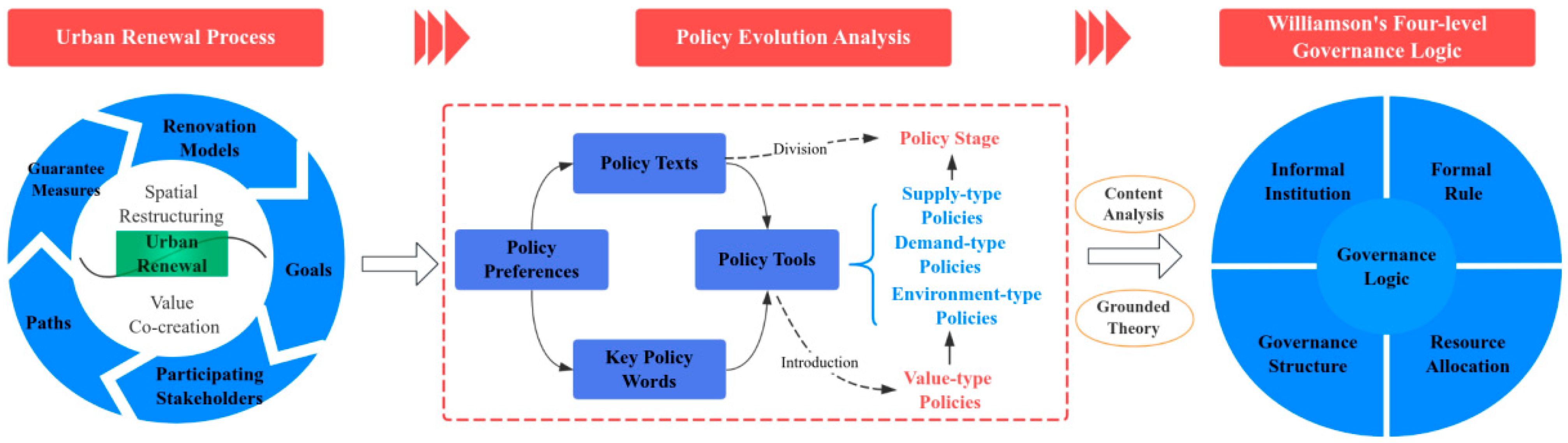
Through statistical analysis of different policy tools, the structural characteristics of local government policy preferences for urban renewal can be effectively understood, but the underlying reasons for these patterns cannot be explained. Therefore, it is necessary to further analyze the governance logic of urban renewal. From an institutional perspective, urban renewal is a systematic urban governance action supported by a policy system in the stage of stock-based development. It has distinct characteristics such as administrative hierarchy, diversified governance, tool diversity, and value orientation, which are highly compatible with Williamson’s four-level analytical framework. Williamson argues that the operation of the social system depends on four levels of support [33]. The first level is the informal and naturally evolving social foundation, including informal institutions such as culture, customs, morality and tradition. The second level is the institutional environment, including the constitution, political system, property rights, fiscal and taxation systems, and other political, economic and legal institutions, that is, the “formal rules of the game”. The third level is the governance structure—the “play of the game” spontaneously chosen by the participants—which promotes interest alignment among parties and the input and output of joint organizational efforts. This includes the trading system, the boundary mechanism between government and the market, the governance mechanism, the financial system, etc. The fourth level is resource allocation, that is, the specific rules governing how resources are used in daily economic activities. Williamson’s four-level theory (informal institutions → formal rules → governance structures → resource allocation) provides a cross-level, systematic analytical framework for urban renewal policy research. Its advantage lies in overcoming the limitations of traditional single-dimensional or static-text approaches and closely linking implicit institutional factors with explicit policy practices. The entire research process is shown in Figure 1.

2.2. Research Methods

Public policy discourse is a key form of information output in the political system, which is recorded, transmitted, and disseminated through policy texts. Therefore, policy texts provide tangible units of analysis for studying the policy discourse system [37]. As an important qualitative research method in modern social sciences, policy text analysis takes policy document texts as its research object and integrates both qualitative and quantitative approaches to more effectively identify the themes, values, and governance logics embedded in policies. Following this logic, high-frequency words, key terms, and pivotal paragraphs in policy texts serve as indicators of the shifting foci and priorities of government decision-makers. Due to the diversity and complexity of urban renewal policies, standardized metadata are not readily available. Therefore, it is necessary to use grounded theory coding methods to scientifically code the themes, contents, and nodes of policy texts, then refine, integrate, and categorize them to form a series of conceptual categories for quantitative analysis of policy evolution and governance logic in urban renewal. The operational operation steps are as follows.
First, we conducted open coding on 50 urban renewal policy texts, and performed secondary coding based on keyword frequencies extracted from the core content of the texts. For example, “30-1” represents the first core keyword in the 30th text. Core keywords such as “people”, “land”, “property rights”, and “standards” were identified, with their respective frequencies and proportions calculated. Second, based on screening, eliminating, and merging duplicate core keywords, we conducted sentence search and expansion to identify diverse initial conceptual codes, forming first-level reference points. Then we performed axial coding on the initial concepts to define multiple categories such as “people-oriented”, “cultural protection”, “rules and regulations”, and “innovative land allocation”, which served as child nodes. Finally, we summarized and condensed the conceptual categories, and classified them into the main categories of “informal institutions”, “formal rules”, “governance structure”, and “resource allocation”, forming parent nodes. Meanwhile, we counted the number of second-level reference points for each main category. This study used NVivo (v11 Plus, QSR International Pty Ltd, Melbourne, Australia) for qualitative data analysis. Taking the identification process of “Formal Rules” as an example: First, using “Planning” as the core keyword, the sentence in the document—“Promote linkage between incremental and stock land use; strengthen the rational control of the total amount and layout of stock construction land through territorial spatial planning; strictly limit urban development within the urban development boundary; and improve the mechanism linking incremental land arrangement with the absorption of stock land”—was coded under “Territorial Spatial Planning”, forming one coding reference point. Second, in the second-level coding process, reference points related to “Planning” were grouped into the child node “Planning Guidance” based on similarity. Finally, in the third-level coding process, system foundations—such as rules and regulations, planning guidance, property rights protection, fiscal and taxation policies, and data infrastructure—that emerged from the second-level coding were consolidated into the parent node “Formal Rules”.

2.3. Research Area and Data Sources

As a vanguard of China’s reform and opening up, Guangzhou has pioneered new approaches for the reuse of inefficient existing land, and has taken the lead in establishing a full-time management agency. To actively promote the implementation of urban renewal, Guangzhou has issued a series of relevant policy documents, which provide rich data and material resources for this study. Based on 50 policy texts related to urban renewal in Guangzhou, this study conducted a qualitative analysis through Nvivo 11 Plus software, aiming to address two research questions: How has Guangzhou’s urban renewal policy evolved? And what characteristics have emerged during this evolution? Through this analysis, we aim to identify the underlying logic of the evolution and development of Guangzhou’s urban renewal policy, and to explore the formation of a more complete policy support system. This will contribute to the optimization and upgrading of Guangzhou’s megacity construction and the gradual reform of China’s land system, and provide valuable insights for the future high-quality development of other cities. Starting from 1978, this study searched for provincial and municipal urban renewal policies on the Peking University Law Treasure website (https://www.pkulaw.com, accessed on 25 January 2026) using the keywords “Guangzhou”, “Three-Old Redevelopment (i.e., redevelopment of old towns, old factories, and old villages)”, and “Urban Renewal”. The search was conducted up to 1 May 2025. In order to avoid omissions, the dataset was subsequently checked and supplemented individually on the websites of the People’s Governments of Guangdong Province and Guangzhou Municipality. Finally, after reviewing all the retrieved policy documents and excluding approvals, announcements, letters, and interpretations, a total of 50 policy texts related to urban renewal in Guangzhou were retained. In addition, the economic and social data of some cases were derived from on-site discussions and in-depth interviews.

3. Results

3.1. Policy Review and Phase Division

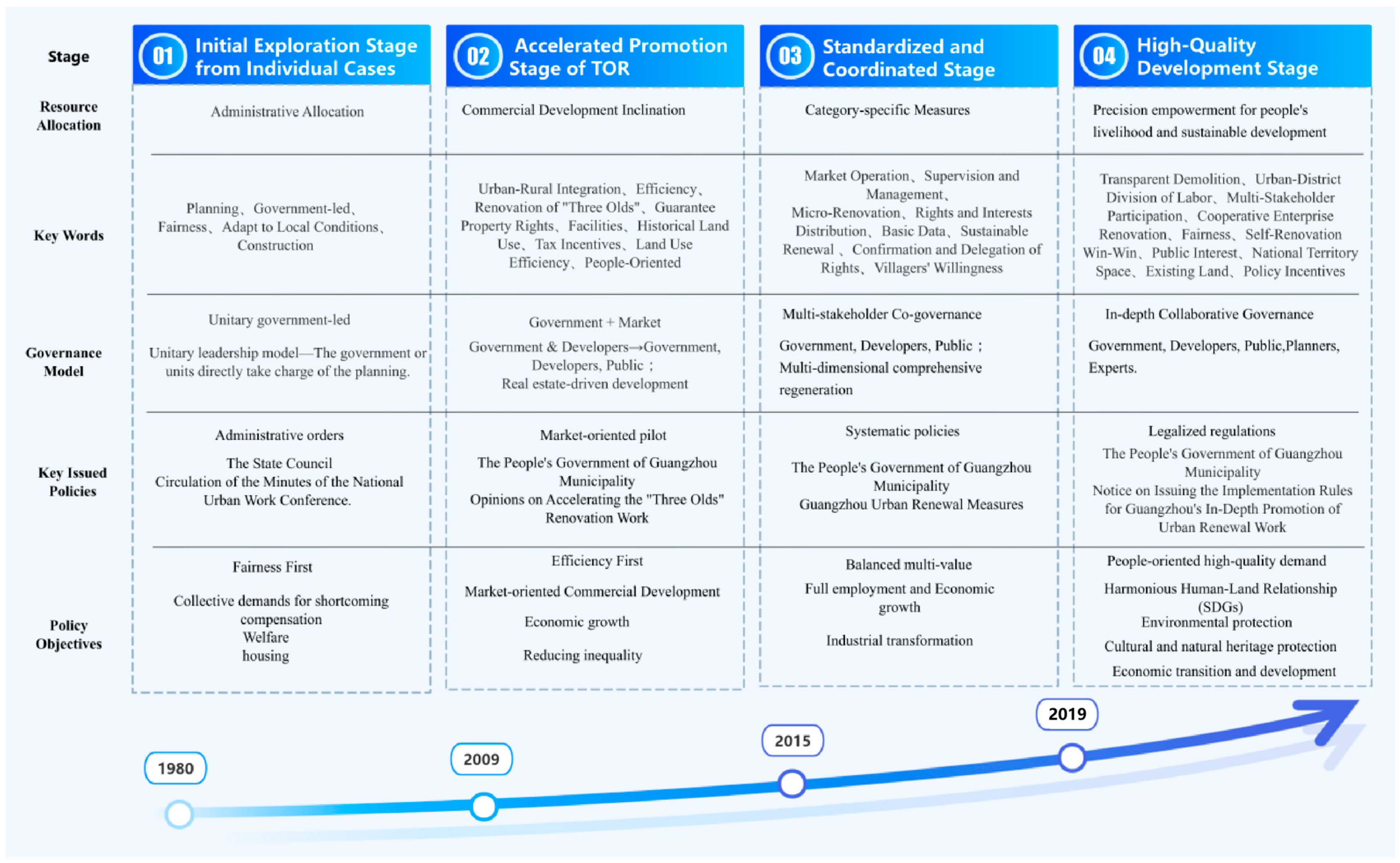
By tracing the development history of urban renewal policies in Guangzhou since the reform and opening up, and identifying key policy nodes at the central and local levels that mark phased divisions, Guangzhou’s local urban renewal policies have gone through four stages: the Initial Exploration Stage (1978–2009), the Accelerated Promotion Stage (2010–2015), the Cooling and Coordination Stage (2016–2019), and the High-Quality Development Stage (2020–present) (Figure 2). In terms of institutional evolution, Guangzhou’s urban renewal policies initially prioritized “efficiency” and “construction” as core goals, with “government-led” instruments—such as planning, property rights, and taxation—serving as the primary drivers. As the scale of urban renewal expanded from “dilapidated housing renovation” to the comprehensive “Three-Old Redevelopment”, the government’s fiscal capacity could no longer sustain the costs alone. In response, urban renewal began to “delegate power and streamline administration”, introducing private sector partners through project-based mechanisms to implement market-oriented operations. This shift enriched renewal models, including cooperative renewal and self-initiated renovation. In recent years, influenced by the concepts of sustainable renewal and high-quality development, large-scale demolition and renovation projects have been halted, and the micro-renovation model has emerged as a dominant approach. Values such as public interest and fairness have been elevated to more prominent positions in policy priorities, and the principle of people-centeredness has increasingly become the primary goal of urban renewal.

3.1.1. The First Stage (1978–2009): The Initial Exploration Stage from Individual Cases

During this stage, the theoretical discussion and policy formulation of urban renewal were still in the exploratory phase of “crossing the river by feeling the stones”. Therefore, only 7.69% of the total policy documents related to Guangzhou’s urban renewal were issued in this stage. In December 1980, the State Council forwarded the Minutes of the National Conference on Urban Planning. The conference pointed out that the construction of many large cities in China suffered from internal planning problems such as unreasonable layout, random location of factories, and serious waste of construction funds and land; severe imbalance between “bones” (infrastructure) and “meat” (supporting facilities), cherry-picking in urban construction, lack of construction of urban housing and service facilities; widespread unauthorized occupation and construction, and disorderly urban appearance. It was necessary to fully leverage the role of urban planning, strengthen government guidance, and accelerate the formulation and improvement of relevant laws and regulations, so as to strictly control the land scale of large cities and promote development through potential tapping, innovation, and transformation. Against this national backdrop, Guangzhou seized the opportunity, took the lead, and initiated the preliminary practice and exploration of old city redevelopment. In 1999, the Guangzhou Municipal Government issued the Implementation Plan for Dilapidated Building Redevelopment in Guangzhou, which focused on individual cases of dilapidated buildings that had fallen into disrepair over the years, and clearly stipulated the objectives, procedures, and operational measures for dilapidated building renovation across the city. On this basis, in 2002, the municipal government issued the Several Opinions on the Redevelopment of “Urban Villages”. The exploration from point to area made Guangzhou’s village-in-city renovation step onto the historical stage. Due to the expansion of scale and a limited fiscal budget, new ideas of introducing social capital to participate in construction emerged, which also laid the foundation for the formal implementation of the subsequent “Three-Old Redevelopment” policy.

3.1.2. The Second Stage (2010–2015): The Accelerated Promotion Stage of Three-Old Redevelopment

This stage marked a critical period for Guangzhou’s urban renewal, as it shifted from scattered pilots to systematic, large-scale implementation. The number of relevant policy texts increased rapidly, accounting for 33.33% of the total. Its core features included systematic policy frameworks, deepened market participation, and diversified renovation fields. A total of 230 redevelopment projects were completed, 120,000 mu (approximately 8000 hectares) of stock land was revitalized, and investment exceeding 300 billion yuan was driven, making Guangzhou a national benchmark case for the “Three-Old Redevelopment”. At the policy level, in response to Guangdong Province’s Several Opinions on Promoting “Three-Old Redevelopment” to Enhance Economical and Intensive Land Use (2008), Guangzhou issued the Guangzhou Urban Renewal Measures and supporting regulations in 2012, establishing an “1 + N” policy system. This system clarified three renovation types (old villages, old factories, old towns), detailed three models (government-led, market-operated, and village collective self-initiated), introduced incentives such as land transfer fee rebates (up to 50%) and tax exemptions (e.g., a three-year property tax exemption), and simplified approval processes (compressing project approval time to within 90 days), providing full-chain institutional guarantees for redevelopment. In terms of market participation, the innovative “cooperative renewal” model helped address fiscal constraints. For old village redevelopment, social capital was introduced to partner with village collectives in joint development. Liede Village, the first national case of whole-village redevelopment, secured 4.6 billion yuan in investment from developers like R&F Properties and KWG Group. After renovation, the village collective assets increased from less than 100 million yuan to 5 billion yuan, with annual per capita dividends for villagers exceeding 100,000 yuan. Old factories were transformed via “self-renovation + policy incentives”. The TIT Creative Park, converted from an old textile factory into a cultural and tech park, attracted Tencent’s WeChat headquarters, with annual output value exceeding 100 billion yuan. Old towns adopted protective renovation combining “demolition, reconstruction, and retention”. The Beijing Road area preserved the historical and cultural style of Qilou (arcade-style buildings), introduced commercial entities like Teemall, and saw annual foot traffic rise to 80 million visits. Additionally, old village renovation expanded from single points to 15 contiguous areas such as Pazhou and Xiancun, establishing a diversified compensation mechanism (on-site reconstruction + monetary compensation + off-site resettlement) to resolve complex property disputes like those in Yangji Village. Old factory renovation promoted the transformation of traditional industries to high-end services, with over 50 old factories being converted into cultural and tech parks citywide. Old town renovation balanced historical preservation and functional upgrading. In the Chen Clan Ancestral Hall area, more than 20 historical buildings were restored, and 30,000 square meters of public space were added. In terms of mechanism innovation, Guangzhou vigorously implemented the decentralization of administrative powers and simplified the approval process for renovation projects. It adhered to the principle of market-oriented operation and mutual benefit for all stakeholders, and created a positive atmosphere through tax and fee reductions and other measures. It also established a dynamic management system for the “Three-Old Redevelopment” project database and introduced third-party evaluation agencies to oversee the renovation process. Special accounts for renovation funds were set up to ensure designated use of reconstruction funds (cumulative supervised funds exceeded 20 billion yuan). It implemented the “Sunshine Relocation” system, which ensured transparency in redevelopment plans and compensation standards, achieving a villager approval rate of over 95%. This stage not only alleviated Guangzhou’s land supply-demand imbalance (the efficiency of economical and intensive land use increased by 28%) but also promoted the transformation of urban functions from “industry-led” to “service-oriented”, laying a solid foundation for subsequent high-quality renewal. Its experience was recognized by the State Council as a national model case for economical and intensive land use.

3.1.3. The Third Stage (2016–2019): The Standardization and Coordination Stage of Urban Renewal

This stage marked a critical period for Guangzhou to shift from rapid renewal to large-scale standardized advancement, centered on “legalization as foundation, coordinated operation, and initial integration of industry and city”. It addressed the issue of fragmented transformation in the early stage. Under the influence of more cautious reflection on the “Three-Old Redevelopment”,, the number of relevant policy documents in this stage slightly decreased to 17.95% of all policy documents. However, policy innovation was notable. The Guangzhou Urban Renewal Measures and three implementing regulations for old villages, old factories, and old towns were issued, forming a “1 + 3” policy system. It emphasized multi-dimensional value rationality requirements such as improving urban functions, enhancing the living environment, upholding social equity, and preserving historical culture. The principles of “government-led, market-operated, overall planning, conservation and intensive use, benefit sharing, fairness and transparency” were proposed, adhering to a holistic perspective and people-oriented approach. The “industry-first” principle was clearly defined for the first time (industrial land shall account for no less than 60% of transformed old factory sites), and a negative list for historical and cultural protection was established. During this period, the Guangzhou Municipal Government launched contiguous transformation of 28 urban villages—a 150% increase year-on-year. Legally based relocation was initiated in Xiancun Village of Tianhe District, and the “compensation before demolition” policy was implemented in Chentian Village of Baiyun District. Meanwhile, 45 old factories were redeveloped: Haizhu TIT Creative Park (converted from a former textile factory) achieved an annual output value exceeding 20 billion yuan, and Panyu 1906 Science and Technology Park attracted cultural and creative industries. In addition, three old residential communities in Yuexiu District underwent contiguous transformation, adding 12,000 square meters of public space and benefiting 5000 households. To further ensure the standardized and legalized implementation of urban renewal, Guangzhou established China’s first dedicated urban renewal authority, the Urban Renewal Bureau, in 2017. It encouraged social capital participation in urban renewal, with social capital accounting for 70% of projects (a 40 percentage point increase). A dual-option compensation of cash and resettlement housing was implemented, with compensation standards increased by 15% and the dispute rate decreased by 25%.

3.1.4. The Fourth Stage (2020–Present): The High-Quality Development Stage of Urban Renewal

Since 2021, Guangzhou’s urban renewal has officially entered a high-quality development stage, marking a qualitative transformation of its renewal model from “scale expansion and demolition-reconstruction-oriented” to “quality improvement and organic renewal”. Policy texts related to urban renewal in this stage account for 41.03% of all the analyzed policy documents. Guided by core principles—including “coordinated retention, renovation, and demolition”, prioritizing people’s livelihoods, preserving cultural heritage, promoting green and low-carbon development, and enabling digital empowerment—this stage aims to address challenges in traditional transformation, such as “large-scale demolition and reconstruction” and “overemphasis on economy over people’s livelihood”, promoting renewal towards refinement, intelligence, and sustainability. In terms of policy innovation, Guangzhou launched the top-level design for high-quality renewal in 2021. In 2022, the Regulations on Urban Renewal of Guangzhou—the first local regulation on urban renewal in Guangdong Province—were officially implemented. It enshrined for the first time “taking retention, utilization, and improvement as the priority” in legislation, explicitly prohibiting large-scale demolition of historical and cultural blocks and requiring that micro-renovation projects account for no less than 80% of total projects. Supporting documents like the Implementation Opinions on High-Quality Development were issued, strengthening mandatory standards including sponge city construction (annual runoff control rate ≥70%), reservation of smart facilities (e.g., 5G/smart property interfaces), and the simultaneous provision of public services (e.g., kindergartens/community hospitals), thus providing legislative guarantees for high-quality renewal. Meanwhile, new models and methods were actively explored. For urban village renovation, Xintian Village in Huangpu District adopted a model of “village collective self-initiated redevelopment + state-owned enterprise cooperation”, which preserved the spatial character of the Lingnan water towns, incorporated smart home apartments and a village history museum, and achieved a 98% villager satisfaction rate. For old residential areas, 15 communities in the Meihuacun Area of Yuexiu District were renovated in a contiguous manner, with smart access control and age-appropriate handrails installed, benefiting 20,000 households. For industrial renewal, Pazhou West District introduced headquarters of ByteDance and Vipshop, with its output value exceeding CNY 120 billion in 2024. For cultural activation, the second phase of Yongqingfang revitalized 150 Qilou (arcade-style houses), introduced 20 intangible cultural heritage workshops, and recorded an annual footfall of over 10 million visitors. Overall, as of 2025, more than 400 micro-renovation projects had been completed, benefiting 150,000 households, with an 85% coverage rate of age-friendly retrofitting. High-end industrial projects accounted for 75%, driving the city’s digital economy output value to exceed 1.2 trillion yuan. Over 300 historical buildings had been revitalized, with the annual footfall in historical districts increasing by 25%. Renovation projects had achieved a 30% energy-saving rate and over 1 million tons of carbon emission reduction. This stage has provided a replicable practical sample for “embroidery-style” high-quality renewal in megacities across China.

3.2. Policy Types and Policy Tool Preferences

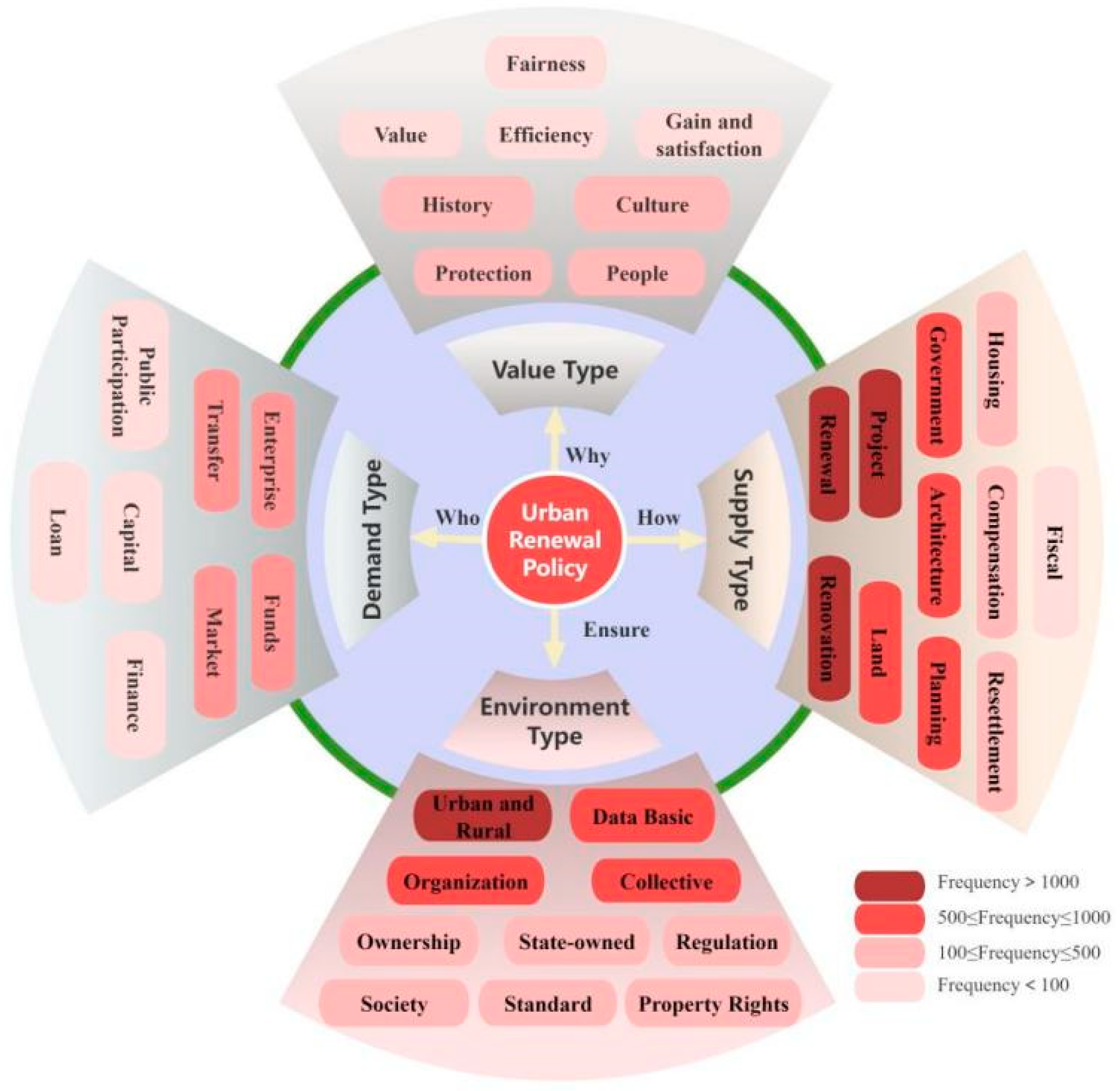
Word frequency is a key indicator in text analysis. Specifically, it refers to the frequency of occurrence of a given term in the entire policy text corpus. The level of word frequency is not only a simple quantitative statistical result but also a quantitative reflection of the internal focus, policy orientation, and issue priorities of policy documents. This quantitative analysis process provides researchers with an effective approach to understanding the underlying structure of policy texts, enabling them to accurately capture the level of attention and discussion devoted to various issues in policy documents based on the distribution characteristics of word frequency data. Using the text query and word frequency analysis functions of NVivo 11 Plus, this study conducted a textual analysis of 50 urban renewal policy documents issued in Guangzhou from 1978 to 2025. Key terms were statistically counted, and policies were further categorized into four dimensions, including value-type, environment-type, supply-type, and demand-type. The results are presented in Figure 3.

3.2.1. Local Governments’ Preferences in the Selection of Policy Tools

Across the four dimensions, keywords related to supply-type policies dominate, accounting for 63.2% of the total frequency proportion. This is followed by environment-oriented policies, which make up 24.5% of the total. In contrast, demand-type and value-type policies account for 6.6% and 5.7%, respectively. These findings indicate that urban renewal policy implementation relies on a multi-dimensional policy system driven primarily by supply-side initiatives, while also prioritizing improvements to the policy implementation environment, supplemented by demand-side stimulation, value embedding, and multi-dimensional guidance. The main reasons for local governments’ preference for supply-type policies are as follows. First, supply-type policy tools can strengthen resource control advantages and governance leadership. As controllers of core resources such as land and capital, local governments can, on one hand, adjust urban spatial structures and promote industrial upgrading and functional replacement through innovative land supply methods. On the other hand, they can coordinate multiple funding channels such as special-purpose bonds, central budgetary investment, and PPP models to provide stable financial support for urban renewal projects. In addition, they can regulate the behavior of market entities through tools such as planning guidance, property rights protection, and fiscal and taxation policies, ensuring that the renewal process aligns with public interests and the long-term development goals of the city. Second, supply-type tools can directly respond to livelihood needs. Projects such as old residential area renovation and infrastructure upgrading have strong public attributes and must rely on government financial investment. By optimizing the allocation of public resources such as education, healthcare, and elderly care through supply-type tools, the government can effectively address structural challenges such as population aging and declining birth rates, and enhance the city’s attractiveness and population-carrying capacity. Third, supply-type policy tools can effectively compensate for imperfect market operation mechanisms. Currently, urban renewal projects generally have the characteristics of long investment cycles and high income uncertainty, resulting in insufficient participation incentives for market entities. Supply-oriented policy tools can reduce market risks through policy guarantees, and incentivize social capital participation in market-oriented projects through measures such as land value-added income returns and tax incentives.

3.2.2. Asymmetry and Key Priorities in the Content of Policy Tools

Four types of policies mutually support and reinforce each other, jointly forming a comprehensive policy system for Guangzhou’s urban renewal that covers resource supply, institutional guarantee, value guidance, and demand activation, providing all-around support for the sustainable advancement of urban renewal. However, from the perspective of frequency distribution, there is a distinct asymmetry and prioritization in the focus areas of Guangzhou’s urban renewal policies.
I. Supply-type Policies: Government-led resource and service provision serves as the decision-making premise for urban renewal. As the core carrier of government-led resource and service provision, supply-type policies highlight the government’s central role in steering renewal direction through top-level planning, as evidenced by the high-frequency keywords “government” (598 occurrences), “planning” (536 occurrences), and “land” (713 occurrences). Terms such as “state-owned” (174 occurrences) and “(land) transfer” (174 occurrences) further confirm that land resources are a key lever for government regulation of urban renewal. Meanwhile, “funds” (178 occurrences) and “finance” (69 occurrences) reflect the foundational support of fiscal investment, while “data” (716 occurrences) and “digital” (40 occurrences) indicate that digital services are emerging as a new supply element enabling smart urban renewal. The high frequency of “building” (460 occurrences) and “housing” (448 occurrences) directly points to the policy’s strong focus on physical space renovation, such as the renovation of old buildings and the improvement of housing quality.
II. Environment-type Policies: Focus on improving institutional norms and rule-based order to foster a favorable implementation environment. Environment-oriented policies construct a stable renewal ecosystem by improving institutional norms, policy incentives, and regulatory governance. For example, the high frequency of “regulation” (266 occurrences), “standard” (157 occurrences), and “system” (48 occurrences) reflects the policy’s emphasis on unified renewal rules (e.g., compensation standards, renovation specifications). Although “tax” (7 occurrences) and “credit” (15 occurrences) appear with relatively low frequency, they signify that policies are exploring market-oriented tools such as tax incentives and credit rewards to stimulate market vitality. Additionally, “policy” (137 occurrences) and “governance” (37 occurrences) reflect the policy’s emphasis on process supervision through mechanisms like “sunshine demolition” to ensure transparency and standardization in renewal processes.
III. Value-type Policies: As a vehicle of a people-centered. multi-dimensional value orientation, their core features lie in prioritizing people’s wellbeing, preserving cultural heritage, and balancing efficiency and equity. The core high-frequency term “people” (230 occurrences), paired with the very high frequencies of “compensation” (391 occurrences) and “resettlement” (354 occurrences), highlights that policies are rooted in protecting public interests to achieve the people’s wellbeing goal of “satisfaction and a sense of gain” (30 occurrences). The high frequency of “culture” (184 occurrences), “history” (216 occurrences), and “protection” (244 occurrences) reflects the policy’s emphasis on protecting historical and cultural heritage, avoiding cultural discontinuities caused by large-scale demolition and construction, and achieving an organic balance between renewal and heritage preservation. The occurrence of “efficiency and equity” (70 occurrences) indicates that policies balance efficiency improvement through market-oriented operations and equitable distribution of interests through collective rights protection in resource allocation.
IV. Demand-type Policies: Market-driven multi-stakeholder demand provides endogenous momentum into urban renewal. The high frequency of “enterprise” (230 occurrences) and “market” (164 occurrences) reflects that policies encourage market entities to participate through models such as “cooperative renovation”, forming a collaborative mechanism of “government + enterprises + collectives”. Terms such as “capital” (22 occurrences), “financial loans” (32 occurrences), “(land) transfer” (174 occurrences), and “circulation” (19 occurrences) indicate that policies activate demand through market-oriented means such as land transfer, capital investment, and financial support.

3.3. Institutional Hierarchies and Evolutionary Process of Urban Renewal

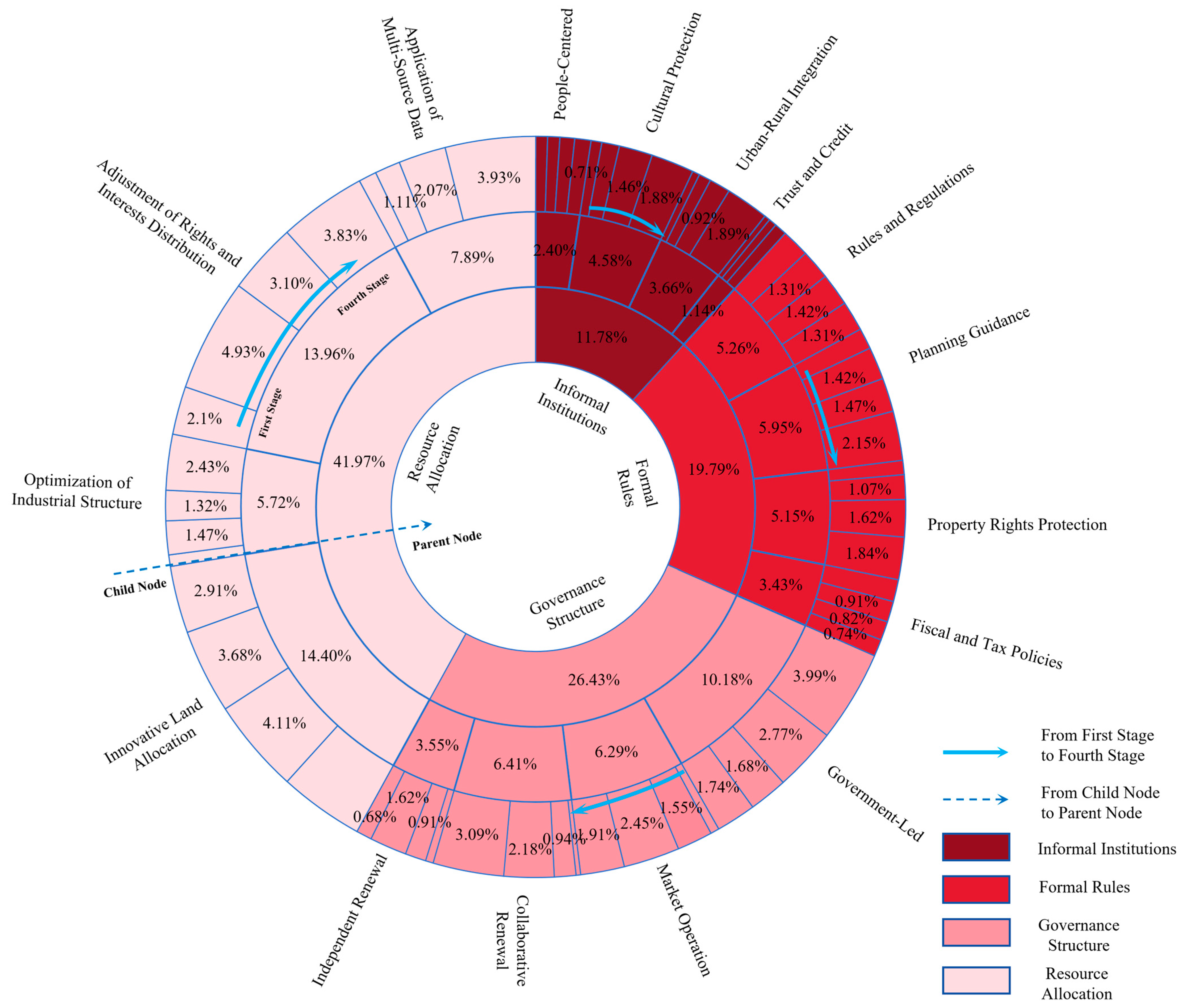
Three-level coding was conducted on 50 urban renewal policy texts of Guangzhou from 1978 to 2025 using NVivo 11 Plus software. Following grounded theory methodology, the coding process of “text coding → child node → parent node” was adopted. Taking the four levels of Williamson’s theory—informal institutions, formal rules, governance structure, and resource allocation—as parent nodes, child nodes were created through coding after refinement and inductive analysis of the collected urban renewal policy texts of Guangzhou. Among them, “child nodes” served as the cornerstone and core basis of coding practice, while “reference points” acted as key tools for counting the coding frequency of each node and data aggregation. Meanwhile, at the child node level, the number of reference points for each of the four stages was counted separately to reflect the changing trends. Eventually, 4 parent nodes, 16 child nodes, and 874 coding reference points were identified and established (see Figure 4).
  • Urban renewal policies exhibit a pyramid structure characterized by resource allocation at the core, governance structure and formal rules as the pillars, and informal institutions as the guiding force. First, the Resource Allocation Level, accounting for the highest proportion (41.99%), serves as the core of urban renewal policies. The Governance Structure Level, ranking second with a 26.43% share, reflects the emphasis placed on renewal implementation mechanisms. The Formal Rules Level, making up 19.79% of the total, provides the institutional framework for urban renewal. The Informal Institutions Level, accounting for 11.78%, reflects the value orientation of urban renewal policies. This hierarchical proportion structure not only reflects the practical urgency of optimizing resource allocation and governance structures in current urban renewal, but also embodies the long-term goal of pursuing sound formal rules and informal institutions. It is a concrete manifestation at the policy level of China’s shift in urban development from “high-speed development” to “high-quality development”.
  • Guangzhou’s urban renewal is distinctly characterized by resource dependence and proactive government involvement. From an internal structure perspective, “innovative land allocation” (14.4%) is the most prominent sub-node in the resource allocation level, serving as the policy core for local governments to address space constraints. This reflects the central role of “land supply-side reform” in urban renewal, which aligns with Guangzhou’s development philosophy: as urban construction land approaches its limit, the city has shifted from “incremental expansion” to “stock quality improvement”. “Benefit distribution adjustment” (13.96%) is key to resolving conflicts and advancing project implementation. Urban renewal involves multiple stakeholders, including governments, developers, and original residents, and improving benefit distribution mechanisms directly determines the social acceptance of renewal projects. “Government leadership” (10.18%) remains the foundation of the current governance structure, reflecting the public attributes of urban renewal (e.g., public space creation and infrastructure upgrading). Governments still play a leading role in planning coordination, policy formulation, and public service provision. “Collaborative renewal” (6.41%) and “market operation” (6.29%) appear with similar frequencies, reflecting the growing role of market and social forces. A “government—market—society” tripartite governance structure has gradually taken shape. This reflects the transformation of governance models from “single-government leadership” to “multi-stakeholder collaboration”.
  • Sound property rights rules and the embedding of justice values are important guarantees for promoting sustainable urban renewal. Higher-level laws, such as the Urban Renewal Regulations have established the basic institutional framework for urban renewal. Sub-nodes such as “rules and regulations” (5.26%) and “planning guidance” (5.95%) are mainly refinements of higher-level laws and local innovations. “Property rights protection” (5.15%) is the core of the formal rules level. Urban renewal involves a large number of property rights adjustments (e.g., house expropriation, collective construction land entering the market), and clarifying property rights is a prerequisite for advancing renewal. “Cultural protection” (4.58%) is the most prominent sub-node in the informal institutions level, reflecting concern about the problem of “hundreds of cities looking the same”. “Urban-rural integration” (3.66%) reflects the impact of the rural revitalization strategy on urban renewal. Urban renewal is no longer limited to easily accessible “central” areas but extends to areas with urgent livelihood needs such as “three old areas” and “urban villages”, promoting equalization of public services across urban and rural areas. “People-centered”, as the fundamental value orientation of policies, runs through all levels of policies. For example, “benefit redistribution”, “social security guarantees for demolition”, and “maintenance of living standards” all center on people’s livelihood needs. On the whole, although the Informal Institutions Level has the smallest share, it reflects the inevitable trend of urban renewal shifting from “physical space renewal” to “social and cultural space renewal”.
  • From the perspective of the evolutionary characteristics of the four-level policy framework, informal institutions increased from 1.31% in the first stage to 5.02% in the fourth stage, governance structures rose from 4.91% in the first stage to 7.42%, and digital and intelligent governance grew from 0.78% to 3.93% in the fourth stage. This reflects that the focus of Guangzhou’s urban renewal transformation has shifted from “physical space renewal” to “social governance renewal”, and that the governance model has evolved from “single-government-led” to “multi-stakeholder collaboration”. Meanwhile, in addition to traditional planning and fiscal policies, innovative tools such as multi-source data applications and credit and trust mechanisms continue to emerge, indicating that the policy system has shifted from “fragmented” to “systematic”.

4. Governance Logic and Ideal Normative Pathways for Urban Renewal

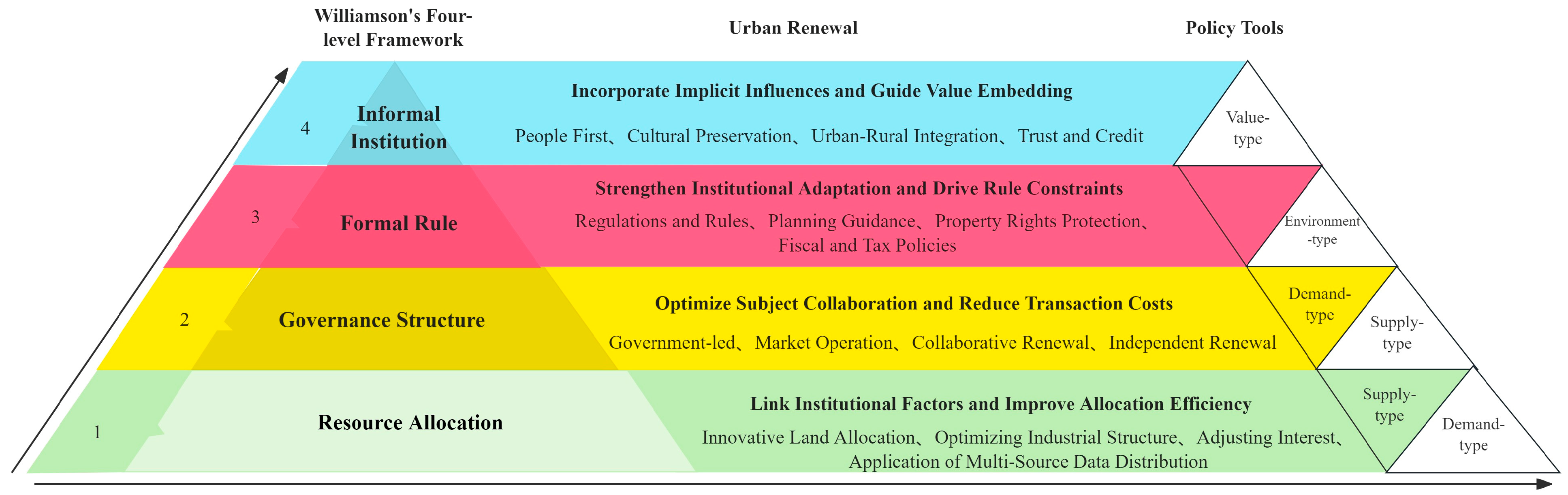
Urban renewal is a public governance process in urban and rural areas driven by spatial restructuring and value co-creation. Its governance logic follows Williamson’s four-level analytical framework, with “people-centered city” and “cultural heritage preservation” as core value orientations. The essence of its policy lies in embedding value goals, promoting policy supply, improving governance structures, and optimizing resource allocation to break the path dependence of traditional models characterized by “large-scale demolition and construction, single-government leadership, and short-term results”. It aims to establish a long-term governance system featuring “multi-stakeholder collaboration, whole-lifecycle operation, and value balance”, transforming institutional norms from rigid constraints of formal rules to flexible guidance of informal systems. Ultimately, it pursues the sustainable goal of spatial value reconstruction and the symbiosis of social vitality (Figure 5). This is not only a concrete implementation of the “five shifts and five emphases” concept proposed at the Central Urban Work Conference, but also a core manifestation of China’s urban transition from “high-speed development” to “high-quality development” in both policy and practice.

4.1. Informal Institutions: Incorporating Implicit Influences and Guiding Value Embedding

The value embedding in China’s urban renewal is embodied in the core development philosophy of “People’s cities are built by the people and for the people”. This philosophy emphasizes that urban renewal must adhere to a people-centered approach, comprehensively enhancing people’s sense of gain, happiness, and security. To this end, it is necessary to integrate the implicit influences of informal institutions such as cultural customs, public interests, and value identity into policy frameworks. The informal institutions in Guangzhou’s urban renewal policies manifest as implicit norms in society—such as unwritten values, cultural traditions, and trust mechanisms—and serve as the deep-seated basis for the design of these policies. Urban renewal policies at the informal institution level essentially aim to return urban renewal to the core values of “people-oriented, culture as the soul, integration as the priority, and trust as the bridge”—ensuring both the social acceptance of policies and the sustainable development of cities. These logics are not only the basis for policy design but also the embodiment of the “human touch” (people-centric care) and “depth” (long-term cultural and social sustainability) of urban renewal.

4.1.1. People First: A Value Anchor Centered on Residents’ Needs

The core of a city is its people. Cities are places where people live in concentration. Urban construction must prioritize making cities livable and comfortable for the people, reserving the best resources for them. The value of “people as the foundation of the state” in informal institutions dictates that urban renewal should not become an “image project” but must take residents’ genuine needs as its starting point. From policy formulation to implementation, residents’ rights to information, participation, and oversight are integrated throughout the entire renewal process. The “people first” orientation enhances residents’ recognition of and cooperation with the policy, reduces implementation resistance, allows residents to become beneficiaries and participants in the renewal, and ensures the sustainability of policy implementation. In the renovation of old communities in Hongqiao Street, Yuexiu District, Guangzhou, residents’ opinions were actively sought during the policy design phase, and a “Menu-Based” renovation model was implemented—i.e., “whether to renovate”, “what to renovate”, and “how to renovate”—with residents’ opinions solicited. The Housing and Urban-Rural Development Department provided residents with a diversified renovation “menu” to choose from. During the renovation process, a problem-oriented approach was adopted to respond to public concerns and expectations. Throughout the renewal process, resident councils were held. Neighborhood residents and design firms were organized to participate in autonomous councils for old community renovation. Designers explained the purpose of the renovation to residents, truly understood their real needs for community renovation services, collected their suggestions and opinions, and integrated them into the renovation plan. As mentioned by an interviewee during fieldwork: “Originally, the street park only had stairs. Disabled people and elderly people in wheelchairs couldn’t get up there. Later, residents made suggestions for modifications. After renovation, barrier-free facilities were added, and ramps were installed, so wheelchairs can now enter and exit easily.” This is the most tangible embodiment of placing the interests of ordinary people at the center.

4.1.2. Cultural Preservation: The Implicit Constraint Guarding the Soul of the City

Guangzhou is a national historical and cultural city and the cradle of Lingnan culture, boasting abundant historical and cultural resources. How to balance construction and demolition, new and old, development and preservation has always been an unavoidable key issue in urban renewal. Cultural inheritance in informal institutions is the root of a city’s uniqueness. Urban renewal should avoid the “one-size-fits-all” homogenization of cities. It should preserve cultural carriers such as historical blocks, traditional buildings, and folk activities to sustain urban memory. Urban renewal should attach great importance to historical and cultural preservation and emphasize the inheritance of civilization and continuity of culture, so that cities retain their memories and people hold onto their nostalgia. Cultural preservation can enhance residents’ sense of belonging and cultural confidence, while also translating into economic value. In its urban renewal, Guangzhou persists in using “embroidery-like craftsmanship” to promote micro-renovation, creating exemplary projects that integrate urban renewal and cultural inheritance, such as Yongqing Fang and Beijing Road. These projects not only effectively improve the living environment of the blocks but also well preserve the city’s historical and cultural memory. In recent years, Guangzhou has paid increasing attention to historical and cultural preservation in promoting urban renewal. For example, the Guangzhou Urban Renewal Special Plan (2021–2035) clarifies the positive and negative lists for renewal projects. In principle, projects that do not comply with the “three zones and three lines”, historical and cultural preservation, or overall urban environmental planning are excluded from full-scale reconstruction. The Measures for the Activation and Utilization of Existing Buildings in Old Residential Areas of Guangzhou explores activating existing buildings based on old communities’ resource endowments, avoiding large-scale demolition while protecting historical relics. The Interdepartmental Collaboration Mechanism for Old Residential Area Renovation in Guangzhou breaks down departmental/regional barriers to solve cross-regional relic-related issues (e.g., poor communication, insufficient collaboration), promoting relic preservation and activation.

4.1.3. Urban–Rural Integration: Breaking the Hidden Bonds of the Dual Structure

Guangzhou is a typical city with villages embedded within its urban areas. As of 2023, there were still 272 urban villages in total. It is clearly unrealistic to completely eliminate urban villages. Therefore, “breaking the urban–rural dual structure and realizing urban-rural coexistence and mutual prosperity” is an inevitable choice for Guangzhou’s sustainable development. The concept of “urban–rural symbiosis” in informal institutions requires that urban renewal should not be limited to large-scale demolition and construction, nor should it lead to homogenized development of “leveling peaks and filling valleys”. Instead, it should break hidden bonds, allowing urban and rural areas to leverage their respective strengths and achieve complementary coexistence. In terms of policies, this integrated development is manifested in eliminating identity barriers, breaking the urban-rural differences in household registration and public services, and enabling urban and rural residents to share equal development opportunities. It promotes culturally inclusive development, preserves rural cultural genes, integrates modern urban elements, and avoids labeled opposition between urban and rural areas. It balances the interests of different groups, avoids resource inclination towards a minority, and promotes the equalization and fairness of urban-rural public services. To this end, Guangzhou’s urban renewal policies also attach great importance to the interconnection of urban and rural infrastructure and industrial collaborative development. At the same time, the old renovation policy clearly states that “demolition compensation shall not be lower than the market appraisal price”, and provides resettlement housing for low-income families to prevent “poverty caused by demolition”. In the renovation of old communities, barrier-free facilities are prioritized to protect the rights and interests of vulnerable groups, ensuring that the benefits of renewal reach all residents.

4.1.4. Trust and Credit: The Social Foundation for Reducing Collaboration Costs

Trust and credit values are the “soft infrastructure” that determines project success or failure and social sustainability. They go beyond physical space transformation and reach the core of governance. Trust is a psychological bond that reduces uncertainty and facilitates cooperation, thereby improving policy implementation efficiency and lowers transaction costs. Credit is the institutionalized and tradable form of trust; it converts social capital into an operable contractual tool. The trust mechanism in informal institutions is a prerequisite for multi-party collaboration, which can be specifically decomposed into institutional trust, actor trust, and process trust. In specific policy texts, Guangzhou’s urban renewal embeds trust values by clarifying institutional rules, refining project processes, establishing transparent deliberation procedures, and strengthening commitment fulfillment. Some successful old village renovations in Guangzhou are often built on interpersonal trust formed through long-term cooperation between village collectives and specific developers. Meanwhile, credit records and access evaluation systems for “cooperative enterprises” have been established (e.g., Guangzhou’s selection mechanism for enterprises participating in old village cooperative renovation). In models like “housing voucher resettlement” and property rights exchange, the securitization and circulation of residents’ future income rights are essentially based on expectations of future urban development credit. The implementation of Guangzhou’s “Sunshine Demolition” showed that the project originally expected to take 18 months was completed 3 months ahead of schedule. This was because enterprises promised “no cutting corners”, clearly disclosed the source and use of renovation funds, and residents actively participated in supervision.

4.2. Formal Rules: Strengthen Institutional Adaptation and Drive Rule Constraints

Through a dynamic adaptive analysis of regional institutional environments and formal policy texts, this study links formal rules (e.g., property rights policies, compensation regulations) with informal institutions, and explores how policies can be adjusted to better fit local contexts. Formal rules form the rigid framework of urban renewal policies. In essence, they rely on the mutual support of four core dimensions—“institutions regulating behaviors, planning anchoring directions, property rights stabilizing expectations, and fiscal-tax policies leveraging capital”—to build a complete system of “rule standardization, spatial coordination, rights protection, and financial support”. This ensures that the renewal process not only aligns with public interests but also stimulates market vitality, ultimately contributing to sustainable urban development.

4.2.1. Regulations and Rules: Establishing Clear Responsibility-Oriented Codes of Conduct

Through legislative and policy system construction, urban renewal work is made law-based, uncertainty is reduced, multi-stakeholder interest conflicts are resolved, urban renewal is promoted from being experience-driven to system-driven, ensuring that the work is standardized, efficient and sustainable. In the process of urban renewal in Guangzhou, China’s first local regulation on urban village reconstruction, the Regulations on Urban Village Reconstruction of Guangzhou, was issued, introducing the mechanism of “law-based expropriation and clean land transfer”. The “1 + N + X” policy system was established, and more than 40 supporting documents have been issued, covering key links such as reconstruction procedures, actor selection, and cost management. Full-process policy coverage avoids fragmented management and improves execution efficiency. For dilapidated building reconstruction, the Measures for the Implementation of Urban Dilapidated Building Reconstruction in Guangzhou was issued, filling the gap in the field of demolition and reconstruction of multi-owner buildings and providing full-process guidance for “demolition and reconstruction on the original site”. Meanwhile, in terms of organizational guarantee, Guangzhou established an Urban Village Reconstruction and Construction Command Headquarters, with the Secretary of the Municipal Party Committee as the chief commander, implementing the “Headquarters + Company” mechanism. Xiancun Village in Tianhe District carried out full-chain law-based relocation through “administrative handling—judicial litigation—compulsory execution”, ensuring the legality and social stability of project promotion and solving the 15-year demolition and relocation problem. In addition, in the policy texts, the number of keywords related to “regulations”, “standards”, “law-based”, and “systems” reaches 608, indicating that regulations and rules are increasingly valued in promoting urban renewal.

4.2.2. Planning Guidance: Achieving Systematically Coordinated Spatial Optimization

Address the dilemma of fragmented renewal through integrated planning, shift from “project-oriented” to “district-level coordination”, balance short-term needs with long-term sustainable development, and anchor the goals of “livable, resilient, and smart”. In terms of the top-level planning system, systematic planning covers the full spatial scale to promote functional synergy. Guided by the strategy of “strictly control total volume, activate stock resources, implement precise regulation, and improve quality and efficiency”, urban renewal is integrated into the “one map” of territorial spatial planning to drive sustainable urban development. The Guangzhou Urban Renewal Special Plan (2021–2035) and the Guangzhou Urban Village Redevelopment Special Plan (2021–2035) were successively formulated and issued, which propose reconstruction scopes and goals, and strictly define reconstruction uses and phased implementation. Implement the district-level coordination concept to solve the profitability challenges of single projects and improve resource allocation efficiency. Promote the “cross-project adjustment” mechanism, allowing high-yield projects to subsidize low-yield ones to achieve resource complementarity and interest balance in the district. Adhere to a problem-oriented approach to build a four-level (municipal, district, sub-district/town, and community) urban health check indicator system with 148 items, following the principle of “health check first, then renewal”. Panyuanyue in Liwan District has preserved its Qing Dynasty village layout, maintaining the city’s uniqueness, and achieving the integration of culture, tourism, commerce, innovation, and living, which is consistent with the concept of sustainable development.

4.2.3. Property Rights Protection: Core Support for Stable Expectations

Stable property rights are a prerequisite for capital investment. Clear rules property ownership and transfer help stimulate the willingness of market actors and the public to participate, protect the legitimate rights and interests of residents, and eliminate investment risks caused by ambiguous property rights. Guangzhou’s property rights protection in urban renewal covers three aspects. First, promote the circulation of property rights. Through the identity transformation from “farmers” to “residents”, village collective economic organizations are encouraged and guided to convert collective land property rights to state-owned ones, so as to enhance the consistency and stability of subsequent renewal and reconstruction. Second, standardize property rights definition to reduce potential obstacles to subsequent renewal. For complex land ownership issues involving fragmented plots with multiple right holders, integrated consolidation is carried out for contiguous development. Measures such as acquisition and consolidation, valuation for equity participation, and interest transfer are adopted to ensure efficient implementation of renovation projects. Third, liberalize the use rights or management rights of land and special buildings (such as historical relics). Implement property rights segmentation, conduct real estate registration on a district-by-district and floor-by-floor basis, and introduce social capital to actively participate in urban renewal. Under these property rights regulations, in 2023, the average signing rate of Guangzhou’s old renovation projects reached over 95%, and the amount of enterprise investment in old renovation increased by 30% year on year. Clear property rights protection makes residents willing to cooperate and enterprises confident to invest.

4.2.4. Fiscal and Tax Policies: Key Tools to Break Through Funding Constraints

Guangzhou’s fiscal and tax policies for urban renewal have established a three-dimensional support system of “targeted tax incentives + financial subsidies + multi-source fund coordination”. Through tools such as financial subsidies, tax reductions and exemptions, and special bonds, the cost of renewal projects is reduced, helping to revitalize the old city. In terms of taxation, full-chain coverage of projects has been achieved. In the early stage, tax incentives are used to lower the start-up costs for enterprises, such as feasibility studies. During the land expropriation and transfer phase, policies on land appreciation tax and deed tax are optimized to facilitate clean land transfer and clear property rights. In the construction phase, VAT exemptions and deductions are allowed to improve enterprises’ capital turnover efficiency. In the delivery and operation phase, property tax policies are adjusted to encourage rapid project operation. For financial subsidies, Guangzhou municipal finance provides a certain proportion of fund matching for old residential area renovation projects in various districts. For basic renovation projects (e.g., pipe network renewal, security facilities, fire protection renovation), government fiscal input usually accounts for 70–80%. For improved renovation projects (e.g., elevator installation, parking space addition, community greening), government fiscal input accounts for about 50–60%. For enhanced renovation projects (e.g., smart communities, elderly care service centers, cultural facilities), government fiscal input drops to 30–40%. Meanwhile, Guangzhou has received leading national special loan support in the field of urban village reconstruction, with a cumulative credit line of 409.6 billion yuan, providing low-cost and long-term funding guarantees for project implementation. In terms of effect, fiscal and tax preferential policies have significantly leveraged market capital to enter the urban renewal field and promoted economic growth.

4.3. Governance Structure: Optimize Subject Collaboration and Reduce Transaction Costs

Urban renewal involves multiple stakeholders, including government, enterprises, and communities. Relying on transaction cost-oriented structural selection criteria, it improves key governance foundations such as land property rights and basic data to select the optimal governance structure. Guangzhou’s urban renewal policy features a diversified, composite governance structure of “government leadership + market participation + resident autonomy”. It not only coordinates public service support facilities through a hierarchical system (Municipal Urban Renewal Leading Group), but also leverages social capital via mixed governance (government-enterprise-bank platform), and addresses the “market failure” issue in micro-projects through independent transformation (resident participation). This governance structure not only safeguards public interests and cultural inheritance, but also stimulates market vitality and resident participation.

4.3.1. Government-Led: Top-Level Coordination Anchored in Public Interest

Urban renewal involves non-profit core objectives such as the inheritance of historical culture and public facility support. Through top-level government design, market failures are avoided to achieve the maximization of public interest and urban sustainable development. Assets like land and public facilities exhibit high asset specificity, requiring a government-led (hierarchical system) guarantee of public interest. The government-led governance structure refers to the government completing the overall transformation of land parcels—including merger, function conversion, increased utilization intensity, and mixed use—by recovering land rights. To this end, in implementing urban renewal projects, Guangzhou has established a leading group and regularly promotes various urban renewal projects, covering 43 urban villages, 20 old factories, 7 historical and cultural blocks, anchoring the direction of public interest. In the early stage, government-led urban renewal mainly relied on administrative power to push forward in a top-down manner; however, as the scale expanded and funds involved grew enormous, pressure on the vitality and sustainability of renewal projects increased, gradually evolving into a government-guided and multi-participatory model. In the Opinions on Accelerating the “Three Olds” Transformation Work, the Guangzhou Municipal Government follows the principle of government leadership and market participation, shifting the renewal model from “project-oriented” to “district-level coordination”. It integrates industrial, transportation, and public service resources with functional districts as units, and through “cross-project floor area ratio adjustment”, high-yield projects feed back the micro-transformation of old residential areas. In subsequent policies, more attention has been paid to the structures of cooperative renewal and independent renewal. The text coverage rate has risen rapidly, the total coding coverage rate of the governance structure has increased to 6.98%, and a multi-governance structure has basically taken shape. The micro-renovation project of the old residential area on Xingang West Road adopts the model of “government leadership + resident participation + enterprise construction”. Through facade renovation, waterproof and thermal insulation layer repair, and public facility upgrading (including children’s playgrounds, rest pavilions, etc.), it benefits more than 300 households.

4.3.2. Market Operation: A Dynamic Engine for Leveraging Social Capital

The core of market operation in Guangzhou’s urban renewal is to build a multi-stakeholder collaborative ecosystem through government-led platforms. With policy guidance as the framework, financial innovation as the link, and project matrix as the carrier, it activates the endogenous motivation of social capital to participate in urban renewal. In terms of financial empowerment, Guangzhou has established a docking platform featuring “government-led platform, financial empowerment, and enterprise participation”. It established a negotiation sub-venue at the Urban Renewal Conference to encourage financial institutions to provide customized solutions based on the needs of different projects. Redevelopment loans for urban village renovation ease upfront capital pressure, the revitalization of historic and cultural districts attracts cultural tourism industry funds, and infrastructure upgrades explore exit channels through publicly offered REITs, addressing the pain points of capital “entering and exiting smoothly”. For instance, financial institutions have provided diversified credit support for projects such as Yaotai Village Redevelopment and Julongwan Area Startup Zone, offering social capital a clear path to returns. At the project portfolio level, the scale effect of urban village renovation attracts participation from large real estate developers (e.g., the signing for Yaotai Village renovation in Yuexiu District). The “industrial rejuvenation” model for old factories draws industrial capital from companies like Tencent (e.g., the TIT Creative Park). The “historic architecture + new consumption” approach for historic and cultural districts attracts investments from cultural tourism capital (e.g., the Changzhou Island revitalization project). This creates a pool of investment targets catering to different risk appetites. Overall, the market operation mechanism not only leverages over 800 billion yuan of social capital into the urban renewal field but also, through multi-stakeholder collaboration, turns projects from “blueprints” into “construction plans”. It not only eases the government’s financial pressure but also enables capital to obtain reasonable returns, while ensuring public welfare goals such as public facility supporting and historical and cultural inheritance. Thus, it has become a Guangzhou model for balancing market vitality and public value in the stock quality improvement of megacities.

4.3.3. Collaborative Renewal: A Win–Win Synergistic Governance Model

Collaborative renewal refers to integrating resources from governments, enterprises, financial institutions, planning experts, residents, and other stakeholders to achieve risk sharing, benefit sharing, and technology integration, thereby enhancing project feasibility and social acceptance.
This process is uniformly organized by the government, which formulates special policies and builds data-sharing and transaction platforms. Village collective economic organizations, based on approved project implementation plans and formulated demolition compensation and resettlement plans, introduce development enterprises to participate in the renewal through either public resource trading center tendering or public land transfer. Professional planners are also commissioned for design work. The land value-added benefits from urban renewal are shared among original land right holders, developers, and the government. The government and original land use right holders transfer part of the land use rights or management rights in exchange for enterprises’ capital investment and services, which fully mobilizes the enthusiasm of the government, collectives, original land use right holders, and relevant rights holders, attracts extensive participation from all sectors of society, achieves win-win outcomes for all parties, and ensures the preservation and appreciation of state-owned and collective assets. Collaborative renewal has become a key governance structure promoted in the subsequent stages of Guangzhou’s urban renewal process. Its proportion in governance structures has continued to rise, ranking first to date with a share of 3.59%. During the implementation of the micro-renovation project of Yongqingfang in Guangzhou, multiple roles including governments, enterprises, residents, professional institutions, and social organizations were involved. The city’s first Co-creation Committee for historical and cultural blocks was established, which collected over 100 opinions through home visits, adopted 78 suggestions from the public and 31 expert recommendations, and formed a micro-renovation plan of “repair the old as old, build the new as before”. Eventually, 470,000 square meters of renovation was completed, benefiting 150,000 people, preserving the Lingnan cultural context, improving the living environment, creating more than 1300 new jobs, and becoming a new cultural and tourism landmark.

4.3.4. Independent Renewal: Resident-Led Micro-Renewal Practices

For “micro-projects” such as single dilapidated buildings and small old residential communities, the market is unwilling to participate due to limited profit margins. Thus, it is necessary to stimulate residents’ sense of ownership to solve the problem of “market failure”. In accordance with the “who benefits, who pays” principle, Guangzhou’s urban renewal policies have gradually allowed the enhancement of project value by adding public service facilities. Early independent renewal refers to allowing village collective economic organizations to carry out self-upgrading and transformation of low-efficiency idle stock land such as old factories and old shops, on the basis of complying with planning and land use policies and obtaining the consent of more than 80% of organizational members. After 2015, the Guangzhou Urban Renewal Measures began to encourage residents within the scope of community micro-renovation to participate in social micro-renovation through independent and joint investment. The emergence of this more flexible structure not only makes up for the defects of government-led urban renewal, such as excessive administrative costs and difficulty in adapting to local conditions, but also addresses the drawbacks of cooperative renewal mode where enterprises sacrifice public interests and ignore residents’ own demands under the benefit-first standard. Residents who are familiar with regional endowments participating in renewal and transformation helps to fully mobilize various stock resources in the region and deepen the low-profit sustainability and cost-sharing mechanism. However, due to limited policy incentives and difficulty in implementation of renovation, the independent renewal mode has always accounted for a small proportion in the governance structure. Nevertheless, some cases have achieved notable results. For instance, the eight projects in Yuexiu District, including Deshenggang and Yingyuan Road, with a total investment of 1.8 billion yuan, have explored pathways for the contiguous redevelopment of old and dangerous buildings in central urban areas. After redevelopment, the property values increased by 1.6 times, and the projects were included in the Ministry of Housing and Urban-Rural Development’s national list of replicable experiences. Additionally, the Class D dangerous building project at No. 2 Jiquan Street in Huadu District, with a total investment of approximately 8 million yuan and resident contributions of 8.7 million yuan, saw property values increase by 1.6 times after in situ reconstruction. This project has also been promoted as a national exemplary case.

4.4. Resource Allocation: Link Institutional Factors and Improve Allocation Efficiency

Focusing on an institutional-economic composite analysis, this study connects resource allocation with the institutional factors of the previous three layers, and seeks to achieve a balance between equity and efficiency through optimized resource distribution. The resource allocation in urban renewal is the direct manifestation of the monetization of renewal value. Its logic centers on stock optimization to alleviate land constraints in megacities. Through mixed land use to activate underutilized spaces, industrial relocation and restructuring to drive high-end transformation, interest sharing to balance the interests of multiple stakeholders, and data-enabled precise policy-making, it achieves the unity of efficiency and fairness, development and people’s livelihood.

4.4.1. Innovative Land Allocation: Breaking the Inefficient Use Dilemma of Existing Land

Guangzhou’s land development intensity has approached the international warning line (reaching 25% in 2023), with inefficient land accounting for over 30% of the city’s total area, facing dual issues of “spatial mismatch” and “underutilization”. Through institutional innovation in urban renewal, the value of existing land is activated, balancing “development benefits” and “public interests” to shift land resource utilization from “incremental expansion” to “stock optimization”. On one hand, the strategy of mixed land use and functional replacement is implemented, breaking the restriction of single land use type. Old factories and villages are permitted to adjust their uses through conversions such as “industrial to commercial”, “industrial to residential”, and “residential to commercial”, while being required to provide public service facilities. For example, the Measures for the Renewal of Old Factories in Guangzhou specifies that old factories transformed into sci-tech innovation parks can include no more than 30% commercial supporting facilities. If transformed into talent apartments, the compatible ratio can be increased to 50%. The Guangdan Area in Tianhe District, once an old industrial zone, was converted from 120 hectares of industrial land into a production-city integration demonstration zone integrating high-end manufacturing, commercial office, and residential communities through the “mixed industrial land use” policy. After transformation, the area has introduced over 200 enterprises with an annual output value exceeding 50 billion yuan, while building 3 schools, 2 parks, and 100,000 square meters of public service facilities. On the other hand, Guangzhou implements strategies for floor area ratio (FAR) incentives and three-dimensional spatial development. Projects that proactively provide public facilities are granted FAR incentives (up to 20% above the base FAR), encouraging developers to undertake social responsibilities. Meanwhile, “stratified confirmation of underground space rights” is promoted, allowing independent transfer and assignment of underground space to improve the efficiency of three-dimensional land use. In the transformation of the Hanxi-Changlong Area in Panyu District, the developer built a 100,000-square-meter urban park and received a 15% FAR reward, adding 30,000 square meters of residential area. The underground space was developed into two floors of parking lots (providing 1200 parking spaces) and one floor of commercial blocks, while the ground space was used to construct an open square, realizing the “integrated use of above-ground and underground spaces”.

4.4.2. Optimizing Industrial Structure: Driving High-Quality Economic Transformation

Traditional industries in Guangzhou (such as textiles, chemicals, and wholesale and retail) account for over 40% of its industrial composition, facing the risk of “low-end lock-in”. Meanwhile, there is a shortage of land for sci-tech innovation industries, and the outflow of high-end talents is severe. Through urban renewal to free up industrial space, Guangzhou guides industries to transform towards “high-end, intelligent, and green” directions, and builds a virtuous cycle of “industry-driven urban development and city-supported industrial growth”. First, the “industrial protection red line” has been established. The proportion of industrial land in the transformation of old industrial zones should not be less than 60%, and blind commercial development in the form of “phasing out secondary industries and developing tertiary industries” has been prohibited. Prioritize guaranteeing land demand for advanced manufacturing (such as intelligent equipment, biomedicine) and strategic emerging industries (such as artificial intelligence, digital economy). Pazhou West District in Haizhu District was originally a traditional industrial zone; via the “industry-first” policy, it was transformed into a digital economy industrial cluster. The district has introduced over 20 leading enterprises including Tencent, Alibaba, and Vipshop, with a total investment exceeding 100 billion yuan. In 2023, its digital economy output value surpassed 80 billion yuan, becoming Guangzhou’s “new economic growth pole”. Second, innovation carriers and existing spaces are activated. Projects that convert old factories into technology incubators or innovation hubs are eligible for incentives such as tax reductions and rental subsidies. For example, the Measures for the Administration of Science and Technology Innovation Parks in Guangzhou stipulates that enterprises settled in transformed incubators can enjoy three years of rent relief, with a maximum subsidy of 5 million yuan. The “Yangcheng Creative Industry Park” in Liwan District was repurposed from old warehouses, with a total construction area of 120,000 square meters. After transformation, the park has attracted over 150 cultural and creative enterprises, with an annual output value of 3 billion yuan. It also provides supporting facilities like public meeting rooms and roadshow centers, offering full-chain services for start-ups. Finally, industry–city integration and job–housing balance are promoted. Policies require that residential, commercial, and educational facilities be developed around industrial parks, accounting for no less than 30% of the total floor area of the parks. For instance, in the planning of Knowledge City in Huangpu District, the ratio of industrial land to residential land is 1:1.2, with supporting construction of 10 schools, 5 hospitals, and a 200,000-square-meter commercial complex.

4.4.3. Adjusting Interest Distribution: Forging Multi-Stakeholder Shared Governance Path

Urban renewal involves multiple stakeholders, including the government, enterprises, village collectives, and residents. The traditional “government-led” or “enterprise-led” models are prone to problems such asconflicts over forced demolition and interest diversion. Through interest restructuring to balance the demands of all parties, we transform the “zero-sum game” into a “multi-win situation”, ensuring the fairness and sustainability of the renewal process. First, mechanisms for benefit sharing have been refined. The government obtains public benefits (about 30%) through taxes and land transfer fees, village collectives get long-term benefits (about 40%) via collective properties and equity dividends, and residents receive direct benefits (about 30%) through demolition compensation and resettlement. In the transformation of Lirendong Village in Panyu District, the village collective obtained property rights to 300,000 square meters of commercial properties (valued at over 5 billion yuan), with annual rental income reaching 300 million yuan. Residents have a per capita resettlement area of 80 square meters and enjoy 10% dividend rights of collective properties. Developers obtain the remaining 60% of property development rights. Second, the entry of collective land into the market and benefit-sharing are promoted. The Measures for the Administration of Collective Construction Land Use Right Circulation in Guangzhou allows village collectives to convert collective construction land into state-owned land through methods such as public transfer, cooperative development, and valuation for equity. In addition, 60% of the land value-added benefits belong to the village collective, and 40% are used for the construction of public service facilities. In the transformation of Huangbian Village in Baiyun District, the village collective used collective construction land to take equity in developers, obtaining 30% of the property rights to commercial properties (with a total construction area of 150,000 square meters) and annual rental income exceeding 200 million yuan. Residents received a per capita resettlement area of 80 square meters of housing and also enjoyed dividend rights of collective properties. Finally, a risk-sharing mechanism has been established. A “circuit-breaker mechanism” has been implemented. If the resident signing rate fails to reach 80%, the project is automatically suspended. Enterprises need to pay a performance bond equivalent to 10% of the total project investment to ensure the timely completion of resettlement housing. The government has established a “renewal risk reserve fund” to deal with issues such as unfinished projects and conflict mediation.

4.4.4. Application of Multi-Source Data: Enhancing Precision in Policy Implementation

Traditional urban renewal relies on “manual surveys + experience-based decision-making”, which suffers from issues like “information asymmetry” and “delayed decision-making”. By integrating multi-source information via big data technology, urban renewal ultimately achieves the modern governance goals of “precise problem identification, efficient project management, and transparent process supervision”. The Guangzhou Urban Renewal Big Data Platform was established, integrating data from 12 departments, including land resources, planning, housing and construction, and urban management. The platform covers multiple dimensions such as land use, population distribution, industrial layout, and infrastructure. It enables full lifecycle management of projects, spanning from initiation → approval → completion → operation. Intelligent assessment and dynamic monitoring were implemented. Technologies such as GIS, RS, and AI were utilized to conduct 3D modeling and dynamic monitoring of old urban areas. The “Urban Physical Examination System” in Yuexiu District identified over 1200 dilapidated and dangerous buildings through intelligent assessment and formulated a “contiguous transformation” plan. After renovation, the building safety level was upgraded to Grade A, resident satisfaction reached 92%, and the case was included in China’s list of replicable experiences. Finally, digital channels for public engagement were enhanced with the launch of the Guangzhou Urban Renewal App. Residents can submit renovation suggestions online, query project progress, and participate in voting. The APP also features a “Sunshine Publicity” section, disclosing information like project fund usage and demolition compensation. As of 2024, the APP has accumulated over 500,000 registered users, received more than 30,000 resident suggestions (with an adoption rate of 50%). For example, residents of an old community in Tianhe District proposed “installing additional elevators” via the APP; after voting, the government provided a 200,000-yuan subsidy per elevator, and finally completed the installation of 15 elevators.

5. Conclusions and Implications

5.1. Conclusions

From the perspective of policy evolution, Guangzhou’s urban renewal has progressed through four stages: the Initial Exploration Stage (1980–2009), the Accelerated Promotion Stage (2010–2015), the Cooling and Coordination Stage (2016–2019), and the High-Quality Development Stage (2020–present).
In terms of policy instruments, Guangzhou’s urban renewal has formed a policy system dominated by supply-side policies, supported by improvements in environment-oriented policies, and supplemented by demand-driven measures, value embedding, and multi-dimensional guidance. Meanwhile, local governments exhibit distinct preferences for different types of policy instruments across various urban renewal stages, with a stronger inclination toward supply-side policy tools.
Regarding policy content, Guangzhou’s urban renewal policies present a pyramid structure characterized by resource allocation (41.99%) at the core, governance structure (26.43%) and formal rules (19.79%) as the pillars, and informal institutions (11.78%) as the guiding force. The policy focus lies in addressing challenges such as resource dependence and spatial constraints through governance measures including optimal allocation of land resources, collaborative actions among government, market, and society, deep embedding of public values, clarification of property rights rules, and application of data technologies. This hierarchical proportion structure not only reflects the practical urgency of optimizing resource allocation and governance structures in current urban renewal, but also embodies the long-term goal of pursuing sound formal rules and informal institutions.
From the perspective of governance logic, the governance logic of urban renewal presents a four-tier progressive closed-loop from value anchoring to long-term empowerment, forming a systematic governance logic that balances human-centricity and efficiency. Value anchoring, centered on the concept of a “people-centered city”, serves as the logical starting point of governance. By deeply embedding informal institutional factors such as public demands and cultural heritage into policy design, it generates endogenous momentum for renewal and avoids the homogeneous misunderstanding of “large-scale demolition and construction”. Furthermore, the multi-dimensional interconnected institutional rules built on value orientation have become key supports for addressing practical challenges. Targeting scenarios such as complex property rights in historic districts and interest conflicts in urban village renovation, adaptive and flexible combined rules covering legal, planning, fiscal, and property rights dimensions are introduced to break the constraints of rigid systems. The optimization of governance structure through collaboration among multiple stakeholders is the core path to reduce transaction costs, significantly enhancing the scientific nature of decision-making and execution efficiency. Ultimately, by adjusting the combination of factors and interest distribution patterns to promote industrial layout, and by leveraging digital and intelligent technologies for empowerment, it achieves a sustainable balance among spatial, economic, and social values.

5.2. Policy Implications

Emphasize Value Embedding and Cultural Preservation, and Balance Investment in Physical Assets and Human Capital. The essence of urban renewal is the continuation of a city’s cultural DNA, so policy design must deeply embed the core value of cultural protection and inheritance into the entire process. Historical and cultural heritage is the soul and key charm of a city. In urban renewal, emphasis should be placed on protecting such heritage—including the urban fabric as a carrier of history and culture, as well as the substantial physical capital accumulated through urban development, which drives economic growth while enhancing residents’ wealth accumulation and consumption capacity. Current urban renewal efforts should not only tap into the potential of investment in physical assets, such as upgrading urban infrastructure, old residential communities, housing, and cultural consumption facilities, but also increase investment in human capital. Centered on people’s life-cycle needs, we should expand the supply of services like childcare, elderly care, health, education, and skills training to promote human capital accumulation and continuously safeguard and improve people’s livelihoods.
Optimize Governance Structure and Policy Mix, and Coordinate Effective Markets and a Capable Government. Entering a new phase focused on quality improvement and efficiency enhancement of stock assets, we must adhere to the combination of effective markets and a capable government, giving full play to the decisive role of the market in resource allocation while better leveraging the government’s role to ensure both “market vitality” and “effective regulation.” We should expand channels for social capital participation, encourage and guide market actors to engage in urban renewal, and rely more on market forces for profitable projects. Meanwhile, we should strengthen institutional supply for urban renewal, including bottom-line regulation, livelihood security, and industry supervision. In areas such as infrastructure and public services that cannot fully rely on market mechanisms, the government should play an active role to ensure sustainable urban development and address people’s pressing needs and concerns.
Improve Supply Demand Matching and Allocation Efficiency, and Adjust the Complementarity and Applicability of Policy Tools. Stock and incremental resources in urban renewal are mutually reinforcing organic entities: quality improvement of stock assets frees up space for incremental development, while optimized incremental development supports the activation of stock assets. In promoting urban renewal, local governments should focus on optimizing the internal structure of policy tools and enhancing their applicability and complementarity. We need to clarify the functions and connection paths of different types of policy tools and use a coordinated policy mix. For supply-side tools, we should strengthen the supply of policies related to land, capital, and finance; for demand-side tools, we should drive industrial upgrading and transformation, expand market entities, improve the skills of operating entities, and broaden channels for public participation in urban renewal governance, thus forming a policy closed-loop to support the sustainable development of urban renewal. Additionally, we should dynamically track policy outcomes, make timely adjustments and corrections in event of low implementation efficiency or goal deviation, and align the policy implementation process with actual results.

Author Contributions

Conceptualization, X.H. and L.Z.; Data curation, J.H., Z.W. and C.D.; Formal analysis, X.H., J.H., C.D. and L.Z.; Funding acquisition, X.H.; Investigation, J.H., C.D. and L.Z.; Methodology, X.H., J.H. and Z.W.; Project administration, X.H. and L.Z.; Resources, X.H., Z.W. and J.H.; Software, X.H. and J.H.; Supervision, L.Z.; Validation, J.H.; Writing—original draft, X.H., Z.W. and J.H. Writing—revised draft, X.H., Z.W. and J.H. All authors have read and agreed to the published version of the manuscript.

Funding

This research was funded by Guangdong Basic and Applied Basic Research Foundation (Grant number 2023A1515010987), the National Natural Science Foundation of China (Grant number 42001195 and 42471237), Guangdong Philosophy and Social Science Foundation (Grant number GD23YGL32), the Fundamental Research Funds for the Central Universities(Grant number HQZZ202404).

Data Availability Statement

The dataset is available on request from the authors.

Conflicts of Interest

The authors declare no conflicts of interest.

References

  1. Caprotti, F.; Cowley, R.; Datta, A.; Broto, V.C.; Gao, E.; Georgeson, L.; Herrick, C.; Odendaal, N.; Joss, S. The new urban agenda: Key opportunities and challenges for policy and practice. Urban Res. Pract. 2017, 10, 367–378. [Google Scholar] [CrossRef]
  2. Millington, N. From urban scar to “park in the sky”: Terrain vague, urban design, and the remaking of new york city’s high line park. Environ. Plan. A 2015, 47, 2324–2338. [Google Scholar] [CrossRef]
  3. Zhang, M. Towards Carbon Neutrality: In the Context of Sustainable Urban Development, How Sweden Supports China in Achieving Carbon Neutrality; China Environmental Science Press: Beijing, China, 2024. [Google Scholar]
  4. Chang, T.C.; Huang, S. Reclaiming the city: Waterfront development in singapore. Urban Stud. 2011, 48, 2085–2100. [Google Scholar] [CrossRef]
  5. Yang, Y. Cultural policy formation and state-society relations: Culture-led urban redevelopment of Enninglu in Guangzhou. City Community 2024, 23, 135–154. [Google Scholar] [CrossRef]
  6. Nachmany, H.; Hananel, R. The urban renewal matrix. Land Use Policy 2023, 131, 106744. [Google Scholar] [CrossRef]
  7. Ye, L.; Peng, X.; Aniche, L.Q.; Scholten, P.H.T.; Ensenado, E.M. Urban renewal as policy innovation in China: From growth stimulation to sustainable development. Public Adm. Dev. 2021, 41, 23–33. [Google Scholar] [CrossRef]
  8. Hu, X.; Hu, J.; Wang, Z.; Zou, L. Ecological priority-oriented performance evaluation of land use functions and zoning governance by entropy-catastrophe progression model. Land 2025, 14, 2296. [Google Scholar] [CrossRef]
  9. Amin, A. The good city. Urban Stud. 2006, 43, 1009–1023. [Google Scholar] [CrossRef]
  10. Zheng, H.W.; Shen, G.Q.; Wang, H. A review of recent studies on sustainable urban renewal. Habitat Int. 2014, 41, 272–279. [Google Scholar] [CrossRef]
  11. Peck, J. Cities beyond compare? Reg. Stud. 2015, 49, 160–182. [Google Scholar] [CrossRef]
  12. Manupati, V.K.; Ramkumar, M.; Samanta, D. A multi-criteria decision making approach for the urban renewal in southern India. Sust. Cities Soc. 2018, 42, 471–481. [Google Scholar]
  13. Haase, A.; Rink, D.; Grossmann, K.; Bernt, M.; Mykhnenko, V. Conceptualizing urban shrinkage. Environ. Plan. A 2014, 46, 1519–1534. [Google Scholar] [CrossRef]
  14. Lai, L.W.C.; Chau, K.W.; Cheung, P.A.C.W. Urban renewal and redevelopment: Social justice and property rights with reference to Hong Kong’s constitutional capitalism. Cities 2018, 74, 240–248. [Google Scholar]
  15. Liu, G.; Wei, L.; Gu, J.; Zhou, T.; Liu, Y. Benefit distribution in urban renewal from the perspectives of efficiency and fairness: A game theoretical model and the government’s role in China. Cities 2020, 96, 9. [Google Scholar]
  16. Lees, L. The urban injustices of new labour’s “new urban renewal”: The case of the Aylesbury estate in London. Antipode 2013, 46, 921–947. [Google Scholar] [CrossRef]
  17. Auerbach, J.; Blackburn, C.; Barton, H.; Meng, A.; Zegura, E. Coupling data science with community crowdsourcing for urban renewal policy analysis: An evaluation of Atlanta’s anti-displacement tax fund. Environ. Plan. B Urban Anal. City Sci. 2020, 47, 1081–1097. [Google Scholar] [CrossRef]
  18. Zhang, W.; Zhang, X.; Wu, G. The network governance of urban renewal: A comparative analysis of two cities in China. Land Use Policy 2021, 106, 105448. [Google Scholar] [CrossRef]
  19. Lavee, E.; Cohen, N. How street-level bureaucrats become policy entrepreneurs: The case of urban renewal. Governance 2019, 32, 475–492. [Google Scholar] [CrossRef]
  20. Hyra, D.S. Conceptualizing the new urban renewal: Comparing the past to the present. Urban Aff. Rev. 2012, 48, 498–527. [Google Scholar] [CrossRef]
  21. Yung, E.H.K.; Sun, Y. Power relationships and coalitions in urban renewal and heritage conservation: The Nga Tsin Wai village in Hong Kong. Land Use Policy 2020, 99, 104811. [Google Scholar] [CrossRef]
  22. Pan, W.; Du, J. Towards sustainable urban transition: A critical review of strategies and policies of urban village renewal in Shenzhen, China. Land Use Policy 2021, 111, 105744. [Google Scholar] [CrossRef]
  23. Chen, X.; Chen, Y.; Liu, Y. Post-occupation evaluation of industrial heritage transformation into a mixed-mode park within the context of urban renewal: A case study of Hebei, China. Buildings 2025, 15, 295. [Google Scholar]
  24. Mehdipanah, R.; Marra, G.; Melis, G.; Gelormino, E. Urban renewal, gentrification and health equity: A realist perspective. Eur. J. Public Health 2017, 28, 243–248. [Google Scholar] [CrossRef]
  25. Liu, B.; Zhai, Y.; Li, Y.; Li, L.; Wu, G.; Chen, S. Effects of social influence on relationships among citizens’ expectation confirmation, satisfaction and acceptance under different urban renewal compensation modes. Public Perform. Manag. Rev. 2023, 46, 1413–1441. [Google Scholar] [CrossRef]
  26. Lin, S.; Huang, X.; Fu, G.; Chen, J.; Zhao, X.; Li, J.; Tzeng, G. Evaluating the sustainability of urban renewal projects based on a model of hybrid multiple-attribute decision-making. Land Use Policy 2021, 108, 105570. [Google Scholar] [CrossRef]
  27. Wang, W.; Tsai, I.C. Discussing the role of urban renewal incentive policies based on housing price effects. Econ. Anal. Policy 2025, 85, 275–291. [Google Scholar] [CrossRef]
  28. Wang, Y.; Fan, Y.; Yang, Z. Challenges, experience, and prospects of urban renewal in high-density cities: A review for Hong Kong. Land 2022, 11, 2248. [Google Scholar] [CrossRef]
  29. Lin, C.L.; Chan, E.H.W.; Chiang, W. Urban renewal governance and manipulation of plot ratios: A comparison between Taipei, Hong Kong and, Singapore. Land Use Policy 2022, 119, 106158. [Google Scholar] [CrossRef]
  30. Wang, R.; Wu, H.; Chiles, R.; Yang, Y. Sustainability outcomes and policy implications: Evaluating China’s “old urban neighborhood renewal” experiment. PLoS ONE 2024, 19, e301380. [Google Scholar]
  31. Huang, Y.; Wei, L.; Liu, G.; Cui, W.; Xie, F.; Deng, X. “Inspiring” policy transfer: Analysis of urban renewal in four first-tier Chinese cities. Land 2023, 12, 31. [Google Scholar]
  32. Zhang, G.; Liu, X.; Luo, Q. Topic mining and evolutionary analysis of urban renewal policy texts in China. Buildings 2025, 15, 3324. [Google Scholar] [CrossRef]
  33. Williamson, O.E. The new institutional economics: Taking stock, looking ahead. J. Econ. Lit. 2000, 38, 595–613. [Google Scholar] [CrossRef]
  34. Hornung, J.; Bandelow, N.C. Social identities, emotions and policy preferences. Policy Politics 2025, 53, 178–199. [Google Scholar]
  35. Rothwell, R.; Zegveld, W. Industrial Innovation and Public Policy: Preparing for the 1980s and the 1990s; Frances Pinter: London, UK, 1981. [Google Scholar]
  36. Lewis, J.M.; Nguyen, P.; Considine, M. Are policy tools and governance modes coupled? Analysing welfare-to-work reform at the frontline. Policy Soc. 2021, 40, 397–413. [Google Scholar] [CrossRef]
  37. Talib, N.; Fitzgerald, R. Micro-meso-macro movements; A multi-level critical discourse analysis framework to examine metaphors and the value of truth in policy texts. Crit. Discourse Stud. 2016, 13, 531–547. [Google Scholar]
Figure 1. The research framework for urban renewal policy.
Land 15 00439 g001
Figure 2. Representative Policy Map of Local Urban Renewal Policies in Guangzhou.
Land 15 00439 g002
Figure 3. Keyword Statistics of Guangzhou’s Urban Renewal Policy Texts.
Land 15 00439 g003
Figure 4. Statistical Chart of Policy Text Node Coding.
Land 15 00439 g004
Figure 5. Governance Logic for Urban Renewal.
Land 15 00439 g005
Disclaimer/Publisher’s Note: The statements, opinions and data contained in all publications are solely those of the individual author(s) and contributor(s) and not of MDPI and/or the editor(s). MDPI and/or the editor(s) disclaim responsibility for any injury to people or property resulting from any ideas, methods, instructions or products referred to in the content.