


Abstract
With the acceleration of digitalization, smart cities have emerged as a key institutional practice reshaping urban governance and spatial development. However, the impact of smart cities on land use efficiency and the conditions under which these effects are shaped by interactions among different policy tools remain insufficiently understood. This study adopts a policy mix perspective, situating smart city pilots within an institutional environment shaped by regulatory, incentive-based, and enabling policy tools, and systematically examines their impact on land use efficiency and underlying mechanisms. Based on data of 285 Chinese prefecture-level cities over 2000–2021, the study treats smart city pilot as a quasi-natural experiment and applies a staggered difference-in-differences (DID) design, supplemented by moderation and triple-difference models. The results indicate that the smart city pilot significantly enhances land use efficiency overall, although the effects vary across regions and topographical conditions. Further analysis reveals that policy tools with different functional attributes exert differential moderating effects: regulatory policy tools, represented by environmental regulation intensity, negatively moderate the land use efficiency gains of smart cities, while incentive-based tools, such as science and technology fiscal incentives, positively amplify these effects. Additionally, cities implementing both smart city pilots and the “Broadband China” Strategy pilot experience significantly greater improvements, highlighting the enabling policy tools in amplifying smart city performance. Overall, the impact of the smart city pilot on land use efficiency is not isolated but highly contingent on the surrounding policy mix. Interactions among policy tools systematically shape land use outcomes under digital urban governance, offering actionable insights for coordinated policy design.
1. Introduction
Amid rapid global urbanization, surging demand for urban land has intensified supply–demand tensions and resource scarcity, thereby exacerbating ecological pressures and governance challenges. The United Nations projects that the global urban population will reach 6.252 billion by 2050, corresponding to an urbanization rate of 67.2%. Across both mature European urban systems that emphasize compact development and green transitions and rapidly expanding cities in emerging economies such as China, land planning strategies are increasingly shifting from extensive expansion toward efficiency-oriented utilization. Alleviating land supply–demand tensions and promoting the scientific allocation and efficient land use have therefore become pressing global concerns. With rapid advances in fourth industrial revolution technologies, smart city construction has emerged as a key institutional approach to addressing these challenges. By leveraging data-driven processes, system interconnectivity, and refined governance practices, it reshapes urban operations and land use patterns and creates new opportunities to enhance land use efficiency through information technologies and governance platforms [1].
Existing evaluations of smart city construction, however, reveal inconsistent findings regarding its impact on land use efficiency. On the one hand, numerous studies demonstrate that smart city construction can substantially enhance urban operational efficiency and spatial utilization through technological innovation, management optimization, and coordinated resource allocation [2,3]. On the other hand, constraints such as technological immaturity, delayed infrastructure deployment, limited fiscal support, inadequate public participation and fragmented institutional arrangements may impede effective coordination of data and capital flows, thereby preventing the anticipated efficiency gains [4,5,6]. This divergence indicates that a single-policy perspective on smart city construction may fail to capture the complex mechanisms through which smart city policies shape land use in practice, and may result in biased or even misleading policy evaluations.
In essence, a smart city is not a single technology or project but an institutional arrangement centered on digital empowerment and holistic governance. By integrating data platforms, promoting cross-departmental coordination, leveraging algorithm-assisted decision-making, and incorporating people-centered principles, this arrangement can reduce information asymmetries, improve decision precision, and reshape factor allocation, thereby influencing resource utilization efficiency [7,8]. In practice, such arrangements rarely operate in isolation. They are often embedded in complex institutional environments with multiple concurrent policies. For instance, EU smart city projects inherently align with the European Green Deal framework while coexisting with the Horizon Europe strategic plan. These tools may generate complementary amplification effects or conflicting constraints, thus systematically shaping the actual impact of smart cities on land use efficiency. Enabling policy tools, such as infrastructure deployment, can strengthen empowerment by improving data flow and accessibility. Incentive-based policy tools, such as fiscal incentives in relevant fields, can ease funding constraints and enhance implementation efficiency. In contrast, constraining policy tools, such as stringent environmental regulations tied to resource use, may crowd out deployment costs through compliance burdens, alter developer decisions, and shift the direction of smart city effects on resource efficiency.
Although prior research has identified the optimization effects of smart city construction on land resource allocation [9], it predominantly focuses on linear effects of single policy tools while overlooking policy interactions. This gap not only risks biased assessments of smart city policy effects but, more critically, limits understanding of complex real-world policy mechanisms and weakens the scientific foundation for designing coordinated policies to maximize smart city dividends. In the specific domain of land use efficiency, systematic evidence on whether and how smart city policies produce differentiated outcomes across policy environments remains limited. Against this backdrop, this study adopts a policy interaction perspective, situating smart city policy within an institutional environment of multiple concurrent policy tools. It systematically examines interactions between smart city policy and constraining, incentive-based, and enabling policy tools, along with their effects on land use efficiency. In doing so, it uncovers the logic of policy complementarity or conflict underlying smart city land use performance, providing empirical evidence for optimizing land governance through policy tool coordination in the digital era.
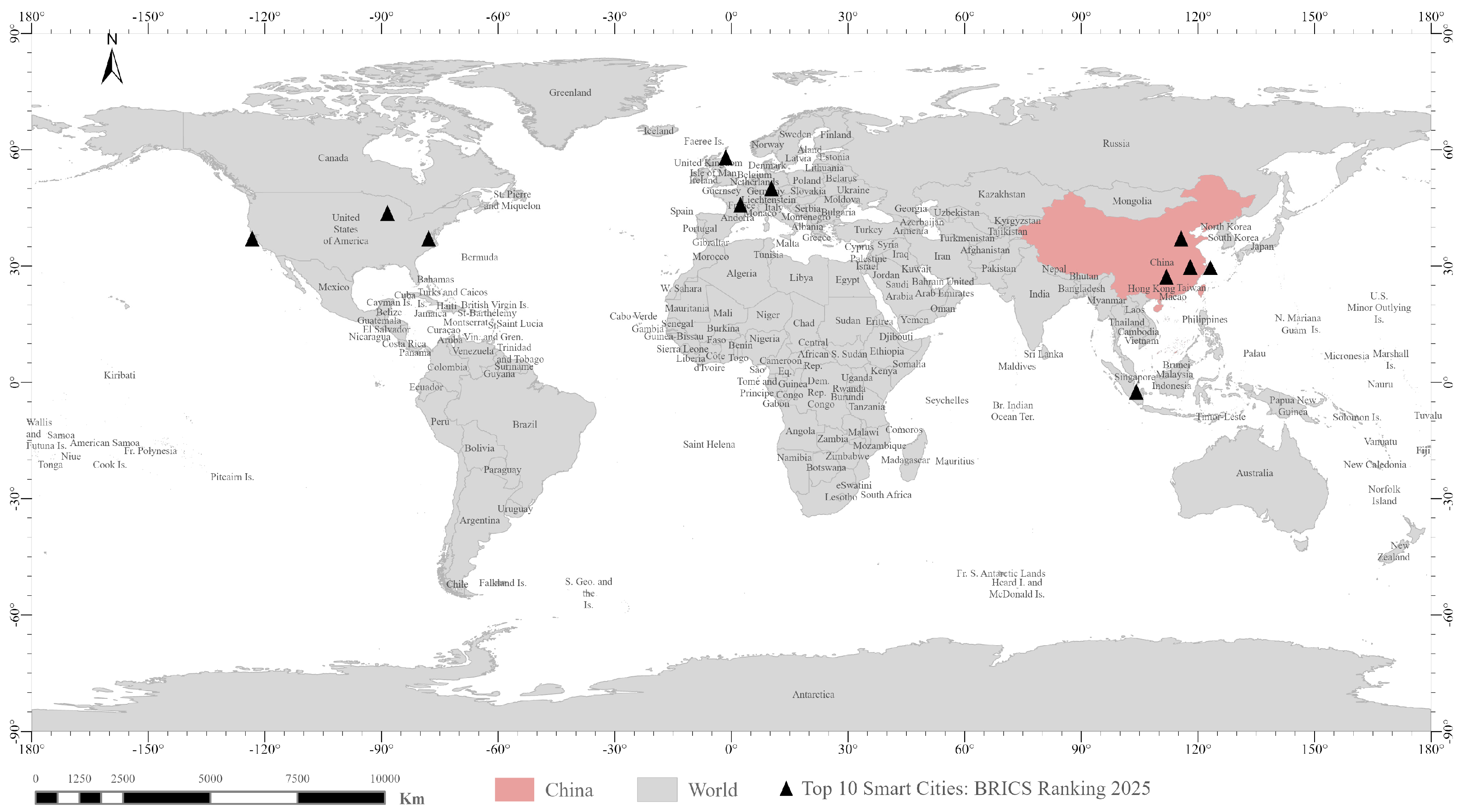
Based on this, this study treats China’s smart city pilot policy as a quasi-natural experiment for causal identification and mechanism testing. China is selected for two main reasons. First, the land and resource constraints encountered during its urban development are broadly generalizable. Supply–demand imbalances driven by rapid urban expansion are not unique to China but common challenges confronted by the EU [10], BRICS nations [11], and other emerging economies [12]. Second, China’s smart city construction is highly representative in institutional design and policy practice. According to the 2025 BRICS smart city rankings, Beijing, Shanghai, Hangzhou, and Shenzhen are placed within the global top 5% (Figure 1). Through phased, incremental national pilots, China has rapidly developed concurrent, interactive scenarios involving smart cities, environmental regulations, fiscal incentives, and digital infrastructure. This creates a highly information-rich “policy laboratory” for identifying policy interaction effects. The setting enables deeper insights into how different policy tools systematically shape smart city land use performance, with analytical logic offering valuable implications for urban systems that prioritize policy coordination and integrated governance.
Figure 1.
Location of China and Top 10 Smart Cities.
This study advances research on smart cities and land use efficiency in three key ways through the adoption of a policy mix framework. First, it moves beyond treating smart city pilots as an isolated governance tool by systematically situating them within a policy mix framework, highlighting how their effects on land use efficiency are highly context-dependent and shaped by interactions with other policy tools. Second, drawing on policy tool theory, it identifies differentiated moderating mechanisms of regulatory policy tools, incentive-based policy tools, and enabling policy tools, offering a more causally nuanced perspective on heterogeneity in multi-policy environments. Third, by integrating land use efficiency, a critical indicator of urban natural resource allocation, into the study of policy interactions, the study provides robust causal evidence from a Chinese quasi-natural experiment on how interactions among policy tools shape resource governance outcomes. This extends the application of policy interaction research to the context of urban natural resource governance. It also offers transferable insights and practical guidance for countries worldwide to refine policy design and maximize the dividends of smart cities in achieving sustainable land use.
2. Theoretical Analysis and Research Hypotheses
In the context of rapid advancements in digital technologies and increasing complexity in urban governance, the smart city is emerging as a novel form of urban development in which information technologies are deeply embedded in planning, construction, and governance processes, gradually becoming an important institutional practice for promoting high-quality urban development. Supported by information science technologies including IoT, cloud computing, and big data, smart cities coordinate information resources, reshape governance processes, and align operational activities, thereby substantially enhancing overall urban management and governance efficiency. In this process, land, as the core material foundation of urban development, undergoes corresponding shifts in both utilization patterns and allocation efficiency.
However, this adjustment is neither a low-cost nor an absolutely positive institutional arrangement. The early stages of smart city policy implementation often entail substantial upfront investments in infrastructure, institutional adaptation costs, and significant implementation uncertainties [4]. In contexts with limited local governance capacity or a weak technological base, such policies may even increase sunk costs in land development, induce decision-making rigidity, and lead to the misallocation of land resources [5]. Nevertheless, from a medium- to long-term perspective and in terms of overall system performance, smart cities retain significant institutional potential to improve land use efficiency by reducing information costs, optimizing resource allocation logic, and enhancing the comprehensive output capacity of urban systems.
First, at the urban planning level, smart cities integrate multi-source spatial data and real-time information to provide a more granular and dynamic cognitive foundation for optimizing urban structure and land-use decision-making [13]. Digital platforms lower the costs of information acquisition and processing, thereby mitigating land use conflicts and resource misallocation stemming from information asymmetry or delays inherent in traditional planning. This enhances the scientific rigor and forward-looking nature of land allocation [14].
Second, at the urban construction level, smart city development promotes the integrated application of AI technologies, remote sensing, GIS, and urban big data, enabling governments to more accurately grasp urban spatial structures, resource distribution, and land use status [15]. This supports more systematic and coordinated organization of infrastructure projects, curbing redundant construction and spatial waste to promote intensive land use. Furthermore, advancing smart city practices fosters innovative spatial formats, such as vertical industrial development and mixed-use complexes. These formats alleviate land constraints while expanding functional capacity and output per unit area, thereby enhancing its comprehensive performance.
Third, at the level of urban governance, smart cities strengthen cross-departmental data sharing and administrative coordination through digital government and platform-based governance. This reduces institutional frictions and coordination costs in land management, planning approval, and resource allocation processes. Supported by digital technologies, this integrated governance model helps improve the granularity and precision of land resource management, thereby mitigating land misallocation caused by information fragmentation or insufficient coordination [16]. Meanwhile, smart city development accelerates the digital transformation of public service provision, industrial organization, and production and consumption patterns. By improving urban operational efficiency and fostering the development of new business models, it amplifies economies of scale, thereby enhancing the productive capacity of land as a factor of production [17].
Overall, although the deployment of smart city policy involves substantial construction costs, institutional adaptation pressures, and constraints related to governance capacity, its long-term effects tend to differ from its short-term risks. As institutional environments gradually adjust, smart city development can continuously reduce information costs, improve the logic of land factor allocation, and enhance the overall operational efficiency of urban systems. As a result, the positive effects of smart city policy on land use are likely to offset initial costs and frictions over time, yielding outcomes that are more systemic and sustainable. Accordingly, this study proposes Hypothesis 1.
H1.
Smart city pilot policy contributes to enhancements in land use efficiency.
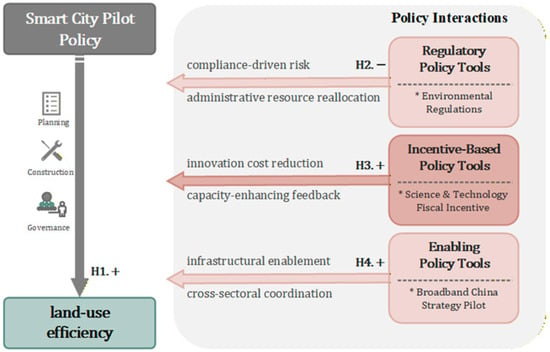
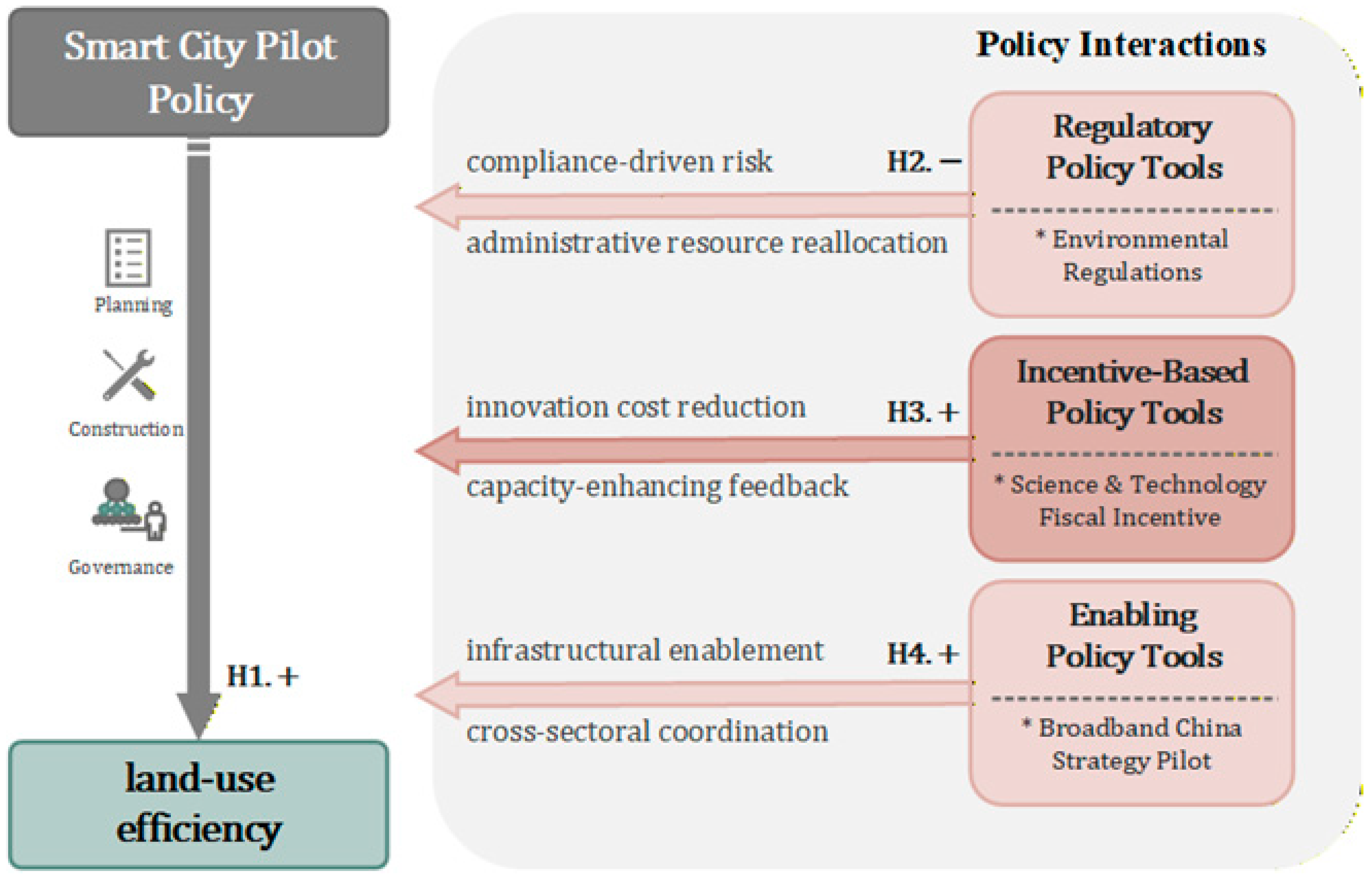
In reality, the smart city pilot policy is not implemented in isolation. Its impact on land use is embedded in a complex institutional environment shaped by the simultaneous operation of multiple policy tools. This is particularly evident in resource allocation, a process highly dependent on institutional constraints. Consequently, the actual effects of smart city policy are often contingent upon its interaction logic with other policy tools (Figure 2).
Figure 2.
Mechanism Design.
According to the policy tool functional classification framework, regulatory policy tools are characterized by rule-setting, behavioral restrictions, and compliance requirements. Their core mechanism lies in strengthening institutional constraints to guide the resource allocation behavior of governments and market actors. Among regulatory tools, environmental regulation is especially notable and representative in the context of land use. On the one hand, through institutional arrangements such as emission standards, land use controls, and ecological red lines, environmental regulation directly influences land development intensity, spatial configuration, and industrial location. It is one of the few policy tools capable of simultaneously constraining land use scale, modes and structure. On the other hand, in the Chinese context, environmental regulation is marked by relatively strong rigidity and administrative enforceability, giving it a systemic and wide-ranging influence on local government decision-making and land use behavior [18].
From the perspective of policy objectives and normative orientation, smart city policy and environmental regulation exhibit a degree of potential complementarity [19]. Both emphasize resource conservation, environmental friendliness, and sustainable development. By establishing ecological constraints and guiding green transition, environmental regulation provides an institutional foundation for smart cities to promote refined management practices and the application of green technologies. When appropriately designed, environmental regulation may induce technological innovation and governance improvement, forming a synergistic relationship with digital empowerment and jointly facilitating the green transformation of land use patterns. However, within China’s specific institutional and developmental context, the interaction between smart city policy and environmental regulation may manifest more prominently as a conflict rather than complementarity. Differences in policy logic and resource allocation priorities can lead environmental regulation to exert a negative moderating effect on the land use efficiency gains associated with smart city development. This conflict primarily stems from misalignment between implementation pathways and short-term incentives, which may constrain the effectiveness of digital governance initiatives in improving land use outcomes.
From the perspective of policy implementation logic, smart city policy is grounded in data integration and process optimization, and follows an “empowerment-oriented efficiency enhancement” logic. It seeks to improve land allocation by reducing information and transaction costs. In contrast, environmental regulation relies primarily on administrative commands and compliance reviews, operating under a “constraint-oriented risk control” logic. Under high-intensity environmental regulation, the decision-making focus of local governments and market actors often shifts from efficiency enhancement toward risk avoidance. This shift may discourage development activities that generate agglomeration effects, leading to more conservative land use patterns. Such dynamics not only limit the scope for applying smart city technologies to optimize land use structure and promote mixed land use but may also weaken their effectiveness in increasing land economic density by fostering new business models [20].
From the perspective of governance resource allocation and local government incentives, smart city development heavily depends on fiscal investment, cross-departmental coordination, and technological governance capacity. Within China’s institutional framework, environmental regulation is typically implemented through administrative evaluation, accountability mechanisms, and enforcement. Under high-intensity environmental regulation, local governments facing constrained administrative capacity and budgetary limitations tend to prioritize compliance with environmental targets that carry “veto-type” consequences. This prioritization may crowd out resources that would otherwise be allocated to smart city platform construction, infrastructure deployment, and refined land management. Under a pressure-based governance system, local governments are therefore more inclined to ensure rigid environmental compliance than to deepen smart land governance applications that promise long-term benefits but involve substantial short-term challenges. As a result, the potential of smart city policy to improve land use efficiency may be constrained [19].
In summary, although smart city policy and environmental regulation may be conceptually complementary. In China’s context, economic growth remains the central performance criterion, and local governments face multiple objectives and resource constraints. Their interaction at the implementation level is more likely characterized by competition in both logic and resources. The stronger the intensity of environmental regulation, the greater its inhibitory effect on efficiency-oriented behaviors and its crowding-out effect on limited governance resources. Consequently, high-intensity environmental regulation is likely to more substantially weaken the expected positive impact of smart city development on land use efficiency. Accordingly, this study proposes Hypothesis 2.
H2.
Regulatory policy intensity negatively moderates the impact of smart city pilot on land use efficiency, such that in regions with stronger environmental regulation, the efficiency gains from smart city development are weaker.
The core function of incentive-based policy tools is to alter the cost–benefit structure of market actors and local governments through direct resource provision and cost compensation. In doing so, it actively encourages investment in and adoption of technologies and governance models associated with smart city development. In contrast to regulatory tools, which prioritize compliance and risk mitigation, incentive-based instruments function by lowering the costs of innovation and enhancing positive spillovers. This operational logic makes them particularly amenable to forming a synergistic relationship with smart city pilot policy, given the latter’s focus on technological empowerment and efficiency gains. Within the Chinese institutional context, fiscal expenditure on science and technology exemplifies how incentive-based tools actively shape market expectations and behavior through resource redistribution and marginal-cost subsidies. It also serves as the most direct and measurable instrument for implementing the “innovation-driven development” strategy. Through the provision of resources and the socialization of innovation risks, this tool influences whether smart city policy can be effectively advanced.
The process of developing smart cities and realizing improvements in land use efficiency often involves substantial sunk costs, technological uncertainty, and organizational learning expenses. Fiscal expenditure on science and technology directly alleviates these binding constraints. First, it reduces liquidity constraints on innovation during the implementation of the smart city pilot. Such fiscal support provides seed funding for enterprises developing smart solutions and for local governments deploying digital governance platforms. This support enables the launch of land management projects with high social returns but insufficient short-term private investment. Thereby enhancing the output efficiency of land [21]. Second, it increases the error tolerance and persistence of local governments in advancing institutional innovations, such as smart planning and digitalized approval processes. This prevents beneficial but slow-to-mature digital land governance initiatives from being interrupted due to short-term performance pressures. Moreover, fiscal support serves as a signal of industrial policy, guiding talent, technology, and digital resources toward the digital economy and related sectors. Through economies of scale, this concentration increases the economic output and service capacity per unit of land, allowing the digital dividends generated by smart city development to be more directly translated into improved land use performance [22].
In summary, incentive-based policy instruments, represented by fiscal expenditure on science and technology, operate through proactive incentives by reallocating resources directly and selectively toward targeted projects and actors, thereby reshaping the innovation incentive structures faced by both markets and governments. These policy tools exhibit a clear functional complementarity with smart city policies. In regions with higher levels of science and technology fiscal expenditure, smart city pilot initiatives are more likely to fully realize their potential in optimizing land allocation and enhancing land-use output efficiency. H3 is proposed.
H3.
Incentive-based policy, represented by science and technology fiscal incentives, positively moderates the impact of smart city pilot on land use efficiency, such that in regions with stronger fiscal incentives, smart city development achieves greater efficiency improvements.
Unlike incentive-based policy tools that create proactive incentives for target-specific projects or actors, enabling policy tools do not directly intervene in behavioral choices through resource allocation, nor do they aim to induce short-term performance gains. Instead, their core function lies in providing inclusive, general-purpose technological and institutional foundations that reduce systemic institutional frictions and technological barriers, thereby shaping whether smart city initiatives can operate efficiently and achieve scalable outcomes. China’s Broadband China pilot policy exemplifies this type of enabling instrument. By supplying non-excludable, network-based public infrastructure, it lowers the overall cost of digital transformation across society. As a systemic information infrastructure initiative, it conforms closely to the defining features of enabling policy tools, with its moderating effects primarily realized through enhanced mobility and usability of data factors.
The capacity of smart cities to enhance land use efficiency relies on real-time data integration across sectors and governance levels, as well as on analytics-driven decision-making supported by high-speed networks. The Broadband China strategy strengthens the technical foundation required for smart city operations by deploying high-speed, stable, and inclusive broadband infrastructure, thereby substantially improving capacities for data collection, transmission, and processing. This enabling effect lowers the technological thresholds for applying smart city tools in land use planning, dynamic land management, and cross-departmental coordination, enhancing their operational feasibility and stability in real-world governance contexts [23]. In regions with more advanced broadband infrastructure, smart city pilot policy is therefore more likely to evolve from isolated applications into systemic and scalable governance models.
The prior or concurrent development of broadband infrastructure significantly enhances the practical operability of smart city technologies in land use and governance. At the same time, traditional governance relies heavily on physical proximity and hierarchical transmission, improved broadband infrastructure breaks down data barriers across departments and regions, reducing governance costs associated with spatial distance and information asymmetry. This enables governments to obtain more accurate and timely information on land use conditions, construction progress, and spatial carrying capacity. Moreover, low-latency and highly reliable networks facilitate the emergence of new digital-enabled business models and land use patterns, such as e-commerce and smart logistics that depend on real-time connectivity, thereby promoting functional mixing and more intensive land use [24]. When a smart city pilot is advanced in coordination with broadband policies and practices, including refined land use management, mixed-use development, and the redevelopment of existing land, it is more likely to be effectively implemented, significantly amplifying the positive effects of smart cities on land use efficiency. Accordingly, this study proposes Hypothesis 4.
H4.
Enabling policy, exemplified by the “Broadband China” Strategy pilot, amplifies the impact of the smart city pilot on land use efficiency, such that regions implementing both policies experience significantly stronger efficiency gains.
3. Model Construction and Data Description
3.1. Model Setting
Existing studies commonly employ staggered DID models to evaluate the effects of policies implemented in multiple waves. By comparing outcome differences between pilot and non-pilot cities before and after policy implementation, this approach isolates and estimates the causal impact of the policy. Building on the theoretical analysis and hypotheses developed above, this study focuses on the effect of smart city development on urban land use efficiency. To address this question, the smart city pilot policy in China is treated as a quasi-natural experiment, and a staggered difference-in-differences model is constructed as follows:
Among them, the subscript and refer to the city and year, respectively, the explained variable is the land use efficiency, and is the multiplication of the policy implementation virtual variable () and the implementation time virtual variable () of the smart city pilot, that is, the core explanatory variable. If city is included in the smart city construction list of year, it will be assigned to 1, otherwise it will be 0. is a set of control variables, including: economic development level (), infrastructure level (), government role (), population density (), social consumption level () have an important impact on urban land use efficiency. is the year fixed effect, represents the individual fixed effect, and is the error term in the model.
Based on the foregoing hypotheses, to further identify the mechanism through which interactions among policy tools with different functional attributes shape the impact of smart city pilot on land use efficiency, this study introduces moderating variables into Model (1). Specifically, the model examines how smart city policies interact with regulatory and incentive-based policy tools in influencing land use efficiency. As shown in Equation (2), denotes the set of moderating variables capturing government public policies, including environmental regulation intensity () and technology-oriented fiscal incentives ().
Because the “Broadband China” pilot is not a continuous intensity variable but a discrete, institutional, and phased infrastructure pilot, its role is not to alter marginal effect slopes but to reshape the institutional environment in which smart city policies operate. To identify the enabling policy dividend generated by the joint implementation of the two policies, a difference-in-differences-in-differences (DDD) approach is required, as it allows the amplifying effect to be isolated while controlling for the independent effects of each policy. Accordingly, Model (3) is constructed to test whether the dual-pilot implementation of smart city development and the enabling policy amplifies the effect of the smart city pilot on land use efficiency. In this model, denotes a dummy variable for the “Broadband China” pilot, taking the value of one if a city is designated as a pilot in a given year and zero otherwise.
3.2. Data and Variable Description
The original data of this paper mainly come from “China Urban Yearbook”, “China Land Yearbook”, “China Environmental Yearbook” and statistical bulletins of various provinces and cities. In the data processing, based on the adjustment of administrative divisions and the availability of data, excluding Chaohu City in Anhui Province, Haidong City in Qinghai Province, Sansha City and Danzhou City in Hainan, Bijie City and Tongren City in Guizhou, Turpan City and Hami City in Xinjiang and prefecture-level cities under the jurisdiction of Xizang Autonomous region. Finally, 285 cities in China from 2000 to 2021 were selected as the research sample, and their panel data were collected and analyzed. For occasional missing values, we apply within-city linear interpolation only for interior gaps. The interpolated observations account for less than 4% of the full sample, and no interpolation is applied to key variables (smart city pilot and LUE), ensuring that the results are not driven by missing-data treatment. The variables involved in the model are as follows:
- (1)
- Core explanatory variable: smart city pilot policy (DID)
That is, the multiplication of the policy implementation virtual variable () and the implementation time virtual variable (). According to a public report by the Ministry of Housing and Construction, there are three batches of lists of smart city pilot projects in China. At the prefectural level, 38 cities represented by Beijing, Tianjin, Shanghai and Chongqing in 2012, 41 cities represented by Wuhan, Shenyang, Nanjing and Changsha in 2013, and 28 cities represented by Xuzhou and Laiwu in 2014. If i city t-year is included in the national smart city pilot list, the value of policy implementation virtual variable () and implementation time virtual variable () is 1, otherwise it is 0.
- (2)
- Explained variable: urban land use efficiency (LUE)
The main measurement methods of land use efficiency are: single quantitative index calculation, comprehensive evaluation index system method and data envelopment analysis (DEA). In order to avoid the one-sidedness of single index measurement and the subjectivity of comprehensive evaluation index selection, this paper chooses data Envelopment Analysis (DEA) based on input–output. In order to account for the advantages of land that are social, ecological, and economic while evaluating urban land use efficiency using the DEA model, the study selects land, capital and labor as input indicators and economic and ecological benefits as output indicators. The specific indicators are considered as presented in Table 1.
Table 1.
Selection of indicators of land use efficiency.
- (3)
- Control variable (X)
Referring to the existing achievements, the study selects the important factors affecting urban land use efficiency as control variables, including: the level of economic development (), expressed by the natural logarithm of per capita GDP; the level of infrastructure (), represented by the natural logarithm of per capita road area; the role of the government (), measured by the proportion of government expenditure in GDP; population density (), the number of people per unit area. The level of social consumption () is presented by the proportion of total social retail consumption to GDP.
- (4)
- Regulating variables (A)
In the Chinese context, environmental regulation and technology-oriented fiscal incentives represent the most typical institutional arrangements of regulatory and incentive-based policy tools, respectively. Accordingly, this study selects environmental regulation intensity () and technology-oriented fiscal incentives () as moderating variables.
is proxied by the ratio of government fiscal expenditure on science and technology to GDP, with a higher ratio indicating stronger governmental incentives for technological development. is measured by constructing a composite index based on indicators such as industrial wastewater discharge, industrial smoke (dust) emissions, and sulfur dioxide emissions, using the range standardization method. The rationale for adopting this measure is that, within China’s outcome-oriented environmental governance system, pollutant emission levels are not merely technological by-products but reflect the combined effects of regulatory enforcement, performance evaluation, and compliance constraints imposed by local governments. Higher emission levels are more likely to trigger stricter enforcement of constraint-based policy instruments, thereby effectively capturing regulatory effort. This measurement approach has been widely adopted in the environmental regulation literature [25,26]. The specific formulation is given as follows:
and , denote the standardized emission intensity and the adjustment coefficients for each pollutant, respectively.
- (5)
- Triple difference variable (BCS)
The “Broadband China” pilot (BCS) is a major national strategy launched by the Chinese government to strengthen the systematic deployment and expansion of broadband infrastructure. Aimed at advancing informatization and digital transformation, the policy lays a foundational infrastructure base and, in the Chinese context, constitutes a typical enabling policy tool. The variable BCS is defined as a dummy variable that equals one if a sample city is designated as a “Broadband China” pilot city in or after the year of selection, and zero otherwise. Descriptive statistics for all variables are reported in Table 2.
Table 2.
Descriptive statistics of the variables.
3.3. Characteristic Fact
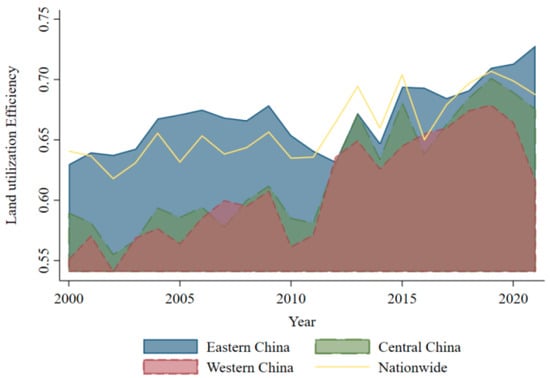
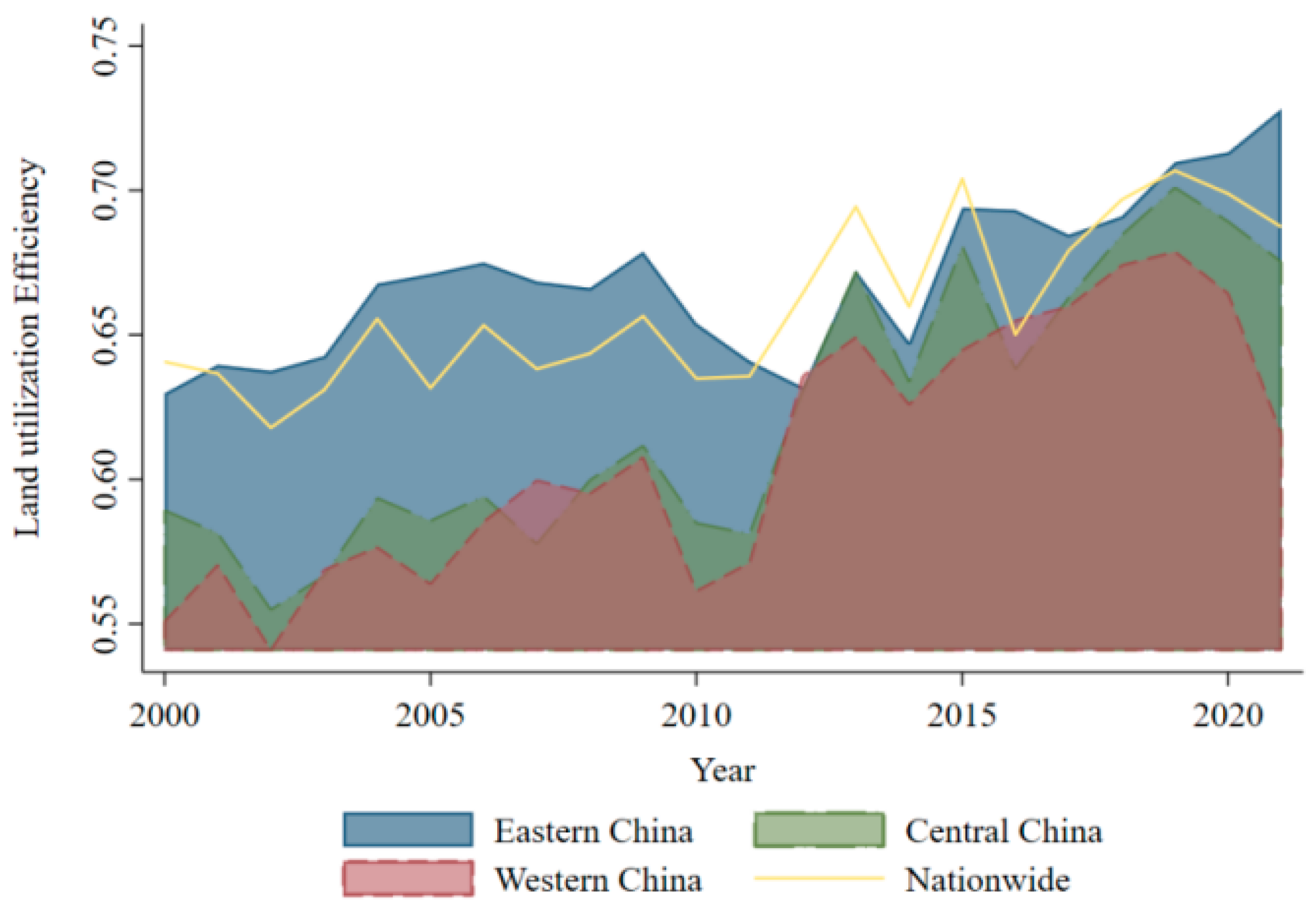
On the basis of calculation, this paper analyzes the trend of the distribution of land use efficiency in China as a whole and in different regions, as shown in Figure 3 and Figure 4. From the overall level (Figure 3), the average annual land use efficiency in China during the study period is between 0.60 and 0.70, showing a fluctuating upward trend. Among them, the land use efficiency fluctuated greatly in 2003, 2008, 2013 and 2016, all in the stage of land use planning and land policy adjustment and exploring the transformation of land development mode in China. The specific measures are as follows: around the goal of the red line of cultivated land, China plans and controls land use as a whole. Measures such as strictly controlling the expansion of construction land, checking and recycling illegal land and saving and intensifying land use are adopted to improve land ecology and improve the economic and social security capacity of land resources. In the adaptation stage, before and after planning adjustment, the input and output of land are affected, leading to a fluctuating trend of “falling first and then rising”.
Figure 3.
Evolution trend of Chinese Land use efficiency and its regions.
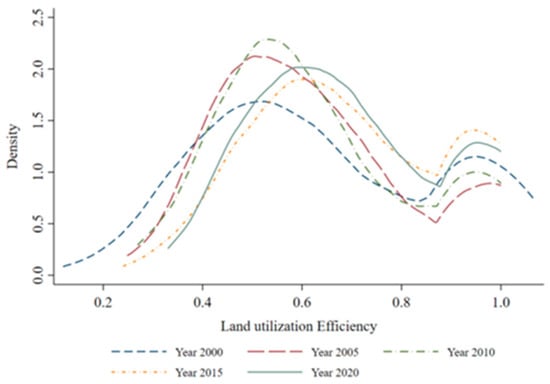
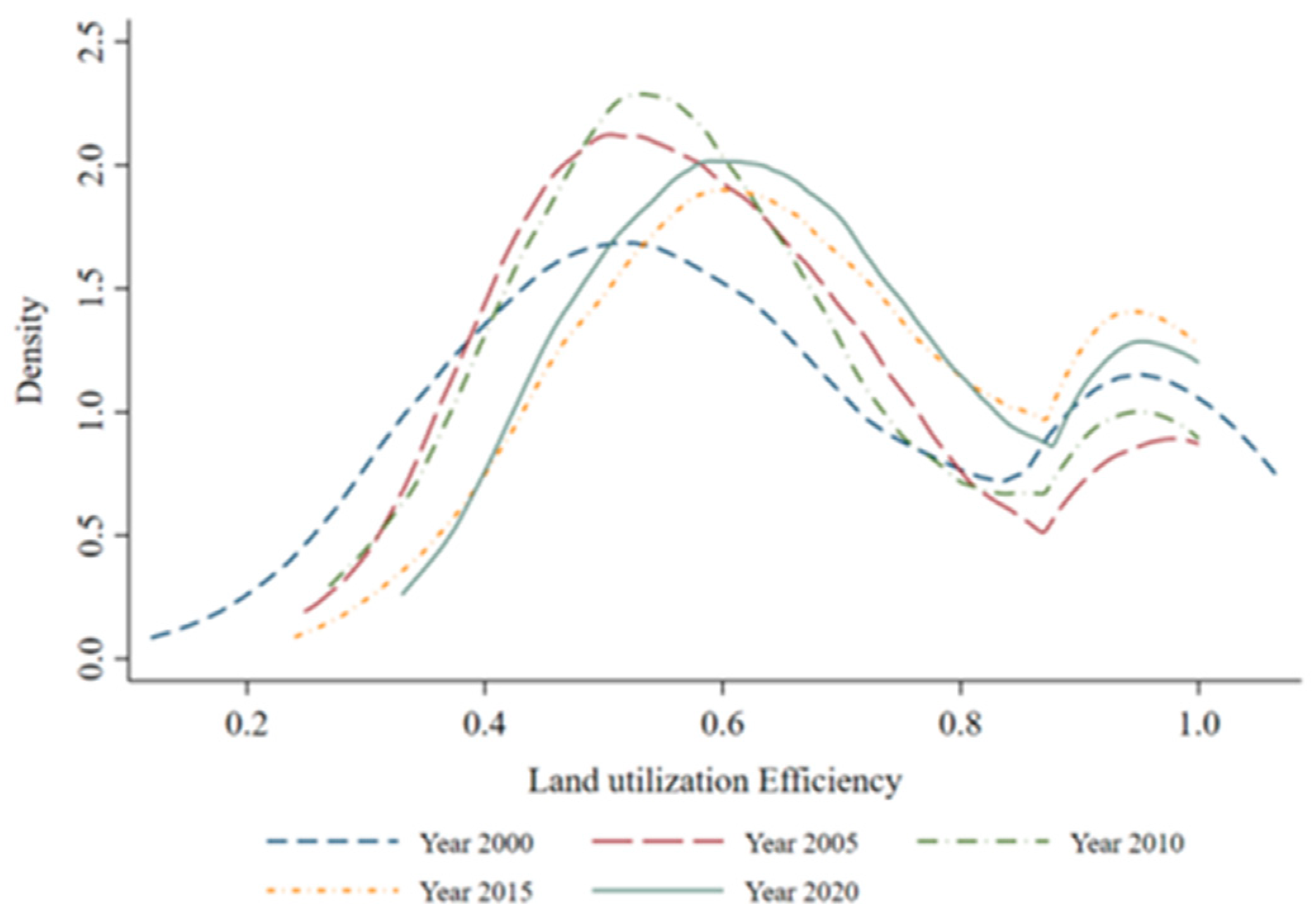
Figure 4.
Kernel density estimation of land use efficiency.
From the perspective of regional distribution, the land use efficiency in China shows the distribution characteristics of “east > middle > west”. The reason for this phenomenon is that, on the one hand, China’s physical geography shows a “ladder” distribution with gradually increasing elevations from east to west, and the land supply and population distribution are also characterized by “dense in the east and scarce in the west”. On the other hand, China is split into three main economic belts according to the disparities in the degree of regional economic growth: the east, the middle and the west, which is generally characterized by the developed east and the relatively backward west. Under the joint action of physical geography and economic distribution factors, the land use efficiency of the three major economic zones in China also presents obvious differences.
Through the nuclear density method, the study further analyzes the dynamic evolution trend of Chinese land use efficiency. As shown in Figure 4, during the sample period, the level of land use efficiency in China gradually shifted to the right; that is, the overall land use efficiency in China showed a trend of continuous improvement. Secondly, with the advance of the year, the “bimodal” characteristic of the curve becomes more and more obvious, and the polarization of land use efficiency distribution is increasing. In addition, the peak of the nuclear density curve increases at first, then decreases, and the width of the curve is widened from wide to narrow, indicating that the difference of land use efficiency in different regions shows the dynamic evolution characteristics of convergence first and then divergence.
4. Empirical Result Analysis
4.1. Parallel Trend Test
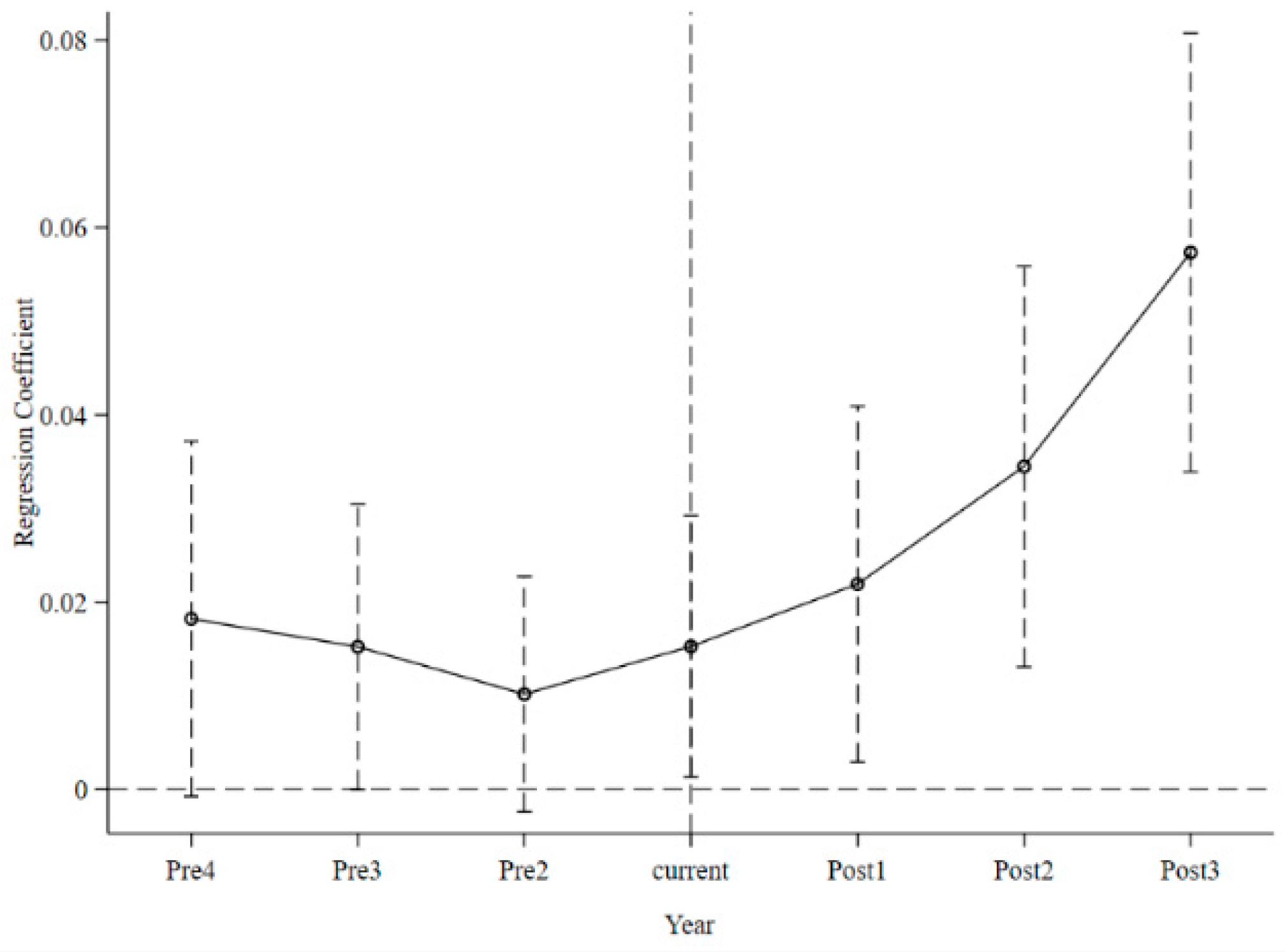
Satisfying the parallel trends assumption is a critical prerequisite for using DID models to evaluate policy effects. Specifically, prior to the smart city pilot, trends in land use efficiency should not differ significantly between pilot and non-pilot cities. Moreover, considering variations in local government implementation capacity, policy response lags, and the staggered rollout of pilot programs, this study employs an event-study approach to formally test the parallel trends assumption. In Equation (4), and denote the number of periods before and after policy implementation, respectively, and captures the difference between the treatment and control groups in period .
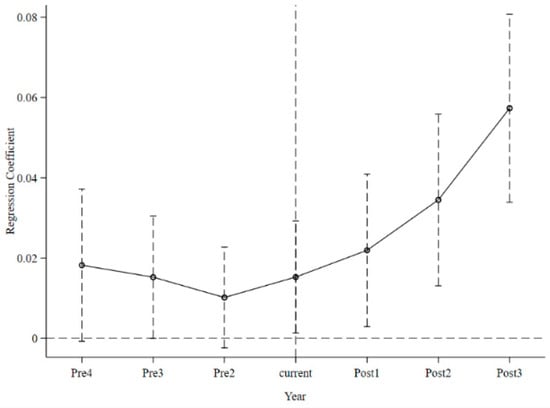
As illustrated in Figure 5, the estimated coefficients in the pre-treatment periods are close to zero, and their confidence intervals consistently include zero, indicating no statistically significant differences in land use efficiency trends between pilot and non-pilot cities prior to the implementation of the smart city pilot. This pattern suggests the absence of differential pre-trends between the two groups. Following policy implementation, the estimated coefficients gradually diverge from zero, and the corresponding confidence intervals exclude zero, implying a statistically significant change in land use efficiency associated with the smart city pilot from the treatment year onward. Overall, the dynamic estimates are consistent with the parallel trends assumption underlying the staggered difference-in-differences design and provide supportive evidence for the identification strategy adopted in this study.
Figure 5.
Parallel Trend test.
4.2. Benchmark Regression Analysis
Based on Model (1), Table 3 reports the baseline regression results for the impact of the smart city pilot policy on urban land use efficiency. As shown in column (1), when city and year fixed effects are included, but other key control variables are excluded, the estimated coefficient is positive and statistically significant at the 1% level. This result indicates that the implementation of smart city development is associated with a significant improvement in urban land use efficiency, with an estimated policy effect of 0.028. As additional control variables are progressively incorporated, as reported in columns (2)–(6), the estimated coefficient of the smart city pilot policy remains significantly positive. These findings suggest that smart city development effectively enhances urban land use efficiency, confirming the robustness of the results and supporting Hypothesis 1.
Table 3.
Benchmark regression results.
Column (6) also reports the estimated effects of the control variables on urban land use efficiency. The results indicate that economic development level and population density exert significantly positive effects on land use efficiency. This suggests that cities with higher levels of economic development and greater population concentration tend to achieve more efficient land use. In contrast, infrastructure development, government intervention, and consumption level are found to have negative effects on urban land use efficiency. This pattern reflects insufficient coordination among policy instruments or relatively low efficiency in resource allocation at specific stages of urban development and within particular institutional contexts. Existing studies show that during periods of rapid urbanization, infrastructure investment and government expenditure do not necessarily translate into simultaneous improvements in land use efficiency; rather, their effects depend critically on investment structure, spatial allocation, and alignment with industrial development and population agglomeration [27]. When infrastructure provision is front-loaded or spatially misaligned, it may expand land development in the short term without effectively increasing output intensity per unit of land, thereby generating empirically negative effects on land use efficiency. Moreover, the effectiveness of local government spending varies with institutional arrangements, performance incentives, and resource allocation mechanisms. Premature or inefficient public expenditure may undermine land intensification and compact development [28].
Similarly, in the context of China’s still-persistent urban–rural dual structure, consumption expansion does not necessarily coincide with a transition toward more intensive land use patterns. If consumption growth is concentrated in low-density and spatially dispersed forms, it may instead reduce the overall output efficiency of land. Taken together, these observations underscore that improvements in land use efficiency are highly contingent on institutional coordination. They also provide indirect support for this study’s adoption of a policy mix perspective to examine how interactions between smart city policies and other policy instruments shape land use outcomes.
4.3. Robustness Test
In the benchmark regression analysis, the robustness of the estimated results is partially supported by the stepwise inclusion of control variables. To further assess the robustness of the relationship between smart city development and urban land use efficiency, this study further conducts placebo tests, endogeneity tests, and additional sensitivity analyses.
- (1)
- Placebo test
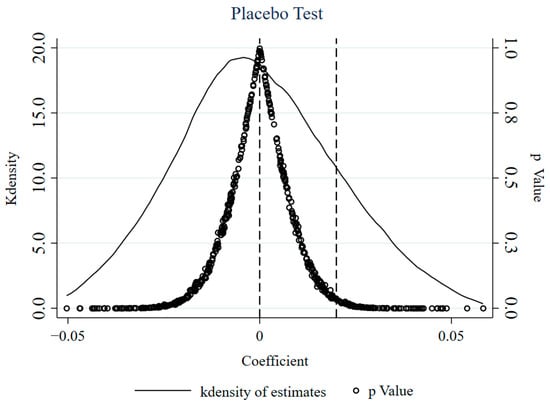
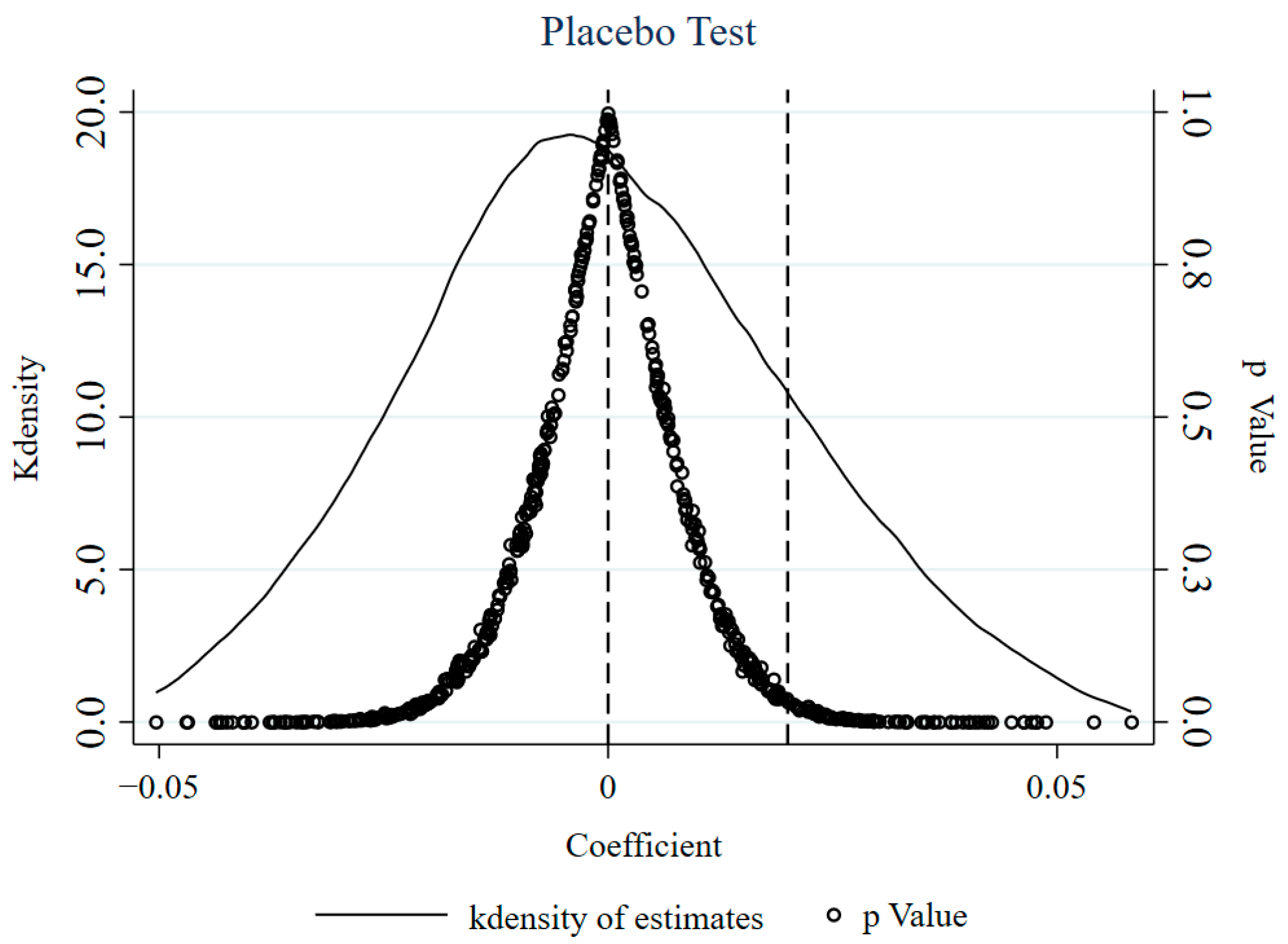
To mitigate potential bias arising from omitted key explanatory variables, this study further conducts placebo tests by constructing fictitious treatment groups and altering policy implementation timing. For the fictitious treatment group placebo test, 50 cities are randomly selected from the sample and assigned as treated cities under the smart city pilot policy, while the remaining cities serve as the control group. An interaction term between the reconstructed treatment group and the implementation period is then introduced into the difference-in-differences model, and the procedure is repeated 500 times. The distributions of the estimated coefficients and corresponding p-values are presented in Figure 6. The estimated coefficients of the interaction term based on the reconstructed treatment groups are centered around zero, and the majority of p-values are statistically insignificant, indicating that the estimated effects are unlikely to be driven by random assignment.
Figure 6.
Placebo remodeling treatment group test.
In addition, time-based placebo tests are conducted by assuming that the implementation of the smart city policy occurred two, three, or four years earlier than its actual timing. Pseudo policy implementation dummy variables are constructed accordingly. As reported in Table 4, the estimated coefficients of the core explanatory variable are statistically insignificant under these alternative timing assumptions. Taken together, the placebo test results confirm the robustness of the relationship between smart city pilot and urban land use efficiency.
Table 4.
Placebo test result.
- (2)
- Endogenous test
Aiming to avoid the endogeneity of the model caused by two-way causality, this study employs the interaction between the number of municipal post offices in 1984 and the national scale of internet access as an instrumental variable and conducts 2SLS estimation. Regarding relevance, early communication infrastructure shaped cities’ capacity to absorb subsequent digital technologies and digital governance practices, while the national scale of internet access captures a unified and exogenous shock associated with digital expansion. Their interaction reflects cross-city differences in accessibility to the diffusion of digital governance, thereby exerting a significant influence on the strategic selection and implementation effectiveness of smart city pilots. Regarding exogeneity, the spatial distribution of post offices in 1984 predates both smart city policy implementation and contemporary land use patterns, making it unlikely to directly affect current land use efficiency through alternative channels. Moreover, its interaction with national internet penetration does not reflect local economic conditions or innovation trends. Additional placebo tests indicate that this instrumental variable has no statistically significant effect on land use efficiency prior to the implementation of smart city pilots, as reported in column (3) of Table 5, thereby supporting the identifying assumption that the instrument affects land use efficiency only through smart city policy. Through verification, LM statistics p-statistics is 0; that is, tool variables can be identified, Wald F statistic (10.199) allows rejection of the null hypothesis of weak instruments. Columns (1) and (2) of Table 5 report the 2SLS estimation results. The results show that after adding instrumental variable, the regression results are consistent with the baseline regression direction and significant degree, demonstrating that smart city construction can increase land use efficiency.
Table 5.
Tool variables and other robustness tests.
- (3)
- Other robustness tests
In the research, the bilateral tail reduction method on 1% quantile and Bootstrap increasing the number of random sampling were adopted to carry out additional robustness test. As shown in column 4 of Table 5, after excluding outliers, the significance and symbol direction of core explanatory variables and control variables do not change. As shown in (5), the results of 500 random samples are consistent with the above regression, and the regression results are still robust. To ensure that the results are not driven by this data treatment, we further conduct sensitivity analyses using non-interpolated samples and alternative missing-data handling strategies, as reported in column (6). The main findings remain robust in terms of sign, magnitude, and statistical significance.
4.4. Heterogeneity Analysis
Considering China’s distinctive topographical characteristics of “an east–west gradient with a stepwise elevation pattern” and pronounced development disparities across the three major economic regions, this study further examines the various effects of the smart city pilot on urban land use efficiency across regions and terrain types (see Table 6). From a regional perspective, smart city construction significantly improves land use efficiency in eastern and central China, while the effect is statistically insignificant in western regions. In terms of marginal effects, the estimated impact of smart city construction on land use efficiency is substantially larger in the eastern region than in the central region, indicating that the productivity-enhancing effect of the smart city pilot is strongest in eastern China.
Table 6.
Heterogeneity test.
These regional disparities can be attributed to differences in economic foundations, population agglomeration, and policy implementation conditions. Eastern China is characterized by higher levels of economic development, larger urban populations, and more concentrated economic activity, which collectively enhance both the pace and spatial diffusion of smart city pilots. Moreover, the majority of cities selected for the first batch of smart city pilots in 2012 were located in the eastern region, providing an early-mover advantage and establishing an institutional and technological foundation for subsequent efficiency gains in land use. In addition, the relatively advanced infrastructure systems and digital foundations in eastern cities amplify the spillover effects of smart city construction, facilitating more scientific spatial planning and more intensive and efficient land use. By contrast, western regions face persistent constraints related to underdeveloped infrastructure, lower digital technology penetration, and weaker economic bases. As a result, the scale and intensity of smart city pilot implementation in these areas remain limited, diminishing the capacity of smart city construction to effectively improve land resource allocation and overall land use performance.
Topographical characteristics constitute a critical constraint in both smart city pilot and urban land use decision-making. Accordingly, this study further recognizes that the effects of smart city pilots on land use may vary depending on the feasibility of deploying and operating new infrastructure. Accordingly, we introduce terrain relief (TR) as a measure of natural topographic variation. TR is derived by rasterizing the digital elevation model (SRTM 90 m) in ArcGIS10.8 and matching it to China’s prefecture-level cities. When TR < 2, indicating relatively small elevation differences and predominantly plain or hilly landscapes with elevations generally below 1000 m, the variable is coded as 1; otherwise, it is coded as 0. Based on this classification, we conduct grouped regression analyses. The results in columns (4) and (5) show that, compared with high-altitude and highly rugged plateau and mountainous areas, the positive effect of smart city pilots on land use efficiency is more pronounced in lower-altitude cities with relatively gentle terrain, such as plains and hills (0.016).
In contrast, in areas with high terrain relief, the estimated policy effect becomes negative (−0.046). This heterogeneity suggests that the land use performance of smart city initiatives exhibits clear spatial conditionality. Areas with flatter terrain are more conducive to digital infrastructure deployment and to the coordinated optimization of factor mobility and spatial development, thereby enhancing the marginal effectiveness of digital governance tools in land allocation and intensive land use. By contrast, in rugged terrain, higher infrastructure costs, tighter constraints on spatial development, and greater difficulties in cross-regional coordination may undermine the implementation efficiency of smart city technologies and governance practices. In the short run, these conditions may even lead to resource misallocation or crowding out of investment, resulting in a negative impact.
4.5. Interaction Between Regulatory Policy Tools and Smart City Pilot
To examine the interactive effect of regulatory policy tools and smart city pilot policy on land use efficiency, this study employs Model (2) to test the moderating role of environmental regulation intensity. The results are reported in Table 7. Without controlling for additional covariates, environmental regulation exhibits a negative main effect on land use efficiency (−0.098), indicating that higher regulatory intensity is associated with lower land use efficiency. Importantly, the interaction term between the smart city pilot and environmental regulation (DID × ER) is significantly negative, opposite in sign to the main effect. This pattern remains robust after introducing control variables, suggesting the stability of the findings. These results indicate that increasing environmental regulation intensity weakens the positive impact of the smart city pilot on land use efficiency. Hypothesis 2 is thus supported. Mechanistically, the rigid compliance pressure imposed by constraint-oriented policy instruments not only diverts governance resources away from smart city initiatives and fine-grained land management, reducing policy performance, but also raises the potential costs of land development and economic activity. As a consequence, market actors adopt more conservative investment behaviors, limiting the agglomeration of new urban functions and thereby diminishing the land use gains generated by the smart city pilot.
Table 7.
Results of the test of regulatory effects.
4.6. Interaction Between Incentive-Based Policy Tools and Smart City Pilot
Using science and technology fiscal incentives as the representative incentive-based policy tool, Columns (3) and (4) of Table 7 report the interaction effects between the smart city pilot policy and incentive-based policy tools on land use outcomes. The results show that science and technology fiscal expenditure itself does not exert a direct effect on land use. However, regardless of whether control variables are included, the coefficient of the interaction term (DID × TC) is significantly positive (4.123). This indicates that as science and technology fiscal incentives increasingly align with the smart city pilot policy, the positive effect of smart city development on land use efficiency becomes stronger. Hypothesis 3 is therefore supported.
Mechanistically, science and technology incentives promote information infrastructure development and technological research and development. By doing so, it not only alleviates the funding constraints and uncertainty risks faced during the implementation of smart city initiatives, but also strengthens local governments’ incentives to sustain investment in digital governance and spatial governance innovation. These effects enhance institutional innovation in land governance and improve cross-departmental coordination in resource management, thereby amplifying the land use benefits generated by smart city development.
4.7. Interaction Between Enabling Policy Tools and Smart City Pilot
The “Broadband China” Strategy pilot (BCS) and the smart city pilot policy are both embedded in a policy framework aimed at advancing informatization and new-type urbanization. By strengthening urban digital and information infrastructure, BCS represents a typical enabling policy tool. Table 8 reports the effects of the joint implementation of BCS and smart city pilots on land use efficiency. The coefficient of the triple-difference term (DID × BCS) remains significantly positive at the 1 percent level (0.040), indicating that the positive effect of smart city development on land use efficiency is more pronounced in cities where broadband and related information infrastructure have been strategically deployed. Hypothesis 4 is therefore supported.
Table 8.
Results of triple-difference test.
Although both policies operate within a shared developmental objective, they differ in policy positioning and functional scope. The “Broadband China” Strategy constitutes a national-level infrastructure initiative, whereas smart city pilots function as city-level comprehensive governance policies. When implemented simultaneously, the “Broadband China” Strategy improves information infrastructure conditions and the digital governance environment, thereby exerting a significant enabling and amplifying effect on the ability of smart city pilots to enhance land use efficiency.
5. Research Conclusions and Policy Implications
As an urban development paradigm centered on data integration and coordinated governance, smart cities reshape modes of urban operation and governance structures, thereby exerting systematic influences on land use processes. Based on evidence of 285 Chinese prefecture-level cities over 2000–2021, using a staggered DID approach, moderation analysis, and a triple-difference design, this study systematically evaluates the impact of smart city development on land use efficiency and its variation across different policy interaction contexts. The main findings are summarized as follows.
Overall, the smart city pilot significantly improves land use efficiency, confirming the positive role of digital transformation policies in optimizing land factor allocation. However, this effect exhibits pronounced heterogeneity across economic regions and natural geographic conditions, being more evident in eastern and central regions as well as in cities with relatively flat terrain, while remaining insignificant in western and plateau regions. Further analysis of policy interactions indicates that the land use effects of smart cities do not emerge in isolation but are deeply embedded in an institutional environment shaped by multiple policy tools. Specifically, environmental regulation intensity, as a representative regulatory policy tool, exerts a significant negative moderating effect on the ability of smart cities to enhance land use efficiency, whereas incentive-based policy tools, represented by science and technology fiscal incentives, effectively amplify the optimization effect of the smart city pilot.
In addition, based on the triple-difference identification results, cities that simultaneously implement smart city pilots and the “Broadband China” Strategy pilot experience significantly larger improvements in land use efficiency. This finding suggests that enabling policy tools enhances the performance of smart cities by improving digital infrastructure and the governance environment. Taken together, the impact of smart cities on land use efficiency depends critically on their interaction structure with regulatory, incentive-based, and enabling policy tools. The complementary or constraining relationships among policy tools with different functional attributes systematically shape land use outcomes under digital urban governance. By treating smart cities as policies embedded in interacting policy instruments rather than as standalone digital interventions, this study advances a policy-mix perspective on digital urban governance and land use outcomes, offering empirical evidence to inform land governance and policy design in the digital era.
Based on the above findings, this study derives several targeted and generalizable policy implications. First, for cities with relatively strong digital foundations and higher levels of economic development, smart city policy should shift from a focus on technology deployment toward deep integration into governance. To unlock the structural efficiency gains in land allocation, such cities should prioritize the deep application of digital technologies in key areas such as land use planning, development control, and the management of existing land stock. Second, in cities characterized by stringent environmental regulation or dense layering of policy instruments, greater emphasis should be placed on policy coordination to prevent constraining tools from crowding out the efficiency gains of smart city initiatives. It is essential to improve the sequencing of policy implementation and clarify functional divisions among policy instruments, so as to avoid cumulative restrictive effects that may inhibit the operation of digital governance. Third, for cities facing tight fiscal constraints or at an early stage of smart city development, incentive-based policy tools, particularly science- and technology-related fiscal spending, should be prioritized to reduce the costs of digital transformation and strengthen their amplifying effects on the land use performance of smart city initiatives. Targeted fiscal support can help ease upfront investment pressures, enhance the feasibility of smart city policies, and sustain their performance in improving land use efficiency over time. Fourth, for cities with relatively underdeveloped information infrastructure, the expansion of new-generation digital infrastructure should be treated as a prerequisite for smart cities to generate land use benefits. Such cities should prioritize closing gaps in network coverage and data transmission capacity, thereby providing the essential technological foundation for the stable operation of smart city applications in land use planning and governance.
6. Discussion and Future Work
The core findings of this study indicate that smart city pilot policy significantly improves land use efficiency on average. However, this effect exhibits pronounced heterogeneity and is highly contingent on interactions with constraining, incentive-based, and enabling policy tools. These results are consistent with existing literature emphasizing the role of digital governance in optimizing resource allocation, and they provide an important theoretical extension to this line of research [9,16]. More importantly, this study demonstrates that the land use effects of smart city policies are neither linear nor isolated, but instead depend on the modes of interaction and functional alignment between smart city policy and other policy tools.
This study extends the smart city literature by strengthening a relatively underexplored dimension: policy interactions. Existing research has largely treated smart cities as a single governance instrument and has explained their performance in resource allocation mainly from the perspectives of technology adoption, governance innovation, or digital infrastructure development [8]. This study embeds smart city policy within a complex policy mix and offers a more nuanced explanation from the perspective of policy interactions. The findings demonstrate that different types of policy tools do not operate through simple additive effects. Instead, they may reshape the land use impacts of smart city policy through mechanisms of complementarity, amplification, or conflict. Specifically, incentive-based policies, such as science and technology–related fiscal spending, significantly amplify the land use efficiency effects of smart cities by easing financial constraints and technological risks. Enabling policies, such as information infrastructure development, enhance the operational feasibility of smart city governance tools by improving underlying institutional and technical conditions. In contrast, constraining policies, such as environmental regulation, may in certain contexts weaken the efficiency-oriented allocation logic of smart cities by reinforcing risk aversion and crowding out limited governance resources. Importantly, this result does not negate the long-term value of constraining policies, but rather reveals the potential mechanisms through which different policy tools may interact during the policy implementation stage.
Based on these findings, this study provides a new framework for understanding heterogeneous effects under conditions of multiple, coexisting policies, and deepens the application of policy mix theory in the field of land use studies [12]. In terms of regional heterogeneity, the effects are stronger in eastern regions and in cities located in plains, which may reflect more favorable baseline conditions that amplify economies of scale. By contrast, cities in western and high-altitude areas appear more constrained by lagging infrastructure, a pattern consistent with the literature on the digital divide [29,30]. This study is subject to two main limitations, which also point to directions for future research. First, although inter-city differences in policy implementation are considered, the estimated effects may vary with cities’ development stages, functional roles, and governance capacities. Future research could adopt a more differentiated analytical framework and conduct in-depth case studies. Second, smart city development constitutes a continuous and adaptive process, during which new policy tools related to digital infrastructure, data governance, and land allocation are likely to emerge. Future studies may therefore focus on the evolving policy mix and assess the dynamic impacts of policy coordination on resource utilization efficiency over longer time horizons.
Author Contributions
Conceptualization, T.H.; Methodology, Y.W.; Software, Y.W.; Formal analysis, Y.W. and T.H.; Investigation, Y.W.; Resources, Y.W.; Data curation, Y.W. and T.H.; Writing—original draft, Y.W.; Writing—review & editing, T.H.; Visualization, Y.W.; Supervision, T.H.; Funding acquisition, T.H. All authors have read and agreed to the published version of the manuscript.
Funding
This work was supported by the Research on National Natural Science Foundation of China (NSFC) Project: Research on the Impact Mechanism of Provincial Population Shrinkage on Urban Economic Resilience in Northeast China from spectives of City Network (72474059).
Data Availability Statement
Data will be provided to the reviewer upon request.
Conflicts of Interest
The authors declare no conflicts of interest.
References
- Lynch, C.R.; Sweeney, M.E. Evolving Spatialities of Digital Life: Troubling the Smart City/Home Divide. Digit. Geogr. Soc. 2024, 6, 100085. [Google Scholar] [CrossRef] [Scilit]
- Mao, C.; Wang, Z.; Yue, A.; Liu, H.; Peng, W. Evaluation of Smart City Construction Efficiency Based on Multivariate Data Fusion: A Perspective from China. Ecol. Indic. 2023, 154, 110882. [Google Scholar] [CrossRef] [Scilit]
- Wan, J.; Xie, Q.; Fan, X. The Impact of Transportation and Information Infrastructure on Urban Productivity: Evidence from 256 Cities in China. Struct. Change Econ. Dyn. 2024, 68, 384–392. [Google Scholar] [CrossRef] [Scilit]
- Bjørner, T. The Advantages of and Barriers to Being Smart in a Smart City: The Perceptions of Project Managers Within a Smart City Cluster Project in Greater Copenhagen. Cities 2021, 114, 103187. [Google Scholar] [CrossRef] [Scilit]
- Makki, A.A.; Alqahtani, A.Y. Analysis of the Barriers to Smart City Development Using DEMATEL. Urban Sci. 2024, 8, 10. [Google Scholar] [CrossRef] [Scilit]
- Shi, X.; Ling, G.H.T.; Alalouch, C.; Leng, P.C.; Lim, S.B.; Rashid, M.F.A.; Rahmat, A. Smart Cities and Public Participation: A Bibliometric Analysis and Conceptualization of the Social-Ecological System Framework. Open House Int. 2025, 50, 904–927. [Google Scholar] [CrossRef] [Scilit]
- Guo, Q.; Wang, Y.; Dong, X. Effects of Smart City Construction on Energy Saving and CO2 Emission Reduction: Evidence from China. Appl. Energy 2022, 313, 118879. [Google Scholar] [CrossRef] [Scilit]
- Axelsson, K.; Melin, U.; Granath, M. Exploring Services in a Smart City through Socio-Technical Design Principles: Revealing Five Tensions in a Smart Living Context. Gov. Inf. Q. 2024, 41, 101915. [Google Scholar] [CrossRef] [Scilit]
- Zhuo, Z.; Ye, J.; Wang, Y.; Chen, H.; Liang, B. Smart Cities, Smarter Land Use? Unveiling the Efficiency Gains from China’s Digital Urban Transformation. Ecol. Indic. 2025, 171, 113151. [Google Scholar] [CrossRef] [Scilit]
- Mohammed, S.; Raihan, A.; Arshad, S.; Ata, B.; Ocwa, A.; Al-Dalahmeh, M.; Harsanyi, E. European Union Agro-Climate Policies toward Sustainability: Analyzing Emission Trends and Land Use Dynamics (1990–2021). Resour. Environ. Sustain. 2025, 21, 100239. [Google Scholar] [CrossRef] [Scilit]
- Ologunde, O.H.; Kelani, M.O.; Biru, M.K.; Olayemi, A.B.; Nunes, M.R. Land Use and Land Cover Changes: A Case Study in Nigeria. Land 2025, 14, 389. [Google Scholar] [CrossRef] [Scilit]
- Asghar, M.; Ayaz, M.; Ali, S. Ecological Resilience in Crisis: Analyzing the Role of Urban Land Use and Institutional Policies. Land Use Policy 2025, 151, 107492. [Google Scholar] [CrossRef] [Scilit]
- Bibri, S.E.; Huang, J.; Jagatheesaperumal, S.K.; Krogstie, J. The Synergistic Interplay of Artificial Intelligence and Digital Twin in Environmentally Planning Sustainable Smart Cities: A Comprehensive Systematic Review. Environ. Sci. Ecotechnol. 2024, 20, 100433. [Google Scholar] [CrossRef] [Scilit]
- Hanisch, M.; Goldsby, C.M.; Fabian, N.E.; Oehmichen, J. Digital Governance: A Conceptual Framework and Research Agenda. J. Bus. Res. 2023, 162, 113777. [Google Scholar] [CrossRef] [Scilit]
- Zhang, Q.; Wang, L. AI in Smart Buildings and Construction 4.0: Implementation Areas and Influencing Factors in Construction Organizations. Autom. Constr. 2026, 181, 106623. [Google Scholar] [CrossRef] [Scilit]
- Su, Y.; Fan, D. Smart Cities and Sustainable Development. Reg. Stud. 2023, 57, 722–738. [Google Scholar] [CrossRef] [Scilit]
- Mandal, S.; Yadav, A.; Panme, F.A.; Devi, K.M.; Kumar, S.M.S. Adaption of Smart Applications in Agriculture to Enhance Production. Smart Agric. Technol. 2024, 7, 100431. [Google Scholar] [CrossRef] [Scilit]
- Li, Q.; Wu, X.; Liu, Y.; Ge, J.; Yang, L. Environmental Regulation, Factor Flow, and Resource Misallocation. J. Environ. Manag. 2025, 373, 123197. [Google Scholar] [CrossRef] [Scilit]
- Wang, L.; Dilanchiev, A.; Haseeb, M. The Environmental Regulation and Policy Assessment Effect on the Road to Green Recovery Transformation. Econ. Anal. Policy 2022, 76, 914–929. [Google Scholar] [CrossRef] [Scilit]
- Annandale, D.; Taplin, R. Is Environmental Impact Assessment Regulation a ‘Burden’ to Private Firms? Environ. Impact Assess. Rev. 2003, 23, 383–397. [Google Scholar] [CrossRef] [Scilit]
- Yang, T.; Xu, B. Incentive Effects of Government Subsidy on Technological Innovation: Evidence from Pharmaceutical Industry. Finance Res. Lett. 2023, 55, 103928. [Google Scholar] [CrossRef] [Scilit]
- Zhang, J.; Guan, J. The Time-Varying Impacts of Government Incentives on Innovation. Technol. Forecast. Soc. Change 2018, 135, 132–144. [Google Scholar] [CrossRef] [Scilit]
- Wang, C.; Wang, L. Does Broadband Infrastructure Promote Urban Innovation? Evidence from “Broadband China” Demonstration Policy. Struct. Change Econ. Dyn. 2024, 69, 349–362. [Google Scholar] [CrossRef] [Scilit]
- Jin, L.; Cao, K.; Li, J.; Xu, Q. Information Infrastructure Construction and Optimization of Resources Allocation among Firms: Evidence from “Broadband China” Strategy. Int. Rev. Econ. Financ. 2024, 91, 36–53. [Google Scholar] [CrossRef] [Scilit]
- Wang, X.; Wang, Y.; Liu, N. Does Environmental Regulation Narrow the North-South Economic Gap?—Empirical Evidence Based on Panel Data of 285 Prefecture-Level Cities. J. Environ. Manag. 2023, 340, 117849. [Google Scholar] [CrossRef] [Scilit] [PubMed]
- Yang, Y.; Xue, G. How Does Environmental Regulation Reshape Global Value Chain Resilience? Clean. Environ. Syst. 2026, 20, 100395. [Google Scholar] [CrossRef] [Scilit]
- Hirschhorn, F.; Veeneman, W.; van de Velde, D. Organisation and Performance of Public Transport: A Systematic Cross-Case Comparison of Metropolitan Areas in Europe, Australia, and Canada. Transp. Res. Part Policy Pract. 2019, 124, 419–432. [Google Scholar] [CrossRef] [Scilit]
- Narbón-Perpiñá, I.; Teresa Balaguer-Coll, M.; Prior, D.; Tortosa-Ausina, E. Vertical Transfers, Political Alignment, and Efficiency in Local Government. Kyklos 2026, 79, 183–200. [Google Scholar] [CrossRef] [Scilit]
- Du, Z.-Y.; Wang, Q. Digital Infrastructure and Innovation: Digital Divide or Digital Dividend? J. Innov. Knowl. 2024, 9, 100542. [Google Scholar] [CrossRef] [Scilit]
- Cheng, Y.; He, W.; Yang, M. Beyond the Digital Divide: Unlocking Urban Economic Resilience through Integrated Digital Infrastructure and Finance. Int. Rev. Econ. Financ. 2025, 104, 104784. [Google Scholar] [CrossRef] [Scilit]

Disclaimer/Publisher’s Note: The statements, opinions and data contained in all publications are solely those of the individual author(s) and contributor(s) and not of MDPI and/or the editor(s). MDPI and/or the editor(s) disclaim responsibility for any injury to people or property resulting from any ideas, methods, instructions or products referred to in the content. |
© 2026 by the authors. Licensee MDPI, Basel, Switzerland. This article is an open access article distributed under the terms and conditions of the Creative Commons Attribution (CC BY) license.