1. Introduction
As global awareness of ecological protection and sustainable development deepens, the national park system has become a pivotal arrangement for countries to construct high-level nature conservation systems, serving as a spatial governance tool that balances the realization of ecological values with regional development [
1]. The International Union for Conservation of Nature (IUCN) classifies national parks as “Category II” protected areas, emphasizing the holistic protection of large-scale natural or near-natural ecosystems [
2], while simultaneously mandating the accommodation of public education, scientific research, cultural experience, and recreational functions [
3,
4]. Since the Convention on Biological Diversity and the 2030 Agenda for Sustainable Development promoted “harmony between humanity and nature” as a global consensus, achieving a balance between ecological conservation and regional economic development has become a core concern in policy design and academic research [
5]. Against this backdrop, scientifically evaluating the causal effects, transmission pathways, and spatial dimensions of national park establishment on regional economic development is of significant importance for optimizing institutional arrangements and fostering coordinated regional development.
Existing research on the economic effects of national parks can be categorized into two perspectives. On one hand, strict ecological regulations may constrain development activities and inhibit resource-dependent industries, potentially limiting economic growth in certain regions [
6]. On the other hand, scholars argue that conservation and development are not mutually exclusive [
7]. Through rational institutional design, national parks can serve as critical vehicles for realizing ecological value [
4,
8,
9]. Specifically, ecological compensation can alleviate conservation costs, ecotourism can cultivate new growth points, and the national park brand effect can enhance regional competitiveness [
10]. These mechanisms not only drive green transformation [
11] but also incentivize communities to shift from “passive protection” to “active protection” [
12], thereby achieving synergy between ecology and economy.
Regarding mechanisms, the majority of empirical studies indicate that national parks generate economic multiplier effects primarily through tourism [
13,
14]. For instance, the establishment of U.S. national parks increased local employment by an average of 4% and income by 6%, effects largely driven by visitor spending rather than government investment [
15,
16]. Austria’s Hohe Tauern National Park generates approximately €700 million in economic benefits annually, with each unit of tourist expenditure producing 1.7 times the local economic spillover [
17]. Australia’s Dorrigo National Park contributes 8.4% to local employment, demonstrating significantly higher economic leverage per tourist compared to surrounding parks [
18]. In South Africa, the Kruger National Park case shows that
$53 million in direct tourism expenditure can be amplified into
$95 million in total output, supporting over 11,000 jobs [
19]. Even when facing a 40% leakage of tourism revenue, Zambia’s South Luangwa National Park still contributes 40% of local household income through employment and local procurement [
20]. These studies consistently demonstrate that the economic value of national parks is reflected not only in direct revenues but also in the overall activation of regional economic systems.
However, the economic benefits of national parks exhibit distinct spatial and inter-group inequalities [
21,
22]. Research in Costa Rica indicates that while wages for tourism workers near park entrances are 6–8% higher than in distant areas, the agricultural sector benefits little [
23]. Wages for migrant workers increased by 14–16%, far exceeding those of local residents [
24], suggesting that national parks may restructure income distribution through factor mobility. In Italy, eight national parks promoted tourism and employment growth in the short term but had a negative impact on the number of agricultural operating units [
25]. Although South Africa’s Kruger National Park created 4000 local jobs, wage disparities were significant: unskilled positions earned approximately
$3000 annually, while skilled positions reached
$10,000 [
10]. Chinese cases show similar divergence: the income structure of farmers around Wuyishan has not changed significantly [
6], whereas the Giant Panda National Park improved the income of low-income farmers through transfer payments [
26]. In Qianjiangyuan National Park, while about 37% of residents saw income growth, 10% suffered losses due to the externalities of ecological protection [
27]; similarly, the policy dividends of Nanshan National Park flowed more to wealthy households, exacerbating the income gap [
28]. Furthermore, while ecotourism in Shennongjia National Park promoted economic growth, it led to vegetation degradation and water quality decline [
29], highlighting the challenges of sustainable development.
Despite the rich findings in the existing literature regarding the ecological values and economic effects of national parks, several deficiencies remain. First, existing studies predominantly focus on micro-level case studies [
26,
28,
30] or descriptive statistics [
31] of single parks, lacking systematic quantitative assessments of policy net effects based on macro-level panel data. This perspective, limited to micro-cases, is often constrained by the specific resource endowments and development stages of the case sites, leading to a lack of generalizability and making it difficult to extrapolate case experiences into general policy evidence [
16]. Second, even among the few quantitative studies, observation periods are often short [
6]. Constrained by insufficient time spans, these studies fail to capture the long-term dynamic characteristics of policy effects, thereby missing the potential lagged release of institutional dividends from “initial investment” to “later output.” Finally, the existing literature generally overlooks the spatial dimension of national parks’ economic impacts. National parks are not isolated ecological islands; their establishment generates significant externalities for surrounding regions through ecosystem service flows, transportation improvements, and industrial linkages [
32]. However, few studies have placed national parks within a regional economic system to examine their “growth pole” effects from the perspective of spatial spillovers.
Against this backdrop, this study focuses on Yunnan Province, a pioneer in China’s national park reform. Utilizing panel data from 127 counties spanning the period 2001–2023, we construct a Time-varying difference-in-differences (DID) model and a Spatial Durbin Model (SDM) to systematically evaluate the direct impacts and spatial spillover effects of national park establishment on county-level economies. Furthermore, we explore the intrinsic mechanisms from the perspectives of fiscal transfer payments, industrial structure upgrading, and fixed-asset investment.
The marginal contributions of this paper are primarily reflected in three aspects: First, in terms of the research sample, this study transcends the limitations of previous micro-case studies. By conducting a systematic assessment based on full-sample panel data from 127 counties in Yunnan, this approach effectively avoids the issue of limited generalizability caused by the specificity of single case sites, significantly enhancing the representativeness and external validity of the conclusions. Second, in terms of the temporal dimension, this study leverages the advantages of long-series data spanning 23 years. Combined with the Time-varying DID model, it accurately identifies the dynamic evolutionary laws of policy effects, effectively bridging the gap in the existing research where short observation periods fail to capture the lagged release characteristics of institutional dividends. Third, regarding the spatial dimension, this paper moves beyond the traditional perspective that neglects spatial correlations. By introducing spatial econometric models, we quantify the spillover effects of national parks on surrounding areas, revealing the spatial attenuation characteristics of these effects and identifying their effective radiation boundary, thereby providing a more comprehensive empirical basis for regional eco-economic governance.
3. Methodology
3.1. Study Area
This study selects Yunnan Province as a case to evaluate the economic effects of national parks, primarily because it represents both the policy frontier and a complete sample in China’s national park institutional reform. Yunnan Province is one of the first regions in the country to systematically explore and implement the national park system. Since the establishment of China’s first provincial-level national park—Pudacuo National Park—in 2007, the province has continuously deepened its pilot efforts, promoting the establishment of 13 provincial-level national park pilots in batches between 2007 and 2016. This process clearly demonstrates an institutional evolution path: beginning with locally initiated exploration in 2007 and gradually transitioning to a nationally led, integrated system reform after 2016. Such a multi-level and multi-stage policy practice provides a favorable quasi-natural experimental setting for accurately identifying the dynamic effects of national park policies using a time-varying DID model.
Against this background, this study employs balanced panel data from 127 counties in Yunnan Province covering the period from 2001 to 2023 to systematically assess the impact of national park establishment on county-level economic development. In the sample structure, 24 counties involved in the 13 national parks are classified as the treatment group, while the remaining 103 counties without national parks serve as the control group.
3.2. Model Specification
3.2.1. Benchmark Regression Model
Taking the approval of the national park pilot program as a quasi-natural experiment, this study employs a time-varying difference-in-differences (Time-varying DID) model to evaluate whether the establishment of national parks promotes county-level economic development. The baseline specification is given by
where the dependent variable
represents the per capita GDP of county
in year
. The key explanatory variable
indicates whether county
has entered the implementation period of the national park pilot policy by year
. Specifically, let
denote the first approval year of county
(see
Table 1). We define
if
, and
otherwise. Counties that are never approved remain
throughout the sample period.
is the coefficient of the key explanatory variable
, showing the effect of national park establishment on per capita GDP.
represents the control variables, including the share of fiscal expenditure in GDP, the share of household deposits in GDP, population density, infrastructure, human capital level, and urbanization rate.
is the year fixed effect, controlling for macroeconomic and time effects faced by all counties in different years.
is the county fixed effect, controlling for the impact of time-invariant characteristics of each county on its economic development during the study period.
is the random disturbance term.
3.2.2. Mechanism Testing Model
To examine the mechanism through which the establishment of national parks influences regional economic development, this study follows the modeling approach proposed by Baron and Kenny [
53] and specifies the following models for mechanism testing:
In Equation (2), the effect of national parks establishment on the mechanism variable is tested. Compared to Equation (1), Equation (3) incorporates the mechanism variable as a control variable. denotes the mechanism variable for county in year , and the other notations carry the same meanings as in Equation (1).
3.2.3. Spatial Durbin Model
To further examine the spatial spillover effects of national park establishment on regional economic development, we build on the baseline regression and estimate a SDM. The model is specified as
Model (4) builds on Model (1) by introducing spatial lags of both the dependent and independent variables. The parameter captures spatial dependence in the dependent variable; identifies the spatial spillover effects of the national park policy on neighboring areas; and measures the spatial externalities associated with the control variables. The spatial weight matrix is constructed based on the principle of global inverse geographic distance. The specific construction steps are as follows: First, we extract the geometric centroid coordinates of each county administrative division and calculate the spherical distance between county and county . Second, considering that the ecological and economic radiation effects of national parks may possess characteristics of long-distance transmission, we did not apply a distance truncation threshold. Specifically, for any two distinct counties () within the sample, we set Finally, the constructed spatial weight matrix is row-standardized, satisfying the condition .
3.3. Variables
- (1)
Dependent Variable
This paper selects GDP per capita (pgdp) as the core dependent variable to measure the level of county-level economic development. This indicator reflects the quality and efficiency of regional economic growth and serves as a crucial benchmark for assessing the economic impact of national park construction on both local and surrounding areas. It is important to note that while per capita GDP is a core indicator of regional economic output, it emphasizes aggregate growth and cannot be fully equated with broad-based social welfare improvement or inclusive development. Therefore, the selection of this indicator in this study is primarily intended to quantify the policy’s growth effect on macroeconomic output, rather than to provide a comprehensive evaluation of overall well-being.
- (2)
Core Explanatory Variable
The core explanatory variable is whether a national park is established. Treating the establishment of a national park as an exogenous policy shock, we construct a DID dummy variable, denoted as did. Let
denote the first approval year of county
(see
Table 1). We define
if
, and
otherwise. Counties that are never approved remain
throughout the sample period.
- (3)
Control Variables
To mitigate the influence of potential confounding factors on the estimated effect of national parks on regional economic growth, and following related studies [
54,
55,
56], this paper includes six county-level control variables in the regression models. Specifically, population density (density), measured by the ratio of permanent population to administrative area, is included to reflect population agglomeration and the associated resource-environmental pressures. Human capital (human) is proxied by the proportion of students in general primary and secondary schools to the total population, capturing the educational attainment of the labor force and its support for long-term growth. Urbanization level (urban), denoted by the share of the urban population, characterizes the transformation of the regional economic structure and modernization trends. Government intervention (gov), measured by the ratio of local fiscal expenditure to GDP, reflects the extent of government participation in economic activities and the supply of public services. Infrastructure (infra) is measured by road network density (total road length within the county divided by administrative area) [
57], which serves as a representative indicator of transport infrastructure and reflects physical accessibility within and outside the county; higher road density implies lower transport costs and higher factor mobility. Finally, financial development level (deposit), expressed as the ratio of household deposit balances to GDP, is controlled to reflect the level of regional capital accumulation and financial deepening.
- (4)
Mechanism Variables
Based on the theoretical discussion above, this paper investigates three channels through which national parks may affect regional economic outcomes: fiscal support, industrial upgrading, and fixed-asset investment.
For the fiscal channel, county-level data on upper-level fiscal transfer payments are missing after 2009. Jiang and Wang (2025) [
58] use the “gap between general budgetary expenditure and revenue” as a proxy for upper-level transfer payments and show that the two are highly correlated (R
2 = 0.85). Following their approach, we construct two measures based on the general public budget balance (expenditure minus revenue):per capita fiscal net subsidy (per_transfer), measured as (general public budget expenditure−general public budget revenue) divided by county year-end population; and fiscal net subsidy intensity (transfer_int), measured as (general public budget expenditure−general public budget revenue) divided by GDP, which captures the strength of fiscal support relative to the size of the local economy.
For the industrial channel, we use two indicators to measure changes in industrial structure. The first is industrial structure upgrading (ts_ratio), measured as the ratio of tertiary-sector value added to secondary-sector value added. The second is an overall industrial transformation index (ind_index), constructed following the weighted structural index in Wang and Li (2024) [
59]: share of primary-sector value added × 1 + share of secondary-sector value added × 2 + share of tertiary-sector value added × 3, which more comprehensively reflects the overall evolution of the industrial structure from lower- to higher-end activities.
For the investment channel, we also construct two measures: per capita fixed-asset investment (per_inv), measured as per capita total fixed-asset investment, reflecting the level of capital input; and fixed-asset investment intensity (inv_int), measured as fixed-asset investment divided by GDP, capturing the intensity of investment relative to economic scale.
Descriptions and assignment methods for the main variables are provided in
Table 2.
3.4. Data
This study uses county-level balanced panel data from 127 counties in Yunnan Province covering the period from 2001 to 2023 to examine the impact of national parks on county-level economic development. The ecological environment quality (EI) data is sourced from the National Earth System Science Data Center of China. Road network density is constructed using road vector data from the open-source geographic information platform OpenStreetMap (OSM); we process the data through map projection, rasterization, and length/area calculations in ArcGIS (v10.8). Other data are obtained from the China County Statistical Yearbook, China Regional Economic Statistical Yearbook, county-level statistical yearbooks, the statistical bureaus of various counties, and official government websites.
In December 2002, with approval from the State Council, the original Lijiang region was restructured into Lijiang City, and Lijiang County was split into the Gucheng District and Yulong Autonomous County. To ensure data comparability, the sample excludes the Gucheng District and Yulong Autonomous County.
All empirical estimations were performed in Stata SE (v18).
4. Empirical Results and Analysis
4.1. Baseline Regression Results
Table 3 reports the baseline regression results on the impact of national park establishment on county-level economic development. To assess the robustness of the core variable estimates, the analysis sequentially introduces control variables and fixed effects. The results show that across all model specifications, the coefficient of the core explanatory variable did remains significantly positive.
In the full model with all control variables and two-way fixed effects, the coefficient of did is 0.5057 and significant at the 1% level. This estimate suggests that, on average, the establishment of national parks increases county-level per capita GDP by about 5057 RMB, showing clear economic and statistical significance. The baseline results consistently indicate that national park establishment promotes local economic development and supports H1.
4.2. Pre-Treatment Test and Dynamic Effect Analysis
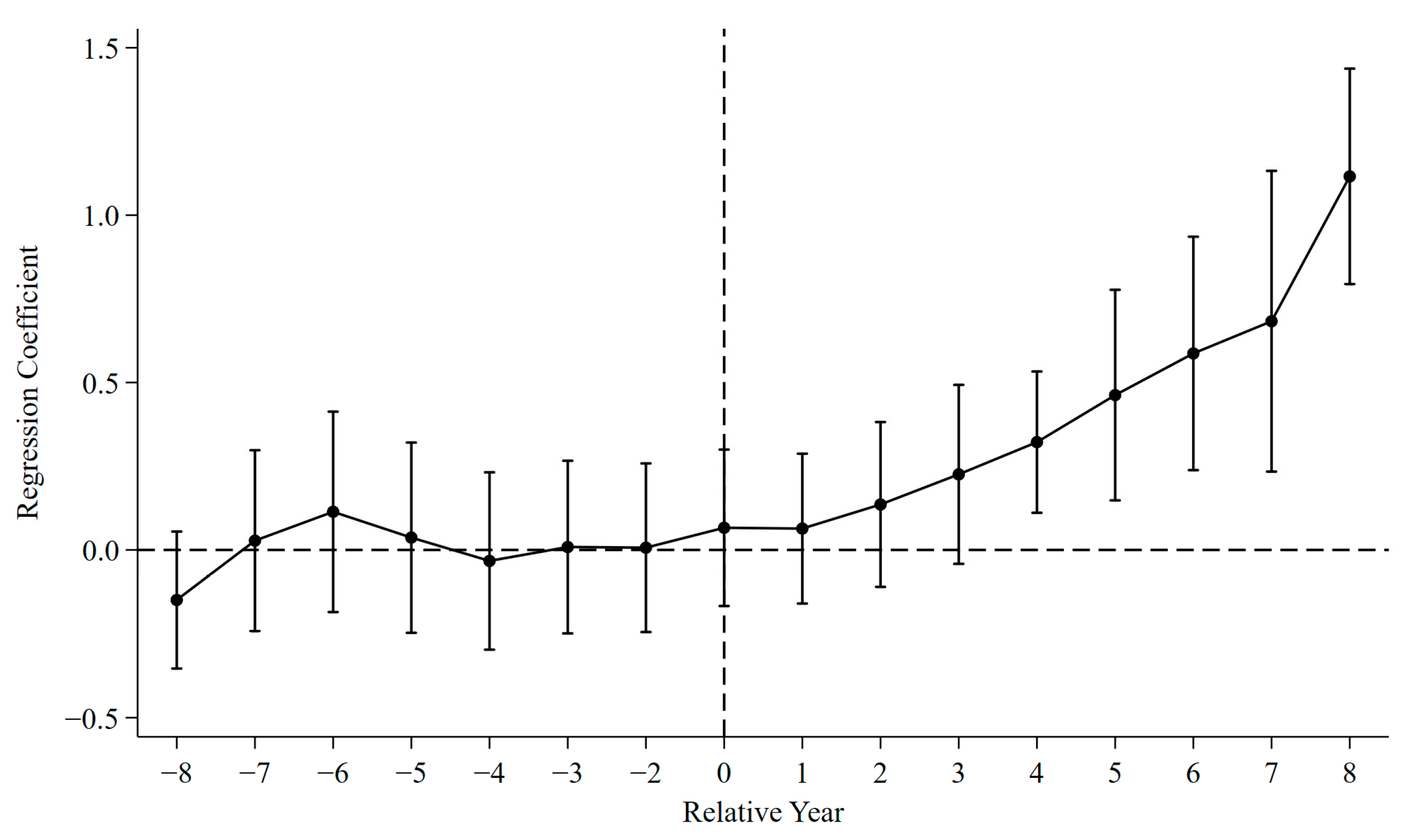
To verify the validity of the DID model, this paper employs the event study method to conduct a pre-treatment trend test and examine the dynamic effects of the policy. To avoid multicollinearity, the year prior to the policy implementation (Relative Year −1) is set as the benchmark period. The results are shown in
Figure 1.
First, the analytical results are consistent with the parallel trend assumption. Before the policy implementation, the regression coefficients fluctuate around zero and are statistically insignificant, indicating that there were no systematic trend differences between the treatment and control groups beforehand.
After the policy implementation, the regression coefficients show an upward trend year by year. However, they are not statistically significant in the first three years, suggesting a lag in the release of economic dividends from national park construction. Starting from the fourth year, the coefficients become significantly positive and continue to grow, demonstrating a marginal increasing effect. This dynamic trend reflects the evolutionary pattern of the regional economy, transitioning from initial infrastructure consolidation to intermediate eco-tourism development, and ultimately to long-term industrial structure upgrading: specifically, the early phases of infrastructure construction and resource integration entail an objective gestation period; however, as ecological brand effects materialize and industrial chains extend, the policy’s driving effect on the regional economy exhibits a trend of continuous strengthening in the medium-to-long term.
4.3. Robustness Check
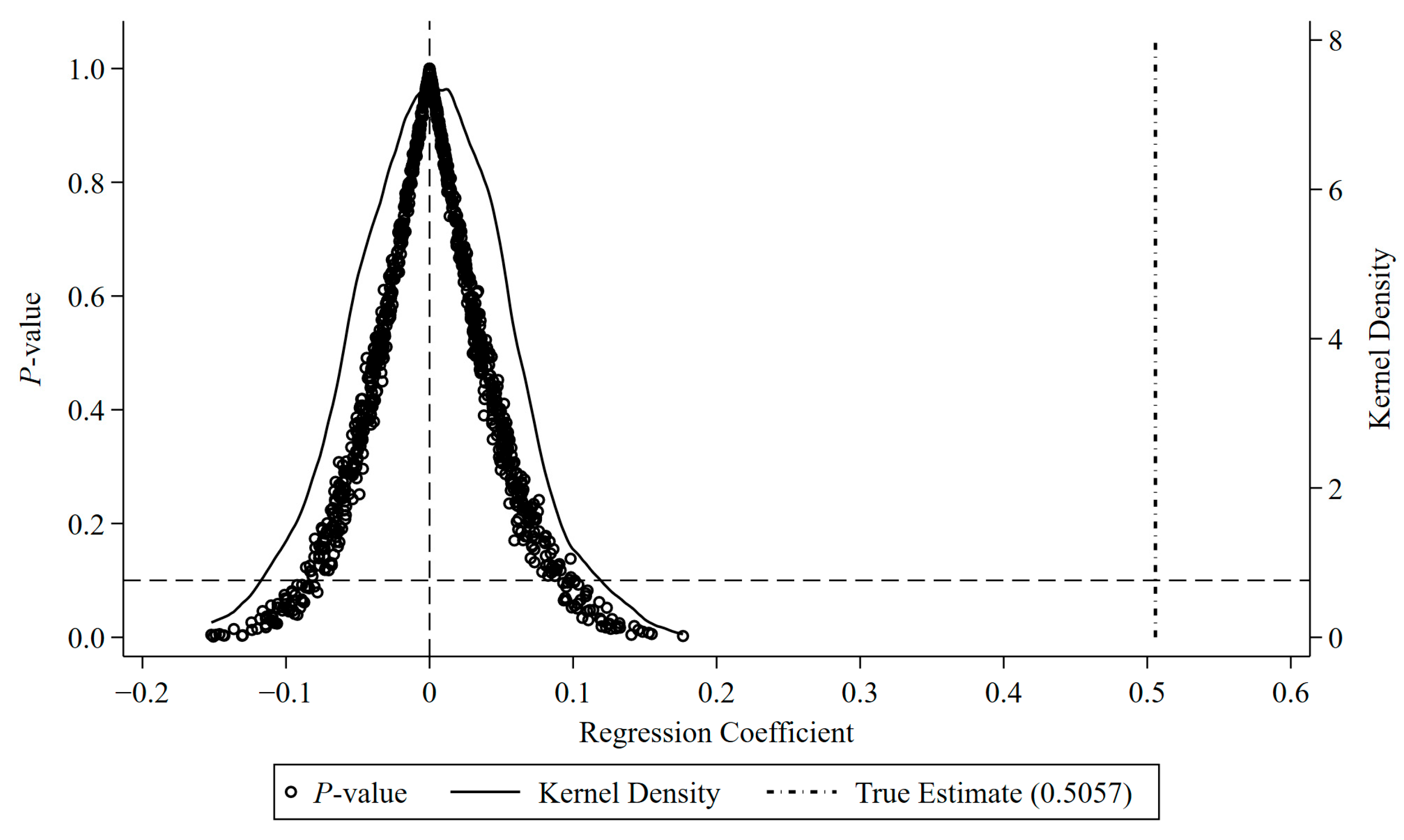
To further verify the validity of the causal identification regarding the impact of national park establishment on regional economic development, this paper employs a placebo test for robustness analysis. Specifically, while keeping the control variables and fixed-effects specifications unchanged, the timing of policy implementation and the treatment group assignments were randomly reshuffled. This virtual regression process was repeated 1000 times to generate a distribution of simulated intervention coefficients. The results are presented in
Figure 2.
The results show that the kernel density curve of the simulated coefficients centers around zero, and the vast majority of
p-value scatter points lie above the 0.1 significance level line, indicating that the randomly constructed dummy policies yielded no significant impact. To facilitate a direct visual comparison with the placebo distribution,
Figure 2 marks the true policy estimate (0.5057) with a vertical dashed line on the right side of the x-axis. As shown, the true coefficient clearly deviates from the main range of the simulated distribution and lies in its extreme right tail. This confirms that the economic promotion effect of national parks is not derived from chance factors or model bias, demonstrating the high robustness of the baseline regression results.
To establish the reliability of the causal inference, this paper conducts a systematic robustness check from dimensions including model specification, variable measurement, sample outliers, and policy exclusivity. The results are presented in
Table 4.
First, we employ alternative estimation models to mitigate potential specification bias. Given that traditional difference-in-differences (DID) models may yield biased estimates due to treatment effect heterogeneity in the context of staggered policy implementation, Column (1) reports the results using the CS-DID model proposed by Callaway and Sant’Anna [
60]. Furthermore, we must acknowledge that the placement of national park pilots is not a completely random “natural experiment” but exhibits significant characteristics of “selection into treatment.” A review of the pilot distribution in Yunnan reveals that early pilots (e.g., Pudacuo and Laojunshan) were mostly concentrated in regions characterized by “superior ecological endowments but relatively lagging economic development.” This non-random selection logic, which simultaneously “selects for ecological superiority” and “targets economic weakness,” may lead to systematic ex-ante differences in resource endowments between pilot and non-pilot counties. If left uncontrolled, these initial differences could confound the identification of policy effects. To address this, Column (2) employs the Propensity Score Matching difference-in-differences (PSM-DID) method. We select control variables as covariates for nearest-neighbor matching to identify non-pilot counties with the most similar characteristics to the pilot counties as a control group, thereby effectively mitigating selection bias driven by location preferences. The results indicate that, even under these stricter identification assumptions, the policy effect remains significantly positive, and the coefficient estimates remain robust.
Second, the dependent variable is replaced, and the influence of extreme values is excluded. To test the sensitivity of the conclusions to the form of indicator construction, Column (3) replaces the dependent variable with total GDP. Columns (4) and (5) apply a two-sided 2.5% winsorization and logarithmic transformation to per capita GDP, respectively, to eliminate interference from outliers and mitigate heteroscedasticity. All regression results are statistically significant, demonstrating that the core conclusions do not rely on specific indicator forms or individual extreme samples.
Finally, the interference of competing policies and specific period shocks is excluded. On the one hand, to purify the policy evaluation environment, considering that the spatial overlap between the “Key Ecological Function Zones” policy and national park construction may induce confounding effects, Column (6) introduces a dummy variable for this policy as a control. On the other hand, to exclude potential interference from the formal establishment of national parks in 2021 and subsequent macro-policy adjustments, Column (7) excludes samples from 2021 and beyond, retaining only data from the pilot period for regression. The results show that the DID coefficient remains significant at the 1% level, effectively ruling out alternative explanations driven by competing policies or specific time windows.
In summary, through rigorous testing across multiple dimensions, the research conclusions of this paper demonstrate a high degree of consistency and robustness.
4.4. Heterogeneity Analysis
To further examine the heterogeneity of the effects of the national park pilot policy, this study conducts subgroup regressions along four dimensions: economic development level, ecological environmental quality, geographic location, and policy stage. Economic development level and ecological environmental quality are divided into high and low groups based on the median values of the average per capita GDP and the average Ecological Environment Quality Index (EI) over 2001–2006, respectively. Geographic location is proxied by county-level average elevation, and the sample is split into high- and low-elevation groups using the median elevation. Following Ren Zhizhong (2018) [
61], policy stages are defined according to the first approval year of the pilot and are classified into the exploratory stage (1996–2007), the construction and promotion stage (2008–2014), and the institutional deepening stage (2015 and thereafter). In all subgroup regressions, counties that have never implemented a national park pilot serve as the control group. The results are reported in
Table 5.
First, regarding heterogeneity by economic development level, Columns (1) and (2) show that the national park pilot policy significantly promotes per capita GDP in both low- and high-income groups, but the estimated coefficient is substantially larger for the low-income group. This indicates a stronger marginal effect of the policy in economically less developed areas. A plausible explanation is that such areas tend to have more pronounced deficiencies in infrastructure and public services, so policy-induced investment improvements are more likely to translate into tangible gains. Moreover, fiscal support from higher-level governments and related project investments may generate stronger stimulus effects in these areas. By contrast, in high-income areas with a larger economic base, the incremental contribution brought by the policy is relatively limited, resulting in a smaller estimated effect.
Second, in terms of ecological environmental quality, Columns (3) and (4) compare policy effects under different ecological endowments. The results indicate significantly positive effects in both groups, while the estimated coefficient is larger in areas with better ecological quality. This suggests that the economic conversion efficiency of the national park policy depends closely on local natural resource endowments. Regions with higher-quality ecological conditions are more likely to leverage the national park brand and landscape resources to enhance attractiveness, promote ecotourism, nature education, and related activities, and therefore more fully translate ecological advantages into economic advantages.
Third, with respect to geographic location, Columns (5) and (6) show that the coefficient is significant and larger in high-elevation areas, whereas the effect in low-elevation areas is positive but smaller in magnitude. This difference may stem from the fact that high-elevation areas often possess scarcer mountain landscapes and richer biodiversity, which better align with the conservation and recreation functions of national parks. In addition, improvements in transportation and public service facilities during the pilot implementation are more likely to alleviate locational constraints in high-elevation areas, thereby facilitating the release of stronger latecomer growth potential.
Finally, regarding heterogeneity across policy stages, Columns (7) through (9) show that the policy effect is strongest in the exploratory stage, followed by the construction and promotion stage, while the institutional deepening stage remains significantly positive but exhibits a smaller effect. Overall, the results display a “faster early impact and slower later impact” pattern, consistent with the logic of policy evolution. During the exploratory and demonstration stage, locally driven pilots tended to place greater emphasis on branding and recreation-oriented development, with relatively weaker institutional constraints, and were often concentrated in areas with strong ecological endowments and high tourism potential, making it easier to generate a rapid “start-up effect.” In the construction and promotion stage, as pilots expanded and gradually became more standardized, infrastructure, tourism carrying capacity, and management systems continued to improve, and policy impacts were more likely to accumulate gradually and stabilize. In the institutional deepening stage, stronger institutional constraints—such as ecological red lines, land-use controls, and restrictions on resource development—may impose tighter limits on some traditional industries and offset part of the short-term gains. Meanwhile, fiscal support mechanisms are strengthened and governance standards become more standardized, but the cultivation of green industries, ecological value realization, and structural upgrading typically require more time to fully materialize. As a result, the overall effect remains positive but is more likely to manifest as slower yet more sustainable gains.
In sum, the heterogeneity analysis indicates that the economic promotion effect of the national park pilot policy varies substantially across contexts. The policy generates stronger impacts in less developed areas, high-elevation areas, and regions with better ecological endowments, where ecological resource advantages can be more readily transformed into economic growth drivers. Moreover, as the policy evolves from exploration toward institutionalization, its effects shift from rapid early gains to a more stable long-term influence, reflecting stage-specific characteristics consistent with institutional development.
4.5. Mechanism Testing
To examine the transmission channels through which the national park pilot policy affects county economic growth, this paper conducts channel tests along three dimensions—fiscal support, industrial structure adjustment, and fixed-asset investment—based on the baseline regressions. The results are reported in
Table 6,
Table 7 and
Table 8. It should be noted that our mechanism analysis follows the classic Baron & Kenny [
53] framework; therefore, the results are intended to provide empirical evidence consistent with these channels as transmission mechanisms, rather than to deliver definitive causal identification of mediation effects.
Table 6 presents the results for the fiscal-support channel. Column (1) shows that the national park pilot significantly increases counties’per capita fiscal net subsidy, indicating an overall rise in fiscal support after policy implementation. After including per capita fiscal net subsidy in Column (2), the mediator is significantly and positively associated with per capita GDP, while the policy coefficient remains significant. This suggests a stable positive relationship between increased fiscal support and economic growth, providing evidence consistent with fiscal support as a transmission channel. The heterogeneity results indicate that this channel is more pronounced in low-income counties: in the low-income group, per capita fiscal net subsidy has a stronger and significant positive association with per capita GDP, whereas the relationship is not significant in the high-income group (Columns (3)–(4)). This implies that fiscal support is more likely to generate larger marginal gains in economically weaker counties by easing fiscal constraints, strengthening the provision of basic public services, and alleviating infrastructure bottlenecks. In more economically advanced counties, where fiscal systems and public service provision are relatively mature, additional fiscal inflows may be diluted by the larger economic base, and the marginal contribution to per capita output may be more limited; policy effects may therefore operate more through market-based allocation and industrial adjustment. As a robustness check, Columns (5)–(8) replace the per capita measure with fiscal net subsidy intensity; the direction and statistical significance are broadly consistent. The policy significantly increases fiscal net subsidy intensity, and this intensity measure is positively associated with per capita GDP, with stronger effects in the low-income group, indicating that the fiscal-channel evidence is not driven by a single measure.
Table 7 reports the results for the industrial upgrading channel. Column (1) shows that the policy significantly increases industrial structure upgrading, suggesting that national park pilots promote a shift toward a more service-oriented and higher value-added industrial structure. After including industrial structure upgrading in Column (2), the mediator enters with a significantly positive coefficient, and the policy coefficient remains significant. This provides evidence consistent with industrial upgrading as a transmission channel. Heterogeneity results further show positive relationships in both income groups, but the effect is stronger in the high-income group (Columns (3)–(4)). This may reflect that economically better-developed counties have more developed counties tend to have more complete market institutions, factor endowments, and service-sector capacity, enabling them to absorb brand spillovers and tourism demand more quickly and translate upgrading into employment expansion, firm agglomeration, and productivity gains. By contrast, although low-income counties also benefit, limitations in market size and complementary conditions may reduce conversion efficiency. Using the overall industrial transformation index as an alternative measure (Columns (5)–(8)) yields consistent results: the policy significantly promotes structural transformation, and the transformation index is positively associated with per capita GDP. The subgroup patterns are in line with the baseline measure, reinforcing the robustness of the industrial-channel evidence.
Table 8 presents the results for the fixed-asset investment channel. Column (1) shows that the national park pilot significantly increases per capita fixed-asset investment, indicating that policy implementation is accompanied by expanded investment in infrastructure and public services. After including per capita fixed-asset investment in Column (2), the mediator is significantly positive and the policy coefficient remains significant, providing evidence consistent with investment-driven transmission. Heterogeneity results show that this channel is more concentrated in low-income counties: the policy effect on per capita GDP is stronger in the low-income group, while it is not significant in the high-income group (Columns (3)–(4)); per capita fixed-asset investment is positive and significant in both groups, but the coefficient is larger in the low-income group. This suggests that in less developed counties, national-park-related investment is more likely to address binding constraints—such as accessibility, tourism-service facilities, ecological monitoring, and public service gaps—thus generating “from-zero-to-one” improvements and supporting subsequent industrial development by lowering transaction costs and raising carrying capacity. In more developed counties, with higher existing infrastructure and investment levels, the marginal contribution of additional investment to per capita output may be smaller. As a robustness check, Columns (5)–(8) use fixed-asset investment intensity instead of per capita investment; the results largely maintain the same pattern. Investment intensity is significantly associated with per capita GDP in the full sample and in the low-income group, but it is not significant and even turns negative in the high-income group. This may indicate that in high-income counties, investment expansion is more prone to structural misallocation or crowding-out effects, leading to lower marginal returns to per capita output. Overall, the investment channel shows consistent directional evidence across alternative measures and exhibits a stronger transmission pattern in low-income counties.
In summary, the promoting effect of the national park policy on the regional economy is not the result of a single pathway but the outcome of the synergistic action of fiscal support, industrial upgrading, and capital investment. Hypotheses H2a, H2b, and H2c are all strongly supported by empirical evidence.
5. Spatial Spillover Effect Analysis
5.1. Spatial Autocorrelation Test
Before constructing a spatial econometric model, testing for spatial autocorrelation among variables is a crucial prerequisite for assessing the rationality of the model specification. To this end, based on a spatial geographic weight matrix, this paper calculated the Global Moran’s I for per capita GDP across 127 counties in Yunnan Province from 2001 to 2023. The results are presented in
Table 9.
The overall distribution shows that the Moran’s I values for both the full sample and individual years are positive and statistically significant at the 1% level. The Global Moran’s I for the full sample is 0.585, indicating a significant positive spatial autocorrelation in county-level economic development. A comparison reveals that the Global index calculated from pooled panel data (0.585) is notably higher than the cross-sectional indices for individual years (0.080–0.130). This statistical characteristic reflects the dual dependence of regional economic development in both spatial and temporal dimensions: the pooled sample captures not only lateral spatial clustering but also longitudinal temporal serial correlation (i.e., path dependence), the superposition of which makes the overall correlation more significant.
In terms of temporal trends, the degree of spatial clustering generally exhibits a fluctuating upward trend during the sample period. Between 2001 and 2011, the Moran’s I fluctuated stably within the range of 0.080 to 0.095. Since 2012, spatial correlation has gradually strengthened, reaching a peak of 0.130 in 2018. Although it declined slightly thereafter, it remained above 0.100. This indicates that with the development of regional economic integration, the economic interdependence between counties has continuously deepened. To minimize model misspecification and estimation bias, a spatial econometric model is introduced to accurately identify policy effects and spatial spillover impacts.
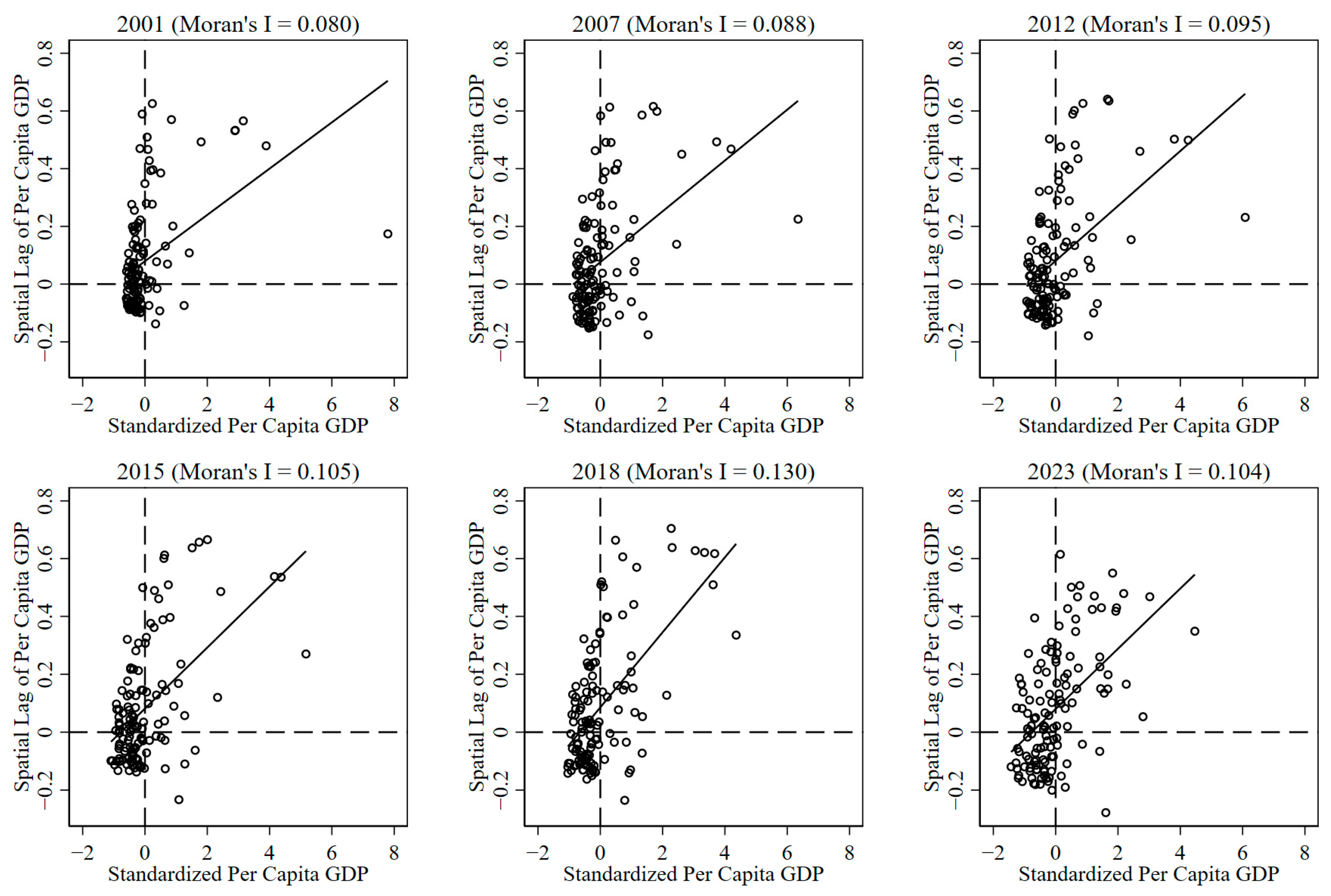
To further characterize the micro-morphology and temporal evolution of spatial agglomeration in Yunnan’s county-level economy, we plotted Moran scatterplots for six key time nodes within the sample period (see
Figure 3). The selection of these time nodes is closely aligned with the evolutionary trajectory of the national park policy: 2001 serves as the baseline prior to policy implementation; 2007 marks the establishment of Pudacuo National Park and the initiation of the “local pilot” phase; 2012 corresponds to the substantive expansion of pilot programs across the province; 2015 marks the elevation of the reform to a national strategy with the issuance of the Pilot Plan for Establishing the National Park System; 2018 represents the peak of spatial agglomeration effects; and 2023 reflects the most recent spatial pattern.
As shown in
Figure 3, the vast majority of county samples are concentrated in the first quadrant (High–High agglomeration) and the third quadrant (Low–Low agglomeration), exhibiting a distinct “bi-polar” polarization. This distribution reveals a significant “club convergence” phenomenon in county-level economic development, where economically developed counties tend to “cluster for development” through positive spillover effects, while underdeveloped counties exhibit characteristics of contiguous poverty. From a dynamic perspective, the slope of the regression fit line (corresponding to the magnitude of Moran’s I) has undergone a process of “stable start—accelerated rise—high-level stabilization.” Between 2001 and 2007, the slope growth was relatively moderate, suggesting loose inter-county economic linkages in the early policy stage. However, after 2012, with the comprehensive rollout of the national park system pilots, the slope steepened significantly, reaching a peak in 2018. This profoundly reflects that national park construction, as a tool for spatial governance, has effectively broken down administrative barriers and accelerated the cross-regional flow and agglomeration of factors by improving transportation infrastructure and building ecological industrial chains, thereby reinforcing the spatial connectivity and coordinated development of the regional economy at the macro level.
5.2. Selection and Testing of Spatial Econometric Models
To accurately identify the spatial spillover effects of regional economic growth, this paper conducts systematic statistical tests on the spatial dependence of the model setting, model form, and fixed effects. The results are shown in
Table 10.
First, spatial dependence diagnosis. Based on the LM test and its robust form (Robust-LM) for the spatial lag term and spatial error term, the results show that the statistics for LM_err, LM_lag, and their robust versions are all significant at the 1% level. This indicates that the sample data simultaneously exhibit significant spatial error autocorrelation and spatial lag correlation, preliminarily verifying the necessity of introducing a spatial econometric model.
Second, model form identification. To determine the optimal spatial model form, this paper uses the LR test and Wald test to examine whether the Spatial Durbin Model (SDM) degenerates into a Spatial Autoregressive Model (SAR) or a Spatial Error Model (SEM). The test results show that the LR and Wald statistics against the SAR model are 129.04 and 123.53, respectively, while those against the SEM are 189.60 and 192.32. All tests reject the null hypothesis that the SDM degenerates into SAR or SEM at the 1% significance level. This demonstrates that the SDM model, as a more inclusive general form, can more comprehensively capture the spatial interaction effects between variables, offering a superior fit compared to simplified models.
Third, fixed-effects testing. The Hausman test result is 60.45 (p < 0.0), rejecting the random-effects hypothesis and supporting the selection of a fixed-effects model. Furthermore, the LR test is used to discriminate the form of fixed effects. The results show that the LR statistics for individual fixed effects and time fixed effects are 60.37 and 2594.28, respectively, both significantly rejecting the null hypothesis of single fixed effects. This indicates that the model should simultaneously control for individual heterogeneity and time shocks.
In summary, this paper ultimately selects the two-way fixed-effects SDM as the baseline regression model. This specification not only effectively addresses omitted variable bias but also simultaneously captures the dual spatial spillover effects of both explanatory and dependent variables.
5.3. Testing for Spatial Spillover Effects
Table 11 reports the estimation results of the Spatial Durbin Model (SDM) based on different spatial weight matrices. Column (1) and Column (2) employ the inverse-distance weight matrix and the adjacency weight matrix, respectively, aiming to verify the reliability of the empirical results by comparing different spatial dimensions.
First, regarding the spatial correlation characteristics and preliminary regression coefficients, the spatial autocorrelation coefficients under both matrices are significantly positive at the 1% level (0.851 and 0.466, respectively), indicating strong spatial dependence and regional stickiness in the county-level economic development of Yunnan Province. In terms of coefficient estimation, the coefficients of the core explanatory variable (Main) and the spatial lag term (Wx) are both positive and significant. This preliminarily suggests that the construction of national parks has a positive impact on the local economy and that spatial spillover effects are emerging. However, since the SDM includes global spillover effects, point estimate coefficients cannot directly reflect true marginal effects. Therefore, the following analysis focuses on the direct, indirect, and total effects decomposed using the partial differentiation method.
Second, regarding the direct impact of the policy on the local area, under the inverse-distance matrix, the direct effect coefficient is 0.459 (). This value is slightly larger than the main regression coefficient (Main = 0.415), with the difference capturing the “spatial feedback effect”—that is, the positive externalities spilling over to neighboring areas after the national park drives local growth feed back into the local economy through regional economic circulation. The result under the adjacency matrix (0.405) is consistent with this finding. This robust conclusion indicates that, regardless of the definition of spatial adjacency, national parks significantly enhance the economic development level of the pilot counties themselves by optimizing resource allocation and establishing ecological brand advantages.
Third, further examining spatial spillover effects, the indirect effect under the inverse-distance matrix is 0.305 (), and under the adjacency matrix, it is 0.202 (). Both matrices confirm that the construction of national parks possesses significant positive spatial externalities. This means that after a county establishes a national park, it effectively drives the increase in per capita GDP of neighboring areas through the interconnection of transportation infrastructure, the diffusion of tourist flows, and the extension of industrial chains. It is worth noting that the indirect effects under both matrices are smaller than the direct effects, exhibiting reasonable “distance decay” characteristics. This indicates that while the policy dividends have significant diffusivity, the core benefits primarily remain within the pilot counties. There is no “hollowing out” caused by excessive diffusion; rather, this pattern of “internal strengthening with external spillovers” aligns with the objective laws of regional economic development.
Fourth, comprehensively examining the overall impact of the policy, the total effect coefficients under the inverse-distance and adjacency matrices are 0.764 and 0.607, respectively, both significant at the 1% level. This result reflects the net contribution of national park establishment to the entire regional sector. Empirical data demonstrate that the policy has not induced a “siphon effect” at the expense of surrounding interests. Instead, it presents a benign development trend of “driving regional development through pilot hubs” (point-to-area development) and achieving regional co-prosperity, effectively validating the empirical value of national park construction as a new engine for promoting coordinated regional economic development.
5.4. Spatial Spillover Boundaries and Distance Decay Characteristics
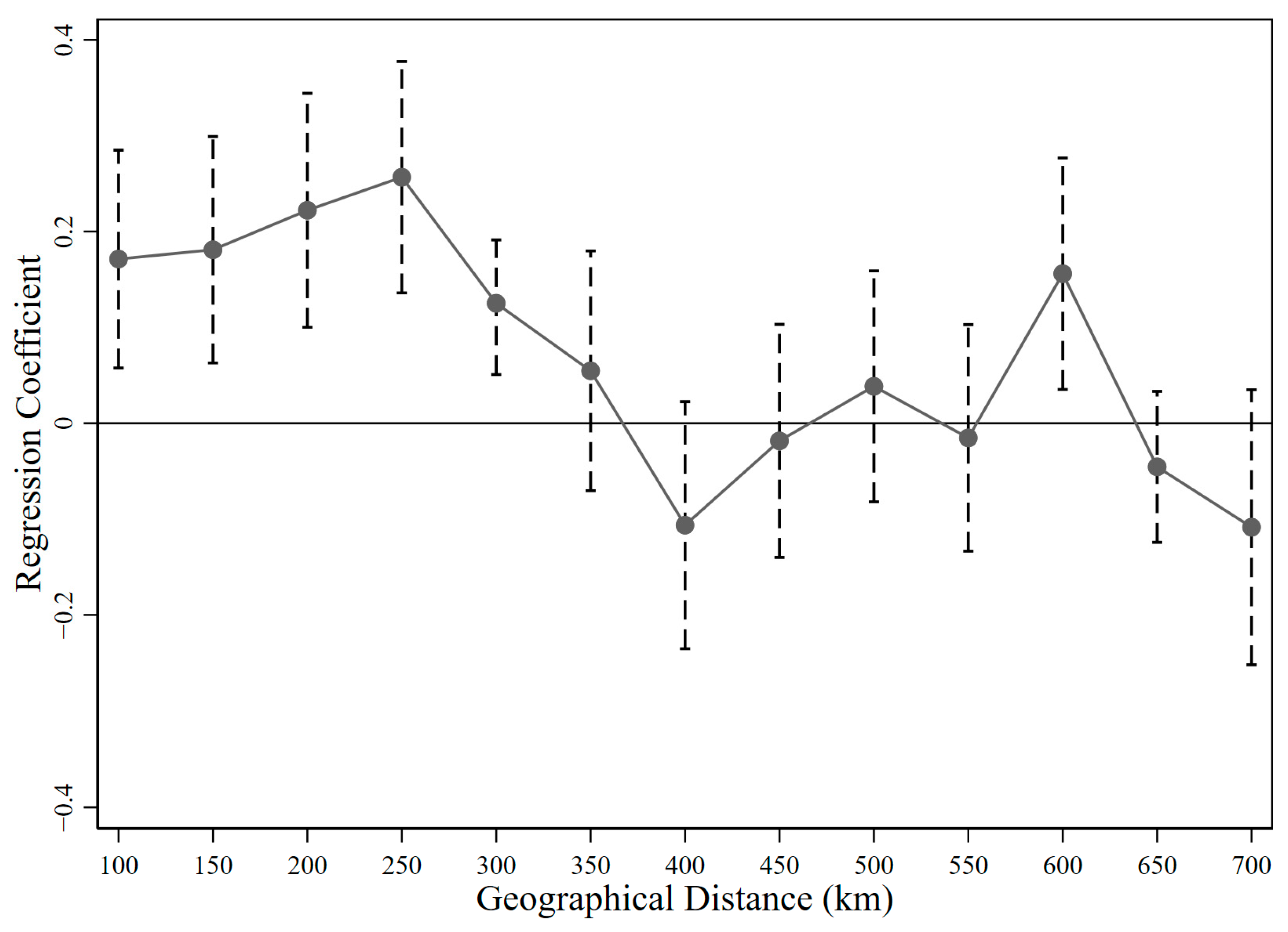
To rigorously verify the geographical boundaries and attenuation laws of the spatial spillover effects generated by national parks, this study plotted the spatial attenuation trend curve as shown in
Figure 4. In terms of the logic for parameter setting, the distance threshold was set to range from 100 km to 700 km, with a fine-grained step size of 50 km. The selection of this range is primarily based on the geographical scale characteristics of Yunnan Province, which ensures the coverage of the vast majority of inter-county economic interactions within the province while effectively filtering out the heterogeneity noise caused by ultra-long-distance spatial units. Furthermore, the 50 km step size helps to capture the marginal changes in spillover intensity within the “Golden Tourism Radius.”
The visualization results indicate that the driving effect of national parks on the regional economy does not follow a simple linear decay law but instead exhibits a significant inverted U-shaped non-linear characteristic. Specifically, within the distance interval of 100 km to 250 km, the spatial spillover effect does not weaken with increasing distance; on the contrary, it shows a significant strengthening trend, reaching its peak intensity at 250 km. This phenomenon suggests that the optimal radiation radius of a national park is not limited to the immediate adjacent areas but reaches its optimum within a transportation circle of approximately 2 to 3 h. This distance interval is conducive to the formation of regional tourism loops and multi-destination travel routes, facilitating the sharing of tourist flows and industrial complementarity, thereby maximizing positive spillovers.
However, after crossing the inflection point of 250 km, the mechanism of distance decay begins to dominate. The empirical curve shows that the regression coefficient exhibits a sharp downward trend as the geographical distance extends further. Specifically, when the distance extends to 350 km, the spillover effect is no longer statistically significant, and it turns negative at 400 km. This finding clearly defines the effective geographical boundary of the positive externalities of national parks at approximately 350 km. Beyond this range, constrained by rising transportation costs and the weakening of industrial linkages, policy dividends are difficult to transmit effectively. In summary, the core economic driving force of national park construction is primarily concentrated within a radius of 350 km. This finding provides an important quantitative basis for constructing appropriately scaled ecological economic circles.
6. Discussion
Taking the national park institutional reform in Yunnan Province, China, as an example, this paper empirically examines the economic effects of national park construction based on long-term panel data from 127 counties between 2001 and 2023.
The study finds that the national park policy has not only significantly increased the per capita GDP of pilot counties but also generated positive spatial spillover effects. This empirical result primarily provides compelling macroeconomic evidence for re-examining the relationship between “conservation and development.” There has been a long-standing controversy in academia regarding whether establishing protected areas inhibits economic growth. Some studies supporting the “restriction hypothesis” worry that strict ecological regulations will crowd out production factors by limiting resource exploitation and increasing compliance costs, thereby suppressing local economic growth [
6,
62]. However, our empirical results do not align with this concern; instead, they provide empirical evidence from a macro-regional level supporting the view that “conservation and development are not mutually exclusive” [
4,
7]. Our research indicates that under reasonable institutional arrangements, national parks do not become obstacles to development but may realize the conversion of ecological value into economic value by forcing a green transformation [
11]. This suggests that the practice in Yunnan has, to a certain extent, avoided the “green poverty” trap feared by some scholars and supports the argument that ecological conservation can be compatible with, or even promote, regional economic development.
Regarding the specific driving mechanisms of “how to promote growth,” the findings of this paper not only corroborate some international experiences but also reveal the uniqueness of the Chinese context. Consistent with most studies focusing on developed countries such as the United States and Austria [
15,
17], we confirm that industrial structure upgrading driven by ecotourism is an important engine for economic growth, which reaffirms the significant economic multiplier effect of the tourism industry [
13]. However, unlike the Western model, which relies mainly on market-oriented tourist consumption [
16], this paper further discovers that “fiscal transfer payments” play a more critical role in the construction of China’s national parks. This finding echoes conclusions regarding the Giant Panda National Park [
26], namely that vertical compensation from the central government effectively alleviates local protection costs. This implies that compared to a purely market-driven model, China’s “two-wheel drive” model of “government-led fiscal incentives + market-oriented industrial upgrading” may be better suited for developing regions to cope with the dual challenges of high population density and lagging development.
Furthermore, this study expands the horizon from the micro “island effect” to the macro “regional radiation.” Previous studies on the economic impacts of national parks have mostly focused on micro-effects within the park or its immediate communities [
15,
23,
29], and some have pointed out the spatial inequality of benefit distribution [
21,
24]. In contrast, this study attempts to shift the perspective from “points” to “areas.” Our spatial econometric results show that the economic dividends of national parks are not confined “within the walls” but have produced significant positive spillovers to surrounding areas. This result quantitatively responds to the view of Cao et al. (2025) [
32] regarding the externalities of ecological service flows from the perspective of economic geography. It implies that national parks are not isolated ecological islands but can become regional growth poles driving coordinated development through transportation improvements and industrial linkages.
Naturally, this study has certain limitations. First, regarding conceptual definitions and indicator selection, this paper uses the growth of per capita GDP as the primary proxy for “economic development,” which may be too absolute. GDP mainly measures the total growth of economic output and is not equivalent to broad-based social welfare improvement or inclusive development; it cannot fully reflect micro-level changes in income distribution, subjective well-being, and livelihood diversity. Although the data show that national parks significantly improved output levels, this does not directly mean that all groups benefit equally. Second, regarding the causal identification strategy, although we employed the PSM-DID method to mitigate differences in observable characteristics, the placement of national parks is not a completely random experiment. They tend to be located in regions with rich ecological resources but relatively lagging economic development (i.e., a “selection into treatment” characteristic). This selection bias, caused by unobservable factors such as local government intent or historical and cultural accumulation, may still interfere with the estimation results. Third, regarding the spatial econometric specification, although we used both inverse-distance and adjacency weight matrices for robustness checks, the measurement of spatial spillover effects is often sensitive to matrix settings. Real-world regional economic connections are influenced by multiple factors such as transportation networks and economic embeddedness; a weight matrix based solely on geographic information may not fully capture complex economic spillover networks. Finally, regarding external environmental impacts, the sample period of this study spans a long duration, and external shocks such as macroeconomic fluctuations may potentially affect the model estimates. This study mainly focuses on the average net effect of the policy itself and has not specifically isolated the non-linear interferences potentially caused by external macro-environmental changes. This points out the direction for further in-depth research.
7. Conclusions and Policy Implications
Based on panel data from 127 counties in Yunnan Province from 2001 to 2023, this paper constructs a time-varying difference-in-differences (DID) model and a Spatial Durbin Model (SDM) to systematically evaluate the impact of national park establishment on regional economic development. It explores the mechanisms from three dimensions—fiscal transfer payments, industrial structure upgrading, and fixed asset investment—while identifying potential spatial spillover effects. The main conclusions are as follows:
First, the establishment of national parks has a significant positive impact on the per capita GDP of pilot areas. This conclusion remains robust across different model specifications and multiple robustness checks, verifying the economic promotion effect of the national park policy. Dynamic effect analysis further shows that this impact possesses distinct lagged and persistent characteristics; policy effects generally emerge gradually 4 to 5 years after implementation and continue to strengthen in subsequent stages.
Second, heterogeneity analysis indicates that the economic driving effect of national parks exhibits significant contextual differences and temporal characteristics. In the cross-section, policy effects are stronger in regions with low economic development levels, high altitudes, and superior ecological environment quality. This suggests that the national park system has significant “pro-poor” characteristics, and regions with better ecological endowments and unique geographical environments are more likely to realize the economic conversion of ecological values. In the longitudinal time series, policy effects present an evolutionary pattern of “early explosion, later stability.” Specifically, the economic driving role is strongest during the “research and exploration stage” due to the rapid initiation of branding and recreational development. In the “institutional deepening stage,” although restricted by stricter ecological red lines and industrial transformation cycles, the marginal effect converges but remains significantly positive, reflecting a transition from “project-driven” to “structure-reshaping” policy dividends.
Third, mechanism tests reveal that national parks synergistically promote regional economic growth through three paths: (1) significantly increasing the scale of upper-level fiscal transfer payments, thereby alleviating the fiscal pressure on local governments; (2) increasing the share of the tertiary industry, promoting the optimization and upgrading of the industrial structure; (3) driving the growth of fixed-asset investment, providing critical capital support for regional economic development.
Finally, spatial analysis results show that national parks not only drive local growth but also generate significant positive spillover effects on surrounding areas through geographical proximity mechanisms. Spatial attenuation trend analysis further reveals that this spillover effect does not follow a simple linear decay but exhibits a significant “inverted U-shaped” characteristic: positive spillovers peak at 250 km, then decay, and lose significance at approximately 350 km. This finding clearly defines the effective geographical boundary of the national park’s economic radiation, indicating that it drives regional coordinated development within a radius of approximately 350 km through a “core-periphery” mechanism.
Based on the findings of this paper, the following policy recommendations are proposed:
First, increase financial and policy inclination towards underdeveloped areas to solidify the foundation for development. The study finds that the driving effect of the national park policy is more pronounced in areas with weaker economic foundations. Therefore, it is recommended to implement a differentiated strategy in fund allocation, prioritizing underdeveloped pilot counties. Central and provincial finances should focus on supporting the improvement of transportation roads and basic public services in these areas to help address infrastructure deficiencies. By improving the “hard environment” for investment, these regions can more quickly accommodate green industries such as ecotourism, thereby gaining tangible growth momentum in the early stages of the policy.
Second, promote the conversion of ecological advantages into industrial advantages according to local conditions to avoid homogeneous competition. Given the finding that policy effects are stronger in high-altitude and ecologically superior regions, it is recommended to fully utilize the unique landscape resources of these areas to pursue a path of distinctive and high-quality development. In development and utilization, low-level mass tourism development should be strictly controlled to avoid the “one park, one look” problem. Encouraging the development of high-value-added service formats such as nature education and ecological wellness, as well as building top-tier national park ecological brands, will improve the output efficiency per unit of resource and ensure sustainable economic returns.
Third, dynamically adjust the policy focus according to the construction stage to maintain long-term growth vitality. Given that policy effects slow down somewhat during the “institutional deepening stage,” it is suggested that policy support methods should be optimized according to the development stage. In the early stage of construction, the focus should be on relying on project investment and infrastructure construction to pull the economy. As the system matures and controls tighten, the focus should timely shift to cultivating endogenous drivers. For example, increasing support for community green industries and exploring diversified value realization paths such as franchising and carbon sink trading will prevent late-stage growth stagnation caused by reliance solely on external investment, ensuring the sustainability of policy dividends.
Fourth, establish cross-regional coordinated development mechanisms to allow surrounding areas to share development dividends. Based on the discovery of a radiation radius of approximately 350 km for national parks, the government should break administrative barriers and coordinate the planning of national parks and their surrounding areas. It is recommended to establish a cross-county coordination and cooperation mechanism to implement an integrated layout in tourism route design, transportation network connection, and industrial support. For instance, guiding surrounding areas to undertake supporting service functions such as catering, accommodation, and tourism distribution will form a dislocated complementarity with the core protected areas, allowing surrounding areas to gain economic benefits through serving the national park and achieving regional common development.