


Abstract
Against the backdrop of rapid urbanization, administrative division adjustments not only alter urban administrative boundaries but may also reshape land allocation patterns and affect agricultural production. Using China’s city–county merger reforms as a quasi-natural experiment, this study employs a staggered difference-in-differences (DID) approach and panel data from 266 Chinese prefecture-level cities over the period 2013–2022 to examine the effects of administrative division adjustments on primary-sector value added. The results show that city–county mergers increase primary-sector value added by approximately 6.4% on average. Mechanism analysis suggests that these reforms strengthen prefecture-level governments’ capacity to coordinate resource allocation across counties and districts within their jurisdictions, thereby promoting agricultural economic growth through improved allocation of agricultural and non-agricultural production resources. Specifically, city–county mergers increase cultivated land area by approximately 4.3% on average and significantly raise local government expenditure on agriculture, forestry, and water conservancy. Heterogeneity analysis reveals that the positive effects are more pronounced in cities with stronger intergovernmental competition within their jurisdictions and in central and western China. These findings suggest that city–county mergers not only reshape urban administrative boundaries but may also promote growth in primary-sector value added by strengthening prefecture-level governments’ capacity to coordinate resource allocation within their jurisdictions. This study provides new empirical evidence on the economic effects of administrative division adjustments on the agricultural sector and contributes to a better understanding of how urban expansion can be reconciled with agricultural development.
1. Introduction
As global urbanization continues, urban expansion is profoundly reshaping land-use patterns and intensifying competition for land between urban development and agricultural production [1,2]. Previous studies have shown that the rapid expansion of urban areas continues to encroach on cultivated land and other agricultural production resources, posing unexpected challenges to food security, agricultural development, and several United Nations Sustainable Development Goals (SDGs), particularly SDG 2 (Zero Hunger), SDG 15 (Life on Land), and SDG 11 (Sustainable Cities and Communities) [1,3,4]. Research further suggests that global urban expansion between 2000 and 2030 could result in the loss of 1.8–2.4% of cropland and a 3–4% decline in global crop production [5]. These findings indicate that urbanization involves not only the concentration of population and economic activities in cities but also the continuous transformation of agricultural production space. Understanding how urbanization affects land allocation and agricultural production is therefore of considerable theoretical and practical importance.
Against the backdrop of rapid global urbanization, China’s urbanization experience is particularly representative [6]. Since the launch of reform and opening-up in 1978, China’s urbanization rate has increased rapidly from 17.9% in 1978 to 65.2% in 2022, undergoing within just four decades an urban transition that took several centuries in many developed Western countries. More importantly, unlike the largely market-driven urbanization process in Western developed countries, China’s urbanization has been characterized by strong government intervention [6,7]. Administrative division adjustments, particularly city–county mergers, have become an important policy instrument through which local governments promote urbanization [8]. Since the 1990s, more than 200 counties in China have been incorporated into central urban areas through city–county merger reforms. A city–county merger refers to an administrative restructuring in which a county under the jurisdiction of a prefecture-level city is converted into a municipal district. Such reforms not only expand urban administrative boundaries but also reshape the governance structure and distribution of authority between county governments and prefecture-level city governments. Existing studies have shown that city–county mergers promote “economic integration” by reducing administrative barriers between cities and counties and facilitating factor mobility [9]. They also strengthen “political integration” by transferring administrative authority from county governments to prefecture-level city governments [9]. These changes have far-reaching implications for non-agricultural outcomes, including regional economic growth, public service provision, environmental pollution control, housing prices, and firm performance [10].
However, relatively little attention has been paid to how city–county mergers affect land allocation and agricultural growth. Given the heavy dependence of agricultural production on land resources, city–county mergers undertaken in the context of land-finance-driven urbanization are bound to affect agricultural production through changes in land allocation. As an important institutional instrument for promoting urbanization, city–county mergers may further crowd out agricultural land and other production resources by expanding urban areas, encouraging the concentration of production factors in non-agricultural sectors, and increasing the demand for construction land. Alternatively, these reforms may strengthen prefecture-level city governments’ capacity to coordinate land use and fiscal resources across their jurisdictions, mitigate excessive competition among county governments, and promote a more efficient allocation of agricultural and non-agricultural production factors over a broader geographical area. Therefore, the overall effect of city–county mergers on agricultural economic growth remains ambiguous and requires further empirical investigation.
To address this issue, we use panel data for Chinese prefecture-level cities from 2013 to 2022 and employ a staggered difference-in-differences approach to systematically examine the effect of city–county mergers on agricultural economic growth at the prefecture-level city level. Unlike much of the existing literature, which focuses on the effects of the reform on the merged county itself [1,11,12,13,14,15,16,17,18], we conduct the analysis at the prefecture-level city level. This choice is important because city–county mergers not only change the development conditions of the merged counties, but also reshape prefecture-level city governments’ capacity to allocate production resources across their entire jurisdictions and may generate spillover effects on other counties that are not directly involved in the reform. Examining the agricultural effects of city–county mergers at the prefecture-level city level therefore allows for a more comprehensive identification of the reform’s overall impact on regional resource coordination and agricultural economic growth.
Our results show that city–county mergers significantly promote agricultural economic growth at the prefecture-level city level, increasing primary-sector value added by approximately 6.4% on average. This finding remains robust across a series of robustness checks. Mechanism analysis provides empirical evidence that city–county mergers promote agricultural economic growth by strengthening prefecture-level governments’ capacity to coordinate the allocation of production resources within their jurisdictions. Specifically, the reforms increase cultivated land area, local fiscal revenue, and government expenditure on agriculture, forestry, and water conservancy, suggesting that adjustments in land resource allocation and improvements in local fiscal capacity may constitute important channels through which city–county mergers promote agricultural economic growth. These findings indicate that city–county mergers involve not only the expansion of urban administrative boundaries but also changes in the distribution of administrative authority and resource allocation responsibilities among local governments. Under specific institutional conditions, such administrative restructuring may create favorable conditions for agricultural economic growth by improving regional resource coordination. Heterogeneity analysis further reveals that the positive effects of city–county mergers on agricultural economic growth are more pronounced in prefecture-level cities with higher initial levels of intergovernmental competition and in central and western China. This suggests that the agricultural economic effects of these reforms may depend on pre-existing administrative structures and regional development conditions, with greater growth benefits potentially accruing to areas characterized by stronger administrative fragmentation and greater scope for resource coordination.
This study makes three main contributions. First, this study extends the literature on the economic effects of administrative division adjustments on agriculture. Existing studies have primarily examined the effects of administrative division adjustments on regional economic growth, market integration, public service provision, and environmental governance [9,13,15,16], while paying relatively little attention to agricultural economic growth. The limited research addressing agriculture has mainly focused on the effects of administrative division adjustments on agricultural production in counties directly affected by the reforms [11]. However, city–county mergers not only reshape the administrative structure of the affected counties but may also generate spillover effects on other counties within the same jurisdiction by altering prefecture-level governments’ capacity to coordinate resource allocation. Therefore, focusing solely on the local effects in the affected counties may fail to capture the overall impact of administrative division adjustments on regional agricultural economies. By extending the unit of analysis to prefecture-level cities, this study finds that city–county mergers significantly increase regional primary-sector value added and provides empirical evidence that these reforms promote agricultural economic growth through changes in the allocation of agricultural production resources. These findings not only contribute to the literature on the economic effects of administrative division adjustments but also offer a new perspective on how such reforms affect agricultural development across entire prefecture-level jurisdictions.
Second, this study provides a new theoretical perspective on the relationship between urbanization and agricultural development. Existing research has largely focused on urban spatial expansion and the conversion of land to urban construction uses, emphasizing how urban expansion undermines agricultural development by encroaching on cultivated land and other agricultural production resources [11,19,20]. While acknowledging the pressure that urban expansion may place on agricultural land, this study further argues that urbanization does not necessarily lead to agricultural decline. Rather, its consequences for agriculture depend on whether the institutional arrangements underlying urbanization facilitate more effective resource coordination. Under certain institutional conditions, when these arrangements improve the allocation of production resources, urbanization may coexist with agricultural growth rather than undermine it.
Third, this study extends the application of centralization theory. Prior research has mainly focused on the effects of overall upward centralization on regional economic outcomes [21,22]. In contrast, we draw on China’s city–county merger reforms to examine how the upward concentration of part of lower-level administrative authority affects agricultural development at the regional level. We find that this form of partial administrative integration can also strengthen prefecture-level city governments’ capacity to coordinate land use and production resource allocation, thereby promoting agricultural growth. This provides new empirical evidence for understanding the relationship among centralization, resource coordination, and agricultural development.
2. Institutional Background and Theoretical Analysis
2.1. Institutional Background
2.1.1. The Institutional Nature of City–County Mergers
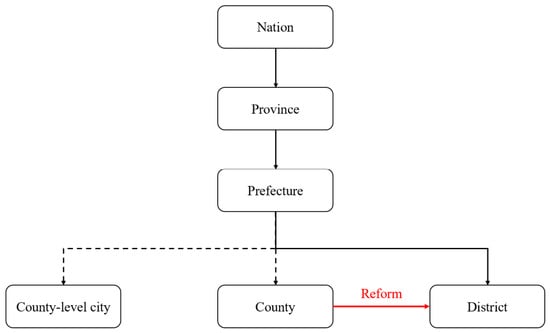
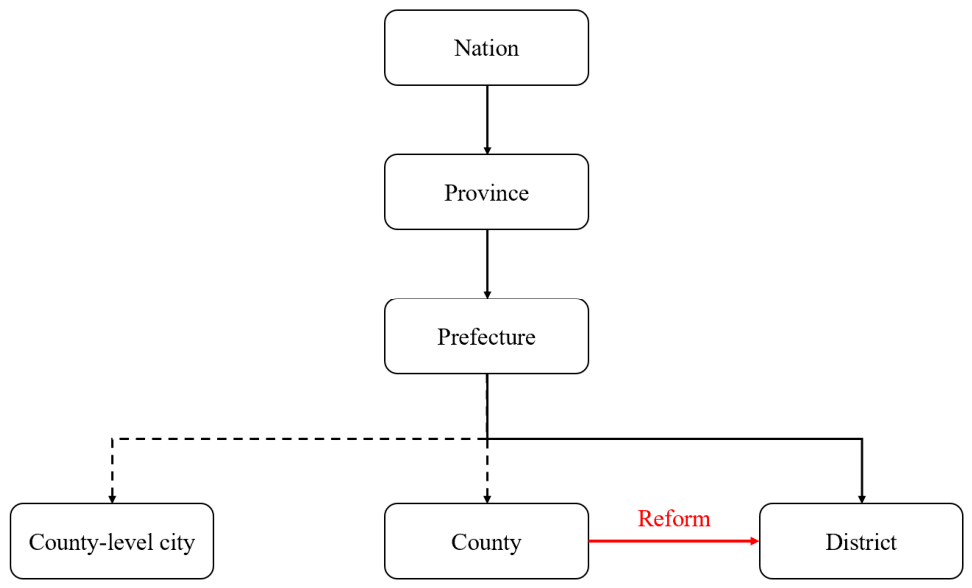
China’s administrative division system follows a hierarchical governance structure, with the central government followed by provincial, prefectural, and county-level governments. At the county level, administrative units include counties, municipal districts, and county-level cities (Figure 1). These units differ substantially in governance authority, fiscal management, and administrative autonomy. For the purposes of this study, the distinction between counties and municipal districts is particularly important.
Figure 1.
Government structure in China.
Although county governments and district governments are formally located at the same administrative rank, they differ substantially in administrative authority and fiscal autonomy. Compared with urban districts, counties are generally more independent and enjoy greater discretion. Specifically, county governments typically function as relatively autonomous governance units and have greater decision-making authority over fiscal expenditure, project approval, land management, and industrial development [9]. By contrast, district governments are directly led and supervised by prefecture-level city governments. They therefore depend more heavily on prefecture-level coordination in economic decision-making, local resource allocation, and urban management, with more limited room for independent action. In fiscal terms, under the principle of “one level of government, one level of finance,” county governments operate with an independent and relatively complete budget system. They are typically required to remit only a certain share of fiscal revenue—roughly 20–30%—to the prefecture-level city after transfers to the central and provincial governments. By contrast, district-level finance is more subordinate, with budgetary arrangements and revenue allocation more directly controlled by the prefecture-level city.
For this reason, city–county mergers are not merely changes in administrative nomenclature or outward expansions of urban boundaries. Rather, they are administrative division adjustments accompanied by a reallocation of governance authority. Once a county is converted into an urban district, part of the administrative and fiscal authority previously held by the county government is transferred upward to the prefecture-level city government [13]. As a result, the prefecture-level city gains greater capacity to coordinate land development, spatial planning, fiscal allocation, and industrial layout across its jurisdiction. In practice, case evidence shows that some county governments have resisted city–county mergers precisely because such reforms imply the loss of key powers, including approval authority, planning authority, and fiscal discretion. For example, in the 2013 restructuring plan proposed by Huzhou City in Zhejiang Province for Changxing County, Changxing would not only have transferred powers such as project approval and planning to the prefecture-level city government, but would also have increased the share of fiscal revenue remitted upward from 20% to 50%. The plan was ultimately abandoned because it encountered strong resistance from county officials. In institutional terms, a city–county merger therefore represents a process through which administrative authority and associated fiscal authority are transferred upward from the merged county to the prefecture-level city.
This institutional feature is particularly important for the present study. Agricultural development depends heavily on land allocation, and land use is deeply embedded in local governance structures. Changes in governance scale and the upward shift in coordination capacity brought about by city–county mergers may therefore reshape the spatial allocation of agricultural and non-agricultural activities within prefecture-level cities. This provides the institutional basis for examining the relationship among city–county mergers, land reallocation, and agricultural growth.
2.1.2. The Evolution of City–County Mergers in China
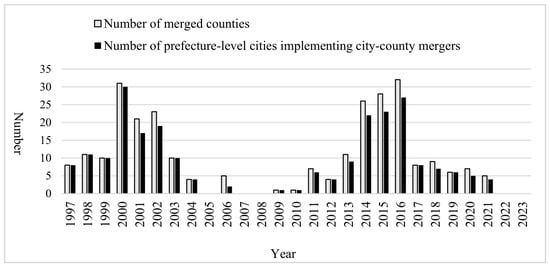
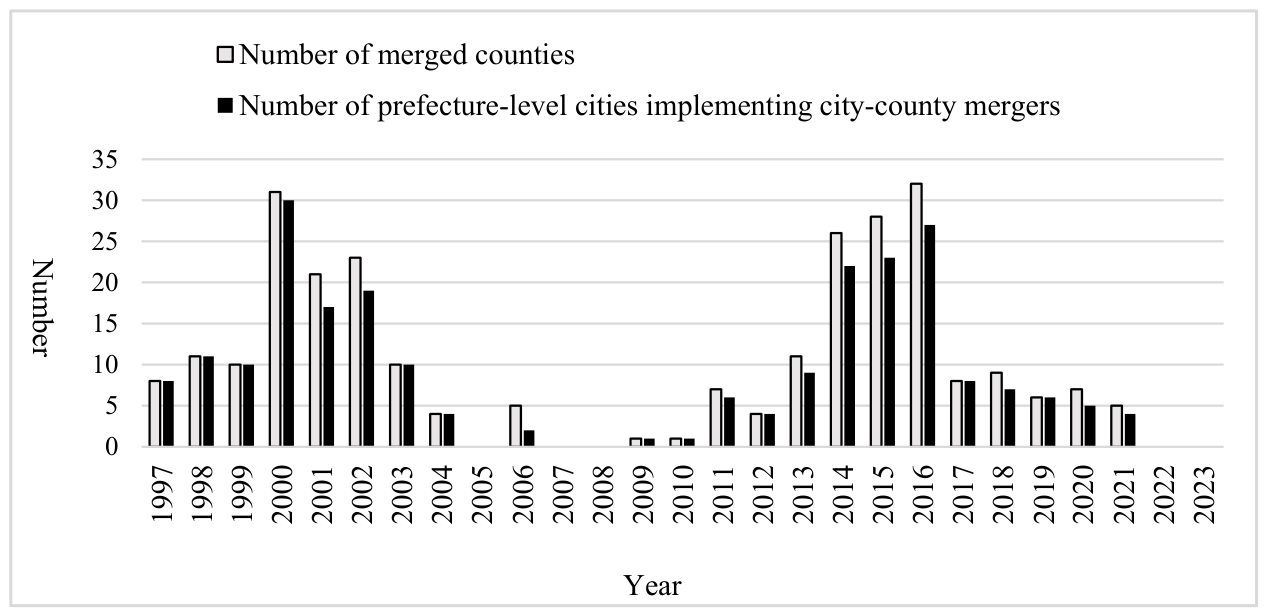
In China, city–county mergers first emerged in the late 1960s but were not widely adopted by local governments until the 1980s. Overall, the development of city–county mergers between 1997 and 2023 exhibited clear stage-specific fluctuations (Figure 2), and their evolution can be broadly divided into four phases.
Figure 2.
Trends in city–county mergers in China, 1997–2023.
The first phase, from 1997 to 2004, was a period of rapid expansion. During this period, the suspension of county-to-city conversion and rising local demand for urban expansion jointly triggered a wave of city–county merger reforms, with the number of reforms peaking between 2000 and 2004. The second phase, from 2005 to 2012, was a period of slowdown and adjustment. Owing to problems such as “pseudo-urbanization” and extensive urban sprawl, the central government gradually tightened its policy stance toward city–county mergers, and the number of reforms declined substantially. The third phase, from 2013 to 2020, was a renewed period of activity. Following the promulgation of the National New-type Urbanization Plan (2014–2020), city–county mergers once again became an important instrument for advancing new-type urbanization, and the number of reforms rose sharply, reaching another peak in 2014–2016. The fourth phase, from 2021 onward, has been characterized by a renewed slowdown. In response to challenges associated with extensive urban expansion, resource and environmental constraints, ecological protection, and social governance, the Chinese central government further tightened policies governing city–county mergers, leading to a sharp decline in the number of reforms.
These stage-specific changes provide an important institutional background for this study. Because China experienced two relatively concentrated waves of city–county mergers, separated by a considerable time interval, they occurred under markedly different macro-policy environments, levels of urbanization, and regional economic conditions. Accordingly, this study focuses on the most recent wave of reforms and uses data from 2013 to 2022 to examine the effect of city–county mergers on agricultural development. This sample period not only improves the contemporary relevance of the findings, but also helps avoid identification problems arising from large institutional differences associated with earlier reform stages, thereby allowing for a clearer identification of the policy effects of the new wave of city–county mergers.
2.2. Theoretical Analysis
In China, the evaluation and promotion of local officials have long placed substantial weight on regional economic performance [23]. Under this institutional arrangement, the positive externalities associated with agricultural production may induce local governments to neglect agricultural development. First, under China’s “promotion tournament” for local officials [24], county-level officials tend to prioritize fiscal revenue growth and local economic expansion, competing for promotion through visible political achievements. Given the limited opportunities for promotion, intense horizontal competition often emerges among local governments at the same administrative level [25]. Second, agricultural production not only plays an essential role in ensuring food security and maintaining a stable supply of agricultural products but also provides various ecosystem services, including soil conservation, water retention, and ecological protection. However, these social benefits are not fully reflected in local economic growth or government fiscal revenues [26]. In other words, local governments find it difficult to obtain easily observable promotion-related rewards directly from agricultural development. At the same time, agriculture is relatively less profitable and often requires substantial and continuous fiscal support [27]. Compared with the development of secondary and tertiary industries, supporting agriculture is therefore often a high-input, low-return task for local governments: it neither generates rapid fiscal gains nor produces highly visible political achievements. Under such circumstances, county governments engaged in horizontal competition may not only lack incentives to actively promote agriculture, but may also use their relatively strong autonomy to allocate scarce resources toward non-agricultural sectors, thereby crowding out agricultural resources and marginalizing agricultural development [28].
According to centralization theory, decentralization may induce lower-level governments to compete over tax bases and public resources, whereas an appropriate degree of centralization can enhance the coordinating capacity of upper-level governments, mitigate destructive competition among subordinate governments, and improve overall resource allocation by reducing cross-regional externalities [22,29]. From this perspective, the administrative centralization brought about by city–county mergers may help mitigate county governments’ tendency to marginalize agriculture.
On the one hand, the administrative centralization induced by city–county mergers can weaken horizontal competition among lower-level governments [22,30]. One important reason why county governments neglect agricultural development is that they operate under persistent competitive pressure centered on economic growth. In China’s decentralized system, local governments seeking growth and promotion tend to allocate policy resources to non-agricultural sectors that can more quickly generate tax revenue and GDP growth [28,31]. Once a city–county merger takes place, the fiscal and administrative powers of the merged county are transferred upward to the prefecture-level city government [9]. As a result, the promotion incentives and fiscal decentralization incentives embedded in local competition are weakened, reducing county governments’ excessive efforts to pursue short-term economic growth and thereby mitigating their tendency to neglect agriculture [25,32].
On the other hand, city–county mergers enhance prefecture-level governments’ capacity to coordinate the allocation of agricultural and non-agricultural resources across their jurisdictions. Under the dual pressures of political promotion and decentralization, lower-level governments often use their broad discretion to stimulate local growth through infrastructure investment, firm support, and other policy tools [33]. Compared with industry, however, agriculture is characterized by longer production cycles, relatively lower productivity, lower tax contributions, and weaker short-term growth effects. County governments therefore tend to treat non-agricultural sectors as the main engine of inter-jurisdictional competition. Although such a non-agricultural development strategy may be rational from the perspective of an individual county government, it can generate collective inefficiency at the regional level: when resources are limited, a generalized bias toward non-agricultural development inevitably crowds out agricultural resources and may also lead to repeated construction, overinvestment, and excess capacity [34]. By concentrating authority upward, city–county mergers strengthen prefecture-level city governments’ ability to coordinate the allocation of agricultural and non-agricultural resources across a broader spatial scale. This may reduce repeated construction and excessive non-agricultural expansion, alleviate the crowding-out of agricultural resources, and ultimately promote agricultural growth at the prefecture level. Based on this reasoning, this study proposes the following hypothesis:
H1.
City–county mergers promote agricultural economic growth within prefecture-level cities.
3. Materials and Methods
3.1. Data Sources
This study uses panel data for prefecture-level cities in China from 2013 to 2022 to examine the impact of city–county mergers on regional agricultural development. The sample does not include Hong Kong SAR, Macao SAR, or Taiwan. The data are drawn mainly from three sources. First, data on city–county mergers are collected from the official website of the Ministry of Civil Affairs of the People’s Republic of China, which provides detailed annual records of administrative division adjustments. Second, socioeconomic statistics at the prefecture-level city level are obtained primarily from the China City Statistical Yearbook, as well as provincial and municipal statistical yearbooks and statistical bulletins. Third, data on terrain relief at the prefecture-level city level are taken from You et al. (2018) [35], while elevation data are derived from the Digital Elevation Model (DEM) of China provided through Google Maps (https://www.google.com/maps, accessed on 27 October 2026) and processed using ArcGIS 10.8. Statistical analyses were conducted using Stata/MP 17.
To construct the final dataset, several adjustments are made. First, given differences in county-level administrative structures across regions, Beijing, Shanghai, Tianjin, Chongqing, Tibet, and Hainan are excluded from the sample. Second, to eliminate the influence of inflation, all value-based variables are deflated to constant 2012 prices using province-level consumer price indices (CPI). Third, all continuous variables are transformed using the natural logarithm. The final sample consists of 2653 observations from 266 prefecture-level cities.
It is worth noting that this study takes the entire administrative jurisdiction of each prefecture-level city as the unit of analysis to examine the effects of city–county mergers on primary-sector value added. The treatment variable is defined according to whether any county-level administrative unit within a prefecture-level city underwent a city–county merger. Table 1 reports the number of prefecture-level cities that first implemented city–county merger reforms in each year. The final sample comprises 266 prefecture-level cities, including 76 treated cities that implemented at least one city–county merger during the sample period (2013–2022) and 190 control cities that did not undergo such reforms during this period.
Table 1.
Treatment Cohorts and Sample Composition.
3.2. Model Specification and Variable Definition
Because city–county mergers can be regarded as institutional changes with quasi-exogenous variation, this study treats them as a quasi-natural experiment and employs a staggered difference-in-differences (DID) model to identify their effect on agricultural growth at the prefecture-level city level. The baseline specification is as follows:
where i denotes prefecture-level cities and t denotes years. The dependent variable, Agrit is the dependent variable, representing primary-sector value added in prefecture-level i in year t. The key explanatory variable, Policyit, indicates whether a city–county merger has occurred in prefecture-level city i by year t during the sample period. The coefficient of primary interest is α1. A significantly positive α1 indicates that city–county mergers promote agricultural development at the prefecture-level city level. γt and δi denote year fixed effects and prefecture-level city fixed effects, respectively, and εit is the error term. Xi is a vector of control variables.
Agrit = α0 + α1Policyit + Xiγt + δi + γt + εit
Given that including post-treatment control variables in a difference-in-differences model may compromise the consistency of the estimates, we follow previous research [36] and further include interactions between pre-treatment characteristics and time trends to account for potentially heterogeneous time trends across regions arising from differences in their initial conditions. In addition, to address potential heteroskedasticity and serial correlation, we cluster robust standard errors at the prefecture-level city level [37].
The variables used in the analysis are defined as follows.
Dependent variable. The dependent variable is agricultural economic output at the prefecture-level city level (Agrit). As this study focuses on the overall impact of city–county mergers on regional agricultural economic activity rather than changes in the physical output of crop production alone, we follow previous studies [1,2,38] and use the natural logarithm of primary-sector value added to measure regional agricultural economic output.
Explanatory variable. The core explanatory variable is the city–county merger (Policyit). Based on official records of administrative division adjustments released by the Ministry of Civil Affairs of the People’s Republic of China, Policyit is coded as 0 before the first occurrence of a city–county merger in a given prefecture-level city, and as 1 from the year of the first reform onward.
Control variables. The control variables fall into two categories. The first includes socioeconomic characteristics, namely GDP per capita, industrial structure, local public service capacity, population density in municipal districts, and the number of pension insurance participants. The second includes natural geographic conditions, namely average elevation and terrain relief.
Mechanism variables. To further examine the transmission channels through which city–county mergers affect agricultural growth at the prefecture-level city level, this study constructs mechanism variables from two dimensions: agricultural factor inputs and fiscal support for agriculture.
First, for agricultural factor inputs, the analysis focuses primarily on land while also considering labor, capital, and intermediate inputs. Specifically, crop sown area is used to measure agricultural land input; employment in the primary sector measures agricultural labor input; total power of agricultural machinery captures agricultural capital input; and fertilizer use in converted quantity measures intermediate input.
Second, for fiscal support for agriculture, general public budget revenue at the prefecture-level city level is used to measure local fiscal capacity; expenditure on agriculture, forestry, and water affairs captures fiscal support for agriculture; and the share of agricultural fiscal expenditure reflects the importance local governments attach to agricultural development.
Detailed definitions of all variables are reported in Table 2.
Table 2.
Definition and descriptive statistics of variables.
4. Results
4.1. Baseline Results
Table 3 reports the baseline regression results for the effects of city–county mergers on agricultural economic growth at the prefecture-level city level. Column (1) includes only city and year fixed effects. The estimated coefficient on the city–county merger variable (Policy) is positive and statistically significant at the 5% level. Columns (2) and (3) progressively incorporate socioeconomic characteristics and natural geographical conditions, respectively. The estimated coefficient on the treatment variable remains positive and statistically significant, indicating that city–county mergers have a robust positive effect on agricultural economic growth. Specifically, after accounting for all control variables, the estimated coefficient in Column (3) is 0.064, suggesting that city–county mergers increase primary-sector value added by approximately 6.4% on average. These baseline results therefore support Hypothesis H1.
Table 3.
Results of Baseline Regression.
4.2. Robustness Check
4.2.1. Parallel Trend Test
Because this study employs a staggered difference-in-differences model, the validity of the identification strategy depends on the parallel trends assumption. Specifically, before the reform, the treatment group, defined as prefecture-level cities that experienced city–county mergers during 2013–2022, and the control group, defined as prefecture-level cities that did not experience such reforms during the same period, should exhibit similar trends in agricultural growth.
To assess the validity of this assumption, following Boler et al. (2015) [39], we employ an event-study approach to examine the dynamic effects of city–county mergers on regional agricultural economic growth before and after reform implementation. The model is specified as follows:
where the coefficient βs captures the difference in trends between the treatment group and the control group at event time s. The variable s denotes the relative timing of city–county merger: when s = 0, it refers to the year of reform; when s < 0, it refers to the s-th period before the reform; and when s > 0, it refers to the s-th period after the reform. It should be noted that all observations five or more years before the reform are grouped into the fifth pre-reform period, while all observations five or more years after the reform are grouped into the fifth post-reform period.
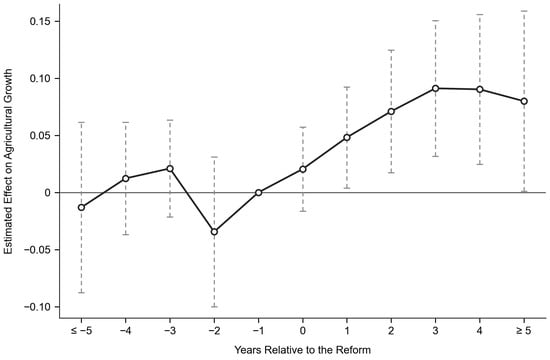
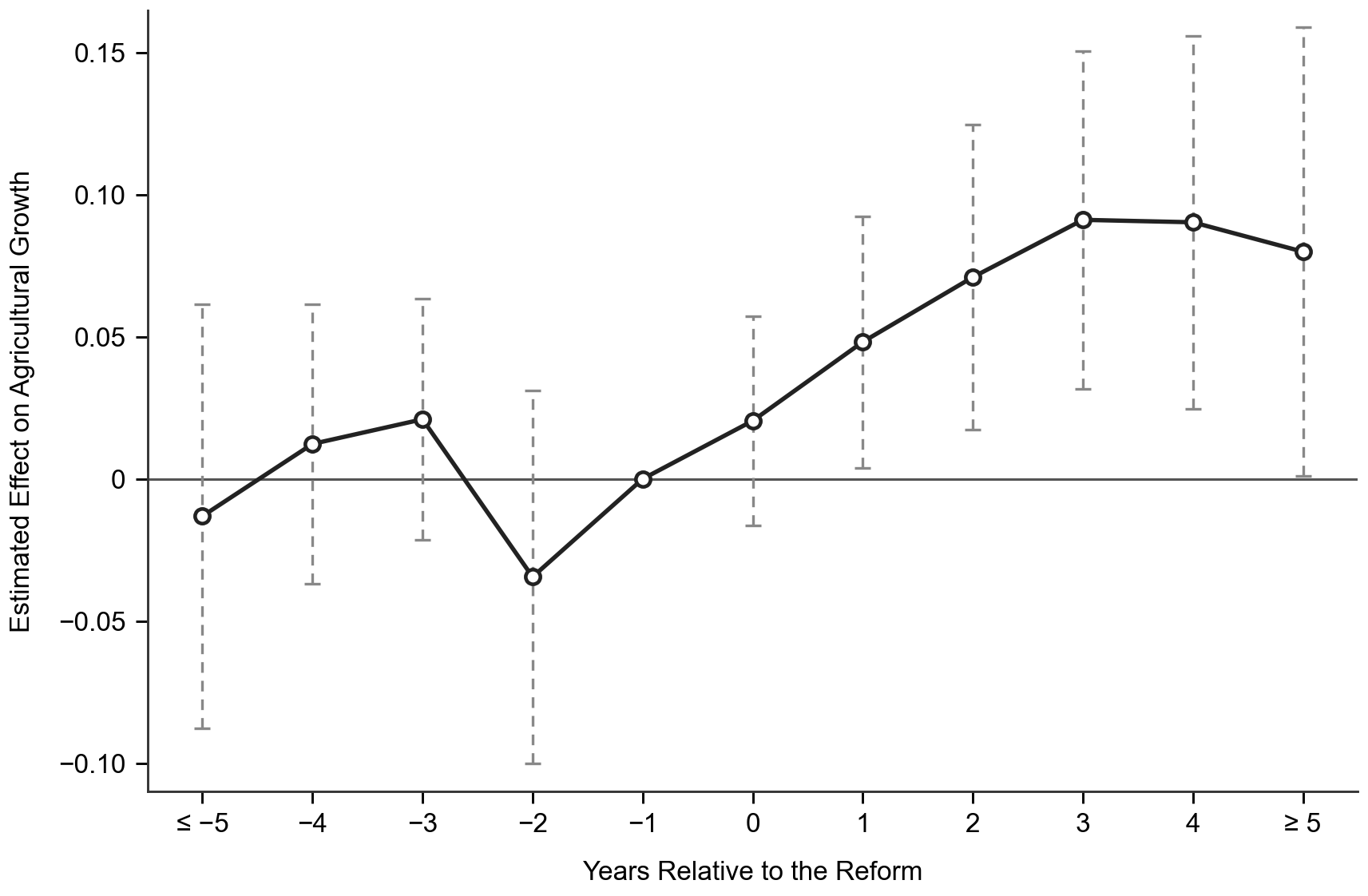
To more intuitively assess the parallel trend assumption, the estimated coefficients of city–county mergers and their 95% confidence intervals are plotted in Figure 3. As shown in the figure, all pre-reform coefficients are statistically insignificant, indicating that there is no significant systematic difference in agricultural growth trends between the treatment and control groups before the reform. Starting from the first post-reform period, the estimated coefficients become significantly different from zero. These results suggest that there is no evidence of a violation of the parallel trend assumption, supporting the validity of the DID specification used in this study.
Figure 3.
Event-study estimates for the effect of city–county mergers on agricultural growth.
Furthermore, some prefecture-level cities implemented city–county mergers relatively late in the sample period, resulting in shorter post-reform observation periods that may affect the identification of dynamic treatment effects. To address this concern, we conduct an additional robustness check using a balanced event-study window. Specifically, we restrict the event-study window to two years before and after the reform and retain only prefecture-level cities that first implemented city–county mergers between 2015 and 2020 and have complete observations over this window. Cities that did not undergo city–county mergers during the sample period serve as the control group. We then re-estimate the dynamic treatment effects. The results show that the estimated coefficient for the second year before the reform is not statistically significant, while those for the first and second years after the reform are positive and statistically significant at the 10% and 5% levels, respectively. These findings indicate that the positive effect of city–county mergers on primary-sector value added persists when the analysis is restricted to cities with complete pre- and post-reform observation windows.
4.2.2. Heterogeneity-Robust DID Estimators
Whether using a multi-period DID or a staggered DID design, causal inference based on a two-way fixed effects (TWFE) model generally relies on several assumptions, including strict exogeneity, no anticipation effects, stable unit treatment values, and homogeneous treatment effects. Among these, if the assumption of treatment effect homogeneity is violated, multi-period DID estimates based on TWFE may be subject to substantial bias [40]. In this study, the timing of city–county mergers differs across prefecture-level cities, suggesting that the policy effect may be heterogeneous over time. In addition, differences in economic development, the number of administrative division adjustments, and local governance conditions across cities imply that treatment effects may also vary across units. As a result, the baseline TWFE estimates may be affected by treatment effect heterogeneity.
To address this issue, this study conducts two additional robustness checks. First, it uses the Goodman-Bacon decomposition to assess the extent to which treatment effect heterogeneity may bias the baseline estimates. Second, it applies heterogeneity-robust estimators to further verify the robustness of the baseline results.
- (1)
- Goodman-Bacon decomposition
To assess the extent to which treatment effect heterogeneity may affect the baseline results, this study applies the decomposition method proposed by Goodman-Bacon (2021) [40]. The results are reported in Table 4. In the weighted average treatment effect underlying the TWFE estimator, comparisons between treated units and never-treated units account for the dominant share of the total weight, with a weight of 0.861. By contrast, the comparison that is more likely to generate bias—namely, comparisons between later-treated units and earlier-treated units—accounts for a much smaller share, with a weight of only 0.096. These results suggest that the baseline estimates mainly rely on relatively appropriate group comparisons, and that the risk of bias arising from treatment effect heterogeneity is limited.
Table 4.
Goodman-Bacon decomposition results.
- (2)
- Heterogeneity-robust estimator
To further examine the robustness of the baseline results under treatment effect heterogeneity, this study adopts the doubly robust estimator proposed by Callaway and Sant’Anna [41] to re-estimate the average treatment effect across all treated groups. Prior studies suggest that a key requirement for robust identification under treatment effect heterogeneity is to avoid using “bad controls,” that is, to avoid treating earlier-treated units as the control group for later-treated units. Compared with the conventional TWFE estimator, the method developed by Callaway and Sant’Anna (2021) [41] is better suited to addressing this problem.
Column (1) of Table 5 reports the estimated average treatment effect across all treated groups. The estimated coefficient on city–county mergers remains significantly positive, indicating that after accounting for the potential bias caused by treatment effect heterogeneity, the baseline conclusion—that city–county mergers promote agricultural growth at the prefecture-level city level—still holds.
Table 5.
Results of the CSDID and PSM-DID estimations.
4.2.3. Placebo Test
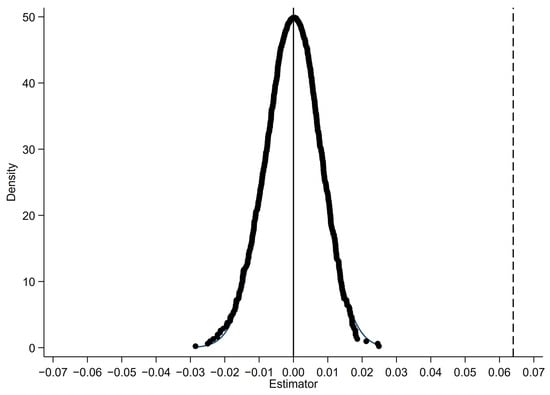
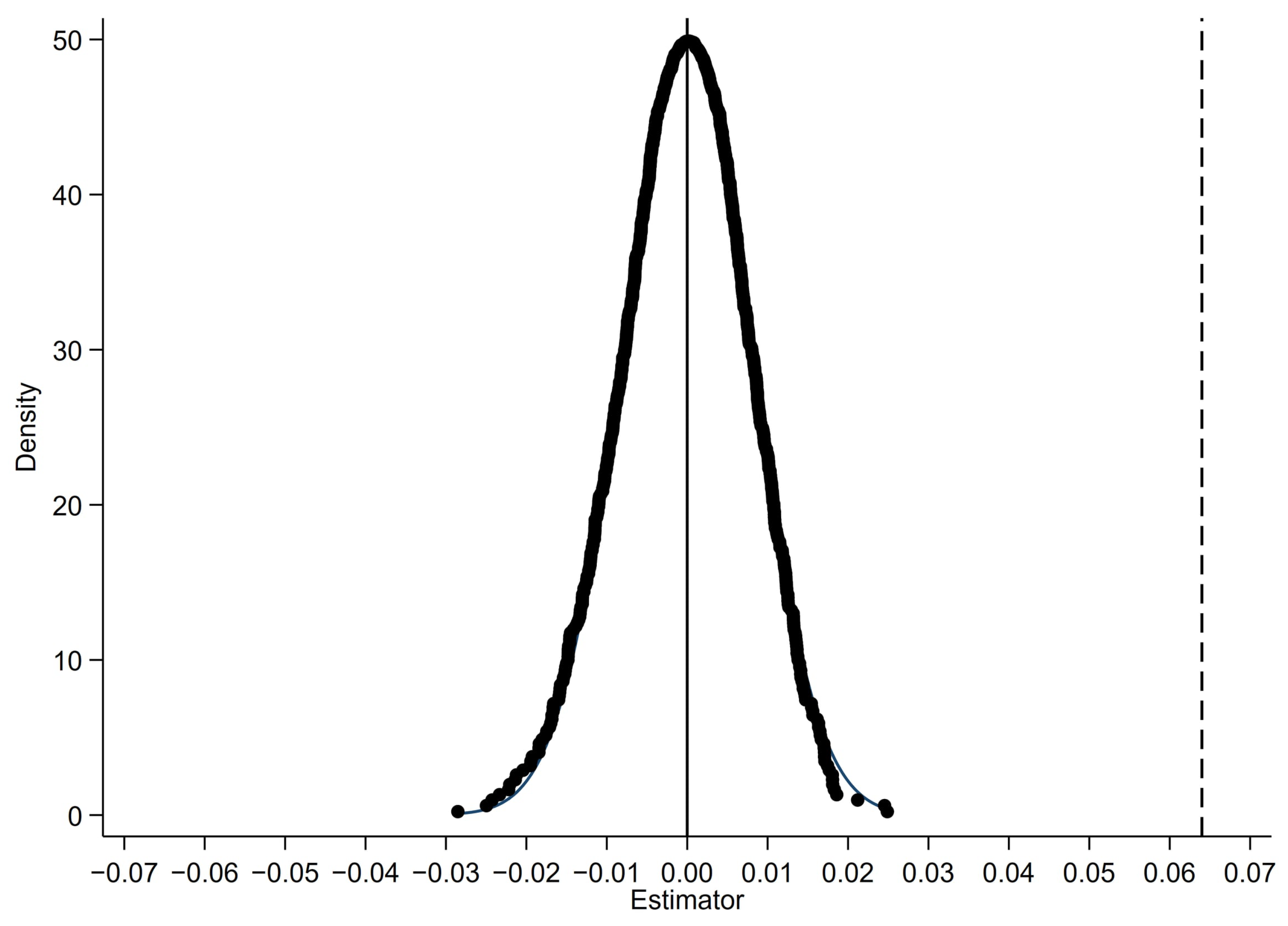
To rule out the possibility that the baseline results are driven by random factors, this study further conducts a placebo test. Specifically, based on the actual number of city–county merger reforms observed during the sample period, an equal number of prefecture-level cities are randomly assigned to a pseudo-treatment group, while the remaining cities are treated as the control group. A new core explanatory variable is then constructed accordingly, and model (1) is re-estimated. This procedure is repeated 1000 times.
In principle, a randomly generated policy variable should not have a systematic effect on agricultural growth at the prefecture-level city level. Figure 4 presents the kernel density distribution of the estimated coefficients on the placebo treatment variable from the 1000 regressions. As shown in the figure, the placebo estimates are highly concentrated around zero and are approximately symmetrically distributed, whereas the actual estimated coefficient from the baseline regression (0.064) lies far in the right tail of the placebo distribution. This result indicates that the positive policy effect identified in the baseline regression is unlikely to be driven by random shocks, thereby supporting the robustness of the main findings.
Figure 4.
Placebo test: kernel density distribution of estimated coefficients.
4.2.4. Psm-Did Robustness Check
Because the implementation of city–county mergers is not random and may be closely related to factors such as geographic location, administrative structure, industrial structure, and socioeconomic development at the prefecture-level city level, this study further employs a PSM-DID approach to mitigate sample selection bias arising from observable characteristics.
Specifically, the matching variables include the administrative structure of prefecture-level cities as well as the control variables used in the baseline analysis, namely GDP per capita, industrial structure, public service capacity, population density in municipal districts, the number of pension insurance participants, average elevation, and terrain relief. Based on these variables, this study applies three matching methods—1:2 nearest-neighbor matching, kernel matching, and radius matching with a caliper of 0.01—to identify control observations in the original control group that are comparable to those in the treatment group. The matched samples are then used to re-estimate the DID model.
The results are reported in Table 5. Columns (2) to (4) present the estimates based on 1:2 nearest-neighbor matching, kernel matching, and radius matching, respectively. In all cases, the estimated coefficient on the city–county merger indicator remains significantly positive, indicating that the conclusion that city–county mergers significantly promote agricultural growth at the prefecture-level city level remains robust after accounting for observable selection bias through PSM-DID.
4.2.5. Additional Robustness Checks
To further assess the robustness of the baseline results, this study conducts a series of supplementary tests, including replacing the dependent variable, adjusting the sample range, changing the clustering level of standard errors, excluding the influence of contemporaneous policies, and using an alternative sample period. The results are reported in Table 6.
Table 6.
Robustness Check Results.
First, we use an alternative measure of the dependent variable. Specifically, we replace the baseline dependent variable with primary-sector value added per capita (Agr_1) to measure agricultural development at the prefecture-level city level and re-estimate the model. The results reported in Column (1) of Table 6 show that the estimated coefficient on the city–county merger variable remains positive and statistically significant, indicating that the baseline findings are robust to this alternative measure of agricultural development.
Second, the sample range is adjusted. Because some prefecture-level cities may have experienced city–county mergers multiple times during the sample period, two alternative sample restrictions are applied to rule out potential interference from repeated reforms. The first excludes cities that experienced city–county mergers in multiple years and retains only those that implemented the reform in a single year; the corresponding results are reported in Column (2) of Table 6. The second further excludes cities that experienced multiple city–county merger reforms within the same year, retaining only those that experienced the reform once during the sample period; the results are reported in Column (3). Both sets of results show that the positive effect of city–county mergers on agricultural growth remains intact.
Third, the clustering level of standard errors is changed. Given that prefecture-level cities within the same province may be jointly affected by common provincial policies and institutional environments, standard errors are further clustered at the provincial level. Column (4) of Table 6 shows that the estimated coefficient on the city–county merger indicator remains significantly positive, suggesting that the baseline conclusion does not depend on clustering at the prefecture-level city level.
Fourth, the potential influence of contemporaneous policies is excluded. Because the Rural Revitalization Strategy, implemented in 2018, may have had a systematic effect on regional agricultural growth and thereby interfered with the identification of the effect of city–county mergers, this study re-estimates the model using only the 2013–2017 sample. The results in Column (5) of Table 6 indicate that city–county mergers still significantly promote agricultural growth, suggesting that the main findings are not driven by the contemporaneous implementation of the Rural Revitalization Strategy.
Overall, the positive effect of city–county mergers on agricultural economic growth at the prefecture-level city level remains robust to alternative variable measures, sample restrictions, changes in the clustering level of standard errors, and the exclusion of potential confounding effects from concurrent policies.
4.3. Mechanism Tests
4.3.1. Mechanism Test Based on the Number of City–County Merger Reforms
We argue that city–county mergers promote agricultural economic growth by transferring part of the administrative and fiscal authority of the affected counties to prefecture-level city governments, thereby strengthening their capacity to coordinate resource allocation. Following this logic, a greater degree of administrative centralization induced by city–county mergers should be associated with a stronger positive effect on agricultural economic growth. In practice, a prefecture-level city may undergo multiple county-to-district conversions within the same year or implement such reforms repeatedly over different years. Therefore, cities experiencing more city–county mergers during the sample period are generally subject to a greater degree of administrative centralization. Accordingly, we use the cumulative number of city–county mergers within each prefecture-level city during the sample period (Policy_num) as a measure of the intensity of administrative centralization and include it as an alternative explanatory variable in the regression. The results are reported in Column (1) of Table 7. The estimated coefficient on Policy_num is positive and statistically significant at the 10% level, indicating that a greater number of city–county mergers is associated with a larger increase in primary-sector value added at the prefecture-level city level. Furthermore, given that differences in the administrative area of the affected counties may lead to variations in the degree of administrative centralization, we use the cumulative administrative area of counties converted into municipal districts (Policy_area) as an alternative proxy for the intensity of administrative centralization. As shown in Column (2) of Table 7, the estimated coefficient on Policy_area is positive and statistically significant at the 5% level. Taken together, these results suggest that more intensive administrative centralization associated with city–county mergers is linked to greater increases in primary-sector value added. This provides some empirical support for the proposed mechanism through which city–county mergers promote agricultural economic growth by strengthening administrative centralization.
Table 7.
Results of Mechanism Tests.
4.3.2. Mechanism Test Based on the Intensity of Agricultural Performance Evaluation
We further argue that, given the relatively low returns from agricultural production for prefecture-level governments, their willingness to allocate additional fiscal resources to agriculture depends largely on whether explicit agricultural performance assessment requirements are imposed by the central government. To examine this argument, we introduce a variable measuring the intensity of agricultural performance assessments (kh) to capture the assessment pressure faced by prefecture-level governments.
Specifically, in 2017 the State Council issued the Assessment Measures for the Mayor Responsibility System for the “Vegetable Basket”, which significantly strengthened performance evaluation requirements related to agricultural development at the prefecture-level city level. Accordingly, this study codes observations before 2017, when agricultural performance evaluation was relatively weak, as 0, and observations from 2017 onward, when evaluation intensity increased, as 1. In the baseline regression model, an interaction term between city–county mergers and the intensity of agricultural performance evaluation (Policy_kh) is further included to identify how changes in agricultural performance pressure affect the reform effect of city–county mergers. The results are reported in Column (3) of Table 7. The estimated coefficient on the interaction term (Policy_kh) is positive and statistically significant at the 5% level, indicating that the positive effect of city–county mergers on primary-sector value added is significantly stronger under more stringent agricultural performance assessment requirements. This finding suggests that improvements in resource coordination capacity and fiscal capacity resulting from city–county mergers are more likely to translate into tangible support for agricultural economic growth when agricultural performance assessment requirements are more clearly defined. These results provide further support for the proposed mechanism through which agricultural performance assessments strengthen local governments’ incentives to allocate fiscal resources to agricultural development.
4.3.3. Mechanism Path Analysis
The preceding analysis shows that city–county mergers significantly increase primary-sector value added at the prefecture-level city level. To further investigate the underlying mechanisms, we examine the effects of city–county mergers on agricultural production inputs, including land, labor, machinery, and fertilizer. Specifically, we measure these inputs using cultivated land area, employment in the primary sector, total power of agricultural machinery, and fertilizer consumption in nutrient-equivalent terms, respectively. The regression results are reported in Table 8. The results show that city–county mergers increase cultivated land area by approximately 4.3% on average, while their effects on primary-sector employment, agricultural machinery power, and fertilizer consumption are not statistically significant. These findings indicate that, among the agricultural production inputs examined, the positive effect of city–county mergers is primarily reflected in land input. As a fundamental input in agricultural production, an increase in cultivated land area can facilitate the expansion of agricultural production and thereby contribute to growth in primary-sector value added. These results suggest that increased land input may be an important channel through which city–county mergers promote growth in primary-sector value added at the prefecture-level city level.
Table 8.
Effects of city–county mergers on agricultural factor inputs.
To better understand how city–county mergers affect cultivated land area, we further examine the roles of local fiscal capacity and government fiscal support for agriculture. By restructuring administrative authority and fiscal relations among local governments, city–county mergers may strengthen prefecture-level governments’ fiscal capacity and provide financial support for coordinating agricultural production resources. To examine this potential mechanism, we first use general public budget revenue at the prefecture-level city level as the dependent variable to assess the effect of city–county mergers on local fiscal revenue. The results reported in Column (1) of Table 9 show that city–county mergers increase general public budget revenue by approximately 5.6% on average, suggesting that the reforms enhance local fiscal capacity. Second, we use government expenditure on agriculture, forestry, and water conservancy to measure the scale of fiscal support for agriculture and further examine the effect of the reforms on agriculture-related fiscal expenditure. As shown in Column (2) of Table 9, city–county mergers increase expenditure on agriculture, forestry, and water conservancy by approximately 5.8% on average. Finally, we measure the relative intensity of fiscal support for agriculture using the share of expenditure on agriculture, forestry, and water conservancy in total general public budget expenditure and use this share as the dependent variable. The results in Column (3) of Table 9 show that city–county mergers have no statistically significant effect on this expenditure share. Although the reforms do not significantly alter the relative composition of fiscal expenditure, the simultaneous increases in fiscal revenue and expenditure on agriculture, forestry, and water conservancy provide empirical evidence consistent with the possibility that city–county mergers support agricultural production by strengthening local fiscal capacity and expanding fiscal support for agriculture.
Table 9.
Effects of city–county mergers on fiscal capacity and fiscal support for agriculture.
Overall, city–county mergers not only significantly increase primary-sector value added at the prefecture-level city level but also have positive effects on cultivated land area, local fiscal revenue, and government expenditure on agriculture, forestry, and water conservancy. These findings provide empirical evidence on two potential channels through which city–county mergers may affect primary-sector value added: agricultural land input and local fiscal support. They also lend further support to the theoretical argument that adjustments in administrative authority may influence agricultural economic output by strengthening prefecture-level governments’ capacity to coordinate resource allocation.
4.4. Heterogeneity Analysis
4.4.1. Heterogeneity by the Intensity of Government Competition
The theoretical analysis suggests that, under a performance evaluation system centered on economic growth, excessive horizontal competition among local governments may encourage a bias toward non-agricultural sectors at the expense of agricultural production. By strengthening prefecture-level governments’ capacity for resource coordination, city–county mergers may alleviate such competitive pressures and thereby promote agricultural economic growth. Following this logic, the effects of city–county mergers on agricultural growth may vary with the intensity of intergovernmental competition within prefecture-level cities.
In general, a larger number of subordinate counties and districts is associated with more intense competition among local governments within a prefecture-level city [42,43]. This relationship can be explained by two factors. First, promotion opportunities for local officials are relatively limited, and the number of positions available to county-level officials within a prefecture-level city is largely fixed. Second, although county-level officials may be promoted across prefecture-level cities, such promotions essentially represent an extension of local competition and do not fundamentally alter the relationship between the number of subordinate jurisdictions and the intensity of competition. Accordingly, we use the number of county-level jurisdictions per capita (the total number of counties and districts divided by the registered population) as a proxy for the intensity of intergovernmental competition within prefecture-level cities.
Given that city–county mergers may directly alter the number of subordinate counties and districts, potentially affecting the measurement of competition intensity, we construct the grouping variable (Competition) using pre-reform data from 2012. Specifically, we calculate the provincial median of the number of county-level jurisdictions per capita in 2012 and classify cities below the median as the low-competition group (Competition = 0) and those at or above the median as the high-competition group (Competition = 1). We then introduce an interaction term between the city–county merger policy indicator and the competition group indicator into the baseline regression model to examine whether treatment effects differ by the intensity of intergovernmental competition.
The results are reported in Column (1) of Table 10. The estimated coefficient on the interaction term is 0.091 and is statistically significant at the 5% level, indicating that the policy effect is significantly greater in the high-competition group than in the low-competition group. These findings are consistent with our theoretical expectations, suggesting that city–county mergers have a stronger positive effect on primary-sector value added in prefecture-level cities characterized by more intense intergovernmental competition before the reform. One possible explanation is that these cities initially experienced greater administrative fragmentation and horizontal competition, leaving more scope for improved resource coordination through the administrative integration brought about by city–county mergers.
Table 10.
Heterogeneity analysis by the intensity of government competition.
4.4.2. Regional Heterogeneity
Given the substantial regional differences in resource endowments, policy environments, and levels of economic development across China, the effects of city–county mergers on agricultural economic growth may vary across regions. To examine this possibility, we follow the regional classification criteria of the National Bureau of Statistics of China and divide the sample into two groups: eastern China and central and western China. We then construct a regional indicator (region), which takes a value of 1 for cities in eastern China and 0 for those in central and western China. An interaction term between the city–county merger policy indicator and the regional indicator is further introduced into the baseline regression model to examine regional differences in treatment effects.
The regression results are reported in Column (2) of Table 10. The estimated coefficient on Policy is 0.121 and is positive and statistically significant at the 1% level, indicating that city–county mergers significantly increase primary-sector value added in central and western China. The estimated coefficient on the interaction term is −0.083 and is statistically significant at the 5% level, suggesting that the positive effect of city–county mergers is significantly weaker in eastern China than in central and western China.
This regional difference may be related to variations in the stages of urbanization and the scope for further administrative integration. Compared with central and western China, eastern China experienced earlier industrialization and urbanization, and some cities had already undergone substantial administrative division adjustments before the sample period. Consequently, additional city–county mergers may offer relatively limited scope for further improvements in administrative integration. In contrast, cities in central and western China may have greater potential for administrative integration and cross-jurisdictional resource coordination, which could explain the stronger positive effects of city–county mergers on agricultural economic growth in these regions.
5. Discussion
This study extends the literature on the economic effects of administrative division adjustments. Existing research has primarily examined the effects of such adjustments on regional economic growth, market integration, public service provision, and environmental governance [4,9,13,15,16,44,45], while paying relatively little attention to agricultural economic outcomes. Chen et al. [11] examined the effects of city–county mergers from the perspective of affected counties and found that these reforms have dynamic and nonlinear effects on food security. On the one hand, the reforms may undermine grain production through the loss of agricultural labor and cultivated land. On the other hand, they may improve agricultural production efficiency by promoting market integration. In contrast, this study extends the scope of analysis to the entire prefecture-level city jurisdiction to examine the effects of city–county mergers on regional agricultural economic activity. Our findings show that city–county mergers significantly increase primary-sector value added at the prefecture-level city level. By shifting the analytical focus from the localized effects on affected counties to the overall effects across prefecture-level jurisdictions, this study provides a more comprehensive understanding of the agricultural economic consequences of administrative division adjustments and their spatial scope.
This study provides a new perspective on the relationship between state-led urbanization and agricultural development. Previous research has largely focused on urban spatial expansion, emphasizing the adverse effects of increasing construction land, the conversion of cultivated land to non-agricultural uses, and agricultural labor migration on agricultural production [5,20,46]. However, urbanization involves not only the expansion of urban construction land but also changes in administrative structures and resource allocation, which may have different implications for agricultural development. Wang et al. [47] suggested that, under appropriate urban–rural land-use arrangements, rural population decline and the consolidation of rural residential land during urbanization may create favorable conditions for large-scale agricultural operations. This suggests that the effects of urbanization on agricultural development depend not only on urban spatial expansion but also on land resource allocation and the underlying institutional arrangements. Building on this perspective, we examine the agricultural economic effects of administrative restructuring associated with state-led urbanization, using China’s city–county merger reforms as an institutional setting. Our findings show that these reforms significantly increase primary-sector value added at the prefecture-level city level. This indicates that, although urban spatial expansion may crowd out agricultural production resources, the accompanying changes in administrative structures may also promote agricultural economic growth by improving resource allocation. By emphasizing institutional adjustments, this study broadens our understanding of the agricultural economic consequences of urbanization and provides new empirical evidence on the relationship between state-led urbanization and agricultural development.
This study also provides new empirical evidence on the agricultural economic effects of changes in local governance structures from the perspective of administrative centralization and regional resource coordination. Traditional fiscal decentralization theory emphasizes the informational advantages of local governments in allocating public resources, but horizontal competition among local governments may also exacerbate administrative fragmentation and cross-jurisdictional externalities [22,29]. Under China’s local governance system, in which economic performance plays an important role in government evaluations [24], local governments may be more inclined to allocate public resources to non-agricultural sectors that generate higher short-term economic returns, potentially resulting in insufficient agricultural investment. By restructuring administrative relations between prefecture-level cities and counties, city–county mergers may strengthen prefecture-level governments’ capacity to coordinate resource allocation across their jurisdictions, thereby mitigating the adverse effects of administrative fragmentation on agricultural development. Our findings show that the positive effect of city–county mergers on primary-sector value added is more pronounced in prefecture-level cities characterized by stronger intergovernmental competition before the reform. This result is consistent with the theoretical expectation that administrative centralization may improve regional resource allocation. These findings further contribute to the empirical literature on the relationship between local governance restructuring and agricultural economic growth.
Several limitations of this study should be acknowledged. First, although primary-sector value added at the prefecture-level city level captures changes in the economic output of the broader agricultural sector, this measure does not allow us to determine whether city–county mergers improve agricultural production efficiency, land quality, farmers’ incomes, or the ecological sustainability of agricultural development. Second, while we provide empirical evidence on potential mechanisms involving cultivated land area, local fiscal revenue, and government expenditure on agriculture, forestry, and water conservancy, data limitations prevent us from directly observing how land resources are reallocated across counties and districts following changes in administrative authority. Moreover, we cannot fully rule out the possibility that changes in land classification and statistical reporting associated with administrative division adjustments may affect the estimated results. Finally, city–county mergers are embedded in China’s specific administrative and institutional context, and their agricultural economic effects are closely related to the distribution of authority among local governments, land management institutions, and local agricultural development conditions. Therefore, whether these findings can be generalized to other forms of administrative division adjustments or to other countries remains an open empirical question. Future research could draw on county- and household-level microdata to further investigate the long-term effects of administrative division adjustments on land allocation efficiency, agricultural production structures, and farmers’ welfare.
6. Conclusions
Using panel data from Chinese prefecture-level cities over the period 2013–2022, this study treats China’s city–county merger reforms as a quasi-natural experiment and employs a staggered difference-in-differences (DID) approach to examine the effects of administrative division adjustments on agricultural economic growth. The results show that city–county mergers significantly increase primary-sector value added at the prefecture-level city level by approximately 6.4% on average, and this finding remains robust across a series of robustness checks. Mechanism analysis provides empirical evidence that city–county mergers may promote agricultural economic growth by strengthening prefecture-level governments’ capacity to coordinate the allocation of production resources within their jurisdictions. Changes in land resource allocation emerge as a potentially important mechanism. Specifically, city–county mergers increase cultivated land area, local fiscal revenue, and government expenditure on agriculture, forestry, and water conservancy, thereby providing support for agricultural production. Heterogeneity analysis further reveals that the positive effects of city–county mergers on agricultural economic growth are more pronounced in cities with higher initial levels of intergovernmental competition and in central and western China.
These findings suggest that, in the context of rapid urbanization, administrative division adjustments do not necessarily come at the expense of agricultural economic growth. Rather, their effects may depend on the distribution of authority among local governments and the mechanisms through which resources are coordinated. Accordingly, efforts to promote urban development and administrative division adjustments should take into account the implications of changes in administrative authority for agricultural production. Greater emphasis should be placed on coordinating land use and agricultural production resources across county boundaries to prevent excessive encroachment on agricultural resources by urban development. Meanwhile, local governments’ responsibilities for agricultural development and mechanisms for fiscal support should be strengthened to ensure that the enhanced governance capacity and fiscal resources resulting from administrative integration are more effectively directed toward agricultural production. Policy arrangements should also be tailored to differences in initial governance conditions and stages of regional development to promote the coordinated development of urban areas and agricultural economies.
Declaration of Generative AI and AI-Assisted Technologies in the Writing Process
All authors certify that they only used AI technologies to improve readability and language in the writing process.
Author Contributions
Conceptualization, Y.C. and Y.J.; methodology, Y.C.; formal analysis, H.C.; data curation, H.C.; writing—original draft preparation, Y.C. and H.C.; writing—review and editing, Y.C. and Y.J.; funding acquisition, Y.C. and Y.J. All authors have read and agreed to the published version of the manuscript.
Funding
This research was funded by the National Social Science Foundation of China (grant number 21&ZD101) and the Postgraduate Research & Practice Innovation Program of Jiangsu Province (grant number 26CXJH1721).
Data Availability Statement
The data presented in this study are available on request from the corresponding author.
Conflicts of Interest
The authors declare no conflict of interest.
References
- Deng, X.; Huang, J.; Rozelle, S.; Zhang, J.; Li, Z. Impact of urbanization on cultivated land changes in China. Land Use Policy 2015, 45, 1–7. [Google Scholar] [CrossRef] [Scilit]
- Li, M.; Cao, Y.; Dai, J.; Song, J.; Liang, M. A comprehensive review of urban expansion and its driving factors. Land 2025, 14, 1534. [Google Scholar] [CrossRef] [Scilit]
- Güneralp, B.; Reba, M.; Hales, B.U.; Wentz, E.A.; Seto, K.C. Trends in urban land expansion, density, and land transitions from 1970 to 2010: A global synthesis. Environ. Res. Lett. 2020, 15, 044015. [Google Scholar] [CrossRef] [Scilit]
- Liu, Y.; Ou, C.; Liu, Y.; Cao, Z.; Robinson, G.M.; Li, X. Unequal impacts of global urban–rural settlement construction on cropland and production over the past three decades. Sci. Bull. 2025, 70, 1699–1709. [Google Scholar] [CrossRef] [Scilit] [PubMed]
- d’Amour, C.B.; Reitsma, F.; Baiocchi, G.; Barthel, S.; Güneralp, B.; Erb, K.-H.; Haberl, H.; Creutzig, F.; Seto, K.C. Future urban land expansion and implications for global croplands. Proc. Natl. Acad. Sci. USA 2017, 114, 8939–8944. [Google Scholar] [CrossRef] [Scilit] [PubMed]
- Feng, R.; Wang, K. The direct and lag effects of administrative division adjustment on urban expansion patterns in Chinese mega-urban agglomerations. Land Use Policy 2022, 112, 105805. [Google Scholar] [CrossRef] [Scilit]
- Fan, S.; Li, L.; Zhang, X. Challenges of creating cities in China: Lessons from a short-lived county-to-city upgrading policy. J. Comp. Econ. 2012, 40, 476–491. [Google Scholar] [CrossRef] [Scilit]
- Feng, R.; Wang, K. Spatiotemporal effects of administrative division adjustment on urban expansion in China. Land Use Policy 2021, 101, 105143. [Google Scholar] [CrossRef] [Scilit]
- Ma, H.; Zou, J.; Cai, H.; Zhang, L. Administrative division adjustment and environmental pollution: Evidence from city-county mergers in China. China Econ. Rev. 2024, 84, 102141. [Google Scholar] [CrossRef] [Scilit]
- Xu, L.; Guo, S.; Zhong, H.; Shao, S. The impact of urbanization on child growth: Evidence from city-county mergers in China. Reg. Sci. Urban Econ. 2026, 117, 104187. [Google Scholar] [CrossRef] [Scilit]
- Chen, W.; Xu, J.; Chen, X.; Hu, X. Creating cities and food security challenge: Evidence from the city–county merger policy in China. China Econ. Rev. 2024, 88, 102257. [Google Scholar] [CrossRef] [Scilit]
- Cui, L.; Hou, Y.; Yu, H. Does city-county consolidation lead to regional integration of the housing market? Evidence from China. Land Use Policy 2025, 157, 107682. [Google Scholar] [CrossRef] [Scilit]
- Han, Y.; Wu, M. Inter-regional barriers and economic growth: Evidence from China. J. Dev. Econ. 2024, 167, 103197. [Google Scholar] [CrossRef] [Scilit]
- Hsueh, S.-C.; Liu, H.; Zhang, S. Hierarchical reform, political connection and land transfer. Emerg. Mark. Rev. 2026, 73, 101476. [Google Scholar] [CrossRef] [Scilit]
- Lv, K.; Zheng, H.; Ge, L. Does administrative division adjustment reduce air pollution? Evidence from city-county mergers in China. Econ. Anal. Policy 2024, 84, 912–928. [Google Scholar] [CrossRef] [Scilit]
- Yuan, C.; Zhu, T.; Ding, Y.; Cong, Z.; Li, Z. The path to regional coordinated development: The power of administrative division adjustment. Cities 2026, 174, 106976. [Google Scholar] [CrossRef] [Scilit]
- Zhang, S.; Zhang, M.-A.; Sun, W. Administrative division adjustment and housing price comovement: Evidence from city-county mergers in China. China World Econ. 2022, 30, 149–173. [Google Scholar] [CrossRef] [Scilit]
- Zhu, C.; Lee, C.-C. Big city, big innovation? Evidence from city-county consolidation in China. Cities 2026, 172, 106825. [Google Scholar] [CrossRef] [Scilit]
- Cai, H.; Yang, X.; Xu, X. Spatiotemporal patterns of urban encroachment on cropland and its impacts on potential agricultural productivity in China. Remote Sens. 2013, 5, 6443–6460. [Google Scholar] [CrossRef] [Scilit]
- Tan, M.; Li, X.; Xie, H.; Lu, C. Urban land expansion and arable land loss in China—A case study of Beijing–Tianjin–Hebei region. Land Use Policy 2005, 22, 187–196. [Google Scholar] [CrossRef] [Scilit]
- Chu, A.C.; Yang, C.-C. Fiscal centralization versus decentralization: Growth and welfare effects of spillovers, Leviathan taxation, and capital mobility. J. Urban Econ. 2012, 71, 177–188. [Google Scholar] [CrossRef] [Scilit]
- Oates, W.E. Fiscal Federalism; Harcourt Brace Jovanovich: New York, NY, USA, 1972. [Google Scholar]
- Guo, G. China’s local political budget cycles. Am. J. Political Sci. 2009, 53, 621–632. [Google Scholar] [CrossRef] [Scilit]
- Li, H.; Zhou, L.-A. Political turnover and economic performance: The incentive role of personnel control in China. J. Public Econ. 2005, 89, 1743–1762. [Google Scholar] [CrossRef] [Scilit]
- Bai, Y.; Li, Y. Political tournaments and regional growth-enhancing policies: Evidence from Chinese prefectures. J. Reg. Sci. 2022, 62, 1358–1385. [Google Scholar] [CrossRef] [Scilit]
- Power, A.G. Ecosystem services and agriculture: Tradeoffs and synergies. Philos. Trans. R. Soc. B Biol. Sci. 2010, 365, 2959–2971. [Google Scholar] [CrossRef] [Scilit] [PubMed]
- Ma, H.; Qin, C.; Zou, J.; Zhang, W. Fiscal decentralization and food production: Evidence from province-managing-county reform in China. China Econ. Rev. 2025, 90, 102342. [Google Scholar] [CrossRef] [Scilit]
- Han, L.; Kung, J.K. Fiscal incentives and policy choices of local governments: Evidence from China. J. Dev. Econ. 2015, 116, 89–104. [Google Scholar] [CrossRef] [Scilit]
- Besley, T.; Coate, S. Centralized versus decentralized provision of local public goods: A political economy approach. J. Public Econ. 2003, 87, 2611–2637. [Google Scholar] [CrossRef] [Scilit]
- Brennan, G.; Buchanan, J.M. The Power to Tax: Analytic Foundations of a Fiscal Constitution; Cambridge University Press: Cambridge, UK, 1980. [Google Scholar]
- Jia, J.; Guo, Q.; Zhang, J. Fiscal decentralization and local expenditure policy in China. China Econ. Rev. 2014, 28, 107–122. [Google Scholar] [CrossRef] [Scilit]
- Que, W.; Zhang, Y.; Schulze, G.G. Is public spending behavior important for Chinese official promotion? Evidence from city-level. China Econ. Rev. 2019, 54, 403–417. [Google Scholar] [CrossRef] [Scilit]
- Xu, C. The fundamental institutions of China’s reforms and development. J. Econ. Lit. 2011, 49, 1076–1151. [Google Scholar] [CrossRef] [Scilit]
- Zhang, J. Interjurisdictional competition for FDI: The case of China’s “development zone fever”. Reg. Sci. Urban Econ. 2011, 41, 145–159. [Google Scholar] [CrossRef] [Scilit]
- You, Z.; Feng, Z.M.; Yang, Y.Z. Relief degree of land surface dataset of China (1 km). J. Glob. Change Data Discov. 2018, 2, 151–155. [Google Scholar] [CrossRef] [Scilit]
- Li, P.; Lu, Y.; Wang, J. Does flattening government improve economic performance? Evidence from China. J. Dev. Econ. 2016, 123, 18–37. [Google Scholar] [CrossRef] [Scilit]
- Bertrand, M.; Duflo, E.; Mullainathan, S. How much should we trust differences-in-differences estimates? Q. J. Econ. 2004, 119, 249–275. [Google Scholar] [CrossRef] [Scilit]
- Wang, Y.; Xie, L.; Zhang, Y.; Wang, C.; Yu, K. Does FDI promote or inhibit the high-quality development of agriculture in China? An agricultural GTFP perspective. Sustainability 2019, 11, 4620. [Google Scholar] [CrossRef] [Scilit]
- Bøler, E.A.; Moxnes, A.; Ulltveit-Moe, K.H. R&D, international sourcing, and the joint impact on firm performance. Am. Econ. Rev. 2015, 105, 3704–3739. [Google Scholar] [CrossRef] [Scilit]
- Goodman-Bacon, A. Difference-in-differences with variation in treatment timing. J. Econom. 2021, 225, 254–277. [Google Scholar] [CrossRef] [Scilit]
- Callaway, B.; Sant’Anna, P.H.C. Difference-in-differences with multiple time periods. J. Econom. 2021, 225, 200–230. [Google Scholar] [CrossRef] [Scilit]
- Lü, X.; Landry, P.F. Show me the money: Interjurisdiction political competition and fiscal extraction in China. Am. Political Sci. Rev. 2014, 108, 706–722. [Google Scholar] [CrossRef] [Scilit]
- Tsai, C.-Y. Political competition and Chinese official data. Public Choice 2025, 205, 537–562. [Google Scholar] [CrossRef] [Scilit]
- Mao, Z.; Wang, D.; Zhang, G. Municipal amalgamations and the quality of public services: A study based on city-county mergers in China. PLoS ONE 2022, 17, e0272430. [Google Scholar] [CrossRef] [Scilit] [PubMed]
- Tang, W.; Hewings, G.J.D. Do city–county mergers in China promote local economic development? Econ. Transit. 2017, 25, 439–469. [Google Scholar] [CrossRef] [Scilit]
- Long, H.; Ge, D.; Zhang, Y.; Tu, S.; Qu, Y.; Ma, L. Changing man-land interrelations in China’s farming area under urbanization and its implications for food security. J. Environ. Manag. 2018, 209, 440–451. [Google Scholar] [CrossRef] [Scilit] [PubMed]
- Wang, S.; Bai, X.; Zhang, X.; Reis, S.; Chen, D.; Xu, J.; Gu, B. Urbanization can benefit agricultural production with large-scale farming in China. Nat. Food 2021, 2, 183–191. [Google Scholar] [CrossRef] [Scilit]

Disclaimer/Publisher’s Note: The statements, opinions and data contained in all publications are solely those of the individual author(s) and contributor(s) and not of MDPI and/or the editor(s). MDPI and/or the editor(s) disclaim responsibility for any injury to people or property resulting from any ideas, methods, instructions or products referred to in the content. |
© 2026 by the authors. Licensee MDPI, Basel, Switzerland. This article is an open access article distributed under the terms and conditions of the Creative Commons Attribution (CC BY) license.