


Abstract
Global demand for food is expected to grow significantly by 2050, underlying the urgency of a sustainable transition in agriculture. In this context, the Circular Economy (CE) paradigm emerges as a promising strategy. This transition is still ongoing, underscoring the importance of sustainability assessment as the first crucial step in supporting this process effectively. Therefore, comprehensive and robust evaluation tools and methodologies are necessary to support effective decision-making processes in this context. This study addresses this topic by conducting a literature review focused on the main evaluation methodologies adopted to assess the sustainability of circular technologies in agriculture, as well as to identify emerging research trends and to identify current knowledge gaps. Therefore, the main objective of this research is to establish a well-defined framework that starting from existing researches, it will support the development of future research directions. The performed review identifies Life Cycle Assessment (LCA) as the most applied methodology for environmental impact assessment, due to its ability to analyze environmental impacts and resources consumption throughout the entire life-cycle of a product, followed by Multi-Criteria Analysis (MCA) and performances-based models for their capacity of integrating and managing many dimensions (environmental, economic, and social) within the evaluation process. Emerging trends highlight the increasing adoption of computational approaches, such as System Dynamics (SD), facilitating a more comprehensive assessment of complex agricultural systems. Despite this increasing attention, the review addresses the significant gap, or rather, the limited management of stakeholders’ conflicts and synergies. This gap will inform potential research directions within the Agritech project, especially regarding the development of Social Multi-Criteria Evaluation (SMCE) to integrate stakeholders’ perspectives in the sustainability assessment of circular technologies.
1. Introduction
The agriculture sector represents the major contributor to global anthropogenic emissions, such as waste production and greenhouse gases [1]. Furthermore, this sector accounts for more than 90% of land- and water-related environmental impacts, including water stress and biodiversity loss [2].
Recent studies concerning demographic projections foresee significant global population growth. The United Nations World Population Prospects 2024 estimates an increase to approximately 9.7 billion people by 2050 [3]. These conditions will increase the demand on agricultural systems and natural resources [4]. Research estimates that agricultural world production needs to grow by 70% to meet the increasing demand for food by 2050 [5,6]. Therefore, it increases the challenge related to the long-term sustainable management of natural resources [7], underlying the crucial role of the agriculture sector in preserving natural capital and achieving climate neutrality by 2050 [8]. With the world’s population growing and concerns about climate change, there is an increasing pressure on the agriculture sector to become more resource-efficient and environmentally sustainable [9].
Within these promises, it is urgent to shift from an approach exclusively focused on productivity maximization toward the sustainable management of resources, to reduce the overall environmental footprint of the agriculture sector [10,11]. In the context of the sustainable transition of the agriculture sector, the Circular Economy (CE) paradigm emerges as a promising strategy for reducing environmental impacts without compromising economic performance [6]. However, according to the main recent study proposed by the Ellen MacArthur Foundation (2021) [12], the CE can be defined as “a systems solution framework that tackles global challenges such as climate change, biodiversity loss, waste, and pollution. It is based on three principles, driven by design: eliminate waste and pollution, circulate products and materials (at their highest value), and regenerate nature”. This approach promotes an alternative option to the traditional linear model of “take-make-dispose” [6,13], embodying a resilient and regenerative model based on renewable resources and designed for systemic transformation [12]. Therefore, the implementation of the CE concept in agriculture is a promising strategy for reducing resource consumption and waste generation, with a focus on transforming agricultural waste into valuable bioproducts [14,15]. In this sense, the CE application to agriculture aligns with the urgent need for more sustainable and environmentally friendly farming practices, ensuring that agriculture not only meets the needs of the present but also preserves the resources and ecosystems essential for future generations [16].
The ongoing transition toward a circular agriculture model has increased the interest in sustainability assessments of agricultural production systems, encompassing the evaluation of multiple impacts, including environmental, economic, social, and cultural aspects [8]. It is due to the fact that the evaluation of circularity and sustainability of the agriculture sector is the essential step to properly support the transition to a circular agriculture model [6]. Therefore, robust and comprehensive evaluation tools and methodologies are required to effectively support decision-making processes in this context [6,17].
Motivations and Objectives
The current literature related to the sustainability assessment of circular technologies is fragmented and rarely comprehensive. The applied evaluation methodologies and main research challenges and lacks are explored in different research frameworks, thus limiting a comprehensive knowledge about the sustainability assessment of circular technologies in agriculture within all its features, both strengths and weaknesses [18].
For this purpose, the present study addresses the topic of the sustainability assessment of circular agriculture technologies through a systematic literature review to comprehensively investigate (1) the main adopted evaluation methodologies, (2) the emerging research trends, and (3) the current knowledge gaps. The main task of this research is to establish a well-defined framework that conceptualises existing research and, at the same time, enhances the development of future research directions.
This research is based on two main research questions that can be listed as follows:
- Q1: “Which are the main evaluation methodologies applied for assessing the sustainability of circular technologies in agriculture? Which are the main emerging evaluation trends?”;
- Q2: “What are the main challenges and gaps in assessing the sustainability of circular technologies in agriculture?”.
This research is inserted in the Agritech (National Research Centre for Agriculture Technologies) research centre [19], in the context of the National Recovery and Resilience Plan (PNRR) [20], and framed in the broader multidisciplinary research initiatives promoted by the Next Generation EU recovery project. The Agritech project aims at identifying the multifaceted problems related to sustainable agriculture through a multidisciplinary perspective. Specifically, this research belongs to the Spoke 8, named “New models of circular economy in agriculture through waste valorisation and recycling”, which has the specific aim of improving the knowledge concerning the multi-dimensional evaluation and assessment of new circular technologies in agriculture. Therefore, the research question Q2 has been specifically formulated to inform research activities within Spoke 8 of the Agritech project.
The paper is structured as follows: Section 2 concerns materials and methods to describe the research methodology and provide the description of the CE paradigm, as well as its implementation in the agriculture sector; Section 3 illustrates the results obtained by the performed literature review; Section 4 critically discusses them and formulates the research activities to be developed within the Agritech project; and Section 5 is dedicated to the conclusion.
2. Materials and Methods
2.1. Methodological Framework
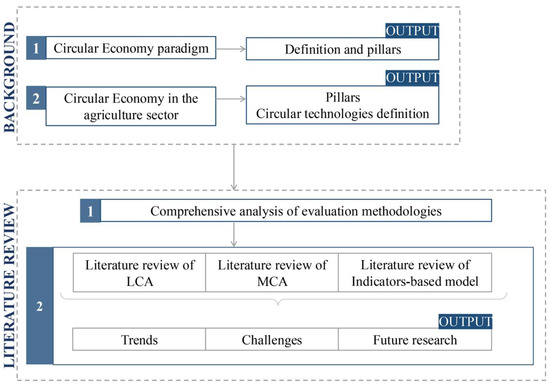
The present research addresses the implementation of the CE paradigm in the agricultural sector by exploring the topic of the sustainability assessment of circular technologies. The sustainability concept is here conceptualised as the approach that aims to balance the three interconnected pillars concerning environmental quality, economic viability, and social well-being over the long term [21,22]. Considering the complexity and multidimensionality of arguments under consideration, a multi-step methodological framework has been proposed to develop the literature review effectively. The multi-step flow can be divided into two main parts as follows: (1) the methodological background, and (2) the literature review concerning the evaluation methodologies and tools proposed and adopted for the sustainability assessment of circular technologies in agriculture. Figure 1 illustrates the proposed multi-step methodological framework.
Figure 1.
Multi-step methodological framework.
As underlined in Figure 1, the methodological background is composed of:
- Phase 1: Clarification and description of the CE paradigm to address its peculiarities and pillars;
- Phase 2: Identification of the principles and implications related to the implementation of the CE paradigm in the agriculture sector. This phase is propaedeutic to gain a clear understanding of how this model can be operationalised and which its main actionable features are. It also serves to clarify which strategies can be categorised as agricultural circular technologies, underlying their characteristics and providing some examples.
Once the conceptual background has been defined, the literature review has been carried out. In detail, to ensure a comprehensive analysis, the literature review has been organised into two sequential steps (Figure 1) that can be described as follows:
- Comprehensive analysis of the methodologies for the sustainability assessment within the CE implementation in the agriculture sector;
- Specific literature review of the main evaluation methodologies addressed in the previous stage. In detail, three literature reviews have been developed regarding (1) Life Cycle Assessment (LCA); (2) Multi-Criteria Analysis (MCA); and (3) indicators-based models.
2.2. Adopted Literature Review Methodology
The proposed literature review aims to explore the main evaluation tools and methodologies proposed and applied for assessing the sustainability of circular technologies in the agriculture sector, as well as identifying the main evaluation challenges to ground future research directions. The literature review has been developed through the Scopus database, considering the time period from 2015 to 2025. The year 2015 has been chosen as the starting point of the literature review, as research on CE implementation in agriculture became more substantial [16], as highlighted by the systematic review of Esposito et al. (2020) [23].
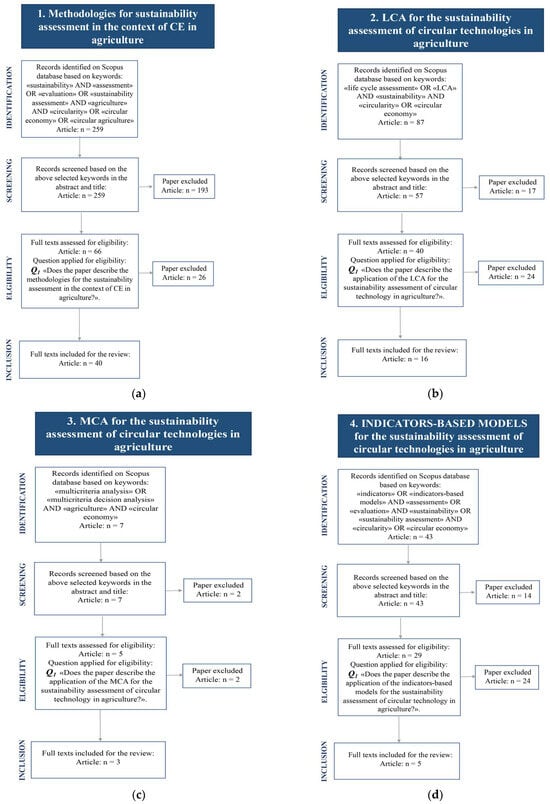
More in detail, the first literature review has been conducted to generally address the main methodologies (qualitative, quantitative, and mixed approaches) that will be further explored in the subsequent stages of the literature. Figure 2a illustrates the PRISMA diagram of the developed literature reviews, also specifying the applied eligibility questions.
Figure 2.
Prisma diagram of the developed literature review. (a) PRISMA diagram for the first literature review; (b) PRISMA diagram for the LCA literature review; (c) PRISMA diagram for the MCA literature review; (d) PRISMA diagram for the indicators-based model literature review.
The second literature review (Figure 2b) concerns the application of LCA for assessing the sustainability of circular technologies in the agricultural sector. The review has been developed on the SCOPUS database, with the following keywords: “life cycle assessment” OR “LCA” AND “sustainability” AND “circularity” OR “circular economy”. It results in 87 articles from 2015 to 2025. Inclusion and exclusion criteria have been applied, retaining only peer-reviewed articles in English that specifically address the integration of LCA with circular economy principles in agriculture. Studies on urban farming have been excluded, since Spoke 8 and the Task 8.4.2, in which this research is framed, do not focus on urban agriculture or food production.
The third literature review focuses on the application of the MCA for evaluating the sustainability of circular agricultural technologies. Within the research activities of Spoke 8, Task 8.4.2 of the Agritech project, Lombardi and Todella (2023) [8] presented a comprehensive literature review on the application of MCA to the sustainability assessment of circular technologies in the agriculture sector. Therefore, the literature review conducted in this research primarily focuses on studies published since 2023, aiming to include new information not previously discussed in the work carried out within Spoke 8. Based on this methodological background, the review has been carried out on the SCOPUS database, using the following keywords: “multicriteria analysis” OR “multicriteria decision analysis” AND “agriculture” AND “circular economy”. It results in 7 articles from 2023 to 2025. Inclusion and exclusion criteria have been applied to refine the selection of relevant studies. Only studies published in English that specifically addressed the integration of MCA with circular economy principles in agriculture have been included.
Figure 2c represents the PRISMA diagram of the MCA literature review.
The fourth literature review concerns the application of indicators-based models for addressing the sustainability of circular technologies in agriculture. Similarly, the review has been conducted on the SCOPUS database, covering the time period from 2015 to 2025. The analysis applied these keywords: “indicators” OR “indicators-based model” AND “assessment” OR “evaluation” AND “sustainability” OR “sustainability assessment” AND “circularity” OR “circular economy” AND “agriculture”. Inclusion and exclusion criteria were applied to refine the selection of relevant studies. Only studies published in English that specifically discuss and describe the application of indicators-based models with circular economy principles in agriculture have been included. In this context, it is essential to note that a significant number of articles have been excluded because they proposed empirical analysis [24], a literature review to support the definition of the evaluation framework [25,26], or analysed policies [16]. Here, only papers that applied indicators for assessing specific technologies have been considered and analysed. Figure 2d represents the PRISMA diagram of the indicators-based model literature review.
These methodological phases have been defined to map all the concepts and dimensions, enabling a better understanding of the gaps and challenges, and to discuss them critically. This will also clearly define the research directions to be implemented within the Agritech project.
3. Research Background
3.1. Circular Economy (CE)
The CE represents an alternative model to replace the traditional linear approach “take-make-dispose” [6,13]. The concept of CE has received increasing attention in both policy and research agendas, especially with reference to primary production (e.g., agriculture, fisheries, and forestry) and the valorisation of raw materials as a fundamental contribution to achieving EU objectives [8,27]. Different scholars have investigated this concept, highlighting that it has multiple definitions and no shared conceptualisation has been proposed and accepted [16,28]. In this context, the study by Lieder and Rashid (2016, p. 37) points out that “there are various possibilities for defining CE” [27], while Yuan et al. (2008, p. 5) declare that “there is no commonly accepted definition of CE” [29].
This section is not intended to comprehensively address the debate concerning this concept. It aims to outline the key features of the CE and to identify a working definition to establish the research background for developing the literature review on evaluation methodologies for the sustainability assessment of circular technologies.
Therefore, this research adopts as the methodological background the definition proposed by Kirchherr et al., 2017 [16], as their study proposed an in-depth review of the CE paradigm, underlying its pillars, the barriers for a shared definition, as well as its linkage with sustainable development, along with the integration of social, economic, and environmental dimensions.
This study [16] describes the CE as “An economic system based on business models that replace the ‘end-of-life’ concept with the reduction, alternatively the reuse, recycling, and recovery of materials in production, distribution, and consumption processes. It operates at the micro-level (products, companies, consumers), meso-level (eco-industrial parks), and macro-level (city, region, nation, and beyond), aiming to achieve sustainable development by simultaneously creating environmental quality, economic prosperity, and social equity, for the benefit of present and future generations”. Furthermore, by this definition, it is possible to list the pillars of the CE paradigm, namely [16]:
- Reduce. It focuses on the limitations of raw materials use and energy consumption by adopting sustainable design principles;
- Reuse. It suggests the product’s useful life through repair, refurbishment, and redistribution, thereby preventing premature disposal;
- Recycle. It suggests the implementation of used material into new product production, closing the material loops.
These three principles support the CE paradigm in limiting environmental externalities and promoting resource efficiency [28].
Moreover, the definition also conceptualises the implementation of the CE at different scales, or rather:
- Micro-level. It relates to the adoption of circular practice by individual businesses and consumers, such as product life-cycle extension, resource efficiency, and waste reduction;
- Meso-level. It refers to the symbiotic relationships among economic agents (e.g., companies within industrial clusters or eco-industrial parks) that allow them to share resources, exchange by-products, and collaborate on recycling initiatives;
- Macro-level. It encompasses cities, regions, and governments that develop policies, infrastructure, and systemic frameworks to support broader-scale circular economy transitions.
3.2. Circular Economy in Agriculture
The implementation of the CE paradigm in the agriculture sector has emerged as a crucial approach to address sustainability challenges [6]. The transition from a linear to a circular model in agriculture is ongoing and requires the development of new expertise and a change in the paradigm of managing the agriculture sector [6,14]. In the literature, a significant gap persists concerning the adaptation and practical implementation of the CE framework within the agriculture sector [6]. In this context, the main theoretical guidelines are provided by the Ellen MacArthur Foundation, which emphasises regenerative, urban, and interior agriculture, underlying the opportunity and potentiality of CE principles to enhance the sustainability of the agriculture sector and its stakeholders [28]. Additionally, several scholars have contributed to the contextualisation of the CE paradigm in the agriculture sector. In this context, it is possible to refer to the study proposed by Jurgilevich and colleagues (2016) [30] which underlined that the implementation of the CE in the agriculture sector implies (i) practices and technologies which minimise the input of finite resources, (ii) supporting the use of regenerative resources, (iii) avoiding the leakage of natural resources from the system, and (iv) encouraging the reuse and recycling of unavoidable resource losses in a way that adds the greatest possible value to the food system. Additionally, de Boer and van Ittersum (2018) [31] drafted the following three key principles for adopting circular models in the agriculture sector: (i) biomass should be prioritized for direct human consumption, (ii) by-products from food production, processing, and consumption should be recycled into the food system, and (iii) animals should be included in ways that provide add value, such as transforming biomass into food and other useful products.
According to these principles, sustainability can be considered a central aspect of implementing the CE in the agriculture sector, as the circular approach aims to promote economic and social well-being while protecting the environment through pollution prevention and resource efficiency [14]. Within this perspective, circular agriculture should (1) become a pillar of the economy, ensuring economic sustainability, (2) safeguard the conservation of biodiversity and productivity, guaranteeing environmental sustainability [32], (3) provide food security and improve health and living conditions, promising social sustainability [33]. Moreover, the circular model in the agriculture sector should be regenerative, supporting and enhancing Ecosystem Services (ES). This implies the creation of systems that close nutrient loops, minimising resource and waste losses, and maximising long-term value [34].
Therefore, the CE in agriculture promotes economic, environmental, and social sustainability while ensuring resource efficiency, regeneration, and biodiversity across the value chain. This model emphasises the recycling of organic matter, such as crop residues and animal waste, to improve or maintain soil fertility and reduce reliance on synthetic fertilisers [31,35]. It also supports local food systems, helping to shorten supply chains and cut transportation-related emissions [23].
Circular Agriculture Strategies and Technologies
Considering the complexity and multidimensional nature of implementing the CE in the agriculture sector, as well as the ongoing debate about this process, it is essential to clarify what circular technologies in agriculture entail. Such clarification is fundamental both to characterise these technologies and to conduct the literature review appropriately. Generally, circular technologies in the agriculture sector can be described as innovations (or strategies) aiming to reach sustainable and regenerative systems by minimising waste, enhancing resource efficiency, and fostering environmental sustainability [36]. For these purposes, these technologies are based on closed-loop models to recycle resources, such as water, nutrients, and energy, back into the agricultural process.
Therefore, circular agriculture aims to transform waste into resources, reducing dependency on finite natural resources, and enhancing the environmental and economic sustainability of agricultural practices. This approach integrates several key characteristics:
- Resource Efficiency. Circular technologies aim to optimise the use of resources such as water, energy, and nutrients. For instance, using recycled agro-industrial wastewater for irrigation supports this goal by reducing the demand for fresh water resources and minimising wastewater discharge [36];
- Waste Minimisation. The transformation of agricultural waste, such as manure and crop residues, into useful products like biofertilisers and bioenergy can mitigate environmental impacts and reduce pollution [37];
- Sustainable Production. Soil ES are vital in circular bioeconomy models, as they play a crucial role in nutrient recycling and support agricultural productivity. Therefore, sustainable soil management practices enhance these services and contribute to lower environmental impacts [38];
- Integration of Renewable Energy. Implementing renewable energy sources within agricultural operations reduces reliance on fossil fuels and supports a closed-loop resource system, increasing sustainability [39].
Considering these principles, it is possible to list some examples of circular technologies in agriculture, such as:
- Anaerobic Digestion of Manure. This process transforms manure into biogas, biofertilizer, and water, reducing greenhouse gas emissions and turning waste into valuable resources [37];
- Bioenergy from Biomass. Agricultural residues and plant waste can be used to produce renewable energy, reducing agricultural waste while supporting sustainable transport and pollution control through biofuels [40];
- Recycling Agro-waste. Crop residues or waste can be reused as livestock feed or transformed into high-quality feed, improving resource efficiency and advancing circular practices [41];
- Water–Energy–Food Nexus. Integrating water and energy management through circular systems enhances agricultural sustainability. The use of bio-based materials and renewable energy illustrates effective resource synergies [42].
These examples demonstrate how circular technologies can enhance the sustainability of the agriculture sector by transforming waste into valuable inputs, improving resource efficiency, and promoting the long-term viability of farming systems.
4. Findings and Discussion
The results of the literature review are discussed here in accordance with the two research questions, Q1 and Q2 (Section 1).
4.1. Assessing the Sustainability of Circular Technologies: Main Evaluation Methodologies
Q1 “Which are the main evaluation methodologies applied for assessing the sustainability of circular technologies in agriculture? Which are the main emerging evaluation trends?”
The first literature review (Figure 2a) results that the main proposed and applied evaluation methodologies to assess the sustainability of circular technologies can be grouped into (i) LCA; (ii) MCA; (iii) indicators-based model.
4.1.1. LCA for Assessing the Sustainability of Circular Technologies in Agriculture
LCA is the most applied method to assess the environmental sustainability of circular agricultural technologies and systems [43]. LCA provides a robust quantitative method for assessing the environmental impacts through the entire life-cycle, and it is particularly effective for closed systems [44]. Additionally, this tool enables the identification of key actions for reducing a product’s environmental impact during the design of innovative products or the redesign of existing ones [45]. Table 1 illustrates the considered articles.
Table 1.
Application of LCA for the sustainability assessment of circular technologies in agriculture.
Furthermore, the application of the LCA is particularly effective at the farmer scale [35]. However, it has been possible to demonstrate that LCA is suitable for application at different scales of analysis, ranging from pilot and laboratory applications [50,53,54,59] to macro contexts [49,55,57,58,60,61]. In this sense, LCA provides actionable insights for policy development and sustainable practices [45].
Concerning the technologies assessed through the LCA, anaerobic digestion technologies [54,57,59] and the energetic valorisation of agricultural and livestock residues (biogas, biomethane, and biomass pellets) [55,58,60,61] represent the most extensively investigated circular strategies.
In these cases, LCA is often complemented by additional evaluation methods (e.g., economic analysis, emergy accounting, TEA) [46,49,52,57], highlighting a growing interest in integrated and MCA.
4.1.2. MCA for Assessing the Sustainability of Circular Technologies in Agriculture
Several studies demonstrate that a multidimensional approach is required to address both the complexity and multidimensionality of the sustainability of CE in the agriculture sector [8]. Table 2 lists the considered articles and compares them according to the method(s) applied, the sector, the technologies considered, and the scale of application and evaluation.
Table 2.
MCA application for the sustainability assessment of circular technologies in agriculture.
Regarding the MCA, it can be noted that this family of methodologies can be useful for advancing the principles of CE in agriculture [8]. It has been underlined that MCA techniques are primarily used to assess and investigate the valorisation and circular management of agricultural and agri-industrial waste, particularly within the olive oil and wine-making supply chains, as well as the management and recovery of urban and agricultural effluents. Regarding the scale of application, the reviewed works demonstrate a significant degree of heterogeneity, spanning from macro-scale [62,64] to meso-scale assessments [63]. This variability in scale is coherent with the systemic and territorial approaches promoted by the CE paradigm, as it enables the evaluation of both localised innovations and their potential upscaling and integration within broader resource management policies. Overall, the cases demonstrate how the integration of MCA techniques facilitates a structured and transparent prioritisation of alternative solutions, considering environmental, economic, and social dimensions, thereby aligning them with sustainability assessment frameworks.
In this context, MCA techniques represent a valuable methodologies for supporting farmers, policymakers, and other stakeholders in managing the multidimensional and complex decision-making process concerning the transition toward circular agriculture. The MCA permits addressing and considering multidimensional factors, as well as weighing environmental, economic, and social dimensions according to stakeholders’ perspectives, enabling the analysis of the potential implications of different choices [65].
4.1.3. Indicators-Based Model for Assessing the Sustainability of Circular Technologies in Agriculture
The introduction of specific indicators for assessing the sustainability and circularity of agriculture systems and technologies has been highlighted [6,66]. In this context, the main trends refer to the integration of traditional metrics of agricultural sustainability with circularity indicators, as well as the development of sector-specific CE performance indicators (CPIs). Table 3 illustrates the considered papers, describing them according to method, technologies, and scale.
Table 3.
Indicators-based model application for the sustainability assessment of circular technologies in agriculture.
Indicators-based models are mainly applied at the macro-level scale for assessing the sustainability and circularity of agricultural practices at the regional and national levels [35,70]. The applied indicators-based models usually manage the complexity of the overall economic system, analysing the complex interactions between the agriculture, environment, and society. These indicators include resource efficiency, which highlights how efficiently water, energy, land, and natural resources are utilised for agricultural production compared to historical trends [71].
The proposal and application of specific indicators are fundamental for measuring progress in the transition to a sustainable and circular agricultural model [6]. Indicators-based models permit the quantification of performance and tracking improvements over time, as well as setting targets [21,25,26].
4.1.4. Emerging Trends for Assessing the Sustainability of Circular Technologies in Agriculture
Concerning the emerging trends, a significant shift toward advanced computational approaches has been addressed. It underlies the transition from traditional assessment frameworks to dynamic, adaptive, and predictive evaluation models capable of capturing the complex interactions inherent in circular agricultural systems [35]. This approach permits the transition from sectoral evaluation approaches towards systemic evaluations that consider the interconnection between the different components of the agricultural systems [72]. In this context, System Dynamics (SD) represents a valuable tool for evaluating circular agriculture systems [35]. SD permits the modelling and simulation of the complex interactions and feedback loops that characterise the agricultural ecosystem, supporting a holistic assessment of resource flows, environmental impacts, and economic performance [35]. Through the implementation of a dynamic model, it is possible to explore how a change in a specific component can affect the overall development of circular agriculture practices [73].
4.2. Evaluation Challenges and Proposal for Future Research
The performed literature review also permits answering the second research question Q2: “What are the main challenges and gaps in assessing the sustainability of circular technologies in agriculture?”.
Firstly, the developed literature review enables addressing the fundamental linkage between CE in agriculture and sustainability, encompassing all its dimensions, namely social, economic, and environmental [6,14].
However, these dimensions are analysed differently. The most addressed dimension is the environment, within the application of the LCA at different scales. Moreover, some efforts have been made to propose multidimensional and integrated evaluations through the implementation of the MCA and the indicators-based models, to also incorporate economic and social aspects. However, despite these attempts, the social dimension remains underexplored in the evaluation of sustainability in circular technologies for agriculture.
As addressed by some studies [8,74,75,76,77], the stakeholders’ engagement is essential to operatively contribute to the transition from the linear model to the circular model of the agriculture sector, as it supports the identification and enhancement of interactions among the involved subjects, also anticipating potential synergies and/or possible conflicts that may arise during the transition process [74]. However, stakeholders’ engagement remains fragmented and limited to specific phases of the evaluation approach, such as the weighting of criteria [78,79,80]. The analysis and observation of stakeholders’ values and perspectives are still underexplored and fragmented; no studies have explored the topic of stakeholders’ conflicts and synergies [81] in the context of implementing CE in agriculture. Concerning the CE operationalisation in agriculture, the engaged stakeholders can be grouped into the following three fundamental categories, namely: (i) public institutions (policymakers and governments), (ii) subjects in the agricultural value chain (primarily farmers and businesses), and (iii) consumers. Each of these categories pursues specific objectives and needs. Public institutions promote environmental sustainability through the implementation of policies and incentives. Value chain stakeholders aim for innovation, economic efficiency, and concrete market opportunities. Consumers have the potential to influence demand, depending on the level of acceptance of products derived from the recovery of agricultural waste [82,83]. Mapping the relationships and dynamics among these groups can support the identification of possible points of convergence, as well as highlight possible divergences, for instance, related to regulations, acceptance of upcycled products, or distribution of costs and benefits [84]. Therefore, specific attention to analyse the possible synergies and conflicts can operatively support the development of participatory governance frameworks, decision-support instruments, and fitted communication approaches [85].
In this sense, the identified challenge supports the identification of the main research direction to be developed in the context of the Spoke 8 within the Agritech project, or rather, the application and the arrangement of the Social-Multicriteria Evaluation (SMCE) [81,86,87] for the sustainability assessment of circular technologies in agriculture. The SMCE has emerged as an innovative methodological framework to address complex and multidimensional policy problems characterised by conflicting values and high uncertainty [87,88,89]. SMCE permits the inclusion of the social dimension in the evaluation, enabling the mapping of the interests, values, and goals of multiple stakeholders involved in the process. The main distinctive strength of the SMCE is the capacity to map both synergies and conflicts among stakeholders concerning the policy options, enabling a transparent evaluation [87].
Therefore, the future research direction within the Agritech project will involve implementing the SMCE to map the stakeholders involved in the process in relation to their objectives, and to perform a dendrogram to analyse the possible conflicts and synergies that can be integrated and managed for the sustainability assessment and CE process implementation in agriculture.
However, some limitations in the future research proposal have to be underlined. The main limitation concerns the fact that the performed analysis is mainly based on the research framework of the Agritech project. Therefore, some studies or research papers have been excluded from the performed analysis, thus limiting the perspective of the analysis.
5. Conclusions
The transition process toward a sustainable and circular model of agriculture is still ongoing, and the sustainability assessment of circular and innovative strategies is the fundamental pillar to properly support this process within the appropriate and necessary knowledge [35].
Within this framework, this research aims to explore the topic of the sustainability assessment of circular technologies in agriculture to identify the main applied methodologies, as well as the main research gaps to be further investigated.
For this purpose, a structured literature review has been developed, enabling the answer to the two main research questions Q1 and Q2 within the context of the Agritech project [19].
The findings highlight that the LCA is the most applied methodology for assessing the environmental sustainability of circular technologies in agriculture, often integrated with economic analysis and emergy analysis. On the other hand, MCA emerged as a valuable tool to enlarge the evaluation approach by engaging environmental, economic, and social factors, as well as an effective supporting tool for promoting the transition toward a circular agriculture system. Indicators-based models also play a crucial role, as they permit the performance evaluation and the definition of measurable targets to support the development of effective policies [90,91]. Furthermore, emerging trends underline the increasing interest in proposing computational and dynamic approaches, such as SD, capable of providing holistic and scenario-based evaluations.
However, the performed literature review also underlined the main research gap (Q2), or rather, the lack of the application of methodologies capable of effectively mapping stakeholders’ values, interests, synergies, and conflicts during the transition toward circular agriculture. Effective stakeholders’ mapping and engagement are fundamental for the successful transition to circular models, but they are not sufficiently addressed in current methodologies and the literature.
The main contribution of the proposed research lies in critically discussing how the proposed and adopted evaluation methodologies address the sustainability assessment of circular technologies by analysing both strengths and limitations in a comprehensive overview that can be used as the methodological background to base future research directions. From the policy perspective, the obtained results emphasise the urgent need to incorporate multi-stakeholder assessment tools into policy design and evaluation processes. Strengthening methodologies that integrate stakeholders perspectives, like the Social Multi-Criteria Evaluation (SMCE), could significantly support the transition of the agriculture sector to the CE paradigm. Specifically, these findings emphasise that policies should (i) explicitly consider stakeholders’ perspectives, positions and values; (ii) adopt multidimensional evaluation frameworks capable of assessing the sustainability of circular technologies within the three dimensions (society, economy, and environment); and (iii) propose the implementation of dynamic tools to analyse possible long-term impacts of circular technologies.
Moreover, the findings of research key gaps (Q2) provide the direction for the research to be conducted within the Agritech project, especially concerning the further application and implementation of the SMCE for circular agriculture technologies assessment, to operatively respond to the need of identifying possible synergies and conflicts among stakeholders within the process of adopting circular technologies.
Author Contributions
Conceptualisation, G.D., and A.O.; methodology, G.D.; validation, G.D., and A.O.; formal analysis, G.D.; investigation, G.D.; writing—original draft preparation, G.D.; visualisation, G.D.; supervision, A.O.; project administration, A.O.; funding acquisition, A.O. All authors have read and agreed to the published version of the manuscript.
Funding
This study was carried out within the “National Research Centre for Agricultural Technologies—AGRITECH” and received funding from the European Union Next-Generation EU (PIANO NAZIONALE DI RIPRESA E RESILIENZA (PNRR)—MISSIONE 4 COMPONENTE 2, INVESTIMENTO 1.4—Avviso n. 3138 del 16/12/2021 Codice Programma CN00000022). This manuscript reflects only the authors’ views and opinions; neither the European Union nor the European Commission can be considered responsible for them.
Data Availability Statement
No new data were created or analysed in this study. Data sharing is not applicable to this article.
Conflicts of Interest
The authors declare no conflict of interest.
References
- Yue, Q.; Guo, P.; Wu, H.; Wang, Y.; Zhang, C. Towards Sustainable Circular Agriculture: An Integrated Optimization Framework for Crop-Livestock-Biogas-Crop Recycling System Management under Uncertainty. Agric. Syst. 2022, 196, 103347. [Google Scholar] [CrossRef] [Scilit]
- Ellen MacArthur Foundation. Completing the Picture: How the Circular Economy Tackles Climate Change. Ellen MacArthur Found. 2021, 3, 1–71. [Google Scholar]
- United Nations Department of Economic and Social Affairs. World Population Prospects 2024; United Nations: New York, NY, USA, 2024; ISBN 9789210031691. [Google Scholar]
- Lam, D. The Next 2 Billion: Can the World Support 10 Billion People? Popul. Dev. Rev. 2025, 51, 63–102. [Google Scholar] [CrossRef] [Scilit]
- OCED/FAO. OECD-FAO Agricultural Outlook 2025–2034; OECD Publishing: Paris, France; FAO: Rome, Italy, 2025. [Google Scholar]
- Velasco-Muñoz, J.F.; Mendoza, J.M.F.; Aznar-Sánchez, J.A.; Gallego-Schmid, A. Circular Economy Implementation in the Agricultural Sector: Definition, Strategies and Indicators. Resour. Conserv. Recycl. 2021, 170, 105618. [Google Scholar] [CrossRef] [Scilit]
- Geissdoerfer, M.; Savaget, P.; Bocken, N.M.P.; Hultink, E.J. The Circular Economy—A New Sustainability Paradigm? J. Clean. Prod. 2017, 143, 757–768. [Google Scholar] [CrossRef] [Scilit]
- Lombardi, P.; Todella, E. Multi-Criteria Decision Analysis to Evaluate Sustainability and Circularity in Agricultural Waste Management. Sustainability 2023, 15, 14878. [Google Scholar] [CrossRef] [Scilit]
- Schanes, K.; Jäger, J.; Drummond, P. Three Scenario Narratives for a Resource-Efficient and Low-Carbon Europe in 2050. Ecol. Econ. 2019, 155, 70–79. [Google Scholar] [CrossRef] [Scilit]
- Allahvirdizadeh, P. A Review on Geothermal Wells: Well Integrity Issues. J. Clean. Prod. 2020, 275, 124009. [Google Scholar] [CrossRef] [Scilit]
- Suárez-Eiroa, B.; Fernández, E.; Méndez-Martínez, G.; Soto-Oñate, D. Operational Principles of Circular Economy for Sustainable Development: Linking Theory and Practice. J. Clean. Prod. 2019, 214, 952–961. [Google Scholar] [CrossRef] [Scilit]
- Ellen MacArthur Foundation. Universal Circular Economy Policy Goals. Enabling the Transition to Scale; MacArthur Foundation: Cowes, UK, 2021. [Google Scholar]
- Zabaniotou, A.; Rovas, D.; Libutti, A.; Monteleone, M. Boosting Circular Economy and Closing the Loop in Agriculture: Case Study of a Small-Scale Pyrolysis–Biochar Based System Integrated in an Olive Farm in Symbiosis with an Olive Mill. Environ. Dev. 2015, 14, 22–36. [Google Scholar] [CrossRef] [Scilit]
- Velasco-Muñoz, J.F.; Aznar-Sánchez, J.A.; López-Felices, B.; Román-Sánchez, I.M. Circular Economy in Agriculture. An Analysis of the State of Research Based on the Life Cycle. Sustain. Prod. Consum. 2022, 34, 257–270. [Google Scholar] [CrossRef] [Scilit]
- Stillitano, T.; Spada, E.; Iofrida, N.; Falcone, G.; De Luca, A.I. Sustainable Agri-Food Processes and Circular Economy Pathways in a Life Cycle Perspective: State of the Art of Applicative Research. Sustainability 2021, 13, 2472. [Google Scholar] [CrossRef] [Scilit]
- Kirchherr, J.; Reike, D.; Hekkert, M. Conceptualizing the Circular Economy: An Analysis of 114 Definitions. Resour. Conserv. Recycl. 2017, 127, 221–232. [Google Scholar] [CrossRef] [Scilit]
- Peña, C.; Civit, B.; Gallego-Schmid, A.; Druckman, A.; Pires, A.C.-; Weidema, B.; Mieras, E.; Wang, F.; Fava, J.; Canals, L.M.I.; et al. Using Life Cycle Assessment to Achieve a Circular Economy. Int. J. Life Cycle Assess. 2021, 26, 215–220. [Google Scholar] [CrossRef] [Scilit]
- Elia, V.; Gnoni, M.G.; Tornese, F. Measuring Circular Economy Strategies through Index Methods: A Critical Analysis. J. Clean. Prod. 2017, 142, 2741–2751. [Google Scholar] [CrossRef] [Scilit]
- National Research Center for Technology in Agriculture. Tecnologie dell’agricoltura (Agritech); National Research Center for Technology in Agriculture: Rome, Italy, 2023; Volume 110012. [Google Scholar]
- Presidenza del Consiglio dei Ministri. Piano Nazionale Di Ripresa e Resilienza; Presidenza del Consiglio dei Ministri: Rome, Italy, 2021; p. 269. [Google Scholar]
- Castillo-Díaz, F.J.; Belmonte-Ureña, L.J.; López-Serrano, M.J.; Camacho-Ferre, F. Quantifying Sustainability in the Agri-Food System: A Comprehensive Methodological Framework and Expert Consensus Approach. Agric. Food Econ. 2024, 12, 20. [Google Scholar] [CrossRef] [Scilit]
- Castillo-Díaz, F.J.; Belmonte-Ureña, L.J.; López-Serrano, M.J.; Camacho-Ferre, F. Assessment of the Sustainability of the European Agri-Food Sector in the Context of the Circular Economy. Sustain. Prod. Consum. 2023, 40, 398–411. [Google Scholar] [CrossRef] [Scilit]
- Esposito, B.; Sessa, M.R.; Sica, D.; Malandrino, O. Towards Circular Economy in the Agri-Food Sector. A Systematic Literature Review. Sustainability 2020, 12, 7401. [Google Scholar] [CrossRef] [Scilit]
- Priyadarshini, P.; Abhilash, P.C. An Empirical Analysis of Resource Efficiency and Circularity within the Agri-Food Sector of India. J. Clean. Prod. 2023, 385, 135660. [Google Scholar] [CrossRef] [Scilit]
- Fassio, F.; Chirilli, C. The Circular Economy and the Food System: A Review of Principal Measuring Tools. Sustainability 2023, 15, 10179. [Google Scholar] [CrossRef] [Scilit]
- Vukelić, I.; Milošević, S.; Đurđević, D.; Racić, G.; Tot, V. Sustainable Transition of the Republic of Serbia: Measuring Capacity for Circularity in Agriculture and Rural Areas. Energy. Sustain. Soc. 2023, 13, 34. [Google Scholar] [CrossRef] [Scilit]
- Lieder, M.; Rashid, A. Towards Circular Economy Implementation: A Comprehensive Review in Context of Manufacturing Industry. J. Clean. Prod. 2016, 115, 36–51. [Google Scholar] [CrossRef] [Scilit]
- Ellen MacArthur Foundation. Towards the Circular Economy Vol. 2: The Opportunities for the Consumer Goods Sector; Ellen MacArthur Foundation: Cowes, UK, 2013; pp. 1–112. [Google Scholar]
- Yuan, Z.; Bi, J.; Moriguichi, Y. The Circular Economy: A New Development Strategy in China. J. Ind. Ecol. 2006, 10, 4–8. [Google Scholar] [CrossRef] [Scilit]
- Jurgilevich, A.; Birge, T.; Kentala-Lehtonen, J.; Korhonen-Kurki, K.; Pietikäinen, J.; Saikku, L.; Schösler, H. Transition towards Circular Economy in the Food System. Sustainability 2016, 8, 69. [Google Scholar] [CrossRef] [Scilit]
- de Boer, I.J.M.; van Ittersum, M.K. Circularity in Agricultural Production LK. 2018. Available online: https://Wur.on.Worldcat.Org/Oclc/1156484334 (accessed on 14 December 2025).
- Jun, H.; Xiang, H. Development of Circular Economy Is A Fundamental Way to Achieve Agriculture Sustainable Development in China. Energy Procedia 2011, 5, 1530–1534. [Google Scholar] [CrossRef] [Scilit]
- Kristensen, D.K.; Kjeldsen, C.; Thorsøe, M.H. Enabling Sustainable Agro-Food Futures: Exploring Fault Lines and Synergies Between the Integrated Territorial Paradigm, Rural Eco-Economy and Circular Economy. J. Agric. Environ. Ethics 2016, 29, 749–765. [Google Scholar] [CrossRef] [Scilit]
- Morseletto, P. Restorative and Regenerative: Exploring the Concepts in the Circular Economy. J. Ind. Ecol. 2020, 24, 763–773. [Google Scholar] [CrossRef] [Scilit]
- Rodino, S.; Pop, R.; Sterie, C.; Giuca, A.; Dumitru, E. Developing an Evaluation Framework for Circular Agriculture: A Pathway to Sustainable Farming. Agriculture 2023, 13, 2047. [Google Scholar] [CrossRef] [Scilit]
- Rodias, E.; Aivazidou, E.; Achillas, C.; Aidonis, D.; Bochtis, D. Water-Energy-Nutrients Synergies in the Agrifood Sector: A Circular Economy Framework. Energies 2020, 14, 159. [Google Scholar] [CrossRef] [Scilit]
- Molina-Moreno, V.; Leyva-Díaz, J.; Llorens-Montes, F.; Cortés-García, F. Design of Indicators of Circular Economy as Instruments for the Evaluation of Sustainability and Efficiency in Wastewater from Pig Farming Industry. Water 2017, 9, 653. [Google Scholar] [CrossRef] [Scilit]
- Anikwe, M.A.N.; Ife, K. The Role of Soil Ecosystem Services in the Circular Bioeconomy. Front. Soil Sci. 2023, 3, 1209100. [Google Scholar] [CrossRef] [Scilit]
- Kristia, K.; Rabbi, M.F. Exploring the Synergy of Renewable Energy in the Circular Economy Framework: A Bibliometric Study. Sustainability 2023, 15, 13165. [Google Scholar] [CrossRef] [Scilit]
- Toplicean, I.-M.; Datcu, A.-D. An Overview on Bioeconomy in Agricultural Sector, Biomass Production, Recycling Methods, and Circular Economy Considerations. Agriculture 2024, 14, 1143. [Google Scholar] [CrossRef] [Scilit]
- Duncan, A.J.; Ayantunde, A.; Blummel, M.; Amole, T.; Padmakumar, V.; Moran, D. Applying Circular Economy Principles to Intensification of Livestock Production in Sub-Saharan Africa. Outlook Agric. 2023, 52, 327–338. [Google Scholar] [CrossRef] [Scilit]
- Ansari, A.; Wuryandani, S.; Pranesti, A.; Telaumbanua, M.; Ngadisih; Hardiansyah, M.Y.; Alam, T.; Supriyanta; Martini, T.; Taryono. Optimizing Water-Energy-Food Nexus: Achieving Economic Prosperity and Environmental Sustainability in Agriculture. Front. Sustain. Food Syst. 2023, 7, 1207197. [Google Scholar] [CrossRef] [Scilit]
- Corona, B.; Shen, L.; Reike, D.; Rosales Carreón, J.; Worrell, E. Towards Sustainable Development through the Circular Economy—A Review and Critical Assessment on Current Circularity Metrics. Resour. Conserv. Recycl. 2019, 151, 104498. [Google Scholar] [CrossRef] [Scilit]
- De Luca, A.I.; Falcone, G.; Stillitano, T.; Iofrida, N.; Strano, A.; Gulisano, G. Evaluation of Sustainable Innovations in Olive Growing Systems: A Life Cycle Sustainability Assessment Case Study in Southern Italy. J. Clean. Prod. 2018, 171, 1187–1202. [Google Scholar] [CrossRef] [Scilit]
- Marques, C.; Güneş, S.; Vilela, A.; Gomes, R. Life-Cycle Assessment in Agri-Food Systems and the Wine Industry—A Circular Economy Perspective. Foods 2025, 14, 1553. [Google Scholar] [CrossRef] [Scilit] [PubMed]
- Shen, Y.; Shi, L.; Tao, Y.; Wang, H.; Lu, C.; Li, S.; Shen, M. Sustainability Evaluation and Optimization on the Modern Agro-Pastoral Circular System Integrating Emergy Analysis and Life Cycle Assessment. Sustainability 2022, 14, 4890. [Google Scholar] [CrossRef] [Scilit]
- Fan, W.; Zhang, P.; Xu, Z.; Wei, H.; Lu, N.; Wang, X.; Weng, B.; Chen, Z.; Wu, F.; Dong, X. Life Cycle Environmental Impact Assessment of Circular Agriculture: A Case Study in Fuqing, China. Sustainability 2018, 10, 1810. [Google Scholar] [CrossRef] [Scilit]
- Goglio, P.; Smith, W.N.; Worth, D.E.; Grant, B.B.; Desjardins, R.L.; Chen, W.; Tenuta, M.; McConkey, B.G.; Williams, A.; Burgess, P. Development of Crop.LCA, an Adaptable Screening Life Cycle Assessment Tool for Agricultural Systems: A Canadian Scenario Assessment. J. Clean. Prod. 2018, 172, 3770–3780. [Google Scholar] [CrossRef] [Scilit]
- Xu, Y.; Li, P.; Gao, Y.; Li, Y.; Li, S.; Li, Y.; Sui, P.; Wang, X.; Gao, W.; Chen, Y. Sustainability Evaluation for a Circular Maize-Pig System Driven by Indigenous Microbes: A Case Study in Northeast China. Ecosyst. Health Sustain. 2022, 8, 2080591. [Google Scholar] [CrossRef] [Scilit]
- Fan, Y.-T.; Lin, Z.-E.; Chiueh, P.-T.; Lin, Y.-P.; Cheng, L.-C.; Cheng, Y.-S.; Lin, S.-I.; Fan, C. Challenges and Opportunities in Using Biowaste for Sustainable Hydroponic Netted Melon (Cucumis melo L.) Cultivation. Agric. Syst. 2025, 228, 104366. [Google Scholar] [CrossRef] [Scilit]
- Almonaitytė, K.; Kruopienė, J. Towards Circularity in Agriculture: A Case of Bioactive Compound Recovery from Sea Buckthorn Residual Leaves and Twigs. Processes 2025, 13, 1884. [Google Scholar] [CrossRef] [Scilit]
- Mayor, Á.; Vinardell, S.; Ganesan, K.; Bacardí, C.; Cortina, J.L.; Valderrama, C. Life-Cycle Assessment and Techno-Economic Evaluation of the Value Chain in Nutrient Recovery from Wastewater Treatment Plants for Agricultural Application. Sci. Total Environ. 2023, 892, 164452. [Google Scholar] [CrossRef] [Scilit]
- Fang, L.L.; Valverde-Pérez, B.; Damgaard, A.; Plósz, B.G.; Rygaard, M. Life Cycle Assessment as Development and Decision Support Tool for Wastewater Resource Recovery Technology. Water Res. 2016, 88, 538–549. [Google Scholar] [CrossRef] [Scilit] [PubMed]
- Wu, W.; Cheng, L.-C.; Chang, J.-S. Environmental Life Cycle Comparisons of Pig Farming Integrated with Anaerobic Digestion and Algae-Based Wastewater Treatment. J. Environ. Manage. 2020, 264, 110512. [Google Scholar] [CrossRef] [Scilit] [PubMed]
- Aleisa, E.; Alsulaili, A.; Almuzaini, Y. Recirculating Treated Sewage Sludge for Agricultural Use: Life Cycle Assessment for a Circular Economy. Waste Manag. 2021, 135, 79–89. [Google Scholar] [CrossRef] [Scilit]
- Roman, B.; Brennan, R.A. Coupling Ecological Wastewater Treatment with the Production of Livestock Feed and Irrigation Water Provides Net Benefits to Human Health and the Environment: A Life Cycle Assessment. J. Environ. Manag. 2021, 288, 112361. [Google Scholar] [CrossRef] [Scilit]
- Batuecas, E.; Tommasi, T.; Battista, F.; Negro, V.; Sonetti, G.; Viotti, P.; Fino, D.; Mancini, G. Life Cycle Assessment of Waste Disposal from Olive Oil Production: Anaerobic Digestion and Conventional Disposal on Soil. J. Environ. Manag. 2019, 237, 94–102. [Google Scholar] [CrossRef] [Scilit]
- Duman, A.K.; Özgen, G.Ö.; Üçtuğ, F.G. Environmental Life Cycle Assessment of Olive Pomace Utilization in Turkey. Sustain. Prod. Consum. 2020, 22, 126–137. [Google Scholar] [CrossRef] [Scilit]
- Khounani, Z.; Hosseinzadeh-Bandbafha, H.; Moustakas, K.; Talebi, A.F.; Goli, S.A.H.; Rajaeifar, M.A.; Khoshnevisan, B.; Salehi Jouzani, G.; Peng, W.; Kim, K.-H.; et al. Environmental Life Cycle Assessment of Different Biorefinery Platforms Valorizing Olive Wastes to Biofuel, Phosphate Salts, Natural Antioxidant, and an Oxygenated Fuel Additive (Triacetin). J. Clean. Prod. 2021, 278, 123916. [Google Scholar] [CrossRef] [Scilit]
- Hollas, C.E.; do Amaral, K.G.C.; Lange, M.V.; Higarashi, M.M.; Radis Steinmetz, R.L.; Barros, E.C.; Mariani, L.F.; Nakano, V.; Kunz, A.; Sanches-Pereira, A.; et al. Life Cycle Assessment of Waste Management from the Brazilian Pig Chain Residues in Two Perspectives: Electricity and Biomethane Production. J. Clean. Prod. 2022, 354, 131654. [Google Scholar] [CrossRef] [Scilit]
- Santolini, E.; Bovo, M.; Barbaresi, A.; Torreggiani, D.; Tassinari, P. Turning Agricultural Wastes into Biomaterials: Assessing the Sustainability of Scenarios of Circular Valorization of Corn Cob in a Life-Cycle Perspective. Appl. Sci. 2021, 11, 6281. [Google Scholar] [CrossRef] [Scilit]
- Keskes, M.A.; Zouari, A.; Houssin, R.; Dhouib, D.; Renaud, J. A New Multi-Criteria, Multi-Phase, and Multi-Decision Makers’ Approach to the Agricultural Sustainability Problem. Environ. Syst. Decis. 2024, 44, 433–455. [Google Scholar] [CrossRef] [Scilit]
- Long, A.; Weber, N.; Krampe, J.; Peer, S.; Rechberger, H.; Zessner, M.; Zoboli, O. Multi-Criteria Analysis of Strategies towards Sustainable Recycling of Phosphorus from Sewage Sludge in Austria. J. Environ. Manag. 2024, 362, 121339. [Google Scholar] [CrossRef] [Scilit]
- Kanchanapiya, P.; Tantisattayakul, T. Analysis of Wastewater Reuse Options Using a Multicriteria Decision Tool for Phuket, Thailand. J. Environ. Manag. 2023, 334, 117426. [Google Scholar] [CrossRef] [Scilit]
- Yazdani, M.; Gonzalez, E.D.R.S.; Chatterjee, P. A Multi-Criteria Decision-Making Framework for Agriculture Supply Chain Risk Management under a Circular Economy Context. Manag. Decis. 2021, 59, 1801–1826. [Google Scholar] [CrossRef] [Scilit]
- Giannakitsidou, O.; Giannikos, I.; Chondrou, A. Ranking European Countries on the Basis of Their Environmental and Circular Economy Performance: A DEA Application in MSW. Waste Manag. 2020, 109, 181–191. [Google Scholar] [CrossRef] [Scilit] [PubMed]
- Leite, F.F.G.D.; Faverin, C.; Ciganda, V.S.; Cristobal-Carballo, O.; dos Reis, J.C.; Eugène, M.; Fariña, S.; Hercher-Pasteur, J.; Monteiro, A.; Pastell, M.; et al. Relevance of Farm-Scale Indicators and Tools for Farmers to Assess Sustainability of Their Mixed Crop-Ruminant Livestock Systems. Sci. Total Environ. 2024, 950, 175218. [Google Scholar] [CrossRef] [Scilit] [PubMed]
- Fernández-Delgado, M.; del Amo-Mateos, E.; Lucas, S.; García-Cubero, M.T.; Coca, M. Liquid Fertilizer Production from Organic Waste by Conventional and Microwave-Assisted Extraction Technologies: Techno-Economic and Environmental Assessment. Sci. Total Environ. 2022, 806, 150904. [Google Scholar] [CrossRef] [Scilit]
- Spagnolo, S.; Chinellato, G.; Cristiano, S.; Zucaro, A.; Gonella, F. Sustainability Assessment of Bioenergy at Different Scales: An Emergy Analysis of Biogas Power Production. J. Clean. Prod. 2020, 277, 124038. [Google Scholar] [CrossRef] [Scilit]
- Waas, T.; Hugé, J.; Block, T.; Wright, T.; Benitez-Capistros, F.; Verbruggen, A. Sustainability Assessment and Indicators: Tools in a Decision-Making Strategy for Sustainable Development. Sustainability 2014, 6, 5512–5534. [Google Scholar] [CrossRef] [Scilit]
- Moraga, G.; Huysveld, S.; Mathieux, F.; Blengini, G.A.; Alaerts, L.; Van Acker, K.; de Meester, S.; Dewulf, J. Circular Economy Indicators: What Do They Measure? Resour. Conserv. Recycl. 2019, 146, 452–461. [Google Scholar] [CrossRef] [Scilit] [PubMed]
- Hamam, M.; Chinnici, G.; Di Vita, G.; Pappalardo, G.; Pecorino, B.; Maesano, G.; D’Amico, M. Circular Economy Models in Agro-Food Systems: A Review. Sustainability 2021, 13, 3453. [Google Scholar] [CrossRef] [Scilit]
- Bastan, M.; Ramazani Khorshid-Doust, R.; Delshad Sisi, S.; Ahmadvand, A. Sustainable Development of Agriculture: A System Dynamics Model. Kybernetes 2017, 47, 142–162. [Google Scholar] [CrossRef] [Scilit]
- Haque, F.; Fan, C.; Lee, Y.Y. From Waste to Value: Addressing the Relevance of Waste Recovery to Agricultural Sector in Line with Circular Economy. J. Clean. Prod. 2023, 415, 137873. [Google Scholar] [CrossRef] [Scilit]
- Crovella, T.; Paiano, A.; Lagioia, G.; Cilardi, A.M.; Trotta, L. Modelling Digital Circular Economy Framework in the Agricultural Sector. An Application in Southern Italy †. Eng. Proc. 2021, 9, 2–5. [Google Scholar] [CrossRef] [Scilit]
- Xia, X.; Ruan, J. Analyzing Barriers for Developing a Sustainable Circular Economy in Agriculture in China Using Grey-DEMATEL Approach. Sustainability 2020, 12, 6358. [Google Scholar] [CrossRef] [Scilit]
- Payne, A.; Kwofie, E.M. Unleashing Circular Economy Potential in Agriculture: Integrating Social Impact Assessment with the ReSOLVE Framework as a Tool for Sustainable Development. Sustain. Dev. 2024, 32, 5074–5089. [Google Scholar] [CrossRef] [Scilit]
- Lijó, L.; Frison, N.; Fatone, F.; González-García, S.; Feijoo, G.; Moreira, M.T. Environmental and Sustainability Evaluation of Livestock Waste Management Practices in Cyprus. Sci. Total Environ. 2018, 634, 127–140. [Google Scholar] [CrossRef] [Scilit]
- Illankoon, W.A.M.A.N.; Milanese, C.; Karunarathna, A.K.; Liyanage, K.D.H.E.; Alahakoon, A.M.Y.W.; Rathnasiri, P.G.; Collivignarelli, M.C.; Sorlini, S. Evaluating Sustainable Options for Valorization of Rice By-Products in Sri Lanka: An Approach for a Circular Business Model. Agronomy 2023, 13, 803. [Google Scholar] [CrossRef] [Scilit]
- Mishra, A.R.; Rani, P.; Pandey, K.; Mardani, A.; Streimikis, J.; Streimikiene, D.; Alrasheedi, M. Novel Multi-Criteria Intuitionistic Fuzzy SWARA–COPRAS Approach for Sustainability Evaluation of the Bioenergy Production Process. Sustainability 2020, 12, 4155. [Google Scholar] [CrossRef] [Scilit]
- Munda, G. A Conflict Analysis Approach for Illuminating Distributional Issues in Sustainability Policy. Eur. J. Oper. Res. 2009, 194, 307–322. [Google Scholar] [CrossRef] [Scilit]
- Sahu, D.K.; Choudhary, D. Transitioning to Circular Economy in Agriculture Sector: An Extended Institutional Theory and Stakeholder Perspective. Bus. Strategy Environ. 2025, 34, 7180–7209. [Google Scholar] [CrossRef] [Scilit]
- Morone, P.; Imbert, E. Food Waste and Social Acceptance of a Circular Bioeconomy: The Role of Stakeholders. Curr. Opin. Green Sustain. Chem. 2020, 23, 55–60. [Google Scholar] [CrossRef] [Scilit]
- Tabas, A.M.; Rehman, M.A.; Khitous, F.; Urbinati, A. Stakeholder and Customer Engagement in Circular Economy Ecosystems: A Systematic Literature Review and Research Agenda. Bus. Strateg. Environ. 2025, 34, 402–416. [Google Scholar] [CrossRef] [Scilit]
- Poponi, S.; Arcese, G.; Mosconi, E.M.; Pacchera, F.; Martucci, O.; Elmo, G.C. Multi-Actor Governance for a Circular Economy in the Agri-Food Sector: Bio-Districts. Sustainability 2021, 13, 4718. [Google Scholar] [CrossRef] [Scilit]
- Gamboa, G. Social Multi-Criteria Evaluation of Different Development Scenarios of the Aysén Region, Chile. Ecol. Econ. 2006, 59, 157–170. [Google Scholar] [CrossRef] [Scilit]
- Munda, G. Social Multi-Criteria Evaluation: Methodological Foundations and Operational Consequences. Eur. J. Oper. Res. 2004, 158, 662–677. [Google Scholar] [CrossRef] [Scilit]
- Bottero, M.; Oppio, A.; Bonardo, M.; Quaglia, G. Hybrid Evaluation Approaches for Urban Regeneration Processes of Landfills and Industrial Sites: The Case of the Kwun Tong Area in Hong Kong. Land Use Policy 2019, 82, 585–594. [Google Scholar] [CrossRef] [Scilit]
- Munda, G. Social Multi-Criteria Evaluation for a Sustainable Economy; Springer: Berlin/Heidelberg, Germany, 2007; ISBN 9783540737032. [Google Scholar]
- Schumann, A. Using Outcome Indicators to Improve Policies: Methods, Design Strategies and Implementation; OECD Publishing: Paris, France, 2016. [Google Scholar] [CrossRef]
- Batalhao, A.; de Fatima Martins, M.; van Bellen, H.M.; Ferreira Caldana, A.C.; Teixeira, D. Sustainability Indicators: Relevance, Public Policy Support and Challenges. J. Mgmt. Sustain. 2019, 9, 173. [Google Scholar] [CrossRef] [Scilit]

Disclaimer/Publisher’s Note: The statements, opinions and data contained in all publications are solely those of the individual author(s) and contributor(s) and not of MDPI and/or the editor(s). MDPI and/or the editor(s) disclaim responsibility for any injury to people or property resulting from any ideas, methods, instructions or products referred to in the content. |
© 2025 by the authors. Licensee MDPI, Basel, Switzerland. This article is an open access article distributed under the terms and conditions of the Creative Commons Attribution (CC BY) license.