Article

Exploring the Pattern of Residential Space Differentiation in a Megacity’s Fringe Areas and Its Influence Mechanism: Insights from Beijing, China


1
School of Economics and Management, Beijing Forestry University, No. 35, Tsinghua East Road, Haidian District, Beijing 100083, China
2
School of Landscape Architecture, Beijing Forestry University, No. 35, Tsinghua East Road, Haidian District, Beijing 100083, China
*
Author to whom correspondence should be addressed.
Land 2026, 15(1), 43; https://doi.org/10.3390/land15010043
Submission received: 28 November 2025 / Revised: 21 December 2025 / Accepted: 23 December 2025 / Published: 25 December 2025

Abstract

Clarifying the residential space differentiation in urban fringe areas and its influencing factors are crucial for land use planning and sustainable urban development. This study investigates residential space differentiation and its influencing factors in the urban fringe area of Beijing from the perspective of housing rent. Utilizing multi-source data, including housing rent statistics from the China Real Estate Price Platform, remote sensing imagery, and POI big data, we employ the residential dissimilarity index for tenants, geographical detector, and MGWR model to analyze spatial patterns and driving mechanisms. The results show the following: (1) The residential space differentiation in the urban fringe area of Beijing is obvious, showing an “X”-shaped fragmentation pattern, with the northeast and southwest regions forming high differentiation values, while the northwest and southeast regions form low differentiation values. (2) The residential space differentiation in the marginal area shows a strong scale effect, which originates from the historic “collage” development mode of Beijing. (3) The differentiation of residential space in Beijing’s urban fringe area is sensitive to the spatial accessibility of residential areas to other facilities, and is less affected by the spatial proximity, such as the number of facilities. (4) The central potential and traffic potential factors are still the core driving forces shaping the differentiation pattern of residential space in the marginal area; the role of leisure supporting factors has become increasingly prominent, and it has gradually become the key factor strengthening residential space differentiation; and the influence of medical and commercial supporting factors is relatively weak.

1. Introduction

Residential space differentiation reflects the imbalanced distribution of urban resource elements in space, representing a persistent issue in the urban development process and an eternal focus of research in social geography [1,2]. Since the 21st century, with global economic structural challenges and accelerated urbanization, major cities have gradually formed a traditional “core–periphery” structure. Within this framework, urban fringe areas have emerged as key areas for receiving the function and industry overflow of the central city and the gathering of migrant populations, exhibiting unique transition and heterogeneity. In China, rapid urban expansion has driven the large-scale promotion of commercial housing communities under new town construction, creating spatial separation with the rural transformation zones inhabited by local residents. This process leads to the pluralistic, fragmented, and spliced pattern of residential space in the urban fringe in terms of material form, property right attributes, and social structure. As a result, the situation of uneven distribution of resources is caused, which further deprives the vulnerable groups of equal access to social resources. This ultimately aggravates the social disparity and spatial isolation within the urban fringe, and constitutes a major obstacle to the sustainable development of the whole city [3,4]. Therefore, clarifying the residential space characteristics in urban fringe areas and exploring their influencing mechanism are useful for accurately grasping the real picture and governance needs. This has great theoretical value and practical significance to promote the rational allocation of spatial resources, social equity, and urban sustainable development.
The study of residential space differentiation originated from the three classical urban spatial structure models of concentric, fan-shaped, and multiple-core proposed by the Chicago School in the early 20th century. After the geographical quantitative revolution in mid-20th-century, it formed the factor ecological research paradigm of “social zone”. This paradigm has been widely used by Chinese scholars since 1980s. It is mostly based on census data and administrative units (e.g., townships and streets) and uses methods such as factor ecological analysis and social district analysis to cluster the spatial agglomeration and differentiation characteristics of different groups from social dimensions such as age, ethnicity, and household registration [5,6]. However, the social statistical data with the characteristic of lag struggles to accurately describe the dynamic and changeable differentiation pattern of urban residential space [7]. Therefore, scholars have gradually turned to the physical space dimension, focusing on residential land, housing prices, and built environment, and have used GIS spatial analysis, deep learning algorithms, and other methods to observe the regional residential space differentiation pattern. It is found that there are housing differentiation phenomena in luxury communities, public housing communities, and shanty towns in big cities in China [8,9], verifying that social differentiation can be translated into distribution differences in different groups in urban space through paths such as the housing market and housing system [10]. With the further expansion of research, scholars have confirmed the scale effects of residential space differentiation. For example, when Song et al. analyzed the multi-scale residential space differentiation pattern of the cities Nanjing and Hangzhou, they found that the degree of residential space differentiation showed a strong scale effect, and the smaller the spatial unit, the higher the degree of differentiation [11].
With the further development of research, scholars began to pay attention to the formation mechanism of residential space differentiation. It is widely acknowledged that urban construction activities (old city renewal, new city construction, etc.), geographical conditions (traffic potential, accessibility of employment and education resources, etc.), macro policies (housing policy, population migration, etc.), and individual endogenous factors (residential preference, social and economic level, family life cycle, etc.) will have an impact on residential space differentiation [12,13]. For example, in terms of micro-individual factors, immigrants in central urban areas will choose to sacrifice housing quality to obtain more employment opportunities, resulting in the phenomenon of “humble dwelling” in divided building units [14]. However, rural migrants in the suburbs will choose to live on the edge of cities because of the high cost of living, forming typical floating population settlements [15]. On this basis, urban land expansion will solidify the differentiation of residential space between old and new urban areas by affecting housing facilities, industrial layout, and infrastructure construction. This makes it difficult for later immigrants to enter the saturated downtown housing market, and they can only settle down in the peripheral new towns, resulting in intergenerational transmission of spatial imbalance [16,17].
To sum up, the existing research has made great achievements in the measurement of and determining the formation mechanism of residential space differentiation. However, three shortcomings persist: (1) The measurement scale of existing research mostly stays in administrative division units such as towns and villages, lacking refined block-scale analysis; it is difficult to capture the micro-scale characteristics of residential space differentiation. (2) In the existing research, the measurement and impact analysis are mostly based on the purchase price, ignoring the differentiation and influencing factors brought about by short-term rental behavior in big cities. (3) The existing research scope is limited to the urban core area or the whole city, ignoring the independence and importance of the urban fringe area as a spatial unit of rapid land use transformation, and failing to fully explore the complexity and uniqueness of residential space differentiation in urban fringe areas.
In the process of continuous outward expansion of urban space, Beijing’s urban fringe area is gradually transformed from the fringe area dominated by agriculture or low-intensity development into a multi-functional mixed space that undertakes emigration industries and spillover population. Its residential space differentiation pattern is the result of long-term action and phased evolution of multiple factors such as historical land use, institutional planning, and urbanization. It not only conforms to the globalization law of spatial expansion of big cities, but also reflects the stage process of urban institutional transformation. It can provide experience and reference for global cities to alleviate the phenomenon of residential space differentiation, and is an optimal case for the research of residential space differentiation. Therefore, this paper takes the urban fringe area of Beijing as the study area and uses rental price differentiation as an analytical basis to characterize residential space differentiation. GIS-based spatial analysis is employed to describe the current differentiation pattern, while geographic detectors and multi-scale regression models are applied to identify the key influencing factors and explore the mechanisms shaping the observed pattern. Therefore, this paper takes Beijing’s urban fringe area as the research area, takes rent differentiation as the measurement basis to characterize residential space differentiation, uses GIS spatial analysis to accurately identify the current residential space differentiation pattern, analyzes residential space differentiation’s key influencing factors through geographic detectors and multi-scale regression models, and analyzes the historical influence and mechanism of shaping the current pattern in order to provide a theoretical basis and decision support for alleviating the differentiation degree of residential space in the fringe area of metropolitan cities and promoting the sustainable development of Chinese cities. The innovations of this study include the following: (1) Selecting the housing rent price to measure the residential space differentiation in urban fringe areas, and exploring the influencing factors from the perspective of the short-term utility of consumers, so as to make up for the deficiency of relying on the purchase price and ignoring the difference between floating population and rental market in previous studies, so as to grasp the real differentiation pattern of residential space. (2) Analyzing the characteristics and differences in residential space differentiation at the two scales of towns and blocks, clarifying the degree and reasons of differentiation at different scales, and providing reference for land planning and utilization in key adjustment areas in the future. (3) Taking Beijing’s urban fringe as a case study, this paper comprehensively discusses and explains the formation mechanism of residential space differentiation in the fringe from the dimensions of government planning, market mechanism, and individual decision-making, so as to deepen the understanding of the dynamics and complexity of land use and people flow in the urban fringe, and also providing some reference for the development of fringe areas in China and other developing countries that are rapidly urbanizing.

2. Framework and Methods

2.1. Analytical Framework

From the perspective of “core–periphery” urban spatial structure, there are significant differences in functional orientation, spatial form, and social composition between the central urban area and the edge area. The central city usually has perfect public services, a mature housing market, and a stable social structure. As the frontier area to undertake the central function relief, industrial transfer, and the agglomeration of urban and rural floating population, the fringe area has diverse housing supply types, an obvious price gradient, and more dynamic and heterogeneous residential space structure. This ubiquitous location difference under the “core–periphery” structure requires scholars to extend their research perspective to the urban fringe.
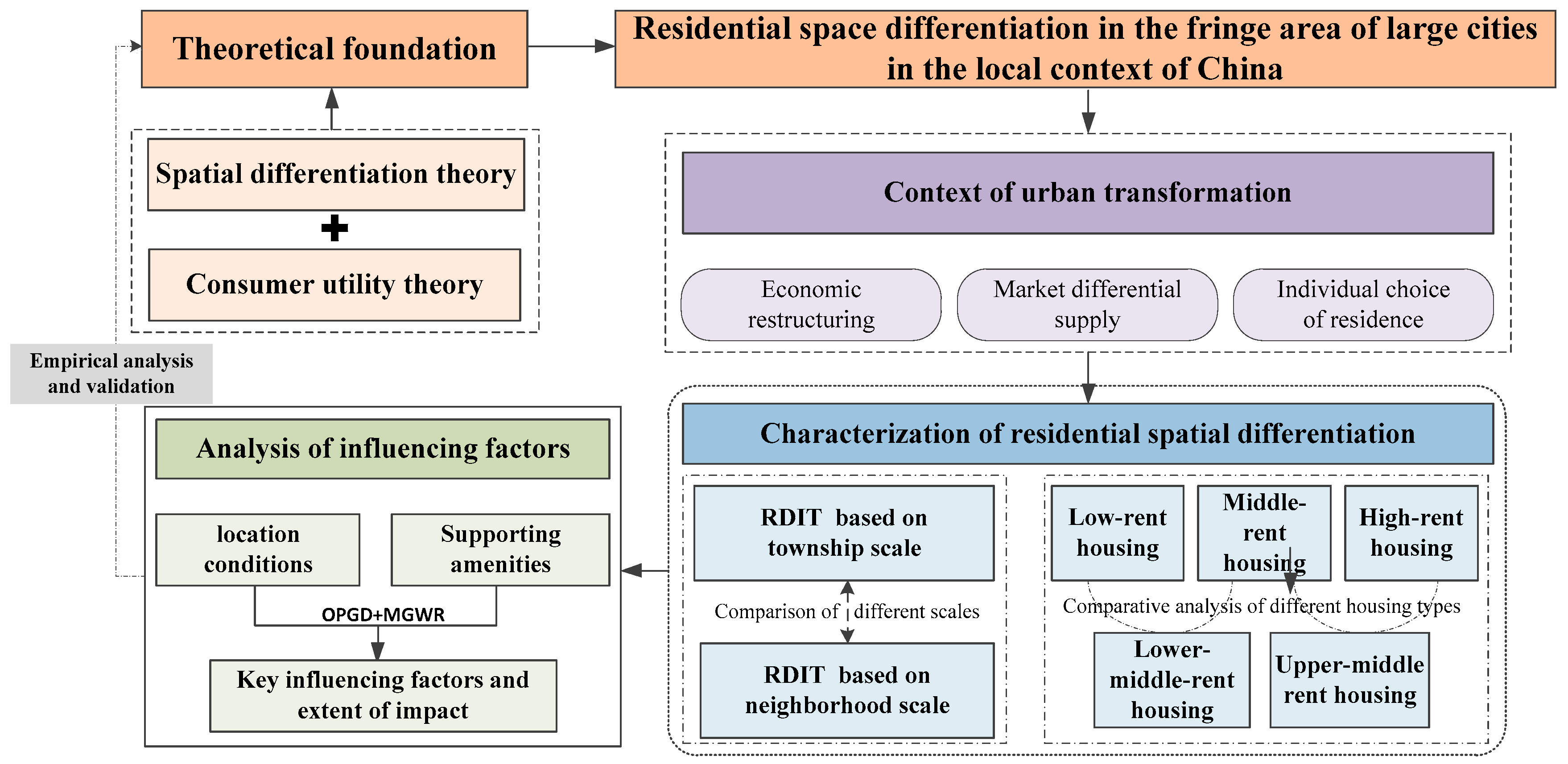
Based on this structural background, this study combines spatial differentiation theory and consumer utility theory to explore the formation process and specific influencing factors of residential space differentiation in the fringe areas of big cities in China. According to the theory of spatial differentiation, the structured supply of housing market and the location preference and constraint choice of heterogeneous social groups jointly form residential space differentiation [18,19,20]. In the context of China, the deepening of economic system reform promotes the loosening of social structure and the accelerated flow of urban and rural population, which makes the peripheral areas of big cities become the main gathering space of floating population [21,22,23]. At the same time, the regional advantages and the government’s differentiated land use planning dominate the land development mode and resource allocation within the urban fringe areas, which makes them form obvious differences in the nature of land use and infrastructure allocation, and then leads to the unbalanced distribution of urban resources and service facilities. On this basis, the logic of marketization further acts on housing supply and residence choice, which affects the choice of differentiated housing price by social groups [24,25], thus shaping the status quo of residential space differentiation based on housing price differentiation [26]. It is worth noting that due to strict institutional constraints on housing property rights, transactions in big cities in China (such as restricting non-local residents or residents who have not met the social security period from buying houses), and high housing price thresholds, rental housing has become the main resettlement method for floating populations in urban fringe areas. At present, there are various sources of rental housing in Chinese cities, including market-oriented housing provided by real estate developers, enterprises, and individual landlords, and affordable rental housing provided by the government. However, the latter struggles to benefit most floating people in terms of coverage scale and access conditions. Therefore, under the guidance of the market-oriented rental housing system, the marginal area can guide the living choices of different groups through the rent screening mechanism, thus shaping the residential space pattern based on rent differentiation.
In this process, due to the participation of multiple stakeholders (government, developers, village collective organizations, etc.), there is often the phenomenon that multiple housing types such as commercial housing, relocated housing, affordable housing, and rural self-built housing are mixed and juxtaposed in the same urban fringe areas in China. Especially in the fringe areas of big cities, there are many different situations, such as undemolished rural self-built houses and relocated houses, spatial proximity between affordable housing communities and newly built commercial housing communities, etc., which leads to the fragmentation and discontinuity of housing rent space in spatial units, showing more significant spatial heterogeneity than in the west [27]. Therefore, it can be concluded that the differentiation degree of the urban fringe in China may be increased when it is divided into finer spatial units [28].
Based on the above complex and fragmented residential space differentiation in the fringe areas of big cities in China, this paper reveals the influencing factors of living needs and the rental preferences of residents in the fringe areas from the micro-consumer utility theory. According to consumer utility theory, renting a house has obvious short-term utility-oriented characteristics. Compared with the internal attributes of housing (decoration, floor, orientation, etc.), the floating population living in the marginal area will pay more attention to the immediate benefits brought by the external attributes of housing, such as commuting costs to the city center, convenience of public transportation, and accessibility of basic public services such as medical, leisure, and commerce [29]. Therefore, rent has become a key measure to regulate and meet the living utility of floating populations. Based on economic ability and demand preference, different groups make differentiated choices in the rent gradient of the marginal area, thus strengthening the residential space differentiation.
To sum up, this study constructs an analytical framework of residential space differentiation in Beijing’s urban fringe in the context of the localization and transition period (Figure 1). Based on the rental data information, this paper focuses on the dual spatial scales of towns and blocks to analyze the morphological characteristics of residential space differentiation, and finds out the key influencing factors and degree of action from the two aspects of residential location conditions and supporting facilities, so as to provide a scientific basis for alleviating the phenomenon of residential space differentiation in marginal areas and optimizing urban spatial governance.

2.2. Study Area and Data Sources

2.2.1. Study Area

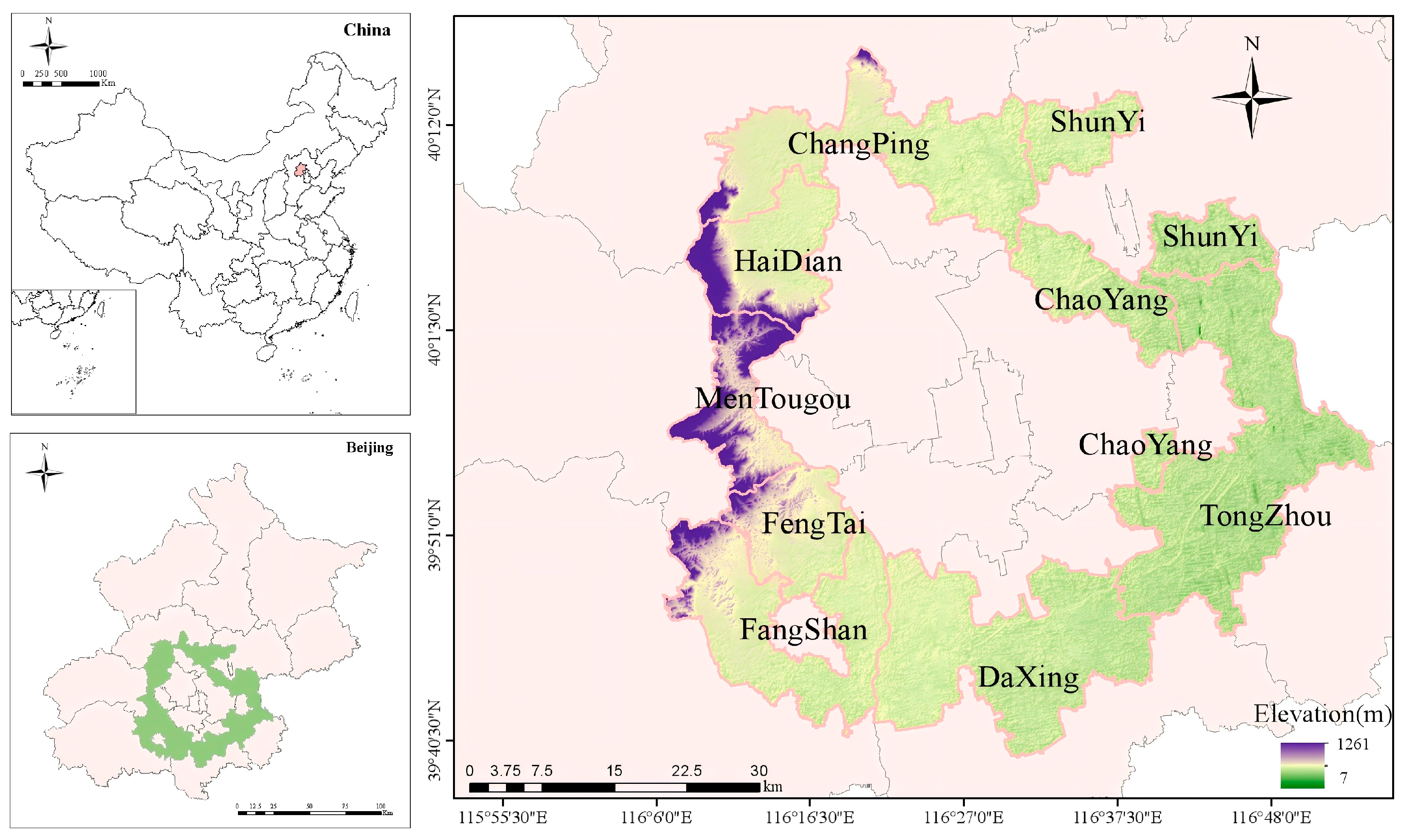
The research area of this paper is based on the official planning space of Beijing’s second green isolation belt (between the fifth ring road and the sixth ring road). It is jointly demarcated by the administrative boundaries of 35 adjacent townships, involving 9 municipal districts with a total area of 2064.1 km2 (Figure 2). The Beijing Second Greening Isolation Area Plan, which was approved in 2003, officially started the construction of this area. In addition to realizing the urban spatial structure of a “decentralized group” layout, it is also a key area for Beijing to build an ecological security pattern in plain areas, reduce urban and rural construction land, and control the spread of central cities to new cities and new cities to peripheral areas. Under the law of urbanization development and planning and deployment, the land use structure and residential space forms in this area have undergone drastic changes in the last twenty years. The original agricultural land, which was dominated by concentrated contiguous cultivated land and scattered villages, has been gradually replaced by various types of construction land such as urban residential land developed in pieces, rural residential areas continuously expanding, industrial edge areas, and high-tech edge areas, forming a typical urban edge landscape with highly mixed land use and uneven development time sequence. At the same time, differentiated planning strategies have further shaped the unbalanced pattern of land use and spatial development in the region. There are obvious differences in land development intensity, land use type combination, and infrastructure investment under different functional guidance: the east relies on urban sub-centers to build sustainable residential and service functions, the south lays out industrial and logistics land around the airport economic zone, the west is strictly restricted by ecological protection, and the north is dominated by scientific and technological research and development. This heterogeneous land use pattern shaped by land system and planning first interacts with the subsequent market mechanism and individual living choices, and finally contributes to complex and diverse residential space differentiation patterns. This area is not only the frontier area of urbanization in Beijing, but is also the case in the construction and development of the fringe areas of other big cities such as Shanghai and Shenzhen. Therefore, exploring the characteristics and formation process of residential space differentiation in urban fringe areas of Beijing, starting from the history of the land development and planning system, and analyzing the influence path of the residential space pattern under the interaction between it and market mechanisms and individual residential choices, has strong typical significance and popularization value for deepening the research on land use and spatial governance in urban fringe areas.

2.2.2. Data Sources

The research data in this study originates from three primary sources: (1) The housing rent data comes from China Housing Price Market Platform (www.creprice.cn, accessed on 1 April 2024), which collects and integrates the number of real estate transactions published by 9300 real estate websites and up to 50 million users and those authorized by businesses; uses the data cleaning technology with independent intellectual property rights to automatically deduplicate, reject, and complement the collected data; and reorganizes and manually verifies data, thus ensuring the comprehensiveness, authenticity, and reliability of the data base. The price time point selected in this paper is April 2024. Taking the residential quarters/villages in the study area as the basic spatial unit, the rent information of the quarters (villages) is first collected and queried through platform statistics to ensure that one spatial unit corresponds to a complete record. Secondly, according to the data retrieval logic built into the platform and based on the principle of spatial proximity, the available rent information is retrieved with a spatial proximity of 500 m, 1 km, and 2 km in turn, and the rent information under the nearest scale is selected as the representative value of the spatial unit. If valid rent information cannot be obtained, the rental status of the community (village) will be verified through on-the-spot visits and census, and the rental price will be supplemented and improved. Finally, the units with missing platforms and which are unable to complete the information on the field are removed from the sample. Through the above cleaning and verification process, a total of 1525 valid samples are obtained. (2) Road network vector data is sourced from Open Street Map (OSM), an open-source mapping platform renowned for its precision in intelligent transportation systems and location-based services. Recognized as one of the most accurate global vector datasets, it provides comprehensive coverage of hierarchical road infrastructure. (3) The source of POI data is the AutoNavi API open platform. This article uses locoy spider to crawl a total of 6793.6 million pieces of POI variable data such as educational resources, medical resources, public transportation points, public green spaces, and shopping malls in 2024.

2.2.3. Scale Selection

Considering the similarity of residential space in the same block and the spatial heterogeneity of residential quarters, this paper selects two spatial scales of towns and blocks to analyze the differentiation pattern of residential space. Among them, township scale, as the basic policy implementation unit, can effectively reflect the differentiation pattern under the comprehensive influence of macro policy guidance, land system, and regional functional orientation. On a finer block scale, it can clearly show the results of micro-agglomeration and separation achieved by different social groups based on demand preference choices. The combination of two scales can more comprehensively and deeply understand the complexity and dynamics of residential space differentiation. On the township scale, based on the administrative divisions of towns and villages in China’s seventh census, the urban fringe areas of Beijing are divided into 35 spatial units. On the block scale, based on OSM road network data, using the block division method proposed by Han et al. [30], using the intersection of urban trunk roads and roads, using topology tools and the “Feature to Polygon” command to divide block units in ArcGIS 10.8, and combining the visual interpretation of remote sensing images to merge blocks, 253 spatial units in the urban fringe area of Beijing are obtained.

2.3. Research Method

2.3.1. Calculation of Residential Space Differentiation Index

Duncan et al. put forward the concept of the dissimilarity index, which can effectively reflect the distribution differences in different groups in residential space and has strong operability [31]. Affected by factors such as high housing prices and blocked property rights transactions, housing rents in big cities can usually better reflect the actual value of houses, show the differences between different regions, and reveal the real residential space differentiation. Considering that compared with the percentage classification method (such as the quintile method) based on equal grouping of sample sizes, the natural breakpoint method can objectively identify the spatial fracture and aggregation characteristics of rent samples by minimizing the differences within groups and maximizing the differences between groups, and grouping according to the natural fracture of the values themselves, thus avoiding the subjective concealment of spatial heterogeneity by artificially setting grouping boundaries. Therefore, in order to accurately characterize the differentiation of residential space, this paper uses the natural breakpoint method to divide them into low rent (20.04~49.73 RMB/m2), medium–low rent (49.74~68.46 RMB/m2), medium rent (68.47~91.57 RMB/m2), medium–high rent (91.58~126.44 RMB/m2), and high rent (126.44~196.69 RMB/m2) to construct the residential dissimilarity index for tenants (RDIT):
R D I T i = 1 2 i = 1 N r i R o i O
where RDITi denotes the residential dissimilarity index for tenants in township/neighborhood i. N represents the total number of townships/neighborhoods within the study area, with values of 35 (township scale) and 253 (neighborhood scale), respectively. ri indicates the proportion of rental units in township/neighborhood i within the r-th rent interval. oi represents the proportion of rental units in township/neighborhood i outside the r-th rent interval. R and O correspond to the proportion of rental units within and outside the r-th rent interval across the entire study area. The RDITi ranges between 0 and 1: RDITi = 0 signifies that the distribution of tenant groups across all five rent tiers in township/neighborhood i perfectly matches the overall distribution pattern observed in the study area. RDITi = 1 indicates absolute spatial concentration, where all tenants within a specific rent tier are entirely clustered in township/neighborhood i.

2.3.2. Impact Factorization Based on the Optimal Parameter Geographic Detector

Geographic detector is a statistical tool used to analyze the influence of independent variables on the spatial heterogeneity of dependent variables in spatial data. Traditional geographic detectors have insufficient subjective judgment in the discretization processing of spatial data, which leads to poor detection effect. As an improved method, Optimal Parameter Geographic Detector (OPGD) uses a variety of discrete methods to carry out spatial discretization and classification of independent variables to screen out the optimal analysis parameters with the largest q value, which significantly improves the detection effect. This study consequently employs factor detector and interaction detector analyses to investigate the dominant drivers and synergistic effects shaping residential space differentiation in Beijing’s urban fringe. The computational expressions are formulated as:
q = 1 - h = 1 L N h σ h 2 N σ 2 = 1 S S W S S T
S S W = h = 1 L N h σ h 2 , S S T = N σ 2
where the explanatory power of the influencing factor is denoted by q. The number of zones is denoted by h, and Nh and N are the number of residential points in zone h and the entire region, respectively. σh2 and σ2 represent the variance of rents in zone h and the entire region, respectively. The within sum of squares is known as SSW, while the total sum of squares is known as SST. The range of q is [0, 1], where a higher number denotes a greater impact of the factor on rent.

2.3.3. Influence Mechanism Analysis Based on Multi-Scale Geographic Weighted Regression Model

The conventional Geographically Weighted Regression (GWR) model is constrained by its fixed-bandwidth assumption, which restricts coefficient estimation to a uniform spatial scale, potentially introducing analytical biases when handling multi-scale spatial processes. On the basis of traditional GWR, the MGWR model allows variables to select the best bandwidth at different scales for regression calculation, which makes the results more adaptive and robust [32]. The formula for the method is:
y i = β b w 0 ( u i , v i ) + j = 1 n β b w j ( u i , v i ) x i j + ε i
where yi is the rent value of the i-th sample; n is the total number of samples participating in the calculation; (ui, vi) is the position of the i-th spatial unit; bw refers to bandwidth; bw0 and bwj are the optimal bandwidth of the intercept and the j-th influence factor, respectively; βbw0 (ui, vi) is the intercept term; βbwj (ui, vi) is the regression coefficient of the j-th influencing factor of the i-th sample under the optimal broadband; xij is the observed value of the influencing factor xj in (ui, vi); and εi is the error term of the model. In this paper, MGWR2.2 is used to build the model, and the selection of MGWR bandwidth follows the quadratic kernel function and modified Akaike information (AICc) criterion.

3. Results

3.1. Analysis of Residential Space Differentiation in Urban Fringe Areas of Beijing

3.1.1. Analysis of Different Spatial Scales

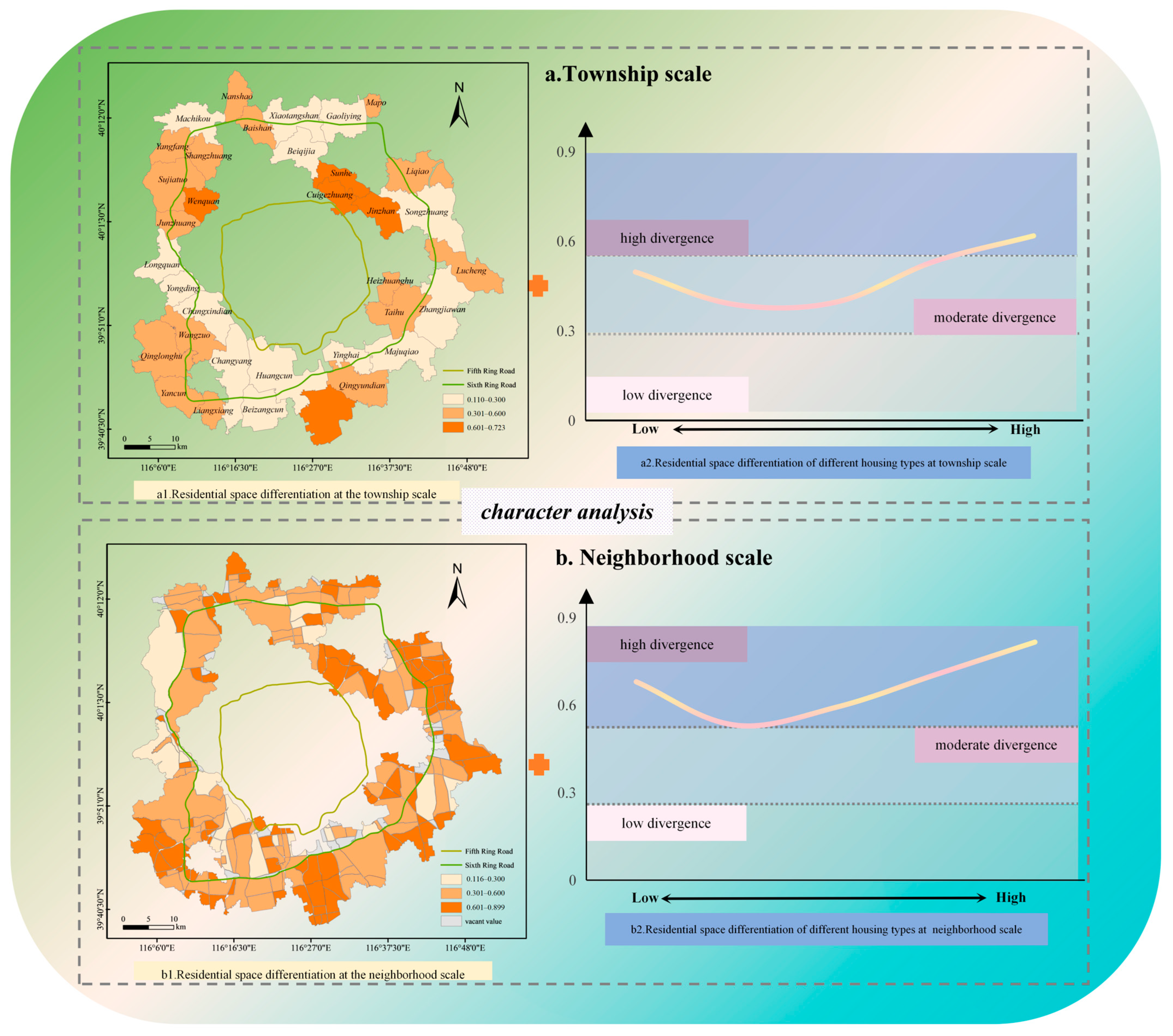
The residential differentiation index RDIT of two scales and five types of houses in Beijing’s urban fringe area was calculated, and the results were visualized, respectively (Figure 3a,b). According to the standard classification of international residence differentiation, lower than 0.3 is low differentiation, 0.3–0.6 is moderate differentiation, and higher than 0.6 is high differentiation. Therefore, 0.3 and 0.6 are used as the separation boundaries in the figure, respectively. The analysis reveals the key findings below.
Firstly, from the perspective of the overall differentiation degree, the average degree of residential space differentiation at different spatial scales is between 0.3 and 0.6. According to the international differentiation degree standard, 2/3 of Beijing’s urban fringe areas are in a moderate and highly differentiated state (RDIT > 0.3) at the township scale, and 47.3% of the areas are in a highly differentiated state (RDIT > 0.6) at the block scale. This shows that the degree of residential space differentiation in Beijing’s urban fringe area is generally “medium to high”, and there is a serious phenomenon of residential space differentiation.
Secondly, from the perspective of spatial distribution, Sunhe Township and Cuigezhuang Township in the northeastern suburbs of Beijing’s urban fringe area and Weishanzhuang Town in the southern suburbs form a differentiated high-value core (RDIT > 0.639), while the western region forms a low-value cluster zone (RDIT < 0.247). Qinglonghu Town and Yancun Town in the outer suburbs of southwest China are slightly lower than those in the high-value areas (RDIT ∈ [0.4, 0.5]). Compared with the low-value areas, the values of Qingyundian Town and Zhangjiawan Town in the southeast suburbs and Shangzhuang Town in the northwest suburbs are slightly higher (RDIT ∈ [0.3, 0.4]). From this, it can be generally judged that the differentiation of residential space between the northeast corner and the southwest corner of Beijing’s urban fringe area is more serious, while the situation between the northwest corner and the southeast corner is more moderate.
Thirdly, from the comparison of the differentiation index, the residential space differentiation index at the block scale is generally higher than that at the township scale, which is highlighted in the northeast and southwest of marginal areas where residential space differentiation is severe, such as Liqiao Town, Songzhuang Town, and Changyang Town. These areas are in a moderate degree of differentiation at the township scale, but they are highly differentiated at the block scale. It is fully verified that the residential space differentiation has a strong scale effect, that is, the smaller the spatial unit, the more obvious the differentiation degree.
In summary, the residential space differentiation in Beijing’s urban fringe area exhibits an “X-shaped” fragmented pattern, characterized by moderate-to-high overall differentiation levels. Specifically, the northeastern and southwestern zones demonstrate severe spatial differentiation, while the northwestern and southeastern regions show relatively mitigated differentiation. This phenomenon is closely related to the differentiated housing supply in Beijing’s urban fringe areas, the difference in policy development orientations across different townships, and the specific directional patterns of migrant population mobility. Additionally, the differentiation intensifies at smaller spatial scales (e.g., neighborhood scale), confirming a robust scale effect.

3.1.2. Analysis of Different Housing Types

Based on the calculation results, the analysis of residential space differentiation across housing types is shown in Figure 3(b1,b2). The RDIT of housing rents in Beijing’s urban fringe area exhibits a distinct “U-shaped” pattern, where high differentiation occurs at both ends (low-rent and high-rent housing) and lower differentiation in the middle. The degree of residential differentiation of all types of housing in the two scales is more than 0.3, and most of them are even more than 0.6 in the block scale, which indicates that there is quite significant residential space differentiation in the marginal areas of Beijing.
Secondly, among the five types of housing, the high-rent type (villa area, high-grade commercial housing, etc.) has the highest differentiation index (0.618 in township scale and 0.816 in block scale), indicating that this type of housing is unevenly distributed in marginal areas and is the most spatially agglomerated, showing a highly isolated distribution state. However, the differentiation index of low- and medium-rent houses (rural self-built houses, relocated houses, etc.) is relatively low (0.388 in township scale and 0.531 in block scale), but it also reaches a moderate differentiation degree. In addition, the differentiation degree of medium- and high-rent, low-rent, and medium-rent housing decreases in turn. It means that the distribution of residential areas corresponding to different rent levels in cities is not random or uniformly mixed, but shows an obvious isolated distribution.
Thirdly, from the numerical differences in different types of housing at the two spatial scales, the degree of residential space differentiation of all types of housing is significantly intensified at smaller spatial scales. Among them, the RDIT of medium-rent housing changes the most drastically, rising from 0.395 to 0.592, an increase of about 49.87%, while the RDIT of other types of housing increases by less than 40%. It is concluded that the finer the spatial unit, the more uneven the distribution of medium-rent housing is.
To sum up, there is a significant residential space differentiation in the urban fringe areas of Beijing, and the distribution of housing with different rent types shows an obvious isolation state. High-rent housing, typically clustered around scare resources or planned zones, tends to form income-segregated communities with peak differentiation indices. Low-rent housing exhibits similar spatial clustering patterns influenced by historical legacies and policy interventions. Notably, middle-rent housing manifests the most dramatic scale-sensitive differentiation–its RDIT changes the most when shifting from township to neighborhood analytical units. This phenomenon shows distinct clustered distribution associated with its diverse supply sources, dispersed development locations, and internal homogeneity.

3.2. Analysis of Influencing Factors of Residential Space Differentiation in Urban Fringe Areas of Beijing

3.2.1. Variable Selection and Description

Based on the analytical framework above, this study focuses on the location conditions considered in housing development and the living preferences of residents in urban fringe areas. It quantifies and analyzes eight factors across two dimensions: location conditions (distance to CBD, subway accessibility, and bus transit) and supporting amenities (commercial, educational, recreational, and medical facilities), as illustrated in Table 1. In terms of data collation, the Beijing POI data obtained from the open platform of AutoNavi API is cleaned and categorized, and the outlier and null records are filtered. At the same time, the matching results are deduplicated to ensure the accuracy of the quantity. In terms of buffer zone setting, since scholars have not unified their choice of buffer distance, this paper synthesizes common scales, collects POI data in buffer zones centered on residential areas and surrounding radii of 800 m and 1000 m, and uses python to calculate the distance from residential areas to relevant POI facilities and the number of various types of POI facilities within the statistical buffer range. Through comparative analysis, the coefficient of variation in the number of POI facilities under the buffer distance of 800 m is higher (about 6.6% higher on average), which can more effectively reflect the different characteristics of the surrounding environment of different residential areas. Therefore, this paper finally selects the buffer range of 800 m as the extraction principle of order of magnitude index.
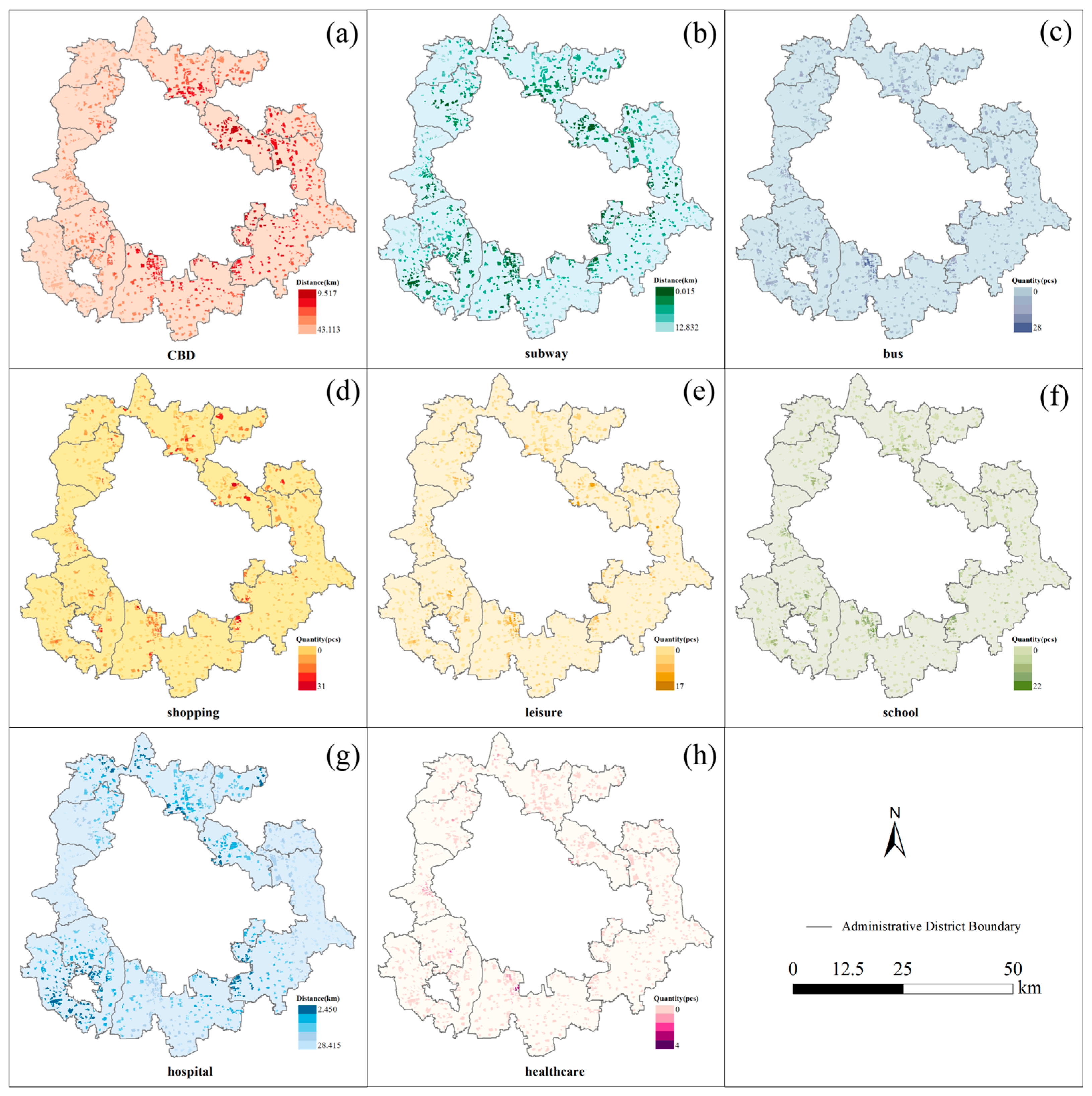
Figure 4a–c illustrate the spatial distribution of various influencing factors. The location conditions reveal the following: (1) Beijing’s Central Business District (CBD), represented by the China World Trade Center (Guomao), is situated on the eastern side of Beijing’s geographical center. Consequently, the distance from residential areas in the peripheral zones to the CBD exhibits a pattern of “closer in the east and farther in the west”. (2) Proximity to subway stations in the peripheral areas is relatively poor, with 62.62% of residential units located over 2 km away from the nearest subway station. (3) Bus stop density is comparatively low in these areas: 35.32% of residential zones have fewer than four bus stops nearby, while 6.3% lack any bus stops entirely. (4) In terms of supporting amenities, the construction of all types of facilities in Beijing’s urban fringe area is relatively sparse, with most residential zones having only 0–1 facility within an 800 m radius (Figure 4d–h). Specifically, commercial facilities are relatively concentrated in Huangcun Town, Majuqiao Town, Jinzhan Township, Beiqijia Town, and Gaoliying Town. Recreational facilities are more abundant in Huangcun Town and Wangzuo Town. Educational facilities show higher density in Huangcun Town, Majuqiao Town, and Wangzuo Town. Medical facilities face significant challenges in accessibility and convenience. Nearly 92.66% of the urban fringe area has no secondary healthcare facilities within 800 m, and the distance from any given point to the nearest tertiary hospital exceeds 2 km. Exceptions include Nanshao Town, Majuqiao Town, and Liangxiang Town, where medical infrastructure is comparatively better.

3.2.2. Factor Detection Analysis

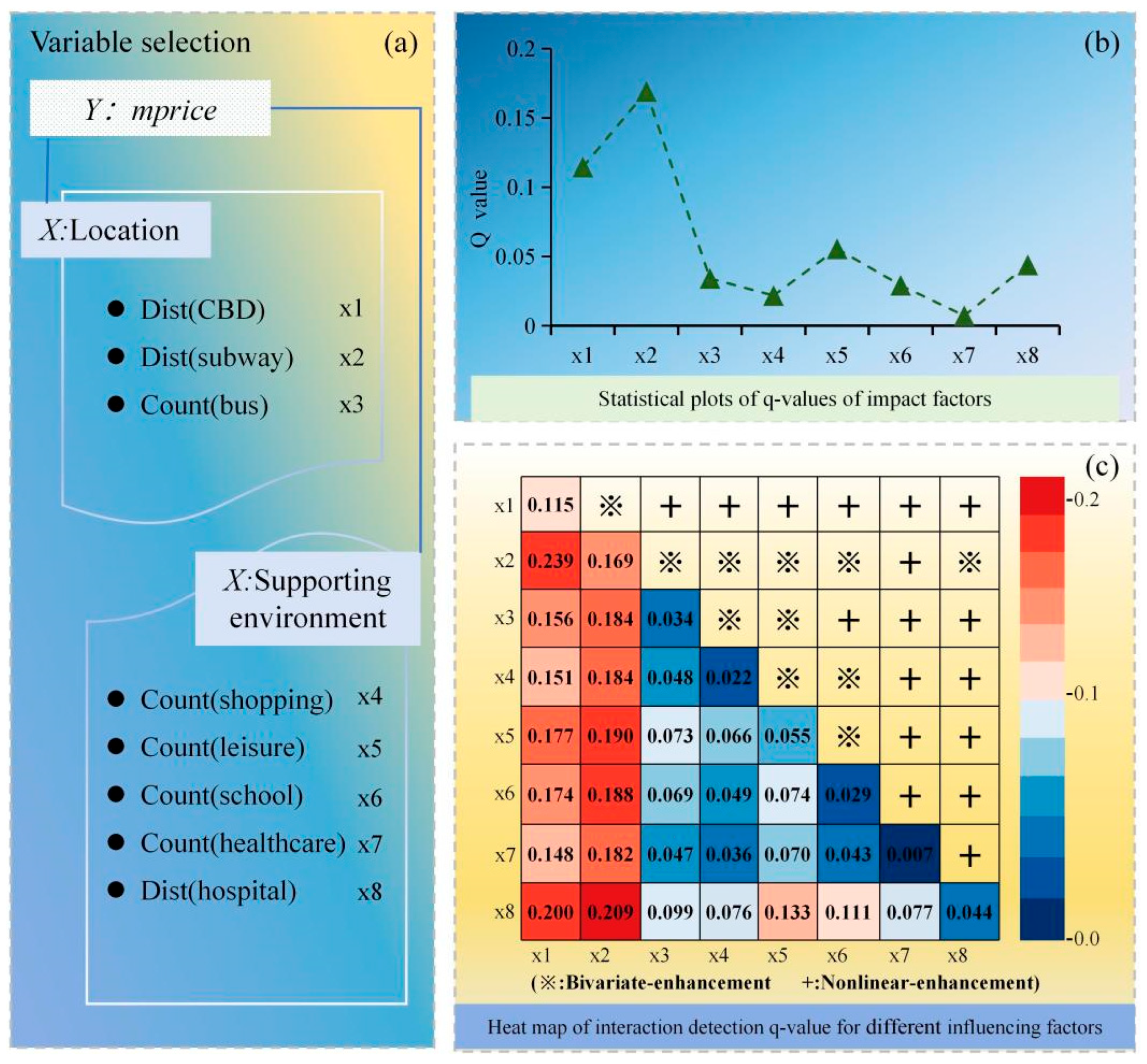
This study utilizes the OPGD to assess the explanatory power of independent variables (X: location and supporting amenities) on the dependent variable (Y: monthly rent). The larger the coefficient value corresponding to the independent variable in the results, the more significant the influence of this variable on rent is. According to the empirical results, the distance X2 from the spatial point to the nearest subway station and the distance X1 from the spatial point to the CBD have the strongest influence, reaching 0.169 and 0.115, respectively. Distance-based variables (X1, X2, X8) consistently show substantially greater explanatory power compared to quantity-based variables (X3, X4, X5, X6, X7). On the whole, the influence ranking of the q values of factor indicators is as follows: transportation position > centrality position > recreational amenities > medical support > educational amenities > commercial amenities. This ranking is the result of suburban residents’ preference for commuting convenience and central location. Distance factors can directly reflect residents’ travel costs and space accessibility needs, showing stronger explanatory power; however, the quantitative class factor has limited explanatory power, which is related to the insufficient infrastructure in the marginal region.

3.2.3. Interactive Detection

To investigate potential synergistic effects among influencing factors, interaction detection analysis was conducted on dual-factor combinations. The results identify 11 factor pairs (X1∩X2, X2∩X3, X2∩X4, X2∩X5, X2∩X6, X2∩X8, X3∩X4, X3∩X5, X4∩X5, X4∩X6, X5∩X6) exhibiting bivariate-enhancement effects (denoted by “※” in Figure 5c), while all remaining combinations demonstrate nonlinear-enhancement effects (marked as “+”), indicating amplified strength through interactive synergies. From the ranking of explanatory power q value, the q value of the interaction between the distance from the spatial point to the subway station and all other factors is above 0.165, and the highest value is 0.239 for the interaction between the distance from the spatial point to the CBD, which indicates that they have strong explanatory power for rent. In addition, the interaction of factors such as the distance from the spatial point to the CBD and the distance from the spatial point to the nearest top three hospitals is relatively significant.

3.3. Analysis of Influencing Mechanism of Residential Space Differentiation in Urban Fringe Areas of Beijing

3.3.1. Impact Factor Screening

In this part, eight impact factor indicators are brought into the ordinary least squares (OLS) model as independent variables, and the variance inflation factor (VIF) and tolerance values are used for multicollinearity tests. The results show that the tolerance of all variables is greater than 10% and the VIF is well below the critical criterion of 10, indicating that the collinearity between independent variables is not obvious. Furthermore, the probability p value of the two influencing factors, the number of bus stops and the number of schools within 800 m, fails to pass the significance test. Therefore, the above redundant variables are removed, and six impact factor indicators are screened out, namely, the distance from the spatial point to the CBD, the distance to the subway station, the number of supermarkets within 800 m, the number of leisure facilities, the number of secondary medical facilities, and the distance from the spatial point to the tertiary hospital (Table 2).

3.3.2. Model Contrast Optimization

The screened impact factors are diagnostically counted in OLS, GWR, and MGWR in turn (Table 3), and the horizontal comparison of indicators shows that the MGWR model have significant applicability and robustness. Specifically, the R2 and adjusted R2 of the MGWR model are both larger than those of the OLS and GWR models. Compared with the OLS and GWR models, the AICc index, residual sum of squares, and log-likelihood value of the MGWR model are all obviously optimized, indicating that the results of the MGWR model are better and the error is minimal. In addition, in order to further verify the reliability of the MGWR model, the spatial autocorrelation analysis of the model residuals is also carried out, and it is concluded that the spatial autocorrelation value of the residual of MGWR is the smallest and is insignificant, indicating that the MGWR model is more robust. It can be seen that the MGWR model considers the optimal bandwidth at different spatial scales in regression analysis, which makes up for the setting defects in global regression, so it can obtain model results with smaller local errors and stronger robustness.

3.3.3. Analysis of Influencing Factors

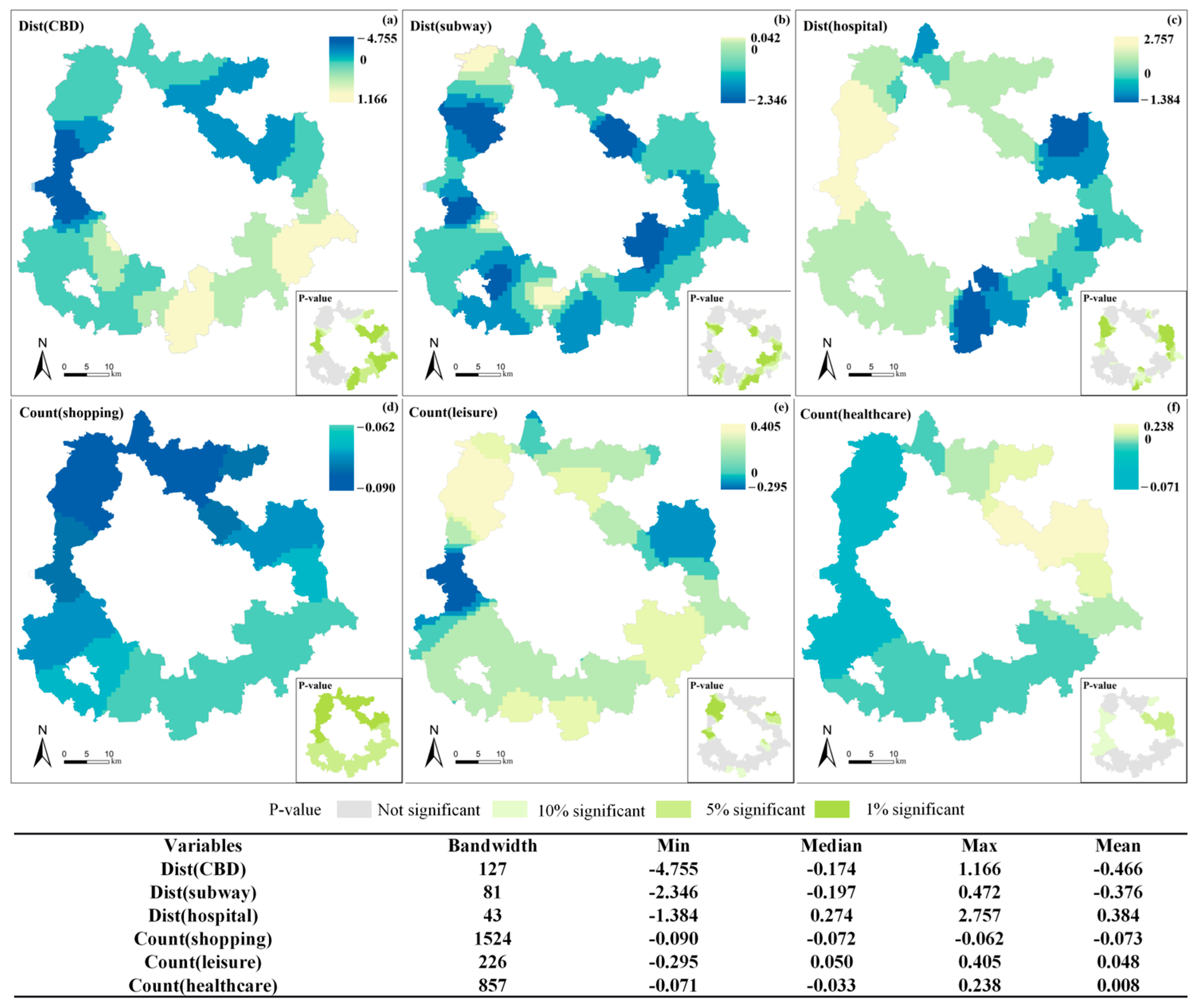
Statistical MGWR regression model coefficient estimation results were summarized and spatially visualized (Figure 6). Regarding the centrality position factor, 64.26% of regression coefficients for distance to CBD demonstrate negative correlations (Figure 6a). Such characteristics are mainly found in western Beijing’s Longquan and Yongding Towns (Mentougou District), reflecting the increased dependence on centrality in peripheral communities with limited local employment opportunities. This indicates that CBD accessibility is still a key factor affecting the housing choice of migrant workers. Concerning transportation position factor, the distance to a subway station exhibits locally negative correlations (Figure 6b). In towns like Sujiatuo and Wenquan Towns (Haidian District), Yongding Town (Mentougou District), and Changyang Town (Fangshan District), this effect is negative, reflecting the high dependence of these areas on rail transit. These findings confirm that subway accessibility is a key factor affecting the housing choice of migrant workers. In relation to medical support factors (Figure 6c,f), in a few areas, the proximity to the nearest tertiary hospital shows a negative correlation, while the density of secondary facilities within 800 m has little impact. This may indicate an imbalance between supply and demand for medical support factors. In terms of commercial factors (Figure 6d), commercial facility density within 800 m presents an overall negative correlation. However, its impact is minimal, suggesting that commercial factors are not key drivers. Concerning recreational factors (Figure 6e), recreational facility density within 800 m generally demonstrates a positive relationship, which indicates that the size of surrounding leisure facilities has a significant impact on immigrant housing choices, where the higher the density of facilities, the higher the rental premium.
The spatial heterogeneity of these driving factors shows that the differentiation of residential space in Beijing’s urban fringe stems from the diversification of regional functions and population needs. Centrality and traffic factors play a leading role, mainly due to the choice of occupation and residence of residents in fringe areas and the lack of public transportation networks in fringe areas. Medical factors (especially tertiary hospitals) are mainly limited by the spatial mismatch between high concentration and daily needs, and only produce weak local effects. Infrastructure commercial facilities are evenly distributed due to low barriers to entry and flexible operations, without significant impact. On the contrary, leisure infrastructure shows a polarization effect through the interaction between high-end resources and residents’ quality pursuit behavior.

4. Discussions

4.1. Formative Mechanism of Residential Space Differentiation Phenomenon in Urban Fringe Area of Beijing

Previous studies on residential space differentiation mostly focus on the analysis of the city as a whole, and posit that the differentiation phenomenon is more serious in the urban fringe than in central urban areas [33], which has laid the foundation for this research. After calculation, there is a serious differentiation of residential space in Beijing’s urban fringe area as a whole (RDIT is much greater than 0.3, and even partially greater than 0.6), which is at a medium–high stage compared with international standards [34]. The overall spatial differentiation presents an “X” pattern with a severe northeast–southwest direction and moderate northwest–southeast direction, which is mainly formed by the interaction of policy guidance, market mechanism, and individual choice. First of all, Beijing’s non-capital function relief and the Beijing–Tianjin–Hebei coordinated development policy have formulated differentiated spatial planning, which has laid a structural foundation for the formation of the “X” differentiation pattern. Specifically, the southwest edge areas (Fangshan and Fengtai) close to Tianjin and Hebei mainly undertake traditional industries and support population relief, and the land supply is inclined to affordable housing and collective construction land, gradually forming a settled area dominated by low- and middle-income migrants. The northeast edge area (Chaoyang) continues to attract high-income groups by relying on high-end industries such as finance and commerce. Secondly, under the guidance of such policies, differentiated resource allocation further strengthens the residential space differentiation through the market mechanism. Due to the concentrated construction of a large amount of affordable housing and rural self-built housing in the southwest, the housing price depression has been formed, which has solidified the living cost gap [35,36]. However, due to resource inclination and location advantage in the northeast, the capital agglomeration effect has been triggered, and land is mostly used to develop high-end housing, which continuously pushes up housing prices and causes price exclusion barriers [37]. Finally, the individual residence choice completes the closed loop of group screening and response in space. Although the household registration system restricts the equal opportunities of the floating population to obtain public services, high-income groups can actively pay a location rent premium in exchange for gains in career development opportunities, while low-income groups are forced to endure space deprivation in exchange for living cost savings due to insufficient ability to pay [38], thus transforming potential location differences into distinct residential segregation. Under the influence of these three, the southwest region and the northeast region have formed two significant high-value areas of differentiation, while the university groups in northwest Haidian and workers in emerging industries in the southeast have alleviated the pressure of market screening and the influence of individual decision-making to a certain extent due to institutional job–housing matching (unit housing, factory dormitories, etc.), thus weakening the differentiation intensity. It can be seen that the current “X” differentiation pattern in Beijing’s urban fringe area is the result of the policy-led differentiation framework, the continuous transmission of market roles, and the continuous action of individual choice constraint responses. Therefore, in future urban governance, it is necessary to take spatial justice as the guide, break the dual isolation of industrial support and low-level security through mixed function development, and give more consideration to the people-oriented spatial governance paradigm.
Consistent with the conclusions of many previous studies, the residential space differentiation in this paper has significant scale effect [39]. That is to say, at a smaller block unit scale, multi-type and multi-attribute housing in China’s urban fringe areas can be accurately identified. The existence of this scale effect originates from the historic “collage” development mode in Beijing’s urban fringe area—government-led affordable housing, market-oriented commercial housing, and village collective self-built housing implemented non-coordinated land development in different periods and according to different land policies, which led to obvious differences in development intensity, land use nature, housing properties, and infrastructure supply of adjacent plots. In this context, the traditional township/street scale masks the reality of sudden rent change in adjacent plots, which easily forms a statistical trap of spatial homogenization. However, studying at the block scale breaks through the statistical smoothing effect, which makes the original homogenized mixed layout obvious at the township scale, which is beneficial for detecting the real intensity and complexity of residential space differentiation [13]. Therefore, aiming at the differentiation of residential space in urban fringe areas of China, we should formulate relevant policies and carry out spatial layout planning based on macro and micro scales.

4.2. Influence Mechanism of Residential Space Differentiation in Urban Fringe Area of Beijing

According to the analysis of the factors of residential spatial differentiation, the formation of residential spatial differentiation in Beijing’s urban fringe area is greatly influenced by spatial accessibility, including the accessibility of employment centers and rail stations [40,41]. The influence of distance variables (the distance between spatial points and hospitals, CBD, and subway stations) is much greater than that of quantity variables (the number of supporting facilities within 800 m of spatial points), among which the influence of distance from subway stations is the most significant. This high sensitivity to distance accessibility index is fundamentally due to the reshaping of land location value by rail transit construction. Under the background of megacities, the commuting pressure, the imbalance of public service space, and the survival needs of migrant workers work together, which makes the land accessibility advantage brought by rail transit investment directly capitalized into a significant rent gradient in the housing rental market. Good accessibility (especially through subway transportation) is the basic capital for residents in peripheral areas to break through spatial barriers and access the urban core functional network [42]. Therefore, focusing on time–space accessibility can reveal the deep dynamic mechanism of residential space differentiation more than focusing on static spatial proximity.
According to the regression model of influencing factors of residential space differentiation, residential location conditions and supporting environment have indeed influenced the differentiation of residents’ choice of housing [11]. This study further reveals that central position and transportation position factors are still the core driving forces shaping the residential space differentiation pattern in marginal areas. The role of recreational amenities has become increasingly prominent, and it has gradually become the key factor strengthening the differentiation. The influence of medical and commercial support is relatively weak. The specific mechanism of action is as follows:
  • Mechanism of the central position factor. The differentiation of residential space in Beijing’s urban fringe area is firstly reflected in the difference in dependence on the urban center area, which is related to the multi-center spatial structure strategy in the process of urbanization. This strategy has promoted the rise in many centers, such as the CBD in the northeast of Beijing, Tongzhou District sub-center, and Yizhuang New City in the southeast, each of which has formed a strong siphon and agglomeration effect. This macro layout plan not only attracts a large number of floating populations to choose their residential location based on employment distribution, but also strengthens the typical land rent gradient under the action of the rent competition mechanism, further solidifying the situation that high-income groups live near the center and low-income groups live in the periphery [43]. Specifically, the northern and western edge areas are affected by the radiation of shopping malls and enterprises in the CBD, attracting a large number of migrant workers engaged in basic service industries such as take-out, express delivery, and cleaning, as well as some highly educated and skilled professional and technical personnel. These floating populations usually choose to obtain limited residential space in neighboring villages with lower total rent or rent houses in farther areas in order to reduce the rent per unit area, thus maintaining and strengthening the gradient dependence on the CBD in space. In contrast, the southeastern edge area, driven by the city sub-center and its surrounding logistics bases, automobile manufacturing parks, and other functional nodes, provides a large number of workers’ jobs for the floating population and attracts them to live in the surrounding areas through low-cost living resources such as supporting dormitories, thus significantly weakening their single dependence on the CBD.
  • Mechanism of the transportation position factor. The residential space differentiation in Beijing’s urban fringe area is significantly affected by the local negative correlation of traffic potential factors, which are the premium effects of track accessibility on the surrounding area [44,45]. As an efficient channel connecting marginal areas and core employment areas, subway stations can improve the accessibility of land plots, affect residents’ travel decisions and land development and utilization, and have a significant premium effect on surrounding areas. Compared with urban areas, due to the weakness of the secondary transportation network, subway stations in marginal areas play a more irreplaceable role in the commuting guarantee of floating populations, which makes floating populations regard “distance from subway stations” as a key consideration in renting a house. The planning and construction of subway stations and the demand of floating populations will lead to a situation where the surrounding stations are highly developed and the peripheral areas are lagging behind, further amplifying the degree of differentiation. In addition, the weakening effect of this effect in the southwestern suburbs and northwestern suburbs of Beijing comes from the fact that the nearby employment of residents in these areas reduces the dependence on long-distance rail transit frequency, and the marginal utility of traffic potential decreases, so its influence is weakened.
  • Mechanism of the recreational amenities factor. The differentiation of residential space in Beijing’s urban fringe area is positively affected by leisure supporting factors, which reflects the differentiated preferences and consumption willingness of different groups for leisure supporting facilities. With the improvement of income level, the demand of floating populations will change from “survival” to “development” and “enjoyment” with the improvement of income level. As a scarce and exclusive social resource, high-quality leisure facilities (golf courses, hot springs, Universal Studios, etc.) can not only significantly improve the quality of the living environment, but also bear the social and identity consumption demand of the middle-class and above income groups. In this process, these kinds of leisure supporting facilities gradually transform into spatial capital with screening functions. By pushing up the surrounding housing rent and land value, they guide capital and middle- and high-income groups to gather in specific areas, thus forming a significant rent premium and strengthening the social stratification structure spatially. In contrast, areas that lack such facilities and rely on basic functions are more likely to absorb low-consumption groups oriented to cost minimization, thus forming significant spatial differentiation between different areas [46].
  • Mechanism of the medical support factor. The residential space differentiation in urban fringe areas of Beijing is only affected by the negative effects of three medical resources in a few areas, and the influence of secondary medical resources is weak, which is related to the imbalance of the spatial allocation of medical resources and the mismatch between supply and demand. Tertiary medical resources are mainly concentrated in the core areas due to administrative planning constraints, while high-quality secondary medical resources also lack effective supply in the market, resulting in shortcomings in both the quality and quantity of medical resources in marginal areas. However, according to the actual survey, the floating population in the marginal area is mainly young and middle-aged, with relatively stable physical health and low demand for major medical services. Most of the daily basic medical needs can be met through community clinics. Therefore, under limited housing affordability, even if the medical supporting resources are unevenly distributed, it is difficult to form an effective spatial differentiation driving effect in the marginal rental market [47,48].
In addition, according to the previous research conclusions, commercial supporting facilities will also have an impact on residential space differentiation, but the commercial supporting factors in this study have not played a very significant role. Two potential explanations emerge: First, most of the urban fringe areas in Beijing are inhabited by migrants, and in their renting decisions they pay more attention to employment commuting distance and transportation costs, which will sacrifice long-term living convenience to meet short-term renting needs. Second, commercial facilities in fringe areas are often scattered and small in scale, which makes it difficult to form a significant land value premium [49,50]. Moreover, the convenience of online shopping will further weaken the demand for physical commercial facilities.

4.3. Policy Recommendations

Based on the above research results, this paper holds that the differentiation of residential space in urban fringe areas is not a single material or social phenomenon, but the result of the unbalanced effects of land use structure planning and public resource allocation on different spatial scales. In view of the phenomenon of residential space differentiation in Beijing’s urban fringe area described at this stage, a differentiated and hierarchical collaborative governance path is proposed from the time dimension and spatial scale, so as to enhance the guiding value of regional land use planning and urban spatial governance in alleviating residential space differentiation.
First of all, in the short-term implementation, priority will be given to the transformation of stock land and the refined governance at the community scale. First is to add, where reasonable, high-frequency bus lines and continuous bicycle lanes on the existing land, build a bicycle–bus microcirculation transportation system, ensure the last mile distance between subway stations and communities, and improve the daily travel convenience of migrant workers. The second is to guide community-level commercial service facilities to upgrade their functions and spatial integration within the existing land use framework, improve the quality of life in the region, and make up for the shortcomings of unbalanced distribution of high-quality resources to a certain extent. The third is to further optimize the layout of medical resources in marginal areas, allocate branches or remote service supply centers of top three hospitals in marginal areas in large residential clusters, and use the idle space of the community to promote the development of primary medical services and ensure the living health of migrants.
Secondly, in medium-term planning, we focus on the optimization of land use structure and spatial resource allocation at the district level. On the one hand, we will continue to strengthen the construction of rail transit networks in fringe areas, focusing on increasing the coverage of subway stations outside the sixth ring road in Beijing, and strengthening intensive land development along the rail, so as to improve traffic accessibility and improve land use efficiency and comprehensive output level. On the other hand, we will deeply combine the process of non-capital function relief and industrial transfer, promote the formation of multi-center function construction and differentiated land supply in urban fringe areas, and realize the coordinated development of multiple types of occupational and residential spaces. Among them, ensuring that there is mixed land compatible with inclusive entrepreneurial incubation space and that rental housing is supplied in highly differentiated areas in the northeast will promote the integration of employment and residence. We will create a layout supporting industrial land in the concentrated construction area of affordable housing in the southwest edge areas, promote the formation of a residential space structure supported by local employment, and enhance the comprehensive benefits of the region. We will guide the relief of emerging nodes such as Changping Future Science City in the low differentiation area in the northwest, and gradually alleviate the unipolar radiation effect of land and functions in the core area. In the southeast, high-value-added industries such as cultural creativity are laid out to ensure the comprehensive functional development of sub-centers and to ultimately promote the nearby balance of employment and residence in multiple districts.
Finally, we will pay attention to the overall urban planning and institutional construction in long-term goals. The first method is to deepen the construction of the land use and housing system, pilot the mixed land use model and the policy of equal rights for rent and purchase, steadily promote the mixed allocation of affordable rental housing and commercial housing in urban fringe areas, and weaken the market screening effect of a single land and housing supply model. The second method is to gradually promote the connection between public service construction and population distribution; lay out and plan land for large-scale cultural, sports, multi-functional places, and other facilities at the regional level; improve the accessibility of public service facilities to migrants; and promote the spatial pattern based on fair land use. The third is to build more flexible social security and floating population policies, reduce institutional obstacles such as household registration constraints, improve the coverage level of public services to permanent residents, fundamentally increase the social cohesion and development potential of marginal areas, and guide the differentiation of living space to develop in a more coordinated and inclusive direction.

5. Conclusions

Based on multi-source spatiotemporal data and the MGWR model, this study systematically reveals the mode and driving mechanism of the spatial differentiation of residential buildings in suburban Beijing. The results show that (1) the whole region presents a significant fragmented “X-shaped” spatial differentiation pattern. The northeast and southwest regions are highly differentiated, while the northwest and southeast regions have relatively mild differentiation. (2) Significant scale effects are observed at the township and community levels, underscoring the importance of future multi-level governance. (3) The analysis of influencing factors shows that facility accessibility (especially metro station accessibility) is a greater driving force than facility density, reflecting the high sensitivity of major mobile tenant groups to commuting costs and limited residential options. (4) Further specific analysis shows that the dominant order of influencing factors is as follows: traffic location > central location > leisure facilities > medical and commercial facilities. This shows that at present, the floating population living in the fringe areas of big cities first considers the accessibility of jobs, followed by leisure, medical, and other supporting facilities. This research theoretically focuses on the rental market in urban fringe areas, deeply analyzes the rent screening mechanism and the demand utility of floating population, and provides a new perspective for social spatial differentiation under the dual structure of urban and rural areas in China. In practice, the hierarchical governance path of “transportation priority–cultivation of multi-centers–improvement of leisure facilities–fair distribution of medical and commercial resources–institutional guarantee” is put forward, which provides a basis for high-quality urban and rural land use.
However, it must be acknowledged that this exploratory study has certain limitations. On the one hand, due to the limitation of data availability and research design, this paper mainly uses one-year cross-sectional data for research, which fails to clarify the spatial and temporal evolution pattern of residential space differentiation in Beijing’s urban fringe areas, and does not fully grasp the changes in differentiation patterns in different stages of urban fringe development and their interaction with policies and market fluctuations. On the other hand, this paper only selects a case study in Beijing’s urban fringe area, which is helpful for in-depth analysis, but lacks comparative analysis among various urban fringe areas, and there is insufficiency in summarizing the common law and differentiation characteristics of residential space differentiation in metropolitan fringe areas.
Despite these limitations, the results of this paper enrich and improve the research on residential space differentiation in urban fringe areas, and provide new insights for land use planning and spatial governance. Future research can be deepened and expanded in the following directions: First, dynamic monitoring and process-oriented analyses of residential space differentiation should be strengthened by integrating long-term, multi-period, and multi-source datasets. In particular, emerging behavioral data such as mobile phone signaling data and social media activity records can be combined with traditional spatial and socioeconomic data to more accurately capture population mobility, daily activity patterns, and the temporal evolution of residential differentiation under policy and market changes. Secondly, comparative studies across multiple cities and urban fringe areas should be encouraged to identify both common mechanisms and place-specific differences in residential space differentiation. Such cross-city analyses would help to distinguish general structural drivers from locally contingent factors, thereby improving the explanatory power and external validity of related research. Thirdly, the research on the connection between micro-individual behavior and macro-spatial structure should be strengthened; social and economic information such as resident population and income level should be obtained by means of questionnaire survey and in-depth interview; and the comprehensive influence of economic rationality, social network and macro-institutional constraints, land use, etc., should be deeply analyzed as factors behind micro-group residence decisions, so as to comprehensively interpret and deepen the mechanism and driving factors of residential space differentiation.

Author Contributions

Conceptualization, S.H. and S.L.; methodology, S.H. and J.C.; software, S.H. and J.C.; validation, S.H. and Y.Q.; writing—original draft preparation, S.H.; writing—review and editing, S.H. and S.L.; visualization, S.H. All authors have read and agreed to the published version of the manuscript.

Funding

This work was funded by the National Natural Science Foundation of China: 42371212; Beijing Social Science Foundation: 22SRB010; and Beijing Natural Science Foundation: 9222022.

Data Availability Statement

The data presented in this study are available in China Housing Price Market Platform (https://www.creprice.cn/, accessed on 28 November 2025).

Conflicts of Interest

The authors declare no conflicts of interest.

References

  1. Knox, P.; Pinch, S. Urban Social Geography: An Introduction, 6th ed.; Routledge: Oxfordshire, UK, 2010; ISBN 978-1-317-90326-0. [Google Scholar]
  2. Jones, K.; Johnston, R.; Forrest, J.; Charlton, C.; Manley, D. Ethnic and Class Residential Segregation: Exploring Their Intersection—A Multilevel Analysis of Ancestry and Occupational Class in Sydney. Urban Stud. 2018, 55, 1163–1184. [Google Scholar] [CrossRef]
  3. Zhou, S.; Deng, L.; Kwan, M.-P.; Yan, R. Social and Spatial Differentiation of High and Low Income Groups’ out-of-Home Activities in Guangzhou, China. Cities 2015, 45, 81–90. [Google Scholar] [CrossRef]
  4. Yang, G.; Zhou, C.; Jin, W. Integration of Migrant Workers: Differentiation among Three Rural Migrant Enclaves in Shenzhen. Cities 2020, 96, 102453. [Google Scholar] [CrossRef]
  5. Gu, C.; Wang, F.; Liu, G. The Structure of Social Space in Beijing in 1998: A Socialist City in Transition. Urban Geogr. 2005, 26, 167–192. [Google Scholar] [CrossRef]
  6. Wu, Q.; Cheng, J.; Young, C. Social Differentiation and Spatial Mixture in a Transitional City—Kunming in Southwest China. Habitat Int. 2017, 64, 11–21. [Google Scholar] [CrossRef]
  7. Shen, J.; Xiao, Y. Emerging Divided Cities in China: Socioeconomic Segregation in Shanghai, 2000–2010. Urban Stud. 2020, 57, 1338–1356. [Google Scholar] [CrossRef]
  8. Wei, Z.; Liu, Y.; He, S.; Mo, H. Housing Differentiation in Transitional Urban China. Cities 2020, 96, 102469. [Google Scholar] [CrossRef]
  9. Hu, S.; Zhang, Z.; Ge, D.; Lin, X.; Lu, Y. Residential Differentiation Characteristics Based on “Socio-Spatial” Coupling: A Case Study of Zhengzhou. Appl. Geogr. 2024, 166, 103269. [Google Scholar] [CrossRef]
  10. Fu, T.; Xing, M.; Wu, C. A Review of International Residential Spatial Divergence Research from the Perspective of “Social-Spatial” Relationship. Urban Probl. 2023, 5, 75–81. [Google Scholar] [CrossRef]
  11. Song, W.; Huang, Q.; Gu, Y.; He, G. Unraveling the Multi-Scalar Residential Segregation and Socio-Spatial Differentiation in China: A Comparative Study Based on Nanjing and Hangzhou. J. Geogr. Sci. 2021, 31, 1757–1774. [Google Scholar] [CrossRef]
  12. Chen, F.; Nielsen, C.P.; Wu, J.; Chen, X. Examining Socio-Spatial Differentiation under Housing Reform and Its Implications for Mobility in Urban China. Habitat Int. 2022, 119, 102498. [Google Scholar] [CrossRef]
  13. Zhang, L.; Zhu, L.; Shi, D.; Hui, E.C. Urban Residential Space Differentiation and the Influence of Accessibility in Hangzhou, China. Habitat Int. 2022, 124, 102556. [Google Scholar] [CrossRef]
  14. Tao, S.; He, S.Y.; Luo, S. The Influence of Job Accessibility on Local Residential Segregation of Ethnic Minorities: A Study of Hong Kong. Popul. Space Place 2020, 26, e2353. [Google Scholar] [CrossRef]
  15. Zhou, X.; Chen, Z.; Yeh, A.G.; Yue, Y. Workplace Segregation of Rural Migrants in Urban China: A Case Study of Shenzhen Using Cellphone Big Data. Environ. Plan. B Urban Anal. City Sci. 2021, 48, 25–42. [Google Scholar] [CrossRef]
  16. Rokem, J.; Vaughan, L. Geographies of Ethnic Segregation in Stockholm: The Role of Mobility and Co-Presence in Shaping the ‘Diverse’ City. Urban Stud. 2019, 56, 2426–2446. [Google Scholar] [CrossRef]
  17. Kurichev, N.; Kuricheva, E. Interregional Migration, the Housing Market, and a Spatial Shift in the Metro Area: Interrelationships in the Case Study of Moscow. Reg. Sci. Policy Pract. 2020, 12, 689–704. [Google Scholar] [CrossRef]
  18. Alonso, W. Location and Land Use: Towards a General Theory of Land Rent; Harvard University Press: Cambridge, MA, USA; Oxford University Press: London, UK, 1964. [Google Scholar]
  19. Clark, W.A.V. Changing Residential Preferences across Income, Education, and Age: Findings from the Multi-City Study of Urban Inequality. Urban Aff. Rev. 2009, 44, 334–355. [Google Scholar] [CrossRef]
  20. Glaeser, E.; Gyourko, J. The Economic Implications of Housing Supply. J. Econ. Perspect. 2018, 32, 3–30. [Google Scholar] [CrossRef]
  21. Wu, W. Migrant Settlement and Spatial Distribution in Metropolitan Shanghai. Prof. Geogr. 2008, 60, 101–120. [Google Scholar] [CrossRef]
  22. Wang, Y.P.; Wang, Y.; Wu, J. Housing Migrant Workers in Rapidly Urbanizing Regions: A Study of the Chinese Model in Shenzhen. Hous. Stud. 2010, 25, 83–100. [Google Scholar] [CrossRef]
  23. Shen, J. Stuck in the Suburbs? Socio-Spatial Exclusion of Migrants in Shanghai. Cities 2017, 60, 428–435. [Google Scholar] [CrossRef]
  24. Huang, Y.; Tao, R. Housing Migrants in Chinese Cities: Current Status and Policy Design. Environ. Plan. C Gov. Policy 2015, 33, 640–660. [Google Scholar] [CrossRef]
  25. Yang, H.; Jin, C.; Li, T. A Paradox of Economic Benefit and Social Equity of Green Space in Megacity: Evidence from Tianjin in China. Sustain. Cities Soc. 2024, 109, 105530. [Google Scholar] [CrossRef]
  26. Song, W.; Mao, N.; Chen, P.; Yuan, Y.; Wang, Y. Coupling Mechanism and Spatial-Temporal Pattern of Residential Differentiation from the Perspective of Housing prices—A Case Study of Nanjing. Acta Geogr. Sin. 2017, 72, 589–602. [Google Scholar] [CrossRef]
  27. Song, W.; Wu, Q. Gentrification and Residential Differentiation in Nanjing, China. Chin. Geogr. Sci. 2010, 20, 568–576. [Google Scholar] [CrossRef]
  28. Logan, J.R.; Zhang, W.; Chunyu, M.D. Emergent Ghettos: Black Neighborhoods in New York and Chicago, 1880–1940. Am. J. Sociol. 2015, 120, 1055–1094. [Google Scholar] [CrossRef]
  29. Poku-Boansi, M.; Tetteh, N.; Adarkwa, K.K. Preferences for Rental Housing in Urban Ghana: A Discrete Choice Experiment. Habitat Int. 2023, 138, 102853. [Google Scholar] [CrossRef]
  30. Han, Z.; Long, Y.; Wang, X.; Hou, J. Urban Redevelopment at the Block Level: Methodology and Its Application to All Chinese Cities. Environ. Plan. B Urban Anal. City Sci. 2020, 47, 1725–1744. [Google Scholar] [CrossRef]
  31. Duncan, O.D.; Duncan, B. A methodological analysis of segregation indexes. Am. Sociol. Rev. 1955, 20, 210–217. [Google Scholar] [CrossRef]
  32. Fotheringham, A.S.; Yang, W.; Kang, W. Multiscale Geographically Weighted Regression (MGWR). Ann. Am. Assoc. Geogr. 2017, 107, 1247–1265. [Google Scholar] [CrossRef]
  33. Lu, T.; Li, Z. The causal effect of residential spatial segregation on the provision of public services: Evidences from Shanghai. Prog. Geogr. 2023, 42, 1795–1808. [Google Scholar] [CrossRef]
  34. Denton, N.A.; Massey, D.S. Residential Segregation of Blacks, Hispanics, and Asians by Socioeconomic Status and Generation. Soc. Sci. Q. 1988, 69, 797–817. [Google Scholar]
  35. Arbaci, S. (Re)Viewing Ethnic Residential Segregation in Southern European Cities: Housing and Urban Regimes as Mechanisms of Marginalisation. Hous. Stud. 2008, 23, 589–613. [Google Scholar] [CrossRef]
  36. Huang, Q.; He, J.; Song, W. Relationship between Residential Patterns and Socioeconomic Statuses Based on Multi-Source Spatial Data: A Case Study of Nanjing, China. Land 2024, 13, 1634. [Google Scholar] [CrossRef]
  37. Wang, A.-M. Agglomeration and Simplified Housing Boom. Urban Stud. 2016, 53, 936–956. [Google Scholar] [CrossRef]
  38. Haddad, M.A. Residential Income Segregation and Commuting in a Latin American City. Appl. Geogr. 2020, 117, 102186. [Google Scholar] [CrossRef]
  39. Sun, C.; Lin, T.; Zhao, Y.; Lin, M.; Yu, Z. Residential Spatial Differentiation Based on Urban Housing Types—An Empirical Study of Xiamen Island, China. Sustainability 2017, 9, 1777. [Google Scholar] [CrossRef]
  40. Zhao, P.; Wan, J. Land Use and Travel Burden of Residents in Urban Fringe and Rural Areas: An Evaluation of Urban-Rural Integration Initiatives in Beijing. Land Use Policy 2021, 103, 105309. [Google Scholar] [CrossRef]
  41. Lee, G.; Jeong, B.; Go, S. Exploring Urban Amenity Accessibility within Residential Segregation: Evidence from Seoul’s Apartment Housing. Land 2024, 13, 824. [Google Scholar] [CrossRef]
  42. Lin, G.; Song, Y.; Xu, D.; Swapan, M.S.H.; Wu, P.; Hou, W.; Xiao, Z. Interpreting Differences in Access and Accessibility to Urban Greenspace through Geospatial Analysis. Int. J. Appl. Earth Obs. Geoinf. 2024, 129, 103823. [Google Scholar] [CrossRef]
  43. Garcia-López, M.-À.; Moreno-Monroy, A.I. Income Segregation in Monocentric and Polycentric Cities: Does Urban Form Really Matter? Reg. Sci. Urban Econ. 2018, 71, 62–79. [Google Scholar] [CrossRef]
  44. Liu, Q.; Zhao, P.; Xiao, Y.; Zhou, X.; Yang, J. Walking Accessibility to the Bus Stop: Does It Affect Residential Rents? The Case of Jinan, China. Land 2022, 11, 860. [Google Scholar] [CrossRef]
  45. Jerch, R.; Barwick, P.J.; Li, S.; Wu, J. The Impact of Road Rationing on Housing Demand and Sorting. J. Urban Econ. 2024, 140, 103642. [Google Scholar] [CrossRef]
  46. Teng, Y.; Wu, Y.; Liu, M. How Do Urban Amenities Shape Knowledge-Intensive Industry Locations within Cities? A Multi-Scalar Study of Wuhan, China. Appl. Geogr. 2025, 180, 103659. [Google Scholar] [CrossRef]
  47. Zhao, M.; Liu, S.; Qi, W. Spatial Differentiation and Influencing Mechanism of Medical Care Accessibility in Beijing: A Migrant Equality Perspective. Chin. Geogr. Sci. 2018, 28, 353–362. [Google Scholar] [CrossRef]
  48. Wei, Z.; Bai, J.; Feng, R. Evaluating the Spatial Accessibility of Medical Resources Taking into Account the Residents’ Choice Behavior of Outpatient and Inpatient Medical Treatment. Socio-Econ. Plan. Sci. 2022, 83, 101336. [Google Scholar] [CrossRef]
  49. Singh, K.; Hachem-Vermette, C. Impact of Commercial Land Mixture on Energy and Environmental Performance of Mixed Use Neighbourhoods. Build. Environ. 2019, 154, 182–199. [Google Scholar] [CrossRef]
  50. Zhou, L.; Wei, L.; López-Carr, D.; Dang, X.; Yuan, B.; Yuan, Z. Identification of Irregular Extension Features and Fragmented Spatial Governance within Urban Fringe Areas. Appl. Geogr. 2024, 162, 103172. [Google Scholar] [CrossRef]
Figure 1. Framework for this research.
Land 15 00043 g001
Figure 2. Schematic of study area.
Land 15 00043 g002
Figure 3. Differentiation characteristics of residential space on the edge of Beijing. (a1) Residential space differentiation at the township scale; (a2) Residential space differentiation of different housing types at township scale; (b1) Residential space differentiation at the neighborhood scale; (b2) Residential space differentiation of different housing types at neighborhood scale.
Land 15 00043 g003
Figure 4. Spatial distribution of influencing variables of residential space differentiation in urban fringe of Beijing. (a) Distance distribution from space point to CBD; (b) Distance distribution from space point to subway; (c) Spatial distribution of bus within 800 m of the space point; (d) Spatial distribution of shopping within 800 m of the space point; (e) Spatial distribution of leisure within 800 m of the space point; (f) Spatial distribution of school within 800 m of the space point; (g) Spatial distribution of hospital within 800 m of the space point; (h) Spatial distribution of healthcare within 800 m of the space point.
Land 15 00043 g004
Figure 5. Analysis of influencing factors of residential space differentiation in urban fringe areas of Beijing. (a) Variable selection; (b) Statistical plots of q-value of impact factors; (c) Heat map of interaction detection q-value for different influencing factors.
Land 15 00043 g005
Figure 6. The regression coefficient diagram of each influencing factor and the optimal broadband of variables. (a) The regression coefficient diagram of Dist(CBD); (b) The regression coefficient diagram of Dist(subway); (c) The regression coefficient diagram of Dist(hospital); (d) The regression coefficient diagram of Count(shopping); (e) The regression coefficient diagram of Count(leisure); (f) The regression coefficient diagram of Count(healthcare).
Land 15 00043 g006
Table 1. Description of influencing factors of residential space differentiation in Beijing’s urban periphery.
Feature TypeExplanatory VariantEncode/UnitsVariable Description
Location conditionsCentral positionDist(CBD)/kmDistance from space point to Beijing International Trade Center
Transportation positionDist(subway)/kmDistance from the space point to the nearest subway station
Count(bus)/pcsNumber of bus stops within 800 m of the space point
Supporting amenitiesCommercial amenitiesCount(shopping)/pcsNumber of supermarkets and convenience stores within 800 m of the space point
Recreational amenitiesCount(leisure)/pcsNumber of parks, green spaces, squares, cultural centers, etc., within 800 m of the space point
Educational amenitiesCount(school)/pcsNumber of schools (kindergartens, elementary school, secondary schools) within 800 m of the space point
Medical supportCount(healthcare)/pcsNumber of level II medical facilities within 800 m of the space point
Central positionDist(hospital)/kmDistance from space point to a tertiary hospital
Table 2. The results of the collinearity test of impact factor indicators.
Independent VariablesCoefficientpToleranceVIFFilter
Dist(CBD)−0.1940.0000.8201.219Pass
Dist(subway)−0.3130.0000.6801.471Pass
Count(shopping)−0.0540.0310.5481.829Pass
Count(leisure)0.1310.0000.6371.569Pass
Count(healthcare)−0.0490.0060.6901.450Pass
Dist(hospital)−0.0060.0000.8791.138Pass
Table 3. OLS, GWR, and MGWR model diagnostic statistics.
Model MetricsOLSGWRMGWR
R20.2020.5090.578
Adj. R20.2000.4870.541
AICc3996.9663384.9273284.020
Residual sum of squares1216.344748.521643.491
Log-likelihood−1991.446−1621.248−1505.965
Residual Moran’s I0.3750.1920.072
Disclaimer/Publisher’s Note: The statements, opinions and data contained in all publications are solely those of the individual author(s) and contributor(s) and not of MDPI and/or the editor(s). MDPI and/or the editor(s) disclaim responsibility for any injury to people or property resulting from any ideas, methods, instructions or products referred to in the content.