


Abstract
As a key part of the new power system, hydropower units (HPUs) are capable of maintaining the stability of system frequency through the flexible conversion of operating conditions. Fixed control parameters are generally adopted by existing HPU governors, which cannot meet the requirements of variable operating conditions, and the flexibility of hydropower regulation is thus restricted. Therefore, an adaptive optimal control strategy for units in frequency regulation mode is proposed for a large hydropower station in this paper. Firstly, a segmented linearized mathematical model for HPU frequency regulation is established. On this basis, objective functions under frequency and load perturbation are constructed. Control parameters under each operating condition are optimized via an improved multi-objective particle swarm optimization based on the objective functions. The nonlinear relationship between optimal control parameters and operating conditions is fitted to obtain the adaptive adjustment strategy. Comparative verification with the fixed-parameter strategy shows that the proposed strategy improves comprehensive performance (frequency adjustment and recovery time) under 48 operating conditions. The improvement rate exceeds 50% under large opening conditions, with an overall average of 51.01%, fully proving its superiority.
1. Introduction
A comprehensive discussion on the significance of adaptive control of hydropower units (HPUs), the current status and gaps in research, and the main points of this paper’s work are presented in this section.
1.1. Background and Literature Review
Large-scale grid integration of renewable energy sources, particularly wind and solar power, has posed significant challenges to grid frequency regulation and stability [1] and has also led to profound changes in the operating modes of HPUs [2]. To address the demands of renewable energy integration and variable loads in the new power system, there has been a marked increase in the frequency of operating mode transitions, suboptimal operation, and governor activation for HPUs [3]. Currently, most HPU governors employ control strategies with fixed PID parameters, making it difficult to ensure optimal control performance under variable operating conditions. This situation worsens the frequency stability and power regulation capabilities of the power system [4]. The primary frequency regulation performance of HPU needs to be accurately assessed and optimized under a wide operating range, and the frequency stability of power grids should be enhanced through the cooperative operation of hydropower with new energy sources and energy storage systems [5,6]. In this context, an adaptive control strategy suitable for frequency regulation modes and variable operating conditions is proposed in this paper, building upon traditional PID control, to enhance the comprehensive regulation capabilities of HPUs under conditions of frequent operating state transitions.
Currently, more than 90% of industrial control processes, including the control system of HPU, are controlled by a proportional–integral–derivative (PID) control strategy, which has the advantages of simple structure, high stability, and fewer parameters [7]. Optimization of PID control for HPUs involves several aspects of innovation and improvement. Parameter optimization of PID control is one of the main focuses of this study. By using different optimization algorithms and objective functions, the parameters of the PID controller can be effectively tuned to improve the dynamic response and steady-state performance of the system [8,9]. Considering control performance and unit vibration, multi-objective optimization (MOO) of the governor control parameters based on NSGA-II and MOEAD is carried out, which enables the governor to show good adaptability to the nonlinear dynamic characteristics of the unit [8]. Taking rise time and damped oscillations as the objectives, MOO of governor control parameters based on adaptive grid particle swarm optimization (PSO) is performed to achieve better rapidity and lower overshoot under both no-load and load conditions of the unit [9]. The combination of PID control with other control strategies is also an important research direction. By combining PID control with intelligent control methods such as fuzzy control and neural networks, the robustness and adaptability of the system can be enhanced. The core idea is to adaptively adjust the PID control parameters according to the state and operating conditions of HPUs for real-time optimal control [10,11,12]. The adjustment strategy can be established by data or knowledge. In addition, fractional-order PID control is another research hotspot. By introducing the concept of fractional-order calculus, fractional-order PID controllers can better deal with the uncertainty and nonlinearity of the system [13,14]. These works not only improve the performance of PID controllers but also provide new ideas and methods for their application in complex industrial systems.
In recent years, advanced control strategies have become increasingly important in optimizing performance and improving system reliability as the complexity of hydropower systems increases. Control strategies such as sliding-mode control, predictive control, robust control, and model-free control have been widely used in different types of hydraulic turbine regulation systems (HTRSs) [15,16,17]. The HTRS is a nonlinear and nonminimum phase system, and the stability problem of the system under varying internal parameters and external disturbances should not be neglected. For the sake of improving the stability of the fractional-order HTRSs, a sliding-mode controller based on the time-varying tangent barrier Lyapunov function was designed, which effectively suppresses the bursting oscillation in the system and improves the stability and control performance of the system [18]. To enhance the integrated control performance of the excitation and speed control system of the unit, a multi-mode intelligent model predictive control strategy for HPUs was developed, and efficient and flexible control of the unit under different operating conditions was achieved via multi-mode switching and a tree-seed algorithm [19]. To improve the robustness of the system under uncertainties and disturbances, intelligent robust control of the nonlinear complex HTRS was proposed based on a novel state space equation and dynamic feedback linearization, which guarantees the reliable operation of the system [20]. For large fluctuation processes such as unit start-up or load shedding, the drastic changes in system characteristics will lead to increased difficulty in control. A nonlinear generalized predictive control method was introduced to better adapt to the complex dynamic characteristics of pumped storage units, which improves the control accuracy and response speed of the unit [21]. A model-free adaptive optimal control method for the start-up process of pumped storage units was designed to reduce the dependence of control strategies on model accuracy, which can realize fast start-up of the unit and improve hydraulic safety without the need for an accurate system model [22]. In addition, the use of deep learning technology to realize intelligent control of HPUs is becoming a new research direction. By learning the control process of complex nonlinear systems such as HPU, the intelligent body can continuously optimize the system control parameters, thus realizing the steady improvement in unit control performance and toughness. In order to improve system damping performance and control efficiency, a soft actor–critic algorithm was proposed to adaptively optimize the governor parameters by combining the time-series prediction capability of Informer and the efficient training mechanism of prioritized empirical playback [23]. For suppressing ultra-low-frequency oscillations in the hydropower dominant system, a two-layer robust control parameter optimization method based on deep reinforcement learning was developed, which significantly improves damping control performance while maintaining the dynamic response capability of the governor [24].
1.2. Research Gaps and Expected Contributions
There are still difficulties in the practical application of a large number of advanced control algorithms for HPUs despite having been theoretically validated. The main factors limiting their application are the complexity of the control algorithms, limited reliability, and difficulties in parameter tuning [25]. Furthermore, it should not be ignored that many advanced control methods for hydropower units fail to account for the nonlinear characteristics of hydraulic turbines, resulting in poor adaptability to operating conditions [26,27,28]. In addition, most studies only consider the tracking performance of the governor when optimizing the control parameters, while the recovery ability of the frequency under load disturbance or the resilience of the system should also be considered [29]. The resulting controller makes it difficult to cope with the complex operation scenarios of real HPUs. Currently, most hydropower stations still employ PID control algorithms, largely due to their simplicity, reliability, and ease of parameter tuning. Given the practical feasibility of implementation, this paper continues to use PID control as a foundation while incorporating the unit’s inherent nonlinear characteristics to design an adaptive PID control system. The main contributions of this paper are as follows: (1) The state space equation of the frequency regulation system of an HPU is established by integrating the segmented linear model of the hydraulic turbine; (2) a MOO model for the frequency regulation of HPUs is proposed considering the frequency tracking and recovery ability; (3) an adaptive PID control (APID) method based on MOO is designed to online tuning the control parameters to adapt to variable operating condition; (4) the performance of the APID is comprehensively analyzed and justified. The design of multi-objective optimization and the adaptive tuning law of control parameters are the main innovations.
1.3. Paper Organization
The rest of this paper is organized as follows. The mathematical model for frequency regulation of an HPU is presented in Section 2, containing the transfer functions or algebraic equations of the subsystems, as well as the overall state space equations of the system. In Section 3, a MOO problem for the governor control parameters under a single operating condition is first proposed. On this basis, an adaptive PID control strategy suitable for frequency regulation under variable operating conditions is designed. In Section 4, the proposed control strategy is quantitatively analyzed and compared with the fixed-parameter PID control in terms of frequency regulation and recovery capability from different perspectives, which proves the superiority of the method. The conclusions of the paper are given in the last section.
2. Frequency Regulation Model of Hydropower Units
The frequency regulation system of an HPU contains the governor, hydraulic turbine, water diversion system, generator, and load. The mathematical model of each component is described below.
2.1. Governor
The governor is the control and actuator of the system, with the unit frequency signal as input and the GVO as output. It contains two parts: a controller and a servo system. At present, PID control strategies are widely used in HPU governors. At the same time, incomplete differentiation is utilized to avoid generating excessive control volume. The corresponding mathematical model is shown in Equation (1) [26].
where u is the relative deviation of the controller’s output, , , and are the proportional, integral, and derivative gains, respectively, is the derivative time constant, is the Laplace operator, is the relative deviation of the unit’s given rotational speed, is the relative deviation of the unit’s actual rotational speed, is the relative deviation of the GVO, and is the permanent speed droop.
The dynamic characteristics of the servo system are mainly reflected by the motion laws of the main distributing valve and the main servomotor. The corresponding mathematical model is shown in Equation (2) [30].
where is the response time constant of the servomotor.
2.2. Hydraulic Turbine and Water Diversion System
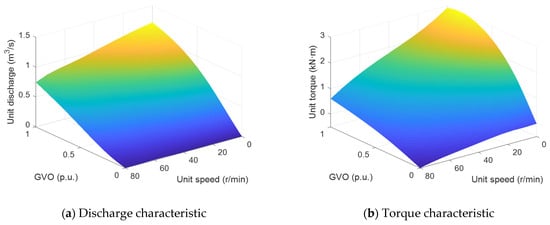
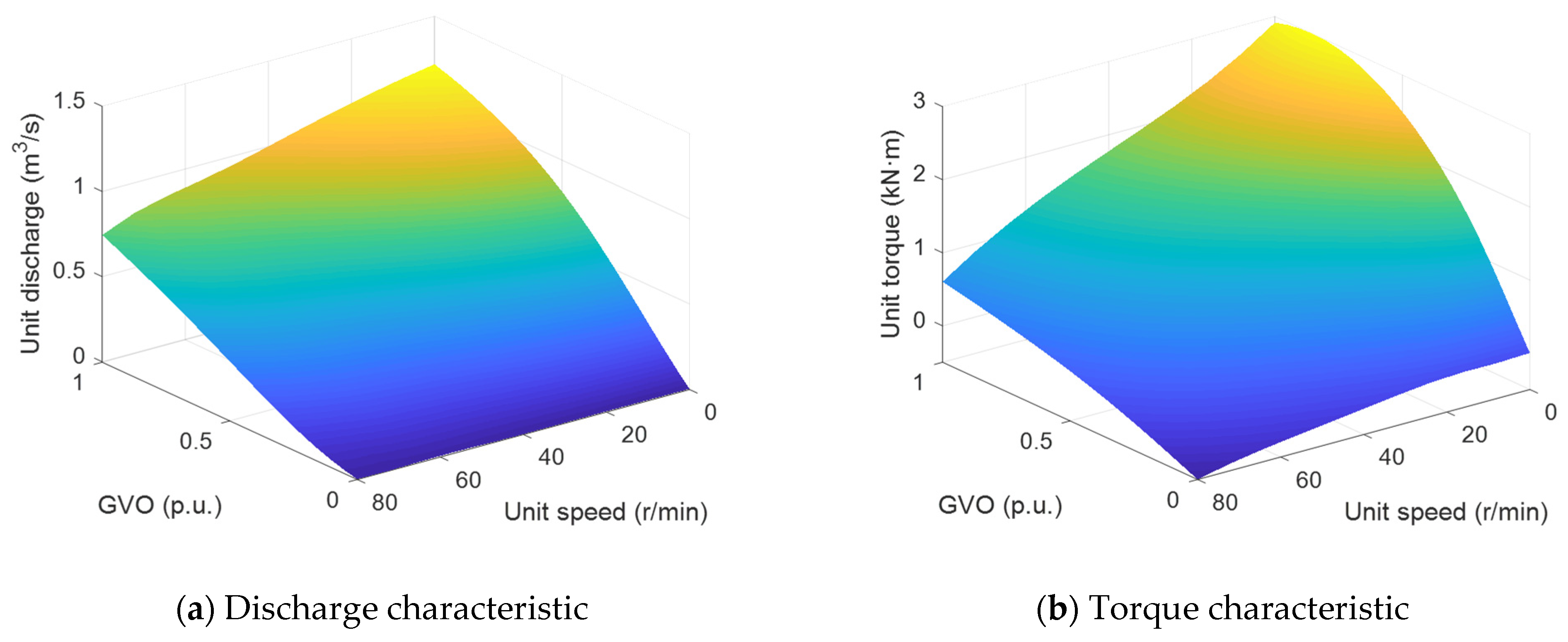
The dynamic characteristics of the hydro-turbine contain a discharge characteristic and a torque characteristic, which are determined by the operating conditions of the turbine (i.e., GVO, speed, and water head). The nonlinear mathematical model of a hydraulic turbine is shown in Equation (3).
where and are the turbine discharge and torque, respectively, is the GVO, is the rotational speed, and is the water head of the turbine. Two neural networks are trained for modeling the discharge characteristic and the torque characteristic of the target hydro-turbine, whose surfaces are shown in Figure 1.
Figure 1.
Neural network nonlinear model of hydro-turbine.
In Figure 1, the unit speed represents the relationship between the water head and the rotational speed, i.e., . The unit discharge and unit torque can be calculated by Equations (4) and (5), respectively.
where is the diameter of a turbine.
The partial derivatives of the turbine’s discharge or torque concerning head, speed, and opening, which are defined as the turbine’s transfer coefficients, can be calculated using the neural network derivation method. The segmented linear model of the hydraulic turbine expressed by the transfer coefficients is obtained as shown in Equation (6).
where , , and are the relative deviation of turbine discharge, torque, and water head, respectively, , , and are the transfer coefficients of turbine discharge to speed, GVO, and water head, respectively, and , and are the transfer coefficients of turbine torque to speed, GVO and water head, respectively.
Since the pressure in the water diversion system is affected by changes in turbine discharge, the mathematical model of the water diversion system reflects the relationship between turbine discharge and water head, as shown in Equation (7).
where is the flow inertia time constant.
2.3. Generator and Load
When the unit is operating in frequency regulation mode, the effect of electrical transients on the system frequency is not significant and can be ignored. Only the generator’s equation of motion is considered here, as shown in Equation (8).
where is the relative deviation of generator load torque and is the unit inertia time constant.
Furthermore, the generator load torque can be expressed by Equation (9).
where is the load disturbance and is the characteristic coefficient of the load.
2.4. Model of Whole System
The derivative part of Equation (1) is rewritten to obtain an alternative representation of the controller, as shown in Equation (10) [31]:
where .
Define the system state variable as , and the system input as . Combining Equations (2) and (6) with Equation (10), the system state space equation can be obtained as shown in Equation (11).
where , , , , , , , , , , , , , , , , , , , , , , . The prediction accuracy of the segmented linear model represented by this state space for the system nonlinearity is shown in Section S1 of the Supplementary Materials.
3. Multi-Objective Optimization and Adaptive Control Strategy
In this section, a MOO model and an intelligent algorithm for optimizing governor control parameters under specific operating conditions are presented, including the objective function, optimization variables, constraints, and multi-objective particle swarm optimization (MOPSO). Further, the operating condition adaptive control strategy is proposed for unit frequency regulation.
3.1. Multi-Objective Optimization Model
(1) Objective Function
In the frequency regulation mode, the operating state of the HPU is determined by the given frequency and the load demand. Under different given frequency disturbances , the regulation objective of the unit is to make the frequency quickly track the given value with a small overshoot. Under different load disturbances , the regulation objective is to quickly return the frequency to the rated value with small variations. Therefore, the objective function of governor control parameter optimization can be expressed by Equations (12) and (13).
where is a large number, which can be set to 106, is the time, is the objective function under the given frequency perturbation, is the objective function under the load perturbation, is the maximum allowable overshoot of the frequency, and is the maximum allowable variation in the frequency.
is determined according to the International Electrotechnical Commission standard (IEC 61362:2024). The standard explains the specification of hydraulic turbine governing systems in detail, which specifies that the maximum amount of overshoot (ORA) should not exceed 40% of the disturbance. Therefore, is set to 30% in this paper considering safety redundancy. According to the work of Saleem MI et al. where the allowable value of relative frequency reduction (RFR) is specified as 0.8/60 = 0.013 [32]. Therefore, RFR is set to 0.012 in this paper for safety redundancy. Considering that the rated frequency of the Chinese power grid is 50 Hz, is calculated as 0.012 × 50 = 0.6 Hz.
(2) Optimization variables
The regulation performance of the hydraulic turbine governor is mainly determined by two parameters, and . The influence of on the regulation process is relatively small. Therefore, the optimization variables in the optimal control of HPU are and . The quantitative evidence of excluding from the optimization can be found in Section S2 of the Supplementary Materials.
(3) Constraint
The Jacobi matrix of the system can be obtained by bringing the other parameters of the system except and at a certain operating condition into Equation (11). Making yields a five-order polynomial concerning the characteristic root , as shown in Equation (14).
where are the coefficients of the characteristic polynomials, each containing the unknown parameters and .
When the system is critically stabilized, Equation (14) can be rewritten in the form shown in Equation (15).
where is the imaginary part of a purely imaginary conjugate complex root and is a complex root with a negative real part.
According to Hopf bifurcation theory, the nonlinear relationship between and can be obtained by combining Equations (14) and (15). Further, the stability domain of the control parameters can be obtained and used as the constraint of the optimization variables.
3.2. Multi-Objective Optimization Algorithm
The MOPSO method is developed based on PSO. By introducing the idea of non-dominated sorting and external particle swarm, it can efficiently solve complex MOO problems and has been widely used in various engineering fields. In this paper, an improved MOPSO is used to solve the MOO model of governor control parameters, and its basic procedure is described as follows [33,34].
1. Initialize the particle population and set the parameters of the algorithm;
2. Calculate the fitness of each particle in the initial population and use their initial positions as the historical optimal positions;
3. Insert the non-dominated particles from the initial population into the external particle swarm and update their information; determine the grid in which they are located and calculate their fitness according to the number of particles in each grid;
4. Start iteration and perform subsequent steps in each iteration;
5. Determine whether the maximum number of iterations is reached. If satisfied, stop iteration and output the optimal solution set;
6. Select a grid by roulette wheel method according to the fitness of each grid and randomly select an individual from that grid as the globally optimal particle;
7. Update the positions and velocities of all particles according to the iterative formula of PSO;
8. Perform the mutation operation: equally divide the particle swarm into three parts: (1) no mutation is performed in part 1; (2) uniform mutation is performed in part 2; (3) non-uniform mutation is performed in part 3;
9. Correct the position and velocity of the particles according to the boundary constraints and calculate the fitness of each particle in the particle swarm;
10. Insert the non-dominated particles in the particle swarm into the external particle swarm and update their information: keep the non-dominated particles in the external particle swarm, determine the grids in which they are located, and calculate their fitness according to the number of particles in each grid;
11. Determine whether the size of the external particle swarm exceeds the allowed maximum value. If so, calculate the crowding degree of each particle and remove the particle with a smaller crowding degree from the external particle swarm;
12. Update the historical optimal position of each particle in the particle swarm: if the new position of a particle dominates the historical optimal position, then replace it; if the new position of a particle and the historical optimal position do not dominate each other, then the former replaces the latter with a certain probability.
It should be noted that the choice of optimization algorithm does not significantly affect the optimization results. Various optimization algorithms can provide near-ideal control parameters for HPU. A performance comparison of different algorithms for solving the multi-objective optimal control of HPUs is given in Section S3 of the Supplementary Materials.
3.3. Adaptive Control Strategy for Frequency Regulation
In the frequency regulation mode, the optimal control parameters of the governor for a certain operating condition can be derived from the models and methods in Section 3.1 and Section 3.2. In order to ensure that the governor has good control performance under different operating conditions, an adaptive control strategy for frequency regulation is proposed. The detailed steps are as follows.
1. Divide the normal operation area of the hydraulic turbine into several operating conditions at an equal interval according to the water head and the GVO;
2. Select an operating condition in order and obtain the transfer coefficients of the turbine under the condition of linearization;
3. Substitute the turbine transfer coefficients into the state space equation shown in Equation (11) to obtain the Jacobi matrix of the system under the current operating condition;
4. Determine the feasible domains of the control parameters based on the Jacobi matrix and Equations (14) and (15);
5. Perform a given frequency step perturbation (perturbation amount is +0.003) in the calculation of objective while performing a load step perturbation (perturbation amount is +0.05) in the calculation of objective ;
6. Optimize the PI control parameters under this condition using the improved MOPSO method to obtain several control parameters corresponding to the Pareto front;
7. Normalize the different objectives separately to get the point on the Pareto front that is closest to the origin (defined as the middle point), and store the control parameters corresponding to this point as the optimal control parameter samples for the current operating conditions;
(7.1) On the first Pareto front, the two objective sequences and are normalized as shown in Equations (16) and (17):
(7.2) On the normalized Pareto front, the distance of each point from the origin is calculated as shown in Equation (18):
(7.3) The point closest to the origin (i.e., the smallest) is identified, and the corresponding control parameter is considered the optimal control parameter;
8. Judge whether the optimization of the control parameters is completed for all the operating conditions. If yes, go to step 9; otherwise, go back to step 2;
9. Use the spline interpolation method to mathematically model the optimal and sample points under all operating conditions, and obtain the surfaces reflecting the changes in control parameters with operating conditions;
10. Regard the above surfaces as the basis for online adjusting the control parameters and to form an adaptive control strategy for governor frequency regulation.
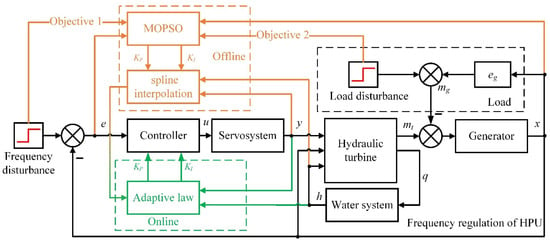
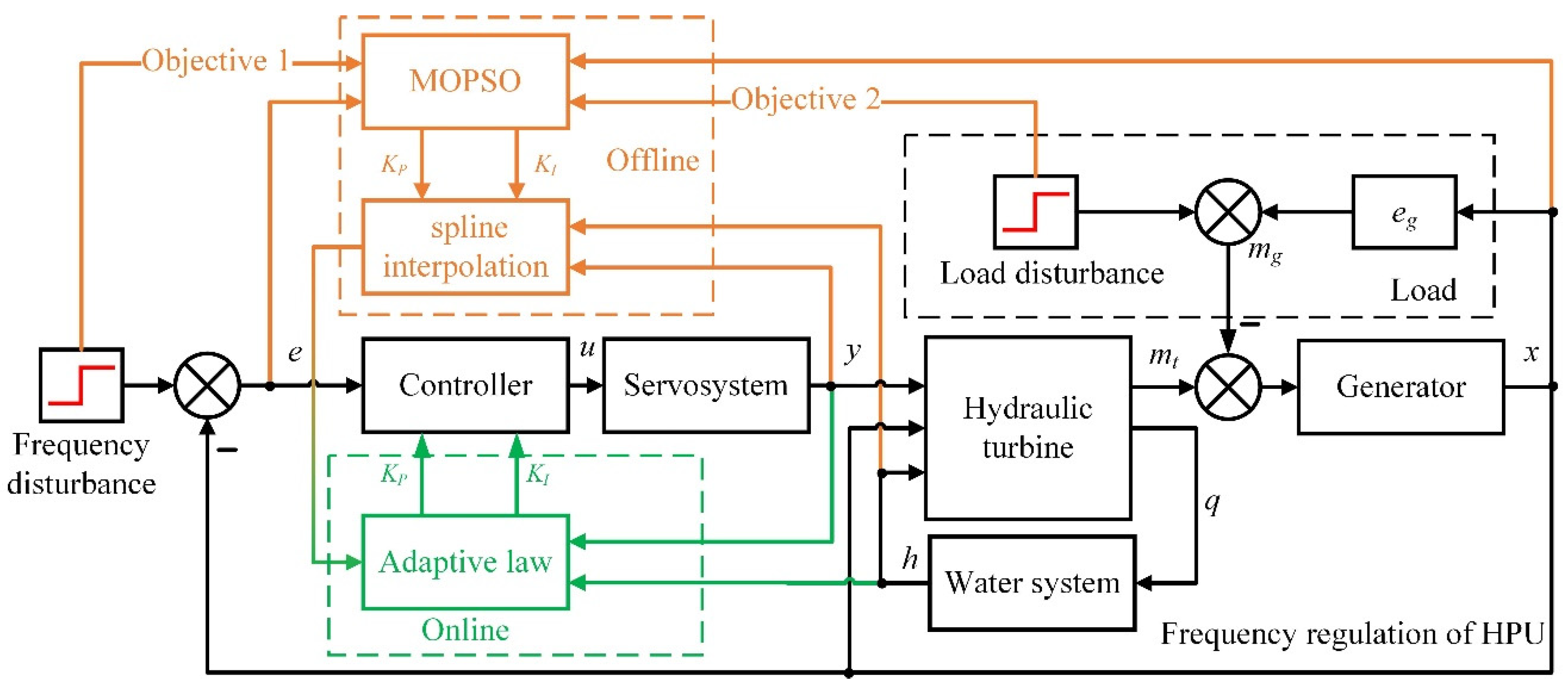
The first nine steps aim to realize the offline optimization of the controller parameters, while the last step applies the fitted surfaces as the adaptive law to online adjust the controller parameters to adapt to the variable operating conditions. The block diagram of the adaptive control strategy for the frequency regulation of an HPU is shown in Figure 2. It should be noted that the neural network nonlinear model of hydro-turbines is used in the validation of the proposed control method, while the segmented linear model is used in the optimization of control parameters.
Figure 2.
A block diagram of the adaptive control strategy for the frequency regulation of an HPU.
4. Results and Analysis
The multi-objective optimization results of the control parameters of the HPU are first presented in this section. On this basis, the effectiveness and advantages of the proposed adaptive control strategy are comprehensively evaluated using different indicators.
4.1. Optimization Results
In this paper, a large hydropower station in the upper reaches of the Yangtze River in China is taken as an example to design an optimal controller suitable for frequency regulation of an HPU using the proposed MOO model and adaptive control method. The main parameters of the unit are shown in Table 1. Except for the hydraulic turbine parameters that change with the operating conditions, the other parameters are fixed values. The six transfer coefficients of the hydraulic turbine under different operating conditions can be obtained by using the method proposed in [30].
Table 1.
Main parameters of targeted HTRS.
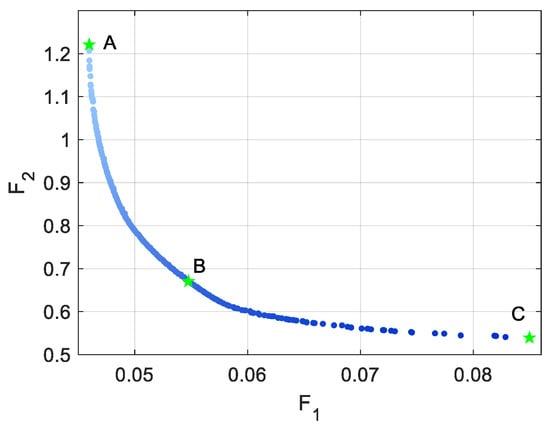
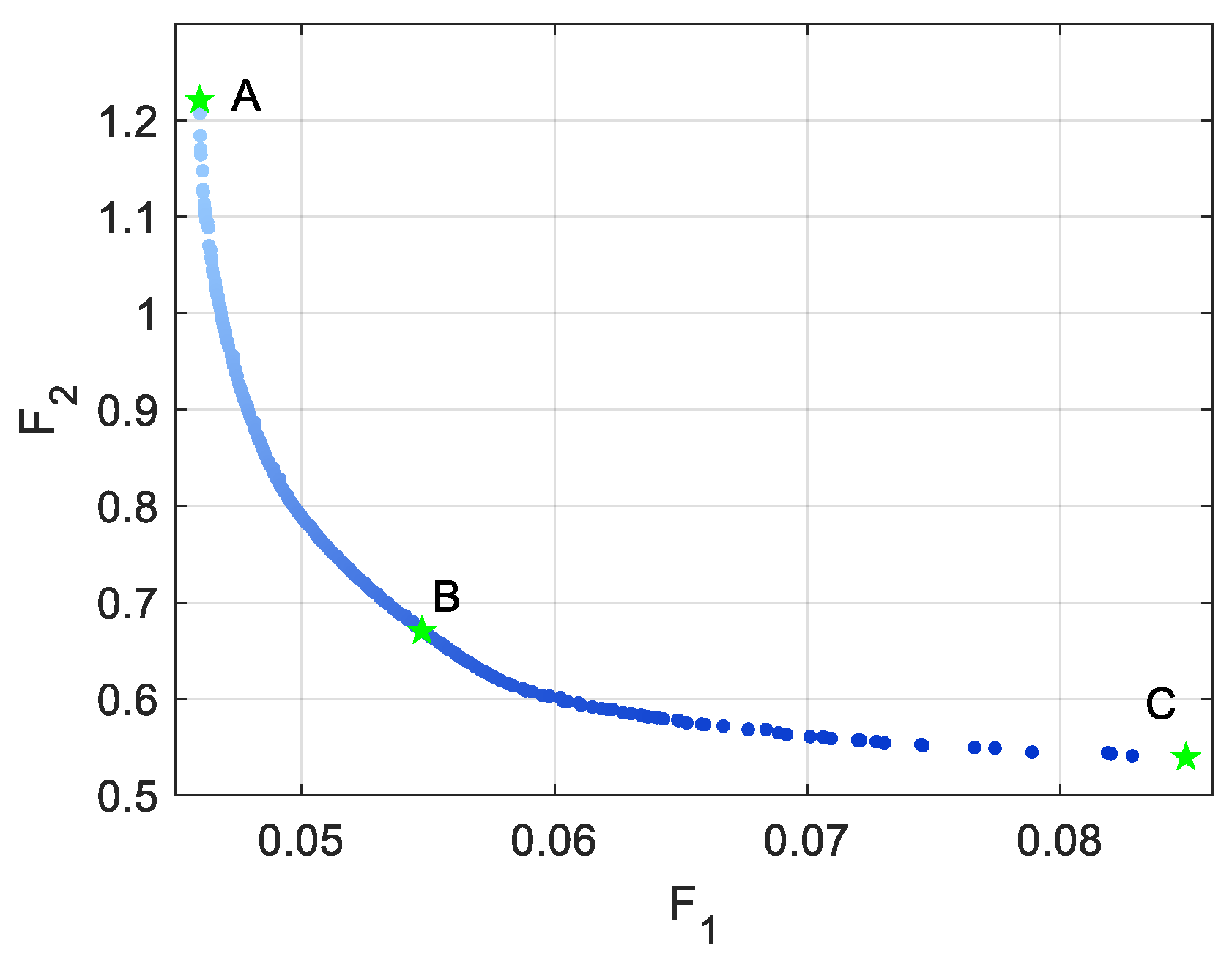
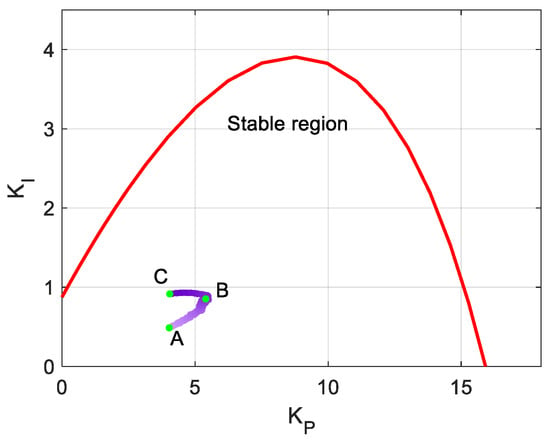
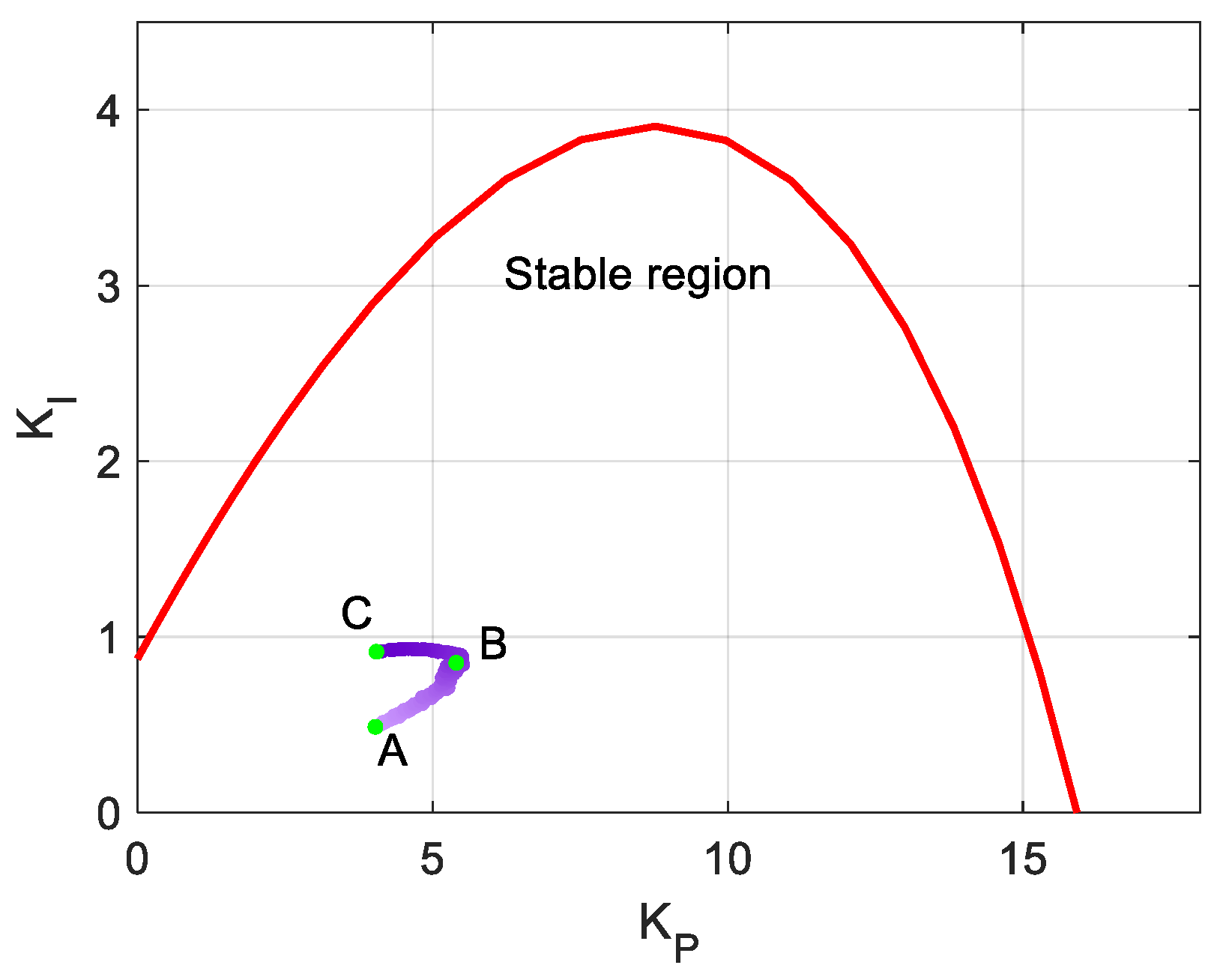
Based on the MOO model proposed in Section 3 and the optimization algorithm adopted, the governor control parameters under the rated operating condition (water head of 195 m, GVO of 80%) are firstly optimized, and the Pareto front is obtained as shown in Figure 3. Points A, B and C in the figure are the left-end, middle and right-end points of the Pareto front, respectively. The color shades of the points in Figure 3 and Figure 4 are one-to-one correspondence (i.e., a purple point at a certain depth corresponds to a blue point at the corresponding depth). This enables us to better find the value of the objective function mapped by a certain control parameter so that the performance of this control parameter for different forms of perturbation can be easily analyzed. It can be seen from the figure that objective varies faster between points A and B, while objective varies faster between points B and C. This indicates that the control parameters on the AB segment have a greater influence on the frequency response under the load perturbation, while the control parameters on the BC segment have a greater influence on the frequency response under the given frequency perturbation. In other words, the control parameter corresponding to the AB segment has better regulation capability for the unit frequency under the given frequency perturbation, while the control parameter corresponding to the BC segment provides better recovery capability for the unit frequency under load perturbation.
Figure 3.
Pareto front under rated operating condition.
Figure 4.
Control parameters corresponding to Pareto front.
The control parameters corresponding to the points on the Pareto front are represented in the plane with as the horizontal coordinate and as the vertical coordinate, and the results are shown in Figure 4. The three points (A, B, and C) in Figure 4 correspond to the three points on the Pareto front in Figure 3. The shades of purple points in Figure 4 correspond to the shades of blue points in Figure 3. Comparison of Figure 3 and Figure 4 show that as the objective increases and decreases, first increases and then decreases, while first increases and then changes slightly. This indicates that a large helps to improve the frequency tracking performance, but deteriorates the frequency recovery performance. In the stable domain, the above variations in the control parameters are small: the variation in is no more than 1.5, and the variation in does not exceed 0.5.
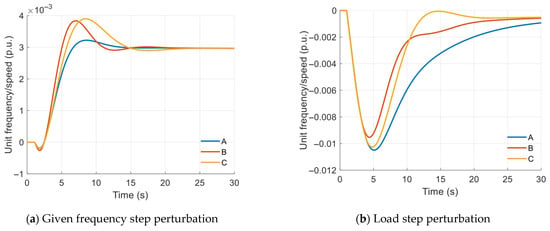
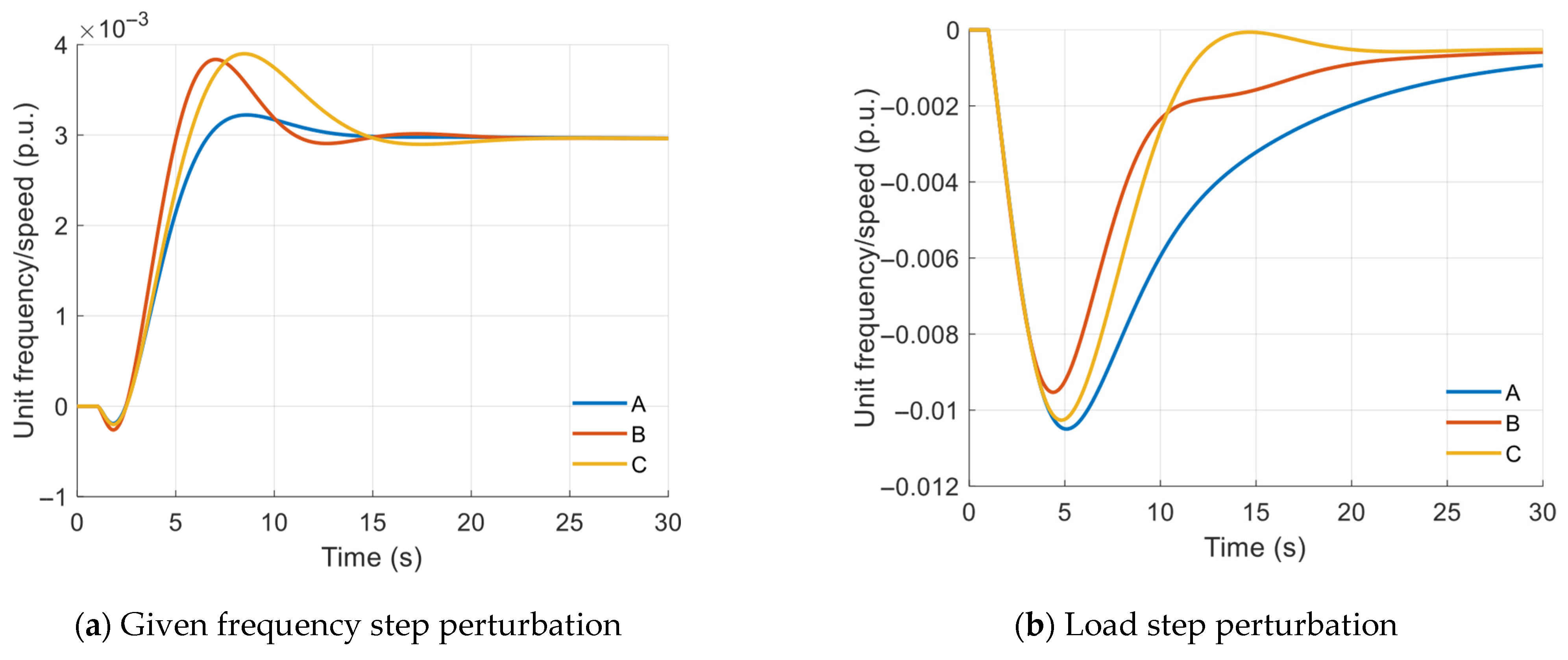
The control parameters represented by points A, B, and C in Figure 4 are brought into the system model for simulation experiments under the conditions of given frequency perturbation and load perturbation. The obtained frequency response curves of the unit are shown in Figure 5. It can be seen that the overshoot of frequency tracking to a given value due to the control parameter at point A is the smallest, but the frequency reduction caused by the load perturbation is also the largest. The overshoot and regulation time of point B is moderate and the frequency reduction is the smallest. The frequency tracking performance at point C is the worst, and the frequency reduction is larger, but the frequency stable time under load perturbation is the shortest. Overall, the control parameters at point B ensure comprehensive performance that balances frequency tracking and recovery ability.
Figure 5.
The regulation process of unit speed by the control parameter on the specified position of the Pareto front under the rated operating condition.
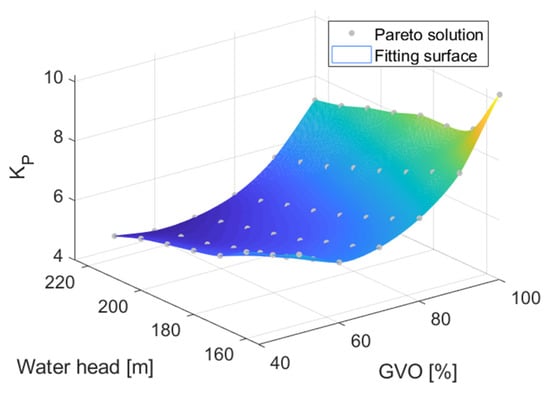
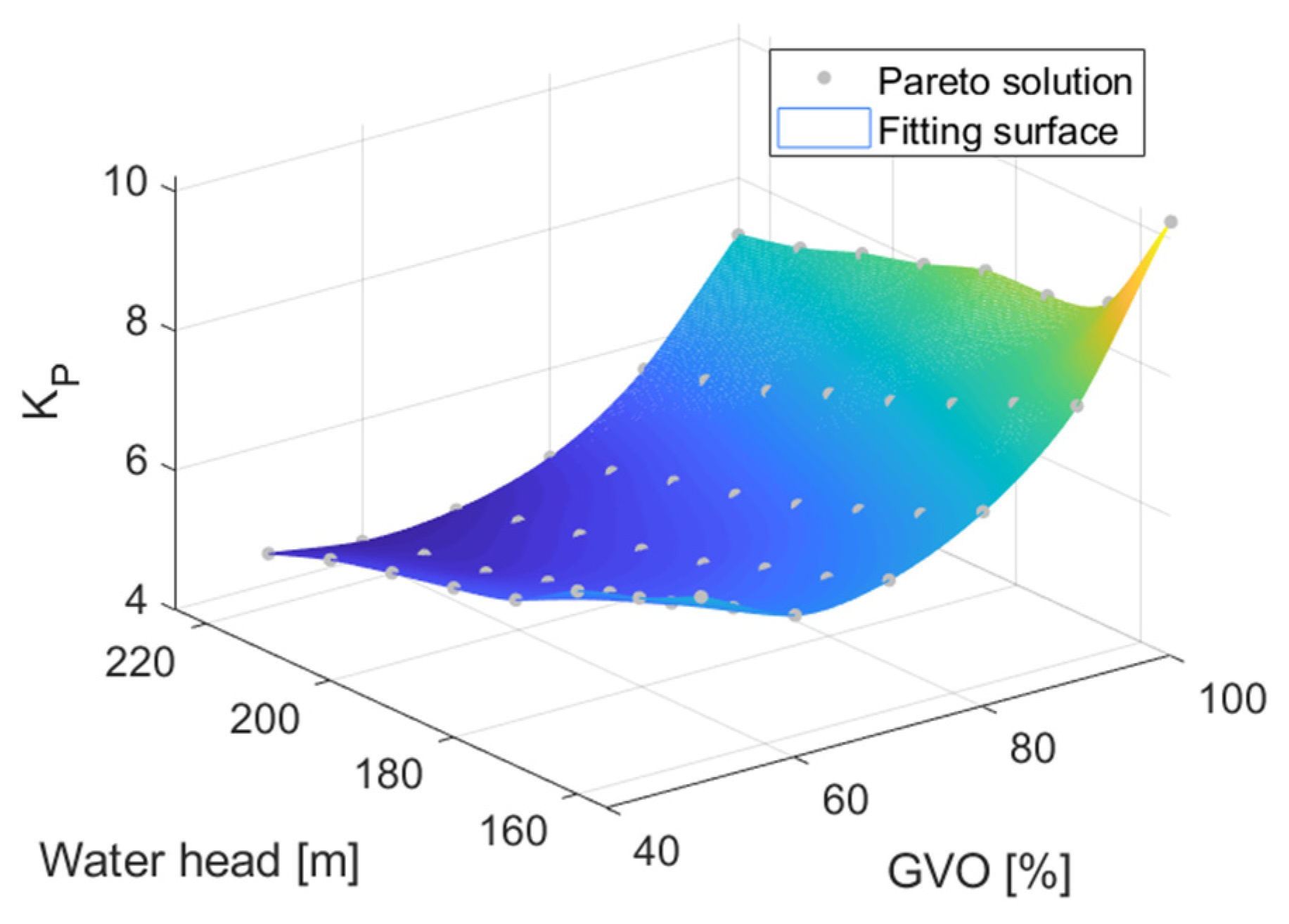
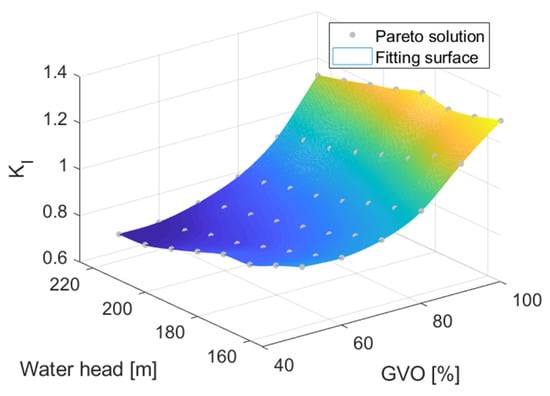
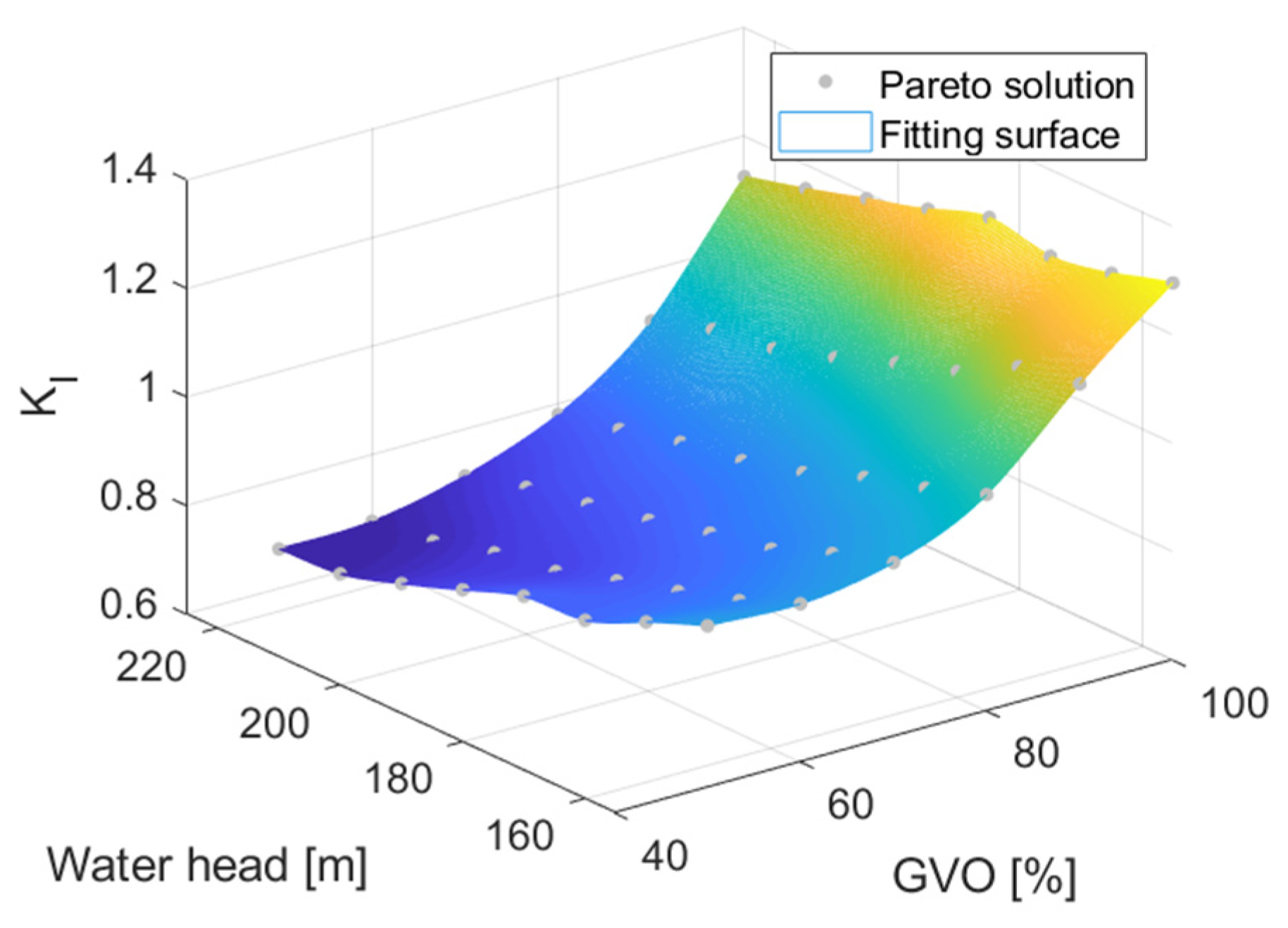
Furthermore, the operating condition zone of the unit is divided. In the normal operating zone, the water head varies from 155 m to 225 m while the GVO varies from 50% to 100%. Therefore, one operating condition is defined for every 10 m of water head or 10% of GVO, which results in a total of 48 operating conditions. The same optimization strategy is applied to these conditions to obtain a series of samples of optimal control parameters. Using the spline interpolation method to mathematically model the optimal and sample points under all operating conditions, the fitted surfaces reflecting the relationship between the optimal control parameters and operating conditions can be obtained, as shown in Figure 6 and Figure 7.
Figure 6.
Fitted surface of optimal versus operating conditions.
Figure 7.
Fitted surface of optimal versus operating conditions.
It is observed that the optimal and show a trend of gradual increase with the increment in the GVO (or load). As the water head increases, the optimal and exhibit a gradual decrease. The variation in optimal is mainly in the range of 5 to 8, and the variation in optimal is mainly in the range of 0.8 to 1.2. Under the conditions of large GVO and low water head, the optimal and are larger, indicating that this condition is not easy to control.
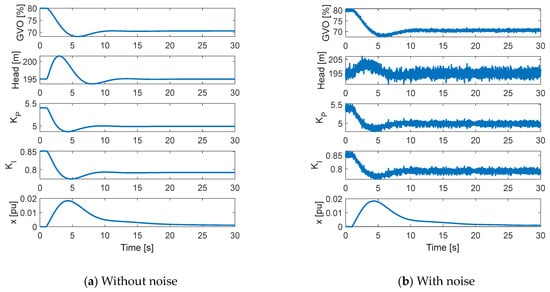
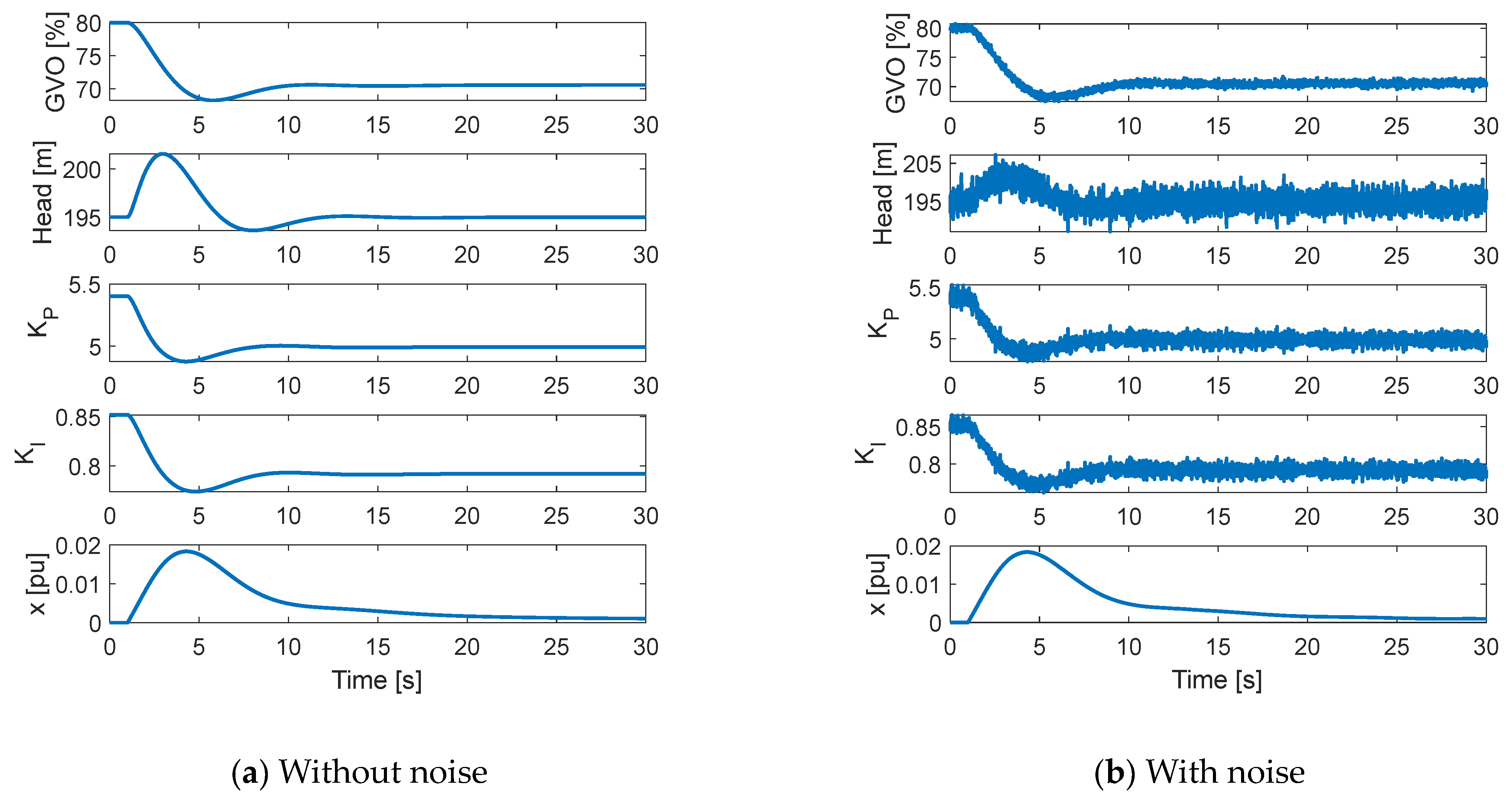
Considering interference factors in real-world production environment, the nonlinear model is used to perform a downward 10% load step perturbation to analyze the real-time online adjustment during dynamic condition switching and the effect of sensor noise on parameter fitting. When the effect of sensor noise is not considered, the state response of the system and the real-time changes in the control parameters under the load perturbation condition are simulated, and the results are shown in Figure 8a. When the effect of sensor noise is considered, the state response of the system and the real-time changes in the control parameters under the same conditions are obtained by adding Gaussian white noise to the head and opening signals, respectively, as shown in Figure 8b.
Figure 8.
State response of the system and real-time changes in control parameters under load perturbation (rated operating condition).
It can be seen from Figure 8 that the system undergoes a switch in operating conditions and the opening is reduced from 80% to 70%. The addition of sensor noise has no substantial effect on the fitting of the control parameters, nor does it affect the dynamic response process and stability of the system. In addition, the computation time required to simulate the dynamic process of the system in 30 s is only 4.78 s, which may be further shortened on an industrial computer, proving that the proposed control strategy can fully meet the real-time requirements.
4.2. Performance Analysis
To demonstrate the advantages of the proposed control strategy, a comparison and analysis with the fixed-parameter PID strategy will be performed across four aspects: objective function, performance indicator, constraint indicator, and comprehensive performance improvement.
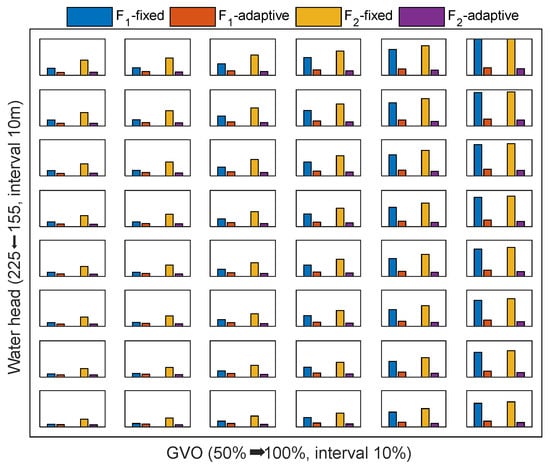
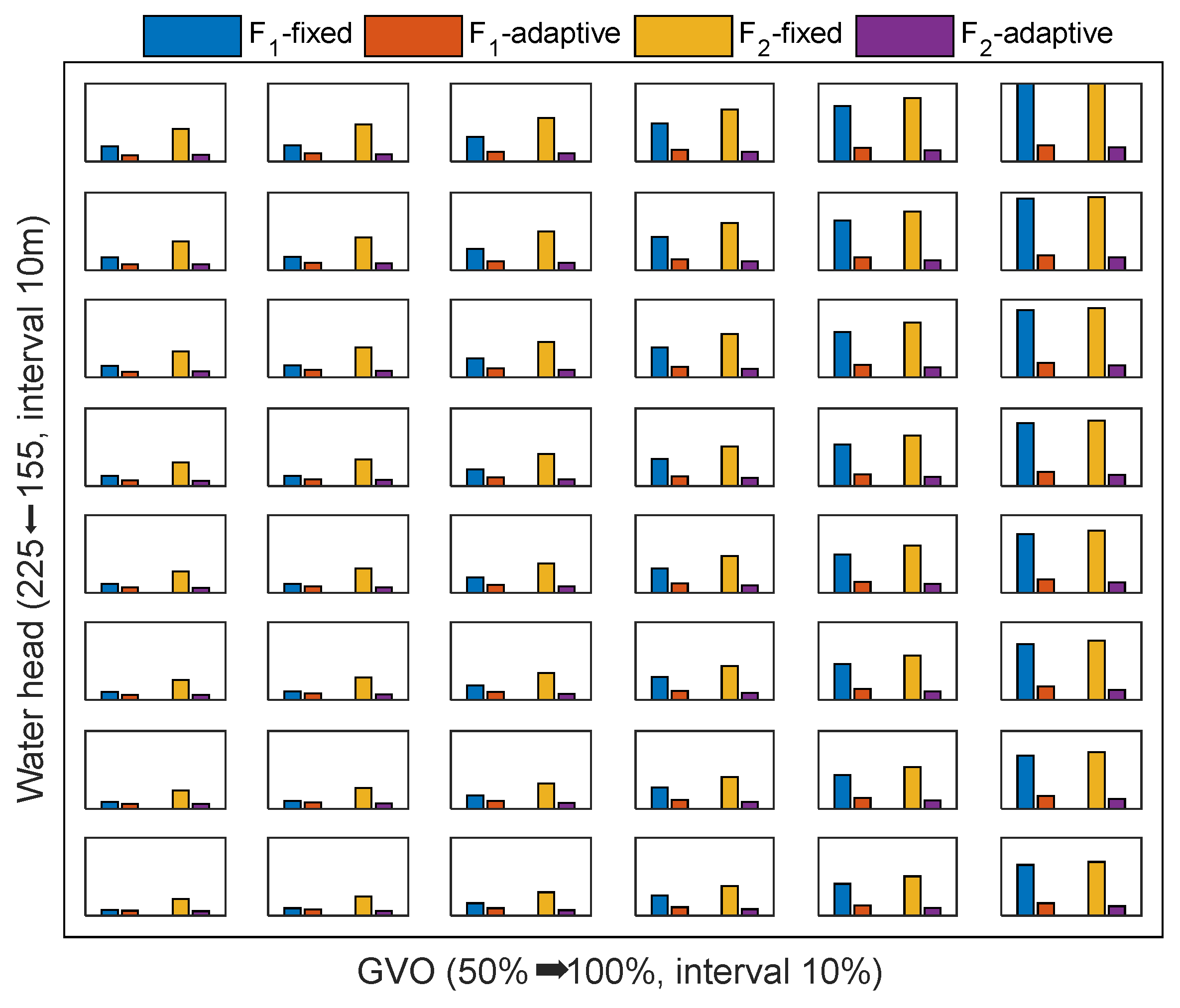
In terms of the objective function, the differences in objectives and between the fixed and adaptive PIDs for different generation operating conditions are compared, as shown in Figure 9. All the objective values are normalized to reflect the effect of operating conditions. All the objective function values for the large GVO conditions are larger than those for the small GVO conditions, indicating that the former represents a system that is more difficult to control. The effect of the water head on the objective function is not as pronounced as the GVO. The objective function values at a high head are relatively small, meaning that the unit has a better regulation performance at a high head. On the other hand, the two objective function values of the adaptive PID control are smaller than that of the fixed PID control for all operating conditions, demonstrating that the proposed control strategy achieves better frequency regulation performance under different operating conditions.
Figure 9.
Comparison of objective function values for fixed and variable PID strategies under different operating conditions.
In terms of performance indicators, frequency adjustment time (FAT) and frequency recovery time (FRT) under the action of the two PID controllers are calculated and compared for power generation conditions. The FAT is defined as the time taken for the relative frequency deviation to change from 0 to the range of 95% to 105% of the given value and not exceeding the range again. The FRT is defined as the time taken for the relative frequency deviation to change from the initial state to return to the range of 99.8% to 100.2% of the initial state and not exceeding the range again. The results are shown in Table 2.
Table 2.
Comparison of performance indicators between fixed and adaptive PID strategies under different operating conditions.
As can be found in Table 2, the FAT and FRT of the adaptive PID controller are shorter than those of the fixed-parameter PID controller under all operating conditions, reflecting the former’s excellent control performance. In terms of the FAT, the adjustment time for adaptive PID control varies from 6.37 s to 15.25 s, while the adjustment time for fixed PID control is more than 16 s after the GVO has reached 80%, and the system is even more difficult to stabilize within 30 s. In terms of the FRT, the recovery time of adaptive PID control varies from 7.17 s to 20.06 s, while the shortest recovery time of fixed PID control is 22.18 s. The frequency recovery performance of adaptive PID control is significantly better than that of fixed PID under all operating conditions.
In terms of constraint indicators, two indicators are selected for quantitative analysis: the ORA in the frequency tracking process and the RFR in the frequency recovery process. The results are shown in Table 3. It can be concluded that the ORA of the adaptive PID controller is large but still within the allowable range to achieve a faster regulation speed. Although the ORA of fixed PID control is very small, the RFR under load disturbance is larger. In many conditions, the maximum change in frequency under the action of fixed PID control exceeds the set allowable value, which is harmful to the frequency stability of the power grid. The maximum frequency variations under the action of adaptive PID are all within the allowable range.
Table 3.
Comparison of constraint indicators between fixed and adaptive PID strategies under different operating conditions.
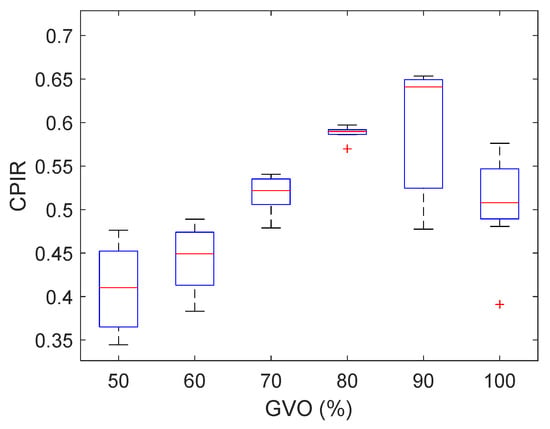
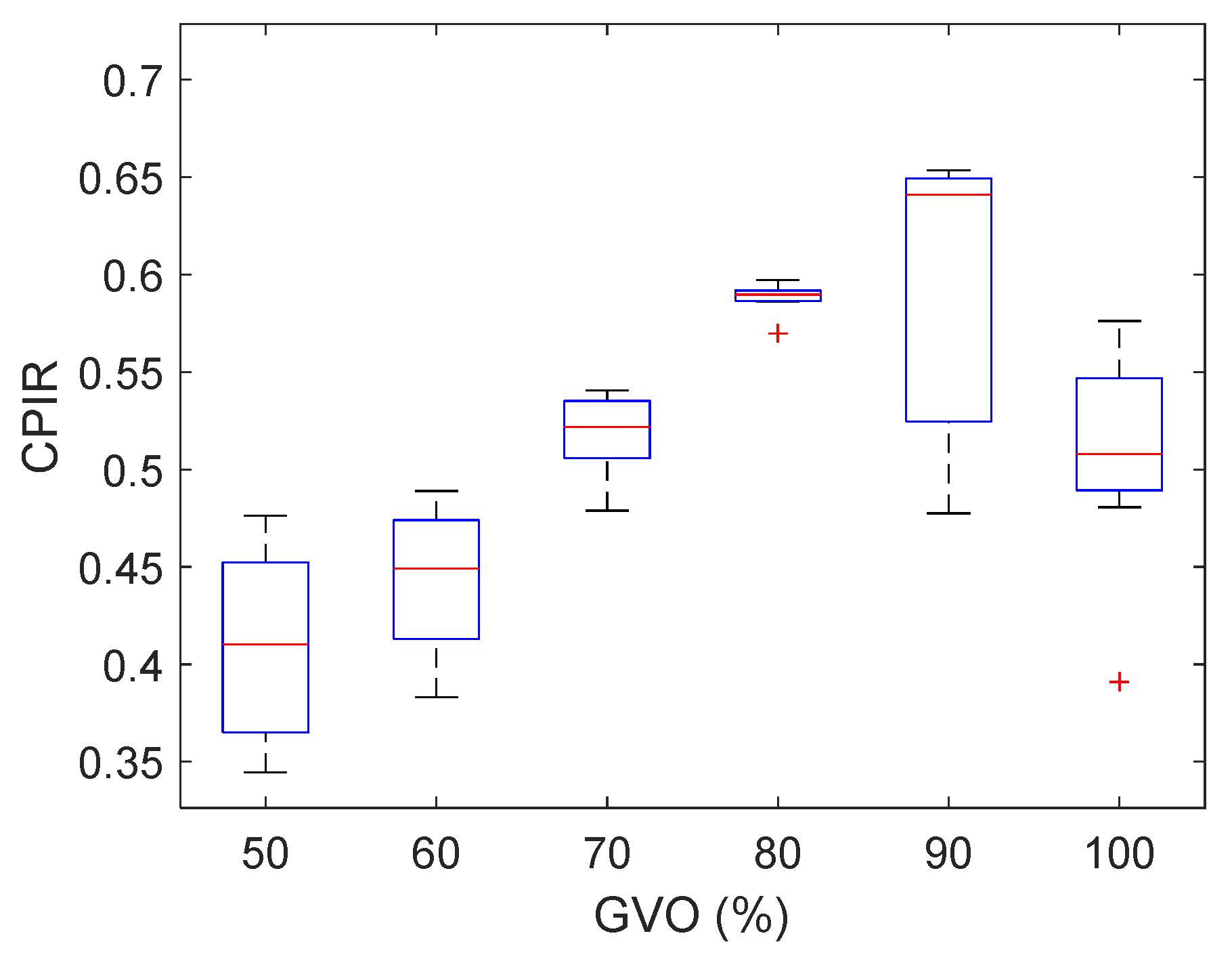
The comprehensive performance improvement rate (CPIR) of adaptive PID control over fixed PID control is calculated under different operating conditions. Here, the CPIR is defined as the average of the percentage reduction in adjustment time for a given frequency perturbation and the percentage reduction in recovery time for load perturbation. The results are shown in Figure 10.
Figure 10.
CPIR of adaptive PID control strategy at different GVO levels.
It can be found that the CPIR shows a general trend of first increasing and then decreasing with the increment in the GVO. Under the GVO of 90%, the difference in the CPIR corresponding to different heads is the largest. Under the GVO of 80%, the water head has the smallest effect on the CPIR. Overall, the CPIR of adaptive PID control reaches more than 35% in different operating conditions, which proves that the frequency regulation ability of the proposed algorithm has been significantly improved.
4.3. Robustness Analysis
Robustness analysis is conducted under operating conditions outside the studied range (low-opening conditions) and within the range (conditions between the two defined operating points) to evaluate the sensitivity of the proposed control strategy to unseen operating scenarios. For operating conditions outside the studied range, three guide vane openings (30%, 35%, and 40%) and three head levels (177 m, 197 m, and 217 m) are selected. These combinations yield a total of nine distinct scenarios, each representing a different operating condition. A 5% load perturbation test is conducted under each unseen operating condition, and the corresponding performance indicators are shown in Table 4.
Table 4.
Performance indicators of different PID control strategies under unseen operating conditions outside the studied range (+5% load perturbation).
Similarly, three guide vane openings (55%, 75%, and 95%) and three water heads (177 m, 197 m, and 217 m) are selected within the studied operating range. Combining these parameters yields a total of nine different operating conditions. The same 5% load perturbation tests are conducted under the aforementioned unseen operating conditions, and the corresponding performance indicators are shown in Table 5.
Table 5.
Performance indicators of different PID control strategies under unseen operating conditions within the studied range (+5% load perturbation).
As shown in Table 4 and Table 5, the proposed adaptive PID strategy achieves significantly better frequency control performance than the fixed PID strategy, both for operating conditions within and outside the studied range. The minimum frequency also satisfies the system’s safety constraints. It should be noted that the above results are derived from a nonlinear model of a hydro-turbine regulation system. This model incorporates a neural network that captures the nonlinear characteristics of the hydro-turbine across full operating conditions. This implementation aims to make the testing environment more closely reflect the actual operating conditions of hydropower units.
5. Conclusions
In this paper, an average 51.01% CPIR of frequency regulation of an HPU under normal operating conditions is achieved through adaptive adjustment of PID parameters. The MOO of control parameters and the adaptive control strategy of the governor are investigated in the example of a large HPU in Southwest China, which provides a new idea for enhancing the frequency regulation capability of the unit under different operating conditions. By interpolating the optimal solutions on the Pareto front under each operating condition, the fitted surfaces of PID parameters varying with the operating conditions are obtained and used as the adjustment strategy of PID parameters. The quantitative results show that the adaptive PID control effectively improves the frequency regulation capability of the HPU under the generation conditions, and the CPIR reaches more than 35%. Under the constraints of overshoot and frequency change, the adaptive PID has better performance than the fixed PID in both frequency adjustment time and recovery time. Robustness analysis further demonstrates the strategy’s applicability in unseen operating conditions.
Supplementary Materials
The following supporting information can be downloaded at: https://www.mdpi.com/article/10.3390/w18070881/s1, Figure S1: Comparison of the dynamic response of nonlinear and linear models under frequency step perturbation; Figure S2: Comparison of the dynamic response of nonlinear and linear models under load step perturbation; Figure S3: Effect of PID control parameters on the DCR of HTRS; Table S1: Results of MOPSO and NSGAII solving multi-objective optimal control of HPU.
Author Contributions
D.L.: Writing—original draft, Funding acquisition. C.L.: Writing—original draft. Y.X.: Writing—original draft. X.T.: Writing—review & editing, Funding acquisition. X.Z.: Writing—review & editing, Funding acquisition. All authors have read and agreed to the published version of the manuscript.
Funding
This research was funded by the National Natural Science Foundation of China (No. 52309111), the Henan Provincial Science and Technology Research Project (No. 262102320200), the National Natural Science Foundation of China (Nos. 52379088, and 52509120).
Data Availability Statement
Data will be made available on request.
Conflicts of Interest
The authors declare no conflicts of interest.
References
- Steele, A.J.H.; Burnett, J.W.; Bergstrom, J.C. The impact of variable renewable energy resources on power system reliability. Energy Policy 2021, 151, 111947. [Google Scholar] [CrossRef] [Scilit]
- Liu, D.; Li, C.S.; Malik, O.P. Nonlinear modeling and multi-scale damping characteristics of hydro-turbine regulation systems under complex variable hydraulic and electrical network structures. Appl. Energy 2021, 293, 116949. [Google Scholar] [CrossRef] [Scilit]
- Yang, W.J.; Norrlund, P.; Saarinen, L.; Yang, J.D.; Guo, W.C.; Zeng, W. Wear and tear on hydro power turbines—Influence from primary frequency control. Renew. Energy 2016, 87, 88–95. [Google Scholar] [CrossRef] [Scilit]
- Liu, W.Y.; Zheng, Y.; Zhou, X.; Lv, Y.J.; Chen, Q.J. Enhanced frequency regulation in pumped hydro storage integrated power systems: An innovative modeling method and GPC-PI control strategy. J. Energy Storage 2024, 103, 114251. [Google Scholar] [CrossRef] [Scilit]
- Lu, X.; Li, C.; Chang, H.; Wang, H.; Zhu, Z.; Liu, D.; Tan, X.; Xu, R. Primary frequency regulation performance in hydropower systems: Precise quantification and holistic enhancement under wide-range operation. Appl. Energy 2025, 389, 125711. [Google Scholar] [CrossRef] [Scilit]
- Shu, H.; He, Y.; Wang, G.; Zhang, H.; Shi, B.; Luo, S. Research on Water Hammer Effect and Cooperative Frequency Regulation Technology of PV-HBESS Compensated Hydroturbine. IEEE Trans. Sustain. Energy 2025, 16, 919–932. [Google Scholar] [CrossRef] [Scilit]
- Esfandyari, M.; Fanaei, M.A.; Zohreie, H. Adaptive fuzzy tuning of PID controllers. Neural Comput. Appl. 2013, 23, S19–S28. [Google Scholar] [CrossRef] [Scilit]
- Shi, Y.S.; Zhou, J.Z. Stability and sensitivity analyses and multi-objective optimization control of the hydro-turbine generator unit. Nonlinear Dyn. 2022, 107, 2245–2273. [Google Scholar] [CrossRef] [Scilit]
- Chen, Z.H.; Yuan, Y.B.; Yuan, X.H.; Huang, Y.H.; Li, X.S.; Li, W.W. Application of multi-objective controller to optimal tuning of PID gains for a hydraulic turbine regulating system using adaptive grid particle swam optimization. ISA Trans. 2015, 56, 173–187. [Google Scholar] [CrossRef] [Scilit]
- Li, C.S.; Mao, Y.F.; Zhou, J.Z.; Zhang, N.; An, X.L. Design of a fuzzy-PID controller for a nonlinear hydraulic turbine governing system by using a novel gravitational search algorithm based on Cauchy mutation and mass weighting. Appl. Soft Comput. 2017, 52, 290–305. [Google Scholar] [CrossRef] [Scilit]
- Zheng, Y.; Chen, Q.J.; Xu, Y.H.; Wang, W.Y.; Yan, D.L.; Liu, W.Y. Hierarchical MPC scheme for the speed governing of PSU with complex conduit system. IET Gener. Transm. Distrib. 2019, 14, 316–329. [Google Scholar] [CrossRef] [Scilit]
- Chen, J.B.; He, G.; Wang, Y.H.; Zheng, Y.; Xiao, Z.H. Adaptive PID control for Hydraulic Turbine Regulation Systems Based on INGWO and BPNN. Prot. Control Mod. Power Syst. 2024, 9, 126–146. [Google Scholar] [CrossRef] [Scilit]
- Xu, Y.H.; Zheng, Y.; Du, Y.; Yang, W.; Peng, X.Y.; Li, C.S. Adaptive condition predictive-fuzzy PID optimal control of start-up process for pumped storage unit at low head area. Energy Convers. Manag. 2018, 177, 592–604. [Google Scholar] [CrossRef] [Scilit]
- Xu, Y.H.; Zhao, K.J.; Guo, P.C.; Jiang, W.; Wu, X.; Sun, W.P. Design of type-2 fuzzy fractional-order proportional-integral-derivative controller and multi-objective parameter optimization under load reduction condition of the pumped storage unit. J. Energy Storage 2022, 50, 104227. [Google Scholar] [CrossRef] [Scilit]
- Fu, J.N.; Yu, X.Y.; Gao, C.Y.; Cui, J.D.; Li, Y.T. Nonsingular fast terminal control for the DFIG-based variable-speed hydro-unit. Energy 2022, 244, 122672. [Google Scholar] [CrossRef] [Scilit]
- Beus, M.; Pandzic, H. Practical Implementation of a Hydro Power Unit Active Power Regulation Based on an MPC Algorithm. IEEE Trans. Energy Convers. 2022, 37, 243–253. [Google Scholar] [CrossRef] [Scilit]
- Ma, T.; Wang, B.; Zhang, Z.; Ai, B. A Takagi-Sugeno fuzzy-model-based finite-time H-infinity control for a hydraulic turbine governing system with time delay. Int. J. Electr. Power Energy Syst. 2021, 132, 107152. [Google Scholar] [CrossRef] [Scilit]
- Wang, C.; Li, D.H.; Zhang, H.L.; Ma, P.; Li, X.K.; Zhang, S.H.; Dong, Y.C. Prescribed performance sliding mode control for the bursting oscillation of a fractional-order hydro-turbine governing system based on time-varying tangent barrier Lyapunov function. Appl. Energy 2024, 356, 122414. [Google Scholar] [CrossRef] [Scilit]
- Zheng, Y.; Zhou, J.Z.; Zhu, W.L.; Zhang, C.; Li, C.S.; Fu, W.L. Design of a multi-mode intelligent model predictive control strategy for hydroelectric generating unit. Neurocomputing 2016, 207, 287–299. [Google Scholar] [CrossRef] [Scilit]
- Chen, J.B.; Zeng, Q.; Zou, Y.D.; Li, S.J.; Zheng, Y.; Liu, D.; Xiao, Z.H. Intelligent robust control for nonlinear complex hydro-turbine regulation system based on a novel state space equation and dynamic feedback linearization. Energy 2024, 302, 131798. [Google Scholar] [CrossRef] [Scilit]
- Li, C.S.; Mao, Y.F.; Yang, J.D.; Wang, Z.B.; Xu, Y.H. A nonlinear generalized predictive control for pumped storage unit. Renew. Energy 2017, 114, 945–959. [Google Scholar] [CrossRef] [Scilit]
- Liu, D.; Zhang, J.J.; Lu, X.D.; Li, C.S.; Malik, O.P. Model-free adaptive optimal control for fast and safe start-up of pumped storage hydropower units. J. Energy Storage 2024, 87, 111345. [Google Scholar] [CrossRef] [Scilit]
- Yin, L.F.; Huang, W.X. Informer-embedded prioritized experience replay-based soft actor-critic for ultra-low frequency oscillation suppression of pumped hydropower storage systems. J. Energy Storage 2025, 114, 115802. [Google Scholar]
- Zhang, G.Z.; Zhao, J.B.; Hu, W.H. Deep Reinforcement Learning Enabled Bi-Level Robust Parameter Optimization of Hydropower-Dominated Systems for Damping Ultra-Low Frequency Oscillation. J. Mod. Power Syst. Clean Energy 2023, 11, 1770–1783. [Google Scholar]
- Zeng, Y.L.; Hussein, Z.A.; Chyad, M.H.; Farhadi, A.; Yu, J.Y.; Rahbarimagham, H. Integrating type-2 fuzzy logic controllers with digital twin and neural networks for advanced hydropower system management. Sci. Rep. 2025, 15, 5140. [Google Scholar] [CrossRef] [Scilit]
- Liu, D.; Li, C.S.; Tan, X.Q.; Lu, X.D.; Malik, O.P. Damping characteristics analysis of hydropower units under full operating conditions and control parameters: Accurate quantitative evaluation based on refined models. Appl. Energy 2021, 292, 116881. [Google Scholar] [CrossRef] [Scilit]
- Liu, D.; Li, C.S.; Malik, O.P. Operational characteristics and parameter sensitivity analysis of hydropower unit damping under ultra-low frequency oscillations. Int. J. Electr. Power Energy Syst. 2022, 136, 107689. [Google Scholar] [CrossRef] [Scilit]
- Xu, R.L.; Tan, X.Q.; Wang, H.; Zhu, Z.W.; Lu, X.D.; Li, C.S. Stability of hydropower units under full operating conditions considering nonlinear coupling of turbine characteristics. Renew. Energy 2024, 223, 120009. [Google Scholar] [CrossRef] [Scilit]
- Jia, Y.; Tan, B.W.; Zhang, W.T.; Jiang, D.R.; Yang, C.; Wen, Y.H. A Novel Control Strategy for Hydraulic Turbines to Consider Both Primary Frequency Regulation and Ultra-Low Frequency Oscillation Suppression. Energies 2024, 17, 1067. [Google Scholar] [CrossRef] [Scilit]
- Liu, D.; Wang, X.; Peng, Y.S.; Zhang, H.; Xiao, Z.H.; Han, X.D.; Malik, O.P. Stability analysis of hydropower units under full operating conditions considering turbine nonlinearity. Renew. Energy 2020, 154, 723–742. [Google Scholar] [CrossRef] [Scilit]
- Chen, Z.H.; Yuan, X.H.; Tian, H.; Ji, B. Improved gravitational search algorithm for parameter identification of water turbine regulation system. Energy Convers. Manag. 2014, 78, 306–315. [Google Scholar] [CrossRef] [Scilit]
- Saleem, M.I.; Saha, S.; Roy, T.K. A frequency stability assessment framework for renewable energy rich power grids. Sustain. Energy Grids Netw. 2024, 38, 101380. [Google Scholar]
- Bojappa, K.; Lee, J. Review on Particle Swarm Optimization: Application Toward Autonomous Dynamical Systems. IEEE/CAA J. Autom. Sin. 2025, 12, 1762–1775. [Google Scholar]
- Ma, H.; Liu, J.; Li, J.J.; Jia, J.H. A comprehensive review on deep learning for multi-objective optimization. Swarm Evol. Comput. 2026, 101, 102304. [Google Scholar] [CrossRef] [Scilit]

Disclaimer/Publisher’s Note: The statements, opinions and data contained in all publications are solely those of the individual author(s) and contributor(s) and not of MDPI and/or the editor(s). MDPI and/or the editor(s) disclaim responsibility for any injury to people or property resulting from any ideas, methods, instructions or products referred to in the content. |
© 2026 by the authors. Licensee MDPI, Basel, Switzerland. This article is an open access article distributed under the terms and conditions of the Creative Commons Attribution (CC BY) license.