Integrated Sediment Yield Estimation and Control in Erosion-Prone Watersheds: A Systematic Review of Models, Strategies, and Emerging Technologies

 , , and
Abstract
1. Introduction
2. Concepts and Definitions
2.1. Scale of Sediment Yield Analysis
2.2. Key Factors Affecting Sediment Yield
2.2.1. Natural Factors
2.2.2. Anthropogenic Factors
3. Review Methodology
3.1. Literature Sources and Selection Criteria
3.2. Thematic Classification
3.3. Temporal and Source Distribution
4. Models for Sediment Yield Estimation
4.1. Empirical Models
4.2. Traditional Sampling Methods
4.3. Physically Based Models
4.4. Artificial Intelligence and Machine Learning Methods
Summary
5. Sediment Control Measures
5.1. Classification and Emerging Approaches
5.2. Effectiveness of Sediment Control Measures
5.3. Suitability of Methods to Different Watershed Contexts
6. Synthesis of Findings, Practical Challenges, and Recommendations
6.1. Synthesis of Findings
6.2. Challenges and Research Gaps
6.2.1. Data and Model Limitations
6.2.2. Scale and Connectivity Gaps
6.2.3. Control and Implementation Constraints
6.3. Recommendations
Summary
7. Conclusions
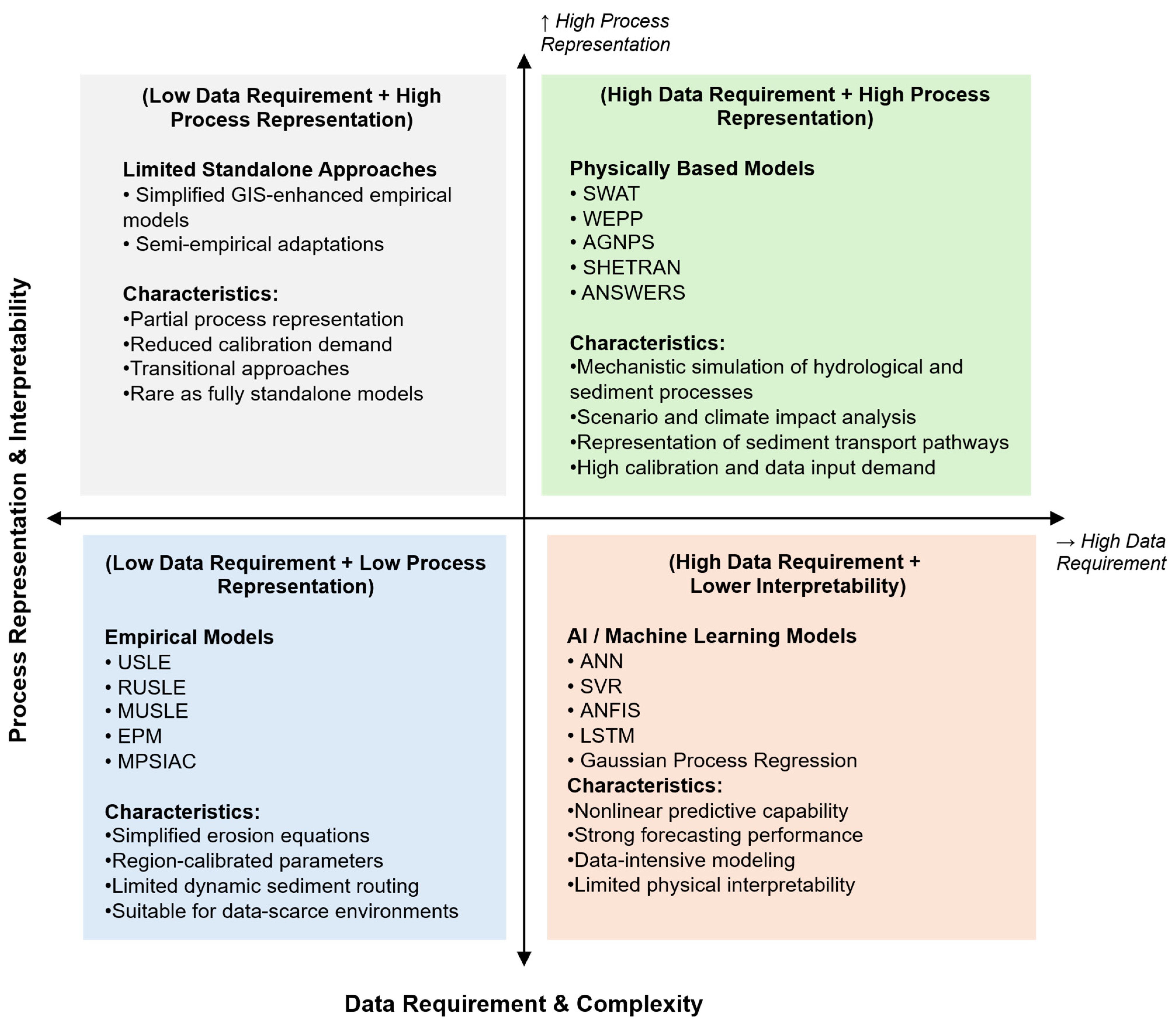
- Empirical models such as USLE, RUSLE, and MUSLE remain practical and widely applicable, particularly in data-scarce environments, because of their relative simplicity and modest data requirements. However, their simplified structure and environment-specific calibration limit their ability to represent dynamic sediment transport processes and reduce their transferability across contrasting climatic, geomorphic, and land-use settings.
- Physically based models, including SWAT, WEPP, and related frameworks, provide stronger mechanistic representation of hydrological and sediment transport processes and are particularly suitable for scenario analysis, climate impact assessment, and evaluation of best management practices. Nevertheless, their application is often constrained by extensive input data requirements, calibration demands, and model complexity.
- Machine learning and artificial intelligence approaches demonstrate strong predictive capability in capturing nonlinear sediment–hydrological interactions and supporting real-time forecasting. However, challenges related to model interpretability, transferability across dissimilar watersheds, and dependence on large, high-quality datasets remain significant limitations to their broader application.
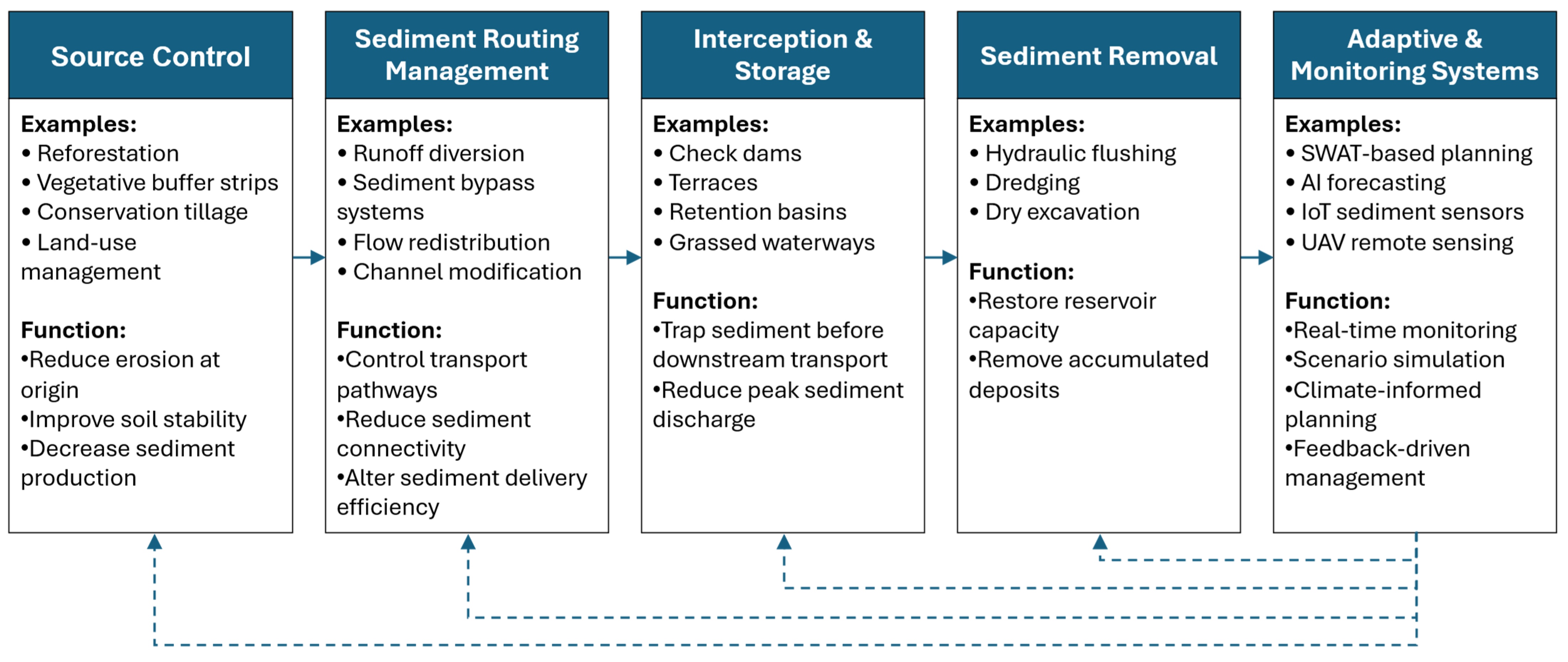
- Sediment control measures—whether structural, vegetative, or adaptive—are highly site-specific, and their effectiveness depends on watershed scale, sediment connectivity, topography, soil conditions, hydrological regime, land-use characteristics, and long-term maintenance capacity. Structural measures can provide immediate sediment interception but require routine maintenance and sediment removal, whereas vegetative interventions offer long-term stabilization benefits but require time to become fully established.
- Sustainable sediment yield management requires integrated watershed-scale frameworks that combine predictive modeling, source-based control strategies, structural interception, real-time monitoring technologies, and climate-informed adaptive planning. The reviewed studies suggest that future progress will depend on improved representation of sediment transfer processes, wider use of low-cost monitoring systems, stronger multi-site model validation, and the incorporation of dynamic climate scenarios to address non-stationarity in hydrological and erosion processes.
Supplementary Materials
Author Contributions
Funding
Data Availability Statement
Conflicts of Interest
Abbreviations
| AGNPS | Agricultural Non-point Source Model |
| AI | Artificial Intelligence |
| ANFIS | Adaptive Neuro-Fuzzy Inference Systems |
| ANN | Artificial Neural Network |
| ANSWERS | Areal Nonpoint Source watershed Environment Response Simulation |
| BMPs | Best Management Practices |
| DL | Deep Learning |
| EPM | Erosion Potential Method |
| GIS | Geographic Information System |
| LLR | Local Linear Regression |
| LSTM | Long Short-Term Memory |
| LULC | Land Use/Land Cover |
| ML | Machine learning |
| MPSIAC | Modified Pacific Southwest Inter-Agency Committee |
| MUSLE | Modified Universal Soil Loss Equation |
| PESERA | Pan-European Soil Erosion Risk Assessment |
| RUSLE | Revised Universal Soil Loss Equation |
| SfM | Structure-from-Motion |
| SHETRAN | Hydrologique Europian-TRANsport |
| SVR | support vector regression |
| SWAT | Soil and Water Assessment Tool |
| UAV | Unmanned Aerial Vehicle |
| USLE | Universal Soil Loss Equation |
| WEPP | Water Erosion Prediction Project |
References
- White, S. Sediment Yield Prediction and Modeling. In Encyclopedia of Hydrological Sciences; Wiley: Hoboken, NJ, USA, 2006. [Google Scholar]
- Sediment Yield and Runoff Frequency of Small Drainage Basins in the Mojave Desert, California and Nevada. Available online: https://pubs.usgs.gov/fs/2006/3007/ (accessed on 10 January 2026).
- Pratama, F.; Wulandari, S.; Rohmat, F.I.W. Modeling Sediment Accumulation in Pare Reservoir Using HEC-RAS 2D: Assessing Storage Capacity over a 10-Year Period. Results Eng. 2025, 25, 104333. [Google Scholar] [CrossRef]
- Zhang, L.; Karthikeyan, R.; Zhang, H.; Tang, Y. Estimation of Sediment Yield Change in a Loess Plateau Basin, China. Water 2017, 9, 683. [Google Scholar] [CrossRef]
- Xie, F.; Zhao, G.; Mu, X.; Tian, P.; Gao, P.; Sun, W. Sediment Yield in Dam-Controlled Watersheds in the Pisha Sandstone Region on the Northern Loess Plateau, China. Land 2021, 10, 1264. [Google Scholar] [CrossRef]
- Morris, G.L.; Fan, J. Reservoir Sedimentation Handbook; McGraw-Hill Book Co.: New York, NY, USA, 1998. [Google Scholar]
- Maximus, J.K. Assessing Watershed Vulnerability to Erosion and Sedimentation: Integrating DEM and LULC Data in Guyana’s Diverse Landscapes. HydroResearch 2025, 8, 178–193. [Google Scholar] [CrossRef]
- Kondolf, G.M.; Gao, Y.; Annandale, G.W.; Morris, G.L.; Jiang, E.; Zhang, J.; Cao, Y.; Carling, P.; Fu, K.; Guo, Q.; et al. Sustainable Sediment Management in Reservoirs and Regulated Rivers: Experiences from Five Continents. Earths Future 2014, 2, 256–280. [Google Scholar] [CrossRef]
- Batalla, R.J.; Vericat, D. Hydrological and Sediment Transport Dynamics of Flushing Flows: Implications for Management in Large Mediterranean Rivers. River Res. Appl. 2009, 25, 297–314. [Google Scholar] [CrossRef]
- Abebe, T.; Leta, O.T. Sediment yield estimation and effect of management options on sediment yield of Kesem Dam watershed, Awash Basin, Ethiopia. Sci. Afr. 2020, 9, e00425. [Google Scholar] [CrossRef]
- Sommerlot, A.R.; Nejadhashemi, A.P.; Woznicki, S.A.; Giri, S.; Prohaska, M.D. Evaluating the Capabilities of Watershed-Scale Models in Estimating Sediment Yield at Field-Scale. J. Environ. Manag. 2013, 127, 228–236. [Google Scholar] [CrossRef]
- De Vente, J.; Poesen, J.; Verstraeten, G.; Govers, G.; Vanmaercke, M.; Van Rompaey, A.; Arabkhedri, M.; Boix-Fayos, C. Predicting Soil Erosion and Sediment Yield at Regional Scales: Where Do We Stand? Earth Sci. Rev. 2013, 127, 16–29. [Google Scholar] [CrossRef]
- Tena, A.; Batalla, R.J.; Vericat, D.; López-Tarazón, J.A. Suspended Sediment Dynamics in a Large Regulated River over a 10-Year Period (the Lower Ebro, NE Iberian Peninsula). Geomorphology 2011, 125, 73–84. [Google Scholar] [CrossRef]
- de Vente, J.; Poesen, J. Predicting Soil Erosion and Sediment Yield at the Basin Scale: Scale Issues and Semi-Quantitative Models. Earth Sci. Rev. 2005, 71, 95–125. [Google Scholar] [CrossRef]
- Rai, R.K.; Singh, V.P.; Upadhyay, A. Hydrologic Computations. Plan. Eval. Irrig. Proj. 2017, 83–229. [Google Scholar] [CrossRef]
- Shi, Z.H.; Huang, X.D.; Ai, L.; Fang, N.F.; Wu, G.L. Quantitative Analysis of Factors Controlling Sediment Yield in Mountainous Watersheds. Geomorphology 2014, 226, 193–201. [Google Scholar] [CrossRef]
- Zhang, H.Y.; Shi, Z.H.; Fang, N.F.; Guo, M.H. Linking Watershed Geomorphic Characteristics to Sediment Yield: Evidence from the Loess Plateau of China. Geomorphology 2015, 234, 19–27. [Google Scholar] [CrossRef]
- Zeng, C.; Zhang, F.; Lu, X.; Wang, G.; Gong, T. Improving Sediment Load Estimations: The Case of the Yarlung Zangbo River (the Upper Brahmaputra, Tibet Plateau). Catena 2018, 160, 201–211. [Google Scholar] [CrossRef]
- Walling, D.E. Human Impact on Land-Ocean Sediment Transfer by the World’s Rivers. Geomorphology 2006, 79, 192–216. [Google Scholar] [CrossRef]
- Ali, A.A.; Al-Abbadi, A.M.; Jabbar, F.K.; Alzahrani, H.; Hamad, S. Predicting Soil Erosion Rate at Transboundary Sub-Watersheds in Ali Al-Gharbi, Southern Iraq, Using RUSLE-Based GIS Model. Sustainability 2023, 15, 1776. [Google Scholar] [CrossRef]
- Walton, R.E.; Moorhouse, H.L.; Roberts, L.R.; Salgado, J.; Ladd, C.J.T.; Do, N.T.; Panizzo, V.N.; Van, P.D.T.; Downes, N.K.; Trinh, D.A.; et al. Using Lake Sediments to Assess the Long-Term Impacts of Anthropogenic Activity in Tropical River Deltas. Anthr. Rev. 2024, 11, 442–462. [Google Scholar] [CrossRef]
- Abua, M.A.; Igelle, E.I.; Eneyo, V.B.; Abali, T.P.; Akpan, N.A.; Archibong, E.P.; Abdelrahman, K.; Fnais, M.S.; Andráš, P.; Eldosouky, A.M. Predicting Sediment Yield on Different Landuse Surfaces in Calabar River Catchment, Nigeria. Heliyon 2023, 9, e19071. [Google Scholar] [CrossRef]
- Ferro, V.; Nicosia, A. Soil Erosion Measurement Techniques and Field Experiments. Water 2023, 15, 2846. [Google Scholar] [CrossRef]
- Desai, A.N.; Kant, R. Geotextiles Made from Natural Fibres. Geotext. Des. Appl. 2016, 61–87. [Google Scholar] [CrossRef]
- Department of Irrigation and Drainage Malaysia. Urban Stormwater Management Manual for Malaysia; Department of Irrigation and Drainage Malaysia: Cyberjaya, Malaysia, 2012; ISBN 9789839304244.
- Xiao, H.; Li, Z.; Chang, X.; Huang, B.; Nie, X.; Liu, C.; Liu, L.; Wang, D.; Jiang, J. The Mineralization and Sequestration of Organic Carbon in Relation to Agricultural Soil Erosion. Geoderma 2018, 329, 73–81. [Google Scholar] [CrossRef]
- Florsheim, J.L.; Pellerin, B.A.; Oh, N.H.; Ohara, N.; Bachand, P.A.M.; Bachand, S.M.; Bergamaschi, B.A.; Hernes, P.J.; Kavvas, M.L. From Deposition to Erosion: Spatial and Temporal Variability of Sediment Sources, Storage, and Transport in a Small Agricultural Watershed. Geomorphology 2011, 132, 272–286. [Google Scholar] [CrossRef]
- Ballio, F.; Brambilla, D.; Giorgetti, E.; Longoni, L.; Papini, M.; Radice, A. Evaluation of Sediment Yield from Valley Slopes: A Case Study. In Proceedings of the WIT Transactions on Engineering Sciences; WIT: Southampton, UK, 2010; Volume 67, pp. 149–160. [Google Scholar]
- Kumar, S.; David Raj, A.; Mariappan, S. Fallout Radionuclides (FRNs) for Measuring Soil Erosion in the Himalayan Region: A Versatile and Potent Method for Steep Sloping Hilly and Mountainous Landscapes. Catena 2024, 234, 107591. [Google Scholar] [CrossRef]
- Yang, S.Y.; Jan, C.D.; Yen, H.; Wang, J.S. Characterization of Landslide Distribution and Sediment Yield in the TsengWen River Watershed, Taiwan. Catena 2019, 174, 184–198. [Google Scholar] [CrossRef]
- Araújo, J.C.; Knight, D.W. A review of the measurement of sediment yield in different scales. REM Rev. Esc. Minas 2005, 58, 257–265. [Google Scholar] [CrossRef]
- Wohlgemuth, P.M. Post-Fire Erosion Control Research on the San Dimas Experimental Forest: Past and Present. In Proceedings of the First Interagency Conference on Research in the Watersheds, Washington, DC, USA, 27–30 October 2003. [Google Scholar]
- Benavides-Solorio, J.D.D.; MacDonald, L.H. Measurement and Prediction of Post-Fire Erosion at the Hillslope Scale, Colorado Front Range. Int. J. Wildland Fire 2005, 14, 457–474. [Google Scholar] [CrossRef]
- Mills, C.F.; Bathurst, J.C. Spatial Variability of Suspended Sediment Yield in a Gravel-Bed River across Four Orders of Magnitude of Catchment Area. Catena 2015, 133, 14–24. [Google Scholar] [CrossRef]
- Church, M. Interpreting Sediment Yield Scaling. Earth Surf. Process. Landf. 2017, 42, 1895–1898. [Google Scholar] [CrossRef]
- Megahan, W.E.; King, J.G. Erosion, Sedimentation, and Cumulative Effects in the Northern Rocky Mountains. In A Century of Forest and Wildland Watershed Lessons; Society of American Foresters: Bethesda, MD, USA, 2004. [Google Scholar]
- Nguyen, B.Q.; Kantoush, S.A.; Vo, N.D.; Sumi, T. Framework for Reservoir Sedimentation Estimation Using the Hydrological Model and Campaign—A Case Study of A Vuong Reservoir in Central Vietnam. Int. J. Sediment Res. 2025, 40, 78–90. [Google Scholar] [CrossRef]
- Dutta, S. Soil Erosion, Sediment Yield and Sedimentation of Reservoir: A Review. Model. Earth Syst. Environ. 2016, 2, 123. [Google Scholar] [CrossRef]
- Sherriff, S.C.; Rowan, J.S.; Fenton, O.; Jordan, P.; Ó hUallacháin, D. Sediment Fingerprinting as a Tool to Identify Temporal and Spatial Variability of Sediment Sources and Transport Pathways in Agricultural Catchments. Agric. Ecosyst. Environ. 2018, 267, 188–200. [Google Scholar] [CrossRef]
- Gao, P.; Zhang, Z. Spatial Patterns of Sediment Dynamics within a Medium-Sized Watershed over an Extreme Storm Event. Geomorphology 2016, 267, 25–36. [Google Scholar] [CrossRef]
- Chen, J.; Li, Z.; Xiao, H.; Ning, K.; Tang, C. Effects of Land Use and Land Cover on Soil Erosion Control in Southern China: Implications from a Systematic Quantitative Review. J. Environ. Manag. 2021, 282, 111924. [Google Scholar] [CrossRef]
- Minella, J.P.G.; Merten, G.H.; Walling, D.E.; Reichert, J.M. Changing Sediment Yield as an Indicator of Improved Soil Management Practices in Southern Brazil. Catena 2009, 79, 228–236. [Google Scholar] [CrossRef]
- Servanzi, L.; Quadroni, S.; Espa, P. Hydro-Morphological Alteration and Related Effects on Fish Habitat Induced by Sediment Management in a Regulated Alpine River. Int. J. Sediment Res. 2024, 39, 514–530. [Google Scholar] [CrossRef]
- Carrera-Villacrés, D.; Gavilanes, P.; Brito, M.J.; Criollo, A.; Chico, A.; Carrera-Villacrés, F. Water and Sediment Quantity and Quality Generated in Check Dams as a Nature-Based Solutions (NbS). Water 2025, 17, 810. [Google Scholar] [CrossRef]
- Bartos, M.; Kerkez, B. Hydrograph Peak-Shaving Using a Graph-Theoretic Algorithm for Placement of Hydraulic Control Structures. Adv. Water Resour. 2019, 127, 167–179. [Google Scholar] [CrossRef]
- Dutal, H.; Reis, M. Identification of Priority Areas for Sediment Yield Reduction by Using a GeoWEPP-Based Prioritization Approach. Arab. J. Geosci. 2020, 13, 1024. [Google Scholar] [CrossRef]
- Sommerlot, A.R.; Pouyan Nejadhashemi, A.; Woznicki, S.A.; Prohaska, M.D. Evaluating the Impact of Field-Scale Management Strategies on Sediment Transport to the Watershed Outlet. J. Environ. Manag. 2013, 128, 735–748. [Google Scholar] [CrossRef]
- Vanmaercke, M.; Poesen, J.; Govers, G.; Verstraeten, G. Quantifying Human Impacts on Catchment Sediment Yield: A Continental Approach. Glob. Planet. Change 2015, 130, 22–36. [Google Scholar] [CrossRef]
- Smetanová, A.; Le Bissonnais, Y.; Raclot, D.; Pedro Nunes, J.; Licciardello, F.; Le Bouteiller, C.; Latron, J.; Rodríguez Caballero, E.; Mathys, N.; Klotz, S.; et al. Temporal Variability and Time Compression of Sediment Yield in Small Mediterranean Catchments: Impacts for Land and Water Management. Soil Use Manag. 2018, 34, 388–403. [Google Scholar] [CrossRef]
- Birkinshaw, S.J.; Bathurst, J.C. Model Study of the Relationship between Sediment Yield and River Basin Area. Earth Surf. Process. Landf. 2006, 31, 750–761. [Google Scholar] [CrossRef]
- Vanmaercke, M.; Poesen, J.; Broeckx, J.; Nyssen, J. Sediment Yield in Africa. Earth Sci. Rev. 2014, 136, 350–368. [Google Scholar] [CrossRef]
- Jansson, M.B. A Global Survey of Sediment Yield. Geogr. Annaler. Ser. A Phys. Geogr. 1988, 70, 81–98. [Google Scholar] [CrossRef]
- Haregeweyn, N.; Poesen, J.; Nyssen, J.; Govers, G.; Verstraeten, G.; de Vente, J.; Deckers, J.; Moeyersons, J.; Haile, M. Sediment Yield Variability in Northern Ethiopia: A Quantitative Analysis of Its Controlling Factors. Catena 2008, 75, 65–76. [Google Scholar] [CrossRef]
- Rodriguez-Lloveras, X.; Corella, J.P.; Benito, G. Modelling the Hydro-Sedimentary Dynamics of a Mediterranean Semiarid Ungauged Watershed Beyond the Instrumental Period. Land Degrad. Dev. 2017, 28, 1506–1518. [Google Scholar] [CrossRef]
- Guesri, M.; Megnounif, A.; Ghenim, A.N. Rainfall Erosivity and Sediment Yield in Northeast Algeria: K’sob Watershed Case Study. Arab. J. Geosci. 2020, 13, 299. [Google Scholar] [CrossRef]
- Xu, Z.; Zhang, S.; Yang, X. Water and Sediment Yield Response to Extreme Rainfall Events in a Complex Large River Basin: A Case Study of the Yellow River Basin, China. J. Hydrol. 2021, 597, 126183. [Google Scholar] [CrossRef]
- de Almeida, W.S.; Seitz, S.; de Oliveira, L.F.; de Carvalho, D.F. Duration and Intensity of Rainfall Events with the Same Erosivity Change Sediment Yield and Runoff Rates. Int. Soil Water Conserv. Res. 2021, 9, 69–75. [Google Scholar] [CrossRef]
- Chen, Y.; Wei, T.; Li, J.; Xin, Y.; Ding, M. Future Changes in Global Rainfall Erosivity: Insights from the Precipitation Changes. J. Hydrol. 2024, 638, 131435. [Google Scholar] [CrossRef]
- Jain, M.K.; Kothyari, U.C. Estimation of Soil Erosion and Sediment Yield Using GIS. Hydrol. Sci. J. 2000, 45, 771–786. [Google Scholar] [CrossRef]
- Fang, K.; Tan, D.Y.; Zhang, C.C.; Shi, S.G.; Sang, H.W.; Shi, B. Nature-Based Profiling of Subsurface Soil Stiffness Driven by Tidal Forces. Geophys. Res. Lett. 2025, 52, e2025GL118702. [Google Scholar] [CrossRef]
- Huangfu, W.; Qiu, H.; Wang, J.; Wang, N.; Zhang, Y.; Liu, Y.; Boloorani, A.D.; Ullah, M. Topographic and Morphological Effects of Global Earthquake- and Rainstorm-Induced Landslides. Geosci. Front. 2026, 17, 102215. [Google Scholar] [CrossRef]
- Li, L.; Gao, X.; Chen, Y.; Zhou, Z.; Tu, W.; Chen, D.; Jiang, X.; Shang, C. Simulation of Catastrophic Submarine Landslide Processes at Model and Engineering Scales Using SPH: A Case Study. Eng. Fail. Anal. 2025, 178, 109703. [Google Scholar] [CrossRef]
- Yuan, Y.; Bingner, R.L.; Locke, M.A. A Review of Effectiveness of Vegetative Buffers on Sediment Trapping in Agricultural Areas. Ecohydrology 2009, 2, 321–336. [Google Scholar] [CrossRef]
- Lee, K.-H.; Schultz, R.C. Sediment and Nutrient Removal in an Established Multi-Species Riparian Buffer. J. Soil Water Conserv. 2003, 58, 1–8. [Google Scholar] [CrossRef]
- Dosskey, M.G.; Vidon, P.; Gurwick, N.P.; Allan, C.J.; Duval, T.P.; Lowrance, R. The Role of Riparian Vegetation in Protecting and Improving Chemical Water Quality in Streams. JAWRA J. Am. Water Resour. Assoc. 2010, 46, 261–277. [Google Scholar] [CrossRef]
- Liao, H.; He, Y. The Temporal Variation of Sediment Connectivity from 1982 to 2020 in the Wei River Basin, China. Hydrol. Process. 2023, 37, e15042. [Google Scholar] [CrossRef]
- Wang, L.; Zhang, Y.; Jia, J.; Zhen, Q.; Zhang, X. Effect of Vegetation on the Flow Pathways of Steep Hillslopes: Overland Flow Plot-Scale Experiments and Their Implications. Catena 2021, 204, 105438. [Google Scholar] [CrossRef]
- Tang, Q.; He, X.; Bao, Y.; Zhang, X.; Guo, F.; Zhu, H. Determining the Relative Contributions of Climate Change and Multiple Human Activities to Variations of Sediment Regime in the Minjiang River, China. Hydrol. Process. 2013, 27, 3547–3559. [Google Scholar] [CrossRef]
- Pimentel, D.; Harvey, C.; Resosudarmo, P.; Sinclair, K.; Kurz, D.; Mcnair, M.; Crist, S.; Shpritz, L.; Fitton, L.; Saffouri, R.; et al. Environmental and Economic Costs of Soil Erosion and Conservation Benefits. Science 1995, 267, 1117–1123. [Google Scholar] [CrossRef] [PubMed]
- Luo, J.; Zheng, Z.; Li, T.; He, S.; Tarolli, P. Impact of Tillage-Induced Microtopography on Hydrological-Sediment Connectivity and Its Hydrodynamic Understanding. Catena 2023, 228, 107168. [Google Scholar] [CrossRef]
- Kusimi, J.M.; Amisigo, B.A.; Banoeng-Yakubo, B.K. Sediment Yield of a Forest River Basin in Ghana. Catena 2014, 123, 225–235. [Google Scholar] [CrossRef]
- Zhou, M.; Deng, J.; Lin, Y.; Belete, M.; Wang, K.; Comber, A.; Huang, L.; Gan, M. Identifying the Effects of Land Use Change on Sediment Export: Integrating Sediment Source and Sediment Delivery in the Qiantang River Basin, China. Sci. Total Environ. 2019, 686, 38–49. [Google Scholar] [CrossRef]
- McVey, I.; Michalek, A.; Mahoney, T.; Husic, A. Urbanization as a Limiter and Catalyst of Watershed-Scale Sediment Transport: Insights from Probabilistic Connectivity Modeling. Sci. Total Environ. 2023, 894, 165093. [Google Scholar] [CrossRef]
- Bello, A.A.D.; Hashim, N.B.; Haniffah, R.M. Impact of Urbanization on the Sediment Yield in Tropical Watershed Using Temporal Land-Use Changes and a GIS-Based Model. J. Water Land Dev. 2017, 34, 33–45. [Google Scholar] [CrossRef]
- Kolaski, K.; Logan, L.R.; Ioannidis, J.P.A. Guidance to best tools and practices for systematic reviews. JBI Evid. Synth. 2023, 21, 1699–1731. [Google Scholar] [CrossRef]
- Zantet Oybitet, M.; Sambeto Bibi, T.; Abdulkerim Adem, E. Evaluation of Best Management Practices to Reduce Sediment Yield in the Upper Gilo Watershed, Baro Akobo Basin, Ethiopia Using SWAT. Heliyon 2023, 9, e20326. [Google Scholar] [CrossRef]
- Aga, A.O.; Melesse, A.M.; Chane, B. An Alternative Empirical Model to Estimate Watershed Sediment Yield Based on Hydrology and Geomorphology of the Basin in Data-Scarce Rift VALLEY Lake Regions, Ethiopia. Geosciences 2020, 10, 31. [Google Scholar] [CrossRef]
- About the Universal Soil Loss Equation. Available online: https://www.ars.usda.gov/midwest-area/west-lafayette-in/national-soil-erosion-research/docs/usle-database/research/ (accessed on 22 January 2026).
- Alewell, C.; Borrelli, P.; Meusburger, K.; Panagos, P. Using the USLE: Chances, Challenges and Limitations of Soil Erosion Modelling. Int. Soil Water Conserv. Res. 2019, 7, 203–225. [Google Scholar] [CrossRef]
- Pham, T.G.; Degener, J.; Kappas, M. Integrated Universal Soil Loss Equation (USLE) and Geographical Information System (GIS) for Soil Erosion Estimation in A Sap Basin: Central Vietnam. Int. Soil Water Conserv. Res. 2018, 6, 99–110. [Google Scholar] [CrossRef]
- Ganasri, B.P.; Ramesh, H. Assessment of Soil Erosion by RUSLE Model Using Remote Sensing and GIS—A Case Study of Nethravathi Basin. Geosci. Front. 2016, 7, 953–961. [Google Scholar] [CrossRef]
- Getachew Abebe, T.; Woldemariam, A. Spatial Distribution Mapping of Erosion and Sediment Yield Estimation Using RUSLE and Arc GIS of Ayigebire Watershed, North Shewa Zone of Amhara Region, Ethiopia. Water-Energy Nexus 2024, 7, 124–134. [Google Scholar] [CrossRef]
- Baar, A.W.; Boechat Albernaz, M.; van Dijk, W.M.; Kleinhans, M.G. Critical Dependence of Morphodynamic Models of Fluvial and Tidal Systems on Empirical Downslope Sediment Transport. Nat. Commun. 2019, 10, 4903. [Google Scholar] [CrossRef] [PubMed]
- Aksoy, H. Modelling Sediment Transfer in Rivers: Challenges in Modelling Sediment Matters. In Sediment Matters; Springer: Berlin/Heidelberg, Germany, 2015; pp. 61–81. [Google Scholar] [CrossRef]
- Tabarestani, E.S.; Afzalimehr, H.; Sui, J. Assessment of Annual Erosion and Sediment Yield Using Empirical Methods and Validating with Field Measurements—A Case Study. Water 2022, 14, 1602. [Google Scholar] [CrossRef]
- Brand, E.; Chen, M.; Montreuil, A.L. Optimizing Measurements of Sediment Transport in the Intertidal Zone. Earth Sci. Rev. 2020, 200, 103029. [Google Scholar] [CrossRef]
- Matos, T.; Martins, M.S.; Henriques, R.; Goncalves, L.M. Design of a Sensor to Estimate Suspended Sediment Transport in Situ Using the Measurements of Water Velocity, Suspended Sediment Concentration and Depth. J. Environ. Manag. 2024, 365, 121660. [Google Scholar] [CrossRef]
- Sandoval, S.; Bertrand-Krajewski, J.L.; Caradot, N.; Hofer, T.; Gruber, G. Performance and Uncertainties of TSS Stormwater Sampling Strategies from Online Time Series. Water Sci. Technol. 2018, 78, 1407–1416. [Google Scholar] [CrossRef]
- Kumar, S.; Godrej, A.; Post, H.; Berger, K. The Value of Intensive Sampling—A Comparison of Fluvial Loads. Water Resour. Manag. 2019, 33, 4303–4318. [Google Scholar] [CrossRef]
- Pandey, A.; Himanshu, S.K.; Mishra, S.K.; Singh, V.P. Physically Based Soil Erosion and Sediment Yield Models Revisited. Catena 2016, 147, 595–620. [Google Scholar] [CrossRef]
- Zhang, J.; Geng, Y.; Li, Z.; Li, P.; Wang, T.; Xu, G.; Yu, K.; Wang, W.; Wang, P.; Guo, M. Modeling Sediment Flux in River Confluences: A Comprehensive Momentum-Based Study. Water Resour. Res. 2025, 61, e2024WR039154. [Google Scholar] [CrossRef]
- Neitsch, S.L.; Arnold, J.G.; Kiniry, J.R.; Williams, J.R. Soil and Water Assessment Tool Theoretical Documentation Version 2009; College of Agriculture and Life Sciences: New York, NY, USA, 2011. [Google Scholar]
- Wang, Y.; Zhang, K.; Luo, Y.; Zhang, Q.; Li, Z.; Yao, C.; Chen, X.; Wang, S.; Liu, J.; Zhang, C.; et al. GHydroMod-SIM-DAI v1.0: A New Distributed Hydrological Model Capable of Dynamically Recognizing Runoff Generation Mechanisms and Accounting for Aboveground and Underground Anthropogenic Impacts. J. Hydrol. 2025, 663, 134184. [Google Scholar] [CrossRef]
- Chia, V.; Mbajiorgu, C.C.; Chia, V.D.; Mbajiorgu, C.C. A Comparative Study of KINEROS2 and AGNPS Models in the Estimation of Runoff and Sediment Yield from an Agricultural Watershed. Niger. J. Hydrol. Sci. 2018, 6, 36–49. [Google Scholar]
- Abdelwahab, O.M.M.; Bingner, R.L.; Milillo, F.; Gentile, F. Effectiveness of Alternative Management Scenarios on the Sediment Load in a Mediterranean Agricultural Watershed. J. Agric. Eng. 2014, 45, 125–136. [Google Scholar] [CrossRef]
- Gull, S.; Shah, S.R. Watershed Models for Assessment of Hydrological Behavior of the Catchments: A Comparative Study. Water Pract. Technol. 2020, 15, 261–291. [Google Scholar] [CrossRef]
- Abid Almubaidin, M.A.; Latif, S.D.; Balan, K.; Ahmed, A.N.; El-Shafie, A. Enhancing Sediment Transport Predictions through Machine Learning-Based Multi-Scenario Regression Models. Results Eng. 2023, 20, 101585. [Google Scholar] [CrossRef]
- Shaukat, N.; Hashmi, A.; Abid, M.; Aslam, M.N.; Hassan, S.; Sarwar, M.K.; Masood, A.; Shahid, M.L.U.R.; Zainab, A.; Tariq, M.A.U.R. Sediment Load Forecasting of Gobindsagar Reservoir Using Machine Learning Techniques. Front. Earth Sci. 2022, 10, 1047290. [Google Scholar] [CrossRef]
- Yadav, A.; Pajjuri, M.; Tanuja, K.L.; Nagarjuna, P.; Satyannarayana, P. Estimation of Suspended Sediment Yield Using Artificial Neural Network Model. Int. J. Innov. Technol. Explor. Eng. 2020, 9, 3249–3253. [Google Scholar] [CrossRef]
- Kumar, P.S.; Praveen, T.V.; Prasad, M.A. Simulation of Sediment Yield Over Un-Gauged Stations Using MUSLE and Fuzzy Model. Aquat. Procedia 2015, 4, 1291–1298. [Google Scholar] [CrossRef]
- Noh, H.; Son, G.; Kim, D.; Park, Y.S. H-ADCP-Based Real-Time Sediment Load Monitoring System Using Support Vector Regression Calibrated by Global Optimization Technique and Its Applications. Adv. Water Resour. 2024, 185, 104636. [Google Scholar] [CrossRef]
- Lamane, H.; Mouhir, L.; Moussadek, R.; Baghdad, B.; El Bilali, A. Leveraging Machine Learning for Accurate and Interpretable Suspended Sediment Concentration Predictions. In Proceedings of the European Geosciences Union General Assembly 2025 (EGU25), Vienna, Austria, 27 April–2 May 2025. [Google Scholar] [CrossRef]
- Rajaee, T.; Jafari, H. Two Decades on the Artificial Intelligence Models Advancement for Modeling River Sediment Concentration: State-of-the-Art. J. Hydrol. 2020, 588, 125011. [Google Scholar] [CrossRef]
- Moghaddam Nia, A.; Misra, D.; Kashani, M.H.; Ghafari, M.; Sahoo, M.; Ghodsi, M.; Tahmoures, M.; Taheri, S.; Jaafarzadeh, M.S. Runoff and Sediment Yield Processes in a Tropical Eastern Indian River Basin: A Multiple Machine Learning Approach. Land 2023, 12, 1565. [Google Scholar] [CrossRef]
- Hermassi, T.; Jarray, F.; Tlili, W.; Achour, I.; Mechergui, M. Integrative Hydrologic Modelling of Soil and Water Conservation Strategies: A SWAT-Based Evaluation of Environmental Resilience in the Merguellil Watershed, Tunisia. Front. Water 2025, 7, 1521812. [Google Scholar] [CrossRef]
- Silva, T.P.; Bressiani, D.; Ebling, É.D.; Reichert, J.M. Best Management Practices to Reduce Soil Erosion and Change Water Balance Components in Watersheds under Grain and Dairy Production. Int. Soil Water Conserv. Res. 2024, 12, 121–136. [Google Scholar] [CrossRef]
- Gashaw, T.; Dile, Y.T.; Worqlul, A.W.; Bantider, A.; Zeleke, G.; Bewket, W.; Alamirew, T. Evaluating the Effectiveness of Best Management Practices on Soil Erosion Reduction Using the SWAT Model: For the Case of Gumara Watershed, Abbay (Upper Blue Nile) Basin. Environ. Manag. 2021, 68, 240–261. [Google Scholar] [CrossRef] [PubMed]
- Girolamo, D.A. Effectiveness and Feasibility of Different Management Practices to Reduce Soil Erosion in an Agricultural Watershed. Land Use Policy 2019, 90, 104306. [Google Scholar]
- Ma, T.; Wu, L.; Zhou, J.; Zhang, H.; Xiao, H. An Interpretable Hybrid Model for Predicting Step-like Landslide Displacement: A Case Study in the Three Gorges Reservoir. Nat. Hazards 2025, 121, 21441–21458. [Google Scholar] [CrossRef]
- Morris, G.L. Classification of Management Alternatives to Combat Reservoir Sedimentation. Water 2020, 12, 861. [Google Scholar] [CrossRef]
- Babel, M.S.; Gunathilake, M.B.; Jha, M.K. Evaluation of Ecosystem-Based Adaptation Measures for Sediment Yield in a Tropical Watershed in Thailand. Water 2021, 13, 2767. [Google Scholar] [CrossRef]
- Ke, G.; Cheng, S.; Li, Z.; Wang, T.; Wu, H.; Zhen, Y. Impact of Different Types of Sediment-Filled Check Dam Systems on Runoff Erosion Dynamics in a Loess Plateau Watershed. Int. J. Sediment Res. 2025, 40, 322–332. [Google Scholar] [CrossRef]
- Koli, N.J.; Todkar, A.A.; Birange, N.R.; Sadale, P.C.; Chougule, P.S. Review of Sedimentation Removal Technique in Dam. Int. J. Sci. Res. Dev. 2024, 11, 14–16. [Google Scholar]
- Pham, L.T.; Luo, L.; Finley, A. Evaluation of Random Forests for Short-Term Daily Streamflow Forecasting in Rainfall- And Snowmelt-Driven Watersheds. Hydrol. Earth Syst. Sci. 2021, 25, 2997–3015. [Google Scholar] [CrossRef]
- Ji, C.; Cao, Y.; Li, X.; Pei, X.; Sun, B.; Yang, X.; Zhou, W. A Review of the Satellite Remote Sensing Techniques for Assessment of Runoff and Sediment in Soil Erosion. J. Hydrol. Hydromech. 2024, 72, 252–267. [Google Scholar] [CrossRef]
- Rai, A.K.; Kumar, A. Continuous Measurement of Suspended Sediment Concentration: Technological Advancement and Future Outlook. Measurement 2015, 76, 209–227. [Google Scholar] [CrossRef]
- Tao, H.; Al-Khafaji, Z.S.; Qi, C.; Zounemat-Kermani, M.; Kisi, O.; Tiyasha, T.; Chau, K.W.; Nourani, V.; Melesse, A.M.; Elhakeem, M.; et al. Artificial Intelligence Models for Suspended River Sediment Prediction: State-of-the Art, Modeling Framework Appraisal, and Proposed Future Research Directions. Eng. Appl. Comput. Fluid Mech. 2021, 15, 1585–1612. [Google Scholar] [CrossRef]
- Nda, M.; Adnan, M.S.; Yusoff, M.A.B.M.; Nda, R.M. An Overview of Machine Learning Techniques for Sediment Prediction. Eng. Proc. 2023, 56, 204. [Google Scholar] [CrossRef]
- Latif, S.D.; Chong, K.L.; Ahmed, A.N.; Huang, Y.F.; Sherif, M.; El-Shafie, A. Sediment Load Prediction in Johor River: Deep Learning versus Machine Learning Models. Appl. Water Sci. 2023, 13, 79. [Google Scholar] [CrossRef]
- Gupta, D.; Hazarika, B.B.; Berlin, M.; Sharma, U.M.; Mishra, K. Artificial Intelligence for Suspended Sediment Load Prediction: A Review. Environ. Earth Sci. 2021, 80, 346. [Google Scholar] [CrossRef]
- Barbini, M.; Bernard, M.; Boreggio, M.; Schiavo, M.; D’Agostino, V.; Gregoretti, C. An Alternative Approach for the Sediment Control of In-Channel Stony Debris Flows with an Application to the Case Study of Ru Secco Creek (Venetian Dolomites, Northeast Italy). Front. Earth Sci. 2024, 12, 1340561. [Google Scholar] [CrossRef]
- Yang, J.; Zhang, H.; Yang, W. Coupling Effects of Precipitation and Vegetation on Sediment Yield from the Perspective of Spatiotemporal Heterogeneity across the Qingshui River Basin of the Upper Yellow River, China. Forests 2022, 13, 396. [Google Scholar] [CrossRef]
- Peng, S.; Li, C.; Luo, G.; Li, Y.; Pan, H.; Cao, H.; Liang, S. Laboratory Investigation Effects of Control Measures for Leakage-Induced Erosion on Seepage Interactions in Defective Underground Structures. Tunn. Undergr. Space Technol. 2025, 161, 106593. [Google Scholar] [CrossRef]
- Blanco, H.; Lal, R. Mechanical Structures and Engineering Techniques. Soil Conserv. Manag. 2023, 299–329. [Google Scholar] [CrossRef]
- Blanco-Canqui, H.; Lal, R. Mechanical Structures and Engineering Techniques. Princ. Soil Conserv. Manag. 2010, 285–319. [Google Scholar] [CrossRef]
- Wang, M.; Shi, B.; Catsamas, S.; Kolotelo, P.; McCarthy, D. A Compact, Low-Cost, and Low-Power Turbidity Sensor for Continuous In Situ Stormwater Monitoring. Sensors 2024, 24, 3926. [Google Scholar] [CrossRef]
- Di, D.; Fang, H.; Zhang, Z.; Lin, K.; Liu, M.; Jia, H. Multi-Objective Optimization Framework for Enhancing the Sustainability and Resilience of Green-Grey Infrastructure: A Perspective Incorporating the Impact of Pipeline Siltation on Flood Simulation. J. Clean. Prod. 2026, 538, 147382. [Google Scholar] [CrossRef]
- Di, D.; Wang, R.; Fang, H.; Shi, M.; Sun, B.; Wang, N.; Li, B. High-Resolution Analysis of Hydraulic Response Characteristics of Silted Stormwater Pipeline and Manholes in Urban Catchments Using GASM-TranGRU and CFD-DEM. Eng. Appl. Comput. Fluid Mech. 2025, 19, 2447389. [Google Scholar] [CrossRef]
- Alexiou, S.; Efthimiou, N.; Karamesouti, M.; Papanikolaou, I.; Psomiadis, E.; Charizopoulos, N. Measuring Annual Sedimentation through High Accuracy UAV-Photogrammetry Data and Comparison with RUSLE and PESERA Erosion Models. Remote Sensors 2023, 15, 1339. [Google Scholar] [CrossRef]
- Sha, F.; Xu, J.; Gu, S.; Dong, Y.; Xiao, W. A Review on Fluid-Sediment and Foundation-Sediment Coupling Mechanisms and Anti-Scour Countermeasures. Mar. Struct. 2025, 103, 103843. [Google Scholar] [CrossRef]
- Kumar, D.; Pradhan, A.K.; Jain, R.; Kumar, V.; Murmu, S.; Samal, I.; Chaurasia, H.S. Remote Sensing in Precision Agriculture: Current Status and Applications. In Artificial Intelligence and Smart Agriculture: Technology and Applications; Springer Nature: Singapore, 2024; pp. 23–41. [Google Scholar] [CrossRef]
- Zhang, H.; Meng, C.; Wang, Y.; Wang, Y.; Li, M. Comprehensive Evaluation of the Effects of Climate Change and Land Use and Land Cover Change Variables on Runoff and Sediment Discharge. Sci. Total Environ. 2020, 702, 134401. [Google Scholar] [CrossRef]
- Petkovšek, G. Adapting Reservoir Flushing Strategies to Changing Hydro-Climatic Conditions. Proc. Inst. Civ. Eng. Water Manag. 2023, 177, 137–147. [Google Scholar] [CrossRef]
- Toma, M.B.; Meja, M.F. Water Resource and Sediment Yield Response under the Dynamics of Historical and Future Climate Change in Ethiopia. Ecohydrol. Hydrobiol. 2025, 25, 100658. [Google Scholar] [CrossRef]
- Mekonnen, M.; Keesstra, S.D.; Stroosnijder, L.; Baartman, J.E.M.; Maroulis, J. Soil Conservation Through Sediment Trapping: A Review. Land Degrad. Dev. 2015, 26, 544–556. [Google Scholar] [CrossRef]
- Lucas-Borja, M.E.; Piton, G.; Yu, Y.; Castillo, C.; Antonio Zema, D. Check Dams Worldwide: Objectives, Functions, Effectiveness and Undesired Effects. Catena 2021, 204, 105390. [Google Scholar] [CrossRef]
- Bertoni, J. Conservação Do Solo; Ícone Editora: São Paulo, Brazil, 2008. [Google Scholar]
- Polyakov, V.O.; Nichols, M.H.; McClaran, M.P.; Nearing, M.A. Effect of Check Dams on Runoff, Sediment Yield, and Retention on Small Semiarid Watersheds. J. Soil Water Conserv. 2014, 69, 414–421. [Google Scholar] [CrossRef]
- Schwindt, S.; Franca, M.J.; Reffo, A.; Schleiss, A.J. Sediment Traps with Guiding Channel and Hybrid Check Dams Improve Controlled Sediment Retention. Nat. Hazards Earth Syst. Sci. 2018, 18, 647–668. [Google Scholar] [CrossRef]
- Wang, S.S.; Li, Z.B.; Zhang, L.T.; Ma, B. Influences of Conservation Measures on Runoff and Sediment Yield in Different Intra-Event-Based Flood Regimes in the Chabagou Watershed. Sci. Rep. 2021, 11, 15595. [Google Scholar] [CrossRef] [PubMed]
- Theofanidis, A.; Kastridis, A.; Sapountzis, M. Effectiveness of Torrential Erosion Control Structures (Check Dams) Under Post-Fire Conditions—The Importance of Immediate Construction. Land 2025, 14, 629. [Google Scholar] [CrossRef]
- Liu, X.; Zhang, X.; Zhang, M. Major Factors Influencing the Efficacy of Vegetated Buffers on Sediment Trapping: A Review and Analysis. J. Environ. Qual. 2008, 37, 1667–1674. [Google Scholar] [CrossRef] [PubMed]
- Ding, W.; He, X.; Chen, W. Runoff and Sediment Reduction by Riparian Buffer Filters on Steep Slopes. Proc.-Int. Conf. Comput. Distrib. Control Intell. Environ. Monit. CDCIEM 2011, 2011, 998–1001. [Google Scholar] [CrossRef]
- Borrelli, P.; Robinson, D.A.; Fleischer, L.R.; Lugato, E.; Ballabio, C.; Alewell, C.; Meusburger, K.; Modugno, S.; Schütt, B.; Ferro, V.; et al. An Assessment of the Global Impact of 21st Century Land Use Change on Soil Erosion. Nat. Commun. 2017, 8, 2013. [Google Scholar] [CrossRef] [PubMed]
- Hao, H.; Qin, J.; Sun, Z.; Guo, Z.; Wang, J. Erosion-Reducing Effects of Plant Roots during Concentrated Flow under Contrasting Textured Soils. Catena 2021, 203, 105378. [Google Scholar] [CrossRef]
- Liu, C.; Shan, Y.; Li, F.; Liu, X.; Nepf, H. Submerged Flexible Canopies Produce Weaker Shear-Layer Turbulence and Mitigate Sediment Transport, Compared to Rigid Model Canopies. Geophys. Res. Lett. 2025, 52, e2025GL117007. [Google Scholar] [CrossRef]
- Ren, D.; Liu, S.; Wu, Y.; Xiao, F.; Patil, S.D.; Dallison, R.J.H.; Feng, S.; Zhao, F.; Qiu, L.; Wang, S.; et al. Quantifying Natural and Anthropogenic Impacts on Streamflow and Sediment Load Reduction in the Upper to Middle Yellow River Basin. J. Hydrol. Reg. Stud. 2024, 53, 101788. [Google Scholar] [CrossRef]
- Regasa, M.S.; Nones, M. Modeling Best Management Practices to Reduce Future Sediment Yield in the Fincha Watershed, Ethiopia. Int. J. Sediment Res. 2024, 39, 737–749. [Google Scholar] [CrossRef]
- Bekele, B.; Gemi, Y. Soil Erosion Risk and Sediment Yield Assessment with Universal Soil Loss Equation and GIS: In Dijo Watershed, Rift Valley Basin of Ethiopia. Model. Earth Syst. Environ. 2021, 7, 273–291. [Google Scholar] [CrossRef]
- Shekar, P.R.; Mathew, A. GIS-based assessment of soil erosion and sediment yield using the revised universal soil loss equation (RUSLE) model in the Murredu Watershed, Telangana, India. HydroResearch 2024, 7, 315–325. [Google Scholar] [CrossRef]
- Majoro, F.; Wali, U.G.; Munyaneza, O.; Naramabuye, F.-X.; Mukamwambali, C. On-Site and Off-Site Effects of Soil Erosion: Causal Analysis and Remedial Measures in Agricultural Land—A Review. Rwanda J. Eng. Sci. Technol. Environ. 2020, 3, 1–19. [Google Scholar] [CrossRef]
- Nasir Ahmad, N.S.B.; Mustafa, F.B.; Muhammad Yusoff, Y.; Didams, G. A Systematic Review of Soil Erosion Control Practices on the Agricultural Land in Asia. Int. Soil Water Conserv. Res. 2020, 8, 103–115. [Google Scholar] [CrossRef]
- Prasetyo, A.; Setyawan, C.; Ngadisih; Tirtalistyani, R. Vegetation Cover Modelling for Soil Erosion Control in Agricultural Watershed. In Proceedings of the IOP Conference Series: Earth and Environmental Science; IOP Publishing Ltd.: Bristol, UK, 2021; Volume 653. [Google Scholar]
- Sedighi, F.; Khaledi Darvishan, A.; Zare, M.R. Effect of Watershed Geomorphological Characteristics on Sediment Redistribution. Geomorphology 2021, 375, 107559. [Google Scholar] [CrossRef]
- Tsige, M.G.; Malcherek, A. Deriving a Soil Loss Equation for Sediment Yield Estimation. 2024; preprint. [Google Scholar] [CrossRef]
- Abbasi, N.A.; Xu, X.; Lucas-Borja, M.E.; Dang, W.; Liu, B. The Use of Check Dams in Watershed Management Projects: Examples from around the World. Sci. Total Environ. 2019, 676, 683–691. [Google Scholar] [CrossRef] [PubMed]
- France, R.L.; Patton, A.S.M.; Aitchison, P.W. Modeling Reforestation’s Role in Climate-Proofing Watersheds from Flooding and Soil Erosion. Am. J. Clim. Change 2019, 08, 387–403. [Google Scholar] [CrossRef]
- McBride, M.; Hession, W.C.; Rizzo, D.M. Riparian Reforestation and Channel Change: How Long Does It Take? Geomorphology 2010, 116, 330–340. [Google Scholar] [CrossRef]
- Chiang, L.C.; Shih, P.C.; Lu, C.M.; Jhong, B.C. Strategies Analysis for Improving SWAT Model Accuracy and Representativeness of Calibrated Parameters in Sediment Simulation for Various Land Use and Climate Conditions. J. Hydrol. 2023, 626, 130124. [Google Scholar] [CrossRef]
- Rodríguez-Blanco, M.L.; Arias, R.; Taboada-Castro, M.M.; Nunes, J.P.; Keizer, J.J.; Taboada-Castro, M.T. Sediment Yield at Catchment Scale Using the SWAT (Soil and Water Assessment Tool) Model. Soil Sci. 2016, 181, 326–334. [Google Scholar] [CrossRef]
- Chuenchum, P.; Xu, M.; Tang, W. Estimation of Soil Erosion and Sediment Yield in the Lancang-Mekong River Using the Modified Revised Universal Soil Loss Equation and GIS Techniques. Water 2020, 12, 135. [Google Scholar] [CrossRef]
- Andualem, T.G.; Hewa, G.A.; Myers, B.R.; Peters, S.; Boland, J. Erosion and Sediment Transport Modeling: A Systematic Review. Land 2023, 12, 1396. [Google Scholar] [CrossRef]
- Gacu, J.G.; Monjardin, C.E.F.; Mangulabnan, R.G.T.; Pugat, G.C.E.; Solmerin, J.G. Artificial Intelligence (AI) in Surface Water Management: A Comprehensive Review of Methods, Applications, and Challenges. Water 2025, 17, 1707. [Google Scholar] [CrossRef]
- Atienza, E.F.; Hipolito, D.M. Challenges on Risk Management of Sediment-Related Disasters in the Philippines. Int. J. Eros. Control Eng. 2010, 3, 85–91. [Google Scholar] [CrossRef][Green Version]



| Type of Factor | Specific Factor | Effects on Watershed | Key References |
|---|---|---|---|
| Natural | Topography | Increased overland flow velocity and sediment detachment; steeper slopes yield more sediment | [14,16,17,51,52] |
| Rainfall Intensity and Erosivity | High-intensity storms enhance soil detachment and sediment transport | [54,55,56] | |
| Soil Properties and Lithology | Highly erodible soils result in increased sediment yields; variability affects model accuracy | [14,51,59] | |
| Vegetation Cover | Reduces raindrop impact and flow velocity; vegetation buffers trap sediments and stabilize soils | [17,63,64,65] | |
| Anthropogenic | Deforestation | Removes protective vegetation, increases soil exposure and erosion | [17] |
| Agricultural Practices | Tillage and monocropping disturb soil, reduce infiltration, increase runoff and sediment delivery | [69,70] | |
| Mining operations | Disturbs large areas, enhances sediment delivery to streams, disrupts hydrological balance | [71] | |
| Urban Development | Impervious surfaces increase runoff and sediment transport in drainage systems | [72,73,74] | |
| Land-Use Change | Conversion from natural to developed land increases sediment production and connectivity | [22] |
| Focus Area | Approx. No. of References |
|---|---|
| Estimation Methods | 82 |
| Control Measures | 34 |
| Watershed Applications | 37 |
| Category | Method/Model | Description | Key References |
|---|---|---|---|
| Empirical Models | USLE, RUSLE, MUSLE | Foundational tools in erosion modeling that use parameters such as rainfall and runoff, soil erodibility, slope length, slope steepness, cover and management, and support practice. These models are advantageous in areas with limited data. | [77,79,81,82,114] |
| Traditional sampling | Data Collection and Laboratory Analysis | Involves the use of an instrument to collect samples from a river, which are then analyzed in a laboratory. This method provides a reliable estimation, but it is often laborious. | [85,86,87] |
| Physically based model | SWAT, WEPP, AGNPS, ANSWERS, SHETRAN | Uses physics equations and parameters to effectively estimate and simulate sediment transport. One of the limitations of this model is that it requires extensive input data for accuracy. | [90,92,105,106,107,108] |
| Emerging Methods | AI, ML, ANN, Fuzzy Logic System, DL | It offers advanced computing abilities that handle complex and non-linear relationships for more accurate predictions. However, these methods require high-quality data and lack transparency. | [29,97,98,99,104] |
| Focus Area | Contributing Summary | References |
|---|---|---|
| Estimation Methods | Demonstrated models such as empirical, physically based, data-driven, and emerging, highlighting the advanced capabilities of AI and ML as powerful tools for predictive sediment yield modeling. | [77,78,79,90,92,97,98,99,100,101,104] |
| Control Measures | Explored Structural and non-structural measures in different applications, such as reservoirs and dams, and evaluated their effectiveness. | [41,106,110,111,112,113,117,121,122,126,129,134,138,139,140,141,145,147,148,149] |
| Watershed Applications | Identified different watershed applications and suggested models that are commonly used and effective in different watershed contexts. | [129,150,152,153,156] |
| Identified Research Gap | Implication | Recommended Direction |
|---|---|---|
| Data scarcity in ungauged watersheds | Reduced model reliability | Expand low-cost sensor networks and integrate remote sensing with hybrid AI–process models |
| Limited model generalization across regions | Poor transferability | Conduct multi-basin validation studies and develop standardized benchmarking protocols |
| Scale mismatch and incomplete sediment connectivity representation | Inaccurate sediment routing predictions | Incorporate sediment connectivity indices and improve sediment delivery ratio modeling |
| Insufficient climate non-stationarity integration | Underestimation of extreme sediment risks | Integrate dynamic rainfall projections and climate scenarios into sediment models |
| Maintenance constraints in structural measures | Declining long-term effectiveness | Develop adaptive, monitoring-supported infrastructure design |
| Limited policy and institutional integration | Implementation gaps | Promote interdisciplinary watershed management frameworks |
| Watershed Type | Dominant Sediment Processes | Typical Issues | Recommended Control Strategies | Typical Modeling/Monitoring Relevance |
|---|---|---|---|---|
| Agricultural watersheds | Sheet erosion, rill erosion, runoff-driven soil detachment, sediment delivery from cultivated slopes | Topsoil loss, nutrient-laden sediment, reservoir siltation | Contour farming, vegetative strips, cover crops, check dams, sediment traps, conservation tillage | Empirical models, GIS-based erosion mapping, field monitoring |
| Forested watersheds | Hillslope erosion after disturbance, channel bank instability, localized mass wasting, post-harvest sediment pulses | Sediment pulses after logging, wildfire, or road construction; stream habitat degradation | Reforestation, riparian buffers, slope stabilization, road drainage control, bioengineering | Physically based models, remote sensing, watershed monitoring |
| Urban watersheds | Construction-related erosion, channel incision, stormwater-driven sediment transport, bank erosion | High runoff peaks, sediment-laden stormwater, drainage clogging | Sediment basins, silt fences, detention ponds, drainage design, erosion and sediment control plans, real-time monitoring | Sensor-based monitoring, urban runoff models, AI/ML forecasting |
| Mountainous watersheds | Steep-slope erosion, debris flows, gullying, landslides, high sediment connectivity | Rapid sediment transport, flash flooding, reservoir sedimentation, downstream aggradation | Check dams, slope reinforcement, revegetation, debris retention structures, early warning and monitoring systems | Physically based and process-based models, remote sensing, terrain analysis |
| Mixed rural catchments | Combined hillslope, channel, and land-use driven sediment sources | Spatially variable erosion hotspots, sediment routing uncertainty | Integrated source control, vegetative measures, localized structural interception, watershed-scale monitoring | Hybrid modeling, GIS, multi-source data integration |
| Reservoir-fed/dam-influenced watersheds | Upstream erosion, channel transport, sediment deposition in storage systems | Reservoir capacity loss, turbine and intake impacts, maintenance burden | Upstream erosion control, sediment flushing/sluicing strategies, check dams, watershed rehabilitation | Sediment routing models, bathymetric monitoring, SDR-based approaches |
Disclaimer/Publisher’s Note: The statements, opinions and data contained in all publications are solely those of the individual author(s) and contributor(s) and not of MDPI and/or the editor(s). MDPI and/or the editor(s) disclaim responsibility for any injury to people or property resulting from any ideas, methods, instructions or products referred to in the content. |
© 2026 by the authors. Licensee MDPI, Basel, Switzerland. This article is an open access article distributed under the terms and conditions of the Creative Commons Attribution (CC BY) license.
Share and Cite
Robles, K.P.V.; Monjardin, C.E.F.; Solmerin, J.G.; Pugat, G.C.E. Integrated Sediment Yield Estimation and Control in Erosion-Prone Watersheds: A Systematic Review of Models, Strategies, and Emerging Technologies. Water 2026, 18, 751. https://doi.org/10.3390/w18060751
Robles KPV, Monjardin CEF, Solmerin JG, Pugat GCE. Integrated Sediment Yield Estimation and Control in Erosion-Prone Watersheds: A Systematic Review of Models, Strategies, and Emerging Technologies. Water. 2026; 18(6):751. https://doi.org/10.3390/w18060751
Chicago/Turabian StyleRobles, Kevin Paolo V., Cris Edward F. Monjardin, Jerose G. Solmerin, and Gerald Christian E. Pugat. 2026. "Integrated Sediment Yield Estimation and Control in Erosion-Prone Watersheds: A Systematic Review of Models, Strategies, and Emerging Technologies" Water 18, no. 6: 751. https://doi.org/10.3390/w18060751
APA StyleRobles, K. P. V., Monjardin, C. E. F., Solmerin, J. G., & Pugat, G. C. E. (2026). Integrated Sediment Yield Estimation and Control in Erosion-Prone Watersheds: A Systematic Review of Models, Strategies, and Emerging Technologies. Water, 18(6), 751. https://doi.org/10.3390/w18060751