


Abstract
Brines in playas and salt lakes provide crucial raw materials for potassium and lithium products in fertilizers and the energy sector. In this contribution, elemental and multiple H, O, Sr, B, and Li isotopic constraints were employed to determine the sources and origin of brines in the Bieletan Section (BLT) of Qarhan Salt Lake, northwestern China. The δD-δ18O results demonstrate that the brines of BLT mainly originated from river waters. The correlations of [Li] vs. [B], δ7Li vs. [Li] and δ11B vs. [B]/[Cl] suggest that the original provenance and silicate weathering played important roles in the elemental and isotopic signatures of B and Li in these river waters, which had been obscured by evaporation and concentration of brines and the related precipitation and redissolution of salt minerals during the evolution of brines in the salt lake. Strontium isotopes rule out the recharge of CaCl2 fluids from the northern fault zones for brines in BLT. Finally, the combination of elemental composition and Li, Sr, and B isotopes suggests that the current brine in BLT is mainly sourced from the Wutumeiren River and has experienced constant and intense evaporation to form the highly concentrated brine. By contrast, the contribution of the Golmud River/Tuolahai River and the CaCl2 spring water from the north fault zone to the brines in BLT is negligible. Our results highlight that integrated elemental and multiple isotope analyses are more effective for achieving a precise and comprehensive understanding of the source-to-sink process in the river–salt lake system.
1. Introduction
The Qaidam Basin is the largest intermontane basin on the northeastern Tibetan Plateau and has developed several salt lakes since the late Cenozoic. Among these salt lakes, Qarhan Salt Lake (QSL), located in the easternmost part of the basin, is the youngest; however, it bears giant salt and brine deposits that provide crucial raw materials for potash and lithium products with high economic value [1,2]. In recent decades, considerable progress has been made toward determining the origin and evolutionary history of brines and salts in QSL [3,4,5,6,7,8]. For example, geomorphic and stratigraphic evidence suggests that QSL is a residual saline lake that formed from the disintegration and migration of the mega-paleolake of Qaidam from west to east [3]. In contrast, Zhu et al. [6,9] proposed that QSL is an isolated lake distributed along the Eastern Kunlun Mountain, which is supplied by a western lake because of a tectonically generated geomorphic low. The above migration model is inconsistent with elemental concentration [10,11] and the formation age of sediments in each lake [7,12]. In addition, some authors have suggested a modern river mixing model for the formation of QSL, highlighting the role of deep-sourced CaCl2 spring water based on the hydrochemistry and mineral sequences of salts [4,5,13]. The model is supported by the sylvite sediments along the northern QSL [2] and by simulation results of mixing river and spring water [14].
Benefiting from advances in analytical techniques in recent years, isotopes like Li, B and Sr have been widely applied to study brine origin, water-salt interaction and the evolution of salt minerals in salt lake areas. For example, strontium is derived from the weathering products of parent rock or parent water. Negligible fractionation of the strontium isotope occurs during evaporation and salt mineral precipitation, whereas mineral dissolution and exchange might modify them, favoring a valuable analysis of hydrochemical processes in salt lakes [15,16,17]. Both Li and B are incompatible elements and tend to remain in the fluid phase during the hydrological cycle. Comparative studies of [B] vs. δ11B and [Li] vs. δ7Li in different water bodies (river water, hot springs, salt lake brines) can successfully trace the source–transport–sink processes and geochemical enrichment characteristics of Li and B elements in salt lakes [18,19,20,21].
Fan et al. [8] and Zhang et al. [22] presented B isotope data for carbonate and halite sediments from drill cores in QSL and concluded that there is no or minor B isotope fractionation between halite/carbonate and brines in this area. They suggested that the related fractionation could be associated with the salinity of the brine rather than the pH. Fan et al. [23] conducted a comprehensive comparison of Sr isotopes from brines and salt in salt lakes of the Qaidam Basin and determined that the mixing of river waters and CaCl2 spring water produces various intercrystalline brines and salt deposits at QSL. Studies of Li and B isotopes show that high Li and B content in rivers sourced from the northern slope of the Eastern Kunlun Mountains are mainly related to the Li and B fertility of sources and the contribution of deep fluids [18,24]. The H, O, S, and Sr isotope compositions from Dongling Lake suggested that, besides the CaCl2 spring along the north of QSL, groundwater from the northern Qaidam Basin plays a role in the formation of brine and salt in this area after leaching of pre-Quaternary salt-bearing strata and deep circulation through the mountain front fault [25].
Despite progress in studies and databases regarding surface brine and salt minerals, the origin and formation of groundwater/intercrystalline brine in different sections of the QSL are still not well understood, especially following long-term and large-scale exploitation and solution mining of solid potash deposits during the past decades. Moreover, QSL hosts the largest amount of brine resources for potash and lithium production. Detailed studies on the formation mechanism of these brines can provide important theoretical guidance for the exploitation of other salt lakes and ancient basins in China. In this study, we focused on the intercrystalline brines of the Bieletan Section (BLT) in the west of QSL. We employed elemental geochemistry and multiple isotopes (H, O, Sr, Li, and B) of brine, along with analysis of potential water sources, to illustrate the sources of brine in this area. Our results will provide multiple isotopic data and new evidence for the evolution and formation of intercrystalline brine in salt lakes and contribute to a better understanding of the underlying hydrogeological processes.
2. Geological Setting
The Qaidam Basin, located on the northeastern Qinghai–Tibet Plateau, is one of the largest endorheic arid basins in China. It is bounded by the Altun Mountains to the northwest, the Eastern Kunlun Mountains to the south, and the Qilian Mountains to the northeast. The Cenozoic formation and evolution of this sedimentary basin were intimately associated with the far-reaching effects caused by the India–Eurasia collision [26,27]. The resulting multistage uplift and reactivation of the surrounding faults have led to the extensive deformation and subsidence in the basin interior [28,29]. The overlapping dry–cold climatic conditions since the late Neogene promoted widespread formation of salt lakes and giant salt sediments [3,30].
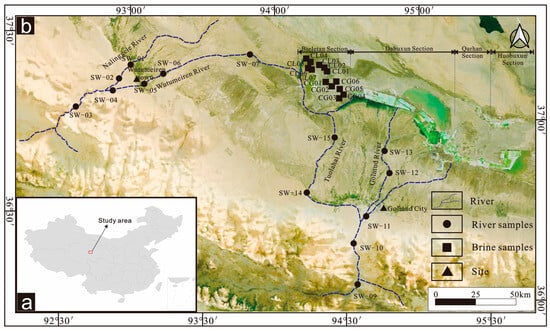
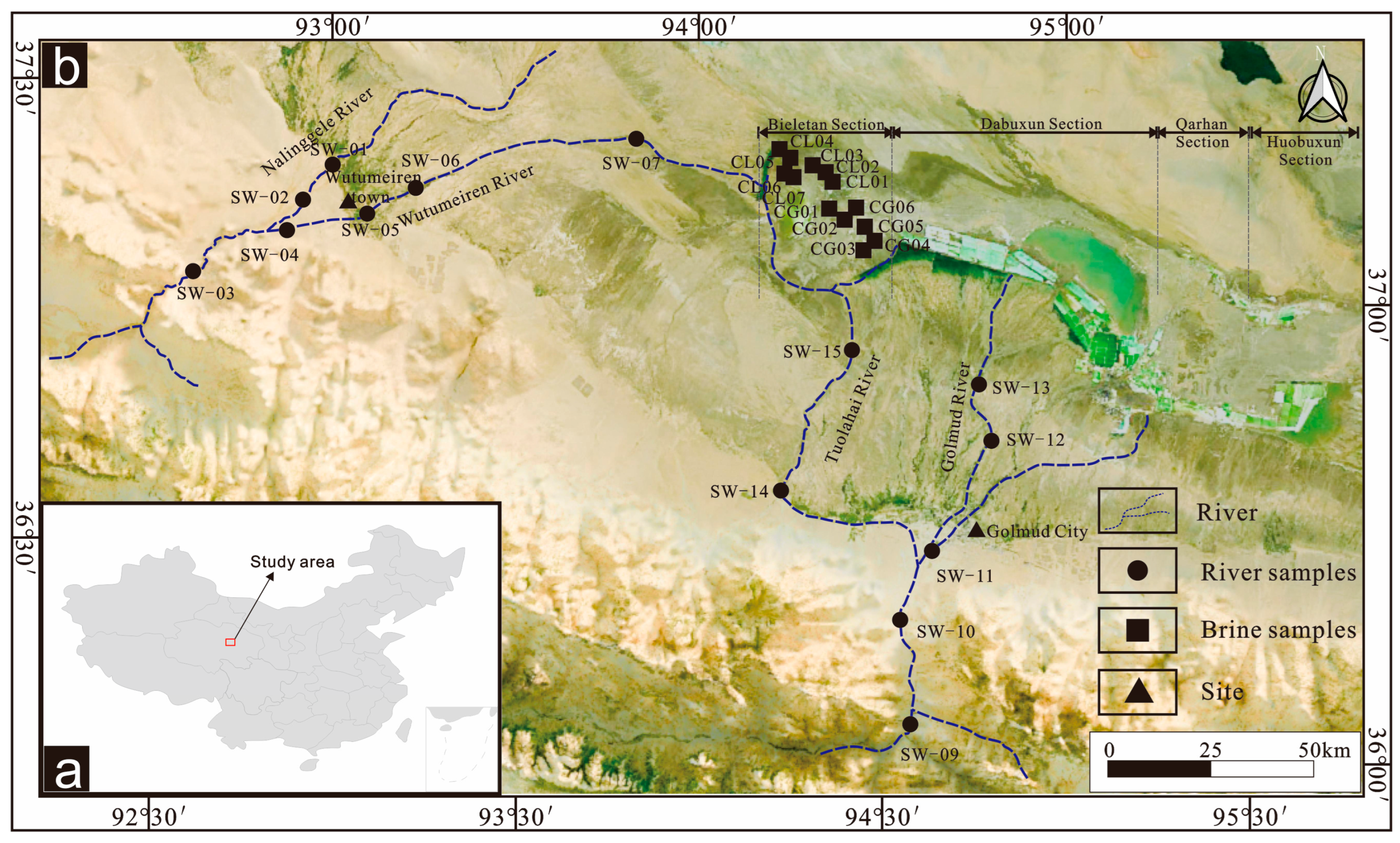
The QSL occupies the eastern Qaidam Basin and is now a playa covering an area of ~5856 km2. It is divided into four sections from west to east: the Bieletan Section (BLT), Dabuxun Section, Qarhan Section, and Huobuxun Section (Figure 1). Among these sections, BLT contains the thickest salt-bearing series, up to 70 m thick, and currently contributes about 60% of the brine resource for potash fertilizer production to the entire QSL [31,32].
Figure 1.
Location of Qarhan Salt Lake (a) and sample sites in this study (b).
Recharges to QSL mainly consist of river water and spring water [1,5]. Spring water is hypothesized to be discharged along deep faults on the northern margin of QSL and is characterized by a CaCl2 type that is enriched in Ca2+ and depleted in SO42− and HCO3− [2,5,33]. Rivers in the south of QSL drain the Eastern Kunlun Mountains, mainly including the Golmud River (G.R.), Tuolahai River (T.R.), and Wutumeiren River (W.R.) from east to west. The hydrogeochemistry of these rivers is comparable to that of the average world river water [5,33]. G.R. originates from the Eastern Kunlun Mountains and serves as the main water source for QSL with an annual average discharge of 19.2 × 10⁹ m3. T.R. shares the same upstream as G.R. Besides being supplied by meltwater and meteoric water, G.R. and T.R. are often influenced by groundwater gushing and flowing north into the QSL. W.R. belongs to the Nalenggele River Catchment and is supplied by upwelling groundwater influenced by the Nalenggele River (N.R.). The N.R. is formed by the mainstream of the Chulakealagan River, which is mainly fed by meltwater and meteoric water, and some tributaries. The most important tributary of N.R. is the Hongshui River, which converges with the mainstream at the end of N.R. [24].
3. Sampling and Method
3.1. Sample Collection
In total, 27 water samples were collected during November 2023, including 13 intercrystalline brines from product wells in BLT and 14 river water samples from N.R., W.R., G.R. and T.R. The sampling locations are shown in Figure 1b. All water samples were filtered through a 0.45 μm Luer-lock syringe filter (polypropylene membrane) and then collected in 500 mL low-density polyethylene bottles that were pre-cleaned with acid. Temperature and pH were measured on-site. All samples were immediately transported to the lab for measurement within one month of field collection.
3.2. Analytical Method
The hydrochemical analyses of river waters and intercrystalline brines were conducted at the MNR Key Laboratory of Metallogeny and Mineral Assessment, Institute of Mineral Resources, Chinese Academy of Geological Sciences. K, Na, Ca, Mg, Cl, S (calculated as SO4), Sr, Li, and B were determined by inductively coupled plasma optical emission spectrometry (ICP-OES, SPECTRO-Analytical Inc., Kleve, Germany), with an analytical error of less than 5%. HCO3− and CO32− were determined by HCl chemical titration using phenolphthalein and methyl orange as indicators, with a relative standard deviation of 1.5%. In addition, the mineral saturation index (SI) of all samples was calculated using the Phreeqc Version 3.5 software.
The δD and δ18O measurements were performed at the Institute of Hydrogeology and Environmental Geology, Chinese Academy of Geological Sciences, using a Picarro L2130-i water isotope analyzer (Picarro Inc., Santa Clara, CA, USA). The Vienna Standard Mean Ocean Water was utilized as the standard reference material for the H-O isotopic analysis, with analytical precision better than 0.025‰ for δ18O and 0.1‰ for δD. The Sr, B, and Li isotope analyses were performed at the Analytical Laboratory of the Beijing Research Institute of Uranium Geology, with measurement precision within 0.0008, 0.35‰ and 0.5‰, respectively. Strontium isotopes were measured using an Isoprobe-T thermal ionization mass spectrometer (Thermo Fisher Inc., Waltham, MA, USA), with mass fractionation corrected using an 87Sr/86Sr ratio of 0.1194. The measurement precision for all samples was calculated to be ±5.0 × 10⁻⁵ based on the standard results. Detailed analytical methods for Sr isotopes are described by Pu et al. [34]. Lithium isotopes were measured using a Nu Plasma II multi-collector inductively coupled plasma mass spectrometer (Nu Instruments Inc., Charlestown, MA, USA) to determine the 7Li/6Li ratio. The detailed analytical methods for obtaining lithium isotopes are described in Zhao et al. [35] and He et al. [18]. The boron isotopes of the river and brine were analyzed via Isotopx Phoenix TIMS (Isotopx Ltd., Cheshire, UK). The detailed analytical methods for obtaining boron isotopes are described in Zhang et al. [22].
4. Results
4.1. Element Composition
The obtained elemental compositions of brine and river samples are presented in Table 1. The discrepancy in the electrical charge balance of measured anions and cations is lower than 5%. Generally, river samples yield low elemental concentrations, with total dissolved solids (TDSs) ranging from 0.63 g/L to 3.11 g/L and a mean value of 1.23 g/L. The western rivers (N.R. and W.R.) have a mean Li of 0.66 mg/L and B of 2.10 mg/L, whereas eastern rivers (G.R. and T.R.) have a lower content of Li and B, with a mean value of 0.04 mg/L (Li) and 1.04 mg/L (B). Brine samples from BLT are more concentrated and have TDS ranges of 260.51 g/L~380.25 g/L, with a mean value of 344.46 g/L. They are dominated by K, Na and Mg for cations and Cl and HCO3 for anions. The average contents of K+, Li+ and B3+ of these brines are 9.92 g/L, 400.87 mg/L and 260.48 mg/L, respectively.
Table 1.
Ion composition of river water and brine samples.
4.2. Mineral Saturation Index (SI)
The calculated SI is reported in Table 2. The data show that the studied river samples are all undersaturated with salt minerals, with only Ca carbonate close to precipitation. The brines in BLT display a more evaporated state. They are commonly oversaturated with Ca–sulfate (like gypsum and glauberite), halite and polyhalite, with some of the brine approaching deposition of carnallite and sylvite.
Table 2.
Mineral saturation index (SI) of the studied samples.
4.3. Isotopic Composition
The results of H, O, Sr, B and Li isotope compositions are listed in Table 3. The δD and δ18O of river waters have a range of −64~−27‰ and −9.0~−2.7‰, respectively. The brines of BLT have values of δD and δ18O ranging from −50‰ to −21‰ and from −2.8‰ to 4.4‰, respectively.
Table 3.
Isotopic composition of river waters and brines in BTLs.
River waters show mean δ7Li values of 4.40‰ in the west (N.R. and W.R.) and 17.48‰ in the east (T.R. and G.R.). Brines in BLT have an intermediate δ7Li value between the western and eastern rivers, with a mean value of 13.46‰. The δ11B values of rivers range from −6.76‰ to −1.21‰. Brines in BLT have a range of δ11B of 3.75‰~9.72 ‰. The mean 87Sr/86Sr value is 0.71160 for the western rivers and 0.71090 for the eastern rivers. The brine of BLT has an 87Sr/86Sr range of 0.77144~0.71162, with a mean value of 0.71150.
5. Discussion
5.1. Hydrochemical Characteristics
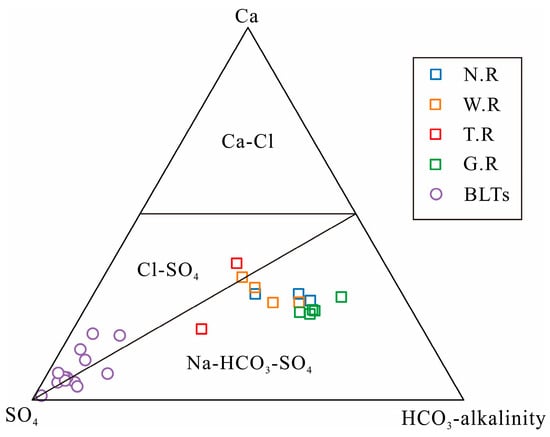
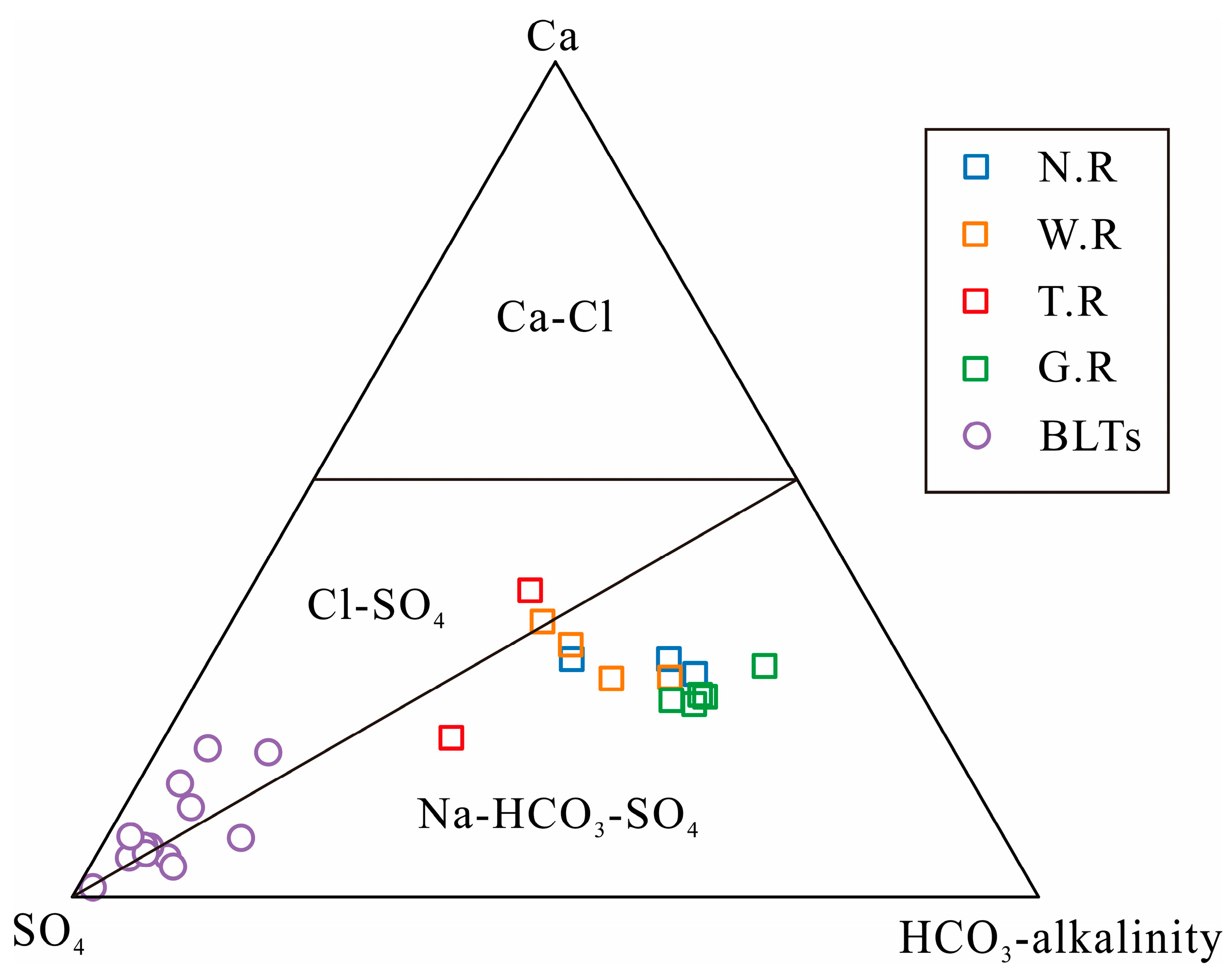
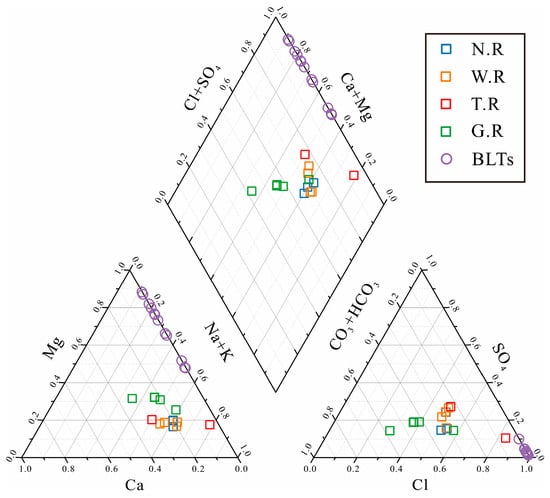
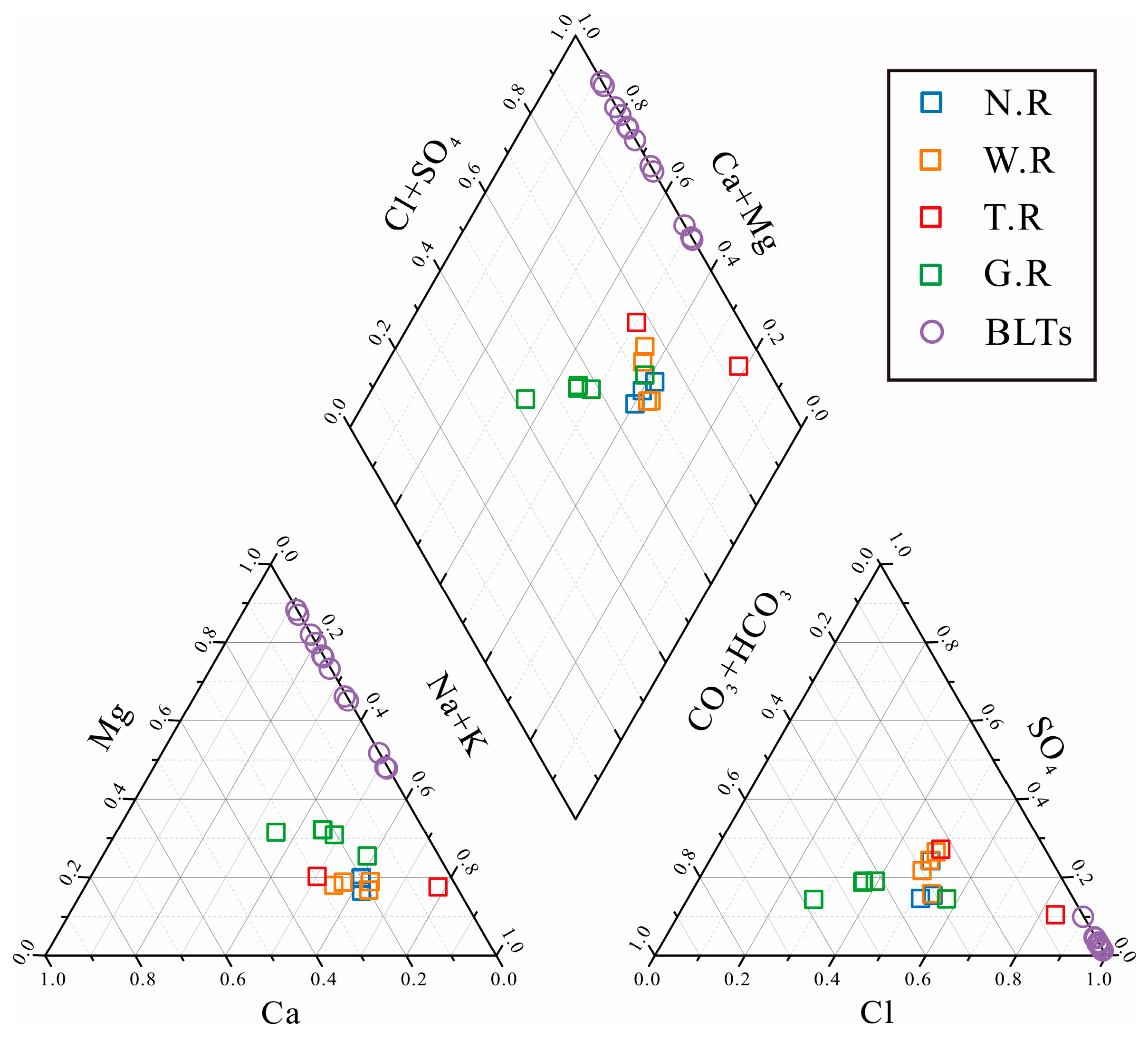
Water types in this contribution were defined based on the principle of hydrochemical divides that were proposed by Hardie and Eugster (1970) [36] and Lowenstein et al. (2009) [33]. All river waters belong to the Na-HCO3-SO4 type, with the exception of the downstream reaches of T.R., which transitions to the Na-Cl-SO4 type (Figure 2). The concentrations of K+, Li+, B3+ and total dissolved solids (TDSs) in these river waters are generally low and show an increasing trend from the upstream area to the downstream or terminal area, implying consistent evaporation and concentration of river waters. Brines from BLT all belong to the Na-Cl-SO4 type and have a lower ratio of Ca2+/Mg2+ and Ca2+/SO42− and a higher ratio of (Mg2+ + Ca2+)/(HCO3− + CO32−) than that of river waters (Figure 3). This indicates that evaporation and concentration favored precipitation of minerals like Mg or Ca carbonate and Ca–sulfate during the evolution of river water to brine, and thus conservative ions like K, Li and B were able to concentrate in the brine. This is consistent with the SI data that all river samples are undersaturated with minerals such as aragonite, calcite, dolomite, gypsum, and anhydrite, whereas brine samples are supersaturated with Mg or Ca carbonate, Ca–sulfate, and even potassium salt minerals.
Figure 2.
Ternary Ca-SO4-HCO3 of brines in BLT and the surrounding river waters.
Figure 3.
Piper diagram of brines in BLT and the surrounding river waters.
5.2. Hydrogen and Oxygen Isotopes
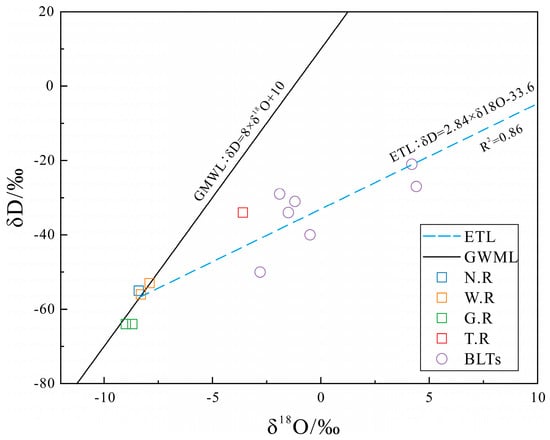
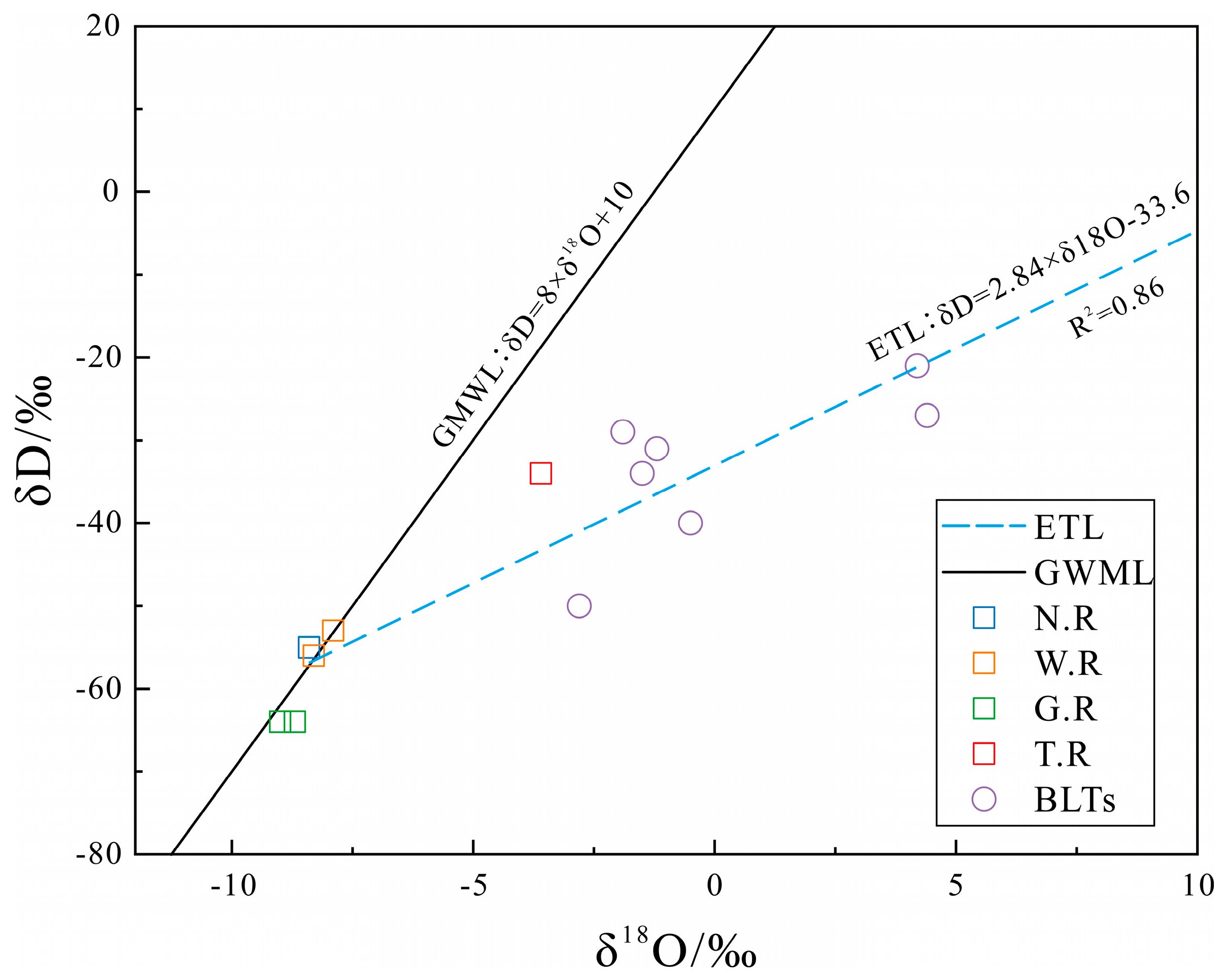
The δD-δ18O of the studied river samples is predominantly plotted near the Global Meteoric Water Line (GMWL). The river waters from the downstream area exhibit heavier δD and δ18O compared to those from the upstream area. This agrees with the previously mentioned increasing trend of element concentration in rivers, further suggesting that continuous evaporation of rivers occurs during long-distance migration from the upstream toward the downstream. The δD and δ18O values of brines in BLT are obviously higher than those of rivers and are distributed along an evaporation trend line (ETL, δD = 2.91δ18O − 32.03) that intersects the δD-δ18O plots of rivers on the GMWL (Figure 4). This implies that brines in BLT are mainly recharged by rivers or meteoric precipitation.
Figure 4.
δD-δ18O plots of the studied water bodies (GMWL from Craig (1961) [37]).
5.3. Lithium Isotopes
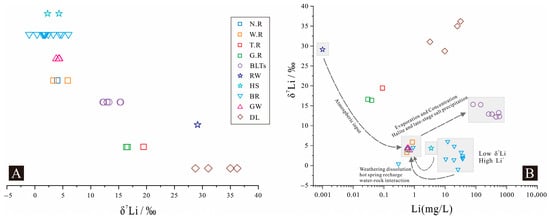
Generally, natural precipitation and meltwater have low Li concentrations and heavy isotopic δ7Li signatures [38,39,40]. This composition and isotopic signature are comparable to those of the studied G.R. and T.R., as well as major global rivers [41]. Conversely, W.R. and N.R. to the western part of BLT are characterized by lighter δ7Li, which is similar to hot springs and bedrocks in the Eastern Kunlun Mountain of the northern Tibetan Plateau [21,40,42,43] (Figure 5A). This evidence highlights the role of the source footprint in the isotopic Li signature of these rivers. Moreover, the correlation of δ7Li vs. [Li] (Figure 5B) implies that the elemental and isotopic behaviors of Li have undergone a complicated process and have been affected by multiple factors during the evolution of river waters into brines in BLT. The studied region is dominated by a prevalent arid climate with a very low average annual precipitation; therefore, the precipitation, characterized by low Li content and heavier δ7Li, has a negligible contribution to Li and δ7Li. In addition, the comparable δ7Li and Li concentrations of river waters (W.R. and N.R.), groundwaters in this area, and hot springs and bedrocks in Eastern Kunlun Mountain suggest that weathering, dissolution, and hot spring recharge play a role in the composition of the studied N.R. and W.R. The brines in BLT have an intermediate δ7Li value between the heavier δ7Li of eastern river water (G.R. and T.R.) and the lighter δ7Li of the western river water (W.R. and N.R.). Moreover, SI data show that almost all brines in BLT are saturated with halite and later-stage potassium salt minerals, such as polyhalite, carnallite and sylvite. Therefore, we propose that brines in BTL are likely supplied by W.R. but not G.R. and T.R. This is because the brines continuously accumulate Li as no lithium salt forms and become enriched in δ7Li during the late stage of evaporation of the salt lake due to the preferential incorporation of δ6Li into chloride precipitates [44]. Conversely, the contribution of G.R. and T.R., as well as Dongling Lake, to the brine of BLT can be excluded, as their already high δ7Li values would be further elevated by salt precipitation during evaporative concentration.
Figure 5.
δ7Li (A) and correlation of [Li] vs. δ7Li (B) of various geological bodies around BLT. RW: rainwater in Qaidam Basin [18]; HS: hot spring in northern QTP [18]; BR: bedrocks in the Eastern Kunlun Mountain [42]; GW: groundwater in N.R. and W.R. catchments [24]; DL: Dongling Lake to the north of BLT [25].
5.4. Boron Isotopes
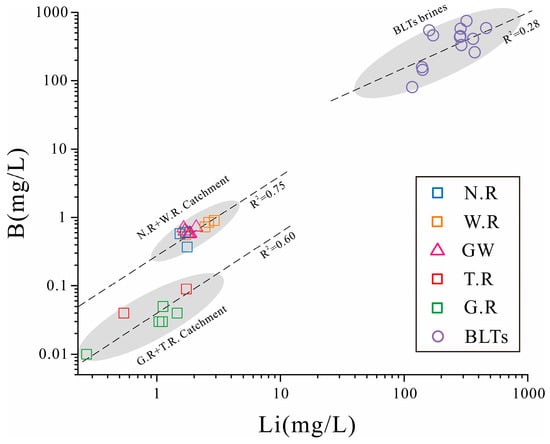
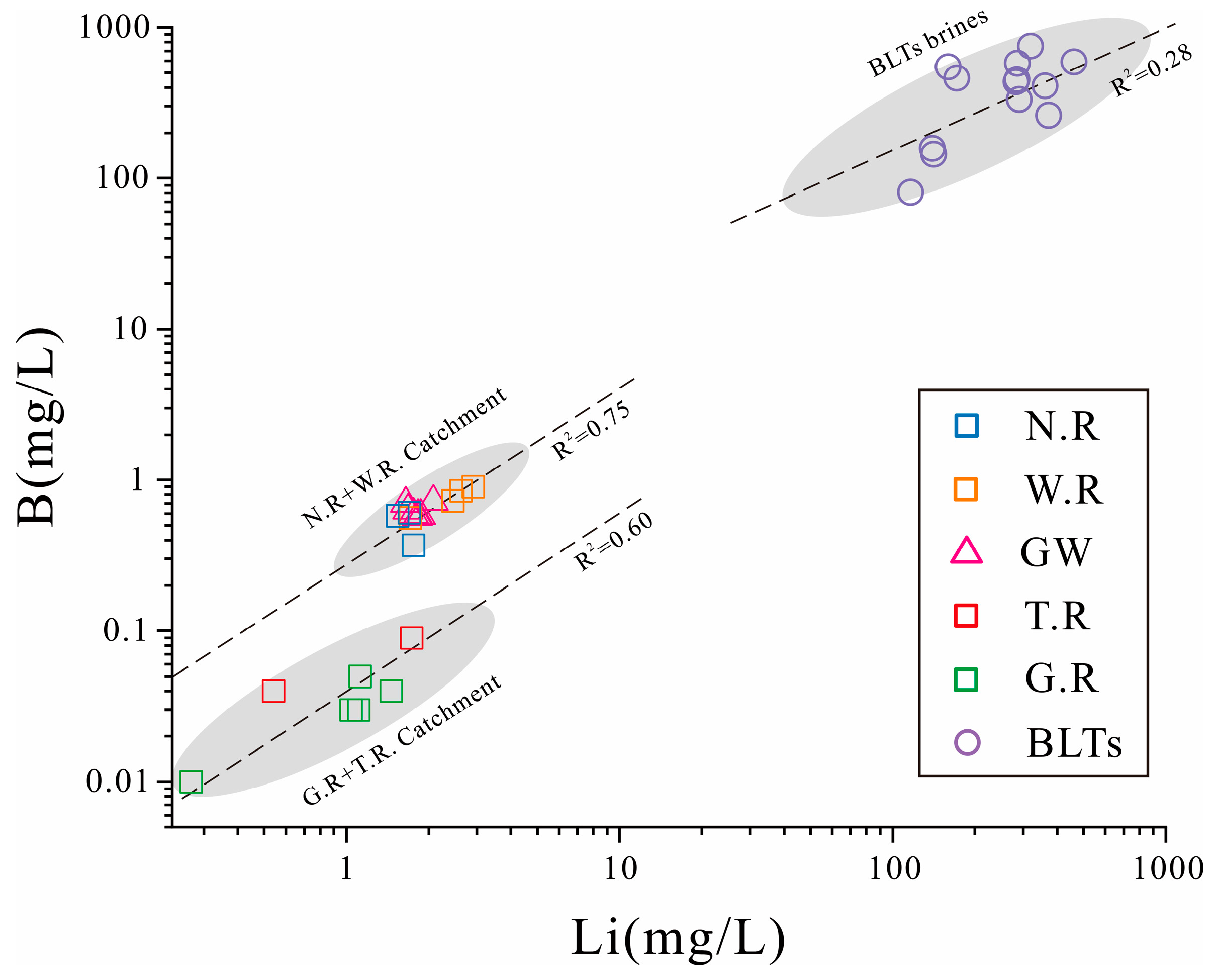
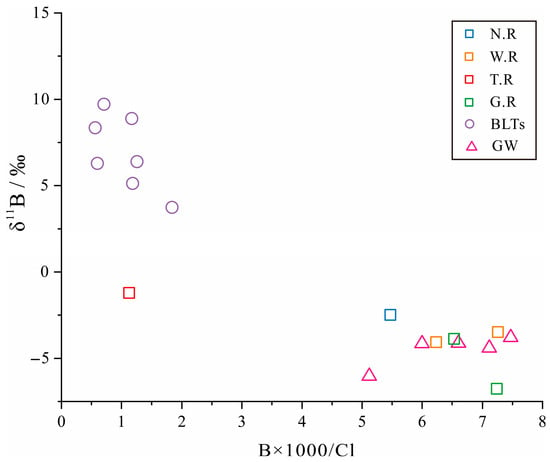
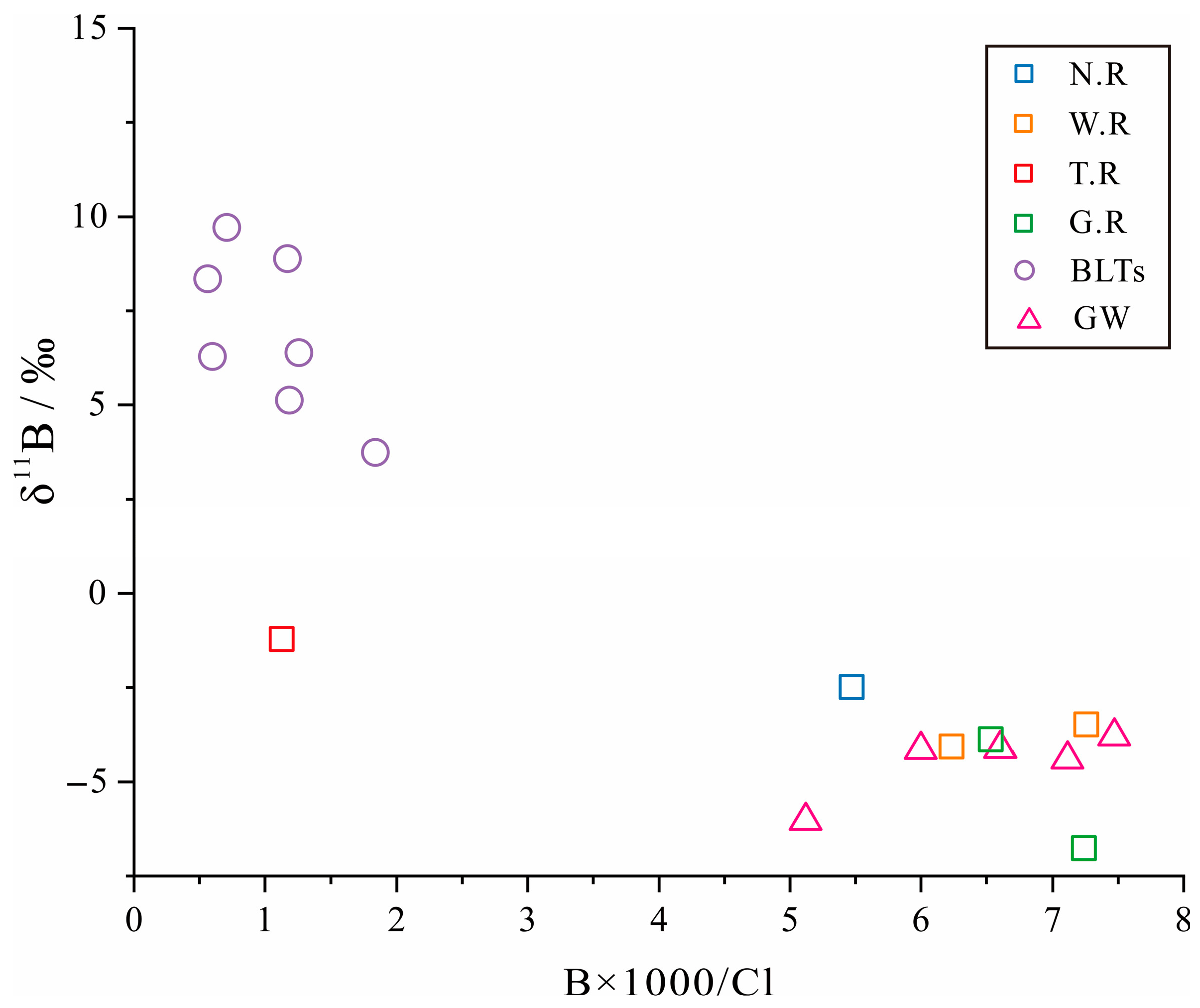
A positive correlation between B and Li was observed for the western (R2 = 0.75) and eastern rivers (R2 = 0.60) (Figure 6). This indicates a similar hydrogeochemical behavior of B and Li for rivers in the same drainage during migration in the plain area, despite various sources within each river catchment. In contrast, brines in BLT show a weak correlation between B and Li, implying that the hydrochemical composition of water bodies changed due to different precipitation of salt minerals associated with the location of production wells in BLT. In addition, there were no obvious differences observed in B concentration and its isotopic composition (δ11B) between the western N.R. and W.R. and the eastern G.R. and T.R. The presence of granitoids in the Eastern Kunlun Mountain and evaporite at the mountain front could serve as one of the candidates for the B reservoir. However, higher surface rocks have heavier δ11B (6.71‰~12.57‰) than the river flows [24]. Therefore, water–rock reaction was not a potential trigger for the higher B concentration and lighter δ11B of the studied rivers because water–rock interaction rates are generally low under low-temperature conditions at high altitudes [45]. In addition, a diagram of δ11B vs. [B]/[Cl] ratio (Figure 7) highlights the control of evaporation and dissolution on B enrichment and B isotopic fractionation during the evolution of the river–salt lake system. This is because 10B is preferentially incorporated into the solid (mineral) phase during evaporation and concentration, which leads to a higher δ11B in brines than in rivers. On the other hand, the brines in BLT with higher δ11B show a negative correlation of δ11B with [B]/[Cl], demonstrating a redissolution of previous salts that decreases δ11B and elevates [B]/[Cl] of the brine [45,46]. As mentioned before, brines in BTLs are typified by ion contents several orders of magnitude higher than river waters, suggesting a strong evaporation and concentration after river waters flux into the salt lake. This agrees with the isotopic H-O characteristics and the calculated mineral SI. Combined with the correlation of δ7Li vs. [Li] and δ11B vs. [B]/[Cl], it seems that the elemental and isotopic signatures of B and Li in river waters are prone to being obscured by evaporation and concentration of brines and the related precipitation and redissolution of salt minerals during the evolution of brines in the salt lake.
Figure 6.
Correlation of [Li] vs. [B] of brines in BLT and surrounding river waters.
Figure 7.
Correlation of δ11B vs. [B]/[Cl] of brines in BLT and the surrounding river waters.
5.5. Strontium Isotopes
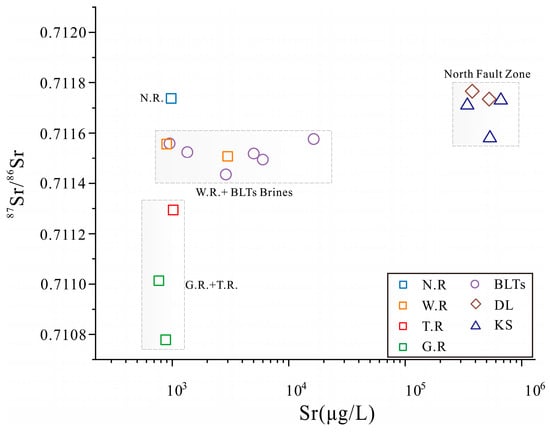
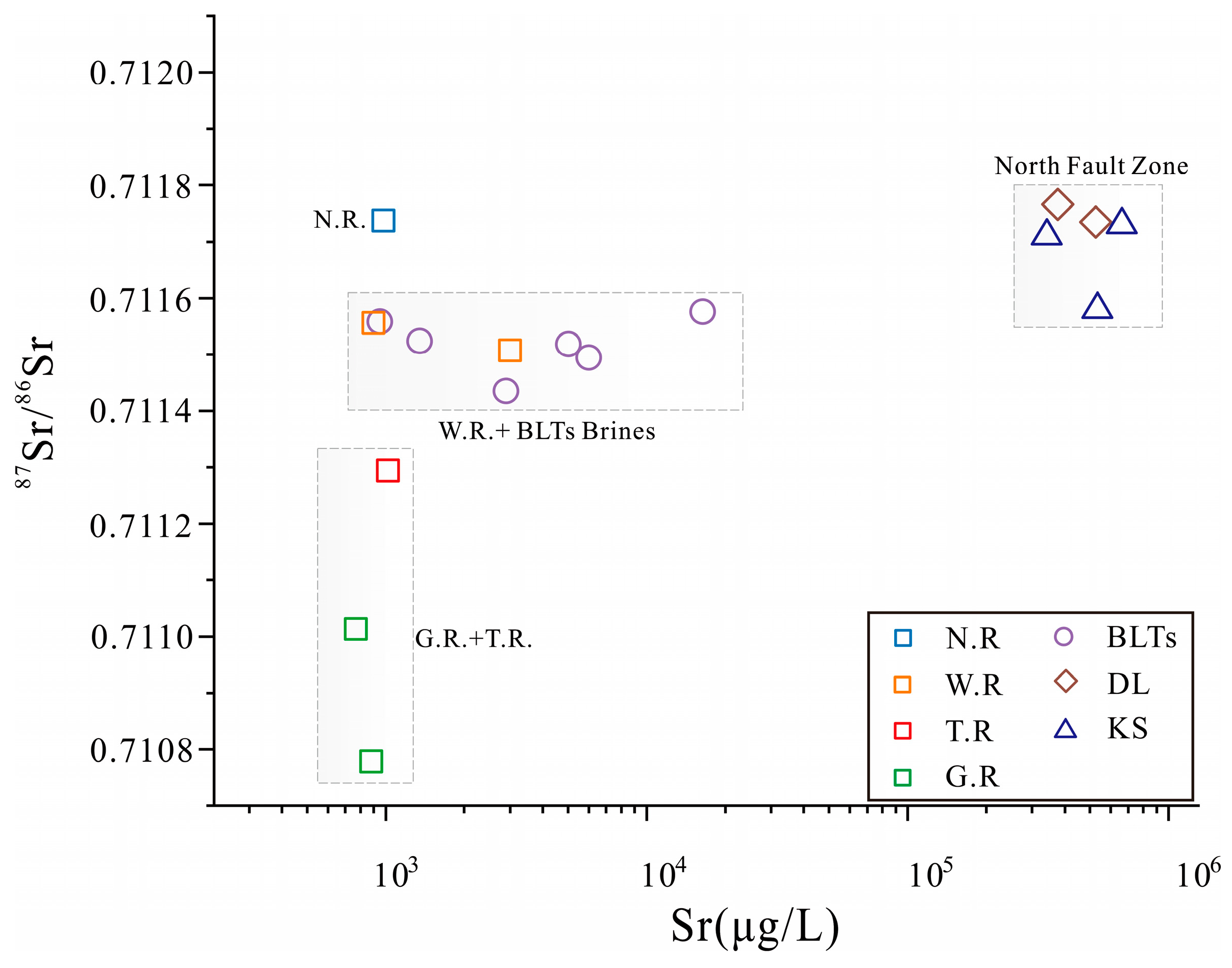
Strontium isotopes undergo negligible fractionation during evaporative concentration or mineral precipitation [47,48,49,50]. Consequently, brine typically retains an 87Sr/86Sr ratio similar to that of its source rivers, making strontium isotopes a powerful tracer for constraining brine origin in saline systems [51,52]. Brines in BLT and the surrounding river waters display distinct strontium isotopic compositions. The mean 87Sr/86Sr values are 0.71170 for N.R., 0.71153 for W.R., 0.71090 for eastern rivers, and 0.71150 for brines in BLT. Therefore, the comparable 87Sr/86Sr values suggest that W.R. is the recharge source for brines in BLT. In addition, a similarity of the 87Sr/86Sr values between brines in BLT and CaCl2 karst waters in the north fault zone and Dongling Lake was also observed (Figure 8). However, these karst waters from the north fault zone and brines from Dongling Lake are characterized by Sr contents [1,25] that are significantly higher than those of brine in BLT, and Sr-bearing evaporites are rarely observed within BLT. Therefore, these lines of evidence exclude fluids such as CaCl2 spring waters from the karst zone along the northern part of BTL as solute sources for brine in BTL, despite the similarity in strontium isotopic composition.
Figure 8.
Correlation of 87Sr/86Sr vs. [Sr] of brines in BLT and the surrounding river waters.
6. Conclusions
This study employs the H, O, Sr, B, and Li isotopes to constrain the sources of the brines in BLT. Our obtained results allow us to make the following conclusions.
The elemental and isotopic H-O characteristics suggest that brines in BLT originated from river waters and underwent intense evaporation. Comparison of Sr, B, and Li isotopic compositions and correlation of element concentrations and the related isotopes suggest that brines of BLT are mainly recharged by waters of W.R. to the west of BLT, and the contributions of G.R. and T.R. to the east of this area are limited and negligible. In short, elemental and isotopic compositions of rivers surrounding BLT are mainly associated with provenance sources and weathering processes, whereas those of brines in BLT are more affected by evaporation and the related precipitation of salt minerals. Our results highlight that multiple isotope analysis is more effective for the identification of brine sources or origin due to the complicated elemental evolution and isotopic fractionation in river–salt lake systems.
Author Contributions
J.J., conceptualization, resources, investigation, writing—original draft preparation; H.Y., conceptualization, investigation, writing—original draft preparation; J.S., formal analysis, validation; Z.C., software; X.Z., data curation; H.Z., conceptualization, methodology, writing—review and editing. All authors have read and agreed to the published version of the manuscript.
Funding
This research was funded by the National Key Research and Development Program of China from Ministry of Science and Technology, PRC (No. 2023YFC2906502).
Data Availability Statement
The original contributions presented in this study are included in the article. Further inquiries can be directed to the corresponding author.
Acknowledgments
We thank Wei Li, Xiaodan Li, and Pengyu Long for the field assistance. The authors thank the editors and reviewers for their insightful comments and suggestions regarding this manuscript.
Conflicts of Interest
The authors declare no conflicts of interest.
References
- Zhang, P.X. Salt Lakes of Qaidam Basin; Science Press: Beijing, China, 1987; pp. 1–233. (In Chinese) [Google Scholar]
- Yuan, J.Q.; Yang, Q.; Sun, D.P.; Huo, C.Y.; Cai, K.Q.; Wang, W.D.; Liu, X.J. The Formation Conditions of Potash Deposit in Qarhan Salt Lake; Geological Publishing House: Beijing, China, 1995; pp. 124–139. (In Chinese) [Google Scholar]
- Chen, K.; Bowler, J. Late Pleistocene evolution of Salt Lakes in the Qaidam Basin, Qinghai Province, China. Palaeogeogr. Palaeoclimatol. Palaeoecol. 1986, 54, 87–104. [Google Scholar]
- Zhang, P.X.; Zhang, B.; Lowenstein, T.; Spencer, R. Origin of Ancient Potash Evaporites: Examples from the Formation of Potash of Qarhan Salt Lake in Qaidam Basin; Science Press: Beijing, China, 1993; pp. 27–121. (In Chinese) [Google Scholar]
- Lowenstein, T.K.; Spencer, R.J.; Zhang, P.X. Origin of ancient potash evaporites: Clues from the modern nonmarine Qaidam Basin of western China. Science 1989, 245, 1090–1092. [Google Scholar] [CrossRef] [Scilit]
- Zhu, Y.Z.; Li, Z.Y.; Wu, B.H.; Wang, M.L. The formation of the Qarhan saline lakes as viewed from the Neotectonic movement. Acta Geol. Sin. 1990, 1, 13–21. [Google Scholar]
- Fan, Q.S.; Ma, H.Z.; Ma, Z.B.; Wei, H.C.; Han, F.Q. An assessment and comparison of 230Th and AMS 14C ages for lacustrine sediments from Qarhan Salt Lake area in arid western China. Environ. Earth Sci. 2014, 71, 1227–1237. [Google Scholar] [CrossRef] [Scilit]
- Fan, Q.S.; Ma, Y.Q.; Cheng, H.D.; Wei, H.C.; Yuan, Q.; Qin, Z.J.; Shan, F.S. Boron occurrence in halite and boron isotope geochemistry of halite in the Qarhan Salt Lake, western China. Sediment. Geol. 2015, 322, 34–42. [Google Scholar] [CrossRef] [Scilit]
- Zhu, Y.Z.; Zhong, J.H.; Li, W.S. Neotectonic Movement and Evolution of Saline Lakes in the Qaidam Basin; Geological Press: Beijing, China, 1994; pp. 57–101. (In Chinese) [Google Scholar]
- Tan, H.B.; Rao, W.B.; Ma, H.Z.; Chen, J.S.; Li, T.W. Hydrogen, oxygen, helium and strontium isotopic constraints on the formation of oilfield waters in the western Qaidam Basin, China. J. Asian Earth Sci. 2011, 40, 651–660. [Google Scholar] [CrossRef] [Scilit]
- Yu, J.Q.; Gao, C.L.; Cheng, A.Y.; Liu, Y.; Zhang, L.S.; He, X.H. Geomorphic, hydroclimatic and hydrothermal controls on the formation of lithium brine deposits in the Qaidam Basin, northern Tibetan Plateau, China. Ore Geol. Rev. 2013, 50, 171–183. [Google Scholar] [CrossRef] [Scilit]
- Wang, A.; Smith, J.A.; Wang, G.C.; Zhang, K.X.; Xiang, S.Y.; Liu, D.M. Late Quaternary River terrace sequences in the eastern Kunlun Range, northern Tibet: A combined record of climatic change and surface uplift. J. Asian Earth Sci. 2009, 34, 532–543. [Google Scholar] [CrossRef] [Scilit]
- Spencer, R.J.; Lowenstein, T.K.; Casas, E.; Zhang, P.X. Origin of potash salts and brines in the Qaidam Basin, China. In Fluid-Mineral Interactions: A Tribute to H.P. Eugster; Spencer, R.J., Chou, I.M., Eds.; Special Publication Number 2; Geochemical Society: Alexandria, VA, USA, 1990; pp. 395–408. [Google Scholar]
- Liu, X.Q.; Cai, K.Q.; Yu, S.S. Geochemical simulation of formation and evolution of salt lakes and their water sources in Qaidam Basin: Application of Pitzer’s model. Geochimica 2002, 31, 501–507, (In Chinese with English Abstract). [Google Scholar]
- Xu, J.; Ma, H.; Xiao, Y.; Tan, H.; Li, T.; Sun, Z.; Fan, Q. Study on stable chlorine isotopes and their applied geochemistry. J. Salt Lake Res. 2008, 1, 51–59, (In Chinese with English Abstract). [Google Scholar]
- Shand, P.; Darbyshire, D.P.F.; Love, A.J.; Edmunds, W.M. Sr Isotopes in Natural Waters: Applications to Source Characterisation and Water–Rock Interaction in Contrasting Landscapes. Appl. Geochem. 2009, 24, 574–586. [Google Scholar] [CrossRef] [Scilit]
- Song, H.L.; Fan, Q.S.; Li, Q.K.; Han, G.; Chen, T.Y.; Yang, H.T.; Wei, Q. Ca-high water recharge and mixing constrain on evolution and K enrichment of brine deposits in the evaporite basin: Case and analogue study in the Qaidam Basin, Qinghai-Tibet Plateau. J. Hydrol. 2024, 632, 130883. [Google Scholar] [CrossRef] [Scilit]
- He, M.; Luo, C.; Yang, H.; Kong, F.; Li, Y.; Deng, L.; Zhang, X.; Yang, K. Sources and a proposal for comprehensive exploitation of lithium brine deposits in the Qarhan Basin on the northern Tibetan Plateau, China: Evidence from Li isotopes. Ore Geol. Rev. 2020, 117, 103277. [Google Scholar] [CrossRef] [Scilit]
- Miao, W.L.; Zhang, X.Y.; Li, Y.L.; Li, W.X.; Yuan, X.L.; Li, C.Z. Lithium and Strontium isotopic systematics in the Nalenggele River catchment of Qaidam basin, China: Quantifying contributions to lithium brines and deciphering lithium behavior in hydrological processes. J. Hydrol. 2022, 614, 128630. [Google Scholar] [CrossRef] [Scilit]
- Du, Y.S.; Han, J.L.; Zhang, X.Y. Origin of Boron and Lithium-Rich Salt Lakes in Center of Tibetan Plateau: Evidence from B and Li Isotopes. Appl. Geochem. 2023, 148, 105539. [Google Scholar] [CrossRef] [Scilit]
- Xue, F.; Tan, H.B.; Zhang, X.Y.; Santosh, M.; Cong, P.X.; Ge, L.; Li, C.; Chen, G.H.; Zhang, Y. Contrasting Sources and Enrichment Mechanisms in Lithium-Rich Salt Lakes: A Li-H-O Isotopic and Geochemical Study from Northern Tibetan Plateau. Geosci. Front. 2024, 15, 101768. [Google Scholar] [CrossRef] [Scilit]
- Zhang, X.; Li, Q.; Qin, Z.; Fan, Q.; Du, Y.; Wei, H.; Gao, D.; Shan, F. Boron isotope geochemistry of a brine-carbonate system in the Qarhan Basin, western China. Sediment. Geol. 2019, 383, 293–302. [Google Scholar] [CrossRef] [Scilit]
- Fan, Q.; Lowenstein, T.K.; Wei, H.; Yuan, Q.; Qin, Z.; Shan, F.; Ma, H. Sr isotope and major ion compositional evidence for formation of Qarhan Salt Lake, western China. Chem. Geol. 2018, 497, 128–145. [Google Scholar] [CrossRef] [Scilit]
- Zhang, Y.; Tan, H.B.; Cong, P.X.; Rao, W.B.; Ta, W.Q.; Lu, S.C.; Shi, D.P. Boron and lithium isotopic constraints on their origin, evolution, and enrichment processes in a river-groundwater-salt lake system in the Qaidam Basin, northeastern Tibetan Plateau. Ore Geol. Rev. 2022, 149, 105110. [Google Scholar] [CrossRef] [Scilit]
- Shi, H.Y.; Fan, Q.S.; Liu, W.P.; Li, Q.K.; Zhao, W.Y.; Chen, T.Y.; Yang, H.T.; Shang, W.J. Hydrological recharge study of potassium salt deposition in Donglin Lake at the northern margin of Qarhan Salt Lake from a source-sink perspective. Acta Petrol. Sin. 2024, 41, 1067–1083, (In Chinese with English Abstract). [Google Scholar]
- Yin, A.; Rumelhart, P.; Butler, R.; Cowgill, E.; Harrison, T.; Foster, D.; Ingersoll, R.; Zhang, Q.; Zhou, X.; Wang, X.; et al. Tectonic history of the Altyn Tagh fault system in northern Tibet inferred from Cenozoic sedimentation. Geol. Soc. Am. Bull. 2002, 114, 1257–1295. [Google Scholar] [CrossRef] [Scilit]
- Tian, J.X.; Li, J.; Pan, C.F.; Tan, Z.; Zeng, X.; Guo, Z.Q.; Wang, B.; Zhou, F. Geochemical characteristics and factors controlling natural gas accumulation in the northern margin of the Qaidam Basin. J. Petrol. Sci. Eng. 2018, 160, 219–228. [Google Scholar] [CrossRef] [Scilit]
- Cheng, F.; Jolivet, M.; Guo, Z.; Wang, L.; Zhang, C.; Li, X. Cenozoic evolution of the Qaidam Basin and implications for the growth of the northern Tibetan Plateau: A review. Earth-Sci. Rev. 2021, 220, 103730. [Google Scholar] [CrossRef] [Scilit]
- Duan, L.; Zhang, B.; Wang, W.; Zhang, P.; Tang, Q.; Chen, G.; Jia, J.; Yan, Y.; Huang, R.; Zheng, Q. Magnetostratigraphy of the Cenozoic Lulehe section in the Qaidam Basin: Implications for the tectonic deformation on the northeastern Tibetan Plateau. Chin. Sci. Bull. 2022, 67, 872–887, (In Chinese with English Abstract). [Google Scholar] [CrossRef] [Scilit]
- Huang, H.C.; Huang, C.H.; Ma, Y.S. Geology of the Qaidam Basin and Its Petroleum Prediction; Geological Press: Beijing, China, 1996; pp. 1–257. (In Chinese) [Google Scholar]
- Li, B.; Zhao, Y.; Qian, Z.; Jiao, P.; Liu, C.; Wang, S. A comparative study of material composition of solid sylvite before and after liquefaction and its significance in Bieletan area of Qarhan salt lake, Qinghai, China. Miner. Depos. 2010, 29, 669–683. [Google Scholar]
- Liu, W.; Zhao, Y.; Yao, F.; Su, Y.; Hu, Y. Study on the control of fault structures on the distribution of deep brines in the Bieletan area, Qaidam Basin. Acta Geol. Sin. 2021, 95, 2073–2081, (In Chinese with English Abstract). [Google Scholar]
- Lowenstein, T.K.; Risacher, F. Closed basin brine evolution and the influence of Ca-Cl inflow waters: Eath Valley and Bristol Dry Lake, California, Qaidam Basin, China, and Salar de Atacama, Chile. Aquat. Geochem. 2009, 15, 71–94. [Google Scholar] [CrossRef] [Scilit]
- Pu, W.; Gao, J.; Zhao, K.; Ling, H.; Jiang, S. Separation method of Rb-Sr, Sm-Nd using DCTA and HIBA. J. Nanjing Univ. 2005, 41, 445–450, (In Chinese with English Abstract). [Google Scholar]
- Zhao, Y.; Li, Y.; Hu, B.; Hou, K.; Fan, C.; Gao, J. Lithium isotopic composition of marine carbonate rocks: A new proxy for paleo-pH reconstruction. Acta Geosci. Sin. 2020, 41, 613–622, (In Chinese with English Abstract). [Google Scholar]
- Hardie, L.A.; Eugster, H.P. The evolution of closed-basin brines. In Fiftieth Anniversary Symposia: Mineralogy and Petrology of the Upper Mantle, Sulfides, Mineralogy and Geochemistry of Non-Marine Evaporites; Morgan, B.A., Ed.; Special Paper No. 3; Mineralogical Society of America: Chantilly, VA, USA, 1970; pp. 273–290. [Google Scholar]
- Craig, H. Isotopic variations in meteoric water. Science 1961, 133, 1702. [Google Scholar] [CrossRef] [Scilit] [PubMed]
- Rose, E.F.; Chaussidon, M.; France-Lanord, C. Fractionation of boron isotopes during erosion processes: The example of Himalayan rivers. Geochim. Cosmochim. Acta 2000, 64, 397–408. [Google Scholar] [CrossRef] [Scilit]
- Millot, R.; Petelet-Giraud, E.; Guerrot, C.; N’egrel, P. Multi-isotopic composition (δ7Li–δ11B–δD–δ18O) of rainwaters in France: Origin and spatio-temporal characterization. Appl. Geochem. 2010, 25, 1510–1524. [Google Scholar] [CrossRef] [Scilit]
- Ma, T.T.; Weynell, M.; Li, S.L.; Liu, Y.S.; Chetelat, B.; Zhong, J.; Xu, S.; Liu, C.Q. Lithium isotope compositions of the Yangtze River headwaters: Weathering in high relief catchments. Geochim. Cosmochim. Acta 2020, 280, 46–65. [Google Scholar] [CrossRef] [Scilit]
- Huh, Y.; Chan, L.H.; Zhang, L.; Edmond, J.M. Lithium and its isotopes in major world rivers: Implications for weathering and the oceanic budget. Geochim. Cosmochim. Acta 1998, 62, 2039–2051. [Google Scholar] [CrossRef] [Scilit]
- Weynell, M.; Wiechert, U.; Schuessler, J.A. Lithium isotope and implications on chemical weathering in the catchment of lake Donggi Cona, northeastern Tibetan Plateau. Geochim. Cosmochim. Acta 2017, 213, 156–177. [Google Scholar] [CrossRef] [Scilit]
- Xiao, Y.K.; Qi, H.P.; Wang, Y.H.; Jin, L. Lithium isotopic compositions of brine, sediments and source water in Da Qaidam lake, Qinghai, China. Geochimica 1994, 23, 329–338, (In Chinese with English Abstract). [Google Scholar]
- Lin, Y.J.; Merli, M.; Censi, P.; Redfem, S.A.T.; Zhao, Y.; Yin, Q.Z.; Zheng, M.P.; Yu, X.D.; Zhang, Y.S.; Knapp, W.J.; et al. Experimental and theoretical constraints on lithium isotope fractionation during brine evaporation and halite precipitation. Geochim. Cosmochim. Acta 2024, 374, 250–263. [Google Scholar] [CrossRef] [Scilit]
- Xiao, Y.K.; Sun, D.P.; Wang, Y.H.; Qi, H.P.; Jin, L. Boron isotopic compostions of brine, sediments and source water in Da Qaidam lake, Qinghai, China. Geochimica 1992, 56, 1561–1568, (In Chinese with English Abstract). [Google Scholar]
- Vengosh, A.; Chivas, A.R.; Starinsky, A.; Kolodny, Y.; Zhang, B.Z.; Zhang, P.X. Chemical and boron isotope compositions of non-marine brines from the Qaidam Basin, Qinghai, China. Chem. Geol. 1995, 120, 135–154. [Google Scholar] [CrossRef] [Scilit]
- Frost, C.; Pearson, B.; Ogle, K.; Heffern, E.; Lyman, R. Sr isotopic tracing of aquifer interactions in an area of coal and methane production, Powder River Basin, Wyoming. Geology 2002, 30, 923–926. [Google Scholar] [CrossRef] [Scilit]
- Millot, R.; Hegan, A.; Négrel, P. Geothermal waters from the Taupo volcanic Zone, New Zealand: Li, B and Sr isotopes characterization. Appl. Geochem. 2012, 27, 677–688. [Google Scholar] [CrossRef] [Scilit]
- Li, Y.; Jiang, S. Sr isotopic compositions of the interstitial water and carbonate from two basins in the Gulf of Mexico: Implications for fluid flow and origin. Chem. Geol. 2016, 439, 43–51. [Google Scholar] [CrossRef] [Scilit]
- Sanjuan, B.; Millot, R.; Innocent, C.; Dezayes, C.; Scheiber, J.; Brach, M. Major geochemical characteristics of geothermal brines from the upper Rhine graben granitic basement with constraints on temperature and circulation. Chem. Geol. 2016, 428, 27–47. [Google Scholar] [CrossRef] [Scilit]
- Négrel, P.; Grosbois, C. Changes in chemical and 87Sr/86Sr signatures distribution patterns of suspended matter and bed sediments in the upper Loire River basin (France). Chem. Geol. 1999, 156, 231–249. [Google Scholar] [CrossRef] [Scilit]
- Liu, Y.; Yang, Y.; Yang, R.; Galy, A.; Jin, Z.; Fang, X.; Song, B. Deciphering source-to-sink history from a solute perspective: A Sr isotope approach in the Qaidam Basin, NE Tibet. Gondwana Res. 2023, 118, 76–91. [Google Scholar] [CrossRef] [Scilit]

Disclaimer/Publisher’s Note: The statements, opinions and data contained in all publications are solely those of the individual author(s) and contributor(s) and not of MDPI and/or the editor(s). MDPI and/or the editor(s) disclaim responsibility for any injury to people or property resulting from any ideas, methods, instructions or products referred to in the content. |
© 2026 by the authors. Licensee MDPI, Basel, Switzerland. This article is an open access article distributed under the terms and conditions of the Creative Commons Attribution (CC BY) license.