Skip to Content
WaterWater
  • Article
  • Open Access

4 March 2026

An Investigation on the Effectiveness of Horizontal Curtain Grouting Based on Multi-Method Joint Analysis: A Case Study of the Cuihongshan Iron-Polymetallic Mine


,
,
,
,
and
1
Technology Innovation Center for Groundwater Disaster Prevention and Control Engineering for Metal Mines, Ministry of Natural Resources, North China Engineering Investigation Institute Co., Ltd., Shijiazhuang 050021, China
2
School of Urban Geology and Engineering, Hebei GEO University, Shijiazhuang 052161, China
3
Key Laboratory of Intelligent Detection and Equipment for Underground Space of Beijing-Tianjin-Hebei Urban Agglomeration, Shijiazhuang 052161, China
4
Hebei Technology Innovation Center for Intelligent Development and Control of Underground Built Environment, Shijiazhuang 052161, China
This article belongs to the Section Hydrogeology

Abstract

Regional curtain grouting for water interception serves as a critical technique for achieving safe and efficient mining under complex hydrogeological conditions in deep mine deposits. This study focuses on the Cuihongshan Iron-Polymetallic Mine, where repeated incidents of water inrush and sand outbursts have occurred due to complex hydrogeological conditions. By identifying the water-conducting pathways and characterizing the spatial distribution of relative aquitards within the mining area, a precise hydrogeological model was established. On this basis, the engineering application and performance evaluation of horizontal curtain grouting were systematically investigated. Through field monitoring and multi-method joint analysis, the water-blocking effectiveness of the grouting technique was comprehensively assessed. The results demonstrate a significant sequential reduction in grout take per meter for primary, secondary, and tertiary grouting holes, indicating a clear cumulative grouting effect. The grout effectively filled karst fractures, forming a continuous and stable water-resisting curtain. The project successfully severed the hydraulic connection between the highly water-rich Quaternary aquifer and the mine workings, substantially reducing mine water inflow. This study provides important theoretical support and practical reference for water hazard control in similar deep metal mines.

1. Introduction

Metal mineral resources are fundamental to modern industrial development and economic growth, forming the backbone of national strategic reserves and productive forces [1,2,3]. However, as shallow mineral deposits become increasingly depleted, mining activities are progressively extending to greater depths, where engineering conditions are often characterized by high in situ stress, elevated geothermal gradients, significant groundwater pressure, and intense mining-induced disturbances [4,5,6]. Under such complex hydrogeological and geomechanical environments, the risk of water inrush disasters from surrounding rock masses rises substantially, posing severe threats to mining safety and productivity [7,8,9].
With growing societal demand for metal mineral resources [10,11], the scale of metal mining operations has continuously expanded, leading to the gradual emergence of water and sand inrush incidents in mines. Such accidents have already occurred at the Macheng Iron Mine and the Cuihongshan Iron-Polymetallic Mine. Moreover, many other metal mines face potential risks or are under threat of such hazards. In recent years, this type of disaster has become a notable concern in the metal mining industry, posing significant threats to both safe mine production and long-term management. As a typical mining geo-hazard, mine water and sand inrush poses serious threats to construction and operational safety in mines, prompting extensive and in-depth research by scholars worldwide. The process of mine water and sand inrush is highly complex and requires the simultaneous presence of four essential conditions [12,13]: (1) abundant source materials; (2) inrush pathways capable of transporting water–sand mixtures; (3) driving forces sufficient to breach aquicludes; and (4) sufficient space for the inrush materials to accumulate. Conventional approaches for managing water hazards in such settings often rely on dewatering and depressurization. While effective to some extent, these methods become increasingly unsustainable with depth: drainage volumes grow exponentially, leading to substantial economic costs and severe disruption of regional groundwater systems [14,15]. Moreover, unexpected encounters with concealed water-bearing structures—such as faults or karst conduits—can trigger sudden and large-volume water inflows, as documented in several case studies [16,17,18].
The theoretical model of grouting under dynamic water conditions can provide valuable guidance for engineering practice. However, due to the inherent anisotropy and uncertainty of soil and rock masses [19,20,21], combined with the complexity of grouting materials and processes, it is difficult to achieve analytical validation of the grout diffusion equation in real-world applications [22,23,24]. Xu et al. [25] investigated grouting in fractures under high-pressure grouting and high-water-pressure conditions using a self-developed physical simulation system. Their results demonstrate that permeability decreases significantly under high-water-pressure conditions. Zhang et al. [26] developed an experimental simulation system for grouting in fractured rock masses under dynamic water conditions to investigate the influence of major fractures and grout viscosity on slurry diffusion within fracture networks. The setup accounted for factors such as fracture distribution, water pressure, and grout properties, simulating the diffusion patterns and processes of grouts with three different viscosities. Xu et al. [27] conducted orthogonal experiments using a self-designed simulation test platform for grouting in dual-surface rough fractures under dynamic water flow. Their study investigated the influence of four factors on slurry diffusion and sealing effectiveness. The results revealed three primary grout diffusion patterns: near-cross-shaped, near-U-shaped, and near-T-shaped. The factors affecting sealing effectiveness were ranked in descending order of influence as follows: initial flow velocity, aperture size, gelation time, and grouting pressure. Liu et al. [28] and Zhou et al. [29] developed a novel dynamic grouting test system based on low-field nuclear magnetic resonance (NMR) to investigate the grout diffusion process in fractured sandstone under flowing water conditions. Experimental results demonstrated that increasing the grouting flow rate and fracture aperture effectively enhances grouting efficiency under dynamic water conditions, whereas higher water flow rates reduce it. The study quantitatively analyzed variations in grout volume, effective grouting time, and slurry permeability under different confining pressures, injection pressures, and fracture dip angles. The results indicated that the relative filling degree of rock pores and fractures decreases with increasing confining pressure and fracture dip angle.
Regarding research on grouting under dynamic water conditions, Dalmalm [30,31] summarized the selection of grouting methods and procedures according to different requirements and conditions, quantifying the impact of five stages—drilling, grouting, grout setting, investigation, and secondary grouting—on the overall sealing time. Aoki et al. [32] suggested that underground dynamic water flow can partially displace grout, thereby altering the morphology of grout diffusion. Their study attempted to establish a theoretical model of grout penetration mechanisms to evaluate grouting effectiveness. Ghafar et al. [33] proposed a novel method that utilizes low-frequency transient variable pressure to enhance slurry diffusion. Lavrov et al. [34] explored the flow of non-Newtonian grouts during grouting and the flow of hydraulic fracturing fluids during stimulation, providing a comprehensive overview to highlight current research challenges. Xu et al. [35] addressed the issue of non-uniform spatiotemporal distribution of grout viscosity during the grouting process by proposing a numerical method for grouting under flowing water based on a Eulerian framework. Their study analyzed grout diffusion behavior at different flow velocities and discussed the influence of both water velocity and grouting rate on grouting pressure. Zou et al. [36] used numerical simulations to investigate the effects of rheological parameters and time-dependent rheological properties of injected yield-power-law fluids on the propagation process.
In recent years, regional curtain grouting has emerged as a proactive and sustainable technique for water hazard control in deep mines. By creating an artificial barrier that isolates working areas from major aquifers, this method not only enhances the stability and impermeability of fractured rock masses but also minimizes environmental impacts by preserving groundwater resources and reducing energy consumption associated with long-term dewatering [37,38]. Successful applications have been reported in various mining contexts, including floor reinforcement in coal mines [39,40], interception of loose aquifers in open pits [41], and sealing of karst conduits in metal mines [42,43]. It has achieved significant engineering results, enabling the safe extraction of a number of large water-rich mines with complex hydrogeological structures, such as the Zhongguan Iron Mine in Hebei [44], the Maoping Lead-Zinc Mine in Yunnan [45], and the Zhuxianzhuang Coal Mine in Anhui [46,47]. Thus, regional grouting curtain technology has become an effective measure for the active prevention and control of water inrush disasters under complex geological conditions in deep mining. However, most existing research has focused on isolated aspects of grouting behavior, lacking an integrated multi-method analytical framework for comprehensively assessing the water-blocking performance of full-scale grout curtains under complex hydrogeological conditions.
This study focuses on the Cuihongshan metal mine—a representative deep mine characterized by complex hydrogeological conditions and a history of severe water inrush disasters—as a typical engineering case. In response to the critical technical challenge of evaluating the anti-seepage performance of horizontal curtain grouting in karst-fissured aquifers, this research establishes a refined hydrogeological model of the mining area by identifying water-conducting pathways and clarifying the spatial distribution of the target aquitard. On this basis, the study systematically investigates the construction process and effectiveness evaluation of the horizontal curtain grouting project. Through the integration of in situ monitoring data and a multi-method joint analytical framework—including the superposition effect analysis method, the frequency curve analysis method, and the unit grout take weight analysis method—a comprehensive assessment of the water-blocking performance of the grout curtain is conducted. The results reveal a clear sequential decrease in grout take per meter among primary, secondary, and tertiary boreholes, indicating a significant cumulative grouting effect and confirming the formation of a continuous and stable impermeable curtain. This study not only elucidates the engineering mechanisms governing grout diffusion and fracture sealing in karst-fissured rock masses under dynamic hydrogeological conditions but also provides theoretical support and practical guidance for the design, construction, and long-term performance assessment of grout curtains in deep metal mines with similar hydrogeological characteristics.

2. Materials and Methods

2.1. Case Study

2.1.1. Engineering Geological Conditions

(1)
Stratigraphy
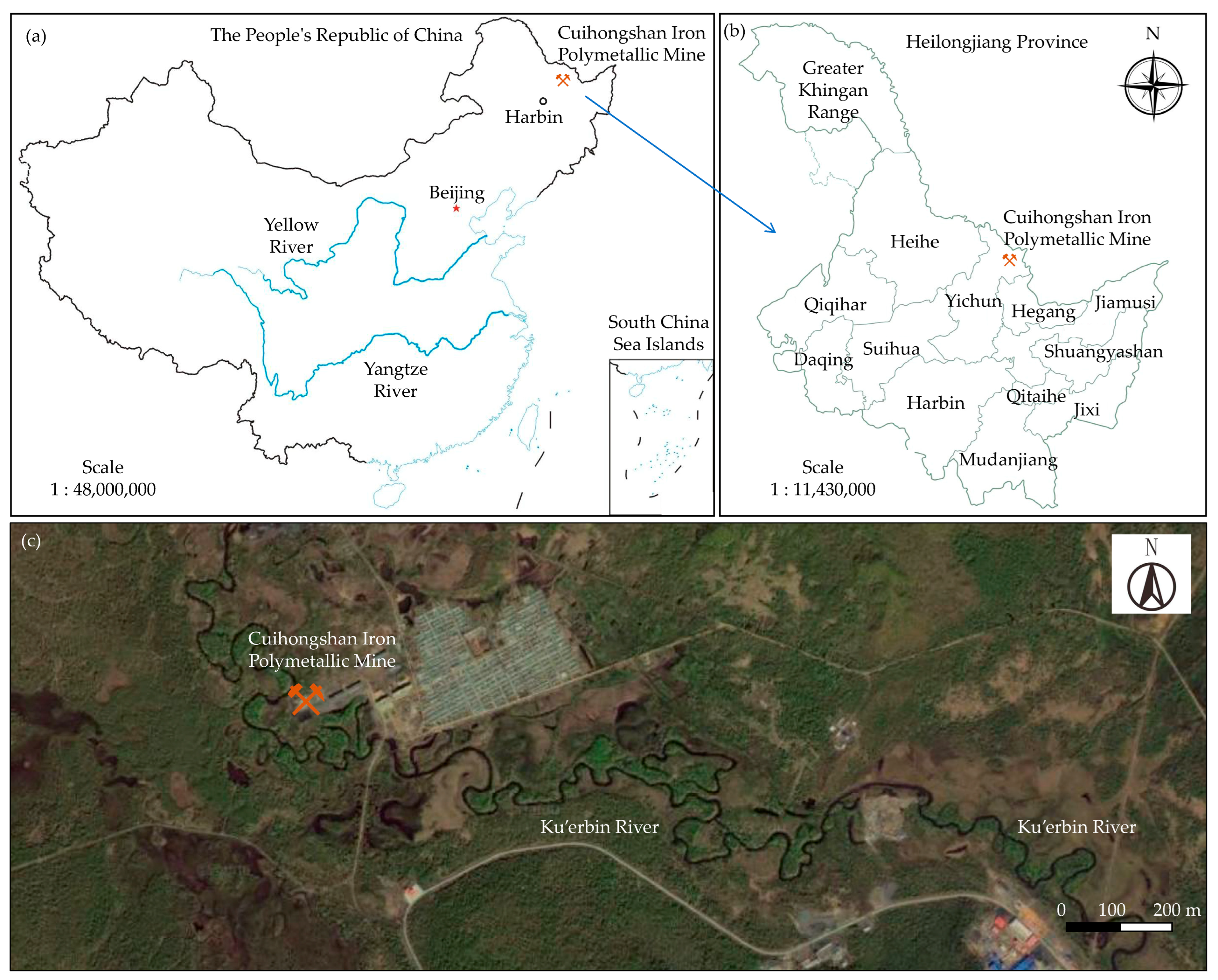
The Cuihongshan Iron-Polymetallic Mine is located in Xunke County, Heilongjiang Province, approximately 240 km southeast of Heihe City and about 80 km north of Yichun City (Figure 1). Geotectonically, the area lies in the eastern part of the Xing’an–Inner Mongolia Geosynclinal Fold Zone. The exposed strata in the mining area include the Lower Cambrian Qianshan Formation (∈1q) and Quaternary (Q4) unconsolidated sandy gravel layers. Based on borehole data, the investigated area is primarily composed of backfill debris and Quaternary (Q4) unconsolidated sand and gravel layers. The underlying bedrock consists of Lower Cambrian Qianshan Formation (∈1q) limestone, with the maximum drilled depth reaching 185 m (elevation +250 m) in this investigation.
Figure 1. Situation of the study area. (a) Map of China (b) Map of Heilongjiang Province (c) Location of the metal mine.
(2)
Magmatic rocks
The mining area exhibits intense magmatic activity, with granites covering approximately 80% of the region. The rock mass, controlled by nearly north–south and east–west trending fault systems, forms stock-like intrusions. Exposed in a nearly north–south orientation, these intrusions cover an area of about 2.0 km2 within the mine. The predominant rock type is alaskite, which transitions into plagiogranite, granite, monzogranite, and syenogranite.
(3)
Geological Structure
The mining area is situated within an NNW-trending structural belt formed by conjugate NNE- and NWW-trending fault systems. The development of fault structures exerts fundamental control over the distribution, scale, morphology, occurrence, and enrichment patterns of the ore bodies. Thick, lens-shaped ore bodies have formed at the intersections of these two fault systems, which also represent zones of relatively well-developed karst features.

2.1.2. Hydrogeological Conditions

Based on the lithology, geological structure, burial conditions, and hydrogeological properties of the strata in the mining area, the aquifers are classified into four main types: the porous aquifer in unconsolidated layers, the weathered fissure aquifer, the karst fissure aquifer, and the structural fissure aquifer. In the vicinity of the Ku’erbin River, the fluctuation trend of the unconfined groundwater level in the Quaternary Holocene porous aquifer closely follows that of the river level, indicating a close hydraulic connection and a complementary relationship between the two. Under mining-induced conditions, dewatering of the mine pit has led to the formation of a local depression cone, resulting in ground subsidence and even collapse in some areas. Consequently, surface water, Quaternary groundwater, and karst fissure water have become interconnected, entering the mine pit through limestone karst conduits and karst fissures.
In the area adjacent to the Ku’erbin River, karst conduits and fissures serve as the primary channels for water inflow into the deposit, with the overlying Quaternary aquifer being the main source of this inflow, while surface water acts as an indirect source. Abandoned goafs (or karst cavities) provide storage space for groundwater and surface water. Karst collapse, particularly goaf collapse, further intensifies the hydraulic connection between Quaternary groundwater and mine water, increasing the risk of water inrush. Consequently, abandoned goafs and karst conduits (or structurally controlled water-conducting zones) represent significant potential hazards for mine water inrush.

2.1.3. Case of the Accident

Unfilled and poorly documented goafs were identified above the +250 m level of the mining area. On 17 May 2019, a water inrush event accompanied by roof collapse occurred in an abandoned goaf on the northwest side of the +310 m level. Within 22 h, the total volume of water and sediment inrush reached 300,000 m3, resulting in the flooding of several mine roadways. A subsidence crater approximately 80 m in diameter and 30 m deep formed directly above the goaf, which became filled with water.
Post-accident analysis indicates that within the exploration near the Ku’erbin River, the mining area contains a thick and highly permeable Quaternary sandy gravel cobble layer. The Quaternary aquifer exhibits a close hydraulic connection with the Ku’erbin River. Beneath this layer lies a highly water-rich limestone stratum with well-developed karst features. Some of the identified ore bodies are hosted within this limestone formation, which also contains unmapped, abandoned goafs.

2.2. Grout Curtain Design

Based on the hydrogeological and geotechnical conditions of the mining area, the karst conduits and fissures within the limestone formation in the Ku’erbin River area serve as the main channels for water inflow into the deposit. The overlying Quaternary aquifer is the primary water source, while the Ku’erbin River acts as a secondary source. Given that the main water-conducting pathways are surrounded by relatively impermeable granite, constructing a horizontal grout curtain in the underlying karst-fissured aquifer—to intercept or significantly reduce the hydraulic connection between Quaternary water and limestone groundwater—represents an effective measure for mitigating water hazards in the mine.
The roof of the Mine No. 1 ore body consists of crystalline limestone, which forms a triangular area on the plan and has been identified as the target zone for horizontal grout curtain treatment. This region is characterized by dolomitic crystalline limestone with well-developed karst features, all of which are of the concealed type. Boreholes have revealed karst cavities with a maximum diameter of 2.75 m, though most are less than 0.6 m. These cavities are partially filled with residual dissolution products within a siliceous framework.
To the west of the limestone area, weakly water-bearing ore bodies, sandy slate, argillaceous slate, and siltstone form a natural hydraulic barrier, serving as the western boundary of the curtain. To the east and north, the granite exhibits low water abundance and acts as a relatively impermeable layer, defining the eastern and northern boundaries of the curtain. The thickness of the Quaternary overburden gradually increases from south to north. The Quaternary cover is only 7–10 m thick and consists mainly of weakly permeable clayey gravel, which can be regarded as a relatively impermeable layer. Therefore, this area has been selected as the southern boundary of the treatment area. The total coverage of the horizontal grout curtain measures 110,451.82 m2.
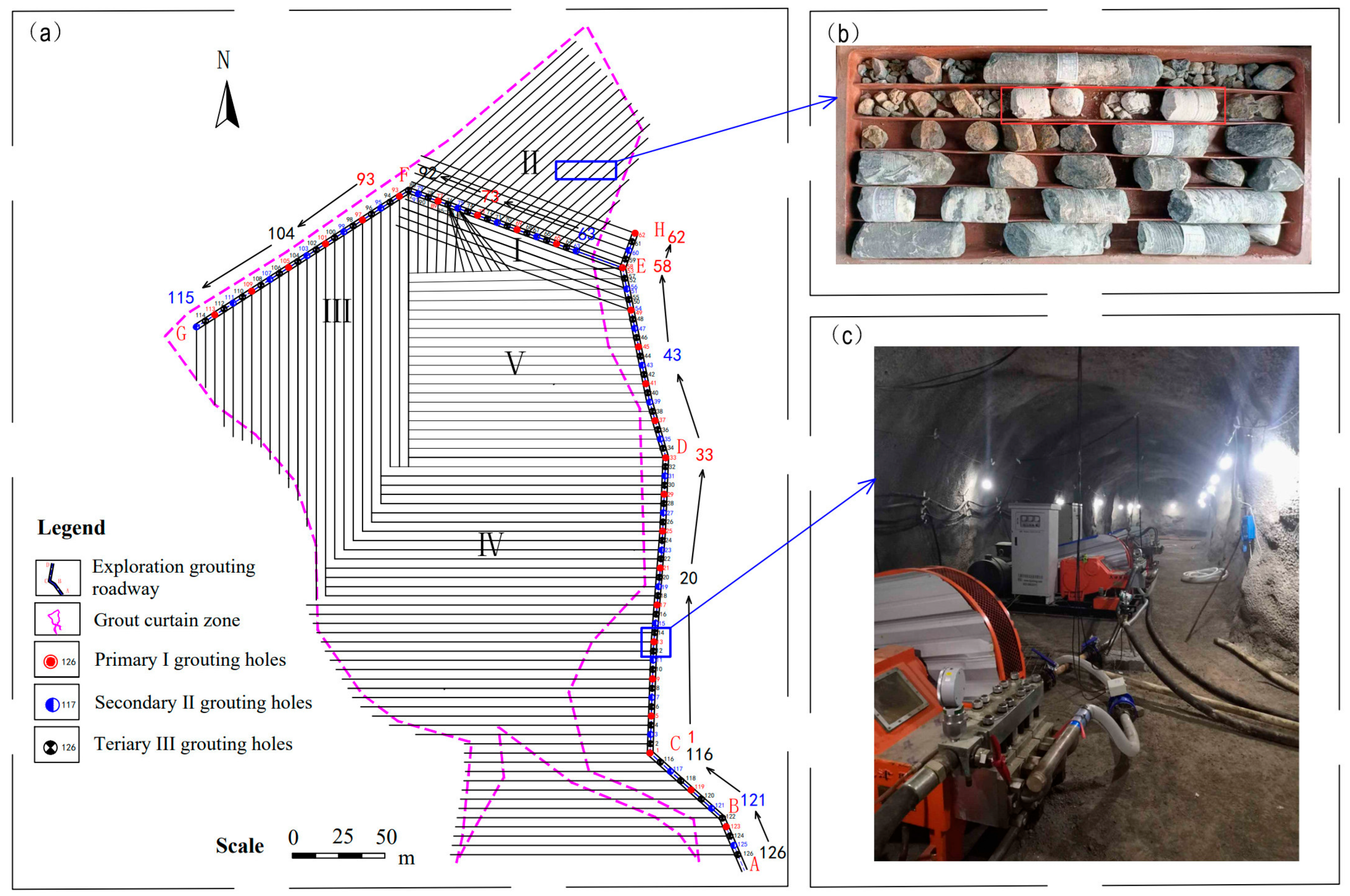
“Exploration Specification of Hydrogeology and Engineering Geology in Mining Areas” (GB/T 12719-2021) [48], “Safety Technical Specifications for Water Prevention and Control in Metal and Nonmetal Underground Mines” (AQ 2061-2018) [49], and “Specification of Mine Curtain Grouting” (DZ/T 0285-2015) [50] were considered in this grout curtain project. Figure 2a shows a schematic plan of the horizontal grouting curtain, including its scope and zoning. Construction was carried out from a dedicated exploration/grouting drift, which served as the working platform. Photographs from rock samples and the underground construction site are provided in Figure 2b,c. Uniaxial compressive strength (UCS) tests were conducted on limestone and skarn samples collected from the treated zone under both dry and saturated conditions. The minimum UCS values of limestone were 12.9 MPa (dry) and 15.04 MPa (saturated), while those of skarn were 18.47 MPa (dry) and 32.79 MPa (saturated). To achieve this objective, a horizontal curtain grouting project was designed and constructed within the limestone strata at the +360 m level, with a vertical thickness of 10 m. This curtain aimed to create an artificial water-blocking barrier to cut off the hydraulic pathways between the upper aquifer and the ore body, thereby reducing the risk of potential water inrush and sand outburst. Based on diffusion calculations, the grout diffusion radius was determined to be 6.2 m. Taking into account both the curtain thickness the grout diffusion radius, and experience from similar projects and to enhance safety and reliability, the final design hole spacing was conservatively set at 5.0 m. Grouting was performed according to the principle of progressive densification, in three sequential stages for each row of boreholes. The primary (I) grouting holes were drilled and grouted first, followed by the secondary (II) grouting holes and finally the tertiary (III) grouting stages holes. Some of the Primary (I) grouting holes also served as exploration holes to gather additional geological data, as illustrated in Figure 2a.
Figure 2. (a) Horizontal grouting curtain scope (b) Photos of rock and grout samples (c) Photos of construction site.

3. Results

As a typical underground concealed engineering project, grouting curtain construction in mines cannot be directly inspected for quality during early stages, making the analysis and evaluation of drilling and grouting data particularly critical during the construction phase. This study analyzes grouting effectiveness based on the grout take per meter for primary, secondary, and tertiary holes using three analytical methods: superposition effect analysis, frequency curve analysis, and unit weight analysis.

3.1. Formation Injectivity Analysis

As summarized in Table 1 and grouting statistics, the total grout volume injected in the test section was 1623.41 m3, with a total cement consumption of 934.48 t. The average grout take per meter for all stages of grouting holes was 1.27 m3/m, and the average cement take per meter was 0.697 t/m. The maximum grout injection occurred in section drill hole zk62 (82.50–94.50 m), with a grout volume of 99.886 m3, corresponding to a grout take of 8.241 m3/m and a cement take of 4.633 t/m. These results indicate significant heterogeneity in the development of karst fissures and considerable variation in formation injectivity. A notable discrepancy exists between the actual grout takes and the design values, which specified a total grout volume of 45,831.98 m3 and an average grout take of 2.77 m3/m. The actual average grout take was only 45.84% of the design value, reflecting weaker formation injectivity than initially anticipated. This can be attributed to the heterogeneous distribution of karst fissures and an overestimation of the karst ratio (1.04%) in the as-built design.
Table 1. Statistics for drilling and grouting of boreholes in the horizontal curtain test section.
Based on the statistical analysis of grouting data from all boreholes in the horizontal curtain, the total grout volume injected into the main curtain was 26,661.17 m3 (including binary slurry), with a total cement consumption of 18,914.62 t. The average grout take per meter for all stages of grouting holes was 1.68 m3/m, and the average cement take per meter was 1.27 t/m. Compared with the test section, both the unit grout take and cement take show a slight increase, which is consistent with the actual conditions of the injected formation.

3.2. Analysis of Grouting Superposition Effect

The grouting superposition effect serves as a key indicator for evaluating the effectiveness of curtain grouting. It manifests as a progressive reduction in grout take in subsequent-stage holes after the voids in the formation have been effectively filled by grout injected from prior-stage holes. A pronounced superposition effect typically indicates the formation of a continuous water-blocking curtain within the formation, representing an important sign of successful grouting. The analysis of grouting effectiveness was conducted by examining the variation patterns in grout take per meter and water permeability per meter across primary, secondary, and tertiary grouting holes (I, II, and III holes), along with the resulting superposition effect.
During the grouting process, when the design pressure is achieved, each grouting hole creates an influence radius around it. With appropriate hole spacing, these individual influence radii overlap, generating a superposition effect. Specifically, grouting in primary holes influences the grout take of secondary and tertiary holes. Subsequently, grouting in secondary holes not only affects the grout take of tertiary holes but also provides a certain compensatory effect on the primary holes. Similarly, grouting in tertiary holes offers some compensatory effect on both primary and secondary holes. Consequently, there is a significant difference in grout consumption among the primary, secondary, and tertiary holes, manifested as the highest grout take in primary holes, followed by secondary holes, and the lowest in tertiary holes.
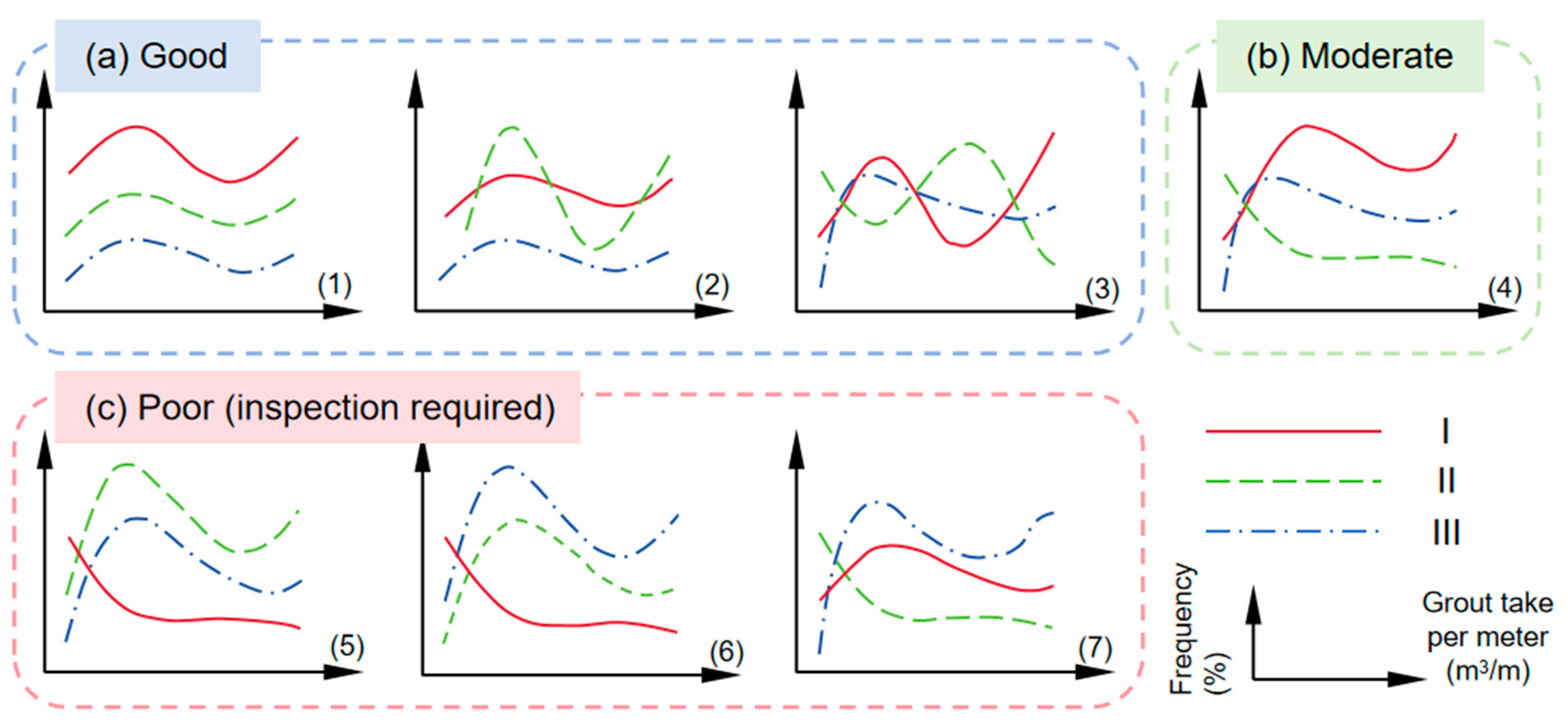
The grout take per meter variation curve is generated by sequentially connecting the grout take values of all grouting holes in the order of primary, secondary, and tertiary stages, forming corresponding continuous curves that reflect the influence of prior-stage holes on subsequent-stage holes, as illustrated in Figure 3. The corresponding grouting effectiveness is summarized in Table 2. To quantitatively analyze the grouting superposition effect in the horizontal curtain of this project, the predetermined hole sequence and construction organization design were strictly followed during the construction process. The statistical results of the cement take per meter for each stage of grouting holes are presented in Table 3.
Figure 3. Grout take per meter variation curve.
Table 2. Quality evaluation conclusions corresponding to curve types.
Table 3. Statistics of Grout Take per Meter for the Horizontal Curtain Test Project.
The average grout take per meter for primary holes reached 1.76 m3/m. This relatively high value initially indicates that the formation in the site area exhibits relatively strong permeability or contains well-developed fractures, leading to a greater initial grouting demand. After the completion of primary hole grouting, the average cement take per meter for secondary holes decreased to 1.06 m3/m, only 60.23% of that of primary holes. This significant declining trend demonstrates that the grout injected from primary holes has effectively sealed some of the seepage pathways, thereby altering the permeability characteristics of the formation. Following the progressive sealing by primary and secondary holes, the cement take per meter for tertiary holes further dropped to 1.00 m3/m, representing only 56.82% of the primary holes and 60.63% of the secondary holes. The grouting superposition effect between primary and secondary holes, secondary and tertiary holes, as well as primary and tertiary holes, is highly evident. With the grout take following the order of primary (I) > secondary (II) > tertiary (III), it corresponds to Type (1), reflecting an ideal grouting effectiveness. This sequentially decreasing pattern clearly illustrates the cumulative superposition process of the grouting effect.

3.3. Frequency Curve Analysis

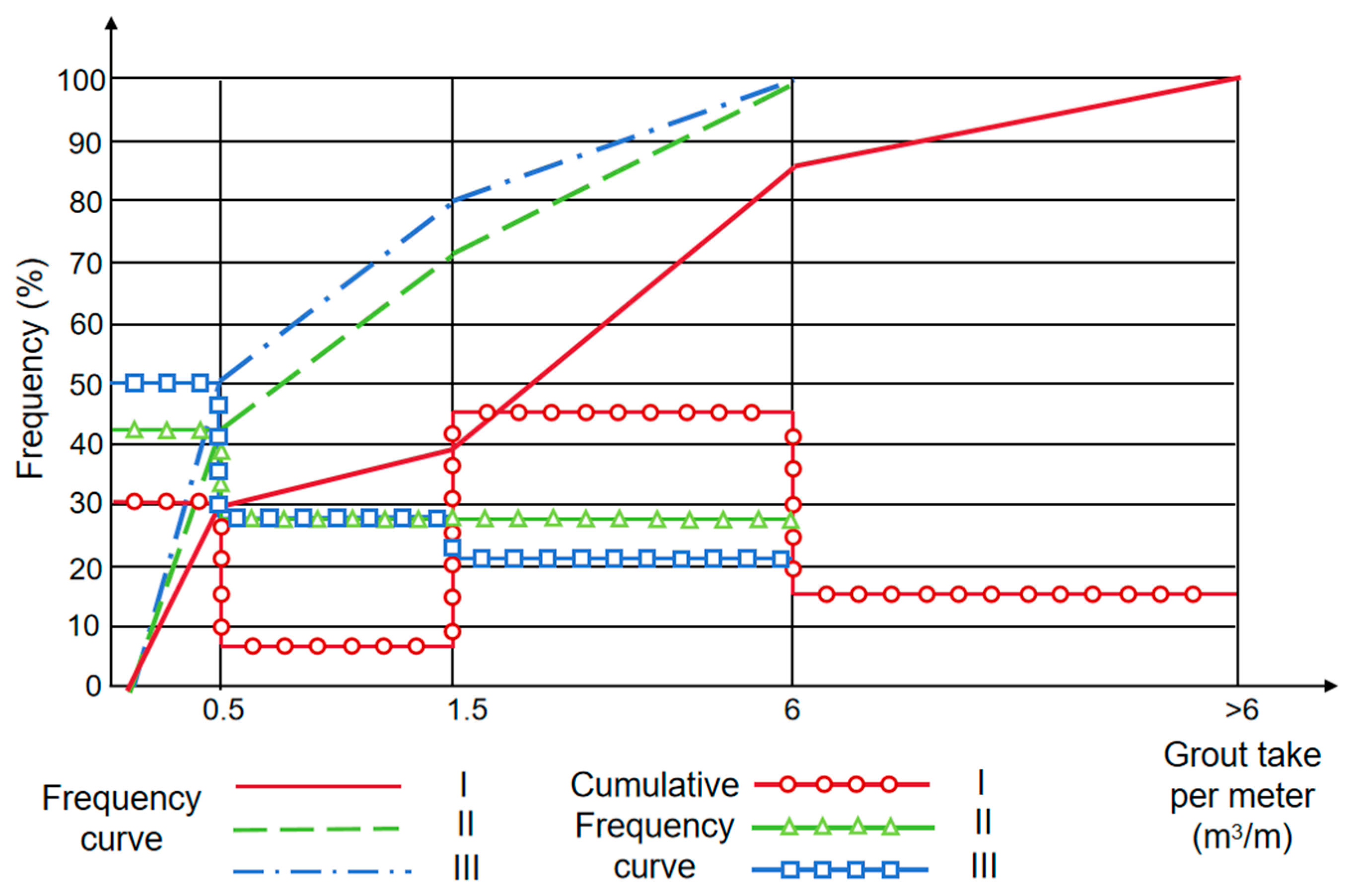
Frequency curve analysis involves categorizing the grout take per meter of grouting segments from different hole sequences into specified data intervals. The grouting effectiveness is then evaluated based on the proportional distribution patterns of these sequences within the intervals. The classification intervals are determined with reference to the recommended grout take values for varying degrees of aquifer fracture development, as stipulated in the “Specification of Mine Curtain Grouting” (DZ/T 0285-2015) [50]. In zones with effective grouting, the frequency curve generally exhibits the following characteristics: in high grout take intervals, the proportion of primary holes exceeds that of secondary holes, which in turn exceeds that of tertiary holes; whereas in low grout take intervals, the proportion of primary holes is lower than that of secondary holes, which is lower than that of tertiary holes.
Based on the grouting results of different hole sequences from the horizontal curtain grouting test project, the frequency curves of grout take per meter for each sequential grouting segment were plotted, as shown in Figure 4, and the interval distribution is presented in Table 4.
Figure 4. Frequency curve of grout take per meter.
Table 4. Statistical table of grout take per meter interval distribution by grouting stage.
As can be seen from Figure 4 and Table 4, in the test project, 46.15% of the grouting segments in primary holes had a grout take per meter between 1.5 and 6.0 m3/m, while 15.38% of segments exceeded 6 m3/m. For secondary holes, 42.86% of the grouting segments had a grout take of less than 0.6 m3/m. In tertiary holes, 50.0% of the segments fell below the 0.6 m3/m threshold. Furthermore, as the hole sequence advances, the proportion of segments with high grout take shows a gradual decreasing trend, whereas the proportion of segments with low grout take exhibits a steady increase.
Through the three-stage grouting process, the grout take per meter in the water-rich aquifer zones within the test project area showed a clear sequential reduction, indicating effective grouting performance. This trend suggests that the borehole spacing was appropriately designed, the grout diffusion range met the design requirements, and the selected grouting parameters were well-suited to the conditions of the injected formation.

3.4. Unit Grout Take Weight Analysis

Building on the grout take per meter curve analysis, the vertical weight analysis method integrating both grout take and permeability was employed to identify potential weak zones in grouting quality, thereby providing a basis for arranging additional inspection holes and geophysical testing.
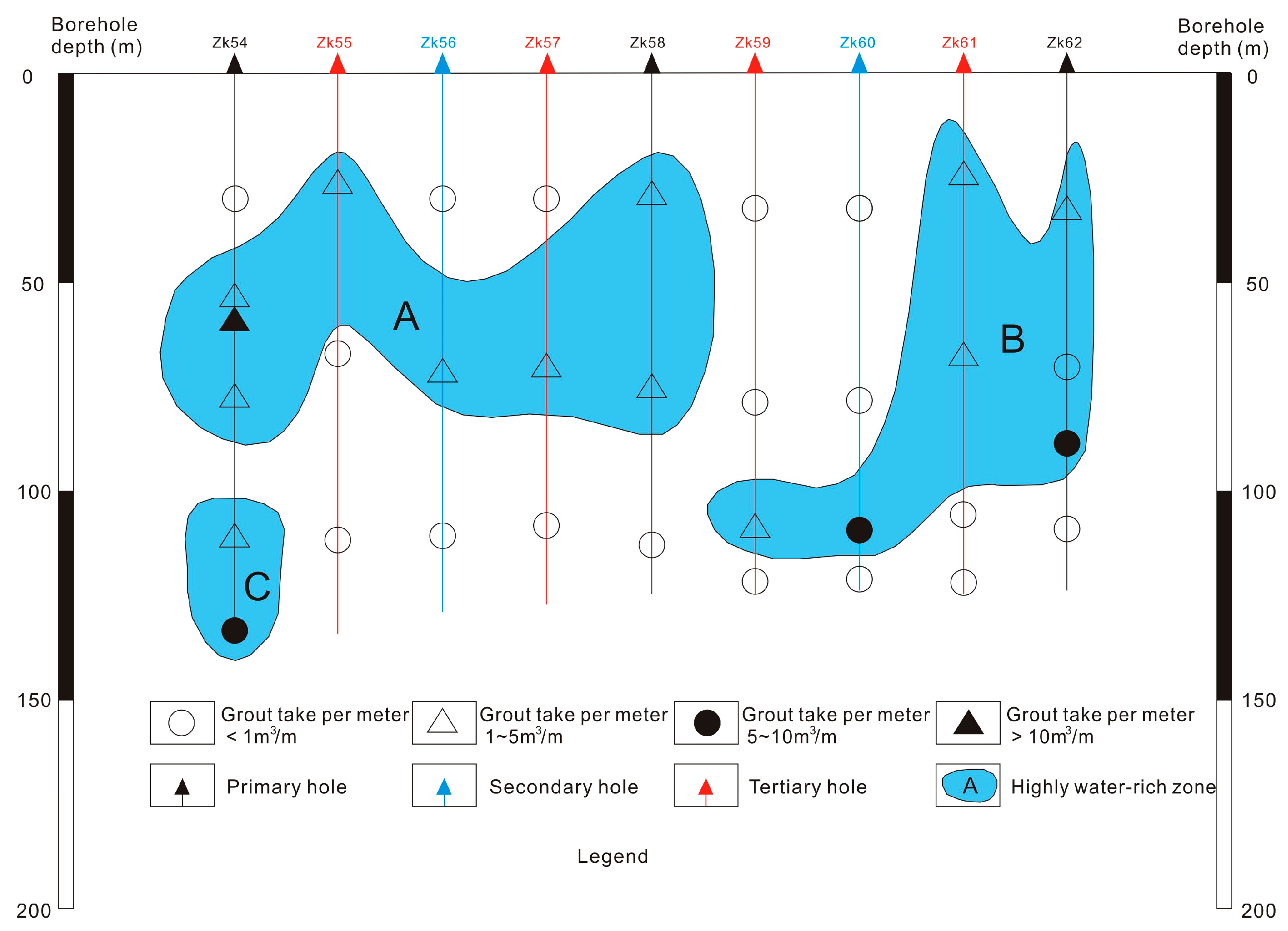
As shown in Figure 5, the grout take in primary and secondary holes across the test section is relatively high and exhibits a complementary distribution. In contrast, the grout take per meter in tertiary holes is significantly reduced compared to the adjacent primary and secondary holes. This indicates that due to factors such as heterogeneous fracture development in the formation, localized deficiencies remained after primary hole grouting. However, through subsequent grouting in secondary and tertiary holes, most fractures within the test section were effectively sealed, resulting in reduced formation permeability and a noticeable decrease in grout absorption. This clearly demonstrates a complementary relationship among the different hole sequences.
Figure 5. Weight distribution of unit grouting volume by hole stage.
Furthermore, inspection hole tests showed that the permeability values for all segments were less than 1 Lu, confirming that the grout diffusion range met the design requirements and that the curtain exhibits good continuity.

3.5. Deformation Monitoring of the Curtain Wall

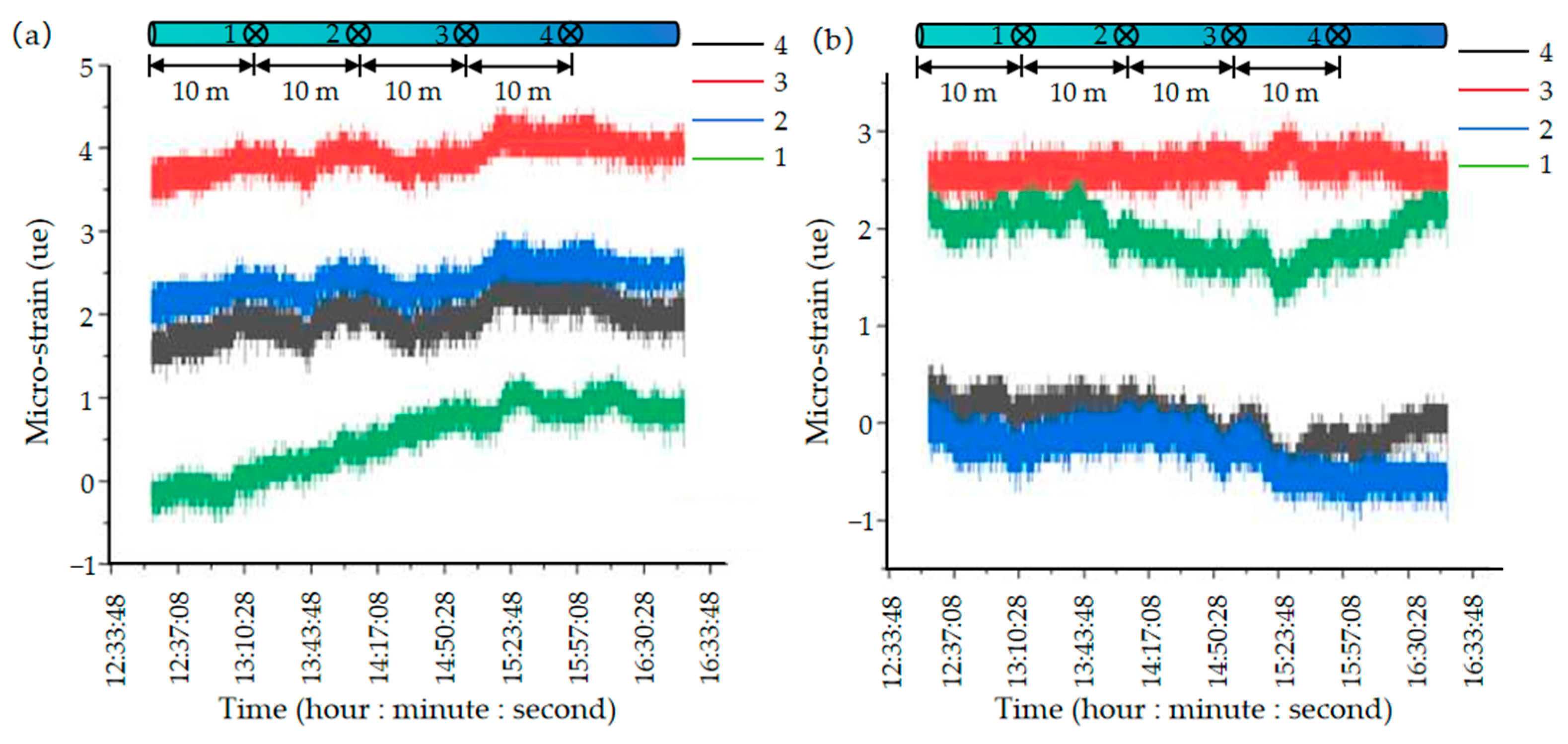
The stable operation of the curtain is crucial for ensuring the safety of underground mining operations. Fiber-optic strain gauges were deployed to dynamically monitor its deformation. A total of 53 fiber Bragg grating (FBG) embeddable strain gauges were installed in 18 uniformly distributed grouting holes after hole cleaning upon completion of grouting. Their performance parameters are as follows: a range of ±1500 µε, a resolution of 0.1% FS, an accuracy of 0.3% FS, and an operating temperature range of −30 to +80 °C.
Based on the analysis of periodic monitoring data, the horizontal curtain is functioning normally, with micro-strain fluctuations remaining within the safe threshold range (Figure 6). This indicates that the curtain structure is secure and stable.
Figure 6. Partial strain gauge curves. (a) No. 70 grouting hole (b) No. 78 grouting hole.

4. Discussion

This study demonstrates that horizontal curtain grouting can effectively sever hydraulic connections between highly water-rich Quaternary aquifers and underlying mine workings, achieving a progressive reduction in grout take from primary to tertiary boreholes (1.76 m3/m → 1.27 m3/m → 0.77 m3/m). These field observations align with the laboratory findings of Xu et al. [25] and Zhang et al. [26], who reported that fracture permeability decreases significantly under high-pressure grouting conditions. However, while previous experimental studies have focused on grout diffusion mechanisms in controlled fracture networks [27,28], our results provide empirical validation at the engineering scale, confirming that the superposition effect observed in laboratory settings translates to actual field conditions.
Compared to conventional dewatering approaches, which Meng et al. [14] and Mei et al. [15] identified as increasingly unsustainable at depth due to exponential drainage volumes and regional groundwater disruption, the curtain grouting method employed here represents a paradigm shift toward active prevention. As Sui [8] advocated, transitioning from reactive drainage to proactive structural control is essential for long-term mining safety. Our multi-method joint analysis framework—integrating superposition effect, frequency curve, and unit weight analyses—offers a practical toolkit for verifying curtain integrity, addressing the challenge of quality assessment in concealed underground engineering noted by Yuan et al. [17].
The significance of this study for mine water hazard control lies in its demonstration that regional curtain grouting enables safe extraction beneath water-rich aquifers without the need for extensive dewatering, thereby preserving critical regional groundwater resources. The multi-method joint analysis framework employed here provides quantifiable quality assurance through a demonstrable cumulative grouting effect, addressing a key challenge for regulatory acceptance in concealed underground engineering. Furthermore, the methodological approach developed in this study can be readily adapted to other deep metal mines facing similar water inrush risks [18,46]. This study thus contributes to the growing body of evidence supporting regional curtain grouting as a sustainable and proactive solution for deep mining operations conducted under complex hydrogeological conditions.
While this study provides a robust, multi-method field evaluation of the horizontal curtain grouting project at the Cuihongshan mine, limitation should be acknowledged. The assessment of grouting effectiveness relies predominantly on phenomenological indicators—such as the progressive reduction in grout take and the results of inspection boreholes—which, although indicative of successful fracture sealing, do not directly reveal the underlying thermo-hydro-mechanical (THM) coupling mechanisms governing grout diffusion and solidification under dynamic water flow conditions. The analysis does not quantitatively account for the time-varying viscosity of the grout, the influence of variable groundwater temperatures, or the dynamic water pressures that were present during the construction process. Future research should therefore focus on developing a coupled THM numerical model calibrated with the field data presented here to simulate the dynamic grouting process. Such an approach would help elucidate the complex interactions between grout flow, temperature, and rock deformation, ultimately providing a more scientific basis for optimizing grouting design in fractured rock masses.

5. Conclusions

Based on comprehensive research into mine hydrogeological and engineering conditions, a subsurface horizontal grouting curtain was successfully implemented for the first time in a domestic metal mine, effectively addressing the issue of water inrush from the overlying highly water-rich aquifer. During the project execution, studies were conducted on horizontal curtain grouting technology and monitoring methods for anti-seepage effectiveness. The main conclusions derived are as follows:
(1)
The horizontal curtain grouting technology has effectively resolved the water inrush issue at the Cuihongshan Mine. Multi-method joint analysis comprehensively verified that the horizontal curtain grouting has achieved remarkable results.
(2)
The grout take per meter for primary, secondary, and tertiary holes showed a significant sequential decreasing trend. This directly demonstrates that the grout from earlier-stage holes has effectively filled and sealed the main fracture channels in the formation, substantially reducing the grouting demand for subsequent holes.
(3)
As the grouting hole sequence advanced, the proportion of segments in the high grout take intervals gradually decreased, while the proportion in the low grout take intervals increased accordingly. The frequency curves statistically confirm that grouting effectiveness improved progressively with the construction process, and the overall permeability of the formation was weakened.
(4)
Spatially, a clear complementary relationship was revealed among the grouting coverage of different hole sequences, indicating that the grout diffusion radii overlapped with one another, forming a continuous and complete water-blocking curtain. This ensures that the overall anti-seepage performance of the curtain meets the design requirements.

Author Contributions

Conceptualization, writing—original draft preparation, Z.W. and D.L.; methodology, X.X.; validation, G.H. and S.Y.; formal analysis, data curation, Z.W. and S.Y.; supervision, S.Y.; project administration, G.H. and X.G. All authors have read and agreed to the published version of the manuscript.

Funding

This study was supported by the Foundation of the Science Research Project of Hebei Education Department (No. BJ2025131).

Data Availability Statement

The original contributions presented in this study are included in the article. Further inquiries can be directed to the corresponding authors.

Conflicts of Interest

Zhiqi Wang, Dajin Liu, Xiaofeng Xue, Guilei Han and Xuetong Gao were employed by North China Engineering Investigation Institute Co., Ltd. The remaining authors declare no conflicts of interest.

References

  1. Yang, Z.; Li, Y.; Xie, S. Water hazards prevention and control technology of non-coal mines under the new safety situation and development trend. China Min. Mag. 2025, 34, 298–307. [Google Scholar]
  2. Guo, S.; Wang, H. Research on hydrogeological structural characteristics and water hazard control mode of Ningtiaota Coal Mine. China Min. Mag. 2024, 33, 190–200. [Google Scholar]
  3. Liu, J.; Wu, G.; Liu, Z. Numerical study on fracture evolution and slurry diffusion laws of multistage large-diameter drilling boreholes. China Min. Mag. 2025, 34, 174–182. [Google Scholar]
  4. He, M.C.; Wang, Q.; Wu, Q.Y. Innovation and future of mining rock mechanics. J. Rock Mech. Geotech. Eng. 2021, 13, 1–21. [Google Scholar] [CrossRef]
  5. Gao, H.; Xie, H.P.; Zhang, Z.T.; Lu, J.; Zhang, D.M.; Zhang, R.; Wu, M.Y. True triaxial energy evolution characteristics and failure mechanism of deep rock subjected to mining-induced stress. Int. J. Rock Mech. Min. Sci. 2024, 176, 105724. [Google Scholar] [CrossRef]
  6. Xie, S.; Xu, L.; Yi, W. Exploration and control of tailings leakage in a tailings reservoir in karst area. China Min. Mag. 2024, 33, 101–108. [Google Scholar]
  7. Wang, D.D.; Sui, W.H.; Ranville, J.F. Hazard identification and risk assessment of groundwater inrush from a coal mine: A review. Bull. Eng. Geol. Environ. 2022, 81, 421. [Google Scholar] [CrossRef]
  8. Sui, W.H. Active prevention and control of water-sand mixture inrush with high potential energy due to mining based on structural hydrogeology. J. Eng. Geol. 2022, 30, 101–109, (In Chinese with English abstract). [Google Scholar]
  9. Chen, Y.; Sun, B.; Xu, M.; Li, D.; Hu, Y.; Xu, C.; Cui, Y.; Yuan, S. Design and implementation of an escape route planning system for deep mine water inrush based on graph structure. China Min. Mag. 2025, 34, 126–136. [Google Scholar]
  10. Ren, H.J.; Zhang, M.; Li, X.B.; Wang, H.; Yu, J.F.; Zhou, C. Managing acidic mine water pollution in karst regions based on hydrogeological structures. Results Eng. 2024, 24, 103399. [Google Scholar] [CrossRef]
  11. Huang, G.; Zhou, G.; Sun, B. Treatment of water inrush in distribution chamber at 430 m middle level of Yiliang Maoping Lead Zinc Mine. China Min. Mag. 2025, 34, 237–245. [Google Scholar]
  12. Kai, Z.; Zhang, B.; Liu, J.; Ma, D.; Bai, H. Experiment on Seepage Property and Sand Inrush Criterion for Granular Rock Mass. Geofluids 2017, 2017, 9352618. [Google Scholar] [CrossRef]
  13. Zhang, G.; Wang, H.; Yan, S.; Jia, C.; Song, X. Simulated Experiment of Water-Sand Inrush across Overlying Strata Fissures Caused by Mining. Geofluids 2020, 1, 6614213. [Google Scholar] [CrossRef]
  14. Meng, S.H.; Wu, Q.; Zeng, Y.F.; Mei, A.S.; Yang, G.Q.; Hua, Z.L.; Yang, L.; Zhang, Y. Evaluating the impact of coal seam roof groundwater using variable weights theory: A special emphasis on skylight-type water inrush pattern. J. Hydrol. Reg. Stud. 2024, 56, 102009. [Google Scholar] [CrossRef]
  15. Mei, A.S.; Wu, X.; Zeng, Y.F.; Zhu, G.; Zhao, D.; Zhang, Y.Z. Formation processes of groundwater in a non-ferrous metal mining city of China: Insights from hydrochemical and strontium isotope analyses. Environ. Sci. Pollut. Res. 2024, 31, 15716–15732. [Google Scholar] [CrossRef]
  16. Li, Q.; Sui, W.H.; Sun, B.T.; Li, D.L.; Yu, S.B. Application of TOPSIS water abundance comprehensive evaluation method for karst aquifers in a lead zinc mine, China. Earth Sci. Inform. 2022, 15, 397–411. [Google Scholar] [CrossRef]
  17. Yuan, S.C.; Zhang, A.W.; Li, D.L. Using grout curtain to cut-off regional groundwater in Maoping lead-zinc mine, SW China. In Proceedings of the Engineering Geology for a Habitable Earth: IAEG XIV Congress 2023, Chengdu, China, 23 September 2023; Springer: Singapore, 2024. [Google Scholar] [CrossRef]
  18. Ren, Z.; Lian, H.; Yin, S.; Xia, X.; Li, Q.; Zhang, Q.; Huang, Y.; Kang, J.; Zhang, Y.; Geng, A. Risk assessment of water inrush from coal seam floor based on the FAHP-TOPSIS model. China Min. Mag. 2025, 34, 145–153. [Google Scholar]
  19. Shaikh, M.; Kyokawa, H.; Maqsood, Z.; Ahsan, K.M.; Koseki, J. Mechanical behaviour and loading rate dependency of gypsum-mixed fine-grained soils. Proc. Inst. Civ. Eng.-Geotech. Eng. 2021, 176, 166–177. [Google Scholar] [CrossRef]
  20. Lin, W.; Liu a Mao, W.; Maqsood, Z.; Koseki, J. Micromechanical Behavior of Granular Soils Characterized by Acoustic Emission. Lithosphere 2021, 3, 4061808. [Google Scholar] [CrossRef]
  21. Maqsood, Z.; Koseki, J.; Ahsan, K.M.; Shaikh, M.; Kyokawa, H. Experimental study on hardening characteristics and loading rate dependent mechanical behaviour of gypsum mixed sand. Constr. Build. Mater. 2020, 262, 119992. [Google Scholar] [CrossRef]
  22. Li, S.; Liu, R.; Zhang, Q.; Zhang, X. Protection against water or mud inrush in tunnels by grouting: A review. J. Rock Mech. Geotech. Eng. 2016, 8, 753–766. [Google Scholar] [CrossRef]
  23. Wang, L.; Li, K.; Zhang, J.; Fu, P.; Zhao, W. Paste slurry planar fracture dynamic water grouting diffusion model research. Chin. J. Rock Mech. Eng. 2019, 38, 3404–3411, (In Chinese with English abstract). [Google Scholar]
  24. Zhang, D.; Xie, C.; Cui, J. Coupled thermal-hydro-mechanical effect on cement slurry grouting propagation in a single fracture with flowing water. In Proceedings of the Engineering Geology for a Habitable Earth: IAEG XIV Congress 2023, Chengdu, China, 23 September 2023; Springer: Singapore, 2024. [Google Scholar] [CrossRef]
  25. Xu, Z.; Liu, C.; Zhou, X.; Gao, G.; Feng, X. Full-scale physical modelling of fissure grouting in deep underground rocks. Tunn. Undergr. Space Technol. 2019, 89, 249–261. [Google Scholar] [CrossRef]
  26. Zhang, E.; Xu, Y.; Fei, Y.; Shen, X.; Zhao, L.; Huang, L. Influence of the dominant fracture and slurry viscosity on the slurry diffusion law in fractured aquifers. Int. J. Rock Mech. Min. Sci. 2021, 141, 104731. [Google Scholar] [CrossRef]
  27. Xu, Z.; Wang, Y.; Cao, C.; Chai, J. Experimental study on flow water diffusion of cement-sodium silicate grouting in rough fracture model. KSCE J. Civ. Eng. 2023, 27, 1955–1965. [Google Scholar] [CrossRef]
  28. Liu, Y.; Wu, Z.; Weng, L.; Wu, L.; Xu, X.; Liu, Q. Experimental study on the grouting diffusion process in fractured sandstone with flowing water based on the low-field nuclear magnetic resonance technique. Rock Mech. Rock Eng. 2023, 56, 7509–7533. [Google Scholar] [CrossRef]
  29. Zhou, Y.; Liu, B.; Wu, Z.; Jiang, Y.; Liu, Q.; Weng, L.; Li, M. Experimental Investigation on the Grouting Diffusion Characteristics and Relative Filling Degree of Chemical Slurry in Fractured Porous Sandstone. Rock Mech. Rock Eng. 2023, 56, 7819–7837. [Google Scholar] [CrossRef]
  30. Dalmalm, T. Grouting Prediction Systems for Hard Rock-Based on Active Design; Division of Soil and Rock Mechanics, Royal Institute of Technology: Stockholm, Sweden, 2001. [Google Scholar]
  31. Dalmalm, T. Choice of Grouting Method for Jointed Hard Rock Based on Sealing Time Predictions. Ph.D. Thesis, Byggvetenskap, Stockholm, Sweden, 2004. [Google Scholar]
  32. Aoki, K.; Mito, Y.; Yamamoto, T.; Wakita, S. Evaluation of dynamic grouting effect for Low-permeable rock. In Proceedings of the 10th ISRM Congress, Sandton, South Africa, 8 September 2003. [Google Scholar]
  33. Ghafar, A.N.; Mentesidis, A.; Draganovic, A.; Larsson, S. An experimental approach to the development of dynamic pressure to improve grout spread. Rock Mech. Rock Eng. 2016, 49, 3709–3721. [Google Scholar] [CrossRef]
  34. Lavrov, A. Flow of non-newtonian fluids in single fractures and fracture networks: Current status, challenges, and knowledge gaps. Eng. Geol. 2023, 321, 107166. [Google Scholar] [CrossRef]
  35. Xu, Z.H.; Bu, Z.H.; Pan, D.D.; Li, D.Y.; Zhang, Y.C. A novel numerical method for grouting simulation in flowing water considering uneven spatial and temporal distribution of slurry: Two-Fluid Tracking (TFT) method. Comput. Geotech. 2022, 147, 104756. [Google Scholar] [CrossRef]
  36. Zou, L.; Håkansson, U.; Cvetkovic, V. Yield-power-law fluid propagation in water-saturated fracture networks with application to rock grouting. Tunn. Undergr. Space Technol. 2020, 95, 103170. [Google Scholar] [CrossRef]
  37. Yuan, S.C.; Han, G.L. Combined drilling methods to install grout curtains in a deep underground mine: A case study in Southwest China. Mine Water Environ. 2020, 39, 902–909. [Google Scholar] [CrossRef]
  38. Chen, W.C.; Li, W.P.; He, J.H.; Qiao, W.; Wang, Q.Q.; Yang, Y.R. Impact of mining-induced bed separation spaces on a cretaceous aquifer: A case study of the Yingpanhao coal mine, Ordos Basin, China. Hydrogeol. J. 2022, 30, 691–706. [Google Scholar] [CrossRef]
  39. Yang, B.B.; Sui, W.H.; Duan, L.H. Risk assessment of water inrush in an underground coal mine based on GIS and fuzzy set theory. Mine Water Environ. 2017, 36, 617–627. [Google Scholar] [CrossRef]
  40. Guo, Y.; Gui, H.R.; Wei, J.C.; Zhang, Z.; Hu, M.C.; Fang, P.; Li, G.P.; Gao, C.; Wang, X. Hydrogeochemistry of water in coal measures during grouting treatment of Taoyuan Mine, China. Groundwater 2021, 59, 256–265. [Google Scholar] [CrossRef]
  41. Wang, H. The influence of a loose layer water cut-off curtain on the slope stability of open-pit coal mines. Mine Water Environ. 2024, 43, 529–539. [Google Scholar] [CrossRef]
  42. Jones, B.R.; Van, R.J.L.; Mouton, D.J. Verifying the ground treatment as proposed by the Secondary Permeability Index during dam foundation grouting. Bull. Eng. Geol. Environ. 2019, 78, 1305–1326. [Google Scholar] [CrossRef]
  43. Wang, H.B.; Yu, Y.C.; Zhang, P.Y.; Yang, C.Y.; Wen, H.; Zhang, F.S.; Du, S.L. Study on the diffusion mechanism of infiltration grouting in fault fracture zone considering the time-varying characteristics of slurry viscosity under seawater environment. Int. J. Concr. Struct. Mater. 2024, 18, 65. [Google Scholar] [CrossRef]
  44. Shi, W.H.; Yang, T.H.; Liu, H.L.; Yang, B. Numerical modeling of Non-Darcy flow behavior of groundwater outburst through fault using the Forchheimer equation. J. Hydrol. Eng. 2018, 23, 04017062. [Google Scholar] [CrossRef]
  45. Yuan, S.C.; Han, G.L.; Liu, D.J.; Zhang, A.W. Multicriteria risk assessment of water inrush in underground mines with large-scale curtain grouting: A mine disaster risk reduction strategy. Geomat. Nat. Hazards Risk 2024, 15, 2409200. [Google Scholar] [CrossRef]
  46. Lou, Q.N.; Shi, B.; Han, H.M.; Zhu, H.H.; Wei, G.Q.; Zhang, K. Research on mine curtain strain curve features for its grouting defects identification with ultra-weak fiber Bragg grating. Measurement 2025, 244, 116507. [Google Scholar] [CrossRef]
  47. Zhang, D.; Liu, D. The effect of thermal-hydro-mechanical coupling on grouting in a single fracture under coalmine flowing water conditions. Deep Undergr. Sci. Eng. 2025, 4, 264–277. [Google Scholar] [CrossRef]
  48. GB/T 12719-2021; Exploration Specification of Hydrogeology and Engineering Geology in Mining Areas. State Administration for Market Regulation/Standardization Administration of China: Beijing, China, 2021.
  49. AQ 2061-2018; Safety Technical Specifications for Water Prevention and Control in Metal and Nonmetal Underground Mines. Ministry of Emergency Management of the People’s Republic of China: Beijing, China, 2018.
  50. DZ/T 0285-2015; Specification of Mine Curtain Grouting. Ministry of Land and Resources of the People’s Republic of China: Beijing, China, 2015.
Disclaimer/Publisher’s Note: The statements, opinions and data contained in all publications are solely those of the individual author(s) and contributor(s) and not of MDPI and/or the editor(s). MDPI and/or the editor(s) disclaim responsibility for any injury to people or property resulting from any ideas, methods, instructions or products referred to in the content.

Article Metrics

Citations

Article Access Statistics

Multiple requests from the same IP address are counted as one view.