


Abstract
This study evaluates the efficiency of several urban wastewater treatment configurations in reducing suspended solids (TSSs) and organic pollutants (BOD5 and COD) under Montenegrin conditions. The systems tested include combinations of primary treatment and vertical-flow constructed wetlands (VFCWs) in three different configurations (VFCW1–VFCW3), with and without the addition of low doses of effective microorganisms (EMs). The results show that the inclusion of EMs significantly improves pollutant removal efficiency and system stability. Suspended solid removal reached over 90%, while organic matter removal was also high. Among the evaluated systems, those integrating microorganisms and optimized substrates required the smallest land area to achieve high treatment performance, with some configurations reducing land demand by over 70% compared to traditional systems. Under Montenegrin climatic conditions, the smallest required wetland area to achieve 95% BOD5 removal was only 1.07 m2/PE in the PT-EM-VFCW3 system (primary treatment + effective microorganisms + vertical-flow constructed wetland configuration 3), which is comparable to or even more favorable than the best values reported in the literature. These findings suggest that enhanced wetland systems offer a sustainable and space-efficient solution for municipal wastewater treatment in areas with land constraints, such as Montenegro. Beyond treatment performance, the results highlight land-use reduction as the dominant economic benefit of the proposed configurations, while the integration of effective microorganisms provides additional operational flexibility under seasonal and variable loading conditions.
1. Introduction
Sustainable wastewater management represents one of the major environmental and infrastructural challenges of modern societies. Accelerated urbanization, population growth, and industrial development have significantly increased the pressure on conventional wastewater treatment systems, emphasizing the need for cost-effective, energy-efficient, and environmentally sustainable treatment solutions. Despite continuous technological advancements, centralized wastewater treatment approaches are often associated with high operational costs, considerable energy demand, extensive land requirements, and environmental impacts, which limit their applicability, particularly in decentralized and small-scale systems.
Nature-based solutions (NBSs) have emerged as a viable alternative, encompassing both natural and engineered systems that enhance physical, chemical, and biological processes involved in wastewater treatment [1]. Among these solutions, constructed wetlands (CWs) represent a well-established and widely implemented technology, particularly effective for organic matter removal. The use of wetland vegetation for wastewater treatment was pioneered by Käthe Seidel in Germany during the 1950s, while the first large-scale applications were implemented in the late 1960s [2,3]. Originally developed as pretreatment units, vertical-flow constructed wetlands (VFCWs) have evolved into second-generation systems capable of achieving high treatment efficiencies.
Compared to conventional wastewater treatment technologies, CWs offer several advantages for urban wastewater treatment, including low construction and operational costs, simple design, low energy consumption, and minimal maintenance requirements [4,5,6,7,8]. These systems primarily rely on natural treatment mechanisms and can often be constructed using locally available materials, contributing to their economic and environmental sustainability. However, their widespread application is limited by high land requirements, particularly in densely populated urban areas [9,10,11].
Both vertical-flow (VF) and horizontal-flow (HF) constructed wetlands have demonstrated effective removal of key pollutants, including biochemical oxygen demand (BOD5), chemical oxygen demand (COD), total suspended solids (TSSs), total nitrogen (TN), total phosphorus (TP), and ammonium nitrogen (NH4+). Nevertheless, VF systems generally outperform HF systems, achieving average removal efficiencies of approximately 77% compared to 68% for HF configurations [12]. Overall, CWs typically exhibit removal efficiencies ranging from 70% to 83% for BOD5, TN, TSS, and TP [12]. Despite these advantages, long-term operational challenges such as clogging of granular media and solid accumulation remain critical issues affecting system performance and sustainability [12].
To overcome these limitations, recent studies have focused on process intensification strategies aimed at improving treatment efficiency and reducing the spatial footprint of CW systems. Effluent recirculation and artificial aeration have been shown to significantly enhance pollutant removal and system stability [13,14,15,16,17,18,19,20,21,22]. However, these approaches often increase system complexity, energy consumption, and operational costs, which may reduce their suitability for low-resource and decentralized applications.
In parallel, the application of effective microorganisms (EMs), consisting of beneficial aerobic and anaerobic microbial consortia, has gained attention as a low-cost and environmentally friendly enhancement technology. Dominant microbial phyla in CW systems include Proteobacteria, Bacteroidetes, Actinobacteria, and Firmicutes [23]. Previous studies have demonstrated that EM application can significantly improve organic matter removal. For instance, Monica et al. [24] reported reductions of up to 85% for BOD5 and 82% for COD during aerobic municipal wastewater treatment (sewage water was collected) using 3 mL/L EM solution after three days of treatment. Additional laboratory and field investigations have confirmed improvements in COD and TSS removal, treatment stability, and microbial activity following EM application [25,26,27,28].
The integration of CWs and EM technology therefore represents a synergistic approach with the potential to enhance treatment efficiency while reducing land requirements and operational constraints. This approach is particularly relevant for regions such as the Western Balkans, including Montenegro, where land availability and financial resources are limited. Regional studies conducted on vertical-flow constructed wetlands (VFCWs) have demonstrated that treatment performance can vary by up to 20% depending on substrate selection and primary treatment efficiency [29], while optimized VF configurations achieved removal efficiencies exceeding 89% for COD, 93% for BOD5, and 91% for TSS [30].
Design guidelines for CW sizing vary considerably depending on climate and regulatory frameworks [4,31,32,33,34,35]. Recommended surface areas for vertical-flow CWs range from 3.2 m2/PE in Denmark [34] to 4 m2/PE according to German standards [35], while reported values across Europe vary from 1.53 m2/PE in Italy to 5 m2/PE in Austria [36], underscoring the importance of localized system optimization.
Therefore, the present study investigates the combined application of primary treatment systems, vertical-flow constructed wetlands with different substrate configurations, and low-dose effective microorganisms for the treatment of urban wastewater. The primary objectives are to evaluate their impact on TSS, COD, and BOD5 removal efficiency, assess the statistical reliability of observed improvements, and examine the potential for reducing the required surface area of constructed wetland systems. The results aim to contribute to the development of sustainable, spatially efficient, and economically viable wastewater treatment solutions suitable for decentralized applications.
In constructed wetlands (CWs), the substrate plays a central role not only as a physical filter but also as a reactive medium that determines hydraulic performance, oxygen transfer, and the availability of sorption sites for pollutants [21,32]. Substrate properties such as grain size distribution, porosity, surface area, and mineral composition strongly influence the removal of suspended solids and organic matter, as well as nutrient retention [31,32]. Moreover, substrates represent the main support matrix for biofilm development, enabling the establishment of diverse microbial communities responsible for key biogeochemical processes [23,32]. Microorganisms are essential for the degradation of organic pollutants and nutrient transformation pathways, and their activity can be further enhanced through microbial enrichment approaches such as effective microorganisms (EMs) [23].
Therefore, the present study investigates the combined application of primary treatment systems, vertical-flow constructed wetlands with different substrate configurations, and low-dose effective microorganisms for the treatment of urban wastewater.
Subject and Goal of Research
The aim of this research is to improve the efficiency of wastewater treatment by evaluating the impact of adding effective microorganisms (EMs) during the primary treatment phase on the performance of secondary constructed wetland (CW) systems, as well as to explore the potential for reducing the land area required for the construction of these systems. The focus is on determining whether EMs can enhance the degradation of pollutants and thereby reduce the load on secondary treatment, and whether optimizing the combination of treatment and substrate can lead to a reduction in spatial requirements, which is particularly important for the application of CW systems in urban and spatially limited environments such as Montenegro.
Considering the general goal, the specific objectives are as follows:
- To evaluate the efficiency of existing primary treatment methods at the Podgorica wastewater treatment plant, including the removal of coarse and fine materials, inert substances in aerated sand traps, and sedimentation of suspended solids, in combination with three different substrate types in constructed wetland (CW) systems.
- To investigate the impact of integrating effective microorganisms (EMs) into the primary treatment process at the Podgorica WWTP on the efficiency of secondary treatment in CW systems, using three different substrate types.
- To assess the variability and influence of substrates sourced from Italy, Austria, and Slovenia on the performance of CW systems, focusing on their ability to support microbial activity and plant growth for optimized pollutant removal.
- To evaluate the potential for space optimization by reducing pollutant loads through enhanced primary treatment methods and substrate combinations, thereby minimizing the land area required for CW system construction under Montenegrin conditions.
- To provide data-driven recommendations for integrating improved primary treatment techniques and substrate selection into wastewater management practices in Montenegro, with an emphasis on ecological and economic sustainability.
2. Materials and Methods
The experiment was conducted in Podgorica, Montenegro, on the banks of the Moraca River. The existing WWTP is operated by Water Supply and Sewerage Company Podgorica (Vodovod i kanalizacija d.o.o., Podgorica, Montenegro). The pilot system consisted of three vertical-flow constructed wetland units (VFCW1–VFCW3) installed in March 2021. Following installation, the units were operated for an adequate period to ensure start-up and stabilization period under continuous loading conditions.
The experimental setup consisted of three pilot-scale vertical-flow constructed wetland (VFCW) units with different substrate configurations, varying in total depth and granulometric composition. The experimental monitoring was conducted in two successive phases using the same units:
- Baseline phase without EM addition (March 2022–March 2023, 16 sampling campaigns);
- EM-amended phase (March 2023–October 2023, 16 sampling campaigns).
During the EM-amended phase, 50 mL of liquid EM preparation (eMBmix/Septomix) was manually added daily to 150 L of pretreated wastewater (0.33 mL L−1).
The same operational conditions, sampling procedures, and analytical methods were applied in both phases, including temperature, pH, TSS, COD, and BOD5 measurements at five sampling points (inlet, post-primary treatment, and outlets of VFCW1, VFCW2, VFCW3). The results are presented as mean ± SD, and statistical differences were assessed using one-way ANOVA (p ≤ 0.05).
In both phases, the same operational conditions, sampling strategy, and analytical procedures were applied to ensure the comparability of the datasets.
It should be noted that the two experimental phases were conducted sequentially rather than simultaneously. Although the same pilot units and operational conditions were maintained, slight seasonal variations in temperature or other environmental factors may have influenced the results. Nevertheless, the study design allows a valid comparative evaluation of EM effects under practical field conditions.
2.1. Description of the Study Site and Existing Treatment Facilities
A pilot project involving a constructed wetland (CW) system was established within the grounds of the existing wastewater treatment facility (WWTP) in Podgorica. The plant is located in the heart of the city, along the right bank of the Morača River. The treatment process is based on a conventional biological approach, incorporating primary sedimentation and an activated sludge system. The resulting sludge is thickened and mechanically dewatered using centrifuges, after which it is stored on-site. Although anaerobic digestion of the sludge was originally envisioned, this stage of treatment has never been put into operation.
The treatment plant comprises several major components, including (Fichtner Water & Transportation GmbH, 2017)
- A main sewer collector with a diameter of DN 1000;
- Two mechanical coarse screens;
- Screw pumps (2 × 180 L/s plus 1 × 370 L/s, representing the maximum hydraulic capacity);
- Two fine screens with 7 mm bar spacing;
- Two aerated grit and grease removal units;
- A ferric chloride dosing station to enhance primary settling efficiency;
- One rectangular primary sedimentation tank;
- Two aeration tanks equipped with a fine bubble diffusion system;
- Two rectangular secondary clarifiers.
2.2. Setup of the Pilot CW-EM Treatment System
Within this experimental study, the vertical-flow constructed wetland (VFCW) system operates as a vertical-flow configuration and serves as the secondary stage of wastewater treatment. It receives influent that has already undergone primary treatment at the existing WWTP in Podgorica. The primary treatment processes at the WWTP include the elimination of larger debris using coarse and fine screening, separation of inert substances within aerated grit chambers, and the removal of settleable solids and suspended particles in the primary sedimentation tanks.
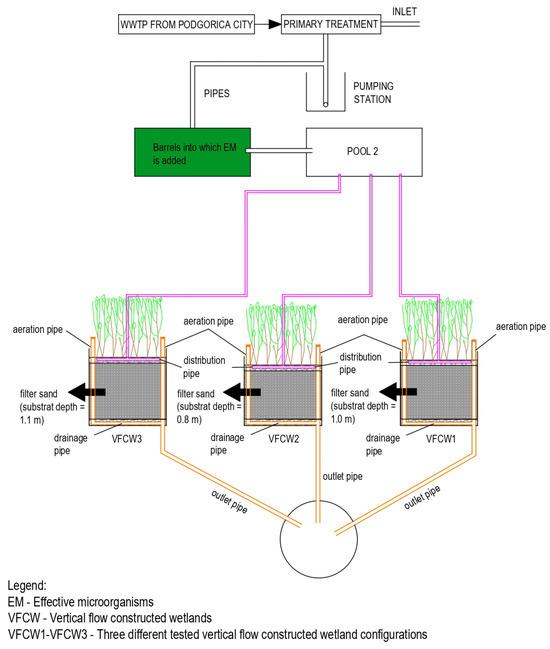
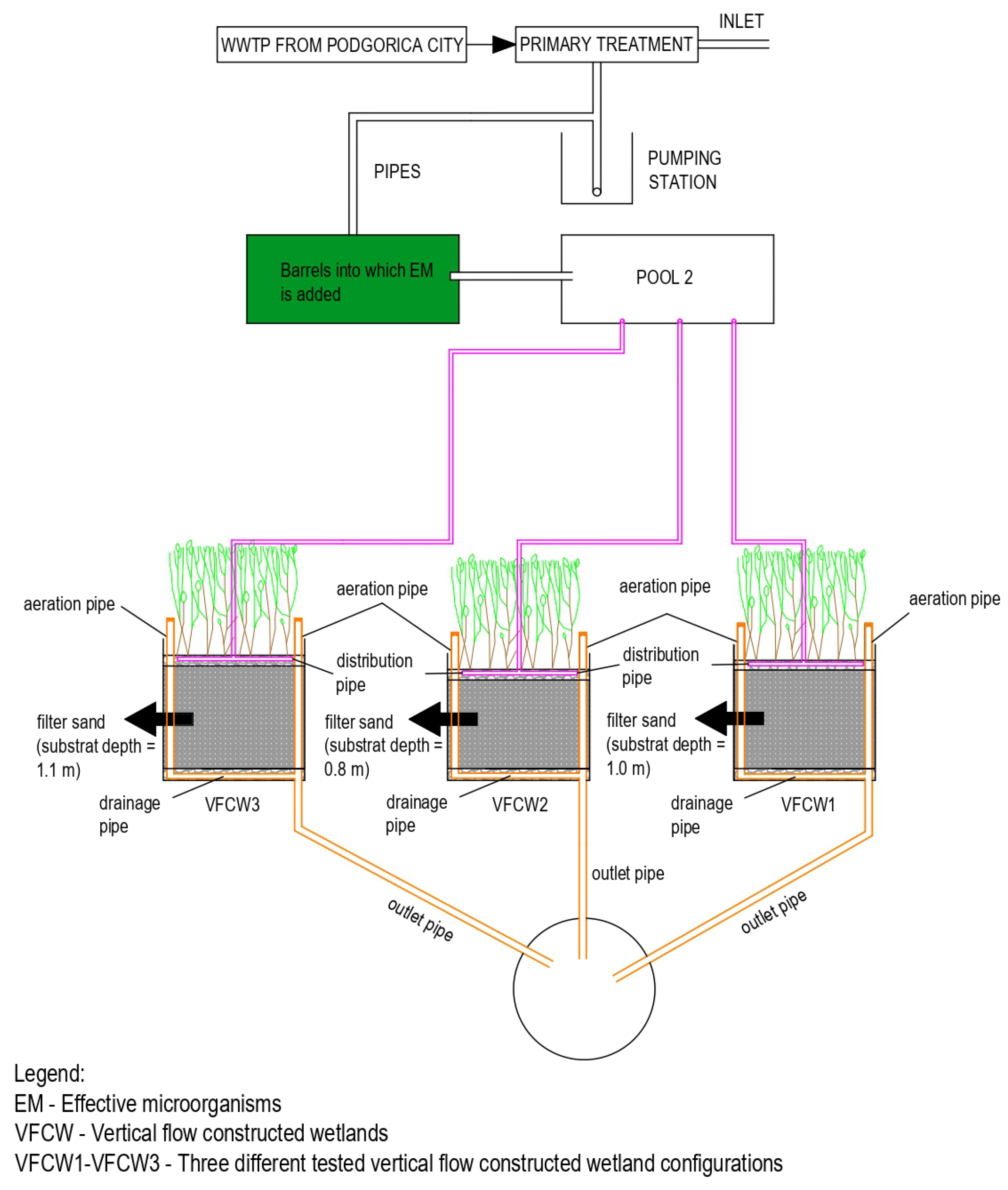
The experimental setup consisted of three pilot vertical-flow constructed wetland (VFCW) units designed to represent three different substrate configurations. The configurations differ in both total substrate depth and granulometric composition (sand fraction distribution), which were adapted from Slovenian, Austrian, and Italian technical design approaches. The differences in bed height shown in Figure 1 therefore reflect not only geometric variation, but also the distinct substrate structure applied in each unit. The layout of the system components is presented in Figure 1.
Figure 1.
Layout of the three-pilot vertical-flow constructed wetland (VFCW) units (VFCW1–VFCW3) operated with the addition of effective microorganisms (EMs) and implemented with different substrate configurations (substrate depth and granulometric composition). Light green areas represent vegetation, dark green indicates the barrels into which effective microorganisms (EMs) are added, purple lines indicate wastewater distribution pipes, grey zones correspond to the substrate layer, and orange lines denote drainage and outlet pipes.
After primary treatment at the WWTP in Podgorica, the wastewater is pumped into barrels with a capacity of 250 L and then redirected through a pipeline into a second tank with a capacity of 1 m3, equipped with valves for flow regulation. From the second tank, the water is directed into three vertical-flow constructed wetland systems (VFCW1, VFCW2, and VFCW3), each with a capacity of 1 m3, filled with substrates of varying granulometry and equipped with piping systems for uniform distribution of water and air. These systems were designed based on treatment approaches from Italy, Austria, and Slovenia.
In the upper layer of each wetland bed, perforated PVC pipes (DN 32 mm) are laterally installed at 40 cm intervals, evenly distributing water through 6 mm diameter holes. Drainage at the bottom is provided by DN 75 mm pipes with partial notches, which collect the treated water and regulate the water level within the system. The treated water exits the system through piping leading to a nearby inspection manhole. Within the experimental setup, three vertical constructed wetland systems, each covering an area of 1 m2, were designed to simulate different wastewater treatment approaches based on models from Slovenia (VFCW1), Austria (VFCW2), and Italy (VFCW3), adapted to Montenegrin environmental conditions. Each unit was filled with a sand-based substrate differing in depth and granulometric composition, as summarized in Table 1.
Table 1.
Main characteristics of the pilot VFCW units and substrate configurations.
After construction and substrate placement, common reeds (Phragmites australis), naturally occurring in the Skadar Lake area, were planted in all three units. This plant was chosen due to its ability to contribute to the purification process and system stabilization in constructed wetlands.
2.3. Primary Treatment
As part of this study, and in conjunction with the use of different substrate configurations in VFCW1, VFCW2, and VFCW3, the following type of primary treatment was applied and evaluated:
2.3.1. Primary Treatment Implemented at the Existing WWTP in Podgorica (PT)
This includes the following key components:
- Two units of automatic coarse screening;
- Screw pumps with a combined capacity of 2 × 180 L/s plus 370 L/s (maximum hydraulic flow);
- Two units of automatic fine screens with a bar spacing of 7 mm;
- Two aerated grit and grease removal chambers;
- A ferric chloride dosing station, aimed at enhancing the efficiency of primary sedimentation;
- One rectangular tank for primary sedimentation.
2.3.2. Primary Treatment at the Existing WWTP in Podgorica (PT) Combined with Effective Microorganisms (EMs)
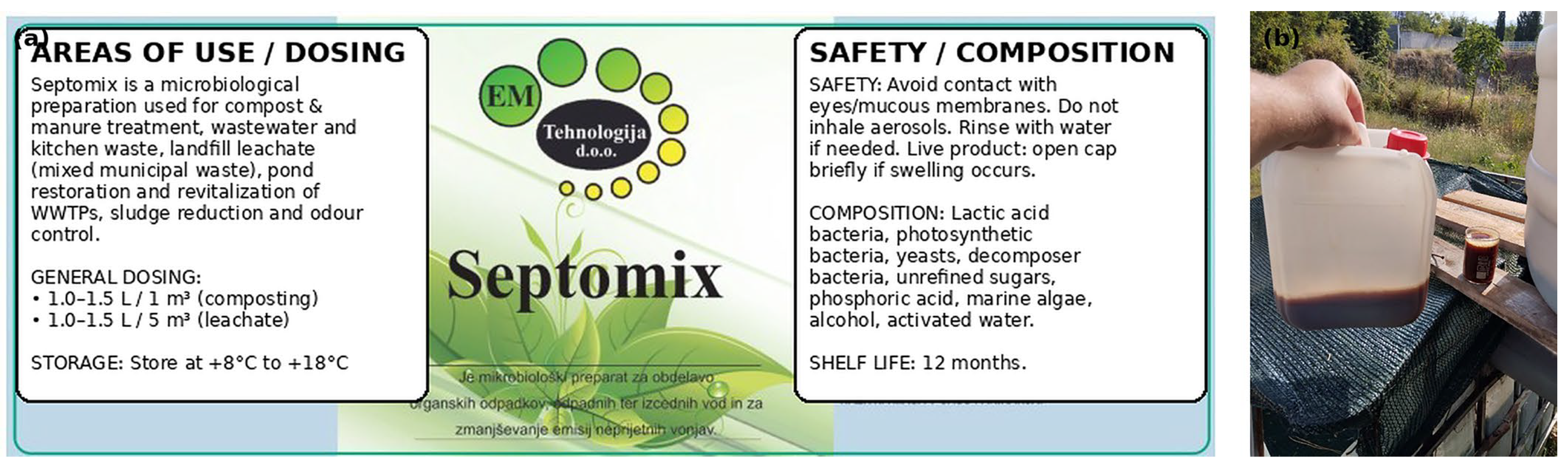
In this treatment setup, 50 mL of liquid effective microorganisms (EMs) (eMBmix; currently marketed as Septomix) was manually added on a daily basis to 150 L of pretreated wastewater, corresponding to 0.33 mL L−1 (Figure 2b). The EM preparation was applied after primary treatment at the existing WWTP in Podgorica and prior to distribution to the VFCW units. Therefore, the objective was not to achieve significant organic matter degradation in the primary settler, but rather to support microbial activity in the secondary VFCW stage.
Figure 2.
Effective microorganism (EM) product documentation and dosing procedure used in this study: (a) Product declaration/label of the commercial EM preparation applied in the experiment (eMBmix, currently marketed as Septomix). (b) Manual dosing of the EM solution into municipal wastewater after primary treatment, prior to distribution to the VFCW units.
According to the product declaration, the commercial EM preparation contains lactic acid bacteria, photosynthetic bacteria, yeasts, and organic matter-degrading bacteria, along with naturally unrefined sweeteners, phosphoric acid, marine algae, alcohol, and activated water. The product was supplied by EM Tehnologija d.o.o., Pobrež 2, 3210 Slovenske Konjice, Slovenia (Figure 2a). It is intended for the decomposition of organic waste, enhancement of water quality, and overall environmental improvement, and is commonly used in wastewater treatment, composting, septic tank maintenance, degradation of organic residues, and soil conditioning.
2.4. Sampling and Testing of Wastewater Quality
The defined goals were accomplished by setting up a pilot-scale experiment and applying standard analytical methods for monitoring the following physico-chemical parameters: temperature (t °C), pH, total suspended solids (TSSs), chemical oxygen demand (COD), and biochemical oxygen demand (BOD5).
- Sampling locations
Wastewater samples were collected at five locations: (1) system inlet, (2) after primary treatment, (3) outlet of VFCW1, (4) outlet of VFCW2, and (5) outlet of VFCW3. Samples were collected using an aluminum telescopic sampler equipped with a 1 L plastic container. The monitoring program was conducted in two consecutive phases using the same pilot VFCW units (VFCW1–VFCW3). The baseline monitoring phase without EM addition was carried out from March 2022 to March 2023, comprising 16 individual sampling campaigns (n = 16). The subsequent monitoring phase with daily EM addition was conducted from March 2023 to October 2023, comprising 16 individual sampling campaigns (n = 16). Influent (system inlet) wastewater was therefore analyzed 32 times in total during the entire experimental period. In both phases, sampling and laboratory analyses were performed following identical procedures to ensure data comparability. The results are presented as mean ± SD, and statistical differences among treatments were assessed using one-way ANOVA (p ≤ 0.05).
- Analytical methods
Laboratory analyses were carried out at the wastewater treatment plant laboratory (operated by the Podgorica Water and Sewerage Corporation) and at the Institute of Hydrometeorology and Seismology.
At the wastewater treatment plant laboratory, water temperature was measured using a mercury thermometer (PRECISION; scale division 0.1 °C), and values were recorded to the nearest 0.5 °C. pH was measured using a calibrated pH meter (WTW 315, GmbH D-82362 Weilheim). COD was determined using potassium dichromate according to Franjo (1990) [37]. BOD5 was determined following Franjo (1990) [37] and Lurie (1984) [38]. TSS was determined according to Standard Methods for the Examination of Water and Wastewater (AWWA, 1975) [39]. Analytical procedures were aligned with Council Directive 91/271/EEC concerning urban wastewater treatment [40].
At the Institute of Hydrometeorology and Seismology, analytical procedures for BOD5, COD, and TSS were conducted in accordance with Council Directive 91/271/EEC [40]. Specifically, BOD5 was determined after a 5-day incubation at 20 °C under dark conditions, COD was measured using the dichromate oxidation method, and TSS was determined gravimetrically by filtration (0.45 μm) and drying at 105 °C.
Nitrogen and phosphorus were monitored only during a shorter campaign period; therefore, these results were not included in the long-term performance evaluation presented in this manuscript.
2.5. Climatic Conditions During the Experimental Period
The performance of constructed wetlands is known to be influenced by environmental conditions, particularly air temperature, relative humidity, and hydraulic regime, which collectively affect microbial activity, oxygen transfer, and hydraulic retention time [32,33]. Higher temperatures generally enhance biological degradation processes, particularly organic matter removal (COD and BOD5), whereas suspended solids removal is primarily governed by physical filtration and sedimentation processes and is therefore less sensitive to climatic variability. Hydraulic conditions, especially hydraulic loading rate and retention time, play central roles in regulating treatment efficiency by controlling contact time between wastewater, substrate, and microbial communities.
In the present study, relationships between removal efficiencies of TSS, COD, and BOD5 and selected environmental and hydraulic variables were examined using correlation analysis based on monthly averages. Air temperature, relative humidity, and precipitation data were obtained for the experimental period, while hydraulic retention time was calculated based on system depth, effective substrate porosity, and daily inflow under constant hydraulic loading conditions. Correlation analyses were conducted to assess the potential influence of climatic variability and hydraulic conditions on treatment performance across different VFCW configurations. Detailed climatic data (air temperature, relative humidity, and precipitation) are provided in the Supplementary Material (Supplementary Tables S1 and S2) to contextualize the environmental conditions under which the pilot VFCW units were operated.
3. Results
During the experimental phase, each constructed wetland system (VFCW1, VFCW2, VFCW3) received an average daily wastewater inflow of 150 L, divided into three equal portions. The baseline monitoring phase without EM addition was carried out from March 2022 to March 2023, comprising 16 individual sampling campaigns (n = 16). The subsequent monitoring phase with daily EM addition was conducted from March 2023 to October 2023, comprising 16 individual sampling campaigns (n = 16). Input parameter sampling was conducted in 32 sessions, and the average values of the main influencing parameters were as follows:
BOD5 (biochemical oxygen demand): 391 ± 80.2. mg/L (n = 32);
COD (chemical oxygen demand): 634 ± 130.2. mg/L (n = 32);
TSS (total suspended solids): 246 ± 91.6 mg/L (n = 32).
3.1. Results of Total Suspended Solid (TSS) Removal
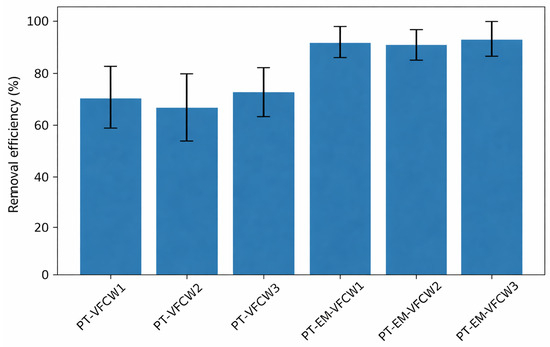
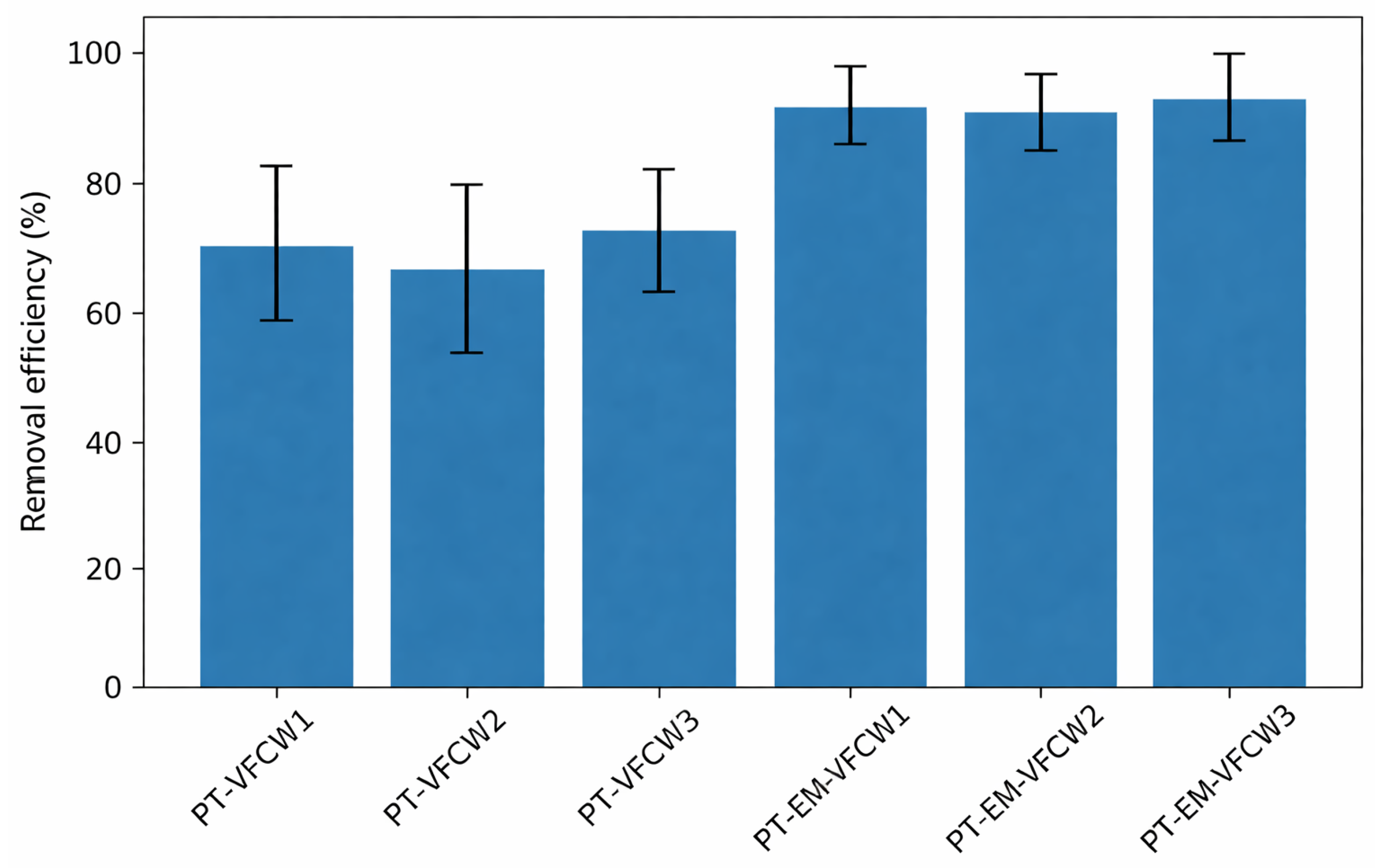
The results presented in Table 2 and Figure 3 demonstrate the significant effect of Effective Microorganisms (EMs) on improving the removal efficiency of total suspended solids (TSSs) in the investigated VFCW-based treatment systems. Under the PT-VFCW configurations, TSS removal showed high variability across the monitoring campaign (30–91%), with mean efficiencies of 64.63–69.63% depending on the substrate type (PT–VFCW1, PT–VFCW2, PT–VFCW3). The relatively high standard deviations (SD = 15.06–18.68) indicate moderate but less stable performance, likely influenced by differences in substrate granulometry, hydraulic conditions, and environmental factors.
Table 2.
Total suspended solid (TSS) removal efficiency (%) of the treatment systems expressed as mean ± SD (n = 16). Differences among systems were evaluated using one-way ANOVA (p ≤ 0.05).
Figure 3.
Comparative TSS Removal Efficiency of VFCW-Based Treatment System. Bars represent mean total suspended solid (TSS) removal efficiencies (%), with error bars indicating standard deviation (±SD, n = 16). All systems treated the same wastewater under identical operating conditions; therefore, differences in removal performance reflect only variations in VFCW configuration and the application of effective microorganisms (EMs). The inclusion of EM resulted in higher and more stable TSS removal compared to systems without EMs, as evidenced by higher mean values and reduced variability.
In contrast, integrating EMs with the primary treatment and VFCWs (PT-EM-VFCW) resulted in consistently higher TSS removal (69–99%), with mean efficiencies of 91.19–93.13% and lower SD values (6.70–9.44), indicating improved treatment stability. Among the evaluated configurations, PT–EM–VFCW3 achieved the highest mean performance, suggesting that the substrate configuration based on the Italian treatment model provided favorable conditions for microbial activity under Montenegrin conditions. Overall, these findings confirm the synergistic effect of EM addition as a practical strategy for enhancing TSS removal efficiency and operational stability in decentralized wastewater treatment applications.
3.2. Results of Chemical Oxygen Demand (COD) Removal
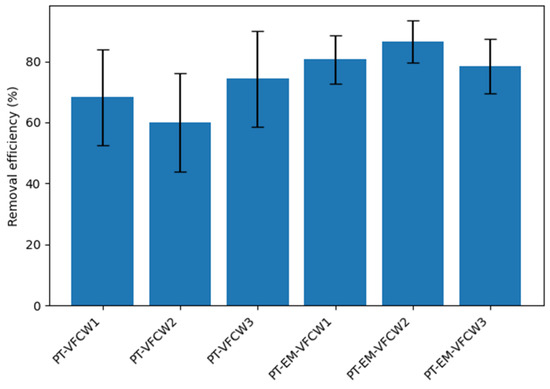
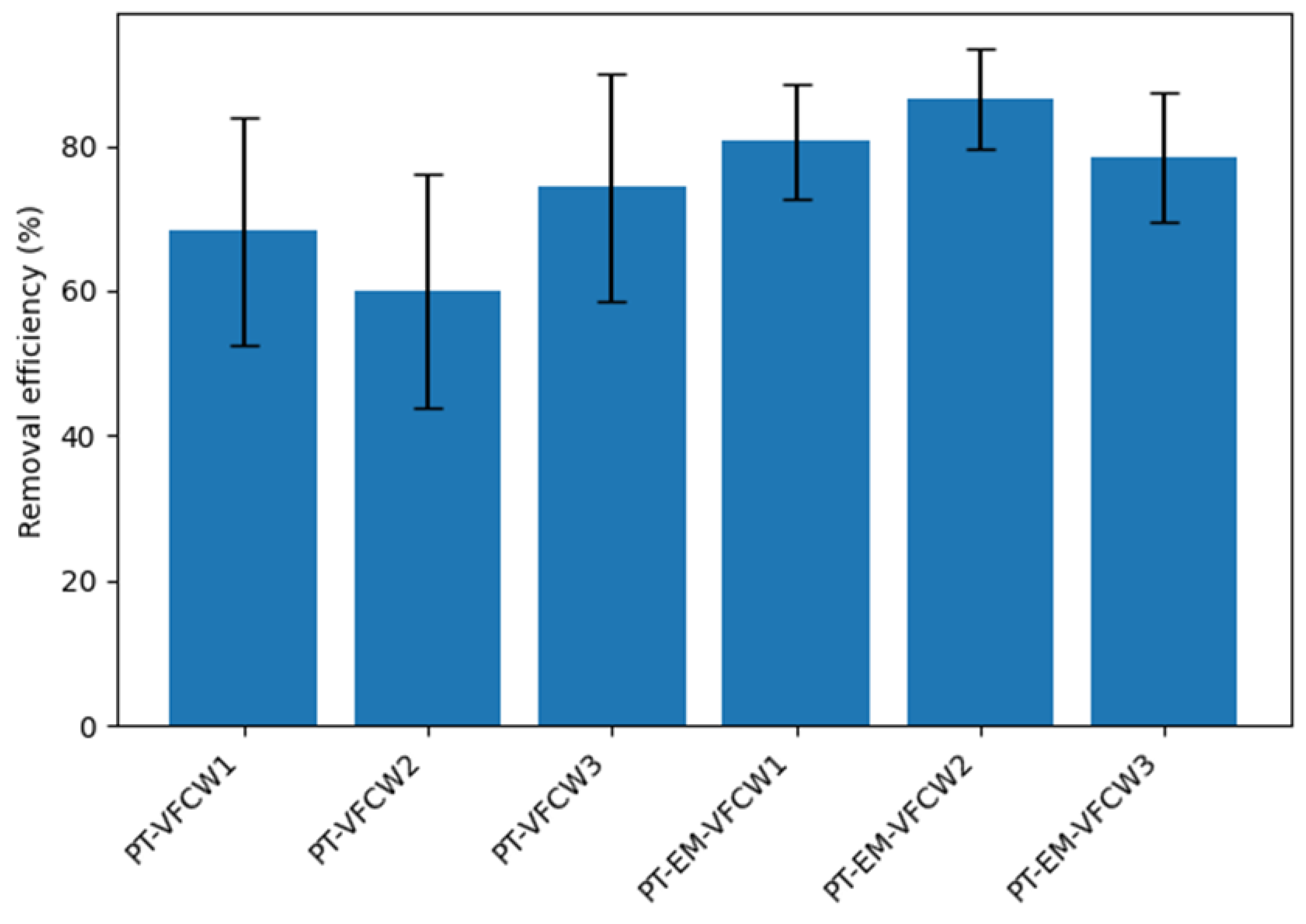
The results presented in Table 3 and Figure 4 demonstrate the clear influence of effective microorganisms (EMs) on enhancing chemical oxygen demand (COD) removal efficiency in the investigated VFCW-based treatment systems. In the PT-VFCW configurations, COD removal exhibited considerable variability throughout the monitoring period (32–94%), with mean efficiencies ranging from 59.94% to 74.25%, depending on the substrate type (PT–VFCW1, PT–VFCW2, PT–VFCW3). The relatively high standard deviation values (SD = 15.66–16.11) indicate moderate treatment performance with limited stability, which can be attributed to variations in substrate characteristics, hydraulic conditions, and operational or environmental factors.
Table 3.
Chemical oxygen demand (COD) removal efficiency (%) of the treatment systems expressed as mean ± SD (n = 16). Differences among systems were evaluated using one-way ANOVA (p ≤ 0.05).
Figure 4.
Comparative COD removal efficiency of VFCW-based treatment systems. Bars represent mean chemical oxygen demand (COD) removal efficiencies (%), with error bars indicating standard deviation (±SD, n = 16). All systems were fed the same wastewater and operated under identical conditions; observed differences in performance are attributable solely to variations in VFCW configuration and the presence or absence of effective microorganisms (EMs). Systems incorporating EM exhibited improved COD removal performance and lower variability, indicating enhanced treatment stability and more efficient organic matter degradation.
In contrast, the integration of EM with primary treatment and VFCWs (PT-EM-VFCW) resulted in consistently higher and more stable COD removal efficiencies, ranging from 61% to 93%, with mean values between 78.50% and 86.50% and notably lower SD values (7.05–8.94). Among the examined systems, PT-EM-VFCW2 achieved the highest average COD removal efficiency and the lowest variability, indicating optimal conditions for microbial degradation processes associated with the Austrian substrate configuration. Overall, these findings confirm the synergistic effect of EM addition in promoting organic matter degradation, reducing oxygen demand, and improving the operational stability of constructed wetlands, highlighting EM application as an effective and sustainable strategy for COD removal in decentralized wastewater treatment systems.
3.3. Results of Biochemical Oxygen Demand (BOD5) Removal
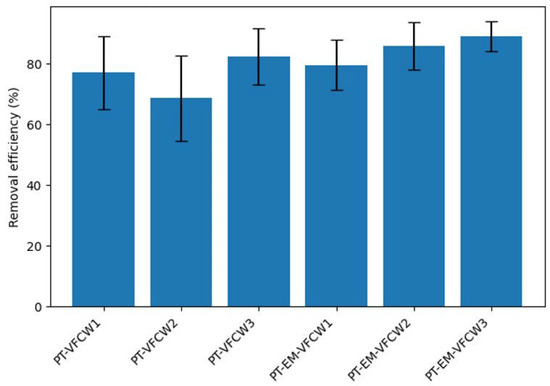
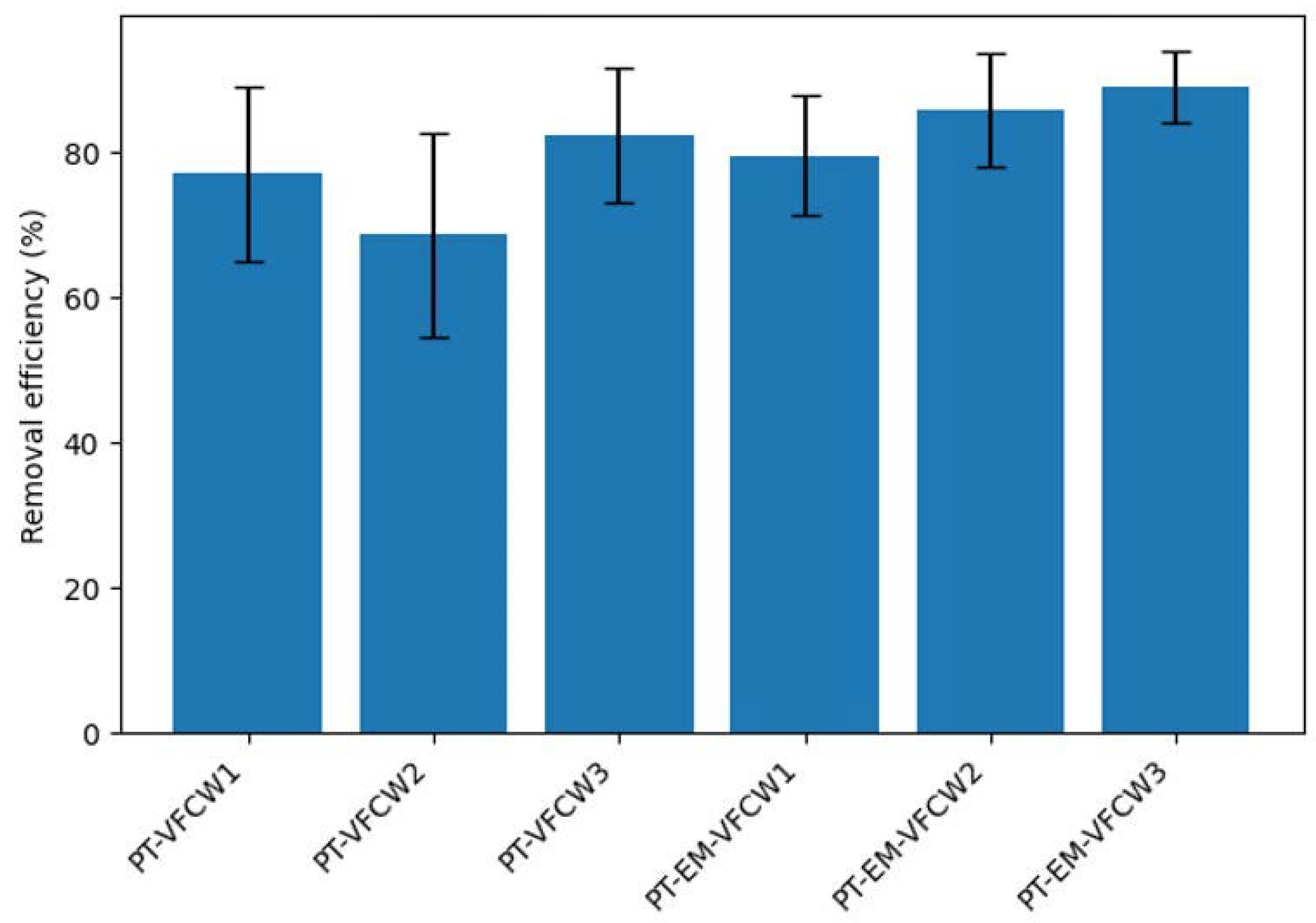
The results presented in Table 4 and Figure 5 clearly demonstrate the positive effect of effective microorganisms (EMs) on improving the removal efficiency of biochemical oxygen demand (BOD5) in wastewater treatment systems. In the PT-VFCW configurations, BOD5 removal exhibited notable variability during the monitoring period, with efficiencies ranging from 44% to 95% and mean values between 68.81% and 82.50%, depending on the substrate type (PT-VFCW1, PT-VFCW2, PT-VFCW3). The corresponding standard deviation values (SD = 9.20–14.08) indicate moderate performance stability, suggesting that treatment efficiency was influenced by substrate properties, hydraulic retention time, and environmental conditions.
Table 4.
Biochemical oxygen demand (BOD5) removal efficiency (%) of the treatment systems expressed as mean ± SD (n = 16). Differences among systems were evaluated using one-way ANOVA (p ≤ 0.05).
Figure 5.
Comparative BOD5 removal efficiency of VFCW-based treatment systems. Bars show mean biochemical oxygen demand (BOD5) removal efficiencies (%), with error bars representing standard deviation (±SD, n = 16). All systems were fed with the same wastewater and operated under identical conditions; differences in performance reflect only variations in VFCW configuration and the presence or absence of EM. The addition of EM contributed to consistently higher BOD5 removal efficiencies and reduced performance variability, confirming the synergistic effect of EM on biochemical degradation processes.
In contrast, the integration of EM with primary treatment and VFCWs (PT-EM-VFCW) resulted in higher and more consistent BOD5 removal efficiencies, with removal rates ranging from 61% to 95% and mean values between 79.69% and 89.19%, accompanied by lower SD values (5.02–8.34). Among the evaluated configurations, PT-EM-VFCW2 and PT-EM-VFCW3 demonstrated the highest mean removal efficiencies and the greatest operational stability, with PT-EM-VFCW3 achieving the best overall performance (89.19 ± 5.02%). These results suggest that the applied substrate configurations provide favorable conditions for enhanced microbial activity and organic matter degradation.
Overall, the observed improvement highlights the synergistic role of EM in accelerating biochemical degradation processes, reducing oxygen demand, and enhancing the operational stability of constructed wetlands. The findings confirm that EM application represents a cost-effective and sustainable strategy for optimizing BOD5 removal, particularly in decentralized and rural wastewater treatment systems.
Furthermore, the performance of the VFCW2 configuration (Austrian substrate) showed promising initial results—especially during the first 11 sampling series prior to clogging—achieving average removal rates of 61% for suspended matter (SM), 70% for chemical oxygen demand (COD), and 77% for biochemical oxygen demand (BOD5). However, this variant was prone to clogging over time. The inclusion of EM proved to be effective in restoring performance and reducing clogging frequency. In contrast, no clogging issues were observed in the CW1 and CW3 systems, indicating better long-term substrate stability.
3.4. Required Surface Area for 95% BOD5 Removal in Different VFCW Configurations
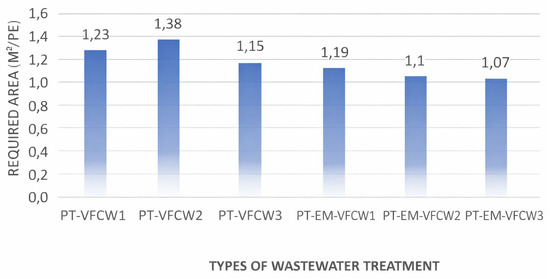
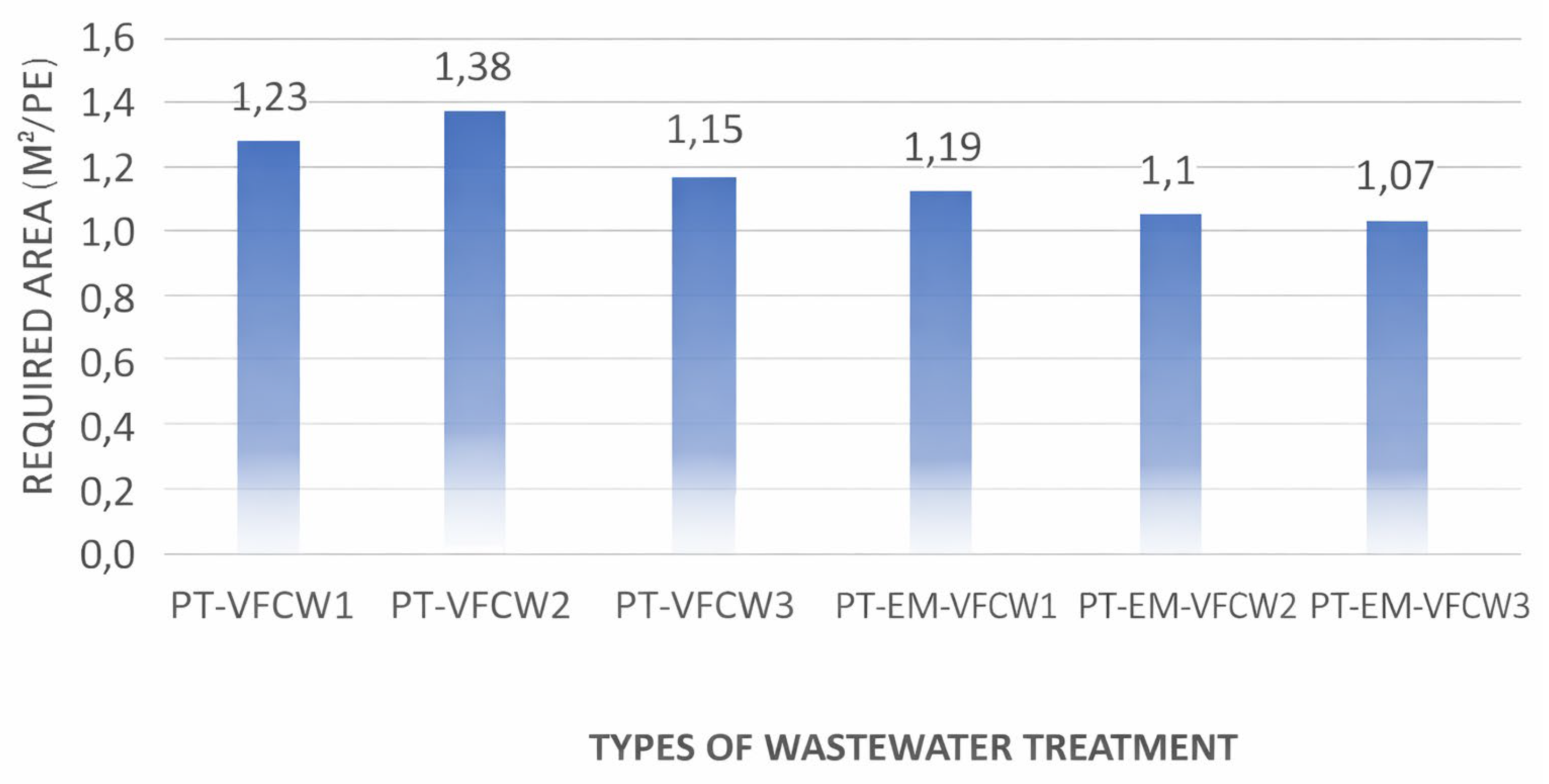
This study demonstrates that, under Montenegrin conditions, the smallest surface area required for achieving 95% BOD5 removal was recorded in the PT-EM-VFCW3 configuration, requiring only 1.07 m2 per population equivalent (PE). Slightly larger areas were necessary for other combinations: 1.10 m2/PE for PT-EM-VFCW2, 1.15 m2/PE for PT-VFCW3, 1.19 m2/PE for PT-EM-VFCW1, 1.23 m2/PE for PT-VFCW1, and 1.38 m2/PE for PT-VFCW2.
Calculation of required surface area for 95% BOD5 removal.
All experimental fields were constructed with an effective surface area of 1 m2. The average BOD5 removal efficiency obtained for each configuration was used to estimate the surface area required to achieve a target removal efficiency of 95%.
The required surface area per population equivalent (PE) was calculated using proportional scaling (Equation (1)):
where A95 (m2/PE) is the surface area required for 95% BOD5 removal, Aexp is the experimental area (1 m2), ηtarget (%) is the target removal efficiency (95%), and ηavg (%) is the average experimental removal efficiency.
A95 = Aexp⋅(ηtarget/ηavg)
The experimentally obtained mean BOD5 removal efficiency at a bed area of 1 m2 was proportionally extrapolated to estimate the surface area required to reach a target removal efficiency of 95%, under identical operating conditions.
Population equivalent (PE) is defined based on BOD5 load, with 1 PE corresponding to 60 g BOD5 per day, reflecting the average daily BOD5 contribution of one person in urban wastewater. BOD5 is therefore the key parameter for both PE definition and wetland sizing.
Table 5 presents the calculated required areas for the different VFCW configurations. The corresponding data are also illustrated in Figure 6 to visually summarize comparative removal efficiencies and required areas. This proportional scaling assumes a linear relationship between removal efficiency and wetland surface area and is applicable within the experimental conditions tested. Calculated areas should be regarded as estimates for comparative analysis and preliminary design purposes.
Table 5.
Required surface area per population equivalent (m2/PE) for 95% BOD5 removal in different VFCW configurations.
Figure 6.
Required area per PE for efficient BOD5 removal (95%) in different CW systems in Montenegro.
Importantly, under Montenegrin conditions, the smallest required wetland area per PE for achieving 95% BOD5 removal was observed in the PT+EM+VFCW3 configuration (1.07 m2/PE). The calculated areas for all tested configurations demonstrate substantial spatial efficiency compared to reported values in other European countries, including Austria (5 m2/PE), Denmark (4.6 m2/PE), Italy (1.53 m2/PE), and Slovenia (2.3 m2/PE).
Compared to literature data [36], the study achieved significant space savings across all configurations:
- 44% reduction in PT+VFCW1;
- 72.4% reduction in PT+VFCW2;
- 37% reduction in PT+VFCW3;
- 45% reduction in PT+EM+VFCW1;
- 78% reduction in PT+EM+VFCW2;
- 42% reduction in PT+EM+VFCW3.
This approach assumes a linear relationship between removal efficiency and wetland surface area and is applicable within the range of operating conditions tested in this study. Therefore, the calculated surface areas should be regarded as estimated values intended for comparative analysis and preliminary design purposes.
The following Figure 6 illustrates the required surface area (in m2 per population equivalent) to achieve 95% BOD5 removal across different constructed wetland (CW) configurations evaluated under Montenegrin conditions. The comparison highlights the spatial efficiency gains achieved through the integration of effective microorganisms (EMs) and optimized substrate selection.
3.5. Role of Effective Microorganisms (EMs)
Throughout the experimental period, effective microorganisms (EMs) exhibited stable and reliable performance, particularly in the PT+EM+CW2 and PT+EM+CW3 combinations. The daily EM application was sufficient to maintain their activity, and no corrective measures were required. This indicates that environmental conditions (temperature, pH, and flow rate) were suitable for microbial action.
3.6. Influence of Climatic and Hydraulic Conditions on Treatment Performance
The hydraulic loading rate (HLR) was maintained constant at 150 L m−2 d−1 across all treatment systems throughout the experimental period, as defined in the experimental methodology.
An increase in system depth from 0.83 to 1.10 m resulted in a proportional increase in hydraulic retention time from approximately 1.9 to 2.6 days under constant hydraulic loading.
The highest overall removal efficiencies were observed in the system with the greatest depth and the longest hydraulic retention time, suggesting that extended contact time between wastewater, substrate, and microbial communities may contribute to improved treatment performance.
Increased air temperature coincided with slightly improved organic matter degradation, as indicated by higher COD and BOD5 removal efficiencies, while relative humidity and precipitation showed no consistent effects, and TSS removal remained stable.
4. Discussion
Analysis of variance (ANOVA) was used to assess the statistical significance of differences in the efficiency of various treatment system combinations. This test allows for the comparison of multiple groups simultaneously to determine whether there are significant differences in treatment performance.
4.1. Efficiency of TSS Removal Across Wastewater Treatment Combinations
The statistical analysis confirmed that the addition of effective microorganisms (EMs) significantly improved the removal efficiency of total suspended solids (TSSs). The ANOVA test showed a highly significant difference between groups (F = 16.77, p < 0.0001), with EM-enhanced treatments consistently achieving removal efficiencies above 91%. These findings are consistent with those reported by Kaur et al. [41] and Hua et al. [42], who observed that EM supplementation in constructed wetlands achieved over 90% TSS removal and improved operational stability during seasonal fluctuations. Similarly, Khalifa et al. [43] found that EM addition enhanced TSS removal by 20–35% compared to control systems, confirming the positive impact of EM on suspended solids retention.
The lower standard deviations in EM groups indicate more consistent system performance, which is particularly important for decentralized or rural treatment systems where system stability is crucial. This aligns with the conclusions of Ilyas and Masih [44], who emphasized that EM contributes to filter unclogging and long-term hydraulic stability in intensified constructed wetlands.
4.2. COD Removal Efficiency
The analysis of chemical oxygen demand (COD) removal clearly demonstrates the superior performance of EM-amended systems. Statistically significant differences were observed among the experimental groups (F = 9.10, p < 0.0001), with PT-EM-VFCW2 achieving the highest and most consistent COD removal efficiency. The enhanced performance can be attributed to increased microbial activity and enzymatic oxidation processes, which accelerate the degradation of organic pollutants in constructed wetland systems. These findings agree with previous studies reporting that the incorporation of effective microorganisms enhances organic matter removal by stimulating microbial metabolism and improving oxidative degradation pathways. In contrast, systems without EM supplementation exhibited greater variability and occasional peaks in COD removal efficiency; however, these fluctuations were less stable and reproducible over time. The increased stability observed in EM-amended systems suggests improved microbial diversity and resilience, enabling more reliable performance under varying pollutant loads.
4.3. BOD5 Removal Efficiency
The biochemical oxygen demand (BOD5) removal efficiency followed a similar trend, with Groups 5 and 6 (PT-EM-VFCW2 and PT-EM-VFCW3) achieving the highest and most stable results. Statistical significance was also observed (F = 8.49, p < 0.0001). Similar findings were presented by Kaur et al. [41], reporting that EM improves biodegradation kinetics and oxygen utilization efficiency, leading to significantly higher BOD5 removal rates.
Furthermore, Hua et al. [42] demonstrated that EM-enriched hybrid wetlands maintained BOD5 removal efficiencies above 90% even under variable seasonal conditions, supporting the robustness of our system performance.
Importantly, this study also demonstrates that under Montenegrin conditions, the smallest required wetland area per population equivalent (PE) for achieving 95% BOD5 removal was found in PT+EM+CW3 (1.07 m2/PE) [36]. This is considerably lower than the reported areas required in countries such as Austria (5 m2/PE), Denmark (4.6 m2/PE), Italy (1.53 m2/PE), and Slovenia (2.3 m2/PE). The spatial efficiency of the system represents a major advantage, particularly in locations with land constraints or ecological sensitivity.
Compared to literature data [36], this study achieved space savings of up to
- 44% reduction in space in PT-VFCW1;
- 72.4% reduction in space in PT-VFCW2;
- 37% reduction in space in PT+CW3;
- 45% reduction in space in PT+EMVFCW1;
- 78% reduction in space in PT+EMVFCW2;
- 42% reduction in space in PT+EM-VFCW3.
In comparison with the values reported in the review paper “Intensification of constructed wetlands for land area reduction: a review,” where the average footprint for different types of constructed wetlands (CWs) ranged from 1.1 ± 0.5 m2/PE (ER-VFCW) to 8.6 ± 4.7 m2/PE (HFCW), the results obtained in this research demonstrate a significantly smaller land requirement. Under Montenegrin climatic conditions, the smallest required wetland area to achieve 95% BOD5 removal was only 1.07 m2/PE in the PT+EM+CW3 system, which is comparable to or even more favorable than the best values reported in the literature. In future research, the potential for further reduction in the required area in this system should be investigated through the implementation of additional aeration.
This confirms the potential of EM to enhance not only removal efficiency but also system compactness.
In the case of VF-CW2 (Austrian substrate), the initial series showed strong performance; however, clogging was observed, which impaired long-term functionality. The research presented in this paper also confirms that frequent blockages were present in VF-CW2, and that better results and unblocking were achieved by including effective microorganisms. In the other two substrates (VF-CW1 and VF-CW3), there was no clogging problem. This observation supports the conclusions of Ilyas and Masih [44], who reported that EM not only enhances pollutant removal but also reduces clogging and improves long-term operational stability of wetland filters.
4.4. Economic Implications of Land-Use Reduction
In urban and peri-urban settings, land availability and land cost represent critical constraints for the implementation of nature-based wastewater treatment systems such as constructed wetlands. While the integration of effective microorganisms (EMs) introduces additional operational costs, the compact system layouts achieved through optimized substrates and vertical-flow configurations substantially reduce land requirements, which may translate into significant economic benefits in areas with high land values.
Based on a hypothetical vertical-flow constructed wetland designed for 1000 population equivalents (PE) and an indicative land price of 500 EUR m−2, the configurations developed in this study required between 1070 and 1380 m2, compared to approximately 2300 m2 reported for conventional European design values. This reduction corresponds to considerable land cost savings, which in some cases exceed several hundred thousand euros. Although EM-based configurations involve an additional annual operational cost, the magnitude of land savings highlights land conservation as the dominant economic driver under urban conditions. A detailed comparison of land requirements, land acquisition costs, and EM-related operational costs for all configurations is provided in the Supplementary Material (Supplementary Table S6).
4.5. Seasonal and Operational Benefits of EM Integration
Beyond land-related economic considerations, the integration of effective microorganisms (EMs) may provide additional operational advantages under dynamic loading conditions. In many urban and tourist-oriented areas, wastewater treatment plants are exposed to pronounced seasonal fluctuations in population, resulting in temporary hydraulic and organic overloading during peak periods. Under such conditions, EM application can support stable treatment performance without requiring physical expansion of the treatment area, which is often constrained by limited available space or high land acquisition costs.
From a planning perspective, this operational flexibility is particularly relevant in cases where additional land for system expansion is unavailable, where the construction of a new treatment facility would be economically or spatially infeasible, or where the service life of an existing plant is intended to be extended. In such scenarios, EM application can function as a mitigation and optimization measure rather than as a permanent design requirement, allowing existing infrastructure to accommodate short-term or seasonal increases in load.
Furthermore, practical experience and previous studies indicate that prolonged EM application may lead to reduced required dosages over time, as microbial communities become established within the substrate and system matrix. In addition to improving organic matter degradation, EM use has been associated with reduced excess sludge production in wastewater treatment systems, which can further decrease operational and disposal costs and enhance overall system sustainability. Although these effects are site-specific and require long-term evaluation, they represent additional benefits that complement the primary advantage of land conservation.
5. Conclusions
This research successfully demonstrated that the integration of effective microorganisms (EMs) during the primary treatment phase significantly improves the performance of secondary constructed wetlands (CWs) in wastewater treatment. The addition of EM enhanced the removal efficiencies of total suspended solids (TSSs), chemical oxygen demand (COD), and biochemical oxygen demand (BOD5) across different substrate types, achieving more stable and higher pollutant degradation rates compared to treatments without EM.
Furthermore, the study showed that the optimized combination of primary treatment with EM and selected substrates—particularly the Italian substrate (VFCW3)—allows substantial spatial efficiency, reducing the required wetland area for 95% BOD5 removal to as low as 1.07 m2 per population equivalent under Montenegrin conditions. This represents a significant reduction in land area compared to systems without EMs and to data reported from other European countries.
The research also highlighted that EMs help mitigate substrate clogging issues observed in some configurations (particularly VFCW2 with the Austrian substrate), thereby improving long-term system functionality and resilience, which is crucial for decentralized and rural wastewater treatment systems.
Overall, the findings confirm that applying EMs in the primary treatment phase, combined with appropriate substrate selection, provides an effective, sustainable, and space-saving solution for improving wastewater treatment efficiency. This aligns well with the goals of enhancing pollutant degradation, reducing the treatment load on constructed wetlands, and minimizing spatial requirements—key considerations for practical implementation in Montenegro and the region’s urban and spatially limited environments.
This research is particularly important in situations where space is limited, where there are high changes in load (for example, seasonal), or where the load has increased and there is no space for a new PPOV module.
The use of effective organisms in the primary treatment phase and the selection of an adequate substrate for the conditions in Montenegro have enabled the wider use of constructed wetlands in wastewater treatment and a significant reduction in the required space. In addition to improved treatment efficiency, the proposed configurations demonstrate substantial land-use reduction as a key economic advantage, while EM integration provides increased operational flexibility under seasonal and variable loading conditions.
Supplementary Materials
The following supporting information can be downloaded at: https://www.mdpi.com/article/10.3390/w18040506/s1, Table S1: Monthly air temperature conditions; Table S2: Monthly relative humidity and precipitation; Table S3: Individual TSS removal efficiency values; Table S4: Individual COD removal efficiency values; Table S5: Individual BOD5 removal efficiency values; Table S6: Land requirement and cost comparison scenario.
Author Contributions
Conceptualization, S.D.; methodology, D.V.; formal analysis, S.D. and D.V.; investigation, S.D.; resources, D.V. and S.D.; data curation, S.D.; writing—original draft preparation, S.D.; writing—review and editing, D.V. and S.D.; visualization, S.D.; supervision, D.V.; project administration, S.D. and D.V.; funding acquisition, S.D. All authors have read and agreed to the published version of the manuscript.
Funding
This research received no external funding.
Data Availability Statement
The original contributions presented in this study are included in the article/Supplementary Material. Further inquiries can be directed to the corresponding author.
Acknowledgments
We thank the Water Supply and Sewerage company from Podgorica for enabling the implementation of the experiment in the city wastewater treatment plant that it manages and for the use of the internal laboratory. We also thank the Institute for Hydrometeorology and Seismology of Montenegro for the use of an external laboratory for data analysis. During the preparation of this work, the author(s) used OpenAI ChatGPT (GPT-4 model) for the purposes of language polishing and grammar checking. The authors have reviewed and edited the output and take full responsibility for the content of the publication.
Conflicts of Interest
The authors declare no conflicts of interest.
References
- O’Hogain, S.; McCarton, L. A Technology Portfolio of Nature Based Solutions: Inovations in Water Management; Springer: Cham, Switzerland, 2018. [Google Scholar] [CrossRef] [Scilit]
- Seidel, K. Neue Wege zur Grundwasseranreicherung in Krefeld, vol. II. Hydrobotanische Reinigungsmethode. GWF Wasser/Abwasser 1965, 30, 831–833. [Google Scholar]
- Vymazal, J. Constructed Wetlands for Wastewater Treatment: A Review. Water 2010, 2, 530–549. [Google Scholar] [CrossRef] [Scilit]
- U.S. Environmental Protection Agency; Office of Research and Development; National Risk Management Research Laboratory. Constructed Wetlands Treatment of Municipal Wastewaters: Manual; (EPA/625/R-99/010); U.S. Environmental Protection Agency. Available online: https://archive.org/details/constructedwetla00nati (accessed on 28 December 2025).
- Vidali, M. Bioremediation. An Overview. Pure Appl. Chem. 2001, 73, 1163–1172. [Google Scholar] [CrossRef] [Scilit]
- Vrhovšek, D.; Vovk Korže, A. Ekoremediacije; Maribor: Filozofska Fakulteta, Mednarodni Center za Ekoremediacije: Ljubljana, Slovenia, 2007. [Google Scholar]
- Tušar, B. Pročišćavanje Otpadnih Voda; Kigen d.o.o: Zagreb, Croatia, 2009. [Google Scholar]
- Malus, D.; Vouk, D. Priručnik za učinkovitu primjenu biljnih uređaja za pročišćavanje sanitarnih otpadnih voda. In Manual for the Effective Application of Constructed Wetlands for Sanitary Wastewater Treatment; Sveučilište u Zagrebu, Građevinski Fakultet: Zagreb, Croatia, 2012. [Google Scholar]
- Zapater-Pereyra, M.; Ilyas, H.; Lavrnić, S.; Van Bruggen, J.J.A.; Lens, P.N.L. Evaluation of the performance and space requirement by three different hybrid constructed wetlands in a stack arrangement. Ecol. Eng. 2015, 82, 290–300. [Google Scholar] [CrossRef] [Scilit]
- Soti, A.; Singh, S.; Verma, V.; Kulshreshtha, N.M.; Brighu, U.; Kalbar, P.; Gupta, A.B. Designing the vertical flow constructed wetland based on targeted limiting pollutant. Bioresour. Technol. 2022, 351, 127068. [Google Scholar] [CrossRef] [Scilit]
- Soti, A.; Singh, S.; Verma, V.; Kulshreshtha, N.M.; Brighu, U.; Kalbar, P.; Gupta, A.B. Assessment of removal rate coefficient in vertical flow constructed wetland employing machine learning for low organic loaded systems. Bioresour. Technol. 2023, 376, 128909. [Google Scholar] [CrossRef] [Scilit]
- Waly, M.M.; Ahmed, T.; Abunada, Z.; Mickovski, S.B.; Thomson, C. Constructed wetland for sustainable and low-cost wastewater treatment. Land 2022, 11, 1388. [Google Scholar] [CrossRef] [Scilit]
- Avila, C.; Nivala, J.; Olsson, L.; Kassa, K.; Headley, T.; Mueller, R.A.; Garcia, J.; Bayona, J.M. Emerging Organic Contaminants in Vertical Subsurface Flow Constructed Wetlands: Influence of Media Size, Loading Frequency and Use of Active Aeration. Sci. Total Environ. 2014, 494, 211–217. [Google Scholar] [CrossRef] [Scilit]
- Pascual, A.; De La Varga, D.; Arias, C.A.; Van Oirschot, D.; Kilian, R.; Alvarez, J.A.; Soto, M. Hydrolytic Anaerobic Reactor and Aerated Constructed Wetland Systems for Municipal Wastewater Treatment—HIGHWET Project. Environ. Technol. 2017, 38, 209–219. [Google Scholar] [CrossRef] [Scilit]
- Sharma, P.K.; Minakshi, D.; Rani, A.; Malaviya, P. Treatment Efficiency of Vertical Flow Constructed Wetland Systems Operated under Different Recirculation Rates. Ecol. Eng. 2018, 120, 474–480. [Google Scholar] [CrossRef] [Scilit]
- Thalla, A.K.; Devatha, C.P.; Anagh, K.; Sony, E. Performance Evaluation of Horizontal and Vertical Flow Constructed Wetlands as Tertiary Treatment Option for Secondary Effluents. Appl. Water Sci. 2019, 9, 147. [Google Scholar] [CrossRef] [Scilit]
- Gikas, G.D.; Papaevangelou, V.A.; Tsihrintzis, V.A.; Antonopoulou, M.; Konstantinou, I.K. Removal of Emerging Pollutants in Horizontal Subsurface Flow and Vertical Flow Pilot-Scale Constructed Wetlands. Processes 2021, 9, 2200. [Google Scholar] [CrossRef] [Scilit]
- Saeed, T.; Hossain, N. Organics and Nutrients Removal in Vertical Flow Wetlands: Loading Fluctuation and Alternative Media. Environ. Technol. 2021, 42, 1104–1118. [Google Scholar] [CrossRef] [Scilit]
- Herrera-Melian, J.A.; Guedes-Alonso, R.; Tite-Lezcano, J.C.; Santiago, D.E.; Ranieri, E.; Alonso-Bilbao, I. The Effect of Effluent Recirculation in a Full-Scale Constructed Wetland System. Sustainability 2023, 15, 4310. [Google Scholar] [CrossRef] [Scilit]
- Liolios, K.A.; Moutsopoulos, K.N.; Tsihrintzis, V.A. Modelling Alternative Feeding Techniques in HSF Constructed Wetlands. Environ. Process. 2016, 3, S47–S63. [Google Scholar] [CrossRef] [Scilit]
- Tsihrintzis, V.A. The Use of Vertical Flow Constructed Wetlands in Wastewater Treatment. Water Resour. Manag. 2017, 31, 3245–3270. [Google Scholar] [CrossRef] [Scilit]
- Ilyas, H.; Masih, I. Intensification of constructed wetlands for land area reduction: A review. Environ. Sci. Pollut. Res. 2017, 24, 12081–12091. [Google Scholar] [CrossRef] [Scilit]
- Wang, J.; Long, Y.; Yu, G.; Wang, G.; Zhou, Z.; Li, P.; Wang, S. A review on microorganisms in constructed wetlands for typical pollutant removal: Species, function, and diversity. Front. Microbiol. 2022, 13, 845725. [Google Scholar] [CrossRef] [Scilit]
- Monica, S.; Karthik, L.; Mythili, S.; Sathiavelu, A. Formulation of effective microbial consortia and its application for sewage treatment. J. Microb. Biochem. Technol. 2011, 3, 051–055. [Google Scholar] [CrossRef]
- Zakaria, Z.; Gairola, S.; Shariff, N.M. Effective Microorganisms (EM) Technology for Water Quality Restoration and Potential for Sustainable Water Resources and Management. In Proceedings of the International Congress on Environmental Modelling and Software, Ottawa, ON, Canada, 1 July 2010. [Google Scholar]
- Wididana, G.N. Preliminary Experiment of EM Technology on Wastewater Treatment; Indonesian Kyusei Nature Farming Society: Jakarta, Indonesia, 2015; Available online: https://www.academia.edu/73595267/Preliminary_Experiment_of_EM_Technology_on_Waste_Water_Treatment (accessed on 28 December 2025).
- Seng, H.; Dokkratoom, S.; Pijarn, N. Effect of EM Ball on DO, BOD and COD of Wastewater Treatment Plant in Bangkokthonburi University, Thailand. Int. J. Chem. Environ. Biol. Sci. 2015, 3, 307–311. [Google Scholar]
- Kannan, D.; Kumar, S.V. Effective microorganisms used in domestic effluent treatment system. In Proceedings of the BALWOIS, Ohrid, Macedonia, 27 May–2 June 2012; p. 28. Available online: https://www.researchgate.net/publication/264423116_Effective_Microorganisms_used_in_Domestic_Effluent_Treatment_System (accessed on 28 December 2025).
- Didanovic, S.; Vrhovsek, D. Significance of substrate selection in the efficiency of wastewater treatment in constructed wetlands (cws). J. Water Resour. Prot. 2023, 15, 424–441. [Google Scholar] [CrossRef]
- Didanovic, S.; Vrhovsek, D. Significance of Primary Treatment Selection in the Efficiency of Wastewater Treatment in Constructed Wetlands (CWs). J. Water Resour. Prot. 2024, 16, 309–327. [Google Scholar] [CrossRef]
- Cooper, P.F. The Performance of Vertical Flow Constructed Wetland Systems with Special Reference to the Significance of Oxygen Transfer and Hydraulic Loading Rates. Water Sci. Technol. 2005, 51, 81–90. [Google Scholar] [CrossRef] [Scilit]
- Kadlec, R.H.; Wallace, S.D. Treatment Wetlands, 2nd. ed.; CRC Press: Boca Raton, FL, USA, 2009. [Google Scholar] [CrossRef] [Scilit]
- Brix, H.; Johansen, N.H. Retningslinier for Etablering af Beplantede Filteranlag op Til 30 PE (Guidelines for Vertical Flow Constructed Wetland Systems up to 30 PE); Okologisk Byfornyelse og Spildevandsrensning No. 52; Miljostyrelsen, Miljoministeriet: Odense, Denmark, 2004. (In Danish)
- Brix, H.; Arias, C.A. The Use of Vertical Flow Constructed Wetlands for On-Site Treatment of Domestic Wastewater: New Danish Guidelines. Ecol. Eng. 2005, 25, 491–500. [Google Scholar] [CrossRef] [Scilit]
- DWA. Grundsätze für Bemessung, Bau und Betrieb von Pflanzenkläranlagen mit Beflanzten Bodenfiltern zur Biologischen Reinigung Kommunalen Abwassers, in German. (Principles for Dimensioning, Construction and Operation of Wastewater Treatment Plants with Soil Filters for Biological Cleaning of Municipal Wastewater); Deutsche Vereinigung für Wasserwirtschaft Abwasser und Abfall: Hennef, Germany, 2006. [Google Scholar]
- Hrast, T. Draft of the Guidelines for the Design of Constructed Wetlands in Slovenia Based on Practices in Europe. 2012. Available online: https://www.semanticscholar.org/paper/Draft-of-the-guidelines-for-the-design-ofwetlands-Hrast/194e573f5952c4964d3f3047b76e7a6501ef6b25 (accessed on 28 December 2025).
- Franjo, Č. Voda za Piće—Standardne Metode za Ispitivanje Higijenske Isprav_Nosti. Beograd. 1990. Available online: https://www.tehnologijahrane.com/knjiga/voda-za-pie (accessed on 28 December 2025).
- Lurie, J.J. Analitičeskaja Chimia Promyšlennych Stočnych Vod (Analytische Chemie der Betriebs-und Abwasser). Acta Hydrochim. Hydrobiol. 1984, 14, 526. [Google Scholar] [CrossRef] [Scilit]
- AWWA. Standard Methods for the Examination of Water and Wastewater, 14th ed.; American Water Works Association: Washington, DC, USA, 1975. [Google Scholar]
- Council Directive 91/271/EEC of 21 May 1991 Concerning Urban Waste-Water Treatment. Available online: http://data.europa.eu/eli/dir/1991/271/oj (accessed on 28 December 2025).
- Kaur, B.; Choudhary, R.; Sharma, G.; Brar, L.K. Sustainable and Effective Microorganisms’ Method for Wastewater treatment. Desalination Water Treat. 2024, 319, 100419. [Google Scholar] [CrossRef] [Scilit]
- Hua, W.; Li, Y.; Chen, Z. Enhanced solid removal in hybrid constructed wetland systems supplemented with microbial consortia. Environ. Technol. Innov. 2023, 29, 103112. [Google Scholar] [CrossRef] [Scilit]
- Khalifa, M.; Salem, M.; Hussein, A. Effect of media variation on the removal efficiency of pollutants from domestic wastewater in constructed wetland systems. J. Environ. Manag. 2020, 260, 110155. [Google Scholar] [CrossRef] [Scilit]
- Ilyas, H.; Masih, I. The performance of intensified constructed wetlands for organic matter and nitrogen removal: A review. Ecol. Eng. 2019, 127, 379–395. [Google Scholar] [CrossRef] [Scilit]

Disclaimer/Publisher’s Note: The statements, opinions and data contained in all publications are solely those of the individual author(s) and contributor(s) and not of MDPI and/or the editor(s). MDPI and/or the editor(s) disclaim responsibility for any injury to people or property resulting from any ideas, methods, instructions or products referred to in the content. |
© 2026 by the authors. Licensee MDPI, Basel, Switzerland. This article is an open access article distributed under the terms and conditions of the Creative Commons Attribution (CC BY) license.