


Abstract
Water scarcity increasingly challenges agriculture, particularly in regions affected by climate change. Reclaimed water can reduce freshwater demand, but its suitability for irrigation must be assessed in terms of water quality, soil properties, crop performance, and food safety. This study evaluated reclaimed water from two nature-based treatment systems, a Daphnia filtration reactor and a biosolar reactor (algal-bacterial photobioreactor), for lettuce (Lactuca sativa) irrigation, comparing their performance with conventionally tertiary-treated wastewater and freshwater. Physicochemical and microbiological analyses showed that all reclaimed waters met most regulatory requirements, although effluents from the nature-based systems exceeded microbiological limits, highlighting the need for additional disinfection when irrigating crops whose edible parts may contact the water. Reclaimed water moderately increased soil electrical conductivity, while mineral composition and trace metal concentrations remained stable over the short term. No significant differences in plant growth or physiological parameters were observed among treatments. Potentially toxic elements in lettuce tissues remained below regulatory limits, although reclaimed wastewater increased sodium concentrations in edible tissues. Overall, both nature-based systems supported lettuce growth without short-term adverse effects on plant performance or potentially toxic element accumulation. However, microbiological safety, soil salinity, and sodium accumulation require consideration when implementing these systems for agricultural water reuse.
1. Introduction
The global water crisis is intensifying under the escalating pressures of climate change and surging population growth. Climate change intensifies extreme weather events, leading to more frequent droughts and erratic rainfall that strain freshwater resources, while also impacting soil health through erosion and nutrient loss [1,2]. This issue is compounded by the water-intensive demands of modern industrial technologies [3,4,5].
Given this high demand, high-quality water should be primarily reserved for drinking water while treated wastewater (TWW) acts as an alternative for other usages including agricultural irrigation, urban cleaning, or recreational activities, among others. Hence, more intensive wastewater treatments (i.e., tertiary treatments) are needed to meet the standards set in the legislation for water reuse and to also decrease the discharge of pollutants in the receiving media.
The operation of conventional wastewater treatment plants (WWTPs) typically involves high electricity consumption, intensive use of chemical reagents, and the periodic replacement of filtration media [6]. In recent years, a strategic shift from energy-intensive conventional methods toward Nature-Based Solutions (NBSs) has occurred to address these economic and environmental challenges. These systems (i.e., lagoons, ponds and wetlands) mimic natural purification processes by leveraging solar energy and biological activity. Compared to traditional infrastructures, NBSs offer significant advantages in operation and maintenance costs due to their low energy demand and chemical inputs. However, there are still problems in their application due to the requirement of large land areas and the difficulties in meeting the discharge criteria throughout the year [7]. Recently, other more-compact examples of bio-based water treatment technologies have been explored including the so-called Daphnia reactor, which relies mostly on the filtration capacity of zooplankton, and the biosolar technology, an algal-bacterial-based cascade photoreactor [8].
The Daphnia reactor utilizes the microcrustacean Daphnia magna (D. magna) for biological filtration, eliminating fine particles (up to 30–50 µm), which are the most difficult to remove using conventional wastewater treatment processes [9]. Moreover, the feeding habits of D. magna can also reduce bacteria and biochemical oxygen demand (BOD) contents through their consumption of particulate organic matter [10]. Some studies also demonstrated the potential of this system to eliminate emerging contaminants including personal care products [11] and microplastics (MPs) [12]. However, its sensitivity to ammonium and metals typically restricts its application as tertiary treatment [11,12]. In the case of biosolar technology, the depuration capacity is assessed by using biofilms composed of microalgae and bacteria that colonize illuminated surfaces. These systems maintain a biomass solids retention time (SRT) significantly longer than the hydraulic retention time (HRT), which enhances chemical oxygen demand (COD) removal and the degradation of emerging contaminants through bioadsorption [11,13,14]. Furthermore, the synergistic interactions between microalgae and bacteria can improve treatment performance: microalgae produce oxygen through photosynthesis, supporting bacterial degradation of organic matter, while bacteria release CO2 that can be used by microalgae for photosynthesis. In addition, microalgae contribute to nitrogen and phosphorus removal through nutrient assimilation into their biomass. Recent studies have highlighted the potential of algal-bacterial consortia to enhance organic matter and nutrient removal, although treatment efficiency depends on the microalgal species and the characteristics of the system [15,16].
As mentioned above, the reuse of reclaimed water for agriculture is a vital strategy for mitigating water scarcity, particularly in arid and semi-arid regions facing prolonged droughts [17]. For instance, in Spain, agricultural irrigation accounts for most of the reclaimed water use (61.9%), followed by urban green spaces (18%), industrial processes (17.4%), and aquifer recharge (0.8%) [18]. Beyond preserving freshwater, this practice enhances soil fertility and crop yields by supplying essential nutrients, potentially reducing reliance on chemical fertilizers [19]. Furthermore, it contributes to environmental protection by minimizing wastewater discharge into natural waterways [20,21]. Recognizing these benefits, the European Union established the Regulation 2020/741 [22] which sets rigorous standards for water quality and risk management. However, this regulation primarily focuses on microbiological and general physicochemical parameters, leaving a critical gap regarding microcontaminants [23]. Research indicates that pollutants ranging from metals to pharmaceuticals can persist in treated effluents and be absorbed by edible plants [24], posing significant public health risks [25,26,27]. Despite the known advantages, long-term irrigation with reclaimed water may lead also to soil degradation and pollutant buildup, an impact that remains insufficiently assessed [28,29]. Over the last few years, a considerable number of studies have been carried out to assess the impact of reclaimed waters on crop irrigation. However, most of these studies have focused on reclaimed waters from conventional treatments [30,31]. Consequently, the effects and potential of nature-based reclaimed water remain largely unknown, representing a critical gap for sustainable irrigation practices.
The present study aimed to address this knowledge gap by investigating, at laboratory-scale, the suitability of reclaimed water produced by two emerging and relatively unexplored nature-based treatment systems (a Daphnia filtration reactor and a biosolar reactor) as alternative water sources for agricultural irrigation. Unlike previous studies, which have mainly focused on reclaimed water from conventional wastewater treatment processes or more established nature-based solutions, this study specifically evaluates the agricultural suitability of effluents from these two compact bio-based technologies. Importantly, the aim was not to develop or optimize the treatment systems themselves, but to assess the effects of their resulting effluents on the water–soil–plant system. Using lettuce (Lactuca sativa) as a model crop, we compared these effluents with conventionally tertiary-treated wastewater (filtration followed by UV disinfection) and freshwater under controlled laboratory conditions. The assessment included reclaimed water quality, changes in soil properties, plant growth and physiological responses, and the elemental composition of edible tissues, with particular attention to potential metal accumulation. The study was conducted in accordance with the relevant Spanish legislation on reclaimed water reuse (R.D. 1620/2007 and R.D. 1085/2024) [32,33].
This short-term laboratory study provides valuable insights into the suitability of emerging compact NBS technologies for agricultural irrigation by assessing their effects on soil and crop quality. Although the results cannot be directly extrapolated to long-term or field-scale conditions, they provide a useful basis for further research on the agricultural reuse of effluents from these systems.
2. Materials and Methods
2.1. Reagents, Apparatus and Instruments
Ultrapure water, with a resistivity of 18.2 MΩ/cm at 25 °C and less than 5 μg/mL total organic carbon, was obtained from a Milli-Q Plus System (Millipore, Darmstadt, Germany). Mono-standard solutions (Ag, As, B, Be, Cd, Co, Fe, Ni, Pb, Cr, Cu, Mn, Mo, Sr, Ti, Zn, Rh, Na, Mg, Ca, K, and V) were prepared from stock solutions of 1000 ± 0.5 μg·mL−1 from ROMIL Pure Chemistry Ltd. (Cambridge, UK).
For microwave digestions, suprapur analytical grade acids and reagents were used, including 69% HNO3 (Sigma-Aldrich, Darmstadt, Germany), 37% HCl (Panreac Applichem, Barcelona, Spain) and 30% H2O2 (Sigma-Aldrich, Darmstadt, Germany). To ensure the robustness of the methodology for plant analysis, three certified reference materials (CRMs) from the National Analysis Center for Iron & Steel (NACIS, Shanghái, China) were used: NCS ZC73013 (spinach), NCS ZC73033 (scallion) and NCS DC73349 (bush branches and leaves). For acid digestion of soil and vegetable samples, a Speedwave XPERT microwave digestion system (Berghof, Eningen, Germany) was utilized.
COD (dissolved organic carbon) was determined using a Hach LCK314 kit (Hach, Düsseldork, Germany), with a range of 15–150 mg·L−1 O2. A Basic 30+ (CRISON, Barcelona, Spain) conductivity meter and a HI93703 (HANNA Instruments, Éibar, Spain) turbidimeter were used for water sample characterization.
Elemental content determination in water and digested samples was primarily conducted using an Agilent 5100 inductively coupled plasma optical emission spectroscopy (ICP-OES) system (Agilent Technologies, Tokyo, Japan). For metal concentrations falling below the detection limits of ICP-OES, an Agilent 7500c inductively coupled plasma mass spectrometer (ICP-MS) system (Agilent Technologies, Tokyo, Japan), equipped with an octopole collision cell, was employed. Instrumental characteristics and measurement conditions of both instruments are shown in the Supplementary Material (see Table S1).
2.2. Water Samples Characterization
Reclaimed water samples were collected from two wastewater treatment plants (WWTPs) in the province of Girona (Spain). Three types of reclaimed water were investigated: (i) conventionally tertiary-treated wastewater from Castell–Platja d’Aro WWTP, which included filtration and UV disinfection; and two nature-based treatment effluents from Quart WWTP: (ii) a Daphnia-based filtration system and (iii) a biosolar reactor (algal-bacterial cascade photobioreactor) (Figure S1). Mineral water was used as a freshwater control in all irrigation experiments.
The Daphnia and biosolar reactors were installed at Quart WWTP (41.966630, 2.844812), near Girona, as part of the EU-funded INNOQUA project. Quart WWTP is a conventional extended-aeration activated sludge plant with secondary sedimentation. Influent wastewater undergoes preliminary treatment through a rotating dynamic sieve before entering the biological treatment process. The plant was designed for a population equivalent of 3000 inhabitants, with a design flow rate of 500 m3 day−1. At the time of the study, the plant did not include tertiary treatment, and the secondary-treated wastewater was used as the common influent for both nature-based systems. The pilot-scale reactors were designed with a nominal treatment capacity of 1.5 m3 day−1, corresponding to approximately 10 population equivalents. The reactors were designed to operate at a nominal hydraulic retention time (HRT) of 1 day.
The conventionally treated reclaimed water was collected from the water regeneration plant (ERA) of Castell–Platja d’Aro WWTP (41.808215, 3.029479). The tertiary treatment process includes coagulation, filtration through four parallel pulsed-bed filters, UV disinfection using medium-pressure lamps, and post-chlorination. The reclaimed water produced at this facility is currently used for several irrigation purposes, including agricultural irrigation through local irrigation communities and the irrigation of golf courses.
An initial physicochemical and biological characterization was performed for the four water types to ensure compliance with Spanish regulations (RD 1620/2007 and RD 1085/2024) [32,33] by using kit-based assays. Elemental analysis was conducted using two complementary atomic spectroscopic techniques. ICP-MS (Agilent 7500c) was employed for the quantification of Ag, As, Cd, Co, Cr, Cu, Mn, Ni, Pb, Ti, and Zn, using an internal calibration approach (Rh as internal standard). Major elements (Na, Ca, K, Mg) as well as B, Mo, V, and Fe were determined by ICP-OES (Agilent 5100, Agilent Technologies Spain, S.L., Barcelona, Spain) using an external calibration strategy. Measurement conditions are displayed in Table S1.
2.3. Crop Bioassay Design
This experimental bioassay was specifically designed to investigate the impact of different types of reclaimed wastewater samples (see Section 2.2) on the irrigation of Lactuca sativa (lettuce), selected as a model crop due to its rapid growth kinetics, ease of handling and economic importance. Prior to the main assay, detailed preparatory work was conducted to optimize the irrigation step by determining the soil’s maximum hydrological retention capacity (MHRC) at 24 h (46% ± 2%) and the field capacity at 48 h (44% ± 2%). To effectively prevent crop water stress, soil moisture was strictly maintained at 30%, which corresponds to two-thirds of the field capacity. Based on an observed linear moisture loss of 5% every 24 h, the irrigation regime was fixed at 80 mL of water administered every two days per pot throughout the experiment. The bioassay incorporated four treatments, three types of reclaimed water and mineral water as a control, with an allocation of 8 replicates for each. The lettuce seedlings were thoroughly washed with Milli-Q water to remove compost residues before being placed in individual pots (∅1: 10.4 cm, ∅2: 7.8 cm, height: 9 cm), each filled with 350 g of sieved agricultural soil (≤2 mm). The experiment was conducted under controlled laboratory conditions, including a constant temperature of 20 ± 2 °C. The study was conducted in two phases using the same soil in both experiments: an initial one-month test in 2024 (First Test), followed by an extended experiment lasting an additional one and a half months in 2025 (Second Test). An overview of the crop bioassay design is shown in the Supplementary Material (Figure S2). As mentioned above, both cultivation periods were conducted using the same soil and irrigation water under identical laboratory conditions to minimize experimental variability.
2.4. Agricultural Soil Characterization
An agricultural soil from the Garrotxa region (Northeast of Spain, 42.190623, 2.402612), sampled at a depth of 0–30 cm, was considered for experimental purposes. A comprehensive characterization of the soil sample was performed prior to its use in the crop bioassay. Following the first and second irrigation periods (see Section 2.3 for details), key soil parameters (including pH, electrical conductivity, total nitrogen, total organic carbon, carbonate content, and the concentrations of major, minor, and trace elements) were determined to assess the potential impact of reclaimed wastewater on agricultural soil. Experimental procedures used for soil characterization are described in the following sections.
2.4.1. General Parameters
A complete soil characterization including pH, electrical conductivity, total nitrogen, total organic carbon and carbonate content was carried out. The analytical determinations were performed in triplicate on the fine soil fraction (Ø < 2 mm) following the procedures of the standardized methods established by the International Soil Reference and Information Centre [34]. The granulometric analysis was performed based on the methodologies outlined in UNE EN_93332. This European Standard (EN), adopted by the Spanish Standard (UNE), establishes the procedures for determining the particle size distribution of aggregates. This method allows for the characterization of particle sizes, distinguishing between coarse fractions (like sand and gravel) and finer particles (such as silt and clay) within the soil samples.
2.4.2. Mineralogical Analysis
The mineralogical composition of the soil samples was determined by X-ray powder diffraction (XRD) using a D8 Advance diffractometer (Bruker/AXS GmbH, Germany) equipped with a Copper Anode X-ray tube and a NaI (Tl) scintillation detector. The samples were dried at 40 °C and ground in an agate mortar to pass a 63 µm sieve, minimizing preferred orientation effects.
Randomly oriented powder specimens were prepared according to well-established methodologies [35] and scanned from 2 to 60° of 2-theta angle with a step size of 0.05° and a counting time of 3 s/step.
All experiments were conducted using CuK-alpha radiation (lambda= 1.5406 Å), a nickel filter, and a secondary monochromator to reduce fluorescent background noise. The instrument was operated at 40 kV and 30 mA with continuous sample rotation. Phase identification was performed using the DIFRAC.EVA™ software (V4.0) package in conjunction with the ICDD PDF-2 database.
2.4.3. Determination of Major and Minor Elements
The concentration of major and minor elements in soil samples was determined using a commercial energy-dispersive X-ray fluorescence system (EDXRF, S2 RANGER, Burker). Soil samples were prepared as pressed pellets of 40 mm in diameter by mixing 10 g of powdered sample (<250 mm) with 1 g of WAX and pressing the mixture at 20 tonnes for 60 s. The instrumental characteristics and measurement parameters are shown in Table S2. Quantification was performed by using the FP-method linked to the instrument software.
2.4.4. Determination of Trace Elements
Determination of trace elements in soil samples was carried out by means of microwave acid digestion and ICP-OES/ICP-MS analysis (see Table S1 for measurement details). The digestion method involved the use of 0.5 g of soil sample and a mixture of 3 mL of HNO3 and 9 mL of HCl. Microwave digestion was performed following a two-step program which entailed heating the mixture to 200 °C in 10 min and then holding it at 200 °C for 15 min. After cooling, sample digests were filtered through a 0.45 μm PTFE filter and transferred into a 25 mL flask and brought to volume with Milli-Q water. Quality assurance of the digestion procedures was achieved by analyzing duplicate samples and method blanks for each sample batch.
2.5. Crop Characterization
To study the effects of reclaimed wastewater irrigation on Lactuca sativa, morphological, biometrical and physiological parameters, as well as the elemental composition, were determined after irrigation.
2.5.1. Biological Parameters
As detailed in Section 2.3, the cultivation was performed in two distinct rounds. Biological analyses of the plant samples were conducted exclusively during the second round to provide a deeper understanding of plant responses to different irrigation treatments. Consequently, after six weeks, five plants per irrigation treatment randomly selected from the eight experimental replicates were harvested. Fresh and dry biomass of both leaves and roots, in addition to the leaf water content, were measured. Roots were then subjected to detailed analyses using WinRHIZO software (Regent Instruments, Inc., Québec, Canada), after scanning them (Epson Perfection V850 Pro Photo Scanner, California, USA), which allowed the determination of total length, mean diameter, and distribution across diameter classes.
Physiological leaf gas exchange parameters (transpiration (E), stomatal conductance (gs) and net photosynthetic rates (A)) were measured at midday using an infrared gas (CO2/H2O) analyser (CIRAS-2, pp-SYSTEMS, Massachusetts, USA), which allowed us to calculate the instantaneous leaf water use efficiency (A/E). Components of foliar chlorophyll a fluorescence were measured with a portable chlorophyll fluorometer (PAM-2100, Heinz Walz GmbH, Bavaria, Germany). In particular, parameters determined were: the apparent electron transport rate (ETR), the maximum photochemical efficiency of photosystem II (Fv/Fm) and the non-photochemical quenching (NPQ) [36]. Non-destructive estimations of the chlorophyll (Chl) and flavonol (Flav) content of leaves were performed by means of a Dualex Scientific+ device (Force-A, Orsay, France), which uses chlorophyll fluorescence and transmittance measurements. The Nitrogen Balance Index (NBI) of leaves was calculated as Chl/Flav.
2.5.2. Elemental Composition
Elemental composition of edible parts and roots of Lactuca sativa specimens were determined by microwave digestion followed by ICP-OES/ICP-MS analysis (see Table S1 for measurement details). Digestion was performed by using 50 mg of dried sample and a mixture of 1.75 mL of HNO3 and 0.25 mL of H2O2. The microwave digestion program was executed in two stages: an initial heating phase to 180 °C in 5 min, followed by a second stage at 180 °C for 10 min. Afterwards, the samples were allowed to cool to room temperature and brought to 15 mL with ultrapure water.
To verify the quality of the results obtained using this method, three vegetal certified reference materials: NCS ZC73013 (spinach), NCS ZC73033 (scallion) and NCS DC73349 (bush branches and leaves) were analyzed. The results obtained confirmed the robust quality of the method, demonstrating recovery values in the range of 85–115% (see Figure S3).
2.6. Statistical Analysis
The data were analyzed using one-way ANOVAs, with statistical significance set at p ≤ 0.05. Specifically, biometric, morphological and physiological plant data were obtained for each reclaimed water treatment from five randomly selected samples from the eight experimental replicates. Following assessment of normality and homoscedasticity with Shapiro–Wilk and Levene’s tests, respectively, Tukey’s or Games–Howell tests were used for post hoc comparisons depending on variance homogeneity. Statistical analysis was performed using SPSS software (version: 29.0.1.0 (171)).
3. Results and Discussion
3.1. Quality of the Reclaimed Wastewaters
A complete characterization of the waters used in the crop bioassay was carried out. Table 1 summarizes the results obtained together with the limits for Quality A waters used for irrigation of crops using a water application system that allows direct contact of reclaimed water with the edible parts intended for fresh human consumption (i.e., lettuces) defined by Royal Decree (RD) 1620/200729. Between brackets, updated values according to the new (RD) 1085/202430 are also displayed.
Table 1.
General parameters and elemental content for water samples used in the crop bioassay: mineral water (freshwater control) and reclaimed wastewaters (from conventional and bio-based treatments). Results are expressed as means of triplicate analysis with the associated standard deviation.
As shown, all samples maintained a stable pH near neutrality (6.88–7.12), and an excellent physical quality, with suspended solids and turbidity concentrations remaining well below the regulatory limits. Regarding organic matter content, the Daphnia reactor produced water with the lowest COD concentration, at 27 mg/L, which was notably lower than the 58.5 mg/L observed in the conventional tertiary treatment system. This demonstrates that Daphnia individuals are highly efficient non-selective filter feeders, capable of ingesting small particles (ranging from 0.1 to 50 µm), which are the most difficult to be removed by conventional wastewater treatment processes [12].
Despite these advantages, the microbiological analysis revealed a critical challenge for the implementation of NBS as Quality A waters for agricultural purposes. While the conventional system (based on filtration and disinfection step) complied with the strict safety standards for E. coli, both the regenerated wastewater from the Daphnia and Biosolar systems exceeded the thresholds established by the RD 1620/2007 (100 CFU/100 mL) and the RD 1085/202430 (10 CFU/100 mL). Therefore, for any future application of these waters to irrigate crops, specifically where reclaimed water directly contacts edible parts intended for fresh consumption, an additional disinfection stage is essential to reduce microbiological risks and improve the suitability of the effluents for agricultural reuse. It should be noted that the present study focused on the microbiological characterization of the irrigation waters, and did not include an assessment of pathogen diversity, microbial persistence, or potential contamination of edible lettuce tissues. These aspects should be addressed in future studies to provide a more comprehensive evaluation of food safety when using reclaimed water from nature-based systems for agricultural irrigation.
In any case, this type of reclaimed water can still be used for other agricultural purposes such as drip irrigation that avoids direct contact with the edible part of the crop or for irrigation of crops intended for non-food industry. Nutrient dynamics varied significantly across the treatment streams. The Daphnia reactor exhibited high efficiency in nitrogen stabilization, maintaining N-NO3− levels as low as 0.581 mg/L and the lowest N-NO2− concentration (0.555 mg/L), suggesting a complete nitrification process or efficient biofilm uptake. In contrast, the Biosolar reactor achieved a significant reduction in N-NH4+ (14.94 mg/L) compared to the other treatments (25–26 mg/L), indicating enhanced nitrogen transformation pathways. Additionally, the Biosolar reactor attained the lowest P-PO43− concentration (2.21 mg/L), likely due to biological phosphorus uptake by microalgae or associated aquatic organisms. Regarding macronutrients (Ca2+, Mg2+ and K+), reclaimed wastewaters exhibit a higher mineral load in comparison with mineral water, which enhances the water’s agronomic value by acting as a liquid fertilizer.
As shown in Table 1, the Sodium Adsorption Ratio (SAR) values for the Daphnia and Biosolar treated waters were 5.38 and 5.22, respectively. Although these values do not indicate an excessively high sodium hazard on their own, they suggest a relatively higher proportion of sodium compared with calcium and magnesium in these treated waters. Elevated SAR values may contribute to soil sodicity, potentially affecting soil structure, aggregate stability, and water infiltration, particularly under long-term irrigation conditions. Therefore, the combined assessment of SAR and electrical conductivity (EC), together with long-term monitoring of soil properties, is recommended to evaluate and prevent potential soil degradation associated with the reuse of reclaimed water from NBS systems. Concentration values for micronutrients and other trace elements are, for all types of samples, far below the safety thresholds established by water reuse regulations. The only exception is for boron in the case of NBS-treated waters which reached levels close to the limit of 0.5 mg/L. Boron is an essential element for plant growth, but it has a very narrow range between deficiency and toxicity. According to the FAO guidelines the tolerance of agricultural crops to boron in irrigation water varies significantly depending on the species’ sensitivity [37]. Excessive boron concentrations can negatively affect plant growth and productivity, with toxicity symptoms and responses depending on plant species and soil properties [38]. Therefore, crop-specific boron tolerance should be considered when assessing the suitability of reclaimed water for agricultural irrigation. Finally, the results presented in Table 1 also show that the reclaimed water from the Daphnia and Biosolar reactors exhibited the lowest Mn concentrations among the three tertiary treatment systems evaluated.
3.2. Effect of Reclaimed Waters on the Agricultural Soil
First, a comprehensive characterization of the soil sample was conducted prior to its use in the crop bioassay. Based on the results (see Table S3 and Figure S4), the soil is classified as a loamy sand in terms of texture, with a moderately basic pH and non-saline conditions. Although the contents of total organic carbon and total nitrogen are generally low, they are moderate to high compared to most Mediterranean agricultural soils. The soil exhibits a mid-carbonate content, and the dominant mineral phases are quartz, calcite, and illite. This physicochemical composition results in a soil profile characterized by rapid drainage and a limited inherent capacity for water and nutrient retention.
Following the first two irrigation events (see Section 2.3), critical soil parameters (including pH, electrical conductivity (EC), total nitrogen, total organic carbon (TOC), carbonate content, and the concentrations of major, minor, and trace elements) were measured to evaluate the effects of different irrigation water types on soil properties.
3.2.1. Effect on General Soil Parameters
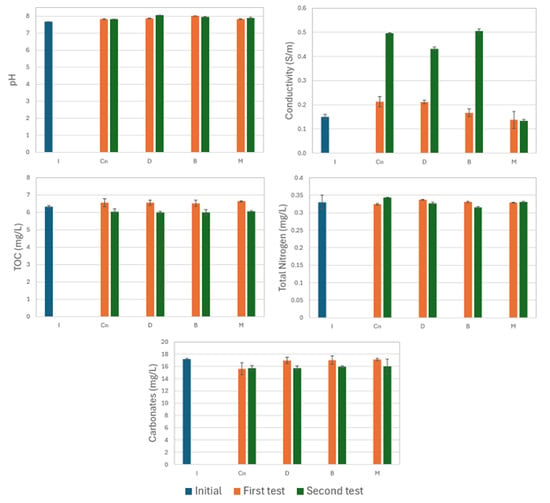
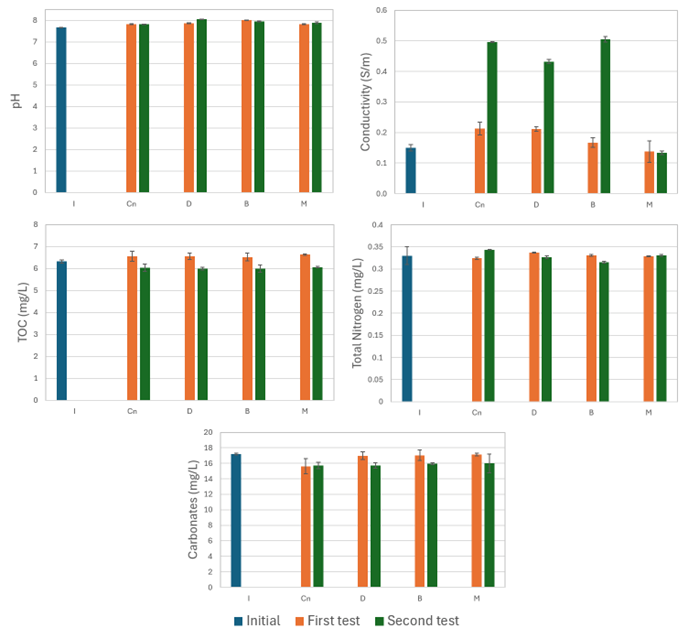
The soil parameters monitored before and after irrigation are presented in Figure 1. The soil pH showed minor fluctuations, reaching values around 8.06 by the end of the second irrigation stage, with no remarkable differences between reclaimed water treatments and the mineral control. Similarly, total organic carbon (TOC), total nitrogen, and carbonate content exhibited no statistically significant differences, regardless of the water source applied. These findings suggest that, under the evaluated conditions, the use of reclaimed water did not significantly alter the general soil matrix composition or the nutrient pools in the short term. For TOC, the only statistically significant difference was found when comparing the contents in mineral water of the first and second year (Games–Howell p = 0.017). Regarding the electrical conductivity (EC) of the soil, the data is also heteroscedastic and the remarkable statistical post hoc differences found were among the first- and second-year comparisons for conventional (CN, p = 0.082), daphnia (D, p = 0.005) and biosolar (B, p = 0.014) treatments. This increase in soil EC is likely associated with the higher concentration of dissolved salts typically present in reclaimed water. In any case, although the observed EC values remained within ranges that are not expected to pose immediate risks to crop productivity, their progressive accumulation under long-term irrigation scenarios should be carefully monitored to prevent potential salinity-related impacts on soil quality and plant performance. Therefore, future studies evaluating the long-term effects of reclaimed water irrigation on soil salinity and sodicity are required.
Figure 1.
General parameters (pH, conductivity, TOC, total N and carbonates) determined in the agricultural soil before and after irrigation using different types of waters. Error bars represent the standard deviation of duplicate analysis. I: initial soil before irrigation, Cn: irrigated with conventional reclaimed water, D: irrigated with reclaimed water from Daphnia treatment system, B: irrigated with reclaimed water from Biosolar treatment system and M: irrigated with mineral water.
3.2.2. Effect on the Content of Major, Minor and Trace Elements
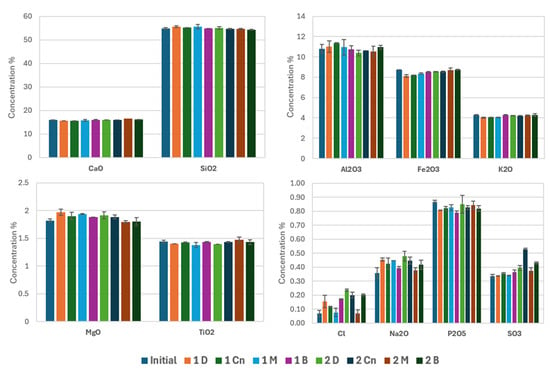
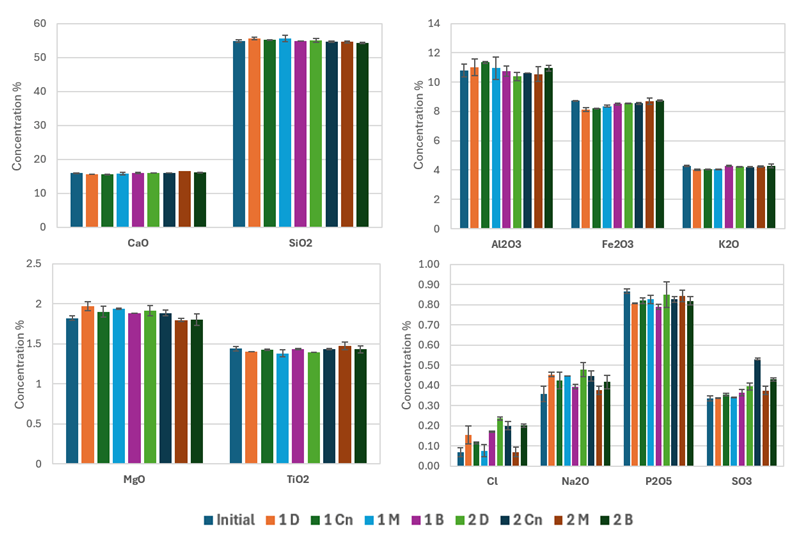
As mentioned in the experimental section, the determination of major (>1%) and minor (0.1–1%) elements in soil samples was carried out using EDXRF analysis. In Figure 2, results obtained are displayed. As shown, the primary soil matrix predominantly composed of oxides such as CaO, SiO2, Al2O3, Fe2O3, K2O, MgO and TiO2 maintained remarkable stability throughout both cultivation phases and across the different irrigation water treatments. This indicates that the application of reclaimed water did not alter the fundamental mineral composition of the substrate in short-term conditions.
Figure 2.
Major and minor elements determined by EDXRF analysis in the agricultural soil before and after the two irrigation periods (1 and 2) using different types of waters. Error bars represent the standard deviation of duplicate analysis. I: initial soil before irrigation, Cn: irrigated with conventional reclaimed water, D: irrigated with reclaimed water from Daphnia treatment system, B: irrigated with reclaimed water from Biosolar treatment system and M: irrigated with mineral water.
In contrast to the major components, the analysis of minor elements (Figure 2) exhibited more pronounced dynamics, directly reflecting the impact of solutes present in the various irrigation sources. A clear trend toward soil salinization was observed, which is consistent with the increase in soil electrical conductivity following irrigation with reclaimed water, as discussed above (Figure 1). Specifically, concentrations of Cl and Na2O increased progressively from the initial to the second cultivation phase (2D, 2CN, 2M, 2B), but no significant post hoc differences were found. This salinization phenomenon is a frequent outcome of utilizing reclaimed water, which typically exhibits higher electrical conductivity compared to potable or mineral water (see Figure 1). It is also important to note a slight increase in sulphur content after the second irrigation period, particularly in soils irrigated with reclaimed water from both the conventional treatment (p = 0.034) and biosolar (p = 0.074) systems, likely due to the accumulation of sulphate ions present in the treated wastewater. As shown in Figure 2, phosphorus content (expressed as P2O5) generally decreased compared to the original soil (before the irrigation period). This reduction may be partly attributed to phosphorus uptake by crops during the two irrigation periods, as phosphorus is an essential macronutrient absorbed by plant roots in the form of inorganic phosphate. Another possible explanation is phosphorus mobilization and transport through irrigation water [39].
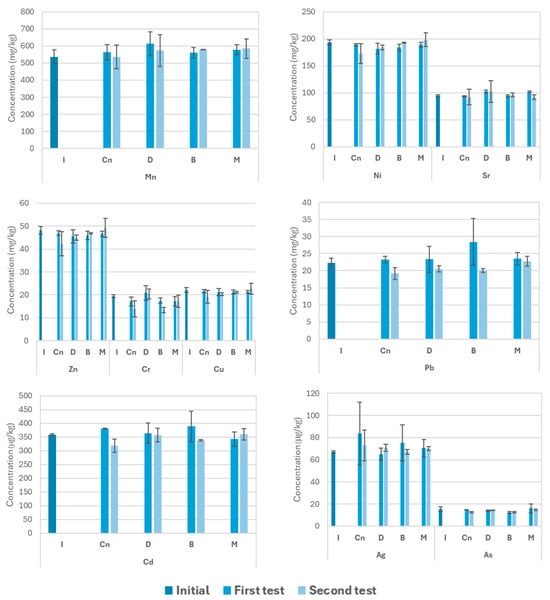
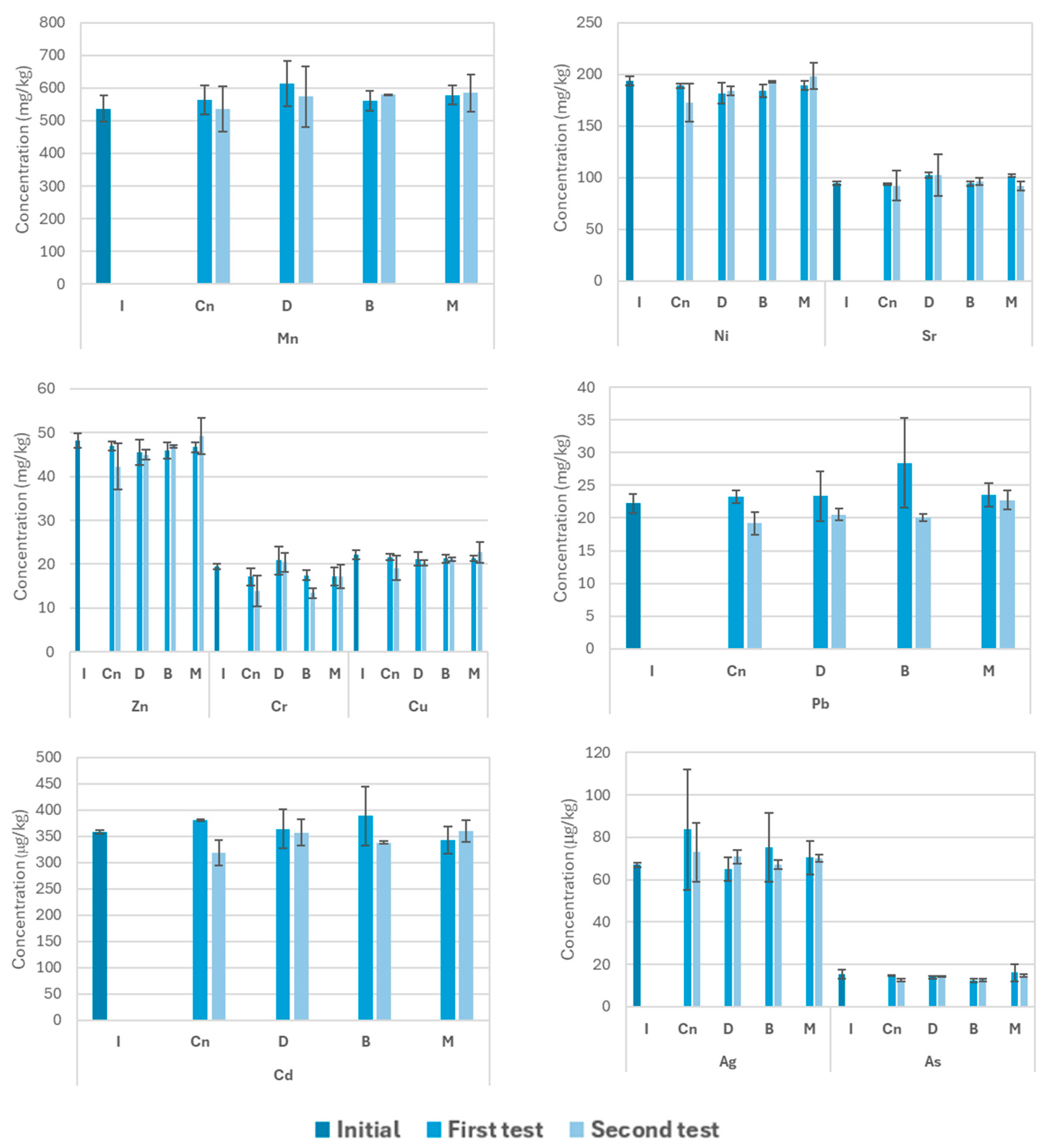
As shown in Figure 3, regarding the content of trace elements (Mn, Zn, Cu, Cr, Ni, Sr) and ultra-trace elements (As, Pb, Cd, Ag), no accumulation process was observed after the two irrigation periods, at least in the short term. It is noteworthy that even for Mn, which had been detected at significantly higher concentrations in the reclaimed water from the conventional system (Table 1), no higher concentration was found in soils irrigated with this water. The concentrations of the studied elements remained below the reference levels for metal concentrations in soils (mg/kg dry weight) under agricultural use, according to the Catalan Waste Agency (As: 30 mg/kg, Cd: 2.5 mg/kg, Cr: 150 mg/kg, Cu: 90 mg/kg, Pb: 60 mg/kg, and Zn: 170 mg/kg), with the only exception being Ni, whose concentration exceeded the threshold value (45 mg/kg) [40]. However, it should be noted that Ni concentrations in the agricultural soil before the irrigation periods were already above the limit, suggesting that the source of Ni is not irrigation derived. Some studies have demonstrated that chemical fertilization, particularly the use of phosphate fertilizers, can be a non-negligible contributor to Ni accumulation in agricultural soils.
Figure 3.
Trace elements in the agricultural soil before and after the two irrigation periods using different types of waters. Error bars represent the standard deviation of duplicate analysis. I: initial soil before irrigation, Cn: irrigated with conventional reclaimed water, D: irrigated with reclaimed water from Daphnia treatment system, B: irrigated with reclaimed water from Biosolar treatment system and M: irrigated with mineral water.
3.3. Effect of Reclaimed Waters on the Crops
3.3.1. Biological Parameters
The impact of reclaimed water on Lactuca sativa was evaluated in terms of growth, leaf physiology, and biochemical responses. Growth vigor was determined by analyzing biomass distribution and root architecture, while leaf health was examined by measuring leaf gas exchange rates, water content, chlorophyll fluorescence, and chlorophyll and flavonol content. Analyses were limited to the second cultivation phase. Five randomly selected samples were taken for each reclaimed water treatment, as described in Section 2.4.1 and Section 2.6, except in the case of ETR values for mineral water when n = 4 due to an extreme value.
As shown in Table 2, biometrical and morphological variables of L. sativa plants did not differ significantly in response to irrigation with wastewater subjected to different tertiary treatment processes. However, root diameter tended to be higher in plants irrigated with Daphnia or Biosolar treated waters (approximately 9.8% and 4.6% greater, respectively, Table 2) compared to control plants irrigated with mineral water.
Table 2.
Biometrical and root morphological parameters in Lactuca sativa plants irrigated with wastewater subjected to different tertiary treatment processes. Results are expressed as mean ± standard error.
Analyses of plant biometric and root morphological data, as well as leaf transpiration (E), stomatal conductance (gs), net photosynthetic rates (A), and water use efficiency (WUE), revealed no significant differences among treatments, with leaf water content (% H2O) remaining stable across all groups (Table 2 and Table 3). These results suggest that irrigation with reclaimed waters did not result in marked alterations in plant growth, water status or gas exchange efficiency under the conditions evaluated. The maintenance of similar physiological parameters in crops irrigated with treated wastewater is consistent with the absence of severe salinity or phytotoxic effects, which are typically associated with reductions in stomatal conductance and photosynthetic activity [41]. Furthermore, the low variability observed, as reflected by the standard errors, indicates a high degree of consistency among replicates. Overall, the comparable growth and physiological performance observed across the treatments support the potential suitability of these tertiary processes for the sustainable production of lettuce.
Table 3.
Gas exchange and water content parameters in Lactuca sativa leaves irrigated with wastewater subjected to different tertiary treatment processes. Results are expressed as mean ± standard error.
In a similar way, analyses of biochemical and chlorophyll fluorescence parameters revealed that most indicators, including chlorophyll and flavonol content, the Nitrogen Balance Index (NBI), and potential photochemical efficiency (Fv/Fm), were not significantly affected by the irrigation source (Table 4). The stability of Fv/Fm and non-photochemical quenching (NPQ) suggests that reclaimed waters did not induce physiological stress or damage to the photosynthetic apparatus of L. sativa. These results support the use of these treated waters for growing crops, such as lettuce, as maintaining Fv/Fm values above 0.8 indicates a fully functional photosynthetic system. However, a significant effect was recorded on the apparent electron transport rate (ETR) (p = 0.05). Indeed, plants irrigated with reclaimed water from the Daphnia reactor exhibited higher ETR values than those under the other treatments (Table 4). Higher ETR values suggest a more efficient processing of light energy by photosystem II, which might be linked to residual micronutrients in these plants. As noted by Bernal et al. [36], increases in ETR values might be a sensitive indicator of photosynthetic improvement even when overall growth remains statistically uniform.
Table 4.
Biochemical and chlorophyll fluorescence parameters in Lactuca sativa leaves irrigated with wastewater subjected to different tertiary treatment processes. Results are expressed as mean ± standard error.
3.3.2. Elemental Composition
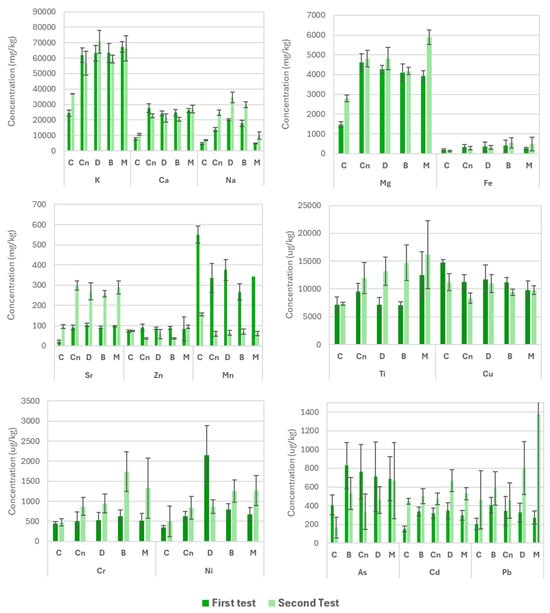
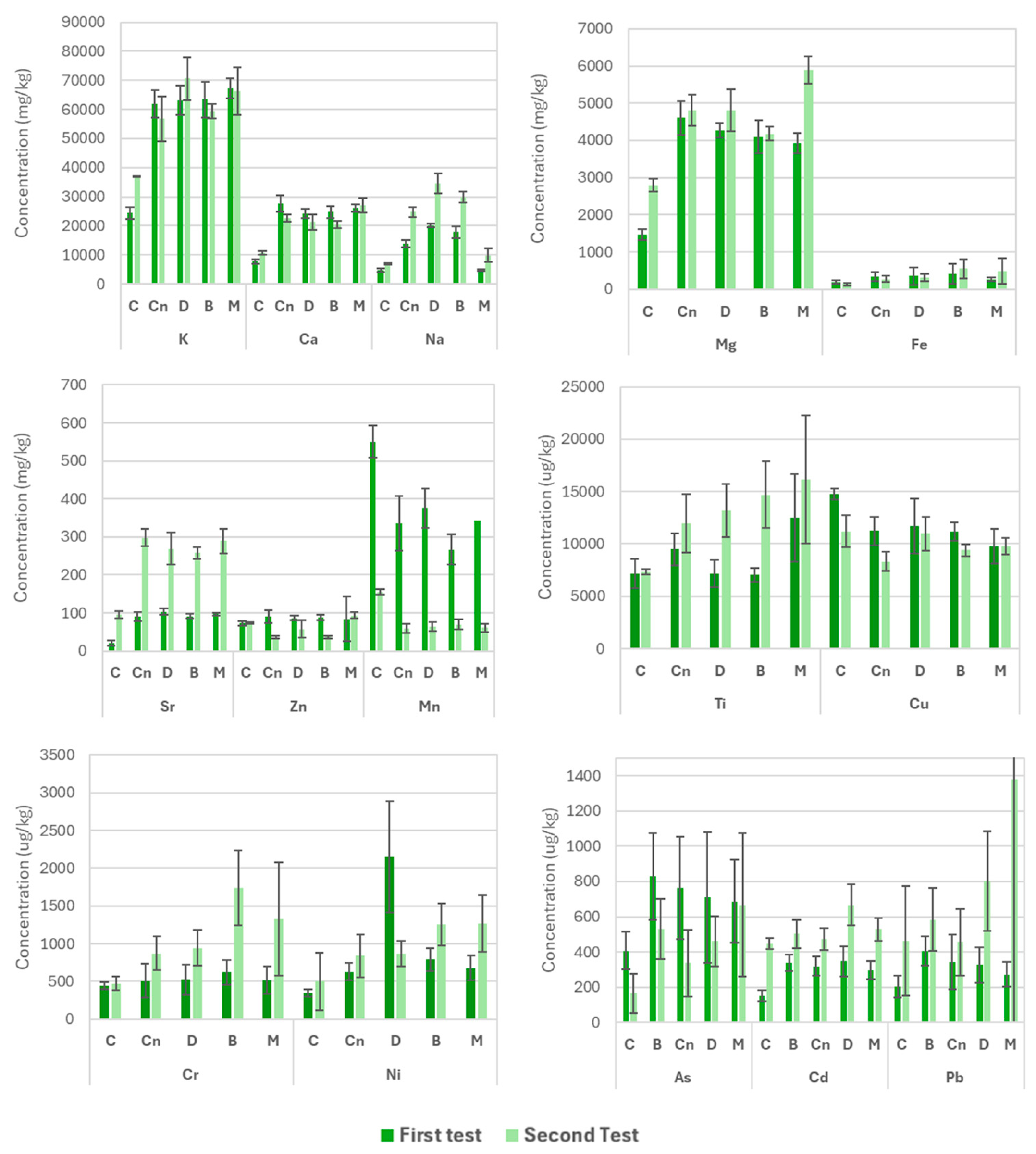
The elemental composition of the edible tissues of the lettuce was also determined to assess the influence of the irrigation water type. Figure 4 shows the results obtained for the two irrigation periods (see Section 2.3 for details), using different types of reclaimed water. For comparison, the elemental composition of lettuce seedlings before starting the irrigation period (Control, C) is also included. It is noteworthy that, in some cases, detecting significant differences among treatments is challenging due to the inherent variability of plant samples. As shown in Figure 4, for macronutrients such as K, Ca, Mg, and other elements like Sr, in general no significant differences were observed in lettuce composition among irrigation treatments; however, a significant increase relative to the control was observed (p < 0.001 according to post hoc Tukey test for homoscedastic data). Particular significant differences (p = 0.003 or less) were found for Ca (1C vs. 2C), Mg (1M vs. 2M) and Sr (1C vs. 2C, 1D vs. 2D, 1B vs. 2B). For Na, a significant increase was observed in plants irrigated with reclaimed waters compared to those irrigated with freshwater, especially in the second irrigation test. This trend of Na accumulation in leaves has been reported by other authors [42]. Mn content also varied considerably between the two controls corresponding to the two irrigation periods. Despite no significant differences being found among irrigation treatments in either period, Mn levels in the control (before irrigation) were higher than those measured after irrigation. These trends may likely be due to dilution effects associated with increased biomass or to fluctuations in soil nutrient availability.
Figure 4.
Trace elements in the edible parts of lettuce plants after the two irrigation periods (dark green: First test; light green: Second test) using different types of waters. Elemental concentrations are expressed on dry-weight basis. Error bars represent the standard deviation of duplicate analysis. C: Control (Lettuce seedlings), Cn: irrigated with conventional reclaimed water, D: irrigated with reclaimed water from Daphnia treatment system, B: irrigated with reclaimed water from Biosolar treatment system and M: irrigated with mineral water.
Regarding Ti, Cr, and Ni, concentrations were generally similar across treatments, with values higher in the second irrigation period. The only exceptions were Ni, with significantly higher concentrations found in plants irrigated with Daphnia-treated water (particularly in the first experimental period, p < 0.001), and Cr (1B vs. 2B showed p = 0.044). For potentially toxic elements such as As, Cd, and Pb, a slight increase relative to the control was observed, but no differences were associated with irrigation type, suggesting that this increase may reflect soil uptake rather than irrigation effects. In any case, measured concentrations were below maximum levels permitted in leafy crops according to Commission Regulation (EU) 2023/915 [43] (Table S4). For other elements previously mentioned, although not regulated, concentrations were consistent with reference ranges reported in other studies (Table S4), indicating that irrigation with reclaimed water, whether from conventional or nature-based systems, does not significantly affect lettuce elemental composition.
To comprehensively assess potential effects of irrigation with conventionally treated wastewater and nature-based alternatives, root samples from specimens harvested after the second irrigation period were also analyzed (Figure S5). In general, elemental concentrations in roots of control seedlings were lower than in plants after the irrigation periods. In most cases, no differences were observed among plants irrigated with different water types. Notably, concentrations of Ca, Mg, Fe, Sr, Mn, and Ti were slightly higher in plants irrigated with conventionally treated reclaimed water (p < 0.001 in many cases), although only Mn was present at significantly higher concentrations in this type of water compared to other water types (Table 1).
Most elements present Translocation Factors (TF < 1) suggesting that they were preferentially retained in the root compartment. In contrast, Mg, K, Ca, and Na, showed higher concentrations in aerial tissues (TF > 1), indicating preferential distribution towards the above-ground parts of the plants. This distinction is relevant because the aerial tissues constitute the edible fraction of the lettuce. Figure S5 also shows that Na and Zn concentrations in roots were higher in plants irrigated with reclaimed water, regardless of treatment type. For Na, statistically significant differences were observed among the irrigation treatments (Games–Howell test, p < 0.03), except for the Daphnia treatment. A particularly noteworthy result was the difference in Na translocation factors between irrigation water types. The TF for Na was approximately 0.79 in plants irrigated with mineral water, whereas values in plants irrigated with reclaimed water ranged from 1.17 to 1.81. Since the TF represents the ratio between the concentration of an element in aerial tissues and that in roots, these values indicate a higher relative concentration of Na in the aerial tissues, compared with the roots, of plants receiving reclaimed water. This pattern suggests that irrigation water quality may influence the partitioning of Na within lettuce plants. Sodium accumulation and its distribution between plant organs are important aspects of plant responses to salinity, as excessive Na uptake can affect plant ion balance and growth [44].
4. Conclusions
This study evaluated the short-term effects of irrigation with reclaimed waters from conventional and nature-based wastewater treatment systems on soil properties and lettuce (Lactuca sativa) crops. The results indicate that both the Daphnia and the biosolar reactors produced effluents with physicochemical characteristics comparable to those obtained from conventional tertiary treatment and showed promising performance in wastewater polishing, contributing to the reduction in COD and nitrogen species. Despite these chemical advantages, microbiological analysis reveals a critical bottleneck, as E. coli levels in both NBS systems exceed the safety thresholds established by RD 1620/200729 and RD 1085/202430 (Quality A waters). Consequently, while these systems are viable for mineral and organic removal, the implementation of a final disinfection stage prior to field application should be properly studied if the reclaimed water is used for irrigating crops with direct contact with edible parts. However, NBS-reclaimed waters remain suitable for a range of other agricultural applications, including drip irrigation, which prevents direct contact with the edible parts of crops, as well as the irrigation of crops intended for non-food uses, energy production, or seed production.
Irrigation with reclaimed waters, from both conventional and NBS systems, resulted in moderate increases in electrical conductivity, suggesting a gradual trend toward salinization that should be monitored under long-term irrigation scenarios. However, the mineralogical composition of the soil remained stable and no accumulation of trace metals attributable to irrigation was detected.
Crop performance was not negatively affected by reclaimed water irrigation. Morphological, physiological, and biochemical indicators of plant health remained stable across treatments, confirming that these water sources did not induce stress or impair photosynthetic activity. Moreover, elemental concentrations in the edible tissues of the lettuce were comparable among treatments and remained below established regulatory limits for food safety.
Overall, this study provides valuable insights into the potential of nature-based treatment technologies for producing reclaimed water for agricultural irrigation and establishes a basis for their further evaluation under real-world conditions. It is important to note that these findings should be interpreted in the context of the short-term and controlled conditions of the present laboratory experiment. In particular, the moderate increases in soil electrical conductivity observed during the study may represent an early indication of salt accumulation, but the long-term effects of repeated irrigation with reclaimed water cannot be established from the present results. Under field conditions, the extent of soil salinization may be influenced by several interacting factors, including the chemical composition of the irrigation water, soil properties, climatic conditions, drainage capacity, and irrigation management practices. Therefore, long-term field-scale studies are needed to assess the cumulative effects of reclaimed water irrigation on soil salinity and sodicity, soil structure and fertility, as well as crop productivity and quality. Such studies would provide essential information to establish appropriate monitoring strategies and irrigation management practices, thereby supporting the safe and sustainable implementation of reclaimed water reuse from the emerging nature-based treatment systems considered.
Supplementary Materials
The following supporting information can be downloaded at: https://www.mdpi.com/article/10.3390/w18222885/s1, Table S1: Instrumental characteristics and measurement conditions for elemental analysis by ICP-based techniques; Table S2: Instrumental characteristics and measurement conditions for EDXRF analysis of soil samples; Table S3: Main physicochemical characteristics of the agricultural soil used in the crop bioassay; Table S4: Maximum levels and reference ranges of metals in leafy vegetables; Figure S1: Images of the two innovative nature-based wastewater treatment technologies located in the Quart WWTP (Girona, Spain): (A) Daphnia Reactor and (B) Biosolar Reactor; Figure S2: Overview of the crop bioassay design; Figure S3: Recovery values (in percentage) obtained in the analysis of the certified reference materials: NCS ZC73013 (Spinach), NCS ZC73033 (Scallion) and NCS DC73349 (Bush branches and leaves) using the microwave digestion + ICP-OES/ICP-MS method; Figure S4: X-ray diffractogram of the agricultural soil used in the crop bioassay; Figure S5: Elemental content determined in the lettuce roots (second test) using different types of reclaimed waters for irrigation.
Author Contributions
Conceptualization, E.M., L.T. and M.I.; methodology, M.I.V., M.I., L.T., I.Q., D.V., L.L., M.G. and E.M.; software, E.B.; resources, E.M.; data curation, M.I.V., M.I., L.T., D.V., L.L. and E.M.; writing—original draft preparation, M.I.V., E.M., D.V. and L.L.; writing—review and editing, M.I.V., M.I., L.T., I.Q., E.B., D.V., L.L., M.G. and E.M.; supervision, E.M., M.I. and L.T.; project administration, E.M.; funding acquisition, E.M. All authors have read and agreed to the published version of the manuscript.
Funding
This research is carried out in the frame of the research projects PID 2021-127326OB-I00, PID2022-142523OB-I00 and PID2024-160499OB-I00 funded by MCIN/AEI. M.I. Villacis appreciates the financial support from the Department of Research and Universities of the Generalitat of Catalonia, through the Scholarship Ajuts Joan Oró for the recruitment of pre-doctoral researchers in training (ref. 2023 FI-1 00253). L. Torrent gratefully acknowledges the postdoctoral grant from the University of Girona (ref. POSTDOC_UdG2023/23). Xavier Montreal is acknowledged for his contribution to the laboratory work.
Data Availability Statement
The original data presented in the study are openly available in the publicly accessible repository CORA at https://doi.org/10.34810/DATA3872.
Conflicts of Interest
The authors declare no conflicts of interest.
References
- Swatuk, L.A.; Cash, C. (Eds.) Water, Energy, Food and People Across the Global South. ‘The Nexus’ in an Era of Climate Change; Palgrave Macmillan: Boston, MA, USA, 2018; p. 340. [Google Scholar]
- Pardini, G.; Gispert, M.; Dunjo, G. Relative Influence of Wildfire on Soil Properties and Erosion Processes in Different Mediterranean Environments in NE Spain. Sci. Total Environ. 2004, 328, 237–246. [Google Scholar] [CrossRef] [Scilit] [PubMed]
- Cabrera, E.; Pardo, M.Á.; Cabrera, E., Jr.; Cobacho, R. Agua y energía en España. Un reto complejo y fascinante. Ing. Agua 2010, 17, 236–246. [Google Scholar] [CrossRef] [Scilit]
- Chávez, M.A.R.; Caicedo, C.E.L. Agua e Inteligencia Artificial: El Lado Oculto del Progreso Tecnológico. Estud. Perspect. Rev. Cient. Acad. 2025, 5, 47–65. [Google Scholar] [CrossRef] [Scilit]
- Castro Dávila, M. Análisis de las Distintas Redes Que Se Generan en Twitter para Identificar el Impacto de la Inteligencia Artificial en el Consumo de Agua; Universidad Complutense de Madrid: Madrid, Spain, 2024. [Google Scholar]
- Venkatesh, G.; Brattebø, H. Environmental impact analysis of chemicals and energy consumption in wastewater treatment plants: Case study of Oslo, Norway. Water Sci. Technol. 2011, 63, 1018–1031. [Google Scholar] [CrossRef] [Scilit] [PubMed]
- Mudadu Silva, J.R.; Alves Fernandez, R.B.; Cirelli, G.L.; Pereira, L.F.; Borges, A.C.; Marzo, A. Nature-based solutions for municipal wastewater treatment: A systematic review on full-scale systems from the last 30 years (1995–2025). Nat.-Based Solut. 2026, 9, 100311. [Google Scholar] [CrossRef] [Scilit]
- Serra, T.; Barcelona, A.; Pous, N.; Salvadó, V.; Colomer, J. Disinfection and Particle Removal by a Nature-Based Daphnia Filtration System for Wastewater Treatment. J. Water Process Eng. 2022, 50, 103238. [Google Scholar] [CrossRef] [Scilit]
- Pau, C.; Serra, T.; Colomer, J.; Casamitjana, X.; Sala, L.; Kampf, R. Filtering Capacity of Daphnia Magna on Sludge Particles in Treated Wastewater. Water Res. 2013, 47, 181–186. [Google Scholar] [CrossRef] [Scilit] [PubMed]
- Shiny, K. Biotreatment of Wastewater Using Aquatic Invertebrates, Daphnia Magna and Paramecium Caudatum. Bioresour. Technol. 2005, 96, 55–58. [Google Scholar] [CrossRef] [Scilit] [PubMed]
- Matamoros, V.; Salvadó, V. Evaluation of the Seasonal Performance of a Water Reclamation Pond-Constructed Wetland System for Removing Emerging Contaminants. Chemosphere 2012, 86, 111–117. [Google Scholar] [CrossRef] [Scilit] [PubMed]
- Colomer, J.; Müller, M.F.; Barcelona, A.; Serra, T. Mediated Food and Hydrodynamics on the Ingestion of Microplastics by Daphnia Magna. Environ. Pollut. 2019, 251, 434–441. [Google Scholar] [CrossRef] [Scilit] [PubMed]
- Miranda, A.F.; Ramkumar, N.; Andriotis, C.; Höltkemeier, T.; Yasmin, A.; Rochfort, S.; Wlodkowic, D.; Morrison, P.; Roddick, F.; Spangenberg, G.; et al. Applications of Microalgal Biofilms for Wastewater Treatment and Bioenergy Production. Biotechnol. Biofuels 2017, 10, 120. [Google Scholar] [CrossRef] [Scilit] [PubMed]
- Garcia-Rodríguez, A.; Matamoros, V.; Fontàs, C.; Salvadó, V. The Ability of Biologically Based Wastewater Treatment Systems to Remove Emerging Organic Contaminants—A Review. Environ. Sci. Pollut. Res. 2014, 21, 11708–11728. [Google Scholar] [CrossRef] [Scilit] [PubMed]
- Li, Y.; Xie, F.; Gao, Y.; Ji, L. The Purification Efficiency and Synergistic Mechanism of the Algal-Bacteria System for Simulating Livestock Wastewater. Sustainability 2026, 18, 2633. [Google Scholar] [CrossRef] [Scilit]
- Li, J.; Ge, Q.; Li, Y.; Gao, Y.; Xie, S. A Comparative Study of the Growth and Nutrient Removal Effects of Five Green Microalgae in Simulated Domestic Sewage. Water 2021, 13, 3613. [Google Scholar] [CrossRef] [Scilit]
- FAO. Versíon Resumida: El Estado Mundial de la Agricultura y la Alimentación 2019. Progresos en la Lucha Contra la Pérdida y el Desperdicio de Alimentos, 1st ed.; FAO: Rome, Italy, 2019. [Google Scholar]
- Smart Water Magazine. Reclaimed Water Reuse: Dealing with Water Scarcity in Spain. Smart Water Magazine. Available online: https://smartwatermagazine.com/news/smart-water-magazine/reclaimed-water-reuse-dealing-water-scarcity-spain (accessed on 17 February 2026).
- Souguir, M.; Fraj, H.; Hannachi, C. Enzymatic and Biochemical Responses of Sesame to Sodium Chloride at Germination and Early Seedling Growth. Int. J. Veg. Sci. 2017, 23, 87–101. [Google Scholar] [CrossRef] [Scilit]
- Al-Jaboobi, M.; Zouahri, A.; Tijane, M.; Housni, A.; Mennane, Z.; Hasna, Y.; Bouksaim, M. Evaluation of Heavy Metals Pollution in Groundwater, Soil and Some Vegetables Irrigated with Wastewater in the Skhirat Region “Morocco”. J. Mater. Environ. Sci. 2014, 5, 961–966. [Google Scholar]
- Choukr-Allah, R. Innovative Wastewater Treatments and Reuse Technologies Adapted to Southern Mediterranean Countries. In Waste Water Treatment and Reuse in the Mediterranean Region; Barceló, D., Petrovic, M., Eds.; Springer: Berlin, Heidelberg, 2011; pp. 29–41. [Google Scholar] [CrossRef] [Scilit]
- Regulation (EU) 2020/741. Regulation (EU) 2020/741; 2020. Volume 177. Available online: http://data.europa.eu/eli/reg/2020/741/oj (accessed on 19 February 2026).
- Elgallal, M.; Fletcher, L.; Evans, B. Assessment of Potential Risks Associated with Chemicals in Wastewater Used for Irrigation in Arid and Semiarid Zones: A Review. Agric. Water Manag. 2016, 177, 419–431. [Google Scholar] [CrossRef] [Scilit]
- Christou, A.; Papadavid, G.; Dalias, P.; Fotopoulos, V.; Michael, C.; Bayona, J.M.; Piña, B.; Fatta-Kassinos, D. Ranking of Crop Plants According to Their Potential to Uptake and Accumulate Contaminants of Emerging Concern. Environ. Res. 2019, 170, 422–432. [Google Scholar] [CrossRef] [Scilit] [PubMed]
- Aliste, M.; Garrido, I.; Hernández, V.; Flores, P.; Hellín, P.; Navarro, S.; Fenoll, J. Assessment of Reclaimed Agro-Wastewater Polluted with Insecticide Residues for Irrigation of Growing Lettuce (Lactuca sativa L) Using Solar Photocatalytic Technology. Environ. Pollut. 2022, 292, 118367. [Google Scholar] [CrossRef] [Scilit] [PubMed]
- Torrent, L.; Iglesias, M.; Marguí, E.; Hidalgo, M.; Verdaguer, D.; Llorens, L.; Kodre, A.; Kavčič, A.; Vogel-Mikuš, K. Uptake, Translocation and Ligand of Silver in Lactuca sativa Exposed to Silver Nanoparticles of Different Size, Coatings and Concentration. J. Hazard. Mater. 2020, 384, 121201. [Google Scholar] [CrossRef] [Scilit] [PubMed]
- Vázquez-Alarcón, A.; Justin-Cajuste, L.; Siebe-Grabach, C.; Alcántar-González, G.; Bauer, M.d.L.d.l.I.d. CADMIO, NÍQUEL Y PLOMO EN AGUA RESIDUAL, SUELO Y CULTIVOS EN EL VALLE DEL MEZQUITAL, HIDALGO, MÉXICO. Agrociencia 2001, 35, 267–274. [Google Scholar]
- Xu, J.; Wu, L.; Chang, A.C.; Zhang, Y. Impact of long-term reclaimed wastewater irrigation on agricultural soils: A preliminary assessment. J. Hazard. Mater. 2010, 183, 780–786. [Google Scholar] [CrossRef] [Scilit] [PubMed]
- Lyu, S.; Wu, L.; Wen, X.; Wang, J.; Chen, W. Effects of reclaimed wastewater irrigation on soil-crop systems in China: A review. Sci. Total Environ. 2022, 813, 152531. [Google Scholar] [CrossRef] [Scilit] [PubMed]
- Serra, T.; Colomer, J.; Pau, C.; Marín, M.; Sala, L. Tertiary Treatment for Wastewater Reuse Based on the Daphnia Magna Filtration—Comparison with Conventional Tertiary Treatments. Water Sci. Technol. 2014, 70, 705–711. [Google Scholar] [CrossRef] [Scilit] [PubMed]
- Jodar-Abellan, A.; López-Ortiz, M.I.; Melgarejo-Moreno, J. Wastewater Treatment and Water Reuse in Spain. Current Situation and Perspectives. Water 2019, 11, 1551. [Google Scholar] [CrossRef] [Scilit]
- Royal Decree 1620/2007: Spain. Royal Decree 1620/2007, of December 7, Establishing the Legal Framework for the Reuse of Treated Wastewater; Official State Gazette (BOE): Madrid, Spain, 2007. [Google Scholar]
- Royal Decree 1085/2024: Spain. Royal Decree 1085/2024, of October 22, Approving the Water Reuse Regulation and Amending Various Royal Decrees Regulating Water Management; Official State Gazette (BOE): Madrid, Spain, 2024. [Google Scholar]
- ISRIC. Soil Parameter Estimates for the Soil Types of the World for Use in Global and Regional Modelling; ISRIC: Wageningen, The Netherlands, 2002. [Google Scholar]
- Buhrke, V.E.; Jenkins, R.; Smith, D.K. (Eds.) A Practical Guide for the Preparation of Specimens for X-Ray Fluorescence and X-Ray Diffraction Analysis; Wiley: Hoboken, NJ, USA, 1998. [Google Scholar]
- Bernal, M.; Verdaguer, D.; Badosa, J.; Abadía, A.; Llusià, J.; Peñuelas, J.; Núñez-Olivera, E.; Llorens, L. Effects of enhanced UV radiation and water availability on performance, biomass production and photoprotective mechanisms of Laurus nobilis seedlings. Environ. Exp. Bot. 2015, 109, 264–275. [Google Scholar] [CrossRef] [Scilit]
- Ayers, R.S.; Westcot, D.W. Water Quality for Agriculture. FAO Irrigation and Drainage Paper 29, Rev. 1; FAO: Rome, Italy, 1985. [Google Scholar]
- Zhao, S.; Huq, M.E.; Fahad, S.; Kamran, M.; Riaz, M. Boron toxicity in plants: Understanding mechanisms and developing coping strategies; a review. Plant Cell Rep. 2024, 43, 238. [Google Scholar] [CrossRef] [Scilit] [PubMed]
- Wang, Y.; Wang, F.; Lu, H.; Liu, Y.; Mao, C. Phosphate Uptake and Transport in Plants: An Elaborate Regulatory System. Plant Cell Physiol. 2021, 62, 564–572. [Google Scholar] [CrossRef] [Scilit] [PubMed]
- Agència de Residus de Catalunya, ARC. Decret 140/2023, de 25 de Juliol, pel Qual S’actualitzen els Nivells Genèrics de Referència dels Elements Traça en els Sòls de Catalunya [Decree 140/2023, of July 25, Updating the Generic Reference Levels for Trace Elements in the Soils of Catalonia]. Diari Oficial de la Generalitat de Catalunya, 8967. 2023. Available online: https://dogc.gencat.cat/ca/pdogc_canals_interns/pdogc_resultats_fitxa/?documentId=965425 (accessed on 17 October 2026).
- Gómez-Bellot, M.J.; Lorente, B.; Sánchez-Blanco, M.J.; Ortuño, M.F.; Nortes, P.A.; Alcarcón, J.J. Influence of Mixed Substrate and Arbuscular Mycorrhizal Fungi on Photosynthetic Efficiency, Nutrient and Water Status and Yield in Tomato Plants Irrigated with Saline Reclaimed Waters. Water 2020, 12, 438. [Google Scholar] [CrossRef] [Scilit]
- Zalacáin, D.; Martínez-Pérez, S.; Bienes, R.; García-Díaz, A.; Sastre-Merlín, A. Salt Accumulation in Soils and Plants under Reclaimed Water Irrigation in Urban Parks of Madrid (Spain). Agric. Water Manag. 2019, 213, 468–476. [Google Scholar] [CrossRef] [Scilit]
- Commission Regulation (EU) 2023/915: European Union. Commission Regulation (EU) 2023/915 of 25 April 2023 on maximum levels for certain contaminants in food. Off. J. Eur. Union 2023, L119/103, 103–157.
- Munns, R.; Tester, M. Mechanisms of Salinity Tolerance. Annu. Rev. Plant Biol. 2008, 59, 651–681. [Google Scholar] [CrossRef] [Scilit] [PubMed]

Disclaimer/Publisher’s Note: The statements, opinions and data contained in all publications are solely those of the individual author(s) and contributor(s) and not of MDPI and/or the editor(s). MDPI and/or the editor(s) disclaim responsibility for any injury to people or property resulting from any ideas, methods, instructions or products referred to in the content. |
© 2026 by the authors. Licensee MDPI, Basel, Switzerland. This article is an open access article distributed under the terms and conditions of the Creative Commons Attribution (CC BY) license.