


Abstract
Mineral residues from wastewater may constitute potential secondary resources; however, their heterogeneous composition and potential to release contaminants through leaching require careful evaluation. This case study compared grit chamber (GC) waste and sewer cleaning (SC) waste collected from a municipal wastewater management system, focusing on their physicochemical properties, chemical composition, particle size distribution, and leaching behavior. The tested materials were separated into coarse (≥2 mm) and fine (<2 mm) fractions and subsequently subjected to solid-phase analyses and leaching tests. Both types of waste had similar median particle sizes (D50: 0.247 mm for GC and 0.230 mm for SC) but differed considerably in chemical composition and leaching behavior. The coarse GC fraction contained substantially more organic carbon (22.79%) than the fine fraction (1.78%), whereas the fine fractions were enriched in SiO2. Sulfate concentrations in aqueous extracts from GC reached 1511 mg/L, compared with 98.6–105 mg/L in extracts from SC. Under the applied leaching conditions, the release of selected trace elements was limited. The results indicate that particle size alone does not fully explain the observed differences in contaminant distribution and release. Although SC waste exhibited relatively favorable properties for raw material recovery, these findings are limited to the tested material batches and laboratory conditions. Therefore, before material recovery is considered, detailed characterization is necessary, taking into account waste origin, appropriate pretreatment, and an environmental assessment tailored to the intended application.
1. Introduction
Municipal wastewater management systems generate substantial quantities of solid residues during wastewater collection and treatment. Although sewage sludge has received considerable scientific and regulatory attention, mineral residues such as grit removed during preliminary treatment and sediments recovered during sewer cleaning remain comparatively poorly characterized. Grit chambers are designed to separate dense particles, including sand, gravel, glass fragments, and other mineral matter, thereby protecting downstream equipment from abrasion, deposition, clogging, and operational failure [1,2]. Sewer cleaning similarly generates heterogeneous materials consisting of mineral particles mixed with organic matter and contaminants accumulated during wastewater transport. The quantity and composition of these residues vary depending on catchment characteristics, sewer system type, wastewater composition, hydraulic conditions, seasonal variability, and the efficiency of grit separation and washing processes [1,2,3].
In conventional waste management practices, wastewater-derived mineral residues are generally classified and managed as waste, commonly through disposal rather than material recovery. However, the transition towards a circular economy promotes waste prevention, preparation for reuse, recycling, and other forms of material recovery over disposal [4]. Because these residues frequently contain a substantial proportion of sand-sized mineral particles, they may represent an alternative source of mineral aggregate. Previous studies have investigated their potential use in construction materials, including in non-structural concrete and other cementitious composites, as soil backfill, and in road embankments and earthworks [5,6,7,8]. Recovery of the mineral fraction could reduce both the consumption of natural sand and the volume of waste requiring disposal. Nevertheless, satisfactory engineering properties alone do not ensure environmental safety. Any proposed recovery or reuse pathway should also be supported by reliable information on contaminant concentrations, organic matter content, and the mobility of potentially hazardous substances under conditions involving contact with water.
During transport through sewer systems and prolonged contact with municipal wastewater, mineral particles may accumulate organic matter, nutrients, trace elements, and other contaminants. Sorption onto particle surfaces, association with iron and aluminium oxides, incorporation into organic surface coatings, and precipitation or co-precipitation reactions may transform apparently inert mineral grains into secondary carriers of pollutants. Sewer sediments have been reported to contain variable concentrations of Zn, Cu, Cr, Ni, Pb, Cd, and other trace elements. These concentrations depend, among other factors, on the type of sewer system, sampling location, and characteristics of the contributing catchment [9]. The disturbance, excavation, reuse, or disposal of these materials may therefore create pathways for contaminant transfer to soils, groundwater, and surface waters.
The total concentration of an element in a solid material is an important indicator of contamination, but it does not directly determine the resulting environmental impact. The associated risk depends largely on the chemical form of the contaminant and its susceptibility to mobilization. Elements incorporated into stable mineral structures may exhibit low leachability despite relatively high total concentrations, whereas smaller amounts present in soluble, exchangeable, or weakly bound forms may be readily released into water. Leaching tests therefore provide information complementary to bulk chemical analysis and are particularly important when assessing potential recovery or reuse options for waste materials. Previous studies have also demonstrated the suitability of leaching tests for assessing trace-element mobility in sewer sediments [9,10].
Particle size may be another important factor controlling contaminant distribution and mobility. Fine particles generally have a higher specific surface area, greater surface reactivity, and a higher capacity to bind metals and organic compounds than coarse mineral grains. Fine sediment fractions may also contain higher proportions of clay minerals, iron and manganese oxides, and organic matter, which provide active sorption sites [11,12]. Consequently, enrichment of certain trace elements in fine-grained fractions has frequently been observed in soils and aquatic sediments [11,13]. However, this relationship cannot be assumed to apply universally to wastewater-derived mineral residues. Coarse particles may occur as organic–mineral aggregates or retain fibrous and biodegradable matter. Furthermore, washing, drying, and sieving may disrupt composite particles or redistribute organic surface coatings, thereby affecting the measured properties of individual fractions [3,14,15]. Contaminant distribution and release should therefore be evaluated separately for different particle size fractions rather than predicted solely from the total composition of an unfractionated sample.
Previous research has focused predominantly on the physical and hydraulic properties of wastewater grit, grit-removal efficiency, the overall composition of recovered sand, or the engineering feasibility of its reuse [1,2,3,5,6,7,8]. Other studies have investigated contaminant concentrations and trace-element leaching from sediments collected from sanitary, stormwater, and combined sewer systems [9,10]. To the authors’ knowledge, however, direct comparisons between grit chamber residues and mineral materials recovered during sewer cleaning remain scarce. In particular, limited attention has been paid to the combined effects of material origin and particle size fraction on bulk chemical composition, organic matter content, nutrient release, trace-element distribution, and leaching behaviour. This knowledge gap limits the identification of fractions that are potentially suitable for recovery and those that require additional treatment or controlled disposal.
Accordingly, the aim of this study was to evaluate the physicochemical properties, chemical composition, and leaching behaviour of contaminants in wastewater-derived mineral residues originating from two sources within an urban wastewater management system: grit removed at a municipal wastewater treatment plant and mineral material recovered during sewer cleaning. The materials were separated into coarse (≥2 mm) and fine (<2 mm) fractions and compared with the corresponding unfractionated materials and with a reference sand. The assessment included particle size distribution, moisture content, bulk density, organic matter indicators, including loss on ignition, oxide and trace-element composition, and the physicochemical and chemical characteristics of aqueous extracts obtained using a leaching test.
It was hypothesized that both material origin and particle size fraction would affect contaminant distribution and release, and that the direction and magnitude of these effects would depend on material composition. Fine fractions were expected to retain more contaminants because of their higher specific surface area and potentially greater abundance of reactive mineral phases, whereas coarse fractions containing organic–mineral aggregates could retain substantial amounts of organic matter and associated contaminants. The aim of this study was to determine whether particle size alone accounts for the distribution and mobility of contaminants or whether material origin and organic and mineral composition also contribute.
2. Materials and Methods
2.1. Study Site and Wastewater Treatment Plant
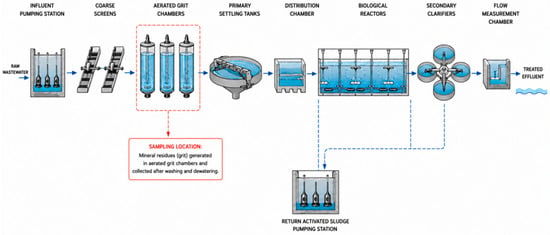
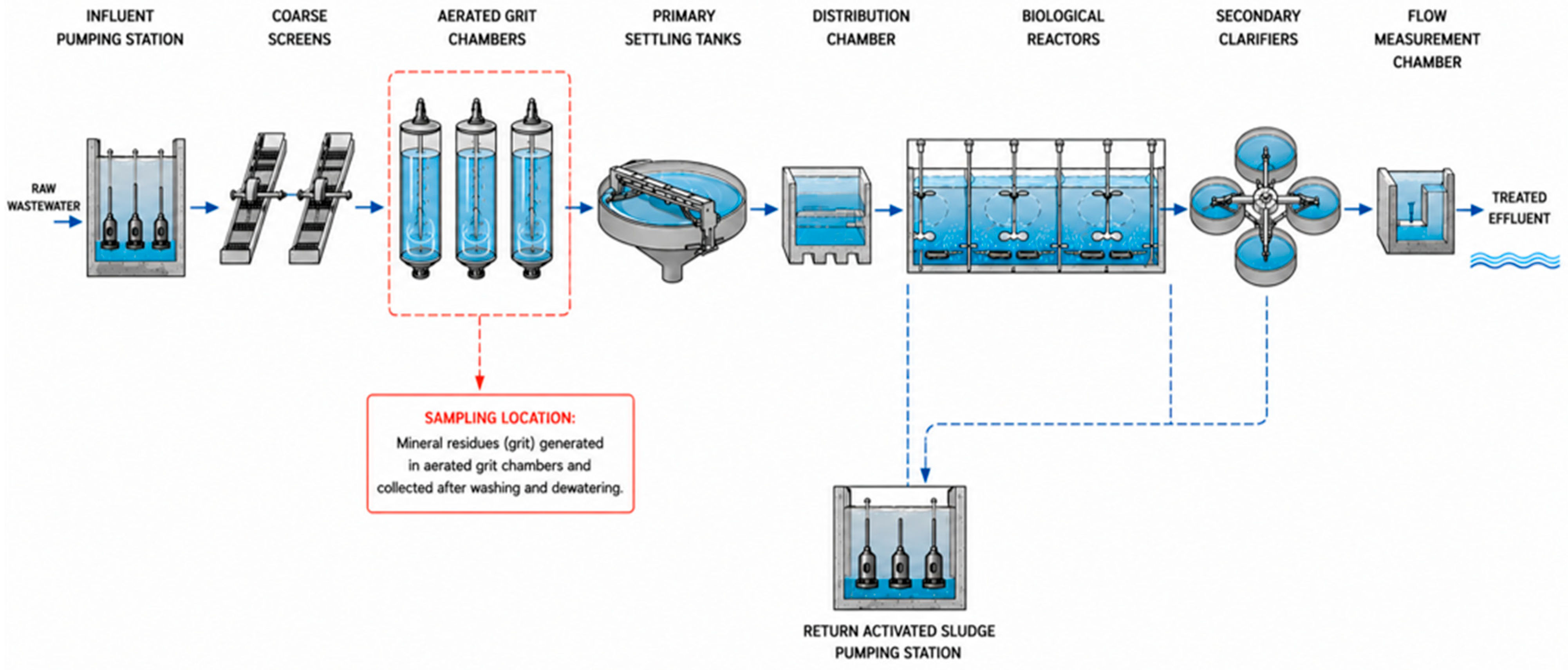
The study was conducted at a full-scale municipal wastewater treatment plant (WWTP) serving a population equivalent (PE) of 137,500. The plant employs a conventional mechanical and biological treatment process with biological nutrient removal (BNR). The treatment train consists of mechanical pre-treatment (pumping, coarse screening, grit removal, and primary sedimentation), followed by a multi-stage activated sludge system with nitrification, denitrification, and enhanced biological phosphorus removal (EBPR). Following biological treatment, activated sludge is separated from the treated wastewater in secondary clarifiers. The resulting effluent is subsequently discharged into the receiving water body, while return activated sludge (RAS) is returned to the biological reactors. A simplified process flow diagram of the WWTP is presented in Figure 1, showing the locations at which the investigated mineral residues were generated and collected.
Figure 1.
Simplified process flow diagram of the WWTP showing the grit sampling location. The schematic was generated with the assistance of artificial intelligence and subsequently reviewed and verified by the authors.
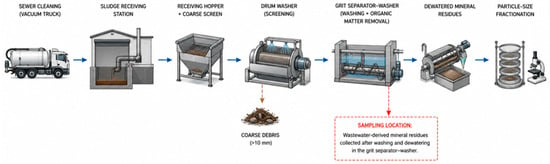
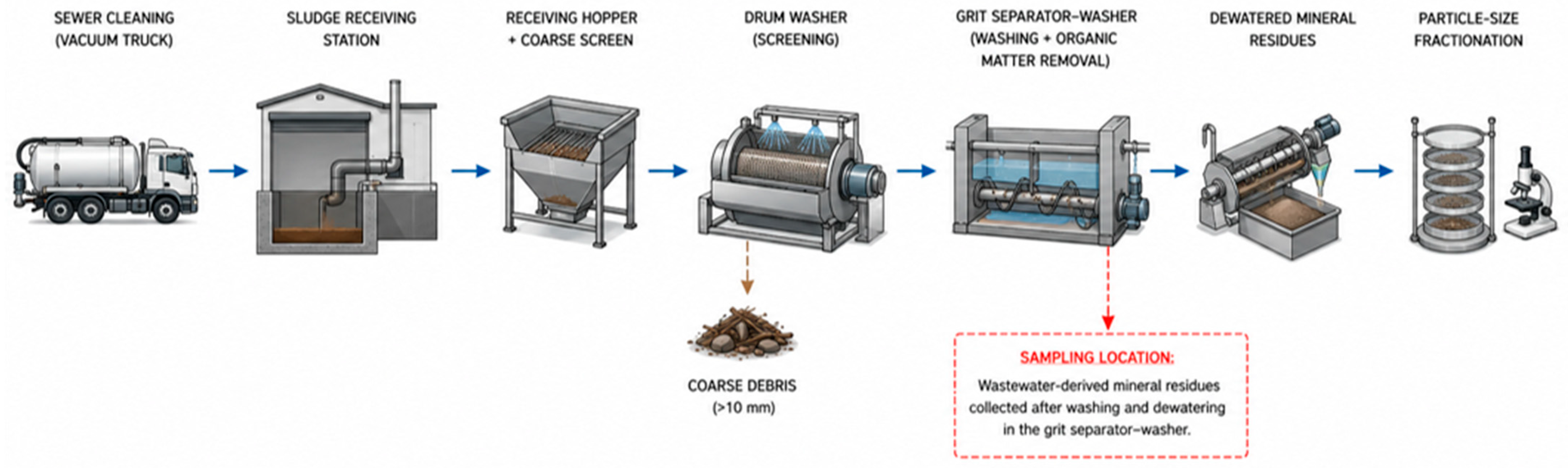
The materials investigated comprised two types of wastewater-derived mineral residues generated within the urban wastewater management system. The first material consisted of grit collected from the aerated grit chambers of the WWTP (Figure 1), where dense inorganic particles were separated from municipal wastewater during the mechanical treatment stage. The second material comprised mineral residues recovered from sewer cleaning operations (Figure 2). Sewer sediments transported to the sludge receiving station by vacuum sewer-cleaning vehicles were processed using a grit separator and washer, in which the material underwent screening, hydraulic washing, organic matter removal and dewatering. The resulting mineral fraction consisted predominantly of washed sand and other dense inorganic particles with a substantially reduced organic content.
Figure 2.
Simplified sewer cleaning sediment processing flow diagram showing the mineral residue sampling location. The schematic was generated with the assistance of artificial intelligence and subsequently reviewed and verified by the authors.
Mineral residues generated during wastewater collection and treatment processes, including grit removed from grit chambers and mineral materials recovered during sewer cleaning, are commonly regarded as predominantly inert. However, prolonged contact with municipal wastewater may promote the accumulation of trace metals, nutrients, organic pollutants, and other contaminants on mineral particle surfaces. Consequently, despite being regarded as inert, these materials may represent secondary sources of contaminant release if reused or disposed of without appropriate characterization. Therefore, both types of wastewater-derived mineral residues were subjected to particle size fractionation, physicochemical characterization, and the potential environmental release associated with individual fractions.
Materials removed from grit chambers at the WWTP, as well as those generated during sewer system cleaning (SSC), are classified as waste under the applicable regulations. In the system investigated, the material originating from the grit chambers was assigned waste code 19 08 02—wastes from desanding—whereas the waste generated during sewer cleaning was classified under code 19 08 99—wastes not otherwise specified [16,17]. This classification establishes the formal and legal framework governing the subsequent management of these materials, including waste record-keeping, storage, transport, and the selection of an appropriate recovery or disposal method.
According to data obtained from the wastewater treatment plant under study, from January 2023 to June 2026, the monthly quantity of material removed from the grit chambers ranged from 2.36 to 70.34 Mg, averaging 22.61 Mg per month. In comparison, the monthly quantity of grit collected at the sludge receiving station and originating from sewer cleaning operations ranged from 11.20 to 67.82 Mg, averaging 30.45 Mg per month. These substantial quantities indicate that the recovered mineral residues could represent a valuable secondary resource, provided that they meet the relevant technical and environmental requirements.
2.2. Materials
The study included unfractionated samples and their corresponding coarse and fine fractions from both material streams: grit collected from the grit chambers of the wastewater treatment plant under investigation and sand recovered during sanitary sewer cleaning operations. In total, nine sample types were analysed under laboratory conditions. The sample names and abbreviations used throughout this paper are presented in Table 1.
Table 1.
Sample names and abbreviations used in the study.
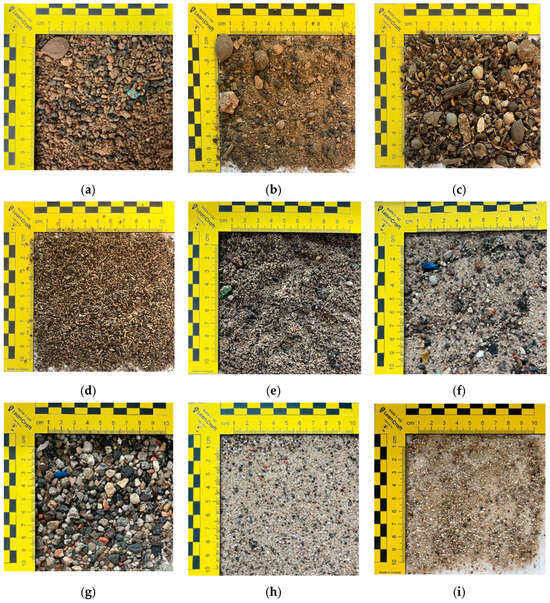
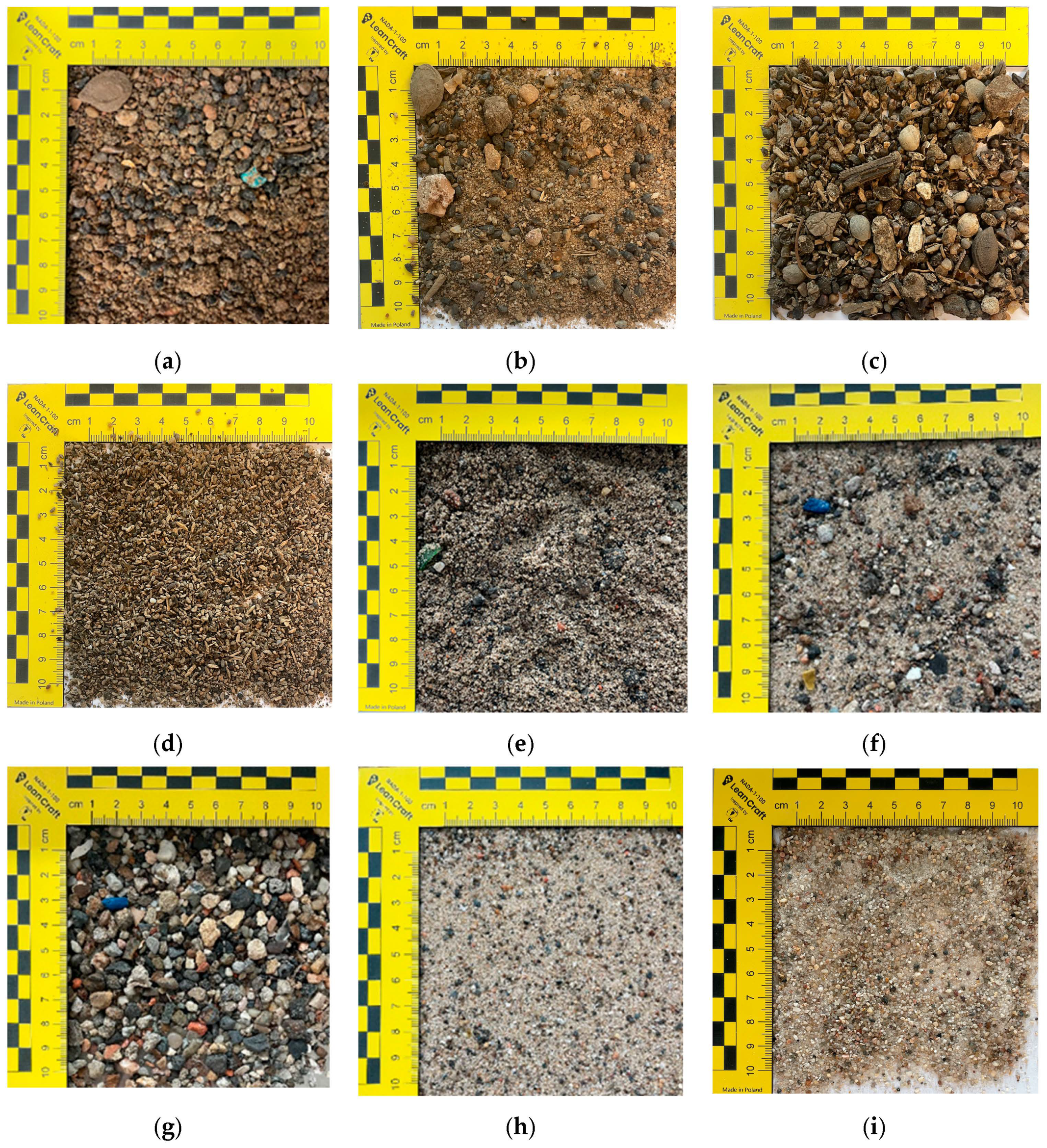
Two sand samples, designated GC and SC, were investigated. The GC sample originated from the grit chamber and was characterised by a dark yellow colour and no distinctive odour (Figure 3a–d). The SC sample originated from the processed sewer-cleaning residues. It had a slightly grey colour, no distinctive odour, and a relatively homogeneous structure (Figure 3e–h). Reference sand (Figure 3i), consisting of standardised sand used in construction testing, was analysed in parallel. It was characterised by a light-yellow colour, a uniform composition, and no distinctive odour.
Figure 3.
Representative photographs of the investigated sand samples and their particle size fractions: (a) GC-R, raw sand from the grit chambers; (b) GC-D, oven-dried sand (105 °C) from the grit chambers; (c) GC-C, coarse fraction (≥2 mm) from the grit chambers; (d) GC-F, fine fraction (<2 mm) from the grit chambers; (e) SC-R, raw sand from sewer cleaning; (f) SC-D, oven-dried sand (105 °C) from sewer cleaning; (g) SC-C, coarse fraction (≥2 mm) from sewer cleaning; and (h) SC-F, fine fraction (<2 mm) from sewer cleaning; and (i) RS, reference sand.
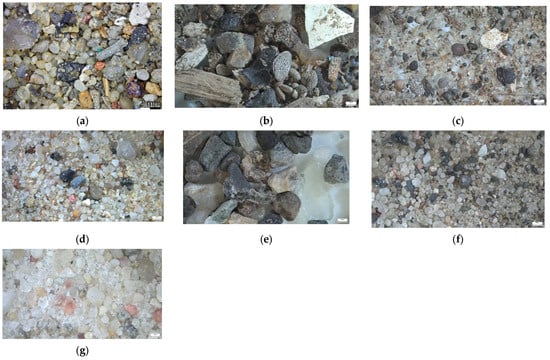
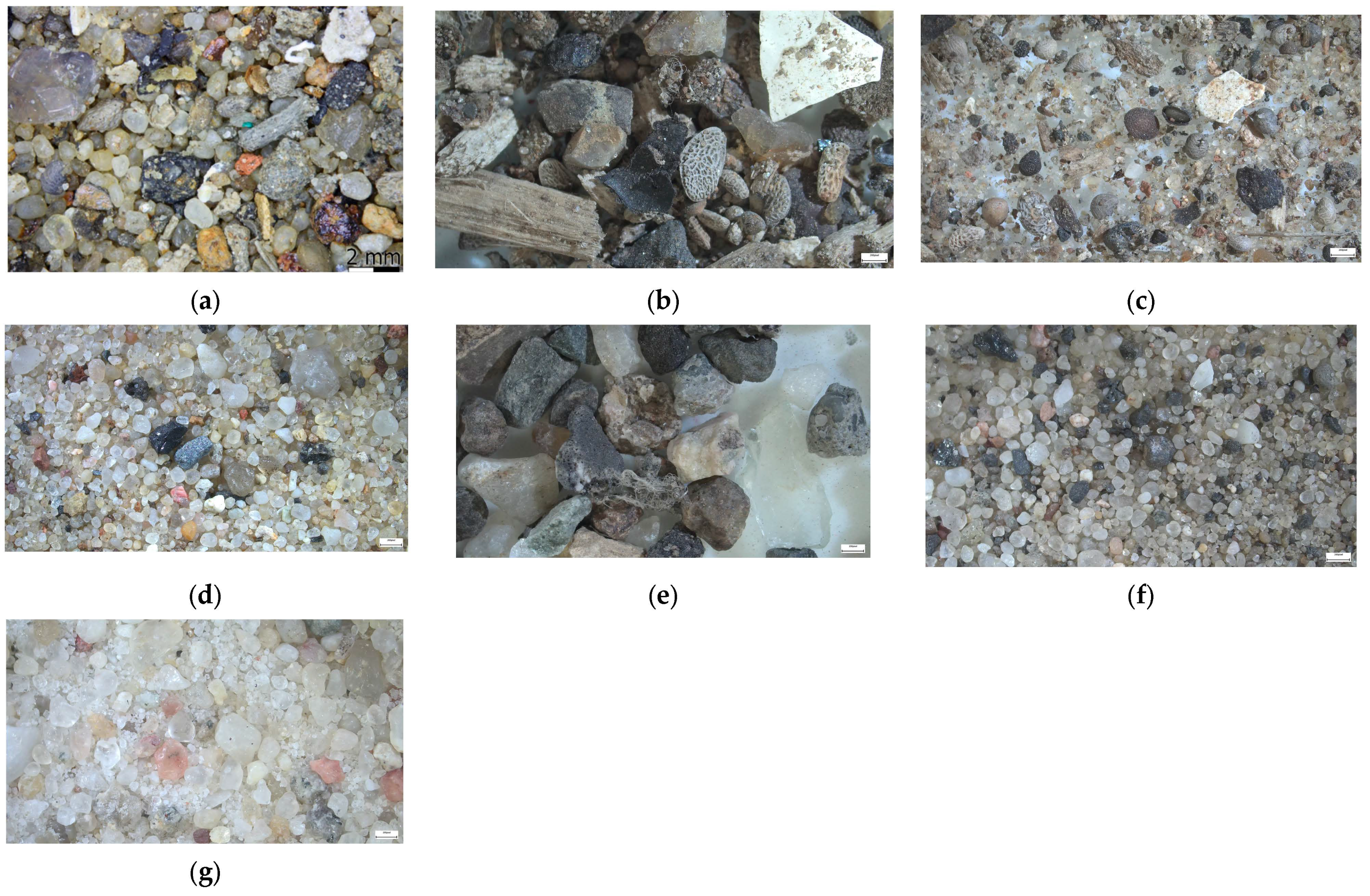
Digital images of the investigated samples and their separated particle size fractions were acquired using a Zeiss Stemi stereomicroscope equipped with an Axiocam digital camera. Stereomicroscopic observations of the GC and SC samples were conducted to qualitatively assess their composition, with particular emphasis on mineral, organic, and anthropogenic constituents. Numerous quartz grains, fragments of organic matter, including plant stems, seeds, and wood, as well as shell fragments, were observed in the GC sample (Figure 4a–c). Anthropogenic constituents, including fragments of ceramics, aluminium foil, and plastics, were also identified. Numerous quartz grains and fragments of organic matter were also observed in the SC sample (Figure 4d–f), together with isolated fragments of glass and plastics. Based on the visual assessment, the SC sample contained a markedly lower proportion of visible organic and anthropogenic constituents than the GC sample. The reference sample, consisting of standardised sand used in construction testing (Figure 4g), was dominated by quartz grains, with only occasional organic inclusions. The reference material was also more homogeneous and contained markedly fewer visible foreign constituents than the GC and SC samples.
Figure 4.
Representative photographs of the investigated sand samples and their particle size fractions: (a) GC-D, oven-dried sand (105 °C) from the grit chambers; (b) GC-C, coarse fraction (≥2 mm) from the grit chambers; (c) GC-F, fine fraction (<2 mm) from the grit chambers; (d) SC-D, oven-dried sand (105 °C) from sewer cleaning; (e) SC-C, coarse fraction (≥2 mm) from sewer cleaning; and (f) SC-F, fine fraction (<2 mm) from sewer cleaning; (g) reference sand.
2.3. Methods and Sampling Fractionation
Samples of grit chamber (GC) residues and processed sewer-cleaning (SC) residues were collected during a single sampling campaign at a wastewater treatment plant (WWTP). The two materials were stored separately prior to sampling. Given their heterogeneous nature, subsamples were collected from several spatially separated locations within each residue batch to account for local variations in composition. The subsamples were combined to obtain one composite sample for each material type.
The sampling strategy was designed to characterize the two residue batches present at the facility at the time of collection. Because sampling was limited to a single campaign, temporal and seasonal variations in residue composition were not assessed. The results should therefore be interpreted as a comparative characterization of the investigated batches rather than as a statistically representative assessment of the residue streams over time.
The composite samples were transported to the laboratory at the Silesian University of Technology, where they were homogenized and their total moisture content was determined [18]. The samples were subsequently dried in a laboratory oven at 105 °C until constant mass was achieved. After cooling to room temperature, aggregates formed during drying were gently disaggregated without deliberately crushing individual particles.
Drying was necessary to facilitate the subsequent disaggregation and separation of the material by particle size. The moisture content of the raw residues hindered effective sieving and separation into the <2 mm and ≥2 mm fractions. Drying was therefore adopted as a sample-preparation step to enable a comparative assessment of contaminant leaching from the individual particle size fractions.
The dried materials were sieved through a 2 mm sieve to obtain two fractions: a fine fraction (<2 mm), consisting of material passing through the sieve, and a coarse fraction (≥2 mm), consisting of material retained on the sieve. Each fraction was collected separately and homogenized before further analyses. Analytical results were expressed on a dry-mass basis.
For additional particle size characterization, sieve analysis was performed on the oven-dried, unfractionated grit chamber residue (GC-D), oven-dried, unfractionated processed sewer-cleaning residue (SC-D), and reference sand (RS). A series of sieves with nominal aperture sizes ranging from 0.0125 to 31.5 mm was used. The cumulative percentage passing through each sieve was calculated relative to the total mass of the analyzed sample [19].
The cumulative particle size distribution curves were used to determine the characteristic particle diameters D10, D50, and D90, corresponding to cumulative mass passing values of 10%, 50%, and 90%, respectively. These diameters were calculated by logarithmic interpolation between adjacent sieve apertures bracketing the respective cumulative passing percentages.
This additional characterization enabled comparison of the particle size distributions of the investigated materials and complemented their separation into fine (<2 mm) and coarse (≥2 mm) fractions.
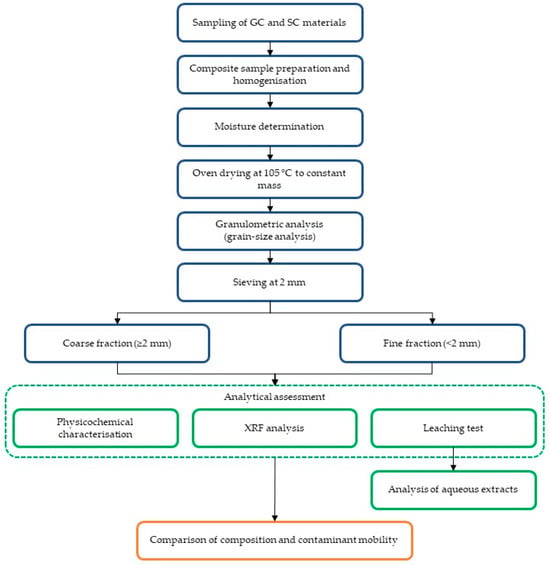
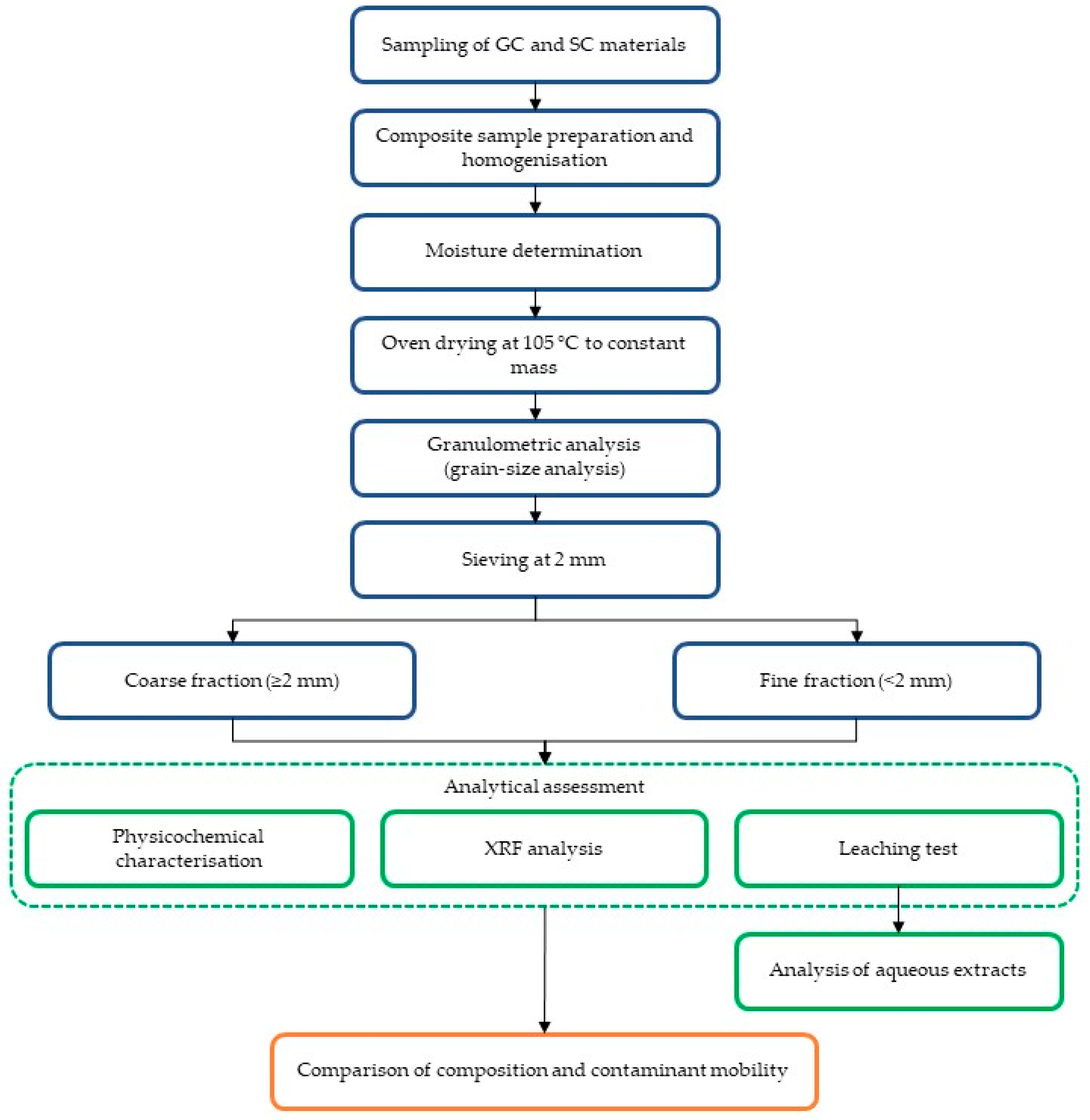
The experimental procedure, comprising sample preparation, separation into particle size fractions, and subsequent analytical evaluation, is shown in Figure 5.
Figure 5.
Procedure for the experimental work.
Laboratory determinations performed in replicate were used to assess analytical repeatability. Given the sampling design and scope of the study, the results were interpreted primarily descriptively, with particular emphasis on differences associated with material source and particle size fraction.
The presence of humic substances in the investigated samples was determined in accordance with PN-EN 1744-1+A1:2013-05 [20]. The test was performed using a 3% sodium hydroxide (NaOH) solution. The samples were mixed with the NaOH solution, thoroughly shaken, and left at room temperature for 24 h. After this period, the colour of the solution above the aggregate was visually assessed by comparison with the reference colour specified in the standard. On this basis, the presence of humic substances in the investigated aggregates was evaluated qualitatively.
In the next stage of the study, the basic physicochemical properties of the investigated materials were characterized. The analyses included the determination of total and analytical moisture content, bulk density, degradable organic substances (DOS), and total organic carbon (TOC). The loss on ignition (LOI) was determined at temperatures of 500 and 950 °C, using separate samples of each material. The determination at 500 °C was carried out until a constant mass was obtained, in accordance with the procedure used to assess the organic matter content, whilst at 950 °C the samples were calcined for 1 h. For the physicochemical analyses, each sample was analysed in triplicate to minimize the influence of gross errors and ensure the repeatability of the results. The physicochemical parameters determined in this study are summarized in Table 2.
Table 2.
Methods, standards, and equipment used for the physicochemical characterization of the investigated materials [18,19,21,22,23,24].
The chemical composition of the investigated materials was analysed by X-ray fluorescence (XRF) at the Department of Applied Geology at the Silesian University of Technology. Measurements were performed using an S2 PUMA spectrometer (Bruker Corporation, Billerica, MA, USA). The material was prepared for analysis in the form of pressed pellets produced by compressing the powdered samples under a load of 20 t. To ensure adequate pellet cohesion, Licowax C (PD Instruments, Toszek, Poland) was added at a binder-to-sample ratio of approximately 1:10 (w/w). The XRF measurements were conducted under vacuum conditions.
Loss on ignition (LOI) was determined gravimetrically as the difference in sample mass before and after ignition at 950 °C for 60 min.
Batch leaching tests were conducted using demineralized water at a liquid-to-solid ratio (L/S) of 10 L/kg of dry matter and a contact time of 24 h. The experimental procedure was based on the general principles of PN-EN 12457-2:2006 [25] and PN-EN 12457-4:2006 [26], which specify one-stage batch leaching tests for materials with particle sizes below 4 mm and 10 mm, respectively. Prior to leaching, the GC and SC materials were oven-dried at 105 °C and separated into fine (<2 mm) and coarse (≥2 mm) fractions. The fine fractions (GC-F and SC-F) met the particle size criterion specified in PN-EN 12457-2:2006, whereas the coarse fractions (GC-C and SC-C) were tested with reference to PN-EN 12457-4:2006. The coarse fractions were tested without additional crushing or grinding to preserve their original particle structure as far as possible. After 24 h of contact, the suspensions were filtered using paper filters rather than the 0.45 µm membrane filters specified in the referenced standards. Therefore, the applied procedure should be regarded as a modified batch leaching test based on PN-EN 12457-2:2006 and PN-EN 12457-4:2006, rather than a test fully compliant with these standards. Supplementary particle size analysis of the unfractionated materials showed that all particles passed through the 8 mm sieve. However, these results do not independently confirm the particle size distribution of the specific aliquots used in the leaching tests. The resulting aqueous extracts were subjected to physicochemical and chemical analyses (Table 3). The results were interpreted as comparative indicators of constituent release under the applied laboratory conditions.
For supplementary environmental interpretation, the concentrations measured in the aqueous extracts were compared with selected reference values specified in the Regulation of the Polish Minister of Maritime Economy and Inland Navigation of 12 July 2019 concerning substances particularly harmful to the aquatic environment and conditions for wastewater discharge into waters or the ground [27]. This comparison was used solely as an indicative benchmark to provide additional context for the concentrations of selected constituents released under laboratory leaching conditions. The aqueous extracts obtained in the batch leaching tests are not equivalent to wastewater effluents, and the referenced discharge limits are not regulatory acceptance criteria for waste recovery or reuse. Consequently, exceedances of these values were not interpreted as evidence of non-compliance with requirements for material recovery.
Table 3.
Analysed parameters, analytical methods, and equipment used in the study [28,29,30,31,32,33,34,35,36,37,38,39].
To quantitatively assess element release and retention relative to the total element content in the solid phase, the leached fraction (LF) was calculated [25,26].
The leached fraction for element i (LFi) was calculated using Equation (1):
where:
Ci,e—concentration of element i in the aqueous extract [mg/L];
Ci,s—concentration of element i in the solid material [mg/kg];
(L/S)—liquid-to-solid ratio applied during the leaching process, equal to 10 L/kg.
The LF values represent the proportion of the total solid-phase content of each element released into the aqueous extract under the specified batch-leaching conditions. They were used to compare the relative release of selected elements across the investigated materials and particle size fractions.
2.4. AI Tool Disclosure
Figure 1 and Figure 2 were prepared with the assistance of ChatGPT (OpenAI), based on descriptions of the technological processes provided by the authors. The AI-generated schematics were subsequently reviewed and verified by the authors to ensure their technical accuracy and consistency with the actual processes investigated in this study.
3. Results
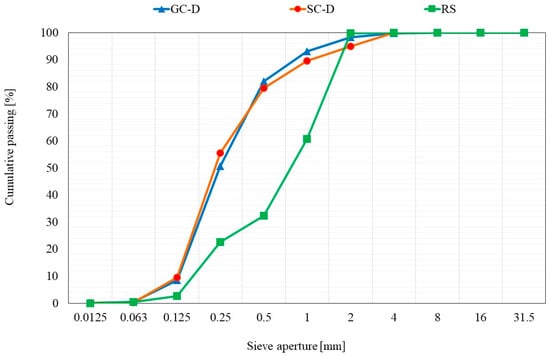
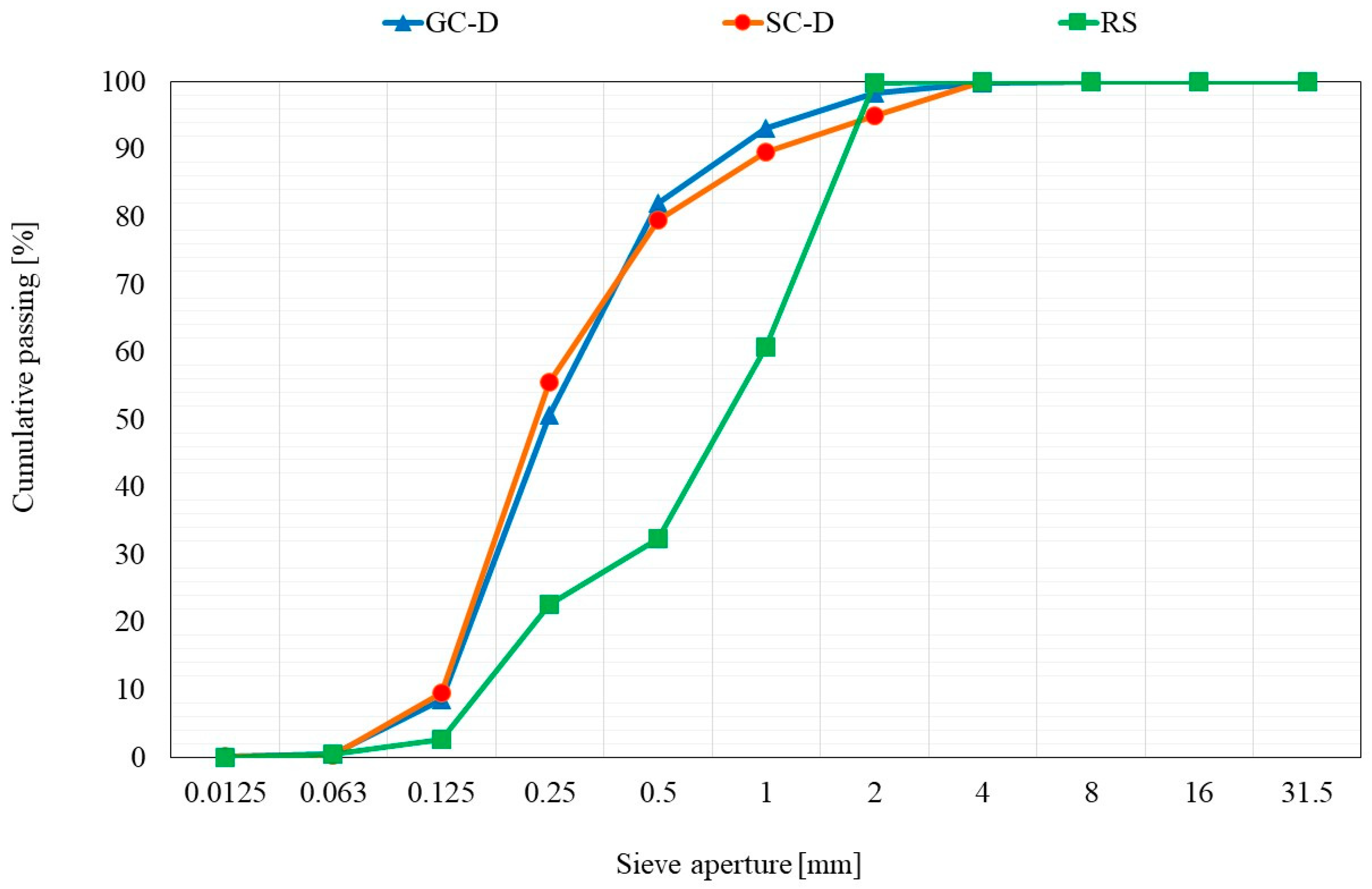
The cumulative particle size distribution curves of the grit chamber residue (GC-D), processed sewer-cleaning residue (SC-D), and reference sand (RS) are presented in Figure 6. The characteristic particle diameters D10, D50, and D90 are summarised in Table 4.
Figure 6.
Cumulative particle size distribution curves of grit chamber residues (GC-D), processed sewer-cleaning residues (SC-D), and reference sand (RS).
Table 4.
Characteristic particle diameters of the investigated materials determined from cumulative particle size distribution curves.
The GC-D and SC-D materials exhibited broadly similar particle size distributions, particularly within the finer particle size range. The median particle diameters (D50) were 0.247 mm for GC-D and 0.230 mm for SC-D, while the D10 values were 0.128 and 0.126 mm, respectively. These results indicate that the two wastewater-derived residues had comparable characteristic particle sizes within the finer and central portions of their particle size distributions.
More pronounced differences were observed in the coarser portion of the distributions. The D90 value was 0.821 mm for GC-D and 1.056 mm for SC-D, indicating that the upper part of the SC-D particle size distribution extended towards larger particle sizes. At a sieve aperture of 0.5 mm, the cumulative percentages passing were approximately 82.0% for GC-D and 79.5% for SC-D.
The reference sand exhibited a distinctly coarser particle size distribution. Its D10, D50, and D90 values were 0.162, 0.770, and 1.680 mm, respectively. Only approximately 32.4% of the reference sand passed through the 0.5 mm sieve, compared with approximately 80% of both wastewater-derived residues.
Overall, the detailed sieve analysis revealed similar median particle diameters for GC-D and SC-D, with differences in the coarser portions of their distributions. These findings provide a more detailed basis for interpreting the physicochemical characteristics and leaching behaviour of the investigated materials.
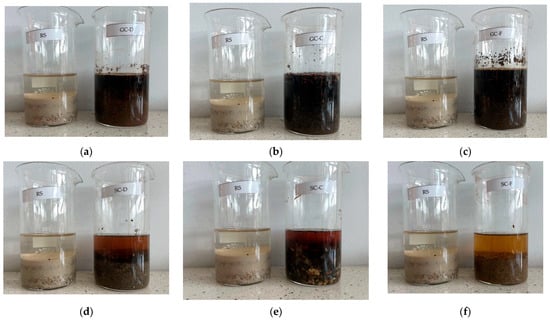
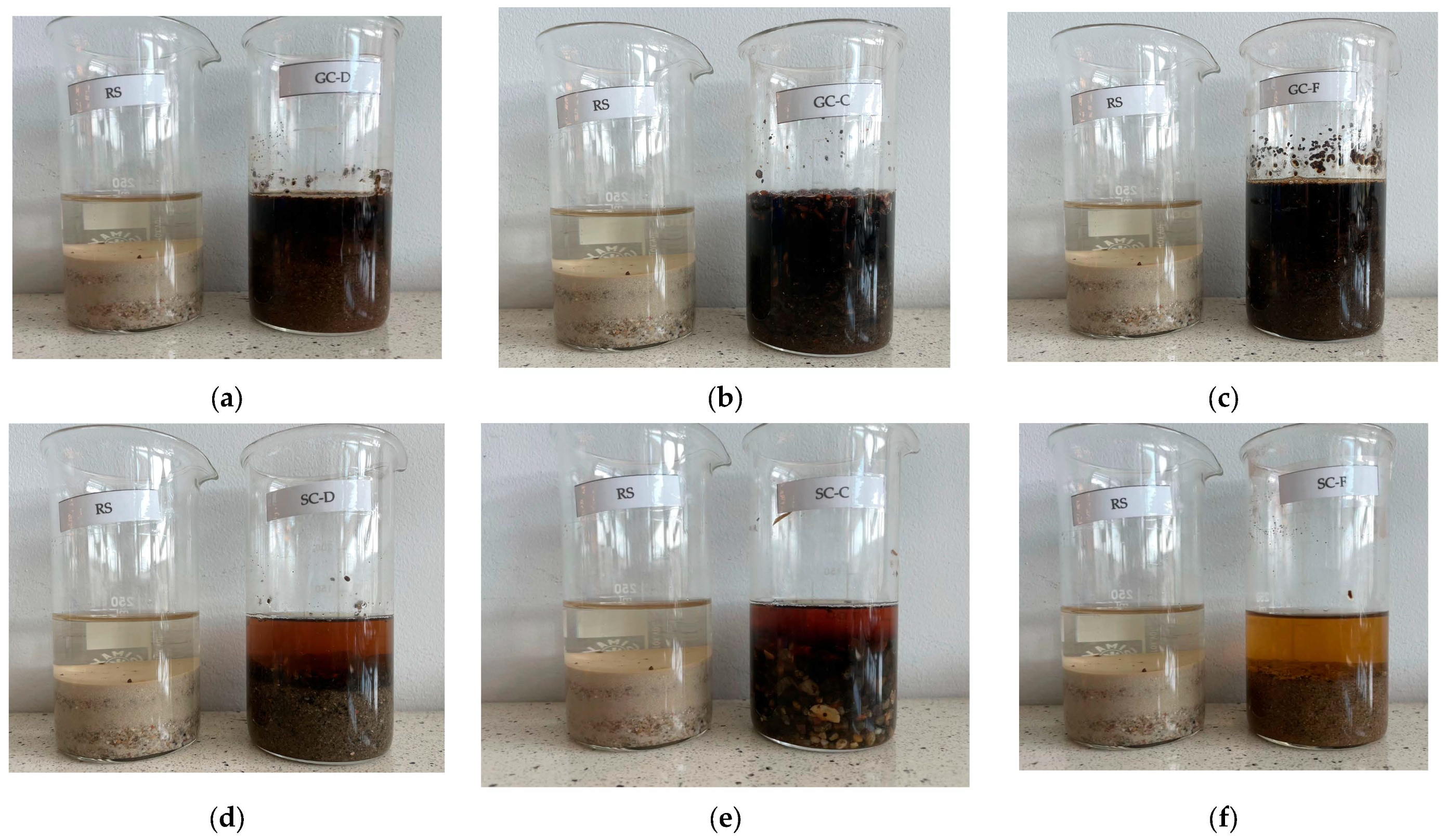
Figure 7a–f presents the results of the visual assessment of humic substance content in the investigated samples and their separated particle size fractions. The solutions obtained from the GC-D, GC-C, and GC-F samples exhibited markedly darker colouration than those obtained from the corresponding SC-D, SC-C, and SC-F samples. These differences may indicate a higher humic substance content in the grit chamber residues. The solutions obtained from the SC samples were lighter in colour, suggesting a lower humic substance content than in the GC samples. Differences in colour intensity were also observed among the individual particle size fractions. Among the samples analysed, the solution obtained from SC-F exhibited the lightest colouration, which, within the limitations of the visual assessment applied, may indicate the lowest humic substance content.
Figure 7.
Visual assessment of humus content in the analysed sand samples: (a) GC-D, oven-dried sand (105 °C) from the grit chambers; (b) GC-C, coarse fraction (≥2 mm) from the grit chambers; (c) GC-F, fine fraction (<2 mm) from the grit chambers; (d) SC-D, oven-dried sand (105 °C) from sewer cleaning; (e) SC-C, coarse fraction (≥2 mm) from sewer cleaning; and (f) SC-F, fine fraction (<2 mm) from sewer cleaning.
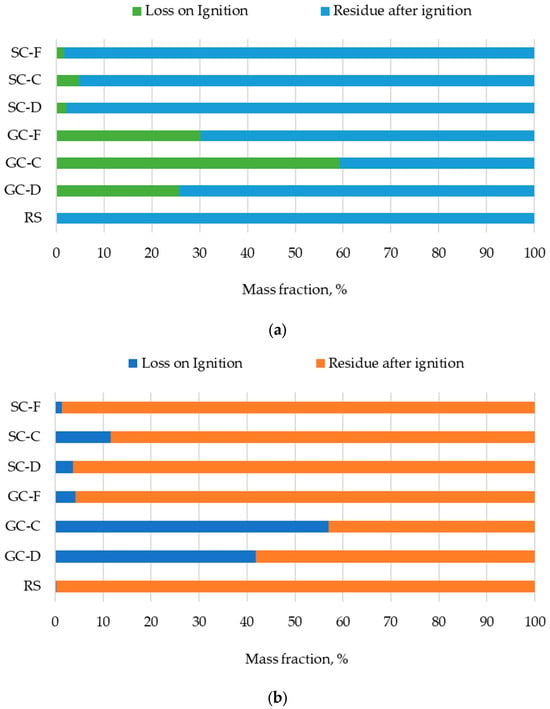
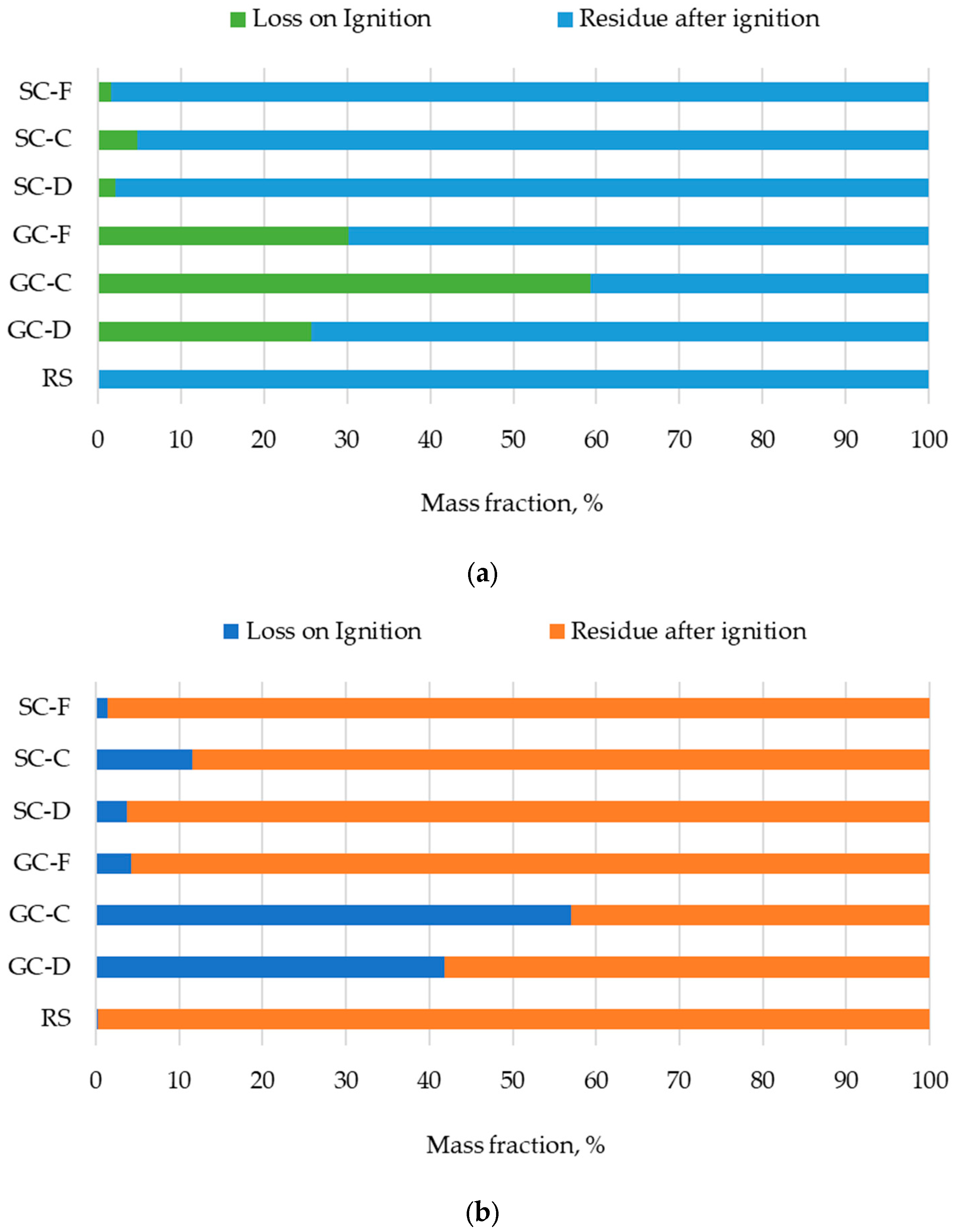
Loss on ignition (LOI) was determined at 500 and 950 °C using separate samples of each material under investigation (Figure 8). At 500 °C, samples were heated to constant mass, following the procedure used to assess organic matter content, whereas separate samples were heated at 950 °C for 1 h. Consequently, the results obtained at both temperatures represent independent measurements and should not be interpreted as successive stages of thermal treatment of the same sample.
Figure 8.
Loss on ignition (LOI) of the tested materials, determined independently using separate sample portions under the following conditions: (a) 500 °C until constant mass was reached; (b) 950 °C for 1 h.
At 500 °C, the LOI values for the GC materials ranged from 25.67% for GC-D to 59.33% for GC-C, whilst GC-F showed a value of 30.25% (Figure 8a). Substantially lower values were obtained for the SC materials, ranging from 1.59% for SC-F to 4.84% for SC-C. The reference sand had an LOI of 0.09%.
At 950 °C, the highest loss on ignition (LOI) was again recorded for GC-C (56.98%), followed by GC-D (41.85%), whilst GC-F showed a substantially lower value of 4.18% (Figure 8b). In the case of the SC material, the highest LOI value was observed for SC-C (11.54%), whilst SC-D and SC-F showed values of 3.78% and 1.35%, respectively. In contrast, the reference sand showed an LOI of 0.29%.
The physicochemical properties of the materials varied depending on both their source and particle size fraction (Table 5). The highest total organic carbon (TOC) content, 22.79%, was recorded in the coarse fraction of the grit chamber residues (GC-C). This fraction also exhibited the highest degradable organic substances (DOS) content, at 48.48%. In the fine fraction of this material (GC-F), the TOC and DOS contents were considerably lower, at 1.78% and 3.79%, respectively. These results demonstrate marked compositional differences between the GC-C and GC-F fractions, consistent with their respective loss on ignition (LOI) values at 950 °C of 56.98% and 4.18%.
Table 5.
Basic physicochemical properties of the investigated materials.
The differences between the fractions of the processed sewer-cleaning residues were less pronounced. In the SC-C fraction, the TOC and DOS contents were 3.77% and 8.03%, respectively, whereas the values of both parameters were below the limit of quantification (<LOQ) in the SC-F fraction. The SC-C fraction had a considerably lower dry bulk density (393 kg/m3) than the values measured for the SC-F fraction (1350 kg/m3) and the reference sand (RS; 1329 kg/m3). The results indicate that particle size separation of the GC and SC materials yielded fractions that differed in organic matter content and physical properties. These differences, particularly those related to organic matter content, may affect the behaviour of the materials upon contact with water. Organic matter may influence element sorption and mobility and, consequently, element release into the aqueous phase.
The chemical composition varied markedly among the samples analysed (Table 6). SiO2 was the predominant oxide, with contents ranging from 30.59% in the GC-C sample to 86.73% in the SC-F sample, while the reference sand (RS) contained approximately 93% SiO2. Clear differences were also observed between the individual particle size fractions. For both residue types, the fine fractions (<2 mm) contained more SiO2 than the corresponding coarse fractions (≥2 mm). This difference was particularly pronounced in the grit chamber residues, with SiO2 contents of 75.13% in GC-F and 30.59% in GC-C. The inverse pattern was observed for loss on ignition (LOI) at 950 °C, with considerably higher values in the coarse fractions. The highest LOI value was recorded for GC-C (56.98%), whereas GC-F exhibited a value of only 4.18%. A similar, although less pronounced, difference was found between SC-C (11.54%) and SC-F (1.35%). These results demonstrate that the composition of the materials varied substantially with particle size fraction, particularly in the grit chamber residues. Several trace elements of potential environmental concern, including Cr, Ni, Zn, As, Cd, W, and Pb, were detected in the materials analysed. The highest concentrations measured in the waste-derived samples were 854 mg/kg for Cr, 1272 mg/kg for Zn, and 568 mg/kg for W, while Pb concentrations ranged from 56 to 89 mg/kg. Differences in the concentrations of individual elements were observed both between the two materials and among their respective particle size fractions. It should be emphasised that the total concentration of an element in a material does not alone determine the associated potential environmental impact; this also depends on the element’s mobility and susceptibility to release upon contact with water. Therefore, the observed differences in elemental composition provide an important basis for interpreting the leaching test results.
Table 6.
Chemical composition of the unfractionated dried sand samples, their particle size fractions, and the reference sand.
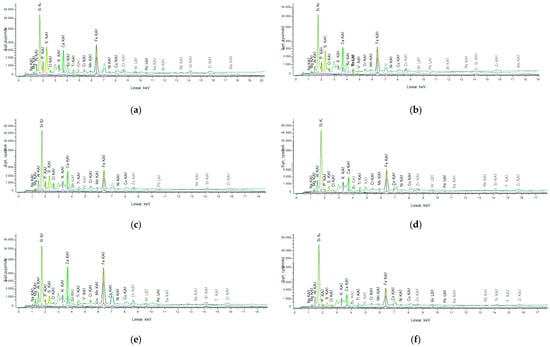
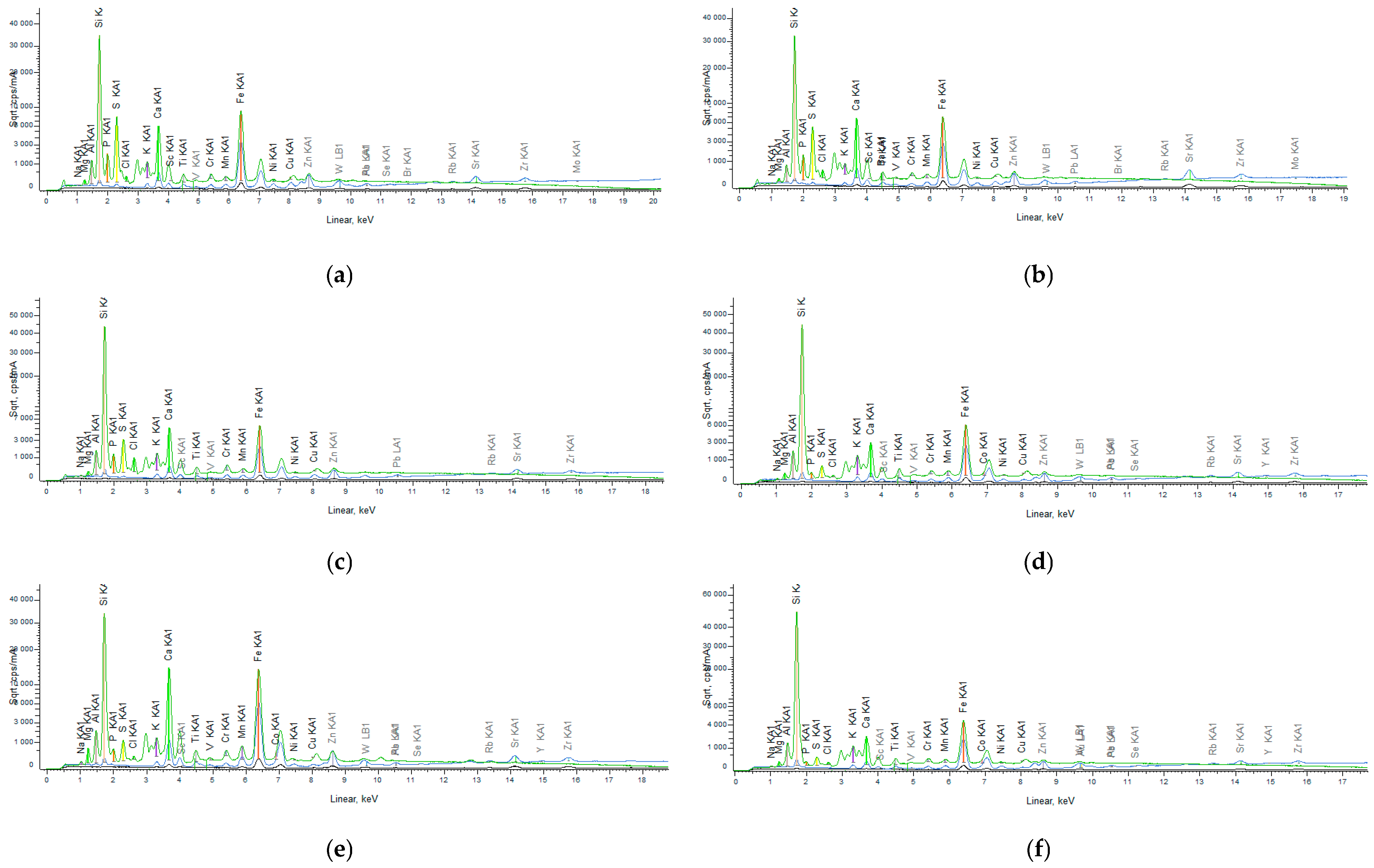
The differences in chemical composition among the individual samples are also reflected in the X-ray fluorescence (XRF) spectra presented in Figure 9. The spectra are dominated by characteristic Si peaks, accompanied by signals attributed to Al, K, Ca, Ti, Mn, and Fe. Differences in peak intensities among the samples are consistent with the variations in chemical composition presented in Table 6.
Figure 9.
XRF spectra of the analysed sand samples: (a) GC-D, oven-dried sand (105 °C) from the grit chambers; (b) GC-C, coarse fraction (≥2 mm) from the grit chambers; (c) GC-F, fine fraction (<2 mm) from the grit chambers; (d) SC-D, oven-dried sand (105 °C) from sewer cleaning; (e) SC-C, coarse fraction (≥2 mm) from sewer cleaning; and (f) SC-F, fine fraction (<2 mm) from sewer cleaning.
Table 7 presents the physicochemical characteristics and chemical composition of the aqueous extracts obtained from the investigated materials. For additional context, selected results were compared with indicative reference values derived from Polish wastewater discharge regulations [27]. These reference values were used solely for comparative purposes and were not considered regulatory limits applicable to waste leachates.
Table 7.
Physicochemical properties and chemical composition of the aqueous extracts obtained from the investigated materials.
The pH values of the aqueous extracts ranged from 6.8 to 8.9. Clear differences between the GC and SC materials were observed in the concentrations of organic constituents. In the GC extracts, chemical oxygen demand (COD) ranged from 246 to 353 mg/L, exceeding the indicative reference value of 125 mg/L. Total organic carbon (TOC) concentrations ranged from 100.5 to 208.7 mg/L and were higher than the reference value of 30 mg/L. The highest TOC concentration was observed in GC-C. The five-day biochemical oxygen demand (BOD5) values for GC-D, GC-C, and GC-F extracts were 28, 170, and 130 mg/L, respectively, compared with the indicative reference value of 25 mg/L.
The SC extracts generally exhibited lower concentrations of organic constituents. TOC concentrations ranged from 2.59 to 5.05 mg/L, while BOD5 ranged from 6 to 25 mg/L. However, COD in SC-D reached 263 mg/L, exceeding the indicative reference value. These results indicate differences in the release of organic constituents between the investigated residue streams under the applied laboratory conditions.
Sulphate concentrations were also higher in the GC extracts. They reached 1348 mg/L in GC-D and 1511 mg/L in GC-F, compared with the indicative reference value of 500 mg/L, while the concentration in GC-C was 400 mg/L. In the SC extracts, sulphate concentrations were substantially lower, ranging from 98.6 to 105 mg/L. The GC extracts also exhibited higher concentrations of several dissolved mineral constituents, including calcium, magnesium, sodium, and potassium.
Total nitrogen concentrations exceeded the indicative reference value of 10 mg/L in GC-C and GC-F, reaching 52.4 and 17.9 mg/L, respectively. The remaining samples exhibited concentrations ranging from 0.56 to 3.68 mg/L. Phosphorus concentrations were slightly higher than the indicative reference value of 1 mg/L in GC-D and GC-C, reaching 1.07 and 1.72 mg/L, respectively.
The concentrations of the investigated trace metals were generally low relative to their corresponding indicative reference values. The highest Zn concentrations were recorded in GC-F (1.66 mg/L) and GC-D (1.22 mg/L), compared with the reference value of 2 mg/L. Similarly, the measured concentrations of Cr, Cu, Pb, Ni, and Fe remained below the corresponding reference values adopted for comparison.
Overall, the aqueous extracts from GC materials generally contained higher concentrations of organic constituents, sulphates, and selected nutrients than those obtained from SC materials. These differences highlight constituents that may require particular attention in further environmental assessments. However, comparisons with wastewater discharge reference values do not establish whether the investigated materials meet the requirements for any specific recovery application. Despite the relatively high contents of some metals in the solid materials, their concentrations in the aqueous extracts were low.
The relationship between the total content of selected trace elements in the solid materials and their release into aqueous extracts was evaluated using the leached fraction (LF) (Table 8). Calculations were performed for elements quantified in both the solid phase and the corresponding aqueous extracts. The LF values ranged from approximately 0.004% to 3.570%, indicating that only a relatively small proportion of the total content of the investigated elements was released under the applied batch-leaching conditions.
Table 8.
Leached fraction (LF) of selected trace elements under the applied batch-leaching conditions.
The highest relative release was observed for Zn and Ni in the fine grit chamber fraction (GC-F), with LF values of 3.570% and 3.537%, respectively. Lower values were recorded in the unfractionated grit chamber material (GC-D), reaching 2.140% for Zn and 1.633% for Ni. In the coarse grit chamber fraction (GC-C), the corresponding LF values were 0.339% and 1.519%, respectively.
Chromium exhibited particularly low LF values. Although the GC-F fraction contained the highest solid-phase Cr concentration (854 mg/kg), its LF value was only approximately 0.004%. Similarly low values were obtained for GC-D (0.008%) and GC-C (0.036%), indicating limited Cr release under the applied test conditions.
The processed sewer-cleaning residues generally exhibited lower relative release of Ni and Zn than the corresponding grit chamber residues. The LF values for Zn ranged from 0.016% in SC-C to 0.253% in SC-D, while those for Ni ranged from 0.033% in SC-F to 0.080% in SC-D. Notably, SC-C contained the highest solid-phase Zn concentration among the analysed materials (1272 mg/kg), but only approximately 0.016% of this content was released during the leaching test.
Overall, these results indicate that the total content of a trace element in the solid phase does not necessarily correspond to its relative release into the aqueous phase. The observed differences emphasize the importance of considering both solid-phase composition and leaching behaviour when assessing the investigated materials.
4. Discussion
The results indicate that the environmental behaviour of wastewater-derived mineral residues is associated not only with their particle size characteristics but also with their origin, composition, and previous processing. Although the investigated GC and SC materials exhibited broadly similar particle size characteristics, substantial differences were observed in their physicochemical properties and leaching behaviour. The predominance of SiO2, particularly in the fine fractions, indicates the predominantly mineral nature of these materials may warrant further investigation as potential substitutes for natural aggregates [5,6,7,8]. However, their suitability for recovery cannot be established on the basis of chemical composition alone and requires additional technical and environmental assessment. Compared with GC-F, the coarse grit chamber fraction (GC-C) exhibited a lower SiO2 content, higher solid-phase contents of total organic carbon (TOC) and degradable organic substances (DOS) contents, and substantially higher loss on ignition (LOI) at 500 °C. Together, these findings indicate a markedly higher proportion of organic matter in the coarse GC fraction. This pattern may be associated with the presence of organic–mineral aggregates rather than mineral grains alone, as similar composite particles have previously been reported in grit chamber residues [3].
The detailed particle size characterization provides additional insight into the relationship between particle size and the composition of wastewater-derived mineral residues. The GC-D and SC-D materials exhibited similar median particle diameters (D50) of 0.247 and 0.230 mm, respectively, although differences were observed in the coarser portions of their particle size distributions, as reflected by D90 values of 0.821 and 1.056 mm. Despite these similarities in particle size characteristics, the two materials differed substantially in their chemical composition, organic matter indicators, and leaching behaviour. These observations suggest that particle size distribution alone is insufficient to explain the differences in the environmental behaviour of the investigated residues. Other factors, including material heterogeneity and previous processing, may also contribute. In particular, the SC material underwent separation and washing before sampling, which may have influenced its organic matter content and the availability of selected constituents for leaching. Nevertheless, the present study does not allow the independent contributions of particle size, material origin, and previous processing to be quantified. Further investigations, including detailed mineralogical characterization and repeated sampling, would be necessary to better understand the processes responsible for the observed differences.
The LOI values obtained at 500 and 950 °C provide complementary information about material composition but are not directly comparable. The determination at 500 °C, carried out to constant mass, was used to estimate organic matter content, whereas LOI at 950 °C was determined independently using a separate sample portion heated for 1 h. At the higher temperature, the measured mass loss cannot be attributed exclusively to organic matter, as thermal transformations of inorganic constituents may also contribute. Consequently, the LOI values should not be interpreted as successive stages of thermal treatment of the same sample, and the difference between them should not be attributed solely to organic matter decomposition. Taken together, these results highlight the compositional heterogeneity of the investigated materials and their particle size fractions.
The results did not fully confirm the initial hypothesis that contaminants would preferentially accumulate in the fine fractions. Although the larger specific surface area of fine particles may favour the sorption of trace elements and organic compounds [11,12,13], the coarse GC-C fraction exhibited the highest LOI value at 500 °C and was characterised by a significant proportion of organic matter in the solid phase. This result indicates that the distribution of organic matter and its associated contaminants in sewage-derived mineral residues cannot be predicted solely on the basis of particle size. The retention of fibrous matter, organic coatings, and organic-mineral aggregates in the coarse fraction may be equally important [3,14,15]. Consequently, separate characterization of the individual particle size fractions provides more comprehensive information than analysis of unfractionated material alone.
The leaching results showed that total elemental contents in the solid materials did not necessarily correspond to the amounts released into water. Despite elevated concentrations of Cr, Zn, W, and Pb in some solid samples, the concentrations of the metals analyzed in the aqueous extracts generally remained below the reference values adopted for comparison. These findings suggest that a substantial proportion of these elements was not readily leached under the applied test conditions, possibly because they are associated with relatively stable mineral phases or strongly bound to particle surfaces. Similar discrepancies between total metal concentrations and leachable fractions have been reported for sewer sediments [9,10]. Therefore, total elemental concentration alone is insufficient for assessing environmental risk, and standardized leaching tests are essential for evaluating the suitability of these materials for recovery or reuse.
In contrast to the limited mobility of most trace elements, grit chamber (GC) residues released substantially greater quantities of organic matter and soluble mineral components than sewer cleaning (SC) residues. Elevated COD, BOD5, and TOC values and sulphate concentrations, together with higher concentrations of Ca, Mg, Na, and K, suggest that organic matter and soluble salts may pose a greater obstacle to the direct reuse of GC residues than trace elements. Solid-phase total organic carbon (TOC) and degradable organic substances (DOS) contents characterize the organic matter associated with the solid matrix, whereas TOC in aqueous extracts reflects the organic carbon released under the applied leaching conditions. These parameters provide complementary information on organic matter content and mobility and should not be treated as interchangeable. Consequently, a high organic matter content in the solid phase does not necessarily imply a proportionally high release of organic carbon into the aqueous phase. These results suggest that GC residues may require pre-treatment, such as washing, organic matter removal, or stabilization, before recovery, whereas SC residues showed lower release of these components under the test conditions. The suitability of each material for reuse should be assessed in relation to its intended application and anticipated exposure conditions, rather than inferred solely from its mineral appearance.
The calculated LF values provide a quantitative measure of the relative release of selected trace elements under the applied batch-leaching conditions. For the elements quantified in both the solid phase and the corresponding aqueous extracts, the LF values did not exceed 3.570%, indicating limited short-term release relative to their total contents in the solid materials. However, these results should not be interpreted as evidence of permanent contaminant immobilisation, as the leaching tests were conducted under specific laboratory conditions and did not reproduce long-term environmental exposure.
The differences in LF values among the investigated materials further demonstrate that total element content alone is insufficient to predict relative leaching behaviour. In particular, the low LF values observed for Cr in GC-F and Zn in SC-C indicate that relatively high solid-phase concentrations may be accompanied by limited release during a single batch-leaching test. Similar observations of limited relative element release have been reported for washed mineral waste derived from wastewater treatment processes [40]. Nevertheless, without mineralogical characterization or chemical speciation analysis, the mechanisms responsible for the observed behaviour cannot be identified.
Consequently, LF should be regarded as a test-specific indicator of relative element release rather than a measure of long-term contaminant retention or environmental safety. The assessment of potential recovery applications should therefore consider both total concentrations and leaching results, together with the expected conditions of material use.
The most pronounced differences between total element concentrations and relative release were observed for Cr in GC-F and Zn in SC-C. Despite their relatively high concentrations in the solid phase, the corresponding LF values were only 0.004% and 0.016%, respectively. These observations indicate that high total element concentrations do not necessarily correspond to high relative release under the applied leaching conditions. Previous studies have reported that particle size distribution and mineral composition may influence trace-element distribution in sediments [14]. However, the specific factors responsible for the low relative release observed in the present study could not be identified.
In contrast, the highest relative release of Zn and Ni was observed in the fine grit chamber fraction (GC-F), with LF values of 3.570% and 3.537%, respectively. This indicates that the relative release of individual elements varied among the investigated particle size fractions. Although particle surface characteristics, mineral composition, and organic matter associations may contribute to such differences, their individual effects were not determined in the present study. Furthermore, the highest values of organic matter indicators were observed in GC-C, whereas the maximum concentrations of individual trace elements occurred in different fractions. These findings suggest that particle size characteristics alone are insufficient to explain the observed differences in element distribution and release. Similar variability has been discussed in previous studies [40,41]. The importance of particle size separation in controlling trace-element behaviour has also been highlighted by Sun et al. [42] in their meta-analysis of heavy-metal-contaminated soils. Although the materials and processes investigated differ from those examined in the present study, their findings provide additional context for the role of particle size fractions in contaminant management.
The importance of material origin is also supported by recent studies of sewer sediments. Wu et al. [43] reported that these sediments act as important carriers of elements and other particle-bound contaminants and that their composition and distribution are strongly influenced by particle size distribution, particle sources, and transport and sedimentation conditions within sewer systems.
The lower relative release of Ni and Zn observed in the processed sewer-cleaning residues may be associated with differences in material composition and previous treatment. Before sampling, the SC material underwent mechanical separation and washing, which could have influenced its physicochemical properties and the distribution of soluble constituents. Previous studies have indicated that washing and mechanical treatment may affect contaminant concentrations and their distribution in recovered mineral materials [40]. However, because the present study did not include samples collected before treatment, the contribution of the washing process to the observed differences cannot be quantified. Consequently, the lower relative release observed in the SC material should be interpreted as a characteristic of the investigated processed residue rather than as direct evidence of contaminant removal during washing. From a practical perspective, the results indicate that wastewater-derived mineral residues should not be treated as a uniform waste stream. Their potential for recovery should be assessed individually, taking into account material origin, previous processing, chemical composition, and particle size characteristics. Recent research has also addressed potential resource recovery pathways for grit originating from faecal sludge and wastewater pretreatment [44]. These approaches provide a broader context for the recovery-oriented assessment of wastewater-derived mineral residues. However, the selection of an appropriate recovery pathway should be based on the specific physicochemical properties, contaminant mobility, and intended application of the recovered material. The processed sewer-cleaning residues, particularly its fine fraction, exhibited a predominantly mineral character and comparatively low release of organic constituents, nutrients, and several trace elements, making it a promising candidate for further recovery-oriented investigation. In contrast, the coarse grit chamber fraction contained substantial amounts of organic matter, suggesting that additional treatment, such as washing or separation of organic matter, may be beneficial before considering potential recovery. Although the fine grit chamber fraction exhibited a higher mineral content, its elevated sulphate release and greater relative release of certain trace elements indicate the need for further environmental assessment. Therefore, the present findings should be regarded as a basis for identifying potentially relevant treatment and recovery options rather than as confirmation of the suitability or unsuitability of individual fractions for direct reuse.
The present study was based on two composite samples collected during a single sampling campaign from separately stored grit chamber residues and processed sewer-cleaning residue batches at the investigated wastewater treatment plant. Although subsamples were obtained from different locations within each accumulated batch to account for spatial heterogeneity, the sampling design did not allow temporal or seasonal variability to be evaluated. Therefore, the findings should be regarded as a descriptive comparison of the investigated residue batches rather than as a statistically representative assessment of the long-term characteristics of the two residue streams.
The drying process at 105 °C was necessary to facilitate separation of the material into two particle size fractions. As this preparation stage may affect the physicochemical properties of certain organic and readily soluble constituents, the results of the leachability tests should be interpreted primarily as a comparison of the prepared fractions under controlled laboratory conditions, rather than as a direct representation of leaching under field conditions. Furthermore, the leachability tests reflect short-term constituent release under specific laboratory conditions and do not capture all potential storage, reuse, or long-term environmental exposure scenarios.
Future studies should include repeated sampling campaigns across seasons and sewerage systems, as well as long-term leaching studies and application-specific analyses.
5. Summary and Conclusions
This study demonstrated that wastewater-derived mineral residues cannot be regarded as homogeneous or environmentally inert materials solely because of their predominantly sandy character. Although the fine fraction (<2 mm) accounted for more than 89% of the mass of both the grit chamber residues (GC) and processed sewer-cleaning residues (SC) materials, their physicochemical properties, chemical composition, and leaching behaviour varied considerably depending on both material origin and particle size fraction.
The fine fractions exhibited the highest SiO2 contents, reaching 75.13% in GC-F and 86.73% in SC-F, suggesting their potential as secondary mineral resources. However, the coarse GC-C fraction exhibited high organic matter indicators, including a TOC content of 22.79%, together with an LOI of 56.98% at 950 °C. This finding demonstrates that the distribution of organic matter and associated contaminants cannot be predicted solely on the basis of particle size and may also be related to organic–mineral aggregates retained in the coarse fraction. Despite relatively high total concentrations of some trace elements in the solid materials, including Cr, Zn, W, and Pb, their concentrations in the aqueous extracts were generally low and remained below the reference values adopted for comparison. This finding indicates limited short-term mobility under the applied batch-leaching conditions and confirms that total elemental concentrations alone are insufficient to assess the potential for environmental release.
The main constituents requiring further environmental consideration in the GC material were organic substances, sulphates, and selected nutrients. The concentrations of these constituents in several GC aqueous extracts exceeded the indicative wastewater discharge reference values used for supplementary comparison, with sulphate concentrations reaching 1511 mg/L. In contrast, the aqueous extracts from the SC material generally contained lower concentrations of these constituents under the applied laboratory leaching conditions. However, these comparisons do not establish regulatory compliance or determine the suitability of either residue stream for a specific recovery application. The results provide a basis for identifying potentially relevant environmental concerns and prioritising further investigations before considering material recovery.
The calculated LF values indicated limited relative release of the trace elements for which LF could be quantified under the applied batch-leaching conditions, with values ranging from 0.004% to 3.570%. The highest relative release of Zn and Ni was observed in GC-F, whereas the corresponding LF values for the processed sewer-cleaning residues were generally lower. However, these results do not provide evidence of permanent contaminant immobilisation or establish the mechanisms responsible for the observed differences.
From a practical management perspective, the findings support a source- and fraction-specific assessment of wastewater-derived mineral residues. The SC material, particularly its fine fraction, appears to be the most promising candidate for further recovery-oriented assessment because of its high mineral content and comparatively low release of organic matter and other soluble constituents. However, these findings provide a basis for prioritising this material for further testing and should not be interpreted as confirmation of its suitability for any specific application. The GC material requires a more cautious management strategy. The coarse GC fraction would require pretreatment to reduce its high organic matter indicators, for example through enhanced washing or organic matter separation, before recovery could be considered. Despite its predominantly mineral composition, the fine GC fraction should not be considered suitable for direct recovery solely on the basis of its particle size or SiO2 content because it exhibited elevated sulphate release and greater relative mobility of certain trace elements under the applied test conditions.
Overall, particle size separation may be useful as a preliminary management step, but it should be combined with source-specific chemical characterisation and leaching assessment before selecting a recovery pathway. In practical terms, screening alone should not be regarded as a sufficient upgrading process for wastewater-derived mineral residues. The suitability of each material for reuse in a specific application should therefore be verified using both environmental and engineering criteria under the anticipated exposure conditions.
Author Contributions
Conceptualization, M.C. and J.W.-K.; methodology, M.C. and J.W.-K.; validation, G.P.-F.; formal analysis, M.C. and J.W.-K.; investigation, M.C. and J.W.-K.; resources, G.P.-F.; data curation, M.C. and J.W.-K.; writing—original draft preparation, M.C. and J.W.-K.; writing—review and editing, M.C.; J.W.-K. and G.P.-F.; visualization, M.C. and J.W.-K.; supervision, M.C. and J.W.-K.; project administration, M.C. All authors have read and agreed to the published version of the manuscript.
Funding
This research was supported by the Excellence Initiative-Research University programme implemented at the Silesian University of Technology (2025), grant number DBN.5610.7.28.2025, and by statutory funds of the Silesian University of Technology, grant numbers 08/030/BK_26/0178 and 08/040/BK_26/0234. The funding was fully waived by the journal Water.
Data Availability Statement
The original contributions presented in this study are included in the article. Further inquiries can be directed to the corresponding author.
Acknowledgments
During the preparation of this manuscript, the authors used ChatGPT (OpenAI), to assist in the preparation of schematic illustrations presented in Figure 1 and Figure 2 and for language editing. The authors reviewed and edited the generated content and take full responsibility for the accuracy and integrity of the publication.
Conflicts of Interest
Author Grażyna Pęciak-Foryś was employed by the company Water Supply and Sewerage Company in Gliwice. The remaining authors declare that the research was conducted in the absence of any commercial or financial relationships that could be construed as a potential conflict of interest.
References
- Górka, J.; Poproch, D.; Cimochowicz-Rybicka, M.; Łuszczek, B. Characteristics of sand recovered from the municipal wastewater treatment plant. Miner. Resour. Manag. 2023, 39, 109–123. [Google Scholar] [CrossRef] [Scilit]
- Kolosovska, T.; Bauer, S.K. Evaluation of grit properties at a medium-capacity wastewater treatment plant: A case study. Resour. Conserv. Recycl. Adv. 2022, 14, 200080. [Google Scholar] [CrossRef] [Scilit]
- Judd, S.J.; Khraisheh, M.; Al-Jaml, K.L.; Jarman, D.M.; Jahfer, T. Influence of composite particle formation on the performance and economics of grit removal. Water Res. 2017, 108, 444–450. [Google Scholar] [CrossRef] [Scilit]
- European Parliament and Council of the European Union. Directive 2008/98/EC of 19 November 2008 on Waste and Repealing Certain Directives. Official Journal of the European Union, L 312, 3–30. EUR-Lex—Consolidated Text. 2008. Available online: https://eur-lex.europa.eu/eli/dir/2008/98/oj/eng (accessed on 18 June 2026).
- Czapla, A.; Kruszelnicka, I.; Drewnowski, J. Integrating silica sand recovery into wastewater treatment: Circular economy applications in GRP pipe manufacturing. J. Ecol. Eng. 2026, 27, 81–97. [Google Scholar] [CrossRef] [Scilit]
- Borges, N.B.; Campos, J.R.; Pablos, J.M. Characterization of residual sand removed from the grit chambers of a wastewater treatment plant and its use as fine aggregate in the preparation of non-structural concrete. Water Pract. Technol. 2015, 10, 164–171. [Google Scholar] [CrossRef] [Scilit]
- Kostrzewa, J.; Popielski, P.; Dąbska, A. Geotechnical properties of washed mineral waste from grit chambers and its potential use as soil backfill and road embankment materials. Buildings 2024, 14, 766. [Google Scholar] [CrossRef] [Scilit]
- Czop, M.; Zajusz-Zubek, E.; Łaźniewska-Piekarczyk, B. Use of Sands from Wastewater Treatment Plants as a Substitute for Natural Aggregate in the Context of a Circular Economy. Sustainability 2025, 17, 5471. [Google Scholar] [CrossRef] [Scilit]
- Kujawska, J.; Duda-Saternus, S.; Szulżyk-Cieplak, J.; Zaburko, J.; Piłat-Rożek, M.; Jamka, K.; Babko, R.; Łagód, G. Comparison of leaching behaviour of heavy metals from sediments sampled in sewer systems—Environmental and public health aspect. Ann. Agric. Environ. Med. 2023, 30, 677–684. [Google Scholar] [CrossRef] [Scilit]
- Duda-Saternus, S.; Kujawska, J.; Wojtaś, E.; Kozłowska, A.; Jamka, K.; Szeląg, B.; Babko, R.; Łagód, G. A simplified method for determining potential heavy metal leached from sediments of stormwater and combined sewer systems—Importance for public health. Ann. Agric. Environ. Med. 2023, 30, 455–461. [Google Scholar] [CrossRef] [Scilit]
- Devesa-Rey, R.; Díaz-Fierros, F.; Barral, M.T. Assessment of enrichment factors and grain size influence on the metal distribution in riverbed sediments (Anllóns River, NW Spain). Environ. Monit. Assess. 2011, 179, 371–388. [Google Scholar] [CrossRef] [Scilit]
- Huang, B.; Yuan, Z.; Li, D.; Zheng, M.; Nie, X.; Liao, Y. Effects of soil particle size on the adsorption, distribution, and migration behaviors of heavy metal(loid)s in soil: A review. Environ. Sci. Process. Impacts 2020, 22, 1596–1615. [Google Scholar] [CrossRef] [Scilit] [PubMed]
- Dong, D.; Nelson, Y.M.; Lion, L.W.; Shuler, M.L.; Ghiorse, W.C. Adsorption of Pb and Cd onto metal oxides and organic material in natural surface coatings as determined by selective extractions: New evidence for the importance of Mn and Fe oxides. Water Res. 2000, 34, 427–436. [Google Scholar] [CrossRef] [Scilit]
- Que, W.; Yi, L.; Wu, Y.; Li, Q. Analysis of heavy metals in sediments with different particle sizes and influencing factors in a mining area in Hunan Province. Sci. Rep. 2024, 14, 20318. [Google Scholar] [CrossRef] [Scilit]
- Plana, Q.; Carpentier, J.; Tardif, F.; Paul, E.; Gadbois, A.; Lessard, P.; Vanrolleghem, P.A. Grit particle characterization: Influence of sample pretreatment and sieving method. Water Sci. Technol. 2018, 78, 1400–1406. [Google Scholar] [CrossRef] [Scilit]
- 2000/532/EC: Commission Decision of 3 May 2000 Replacing Decision 94/3/EC Establishing a List of Wastes Pursuant to Article 1(a) of Council Directive 75/442/EEC on Waste and Council Decision 94/904/EC Establishing a List of Hazardous Waste Pursuant to Article 1(4) of Council Directive 91/689/EEC on Hazardous Waste (Notified Under Document Number C(2000) 1147) (Text with EEA Relevance). Available online: https://eur-lex.europa.eu/eli/dec/2000/532/oj (accessed on 12 February 2026).
- Regulation of the Minister of Climate of 2 January 2020 on the Waste Catalogue. Journal of Laws 2020. Item 10. Available online: https://isap.sejm.gov.pl/isap.nsf/DocDetails.xsp?id=WDU20200000010 (accessed on 12 February 2026). (In Polish)
- PN-EN ISO 21660-3:2021-08; Solid Recovered Fuels. Determination of Moisture Content Using the Oven Dry Method. Part 3: Moisture in General Analysis Sample. The Polish Committee for Standardization: Warsaw, Poland, 2021. Available online: https://kpt-bj.com/pn-en-iso-21660-3-2021-08-e-solid-recovered-fuels-determination-of-moisture-content-using-the-oven-dry-method-part-3-moisture-in-general-analysis-sample-iso-21660-3-2021-8612098.html?utm (accessed on 16 February 2026).
- PN-EN 933-1:2012; Tests for Geometrical Properties of Aggregates. Part 1: Determination of Particle Size Distribution. Sieve Method. The Polish Committee for Standardization: Warsaw, Poland, 2012. Available online: https://sklep.pkn.pl/pn-en-933-1-2012e.html?options=cart&utm (accessed on 17 February 2026).
- PN-EN 1744-1+A1:2013-05; Tests for Chemical Properties of Aggregates. Part 1: Chemical Analysis. The Polish Committee for Standardization: Warsaw, Poland, 2013. Available online: https://sklep.pkn.pl/pn-en-1744-1-a1-2013-05e.html?utm (accessed on 16 February 2026).
- PN-EN ISO 18134-3:2023-12; Solid Biofuels. Determination of Moisture Content. Part 3: Moisture in the General Analysis Sample. The Polish Committee for Standardization: Warsaw, Poland, 2023. Available online: https://sklep.pkn.pl/pn-en-iso-18134-3-2023-12e.html?utm (accessed on 5 February 2026).
- PN-Z-15011-3:2001; Compost from Municipal Waste. Determination of: pH, Organic Matter Content, Organic Carbon, Nitrogen, Phosphorus, and Potassium. The Polish Committee for Standardization: Warsaw, Poland, 2001. Available online: https://sklep.pkn.pl/pn-z-15011-3-2001p.html (accessed on 16 February 2026).
- PN-EN 1097-3:2000; Testing of Mechanical and Physical Properties of Aggregates. Determination of Bulk Density and Void Content. The Polish Committee for Standardization: Warsaw, Poland, 2000. Available online: https://sklep.pkn.pl/pn-en-1097-3-2000p.html (accessed on 24 February 2026).
- PN ISO 14235:2003; Soil Quality. Determination of Organic Carbon by Sulfochromic Oxidation. The Polish Committee for Standardization: Warsaw, Poland, 2003. Available online: https://sklep.pkn.pl/pn-iso-14235-2003p.html (accessed on 27 February 2026).
- PN-EN 12457-2:2006; Characterization of Waste. Leaching. Compliance Test for Leaching of Granular Waste Materials and Sludges. Part 2: One-Step Batch Test at a Liquid to Solid Ratio of 10 L/kg for Materials with a Particle Size of Less than 4 mm (Without or with Size Reduction). The Polish Committee for Standardization: Warsaw, Poland, 2006. Available online: https://sklep.pkn.pl/pn-en-12457-2-2006p.html (accessed on 25 February 2026).
- PN-EN 12457-4:2006; Characterisation of Waste. Leaching. Compliance Testing with Regard to the Leaching of Granular Waste Materials and Sludges. Part 4: Single-Stage Batch Test at a Liquid-to-Solid Ratio of 10 L/kg for Materials with Particle Sizes Below 10 mm (with or Without Size Reduction). The Polish Committee for Standardization: Warsaw, Poland, 2006. Available online: https://sklep.pkn.pl/pn-en-12457-4-2006p.html (accessed on 25 February 2026).
- Regulation of the Minister of Maritime Affairs and Inland Navigation of 12 July 2019 on Substances Particularly Harmful to the Aquatic Environment and Conditions to Be Met When Discharging Waste Water into Waters or into the Ground. and When Discharging Rainwater or Snowmelt into Waters or into Water Facilities. Journal of Laws 2019. Item 1311. Available online: https://isap.sejm.gov.pl/isap.nsf/DocDetails.xsp?id=WDU20190001311 (accessed on 12 July 2026). (In Polish)
- PN-EN ISO 10523:2012; Water Quality. Determination of pH. The Polish Committee for Standardization: Warsaw, Poland, 2012. Available online: https://sklep.pkn.pl/pn-en-iso-10523-2012e.html (accessed on 3 March 2026).
- Hach Method 8006. Suspended Solids. Photometric Method 1 (5 to 750 mg/L). Available online: https://mastersloncos.wordpress.com/wp-content/uploads/2010/02/suspendedsolids_8006_photometric_2800.pdf (accessed on 24 October 2026).
- PN ISO 15705:2005; Water Quality. Determination of the Chemical Oxygen Demand Index (SP-COD). Micromethod Using Sealed Tubes. The Polish Committee for Standardization: Warsaw, Poland, 2005. Available online: https://sklep.pkn.pl/normy/pn-iso-15705-2005p.html (accessed on 3 March 2026).
- PN-EN ISO 5815-1:2019-12; Water Quality. Determination of Biochemical Oxygen Demand After n Days (BODn). Part 1: Dilution Method with Addition of an Allylthiourea Nitrification Inhibitor. The Polish Committee for Standardization: Warsaw, Poland, 2019. Available online: https://sklep.pkn.pl/pn-en-iso-5815-1-2019-12e.html (accessed on 5 March 2026).
- DIN EN 1899-2; Water Quality—Determination of Biochemical Oxygen Demand After n Days (BODn)—Part 2: Method for Undiluted Samples. DIN Media: Berlin, Germany, 1998.
- PN-ISO 9297:1994; Water Quality. Determination of Chloride. Silver Nitrate Titration with Chromate Indicator (Mohr’s Method). The Polish Committee for Standardization: Warsaw, Poland, 1994. Available online: https://sklep.pkn.pl/normy/pn-iso-9297-1994p.html (accessed on 5 March 2026).
- LCK353 Sulphate. Available online: https://cdn.hach.com/7FYZVWYB/at/98rs8whtmx94w64sqtg75pm/DOC3125394023_2ed_LCK353.pdf (accessed on 24 October 2026).
- PN-EN ISO 11905-1; Water Quality. Determination of Nitrogen. Part 1: Persulfate Digestion Method. The Polish Committee for Standardization: Warsaw, Poland, 1905. Available online: https://sklep.pkn.pl/pn-en-iso-11905-1-2001p.html (accessed on 5 March 2026).
- PN-EN 1484:1999; Water Analysis—Guidelines for the Determination of Total Organic Carbon (TOC) and Dissolved Organic Carbon (DOC). The Polish Committee for Standardization: Warsaw, Poland, 2021. Available online: https://sklep.pkn.pl/pn-en-1484-1999p.html (accessed on 2 March 2026).
- PN-EN ISO 6878:2006; Water Quality. Determination of Phosphorus. Ammonium Molybdate Spectrometric Method. The Polish Committee for Standardization: Warsaw, Poland, 2006. Available online: https://sklep.pkn.pl/normy/pn-en-iso-6878-2006p.html (accessed on 2 March 2026).
- REF 918142. Test 1-42; Standard Methods for the Examination of Water and Wastewater (4500-F–D). Fluoride. Available online: http://Vendart.com.au/wp-content/uploads/2024/01/918142-INSTRUCTIONS1.pdf?srsltid=AU7gw4WaEgNe8xOv1G6zkdIsvJqR7EM5v7Zib-6QvN8VbSZqn9SD45wy (accessed on 12 February 2026).
- PN-EN ISO 11885:2009; Water Quality. Determination of Selected Elements by Inductively Coupled Plasma Optical Emission Spectrometry (ICP-OES). The Polish Committee for Standardization: Warsaw, Poland, 2009. Available online: https://sklep.pkn.pl/normy/pn-en-iso-11885-2009e.html (accessed on 11 March 2026).
- Kostrzewa, J.; Kaczmarek, Ł.; Bogacki, J.; Dąbska, A.; Wojtkowska, M.; Popielski, P. Potential Use of Wastewater Treatment Plant Washed Mineral Waste as Flood Embankment Materials. Materials 2025, 18, 3384. [Google Scholar] [CrossRef] [Scilit]
- Li, W.; Chen, H.; Huang, J.; Zhou, W.; Fang, N.; Guo, Y.; Wang, X. Pollution Characteristics, Contaminant Redistribution, and Pretreatment for Safe Resource Reuse of Screened Sand from Urban Sewer Sediments. Water 2026, 18, 1164. [Google Scholar] [CrossRef] [Scilit]
- Sun, L.; Zhang, Y.; Wu, B.; Hu, E.; Li, L.; Qu, L.; Li, S. Impact of particle size separation on the stabilisation efficiency of heavy-metal-contaminated soil: A meta-analysis. Environ. Sci. Process. Impacts 2024, 26, 1821–1835. [Google Scholar] [CrossRef] [Scilit]
- Wu, J.; Ma, Y.; Song, S. Reducing particle accumulation in sewers for mitigation of combined sewer overflow impacts on urban rivers: A critical review of particles in sewer sediments. Water Sci. Technol. 2024, 89, 89–115. [Google Scholar] [CrossRef] [Scilit]
- Semiyaga, S.; Babale, S.M.; Asingwire, J.; Irumba, C.; Manga, M.; Sakaya, R.; Bateganya, N.L.; Kulabako, R.N. Resource recovery pathways for grit from faecal sludge and wastewater pre-treatment. Circ. Econ. 2026, 5, 100211. [Google Scholar] [CrossRef] [Scilit]

Disclaimer/Publisher’s Note: The statements, opinions and data contained in all publications are solely those of the individual author(s) and contributor(s) and not of MDPI and/or the editor(s). MDPI and/or the editor(s) disclaim responsibility for any injury to people or property resulting from any ideas, methods, instructions or products referred to in the content. |
© 2026 by the authors. Licensee MDPI, Basel, Switzerland. This article is an open access article distributed under the terms and conditions of the Creative Commons Attribution (CC BY) license.