


Abstract
Zooplankton in temperate areas show variation in adult body size across seasonally succeeding generations. Adult size could therefore be a useful indicator of environmental change over long time periods. Acartia clausi was chosen as the target species for this purpose, with measurements available from Italy and Tunisia for the period 2004–2021. Adults of the winter generations were larger than those of the summer generations, indicating an inverse correlation between size and environmental temperature. However, size variability also appeared to be affected by additional drivers, such as sex (females larger than males) and eco-geographic location (specimens from the open sea larger than those from confined sites). Specimens from the Gulf of Taranto (Italy) and the Gulf of Gabes (Sfax, Tunisia) showed a complex pattern of body size variation from 2004 to 2021 and from 2008 to 2014, respectively. Adult size was inversely correlated with water temperature on the sampling date and one month before. However, the size of specimens from the same area (Taranto) was also affected by the geographic position of the collection site. Given the position of Calanoida in the marine food web, these changes may also have implications for the growth rate and maximum size of other species, including those of economic importance that feed on copepods.
1. Introduction
Body size has long been a challenging topic for evolutionary biologists and ecologists [1]. The competitive advantage of being large is generally limited by the complex ecological implications and interspecific relationships that an organism must deal with during its lifespan, as it starts out small at birth and passes through a series of progressively larger body sizes before reaching adulthood. This constraint inspired the theory that ecological communities in which large-bodied species are present are stable and diversified, because these communities provide suitable conditions for all their developmental stages [2].
Apart from the complexity and stability of systems, single factors such as temperature also seem to affect (negatively) the size of organisms. A trend of increasing body size along geographical gradients of decreasing temperature, originally described for endotherms [3], has also been documented for many ectotherms [4,5,6,7,8,9], offering many opportunities to study this phenomenon in different taxa. This framework is complemented by the genetic constraints underlying sexual size dimorphism and by the age of each individual, which is generally positively correlated with its final size. Constraints related to the increase in DNA content per cell must also be considered within the framework of the several driving forces exerted by the environment, since copepods from cold areas appear to have larger genomes (and cell volumes) than those from warm areas [10].
A common observation in ectothermic species is that higher temperatures during development lead to smaller adult body size, a pattern known as the temperature–size (T–S) rule [4]. More broadly, a warming-induced reduction in the final body size of species is regarded as one of the three universal responses to climate change, along with shifts in the seasonal timing of life cycles and the geographical redistribution of species [11].
Among the many taxa suitable for body size studies, calanoid copepods (Crustacea, Copepoda, Calanoida) are good candidates because of their great abundance, their relatively short life cycle (with more than one generation per year, so that final size can be attributed to each season), and the fact that the adult stage, enclosed in a cuticle and unable to moult (and thus to grow further), has a final body size that results from all the genetic and environmental drivers acting during development.
In temperate areas, the body size of marine Calanoida, which generally have more than one generation per year [12], varies among individuals of successive generations, as first recorded by Adler and Jespersen [13]. Temperature, salinity, pollution, and water density have been found to be correlated (positively or negatively) with final body size [14,15,16,17,18,19]. Food quality and availability, as well as predation pressure, have been recognized as biotic factors correlated with final body size [9,15,20,21,22,23,24].
The correlation between temperature and body size is generally negative, whereas that between size and food abundance is positive. These factors, however, must be combined with genetic factors to provide a comprehensive explanation of the entire spectrum of size variability. Indeed, the range of size variation can differ between the two sexes of the same species within the same population [22]. In addition, the body size of a species has been found to be correlated with different factors in different years [9] or geographic areas [25]. Finally, the body sizes of coexisting species may be correlated differently with the same factor [9,26]. On the other hand, Miller et al. [27], reporting size variability in two Neocalanus species over a 20-year period, found that cephalosome length showed greater inter-annual than intra-annual variability. However, these data, derived from an oceanic pelagic environment in a cold sub-Arctic sea and from resting individuals living in deep waters, should not be correlated with temperature variation, given the constancy of water temperature in the investigated environment.
In general, among Calanoida of temperate coastal waters that have more than one generation per year, late-winter adults are commonly larger than late-summer adults. This general trend, however, is accompanied by another general rule that links final size to space/area. Indeed, in confined coastal environments (lagoons), both the body size of the zooplankton community as a whole and that of single species appear smaller in more confined areas [28,29,30,31,32].
Within this framework, the size of the calanoid Acartia clausi should also depend, within a limited geographical range, on local differences in environmental variables, mainly salinity and oxygen concentration, which can counteract or mask the effect of temperature [33].
Given that the body size of a species varies with season and degree of confinement, long-term changes in body size could serve as an indicator of responses potentially associated with ongoing climate warming. Owing to their life-history traits, zooplankton organisms are ideal for studying the effects of climate on aquatic ecosystems [34], including the consequences for the reproductive success of species. Indeed, in such short-lived species, the population is entirely replaced each year, and recruitment should be affected by climate drivers [35]. Moreover, the rapid response of plankton populations to climate may propagate further through the food web and thereby affect marine ecosystem functioning. This effect has been investigated in terms of abundance [36,37], but few studies have addressed body size variation and its effect on total biomass.
The study of past samples (if measurements were not made on fresh material) is complicated by the altering effect of fixative solutions (and of the duration of preservation) on the body size of specimens. Formalin was found to cause significant shrinkage of cephalothorax length, abdomen length, and total length in Acartia clausi [38], with marked changes in metric values during the first 3–5 months after immersion in the fixative, and no further changes thereafter. In a long-term study (about 20 years) of Calanoida in the Baltic Sea, Viitasalo et al. [25] did not consider the possible reduction in adult body size due to formalin fixation over different periods. Thus, the role of the fixative was not considered in that study, and the interannual differences were not examined from this perspective.
It is still unclear how the seasonal distribution of body size varies from year to year and among species, and how this may change with climate warming. Sea surface temperature (SST) has increased significantly worldwide over the last 100 years [39]. However, climate warming occurs with large interannual fluctuations, and studies investigating its effects on copepod body size over multiple years are available but concern only a few species [9,25]. The study of the effect of temperature on body size over several years has only recently begun [40] and is already revealing differences depending on the species considered. In a study of collections spanning 27 years at Plymouth, UK, the seasonal temperature–size (T–S) response varied greatly among species, ranging from a reduction of 2.93% in carbon mass °C−1 in Paracalanus parvus to a reduction of 10.15% in carbon mass °C−1 in Temora longicornis. Evidence of a long-term T–S response was detected in at least two species, and in more than two when samples from April were excluded, a month in which population abundance interferes with temperature in determining final body size [40]. Together with similar findings in Acartia tonsa and A. hudsonica [41] and in fish [42], these results suggest that long-term T–S responses may also occur in other copepod species, a hypothesis that requires further testing.
The availability of the members and sites of the European Long-Term Ecological Research network (LTER-Europe) makes it possible to plan historical studies on marine organisms in order to understand natural and human-induced changes in ecosystems at local and global scales. The Mar Piccolo of Taranto, in the Taranto Sea System, is one of the Italian LTER sites (DEIMS ID IT22), and Acartia clausi is one of the best-known and most geographically widespread species in the Mediterranean Sea [43]. The aim of the present study was to investigate whether the body size of this species has been affected by ongoing climate warming, taking into account the influence of sex, season, spatial distribution, and the fixative solution used for the samples.
Past samples (from 2004 onwards) were compared with recent ones (2021), and geographically distant populations of the species (Italian and Tunisian) were considered to better understand the relationship between the adult size of A. clausi and the water temperature experienced during the lifetime of the individuals.
2. Materials and Methods
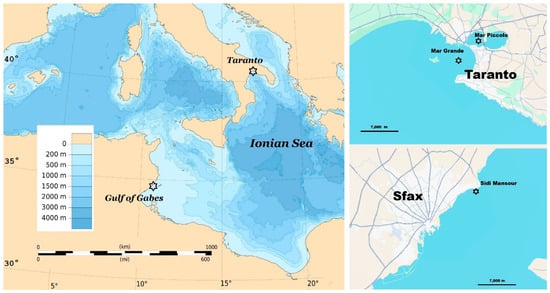
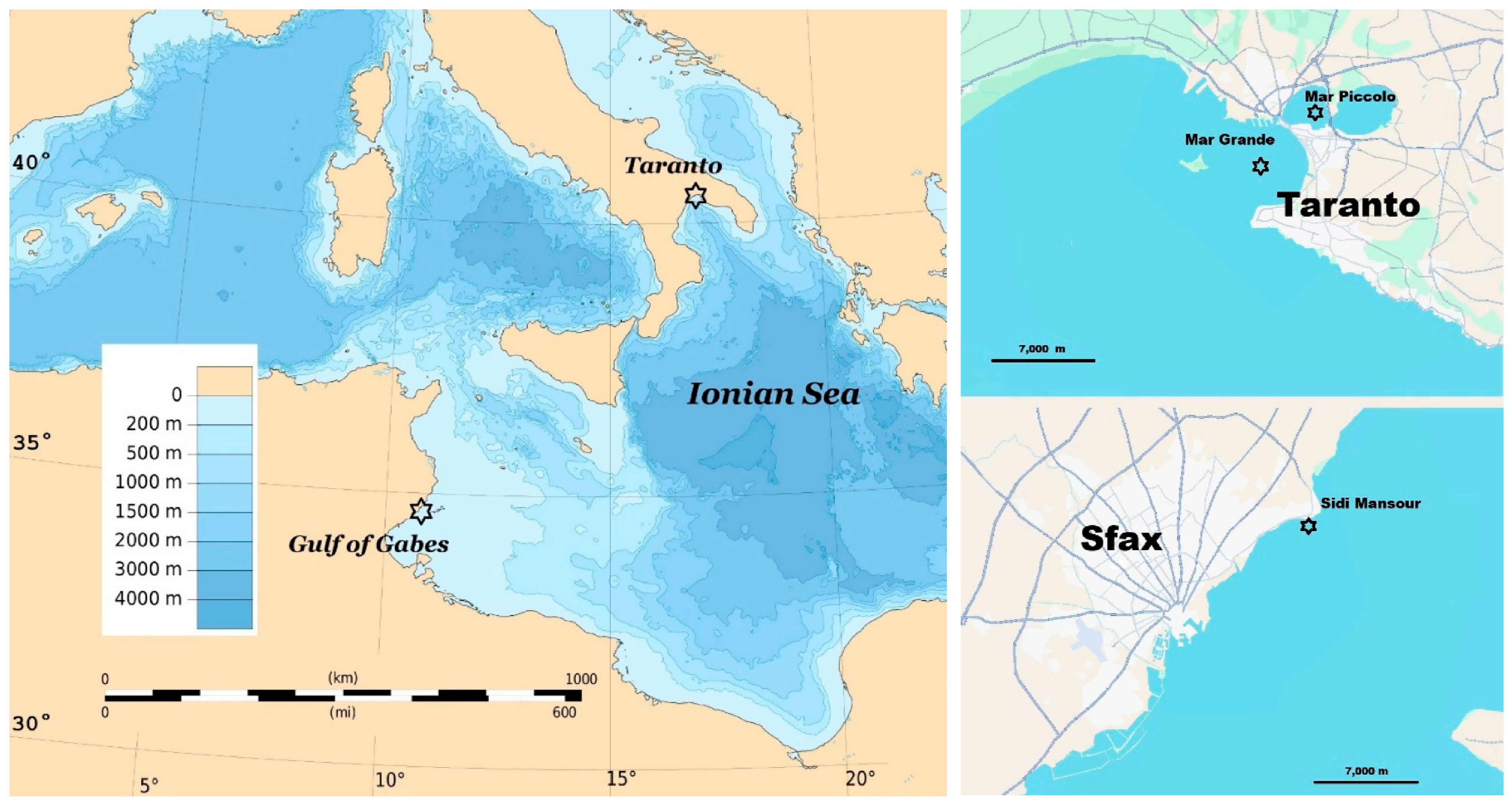
Adult specimens of Acartia clausi (Calanoida) were isolated from samples collected in the Mar Grande (MG) and Mar Piccolo (MP) of Taranto (Italy; collections 2004–2006 and 2020–2021) and in the Gulf of Gabes (Sfax, Tunisia; collections 2008 and 2014) (Figure 1). Italian samples were collected (over the entire time span) with a plankton net of 80 µm mesh size and a circular mouth 54 cm in diameter, towed obliquely from the bottom (25 m in MG and 11 m in MP) to the surface, for a final filtered volume of 1–2 m3 per sample. Samples were collected at two stations (MG, lat. N 40°27′12.15″; long. E 17°12′51.46″. MP, lat. N 40°29′17.74″, long. E 17°15′13.41″) with different levels of geographic confinement (low at MG, high at MP) (Figure 1). The Gulf of Gabes is a neritic environment, less confined than the Taranto seas (Figure 1), extending along the southeastern coast of Tunisia to the Libyan border. Samples were collected at Sidi Mansour, on the northern coast of Sfax (lat. N 34°48′53.67″; long. E 10°43′51.06″), where sampling was carried out twice per year (2008 and 2014), in January and August, by towing a plankton net of 100 µm mesh size obliquely through a 1.5 m water column, for a final filtered volume of approximately 0.5 m3.
Figure 1.
(Left)—location of the two sites (Taranto and the Gulf of Gabes) where Acartia clausi specimens were collected. (Right)—position of the sampling stations (stars) at each site.
The slight difference between the mesh sizes used in Tunisia and Italy was considered not to affect the body size of the studied specimens, as all were adults and considerably larger than the mesh size used.
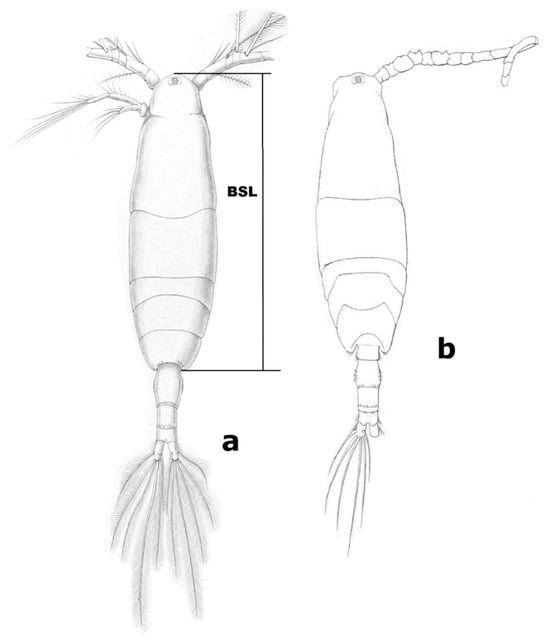
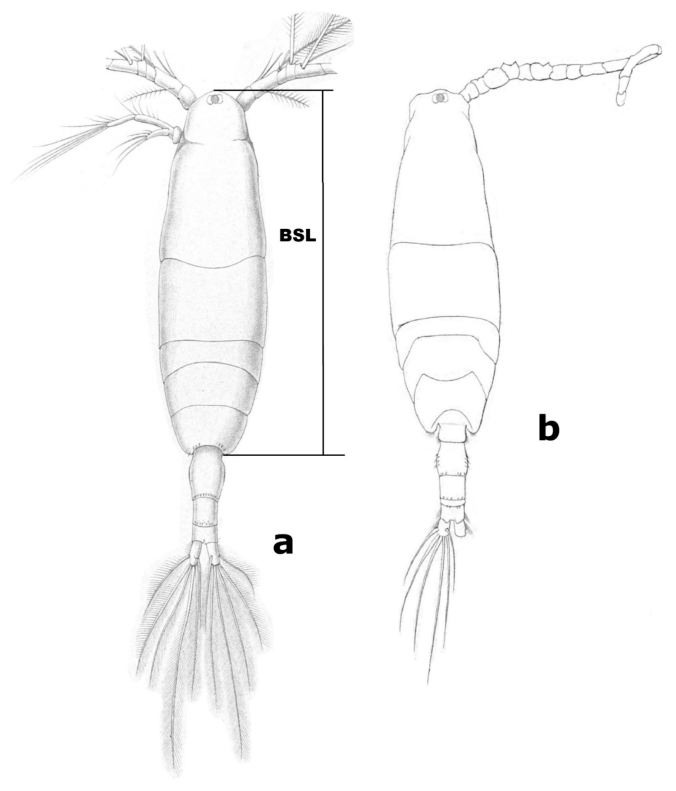
Each isolated individual was measured from the anterior end of the head to the posterior border of the cephalothorax (Figure 2) under a compound microscope (Zeiss Axiovert S-100; Carl Zeiss GmbH, Jena, Germany) equipped with the measurement module of the Leica Application Suite X (https://www.leica-microsystems.com/products/microscope-software/p/leica-las-x-id/ accessed on 14 September 2025) with a precision of 0.01 mm. The Gulf of Gabes specimens were measured with an ocular micrometer (Carl Zeiss 44 41 32 01, Plus 10×/18, Carl Zeiss GmbH, Jena, Germany).
Figure 2.
Acartia clausi adult female (a) and male (b), (redrawn from [44]). The measured part of the body (cephalothorax) is indicated (BSL = body size length).
Cephalothorax length was chosen to avoid errors arising from including the abdomen, which is often curved relative to the cephalothorax.
Measurements were grouped into different clusters according to the sex of the specimens, the sampling date, the water temperature (on the collection date and one and two months before, to account for the post-embryonic development of the specimens), the collection station (Taranto only), and the year (Table 1).
Table 1.
Sites, dates, measured specimens, and water temperatures in the present study. Mean cephalothorax (prosome) lengths (µm) are reported for each cluster of specimens. Water temperatures are averages of surface and bottom values for each date (collection date, 1 month before, and 2 months before). Average values are shown in bold. Average I–II values were obtained from the collection date and one month before. Missing values indicate that no specimens were measured.
All the measured specimens from Taranto (Italy) came from samples preserved in ethanol (final concentration of 75–85% in seawater). Those collected in the Gulf of Gabes (Sfax, Tunisia) were measured fresh, before fixation in formalin (4% of total volume). The different condition of the specimens (fixed in ethanol or freshly collected), in addition to the different measuring devices used (electronic vs. optical), prevented a reliable comparison between the two geographic sites.
To obtain sufficient numbers for statistical analysis, 35 individuals were measured per data cluster. Data for the Taranto population were obtained from two sexes, two sites (MG and MP), two years (2005–2006) with four seasons per year (March or April, July, October, and January), and one further year (2020–2021) with two seasons (July and January), for a total of 1140 specimens measured. Not all dates yielded a satisfactory number of specimens; therefore, different analyses of the adult body size of Acartia clausi were designed and carried out according to the availability of comparable data sets:
- -
- Sex differences (all measured specimens from Taranto, 2004–2006 and 2021, and from Sfax, 2008 and 2014);
- -
- Seasonal variation (for each sex and each period: Taranto, 2004–2006 and 2020–2021; Sfax, 2008 and 2014);
- -
- Site differences (Taranto only, MG vs. MP, 2005–2006 only);
- -
- Correlation with the average temperature on the collection date (each sex and each site analysed separately, over the whole study period: 2004–2006 and 2021 for Taranto, and 2008 and 2014 for Sfax).
Body size measurements were plotted against water temperature (values on the collection date and one and two months before zooplankton collection).
Data were statistically compared using one-way ANOVA followed by Bonferroni post hoc tests to assess differences among more than two years. Student’s t-test was used to assess significant differences in size between sexes, sites, and dates.
The correlation between the size of the Italian and Tunisian populations and water temperature was assessed using Pearson’s correlation coefficient. Statistical analyses were performed with XLSTAT 2019 (version 2.2).
3. Results
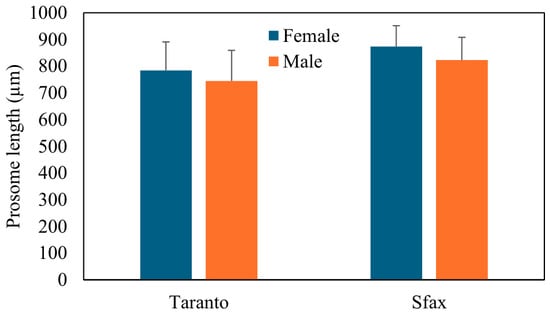
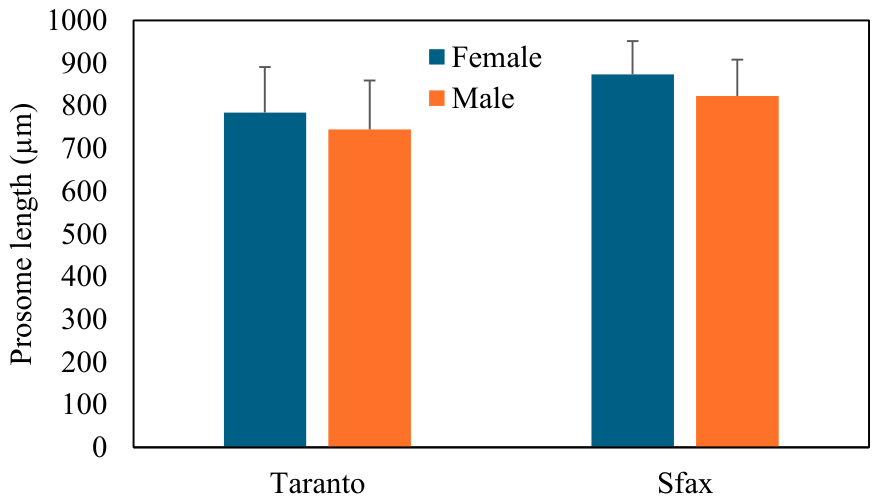
Acartia clausi adult females from Taranto were larger than males in all the analysed periods, with only rare exceptions (e.g., at MG in January 2005; Table 1). Female length ranged from 608.88 to 952.85 µm (mean ± SD = 783.81 ± 106.69 µm), while male length ranged from 547.46 to 895.72 µm (mean ± SD = 744.24 ± 114.89 µm) (Table 1, Figure 3). Student’s t-test revealed a highly significant difference in mean length between females and males (t = 5.76; d.f. = 1138; p < 0.0001), as well as between winter and summer adults (Figure 4).
Figure 3.
Mean prosome length of males and females from Taranto and Sfax (all dates and sites combined).
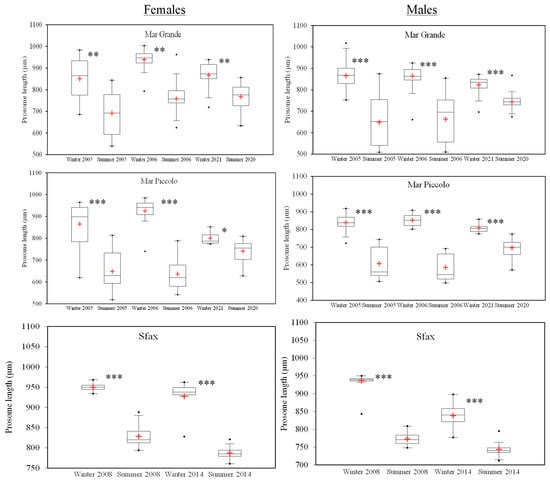
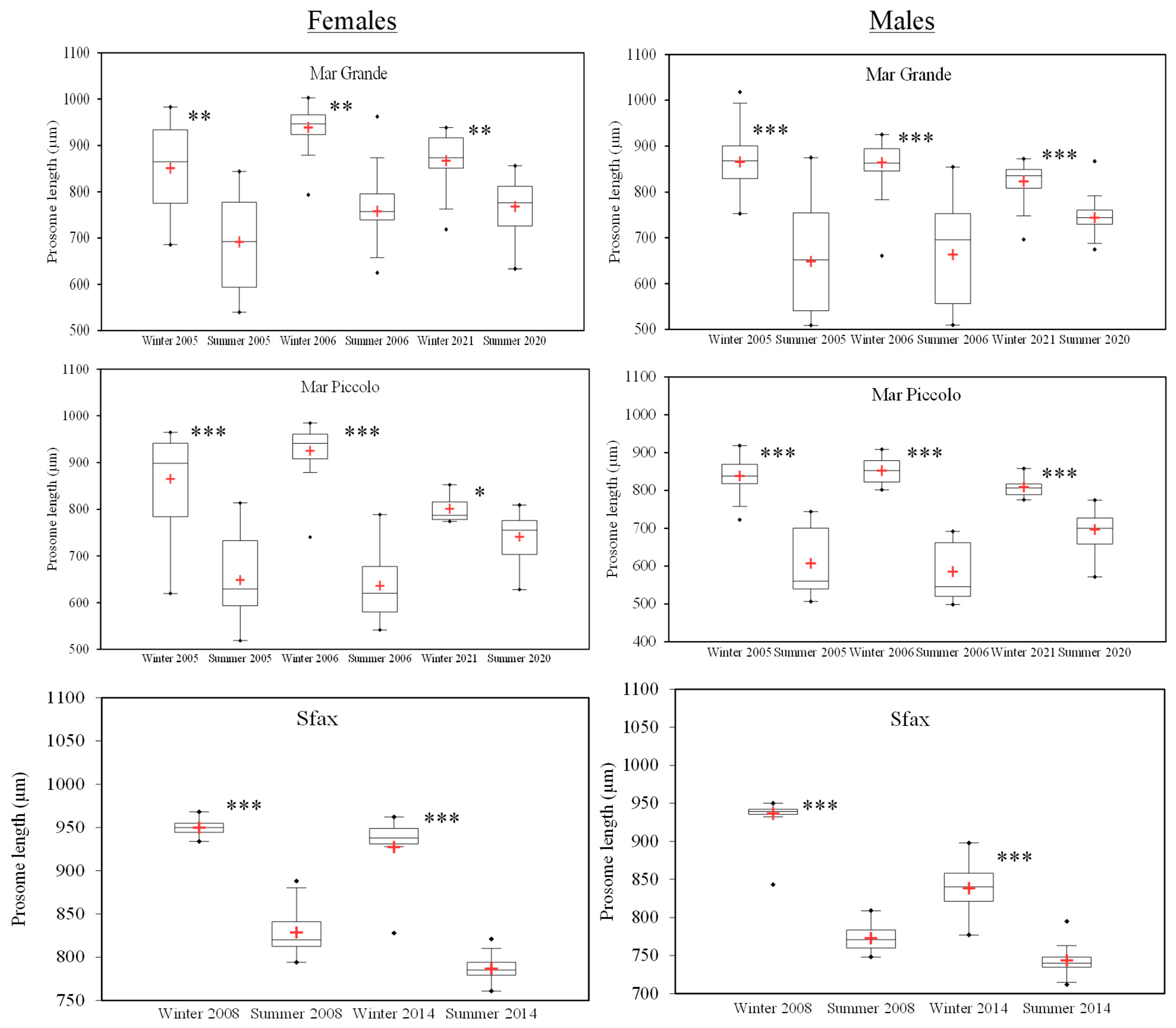
Figure 4.
Effect of season on the adult size of Acartia clausi at the Taranto and Sfax sites. Comparisons were made between seasons within each year (Student’s t-test: ** p < 0.01, *** p < 0.001).
In A. clausi from Sfax, female body size ranged from 828.51 to 949.83 µm (mean ± SD = 873.11 ± 59.05 µm), while male body size ranged from 772.71 to 936.46 µm (mean ± SD = 822.69 ± 39.67 µm) (Table 1, Figure 3). The prosome length of winter adults was significantly greater than that of summer adults in both 2008 and 2014 (Student’s t-test, p < 0.0001) (Table 1, Figure 4).
In each year considered, adults of the Taranto population were larger in the winter generations (January and March samples, from three years and two sites) than in the summer generations (July and October samples) (Table 1). The range of size variation (Taranto extreme values: 608.88–952.85 µm for females and 547.46–895.72 µm for males) was similar in the two sexes, with the largest adults found in winter (Table 1).
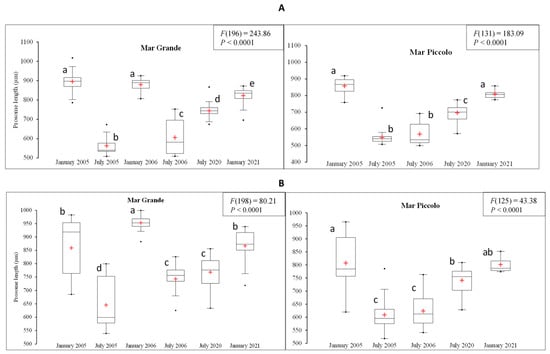
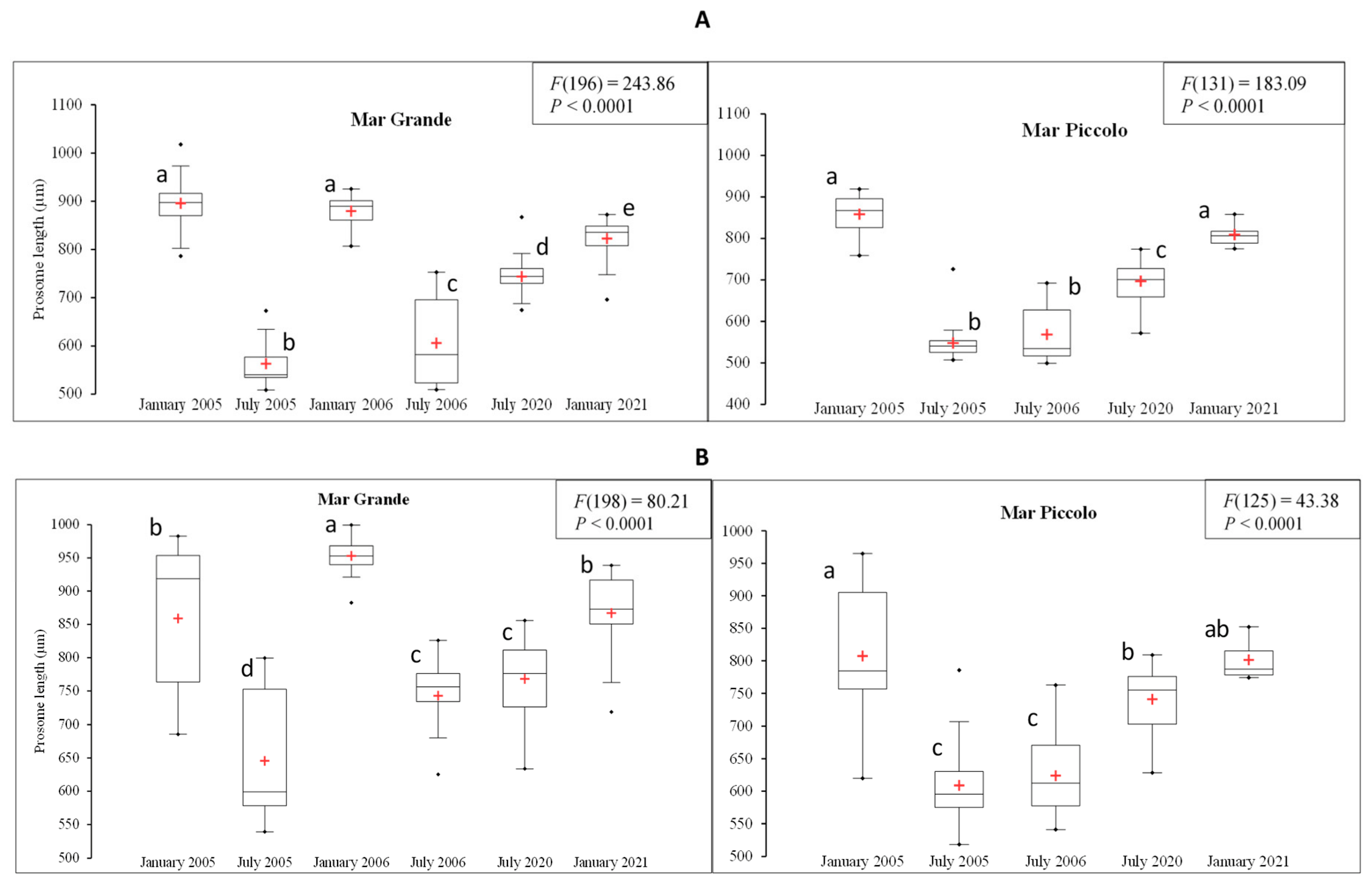
When three distinct years were compared in Taranto (only July and January data were used for this comparison), adults from July 2020 were larger than those from July 2005 and 2006, whereas the comparison of January measurements showed the opposite result (adults from 2005 larger than those from 2021) (Table 1, Figure 5). Statistical analysis indicated as significant the difference between females of 2005 and 2006 (t-test, p < 0.001) and all the size variations between years, although with contrasting trends: the size of winter specimens (January) decreased slightly from 2005 to 2021, whereas that of summer specimens (July) increased during the same period (Figure 5).
Figure 5.
Boxplots showing the temporal variation in prosome length of males (A) and females (B) of A. clausi at the Mar Grande and Mar Piccolo sites in Taranto. F-values and p-values correspond to the results of the multi-year ANOVA. Different lowercase letters on the boxes at each site indicate significant differences between years (Bonferroni post hoc test, p < 0.05).
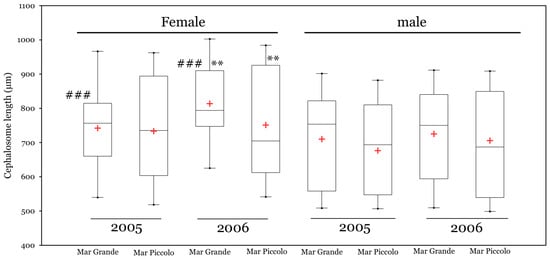
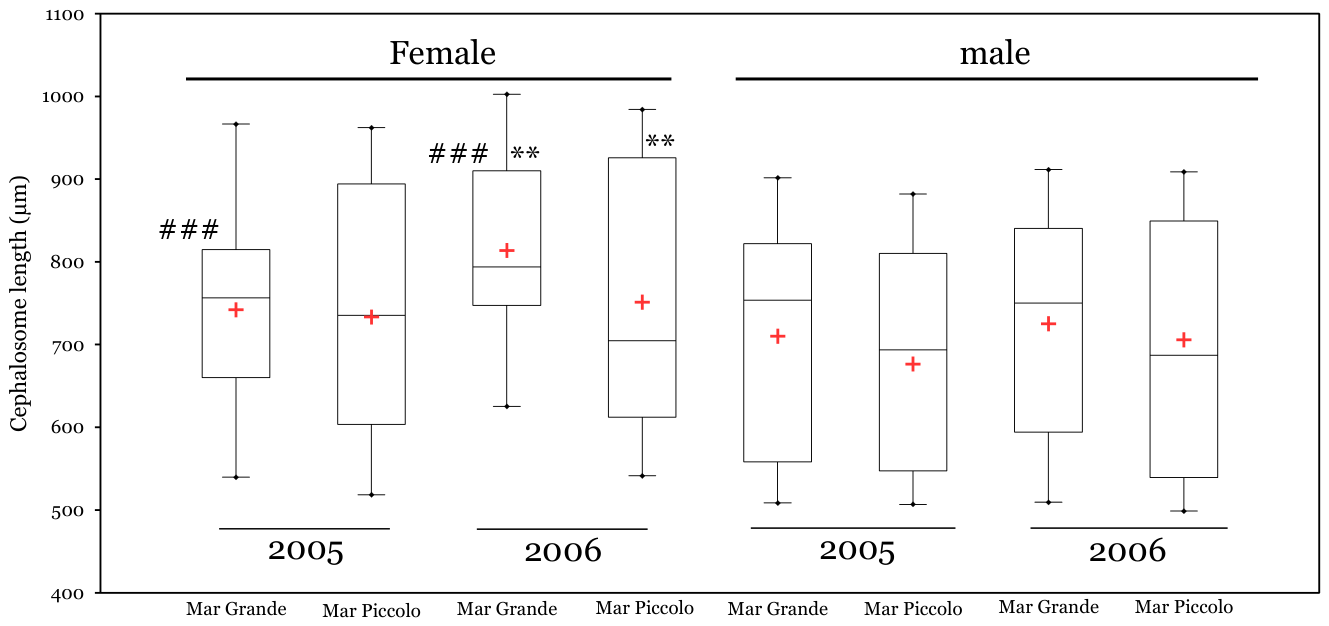
Regarding the comparison between the two adjacent areas of Taranto (Mar Grande and Mar Piccolo), in the analysed period (2005 and 2006) the average size of adults (both females and males) was larger at MG than at MP (Figure 6).
Figure 6.
Boxplots illustrating the spatio-temporal variation in the length of adult males and females of A. clausi at the Mar Grande and Mar Piccolo sites in 2005 and 2006. Within each box, the red cross and the horizontal line represent the mean and the median, respectively. Significant differences between sites: ** p < 0.01 (Student’s t-test); significant differences between dates: ### p < 0.0001.
In the Gulf of Gabes, adult males and females in summer and winter 2008 were significantly larger than those observed in summer and winter 2014 (Table 1) (winter: males, t = 18.04, d.f. = 56.70, p < 0.0001; females, t = 3.50, d.f. = 37, p = 0.01; summer: males, t = 7.83, d.f. = 68, p < 0.0001; females, t = 8.65, d.f. = 50.5, p < 0.0001).
For the Taranto data, the exploration of a possible correlation between size and water temperature (on the collection date and one and two months before collection, to account for the possible effect on the post-embryonic development of the specimens) showed, in all the examined cases (sex, years, and sites), a statistically significant negative correlation with the temperature on the collection date and with that of the preceding month, but not with the temperature two months before, except for females at MP (Table 2). For the Sfax population, in the winters of 2008 and 2014, adult size was positively correlated with water temperature, but not significantly (except for female length in 2014: r = 0.36; N = 35; p = 0.032). In the two summers, adult size appeared to be negatively correlated with temperature, except for males.
Table 2.
Correlation matrix (Pearson’s coefficient) between the size of Acartia clausi adults and water temperature on the sampling date and one and two months before. * p < 0.05, ** p < 0.01, *** p < 0.001.
4. Discussion
In a recent study, Corona et al. [40] measured 891 adult females of A. clausi (from several collection dates) in samples collected in the Southampton marine area (UK). The average prosome length of those females (891 individuals, 921.03 µm) was greater than that of the Taranto females (624 specimens, 791.27 µm) and the Sfax females (140 specimens, 873.11 µm). However, the size ranges of both the Southampton specimens and the Mediterranean specimens of the present study show a wide overlap between the data sets. In any case, the established link between adult size and water temperature [15,16,30] also suggests that the larger prosome length of the Southampton population could be explained by the lower average temperature of UK marine waters compared with the Mediterranean. Finally, habitat should also be considered, since it has already been demonstrated [30], and was also found in the present data, that in confined environments the same species has smaller individuals than in the open sea.
The hypothesis of a link between temperature and body size in Acartia clausi was supported at the seasonal scale, where a clear negative correlation between size and temperature emerged within the annual cycle. In contrast, the comparison of distant time periods provided only partial support, as no clear long-term relationship could be detected. This may be because recent warming was either not clearly evident in Taranto or still insufficient to produce a detectable effect on the body size of A. clausi.
Of the two drivers analysed, confinement is the heterogeneous one, temperature being the homogeneous one. Confinement of a water body is a complex concept encompassing many features, but it is mainly determined by the rate of water renewal and oxygen concentration (corresponding to the lack of the “vital elements” of marine origin described by Guelorget and Perthuisot [45]). As a driver, confinement also includes biotic factors such as crowding, food depletion, and predation pressure. Its effect is therefore complex and not easy to manage or interpret.
Ongoing climate warming might affect the body size of A. clausi and, more generally, of most zooplankton species. The future consequences of size reduction cannot be easily predicted. Indeed, if a reduction in copepod size is not accompanied by a corresponding reduction in the size of the organisms constituting its food particles, the food web will be readily modified, with consequences that are difficult to foresee.
Consequently, this result supports the use of A. clausi as a clear indicator of the temperature regime (and of ongoing climate warming) only if studies are restricted to very circumscribed sites, in order to avoid the confounding effect of confinement, which was evident even between sites as close as Mar Grande and Mar Piccolo in Taranto.
The present study provides data for interpreting size variability in adults of a planktonic species, which is linked not only to temperature but also to sex and site confinement. Contrary to what might be expected, the temperature experienced by each individual during its post-embryonic development was not a good indicator of its final body size. Final size was instead readily predicted by water temperature on the date of adult collection or one month before. In the present study, temperature values two months before the capture dates were not correlated with the final body size of A. clausi. The period during which environmental conditions may affect growth and final body size is that of post-embryonic development: the first naupliar instar (NI) is separated from the final copepodite instar (= adult, CVI) by 15–40 days [46], to which the adult lifespan of 22–78 days must be added [47]. On this basis, we can assume that the A. clausi adults of the present study were captured, on average, 66.5 days after birth (range: 15–118 days). An interesting suggestion arising from the present study is that the final body size of Acartia clausi seems to be affected more by the temperatures experienced during the last copepodite stage than during the naupliar stage. An alternative explanation could be a resting period of copepodites, which would further separate the naupliar stage in time from adult collection. However, this possibility (suggested by [16,19]) remains to be verified in Mediterranean A. clausi.
5. Conclusions
The present study suggests that, although adult body size in A. clausi is affected by water temperature, the role of additional conditions, such as the degree of confinement of the site, deserves attention. Many additional drivers are considered in the scientific literature [48], but temperature remains the factor most strongly (and inversely) correlated with final body size. In the present study, the comparison of distant years suggests that temperature variation does not clearly dominate the scenario, as temperatures were approximately the same in distant years in Taranto. This allowed site confinement, which varies in space but also in time (each site may show a different level of confinement in different years), to interfere with the final result. Consequently, although the body size of A. clausi is a reliable indicator of environmental temperature, we suggest that it be used only in local population analyses (within geographically delimited areas).
Sfax and Taranto adults were collected, treated (preserved), and measured with different methods, which does not allow a direct comparison between the two geographic populations. The limited comparability of the data sets prevents us from attributing the larger size of the Sfax adults to any environmental difference (e.g., the lower degree of confinement). We therefore recommend that comparative studies across distant periods be restricted to single geographic sites.
Finally, in Taranto, the temperature on the capture date appeared to be the best indicator of final body size, whereas temperatures one and two months before the capture date (possibly corresponding to earlier developmental stages of the measured adults) were less correlated and not correlated, respectively.
The present results can complement data on the variability of fecundity/fertility in A. clausi (and other Calanoida), since the abundance and biomass of copepod populations are undoubtedly of pivotal importance in marine food chains.
The study of size variation in A. clausi should be encouraged, given the wide distribution of the species and its year-round presence in the water column. Such studies could easily be carried out at LTER sites (such as Taranto) located throughout Europe and the Mediterranean area, where continuous records of abiotic water features and continuous collection of plankton samples would provide important support for the proposed role of plankton species as ecological indicators.
Some traits, such as body size, span several functions and are considered major determinants of zooplankton ecological strategies [49]. Adding trait measurements to future zooplankton studies would help to build a matrix of key traits for diverse taxa and to explore its usefulness for identifying general patterns. New predictive models and improved community metrics that incorporate traits and their associated trade-offs could then emerge to explain and predict zooplankton community structure and dynamics under different environmental conditions, thus improving our understanding of ongoing global change scenarios [50].
Author Contributions
Conceptualization, G.B. and N.A.-T.; methodology, F.R. and G.D.; software, W.G.; validation, G.B., N.A.-T. and F.R.; formal analysis, W.G.; investigation, G.B., N.A.-T. and F.R.; resources, G.B., N.A.-T. and F.R.; data curation, G.D. and W.G.; writing—original draft preparation, G.B., N.A.-T. and F.R.; writing—review and editing, G.B., N.A.-T. and F.R.; visualization, W.G.; supervision, G.B.; project administration, G.B., N.A.-T. and F.R.; funding acquisition, G.B., N.A.-T., G.D. and F.R. All authors have read and agreed to the published version of the manuscript.
Funding
This research was funded under the National Recovery and Resilience Plan (NRRP), Mission 4 Component 2 Investment 1.4—Call for tender No. 3138 of 16 December 2021, rectified by Decree n. 3175 of 18 December 2021 of the Italian Ministry of University and Research funded by the European Union—NextGenerationEU, Project code CN_00000033, Concession Decree No. 1034 of 17 June 2022 adopted by the Italian Ministry of University and Research, CUP B83C22002930006 Project title “National Biodiversity Future Center—NBFC”; and under the NRRP, Mission 4 Component 2 Investment 3.1, code IR_0000032, CUP B53C22002150006 Project title “ITINERIS”. The Tunisian part of this work was supported and funded by the Tunisian Ministry of Higher Education and Scientific Research.
Data Availability Statement
The data presented in this study are available on request from the corresponding author due to privacy reasons.
Acknowledgments
The Mar Piccolo of Taranto site (DEIMS.ID IT22) belongs to the national and international Long-Term Ecological Research networks: LTER-Italy (https://ror.org/05ma8mw15, accessed on 30 June 2026), LTER-Europe, and ILTER.
Conflicts of Interest
The authors declare no conflicts of interest.
References
- McMahon, T.A.; Bonner, J.T. On Size and Life; Scientific American Library: New York, NY, USA, 1983. [Google Scholar]
- Hutchinson, G.E.; MacArthur, R.H. A Theoretical Ecological Model of Size Distributions Among Species of Animals. Am. Nat. 1959, 93, 117–125. [Google Scholar] [CrossRef] [Scilit]
- Bergmann, C. Über Die Verhältnisse Der Wärmeökonomie Der Thiere Zu Ihrer Grösse; Vandenhoeck und Ruprecht: Göttingen, Germany, 1848. [Google Scholar]
- Atkinson, D. Temperature and Organism Size-a Biological Law for Ectotherms? Adv. Ecol. Res. 1994, 25, 1–58. [Google Scholar] [CrossRef] [Scilit]
- Angilletta, M.J., Jr.; Niewiarowski, P.H.; Dunham, A.E.; Leaché, A.D.; Porter, W.P. Bergmann’s Clines in Ectotherms: Illustrating a Life-History Perspective with Sceloporine Lizards. Am. Nat. 2004, 164, E168–E183. [Google Scholar] [CrossRef] [Scilit]
- Rees, D.J.; Dufresne, F.; Glémet, H.; Belzile, C. Amphipod Genome Sizes: First Estimates for Arctic Species Reveal Genomic Giants. Genome 2007, 50, 151–158. [Google Scholar] [CrossRef] [Scilit]
- Rees, D.J.; Belzile, C.; Glémet, H.; Dufresne, F. Large Genomes among Caridean Shrimp. Genome 2008, 51, 159–163. [Google Scholar] [CrossRef] [Scilit]
- Hessen, D.O.; Persson, J. Genome Size as a Determinant of Growth and Life-History Traits in Crustaceans: Genome Size in Crustaceans. Biol. J. Linn. Soc. 2009, 98, 393–399. [Google Scholar] [CrossRef] [Scilit]
- Evans, F. An Investigation into the Relationship of Sea Temperature and Food Supply to the Size of the Planktonic Copepod Temora longicornis Müller in the North Sea. Estuar. Coast. Shelf Sci. 1981, 13, 145–158. [Google Scholar] [CrossRef] [Scilit]
- Leinaas, H.P.; Jalal, M.; Gabrielsen, T.M.; Hessen, D.O. Inter- and Intraspecific Variation in Body- and Genome Size in Calanoid Copepods from Temperate and Arctic Waters. Ecol. Evol. 2016, 6, 5585–5595. [Google Scholar] [CrossRef] [Scilit]
- Gardner, J.L.; Peters, A.; Kearney, M.R.; Joseph, L.; Heinsohn, R. Declining Body Size: A Third Universal Response to Warming? Trends Ecol. Evol. 2011, 26, 285–291. [Google Scholar] [CrossRef] [Scilit]
- Davis, C.S. Predatory Control of Copepod Seasonal Cycles on Georges Bank. Mar. Biol. 1984, 82, 31–40. [Google Scholar] [CrossRef] [Scilit]
- Adler, G.; Jespersen, P. Variations Saisonnières Chez Quelques Copépodes Planctoniques Marins. Meddelelser Fra Komm. Dan. Fisk.-Og. Havunders. Ser. Plankton 1920, 2, 46. [Google Scholar]
- Conover, R.J. Oceanography of Long Island Sound, 1952–1954. VI. Biology of Acartia clausi and A. tonsa. Bull. Bingham Oceanogr. Collect. 1956, 15, 156–233. [Google Scholar]
- Deevey, G.B. Relative Effects of Temperature and Food on Seasonal Variations in Length of Marine Copepods in Some Eastern American and Western European Waters. Bull. Bingham Oceanogr. Collect. 1960, 17, 54–86. [Google Scholar]
- McLaren, I.A. Some relationships between temperature and egg size, body size, development rate, and fecundity, of the copepod Pseudocalanus. Limnol. Oceanogr. 1965, 10, 528–538. [Google Scholar] [CrossRef] [Scilit]
- Moraitou-Apostolopoulou, M.; Verriopoulos, G.; Tsipoura, N. Dimensional Differentiation between Five Planktonic Organisms Living in Two Areas Characterized by Different Salinity Conditions. Arch. Hydrobiol. 1986, 105, 459–469. [Google Scholar] [CrossRef] [Scilit]
- Moraitou, A.; Verriopoulos, G. Différenciation morphologique entre deux populations d’Acartia clausi (Copepoda) provenant de biotopes différemment pollués. Rev. Int. Oceanogr. Med. 1979, 53–54, 77–86. [Google Scholar]
- Hirche, H.-J.; Boersma, M.; Wiltshire, K.H. Partial Decoupling from the Temperature Size Rule by North Sea Copepods. Mar. Biol. 2019, 166, 58. [Google Scholar] [CrossRef] [Scilit]
- El-Maghraby, A.M. The Seasonal Variations in Length of Some Marine Planktonic Copepods from the Eastern Mediterranean at Alexandria. Crustaceana 1965, 8, 37–47. [Google Scholar] [CrossRef] [Scilit]
- Carter, J.C.H.; Sprules, W.G.; Dadswell, M.J.; Roff, J.C. Factors Governing Geographical Variation in Body Size of Diaptomus minutus (Copepoda, Calanoida). Can. J. Fish. Aquat. Sci. 1983, 40, 1303–1307. [Google Scholar] [CrossRef] [Scilit]
- Warren, G.J.; Evans, M.S.; Jude, D.J.; Ayers, J.C. Seasonal Variations in Copepod Size: Effects of Temperature, Food Abundance, and Vertebrate Predation. J. Plankton Res. 1986, 8, 841–853. [Google Scholar] [CrossRef] [Scilit]
- Breteler, W.K.; Gonzalez, S.R. Influence of Temperature and Food Concentration on Body Size, Weight and Lipid Content of Two Calanoid Copepod Species. Hydrobiologia 1988, 167, 201–210. [Google Scholar] [CrossRef] [Scilit]
- Dam, H.G.; Peterson, W.T. In Situ Feeding Behavior of the Copepod Temora longicornis: Effects of Seasonal Changes in Chlorophyll Size Fractions and Female Size. Mar. Ecol. Prog. Ser. 1991, 71, 113–123. [Google Scholar] [CrossRef] [Scilit]
- Viitasalo, M.; Koski, M.; Pellikka, K.; Johansson, S. Seasonal and Long-Term Variations in the Body Size of Planktonic Copepods in the Northern Baltic Sea. Mar. Biol. 1995, 123, 241–250. [Google Scholar] [CrossRef] [Scilit]
- Chisholm, L.A.; Roff, J.C. Size-Weight Relationships and Biomass of Tropical Neritic Copepods off Kingston, Jamaica. Mar. Biol. 1990, 106, 71–77. [Google Scholar] [CrossRef] [Scilit]
- Miller, C.B.; Fulton, J.; Frost, B.W. Size Variation of Neocalanus plumchrus and Neocalanus flemingeri in a 20-Yr Sample Series from the Gulf of Alaska. Can. J. Fish. Aquat. Sci. 1992, 49, 389–399. [Google Scholar] [CrossRef] [Scilit]
- Uye, S. Replacement of Large Copepods by Small Ones with Eutrophication of Embayments: Cause and Consequence. Hydrobiologia 1994, 292, 513–519. [Google Scholar] [CrossRef] [Scilit]
- Riccardi, N.; Mariotto, L. Seasonal Variations in Copepod Body Length: A Comparison between Different Species in the Lagoon of Venice. Aquat. Ecol. 2000, 34, 243–252. [Google Scholar] [CrossRef] [Scilit]
- Belmonte, G.; Cavallo, A. Body Size and Its Variability in the Copepod Acartia margalefi (Calanoida) from Lake Acquatina (SE Italy). Ital. J. Zool. 1997, 64, 377–382. [Google Scholar] [CrossRef] [Scilit]
- Gaudy, R.; Verriopoulos, G. Spatial and Seasonal Variations in Size, Body Volume and Body Proportion (Prosome: Urosome Ratio) of the Copepod Acartia tonsa in a Semi-Closed Ecosystem (Berre Lagoon, Western Mediterranean). Hydrobiologia 2004, 513, 219–231. [Google Scholar] [CrossRef] [Scilit]
- Belmonte, G.; Vaglio, I.; Rubino, F.; Alabiso, G. Zooplankton Composition along the Confinement Gradient of the Taranto Sea System (Ionian Sea, South-Eastern Italy). J. Mar. Syst. 2013, 128, 222–238. [Google Scholar] [CrossRef] [Scilit]
- Uriarte, I.; Villate, F. Spatial Variations in Size, Weight and Condition Factor of the Females of Acartia clausi (Copepoda: Calanoida) along a Salinity Gradient in Two Contrasting Estuaries of the Basque Coast (Bay of Biscay). Hydrobiologia 2006, 571, 329–339. [Google Scholar] [CrossRef] [Scilit]
- Straile, D. North Atlantic Oscillation Synchronizes Food-Web Interactions in Central European Lakes. Proc. Biol. Sci. 2002, 269, 391–395. [Google Scholar] [CrossRef] [Scilit]
- Agnew, D.J.; Beddington, J.R.; Hill, S.L. The Potential Use of Environmental Information to Manage Squid Stocks. Can. J. Fish. Aquat. Sci. 2002, 59, 1851–1857. [Google Scholar] [CrossRef] [Scilit]
- Molinero, J.C.; Ibanez, F.; Souissi, S.; Chifflet, M.; Nival, P. Phenological Changes in the Northwestern Mediterranean Copepods Centropages typicus and Temora stylifera Linked to Climate Forcing. Oecologia 2005, 145, 640–649. [Google Scholar] [CrossRef] [Scilit]
- Klais, R.; Otto, S.A.; Teder, M.; Simm, M.; Ojaveer, H. Winter–Spring Climate Effects on Small-Sized Copepods in the Coastal Baltic Sea. ICES J. Mar. Sci. 2017, 74, 1855–1864. [Google Scholar] [CrossRef] [Scilit]
- Kapiris, K.; Miliou, H.; Moraitou-Apostolopoulou, M. Effects of Formaldehyde Preservation on Biometrical Characters, Biomass and Biochemical Composition of Acartia clausi (Copepoda, Calanoida). Helgol. Meeresunters. 1997, 51, 95–106. [Google Scholar] [CrossRef] [Scilit]
- Lima, F.P.; Wethey, D.S. Three decades of high-resolution coastal sea surface temperatures reveal more than warming. Nat. Commun. 2012, 3, 704. [Google Scholar] [CrossRef] [Scilit]
- Corona, S.; Hirst, A.; Atkinson, D.; Atkinson, A. Density-dependent Modulation of Copepod Body Size and Temperature–Size Responses in a Shelf Sea. Limnol. Oceanogr. 2021, 66, 3916–3927. [Google Scholar] [CrossRef] [Scilit]
- Rice, E.; Stewart, G. Decadal Changes in Zooplankton Abundance and Phenology of Long Island Sound Reflect Interacting Changes in Temperature and Community Composition. Mar. Environ. Res. 2016, 120, 154–165. [Google Scholar] [CrossRef] [Scilit]
- Daufresne, M.; Lengfellner, K.; Sommer, U. Global Warming Benefits the Small in Aquatic Ecosystems. Proc. Natl. Acad. Sci. USA 2009, 106, 12788–12793. [Google Scholar] [CrossRef] [Scilit]
- Belmonte, G. Acartiidae Sars, G.O, 1903. In ICES Identification Leaflets for Plankton; ICES: Copenhagen, Denmark, 2021; Volume 194, pp. 1–29. [Google Scholar] [CrossRef]
- Giesbrecht, W. Sistematik und Faunistik der Pelagischen Copepoden des Golfes von Neapel und der Angrenzenden Meeres-Abschnitte; Fauna und Flora des Golfes von Neapel; R. Friedländer & Sohn: Berlin, Germany, 1892; Volume 19, p. 831. [Google Scholar]
- Guelorget, O.; Perthuisot, J.P. Paralic Ecosystems. Biological Organization and Functioning. Life Environ. 1992, 42, 215–251. [Google Scholar]
- Klein Breteler, W.C.M.; Schogt, N. Development of Acartia clausi (Copepoda, Calanoida) Cultured at Different Conditions of Temperature and Food. Hydrobiologia 1994, 292, 469–479. [Google Scholar] [CrossRef] [Scilit]
- Ianora, A. Copepod Life History Traits in Subtemperate Regions. J. Mar. Syst. 1998, 15, 337–349. [Google Scholar] [CrossRef] [Scilit]
- Horne, C.R.; Hirst, A.G.; Atkinson, D.; Neves, A.; Kiørboe, T. A Global Synthesis of Seasonal Temperature–Size Responses in Copepods. Glob. Ecol. Biogeogr. 2016, 25, 988–999. [Google Scholar] [CrossRef] [Scilit]
- Litchman, E.; Ohman, M.D.; Kiorboe, T. Trait-based approaches to zooplankton communities. J. Plankton Res. 2013, 35, 473–484. [Google Scholar] [CrossRef] [Scilit]
- Hébert, M.P.; Beisner, B.; Maranger, R. Linking zooplankton communities to ecosystem functioning: Toward an effect-trait framework. J. Plankton Res. 2017, 39, 3–12. [Google Scholar] [CrossRef] [Scilit]

Disclaimer/Publisher’s Note: The statements, opinions and data contained in all publications are solely those of the individual author(s) and contributor(s) and not of MDPI and/or the editor(s). MDPI and/or the editor(s) disclaim responsibility for any injury to people or property resulting from any ideas, methods, instructions or products referred to in the content. |
© 2026 by the authors. Licensee MDPI, Basel, Switzerland. This article is an open access article distributed under the terms and conditions of the Creative Commons Attribution (CC BY) license.