


Highlights
What are the main findings?
- A five-dimensional conceptual framework integrates complementary perspectives on water education.
- The selected Saudi policy sources represent these dimensions with differing institutional emphases.
- Systems literacy and governance literacy extend the framework beyond resource awareness and individual conservation.
- Environmental values and conservation practices are analytically distinct.
What is the implication of the main finding?
- Cross-sector policy perspectives could inform integrated water education.
- Curriculum development could connect water resources with environmental, technological, and socioeconomic systems.
- Governance-related learning could address institutions, responsibilities, and resource-management decisions.
- The framework provides a basis for future curriculum analysis and empirical evaluation.
Abstract
Water scarcity presents a significant sustainability challenge in Saudi Arabia, creating opportunities to connect water education with environmental responsibility, systems understanding, and governance literacy. This study develops a five-dimensional conceptual framework for water education and examines its representation across selected Saudi national policy sources. An integrative synthesis of relevant literature informed a deductive, interpretive qualitative analysis of four purposively selected official sources covering water policy, environmental sustainability, educational sustainability, and national strategic implementation. The framework comprises water knowledge, environmental values, conservation practices, systems literacy, and governance literacy. The findings reveal complementary but differentiated representations of these dimensions, reflecting the distinct institutional mandates and purposes of the analyzed sources. Water-sector and national implementation documents articulate resource-management relationships and institutional responsibilities, while environmental and educational sustainability sources contribute complementary perspectives on stewardship, responsible resource use, and participation. These findings identify opportunities to translate policy-relevant concepts into integrated, developmentally appropriate educational experiences. The framework offers a conceptual basis for cross-curricular development and future empirical research, without establishing how these dimensions are currently represented in Saudi curricula or whether their integration improves student learning outcomes.
1. Introduction
Water security is a major sustainability challenge in arid and water-stressed regions, where limited freshwater availability intersects with population growth, urbanization, agricultural production, industrial development, and increasing resource demand. Saudi Arabia provides a particularly relevant context because its arid climate and limited renewable freshwater resources coexist with substantial reliance on non-renewable groundwater and energy-intensive water-supply technologies [1]. In response, the Saudi National Water Strategy 2030 emphasizes resource sustainability, demand management, supply reliability, institutional capacity, and improved sector governance [2]. These priorities illustrate that water sustainability is not exclusively a technical or environmental concern but also involves human behavior, institutional decision-making, and collective responsibility. Education therefore has a potentially important role in helping learners understand the interconnected challenges associated with sustainable water management.
Water education has traditionally emphasized awareness of water scarcity, responsible water use, and individual conservation practices. Saudi-focused research has highlighted the importance of educational initiatives, public awareness, institutional coordination, and supportive policies in promoting water conservation [3,4,5]. Although these contributions establish the relevance of education to national water sustainability, they also raise questions about the breadth of competencies addressed through water-related learning. In particular, understanding water scarcity and adopting conservation practices may represent important educational objectives without fully capturing the environmental, technological, social, and institutional complexities of contemporary water management.
International scholarship increasingly supports a broader approach. Values-based water education connects environmental responsibility with cooperation, resource stewardship, and practical problem-solving [6], while place-based and systems-oriented approaches situate water issues within interconnected ecological, cultural, and social contexts [7]. Interdisciplinary research further emphasizes the relationships among technical knowledge, environmental processes, economic considerations, public policy, and governance [8,9]. This multidimensional perspective is also consistent with analytical approaches such as PESTEL (Political, Economic, Social, Technological, Environmental, and Legal) and STEEPLE (Social, Technological, Economic, Environmental, Political, Legal, and Ethical), which situate technological developments within broader societal, environmental, institutional, and governance contexts. These approaches are referenced here as conceptual parallels rather than analytical frameworks applied in the present study. At the same time, studies have questioned the assumption that improved knowledge necessarily produces corresponding changes in attitudes or behavior [10,11,12]. These findings suggest that water knowledge, environmental values, and conservation practices should be treated as related but analytically distinct educational dimensions. Ethical perspectives on water governance reinforce the importance of responsibility and values in shaping sustainable resource management [13].
Two additional dimensions are particularly relevant to contemporary water sustainability. Systems literacy concerns the ability to recognize relationships among water resources, environmental processes, technologies, economic activities, and societal needs. Research connecting education, sustainable water-resource management, and interdisciplinary problem-solving highlights the importance of understanding these interactions rather than treating water challenges as isolated issues [14,15,16]. Governance literacy, meanwhile, concerns understanding the institutions, policies, stakeholder responsibilities, and decision-making processes through which water resources are managed. Research on integrated water-resources education and related educational approaches has emphasized governance, collaboration, planning, and decision-making as important competencies [17,18]. Studies examining the representation of water issues in educational materials also demonstrate that educational content can shape how learners understand responsibility, resource challenges, and possible policy responses [19]. Together, these perspectives suggest that comprehensive water education should connect individual knowledge and action with broader socio-ecological systems and institutional arrangements.
Despite these developments, the relevant educational dimensions are frequently discussed across separate strands of scholarship. Saudi research has contributed to understanding water awareness, conservation behavior, and educational interventions [3,4,5], while international studies have explored values, systems thinking, interdisciplinarity, and governance-related competencies [6,7,8,9,10,11,12,13,14,15,16,18,19,20]. However, comparatively limited attention has been devoted to bringing these perspectives together within a coherent analytical framework specifically applicable to Saudi Arabia’s evolving water sustainability context. The central research gap is therefore not an assumed absence of sustainability education, but the need for an integrated conceptual approach capable of examining how complementary educational dimensions are articulated across relevant national policy domains.
This gap is particularly significant because national water, environmental, educational, and strategic implementation documents address different aspects of sustainability according to their institutional purposes. Examining these sources together can clarify how water-related knowledge, environmental responsibility, conservation, systems understanding, and governance considerations are represented across the selected policy environment. Such an examination does not establish whether these competencies are implemented in classrooms or adequately reflected in existing curricula; rather, it can identify conceptual connections and potential directions for future educational development.
Accordingly, this study develops a five-dimensional analytical framework comprising water knowledge, environmental values, conservation practices, systems literacy, and governance literacy. It combines an integrative review of relevant literature with qualitative documentary analysis of four purposively selected official Saudi sources addressing national water policy, environmental sustainability, educational sustainability, and strategic implementation. The study addresses two research questions: (1) What dimensions can be integrated into a conceptual framework that captures contemporary water education beyond factual knowledge and individual conservation practices? (2) How are these dimensions represented across selected Saudi national policy documents?
The study contributes by synthesizing previously dispersed educational perspectives into a coherent framework and applying it to the Saudi policy context. The documentary analysis identifies complementary emphases across the selected sources, suggesting opportunities to connect specialized water knowledge and governance considerations with sustainability values, responsible resource use, and participation. These findings provide a conceptual foundation for future curriculum analysis and empirical investigation, while remaining limited to the interpretation of selected policy documents rather than direct evidence of educational implementation or learning outcomes.
2. Materials and Methods
2.1. Research Design
This study employed an integrative qualitative design combining a structured review of the literature with qualitative documentary analysis of official Saudi policy and sustainability documents. This design was selected because water education is examined as a multidimensional issue involving not only knowledge and conservation behavior but also environmental values, systems understanding, and governance competencies. The study did not seek to measure individual knowledge, attitudes, or behavior through surveys, interviews, or other participant-based methods. Instead, it examined how educational dimensions relevant to contemporary water sustainability are conceptualized in the scholarly literature and represented across key Saudi policy domains.
The study proceeded in two interconnected stages. First, relevant scholarship on water education, environmental values, conservation practices, systems-oriented learning, and water governance was systematically reviewed and synthesized to identify recurring concepts and educational competencies. This synthesis informed the development of a five-dimensional analytical framework comprising water knowledge, environmental values, conservation practices, systems literacy, and governance literacy. Second, the framework was applied to a purposively selected corpus of official Saudi documents representing national water policy, environmental policy, educational sustainability, and national strategic implementation. The documents were examined qualitatively and comparatively to determine how the five dimensions were represented, how they related to one another, and where patterns of convergence, differential emphasis, or limited representation emerged across policy domains. This two-stage design connected insights from the scholarly literature with an applied cross-sector analysis of the Saudi policy environment.
2.2. Literature Identification and Selection
A structured literature search was undertaken to support the conceptual development of the analytical framework. The search addressed six interconnected areas: water education and water literacy; environmental and sustainability values; water-conservation education and behavior; systems thinking and interdisciplinary water education; water governance; and educational approaches connecting knowledge with decision-making, participation, and responsible action. Particular attention was given to scholarship from Saudi Arabia, the Gulf region, the Arab world, and other arid or semiarid contexts in which water scarcity constitutes a major sustainability and educational concern.
Relevant scholarly publications were identified and screened according to their substantive contribution to the conceptual domains underpinning the study. The selection process considered water-specific educational content, environmental values, conservation behavior, systems-oriented approaches, sustainability and governance competencies, educational-framework development, and contextual relevance to water-scarce settings. Duplicate and peripheral records were excluded, as were publications in which water or sustainability education was incidental to the primary research question. The retained literature was used to identify complementary theoretical perspectives and support the development of the five-dimensional analytical framework.
For each retained source, relevant information was examined concerning the study context, educational level or target population where applicable, water-education content, environmental values, conservation practices, interdisciplinary or systems-oriented learning, sustainability and governance competencies, implementation barriers, contextual factors, and recommendations. The literature search was supplemented by reference chaining and targeted verification of publications directly relevant to the five analytical dimensions. Priority was given to peer-reviewed journal articles, scholarly books and chapters, established academic conference proceedings, and authoritative institutional or policy sources. Bibliographic information and DOI data were verified against publisher or institutional records where available. Because the purpose of the literature synthesis was integrative conceptual framework development rather than quantitative estimation of effects, no statistical meta-analysis was undertaken.
2.3. Saudi Documentary Corpus
The documentary corpus was constructed through purposive, criterion-based selection to capture complementary institutional perspectives within Saudi Arabia’s water and sustainability policy environment. Rather than seeking exhaustive or statistically representative coverage of national policy documents, the selection aimed to establish a bounded cross-sector corpus suitable for examining the representation of the five dimensions of water education. Three inclusion criteria were applied: (1) official publication by a Saudi governmental or national public institution; (2) substantive relevance to water-resource management, environmental sustainability, education, conservation, systems relationships, or governance; and (3) sufficient policy-related or conceptual content to support qualitative interpretation within the proposed analytical framework.
Four sources were selected to represent distinct but complementary institutional domains (Table 1). The Saudi National Water Strategy 2030 (D1) provides a reference for water-resource management, demand management, and sector governance. The National Environment Strategy—Executive Summary (D2) situates resource sustainability within broader environmental priorities and institutional responsibilities. The Ministry of Education’s Sustainable Development webpage (D3) presents the Ministry’s official orientation toward sustainability, although it does not constitute a curriculum document or a comprehensive educational policy framework. The Saudi Vision 2030 Annual Report 2025 (D4) provides a national implementation perspective, including sustainability initiatives and institutional developments. Together, these sources enable a cross-sector examination of water-related educational dimensions without assuming that each document addresses all five dimensions equally or comprehensively.
Table 1.
Saudi documentary corpus, source characteristics, and analytical roles.
The selection of four sources was guided by institutional complementarity and analytical relevance rather than document quantity. The corpus was therefore treated as a focused illustration of four policy domains, not as a comprehensive inventory of Saudi water-education policies. School curricula, textbooks, teacher guides, and classroom materials were excluded because the study examines policy-level representations rather than educational implementation. Consequently, the analysis cannot establish the extent to which the five dimensions are incorporated into existing curricula, classroom instruction, or student learning. These questions require separate curriculum-based and empirical investigations.
The archived documentary corpus comprised 228 PDF pages: a six-page capture of the official National Water Strategy webpage (D1), the 68-page National Environment Strategy executive summary (D2), a four-page capture of the Ministry of Education’s Sustainable Development webpage (D3), and the 150-page Saudi Vision 2030 Annual Report 2025 (D4). These page counts describe the extent of the source files, including webpage formatting and ancillary material, rather than the volume of text coded during qualitative analysis. The documents also differ substantially in institutional mandate, purpose, format, and technical detail. Accordingly, the analysis focused on substantively relevant passages and interpreted differences in representation in relation to each source’s institutional context. Cross-document comparisons were used to identify qualitative patterns of emphasis and conceptual complementarity, not to rank policy quality, infer educational effectiveness, or quantify national implementation performance.
2.4. Analytical Framework
The analytical framework was developed through an iterative synthesis of the reviewed literature and organized around five principal dimensions: water knowledge, environmental values, conservation practices, systems literacy, and governance literacy. These dimensions were treated as analytically distinguishable but conceptually interconnected. They were not conceptualized as a causal or developmental sequence in which knowledge necessarily produces values or values necessarily produce behavior.
Water knowledge refers to substantive scientific, environmental, and resource-related understandings of water, including availability, scarcity, sources, quality, supply, demand, use, and sustainability challenges. The analysis considered substantive representations of water resources and water-related conditions while excluding incidental references that did not contribute to an understanding of water sustainability.
Environmental values refer to normative orientations toward water and environmental resources, including stewardship, responsibility, conservation, sustainability, intergenerational responsibility, and the protection or valuation of natural resources. The analysis distinguished such normative orientations from statements that merely described environmental conditions.
Conservation practices refer to action-oriented approaches related to efficient water use, demand reduction, reuse, responsible consumption, behavioral change, and other practical responses intended to improve water sustainability. General statements concerning the importance of conservation were distinguished from content addressing identifiable practices or actions.
Systems literacy refers to understanding water within interconnected natural, technological, economic, social, and environmental systems. Particular attention was given to explicit relationships between water and wider components or processes, including energy, agriculture, food production, desalination, wastewater reuse, technology, consumption, economic priorities, environmental pressures, and societal needs. Mere co-occurrence of topics without an articulated relationship was not considered evidence of systems literacy.
Governance literacy refers to the institutional and policy dimensions of sustainable resource management, including laws, regulations, policies, institutional mandates, stakeholder roles, allocation and management decisions, accountability, participation, coordination, and distributions of responsibility. Governance-related material was further interpreted in terms of governance knowledge, concerning institutions and rules; governance reasoning, concerning policy choices, trade-offs, and relationships; and governance agency, concerning participation, responsibility, and stakeholder involvement.
Together, the five dimensions provided a structured basis for examining how different aspects of comprehensive water education are represented across the selected Saudi documents while remaining sensitive to the institutional purpose and context of each source.
2.5. Documentary Analysis Procedure
The four Saudi sources were examined using a structured qualitative documentary analysis guided by the five-dimensional analytical framework described in Section 2.4. The analysis adopted a deductive, semantically oriented approach in which the five dimensions served as predefined interpretive categories. The unit of analysis was a substantively meaningful textual segment, such as a sentence, paragraph, policy objective, initiative description, or explanatory passage, that conveyed an identifiable concept relevant to at least one dimension. Segment boundaries were determined by conceptual coherence rather than by a fixed number of words or sentences.
The analysis focused on substantive policy and sustainability content, excluding webpage navigation elements, repeated headers and footers, and other formatting-related material without analytical relevance. Relevant segments were identified through their substantive meaning rather than the presence of predetermined keywords. This approach accommodated differences in terminology across the four sources, particularly where environmental responsibility, resource interdependence, and governance arrangements were expressed indirectly through descriptions of institutional responsibilities, policy objectives, or relationships among resources and actors.
Each source was examined individually in relation to the five dimensions: water knowledge, environmental values, conservation practices, systems literacy, and governance literacy. Interpretive assignment was based on the conceptual definitions established in Section 2.4. For example, statements concerning water-saving measures were interpreted in relation to conservation practices, whereas explanations linking water demand, resource availability, and environmental pressures were considered relevant to systems literacy. References to public institutions were associated with governance literacy only when they communicated responsibilities, regulatory functions, coordination mechanisms, participation, or decision-making arrangements. Where a passage substantively addressed more than one dimension, its overlapping conceptual relevance was considered rather than forcing an exclusively single-dimensional interpretation.
Following the source-specific examination, the findings were compared across D1–D4 to identify similarities, differences, complementary emphases, and areas receiving limited explicit attention. Comparisons considered both the substantive content and the institutional purpose of each document, distinguishing the technical and regulatory orientation of water policy from the broader environmental, educational, and national implementation perspectives. Limited representation of a dimension within an individual source was interpreted in relation to that source’s mandate and scope, rather than as evidence of its absence from Saudi policy or educational practice.
The resulting synthesis was qualitative and interpretive. No numerical coding frequencies, statistical tests, or quantitative measures of policy coverage were used to establish the relative importance of the five dimensions. The analysis therefore supports conclusions about patterns of documentary representation and conceptual complementarity within the selected corpus, but not about curriculum implementation, student learning outcomes, educational effectiveness, or causal policy impacts.
2.6. Analytical Rigor and Transparency
Analytical rigor was supported through predefined conceptual categories, consistent interpretation procedures, contextual examination of documentary evidence, and author review of the resulting interpretations. The five dimensions—water knowledge, environmental values, conservation practices, systems literacy, and governance literacy—were defined before the final cross-document comparison and applied consistently across the four sources. These definitions provided a common interpretive basis while allowing differences in institutional mandate, documentary purpose, and technical scope to be considered.
Interpretations were grounded in substantively relevant statements, policy objectives, initiatives, and explanatory passages within the original documents. Particular attention was given to distinguishing explicitly stated documentary content from analytical inferences developed through comparison and synthesis. Ambiguous or potentially overlapping passages were considered in relation to their surrounding context and the conceptual definitions established in Section 2.4. Evidence that qualified, complicated, or contrasted with emerging patterns was retained rather than excluded to produce artificial agreement across sources.
The resulting interpretations were reviewed by both authors before their inclusion in the final analysis. This review focused on conceptual consistency, the correspondence between interpretations and documentary content, and the appropriate qualification of claims where the evidence was limited or indirect. Author review is reported as an interpretive verification procedure rather than as independent dual coding or a formal assessment of intercoder reliability. No statistical agreement coefficients are claimed.
Transparency was further supported by identifying the four documentary sources, specifying their characteristics and extent in Table 1, defining the analytical dimensions in Section 2.4, and describing the procedures for identifying and comparing relevant textual segments in Section 2.5. These descriptions provide a basis for methodological scrutiny and replication of the interpretive approach, although they do not constitute a complete passage-level coding archive. The findings are therefore limited to patterns of documentary representation and conceptual relationships within the selected sources. They do not establish the extent of curriculum implementation, the effectiveness of educational practices, or what Saudi students actually know, value, understand, or practice.
2.7. Ethical Considerations and Data Availability
The study involved no human participants, personal data, interventions, surveys, interviews, or animal subjects. The materials analyzed consisted exclusively of publicly available scholarly literature and official institutional and policy documents. Accordingly, institutional review board or human-subject ethical approval was not required.
All four Saudi documents analyzed in the study are publicly accessible through official institutional sources, and the scholarly literature used to develop the analytical framework is identified in the reference list. The documentary corpus, analytical framework, conceptual definitions, and analytical procedures are described in the manuscript. No confidential, personally identifiable, or restricted data were collected or analyzed.
2.8. Use of Generative Artificial Intelligence
Generative artificial intelligence tools were used to assist with research organization, conceptual structuring, and language drafting and refinement. Elicit (web-based version, Elicit, Inc.) was used to support literature discovery and initial screening. Bibliographic information and substantive claims retained in the study were subsequently checked against the corresponding scholarly, publisher, governmental, or institutional sources.
Generative AI was not treated as documentary evidence and was not used to fabricate, replace, or independently determine source data or study findings. The documentary analysis and interpretation were grounded in the original source materials and the analytical framework developed for the study. Both authors reviewed the source material, analytical procedures, interpretations, citations, and manuscript content and take responsibility for the final published work.
3. Results
The documentary analysis identified complementary representations of the five dimensions of water education—water knowledge, environmental values, conservation practices, systems literacy, and governance literacy—across four Saudi national sources. The National Water Strategy 2030 (D1) [21] foregrounded water-resource management and sector governance, while the National Environment Strategy (D2) [22] situated resource sustainability within broader environmental priorities. The Ministry of Education’s Sustainable Development webpage (D3) [23] emphasized educational responsibility, environmental protection, and responsible resource use, whereas the Saudi Vision 2030 Annual Report 2025 (D4) [24] documented national implementation, infrastructure development, and institutional transformation. These differences reflect the sources’ respective institutional mandates rather than a uniform or comprehensive representation of water education.
Across the selected corpus, the five dimensions were articulated through distinct but complementary policy perspectives. The following sections present the principal findings for each dimension, with the cross-document synthesis summarized in Table 2.
Table 2.
Comparative representation of the five analytical dimensions across the Saudi documentary corpus.
3.1. Water Knowledge
Water knowledge was represented primarily through two complementary perspectives: understanding water-resource conditions and understanding the technical and institutional responses to those conditions. D1 [21] provided the most water-specific account, addressing resource availability, supply and demand, groundwater pressures, desalination, wastewater management, efficiency, and long-term water security. These elements presented water scarcity as a multidimensional resource-management challenge rather than an isolated environmental problem.
D2 [22] broadened this perspective by situating water resources within environmental sustainability, resource protection, pollution prevention, and national environmental priorities. In contrast, D4 [24] emphasized the implementation of water-management responses through desalination, transmission infrastructure, strategic storage, wastewater treatment, and technological improvements in energy efficiency. The report documented an increase in water-transmission pipeline length from 7400 km in 2016 to 18,500 km in 2025 (150%), alongside an expansion in daily water-transmission capacity from 8.7 million to 17.2 million m3 (approximately 98%). Water-storage capacity also increased from 13.6 million to 30 million m3 over the same period (approximately 121%) [24] (pp. 250–251). These indicators illustrate the scale of infrastructural development reported in D4 and connect knowledge of water-resource pressures with the technical and institutional responses through which water security is pursued.
The educational perspective was less technically detailed. D3 [23] linked sustainable development to environmental protection, responsible natural-resource consumption, and the preservation of resources for future generations, but did not provide the water-specific explanations found in D1 or the implementation indicators reported in D4. This difference is consistent with D3’s broader sustainability orientation and should not be interpreted as evidence of insufficient water knowledge in Saudi curricula.
Overall, the selected documents provide complementary foundations for water knowledge, ranging from resource conditions and environmental pressures to technological and institutional responses. Their educational relevance lies in the potential to connect these forms of knowledge within sustainability learning, rather than treating water scarcity as an isolated factual topic.
3.2. Environmental Values
Environmental values were represented across the selected documents through sustainability, environmental responsibility, resource protection, and concern for future generations. Their expression differed according to institutional purpose, ranging from explicit normative commitments to the incorporation of sustainability principles into resource-management objectives.
The clearest statements of intergenerational responsibility appeared in the environmental and educational sources. D2 [22] situated resource protection within the relationship between environmental sustainability and national development, emphasizing environmental protection and sustainable resource use. D3 [23] explicitly connected sustainable development with meeting present needs without compromising future generations’ opportunities and identified the preservation of natural and environmental resources as an educational sustainability objective. These sources therefore provided a normative basis for understanding water conservation as an aspect of broader environmental responsibility.
In contrast, D1 [21] and D4 [24] expressed related values primarily through strategic and implementation-oriented priorities. Sustainable water use, conservation, resource efficiency, and long-term water security were incorporated into water-management objectives and national sustainability initiatives. Although these priorities are consistent with environmental responsibility, their documentary emphasis was predominantly operational rather than explicitly educational or ethical.
The comparison indicates that environmental values are represented through complementary normative and operational perspectives. This distinction provides a basis for connecting environmental responsibility and intergenerational sustainability with the practical objectives of water-resource management, without assuming that their representation in policy documents establishes how such values are taught or internalized by learners.
3.3. Conservation Practices
Conservation practices represented the action-oriented dimension of the analytical framework. Across the selected documents, this dimension encompassed two complementary approaches: behavioral conservation, involving responsible consumption and individual or collective practices, and system-level conservation, involving demand management, water-use efficiency, wastewater reuse, and institutional resource-management measures.
The distinction was particularly evident when comparing the water-sector and educational sources. D1 [21] addressed conservation through demand management, efficient water use, wastewater reuse, awareness, and behavioral change, indicating that reducing pressure on water resources requires both consumption-related practices and coordinated management interventions. D3 [23], by contrast, emphasized responsible natural-resource consumption and sustainability-oriented initiatives, providing a broader educational perspective without specifying detailed water-conservation mechanisms. D2 [22] connected these approaches to environmental protection, pollution prevention, and sustainable resource management.
D4 [24] added an implementation-oriented perspective through its reporting on wastewater-treatment infrastructure, desalination capacity, and improvements in water-production energy efficiency. The report documented an increase in daily wastewater-treatment capacity from 4.0 million m3 in 2016 to 7.81 million m3 in 2025 (approximately 95%), alongside an 85% reduction in the energy required for water production [24] (pp. 250–251). These indicators demonstrate changes in treatment capacity and production efficiency, but they should not be interpreted as direct evidence of reduced water use or increased wastewater reuse. Treatment capacity indicates infrastructure availability rather than actual reuse volumes, while reduced energy requirements reflect improvements in production efficiency. Accordingly, D4 illustrates system-level resource-management responses that complement, but remain analytically distinct from, individual water-conservation practices.
Taken together, the documents distinguish responsible consumption from the broader institutional and technological arrangements supporting sustainable water management. This finding provides a basis for conceptualizing conservation practices in water education as encompassing both individual behavior and an understanding of collective resource-management measures. However, the documentary evidence does not establish the extent to which these practices are currently taught, adopted, or evaluated in Saudi educational settings.
3.4. Systems Literacy
Systems literacy was represented through the interdependencies among water resources, environmental conditions, technologies, infrastructure, economic activities, and institutional arrangements. Unlike water knowledge, which concerns understanding individual resource conditions and management measures, systems literacy concerns how these elements interact within broader socio-ecological and technological systems.
The water-sector and environmental sources provided complementary perspectives on these relationships. D1 [21] connected water supply and demand with groundwater pressures, desalination, wastewater reuse, agriculture, infrastructure, and institutional capacity, presenting water security as a challenge involving multiple interacting components. D2 [22] extended this perspective by situating natural-resource sustainability within environmental protection, economic development, institutional capacity, research, innovation, and human-resource development. Together, these documents illustrated how water sustainability is shaped by relationships extending beyond the water sector itself.
D4 [24] provided an implementation-oriented illustration of these interdependencies through its reporting on desalination, water transmission, strategic storage, wastewater-treatment infrastructure, and energy-efficiency improvements. These developments highlighted the interconnected roles of infrastructure, technology, energy requirements, and national water-security objectives. D3 [23], meanwhile, addressed interconnectedness at a broader educational and sustainability level by linking social, economic, and environmental development with education, human-capability development, resource consumption, and digital transformation. Its treatment was less water-specific, consistent with its general institutional purpose.
The principal analytical finding is that systems literacy extends beyond recognizing individual water-related issues to understanding their interactions and potential implications across sectors. For example, knowledge of desalination constitutes water knowledge, whereas examining its relationships with energy requirements, infrastructure, environmental sustainability, and national development reflects systems literacy. The selected documents therefore offer complementary material for developing an integrated understanding of water sustainability, although they do not establish whether such systems-oriented understanding is currently incorporated into Saudi curricula or achieved by learners.
3.5. Governance Literacy
Governance literacy emerged from the representation of institutional responsibilities, regulatory arrangements, policy choices, implementation mechanisms, and participation across the selected documents. The analysis identified three analytically distinct but related components: governance knowledge, governance reasoning, and governance agency. These components reflect different aspects of the documentary evidence rather than demonstrated competencies among learners.
The water and environmental sources primarily emphasized institutional arrangements and policy implementation. D1 [21] addressed sectoral planning, regulation, management responsibilities, and coordination, while D2 [22] situated these arrangements within broader environmental governance. D4 [24] complemented these perspectives through its reporting on national programs, implementation structures, performance indicators, and institutional transformation. By comparison, D3 [23] articulated broader sustainability-related principles of transparency, responsibility, effectiveness, efficiency, and electronic community participation. This distinction provided the basis for examining how institutional knowledge, policy reasoning, and participatory agency were represented within the selected corpus.
3.5.1. Governance Knowledge
Governance knowledge concerns understanding the institutions, strategies, regulations, and responsibilities through which water and environmental sustainability are managed. The documentary evidence was most explicit in D1 [21], which addressed water-sector organization, planning, and management arrangements, and D2 [22], which situated institutional responsibilities within environmental regulation and coordination. D4 [24] illustrated the implementation dimension through national programs, institutional initiatives, and performance reporting.
D3 [23] contributed a broader educational perspective through principles of responsibility, transparency, and participation, but did not provide comparable detail on water-sector institutions or regulatory mechanisms. The comparison therefore distinguished specialized knowledge of water governance arrangements from general sustainability-related governance principles.
3.5.2. Governance Reasoning
Governance reasoning refers to understanding the relationships between resource-management challenges, policy responses, and their potential implications. In D1 [21], water-resource pressures were associated with strategies involving supply diversification, demand management, efficiency, wastewater reuse, and institutional development. D2 [22] connected environmental challenges with regulatory and resource-management responses, while D4 [24] documented implementation measures involving infrastructure, technological development, and national sustainability objectives.
These sources provided material through which relationships between policy objectives and management responses could be examined. However, the documents did not themselves demonstrate learners’ ability to evaluate policy alternatives or assess trade-offs. D3 [23] addressed sustainability and resource efficiency at a general educational level without presenting similarly detailed water-governance choices. Governance reasoning was therefore identified as an analytical opportunity arising from the documentary content rather than an empirically observed educational outcome.
3.5.3. Governance Agency
Governance agency concerns the potential role of individuals and stakeholders in understanding, engaging with, and contributing to sustainability-related decisions. Compared with the detailed treatment of institutional responsibilities and implementation mechanisms, explicit discussion of citizen participation in water-specific governance was more limited within the selected corpus.
D3 [23] provided the clearest general educational reference to participation through its emphasis on electronic community participation, responsibility, and sustainability-oriented initiatives. D1 [21] and D2 [22] addressed awareness, behavioral responsibility, and institutional or stakeholder roles within resource management, while D4 [24] primarily emphasized national implementation and institutional progress. These references were relevant to governance agency but did not necessarily establish mechanisms for learner participation in water-policy decisions.
The comparison consequently suggested an important distinction between awareness of sustainability responsibilities and opportunities for meaningful participation in governance. Within the selected documents, governance agency was less explicitly developed in relation to water-specific public decision-making than institutional governance arrangements. This observation is limited to the documentary corpus and does not establish the availability or effectiveness of participatory opportunities elsewhere in Saudi policy or educational practice.
3.6. Cross-Document Comparison
The cross-document comparison revealed institutional differentiation in the representation of the five analytical dimensions. Although all four sources contained material relevant to water or natural-resource sustainability, their emphases reflected distinct institutional mandates and documentary purposes. The National Water Strategy 2030 (D1) [21] foregrounded water-resource management and sector governance; the National Environment Strategy (D2) [22] emphasized environmental protection and sustainable resource use; the Ministry of Education’s Sustainable Development webpage (D3) [23] articulated broader sustainability responsibilities and participation; and the Saudi Vision 2030 Annual Report 2025 (D4) [24] documented infrastructure development, technological improvements, and institutional implementation. Table 2 summarizes these complementary perspectives.
The comparison identified two particularly important distinctions. First, water knowledge and conservation practices were represented through both resource-specific management measures and broader sustainability principles. D1 and D4 provided technical and implementation-oriented perspectives, whereas D2 and D3 situated resource protection and responsible consumption within wider environmental and educational sustainability concerns. These perspectives were complementary but differed in their level of water-specific detail.
Second, systems literacy and governance literacy were articulated more explicitly through the technical, institutional, and implementation-oriented content of D1, D2, and D4. These sources described relationships among resources, technologies, infrastructure, regulatory arrangements, and institutional responsibilities. D3 addressed related concepts primarily through broader sustainability objectives, educational responsibility, and participation. This difference reflects the scope and purpose of the selected documents rather than a demonstrated deficiency in Saudi educational policy or practice.
The principal finding is therefore not the simple presence or absence of particular dimensions, but their differentiated representation across policy domains. The selected documents collectively provide a basis for connecting water-resource knowledge, environmental responsibility, conservation practices, systems relationships, and governance arrangements within an integrated conceptual approach to water education. However, the documentary analysis does not establish whether such integration currently occurs in Saudi curricula, classroom instruction, or student learning. Its contribution lies in identifying complementary policy perspectives that may inform subsequent educational development and empirical investigation.
3.7. Integration Across the Five Dimensions
The cross-document synthesis provided a basis for interpreting the five dimensions as interconnected components of an integrated conceptual framework rather than as a fixed sequence of educational development. Water knowledge offers an informational foundation, environmental values provide normative orientations, and conservation practices concern individual and collective action. Systems literacy extends understanding to relationships among resources, technologies, infrastructure, environmental conditions, and socioeconomic activities, while governance literacy addresses institutions, policy choices, responsibilities, and opportunities for participation.
These dimensions are conceptually complementary, but their relationships should not be interpreted as automatic or causally established. Knowledge of water scarcity does not necessarily lead to environmental responsibility or conservation behavior, just as understanding governance arrangements does not by itself establish the capacity or willingness to participate in water-related decisions. The proposed framework therefore emphasizes potential reciprocal relationships among the dimensions without assuming a predetermined progression or empirically verified causal pathways.
Figure 1 illustrates this conceptual integration. The bidirectional arrows indicate reciprocal conceptual relationships among the five dimensions, rather than a linear sequence, hierarchical ordering, or empirically established causal connections. For example, systems literacy can contextualize conservation practices by connecting individual water use with infrastructure and resource-management systems, while governance literacy can relate environmental responsibility to institutional arrangements and collective decision-making. These connections represent proposed educational relationships derived from the analytical framework and informed by the documentary synthesis, not observed learning processes.
Figure 1.
Integrated framework for water education in the Saudi sustainability context. Bidirectional arrows represent reciprocal conceptual relationships, not sequential stages or empirically established causal effects.
The documentary findings provide contextual support for the inclusion of systems literacy and governance literacy alongside water knowledge, environmental values, and conservation practices. In particular, the selected Saudi sources address water sustainability through interconnected resource-management, technological, environmental, and institutional perspectives. Integrating these perspectives into water education is therefore a proposed pedagogical implication of the analysis rather than an educational intervention whose effectiveness has been empirically established.
3.8. Synthesis of the Main Findings
The documentary analysis yielded four principal findings. First, water-related knowledge was distributed across sources with distinct institutional purposes, ranging from sector-specific resource management to environmental sustainability, educational responsibility, and national development. Second, environmental values and conservation practices were represented through complementary emphases on stewardship, responsible resource use, demand management, and efficiency. The comparison also highlighted the importance of distinguishing individual conservation behaviors from institutional and infrastructure-based resource-management measures.
Third, the selected water, environmental, and national-development documents provided substantive material relevant to systems literacy by addressing relationships among water resources, technological infrastructure, environmental conditions, institutional arrangements, and development priorities. The Ministry of Education’s sustainability document articulated broader connections among education, society, and environmental responsibility but did not examine these water-specific relationships in comparable detail.
Fourth, governance literacy was represented primarily through institutional responsibilities, regulatory arrangements, strategic planning, and implementation mechanisms in the sectoral and national documents. The educational source emphasized broader principles of responsibility, transparency, efficiency, and participation. This distinction suggests opportunities to connect sustainability-oriented educational principles with the institutional and decision-making contexts of water management.
Taken together, these findings identify complementary perspectives that can inform an integrated conceptual approach to water education in Saudi Arabia. The contribution of the analysis lies in showing how water knowledge, environmental values, conservation practices, systems literacy, and governance literacy can be brought together across distinct policy domains. However, the findings concern the content and emphasis of four purposively selected documents; they do not establish the extent to which these dimensions are currently taught, learned, or implemented in Saudi educational settings. Assessing their curricular representation and educational effectiveness requires further empirical investigation.
4. Discussion
This study developed a five-dimensional conceptual framework for water education encompassing water knowledge, environmental values, conservation practices, systems literacy, and governance literacy. Its application to four purposively selected Saudi official documents revealed complementary but differentiated representations of these dimensions across water, environmental, educational, and national-development policy domains. These differences primarily reflected the distinct purposes and institutional mandates of the selected sources.
The central implication is one of conceptual integration rather than a demonstrated deficiency in Saudi education. The documentary findings identify policy perspectives that could inform a more comprehensive approach to water education, but they do not establish how these dimensions are currently addressed in curricula, classroom practices, or student learning. The following discussion considers their relationship to existing scholarship and their potential educational implications.
4.1. Beyond the Knowledge-Deficit Model of Water Education
The findings are consistent with scholarship questioning the knowledge-deficit model, which assumes that providing environmental information is sufficient to encourage responsible attitudes and behavior. Water knowledge remains essential for understanding scarcity, resource availability, groundwater pressures, desalination, wastewater management, and patterns of supply and demand. Nevertheless, previous research indicates that greater environmental awareness does not necessarily translate into corresponding behavioral change.
The Saudi documentary analysis adds a policy-level perspective to this distinction. The selected sources, particularly the water-sector document, contain substantive information about water-resource challenges and management responses. However, the availability of such information in national policy does not establish whether it is translated into educational content or whether learners acquire the capacity to apply it. The distinction between documentary knowledge and educational competence is therefore fundamental to interpreting the findings.
The five-dimensional framework suggests how water knowledge could be connected with broader educational purposes. Groundwater depletion, for example, can be examined not only as a question of resource availability but also through agricultural demand, technological alternatives, intergenerational responsibility, conservation decisions, and institutional management. Such connections provide opportunities for systems understanding and governance reasoning without assuming that factual knowledge automatically produces values, behavioral change, or participation.
The educational implication is therefore not to reduce attention to water knowledge, but to situate it within relationships involving environmental responsibility, conservation choices, socio-technical systems, and governance arrangements. This broader interpretation provides the basis for the subsequent discussion of conservation competence, systems literacy, and governance literacy.
4.2. From Environmental Values to Conservation Competence
The distinction between environmental values and conservation practices is central to understanding the educational implications of the findings. Previous scholarship has associated water education with stewardship, environmental responsibility, resource valuation, and concern for future generations. Similar orientations appeared in the selected Saudi documents, particularly within the environmental and educational sustainability sources. However, endorsing conservation principles should not be equated with the ability to evaluate resource-use problems, identify appropriate responses, or engage in conservation activities.
The documentary comparison further distinguished between individual and system-level approaches to conservation. Individual conservation concerns responsible consumption and everyday practices, whereas system-level conservation encompasses demand management, water-use efficiency, wastewater reuse, infrastructure, and institutional resource-management measures. The water-sector strategy (D1) and national implementation report (D4) provided material relevant to these broader management approaches, although their documentary representation does not establish the effectiveness of particular interventions.
This distinction has implications for how conservation might be addressed educationally. An exclusive emphasis on individual behavior risks overlooking the technological, economic, and institutional conditions shaping water use. Conversely, focusing solely on large-scale management measures may obscure opportunities for personal responsibility. An integrated approach could therefore help learners examine how household consumption relates to aggregate demand, how technological and policy measures influence resource management, and how individual and institutional responsibilities intersect.
From this perspective, conservation competence extends beyond awareness or endorsement of sustainability values. It can be conceptualized as the capacity to recognize conservation challenges, consider alternative responses, make informed choices, and understand the wider systems within which those choices occur. This represents a proposed educational objective derived from the conceptual framework and documentary synthesis, rather than a competence measured in the present study.
4.3. Systems Literacy and the Translation of Policy Complexity into Education
Systems literacy extends water education beyond the acquisition of hydrological facts toward understanding relationships among natural resources, technological infrastructure, energy, agriculture, economic activities, environmental conditions, and institutional decisions. This perspective is consistent with interdisciplinary and place-based approaches in the literature that conceptualize water sustainability as a socio-ecological and technological challenge rather than an isolated resource-management issue.
The Saudi documentary findings provide a context-specific illustration of this perspective. The water, environmental, and national implementation sources (D1, D2, and D4) represent water sustainability through interconnected resource pressures, technological responses, infrastructure development, environmental considerations, and institutional arrangements. By comparison, the Ministry of Education’s sustainability source (D3) addresses broader relationships among education, society, and sustainable development without presenting comparable water-specific systems detail. This difference reflects the distinct purposes of the documents and cannot be interpreted as evidence that systems thinking is absent from Saudi curricula.
The educational implication concerns the translation of complex policy relationships into developmentally appropriate learning opportunities, rather than the reproduction of technical policy content in classrooms. Desalination, for example, can illustrate connections among water supply, energy requirements, technological choices, environmental considerations, and economic costs. Groundwater management can connect resource availability with agricultural demand, food production, allocation decisions, and intergenerational sustainability. Wastewater reuse can demonstrate relationships among treatment technologies, resource efficiency, environmental protection, regulation, and public acceptance. These examples show how systems literacy can organize multiple dimensions of water sustainability around specific, contextually relevant problems.
Such an approach may help learners move beyond explanations that attribute water scarcity exclusively to natural aridity or present sustainability primarily as a matter of individual consumption. Instead, it encourages consideration of how environmental constraints interact with infrastructure, technology, economic priorities, institutional decisions, and patterns of resource use. The documentary analysis identifies relevant relationships within Saudi policy, while its educational translation and effectiveness remain propositions for curriculum development and future empirical evaluation.
4.4. Governance Literacy and the Civic Dimension of Water Sustainability
Governance literacy adds an institutional and civic perspective to water education by connecting resource sustainability with policies, responsibilities, decision-making, and opportunities for participation. This perspective complements existing scholarship that situates water management within regulatory arrangements, stakeholder relationships, resource allocation, and collective decision-making. The Saudi documentary findings provide a context-specific basis for this dimension: the water, environmental, and national implementation sources (D1, D2, and D4) address institutional responsibilities, coordination, regulation, and strategic implementation, whereas the Ministry of Education’s sustainability source (D3) emphasizes broader principles of responsibility, transparency, efficiency, and participation.
The framework distinguishes three complementary components of governance literacy. Governance knowledge concerns understanding the institutions, policies, and responsibilities through which water resources are managed. Governance reasoning involves considering why particular management choices are adopted, how competing priorities are addressed, and what consequences alternative decisions might have. Governance agency concerns recognizing opportunities for responsible engagement and participation in sustainability-related processes. These components describe proposed educational capacities; their presence or development among Saudi learners was not assessed in this study.
The educational value of this distinction lies in translating institutional complexity into accessible questions rather than reproducing specialized administrative content. Learners could examine who supplies and regulates water, why different water sources are used, how competing demands from households, agriculture, industry, and ecosystems are considered, and what responsibilities individuals and institutions hold. At more advanced levels, they could explore hypothetical allocation decisions or compare policy responses to water scarcity, while distinguishing evidence, stakeholder interests, and potential trade-offs.
Integrating governance literacy with water knowledge, environmental values, conservation practices, and systems literacy would broaden the educational treatment of water sustainability beyond scientific understanding and individual consumption. It would provide a conceptual basis for examining water as a shared resource shaped by institutional arrangements and collective decisions. This remains a proposed pedagogical application of the documentary findings, rather than evidence of existing curricular provision or demonstrated civic competence.
4.5. Cross-Sector Complementarity and Educational Integration
The principal contribution of the cross-document comparison lies in identifying complementary representations of water sustainability across distinct Saudi policy domains. The selected sources address resource management, environmental stewardship, educational responsibility, and national implementation from different institutional perspectives. This differentiation reflects their respective mandates and documentary purposes rather than demonstrating policy fragmentation, institutional inconsistency, or deficiencies in educational provision.
The educational significance of this finding concerns the potential integration of concepts that are articulated separately across policy domains. Such integration would not require reproducing specialized strategies or technical reports in educational materials. Instead, it would involve selecting relevant relationships, values, management practices, and governance concepts and translating them into coherent, developmentally appropriate learning opportunities. The five dimensions could thereby serve as complementary analytical perspectives on shared sustainability challenges rather than as five additional, disconnected curriculum topics.
For example, groundwater depletion could provide a common context for examining resource availability and scarcity (water knowledge), responsibilities toward future generations (environmental values), demand management and efficiency (conservation practices), relationships between groundwater and agricultural production (systems literacy), and allocation decisions and institutional responsibilities (governance literacy). This example illustrates a proposed approach to educational integration rather than an existing curriculum intervention. The documentary findings establish the relevance of these perspectives within the selected Saudi sources, while their pedagogical implementation and effectiveness remain subjects for future investigation.
4.6. Implications for Saudi Educational Policy and Curriculum Development
The findings suggest opportunities for strengthening water education through cross-curricular integration rather than necessarily introducing a separate school subject. Water sustainability offers a context for connecting science, mathematics, geography, social studies, environmental education, and technology. The five-dimensional framework could support curriculum developers in identifying learning objectives that combine resource knowledge, environmental responsibility, conservation practices, systems relationships, and governance understanding.
A central implication is the need to translate specialized policy content into developmentally appropriate educational experiences. National water and environmental documents provide examples of resource-management challenges, technological responses, institutional responsibilities, and sustainability priorities that could inform learning activities without requiring students to engage directly with technical policy documents. Such translation should distinguish between understanding water-related problems, evaluating possible responses, and recognizing the respective roles of individuals and institutions.
Table 3 illustrates how the framework could be operationalized across educational stages and subjects. The examples are proposed pedagogical applications derived from the conceptual synthesis and documentary analysis; they are not descriptions of existing Saudi curricula or empirically evaluated interventions.
Table 3.
Illustrative cross-curricular applications of the five-dimensional water education framework across educational stages.
The examples illustrate a possible developmental progression. At the primary level, learning could emphasize basic resource knowledge, environmental responsibility, and observable conservation choices. At the intermediate level, students could explore relationships among water resources, technologies, environmental conditions, and human activities. At the secondary level, more complex activities could introduce competing demands, policy alternatives, institutional responsibilities, and evidence-based decision-making. This progression is pedagogically proposed rather than derived from an empirical assessment of learners at different ages.
Curriculum development could also benefit from collaboration among educational specialists, water-sector institutions, and environmental authorities to adapt relevant national policy knowledge into accessible learning materials. Such collaboration could help ensure that simplified educational examples retain their scientific and institutional accuracy while remaining appropriate to students’ developmental levels.
The broader objective is not to include every aspect of water governance or sustainability in every subject, but to create coherent opportunities for learners to connect individual responsibility with the technological, environmental, and institutional systems shaping water sustainability. Whether these proposed activities improve water literacy, conservation reasoning, or governance understanding would require subsequent curriculum analysis, classroom implementation, and empirical evaluation.
4.7. Theoretical and Methodological Implications
The principal theoretical contribution of this study lies in integrating five complementary dimensions of water education within a common conceptual framework while preserving their analytical distinctions. The framework differentiates water knowledge from systems literacy, recognizing that familiarity with water-related facts does not necessarily imply an understanding of relationships among resources, technologies, institutions, and environmental conditions. It also distinguishes environmental values from conservation practices, avoiding the assumption that normative commitment is equivalent to practical competence or behavior. Governance literacy further extends the framework by incorporating institutional responsibilities, policy reasoning, and opportunities for participation into the conceptualization of water education.
The framework contributes to existing interdisciplinary approaches by treating these dimensions as mutually relevant rather than sequential or interchangeable. Its purpose is not to establish a new causal model of learning but to provide an analytical structure through which different aspects of water sustainability can be examined together. In this respect, the framework offers a basis for future curriculum analysis, educational design, and empirical investigation without presupposing that integration among the dimensions produces particular learning outcomes.
Methodologically, the study illustrates how a literature-informed conceptual framework can be applied through qualitative cross-document analysis to examine the representation of educationally relevant concepts across distinct policy domains. The four selected Saudi documents provided complementary perspectives on resource management, environmental stewardship, educational sustainability, and national implementation. Comparing these perspectives enabled the identification of differences in institutional emphasis and potential connections among the five dimensions, even where the documents were not designed primarily as educational materials.
This approach also has important interpretive boundaries. Differences in the specificity or prominence of documentary content do not constitute quantitative measures of conceptual representation, policy quality, or educational effectiveness. Similarly, the limited treatment of a dimension in one source cannot establish its absence from the wider Saudi policy environment or educational system. The methodological contribution therefore lies in demonstrating the analytical usefulness of cross-sector documentary comparison for identifying conceptual relationships and informing educational inquiry, rather than in evaluating existing curricula or validating the proposed framework empirically.
4.8. Limitations and Future Research
Several limitations should be considered when interpreting the findings. First, the documentary corpus comprised four purposively selected official Saudi sources representing complementary water, environmental, educational, and national-development policy domains. The selection was intended to support cross-sector conceptual comparison rather than provide exhaustive coverage of Saudi sustainability policies or educational materials. Accordingly, the findings are specific to the analyzed corpus and should not be generalized to the wider Saudi policy or curriculum system.
Second, the sources differed in institutional purpose, documentary format, scope, and level of technical detail. The water-sector strategy, environmental strategy summary, Ministry of Education sustainability webpage, and national annual report were not designed to address identical questions or audiences. Differences in the representation of the five dimensions therefore reflect, at least in part, these documentary characteristics and should not be interpreted as direct measures of policy quality or institutional performance.
Third, the analysis examined documentary content rather than curriculum implementation or educational outcomes. The presence of systems and governance concepts in national policy does not establish their inclusion in textbooks, classroom instruction, or student learning. Equally, their limited treatment in the selected Ministry of Education source cannot demonstrate their absence from Saudi curricula, educational programs, or informal learning environments.
Fourth, the study employed a deductive, interpretive qualitative analysis guided by a literature-informed conceptual framework. The analysis was not designed to estimate the frequency or statistical distribution of the five dimensions, and it did not involve independent dual coding or statistical intercoder agreement testing. Although the predefined analytical categories and contextual comparison supported interpretive consistency, the findings remain dependent on qualitative judgments and do not constitute empirical validation of the framework.
Finally, the framework drew on scholarship spanning different educational levels, disciplinary traditions, and geographical contexts. Its application to Saudi policy documents supports its contextual relevance as an analytical perspective, but its suitability for particular educational stages, subjects, and learning environments requires further investigation.
Future research could extend the documentary analysis to Saudi curriculum standards, textbooks, and teaching materials across educational stages and disciplines. Classroom-based studies could examine how the proposed dimensions are translated into learning activities and whether students develop corresponding knowledge, conservation reasoning, systems understanding, and governance literacy. Subsequent intervention studies could evaluate the educational feasibility and effectiveness of the illustrative activities proposed in Table 3, using appropriate learning assessments and behavioral or decision-making measures. Comparative investigations across Gulf Cooperation Council countries and other water-stressed contexts could further examine the transferability and contextual adaptation of the framework.
4.9. Overall Interpretation
Taken together, the findings suggest that the educational relevance of Saudi water-sustainability policy lies not only in the availability of resource-related information but also in the potential integration of complementary perspectives distributed across distinct institutional domains. The four selected documents provide material relevant to water knowledge, environmental values, conservation practices, systems literacy, and governance literacy, although these dimensions are articulated with different emphases according to each source’s purpose. Their integration represents a proposed educational opportunity rather than evidence of an existing deficiency in Saudi curricula or teaching practices.
The study therefore advances an integrated conception of water education that extends beyond scarcity awareness and individual conservation to include socio-technical relationships, institutional responsibilities, and governance reasoning. Its principal contribution is a context-informed conceptual framework that can guide future curriculum analysis and pedagogical development. Whether this framework can be effectively translated into educational practice, and with what learning outcomes, remains to be established through empirical research.
5. Conclusions
This study developed a five-dimensional conceptual framework for water education encompassing water knowledge, environmental values, conservation practices, systems literacy, and governance literacy. Drawing on an integrative synthesis of relevant scholarship and qualitative documentary analysis of four purposively selected official Saudi sources, the study examined how these dimensions are represented across water, environmental, educational sustainability, and national-development policy domains. The findings revealed complementary but differentiated emphases reflecting the distinct purposes and institutional mandates of the analyzed documents. Specifically, the water-sector and national implementation sources emphasized resource-management knowledge, technological infrastructure, and institutional arrangements, whereas the environmental and educational sustainability sources contributed broader perspectives on environmental stewardship, responsible resource use, and participation. These findings demonstrate the conceptual complementarity of the selected policy sources without implying that the identified dimensions are currently integrated into Saudi educational curricula.
The principal contribution of the study is to extend the conceptualization of water education beyond resource awareness and individual conservation toward an integrated understanding of environmental responsibility, practical decision-making, socio-technical interdependencies, and water governance. The framework distinguishes factual knowledge from systems understanding, environmental values from conservation practices, and individual responsibility from institutional and collective decision-making. These dimensions are proposed as interconnected analytical perspectives rather than sequential stages of learning or empirically established causal relationships.
In the Saudi context, the documentary findings identify opportunities to translate water-related policy concepts into developmentally appropriate educational experiences. Such translation could support cross-curricular learning that connects water resources and conservation with technological choices, environmental considerations, institutional responsibilities, and governance reasoning. The proposed applications provide a conceptual basis for curriculum development and educational inquiry, but they should not be interpreted as evidence of existing curricular provision or demonstrated educational effectiveness.
The conclusions are limited to the four selected documents and the interpretive scope of the qualitative analysis. They do not establish how water sustainability is currently addressed across Saudi curricula, textbooks, or classroom practices, nor do they assess student competencies or behavioral outcomes. Future research should examine the framework’s applicability to curriculum materials across educational stages and subjects, followed by classroom-based investigations and empirical evaluations of proposed learning activities. Such work could determine whether and how integrated water education contributes to learners’ understanding of water systems, conservation decision-making, and governance literacy in Saudi Arabia.
Author Contributions
Conceptualization, A.O.A. and F.A.A.; methodology, A.O.A. and F.A.A.; validation, A.O.A. and F.A.A.; formal analysis, A.O.A. and F.A.A.; investigation, A.O.A. and F.A.A.; resources, A.O.A. and F.A.A.; data curation, A.O.A. and F.A.A.; writing—original draft preparation, A.O.A. and F.A.A.; writing—review and editing, A.O.A. and F.A.A.; visualization, A.O.A. and F.A.A.; supervision, F.A.A.; project administration, F.A.A. All authors have read and agreed to the published version of the manuscript.
Funding
This research received no external funding.
Data Availability Statement
The study is based exclusively on publicly available scholarly literature and official institutional and policy documents. All sources analyzed are identified and cited in the manuscript. The analytical framework, conceptual definitions, documentary corpus, and documentary analysis procedures are described in the Section 2. No new datasets containing personal, confidential, or restricted information were generated during the study.
Acknowledgments
During the preparation of this manuscript, the authors used Elicit(web-based version, Elicit, Inc.) to assist with literature discovery and screening and ChatGPT (GPT-6, OpenAI, 2026) to assist with research organization, conceptual structuring, and language drafting and refinement. All bibliographic information and substantive claims retained in the manuscript were checked against the corresponding scholarly or institutional sources. The authors reviewed and edited all AI-assisted output and take full responsibility for the content of this publication.
Conflicts of Interest
The authors declare no conflicts of interest.
Abbreviations
The following abbreviations are used in this manuscript:
| SDGs | Sustainable Development Goals |
| WDM | Water Demand Management |
| IWRM | Integrated Water Resources Management |
| WASH | Water, Sanitation, and Hygiene |
| GenAI | Generative Artificial Intelligence |
References
- Al-Zahrani, K.; Baig, M.; Straquadine, G. Consumption Behavior and Water Demand Management in the Kingdom of Saudi Arabia: Implications for Extension and Education. Arab. Gulf J. Sci. Res. 2013, 31, 79–89. [Google Scholar] [CrossRef] [Scilit]
- Alsaluli, A.; Ahmed, A.; Davies, J. Public Engagement in Integrated Urban Water Management in Saudi Arabia: Teachers’ Perceptions in Relation to Water Awareness. Water Supply 2015, 15, 871–880. [Google Scholar] [CrossRef] [Scilit][Green Version]
- Alsaluli, A. Transferring the UK Experience of Raising Water Awareness to the Saudi Situation: Perceptions of Saudi Students in the UK. Water Supply 2021, 21, 791–796. [Google Scholar] [CrossRef] [Scilit]
- Banjar, H. Motivating Sustainable Consumption Behaviour through Education, Incentive Programs, and Green Policies in Saudi Arabia. In Sustainability in the Gulf; Routledge: London, UK, 2017; 25p. [Google Scholar] [CrossRef] [Scilit]
- Al-Shayaa, M. Education and Water Conservation in Tucson, Arizona: Towards an Educational Model for Saudi Arabia. Ph.D. Dissertation, Iowa State University, Ames, IA, USA, 2004. [Google Scholar] [CrossRef] [Scilit]
- Alghamdi, A.; Ernest, J.; Hafiz, F. Teaching Sustainable Practices as Part of a Holistic Education in the Saudi Context. Int. J. Whole Child 2018, 3, 42–49. [Google Scholar]
- Akkad, A.A. Water Conservation in Arid and Semi-Arid Regions. Desalination 1989, 72, 185–205. [Google Scholar] [CrossRef] [Scilit]
- Amahmid, O.; El Guamri, Y.; Yazidi, M.; Razoki, B.; Kaid Rassou, K.; Rakibi, Y.; Knini, G.; El Ouardi, T. Water Education in School Curricula: Impact on Children Knowledge, Attitudes and Behaviours towards Water Use. Int. Res. Geogr. Environ. Educ. 2019, 28, 178–193. [Google Scholar] [CrossRef] [Scilit]
- Mathur, C.; Monteiro, J.M. A Place-Based and Systems Approach to Curriculum Design for Water Education: A Case Study from Pune, India. S. Afr. J. Environ. Educ. 2025, 41, 104–118. [Google Scholar] [CrossRef] [Scilit]
- Nourredine, H.; Barjenbruch, M.; Million, A.; El Amrani, B.; Chakri, N.; Amraoui, F. Linking Urban Water Management, Wastewater Recycling, and Environmental Education: A Case Study on Engaging Youth in Sustainable Water Resource Management in a Public School in Casablanca City, Morocco. Educ. Sci. 2023, 13, 824. [Google Scholar] [CrossRef] [Scilit]
- Ng, K.T.; Teoh, B.T.; Tan, K.A. Teaching Mathematics Incorporating Values-Based Water Education via Constructivist Approaches. Learn. Sci. Math. 2007, 2, 9–31. [Google Scholar]
- Zuzovsky, R.; Levinger-Dressler, M.; Yakir, R.; Wubbles, T.; Eijkelhof, H. Science Education in the Service of Bridging the Israeli-Palestinian Dispute over Water Resources. Mediterr. J. Educ. Stud. 2003, 8, 161–185. [Google Scholar]
- Nilay, N. Developing Values and Ethics in Leadership for Effective Water Governance. In Water Management and Water Governance; Pandey, A., Mishra, S.K., Kansal, M.L., Singh, R.D., Singh, V.P., Eds.; Springer: Cham, Switzerland, 2021; Volume 96, pp. 523–529. [Google Scholar] [CrossRef] [Scilit]
- Mader, C.; Mahjoub, B.; Breßler, K.; Jebari, S.; Kümmerer, K.; Bahadir, M.; Leitenberger, A.-T. The Education, Research, Society, and Policy Nexus of Sustainable Water Use in Semiarid Regions-A Case Study from Tunisia. In Sustainable Water Use and Management; Filho, W.L., Sümer, V., Eds.; Springer: Cham, Switzerland, 2015; pp. 277–291. [Google Scholar] [CrossRef] [Scilit]
- Skoulikaris, C.; Ganoulis, J. EU and UNESCO Educational Initiatives Integration for Environmental Education on Sustainable Water Resources Management. In Proceedings of the 3rd International Conference on Economics and Social Sciences, Bucharest, Romania, 15–16 October 2020; pp. 512–521. [Google Scholar] [CrossRef] [Scilit]
- Jimoh, M.O. Making a Case for an Interdisciplinary Approach to Water Education Towards Sustainable Development. In Proceedings of the 39th IAHR World Congress, Granada, Spain, 19–24 June 2022. [Google Scholar] [CrossRef] [Scilit]
- Grau, J.B.; Tarquis, A.M.; Martín-Sotoca, J.J.; Antón, J.M. High Level Education on Integrated Water Resources Management for Sustainable Development. J. Technol. Sci. Educ. 2019, 9, 295–307. [Google Scholar] [CrossRef] [Scilit]
- Gatt, K. Youths’ Environmental Traits in Water Management as a Precursor for Good Water Governance. Int. J. Soc. Syst. Sci. 2017, 9, 105–118. [Google Scholar] [CrossRef] [Scilit]
- Hussein, H. A Critique of Water Scarcity Discourses in Educational Policy and Textbooks in Jordan. J. Environ. Educ. 2018, 49, 260–271. [Google Scholar] [CrossRef] [Scilit]
- Dehnavi, S.; Al-Saidi, M. Educating Water Professionals for the Arab World: Archetypes, Change Agents and Complex Realities. Energy Rep. 2020, 6, 106–113. [Google Scholar] [CrossRef] [Scilit]
- Ministry of Environment, Water and Agriculture. National Water Strategy 2030; Ministry of Environment, Water and Agriculture: Riyadh, Saudi Arabia.
- Ministry of Environment, Water and Agriculture. National Environment Strategy: Executive Summary for the Council of Economic and Development Affairs; Ministry of Environment, Water and Agriculture: Riyadh, Saudi Arabia, 2018. Available online: https://www.mewa.gov.sa/en/Ministry/initiatives/SectorStratigy/Documents/6.%20BAH-MEWA-KSA%20NES-CEDA%20Executive%20Summary%20v3%2020180221%20ENG.pdf (accessed on 1 September 2026).
- Ministry of Education. Sustainable Development. Available online: https://www.moe.gov.sa/en/aboutus/aboutministry/Pages/sustainabledevelopment.aspx (accessed on 1 September 2026).[Green Version]
- Saudi Vision 2030. Saudi Vision 2030 Annual Report 2025; Saudi Vision 2030: Riyadh, Saudi Arabia, 2026. Available online: https://www.vision2030.gov.sa/media/ecdjfopq/vision2030_annual_report_2025_en.pdf (accessed on 1 September 2026).
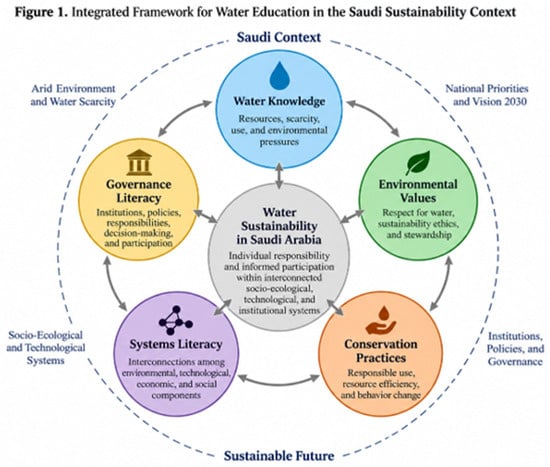
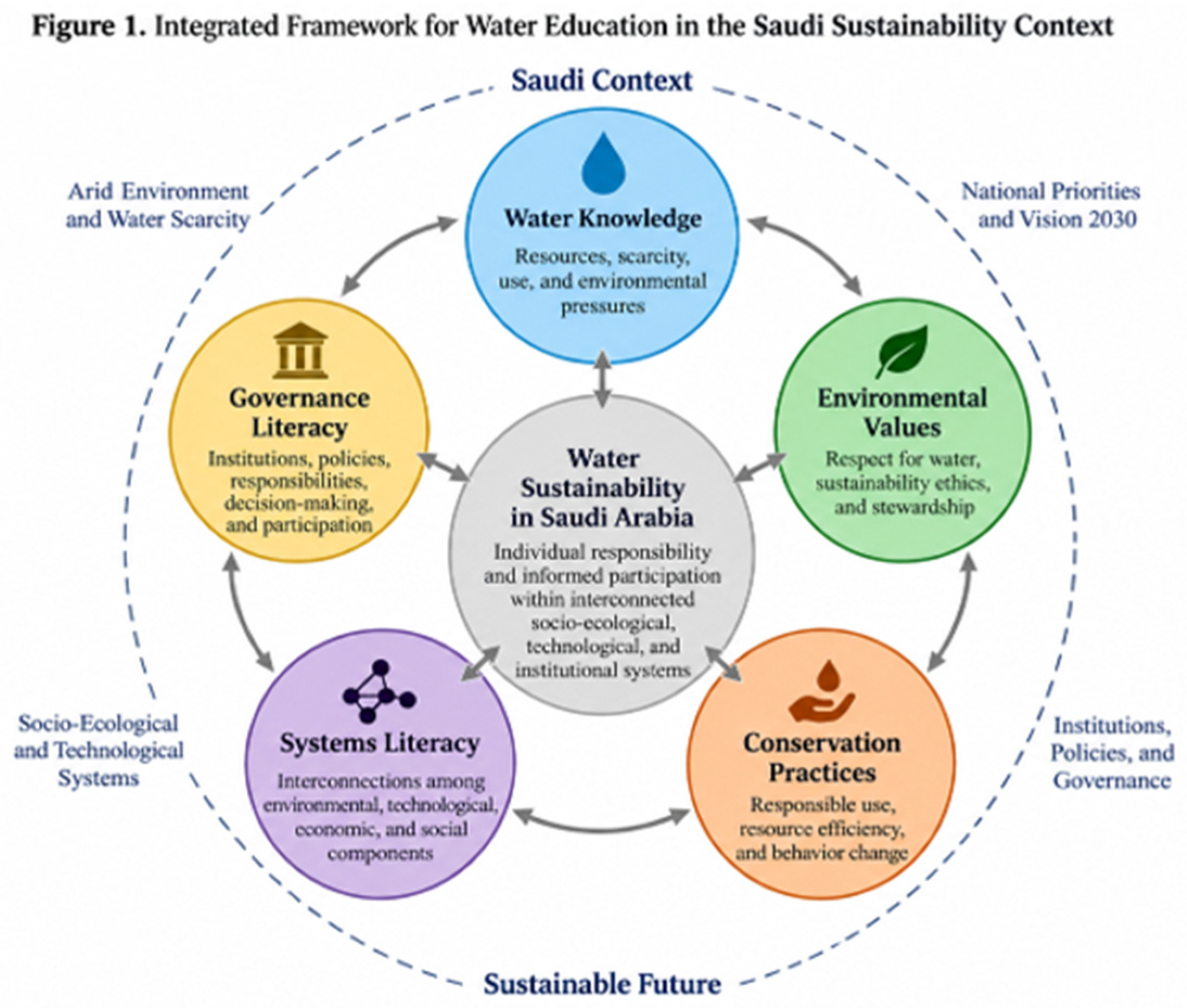

Disclaimer/Publisher’s Note: The statements, opinions and data contained in all publications are solely those of the individual author(s) and contributor(s) and not of MDPI and/or the editor(s). MDPI and/or the editor(s) disclaim responsibility for any injury to people or property resulting from any ideas, methods, instructions or products referred to in the content. |
© 2026 by the authors. Licensee MDPI, Basel, Switzerland. This article is an open access article distributed under the terms and conditions of the Creative Commons Attribution (CC BY) license.