


Abstract
The oily wastewater produced by transformer oil leakage contains pollutants such as mineral oil, metal particles, aged oil and additives, which can disrupt the dissolved oxygen balance in water bodies, pollute soil and endanger human health through the food chain, causing serious environmental pollution. Effective oil–water separation technology is the key to ecological protection and resource recovery. This paper reviews the principles, influencing factors and research progress of traditional (gravity sedimentation, air flotation, adsorption, demulsification) and new (nanocomposite adsorption, metal–organic skeleton materials, superhydrophobic/superlipophilic modified films) transformer oil–water separation technologies. Traditional technologies are mostly applicable to large-particle-free oil and are difficult to adapt to complex matrix wastewater. However, the new technology has significant advantages in separation efficiency (up to over 99.5%), selectivity and cycling stability (with a performance retention rate of over 85% after 20–60 cycles), breaking through the bottlenecks of traditional methods. In the future, it is necessary to develop low-cost and efficient separation technologies, promote the research and development of intelligent responsive materials, upgrade low-carbon preparation processes and their engineering applications, support environmental protection treatment in the power industry and encourage the coupling of material innovation and processes.
1. Introduction
As the primary cooling and insulating medium for transformers in power systems, transformer oil’s superior dielectric loss properties [1], thermal stability and insulation strength are essential to guaranteeing the transformers’ long-term stable and safe operation. It is extensively used in a variety of power facilities, including distribution transformers and ultra-high voltage power transmission and transformation equipment operating at 110 kV and higher. However, transformer oil leakage accidents are common throughout the whole life cycle of transformers because of things like aging equipment, external impact and internal faults [2]. When rainwater, firefighting wastewater, equipment cooling water and other materials from the surrounding environment are combined with the leaked transformer oil, a significant volume of complex oily wastewater is quickly formed [3]. This kind of wastewater, which contains impurities like metal particles (iron, copper, etc.) and mineral oil components from transformer oil, is one of the common hazardous wastewater types in the power industry, caused by equipment wear, insulating paper degradation residues and oil additives (rust inhibitors, antioxidants).Oily wastewater discharge is currently subject to stringent environmental protection regulations in every nation and area of the world. Consider the case of China, the oil content of oily wastewater discharged by all units must be less than 10 mg/L for the first and second grades and less than 30 mg/L for the third grade, according to the “Integrated Wastewater Discharge Standard” (GB 8978-1996) [4]. Wastewater discharge from power facilities, including substations, is subject to even more stringent regulations under the “Emission Standard of Pollutants for Petrochemical Industry” (GB 31571-2015) [5]. The oil content should be less than 20 mg/L for oily wastewater discharged indirectly from the entire enterprise wastewater outlet and less than 5 mg/L for oily wastewater discharged directly. The oil content of oily wastewater discharged indirectly after treatment should be less than 15 mg/L, and the oil content of oily wastewater discharged directly should be less than 3 mg/L for certain substations situated in ecologically sensitive areas and drinking water source protection areas. The exchange of oxygen between the water and the atmosphere can be hampered by the formation of a thick oil film on the water’s surface. It upsets the natural equilibrium of rivers and lakes and causes the widespread death of aquatic life due to a lack of oxygen. In the meantime, dangerous materials like transformer oil’s polycyclic aromatic hydrocarbons will build up in soil and waterways. They will eventually lead to health risks like skin cancer and respiratory illnesses in humans due to the biological amplification effect of the food chain. Furthermore, because transformer oil is a non-renewable mineral resource, its sporadic release results in more than just waste.
Among the conventional technical systems for oily wastewater treatment [6], gravity sedimentation separation is the earliest and most mature pretreatment method. This method relies on the density difference between oil and water (the density of transformer oil is approximately 0.89–0.91 g/cm3 and that of water is about 1 g/cm3). By standing still, oil droplets float up while free water droplets settle, achieving the initial separation of oil and water. It has the advantages of simple equipment structure, no need to add additional reagents or consume a large amount of energy, and remains the core pretreatment link in the treatment of accident wastewater in substations to this day. However, with the development of power systems towards ultra-high voltage and large capacity, the total volume and complexity of oily wastewater generated by accidents have significantly increased. Traditional technologies have found it difficult to meet the demands: gravity sedimentation can only remove free oil with a particle size greater than 50 μm and is completely ineffective for emulsified oil with a particle size of less than 1 μm. Moreover, at low temperatures, the retention time needs to be extended to several hours, which cannot meet the requirements for emergency treatment. The air flotation method is susceptible to interference from solid particles, and the adhesion efficiency between bubbles and oil droplets drops significantly. The adsorption and demulsification method has a long treatment cycle and is sensitive to metal particles and insulation residues produced by equipment wear, which can easily lead to the failure of the adsorbent or incomplete demulsification, making it difficult to achieve the treatment goal of “high efficiency, depth and rapidity”.
Both the complexity of treating oily wastewater and the amount produced after accidents have greatly increased as the power system has developed toward ultra-high voltage and large capacity [7]. The “high efficiency, depth and rapidity” treatment requirements can no longer be met by the conventional technologies currently in use. Superhydrophobic modified membranes, metal–organic framework (MOF) materials and nanocomposite adsorbents are examples of new separation technologies that have achieved performance breakthroughs through material innovation. However, at present, there is a lack of systematic reviews to sort out and compare the principles, characteristics, research progress and application scenarios of various technologies. This article will focus on the treatment requirements of oily wastewater from transformer oil after an accident. Firstly, it will elaborate on the core principles, influencing factors and the latest research progress of four traditional separation methods: gravity sedimentation, air flotation, adsorption and demulsification. By re-analyzing the innovative mechanisms and performance advantages of new technologies, such as the nanocomposite adsorbent method, the MOFs material separation method and the superhydrophobic/superlipophilic modified film method, theoretical support can be provided for the optimization and upgrading as well as the engineering application of transformer oil oil–water separation technology [8].
2. Traditional Oil–Water Separation Methods
2.1. Gravity Sedimentation Separation Method
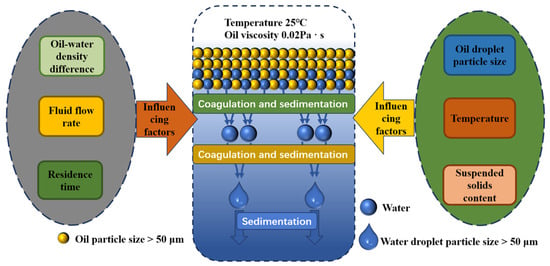
A conventional physical technique called gravity sedimentation separation uses Stokes’ law and the density difference between water and oil to separate free water in transformer oil. Its separation process and key influencing factors are shown in Figure 1. The water phase is at the bottom and the oil phase is at the top during the separation process. Gravity causes free water droplets to sink while oil droplets rise. There are primarily two types of factors that affect transformer oil’s oil–water separation efficiency. One is the material’s intrinsic characteristics, such as the size of water droplets and the density differential between water and oil. The rate of sedimentation increases with the size and density difference in the particles. External working conditions, such as room temperature, oil viscosity and residence time, make up the second factor. In order to improve the separation effect, low temperatures will increase the oil’s viscosity, strengthen its resistance to water droplet sedimentation and lengthen its residence time. Meanwhile, the separation process will also be hampered by the oil’s suspended solids content. The separation effect of this method strictly follows Stokes’ law, with the core quantitative relationship being as follows: the droplet sedimentation rate is directly proportional to the square of the particle size and inversely proportional to the viscosity of the oil phase. Its typical cut-off droplet size is 50 μm. It can only effectively separate free oil droplets larger than this size and is completely ineffective for emulsified droplets smaller than 1 μm. The viscosity of transformer oil varies significantly with temperature. It is approximately 0.02 Pa·s at 25 °C and rises to 0.08 Pa·s at 0 °C, causing the water droplet sedimentation rate to drop by 75%. To ensure the basic separation effect, the residence time needs to be extended from 30 min in the laboratory to 2–4 h in the engineering scenario.
Figure 1.
The oil–water separation process of removing transformer oil by gravity sedimentation and the factors affecting the performance of oil–water separation.
The separation performance of gravity sedimentation is regulated in a coordinated manner by the hydrodynamic parameters, emulsion properties and operating conditions. Relevant studies have shown a great deal of detail about its internal mechanism of action. The kinetics of gravity instability in oil-in-water emulsions were studied, and it was found that the volume fraction of the dispersed phase and the concentration of the surfactant have a synergistic effect [9]. Although a higher oil phase fraction (20%) and a lower surfactant concentration (0.4% by mass) can accelerate the droplet coalescence rate, they will delay the actual oil phase separation process. At a higher surfactant concentration (1.6% by mass), the coalescence rate between droplets and the interface becomes the dominant factor in inhibiting emulsion instability. It was verified using a combination of theoretical analysis, finite element simulation and laboratory experiments when it was extended to the multi-field coupling scenario. Under the combined action of the gravitational field and the centrifugal force field, the velocity and viscosity of the continuous phase are the key factors determining the movement and deformation of oil droplets. Its apparent velocity can regulate the final distribution of oil droplets of different particle sizes, providing a theoretical basis for the structural design of separation equipment [10]. Based on the field investigation data, Liu [11] et al. adopted a numerical simulation method that coupled indoor sedimentation experiments with the mixture multiphase flow model and the population equilibrium model (PBM) to verify the accuracy of the model and quantify the influence of the initial droplet size and the continuous phase viscosity. The water content distribution within the storage tank and the height of the stable water content area will be drastically changed by the increase in crude oil viscosity and the initial droplet size. This will further clarify the direction of parameter optimization for the gravity sedimentation process in engineering applications. The gravity sedimentation method is applied in the actual treatment of transformer oil leakage wastewater. Solid particles contained in wastewater (such as iron and copper metal debris, insulation paper degradation residues) will adsorb at the oil–water interface, hindering water droplet sedimentation and leading to a decrease in separation efficiency. Therefore, a pretreatment filtration unit is required to remove solid particles with a diameter greater than 10 μm. The viscosity of aged oil is 3 to 5 times higher than that of new oil. In a low-temperature environment (<5 °C), the viscosity further increases, reducing the floating rate of free oil droplets by more than 50%. It is necessary to optimize it by heating (30–40 °C) or adding viscosity regulators. In the process of engineering expansion, the retention time of large storage tanks needs to be extended to 2 to 4 h, which occupies a large area and is difficult to meet the rapid handling requirements of emergency leakage. In addition, additives such as antioxidants and rust inhibitors in the wastewater will slightly reduce the density difference between oil and water, further weakening the separation effect. Therefore, it is necessary to combine the demulsification method for pretreatment.
2.2. Air Flotation Method
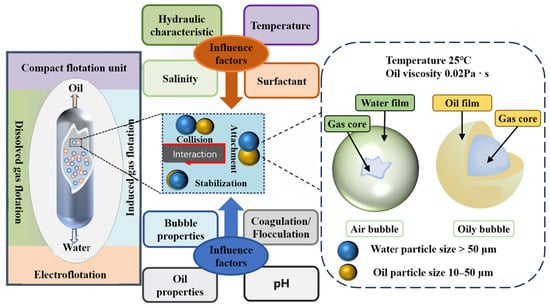
Air flotation is a liquid–liquid separation technology that effectively separates tiny dispersed water droplets in transformer oil by generating micro-bubbles as carriers. In Figure 2, it is systematically described as follows: classification, action process and influencing factors. The four main types of air flotation are electrolytic flotation, induced air flotation, pressurized dissolved air flotation and compact air flotation device flotation. The three stages of the action are bubble generation, bubble-water droplet adhesion and air flotation separation. The combination of bubbles and water droplets through interfacial tension and electrostatic attraction results in “bubble-water droplet” composite particles. They have a density lower than that of the oil phase, which causes them to float to the surface and form a scum layer. Among the influencing factors are bubble characteristics (particle size, specific surface area), oil–water properties (oil phase properties, water droplet particle size), working condition parameters (temperature, salinity, pH value) and chemical reagents (surfactants, coagulants). Among them are the following: a higher probability of collision and adhesion with water droplets; a smaller bubble particle size; a larger specific surface area; and a higher separation efficiency.
Figure 2.
Classification of air flotation method, interaction process between bubbles and oil and factors affecting oil–water separation performance, and schematic diagram of bubbles in water and of structures containing bubbles.
The air flotation method, as an efficient separation technology for tiny dispersed water droplets in transformer oil, has seen its research progress step by step in three major directions: process optimization, bubble modification and coupling enhancement, as shown in Table 1. Equipment innovation and process optimization focus on the precise control of structural parameters and operating conditions. With a separation efficiency of over 15% higher than that of traditional DAF, the recently developed FCSMC device targets oil droplets smaller than 10 m, solving the problem of separating tiny water droplets. By controlling interfacial characteristics, bubble modification enhances the oil droplet-bubble interaction. With their excellent lipophilic and hydrophobic properties, the newly prepared condensation bubbles (CB) [12] shorten the adhesion induction time and increase the oil removal efficiency by more than 10% compared to ordinary bubbles. By adding sodium chloride, Rajak [13] established a kinetic model and achieved an ultra-high separation efficiency of 98.23%. The development of coupled processes has also broken through the limitations of a single technology. In large-scale applications, the “coalescing-air flotation-carrier adsorption” coupled process has achieved the dual goals of cost reduction and efficiency improvement. By reducing the separation time by 50%, the microbubble-vortex field-flocculant coupling system provides a multi-solution for engineering applications. The air flotation method faces challenges and adaptation difficulties in the actual treatment of transformer oil leakage wastewater. The interference of solid particles: iron and copper metal debris and insulating paper residues (particle size 5–100 μm) contained in the wastewater will adhere to the surface of the bubbles, hindering the collision and adhesion between the bubbles and oil droplets, resulting in a decrease in separation efficiency. Especially when the concentration of solid particles exceeds 100 mg/L, bubbles tend to aggregate and burst, and a pre-filtration unit is required to remove impurities with a particle size greater than 20 μm. The viscosity of aged oil is 3 to 5 times higher than that of new oil, which will reduce the rate of bubble rise. Meanwhile, additives such as antioxidants and rust inhibitors will change the interfacial tension between oil and water, weakening the ability of bubbles to capture oil droplets. Therefore, it is necessary to reduce the viscosity of the oil by raising the temperature (30–40 °C) or optimizing the bubble size (≤5 μm) to enhance the capture efficiency. High-salt environments (such as wastewater from coastal substations with a salt concentration greater than 5%) will increase the density of the water phase, making it difficult for the “bubble-oil droplet” composite particles to float up. Strong acid (pH < 4) or strong alkali (pH > 10) conditions will corrode the bubble generator of the air flotation equipment, affecting the stability of micro-bubble generation. In terms of engineering scale-up, small-scale laboratory devices can ensure uniform bubble distribution through stirring. However, for 10,000-ton air flotation towers, local dead zones are prone to occur, leading to an increase in oil droplet escape rate. Therefore, the tower structure needs to be optimized. The energy consumption of the traditional pressurized dissolved air flotation method increases exponentially with the increase in treatment capacity. When the treatment scale is expanded from 1 m3/h to 100 m3/h, the unit energy consumption increases by 2.5 times. It is necessary to develop efficient and energy-saving microbubble generation technology. The oil content of the scum produced by air flotation is approximately 30% to 50%. In actual engineering, sludge dewatering and oil recovery devices need to be equipped; otherwise, it is easy to cause secondary pollution and increase the treatment cost.
Table 1.
Research progress on process innovation and performance optimization of air flotation technology in oil–water separation of transformer oil.
2.3. Adsorption Method
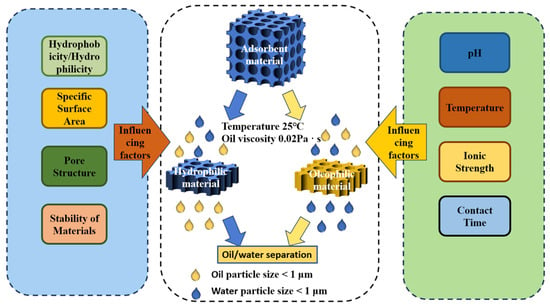
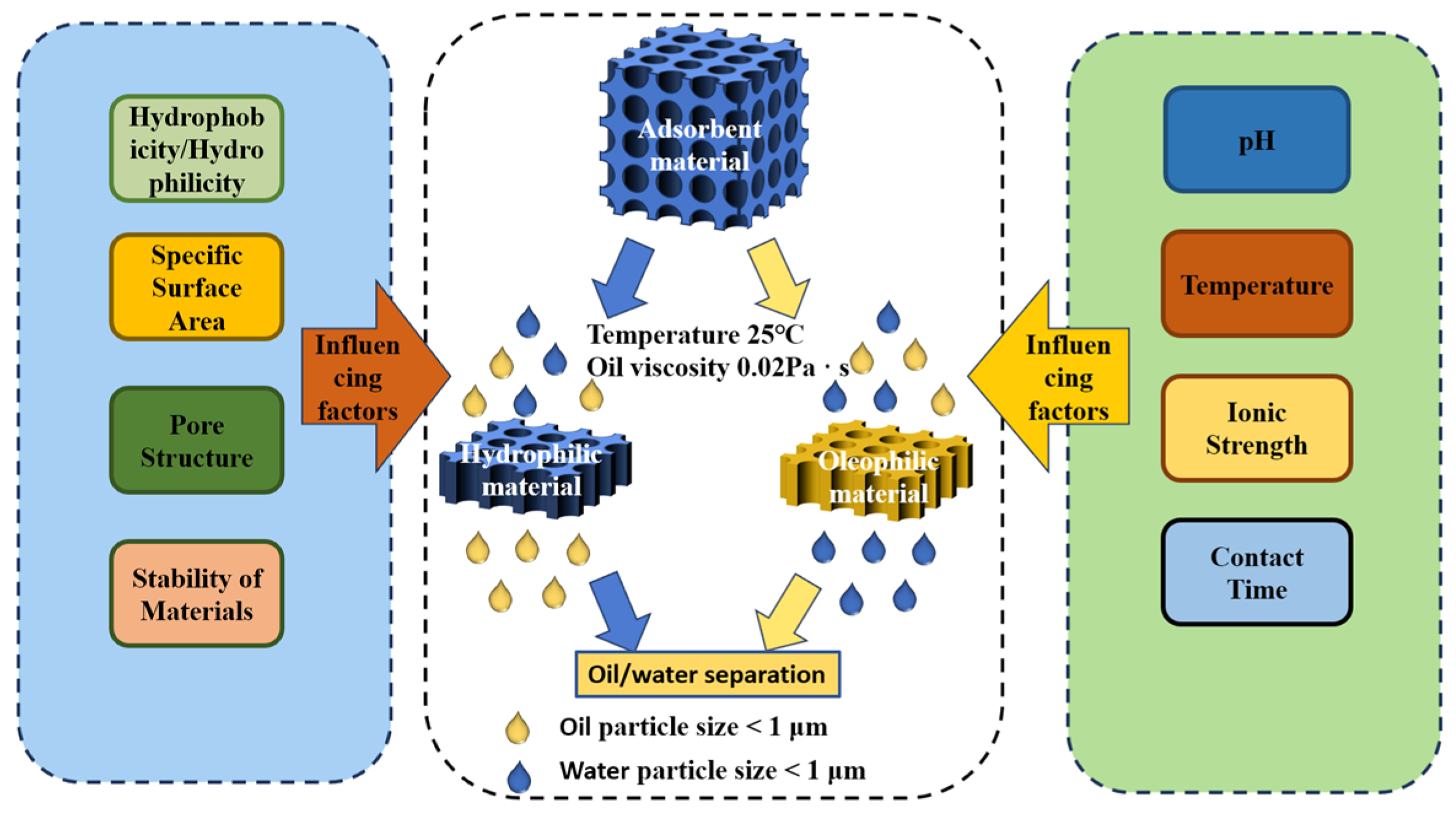
The adsorption method is a conventional physical technique that uses the microscopic pore structure and surface active sites of adsorbents to selectively adsorb floating oil and disturb the stability of oil–water emulsions in transformer oil. Figure 3 clearly presents the oil–water separation process and influencing factors of this method. During the separation process, after the lipophilic adsorbent is added to the oil–water emulsion, it quickly adheres to the surface of the oil phase and penetrates into the interior of the emulsion, disrupting the oil–water dispersion balance and adsorbing and fixing the floating oil in the pores, ultimately achieving the recovery of the oil phase and the separation of the water phase. The factors influencing the separation performance are mainly divided into two categories. The first is the adsorbent’s intrinsic properties, which include its hydrophilicity and hydrophobicity, specific surface area, pore structure and material stability. The adsorption capacity can be increased by a large specific surface area and a reasonable pore size distribution and reusability is ensured by excellent stability. The external working conditions, which include contact time, ionic strength and ambient temperature, are the second factor. Appropriate temperature and sufficient contact time can promote adsorption and mass transfer, while ionic strength affects the interfacial interaction efficiency between the adsorbent and the oil phase.
Figure 3.
The oil–water separation process of removing transformer oil by adsorption method and the factors affecting the performance of oil–water separation.
As shown in Table 2, the research on oil–water separation of transformer oil by the adsorption method focuses on material innovation and functional upgrading, and the research scope covers from basic base materials to high-end functional materials. While cellulose-based materials are appropriate for a variety of industrial situations because of their renewable qualities, pure biomass-based materials prioritize low-cost and environmental protection [18]. Through the MOF structure, biomass-MOF composite matrix materials maximize adsorption performance to achieve almost total oil adsorption [19]. Carbon nanomaterial-modified sponges and graphene-based aerogels constitute two major branches of carbon-based materials. The former focuses on stability under complex working conditions [20], while the latter achieves efficient adsorption with high porosity [21,22]. Magnetic functionalized materials [19] and metal matrix mesh materials [23] have, respectively, solved the recovery problem and flux bottleneck. After 15 magnetic control cycles, the latter’s flux has surpassed 30,000 L·m−2·h−1 and metal-based network adsorption materials (preparation of superhydrophobic membrane by anodizing copper mesh + impregnation modification) maintained an efficiency of 95% after 20 cycles [23] while the former’s performance is stable. Aerogels made of cellulose nanofiber composites and structured carbon aerogels [24] have made significant advancements in mechanical and lightweight qualities. The anisotropic structure of the latter enables an adsorption capacity of 288 times its own weight, providing solutions for high-demand scenarios. Overall, “diversified substrates, precise functions, and refined structures” are the development trend that is evident. The applicability of the adsorption method in an actual wastewater environment highly depends on the anti-interference ability of the adsorbent. Wastewater containing solid particles can clog the pores of the adsorbent, resulting in a decrease in adsorption capacity. Therefore, pre-filtration pretreatment is required. The high viscosity of aged oil will slow down the diffusion rate of the oil phase, extending the adsorption equilibrium time from 30 s in the laboratory to 10–20 min in practice. The polar components in the additives may compete with the oil for adsorption active sites, resulting in a reduction in adsorption capacity. In terms of engineering scale-up, traditional granular adsorbents have problems such as difficult solid–liquid separation and easy loss. Although spongy and aerogel adsorbents are easy to recover, their large-scale production costs are high and mechanical wear is prone to occur during continuous operation. In addition, wastewater with high salt concentration will enhance the polarity of the aqueous phase and improve the selectivity of the adsorbent for the oil phase. However, a strong acid (pH < 3) or strong base (pH > 11) environment can damage the structure of bio-based and MOF-based adsorbents, leading to a decline in their cycling stability.
Table 2.
Research progress on process innovation and performance optimization of adsorption technology in oil-water separation of sransformer oil.
2.4. Desification Method
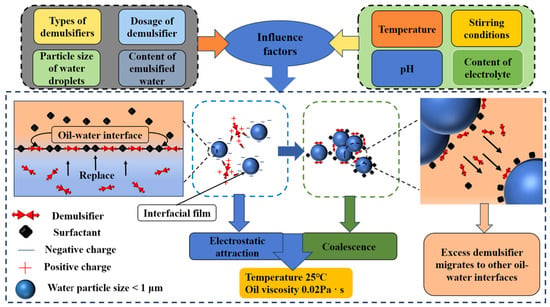
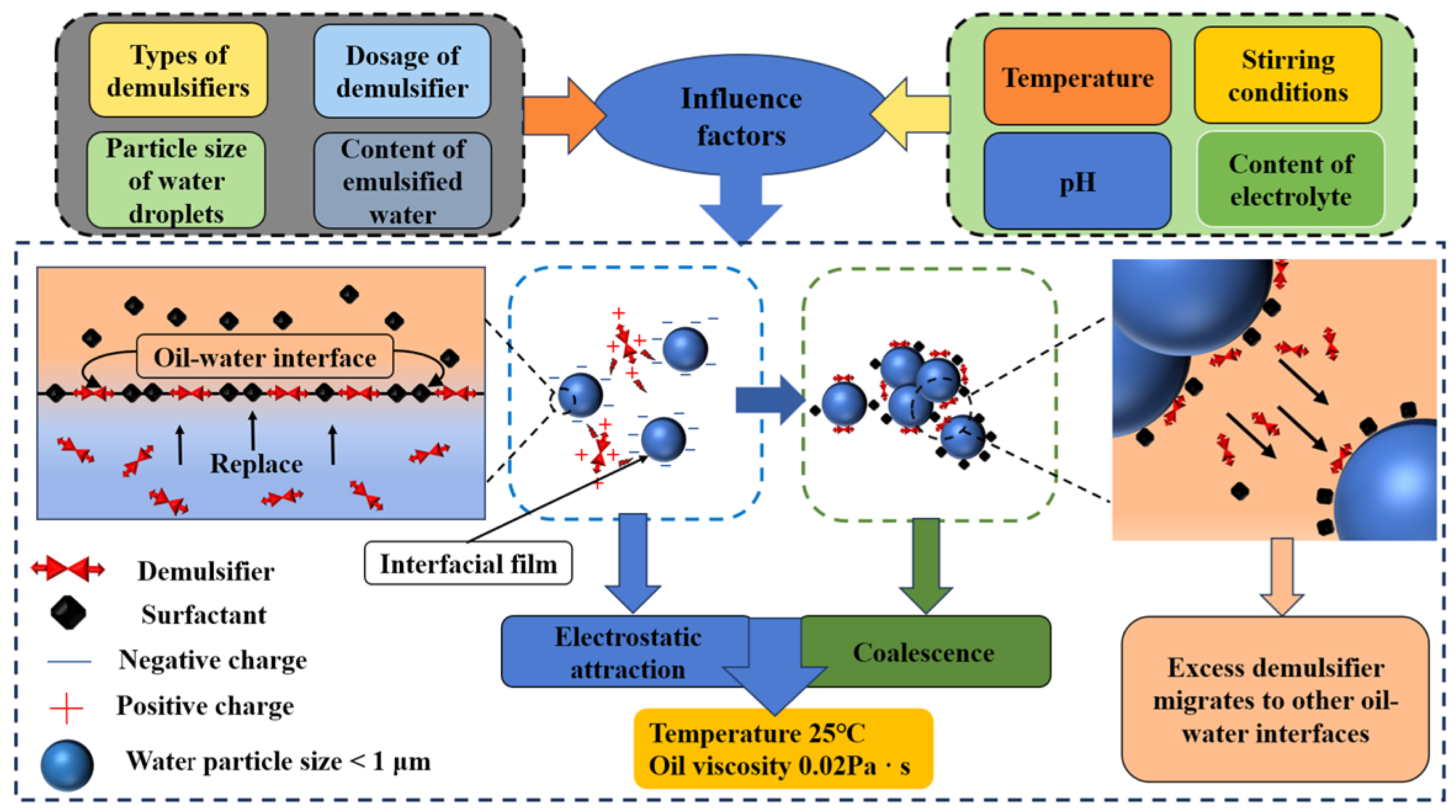
Demulsification is an approach to oil–water separation that uses physical action, chemical reagents, or a combination of both to disrupt the stable emulsification system formed by transformer oil and water, causing the dispersed phase (emulsified water droplets) to coalesce and settle. Figure 4 systematically presents the separation process and influencing factors. The emulsified structure is destroyed during the separation process by demulsifiers, which can be used to replace the surfactants at the oil–water interface, weaken the strength of the interfacial film or physically act in the field. The tiny droplets in emulsified water are aggregated into large-sized free water droplets and then separated through subsequent processes. There are two main categories of factors influencing the separation performance. First, the characteristics of materials and reagents related to demulsification are examined. Depending on the type of demulsifier, dosage and particle size of the emulsified water droplets, the appropriate demulsifier and suitable dosage are essential for efficient demulsification. The second is the external working conditions. Heat can reduce the viscosity of the oil phase, reasonable stirring promotes the dispersion of demulsifiers, electrolytes enhance the coalescing effect by influencing the interfacial charge and heating can reduce the viscosity of the oil phase.
Figure 4.
The oil–water separation process of transformer oil removal by demulsification and the factors affecting the performance of oil–water separation.
As shown in Table 3, the research on oil–water separation of transformer oil by demulsification method focuses on three major directions: “high efficiency, environmental protection and functionalization”. The research scope covers all dimensions, including chemical demulsification, physical demulsification and composite modification. With a demulsification efficiency of over 98%, conventional polyether/polyquaternary ammonium salt types achieve high salt and acid and alkali resistance through molecular structure optimization. Fatty acids and lotus leaf extracts are used to create natural biomass-based demulsifiers [25,26], which combine high efficiency and environmental friendliness. The demulsification efficiency of LA1 reaches 100%. The two main upgrade paths are magnetic functionalization and nanocomposites. Silicon-based nanodemulsifiers [27] enhance demulsification through interfacial tension regulation, while magnetic fluorine-containing composites [28,29] achieve magnetic control recovery with stable performance after five cycles. The amine-functionalized magnetic demulsifier [30,31] further breaks through the compatibility of multiple types of emulsions, with a demulsification efficiency of 95.5% within 5 min. Chemical reagents are not needed for physical field technology [32,33], opening up a new avenue for environmentally friendly demulsification. With a 99.9% oil removal rate, ethoxylated amide type [34] is especially designed for unique working conditions. Overall, it shows a development trend from “single function” to “multi-functional collaboration”, from “chemical-dominated” to “physical-chemical integration”, providing diversified solutions for the separation of complex emulsification systems. In the treatment of transformer oil wastewater by demulsification, the metal debris (Fe, Cu) and insulating paper residue (particle size 5–50 μm) in the wastewater will adsorb the active components of the demulsifier or adhere to the oil–water interface, hindering the coalescence of liquid droplets and resulting in a decrease in demulsification efficiency. The content of resins and asphaltenes in aged oil is three to four times higher than that in new oil, which will enhance the strength of the emulsion interface film and significantly increase the difficulty of demulsification. Antioxidants, rust inhibitors and other surface-active additives in wastewater will compete with demulsifiers for the adsorption sites on the surface of oil droplets, destroying the charge neutralization or adsorption bridging effect of demulsifiers and leading to a decline in demulsification efficiency. Strong acid (pH < 3) environments can render cationic demulsifiers ineffective, strong alkali (pH > 11) can cause inorganic demulsifiers to hydrolyze and precipitate and low temperatures (<10 °C) can reduce the demulsification reaction rate. In terms of engineering scale-up, the core bottleneck of chemical demulsification lies in dosing control and secondary pollution. When large-scale treatment is carried out, fluctuations in water quality can make it difficult to match the dosage. Excessive dosage not only increases the treatment cost but also adds to the load of subsequent biochemical treatment due to the residue of demulsifiers and may even cause secondary pollution of the water body. Insufficient addition, however, will lead to incomplete demulsification and a sharp increase in the load of subsequent processes. In addition, the oil content of the scum produced by chemical demulsification can reach 30% to 50%. In large-scale treatment, sludge dewatering and oil recovery devices must be equipped; otherwise, secondary pollution is likely to occur. In the demulsification method, demulsifiers have a potential impact on the quality of recovered transformer oil. Residues of chemical demulsifiers (such as some polyethers and fluorine-containing complexes) may reduce the dielectric strength and thermal stability of the oil, affecting its insulation performance. Excessive addition may also introduce impurities and interfere with the physical and chemical indicators of the oil. The residual amount of bio-based and magnetic recyclable demulsifiers is low and can be removed through simple separation, having a relatively small impact on oil quality. This is the preferred direction that takes into account both demulsification efficiency and oil quality protection. The key challenge of physical demulsification lies in the balance between equipment scale-up and energy consumption. Electric field demulsification, as the mainstream physical demulsification technology, occupies a large area and has high energy consumption. Although technologies such as ultrasonic demulsification and microwave demulsification are not contaminated by chemical agents, their energy consumption increases exponentially when scaled up, and the maintenance cost of the equipment is high, making it difficult to promote and apply them.
Table 3.
Research progress on process innovation and performance optimization of demulsification technology in oil–water separation of transformer oil.
3. New Oil–Water Separation Method
3.1. Nanocomposite Adsorbent Method
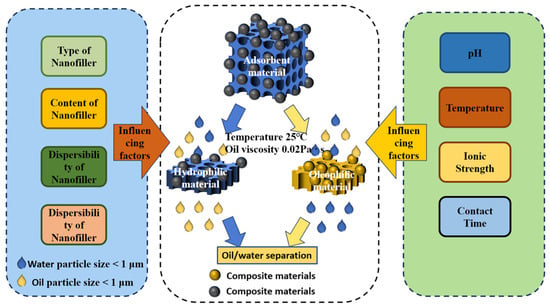
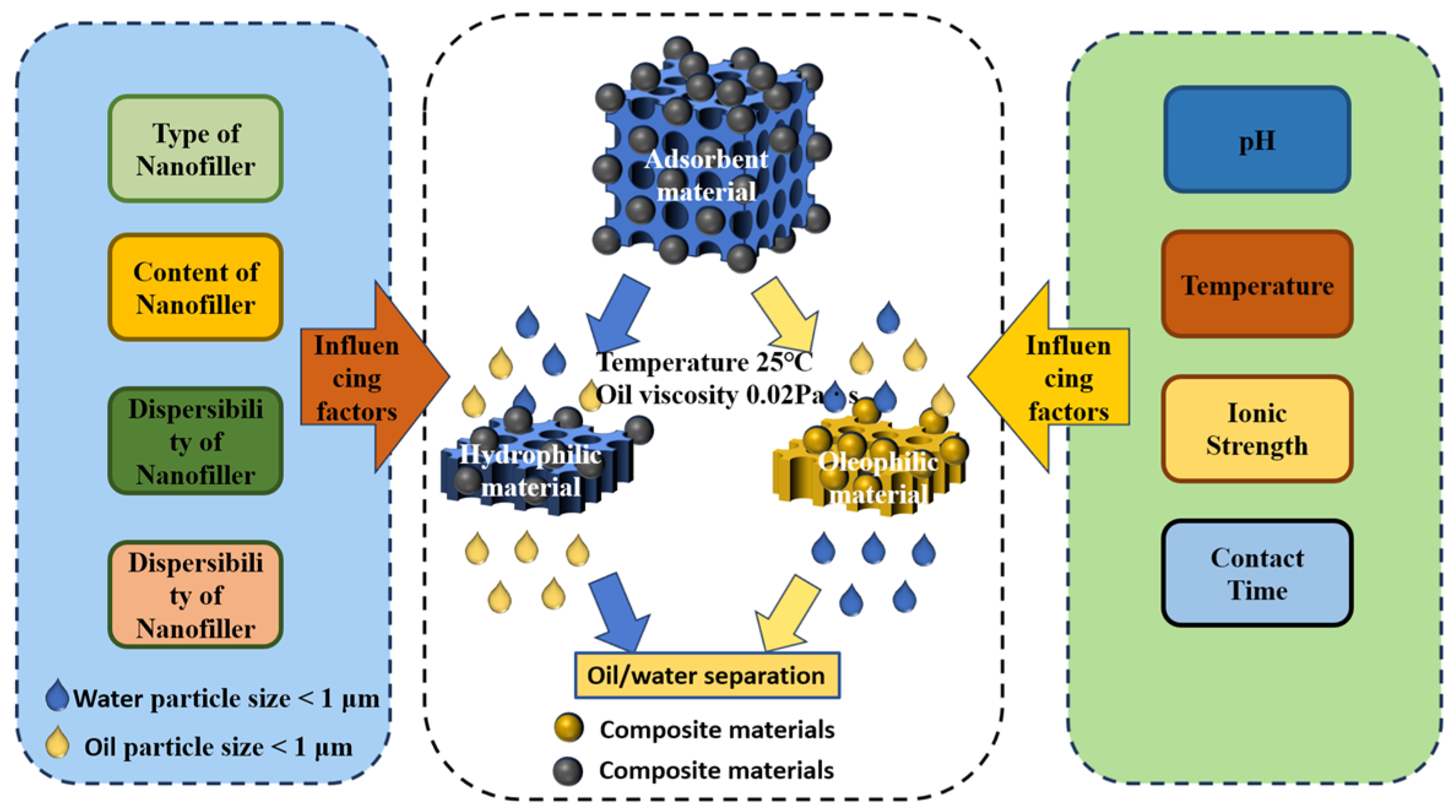
A novel technology, the nanocomposite adsorbent method, relies on the composite modification advantages of nanomaterials and traditional adsorbents. It increases the adsorption sites and mass transfer efficiency, resulting in deep water separation in transformer oil. The oil–water separation process and influencing factors are clearly shown in Figure 5. Using its multi-level pore structure and surface active sites, the nanocomposite adsorbent specifically captures water molecules in the oil and fixes them in the adsorbed phase during the separation process, achieving oil–water separation. The main categories of factors influencing the separation performance are as follows: the first is the material’s inherent characteristics, which include the type of adsorbent substrate, the type and content of nano-fillers and the dispersibility of nano-fillers. The richer the active sites and the better the dispersibility, the higher the adsorption efficiency. The second factor is the external working conditions, such as contact time, ionic strength and the selection of hydrophilic and hydrophobic materials. By properly controlling working conditions, the adsorption effect can be further optimized and the separation accuracy can be increased.
Figure 5.
The oil–water separation process of removing transformer oil by nanocomposite adsorption method and the factors affecting the oil–water separation performance.
As shown in Table 4, the research on oil–water separation of transformer oil by nanocomposite adsorbent method centers on “multi-functionalization of materials, extreme performance, and precise application scenarios”, presenting a trend of multi-dimensional collaborative upgrading. When it comes to basic carbon-based materials, graphene-based aerogel [39] achieves a unity of adsorption capacity and mechanical stability due to its high porosity and excellent elasticity. After 10 cycles, the absorption retention rate was 88.8%. MXene/titanium-based materials [40,41] were used to construct super-wettable surfaces through multi-dimensional composites, and the separation flux exceeded 17 × 104 L·m−2·h−1. In terms of functional upgrades, magnetic adsorbents [42,43] solve the problem of reuse through magnetic control recovery, and photothermal responsive materials [44] break through the bottleneck of high-viscosity crude oil adsorption by rapid heating, with a heating temperature up to 102 °C. In the direction of environmental protection and intelligence, biomass-based adsorbents [45] realize the resource utilization of waste. In terms of adaptability to extreme environments, the resistant adsorbent [46] can resist wide temperature ranges and acid and alkali corrosion, while the catalytic synergistic material [47] achieves a separation efficiency of 99.9% through adsorption-oxidation demulsification synergy. The MS/UIO-66 (F-4)/RGO/PDMS [48] superhydrophobic and superlipophilic sponge is made, with a melamine sponge as the framework, through layering modification and PDMS hydrophobic modification. The water contact angle is 153.5°, the oil–water emulsion flux reaches 3665 L·m−2·h−1, the separation efficiency exceeds 98.3%, and the oil absorption capacity is 48 to 100 times its own weight. The performance is stable after 20 to 25 cycles. The THS@MS [49] superhydrophobic sponge is prepared by a one-step impregnation coating method. The initial water contact angle is 158.57°, and it still reaches 157.88° after 50 cycles. The adsorption rate of various oils is 62.03–71.33 g/g, and the separation efficiency remains above 95%. It is resistant to acids and alkalis, can handle emulsions and has excellent self-cleaning and environmental adaptability. The improved peat moss bio-based adsorbent [50], after pretreatment and silane functionalization modification, has a water contact angle of 157° and an adsorption capacity of 22.756 g/g for engine oil, which is superior to traditional bio-based adsorbents and biochar. The adsorption kinetics conform to the pseudo-second-order model, and feature high selectivity, reusability and environmental compatibility. The overall system forms a complete framework ranging from basic performance to multi-functional collaboration and from conventional working conditions to extreme scenarios. In the actual treatment of transformer oil leakage wastewater, the applicability and anti-interference ability of nanocomposite adsorbents are significantly affected by the wastewater matrix. Metal particles (Fe, Cu) and insulating residues in the wastewater will physically clog the mesoporous/macroporous channels of the adsorbent, resulting in a decrease in adsorption capacity. Pretreatment filtration is required to reduce clogging. The polycyclic aromatic hydrocarbons in aged oil have relatively large molecular sizes and are prone to occupying the active sites of the adsorbent. Meanwhile, polar additives such as antioxidants and rust inhibitors will compete with the oil phase for adsorption sites, leading to a decrease in adsorption selectivity. Therefore, surface hydrophobic modification (such as silanization and PDMS coating) is needed to enhance the specific adsorption of the oil phase. In a low-temperature environment (<5 °C), nano-fillers tend to agglomerate, resulting in poor dispersibility of the adsorbent and a decrease in adsorption rate. However, strong acid (pH < 3) or strong base (pH > 11) conditions will disrupt the bond between the nano-filler and the matrix, causing the filler to fall off and resulting in a decline in adsorption capacity. In terms of engineering scale-up, the cost of large-scale production is high, being five to eight times that of traditional adsorbents. Moreover, during batch production, uneven dispersion of nano-fillers is prone to occur, leading to fluctuations in product performance. Therefore, it is necessary to develop green large-scale processes such as fluorine-free etching and in situ lamination. The wear rate of the adsorbent increases with the increase in processing volume, and the regeneration process will cause the loss of nano-fillers, resulting in a decrease in the performance retention rate after regeneration. It will cause safety/environmental risks. It is necessary to optimize the mechanical strength of the adsorbent and the regeneration process. This method struggles to meet the rapid treatment requirements of large-scale wastewater and needs to be combined with membrane separation, air flotation and other technologies to increase the treatment rate.
Table 4.
Research progress on process innovation and performance optimization of nanocomposite adsorbent technology in oil–water separation of transformer oil.
3.2. Separation Method of Metal–Organic Framework Materials
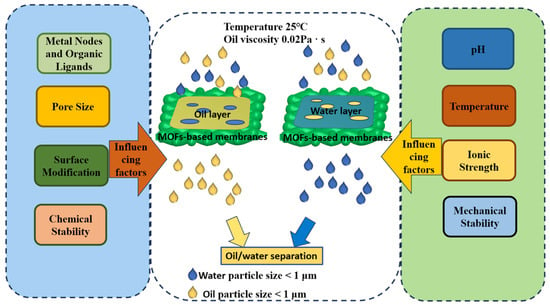
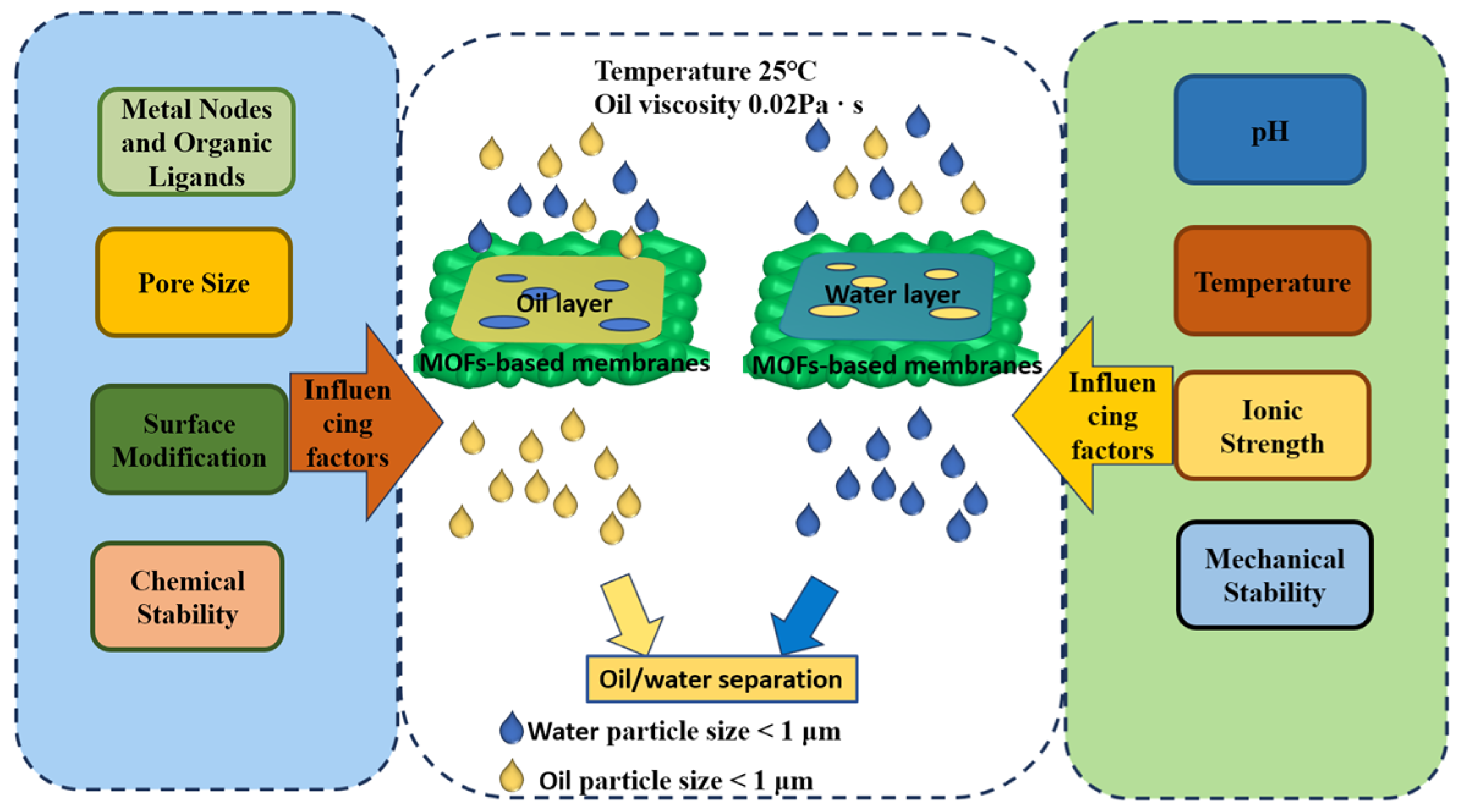
The metal–organic framework material (MOFs) separation method is a novel separation technology that relies on the controllable porous structure and highly selective adsorption characteristics of MOFs materials to efficiently capture water in transformer oil. Figure 6 systematically shows its oil–water separation process and influencing factors. Water molecules are selectively adsorbed through pore sieving and surface affinity when the oil phase passes through the MOF’s base membrane or adsorption material during the separation process. The oil phase then smoothly penetrates to complete the separation. The factors influencing the separation performance mainly fall into two categories. The first is the material’s intrinsic qualities, which include pore size, surface modification techniques and chemical and mechanical stability. To guarantee the separation effect, stable surface performance and regular pore structure are essential. The second factor is the external working conditions, such as ambient temperature and ionic strength. A mild working environment can prevent damage to the material structure and maintain efficient separation performance.
Figure 6.
The oil–water separation process of removing transformer oil by metal–organic frame material separation method and the factors affecting the oil–water separation performance.
A multifaceted trend of innovative upgrading is presented by the research on oil–water separation of transformer oil by metal–organic framework (MOFs) material separation method, which takes “structural regulation-functional enhancement-scenario adaptation” as the core logic (Table 5).At the material modification level, from single-metal (MIL-53 (Fe)) to bimetallic (FE-CO) synergy and then to functional group modifications, such as fluorination and amino groups [54,55], achieve precise regulation of hydrophobicity and stability. The water contact angle of 2CF3-UiO-66 reaches 164.7°, making it suitable for extreme medium environments. In terms of carrier diversification, MOFs are mixed with textiles, sponges, membranes (PVDF, PES), etc. [56,57]. The flexible fabric materials have both anti-icing and antibacterial functions, with a flux as high as 36,000 L·m−2·h−1. The adsorption capacity of the sponge material reaches 140 g/g, efficiently treating water-in-oil emulsions. Membrane fouling is resolved by the photo-Fenton self-cleaning MOFs membrane [58], which has a flux recovery rate of almost 100% in terms of functional enhancement. With a retention rate of more than 95%, the multi-pollutant collaborative removal material [59] synchronously separates pollutants like transformer oil. The incredibly resilient material [60] can resist acids, alkalis and salts. The KFUPM-100@Cu-mesh membrane can maintain its performance even after 10 months in water, acidic and alkaline conditions. It remains above 97.8% after being reused 12 times. UUI-66-RA oil–water separation efficiency is greater than 95.8%. After five repetitions, the oil–water separation efficiency is above 95.1%. The green modification path [61] offers an effective solution for the oil–water separation of transformer oil under challenging operating conditions by avoiding fluorine-containing reagents, adhering to environmental protection regulations and forming a comprehensive technical system from material design to engineering application. The compatibility of MOFs with transformer oil depends on the hydrophobicity of the ligand and the composition of the oil phase. Zirconium-based/aluminum-based MOFs show no significant swelling after soaking in mineral oil for 10 days (adsorption capacity retention rate > 85%), while long-chain alkyl ligand modification can enhance oil repellency and reduce performance degradation caused by the interaction between ligands and ester groups in synthetic ester oils. The long-term durability of MOFs under changes in ionic strength is closely related to the rigidity of the skeleton. The volume retention rate of UiO-66 and its derivatives in 0.5 mol/L NaCl solution after 50 cycles is >80%, while ZIF-8 is prone to skeleton collapse due to ion exchange.A protective layer can be formed through surface modification with a silane coupling agent, significantly enhancing the cycling stability in high-salt environments (retention rate > 85% after 50 cycles in 1 mol/L NaCl). In the actual treatment of transformer oil leakage wastewater with MOF-based materials, three key points need to be focused on. Solid particles (such as SiO2, metal oxides) can physically clog the pores of MOFs membranes or the mesoporous structure of adsorbents, leading to flux attenuation. Therefore, anti-pollution coatings need to be constructed through surface modification (such as grafted polyethylene glycol). Polycyclic aromatic hydrocarbons in aged oil will form coordination with the metal sites of MOFs, resulting in a decrease in the performance retention rate during the adsorption–desorption cycle. It is necessary to optimize the desorption conditions (such as raising the temperature to 60 °C or using a mixed desorbent). In engineering scale-up, the continuous preparation of MOFs membranes faces the challenge of controlling the uniformity of membrane thickness. The cost of large-scale production is 10 to 15 times that of traditional membranes and the mechanical strength of MOFs materials is insufficient, making membrane rupture prone to occur under high-pressure filtration (>0.3 MPa). In addition, additives such as antioxidants in the wastewater will compete with the functional groups on the surface of MOFs, reducing the selectivity of the oil phase. Such polar impurities need to be removed through pre-adsorption before use.
Table 5.
Research progress on process innovation and performance optimization of metal–organic framework material separation technology in oil–water separation of transformer oil.
3.3. Superhydrophobic/Superlipophilic Modified Film Method
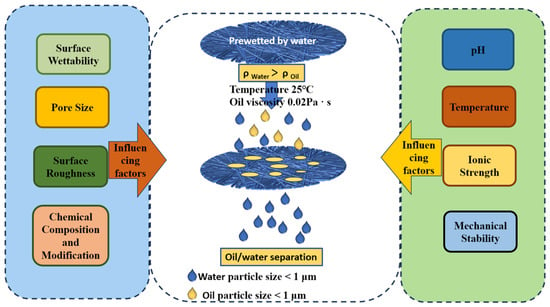
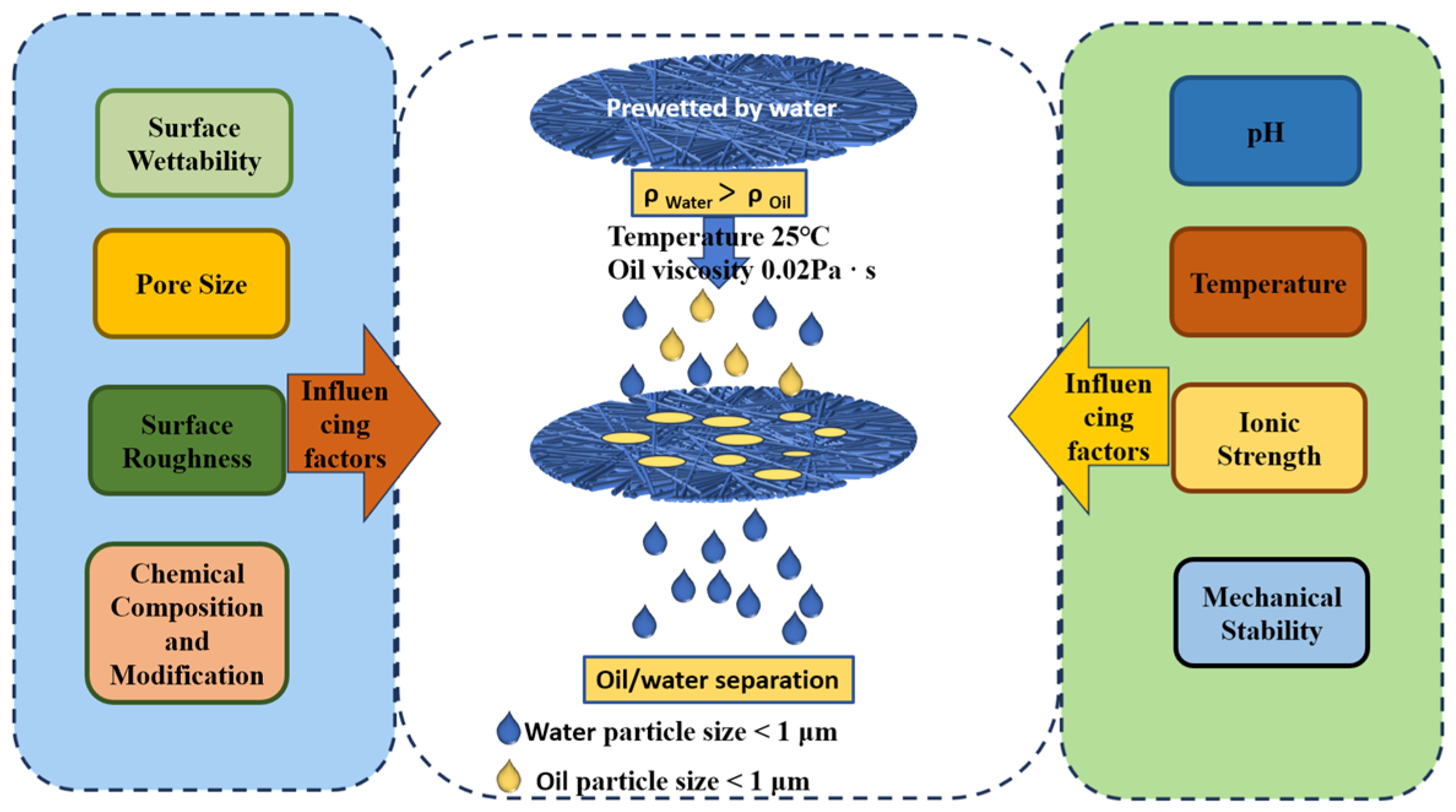
The superhydrophobic/superlipophilic modified membrane method is a new type of membrane separation technology that relies on the regulation of the superwettability of the membrane surface and builds a directional affinity interface to achieve rapid separation of transformer oil and water. Figure 7 describes in detail its separation process and influencing factors. During the separation process, the surface of the modified membrane shows superaffinity for the oil phase and superrepulsion for the water phase. Effective separation is achieved when the water phase is held on the membrane surface while the oil phase quickly permeates the membrane layer. There are primarily two types of factors that affect separation performance. The first is the intrinsic properties of the membrane material, such as chemical composition, surface roughness, pore size and surface wettability. The directional separation ability can be improved by optimizing the membrane surface’s microstructure. The second factor is external working conditions, such as ionic strength, mechanical stability and modification processes. Good mechanical stability and suitable modification processes can extend the service life of the membrane and ensure stable separation efficiency.
Figure 7.
The oil–water separation process of transformer oil removal by superhydrophobic/superlipophilic modified membrane method and the factors affecting the oil–water separation performance.
The research on oil–water separation of transformer oil by superhydrophobic/superlipophilic modified membrane method takes “structural innovation-functional enhancement-scenario adaptation” as its core logic, as shown in Table 6. The electrospinning technology [64] constructed micro-nano structures through nanoparticle composites at the basic preparation level, resulting in an oil–water emulsion separation flux of 22,474.7 L·m−2·h−1. The ceramic substrate membrane achieves stability, flux, corrosion resistance and high-temperature resistance through the sol–gel process [65]. The Janus asymmetric membrane [64] has broken through the limitation of single wettability, with a flux recovery rate approaching 100%, demonstrating structural innovation. By simulating spider silk, bionic structural membranes [65] enhance demulsification and anti-fouling performance. The multi-pollutant collaborative removal membrane [66] synchronously separates pollutants, such as transformer oil, at the functional upgrade level, meeting the complex wastewater treatment requirements. Membranes that are resistant to extreme environments [67] can resist acids, alkalis, salts, high temperatures and mechanical wear. By utilizing waste material recycling for preparation, the green and environmental protection direction [68] is in line with the concept of sustainable development. With a flux exceeding 6 × 10⁴ L·m−2·h−1, the wood-based MOF composite film [67] has produced an efficient and low-carbon solution for large-scale applications. The “oil diode” Janus [69] membrane with a special wetting structure has broken through the oil penetration limitations of traditional fully hydrophobic membranes. It has a separation permeability of 2993 L·bar−1·m−2·h−1 for stable oil-in-water emulsions containing surfactants, with a separation efficiency as high as 99.6%, providing an effective path for light oil recovery and rapid refining. The WO3/MXene [70] composite membrane based on polyaryl ether sulfonane (PAES) can achieve self-cleaning by photodegrading organic pollutants through brief ultraviolet irradiation. The recovery time is only 0.25 h, and the separation efficiency and water flux are restored to 99.98% and 6.4 L·m−2·h−1, respectively, effectively solving the problem of performance degradation caused by membrane fouling. It has also formed a complete technical system, from basic preparation to high-end functional integration as a whole, providing an efficient and low-carbon solution for large-scale applications and forming a complete technical system from basic preparation to high-end functional integration as a whole. In the actual treatment of transformer oil leakage wastewater, solid particles (metal debris, insulation residues) in the wastewater will deposit on the membrane surface to form a filter cake layer with superhydrophobic/superhydrophobic modified membranes. The resins and asphaltenes in aged oil will adsorb in the membrane pores, leading to a decline in membrane flux. To reduce contamination, the water contact angle on the membrane surface is greater than 150°, and the oil contact angle is close to 0°. The oil phase penetrates rapidly while the water phase repels, reducing the attachment sites of solid particles, resins and other contaminants [71]. By constructing bionic micro-nano structures (such as spindle-shaped protrusions) or composite SiO2 and MOF coatings, the contact area between pollutants and the membrane surface is reduced and the adsorption force is weakened. Some membranes are integrated with photocatalytic or self-cleaning functions, which can degrade the oil contaminants adhering to the surface [72]. Optimize the membrane pore size (50–200 nm) and pore structure, reduce channel clogging and combine regular air-water backwashing to further suppress flux decay, enabling the membrane to maintain stable separation efficiency in complex wastewater treatment. Antioxidants, rust inhibitors and other additives in wastewater can damage the hydrophobic coating on the membrane surface, leading to a decrease in separation efficiency. However, strong acid (pH < 4) and strong alkali (pH > 10) environments can corrode the membrane substrate, and it is necessary to enhance the chemical stability through composite modification. Low-temperature environments (<10 °C) will significantly increase the viscosity of transformer oil, leading to a decrease in the oil phase penetration rate. High-oil-content wastewater (oil content > 10%) is prone to causing oil film accumulation on the membrane surface, hindering subsequent oil phase penetration. Therefore, heating or pre-dehydration units need to be combined to optimize the working conditions. In terms of engineering scale-up, the surface coating thickness of the modified film prepared in the laboratory is uniform, but problems such as coating peeling and uneven porosity are prone to occur in mass production. Therefore, it is necessary to develop large-scale processes such as continuous coating and in situ growth. When components such as flat sheet membranes and hollow fiber membranes are scaled up, the problems of uneven flow field distribution and excessive pressure loss need to be addressed. Under actual working conditions, chemical cleaning of membranes (such as NaOH solution) will shorten the membrane’s lifespan. It is necessary to develop green cleaning technologies (such as ultrasonic-assisted cleaning and photocatalytic self-cleaning) or design replaceable membrane modules to reduce operation and maintenance costs [73].
Table 6.
Research progress on process innovation and performance optimization of superhydrophobic/superlipophilic modified membrane technology in oil–water separation of transformer oil.
The key performance differences between traditional and emerging oil–water separation technologies for transformer oil wastewater can be intuitively summarized as follows: In terms of separation efficiency, the traditional gravity sedimentation method can only handle free oil with a particle size greater than 50 μm, maintaining an efficiency of 60% to 85%. Although the air flotation method can increase the efficiency to 85% to 98.23% for tiny oil droplets of 10 to 50 μm, both methods are difficult to solve the problem of emulsified oil. Emerging technologies such as nanocomposite adsorbents, MXene-based membranes, and Janus membranes can achieve a separation efficiency of 99.5% to 99.9% for complex systems containing solid particles and aged oil, which is an average improvement of 10% to 15% compared to traditional technologies. They can achieve deep purification with oil content below 3 mg/L. In terms of flux performance, the upper limit of the flux of the more efficient air flotation method in traditional technologies is 1500 L·m−2·h−1, while that of the traditional adsorption method is only 100–500 L·m−2·h−1. However, the flux of superhydrophobic modified membranes and MMOF-based membranes can exceed 6 × 10⁴ L·m−2·h−1, reaching over 120 times that of traditional technologies. Significantly increase processing speed. In terms of cycle stability, the effective cycle times of traditional adsorbents are mostly five to ten times and the performance retention rate after regeneration is only 70% to 85%. However, after 20 to 60 adsorption–desorption cycles, the performance retention rate of MOF-based materials and magnetic nanocomposite adsorbents remains at 85% to 99%, significantly reducing operation and maintenance costs. The cost dimension presents a complementary pattern. The treatment cost of traditional gravity sedimentation and air flotation methods is only 1–8 yuan per ton of wastewater, making them suitable for large-scale pretreatment scenarios. Although the treatment cost of emerging technologies is 15–50 yuan per ton of wastewater, their deep treatment capacity and adaptability to complex substrates make them the core choice for strict demands such as discharge from ecologically sensitive areas and high-purity recovery of oil resources. Through a collaborative model of “large-scale pretreatment with traditional technologies + efficient and deep purification with emerging technologies”, the two can achieve the optimal balance between treatment costs and emission requirements.
4. Conclusions
The research on oil–water separation technology for oily wastewater created by transformer oil leaks following an accident is methodically reviewed in this paper. The fundamental traits, tenets and driving forces of both conventional and novel separation techniques have been elucidated, offering theoretical backing for engineering applications and technological optimization. Gravity sedimentation is still a crucial pretreatment step in industrial treatment for conventional oil–water separation technologies because it is inexpensive and does not harm the oil’s quality chemically. By using microbubble carriers to separate tiny, dispersed water droplets, the air flotation method has overcome the drawbacks of the gravity method. One important technique for deep dehydration is adsorption, which can lower the water content of oil to less than 10 parts per million. A pre-core procedure called demulsification breaks stable emulsions to ensure the separation effect that follows. By relying on material innovation, the new oil–water separation technology has broken through the traditional technology bottleneck. By building a multi-level pore channel and active site synergistic system, nanocomposite adsorbents can increase their adsorption capacity by 30% to 100% when compared to conventional adsorbents. Compared to conventional adsorbents, metal–organic framework (MOF) materials have an adsorption capacity that is two to five times greater. Based on surface wettability regulation, the superhydrophobic/superlipophilic modified membrane has a membrane flux attenuation rate reduction of more than 50% and an emulsified water droplet separation efficiency of over 99.5%. In practical applications, for small-scale leakage, the adsorption method or Janus membrane is selected; for medium-scale leakage, gravity sedimentation + air flotation + nanocomposite adsorption is adopted; and for large-scale leakage, demulsification + air flotation +MOFs base membrane is chosen. For simple water quality, gravity and air flotation are selected; for complex water quality, filtration, demulsification and MXene membrane are required. To meet the discharge standards, membrane deep purification is required. For resource recovery, the adsorption method is preferred. In emergency cases, air flotation + Janus membrane is selected. In the future, intelligent responsive materials, low-carbon preparation processes and engineering technologies will be developed. It will still be necessary to develop low-cost and highly stable large-scale separation technologies, to further encourage the coupling innovation of material modification and processes and offer more dependable technical guarantees for the treatment of wastewater following power industry accidents.
Author Contributions
Conceptualization, L.Y., H.S., J.Z. and W.Q.; methodology, L.Y., B.S. and Y.S.; resources, Y.S. and L.Y.; data curation, L.Y.; writing—original draft preparation, H.S. and Y.S.; writing— review and editing, L.Y. and Y.S.; supervision, W.Q. and Y.S.; project administration, L.Y. and Y.S.; funding acquisition, L.Y. and W.S. All authors have read and agreed to the published version of the manuscript.
Funding
This research was supported by the Sci-Tech project (JE202405) from State Grid Jiangsu Electric Power Design and Consulting Co., Ltd.
Data Availability Statement
No new data were created or analyzed in this study.
Conflicts of Interest
Author Lijuan Yao, Han Shi and Wen Qi were employed by the company State Grid Jiangsu Electric Power Design and Consulting Co., Ltd. and State Grid Jiangsu Electric Power Co., Ltd. Economic Research Institute. The remaining authors declare that the research was conducted in the absence of any commercial or financial relationships that could be construed as a potential conflict of interest. The authors declare that this study received funding from State Grid Jiangsu Electric Power Design and Consulting Co., Ltd. The funder was not involved in the study design, collection, analysis, interpretation of data, the writing of this article or in the decision to submit it for publication.
References
- Gupta, R.K.; Dunderdale, G.J.; England, M.W.; Hozumi, A. Oil/Water Separation Techniques: A Review of Recent Progresses and Future Directions. J. Mater. Chem. A 2017, 5, 16025–16058. [Google Scholar] [CrossRef] [Scilit]
- Yu, L.; Han, M.; He, F. A Review of Treating Oily Wastewater. Arab. J. Chem. 2017, 10, S1913–S1922. [Google Scholar] [CrossRef] [Scilit]
- Zheng, W.; Huang, J.; Li, S.; Ge, M.; Teng, L.; Chen, Z.; Lai, Y. Advanced Materials with Special Wettability toward Intelligent Oily Wastewater Remediation. ACS Appl. Mater. Interfaces 2021, 13, 67–87. [Google Scholar] [CrossRef] [Scilit]
- GB 8978-1996; Integrated Wastewater Discharge Standard. China Environmental Science Press: Beijing, China, 1996.
- GB 31571-2015; Emission Standard of Pollutants for Petrochemical Industry. China Environmental Science Press: Beijing, China, 2015.
- Bejarano, A.C.; Adams, J.E.; McDowell, J.; Parkerton, T.F.; Hanson, M.L. Recommendations for Improving the Reporting and Communication of Aquatic Toxicity Studies for Oil Spill Planning, Response, and Environmental Assessment. Aquat. Toxicol. 2023, 255, 106391. [Google Scholar] [CrossRef] [Scilit] [PubMed]
- Sharma, K.; Shah, G.; Singhal, K.; Soni, V. Comprehensive Insights into the Impact of Oil Pollution on the Environment. Reg. Stud. Mar. Sci. 2024, 74, 103516. [Google Scholar] [CrossRef] [Scilit]
- Lovindeer, R.; Mynott, S.; Porobic, J.; Fulton, E.A.; Hook, S.E.; Pethybridge, H.; Allen, S.E.; Latornell, D.; Morzaria-Luna, H.N.; Melbourne-Thomas, J. Ecosystem-Level Impacts of Oil Spills: A Review of Available Data with Confidence Metrics for Application to Ecosystem Models. Environ. Model. Assess. 2023, 28, 939–960. [Google Scholar] [CrossRef] [Scilit]
- Mazumdar, M.; Roy, S. Gravity Induced Coalescence in Emulsions with High Volume Fractions of Dispersed Phase in the Presence of Surfactants. Aiche J. 2017, 63, 4379–4389. [Google Scholar] [CrossRef] [Scilit]
- Wang, Z.; Zhang, X.; Liao, R.; Li, K.; Wu, H.; Yang, W. Study of Oil Droplet Patterns and Laws of Motion Based on Multi-Field Synergistic Effects. Colloids Surf.—Physicochem. Eng. Asp. 2025, 705, 135518. [Google Scholar] [CrossRef] [Scilit]
- Liu, E.; Pang, J.; Huang, S. Research on the Gravity Sedimentation Law of Watery Crude Oil in Large Oil Tanks. Energy Sources Part—Recovery Util. Environ. Eff. 2024, 46, 14300–14315. [Google Scholar]
- Wang, C.; Lu, Y.; Huo, F.; Ye, T.; Li, D.; He, L. Exploration of the Dynamic Attachment Properties of Oil Droplets to Air or Condensate Bubbles in Flotation. Colloids Surf.—Physicochem. Eng. Asp. 2024, 703, 135387. [Google Scholar] [CrossRef] [Scilit]
- Rajak, V.K.; Relish, K.K.; Kumar, S.; Mandal, A. Mechanism and Kinetics of Separation of Oil From Oil-in-Water Emulsion by Air Flotation. Pet. Sci. Technol. 2015, 33, 1861–1868. [Google Scholar]
- Li, X.; Xu, H.; Liu, J.; Zhang, J.; Li, J.; Gui, Z. Cyclonic State Micro-Bubble Flotation Column in Oil-in-Water Emulsion Separation. Sep. Purif. Technol. 2016, 165, 101–106. [Google Scholar]
- Huang, G.; Xu, H.; Wu, L.; Li, X.; Wang, Y. Research of Novel Process Route and Scale-up Based on Oil-Water Separation Flotation Column. J. Water Reuse Desalination 2018, 8, 111–122. [Google Scholar]
- Liang, Y.; Wang, B.; Chen, Y.; Yan, Z.; Liang, H.; Wang, X.; Chen, H. Oil-Water Separation Process Based on Microbubble Air Flotation Membrane Device and Scale-up Research. Desalination Water Treat. 2024, 318, 100312. [Google Scholar]
- Wang, W.; Zhao, X.; Bai, X.; Ma, X.; Lin, W.; Yu, J. Investigation of Factors Affecting Oil-Water Separation Efficiency in Micro-Bubble Micro-Cyclonic Flow Air Flotation. J. Water Process Eng. 2024, 67, 106094. [Google Scholar]
- Peng, B.; Yao, Z.; Wang, X.; Crombeen, M.; Sweeney, D.G.; Tam, K.C. Cellulose-Based Materials in Wastewater Treatment of Petroleum Industry. Green Energy Environ. 2020, 5, 37–49. [Google Scholar] [CrossRef] [Scilit]
- Wei, X.; Xu, X.; Liu, Z.; Zhao, X.; Zhang, L. Versatile Superhydrophobic Magnetic Biomass Aerogel for Oil/Water Separation and Removal of Multi-Class Emerging Pollutants. Sep. Purif. Technol. 2024, 345, 127371. [Google Scholar]
- Panickar, R.; Sobhan, C.B.; Chakravorti, S. Highly Efficient Amorphous Carbon Sphere-Based Superhydrophobic and Superoleophilic Sponges for Oil/Water Separation. Langmuir 2021, 37, 12501–12511. [Google Scholar] [CrossRef] [Scilit]
- Bo, Y.; Yu, A.; Liu, H.; Chen, S.; Xu, W.; Diao, S.; Zhang, C. Preparation of Elastic Graphene Aerogel and Its Adsorption of Oil. J. Porous Mater. 2021, 28, 39–56. [Google Scholar]
- Liu, L.; Kong, G.; Zhu, Y.; Che, C. Superhydrophobic Graphene Aerogel Beads for Adsorption of Oil and Organic Solvents via a Convenient in Situ Sol-Gel Method. Colloid Interface Sci. Commun. 2021, 45, 100518. [Google Scholar] [CrossRef] [Scilit]
- Chen, X.; Gong, X. Electrochemically Fast Preparation of Superhydrophobic Copper Mesh for High-Efficiency Oil Spill Adsorption and Oil-Water Separation. J. Hazard. Mater. 2024, 472, 134465. [Google Scholar] [CrossRef] [Scilit]
- Zhou, L.; Xu, Z. Ultralight, Highly Compressible, Hydrophobic and Anisotropic Lamellar Carbon Aerogels from Graphene/Polyvinyl Alcohol/Cellulose Nanofiber Aerogel as Oil Removing Absorbents. J. Hazard. Mater. 2020, 388, 121804. [Google Scholar] [CrossRef] [Scilit] [PubMed]
- Dhandhi, Y.; Saw, R.K.; Singh, R.; Naiya, T.K. Application of a Novel Surface-Active Green Demulsifier for Demulsification of Field Crude Oil Emulsion. Sep. Sci. Technol. 2023, 58, 1654–1678. [Google Scholar] [CrossRef] [Scilit]
- Ye, F.; Mi, Y.; Liu, H.; Zeng, G.; Shen, L.; Feng, X.; Yang, Y.; Zhang, Z.; Yuan, H.; Yan, X. Demulsification of Water-in-Crude Oil Emulsion Using Natural Lotus Leaf Treated via a Simple Hydrothermal Process. Fuel 2021, 295, 120596. [Google Scholar] [CrossRef] [Scilit]
- Shen, L.; Ai, G.; Ao, Y.; Zeng, G.; Yang, Y.; Feng, X.; Zhang, Z.; Yuan, H.; Ye, F.; Mi, Y. Treatment of Water-in-Crude Oil Emulsion Driven by SiO2 Modified Rice Bran. Colloids Surf.—Physicochem. Eng. Asp. 2021, 631, 127708. [Google Scholar] [CrossRef] [Scilit]
- Gu, Y.; Wei, L.; Liu, C.; Jia, X.; Qin, W.; Shi, L.; Zhang, L. Fluorinated Polyether Grafted TiO2 Magnetic Composite Material for Oil-Water Separation of Crude Oil Emulsion. J. Dispers. Sci. Technol. 2024, 45, 1296–1306. [Google Scholar] [CrossRef] [Scilit]
- Jia, X.; Wei, L.; Fu, M.; Liu, C.; Gu, Y.; Qin, W.; Zhang, L.; Geng, X.; Guo, H. One-Pot Preparation of Environmentally Friendly, High Demulsification Rate and Novel Functional Magnetic Demulsifier: Used for Oil and Water Separation in Crude Oil Emulsion. Arab. J. Chem. 2023, 16, 105134. [Google Scholar] [CrossRef] [Scilit]
- Wang, Q.; Puerto, M.C.; Warudkar, S.; Buehler, J.; Biswal, S.L. Recyclable Amine-Functionalized Magnetic Nanoparticles for Efficient Demulsification of Crude Oil-in-Water Emulsions. Environ. Sci.-Water Res. Technol. 2018, 4, 1553–1563. [Google Scholar] [CrossRef] [Scilit]
- Zhou, J.; Sui, H.; Ma, J.; Li, X.; Al-Shiaani, N.H.A.; He, L. Fast Demulsification of Oil-Water Emulsions at Room Temperature by Functionalized Magnetic Nanoparticles. Sep. Purif. Technol. 2021, 274, 118967. [Google Scholar] [CrossRef] [Scilit]
- Yuan, L.; Cong, H.; Li, X. A Novel Helical Descending Liquid-Bridge for Continuous Demulsification. Aiche J. 2023, 69, 18195. [Google Scholar] [CrossRef] [Scilit]
- Ren, B.; Kang, Y.; Zhang, X.; Gong, H.; Chen, L.; Liu, Y. Demulsification Behavior, Characteristics, and Performance of Surfactant Stabilized Oil-in-Water Emulsion under Bidirectional Pulsed Electric Field. China Pet. Process. Petrochem. Technol. 2023, 25, 10–22. [Google Scholar]
- Al-Sabagh, A.M.; Sharaky, A.M.; El-din, M.R.N.; Hussein, K.M. Destabilization of Gas Condensate Oil-Water Emulsion by Dissolved Air Flotation Using New Non Ionic Surfactants. Tenside Surfactants Deterg. 2015, 52, 88–98. [Google Scholar] [CrossRef] [Scilit]
- Wang, D.; Li, J.; Liu, Y.; Guo, N.; Qin, Q. Sesame Pods Derived High-Efficiency Demulsifier: Synthesis and Demulsification Performance in Oily Wastewater Treatment. Process Saf. Environ. Prot. 2025, 203, 107976. [Google Scholar] [CrossRef] [Scilit]
- Ma, W.; Liu, H.; Jiang, X.; Ding, Y.; Chen, L.; Zhao, Y.; Li, Z.; Jin, B.; Mi, Y. Ambient-Temperature Synthesis and Demulsification Performance of a Demulsifier with Concentrated Hydrophilic Groups and Dispersed Hydrophobic Chains. Sep. Purif. Technol. 2025, 379, 135050. [Google Scholar] [CrossRef] [Scilit]
- Sun, H.; Wang, Q.; Li, X.; He, X. Novel Polyether-Polyquaternium Copolymer as an Effective Reverse Demulsifier for O/W Emulsions: Demulsification Performance and Mechanism. Fuel 2020, 263, 116770. [Google Scholar] [CrossRef] [Scilit]
- Shao, Z.; Mu, Y.; Yang, S.; Li, T.; Wang, T.; Ren, S. Preparation of Novel Nanoparticle Demulsifier and Its Demulsification for Surfactant-Stabilized Crude Oil Emulison. Colloids Surf.—Physicochem. Eng. Asp. 2025, 704, 135515. [Google Scholar] [CrossRef] [Scilit]
- Kavak, O.; Can, B.; Bat, E. Water-Based Route for Dopamine and Reduced Graphene Oxide Aerogel Production. Acs Omega 2023, 8, 46728–46737. [Google Scholar] [CrossRef] [Scilit]
- Liu, H.; Chen, X.; Zheng, Y.; Zhang, D.; Zhao, Y.; Wang, C.; Pan, C.; Liu, C.; Shen, C. Lightweight, Superelastic, and Hydrophobic Polyimide Nanofiber/MXene Composite Aerogel for Wearable Piezoresistive Sensor and Oil/Water Separation Applications. Adv. Funct. Mater. 2021, 31, 2008006. [Google Scholar] [CrossRef] [Scilit]
- Zhang, K.-N.; Lei, Z.-L.; Lu, Q.-F. Flower-like ZnO Modified TiO2@Ti3C2Tx Composite for Efficient Adsorption of Malachite Green and Oil-Water Separation. J. Clean. Prod. 2024, 447, 141632. [Google Scholar] [CrossRef] [Scilit]
- Yu, T.; Halouane, F.; Mathias, D.; Barras, A.; Wang, Z.; Lv, A.; Lu, S.; Xu, W.; Meziane, D.; Tiercelin, N.; et al. Preparation of Magnetic, Superhydrophobic/Superoleophilic Polyurethane Sponge: Separation of Oil/Water Mixture and Demulsification. Chem. Eng. J. 2020, 384, 123339. [Google Scholar] [CrossRef] [Scilit]
- Zhang, X.; Zhang, Q.; Su, H.; Xu, Y.; Li, L. Nanoparticle-Decorated and Poly(Dimethyl Siloxane)-Modified Superhydrophobic Melamine Sponge for Efficient Oil/Water Separation. Mater. Chem. Phys. 2023, 304, 127909. [Google Scholar] [CrossRef] [Scilit]
- He, L.; He, J.; Qi, X.; Wei, W.; Zhang, X.; Wang, J.; Li, J.; Gao, Z. Superhydrophobic Sponge with Self-Cleaning Properties for Continuous and Efficient Oil-Water Separation in Harsh Environment. Constr. Build. Mater. 2024, 441, 137505. [Google Scholar] [CrossRef] [Scilit]
- Ren, J.; Yang, X.; Wang, Y.; Zhang, S.; Zhou, J. Sustainable Hydrophobic Bio-Based Adsorbent from Modified Sphagnum Moss for Efficient Oil-Water Separation. Sci. Rep. 2025, 15, 11792. [Google Scholar] [CrossRef] [Scilit] [PubMed]
- Zhao, C.; Chen, L.; Yu, C.; Hu, B.; Huang, H.; Chen, Y.; Wang, X.; Ye, Y.; Zhuang, X.; Li, Y. Fabrication of Hydrophobic NiFe2O4@poly(DVB-LMA) Sponge via a Pickering Emulsion Template Method for Oil/Water Separation. Soft Matter 2021, 17, 2327–2339. [Google Scholar] [CrossRef] [Scilit]
- Wang, R.; Yin, Z.; Yang, G.; Zha, Q.; Xiong, C.; Xie, Y.; Xu, J.; Luo, Y.; Hong, Z.; Xie, C.; et al. Highly Efficient Multifunctional 3D Polyurethane Sponge with Photothermal Responsiveness for Efficient Oil-Water Separation and Microplastic Extraction. Desalination 2025, 601, 118604. [Google Scholar] [CrossRef] [Scilit]
- Han, Z.; Lv, X.; Li, Y.; Gao, M.; Tang, Z.; Su, X.; Zhang, Z.; Li, H.; He, J.; Zheng, Z.; et al. Preparation of Superhydrophobic and Multifunctional Sponges for Oil/Water Separation and Oil Absorption. Langmuir 2024, 40, 23902–23917. [Google Scholar] [CrossRef] [Scilit]
- Yang, G.; Zhang, Y.; Yin, Z.; Deng, Y.; Li, Z.; Xie, Y.; Chen, Y.; Yang, C.; Yang, H.; Luo, Y.; et al. Robust Mussel-Inspired LBL Carbon Nanotube-Based Superhydrophobic Polyurethane Sponge for Efficient Oil-Water Separation Utilizing Photothermal Effect. Fuel 2025, 381, 133353. [Google Scholar] [CrossRef] [Scilit]
- Zeng, H.; Wang, S.; Zhao, X.; Liu, B.; Zhang, Z.; Qin, C.; Liang, C.; Huang, C.; Yao, S. Preparation of Hydrophobic and Lipophilic Carboxymethyl Cellulose Composite Aerogel Using Ferrous Ion/ Persulfate and Its Directed Oxidation for Oil-Water Emulsion Separation. Carbohydr. Polym. 2025, 348, 122814. [Google Scholar] [CrossRef] [Scilit]
- Zhang, Y.; Hou, S.; Song, H.; Qin, G.; Li, P.; Zhang, K.; Li, T.; Han, L.; Liu, W.; Ji, S. A Green and Facile One-Step Hydration Method Based on ZIF-8-PDA to Prepare Melamine Composite Sponges with Excellent Hydrophobicity for Oil-Water Separation. J. Hazard. Mater. 2023, 451, 131064. [Google Scholar] [CrossRef] [Scilit]
- Pang, Y.; Yu, Z.; Chen, H.; Xiang, Q.; Wang, Q.; Xie, C.; Liu, Y. Superhydrophobic Polyurethane Sponge Based on Sepiolite for Efficient Oil/Water Separation. J. Hazard. Mater. 2022, 434, 128833. [Google Scholar] [CrossRef] [Scilit] [PubMed]
- Ma, W.; Jiang, Z.; Lu, T.; Xiong, R.; Huang, C. Lightweight, Elastic and Superhydrophobic Multifunctional Nanofibrous Aerogel for Self-Cleaning, Oil/Water Separation and Pressure Sensing. Chem. Eng. J. 2022, 430, 132989. [Google Scholar] [CrossRef] [Scilit]
- Ma, J.; Zhang, M.; Feng, R.; Dong, L.; Sun, W.; Jia, Y. Superhydrophobic Fluorinated Metal-Organic Framework (MOF) Devices for High-Efficiency Oil-Water Separation. Inorg. Chem. Front. 2024, 11, 5636–5647. [Google Scholar] [CrossRef] [Scilit]
- Shi, M.; Huang, R.; Qi, W.; Su, R.; He, Z. Synthesis of Superhydrophobic and High Stable Zr-MOFs for Oil-Water Separation. Colloids Surf.—Physicochem. Eng. Asp. 2020, 602, 125102. [Google Scholar] [CrossRef] [Scilit]
- Yuan, H.-B.; Zhao, M.; Lei, X.; Sha, D.; Xing, T.; Chen, G. Fabrication of Multifunctional Cotton Fabric with “Pompon Mum” Shaped Surface by ZIF-8 for Applications in Oil-Water Separation and Anti-Icing. Prog. Org. Coat. 2024, 186, 108056. [Google Scholar] [CrossRef] [Scilit]
- Zhai, G.; Wu, J.; Yuan, Z.; Li, H.; Sun, D. Robust Superhydrophobic PDMS@SiO2@UiO66-OSiR Sponge for Efficient Water-in-Oil Emulsion Separation. Inorg. Chem. 2023, 62, 5447–5457. [Google Scholar] [CrossRef] [Scilit]
- Xie, A.; Cui, J.; Yang, J.; Chen, Y.; Lang, J.; Li, C.; Yan, Y.; Dai, J. Photo-Fenton Self-Cleaning PVDF/NH2-MIL-88B(Fe) Membranes towards Highly-Efficient Oil/Water Emulsion Separation. J. Membr. Sci. 2020, 595, 117499. [Google Scholar] [CrossRef] [Scilit]
- Han, L.; Ma, J.; Lin, H.; Chen, C.; Teng, J.; Li, B.; Zhao, D.; Xu, Y.; Yu, W.; Shen, L. A Novel Flower-like Nickel-Metal-Organic Framework (Ni-MOF) Membrane for Efficient Multi-Component Pollutants Removal by Gravity. Chem. Eng. J. 2023, 470, 144311. [Google Scholar] [CrossRef] [Scilit]
- Baig, N.; Abdulazeez, I.; Salhi, B.; Asmaly, H.A.; Osman, A.I.; Ahmed, K.H. Electro-Assisted Interfacial Growth of Biomimetic KFUPM-100 MOF Membrane for Ultrafast Oil-Water Separation with Breakthrough Stability. Chem. Eng. J. 2025, 504, 158628. [Google Scholar] [CrossRef] [Scilit]
- Zhou, Y.; Li, Z.; Xu, X.; Li, X.; Qing, Y.; Huang, Q.; Wu, Y. Multifunctional Hydrophobic MOFs Modified by Rosin Acid with Oil-Water Separation and Room Temperature Catalysis. Sep. Purif. Technol. 2024, 346, 127478. [Google Scholar] [CrossRef] [Scilit]
- Han, S.; Wang, Y.; Gan, B.; Cai, J.; Jiang, S.; Huang, C.; Li, S. Construction of a High-Performance MIL-53(Fe)/Metal-Phenolic Network Composite Membrane for Oil-Water Separation. J. Appl. Polym. Sci. 2026, 143, e58008. [Google Scholar] [CrossRef] [Scilit]
- Liu, Y.; Huang, Z.; He, W.; Chen, M.; Tu, W.; Zhu, M.; Gan, D.; Liu, S. Multifunctional Stable PDA/RGO/MOFs&SiO2-COOH Membrane with Excellent Flux and Anti-Fouling Performance for the Separation of Organic Dye and Oil/Water. Surf. Interfaces 2022, 33, 102183. [Google Scholar]
- Wang, Z.; Cui, Z.; Qi, X.; Shao, Y.; Zhang, J.; Zhao, Y.; Chen, Y. Constructing Superhydrophilic/Superhydrophobic Janus Membrane Assisted by Dual-Interface-Confined Strategy for on-Demand Oil-in-Water and Water-in-Oil Emulsions Separation. Sep. Purif. Technol. 2024, 350, 127846. [Google Scholar] [CrossRef] [Scilit]
- Wei, S.; Xu, Z.; Liu, Y.; Liang, Y.; Wang, G. Bioinspired Spindle-Knotted Structure Fiber Membrane Prepared by Modified Coaxial Electrospinning for Water-in-Oil Emulsion Separation. Korean J. Chem. Eng. 2023, 40, 1086–1093. [Google Scholar] [CrossRef] [Scilit]
- Ma, W.; Cao, W.; Lu, T.; Xiong, R.; Huang, C. Multifunctional Nanofibrous Membrane Fabrication by a Sacrifice Template Strategy for Efficient Emulsion Oily Wastewater Separation and Water Purification. J. Environ. Chem. Eng. 2022, 10, 108908. [Google Scholar] [CrossRef] [Scilit]
- Guo, L.; Xu, Z.; Wang, J.; Chang, Q.; Zhang, L.; Deng, S.; Li, X.; Xie, T.; Zhu, G. Integrated Durable Superhydrophobic PDMS/DTMS/Mg-MOF-74 Composite Coating on Wood Membrane for Continuous Oily Wastewater Purification. Colloids Surf.—Physicochem. Eng. Asp. 2025, 708, 135980. [Google Scholar] [CrossRef] [Scilit]
- Dong, Z.; Qu, N.; Jiang, Q.; Zhang, T.; Han, Z.; Li, J.; Zhang, R.; Cheng, Z. Preparation of Polystyrene and Silane-Modified Nano-Silica Superhydrophobic and Superoleophilic Three-Dimensional Composite Fiber Membranes for Efficient Oil Absorption and Oil-Water Separation. J. Environ. Chem. Eng. 2024, 12, 112690. [Google Scholar] [CrossRef] [Scilit]
- Amari, A.; Osman, H.; Boujelbene, M.; Abdulameer, M.K.; Scholz, M.; Sammen, S.S. Enhancing Oil-Water Separation Efficiency with WO3/MXene Composite Membrane. Water 2024, 16, 1767. [Google Scholar] [CrossRef] [Scilit]
- Cheng, X.; Ye, Y.; Li, Z.; Chen, X.; Bai, Q.; Wang, K.; Zhang, Y.; Drioli, E.; Ma, J. Constructing Environmental-Friendly “Oil-Diode” Janus Membrane for Oil/Water Separation. ACS Nano 2022, 16, 4684–4692. [Google Scholar] [CrossRef] [Scilit] [PubMed]
- Rather, A.M.; Jana, N.; Hazarika, P.; Manna, U. Sustainable Polymeric Material for the Facile and Repetitive Removal of Oil-Spills through the Complementary Use of Both Selective-Absorption and Active-Filtration Processes. J. Mater. Chem. A 2017, 5, 23339–23348. [Google Scholar] [CrossRef] [Scilit]
- Li, Z.; Jin, R.; Gong, J.; Liu, W.; Li, J. Recent Advances in Anti-Fouling Oil–Water Separation Membranes: A Review Focusing on Active and Passive Anti-Fouling Strategies. J. Mater. Chem. A 2025, 13, 23418–23438. [Google Scholar] [CrossRef] [Scilit]
- Rather, A.M.; Manna, U. Stretchable and Durable Superhydrophobicity That Acts Both in Air and Under Oil. J. Mater. Chem. A 2017, 5, 15208–15216. [Google Scholar] [CrossRef] [Scilit]
- Yao, X.; Hou, X.; Qi, G.; Zhang, R. Preparation of Superhydrophobic Polyimide Fibrous Membranes with Controllable Surface Structure for High Efficient Oil-Water Emulsion and Heavy Oil Separation. J. Environ. Chem. Eng. 2022, 10, 107470. [Google Scholar] [CrossRef] [Scilit]
- Zhang, T.; Zhang, C.; Zhao, G.; Li, C.; Liu, L.; Yu, J.; Jiao, F. Electrospun Composite Membrane with Superhydrophobic-Superoleophilic for Efficient Water-in-Oil Emulsion Separation and Oil Adsorption. Colloids Surf.—Physicochem. Eng. Asp. 2020, 602, 125158. [Google Scholar] [CrossRef] [Scilit]
- Zhang, Y.-P.; Wang, Y.-N.; Wan, L.; Chen, X.-X.; Zhao, C.-H. Superwetting Stainless Steel Mesh Used for Both Immiscible Oil/Water and Surfactant-Stabilized Emulsion Separation. Membranes 2023, 13, 808. [Google Scholar] [CrossRef] [Scilit] [PubMed]
- Guo, Y.; Li, M.; Wen, X.; Guo, X.; Zhang, T. Silica-Modified Electrospun Membrane with Underwater Superoleophobicity for Effective Gravity-Driven Oil/Water Separation. Fibers Polym. 2022, 23, 1906–1914. [Google Scholar] [CrossRef] [Scilit]

Disclaimer/Publisher’s Note: The statements, opinions and data contained in all publications are solely those of the individual author(s) and contributor(s) and not of MDPI and/or the editor(s). MDPI and/or the editor(s) disclaim responsibility for any injury to people or property resulting from any ideas, methods, instructions or products referred to in the content. |
© 2026 by the authors. Licensee MDPI, Basel, Switzerland. This article is an open access article distributed under the terms and conditions of the Creative Commons Attribution (CC BY) license.