


Abstract
Sulfonamides (SAs) are widely applied synthetic antibacterial agents, and their overuse leads to widespread aquatic residues ranging from ng·L−1 to μg·L−1, posing severe ecological hazards. In this study, the chlorination reaction kinetics, transformation mechanisms and corresponding ecological risks of two typical aquaculture sulfonamides, sulfacetamide (SFA) and sulfathiazole (STZ), were systematically explored under controlled aquatic conditions. All batch degradation tests, product identification experiments and water matrix simulation trials were conducted in biological triplicate (n = 3), and kinetic fitting achieved a high coefficient of determination R2 > 0.985, indicating excellent statistical correlation and reliability of the experimental data. Under constant conditions of 20.0 ± 1 °C and pH 5.0, the apparent second-order rate constants (kapp) of SFA and STZ were quantitatively determined as 84.82 M−1·s−1 and 103.68 M−1·s−1, respectively; reaction rates peaked at neutral pH 7.0 and exhibited a positive linear correlation with temperature. Ammonium ions exerted prominent inhibitory effects on SA elimination: at an NH4+ concentration of 1.0 mg·L−1, the removal efficiencies of both SAs dropped sharply from approximately 95% to 15%. Multiple toxic chlorinated transformation products (CTPs), including chlorophenols and chloroanilines, that could continuously accumulate in water systems were detected via GC-MS. The practical implications of this work are as follows: high ammonium loads in aquaculture effluents will severely weaken the disinfection and removal capacity of conventional chlorination for residual SAs, and the generated persistent chlorinated aromatic intermediates create overlooked hidden risks to aquatic biota and human consumers. This quantitative kinetic dataset can provide parameter support for optimizing chlorine dosing strategies in aquaculture water treatment and evaluating the ecological safety of breeding wastewater discharge.
1. Introduction
Sulfonamides (SAs) are among the most widely used antibiotics globally, favored for their low cost and high efficacy against common bacterial infections [1]. Owing to their extensive application in human medicine, animal husbandry, aquaculture, and agriculture, SAs have been detected in various aquatic environments—including surface water, groundwater, and even drinking water [2,3,4]—at concentrations ranging from ng·L−1 to μg·L−1 [5]. Major sources of environmental SAs include industrial discharge, medical waste, livestock excreta, and agricultural runoff [6,7]. Long-term environmental accumulation of SAs poses significant risks to human health and ecological systems [8]. Ecologically, the antibiotic activity of SAs can inhibit the growth of non-target organisms. For instance, sulfadiazine exhibited an EC50 of 13.7 mg·L−1 for the growth and reproduction of Daphnia magna [9]. During wastewater irrigation, sulfonamides were found to accumulate in various vegetables and fruits, with sulfamethoxazole exhibiting the highest concentration in tomato fruit, exceeding 30 µg·kg−1 [10]. For human health, chronic ingestion of SA-contaminated food or water can lead to bioaccumulation in the human body, potentially causing allergies, bacterial resistance, teratogenicity, mutagenicity, carcinogenicity, and hormonal disruptions [11]. Thus, the environmental persistence of SAs requires urgent attention.
Sulfacetamide (SFA) and sulfathiazole (STZ) are two widely utilized SAs characterized by distinct N1-substituents—an acetyl group for SFA and a thiazole ring for STZ [12]. These structural variations confer differential antibacterial activity while maintaining the common mechanism of dihydropteroate synthase inhibition. In global aquaculture, these compounds are extensively employed for disease control. Field monitoring data demonstrated that residual SFA and STZ concentrations in pristine surface water bodies (rivers, reservoirs and lakes) were mostly at the nanogram-per-liter scale, ranging from tens to hundreds of ng·L−1 [13]. By comparison, substantially elevated levels of the two sulfonamides were quantified in aquaculture ponds and breeding wastewater effluents: their routine concentrations fell within 1–3 μg·L−1 [14,15], while maximum detected concentrations approached 7.0 μg·L−1, which reflects substantial antibiotic loadings originating from aquaculture production. The persistent occurrence of these antibiotics, coupled with their potential transformation into toxic byproducts during water disinfection processes [16], necessitates comprehensive investigation into their environmental fate and ecological impacts.
Advanced oxidation processes (AOPs), including ozonation and UV/chlorine coupling processes, together with conventional chlorination, are commonly used to eliminate SFA and STZ in contaminated water. A comprehensive comparison reveals distinct practical trade-offs among these techniques for aquaculture water treatment. Ozonation and UV/chlorine AOPs achieve higher sulfonamide degradation and mineralization efficiency but require high capital and maintenance costs, accompanied by insufficient residual disinfection ability [17,18]. In comparison, conventional chlorination exhibits ultra-low operational costs, simple dosing procedures, and stable residual disinfection performance, making it highly applicable to scattered aquaculture ponds [19]. However, chlorine can react with organic micropollutants (e.g., SAs) to form chlorinated transformation products (CTPs), which may pose hidden risks to human health and aquatic environments. Recent studies have highlighted that organic micropollutants are rarely fully mineralized during chlorination; instead, they primarily undergo chloro-substitution reactions [20], underscoring the need to investigate SA transformation during chlorination.
Given the elevated environmental concentrations and potential risks posed by SAs, thorough research on their chlorination pathways is urgently required. While several studies have focused on SA chlorination [21,22], knowledge gaps remain. Dodd and Huang (2004) uncovered comprehensive chlorination mechanisms for sulfamethoxazole (SMX) bearing an isoxazole-type N1 side chain based on mass-spectrometry evidence [23]. Their work mainly focused on municipal water matrices with low ammonium loading; kinetic simplifications neglected contributions from ClO− and cationic SMX, and ionic-strength-driven shifts in pKa were not considered. However, the chlorination behavior of aquaculture-relevant SA congeners with different N1-substituents (including SFA and STZ) remains unclear, and the influences of typical aquaculture co-existing solutes require further elucidation.
To fill these research gaps, the chlorination behaviors of SFA and STZ are systematically investigated and compared in this study. SFA and STZ, two veterinary sulfonamides frequently detected in aquaculture effluents with distinctly different N1-substituents (acetyl and thiazole moieties), are selected as target compounds under aquaculture-relevant water matrix conditions. Quantitative links between molecular substituent structures and chlorination reactivity are established through determination of second-order rate constants and Arrhenius activation energies for both compounds. Enhanced benzene-ring electrophilic reactivity conferred by the thiazole ring of STZ and suppressed oxidative reactivity toward free chlorine induced by the acetyl group of SFA are verified. Unlike earlier pH-dependent kinetic models in which a fixed k1/k2 ratio was adopted or ionic-strength effects were omitted, an unconstrained speciation-coupled kinetic model is constructed herein. Intrinsic rate constants for the reactions between neutral- and anionic-SA species and HClO are solved via nonlinear fitting, and the ionic-strength-corrected pKa2 of SFA is further calibrated to improve model performance for real-world disinfection scenarios. Influences exerted by typical aquaculture water coexisting components (NH4+, HCO3−, humic acid) and authentic water matrices are systematically disentangled. Prominent competitive inhibition originating from ammonium through the formation of low-reactivity chloramines is confirmed, which is of particular concern for the disinfection of high-nitrogen aquaculture wastewater. Finally, heteroatom (N, S) mineralization discrepancies between SFA and STZ are quantified. Shared and unique chlorinated transformation intermediates are identified by GC-MS, and substituent-governed transformation pathways are proposed for the two sulfonamides. Hidden ecological risks arising from toxic chlorinated aromatic by-products accumulated during aquaculture water chlorination are also highlighted in this work. The specific objectives of this study are as follows: (1) the kinetic behaviors of SFA and STZ reacting with free chlorine under environmentally relevant conditions are elucidated, and the hypothesis that the reactions follow second-order kinetics is tested; (2) the influences of critical environmental parameters—including temperature, pH, common ions (e.g., NH4+), humic acid, and complex water matrices—on chlorination rates are quantitatively evaluated; (3) chlorinated transformation products (CTPs) are identified by advanced analytical techniques, and their formation pathways are elucidated, with special emphasis placed on the comparison of distinct transformation routes between SFA and STZ so that regulatory mechanisms of SA molecular structures over chlorination mechanisms can be clarified; and (4) elimination efficiency of trace-level SFA and STZ under realistic water treatment scenarios is simulated, and the persistence as well as the ecological risks of the generated CTPs are assessed.
2. Materials and Methods
2.1. Materials
Sulfacetamide (SFA, 99%, CAS: 144-80-9) and sulfathiazole (STZ, 99%, CAS: 72-14-0) were purchased from TCI Corporation (Tokyo, Japan). Sodium hypochlorite (NaClO) solution (6–14% available chlorine) was obtained from Aladdin Industrial Corporation (Shanghai, China). The actual available chlorine concentration of NaClO stock solution was freshly determined by iodometric titration before each experiment to eliminate concentration drift caused by decomposition. Stock solutions of SFA and STZ (100 μM) were prepared with deionized water (18.2 MΩ·cm, Milli-Q, Millipore, Burlington, MA, USA) and stored in amber glass bottles at 4 °C in the dark; stock solutions were renewed every 7 days to avoid solute degradation. Acetonitrile (HPLC grade, ≥99.9%) was supplied by CNW Technologies (Shanghai, China). Other inorganic reagents, including KH2PO4, Na2S2O3, NH2OH·HCl, NH4Cl, H3PO4 and NaOH, were of analytical grade (≥99.0%) and purchased from Sinopharm Chemical Reagent Co., Ltd. (Shanghai, China).
Surface water samples were collected from the Dongpu Reservoir (DP; 31.78° N, 117.28° E, Hefei, China), and secondary effluent was obtained from the Shiwuli River Wastewater Treatment Plant (SWLR WWTP; 31.78° N, 117.30° E, Hefei, China). All sampling was conducted in June 2023. Water samples were filtered through 0.45 μm cellulose nitrate membranes immediately after collection and stored at 4 °C. Water quality parameters of the samples are summarized in Table 1.
Table 1.
Water quality parameters of surface water and wastewater treatment plant effluent.
2.2. Experimental Approach
2.2.1. Kinetic Experiments
A relatively high initial SFA/STZ concentration (5 μM) was adopted to reduce the relative analytical error of HPLC-DAD quantification; the obtained second-order rate constants are concentration-independent and can be extrapolated to trace-level environmental scenarios. The reaction solution pH was buffered to ~7.0 using KH2PO4-NaOH, and the temperature was maintained at 20 °C via a water bath. At predetermined time intervals, 1.0 mL samples were collected and immediately quenched with 20 μL of 0.1 M sodium thiosulfate (to terminate chlorination). Residual SFA/STZ concentrations were quantified via high-performance liquid chromatography (HPLC). Kinetic models for SFA and STZ were evaluated independently.
2.2.2. Effects of Environmental Parameters
Batch experiments were conducted to systematically evaluate the influence of environmental parameters on the chlorination of SFA and STZ. The investigated variables included: (1) pH: ranging from 5.0 to 10.0, adjusted using a KH2PO4-NaOH buffer system (pH variation < 0.1 throughout the experiment); (2) temperature: controlled at 5 ± 1 °C to 35 ± 1 °C using a water/ice bath; (3) ammonium and bicarbonate, ubiquitous solutes in aquaculture-related water, tested at concentration gradients of 0–5.0 mg·L−1 and 0–100 mg·L−1, respectively, based on reported field water concentrations to evaluate their potential interference under environmentally relevant conditions; and (4) water matrix: compared using DP Reservoir surface water and SWLR WWTP secondary effluent, with deionized water (DI water) as the control.
For all experiments, the initial concentrations of SFA/STZ and NaClO were fixed at 5 μM and 50 μM, respectively. Sample quenching was performed by adding 0.1 M sodium thiosulfate solution before HPLC analysis.
2.2.3. Transformation Product Identification
To identify CTPs, experiments were conducted in deionized water with 200 μM SFA/STZ and 1000 μM NaClO (unadjusted pH). Samples were collected at different time points, quenched with excess hydroxylamine hydrochloride, and concentrated via vacuum freeze-drying prior to GC-MS analysis.
2.2.4. Influence of Water Matrix on Chlorination of SAs
Relatively low-concentration experiments were performed with initial SFA/STZ concentrations of 0.1 μM and 0.01 μM, paired with initial free chlorine dosages of 20 μM and 2.0 μM, respectively. These tests were carried out in deionized water, reservoir surface water, and wastewater treatment plant secondary effluent to simulate realistic concentrations of sulfonamide antibiotics and disinfectant under practical water treatment conditions. Samples taken at predefined time points were quenched with excess hydroxylamine hydrochloride to stop ongoing chlorination. CTPs were enriched by solid-phase extraction (SPE) before GC-MS measurement. The objectives of these experiments included validating kinetic models, identifying transformation products, and evaluating the stability of generated CTPs.
All batch experiments were implemented in 250 mL beakers with thermostatically controlled magnetic stirring to guarantee homogeneous mixing and stable temperature conditions. Each experimental set was performed in triplicate.
2.3. Analytical Methods
SFA and STZ concentrations were determined via HPLC (1260 Infinity, Agilent Technologies, Santa Clara, CA, USA) equipped with a diode array detector (DAD). Detection wavelengths were set to 275 nm (SFA) and 285 nm (STZ). Separation was achieved using a Shimadzu HC-C18 column (5 μm, 4.6 mm × 150 mm) at 30 °C. The mobile phase was a mixture of 0.1% formic acid in water and acetonitrile (70:30, v/v) at a constant flow rate. External standard calibration was adopted for the quantification of target analytes (SFA and STZ). Method performance parameters, including linear ranges, spiked recoveries, limits of detection (LOD), and limits of quantification (LOQ), are summarized in Tables S1 and S2 and Figure S1 of the Supplementary Materials.
CTPs were enriched using an Oasis HLB SPE column (200 mg, 6 mL, Waters, Milford, MA, USA). The column was activated sequentially with 10 mL dichloromethane (soaked for 5 min, flow rate: 5 mL·min−1), 10 mL methanol (10 mL·min−1), 10 mL 0.05 M HCl (10 mL·min−1), and 10 mL deionized water (10 mL·min−1); the column was kept moist throughout activation. For sample loading, 500 mL of sample (adjusted to pH 3 with HCl, spiked with 2.5 mL methanol) was passed through the column at 10 mL·min−1. CTPs were eluted with 8 mL of dichloromethane/acetone (1:1, v/v), dehydrated via a sodium sulfate column, and concentrated to 1 mL under N2 (40 °C). CTPs were analyzed using a PerkinElmer Clarus 680 gas chromatograph coupled with SQ8 T mass spectrometer (PerkinElmer, Waltham, MA, USA). Separation was performed on an HP-5MS capillary column (30 m × 0.25 mm × 0.25 μm) with the following GC conditions: injection volume: 2.0 μL (split mode); carrier gas: high-purity helium (He); flow rate: 1.0 mL·min−1; split flow: 20 mL·min−1; injector temperature: 250 °C; oven program: initial temperature 80 °C (hold 1 min), ramped at 10 °C·min−1 to 280 °C (hold 6 min). MS detection parameters included: ionization mode: electron impact (EI); polarity: positive ion mode; scan range: m/z 50–500; solvent delay: 5 min.
Free chlorine concentration was determined via iodometry. Total organic carbon (TOC) was measured using an organic carbon analyzer (TOC-VCPN, Shimadzu Corporation, Kyoto, Japan). Other parameters (COD, NH4+-N, NO3−-N) were analyzed according to standard methods.
2.4. Quality Control and Quality Assurance (QC/QA)
All glassware was pre-treated by soaking in dilute acid solution, thoroughly rinsed with ultrapure water, and baked to remove residual organic contaminants before use. For field water samples including surface water and wastewater treatment plant secondary effluent, samples were acidified upon collection, transported to the laboratory, stored in dark conditions at 4 °C, and analyzed within 24 h after sampling. All batch experiments, including kinetic tests and environmental parameter influence experiments, were conducted in triplicate. Each sample was instrument-analyzed in duplicate consecutive runs for both HPLC and GC-MS measurements. Method blanks (reagent blanks without target sulfonamides) and solvent blanks were analyzed for every experimental batch to rule out contamination originating from reagents and glassware. For HPLC quantification, external standard calibration curves were established with no fewer than seven concentration levels (R2 > 0.999). Daily verification of instrument performance was carried out using calibration check standards, and the relative deviation of check standards was maintained below 5%. Prior to sample injection for GC-MS measurements, perfluorotributylamine (PFTBA) was applied for mass-axis calibration.
2.5. Data Processing and Statistical Analysis
Raw experimental data were processed, analyzed and plotted using Origin (Version 2019) and Microsoft Excel software (Version 2019). Origin was applied for graph generation as well as linear and non-linear least-squares regression, while Microsoft Excel was used for raw data computation. Least-squares regression was adopted to perform kinetic, Arrhenius, and pH-speciation-coupled model fitting. Hypothesis-testing statistical analyses, including one-way ANOVA and Tukey’s HSD test, were performed to evaluate the significance of pH effects on chlorination rate constants. The corresponding ANOVA summary and pairwise comparison outputs are compiled in Tables S9 and S10 of the Supplementary Materials. Error bars displayed in all figures denote the standard deviation (SD) calculated from triplicate experimental datasets. The 95% confidence intervals of fitted kinetic parameters (kobs, kapp, Ea) are either provided in figure captions or compiled within the Supporting Materials.
3. Results
3.1. Chlorination Kinetics
The reaction between SFA/STZ and NaClO follows the stoichiometric reaction shown in Equation (1):
where [SAs]t and [NaClO]t are the concentrations of SFA/STZ and NaClO at time t, respectively, and a, b are stoichiometric coefficients. The reaction rate is expressed as:
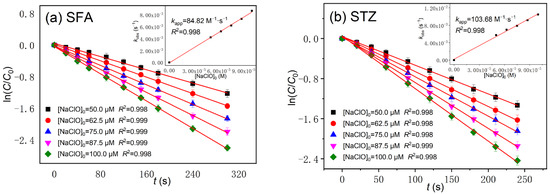
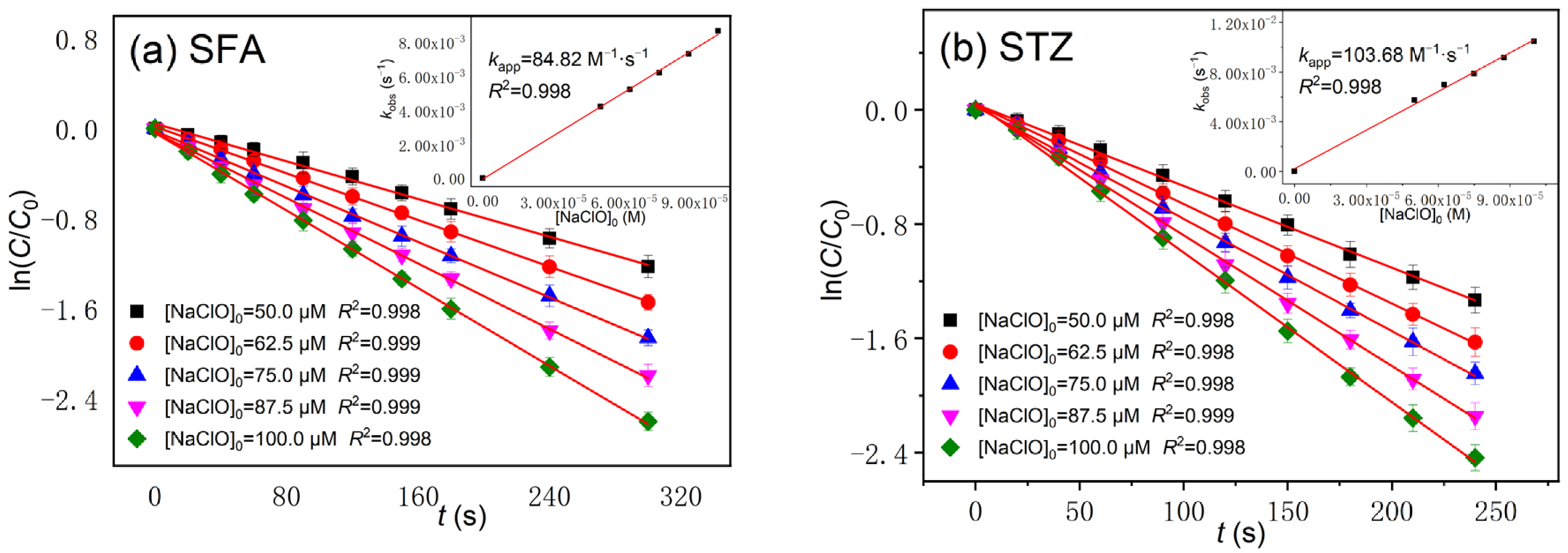
Kinetic fitting curves are displayed in Figure 1 (residual analysis, root-mean-square error (RMSE), and fitting comparisons with other kinetic models are provided in Tables S3–S6). At 20 ± 1 °C and pH 5.0, the apparent second-order rate constant kapp of SFA was 84.82 M−1·s−1, while kapp of STZ reached 103.68 M−1·s−1, indicating STZ possessed higher reactivity with free chlorine under identical conditions.
Figure 1.
The second-order kinetic plot for the chlorination of SFA and STZ by NaClO (experimental conditions: [SAs]0 = 5 μM, T = 20 °C, pH = 5.0 ± 0.1).
3.2. Effect of Environmental Parameters
3.2.1. Influence of Temperature
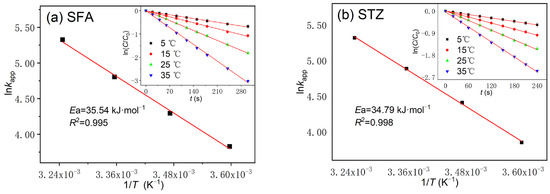
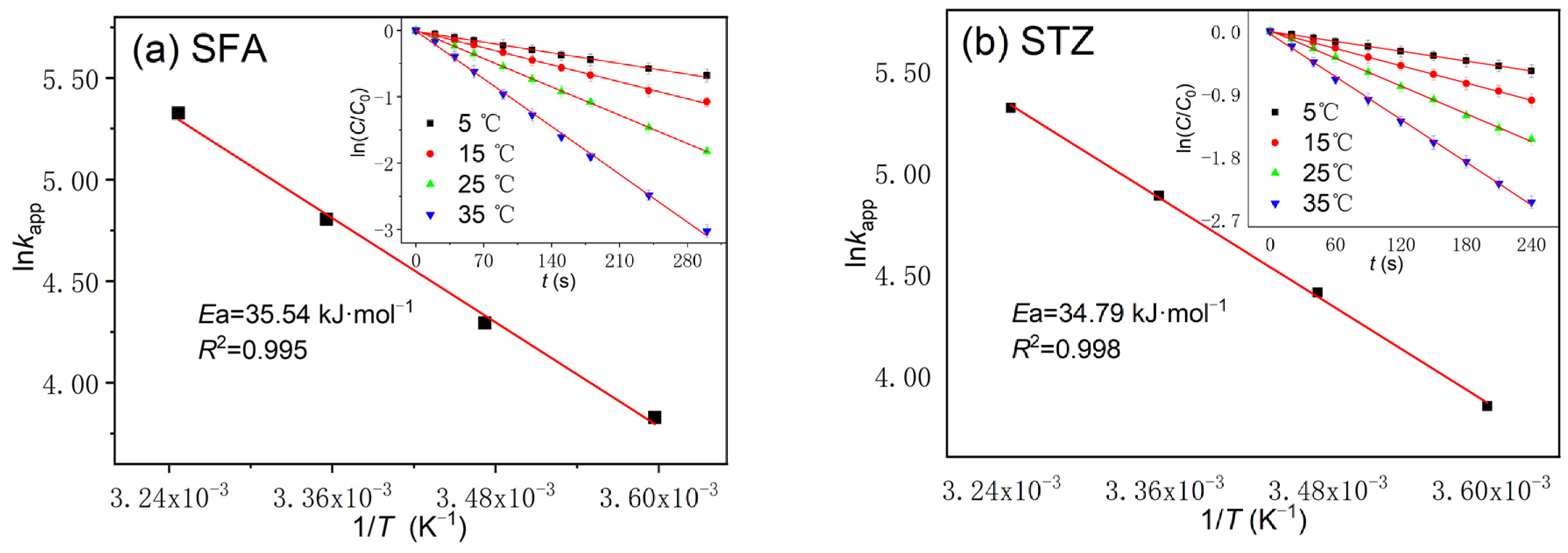
The chlorination rates of SFA and STZ increased continuously with temperature ranging from 5 to 35 °C (Figure 2). A linear correlation between ln(kapp) and 1/T was observed and fitted by the Arrhenius equation (Equation (5)):
where Ea is the apparent activation energy, R = 8.314 J·mol−1·K−1, and A stands for the pre-exponential factor. Fitting results yielded Ea = 35.54 kJ·mol−1 for SFA and Ea = 34.79 kJ·mol−1 for STZ. The corresponding pre-exponential factors A are 2.338 × 10⁸ M−1·s−1 for SFA and 1.825 × 10⁸ M−1·s−1 for STZ.
Figure 2.
The effect of temperature on the chlorination of SFA and STZ by NaClO (experimental conditions: [SAs]0 = 5 μM, T = 20 °C, pH = 5.0 ± 0.1).
3.2.2. Influence of pH
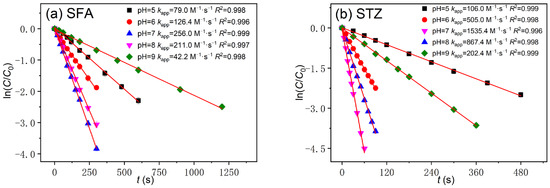
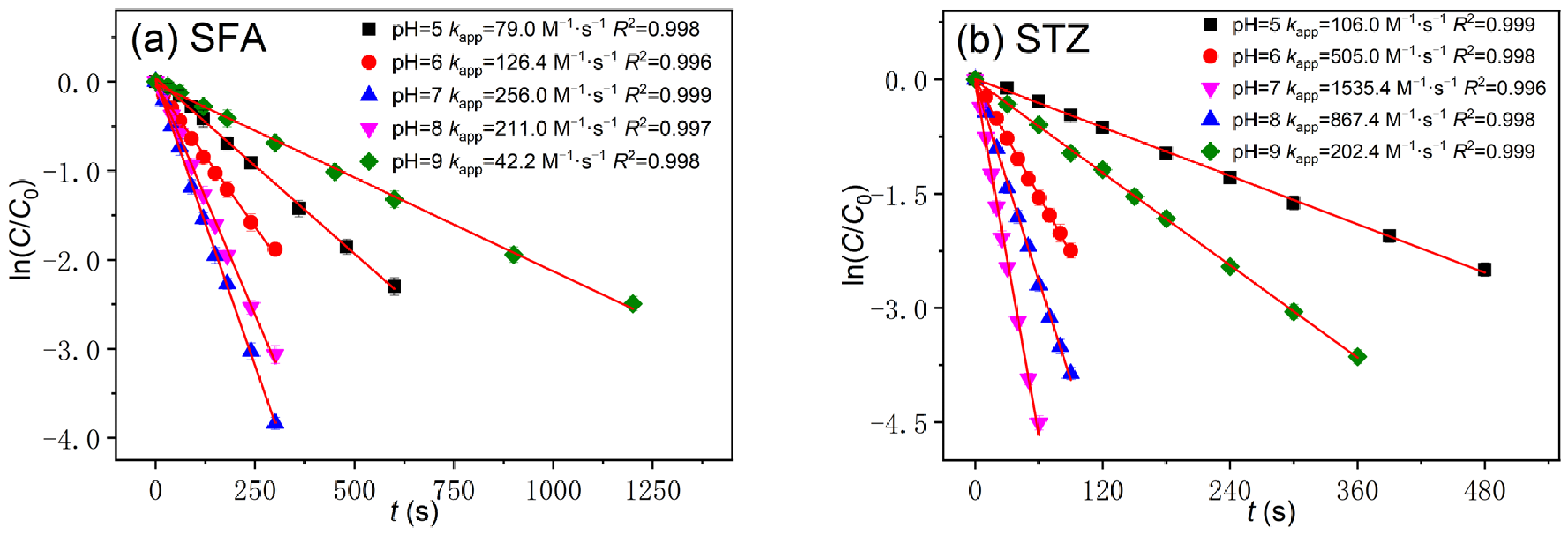
pH exerted obvious regulation on kapp of both SAs, and the maximum reaction rate occurred at neutral pH 7.0; lower reactivity was detected under acidic and alkaline environments (Figure 3).
Figure 3.
The effect of pH on the chlorination of SFA and STZ by NaClO (experimental conditions: [SAs]0 = 5 μM, T = 20 °C, pH = 5.0 ± 0.1).
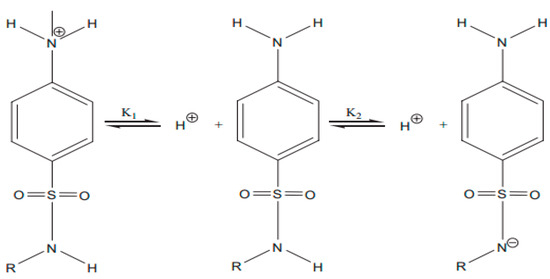
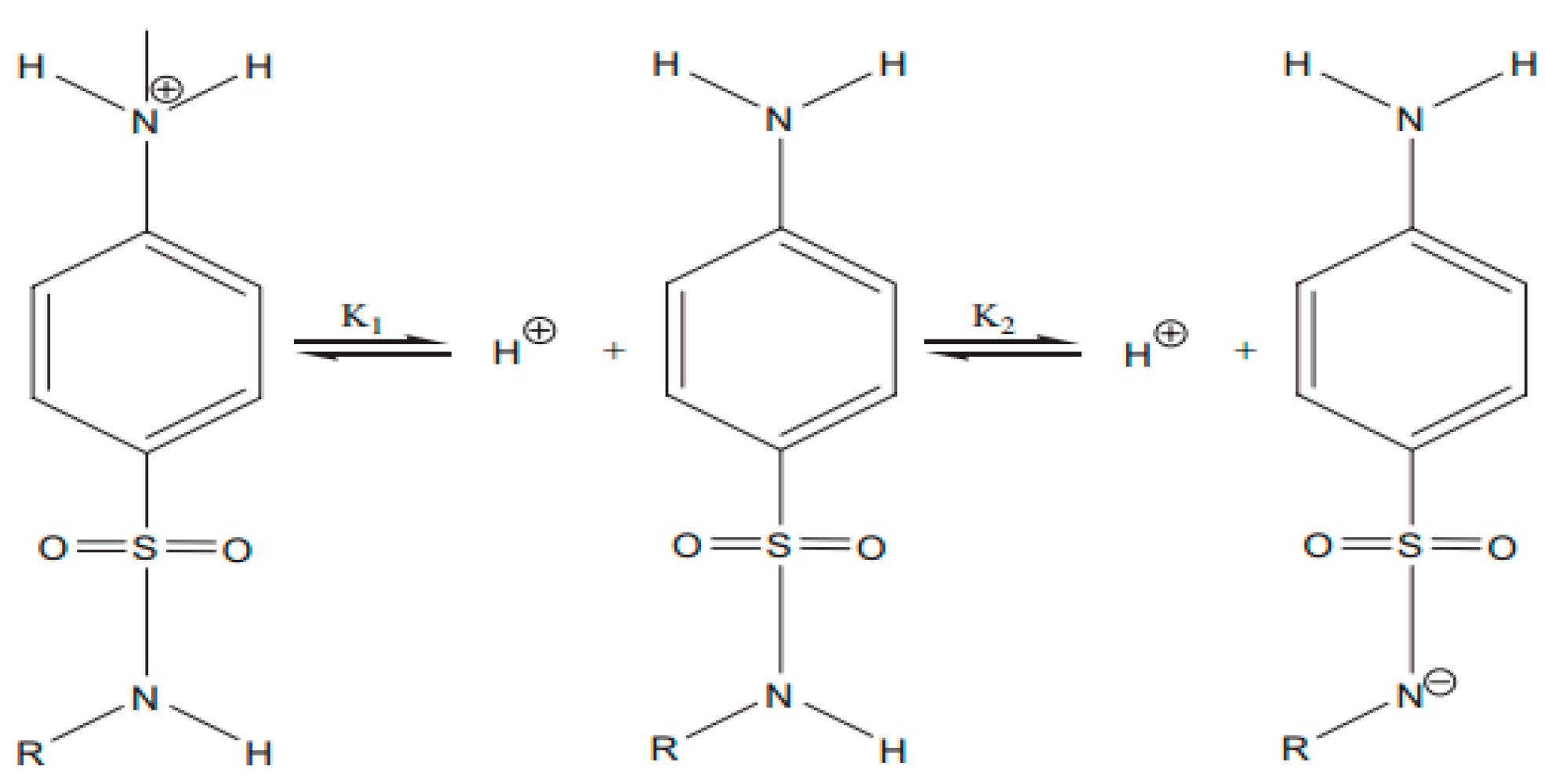
SFA and STZ existed as cationic (M+), neutral (M0) and anionic (M−) species in water (Figure 4), with dissociation equilibria shown in Equations (6)–(9):
where pKa1 and pKa2 are the first and second dissociation constants, respectively [24]. The fractions of each SA speciation state (αM+, αM0, αM−) are calculated as:
where [H+] = 10−pH, Ka1 = 10−pKa1, Ka2 = 10−pKa2. Total SA concentration ([M]T) is:
Figure 4.
Speciation of generic sulfonamides in aqueous solution.
Free chlorine speciation (HClO/ClO−) equilibrium is described by Equation (14):
The fractions of HClO and ClO− are calculated by Equations (15)–(16), and total free chlorine concentration is given by Equation (17).
where KHClO = 10−pKa,HClO.
Two dominant reaction pathways were determined: neutral sulfonamide species reacted with HClO (k1, Equation (18)), and anionic sulfonamide species reacted with HClO (k2, Equation (19)).
M0 + HClO → Products (k1)
M− + HClO → Products (k2)
Substituting speciation fractions into the second-order rate equation gives:
and:
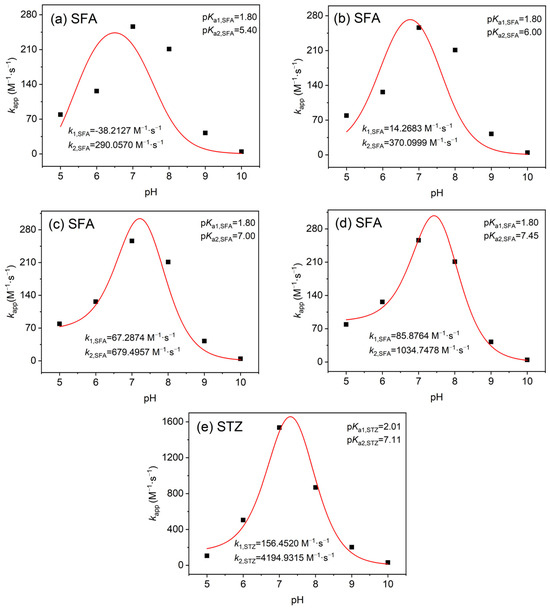
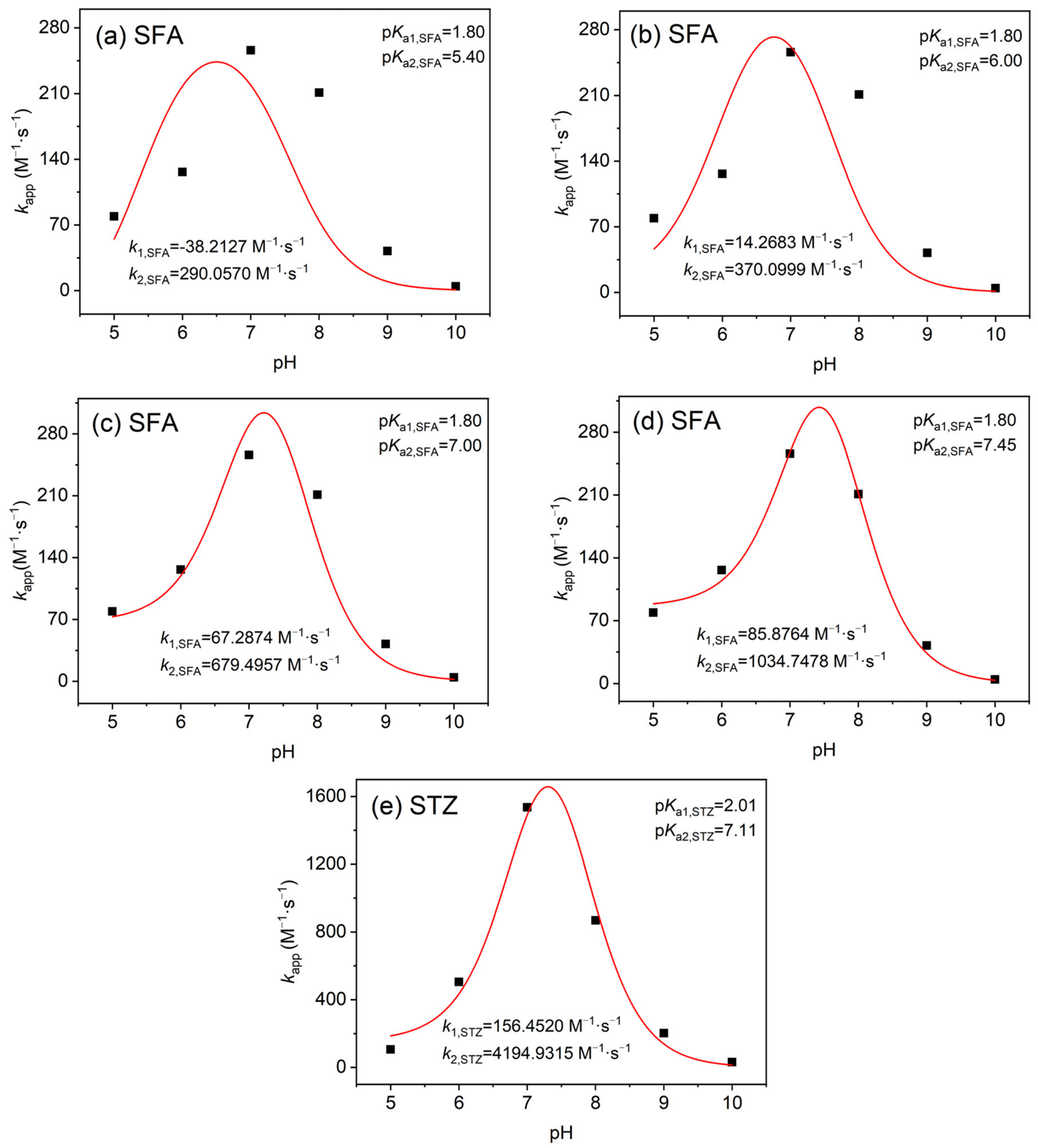
Nonlinear least-squares regression was applied to match experimental kapp data to Equation (21) for solving k1 and k2 (Figure 5). The optimized pka2,SFA was corrected to 7.45 under buffered experimental conditions. In this nonlinear least-squares regression, pka1 (SFA = 1.80, STZ = 2.01) and pKa2 of STZ (7.11) were adopted from the literature and kept constant. Only pKa2 of SFA was treated as an adjustable parameter to account for ionic-strength perturbation from buffer salts, which yielded a corrected apparent value of 7.45, instead of arbitrary trial-and-error fitting.
Figure 5.
Theoretical analysis model of the effect of pH on the chlorination of SFA (a–d) and STZ (e) by NaClO.
3.2.3. Influence of Common Ions
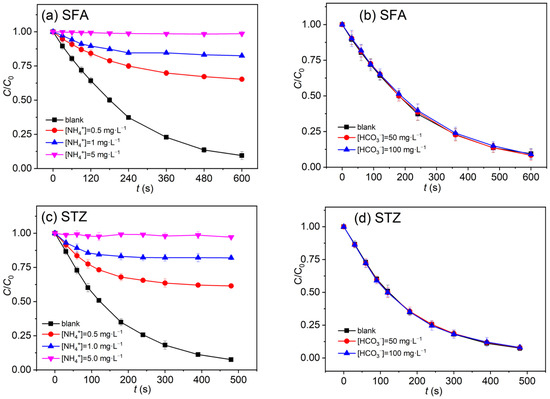
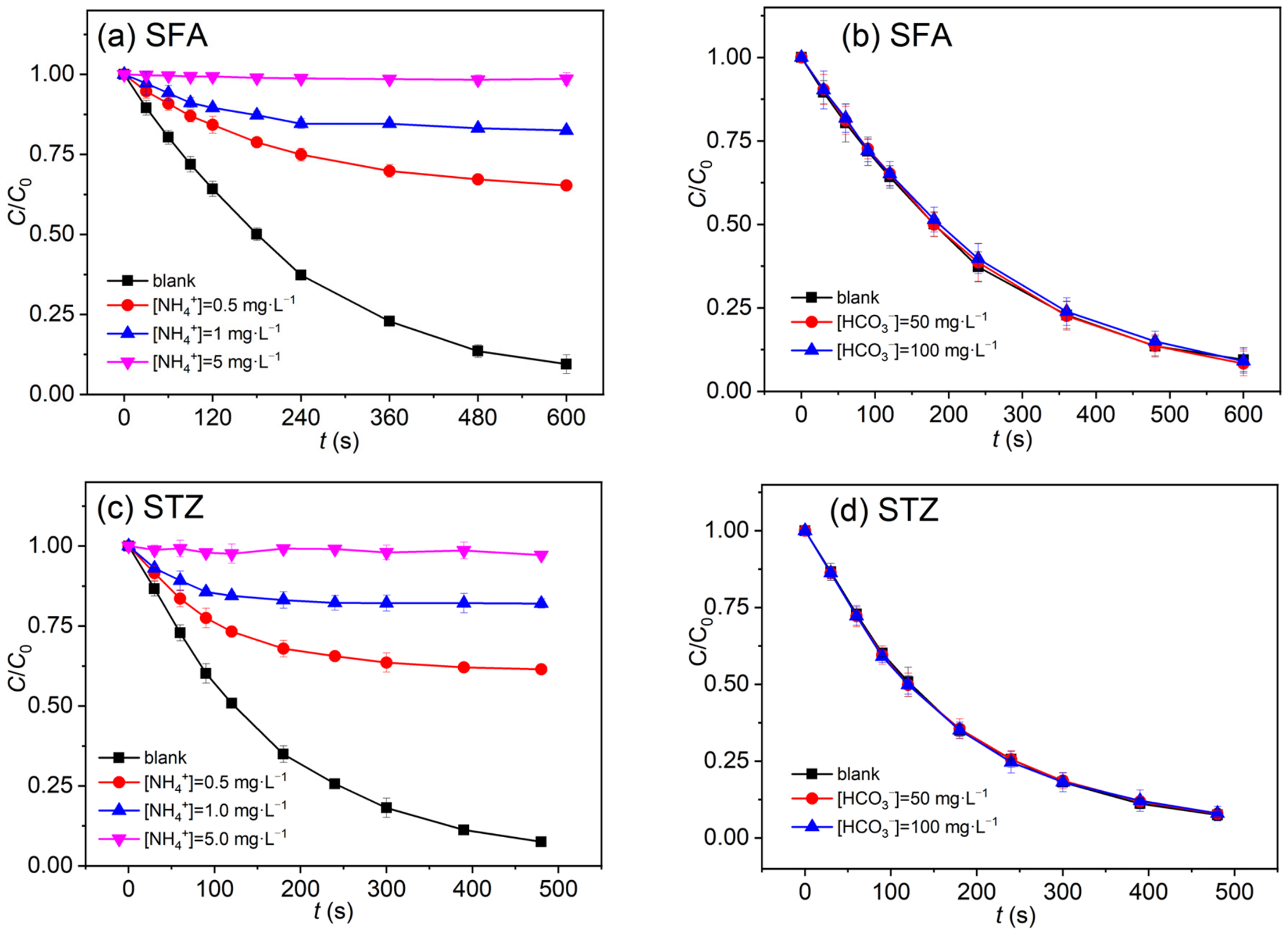
Figure 6 illustrates the removal efficiency variation in SFA and STZ under gradient concentrations of NH4+ and HCO3−. Bicarbonate ions showed negligible influence on SA degradation, while ammonium ions produced severe inhibitory effects. At NH4+ = 1.0 mg·L−1, the removal rate of SFA and STZ dropped from ~95% to ~15%; degradation was almost completely suppressed when NH4+ reached 5.0 mg·L−1.
Figure 6.
The effects of NH4+ (a,c) and HCO3− (b,d) on the chlorination of SFA and STZ by NaClO (experimental conditions: [SAs]0 = 5 μM, [NaClO]0 = 50 μM, T = 20 °C, pH = 5.0 ± 0.1).
Competitive reaction between free chlorine and ammonium ions consumes available free chlorine, forming low-reactivity inorganic chloramines in accordance with Equations (22)–(25), which further reduces the removal efficiency of target contaminants. It should be noted that residual free chlorine was not directly quantified in the present study. This mechanistic interpretation is supported by well-established chlorine–ammonium reaction chemistry and previous analogous research [25,26]. Direct measurement of time-dependent residual free chlorine would provide more solid experimental evidence for this hypothesis in future work.
3.2.4. Influence of Humic Acid (HA)
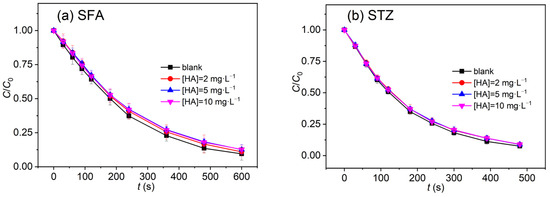
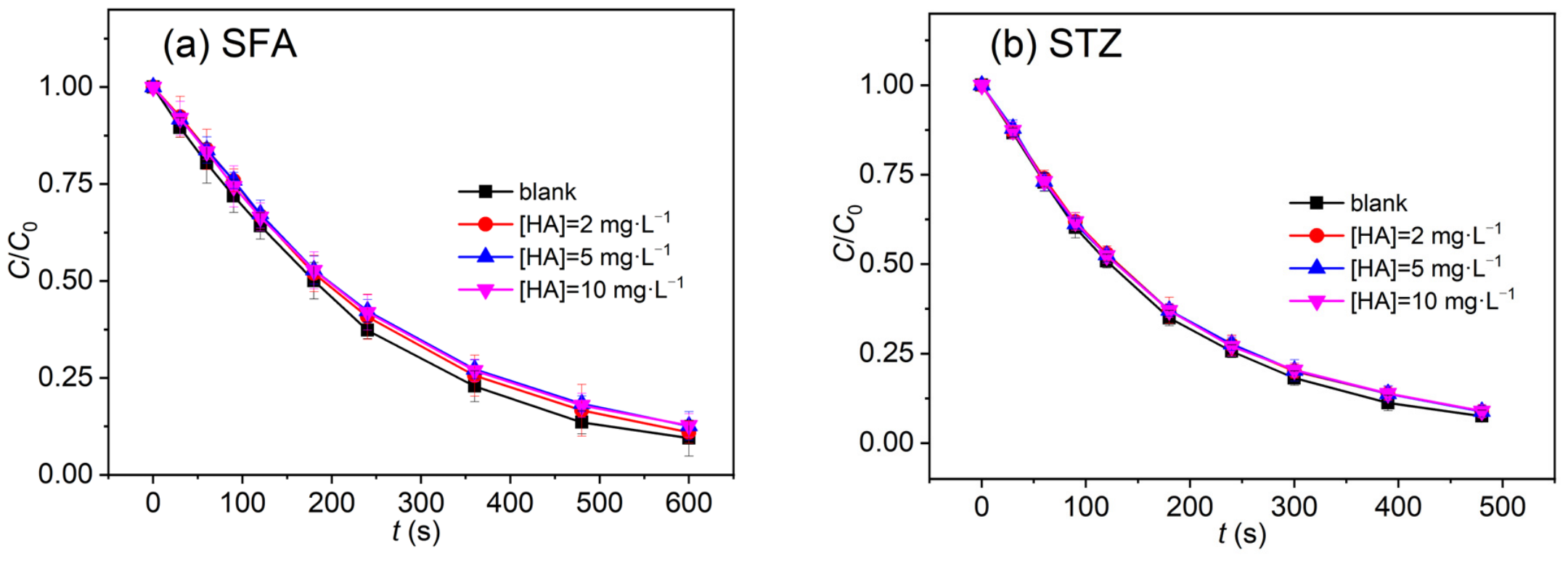
Gradient humic acid (0–30 mg·L−1) slightly inhibited the chlorination of SFA and STZ, and the inhibitory effect increased moderately with rising HA concentration (Figure 7).
Figure 7.
The effect of HA on the chlorination of SFA and STZ by NaClO (experimental conditions: [SAs]0 = 5 μM, [NaClO]0 = 50 μM, T = 20 °C, pH = 5.0 ± 0.1).
3.2.5. Influence of Water Matrix
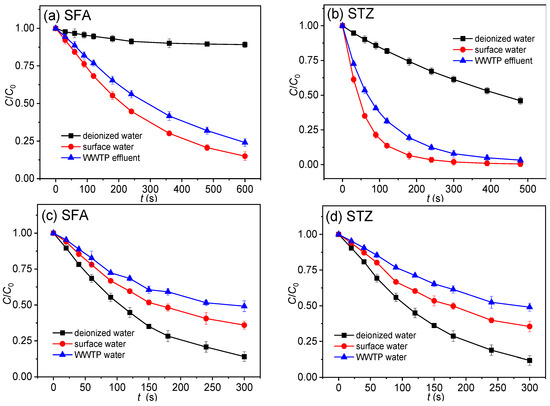
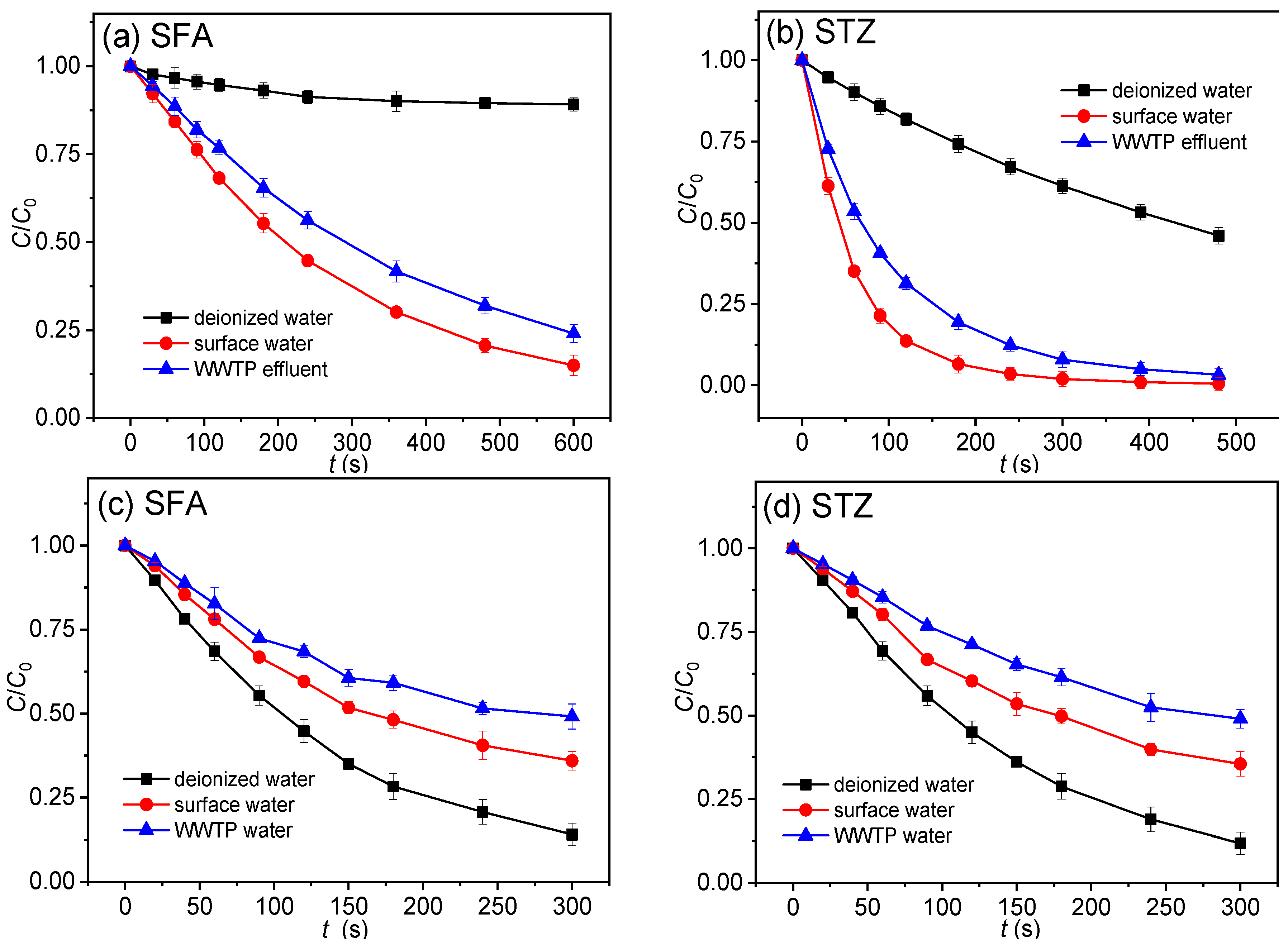
Chlorination rates of SFA and STZ followed the order deionized water > Dongpu Reservoir surface water > Shiwuli River WWTP secondary effluent (Figure 8). After adding NaClO, the pH of unbuffered deionized water rose to ~9, while natural water matrices maintained stable pH around 6. Water quality parameters of surface water and WWTP effluent are summarized in Table 1, which shows that WWTP effluent contained higher TOC than reservoir water.
Figure 8.
The effect of water matrix on the chlorination of SFA and STZ by NaClO (experimental conditions: (a,b), [SAs]0 = 0.1 μM, [NaClO]0 = 20 μM, T = 20 °C; (c,d), [SAs]0 = 0.01 μM, [NaClO]0 = 2.0 μM, T = 20 °C).
3.3. Mineralization Monitoring and Transformation Products
3.3.1. Mineralization Performance
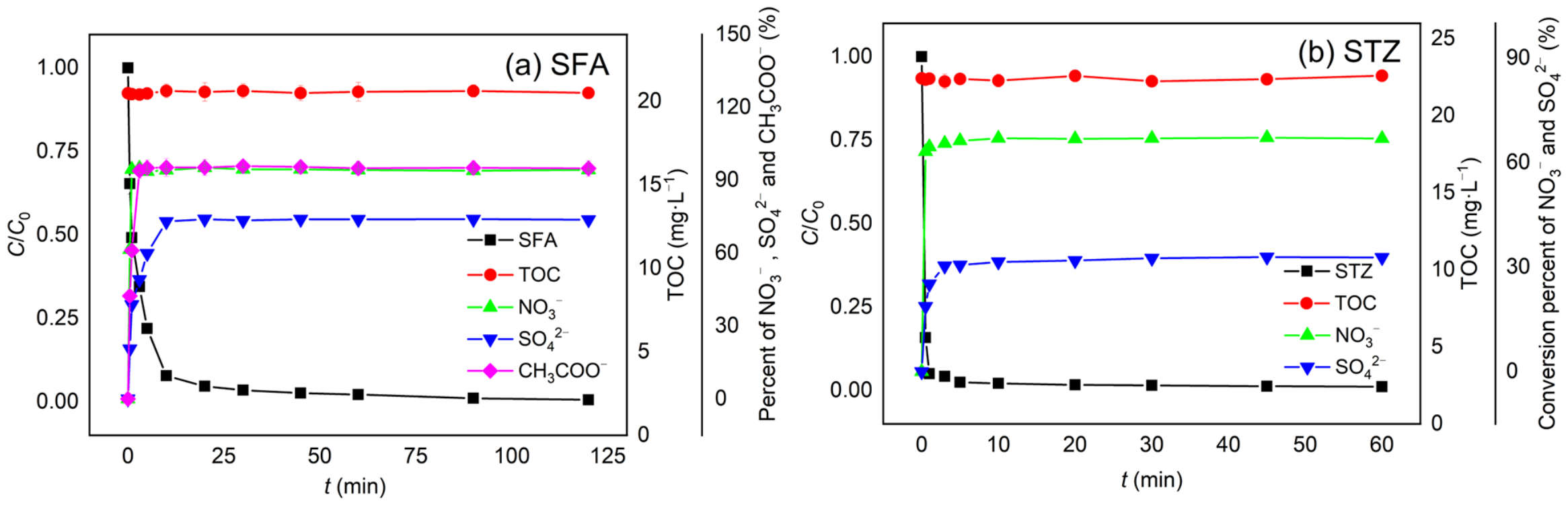
Under high-dose chlorination ([SAs]0 = 200 μM, [NaClO]0 = 1000 μM), parent SFA and STZ were completely degraded within 20–30 min, yet TOC concentration remained nearly constant throughout the reaction (Figure 9). Mineralization of heteroatoms exhibited significant differences between the two sulfonamides: ~95% N and ~70% S in SFA were converted to NO3− and SO42−; only ~67% N and ~33% S of STZ achieved mineralization. Acetate was detected during SFA chlorination, corresponding to the cleavage of acetyl substituent on SFA. This observation represents an apparent contradiction: complete removal of parent SFA and STZ does not correspond to substantial TOC reduction. It indicates that free-chlorine-driven transformation mainly induces structural cleavage and electrophilic chlorination substitution rather than full mineralization of organic carbon. The parent sulfonamide molecules are converted into abundant soluble chlorinated aromatic transformation products that remain in the aqueous phase and still contribute to total organic carbon. Only partial heteroatoms (N and S) are released and mineralized into inorganic ions, while most carbon skeletons are retained within these newly formed chlorinated by-products, which accounts for the nearly constant TOC concentrations observed in this test.
Figure 9.
The mineralization of SFA and STZ and the concentration of NO3−, SO42− and CH3COO− during the reaction (experimental conditions: [SAs]0 = 200 μM, [NaClO]0 = 1000 μM, T = 20 °C).
3.3.2. Identification of Transformation Products and Speculation of Transformation Pathways
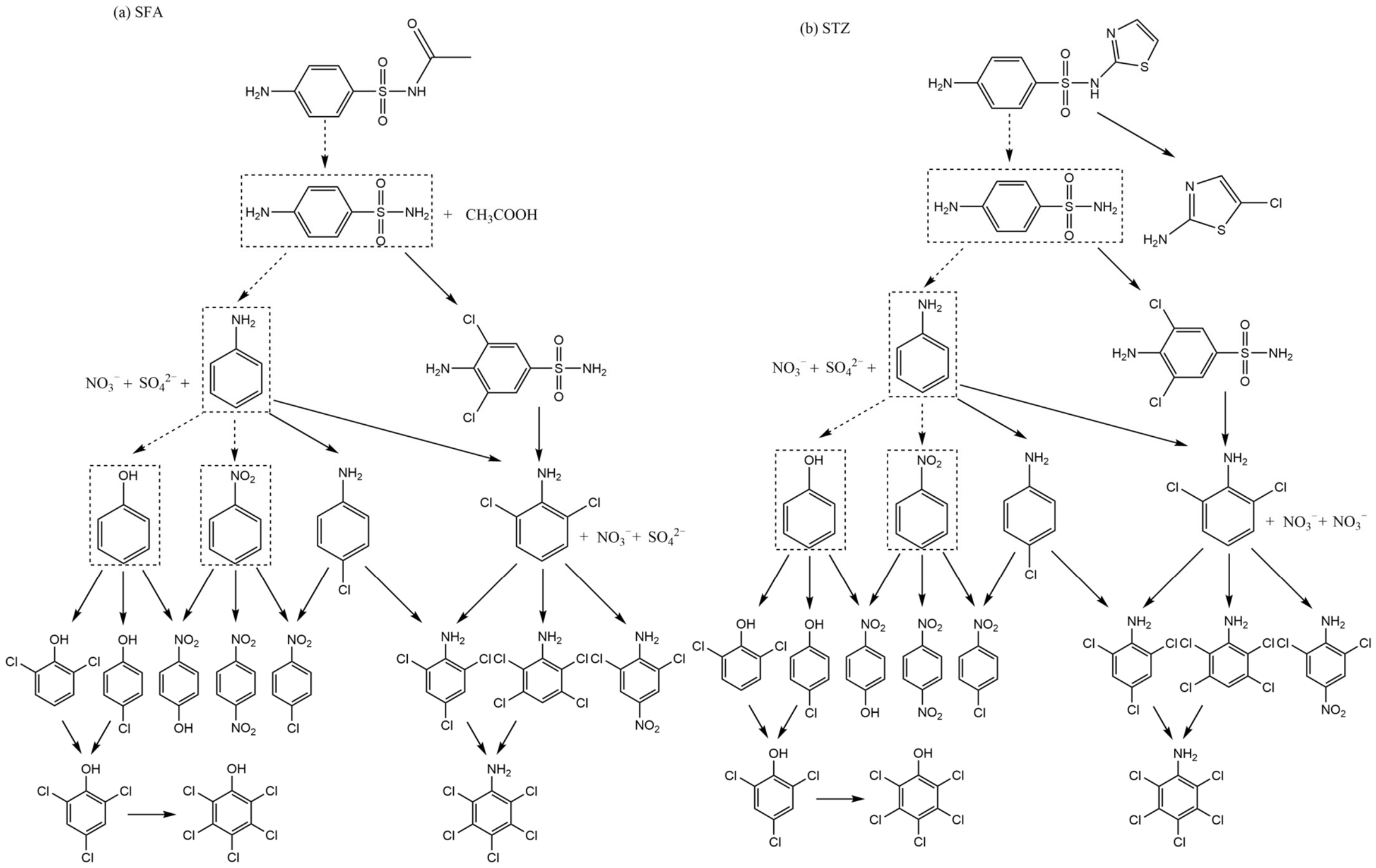
Multiple chlorinated transformation intermediates of SFA and STZ were detected by GC-MS. Their retention time (tR), mass-to-charge ratio (m/z), and molecular weight are summarized in Table 2, Table 3 and Table S12. GC-MS chromatograms of these intermediates are presented in Figure S2, and screenshots of NIST library matching for the identified chlorinated transformation products (CTPs) are provided in Figure S3. The general chlorination transformation pathways for SFA and STZ were proposed based on the detected CTPs (Figure 10).
Table 2.
Information about the products resulting from chlorination of SFA by NaClO.
Table 3.
Information about the products resulting from chlorination of STZ by NaClO.
Figure 10.
The proposed pathways of the chlorination of SFA and STZ by NaClO.
Several detected chloro-aromatic byproducts (e.g., chlorophenols) have been frequently reported in previous sulfonamide chlorination studies [23]. In addition, several unique transformation intermediates originating from the acetyl side chain of SFA and the thiazole heterocycle of STZ were tentatively identified in this work, which have seldom been described in prior literature. It should be emphasized that all CTPs were tentatively assigned via NIST mass-spectral library matching without authentic commercial reference standards; peak area data in the Supplementary Materials (Table S12) only represent relative signal intensity and cannot be used for quasi-quantitative concentration calculation.
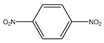
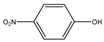
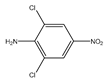
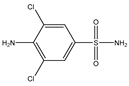
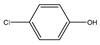
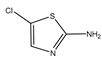
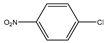
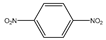
The chlorination process was divided into three sequential stages: (1) cleavage of parent molecular structures to produce sulfanilamide derivatives via detachment of characteristic side chains; (2) partial mineralization of N and S heteroatoms and generation of aromatic intermediates, including phenol, aniline and nitrobenzene; and (3) electrophilic substitution on benzene rings by excess free chlorine, forming chlorophenols, chloroanilines and chloronitrobenzenes as dominant final products.
4. Discussion
4.1. Reaction Kinetic Characteristics and Structural Dependence of Reactivity
The present study confirmed that chlorination of SFA and STZ obeys second-order kinetics, consistent with the chlorination pattern of sulfamethoxazole reported by Dodd and Huang [23]. Under identical pH and temperature, STZ exhibited higher kapp than SFA. This phenomenon is hypothesized to originate from structural differences in N1-substituents: the thiazole heterocycle in STZ may modulate electron density on the benzene ring, while the acetyl moiety of SFA potentially imposes electron-withdrawing character that suppresses electrophilic attack by HClO [12]. We note that this reasoning is inferred from experimental kinetic trends. Previous quantum-chemical studies on sulfonamide chlorination demonstrated that substituent groups can tune aromatic-ring susceptibility toward free chlorine via altering frontier molecular orbitals and Fukui indices for electrophilic sites [27]. Direct DFT or Fukui-function calculation for SFA and STZ will be required in future work to quantitatively verify this structure–reactivity relationship.
The activation energy Ea of SFA and STZ (34.79–35.54 kJ·mol−1) was far lower than that of phenacetin (57.7 kJ·mol−1) from Acero et al. [28], quantitatively demonstrating that sulfonamide antibiotics are more susceptible to oxidative degradation by chlorine than phenolic pharmaceutical micropollutants. The low activation energy also indicates that chlorination disinfection under conventional water plant temperature (10–30 °C) can effectively remove trace SFA and STZ in aquaculture water.
4.2. Mechanism of pH Regulating Chlorination Reactivity
The unimodal trend of kapp across the pH gradient originates from the dual modulation of sulfonamide species distribution and free chlorine speciation. Though this mechanism has been postulated in earlier sulfonamide chlorination studies, it has seldom been quantified by comprehensive kinetic fitting [29,30]. Neutral sulfonamide species (M0) exhibit higher reactivity toward HClO than their anionic counterparts (M−), attributed to diminished electrostatic repulsion and elevated electron density on the aromatic ring [23]. At pH 7.0, the system achieves an optimal balance between the fraction of reactive neutral sulfonamide and abundant HClO (the potent oxidant among free chlorine species), yielding the maximum overall reaction rate. Under alkaline conditions, ClO−—a weaker oxidant—dominates free chlorine speciation; under strongly acidic conditions, the fraction of reactive neutral sulfonamide declines. Both scenarios suppress chlorination rates [21].
In the present work, pH-dependent second-order chlorination kinetics of SFA and STZ were characterized over pH 5.0–9.0. One-way ANOVA confirmed that pH exerted an extremely significant effect on kapp for both SFA (F4,10 = 3027.1, p < 0.001, η2 = 0.9992) and STZ (F4,10 = 4621.4, p < 0.001, η2 = 0.9995). Tukey’s HSD post hoc comparisons revealed significant differences across all pairwise pH contrasts (p < 0.001), with the highest kapp observed at pH 7.0 for both compounds. Notably, STZ displayed markedly greater reactivity than SFA, particularly under neutral conditions, where its kapp was approximately six-fold larger. This observation supports the mechanistic hypothesis that the thiazole substituent strengthens electrophilic susceptibility of STZ toward HClO.
Different from Chamberlain’s assumption that k2 = 2k1 for all sulfonamides [21], this study established a speciation-coupled kinetic model without fixed ratio constraints between k1 and k2. The corrected pKa2,SFA = 7.45 instead of the literature value of 5.40 proves that buffer salts in batch experiments increase solution ionic strength and shift the dissociation equilibrium of sulfonamides, which should be considered in modeling actual water disinfection processes [23].
4.3. Interference Mechanism of Coexisting Water Components
4.3.1. Ammonium, Bicarbonate and Humic Acid
NH4+ showed strong inhibitory effects, while HCO3− barely affected SA chlorination. The inorganic chloramines generated by the reaction between ammonium and HClO possess oxidizing capacity 100–1000 times lower than free chlorine [25,31], as reported in research on estrogens, bromophenols and acetaminophen chlorination [25,28,32]. This finding provides key guidance for aquaculture water disinfection: high ammonium content in breeding wastewater will severely reduce the removal efficiency of residual sulfonamides by chlorine disinfection.
Humic acid derived from natural DOM slightly competes with SAs for free chlorine, but the inhibitory amplitude is limited [26,33]. Compared with advanced oxidation processes, chlorine has moderate oxidation potential and does not produce abundant reactive radicals to trigger DOM-SA competitive reactions, which explains the weak inhibition of HA observed in this experiment [34].
4.3.2. Actual Water Matrix Interference
Chlorination rates in natural surface water and WWTP effluent were lower than in deionized water, mainly attributed to dissolved organic matter (reflected by TOC) competing for chlorine [34]. Although natural water owns buffer capacity to stabilize pH, ubiquitous DOM in practical water matrices continuously consumes free chlorine, reducing the effective oxidant concentration available for sulfonamide degradation. This result suggests that laboratory kinetic data obtained in pure deionized water overestimates SA removal efficiency in actual aquaculture and sewage disinfection scenarios.
From an engineering perspective, chlorine dosage should be carefully balanced between sulfonamide abatement and toxic chlorinated by-product formation. Higher chlorine loading accelerates degradation of parent SFA and STZ, yet favors generation of toxic chlorophenols, chloroanilines and chloronitrobenzenes. Particularly for aquaculture water containing ammonium, simply elevating chlorine dose is not an efficient strategy: ammonium competes for free chlorine and yields low-reactive chloramines, which drastically decrease SA removal efficiency. For practical aquaculture disinfection, we recommend maintaining pH near neutral (~7.0) to achieve optimal SA degradation. Pre-treatment processes to reduce ammonium are preferred over blind chlorine overdosing for high ammonium aquaculture effluents. In addition to routine monitoring of parent sulfonamide residues, more attention should be paid to the ecological risk of persistent chlorinated transformation products. Laboratory kinetic data obtained in pure water over-predict removal efficiency in real aquaculture matrices; field-scale trials are essential to calibrate site-specific chlorine dosing schemes for practical ponds.
4.4. Mineralization Limitation and Ecological Risks of Chlorinated Transformation Products
Consistent with previous research conclusions, chlorine disinfection cannot achieve complete mineralization of sulfonamides, and only partial heteroatoms (N, S) are transformed into inorganic ions. The distinct mineralization degree between SFA and STZ originates from structural stability: the thiazole ring of STZ is more resistant to oxidative cleavage than the acetyl group of SFA, leading to incomplete release of nitrogen and sulfur heteroatoms [20].
GC-MS identification verified a series of chlorinated aromatic byproducts, including chlorophenols, chloroanilines and chloronitrobenzenes [23]. These chloroaromatic compounds have been reported as priority toxic pollutants with carcinogenic, teratogenic and mutagenic properties and may bioaccumulate and magnify along aquatic food chains [35]. According to previous toxicological reports, their comprehensive toxicity may be higher than parent sulfonamides, which reveals potential hidden ecological risks of chlorination disinfection for aquaculture wastewater containing SFA and STZ [36]. Current water quality standards only restrict parent sulfonamide concentrations, ignoring the persistent toxic transformation byproducts generated during disinfection.
4.5. Research Limitations and Future Perspectives
This study systematically elucidates the chlorination kinetics, key influencing factors, and transformation pathways of two typical sulfonamide veterinary antibiotics relevant to aquaculture. Nevertheless, several limitations should be acknowledged, which point to directions for future investigation.
- (1)
- All chlorination experiments were performed with single-solute systems. Aquaculture water contains mixtures of multiple sulfonamides and other veterinary antibiotics, which may trigger competitive or synergistic transformation interactions. Further mixed-pollutant experiments are required to reveal such combined effects.
- (2)
- Ecological-risk evaluation for CTPs in this manuscript remains qualitative. Neither experimental toxicity bioassays nor in silico QSAR-based toxicological simulations were conducted; hence, quantitative outputs such as EC50 estimation, QSAR analysis, and risk quotient calculation are not provided. Qualitative risk discussions are based on published ecotoxicity data of sulfonamides and their chlorinated by-products. Future work should perform quantitative toxicological tests covering algae, daphnids, and fish embryos to derive risk quotient values for individual CTPs.
- (3)
- The formation control strategies for toxic chlorinated by-products were not investigated herein. Subsequent studies could evaluate combined disinfection technologies (e.g., pre-ozonation followed by chlorination) for mitigating CTP formation in aquaculture water treatment.
- (4)
- Only laboratory-scale batch tests were carried out. Field-scale disinfection trials using real aquaculture ponds are necessary to validate the established kinetic models and optimize chlorine-dosing strategies for practical engineering implementation.
- (5)
- Chlorinated transformation products were qualitatively identified under relatively high substrate concentrations in deionized water matrices. Restricted by instrumental detection limits, reliable identification of trace-level CTPs generated under environmentally realistic trace-concentration and complex water matrix conditions could not be achieved. High-sensitivity analytical tools such as liquid chromatography–high-resolution mass spectrometry (LC-HRMS) are recommended for characterizing transformation by-products under practical trace-level disinfection scenarios.
Additionally, time-resolved measurements of residual free chlorine across gradient ammonium concentrations are suggested for future experiments to further verify the chloramine-mediated competitive inhibition mechanism proposed in this work.
5. Conclusions
This study systematically investigated the chlorination kinetics and transformation mechanisms of SFA and STZ under controlled laboratory conditions. Under experimental conditions of 20 ± 1 °C and pH 5.0–10.0, the chlorination of SFA and STZ followed second-order reaction kinetics. Reaction rates were strongly modulated by pH and temperature. Ammonium ions significantly suppressed the degradation of SFA and STZ through forming low-reactive chloramines. GC-MS analysis confirmed the generation of multiple CTPs, such as chlorophenols, chloroanilines and chloronitrobenzenes, in laboratory batch tests. The present work reveals the transformation behavior of two typical sulfonamides upon chlorine disinfection at the bench scale.
Supplementary Materials
The following supporting information can be downloaded at: https://www.mdpi.com/article/10.3390/w18192376/s1.
Author Contributions
B.Z.: Conceptualization, methodology, writing—original draft, writing—review & editing. S.Y. (Shuai Yang), S.D. and Z.P.: Investigation, formal analysis, data curation. C.Y.: Validation, investigation. S.Y. (Shoujun Yuan): Conceptualization, supervision, writing—review & editing, funding acquisition. All authors have read and agreed to the published version of the manuscript.
Funding
This study was funded by the research project from Hefei Water Supply Group Co., Ltd. in China (Project No. 2024BFFWZ00658-3).
Data Availability Statement
The original contributions presented in this study are included in the article/Supplementary Materials. Further inquiries can be directed to the corresponding author.
Acknowledgments
During the preparation of this manuscript, the authors used Doubao developed by ByteDance (version 2.29.12) for language polishing, grammatical revision and optimization of scientific writing style. All content generated by the tool has been reviewed and revised by the authors, who take full responsibility for all content of this paper.
Conflicts of Interest
Authors Bo Zhu and Cuiqin Yin were affiliated with Hefei Water Group, Hefei, China. The authors confirm that this study received financial support from Hefei Water Group, Hefei, China. The funder took part in the validation and investigation of this research.
Abbreviations
The following abbreviations and units are used in this manuscript:
| SAs | Sulfonamides | |
| SFA | Sulfacetamide | |
| STZ | Sulfathiazole | |
| CTPs | Chlorinated transformation products | |
| WWTP | Wastewater treatment plant | |
| SPE | Solid-phase extraction | |
| HA | Humic acid | |
| Symbol/Quantity | Unit | Description |
| T | °C | Temperature |
| pH | – | Hydrogen ion concentration (dimensionless) |
| kapp | M−1·s−1 | Apparent second-order rate constant |
| kobs | s−1 | Pseudo-first-order rate constant |
| Ea | kJ·mol−1 | Apparent activation energy |
| R | J·mol−1·K−1 | Universal gas constant |
| Concentration (e.g., [SAs], [NaClO]) | μM, M | Micromolar, molar |
| Concentration (mass/volume) | mg·L−1, μg·L−1, ng·L−1 | Mass per unit volume |
| TOC, COD, NH4+-N, NO3−-N, TP | mg·L−1 | Water quality parameters (total organic carbon, chemical oxygen demand, etc.) |
| tR | min | Gas chromatography retention time |
| m/z | – | Mass-to-charge ratio (dimensionless) |
| Mr | g·mol−1 | Relative molecular mass |
References
- Dai, J.J.; Song, J.M.; Wen, L.L.; Ma, J.; Yuan, H.M.; Li, X.G.; Duan, L.Q.; Wang, Q.D. Sulfonamides as emerging contaminants in China’s marginal seas: Distribution, Usage, and Residues. Cont. Shelf Res. 2025, 295, 105570. [Google Scholar] [CrossRef] [Scilit]
- Mu, L.; Zha, F.S.; Wen, M.H.; Wang, Q.; Song, X.J. Nationwide occurrence and site-scale dynamics of antibiotics in landfill-associated waters in China. Water Res. 2026, 304, 126330. [Google Scholar] [CrossRef] [Scilit] [PubMed]
- Zhang, Q.; L.i, Y.N.; Kroeze, C.; van de Schans, M.G.M.; Baartman, J.; Yang, J.; Li, S.Y.; Xu, W.; Wang, M.R.; Ma, L.; et al. More inputs of antibiotics into groundwater but less into rivers as a result of manure management in China. Environ. SciEcotechnol. 2025, 23, 100513. [Google Scholar] [CrossRef] [Scilit] [PubMed]
- Simbo, E.B.S.; Ma, Z.; Fang, L.; Morgan, S.; Sumana, S.L.; Maguru, M.C.; Chakanga, M.; Gondwe, H.; Bundu, A.T.; Qiu, L.; et al. Occurrence, dominance, and combined use of antibiotics in aquaculture ponds. Toxics 2025, 13, 892. [Google Scholar] [CrossRef] [Scilit] [PubMed]
- Guo, X.; Xiong, J.; Liu, H.; Wang, H.; Cheng, Q.; Tang, F.; Zeng, Z.; Zhang, H.; Yin, H. Targeted screening, distribution and sources of antibiotics in drinking water sources and its risk assessment in sichuan province, China. Environ. Manag. 2025, 75, 1168–1180. [Google Scholar] [CrossRef] [Scilit] [PubMed]
- Haenelt, S.; Wang, G.; Kasmanas, J.C.; Musat, F.; Richnow, H.H.; da Rocha, U.N.; Müller, J.A.; Musat, N. The fate of sulfonamide resistance genes and anthropogenic pollution marker intI1 after discharge of wastewater into a pristine river stream. Front. Microbiol. 2023, 14, 1208555. [Google Scholar] [CrossRef] [Scilit] [PubMed]
- Xu, R.; Song, J.; Li, D.; Song, X.; Wang, X.; Xiong, J. Traceability analysis and risk assessment of river antibiotics based on dissolved organic matter spectral features and the positive matrix factorization receptor model. J. Contam. Hydrol. 2025, 272, 104549. [Google Scholar] [CrossRef] [Scilit] [PubMed]
- García-Galán, M.J.; Díaz-Cruz, M.S.; Barceló, D. Occurrence of sulfonamide residues along the Ebro river basinRemoval in wastewater treatment plants and environmental impact assessment. Environ. Int. 2011, 37, 462–473. [Google Scholar] [CrossRef] [Scilit] [PubMed]
- Iftikhar, N.; Konig, I.; English, C.; Ivantsova, E.; Souders, C.L.; Hashmi, I.; Martyniuk, C.J. Sulfamethoxazole (SMX) alters immune and apoptotic endpoints in developing Zebrafish (Danio rerio). Toxics 2023, 11, 178. [Google Scholar] [CrossRef] [Scilit] [PubMed]
- Camacho-Arévalo, R.; García-Delgado, C.; Mayans, B.; Antón-Herrero, R.; Cuevas, J.; Segura, M.L.; Eymar, E. Sulfonamides in tomato from commercial greenhouses irrigated with reclaimed wastewater: Uptake, translocation and food safety. Agronomy 2021, 11, 1016. [Google Scholar] [CrossRef] [Scilit]
- Hu, H.; Yan, Z.; Li, S.; Zhu, Z.; Li, W.; Tai, J.; Zhang, H. Multiresidue analysis and health risk assessment of sulfonamides and quinolones from edible Batrachia and other aquatic products. Food Res. Int. 2023, 30, 1461–1470. [Google Scholar] [CrossRef] [Scilit]
- Chen, L.; Liu, Y.; Cheng, G.; Fan, Z.; Yuan, J.; He, S.; Zhu, G. A novel fluorescent probe based on N, B, F co-doped carbon dots for highly selective and sensitive determination of sulfathiazole. Sci. Total Environ. 2021, 759, 143432. [Google Scholar] [CrossRef] [Scilit] [PubMed]
- Herrera-Herrera, A.V.; Hernández-Borges, J.V.; Borges-Miquel, T.M.; Rodríguez-Delgado, M.Á. Dispersive liquid–liquid microextraction combined with ultra-high performance liquid chromatography for the simultaneous determination of 25 sulfonamide and quinolone antibiotics in water samples. J. Pharm. Biomed. Anal. Water Res. 2013, 75, 130–137. [Google Scholar]
- Dahal, R.; Dhakal, O.B.; Mukherjee, S.; Acharya, T.R.; Lamichhane, P.; Kaushik, N.; Kaushik, N.K.; Choi, E.H. Sustainable removal of sulfathiazole from aqueous solutions using ZnFe2O4-catalyzed dielectric barrier discharge plasma: Efficiency, reusability, and environmental impact. Chem. Eng. J. 2025, 523, 168588. [Google Scholar] [CrossRef] [Scilit]
- Ottosen, C.F.; Bjerg, P.L.; Kümmel, S.; Richnow, H.H.; Middeldorp, P.; Draborg, H.; Lemaire, G.G.; Broholm, M.M. Natural attenuation of sulfonamides and metabolites in contaminated groundwater-Review, advantages and challenges of current documentation techniques. Water Res. 2024, 254, 121416. [Google Scholar] [CrossRef] [Scilit] [PubMed]
- Zhang, Y.; Nie, S.; Nie, M.; Yan, C.; Qiu, L.; Wu, L.; Ding, M. Remediation of sulfathiazole contaminated soil by peroxymonosulfate: Performance, mechanism and phytotoxicity. Sci. Total Environ. 2022, 830, 154839. [Google Scholar] [CrossRef] [Scilit] [PubMed]
- Bano, S.; Shad, A.; Alqhtani, H.A.; Bin-Jumah, M.; Altoom, N.G.; Allam, A.A. Deciphering the degradation of sulfonamides by UV/chlorination in aqueous solution: Kinetics, reaction pathways, and toxicological evolution. Environ. Res. Commun. 2024, 6, 095017. [Google Scholar] [CrossRef] [Scilit]
- Niu, J.M.; Yuan, R.F.; Chen, H.L.; Zhou, B.H.; Luo, S. Heterogeneous catalytic ozonation for the removal of antibiotics in water: A review. Environ. Res. 2024, 262, 119889. [Google Scholar] [CrossRef] [Scilit] [PubMed]
- Casinini, F.; Ferrante, M. A Device for Controlling the Chlorination in Small Umbrian Water Distribution Systems. Water 2024, 16, 2747. [Google Scholar] [CrossRef] [Scilit]
- Sekizawa, T.; Onodera, S. Chemical fate and mutagenic formation potentials of phenothiazine and related compounds during water chlorination. J. Toxicol. Sci. 2010, 35, 853–862. [Google Scholar] [CrossRef] [Scilit] [PubMed]
- Chamberlain, E.; Adams, C. Oxidation of sulfonamides, macrolides, and carbadox with free chlorine and monochloramine. Water Res. 2006, 40, 2517–2526. [Google Scholar] [CrossRef] [Scilit] [PubMed]
- Gaffney, V.D.; Cardoso, V.V.; Benoliel, M.J.; Almeida, C.M.M. Chlorination and oxidation of sulfonamides by free chlorine: Identification and behaviour of reaction products by UPLC-MS/MS. J. Environ. Manag. 2016, 166, 466–477. [Google Scholar] [CrossRef] [Scilit] [PubMed]
- Dodd, M.C.; Huang, C.H. Transformation of the antibacterial agent sulfamethoxazole in reactions with chlorine: Kinetics, mechanisms, and pathways. Environ. Sci. Technol. 2004, 38, 5607. [Google Scholar] [CrossRef] [Scilit] [PubMed]
- Sagi, G.; Csay, T.; Szabo, L.; Patzay, G.; Csonka, E.; Takacs, E.; Wojnarovits, L. Analytical approaches to the OH radical induced degradation of sulfonamide antibiotics in dilute aqueous solutions. J. Pharm. Biomed. Anal. 2015, 106, 52–60. [Google Scholar] [CrossRef] [Scilit] [PubMed]
- Deborde, M.; Gunten, U.V. Reactions of chlorine with inorganic and organic compounds during water treatment—Kinetics and mechanisms: A critical review. Water Res. 2008, 42, 13–51. [Google Scholar] [CrossRef] [Scilit] [PubMed]
- Cao, F.; Zhang, M.; Yuan, S.; Feng, J.; Wang, Q.; Wang, W.; Hu, Z. Transformation of acetaminophen during water chlorination treatment: Kinetics and transformation products identification. Environ. Sci. Pollut. Res. 2016, 23, 12303–12311. [Google Scholar] [CrossRef] [Scilit] [PubMed]
- Sun, Z.K.; Jin, Y.F.; Huang, J.W.; Wei, X.; Ma, G.; Yu, H.Y. Experimental and computational studies of transformation of sulfachloropyridazine during water chloramination: Kinetics, mechanism and toxicity. J. Hazard. Mater. 2026, 507, 141748. [Google Scholar] [CrossRef] [Scilit] [PubMed]
- Acero, J.L.; Benitez, F.J.; Real, F.J.; Roldan, G. Kinetics of aqueous chlorination of some pharmaceuticals and their elimination from water matrices. Water Res. 2010, 44, 4158–4170. [Google Scholar] [CrossRef] [Scilit] [PubMed]
- Gallard, H.; Leclercq, A.; Croué, J.-P. Chlorination of bisphenol A: Kinetics and by-products formation. Chemosphere 2004, 56, 465–473. [Google Scholar] [CrossRef] [Scilit] [PubMed]
- Lane, R.F.; Adams, C.D.; Randtke, S.J.; Carter, R.E. Bisphenol diglycidyl ethers and bisphenol A and their hydrolysis in drinking water. Water Res. 2015, 72, 331–339. [Google Scholar] [CrossRef] [Scilit] [PubMed]
- Sipahi, F.; Uslu, S. Investigation of the quality and physical-geochemical characteristics of the drinking water in Gümüşhane (Turkey) city central. Arab. J. Geosci. 2016, 9, 600. [Google Scholar] [CrossRef] [Scilit]
- Lee, Y.; Escher, B.I.; Gunten, U.V. Efficient removal of estrogenic activity during oxidative treatment of waters containing steroid estrogens. Environ. Sci. Technol. 2008, 42, 6333–6339. [Google Scholar] [CrossRef] [Scilit] [PubMed]
- Gerecke, A.C.; Canonica, S.; Muller, S.R.; Scharer, M.; Schwarzenbach, R.P. Quantification of dissolved natural organic matter (DOM) mediated phototransformation of phenylurea herbicides in lakes. Environ. Sci. Technol. 2001, 35, 3915–3923. [Google Scholar] [CrossRef] [Scilit] [PubMed]
- Garbin, J.R.; Milori, D.M.B.P.; Simões, M.L.; Silva, W.T.L.D.; Neto, L.M. Influence of humic substances on the photolysis of aqueous pesticide residues. Chemosphere 2007, 66, 1692–1698. [Google Scholar] [CrossRef] [Scilit] [PubMed]
- Shehata, M.; Durner, J.; Thiessen, D.; Shirin, M.; Lottner, S.; Landuyt, K.V.; Furche, S.; Hickel, R.; Reichl, F.X. Induction of DNA double-strand breaks by monochlorophenol isomers and ChKM in human gingival fibroblasts. Arch. Toxicol. 2012, 86, 1423–1429. [Google Scholar] [CrossRef] [Scilit] [PubMed]
- Repetto, G.; Jos, A.; Hazen, M.J.; Molero, M.L.; Peso, A.; Salguero, M.; Castillo, P.D.; Repetto, M.C.R.M. A test battery for the ecotoxicological evaluation of pentachlorophenol. Toxicol. Vitro 2001, 15, 503. [Google Scholar] [CrossRef] [Scilit] [PubMed]











Disclaimer/Publisher’s Note: The statements, opinions and data contained in all publications are solely those of the individual author(s) and contributor(s) and not of MDPI and/or the editor(s). MDPI and/or the editor(s) disclaim responsibility for any injury to people or property resulting from any ideas, methods, instructions or products referred to in the content. |
© 2026 by the authors. Licensee MDPI, Basel, Switzerland. This article is an open access article distributed under the terms and conditions of the Creative Commons Attribution (CC BY) license.