


Abstract
The adaptive responses of salinity-acclimated heterotrophic bacterial communities with ammonium assimilation potential to prolonged cooling remain poorly understood. In this study, three sequencing batch reactors (SBRs) with salinities of 25 (R1), 50 (R2), and 100 g/L (R3) NaCl were operated continuously for 283 days as the temperature was successively reduced from 25 °C to 8 °C. At 8 °C, the apparent aqueous phase total inorganic nitrogen (TIN) removal efficiencies were 79.99 ± 1.32%, 93.20 ± 8.29%, and 95.66 ± 4.34% in R1, R2, and R3, respectively, with limited net accumulation of NO2−-N and NO3−-N. Cooling was accompanied by distinct changes in sludge properties and microbial communities across the reactors. R1 experienced marked decreases in MLSS and MLVSS and lower community evenness, together with the predominance of Nitrincola (89.42%) and reduced apparent aqueous phase nitrogen removal. In contrast, R2 and R3 retained higher volatile solids and multiple halotolerant heterotrophic genera, while Halomonas remained dominant in R3. Protein-rich EPS increased during cooling, and intracellular ectoine reached 133.03, 215.50, and 443.49 mg/g VSS in R1, R2, and R3 at 8 °C. The continued detection of glnA in metagenomes indicated retained genetic potential for ammonium assimilation. Collectively, these descriptive observations characterize different community responses to cooling and support ammonium assimilation as a plausible contributor to nitrogen transformation.
1. Introduction
Saline nitrogen-containing wastewater is increasingly generated by sea-water-dependent activities and salt-intensive industries, including food processing, pharmaceuticals, leather manufacturing, petrochemicals, and metallurgy [1,2,3,4]. If inadequately treated, the combined salinity, organic load, and nitrogen content of these waste streams can impair receiving-water quality and constrain subsequent water reuse [5,6,7]. Among the available treatment technologies, biological processes have received considerable attention due to their relatively low operating costs, environmental compatibility, limited secondary pollution, and capacity for the simultaneous removal of organic matter and nitrogenous contaminants. Its application to saline wastewater, however, depends on maintaining metabolically active microbial communities under simultaneous osmotic and thermal stress.
Elevated NaCl concentrations reduce water activity and perturb cellular ionic homeostasis, thereby affecting enzyme function, membrane integrity, substrate transport, and biomass retention [5,8]. Cooling further decreases catalytic rates, membrane fluidity, transmembrane transport, and cellular energy generation [9,10,11,12,13]. These constraints are especially relevant to the traditional nitrification process. Ammonia-oxidizing bacteria (AOB) initiate the oxidation of NH4+-N to NO2−-N, whereas nitrite-oxidizing bacteria (NOB) subsequently oxidize NO2−-N to NO3−-N. Salinity can alter ammonia-oxidizing activity and community composition [14], while wastewater temperatures below 15 °C can reduce amoA transcription even when AOB abundance is maintained [15]. Consequently, maintaining stable ammonium removal under the combined stresses of salinity and low temperature remains a critical challenge.
Biological ammonium removal from saline wastewater has been investigated mainly through conventional nitrification–denitrification, heterotrophic nitrification–aerobic denitrification, and anaerobic ammonium oxidation [16,17,18,19,20]. Although the enrichment of salt-tolerant or psychrotolerant microorganisms and the regulation of carbon availability can improve nitrogen removal, process performance remains dependent on microbial acclimation, oxygen availability, substrate composition, and reactor operating conditions [21,22,23]. Furthermore, N2O may be produced during both ammonia oxidation and heterotrophic denitrification, while elevated salinity can promote N2O accumulation, thereby leading to nitrogen loss and greenhouse gas emissions [24,25,26].
In addition to direct influent loading, ammonium can be regenerated within activated sludge through the hydrolysis and ammonification of organic nitrogen contained in wastewater constituents, extracellular polymeric substances, and decaying biomass [27]. Under saline conditions, community succession may favor halotolerant or halophilic heterotrophic decomposers capable of maintaining organic-matter turnover, thereby influencing endogenous ammonium regeneration [28]. The resulting ammonium pool may subsequently undergo oxidative conversion or be directly incorporated into microbial biomass. Against this background, ammonium assimilation provides a distinct pathway for nitrogen transformation in saline activated sludge.
Ammonium assimilation is the anabolic process in which microorganisms directly assimilate inorganic ammonium nitrogen from the ambient environment, incorporating it into cellular nitrogenous compounds, including amino acids, proteins, and nucleic acids [29]. This process is primarily mediated by the glutamine synthetase/glutamate synthase (GS/GOGAT) and glutamate dehydrogenase (GDH) pathways. Unlike transformation routes initiated by ammonia oxidation, ammonium assimilation captures inorganic nitrogen into microbial biomass through a concise metabolic route. Its contribution to net aqueous nitrogen removal depends on microbial growth, biomass retention, and subsequent sludge withdrawal. Lang et al. demonstrated that directing NH4+-N into nitrogen-containing biomolecules increased nitrogen removal efficiency to over 87% [30]. The assimilated nitrogen can subsequently be eliminated from the aqueous phase -through excess sludge discharge or biomass harvesting. Zhang et al. constructed a halophilic ammonium-assimilating microbiome capable of recovering more than 80% of ammonium nitrogen and total nitrogen into biomass [31]. Recent evidence further indicates that ammonium assimilation can account for a substantial proportion of influent total nitrogen transformation under different nitrogen loadings and carbon-source conditions, directing nitrogen into sludge proteins through either the GS/GOGAT or GDH pathway [32]. These studies demonstrate that ammonium assimilation can contribute substantially to nitrogen transformation under specific microbial and operating conditions.
Importantly, ammonium assimilation is intimately coupled with the stress-adaptation mechanisms of halophilic microorganisms. Ectoine (C6H10N2O2), a nitrogenous compatible solute synthesized by numerous salt-tolerant bacteria, maintains cellular osmotic balance and protects macromolecular structures. Because ectoine is a nitrogen-containing metabolite derived from aspartate metabolic intermediates, its biosynthesis requires cellular nitrogen assimilation. Previous research has demonstrated that ectoine synthesis not only enhances the osmoregulatory capacity of salt-tolerant bacteria but also promotes NH4+-N assimilation in hypersaline wastewater [33]. Stable ammonium assimilation promotes the production of osmoprotectants, thereby fortifying the adaptation of halophilic communities to osmotic stress [34]. Nevertheless, existing studies have primarily examined salinity effects under constant-temperature conditions or osmotic responses induced by changes in salinity. Whether ammonium assimilation genes and associated physiological traits are retained during long-term stepwise cooling remains insufficiently understood.
Accordingly, three sequencing batch reactors (SBRs) with different salinities (25, 50, and 100 g/L NaCl) were stably operated and subjected to successive stepwise cooling from 25 °C to 8 °C. Variations in inorganic nitrogen species were monitored alongside changes in sludge biomass, extracellular polymeric substance (EPS) composition, and intracellular ectoine content to evaluate physiological stress responses. Furthermore, microbial community succession and nitrogen-metabolism functional genes were analyzed to assess ammonium-assimilation-related genomic potential. This study aimed to elucidate the potential role of ammonium assimilation by halophilic microorganisms in nitrogen removal from low-temperature saline wastewater and to provide new mechanistic insights into the stable operation of saline biological treatment systems under cold conditions.
2. Materials and Methods
2.1. Experimental Setup and Operating Conditions
Three geometrically identical laboratory-scale sequencing batch reactors (SBRs) were operated continuously for 283 d. Each reactor was assigned a single fixed NaCl concentration: 25 g/L in R1, 50 g/L in R2, and 100 g/L in R3. Thus, the three reactors represented long-term case-study systems operated at different salinities. The responses to stepwise cooling were evaluated primarily from the temporal changes within each reactor, whereas comparisons among R1, R2, and R3 were interpreted descriptively.
Each SBR consisted of a 2.0 L glass vessel with a bottom diameter of 133 mm, an upper diameter of 143 mm, and a total height of 200 mm. The working volume and liquid depth were 2.0 L and 144 mm, respectively. Each 12 h cycle consisted of feeding (0.5 h), aeration (8 h), anoxic reaction (2 h), settling (1 h), and decanting (0.5 h). One liter of mixed liquor was replaced during each cycle, corresponding to a volumetric exchange ratio of 50% and a nominal hydraulic retention time of 24 h. Feeding and decanting were controlled using peristaltic pumps. During the 8 h aerated phase of each cycle, aeration was supplied at 6 L/min per reactor, and dissolved oxygen (DO) was continuously monitored and maintained at approximately 5.0 mg/L. The measured pH ranged from 6.83 to 8.21 during reactor operation. The sludge retention time (SRT) was controlled at 80 d.
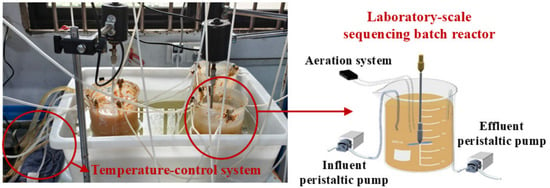
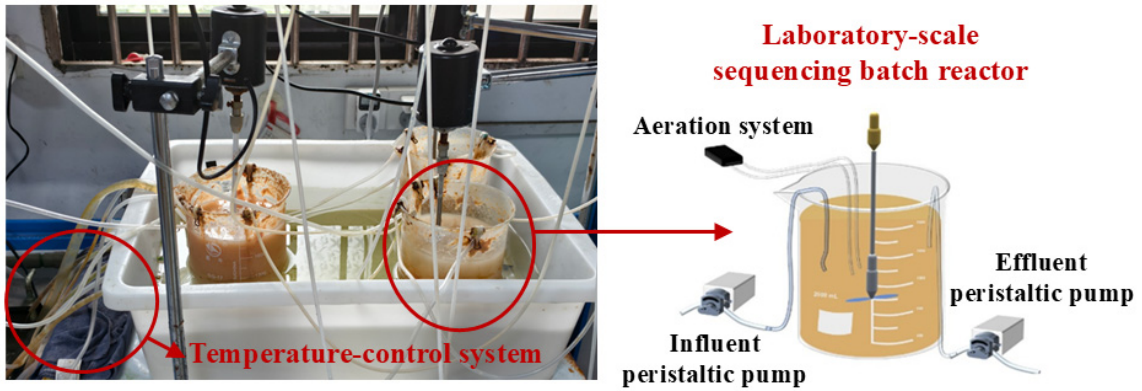
Temperature was regulated using an external recirculating water bath. All three reactors were immersed in a common water tank connected to a thermostatic bath, and the water was circulated at approximately 500 mL min−1. The circulating-water volume was approximately 5.5 L. A schematic of the reactor configuration and temperature-control system, is presented in Figure 1.
Figure 1.
Laboratory-scale sequencing batch reactors for monitoring adaptive responses of salinity-acclimated heterotrophic bacterial communities in halophilic sludge.
Synthetic wastewater was used throughout the experiment. The influent NH4+-N and total organic carbon (TOC) concentrations were maintained at approximately 60 and 480 mg/L, respectively. The temperature was sequentially decreased from 25 to 18, 13, and 8 °C. Stage I was operated at 25 °C on days 1–115, Stage II at 18 °C on days 116–160, Stage III at 13 °C on days 161–205, and Stage IV at 8 °C on days 206–283. Other operating conditions were maintained unchanged during the temperature transitions. The detailed operating conditions for each stage are summarized in Table 1.
Table 1.
Main Operating Parameters of the Reactor.
2.2. Sludge and Synthetic Wastewater
The original activated sludge was obtained from the secondary clarifier of the Ningbo Eastern Wastewater Treatment Plant, Zhejiang Province, China. Before the cooling experiment, the sludge was acclimated under saline conditions using the procedure described previously, with modifications [33,35]. Because ammonium assimilation was not directly quantified in the inoculum using a nitrogen mass balance or isotope tracing, the inoculum is hereafter referred to as salinity-acclimated sludge with ammonium-assimilation potential.
Prior to reactor inoculation, the acclimated sludge was acclimated in a mother reactor under baseline conditions of 50 g/L NaCl, pH 7.88, influent NH4+-N of 40 mg/L, and TOC of 160 mg/L. The physicochemical characteristics of the acclimated sludge were as follows: mixed liquor suspended solids (MLSS) of 8.65 g/L, mixed liquor volatile suspended solids (MLVSS) of 6.13 g/L, and an MLVSS/MLSS ratio of 0.71, demonstrating a high fraction of active biomass prior to the experimental transition.
Three liters acclimated sludge were divided equally among the three reactors. Each reactor received 1.0 L of inoculum and 1.0 L of synthetic wastewater to establish a working volume of 2.0 L.
The composition of the synthetic wastewater mainly consisted of the following substances. NH4Cl was added on an N-equivalent basis to provide 60 mg/L NH4+-N, and sodium acetate was added on a carbon-equivalent basis to provide 480 mg/LTOC. The remaining components were 500 mg/L NaHCO3, 50 mg/L CaCl2, 50 mg/L MgSO4, 22 mg/L KH2PO4, and 1 mL/ L of trace-element solution. NaCl was added separately to establish the designated salinity in each reactor.
The trace-element stock solution contained, per liter, 5.5 g MnCl2·4H2O, 0.5 g CaCl2, 0.68 g ZnCl2, 1.2 g CoCl2·6H2O, 1.2 g NiCl2·6H2O, 4.0 g FeCl2, 1.2 g H3BO3, and 1.2 g (NH4)6Mo7O24·4H2O. The supplier and purity of each chemical are listed in Table S1.
2.3. Analytical Methods
2.3.1. Water Quality and Sludge Biomass
Influent samples were collected immediately before feeding, and the corresponding effluent samples were collected after decanting within the same 12 h cycle. Samples were collected everyday throughout the 283 days experiment. For dissolved nitrogen analyses, samples were centrifuged at 5000 rpm for 5 min. The supernatants were passed through 0.22 μm hydrophilic polyethersulfone (PES) filters and analyzed after storage at 4 °C.
The monitored water-quality parameters, including NH4+-N, NO2−-N, NO3−-N, were determined using a UV–visible spectrophotometer. Total inorganic nitrogen (TIN) was calculated as
TIN = NH4+-N + NO2−-N + NO3−-N.
The volatile suspended solids concentration of mixed liquor (MLVSS) and intracellular ectoine were the sludge-related indicators assessed in this study. The samples were well mixed and sampled concurrently before analysis. Their concentrations were determined in accordance with the standard methods outlined by the American Public Health Association (APHA, Method 2540D and 2540E) [36]. Briefly, a mixed liquor volume (V = 100 mL) was filtered through a pre-weighed filter paper (constant weight m1 dried at 105 °C for 2 h) using a Büchner funnel, followed by repeated rinsing with ultrapure water. The filter paper with the retained sludge was then dried in an oven at 105 °C for 2 h, cooled in a desiccator, and weighed as m2. Subsequently, the dried filter paper was transferred to a crucible, and the total weight was recorded as m3. The crucible containing the sample was then ignited in a muffle furnace at 600 °C for 2 h, cooled in a desiccator, and weighed as m4. The MLSS and MLVSS concentrations were calculated according to the following equations:
2.3.2. EPS Extraction and Quantification
Extracellular polymeric substances (EPS), including tightly bound EPS (TB-EPS) and loosely bound EPS (LB-EPS), were extracted at the end of each operational phase using a modified heat-extraction method [35]. For each reactor, one homogenized sludge sample was divided into three aliquots and analyzed in parallel. These aliquots were analytical replicates and did not constitute independent reactor replicates. Given that DNA constitutes a minor fraction of EPS, only proteins (PN) and polysaccharides (PS) were quantified. PN and PS concentrations in the LB-EPS and TB-EPS fractions were determined using the Coomassie Brilliant Blue G-250 method [37] and the anthrone–sulfuric acid colorimetric method [38], respectively. Total EPS content was calculated as the sum of LB-EPS and TB-EPS, with each fraction representing the sum of its respective PN and PS contents. Before the formal experiment, calibration curves for EPS components were established across the experimental salinity range (25–100 g/L NaCl), confirming that salinity had no appreciable effect on their analytical responses.
The EPS content of each fraction was calculated as the sum of its protein and polysaccharide contents. Total EPS was calculated as the sum of LB-EPS and TB-EPS and was normalized to the corresponding VSS content. The results are reported as mg/g VSS.
2.3.3. Intracellular Ectoine
Intracellular ectoine was measured during representative cycles after stable operation had been reached at each temperature stage. Ectoine extraction and HPLC analysis were conducted using a method adapted from Huang et al. and Chen et al. [33,39]. For each measurement, 10 mL of mixed liquor was centrifuged (4000 rpm, 5 min) and the supernatant was discarded. After removal of the supernatant, the sludge pellet was dried at 105 °C for 120 min. The dried material was extracted with 10 mL of 80% ethanol by shaking at 200 rpm for 30 min. After centrifugation at 4000 rpm for 5 min, the supernatant was filtered through a 0.22 μm membrane.
Ectoine was quantified using an LC-2030C HPLC system (Shimadzu, Kyoto, Japan) equipped with a UV-diode array detector and a C18 column. The injection volume was 10 μL. The mobile phase consisted of ultrapure water and acetonitrile at a volume ratio of 12:88 and was delivered at 0.6 mL min−1. The column temperature, detection wavelength, and analytical run time were 25 °C, 210 nm, and 15 min, respectively.
Quantification was performed using an external ectoine standard (analytical reagent (AR), Shanghai Aladdin Bio-Chem Technology Co., Ltd., Shanghai, China) over a calibration. The calibration curve for ectoine exhibited linearity across a concentration range of 0.01–0.8 mg/L, corresponding to integrated peak areas between 1981 and 36,650,141.
2.4. Microbial Community and Metagenomic Analysis
To comprehensively characterize the microbial communities under different operating conditions, sludge was sampled from each reactor after stable operation had been reached at each temperature stage. A total of 12 samples were obtained, representing three reactors and four temperatures.
Microbial community composition and functional-gene profiles were evaluated using two distinct sequencing approaches. Bacterial community composition was determined by 16S rRNA gene amplicon sequencing, whereas nitrogen-metabolism genes were quantified using metagenomic sequencing. The sequencing and analysis were conducted by Sangon Biotech Co., Ltd. (Shanghai, China). The detection method involved DNA extraction from the samples, followed by Polymerase Chain Reaction (PCR) amplification of the V4 region of the 16S rRNA gene.
Metagenomic sequencing and bioinformatic analysis were performed by Sangon Biotech Co., Ltd. (Shanghai, China). Functional genes associated with nitrogen metabolism were annotated and identified using the Kyoto Encyclopedia of Genes and Genomes (KEGG) database. The selection and interpretation of genes associated with ammonium assimilation and ectoine biosynthesis were informed by the functional pathway framework reported by Huang et al. [33].
The raw 16S rRNA gene and metagenomic sequences have been deposited in the NCBI Sequence Read Archive under BioProject PRJNA1522161. The corresponding BioSample and SRA accession numbers are provided in Table S2.
2.5. Data Analysis and Statistical Processing
Before the formal experiment, calibration curves for NH4+-N, NO2−-N, NO3−-N, EPS proteins, and EPS polysaccharides were established at the experimental NaCl concentrations of 25, 50, and 100 g/L. Comparable calibration responses and linearity were obtained across the tested salinities, indicating no appreciable salinity effect within the evaluated ranges.
Sludge concentration and EPS results are reported as the mean ± standard deviation of three analytical aliquots derived from the same homogenized reactor sample. Data processing and visualization were performed using Microsoft Excel LTSC and OriginPro 2025 (OriginLab Corporation, Northampton, MA, USA).
2.6. Use of Generative AI-Assisted Tools
During manuscript preparation and revision, the authors used ChatGPT (5.6, OpenAI, San Francisco, CA, USA) solely to improve English expression, sentence clarity, and the organization of responses to the reviewers. The tool was not used to generate experimental data, perform statistical or bioinformatic analyses, create figures, or independently interpret the results. All AI-assisted text was reviewed, verified, and revised by the authors, who take full responsibility for the manuscript.
3. Results and Discussion
3.1. Nitrogen Removal Performance Under Stepwise Cooling
3.1.1. Long-Term Performance of Inorganic Nitrogen
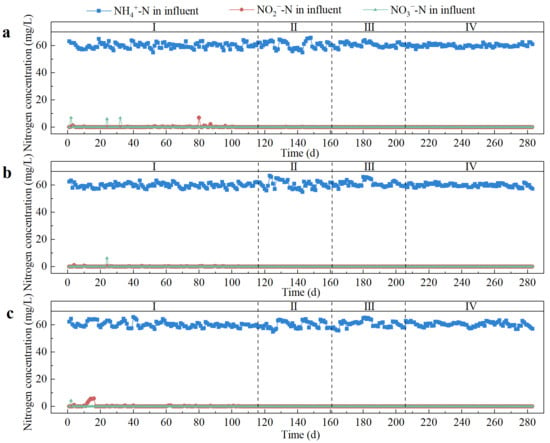
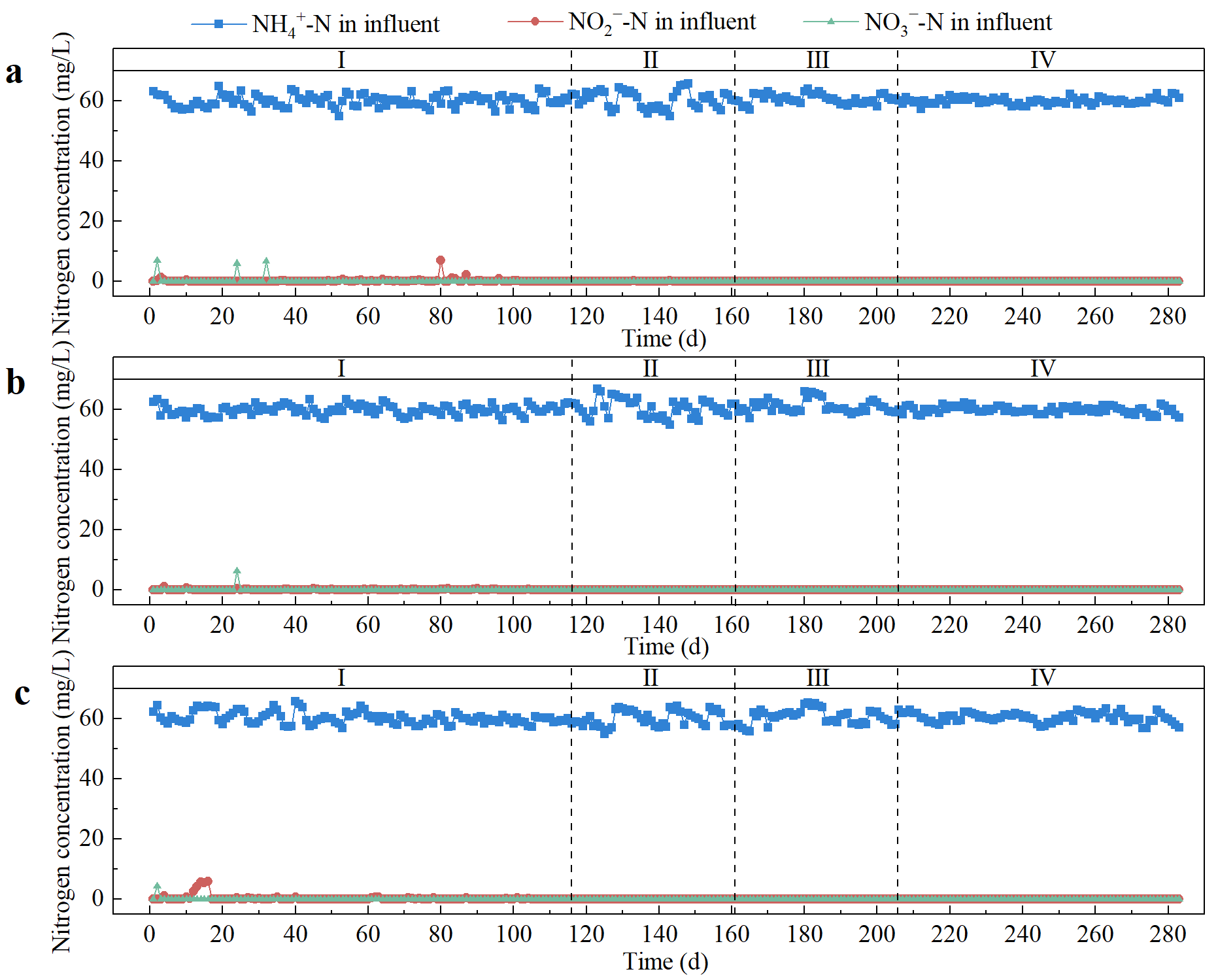
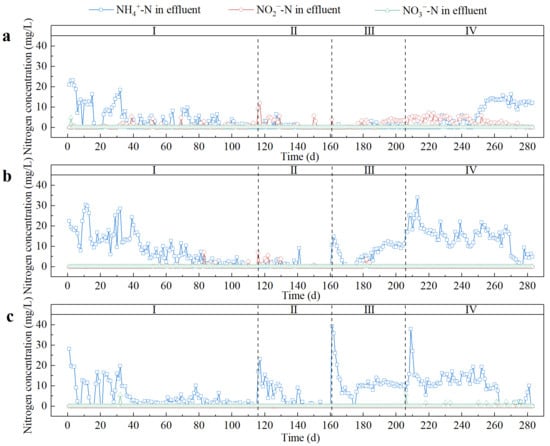
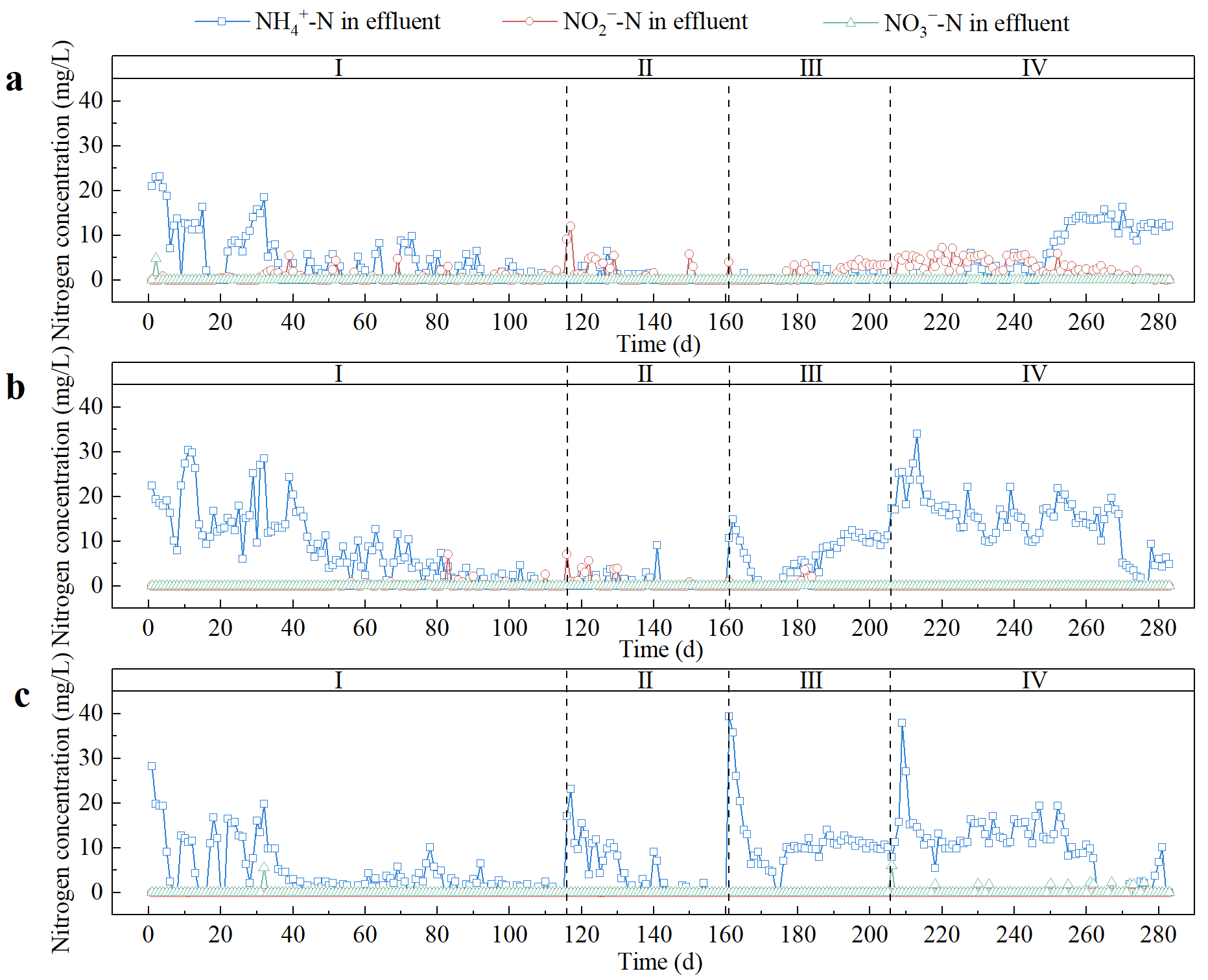
The three SBRs were operated continuously for 283 days to monitor the dynamics of influent (Figure 2) and effluent (Figure 3) ammonium, nitrite, and nitrate under varying salinities. throughout the operational period, the influent NH4+-N concentration remained stable at approximately 60 mg/L in all reactors, while influent NO2−-N and NO3−-N were negligible. During Stage I (25 °C, days 1–115), R1, R2, and R3 all exhibited high aqueous phase inorganic nitrogen removal after start-up acclimation. Effluent NH4+-N gradually decreased to low levels without appreciable accumulation of NO2−-N or NO3−-N, indicating stable apparent removal of aqueous inorganic nitrogen under the three salinity conditions in all three saline systems at 25 °C.
Figure 2.
Changes in influent ammonium, nitrite and nitrate in the reactors of R1 (a), R2 (b), R3 (c) under stepwise cooling. Reactors R1, R2 and R3 contained 25, 50 and 100 g/L NaCl, respectively.
Figure 3.
Changes in effluent ammonium, nitrite and nitrate in the reactors of R1 (a), R2 (b), R3 (c) under stepwise cooling. Reactors R1, R2 and R3 contained 25, 50 and 100 g/L NaCl, respectively.
The transition to Stage II (18 °C, days 116–160) triggered varying degrees of short-term performance fluctuations. Effluent NH4+-N generally remained low in R1 and R2, indicating that the systems containing 25 and 50 g/L NaCl rapidly adapted to the initial cooling. In contrast, R3 showed a pronounced increase in effluent NH4+-N immediately after cooling, followed by a gradual recovery. This transient deterioration implies that 100 g/L NaCl intensified the short-term adverse effect of the temperature transition on inorganic nitrogen removal from the aqueous phase. Nevertheless, oxidized nitrogen species (NO2−-N and NO3−-N) remained at persistently low levels in all three reactors during this stage.
As the temperature was further reduced to 13 °C during Stage III (days 161–205), performance divergences became more pronounced. R1 maintained a low effluent NH4+-N concentration but exhibited moderate NO2−-N accumulation, suggesting a potential imbalance between ammonia oxidation and subsequent nitrite conversion. R2 experienced a transient deterioration immediately after cooling, followed by a gradual recovery in NH4+-N removal. R3 was affected most strongly, as indicated by the rapid increase in effluent NH4+-N after cooling and its persistent residual concentration after acclimation, but the concentration of ammonia nitrogen in the effluent was generally below 10 mg/L.
When the temperature plummeted to 8 °C during Stage IV (days 206–283), ammonium removal was affected in all systems, albeit with distinct response patterns. R1 maintained low effluent NH4+-N initially, followed by a delayed deterioration accompanied by significant NO2−-N accumulation. In its later period, effluent NO2−-N decreased while NH4+-N concurrently increased. R2 exhibited a pronounced increase in effluent NH4+-N immediately after cooling, but the concentration gradually declined after prolonged acclimation, demonstrating relatively strong recovery. R3 showed incomplete aqueous-phase inorganic nitrogen removal and slight NO3−-N accumulation during the early part of Stage IV, followed by a marked decrease in effluent NH4+-N during the later period.
Overall, after stepwise cooling, the three systems maintained high TIN removal efficiencies from the aqueous phase at 8 °C, reaching 79.99 ± 1.32%, 93.20 ± 8.29%, and 95.66 ± 4.34% in R1, R2, and R3, respectively. Crucially, NH4+-N removal during stepwise cooling was not accompanied by a corresponding accumulation of NO2−-N or NO3−-N, and oxidized nitrogen remained at low levels throughout most of the operational period. These results suggest that conventional nitrification alone cannot fully account for the observed ammonium removal. A portion of the ammonium may therefore have been transformed through microbial assimilation and other nonconventional nitrogen transformation pathways.
3.1.2. Cycle Concentration Profiles of Inorganic Nitrogen and Intracellular Ectoine
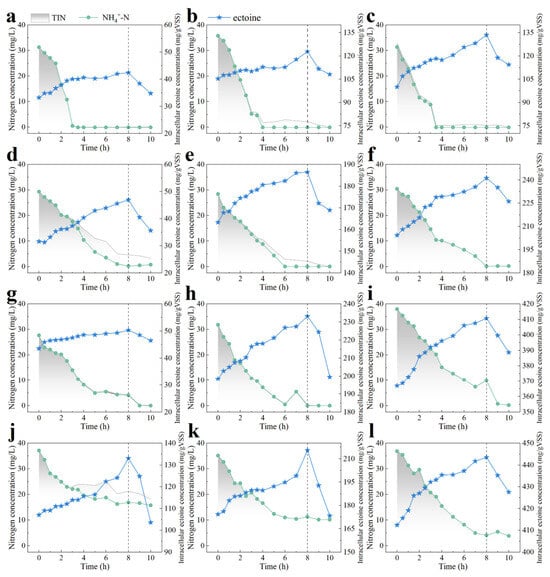
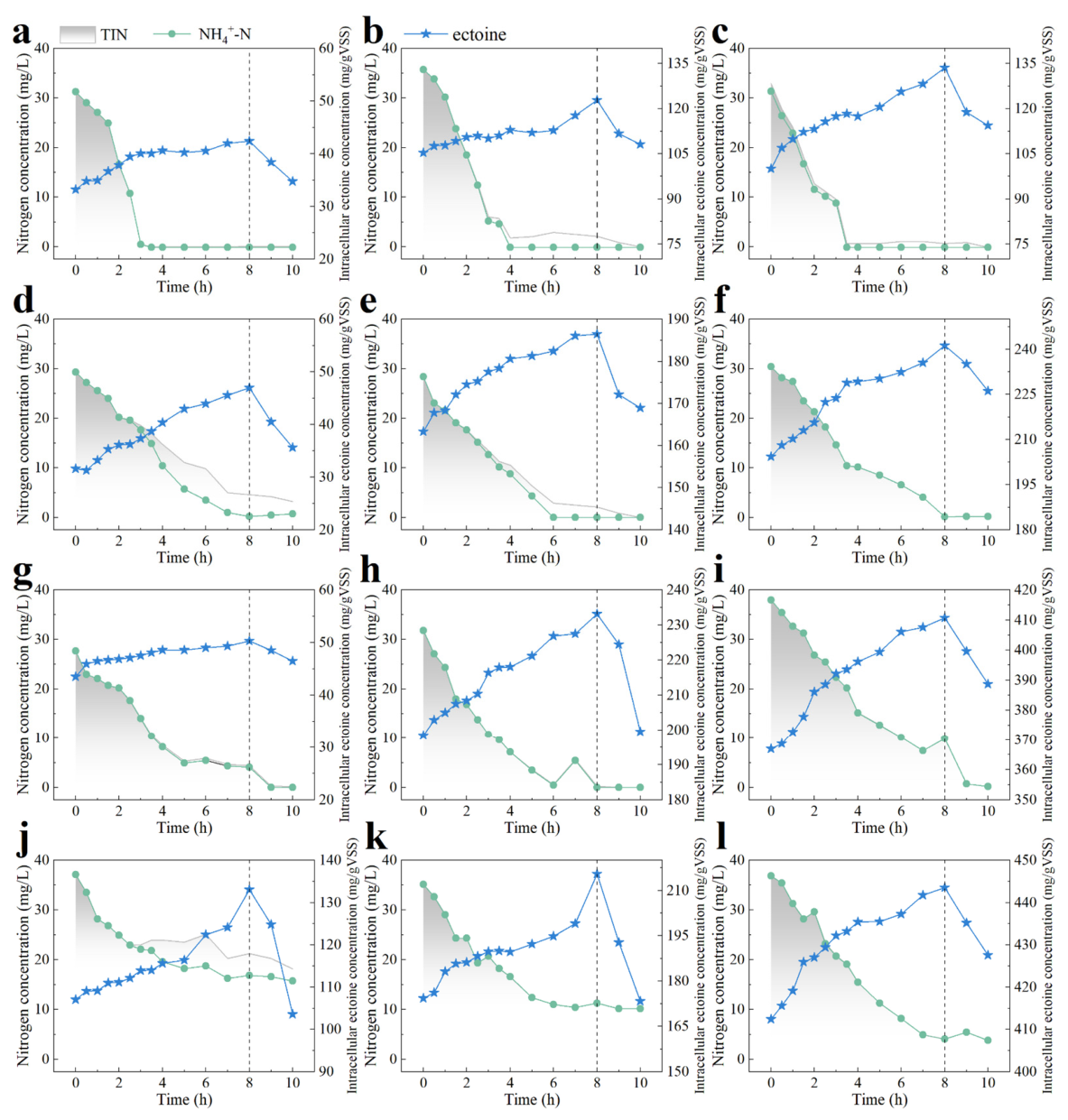
To further delineate dynamic variations in inorganic nitrogen species in the aqueous phase and intracellular ectoine content in sludge during stepwise cooling, intra-cycle variations in the reactors were compared at different temperatures (Figure 4). At 25 °C, NH4+-N decreased rapidly during the early stage of each cycle and was nearly completely removed within 3–4 h across all systems. As the temperature decreased, the removal rate of NH4+-N removal progressively slowed. At 8 °C, residual NH4+-N was evident in R1 and R2, whereas R3 retained a relatively high ammonium transformation capacity. TIN generally followed the NH4+-N profile because NO2−-N and NO3−-N remained at relatively low concentrations.
Figure 4.
Intra-cycle variations in inorganic nitrogen concentrations and intracellular ectoine content after stable operation in each phase. (a) Phase I-R1, (b) phase I-R2, (c) phase I-R3, (d) phase II-R1, (e) phase II-R2, (f) phase II-R3, (g) phase III-R1, (h) phase III-R2, (i) phase III-R3, (j) phase IV-R1, (k) phase IV-R2, (l) phase IV-R3. The vertical dashed lines at 8 h indicate the transition from the aerated phase to the non-aerated phase.
Concurrently with the decrease in the aqueous phase inorganic nitrogen, intracellular ectoine progressively accumulated during the aeration phase, reached a relatively high level at the end of aeration, and subsequently declined rapidly. As salinity increased, ectoine concentrations in R2 and R3 were markedly higher than that in R1. Notably, intracellular ectoine levels surged substantially in all systems as the temperature decreased. The peak concentrations in R1, R2, and R3 increased from 42.46, 122.87, and 133.61 mg/g VSS at 25 °C to 133.03, 215.50, and 443.49 mg/g VSS at 8 °C, respectively. These elevations reveal salt-tolerant microorganisms rely on massive compatible-solute synthesis to survive the compounded stresses of severe cold and high salinity.
As a nitrogenous compatible solute derived from aspartate metabolism, ectoine serves as a vital osmoprotectant (with nitrogen accounting for 19.70% of its molecular weight), whose biosynthesis depends on the continuous incorporation of ammonium into organic nitrogen [33]. The synchronization between ammonium consumption and intracellular ectoine accumulation provides compelling evidence that a fraction of the removed ammonium in the water was assimilated into intracellular nitrogenous compounds rather than being oxidized. Thus, these intra-cycle characteristics validate the contribution of ammonium assimilation to biological nitrogen removal under low-temperature and high-salinity stress.
3.2. Sludge Responses to Stepwise Cooling
3.2.1. Variations in Sludge Biomass
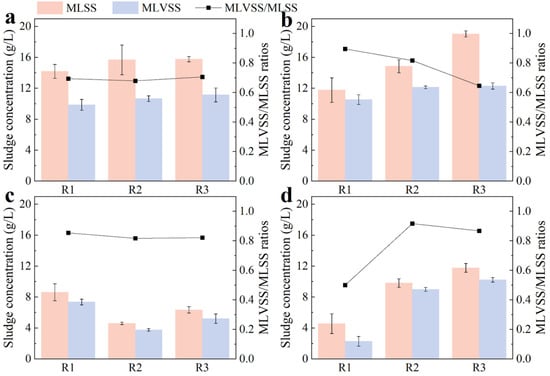
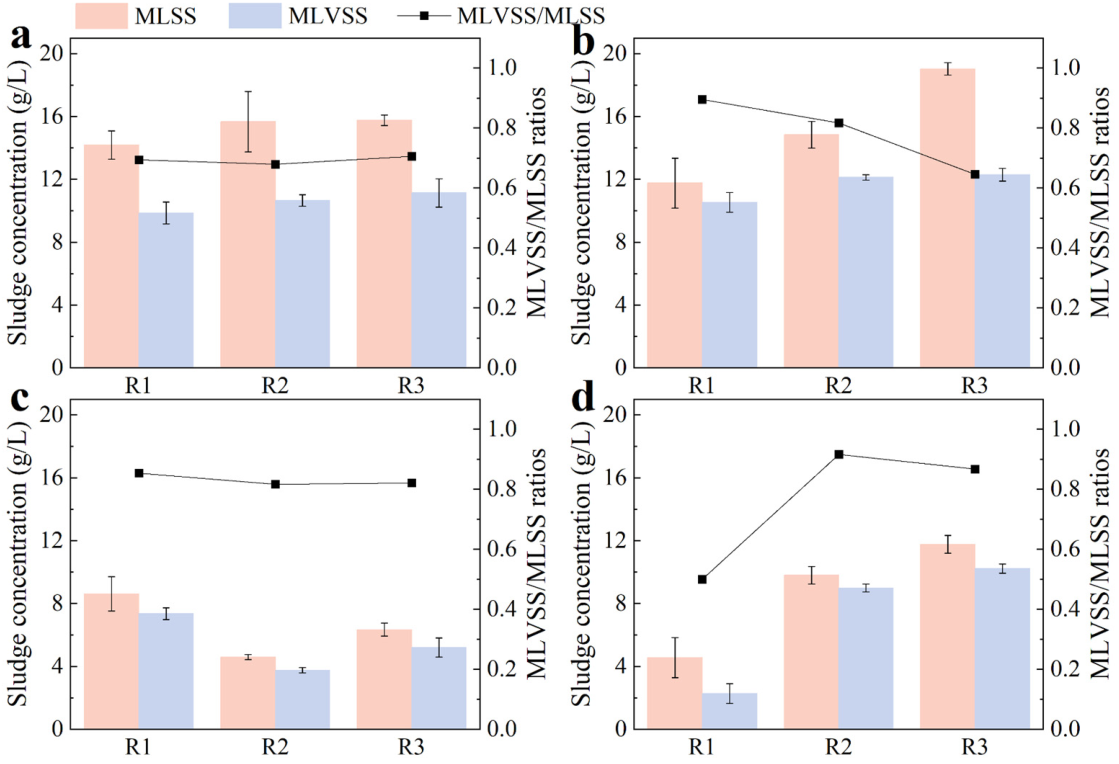
Changes in sludge concentrations during stepwise cooling are shown in Figure 5. At 25 °C, the MLSS concentrations in R1, R2, and R3 were 14.20, 15.68, and 15.78 g/L, respectively, while the MLVSS concentrations were 9.87, 10.66, and 11.15 g/L. Thus, the three systems had comparable biomass levels. Their MLVSS/MLSS ratios were all approximately 0.70. When the temperature decreased to 18 °C, the MLSS in R2 and R3 increased, with R3 reaching the highest value of 19.05 g/L. However, the MLVSS/MLSS ratio in R3 concurrently dropped to approximately 0.65. The increase in MLSS was not accompanied by a proportional increase in MLVSS and may therefore have reflected the accumulation of inorganic solids, EPS, or other particulate material.
Figure 5.
Sludge biomass in phase I (a), phase II (b), phase III (c), phase IV (d).
After the temperature was further reduced to 13 °C, both MLSS and MLVSS declined markedly in all reactors. At 8 °C, the three salinity systems showed distinct responses. In R1, MLSS and MLVSS decreased to 4.57 and 2.29 g/L, respectively, yielding an MLVSS/MLSS ratio of merely 0.50. Conversely, the MLVSS in R2 and R3 stabilized at 9.00 and 10.24 g/L, respectively, maintaining MLVSS/MLSS ratios above 0.85. These physiological retention capabilities were consistent with the superior TIN removal efficiencies observed in R2 and R3 at 8 °C. No obvious solids loss, deterioration in settling, or floc bulking was observed during routine monitoring throughout the experiment, suggesting that severe washout was unlikely to be the sole cause of the decline. The higher MLVSS concentrations retained in R2 and R3 coincided with their higher apparent aqueous-phase TIN removal at 8 °C. These observations indicate that the two systems maintained a larger volatile suspended-solids inventory capable of supporting heterotrophic nitrogen incorporation.
3.2.2. Variations in EPS Content and Composition
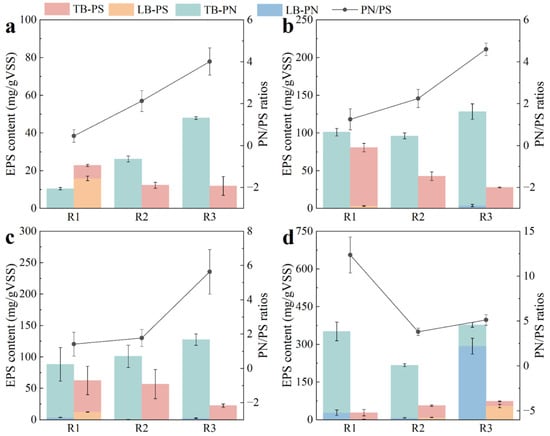
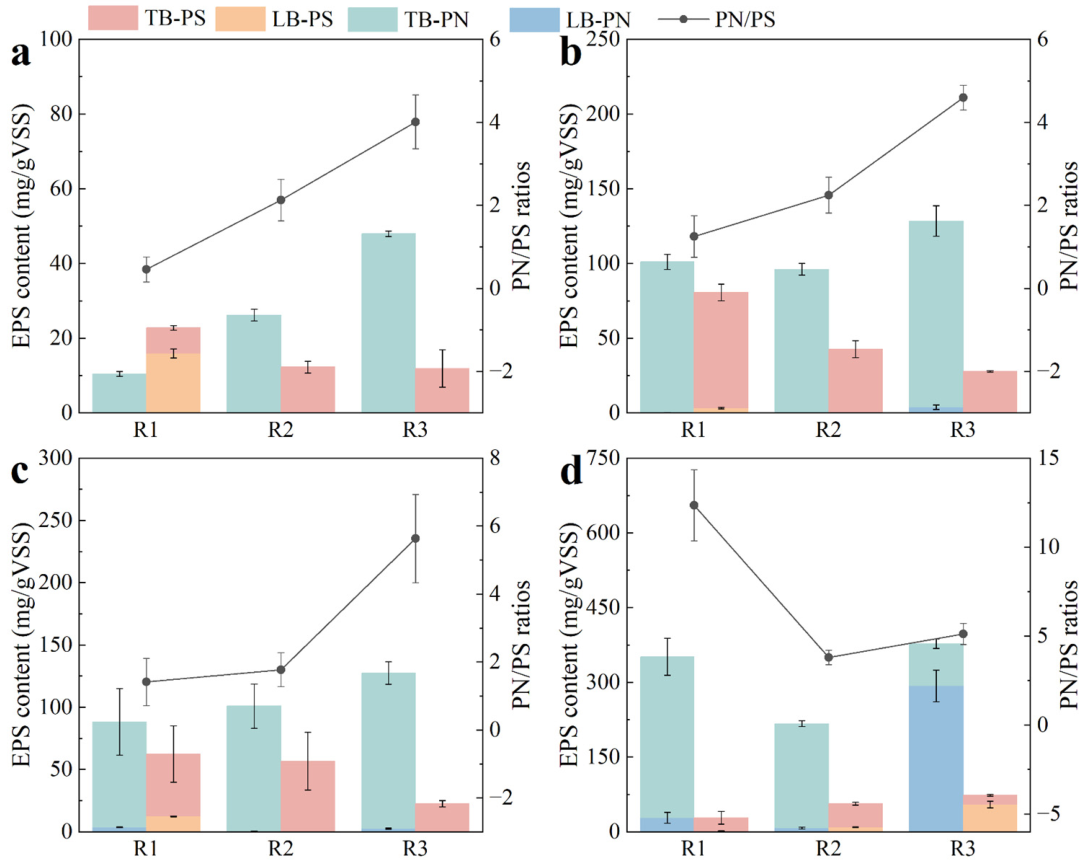
Stepwise cooling changed markedly both the content and composition of EPS (Figure 6). At 25 °C, the total EPS content increased proportionally with salinity. EPS in R1 was predominantly composed of PS, with a PN/PS ratio of 0.46, whereas PN-dominated EPS structures characterized R2 and R3. Upon cooling to 18 °C and 13 °C, the overall EPS content increased across all systems, primarily driven by the massive accumulation of proteins in TB-EPS. This identifies protein-enriched EPS as a crucial structural defense mechanism mobilized by saline sludge against low-temperature stress. Furthermore, R3 consistently maintained the highest EPS contents and PN/PS ratios throughout all phases, showcasing an exceptional capacity for extracellular protein secretion under hypersaline conditions.
Figure 6.
EPS content and composition in phase I (a), phase II (b), phase III (c), phase IV (d).
At 8 °C, the PN contents in R1, R2, and R3 escalated to approximately 352.09, 195.99, and 345.40 mg/g VSS, respectively, vastly outnumbering their corresponding PS contents. While PN accumulation in R1 and R2 occurred mainly in TB-EPS, whereas a large amount of loosely bound protein (LB-PN) accumulated in R3. The compact extracellular layer formed by TB-PN may facilitate cell aggregation, stabilize extracellular enzymes, and alleviate the direct damage caused by low temperature and salinity. In contrast, LB-PN may strengthen the buffering interface between sludge flocs and the surrounding environment.
Notably, despite exhibiting an extremely high PN/PS ratio at 8 °C, R1 experienced a severe decline in active biomass and nitrogen removal. This finding suggests that enhanced EPS production may also represent a compensatory response to low-temperature stress and does not necessarily indicate higher metabolic activity. In stark contrast, R2 and R3 simultaneously maintained high active biomass, protein-rich EPS layers, and excellent TIN removal. This confirms that a stabilized sludge architecture and dynamic extracellular protection are indispensable for preserving ammonium assimilation functionality under low-temperature conditions.
3.3. Microbial Community
3.3.1. Changes in Microbial Community Diversity
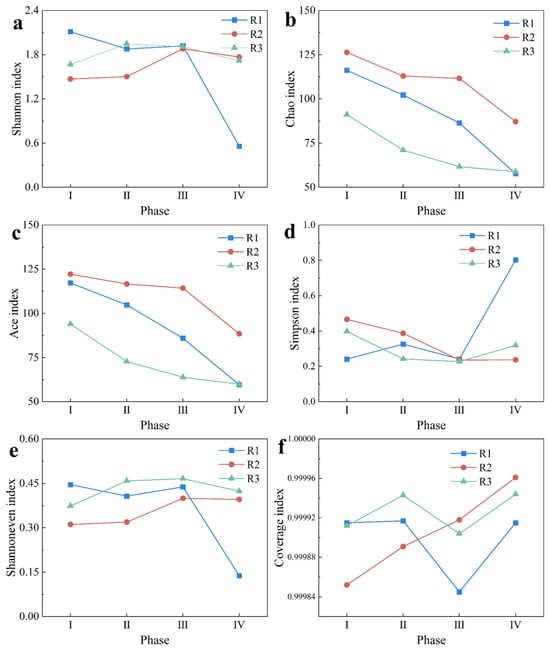
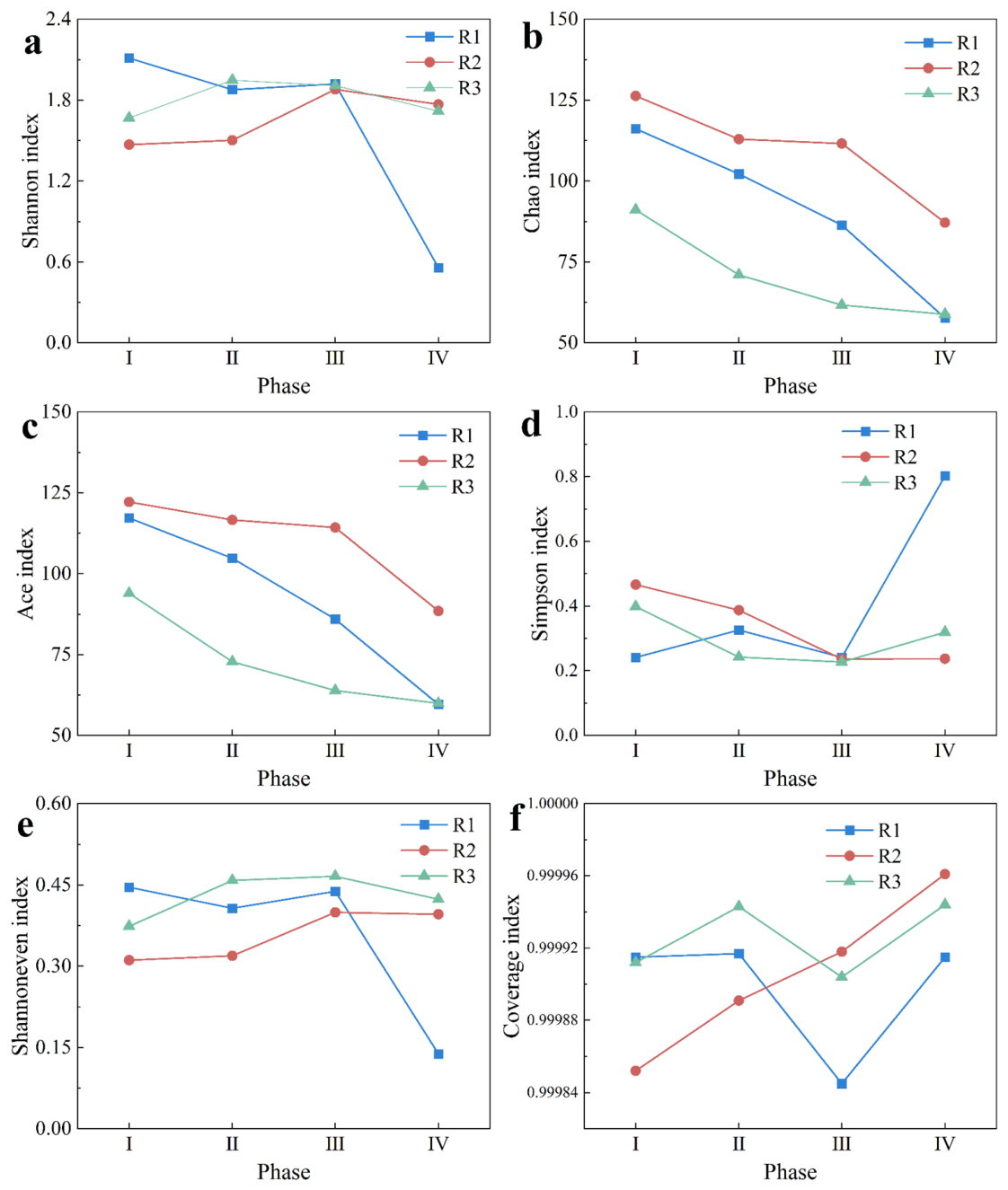
Figure 7 shows the microbial diversity indices of the systems at different operational stages. The coverage index exceeded 0.9998 in all reactors throughout the experiment, ensuring sufficient sequencing depth. As the temperature decreased, the Chao and Ace indices generally declined across all systems, indicating that stepwise cooling eliminated some cold-sensitive microorganisms and progressively reduced community richness. R2 retained relatively high Chao and Ace indices at 8 °C, whereas the loss of species richness was more pronounced in R1 and R3.
Figure 7.
Microbial community diversity in SBR system in different phase. (a) Shannon index; (b) Chao index; (c) Ace index; (d) Simpson index; (e) Shannoneven index; (f) coverage index.
Community evenness responded differently among the three systems. The Shannon index of R2 and R3 remained relatively stable during stepwise cooling. In contrast, the Shannon index of R1 decreased from 2.11 at 25 °C to 0.56 at 8 °C, while its Simpson index increased to 0.80 and its Shannoneven index decreased to 0.14. These changes indicated that the R1 community developed into a less even structure dominated by a few genera at low temperature. Conversely, the sustained richness and evenness in R2 and R3 suggest the successful preservation of a diverse consortium of salt-tolerant heterotrophs. Given that ammonium assimilation requires complex carbon-skeleton availability and synergistic intracellular biosynthesis, this high functional redundancy provided the ecological anchor necessary to sustain nitrogen removal in R2 and R3 at extreme temperatures.
3.3.2. Differences in the Microbial Communities at the Phylum and GENUS Levels
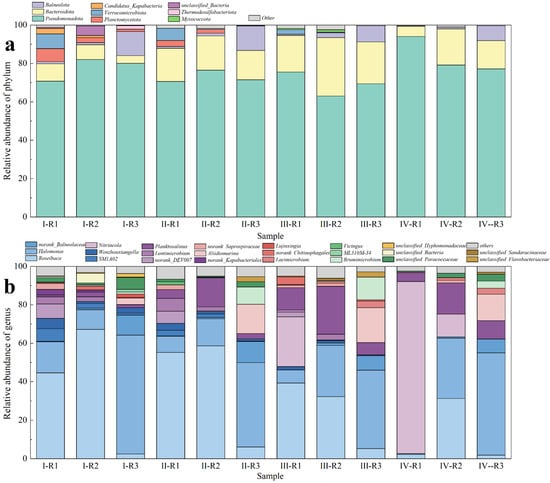
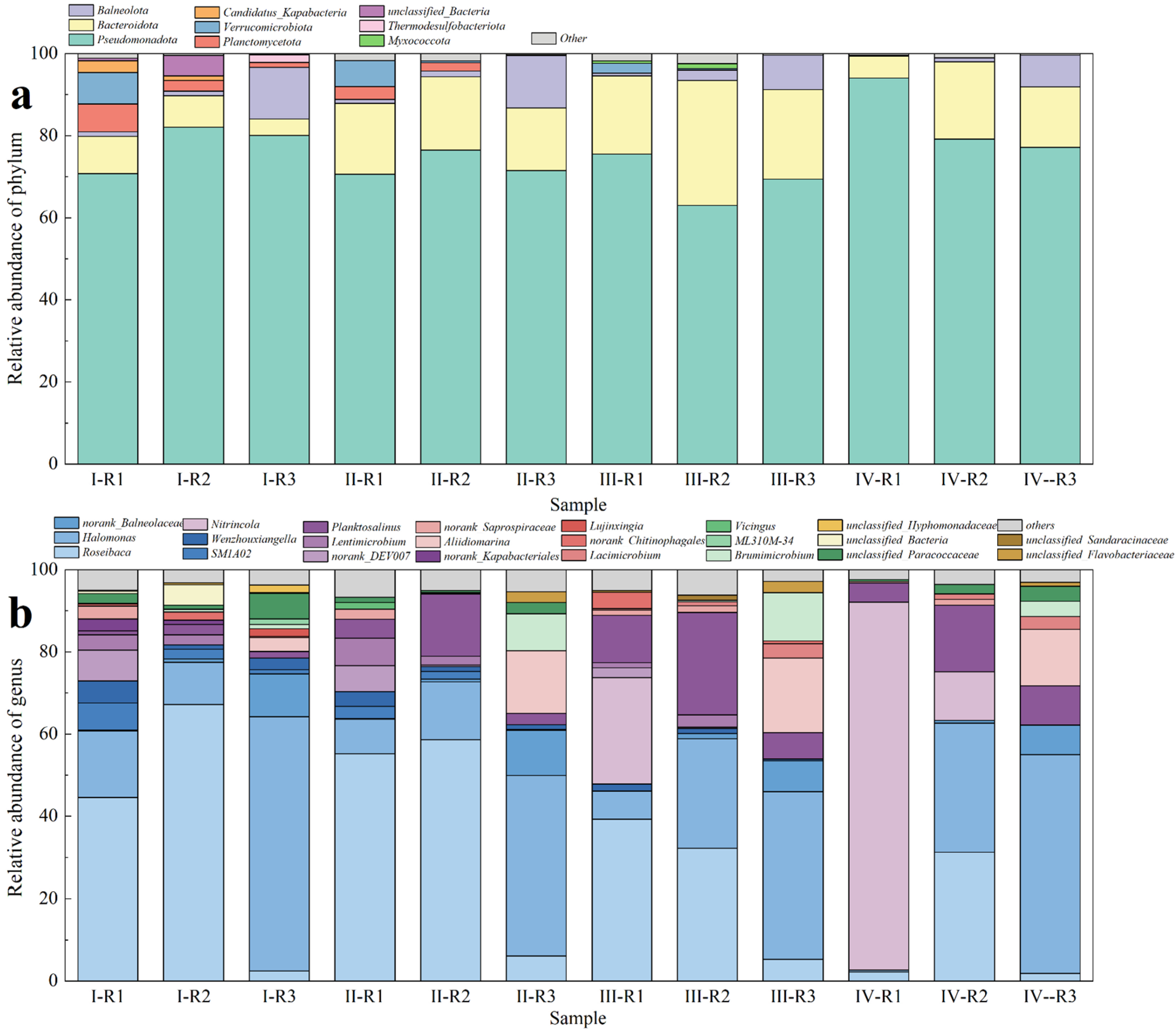
At the phylum level (Figure 8a), Pseudomonadota dominated all samples (62.91–94.05%), acting as the core functional phylum responsible for organic degradation and nitrogen transformation. Bacteroidota and Balneolota were the other major phylum. Bacteroidota is commonly associated with the degradation and transformation of macromolecular organic matter, whereas members of Balneolota are typical halophiles with efficient transmembrane sodium-pumping and compatible-solute regulation systems [40,41]. At 8 °C, the relative abundance of Pseudomonadota increased sharply in R1, while R2 and R3 retained relatively high proportions of Bacteroidota and Balneolota, indicating that the medium and high-salinity systems maintained more complex community compositions at low temperature.
Figure 8.
Relative abundance of phylum (a) and genus (b) in the different reactors.
Changes at the genus level further revealed the effects of salinity and temperature on the functional microbial community (Figure 8b). At 25 °C, R1 and R2 were dominated by Roseibaca (44.60% and 67.17%), while R3 was dominated by Halomonas (61.77%). Previous research showed that Roseibaca in saline-lake biofilms possessed ammonium transporter (amt) and glutamine synthetase (glnA), with coordinated expression of amt and glnA, indicating its potential for ammonium assimilation [42]; their initial enrichment likely drove the rapid NH4+-N assimilation into microbial biomass at 25 °C.
As the temperature decreased, the dominant genera in R1 and R2 gradually shifted from Roseibaca toward Nitrincola, Halomonas, Planktosalinus and Aliidiomarina. At 8 °C, the relative abundance of Nitrincola in R1 reached 89.42%, indicating that the low-salinity system underwent strong selection toward a community dominated by a single genus. However, this high dominance did not ensure stable nitrogen removal. In contrast, R2 fostered a balanced coexistence of multiple genera, including Roseibaca, Halomonas, Nitrincola, and Planktosalinus. R3 remained dominated by Halomonas while retaining Planktosalinus, Aliidiomarina, and other genera. The coexistence of diverse salt-tolerant heterotrophs may have maintained ammonium assimilation at a low temperature through functional complementarity in substrate utilization and nitrogenous compound synthesis.
Among these genera, Halomonas may have played a key role in supporting nitrogen transformation in R2 and R3 at low temperature. Previous studies demonstrated that Halomonas could resist high-salinity stress by synthesizing ectoine and maintain growth and nitrogen transformation at NaCl concentrations of 30–120 g/L [43,44]. In the present study, the persistent enrichment of Halomonas corresponded with the higher intracellular ectoine contents, active biomass levels, and TIN removal efficiencies in R2 and R3. This relationship implies that compatible-solute synthesis may have helped these salt-tolerant bacteria maintain growth and ammonium uptake at low temperature. Halophilic heterotrophic communities can retain inorganic nitrogen in biomass through ammonium assimilation, while stable assimilation can further promote the synthesis of amino acids and osmoprotectants, thereby enhancing the adaptation of halophilic microbial communities to environmental stress [31].
Collectively, stepwise cooling did not uniformly suppress the entire microbial community but instead selected heterotrophic populations with strong salinity and low temperature tolerance. The coexistence of diverse salt-tolerant heterotrophs in R2 and R3 provided a community-level basis for NH4+-N uptake, intracellular nitrogenous compound synthesis, and ectoine accumulation, thereby supporting the potential contribution of ammonium assimilation to nitrogen removal at low temperature.
3.4. Functional Responses of Nitrogen Metabolic Pathways to Stepwise Cooling
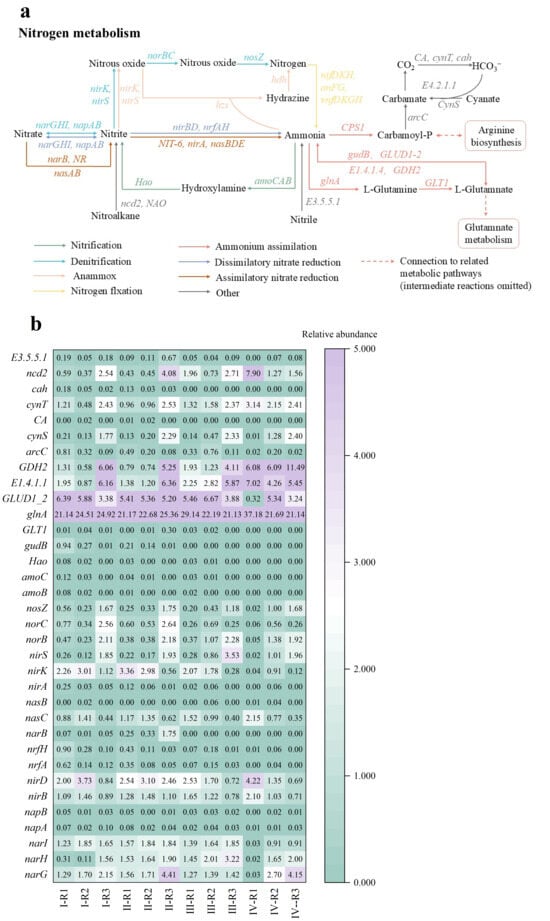
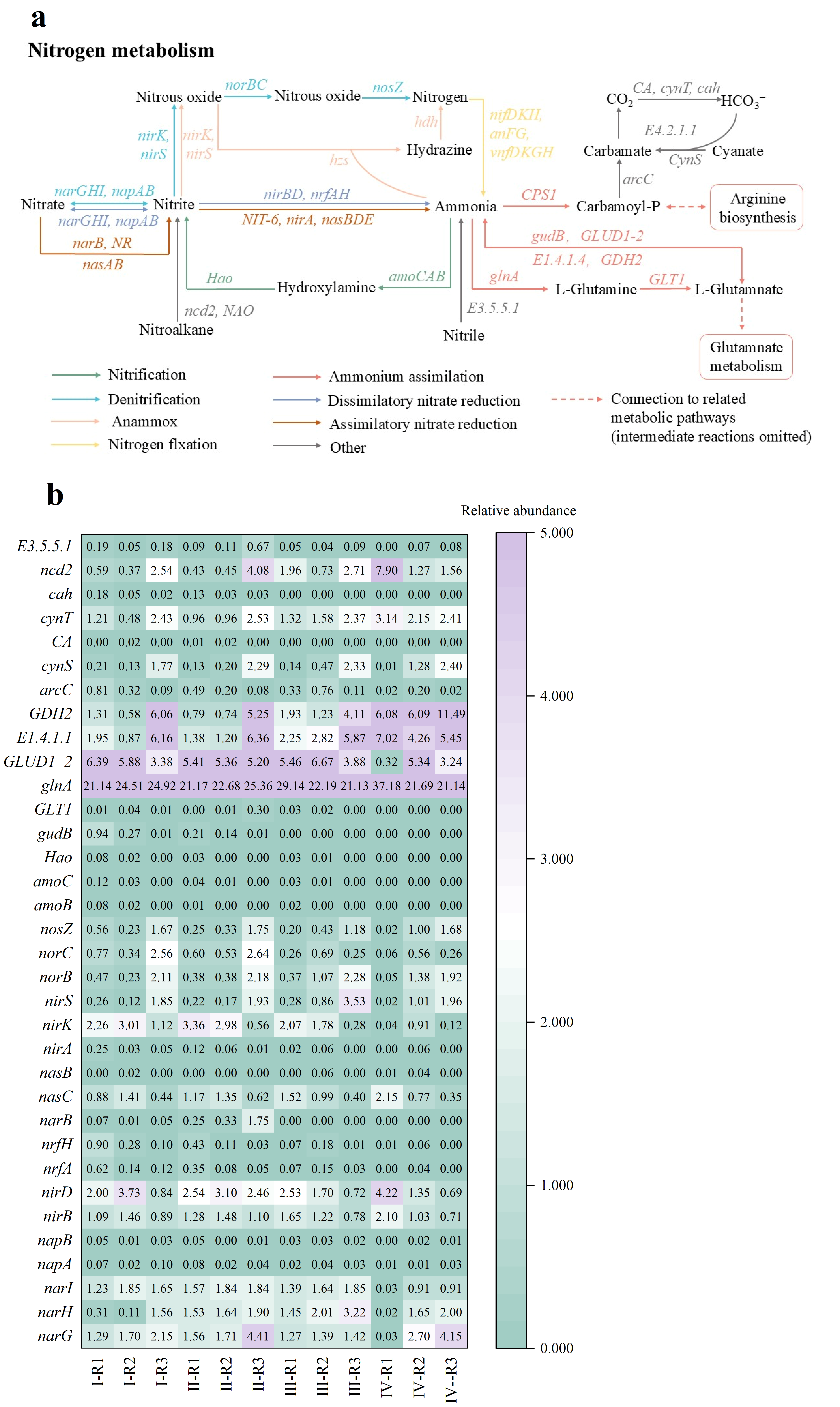
To examine the nitrogen metabolism pathways, functional genes were annotated and quantified using metagenomic analysis (Figure 9) (in RPKM, reads kb−1 million mapped reads−1). Pathways associated with ammonium assimilation, nitrification, denitrification, assimilatory nitrate reduction, and dissimilatory nitrate reduction were detected in all reactors. However, the abundances of the corresponding genes and their responses to temperature varied considerably among pathways.
Figure 9.
(a) The nitrogen metabolism pathway in the microbial communities; (b) relative abundances of nitrogen metabolism-related functional genes.
Across all operational conditions, functional genes responsible for ammonium assimilation remained highly abundant, while nitrification-related genes exhibited low abundances that further diminished as temperature decreased. These findings indicate that the halophilic microbial communities possessed the metabolic potential for ammonium assimilation, thereby facilitating ammonium removal from the saline wastewater and assimilating inorganic nitrogen into cellular biomass [45].
The glutamine synthetase gene (glnA) emerged as the most abundant nitrogen metabolism gene in all samples. At 25 °C, the relative abundances of glnA in R1, R2, and R3 were 21.14, 24.51, and 24.92, respectively. After the temperature dropped to 8 °C, its relative abundances remained as high as 37.18, 21.69, and 21.14. These results suggest that the glnA-mediated GS/GOGAT pathway possessed the metabolic potential to remain fully operative under persistent cooling stress, serving as the core microbial ammonium assimilation route and the essential step for assimilating NH4+-N into amino acids and nucleotides [46].
Notably, although the relative abundance of glnA in R1 increased at 8 °C, a concurrent decline was observed in both aqueous inorganic nitrogen removal and biomass retention. This apparent discrepancy was driven by community collapse and extreme taxonomic dominance (with Nitrincola accounting for 89.42% of the total community) rather than elevated pathway activity. Because metagenomic gene abundance is DNA-based and compositional, an elevated relative abundance does not necessarily translate into enhanced gene expression, enzymatic activity, or system-level nitrogen assimilation. The loss of functional biodiversity, severe depletion of active biomass, and cold-induced carbon skeleton starvation likely constrained the translation of this genetic potential into effective macroscopic nitrogen conversion.
In addition to glnA, reductive amination-related genes, including GDH2, GLUD1_2, and EC 1.4.1.1, also maintained moderate abundances, suggesting that the microbial community harbored the genetic capacity to drive ammonium assimilation through diversified routes. As the temperature decreased from 25 to 8 °C, the relative abundances of GDH2 in R1, R2, and R3 increased from 1.31, 0.58, and 6.06 to 6.08, 6.09, and 11.49, with the largest increase observed in R3. At 8 °C, the relative abundances of GLUD1_2 remained at 5.34 and 3.24 in R2 and R3, but decreased to 0.32 in R1. This finding indicates that the medium and high-salinity systems retained more complete GDH-related functions. Compared with the GS/GOGAT pathway, GDH-mediated reductive amination does not directly consume ATP and may therefore be advantageous at high ammonium concentrations or under energy-limited conditions [47]. Because low temperature restricts energy generation and biosynthetic rates, the retention of functional genes associated with multiple ammonium assimilation pathways in R2 and R3 may have improved their metabolic flexibility, enabling salt-tolerant heterotrophs to continue assimilating NH4+-N at 8 °C.
In contrast, nitrification genes remained consistently low in abundance. At 25 °C, the relative abundances of amoB, amoC, and hao in the reactors were only 0–0.12. Their abundances decreased further with declining temperature and fell below the detection limit at 8 °C. The amoBC and hao genes are involved in ammonia oxidation and hydroxylamine oxidation [14,48], and their low abundances indicate that the functional basis for conventional autotrophic nitrification was limited. In full-scale wastewater treatment systems, temperatures below 15 °C can substantially reduce amoA transcription and result in seasonal nitrification failure [15]. The present results are consistent with this observation and with the limited accumulation of NO2−-N and NO3−-N during long-term operation and typical cycles.
Denitrification genes exhibited distinct responses to temperature and salinity. At 8 °C, the abundances of narGHI, nirS, norBC, and nosZ in R1 decreased to low levels, indicating that its complete denitrification potential was inhibited. In contrast, R2 and R3 retained relatively high abundances of denitrification genes. For example, the relative abundances of narG in R2 and R3 were 2.70 and 4.15, respectively; those of nirS were 1.01 and 1.96; and those of nosZ were 1.00 and 1.68. These may be attributed to the retention of the potential to further reduce oxidized nitrogen to gaseous nitrogen at low temperatures in the moderate- and high-salinity systems. This function has contributed to the limited accumulation of NO2−-N and NO3−-N. Nevertheless, the bulk liquid was maintained in a well-aerated state, and influent oxidized nitrogen was negligible. Furthermore, because ammonia oxidation genes (amoBC, hao) fell below the limit of detection, the substrate supply for sustained nitrification and denitrification were largely cut off. Consequently, denitrification potential functioned merely as an auxiliary metabolic reservoir rather than a primary driver of nitrogen removal.
Taken together, based on metagenomic functional analysis, ammonium assimilation demonstrated superior potential resilience compared to the more psychrosensitive nitrification pathway within the reactors, underpinning an essential functional capacity to maintain inorganic nitrogen removal in saline wastewater systems.
3.5. Limitations and Future Perspectives
The findings of this study should be interpreted within the scope of three laboratory-scale, acetate-fed SBRs operated as individual long-term case-study systems. Because each salinity was represented by one reactor and synthetic wastewater was used, treatment-level statistical inference and direct extrapolation to complex real wastewater are limited. Furthermore, the absence of a complete nitrogen mass balance, 15N tracing, abiotic controls, pathway-specific inhibition, and activity-based analyses prevents quantitative or exclusive attribution of aqueous ammonium depletion to assimilation. The metagenomic results therefore represent functional potential, while ectoine accumulation provides complementary evidence rather than direct confirmation of pathway activity or metabolic flux. Incomplete characterization of analytical uncertainty, floc properties, reaction kinetics, and gas–liquid mass transfer also restricts mechanistic interpretation and scale-up.
Future studies should use replicated factorial designs and representative saline wastewater to distinguish the effects and interactions of salinity, temperature, and matrix composition [49]. Complete nitrogen balances should be integrated with isotope tracing, targeted metabolomics, transcriptomics, enzyme assays, and experimentally constrained metabolic modeling [50] to verify nitrogen pathways. Pilot-scale assessment should further examine biomass retention, oxygen transfer, sludge settling, resistance to fluctuating loads, and risks of washout or nitrite accumulation. Long-term engineering feasibility should ultimately be evaluated through energy, cost, carbon-footprint [51], and life-cycle analyses, together with operational stability and matrix-interference testing.
4. Conclusions
The three salinity-acclimated SBRs exhibited distinct responses to stepwise cooling from 25 to 8 °C under the tested synthetic-wastewater conditions. At 8 °C, the aqueous phase TIN removal efficiencies were 79.99 ± 1.32%, 93.20 ± 8.29%, and 95.66 ± 4.34% in R1, R2, and R3, respectively. Cooling was also accompanied by increased protein-rich EPS. The continued detection of glnA and other assimilation-related genes indicated retained genomic potential for ammonium assimilation. Together with ectoine accumulation and limited net accumulation of oxidized nitrogen, these observations support ammonium assimilation as a plausible contributor to nitrogen transformation during cooling.
Supplementary Materials
The following supporting information can be downloaded at https://www.mdpi.com/article/10.3390/w18192375/s1, Table S1: Main experimental reagents; Table S2: The BioSample and SRA accession numbers of metagenomic.
Author Contributions
Conceptualization, Z.P. and H.Z.; methodology, Z.P., J.S. and D.Z.; software, Z.P.; investigation, Z.P. and H.Z.; writing—original draft preparation, Z.P.; writing—review and editing, H.Z. and K.Z.; supervision, H.Z. and K.Z.; data curation, J.M.; funding acquisition, H.Z. All authors have read and agreed to the published version of the manuscript.
Funding
This research was funded by the Ningbo Municipal Bureau of Science and Technology Key Research and Development Plan (2023Z045, 2023Z146) and the Natural Science Foundation of Ningbo Municipality (2025S203).
Data Availability Statement
The experimental data that support the findings of this study are available from the corresponding authors upon reasonable request.
Acknowledgments
During the preparation of this manuscript, the authors used ChatGPT (5.6, OpenAI) for the purposes for language-editing. The authors have reviewed and edited the output and take full responsibility for the content of this publication.
Conflicts of Interest
The authors declare no conflicts of interest.
References
- Feng, Y.; Qiu, M.; Shao, L.; Jiang, Y.; Zhang, W.; Jiang, W.; Xin, F.; Jiang, M. Strategies for the biological production of ectoine by using different chassis strains. Biotechnol. Adv. 2024, 70, 108306. [Google Scholar] [CrossRef] [Scilit] [PubMed]
- Cao, P.; Li, Z.; Hu, J.; Ye, W.; Ji, Y.; Lin, H.; Zhu, J. UV-assisted electrochemical oxidation for saline wastewater treatment: Condition optimization and mechanism exploration. J. Electroanal. Chem. 2025, 993, 119250. [Google Scholar] [CrossRef] [Scilit]
- Goh, P.S.; Wong, K.C.; Ismail, A.F. Membrane technology: A versatile tool for saline wastewater treatment and resource recovery. Desalination 2022, 521, 115377. [Google Scholar] [CrossRef] [Scilit]
- Li, Z.; Yang, C.; Wang, X.; Chen, Q. Optimal multistage air gap membrane distillation (AGMD) for enhanced lithium extraction from medium- and low-quality brines. Water Res. 2026, 295, 125582. [Google Scholar] [CrossRef] [Scilit] [PubMed]
- Zhang, Y.Q.; Han, J.L.; Cheng, H.Y.; Wang, H.C.; Liu, T.J.; Liang, B.; Wang, A.J. Hypersaline organic wastewater treatment: Biotechnological advances and engineering challenges. Environ. Sci. Ecotechnol. 2025, 24, 100542. [Google Scholar] [CrossRef] [Scilit] [PubMed]
- Panagopoulos, A.; Haralambous, K.-J. Environmental impacts of desalination and brine treatment—Challenges and mitigation measures. Mar. Pollut. Bull. 2020, 161, 111773. [Google Scholar] [CrossRef] [Scilit] [PubMed]
- Zhang, J.; Song, M.M.; Gao, X.; Zhang, M.G.; Hua, J. Design of Saline Wastewater Treatment Process with MVR as Core Treatment Unit. China Water Wastewater 2020, 36, 109–114. [Google Scholar] [CrossRef]
- Huang, W.; She, Z.; Gao, M.; Wang, Q.; Jin, C.; Zhao, Y.; Guo, L. Effect of anaerobic/aerobic duration on nitrogen removal and microbial community in a simultaneous partial nitrification and denitrification system under low salinity. Sci. Total Environ. 2019, 651, 859–870. [Google Scholar] [CrossRef] [Scilit] [PubMed]
- Wu, Z.-Y.; Cai, Y.-B.; Meng, F.-D.; Wang, Y.; Cheng, B.-A.; Zou, H.-M. Electro-assisted microbial transformation of nitrogen in coking wastewater using 3D-BER under low temperature stress: Effect of applied current on nitrification. J. Water Process Eng. 2025, 77, 108572. [Google Scholar] [CrossRef] [Scilit]
- Dong, Y.; Wang, Z.; Li, L.; Zhang, X.; Chen, F.; He, J. Heterotrophic nitrification and aerobic denitrification characteristics of the psychrotolerant Pseudomonas peli NR-5 at low temperatures. Bioprocess. Biosyst. Eng. 2023, 46, 693–706. [Google Scholar] [CrossRef] [Scilit] [PubMed]
- Wu, J.; Li, Y.; Zhang, C.; Xu, Y.; Tang, J.; Li, Q.; Xu, S. How temperature affects anammox for the treatment of ammonia-rich saline wastewater: Phenomena, microbial activity, diversity and resistance genes. J. Environ. Chem. Eng. 2025, 13, 119833. [Google Scholar] [CrossRef] [Scilit]
- Han, F.; Li, X.; Zhang, M.; Liu, Z.; Han, Y.; Li, Q.; Zhou, W. Solid-phase denitrification in high salinity and low-temperature wastewater treatment. Bioresour. Technol. 2021, 341, 125801. [Google Scholar] [CrossRef] [Scilit] [PubMed]
- Li, Z.-H.; Yang, J.-W.; Zhang, H. Increase metabolic heat to compensate for low temperature in activated sludge systems. Water Res. 2024, 250, 121068. [Google Scholar] [CrossRef] [Scilit] [PubMed]
- Qiu, H.; Zhao, W.; Qin, Y.; Wang, Y.; Bai, M.; Su, S.; Wang, C.; Zhao, Z. Ammonia-oxidizing activity and microbial structure of ammonia-oxidizing bacteria, ammonia-oxidizing archaea and complete ammonia oxidizers in biofilm systems with different salinities. Bioresour. Technol. 2025, 423, 132248. [Google Scholar] [CrossRef] [Scilit] [PubMed]
- Johnston, J.; Du, Z.; Behrens, S. Ammonia-Oxidizing Bacteria Maintain Abundance but Lower amoA-Gene Expression during Cold Temperature Nitrification Failure in a Full-Scale Municipal Wastewater Treatment Plant. Microbiol. Spectr. 2023, 11, e02571-22. [Google Scholar] [CrossRef] [Scilit] [PubMed]
- She, Z.; Zhao, L.; Zhang, X.; Jin, C.; Guo, L.; Yang, S.; Zhao, Y.; Gao, M. Partial nitrification and denitrification in a sequencing batch reactor treating high-salinity wastewater. Chem. Eng. J. 2016, 288, 207–215. [Google Scholar] [CrossRef] [Scilit]
- Corsino, S.F.; Capodici, M.; Morici, C.; Torregrossa, M.; Viviani, G. Simultaneous nitritation-denitritation for the treatment of high-strength nitrogen in hypersaline wastewater by aerobic granular sludge. Water Res. 2016, 88, 329–336. [Google Scholar] [CrossRef] [Scilit] [PubMed]
- Huang, J.-L.; Cui, Y.-W.; Yan, J.-L.; Cui, Y. Occurrence of heterotrophic nitrification-aerobic denitrification induced by decreasing salinity in a halophilic AGS SBR treating hypersaline wastewater. Chem. Eng. J. 2022, 431, 134133. [Google Scholar] [CrossRef] [Scilit]
- Xu, A.; Yu, D.; Qiu, Y.; Chen, G.; Tian, Y.; Wang, Y. A novel process of salt tolerance partial denitrification and anammox (ST-PDA) for treating saline wastewater. Bioresour. Technol. 2022, 345, 126472. [Google Scholar] [CrossRef] [Scilit] [PubMed]
- Feng, L.; Li, J.; Ma, H.; Chen, G. Effect of Fe(II) on simultaneous marine anammox and Feammox treating nitrogen-laden saline wastewater under low temperature: Enhanced performance and kinetics. Desalination 2020, 478, 114287. [Google Scholar] [CrossRef] [Scilit]
- Li, W.; Peng, Y.; Gao, R.; Zhang, Q.; Li, X.; Kao, C.; Li, J. Effect of low salinity on nitrogen removal from municipal wastewater via a double-anammox process coupled with nitritation and denitratation: Performance and microbial structure. Bioresour. Technol. 2022, 346, 126633. [Google Scholar] [CrossRef] [Scilit] [PubMed]
- Faust, V.; van Alen, T.A.; Op den Camp, H.J.M.; Vlaeminck, S.E.; Ganigue, R.; Boon, N.; Udert, K.M. Ammonia oxidation by novel “Candidatus Nitrosacidococcus urinae” is sensitive to process disturbances at low pH and to iron limitation at neutral pH. Water Res. X 2022, 17, 100157. [Google Scholar] [CrossRef] [Scilit] [PubMed]
- Hu, Z.; Li, J.; Zhang, Y.; Liu, W.; Wang, A. Exerting applied voltage promotes microbial activity of marine anammox bacteria for nitrogen removal in saline wastewater treatment. Water Res. 2022, 215, 118285. [Google Scholar] [CrossRef] [Scilit] [PubMed]
- Li, P.; Wang, Y.; Liu, Y.; Wang, S.; Peng, Y. The Effect of Salinity on N2O Emissions during Domestic Wastewater Partial Nitrification Treatment in a Sequencing Batch Reactor. Water 2023, 15, 3502. [Google Scholar] [CrossRef] [Scilit]
- Tsuneda, S.; Mikami, M.; Kimochi, Y.; Hirata, A. Effect of salinity on nitrous oxide emission in the biological nitrogen removal process for industrial wastewater. J. Hazard. Mater. 2005, 119, 93–98. [Google Scholar] [CrossRef] [Scilit] [PubMed]
- Abasi, S.; Tarre, S.; Green, M. Nitrous Oxide Emissions from Nitritation Reactors under Hypersaline Conditions. Bioresour. Technol. 2024, 399, 130639. [Google Scholar] [CrossRef] [Scilit] [PubMed]
- Ramdani, A.; Dold, P.; Déléris, S.; Lamarre, D.; Gadbois, A.; Comeau, Y. Biodegradation of the endogenous residue of activated sludge. Water Res. 2010, 44, 2179–2188. [Google Scholar] [CrossRef] [Scilit] [PubMed]
- He, H.; Chen, Y.; Li, X.; Cheng, Y.; Yang, C.; Zeng, G. Influence of salinity on microorganisms in activated sludge processes: A review. Int. Biodeterior. Biodegrad. 2017, 119, 520–527. [Google Scholar] [CrossRef] [Scilit]
- Wang, A.; Liang, Z.; Gao, M.; Chang, R.; Li, Y. Nitrogen source forms govern ammonia assimilation and nitrogen retention through ammonium supply dynamics during composting. Bioresour. Technol. 2026, 450, 134475. [Google Scholar] [CrossRef] [Scilit] [PubMed]
- Lang, X.; Li, Q.; Ji, M.; Yan, G.; Guo, S. Isolation and niche characteristics in simultaneous nitrification and denitrification application of an aerobic denitrifier, Acinetobacter sp. YS2. Bioresour. Technol. 2020, 302, 122799. [Google Scholar] [CrossRef] [Scilit] [PubMed]
- Zhang, M.; Han, F.; Li, Y.; Liu, Z.; Chen, H.; Li, Z.; Li, Q.; Zhou, W. Nitrogen recovery by a halophilic ammonium-assimilating microbiome: A new strategy for saline wastewater treatment. Water Res. 2021, 207, 117832. [Google Scholar] [CrossRef] [Scilit] [PubMed]
- Zhang, G.; Wang, S.; Li, W.; Li, H.; Guo, X.; Li, D.; Lv, L. Denitrification vs. assimilation: Shifting metabolic pathways to enable N recovery from low-strength municipal wastewater. Bioresour. Technol. 2026, 458, 135031. [Google Scholar] [CrossRef] [Scilit] [PubMed]
- Huang, M.; Zhang, H.; Ren, M.; Ji, B.; Sun, K. The synthesis of ectoine enhance the assimilation of ammonia nitrogen in hypersaline wastewater by the salt-tolerant assimilation bacteria sludge. Sci. Total Environ. 2024, 913, 169694. [Google Scholar] [CrossRef] [Scilit] [PubMed]
- Zhang, M.; Zhao, C.; Zhang, W.; Guo, Y.; Han, F.; Li, Y.; Zhou, W. Stable ammonium assimilation mediates the metabolic adaptation of halophilic microbiome to hypo-osmotic stress in wastewater treatment. Water Res. 2026, 288, 124572. [Google Scholar] [CrossRef] [Scilit] [PubMed]
- Ji, B.; Zhang, H.; Zhou, L.; Yang, J.; Zhang, K.; Yuan, X.; Ma, J.; Qian, Y. Effect of the rapid increase of salinity on anoxic-oxic biofilm reactor for treatment of high-salt and high-ammonia-nitrogen wastewater. Bioresour. Technol. 2021, 337, 125363. [Google Scholar] [CrossRef] [Scilit] [PubMed]
- Lipps, W.C.; Braun-Howland, E.B.; Baxter, T.E. (Eds.) Standard Methods for the Examination of Water and Wastewater, 24th ed.; APHA Press: Washington, DC, USA, 2023. [Google Scholar]
- Katherine, M.W.; Thomas, M. Protein concentration of cerebrospinal fluid by precipitation with Pyrogallol Red prior to sodium dodecyl sulphate-polyacrylamide gel electrophoresis. J. Biochem. Bioph. Meth. 2001, 47, 197–207. [Google Scholar] [CrossRef] [Scilit] [PubMed]
- Leyva, A.; Quintana, A.; Sanchez, M.; Rodriguez, E.N.; Cremata, J.; Sanchez, J.C. Rapid and sensitive anthrone-sulfuric acid assay in microplate format to quantify carbohydrate in biopharmaceutical products: Method development and validation. Biologicals 2008, 36, 134–141. [Google Scholar] [CrossRef] [Scilit] [PubMed]
- Chen, J.; Chen, J.; Wang, S.; Zhou, G.; Chen, D.; Zhang, H.; Wang, H. Development and validation of polar RP-HPLC method for screening for ectoine high-yield strains in marine bacteria with green chemistry. Nat. Prod. Res. 2019, 33, 1122–1126. [Google Scholar] [CrossRef] [Scilit] [PubMed]
- Hahnke, R.L.; Meier-Kolthoff, J.P.; García-López, M.; Mukherjee, S.; Huntemann, M.; Ivanova, N.N.; Woyke, T.; Kyrpides, N.C.; Klenk, H.-P.; Göker, M. Genome-Based Taxonomic Classification of Bacteroidetes. Front. Microbiol. 2016, 7, 2003. [Google Scholar] [CrossRef] [Scilit] [PubMed]
- Sorokin, D.Y.; Muntyan, M.S.; Toshchakov, S.V.; Korzhenkov, A.; Kublanov, I.V. Phenotypic and Genomic Properties of a Novel Deep-Lineage Haloalkaliphilic Member of the Phylum Balneolaeota From Soda Lakes Possessing Na+-Translocating Proteorhodopsin. Front. Microbiol. 2018, 9, 2672. [Google Scholar] [CrossRef] [Scilit] [PubMed]
- Lindemann, S.R.; Mobberley, J.M.; Cole, J.K.; Markillie, L.M.; Taylor, R.C.; Huang, E.; Chrisler, W.B.; Wiley, H.S.; Lipton, M.S.; Nelson, W.C.; et al. Predicting Species-Resolved Macronutrient Acquisition during Succession in a Model Phototrophic Biofilm Using an Integrated ‘Omics Approach. Front. Microbiol. 2017, 8, 1020. [Google Scholar] [CrossRef] [Scilit] [PubMed]
- Wang, T.; Jiang, Z.; Dong, W.; Liang, X.; Zhang, L.; Zhu, Y. Growth and nitrogen removal characteristics of Halomonas sp. B01 under high salinity. Ann. Microbiol. 2019, 69, 1425–1433. [Google Scholar] [CrossRef] [Scilit]
- Tanimura, K.; Nakayama, H.; Tanaka, T.; Kondo, A. Ectoine production from lignocellulosic biomass-derived sugars by engineered Halomonas elongata. Bioresour. Technol. 2013, 142, 523–529. [Google Scholar] [CrossRef] [Scilit] [PubMed]
- Ke, X.; Wu, Z.D.; Zhang, X.Y.; Zhou, S.P.; Zhang, Y.C.; Xue, Y.P.; Zheng, Y.G. Nitrogen removal characteristics and salt tolerance mechanisms of the novel bacterium Halomonas sp. W07 in saline wastewater treatment. Bioresour. Technol. 2025, 426, 132338. [Google Scholar] [CrossRef] [Scilit] [PubMed]
- Muller, M.C.; Lemaire, O.N.; Kurth, J.M.; Welte, C.U.; Wagner, T. Differences in regulation mechanisms of glutamine synthetases from methanogenic archaea unveiled by structural investigations. Commun. Biol. 2024, 7, 111. [Google Scholar] [CrossRef] [Scilit] [PubMed]
- van Heeswijk, W.C.; Westerhoff, H.V.; Boogerd, F.C. Nitrogen assimilation in Escherichia coli: Putting molecular data into a systems perspective. Microbiol. Mol. Biol. Rev. 2013, 77, 628–695. [Google Scholar] [CrossRef] [Scilit] [PubMed]
- Kuypers, M.M.M.; Marchant, H.K.; Kartal, B. The microbial nitrogen-cycling network. Nat. Rev. Microbiol. 2018, 16, 263–276. [Google Scholar] [CrossRef] [Scilit] [PubMed]
- Huyan, J.; Wu, X.; Song, Z.; He, Q.; Miao, Z. Rapid and selective lithium recovery from salt lake brine using a manganese-based lithium-ion sieve flow-electrode capacitive deionization system. J. Environ. Chem. Eng. 2026, 14, 122581. [Google Scholar] [CrossRef] [Scilit]
- Dai, H.; Zhang, Y.; Deng, Y.; Guadagnini, A.; Yang, J.; Pan, Z.; Wang, Y. Gene-Informed Modeling of Denitrification Process in Groundwater Through Dynamic Flux Balance Analysis and Deep Learning. Water Resour. Res. 2026, 62, e2026WR043411. [Google Scholar] [CrossRef] [Scilit]
- Ma, Y.; Wan, J.; Tang, H.; Zhang, Y.; Chen, Z.; Chen, X.; Ma, W. Green physical metallurgy approach for capturing silver from waste silicon photovoltaic cells using a tin–bismuth melt. Chem. Eng. J. 2026, 545, 179598. [Google Scholar] [CrossRef] [Scilit]

Disclaimer/Publisher’s Note: The statements, opinions and data contained in all publications are solely those of the individual author(s) and contributor(s) and not of MDPI and/or the editor(s). MDPI and/or the editor(s) disclaim responsibility for any injury to people or property resulting from any ideas, methods, instructions or products referred to in the content. |
© 2026 by the authors. Licensee MDPI, Basel, Switzerland. This article is an open access article distributed under the terms and conditions of the Creative Commons Attribution (CC BY) license.