


Abstract
Heavy metal contamination of water by cadmium (Cd2+) and silver (Ag+) represents a significant environmental concern due to their toxicity and persistence. In this study, peptide-functionalized resins were evaluated as bio-inspired adsorbent materials for metal removal from aqueous solutions. Glycine-based and histidine-containing peptide sequences were synthesized via solid-phase peptide synthesis and immobilized onto Wang and Rink amide resins, with and without N-terminal acetylation. Adsorption capacity (Q, mg g−1) was determined for each material. The results showed that adsorption performance strongly depends on both peptide structure and metal type. Higher adsorption capacities were consistently observed for Cd2+ (up to 7.9 mg g−1) compared to Ag+ (up to 2.4 mg g−1). Interestingly, histidine-containing resins exhibited superior performance, likely due to the presence of imidazole groups that enhance metal coordination. In contrast, the influence of resin type and N-terminal acetylation was less consistent, suggesting a secondary role of these factors. Overall, the findings provide an initial screening or proof-of-concept for peptide-functionalized resins and highlight the potential of these peptidyl resins as effective adsorbent materials for the removal of heavy metals from aqueous environments.
1. Introduction
Water pollution is a critical global issue due to the limited availability of potable water and its essential role in sustaining life. Industrial effluents, particularly from mining and agricultural activities, are major sources of heavy metals, such as cadmium () and silver , which accumulate in ecosystems and pose significant risks to human health [1,2]. is particularly hazardous even at low concentrations, inducing oxidative stress and protein denaturation, while can exert toxic effects on aquatic microbial communities [3,4].
Conventional methods for heavy metal removal often present limitations, such as high operational costs and low efficiency at low metal concentrations [5,6]. Biosorption has emerged as a promising alternative, utilizing materials that offer environmental sustainability [7]. In this context, chelating agents are vital, as they form stable complexes with metal ions through electron-donor atoms (N, O, or S) [8]. This interaction is governed by the Hard and Soft Acids and Bases (HSAB) theory, where “soft” or “borderline” metal acids, such as and , exhibit high affinity for “soft” bases [9]. Amino acid residues like histidine are particularly effective due to the imidazole ring, which provides nitrogen-donor groups for metal coordination. The strong coordination ability of histidine toward metal ions is associated with the high stability constants of histidine–metal complexes, supporting its potential application in selective adsorption systems [10].
To enhance stability and facilitate solid–liquid separation, peptides can be immobilized onto solid supports, forming peptidyl resins [11]. Peptidyl resins offer superior advantages over common adsorbents due to their high density of specific functional groups and the structural stability provided by the polymeric matrix [12]. In this study, Wang and Rink amide resins were selected as supports not only for their well-established role in Solid Phase Peptide Synthesis (SPPS) but also to investigate how different C-terminal linkages (carboxylic acid vs. amide) and resin swelling properties influence metal accessibility to the peptide ligands.
The design rationale for the sequences investigated here focuses on the synergistic effect between the flexibility of glycine spacers and the high coordination capacity of histidine. While peptide–metal interactions are well-documented in biological systems, their application in functionalized solid matrices for wastewater treatment remains underexplored.
Herein, we report the development of specific peptide sequences, directly synthesized on industrial-standard resins, tailored for the selective removal of and . Although synthesis costs and regeneration challenges remain critical factors for large-scale application, this study provides a proof-of-concept for using biomimetic sequences to enhance the performance of heterogeneous adsorbents. Therefore, the objective of this work was to evaluate how peptide length and C-terminal functionalization influence metal-binding efficiency, correlating experimental data with the principles of coordination chemistry.
2. Materials and Methods
2.1. Materials
2.1.1. Chemicals
Fmoc-Gly-OH and Fmoc-His(Trt)-OH, Wang resin, and Rink amide resin were used as solid supports for peptide synthesis (Aapptec Peptides, Louisville, KY, USA). The coupling reagents N,N′-diisopropylcarbodiimide (DIC) and N-hydroxybenzotriazole (HOBt) or OxymaPlus® were employed for peptide bond formation (Aapptec Peptides, Louisville, KY, USA).
Fmoc deprotection was carried out using 20% 4-methylpiperidine in N,N-dimethylformamide (DMF) (Sigma-Aldrich, St. Louis, MO, USA). Dichloromethane (DCM), Triisopropylsilane (TIS), Diisopropylethylamine (DIPEA) (Sigma-Aldrich, St. Louis, MO, USA), and DMF were used as the solvent, scavenger, and base, respectively, for the washing and reaction steps. All reagents and solvents were of analytical grade and used as received.
2.1.2. Instrumentation
Peptide synthesis was monitored using the Kaiser test at room temperature (~25 °C). UV-Vis measurements were performed using a spectrophotometer (Shimadzu, Kyoto, Japan) at a wavelength of 483 nm. The filtration system consisted of a syringe-based prototype coupled to a Kitasato flask and a vacuum pump to control the flow through the resin bed. The concentrations of Cd2+ and Ag+ in solution before and after adsorption were determined using a SpectrAA-220 (Varian, Victoria, Australia) Flame Atomic Absorption Spectrometer (FAAS). As a radiation source, a hollow cathode lamp (Agilent Technologies, Melbourne, Australia) operated at a specific wavelength line for Ag and Cd, respectively, was employed.
2.2. Methods
2.2.1. Synthesis of Peptidyl Resins
Peptidyl resins were synthesized via SPPS using the Fmoc/tBu strategy [13]. Amino acids were sequentially coupled from the C-terminal to the N-terminal while anchored to the solid support. Fmoc deprotection was performed using 20% 4-methylpiperidine in DMF (1 min followed by 20 min). After each deprotection and coupling step, washing cycles were carried out with DMF and DCM to remove excess reagents and byproducts.
Coupling reactions were conducted using a three-fold molar excess of amino acids, DIC, and HOBt in DMF for 2 h. The progress of the reactions was monitored by the Kaiser test, which indicates the presence of free amine groups by the development of a blue coloration.
Glycine-based (GG and/or GGG) and histidine-containing sequences (HGH and HGGHHG) were assembled on Wang and Rink amide resins. For the latter, removal of the trityl protection group was performed as follows using a very dilute acidic solution: 5% TFA in DCM (v/v) and 2.5% TIS as scavenger for 10 min with stirring, with this step repeated 5 to 10 times. Once the trityl group is protonated and released, the solution can turn into a yellow or orange color (the color of the trityl cation), as it forms a highly stable (and highly reactive carbocation). Without scavengers, this cation can re-alkylate the histidine or attack other nucleophilic side chains. After that, the solution was drained and the resin washed with DCM, followed by a solution of 5% DIPEA in DMF to neutralize any residual TFA remaining.
For selected sequences, N-terminal acetylation was performed using 500 µL of anhydride acetic after Fmoc removal of the selected peptidyl resins’ last residues, to evaluate its influence on metal adsorption. After complete synthesis, the peptidyl resins were washed, dried, and stored in a fridge until usage.
A total of sixteen peptidyl resins were obtained, as summarized in Table 1.
Table 1.
Peptidyl resins synthesized for the experiments.
2.2.2. Preparation of Metal Solutions
Aqueous solutions of cadmium (Cd2+) and silver (Ag+) were prepared at an initial concentration of 100 mg L−1 using appropriate metal salts dissolved in deionized water. All the working solutions with a concentration of 10 mg L−1 were then adjusted to pH 5 with HNO3. All experiments were conducted at room temperature.
2.2.3. Adsorption Experiments
Adsorption assays were carried out by passing 25 mL of the metal working solution through a cartridge containing a known mass (100 mg) of peptidyl resin at a controlled flow rate of 0.5 mL min−1 (Masterflex L/S Easy Load Pump, VWR/Avantor, Radnor, PA, USA). The controlled flow allowed sufficient interaction between metal ions and peptide functional groups.
After the adsorption process, the residual metal concentration in the solution was immediately determined using an analytical procedure.
2.2.4. Determination of Metal Concentration
The concentrations of Cd2+ and Ag+ in solution before and after adsorption were determined using a SpectrAA-220 Flame Atomic Absorption Spectrometer (FAAS, Agilent Technologies, Melbourne, Australia). As a radiation source, a hollow cathode lamp operated at a specific wavelength line of 328.1 and 228.1 nm for Ag and Cd, respectively, with a spectral slot width of 0.1 nm. The acetylene (White Martins, São Paulo, Brazil) and air flow rates, as well as the burner height, were adjusted to obtain a maximum absorbance signal under the operating conditions. The parameters followed the manufacturer’s recommendations: airflow 300 mL min−1, and signal integration time 5.0 s.
Calibration curves were constructed using standard solutions of each metal in the concentration range from 0.5 to 10 mg L−1. Solutions without metal ions were used as analytical blanks. Both methods showed excellent linearity (r2 > 0.99), with calibration equations expressed as Abs = 0.206 [Ag+] + 0.163 and Abs = 0.502 [Cd2+] + 0.0418. Limits of detection, calculated as three times the standard deviation of the blank signal, were 0.11 and 0.06 mg L−1 for Ag+ and Cd2+, respectively. Standard solutions containing 5 mg L−1 of each metal were used as quality control samples and analyzed prior to sample measurements.
2.2.5. Adsorption Capacity (Q)
The efficiency of the peptidyl resins for selective metal binding was evaluated using the adsorption capacity (Q, mg g−1). This parameter is defined as the mass (mg) of analyte bound per gram of adsorbent and was calculated according to Equation (1):
where
Ci is the initial metal concentration (mg L−1);
Cf is the final metal concentration after adsorption (mg L−1);
V is the volume of the solution (L);
m is the mass of the resin (g).
The initial concentration of each metal ion solution is 10 mg L−1. For the calculation of the relative adsorption capacity of each peptidyl resin, the corresponding blank (i.e., Rink or Wang resins) adsorption was considered and subtracted.
2.2.6. Data Analysis
All experiments were performed in triplicate, and the results are expressed as adsorption capacity (Q, mg g−1).
3. Results
As an initial screening, the amount of retained metal ions was determined by measuring the concentration of each metal after passing the solutions through the resins. A 10 mg L−1 standard solution (pH 5) was employed, and the amount of metal adsorbed was calculated by subtracting the residual metal concentration measured after contact with the resin from the initial concentration. Each experiment was performed in triplicate. As shown in Table 2, the non-functionalized resins (i.e., blank resins) exhibited higher retention efficiency toward Ag+. In contrast, after functionalization, the resins showed enhanced retention of Cd2+. In some cases, the concentration of metal ions measured after passing through the functionalized resin was higher than that observed for the corresponding blank resin and was indicated as “>blank”.
Table 2.
Concentrations of metal ions measured after passage through the resins and the effective concentrations of metal ions retained by each peptidyl-functionalized resin.
Next, the adsorption capacities (Q, mg g−1) of the resins for Ag+ and Cd2+ metals were calculated. Table 3 presents both the overall adsorption capacities and the effective adsorption capacities, considering an initial metal ion concentration of 10 mg L−1. The effective adsorption capacity (QEFFECTIVE) was determined by subtracting the adsorption capacity of the blank resin from that of each peptidyl-functionalized resin.
Table 3.
Overall and effective adsorption capacities for the non-functionalized (blank) and functionalized resins.
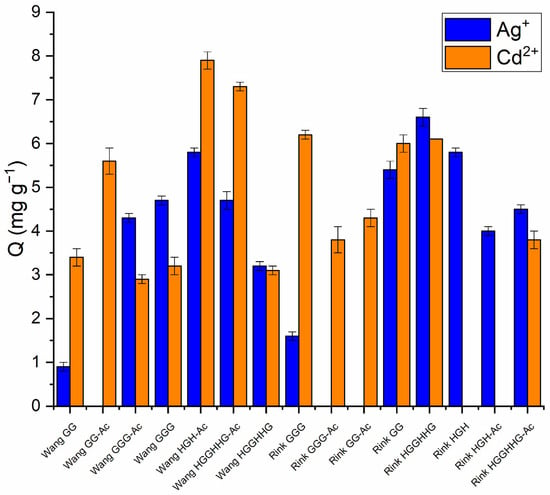
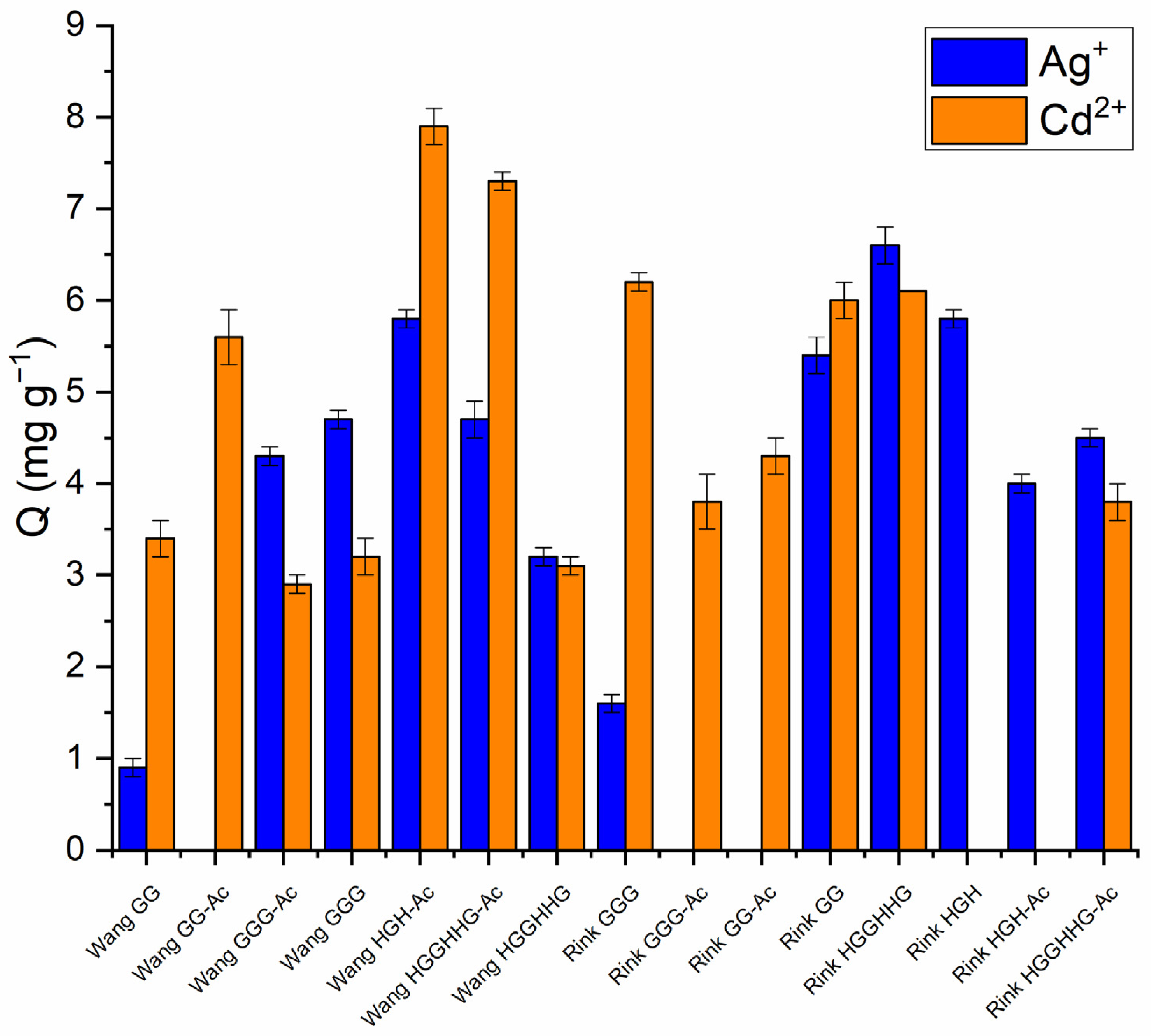
Figure 1 presents the effective adsorption capacity for both metal ions.
Figure 1.
Adsorption capacity (Q, mg g−1) of peptidyl resins for the evaluated metals Ag+ and Cd2+. Blue bars represent Ag+ adsorption, while orange bars represent Cd2+ adsorption. Values correspond to the amount of metal adsorbed per gram of resin for each peptidyl resin tested.
Overall, the adsorption performance strongly depended on both the metal ion and peptide sequence. Higher adsorption capacities were consistently observed for Cd2+ compared to Ag+ across all tested materials. Cd2+ adsorption ranged from 2.9 to 7.9 mg g−1, whereas Ag+ adsorption values were significantly lower, ranging from 0.0 to 2.4 mg g−1.
Among the evaluated systems, histidine-containing peptidyl resins exhibited the highest adsorption capacities for both metals. The highest Cd2+ adsorption was observed for Ac-HGH-Wang (7.9 mg g−1), followed by Ac-HGGHHG-Wang (7.3 mg g−1) and HGGHHG-Wang (5.9 mg g−1). For Ag+, the best performance was achieved by HGGHHG-Rink (2.4 mg g−1), followed by Ac-HGH-Wang (2.3 mg g−1).
In contrast, glycine-based resins (GG and GGG) showed lower adsorption capacities, particularly for Ag+, where some systems exhibited negligible adsorption (0.0 mg g−1). For Cd2+, these materials displayed moderate performance, with values generally ranging between 3.2 and 5.7 mg g−1.
The effect of N-terminal acetylation was not consistent across all samples. While acetylated histidine-containing resins showed improved performance in some cases, this trend was not observed for glycine-based systems.
Regarding the type of resin, Wang-based materials generally exhibited slightly higher adsorption capacities compared to Rink-based resins, although this effect was less pronounced than the influence of peptide composition.
4. Discussion
The results indicate that adsorption behavior is strongly influenced by both the nature of the metal ion and the peptide structure. The consistently higher adsorption observed for Cd2+ compared to Ag+ suggests a greater affinity of cadmium ions for the available binding sites under the experimental conditions. This difference may be associated with distinct coordination preferences and ionic characteristics, which can influence the strength and stability of metal–ligand interactions [11,14].
Peptide composition emerged as the most relevant factor governing adsorption performance. Histidine-containing sequences (HGH and HGGHHG) exhibited significantly higher adsorption capacities compared to glycine-based resins. This behavior may be attributed to the presence of imidazole groups in histidine residues, which provide effective coordination sites for metal ions [11,14]. In contrast, glycine-based sequences lack functional side chains, limiting their ability to interact strongly with the metals, particularly in the case of Ag+ [11]. In any case, additional characterization, such as FTIR, XPS, SEM-EDS, or elemental analysis, would be considered in future studies to further substantiate the proposed binding mechanism.
The relatively modest difference between GG and GGG systems indicates that increasing peptide length alone is not sufficient to substantially enhance adsorption capacity. Instead, the presence of functional residues capable of metal coordination appears to be more critical than chain length [12].
The influence of N-terminal acetylation was not consistent across all samples, suggesting that its effect on adsorption is dependent on the specific peptide structure. In some cases, acetylation may alter peptide conformation or the accessibility of binding sites, but it does not appear to be a dominant factor controlling adsorption efficiency [2].
Similarly, the type of resin support showed a secondary influence on performance. Although Wang-based resins generally exhibited slightly higher adsorption capacities than Rink amide resins, this effect was less significant than the impact of peptide composition. This indicates that adsorption is primarily governed by the chemical nature of the immobilized peptide rather than the support material [12].
Overall, these findings highlight that the incorporation of functional amino acids, particularly histidine, is a key strategy to enhance metal adsorption in peptidyl resins. The observed differences between Cd2+ and Ag+ further suggest that adsorption efficiency is metal-dependent, reinforcing the importance of tailoring peptide structure according to the target contaminant [11,12].
Finally, Table 4 presents a comparison between the adsorption capacities of the peptidyl-functionalized resins and those of other adsorbent materials reported in the literature. As indicated in the table, pH 5 was selected based on conditions employed in previous studies, allowing a more consistent comparison of adsorption performance under similar experimental conditions. The results demonstrate that the performance of the peptidyl-functionalized resins is comparable to that of other adsorbent materials described in the literature.
Table 4.
Adsorption capacity of different sorbent materials published in the literature.
5. Conclusions
Peptidyl resins demonstrated effective capacity for the removal of the heavy metals Cd2+ and Ag+ from aqueous solutions, with adsorption performance primarily governed by peptide composition. Histidine-containing sequences showed the highest capacities, while Cd2+ was more efficiently adsorbed than Ag+. These findings highlight the importance of peptide design for developing potential adsorbent materials for water treatment, providing an initial screening or a proof-of-concept for peptide-functionalized resins. Therefore, future studies involving competing ions, real-water matrices, regeneration studies, optimization of peptide density, and overall process scale-up are needed to perform a complete application of the peptidyl resins.
Author Contributions
M.M.M. and R.S.S.Y.: methodology, investigation; J.F.d.S.P., L.F.M.O. and W.R.S.: methodology, investigation, research, and writing—original draft preparation; R.P.R.C., B.B.N. and L.E.B.: writing—original draft preparation and writing—review and editing; E.F.V.: project administration, funding acquisition, supervision, and writing—review and editing. All authors have read and agreed to the published version of the manuscript.
Funding
This research was funded by the São Paulo Research Foundation (FAPESP), Brazil, grant number 2021/06706-9, and the National Council for Scientific and Technological Development (CNPq, Brazil) process number 311935/2022-2. This study was financed in part by the Coordenação de Aperfeiçoamento de Pessoal de Nível Superior—Brazil (CAPES)—Finance Code 001.
Data Availability Statement
The original contributions presented in this study are included in the article. Further inquiries can be directed to the corresponding author.
Acknowledgments
We would like to thank the São Paulo Research Foundation/FAPESP, National Council for Scientific and Technological Development (CNPq, Brazil), and Coordenação de Aperfeiçoamento de Pessoal de Nível Superior—Brazil (CAPES) for the funding support and the research group “Peptides: Synthesis, Optimization and Applied Studies—PeSEAp”.
Conflicts of Interest
The authors declare no conflicts of interest.
References
- Hama Aziz, K.H.; Mustafa, F.S.; Omer, K.M.; Hama, S.; Hamarawf, R.F.; Rahman, K.O. Heavy metal pollution in the aquatic environment: Efficient and low-cost removal approaches to eliminate their toxicity: A review. RSC Adv. 2023, 13, 17595–17610. [Google Scholar] [CrossRef] [Scilit]
- Madjar, R.M.; Vasile Scăețeanu, G. An Overview of Heavy Metal Contamination in Water from Agriculture: Origins, Monitoring, Risks, and Control Measures. Sustainability 2025, 17, 7368. [Google Scholar] [CrossRef] [Scilit]
- Vitelli, V.; Giamborino, A.; Bertolini, A.; Saba, A.; Andreucci, A. Cadmium stress signaling pathways in plants: Molecular responses and mechanisms. Curr. Issues Mol. Biol. 2024, 46, 6052–6068. [Google Scholar] [CrossRef] [Scilit] [PubMed]
- Le Ouay, B.; Stellacci, F. Antibacterial activity of silver nanoparticles: A surface science insight. Nano Today 2015, 10, 339–354. [Google Scholar] [CrossRef] [Scilit]
- Fei, Y.; Hu, Y.H. Recent progress in removal of heavy metals from wastewater: A comprehensive review. Chemosphere 2023, 335, 139077. [Google Scholar] [CrossRef] [Scilit] [PubMed]
- Dawam, M.; Gobara, M.; Oraby, H.; Zorainy, M.Y.; Nabil, I.M. Advances in membrane technologies for heavy metal removal from polluted water: A comprehensive review. Water Air Soil Pollut. 2025, 236, 461. [Google Scholar] [CrossRef] [Scilit]
- Luo, Y.; Zhang, Y.; Xiong, Z.; Chen, X.; Sha, A.; Xiao, W.; Peng, L.; Zou, L.; Han, J.; Li, Q. Peptides Used for Heavy Metal Remediation: A Promising Approach. Int. J. Mol. Sci. 2024, 25, 6717. [Google Scholar] [CrossRef] [Scilit] [PubMed]
- Qasem, N.A.A.; Mohammed, R.H.; Lawal, D.U. Removal of heavy metal ions from wastewater: A comprehensive and critical review. npj Clean Water 2021, 4, 36. [Google Scholar] [CrossRef] [Scilit]
- Fan, J.; Duan, L.; Zhang, X.; Li, Z.; Qiu, P.; He, Y.; Shang, P. Selective Adsorption and Recovery of Silver from Acidic Solution Using Biomass-Derived Sulfur-Doped Porous Carbon. ACS Appl. Mater. Interfaces 2023, 15, 40088–40099. [Google Scholar] [CrossRef] [Scilit]
- Kanahashi, K.; Urushihara, M.; Yamaguchi, K. Machine learning-based analysis of overall stability constants of metal–ligand complexes. Sci. Rep. 2022, 12, 11159. [Google Scholar] [CrossRef] [Scilit]
- Stillger, L.; Müller, D. Peptide-coating combating antimicrobial contaminations: A review of covalent immobilization strategies for industrial applications. J. Mater. Sci. 2022, 57, 10863–10885. [Google Scholar] [CrossRef] [Scilit]
- Bassan, G.A.; Marchesan, S. Peptide-Based Materials That Exploit Metal Coordination. Int. J. Mol. Sci. 2023, 24, 456. [Google Scholar] [CrossRef] [Scilit] [PubMed]
- Vicente, E.F.; Basso, L.G.M.; Cespedes, G.F.; Lorenzón, E.N.; Castro, M.S.; Mendes-Giannini, M.J.S.; Costa-Filho, A.J.; Cilli, E.M. Dynamics and conformational studies of TOAC spin labeled analogues of Ctx(Ile21)-Ha peptide from Hypsiboas albopunctatus. PLoS ONE 2013, 8, e60818. [Google Scholar] [CrossRef] [Scilit] [PubMed]
- Jomova, K.; Alomar, S.Y.; Nepovimova, E.; Kuca, K.; Valko, M. Heavy metals: Toxicity and human health effects. Arch. Toxicol. 2025, 99, 153–209. [Google Scholar] [CrossRef] [Scilit] [PubMed]
- Fan, S.; Li, H.; Wang, Y.; Wang, Z.; Tang, J.; Tang, J.; Li, X. Cadmium removal from aqueous solution by biochar obtained by co-pyrolysis of sewage sludge with tea waste. Res. Chem. Intermed. 2018, 44, 135–154. [Google Scholar] [CrossRef] [Scilit]
- Kamsonlian, S.; Balomajumder, C.; Chand, S.; Suresh, S. Biosorption of Cd (II) and as (III) ions from aqueous solution by tea waste biomass. Afr. J. Environ. Sci. Technol. 2011, 5, 7. [Google Scholar]
- Moyo, M.; Lindiwe, S.T.; Sebata, E.; Nyamunda, B.C.; Guyo, U. Equilibrium, kinetic, and thermodynamic studies on biosorption of Cd(II) from aqueous solution by biochar. Res. Chem. Intermed. 2016, 42, 1349–1362. [Google Scholar] [CrossRef] [Scilit]
- Kumar, A.; Prabhakaran, J.; Cheshta; Jangra, P.K.; Pali, H.S.; Shah, M.A. Nickel MOF enabled cadmium adsorption: A response surface optimization study. J. Indian Chem. Soc. 2026, 103, 102442. [Google Scholar] [CrossRef] [Scilit]
- Liang, P.; Wang, D.; Qi, H.; Liu, X.; Xu, Y. Biosorption of citric acid-cadmium complex by imprinted chitosan polymer. Desalin. Water Treat. 2013, 51, 3754–3761. [Google Scholar] [CrossRef] [Scilit]

Disclaimer/Publisher’s Note: The statements, opinions and data contained in all publications are solely those of the individual author(s) and contributor(s) and not of MDPI and/or the editor(s). MDPI and/or the editor(s) disclaim responsibility for any injury to people or property resulting from any ideas, methods, instructions or products referred to in the content. |
© 2026 by the authors. Licensee MDPI, Basel, Switzerland. This article is an open access article distributed under the terms and conditions of the Creative Commons Attribution (CC BY) license.