Article

Airflow-Transport-Pathway Dependence of Raindrop Size Distributions and Radar ZR Relationships During the Rainy Season in the Liupan Mountains: Warm-Moist Monsoon vs. Dry-Cold Continental

1
School of Atmospheric Physics, Nanjing University of Information Science and Technology, Nanjing 210044, China
2
Jiangsu Key Laboratory of Disaster Reduction in Marine Meteorology, Jiangsu Ocean University, Lianyungang 222005, China
3
Key Laboratory for Aerosol-Cloud-Precipitation of China Meteorological Administration, Nanjing University of Information Science and Technology, Nanjing 210044, China
4
Institute of Urban Meteorology, China Meteorological Administration, Beijing 100089, China
*
Author to whom correspondence should be addressed.
Water 2026, 18(11), 1270; https://doi.org/10.3390/w18111270 (registering DOI)
Submission received: 11 March 2026 / Revised: 18 April 2026 / Accepted: 22 May 2026 / Published: 24 May 2026
(This article belongs to the Section Hydrology)

Abstract

Raindrop size distribution (DSD) is a crucial parameter for microphysics parameterizations and radar quantitative precipitation estimation (QPE). Using disdrometer and ERA5 reanalysis data collected during the rainy season (July–September 2021) in the Liupan Mountains (LP), this study investigated how the two dominant airflow transport pathway types—the deep warm-moist monsoon (C1) and deep dry-cold continental (C2) types—modulated DSDs in the LP. The results showed that C1 had maritime characteristics, with higher number concentrations and a smaller mass-weighted mean diameter (Dm). C2 showed continental characteristics: low-level evaporation preferentially depleted small drops and increased the contribution of large drops (>2.38 mm), resulting in a larger Dm. Under both types, convective precipitation had broader DSDs than stratiform precipitation. Triggered by orographic lifting, C2 convective precipitation enhanced large-drop growth, making its Dm much larger than that of C1. The ZR relationships were highly sensitive to airflow transport pathways. Dominated by small drops, C1 yielded a smaller ZR coefficient A than C2, whereas reflectivity in C2 was more sensitive to the enhanced large-drop tail. These findings provide an observational basis for improving regional radar QPE accuracy, hydrometeorological forecasting, and water-resource assessment over complex terrain.

1. Introduction

Raindrop size distribution (DSD) is a fundamental parameter for characterizing the microphysical structure of precipitation. Its shape not only determines the empirical relationship between rainfall rate and radar reflectivity, but also represents a critical source of uncertainty in microphysics parameterization schemes in cloud-resolving models and in radar quantitative precipitation estimation (QPE) [1,2]. Complex terrain can strongly affect precipitation microphysics through uplift, convergence, wind shear, and gravity-wave activity. Consequently, these processes can cause pronounced spatial variations in DSDs [3,4]. Accurately characterizing DSD features under orographic influences is essential for practical applications, including flash-flood early warning, water-resource assessment in mountainous areas, and artificial precipitation enhancement operations.
Under orographic forcing, the upslope lifting of warm, moist air not only supplies ample moisture for condensation but also increases in-cloud liquid water content by triggering or enhancing convective activity. This environment promotes the rapid growth of small raindrops at high number concentrations through efficient collision–coalescence, resulting in a broader DSD [5]. In contrast, on the leeward slope, adiabatic warming and evaporation induced by downdrafts reduce the concentration of small drops, leading to a narrower DSD [6]. Furthermore, turbulence and strong wind shear induced by complex terrain can disrupt the aerodynamic stability of falling raindrops. Under strong shear, large raindrops are prone to aerodynamic breakup, which reduces their concentration while increasing the number of secondary small drops. This process alters the slope of the DSD [7]. In addition to orographic forcing, large-scale circulation and moisture-source characteristics also constrain precipitation microphysics [8]. Precipitation influenced by warm, moist monsoon flows typically exhibits maritime characteristics and is dominated by high concentrations of small raindrops. In contrast, precipitation associated with dry, cold continental air masses or strong synoptic disturbances tends to display continental characteristics, with lower number concentrations but a greater contribution from large drops [9,10].
Currently, studies of DSDs over complex terrain primarily focus on regional climatological means or differences along altitudinal gradients [5,6,11,12]. For example, Wang et al. [11] found that eastern coastal island stations have a higher concentration number of small raindrops than inland plain stations, whereas the opposite is true for large raindrops. Zeng et al. [12] observed higher raindrop number concentrations across all diameter bins at the summit of the Tianshan Mountains. Similarly, Wang et al. [5] compared sites in Nagqu and Medog on the Tibetan Plateau, noting higher contributions from large drops within specific diameter ranges at high-elevation stations. Furthermore, Kim et al. [6] highlighted distinct spatial gradients in DSD characteristics varying with altitude and distance from the mountain axis. Although existing studies have shown that terrain statistically modulates DSD, few have incorporated topographic features to comprehensively investigate the evolution of DSD under different airflow transport pathways. Consequently, systematic biases often arise in ZR relationships and key microphysical parameters across different precipitation processes. This limitation ultimately hampers further improvements in the accuracy of radar quantitative precipitation estimation (QPE) and numerical weather prediction over complex terrain [13,14].
The study area, the Liupan Mountains (LP), is located in the transitional zone between the East Asian monsoon region and the westerlies. It serves not only as a critical ecological barrier in central North China, but also as a key region for modulating regional moisture transport. In this setting, the complex terrain strongly influences local hydrothermal conditions and atmospheric dynamics [15,16,17,18]. However, despite the region’s distinct climatic features, no study has yet conducted a systematic analysis of DSD characteristics under different airflow transport pathways. To address this gap, we classified the airflow transport pathways of 24 precipitation events during the 2021 LP rainy season. We then examined DSDs and ZR relationships under the warm-moist monsoon and dry-cold continental types and developed empirical QPE relationships for each type. These results provide preliminary observational insight into precipitation microphysics under different airflow transport pathways during the 2021 rainy season and may serve as a basis for the future optimization of precipitation monitoring and improvement of regional microphysical parameterizations over complex terrain.
The remainder of this paper is organized as follows. Section 2 describes the observation sites, datasets, quality-control procedure, trajectory analysis, and precipitation classification methods. Section 3 presents the airflow transport pathways and the corresponding DSD, μ–Λ, and ZR characteristics. Section 4 discusses the physical implications, uncertainties, and comparisons with previous studies. Section 5 summarizes the main conclusions.

2. Materials and Methods

2.1. Observation Stations and Data Introduction

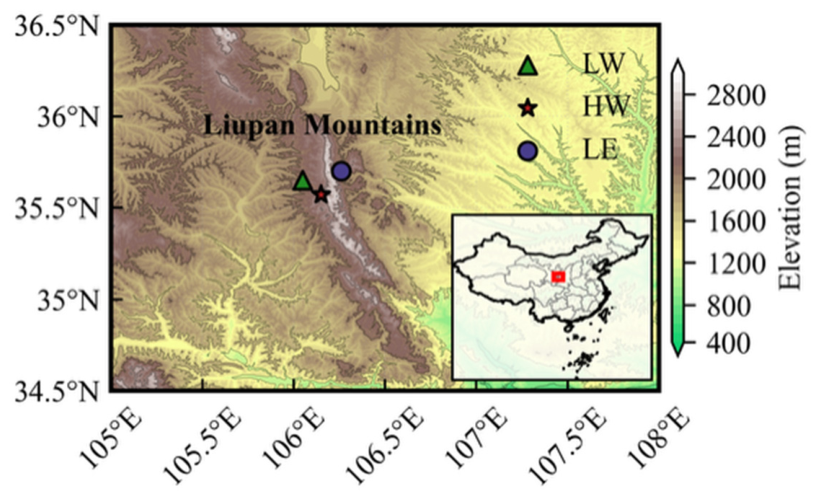
The LP region extends in a northwest–southeast direction, forming an angle of approximately 30° with the north–south axis. The region is characterized by complex terrain with a mean elevation exceeding 2000 m and a peak elevation of 2942 m. This study selected three observational sites: the low-elevation station LW (35.65° N, 106.05° E; 1986 m) and the high-elevation station HW (35.57° N, 106.15° E; 2254 m) on the western slope, and the low-elevation station LE (35.70° N, 106.26° E; 1952 m) on the eastern slope. The geographic setting of the LP and the locations of the three observation stations are shown in Figure 1. The basic information for the three observation stations is summarized in Table 1.
Precipitation was measured using DSG5 laser disdrometers at the three stations during the 2021 rainy season (July–September), which corresponds to the primary precipitation period in the LP [18]. The DSG5 disdrometer determines the hydrometeor diameter and fall velocity by recording the attenuation of a horizontal laser beam and the duration of beam occlusion as particles traverse the sampling area. Measurements were recorded at 60 s intervals over a sampling area of 54 cm2 (180 mm × 30 mm). Particle diameter and fall velocity were discretized into 32 non-uniform classes, spanning 0.05–26 mm and 0.0–22.4 m s−1, respectively. A splash shield was installed on the instrument to reduce contamination from raindrop splash.
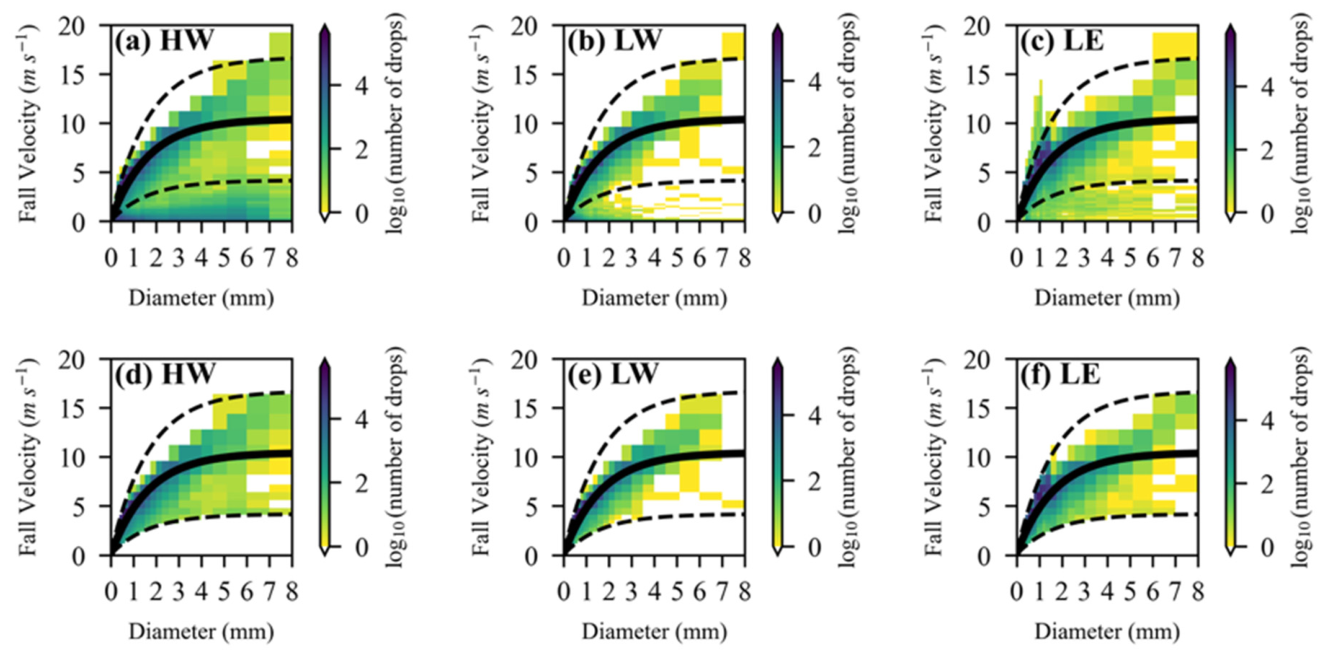
Given the relatively low signal-to-noise ratio in the first two diameter bins [19], drops with diameters between 0.05 and 0.25 mm were excluded. In addition, to ensure physically plausible drop sizes [20], drops larger than 8 mm were discarded. To remove non-precipitation clutter, samples containing fewer than 10 drops or with a rainfall rate below 0.1 mm h−1 were eliminated [21]. Moreover, margin effects arising from partial beam interception, as well as splash-induced artifacts under strong winds and heavy rainfall, can yield outliers with anomalously large diameters and/or unrealistic fall velocities [22,23]. Prior to quality control (QC), fall velocities were corrected for air density to account for elevation effects. These outliers were then filtered using the empirical velocity–diameter relationship of Atlas et al. [24], and drops with fall velocities deviating by more than 60% from the empirical curve were discarded. Figure 2 illustrates the effect of the QC procedure on the joint distributions of drop diameter and fall velocity at the three stations.
To identify precipitation processes common to all three stations (LE, HW, and LW), events were matched based on temporal consistency. A process was classified as a common event when precipitation was observed at all three stations during overlapping time periods, or when the separation between events at different stations was ≤6 h [25,26], which is a widely used event-separation threshold to avoid artificially splitting closely spaced rainfall episodes into different processes. Using these criteria, 24 common precipitation processes were identified during July–September 2021 (Table 2).
Meteorological fields were obtained from the fifth-generation global atmospheric reanalysis (ERA5) produced by the European Center for Medium-Range Weather Forecasts (ECMWF), with a spatial resolution of 0.25° × 0.25°. To characterize precipitation processes over the LP, hourly ERA5 data from July to September 2021 were extracted, including total column water vapor (TCWV), temperature, and specific humidity. To examine the thermodynamic and moisture environments during precipitation events, gridded variables were sampled at each station using the nearest-grid-point method. ERA5 reanalysis was mainly used to characterize differences in moisture and thermal conditions associated with different moisture-transport pathways within the region.
The main datasets used in this study and their basic information are summarized in Table 3.
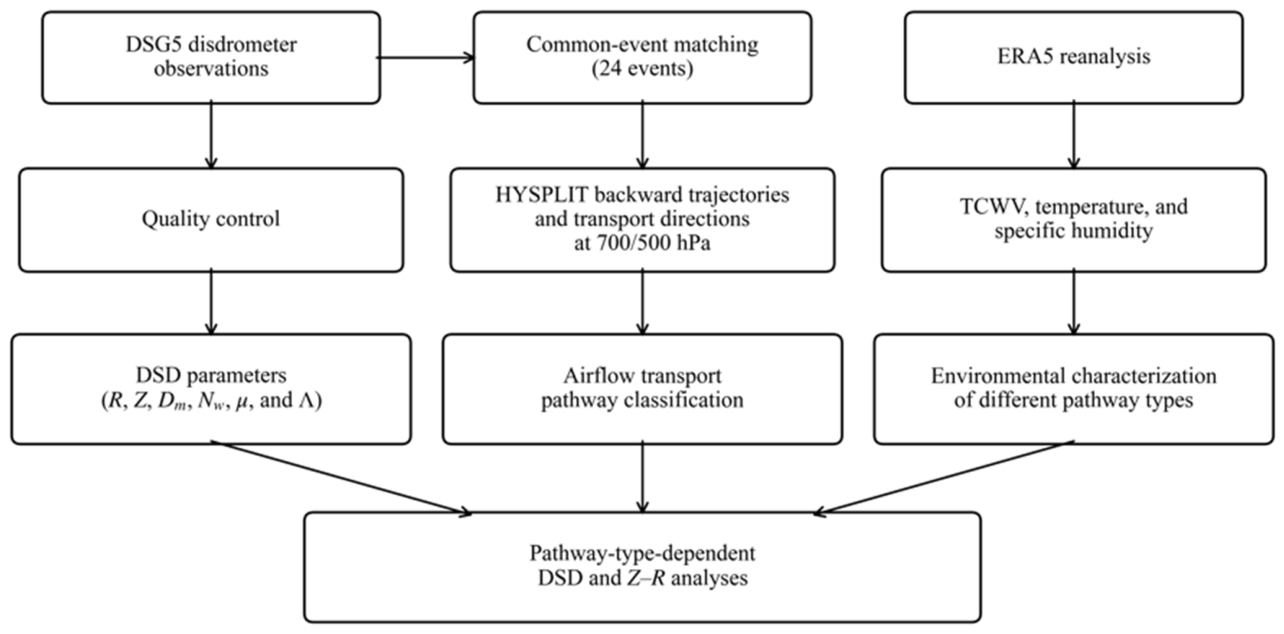
A schematic workflow of the main data processing and analysis steps is shown in Figure 3.

2.2. Characteristic Parameters

This study derived the raindrop concentration (N(Di), m−3 mm−1) from DSD data using Equation (1) [23,27]:
N D i = j = 1 32 n i j A i · t · V j · D i
where N(Di) (m−3 mm−1) denotes the raindrop number concentration per unit volume and size interval for diameter Di; nij represents the number of raindrops in size bin i and velocity bin j; Ai (m2) is the disdrometer’s effective sampling area; ∆t (s) is the sampling interval (60 s for the DSG5 laser disdrometer); Di (mm) is the diameter of the i-th size bin; ΔDi (mm) is the corresponding diameter interval; and Vj (m s−1) is the fall speed of velocity bin j.
Integral rainfall parameters, including rainfall rate R (mm h−1), liquid water content W (g m−3), total number concentration Nt (m−3), and radar reflectivity factor Z (mm6 m−3) were calculated using Equations (2)–(5):
R = 6 π 10 4 i = 1 32 j = 1 32 V j N D i D i 3 D i
W = π ρ w 6000 j = 1 32 N ( D i ) D i 3 D i
N t = i = 1 32 N D i D i
Z = i = 1 32 N ( D i ) D i 6 D i
In addition, this study used the mass-weighted mean diameter Dm (mm) and normalized intercept parameter Nw (mm−1m−3) to characterize the statistical properties of DSDs, as detailed in Equations (6) and (7):
D m = j = 1 32 N ( D i ) D i 4 D i i = 1 32 N ( D i ) D i 3 D i
N w = 4 4 π ρ W ( 10 3 W D m 4 )
This study also employed the gamma distribution shape parameter μ and slope parameter Λ (mm−1), with calculations detailed in Equations (8)–(13):
N D = N 0 D μ e x p ( Λ D )
M n = 0 N D D n d D = N 0 Γ ( n + 1 + μ ) Λ n + 1 + μ
N 0 = M 3 Λ μ + 4 Γ ( μ + 4 )
μ = 11 G 8 + G ( G + 8 ) 2 ( 1 G )
Λ = ( μ + 4 ) M 3 M 4
G = M 4 3 M 3 2 M 6
where D (mm) denotes the raindrop diameter, and N0 (mm−1-μ·m−3) represents the intercept parameter.

2.3. Airflow Trajectory Simulation

Backward air-mass trajectories were computed using the Hybrid Single-Particle Lagrangian Integrated Trajectory (HYSPLIT) model developed by the National Oceanic and Atmospheric Administration (NOAA). In HYSPLIT, the air-parcel position is calculated by integrating the three-dimensional wind field backward in time, where the rate of change of parcel position is determined by the resolved wind vector from the driving meteorological dataset. In this study, the model was run in backward mode for 24 h for each precipitation event. The HW station (35.57° N, 106.15° E; 2254 m a.s.l.) was used as the receptor location. For each precipitation event, a 24-h backward trajectory was initialized at the event onset time. Trajectories were started at two heights above ground level (AGL): 750 m (≈3000 m a.s.l.; ≈700 hPa) to represent low-level transport strongly influenced by topography, and 3250 m (≈5500 m a.s.l.; ≈500 hPa) to capture upper-level flows associated with the westerlies or the periphery of the subtropical high. The HYSPLIT model was driven by meteorological fields from the NCEP Global Data Assimilation System (GDAS), and the trajectory output included the air-mass position (latitude and longitude) and specific humidity (q) at each time step. The purpose of the HYSPLIT analysis was to diagnose synoptic-scale airflow pathways and moisture-source characteristics, rather than to simulate local precipitation development directly.

2.4. Airflow Transport Pathway Classification Criteria

Airflow transport pathways were classified according to the dominant airflow directions indicated by the 24-h backward trajectories at 700 and 500 hPa. Events were assigned to C1 when both levels showed southerly to southeasterly transport (S–SE/S–SE), to C2 when both levels showed northwesterly transport (NW/NW), to C3 when the lower level showed S–SE transport and the upper level showed W–NW transport, to C4 when the lower level showed E–NE transport and the upper level showed S–SE transport, and to C5 when the lower level showed E–NE transport and the upper level showed W–SW transport. The corresponding event IDs and the main environmental characteristics of each airflow transport pathway are listed in Table 4.

2.5. Classification of Stratiform and Convective Precipitation

We adopted the classification method proposed by Bringi et al. [28] to distinguish between stratiform and convective precipitation. At least 10 min of consecutive DSD samples were aggregated into 10-min segments, and the mean rainfall rate (R) and the standard deviation of R (σ) were calculated for each segment. A segment was classified as stratiform when R ≥ 0.5 mm h−1 and σ ≤ 1.5 mm h−1, whereas it was classified as convective when R ≥ 5 mm h−1 and σ > 1.5 mm h−1. The 10-min aggregation was used to reduce minute-to-minute fluctuations in rainfall rate and to provide a more stable basis for precipitation-type classification. Samples that did not satisfy either the stratiform or convective criteria were not included in the SP/CP comparison. Based on this scheme, the fractions of convective (stratiform) segments at HW, LW, and LE were 4.03% (42.39%), 3.35% (41.08%), and 4.00% (50.15%), respectively. This scheme was adopted because it has been widely used in disdrometer-based DSD studies and provides a practical way to distinguish relatively steady rainfall from more variable convective precipitation in the absence of radar-based echo classification.

3. Results

3.1. Synoptic Background Characteristics and Classification

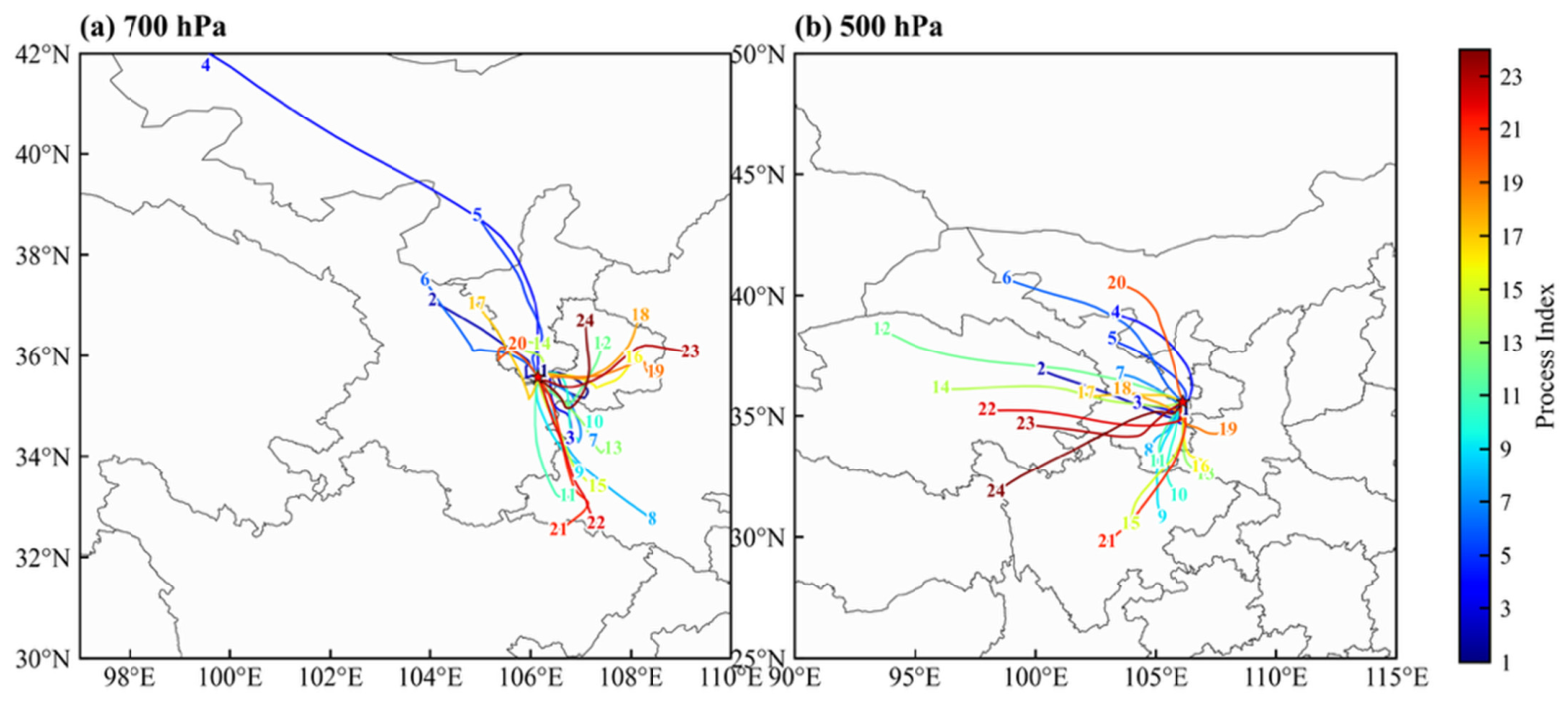
Given that the maximum elevation of the LP is approximately 2.8 km and that the mid-to-upper troposphere is strongly influenced by the westerlies, we analyzed the airflow transport characteristics at 700 and 500 hPa for all precipitation events [29,30,31]. Based on the dominant transport directions indicated by the HYSPLIT backward trajectories, the airflow pathways for the 24 precipitation events were summarized (Figure 4). At 700 hPa, airflow directions were mainly concentrated in the S–SE, NW, and E–NE sectors, whereas at 500 hPa, they were primarily from the SW, W, and NW sectors.
Based on the airflow transport directions at 700 hPa and 500 hPa shown in Figure 4, five pathway types (C1–C5) influencing surface precipitation were identified (Table 4).
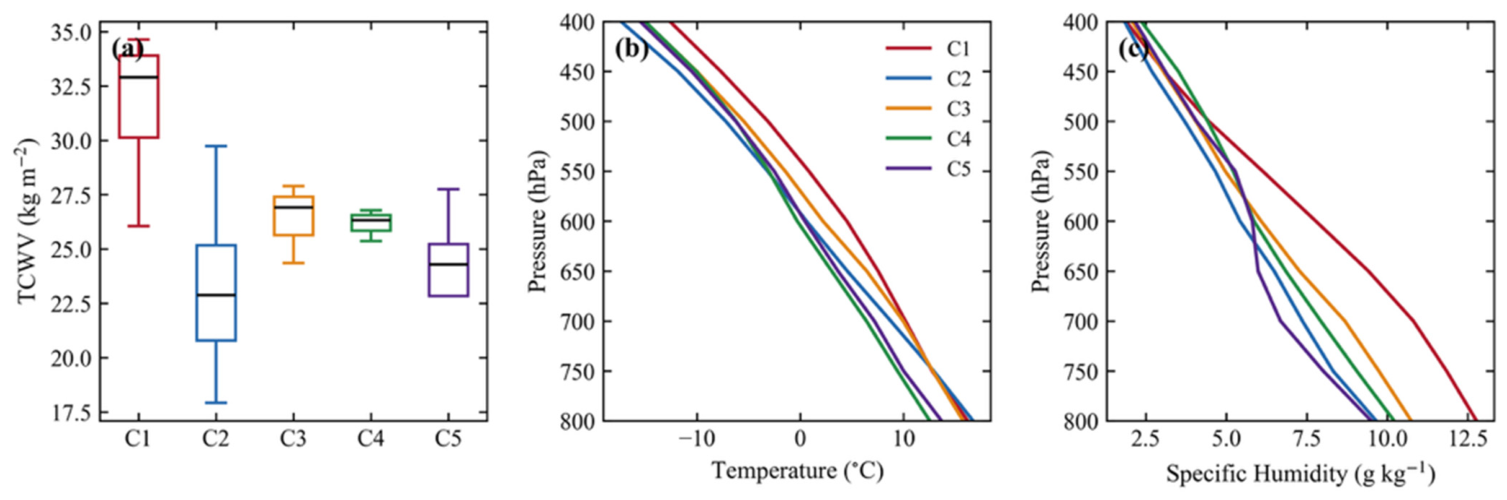
For the C1 type, winds at both 700 hPa and 500 hPa were from the south–southeast (S–SE), indicating a strong monsoon influence. Figure 5 shows the vertical structures of TCWV, temperature, and specific humidity; C1 had the highest TCWV among the five types (mean: 31.66 kg m−2; median: 32.89 kg m−2). In addition, temperatures above 700 hPa and specific humidity below 500 hPa were higher than those in the other types, consistent with a deep, warm-moist monsoon type. Under these conditions, the deep warm-moist stratification transported abundant moisture and heat to the LP region. Consequently, C1 was associated with the longest precipitation duration (33%) and a relatively large event-accumulated precipitation (6.6 mm) among the five types. These results are consistent with Qiu et al. [18], who used observations from surface gradient stations on the eastern and western slopes of the LP. Their study also showed that precipitation duration and amount under the monsoon type exceeded those under other types. The monsoon type is typically accompanied by a deeper warm-cloud growth layer and higher precipitable water, which facilitates sustained warm-rain processes [32]. In addition, abundant moisture mitigates the depletion of precipitation by evaporative cooling. Consequently, this type tends to favor longer precipitation durations and higher accumulated rainfall [33].
For the C2 type, air masses at both 700 hPa and 500 hPa originated from the arid regions of the Eurasian continent to the northwest. C2 had the lowest TCWV among the five pathway types (mean: 23.21 kg m−2) and a mean specific humidity of only 3.83 g kg−1 at 500 hPa, indicating a marked moisture deficit. Furthermore, its temperature lapse rate was the steepest among the five types, consistent with a deep, dry-cold continental type. The total precipitation duration under this type accounted for 21% of the sample, with a mean event-accumulated precipitation of 2.2 mm. Under this dry-cold background, the atmospheric stratification was unstable and the moisture supply was limited. Consequently, convective initiation relied more on orographic lifting [34], leading to more sporadic and short-lived precipitation events. Once strong convection was triggered by orographic lifting, it could promote the rapid growth of a few hydrometeors through ice-phase processes. Subsequent melting could then produce larger raindrops [23].
For the C3 type, the flow at 700 hPa is similar to that in C1 (SE/S), but it shifts to westerly (W) or northwesterly (NW) winds at 500 hPa, indicating strong vertical wind shear. TCWV and temperature are intermediate between those in C1 and C2, consistent with a transition from a warm-moist monsoon flow to a dry-cold continental flow. In the analyzed events, the total precipitation duration under this type accounts for 11% of the sample, with a mean event-accumulated precipitation of 7.2 mm.
The C4 type features flow from the east or northeast at 700 hPa and strong southerly warm-moist flow at 500 hPa. Above 650 hPa, its moisture conditions are similar to those in C1, but its temperature is lower than in the other types. This indicates a coupled structure, with low-level cold-moist air and upper-level warm-moist air. Under this type, the total precipitation duration accounts for 18% of the sample, and the mean event-accumulated precipitation is 6.0 mm.
The C5 type was influenced by easterly or northeasterly flow at 700 hPa and was controlled by northwesterly flow behind a westerly trough or by westerly winds at 500 hPa, resulting in pronounced wind shear. Under this type, the mean TCWV was 23.78 kg m−2, only slightly higher than that of C2. Both temperature and specific humidity below 650 hPa were relatively low among the five types, consistent with a low-level easterly and upper-level westerly shear type. For the analyzed events, the total precipitation duration under this type accounted for 16% of the sample, with a mean event-accumulated precipitation of 2.5 mm.
Within the July–September 2021 sample, the deep warm-moist monsoon type (C1) and deep dry-cold continental type (C2) were the two most frequent pathway types. The occurrence frequencies of precipitation under the other three pathway types were lower than those of C1 and C2.

3.2. Microphysical Characteristics

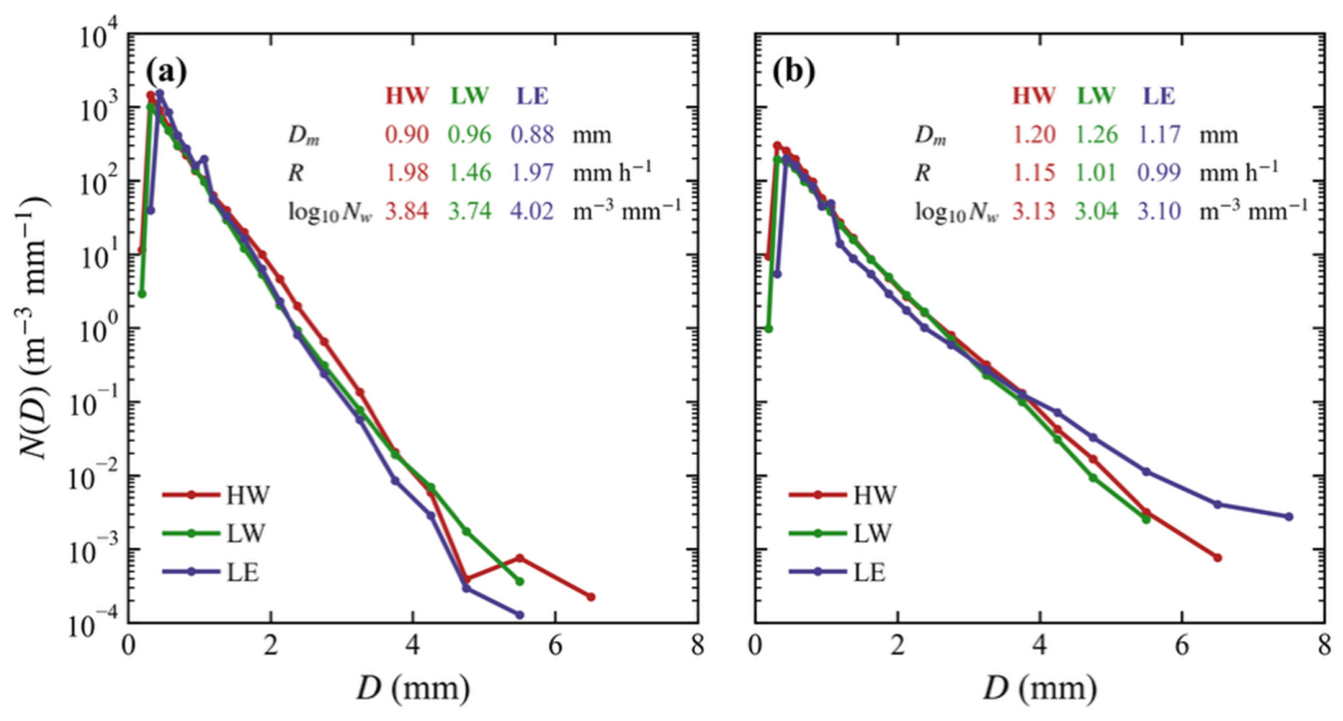
Section 3.1 identified C1 and C2 as the dominant pathway types affecting precipitation frequency during the rainy season in the LP. To investigate the impact of these distinct pathway types on microphysical processes, we compared the raindrop size distributions (DSDs) at three stations on the eastern and western slopes under C1 and C2 conditions. The results are presented in Figure 6.
Figure 6 shows that the raindrop number concentration in the LP region peaked between 0.31 and 0.44 mm. However, the peak concentration in C1 was about 0.74 orders of magnitude higher than that in C2. In contrast, C2 showed a higher concentration number for raindrops larger than 2.38 mm than those in C1. The mass-weighted mean diameter (Dm) in C1 (0.88–0.96 mm across the three stations) was smaller than that in C2 (1.17–1.26 mm), whereas the normalized intercept parameter (log10Nw) in C1 (3.74–4.02) was higher than that in C2 (3.04–3.13). In other words, relative to C2, C1 was characterized by smaller but more abundant raindrops, consistent with Wen et al. [35] and Huang et al. [36]. The predominance of high-concentration small raindrops in C1 was attributed to strong monsoon moisture transport, which provided abundant moisture and condensation nuclei. This led to high in-cloud liquid water content, active warm-rain processes, and high collision–coalescence efficiency, producing large numbers of small raindrops. In turn, this high-concentration environment limited the excessive growth of individual raindrops. The DSD characteristics in the C2 type were consistent with those reported by Chen et al. [37] for the Tianshan Mountains and showed a higher proportion of large raindrops than that in C1. This was mainly because the dry-cold continental air mass provided limited moisture, resulting in a lower total raindrop number concentration. Furthermore, based on observations from surface gradient stations on the eastern and western slopes of the LP, Qiu et al. [18] pointed out that C1 precipitation was mainly driven by its high water content, whereas its dynamical characteristics were less pronounced than those of other pathway types. In contrast, airflow during C2 precipitation was less stable and was more strongly linked to orographic lifting. These dynamical conditions favored the growth of a small number of raindrops to larger sizes through collision–coalescence.
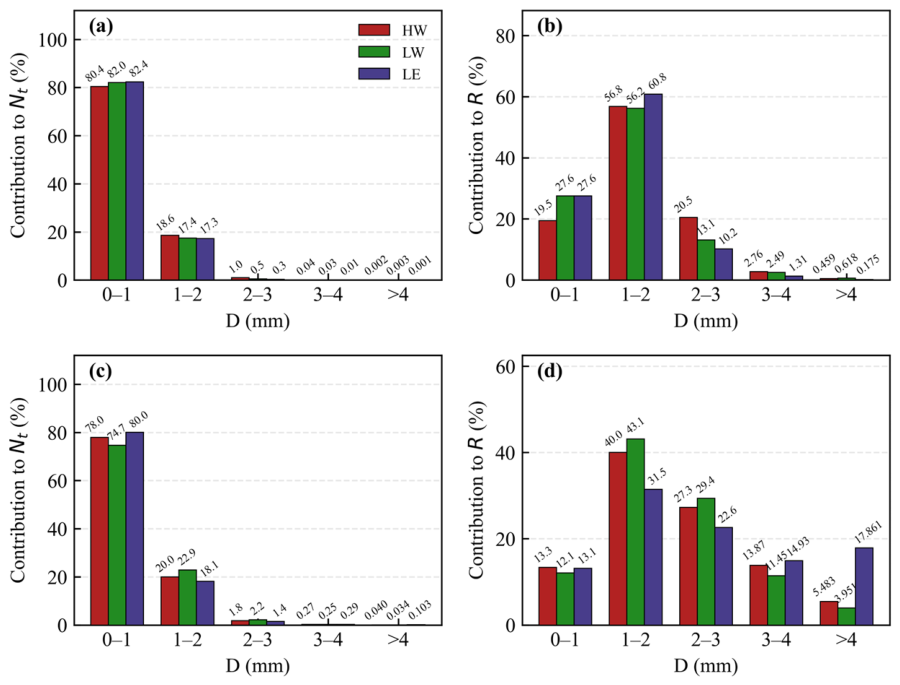
Furthermore, we compared the relative contributions of different size bins to the total concentration number (Nt) and rainfall rate (R) (Figure 7). We found that small raindrops (<1 mm) contributed more than 75% of the total concentration number in both the C1 and C2 types, with the contribution in C1 averaging 4.05% higher than that in C2. However, raindrops ≥ 1 mm dominated the rainfall rate in both types. The differences between C1 and C2 were mainly concentrated in the 1–2 mm and ≥2 mm ranges. Specifically, the contribution of raindrops ≥ 2 mm to the rainfall rate in C2 was 31.74% higher than that in C1. This was mainly because C2 had a higher proportion of large raindrops than C1. Consequently, large drops contributed more to the total rainfall rate in C2, whereas C1 was dominated by abundant small drops. On the other hand, when comparing the eastern and western slopes, the contribution of large raindrops (≥3 mm) to the rainfall rate under the C2 type was particularly prominent on the eastern slope and was 17.40% higher than that on the western slope. This difference was closely related to local topographic features. Specifically, the eastern slope is steeper and has higher moisture content [17]. These conditions facilitated the lifting of low-level moisture and its mixing with upper-level air, thereby enhancing collision–coalescence and producing more large raindrops [15].
In summary, the C1 type showed a higher DSD peak and a higher concentration number of small raindrops than the C2 type. In contrast, the contribution of large raindrops to the rainfall rate was higher under the C2 type than under C1.

3.3. DSD of Different Rain Types

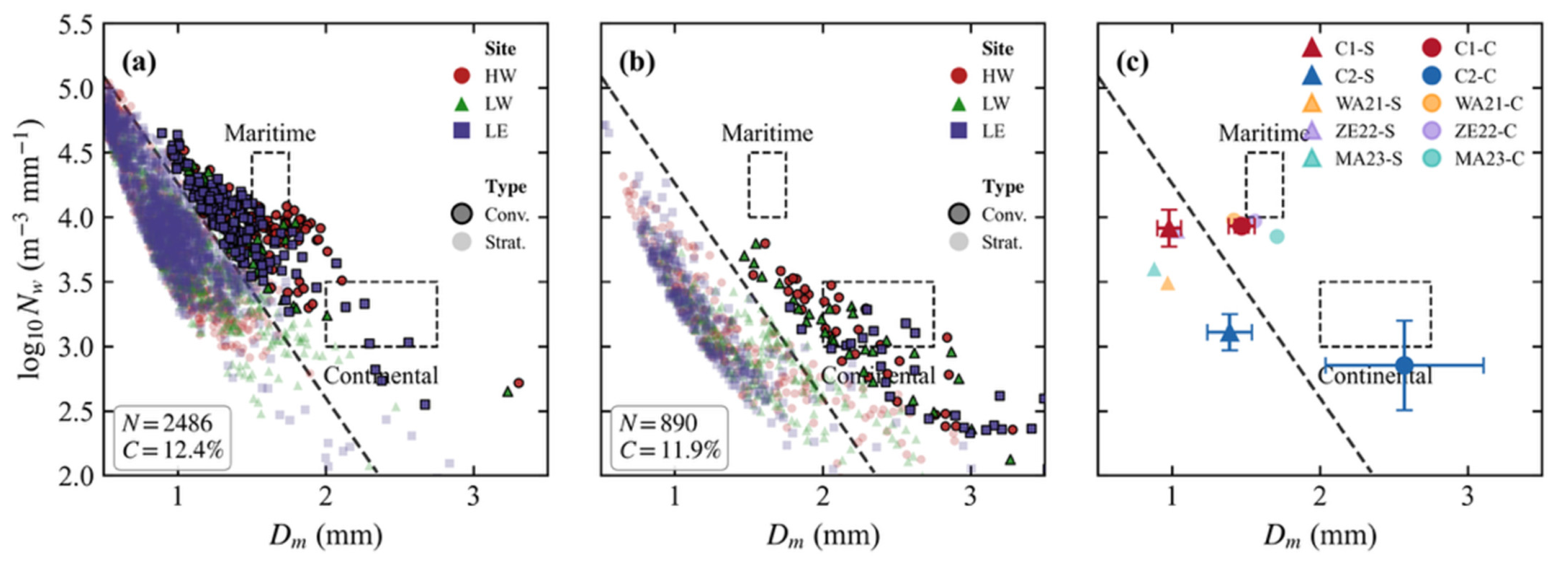
Bringi et al. [28] pointed out that raindrop size distributions differ significantly between stratiform precipitation (SP) and convective precipitation (CP). Following the classification scheme of Bringi et al. [28], we separated precipitation events in the C1 and C2 types into SP and CP types (Figure 8). As shown in Figure 8a, CP samples in the C1 type were distributed in the high-concentration region to the upper right of the stratiform separation line and mainly fell within or adjacent to the maritime convective cluster. In contrast, the CP sample distribution in the C2 type shifted toward the lower right (Figure 8b) and appeared closer to the continental convective cluster. This pattern reflected differences in moisture supply and DSD evolution within convective clouds under the two types. Continuous moisture supply in C1 allowed convection to maintain high number concentrations, consistent with the maritime feature of high Nw. Conversely, C2 relied more on intermittent forced lifting and collision–coalescence growth at a lower concentration number, favoring a larger Dm and a continental DSD shape.
Based on the classification shown in Figure 8, we calculated the shape parameter (μ) and slope parameter (Λ) for SP and CP (Table 5). For CP under C1, both μ (4.21–6.76) and Λ (5.57–7.96 mm−1) were relatively high, consistent with the dominance of high concentrations of small raindrops. The mean microphysical parameters (Dm = 1.47 mm, log10Nw = 3.93 m−3mm−1) were close to those observed in Medog (WA21) [38], a key water vapor pathway on the Tibetan Plateau (Figure 8c). These results indicate that although the LP is located in the inland northwest, abundant moisture supplied by strong monsoon flows maintained a high particle concentration number in convective clouds. Consequently, precipitation under this type showed pronounced maritime characteristics. However, when the airflow switched to a dry-cold continental air mass, the Λ parameter of convective precipitation (CP) in the C2 type decreased to 3.14–3.95 mm−1. Compared with observations from the Tianshan Mountains (ZE22) [39] and the Qilian Mountains (MA23) [40], which are also located in the arid northwest region, CP in the C2 type had a larger Dm, indicating a shift in microphysical properties toward more extreme continental characteristics. These comparisons indicate that DSDs in the LP strongly depend on airflow transport pathways. As the dominant airflow shifts from warm-moist monsoon flow to cold-dry continental air masses, the microphysical properties transition from a “Medog-like maritime” pattern to an “extremely continental” pattern.
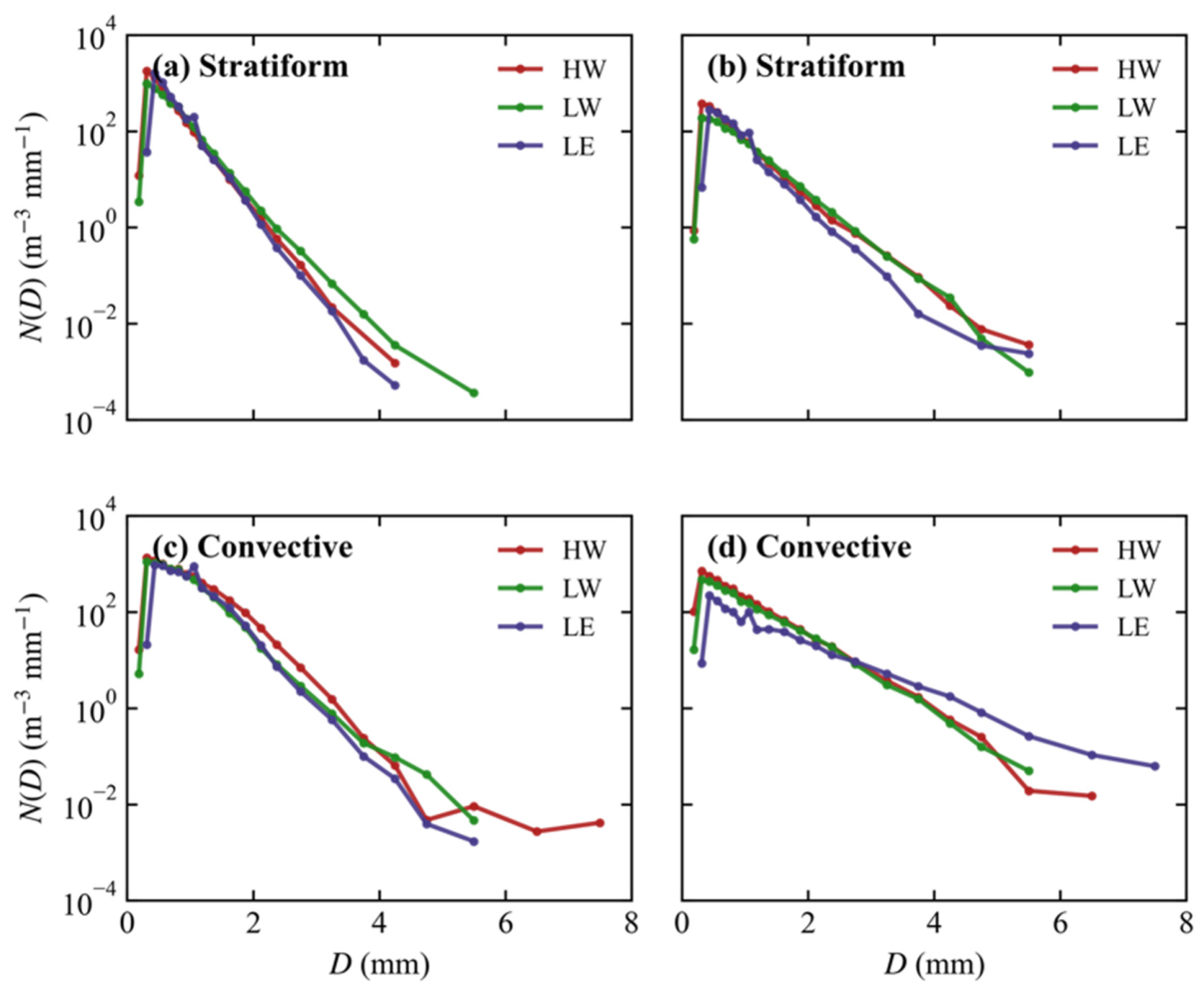
As shown in Figure 9, log10Nw for SP in the C1 type generally ranged from 3.74 to 4.02 and was on average about 0.8 orders of magnitude higher than that in C2. In both types, CP had a higher concentration number and broader DSDs than SP. Notably, the mean Dm for CP in the C2 type (2.53 mm) was larger than that for SP in the same type and that for CP in the C1 type (1.47 mm). In other words, under convective conditions, enhanced updrafts generally broaden the DSD and increase the concentration number [41]. However, continuous moisture supply and stronger condensation in the C1 type led to higher Nw and a relatively large Λ. In contrast, under the dry-cold background of the C2 type, droplet numbers were limited and evaporative sorting was stronger. Consequently, collision–coalescence exerted stronger control over the large-drop tail, resulting in a larger Dm and a smaller Λ.
Furthermore, when comparing the DSDs between the eastern and western slopes of the LP, the concentration number of large raindrops (≥2 mm) under C1 SP was higher on the western slope than on the eastern slope. In contrast, the opposite pattern was observed for CP. This discrepancy was related to topographic differences. The gentler western slope is more conducive to the development of continuous, widespread weak-to-moderate updrafts. These conditions generated moisture convergence, which facilitated ice-phase growth in stratiform clouds and collision–coalescence growth below the melting layer. Conversely, due to its steeper terrain, the eastern slope is more prone to triggering strong localized lifting and forming a deep warm-cloud growth layer under convective conditions. This enhanced collision–coalescence, resulting in a more prominent large-drop tail. Under the C2 type, differences in stratiform precipitation between the eastern and western slopes were similar to those observed in C1. For convective precipitation, however, the concentration number of large raindrops was higher on the eastern slope than on the western slope. This is because C2 airflow is more prone to forming convergence and updraft zones on the eastern slope, biasing convective initiation and maintenance toward the east [15]. It should be noted that the number concentration of large raindrops is jointly influenced by updrafts, liquid water path, melting-layer fluxes, and breakup processes. In this study, these contributions were not quantified. Future work will incorporate observations such as vertical velocities from wind profilers and liquid water paths from microwave radiometers to quantitatively attribute these mechanisms.

3.4. Shape–Slope (μ–Λ) Relationship

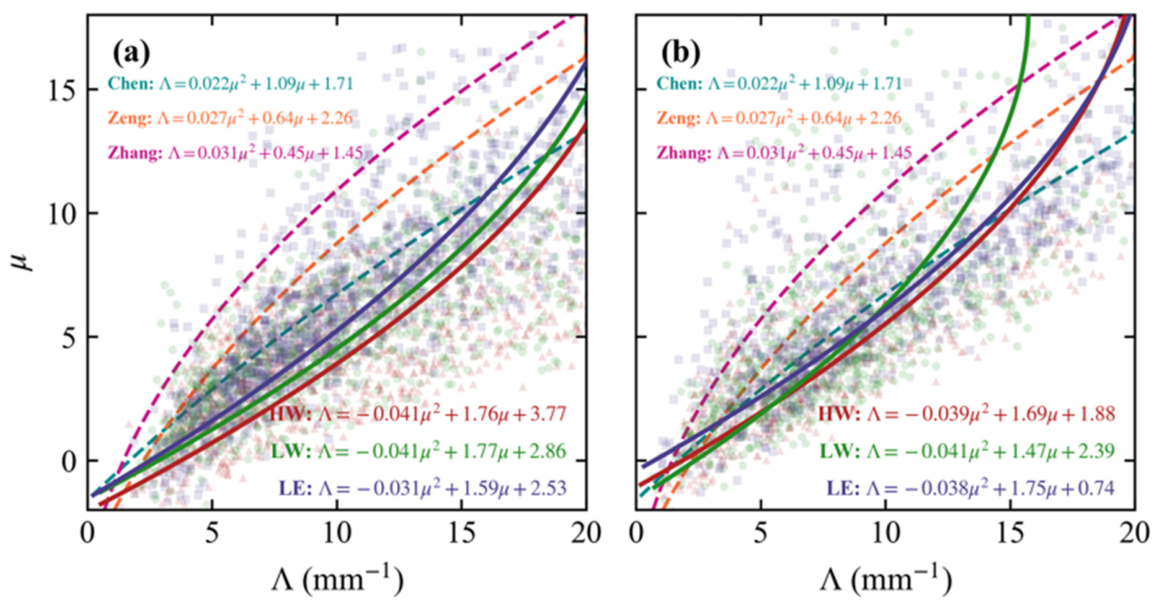
To investigate the variability of DSDs for SP and CP under different pathway types, we analyzed the μ−Λ relationships. To minimize the effects of measurement noise and calculation errors on the fitting results, we followed Chen et al. [42] and excluded samples with a total drop count < 300. A second-degree polynomial fit (Λ = Aμ2 + Bμ+ C) was then applied to the filtered data using the least-squares method (Figure 10). For comparison, empirical relationships from Nagqu in the central Tibetan Plateau [42], Zhaosu in the Tianshan Mountains during summer [43], and Zhuhai in southern China during the monsoon season [44] are also shown.
As shown in Figure 10, the fitted lines for the three stations under the C1 type were primarily located below the reference lines for Zhuhai and the Tianshan Mountains. In other words, for a given Λ, the μ values in the LP were lower than those in the Tianshan Mountains [43] and Zhuhai [44], but were close to those reported for the Nagqu region of the Tibetan Plateau [42]. This suggests that although the LP is located on the monsoon fringe, its geographical setting and elevation cause its overall precipitation microphysical structure to more closely resemble that of the Nagqu region on the Tibetan Plateau. Consequently, this relationship differs from empirical relationships derived for plains or typical monsoon regions. Furthermore, when comparing the stations on the eastern and western slopes, the eastern slope showed higher μ values than the western slope for a given Λ. Similarly, the high-altitude station on the western slope showed higher values than its low-altitude counterpart. This pattern was consistent with the theory that orographic forced lifting enhances collision–coalescence [6]. High-altitude regions are more directly subjected to this orographic forcing, causing precipitation to shift toward smaller-drop characteristics (i.e., for a given μ, Λ is typically larger in plateau regions). Compared with the C1 type, the fitted μ–Λ curves for the C2 type showed an overall upward shift. Under the C2 type, the μ–Λ relationships at the low-altitude stations on both slopes showed an even smaller discrepancy from those reported for the Nagqu region on the Tibetan Plateau [42]. Moreover, at larger Λ values, the increase in μ at the high-altitude station was much greater than that at the two low-altitude stations. This provided further evidence supporting the orographically enhanced collision–coalescence mechanism [6].
In summary, the μ–Λ relationships in the LP under both C1 and C2 are similar to those reported for Nagqu on the Tibetan Plateau, but differ markedly from those in plain and monsoon regions.

3.5. Z–R Relationships

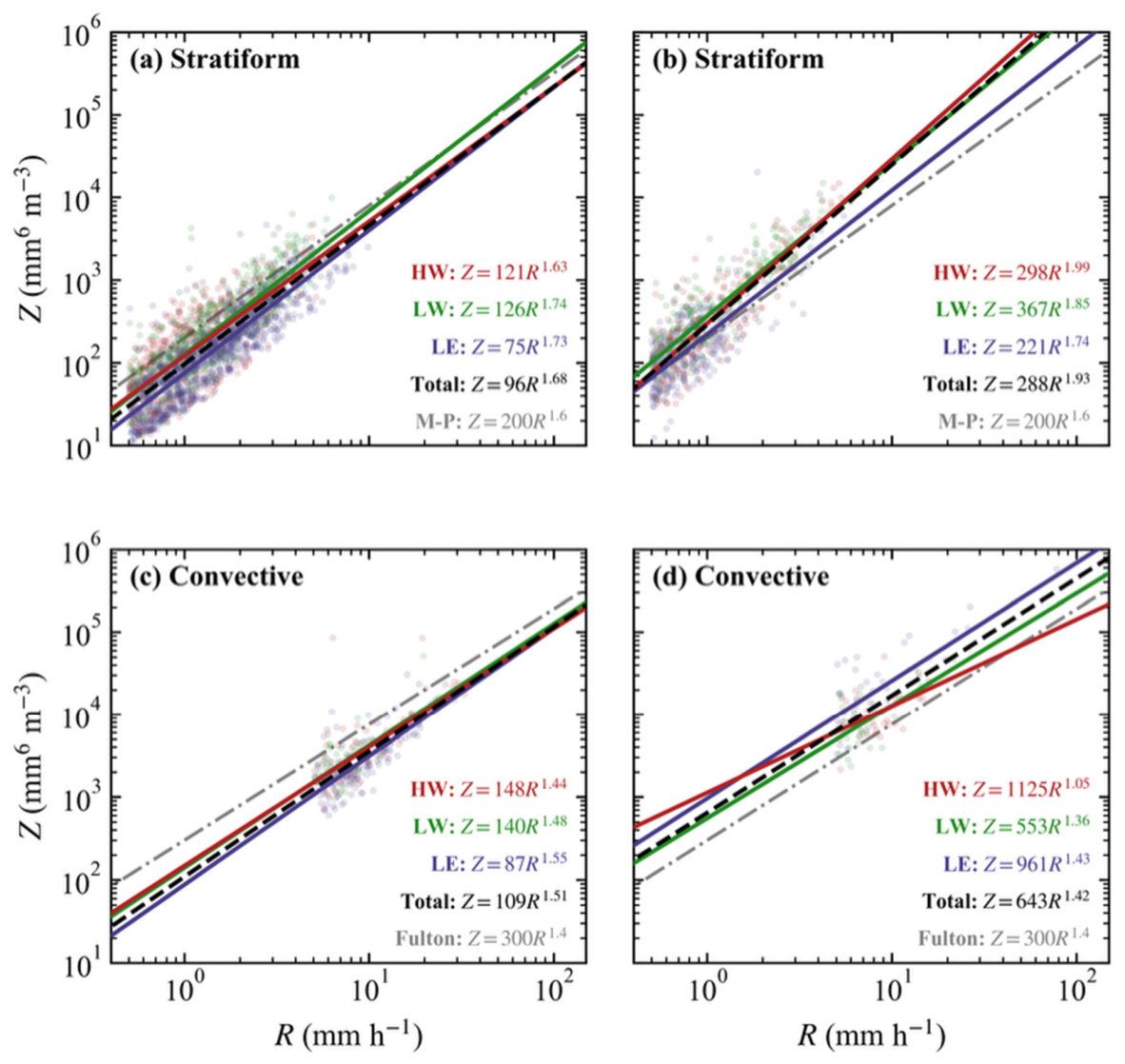
Given the critical role of the radar reflectivity factor (Z)–rainfall rate (R) relationship in quantitative precipitation estimation (QPE) using single-polarization radar [45], we fitted ZR relationships for SP and CP under C1 and C2 (Figure 11).
In stratiform precipitation, the C1 type was dominated by high concentrations of small drops. Because small drops contribute relatively little to Z, Z was lower for a given R. Consequently, its A value (96) was smaller than that of the standard Marshall–Palmer (M–P) relationship (200). In contrast, the C2 type was dominated by a small number of large drops, resulting in higher Z and an A value (288) that was much higher than that of C1. The mass flux under the C1 type was mainly contributed by a large number of small drops, shifting the ZR relationship toward the low-Z side. In contrast, the enhanced large-drop tail in the C2 type made Z highly sensitive to a few large drops, shifting the ZR relationship toward the high-Z side. Therefore, using the standard M–P empirical formula tended to underestimate rainfall in C1 and overestimate rainfall in C2. For convective precipitation, the A value of C1 (109) was much lower than that of the Fulton formula (300), whereas the A value of C2 (643) was approximately twice that of the Fulton formula. The high-altitude station HW on the western slope (A = 1125) was particularly notable. This suggests that the unusually large contribution of large raindrops in LP convective precipitation produced very high radar reflectivity. Consequently, applying the standard Fulton formula would result in a substantial overestimation of rainfall amounts.
Regarding station differences, the LE station on the eastern slope had the lowest A values in both the C1 and C2 types. Specifically, the A value for C1 stratiform precipitation at LE (75) was much lower than that at the LW station on the western slope (126). Similarly, the A value for C2 stratiform precipitation at LE (221) was lower than that at LW (367). This pattern was associated with the steeper terrain, higher moisture content, and stronger orographic lifting on the eastern slope [17,18]. Orographic forced lifting can increase the raindrop number concentration and reduce drop size [6], thereby reducing Z without a comparable decrease in R.
In summary, the standard M–P formula was not suitable for stratiform precipitation in the LP region, because it tended to underestimate C1 rainfall and overestimate C2 rainfall. Moreover, applying the standard Fulton formula to convective precipitation would lead to an underestimation of C1 rainfall and an overestimation of C2 rainfall.

4. Discussion

Drop size distributions (DSDs) are jointly influenced by climatic background, topographic conditions, geographical location, and precipitation type [48,49]. The LP is situated in a semi-arid monsoon transition zone, where atmospheric water resources are relatively scarce and moisture content is limited [17]. The present study has shown that precipitation during the LP rainy season was associated with highly variable large-scale transport conditions. Two pathway types were most prominent: the deep warm-moist monsoon type (C1) and the deep dry-cold continental type (C2). Due to differences in air-mass properties, the microphysical characteristics differed between these two pathway types. The C1 type showed maritime DSD characteristics, with smaller raindrops and higher number concentrations. In contrast, the C2 type showed continental DSD characteristics, with larger raindrops and a broader DSD. Quantitatively, C1 exhibited smaller Dm values (0.88–0.96 mm) and larger log10Nw values (3.74–4.02), whereas C2 showed larger Dm values (1.17–1.26 mm) and lower log10Nw values (3.04–3.13). In addition, the contribution of drops ≥ 2 mm to rainfall rate was 31.74% higher in C2 than in C1. These results indicate that different airflow transport pathways exert an important control on DSD variability in the LP, with C1 showing more maritime-like characteristics and C2 showing more continental-like characteristics. These DSD differences suggest that directly applying fixed empirical formulas, such as the Marshall–Palmer or Fulton relationships, in quantitative precipitation estimation (QPE) may lead to substantial biases. Therefore, for precipitation estimation in the LP and nearby regions, we recommend accounting for the effects of airflow transport pathways. Developing a dynamic ZR parameterization based on airflow transport pathway classification can improve the accuracy of precipitation retrievals. This implication is also consistent with the fitted ZR relationships in this study, in which the coefficient A for stratiform precipitation was 96 in C1 but 288 in C2, while for convective precipitation it was 109 in C1 and 643 in C2.
The airflow-transport-pathway-dependent characteristics identified in the LP are broadly consistent with previous disdrometer-based observations from other mountainous regions, but they also reveal clear regional contrasts. Under C1, convective DSDs were closer to the maritime-like characteristics reported for Medog on the southeastern Tibetan Plateau [38], whereas under C2, they were more similar to the continental characteristics observed in the Tianshan and Qilian Mountains [39,40]. Likewise, the μ–Λ relationships in the LP were closer to those reported for Nagqu [42] than to those in Zhuhai [44], suggesting that the combined effects of elevation, terrain forcing, and large-scale moisture transport background play a key role in shaping precipitation microphysics in the LP. In addition, comparison with the standard Marshall–Palmer [46] and Fulton [47] formulas indicates that fixed ZR relationships may introduce systematic biases in this region, supporting the need for airflow-transport-pathway-dependent parameterizations.
It should be noted that this study is based on observations from only one rainy season (July–September 2021), and the results should therefore be interpreted as observational features of the 2021 sample rather than long-term climatological characteristics of the entire LP region. However, because the three stations were observed concurrently during the same rainy season, the dataset remains useful for comparing relative differences among the eastern and western slopes and stations at different elevations under different airflow transport pathways. Future work should extend the analysis to multi-year observations and combine them with vertically resolved observations for further verification of these conclusions.

5. Conclusions

Based on ground-based DSD observations collected during the July–September 2021 rainy season in the Liupan Mountains (LP), this study examined DSD characteristics under two dominant pathway types (C1 and C2), together with their μ–Λ and ZR relationships.
Within the five identified pathway types, C1 and C2 contributed the most to total rainfall and precipitation duration in the present dataset. Compared with C2, C1 was characterized by higher concentrations of small drops, smaller Dm (0.88–0.96 mm), and larger log10Nw (3.74–4.02), whereas C2 exhibited a stronger contribution from large drops to rainfall rate, larger Dm (1.17–1.26 mm), and lower log10Nw (3.04–3.13). In particular, the contribution of drops ≥ 2 mm to rainfall rate was 31.74% higher in C2 than in C1. For both types, convective precipitation showed broader DSDs than stratiform precipitation, and the east–west slope differences were more pronounced under C2. The μ–Λ relationships in the LP were closer to those reported for plateau regions than to those in typical monsoon and plain regions. The ZR relationships were strongly dependent on the airflow transport pathways, implying that direct application of the standard Marshall–Palmer or Fulton formulas may introduce systematic biases when the transport background is not considered.
However, these findings should be regarded as preliminary because they are based on one rainy season and a limited number of common precipitation events. Therefore, they should be interpreted as observational features of the July–September 2021 sample rather than long-term climatological characteristics of the entire LP region. At the same time, because the three stations were observed concurrently during the same rainy season, the dataset remains useful for comparing relative differences among the eastern and western slopes and stations at different elevations under different airflow transport pathways. Future work should extend the analysis to multi-year observations and combine them with vertically resolved observations to better understand the physical mechanisms responsible for the airflow-transport-pathway dependence of DSD and ZR relationships.

Author Contributions

Conceptualization, S.C. and Y.Q.; methodology, S.C.; software, S.C.; validation, S.C. and Y.Q.; formal analysis, S.C.; investigation, S.C.; resources, Y.Q.; data curation, S.C.; writing—original draft preparation, S.C.; writing—review and editing, S.C., Y.Q., C.L. and P.T.; visualization, S.C.; supervision, Y.Q.; project administration, Y.Q.; funding acquisition, Y.Q. All authors have read and agreed to the published version of the manuscript.

Funding

This research was funded by the National Natural Science Foundation of China (42575084, 42075073) and the National Key Research and Development Program of China (2024g055).

Data Availability Statement

Restrictions apply to the availability of these data. The disdrometer observations from the Liupan Mountains are subject to institutional data-sharing policies and are available from the corresponding author upon reasonable request and with permission. The ERA5 reanalysis data are publicly available.

Acknowledgments

We appreciate the data provided by the Key Laboratory of Monitoring, Early Warning and Risk Management of Agricultural Meteorological Disasters with Special Characteristics in Dry Areas of the China Meteorological Administration (CMA) and the Key Laboratory of Meteorological Disaster Prevention and Mitigation in Ningxia.

Conflicts of Interest

The authors declare no conflicts of interest.

Abbreviations

CPConvective precipitation
DSDRaindrop size distribution
LPLiupan Mountains
QPEQuantitative precipitation estimation
SPStratiform precipitation
TCWVTotal column water vapor

References

  1. Abel, S.J.; Boutle, I.A. An Improved Representation of the Raindrop Size Distribution for Single-moment Microphysics Schemes. Q. J. R. Meteoro Soc. 2012, 138, 2151–2162. [Google Scholar] [CrossRef]
  2. Ryzhkov, A.; Zhang, P.; Bukovčić, P.; Zhang, J.; Cocks, S. Polarimetric Radar Quantitative Precipitation Estimation. Remote Sens. 2022, 14, 1695. [Google Scholar] [CrossRef]
  3. Houze, R.A. Orographic Effects on Precipitating Clouds. Rev. Geophys. 2012, 50, 2011RG000365. [Google Scholar] [CrossRef]
  4. Zhang, A.; Chen, C.; Wu, L. Regional Variability of Raindrop Size Distribution from a Network of Disdrometers over Complex Terrain in Southern China. Remote Sens. 2023, 15, 2678. [Google Scholar] [CrossRef]
  5. Wang, G.; Li, R.; Sun, J.; Xu, X.; Zhou, R.; Liu, L. Comparative Analysis of the Characteristics of Rainy Season Raindrop Size Distributions in Two Typical Regions of the Tibetan Plateau. Adv. Atmos. Sci. 2022, 39, 1062–1078. [Google Scholar] [CrossRef]
  6. Kim, H.-J.; Jung, W.; Suh, S.-H.; Lee, D.-I.; You, C.-H. The Characteristics of Raindrop Size Distribution at Windward and Leeward Side over Mountain Area. Remote Sens. 2022, 14, 2419. [Google Scholar] [CrossRef]
  7. Houze, R.A.; Medina, S. Turbulence as a Mechanism for Orographic Precipitation Enhancement. J. Atmos. Sci. 2005, 62, 3599–3623. [Google Scholar] [CrossRef]
  8. Ghada, W.; Buras, A.; Lüpke, M.; Schunk, C.; Menzel, A. Rain Microstructure Parameters Vary with Large-Scale Weather Conditions in Lausanne, Switzerland. Remote Sens. 2018, 10, 811. [Google Scholar] [CrossRef]
  9. Krishna, U.V.M.; Reddy, K.K.; Seela, B.K.; Shirooka, R.; Lin, P.-L.; Pan, C.-J. Raindrop Size Distribution of Easterly and Westerly Monsoon Precipitation Observed over Palau Islands in the Western Pacific Ocean. Atmos. Res. 2016, 174–175, 41–51. [Google Scholar] [CrossRef]
  10. Sreekanth, T.S.; Varikoden, H.; Mohan Kumar, G.; Resmi, E.A. Microphysical Features of Rain and Rain Events during Different Seasons over a Tropical Mountain Location Using an Optical Disdrometer. Sci. Rep. 2019, 9, 19083. [Google Scholar] [CrossRef]
  11. Wang, H.; Wang, J.; Ren, G.; Wang, W.; Zhang, D. Geographical Characteristics of Raindrop Size Distribution for Rainy Season in Eastern China. Sci. Rep. 2025, 15, 26892. [Google Scholar] [CrossRef] [PubMed]
  12. Zeng, Y.; Yang, L.; Zhou, Y.; Tong, Z.; Jiang, Y.; Chen, P. Characteristics of Orographic Raindrop Size Distribution in the Tianshan Mountains, China. Atmos. Res. 2022, 278, 106332. [Google Scholar] [CrossRef]
  13. Zhang, Z.; Zhao, Z.; Qi, Y.; Xiong, M. Dual-Polarization Radar Quantitative Precipitation Estimation (QPE): Principles, Operations, and Challenges. Remote Sens. 2025, 17, 3619. [Google Scholar] [CrossRef]
  14. Barszcz, M.P.; Kaznowska, E. Z–R Relationships for Different Precipitation Types and Events from Parsivel Disdrometer Data in Warsaw, Poland. Remote Sens. 2025, 17, 2271. [Google Scholar] [CrossRef]
  15. Gao, L. Numerical Study on Orographic Summertime Cloud Structure and Precipitation Mechanism over the Liupan Mountain Area. Master’s Thesis, Chinese Academy of Meteorological Sciences, Beijing, China, 2020. [Google Scholar]
  16. Deng, P.; Sang, J.; Yang, M.; Mu, J.; Chang, Z.; Cao, N. Analysis of difference characteristics of precipitation and air water vapor conditions over east and west slopes of Liupan Mountain in recent 30 years. Meteorol. Sci. Technol. 2021, 49, 77–85. [Google Scholar] [CrossRef]
  17. Xu, R.; Qiu, Y. The Difference in Cloud Water Resources and Precipitation on the Eastern and Western Sides of the Liupan Mountains Caused by Topographic Effects. Atmosphere 2023, 14, 1502. [Google Scholar] [CrossRef]
  18. Qiu, Y.; Lu, C.; Shu, Z.; Deng, P. The Influence of Airflow Transport Pathways on Precipitation during the Rainy Season in the Liupan Mountains of Northwest China. Adv. Atmos. Sci. 2024, 41, 2215–2229. [Google Scholar] [CrossRef]
  19. Löffler-Mang, M.; Joss, J. An Optical Disdrometer for Measuring Size and Velocity of Hydrometeors. J. Atmos. Ocean. Technol. 2000, 17, 130–139. [Google Scholar] [CrossRef]
  20. Beard, K.V.; Johnson, D.B.; Baumgardner, D. Aircraft Observations of Large Raindrops in Warm, Shallow, Convective Clouds. Geophys. Res. Lett. 1986, 13, 991–994. [Google Scholar] [CrossRef]
  21. Tokay, A.; Petersen, W.A.; Gatlin, P.; Wingo, M. Comparison of Raindrop Size Distribution Measurements by Collocated Disdrometers. J. Atmos. Ocean. Technol. 2013, 30, 1672–1690. [Google Scholar] [CrossRef]
  22. Yuter, S.E.; Kingsmill, D.E.; Nance, L.B.; Löffler-Mang, M. Observations of Precipitation Size and Fall Speed Characteristics within Coexisting Rain and Wet Snow. J. Appl. Meteorol. Climatol. 2006, 45, 1450–1464. [Google Scholar] [CrossRef]
  23. Friedrich, K.; Higgins, S.; Masters, F.J.; Lopez, C.R. Articulating and Stationary PARSIVEL Disdrometer Measurements in Conditions with Strong Winds and Heavy Rainfall. J. Atmos. Ocean. Technol. 2013, 30, 2063–2080. [Google Scholar] [CrossRef]
  24. Atlas, D.; Srivastava, R.C.; Sekhon, R.S. Doppler Radar Characteristics of Precipitation at Vertical Incidence. Rev. Geophys. 1973, 11, 1–35. [Google Scholar] [CrossRef]
  25. Freitas, E.D.S.; Coelho, V.H.R.; Xuan, Y.; Melo, D.D.C.D.; Gadelha, A.N.; Santos, E.A.; Galvão, C.D.O.; Ramos Filho, G.M.; Barbosa, L.R.; Huffman, G.J.; et al. The Performance of the IMERG Satellite-Based Product in Identifying Sub-Daily Rainfall Events and Their Properties. J. Hydrol. 2020, 589, 125128. [Google Scholar] [CrossRef]
  26. Brasil, J.B.; Guerreiro, M.S.; Andrade, E.M.D.; De Queiroz Palácio, H.A.; Medeiros, P.H.A.; Ribeiro Filho, J.C. Minimum Rainfall Inter-Event Time to Separate Rainfall Events in a Low Latitude Semi-Arid Environment. Sustainability 2022, 14, 1721. [Google Scholar] [CrossRef]
  27. Tokay, A.; Wolff, D.B.; Petersen, W.A. Evaluation of the New Version of the Laser-Optical Disdrometer, OTT Parsivel2. J. Atmos. Ocean. Technol. 2014, 31, 1276–1288. [Google Scholar] [CrossRef]
  28. Bringi, V.N.; Chandrasekar, V.; Hubbert, J.; Gorgucci, E.; Randeu, W.L.; Schoenhuber, M. Raindrop Size Distribution in Different Climatic Regimes from Disdrometer and Dual-Polarized Radar Analysis. J. Atmos. Sci. 2003, 60, 354–365. [Google Scholar] [CrossRef]
  29. Miller, D.; Arulraj, M.; Ferraro, R.; Grassotti, C.; Kuligowski, B.; Liu, S.; Petkovic, V.; Wu, S.; Xie, P. A Study of Two Impactful Heavy Rainfall Events in the Southern Appalachian Mountains during Early 2020, Part II.; Regional Overview, Rainfall Evolution, and Satellite QPE Utility. Remote Sens. 2021, 13, 2500. [Google Scholar] [CrossRef]
  30. Jia, X.; Liu, F.; Dong, W.; Chen, X.; Qian, Q. Amplified Summer Extreme Precipitation over the Tibetan Plateau in the Early 21st Century. npj Clim. Atmos. Sci. 2025, 8, 390. [Google Scholar] [CrossRef]
  31. Peng, J.; Li, Z.; Yang, L.; Zhang, Y. Dynamic Diagnosis of an Extreme Precipitation Event over the Southern Slope of Tianshan Mountains Using Multi-Source Observations. Remote Sens. 2025, 17, 1521. [Google Scholar] [CrossRef]
  32. Su, L.; Hu, J.; Du, Y.; Li, J.; Chen, G. Boundary-Layer and Low-Level Moisture Fluxes during Low-Level Jet Events in South China and Their Relationship with Early Summer Rainfall. J. Clim. 2025, 38, 1691–1713. [Google Scholar] [CrossRef]
  33. Pu, Y.; Hu, S.; Luo, Y.; Liu, X.; Hu, L.; Ye, L.; Li, H.; Xia, F.; Gao, L. Multiscale Perspectives on an Extreme Warm-Sector Rainfall Event over Coastal South China. Remote Sens. 2022, 14, 3110. [Google Scholar] [CrossRef]
  34. Li, N.; Ran, L.; Yang, D.; Jiao, B.; Yang, C.; Hu, W.; Sun, Q.; Tang, P. Vertical Accelerations and Convection Initiation in an Extreme Precipitation Event in the Western Arid Areas of Southern Xinjiang. Atmosphere 2024, 15, 1406. [Google Scholar] [CrossRef]
  35. Wen, L.; Zhao, K.; Zhang, G.; Xue, M.; Zhou, B.; Liu, S.; Chen, X. Statistical Characteristics of Raindrop Size Distributions Observed in East China during the Asian Summer Monsoon Season Using 2-D Video Disdrometer and Micro Rain Radar Data. JGR Atmos. 2016, 121, 2265–2282. [Google Scholar] [CrossRef]
  36. Huang, C.; Chen, S.; Zhang, A.; Pang, Y. Statistical Characteristics of Raindrop Size Distribution in Monsoon Season over South China Sea. Remote Sens. 2021, 13, 2878. [Google Scholar] [CrossRef]
  37. Chen, P.; Wang, P.; Li, Z.; Yang, Y.; Jia, Y.; Yang, M.; Peng, J.; Li, H. Raindrop Size Distribution Characteristics of Heavy Precipitation Events Based on a PWS100 Disdrometer in the Alpine Mountains, Eastern Tianshan, China. Remote Sens. 2023, 15, 5068. [Google Scholar] [CrossRef]
  38. Wang, G.; Zhou, R.; Zhaxi, S.; Liu, S. Raindrop Size Distribution Measurements on the Southeast Tibetan Plateau during the STEP Project. Atmos. Res. 2021, 249, 105311. [Google Scholar] [CrossRef]
  39. Zeng, Y.; Tong, Z.; Jiang, Y.; Zhou, Y. Microphysical Characteristics of Seasonal Rainfall Observed by a Parsivel Disdrometer in the Tianshan Mountains, China. Atmos. Res. 2022, 280, 106459. [Google Scholar] [CrossRef]
  40. Mao, W.; Zhang, W.; Kou, M. Statistical Characteristics of Raindrop Size Distribution during Rainy Seasons in Complicated Mountain Terrain. Hydrol. Earth Syst. Sci. 2023, 27, 3895–3910. [Google Scholar] [CrossRef]
  41. Hu, Z.; Srivastava, R.C. Evolution of Raindrop Size Distribution by Coalescence, Breakup, and Evaporation: Theory and Observations. J. Atmos. Sci. 1995, 52, 1761–1783. [Google Scholar] [CrossRef]
  42. Chen, B.; Hu, Z.; Liu, L.; Zhang, G. Raindrop Size Distribution Measurements at 4,500 m on the Tibetan Plateau During TIPEX-III. JGR Atmos. 2017, 122, 11092–11106. [Google Scholar] [CrossRef]
  43. Zeng, Y.; Yang, L.; Tong, Z.; Jiang, Y.; Chen, P.; Zhou, Y. Characteristics and Applications of Summer Season Raindrop Size Distributions Based on a PARSIVEL2 Disdrometer in the Western Tianshan Mountains (China). Remote Sens. 2022, 14, 3988. [Google Scholar] [CrossRef]
  44. Zhang, A.; Hu, J.; Chen, S.; Hu, D.; Liang, Z.; Huang, C.; Xiao, L.; Min, C.; Li, H. Statistical Characteristics of Raindrop Size Distribution in the Monsoon Season Observed in Southern China. Remote Sens. 2019, 11, 432. [Google Scholar] [CrossRef]
  45. Peng, W.; Bao, S.; Yang, K.; Wei, J.; Zhu, X.; Qiao, Z.; Wang, Y.; Li, Q. Radar Quantitative Precipitation Estimation Algorithm Based on Precipitation Classification and Dynamical Z-R Relationship. Water 2022, 14, 3436. [Google Scholar] [CrossRef]
  46. Marshall, J.S.; Palmer, W.M.K. THE DISTRIBUTION OF RAINDROPS WITH SIZE. J. Meteor. 1948, 5, 165–166. [Google Scholar] [CrossRef]
  47. Fulton, R.A.; Breidenbach, J.P.; Seo, D.-J.; Miller, D.A.; O’Bannon, T. The WSR-88D Rainfall Algorithm. Wea. Forecast. 1998, 13, 377–395. [Google Scholar] [CrossRef]
  48. Uijlenhoet, R. Raindrop Size Distributions and Radar Reflectivity–Rain Rate Relationships for Radar Hydrology. Hydrol. Earth Syst. Sci. 2001, 5, 615–628. [Google Scholar] [CrossRef]
  49. Tokay, A.; Bashor, P.G.; Habib, E.; Kasparis, T. Raindrop Size Distribution Measurements in Tropical Cyclones. Mon. Weather Rev. 2008, 136, 1669–1685. [Google Scholar] [CrossRef]
Figure 1. Topographic map of the LP and locations of the observational sites. The inset in the lower-right corner shows the location of the LP within China, with the red box indicating its position. LW (1986 m) and HW (2254 m) are located on the western slope, and LE (1952 m) is located on the eastern slope at an elevation similar to LW.
Water 18 01270 g001
Figure 2. Illustration of the QC procedure: distributions of raindrop diameter and fall velocity before (ac) and after (df) quality control at the (a,d) HW, (b,e) LW, and (c,f) LE stations. The solid black line denotes the empirical fall velocity–diameter relationship of Atlas et al. [24], and the dashed black lines indicate the ±60% bounds.
Water 18 01270 g002
Figure 3. Schematic workflow of the main data processing and analysis steps in this study.
Water 18 01270 g003
Figure 4. Twenty-four-hour backward trajectories for the 24 precipitation events during July–September 2021 at (a) 700 hPa and (b) 500 hPa. The color bar denotes the precipitation event ID (1–24) listed in the precipitation-event summary Table 2.
Water 18 01270 g004
Figure 5. Environmental conditions for the five pathway types (C1–C5) derived from ERA5 reanalysis. (a) Boxplots of total column water vapor (TCWV); (b) vertical profiles of mean air temperature; and (c) vertical profiles of mean specific humidity. Boxplots show the 25th, 50th (median), and 75th percentiles, with whiskers extending to 1.5 times the interquartile range.
Water 18 01270 g005
Figure 6. Mean raindrop size distributions at the three stations (HW, LW, and LE) under the two pathway types: (a) C1 and (b) C2.
Water 18 01270 g006
Figure 7. Relative contributions of five diameter classes to total raindrop concentration number (Nt) and hourly mean rainfall rate (R) at the three LP stations (HW, LW, and LE). Panels (a,b) show Nt and R under C1, and panels (c,d) show Nt and R under C2.
Water 18 01270 g007
Figure 8. Scatterplots of precipitation microphysical parameters (log10Nw vs. Dm) for different pathway types in the LP, with comparison to other topographic regions. (a,b) Scatterplots for C1 and C2 at the three stations. Red circles, green triangles, and blue squares denote HW, LW, and LE, respectively. Solid symbols denote convective precipitation, and semi-transparent symbols denote stratiform precipitation. Black dashed rectangles indicate the maritime and continental convective clusters defined by Bringi et al. [28]. The dotted line denotes the convective–stratiform separation line from Bringi et al. [28]. N is the total sample size, and C is the fraction of convective samples. (c) Mean values for stratiform (triangles) and convective (circles) precipitation under C1 and C2, compared with Medog (WA21, orange) [38], Urumqi (ZE22, purple) [39], and the Qilian Mountains (MA23, cyan) [40]. Error bars indicate the standard deviation.
Water 18 01270 g008
Figure 9. Mean raindrop size distributions for (a,b) stratiform and (c,d) convective precipitation at the three stations. Panels (a,c) correspond to C1 and panels (b,d) correspond to C2.
Water 18 01270 g009
Figure 10. Scatterplots of μ–Λ relationships and polynomial fit curves at the three stations (HW, LW, and LE) under (a) C1 and (b) C2. Solid lines show the least-squares fits based on filtered samples (total drop count N > 300). Fitted equations are provided in each panel. Dashed lines denote empirical relationships reported for Nagqu [42], Zhaosu [43], and Zhuhai [44] during the monsoon season.
Water 18 01270 g010
Figure 11. Scatterplots of radar reflectivity factor (Z) versus rainfall rate (R) and fitted power-law relationships (Z = ARb) for (a,b) stratiform and (c,d) convective precipitation at the three stations (HW, LW, and LE). Panels (a,c) correspond to C1 and panels (b,d) correspond to C2. Legends provide the fitting equations for all stations combined (Total) and for each individual station. Gray lines indicate the Marshall–Palmer [46] relationship (Z = 200R1.6) and the Fulton et al. [47] relationship (Z = 300R1.4).
Water 18 01270 g011
Table 1. Information for the three observation stations in the LP.
StationLatitude (°N)Longitude (°E)Slope PositionElevation (m)
HW35.57106.15High-elevation, western slope2254
LW35.65106.05Low-elevation, western slope1986
LE35.70106.26Low-elevation, eastern slope1952
Table 2. Summary of the 24 precipitation events observed at the HW, LW, and LE stations during the 2021 rainy season (July–September) in the LP region.
IDDate (2021) & TimeDuration (h)Pacc (HW) (mm)Pacc (LW) (mm)Pacc (LE)
(mm)
IDDate (2021) & TimeDuration (h)Pacc (HW) (mm)Pacc (LW) (mm)Pacc (LE) (mm)
11 July 00:002.71.110.431.011330 August 07:3710.01.002.469.24
22 July 04:134.72.271.281.531431 August 10:022.00.380.040.32
36 July 10:042.84.941.421.42152 September 23:478.39.096.5010.37
426 July 07:317.80.821.871.98165 September 12:595.85.405.4812.49
527 July 10:145.10.991.820.94178 September 19:371.52.601.583.53
628 July 12:182.51.192.135.741817 September 09:246.72.461.524.06
712 August 14:415.92.450.614.481917 September 23:3314.46.687.0314.35
817 August 20:540.70.100.100.492019 September 11:413.95.705.193.42
918 August 12:110.80.940.550.502122 September 09:279.27.038.1226.91
1018 August 20:2610.925.439.9917.242224 September 02:486.012.9316.3019.92
1121 August 10:062.30.200.951.252325 September 07:378.33.574.306.03
1223 August 08:101.10.670.030.072427 September 13:214.72.421.343.79
Note: Pacc: accumulated precipitation.
Table 3. Summary of datasets used in this study.
DatasetVariablesSourceSpatial ResolutionTemporal ResolutionPeriod Used
DSG5 disdrometerRaindrop diameter, fall velocity, rain rate, Dm, Nw, Z, μ, ΛField observationsPoint (3 stations)60 sJuly–September 2021
ERA5 reanalysisTotal column water vapor (TCWV), temperature, specific humidityECMWF0.25° × 0.25°Hourly (1 h)July–September 2021
GDAS forcing for HYSPLIT3D meteorological fieldsNCEP1° × 1°3 hJuly–September 2021
Table 4. Classification criteria and key environmental characteristics of the five pathway types (C1–C5).
CodePathway TypeDir. (Low/High)Event IDsDuration (h)q
(700 hPa)
(g kg−1)
q (500 hPa)
(g kg−1)
C1Deep MonsoonS–SE/S–SE8, 9, 10, 11, 13, 15, 2142.212.936.83
C2Deep ContinentalNW/NW 2, 4, 5, 6, 14, 17, 2027.56.753.83
C3Monsoon-Continental TransitionS–SE/W–NW3, 7, 2214.79.753.84
C4Low Cold-Moist/Upper Warm-Moist CoupledE–NE/S–SE 1, 16, 1922.98.558.70
C5Low Easterly/Upper Westerly ShearE–NE/W–SW 12, 18, 23, 2420.88.463.39
Table 5. Mean values and standard deviations of Dm, log10Nw, μ, and Λ for stratiform and convective precipitation under C1 and C2.
Site-TypeC1C2
Dm
(mm)
log10Nw
(m−3mm−1)
μΛ
(mm−1)
Dm
(mm)
log10Nw
(m−3mm−1)
μΛ
(mm−1)
MESDMESDMESDMESDMESDMESDMESDMESD
HW-S0.980.33.880.564.683.1510.075.221.420.53.120.524.293.446.693.77
LW-S1.090.343.740.495.453.429.734.911.540.482.960.445.294.036.583.27
LE-S0.930.284.020.487.384.3412.175.551.240.413.240.56.774.049.284.54
HW-C1.570.43.910.334.31.845.571.782.250.483.080.442.893.43.141.26
LW-C1.450.343.870.364.212.575.962.342.20.473.080.394.223.213.951.84
LE-C1.40.33.970.346.763.617.962.993.140.882.480.526.235.13.431.68
Disclaimer/Publisher’s Note: The statements, opinions and data contained in all publications are solely those of the individual author(s) and contributor(s) and not of MDPI and/or the editor(s). MDPI and/or the editor(s) disclaim responsibility for any injury to people or property resulting from any ideas, methods, instructions or products referred to in the content.