Review

Stable Isotopes as Tracers of Sources and Migration of High-Fluoride Groundwater: A Review

1
Tianjin Center (North China Center for Geoscience Innovation), China Geological Survey, Tianjin 300170, China
2
Tianjin Key Laboratory of Coast Geological Processes and Environmental Safety, Tianjin 300170, China
3
School of Water Resources and Environment Engineering, East China University of Technology, Nanchang 330032, China
*
Author to whom correspondence should be addressed.
Water 2026, 18(11), 1269; https://doi.org/10.3390/w18111269 (registering DOI)
Submission received: 13 March 2026 / Revised: 13 May 2026 / Accepted: 22 May 2026 / Published: 24 May 2026

Abstract

High-fluoride (F) groundwater is a widespread environmental problem that poses significant risks to human health in many regions worldwide. Understanding the origin, circulation, and evolution of fluoride-rich groundwater is therefore essential for effective groundwater management and mitigation strategies. In recent years, stable isotope techniques have helped to address key gaps in understanding the hydrogeochemical processes governing F enrichment, particularly regarding the source identification and water-rock interaction mechanisms that remain poorly constrained. This study reviews the applications of hydrogen–oxygen, strontium–calcium, and lithium–boron isotopes in research on high-F groundwater systems. Hydrogen and oxygen isotopes (δ2H and δ18O) are widely used to identify groundwater recharge sources, mixing processes, and evaporative effects, thereby providing key constraints on the origin of fluoride-rich groundwater. Strontium and calcium isotopes (87Sr/86Sr and δ44/40Ca) serve as effective tracers of water-rock interactions and associated hydrogeochemical processes, including mineral weathering and dissolution, cation exchange, and secondary mineral precipitation, which play critical roles in fluoride mobilization and enrichment. In addition, lithium, and boron isotopes (δ7Li and δ11B) provide valuable insights into the influence of geothermal fluids and deep hydrothermal processes on fluoride accumulation in groundwater systems. Overall, the integrated application of these stable isotope systems offers a robust framework for elucidating the formation mechanisms and evolutionary pathways of high-F groundwater. Moving beyond qualitative source identification, future research should prioritize the development of Bayesian isotope mixing models that explicitly quantify uncertainty in fluoride source apportionment and utilize sensitivity analysis to test competing hydrogeochemical mechanisms.

1. Introduction

High-fluoride (F) groundwater represents a significant global environmental problem and poses serious threats to human health. Fluorine is widely distributed in the natural environment and mainly occurs in groundwater in the form of fluoride ions (F). Appropriate levels of fluoride in drinking water can be beneficial to human health, whereas excessive concentrations may cause adverse health effects. The World Health Organization (WHO) recommends that F concentrations in drinking water should not exceed 1.5 mg/L [1]. Prolonged intake of water with F levels above this guideline can lead to a range of adverse health effects. Chronic exposure to moderate excess F (1.5–4.0 mg/L) primarily causes dental fluorosis, characterized by mottling and discoloration of tooth enamel. At higher concentrations (>4.0 mg/L), skeletal fluorosis may develop, leading to joint pain, bone stiffness, and increased risk of bone fractures. In severe cases, crippling skeletal fluorosis can result in permanent disability [1,2,3]. Approximately 179 million people worldwide are threatened by high-F drinking water as of 2020, with major affected countries including India, Argentina, Chile, Pakistan, Mexico, China, and the United States [2,3,4,5,6]. In China, the standard for fluoride in drinking water is 1 mg/L, and high-F groundwater (F > 1 mg/L) is mainly distributed in the plains and basins of northern China [7,8,9]. Currently, about 70 million people in China are affected by high-F groundwater [4]. Therefore, clarifying the formation mechanisms of high-F groundwater is of great urgency. In recent years, with the rapid development of isotope techniques, stable isotopes have demonstrated significant potential in studies of high-F groundwater [9,10,11,12,13,14]. However, existing applications remain largely qualitative or site-specific, and a systematic synthesis of how different isotope systems can collectively constrain F sources and mobilization processes is still lacking. Furthermore, the mechanistic links between isotope fractionation and F enrichment under varying hydrogeochemical conditions have not been rigorously established.
The natural enrichment of F in groundwater mainly originates from three sources: fractured bedrock containing fluoride-bearing minerals, active volcanic belts with fluorine-rich volcanic rocks, and fluoride-rich sediments in arid and semi-arid regions [15,16]. However, the relative contribution of each source varies significantly depending on local geological and hydrogeological conditions. In fractured bedrock terrains, such as Cameroon, Ghana, and Ethiopia in Africa, the weathering and dissolution of fluoride-bearing minerals (e.g., fluorite, apatite, and biotite) in crystalline basement rocks are considered the dominant enrichment mechanism [17,18]. By contrast, in active volcanic settings, such as Xilingol League in Inner Mongolia, China, high-F groundwater is primarily derived from the interaction between groundwater and fluorine-rich volcanic rocks [19]. In arid and semi-arid sedimentary basins, represented by parts of southeastern South America, northern China, and eastern Africa, the enrichment of F is mainly controlled by evaporative concentration combined with the dissolution of fluoride-bearing sediments under alkaline conditions [20]. Leaching of fluoride-bearing minerals is considered the most important process responsible for the formation of high-F groundwater. Therefore, the enrichment of F in groundwater largely depends on the lithological characteristics of aquifers and hydrogeological conditions [21]. Hydrogeochemical processes controlling the behavior of F in groundwater systems include dissolution and precipitation, adsorption and desorption, and evaporative concentration in arid and semi-arid regions. High concentrations of HCO3 or Na+ in groundwater can promote the dissolution of F, whereas excessive Ca2+ may cause fluoride to precipitate as CaF2 [22]. The adsorption and desorption of F depend strongly on groundwater pH conditions. Under acidic conditions, F readily forms complexes with aluminum and iron in soils. In contrast, under alkaline conditions, OH and HCO3 can replace F through anion exchange, leading to fluoride enrichment in groundwater [23]. Climatic conditions also exert significant influence on groundwater fluoride concentrations [24]. Strong evaporation in arid and semi-arid regions directly increases F concentrations in shallow groundwater [7]. Furthermore, evaporative concentration promotes the precipitation of low-solubility minerals (e.g., CaCO3), thereby reducing Ca2+ concentrations in groundwater and indirectly enhancing the dissolution of fluorite, which leads to fluoride enrichment [9]. This paper focuses on the application of hydrogen–oxygen isotopes, strontium–calcium isotopes, and lithium–boron isotopes in the investigation of high-F groundwater and summarizes the main findings reported in previous studies.

2. Tracing the Sources of High F Groundwater Using Hydrogen–Oxygen Isotopes

The stable isotopes 2H and 18O in water molecules are among the most common isotopes in nature. Stable isotopes of 2H and 18O were generally analyzed using a Picarro L2120-1, with analytical precisions of 1 ‰ and 0.1 ‰, respectively. Isotopic compositions are reported relative to Vienna standard mean ocean water (SMOW) [10,11]. Their isotopic compositions are closely related to humidity and temperature during precipitation and are generally not significantly altered during water movement or associated biochemical processes [25,26]. Therefore, different water bodies exhibit distinct hydrogen and oxygen isotope characteristics.
δ2H(‰) = ((2H/1H)sample/(2H/1H)STD − 1) × 1000
δ18O(‰) = ((18O/16O)sample/(18O/16O)STD − 1) × 1000
In Equations (1) and (2), (2H/1H)sample and (18O/16O)sample denote the hydrogen and oxygen isotope ratios of the analyzed sample, respectively, while (2H/1H)STD and (18O/16O)STD represent the corresponding isotope ratios of the international standard. By comparing the relationships between δ2H and δ18O values in groundwater and other water bodies, it is possible to identify groundwater recharge sources [27,28]. During evaporation, δ18O becomes relatively enriched compared with 2H, resulting in a reduced slope of the δ2H–δ18O relationship and deviation from the meteoric water line. Thus, hydrogen and oxygen isotopes can also be used to identify the influence of evaporative concentration [29,30].
Hydrogen and oxygen stable isotopes have been widely used in studies of high-F groundwater, primarily serving two purposes: (i) identifying groundwater recharge sources and flow paths, and (ii) evaluating the role of evaporative concentration in fluoride enrichment. However, the relative importance of these two controls varies considerably across different hydrogeological settings. For recharge source identification, hydrogen-oxygen isotopes effectively discriminate between different water origins. Martins et al. [31] found that high-F groundwater in São Paulo, Brazil, exhibits depleted 2H and 18O signatures, suggesting that deep groundwater circulation may be responsible for the formation of high-F groundwater in this region. In the Yuncheng Basin of China, similar isotopic characteristics of 2H, 18O, and 7Li between shallow groundwater and lake water, together with comparable Cl/Br ratios, indicate that recharge from saline lake water contributes to the salinity and fluoride enrichment of shallow groundwater [32]. For evaporative concentration, the influence on fluoride enrichment is not globally uniform. In eastern Pakistan, hydrogen-oxygen isotope data indicate that evaporative concentration is the main driver of increasing groundwater salinity, which in turn controls F enrichment [33]. Su et al. [34] reported that in the Datong Basin of China, groundwater F concentrations do not increase continuously with increasing δ2H and δ18O values. Instead, fluoride concentrations remain relatively stable once δ2H and δ18O values reach their mean levels, indicating that evaporation cannot indefinitely enrich F in groundwater. In contrast, groundwater isotope data from the Songliao Basin and the Luanhe River Delta indicate that evaporative concentration has little influence on F enrichment [8,35]. Collectively, these case studies demonstrate that hydrogen-oxygen isotopes are effective tools for tracing the sources of high-F groundwater and evaluating the influence of evaporative concentration (Table 1). It should be noted, however, that hydrogen-oxygen isotopes primarily constrain hydrological processes rather than directly tracing F release from mineral sources. As a complementary approach, radioactive isotopes (3H and 14C) can further constrain groundwater residence times, thereby helping to assess the timescales of F accumulation and distinguish recently recharged waters from those with prolonged water-rock interaction histories [5,9,10].

3. Strontium and Calcium Isotopes Indicating Hydrogeochemical Processes Responsible for High F Groundwater Formation

3.1. Strontium Isotopes

Strontium (Sr) is a typical lithophile element that is widely distributed in the Earth’s crust, particularly enriched in silicate rocks. During sedimentary processes, the distribution of Sr is influenced by several factors, including the adsorption capacity of clay minerals, the degree of Sr–Ca isomorphic substitution in carbonate minerals, and the abundance of feldspar detritus [45]. Strontium has four naturally occurring isotopes: 84Sr, 86Sr, 87Sr, and 88Sr, with relative abundances of 0.56%, 9.86%, 7.02%, and 82.56%, respectively. Among them, 87Sr is a radiogenic isotope produced by the β-decay of 87Rb, with a half-life of 4.88 × 10¹⁰ years. Significant correlations and differences exist between Sr concentrations and 87Sr/86Sr ratios in natural waters and geological materials [58]. 87Sr/86Sr ratios are generally determined by TIMS after Sr separation using AG50W resin. The SRM-987 standard gives 0.710247 ± 0.000012 (2σ, n = 10) [59,60,61]. The 87Sr/86Sr ratio of rock minerals depends on the initial isotopic ratio during rock formation, the age of the rock, and the 87Rb/86Sr ratio. The 87Sr/86Sr ratios of continental crustal rocks generally range from 0.702 to 0.750. Older granites typically exhibit higher 87Sr/86Sr ratios than younger basalts, while continental volcanic rocks usually show values between 0.702 and 0.714 [36]. Seawater has relatively uniform 87Sr/86Sr ratios of 0.709 [62]. In surface waters, the 87Sr/86Sr ratio mainly depends on rainfall input and the weathering products of surrounding rocks and sediments [63]. Groundwater flowing through carbonate rocks generally contains higher Sr concentrations but lower 87Sr/86Sr ratios than groundwater flowing through silicate rocks. Carbonate and silicate rocks represent the major geochemical end-members controlling the chemical composition of most groundwater systems [64]. The 87Sr/86Sr signature in groundwater is therefore the result of mixing among Sr derived from different minerals within aquifer sediments. Therefore, because the weathering of different lithologies releases strontium and F with distinct 87Sr/86Sr signatures, the Sr isotope ratio serves as a diagnostic tracer for identifying the specific water-rock interaction pathways that control fluoride enrichment.
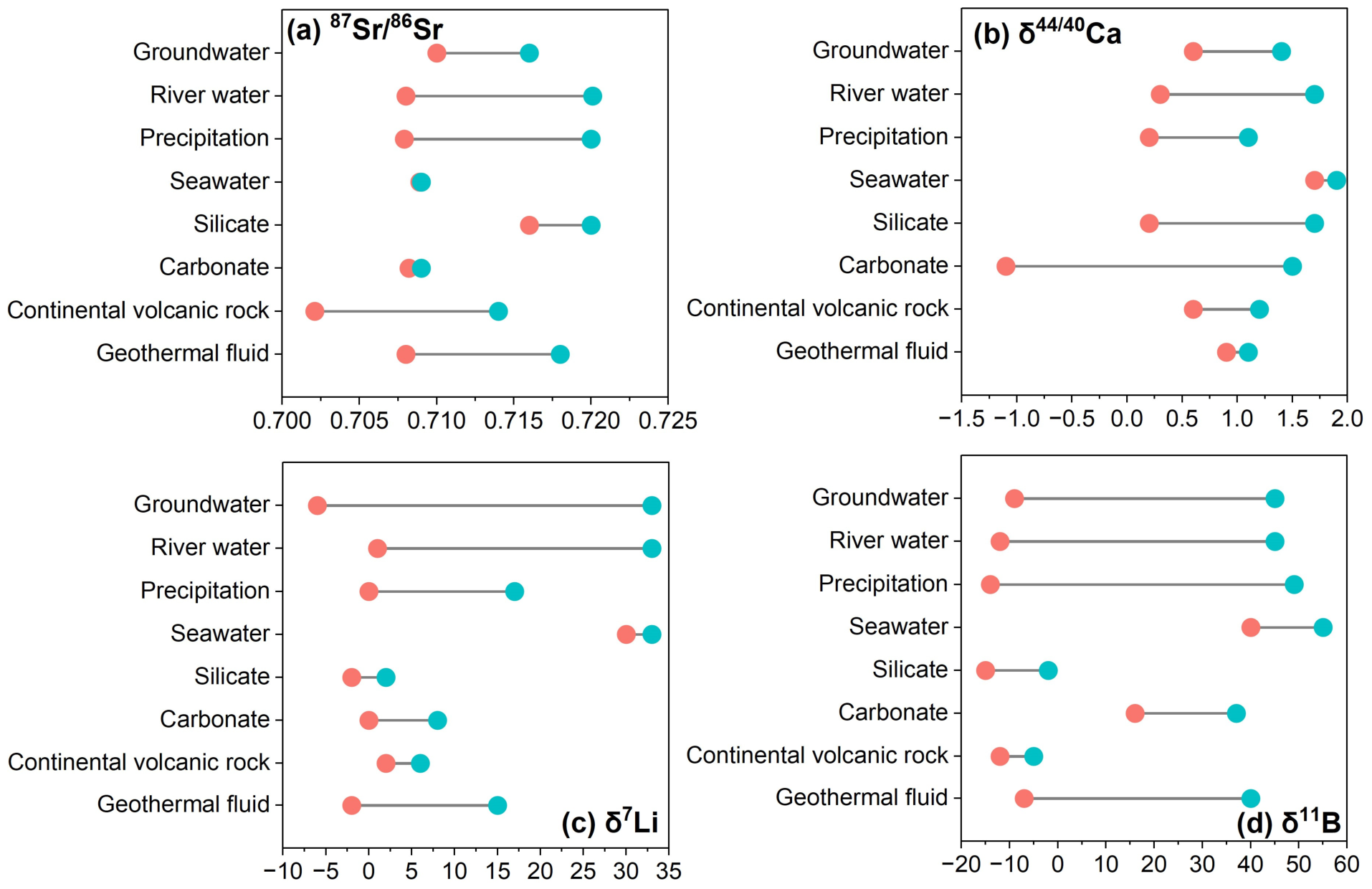
Fluoride-bearing minerals in nature mainly include fluorite, mica, and apatite, which are commonly associated with silicate and carbonate minerals [65]. Upon dissolution, these minerals release both F and Sr into groundwater, with characteristic 87Sr/86Sr ratios that depend on the mineral type and its geological history. As a result, the 87Sr/86Sr signature serves as a proxy for the specific mineral dissolution process responsible for F mobilization. Since these isotopic signatures vary significantly among different minerals, 87Sr/86Sr ratios provide strong constraints on the sources of dissolved components in high-F groundwater systems (Figure 1). Typically, Sr derived from carbonate dissolution exhibits relatively low 87Sr/86Sr ratios (0.708–0.710), whereas Sr released from silicate weathering usually shows higher values (>0.710) [37]. The residence time of Sr in groundwater ranges from several days to approximately one thousand years, which is far shorter than the half-life of 87Rb. Therefore, geological processes that alter 87Sr/86Sr ratios in groundwater mainly include mineral dissolution and mixing between different water bodies, while processes such as mineral precipitation and evaporation generally do not affect these ratios [38]. These characteristics make strontium isotopes effective tracers for water–rock interactions in groundwater systems (Table 1). For example, Ye et al. [66] investigated the hydrogeochemical characteristics and spatial distribution of deep high-F groundwater in the Hebei Plain by comparing Sr isotope compositions in groundwater and aquifer materials. In the Taiyuan Basin geothermal system, 87Sr/86Sr ratios confirmed water–rock interactions as the control on F enrichment, while in the Yishu Fault Zone, quantitative analysis identified mineral dissolution and adsorption–desorption as dominant processes [67,68]. Their results indicate that Sr and F likely share similar sources and exhibit comparable distribution patterns in deep groundwater of the Hebei Plain. However, in complex aquifer systems where multiple F and Sr sources coexist with distinct isotopic signatures, or where water-rock interaction histories are highly heterogeneous, the interpretation of 87Sr/86Sr data alone may be non-unique and require integration with other isotopes and hydrogeochemical modeling.

3.2. Calcium Isotopes

Calcium (Ca) is not only an essential element in biological structures but also a key geochemical element linking the lithosphere, hydrosphere, biosphere, and atmosphere. With advances in mass spectrometry, Ca isotope fractionation has been widely used to trace and quantify biogeochemical processes occurring across different spatial and temporal scales [69].
Calcium has six isotopes: 40Ca, 42Ca, 43Ca, 44Ca, 46Ca, and 48Ca, with relative abundances of 96.94%, 0.65%, 0.14%, 2.09%, 0.004%, and 0.19%, respectively. Among them, 48Ca is radioactive, whereas the other five are stable isotopes. High resolution SIMS techniques, achieving analytical uncertainties of approximately 0.3‰, have also been established, and the NIST SRM 915b was proposed as an international reference standard [39,40]. The isotopic composition of Ca in different phases is commonly expressed as δ44/40Ca (Equation (3)):
δ44/40Ca(‰) = ((44Ca/40Ca)sample/(44Ca/40Ca)STD − 1) × 1000
where (44Ca/40Ca)sample represent the calcium isotope ratios measured in the sample, whereas (44Ca/40Ca)STD denote the corresponding isotope ratios of the internationally recognized standard. Most studies use δ44/40Ca for geochemical interpretation. On a global scale, δ44/40Ca values range from −2‰ to 2‰. Carbonates typically exhibit δ44/40Ca values between −1.1‰ and 1.5‰, slightly lower than those of silicate rocks. Rainwater shows δ44/40Ca values ranging from 0.2‰ to 1.1‰ [37] (Figure 1). In rivers and groundwater, δ44/40Ca values mainly depend on rainfall input and the weathering products of surrounding rocks and sediments, although seawater influence may occur in some regions [38].
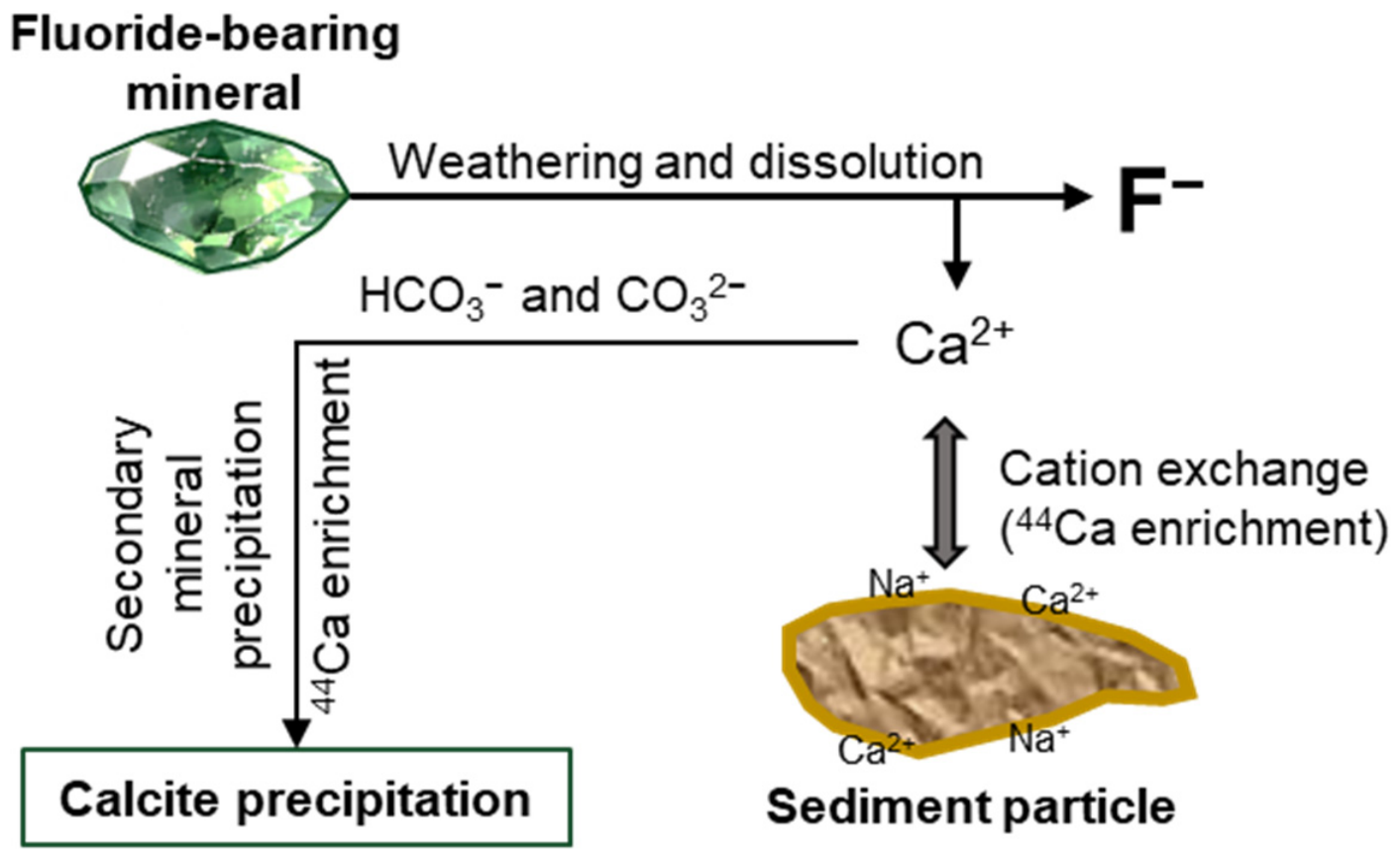
Hydrogeochemical processes that can induce Ca isotope fractionation in groundwater include mineral weathering and dissolution, cation exchange, and secondary mineral precipitation. These processes are also commonly associated with variations in groundwater F concentrations because Ca-bearing minerals often serve as both Ca2+ and F sources or sinks [41]. Mineral weathering and dissolution can produce Ca isotope fractionation that depends both on the δ44/40Ca composition of the parent minerals and on the weathering process itself. When fluoride-bearing minerals dissolve, they release both Ca2+ and F into groundwater, and the accompanying Ca isotope fractionation directly records the signature of the dissolving mineral phase [42]. The δ44/40Ca values in high-F groundwater therefore represent an integrated signal of the weathering of various fluoride-bearing minerals in local rocks, controlled by the isotopic compositions, abundances, and weathering rates of these minerals [43]. Consequently, δ44/40Ca signatures can help trace the specific mineral sources of F, provided that the primary Ca isotope fractionation occurs during mineral dissolution and is not overprinted by secondary processes such as cation exchange or calcite precipitation, which may decouple the Ca and F signals (Figure 2).
Cation exchange can also cause Ca isotope fractionation. Clay minerals in sediments commonly carry negative charges due to isomorphic substitution within their crystal structures. These charges promote the adsorption of cations on mineral surfaces or within interlayer sites, leading to strong adsorption of Ca2+ by clay minerals. As a kinetic fractionation process, clay minerals tend to preferentially adsorb the lighter isotope 40Ca, resulting in enrichment of 44Ca in the aqueous phase. The degree of fractionation varies depending on the mineral type [44]. When Ca2+ adsorbed on clay surfaces exchanges with Na+ in groundwater, the groundwater becomes depleted in 44Ca and δ44/40Ca decreases [70]. In aquifers, the release of Ca2+ from adsorption sites into the aqueous phase is unfavorable for fluoride enrichment. Conversely, when Na+ on clay surfaces exchanges with Ca2+ in groundwater, the solution becomes enriched in 44Ca, leading to higher δ44/40Ca values, which can promote fluoride enrichment (Table 1). Secondary Ca mineral precipitation can also induce Ca isotope fractionation. Experimental studies by Gussone et al. [71] demonstrated that secondary Ca precipitates are depleted in 44Ca because kinetic fractionation favors the incorporation of the lighter isotope 40Ca into the precipitated phase, leaving the solution enriched in 44Ca. Secondary mineral precipitation is often closely associated with microbial activity. For instance, microbial degradation of organic matter by calcium-precipitating bacteria can produce inorganic carbon species (HCO3 and CO32−), which react with Ca2+ to form secondary carbonate minerals. This process further enriches the aqueous phase in 44Ca [72]. In high-F groundwater systems, such processes can also contribute to increased F concentrations [5,22,23,73].

4. Lithium and Boron Isotopes for Identifying the Influence of Geothermal Fluids

4.1. Lithium Isotopes

Lithium (Li) isotopes are considered sensitive tracers of geothermal fluids [46,74]. Lithium has two stable isotopes, 7Li (92.4%) and 6Li (7.6%). The analysis of Li isotopes has been performed using TIMS as well as multi-collector sector ICP-MS techniques [47,75]. Lithium isotope compositions are typically reported relative to the L-SVEC standard. Given that the original L-SVEC material has been consumed, it has been replaced by IRMM-016, which is considered to have an isotopic composition identical to that of L-SVEC. Due to differences in their diffusion coefficients, these isotopes can undergo significant fractionation during various hydrogeochemical processes, and the degree of fractionation is strongly temperature dependent [48,49]. The Li isotopic composition of a phase is commonly expressed as δ7Li (Equation (4)):
δ7Li(‰) = ((7Li/6Li)sample/(7Li/6Li)STD − 1) × 1000
where (7Li/6Li)sample denotes the lithium isotope ratio of the analyzed sample, while (7Li/6Li)STD represents the corresponding ratio of the international standard.
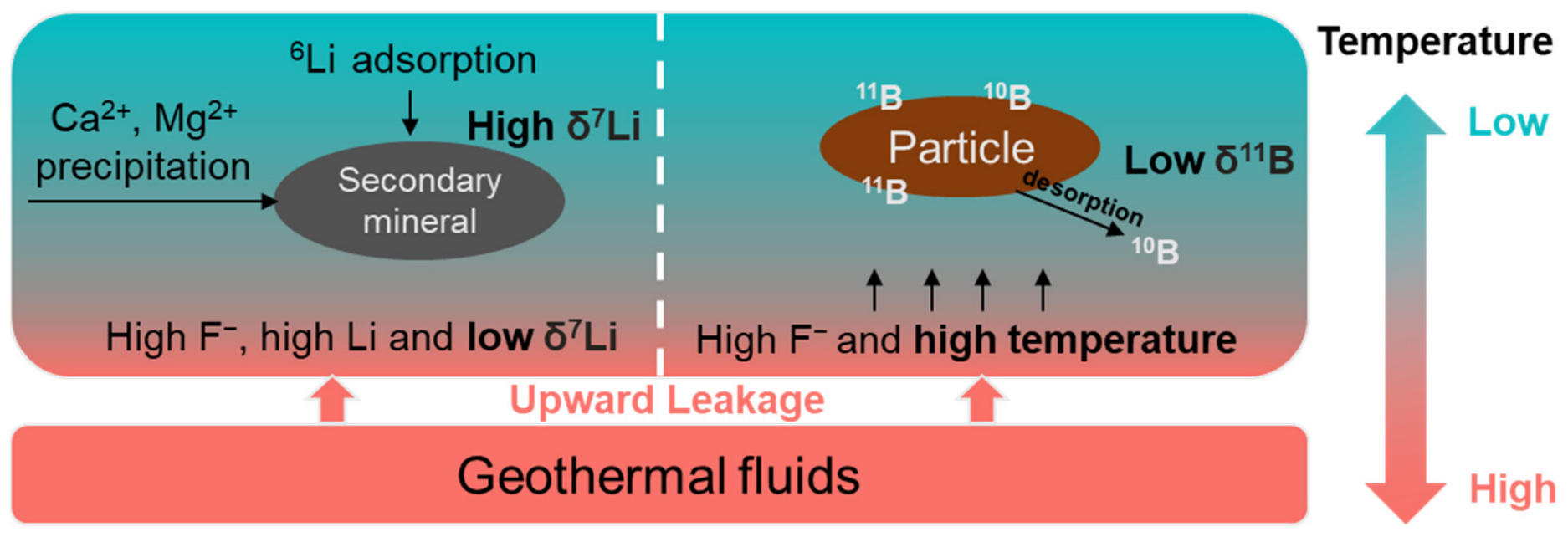
Different phases exhibit wide variations in δ7Li values (Figure 1). Carbonates typically show δ7Li values ranging from 0‰ to 8‰, higher than those of silicates (−2‰ to 2.5‰) [34]. The δ7Li values of precipitation and seawater range from 0‰ to 17‰ and 30‰ to 33‰, respectively [47,48]. In rivers and groundwater, δ7Li values are mainly influenced by precipitation inputs and the weathering products of surrounding rocks and sediments, while deep groundwater may also be affected by geothermal fluids [50,51]. Geothermal fluids often contain high concentrations of fluoride ions [76]. Moreover, their high-temperature conditions and strong dissolution capacity typically result in high Li concentrations and relatively low δ7Li values [77,78] (Figure 3). These characteristics can therefore be used to identify the influence of geothermal fluids on groundwater F. Additionally, the formation of secondary minerals in groundwater can consume Ca2+ and Mg2+, thereby promoting the dissolution of fluoride-bearing minerals. During this process, the lighter isotope 6Li is preferentially incorporated into mineral phases, causing progressive enrichment of the heavier isotope 7Li in the aqueous phase. Thus, Li isotopes can also indicate hydrogeochemical processes related to F enrichment [79,80]. Recent case studies have confirmed the utility of δ7Li in high-F groundwater research: in the Yuncheng Basin, δ7Li distinguished geothermal inputs and Salt Lake intrusion as F sources [14]; in the Taiyuan Basin geothermal system, δ7Li together with 87Sr/86Sr traced water–rock interactions controlling F enrichment [68].

4.2. Boron Isotopes

Boron (B) isotopes have been increasingly applied in the identification of geothermal sources and the tracing of hydrogeochemical processes in high-temperature hydrothermal systems. They provide valuable information for determining the geothermal origin of deep high-F groundwater. Boron has two stable isotopes: 11B (80.1%) and 10B (19.9%). Several analytical methods have been developed for boron isotope measurement, including TIMS, multi-collector sector ICP-MS, and SIMS [52,81,82]. Boron isotope compositions are commonly reported relative to the NIST SRM 951 boric acid standard, which is prepared from Searles Lake borax. The relatively large mass difference between these isotopes results in significant variations in B isotope compositions in natural systems [53,54]. The isotopic composition of boron is usually expressed as δ11B (Equation (5)):
δ11B(‰) = ((11B/10B)sample/(11B/10B)STD − 1) × 1000
where (11B/10B)sample denotes the B isotope ratio of the analyzed sample, while (11B/10B)STD represents the corresponding ratio of the international standard. Carbonates exhibit δ11B values ranging from 16‰ to 37‰, which are significantly higher than those of silicates [49,55]. The δ11B values in river water, precipitation, and groundwater range from −12‰ to 45‰, −14‰ to 49‰, and −9‰ to 45‰, respectively, all lower than those of seawater (40–55‰) [56] (Figure 1). Geothermal waters display a wide range of δ11B values, typically between −17‰ and 44‰ [57].
Boron isotope fractionation largely depends on the relative proportions of B(OH)3 and B(OH)4 in aqueous solutions. Variations in the pH of geothermal waters affect the relative abundance of these species and thus influence boron isotope fractionation. In addition, the isotopic composition of boron in groundwater can also be affected by adsorption–desorption processes. The lighter 10B tends to be preferentially desorbed into solution, resulting in lower δ11B values in groundwater [53] (Figure 3). Fractionation caused by dissolution and adsorption–desorption processes is also temperature dependent [83]. Therefore, differences in pH conditions and temperature regimes of geothermal fluids lead to distinct boron isotope compositions in geothermal-related F groundwater compared with other sources [84] (Table 1). Recent studies have demonstrated the practical utility of δ11B in tracing F enrichment. In the active Andean arc of northern Chile, B isotope revealed that geothermal inputs and evaporite dissolution control B and F release, with δ11B values ranging from −6‰ to +14‰ accompanying F concentrations up to 20 mg/L in groundwater [74]. In the coastal region of Guangdong Province, China, B isotope combined with H, O, and C isotopes identified seawater mixing as a key process affecting saline geothermal groundwater, with B isotopes effectively distinguishing marine and continental influences on geothermal systems [85]. The δ11B combined with B/Cl ratios can distinguish natural F sources from anthropogenic inputs including agriculture and sewage, as demonstrated in the Mt. Vulture volcanic aquifer, Italy [86]. These case studies confirm that δ11B is an effective tracer for identifying geothermal fluid inputs, evaporite dissolution, and seawater mixing processes that control fluoride enrichment in diverse hydrogeological settings.

5. Conclusions

The stable isotopes of hydrogen and oxygen (δ2H and δ18O) serve as fundamental tracers for deciphering the origins and evolutionary history of high-F groundwater. By constraining groundwater recharge sources, mixing dynamics, and the degree of evaporative enrichment, these isotopes provide critical insights into the initial hydrological controls on F mobilization. Complementing these, 87Sr/86Sr and δ44/40Ca act as sensitive indicators of water–rock interactions. Their variations in groundwater effectively capture key hydrogeochemical processes—including mineral dissolution, cation exchange, and secondary mineral precipitation—that govern the release and accumulation of fluoride from aquifer materials. Together, these isotope systems establish a robust framework for linking fluoride enrichment to both hydrological conditions and geochemical reactions. In geothermal-influenced aquifer systems, δ7Li and δ11B emerge as powerful tracers for unraveling complex water–rock interactions at depth. Their distinct isotopic fractionation patterns allow for the identification of geothermal fluid inputs and deep-seated hydrothermal processes that can significantly elevate F concentrations. The integrated application of these six stable isotope systems thus offers a comprehensive approach to elucidating the formation mechanisms and evolutionary pathways of high-F groundwater. Despite the demonstrated potential of multi-isotope approaches, several limitations must be acknowledged. First, most existing studies remain qualitative or semi-quantitative in nature, and standardized protocols for quantifying relative source contributions using isotopic mixing models are still lacking. Second, the simultaneous application of all six isotope systems is often constrained by high analytical costs, limited access to mass spectrometry facilities, and substantial sample volume requirements, which may hinder routine implementation in resource-limited settings. Third, the interpretation of isotopic signatures can be non-unique, particularly in complex aquifer systems where multiple F sources coexist or where secondary processes decouple traditional isotope tracers from fluoride dynamics. Future research should focus on advancing multi-isotope frameworks and coupling them with hydrogeochemical models to enhance predictive capabilities. Such efforts will be instrumental in developing targeted mitigation strategies and ensuring the long-term safety and sustainability of drinking water supplies in fluoride-affected regions.

Author Contributions

Conceptualization, Z.Z., Z.W. and N.A.; writing—original draft preparation, Z.Z., writing—review and editing, Z.W. and N.A. All authors have read and agreed to the published version of the manuscript.

Funding

This research was funded by Tianjin Natural Science Foundation Project (25JCQNJC00810).

Data Availability Statement

The original contributions presented in this study are included in the article. Further inquiries can be directed to the corresponding author.

Conflicts of Interest

The authors declare no conflicts of interest.

References

  1. Cotruvo, J.A. 2017 WHO Guidelines for Drinking Water Quality: First Addendum to the Fourth Edition. J. Am. Water Work. Assoc. 2017, 109, 44–51. [Google Scholar] [CrossRef]
  2. Alvarez, M.d.P.; Carol, E. Geochemical Occurrence of Arsenic, Vanadium and Fluoride in Groundwater of Patagonia, Argentina: Sources and Mobilization Processes. J. S. Am. Earth Sci. 2019, 89, 1–9. [Google Scholar] [CrossRef]
  3. Batabyal, A.K.; Gupta, S. Fluoride-Contaminated Groundwater of Birbhum District, West Bengal, India: Interpretation of Drinking and Irrigation Suitability and Major Geochemical Processes Using Principal Component Analysis. Environ. Monit. Assess. 2017, 189, 369. [Google Scholar] [CrossRef] [PubMed]
  4. Jia, Y.; Xi, B.; Jiang, Y.-H.; Guo, H.; Yang, Y.; Lian, X.; Han, S. Distribution, Formation and Human-Induced Evolution of Geogenic Contaminated Groundwater in China: A Review. Sci. Total Environ. 2018, 643, 967–993. [Google Scholar] [CrossRef] [PubMed]
  5. McMahon, P.B.; Brown, C.J.; Johnson, T.D.; Belitz, K.; Lindsey, B.D. Fluoride Occurrence in United States Groundwater. Sci. Total Environ. 2020, 732, 139217. [Google Scholar] [CrossRef]
  6. Podgorski, J.; Berg, M. Global Analysis and Prediction of Fluoride in Groundwater. Nat. Commun. 2022, 13, 4232. [Google Scholar] [CrossRef]
  7. Zhang, Z.; Liu, J.; Xiao, Z.; Liu, F.; Wang, Z.; Chen, S.; Zhang, J.; Xia, Y.; Jiang, W.; Ning, H. Spatial Distribution, Controlling Factors, and Health Risk Assessment of Groundwater Fluoride in the Chahanur Basin, Inner Mongolia, China. Environ. Earth Sci. 2025, 84, 400. [Google Scholar] [CrossRef]
  8. Yan, J.; Chen, J.; Zhang, W.; Ma, F. Determining Fluoride Distribution and Influencing Factors in Groundwater in Songyuan, Northeast China, Using Hydrochemical and Isotopic Methods. J. Geochem. Explor. 2020, 217, 106605. [Google Scholar] [CrossRef]
  9. Vithanage, M.; Bhattacharya, P. Fluoride in the Environment: Sources, Distribution and Defluoridation. Environ. Chem. Lett. 2015, 13, 131–147. [Google Scholar] [CrossRef]
  10. Zhang, Z.; Liu, F.; Chen, S.; Zhang, J.; Jiang, W.; Ning, H.; Liu, W.; Gao, Z.; Cao, W.; Guo, H. Strontium Isotope and Multi-Tracer Insights into Groundwater Mixing and Fluoride Mobilization in the Luanhe River Delta, Northern China. Appl. Geochem. 2025, 193, 106567. [Google Scholar] [CrossRef]
  11. Schmidt, M.; Maseyk, K.; Lett, C.; Biron, P.; Richard, P.; Bariac, T.; Seibt, U. Concentration Effects on Laser-Based δ18O and δ2H Measurements and Implications for the Calibration of Vapour Measurements with Liquid Standards. Rapid Commun. Mass Spectrom. 2010, 24, 3553–3561. [Google Scholar] [CrossRef] [PubMed]
  12. Keesari, T.; Sinha, U.K.; Deodhar, A.; Krishna, S.; Ansari, A.; Mohokar, H.; Dash, A. High Fluoride in Groundwater of an Industrialized Area of Eastern India (Odisha): Inferences from Geochemical and Isotopic Investigation. Environ. Earth Sci. 2016, 75, 1090. [Google Scholar] [CrossRef]
  13. Rashid, A.; Ayub, M.; Gao, X.; Khattak, S.A.; Ali, L.; Li, C.; Ahmad, A.; Khan, S.; Rinklebe, J.; Ahmad, P. Hydrogeochemical Characteristics, Stable Isotopes, Positive Matrix Factorization, Source Apportionment, and Health Risk of High Fluoride Groundwater in Semiarid Region. J. Hazard. Mater. 2024, 469, 134023. [Google Scholar] [CrossRef]
  14. Li, C.; Gao, X.; Liu, Y.; Wang, Y. Impact of Anthropogenic Activities on the Enrichment of Fluoride and Salinity in Groundwater in the Yuncheng Basin Constrained by Cl/Br Ratio, δ18O, δ2H, δ13C and δ7Li Isotopes. J. Hydrol. 2019, 579, 124211. [Google Scholar] [CrossRef]
  15. Fuge, R. Fluorine in the Environment, a Review of Its Sources and Geochemistry. Appl. Geochem. 2019, 100, 393–406. [Google Scholar] [CrossRef]
  16. Wang, Y.; Li, J.; Ma, T.; Xie, X.; Deng, Y.; Gan, Y. Genesis of Geogenic Contaminated Groundwater: As, F and I. Crit. Rev. Environ. Sci. Technol. 2020, 51, 2895–2933. [Google Scholar] [CrossRef]
  17. Fantong, W.Y.; Satake, H.; Ayonghe, S.N.; Suh, E.C.; Adelana, S.; Fantong, E.B.; Banseka, H.S.; Gwanfogbe, C.D.; Woincham, L.N.; Uehara, Y.; et al. Geochemical Provenance and Spatial Distribution of Fluoride in Groundwater of Mayo Tsanaga River Basin, Far North Region, Cameroon: Implications for Incidence of Fluorosis and Optimal Consumption Dose. Environ. Geochem. Health 2009, 32, 147–163. [Google Scholar] [CrossRef]
  18. Yidana, S.M.; Banoeng-Yakubo, B.; Akabzaa, T.M. Analysis of Groundwater Quality Using Multivariate and Spatial Analyses in the Keta Basin, Ghana. J. Afr. Earth Sci. 2010, 58, 220–234. [Google Scholar] [CrossRef]
  19. Dong, S.; Liu, B.; Shi, X.; Zhang, W.; Li, Z. The Spatial Distribution and Hydrogeological Controls of Fluoride in the Confined and Unconfined Groundwater of Tuoketuo County, Hohhot, Inner Mongolia, China. Environ. Earth Sci. 2015, 74, 325–335. [Google Scholar] [CrossRef]
  20. Chowdhury, A.; Adak, M.K.; Mukherjee, A.; Dhak, P.; Khatun, J.; Dhak, D. A Critical Review on Geochemical and Geological Aspects of Fluoride Belts, Fluorosis and Natural Materials and Other Sources for Alternatives to Fluoride Exposure. J. Hydrol. 2019, 574, 333–359. [Google Scholar] [CrossRef]
  21. Edmunds, W.M.; Smedley, P.L. Fluoride in Natural Waters. In Essentials of Medical Geology: Revised Edition; Selinus, O., Ed.; Springer Netherlands: Dordrecht, The Netherlands, 2013; pp. 311–336. ISBN 9789400743755. [Google Scholar]
  22. Rango, T.; Bianchini, G.; Beccaluva, L.; Ayenew, T.; Colombani, N. Hydrogeochemical Study in the Main Ethiopian Rift: New Insights to the Source and Enrichment Mechanism of Fluoride. Environ. Geol. 2008, 58, 109–118. [Google Scholar] [CrossRef]
  23. Guo, H.; Zhang, Y.; Xing, L.; Jia, Y. Spatial Variation in Arsenic and Fluoride Concentrations of Shallow Groundwater from the Town of Shahai in the Hetao Basin, Inner Mongolia. Appl. Geochem. 2012, 27, 2187–2196. [Google Scholar] [CrossRef]
  24. Mukherjee, I.; Singh, U.K. Groundwater Fluoride Contamination, Probable Release, and Containment Mechanisms: A Review on Indian Context. Environ. Geochem. Health 2018, 40, 2259–2301. [Google Scholar] [CrossRef]
  25. Clark, I.D.; Fritz, P. Environmental Isotopes in Hydrogeology; CRC Press: Boca Raton, Fl, USA; Lewis Publishers: Boca Raton, Fl, USA, 1997; ISBN 9781566702492. [Google Scholar]
  26. Craig, H. Isotopic Variations in Meteoric Waters. Science 1961, 133, 1702–1703. [Google Scholar] [CrossRef]
  27. Dansgaard, W. Stable Isotopes in Precipitation. Tellus 1964, 16, 436–468. [Google Scholar] [CrossRef]
  28. Gat, J.R. Oxygen and Hydrogen Isotopes in the Hydrologic Cycle. Annu. Rev. Earth Planet. Sci. 1996, 24, 225–262. [Google Scholar] [CrossRef]
  29. Pang, Z.; Kong, Y.; Li, J.; Tian, J. An Isotopic Geoindicator in the Hydrological Cycle. Procedia Earth Planet. Sci. 2017, 17, 534–537. [Google Scholar] [CrossRef]
  30. Zhang, Z.; Liu, F.; Chen, S.; Jiang, W.; Zhang, H.; Gao, Z.; Zhang, J.; Xie, H.; Meng, Q.; Xia, Y.; et al. Hydrogeochemical and Isotopic Insights into Groundwater Evolution in the Agricultural Area of the Luanhe Plain. Environ. Earth Sci. 2024, 83. [Google Scholar] [CrossRef]
  31. Martins, V.T.d.S.; Pino, D.S.; Bertolo, R.; Hirata, R.; Babinski, M.; Pacheco, D.F.; Rios, A.P. Who to Blame for Groundwater Fluoride Anomaly in São Paulo, Brazil? Hydrogeochemistry and Isotopic Evidence. Appl. Geochem. 2018, 90, 25–38. [Google Scholar] [CrossRef]
  32. Li, P.; He, X.; Li, Y.; Xiang, G. Occurrence and Health Implication of Fluoride in Groundwater of Loess Aquifer in the Chinese Loess Plateau: A Case Study of Tongchuan, Northwest China. Expo. Health 2018, 11, 95–107. [Google Scholar] [CrossRef]
  33. Parvaiz, A.; Khattak, J.A.; Hussain, I.; Masood, N.; Javed, T.; Farooqi, A. Salinity Enrichment, Sources and Its Contribution to Elevated Groundwater Arsenic and Fluoride Levels in Rachna Doab, Punjab Pakistan: Stable Isotope (δ2H and δ18O) Approach as an Evidence. Environ. Pollut. 2021, 268, 115710. [Google Scholar] [CrossRef]
  34. Su, C.; Wang, Y.; Xie, X.; Zhu, Y. An Isotope Hydrochemical Approach to Understand Fluoride Release into Groundwaters of the Datong Basin, Northern China. Environ. Sci. Process. Impacts 2015, 17, 791–801. [Google Scholar] [CrossRef]
  35. Zhang, Z.; Liu, F.; Jiang, W.; Chen, S.; Zhang, H.; Gao, Z.; Zhang, J.; Niu, X.; Cao, W.; Shan, Q. Quantifying the Factors Controlling Groundwater Fluoride and Associated Health Risks in the Coastal River Delta, Northern China. J. Asian Earth Sci. 2024, 259, 105929. [Google Scholar] [CrossRef]
  36. Yadav, K.K.; Kumar, S.; Pham, Q.B.; Gupta, N.; Rezania, S.; Kamyab, H.; Yadav, S.; Vymazal, J.; Kumar, V.; Tri, D.Q.; et al. Fluoride Contamination, Health Problems and Remediation Methods in Asian Groundwater: A Comprehensive Review. Ecotoxicol. Environ. Saf. 2019, 182, 109362. [Google Scholar] [CrossRef] [PubMed]
  37. Han, G.; Song, Z.; Tang, Y.; Wu, Q.; Wang, Z. Ca and Sr Isotope Compositions of Rainwater from Guiyang City, Southwest China: Implication for the Sources of Atmospheric Aerosols and Their Seasonal Variations. Atmos. Environ. 2019, 214, 116854. [Google Scholar] [CrossRef]
  38. Awaleh, M.O.; Baudron, P.; Soubaneh, Y.D.; Boschetti, T.; Hoch, F.B.; Egueh, N.M.; Mohamed, J.; Dabar, O.A.; Masse-Dufresne, J.; Gassani, J. Recharge, Groundwater Flow Pattern and Contamination Processes in an Arid Volcanic Area: Insights from Isotopic and Geochemical Tracers (Bara Aquifer System, Republic of Djibouti). J. Geochem. Explor. 2017, 175, 82–98. [Google Scholar] [CrossRef]
  39. Kasemann, S.A.; Schmidt, D.N.; Pearson, P.N.; Hawkesworth, C.J. Biological and Ecological Insights into ca Isotopes in Planktic Foraminifers as a Palaeotemperature Proxy. Earth Planet. Sci. Lett. 2008, 271, 292–302. [Google Scholar] [CrossRef]
  40. Heuser, A.; Eisenhauer, A. The Calcium Isotope Composition (δ44/40Ca) of NIST SRM 915b and NIST SRM 1486. Geostand. Geoanal. Res. 2008, 32, 311–315. [Google Scholar] [CrossRef]
  41. Holmden, C.; Papanastassiou, D.A.; Blanchon, P.; Evans, S. δ44/40Ca Variability in Shallow Water Carbonates and the Impact of Submarine Groundwater Discharge on Ca-Cycling in Marine Environments. Geochim. Cosmochim. Acta 2012, 83, 179–194. [Google Scholar] [CrossRef]
  42. Moore, J.; Jacobson, A.D.; Holmden, C.; Craw, D. Tracking the Relationship between Mountain Uplift, Silicate Weathering, and Long-Term CO2 Consumption with ca Isotopes: Southern Alps, New Zealand. Chem. Geol. 2013, 341, 110–127. [Google Scholar] [CrossRef]
  43. Hindshaw, R.S.; Bourdon, B.; Pogge von Strandmann, P.A.E.; Vigier, N.; Burton, K.W. The Stable Calcium Isotopic Composition of Rivers Draining Basaltic Catchments in Iceland. Earth Planet. Sci. Lett. 2013, 374, 173–184. [Google Scholar] [CrossRef]
  44. Brazier, J.M.; Schmitt, A.D.; Gangloff, S.; Pelt, E.; Chabaux, F.; Tertre, E. Calcium Isotopic Fractionation during Adsorption onto and Desorption from Soil Phyllosilicates (Kaolinite, Montmorillonite and Muscovite). Geochim. Cosmochim. Acta 2019, 250, 324–347. [Google Scholar] [CrossRef]
  45. Barbieri, M. Isotopes in Hydrology and Hydrogeology. Water 2019, 11, 291. [Google Scholar] [CrossRef]
  46. Xu, L.; Cheng, Y.; Zhang, J.; Liu, Y.; Zhao, X.; Sun, Y. Geochemical Characteristics of Lithium in Geothermal Waters and Its Impact on Riverine Li in the Southeastern Tibetan Plateau. Chem. Geol. 2026, 710, 123378. [Google Scholar] [CrossRef]
  47. James, R.H.; Palmer, M.R. The Lithium Isotope Composition of International Rock Standards. Chem. Geol. 2000, 166, 319–326. [Google Scholar] [CrossRef]
  48. Alvarez-Amado, F.; Tardani, D.; Poblete-Gonzalez, C.; Godfrey, L.K.; Matte-Estrada, D. Hydrogeochemical Processes Controlling the Water Composition in a Hyperarid Environment: New Insights from Li, B, and Sr Isotopes in the Salar de Atacama. Sci. Total Environ. 2022, 835, 155470. [Google Scholar] [CrossRef] [PubMed]
  49. Wimpenny, J.; Colla, C.A.; Yu, P.; Yin, Q.-Z.; Rustad, J.R.; Casey, W.H. Lithium Isotope Fractionation during Uptake by Gibbsite. Geochim. Cosmochim. Acta 2015, 168, 133–150. [Google Scholar] [CrossRef]
  50. Huang, T.; Li, Z.; Long, Y.; Zhang, F.; Pang, Z. Role of Desorption-Adsorption and Ion Exchange in Isotopic and Chem ical (Li, B, and Sr) Evolution of Water Following Water–Rock Interaction. J. Hydrol. 2022, 610, 127800. [Google Scholar] [CrossRef]
  51. Weynell, M.; Wiechert, U.; Schuessler, J.A. Lithium Isotopes and Implications on Chemical Weathering in the Catch ment of Lake Donggi Cona, Northeastern Tibetan Plateau. Geochim. Cosmochim. Acta 2017, 213, 155–177. [Google Scholar] [CrossRef]
  52. Rollion-Bard, C.; Erez, J. Intra-Shell Boron Isotope Ratios in the Symbiont-Bearing Benthic Foraminiferan Amphistegina lobifera: Implications for Δ11B Vital Effects and Paleo-PH Reconstructions. Geochim. Cosmochim. Acta 2010, 74, 1530–1536. [Google Scholar] [CrossRef]
  53. Zhang, W.; Tan, H.; Zhang, Y.; Wei, H.; Dong, T. Boron Geochemistry from Some Typical Tibetan Hydrothermal Systems: Origin and Isotopic Fractionation. Appl. Geochem. 2015, 63, 436–445. [Google Scholar] [CrossRef]
  54. Saffer, D.M.; Kopf, A.J. Boron Desorption and Fractionation in Subduction Zone Fore Arcs: Implications for the Sources and Transport of Deep Fluids. Geochem. Geophys. Geosyst. 2016, 17, 4992–5008. [Google Scholar] [CrossRef]
  55. Kubota, K.; Ishikawa, T.; Nagaishi, K.; Kawai, T.; Sagawa, T.; Ikehara, M.; Yokoyama, Y.; Yamazaki, T. Comprehensive Analysis of Laboratory Boron Contamination for Boron Isotope Analyses of Small Carbonate Samples. Chem. Geol. 2021, 576, 120280. [Google Scholar] [CrossRef]
  56. Mao, H.R.; Liu, C.Q.; Zhao, Z.Q. Source and Evolution of Dissolved Boron in Rivers: Insights from Boron Isotope Signatures of End-Members and Model of Boron Isotopes during Weathering Processes. Earth-Sci. Rev. 2019, 190, 439–459. [Google Scholar] [CrossRef]
  57. Rivas, S.; Sanchez-Alfaro, P.; Alvarez-Amado, F.; Perez-Fodich, A.; Godfrey, L.; Becerra, P.; Tardani, D.; Perez-Flores, P.; Aron, F.; Fica, C.; et al. Water-Rock Interaction and Magmatic Contribution in Thermal Fluids of the Southern Volcanic Zone, Chile: Insights from Li, B and Sr Isotopes. J. Volcanol. Geotherm. Res. 2024, 453, 108149. [Google Scholar] [CrossRef]
  58. Andrews, M.G.; Jacobson, A.D.; Lehn, G.O.; Horton, T.W.; Craw, D. Radiogenic and Stable Sr Isotope Ratios (87Sr/86Sr, δ88/86Sr) as Tracers of Riverine Cation Sources and Biogeochemical Cycling in the Milford Sound Region of Fiordland, New Zealand. Geochim. Cosmochim. Acta 2016, 173, 284–303. [Google Scholar] [CrossRef]
  59. Stevenson, R.; Pearce, C.R.; Rosa, E.; Hélie, J.-F.; Hillaire Marcel, C. Weathering Processes, Catchment Geology and River Management Impacts on Radiogenic (87Sr/86Sr) and Stable (δ88/86Sr) Strontium Isotope Compositions of Canadian Boreal Rivers. Chem. Geol. 2018, 486, 50–60. [Google Scholar] [CrossRef]
  60. Liu, W.; Wei, S.; Zhang, J.; Ao, C.; Liu, F.-T.; Cai, B.; Zhou, H.-Y.; Yang, J.-L.; Li, C.-F. An Improved Separation Scheme for Sr through Fluoride Coprecipitation Combined with a Cation-Exchange Resin from Geological Samples with High Rb/Sr Ratios for High-Precision Determination of Sr Isotope Ratios. J. Anal. At. Spectrom. 2020, 35, 953–960. [Google Scholar] [CrossRef]
  61. Wen, Z.; Hu, Z. Estimation of Isotopic Reference Values for Pure Materials and Geological Reference Materials. At. Spectrosc. 2020, 41, 93–102. [Google Scholar] [CrossRef]
  62. Meknassi, S.E.; Dera, G.; de Rafélis, M.; Brahmi, C.; Lartaud, F.; Hodel, F.; Jeandel, C.; Menjot, L.; Mounic, S.; Henry, M.; et al. Seawater 87Sr/86Sr Ratios along Continental Margins: Patterns and Processes in Open and Restricted Shelf Domains. Chem. Geol. 2020, 558, 119874. [Google Scholar] [CrossRef]
  63. Harrington, G.A.; Herczeg, A.L. The Importance of Silicate Weathering of a Sedimentary Aquifer in Arid Central Australia Indicated by Very High 87Sr/86Sr Ratios. Chem. Geol. 2003, 199, 281–292. [Google Scholar] [CrossRef]
  64. Shand, P.; Darbyshire, D.P.F.; Love, A.J.; Edmunds, W.M. Sr Isotopes in Natural Waters: Applications to Source Characterisation and Water–Rock Interaction in Contrasting Landscapes. Appl. Geochem. 2009, 24, 574–586. [Google Scholar] [CrossRef]
  65. Bayon, G.; Freslon, N.; Germain, Y.; Bindeman, I.N.; Trinquier, A.; Barrat, J.A. A Global Survey of Radiogenic Strontium Isotopes in River Sediments. Chem. Geol. 2021, 559, 119958. [Google Scholar] [CrossRef]
  66. Ye, P. Formation Mechanism of Strontium Isotopes in Groundwater of the Hebei Plain. Earth Sci. J. China Univ. Geosci. 2008, 33, 137–144. [Google Scholar] [CrossRef]
  67. Wang, L.; Liu, K.; Zhang, S.; Wan, L.; Jiang, F.; Feng, H.; Zhang, Y.; Zhang, L.; Wang, J. Quantitative Assessment of Fluoride Enrichment Mechanisms and Consequent Health Risks in Geothermal Waters of the Yishu Fault Zone Using Hydrochemical and Multi-Isotopic (H, O, Sr, S) Tracers. Geothermics 2026, 140, 103701. [Google Scholar] [CrossRef]
  68. Lu, C.; Li, Y.; Zhou, X.; Wang, Y.; Shao, W.; Zeng, Z.; Liu, Z.; Liao, D.; Zhang, H.; Mu, H. Fluoride Enrichment in Geothermal Waters Based on H, O, Sr, and Li Isotopes of the Taiyuan Basin, North China. J. Asian Earth Sci. 2025, 287, 106574. [Google Scholar] [CrossRef]
  69. Griffith, E.M.; Schmitt, A.-D.; Andrews, M.G.; Fantle, M.S. Elucidating Modern Geochemical Cycles at Local, Regional, and Global Scales Using Calcium Isotopes. Chem. Geol. 2020, 534, 119445. [Google Scholar] [CrossRef]
  70. Ockert, C.; Gussone, N.; Kaufhold, S.; Teichert, B.M.A. Isotope Fractionation during Ca Exchange on Clay Minerals in a Marine Environment. Geochim. Cosmochim. Acta 2013, 112, 374–388. [Google Scholar] [CrossRef]
  71. Gussone, N.; Filipsson, H.L.; Kuhnert, H. Mg/Ca, Sr/Ca and ca Isotope Ratios in Benthonic Foraminifers Related to Test Structure, Mineralogy and Environmental Controls. Geochim. Cosmochim. Acta 2016, 173, 142–159. [Google Scholar] [CrossRef]
  72. Harouaka, K.; Mansor, M.; Macalady, J.L.; Fantle, M.S. Calcium Isotopic Fractionation in Microbially Mediated Gypsum Precipitates. Geochim. Cosmochim. Acta 2016, 184, 114–131. [Google Scholar] [CrossRef]
  73. Yang, Y.; Zhang, Z.; Wang, Z.; Liu, H.; Sun, Z. Formation of High Fluoride Groundwater and Associated Health Risks in the Cangzhou Area of the North China Plain. Environ. Earth Sci. 2025, 84, 111. [Google Scholar] [CrossRef]
  74. Godfrey, L.V.; Herrera, C.; Gamboa, C.; Mathur, R. Chemical and Isotopic Evolution of Groundwater through the Active Andean Arc of Northern Chile. Chem. Geol. 2019, 518, 32–44. [Google Scholar] [CrossRef]
  75. Millot, R.; Guerrot, C.; Vigier, N. Accurate and High-Precision Measurement of Lithium Isotopes in Two Reference Materials by MC-ICP-MS. Geostand. Geoanal. Res. 2004, 28, 153–159. [Google Scholar] [CrossRef]
  76. Wang, Z.; Zhang, Z.; Adimalla, N.; Guo, H.; Pei, J.; Liu, H. Spatial Distribution and Enrichment Mechanisms of High Fluoride Groundwater in Geotherm-Affected Pliocene Aquifers of the Guide Basin, China. J. Geochem. Explor. 2024, 256, 107356. [Google Scholar] [CrossRef]
  77. Hindshaw, R.S.; Tosca, R.; Goût, T.L.; Farnan, I.; Tosca, N.J.; Tipper, E.T. Experimental Constraints on Li Isotope Fractionation during Clay Formation. Geochim. Cosmochim. Acta 2019, 250, 219–237. [Google Scholar] [CrossRef]
  78. Wanner, C.; Bucher, K.; von Strandmann, P.A.P.; Pettke, T. On the Use of Li Isotopes as a Proxy for Water–Rock Interaction in Fractured Crystalline Rocks: A Case Study from the Gotthard Rail Base Tunnel. Geochim. Cosmochim. Acta 2017, 198, 396–418. [Google Scholar] [CrossRef]
  79. Millot, R.; Guerrot, C.; Innocent, C.; Négrel, P.; Sanjuan, B. Chemical, Multi-Isotopic (Li–B–Sr–U–H–O) and Thermal Characterization of Triassic Formation Waters from the Paris Basin. Chem. Geol. 2011, 283, 226–241. [Google Scholar] [CrossRef]
  80. Murphy, M.J.; Porcelli, D.; Pogge von Strandmann, P.A.E.; Hirst, C.A.; Kutscher, L.; Katchinoff, J.A.; Mörth, C.-M.; Maximov, T.; Andersson, P.S. Tracing Silicate Weathering Processes in the Permafrost-Dominated Lena River Watershed Using Lithium Isotopes. Geochim. Cosmochim. Acta 2019, 245, 154–171. [Google Scholar] [CrossRef]
  81. Spivack, A.J.; Edmond, J.M. Determination of Boron Isotope Ratios by Thermal Ionization Mass Spectrometry of the Dicesium Metaborate Cation. Anal. Chem. 1986, 58, 31–35. [Google Scholar] [CrossRef]
  82. Louvat, P.; Moureau, J.; Paris, G.; Bouchez, J.; Noireaux, J.; Gaillardet, J. A Fully Automated Direct Injection Nebulizer (D-DIHEN) for MC-ICP-MS Isotope Analysis: Application to Boron Isotope Ratio Measurements. J. Anal. At. Spectrom. 2014, 29, 1698–1707. [Google Scholar] [CrossRef]
  83. Nigro, A.; Sappa, G.; Barbieri, M. Boron Isotopes and Rare Earth Elements in the Groundwater of a Landfill Site. J. Geochem. Explor. 2018, 190, 200–206. [Google Scholar] [CrossRef]
  84. André, L.; Manceau, J.-C.; Bourbon, P.; Wuilleumier, A. Cyclic Variations of Sulfate and Boron Concentrations and Isotopes in Deep Groundwaters in the Aquitaine Basin, France. Appl. Geochem. 2020, 123, 104818. [Google Scholar] [CrossRef]
  85. Yuan, J.; Xu, F.; Zheng, T. The Genesis of Saline Geothermal Groundwater in the Coastal Area of Guangdong Province: Insight from Hydrochemical and Isotopic Analysis. J. Hydrol. 2022, 605, 127345. [Google Scholar] [CrossRef]
  86. Paternoster, M. Boron Isotopes in the Mount Vulture Groundwaters (Southern Italy): Constraints for the Assessment of Natural and Anthropogenic Contaminant Sources. Geofluids 2019, 2019, 9107636. [Google Scholar] [CrossRef]
Figure 1. (a) 87Sr/86Sr ratios [10,36,37], (b) δ44/40Ca [37,38,39,40,41,42,43,44], (c) δ7Li [45,46,47,48,49,50,51] and (d) δ11B [52,55,56,57] values of important geological reservoirs.
Water 18 01269 g001
Figure 2. Hydrogeochemical processes in Ca isotope fractionation.
Water 18 01269 g002
Figure 3. Conceptual diagram showing changes in 7Li and 11B in groundwater induced by geothermal fluid recharge.
Water 18 01269 g003
Table 1. Advantages and limitations of isotope systems in high-F groundwater studies.
Isotope SystemPrimary Application in High F GroundwaterAdvantagesReferences
δ2H and δ18OIdentifying groundwater recharge sources, evaporative concentration, and hydrological processesSmall analytical uncertainty (δ2H: ±1‰; δ18O: ±0.1‰); sensitive to climatic influences and mixing dynamics[10,11,25,26,27,28,29,30,31,32,33,34,35]
87Sr/86SrTracing sources of dissolved solutes and identifying water-rock interactionsStrong capability to distinguish lithological sources (silicate vs. carbonate); minimal isotopic fractionation during most hydrogeochemical processes[10,36,37]
δ44/40CaInvestigating mineral dissolution and precipitationSensitive to Ca-related geochemical processes; useful for identifying mineral controls on fluoride concentrations[37,38,39,40,41,42,43,44]
δ7LiTracing silicate weathering, water-rock interactions, and deep fluid inputsHighly sensitive to high-temperature water-rock interactions; exhibits characteristic signatures in geothermal fluids; effective for identifying deep circulation and geothermal fluid mixing[45,46,47,48,49,50,51]
δ11BIdentifying solute sources, adsorption-desorption processes, and deep fluid contributionsStrong source discrimination (geothermal, marine, agricultural, sewage); pH-dependent fractionation provides additional process constraints[52,53,54,55,56,57]
Disclaimer/Publisher’s Note: The statements, opinions and data contained in all publications are solely those of the individual author(s) and contributor(s) and not of MDPI and/or the editor(s). MDPI and/or the editor(s) disclaim responsibility for any injury to people or property resulting from any ideas, methods, instructions or products referred to in the content.