Source Apportionment and Ozone Formation Potential Analysis of Atmospheric Unsaturated Hydrocarbon Volatile Organic Compounds in Beihai City During Summer


Abstract
1. Introduction
2. Materials and Methods
2.1. Monitoring Site and Sampling Period
2.2. Instrumentation and Quality Assurance/Quality Control
2.3. Analytical Methods
2.3.1. Ozone Formation Potential
2.3.2. Source Apportionment of Unsaturated Hydrocarbon VOCs
3. Results and Discussion
3.1. Source Apportionment of Unsaturated Hydrocarbons
3.2. Analysis of the Variation Characteristics of Unsaturated Hydrocarbons
3.2.1. Analysis of the Variation Characteristics of Alkenes
3.2.2. Analysis of the Variation Characteristics of Alkyne
3.2.3. Analysis of the Variation Characteristics of Aromatic Hydrocarbons
3.3. Reactivity of Unsaturated Hydrocarbons and Their Contribution to Ozone Formation
4. Conclusions
Author Contributions
Funding
Institutional Review Board Statement
Informed Consent Statement
Data Availability Statement
Conflicts of Interest
References
- Shao, M.; Zhang, Y.; Zeng, L.; Tang, X.; Zhang, J.; Zhong, L.; Wang, B. Ground-level ozone in the Pearl River Delta and the roles of VOC and NOx in its production. J. Environ. Manag. 2009, 90, 512–518. [Google Scholar] [CrossRef]
- Xue, L.K.; Wang, T.; Gao, J.; Ding, A.J.; Zhou, X.H.; Blake, D.R.; Wang, X.F.; Saunders, S.M.; Fan, S.J.; Zuo, H.C.; et al. Ground-level ozone in four Chinese cities: Precursors, regional transport and heterogeneous processes. Atmos. Chem. Phys. 2014, 14, 13175–13188. [Google Scholar] [CrossRef]
- Guo, S.; Hu, M.; Zamora, M.L.; Peng, J.; Shang, D.; Zheng, J.; Du, Z.; Wu, Z.; Shao, M.; Zeng, L.; et al. Elucidating severe urban haze formation in China. Proc. Natl. Acad. Sci. USA 2014, 111, 17373–17378. [Google Scholar] [CrossRef]
- Zhao, P.; Dong, F.; Yang, Y.; He, D.; Zhao, X.; Zhang, W.; Yao, Q.; Liu, H. Characteristics of carbonaceous aerosol in the region of Beijing, Tianjin, and Hebei, China. Atmos. Environ. 2013, 71, 389–398. [Google Scholar] [CrossRef]
- Chen, S.; Wang, H.; Lu, K.; Zeng, L.; Hu, M.; Zhang, Y. The trend of surface ozone in Beijing from 2013 to 2019: Indications of the persisting strong atmospheric oxidation capacity. Atmos. Environ. 2020, 242, 117801. [Google Scholar] [CrossRef]
- Lewis, A.C.; Hopkins, J.R.; Carslaw, D.C.; Hamilton, J.F.; Nelson, B.S.; Stewart, G.; Dernie, J.; Passant, N.; Murrells, T. An increasing role for solvent emissions and implications for future measurements of volatile organic compounds. Philos. Trans. Ser. A Math. Phys. Eng. Sci. 2020, 378, 20190328. [Google Scholar] [CrossRef]
- Amin, H.S.; Hatfield, M.L.; Hartz, K.E.H. Characterization of secondary organic aerosol generated from ozonolysis of α-pinene mixtures. Atmos. Environ. 2013, 67, 323–330. [Google Scholar] [CrossRef]
- Ahlberg, E.; Falk, J.; Eriksson, A.; Holst, T.; Brune, W.H.; Kristensson, A.; Roldin, P.; Svenningsson, B. Secondary organic aerosol from VOC mixtures in an oxidation flow reactor. Atmos. Environ. 2017, 161, 210–220. [Google Scholar] [CrossRef]
- Henze, D.K.; Seinfeld, J.H.; Ng, N.L.; Kroll, J.H.; Fu, T.-M.; Jacob, D.J.; Heald, C.L. Global modeling of secondary organic aerosol formation from aromatic hydrocarbons: High- vs. low-yield pathways. Atmos. Chem. Phys. 2008, 8, 2405–2420. [Google Scholar] [CrossRef]
- Hodzic, A.; Jimenez, J.L.; Madronich, S.; Canagaratna, M.R.; DeCarlo, P.F.; Kleinman, L.; Fast, J. Modeling organic aerosols in a megacity: Potential contribution of semi-volatile and intermediate volatility primary organic compounds to secondary organic aerosol formation. Atmos. Chem. Phys. 2010, 10, 5491–5514. [Google Scholar] [CrossRef]
- Mozaffar, A.; Zhang, Y.-L. Atmospheric Volatile Organic Compounds (VOCs) in China: A Review. Curr. Pollut. Rep. 2020, 6, 250–263. [Google Scholar] [CrossRef]
- Guo, H.; Ling, Z.H.; Cheng, H.R.; Simpson, I.J.; Lyu, X.P.; Wang, X.M.; Shao, M.; Lu, H.X.; Ayoko, G.; Zhang, Y.L.; et al. Tropospheric volatile organic compounds in China. Sci. Total Environ. 2017, 574, 1021–1043. [Google Scholar] [CrossRef]
- Wang, G.; Cheng, S.; Wei, W.; Zhou, Y.; Yao, S.; Zhang, H. Characteristics and source apportionment of VOCs in the suburban area of Beijing, China. Atmos. Pollut. Res. 2016, 7, 711–724. [Google Scholar] [CrossRef]
- Wang, N.; Li, N.; Liu, Z.; Evans, E. Investigation of chemical reactivity and active components of ambient VOCs in Jinan, China. Air Qual. Atmos. Health 2016, 9, 785–793. [Google Scholar] [CrossRef]
- Mo, Z.; Shao, M.; Lu, S.; Niu, H.; Zhou, M.; Sun, J. Characterization of non-methane hydrocarbons and their sources in an industrialized coastal city, Yangtze River Delta, China. Sci. Total Environ. 2017, 593–594, 641–653. [Google Scholar] [CrossRef] [PubMed]
- Hui, L.; Liu, X.; Tan, Q.; Feng, M.; An, J.; Qu, Y.; Zhang, Y.; Jiang, M. Characteristics, source apportionment and contribution of VOCs to ozone formation in Wuhan, Central China. Atmos. Environ. 2018, 192, 55–71. [Google Scholar] [CrossRef]
- Song, M.; Tan, Q.; Feng, M.; Qu, Y.; Liu, X.; An, J.; Zhang, Y. Source Apportionment and Secondary Transformation of Atmospheric Nonmethane Hydrocarbons in Chengdu, Southwest China. J. Geophys. Res. Atmos. 2018, 123, 9741–9763. [Google Scholar] [CrossRef]
- Yu, S.; Wang, S.; Xu, R.; Zhang, D.; Zhang, M.; Su, F.; Lu, X.; Li, X.; Zhang, R.; Wang, L. Measurement report: Intra- and interannual variability and source apportionment of volatile organic compounds during 2018–2020 in Zhengzhou, central China. Atmos. Chem. Phys. 2022, 22, 14859–14878. [Google Scholar] [CrossRef]
- Wu, Y.; Mo, Z.; Wu, Q.; Fan, Y.; Chen, X.; Li, H.; Lin, H.; Huang, X.; Tang, H.; Liao, D.; et al. A Year-Long Measurement and Source Contributions of Volatile Organic Compounds in Nanning, South China. Atmosphere 2024, 15, 560. [Google Scholar] [CrossRef]
- Paatero, P.; Tapper, U. Analysis of different modes of factor analysis as least squares fit problems. Chemom. Intell. Lab. Syst. 1993, 18, 183–194. [Google Scholar] [CrossRef]
- Anderson, M.J.; Daly, E.P.; Miller, S.L.; Milford, J.B. Source apportionment of exposures to volatile organic compounds: II. Application of receptor models to TEAM study data. Atmos. Environ. 2002, 36, 3643–3658. [Google Scholar] [CrossRef]
- Song, Y.; Shao, M.; Liu, Y.; Lu, S.; Kuster, W.; Goldan, P.; Xie, S. Source Apportionment of Ambient Volatile Organic Compounds in Beijing. Environ. Sci. Technol. 2007, 41, 4348–4353. [Google Scholar] [CrossRef] [PubMed]
- Liu, X.; Zeng, L.; Lu, S.; Yu, X. Online monitoring system for volatile organic compounds in the atmosphere. Acta Sci. Circumstantiae 2009, 29, 2471–2477. [Google Scholar]
- Yuan, B.; Shao, M.; De Gouw, J.; Parrish, D.D.; Lu, S.; Wang, M.; Zeng, L.; Zhang, Q.; Song, Y.; Zhang, J.; et al. Volatile organic compounds (VOCs) in urban air: How chemistry affects the interpretation of positive matrix factorization (PMF) analysis. J. Geophys. Res. Atmos. 2012, 117, D24302. [Google Scholar] [CrossRef]
- Zhang, F.; Shang, X.; Chen, H.; Xie, G.; Fu, Y.; Wu, D.; Sun, W.; Liu, P.; Zhang, C.; Mu, Y.; et al. Significant impact of coal combustion on VOCs emissions in winter in a North China rural site. Sci. Total Environ. 2020, 720, 137617. [Google Scholar] [CrossRef]
- Carter, W.-P.L. Development of ozone reactivity scales for volatile organic compounds. J. Air Waste Manag. Assoc. 1994, 44, 881–899. [Google Scholar] [CrossRef]
- Carter, W.-P.L. SAPRC Atmospheric Chemical Mechanisms and VOC Reactivity Scales[EB/OL], 2024. Available online: https://intra.engr.ucr.edu/~carter/SAPRC/ (accessed on 7 July 2024).
- Liu, Y.; Shao, M.; Fu, L.; Lu, S.; Zeng, L.; Tang, D. Source profiles of volatile organic compounds (VOCs) measured in China: Part I. Atmos. Environ. 2008, 42, 6247–6260. [Google Scholar] [CrossRef]
- Guo, H.; Wang, T.; Louie, P. Source apportionment of ambient non-methane hydrocarbons in Hong Kong: Application of a principal component analysis/absolute principal component scores (PCA/APCS) receptor model. Environ. Pollut. 2004, 129, 489–498. [Google Scholar] [CrossRef]
- Yuan, B.; Shao, M.; Lu, S.; Wang, B. Source profiles of volatile organic compounds associated with solvent use in Beijing, China. Atmos. Environ. 2010, 44, 1919–1926. [Google Scholar] [CrossRef]
- Choi, E.; Choi, K.; Yi, S.-M. Non-methane hydrocarbons in the atmosphere of a metropolitan city and a background site in South Korea: Sources and health risk potentials. Atmos. Environ. 2011, 45, 7563–7573. [Google Scholar] [CrossRef]
- Vega, E.; Mugica, V.; Carmona, R.; Valencia, E. Hydrocarbon source apportionment in Mexico City using the chemical mass balance receptor model. Atmos. Environ. 2000, 34, 4121–4129. [Google Scholar] [CrossRef]
- Liu, T.; Wang, X.; Wang, B.; Ding, X.; Deng, W.; Lü, S.; Zhang, Y. Emission factor of ammonia (NH3) from on-road vehicles in China: Tunnel tests in urban Guangzhou. Environ. Res. Lett. 2014, 9, 064027. [Google Scholar] [CrossRef]
- Zhang, Y.; Wang, X.; Zhang, Z.; Lü, S.; Shao, M.; Lee, F.S.; Yu, J. Species profiles and normalized reactivity of volatile organic compounds from gasoline evaporation in China. Atmos. Environ. 2013, 79, 110–118. [Google Scholar] [CrossRef]
- Tang, G.; Sun, J.; Wu, F.; Sun, Y.; Zhu, X.; Geng, Y.; Wang, Y. Organic composition of gasoline and its potential effects on air pollution in North China. Sci. China Chem. 2015, 58, 1416–1425. [Google Scholar] [CrossRef]
- Gao, S.; Jin, L.; Shi, J.; Han, B.; Wang, X.; Peng, Y.; Zhao, L.; Bai, Z. VOCs emission characteristics and emission factors of light-duty gasoline vehicles with bench test. China Environ. Sci. 2012, 32, 397–405. [Google Scholar]
- Ou, J.; Feng, X.; Liu, C.; Gao, Z.; Yang, Y.; Zhang, Z.; Wang, X.; Zheng, J. Source characteristics of VOCs emissions from vehicular exhaust in the Pearl River Delta region. Acta Sci. Circumstantiae 2014, 34, 826–834. [Google Scholar]
- Lu, S.; Bai, Y.; Zhang, G.; Ma, J. Study on the Characteristics of VOCs Source Profiles of Vehicle Exhaust and Gasoline Emission. Acta Scicentiarum Nat. Univ. Pekinesis 2003, 39, 507–511. [Google Scholar]
- Nelson, P.F.; Quigley, S.M. The Hydrocarbon Composition of Exhaust Emitted from Gasoline Fuelled Vehicles. Atmos. Environ. (1967) 1984, 18, 79–87. [Google Scholar] [CrossRef]
- Sharkey, T.D.; Yeh, S. Isoprene emission from plants. Annu. Rev. Plant Biol. 2001, 52, 407–436. [Google Scholar] [CrossRef] [PubMed]
- Seo, J.H.; Cho, J.; Hong, E.; Cho, S.; Gil, J.; Joo, T.; Weon, S. Seasonally adaptive data-driven ozone prediction in megacity environments. Environ. Res. 2026, 293, 123741. [Google Scholar] [CrossRef]
- Santiago, J.V.; Inoue, K.; Tonokura, K. Modeling Ground Ozone Concentration Changes after Variations in Precursor Emissions and Assessing Their Benefits in the Kanto Region of Japan. Atmosphere 2022, 13, 1187. [Google Scholar] [CrossRef]
- Wang, Q.; Sheng, D.; Wu, C.; Zhao, J.; Li, F.; Yao, S.; Ou, X.; Li, W.; Chen, J. Exploring ozone formation rules and concentration response to the change of precursors based on artificial neural network simulation in a typical industrial park. Heliyon 2023, 9, e20125. [Google Scholar] [CrossRef] [PubMed]






| Compound | Linear Correlation Coefficient (R2) | MDL (ppbv) | Precision (%) | Compound | Linear Correlation Coefficient (R2) | MDL (ppbv) | Precision (%) |
|---|---|---|---|---|---|---|---|
| Ethylene | 0.999 | 0.059 | 0.686 | M, p-xylene | 0.998 | 0.038 | 0.821 |
| Propylene | 0.998 | 0.079 | 0.512 | O-xylene | 0.997 | 0.021 | 0.76 |
| Acetylene | 0.998 | 0.044 | 0.595 | Styrene | 0.997 | 0.028 | 0.68 |
| Trans-2-butene | 0.998 | 0.04 | 0.531 | Cumene | 0.997 | 0.024 | 0.754 |
| Cis-2-butene | 0.998 | 0.08 | 0.546 | N-propylbenzene | 0.997 | 0.019 | 0.775 |
| N-butene | 0.998 | 0.035 | 0.459 | 1-ethyl-3-methylbenzene | 0.997 | 0.033 | 1.528 |
| butadiene | 0.999 | 0.045 | 1.194 | P-ethyltoluene | 0.997 | 0.036 | 1.312 |
| 1-Pentene | 0.999 | 0.052 | 1.075 | 1,3,5-trimethylbenzene | 0.998 | 0.022 | 0.68 |
| Trans-2-pentene | 0.998 | 0.044 | 1.226 | 1-ethyl-2-methylbenzene | 0.997 | 0.024 | 0.629 |
| Isoprene | 0.998 | 0.058 | 1.555 | 1,2,4-trimethylbenzene | 0.997 | 0.017 | 1.967 |
| Cis-2-pentene | 0.999 | 0.038 | 1.16 | 1,2,3-trimethylbenzene | 0.998 | 0.022 | 0.612 |
| 1-hexene | 0.997 | 0.035 | 1.514 | 1,3-diethylbenzene | 0.998 | 0.018 | 0.654 |
| Benzene | 0.997 | 0.033 | 0.791 | P-ethylbenzene | 0.998 | 0.018 | 0.583 |
| Toluene | 0.997 | 0.021 | 0.821 | Naphthalene | 0.993 | 0.02 | 0.79 |
| Ethylbenzene | 0.997 | 0.019 | 0.771 |
| Source | Fuel Evaporation | Solvent Usage | Combustion | Vehicle Exhaust | Biogenic |
|---|---|---|---|---|---|
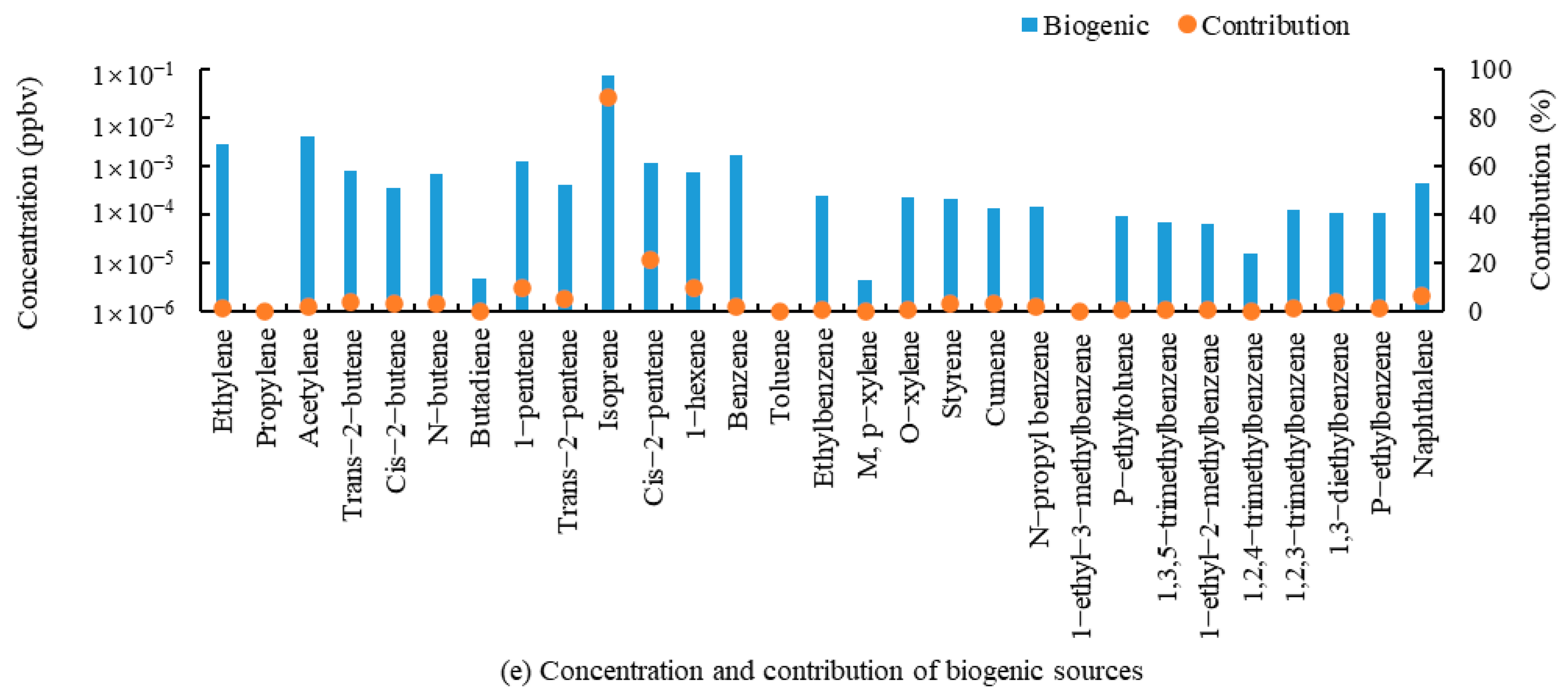
| Alkenes (excluding isoprene) | 9.80% | 3.27% | 51.41% | 33.40% | 2.12% |
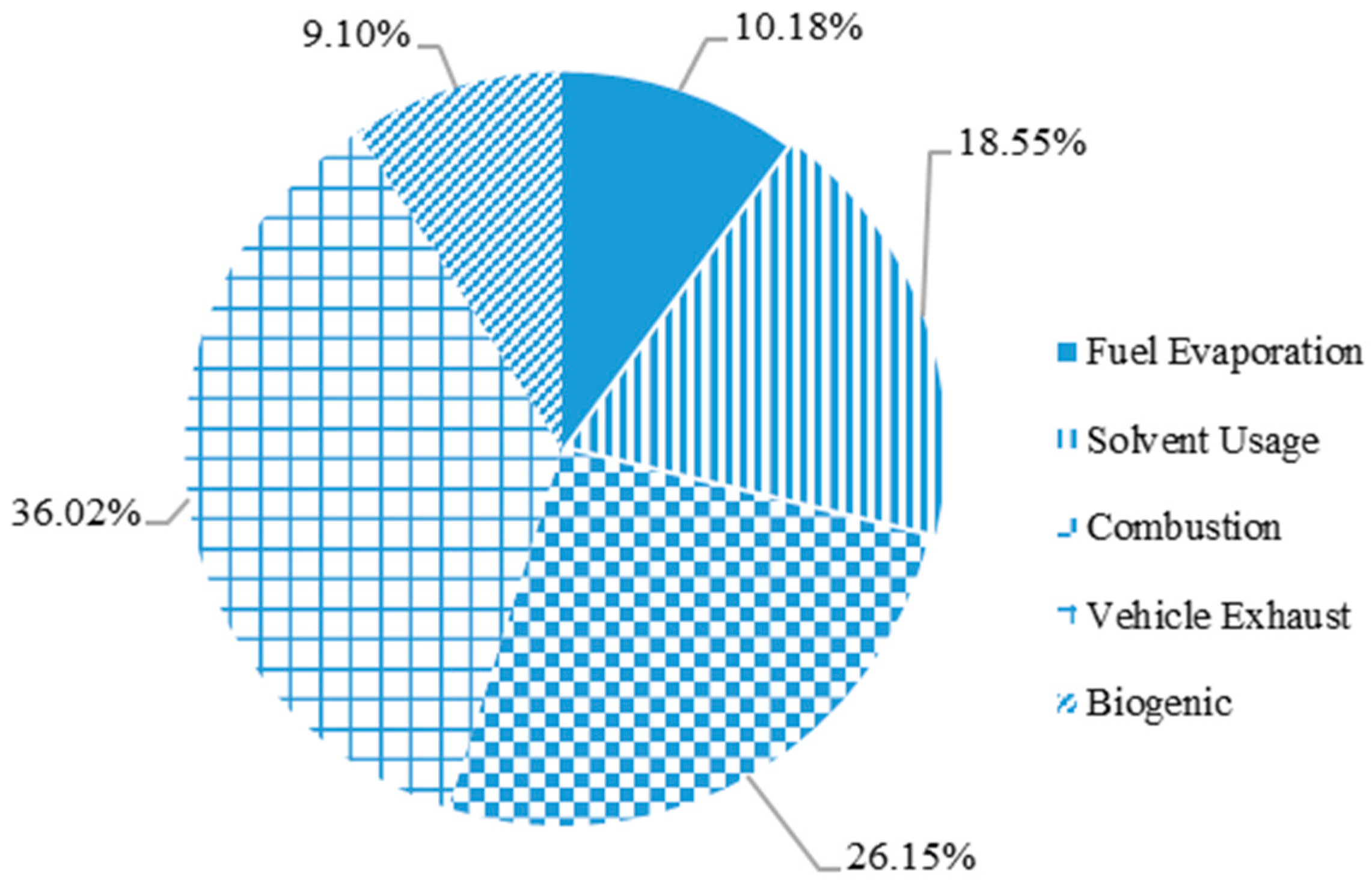
| Alkynes | 18.73% | — | 17.55% | 61.52% | 2.20% |
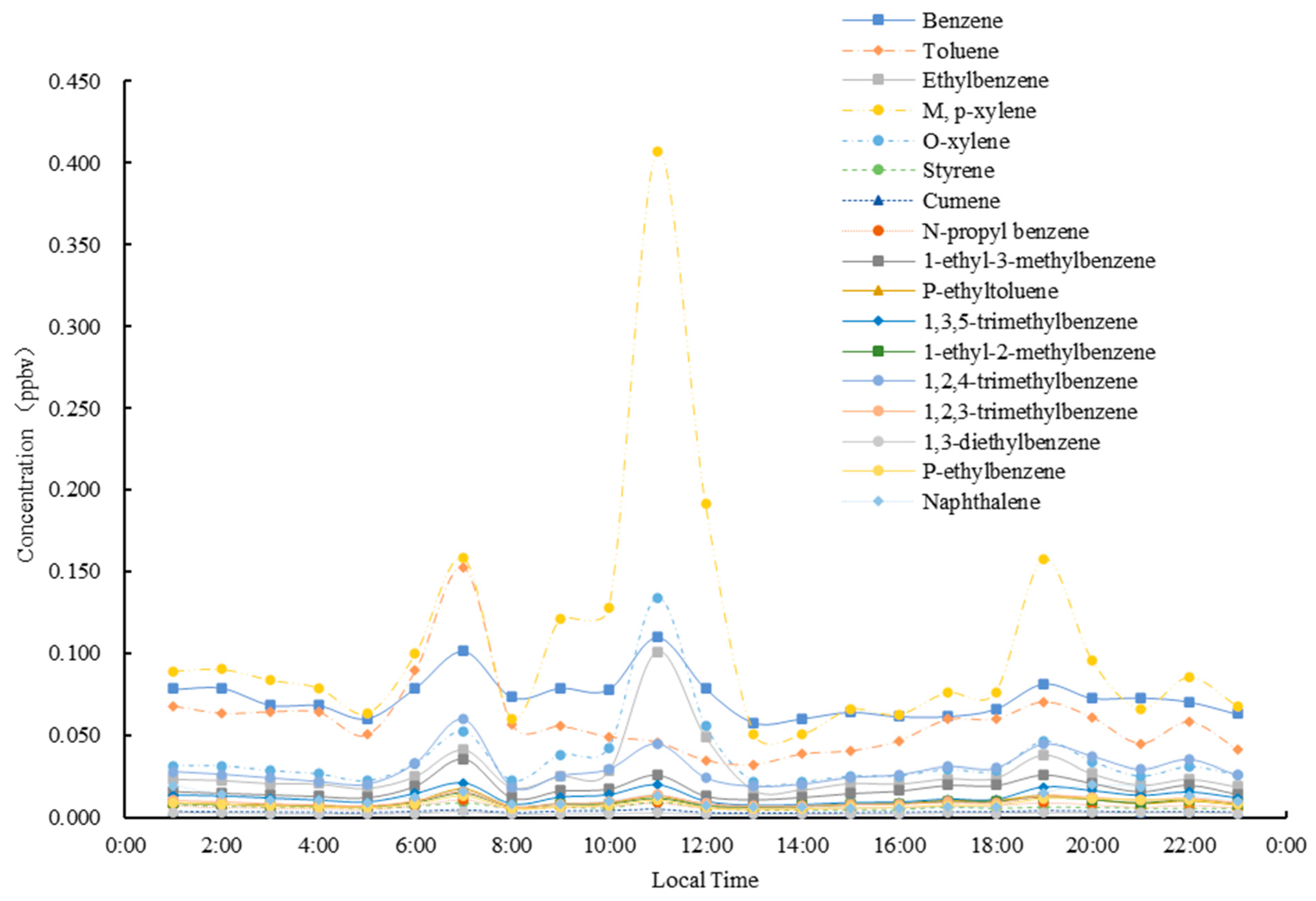
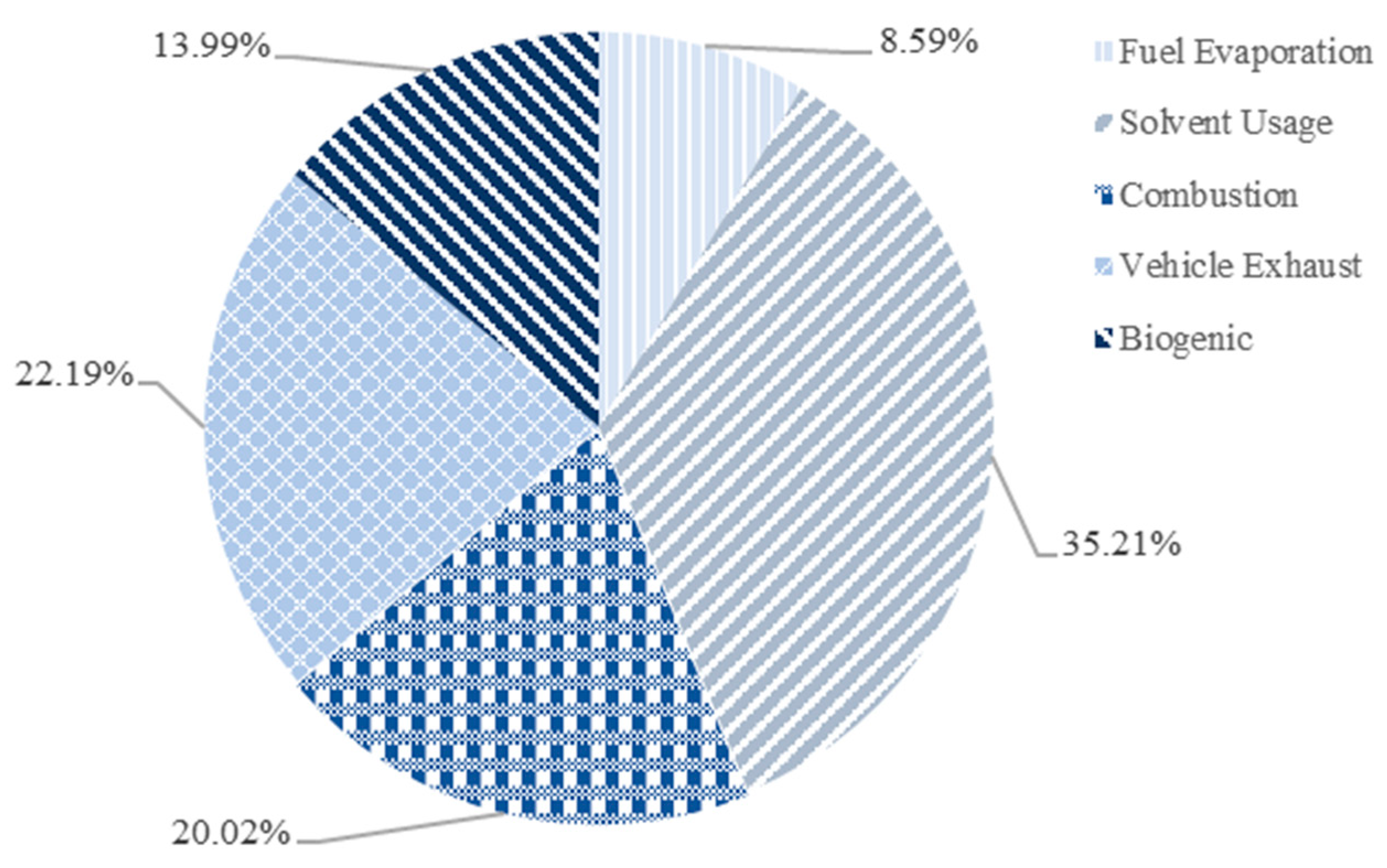
| Aromatic hydrocarbons | 8.74% | 48.26% | 9.62% | 32.35% | 1.02% |
| Compound | Avg. Concentration (ppbv) | Std. Dev. (ppbv) | Compound | Avg. Concentration (ppbv) | Std. Dev. (ppbv) |
|---|---|---|---|---|---|
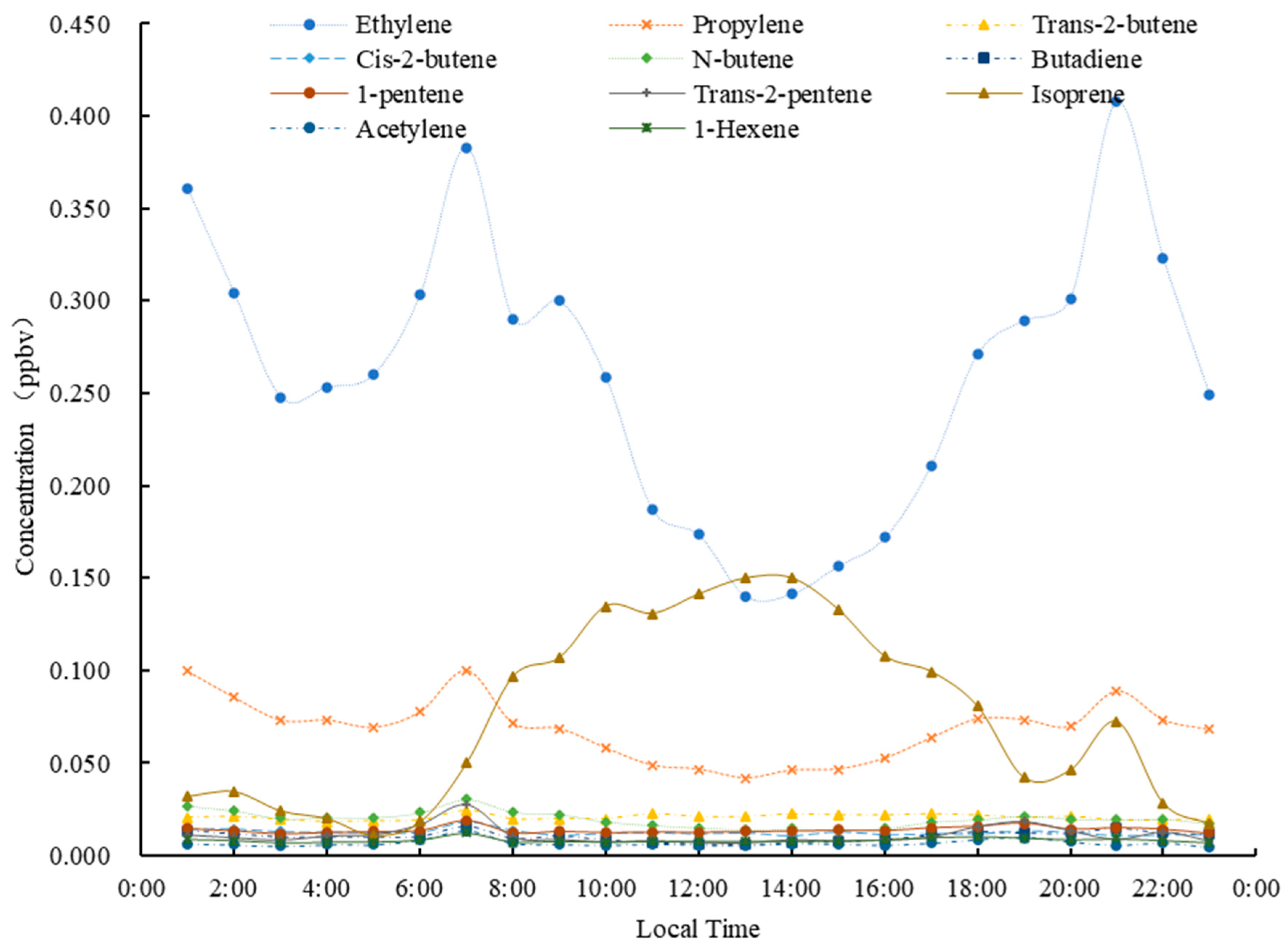
| ethylene | 0.288 | 0.296 | M, p-xylene | 0.106 | 0.357 |
| propylene | 0.075 | 0.070 | O-xylene | 0.037 | 0.106 |
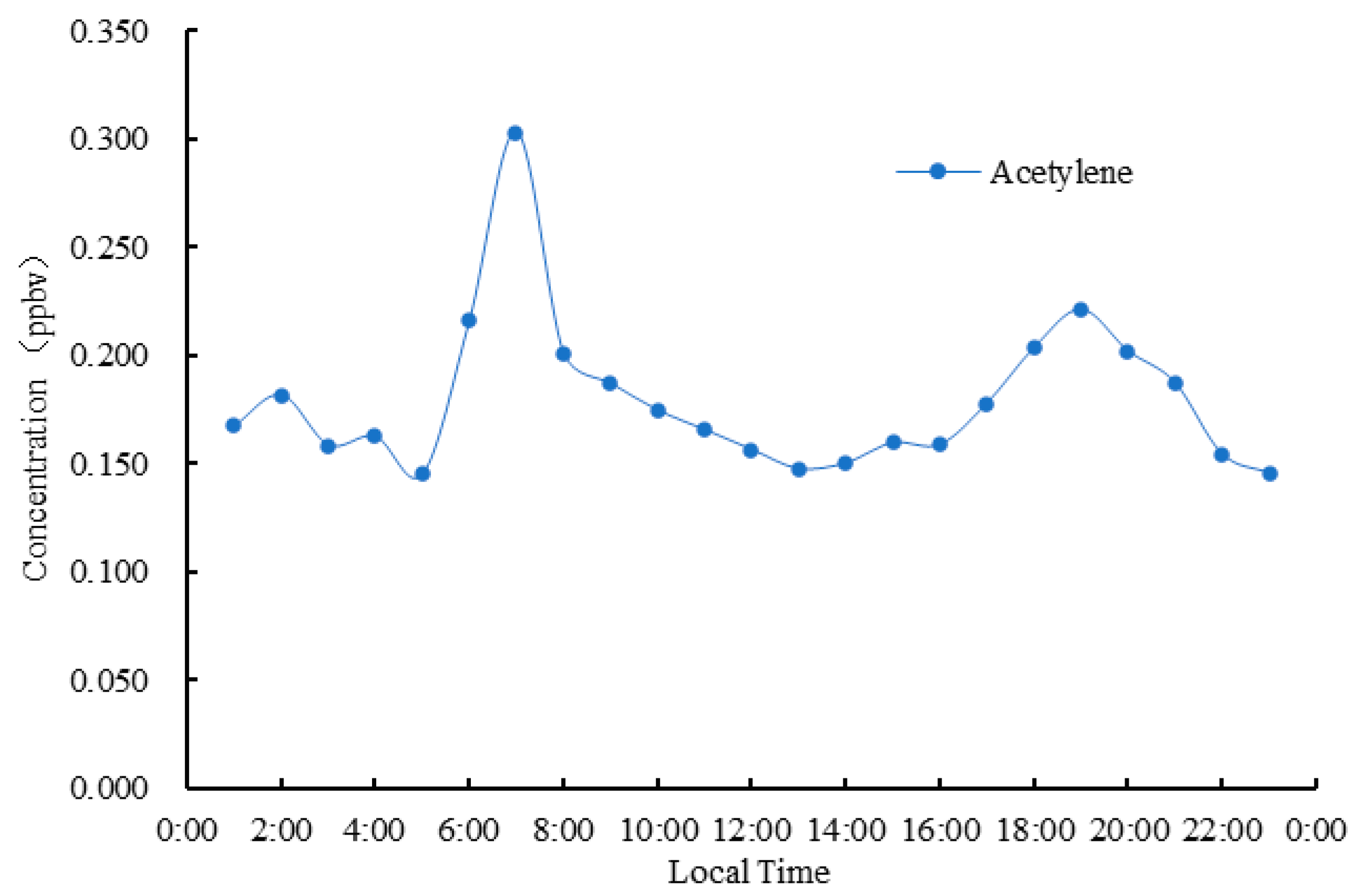
| acetylene | 0.204 | 0.170 | styrene | 0.007 | 0.006 |
| Trans-2-butene | 0.020 | 0.009 | Cumene | 0.004 | 0.004 |
| Cis-2-butene | 0.013 | 0.006 | N-propylbenzene | 0.007 | 0.008 |
| N-butene | 0.021 | 0.014 | 1-ethyl-3-methylbenzene | 0.018 | 0.029 |
| butadiene | 0.011 | 0.013 | P-ethyltoluene | 0.010 | 0.014 |
| 1-Pentene | 0.015 | 0.012 | 1,3,5-trimethylbenzene | 0.013 | 0.022 |
| Trans-2-pentene | 0.012 | 0.021 | 1-ethyl-2-methylbenzene | 0.009 | 0.011 |
| isoprene | 0.090 | 0.136 | 1,2,4-trimethylbenzene | 0.030 | 0.053 |
| Cis-2-pentene | 0.007 | 0.009 | 1,2,3-trimethylbenzene | 0.010 | 0.013 |
| 1-hexene | 0.009 | 0.008 | 1,3-diethylbenzene | 0.003 | 0.002 |
| benzene | 0.079 | 0.065 | P-ethylbenzene | 0.008 | 0.012 |
| toluene | 0.068 | 0.108 | naphthalene | 0.011 | 0.021 |
| ethylbenzene | 0.029 | 0.086 |
| Compound | OFP/(μg·m−3) | OFP Contribution (%) | Compound | OFP/(μg·m−3) | OFP Contribution (%) |
|---|---|---|---|---|---|
| ethylene | 2.63 | 11.39% | M, p-xylene | 4.50 | 19.46% |
| propylene | 1.36 | 5.88% | O-xylene | 1.49 | 6.43% |
| acetylene | 0.21 | 0.89% | styrene | 0.05 | 0.22% |
| Trans-2-butene | 0.81 | 3.51% | Cumene | 0.05 | 0.23% |
| Cis-2-butene | 0.46 | 1.97% | N-propylbenzene | 0.08 | 0.34% |
| N-butene | 0.47 | 2.02% | 1-ethyl-3-methylbenzene | 0.74 | 3.21% |
| butadiene | 0.30 | 1.29% | P-ethyltoluene | 0.23 | 1.01% |
| 1-Pentene | 0.32 | 1.40% | 1,3,5-trimethylbenzene | 0.79 | 3.41% |
| Trans-2-pentene | 0.39 | 1.68% | 1-ethyl-2-methylbenzene | 0.28 | 1.21% |
| isoprene | 3.32 | 14.37% | 1,2,4-trimethylbenzene | 1.46 | 6.33% |
| Cis-2-pentene | 0.24 | 1.03% | 1,2,3-trimethylbenzene | 0.63 | 2.74% |
| 1-hexene | 0.18 | 0.77% | 1,3-diethylbenzene | 0.11 | 0.48% |
| benzene | 0.19 | 0.82% | P-ethylbenzene | 0.21 | 0.91% |
| toluene | 0.98 | 4.23% | naphthalene | 0.18 | 0.76% |
| ethylbenzene | 0.46 | 2.00% |
Disclaimer/Publisher’s Note: The statements, opinions and data contained in all publications are solely those of the individual author(s) and contributor(s) and not of MDPI and/or the editor(s). MDPI and/or the editor(s) disclaim responsibility for any injury to people or property resulting from any ideas, methods, instructions or products referred to in the content. |
© 2026 by the authors. Licensee MDPI, Basel, Switzerland. This article is an open access article distributed under the terms and conditions of the Creative Commons Attribution (CC BY) license.
Share and Cite
Wu, Q.; Wu, Y. Source Apportionment and Ozone Formation Potential Analysis of Atmospheric Unsaturated Hydrocarbon Volatile Organic Compounds in Beihai City During Summer. Atmosphere 2026, 17, 565. https://doi.org/10.3390/atmos17060565
Wu Q, Wu Y. Source Apportionment and Ozone Formation Potential Analysis of Atmospheric Unsaturated Hydrocarbon Volatile Organic Compounds in Beihai City During Summer. Atmosphere. 2026; 17(6):565. https://doi.org/10.3390/atmos17060565
Chicago/Turabian StyleWu, Qinqin, and Ying Wu. 2026. "Source Apportionment and Ozone Formation Potential Analysis of Atmospheric Unsaturated Hydrocarbon Volatile Organic Compounds in Beihai City During Summer" Atmosphere 17, no. 6: 565. https://doi.org/10.3390/atmos17060565
APA StyleWu, Q., & Wu, Y. (2026). Source Apportionment and Ozone Formation Potential Analysis of Atmospheric Unsaturated Hydrocarbon Volatile Organic Compounds in Beihai City During Summer. Atmosphere, 17(6), 565. https://doi.org/10.3390/atmos17060565