


Abstract
It is well known that broadband solar irradiance is measured with a much higher spatial density than ultraviolet (UV) solar irradiance. Building on this, this study proposes a new model for estimating clear-sky global UV solar irradiance based on broadband radiometric measurements. The model is developed for the UV spectral range from 0.280 to 0.400 μm. The originality of the model lies in its innovative structure, empirically derived equations, and minimal input requirements, limited to global solar irradiance and atmospheric turbidity. Preliminary results demonstrate that the proposed model achieves a stable and well-balanced trade-off between simplicity and accuracy. A notable advantage of the model is its reliance on minimal inputs, enabling application over large geographical areas.
1. Introduction
Solar ultraviolet (UV) radiation, typically defined over 0.280 to 0.400 μm spectral range, plays a key role in the biosphere, influencing a wide range of biological, chemical, and ecological processes. It affects living organisms at multiple levels, from molecular interactions to ecosystem functioning, and contributes to the regulation of environmental dynamics [1]. Although it represents only a small fraction of the solar radiation spectrum, surface UV radiation has a significant impact on environmental processes and ecosystem responses under varying atmospheric conditions [2]. In addition to its biological and ecological relevance, solar UV radiation also affects materials, contributing to the degradation of polymers and influencing the performance and long-term stability of photovoltaic systems [3]. Surface UV irradiance is sensitive to atmospheric conditions, resulting in substantial spatial and temporal variability.
In contrast to its importance, ground-based measurements of solar UV irradiance are relatively sparse and unevenly distributed. The limited number of monitoring stations and the higher instrumental complexity of UV radiometers contribute to the scarcity of observations. This complexity arises from the need for spectral filtering, which increases both cost and measurement uncertainty, resulting in datasets that are often discontinuous and geographically restricted [4,5]. By comparison, broadband global solar irradiance is routinely measured at a much higher spatial and temporal density through well-established radiometric networks. As a result, extensive and consistent datasets of broadband irradiance are widely available and commonly used in solar and atmospheric studies [6].
As an alternative to direct measurements, solar UV irradiance can be estimated using radiative transfer modeling approaches. Clear-sky spectral models, such as SMARTS2 [7] and NEOPLANTA [8], enable accurate computation of UV irradiance through spectral integration when detailed atmospheric inputs (e.g., ozone, nitrogen dioxide content, aerosol properties, and water vapor content) are available. In parallel, simplified methods based on parametric or empirical formulations have been proposed to estimate UV irradiance using a reduced set of atmospheric inputs or more readily available radiometric measurements [9].
Within this context, models that estimate solar UV irradiance from measured broadband global irradiance provide a practical and efficient alternative. By considering global solar irradiance as an input parameter, these models implicitly account for the overall atmospheric state, including the combined effects of absorption and scattering processes. As a result, they reduce the need for detailed atmospheric inputs while preserving sensitivity to key attenuation mechanisms, making them suitable for applications where only limited data are available.
Several studies have investigated the estimation of clear-sky solar UV irradiance from broadband global irradiance as a practical alternative to direct measurements. Early work established empirical relationships between UV and broadband solar radiation using ground-based measurements. For example, hourly values of UV (0.290–0.385 μm) and broadband solar irradiance have been shown to be strongly correlated under different climatic conditions [10]. Similarly, analyses of global UV radiation (0.280–0.380 μm) have demonstrated that broadband global solar irradiance can serve as a reliable predictor of UV irradiance under clear-sky conditions [11]. Further developments have focused on the estimation of clear-sky erythemal UV radiation from broadband solar irradiance in specific climatic environments [12]. Similar concepts have been applied in operational contexts, where the UV Index is estimated from broadband global irradiance using simplified models or empirical relationships. This illustrates the practical relevance of the UV–broadband link under clear-sky conditions.
Recent studies have continued to explore this relationship, although often within more complex modelling frameworks. For instance, models have been developed to estimate UV-B, UV-A, and erythemal irradiance from global horizontal irradiance combined with ozone column information [13]. Such approaches extend beyond purely broadband-based estimation of solar UV irradiance by incorporating additional atmospheric inputs. They also confirm the significant role of global irradiance as a predictor of UV radiation.
Despite these advances, relatively few studies have addressed the development of simple, physically based models for estimating UV irradiance from broadband measurements under clear-sky conditions. Empirical relationships have been reported for both broadband and UV solar irradiance, showing that global solar irradiance can explain a substantial part of UV variability, especially when additional atmospheric information is included [9,14]. A similar line was followed by Habte et al., who developed a simplified empirical approach for estimating UV irradiance from global horizontal irradiance using only the atmospheric optical mass as input [15].
Taken together, these studies confirm that broadband global solar irradiance is a readily available radiometric quantity. It is also a physically significant predictor for empirical and semi-empirical UV irradiance models operating under clear-sky conditions.
Despite the progress achieved by empirical and semi-empirical approaches, most existing models require site-specific calibration or multiple atmospheric inputs, which may limit their applicability when such data are not available. The explicit role of atmospheric parameters in controlling the relationship between UV and broadband irradiance remains only partially quantified. This gap provides the context for the present study, which builds on established UV–broadband relationships and explicitly incorporates key atmospheric parameters under clear-sky conditions.
In this context, the present study investigates the use of global solar irradiance as a physical proxy for modeling solar UV irradiance under clear-sky conditions. By combining broadband global solar irradiance with atmospheric optical mass and the Ångström turbidity coefficient, a new model for global solar UV irradiance is developed. The model is developed to estimate instantaneous UV irradiance (W/m2), integrated over the 0.280–0.400 μm spectral range. The proposed approach aims to capture the dominant attenuation processes while maintaining a reduced input structure. The novelty of the model lies in its formulation based on empirically derived equations and its minimal input requirements, limited to deterministic parameters and atmospheric turbidity.
2. Models, Methods and Data
The present study is structured into four parts, each involving different models and investigation methods. In the first part, the relationship between global solar UV irradiance GUV and broadband global solar irradiance G is analyzed under clear-sky conditions. This relationship is hereafter denoted as GUV/G. In the second part, a new empirical model is developed to estimate clear-sky solar UV irradiance based on measurements (or even estimates) of broadband global irradiance. The third part presents an intercomparison of different models for estimating global solar UV irradiance. In the final part, the performance of the proposed model is evaluated against measured data. The tools and methods used in each part are described below.
The influence of atmospheric parameters on the GUV/G ratio was investigated using synthetically generated data. Two clear-sky parametric models developed by the authors were employed: the PS model [16] for broadband solar irradiance and the UV4PM model [9] for UV irradiance. The choice of these models is justified by their common origin in the Leckner spectral model [17], which is expected to reduce systematic errors in the GUV/G ratio.
The development of the new model for estimating clear-sky solar UV irradiance was also based on synthetic data. Synthetic values of the GUV/G ratio were generated using the Leckner clear-sky spectral irradiance model [17]. Synthetic data were used for two main reasons. First, ground-based UV measurements are limited and do not provide sufficiently comprehensive datasets. Second, synthetic data ensures uniform coverage of atmospheric parameter ranges, which is difficult to achieve using observations. The Leckner model may exhibit biases under certain atmospheric conditions. In our approach, the Leckner model is used to generate the ratio of UV to broadband irradiance, GUV/G. In this way, the potential bias of the Leckner model is reduced.
Since the UV absorption coefficients in this model are defined at only 14 wavelengths, the spectral resolution was enhanced using absorption coefficients from the SMARTS2 model [7], defined at 121 wavelengths. Because the two sets of coefficients differ in magnitude (due to differences in the atmospheric transmittance formulations), the SMARTS2 coefficients were statistically calibrated prior to their implementation in the Leckner model. Using the adjusted Leckner model, the matrix GUV(mₖ, βᵢ)/G(mₖ, βᵢ) was generated, forming the discrete grid on which the continuous function R(m, β) was fitted.
A first step in evaluating the proposed model consisted of a comparative analysis of solar UV irradiance estimates against those obtained from other models under similar atmospheric conditions. The proposed model was compared with the UV:TS [15], UV2G [9], and SMARTS2 [7] models. The selection of these models was not arbitrary. The UV:TS model expresses solar UV irradiance as a function of broadband global irradiance G and atmospheric optical mass m. The UV2G model considers, in addition to G and m, four additional atmospheric parameters: total ozone, nitrogen dioxide, water vapor, and the Ångström turbidity coefficient. The SMARTS2 model estimates spectral solar UV irradiance based on a comprehensive set of atmospheric parameters, with global UV irradiance obtained through integration of the discrete spectral values.
In the second step, the model was tested against measured data from two radiometric stations, Payerne and Izaña (Table 1). Both stations are part of the Baseline Surface Radiation Network (BSRN) [18]. These are the only stations in the network that measure and report global solar irradiance in the UV band. The climatic conditions at Payerne and Izana differ significantly, particularly in terms of sky conditions. Payerne is located in a low-altitude temperate region, where weather conditions are strongly influenced by synoptic variability. As a result, cloud cover is frequent and highly variable. In contrast, Izana is situated at high altitude in the subtropical North Atlantic, typically above the marine boundary layer. This site is characterized by predominantly clear-sky conditions, low aerosol load, and high atmospheric stability. At the Izana Atmospheric Observatory, the mean surface pressure is approximately 770 hPa, corresponding to a pressure ratio p/p0 ≈ 0.76 [19].
Table 1.
The radiometric stations where the UV data used in this study was recorded. The climate of the station is indicated in terms of the Köppen–Geiger classification [20] (Csb—subtropical highland climate; Cfb—temperate-continental).
The test dataset includes only measurements performed on perfectly clear-sky days. The selection procedure was based on the indicator developed in [21]. This indicator, based on the cumulative distribution function of clearness index increments, was applied to time series of global solar irradiance for individual days. Following this automatic selection, an additional visual inspection of the temporal variation in global solar irradiance was carried out. Only those days exhibiting a smooth bell-shaped curve were retained.
The UV and broadband solar irradiance data obtained from the BSRN were combined with atmospheric parameters, including ozone content in the atmospheric column, column water vapor content, and the Ångström turbidity coefficient. The atmospheric parameters were retrieved from the Aerosol Robotic Network (AERONET) [22]. It should be noted that, at each of the two sites, a BSRN station and an AERONET station are co-located. The final dataset includes measurements collected on perfectly clear-sky days: 18 and 29 July 2024 at the PAY station (378 instances), and 1, 5, 8, 11, and 14–25 July at the IZA station (2529 instances).
The models’ performances are compared in terms of two statistical indicators: normalized root mean square error (nRMSE) and normalized mean bias error (nMBE):
where c and m refer to the estimated and measured values of a physical quantity, respectively, while M denotes the number of measurements. nRMSE indicates the percentage of error relative to the data range; lower values indicate better performance. nMBE shows whether a model tends to underestimate (negative value) or overestimate (positive value) the measured values.
3. Results and Discussions
3.1. Effect of Atmospheric Parameters on the GUV/G Ratio
The aim of this preliminary study is to highlight the relative influence of different atmospheric parameters (ozone, water vapor, and aerosol) on the modeling of the GUV/G ratio under clear-sky conditions. It should be noted that although water vapor does not absorb in the UV range, it has an indirect influence, thus affecting the GUV/G ratio.
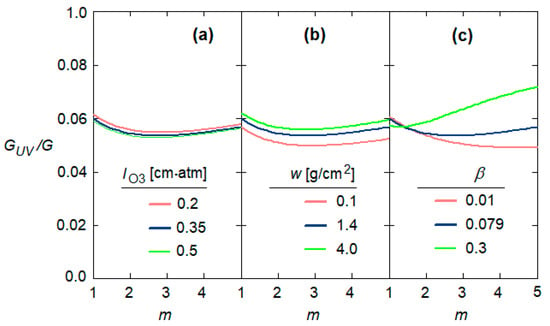
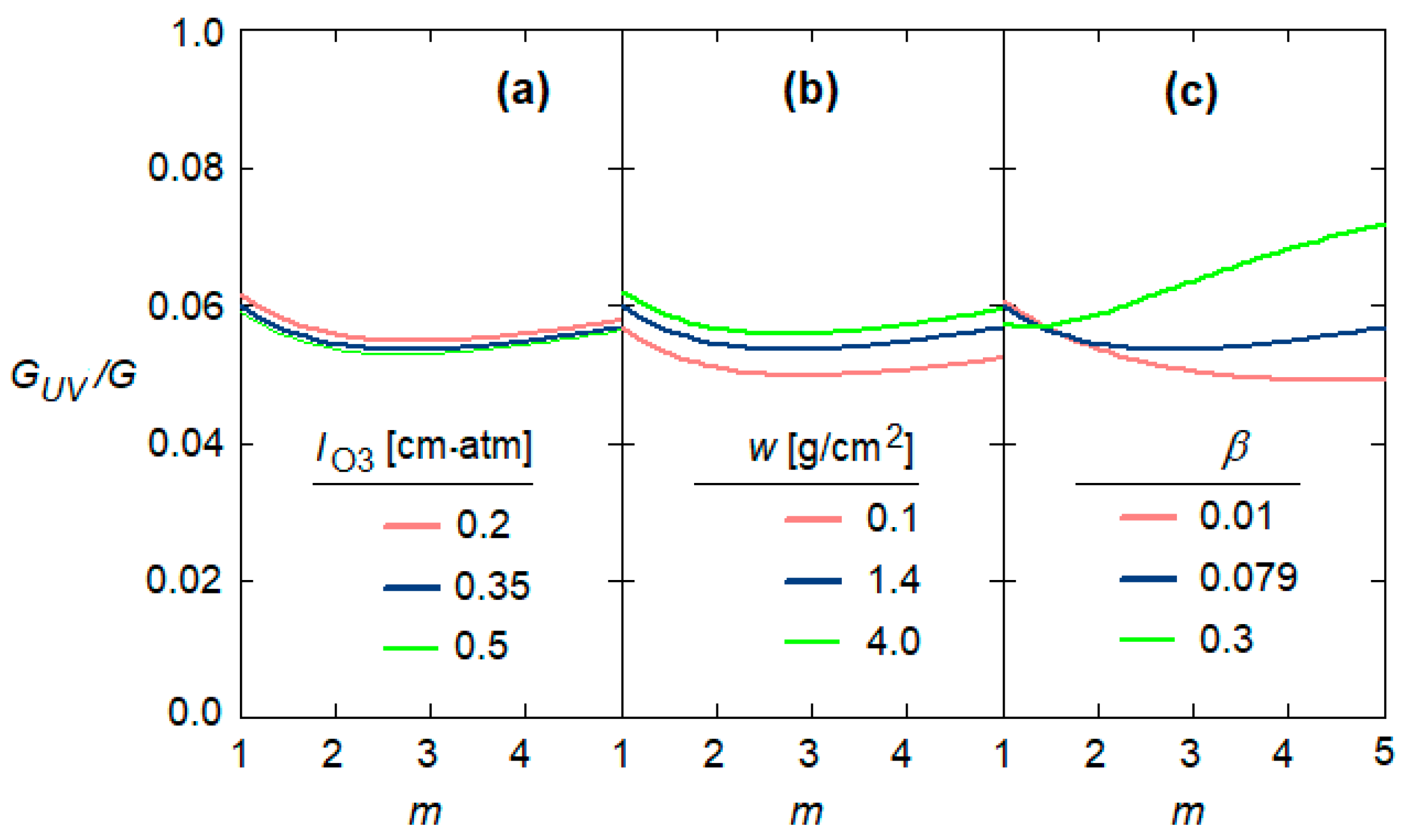
Synthetic values of the GUV/G ratio were generated for atmospheric optical mass values in the range of 1 < m < 5. At higher optical mass values, the level of solar UV radiation decreases significantly, and the biological effects induced by UV exposure become negligible. The atmospheric parameters were varied within their specific ranges, namely ozone column content 0.2 cm·atm < lO3 < 0.5 cm·atm, water vapor amount 0.1 g/cm2 < w < 4 g/cm2, and the Ångström turbidity coefficient 0.01 < β < 0.3.
The results are presented graphically in Figure 1. Since ozone absorbs predominantly in the UV band and only weakly in the visible, it affects both UV and broadband solar irradiance in a similar manner. As a result, the atmospheric transmittances associated with ozone absorption in the UV and broadband ranges are nearly identical. When considering the ratio of UV to broadband irradiance (GUV/G), these transmittances effectively cancel out, leading to a negligible dependence of the ratio on atmospheric ozone content. This behavior is illustrated in Figure 1a, where the GUV/G ratio is shown as a function of air mass for different values of total column ozone, and the corresponding curves nearly overlap. Water vapor absorbs solar radiation in the visible and infrared spectral domains. Although the associated transmittance in the UV band is close to unity, Figure 1b reveals the relatively low influence of water vapor on the GUV/G irrespective of the optical mass. Unlike ozone and water vapor, Figure 1c shows that aerosols have a more complex and stronger influence, which can no longer be neglected. The remaining atmospheric transmittances, namely those associated with mixed gases and Rayleigh scattering, depend only on atmospheric optical mass. They are therefore expected to be effectively captured in the dependence of the GUV/G ratio on optical mass. The results indicate that UV irradiance can be estimated from broadband solar irradiance as a function of atmospheric optical mass and the Ångström turbidity coefficient.
Figure 1.
Dependence of GUV/G ratio on broadband solar irradiance as a function of atmospheric optical mass and the Ångström turbidity coefficient: (a) variation with optical mass; (b) variation with the Ångström turbidity coefficient; (c) combined effect of both parameters.
3.2. A New Clear-Sky Global Solar UV Irradiance Model
Based on the previous analysis, a semi-empirical model for clear-sky conditions was developed. It estimates the GUV/G ratio as a function of atmospheric optical mass m and the Ångström turbidity coefficient β. The model equation was derived using a synthetic dataset generated with the Leckner spectral model, as described in Section 2. The atmospheric optical mass has been varied between 0.5 and 5, while β has been varied between 0.01 and 0.3. The 3D fitting procedure was carried out in two stages. In the first stage, for each value of the Ångström turbidity coefficient βi, the GUV/G ratio was fitted to synthetic data as a function of m using different equations. The following equation was retained:
as it consistently achieved a coefficient of determination R2 > 0.999 for all values of β. An R2 close to unity was also obtained for other equations. The reason for selecting Equation (3) is that the coefficients , and vary smoothly with β (Figure 2). In the second stage, the coefficients , and were fitted using continuous functions.
Figure 2.
Discrete coefficients in Equation (3) (points) and the fitted equations (lines) as a function of the Ångström turbidity coefficient β: (a) , (b) , (c) , (d) and (e) .
In summary, the model equations are as follows:
The coefficients , , in Equations (5) and (6), and the coefficients , , in Equation (7), are listed in Appendix A.
Equations (4)–(7) provide a simple estimate of the global solar irradiance in the UV band GUV based on broadband solar irradiance G measured under clear-sky conditions:
To apply Equation (8), the Ångström turbidity coefficient β must be available. It can be obtained from ground-based measurements. Even if instantaneous values are not available, average values can be used [23]. Alternatively, β can be retrieved from reanalysis products without a significant loss of accuracy [24].
Second, from a physical perspective, the overall influence of aerosols is already captured by global solar irradiance. In this context, the Ångström turbidity coefficient can be interpreted as an empirical fine-tuning parameter for the model coefficients (Equation (8)), transferring the information captured in the broadband domain to the UV range.
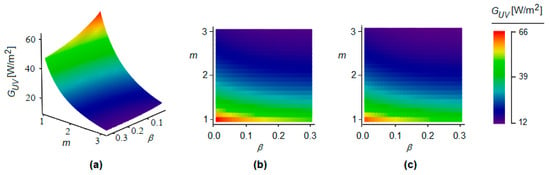
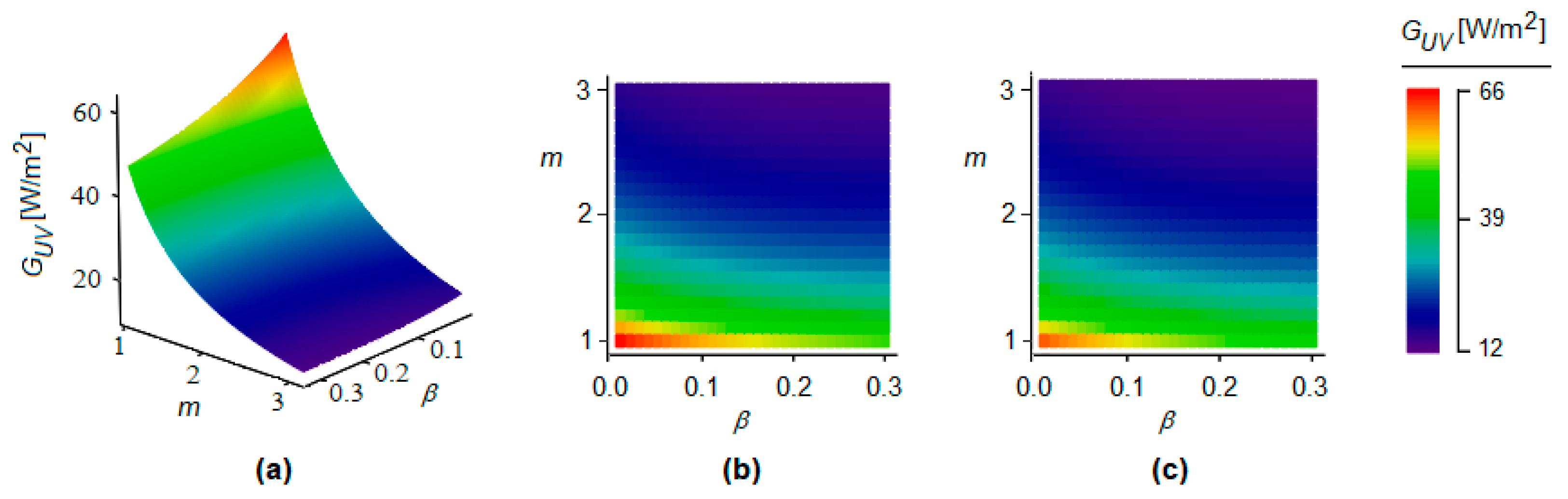
Before performing a comparative evaluation of the proposed model performance, it is worth examining in more detail the estimates given by Equation (8) as a function of the input variables and the atmospheric state. Thus, Figure 3 shows the UV solar irradiance GUV estimated using Equation (8) as a function of atmospheric optical mass m and the Ångström turbidity coefficient β. The plots were generated by emulating the global solar irradiance G using the PS model, varying m between 1 and 3 with a step of 0.2, and β between 0.01 and 0.3 with a step of 0.01. Figure 3a shows for typical values of ozone content (lO3 = 0.35 cm·atm) and water vapor (w = 1.4 g/cm2) in a temperate–continental climate. This plot illustrates how the proposed model captures the influence of atmospheric aerosol loading on UV solar irradiance estimates. Figure 3b,c are planar projections of Figure 3a, differing in the atmospheric water vapor content. Figure 3b illustrates the variation of in a dry atmosphere (w = 0.5 g/cm2), while Figure 3c corresponds to an atmosphere with high water vapor content (w = 3.5 g/cm2). A visual inspection of Figure 3a,b may suggest that they are identical; however, closer examination reveals minor differences that are difficult to perceive. For fixed values of m and β, the transition from a dry atmosphere to an atmosphere with high water vapor content (from Figure 3b to Figure 3c) does not significantly alter the pixel color, at most resulting in slight changes in shading. This indicates the minor impact of water vapor in the model. In contrast, regardless of the atmospheric water vapor content, the transition from a clean atmosphere to an atmosphere with high aerosol loading leads to noticeable variations in GUV (as reflected by the color variation with β in Figure 3b,c at a given m). The difference between these two behaviors further supports the inclusion of atmospheric aerosol loading as a model parameter.
Figure 3.
UV solar irradiance GUV estimated using Equation (8) as a function of atmospheric optical mass m and the Ångström turbidity coefficient β: (a) typical atmosphere in a temperate–continental climate; (b) dry atmosphere; and (c) atmosphere with high water vapor content.
3.3. Model Intercomparison
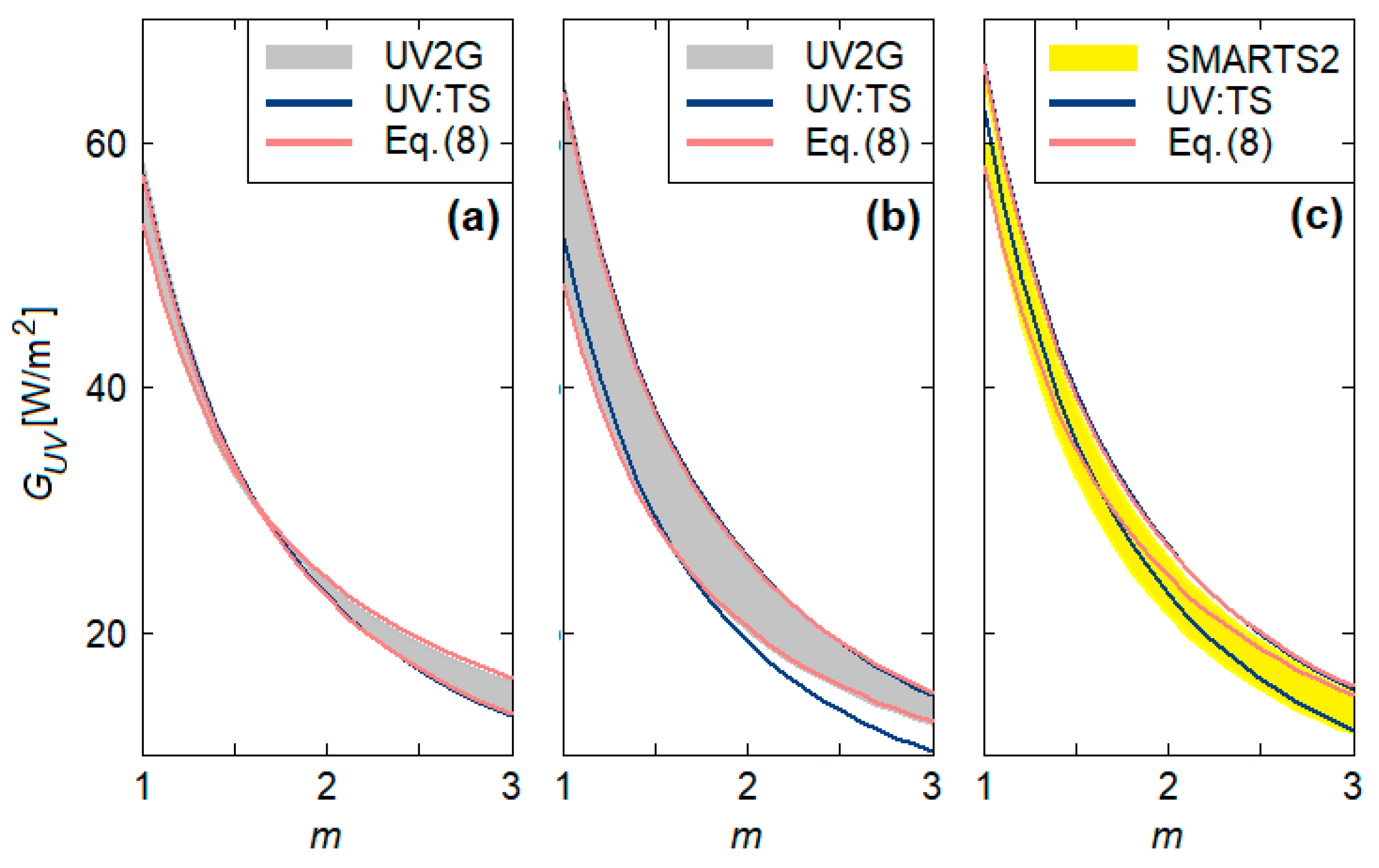
To evaluate the proposed model, its estimates were first compared with those of other models in a simulated framework, i.e., broadband solar irradiance G was estimated for various atmospheric aerosol loading using three models of different complexity. The first model is an empirical model, from Adnot et al. [25], which estimates global solar irradiance solely based on the solar elevation angle, i.e., atmospheric optical mass. The second model is the parametric PS model [16], which, in addition to atmospheric optical mass, requires as input the atmospheric aerosol loading quantified by the Ångström turbidity coefficient, along with other parameters. The third model is SMARTS2, which estimates spectral solar irradiance based on a comprehensive set of atmospheric parameters [7]. The high performance of SMARTS2 is widely recognized [26]. Unlike the first two models, SMARTS2 allows a straightforward estimation of global UV solar irradiance by integrating the spectral irradiance over the 0.28–0.4 μm band. In addition to SMARTS2, the proposed model was compared with two other models that use G as a proxy for estimating UV irradiance, namely UV2G [9] and UV:TS [15]. The two models differ in the complexity with which they evaluate the GUV/G ratio. While the UV:TS model requires only atmospheric optical mass as input, the UV2G model requires, in addition to atmospheric optical mass, four additional parameters (total column ozone, nitrogen dioxide, and water vapor, as well as the Ångström turbidity coefficient). Thus, in terms of complexity, the proposed model lies between UV:TS and UV2G.
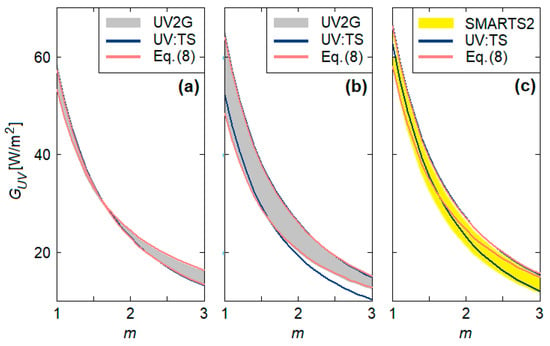
In Figure 4a–c, G is estimated using the Adnot et al., PS, and SMARTS2 models, respectively. In each panel, the range of GUV estimates corresponding to β values between 0.01 and 0.3 is shown. A notable feature of Figure 4 is that the estimates of all models fall within the same range. Regardless of the complexity of the model used to generate G, the three models, UV2G, UV:TS, and the proposed model, provide very similar estimates of GUV. Naturally, differences exist between the model estimates due to their inherent structure and complexity, which will differentiate their performance when tested against measured data. In conclusion, Figure 4 demonstrates that Equation (8) performs similarly to models of the same class.
Figure 4.
Comparison of the estimates of the proposed model (Equation (8)) with those of the SMARTS2 [7], UV:TS [15], and UV2G [9] models. Broadband solar irradiance was estimated using (a) the empirical model of Adnot et al. [25], (b) the parametric PS [16] model, and (c) integration of the SMARTS2 spectral model.
3.4. Model Performance Evaluation
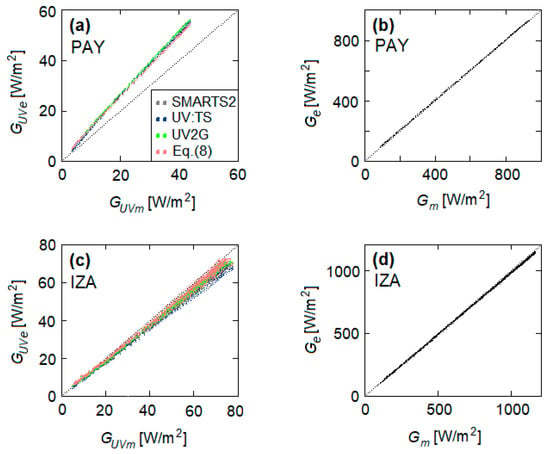
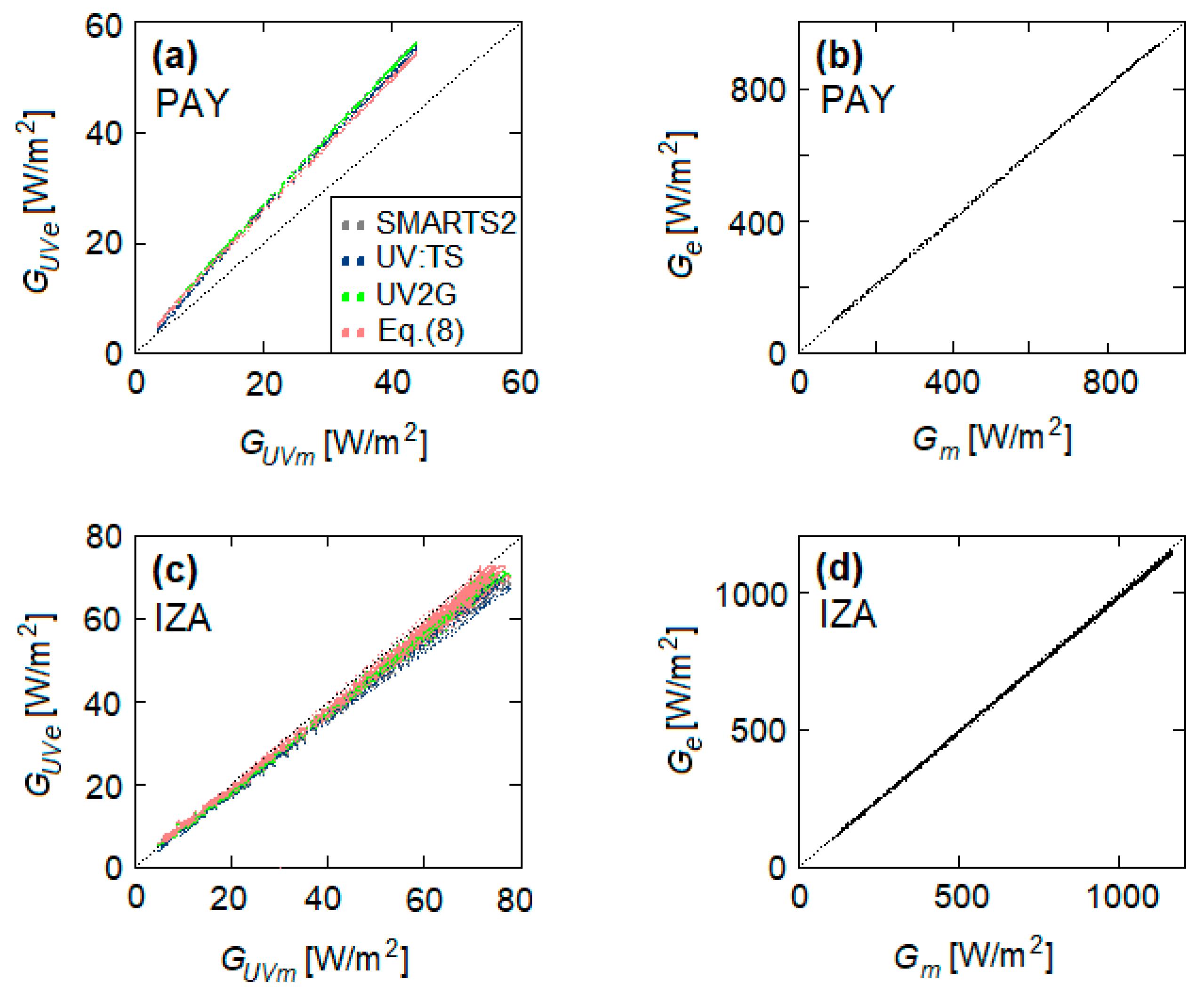
The final test was performed against measured data collected at the BSRN stations PAY and IZA, described in Section 2. In addition to the proposed model Equation (8), the SMARTS2, UV:TS, and UV2G models were also tested. Figure 5 presents the results in the form of scatter plots. At the PAY station, all models consistently overestimate the measured irradiance (Figure 5a). However, in terms of statistical indicators, the proposed model shows the best performance (Table 2). SMARTS2 was also tested for the estimation of broadband global solar irradiance at the same instances as for GUV estimation. The test highlighted the remarkable performance of the model (Figure 5b). Therefore, the systematic error in GUV estimation is unlikely to be caused by the modeling approach. At the IZA station, the performance of the GUV estimation models is very good (Figure 5c). SMARTS2 again confirms its high performance in estimating broadband global solar irradiance (Figure 5d). There is a significant difference in model performance between the two stations. What is relevant is that none of the models behaves inconsistently: all models perform well at IZA and overestimate solar irradiance at PAY. This consistent behavior is reflected in the scatter plots shown in Figure 5a,c, where the estimates from the four models exhibit a high degree of overlap at both stations. The models were applied under clear-sky conditions that were independently verified. The presence of clouds at PAY is therefore unlikely to explain the overestimation.
Figure 5.
(a,c) Estimated GUVe vs. measured GUVm global solar UV irradiance and (b,d) estimated Ge vs. measured Gm global solar broadband irradiance. The dotted line indicates the first diagonal.
Table 2.
Normalized root mean square error and mean bias error for the models tested against data measured at the PAY and IZA stations.
In summary, this preliminary test on measured data indicates that the proposed model is an accurate tool for estimating global solar irradiance in the UV band.
4. Conclusions
This study presents a new model for estimating global clear-sky solar irradiance in the UV band using broadband radiometric measurements as a physical proxy. The model combines global solar irradiance with atmospheric optical mass and the Ångström turbidity coefficient, resulting in a formulation that captures the dominant attenuation processes with a reduced set of input parameters.
Global solar irradiance encapsulates the effect of the local atmosphere on solar radiation. Therefore, in principle, the applicability of the model is not geographically limited. It is valid as long as the input parameters fall within the range for which the model was developed: atmospheric optical mass between 0.5 and 5, and the Ångström turbidity coefficient between 0.01 and 0.3.
The proposed model is designed for clear-sky conditions, which represents a fundamental reference in solar irradiance modeling, including in the UV range. Moreover, since clouds strongly attenuate UV radiation, the biological relevance of surface UV exposure is greatest under clear-sky conditions.
The model was developed and initially evaluated using synthetic data, demonstrating stable behavior. Comparative analysis against existing models (SMARTS2, UV:TS, and UV2G) in a simulated framework showed that the proposed model provides estimates within the same range, despite its lower input complexity.
Validation against measured data from the BSRN stations Payerne and Izana confirmed the capability of the model to reproduce observed UV irradiance with good accuracy. The proposed model consistently achieved the best performance in terms of statistical indicators among the tested simplified models.
Overall, the results indicate that the proposed model achieves a well-balanced trade-off between simplicity and accuracy. Performance is comparable to that of SMARTS2, one of the most accurate clear-sky spectral solar irradiance models, supporting the reliability of the approach. The minimal input requirements, limited to deterministic parameters and atmospheric turbidity, make the proposed model suitable for applications over large geographical areas. As with any model of general applicability, further independent testing on extensive and diverse datasets is needed to increase confidence in the estimates.
Author Contributions
Conceptualization, A.-F.C. and M.P.; methodology, A.-F.C. and O.M.B.; software, A.-F.C. and M.P.; formal analysis, A.-F.C., O.M.B. and M.P.; investigation, A.-F.C., O.M.B. and M.P.; writing—original draft preparation A.-F.C., O.M.B. and M.P.; writing—review and editing, A.-F.C., O.M.B. and M.P.; All authors have read and agreed to the published version of the manuscript.
Funding
This research received no external funding.
Institutional Review Board Statement
Not applicable.
Informed Consent Statement
Not applicable.
Data Availability Statement
The data presented in the study are openly available in Baseline Solar Radiation Network, http://bsrn.awi.de (accessed on 30 March 2026).
Conflicts of Interest
The authors declare no conflicts of interest.
Appendix A. Fitted Coefficients of Equations (5)–(7)
Table A1.
Fitted coefficients of Equations (5) and (6).
Table A2.
Fitted coefficients of Equation (7).
References
- Williamson, C.E.; Zepp, R.G.; Lucas, R.M.; Madronich, S.; Austin, A.T.; Ballaré, C.L.; Norval, M.; Sulzberger, B.; Bais, A.F.; McKenzie, R.L.; et al. Solar ultraviolet radiation in a changing climate. Nat. Clim. Change 2014, 4, 434–441. [Google Scholar] [CrossRef] [Scilit]
- Bornman, J.F.; Barnes, P.W.; Robinson, S.A.; Ballaré, C.L.; Flint, S.D.; Caldwell, M.M. Solar ultraviolet radiation and ozone depletion-driven climate change: Effects on terrestrial ecosystems. Photochem. Photobiol. Sci. 2015, 14, 88–107. [Google Scholar] [CrossRef] [Scilit]
- Andrady, A.L. Effects of solar ultraviolet radiation on materials and polymers. Materials 2023, 16, 2784. [Google Scholar]
- Webb, A.R.; Gröbner, J.; Blumthaler, M.; Cabot, T.; Lantz, K.; Hooke, R.; Kouremeti, N.; Bais, A.F. Variability and trends in surface UV radiation in Europe. Atmos. Chem. Phys. 2011, 11, 9125–9138. [Google Scholar]
- Kazadzis, S.; Kouremeti, N.; Bais, A.; Kazantzidis, A.; Garane, K.; Grobner, J. Spatial and temporal UV irradiance variability in Europe. Atmos. Res. 2015, 153, 1–12. [Google Scholar]
- Driemel, A.; Augustine, J.; Behrens, K.; Colle, S.; Cox, C.; Cuevas-Agulló, E.; Denn, F.M.; Duprat, T.; Fukuda, M.; Grobe, H.; et al. Baseline Surface Radiation Network (BSRN): Structure and data description (1992–2017). Earth Syst. Sci. Data 2018, 10, 1491–1501. [Google Scholar] [CrossRef] [Scilit]
- Gueymard, C.A. SMARTS2, Simple Model of the Atmospheric Radiative Transfer of Sunshine: Algorithms and Performance Assessment; Rep. FSEC-PF-270-95; Florida Solar Energy Center: Cocoa, FL, USA, 1995. [Google Scholar]
- Malinovic, S.; Mihailovic, D.T.; Kapor, D.; Mijatovic, Z.; Arsenic, I.D. NEOPLANTA: A short description of the first Serbian UV index model. J. Appl. Meteorol. Climatol. 2006, 45, 1171–1177. [Google Scholar] [CrossRef] [Scilit]
- Paulescu, M.; Stefu, N.; Tulcan-Paulescu, E.; Calinoiu, D.; Neculae, A.; Gravila, P. UV solar irradiance from broadband radiation and other meteorological data. Atmos. Res. 2010, 96, 141–148. [Google Scholar] [CrossRef] [Scilit]
- Cañada, J.; Pedrós, G.; Bosca, J.V. Relationships between UV (0.290–0.385 μm) and broadband solar radiation hourly values in Valencia and Córdoba, Spain. Energy 2003, 28, 199–217. [Google Scholar] [CrossRef] [Scilit]
- Jacovides, C.P.; Assimakopoulos, V.D.; Tymvios, F.S.; Theophilou, K.; Assimakopoulos, D.N. Solar global UV (280–380 nm) radiation and its relationship with solar global radiation measured on the island of Cyprus. Energy 2006, 31, 2728–2738. [Google Scholar] [CrossRef] [Scilit]
- Sabziparvar, A.A. Estimation of clear-sky effective erythemal radiation from broadband solar radiation (300–3000 nm) data in an arid climate. Int. J. Climatol. 2009, 29, 2027–2032. [Google Scholar] [CrossRef] [Scilit]
- Laguarda, A.; Abal, G.; Russo, P.; Habte, A. Estimating UV-B, UV-Erythemal, and UV-A Irradiances from Global Horizontal Irradiance and MERRA-2 Ozone Column Information. J. Sol. Energy Eng. 2025, 147, 021001. [Google Scholar] [CrossRef] [Scilit]
- Qin, W.; Wang, L.; Wei, J.; Hu, B.; Liang, X. A novel efficient broadband model to derive daily surface solar Ultraviolet radiation (0.280–0.400 μm). Sci. Total Environ. 2020, 735, 139513. [Google Scholar] [CrossRef] [Scilit]
- Habte, A.; Sengupta, M.; Gueymard, C.A.; Narasappa, R.; Rosseler, O.; Burns, D.M. Estimating Ultraviolet Radiation From Global Horizontal Irradiance. IEEE J. Photovolt. 2019, 9, 139–146. [Google Scholar] [CrossRef] [Scilit]
- Paulescu, M.; Schlett, Z. A simplified but accurate spectral solar irradiance model. Theor. Appl. Climatol. 2003, 75, 203–212. [Google Scholar] [CrossRef] [Scilit]
- Leckner, B. The spectral distribution of solar radiation at the earth’s surface. Elements of a model. Sol. Energy 1978, 20, 143–150. [Google Scholar] [CrossRef] [Scilit]
- Baseline Surface Radiation Network. BSRN. Available online: https://bsrn.awi.de (accessed on 30 March 2026).
- González, Y.; Sánchez-Barrero, M.F.; Popovici, I.; Barreto, Á.; Victori, S.; Welton, E.J.; García, R.D.; Sicilia, P.G.; Almansa, F.A.; Torres, C.; et al. Compact dual-wavelength depolarization lidar for aerosol studies at the Izaña Atmospheric Observatory. Atmos. Meas. Tech. 2025, 18, 1885–1902. [Google Scholar] [CrossRef] [Scilit]
- Kottek, M.; Grieser, J.; Beck, C.; Rudolf, B.; Rubel, F. World Map of the Koppen-Geiger climate classification updated. Meteorol. Z. 2006, 15, 259–263. [Google Scholar] [CrossRef] [Scilit]
- Blaga, R.; Paulescu, M. Quantifiers for the solar irradiance variability: A new perspective. Sol. Energy 2018, 174, 606–616. [Google Scholar] [CrossRef] [Scilit]
- Aerosol Robotic Network. AERONET. Available online: https://aeronet.gsfc.nasa.gov/ (accessed on 5 May 2026).
- Calinoiu, D.-G.; Stefu, N.; Paulescu, M.; Trif-Tordai, G.; Mares, O.; Paulescu, E.; Boata, R.; Pop, N.; Pacurar, A. Evaluation of errors made in solar irradiance estimation due to averaging the Angstrom turbidity coefficient. Atmos. Res. 2014, 150, 69–78. [Google Scholar] [CrossRef] [Scilit]
- Gueymard, C.A.; Yang, D. Worldwide validation of CAMS and MERRA-2 reanalysis aerosol optical depth products using 15 years of AERONET observations. Atmos. Environ. 2020, 225, 117216. [Google Scholar] [CrossRef] [Scilit]
- Adnot, J.; Bourges, B.; Campana, D.; Gicquel, R. Utilisation des courbes de frequence cumulees pour le calcul des installation solaires. In Analise Statistique des Processus Meteorologiques Appliquee a l’Energie Solaire; Lestienne, R., Ed.; CEP: Paris, France, 1979; pp. 9–40. [Google Scholar]
- Gueymard, C.A. The SMARTS spectral irradiance model after 25 years: New developments and validation of reference spectra. Sol. Energy 2019, 187, 233–253. [Google Scholar] [CrossRef] [Scilit]



Disclaimer/Publisher’s Note: The statements, opinions and data contained in all publications are solely those of the individual author(s) and contributor(s) and not of MDPI and/or the editor(s). MDPI and/or the editor(s) disclaim responsibility for any injury to people or property resulting from any ideas, methods, instructions or products referred to in the content. |
© 2026 by the authors. Licensee MDPI, Basel, Switzerland. This article is an open access article distributed under the terms and conditions of the Creative Commons Attribution (CC BY) license.