
Thermal Effects of Injection Molding Machines in Cleanrooms


Abstract
1. Introduction
2. Materials and Method
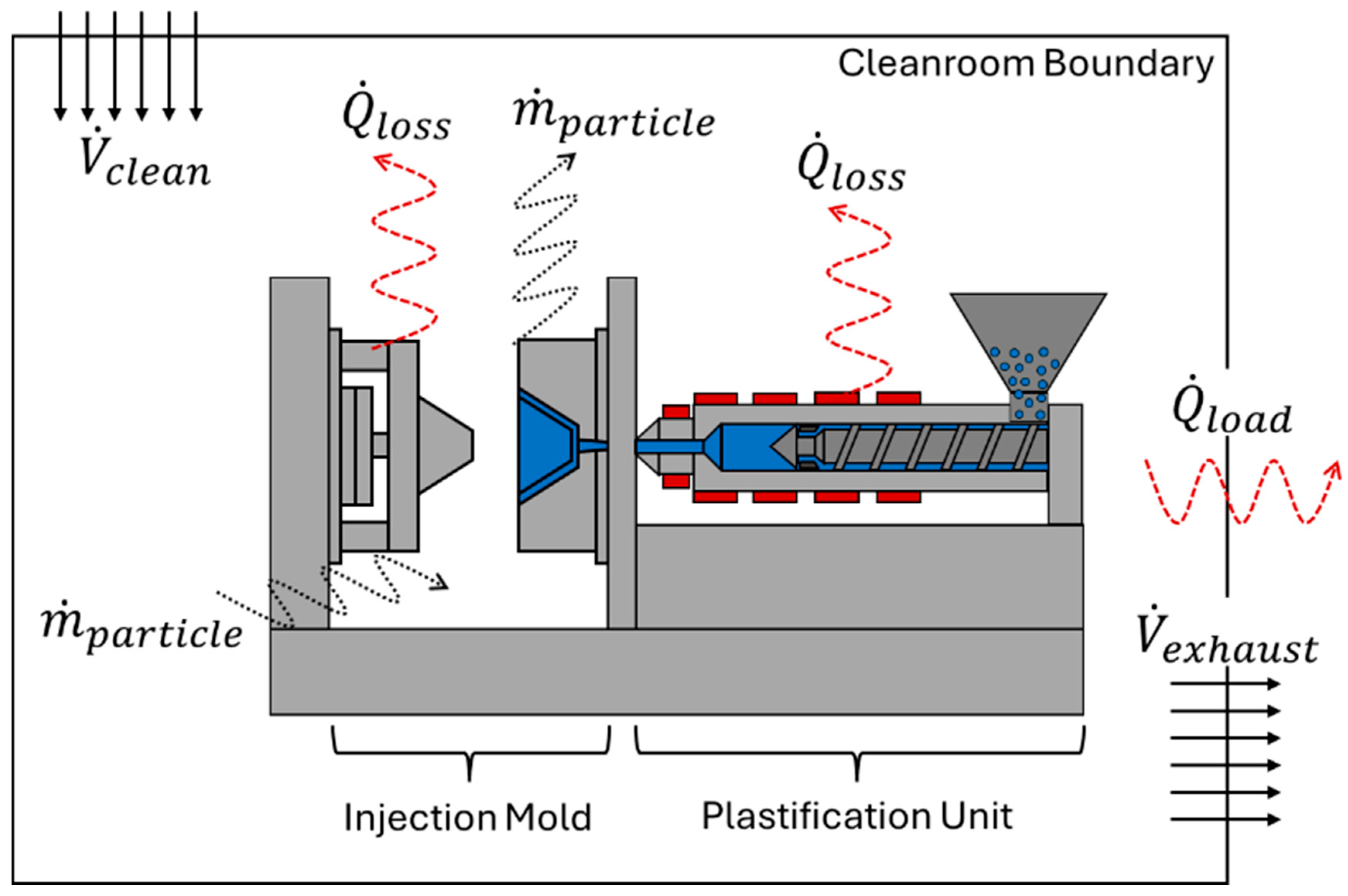
2.1. Heat Load from Injection Molding into Cleanroom Environment
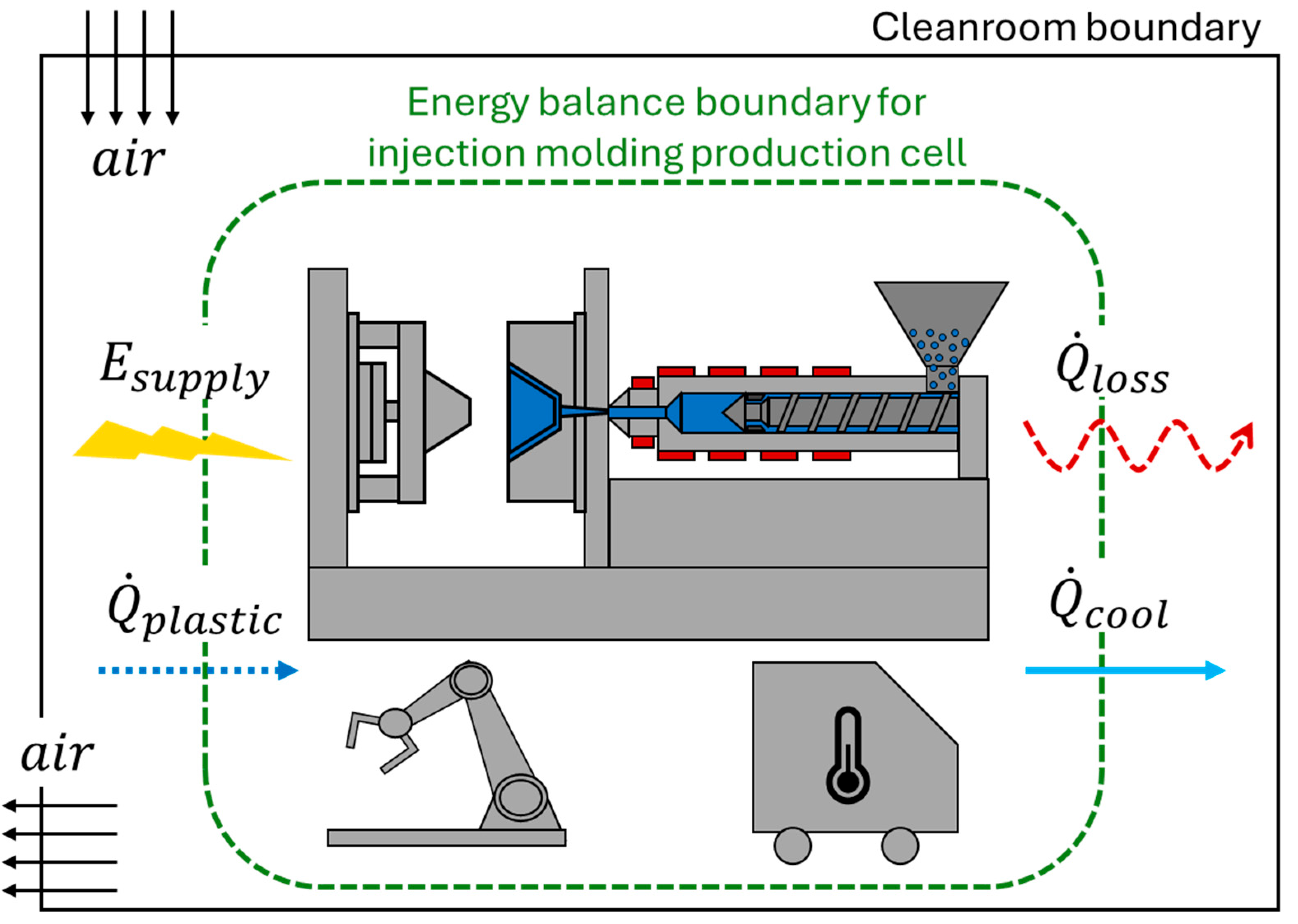
2.1.1. Gross Energy Balance of Production Cell
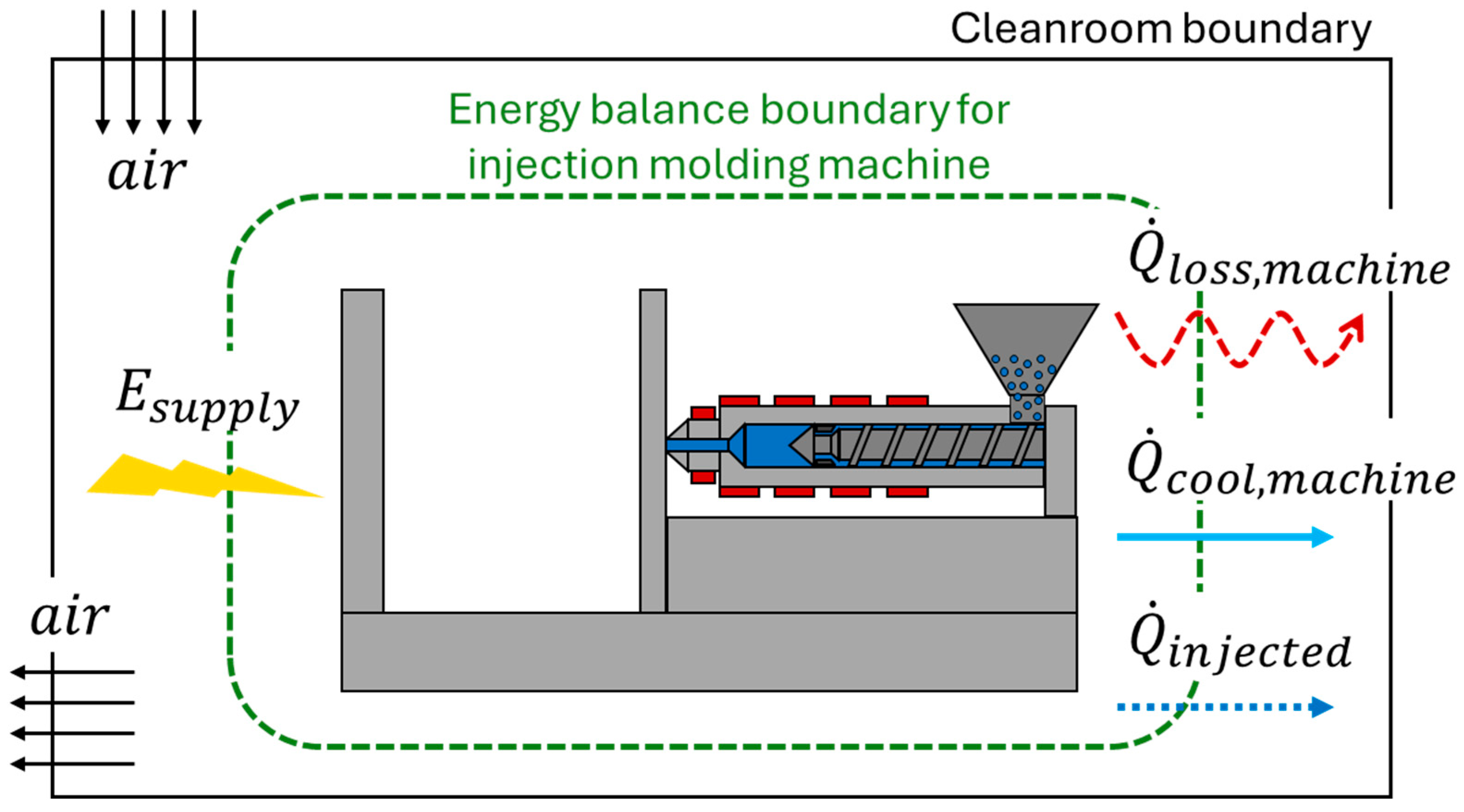
2.1.2. Gross Energy Balance of Injection Molding Machine
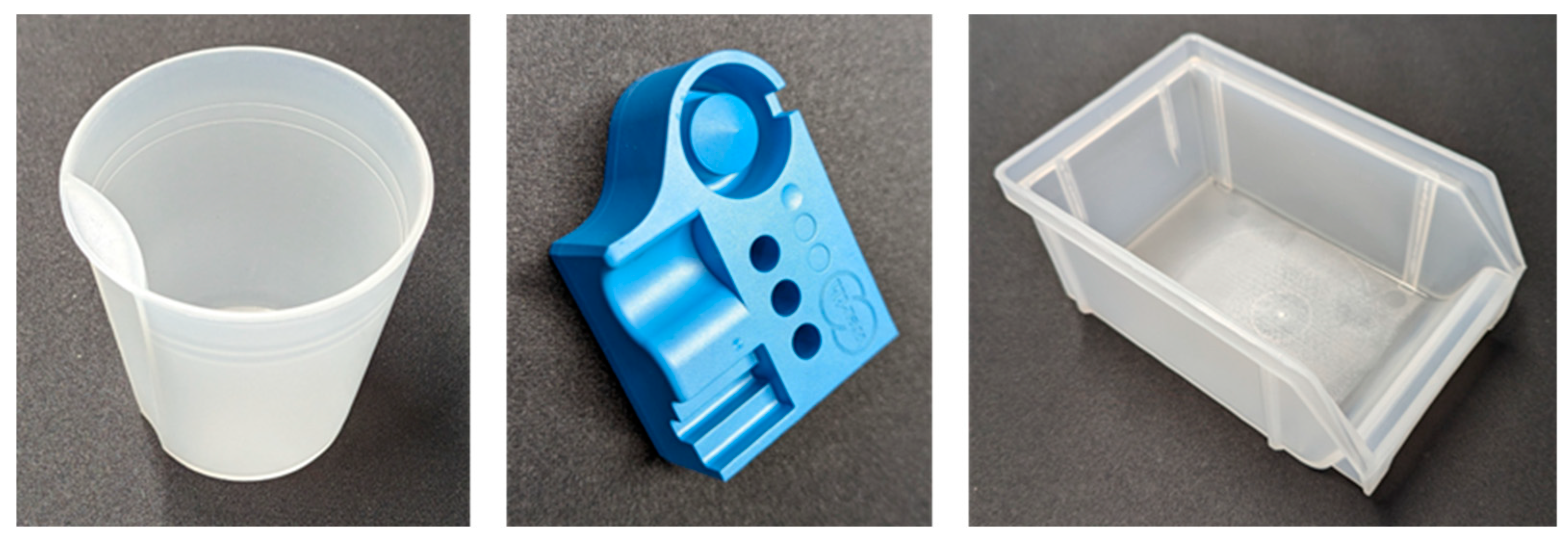
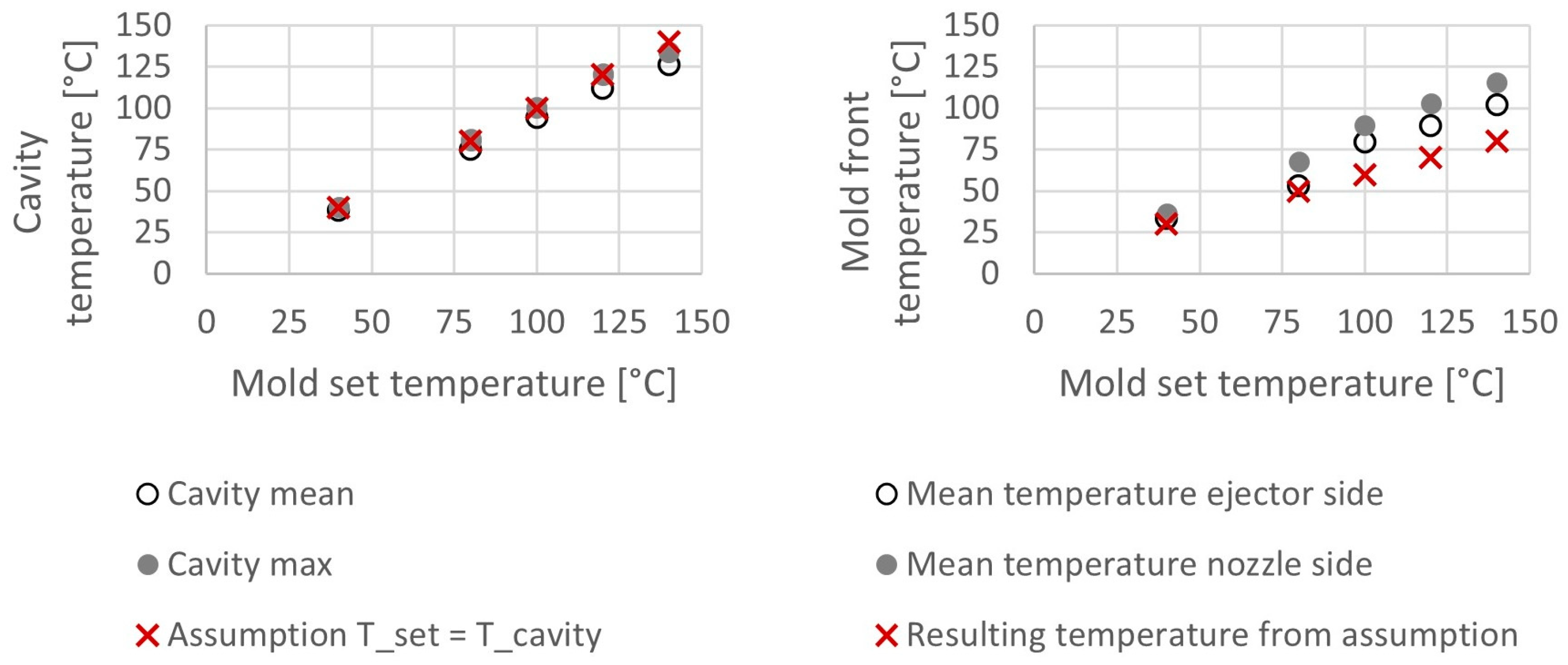
2.1.3. Experimental Setup Heat Load
2.1.4. Uncertainty Analysis
2.2. Flow Analysis Inside the Injection Molding Machine
2.2.1. Analytical Description with Dimensionless Numbers
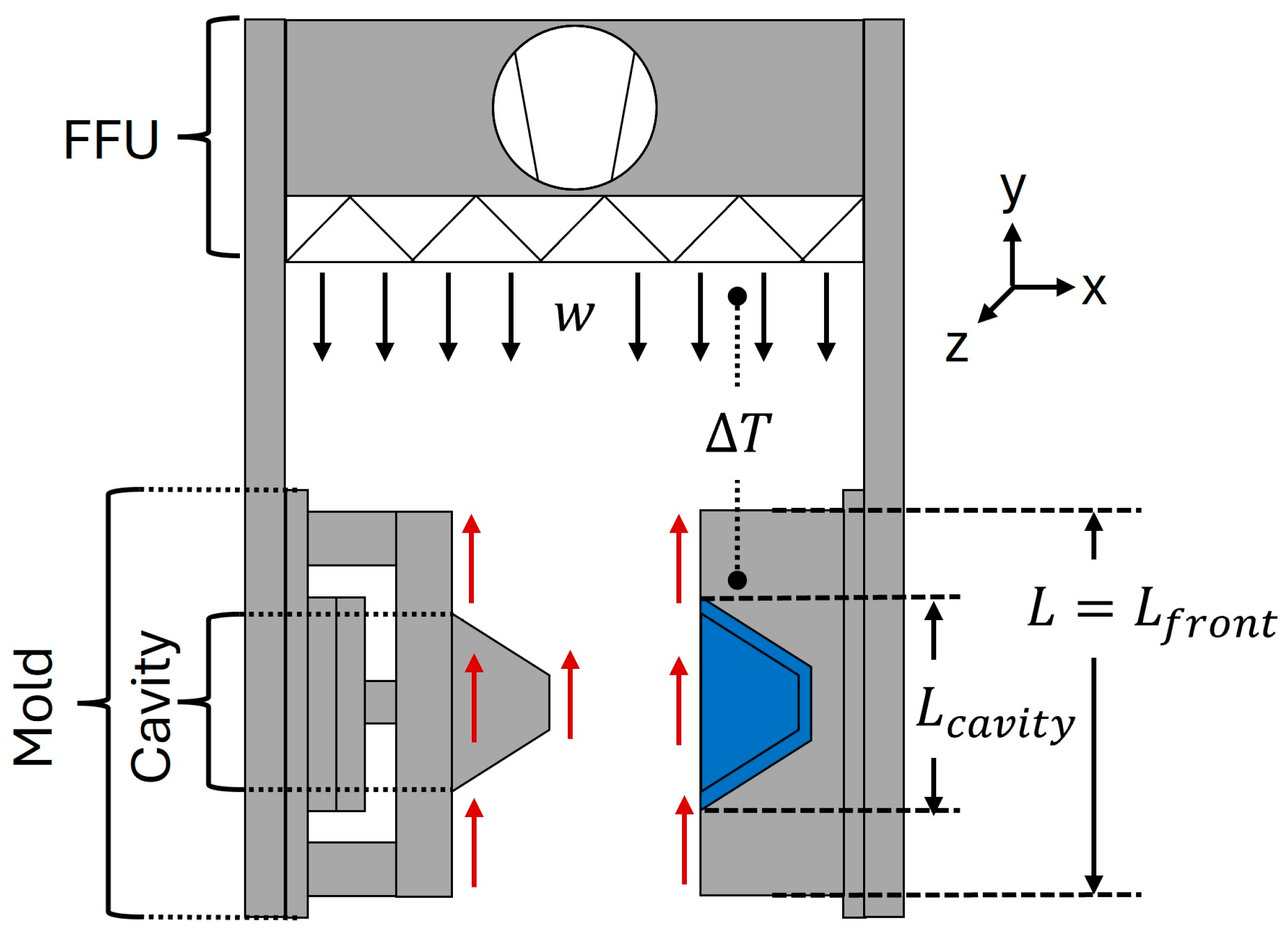
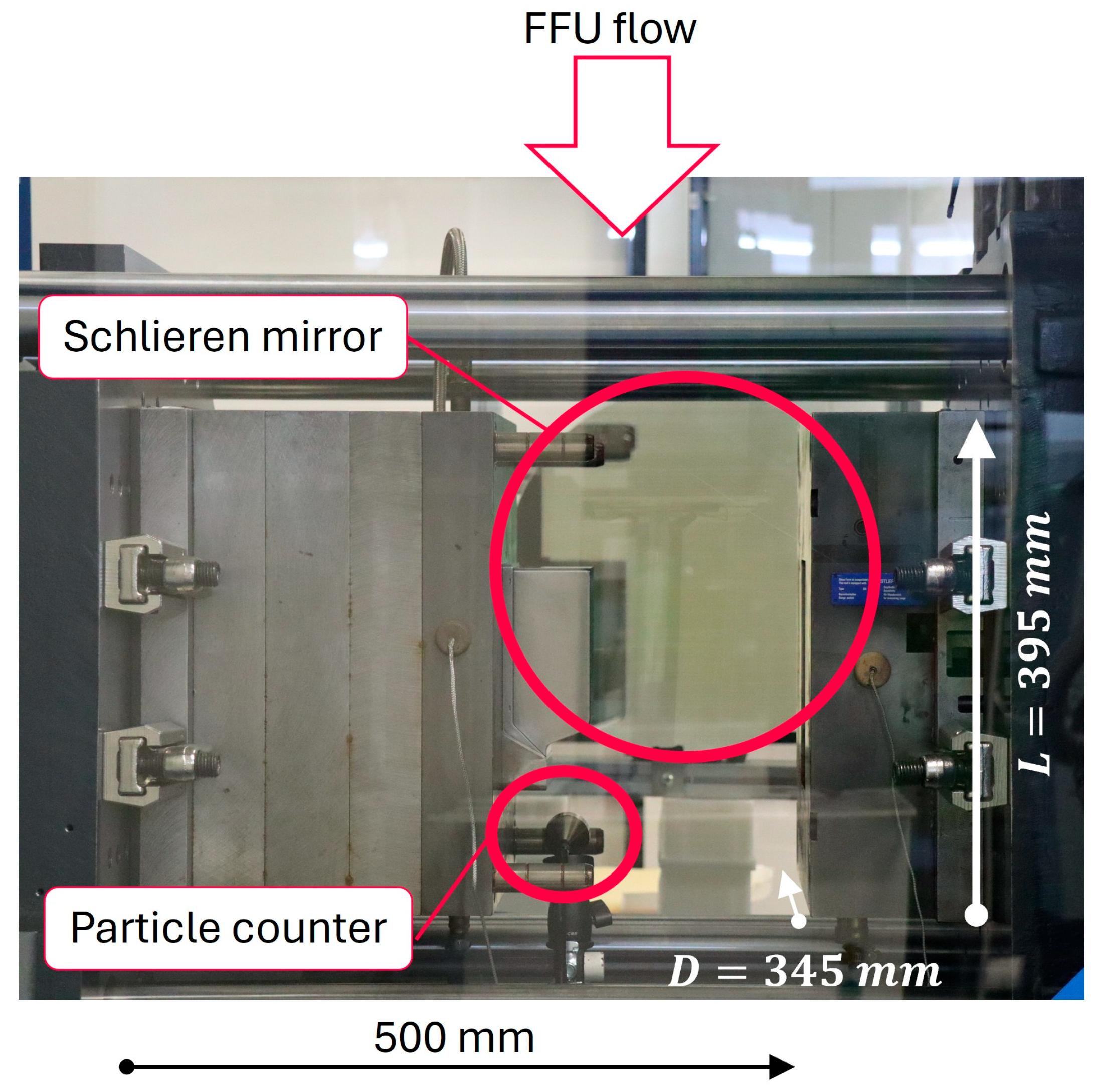
2.2.2. Analysis Buoyancy-Driven Flow near the Injection Mold
3. Results and Discussion
3.1. Heat Load of Injection Molding Production Cells
3.2. Airflow Inside the Injection Molding Machine
3.3. Particle Contamination Dependent on Archimedes Number
4. Conclusions
Supplementary Materials
Author Contributions
Funding
Institutional Review Board Statement
Informed Consent Statement
Data Availability Statement
Conflicts of Interest
Abbreviations
| DSC | Differential scanning calorimetry |
| FFU | Filter fan unit |
| HVAC | Heating, ventilation, and air conditioning |
| PP | Polypropylene |
| PPS GFR | Glass fiber reinforced Polyphenylene sulfide |
| TCU | Temperature control unit |
| Area | |
| Archimedes number | |
| Mold depth | |
| Electrical energy | |
| Gravitational constant | |
| Enthalpy | |
| Heat transfer coefficient | |
| Characteristic length | |
| Nusselt number | |
| Specific heating power | |
| Heat | |
| Heat flow | |
| Temperature | |
| Time | |
| Internal energy | |
| Work | |
| Velocity | |
| Thermal expansion coefficient of air | |
| Thermal conductivity | |
| Dimensionless factor |
Appendix A. Differential Scanning Calorimetry of the Processed Polymers

References
- Bürkle, E.; Karlinger, P.; Wobbe, H. Reinraumtechnik in der Spritzgießverarbeitung; Carl Hanser Verlag GmbH & Co. KG: München, Germany, 2013. [Google Scholar]
- Permana, I.; Agharid, A.P.; Singh, N.; Wang, F. Full-scale evaluation of FFU configurations in an optical cleanroom injection molding for improving thermal performance and contaminant removal. Case Stud. Therm. Eng. 2024, 61, 105076. [Google Scholar] [CrossRef] [Scilit]
- Guo, Z.; Xie, J.; Yang, J.; Fu, J.; Zhao, P. Rapid mold temperature rising method for PEEK microcellular injection molding based on induction heating. J. Mater. Res. Technol. 2023, 26, 3285–3300. [Google Scholar] [CrossRef] [Scilit]
- Djunaedy, E.; van den Wymelenberg, K.; Acker, B.; Thimmana, H. Oversizing of HVAC system: Signatures and penalties. Energy Build. 2011, 43, 468–475. [Google Scholar] [CrossRef] [Scilit]
- DIN EN ISO 14644-1; Reinräume und Zugehörige Reinraumbereiche: Teil 1: Klassifizierung der Luftreinheit Anhand der Partikelkonzentration. DIN Deutsches Institut für Normung e. V.: Berlin, Germany, 2016.
- Amellal, K.; Tzoganakis, C.; Penlidis, A.; Rempel, G.L. Injection molding of medical plastics: A review. Adv. Polym. Technol. 1994, 13, 315–322. [Google Scholar] [CrossRef] [Scilit]
- Puntigam, S.; Karlinger, P. Einfluss der Abwärme des Spritzgusswerkzeugs auf die Produktion Unter Reinraumbedingungen; Technische Universität Chemnitz: Chemnitz, Germany, 2021. [Google Scholar]
- Bürkle, E.; Dittel, G. Produktionssicheres Spritzgießen im ISO5/GMP-A-Reinraum. Kunststoffe 2005, 95, 138–143. [Google Scholar]
- European Commission. The Rules Governing Medicinal Products in the European Union Volume 4 EU Guidelines for Good Manufacturing Practice for Medicinal Products for Human and Veterinary Use: Annex 1 Manufacture of Sterile Medicinal Products; C(2022) 5938 final; European Commission: Brussels, Belgium, 2022; Available online: https://health.ec.europa.eu/medicinal-products/eudralex/eudralex-volume-4_de (accessed on 21 January 2026).
- Schöngruber, H.; Lhota, C. Auf den Kopf gestellt: Neues Reinraumkonzept für Hochtemperaturanwendungen. Plastverarbeiter 2017, 14–18. Available online: https://a.storyblok.com/f/136567/x/50207737dd/2017-06-plastverarbeiter-auf-den-kopf-gestellt-de.pdf (accessed on 21 January 2026).
- Hofer, V. Zum Kontaminierten Raumvolumen von Partikel und Wärmequellen in Laminarer Verdrängungsströmung. Ph.D. Thesis, Technische Universität Berlin, Berlin, Germany, 2019. [Google Scholar]
- Stephan, P.; Kabelac, S.; Kind, M.; Mewes, D.; Schaber, K.; Wetzel, T. (Eds.) VDI-Wärmeatlas: Fachlicher Träger VDI-Gesellschaft Verfahrenstechnik und Chemieingenieurwesen, 12th ed.; Springer: Berlin/Heidelberg, Germany, 2019. [Google Scholar]
- Regenscheit, O.B. Strömungsvorgänge in Reinräumen und Rämen mit Reinfeldern. Chem. Ing. Tech. 1969, 41, 1050–1056. [Google Scholar] [CrossRef] [Scilit]
- Quarini, G.L.; Chang, Y.C.; Tierney, M.J.; Poulter, R. Characteristics and ‘Figures of Merit’ for the Value of the Ventilation in Clean Rooms. Chem. Eng. Res. Des. 1997, 75, 672–676. [Google Scholar] [CrossRef] [Scilit]
- Ding, L.C.; Yau, Y.H. A study on the arrangement of air inlets in a Class 7 clean room. Build. Serv. Eng. Res. Technol. 2015, 36, 357–367. [Google Scholar] [CrossRef] [Scilit]
- Yang, C.; Yang, X.; Zhao, B. The ventilation needed to control thermal plume and particle dispersion from manikins in a unidirectional ventilated protective isolation room. Build. Simul. 2015, 8, 551–565. [Google Scholar] [CrossRef] [Scilit]
- Schliesser, J.; Staudt-Fischbach, P. Minienvironments and thermal effects. In 10th Annual IEEE/SEMI. Advanced Semiconductor Manufacturing Conference and Workshop. ASMC 99 Proceedings (Cat. No.99CH36295); IEEE: Piscataway, NJ, USA, 1999; pp. 432–439. [Google Scholar]
- Li, X.; Liu, F.; Xie, J.; Zhang, C.; Gao, R.; Lyu, C.; Zhao, P. Research on metallic contamination control of PFA injection molded fittings. J. Appl. Polym. Sci. 2023, 140, e53940. [Google Scholar] [CrossRef] [Scilit]
- Weiß, P. Energieeffizienz und Abwärmenutzung in der Kunststoffverarbeitung. Ph.D. Thesis, Universität Duisburg-Essen, Duisburg-Essen, Germany, 2016. [Google Scholar]
- Eben, J.; Eigenbrod, H.; Karlinger, P.; Krallmann, K.; Kruppa, S.; Neher, J.; Peters, G.; Schiffers, R.; Würtele, M. Zustandsabhägige Prozessführung für die Energieeffiziente und Ressourcenschonenede Produktion von Kunststoffformteilen (ZuPrEff). Abschlussbericht 2012. [Google Scholar] [CrossRef] [Scilit]
- Liu, J. Erhöhung der Reproduzierbarkeit des Spritzgießprozesses Durch Verbesserte Plastifizierkonzepte. Ph.D. Thesis, Technische Universität München, München, Germany, 2009. [Google Scholar]
- Vormoor, N. Entwicklung, Durchführung und Bewertung Einer Methodik der Energieeffizienzmessung für eine Vollhydraulische Spritzgießmaschine in der Kunststoffindustrie. Ph.D. Thesis, Technische Universität Clausthal, Clausthal, Germany, 2017. [Google Scholar]
- Pamminger, R.; Wimmer, W.; Winkler, R.E. Energiedienstleistung zur Steigerung der Energieeffizienz von Spritzgießmaschinen im Kunststoffbereich; Bundesministerium für Verkehr, Innovation und Technologie: Wien, Austria, 2009. [Google Scholar]
- Pamminger, R.; Wimmer, W.; Winkler, R. Entwicklung von Kriterien zur Kommunikation der Energieeffizienz von Kunststoff Verarbeitenden Maschinen; Bundesministerium für Verkehr, Innovation und Technologie: Wien, Austria, 2010. [Google Scholar]
- Kaiser, W.; Schlachter, W. Energie in der Kunststofftechnik: Grundlagen und Anwendungen für Ingenieure; Carl Hanser Verlag München: München, Germany, 2019. [Google Scholar]
- Zhao, C.; Gao, F. Melt temperature profile prediction for thermoplastic injection molding. Polym. Eng. Sci. 1999, 39, 1787–1801. [Google Scholar] [CrossRef] [Scilit]
- Jeon, J.; Rhee, B.; Gim, J. Melt Temperature Estimation by Machine Learning Model Based on Energy Flow in Injection Molding. Polymers 2022, 14, 5548. [Google Scholar] [CrossRef] [Scilit]
- Puntigam, S.; Karlinger, P. Spritzgusswerkzeuge im Reinraum: Eine Analyse des Kamineffekts in der Kunststoffverarbeitung. Clean. Process. 2023, 2, 110–116. [Google Scholar]
- Sparrow, E.M.; Eichhorn, R.; Gregg, J.L. Combined Forced and Free Convection in a Boundary Layer Flow. Phys. Fluids 1959, 2, 319. [Google Scholar] [CrossRef] [Scilit]
- Wagner, W. Wärmeübertragung: Grundlagen, 7th ed.; überarb. u. erw. Aufl.; Vogel: Würzburg, Germany, 2011. [Google Scholar]
- Baehr, H.D.; Stephan, K. Wärme- und Stoffübertragung; Springer: Berlin/Heidelberg, Germany, 2019. [Google Scholar]
- Karwa, R. Heat and Mass Transfer, 2nd ed.; Springer: Singapore, 2020. [Google Scholar]
- Motegi, K.; Sibamoto, Y.; Hibiki, T.; Tsukamoto, N.; Kaneko, J. Opposing Mixed Convection Heat Transfer for Turbulent Single-Phase Flows. Int. J. Energy Res. 2024, 2024, 6029412. [Google Scholar] [CrossRef] [Scilit]
- Zhang, J.; Liu, J.; Lu, W. Study on Laminar Natural Convection Heat Transfer from a Hemisphere with Uniform Heat Flux Surface. J. Therm. Sci. 2019, 28, 232–245. [Google Scholar] [CrossRef] [Scilit]
- Settles, G.S. Colour-coding schlieren techniques for the optical study of heat and fluid flow. Int. J. Heat Fluid Flow 1985, 6, 3–15. [Google Scholar] [CrossRef] [Scilit]
- Thiriez, A. An Environmental Analysis of Injection Molding. Master’s Thesis, Massachusetts Institute of Technology, Cambridge, MA, USA, 2006. [Google Scholar]
- Nguyen, D.T.; Yu, E.; Barry, C.; Chen, W.-T. Energy consumption variability in life cycle assessments of injection molding processes: A critical review and future outlooks. J. Clean. Prod. 2024, 452, 142229. [Google Scholar] [CrossRef] [Scilit]
- Ribeiro, I.; Peças, P.; Henriques, E. Modelling the energy consumption in the injection moulding process. Int. J. Sustain. Manuf. 2015, 3, 289–309. [Google Scholar] [CrossRef] [Scilit]
- Elduque, A.; Elduque, D.; Clavería, I.; Javierre, C. Influence of material and injection molding machine’s selection on the electricity consumption and environmental impact of the injection molding process: An experimental approach. Int. J. Precis. Eng. Manuf. Green Technol. 2018, 5, 13–28. [Google Scholar] [CrossRef] [Scilit]
- Dr. Boy GmbH & Co. KG. Focus on Energy Efficiency: Servo-Hydraulics vs. Fully Electric Injection Moulding Machines. Available online: https://www.dr-boy.de/images/downloads-en/Mic/Focus_on_energy_efficiency__servo-hydraulics_vs__fully_electric_injection_molding_machines.pdf (accessed on 27 April 2026).







| Machine | Electric | Hydraulic | ||
|---|---|---|---|---|
| Machine data | Closing force: 100 tons | Closing force: 80 tons | ||
| Year of manufacturing: 2023 | Year of manufacturing: 2016 | |||
| Produced part | Test specimen | Cup | Cup | Box |
| Part weight | 59 g | 45 g | 45 g | 110 g |
| Material | PPS GFR | PP | PP | PP |
| FORTRON® 1140L4 (Celanese, Florence, KY, USA) | SABIC® PP 531Ph (SABIC, Düsseldorf, GER) | SABIC® PP 531Ph (SABIC, Düsseldorf, GER) | SABIC® PP 575P (SABIC, Düsseldorf, GER) | |
| Drying temperature | 80 °C | No drying | No drying | No drying |
| Nozzle temperature | 335 °C | 250 °C | 250 °C | 230 °C |
| Cooling time | 60 s | 20 s | 25 s | 20 s |
| Temperature control unit | 140 °C | 20 °C | 20 °C | 40 °C |
Disclaimer/Publisher’s Note: The statements, opinions and data contained in all publications are solely those of the individual author(s) and contributor(s) and not of MDPI and/or the editor(s). MDPI and/or the editor(s) disclaim responsibility for any injury to people or property resulting from any ideas, methods, instructions or products referred to in the content. |
© 2026 by the authors. Licensee MDPI, Basel, Switzerland. This article is an open access article distributed under the terms and conditions of the Creative Commons Attribution (CC BY) license.
Share and Cite
Puntigam, S.; Radl, S.; Karlinger, P. Thermal Effects of Injection Molding Machines in Cleanrooms. Atmosphere 2026, 17, 518. https://doi.org/10.3390/atmos17050518
Puntigam S, Radl S, Karlinger P. Thermal Effects of Injection Molding Machines in Cleanrooms. Atmosphere. 2026; 17(5):518. https://doi.org/10.3390/atmos17050518
Chicago/Turabian StylePuntigam, Stephan, Stefan Radl, and Peter Karlinger. 2026. "Thermal Effects of Injection Molding Machines in Cleanrooms" Atmosphere 17, no. 5: 518. https://doi.org/10.3390/atmos17050518
APA StylePuntigam, S., Radl, S., & Karlinger, P. (2026). Thermal Effects of Injection Molding Machines in Cleanrooms. Atmosphere, 17(5), 518. https://doi.org/10.3390/atmos17050518