


Abstract
Climate change poses significant threats to Mediterranean plant species, including Laurus nobilis L., an ecologically and economically important tree. This study evaluates potential shifts in its suitable distribution areas across Türkiye under future climate scenarios [Shared Socioeconomic Pathway 2-4.5 (SSP2-4.5) and 5-8.5 (SSP5-8.5)] using an ensemble species distribution model incorporating ten algorithms. Key environmental drivers—elevation, annual mean temperature (Bio1), and evaporation including sublimation and transpiration (evspsbl)—were identified as critical factors influencing habitat suitability. Results indicate substantial spatial redistributions, with habitat losses projected in inland transition zones toward continental climates, particularly in parts of the Aegean and Black Sea regions. The current suitable distribution area across the country, approximately 18.48%, could rise to 18.55% by 2040 under the SSP2-4.5 scenario and to 18.76% by 2060 under the SSP5-8.5 scenario. However, without human intervention, the species’ establishment in these new suitable distribution areas is not considered possible. Moreover, it has been determined that the suitable distribution area of the species could decrease to 17.48% by 2060 under the SSP2-4.5 scenario and to 17.31% by 2080 under the SSP5-85 scenario. This result indicates that there could be a loss of more than 8% of the suitable distribution area between 2060 and 2080, according to the SSP5-8.5 scenario. Conversely, limited expansions may occur in specific areas, including the northern Aegean and the Hatay-Antep region. By 2100, despite periodic fluctuations, a net decline in suitable habitats is expected under both scenarios. Notably, spatial analysis reveals that while some newly suitable areas may emerge, natural migration will likely be insufficient for population persistence, necessitating human-assisted adaptation strategies. These findings underscore the need for proactive conservation measures, such as identifying climate-resilient provenances, assisted migration, and targeted reforestation in future suitable zones. Given that most Turkish forests are state-managed, collaboration with the General Directorate of Forestry is essential to integrate climate adaptation into long-term management plans. This study provides a framework for mitigating climate-induced habitat loss in L. nobilis while offering insights applicable to other vulnerable Mediterranean species facing similar threats.
1. Introduction
The most important of these problems is global climate change (GCC), which is now considered irreversible [1]. The climate influences all organisms on Earth. Climatic changes have occurred many times throughout world history. These changes have generally occurred because of natural events, such as volcanic activity and the release of CO2 and NO2. It is stated that global average surface temperatures decreased by approximately 8 °C over a period of 1200 years due to frequent SO2 and CO2 injections [2,3]. It is estimated that during the Cretaceous Period, temperatures were approximately 10 °C higher than they are today, and atmospheric CO2 levels were 4–8 times higher than they are today [4]. Climate change has caused effects such as glacial movements, sea level changes, and permanent changes in ecosystems. However, these changes are caused by natural factors. However, today’s climate change is primarily of anthropogenic origin [5,6].
However, it is estimated that current climate change will cause permanent changes in a much shorter time than those experienced in the past [7]. In this case, it is emphasized that plants without operational movement cannot adapt to this process, and large-scale population and even species losses are expected [8]. Plants are organisms that form the basis of the food pyramid. The GCC will inevitably have a direct or indirect impact on all other organisms and ecosystems. Therefore, it is essential to anticipate the changes caused by GCC and implement sectoral measures to mitigate its devastating effects [7].
Studies show that plants are the organisms most likely to be affected by this process, and that it is not possible for trees, especially those with long life cycles, to adapt to it through natural migration mechanisms [9]. Because climate is one of the most effective elements on all phenotypic features of plants [10], it is not possible for plants, which can adapt to the climatic conditions in the environment where they grow over a very long time, to adapt to climatic changes that will occur in a short time outside of their optimal conditions [11]. To minimize the impacts of this process, changes in the appropriate distribution areas of plants must first be identified. Then, the migration mechanisms needed by plants must be provided by humans [8].
Success in studies on this subject is possible primarily by correctly estimating the effects of the process. Various models are being developed to determine how GCC may affect the distribution of suitable plant habitats. It is crucial to assess potential outcomes using multiple models, adhere to the procedure, and identify which model and scenario generate the most accurate predictions. This study aimed to identify suitable distribution habitats for laurel (Laurus nobilis L.), a major tree species in Türkiye and the Mediterranean basin, using several models and scenarios. L. nobilis is particularly significant because it is used in numerous industries, ranging from pharmaceuticals to cosmetics. It is reported that laurel leaf exports in Türkiye have increased significantly in both quantity and revenue over the years. While 11,095 tons of laurel leaves were exported in 2013, generating approximately $33.6 million in revenue, this figure rose to over $47 million in 2021 with the export of 17,197 tons. Thus, it provides income for approximately 1.5 million people in Türkiye. The additional income generated is estimated to be around $1205 per household annually [12,13].
This study assesses geographic shifts in L. nobilis distribution regions under climate change and identifies appropriate future distribution habitats. Because it avoids important geographical redistributions, current research tends to focus only on the overall appropriate area, which may lead to misunderstandings (e.g., contractions in one region offset by expansions in another). This study aims to predict how the suitable distribution areas of L. nobilis in Türkiye may change under different scenarios of global climate change. L. nobilis is widely used as an ornamental plant and in landscaping, and its leaves are antiseptic, aromatic, astringent, carminative, diaphoretic, diuretic, parasiticidal, and stimulant [14]. Therefore, it is of great ecological and economic importance to Türkiye. It is reported that 90% of the world’s laurel supply comes from Türkiye, and according to 2021 data, 45,000 tons of laurel leaves were exported [15].
Additionally, the Western Mediterranean is a region with exceptionally high genetic diversity for the Laurus genus. This region produced four of the six haplotypes identified throughout the genus’s distribution range. Moreover, despite geographic proximity, the eastern lineage found in Türkiye, Rhodes, and the Near East differs significantly from the nearby Aegean populations, as L. nobilis populations are distinctly separated from the eastern and western ends of the Mediterranean Basin [15]. Therefore, L. nobilis populations in Türkiye are of particular importance. Furthermore, it has been noted that some of the regions most affected by global climate change are those encompassing the distribution areas of L. nobilis in Türkiye [16,17,18].
The genus Laurus (Lauraceae) was distributed over wider areas in southern Europe and North Africa during the Middle Tertiary period. However, its current distribution is limited to isolated refugia in the Southern Black Sea region, the Mediterranean Basin, Morocco, the Azores, and the Macaronesian archipelago [19]. However, it has been reported that the species has experienced significant range loss and fragmentation due to climatic changes since the Late Tertiary [20,21]. Therefore, the potential effects of the GCC on existing populations have attracted the interest of researchers. Thus, studies have been conducted to determine the distribution areas of L. nobilis, both in the past and present [22], and from the present to the future [23]. However, the MaxEnt model was used in these studies. However, recent studies have indicated that different models yield significantly different results, and therefore, studies using multiple models may be more reliable [24,25]. For these reasons, the potential impacts of the GCC on suitable distribution areas for L. nobilis in Türkiye were evaluated using different models and their combined results.
This research aims to determine the distribution areas of L. nobilis, an important species for both Türkiye and the Mediterranean region, using different models, based on current climatic conditions: (a) Determining the suitable distribution areas of the species according to current climatic conditions, using different models; (b) Determining the climatic parameters that are decisive in the distribution of the species; (c) Determining the changes in the suitable distribution areas of the species in 20-year periods up to 2100, using different models according to the SSP2-4.5 scenario; (d) Determining the changes in the suitable distribution areas of the species in 20-year periods up to 2100, using different models according to the SSP5-8.5 scenario.
2. Materials and Methods
2.1. Materials
Current Laurus nobilis Distribution Regions
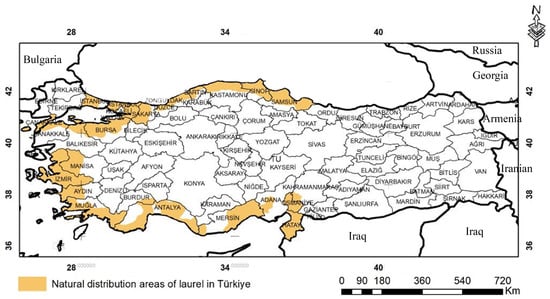
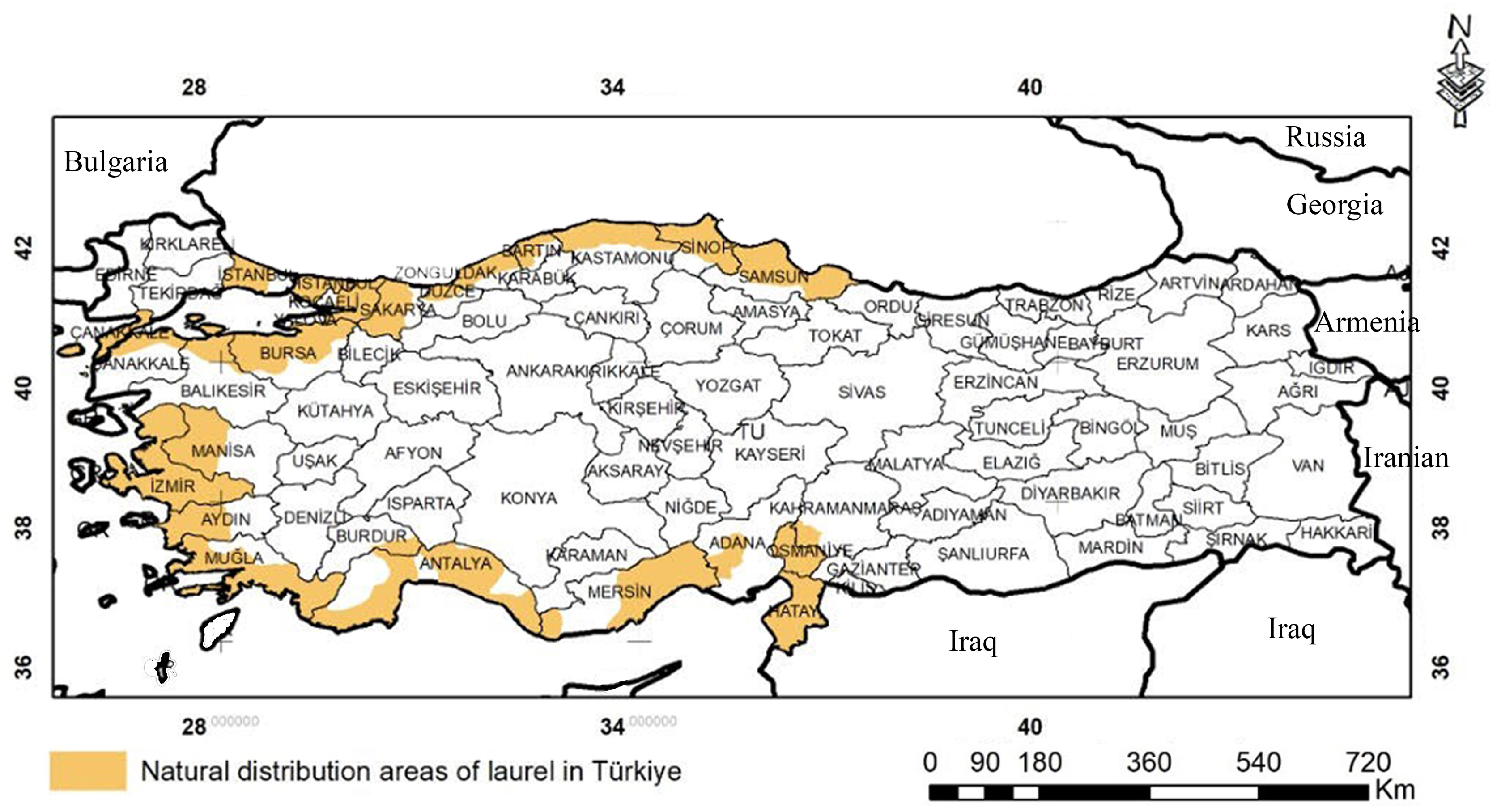
L. nobilis is an evergreen, mostly shrubby, bird-dispersed, dioecious, maquis species with entomophilous pollination and fleshy fruited seeds. L. nobilis grows naturally along the Black Sea coasts of Belgium, France, Portugal, Georgia, and Russia, countries with a Mediterranean climate. L. nobilis grows naturally along the Mediterranean, Aegean, and Black Sea regions of Türkiye, at elevations between 0 and 1200 m (Figure 1). The total area of distribution of L. nobilis in Türkiye has been estimated at 131,862 ha. L. nobilis prefers warm, moist riverbeds with mild winters and hot summers [12,13]. It is also found on arid southern slopes where there is no water or humid riverside environment, but where marine moisture is present. It often forms groups and clumps under other shrub species and pines. In terms of soil requirements, it prefers calcareous, humus-rich soils. In its natural range, average temperatures rarely drop below zero, and annual rainfall ranges from 600 to 2000 mm [20,23]. Even brief exposure to temperatures between −6 and −10 °C causes damage to leaves. Frost and desiccation reduce the viability of its resistant seeds. Indeed, cold spells have been responsible for mass mortality in northern populations [22].
Figure 1.
Current natural distribution regions of L. nobilis in Türkiye.
2.2. Methods
2.2.1. Occurrence Data Collection
Distribution data for Laurus nobilis were sourced from the Global Biodiversity Information Facility (https://www.gbif.org/species/3034015, accessed on 22 February 2025), yielding 587 georeferenced records. The data were refined by retaining only one occurrence point per 1 km2 grid cell to minimize spatial autocorrelation and sampling bias. This thinning process was performed using the gridSample function from the dismo R package (version 4.2.2) [26], ensuring no two points were closer than 1 km. After spatial filtering, 159 spatially independent records remained for use in species distribution modeling. This method has been used in previous studies to determine changes in the suitable distribution areas of species, including Prunus avium [24], Picea orientalis [27], Buxus sempervirens [8], and Fagus orientalis [25].
2.2.2. Environmental Data Selection
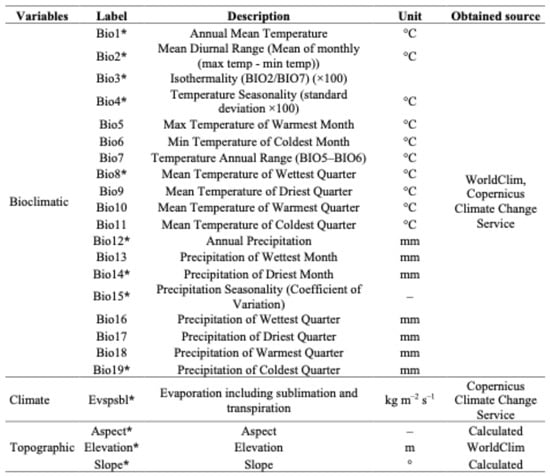
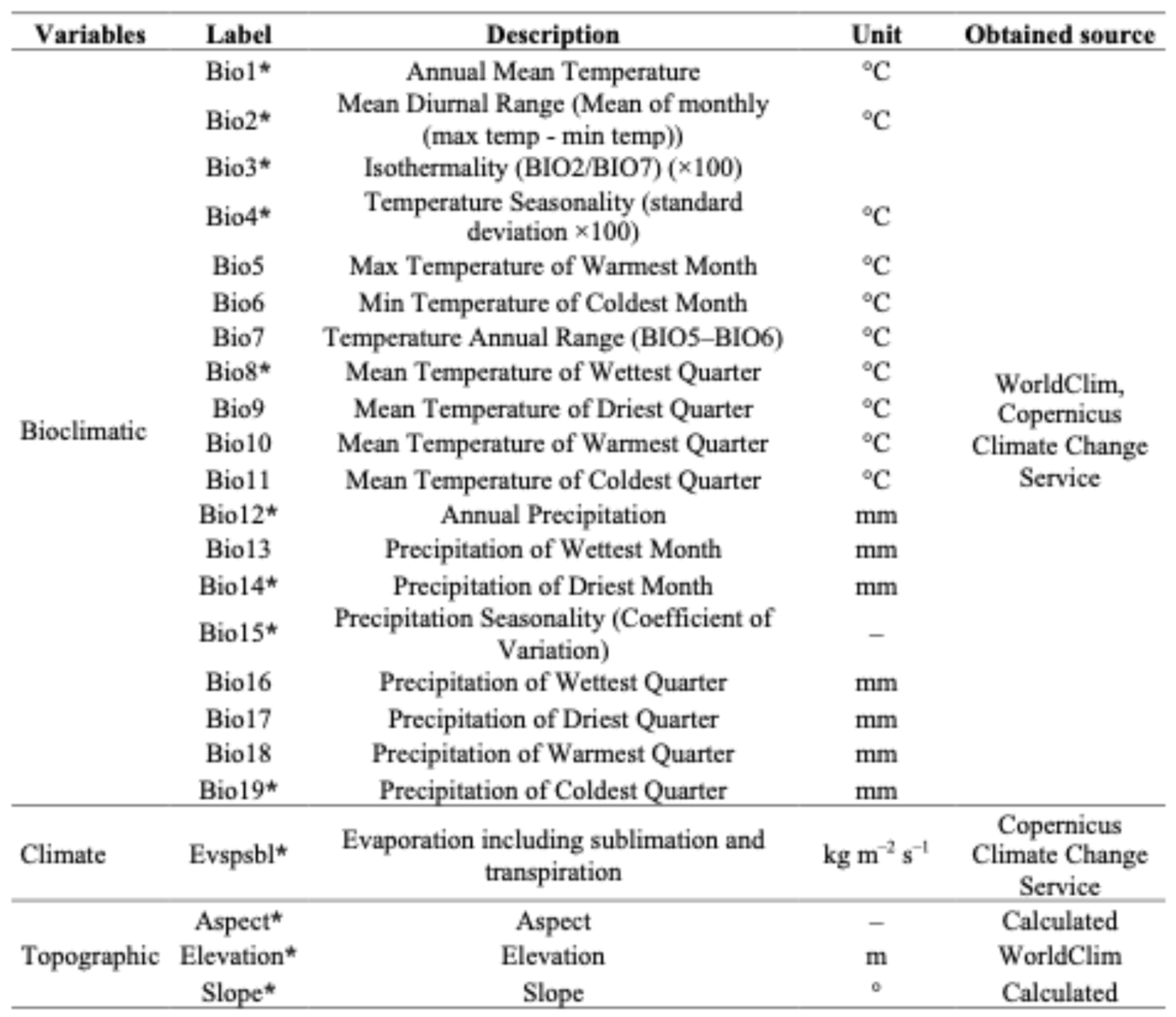
This study utilized a comprehensive set of 23 environmental variables, comprising 19 bioclimatic parameters, three topographic factors (elevation, slope, and aspect), and an evaporation variable that accounts for sublimation and transpiration (evspsbl) (Figure 2). The bioclimatic data were obtained from the WorldClim Database v2.1 and the Copernicus Climate Change Service Climate Data Store at a 30-arcsecond (~1 km2) resolution, and elevation data from WorldClim were processed in ArcGIS to derive slope and aspect. Future climate projections incorporated CNRM-CM6-1 (Centre National de Recherches Météorologiques-Coupled Model 6-1) model outputs from Coupled Model Intercomparison Project Phase 6 (CMIP6), including moderate (SSP2-4.5) and high (SSP5-8.5) emission scenarios across four time periods (2021–2040, 2041–2060, 2061–2080, and 2081–2100). All environmental layers were standardized to a consistent 30-arcsecond resolution and converted to ASCII format using ArcGIS to ensure compatibility.
Figure 2.
Environmental factors analyzed in this research and their data sources (asterisks indicate the selected variables).
To address potential multicollinearity issues, we performed both Pearson correlation analysis and Variance Inflation Factor (VIF) analysis using the ‘usdm’ package [28]. Following thresholds in ecological modeling, variables with |r| > 0.8 and VIF > 10 were considered collinear and excluded [28]. The initial VIF analysis revealed extremely high multicollinearity among several bioclimatic variables, with Bio5, Bio6, and Bio7 exhibiting VIF values exceeding 1012 (Table 1). After stepwise exclusion of collinear variables, the final variable set was reduced to 13 key predictors with VIF values below 10 and correlation coefficients below 0.8 (Table 1): Bio1, Bio2, Bio3, Bio4, Bio8, Bio12, Bio14, Bio15, Bio19, aspect, elevation, evspsbl, and slope. The correlation matrix for the retained variables is provided in Table 2.
Table 1.
Variance inflation factor (VIF) values before and after exclusion of collinear variables.
Table 2.
Pearson correlation matrix for the 13 retained environmental variables.
These selected variables, detailed in Figure 2, were used for subsequent species distribution modeling of L. nobilis while accounting for both current conditions and future climate scenarios.
2.2.3. Species Distribution Modeling and Evaluation
Species distribution models (SDMs) were developed using ShinyBIOMOD, an R-based interface to the biomod2 package that integrates multiple statistical and machine-learning approaches for ensemble modeling (EM). The platform (version 0.0.0.9000) incorporates ten algorithms: Surface Range Envelope (SRE), Classification Tree Analysis (CTA), Random Forest (RF), Generalized Additive Models (GAM), Generalized Boosting Models (GBM), Generalized Linear Models (GLM), Multivariate Adaptive Regression Splines (MARS), Artificial Neural Networks (ANN), Maximum Entropy (MaxEnt), and Flexible Discriminant Analysis (FDA). ShinyBIOMOD minimizes uncertainty in L. nobilis distribution predictions, enhances predictive precision, and eliminates individual model biases by integrating these different modeling strategies [29,30].
To prevent spatial overlap and account for species dispersal restrictions, 1000 pseudo-absence points were generated with a 5 km exclusion buffer around known occurrence points to ensure robust model calibration [31,32]. The “disk” function in the biomod2 package was used to duplicate this procedure three times. A total of 450 models per climate scenario and timeframe were produced by splitting the dataset into 80% training and 20% testing subsets, with five iterations per model run (3 pseudo-absence replicates × 10 models × 3 repetitions). For balancing presence-absence data, the model calibration maintained a prevalence of 0.5 [33].
The True Skill Statistic (TSS) and Area Under the Receiver Operating Characteristic (ROC) Curve (AUC) were used to assess the model’s fitness. While TSS enhances conventional Kappa statistics by mitigating biases due to species prevalence, AUC provides a threshold-independent indicator of predictive accuracy [34,35]. Only models with an AUC > 0.85 and TSS > 0.75 were maintained for EM. The habitat suitability index (HSI) on the generated continuous prediction maps ranged from 0 to 1000. We compared the percentage of HSI values among four classes of HSI: unsuitable (0–250), very low (251–500), medium (501–750), and high suitability (751–1000), that were applied to the EM outputs in ArcGIS 10.8 in order to ascertain the degree of change in predicted HSI between the various modeling techniques and to choose the most reliable one [36].
To determine the relative impacts of environmental variables on species distribution (presented in Table 2), permutation-based variable importance scores were calculated using the biomod2 package [37]. In this procedure, the values of each explanatory variable were randomly permuted, breaking the relationship between the variable and species presence while holding all other variables constant. The predictive performance of the model on this permuted dataset (measured using ROC and TSS scores) was then compared with the performance of the original model. The reduction in model performance resulting from permuting a given variable was recorded as its importance level, with larger decreases indicating higher variable importance. This permutation-based procedure is preferred over correlation-based methods because it accounts for interactions among variables and reflects each predictor’s actual contribution to the model’s predictive capacity [38,39]. The approach was repeated five times for each variable to ensure stability of the importance estimates.
We created presence/absence matrices for baseline (2021) and future projections (2040–2100) to assess shifts in suitable habitats under climate change. According to Ye et al. [40], changes were classified as new suitable (0 → 1), lost (1 → 0), stable (1 → 1), or unsuitable (0 → 0) areas. By enabling the quantification of L. nobilis’s potential distribution area (PDA) changes under SSP2-4.5 and SSP5-8.5 scenarios, this framework sheds light on range contractions, expansions, and stable sites throughout Türkiye.
3. Results
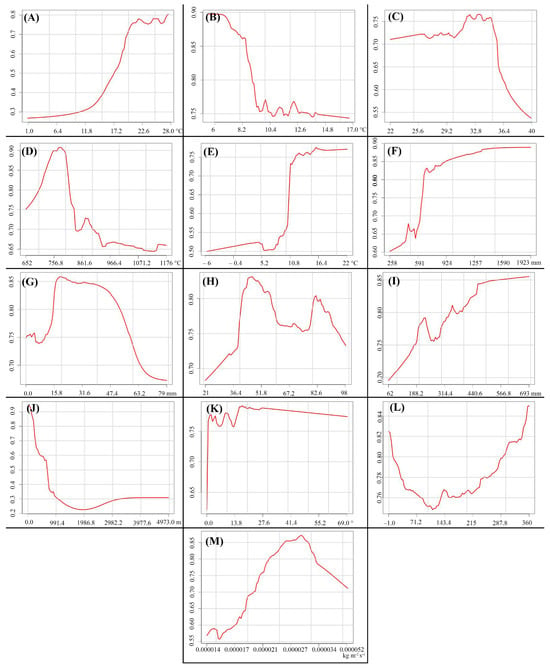
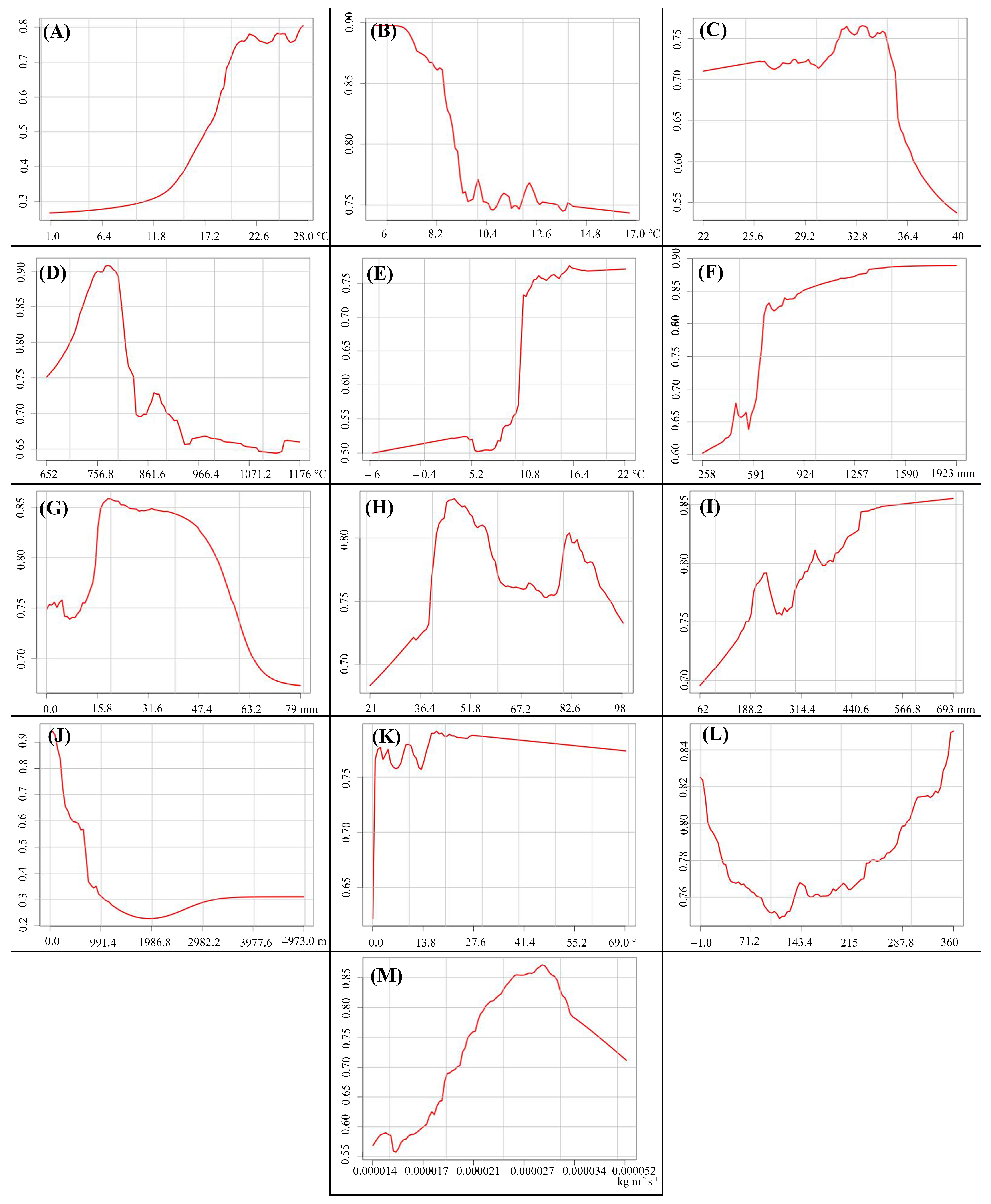
The graphs illustrate how the environmental factors identified during the study shaped the distribution area of the L. nobilis species (Figure 3). These graphs represent the contribution of each environmental variable in species distribution models and the species’ “response curve” to that variable. In other words, each graph shows the effect of a single environmental variable (Bio 1, Bio 4, slope, elevation, etc.) on a species’ fitness probability. The Y-axis represents the model’s predicted fitness (between 0 and 1), and the X-axis represents the value of the environmental variable. These graphs answer the question, “How does a species’ fitness change as the variable’s value increases?” For example, in the Bio 1 (temperature) graph, if the curve rises rapidly at low temperatures, then levels off at moderate temperatures, and finally drops again above a certain threshold, it indicates that the species prefers moderate temperatures and experiences a decrease at very low or very high temperatures. The highest portion of the curve represents the optimum environmental value most preferred by the species, associated with its widest distribution. For example, if the peak in the Bio 4 (temperature seasonality) graph is around 500, the species is likely to be found in areas with a seasonality of around 500. If the curve drops rapidly after a point, the species’ tolerance limit has been exceeded. Beyond this value, fitness decreases, and the species is rarely seen in locations where these values are present. Some curves contain multiple peaks and troughs. This indicates that the species may be tolerant to different environmental ranges, or that the variable may interact with other variables. For example, if the Bio 15 (rainfall seasonality) graph contains multiple peaks, the species may be adaptable to both moderate and high seasonality.
Figure 3.
Response curves showing the marginal effect of each environmental variable on habitat suitability for L. nobilis. The y-axis represents predicted suitability (0–1 scale), and the x-axis shows the variable range. The apex of each curve indicates the optimal value for the species. Curves were generated from the ensemble model with all other variables held at their mean values. Variables shown include the 13 retained predictors [(A) Bio1, (B) Bio2, (C) Bio3, (D) Bio4, (E) Bio8, (F) Bio12, (G) Bio14, (H) Bio15, (I) Bio19, (J) elevation, (K) slope, (L) aspect, and (M) evspsbl].
The effect rates of the environmental variables with the greatest impact on the species distribution were determined, and the effect levels of these variables, based on the models used in the study, are presented in Table 3. The variables with the most significant effects on the distribution area of the species are elevation, Bio 1 (Annual Mean Temperature), and evspsbl (Table 3). These three variables in the EMs accounted for approximately 89.1% (44.3/49.7%) of the total variables in the study. The calculated TSS and AUC values of the models evaluated in the study are given in Table 4.
Table 3.
Effect levels of environmental variables on 10 models and the ensemble model. Values represent the decrease in model performance (measured by ROC and TSS) when each variable is randomly permuted; higher values indicate greater importance.
Table 4.
TSS and ROC mean values (±Std. dev.) of the 10 individual models and the ensemble model. Models with AUC > 0.90 and TSS > 0.80 (GAM, RF, GLM, GBM, MaxEnt) were selected for ensemble construction. The ensemble model achieved the highest performance, indicating excellent predictive accuracy (bolds indicate the selected models and the ensemble model).
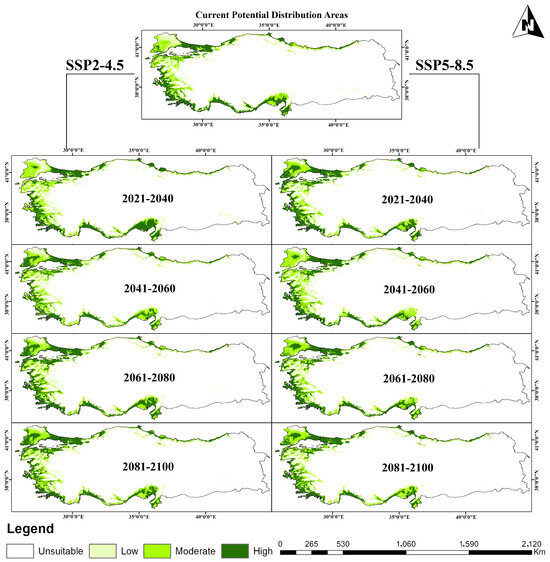
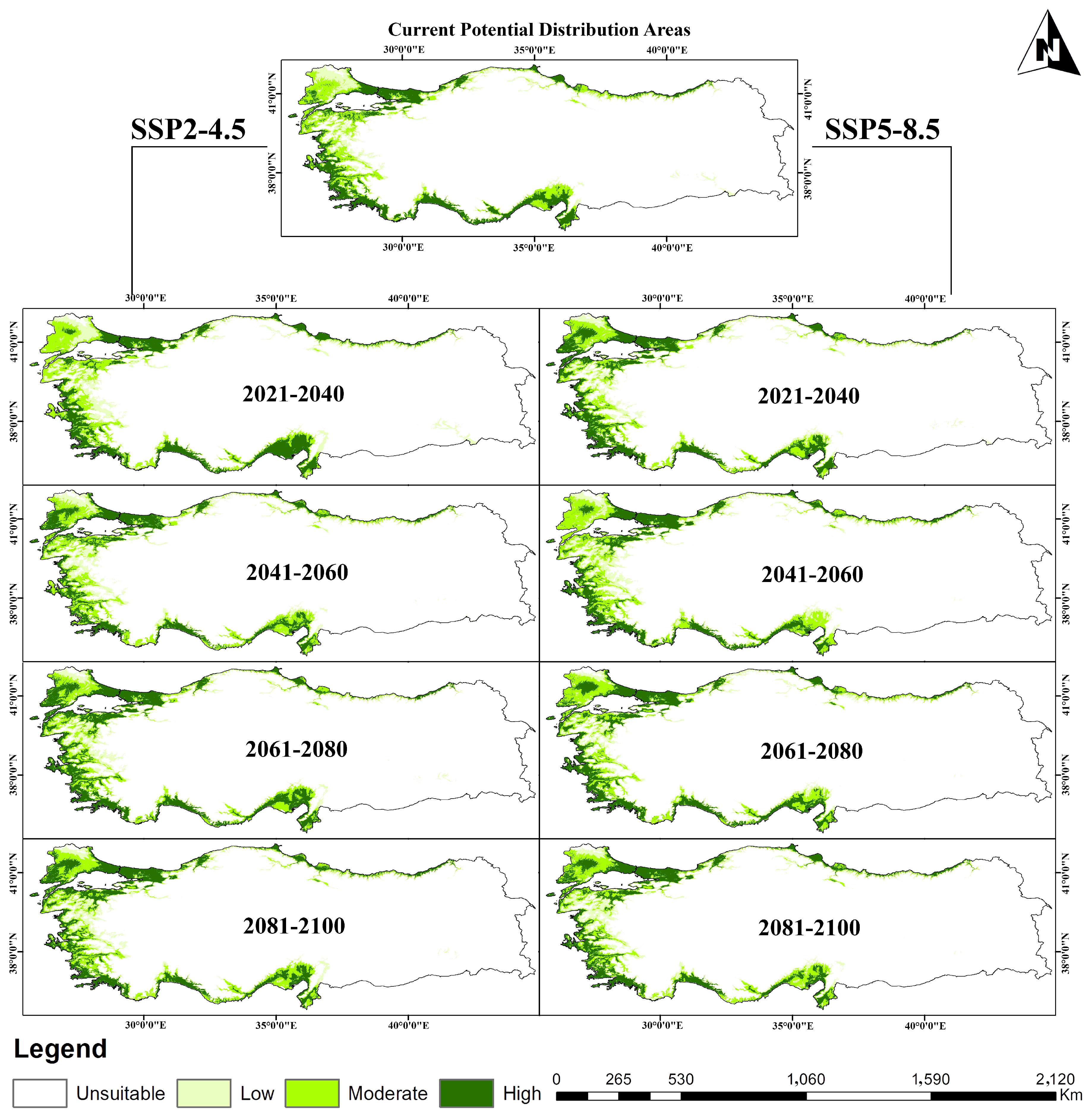
A total of 10 models with five replications were run using environmental variables together with L. nobilis distribution data specific to Türkiye. As a result, TSS and AUC values of 10 models were obtained. GAM (TSS = 0.766, AUC = 0.926), RF (TSS = 0.818, AUC = 0.936), GLM (TSS = 0.770, AUC = 0.921), GBM (TSS = 0.804, AUC = 0.940), and MaxEnt (TSS = 0.769, AUC = 0.932) show the best accuracy and stability with high average TSS and AUC values. Models with AUC values > 0.90 and TSS values > 0.80 (Maxent, GBM, RF, GAM, and GLM) were selected to derive EM. These outcomes indicate that L. nobilis species distribution areas estimated using EM (TSS = 0.838, AUC = 0.964) are more reliable than those obtained using any single model. The changes in the appropriate distribution areas of L. nobilis, as predicted by the models, are shown in Figure 4.
Figure 4.
Modeled changes in the suitable habitat distribution of L. nobilis across Türkiye. The ensemble model projections show the current (2020) and future potential distribution under the SSP2-4.5 and SSP5-8.5 scenarios for four consecutive 20-year periods (2021–2100). Colors indicate habitat suitability classes [unsuitable (0–250), low suitability (251–500), medium suitability (501–750), and high suitability (751–1000)].
Our projections indicate that, by the end of the century (2100), the suitable habitat for L. nobilis is likely to contract substantially in inland areas under the SSP2-4.5 scenario compared to the present (2020). This contraction appears particularly pronounced in the inland zones of the Black Sea, the Aegean, and Eastern Anatolia. However, an analysis of intermediate time slices reveals a non-linear trend: a temporary increase in suitability is explicitly projected for the inland Aegean region in the 2061–2080 period. Under the SSP5-8.5 scenario, a similar temporary increase is evident in the inland Aegean region for the 2041–2060 period; however, this gain is projected to be lost in subsequent projections (2080, 2100), resulting in widespread habitat loss across most areas with a continental climate. The areal change in appropriate distribution habitats is given in Table 5.
Table 5.
Spatial change in appropriate distribution habitats of L. nobilis (%) under current (2020) and future climate scenarios under the SSP2-4.5 and SSP5-8.5 scenarios for four consecutive 20-year periods (2021–2100).
When the table values are examined, it is seen that approximately 5.45% of Türkiye is low and 6.07% is moderately suitable as L. nobilis habitat today, while 6.96% is highly suitable. According to the calculations, the total area suitable for L. nobilis distribution may expand slightly in 2040 under the SSP2-4.5 scenario, decrease until 2060 and 2080, and increase slightly until 2100. However, the area in 2100 is still projected to be lower than the total of today’s suitable distribution area. According to the SSP5-8.5 scenario, there may be a decrease, an increase, a decrease, and an increase every 20 years from now on. However, again, the total suitable distribution area in 2100 is expected to remain lower than today’s. As a result, the total suitable distribution habitat of L. nobilis is likely to decrease under both scenarios.
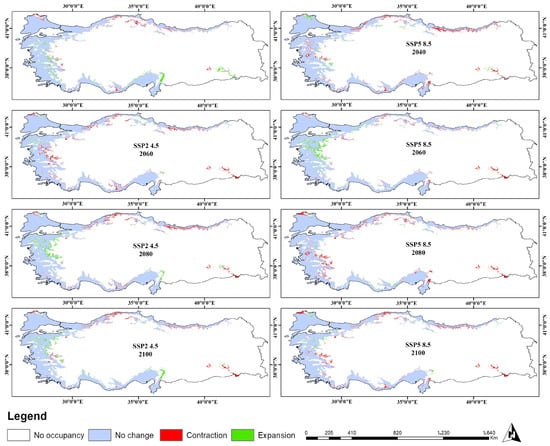
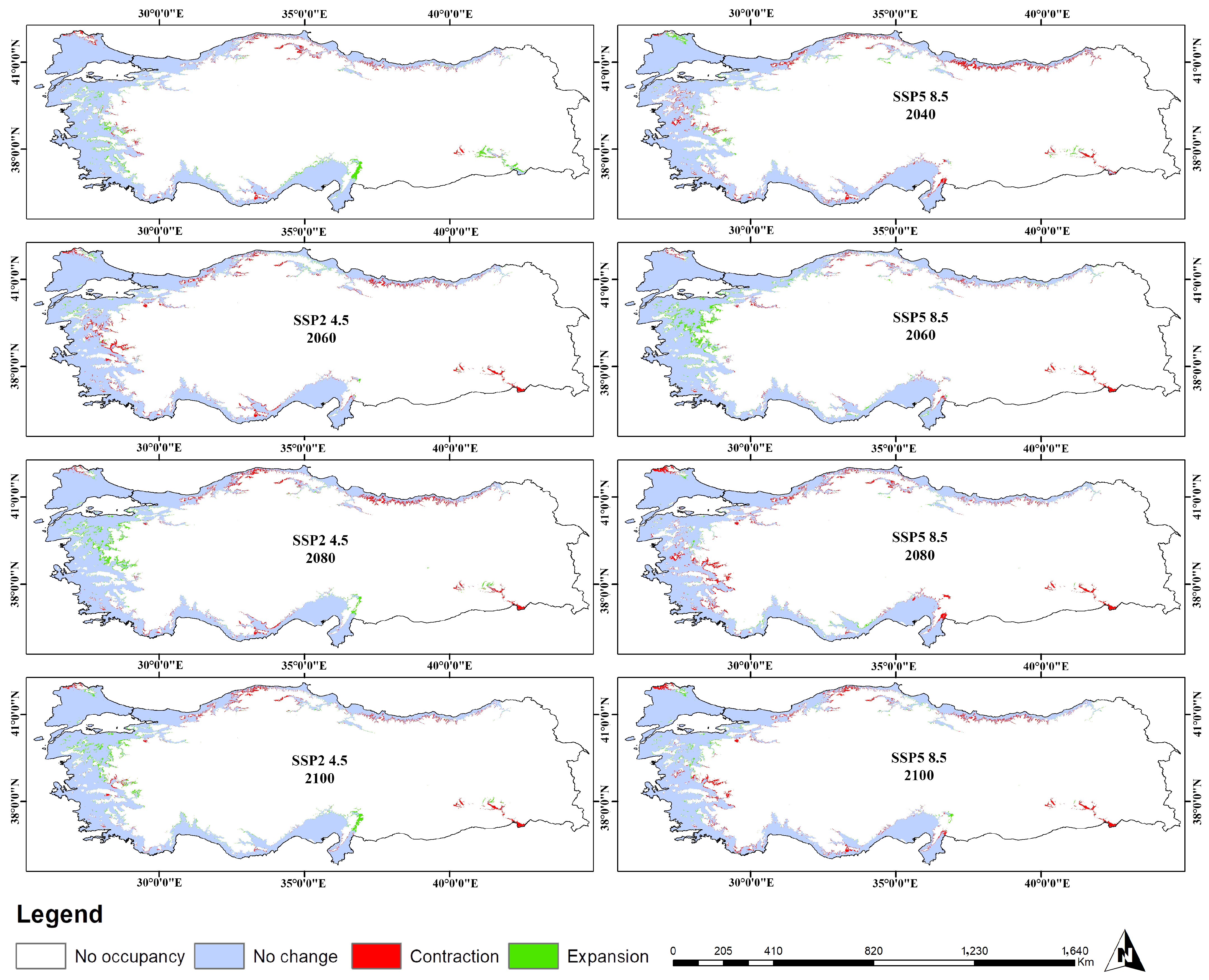
However, these figures do not reflect the real situation. While habitat loss may occur in areas with existing distribution, new suitable distribution areas may emerge far from those areas. In this case, although the total suitable distribution area changes little, severe habitat loss may occur. To reveal this situation, the increases and decreases in suitable distribution areas of L. nobilis are shown in Figure 5.
Figure 5.
Spatial patterns of range contraction (habitat loss) and range expansion (habitat gain) for L. nobilis under SSP2-4.5 and SSP5-8.5 scenarios across four time periods (2040, 2060, 2080, 2100).
When Figure 5 is examined, suitable distribution area losses are projected in the north of the Thrace region, the south of the Black Sea strip, the inner parts of the Aegean region, and in limited areas in the Southeastern Anatolia region beginning in the 2040 time slice (2021–2040) under both scenarios. In addition, according to the SSP2-4.5 scenario, in the 2061–2080 and 2081–2100 periods, and according to the SSP5-8.5 scenario, in the 2041–2060 period, new suitable distribution habitats may form in the inner parts of the northern Aegean region. Similarly, according to the SSP2-4.5 scenario, in the 2061–2080 and 2081–2100 periods, and according to the SSP5-8.5 scenario in the 2081–2100 period, new appropriate distribution habitats are projected to occur around Hatay-Antep (in southeastern Anatolia, near the Syrian border). The spatial changes in the suitable distribution habitats of L. nobilis are provided in Table 6.
Table 6.
Spatial changes in suitable distribution habitats of L. nobilis (%) under SSP2-4.5 and SSP5-8.5 scenarios across four time periods (2040, 2060, 2080, 2100).
When the spatial changes in suitable distribution areas of L. nobilis are examined, there are projected to be losses of suitable distribution areas at rates ranging from 0.73% to 1.27% in 20-year periods until 2100 according to the SSP2-4.5 scenario, and at rates ranging from 0.64% to 1.41% according to the SSP5-8.5 scenario. In addition, new suitable distribution areas may emerge at rates ranging from 0.26% to 0.81% under the SSP2-4.5 scenario and from 0.24% to 0.92% under the SSP5-8.5 scenario. Given that these areas are proportional to the country’s land area, the situation may be even more serious; for instance, under the SSP5-8.5 scenario, the expected 1.41% loss in 2080 corresponds to approximately 8.3% of the total L. nobilis distribution area.
4. Discussion
In this study, the current and future suitable distribution habitats of L. nobilis were estimated using GAM, RF, GLM, GBM, CTA, ANN, SRE, FDA, MARS, and MaxEnt models under SSP2-4.5 and SSP5-8.5 scenarios. To integrate these predictions, an ensemble model (EM) was constructed [41]. The EM simultaneously evaluates several models, seeks the most accurate outcome, and has been widely applied in recent research to predict species distribution shifts under global climate change (GCC). For example, studies on Olea europaea [42], Larix gmelinii (Rupr.) Kuzen [43], Moringa oleifera Lam. and M. stenopetala (Baker f.) Cufod [44], Vachellia sieberiana (DC.) Kyal. & Boatwr [45], Cupressus funebris Endl. [46], Liquidambar orientalis Mill. [41], and Fagus orientalis Lipsky [25] have successfully used this method. In the present research, the EM’s TSS and ROC weights were determined to be 0.838 and 0.966, respectively, indicating a highly predictive model.
Climate change is expected to result in possible distribution shifts in L. nobilis. Based on our results, a reduction in appropriate distribution habitats could surpass 8% every 20 years. Our results indicate that elevation and mean annual temperature are the most significant factors influencing the distribution of laurel. Studies have shown that, throughout geological periods, Laurus has consistently lived in warm, relatively humid climates. It is stated that the optimum temperature range of laurel, which has a limited tolerance to summer temperatures above 28–30 °C, is approximately 15–30 °C. While decreasing water availability limits the distribution of Laurus, increasing humidity levels enhance its distribution [22]. Frost and desiccation reduce the viability of laurel seeds, thus preventing Laurus species from establishing in regions with recurring cold winters or arid climates. With the GCC effect, it is projected that Türkiye’s annual temperature will increase throughout the country until 2100; it is predicted that temperature increases could reach up to 6 °C, especially in the Aegean region [47], and that the northern half of Türkiye may experience a significant decrease in summer precipitation [48]. These regions are the current distribution areas of laurel in Türkiye, and drought in these regions, in particular, may seriously threaten laurel distribution. Furthermore, L. nobilis grows naturally at low elevations, specifically between 0 and 1200 m, in the Mediterranean, Aegean, and Black Sea regions of Türkiye [23]. Studies have indicated that the distribution areas of the species are likely to shift upwards in elevation, that this shift may reach 650 m in some broad-leaved species such as Quercus frainetto and Fagus sylvatica [49], and that due to this situation, the suitable distribution areas of some species, such as Castanea sativa in Türkiye, may completely disappear [7].
Compared to other tree species, this number is reasonably optimistic. Research indicates that the GCC will have catastrophic consequences, particularly for forest tree species, and the loss of appropriate distribution habitats may be extremely high. For instance, according to the Representative Concentration Pathways (RCP) 8.5 scenario, Arslan and Örücü [50] estimated that the appropriate distribution area of Pinus nigra in Türkiye may be lost by roughly 88% in 2070. In contrast, it is estimated that the SSP5-8.5 scenario will result in a loss of 19.73–48.92% of P. nigra in Türkiye [51]. Abies bornmuelleriana populations at elevations between 1800 and 2000 m may experience losses of over 60% [52], and by 2085, Liquidambar orientalis habitats may have decreased by 58%, according to Kenar [41]. According to Çobanoğlu et al. [7], by 2100, Castanea sativa’s suitable distribution areas might almost disappear.
Studies conducted in various locations worldwide induce comparable results. According to a study done in Greece, the appropriate distribution of habitat losses for Pinus nigra, P. halepensis, P. brutia, Quercus ilex, Q. pubescens, Q. frainetto, and Fagus sylvatica could be as much as 77%, 45%, 54%, 47%, 64%, 72%, and 93%, respectively [49]. It is stated that the suitable distribution areas of Abies religiosa, Pinus hartwegii, P. pseudostrobus, P. devoniana, and P. oocarpa in the mountainous areas of Mexico may decrease by 46–77% by 2060. The reduction in the distribution area of Q. gilva in East Asia could exceed 45% by 2060 [53]. It is predicted that between 2081 and 2100, the highly suitable habitats of Magnolia sieboldii subsp. japonica in China, except for Anhui, Zhejiang, and Hubei Provinces, will disappear [30].
Studies show that suitable distribution areas will change with the effects of GCC generally manifesting as an upward shift in elevation and affecting endemic species with limited distribution areas the most. For example, Wang et al. [54] stated that trees will migrate upslope by approximately 140 m in the Eastern Himalaya by the end of the twenty-first century, and this shift will cause endemic flora to lose at least 20% of their current habitat.
Our results generally indicate that suitable distribution habitats are likely to be lost in inland areas near regions with a continental climate. The most significant impacts of global climate change are projected to be increased temperatures, changes in precipitation, and associated increases in drought. These shifts could lead to the loss of individuals, populations, and even species in many plant species [7,24,30]. Plants, unlike animals, lack an effective migration mechanism; therefore, their genetic structure and environmental conditions shape all their phenotypic characters [55,56,57]. Climate is one of the most significant ecological factors influencing plant development [9]. Large-scale alterations in climatic features cause plant stress [58]. This situation can seriously disrupt plant development. For example, a study conducted in Bangladesh on Lagerstroemia speciosa, Chukrasia tabularis, and Toona ciliata found that tree diameter growth could decrease by up to 20% due to the GCC effect [59]. Similarly, a research study in Korea projected that, under the SSPS5-8.5 scenario by 2090, climate change could lead to a significant loss of suitable habitat for species used in landscaping, such as a 33.6% reduction for Stewartia koreana, 98.9% for Betula ermanii, and 90.1% for Taxus cuspidata [60]. This vulnerability stems from the fact that many landscape species are cultivated outside their native ranges, thereby exposing them to greater environmental stress.
However, it should be remembered that climate is not the only parameter determining the distribution area of species. For plants, edaphic factors also affect species distribution as much as climatic factors [61,62]. In addition, anthropogenic factors, especially land use, also affect the distribution area of species ([63,64,65]). In addition, biotic factors such as interspecies competition and symbiosis, diseases and pests [66,67,68], abiotic factors such as salt stress, heavy metals, nanoparticles, UV-B radiation [69,70,71,72,73,74,75], and physical and topographical factors such as altitude, slope, aspect, mountains, and oceans [76,77,78] also significantly affect plant distribution. Furthermore, it has been determined that microenvironmental conditions can be more influential than macroenvironmental conditions and can shape species distribution [27,79]. Therefore, climatically suitable areas cannot perfectly match existing distribution areas. However, studies have shown a strong correlation between the two factors [63,80].
Our results revealed that some areas will lose suitable distribution areas, while new appropriate distribution habitats will form. A similar situation has been observed in studies of different species. For example, Cantürk et al. [51] determined that according to the SSP5-8.5 scenario and the CTA model, 25.09% of the appropriate distribution areas of black pine in 2100 will be the same as today, and 48.92% of the areas that are appropriate distribution areas today will no longer be appropriate distribution areas. Some areas that are currently unsuitable for black pine will be suitable distribution areas for the species in 2100 (the rate of these areas was calculated at 25.99%). The potential impacts of the GCC on species’ suitable ranges are assessed by considering the total extent of the suitable range [8,9], but this approach is misleading. Plants will not be able to grow in these areas because they cannot naturally migrate into newly formed suitable habitats. Therefore, it is inevitable that populations and even species will decline.
It is estimated that the spread of insects and fungi may be affected in this process [81,82], forest fires may increase [83,84], non-native species invasions may increase [85,86], precipitation regime and, accordingly, water and nutrient availability may be affected [87,88,89], and UV-B rays may increase [90,91,92]. Therefore, it is clear that the effects of GCC are likely to be multifaceted, and new studies are continually being added to determine their impact. However, the effects of the process have not yet been fully clarified.
5. Conclusions
The EM (ensemble model) developed in this study effectively predicts shifts in the suitable distribution habitats of L. nobilis in Türkiye under climate change, with elevation, annual mean temperature (Bio1), and evaporation, including sublimation and transpiration (evspsbl) emerging as the most influential factors. Projections under the SSP2-4.5 and SSP5-8.5 scenarios indicate habitat losses in inland regions, particularly where continental climates prevail, while limited expansions may occur in areas such as the northern Aegean and Hatay-Antep. Despite fluctuations, a net decrease in suitable habitats is expected by 2100, emphasizing the species’ vulnerability to climate change. To mitigate these impacts, proactive precautions such as selecting drought-resistant provenances, implementing assisted migration, and establishing pilot adaptation studies in newly suitable sites are vital. Collaboration with Türkiye’s General Directorate of Forestry will be crucial for conservation planning, ensuring the preservation of L. nobilis for its ecological and economic benefits. Integrating these strategies into national forestry policies and long-term monitoring programs will enhance resilience against climate-driven habitat shifts.
The current study used different climate models and scenarios to predict the course of global climate change. As in similar studies, the biggest uncertainty in this study is the unknown effects of climate change and the direction of changes in climatic parameters. The study results also show that changes in the species’ suitable distribution areas differ greatly between optimistic and pessimistic scenarios. Therefore, it is necessary to monitor which scenario is most likely to occur in the coming years and to shape the measures accordingly.
Author Contributions
U.C.: Conceptualization, Methodology, Software, Writing—original draft. I.K.: Conceptualization, Formal analysis, Writing—original draft—review & editing. R.E.: Methodology, review & editing. A.O.P.: Conceptualization, Writing—review & editing. H.S.: Conceptualization, Software, Writing—review & editing. H.B.O.: Methodology, Writing—review & editing. F.A.: Methodology, Writing—review & editing. N.K.O.: Writing—review & editing. All authors read drafts and approved the final manuscript. All authors have read and agreed to the published version of the manuscript.
Funding
This research received no external funding.
Institutional Review Board Statement
Not applicable.
Informed Consent Statement
Not applicable.
Data Availability Statement
The original contributions presented in the study are included in the article; further inquiries can be directed to the corresponding author.
Conflicts of Interest
The authors declare no conflicts of interest.
References
- Buhr, L.; Lenzi, D.S.; Pols, A.J.; Brunner, C.E.; Fischer, A.; Staal, A.; Hofbauer, B.P.; Bovenkerk, B. The concepts of irreversibility and reversibility in research on anthropogenic environmental changes. PNAS Nexus 2025, 4, pgae577. [Google Scholar] [CrossRef] [Scilit]
- Lin, J.; Qian, T. Earth’s climate history from 4.5 billion years to one minute. Atmosphere-Ocean 2022, 60, 188–232. [Google Scholar] [CrossRef] [Scilit]
- Kaiho, K. Mechanisms of global climate change during the five major mass extinctions. Sci. Rep. 2025, 15, 16498. [Google Scholar] [CrossRef] [Scilit] [PubMed]
- Zeren Cetin, I.; Ozel, H.B.; Varol, T.; Canturk, U.; Sevik, H. Climate change impacts on Taxus baccata distribution and conservation. J. For. Res. 2025, 36, 95. [Google Scholar] [CrossRef] [Scilit]
- Yohannes, H.T.; Yu, J.; Zhang, X. The role of anthropogenic climate change on March–April–May (MAM) drought trends across global land. Int. J. Climatol. 2025, 45, e8776. [Google Scholar] [CrossRef] [Scilit]
- Swagatika Priyadarshini, L.; Kaushik, V.; Kataria, R. The Role of anthropogenic activities, energy demand, and global climate change. In The Intersection of Global Energy Politics and Climate Change: A Comprehensive Analysis of Energy Markets and Economics; Springer: Berlin/Heidelberg, Germany, 2025; pp. 35–61. [Google Scholar]
- Cobanoglu, H.; Canturk, U.; Koç, İ.; Kulaç, Ş.; Sevik, H. Climate change effect on potential distribution of Anatolian chestnut (Castanea sativa mill.) in the upcoming century in Türkiye. Forestist 2023, 73, 247–256. [Google Scholar] [CrossRef] [Scilit]
- Varol, T.; Canturk, U.; Cetin, M.; Ozel, H.B.; Sevik, H.; Zeren Cetin, I. Identifying the suitable habitats for Anatolian boxwood (Buxus sempervirens L.) for the future regarding the climate change. Theor. Appl. Climatol. 2022, 150, 637–647. [Google Scholar] [CrossRef] [Scilit]
- Ertürk, N.; Arıcak, B.; Şevik, H.; Yiğit, N. Possible change in distribution areas of Abies in Kastamonu due to global climate change. Kastamonu Univ. J. For. Fac. 2024, 24, 81–91. [Google Scholar] [CrossRef] [Scilit]
- Langstroff, A.; Heuermann, M.C.; Stahl, A.; Junker, A. Opportunities and limits of controlled-environment plant phenotyping for climate response traits. Theor. Appl. Genet. 2022, 135, 1–16. [Google Scholar] [CrossRef] [Scilit]
- Anderson, J.T.; Song, B.H. Plant adaptation to climate change—Where are we? J. Syst. Evol. 2020, 58, 533–545. [Google Scholar] [CrossRef] [Scilit]
- Ayhan, E. The Contribution of Laurel Production to Rural Economy and Its Management (Sample of Bursa Province). Master’s Thesis, Bursa Techinal University, Bursa, Türkiye, 2022. [Google Scholar]
- Erkan, N.; Ayhan, E. Investigation of potential contribution of laurel (Laurus nobilis L.) production to rural economy and profile, problems and expectations of laurel producer (Case of Bursa province). Turk. J. For. 2023, 24, 262–271. [Google Scholar]
- Karaşah, B. Koku bahçelerinde değerlendirilebilecek bazı tıbbi ve aromatik bitkiler ve sağladıkları ekosistem hizmetleri. Bahçe 2025, 54, 419–428. [Google Scholar] [CrossRef] [Scilit]
- Doğan, H.; Genç, A.; Mutlu, M. Extracting the essential oil from laurel (Laurus nobilis) plant with a new microwave assisted distillation system. J. Tekirdag Agric. Fac. 2025, 22, 151–161. [Google Scholar]
- Babacan, H.T. Evaluation of flood risk due to rainfall under the impact of climate change in Antalya region. Urban Water J. 2025, 22, 1011–1027. [Google Scholar] [CrossRef] [Scilit]
- Taskin, B.G.; Taskin, V.; Akbaş, K. The status and distributions of the Wild Olive (Olea europaea subsp. europaea var. sylvestris) in Muğla Province and its islands under global climate change. Biol. Bull. 2024, 51, 1326–1337. [Google Scholar] [CrossRef] [Scilit]
- Gur, E.; Palta, S.; Ozel, H.B.; Varol, T.; Sevik, H.; Cetin, M.; Kocan, N. Assessment of climate change impact on highland areas in Kastamonu, Turkey. Anthropocene 2024, 46, 100432. [Google Scholar] [CrossRef] [Scilit]
- Arroyo, J.M.; Rigueiro, C.; Rodríguez, R.; Hampe, A.; Valido, A.; Rodríguez-Sánchez, F.; Jordano, P. Isolation and characterization of 20 microsatellite loci for laurel species (Laurus, Lauraceae). Am. J. Bot. 2010, 97, e26–e30. [Google Scholar] [CrossRef] [Scilit]
- Rodríguez-Sánchez, F.; Guzmán, B.; Valido, A.; Vargas, P.; Arroyo, J. Late Neogene history of the laurel tree (Laurus L., Lauraceae) based on phylogeographical analyses of Mediterranean and Macaronesian populations. J. Biogeogr. 2009, 36, 1270–1281. [Google Scholar] [CrossRef] [Scilit]
- Rodríguez-Sánchez, F.; Hampe, A.; Jordano, P.; Arroyo, J. Past tree range dynamics in the Iberian Peninsula inferred through phylogeography and palaeodistribution modelling: A review. Rev. Palaeobot. Palynol. 2010, 162, 507–521. [Google Scholar] [CrossRef] [Scilit]
- Rodríguez-Sánchez, F.; Arroyo, J. Reconstructing the demise of Tethyan plants: Climate-driven range dynamics of Laurus since the Pliocene. Glob. Ecol. Biogeogr. 2008, 17, 685–695. [Google Scholar] [CrossRef] [Scilit]
- Akyol, A.; Örücü, Ö.K.; Arslan, E.S.; Sarıkaya, A.G. Predicting of the current and future geographical distribution of Laurus nobilis L. under the effects of climate change. Environ. Monit. Assess. 2023, 195, 459. [Google Scholar] [CrossRef] [Scilit] [PubMed]
- Canturk, U.; Koç, İ.; Erdem, R.; Ozturk Pulatoglu, A.; Donmez, S.; Ozkazanc, N.K.; Sevik, H.; Ozel, H.B. Climate-driven shifts in wild Cherry (Prunus avium L.) habitats in Türkiye: A multi-model projection for conservation planning. Forests 2025, 16, 1484. [Google Scholar] [CrossRef] [Scilit]
- Koç, İ. Predicting the potential geographic distribution of Fagus orientalis Lipsky under climate change using an ensemble model approach in Türkiye. Sci. Nat. 2025, 112, 93. [Google Scholar] [CrossRef] [Scilit]
- Hijmans, R.J.; Phillips, S.; Leathwick, J.; Elith, J.; Hijmans, M.R.J. Package ‘dismo’. Circles 2017, 9, 1–68. [Google Scholar]
- Zeren Cetin, I.; Ozel, H.B.; Sevik, H.; Canturk, U.; Varol, T.; Atesoglu, A.; Kocan, N.; Zeren, D.B. Potential altitude change of Oriental spruce in Türkiye due to global climate change. Acta Geophys. 2025, 73, 6305–6314. [Google Scholar] [CrossRef] [Scilit]
- Huang, D.; An, Q.; Huang, S.; Tan, G.; Quan, H.; Chen, Y.; Zhou, J.; Liao, H. Biomod2 modeling for predicting the potential ecological distribution of three Fritillaria species under climate change. Sci. Rep. 2023, 13, 18801. [Google Scholar] [CrossRef] [Scilit]
- Guo, Y.; Zhao, Z.; Li, X. Moderate warming will expand the suitable habitat of Ophiocordyceps sinensis and expand the area of O. sinensis with high adenosine content. Sci. Total Environ. 2021, 787, 147605. [Google Scholar] [CrossRef] [Scilit]
- Li, Q.; Cao, S.; Wang, L.; Hou, R.; Sun, W. Impacts of climate change on the potential distribution of three Cytospora species in Xinjiang, China. Forests 2024, 15, 1617. [Google Scholar] [CrossRef] [Scilit]
- VanDerWal, J.; Shoo, L.P.; Graham, C.; Williams, S.E. Selecting pseudo-absence data for presence-only distribution modeling: How far should you stray from what you know? Ecol. Model. 2009, 220, 589–594. [Google Scholar] [CrossRef] [Scilit]
- Phillips, S.J.; Dudík, M.; Elith, J.; Graham, C.H.; Lehmann, A.; Leathwick, J.; Ferrier, S. Sample selection bias and presence-only distribution models: Implications for background and pseudo-absence data. Ecol. Appl. 2009, 19, 181–197. [Google Scholar] [CrossRef] [Scilit]
- Linero, D.; Cuervo-Robayo, A.P.; Etter, A. Assessing the future conservation potential of the Amazon and Andes Protected Areas: Using the woolly monkey (Lagothrix lagothricha) as an umbrella species. J. Nat. Conserv. 2020, 58, 125926. [Google Scholar] [CrossRef] [Scilit]
- Allouche, O.; Tsoar, A.; Kadmon, R. Assessing the accuracy of species distribution models: Prevalence, kappa and the true skill statistic (TSS). J. Appl. Ecol. 2006, 43, 1223–1232. [Google Scholar] [CrossRef] [Scilit]
- Fawcett, T. An introduction to ROC analysis. Pattern Recognit. Lett. 2006, 27, 861–874. [Google Scholar] [CrossRef] [Scilit]
- Charbonnel, A.; Lambert, P.; Lassalle, G.; Quinton, E.; Guisan, A.; Mas, L.; Paquignon, G.; Lecomte, M.; Acolas, M.-L. Developing species distribution models for critically endangered species using participatory data: The European sturgeon marine habitat suitability. Estuar. Coast. Shelf Sci. 2023, 280, 108136. [Google Scholar] [CrossRef] [Scilit]
- Thuiller, W.; Georges, D.; Engler, R.; Breiner, F. Biomod2: Ensemble Platform for Species Distribution Modeling; R Package Version. 2024. Available online: https://biomodhub.github.io/biomod2/ (accessed on 15 December 2025).
- Breiman, L. Random forests. Mach. Learn. 2001, 45, 5–32. [Google Scholar] [CrossRef] [Scilit]
- Grömping, U. Variable importance assessment in regression: Linear regression versus random forest. Am. Stat. 2009, 63, 308–319. [Google Scholar] [CrossRef] [Scilit]
- Ye, X.-Z.; Zhao, G.-H.; Zhang, M.-Z.; Cui, X.-Y.; Fan, H.-H.; Liu, B. Distribution pattern of endangered plant Semiliquidambar cathayensis (Hamamelidaceae) in response to climate change after the last interglacial period. Forests 2020, 11, 434. [Google Scholar] [CrossRef] [Scilit]
- Kenar, N. Predicting the effect of climate change on the geographic range of the Mediterranean relict tree Liquidambar orientalis Mill. Nord. J. Bot. 2024, 2024, e04250. [Google Scholar]
- Khan, S.; Verma, S. Ensemble modeling to predict the impact of future climate change on the global distribution of Olea europaea subsp. cuspidata. Front. For. Glob. Change 2022, 5, 977691. [Google Scholar] [CrossRef] [Scilit]
- Gao, M.; Zhao, G.; Zhang, S.; Wang, Z.; Wen, X.; Liu, L.; Zhang, C.; Tie, N.; Sa, R. Priority conservation area of Larix gmelinii under climate change: Application of an ensemble modeling. Front. Plant Sci. 2023, 14, 1177307. [Google Scholar] [CrossRef] [Scilit] [PubMed]
- Bania, J.K.; Deka, J.R.; Hazarika, A.; Das, A.K.; Nath, A.J.; Sileshi, G.W. Modelling habitat suitability for Moringa oleifera and Moringa stenopetala under current and future climate change scenarios. Sci. Rep. 2023, 13, 20221. [Google Scholar] [CrossRef] [Scilit]
- Jinga, P.; Manyangadze, T. Variable intraspecific response to climate change in a medicinally important African tree species, Vachellia sieberiana (DC.) (paperbark thorn). Ecol. Evol. 2024, 14, e11314. [Google Scholar] [CrossRef] [Scilit]
- Yang, J.; Huang, Y.; Su, M.; Liu, M.; Yang, J.; Wu, Q. Spatial distribution patterns of the key afforestation species Cupressus funebris: Insights from an ensemble model under climate change scenarios. Forests 2024, 15, 1280. [Google Scholar] [CrossRef] [Scilit]
- Dalfes, H.; Karaca, M.; Sen, O. Climate Change Scenarios for Turkey in Climate Change & Turkey: Impact, Sectoral Analyses, Socio-Economic Dimensions; United Nations Development Programme (UNDP) Turkey Office: Ankara, Turkey, 2007. [Google Scholar]
- Talu, N.; Özden, M.; Özgün, S.; Dougherty, W.; Fencl, A. Turkey’s National Climate Change Adaptation Strategy and Action Plan (Draft); TR Ministry of Environment and urbanization, General Directorate of Environmental Management, Department of Climate Change: Ankara, Turkey, 2010.
- Fyllas, N.M.; Koufaki, T.; Sazeides, C.I.; Spyroglou, G.; Theodorou, K. Potential impacts of climate change on the habitat suitability of the dominant tree species in Greece. Plants 2022, 11, 1616. [Google Scholar] [CrossRef] [Scilit] [PubMed]
- Seda, A.; Ömer, Ö. Present and future potential distribution of the Pinus nigra Arnold. and Pinus sylvestris L. using maxent model. Int. J. Ecosyst. Ecol. Sci. 2019, 9, 787–798. [Google Scholar] [CrossRef] [Scilit]
- Cantürk, U.; Koç, İ.; Özel, H.B.; Şevik, H. Possible changes of Pinus nigra distribution regions in Türkiye with the impacts of global climate change. BioResources 2024, 19, 6190. [Google Scholar] [CrossRef] [Scilit]
- Tekin, O.; Cetin, M.; Varol, T.; Ozel, H.B.; Sevik, H.; Zeren Cetin, I. Altitudinal migration of species of Fir (Abies spp.) in adaptation to climate change. Water Air Soil Pollut. 2022, 233, 385. [Google Scholar] [CrossRef] [Scilit]
- Shi, J.; Xia, M.; He, G.; Gonzalez, N.C.; Zhou, S.; Lan, K.; Ouyang, L.; Shen, X.; Jiang, X.; Cao, F. Predicting Quercus gilva distribution dynamics and its response to climate change induced by GHGs emission through MaxEnt modeling. J. Environ. Manag. 2024, 357, 120841. [Google Scholar] [CrossRef] [Scilit]
- Wang, X.; Wang, T.; Xu, J.; Shen, Z.; Yang, Y.; Chen, A.; Wang, S.; Liang, E.; Piao, S. Enhanced habitat loss of the Himalayan endemic flora driven by warming-forced upslope tree expansion. Nat. Ecol. Evol. 2022, 6, 890–899. [Google Scholar] [CrossRef] [Scilit]
- Stronen, A.V.; Norman, A.J.; Vander Wal, E.; Paquet, P.C. The relevance of genetic structure in ecotype designation and conservation management. Evol. Appl. 2022, 15, 185–202. [Google Scholar] [CrossRef] [Scilit]
- Schneider, H.M. Characterization, costs, cues and future perspectives of phenotypic plasticity. Ann. Bot. 2022, 130, 131–148. [Google Scholar] [CrossRef] [Scilit] [PubMed]
- Ramos-Muñoz, M.; Castellanos, M.C.; Blanco-Sánchez, M.; Pías, B.; Ramírez-Valiente, J.A.; Benavides, R.; Escudero, A.; Matesanz, S. Drivers of phenotypic variation and plasticity to drought in populations of a Mediterranean shrub along an environmental gradient. Environ. Exp. Bot. 2024, 228, 106011. [Google Scholar] [CrossRef] [Scilit]
- Miralles, D.G.; Vilà-Guerau de Arellano, J.; McVicar, T.R.; Mahecha, M.D. Vegetation–climate feedbacks across scales. Ann. N. Y. Acad. Sci. 2025, 1544, 27–41. [Google Scholar] [CrossRef] [Scilit] [PubMed]
- Rahman, M.; Islam, M.; Wernicke, J.; Bräuning, A. Changes in sensitivity of tree-ring widths to climate in a tropical moist forest tree in Bangladesh. Forests 2018, 9, 761. [Google Scholar] [CrossRef] [Scilit]
- Kim, D.-J.; Han, N.-Y.; Choi, M.N.; Jang, M.-J.; Shin, M.-S.; Seo, C.W.; Lee, D.-H.; Kwon, Y.S. Assessment of climate change impact on landscape tree distribution and sustainability in South Korea using MaxEnt-based modeling. PLoS ONE 2025, 20, e0316393. [Google Scholar] [CrossRef] [Scilit]
- Demirci, H.; Sevik, H.; Koc, I.; Ucun Ozel, H.; Erdem, R.; Adiguzel, F.; Imren, E.; Ozel, H.B. Organ-based accumulation, translocation, and associated health risk of Al, Ni, and Zn in Tomatoes, peppers, eggplants, cucumbers, and corn from an industrial zone in Düzce, Türkiye. Foods 2026, 15, 196. [Google Scholar] [CrossRef] [Scilit]
- Sevik, H.; Koc, I.; Ucun Ozel, H.; Adiguzel, F.; Erdem, R.; Imren, E.; Ozturk Pulatoglu, A.; Ozel, H.B. Changes in Cr and Cd concentrations in certain crops based on species and organ, and their translocation within plants. Horticulturae 2026, 12, 400. [Google Scholar] [CrossRef] [Scilit]
- Ertürk, N.; Arıcak, B. Possible changes in red pine (Pinus brutia Ten.) distribution areas in Kastamonu due to global climate change. Kastamonu Univ. J. Eng. Sci. 2024, 10, 29–37. [Google Scholar] [CrossRef] [Scilit]
- Liao, D.; Zhou, B.; Xiao, H.; Zhang, Y.; Zhang, S.; Su, Q.; Yan, X. Maxent modeling of the impacts of human activities and climate change on the potential distribution of plantago in China. Biology 2025, 14, 564. [Google Scholar] [CrossRef] [Scilit]
- Liu, C.-E.; Luo, Q.-R.; Xiao, Y.-L.; Li, H.-Y.; Dong, H.-J.; Duan, C.-Q. Influence of land-use type on earthworm diversity and distribution in Yunnan: Insights from soil properties. Appl. Soil Ecol. 2025, 205, 105791. [Google Scholar] [CrossRef] [Scilit]
- Basit, A.; Haq, I.U.; Hyder, M.; Humza, M.; Younas, M.; Akhtar, M.R.; Ghafar, M.A.; Liu, T.-X.; Hou, Y. Microbial symbiosis in lepidoptera: Analyzing the gut microbiota for sustainable pest management. Biology 2025, 14, 937. [Google Scholar] [CrossRef] [Scilit]
- Maake, T.W.; Sibisi, P. Microbial antagonists for the control of plant diseases in Solanaceae crops: Current status, challenges, and global perspectives. Bacteria 2025, 4, 29. [Google Scholar] [CrossRef] [Scilit]
- Hossain, M.M.; Sultana, F.; Mostafa, M.; Rubayet, M.T.; Mishu, N.J.; Khan, I.; Mostofa, M.G. Biological management of Soil-Borne pathogens through tripartite rhizosphere interactions with plant Growth-Promoting fungi. Appl. Microbiol. 2025, 5, 123. [Google Scholar] [CrossRef] [Scilit]
- Isinkaralar, K. Some atmospheric trace metals deposition in selected trees as a possible biomonitor. Rom. Biotechnol. Lett. 2022, 27, 3227–3236. [Google Scholar] [CrossRef] [Scilit]
- Bayraktar, E.P.; Isinkaralar, O.; Isinkaralar, K. Usability of several species for monitoring and reducing the heavy metal pollution threatening the public health in urban environment of Ankara. World J. Adv. Res. Rev. 2022, 14, 276–283. [Google Scholar] [CrossRef] [Scilit]
- Özel, H.B.; Koç, İ.; Yildiz, Y.; Şevik, H. Dose-dependent effects of CuO nanoparticles on germination and early seedling growth in Prunus avium. Balt. For. 2025, 31, id767. [Google Scholar] [CrossRef] [Scilit]
- Aygüneş, H.; Koç, İ. Kuraklık ve UV-B stresinin Acer buergerianum fidanlarının büyüme ve fotosentetik aktivitesi üzerindeki birleşik etkileri. Turk. J. Agric.-Food Sci. Technol. 2026, 14, 1050–1058. [Google Scholar] [CrossRef] [Scilit]
- Nechita, C.; Iordache, A.M.; Roba, C.; Pluhacek, T.; Koç, İ.; Ionete, R.E.; Camarero, J.J. Nutrient imbalances caused by industrial pollution were not affected by extreme climate events. J. Hazard. Mater. Adv. 2026, 21, 101071. [Google Scholar] [CrossRef] [Scilit]
- Nechita, C.; Geana, E.-I.; Ionete, R.E.; Ciucure, C.T.; Koç, İ.; Camarero, J.J. Quantitative source-oriented, bioaccumulation and toxicity of organic pollutants in a formerly mining area. Environ. Geochem. Health 2026, 48, 206. [Google Scholar] [CrossRef] [Scilit] [PubMed]
- Yucedag, C.; Gailing, O. Growth, photosynthesis and biochemical responses of Juniperus excelsa seedlings to salicylic acid and silicon under salt stress. For. Ecol. Manag. 2026, 606, 123564. [Google Scholar] [CrossRef] [Scilit]
- Yücedag, C.; Çiçek, N.; Gailing, O. Local adaptation at a small geographic scale observed in Juniperus excelsa populations in southern Turkey. IForest-Biogeosci. For. 2021, 14, 531. [Google Scholar] [CrossRef] [Scilit]
- Ding, Y.; Yang, Y.; Peng, X.; Wang, J.; Wu, M.; Zhang, Y.; Liu, X.; Peng, P. Habitat Suitability and driving factors of Cycas panzhihuaensis in the Hengduan mountains. Plants 2025, 14, 2797. [Google Scholar] [CrossRef] [Scilit]
- Masoud, M.; Abdul-Hamid, H.; Mohamed, J.B.; Alsanousi, A. Altitude-induced variations in vegetation characteristics and soil properties. Nat. Environ. Pollut. Technol. 2025, 24, D1773. [Google Scholar] [CrossRef] [Scilit]
- Çakir, F.; Çiçek, N.; Yücedağ, C. Impacts of pine mistletoe on the physiological traits and plant nutrients of Anatolian black pine. Eur. J. Plant Pathol. 2025, 173, 277–287. [Google Scholar] [CrossRef] [Scilit]
- Ertürk, N.; Arıcak, B.; Yiğit, N.; Sevik, H. Potential changes in the suitable distribution areas of Fagus orientalis Lipsky in Kastamonu due to global climate change. Forestist 2024, 74, 159–165. [Google Scholar] [CrossRef] [Scilit]
- Toczydlowski, A.J.; Slesak, R.A.; Kolka, R.K.; Venterea, R.T. Temperature and water-level effects on greenhouse gas fluxes from black ash (Fraxinus nigra) wetland soils in the Upper Great Lakes region, USA. Appl. Soil Ecol. 2020, 153, 103565. [Google Scholar] [CrossRef] [Scilit]
- Franić, I.; Allan, E.; Prospero, S.; Adamson, K.; Attorre, F.; Auger-Rozenberg, M.-A.; Augustin, S.; Avtzis, D.; Baert, W.; Barta, M. Climate, host and geography shape insect and fungal communities of trees. Sci. Rep. 2023, 13, 11570. [Google Scholar] [CrossRef] [Scilit]
- Grünig, M.; Seidl, R.; Senf, C. Increasing aridity causes larger and more severe forest fires across Europe. Glob. Change Biol. 2023, 29, 1648–1659. [Google Scholar] [CrossRef] [Scilit]
- Akay, A.E.; Erkan, N.; Bilici, E.; Ucar, Z.; Güney, C.O. Valuing improved firefighting access for wildfire damage prevention in Mediterranean forests. Forests 2025, 16, 1755. [Google Scholar] [CrossRef] [Scilit]
- Bradley, B.A.; Beaury, E.M.; Gallardo, B.; Ibáñez, I.; Jarnevich, C.; Morelli, T.L.; Sofaer, H.R.; Sorte, C.J.; Vilà, M. Observed and potential range shifts of native and nonnative species with climate change. Annu. Rev. Ecol. Evol. Syst. 2024, 55, 23–40. [Google Scholar] [CrossRef] [Scilit]
- Bezabih Beyene, B.; Li, J.; Yuan, J.; Dong, Y.; Liu, D.; Chen, Z.; Kim, J.; Kang, H.; Freeman, C.; Ding, W. Non-native plant invasion can accelerate global climate change by increasing wetland methane and terrestrial nitrous oxide emissions. Glob. Change Biol. 2022, 28, 5453–5468. [Google Scholar] [CrossRef] [Scilit] [PubMed]
- Güney, D.; Atar, F.; Bayraktar, A.; Turna, İ. Elevational variation and temporal dynamics of needle moisture content in Pinus sylvestris L. seedlings. Turk. J. Agric.-Food Sci. Technol. 2025, 13, 2943–2949. [Google Scholar] [CrossRef] [Scilit]
- Peñuelas, J.; Sardans, J.; Filella, I.; Estiarte, M.; Llusià, J.; Ogaya, R.; Carnicer, J.; Bartrons, M.; Rivas-Ubach, A.; Grau, O. Assessment of the impacts of climate change on Mediterranean terrestrial ecosystems based on data from field experiments and long-term monitored field gradients in Catalonia. Environ. Exp. Bot. 2018, 152, 49–59. [Google Scholar] [CrossRef] [Scilit]
- Beyazyüz, F.; Kulaç, Ş. Effects of drought stress on leaf gas exchange parameters and proline accumulation in chestnut (Castanea sativa Mill.) saplings. Turk. J. Agric.-Food Sci. Technol. 2023, 11, 1231–1237. [Google Scholar]
- Liaqat, W.; Altaf, M.T.; Barutçular, C.; Nawaz, H.; Ullah, I.; Basit, A.; Mohamed, H.I. Ultraviolet-B radiation in relation to agriculture in the context of climate change: A review. Cereal Res. Commun. 2024, 52, 1–24. [Google Scholar] [CrossRef] [Scilit]
- Farzi-Aminabad, R.; Nasrollahzadeh, S.; Razmi, S.; Shami, A. Environmental factors can impact the secondary metabolites in plants under climate change: A focus on UV-B stress. Physiology 2025, 15, 5585–5596. [Google Scholar]
- Çobanoğlu, H.; Kulaç, Ş. Effect of drought and UV-B stress on anatomical and physiological characters in Acer negundo and Acer pseudoplatanus species. Water Air Soil Pollut. 2024, 235, 812. [Google Scholar] [CrossRef] [Scilit]

Disclaimer/Publisher’s Note: The statements, opinions and data contained in all publications are solely those of the individual author(s) and contributor(s) and not of MDPI and/or the editor(s). MDPI and/or the editor(s) disclaim responsibility for any injury to people or property resulting from any ideas, methods, instructions or products referred to in the content. |
© 2026 by the authors. Licensee MDPI, Basel, Switzerland. This article is an open access article distributed under the terms and conditions of the Creative Commons Attribution (CC BY) license.