


Abstract
Background: Pangolins are critically endangered mammals, and a comprehensive understanding of their genetic diversity is crucial for effective conservation. The mitochondrial genome serves as a vital molecular marker for phylogenetic and population genetic studies. Obtaining genetic material from these elusive animals non-invasively remains a challenge. This study aimed to sequence and characterize the complete mitochondrial genome of Manis javanica and explore the phylogenetic relationships among pangolin species. Methods: The complete mitochondrial genome was sequenced from a saliva-derived sample. Standard procedures for DNA extraction, amplification, and sequencing were employed. The genome was assembled and annotated using bioinformatic tools. Phylogenetic analysis was conducted based on the cytochrome c oxidase subunit I (COXI) gene sequences from nine pangolin species, with the resulting tree constructed using the maximum-likelihood method. Results: The complete mitochondrial genome of M. javanica (GenBank accession: PP110760) is a circular molecule of 16,573 bp, containing 13 protein-coding genes, 22 tRNA genes, 2 rRNA genes, and a control region. The overall base composition showed a lower GC content (43.83%) than AT content (56.17%). Phylogenetic analysis based on COXI sequences delineated the nine species into three distinct genera: Manis, Phataginus, and Smutsia. Within the genus Manis, Manis pentadactyla was identified as the closest relative to M. javanica. The newly described species Manis mysteria was found to be closer to Manis culionensis and Manis crassicaudata than to other congeners. Furthermore, the analysis indicated that African pangolins diverged earlier than Asian pangolins. Conclusions: This study successfully demonstrates the feasibility of extracting and sequencing the complete mitochondrial genome from saliva samples, providing a valuable non-invasive method for future genetic studies on pangolins. The genomic data and phylogenetic results offer significant molecular insights that will benefit the genetic management and conservation of critically endangered pangolin resources.
1. Introduction
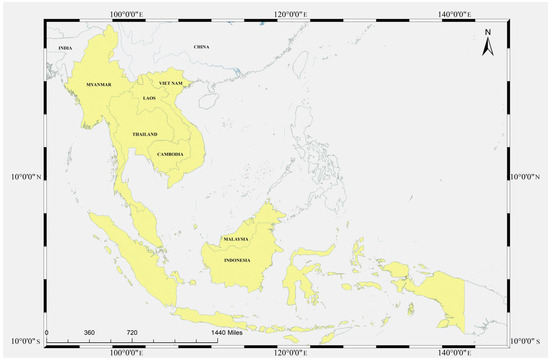
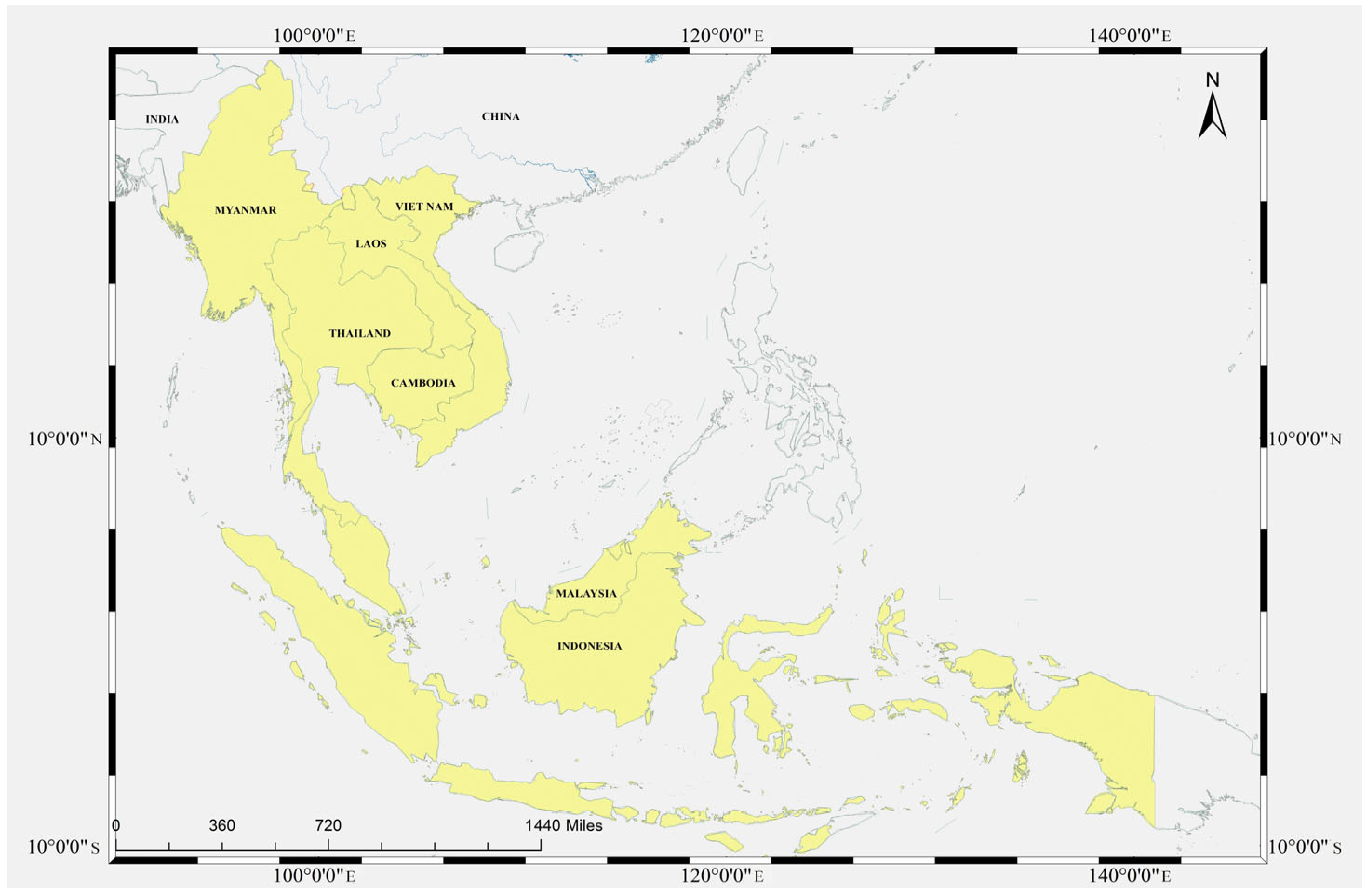
This study focuses on the Malayan pangolin (Manis javanica), a myrmecophagous mammal whose contemporary distribution spans mainland and insular Southeast Asia—including Myanmar, Thailand, Laos, Cambodia, Vietnam, Peninsular Malaysia, Singapore, Sumatra, Borneo, and Java—with its northern range extending into Yunnan provinces of southern China [1,2]. Here it overlaps ecologically with the Chinese pangolin (Manis pentadactyla) along montane transition zones [3]. Listed as Endangered on the IUCN Red List and included in CITES Appendix I since 2016, M. javanica faces persistent pressure from illegal harvest and habitat modification across its range [4,5]. Its biogeographic context within Asia is illustrated in Figure 1.
Figure 1.
Distribution range of Manis javanicain Southeast Asia and southern China.
Globally, the order Pholidota comprises eight extant species partitioned into African (Phataginus tetradactyla, Phataginus. tricuspis, Smutsia gigantea, Smutsia. temminckii) and Asian (Manis crassicaudata, Manis culionensis, M. javanica, M. pentadactyla) genera [6]. All species are scale-bearing, obligate ant/termite feeders that contribute significantly to ecosystem regulation [7]. Their collective distributions are summarized in Supplementary Figure S1.
Historically abundant across their ranges, Asian pangolins have experienced severe population decline in recent decades due to intensive poaching for scales and meat, exacerbated by landscape fragmentation [8]. More than one million individuals are estimated to have been trafficked globally since 2000, with primary market destinations in China and Vietnam [9]. Strengthened legal protections in the China and CITES Appendix I listing reflect elevated conservation prioritization. Captive rescue and breeding initiatives have emerged as critical components of species recovery, requiring accurate genetic data to manage population viability and preserve adaptive diversity [10,11,12].
Against this backdrop, current pangolin genetic monitoring typically relies on DNA from tissue, scale, or blood samples—sources demanding invasive or terminal collection that is poorly aligned with field-based conservation studies [13,14]. Non-invasive fecal DNA, while operationally convenient, commonly yields degraded templates complicated by PCR inhibitors and high microbial load, limiting reliable mitochondrial genome assembly [15,16,17]. Saliva sampling via buccal swabs represents a promising intermediate approach that is less invasive than biopsies but that generally provides superior eukaryotic DNA integrity compared to scat [18,19]. Although buccal swab protocols are established in human forensics and select wildlife applications, standardized saliva-based workflows tailored to pangolin genomics and specifically whole mitogenome sequencing remain underdeveloped.
Furthermore, existing pangolin phylogenetic frameworks depend heavily on mitogenomes derived from confiscated or archival specimens, restricting fine-scale spatiotemporal inference. Fresh, wild-sourced mtDNA acquired through non-invasive methods could substantially improve haplotype resolution but remains underrepresented. Regionally variable molecular markers (e.g., COX1 substitutions) may additionally illuminate local adaptation or metapopulation structure, though validation against high-fidelity references is required.
To address these gaps, this study aims to achieve the following: (1) establish a field-applicable workflow for recovering complete mitochondrial genomes from pangolin saliva using commercial magnetic bead kits and NGS; (2) characterize the mtDNA architecture of M. javanica from Guangxi, comparing structural features with Malaysian conspecifics to identify conserved and polymorphic regions; and (3) evaluate COX1 nucleotide and amino acid variability as a potential indicator of regional differentiation. By validating saliva as a practical mtDNA source, we seek to deliver a scalable, welfare-compatible genetic tool for conservation practitioners while contributing reference data to support pangolin reintroduction planning.
2. Materials and Methods
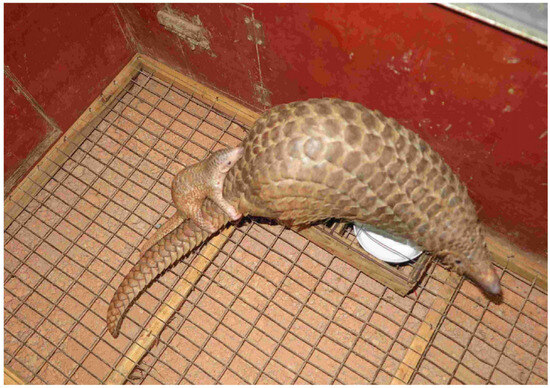
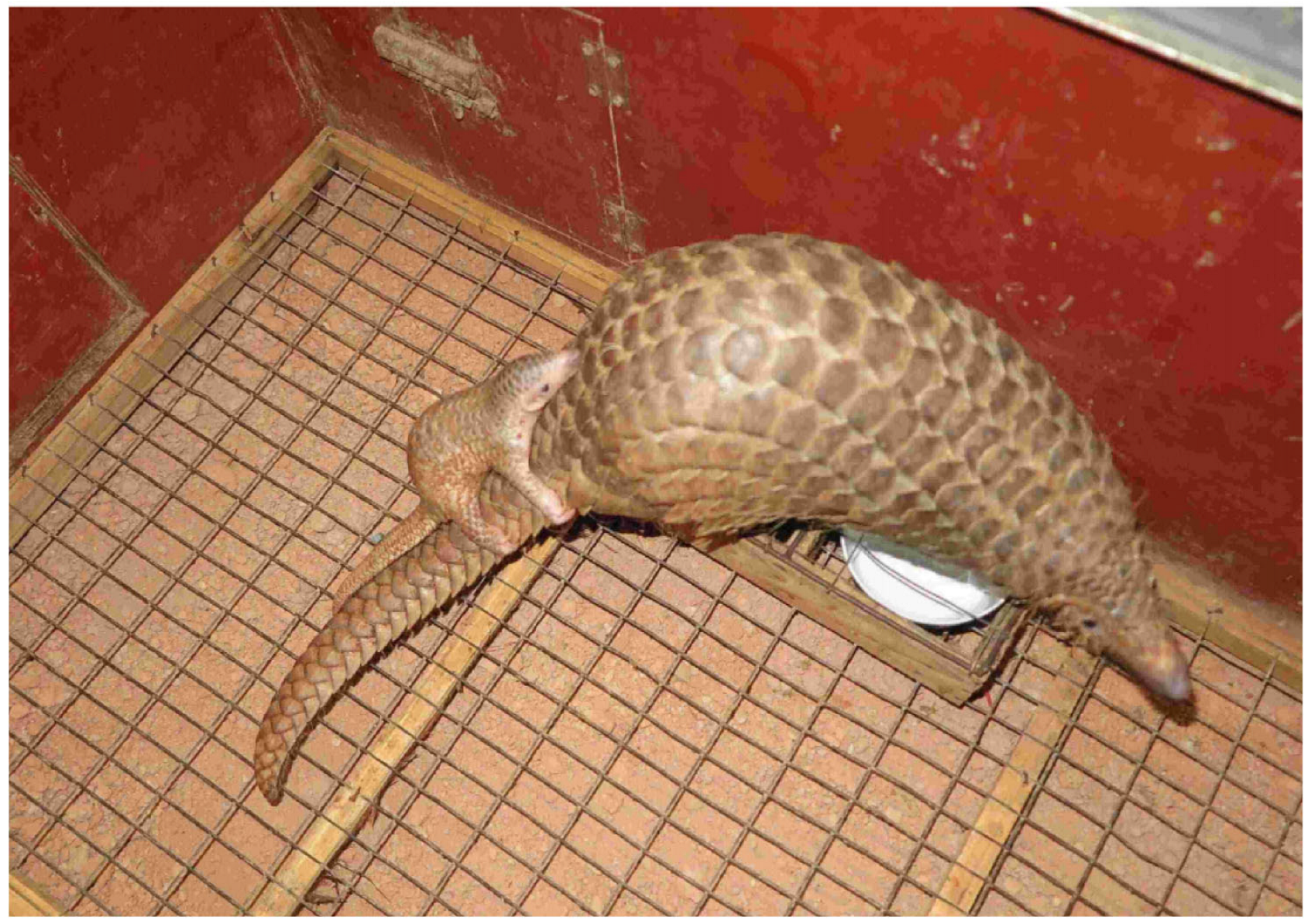
The pangolins used in this study were obtained from the Pangolin Rescue and Breeding Center of the Guangxi Forestry Research Institute, Nanning, Guangxi Zhuang Autonomous Region, People’s Republic of China (108.3458 E, 22.9393 N). The specimen was deposited at the Guangxi Key Laboratory of Special Non-wood Forest Cultivation & Utilization, Nanning, Guangxi Zhuang Autonomous Region, China (contact: Baocai Li, 957065217@qq.com) under voucher number GFRI1103. A species reference image for the species is shown in Figure 2.
Figure 2.
Photography of M. javanica taken by Xiaobing Guo in August 2025.
Before sampling, the pangolins were secured, and oral swabs and 5 mL sterilized centrifuge tubes were prepared. A buccal swab was dipped in pangolin saliva and quickly transferred to a sterilized centrifuge tube, which was then capped. This process is repeated five times. After successful sampling, the centrifuge tube was stored in a liquid nitrogen tank for later use.
Genomic DNA from a pangolin was extracted via the Magnetic Universal Genomic DNA Kit (Tiangen Biotech Co., Ltd., Beijing, China) following the manufacturer’s protocol. The Illumina NovaSeq 6000 platform (Illumina, Inc., San Diego, CA, USA) was used to sequence the whole genome of M. javanica, with a sequencing depth of 8.81×. The complete mitochondrial sequence was assembled via Geneious Primer v.2024.0.5 [20]. The analysis of the mitochondrial genome structure was conducted via the Tutools platform (http://www.cloudtutu.com), a free online data analysis website, and annotated via MITOS 2 [21].
To elucidate the phylogenetic status of M. javanica in Pholidota, eight currently available complete mitogenomes of Pholidota obtained from GenBank were used in phylogenetic analyses. Four species of Canivora (Canis lupus KU696410, Arctocephalus pusillus NC008417, Acinonyx jubatus AY463959 and Crocuta crocuta, JF894378) and one species of Artiodactyla (Alces alces NC020677) were used as outgroups. The phylogenetic tree was reconstructed via the maximum likelihood (ML) method on the basis of COXI sequences via MEGA 11 [22]. The number of bootstrap replicates was set to 1000 with automatic model prediction in the ML analyses.
3. Results
3.1. Mitochondrial Genome Assembly and Characterization of Manis javanica
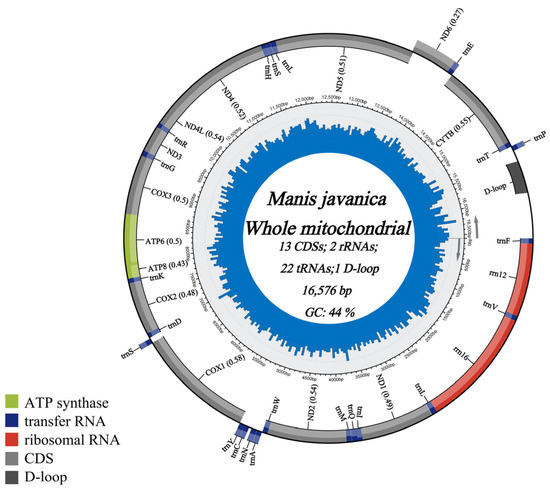
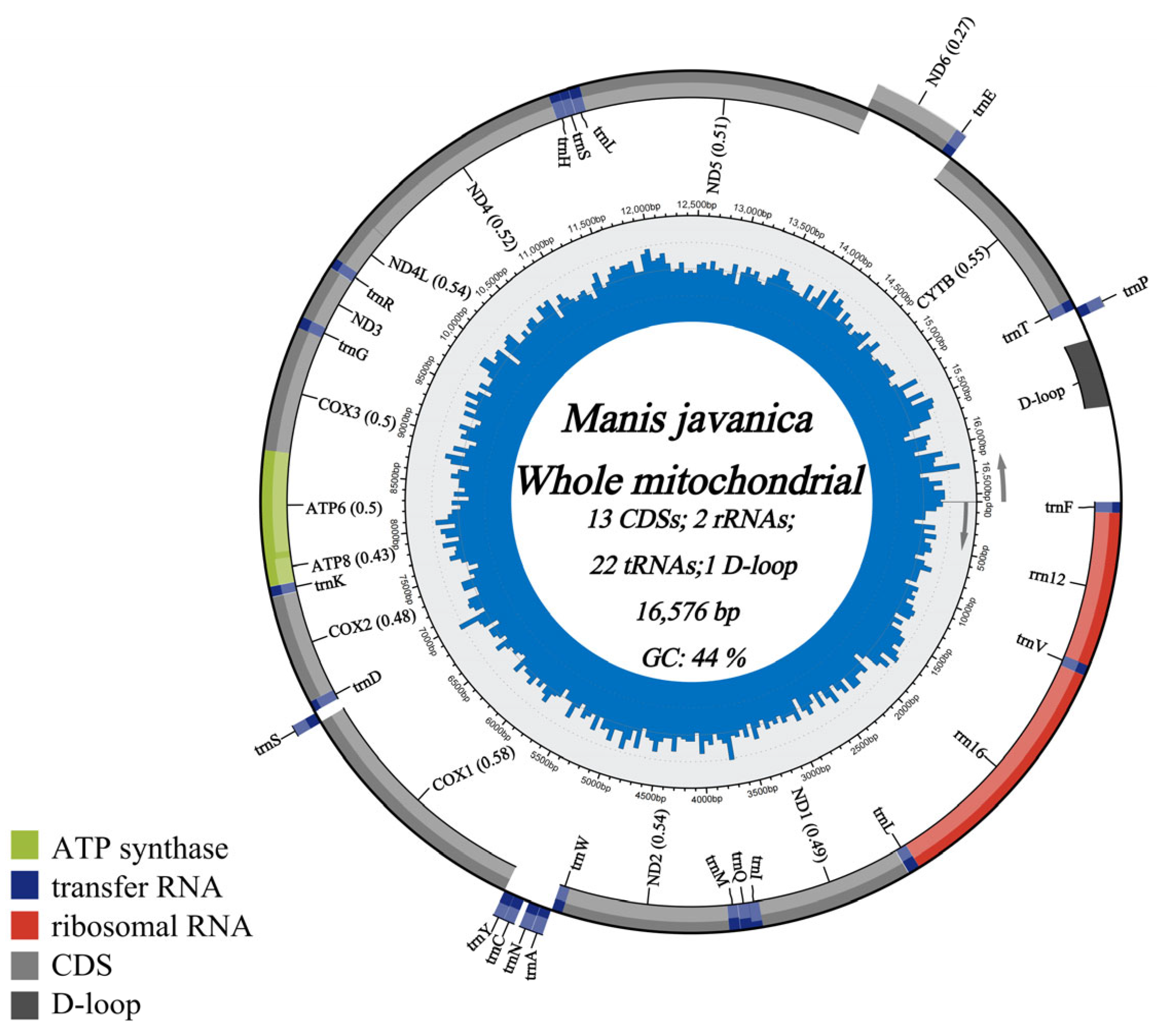
In this study, we successfully characterized the complete mitochondrial genome of the critically endangered M. javanica, which has been deposited in GenBank under accession number PP110760. The newly sequenced mitochondrial genome is 16,576 bp in length and exhibits a structure typical of vertebrates, comprising 13 protein-coding genes (PCGs), 22 transfer RNA (tRNA) genes, 2 ribosomal RNA (rRNA) genes, and 1 control region (D-loop) (Figure 3), similar to typical vertebrate mitochondrial DNA [23,24,25,26,27].
Figure 3.
The complete mitochondrial genome of M. javanica. The innermost circles depict the GC content, and the outermost circle indicatescircles indicate the arrangements of genes: inner genes from the forward strand, and outer genes from the reverse strand, with CDSs in gray, rRNAs in red, ATP synthase in green and tRNAs in purple.
Among the PCGs are 7 NADH dehydrogenase subunits (ND1–6, ND4L), 3 cytochrome c oxidase subunits (COXI–III), 2 ATP synthase subunits (ATP6 and ATP8), and cytochrome b(Cytb). The ND6 gene and seven tRNA genes (tRNA-Ala, -Asn, -Cys, -Tyr, -Ser(UCN), -Glu, and -Pro) are encoded on the light strand, while all other genes are encoded on the heavy strand. The D-loop is the only major non-coding region. The longest PCG is ND5 (1821 bp), and the shortest is ATP8 (204 bp). Regarding start codons, ND6 uses ATA, ND2 and ND3 use ATT, ND5 uses GTG, and the remaining nine PCGs use ATG. The stop codons for COXII, ATP6, ATP8, ND4L, and ND5 are TAA, while Cytband COXI use AGA. The genes ND1, ND2, ND3, ND4, ND6, and COXIII possess incomplete stop codons (T or TA) (Table 1).
Table 1.
Annotation of the mitochondrial genome of M. javanica.
3.2. Comparative Analysis of COX1 Sequences Between Malaysian and Guangxi Populations
A comparison of the COX1 nucleotide sequences from M. javanica individuals from Malaysia and Guangxi, China, revealed a high degree of conservation, with 99% sequence identity. Analysis identified 43 variable sites, of which 42 were synonymous substitutions and one was a nonsynonymous substitution (Table S1). This single nonsynonymous mutation results in an amino acid change at position 155: isoleucine (I) in the Malaysian individual was replaced by valine (V) in the Guangxi individual (Table S2).
3.3. Phylogenetic Analysis Based on COXI Sequences
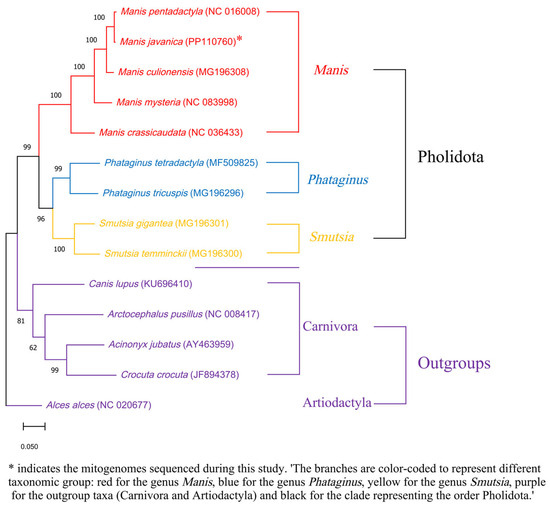
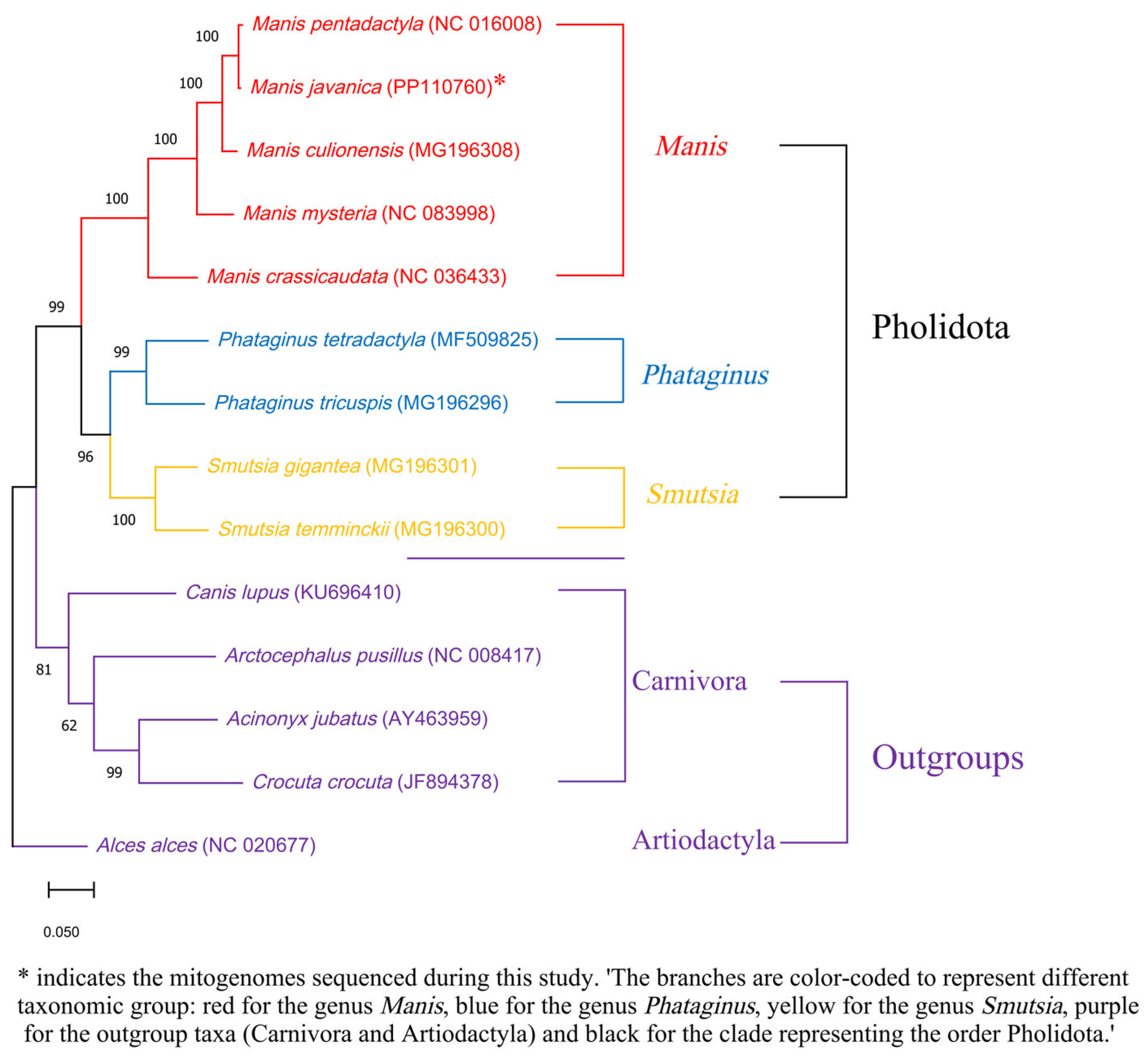
Phylogenetic reconstruction using COXI sequences from nine pangolin species resolved them into three distinct genera: Manis, Phataginus, and Smutsia. Within the genus Manis, M. pentadactyla was identified as the closest relative to M. javanica. The newly described species M. mysteria [28] formed a clade with M. culionensis and M. crassicaudata. Furthermore, the topology indicated that the African pangolin genera (Phataginus and Smutsia) diverged earlier than the Asian pangolins (Manis), providing a temporal framework for pangolin evolution (Figure 4).
Figure 4.
Maximum likelihood tree for Malayan pangolins and 8 other pangolin species constructed based on COXI sequences using MEGA 11.
The maximum likelihood tree was constructed using MEGA 11, with bootstrap values supporting the nodes. Outgroups included Alces alces, Acinonyx jubatus, Crocuta crocuta, Canis lupus, and Arctocephalus pusillus.
The number under the internode represents the bootstrap value. The GenBank accession numbers used are listed in brackets after the species names. The scale bar indicates the unit length of the value of the difference between sequences. The following sequences were used: NC_016008 [29], MG_196308 [30], NC_083998 [28], NC_036433 [30], MF_509825 [31], MG_196296, MG_196301, MG_196300 [30], KU_696410 [32], NC_008417 [33], AY_463959 [34], JF_894378 [35], and NC_020677 [36].
4. Discussion
The mitochondrial genome of M. javanica presented in this study provides insights into the genetic structure and phylogenetic relationships of pangolins. The circular mitochondrial genome’s unique composition of coding sequences, tRNA genes, rRNA genes, and control regions reflects the conserved mitochondrial DNA structure among vertebrates [37]. The observed nucleotide content, with a greater proportion of AT than GC, is characteristic of mitochondrial genomes and might influence transcription and replication processes within the mitochondrial compartment [38].
The feasibility of extracting the genome from saliva samples and amplifying the mitochondrial genome is demonstrated, opening new avenues for genetic diversity research on pangolins. This noninvasive sampling method could be particularly useful for monitoring pangolin populations in their natural habitats where invasive sampling techniques may not be feasible. A comparison of COX1 nucleotide sequences from M. javanica samples from Malaysia and Guangxi revealed high consistency, validating the use of COX1 markers for analyzing the genetic diversity of this species. However, amino acid sequence comparison revealed that the 155th amino acid was isoleucine (I) in the Malaysia sample and valine (V) in the Guangxi sample. This variation provides a potential molecular marker for distinguishing regional populations. As valine and isoleucine are essential amino acids obtained through the diet [39], the observed substitution in the Guangxi population may be influenced by long-term dietary factors, though the underlying mechanisms warrant further exploration.
Phylogenetic analysis based on COXI sequences underscores the close relationships among pangolin species. The clustering of pangolins into three genera—Manis, Phataginus, and Smutsia—provides a robust taxonomic framework for future studies. The close relationship between M. pentadactyla and M. javanica suggests a shared evolutionary history, which should inform cross-species conservation strategies. The placement of the newly described species M. mysteria, showing closer affinity to M. culionensis and M. crassicaudata, enhances our understanding of the phylogenetic diversification within the genus Manis. Furthermore, the earlier divergence of African pangolins compared to Asian pangolins adds a temporal dimension to their evolutionary history, highlighting the need to consider phylogenetic distinctiveness in conservation prioritization.
Our study has several constraints that merit consideration. First, despite successful mtDNA amplification, salivary DNA fragmentation may limit recovery of full-length nuclear loci, and residual bacterial/feed contamination could affect rare variant calling—future work should validate findings with additional tissue-matched controls [40]. Second, current inferences rely primarily on a single mitochondrial marker (COX1) and limited regional samples; broader geographic sampling combined with whole mitogenome or nuclear SNP datasets would strengthen population structure analyses [41]. Third, while dietary influences are hypothesized to explain the Ile155Val substitution, environmental gradients and local adaptation mechanisms cannot be fully disentangled without metabolomic or transcriptomic follow-up [42]. Future efforts should prioritize expanding noninvasive sampling across Southeast Asian pangolin ranges, integrating nuclear gene panels to verify phylogeographic patterns, and applying target capture methods to overcome saliva DNA degradation in degraded-field conditions.
5. Conclusions
This study successfully sequenced and assembled the complete mitochondrial genome of M. javanica from a minimally invasive saliva-derived DNA sample, demonstrating the viability of buccal swabbing as a practical starting material for conservation genomics. The workflow efficiently recovered sufficient template for long-range PCR and NGS, overcoming common hurdles of degraded field samples. Beyond the assembly of the circular mtDNA structure, comparative analysis identified a notable amino acid variation (Ile155Val in COX1) between Guangxi and Malaysian populations, proposing a candidate marker for regional traceability relevant to wildlife forensics. Furthermore, phylogenetic reconstruction based on COXI sequences elucidated interspecific relationships with Manis and reaffirmed the deep evolutionary split between African and Asian pangolin clades. Collectively, the genomic resource and the validated non-invasive sampling strategy significantly expand the molecular toolkit available for genetic monitoring, origin verification, and informed management of critically endangered pangolin populations.
Supplementary Materials
The following supporting information can be downloaded at: https://www.mdpi.com/article/10.3390/genes17050498/s1, Table S1: Nucleotide distribution of the COX1 sequence in two M. javanica strains; Table S2: Amino acid distribution of the COX1 sequence in two M. javanica strains. Figure S1. Global distribution ranges of all eight extant pangolin species.
Author Contributions
Conceptualization, X.G. and W.L.; methodology, X.G.; formal analysis, S.X. and M.J.; writing—original draft preparation, X.G. and S.X.; writing—review and editing, Y.P., Y.L. and X.L.; funding acquisition, X.G. All authors have read and agreed to the published version of the manuscript.
Funding
This research was funded by the Guangxi Key Laboratory of Special Non-wood Forest Cultivation & Utilization (Grant No. JA-23-01-01; JA-23-03-01) and the Guangxi Natural Science Foundation (Grant No. 2025GXNSFBA069419).
Institutional Review Board Statement
The study was conducted in accordance with the guidelines and animal welfare requirements of the Chinese Animal Society. All work and programs were approved by the Guangxi Forestry Research Institute Institutional Animal Care and Use Committee (GFRIACUC2016-001, 1 June 2023).
Informed Consent Statement
Not applicable.
Data Availability Statement
The genome sequence data that support the findings of this study are openly available in the NCBI GenBank [https://www.ncbi.nlm.nih.gov] (https://www.ncbi.nlm.nih.gov/nuccore/PP110760.1/, accessed on 17 March 2026) under accession no. PP110760.1. The associated BioProject, Biosample, and SRA numbers are PRJNA1091841, SAMN40613622 and SRR28482087, respectively.
Conflicts of Interest
The authors declare no conflicts of interest.
References
- Chong, J.L.; Panjang, E.; Willcox, D.; Nash, H.C.; Semiadi, G.; Sodsai, W.; Lim, N.T.; Fletcher, L.; Kurniawan, A.; Cheema, S. Sunda pangolin Manis javanica (Desmarest, 1822). In PANGOLINS Science, Society and Conservation; Challender, D.S., Nash, H.C., Waterman, C., Nyhus, P.J., Eds.; Elsevier: London, UK, 2020; pp. 90–104. [Google Scholar]
- Cen, P.; Sun, J.; Wang, Q.; Zhang, F.; Mo, L.; Mahmood, A.; Li, J.; Wang, Y.; Wu, S. Only Sunda and Chinese pangolin (Pholidota) are naturally distributed in China. Integr. Zool. 2023, 18, 704–709. [Google Scholar] [CrossRef] [Scilit]
- Zhang, F.; Wu, S.; Cen, P. The past, present and future of the pangolin in Mainland China. Glob. Ecol. Conserv. 2022, 33, e01995. [Google Scholar] [CrossRef] [Scilit]
- Challender, D.; Willcox, D.H.A.; Panjang, E.; Lim, N.; Nash, H.; Heinrich, S.; Chong, J. Manis javanica. In The IUCN Red List of Threatened Species 2019; International Union for Conservation of Nature (IUCN): Gland, Switzerland, 2019; e.T12763A123584856. [Google Scholar] [CrossRef] [Scilit]
- CITES Secretariat. CoP17 Prop. 11: Transfer of the genus Manis (pangolins) from CITES Appendix II to Appendix I. In Proceedings of the Seventeenth Meeting of the Conference of the Parties, Johannesburg, South Africa, 24 September–4 October 2016. [Google Scholar]
- Gaubert, P.; Wible, J.R.; Heighton, S.P.; Gaudin, T.J. Phylogeny and systematics. In PANGOLINS Science, Society and Conservation; Challender, D.S., Nash, H.C., Waterman, C., Nyhus, P.J., Eds.; Elsevier: London, UK, 2020; pp. 25–37. [Google Scholar]
- Sun, S.; Dou, H.; Wei, S.; Fang, Y.; Long, Z.; Wang, J. A review of the engineering role of burrowing animals: Implication of chinese pangolin as an ecosystem engineer. J. Zool. Res. 2021, 3, 1–20. [Google Scholar] [CrossRef] [Scilit]
- Simo, F.T.; Difouo, G.F.; Kekeunou, S.; Ichu, I.G.; Ingram, D.J.; Olson, D. Pangolin hunting and trafficking in the forest–savannah transition area of Cameroon. Oryx 2023, 57, 704–713. [Google Scholar] [CrossRef] [Scilit]
- Challender, D.W.S.; Heinrich, S.; Shepherd, C.R.; Katsis, L.K.D. International trade and trafficking in pangolins, 1900–2019. In PANGOLINS Science, Society and Conservation; Challender, D.S., Nash, H.C., Waterman, C., Nyhus, P.J., Eds.; Elsevier: London, UK, 2020; pp. 259–274. [Google Scholar]
- Wei, S.; Fan, H.; Zhou, W.; Huang, G.; Hua, Y.; Wu, S.; Wei, X.; Chen, Y.; Tan, X.; Wei, F. Conservation genomics of the critically endangered Chinese pangolin. Sci. China Life Sci. 2024, 67, 2051–2061. [Google Scholar] [CrossRef] [Scilit] [PubMed]
- Wangmo, L.K.; Jabin, G.; Ghosh, A.; Priyambada, P.; Dalui, S.; Joshi, B.D.; Singh, V.K.; Dolker, S.; Mohapatra, R.K.; Nair, M.V.; et al. Genetic assessment of captive breeding program of Indian Pangolin: Implications for conservation and management. Mol. Biol. Rep. 2024, 51, 8. [Google Scholar] [CrossRef] [Scilit]
- Ramirez, O.; Altet, L.; Ensenat, C.; Vilà, C.; Sanchez, A.; Ruiz, A. Genetic assessment of the Iberian wolf Canis lupus signatus captive breeding program. Conserv. Genet. 2006, 7, 861–878. [Google Scholar] [CrossRef] [Scilit]
- du Toit, Z.; Grobler, J.P.; Kotze, A.; Jansen, R.; Dalton, D.L. Scale samples from Temminck’s ground pangolin (Smutsia temminckii): A non-invasive source of DNA. Conserv. Genet. Resour. 2017, 9, 1–4. [Google Scholar] [CrossRef] [Scilit]
- Hogan, F.; Wedrowicz, F.; Khatiwada, A.P.; Joshi, J.D.; Wasser, S.; Wright, W. Genetic Evidence Reveals Distinct Lineage of Chinese Pangolin in Nepal: Insights from Scat and Blood Samples for Conservation and Wildlife Forensics. Ecol. Evol. 2025, 15, 13. [Google Scholar] [CrossRef] [Scilit]
- Perry, G.H.; Marioni, J.C.; Melsted, P.; Gilad, Y. Genomic-scale capture and sequencing of endogenous DNA from feces. Mol. Ecol. 2010, 19, 5332–5344. [Google Scholar] [CrossRef] [Scilit]
- Ando, H.; Mukai, H.; Komura, T.; Tungga, D.; Ando, M.; Isagi, Y. Methodological trends and perspectives of animal dietary studies by noninvasive fecal DNA metabarcoding. Environ. DNA 2020, 2, 391–406. [Google Scholar] [CrossRef] [Scilit]
- Hebert, L.; Darden, S.K.; Pedersen, B.V.; Dabelsteen, T. Increased DNA amplification success of non-invasive genetic samples by successful removal of inhibitors from faecal samples collected in the field. Conserv. Genet. Resour. 2011, 3, 41–43. [Google Scholar] [CrossRef] [Scilit]
- Toyoda, A.; Matsudaira, K.; Maruhashi, T.; Malaivijitnond, S.; Kawamoto, Y. Highly Versatile, Non-Invasive Method for Collecting Buccal DNA from Free-Ranging Non-Human Primates. J. Trop. Biol. Conserv. 2021, 18, 251–267. [Google Scholar] [CrossRef] [Scilit]
- Kalasad, M.; Dagamwar, A.; Patil, P.; Patil, D.; Bhuran, R.; Thange, M. Storage-Related Variations in buccal swab DNA integrity over two weeks: Forensic and Genetic Considerations. Int. J. Pharm. Sci. 2025, 3, 266–271. [Google Scholar] [CrossRef]
- Kearse, M.; Moir, R.; Wilson, A.; Stones-Havas, S.; Cheung, M.; Sturrock, S.; Buxton, S.; Cooper, A.; Markowitz, S.; Duran, C.; et al. Geneious Basic: An integrated and extendable desktop software platform for the organization and analysis of sequence data. Bioinformatics 2012, 28, 1647–1649. [Google Scholar] [CrossRef] [Scilit]
- Bernt, M.; Donath, A.; Juhling, F.; Externbrink, F.; Florentz, C.; Fritzsch, G.; Putz, J.; Middendorf, M.; Stadler, P.F. MITOS: Improved de novo metazoan mitochondrial genome annotation. Mol. Phylogenet. Evol. 2013, 69, 313–319. [Google Scholar] [CrossRef] [Scilit]
- Tamura, K.; Stecher, G.; Kumar, S. MEGA11: Molecular Evolutionary Genetics Analysis Version 11. Mol. Biol. Evol. 2021, 38, 3022–3027. [Google Scholar] [CrossRef] [Scilit]
- Das, P.J.; Kumar, S.; Choudhury, M.; Banik, S.; Pegu, S.R.; Kumar, S.; Deb, R.; Gupta, V.K. Characterization of the complete mitochondrial genome and identification of signature sequence of Indian wild pig. Gene 2024, 897, 148070. [Google Scholar] [CrossRef] [Scilit]
- Jiang, L.; Zhu, L.; Li, M.; Bao, X.; Zhao, Z.; Qin, H.; Chen, W. Sequencing and Characterization of the Complete Mitochondrial Genome of Tufted Deer, Elaphodus cephalophus (Artiodactyla: Cervidae) and its Phylogenetic Position within the Family Cervidae. Pak. J. Zool. 2023, 55, 2019–2032. [Google Scholar] [CrossRef] [Scilit]
- Li, J.; Da, L.; Bao, X. High-throughput sequencing yields a complete mitochondrial genome of Emberiza godlewskii (aves, emberidae). Mitochondrial DNA Part B 2023, 8, 882–885. [Google Scholar] [CrossRef] [Scilit]
- Yundaeng, C.; Naktang, C.; U-thoomporn, S.; Narong, N.; Phetchawang, P.; Pootakham, W.; Promdam, R.; Tangphatsornruang, S. The complete mitochondrial genome sequence of the karst-dwelling crab, Terrapotamon thungwa (Crustacea: Brachyura: Potamidae). Mitochondrial DNA Part B 2022, 7, 769–771. [Google Scholar] [CrossRef] [Scilit]
- Zhang, H.; Song, X.; Liu, Z.; Ling, J. Complete mitochondrial genome sequence and phylogenetic analysis of the Taiwan tai Argyrops bleekeri (Spariformes: Sparidae). Mitochondrial DNA B 2023, 8, 912–915. [Google Scholar] [CrossRef] [Scilit] [PubMed]
- Gu, T.-T.; Wu, H.; Yang, F.; Gaubert, P.; Heighton, S.P.; Fu, Y.; Liu, K.; Luo, S.-J.; Zhang, H.-R.; Hu, J.-Y.; et al. Genomic analysis reveals a cryptic pangolin species. Proc. Natl. Acad. Sci. USA 2023, 120, e2304096120. [Google Scholar] [CrossRef] [Scilit] [PubMed]
- Qin, X.M.; Dou, S.R.; Guan, Q.X.; Qin, P.S.; She, Y. Complete mitochondrial genome of the Manis pentadactyla (Pholidota, Manidae): Comparison of M. pentadactyla and M. tetradactyla. Mitochondrial DNA 2012, 23, 37–38. [Google Scholar] [CrossRef] [Scilit] [PubMed]
- Gaubert, P.; Antunes, A.; Meng, H.; Miao, L.; Peigne, S.; Justy, F.; Njiokou, F.; Dufour, S.; Danquah, E.; Alahakoon, J.; et al. The Complete Phylogeny of Pangolins: Scaling Up Resources for the Molecular Tracing of the Most Trafficked Mammals on Earth. J. Hered. 2018, 109, 347–359. [Google Scholar] [CrossRef] [Scilit]
- du Toit, Z.; du Plessis, M.; Dalton, D.L.; Jansen, R.; Paul Grobler, J.; Kotze, A. Mitochondrial genomes of African pangolins and insights into evolutionary patterns and phylogeny of the family Manidae. BMC Genom. 2017, 18, 746. [Google Scholar] [CrossRef] [Scilit]
- Koblmüller, S.; Vilà, C.; Lorente-Galdos, B.; Dabad, M.; Ramirez, O.; Marques-Bonet, T.; Wayne, R.K.; Leonard, J.A. Whole mitochondrial genomes illuminate ancient intercontinental dispersals of grey wolves (Canis lupus). J. Biogeogr. 2016, 43, 1728–1738. [Google Scholar] [CrossRef] [Scilit]
- Arnason, U.; Gullberg, A.; Janke, A.; Kullberg, M.; Lehman, N.; Petrov, E.A.; Vainola, R. Pinniped phylogeny and a new hypothesis for their origin and dispersal. Mol. Phylogenet. Evol. 2006, 41, 345–354. [Google Scholar] [CrossRef] [Scilit]
- Burger, P.A.; Steinborn, R.; Walzer, C.; Petit, T.; Mueller, M.; Schwarzenberger, F. Analysis of the mitochondrial genome of cheetahs (Acinonyx jubatus) with neurodegenerative disease. Gene 2004, 338, 111–119. [Google Scholar] [CrossRef] [Scilit]
- Bon, C.; Berthonaud, V.; Maksud, F.; Labadie, K.; Poulain, J.; Artiguenave, F.; Wincker, P.; Aury, J.M.; Elalouf, J.M. Coprolites as a source of information on the genome and diet of the cave hyena. Proc. R. Soc. B Biol. Sci. 2012, 279, 2825–2830. [Google Scholar] [CrossRef] [Scilit]
- Hassanin, A.; Delsuc, F.; Ropiquet, A.; Hammer, C.; Jansen van Vuuren, B.; Matthee, C.; Ruiz-Garcia, M.; Catzeflis, F.; Areskoug, V.; Nguyen, T.T.; et al. Pattern and timing of diversification of Cetartiodactyla (Mammalia, Laurasiatheria), as revealed by a comprehensive analysis of mitochondrial genomes. Comptes Rendus Biol. 2012, 335, 32–50. [Google Scholar] [CrossRef] [Scilit] [PubMed]
- Montana-Lozano, P.; Moreno-Carmona, M.; Ochoa-Capera, M.; Medina, N.S.; Boore, J.L.; Prada, C.F. Comparative genomic analysis of vertebrate mitochondrial reveals a differential of rearrangements rate between taxonomic class. Sci. Rep. 2022, 12, 5479. [Google Scholar] [CrossRef] [Scilit]
- Bohlin, J.; Rose, B.; Pettersson, J.H.O. Estimation of AT and GC content distributions of nucleotide substitution rates in bacterial core genomes. Big Data Anal. 2019, 4, 5. [Google Scholar] [CrossRef] [Scilit]
- Brestenský, M.; Nitrayová, S.; Patras, P.; Heger, J.; Nitray, J. Branched chain amino acids and their importance in nutrition. J. Microbiol. Biotechnol. Food Sci. 2015, 5, 197–202. [Google Scholar] [CrossRef] [Scilit]
- Christopher, C.; Sébastien, M.; Reyes, F.O.; Landestoy, M.A.; Frank, C.; Etienne, B. Obtaining DNA Samples from Sensitive and Endangered Bird Species: A Comparison of Saliva and Blood Samples. Ardeola 2022, 69, 263–278. [Google Scholar] [CrossRef] [Scilit]
- Hu, J.Y.; Hao, Z.Q.; Frantz, L.; Wu, S.F.; Chen, W.; Jiang, Y.F.; Wu, H.; Kuang, W.-M.; Li, H.; Zhang, Y.-P.; et al. Genomic consequences of population decline in critically endangered pangolins and their demographic histories. Natl. Sci. Rev. 2020, 7, 798–814. [Google Scholar] [CrossRef] [Scilit]
- Cheng, S.-C.; Liu, C.-B.; Yao, X.-Q.; Hu, J.-Y.; Yin, T.-T.; Lim, B.K.; Chen, W.; Wang, G.-D.; Zhang, C.-L.; Irwin, D.M.; et al. Hologenomic insights into mammalian adaptations to myrmecophagy. Natl. Sci. Rev. 2022, 10, nwac174. [Google Scholar] [CrossRef] [Scilit]

Disclaimer/Publisher’s Note: The statements, opinions and data contained in all publications are solely those of the individual author(s) and contributor(s) and not of MDPI and/or the editor(s). MDPI and/or the editor(s) disclaim responsibility for any injury to people or property resulting from any ideas, methods, instructions or products referred to in the content. |
© 2026 by the authors. Licensee MDPI, Basel, Switzerland. This article is an open access article distributed under the terms and conditions of the Creative Commons Attribution (CC BY) license.