Article

Differential Gene Expression in Human Upper Respiratory Tract Samples Identifies Antiviral Responses in Omicron SARS-CoV-2 Infection


by
Andrea E. Luquette
1,2,
Anthony Cicalo
1,2,
Maren C. Fitzpatrick
1,2,
Ghyssella E. Valdiviezo
1,2,
J. Alexander Chitty
1,2,
Gregory K. Rice
1,2,
Regina Z. Cer
1,
Cameron V. Sayer
1,
Francisco Malagon
1,2,* and
Kimberly A. Bishop-Lilly
1,*
1
Genomics and Bioinformatics Department, Biological Defense Research Directorate, Naval Medical Research Command-Frederick, Fort Detrick, MD 21702, USA
2
Leidos, Reston, VA 20190, USA
*
Authors to whom correspondence should be addressed.
Genes 2026, 17(5), 497; https://doi.org/10.3390/genes17050497
Submission received: 31 March 2026 / Revised: 13 April 2026 / Accepted: 20 April 2026 / Published: 22 April 2026

Abstract

Background/Objectives: SARS-CoV-2 is the causative agent of COVID-19, an infectious viral respiratory disease with human-to-human transmission. Current molecular understanding of how hosts respond to infection by respiratory viral pathogens in general and to SARS-CoV-2 in particular is still a research field under development. The activation levels of various host pathways are dependent on several variables, including the host tissue compartment. Methods: In this work, Illumina RNA sequencing was performed to assess the transcriptional host response to SARS-CoV-2 infection using COVID-19 PCR testing nasopharyngeal (NP) swab remnants from twenty infected and nine non-infected individuals. Results: Differential gene expression (DGE) analysis identified 182 overexpressed genes, with strong enrichment in innate immune and viral response genes. This included a significant induction of IFIH1/MDA5, a pattern recognition receptor (PRR) gene participating in the initial sensing of viral RNAs and subsequent cascade activation of interferon (IFN) and IFN-stimulated genes (ISGs). Interestingly, we observed different levels of concordance with previous similar studies and a significant induction of RIG1 and TLR3, two PRR genes encoding proteins that function to upregulate IFN and ISGs, but which are not normally identified as differentially expressed genes (DEGs). Finally, the overexpression of MX1, a well-characterized biomarker of viral infection; IFIT1, one of the top upregulated genes; and OAS1, OAS2 and OAS3, genes with a molecular function, 2-5-oligoadenylate synthase activity, identified as enriched in the DGE analyses, was confirmed by RT-qPCR. Conclusions: This study provides insights into upper respiratory tract responses to SARS-CoV-2 infections and identifies a set of differentially expressed genes (DEGs) with potential as candidates for further investigations as viral infection biomarkers.

1. Introduction

The respiratory tract is one of the most common entry points for invading pathogens as well as a major route for human-to-human transmission. As such, evolution has favored robust local adaptive and innate immune responses to prevent infection and to fight pathogens that propagate in this area of the body. Notwithstanding individual and social immunity developed to protect from respiratory infections [1,2], respiratory pathogens constitute a major class of microbes behind seasonal illnesses, epidemics and pandemics [3,4]. In contrast to adaptive immunity, which is long-lasting, highly pathogen-specific, and slow to develop, innate immune cellular responses are rapid, short-lived, and nonspecific, in that even though there is some degree of variability of the cellular responses depending on the pathogen, innate immune responses are considered broad-ranged. This is achieved starting at the pathogen recognition level, where there are sets of sensors that recognize molecular signatures typical of broad classification groups. An example of this would be the Toll-like receptors (TLRs) [5,6], with TLR3 recognizing viral RNA and TLR4 acting as a sensor for Gram-negative bacterial lipopolysaccharide. These sensors activate the transcription of interferon genes that, in turn, lead to the JAK-STAT-mediated upregulation of a multitude of interferon-stimulated genes (ISGs) involved in secondary sensing of viral components, inflammatory responses, and antiviral resistance [7]. Therefore, different degrees of pathogen class specificity could be inferred from the specific set of innate immune genes activated by different types of pathogens, and, in turn, this knowledge could be used to improve diagnosis and prognosis.
Severe acute respiratory syndrome coronavirus-2 (SARS-CoV-2), with the official name Betacoronavirus pandemicum [8], is a positive-strand RNA virus of the subgenus Sarbecovirus genus Betacoronavirus, and the causative agent of COVID-19, an infectious viral disease that emerged in 2019 and resulted in a global pandemic from 2020 until 2023 and seasonal illness afterwards [9]. Respiratory viruses with very different genomic organization and epidemiologic characteristics, like SARS-CoV-2, influenza virus and others, have been subject to extensive research due to high burden for healthcare systems, including studies on transcriptional host responses and on the identification of tissue-specific infection biomarkers [10,11,12,13]. Crowded environments, typical, for example, of military facilities and ships, favor the spread of respiratory viruses that could result in outbreaks if robust early-warning surveillance protocols are not available. Therefore, the identification of host biological pathways and individual genes upregulated in SARS-CoV-2 infected individuals could provide valuable biomarker information to be used in design of diagnostic assays to support force health protection decision-making during the occurrence of respiratory illness outbreaks.
To increase the reliability of previously identified DEGs in response to SARS-CoV-2 infection and to find new putative DEGs, we conducted RNA sequencing transcriptomic analysis of residual nasopharyngeal (NP) swab samples from SARS-CoV-2-positive versus SARS-CoV-2-negative individuals. These data could not only be applied to gain further insight into cellular pathways activated by SARS-CoV-2 in the respiratory tract, but also to identify potential biomarkers with different degrees of pathogen specificity as candidates for further clinical evaluation.

2. Materials and Methods

2.1. Sample Source

The biospecimens for this work were commercially sourced (iSpecimen, Woburn, MA, USA) and consisted of deidentified residual NP swabs in the universal transport media (Becton, Dickinson and Company, Franklin Lakes, NJ, USA), collected from individuals tested for COVID-19 by RT-qPCR using GeneXpert systems (Cepheid, Sunnyvale, CA, USA) (Table 1) and with no known viral coinfections. Upon receipt, viral infection status was confirmed internally via sequencing and bioinformatics, and five samples were excluded due to either failing the library preparation step or producing very few SARS-CoV-2 sequencing reads upon SARS-CoV-2 amplicon sequencing, as in our experience, both of those outcomes can indicate samples containing very little virus. In addition, among the samples that passed those prerequisites, one of the COVID-19-negative samples, sample NP71, was excluded from the DGE analyses due to the detection of human parainfluenza virus 1 in the sample after sequencing and analyses with VirusSeeker 2.0 [14], leaving nine SARS-CoV-2-negative samples for use in downstream analyses. This study was designated as non-human subject research by the Naval Medical Research Command Institutional Review Board with approval number PJT-23-07 DoHSR_ORA.

2.2. RNA Extraction

Total RNA was extracted from 250 μL of residual viral transport medium (VTM) from fifty-five (although only twenty-nine of them passed all subsequent quality controls for inclusion in this study; see Table 1 and Section 3) NP swab samples using Trizol LS reagent (Thermo Fisher, Waltham, MA, USA) using the manufacturer’s protocol. Briefly, the samples were incubated with 750 μL of Trizol LS for 10 min, followed by the addition of 200 μL of chloroform, inversion of the tubes, and centrifugation to separate the phases. The top aqueous phase was recovered into a new tube and precipitated with 0.9 volumes of isopropanol after 1 h incubation on ice and centrifugation at 20,000 rpm for 15 min. The supernatant was discarded, and the pellet was washed with 75% ethanol. The cleaned RNA was eluted in 35 μL of molecular biology-grade water (Thermo Fisher). Quality control of RNA samples was conducted using Qubit RNA quantification kits and a Qubit 3 fluorometer (Thermo Fisher) and/or a high-sensitivity RNA TapeStation kit and TapeStation 4150 electrophoresis system (Agilent, Santa Clara, CA, USA).
RNA for RT-qPCR was obtained by first extracting total nucleic acid (TNA) from 200 μL of residual VTM from NP swabs using the QIAamp DNA Blood Mini kit (Qiagen, Germantown, MD, USA) using the vendor’s recommended protocol, with the exception that no RNAase was added to the reagents. The TNA was then treated with HL-dsDNAse (Qiagen) by mixing 50 μL of TNA, 1 μL of NEB restriction buffer 2, and 2.5 μL of HL-dsDNAse, and incubating at 37 °C for 10 min followed by 52 °C for 15 min. We used this second RNA extraction method due to an improved efficiency of recovery of RNA and lower Ct values for RT-qPCR compared to the Trizol LS method.

2.3. SARS-CoV-2 Amplicon Library Preparation and Sequencing

SARS-CoV-2 amplicon library preparation and DNA sequencing were performed as previously described with small modifications [15]. Briefly, 8 μL of total RNA was used as input for the NEB ARTIC library prep kit (New England Biolabs, Ipswich, MA, USA) following the manufacturer’s protocol, with the exception that ARTICv4.1 primers [16] were used instead of the amplification primers provided with the kit. The libraries were assessed for quality using DNA 1000 (Agilent) and Qubit dsDNA BR Assay kits (Thermo Fisher), pooled, and sequenced using a MiSeq sequencing system and a MiSeq v3 600 cycles reagent kit (Illumina, San Diego, CA, USA).

2.4. Shotgun RNA Library Preparation and Sequencing

Shotgun RNA sequencing library preparation and sequencing were performed as previously described with small modifications [17]. Briefly, 5 μL of total RNA was used as input for the NEBNext Ultra II RNA Library Prep Kit (New England Biolabs) following the manufacturer’s instructions. The libraries were assessed for quality using D1000 ScreenTape and D1000 reagents (Agilent) and Qubit dsDNA BR Assay Kits (Thermo Fisher), pooled, and sequenced using a NovaSeq 6000 sequencing system and an S1 v1.5 300 cycles reagent kit (Illumina).

2.5. Genomic Analyses of SARS-CoV-2 Amplicon Sequencing Data

Amplicon sequencing reads were processed using Viral Amplicon Illumina Workflow (VAIW) [18]. Sequencing reads were trimmed, filtered to Q20 and a minimum length of 50 bp, merged with default settings and aligned to the Wuhan reference genome (GenBank accession NC_045512.2) with local alignment and a maximum insertion/deletion of 500 bp using BBTools. SARS-CoV-2 lineage determination was carried out using Pangolin (Phylogenetic Assignment of Named Global Outbreak LINeages) v.4.3.1 [19] and Constellations repository v0.1.12 [20].

2.6. Identification of Sequencing Reads from Pathogenic Viruses

Raw shotgun sequencing reads were screened for the presence of human viral pathogens using VirusSeeker 2.0 [14], an enhanced version of VirusSeeker [21]. Briefly, quality-controlled sequencing reads were assembled into contigs using metaSPAdes [22], then contigs and stitched reads were used for alignment nucleotide identity BLASTN 2.17.0 searches against databases restricted to human pathogenic viruses.

2.7. Bioinformatic Analysis of Total RNA Sequencing Data

Shotgun sequencing reads were processed following the nf-core RNA-Seq v3.17.0 pipeline [23], and the workflow was managed using Nextflow v24.04.2 [24]. Read quality was assessed using FastQC v0.12.1, trimmed and quality filtered with fastp v0.23.4, and ribosomal RNA (rRNA) sequences were removed with sortMeRNA v4.3.7 [25]. The reads were then aligned to the Genome Reference Consortium (GRC) h38 human genome using the splice-aware STAR v2.7.11b aligner [26]. Resulting BAM files were sorted, indexed, and assessed using SAMtools v1.2 [27], and transcript abundance was quantified using Salmon v1.10.3 [28]. Quantification quality control was performed using Qualimap v2.3 [29], dupRadar v1.32.0 [30], and the RSeQC suite (v5.0.2) [31], with results summarized in a MultiQC report. The transcript abundance results were imported into R via tximeta v1.20.1 [32], where DGE analyses were carried out with DESeq2 v1.46.0 [33] applying an adjusted p-value ≤ 0.05 and an absolute log2-fold-change ≥ 2. Gene set enrichment analysis (GSEA) were performed in R using clusterProfiler v4.14.0 [34], and online using STRING v12.0 database [35] with default parameters and focus on the Gene Ontology (GO) enrichment analysis tool for functional pathways/biological processes analyses [36].

2.8. Quantitative RT-PCR

Gene expression quantifications by RT-qPCR were carried out in triplicate using 3 μL of total RNA, gene-specific TaqMan assays (Thermo Fisher), PrimeTime One-Step RT-qPCR master mix (Integrated DNA Technologies, Coralville, IA, USA) and a CFP Connect qPCR system (BioRad, Hercules, CA, USA) with the following cycling conditions: 50 °C 30 min, 95 °C 3 min, 45 amplification cycles (95 °C 15 s plus 60 °C 1 min). The specific TaqMan assays used were Hs03027069_s1 FAM-MGB, Hs00895608_m1 FAM-MGB, Hs00242943_m1 FAM-MGB, Hs00942643_m1 FAM-MGB, Hs0019632_m1 FAM-MGB, and Hs01124518_m1 VIC-MGB for IFIT1, MX1, OAS1, OAS2, OAS3, and RPP30 respectively. Normalized fold changes were calculated using double delta Ct analysis [37].

3. Results

3.1. Sample RNA Processing and Selection Criteria

Total RNA from NP swabs is one of the most common inputs for nucleic acid amplification tests (NAAT) for SARS-CoV-2 detection [38], and host biomarker assessment for COVID-19 [39] and other respiratory viral infections [10,11]. The samples in this study consist of a heterogeneous set of deidentified remnant NP swabs originally used for COVID-19 PCR testing (Table 1) and divided into two categories: SARS-CoV-2-positive and SARS-CoV-2-negative. Due to the high degree of heterogeneity in the quantity of biological material among the samples available, the following criteria were applied for sample selection for this study: (a) samples with detectable levels of RNA (~1 ng/μL or higher), (b) relatively balanced number of samples from male and females in each of the two categories, (c) include only SARS-CoV-2-positive with a robust level of SARS-CoV-2 (resulting in breadth of coverage > 90% upon amplicon sequencing), and (d) avoid including samples with infections with other respiratory viruses. In addition, we reasoned that instead of using poly(A)+ purified RNA, a common preprocessing in transcriptomic studies to eliminate highly abundant stable RNAs like rRNAs, we will use total RNA for library preparation and sequencing due to: (a) the low amount of starting material, and (b) the rarity of using poly(A)+ RNA in the clinical diagnostics setting. Using these criteria, 60 samples were selected (45 SARS-CoV-2-positive and 15 SARS-CoV-2-negative) for RNA extraction using Trizol LS, and after quality control, 40 SARS-CoV-2-positive and 10 SARS-CoV-2-negative samples were considered as having enough RNA for the next step.

3.2. SARS-CoV-2 Amplicon Sequencing

SARS-CoV-2 detection and genetic characterization were carried out by amplicon sequencing using ~400 bp ARTIC Consortium SARS-CoV-2 amplicons for short read sequencing library preparation as indicated in the Materials and Methods. The libraries were pooled and sequenced on an Illumina MiSeq system, resulting in an average coverage of 1.2 M raw reads per sample. In agreement with the metadata provided, none of the 15 samples classified as SARS-CoV-2-negative by RT-PCR produced amplicon libraries. In addition, four of the samples classified as SARS-CoV-2-positive did not produce amplicon libraries passing the quality control, and therefore were not sequenced, and one resulted in mediocre coverage of the SARS-CoV-2 genome upon sequencing and was therefore excluded from downstream analyses. Moreover, additional samples were omitted because out of the 39 SARS-CoV-2-positive samples producing adequate SARS-CoV-2 amplicon sequencing data, only 30 also produced good total RNA shotgun sequencing libraries (next section). All 30 selected SARS-CoV-2-positive samples resulted in amplicon sequencing data with SARS-CoV-2 breadth of coverage > 96%, suggesting a moderate or high viral load in all of them (Table 1). Variant analyses of the genomes assigned all of them to omicron variants of pangolin lineages, in agreement with the reported circulating variant at the time of collection of the samples (June–July 2022) [9]. Therefore, we confirmed and expanded the RT-PCR information provided in the sample metadata.

3.3. RNAseq Shotgun Sequencing: Presence of Pathogenic Viruses

Next, shotgun Illumina libraries were prepared from total RNA by random priming reverse transcription as described in the Materials and Methods. Due to the very low amount of starting material in some of the NP swab samples, some of the libraries did not pass quality control, resulting in a final number of 20 SARS-CoV-2-positive and 10 SARS-CoV-2-negative, all of which were pooled and sequenced on a NovaSeq 6000 system, resulting in an average coverage of 103 M raw reads per sample. Infections with other respiratory viruses could significantly alter the host transcriptome and thus complicate analyses and interpretations. Therefore, after completing the initial quality processing of the sequencing reads, we decided to evaluate the presence of pathogenic viruses in the samples using VirusSeeker 2.0, an analysis pipeline developed and extensively tested by our team [14]. As shown in Table 1, this tool confirmed the SARS-CoV-2-positive result obtained by amplicon sequencing and analysis with VAIW [18] and the initial assessment by the sample provider of no known coinfections with other viruses. However, one of the SARS-CoV-2-negative samples, NP71, contained a high number of human parainfluenza type I virus (HPIV-1) reads and was therefore omitted from further analyses.

3.4. Host Biological Pathways Upregulated by SARS-CoV-2 Infection

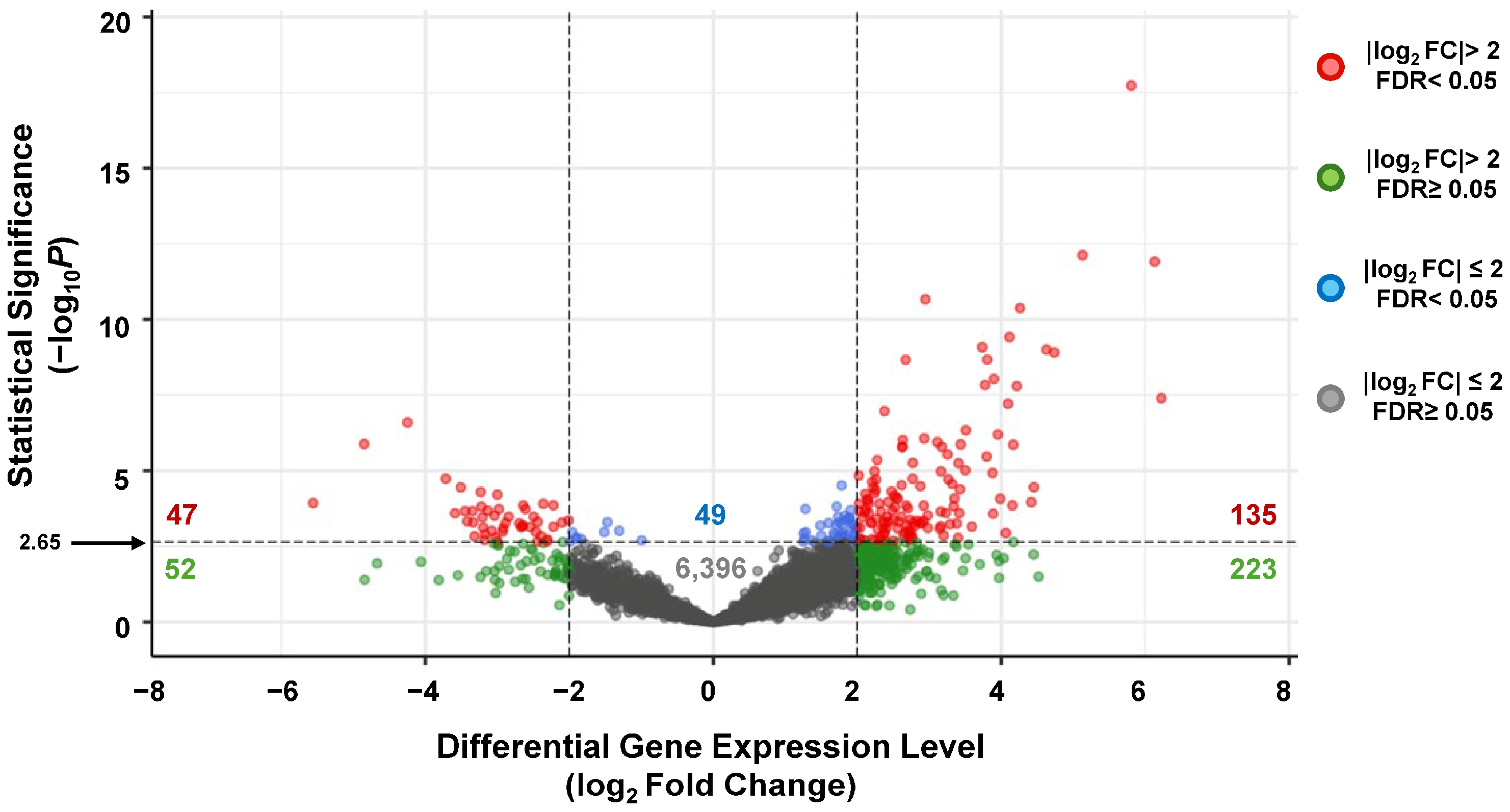
Next, low-count genes were prefiltered before differential expression analysis by requiring counts ≥ 10 in at least three samples, resulting in 6902 genes retained for DESeq2 (Table S1). Among the genes excluded from this work are those with low expression levels in NP swab samples, those producing short RNA transcripts (library molecules corresponding to RNAs of size < 200 nt are eliminated during library preparation) and rRNAs (eliminated during the bioinformatic preprocessing of the sequencing reads). To minimize statistical fluctuations due to low expression, genes with a normalized base mean signal < 0.03 were not included in the analyses. From the total of 6902 genes that passed this filter (Table S1), 4735 (69%) were upregulated and 2167 (31%) downregulated. Classification of DEGs as statistically significant was based on mid/strong fold changes (|log2 FC| > 2.0) and a log10 p-values cutoff of 2.65, corresponding to false discovery rates (FDR) of 0.05 or lower, considered the standard value for differential gene expression analyses [40]. The final number of statistically significant genes with these criteria was 135 (2.0%) upregulated and 47 (0.7%) downregulated (Figure 1 and Table S2).
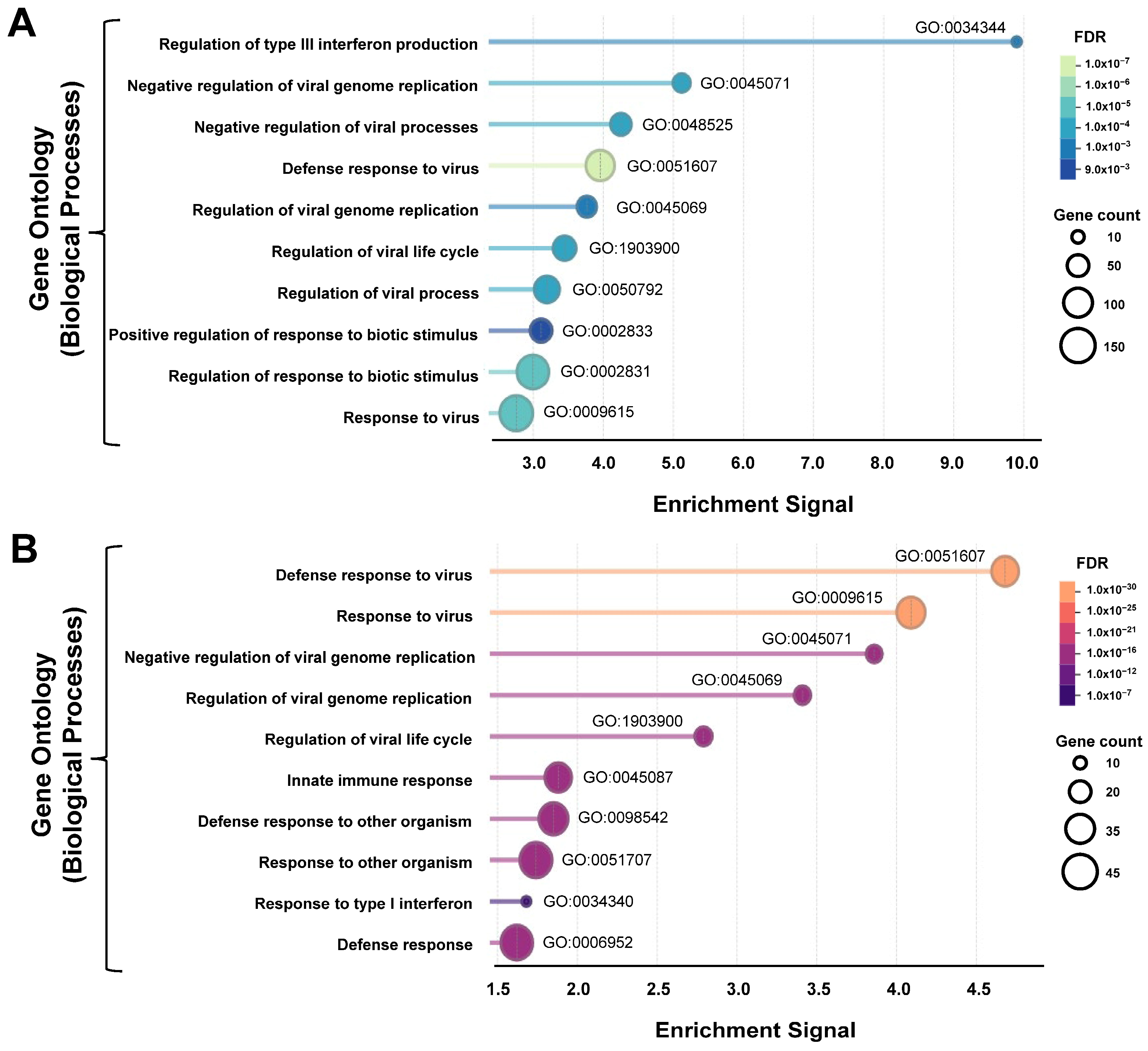
Next, we evaluated the enrichment of pre-classified gene sets at the Gene Ontology (GO) database [36], focusing on genes clustered by biological processes. Gene set enrichment analyses (GSEA) and GSEAPreranked, either having into consideration all 4735 upregulated genes (Figure 2A) or only the 135 strongly and significantly upregulated DEGs (Figure 2B), have very low FDRs and a high degree of overlap. In both cases, the top enriched GO processes indicate stimulation of innate immunity genes, including inflammatory responses, negative regulation of viruses, interferon production, and ISGs. The enrichment of these pathways is consistent with viral infection in the SARS-CoV-2-positive samples, further validating the RT-PCR and sequencing data as well as the processing of the samples. This conclusion was further validated using alternative gene sets like the ones in databases such as WikiPathways [41] and UniProt Annotated Keywords [42], with WikiPathways being more precise at pinpointing specifically towards SARS-CoV-2 infection (Figures S1 and S2). By contrast to the upregulated genes, GSEA of downregulated genes did not identify any specific gene sets with any of the databases.

3.5. Host Genes Upregulated by SARS-CoV-2 Infection

Next, a more granular investigation of the transcriptomic data was conducted, focusing on individual DEGs. The literature searches on the top twenty upregulated DEGs confirmed the GSEA results by highlighting genes with important functions in broadly innate immunity. Interestingly, although genes involved in general illness responses, e.g., inflammation, were indeed identified, a high proportion of the induced genes could be ascribed to different layers of host defense against invading pathogenic RNA viruses (Table 2).
Some of the genes encoding more general responses to illness are CXCL9, 10, and 11, producing chemokines, and the inflammation regulator gene IDO1. One of the DEGs encoding earlier antiviral infection factors is RIG1 (Table 2; Fold Change Rank (FCR) 14). The RIG-I protein is a PRR that senses the presence of viral RNA by detecting molecules with 5′ triphosphate and short regions of double-strandedness [58,65,66], but with a modest role in COVID-19 due to its targeted degradation by SARS-CoV-2 [67]. Moreover, IFIH1/MDA5 and TLR3, genes that also encode the first line of defense PRRs, in this case MDA5, a RIG-I-like receptor and the major PRR for SARS-CoV-2 [58,68], and the Toll-like Receptor 3 [63], albeit not in the top 20 (FCRs 24 and 44), are strongly upregulated. Genes participating in host processes downstream of the initial recognition of pathogen-associated molecular patterns (PAMP) and activation of type I IFN genes are among the top upregulated DEGs as well. Those include genes that target a variety of viral life cycle steps to counter virus propagation. MX1 (FCR 50) encodes MxA, an ancient dynamin-like protein with a broad antiviral spectrum and mode of action not fully understood yet, but possibly involved in virus sequestration [64,69]. IFITI (FCR 3), IFIT2 (FCR 4) and IFIT3 (FCR 18) inhibit viral translation [45,70], DDX60L (FCR 10) inhibits viral replication [51], RSAD2/Viperin (FCR 13) counteracts virus life cycles at various levels [54,55,56], and XAF1 (FCR 6) precludes viral propagation by inducing apoptosis [48]. Other DEGs are involved in the modulation of RIG-I and IFIH1/MDA5 responses. OASL (FCR 2) participates in a positive feedback loop that enhances RIG-I activity [44]. ISG15 (FCR 5) has opposite effects on IFIH1/MDA5 and RIG-I, enhancing the activity of the former and inhibiting the latter [46,47]. FYB1/ADAP (FCR 16) counteracts viral evasion factors that suppress RIG-I [59]. Host genes induced by viruses to avoid detection are also included in the list of DEGs. For example, PNPT1 (FCR 17) counters the host pathway to detect hyperactivity of the mitochondria, typically associated with rapid viral propagation [60]. Additionally, upregulated DEGs clearly linked to viral host responses, e.g., OAS2, TRIM38, and STAT2, but not in the top 20, as well as significantly downregulated genes, are included in Table S2.

3.6. Quantification of IFIT1,MX1, OAS1, OAS2 and OAS3 RNAs by RT-qPCR Supports Their Use as Viral Infection Biomarkers

The upregulated DEGs identified in this work contain a high proportion of genes that are clearly involved in host responses to viral infection and/or that have previously been proposed as NP tissue viral infection biomarkers. Among the latter are included CXCL10, IFIT2, OASL, IFI44L, and HERC6, to name a few [11,12]. Thus, the data presented here could support the use of previously described biomarkers as well as help identify new biomarkers of SARS-CoV-2 infection. Two of them, IFIT1 and MX1, were chosen as proof-of-principle. IFIT1 is one of the genes with the highest upregulation levels (Table 2) and has been previously proposed as a cancer biomarker [71,72], but, to our knowledge, not for viral respiratory infections. On the other hand, MX1 has a significantly lower upregulation level than IFIT1, but has been used as a blood biomarker for several different respiratory viral infections, including SARS-CoV-2 [13,73]. To strengthen the results obtained by RNASeq, the upregulation of these genes was evaluated using an orthogonal method, specifically a commercially available TaqMan RT-qPCR assay targeting the last exon of the IFIT1 (Genbank accession NM_001548.5) and the junction between exons 9 and 10 of MX1 (Genbank accession NM_002462.5). For normalization purposes, a TaqMan RT-qPCR assay targeting the junction between exons 2 and 3 of RPP30 (Genbank accession NM_006413.4) was used. RPP30, encoding the p30 subunit of RNAseP, is commonly used as a housekeeping control gene in SARS-CoV-2 NAAT diagnostics assays of NP swab samples [38] and does not exhibit significant expression changes between SARS-CoV-2-positive and SARS-CoV-2-negative samples (Table 2). Using this approach, the fold upregulation for IFIT1 and MX1, calculated using the ΔΔCt method, was 20.6 and 4.0-fold respectively. Therefore, although the magnitude of upregulation calculated by sequencing and qPCR is not identical due to multiple different variables, the RT-qPCR results confirm the overexpression of IFIT1 and MX1 mRNA in NP samples upon SARS-CoV-2 infection.
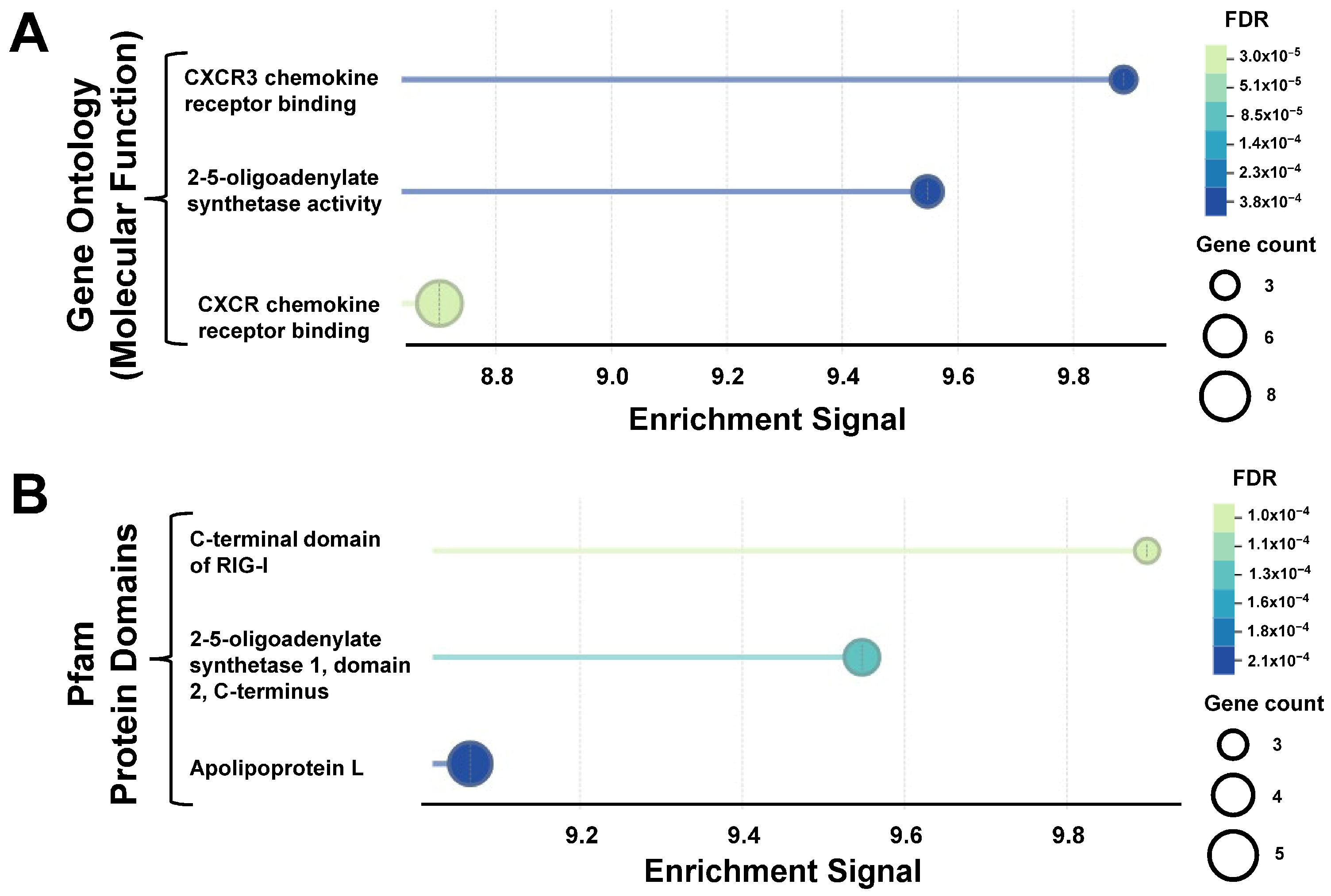
Finally, OAS1, OAS2 and OAS3, three genes encoding enzymes that synthesize 2′-5′ linked oligoadenylates (2-5A) and that, like in the case of other PRRs, have a strong posttranslational regulation, were selected for further evaluation. Albeit not exhibiting the highest levels of all the upregulated genes in this study, they are known to function as PRRs, and it was notable that pre-ranked GSEA highlighted them when analyzing protein families and enzymatic activities enriched upon SARS-CoV-2 infection (Figure 3).
In addition, these three genes are clustered in locus chr12q24.13, a region in chromosome 12 with genetic alleles associated in other studies with SARS-CoV-2 infection propensity and severity [74,75,76], a fact shared by other DEGs belonging to the innate immune pathway, including the major PRR regulator IFIH1/MDA5 [68,77]. However, to our knowledge, RNA levels of OAS1/OAS2/OAS3 have been previously suggested as candidate biomarkers for other diseases, mainly for cancer, but not for COVID-19 [78,79,80]. As previously, TaqMan RT-qPCR assays and ΔΔCt values were used as an orthogonal method to assess RNA levels. These assays target the junction between exons 2-3, 1-2, and 3-4, for OAS1 (Genbank accession NM_001032409.2), OAS2 (Genbank accession NM_001032731.1) and OAS3 (Genbank accession NM_006187), respectively. Using this approach, the fold upregulation for OAS1, OAS2 and OAS3 was found to be 12.8, 4.1 and 15.8 respectively.
These results are in support of the further evaluation of IFIT1, MX1, OAS1, OAS2 and OAS3 as NP biomarker candidates for COVID-19. Further studies with time points and a larger number of samples are needed to assess how early these biomarkers are detectable and how durable the signal is over time.

4. Discussion

Here we present differential RNA expression data and analyses of NP swab samples from individuals tested for COVID-19, comparing SARS-CoV-2-positive and -negative samples. The initial classification was originally carried out by RT-PCR during routine clinical diagnosis and further confirmed by amplicon and agnostic sequencing. SARS-CoV-2 genomic characterization of the SARS-CoV-2-positive samples indicated that they belong to typical omicron lineages prevalent during the Summer of 2022, e.g., BA.2.12.1 [81]. In addition, we also characterized the samples to ensure that none of the samples included in the differential expression analyses would have been infected by other pathogenic viruses. With regard to the RNA population captured, the RNA processing, sequencing and analyses pipelines used are poly(A)+ independent but exclude small RNAs, rRNA genes, and genes with very low expression levels.
DGE analyses of host genes upregulated by SARS-CoV-2 in NP swab samples demonstrated a clear enrichment of GO biological pathways involved in viral infection responses, a conclusion supported by similar analyses using UniProt and WikiPathways databases. The most abundant group of induced genes is ISGs, suggesting that most DEGs are upregulated by transcriptional activation cascades triggered by the recognition of viral PAMPs [6,7,82], although additional mechanisms like increased stability by mRNA pseudouridylation can also play an important role [83,84]. These results, highlighting an interferon-driven response to SARS-CoV-2 Omicron variant infection, are in line with previous studies on NP host responses in pre-Omicron COVID-19 patients [11,12,85] but significantly distinct from other studies where ISG-ranked expressions are significantly lower [86,87]. Interestingly, our data are similar to in vitro studies with cells in culture stimulated by the synthetic RNA SLR14, a potent inducer of RIG-I protein activity [11]. Thus, our data support the use of SLR14 for in vitro studies mimicking NP SARS-CoV-2 infections.
The top overexpressed genes of this study are in common with the top DEGs from two other similar studies where the first line of defense PRR gene IFIH1/MDA5 as well as the ISGs CXCL9/10/11, IFIT1/2/3, OASL, RSAD2 and MX1 top the ranks of DEGs [11,12], but are significantly or sharply ranked lower in other two studies [86,87]. By contrast, RIG1 and TLR3 [82] are among the top upregulated genes in our study, but, to our knowledge, not in previous ones. RIG1 and TLR3 transcription is generally low and tightly regulated, with RIG1 being significantly induced by all-trans retinoic acid (ATRA) [57], and in ovarian cancer [88], and TLR3 during dendritic cell differentiation [89]. However, in most cases, their viral responses are post-translationally regulated by their enzymatic activation upon binding viral RNAs. Other top DEGs from this work that normally do not appear in other similar studies are AQP9 (FCR 7), an aquaporin with an important role in immune cell activation [49,90], and PNPT1 (FCR 17), an RNAse commonly induced by viruses to attenuate the host integrate stress response [60].
As expected by the conservation of the ISG response as an antiviral defense, most of the top ISGs in this study are also induced by other respiratory viruses [12]. Specifically, the highlighted ISGs above, CXCL9/10/11, IFIT1/2/3, OASL, RSAD2, MX1, as well as ISG15, are habitually among the top induced genes and, therefore, have the potential to serve as candidates for further clinical testing to determine their suitability as NP biomarkers for the detection of respiratory virus infections. Certainly, a good proportion of these ten genes have already been studied with this specific purpose, with CXCL10 (FCR 15) being perhaps the most widely used [10,11,43]. A caveat of this study is that the heterogeneity of the samples regarding donor backgrounds and vital statistics may influence the basal and RNA induction levels of specific genes in a differential manner. For example, IFIH1/MDA5 expression changes significantly with age, an effect that is also modulated by the genotypes of each individual [68,91,92], and environmental conditions affecting the gut microbiota regulate interferon responses to viral infections [93]. Furthermore, the limited amount of sample metadata precludes more in-depth analysis of association with common clinical biomarkers. Complementary studies with carefully controlled sample sources are necessary to address these limitations. However, even with all the limitations indicated above, the results reinforce a strong antiviral host response, albeit with few SARS-CoV-2-exclusive signatures.
We initially chose IFIT1 and MX1 as two alternative genes with different ranks (FCRs 3 and 50 respectively), and levels of induction for validation by RT-qPCR, and both showed significant induction using this orthogonal method. In addition, the OAS1/OAS2/OAS3 genes, exhibiting a significantly more modest fold induction based on the RNA-Seq data (~4–5-fold; see Tables S1 and S2), also exhibit a robust increase in RNA levels in NP swab samples of COVID-19 cases as measured by RT-qPCR. It would be interesting to extend these studies to other respiratory viruses to delimit their specificity.
The upregulated host genes described here, either individually or as a subset in combination, could be used as the starting point to assess their suitability as part of rapid qRT-PCR diagnosis of respiratory viral infection using NP swabbing, or even less invasive sampling methods (e.g., saliva collection). Moreover, the specific combination of enrichment genes in our set could support the diagnosis of illnesses caused by novel or uncommon respiratory viruses. Interestingly, a significant proportion of the DEGs identified here also constitute part of a set of “core response” human genes upregulated in saliva samples upon infection by a broad range of pathogens (e.g., MX1 and ISG15) [94]. Subsequent studies with non-core response genes, e.g., TLR3, and using saliva samples could help further facilitate the design of systems specific to respiratory virus infection that could be used with sampling methods even less invasive than NP swabs. Finally, the data herein, when viewed in the light of other similar studies, might suggest that the strong interferon response, ISG upregulation, and PRR activation within the host are a natural means to fight SARS-CoV-2 that could serve as inspiration for studies using drugs mimicking those effects for prophylactic purposes during viral outbreaks.

Supplementary Materials

The following supporting information can be downloaded at: https://www.mdpi.com/article/10.3390/genes17050497/s1, Figure S1: WikiPathways enriched in NP swab samples of SARS-CoV-2 infected individuals; title; Figure S2: UniProt Annotated Keywords enriched in NP swab samples of SARS-CoV-2 infected individuals; Table S1: Estimated expression change and statistical significance of genes included in this study; Table S2: Estimated expression change and statistical significance of statistically significant DEGs.

Author Contributions

Conceptualization, F.M. and K.A.B.-L.; methodology, F.M. and A.C.; software, G.K.R. and R.Z.C.; validation A.E.L., M.C.F. and G.E.V.; formal analysis, A.E.L., J.A.C., A.C. and F.M.; investigation, A.E.L., M.C.F. and G.E.V.; resources, F.M. and K.A.B.-L.; data curation, A.E.L., A.C., M.C.F. and G.E.V.; project administration, F.M.; writing—original draft preparation, F.M.; writing—review and editing, C.V.S., F.M. and K.A.B.-L.; supervision, R.Z.C., F.M. and K.A.B.-L.; funding acquisition, F.M. and K.A.B.-L. All authors have read and agreed to the published version of the manuscript.

Funding

This research was funded by In-House Laboratory Independent Research (ILIR) Program grant number 2023-ILIR-NMRC-21.

Institutional Review Board Statement

This study was designated as non-human subject research by the Naval Medical Research Command Institutional Review Board with approval number PJT-23-07 DoHSR_ORA, approved on 6 June 2023.

Informed Consent Statement

Not applicable.

Data Availability Statement

The RNA expression raw sequencing data is available at the NCBI BioProject database as PRJNA1372799, with SAMN53806727-SAMN53806756 as accession numbers for the individual samples. The SARS-CoV-2 amplicon raw sequencing data is available at the NCBI BioProject database as PRJNA1390822, with SAMN54204617-SAMN54204636 as accession numbers for the individual samples.

Conflicts of Interest

The authors declare no conflicts of interest. The views expressed in this article reflect the results of research conducted by the authors and do not necessarily reflect the official policy or position of the Department of the Navy, Department of Defense, nor the U.S. Government. R.Z.C., C.V.S. and K.A.B.-L. are military service members or federal employees of the United States government. This work was prepared as part of official duties. Title 17 U.S.C. §105 provides that ‘Copyright protection under this title is not available for any work of the United States Government.’ Title 17 U.S.C. §101 defines a U.S. Government work as a work prepared by a military service member or employee of the U.S. Government as part of that person’s official duties. Leidos provided support to this effort under contract N6264521F0119. This support did not create any conflicts of interest.

References

  1. Butler, M.J., IV; Behringer, D.C. Behavioral Immunity and Social Distancing in the Wild: The Same as in Humans? Bioscience 2021, 71, biaa176. [Google Scholar] [CrossRef]
  2. Zhou, X.; Wu, Y.; Zhu, Z.; Lu, C.; Zhang, C.; Zeng, L.; Xie, F.; Zhang, L.; Zhou, F. Mucosal immune response in biology, disease prevention and treatment. Signal Transduct. Target. Ther. 2025, 10, 7. [Google Scholar] [CrossRef]
  3. Grassly, N.C.; Fraser, C. Seasonal infectious disease epidemiology. Proc. Biol. Sci. 2006, 273, 2541–2550. [Google Scholar] [CrossRef]
  4. Piret, J.; Boivin, G. Pandemics Throughout History. Front. Microbiol. 2020, 11, 631736. [Google Scholar] [CrossRef] [PubMed]
  5. Chen, Y.H.; Wu, K.H.; Wu, H.P. Unraveling the Complexities of Toll-like Receptors: From Molecular Mechanisms to Clinical Applications. Int. J. Mol. Sci. 2024, 25, 5037. [Google Scholar] [CrossRef] [PubMed]
  6. Kawai, T.; Ikegawa, M.; Ori, D.; Akira, S. Decoding Toll-like receptors: Recent insights and perspectives in innate immunity. Immunity 2024, 57, 649–673. [Google Scholar] [CrossRef] [PubMed]
  7. Schneider, W.M.; Chevillotte, M.D.; Rice, C.M. Interferon-stimulated genes: A complex web of host defenses. Annu. Rev. Immunol. 2014, 32, 513–545. [Google Scholar] [CrossRef]
  8. Black, E.J.; Powell, C.S.; Dempsey, D.M.; Hendrickson, R.C.; Mims, L.R.; Lefkowitz, E.J. Virus taxonomy: The database of the International Committee on Taxonomy of Viruses. Nucleic Acids Res. 2026, 54, D776–D789. [Google Scholar] [CrossRef]
  9. Korber, B.; Fischer, W.; Theiler, J. Real-time monitoring of SARS-CoV-2 evolution during the COVID-19 pandemic. Cell Host Microbe 2025, 33, 1802–1806. [Google Scholar] [CrossRef]
  10. Amat, J.A.R.; Dudgeon, S.N.; Cheemarla, N.R.; Watkins, T.A.; Green, A.B.; Young, H.P.; Peaper, D.R.; Landry, M.L.; Schulz, W.L.; Foxman, E.F. Nasal biomarker testing to rule out viral respiratory infection and triage samples: A test performance study. EBioMedicine 2025, 117, 105820. [Google Scholar] [CrossRef]
  11. Landry, M.L.; Foxman, E.F. Antiviral Response in the Nasopharynx Identifies Patients with Respiratory Virus Infection. J. Infect. Dis. 2018, 217, 897–905. [Google Scholar] [CrossRef] [PubMed]
  12. Mick, E.; Kamm, J.; Pisco, A.O.; Ratnasiri, K.; Babik, J.M.; Castaneda, G.; DeRisi, J.L.; Detweiler, A.M.; Hao, S.L.; Kangelaris, K.N.; et al. Upper airway gene expression reveals suppressed immune responses to SARS-CoV-2 compared with other respiratory viruses. Nat. Commun. 2020, 11, 5854. [Google Scholar] [CrossRef] [PubMed]
  13. Rosenheim, J.; Gupta, R.K.; Thakker, C.; Mann, T.; Bell, L.C.K.; Broderick, C.M.; Madon, K.; Papargyris, L.; Dayananda, P.; Kwok, A.J.; et al. SARS-CoV-2 human challenge reveals biomarkers that discriminate early and late phases of respiratory viral infections. Nat. Commun. 2024, 15, 10434. [Google Scholar] [CrossRef]
  14. Rice, G.K.; Paskey, A.C.; Thomas, Q.K.; Long, K.A.; Cicalo, A.; Philipson, C.W.; Zhao, G.; Cer, R.Z.; Bishop-Lilly, K.A. VirusSeeker2.0, version 2.0.0; [Computer Software]; BDRD-Genomics: Fort Detrick, MD, USA, 2026. Available online: https://github.com/BDRD-Genomics/VirusSeeker2.0 (accessed on 1 March 2026).
  15. Arnold, C.E.; Voegtly, L.J.; Stefanov, E.K.; Lueder, M.R.; Luquette, A.E.; Miller, R.H.; Miner, H.L.; Bennett, A.J.; Glang, L.; McGinnis, T.N.; et al. SARS-CoV-2 Infections in Vaccinated and Unvaccinated Populations in Camp Lemonnier, Djibouti, from April 2020 to January 2022. Viruses 2022, 14, 1918. [Google Scholar] [CrossRef]
  16. Wilko, S. artic-ncov2019/primer_schemes/nCoV-2019/V4.1. 2023. Available online: https://github.com/artic-network/artic-ncov2019/tree/master/primer_schemes/nCoV-2019/V4.1 (accessed on 1 March 2026).
  17. Huaman, C.; Paskey, A.C.; Clouse, C.; Feasley, A.; Rader, M.; Rice, G.K.; Luquette, A.E.; Fitzpatrick, M.C.; Drumm, H.M.; Yan, L.; et al. Genomic Surveillance of Rabies Virus in Georgian Canines. Viruses 2023, 15, 1797. [Google Scholar] [CrossRef]
  18. BDRD_Genomics. Viral Amplicon Illumina Workflow. 2023. Available online: https://hub.docker.com/r/bdrdgenomics/viral_amplicon_illumina_workflow (accessed on 1 March 2026).
  19. O’Toole, A.; Scher, E.; Underwood, A.; Jackson, B.; Hill, V.; McCrone, J.T.; Colquhoun, R.; Ruis, C.; Abu-Dahab, K.; Taylor, B.; et al. Assignment of epidemiological lineages in an emerging pandemic using the pangolin tool. Virus Evol. 2021, 7, veab064. [Google Scholar] [CrossRef]
  20. Colquhoun, R. CoV-lineages/Constelations. 2023. Available online: https://github.com/cov-lineages/constellations (accessed on 1 March 2026).
  21. Zhao, G.; Wu, G.; Lim, E.S.; Droit, L.; Krishnamurthy, S.; Barouch, D.H.; Virgin, H.W.; Wang, D. VirusSeeker, a computational pipeline for virus discovery and virome composition analysis. Virology 2017, 503, 21–30. [Google Scholar] [CrossRef]
  22. Nurk, S.; Meleshko, D.; Korobeynikov, A.; Pevzner, P.A. metaSPAdes: A new versatile metagenomic assembler. Genome Res. 2017, 27, 824–834. [Google Scholar] [CrossRef]
  23. Ewels, P.A.; Peltzer, A.; Fillinger, S.; Patel, H.; Alneberg, J.; Wilm, A.; Garcia, M.U.; Di Tommaso, P.; Nahnsen, S. The nf-core framework for community-curated bioinformatics pipelines. Nat. Biotechnol. 2020, 38, 276–278. [Google Scholar] [CrossRef]
  24. Langer, B.E.; Amaral, A.; Baudement, M.O.; Bonath, F.; Charles, M.; Chitneedi, P.K.; Clark, E.L.; Di Tommaso, P.; Djebali, S.; Ewels, P.A.; et al. Empowering bioinformatics communities with Nextflow and nf-core. Genome Biol. 2025, 26, 228. [Google Scholar] [CrossRef] [PubMed]
  25. Kopylova, E.; Noe, L.; Touzet, H. SortMeRNA: Fast and accurate filtering of ribosomal RNAs in metatranscriptomic data. Bioinformatics 2012, 28, 3211–3217. [Google Scholar] [CrossRef]
  26. Dobin, A.; Davis, C.A.; Schlesinger, F.; Drenkow, J.; Zaleski, C.; Jha, S.; Batut, P.; Chaisson, M.; Gingeras, T.R. STAR: Ultrafast universal RNA-seq aligner. Bioinformatics 2013, 29, 15–21. [Google Scholar] [CrossRef]
  27. Li, H.; Handsaker, B.; Wysoker, A.; Fennell, T.; Ruan, J.; Homer, N.; Marth, G.; Abecasis, G.; Durbin, R.; 1000 Genome Project Data Processing Subgroup. The Sequence Alignment/Map format and SAMtools. Bioinformatics 2009, 25, 2078–2079. [Google Scholar] [CrossRef] [PubMed]
  28. Patro, R.; Duggal, G.; Love, M.I.; Irizarry, R.A.; Kingsford, C. Salmon provides fast and bias-aware quantification of transcript expression. Nat. Methods 2017, 14, 417–419. [Google Scholar] [CrossRef] [PubMed]
  29. Okonechnikov, K.; Conesa, A.; Garcia-Alcalde, F. Qualimap 2: Advanced multi-sample quality control for high-throughput sequencing data. Bioinformatics 2016, 32, 292–294. [Google Scholar] [CrossRef]
  30. Sayols, S.; Scherzinger, D.; Klein, H. dupRadar: A Bioconductor package for the assessment of PCR artifacts in RNA-Seq data. BMC Bioinform. 2016, 17, 428. [Google Scholar] [CrossRef] [PubMed]
  31. Wang, L.; Wang, S.; Li, W. RSeQC: Quality control of RNA-seq experiments. Bioinformatics 2012, 28, 2184–2185. [Google Scholar] [CrossRef]
  32. Love, M.I.; Soneson, C.; Hickey, P.F.; Johnson, L.K.; Pierce, N.T.; Shepherd, L.; Morgan, M.; Patro, R. Tximeta: Reference sequence checksums for provenance identification in RNA-seq. PLoS Comput. Biol. 2020, 16, e1007664. [Google Scholar] [CrossRef]
  33. Love, M.I.; Huber, W.; Anders, S. Moderated estimation of fold change and dispersion for RNA-seq data with DESeq2. Genome Biol. 2014, 15, 550. [Google Scholar] [CrossRef]
  34. Yu, G.; Wang, L.G.; Han, Y.; He, Q.Y. clusterProfiler: An R package for comparing biological themes among gene clusters. OMICS 2012, 16, 284–287. [Google Scholar] [CrossRef]
  35. Szklarczyk, D.; Kirsch, R.; Koutrouli, M.; Nastou, K.; Mehryary, F.; Hachilif, R.; Gable, A.L.; Fang, T.; Doncheva, N.T.; Pyysalo, S.; et al. The STRING database in 2023: Protein-protein association networks and functional enrichment analyses for any sequenced genome of interest. Nucleic Acids Res. 2023, 51, D638–D646. [Google Scholar] [CrossRef]
  36. Gene Ontology, C.; Aleksander, S.A.; Balhoff, J.; Carbon, S.; Cherry, J.M.; Drabkin, H.J.; Ebert, D.; Feuermann, M.; Gaudet, P.; Harris, N.L.; et al. The Gene Ontology knowledgebase in 2023. Genetics 2023, 224, iyad031. [Google Scholar] [CrossRef]
  37. Livak, K.J.; Schmittgen, T.D. Analysis of relative gene expression data using real-time quantitative PCR and the 2(-Delta Delta C(T)) Method. Methods 2001, 25, 402–408. [Google Scholar] [CrossRef]
  38. Lu, X.; Wang, L.; Sakthivel, S.K.; Whitaker, B.; Murray, J.; Kamili, S.; Lynch, B.; Malapati, L.; Burke, S.A.; Harcourt, J.; et al. US CDC Real-Time Reverse Transcription PCR Panel for Detection of Severe Acute Respiratory Syndrome Coronavirus 2. Emerg. Infect. Dis. 2020, 26, 1654–1665. [Google Scholar] [CrossRef]
  39. Ng, D.L.; Granados, A.C.; Santos, Y.A.; Servellita, V.; Goldgof, G.M.; Meydan, C.; Sotomayor-Gonzalez, A.; Levine, A.G.; Balcerek, J.; Han, L.M.; et al. A diagnostic host response biosignature for COVID-19 from RNA profiling of nasal swabs and blood. Sci. Adv. 2021, 7, eabe5984. [Google Scholar] [CrossRef] [PubMed]
  40. Zlobina, K.; Yang, H.Y.; Kesapragada, M.; Lu, F.; Gallegos, A.; Villa-Martinez, G.; Alhamo, M.A.; Zhu, K.; Recendez, C.; Collins, C.; et al. A high-resolution temporal transcriptomic and imaging dataset of porcine wound healing. Sci. Data 2025, 12, 1635. [Google Scholar] [CrossRef]
  41. Agrawal, A.; Balci, H.; Hanspers, K.; Coort, S.L.; Martens, M.; Slenter, D.N.; Ehrhart, F.; Digles, D.; Waagmeester, A.; Wassink, I.; et al. WikiPathways 2024: Next generation pathway database. Nucleic Acids Res. 2024, 52, D679–D689. [Google Scholar] [CrossRef]
  42. UniProt, C. UniProt: The Universal Protein Knowledgebase in 2025. Nucleic Acids Res. 2025, 53, D609–D617. [Google Scholar] [CrossRef]
  43. Tokunaga, R.; Zhang, W.; Naseem, M.; Puccini, A.; Berger, M.D.; Soni, S.; McSkane, M.; Baba, H.; Lenz, H.J. CXCL9, CXCL10, CXCL11/CXCR3 axis for immune activation—A target for novel cancer therapy. Cancer Treat. Rev. 2018, 63, 40–47. [Google Scholar] [CrossRef] [PubMed]
  44. Choi, U.Y.; Kang, J.S.; Hwang, Y.S.; Kim, Y.J. Oligoadenylate synthase-like (OASL) proteins: Dual functions and associations with diseases. Exp. Mol. Med. 2015, 47, e144. [Google Scholar] [CrossRef] [PubMed]
  45. Mears, H.V.; Sweeney, T.R. Better together: The role of IFIT protein-protein interactions in the antiviral response. J. Gen. Virol. 2018, 99, 1463–1477. [Google Scholar] [CrossRef] [PubMed]
  46. Kim, M.J.; Hwang, S.Y.; Imaizumi, T.; Yoo, J.Y. Negative feedback regulation of RIG-I-mediated antiviral signaling by interferon-induced ISG15 conjugation. J. Virol. 2008, 82, 1474–1483. [Google Scholar] [CrossRef] [PubMed]
  47. Liu, G.; Lee, J.H.; Parker, Z.M.; Acharya, D.; Chiang, J.J.; van Gent, M.; Riedl, W.; Davis-Gardner, M.E.; Wies, E.; Chiang, C.; et al. ISG15-dependent activation of the sensor MDA5 is antagonized by the SARS-CoV-2 papain-like protease to evade host innate immunity. Nat. Microbiol. 2021, 6, 467–478. [Google Scholar] [CrossRef]
  48. Han, Y.; Bai, X.; Liu, S.; Zhu, J.; Zhang, F.; Xie, L.; Liu, G.; Jiang, X.; Zhang, M.; Huang, Y.; et al. XAF1 Protects Host against Emerging RNA Viruses by Stabilizing IRF1-Dependent Antiviral Immunity. J. Virol. 2022, 96, e0077422. [Google Scholar] [CrossRef]
  49. da Silva, I.V.; Garra, S.; Calamita, G.; Soveral, G. The Multifaceted Role of Aquaporin-9 in Health and Its Potential as a Clinical Biomarker. Biomolecules 2022, 12, 897. [Google Scholar] [CrossRef] [PubMed]
  50. Uppala, R.; Sarkar, M.K.; Young, K.Z.; Ma, F.; Vemulapalli, P.; Wasikowski, R.; Plazyo, O.; Swindell, W.R.; Maverakis, E.; Gharaee-Kermani, M.; et al. HERC6 regulates STING activity in a sex-biased manner through modulation of LATS2/VGLL3 Hippo signaling. iScience 2024, 27, 108986. [Google Scholar] [CrossRef]
  51. Grunvogel, O.; Esser-Nobis, K.; Reustle, A.; Schult, P.; Muller, B.; Metz, P.; Trippler, M.; Windisch, M.P.; Frese, M.; Binder, M.; et al. DDX60L Is an Interferon-Stimulated Gene Product Restricting Hepatitis C Virus Replication in Cell Culture. J. Virol. 2015, 89, 10548–10568. [Google Scholar] [CrossRef]
  52. Salminen, A. Role of indoleamine 2,3-dioxygenase 1 (IDO1) and kynurenine pathway in the regulation of the aging process. Ageing Res. Rev. 2022, 75, 101573. [Google Scholar] [CrossRef]
  53. Zhao, C.; Brown, R.S.; Tang, C.H.; Hu, C.C.; Schlieker, C. Site-specific Proteolysis Mobilizes TorsinA from the Membrane of the Endoplasmic Reticulum (ER) in Response to ER Stress and B Cell Stimulation. J. Biol. Chem. 2016, 291, 9469–9481. [Google Scholar] [CrossRef]
  54. Bai, L.; Dong, J.; Liu, Z.; Rao, Y.; Feng, P.; Lan, K. Viperin catalyzes methionine oxidation to promote protein expression and function of helicases. Sci. Adv. 2019, 5, eaax1031. [Google Scholar] [CrossRef]
  55. Ghosh, S.; Marsh, E.N.G. Viperin: An ancient radical SAM enzyme finds its place in modern cellular metabolism and innate immunity. J. Biol. Chem. 2020, 295, 11513–11528. [Google Scholar] [CrossRef] [PubMed]
  56. Panayiotou, C.; Lindqvist, R.; Kurhade, C.; Vonderstein, K.; Pasto, J.; Edlund, K.; Upadhyay, A.S.; Overby, A.K. Viperin Restricts Zika Virus and Tick-Borne Encephalitis Virus Replication by Targeting NS3 for Proteasomal Degradation. J. Virol. 2018, 92, e02054-17. [Google Scholar] [CrossRef] [PubMed]
  57. Liu, T.X.; Zhang, J.W.; Tao, J.; Zhang, R.B.; Zhang, Q.H.; Zhao, C.J.; Tong, J.H.; Lanotte, M.; Waxman, S.; Chen, S.J.; et al. Gene expression networks underlying retinoic acid-induced differentiation of acute promyelocytic leukemia cells. Blood 2000, 96, 1496–1504. [Google Scholar] [CrossRef]
  58. Rehwinkel, J.; Gack, M.U. RIG-I-like receptors: Their regulation and roles in RNA sensing. Nat. Rev. Immunol. 2020, 20, 537–551. [Google Scholar] [CrossRef] [PubMed]
  59. Wang, Y.; Feng, H.; Li, X.; Ruan, Y.; Guo, Y.; Cui, X.; Zhang, P.; Li, Y.; Wang, X.; Wang, X.; et al. Dampening of ISGylation of RIG-I by ADAP regulates type I interferon response of macrophages to RNA virus infection. PLoS Pathog. 2024, 20, e1012230. [Google Scholar] [CrossRef]
  60. Qu, S.; Yang, C.; Sun, X.; Huang, H.; Li, J.; Zhu, Y.; Zhang, Y.; Li, L.; Liang, H.; Zen, K. Blockade of pan-viral propagation by inhibition of host cell PNPT1. Int. J. Antimicrob. Agents 2024, 63, 107124. [Google Scholar] [CrossRef]
  61. Schnell, S.; Demolliere, C.; van den Berk, P.; Jacobs, H. Gimap4 accelerates T-cell death. Blood 2006, 108, 591–599. [Google Scholar] [CrossRef]
  62. Ma, J.; Gong, Y.; Sun, X.; Liu, C.; Li, X.; Sun, Y.; Yang, D.; He, J.; Wang, M.; Du, J.; et al. Tumor suppressor FRMD3 controls mammary epithelial cell fate determination via notch signaling pathway. Sci. Adv. 2024, 10, eadk8958. [Google Scholar] [CrossRef]
  63. Chen, Y.; Lin, J.; Zhao, Y.; Ma, X.; Yi, H. Toll-like receptor 3 (TLR3) regulation mechanisms and roles in antiviral innate immune responses. J. Zhejiang Univ. Sci. B 2021, 22, 609–632. [Google Scholar] [CrossRef]
  64. Davis, D.; Yuan, H.; Liang, F.X.; Yang, Y.M.; Westley, J.; Petzold, C.; Dancel-Manning, K.; Deng, Y.; Sall, J.; Sehgal, P.B. Human Antiviral Protein MxA Forms Novel Metastable Membraneless Cytoplasmic Condensates Exhibiting Rapid Reversible Tonicity-Driven Phase Transitions. J. Virol. 2019, 93, e01014-19. [Google Scholar] [CrossRef]
  65. Schlee, M.; Hartmann, G. Discriminating self from non-self in nucleic acid sensing. Nat. Rev. Immunol. 2016, 16, 566–580. [Google Scholar] [CrossRef] [PubMed]
  66. Schlee, M.; Roth, A.; Hornung, V.; Hagmann, C.A.; Wimmenauer, V.; Barchet, W.; Coch, C.; Janke, M.; Mihailovic, A.; Wardle, G.; et al. Recognition of 5’ triphosphate by RIG-I helicase requires short blunt double-stranded RNA as contained in panhandle of negative-strand virus. Immunity 2009, 31, 25–34. [Google Scholar] [CrossRef] [PubMed]
  67. Liu, Y.; Qin, C.; Rao, Y.; Ngo, C.; Feng, J.J.; Zhao, J.; Zhang, S.; Wang, T.Y.; Carriere, J.; Savas, A.C.; et al. SARS-CoV-2 Nsp5 Demonstrates Two Distinct Mechanisms Targeting RIG-I and MAVS To Evade the Innate Immune Response. mBio 2021, 12, e0233521. [Google Scholar] [CrossRef] [PubMed]
  68. Maiti, A.K. MDA5 Is a Major Determinant of Developing Symptoms in Critically Ill COVID-19 Patients. Clin. Rev. Allergy Immunol. 2024, 67, 58–72. [Google Scholar] [CrossRef]
  69. Langley, C.A.; Dietzen, P.A.; Emerman, M.; Tenthorey, J.L.; Malik, H.S. Antiviral Mx proteins have an ancient origin and widespread distribution among eukaryotes. Proc. Natl. Acad. Sci. USA 2025, 122, e2416811122. [Google Scholar] [CrossRef]
  70. Franco, J.H.; Chattopadhyay, S.; Pan, Z.K. How Different Pathologies Are Affected by IFIT Expression. Viruses 2023, 15, 342. [Google Scholar] [CrossRef]
  71. Danish, H.H.; Goyal, S.; Taunk, N.K.; Wu, H.; Moran, M.S.; Haffty, B.G. Interferon-induced protein with tetratricopeptide repeats 1 (IFIT1) as a prognostic marker for local control in T1-2 N0 breast cancer treated with breast-conserving surgery and radiation therapy (BCS + RT). Breast J. 2013, 19, 231–239. [Google Scholar] [CrossRef]
  72. Zhao, Y.; Zhang, Y.; Lu, W.; Sun, R.; Guo, R.; Cao, X.; Liu, X.; Lyu, C.; Zhao, M. The diagnostic/prognostic roles and biological function of the IFIT family members in acute myeloid leukemia. BMC Med. Genom. 2023, 16, 296. [Google Scholar] [CrossRef]
  73. Piri, R.; Ivaska, L.; Kujari, A.M.; Julkunen, I.; Peltola, V.; Waris, M. Evaluation of a Novel Point-of-Care Blood Myxovirus Resistance Protein A Measurement for the Detection of Viral Infection at the Pediatric Emergency Department. J. Infect. Dis. 2024, 230, e1049–e1057. [Google Scholar] [CrossRef]
  74. Banday, A.R.; Stanifer, M.L.; Florez-Vargas, O.; Onabajo, O.O.; Papenberg, B.W.; Zahoor, M.A.; Mirabello, L.; Ring, T.J.; Lee, C.H.; Albert, P.S.; et al. Genetic regulation of OAS1 nonsense-mediated decay underlies association with COVID-19 hospitalization in patients of European and African ancestries. Nat. Genet. 2022, 54, 1103–1116. [Google Scholar] [CrossRef]
  75. DeDiego, M.L.; Lopez-Fernandez-Sobrino, R.; Pedragosa, J.; Lopez-Garcia, D.; Nogales, A.; Durban, J.; Cardona, F.; Llucia-Carol, L.; Rivero, V.; Vazquez-Utrilla, P.; et al. OAS1 and OAS3 genetic variants enhance inflammatory responses to SARS-CoV-2. iScience 2025, 28, 113966. [Google Scholar] [CrossRef]
  76. Wickenhagen, A.; Sugrue, E.; Lytras, S.; Kuchi, S.; Noerenberg, M.; Turnbull, M.L.; Loney, C.; Herder, V.; Allan, J.; Jarmson, I.; et al. A prenylated dsRNA sensor protects against severe COVID-19. Science 2021, 374, eabj3624. [Google Scholar] [CrossRef] [PubMed]
  77. Ince, I.; Sposito, F.; Charras, A.; McCann, L.J.; Hedrich, C.M. How loss-of-function mutations in IFIH1 contribute to infectious and/or inflammatory disease—A systematic review. J. Transl. Autoimmun. 2026, 12, 100353. [Google Scholar] [CrossRef] [PubMed]
  78. Gao, L.J.; Li, J.L.; Yang, R.R.; He, Z.M.; Yan, M.; Cao, X.; Cao, J.M. Biological Characterization and Clinical Value of OAS Gene Family in Pancreatic Cancer. Front. Oncol. 2022, 12, 884334. [Google Scholar] [CrossRef]
  79. Jiang, S.; Deng, X.; Luo, M.; Zhou, L.; Chai, J.; Tian, C.; Yan, Y.; Luo, Z. Pan-cancer analysis identified OAS1 as a potential prognostic biomarker for multiple tumor types. Front. Oncol. 2023, 13, 1207081. [Google Scholar] [CrossRef]
  80. Yang, R.; Du, Y.; Zhang, M.; Liu, Y.; Feng, H.; Liu, R.; Yang, B.; Xiao, J.; He, P.; Niu, F. Multi-omics analysis reveals interferon-stimulated gene OAS1 as a prognostic and immunological biomarker in pan-cancer. Front. Immunol. 2023, 14, 1249731. [Google Scholar] [CrossRef] [PubMed]
  81. Cao, Y.; Yisimayi, A.; Jian, F.; Song, W.; Xiao, T.; Wang, L.; Du, S.; Wang, J.; Li, Q.; Chen, X.; et al. BA.2.12.1, BA.4 and BA.5 escape antibodies elicited by Omicron infection. Nature 2022, 608, 593–602. [Google Scholar] [CrossRef]
  82. Cryer, B.J.; Lange, M.J. Making Sense from Structure: What the Immune System Sees in Viral RNA. Viruses 2026, 18, 128. [Google Scholar] [CrossRef]
  83. Huang, E.; Frydman, C.; Xiao, X. Navigating the landscape of epitranscriptomics and host immunity. Genome Res. 2024, 34, 515–529. [Google Scholar] [CrossRef]
  84. Huang, S.; Zhang, W.; Katanski, C.D.; Dersh, D.; Dai, Q.; Lolans, K.; Yewdell, J.; Eren, A.M.; Pan, T. Interferon inducible pseudouridine modification in human mRNA by quantitative nanopore profiling. Genome Biol. 2021, 22, 330. [Google Scholar] [CrossRef]
  85. Lieberman, N.A.P.; Peddu, V.; Xie, H.; Shrestha, L.; Huang, M.L.; Mears, M.C.; Cajimat, M.N.; Bente, D.A.; Shi, P.Y.; Bovier, F.; et al. In vivo antiviral host transcriptional response to SARS-CoV-2 by viral load, sex, and age. PLoS Biol. 2020, 18, e3000849. [Google Scholar] [CrossRef]
  86. Cheemarla, N.R.; Watkins, T.A.; Mihaylova, V.T.; Wang, B.; Zhao, D.; Wang, G.; Landry, M.L.; Foxman, E.F. Dynamic innate immune response determines susceptibility to SARS-CoV-2 infection and early replication kinetics. J. Exp. Med. 2021, 218, e20210583. [Google Scholar] [CrossRef] [PubMed]
  87. Jain, R.; Ramaswamy, S.; Harilal, D.; Uddin, M.; Loney, T.; Nowotny, N.; Alsuwaidi, H.; Varghese, R.; Deesi, Z.; Alkhajeh, A.; et al. Host transcriptomic profiling of COVID-19 patients with mild, moderate, and severe clinical outcomes. Comput. Struct. Biotechnol. J. 2021, 19, 153–160. [Google Scholar] [CrossRef]
  88. Wolf, D.; Fiegl, H.; Zeimet, A.G.; Wieser, V.; Marth, C.; Sprung, S.; Sopper, S.; Hartmann, G.; Reimer, D.; Boesch, M. High RIG-I expression in ovarian cancer associates with an immune-escape signature and poor clinical outcome. Int. J. Cancer 2020, 146, 2007–2018. [Google Scholar] [CrossRef]
  89. Porras, A.; Kozar, S.; Russanova, V.; Salpea, P.; Hirai, T.; Sammons, N.; Mittal, P.; Kim, J.Y.; Ozato, K.; Romero, R.; et al. Developmental and epigenetic regulation of the human TLR3 gene. Mol. Immunol. 2008, 46, 27–36. [Google Scholar] [CrossRef]
  90. Cui, G.; Staron, M.M.; Gray, S.M.; Ho, P.C.; Amezquita, R.A.; Wu, J.; Kaech, S.M. IL-7-Induced Glycerol Transport and TAG Synthesis Promotes Memory CD8+ T Cell Longevity. Cell 2015, 161, 750–761. [Google Scholar] [CrossRef]
  91. Loske, J.; Rohmel, J.; Lukassen, S.; Stricker, S.; Magalhaes, V.G.; Liebig, J.; Chua, R.L.; Thurmann, L.; Messingschlager, M.; Seegebarth, A.; et al. Pre-activated antiviral innate immunity in the upper airways controls early SARS-CoV-2 infection in children. Nat. Biotechnol. 2022, 40, 319–324. [Google Scholar] [CrossRef] [PubMed]
  92. Muniz-Banciella, M.G.; Albaiceta, G.M.; Amado-Rodriguez, L.; Del Riego, E.S.; Alonso, I.L.; Lopez-Martinez, C.; Martin-Vicente, P.; Garcia-Clemente, M.; Hermida-Valverde, T.; Enriquez-Rodriguez, A.I.; et al. Age-dependent effect of the IFIH1/MDA5 gene variants on the risk of critical COVID-19. Immunogenetics 2023, 75, 91–98. [Google Scholar] [CrossRef] [PubMed]
  93. Wirusanti, N.I.; Baldridge, M.T.; Harris, V.C. Microbiota regulation of viral infections through interferon signaling. Trends Microbiol. 2022, 30, 778–792. [Google Scholar] [CrossRef]
  94. Yang, Q.; Meyerson, N.R.; Paige, C.L.; Morrison, J.H.; Clark, S.K.; Fattor, W.T.; Decker, C.J.; Steiner, H.R.; Lian, E.; Larremore, D.B.; et al. Human mRNA in saliva can correctly identify individuals harboring acute infection. mBio 2023, 14, e0171223. [Google Scholar] [CrossRef]
Figure 1. Volcano plot of differentially expressed genes in nasopharyngeal swab samples of SARS-CoV-2-positive versus SARS-CoV-2-negative samples. The value 2.65 on the y-axis is indicated with an arrow to highlight the significance cutoff line. Y values > 2.65 have a false discovery rate (FDR) < 0.05 based on the Benjamini–Hochberg p-adjusted FDR evaluation method. A total of 6902 genes, with base mean signal ≥ 0.03, are represented in the plot as colored circles located on the XY plane based on their fold changes and statistical significance values. The numbers in the volcano plot correspond to the number of genes in each section of the graph, e.g., 135 are the number of genes considered upregulated (log2FC > 2) and statistically significant (FDR < 0.05).
Genes 17 00497 g001
Figure 2. Top ten Gene Ontology (GO) biological processes enriched in NP swab samples of SARS-CoV-2-positive samples. (A) GSEAPreranked, including all 4735 genes with no changes or upregulated (log2FC ≥ 2). Genes were given ranks according to the formula |log2 FC| × −log10(p-value). (B) GSEA including the 135 statistically significant upregulated genes (log2FC > 2 and FDR < 0.05). Description of the GO biological processes, GO IDs, FDRs and number of DEGs are indicated in each panel.
Genes 17 00497 g002
Figure 3. Molecular functions and protein domains enriched in NP swab samples of SARS-CoV-2-positive samples. Gene Ontology molecular functions (A) and Pfam protein domains (B) enriched, as determined by GSEAPreranked analyses. Includes all 4735 genes with no changes or upregulated (log2 FC ≥ 2). Genes were given ranks according to the formula |log2 FC| × log10(p-value).
Genes 17 00497 g003
Table 1. Sample metadata and pathogenic virus identification by sequencing.
Sample IDMetadataAmplicon
Sequencing
Shotgun
Sequencing
AgeSexDiagnosisPCR *Breath of
Coverage # (%)
Lineage @Virus ID ^
NP2767FCOVID-19+99.1BF.5SARS-CoV-2
NP283MCOVID-19+100.0BA.4.1SARS-CoV-2
NP302MCroup+100.0BA.4.1SARS-CoV-2
NP3178FCOVID-19+100.0BA.5.2.9SARS-CoV-2
NP3477MCOVID-19+99.1BF.5SARS-CoV-2
NP3771MSepsis, COVID-19, unspecified altered mental status+99.2BA.2.12.1SARS-CoV-2
NP3864MCOVID-19+100.0BA.2.12.1SARS-CoV-2
NP4392FNausea, vomiting, diarrhea, COVID-19+100.0BF.10SARS-CoV-2
NP455FCOVID-19+100.0BA.2.12.1SARS-CoV-2
NP4675MOther chest pain+99.2BA.5.2.1SARS-CoV-2
NP4875FCOVID-19+100.0BA.2.48SARS-CoV-2
NP5118MCOVID-19+100.0BA.5.1SARS-CoV-2
NP5445FWeakness, abscess of the left foot, acute kidney injury, sepsis+96.6BG.5SARS-CoV-2
NP5575FCOVID-19+97.5BA.5.2.1SARS-CoV-2
NP5632FAcute respiratory failure with hypoxia, COVID-19, pelvic pain, nausea, vomiting+100.0BA.5.2.21SARS-CoV-2
NP5891FDelirium and Non-ST-Elevation Myocardial Infarction, acute right-sided weakness, acute hypoxemic respiratory failure, sepsis with encephalopathy+100.0BA.2SARS-CoV-2
NP5925FUnknown+99.1BF.5SARS-CoV-2
NP6272FCOVID-19+100.0BA.2.12.1SARS-CoV-2
NP6362MCOVID-19, acute hypoxemic respiratory failure+100.0BA.5.2.1SARS-CoV-2
NP6419MCOVID-19, nausea, vomiting and diarrhea.+100.0BA.4.1SARS-CoV-2
NP6882FAcute Respiratory failure with hypoxia, elevated troponin I level, longstanding persistent atrial fibrillation, acute diastolic heart failure, weakness, non-healing wound on right lower extremity, hearing loss0.0N/A-
NP6974MDiarrhea, unspecified type, abdominal cramping0.0N/A-
NP7033FUpper gastrointestinal bleed0.0N/A-
NP7215FDehydration0.0N/A-
NP7369FDyspnea, unspecified type0.0N/A-
NP740.4FViral gastroenteritis, vomiting, diarrhea0.0N/A-
NP7734FFentanyl use disorder, moderate0.0N/A-
NP7850FBacterial upper respiratory infection0.0N/A-
NP8044MPolysubstance dependence, including opioid drugs with daily use, open wounds of both lower extremities, and sleep apnea0.0N/A-
* SARS-CoV-2 diagnostic PCR with the Cepheid system. # Percentage of the SARS-CoV-2 genome covered. @ Genetic lineage (Pangolin lineage) determined using the PANGOLIN v.4.3.1 software. ^ Pathogenic virus identified by agnostic sequencing.
Table 2. Estimated expression change, statistical significance, and function of selected genes, including the top 20 upregulated DEGs, plus IFIH1, TLR3, MX1, and the housekeeping gene RPP30.
DGE
FC Rank
GeneFold Change−log10PGene Product Function/
Brief Description
References
1CXCL1175.067.39Cytokine (chemokine), positive chemotaxis of T lymphocytes[43]
2OASL70.0311.91Oligoadenylate Synthetase-Like enhances the RIG-I pathway[44]
3IFIT156.117.73Binds to RNA with 5′ triphosphates (uncapped), inhibiting viral replication[45]
4IFIT235.0212.12Binds to mRNAs to inhibit translation[45]
5ISG1526.728.90Binds covalently (“ISGylation”) to the viral RNA sensor MDA5, to activate it, and RIG-1 to downregulate it[46,47]
6XAF124.769.00Interferon-stimulated gene induces apoptosis[48]
7AQP921.864.45Aquaporin channel[49]
8CXCL921.413.96Cytokine (chemokine), positive chemotaxis of immune cells[43]
9HERC619.1610.37ISG, E3 ISG/Ubiquitin Ligase for indirectly modulating STING[50]
10DDX60L18.647.79RNA helicase inhibiting viral replication[51]
11IDO1185.86Indoleamine dioxygenase is involved in inflammation and cancer[52]
12TOR1B17.883.85Putative chaperone for the integrity of the ER and nuclear envelope[53]
13RSAD217.399.41Viperin, a radicalSAM enzyme, inhibitor of the viral life cycle[54,55,56]
14RIG117.157.21Retinoic acid inducible gene encoding an RNA helicase involved in viral RNA recognition[57,58]
15CXCL1016.82.94Cytokine (chemokine), positive chemotaxis of immune cells[43]
16FYB115.894.07FYN-binding protein 1/ADAP protein inhibits ISGylation of RIG-1 by viruses[59]
17PNPT115.456.19RNAase is involved in the degradation of oxidized mitochondrial RNAs, virus upregulated[60]
18IFIT314.938.03Central scaffold subunit of the antiviral IFT1/2/3 complex[45]
19GIMAP414.833.58GTPase Immunity Associated protein 4[61]
20FRMD314.724.93Regulator of epithelial cell development via the Notch pathway[62]
24IFIH1/
MDA5
13.369.08MDA5 RIG-I-Like Receptor (RLR), involved in viral RNA recognition[58]
44TLR38,943.65Recognizes viral dsRNA and induces innate immunity[63]
50MX17.7310.66MxA protein sequestrates virus factors, a proposed biomarker for viral infection[13,64]
N/ARPP300.930.05RNAseP subunit/housekeeping RNA[38]
Disclaimer/Publisher’s Note: The statements, opinions and data contained in all publications are solely those of the individual author(s) and contributor(s) and not of MDPI and/or the editor(s). MDPI and/or the editor(s) disclaim responsibility for any injury to people or property resulting from any ideas, methods, instructions or products referred to in the content.