


Abstract
Background/Objectives: Epigenome editing offers a promising alternative to conventional genome editing by enabling targeted control of gene expression without introducing permanent DNA mutations. However, many existing technologies are limited by large construct size that can impose substantial constraints on delivery and in vivo application. In this study, we introduce a novel compact epigenome editing platform based on site-specific recombinases (SSRs) that we term RecOFF. Methods: We evaluated the RecOFF epigenome editing tools across multiple experimental configurations to assess their ability to mediate transcriptional repression in reporter systems containing an epigenetically tunable promoter. Results: As a proof-of-concept, we repurposed the catalytically inactive Cre recombinase as a DNA-binding scaffold for gene silencing by fusing it to epigenetic silencer domains (CreOFF). Notably, a single CreOFF in vitro-transcribed (IVT)-mRNA electroporation was sufficient to induce stable and robust long-term silencing across binding site configurations, reaching up to 95% silencing efficiency. Bisulfite sequencing confirmed that repression was mediated by sustained DNA methylation at CpG sites within the promoter throughout this period. Finally, we coupled the catalytically inactive form of Brec1, an SSR reprogrammed from Cre through directed evolution for the excision of HIV-1 proviral DNA, with epigenetic silencer domains (Brec1-OFF), and showed that it significantly silences the HIV-1 long terminal repeat (LTR) promoter. Conclusions: By demonstrating the RecOFF approach with two distinct and well-characterized SSRs, we show that RecOFF provides a framework that can be adapted to different genomic targets using alternative recombinases, making these compact and potent tools a potentially useful addition to the current epigenome editing tools.
1. Introduction
Epigenome editing has emerged as a powerful approach for modulating gene expression without altering the underlying DNA sequence [1,2]. Engineered epigenome editing tools typically combine programmable DNA-binding modules with epigenetic effector domains [1]. One of the most widely used targeting platforms is the catalytically inactive Cas9 (dCas9), which can be directed to specific genomic loci using single guide RNAs (sgRNAs). For targeted gene silencing, dCas9 is commonly fused to effectors such as DNA methyltransferase (DNMT) catalytic domains like DNMT3A-3L, which directly deposit DNA methylation at target regulatory regions, or the Krüppel-associated box (KRAB) domain, which recruits endogenous corepressor proteins that promote repressive histone modifications [1]. In some contexts, the combination of DNA methylation and repressive chromatin effectors can establish durable transcriptional silencing [3,4], as exemplified by CRISPRoff, a dCas9-based editor that incorporates both DNMT3A-3L and KRAB domains [3].
Despite their programmability through guide RNAs [3,5], dCas9-based tools present substantial practical and delivery challenges. The large size of dCas9-effector fusion proteins, together with the requirement to deliver or encode one or more sgRNAs, creates challenges for vector packaging and efficient in vivo delivery, thereby limiting therapeutic translation [6]. These constraints have motivated the search for alternative programmable DNA-targeting domains that are more compact, easier to deliver, and readily adaptable for epigenome editing.
Zinc finger protein (ZFP)- and transcription activator-like effector (TALE)-based editors offer protein-guided alternatives to dCas9-based systems, using engineered arrays or repeats to recognize specific target sequences [7]. However, ZFP targeting specificity is difficult to predict due to context-dependent interactions between neighboring zinc fingers [8,9], whereas the large, highly repetitive coding sequences of TALEs complicate cloning and delivery [7].
Site-specific recombinases (SSRs) are enzymes widely used as genome engineering tools to mediate precise DNA rearrangements between defined recombination sites. One of the most established SSRs, Cre recombinase, recognizes the 34 bp loxP site and is commonly used for conditional gene knockout in vivo [10,11].
However, native SSRs generally recognize only cognate sites, such as in the Cre-loxP system, which are typically absent from most therapeutic targets. Directed evolution strategies [12,13] have therefore been used to reprogram SSR specificity and generate designer recombinases that target specific loci within the human genome. In preclinical studies, the evolved SSRs Brec1 and RecHTLV excised integrated HIV-1 [14] and HTLV-1 [15] proviral DNA, respectively, whereas RecF8 corrected a disease-causing F8 inversion [16]. Despite this progress, SSR-based gene therapy remains limited by the requirement for two appropriately positioned target sites, a configuration that is uncommon in endogenous genes.
We therefore reasoned that catalytically inactive, but DNA-binding-competent SSRs could be repurposed as programmable DNA-binding domains for targeted epigeneticsilencing, establishing a new class of tools we term RecOFF. Unlike dCas9, which is around 4 kb [6], SSRs are substantially smaller (Cre being approximately 1.1 kb [17]), making RecOFF a compact alternative to current tools. Because the DNA-binding specificity of the SSRs can be altered by directed evolution [12,13,18], this platform could in principle be adapted to therapeutically relevant targets, while also requiring only a single target site. Catalytically inactive Cre has previously been used for transcriptional activation in plasmid-based recombinant protein production [19]. However, this approach relied on multiple consecutive target sites, a configuration unlikely to occur naturally at endogenous genomic loci and therefore making it unsuitable for applications in endogenous contexts.
Here, we establish CreOFF as a proof-of-concept epigenetic silencing platform by fusing a catalytically inactive Cre to repressive epigenetic effectors, which requires a single loxP target site to perform silencing. A single IVT-mRNA nucleofection of CreOFF induced efficient and persistent epigenetic repression in a reporter system. Furthermore, by employing a catalytically inactive Brec1, which binds the loxBTR site in the HIV-1 LTR [14], we show that via directed evolution the platform can be retargeted for silencing by directly binding to a promoter integrated into the human genome without the need for a canonical recombinase target site.
2. Materials and Methods
2.1. Plasmid Design and Construction
The CRISPRoff construct was obtained from Schönberg et al. [20] and encodes CRISPRoff-V2 [3] under the control of a doxycycline-inducible TRE3G promoter. The RecOFF constructs were generated using this plasmid as a template and retained the same backbone, DNMT, and KRAB domains. The dCre (Y324F) domain was cloned into the corresponding construct, generating CreOFF-V2. The other three configurations were generated from this construct by overlap-extension PCR and restriction enzyme-based cloning to rearrange the domains into the desired order. The Brec1-OFF construct was also generated from the CreOFF-V2 construct, with the exchange of the dCre domain with a dBrec1 domain that was ordered as a fragment (Twist Bioscience, San Francisco, CA, USA).
The constructs used to produce the reporter cell lines are based on a lentiviral vector encoding for the enhanced green fluorescent protein (eGFP) under a spleen focus-forming virus (SFFV) promoter [21]. A PEST domain [22] was fused to the C-terminus of eGFP. loxP sites were inserted upstream or downstream of the SFFV promoter to generate the loxP-up and loxP-down constructs. To produce the LTR-eGFP-PEST cell line, the LTR and the eGFP-PEST regions were amplified from the above-mentioned lentiviral vector [21] and cloned into a vector containing PiggyBac inverted terminal repeats.
2.2. Cell Culture Procedure
Adherent human embryonic kidney (HEK) 293T cell line (Takara Bio, Kusatsu, Japan, Cat. No. 632180) were cultured in Dulbecco’s Modified Eagle Medium (DMEM) (Thermo Fisher Scientific, Waltham, MA, USA), supplemented with 10% fetal bovine serum (FBS) and 1% Penicillin-Streptomycin (Thermo Fisher Scientific). The cells were passaged every 48 h in T75 flasks by trypsinization with TrypLE Express (Thermo Fisher Scientific) and maintained at 37 °C in an incubator with 5% CO2.
2.3. Generation of Reporter Cell Lines
The loxP-up and loxP-down cell lines were generated via lentiviral transduction. For lentivirus production, 5.0 × 10⁶ HEK293T cells were seeded in 8.5 mL DMEM in 10-cm dishes and cultured overnight under standard conditions. Cells were transfected with 6.4 µg transfer vector (either loxP-up or loxP-down plasmid generated previously), 5.6 µg psPAX2 packaging plasmid (Addgene plasmid #12260), and 3.2 µg pVSV-G envelope plasmid (Addgene plasmid #138479). The plasmids were diluted in 700 µL Opti-MEM (Thermo Fisher Scientific) and combined with 160 µL polyethylenimine (PEI) (0.323 µg/µL) diluted in 540 µL Opti-MEM. Following complex formation, the transfection mixture was added dropwise to the cells. The medium was replaced with 5 mL fresh DMEM the following day. Lentiviral supernatants were collected 48 h after transfection, passed through a 0.45-µm filter, and supplemented with protamine sulfate to a final concentration of 5 µg/mL. Viral supernatants were used immediately or stored at −80 °C. For transduction, approximately 3.0 × 10⁵ HEK293T cells per well were seeded in 6-well plates one day before infection. The following day, cells were infected with the lentiviruses at a multiplicity of infection of 0.1. Cells were analyzed 3 days after transduction, and eGFP-positive cells were isolated by fluorescence-activated cell sorting (FACS).
The LTR-eGFP cell line was generated using the PiggyBac transposon system. HEK293T cells were co-transfected with 1.0 µg LTR-eGFP plasmid and 0.5 µg Super PiggyBac Transposase Expression Vector (System Biosciences, Newark, CA, USA) using 2.5 µL Hieff Trans PEI reagent (Yeasen Biotechnology, Shanghai, China) in 6-well plates. Cells positive for eGFP were subsequently isolated by FACS.
2.4. Flow Cytometry and Fluorescence-Activated Cell Sorting
Cells were washed with phosphate-buffered saline (PBS), trypsinized, and fixed in 2% paraformaldehyde in PBS. Flow cytometry was performed using a BD FACSCanto cytometer (BD Biosciences, San Jose, CA, USA). A minimum of 20,000 events were acquired per sample. Data were analyzed using FACSDiva v9.0.1 software (BD Biosciences).
For FACS, cells were harvested and resuspended in PBS supplemented with 2% FBS and 1% penicillin-streptomycin. A single-cell suspension was obtained by passing the sample through a 40 µm cell strainer to remove cell clumps and debris. eGFP-positive cells were sorted using a BD FACSAria III cell sorter (BD Biosciences).
2.5. Plasmid DNA and sgRNA Co-Transfection
For each 6-well plate, 1.2 × 10⁶ HEK293T loxP-up cells were seeded in 2 mL of DMEM supplemented with 10 µg/mL doxycycline per well. A DNA solution was prepared by mixing 120 µL of Opti-MEM with 2.0 µg of plasmid DNA. Separately, a PEI solution was prepared by combining 26.6 µL of PEI (0.323 µg/µL) with 91.6 µL of Opti-MEM. Both solutions were then combined and incubated at room temperature for 20 min to allow complex formation. For sgRNA transfection, 50 pmol sgRNA (5’-GAATGAAAGACCCCACCTGT-3’) were prepared using MessengerMAX (Invitrogen, Carlsbad, CA, USA), according to the manufacturer’s instructions. Plasmid DNA and sgRNA transfections were performed in parallel, and the resulting complexes were added together to the cells. Cells were then incubated under standard culture conditions overnight, with medium changed 24 h post-transfection. Seven days post-transfection, cells were analyzed by flow cytometry and subsequently reanalyzed every 3–4 days.
2.6. IVT-mRNA Production
The DNA template for the in vitro transcription was generated via PCR using a Herculase II Fusion DNA Polymerase (Agilent, Santa Clara, CA, USA) and primers designed to incorporate the T7 promoter, AG Cap Initiator, and a PolyA tail. PCR products were purified using the PCR Purification Kit (Qiagen, Venlo, The Netherlands) and eluted in nuclease-free water. In vitro transcription was performed using the HiScribe T7 mRNA Kit with CleanCap Reagent AG (New England Biolabs, Ipswich, MA, USA) in a 20 µL reaction according to the manufacturer’s instructions. Subsequently, the IVT-mRNA was polyadenylated using Poly(A) Polymerase (New England Biolabs) according to the manufacturer’s instructions. The resulting IVT-mRNA was purified using the RNA Cleanup Kit (New England Biolabs). The IVT-mRNA was analyzed using TapeStation RNA ScreenTape (Agilent).
2.7. IVT-mRNA Nucleofection
For each nucleofection, 2 × 10⁵ reporter cells were pelleted in individual 1.5 mL microcentrifuge tubes. A nucleofection master mix was prepared using the Amaxa SF Cell Line 4D-Nucleofector X Kit S (Lonza, Basel, Switzerland) according to the manufacturer’s instructions, with IVT-mRNA amounts ranging from 0.05 to 4 pmol. Nucleofection was performed using the CM-130 pulse program on the 4D-Nucleofector X Unit (Lonza). Immediately after nucleofection, 80 µL of pre-warmed culture medium was added to each vessel, and the full volume was transferred to a 12-well plate containing 1.5 mL of culture medium per well. Three days post-nucleofection, cells were analyzed by flow cytometry and subsequently reanalyzed every 2–3 days.
2.8. Analysis of DNA Methylation in the Targeted Region
Genomic DNA was isolated from 1–2 × 10⁶ HEK293T cells using the DNeasy Blood & Tissue Kit (Qiagen) according to the manufacturer’s instructions. For each condition, 400–500 ng of genomic DNA was subjected to bisulfite conversion and cleanup using the EZ DNA Methylation-Gold Kit (Zymo Research, Orange, CA, USA), following the manufacturer’s standard conversion protocol. Bisulfite-converted DNA was subsequently amplified by PCR using EpiMark Hot Start Taq DNA polymerase (New England Biolabs) with primers targeting the SFFV promoter (Table S1). PCR amplicons were gel-purified using the Isolate II PCR and Gel Kit (Meridian Bioscience, Cincinnati, OH, USA) and subjected to Illumina Amplicon Deep Sequencing with 2 × 250 bp paired end reads (Microsynth, Balgach, Switzerland).
Sequencing data were analyzed using nf-core/methylseq version 4.2.0 workflow [23]. Sequencing reads were aligned to a custom FASTA reference containing the expected unconverted amplicon sequence using BWA-Meth. CpG methylation calls were extracted with MethylDackel, and the methylation level was calculated as the number of methylated reads divided by the total number of methylated and unmethylated reads at each CpG site, with a coverage depth of at least 1000×.
2.9. Statistical Analysis
For comparisons between two experimental groups, Welch’s independent samples t-test was conducted. When more than two groups were compared, one-way analysis of variance (ANOVA) was performed. Significant ANOVA results were followed by Tukey’s honestly significant difference test for post hoc pairwise comparisons, with adjustment for multiple comparisons. Statistical significance was defined as p < 0.05.
3. Results
3.1. CreOFF Induces Epigenetic Silencing in the Reporter System Comparable to CRISPRoff
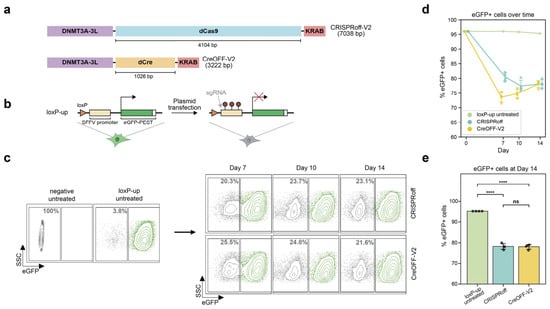
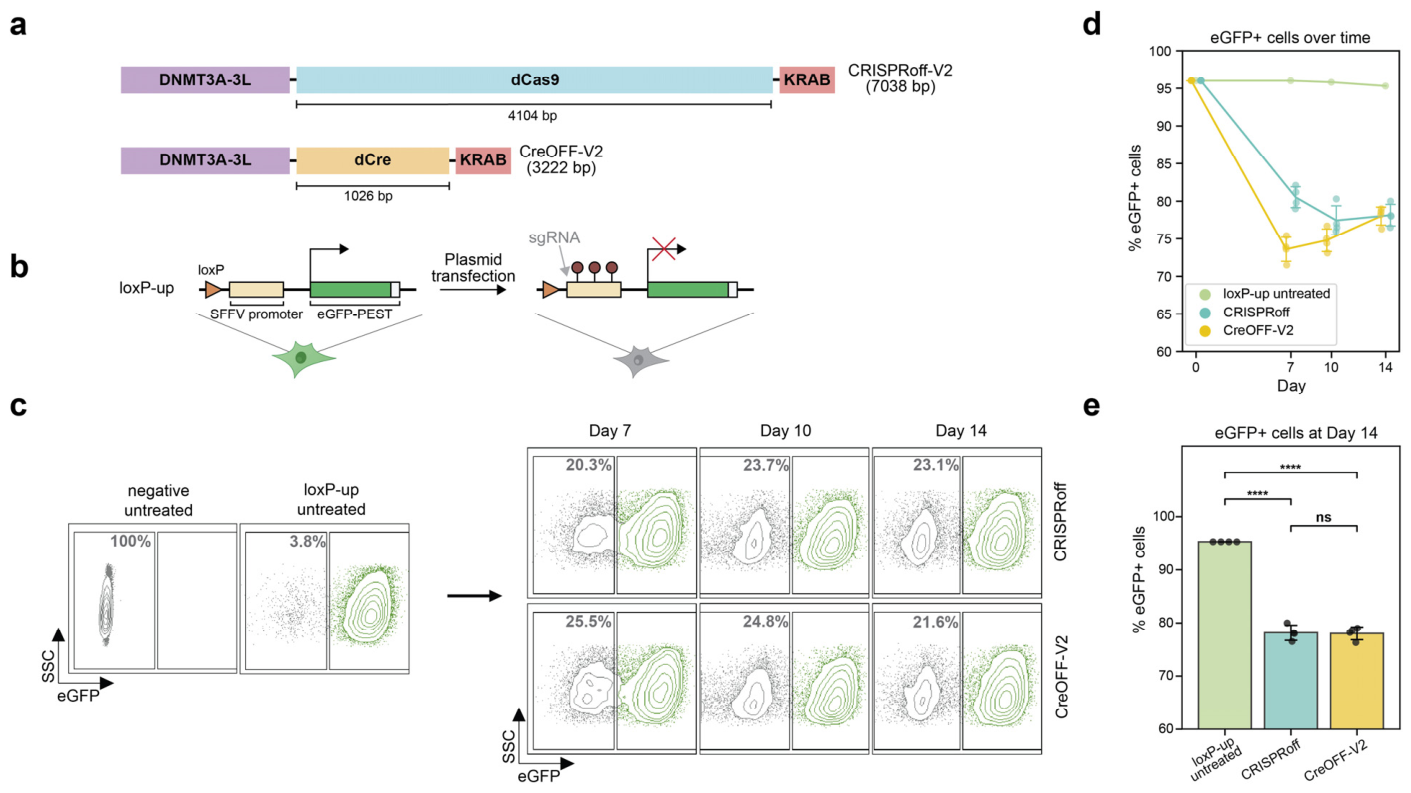
To evaluate whether a catalytically inactive, but DNA-binding-competent Cre (Y324F) recombinase [24] could function as a DNA-binding domain analogous to dCas9 in the CRISPRoff system, we generated a modified construct in which dCas9 from CRISPRoff-V2 (the most efficient variant in the original publication) [3] was replaced with a “dead” Cre (dCre). This construct was termed CreOFF-V2. The DNMT3A-3L and KRAB domains remained unchanged. Notably, CreOFF-V2 is substantially smaller than CRISPRoff-V2, with a size of 3.2 kb compared to 7.0 kb (Figure 1a).
Figure 1.
CreOFF induces epigenetic silencing of eGFP in a loxP reporter system comparable to CRISPRoff. (a) Schematic overview of the CRISPRoff and CreOFF-V2 constructs, both containing the DNMT3A-3L and KRAB epigenetic effector domains. (b) Experimental design: loxP-up cells were transfected with either CreOFF-V2 or CRISPRoff plasmids to silence eGFP. For CRISPRoff, a sgRNA targeting a region in close proximity to the SFFV promoter was co-transfected. (c) Representative flow cytometry plots showing eGFP-negative HEK293T cells, untreated loxP-up cells (eGFP-positive), and unselected loxP-up cells transfected with CreOFF-V2 or CRISPRoff at different time points. Grey numbers indicate the percentage of eGFP-negative cells. (d) Changes in percentages of eGFP-positive cells over time. The dots show a replicate, and the error bars indicate the standard deviation (n = 4 biological replicates). (e) Bar plot of eGFP-positive cells at the experimental endpoint, day 14 (n = 4 biological replicates). Single dots indicate individual replicates, error bars indicate standard deviation, and asterisks denote statistical significance (ns—not significant; ****—p < 0.0001; one-way ANOVA).
To initially validate the functionality of CreOFF-V2, plasmid transfections were performed in the reporter HEK293T cell line (named loxP-up throughout this work), which contains one copy of eGFP-PEST under the SFFV promoter, with a single loxP site upstream of the promoter (Figure 1b). CRISPRoff was included as a control. While CreOFF-V2 can directly bind the loxP site, CRISPRoff requires the co-transfection of an sgRNA. For a direct comparison between the two tools, the sgRNA targeted a region proximal to the loxP target site.
Following plasmid transfection, cells were analyzed by flow cytometry at days 7, 10, and 14 post-transfection (Figure 1c). As early as day 7, a clear shift toward the eGFP-negative population was observed in cells treated with CreOFF-V2 or CRISPRoff. By day 10, two distinct populations, eGFP-positive and eGFP-negative, were evident, and this distribution remained stable through day 14.
Over time (Figure 1d), untreated reporter cells consistently maintained high levels of eGFP expression, with approximately 95% of eGFP-positive cells throughout the experiment. In contrast, cells treated with CreOFF-V2 exhibited a marked increase in the proportion of eGFP-negative cells, with approximately 25% being silenced at day 7 and 20% remaining eGFP-negative by day 14. A comparable silencing efficiency was observed for CRISPRoff-treated cells, which also showed silencing by day 7 that remained stable through day 14. At the experimental endpoint (Figure 1e), both CreOFF and CRISPRoff resulted in significant silencing of the cells compared to the untreated control, with around 20% efficiency.
Together, these results demonstrate that a catalytically inactive Cre can function as an effective DNA-binding domain for epigenetic silencing when fused to epigenetic effector domains.
3.2. CreOFF-V2 Outperforms Alternative Configurations and Approaches Complete Silencing
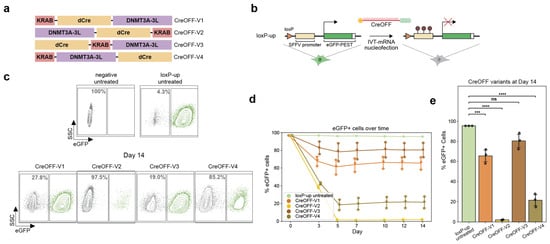
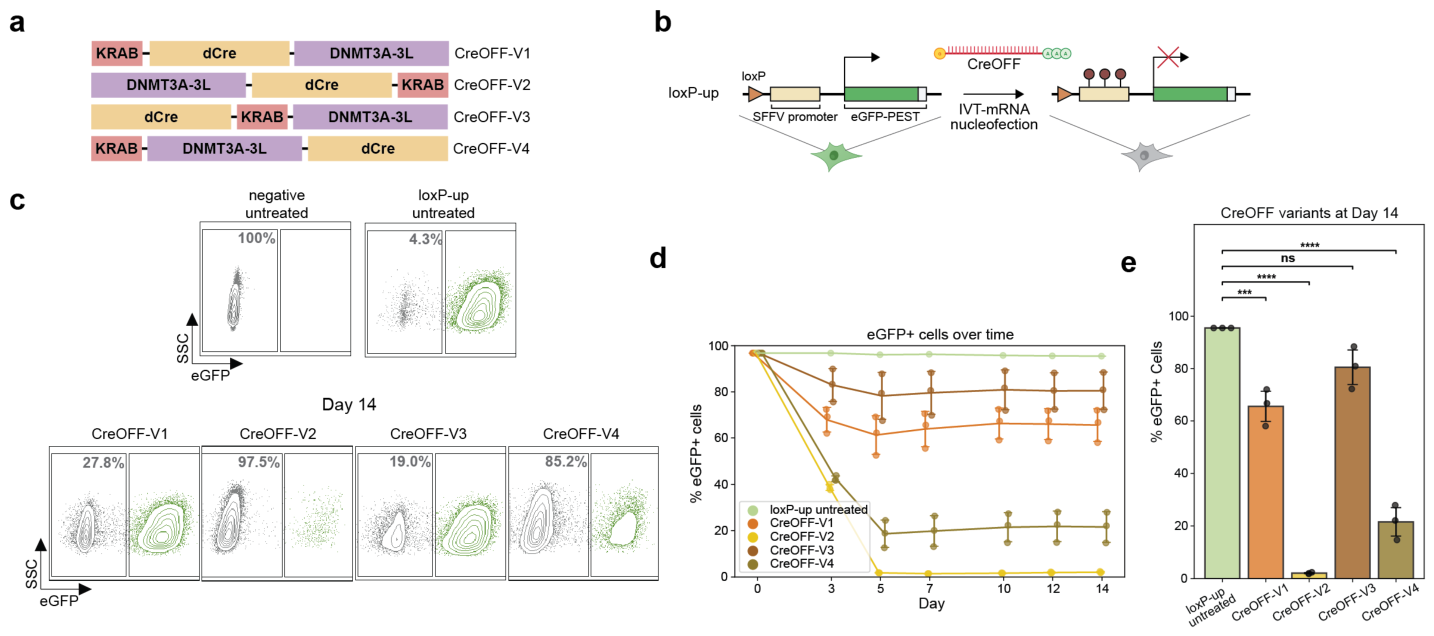
Since CreOFF-V2 had demonstrated strong potential for epigenetically silencing eGFP in reporters via plasmid transfection, we next sought to investigate whether the arrangement of the epigenetic domains within the construct could influence the efficiency of CreOFF-mediated silencing. To this end, we generated three additional CreOFF variants (Figure 2a), named V1, V3, and V4, each differing in the order of the DNA-binding and effector domains. In V1 and V2, the DNA-binding domain is positioned in the middle, flanked by the epigenetic editors, whereas in V3 and V4, the dCre domain is located at either the N-terminal or C-terminal end. For delivery, we opted for IVT-mRNA nucleofection (Figure 2b), which provides short transient expression and is more aligned with potential clinical applications.
Figure 2.
Influence of CreOFF domain arrangements on silencing efficiency. (a) Schematic representation of the CreOFF variants (V1 to V4) with different arrangements of the domains. (b) Experimental procedure of the CreOFF configuration testing in the loxP-up reporter system, with nucleofection of 1 pmol of CreOFF IVT-mRNA. (c) Representative flow cytometry plots showing eGFP-negative HEK293T cells, untreated loxP-up cells, and unselected loxP-up cells following CreOFF IVT-mRNA nucleofection with each variant on day 14. Grey numbers indicate the percentage of eGFP-negative cells. (d) Changes in the percentages of eGFP-positive cells over time. The dots indicate a replicate (n = 3 biological replicates), and the error bars show the standard deviation. (e) Bar plot of eGFP-positive cells at day 14 (n = 3 biological replicates). Single dots show individual replicates, error bars indicate standard deviation, and asterisks denote statistical significance (ns—not significant; ***—p < 0.001; ****—p < 0.0001; one-way ANOVA).
Representative flow cytometry data (Figure 2c and Figure S1) and analysis over time (Figure 2d) revealed that all configurations could induce silencing in the loxP-up reporter. Already by day 5, a clear stabilization of silencing was observed, and from that point onward, the percentage of silenced cells remained constant until the experimental endpoint at day 14. Despite receiving the same amount of IVT-mRNA (1 pmol), clear differences in silencing efficiency emerged among the variants, with CreOFF-V2 outperforming the other configurations at ~98% eGFP-negative cells, followed by V4 at ~80%, V1 at ~35%, and V3 at ~20% (Figure 2e). CreOFF-V2 remained functionally effective and exhibited robust silencing activity even when delivered at substantially reduced IVT-mRNA amounts, where significant silencing was still observed at doses as low as 0.05 pmol (Figure S2).
These results demonstrate that while alternative configurations can mediate silencing, the relative order of the epigenetic domains critically influences efficiency.
3.3. CreOFF-V2 Achieves Robust Long-Term Silencing with Flexible Binding Site Positioning
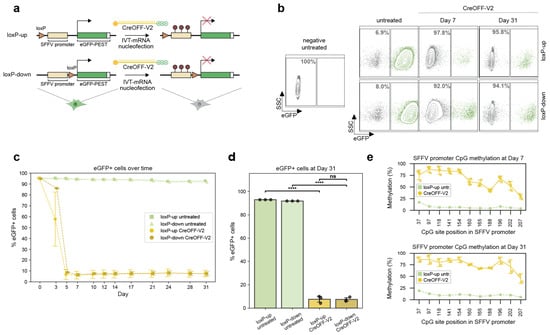
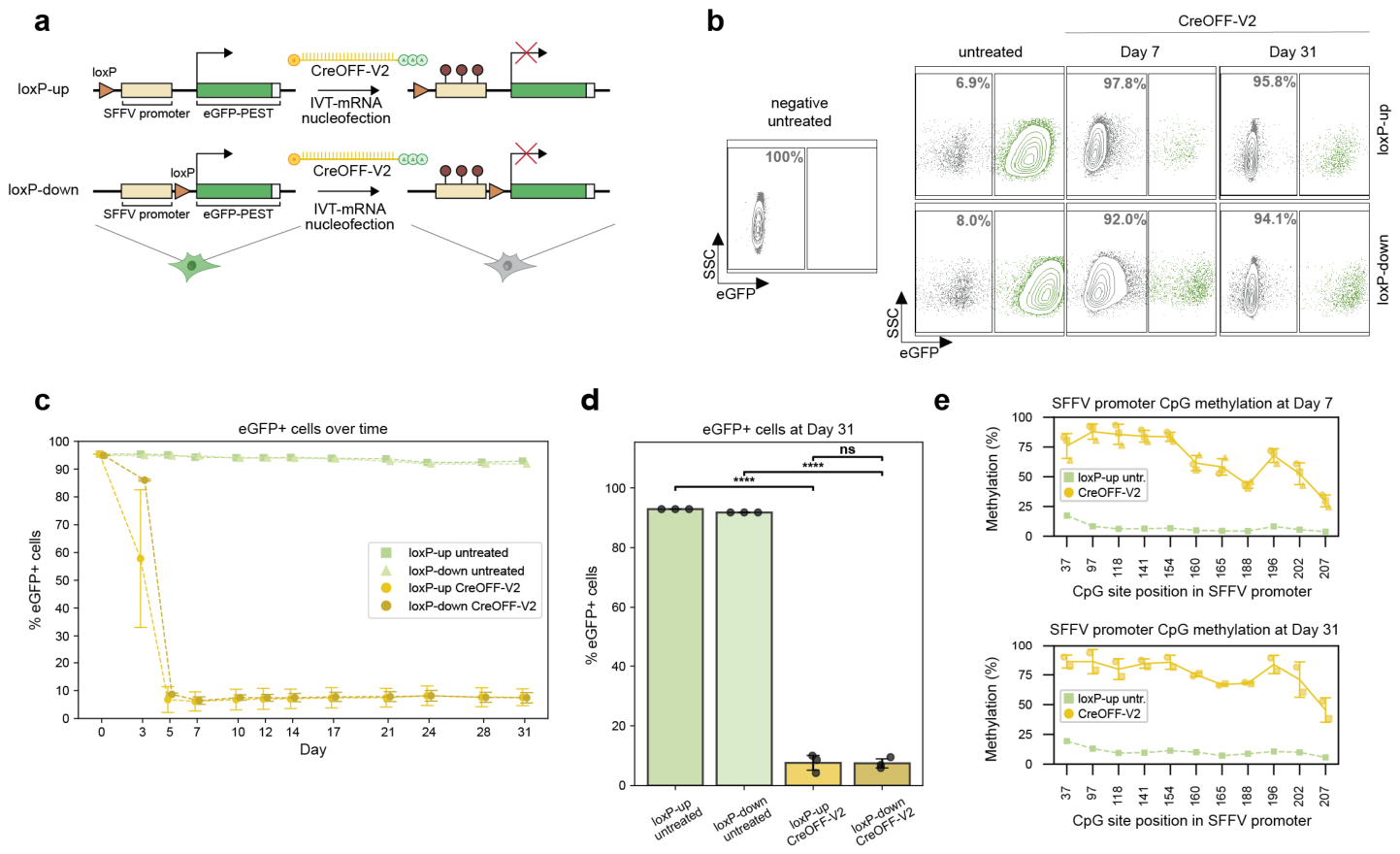
We next investigated whether the positioning of the binding site relative to the promoter influences silencing efficiency. Specifically, we compared targeting upstream (loxP-up) versus downstream (loxP-down) of the promoter (Figure 3a). More precisely, the loxP site is located 526 bp upstream of the transcription start site in the loxP-up cell line, compared to 18 bp upstream of the transcription start site in the loxP-down cell line. In addition, we assessed whether CreOFF-mediated silencing remains stable over an extended period despite its transient expression following IVT-mRNA nucleofection. For that, eGFP expression was monitored over a period of 31 days, corresponding to approximately 35–40 cell divisions [25].
Figure 3.
Long-term stability of CreOFF-mediated silencing at different binding site positions. (a) Experimental overview of the loxP-up and loxP-down HEK293T reporter cell lines following nucleofection of 1 pmol CreOFF-V2 IVT-mRNA, used to assess the impact of binding site positioning upstream or downstream of the SFFV promoter. (b) Representative flow cytometry plots showing eGFP-negative HEK293T cells, untreated loxP-up and loxP-down cells, and unselected loxP-up and loxP-down cells treated with CreOFF-V2 IVT-mRNA at representative time points. Grey numbers indicate the percentage of eGFP-negative cells. (c) Time-course quantification of eGFP-positive cells following CreOFF treatment. Dots represent individual replicates (n = 3 biological replicates), and error bars indicate standard deviation. (d) Bar plot showing the percentage of eGFP-positive cells at the experimental endpoint (day 31) for loxP-up and loxP-down cells (n = 3 biological replicates). Individual dots represent replicates, error bars indicate standard deviation, and asterisks denote statistical significance (ns—not significant; ****—p < 0.0001; one-way ANOVA). (e) CpG methylation profiles of untreated and CreOFF-treated loxP-up samples shown in (b,c) at days 7 and 31, respectively, following targeted bisulfite sequencing of a region within the SFFV promoter.
Representative flow cytometry profiles (Figure 3b and Figure S3) and quantification of eGFP expression across the complete experimental course (Figure 3c) showed that in both loxP-up and loxP-down reporter systems, the percentage of silenced cells increased rapidly following nucleofection, with most cells becoming eGFP-negative by day 5–7. This silenced state was maintained consistently through day 31. At the experimental endpoint (day 31), the silencing efficiencies exceeded 90% for both reporter configurations, with no significant difference observed between the two target site positions (Figure 3d). Targeted bisulfite sequencing of the analyzed promoter region (Figure 3e) revealed low CpG island methylation of the promoter in untreated samples and high methylation in CreOFF-treated samples, supporting methylation-mediated long-term silencing. Similar methylation levels on day 7 and day 31 indicate that this silenced state was established by day 7 and stably maintained thereafter.
Together, these results demonstrate that a single dose of CreOFF IVT-mRNA induces stable long-term silencing via CpG methylation. Moreover, the position of the binding site relative to the promoter, whether upstream or downstream, within around 500 bp upstream of the transcript start site, does not significantly affect silencing efficiency.
3.4. Brec1-OFF Induces Epigenetic Silencing in an HIV-1 LTR-Driven Reporter
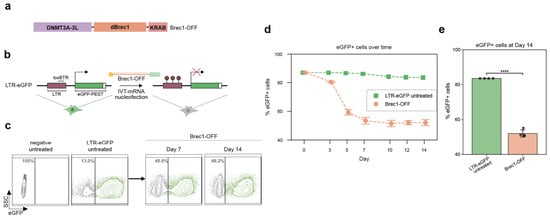
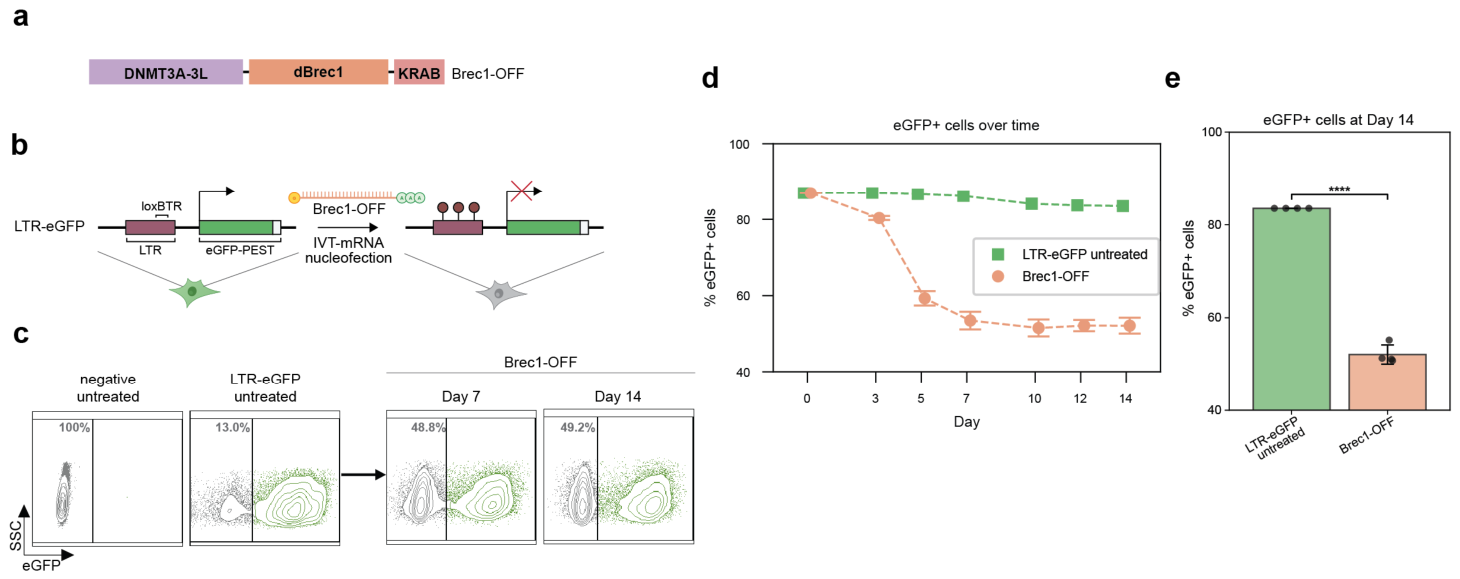
As previously shown, CreOFF induced efficient and persistent long-term silencing after a single transient expression, highlighting its potential as an epigenome editing tool. However, its use is restricted by the need for a loxP site. To eliminate the need for such a canonical recombination site, directed evolution can be used to reprogram the SSR’s target site specificity toward a desired endogenous sequence. Brec1 is an SSR evolved from Cre recombinase to recognize the loxBTR site in the R region of HIV-1 LTRs and to excise the integrated HIV-1 proviral genome [14]. Since the HIV-1 5′ LTR also functions as the viral promoter and drives proviral transcription [26], we reasoned that a catalytically inactive Brec1 fused to repressive epigenetic editor domains can bind to the LTR promoter and perform epigenetic silencing. We thus generated Brec1-OFF, a construct analogous to CreOFF-V2, but with a “dead” Brec1 (dBrec1) as the DNA-binding domain instead of a “dead” Cre (Figure 4a). To validate the functionality of Brec1-OFF, IVT-mRNA nucleofection was performed in the reporter cell line, which expresses eGFP under the HIV-1 LTR promoter and does not contain any canonical SSR target site (in short, LTR-eGFP) (Figure 4b).
Figure 4.
Brec1-OFF mediates silencing in LTR-eGFP reporter system. (a) Schematic overview of the Brec1-OFF construct, with a catalytically inactive Brec1 as the DNA-binding domain. (b) Experimental procedure, with a schematic overview of the LTR-eGFP HEK293T reporter cell lines, where the HIV-1 LTR promoter drives the expression of eGFP-PEST, following nucleofection of 4 pmol Brec1-OFF IVT-mRNA. (c) Representative flow cytometry profiles showing eGFP-negative HEK293T cells, untreated LTR-eGFP cells, and unselected LTR-eGFP cells treated with Brec1-OFF IVT-mRNA at representative time points. Grey numbers indicate the percentage of eGFP-negative cells. (d) Time-course analysis of eGFP-positive cells following Brec1-OFF treatment. Dots represent individual replicates (n = 4 biological replicates), and error bars indicate standard deviation. (e) Bar plot showing the percentage of eGFP-positive cells at the experimental endpoint (day 14). Individual dots represent replicates (n = 4 biological replicates), error bars indicate standard deviation, and asterisks denote statistical significance (****—p < 0.0001, Welch’s independent samples t-test).
In line with the temporal pattern observed previously in the CreOFF experiments, the proportion of silenced LTR-eGFP cells increased rapidly following Brec1-OFF nucleofection, reaching approximately 35% by day 7 (Figure 4c,d and Figure S4). This level of silencing was maintained throughout the 14-day observation period and remained significantly higher than in untreated cells at the experimental endpoint (Figure 4e).
These results highlight the potential of evolved SSRs as DNA-binding domains that specifically target the sequences for which they were reprogrammed, thereby eliminating the need for a canonical target site like loxP.
4. Discussion
In this study, we developed and validated a novel epigenome editing tool, RecOFF, based on catalytically inactive SSRs fused to epigenetic effector domains, with CreOFF as a proof-of-concept. By leveraging an inactive SSR as a DNA-binding scaffold, RecOFF provides an innovative alternative to conventional CRISPR-based tools such as CRISPRoff, with the added advantages of small size and independence from sgRNA or protospacer adjacent motif sequence requirements.
Using a reporter, we demonstrated that transient delivery of CreOFF IVT-mRNA induces rapid, robust, and reproducible repression, which is persistent over long-term culture and multiple cell divisions. Importantly, silencing remained effective whether the binding sites were positioned upstream or downstream of the promoter, demonstrating flexibility in binding site selection and highly efficient silencing at distances exceeding 500 bp from the transcription start site. At a molecular level, targeted bisulfite sequencing confirmed that stable repression correlates with targeted DNA methylation at promoter CpG sites. These results demonstrate that RecOFF can establish heritable epigenetic states that persist even after transient editor expression, highlighting its potential for hit-and-run epigenome editing, consistent with other tools that combine different epigenetic editor domains [3,27,28,29,30].
Additionally, we showed that Brec1-OFF, which is based on a catalytically inactive Brec1, an SSR reprogrammed via directed evolution from Cre to target the HIV-1 LTR promoter [14], mediates epigenetic silencing. This demonstrates that SSRs can be reprogrammed to bind specific promoters distinct from their native target. In doing so, the repertoire of available SSRs would be expanded, thereby broadening the range of targetable genomic loci and enhancing the versatility of the RecOFF platform. Multiple SSRs could serve as starting scaffolds, with the initial choice guided by similarity between their native binding sites and the target genomic locus sequence. Directed evolution techniques [12,18] could then be used to adapt DNA-binding specificity, eliminating the need for a canonical target site. Although directed evolution is a complex process requiring multiple rounds of iterative evolution and optimization, this approach offers a promising route toward expanding the versatility of RecOFF constructs. In this way, RecOFF constructs would function as potent, compact, and self-contained tools that enable targeted gene silencing at defined genomic loci, extending their potential application beyond the specific reporters investigated here.
Furthermore, a catalytically inactive SSR could be fused to other epigenetic effector domains, such as TET1 or VP64, to enable targeted gene activation like CRISPRon [3]. These fusions would give rise to a gene-activating tool we will term RecON, complementing the repressive RecOFF platform.
Taken together, this work shows that catalytically inactive SSRs can be repurposed as DNA-binding domains for targeted epigenome editing, establishing them as a novel, versatile, and efficient platform. The combination of compact molecular architecture, the capacity to couple transient expression with sustained modulation of gene expression, and the potential for flexible target selection highlights SSR-based tools as a promising addition to the existing epigenome editing platforms.
5. Conclusions
Overall, this work provides a strong foundation for the use of catalytically inactive SSRs as precise, long-term gene regulation tools. Beyond the specific reporter systems studied here, these findings illustrate the broader promise of SSR-based platforms such as RecOFF for controlled and durable modulation of gene expression through targeted epigenetic modification. Their ability to induce durable and position-tolerant silencing from a transient expression event supports their application in various research contexts and potentially in the development of next-generation strategies for precision gene silencing.
Supplementary Materials
The following supporting information can be downloaded at https://www.mdpi.com/article/10.3390/genes17111355/s1. Figure S1. Influence of CreOFF domain arrangements on silencing efficiency; Figure S2. Dose-dependent efficiency of CreOFF-mediated silencing via IVT-mRNA nucleofection; Figure S3. Long-term stability of CreOFF-mediated silencing at different binding site positions; Figure S4. Brec1-OFF mediates silencing in LTR-eGFP reporter system; Table S1. Primer sequences for targeted bisulfite sequencing.
Author Contributions
Conceptualization, D.S.; methodology, D.S.; software, G.T.; validation, G.T. and Á.M.-O.; formal analysis, G.T.; investigation, G.T. and Á.M.-O.; resources, D.S.; data curation, G.T.; writing—original draft preparation, G.T.; writing—review and editing, D.S. and Á.M.-O.; visualization, G.T.; supervision, D.S.; project administration, D.S.; funding acquisition, D.S. All authors have read and agreed to the published version of the manuscript.
Funding
This research was funded by the Health + Life Science Alliance Heidelberg Mannheim, grant number MWK32-7531-27/2/4.
Institutional Review Board Statement
Not applicable.
Informed Consent Statement
Not applicable.
Data Availability Statement
The original contributions presented in this study are included in the article/Supplementary Materials. Further inquiries can be directed to the corresponding author.
Acknowledgments
We thank Marc Freichel and his team for their support and the fruitful discussions. This work is supported by the Health + Life Science Alliance Heidelberg Mannheim and received state funds approved by the State Parliament of Baden-Württemberg. We also thank the Flow Cytometry & FACS Core Facility (FFCF) of Heidelberg University for providing access to instruments.
Conflicts of Interest
The authors declare no conflicts of interest.
Abbreviations
The following abbreviations are used in this manuscript:
| SSR | Site-specific recombinase |
| IVT-mRNA | In vitro-transcribed messenger RNA |
| LTR | Long terminal repeat |
| dCas9 | Catalytically inactive Cas9 |
| sgRNA | Single guide RNA |
| DNMT | DNA methyltransferase |
| KRAB | Krüppel-associated box |
| ZFP | Zinc finger protein |
| TALE | Transcription activator-like effector |
| eGFP | Enhanced green fluorescent protein |
| SFFV | Spleen focus-forming virus |
| DMEM | Dulbecco’s Modified Eagle Medium |
| FBS | Fetal bovine serum |
| PEI | Polyethylenimine |
| FACS | Fluorescence-activated cell sorting |
| PBS | Phosphate-buffered saline |
References
- Heller, E.A.; Bintu, L.; Rots, M.G. Epigenetic Editing: From Concept to Clinic. Nat. Rev. Drug Discov. 2026, 25, 227–248. [Google Scholar] [CrossRef] [Scilit] [PubMed]
- Yuan, L.; Xiong, Y.; Zhang, Y.; Gu, S.; Lei, Y. Epigenome Editing Based Treatment: Progresses and Challenges. Mol. Ther. 2026, 34, 46–67. [Google Scholar] [CrossRef] [Scilit] [PubMed]
- Nuñez, J.K.; Chen, J.; Pommier, G.C.; Cogan, J.Z.; Replogle, J.M.; Adriaens, C.; Ramadoss, G.N.; Shi, Q.; Hung, K.L.; Samelson, A.J.; et al. Genome-Wide Programmable Transcriptional Memory by CRISPR-Based Epigenome Editing. Cell 2021, 184, 2503–2519.e17. [Google Scholar] [CrossRef] [Scilit] [PubMed]
- O’geen, H.; Tomkova, M.; Combs, J.A.; Tilley, E.K.; Segal, D.J. Determinants of Heritable Gene Silencing for KRAB-DCas9 + DNMT3 and Ezh2-DCas9 + DNMT3 Hit-and-Run Epigenome Editing. Nucleic Acids Res. 2022, 50, 3239–3253. [Google Scholar] [CrossRef] [Scilit] [PubMed]
- Qi, L.S.; Larson, M.H.; Gilbert, L.A.; Doudna, J.A.; Weissman, J.S.; Arkin, A.P.; Lim, W.A. Repurposing CRISPR as an RNA-Guided Platform for Sequence-Specific Control of Gene Expression. Cell 2013, 152, 1173–1183, Erratum in Cell 2021, 184, 844. https://doi.org/10.1016/j.cell.2021.01.019. [Google Scholar] [CrossRef] [Scilit] [PubMed]
- van Haasteren, J.; Li, J.; Scheideler, O.J.; Murthy, N. Schaffer DV The Delivery Challenge: Fulfilling the Promise of Therapeutic Genome Editing. Nat. Biotechnol. 2020, 38, 845–855. [Google Scholar] [CrossRef] [Scilit] [PubMed]
- Kim, M.S.; Kini, A.G. Engineering and Application of Zinc Finger Proteins and TALEs for Biomedical Research. Mol. Cells 2017, 40, 533. [Google Scholar] [CrossRef] [Scilit] [PubMed]
- Katayama, S.; Watanabe, M.; Kato, Y.; Nomura, W.; Yamamoto, T. Engineering of Zinc Finger Nucleases Through Structural Modeling Improves Genome Editing Efficiency in Cells. Adv. Sci. 2024, 11, 2310255. [Google Scholar] [CrossRef] [Scilit] [PubMed]
- Negi, S.; Imanishi, M.; Hamori, M.; Kawahara-Nakagawa, Y.; Nomura, W.; Kishi, K.; Shibata, N.; Sugiura, Y. The Past, Present, and Future of Artificial Zinc Finger Proteins: Design Strategies and Chemical and Biological Applications. JBIC J. Biol. Inorg. Chem. 2023, 28, 249–261. [Google Scholar] [CrossRef] [Scilit] [PubMed]
- Sternberg, N.; Hamilton, D. Bacteriophage P1 Site-Specific Recombination: I. Recombination between LoxP Sites. J. Mol. Biol. 1981, 150, 467–486. [Google Scholar] [CrossRef] [Scilit] [PubMed]
- Nagy, A. Cre Recombinase: The Universal Reagent for Genome Tailoring. Genesis 2000, 26, 99–109. [Google Scholar] [CrossRef]
- Buchholz, F.; Stewart, A.F. Alteration of Cre Recombinase Site Specificity by Substrate-Linked Protein Evolution. Nat. Biotechnol. 2001, 19, 1047–1052. [Google Scholar] [CrossRef] [Scilit] [PubMed]
- Santoro, S.W.; Schultz, P.G. Directed Evolution of the Site Specificity of Cre Recombinase. Proc. Natl. Acad. Sci. USA 2002, 99, 4185–4190. [Google Scholar] [CrossRef] [Scilit] [PubMed]
- Karpinski, J.; Hauber, I.; Chemnitz, J.; Schäfer, C.; Paszkowski-Rogacz, M.; Chakraborty, D.; Beschorner, N.; Hofmann-Sieber, H.; Lange, U.C.; Grundhoff, A.; et al. Directed Evolution of a Recombinase That Excises the Provirus of Most HIV-1 Primary Isolates with High Specificity. Nat. Biotechnol. 2016, 34, 401–409. [Google Scholar] [CrossRef] [Scilit] [PubMed]
- Rojo-Romanos, T.; Karpinski, J.; Millen, S.; Beschorner, N.; Simon, F.; Paszkowski-Rogacz, M.; Lansing, F.; Schneider, P.M.; Sonntag, J.; Hauber, J.; et al. Precise Excision of HTLV-1 Provirus with a Designer-Recombinase. Mol. Ther. 2023, 31, 2266–2285. [Google Scholar] [CrossRef] [Scilit] [PubMed]
- Lansing, F.; Mukhametzyanova, L.; Rojo-Romanos, T.; Iwasawa, K.; Kimura, M.; Paszkowski-Rogacz, M.; Karpinski, J.; Grass, T.; Sonntag, J.; Schneider, P.M.; et al. Correction of a Factor VIII Genomic Inversion with Designer-Recombinases. Nat. Commun. 2022, 13, 422. [Google Scholar] [CrossRef] [Scilit] [PubMed]
- Sternberg, N.; Sauer, B.; Hoess, R.; Abremski, K. Bacteriophage P1 Cre Gene and Its Regulatory Region: Evidence for Multiple Promoters and for Regulation by DNA Methylation. J. Mol. Biol. 1986, 187, 197–212. [Google Scholar] [CrossRef] [Scilit] [PubMed]
- Schmitt, L.T.; Schneider, A.; Posorski, J.; Lansing, F.; Jelicic, M.; Jain, M.; Sayed, S.; Buchholz, F.; Sürün, D. Quantification of Evolved DNA-Editing Enzymes at Scale with DEQSeq. Genome Biol. 2023, 24, 254. [Google Scholar] [CrossRef] [Scilit] [PubMed]
- Karagyaur, M.; Dyikanov, D.; Tyurin-Kuzmin, P.; Dzhauari, S.; Skryabina, M.; Vigovskiy, M.; Primak, A.; Kalinina, N.; Tkachuk, V. A Novel Cre/Lox71-Based System for Inducible Expression of Recombinant Proteins and Genome Editing. Cells 2022, 11, 2141. [Google Scholar] [CrossRef] [Scilit] [PubMed]
- Schönberg, P.Y.; Muñoz-Ovalle, Á.; Saleh, H.A.; Crespo, E.; Kuhnert, R.; Michen, S.; Loureiro, L.; Temme, A.; Feldmann, A.; Buchholz, F. Epigenetic Editing Balances TCR Suppression and Persistence in CAR T Cells. Mol. Ther. Adv. 2026, 34, 201712. [Google Scholar] [CrossRef] [Scilit] [PubMed]
- Sürün, D.; Schneider, A.; Mircetic, J.; Neumann, K.; Lansing, F.; Paszkowski-Rogacz, M.; Hänchen, V.; Leekirsch, M.A.; Buchholz, F. Efficient Generation and Correction of Mutations in Human IPS Cells Utilizing MRNAs of CRISPR Base Editors and Prime Editors. Genes 2020, 11, 511. [Google Scholar] [CrossRef] [Scilit] [PubMed]
- Corish, P.; Tyler-Smith, C. Attenuation of Green Fluorescent Protein Half-Life in Mammalian Cells. Protein Eng. 1999, 12, 1035–1040. [Google Scholar] [CrossRef] [Scilit] [PubMed]
- Ewels, P.A.; Peltzer, A.; Fillinger, S.; Patel, H.; Alneberg, J.; Wilm, A.; Garcia, M.U.; Di Tommaso, P.; Nahnsen, S. The Nf-Core Framework for Community-Curated Bioinformatics Pipelines. Nat. Biotechnol. 2020, 38, 276–278. [Google Scholar] [CrossRef] [Scilit] [PubMed]
- Guo, F.; Gopaul, D.N.; Van Duyne, G.D. Asymmetric DNA Bending in the Cre-LoxP Site-Specific Recombination Synapse. Proc. Natl. Acad. Sci. USA 1999, 96, 7143–7148. [Google Scholar] [CrossRef] [Scilit] [PubMed]
- Lomba, A.L.O.; Tirapelle, M.C.; Biaggio, R.T.; Abreu-Neto, M.S.; Covas, D.T.; Picanço-Castro, V.; Swiech, K.; Mizukami, A. Serum-Free Suspension Adaptation of HEK-293T Cells: Basis for Large-Scale Biopharmaceutical Production. Braz. Arch. Biol. Technol. 2021, 64, e21200817. [Google Scholar] [CrossRef] [Scilit]
- Van Lint, C.; Bouchat, S.; Marcello, A. HIV-1 Transcription and Latency: An Update. Retrovirology 2013, 10, 67. [Google Scholar] [CrossRef] [Scilit] [PubMed]
- Tremblay, F.; Xiong, Q.; Shah, S.S.; Ko, C.W.; Kelly, K.; Morrison, M.S.; Giancarlo, C.; Ramirez, R.N.; Hildebrand, E.M.; Voytek, S.B.; et al. A Potent Epigenetic Editor Targeting Human PCSK9 for Durable Reduction of Low-Density Lipoprotein Cholesterol Levels. Nat. Med. 2025, 31, 1329–1338. [Google Scholar] [CrossRef] [Scilit] [PubMed]
- Mao, S.; Peng, W.; Feng, Z.; Chen, Y.; Sun, J.; Chen, H.; Wang, P.; Huang, P.; Zhao, J.; Wu, L.; et al. Design of Optimized Epigenetic Regulators for Durable Gene Silencing with Application to PCSK9 in Nonhuman Primates. Nat. Biotechnol. 2025, 44, 1516–1524. [Google Scholar] [CrossRef] [Scilit] [PubMed]
- Cappelluti, M.A.; Mollica Poeta, V.; Valsoni, S.; Quarato, P.; Merlin, S.; Merelli, I.; Lombardo, A. Durable and Efficient Gene Silencing in Vivo by Hit-and-Run Epigenome Editing. Nature 2024, 627, 416–423. [Google Scholar] [CrossRef] [Scilit] [PubMed]
- Ding, L.; Schmitt, L.T.; Brux, M.; Sürün, D.; Augsburg, M.; Lansing, F.; Mircetic, J.; Theis, M.; Buchholz, F. DNA Methylation–Independent Long-Term Epigenetic Silencing with DCRISPR/Cas9 Fusion Proteins. Life Sci. Alliance 2022, 5, e202101321. [Google Scholar] [CrossRef] [Scilit] [PubMed]
Disclaimer/Publisher’s Note: The statements, opinions and data contained in all publications are solely those of the individual author(s) and contributor(s) and not of MDPI and/or the editor(s). MDPI and/or the editor(s) disclaim responsibility for any injury to people or property resulting from any ideas, methods, instructions or products referred to in the content. |
© 2026 by the authors. Licensee MDPI, Basel, Switzerland. This article is an open access article distributed under the terms and conditions of the Creative Commons Attribution (CC BY) license.