


Abstract
Straw and no-tillage management, as important practices in conservation agriculture, have the potential to improve soil structure. However, their effects on the aggregate stability of soil and on active organic carbon pools in paddy fields are unclear. To investigate how different tillage and straw management practices affect soil properties, this study drew on a 15-year long-term experiment conducted in a double-cropped rice region in South China. It systematically compared four treatments: no-tillage (NT), conventional tillage (CT), conventional tillage with incorporated straw (CT-SR), and no-tillage with straw mulch (NT-SMR)—in terms of their effects on the distribution and stability of mechanical and water-stable aggregates, as well as the distribution of particulate organic carbon (POC) and mineral-associated organic carbon (MAOC) across various aggregate size fractions. The results showed that: (1) Relative to the CT, NT, and CT-SR treatments, NT-SMR significantly enhanced soil structure, as evidenced by a higher percentage of large aggregates (>0.25 mm) and improved aggregate stability. (2) NT-SMR consistently increased soil organic carbon pools, raising SOC, POC, and MAOC contents by 2.0–14.2%, 5.7–24.3%, and 1.0–11.9%, respectively, compared to other treatments. (3) In this study, stability of soil aggregates parameters (R>0.25, MWD and GMD) increased combined with higher levels of bulk SOC and >0.053 mm MAOC, but decreased with higher fractal dimension, indicating a direct causal link between organic carbon accumulation and the betterment of soil structure. Overall, NT-SMR promotes aggregate stability through an optimized particle-size distribution and increased SOC, particularly in the >0.053 mm MAOC fraction. This practice is a sustainable long-term strategy for enhancing SOC sequestration and structural stability in paddy.
1. Introduction
As the basic building blocks of soil structure, soil aggregates govern organic matter content, nutrient turnover, pore space, and soil aeration, thus influencing plant and microbial development, water entry, and soil loss. The formation of soil aggregates follows a complex, hierarchical process, where binding agents gradually promote the creation of micro-aggregates, and these then combine into macro-aggregates [1,2]. In general, tillage directly affects aggregate stability by destroying macro-aggregates through squeezing [3]. In contrast, when straw is returned, aggregates are formed around the fresh residues, which then turn into particulate organic matter within the coarse aggregates and thus induce the development of macro-aggregates. Soil organic carbon not only serves as a key binding agent that facilitates the formation of large aggregates but is also physically protected by these aggregates once they are formed. Currently, the main indicators for evaluating aggregate stability are the ratio of macro-aggregates (R > 0.25), geometric mean diameter (GMD), mean weight diameter (MWD), aggregate destruction rate (PAD), and fractal dimension (D) [4,5]. Typically, higher MWD, GMD, and R>0.25 reflect improved aggregate stability and size distribution. Conversely, lower PAD and fractal dimension correspond to greater stability of soil structure and stronger erosion resistance [6].
Based on density or particle-size fractionation, organic carbon is categorized as either particulate organic carbon (POC) or mineral-associated organic carbon (MAOC), and these two fractions exhibit consistent differences in turnover time [7,8]. POC is broadly recognized as an important indicator of soil fertility, but its faster turnover rate makes it more vulnerable to disturbance than MAOC. MAOC, on the other hand, is stabilized through its longer turnover time, contributing to soil organic carbon sequestration. The major stabilization pathways for organic carbon are physical protection, which involves occlusion within aggregates; chemical protection, achieved through sorption onto mineral surfaces; and biochemical protection, resulting from substrate-driven rate limitation of microbial activity [5]. Although there are many views on these phenomena, physical protection is widely accepted as a dominant mechanism in the stabilization of organic carbon. Soil aggregate-related carbon is considered a sensitive indicator for assessing soil carbon sequestration. Macro-aggregates contribute significantly to the accumulation and stabilization of organic carbon by physically reducing its accessibility to decomposers [9].
In the double-cropping rice region of South China, which is dominated by hilly and mountainous terrain and characterized by severe fragmentation of arable land, the cost of crop straw recycling and utilization is relatively high. Therefore, in situ straw return has become a common, cost-effective, and efficient management practice. Although extensive research has examined how cementing agents like clay minerals, metal oxides, and organic carbon influence aggregate stability, the effects of particulate organic carbon (an active carbon pool) and mineral-associated organic carbon (a recalcitrant carbon pool) have received very limited attention. A well-established finding is that the interaction between tillage systems and straw return significantly alters the stocks and fractional distribution of both POC and MAOC in the soil. However, little attention has been paid to the resulting changes in soil aggregate stability following alterations in these two carbon pools. In the hilly regions of South China, arable land is characterized by uneven terrain. Situated in a subtropical monsoon climate zone and prone to frequent typhoons and flooding, the region experiences wind and water erosion as major natural disasters contributing to the decline in arable land quality. Stable soil aggregates build a well-structured soil, significantly enhancing resistance to water and wind erosion, thereby effectively curbing soil and water loss. Thus, examining the link between POC/MAOC distribution and aggregate stability under combined tillage and straw practices is crucial for sustaining regional arable land productivity.
Conservation tillage (e.g., no-till, straw return) has been widely adopted worldwide to mitigate the decline in topsoil carbon content associated with conventional tillage (CT) [10]. It is recognized that soil aggregates can protect organic carbon from microbial contact, thereby sequestering it [11]. Conservation tillage can significantly alter the size and distribution of soil aggregates, and this may affect SOC accumulation [12]. Consequently, further research is needed to understand how soil aggregates relate to carbon sequestration with respect to conservation tillage. Accordingly, a 15-year field study (2008–2023) was set up in China’s double-cropped rice region under four practices: conventional tillage, no-tillage, straw return, and no-tillage plus straw mulching. The primary objectives of this study were: (1) to evaluate the variations in soil structural stability and dynamic organic carbon fractions under differing tillage–straw return systems; (2) to analyze the interplay between aggregate properties and organic carbon pool dynamics; and (3) to identify appropriate management practices for improving soil quality in double-cropped rice fields.
2. Materials and Methods
2.1. Field Site and Experimental Protocols
From 2008 to 2023, a field experiment was carried out spanning 15 years. The trial site was located in Liuxuizhen, Hechi City, Guangxi Province, China (24°64′ N, 108°00′ E). This experimental field belongs to the Soil Fertilizer Workstation of Guangxi Zhuang Autonomous Region. Characterized by a humid subtropical monsoon climate, this region enjoys abundant light and temperature resources, with an average annual rainfall of 1167.7 mm and a mean annual temperature of 23.9 °C. As defined by the IUSS Working Group WRB classification [13], the soil is identified as a Haplic Acrisol, with quaternary red clay as its parent material. The soil contained 1.50 g kg−1 of total nitrogen. Available phosphorus and potassium levels were 29 mg kg−1 and 70 mg kg−1, respectively.
A split-plot design was employed, with whole plots receiving different plowing intensities and subplots receiving different straw handling treatments. Four treatment combinations were established: conventional tillage (CT), no-tillage (NT), conventional tillage plus straw return (CT-SR), and no-tillage plus straw mulching (NT-SMR). The experimental plot size was 130 m2, and each treatment was replicated three times, resulting in 12 plots overall. Each treatment followed the designated procedures. CT entailed two steps: (i) complete removal of rice straw after harvest, and (ii) rotary plowing of the soil to 20 cm. For NT, straw was also completely removed, but no tillage was performed. CT-SR involved surface mulching of straw after harvest, followed by rotary incorporation into the soil. NT-SMR consisted solely of straw mulching after harvest. It should be noted that under both NT and CT, rice straw was removed promptly from paddy fields after each of the two annual rice harvests (early and late). CT-SR involved two key timings: before early rice sowing and after late rice harvest. At both points, straw left on the field surface from the previous rice harvest was plowed into the soil before the next planting season. In the NT-SMR, no tillage was performed after harvest, and the straw remained on the field surface throughout. In the NT-SMR, no tillage was performed after harvest, and the straw remained on the field surface throughout. Straw residues from both the early and late rice crops were retained in the field. Nutrient application included 180 kg N ha−1, 60 kg P2O5 ha−1, and 135 kg K2O ha−1. The CT-SR treatment followed a biannual cycle: after each rice harvest, straw remained on the surface, only to be plowed in before the next planting. Specifically, this was done prior to early rice seeding and subsequent to late rice harvesting. This experiment was conducted in the double-cropping rice region of South China, where two seasons of rice (early and late rice) are planted each year. Early rice is sown manually around March 10 and transplanted around April 5 each year. Late rice is sown around July 15 and transplanted around August 3 each year. The rice variety used is Yexiangyou 409. No fungicides were applied. Pest and weed control were uniformly applied in accordance with local field production standards.
2.2. Soil Sampling and Analysis
Soil sampling was performed following the late rice harvest of 2023. Within each plot, ten sampling points were arranged in an “S” configuration, and soil was collected from both the shallow (0–10 cm) and deeper (10–20 cm) soil horizons. We combined the ten subsamples from each plot into a single composite soil sample, from which extraneous debris and residues of plant and animal origin were subsequently removed. The soil was separated into pieces approximately 1 cm in diameter along soil fissures and air-dried in the shade for subsequent determination of aggregate structure.
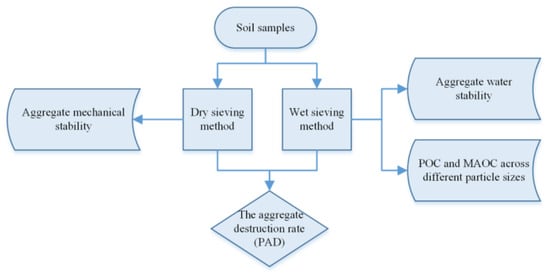
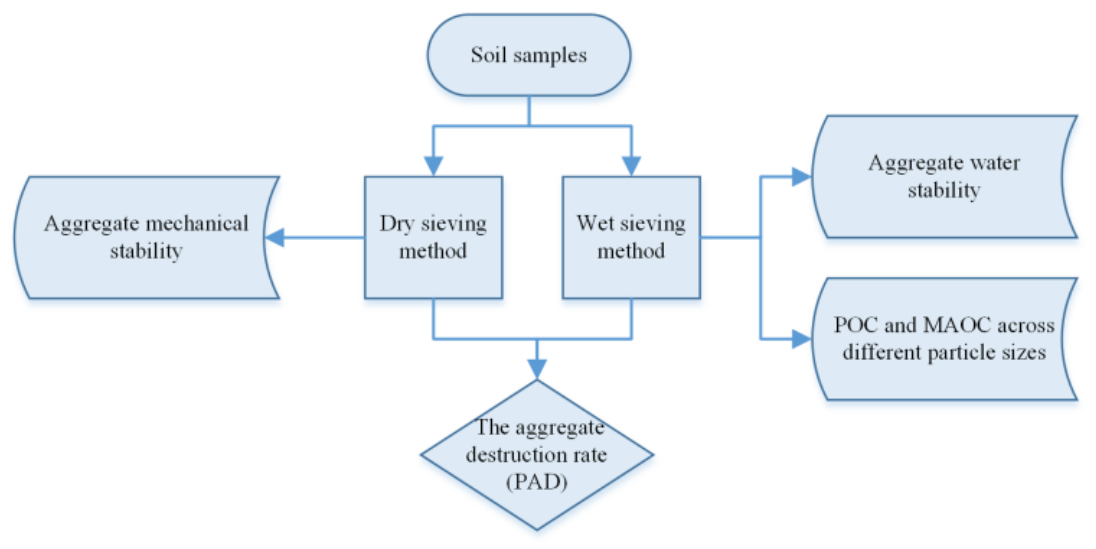
The separation of soil aggregates was carried out through dry sieving followed by wet sieving. For the dry sieving step, a 200 g subsample of air-dried soil was subjected to a sieve stack consisting of 2 mm, 1 mm, 0.5 mm, 0.25 mm, and 0.053 mm meshes. A vibratory sieve shaker (Model ZBSX-92A, Tongli Instrument Equipment Co., Ltd., Baoding, China) was used at a frequency of 30 strokes per minute for a duration of 2 min. The aggregates retained on each sieve were weighed, and their mass percentages relative to the total soil sample were calculated. Regarding wet sieving, soil samples were initially moistened for a period of 5 min, followed by separation through a series of sieves (2, 1, 0.5, 0.25, and 0.053 mm) employing a soil aggregate analyzer (Model TTF-100, Shunlong Experimental Apparatus Factory, Shangyu City, Zhejiang Province, China). The apparatus was operated at 30 strokes min−1 for 30 min, with a stroke amplitude of 5 cm. The aggregates that remained on each sieve were quantitatively rinsed into aluminum pans using water, subsequently dried at 40 °C until a constant mass was achieved, and finally weighed to ascertain the composition of water-stable aggregates. The <0.053 mm fraction was calculated by difference. Water-stable aggregates were determined by the wet sieving method (Yoder method) according to NY/T 1121.19-2008 [14]. Quantification of soil organic carbon was achieved using the K2Cr2O7 oxidation-external heating procedure, and we determined the amounts of POC and MAOC using the wet sieving technique [15]. Soil organic carbon storage was quantified according to the formula presented below.
The variables in the formula are defined as follows: SOC stocks refer to the total soil organic carbon content; Soil parameters are denoted as follows: H (soil depth, cm), BD (bulk density, g cm−3), and SOC (organic carbon concentration, g C kg−1 soil). See below for the experimental flow chart (Figure 1).
Figure 1.
Graphical illustration of the experimental protocol. POC denotes particulate organic carbon, and MAOC denotes mineral-associated organic carbon.
2.3. Computation of the Ability of Soil Aggregates to Remain Intact Metrics
The relative abundance of macro-aggregates within the soil matrix can be calculated according to the following equation:
In this equation, R>0.25 denotes the content of large aggregates (>0.25 mm) in percent; M>0.25 is the mass (g) of aggregates exceeding 0.25 mm in diameter; and M0 is the sum of the masses of all soil size classes (g).
Calculation of the mean weight diameter (MWD) and geometric mean diameter (GMD) of soil aggregates is performed according to the equations presented below.
In this formula, Wi stands for the weight proportion (%) of aggregates belonging to the i particle size grouping; is the corresponding mean aggregate size (mm); and n indicates the total count of particle size grouping.
Calculation of the soil fractal dimensions was performed according to the equations presented as follows:
Here, dmax is the average diameter expressed in mm. It specifically refers to aggregates falling into the largest size class (mm).
We calculate the aggregate destruction rate (PAD) using Equation (5)
With DR>0.25 and WR>0.25 defined as the percent contents of >0.25 mm mechanical and water-stable aggregates, respectively.
2.4. Statistical Analysis
Data acquired during different fertility periods were subjected to a two-way (straw and tillage) repeated-measures analysis of variance (ANOVA) using SPSS (version 22.0; SPSS Inc., Chicago, IL, USA). We performed post hoc comparisons using Tukey’s HSD test at the p < 0.05 significance level. Prior to the ANOVA, normality and homogeneity of variance assumptions were validated-normality using the Kolmogorov–Smirnov test complemented by Q-Q plots, and homogeneity using Levene’s test. Outliers were detected via boxplot analysis. We created all figures using Origin 2024 (version 2023; Origin Lab, Inc., Northampton, MA, USA). To clarify how aggregate characteristics correlate with organic carbon levels, we performed a Pearson correlation analysis.
3. Results
3.1. Percentage and Stability of Soil Mechanical Aggregates
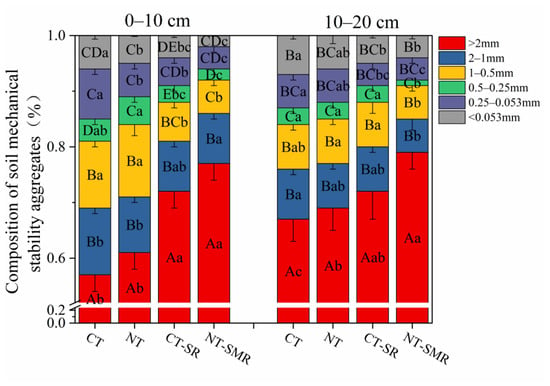
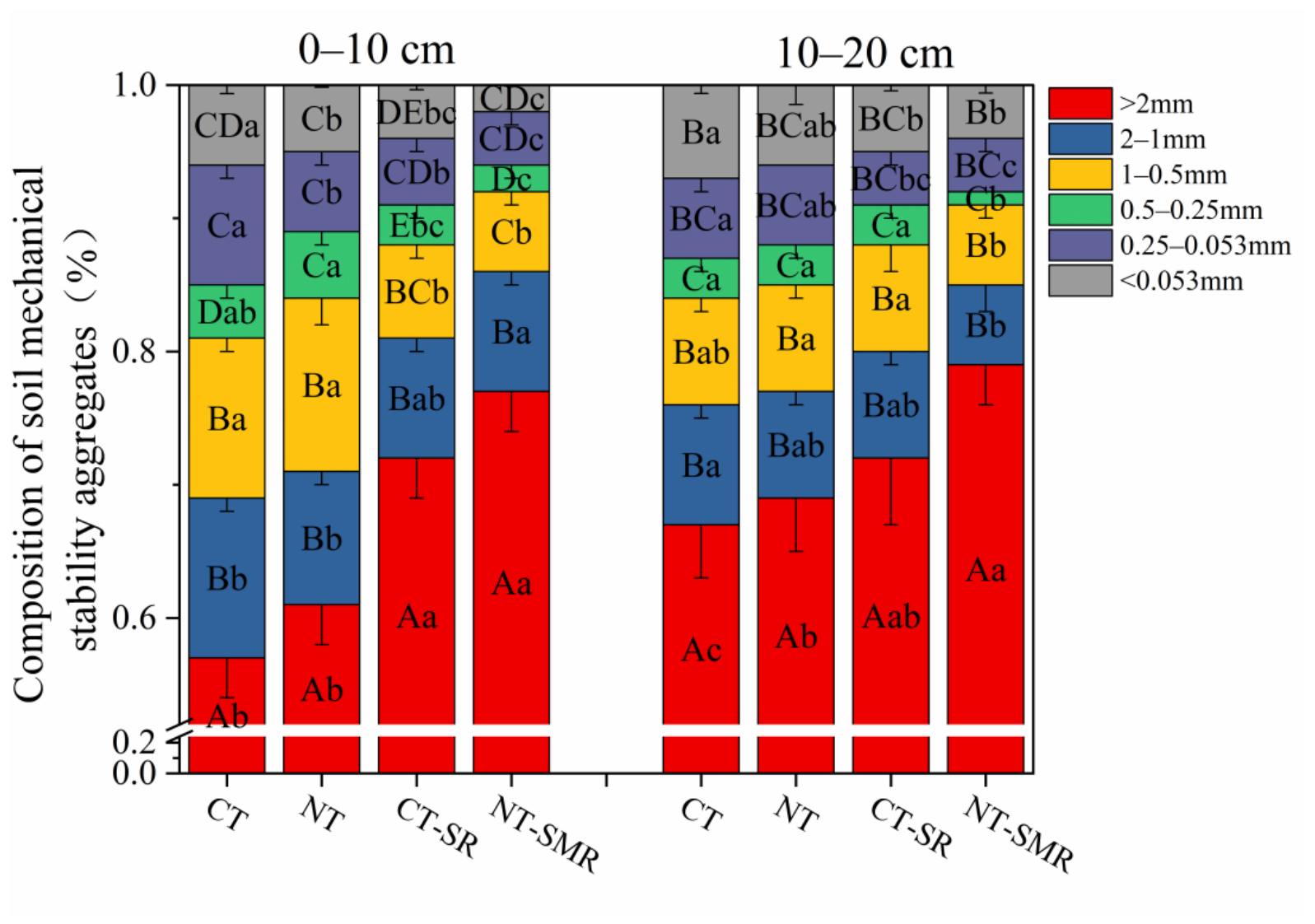
In the 0–20 cm, >2 mm aggregates dominated in all treatments (Figure 2). No-tillage enhanced the mass percentage of >2 mm aggregates by 6.2%, and significantly diminished the proportions of aggregates in the 0.053–0.25 mm and <0.053 mm size classes by 30.4% and 18.4%, respectively, in the 0–10 cm soil layer. Straw return led to a 25.8% increase in >2 mm aggregates, accompanied by significant decreases of 50.8% in the 0.5–1 mm fraction, 37.3% in the 0.053–0.25 mm fraction, and 24.7% in the <0.053 mm fraction. At a depth of 10–20 cm, the application of no-tillage and straw return resulted in a 25.8% increase in >2 mm aggregates, accompanied by significant decreases of 50.8% in the 0.5–1 mm fraction, 37.3% in the 0.053–0.25 mm fraction, and 24.7% in the <0.053 mm fraction. In the 10–20 cm soil layer, the application of no-tillage led to a 6.3% increase in >2 mm aggregates, while straw return resulted in a 10.4% increase. Both treatments simultaneously reduced the 0.053–0.25 mm and <0.053 mm aggregate
Figure 2.
This figure shows the composition of soil mechanical aggregates under different combinations of tillage and straw return. Abbreviations: CT, conventional tillage; NT, no-tillage; CT-SR, conventional tillage with straw incorporation; NT-SMR, no-tillage with straw mulch return. For each treatment, different uppercase letters indicate significant differences (p < 0.05) among aggregate size fractions, while for each aggregate size, different lowercase letters indicate significant differences (p < 0.05) among treatments.
In the upper soil layer (0–10 cm), tillage practices led to significant increases of 5.2% in mean weight diameter (MWD) and 3.5% in the content of aggregates larger than 0.25 mm (R > 0.25), although no significant change was observed in geometric mean diameter (GMD). Meanwhile, the fractal dimension (D) was significantly reduced by 3.0%. The application of straw return led to significant increases of 20.6% in GMD, 50.4% in MWD, and 4.6% in R>0.25, as well as a significant reduction of 4.3% in D. Importantly, we found no significant interaction effects between tillage and straw return on GMD, MWD, R>0.25, or D (Table 1). In the 10–20 cm soil layer, straw return alone exerted a significant influence, leading to increases of 8.9% in GMD, 26.6% in MWD, and 4.2% in R>0.25, along with a 4.1% decrease in D. However, no significant effects were detected for tillage practices or their interaction with straw return.
Table 1.
Stability of soil mechanical aggregates under different tillage and straw return practices.
3.2. Proportion and Stability of Water-Stable Aggregates
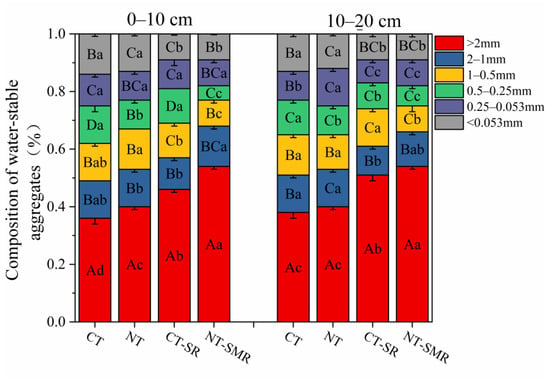
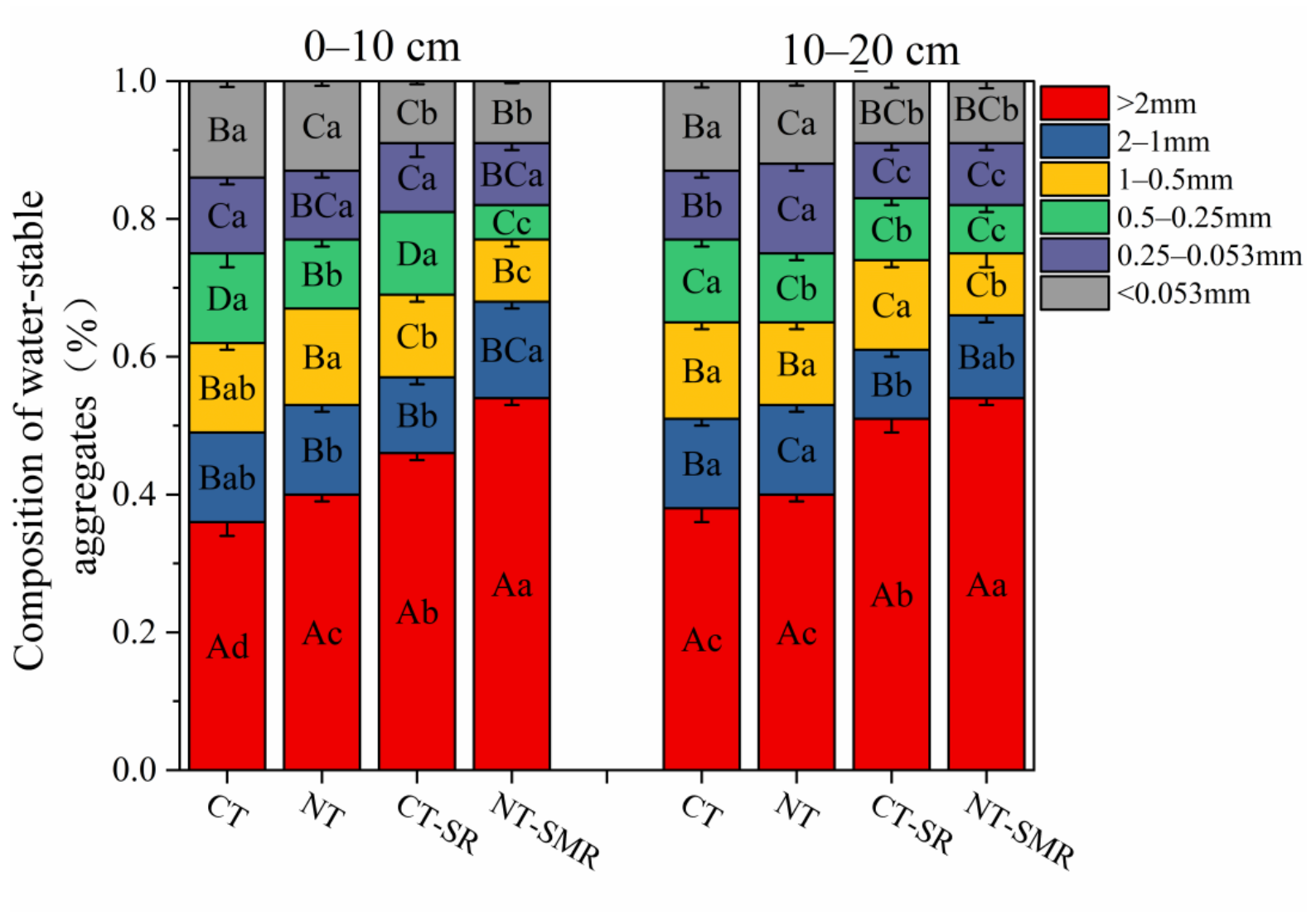
In the 0–10 cm layer, no-tillage significantly increased >2 mm and 1–2 mm aggregates by 15.6% and 13.2%, while significantly decreasing 0.25–0.5 mm aggregates by 43.5% compared to conventional tillage. Straw returned significantly increased >2 mm aggregates by 32.3% and decreased <0.053 mm aggregates by 33.7% (Figure 3). The application of no-tillage resulted in a 6.5% increase in >2 mm aggregates and a 20.1% decrease in the 0.25–0.5 mm fraction in 10–20 cm. Straw return, on the other hand, led to a substantial 34.7% increase in >2 mm aggregates, accompanied by significant reductions of 13.8% in 1–2 mm, 23.9% in 0.25–0.5 mm, 26.4% in 0.053–0.25 mm, and 28.9% in <0.053 mm aggregates. Taken together, the application of no-tillage and straw return significantly enhanced the formation of large aggregates (>2 mm) and concurrently lowered the proportion of the smallest micro-aggregates (<0.053 mm).
Figure 3.
This figure presents the composition of soil water-stable aggregates under different combinations of tillage and straw return. Abbreviations: CT, conventional tillage; NT, no-tillage; CT-SR, conventional tillage with straw incorporation; NT-SMR, no-tillage with straw mulch return. For each treatment, different uppercase letters indicate significant differences (p < 0.05) among aggregate size fractions, while for each aggregate size. The presence of different lowercase letters denotes a statistically significant difference between treatments at the α = 0.05 level.
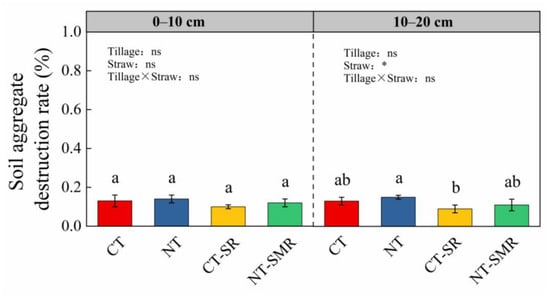
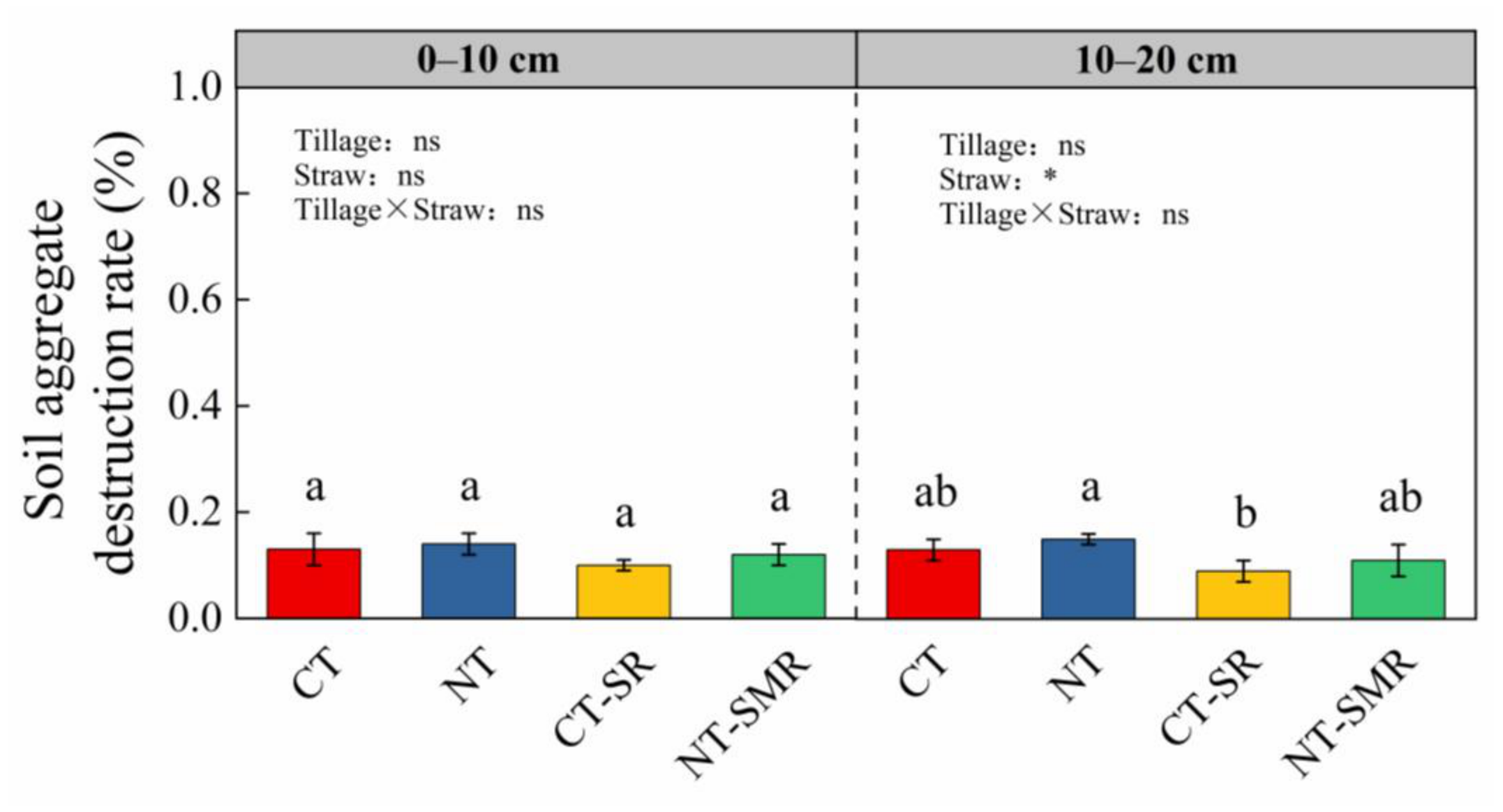
Tillage practices significantly affected the values of GMD, MWD, and D in the 0–10 cm soil layer. No-tillage significantly increased GMD and MWD and significantly decreased D by 13.1% and 23.9%, respectively, compared to conventional tillage. By contrast, the parameters GMD, MWD, R>0.25, and D were all significantly affected by straw return. Specifically, when compared to straw removal, straw return led to significant increases of 25.2% in GMD, 56.1% in MWD, and 7.9% in R>0.25, as well as a significant decrease of 3.9% in D. The interaction of tillage and straw did not significantly affect GMD, MWD, R>0.25, D, and PAD (Table 2 and Figure 4). At 10–20 cm, tillage practices significantly affected only MWD; no-tillage increased MWD by 5.2% compared to conventional tillage. Whereas straw return significantly affected GMD, MWD, R>0.25, D, and PAD. Straw return led to significant increases of 26.7% in GMD, 58.1% in MWD, and 8.9% in R>0.25 compared to straw removal, as well as significant reductions in both D and PAD. Meanwhile, the tillage × straw interaction did not significantly affect GMD, MWD, R>0.25, D, or PAD.
Table 2.
Changes in water-stable aggregate stability induced by different tillage and straw return regimes.
Figure 4.
How different tillage and straw return methods affect the soil aggregate destruction rate. Treatments include conventional tillage (CT), no-tillage (NT), conventional tillage with straw incorporation (CT-SR), and no-tillage with straw mulch return (NT-SMR). Significant differences among treatments (p < 0.05) for each aggregate size class are denoted by different lowercase letters. The symbol * indicates significance at the 0.05 level. The abbreviation “ns” is used here to denote the absence of a significant difference.
3.3. Soil Active Organic Carbon Pools
3.3.1. Soil Organic Carbon
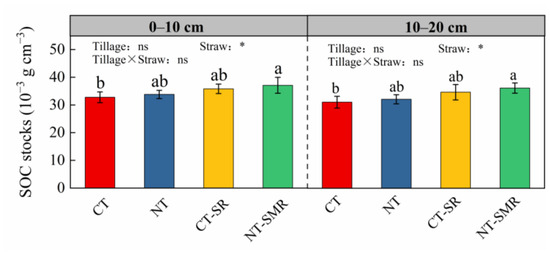
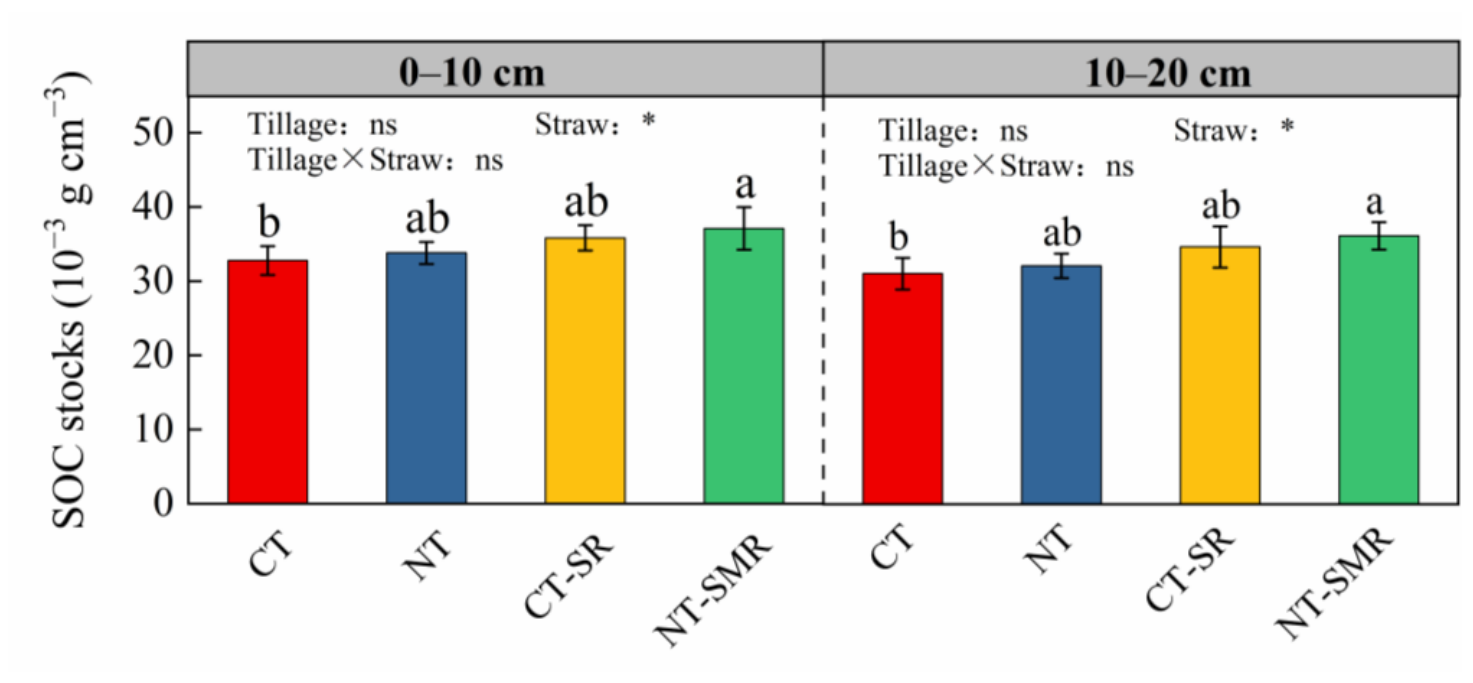
In the top 20 cm of soil, NT-SMR produced the highest SOC stock, which was 14.8% greater than the value recorded under CT. SOC stock was significantly influenced only by straw return, with a 10.8% increase compared to straw removal (Figure 5).
Figure 5.
Responses of soil organic carbon stocks to diverse tillage and straw incorporation regimes. Treatments: CT (conventional tillage), NT (no-tillage), CT-SR (conventional + straw) and NT-SMR (no-tillage + straw mulch). Significant differences among treatments (p < 0.05) for each aggregate size class are denoted by different lowercase letters. The symbol * indicates significance at the 0.05 level. The abbreviation “ns” is used here to denote the absence of a significant difference.
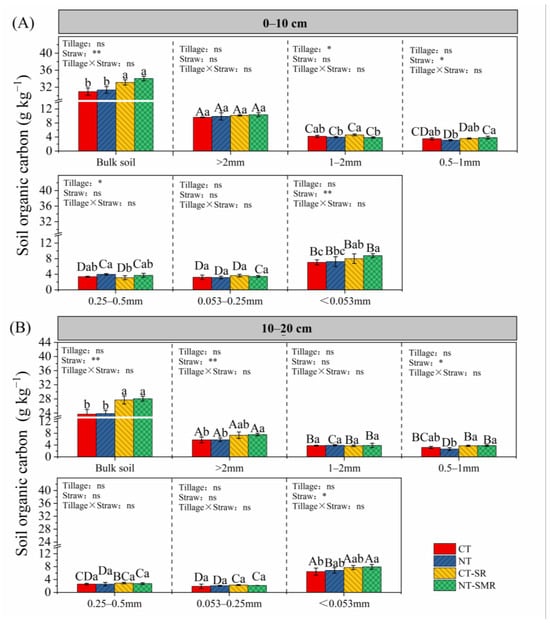
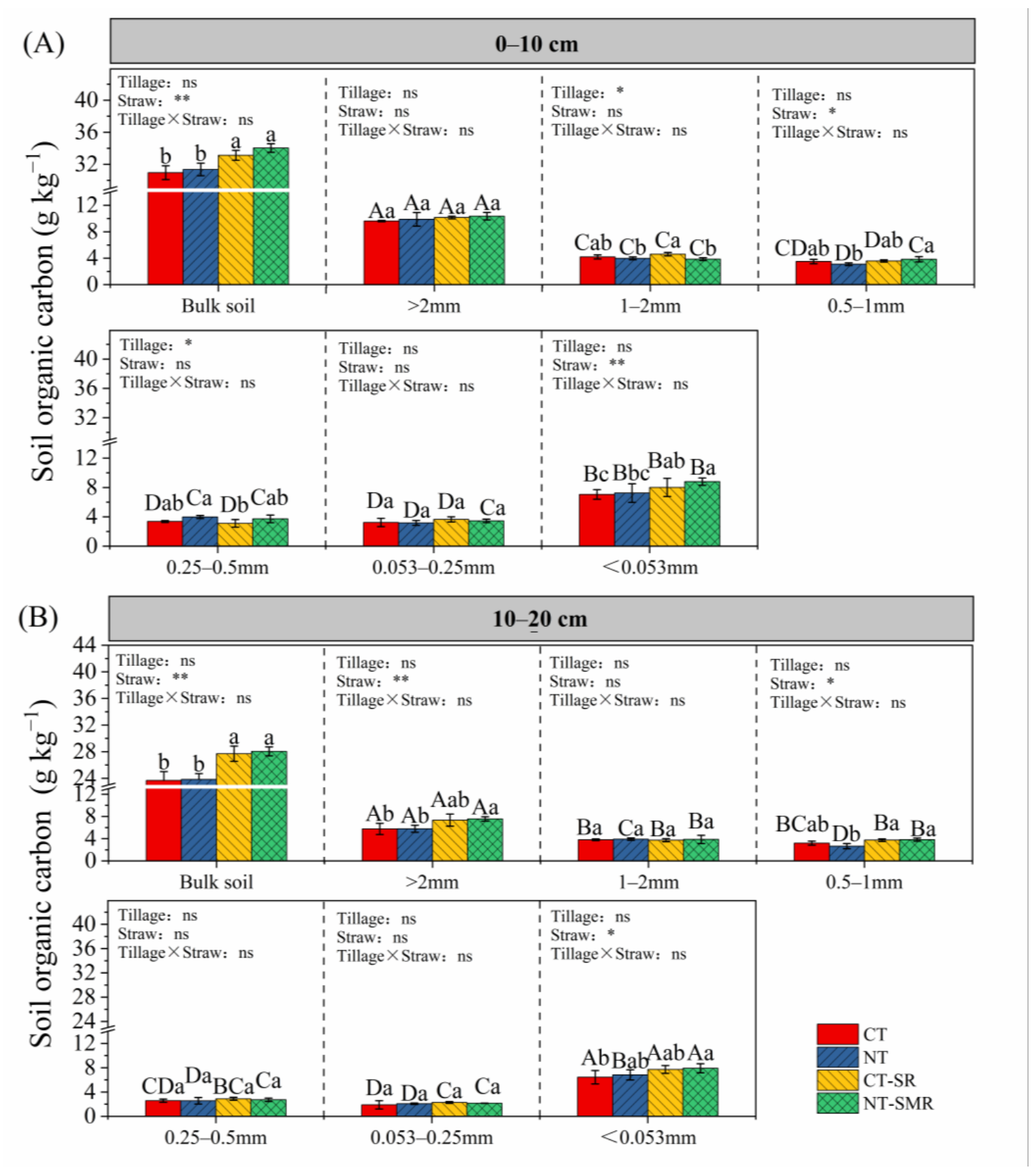
The SOC content in >2 mm and <0.053 mm aggregates was significantly higher than that in aggregates of other particle sizes in the 0–10 cm layer. Together, they account for 53.8–56.3% of the total organic carbon. Repeated ANOVA showed that tillage practices had a significant effect on 1–2 mm and 0.25–0.5 mm SOC content (Figure 5). When compared to conventional tillage, the application of no-tillage led to an 8.9% decrease in SOC content within 1–2 mm aggregates, while increasing SOC content in the 0.25–0.5 mm aggregate fraction by 19.0%. Straw return increased the SOC content of A and all particle size aggregates, except for 0.25–0.5 mm aggregates. Repeated ANOVA showed that tillage practices had a significant effect on bulk soil, 0.5–1 mm and <0.053 mm SOC concentrations (Figure 5). Straw return led to substantial increases in SOC content. In bulk soil and in the 0.5–1 mm and <0.053 mm aggregate fractions, the enhancement ranged from 7.8% to 59.3%. According to repeated-measures ANOVA, the combined effect of tillage and straw management on SOC content was not statistically significant.
Aggregates larger than 2 mm and smaller than 0.053 mm exhibited significantly higher SOC concentrations compared to all other aggregate size classes in the 10–20 cm soil layer. These two fractions together comprised 51.5–55.2% of the total organic carbon. Repeated ANOVA showed that tillage practices left the organic carbon content of bulk soil statistically unchanged or of all particle-size aggregates. However, organic carbon gains of 3.5% (1–2 mm), 1.4% (0.053–0.25 mm), and 3.2% (<0.053 mm) were observed for NT relative to CT (Figure 6). Straw return significantly affected the SOC content. This effect was evident in bulk soil as well as in aggregates sized >2 mm, 0.5–1 mm, and <0.053 mm. When compared to straw removal, straw return led to increases of 17.4% in bulk soil SOC, and 29.0%, 29.2%, and 17.9% in the >2 mm, 0.5–1 mm, and <0.053 mm aggregate fractions, respectively. A significant tillage × straw interaction was detected only for bulk soil, >2 mm aggregates, <0.053 mm aggregates, and SOC. According to repeated-measures ANOVA, the interaction between tillage and straw did not significantly affect SOC concentrations.
Figure 6.
Soil organic carbon (SOC) content as affected by various tillage and straw return regimes. (A) 0–10 cm soil layer; (B) 10–20 cm soil layer. Treatments: CT (conventional tillage), NT (no-tillage), CT-SR (conventional + straw) and NT-SMR (no-tillage + straw mulch). Different uppercase letters indicate p < 0.05 among aggregate sizes within a treatment; different lowercase letters indicate p < 0.05 among treatments within a size fraction. The symbols * and ** indicate significance at the 0.05 and 0.01 levels, respectively. The abbreviation “ns” is used here to denote the absence of a significant difference.
3.3.2. Particulate Organic Carbon Content
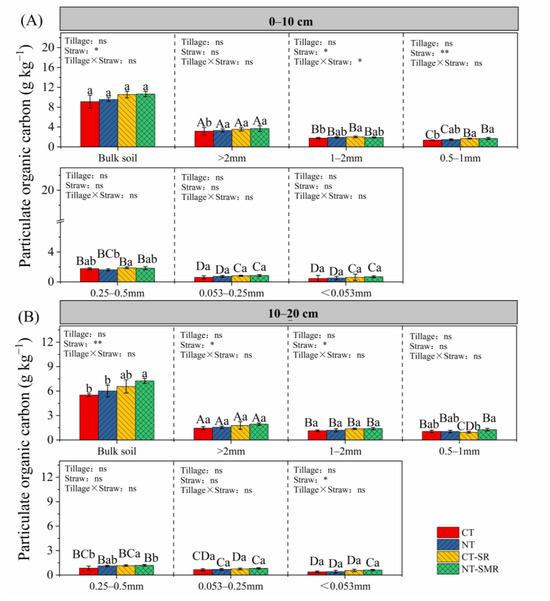
The majority of particulate organic carbon (POC) was distributed in aggregates exceeding 0.25 mm in size. Specifically, the POC content in the >0.25 mm fraction represented 85.6–88.4% of the total POC in the 0–10 cm soil layer (Figure 7). According to repeated-measures ANOVA, tillage methods had no significant influence on POC content in either bulk soil or any of the aggregate size classes. However, no-tillage increased bulk soil and all particle-size aggregate POC content, except for the 0.25–0.5 mm fraction, compared to conventional tillage. The application of straw return had a significant impact on POC content in bulk soil and in the 1–2 mm and 0.5–1 mm aggregate fractions. When compared to straw removal, straw return led to increases of 13.7% in bulk soil POC, 6.3% in POC of 1–2 mm aggregates, and 19.9% in POC of 0.5–1 mm aggregates.
Figure 7.
Particulate organic carbon (POC) content as affected by various tillage and straw return regimes. (A) 0–10 cm soil layer; (B) 10–20 cm soil layer. CT (conventional tillage), NT (no-tillage), CT-SR (conventional + straw) and NT-SMR (no-tillage + straw mulch). Different uppercase letters indicate p < 0.05 among aggregate sizes within a treatment; different lowercase letters indicate p < 0.05 among treatments within a size fraction. The symbols * and ** indicate significance at the 0.05 and 0.01 levels, respectively. The abbreviation “ns” is used here to denote the absence of a significant difference.
The POC content in >2 mm and 1–2 mm aggregate size was significantly higher than that in other particle-size fractions in the 10–20 cm layer. POC was predominantly distributed in large aggregates (>0.25 mm), which accounted for 80.1–81.7% of the total POC (Figure 7). No-tillage increased the POC content of bulk soil, >2 mm, 1–2 mm, 0.25–0.5 mm, 0.053–0.25 mm, and <0.053 mm aggregates by 9.1%, 8.3%, 5.3%, 32.1%, 4.5%, and 7.9%, respectively, compared to conventional tillage. Straw return significantly altered POC levels in bulk soil and in the >2 mm, 1–2 mm, and <0.053 mm aggregate fractions. When compared to straw removal, the application of straw return led to increases in POC content of 20.0% in bulk soil, 23.5% in >2 mm aggregates, 19.4% in 1–2 mm aggregates fractions, and 48.1% in <0.053 mm aggregates. According to repeated-measures ANOVA, the interaction between tillage and straw did not significantly affect POC content. Furthermore, NT-SMR significantly raised bulk soil POC content by 31.6% and 21.6% relative to CT and NT, respectively.
3.3.3. Mineral-Associated Organic Carbon
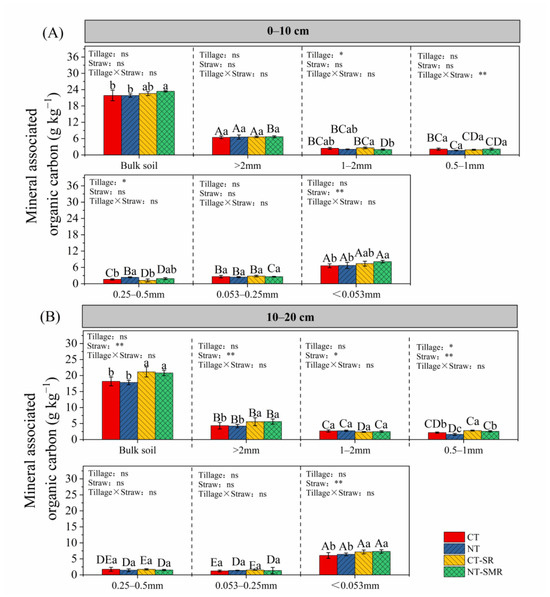
In the 0–10 cm layer, mineral-associated organic carbon (MAOC) was predominantly distributed in the >2 mm and <0.053 mm aggregate fractions. Collectively, these aggregates comprised 59.8–63.3% of the total organic carbon. Furthermore, the MAOC content associated with the was significantly affected by tillage practices (Figure 8). No-tillage decreased the MAOC content of 1–2 mm aggregates by 19.8% and increased the 0.25–0.5 mm aggregates by 50.9%, respectively, compared with conventional tillage. Straw return significantly affected the MAOC of <0.053 mm aggregates. A 16.4% increase in MAOC content of <0.053 mm aggregates was observed under straw return compared to straw removal. Repeated ANOVA showed that the tillage-straw interaction did not significantly affect MAOC content. In comparison to both CT and NT, NT-SMR increased the MAOC content of bulk soil by 3.6–7.1% and that of <0.053 mm aggregates by 9.9–23.7%. The same ranges of increase (3.6–7.1% for bulk soil and 9.9–23.7% for <0.053 mm aggregates) were also observed when NT-SMR was compared to CT-SR.
Figure 8.
Mineral-associated organic carbon (MAOC) content as affected by various tillage and straw return regimes. (A) 0–10 cm soil layer; (B) 10–20 cm soil layer. CT (conventional tillage), NT (no-tillage), CT-SR (conventional + straw) and NT-SMR (no-tillage + straw mulch). Different uppercase letters indicate p < 0.05 among aggregate sizes within a treatment; different lowercase letters indicate p < 0.05 among treatments within a size fraction. The symbols * and ** indicate significance at the 0.05 and 0.01 levels, respectively. The abbreviation “ns” is used here to denote the absence of a significant difference.
Within the 10–20 cm soil layer, aggregates exceeding 0.053 mm in diameter exhibited significantly higher MAOC concentrations compared to all other aggregate size classes. The majority of MAOC was associated with aggregates larger than 2 mm and smaller than 0.053 mm, comprising 57.1–62.1% of the total MAOC content. Additionally, the MAOC content of the 0.5–1 mm aggregate fraction was significantly affected by tillage practices (Figure 8). When compared to conventional tillage, the application of no-tillage resulted in a 15.4% decrease in MAOC content within the 0.5–1 mm aggregates. The application of straw return had a significant impact on MAOC content in bulk soil and in the following size classes: >2, 1–2, 0.5–1, and <0.053 mm. When compared to straw removal, the application of straw return led to increases in MAOC content of 16.5% in bulk soil, 31.0% in >2 mm aggregates, 41.9% in 0.5–1 mm aggregates, and 15.9% in <0.053 mm aggregates. In contrast, MAOC content in the 1–2 mm aggregate fraction decreased by 16.5%. Repeated ANOVA showed that the tillage-straw interaction did not significantly affect MAOC content. When compared to both CT and NT, the NT-SMR treatment resulted in increases in MAOC content ranging from 14.5% to 16.7% in bulk soil, 29.9% to 33.0% in >2 mm aggregates, and 13.9% to 20.6% in <0.053 mm aggregates.
3.4. Correlations Among Soil Aggregate Composition, Aggregate Stability, and Soil Reactive Organic Carbon Pools
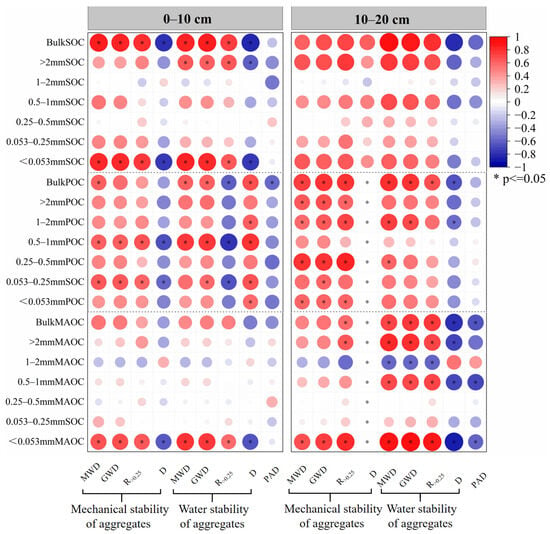
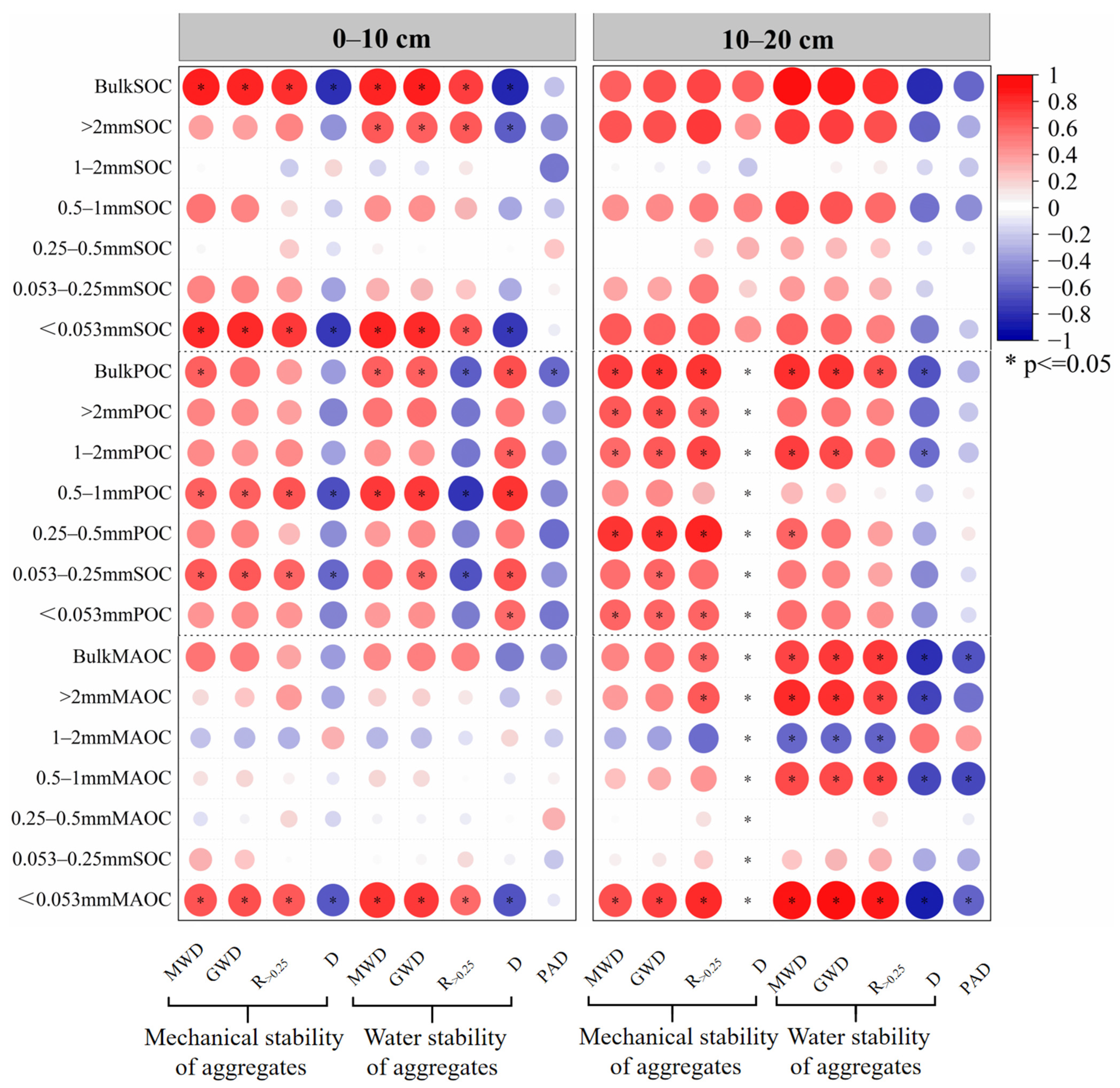
Correlation analysis indicated that both bulk soil organic carbon and SOC associated with <0.053 mm aggregates were significantly positively associated with MWD, GMD, and R>0.25 (for both mechanical and water-stable aggregates), while exhibiting significant negative associations with D in the 0–10 cm layer (Figure 9). Bulk particulate organic carbon (POC) was significantly correlated with MWD, GMD, R>0.25, and D of water-stable aggregates. The POC content in the 0.5–1 and 0.053–0.25 mm aggregate fractions showed significant correlations with MWD, GMD, R>0.25, and D of both mechanical and water-stable aggregates. Additionally, across both mechanical and water-stable aggregates, MAOC in the <0.053 mm fraction was positively and significantly associated with MWD, GMD, and R > 0.25, yet exhibited the opposite relationship with D.
Figure 9.
Correlation analysis between soil organic carbon (including its fractions) and how aggregates are distributed by size and how stable they are. * denotes significance (p < 0.05). MWD: mean weight diameter; GMD: geometric mean diameter; D: fractal dimension; R>0.25: percentage of >0.25 mm water-stable aggregates; PAD: rate of aggregate destruction.
Significant positive correlations were observed between bulk SOC, >2 mm SOC, and <0.053 mm SOC and these stability metrics (MWD, GMD, and R>0.25) for both mechanical and water-stable aggregates (Figure 9) in the 10–20 cm layer. Bulk POC and >0.5 mm POC were significantly positively correlated with MWD, GMD, and R>0.25 in mechanical aggregates. Similarly, bulk MAOC and >0.5 mm MAOC showed significant positive correlations with MWD, GMD, and R>0.25 in water-stable aggregates. Furthermore, <0.053 mm MAOC exhibited positive dependence on these stability metrics (MWD, GMD, and R>0.25) across both mechanical and water-stable aggregates, while being significantly negatively correlated with D.
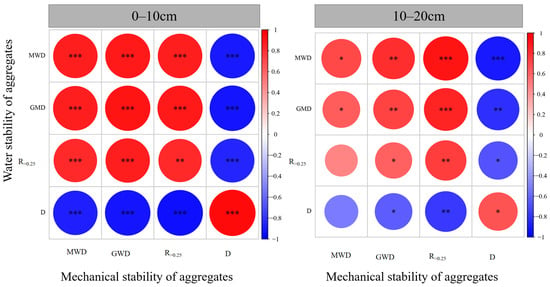
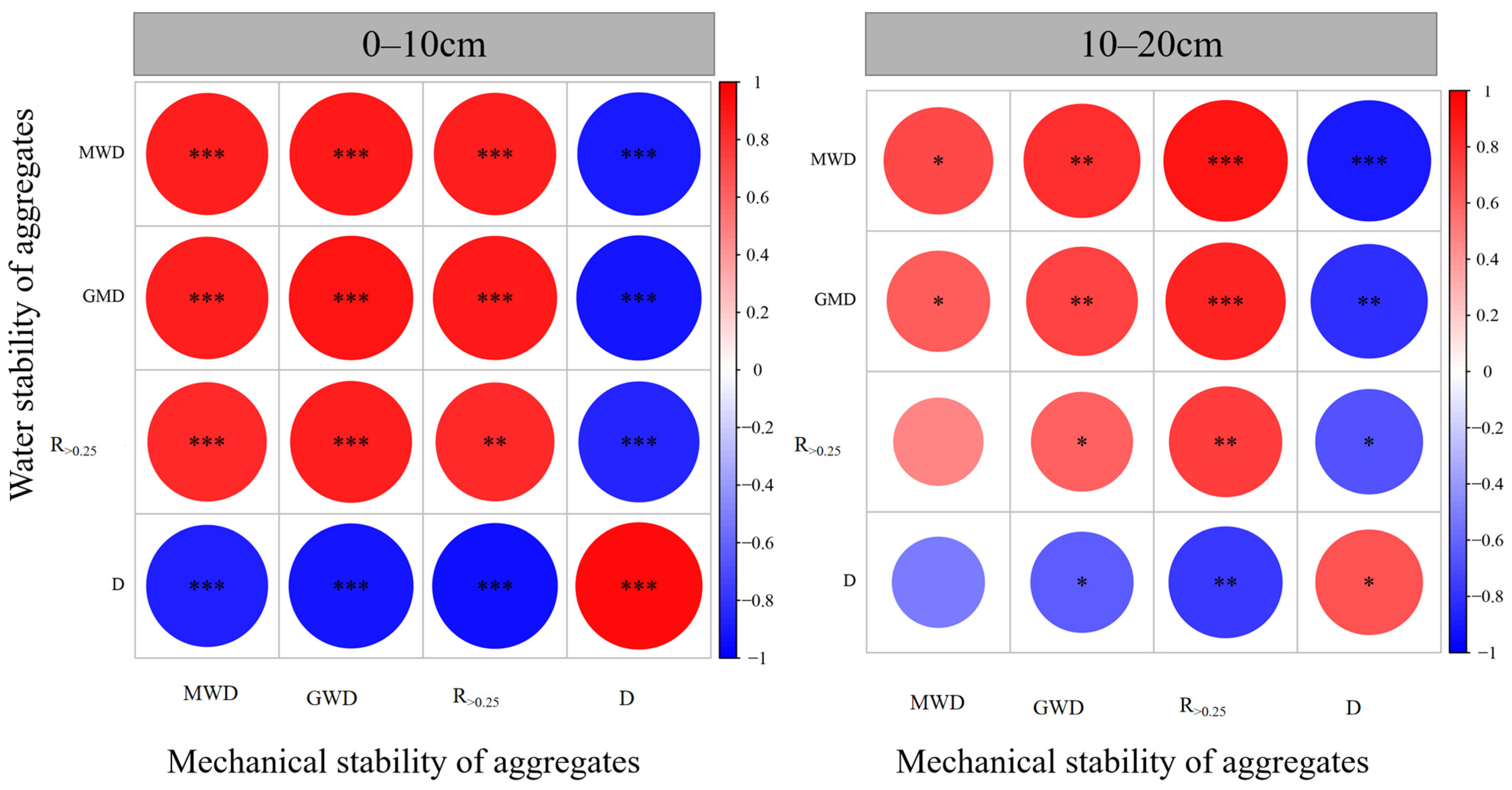
Within the 0–10 cm depth interval, aggregate water stability and mechanical stability exhibited a significant correlation. By contrast, at 10–20 cm depth, the mean weight diameter (MWD) of mechanically stable aggregates was not significantly correlated with either the R>0.25 value or the fractal dimension (D) of water-stable aggregates. This may be because, in the 0–10 cm layer, abundant organic matter and active bio-physicochemical processes (e.g., dry-wet cycles and tillage mixing) promote both the water stability and mechanical stability of aggregates, leading to their synergistic variation. In the deeper layer (10–20 cm), organic matter content declines markedly, and the formation of aggregates is progressively controlled by mineral-associated processes or physical compaction. As the key factors influencing mechanical and water stability diverge, the correlation between these two stability types is no longer statistically significant (Figure 10).
Figure 10.
Correlation analysis of mechanical stability and water stability of aggregates. *, **, and *** indicate a significant difference at the 0.05, 0.01, and 0.001 level. MWD, mean weight diameter; GMD, geometric mean diameter; D, fractal dimension; R>0.25, >0.25 mm water-stable aggregates content.
4. Discussions
4.1. Soil Aggregate Stability as Influenced by Diverse Tillage and Straw Return Practices
Aggregate mechanical stability quantifies the resistance of soil to physical disruption, such as that caused by tillage or wind erosion under different tillage and straw management methods. Water stability is used to assess the soil’s resistance to water erosion and dispersion by heavy rainfall, and indirectly reflects the cementing effect of organic matter and the stability of soil structure. The combination of both provides a comprehensive characterization of the soil’s resistance to structural degradation. Particle-size distribution largely determines soil aggregate characteristics. Stability indices (GMD, MWD, and R>0.25, D) further describe the behavior of both mechanical and water-stable aggregates [16]. When GMD, MWD, and R are larger, soil aggregates are more stable, indicating a better ability of the soil to resist degradation. When D is smaller, soil aggregates are more stable, and soil structure is better. In our study, no-tillage or straw return increased soil mechanical aggregate stability (Table 1). This is because no-tillage reduces soil disturbance from tillage compared to conventional tillage and also reduces wind and water erosion, which are more favorable to aggregate formation. And straw returning increased the amount of cementing material and promoted the aggregation of soil microaggregates into macroaggregates. The transformation of microaggregates into macroaggregates, driven by no-tillage and straw return, was observed to result from changes in the particle-size distribution of soil aggregates [17]. Moreover, no-tillage was observed to increase MWD and R > 0.25 in the 0–10 cm layer while reducing D. By contrast, straw return elevated GMD, MWD, and R > 0.25, and significantly decreased D (Table 1). Consistent with these results, another study demonstrated that straw return and no-tillage systems had a significant impact on MWD within the 0–20 cm soil profile [18]. Hence, no-tillage combined with straw return leads to changes in the particle-size distribution of paddy soil aggregates, which in turn promotes aggregate stability [19].
There is a close link between the stability of soil water-stable aggregates and the ability of soil to resist erosion. There was a positive relationship between soil water-stable aggregate stability and GMD, MWD, and R>0.25, whereas D and PAD were negatively related to it [20]. In this study, no-tillage or straw return had a significant effect on increasing the GMD and MWD of water-stable aggregates, decreasing D, and consequently improving the stability of soil water-stable aggregates (Table 2). This suggests that soil structure is more resistant to external erosion under no-tillage and straw return [21]. In addition, no-tillage and straw return promoted the growth of underground root systems and increased soil organic matter content, which may have further enhanced soil particle aggregation [22]. Findings from an eight-year study indicated that soil aggregate MWD and GMD were significantly altered by tillage practices, with straw return also affecting these parameters (Table 2). Consistent with this finding, related studies have shown that organic residues promote soil aggregate formation [23]. Straw return was found to both increase the stability of soil aggregates and markedly enhance other critical soil physicochemical properties [24]. In addition, in this study, we found that there was a more pronounced difference in the nature of aggregates at 0–10 cm vs. 10–20 cm (Table 1 and Table 2), which may be related to the fact that no-tillage and straw mulching mainly affect the topsoil [10]. We additionally observed that aggregate stability correlated significantly with organic carbon content (Figure 9), which indicates that the cementing material constitutes an important determinant of aggregate stability. While various tillage and straw practices were compared for their influence on aggregates varied, no-tillage and straw return proved more favorable for enhancing soil structure in the long run compared to tillage and straw removal.
4.2. Influences of Tillage and Straw Regimes on the SOC Pool
No-tillage and straw return were shown to increase SOC content in the 0–20 cm soil layer (Figure 5). No-tillage and straw return likely decrease soil disturbance and improve soil structure, improve soil structure, and promote microbial activity, which in turn elevates organic carbon levels [25]. Similar to this study, NT treatment was observed to increase SOC content in the 0–30 cm soil layer [26]. Meanwhile, another study found that crop cultivation practices and residue management led to a marked increase in organic carbon at depths of 0–15 cm and 15–30 cm after five years [27].
As important components of soil organic carbon, POC and MAOC both vary with changes in total organic carbon. POC, being a transitional form in the process from fresh organic matter to humus, is widely recognized as a key indicator of soil fertility. Its formation is promoted by the return to the field. In contrast, MAOC is protected by soil clay and powder particles, has a long turnover time, and is often targeted for soil carbon sequestration. Our study revealed that straw return led to an increase in MAOC content within the 0–20 cm depth (Figure 8). This is because the addition of organic matter promotes microbial activity, and microbial residual carbon is a major component of MAOC [28]. We also found that no-tillage increased MAOC and POC contents in 0–10 cm; and no-tillage increased POC and decreased MAOC in 10–20 cm (Figure 6 and Figure 7). The reason lies in POC’s vulnerability to changes in tillage practices, as tillage-induced soil compaction can quickly deplete POC.
Tillage may cause a redistribution of soil organic matter density components, which encourages the conversion of POC to MAOC, leading to a decline in MAOC at the 10–20 cm depth. No-tillage or straw return can change how much carbon is input and where it is distributed via root systems, increasing rhizosphere carbon inputs—a major pathway for MAOC formation. Exogenous carbon added to the soil can either enter the POC or MAOC pool, while the remainder is mineralized into the atmosphere [29]. The remainder may be unrelated to soil minerals, encapsulated in larger aggregates, and may go on to form the POM [30]. The unstable or low-molecular-weight fraction may be bound to soil minerals or encapsulated in microaggregates, forming MAOM [31]. Another portion of the carbon may be taken up by microbial communities, leading to increased microbial mass and necrotic residues. Subsequently, this microbial mass and necromass were formed from MAOC through two mechanisms: binding to soil minerals or becoming trapped inside microaggregates [32]. Consequently, this study suggests that straw incorporation represents an effective approach to both enhancing soil fertility and strengthening carbon sequestration in paddy field ecosystems. Specifically, when straw return is combined with no-tillage, a synergistic effect occurs, leading to increased soil organic carbon content and better soil structure.
4.3. Soil Aggregate Stability in Double-Cropping Rice Regions as Influenced by POC and MAOC
Previous studies have confirmed that particulate organic carbon (POC) is highly sensitive to temperature, with rising temperatures accelerating its microbial decomposition and mineralization [33]. The investigated region is situated in a subtropical monsoon climate, where warm conditions prevail year-round (mean annual temperature: 23.9 °C) and moisture levels are high, as reflected by an average annual precipitation of 1167.7 mm. This warm and humid environment stimulates microbial activity, leading to rapid consumption of POC as a labile carbon pool. It is therefore proposed that high temperature and high humidity are key drivers of the relatively low POC content and its significant variation in this region. These conditions shorten the mean residence time of soil POC and accelerate the turnover of the entire soil carbon pool. Given that POC serves as a key binding agent for macroaggregate formation, its rapid turnover under warm and humid conditions may directly affect soil aggregate stability. Specifically, the fast depletion of POC reduces the availability of organic binding agents that hold microaggregates together into macroaggregates, thereby weakening aggregate structural integrity in this double-cropping rice region.
In contrast to POC’s strong sensitivity to temperature, MAOC stability is more dependent on water-driven interactions between minerals and organic matter [33]. In the subtropical monsoon climate zone of this study, high temperatures may reduce MAOC formation efficiency by weakening mineral protection, whereas dry-season rainfall frequency is a key climatic factor promoting the accumulation of MAOC bound to iron and aluminum oxides. MAOC is more strongly associated with the fine mineral fraction and contributes primarily to microaggregate stability. Therefore, while rapid POC turnover under warm and humid conditions may destabilize larger macroaggregates, MAOC may sustain microaggregate stability through mineral–organic associations. The balance between these two carbon fractions—POC regulating macroaggregate stability via its binding effect and MAOC maintaining microaggregate stability via mineral protection—collectively determines the overall aggregate stability in the study region.
In summary, POC is primarily regulated by temperature and exhibits rapid turnover, whereas MAOC is more dependent on water-driven mineral protection mechanisms. The composition and stability of soil organic carbon in the region are jointly determined by the divergent responses of these two carbon fractions to climatic factors, which subsequently influence the formation, turnover, and stability of soil aggregates.
5. Conclusions
A 15-year long-term positional experiment was conducted in this study to assess the effects of different tillage and straw-returning practices on soil aggregate properties and organic carbon pools. Significant improvements in 0–20 cm aggregate stability and a 3.5–16.4% increase in soil total organic carbon stock were observed under no-tillage, straw mulching, and straw return practices. The significant correlations between soil aggregate properties (MWD, GMD, and R>0.25) and bulk SOC, >0.053 mm SOC, and >0.053 mm MAOC support the finding that MAOC within microaggregates is crucial for improving soil aggregate stability. Long-term application of a conservation tillage model featuring no-tillage and straw mulching was shown, under the experimental conditions of this study, to effectively enhance soil aggregate stability and facilitate organic carbon sequestration in double-season rice ecosystems. Therefore, this practice represents a promising option for improving rice soil quality and achieving sustainable management in similar agroecological contexts, although its broader applicability requires further validation across diverse site conditions, soil types, and longer-term studies.
Author Contributions
P.Y.: writing—review and editing, project administration, and conceptualization. J.Q.: writing—review and editing, writing—original draft, investigation, formal analysis, conceptualization. Y.H.: conceptualization, investigation, formal analysis. Y.Z.: investigation, formal analysis. L.J.: funding acquisition, conceptualization, and project administration. Y.C.: investigation. H.W.: investigation. S.X.: supervision, resources, conceptualization, and investigation. All authors have read and agreed to the published version of the manuscript.
Funding
Guangxi Key Research and Development Program (GUIKENONGAB2506910014).
Data Availability Statement
The original contributions presented in this study are included in the article. Further inquiries can be directed to the corresponding authors.
Conflicts of Interest
The authors declare that they have no known competing financial interests or personal relationships that could have appeared to influence the work reported in this paper. The authors declare no conflicts of interest.
Abbreviations
The following abbreviations are used in this manuscript:
| SOC | Soil organic carbon |
| POC | Particulate organic carbon |
| MAOC | Mineral-associated organic carbon |
| NT | No-tillage |
| CT | Conventional tillage |
| CT-SR | Conventional tillage with incorporated straw |
| NT-SMR | No-tillage with straw mulch |
| MWD | Mean weight diameter |
| GWD | Geometric mean diameter |
| PAD | Rate of aggregate destruction |
| D | Fractal dimension |
| R>0.25 | Percentages of >0.25 mm water-stable aggregate |
References
- Jouquet, P.; Dauber, J.; Lagerlof, J.; Lavelle, P.; Lepage, M. Soil invertebrates as ecosystem engineers: Intended and accidental effects on soil and feedback loops. Appl. Soil Ecol. 2006, 32, 153–164. [Google Scholar] [CrossRef] [Scilit]
- García, A.C.; van Tol de Castro, T.A.; Santos, L.A.; Tavares, O.C.H.; Castro, R.N.; Berbara, R.L.L.; García-Mina, J.M. Structure-property-function relationship of humic substances in modulating the root growth of plants: A review. J. Environ. Qual. 2019, 48, 1622–1632. [Google Scholar] [CrossRef] [Scilit]
- Hungria, M.; Franchini, J.C.; Brandao-Junior, O.; Kaschuk, G.; Souza, R.A. Soil microbial activity and crop sustainability in a long-term experiment with three soil tillage and two crop-rotati on systems. Appl. Soil Ecol. 2009, 42, 288–296. [Google Scholar] [CrossRef] [Scilit]
- Loss, A.; Lourenzi, C.R.; dos Santos, E.; Mergen, C.A.; Benedet, L.; Pereira, M.G.; de Cássia Piccolo, M.; Brunetto, G.; Lovato, P.E.; Comin, J.J. Carbon, nitrogen and natural abundance of 13 C and 15 N in biogenic and physicogenic aggregates in a soil with 10 years of pig manure application. Soil Till. Res. 2017, 166, 52–58. [Google Scholar] [CrossRef] [Scilit]
- Loss, A.; Pereira, M.G.; Costa, E.M.; Beutler, S.J. Soil fertility, physical and chemical organic matter fractions, natural 13C and 15N abundance in biogenic and physicogenic aggregates in areas under different land use systems. Soil Res. 2014, 52, 685–697. [Google Scholar] [CrossRef] [Scilit]
- de Moraes Sá, J.C.; Séguy, L.; Tivet, F.; Lal, R.; Bouzinac, S.; Borszowskei, P.R.; Briedis, C.; dos Santos, J.B.; da Cruz Hartman, D.; Bertoloni, C.G.; et al. Carbon depletion by plowing and its restoration by No-Till cropping systems in oxisols of subtropical and tropical agro-ecoregions in Brazil. Land Degrad. Dev. 2015, 26, v531–v543. [Google Scholar] [CrossRef] [Scilit]
- de Moraes, G.M.; Xavier, F.A.D.; Mendonça, E.D.; de Araújo, J.A.; de Oliveira, T.S. Chemical and structural characterization of soil humic substances under agroforestry and conventional systems. Rev. Bras. Cienc. Solo 2011, 35, 1597–1608. [Google Scholar] [CrossRef] [Scilit]
- Assunção, S.A.; Pereira, M.G.; Rosset, J.S.; Berbara, R.L.L.; García, A.C. Carbon input and the structural quality of soil organic matter as a function of agricultural management in a tropical climate region of Brazil. Sci. Total Environ. 2019, 658, 901–911. [Google Scholar] [CrossRef] [Scilit]
- Six, J.; Conant, R.T.; Paul, E.A.; Paustian, K. Stabilization mechanisms of soil organic matter: Implications for C-saturation of soils. Plant Soil 2002, 241, 155–176. [Google Scholar] [CrossRef] [Scilit]
- Derpsch, R.; Franzluebbers, A.J.; Duiker, S.W.; Reicosky, D.C.; Koeller, K.; Friedrich, T.; Weiss, K. Why do we need to standardize no-tillage research? Soil Till. Res. 2014, 137, 16–22. [Google Scholar] [CrossRef] [Scilit]
- Ferreira, C.D.; Neto, E.C.D.; Pereira, M.G.; Guedes, J.D.; Rosset, J.S.; dos Anjos, L.H.C. Dynamics of soil aggregation and organic carbon fractions over 23 years of no-till management. Soil Till. Res. 2020, 198, 104533. [Google Scholar] [CrossRef] [Scilit]
- Zheng, H.B.; Liu, W.R.; Zheng, J.Y.; Luo, Y.; Li, R.P.; Wang, H.; Qi, H. Effect of long-term tillage on soil aggregates and aggregate-associated carbon in black soil of Northeast China. PLoS ONE. 2018, 13, e0199523. [Google Scholar] [CrossRef] [Scilit]
- IUSS Working Group WRB. World Reference Base for Soil Resources 2014, Update 2015. International Soil Classification System for Naming Soils and Creating Legends for Soil Maps (World Soil Resources Reports No. 106); FAO: Rome, Italy, 2015. [Google Scholar]
- NY/T 1121.19-2008; Soil Testing. Part 19: Method for Determination of Soil Water Stable Macro-Aggregates Distribution. Ministry of Agriculture of the People’s Republic of China: Beijing, China, 2008.
- Liu, S.; Zhou, J.C.; Che, L.A.; Kuzyakov, Y.; Min, K.; Smith, P.; He, D.; Olesen, J.E.; Mueller, C.W.; Sun, S.Y.; et al. Divergent responses of particulate and mineral-associated organic carbon to permafrost degradation. Catena 2025, 261, 109527. [Google Scholar] [CrossRef] [Scilit]
- Tian, X.M.; Fan, H.; Wang, J.Q.; Ippolito, J.; Li, Y.B.; Feng, S.S.; An, M.J.; Zhang, F.H.; Wang, K.Y. Effect of polymer materials on soil structure and organic carbon under drip irrigation. Geoderma 2019, 340, 94–103. [Google Scholar] [CrossRef] [Scilit]
- Zhou, M.; Xiao, Y.; Zhang, X.Y.; Xiao, L.L.; Ding, G.W.; Cruse, R.M.; Liu, X.B. Fifteen years of conservation tillage increases soil aggregate stability by altering the contents and chemical composition of organic carbon fractions in Mollisols. Land Degrad. Dev. 2022, 33, 2932–2944. [Google Scholar] [CrossRef] [Scilit]
- Ferreira, C.D.; Guedes, J.D.; Rosset, J.S.; dos Anjos, L.H.C.; Pereira, M.G. Diversity of the edaphic macrofauna in areas managed under no-tillage for different periods. Semin. Cienc. Agrar. 2019, 40, 599–610. [Google Scholar] [CrossRef] [Scilit]
- Zhang, L.; Su, X.Y.; Meng, H.; Wang, H.; Yan, X.Y.; Qin, D.L.; Liu, C.M.; Men, Y.; Zhang, X.P.; Song, X.L.; et al. Long-term cotton stubble return and subsoiling improve soil organic carbon by changing the stability and organic carbon of soil aggregates in coastal saline fields. Soil Till. Res. 2024, 241, 106127. [Google Scholar] [CrossRef] [Scilit]
- Zhu, G.Y.; Shangguan, Z.P.; Deng, L. Soil aggregate stability and aggregate-associated carbon and nitrogen in natural restoration grassland and Chinese red pine plantation on the Loess Plateau. Catena 2017, 149, 253–260. [Google Scholar] [CrossRef] [Scilit]
- Cong, Z.J.; Gu, J.; Li, C.Q.; Li, F.; Li, F.M. Enhancing Soil Conditions and Maize Yield Efficiency through Rational Conservation Tillage in Aeolian Semi-Arid Regions: A TOPSIS Analysis. Water 2024, 16, 2228. [Google Scholar] [CrossRef] [Scilit]
- Moraes Sá, J.C.; Tivet, F.; Lal, R.; Briedis, C.; Hartman, D.C.; dos Santos, J.Z.; dos Santos, J.B. Long-term tillage systems impact on soil C dynamics, soil resilience and agronomic productivity of a Brazilian Oxisol. Soil Till. Res. 2014, 136, 38–50. [Google Scholar] [CrossRef] [Scilit]
- Bradford, M.A.; Wieder, W.R.; Bonan, G.B.; Fierer, N.; Raymond, P.A.; Crowther, T.W. Managing uncertainty in soil carbon feedbacks to climate change. Nat. Clim. Change 2016, 6, 758. [Google Scholar] [CrossRef] [Scilit]
- Wang, H.; Wang, S.L.; Yu, Q.; Zhang, Y.J.; Wang, R.; Li, J.; Wang, X.L. Ploughing/zero-tillage rotation regulates soil physicochemical properties and improves productivity of erodible soil in a residue return farming system. Land Degrad. Dev. 2021, 32, 1833–1843. [Google Scholar] [CrossRef] [Scilit]
- Liu, R.Z.; Zhao, X.Y.; Wang, L.J.; Zhang, X.; Hu, S.P.; Gao, J.L.; Yu, X.F.; Borjigin, Q. Coupled effects of straw return practices on soil microbial functional potential and agricultural productivity in Semi-Arid Region. Plant Soil 2026, 520, 121–139. [Google Scholar] [CrossRef] [Scilit]
- Cotrufo, M.F.; Ranalli, M.G.; Haddix, M.L.; Six, J.; Lugato, E. Soil carbon storage informed by particulate and mineral-associated organic matter. Nat. Geosci. 2019, 12, 989–994. [Google Scholar] [CrossRef] [Scilit]
- Kirkegaard, J.; Kirkby, C.; Oates, A.; van der Rijt, V.; Poile, G.; Conyers, M. Strategic tillage of a long-term, no-till soil has little impact on soil characteristics or crop growth over five years. Crop Pasture Sci. 2020, 71, 945–958. [Google Scholar] [CrossRef] [Scilit]
- Jia, C.Y.; Ding, X.X.; Han, X.Y.; Liu, C.F.; Li, X.J.; Zeng, X.F.; Xue, C.Y. nZVI-BC strengthens organic carbon sequestration driven by the modulation of soil microbial community and heavy metal speciation. J. Hazard. Mater. 2026, 504, 141371. [Google Scholar] [CrossRef] [Scilit]
- Kan, Z.R.; Ma, S.T.; Liu, Q.Y.; Liu, B.Y.; Virk, A.L.; Qi, J.Y.; Zhao, X.; Lal, R.; Zhang, H.L. Carbon sequestration and mineralization in soil aggregates under long-term conservation tillage in the North China Plain. Catena 2020, 18, 104428. [Google Scholar] [CrossRef] [Scilit]
- Zhang, X.Y.; Gou, Y.Z.; Zhang, X.J.; Guo, H.Y.; Wang, Y.D.; Shi, J.L.; Meng, X.T.; Tian, X.H. Nitrogen fertilization destabilizes soil structure but enhances macroaggregate-associated carbon and nitrogen under long-term straw incorporation: Insights from a 20-year field trial. Soil Till. Res. 2026, 257, 106975. [Google Scholar] [CrossRef] [Scilit]
- Shi, J.; Zhang, Z.Y.; Zhang, Z.Y.; Fan, Z.M.; Wang, X. Erosion-induced low carbon availability exacerbates carbon loss: Insights from microbial carbon allocation and the chemo-diversity of carbon. Catena 2025, 252, 108894. [Google Scholar] [CrossRef] [Scilit]
- Liang, C.; Amelung, W.; Lehmann, J.; Kästner, M. Quantitative assessment of microbial necromass contribution to soil organic matter. Glob. Change Biol. 2019, 25, 3578–3590. [Google Scholar] [CrossRef] [Scilit]
- Ma, Y.; Liu, J.Z.; Yan, H.; Guo, L.; Chen, J.; Zhang, F.; Jiang, Z.Y.; Xiao, X.; Liu, J.; Deng, W.B.; et al. Soil pH and temperature dominate topsoil particulate and mineral-associated organic carbon over the Yellow River Basin. Catena 2025, 259, 109381. [Google Scholar] [CrossRef] [Scilit]

Disclaimer/Publisher’s Note: The statements, opinions and data contained in all publications are solely those of the individual author(s) and contributor(s) and not of MDPI and/or the editor(s). MDPI and/or the editor(s) disclaim responsibility for any injury to people or property resulting from any ideas, methods, instructions or products referred to in the content. |
© 2026 by the authors. Licensee MDPI, Basel, Switzerland. This article is an open access article distributed under the terms and conditions of the Creative Commons Attribution (CC BY) license.