


Abstract
Ceratitis capitata (Diptera: Tephritidae), or medfly, is an invasive pest widespread in Argentina, where standardized management methods, such as cultural and chemical controls, are commonly implemented. The success in controlling medfly populations depends on implementing preventive, sustainable, long-term, and eco-friendly eradication/control strategies across all invaded environments. One strategy may involve augmentative biological control using parasitoids adapted to local conditions, such as Ganaspis pelleranoi (Brèthes) (Hymenoptera: Figitidae), a Neotropical-native parasitoid that mostly forages on tephritid larvae in a broad range of fallen fruit. Two hypotheses were tested in the current study: (1) G. pelleranoi females are more efficient in controlling medfly larvae infesting different fruits as the density of released females progressively increases, and (2) such parasitoid-induced host mortality capacity remains when host density is increased. Parasitism (reproductive effects) and additional host mortality (non-reproductive effects) were the indicator variables of parasitoid-induced host ability. Trials were performed in field cages (semi-field conditions) using two medfly-multiplier host fruit species, namely sour orange and peach, and with variations in both parasitoid release and host larval densities. Three major findings were highlighted: (1) G. pelleranoi females successfully parasitized host larvae on peach and sour orange, regardless of their strongly differing physical features, although medfly larvae in peaches were significantly more susceptible to the parasitoid; (2) medfly mortality significantly increased in both peach and sour orange relative to the gradual increase in released G. pelleranoi females, regardless of the increase in host density offered to parasitoids; and (3) G. pelleranoi females induced a substantially high host die-off rate when the additional mortality was added to the analysis, which was not revealed when parasitism alone was regarded as a medfly mortality variable. Such outcomes may provide relevant information for implementing an augmentative biological control against medfly using indigenous parasitoid species within an eco-friendly fruit fly pest management approach.
1. Introduction
Ceratitis capitata (Wiedemann, 1824) (Diptera: Tephritidae), commonly known as the Mediterranean fruit fly or medfly, is one of the major invasive pests affecting a broad range of commercially valuable fruit and vegetable crops worldwide [1,2]. Endemic to sub-Saharan Africa, the medfly has spread to temperate, subtropical, and tropical regions worldwide mainly due to its broad thermal tolerance and polyphagous and multivoltine nature [3,4]. More than 300 fruit species, many of agricultural importance, have been reported as medfly hosts in the world [5,6,7,8]. Medfly can cause direct and indirect damage to the fruit industry. The former involves damage to the skin of the fruit due to the female’s egg-laying and rotting of the fruit pulp caused by the larvae feeding on it [9]. The latter involves quarantine restrictions on the movement of fresh fruit imposed by importing countries [10]. Therefore, the medfly affects both the country’s local economy and its international trade. The first medfly detections in the Neotropical region were in South American countries, such as Brazil in 1901 and Argentina in 1934; then, in 1955, it was recorded in Central American countries [11]. In South America, the medfly is widely distributed across agro-ecosystems because environmental fragmentation and degradation, along with the introduction and spread of exotic fruit species, enabled its persistence and dissemination [12]. A combination of the pest’s high dispersal capacity and human-mediated pathways led to the medfly spreading throughout all Argentinean fruit-growing regions, covering latitudes from 22° to 45° S, from the northern border with Bolivia to southern Patagonia. Consequently, the medfly became one of the most damaging pests affecting fruit and vegetable crops in Argentina [13]. Therefore, in the early 1990s, the Argentine government implemented the National Fruit Fly Control and Eradication Programme (Spanish acronym: PROCEM) [14]. Current medfly mitigation actions involve an area-wide integrated fruit fly management (AW-IFFM) approach, particularly adapted to the agro-ecological and geographical characteristics of each Argentinean fruit-growing region. Integrated strategies nowadays include the sterile insect technique (SIT), mass trapping, and cultural, chemical, and biological controls, as well as quarantine measures through phytosanitary barriers [13].
Biological control using parasitoids has become a relevant complementary tool with other eco-friendly techniques for fruit-fly-integrated management in Latin America [15,16,17,18], particularly with the sterile insect technique [19], mass trapping [20], and novel bait spray [21]. This is mainly because there has been a growing trend over recent years towards sustainable farming practices to minimize environmental impact, preserve natural resources, and ensure long-term agricultural productivity [22,23]. Thus, including indigenous parasitoids for fruit fly biological control strengthens that up-and-coming trend even more [24,25,26,27]. One of the rising tactics of biological control is the augmentative method, which involves releasing large numbers of mass-reared natural enemies to achieve early control of the target pest [28,29]. This biological control approach has been used against fruit fly pests in various countries whose fruit production has been affected by these pests [15,18,30,31,32,33]. In this regard, releases of the Southeast-Asian-native larval parasitoid Diachasmimorpha longicaudata (Ashmead, 1905) (Hymenoptera: Braconidae) were performed in medfly-infested commercial fruit crops of San Juan, a province located in the central-western fruit-growing region of Argentina. Post-release data assessment demonstrated the success of mass releases of this exotic parasitoid species in reducing medfly populations in irrigated multi-fruit orchards under a dry environment with wide thermal variations [13]. Those promising outcomes with the exotic parasitoid D. longicaudata for medfly control encouraged further assessments of the Neotropical-native parasitoid species. One of these indigenous species is the larval parasitoid Ganaspis pelleranoi (Brèthes, 1924) (Hymenoptera: Figitidae), a generalist fruit fly parasitoid belonging to a guild of synovigenic, solitary, koinobiont endoparasitoids that parasitize mid- and late-instars of tephritid flies [34]. This figitid can successfully be reared on the larvae of both C. capitata and Neotropical-native Anastrepha fraterculus (Wiedemann, 1830) (Diptera: Tephritidae) [34,35,36,37], another economically important tephritid fruit fly species in Argentina [14]. In addition, G. pelleranoi can also produce offspring using the larvae of the pest tephritid species Anastrepha ludens (Loew, 1873) (Diptera: Tephritidae) under laboratory conditions [24]. This parasitoid is naturally associated with wild medfly populations in warm–humid, temperate–humid, and temperate–dry environments from the northwestern fruit-growing region of Argentina [38]. Although G. pelleranoi has long been regarded as a potential candidate for fruit fly biological control in the Americas [15], field cage and particularly open-field assessments of its effectiveness as a biocontrol agent have not been conducted to date.
Based on the G. pelleranoi bioecological features outlined above, a core research question arises: can G. pelleranoi effectively perform to reduce medfly population levels by increasing the number of released parasitoids? The parasitoid performance relates to the assessment of the host-killing effectiveness, i.e., the proportion of attacked hosts that die as a result of parasitization [39]. Thus, two conceptual hypotheses can be formulated in the face of this uncertainty: (1) G. pelleranoi females can find and kill medfly larvae infesting fruits of different physical features as the density of released parasitoid females in the tested patch increases, and (2) such medfly-killing capacity of G. pelleranoi females is sustained under variable host density conditions. Consequently, the overall aim of this study was to assess G. pelleranoi as a potential biological control agent of the exotic C. capitata through a gradual increase in the number of parasitoid females released under field cage (semi-field) conditions. In particular, three issues were tested: (1) the effect of increasing the density of released females on the parasitoid performance to reduce medfly emergence; (2) the parasitoid-induced medfly mortality based on the physical properties of two primary exotic host plants, namely Prunus persica (L.) Batsch (peach) (Rosaceae) and Citrus aurantium L. (sour orange) (Rutaceae); and (3) the potential effect of host larval density within both medium-sized (peach) and large-sized (orange) fruits on G. pelleranoi females’ performance. Both tested fruit species play an important role as reservoirs and multipliers of natural medfly populations in the Citrus-growing region of northern Argentina [40]. This study is framed within a renewed initiative to promote the use of a biological control to suppress fruit fly pest populations as an environmentally and human-health-friendly strategy. Therefore, the relevance of the findings is discussed in view of the potential use of this Neotropical-native figitid parasitoid species in augmentative [22,30,41] and conservative [25,42,43] fruit fly biological control programs scheduled or ongoing in Argentina and in the rest of the Latin American countries.
2. Materials and Methods
2.1. Source and Rearing of Insects
Both parasitoids and medflies were reared at the insectary of the Biological Control Department (BCD) from the Microbiological Industrial Processes and Biotechnology Pilot Plant (PROIMI, Spanish acronym). This scientific institution is located at 26°49′ S, 65°13′ W, at 452 m.a.s.l., in San Miguel de Tucumán, northwestern Argentina. The G. pelleranoi colony was initially established in November 2015 with individuals recovered from C. capitata puparia, which in turn were retrieved from feral peaches collected from the soil underneath the fruit tree. The fruit were taken from the Horco Molle Experimental Reserve (REHM, Spanish acronym), a protected wildlife area of the “Las Yungas” subtropical mountain rainforest belonging to the National University of Tucumán (UNT, Spanish acronym), located in Yerba Buena, Tucumán, at 26°55′ S and 65°05′ W, 600–800 m. The G. pelleranoi colony was held in 30 × 30 × 30 cm (length, width, and height) acrylic glass-structured, voile-fabric-covered cages at a density of 4000 parasitoid pairs per cage under 25 ± 1 °C; 75 ± 5% RH and a 12:12 (L:D) h photoperiod in a 6-m2 room under a lighting condition of 1200 lux provided by six fairly distributed 36W fluorescent light tubes. Each cage was provided with water and honey every other day. Once a day, 12 × 1.5 cm (diameter × height) voile-cloth-screen-covered dishes holding ca. 1000 lab-reared third-instar medfly larvae were placed inside each parasitoid rearing cage. After host exposure, medfly larvae were placed in plastic containers with 2 mm of sterilized vermiculite (Intersum®, Aislater S.R.L., Córdoba, Argentina) at the bottom as pupation medium. These containers were kept under lab conditions until both fly and parasitoid emergence. Medfly larvae were reared on an artificial diet consisting of wheat germ, sugar, brewer’s yeast, citric acid, agar-agar, vitamins, minerals, and preserving agents. Adult medflies were kept in the same cages and lab conditions as described above, and fed daily with a mixture of yeast hydrolysate enzymatic (MP Biomedicals, LLC, Solon, OH, USA), common refined sugar (Ledesma®, Buenos Aires, Argentina), vitamins A and E, and water. The G. pelleranoi cohorts used in field cage trials were the 26th generation under artificial rearing.
2.2. Study Timeframe, Experimental Location, and Environmental Conditions
Field cage trials were carried out in the BCD’s backyard between late November and mid-December in 2022, corresponding to late spring. The study was carried out at the time when the highest medfly population peak began to occur (late spring) in northwestern Argentina [40]. The PROIMI institution is located in the central piedmont sector of the Tucuman lowlands at the foot of the western mountains at altitudes ranging from 350 m to 500 m. The original native vegetation was characterized by a subtropical rainforest. However, residential neighborhoods and extensive citrus, soft fruits, sugar cane, and horticultural crops replaced it. The climate is humid and warm–temperate, with a rainy–warm season from October to April and a dry–cold season from May to September; its mean annual rainfall ranges between 1300 and 1600 mm, with a mean annual temperature of 18 °C [40]. Meteorological data, such as both mean temperature and relative humidity (RH), were provided by a digital weather station (LUFT®, model WS80, Shenzhen, China) during the trials. This station was located outside the field cages but only 1 m away from them. The weekly temperature and RH average data recorded during the testing date are shown in Table 1.
Table 1.
Minimum (=Min), maximum (=Max), and average temperature and relative humidity during field-cage trial dates between November and December 2022 (late spring).
2.3. Host Fruit Species Selection
Citrus aurantium and P. persica (unknown feral cultivars) were used during field cage trials. Such fruit species were selected because they are among the most widespread medfly wild host plants growing adjacent to commercial crops throughout the Citrus-producing areas of Argentina. Fruits were removed from the backyards of rural houses located within the REHM-UNT. Branches of all unsprayed fruit species trees, each containing 6–12 unripe fruits (small, green fruit), were covered with a cloth mesh to avoid early infestation by the medfly. Once the fruits were ripe, they were harvested and taken to the BCD’s laboratory. Fruit of similar size and ripeness degree per plant species were selected for use in the trials. Weight, rind thickness, and pulp depth were quantified for each fruit species. As such, those physical traits were 245.4 ± 3.5 gr, 7.4 ± 0.2 mm, 8.9 ± 0.5 cm for the sour orange (N = 100), and 49.6 ± 1.5 gr, 0.2 ± 0.1 mm, 2.5 ± 0.4 cm for the peach (N = 100).
2.4. Fruit Inoculation for Trials
Before the trials, the fruits were washed and sanitized with a sodium benzoate plus methylparaben solution. Then, the fruits were individually filled with 5-day-old (late second instar), lab-reared medfly larvae plus the diet on which they had been reared. Artificial infestation was performed by cutting the fruit in the middle using a sterilized scalpel. Then, a quarter of the pulp and liquid were removed from each fruit. The space shaped inside the fruit, ca. 50% of the fruit volume, was filled with the host larvae and their rearing diet. The peach stone was removed. Once the fruit was inoculated, both fruit sections, the small upper lid and the large lower section, were tightly fitted and linked together with a transparent silicone adhesive, Unipox®-brand hot melt glue (Unipox®, Lomas de Zamora, Buenos Aires, Argentina), which was melted with an electric silicone gun (Multitienda Mendoza, Mendoza, Argentina). Preliminary laboratory studies indicated that the use of the aforementioned silicone adhesive on the fruit did not affect the foraging behavior of the female parasitoids, as it did not interfere with the hosts’ detection, acceptance, and parasitization. Each inoculated fruit was an oviposition unit. After medfly larvae were put in each fruit, a 5 mm diameter sterilized metal rod was used to create eight equidistant equatorial punctures that simulated larval exit holes. These holes resemble cavities commonly found in fallen ripe fruit during surveys in natural environments [40]. The holes in the fruit were made because G. pelleranoi females could penetrate the fruit in search of larvae by biting through the epicarp and mesocarp but also through fissures or hollows already existing in the fallen fruit. The depth of such holes varied according to the rind thickness and pulp depth of each fruit species. In the sour orange, the holes were 6 cm deep, while in the peach, they were 2 cm deep. Puncturing occurred a few minutes before the trial started. The diet was added to the fruit in order to provide a feeding and acclimatization medium within the fruit for larvae previously reared on trays with an artificial diet, and to prevent the larvae from promptly exiting the fruit through the artificial punctures.
2.5. Experimental Setup
Field cage trials were performed to assess G. pelleranoi-induced medfly mortality in two key host fruit species under a natural free-foraging condition and the variations in both parasitoid female release and host larval densities. Trials were carried out inside 3.5 × 3.0 m cylindrical iron-framed, nylon-mesh-covered field cages. At 10 m above the roof of each field cage, both a 130 g/m2 black shade cloth, UV-resistant net (AGROREDES®, San Isidro, Buenos Aires, Argentina), to protect from direct sunlight, and a 100μ-translucent high-density plastic cover (AGROREDES®), to prevent rain falling directly on the cage, were installed. Five 60 × 200 cm galvanized wire-structured, white voile-fabric-covered, cylindrical cages were placed inside every main nylon field cage. Each internal experimental cage had a 1.5 m long zipper in its middle part to enter. A 1 m high potted peach or orange tree was placed inside each experimental cage to provide both a more natural environment and a larger surface area for parasitoid shelter. According to the experimental design, four, six, or eight artificially inoculated and punctured peaches or sour oranges were placed on the floor of each experimental cage equidistant from one another. Each fruit was placed into a 5 × 5 × 0.5 cm white expanded polystyrene tray, which was filled with a 0.5 cm layer of sterilized 8 mm thick expanded vermiculite on the bottom as a pupation substrate. Fruits were placed in a circle around the potted tree. Treatments involved three densities of medfly larvae per experiment and four densities of G. pelleranoi females released per experimental cage. Host larval densities used were 200, 300, and 400 lab-reared medfly larvae per experiment, which involved four, six, and eight fruit per tested species. Each fruit was inoculated with 50 medfly larvae. The same larval density per fruit species was used to homogenize the number of host larvae. The densities of G. pelleranoi females used were 20, 40, 80, and 160 parasitoid females per experimental cage. Host–parasitoid ratios per treatment are shown in Table 2.
Table 2.
Host–parasitoid ratios (h/p) per treatment based on the three testing medfly larval densities and the four released Ganaspis pelleranoi female densities.
Naïve, mated, 3–4 day-old parasitoid females were used in all trials. Controls, with no released parasitoids, were carried out to determine natural medfly emergence from both inoculated peach and sour orange. All four treatments involving different parasitoid release densities and the respective controls were carried out in the same main nylon field cage. Parasitoid females were released on the floor of the experimental cage around the potted tree and 2 cm away from the fruits. Parasitoids were allowed to forage on fruit for 48 h starting at 10:00 a.m. After the tests were finished, both the fruit and the vermiculite from the trays were removed and taken to the BCD’s laboratory. There, the fruits were dissected to remove living medfly larvae, and the vermiculite was sieved to recover puparia. Larvae and puparia from the same fruit and from each tray were placed into 10 × 7 cm plastic cups with sterilized vermiculite on the bottom as a pupation substrate, and with a voile-covered top. The cups were kept under lab conditions until the flies and parasitoids emerged. Numbers of emerged parasitoids, adult flies, and non-hatched puparia were recorded. Once the parasitoid emergence period was over, the non-hatched puparia were dissected to detect the presence or absence of immature parasitoid stages or non-emerged adult parasitoids. Dead puparia due to pathogens or unknown causes were also reported. All this information was used to calculate parasitism and estimate the additional host mortality (=AM) as indicators of the parasitoid-induced host mortality ability. Each treatment combination (fruit × host density × parasitoid density) was replicated 10 times, with a total of 240 experimental units. Controls (no parasitoid release) were also replicated 10 times. For each replicate, new inoculated fruits, pupation substrate, and parasitoid females were always used.
2.6. Data Analysis
The R-4.5.1 software was used for statistical analysis [44]. Statistical significance was set at α = 0.05. The parasitism was calculated using the formula: 100 × (number of emerged parasitoids + number of non-emerged parasitoids)/(total number of exposed hosts). The parasitism was analyzed using generalized linear mixed models (GLMMs) with a binomial error distribution and logit link function. Fruit type (peach and orange), host density (200, 300, and 400 hosts per cage), parasitoid release density (20, 40, 80, and 160 released parasitoids per cage), and their interactions were included as fixed effects. Data from controls were excluded from models to avoid complete separation arising from structural zeros (i.e., no parasitism occurs in the absence of parasitoids). The AM was also analyzed using GLMMs with a binomial error distribution and logit link function. Fruit type, host density, parasitoid release density (0, 20, 40, 80, and 160 released parasitoids per cage), and their interactions were included as fixed effects, while the experimental period and a random effect at the observation level were included as random intercepts. Controls were included in the AM models. The AM was derived on the response scale using model-based predictions from the fitted GLMM. Particularly, the AM was calculated as the difference between the predicted probability of host mortality in the treatment cages (presence of parasitoids) and the predicted probability of host mortality in the control cages (no parasitoids), for each fruit type × host density combination:
where denotes the marginal probability of host mortality predicted by the GLMM on the response scale. For reporting purposes, the AM was expressed in percentage points as follows:
The experimental period (a 2-day exposure time) was included as a randomized blocking factor. The residual overdispersion was accounted for by including a random effect at the observation level, consistent with standard practice for binomial GLMMs. The models were fitted using the glmmTMB package [45]. In order to assess whether host exposure to parasitoids caused additional mortality relative to baseline levels, hypothesis tests comparing the treatment group to the control group were conducted. For this purpose, estimated marginal means (EMMs) based on GLMMs of the dead host pupae were used. For each combination of fruit type × host density, each parasitoid release density was compared with the control. These comparisons tested the null hypothesis H0: ΔAM = 0 against the alternative H1: ΔAM ≠ 0, that is, whether exposure to parasitoids increased host mortality, in addition to parasitism, relative to controls. Tests were performed on the model’s linear predictor (logit) scale, reporting estimates, standard errors, z-statistics, and p-values. The p-values were adjusted using Sidak’s method for multiple comparisons within each fruit type × host density combination. EMMs and treatment vs. control contrasts were computed using the emmeans package [46]. Pairwise contrasts between different parasitoid density levels were then performed. Similarly, to compare the two fruit types within each combination of host and parasitoid density, EMMs were computed for fruit type within each treatment level, followed by pairwise contrasts. Contrasts were evaluated on the log-odds scale using Tukey’s adjusted method to control the family-wise error rate for multiple comparisons. Results are reported as odds ratios (ORs) with their corresponding standard errors, t-ratios, and p-values, providing a measure of effect size for each comparison. Data cleaning, transformation, and reshaping were performed with the tidyverse function, particularly the dplyr and tidyr packages [47]. Graphical representations were produced using the ggplot2 package [48]. In order to compare the host mortality recorded from parasitism alone with the combined effect of parasitism and the AM, a percentage-based metric was developed. This metric, hereafter referred to as parasitism + AM, was calculated by adding the percentage of parasitism to the corresponding AM, which was estimated for each treatment combination. The parasitism + AM metric was used as a descriptive index to combine successful parasitism and the mortality associated with the action of parasitoids into a single measure of the overall impact on the host. This index was used only for graphical comparisons between treatments and experimental runs and was not subjected to further inferential testing.
3. Results
3.1. Fruit Effect on Parasitism and Parasitism + AM
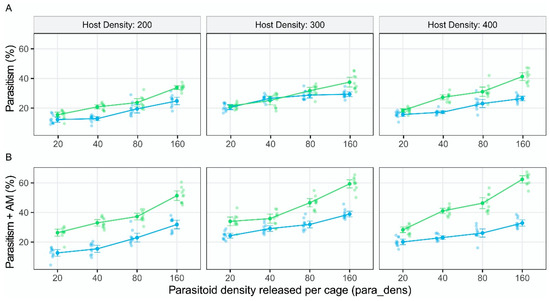
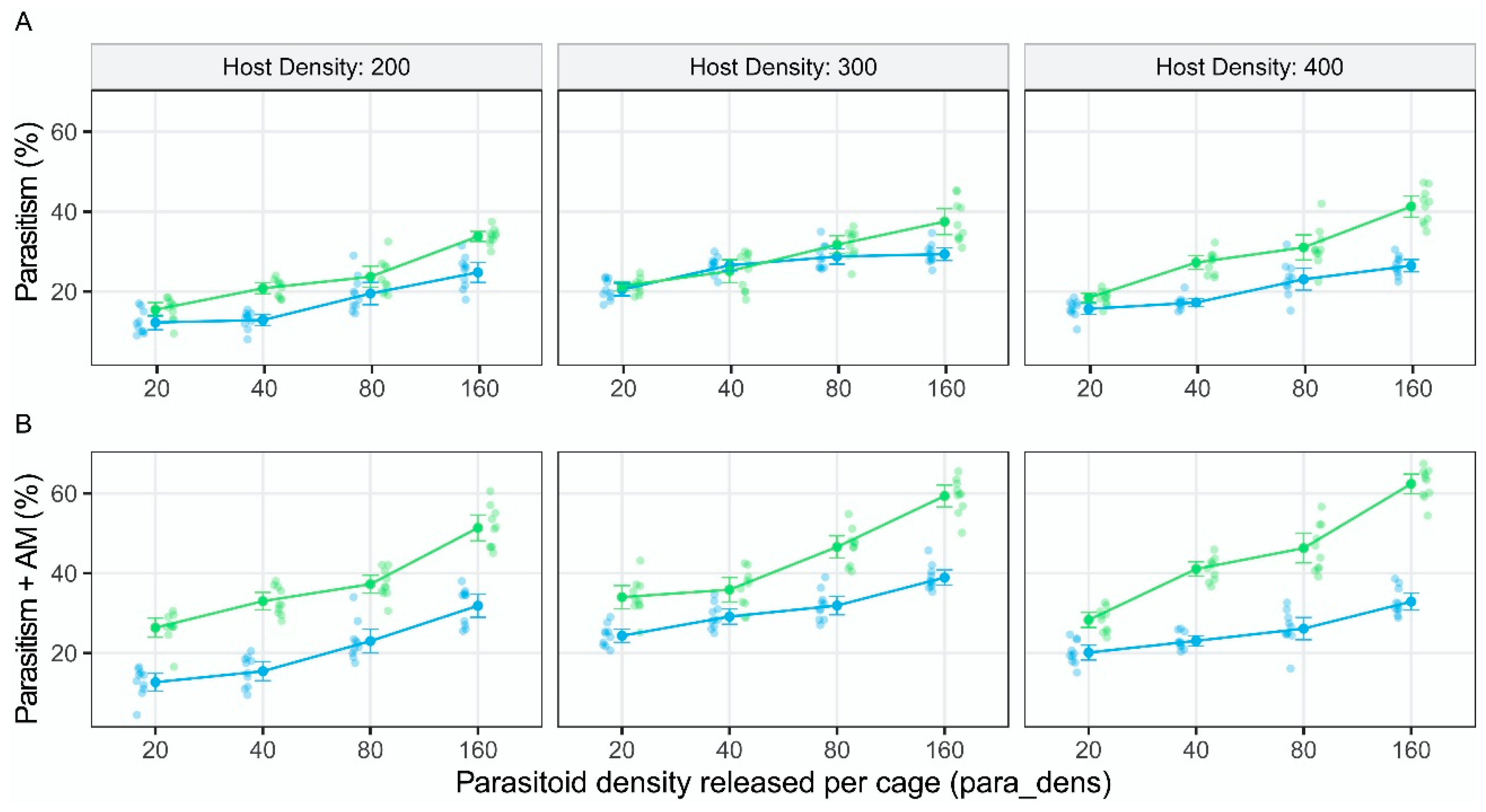
Parasitism fluctuated considerably across treatments, ranging from a minimum of 12.2% ± 0.8% (SE) to a maximum of 41.3% ± 1.1% (SE), and fruit type significantly affected this outcome. Parasitism odds were significantly lower in the orange than in the peach under the GLMM model’s reference conditions (β = −0.270, SE = 0.104, z = −2.596, p = 0.009), revealing a considerably lower incidence of parasitism in the orange relative to the peach. Pairwise fruit contrasts within each host density × parasitoid release density combination showed that the peach frequently had higher parasitism odds than the orange. This contrast was particularly significant in nine of the 12 treatment combinations. The three non-significant parasitism contrasts occurred at the intermediate host density (300 hosts per cage) with 20, 40, and 80 parasitoids released per cage (p = 0.5070, p = 0.3031, and p = 0.0572, respectively) (Figure 1A, Table 3).
Figure 1.
(A) Parasitism (%) and (B) parasitism plus additional mortality (%) in peach (green) and orange (blue) at different parasitoid release densities (20–160 parasitoids per cage) and host densities (200, 300, and 400 hosts per cage); n = 10 for each trial. Large points represent treatment means, which are interconnected by trend lines across parasitoid release densities; error bars indicate ± 95% confidence intervals. Small points represent individual replicates (horizontally jittered).
Table 3.
Fruit type (peach vs. orange) contrasts for parasitism and parasitism + additional mortality (AM) by host and parasitoid release densities. Odds ratios (ORs) are expressed as peach/orange; OR > 1 indicates higher odds in peach. Parasitism contrasts are derived directly from the parasitism GLMM. Contrasts for parasitism + AM are reported as approximate, as this composite metric was constructed on the response scale and not modeled as a direct binomial response. The p-values indicate statistical significance at α = 0.05. An asterisk (*) means non-significant.
Additional mortality (AM) varied across treatments, ranging from a minimum of 0.5% ± 1.4% (SE) to a maximum of 21.8% ± 1.3% (SE), and fruit type significantly influenced this component. Parasitism + AM odds were significantly higher in peach than in orange under the GLMM model’s reference conditions (β = 0.491, SE = 0.086, z = 5.720, p < 0.001) (Figure 1B), revealing a considerably greater total host mortality in peach when accounting for non-parasitic effects. Pairwise fruit contrasts within each host density × parasitoid release density combination showed that peach consistently had higher parasitism + AM odds than orange. Unlike the analysis based on parasitism alone, in which three non-significant contrasts were found, the inclusion of AM data resulted in statistically significant contrasts across all 12 treatment combinations (Table 3). This highlighted the enhanced discriminatory power of the composite metric.
3.2. Parasitism and AM Responses to Host and Parasitoid Release Densities
Parasitism increased with higher parasitoid release densities in both fruit species. Relative to the release density of 20 parasitoids per cage (reference), positive and significant effects were found for densities of 40 (β = 0.364, SE = 0.096, z = 3.795, p < 0.001), 80 (β = 0.531, SE = 0.094, z = 5.625, p < 0.001), and 160 (β = 1.030, SE = 0.092, z = 11.249, p < 0.001). Host density also influenced parasitism. Compared to 200 hosts per cage (reference), densities of 300 (β = 0.398, SE = 0.090, z = 4.415, p < 0.001) and 400 hosts (β = 0.213, SE = 0.088, z = 2.409, p = 0.016) showed higher parasitism odds. Significant interaction terms indicated that the magnitude of parasitoid release effects varied by fruit type and host density. The specific differences between treatments are illustrated in each panel of Figure 1A. The number of dead host pupae increased with parasitoid release density, even after accounting for baseline mortality found in controls. In the GLMM fitted to host mortality data (dead host pupae), all parasitoid release densities showed strong positive effects relative to controls: 20 (β = 0.672, SE = 0.084, z = 7.966, p < 0.001), 40 (β = 0.738, SE = 0.084, z = 8.796, p < 0.001), 80 (β = 0.805, SE = 0.084, z = 9.638, p < 0.001), and 160 (β = 0.992, SE = 0.083, z = 12.024, p < 0.001). On the response scale, AM (expressed as percentage points, pp) was higher in peach than in orange and tended to increase with parasitoid release density (Table 4). In peach, AM ranged from 10.0% to 21.8%, whereas in orange ranged from 0.5% to 9.5%. The AM effect increased with higher parasitoid release densities. These patterns varied across host densities, consistent with fruit- and host-dependent modulation of parasitoid-associated additional mortality.
Table 4.
Significance of additional mortality (ΔAM) by fruit type, host density, and parasitoid release density. Results from treatment versus control contrasts derived from estimated marginal means (EMMs) of the GLMM fitted to host mortality data. p-values were adjusted using Sidák’s method for multiple comparisons within each fruit type × host density combination. Significance codes: *** p < 0.001, ** p < 0.01, * p < 0.05, ns = non-significant (p ≥ 0.05).
Treatment versus control contrasts derived from the estimated marginal means (EMMs) of the GLMM fitted to host mortality data (dead host pupae) indicated that AM was significantly higher than zero at all combinations of parasitoid and host densities in peach (all p < 0.001) (Table 4). In contrast, in orange, AM was significantly higher than zero only at intermediate and high parasitoid release densities, with non-significant effects observed at 20 parasitoids across all host densities and at 40 parasitoids at 200 and 300 hosts (Table 4). Detailed results, including estimates, standard errors, and z-ratios, are provided in File S1.
3.3. Parasitism vs. Parasitism + AM
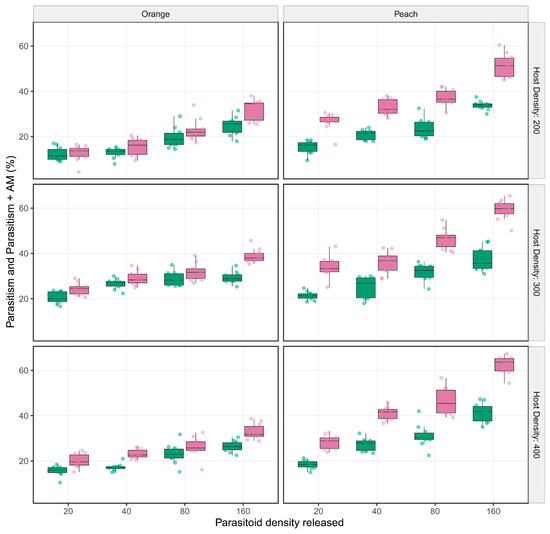
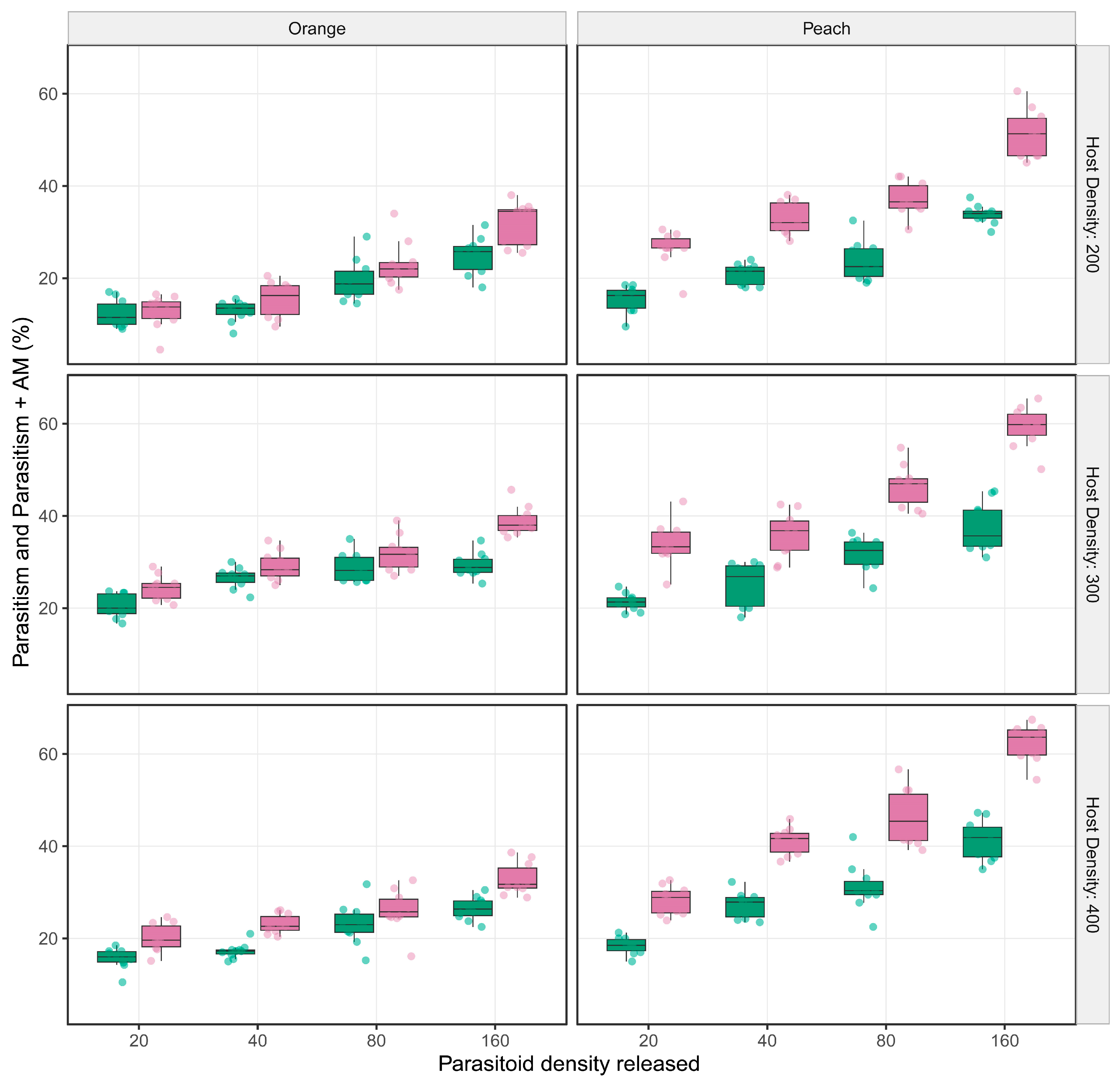
Host mortality attributed to the composite metric (parasitism + AM) was consistently higher than that caused by parasitism alone across treatment combinations (Figure 2). Given the descriptive nature of this composite metric, no inferential statistics were calculated directly on this index. Instead, patterns were evaluated through graphical inspection. However, the AM values were significantly higher than zero in most treatment combinations (Section 3.2, Table 4), implying that parasitism + AM outperformed parasitism alone, as the latter variable did not account for the host’s additional mortality component. The difference between the two metrics increased with parasitoid release density and was particularly evident in peach at high release densities. In orange, the difference between the two variables was smaller at low parasitoid release densities and more pronounced at high release densities. These patterns were consistent across all experimental runs, indicating a standardized trend in both fruit species (Figure 2). At the highest parasitoid release density (160 parasitoids per cage), parasitism + AM caused mean host mortalities ranging from 51.3% to 62.4% in peach across all host densities, whereas parasitism alone accounted for 33.8% to 41.3%. In orange, parasitism + AM caused mortality rates ranging from 31.8% to 38.9%, compared with 24.7% to 29.3% for parasitism alone (Table 3, File S2). The composite metric substantially enhanced host mortality differences between fruit species under high parasitoid pressure (File S2).
Figure 2.
Boxplots show the distribution of parasitism (%) (green boxes) and parasitism plus additional mortality (%) (pink boxes) across parasitoid release densities for each host density (rows) and fruit type (columns). Boxes represent the interquartile range with the median indicated by the central line; whiskers extend to 1.5× the interquartile range, and error bars indicate ± 95% confidence intervals. Each box is based on n = 10 replicates per combination of fruit, host density, and parasitoid density. Jittered points correspond to individual experimental cages, highlighting the variability within the treatment.
4. Discussion
Parasitoid species selected as potentially effective fruit fly biocontrol agents entail a prior and exhaustive assessment of their host foraging and killing abilities in different host fruits and surrounding environments [26,49]. Understanding those ecological aspects is strategically essential for developing and implementing a biological control program using indigenous parasitoids [50]. In this framework, the current study mainly reports the ability of the Neotropical-native parasitoid G. pelleranoi to kill the exotic C. capitata infesting two substantially different medfly-multiplying fruit species, through simulated augmentative releases under field cage conditions. Consequently, results of this study highlight valuable biological information as follows: (1) G. pelleranoi females performed satisfactorily once released under non-controlled environmental conditions as they successfully parasitized host larvae on peach and sour orange, regardless of their strongly differing physical features; (2) both host and parasitoid densities influenced the ability of G. pelleranoi females to kill medfly larvae, and the fruit type modulated this effect; and (3) G. pelleranoi females induced a substantially high host die-off rate when AM was added to the analysis, which was not revealed when parasitism alone was regarded as a medfly mortality variable.
The first finding showed G. pelleranoi as a suitable parasitoid to successfully attack medfly larvae in fruits with highly contrasting physical attributes, as is the case between the peach and the orange. Individual fruit physical features, such as rind thickness and pulp depth, can mostly influence fruit fly parasitism rates [51,52]. The peach has physical traits that facilitate natural parasitism in tephritid larvae lodged internally in the fruit, such as small size, thin skin, and shallow pulp [40]. The highest fruit fly parasitism levels have usually been linked to fruit with more advantageous features, enabling parasitoid females to find and parasitize host larvae [22,53,54]. In contrast, the sour orange, with its large size and a rind 37 times thicker and a pulp 4 times deeper than those of the peach, sharply restricts natural parasitism [40]. Fruit flies can escape parasitism when they infest large fruit because fly larvae can feed at a greater depth in the fruit pulp, which reduces host accessibility to parasitoids [55,56]. This occurs mainly with braconid larval parasitoids, such as Doryctobracon spp., Utetes spp., and Opius spp., whose females lay eggs on the tephritid larvae feeding inside fruits by drilling with their ovipositor through the pericarp from the exterior [53]. Thus, the physical barrier imposed by the fruit on the female parasitoid is one of the main hurdles to achieving the successful release of fruit fly parasitoids [57]. As such, a large fruit can provide shelter, as it reduces or prevents attacks by parasitoids [58]. However, the results of the current study revealed that releases of the figitid G. pelleranoi induced up to 50% of pest mortality in the sour orange. This information supports previous field data recorded from fruit surveys in wilderness areas of northwestern Argentina, in which G. pelleranoi was recovered from non-crop Citrus spp. highly infested by C. capitata, although natural parasitism remained below 10% [40]. The host-searching behavior likely played a role in enabling G. pelleranoi females to detect medfly larvae and oviposit in fruit with unsuitable features for natural parasitism by braconid wasps. Ganaspis pelleranoi females mainly forage host larvae in fallen fruit and mostly find them by entering the fruit through fissures in the rind, by holes produced by its jaws, or even by attacking the fly larva when it exits the fruit to pupate [59,60]. These host foraging and oviposition strategies exhibited by this figitid species appear to be an important advantage over the foraging behavior of braconids when the infested fruit is a Citrus species. In addition, the lack of development of Neotropical-native braconid larvae in C. capitata, probably caused by encapsulation or antibiosis [40], would be overcome by G. pelleranoi, as it successfully develops inside medfly larvae.
The second finding highlighted that increased medfly mortality in both tested fruit species occurred with augmented numbers of released female parasitoids, even at higher host densities. In this regard, when comparing the maximum parasitoid release density, i.e., 160 parasitoids per experimental cage, in both testing fruit species and in the three host larval densities, G. pelleranoi was highly effective in killing medfly larvae. Therefore, it was proven that the progressive increase in the number of released parasitoid females significantly improved the effectiveness of G. pelleranoi in reducing medfly emergence in the fruits of the two tested species. Although the results recorded in field cages are still preliminary, they suggest that augmentative releases of G. pelleranoi may substantially suppress medfly populations in the citrus-growing region of northwestern Argentina, characterized by subtropical weather conditions. The findings of the current study is consistent with previous field cage trials conducted with two population lines of the exotic braconid parasitoid D. longicaudata [61]. In those trials, the authors found significant reductions in C. capitata emergence in infested commercial peaches at the highest D. longicaudata release rates, e.g., 160 and 320 parasitoid females. In the current study, the maximum release density did not exceed 160 parasitoids; it cannot be regarded as an optimal release rate based on the host densities tested. The optimal release rate of predators and parasitoids for effective pest control depends on the species assessed, although exceeding the optimal rate does not improve control of the target pest [62]. Factors that can affect the relative impact of open-field release rates include the timing and method of biological control application, the reproductive capacity and foraging ability of natural enemies, the host density and availability, community interactions, environmental conditions [62,63,64], and traits of fruit species hosting the pest [53,57]. However, two components in the host–parasitoid interaction are relevant in determining the parasitoid release rate: the intrinsic growth rate of the host population relative to the maximum growth rate of the parasitoid [65]. Although the latter is lower than the growth rate of the host, a threshold still exists for the number of parasitoids that can be released to control the host population growth [65]. This is the case of G. pelleranoi, whose intrinsic increment rate when using different fruit fly species as hosts, e.g., Anastrepha ludens [24], A. fraterculus [34], and C. capitata [35], was significantly lower than the mean intrinsic growth rate of the invasive medfly [66]. However, this does not preclude the potential use of G. pelleranoi as a medfly biological control agent through augmentative release, as suggested by the current study. Interestingly, the performance of G. pelleranoi females was conditioned by the tested fruit species. The peach evidently exerted a significant influence on the parasitoid-induced host mortality capacity. Medfly mortality was particularly higher in the peach than in the sour orange on 85% of the different combined densities of released parasitoids and exposed host larvae. Medfly mortality rates were particularly higher in those host densities involving 300 to 400 medfly larvae exposed to G. pelleranoi females, but always with a preference for infested peaches over sour oranges. Apparently, increasing the number of fruits in the experimental cages, to increase the host density offered to parasitoids, enabled females to increase their host foraging possibilities and decrease intraspecific interference. Previous lab studies showed that G. pelleranoi females had a higher propensity to forage non-parasitized host larvae rather than medfly larvae previously parasitized by conspecific females [67]. Thus, the ability of G. pelleranoi females to discriminate previously parasitized hosts suggests low levels of conspecific competition, which may lead females to search for hosts in alternative microenvironments, e.g., in other fallen or unfallen fruits [67].
The third finding revealed that the composite metric (parasitism + AM) was a better predictor variable of the true host mortality inflicted by the parasitoid than the parasitism rate. Therefore, evaluating parasitism alone may not accurately represent how many hosts are successfully suppressed by G. pelleranoi, and so the effectiveness of this figitid parasitoid as a medfly control agent can be underestimated. This is because the parasitoid-induced host mortality is usually based on evidence of host death followed by successful parasitoid offspring development, i.e., a reproductive mortality [68]. Therefore, the induced host mortality without visible evidence of parasitism, i.e., non-reproductive effects, is usually overlooked [68,69]. These non-reproductive impacts, i.e., when the host is not involved in reproductive processes of the parasitoid, can kill the host or induce behavioral, reproductive, and developmental disorders, reducing host fitness [70]. The hidden host mortality can be caused by several factors [68,70], including both stinging activity in the host without oviposition and superparasitism [71]. Both events may increase host mortality rates when fruit fly larvae are attacked by parasitoids [71,72,73,74]. Females of the braconid D. longicaudata can cause serious damage to Anastrepha spp. larvae due to multiple punctures as a result of probing with the ovipositor [71] or an overly high number of successful ovipositions, causing a superparasitized host [72,75]. Both situations can often kill the tephritid fly larva [71,72]. As found in the current study, the figitid Aganaspis daci (Weld, 1951) (Hymenoptera: Figitidae), a promising candidate for the biological control of C. capitata in the Mediterranean region [73,74], can also induce non-reproductive mortality in medfly larvae [73], potentially caused by superparasitism [76]. Interestingly, the combined induced mortality and parasitism rate caused by A. daci on medfly averaged at 87% under field conditions in the Spanish Mediterranean region [74]. Based on these data, the effectiveness of G. pelleranoi in controlling medfly under semi-field conditions was lower than that of A. daci. The figitid G. pelleranoi induced an average mortality rate of around 57% in medfly at the maximum parasitoid release density.
Superparasitism was detected in some non-hatched medfly puparia through dissection, but this parameter was not quantified, so no conclusions could be drawn about whether superparasitism by G. pelleranoi was a factor influencing the high corrected host mortality rates recorded in the current study. However, a recent study [67] found that self-superparasitism was higher than conspecific superparasitism in G. pelleranoi, and females could repeatedly both probe with their ovipositor and oviposit in the same medfly larva. Therefore, excessive probing activity by G. pelleranoi females could cause non-reproductive mortality in the host larva. Furthermore, combining AM with parasitism and analyzing them as a composite indicator reinforced the effect of fruit type on the impact of G. pelleranoi on host mortality. In this regard, the differences between peach and sour orange relating to host mortality rate were even greater. The integration of the AM variable produced a consistently detectable difference in odds between peach and orange across all experimental conditions. Consequently, the AM, which involved non-reproductive effects of the parasitoid on the host, has important practical implications for the evaluation of G. pelleranoi as a biocontrol agent of natural medfly regulation. Faced with this evidence, the resident parasitoid G. pelleranoi should be taken into account when analyzing different biological control strategies, such as conservative and/or augmentative approaches.
5. Conclusions
The results supported the preliminary hypotheses, as two main findings stood out. Firstly, G. pelleranoi females performed satisfactorily once released under non-controlled environmental conditions and successfully killed a high proportion of medfly larvae in the two tested fruit species, characterized by significant physical differences. Secondly, the parasitoid-induced medfly mortality significantly increased in both peach and sour orange relative to the gradual increase in released G. pelleranoi females, regardless of the increase in host density offered to parasitoids. Although such outcomes were limited to two medfly host fruit species confined to field cages, it served as a precedent for developing and testing the usefulness of the native parasitoid G. pelleranoi through open-field releases to control natural medfly populations within an eco-friendly pest management approach. Consistent with this approach, the ability of G. pelleranoi females to successfully attack medfly larvae in large exotic fruits, such as Citrus spp., may have significant practical implications, for instance, the implementation of augmentative biological control involving the mass rearing and release of G. pelleranoi in Citrus-producing areas or in other high-value fruit crops for Argentina’s fruit production, and in countries affected by C. capitata. However, successful implementation of augmentative releases requires precise timing, production at a mass-rearing facility —such as the San Juan biofactory in central-western Argentina—and, most importantly, the integration of habitat management to support the release of the parasitoid.
Supplementary Materials
The following supporting information can be downloaded at https://www.mdpi.com/article/10.3390/agronomy16090873/s1, File S1: Additional mortality (ΔAM, %) and hypothesis-testing results for treatment-vs-control contrasts across fruit types, host densities, and parasitoid release densities; File S2: Summary statistics and fruit-type contrasts for parasitism, additional mortality (ΔAM), and the composite metric parasitism + AM across host densities and parasitoid release densities.
Author Contributions
Conceptualization, L.d.C.S., S.R.N.-C., M.J.B.-B., P.S., F.R.M.G. and S.M.O.; methodology, L.d.C.S., S.R.N.-C., M.J.B.-B., P.S., F.R.M.G. and S.M.O.; software, S.R.N.-C.; validation, L.d.C.S., S.R.N.-C., M.J.B.-B., P.S., F.R.M.G. and S.M.O.; formal analysis, S.R.N.-C.; investigation, L.d.C.S., S.R.N.-C., M.J.B.-B., P.S., F.R.M.G. and S.M.O.; resources, L.d.C.S., S.R.N.-C., M.J.B.-B., P.S., F.R.M.G. and S.M.O.; data curation, L.d.C.S., S.R.N.-C., M.J.B.-B., P.S., F.R.M.G. and S.M.O.; writing—original draft preparation, L.d.C.S., S.R.N.-C., M.J.B.-B., P.S., F.R.M.G. and S.M.O.; writing—review and editing, L.d.C.S., S.R.N.-C., M.J.B.-B., P.S., F.R.M.G. and S.M.O.; visualization, L.d.C.S., S.R.N.-C., M.J.B.-B., P.S., F.R.M.G. and S.M.O.; supervision, L.d.C.S., S.R.N.-C., M.J.B.-B., P.S., F.R.M.G. and S.M.O.; project administration, L.d.C.S., S.R.N.-C., M.J.B.-B., P.S., F.R.M.G. and S.M.O.; funding acquisition, L.d.C.S., S.R.N.-C., M.J.B.-B., P.S., F.R.M.G. and S.M.O. All authors have read and agreed to the published version of the manuscript.
Funding
This research was supported by the Agencia Nacional de Promoción de la Investigación, el Desarrollo Tecnológico y la Innovación (Argentina), grant no. PICT2020-01050.
Data Availability Statement
The data presented in this study are available on the CONICET (Argentina) website link: http://hdl.handle.net/11336/282075 (accessed on 29 March 2026).
Acknowledgments
We give thanks to Patricia Colombres and Guillermo Borchia (PROIMI-CONICET) for laboratory and field-cage technical support. Special thanks to the National Scientific and Technical Research Council of Argentina (CONICET, Spanish acronym) for awarding a postdoctoral fellowship to María Josefina Buonocore-Biancheri.
Conflicts of Interest
The authors declare no conflicts of interest.
References
- Malacrida, A.R.; Gomulski, L.M.; Bonizzoni, M.; Bertin, S.; Gasperi, G.; Guglielmino, C.R. Globalization and fruit fly invasion and expansion: The medfly paradigm. Genetica 2007, 131, 1–9. [Google Scholar] [CrossRef] [Scilit]
- Rodovitis, V.G.; Verykouki, E.; Zarpas, K.D.; Papanastasiou, S.A.; Moraiti, C.A.; Patronis, N.; Papadopoulos, N.T. Mediterranean fruit fly population phenological patterns are strongly affected by elevation and host presence. Sci. Rep. 2024, 14, 6010. [Google Scholar] [CrossRef] [Scilit]
- Nyamukondiwa, C.; Kleynhans, E.; Terblanche, J.S. Phenotypic plasticity of thermal tolerance contributes to the invasion potential of Mediterranean fruit flies (Ceratitis capitata). Ecol. Entomol. 2010, 35, 565–575. [Google Scholar] [CrossRef] [Scilit]
- Gutierrez, A.P.; Ponti, L. Assessing the invasive potential of the Mediterranean fruit fly in California and Italy. Biol. Invasions 2011, 13, 2661–2676. [Google Scholar] [CrossRef] [Scilit]
- Liquido, N.J.; Shinoda, L.A.; Cunningham, R.T. Host Plants of the Mediterranean Fruit Fly (Diptera: Tephritidae): An Annotated World Review; Entomological Society of America: Annapolis, MD, USA, 1991; Volume 77, pp. 1–52. [Google Scholar]
- Copeland, R.S.; Wharton, R.A.; Luke, Q.; De Meyer, M. Indigenous hosts of Ceratitis capitata (Diptera: Tephritidae) in Kenya. Ann. Entomol. Soc. Am. 2002, 95, 672–694. [Google Scholar] [CrossRef] [Scilit]
- De Meyer, M.; Robertson, M.P.; Peterson, A.T.; Mansell, M.W. Ecological niches and potential geographical distributions of Mediterranean fruit fly (Ceratitis capitata) and Natal fruit fly (Ceratitis rosa). J. Biogeogr. 2008, 35, 270–281. [Google Scholar] [CrossRef] [Scilit]
- Szyniszewska, A.M.; Tatem, A.J. Global assessment of seasonal potential distribution of Mediterranean Fruit Fly, Ceratitis capitata (Diptera: Tephritidae). PLoS ONE 2014, 9, e111582. [Google Scholar] [CrossRef] [Scilit] [PubMed]
- Papadopoulos, N.T. Fruit fly invasion: Historical, biological, economic aspects and management. In Trapping and the Detection, Control, and Regulation of Tephritid Fruit Flies: Lures, Area-Wide Programs, and Trade Implications; Shelly, T., Epsky, N., Jang, E., Reyes-Flores, J., Vargas, R., Eds.; Springer: Dordrecht, The Netherlands, 2014; pp. 219–252. [Google Scholar]
- Gazit, Y.; Akiva, R.; Gavriel, S. Cold tolerance of the Mediterranean fruit fly in date and mandarin. J. Econ. Entomol. 2014, 107, 1745–1750. [Google Scholar] [CrossRef] [Scilit]
- Dias, N.P.; Montoya, P.; Nava, D.E. Historical invasion of medfly in the Neotropical region and adoption of management techniques. Curr. Opin. Insect Sci. 2022, 50, 100872. [Google Scholar] [CrossRef] [Scilit]
- Schliserman, P.; Aluja, M.; Rull, J.; Ovruski, S.M. Habitat degradation and introduction of exotic plants favor persistence of invasive species and population growth of native polyphagous fruit fly pests in a Northwestern Argentinean mosaic. Biol. invasions 2014, 16, 2599–2613. [Google Scholar] [CrossRef] [Scilit]
- Suárez, L.; Buonocore-Biancheri, M.J.; Murúa, A.F.; Beltrachini, S.; Kulichevsky, L.E.; Ovruski, S.M. Management of tephritid fruit flies in Argentina. In Management of Fruit Flies in the Americas; Garcia, F.R.M., Ed.; Springer Nature: Cham, Switzerland, 2024; pp. 169–195. [Google Scholar]
- Guillén, D.; Sánchez, R. Expansion of the National Fruit Fly Control Programme in Argentina. In Area-Wide Control of Insect Pests: From Research to Field Implementation; Vreysen, M.J.B., Robinson, A.S., Hendrischs, J., Eds.; Springer: Dordrecht, The Netherlands, 2007; pp. 653–660. [Google Scholar]
- Garcia, F.R.M.; Ovruski, S.M.; Suárez, L.; Cancino, J.; Liburd, O.E. Biological control of tephritid fruit fies in the Americas and Hawaii: A review of the use of parasitoids and predators. Insects 2020, 11, 662. [Google Scholar] [CrossRef] [Scilit] [PubMed]
- Van Lenteren, J.C.; Bueno, V.H. Augmentative biological control of arthropods in Latin America. BioControl 2003, 48, 123–139. [Google Scholar] [CrossRef] [Scilit]
- Dias, N.P.; Zotti, M.J.; Montoya, P.; Carvalho, I.R.; Nava, D.E. Fruit fly management research: A systematic review of monitoring and control tactics in the world. Crop Prot. 2018, 112, 187–200. [Google Scholar] [CrossRef] [Scilit]
- Dias, N.P.; Montoya, P.; Nava, D.E. A 30-year systematic review reveals success in tephritid fruit fly biological control research. Entomol. Exp. Appl. 2022, 170, 370–384. [Google Scholar] [CrossRef] [Scilit]
- Cancino, J.; Montoya, P.; Gálvez, F.O.; Gálvez, C.; Liedo, P. Effect of the Sterile Insect Technique and augmentative parasitoid releases in a fruit fly suppression program in mango-producing areas of Southeast Mexico. Insects 2023, 14, 719. [Google Scholar] [CrossRef] [Scilit]
- Hepdurgun, B.; Turanli, T.; Zümreoğlu, A. Control of the olive fruit fly, Bactrocera oleae, (Diptera: Tephritidae) through mass trapping and mass releases of the parasitoid Psyttalia concolor (Hymenoptera: Braconidae) reared on irradiated Mediterranean fruit fly. Biocontrol Sci. Technol. 2009, 19, 211–224. [Google Scholar] [CrossRef] [Scilit]
- Vargas, R.I.; Peck, S.L.; McQuate, G.T.; Jackson, C.G.; Stark, J.D.; Armstrong, J.W. Potential for area-wide integrated management of mediterranean fruit fly (Diptera: Tephritidae) with a braconid parasitoid and a novel bait spray. J. Econ. Entomol. 2001, 94, 817–825. [Google Scholar] [CrossRef] [Scilit]
- Montoya, P.; López, P.; Cruz, J.; López, F.; Cadena, C.; Cancino, J.; Liedo, P. Effect of Diachasmimorpha longicaudata releases on the native parasitoid guild attacking Anastrepha spp. larvae in disturbed zones of Chiapas, Mexico. Biocontrol 2017, 62, 581–593. [Google Scholar] [CrossRef] [Scilit]
- Colmenarez, Y.C.; Vasquez, C. Benefits associated with the implementation of biological control programmes in Latin America. BioControl 2024, 69, 303–320. [Google Scholar] [CrossRef] [Scilit]
- Aluja, M.; Sivinski, J.; Ovruski, S.; Guillén, L.; López, M.; Cancino, J.; Torres-Anaya, A.; Gallegos-Chan, G.; Ruíz, L. Colonization and domestication of seven species of native New World hymenopterous larval-prepupal and pupal fruit fly (Diptera: Tephritidae) parasitoids. Biocontrol Sci. Technol. 2009, 19, 49–79. [Google Scholar] [CrossRef] [Scilit]
- Aluja, M.; Sivinski, J.; Van Driesche, R.; Anzures-Dadda, A.; Guillén, L. Pest management through tropical tree conservation. Biodivers. Conserv. 2014, 23, 831–853. [Google Scholar] [CrossRef] [Scilit]
- Cancino, J.; Montoya, P.; Barrera, J.F.; Aluja, M.; Liedo, P. Parasitism by Coptera haywardi and Diachasmimorpha longicaudata on Anastrepha flies with different fruits under laboratory and field cage conditions. BioControl 2014, 59, 287–295. [Google Scholar] [CrossRef] [Scilit]
- Murillo, F.D.; Montoya, P.; Cabrera-Mireles, H.; Barrera, J.F.; Liedo, P. Intrinsic competition between Diachasmimorpha longicaudata and three native species of parasitoids (Hymenoptera: Braconidae: Opiinae) of Anastrepha (Diptera: Tephritidae) fruit flies under laboratory conditions. Biocontrol Sci. Technol. 2019, 29, 757–772. [Google Scholar] [CrossRef] [Scilit]
- van Lenteren, J.C. The state of commercial augmentative biological control: Plenty of natural enemies, but a frustrating lack of uptake. BioControl 2012, 57, 1–20. [Google Scholar] [CrossRef] [Scilit]
- Sivinski, J. Augmentative biological control: Research and methods to help make it work. CABI Rev. 2013, 8, 1–11. [Google Scholar] [CrossRef] [Scilit]
- Montoya, P.; Cancino, J.; Zenil, M.; Santiago, G.; Gutierrez, J.M. The augmentative biological control component in the Mexican national campaign against Anastrepha spp. fruit flies. In Area-Wide Control of Insect Pests: From Research to Field Implementation; Vreysen, M.J.B., Robinson, A.S., Hendrichs, J., Eds.; Springer: Dordrecht, The Netherlands, 2007; pp. 661–670. [Google Scholar]
- Cancino, J.; Ruiz, L.; Viscarret, M.; Sivinski, J.; Hendrichs, J. Application of nuclear techniques to improve the mass production and management of fruit fly parasitoids. Insects 2012, 3, 1105–1125. [Google Scholar] [CrossRef] [Scilit]
- Vargas, R.I.; Leblanc, L.; Harris, E.J.; Manoukis, N.C. Regional suppression of Bactrocera fruit flies (Diptera: Tephritidae) in the Pacific through biological control and prospects for future introductions into other areas of the world. Insects 2012, 3, 727–742. [Google Scholar] [CrossRef] [Scilit] [PubMed]
- Wang, X.G.; Ramadan, M.M.; Hoelmer, K.A. Biological control introductions against invasive tephritid fruit flies (Diptera: Tephritidae) in the US: Achievements, opportunities, and challenges. In Management of Fruit Flies in the Americas; Garcia, F.R.M., Ed.; Springer Nature: Cham, Switzerland, 2024; pp. 461–499. [Google Scholar]
- Núñez-Campero, S.R.; Suárez, L.d.C.; Mello Garcia, F.R.; Cancino, J.; Montoya, P.; Ovruski, S.M. Insights into the functional responses of four Neotropical-native parasitoids to enhance their role as biocontrol agents against Anastrepha fraterculus pest populations. Insects 2025, 16, 919. [Google Scholar] [CrossRef] [Scilit]
- Gonçalves, R.S.; Nava, D.E.; Pereira, H.C.; Lisbôa, H.; Grützmacher, A.D.; Valgas, R.A. Biology and fertility life table of Aganaspis pelleranoi (Hymenoptera: Figitidae) in larvae of Anastrepha fraterculus and Ceratitis capitata (Diptera: Tephritidae). Ann. Entomol. Soc. Am. 2013, 106, 791–798. [Google Scholar] [CrossRef] [Scilit]
- Gonçalves, R.S.; Andreazza, F.; Lisbôa, H.; Grützmacher, A.D.; Valgas, R.A.; Manica-Berto, R.; Nörnberg, S.D.; Nava, D.E. Basis for the Development of a Rearing Technique of Aganaspis pelleranoi (Hymenoptera: Figitidae) in Anastrepha fraterculus (Tephritidae: Diptera). J. Econ. Entomol. 2016, 109, 1094–1101. [Google Scholar] [CrossRef] [Scilit]
- Rohr, R.A.; Jahnke, S.M.; Redaelli, L.R. Influence of the original host in the preference of Aganaspis pelleranoi and Doryctobracon areolatus, parasitoids of Tephritidae larvae. Bull. Insectol. 2019, 72, 13–20. [Google Scholar]
- Núñez-Campero, S.R.; González, C.; Rull, J.; Ovruski, S.M. Maximum Entropy (MaxEnt) as extreme distribution indicator of two Neotropical fruit fly parasitoids in irrigated drylands of Argentina. Bull. Entomol. Res. 2022, 112, 636–645. [Google Scholar] [CrossRef] [Scilit]
- Kruitwagen, A.; Wertheim, B.; Beukeboom, L.W. Artificial selection for non-reproductive host killing in a native parasitoid on the invasive pest, Drosophila suzukii. Evol. Appl. 2021, 14, 1993–2011. [Google Scholar] [CrossRef] [Scilit]
- Schliserman, P.; Aluja, M.; Rull, J.; Ovruski, S.M. Temporal diversity and abundance patterns of parasitoids of fruit-infesting Tephritidae (Diptera) in the Argentinean Yungas: Implications for biological control. Environ. Entomol. 2016, 45, 1184–1198. [Google Scholar] [CrossRef] [Scilit]
- Cancino, J.; Ruiz, L.; López, E.; Aguilar, E.; Galvez, C.; Montoya, P.; Liedo, P. Suppression of Ceratitis capitata (Wied.) (Diptera: Tephritidae) populations in coffee in the Mexico-Guatemala border region through the augmentative releases of Diachasmimorpha longicaudata (Ashmead) (Hymenoptera: Braconidae). Biocontrol Sci. Technol. 2019, 29, 822–826. [Google Scholar] [CrossRef] [Scilit]
- Gurr, G.M.; Wratten, S.D.; Barbosa, P. Success in conservation biological control of arthropods. In Biological Control: Measures of Success; Gurr, G.M., Wratten, S.D., Eds.; Kluwer Academic Publishers: Dordrecht, The Netherlands, 2020; pp. 105–132. [Google Scholar]
- Harris, C.; Bromley, E.; Clarke, L.K.; Kay, B.J.; Schwenke, A.C.; Clarke, A.R. Conservation biological control of the fruit fly parasitoid Fopiusa arisanus (Hymenoptera: Braconidae). Aust. Entomol. 2022, 61, 340–349. [Google Scholar] [CrossRef] [Scilit]
- R Core Team. R: A Language and Environment for Statistical Computing; R Foundation for Statistical Computing: Vienna, Austria, 2024; Available online: https://www.R-project.org (accessed on 2 March 2026).
- Brooks, M.E.; Kristensen, K.; van Benthem, K.J.; Magnusson, A.; Berg, C.W.; Nielsen, A.; Skaug, H.J.; Mächler, M.; Bolker, B.M. glmmTMB balances speed and flexibility among packages for zero inflated generalized linear mixed modeling. R J. 2017, 9, 378–400. [Google Scholar] [CrossRef] [Scilit]
- Lenth, R.; Piaskowski, J. R package, version 2.0.1; Package emmeans: Estimated Marginal Means, Aka Least Squares Means; R Foundation for Statistical Computing: Vienna, Austria, 2025. [Google Scholar] [CrossRef] [Scilit]
- Wickham, H.; Averick, M.; Bryan, J.; Chang, W.; McGowan, L.D.A.; François, R.; Grolemund, G.; Hayes, A.; Henry, L.; Hester, J.; et al. Welcome to the tidyverse. J. Open Source Softw. 2019, 4, 1686. [Google Scholar] [CrossRef] [Scilit]
- Wickham, H. ggplot2: Elegant Graphics for Data Analysis; Springer: New York, NY, USA, 2016; 213p, Available online: https://link.springer.com/book/10.1007/978-3-319-24277-4 (accessed on 21 April 2026).
- Sivinski, J.; Aluja, M. The roles of parasitoid foraging for hosts, food and mates in the augmentative control of Tephritidae. Insects 2012, 3, 668–691. [Google Scholar] [CrossRef] [Scilit]
- Haran, J.; Grove, T.; van Noort, S.; Benoit, L.; Addison, P. Natural biocontrol of fruit flies in indigenous hosts: A perspective for population control in the agroecosystem. Biol. Control 2019, 137, 104022. [Google Scholar] [CrossRef] [Scilit]
- Sivinski, J. The influence of host fruit morphology on parasitization rates in the Caribbean fruit fly, Anastrepha suspensa. Entomophaga 1991, 36, 447–454. [Google Scholar] [CrossRef] [Scilit]
- Aluja, M.; Rull, J.; Sivinski, J.; Norrbom, A.L.; Wharton, R.A.; Macías-Ordóñez, R.; Díaz-Fleischer, F.; López, M. Fruit flies of the genus Anastrepha (diptera: Tephritidae) and associated native parasitoids (hymenoptera) in the tropical rainforest biosphere reserve of Montes Azules, Chiapas, Mexico. Environ. Entomol. 2003, 32, 1377–1385. [Google Scholar] [CrossRef] [Scilit]
- Sivinski, J.; Aluja, M. The evolution of ovipositor length in the Parasitic Hymenoptera and the search for predictability in biological control. Fla. Entomol. 2003, 86, 143–150. [Google Scholar] [CrossRef] [Scilit]
- Wang, X.-G.; Johnson, M.W.; Daane, K.M.; Yokoyama, V.Y. Larger olive fruit size reduces the efficiency of Psyttalia concolor, as a parasitoid of the Olive fruit fly. Biol. Control 2009, 49, 45–51. [Google Scholar] [CrossRef] [Scilit]
- López, M.; Aluja, M.; Sivinski, J. Hymenopterous larval-pupal and pupal parasitoids of Anastrepha flies (Diptera: Tephritidae) in Mexico. Biol. Control 1999, 15, 119–129. [Google Scholar] [CrossRef] [Scilit]
- Sivinski, J.; Vulinec, K.; Aluja, M. Ovipositor length in a guild of parasitoids (Hymenoptera: Braconidae) attacking Anastrepha spp. Fruit flies (Diptera: Tephritidae) in southern Mexico. Ann. Entomol. Soc. Am. 2001, 94, 886–895. [Google Scholar] [CrossRef] [Scilit]
- Cancino, J.; Colmenares, M.; Pérez-López, S.; Brindis Santos, I.; Hilerio, A.; Suárez, L.; Ovruski, S.M. Influence of Anastrepha host fruit size over parasitism by Diachasmimorpha longicaudata in open-field augmentative releases. Biocontrol Sci. Technol. 2024, 34, 812–827. [Google Scholar] [CrossRef] [Scilit]
- Akinkurolere, R.O.; Boyer, S.; Chen, H.; Zhang, H. Parasitism and host-location preference in Habrobracon hebetor (Hymenoptera: Braconidae): Role of refuge, choice, and host instar. J. Econ. Entomol. 2009, 102, 610–615. [Google Scholar] [CrossRef] [Scilit] [PubMed]
- Guimarães, J.A.; Zucchi, R.A. Parasitism behavior of three species of Eucoilinae (Hymenoptera: Cynipoidea: Figitidae) fruit fly parasitoids (Diptera) in Brazil. Neotrop. Entomol. 2004, 33, 217–224. [Google Scholar] [CrossRef] [Scilit]
- Aluja, M.; Ovruski, S.M.; Guillén, L.; Oroño, L.E.; Sivinski, J. Comparison of the host searching and oviposition behaviors of the tephritid (Diptera) parasitoids Aganaspis pelleranoi and Odontosema anastrephae (Hymenoptera: Figitidae, Eucoilinae). J. Insect Behav. 2009, 22, 423–451. [Google Scholar] [CrossRef] [Scilit]
- Buonocore Biancheri, M.J.; Suárez, L.d.C.; Kirschbaum, D.S.; Ovruski, S.M. Augmentative releases of two Diachasmimorpha longicaudata (Hymenoptera: Braconidae) population lines under field-cage conditions to control Ceratitis capitata (Diptera: Tephritidae). Neotrop. Entomol. 2023, 52, 212–226. [Google Scholar] [CrossRef] [Scilit]
- Crowder, D.W. Impact of release rates on the effectiveness of augmentative biological control agents. J. Insect Sci. 2007, 7, 15. [Google Scholar] [CrossRef] [Scilit] [PubMed]
- Bellows, T.S., Jr.; Paine, T.D.; Bezark, L.G.; Ball, J. Optimizing natural enemy release rates, and associated pest population decline rates, for Encarsia inaron walker (Hymenoptera: Aphelinidae) and Siphoninus phillyreae (Haliday) (Homoptera: Aleyrodidae). Biol. Control 2006, 37, 25–31. [Google Scholar] [CrossRef] [Scilit]
- Gaudon, J.M.; Allison, J.D.; Smith, S.M. Factors influencing the dispersal of a native parasitoid, Phasgonophora sulcata, attacking the emerald ash borer: Implications for biological control. BioControl 2018, 63, 751–761. [Google Scholar] [CrossRef] [Scilit]
- Grasman, J.; van Herwaarden, O.A.; Hemerik, L.; van Lenteren, J.A. two-component model of host-parasitoid interactions: Determination of the size of inundative releases of parasitoids in biological pest control. Math. Biosci. 2001, 169, 207–216. [Google Scholar] [CrossRef] [Scilit]
- Diamantidis, A.D.; Carey, J.R.; Nakas, C.T.; Papadopoulos, N.T. Population-specific demography and invasion potential in medfly. Ecol. Evol. 2011, 1, 479–488. [Google Scholar] [CrossRef] [Scilit]
- Buonocore Biancheri, M.J.; Suárez, L.; Kirschbaum, D.S.; Ovruski, S.M. Discrimination by Ganaspis pelleranoi of Ceratitis capitata larvae previously parasitised by Diachasmimorpha longicaudata. Biocontrol Sci. Technol. 2022, 32, 341–361. [Google Scholar] [CrossRef] [Scilit]
- Abram, P.K.; Brodeur, J.; Burte, V.; Boivin, G. Parasitoid-induced host egg abortion: An underappreciated component of biological control services provided by egg parasitoids. Biol. Control 2016, 98, 52–60. [Google Scholar] [CrossRef] [Scilit]
- Hepler, J.R.; Athey, K.; Enicks, D.; Abram, P.K.; Gariepy, T.D.; Talamas, E.J.; Beers, E. Hidden host mortality from an introduced parasitoid: Conventional and molecular evaluation of non-target risk. Insects 2020, 11, 822. [Google Scholar] [CrossRef] [Scilit]
- Abram, P.K.; Brodeur, J.; Urbaneja, A.; Tena, A. Nonreproductive effects of insect parasitoids on their hosts. Annu. Rev. Entomol. 2019, 64, 259–276. [Google Scholar] [CrossRef] [Scilit]
- Montoya, P.; Liedo, P.; Benrey, B.; Barrera, J.F.; Cancino, J.; Aluja, M. Functional response and superparasitism by Diachasmimorpha longicaudata (Hymenoptera: Braconidae), a parasitoid of fruit flies (Diptera: Tephritidae). Ann. Entomol. Soc. Am. 2000, 93, 47–54. [Google Scholar] [CrossRef] [Scilit]
- Montoya, P.; Ruiz, L.; Pérez-Lachaud, G.; Cancino, J.; Liedo, P. Field superparasitism by Diachasmimorpha longicaudata attacking Anastrepha spp. larvae on mango fruits. Biol. Control 2013, 64, 160–165. [Google Scholar] [CrossRef] [Scilit]
- de Pedro, L.; Beitia, F.; Ferrara, F.; Asís, J.D.; Sabater-Muñoz, B.; Tormos, J. Effect of host density and location on the percentage parasitism, fertility and induced mortality of Aganaspis daci (Hymenoptera: Figitidae), a parasitoid of Ceratitis capitata (Diptera: Tephritidae). Crop Prot. 2017, 92, 160–167. [Google Scholar] [CrossRef] [Scilit]
- de Pedro, L.; Beitia, F.; Sabater-Muñoz, B.; Harbi, A.; Ferrara, F.; Polidori, C.; Asís, J.D.; Tormos, J. Parasitism of Aganaspis daci against Ceratitis capitata under Mediterranean climate conditions. Entomol. Exp. Appl. 2017, 163, 287–295. [Google Scholar] [CrossRef] [Scilit]
- González, P.; Montoya, P.; Perez-Lachaud, G.; Cancino, J.; Liedo, P. Host discrimination and superparasitism in wild and mass-reared Diachasmimorpha longicaudata (Hym.: Braconidae) females. Biocontrol Sci. Technol. 2010, 20, 137–148. [Google Scholar] [CrossRef] [Scilit]
- de Pedro, L.; Tormos, J.; Asís, J.D.; Sabater-Muñoz, B.; Beitia, F. Biology of Aganaspis daci (Hymenoptera: Figitidae), parasitoid of Ceratitis capitata (Diptera: Tephritidae): Mode of reproduction, biological parameters and superparasitism. Crop Prot. 2018, 108, 54–61. [Google Scholar] [CrossRef] [Scilit]

Disclaimer/Publisher’s Note: The statements, opinions and data contained in all publications are solely those of the individual author(s) and contributor(s) and not of MDPI and/or the editor(s). MDPI and/or the editor(s) disclaim responsibility for any injury to people or property resulting from any ideas, methods, instructions or products referred to in the content. |
© 2026 by the authors. Licensee MDPI, Basel, Switzerland. This article is an open access article distributed under the terms and conditions of the Creative Commons Attribution (CC BY) license.