


Abstract
Miscanthus lutarioriparius exhibits strong potential for cadmium (Cd) accumulation, making it a promising candidate for the phytoremediation of Cd-contaminated soils. However, its full remediation potential remains underexploited, highlighting the need for targeted genetic improvement This study presents a comprehensive genome-wide identification and systematic characterization of 20 Ml4CL (4-coumarate: CoA ligase genes) in the M. lutarioriparius. Results indicate that the Ml4CL gene family has undergone substantial evolutionary divergence and expansion. Phylogenetic classification is highly consistent with gene structures ad conserved motifs suggesting potential functional diversification. Promoter analysis revealed a complex cis-regulatory landscape enriched in n ABA- and light-responsive elements, frequently co-occuring with hormone-responsive elements associated with jasmonic acid (JA), gibberellins (GAs), salicylic acid (SA), and strigolactones (SLs) signaling. This pattern suggests that the Ml4CL family may function as an integrative regulatory node linking multiple stress and hormonal signaling pathways. Importantly, under Cd stress, Ml4CL genes exhibited diverse expression dynamics, including gene-specific repression and dose-dependent biphasic responses. Notably, Ml4CL4 showed strong repression, while other members displayed “induction-then-repression” or “repression-then-induction” patterns, suggesting a staged or hierarichical transcriptional response. These findings further suggest that Cd-responsive signaling networks may involve non-linear or threshold-dependent mechanismsthat activate distinct transcriptional programs depending on stress levels. Collectively, this study highlights the regulatory role of the Ml4CL family in plant adaptation to complex environments and identifies candidate dose-resonsive regulatory elements and key allelic variations. These findings provide valuable targets for molecular breeding and synthetic biology aimed at improving crop stress resilience.
1. Introduction
Global soil contamination by heavy metals represents a major and persistent environmental challenge, with an estimated 14–17% of global arable land affected by toxic metal pollution. Approximately 0.9–1.4 billion people reside in regions with elevated soil metal concentrations, thereby facing significant health risks [1]. Among these contaminants, cadmium(Cd) is one of the most prevalent and highly mobile heavy metals, polluting approximately 9% of the world’s farmland [2]. Staple crops such as rice (Oryza sativa) and wheat (Triticum aestivum) readily accumulate Cd and translocate it to edible tissues, thereby reducing yield and compromising food quality [3,4,5,6]. Therefore, developing effective and sustainable strategies for remediating Cd-contaminated soil has become an urgent priority [7,8].
Cd is a persistent and highly toxic contaminant characterized by low degradability, high mobility, and widespread dispersion in soils [9,10,11]. Conventional physical and chemical methods are often costly, time-consuming, and may cause secondary pollution. In contrast, bioremediation has emerged as an environmentally sustainable alternative due to its cost-effectiveness and ecological compatibility [12,13,14]. Bioremediation mainly includes phytoremediation and microbial remediation with the later often requiring s synergistic interactions with plants achieve effective Cd removal [13,15,16,17,18,19,20]. Phytoremediation represents a straightforward and field-applicable approach, as Cd can be extracted through harvesting aboveground biomass. Although phytoremediation offers a conceptually straightforward approach for Cd extraction through the harvest of aboveground biomass, aligning with practical remediation needs [16,21], it practical efficiency constrained by the limited growth stature and low absolute Cd accumulation characteristic of most identified hyperaccumulators [22]. Moreover, these plants often have long growth cycles, exhibit geographically variable Cd uptake capacity, and lack economic value, failing to support land-use productivity during remediation [23]. Consequently, research focus has shifted toward high-biomass with moderate accumulation capacity, which may offer greater potential for large-scale remediation.
Miscanthus spp., a perennial C4 grass native to East Asia, Southeast Asia, and the Pacific Islands, exhibits remarkable resilience, including tolerance to drought, cold, salinity, and heavy metals [24,25,26]. These traits enable its cultivation on marginal lands and position it as a promising candidate for sustainable phytoremediation [27,28,29,30]. Beyond its remediation potential, Miscanthus is distinguished by high biomass productivity, elevated calorific value (17.9 MJ kg−1), and high lignocellulosic content (cellulose: 43.1–52.2%; hemicellulose: 24.8–34.0%; lignin: 9.2–12.6%), coupled with low ash content (2.2%) and broad adaptability [31,32]. Its biomass can be converted into biochar, nanocellulose, xylooligosaccharides, and other bio-based products, earning it recognition as a valuable eco-industrial crop with significant commercial potential [33,34,35,36]. Ecologically, Miscanthus offers multiple environmental benefits. It enhances strong soil and water conservation; for example, planting Miscanthus × giganteus can reduce soil loss on slopes by 29% [37,38]. In terms of carbon sequestration, M. lutarioriparius can fix approximately 667 t CO2 per hectare (equivalent to 1.82 t C), and a “M. lutarioriparius -biochar” system can achieve emission reductions equal to half of the total CO2 absorbed by the plant [39,40]. Moreover, in saline-alkali soils, Miscanthus improves soil quality by increasing organic content and modulating microbial community structure [41].
M. lutarioriparius, a species endemic to China, exhibits superior biomass yield and quality compared to its congeners, rendering it a promising eco-industrial crop [42]. Its high biomass productivity supports substantial absolute Cd accumulation, identifying it as a viable candidate for Cd phytoremediation. Moreover, M. lutarioriparius delivers the characteristic ecological and economic benefits of the genus, enabling concurrent soil restoration and value generation to offset remediation costs. Collectively, these attributes establish M. lutarioriparius as a multifunctional species well-suited for sustainable Cd-contaminated soil remediation.
M. lutarioriparius mitigates Cd stress through multiple physiological mechanisms, including cell wall reinforcement, vacuolar sequestration, and metabolic reprogramming [43]. However, the Cd accumulation and tolerance capacity of currently available germplasms are influenced by Cd concentration and exhibit regional variability, limiting their full remediation potential. Genetic improvement of existing M. lutarioriparius resources is therefore essential to enhance Cd tolerance and accumulation for more effective soil remediation. Compared to conventional breeding, molecular breeding offers greater efficiency, precision, predictability, and cost-effectiveness, representing the mainstream approach in contemporary genetic enhancement [44,45]. Nevertheless, the gene regulatory mechanisms underlying Cd stress response in M. lutarioriparius remain poorly understood. Identifying suitable genetic modification targets is thus a prerequisite for advancing molecular breeding programs in this species.
Based on our preliminary findings, the phenylpropanoid biosynthesis pathway is significantly enriched in the roots of M. lutarioriparius under Cd stress, suggesting it may be a key metabolic pathway involved in root Cd response. 4-Coumarate:CoA ligase (4CL) is a rate-limiting enzyme in the phenylpropanoid pathway and regulates carbon flux lignin biosynthesis and secondary metabolism [46]. Therefore, 4CL may play a pivotal role in regulating Cd stress responses by modulating lignin deposition and cell wall properties [47]. However, systematic studies on the 4CL gene family in M. lutarioriparius are currently lacking, hindering a clear understanding of its regulatory mechanisms during root stress adaptation. The recent completion of the M. lutarioriparius genome sequencing, which produced a chromosome-scale assembly of a diploid species (2n = 2x = 38) with an allotetraploid origin (19 chromosomes partitioned into two subgenomes, ~2.07 Gb), has now laid the foundation for genome-wide identification and functional characterization of its 4CL gene family [48].
In summary, this study conducted a systematic genome-wide identification of the 4CL gene family in M. lutarioriparius. We performed comprehensive analyses of their physicochemical properties, gene structures, conserved domains, phylogenetic relationships, and promoter cis-acting elements to infer their potential biological functions. Furthermore, expression profiling of 4CL genes in M. lutarioriparius (Ml4CL) in roots under Cd stress was carried out to explore their potential in Cd stress responses and to gain insight into the underlying regulatory mechanisms. Collectively, This study provides candidate genetic targets for improving Cd tolerance and accumulation in M. lutarioriparius and offers valuable genetic resources for the development of improved cultivars for the remediation of Cd-contaminated soils.
2. Materials and Methods
2.1. Identification and In Silico Analysis of Ml4CL Gene Family Members
2.1.1. Genome and Proteome Data Retrieval
The whole-genome sequence, genome annotation file, and protein sequences of M. lutarioriparius were obtained from the NCBI database (https://www.ncbi.nlm.nih.gov/, accessed on 10 October 2024).
2.1.2. Identification of Ml4CL Gene Family Members
Candidate 4CL genes were initially identified by performing BLASTp searches against the M. lutarioriparius proteome using known Os4CL protein sequences [49] as queries with the BLAST Tool in TBtools-II (South China Agricultural University, Guangzhou, China) (version 2.420) [50]. Redundant sequences were removed in Excel 2019 (Microsoft Corp., Redmond, WA, USA). The AMP-binding domain (PF00501) and AMP-binding-C domain (PF13193) were used as additional filters in TBtools to refine the candidate list. Final confirmation of Ml4CL members was achieved through domain validation using InterPro database (https://www.ebi.ac.uk/interpro/, accessed on 15 March 2025) and the NCBI Conserved Domain Search (CD-search) tool.
2.1.3. Chromosomal Localization and Coding of Ml4CL Gene Family Members
The chromosomal locations of Ml4CL genes were determined based on genome annotation data and visualized using the Gene Location Visualize function in TBtools-II. The identified genes were subsequently renamed according to their physical positions on the chromosomes.
2.1.4. Physicochemical Properties and Cellular Localization
The physicochemical properties of Ml4CL proteins were predicted using the ProtParam tool on ExPASy (https://web.expasy.org/protparam/, accessed on 15 February 2025). Subcellular localization was predicted with DeepLoc 2.1 (https://services.healthtech.dtu.dk/services/DeepLoc-2.1/, accessed on 4 March 2025), and signal peptides were detected using SignalP-6.0 (https://services.healthtech.dtu.dk/services/SignalP-6.0/, accessed on 20 February 2025) [51].
2.2. Evolutionary Relationship and Structural Analysis of Ml4CL Genes
2.2.1. Phylogenetic Analysis
Full-length Ml4CL protein sequences were aligned with reference 4CL proteins from Arabidopsis thaliana [52] (At4CL1, NP_564447; At4CL2, NP_566792; At4CL3, NP_176788; At4CL4, NP_173614) and Oryza sativa [49] (Os4CL1, NP_001403765; Os4CL2, BAD07859; Os4CL3, BAD97321; Os4CL4, BAD87494; Os4CL5, BAD88911) (obtained from NCBI) using the ClustalW implemented in MEGA11 (Pennsylvania State University, State College, PA, USA) [53]. A phylogenetic tree was constructed using the Maximum Likelihood (ML) method based on the JTT matrix-based model, with 1000 bootstrap replicates to assess branch support. Thetree was visualized and annotated using the interactive Tree of Life (iTOL) online platform (EMBL, Heidelberg, Germany) (https://itol.embl.de/, accessed on 5 February 2026).
2.2.2. Gene Structure Analysis
The exon-intron structures of the Ml4CL genes were visualized using the Visualize Gene Structure (Basic) function TBtools-II by comparing their genomic DNA sequences with their corresponding coding sequences (CDS).
2.2.3. Conserved Motif Analysis
Conserved motifs in the Ml4CL proteins were identified using the Multiple Em for Motif Elicitation (MEME) online tool (University of Queensland, Brisbane, Australia) (version 5.5.5, https://meme-suite.org/meme/, accessed on 3 April 2026) with the following parameters: maximum number of motifs = 20 and motif width between 6 and 50 amino acids. The arrangement of these motifs was then visualized using the Visualize MEME/MAST Motif Pattern function in TBtools-II.
2.3. Promoter Cis-Acting Elements Analysis
The 2000 bp genomic DNA sequences upstream of the transcription start site (TTS) of each Ml4CL gene were retrieved from M. lutarioriparius genome assembly (GCA_904845875.1) and defined as putative promoter regions. These sequences were subsequently submitted to the PlantCARE online tool (Ghent University, Gent, Belgium) (https://bioinformatics.psb.ugent.be/webtools/plantcare/html/; accessed on 24 December 2025), for the identification of cis-acting regulatory elements. The predicted elements were then manually categorized into functional groups related to plant hormone response, abiotic stress response, light responsiveness, and developmental regulation based on their annotated functions in the database. A schematic diagram of the element distribution was generated using the Simple PlantCARE Classify function in TBtools-II.
2.4. Materials
2.4.1. Plant Cultivation
Rhizomes of M. lutarioriparius were thoroughly washed and planted in March in a greenhouse under controlled conditions. Rhizomes with uniform mass and similar bud count were selected and planted in homogenized soil to ensure consistent growth performance across all replicates.
2.4.2. Cd Stress Treatment
After one month of growth, seedlings at similar developmental stages were selected and randomly assigned to experimental groups. Soil Cd stress was simulated by adding Cd2+ solutions (CdCl·2.5H2O, purity ≥ 99%, Sigma-Aldrich, St. Louis, MO, USA), resulting in final soil concentrations of: control 0 mg kg−1 (CK), 28 mg kg−1 (T1), 56 mg kg−1 (T2). The selected concentrations were based on both experimental observations and environmental relevance. Preliminary experiment indicated that 28 mg kg−1 Cd promoted growth in M. lutarioriparius, whereas 56 mg kg−1 induced pronounced cellular and physiological stress responses. Additionally, these concentrations correspond to field conditions, with 28 mg kg−1 representing typical concentration levels in mining-affected soils and 56 mg kg−1 reflecting severe pollution near smelting or mining sites.
2.4.3. Sample Collection and Preservation
After 30 days of Cd2+ treatment, root tissues were harvested from all groups, immediately frozen in liquid nitrogen, and stored at −80 °C for subsequent molecular analyses.
2.5. Expression Profiling of Ml4CL Genes in Root Tissues Under Cd Stress
2.5.1. RNA Extraction and Quality Control
Total RNA was extracted from the roots of M. lutarioriparius exposed to different Cd concentrations using a Plant Polysaccharide and Polyphenol RNA extraction Kit (Catalog Number: RC401, Vazyme, Nanjing, China). RNA integrity was verified by agarose gel electrophoresis, and concentration purity was measured using a microvolume spectrophotometer.
2.5.2. cDNA Synthesis
First-strand cDNA was synthesized from qualified RNA samples using the Hieff UNICON Universal Blue qPCR SYBR Green Mater Mix reverse transcription kit (Catalog Number: 11141ES60, Yeasen, Shanghai, China). The synthesized cDNA was diluted appropriately and stored at −20 °C.
2.5.3. Quantitative Real-Time PCR (qRT-PCR) Primer Design and Analysis
Gene-specific primers for Ml4CL genes were designed using Primer-BLAST (https://www.ncbi.nlm.nih.gov/tools/primer-blast/, accessed on 19 February 2026, NCBI), with the MlActin1 [54] used as an internal reference gene (Table 1). The qRT-PCR was performed to analyze the transcriptional response of Ml4CL genes to Cd stress in roots. The qRT-PCR was performed on a Roche LightCycler 96 instrument (Roche Diagnostics, Rotkreuz, Switzerland). Each 20 μL reaction contained 10 μL of 2× Hieff UNICON Universal Blue qPCR SYBR Green Master Mix (Catalog Number: 11185ES08, Yeasen, Shanghai, China), 0.4 μL each of forward and reverse primers (10 μmol L−1), 1 μL of cDNA template, and 8.2 μL of ddH2O. No-template controls (NTC) were included in each run to exclude reagent contamination. The thermal cycling protocol was as follows: initial denaturation at 95 °C for 2 min; followed by 40 cycles of 95 °C for 10 s and 60 °C for 30 s. A melting curve analysis was performed using the default settings of the Roche LightCycler 96 instrument. The melting curves for each gene exhibited a single sharp peak, indicating specific amplification without primer-dimer or non-specific products. The amplification curves were analyzed using the instrument’s integrated LightCycler 96 Software (version 1.1).
Table 1.
Primers used in this study.
2.6. Gene Expression Data Processing and Integrated Analysis
Relative gene expression levels were calculated using the 2−ΔΔCt method, and three biological replicates with three technical repeats each were performed for statistical analysis. The detailed procedure is as follows:
- Data quality control and screening: samples with Ct values > 40 or not detected (N.D.) were excluded; within the same gene, samples showing a Ct variation > 1.0 among technical replicates were discarded;
- Normalization with reference gene: using MlActin1 as the reference gene, Δ Ct was calculated as follows:
ΔCt = Ct (target gene) − Ct (MlActin1);
- 3.
- Calculation of relative expression in treatment groups: the average Δ Ct of the CK was used as the calibrator (Δ Ct CK), and ΔΔ Ct for treatment groups (T1, T2) was calculated as follows:
ΔΔCt = Δ Ct (treatment group) − Δ Ct CK (average);
Relative expression (RE) was then calculated as follows:
RE = 2−ΔΔCt.
To evaluate the overall response of each Ml4CL gene to Cd stress, the mean relative expression under Cd exposure (Mean RE Cd) was calculated by averaging the RE values from the two treatment levels:
Mean RE Cd = (RE T1 + RE T2)/2.
Differences in gene expression levels among the CK, T1, and T2 were assessed using one-way analysis of variance (ANOVA). Prior to ANOVA, the assumption of homogeneity of variance was verified using Levene’s test. For datasets where the ANOVA indicated a significant overall effect (p < 0.05), postchoc multiple comparisons were performed using Tukey’s honestly significant difference (HSD) test to specifically compare each treatment group (T1, T2) against the CK. Data that did not meet the assumption of variance homogeneity were analyzed using Welch’s ANOVA followed by the Games–Howell post hoc test. All statistical analyses were conducted using SPSS 26 (IBM Corp., Armonk, NY, USA) and Origin Pro 2025(OriginLab Corp., Northampton, MA, USA). All expression data are presented as mean ± SE.
3. Results
3.1. Identification of Ml4CL Genes and Analysis of Physicochemical Properties of Proteins
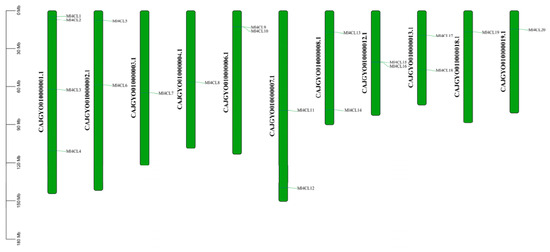
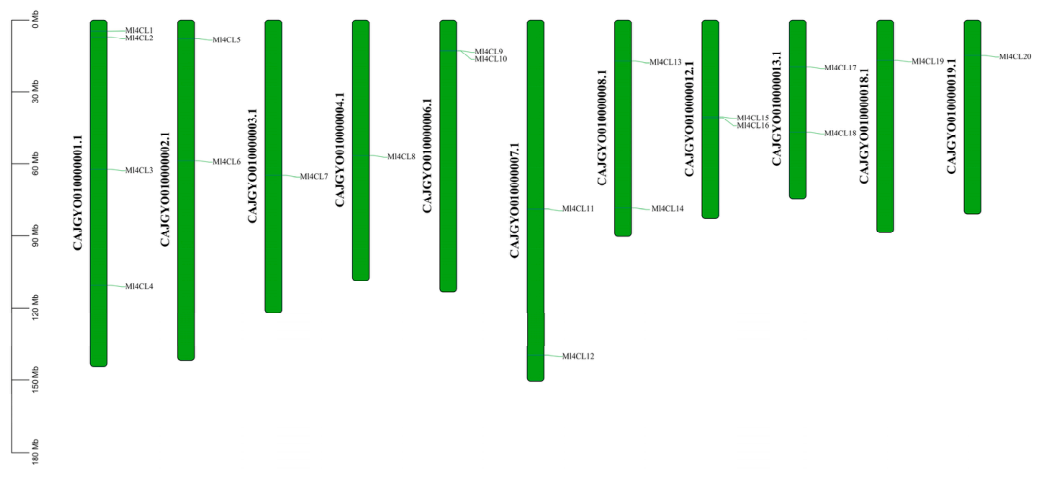
A total of 20 Ml4CL genes were systematically identified in the M. lutarioriparius genome and designated Ml4CL1 to Ml4CL20 based on their chromosomal positions. These genes were unevenly distributed across 11 chromosomes (Chr1, 2, 3, 4, 6, 7, 8, 12, 13, 18, and 19), with the highest concentration observed on chromosome 1 (Figure 1).
Figure 1.
Chromosomal distribution of Ml4CL genes in M. lutarioriparius.
Analysis of physicochemical properties showed that the open reading frames (ORFs) ranged from 1599 to 1965 bp, encoding proteins of 532 to 654 amino acids (Table 2). Predicted molecular weights varied from 57.01 to 70.12 kDa, with theoretical point (pI) ranging from 5.01 to 9.32 (Table 2). Specifically, Ml4CL2 has the shortest ORF (1599 bp), the fewest amino acids (532 aa), and the lowest molecular mass (57.01 kDa), with a pI of 8.30. In contrast, Ml4CL19 has the longest ORF (1965 bp), the highest number of amino acids (654 aa), and the highest molecular mass (70.14 kDa), with a pI of 5.62. Regrading theoretical pI, Ml4CL5 has the highest value (9.32), while Ml4CL17 has the lowest value (5.01).
Table 2.
Basic information of Ml4CL genes in M. lutarioriparius.
The instability index ranged from 30.65 and 50.46, with nine proteins exceeding the threshold of 40, indicating potential structural stability. All Ml4CL proteins exhibit positive GRAVY values, suggesting a hydrophobic characteristics. The aliphatic index ranged from 90.87 to 100.58, indicating moderate thermal stability. Subcellular localization prediction revealed that the Ml4CL proteins are mainly localized in the cytoplasm and peroxisomes, and no signal peptides were detected, indicating intracellular functions.
3.2. Phylogenetic Relationship, Gene Structure, and Conserved Motif Analysis of Ml4CL Genes
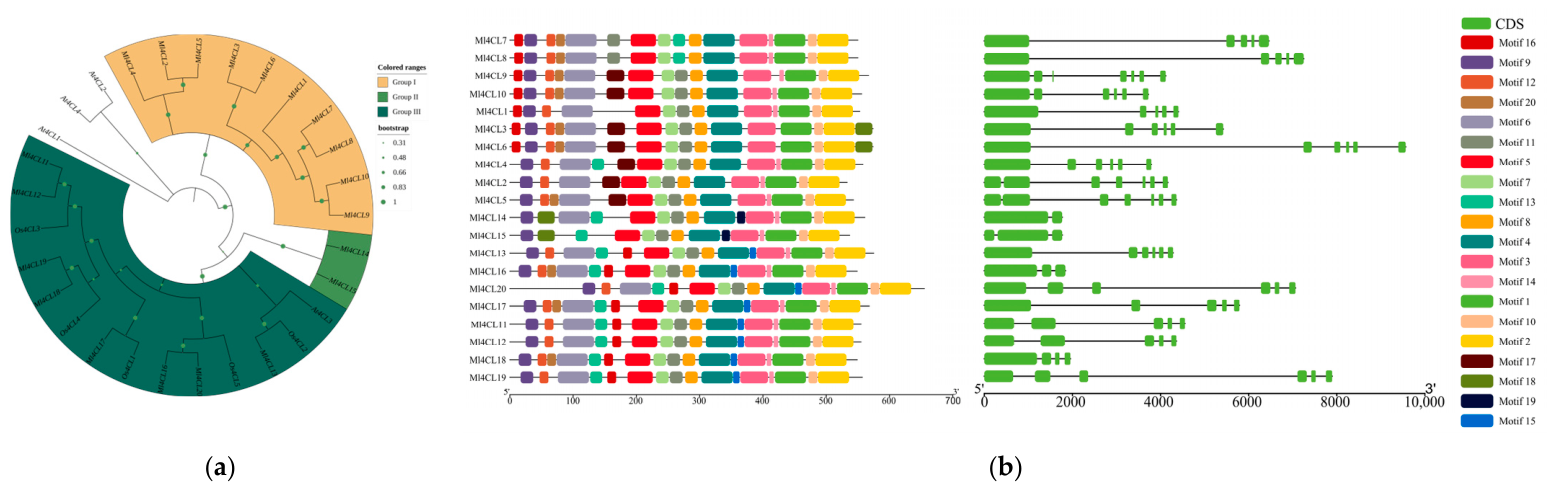
A maximum likelihood phylogenetic tree was constructed using the full-length sequences of 20 Ml4CL genes, along with 8 homologous sequences from representative species including A. thaliana and O. sativa (Figure 2a). The tree topology revealed a clear segregation of all sequences into three major, well-supported clades, designated as Group I to Group III. Group I formed a highly supported monophyletic clade (100% bootstrap) and comprised 14 genes. This group included 8 genes from M. lutarioriparius, along with their putative orthologs from both dicots (e.g., At4CL3 from A.thaliana) and monocots (e.g., Os4CL3 from rice). But the internal relationships within Group I received only moderate support (e.g., 65% and 55%bootstrap), leaving the exact branching order among its members unresolved with high confidence. Within Group II, two genes from M. lutarioriparius, Ml4CL14 and Ml4CL15 formed a tight sister-branch pair with 100% bootstrap support. Group III consisted exclusively of 10 genes from M. lutarioriparius.
Figure 2.
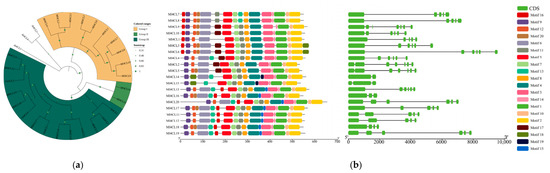
Phylogenetic analysis, gene structure, and conserved motif composition of the Ml4CL gene family in M. lutarioriparius. (a) Phylogenetic analysis of 4CL proteins in different species; (b) Schematic representation of the conserved motifs identified by MEME analysis (left) and exon-intron organization (right) for genes in M. lutarioriparius. Each motif is represented by a colored box numbered 1–10. Green boxes represent coding sequences.
Gene structure analysis revealed considerable divergence in intron numbers among the Ml4CL genes, which largely correlated with their phylogenetic grouping (Figure 2b). Members within the same subclade of a given subfamily generally shared similar exon-intron organizations. For instance, Ml4CL11 and Ml4CL12 exhibited similar structures, containing 5 exons and 4 introns, whereas Ml4CL7 and Ml4CL8 displayed comparable organizations, comprising 6 exons and 5 introns. In contrast, members from different subfamilies sowed notable variations. Among all Ml4CL members, Ml4CL14 possessed the fewest exons (2 exons), while Ml4CL2, Ml4CL5, and Ml4CL9 contained the highest number (7 exons each). Notably, Ml4CL2 and Ml4CL5 shared similar exon-intron structures.
A total of 20 distinct motifs (motif 1–motif 20) were identified among the Ml4CL proteins (Figure 2b; Table 3). Among motifs 1–11, all were present in every Ml4CL member except that Ml4CL15 lacked motif 6. Regarding motif abundance, Ml4CL16, Ml4CL17, and Ml4CL18 contained the highest total number of conserved motifs (17 each), while Ml4CL1, Ml4CL2, and Ml4CL15 contained the lowest (14 each). Furthermore, additional group-specific motifs were identified in different phylogenetic subgroups. Group II members uniquely possessed motif 19, which was absent in other groups. Group III members were characterized by the presence of motif 15. The distribution of these group-specific motifs further supports the phylogenetic classification and suggests functional specialization among different subfamilies. Notably, motif 5 harbors the conserved BoxIsequence (SSGTTGLPKGV), and motif 3 includes BoxII (GEICIRG).
Table 3.
Conserved motif sequences.
3.3. Analysis of Cis-Acting Elements in the Ml4CLs Promoter
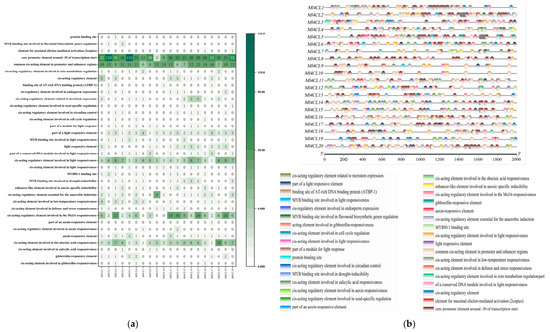
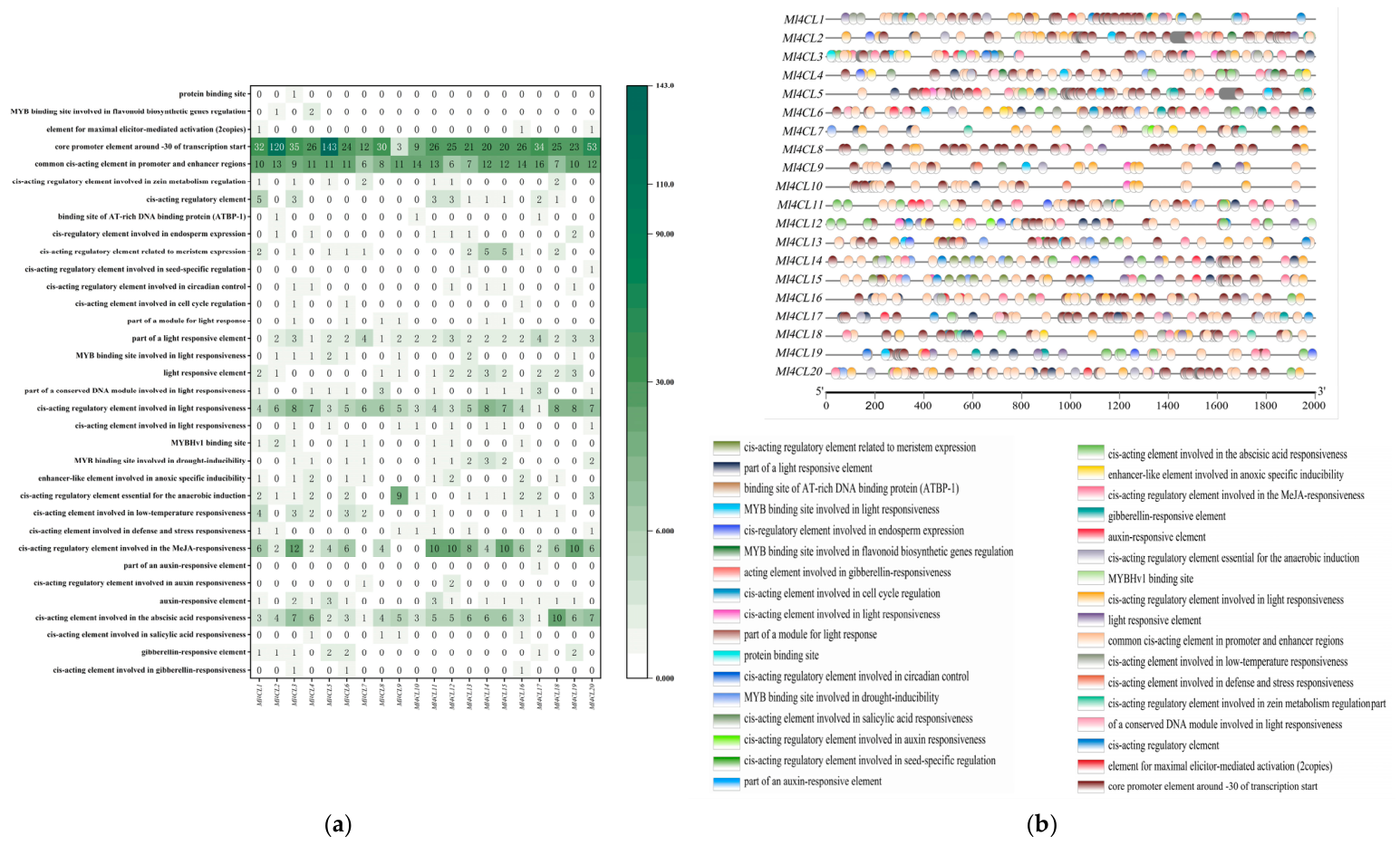
In silico analysis of the 2 kb promoter regions upstream of the transcription start sites of the Ml4CL genes revealed a rich diversity of putative cis-acting regulatory elements (Figure 3). A total of 34 distinct element types were identified, which were categorized into four major functional groups: hormone responsiveness, stress responsiveness, plant growth/development, and light responsiveness (Table 4).
Figure 3.
Heatmap of the abundance and distribution of cis-regulatory elements in the promoter regions of different Ml4CL genes. (a) the heatmap displays the predicted number of core cis-regulatory elements within the 2000 bp promoter region upstream of the ATG start codon for each Ml4CL gene. Rows represent different types of cis-elements, and columns represent individual genes. The color gradient form white (low abundance) to green (high abundance) indicates the relative abundance of each element. (b) Cluster analysis of genes based on their cis-element composition.
Table 4.
Classification of cis-acting regulatory elements identified in the promoters of Ml4CL genes.
Among these 34 elements, four specific cis-acting elements were universally present in the promoter regions of all 20 Ml4CL members (Figure 3a): (1) the core promoter element around −30 bp, essential for precise transcription initiation; (2) the common cis-acting element found in both promoter and enhancer regions; (3) the cis-acting regulatory element involved in light responsiveness; and (4) the cis-acting regulatory element involved in abscisic acid responsive elements (ABRE). The ubiquity and co-occurrence of these elements across all paralogs indicate that the transcriptional regulation of this gene family is built upon a conserved foundational module integrating developmental, environmental (light), and hormonal (ABA) signals. Regarding element abundance, Ml4CL5 contained the highest total number of cis-acting elements(176), while Ml4CL10 contained the lowest number (35). Besides this, re-examining our promoter dataset, we noted that while ABREs were universal, elements responsive to other hormones, such as methyl jasmonate (MeJA) responsive elements (CGTCA-motif) and gibberellin-responsiveness (GARE-motif), were present in a significant subset of promoters. Furthermore, drought-inducibility (MBS) and defense/stress elements frequently co-occurred with ABREs in the same promoters. A substantial proportion (65%) of genes contained anaerobic induction elements (AREs). For example, the promoter of Ml4CL13, Ml4CL14, and Ml4CL15 harbored the highest density of ABRE and MBS elements, implying their potential for strong induction under drought or ABA treatment. This finding suggests a potential link between the regulation of this gene family and low-oxygen stress responses.
3.4. Differential Expression Patterns of Ml4CL Genes Under Cd Stress
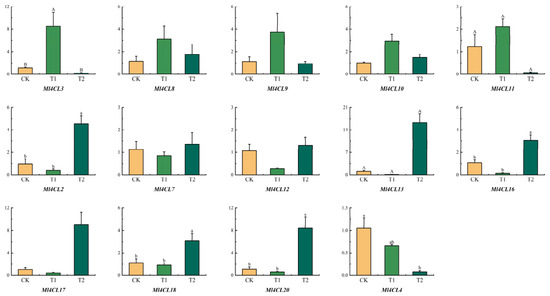
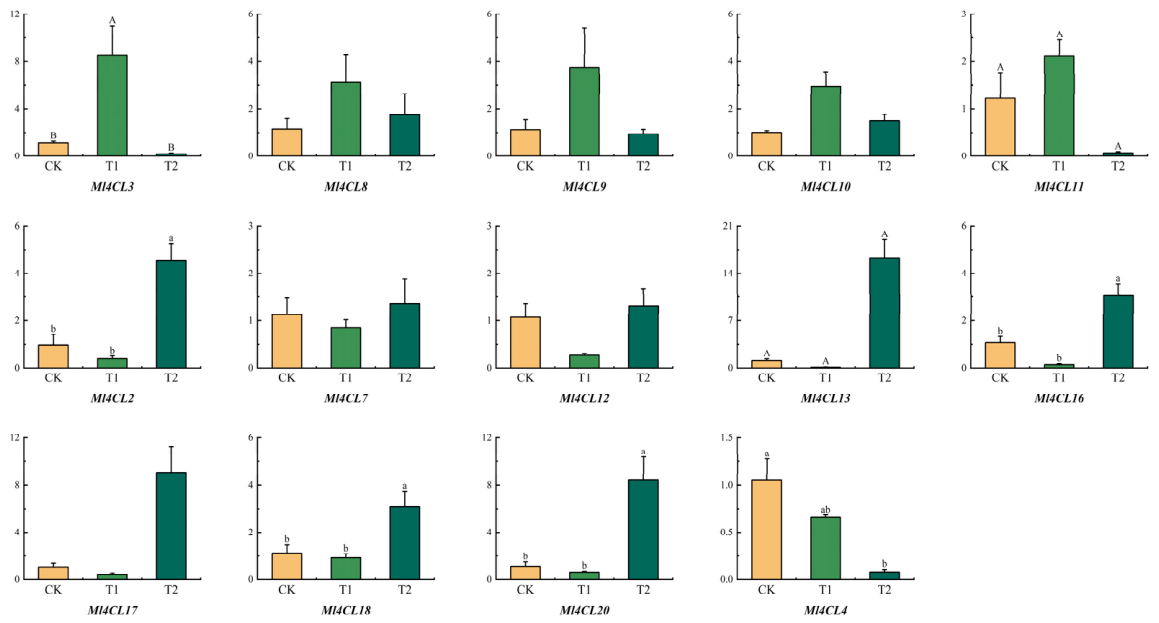
The relative expression profiles of the 20 identified Ml4CL genes in response to Cd stress were determined by qRT-PCR (Figure 4). Six genes (Ml4CL1, Ml4CL5, Ml4CL6, Ml4CL14, Ml4CL15, and Ml4CL19) were excluded from subsequent analysis due to high Ct values (>36) or lack of amplification. The ANOVA analysis revealed differential responsiveness of the Ml4CL genes to Cd stress. A subset of genes exhibited a significant main effect of Cd treatment, others showed no statistically significant alteration in their expression levels (Figure 4, Table A1, Table A2 and Table A3).
Figure 4.
Relative expression levels of Ml4CL genes in the roots of M. lutarioriparius under various concentration treatments. Plants were treated with 0 (CK, control), 28 (T1), and 56 (T2) mg Cd kg−1 soil. The significance of differences among groups was evaluated by one-way ANOVA or Welch’s ANOVA, followed by the corresponding post hoc test (Tukey’s HSD test or the Games–Howell test). No letters are marked on the bars when no significant exists between groups. Different letters on the bars indicate significant intergroup differences (p < 0.05), with lowercase letters denoting results from analyses meeting the assumption of homogeneity of variances (one-way ANOVA followed by Tukey’s HSD test), and uppercase letters denoting results from analyses when variances were unequal (Welch’s ANOVA followed by the Games–Howell test).
A total of 8 out of 14 Ml4CL genes displayed a significant main effect (p < 0.05) in response to Cd exposure. Based on their expression patterns, these responsive genes can be categorized into two groups: Cd-induced and Cd-repressed. A subset of Cd-Induced genes included Ml4CL2, Ml4CL3, Ml4CL13, Ml4CL16, Ml4CL18, and Ml4CL20. Mean RE _ Cd of Ml4CL2 and Ml4CL13 increased by approximately 2.55-fold and 7.17-fold relative to the CK. In contrast, a smaller subset of Cd-repressed genes (Ml4CL4 and Ml4CL11) was significantly downregulated under Cd stress. Their mean RE _ Cd decreased to about 0.35-fold and 0.89-fold of CK. For Ml4CL11 and Ml4CL13, ANOVA revealed a significant main effect of Cd treatment. However, post hoc pairwise comparisons showed no statistically significant differences between any two specific treatment groups. This lack of pairwise significance occurred despite large fold-change differences: Ml4CL11 exhibited a 29.85-fold change (T1 vs. T2), and Ml4CL13 exhibited a 113.14-fold change (T2 vs. T1).
Intriguingly, several (e.g., Ml4CL2, Ml4CL13, Ml4CL16, Ml4CL18, and Ml4CL20) exhibited a pronounced ‘V-shaped’ response trajectory (Figure 4). Their expression was suppressed at T1 (e.g., Ml4CL13 to 0.14-fold of CK) but sharply rebounded and surpassed the control level at T2 (e.g., Ml4CL13 to 16.2-fold of CK, p < 0.05). This creates a statistically significant “down-then-up” biphasic pattern within the overall up-regulatory main effect. Besides of this, the other noteworthy pattern was observed for genes like Ml4CL3 and Ml4CL11, which exhibited a transient ‘up-then -down’ biphasic response. Their expression was induced at the T1 but was repressed back to, or below, the basal level at T2. For instance, Ml4CL3 expression peaked at 8.49-fold (vs. CK) at T1 (p < 0.05) but plummeted to 0.18-fold at T2. Of particular note, Ml4CL4 stood out as the sole gene displaying a progressive reduction in relative expression under Cd stress.
The remaining six genes, including Ml4CL7, Ml4CL8, Ml4CL9, Ml4CL10, Ml4CL12, and Ml4CL17, did not show a statistically significant main effect of Cd treatment (ANOVA p > 0.05; Figure 4, Table A2). However, their expression profiles suggested biologically relevant trends under Cd stress. A subset of genes, including Ml4CL17, recapitulated the “down-then-up” biphasic response. Their expression was initially suppressed at T1 (e.g., Ml4CL17, 0.41-fold) and then induced at T2 (e.g., Ml4CL17, 9.07-fold). Similarly, genes such as Ml4CL9 exhibited the “up-then-down” biphasic response.
4. Discussion
4.1. Comprehensive Characterization of the Ml4CL Gene Family: Evolution, Structure, and Function
In this study, 20 Ml4CL genes were systematically identified from the M. lutarioriparius genome. The results demonstrate that the Ml4CL gene family has undergone complex divergence and expansion during evolution. Chromosomal localization analysis revealed that the 20 Ml4CL genes are unevenly distributed across 11 chromosomes, with the highest concentration observed on chromosome 1 (Figure 1), suggesting that this chromosome represents a genomic hotspot for Ml4CL gene expansion. Such uneven distribution is commonly associated with tandem duplication events, which play a crucial role in gene family expansion and functional diversification [55].
As described in the result section, the Ml4CL proteins exhibit considerable variation in their physicochemical properties. All proteins exhibited hydrophobicity (positive GRAVY values) and high aliphatic indices, suggesting moderate thermal stability under ambient to moderately elevated temperatures, which aligns with the fluctuating thermal environment of the plant cytosol [56,57]. However, the instability indices of nine members exceeded 40, implying that these proteins may require post-translational modifications to maintain functionality [58]. A clear correlation between pI values and subcellular localization was observed: peroxisome-targeted members exhibited higher pI values than cytoplasmic members. This pI-based segregation suggests that the charge properties of Ml4CL proteins may be adapted to the pH environments of their respective organelles (near-neutral to slightly alkaline in peroxisomes, neutral in cytoplasm). Their peroxisomal localization may further suggest involvement in reactive oxygen species metabolism, offering a new perspective for understanding lignin synthesis regulation under stress conditions [59,60].
A maximum likelihood phylogenetic tree constructed from full-length sequences clearly divided all Ml4CL and homologous sequences into three highly supported clades (e.g., Group I, Group II, and Group III). Group I forms a highly conserved monophyletic clade (100% bootstrap), containing both monocots and dicots, suggesting an ancient lineage predating the monocot–dicot split. functionally conserved lineage. However, internal relationships within Group I received only moderate support, indicating possible rapid radiation or incomplete lineage sorting during its early evolution; thus, the exact branching order remains unresolved [61,62]. Furthermore, within Group II, Ml4CL14 and Ml4CL15 form a tightly clustered sister-branch pair with 100% bootstrap support, most likely originating from a very recent tandem or segmental duplication event, providing an ideal case for studying functional divergence after gene duplication [63,64,65].
Gene structure and conserved motifs showed high congruence with phylogenetic grouping (Figure 2b). Members within the same clade (e.g., Ml4CL11 and Ml4CL12 in Group I) shared similar intron numbers and exon-intron structures, while notable variations existed between different clades. This pattern of structural co-evolution strongly suggests that distinct structural frameworks, potentially related to differences in transcriptional regulation or splicing efficiency, were formed in each subfamily through independent intron gain/loss events during evolution [66]. As described in the result section, all Ml4CL members possess a conserved catalytic core. However, notable variations in motif composition were observed among different phylogenetic subgroups. Group II members uniquely possessed motif 19, while Group III members were characterized by the presence of motif 15. Additionally, Ml4CL15 lacked motif 6, which was present in all other members. These group-specific motif distributions suggest functional specialization. The striking variation in motif abundance may also have functional implications: motif-rich members may possess more complex protein structures, while motif-poor members may represent more compact isoforms. Specifically, the absence of motif 6 in Ml4CL15 may affect protein stability, catalytic efficiency, warranting further experimental investigation. Collectively, these findings support functional specialization within the Ml4CL gene family, providing a molecular basis for the divergent roles in lignin biosynthesis and stress responses.
4.2. Architecture for Adaption: Cis-Regulatory Code Links Stress, Hormone, and Hypoxia
Our promoter analysis paints a picture of the Ml4CL gene family as a transcriptional hub integrating multiple signaling cascades. Four specific cis-acting elements were universally present in all 20 Ml4CL promoters: ABRE, light-responsive element, the core promoter element around −30 bp, and the common promoter/enhancer element. The universal ABRE and light-responsive elements form the obligatory core, ensuring that every gene member is responsive to abiotic stress and photoperiod [67,68]. The core promoter element is essential for precise transcription initiation by RNA polymerase II, while the common promoter/enhancer element may facilitate coordinated regulation across distal regulatory regions. Together, these four elements constitute a conserved regulatory backbone for this gene family, ensuring that every member possesses the basic transcriptional machinery for signal integration. The frequent co-occurrence of JA-, GA-, and SA-related elements suggests that this core response can be finely modulated by additional hormonal cues [69,70].
Beyond the conserved core elements, the total number of cis-acting elements varied dramatically among Ml4CL members. Ml4CL5 contained the highest number (176), while Ml4CL10 contained the fewest cis-elements (35). This five-fold difference in promoter complexity may reflect distinct transcriptional regulatory capacities. Ml4CL5, with its exceptionally high cis-element abundance, may possess a more complex and highly inducible expression pattern, enabling it respond to a broader range of environmental and developmental signals. In contrast, Ml4CL10, with the fewest cis-elements, may have a more constitutive or narrowly tuned expression pattern, potentially serving a housekeeping function under standard growth conditions. Such divergence in promoter architecture likely contributes to the functional specialization observed within the Ml4CL family.
Beyond the well-established phytohormones discussed above, strigolactones (SLs) have recently emerged as critical regulators of plant responses to Cd stress [71]. SLs are known to alleviate Cd toxicity by reducing Cd accumulation, enhancing antioxidant defense, and coordinating with ABA signaling pathways [72,73]. Given that our promoter analysis identified universal ABRE elements and frequent MYB binding sites in all Ml4CL members, it is plausible that SL signaling may integrate with ABA and other hormonal pathways to regulate Ml4CL expression under heavy metal stress. Future experimental validation of SL-mediated regulation of Ml4CL genes under Cd stress is warranted [71].
Based on these findings, we propose a hierarchical model of regulation: under standard conditions, basal expression may be maintained by light signaling. Upon drought or Cd stress (which often induce ABA), the ABRE-mediated pathway becomes dominant, driving strong induction. Concurrently, the specific blend of secondary hormonal signals (e.g., JA accumulation upon herbivory, SA during pathogen attack, and SLs under heavy metal stress) present in given tissue or stress context could potentiate or attenuate this core ABA response via their respective cis-elements [69,74,75]. This architecture allows the Ml4CL gene family to generate a graded and context-specific output, enabling the plant to tailor its physiological response (e.g., lignin biosynthesis for defense, secondary metabolite production) to a complex combinatorial stress environment.
Crucially, the frequent co-occurrence of AREs with this core module extends this logic to a prevalent ecological challenge: compound stress in waterlogged soils, where heavy metal toxicity coincides with hypoxia [76,77]. Therefore, the Ml4CL gene family is positioned not merely as a set of stress responders, but as active integrative hubs that synchronize abiotic stress signaling with energy/metabolic homeostasis and other hormonal programs [78,79,80]. This sophisticated cis-regulatory code fundamentally broadens the functional interpretation of our study, linking molecular regulation to the plant’s capacity for adaptive plasticity [81,82,83].
4.3. Decoding a Sophisticated Defense Hierarchy: From Specific Repression to Biphasic Regulation
As described in the results, six Ml4CL genes showed no detectable amplification, and six others exhibited no statistically significant expression changes under Cd stress. The lack of amplification may be attributed to highly tissue-specific expression with extremely low basal levels in roots, activation only under specific stress conditions or higher Cd concentrations, or the possibility of being pseudogenes. For the non-responsive genes, their functional divergence may reflect basal constitutive expression serving housekeeping functions, consistent with the promoter analysis showing that Ml4CL10 contains the fewest cis-elements (35). Alternatively, they may be insensitive to the Cd concentrations used but could respond to other concentrations or stresses (e.g., drought, pathogens), or they may respond to Cd in other tissues (e.g., leaves). Notably, although Ml4CL17 did not reach statistical significance, its biphasic trend resembles that of the significantly responsive gene Ml4CL13, suggesting potential Cd responsiveness masked by high biological variability. Further validation across additional tissues and stress conditions is warranted.
In stark contrast to most responsive genes, a single member of the Ml4CL gene family, Ml4CL4, exhibited a consistent and significant down-regulation under cadmium stress. The unique expression profile of Ml4CL4 is coherent with its distinctive promoter composition. Unlike its stress-induced paralogs, the Ml4CL4 promoter is enriched with auxin-responsive elements and elements associated with flavonoid biosynthesis, but noticeably lacks gibberellin-responsive element. This cis-regulatory signature suggests that Ml4CL4 is primarily into growth and developmental networks regulated by auxin and is involved in the synthesis of specific flavonoids, rather than being part of the core abiotic stress response toolkit [84,85]. This positions it firmly within a growth-promoting, developmental context. The specific repression of Ml4CL4 exemplifies the complex reprioritization during stress. This serves a dual purpose: it conserves energy and carbon skeletons for essential defense processes, and it may reconfigure the flavonoid metabolic network to favor the production of defensive over growth-related compounds [86,87]. Thus, stress adaptation is achieved not only by activating defense genes but also by precisely silencing competing physiological programs.
The “induction-then-repression” pattern observed for some genes may reflect a protective mechanism that becomes saturated or detrimental under severe stress [88,89,90]. At moderate Cd levels (T1), these genes are activated to participate in initial detoxification or signaling. However, under extreme toxicity (T2), their activity might be shut down to conserve cellular resources, prevent the accumulation of toxic intermediates, or because the stress pathway they are involved in is overridden by a more dominant cell death or survival signal [87,89]. The “repression-then-induction” pattern is particularly intriguing [91]. It suggests that these genes might be repressed under mild stress to prioritize other immediate responses, but are specifically recruited under sever, sustained stress for functions such as long-term adaptation, repair, or a switch to a different metabolic strategy [92]. This could represent a two-tiered defense strategy, where different genetic programs are sequentially deployed based on stress severity.
The significant main effects detected for genes with biphasic responses carry a deeper biological meaning than those for monotonically induced genes. They do not merely indicate a change, but reveal a qualitative switch in regulatory outcome driven by Cd dose. This implies that the underlying signaling networks sensing Cd are not linear but threshold-based or biphasic themselves, capable of activating distinct transcriptional programs at different stress intensities. Therefore, the significant main effect of Cd should not be interpreted uniformly. It encompasses at least two types of responses: sustained repression, and does-dependent reversal. This complexity underscores that the Ml4CL gene family is integrated into a sophisticated regulatory network capable of generating nuanced outputs in response to varying stress magnitudes, a feature that likely enhances the plant’s adaptive flexibility [88,93].
4.4. Limitations, Application Prospects, and Future Perspectives
Despite providing a comprehensive bioinformatic and expression profile, this study has certain limitations inherent to its predictive nature. First, the functional implications of the identified cis-elements and motif variations remain computational predictions; direct experimental validation (e.g., through EMSA or promoter-reporter assays) is required to confirm their regulatory roles [94,95]. Second, while qPCR revealed expression patterns, it does not elucidate post-translational regulation or the actual enzymatic activity of the Ml4CL proteins under stress. Third, the scope of our experimental validation is limited. Our qPCR analysis focused on root response to a gradient of stress, leaving expression dynamics in aboveground tissues (leaves, stems) as well as cell-type specificity within roots unaddressed. Fourth, the functional mechanisms of Ml4CL proteins in this study are primarily based on bioinformatics predictions and expression profiling, lacking evidence at the protein-protein interaction level. Future studies could utilize bioinformatics tools such as the STRING database to construct protein-protein interaction networks of Ml4CL proteins and predict their potential interactions with key components of Cd stress-responsive pathways (e.g., transcription factors, signal transduction proteins, phenylpropanoid pathway enzymes). This would help to further elucidate the molecular regulatory networks of Ml4CL proteins in Cd stress adaptation at the protein interaction level.
Our findings provide a potential molecular explanation for an intriguing agronomic observation in M. lutarioriparius: that low-concentration stress can enhance growth, a form of hormesis documented in prior studies [43,96]. We demonstrate that key Ml4CL genes (e.g., Ml4CL13) exhibit a biphasic transcriptional response, being repressed under mild stress and strongly upregulated under severe stress. This dose-sensitive expression pattern positions these genes as ideal candidates for mediating the fine-tuning of phenylpropanoid metabolism in response to varying environmental challenges [93]. This mechanistic insight translates into concrete application prospects. (1) The promoters of these graded-response genes could be engineered to create “stress-responsive regulatory modules” in crops. Such sensors would only activate costly defense pathways (like lignin biosynthesis) when truly needed (high stress), while allowing growth to proceed or even be stimulated under mild, beneficial stress [97,98]. (2) In M. lutarioriparius breeding programs, allelic variation in these genes could be screened to select for genotypes that maintain an optimal “response balance”-retaining the growth-promoting response to mild stress while ensuring robust defense under severe conditions, thereby maximizing overall fitness and remediation potential [48,99].
5. Conclusions
Through a comprehensive investigation of the Ml4CL gene family in M. lutarioriparius, this study draws the following key conclusions:
1. Evolutionary and Structural Basis: The Ml4CL gene family can be classified into three clades: Group I represents an ancient, conserved subfamily; Group II contains a recent tandem/segmental duplication pair, and Group III is a product of recent lineage-specific expansion. The co-evolution of gene structure and motifs strongly supports functional divergence among subfamilies.
2. Sophisticated Regulatory Logic: The Ml4CL promoters possess an intricate cis-regulatory code, enabling them to function as signaling integrators. They synchronize responses to abiotic stresses (e.g., drought), hypoxia signals, and multiple plant hormones (ABA, JA, SA, GA) and strigolactones (SLs), thereby generating nuanced metabolic outputs tailored to the environmental context.
3. Hierarchical Stress Response Strategy: Family members exhibit highly divergent expression patterns under cadmium stress, which go beyond simple activation or repression. These include: (i) the specific repression of Ml4CL4, representing a reprioritization of metabolic resources towards defense; (ii) the “early induction followed by repression” in some genes, potentially a protective mechanism against over-activation; and (iii) the “early repression followed by induction” in others, possibly indicating a delayed launch of long-term adaptation or repair programs. These biphasic response patterns reveal an underlying, dose-dependent, non-linear signal perception network.
4. Application Potential and Future Perspectives: These findings hold significant translational value. The dose-sensitive promoters are ideal components for engineering stress-responsive regulatory modules while the key allelic variations can be used in marker-assisted breeding to select genotypes that maintain an optimal “response balance” between growth and defense, thereby facilitating the development of climate-resilient M. lutarioriparius varieties. Future work should focus on experimentally validating the function of key cis-elements and elucidating the family’s regulatory mechanisms at whole-plant and protein activity levels.
Author Contributions
Conceptualization, X.H., X.Z. and S.X.; methodology, X.H., T.F. and S.X.; software, X.H. and X.Z.; validation, X.H., X.Z. and Y.P.; formal analysis, X.H.; investigation, X.H., X.Z. and Y.P.; resources, M.L., T.F., Y.P. and S.X.; data curation, X.H. and S.X.; writing—original draft preparation, X.H.; writing—review and editing, T.F., M.L., Z.Y., X.Z., Y.P. and S.X.; visualization, X.H., X.Z. and Y.P.; supervision, M.L. and Z.Y.; project administration, S.X. and Z.Y.; funding acquisition, S.X. All authors have read and agreed to the published version of the manuscript.
Funding
This work was supported by the Yulushan Laboratory Breeding Project (YLS-2025-ZY04075), Natural Science Foundation of China (32000259) and Research funding of Hunan Agricultural University (25KJ040 & 2024XKJC05).
Data Availability Statement
The original contributions presented in this study are included in the article. Further inquiries can be directed to the corresponding author.
Acknowledgments
We thank all members of our laboratory for their helpful discussions and technical assistance.
Conflicts of Interest
The authors declare no conflicts of interest.
Appendix A
Appendix A is a supplement to Section 3.4, presenting statistical details for Ml4CL gene family qPCR analysis.
Table A1.
Results of Levene’s test for Homogeneity of variances.
Table A2.
Summary of ANOVA results.
Table A3.
Detailed results of post hoc multiple comparisons.
References
- Hou, D.; Jia, X.; Wang, L.; McGrath, S.P.; Zhu, Y.-G.; Hu, Q.; Zhao, F.-J.; Bank, M.S.; O’Connor, D.; Nriagu, J. Global soil pollution by toxic metals threatens agriculture and human health. Science 2025, 388, 316–321. [Google Scholar] [CrossRef] [Scilit]
- Xu, T.; Xi, J.; Ke, J.; Wang, Y.; Chen, X.; Zhang, Z.; Lin, Y. Deciphering Soil Amendments and Actinomycetes for Remediation of Cadmium (Cd) Contaminated Farmland. Ecotoxicol. Environ. Saf. 2023, 249, 114388. [Google Scholar] [CrossRef] [Scilit]
- Li, Y.; Fan, G.; Gao, Y.; Chen, W.; Shi, G.; Tong, F.; Liu, L.; Zhou, D. Wheat tends to accumulate higher levels of cadmium in the grains than rice under a wide range of soil pH and Cd concentrations: A field study on rice-wheat rotation farmland. Environ. Pollut. 2025, 367, 125574. [Google Scholar] [CrossRef] [Scilit] [PubMed]
- Du, B.; Zhou, J.; Lu, B.; Zhang, C.; Li, D.; Zhou, J.; Jiao, S.; Zhao, K.; Zhang, H. Environmental and Human Health Risks from Cadmium Exposure Near an Active Lead-Zinc Mine and a Copper Smelter, China. Sci. Total Environ. 2020, 720, 137585. [Google Scholar] [CrossRef] [Scilit]
- Gonçalves, J.F.; Dressler, V.L.; Assmann, C.E.; Morsch, V.M.M.; Schetinger, M.R.C. Cadmium Neurotoxicity: From Its Analytical Aspects to Neuronal Impairment. Adv. Neurotoxicol. 2021, 5, 81–113. [Google Scholar] [CrossRef] [Scilit]
- Cui, J.; Liu, Y.; Hao, Z.; Liu, Y.; Qiu, M.; Kang, L.; Teng, X.; Tang, Y. Cadmium Induced Time-Dependent Kidney Injury in Common Carp Via Mitochondrial Pathway: Impaired Mitochondrial Energy Metabolism and Mitochondrion-Dependent Apoptosis. Aquat. Toxicol. 2023, 261, 106570. [Google Scholar] [CrossRef] [Scilit] [PubMed]
- Lang, Q.; Xia, Y.; Li, Y.; Wang, C.; Liu, Z.; Zou, G.; Sun, Q. CaO-modified Hydrochar Reduces Soil Cadmium Bioavailability by Altering Soil Properties, Shifting Bacterial Community, and Promoting Microbial Metabolisms. Environ. Technol. Innov. 2024, 35, 103698. [Google Scholar] [CrossRef] [Scilit]
- Zhou, C.; Zhu, L.; Ma, Z.; Wang, J. Bacillus amyloliquefaciens SAY09 Increases Cadmium Resistance in Plants by Activation of Auxin-Mediated Signaling Pathways. Genes 2017, 8, 173. [Google Scholar] [CrossRef] [Scilit]
- Chen, J.; Zou, W.; Meng, L.; Fan, X.; Xu, G.; Ye, G. Advances in the Uptake and Transport Mechanisms and QTLs Mapping of Cadmium in Rice. Int. J. Mol. Sci. 2019, 20, 3417. [Google Scholar] [CrossRef] [Scilit]
- El-Naggar, A.; Chang, S.X.; Cai, Y.; Lee, Y.H.; Wang, J.; Wang, S.-L.; Ryu, C.; Rinklebe, J.; Ok, Y.S. Mechanistic Insights into the (im)mobilization of Arsenic, Cadmium, Lead, and Zinc in a Multi-Contaminated Soil Treated with Different Biochars. Environ. Int. 2021, 156, 106638. [Google Scholar] [CrossRef] [Scilit]
- Galhardi, J.A.; Mello, J.W.d.; Wilkinson, K.J. Bioaccumulation of Potentially Toxic Elements from the Soils Surrounding a Legacy Uranium Mine in Brazil. Chemosphere 2020, 261, 127679. [Google Scholar] [CrossRef] [Scilit] [PubMed]
- Su, R.; Xie, T.; Yao, H.; Chen, Y.; Wang, H.; Dai, X.; Wang, Y.; Shi, L.; Luo, Y. Lead Responses and Tolerance Mechanisms of Koelreuteria paniculata: A Newly Potential Plant for Sustainable Phytoremediation of Pb-Contaminated Soil. Int. J. Environ. Res. Public Health 2022, 19, 14968. [Google Scholar] [CrossRef] [Scilit]
- Zhu, Y.; Dong, B.; Zhang, H.; Liu, Z.; Zou, H.; Li, S.; Nie, G.; Wang, X.; Li, H.; Han, M.; et al. Intermittent anaerobic-aerobic biopiling for remediating energetic compound-contaminated soils. Environ. Technol. Innov. 2024, 35, 103728. [Google Scholar] [CrossRef] [Scilit]
- Liu, S.; Yang, B.; Liang, Y.; Xiao, Y.; Fang, J. Prospect of phytoremediation combined with other approaches for remediation of heavy metal-polluted soils. Environ. Sci. Pollut. Res. Int. 2020, 27, 16069–16085. [Google Scholar] [CrossRef] [Scilit]
- Roane, T.; Lantz, M. Microbial Uses in the Remediation of Metal-Impacted Soils. In Manual of Environmental Microbiology; ASM Press: Washington, DC, USA, 2015; Chapter 5.2.3-1–5.2.3-10. [Google Scholar] [CrossRef] [Scilit]
- Ashraf, S.; Ali, Q.; Zahir, Z.A.; Ashraf, S.; Asghar, H.N. Phytoremediation: Environmentally Sustainable Way for Reclamation of Heavy Metal Polluted Soils. Ecotoxicol. Environ. Saf. 2019, 174, 714–727. [Google Scholar] [CrossRef] [Scilit] [PubMed]
- Zhang, L. Bioaugmentation with Siderophore-producing Bacteria to Enhance Phytoremediation of Heavy Metal Polluted Soil by Sweet Sorghum. Environ. Sci. Technol. 2014, 37, 74–79. (In Chinese) [Google Scholar]
- Wu, C.; Wu, Y.-j.; Yi, S.-w.; Li, F. Enhancing Cadmium Biosorption Capacity in E. coli Through Heterologous Expression of Metal-Chelating Proteins: Insights into Bioremediation Potential and Mechanisms. J. Cent. South Univ. 2024, 31, 1265–1275. [Google Scholar] [CrossRef] [Scilit]
- Xu, Z.; Wang, D.; Tang, W.; Wang, L.; Li, Q.; Lu, Z.; Liu, H.; Zhong, Y.; He, T.; Guo, S. Phytoremediation of Cadmium-Polluted Soil Assisted by D-gluconate-enhanced Enterobacter cloacae Colonization in the Solanum nigrum L. Rhizosphere. Sci. Total Environ. 2020, 732, 139265. [Google Scholar] [CrossRef] [Scilit]
- Gu, P.; Zhang, Y.; Xie, H.; Wei, J.; Zhang, X.; Huang, X.; Wang, J.; Lou, X. Effect of Cornstalk Biochar on Phytoremediation of Cd-contaminated Soil by Beta vulgaris Var. Cicla L. Ecotoxicol. Environ. Saf. 2020, 205, 111144. [Google Scholar] [CrossRef] [Scilit]
- Yang, Y.; Xiao, C.; Wang, F.; Peng, L.; Zeng, Q.; Luo, S. Assessment of the Potential for Phytoremediation of Cadmium Polluted Soils by Various Crop Rotation Patterns Based on the Annual Input and Output Fluxes. J. Hazard. Mater. 2022, 423, 127183. [Google Scholar] [CrossRef] [Scilit]
- Huang, R.; Dong, M.; Mao, P.; Zhuang, P.; Paz-Ferreiro, J.; Li, Y.; Li, Y.; Hu, X.; Netherway, P.; Li, Z. Evaluation of Phytoremediation Potential of Five Cd (hyper)accumulators in Two Cd Contaminated Soils. Sci. Total Environ. 2020, 721, 137581. [Google Scholar] [CrossRef] [Scilit]
- Rascio, N.; Navari-Izzo, F. Heavy Metal Hyperaccumulating Plants: How and Why Do They Do It? and What Makes Them So Interesting? Plant Sci. 2010, 180, 169–181. [Google Scholar] [CrossRef] [Scilit]
- Yu, Y.; Yi, Z.; Zhou, G. Research Progress and Comprehensive Utilization of Miscanthus. Chin. Bull. Life Sci. 2014, 26, 707–714. (In Chinese) [Google Scholar] [CrossRef]
- Yi, Z. Exploitation and utilization of Miscanthus as energy plant. J. Hunan Agric. Univ. 2012, 38, 345–350. (In Chinese) [Google Scholar] [CrossRef] [Scilit]
- Chen, Z.-J.; Tian, W.; Li, Y.-J.; Sun, L.-N.; Chen, Y.; Zhang, H.; Li, Y.-Y.; Han, H. Responses of Rhizosphere Bacterial Communities, Their Functions and Their Network Interactions to Cd Stress under Phytostabilization by Miscanthus spp. Environ. Pollut. 2021, 287, 117663. [Google Scholar] [CrossRef] [Scilit]
- Wu, B.; Luo, S.; Luo, H.; Huang, H.; Xu, F.; Feng, S.; Xu, H. Improved Phytoremediation of Heavy Metal Contaminated Soils by Miscanthus floridulus under a Varied Rhizosphere Ecological Characteristic. Sci. Total Environ. 2022, 808, 151995. [Google Scholar] [CrossRef] [Scilit]
- Zadel, U.; Nesme, J.; Michalke, B.; Vestergaard, G.; Plaza, G.A.; Schroeder, P.; Radl, V.; Schloter, M. Changes Induced by Heavy Metals in the Plant-Associated Microbiome of Miscanthus × Giganteus. Sci. Total Environ. 2020, 711, 134433. [Google Scholar] [CrossRef] [Scilit] [PubMed]
- Rusinowski, S.; Krzyzak, J.; Clifton-Brown, J.; Jensen, E.; Mos, M.; Webster, R.; Sitko, K.; Pogrzeba, M. New Miscanthus Hybrids Cultivated at a Polish Metal-Contaminated Site Demonstrate High Stomatal Regulation and Reduced Shoot Pb and Cd Concentrations. Environ. Pollut. 2019, 252, 1377–1387. [Google Scholar] [CrossRef] [Scilit] [PubMed]
- Deans, I.; Stewart, D.; Jones, J.; Kam, J.; Mishra, B. Uptake and Speciation of Zn and Pb by Miscanthus Grown in Contaminated Soils. J. Hazard. Mater. 2023, 445, 129899. [Google Scholar] [CrossRef] [Scilit] [PubMed]
- Muntean, I.; Titei, V.; Gudima, A.; Armas, A.; Gadibadi, M. Biomass Quality Of Some Poaceae Species And Possible Use For Renewable Energy Production In Moldova. Sci. Pap. Ser. A Agron. 2018, 61, 497–502. [Google Scholar]
- Jin, X.; Chen, X.; Shi, C.; Li, M.; Guan, Y.; Yu, C.Y.; Yamada, T.; Sacks, E.J.; Peng, J. Determination of Hemicellulose, Cellulose and Lignin Content Using Visible and Near Infrared Spectroscopy in Miscanthus sinensis. Bioresour. Technol. 2017, 241, 603–609. [Google Scholar] [CrossRef] [Scilit] [PubMed]
- Chen, Y.X.; Wu, F.; Yu, Q.; Brouwers, H.J.H. Bio-based Ultra-Lightweight Concrete Applying Miscanthus Fibers: Acoustic Absorption and Thermal Insulation. Cem. Concr. Compos. 2020, 114, 103829. [Google Scholar] [CrossRef] [Scilit]
- Singh, S.S.; Lim, L.-T.; Manickavasagan, A. Enhanced Microfibrillation of Miscanthus × Giganteus Biomass by Binary-Enzymes Pre-Treatment. Ind. Crops Prod. 2022, 177, 114537. [Google Scholar] [CrossRef] [Scilit]
- Tang, Z.; Yi, Z.; Li, M.; Wang, S. Preparation and characterization of stearic acid modified Miscanthus lutarioriparius nanocellulose. Chem. Fiber Text. Technol. 2023, 52, 14–18. (In Chinese) [Google Scholar]
- Yuan, R.; Liang, Y.; Fu, T.; Hu, S.; Wang, S.; Yi, Z.; Li, M. Hydrothermal Liquefaction Enzymolysis Coupling Technology for the Saccharification of Miscanthus lutarioriparius Biomass. China Pulp. Pap. 2024, 43, 71–80. (In Chinese) [Google Scholar] [CrossRef]
- Mazur, A.; Kowalczyk-Jusko, A. The Assessment of the Usefulness of Miscanthus × Giganteus to Water and Soil Protection Against Erosive Degradation. Resources 2021, 10, 66. [Google Scholar] [CrossRef] [Scilit]
- Zhao, C.; Nie, Y.-H.; Xin, J.-P.; Zhu, X.-Y.; Li, Y.; Tian, R.-N. Soil Erosion Effectively Alleviated by Miscanthus sacchariflorus, a Potential Candidate for Land Deterioration Improvement. Rhizosphere 2023, 26, 100694. [Google Scholar] [CrossRef] [Scilit]
- Xue, S.; Yi, Z.; Huang, H.; Yang, S. Development of the Dongting Lake grown Miscanthus lutarioriparius derived bio-industries: Problems and solutions. Environ. Ecol. 2022, 4, 33–38. (In Chinese) [Google Scholar]
- Chen, Q.; Fu, X.; He, C.; Li, Z.; Yi, Z.; Xue, S. Exploring the degradation characteristics of Miscanthus lutarioriparius derived biochar and its underground biomass in soil. J. China Agric. Univ. 2025, 30, 115–125. (In Chinese) [Google Scholar]
- Xu, Y.; Zheng, C.; Liang, L.; Yi, Z.; Xue, S. Quantitative Assessment of the Potential for Soil Improvement by Planting Miscanthus on Saline-alkaline Soil and the Underlying Microbial Mechanism. Glob. Change Biol. Bioenergy 2021, 13, 1191–1205. [Google Scholar] [CrossRef] [Scilit]
- Xue, S.; Guo, M.; Iqbal, Y.; Liao, J.; Yang, S.; Xiao, L.; Yi, Z. Mapping current distribution and genetic diversity of the native Miscanthus lutarioriparius across China. Renew. Sustain. Energy Rev. 2020, 134, 110386. [Google Scholar] [CrossRef] [Scilit]
- Wu, Y. Exploration of the Mechanism of Miscanthus lutarioriparius Adaptation to Cadmium Stress. Master’s Thesis, Hunan Agricultural University, Changsha, China, 2022. (In Chinese) [Google Scholar]
- Zhu, Y.X.; Du, W.X.; Fang, X.Z.; Zhang, L.L.; Jin, C.W. Knockdown of BTS May Provide a New Strategy to Improve Cadmium-Phytoremediation Efficiency by Improving Iron Status in Plants. J. Hazard. Mater. 2020, 384, 121473. [Google Scholar] [CrossRef] [Scilit] [PubMed]
- Whankaew, S.; Poopear, S.; Kanjanawattanawong, S.; Tangphatsornruang, S.; Boonseng, O.; Lightfoot, D.A.; Triwitayakorn, K. A Genome Scan for Quantitative Trait Loci Affecting Cyanogenic Potential of Cassava Root in an Outbred Population. BMC Genom. 2011, 12, 266. [Google Scholar] [CrossRef] [Scilit]
- Schneider, K.; Hovel, K.; Witzel, K.; Hamberger, B.; Schomburg, D.; Kombrink, E.; Stuible, H. The Substrate Specificity-Determining Amino Acid Code of 4-Coumarate:Coa Ligase. Proc. Natl. Acad. Sci. USA 2003, 100, 8601–8606. [Google Scholar] [CrossRef] [Scilit]
- Lavhale, S.G.; Kalunke, R.M.; Giri, A.P. Structural, Functional and Evolutionary Diversity of 4-Coumarate-coa Ligase in Plants. Planta 2018, 248, 1063–1078. [Google Scholar] [CrossRef] [Scilit]
- Miao, J.; Feng, Q.; Li, Y.; Zhao, Q.; Zhou, C.; Lu, H.; Fan, D.; Yan, J.; Lu, Y.; Tian, Q.; et al. Chromosome-scale Assembly and Analysis of Biomass Crop Miscanthus lutarioriparius Genome. Nat. Commun. 2021, 12, 2458. [Google Scholar] [CrossRef] [Scilit]
- Gui, J.; Shen, J.; Li, L. Functional Characterization of Evolutionarily Divergent 4-Coumarate:Coenzyme A Ligases in Rice1[W][OA]. Plant Physiol. 2011, 157, 574–586. [Google Scholar] [CrossRef] [Scilit]
- Chen, C.; Wu, Y.; Li, J.; Wang, X.; Zeng, Z.; Xu, J.; Liu, Y.; Feng, J.; Chen, H.; He, Y.; et al. TBtools-II: A “one for All, All for One” Bioinformatics Platform for Biological Big-Data Mining. Mol. Plant 2023, 16, 1733–1742. [Google Scholar] [CrossRef] [Scilit]
- Nielsen, H. Practical Applications of Language Models in Protein Sorting Prediction: SignalP 6.0, DeepLoc 2.1, and DeepLocPro 1.0. In Large Language Models (LLMs) in Protein Bioinformatics; Methods in Molecular Biology; Humana: New York, NY, USA, 2025; Volume 2941, pp. 153–175. [Google Scholar] [CrossRef] [Scilit]
- Soltani, B.M.; Ehlting, J.; Hamberger, B.; Douglas, C.J. Multiple Cis-Regulatory Elements Regulate Distinct and Complex Patterns of Developmental and Wound-Induced Expression of Arabidopsis Thaliana 4CL Gene Family Members. Planta 2006, 224, 1226–1238. [Google Scholar] [CrossRef] [Scilit] [PubMed]
- Tamura, K.; Stecher, G.; Kumar, S. MEGA11: Molecular Evolutionary Genetics Analysis Version 11. Mol. Biol. Evol. 2021, 38, 3022–3027. [Google Scholar] [CrossRef] [Scilit] [PubMed]
- Cheng, T.; Zhu, F.; Sheng, J.; Zhao, L.; Zhou, F.; Hu, Z.; Diao, Y.; Jin, S. Selection of Suitable Reference Genes for Quantitive Real-Time PCR Normalization in Miscanthus lutarioriparia. Mol. Biol. Rep. 2019, 46, 4545–4553. [Google Scholar] [CrossRef] [Scilit]
- Cannon, S.B.; Mitra, A.; Baumgarten, A.; Young, N.D.; May, G. The roles of segmental and tandem gene duplication in the evolution of large gene families in Arabidopsis thaliana. BMC Plant Biol. 2004, 4, 10. [Google Scholar] [CrossRef] [Scilit]
- Kyte, J.; Doolittle, R. A Simple Method for Displaying the Hydropathic Character of a Protein. J. Mol. Biol. 1982, 157, 105–132. [Google Scholar] [CrossRef] [Scilit]
- Guruprasad, K.; Reddy, B.; Pandit, M. Correlation Between Stability of a Protein and Its Dipeptide Composition: A Novel Approach for Predicting in Vivo Stability of a Protein from Its Primary Sequence. Protein Eng. Des. Sel. 1990, 4, 155–161. [Google Scholar] [CrossRef] [Scilit]
- Lee, J.M.; Hammarén, H.M.; Savitski, M.M.; Baek, S.H. Control of Protein Stability by Post-Translational Modifications. Nat. Commun. 2023, 14, 201. [Google Scholar] [CrossRef] [Scilit]
- Nakanishi, K.; Li, H.; Ichino, T.; Tatsumi, K.; Osakabe, K.; Watanabe, B.; Shimomura, K.; Yazaki, K. Peroxisomal 4-coumaroyl-CoA ligases participate in shikonin production in Lithospermum erythrorhizon. Plant Physiol. 2024, 195, 2843–2859. [Google Scholar] [CrossRef] [Scilit] [PubMed]
- Chen, X.; Wang, H.; Li, X.; Ma, K.; Zhan, Y.; Zeng, F. Molecular cloning and functional analysis of 4-Coumarate:CoA ligase 4(4CL-like 1)from Fraxinus mandshurica and its role in abiotic stress tolerance and cell wall synthesis. BMC Plant Biol. 2019, 19, 231. [Google Scholar] [CrossRef] [Scilit]
- He, G.-H.; Meng, Y.; Zhang, M.-H.; Wang, D.; Meng, R.; Zhang, L.; Chu, Z.-F.; Wen, J.; Nie, Z.-L. Extensive Genome-Wide Phylogenetic Discordance is Due to Incomplete Lineage Sorting in the Rapidly Radiated East Asian Genus Nekemias (Vitaceae). Ann. Bot. 2025, 135, 925–934. [Google Scholar] [CrossRef] [Scilit] [PubMed]
- Hoz, C.J.P.-D.l.; Magain, N.; Piatkowski, B.; Cornet, L.; Forno, M.D.; Carbone, I.; Miadlikowska, J.; Lutzoni, F. Ancient Rapid Radiation Explains Most Conflicts among Gene Trees and Well-Supported Phylogenomic Trees of Nostocalean cyanobacteria. Syst. Biol. 2023, 72, 694–712. [Google Scholar] [CrossRef] [Scilit]
- Ren, R.; Wang, H.; Guo, C.; Zhang, N.; Zeng, L.; Chen, Y.; Ma, H.; Qi, J. Widespread Whole Genome Duplications Contribute to Genome Complexity and Species Diversity in Angiosperms. Mol. Plant 2018, 11, 414–428. [Google Scholar] [CrossRef] [Scilit] [PubMed]
- Magadum, S.; Banerjee, U.; Murugan, P.; Gangapur, D.; Ravikesavan, R. Gene Duplication As a Major Force in Evolution. J. Genet. 2013, 92, 155–161. [Google Scholar] [CrossRef] [Scilit]
- Ma, R.; Huang, W.; Hu, Q.; Tian, G.; An, J.; Fang, T.; Liu, J.; Hou, J.; Zhao, M.; Sun, L. Tandemly Duplicated MYB Genes Are Functionally Diverged in the Regulation of Anthocyanin Biosynthesis in Soybean. Plant Physiol. 2024, 194, 2549–2563. [Google Scholar] [CrossRef] [Scilit]
- Xu, G.; Guo, C.; Shan, H.; Kong, H. Divergence of Duplicate Genes in Exon–intron Structure. Proc. Natl. Acad. Sci. USA 2012, 109, 1187–1192. [Google Scholar] [CrossRef] [Scilit]
- Seung, D.; Risopatron, J.P.M.; Jones, B.J.; Marc, J. Circadian Clock-Dependent Gating in Aba Signalling Networks. Protoplasma 2012, 249, 445–457. [Google Scholar] [CrossRef] [Scilit]
- Baek, D.; Kim, W.-Y.; Cha, J.-Y.; Park, H.J.; Shin, G.; Park, J.; Lim, C.J.; Chun, H.J.; Li, N.; Kim, D.H.; et al. The GIGANTEA-ENHANCED EM LEVEL Complex Enhances Drought Tolerance Via Regulation of Abscisic Acid Synthesis. Plant Physiol. 2020, 184, 443–458. [Google Scholar] [CrossRef] [Scilit]
- Gan, H.; Wang, S.; Yang, Z.; Ma, P. Molecular Decoding of Phytohormone Crosstalk: JA-Mediated Key Regulatory Nodes and Signal Integration. Plants 2025, 14, 2647. [Google Scholar] [CrossRef] [Scilit] [PubMed]
- Mu, T.; Luo, S.; Li, L.; Zhang, R.; Wang, P.; Zhang, G. A Review of the Interaction Mechanisms Between Jasmonic Acid (JA) and Various Plant Hormones, As Well As the Core Regulatory Role of MYC2. Plant Sci. 2025, 353, 112407. [Google Scholar] [CrossRef] [Scilit]
- Khan, K.M.; Pandey, A.; Hamurcu, M.; Vyhnanek, T.; Zargar, M.S.; Kahraman, A.; Topal, A.; Gezgin, S. Exploring strigolactones for inducing abiotic stress tolerance in plants. Czech J. Genet. Plant Breed. 2024, 60, 55–69. [Google Scholar] [CrossRef] [Scilit]
- Shah, T.; Khan, Z.; Asad, M.; Imran, A.; Khan Niazi, M.B.; Alsahli, A.A. Alleviation of cadmium toxicity in wheat by strigolactone: Regulating cadmium uptake, nitric oxide signaling, and genes encoding antioxidant defense system. Plant Physiol. Biochem 2023, 202, 107916. [Google Scholar] [CrossRef] [Scilit] [PubMed]
- Qi, J.; Mao, Y.; Cui, J.; Lu, X.; Xu, J.; Liu, Y.; Zhong, H.; Yu, W.; Li, C. The role of strigolactones in resistance to environmental stress in plants. Physiol. Plant. 2024, 176, e14419. [Google Scholar] [CrossRef] [Scilit] [PubMed]
- Lv, Z.-Y.; Sun, W.-J.; Jiang, R.; Chen, J.-F.; Ying, X.; Zhang, L.; Chen, W.-S. Phytohormones Jasmonic Acid, Salicylic Acid, Gibberellins, and Abscisic Acid Are Key Mediators of Plant Secondary Metabolites. World J. Tradit. Chin. Med. 2021, 7, 307–325. [Google Scholar] [CrossRef] [Scilit]
- Yang, J.; Yi, J.; Ma, S.; Wang, Y.; Song, J.; Li, S.; Feng, Y.; Sun, H.; Gao, C.; Yang, R. Integrated Physiological, Metabolomic, and Transcriptomic Analyses Elucidate the Regulation Mechanisms of Lignin Synthesis under Osmotic Stress in Alfalfa Leaf (Medicago sativa L.). BMC Genom. 2024, 25, 174. [Google Scholar] [CrossRef] [Scilit]
- Renziehausen, T.; Frings, S.; Schmidt-Schippers, R. ‘Against All Floods’: Plant Adaptation to Flooding Stress and Combined Abiotic Stresses. Plant J. 2024, 117, 1836–1855. [Google Scholar] [CrossRef] [Scilit] [PubMed]
- Wang, F.; Zhou, Z.; Liu, R.; Gu, Y.; Chen, S.; Xu, R.; Chen, Z.-H.; Shabala, S. In Situ Mapping of Ion Distribution Profiles and Gene Expression Reveals Interactions Between Hypoxia and Mn2+/Fe2+ Availability in Barley Roots. Plant Sci. 2023, 329, 111607. [Google Scholar] [CrossRef] [Scilit]
- Baxter, A.; Mittler, R.; Suzuki, N. ROS As Key Players in Plant Stress Signalling. J. Exp. Bot. 2014, 65, 1229–1240. [Google Scholar] [CrossRef] [Scilit]
- Devireddy, A.R.; Zandalinas, S.I.; Fichman, Y.; Mittler, R. Integration Of Reactive Oxygen Species And Hormone Signaling During Abiotic Stress. Plant J. 2021, 105, 459–476. [Google Scholar] [CrossRef] [Scilit]
- Xu, Y.; Zhu, Z. PIF4 and PIF4-Interacting Proteins: At the Nexus of Plant Light, Temperature and Hormone Signal Integrations. Int. J. Mol. Sci. 2021, 22, 10304. [Google Scholar] [CrossRef] [Scilit]
- Marand, A.P.; Eveland, A.L.; Kaufmann, K.; Springer, N.M. Cis-Regulatory Elements in Plant Development, Adaptation, and Evolution. Annu. Rev. Plant Biol. 2023, 74, 111–137. [Google Scholar] [CrossRef] [Scilit] [PubMed]
- He, F.; Steige, K.A.; Kovacova, V.; Göbel, U.; Bouzid, M.; Keightley, P.D.; Beyer, A.; de Meaux, J. Cis-regulatory Evolution Spotlights Species Differences in the Adaptive Potential of Gene Expression Plasticity. Nat. Commun. 2021, 12, 3376. [Google Scholar] [CrossRef] [Scilit]
- Meaux, J.D. Cis-regulatory Variation in Plant Genomes and the Impact of Natural Selection. Am. J. Bot. 2018, 105, 1788–1791. [Google Scholar] [CrossRef] [Scilit] [PubMed]
- Daryanavard, H.; Postiglione, A.E.; Mühlemann, J.K.; Muday, G.K. Flavonols modulate plant development, signaling, and stress responses. Curr. Opin. Plant Biol. 2023, 72, 102350. [Google Scholar] [CrossRef] [Scilit]
- Li, Z.-G.; Xiang, R.-H.; Wang, J.-Q. Hydrogen Sulfide–Phytohormone Interaction in Plants Under Physiological and Stress Conditions. J. Plant Growth Regul. 2021, 40, 2476–2484. [Google Scholar] [CrossRef] [Scilit]
- Yang, Y.; Zhang, C.; Wang, Y.; Zhou, J.; Hua, Y.; Zhou, X.; Zheng, H.; Ma, X.; Ge, Y.; Qiu, B.; et al. Multi-omics to Hormonal Signaling Networks: Decoding Growth-Defense Trade-Offs Underlying Growth-Retardation in Two-Year-old Cultivated Ginseng (Panax ginseng C.A. Mey.). Ind. Crops Prod. 2025, 236, 121873. [Google Scholar] [CrossRef] [Scilit]
- Hernández, I.; van Breusegem, F. Opinion on the possible role of flavonoids as energy escape valves: Novel tools for nature’s Swiss army knife? Plant Sci. 2010, 179, 297–301. [Google Scholar] [CrossRef] [Scilit]
- Shahsavari, M.; Raspor, M.; Mohammadi, V. Gene Regulatory and Co-Expression Networks Reveal Novel Hub Genes and Regulatory Mechanisms in Rapeseed (Brassica napus L.) under Drought Stress. Sci. Rep. 2025, 16, 3470. [Google Scholar] [CrossRef] [Scilit] [PubMed]
- Li, W.; Zhang, M.; Zhang, T.; Liu, Y.; Liu, L. Arabidopsis Cys2/His2 Zinc Finger Transcription Factor ZAT18 Modulates the Plant Growth-Defense Tradeoff. Int. J. Mol. Sci. 2022, 23, 15436. [Google Scholar] [CrossRef] [Scilit] [PubMed]
- Kaleh, A.M.; Singh, P.; Chua, K.O.; Harikrishna, J.A. Modulation of Plant Transcription Factors and Priming of Stress Tolerance by Plant Growth-Promoting Bacteria: A Systematic Review. Ann. Bot. 2025, 135, 387–402. [Google Scholar] [CrossRef] [Scilit]
- Zhao, K.; Kong, D.; Jin, B.; Smolke, C.D.; Rhee, S.Y. A Novel Bivalent Chromatin Associates with Rapid Induction of Camalexin Biosynthesis Genes in Response to a Pathogen Signal in Arabidopsis. eLife 2021, 10, e69508. [Google Scholar] [CrossRef] [Scilit]
- Lamkin, M.; Gymrek, M. The emerging role of tandem repeats in complex traits. Nat. Rev. Genet. 2024, 25, 452–453. [Google Scholar] [CrossRef] [Scilit]
- Jiang, Y.; Jiang, D.; Tang, S.; Li, X.; Xiao, D.; Wang, Z.; Ni, J.; Li, H.; Sun, C.; Xia, M.; et al. HSF-HSP-GST Coordinated Network Underlies Ginger’s Adaptation to Combined High-Temperature and Strong-Light Stress: Insights from Multi-Omics Integration. Ind. Crops Prod. 2025, 236, 121764. [Google Scholar] [CrossRef] [Scilit]
- Wang, H.; Guan, S.; Zhu, Z.; Wang, Y.; Lu, Y. A Valid Strategy for Precise Identifications of Transcription Factor Binding Sites in Combinatorial Regulation Using Bioinformatic and Experimental Approaches. Plant Methods 2013, 9, 34. [Google Scholar] [CrossRef] [Scilit]
- Wang, G.; Yu, G.; Hao, Y.; Cheng, X.; Zhao, J.; Sun, S.; Wang, H. Molecular Dissection of TaLTP1 Promoter Reveals Functional Cis-Elements Regulating Epidermis-Specific Expression. Int. J. Mol. Sci. 2020, 21, 2261. [Google Scholar] [CrossRef] [Scilit] [PubMed]
- Siemieniuk, A.; Rudnicka, M.; Jemioła, G.; Małkowski, E. Hormesis As a Particular Type of Plant Stress Response. Plants 2025, 14, 3815. [Google Scholar] [CrossRef] [Scilit]
- Lou, H.; Li, S.; Shi, Z.; Zou, Y.; Zhang, Y.; Huang, X.; Yang, D.; Yang, Y.; Li, Z. Engineering Source-Sink Relations by Prime Editing Confers Heat-Stress Resilience in Tomato and Rice. Cell 2025, 188, 1504–1523. [Google Scholar] [CrossRef] [Scilit] [PubMed]
- Ahmed, S.; Naqvi, S.M.Z.A.; Awais, M.; Ren, Y.; Zhang, H.; Wu, J.; Li, L.; Raghavan, V.; Hu, J. Bacterial Network for Precise Plant Stress Detection and Enhanced Crop Resilience. BMC Bioinform. 2025, 26, 98. [Google Scholar] [CrossRef] [Scilit]
- Yan, J.; Zhu, M.; Liu, W.; Xu, Q.; Zhu, C.; Li, J.; Sang, T. Genetic Variation and Bidirectional Gene Flow in the Riparian Plant Miscanthus lutarioriparius, Across Its Endemic Range: Implications for Adaptive Potential. Glob. Change Biol. Bioenergy 2016, 8, 136–147. [Google Scholar] [CrossRef] [Scilit]

Disclaimer/Publisher’s Note: The statements, opinions and data contained in all publications are solely those of the individual author(s) and contributor(s) and not of MDPI and/or the editor(s). MDPI and/or the editor(s) disclaim responsibility for any injury to people or property resulting from any ideas, methods, instructions or products referred to in the content. |
© 2026 by the authors. Licensee MDPI, Basel, Switzerland. This article is an open access article distributed under the terms and conditions of the Creative Commons Attribution (CC BY) license.