


Abstract
Liquid vermicompost fertilizer (LVF) represents a valuable organic resource in the promotion of sustainable crop production. This study assessed how LVF at four different dilution rates (0, 0.5:1000, 1:1000, and 1.5:1000, v/v) impacted the growth, yield, and quality parameters of Thai basil (Ocimum basilicum L.) grown in greenhouse conditions. The study was carried out from September 2023 to January 2024 at Ton Duc Thang University, Vietnam. Measurements and statistical analyses were conducted on growth and yield traits, which included plant height, leaf area (LA), leaf number, and fresh biomass. Additionally, quality parameters such as total phenolic content, total flavonoid content, and antioxidant activity were also assessed. The application of LVF had a notable impact on all of the assessed parameters (p < 0.05). The highest LVF rate (1.5:1000) led to the most substantial increases in plant height, LA, leaf number, and fresh weight, while also significantly boosting phenolic and flavonoid content in comparison to the control. The antioxidant activity demonstrated a distinct upward trend as the concentration of LVF was increased.
1. Introduction
Thai Basil (Ocimum basilicum L.), also known as Asian basil (Húng quế in Vietnamese), is a sweet basil that has been developed for its unique characteristics. Due to its quick growth and bioactive components, basil is a common leafy vegetable and herb [1]. It is known for its genetic diversity, with 50–150 species based on morphological characteristics like growing habits, leaf and flower color, size and shape, and aromatic composition [2]. Today, basil is grown worldwide as an aromatic and medicinal plant for essential oil production, which is used in traditional medicines and meal preparation [3]. Generally, basil is composed of 92.1% water, 3.15% proteins, and 2.65% carbohydrates. Of these, 0.3% are soluble sugars, 1.66% fiber, 0.75% other carbohydrates, 0.64% total fats, and 1.49% ash [4]. Most of the phenolic chemicals in basil are acids, including rosmarinic, chicoric, ferulic, and caffeic acid [5].
Organic vegetables are becoming increasingly popular due to stricter cultivation and care regulations and customer demand for nutritious vegetables. Organic vegetable cultivation may also boost farmers’ incomes. Recently, organic fertilizers have replaced chemical fertilizers to increase soil quality [6] and its physical and chemical properties [7], and to reduce agricultural pollution [8] and the soil’s water storage capacity [9]. Additionally, the use of organic fertilizers improves plant quality and stimulates the vegetative and reproductive development of plants [10]. In addition to providing essential macro- and micronutrients, they also provide a variety of substances that promote plant growth [11]. The utilization of diverse organic fertilizers has become increasingly prevalent in recent years as a means to enhance crop yields and to improve the stress tolerance of crop plants [12]. It has been demonstrated through research that organic fertilizers increase the yield of herbs and their nutrient content, and the quality of plants, including basil [13]. Moreover, organic fertilizers have substantially increased the concentrations of ascorbic acid and total phenolics in tomatoes [14], as well as the yield and quality of broccoli [15].
Vermicompost is an organic fertilizer rich in nutrients obtained from the activity of earthworms and microorganisms that are helpful to all plant species, including vegetables, perennials, flowers, fruit trees, and herbs. Earthworm leachate comes from an earthworm farm that uses earthworms to turn organic liquid into liquid vermicompost fertilizer (LVF). LVF contains a diverse community of beneficial microorganisms, such as fungi and nitrogen-fixing bacteria, that contribute to the deposition of organic matter, the development of a healthy soil profile, improved plant growth, and the enrichment of the microbial community in the plant rhizosphere. The advantages of vermicompost for a wide range of commodities, including cereals, legumes, ornamental plants, and flowering plants, have been demonstrated in numerous studies [16] investigating vegetables [17] and field crops [18]. Amooaghaie and Golmohammadi [19] evaluated the agronomic characteristics, essential oil yield, and essential oil content of sweet basil grown with organic fertilizer. Several studies have reported the effects of vermicompost on basil plants, indicating significant improvements in vegetable growth [20,21]. Most vermicompost research on basil and related crops has employed solid vermicompost in open-field or pot environments. However, despite its rising use in greenhouse systems, liquid vermicompost fertilizer (LVF) has received less attention due to the simplicity of its application, its rapid nutrient availability, and its compatibility with fertigation procedures. LVF studies often show positive impacts but lack rate-dependent responses regarding vegetative growth and phytochemical quality. Furthermore, the majority of existing research has focused on temperate environments, with information about LVF performance in tropical greenhouse conditions remaining limited. Tropical protected cultivation systems vary significantly regarding temperature regimes, nutrient dynamics, and plant physiological responses, which can impact yield formation and the accumulation of secondary metabolites. Consequently, applying findings from temperate systems to tropical greenhouses may not be suitable without evidence specific to the system in question.
The existing literature often assesses agronomic performance and phytochemical quality separately. Limited research has concurrently evaluated growth, yield components, and antioxidant-related traits within a unified experimental framework, complicating the identification of fertilization strategies that enhance both productivity and quality. Therefore, this study aimed to examine the effects of vermicompost leachate on the growth, yield, and phytochemical quality of Thai basil leaves, including total phenolic and flavonoid content, and antioxidant activity under greenhouse conditions. This study specifically aimed to (i) examine the rate-dependent responses of key growth and yield traits to LVF application, and (ii) assess the influence of LVF on phenolic content, flavonoid content, and antioxidant activity. This work aims to enhance applied knowledge pertinent to sustainable basil production in tropical greenhouse systems by offering evidence that is specific to both rates and systems.
2. Materials and Methods
2.1. Plant Materials and Experimental Design
The plant material used was the variety of Thai basil seeds produced by the High Agricultural Technology Research Institute for Mekong Delta, Vietnam (HATRI). The organic fertilizer used in the process was LVF, which was made by Agrifood Development and Investment Co., Ltd., Ho Chi Minh, Vietnam. The nutritional composition of LVF is presented in Table 1 [22].
Table 1.
Nutrient properties of liquid vermicompost fertilizer.
The experiment was conducted at the experimental greenhouse and laboratory of the Faculty of Applied Sciences, Ton Duc Thang University, from September 2022 to January 2023. The average temperature ranged from 27 to 30 °C, while the average relative humidity was between 71 and 79%. Situated at 10°49′ N, the city experiences a relatively stable and extended photoperiod.
Thai basil seedling was cultivated in 14 × 16 cm plastic pots and rice husk ash-filled containers. The soil used in this case was a mixture of soil, rice husk ash, and coir (1:1:1, v/v/v), treated with Trichoderma harzianum. The four treatments in the experiment were set up in a completely randomized design (T0, T1, T2, and T3), one pot containing one plant with 10 plants for each treatment; with three replicates, yielding a total of 30 plants per treatment and 120 plants overall with different LVF solution ratios of 0, 0.5: 1000, 1:1000, and 1.5:1000 L, and the 20, 40, and 60 mL doses of LVF were added to the experimental units 10 days after the transplanting date, as shown in Table 2. Four growth parameters (plant height, leaf area, leaf number, and plant fresh weight) were measured on 30 randomly selected representative plants from each treatment group, and biochemical traits such as total phenolic and flavonoid contents and the antioxidant activity of the basil leaves were sampled and analyzed after 30 days of growth.
Table 2.
Parameters for the liquid vermicompost fertilizer used in the experiment.
2.2. Chlorophyll a, b
A total amount of 1 g of fresh leaves was soaked in 20 mL of 96% ethanol, and ground leaf samples were obtained using a pestle and mortar. Then, each sample was placed in a 50 mL Falcon tube with 5 g of MgCO3 and shaken well. The mixture sample was incubated at 4 °C for 4 h and then centrifuged at 10,000 rpm for 5 min. The supernatant of the sample was collected at the same volume, placed in a 100 mL volumetric flask, and titrated to 100 mL using 96% ethanol. The absorbance of the solution was measured at wavelengths of 649 nm and 665 nm using a UV-Vis spectrophotometer (Jenway 6705 UV–Vis spectrophotometer, Universal Resource Trading Ltd., Caerphilly, UK) [23].
The chlorophyll a and b contents were determined using the following formulas:
Chla = 13.70 × A665 − 5.76 × A649 µg/mL
Chlb = 25.80 × A649 − 7.60 × A665 µg/mL
2.3. Total Phenolic Content (TPC)
Basil leaf samples were dried in an oven at 50 °C before being ground into a fine powder with a blender. Then, 0.5 g of powder was soaked in 40 mL of methanol and incubated for 24 h at room temperature. After that, the extract was concentrated using a rotary evaporator (Heidolph Instrument, Hei-VAP core, Schwabach, Germany). The dried extract was diluted in methanol to a concentration of 1 mg mL−1 before being stored in a refrigerator at 4 °C for the next steps.
Total phenolic content was determined according to the method described by Ha et al. [24] with slight modifications. Extracts were diluted with methanol at a concentration of 1 mg mL−1. Gallic acid was used to determine total phenolic content at concentrations of 20, 40, 60, 80, 100, and 120 µg mL−1. Folin–Ciocalteu reagent 0.2 N was diluted with distilled water. An amount of 1 mL of gallic acid solution (concentrations 20, 40, 60, 80, 100, and 120 µg mL−1) or extract was mixed with 2.5 mL of Folin–Ciocalteu reagent (0.2 N) and kept for 5 min. Then, 2 mL of Na2CO3 solution (75 g L−1) was added. The mixture was incubated in the dark for 2 h at room temperature. The experiment was repeated 3 times. The absorbance was determined by a UV-Vis spectrophotometer (Jenway 6705 UV–Vis spectrophotometer, UK) at 760 nm.
2.4. Total Flavonoid Content (TFC)
The total flavonoid content of the leaf extract was measured by using the methodology described by Ha et al. [24] with slight modifications. An amount of 2 mL of 2% AlCl3 in methanol was mixed with 2 mL of each extracted sample (100 µg mL−1), shaken well, and stored for 10 min. The blank sample, which consisted of 2 mL of methanol and 2 mL of each extract without AlCl3, was subjected to absorbance at 415 nm using a UV-Vis spectrophotometer (Jenway 6705 UV–Vis spectrophotometer, UK). Rutin was used as a standard for the calibration curve. The concentrations of the standards used were 0, 0.02, 0.04, 0.06, 0.08, and 0.1 mg mL−1. The experiment was repeated 3 times.
2.5. DPPH Assay
Antioxidant activity was investigated using the DPPH free radical scavenging method [25]. A 0.6 mM solution of DPPH was formulated in methanol. Samples of basil extract were tested at concentrations of 25, 50, 100, and 200 µg mL−1 to assess their ability to scavenge radicals. Ascorbic acid was prepared at concentrations of 10, 20, 30, and 40 µg mL−1 to serve as a positive control standard for the comparison of antioxidant activity. The mixture consisted of an extract sample of 0.5 mL (concentration 25–200 µg mL−1), 3 mL of methanol, and 0.5 mL of 0.6 mM DPPH. After mixing, the mixture was maintained in the dark at room temperature for 30 min. Methanol was used as a negative control. The absorbance was measured at 517 nm, and the experiment was repeated 3 times.
DPPH was calculated as follows: I (%) = ((Ac − At)/Ac) × 100;
Ac is the absorbance of the DPPH solution without the extract;
At is the absorbance of the sample with DPPH solution.
2.6. Data Analysis
All statistical analyses were conducted using SPSS version 17.0 (IBM Corp., Armonk, NY, USA). The data was first checked to see if it followed a normal distribution using the Shapiro–Wilk test and to ensure the variances were similar with Levene’s test. Growth and yield parameters were evaluated by a one-way analysis of variance (ANOVA) based on a completely randomised design involving four LVF treatments. When substantial treatment effects were seen (p < 0.05), means were differentiated using Tukey’s Honestly Significant Difference (HSD) test to mitigate Type I errors across multiple comparisons.
Results for growth and yield characteristics are reported as mean ± standard error (SE) derived from three biological replicates (n = 3). Biochemical analyses report values as mean ± standard deviation (SD) to indicate variability in analytical measurements. The significance threshold was established at p < 0.05.
Descriptive statistics, including minimum, maximum, and coefficient variation, were computed for initial data screening but are not highlighted in the results section.
3. Results
3.1. Effect of LVF Application on Growth and Yield of Thai Basil
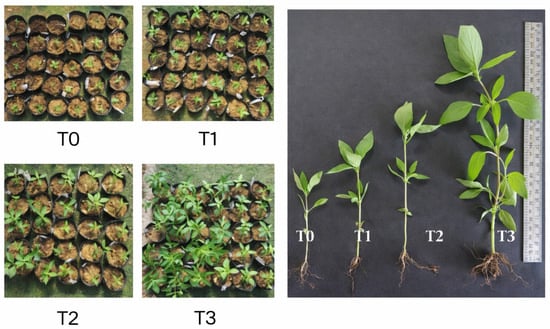
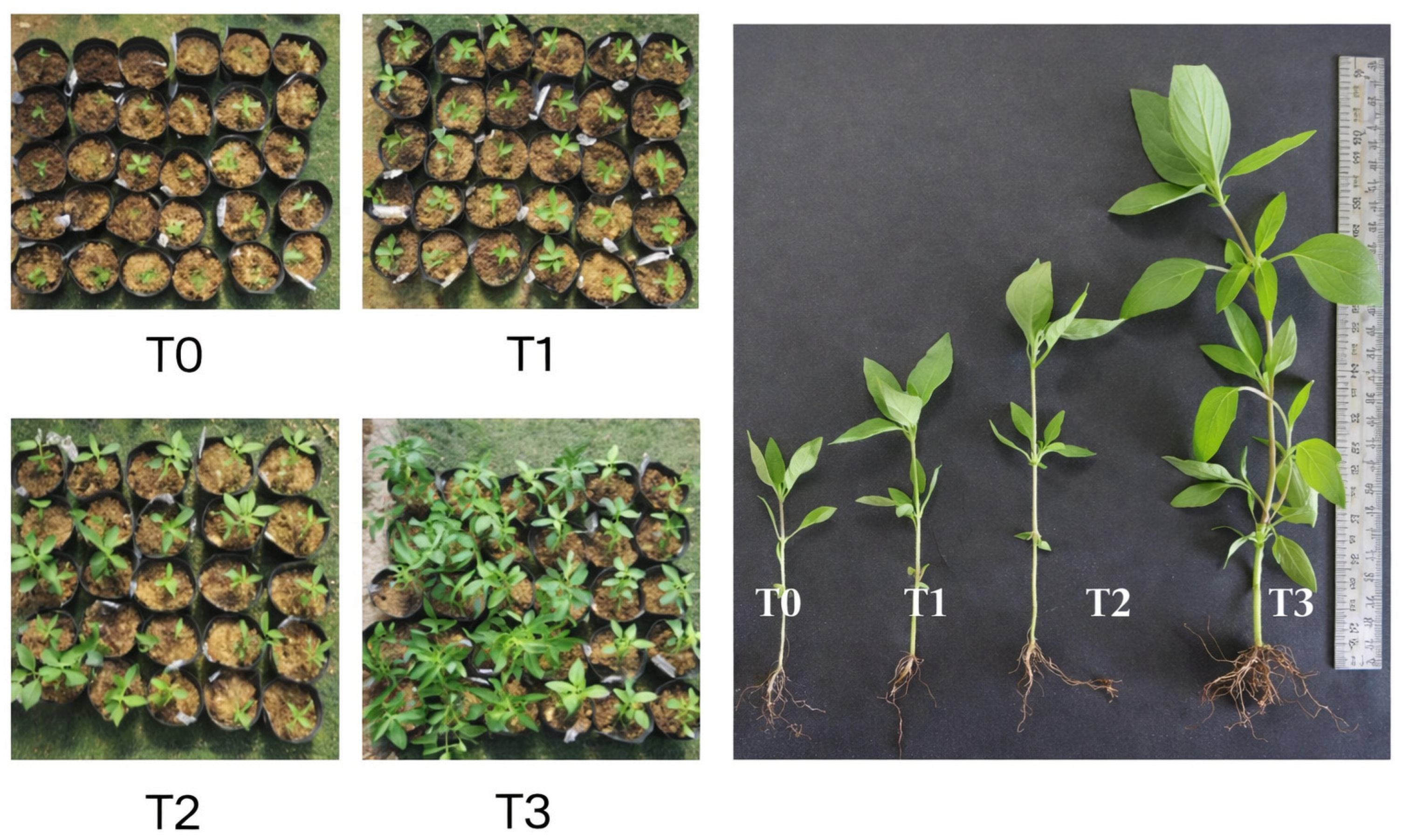
Table 3 presents the descriptive statistics of growth- and yield-related traits of Thai basil under different LVF treatments at 30 days after application. The mean values of plant height, leaf area index, leaf number, and fresh weight show a clear increasing trend with increasing LVF concentration. As shown in Table 3 and Figure 1, there was a high CV (over 10%) in plant height for all treatments except for leaf area in T0, T1, and T2, and the leaf number and plant fresh weight in T3. The treatments using LVF generated a higher plant height when compared with T0. Applying LVF at a rate of 1.5:1000 (T3–30) produced the highest values for all parameters, which for plant height ranged from 13.50 to 27.25 cm, with a mean of 20.25 cm, and a CV of 16.73%; for leaf area the range was from 2.47 to 4.75 cm2, with a mean of 3.6 cm2 and a CV of 10.72; for leaf number the range was from 27 to 42, with a mean of 34 and a CV of 8.96%; and for plant fresh weight the range was from 2.99 to 3.71 g, with a mean of 3.35 g and a CV of 6.13%.
Table 3.
Descriptive statistics of yield and yield components of Thai basil under different IVF treatments at 30 days after application.
Figure 1.
Effect of applied LVF on growth and morphological characteristics of Thai basil. Note: T0: control (water); T1: 0.5:1000 (LVF: water (L)); T2: 1:1000 (LVF: water (L)); T3: 1.5:1000 (LVF: water (L)).
3.2. Effect of Application of LVF on Chlorophyll a and b of Thai Basil
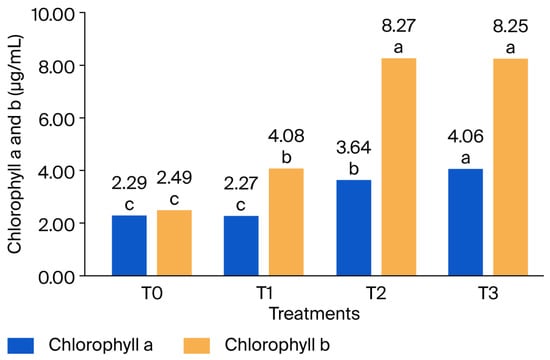
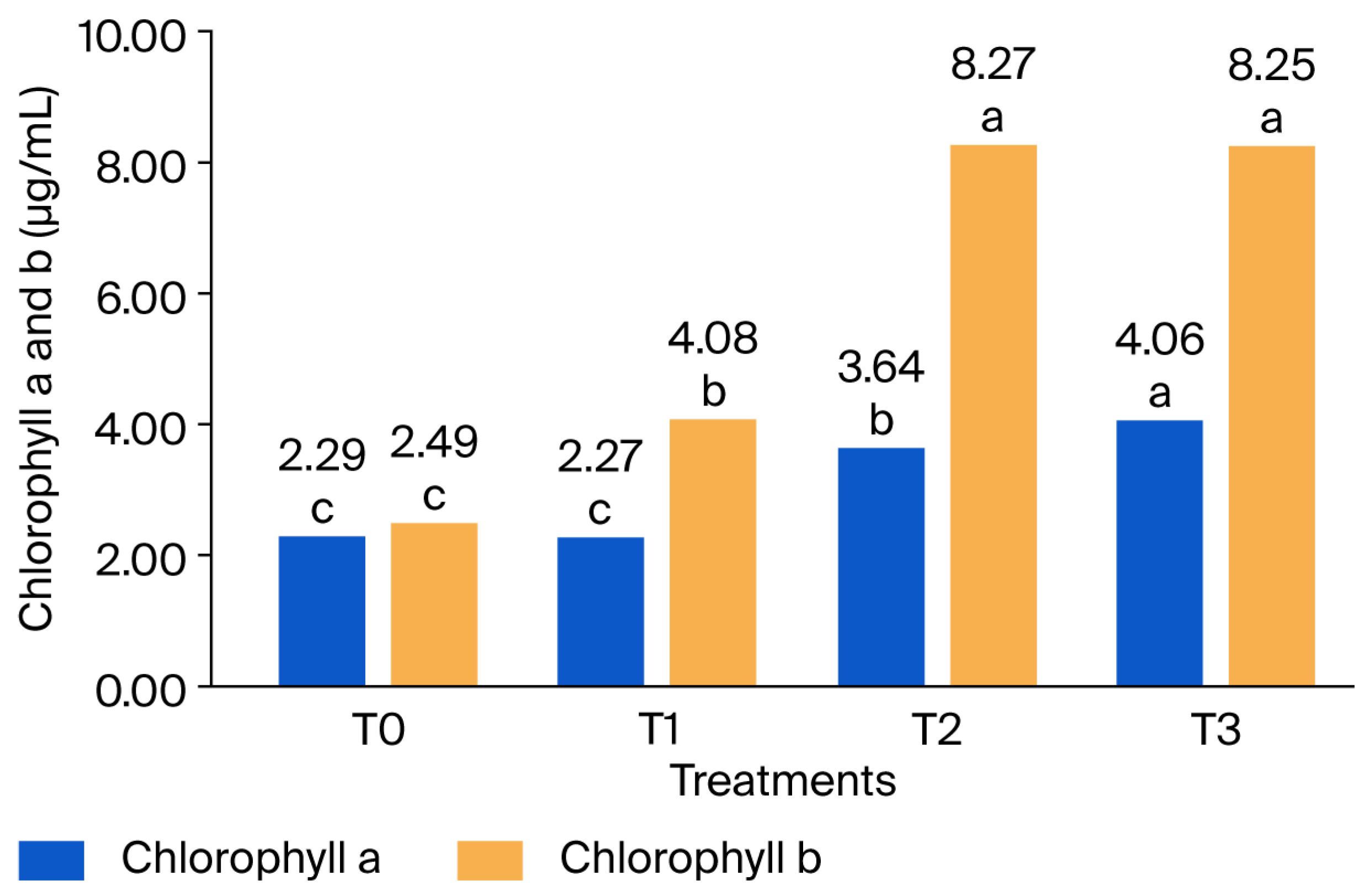
In Figure 2, the treatment with the highest chlorophyll a used an LVF rate of 1.5:1000 (T3–30) and was significantly different from other treatments and the control, while chlorophyll b was highest in the 1:1000 (T2–30) and 1.5:1000 (T3–30) treatments (p < 0.05). Among all treatments, LVF application had the greatest impact on chlorophyll a and b content.
Figure 2.
Effect of applied LVF on chlorophyll a and b of Thai basil. There is no significant difference at p < 0.05 between values within the same group that are followed by the same letters. Note: T0: control (water); T1: 0.5:1000 (LVF: water (L)); T2: 1:1000 (LVF: water (L)); T3: 1.5:1000 (LVF: water (L)).
3.3. Effect of LVF Application on TPC and TFC of Thai Basil
In the present study, the treatment (T3–30) with the highest total phenolic and flavonoid contents, achieved using LVF 1.5: 1000 (334.57 ± 0.46 mg GAE g−1 extract and 205.11 ± 0.46 mg rutin g−1 extract, respectively), was significantly different from the other treatments and the control (p < 0.05) (Table 4).
Table 4.
Effect of applied LVF on total phenolic and flavonoid contents of Thai basil.
3.4. Effect of LVF Application on Antioxidant Activity of Thai Basil
The DPPH method was applied to estimate antioxidant activity. The IC50 value, which was defined as the concentration that inhibited free radicals by 50%, was used to express the plant’s DPPH radical scavenging ability. The effect of LVF on the antioxidant activity of Thai basil is shown in Table 5. The antioxidant activity of the treatments significantly increased as the extract concentrations increased within the range of 25 to 200 μg mL−1. All three treatments exhibited lower IC50 values compared with T0. The lowest IC50 value of the T3 treatment demonstrated that the Basil leaf extract sample treated using an LVF rate of 1.5:1000 exhibited the highest antioxidant activity.
Table 5.
Effect of applied LVF on DPPH scavenging of Thai basil.
4. Discussion
4.1. Influence of LVF on the Yield Component of Thai Basil
Organic fertilizers increase crop development and output by acting as nutrient reservoirs during mineral content and humification, releasing the macro- and micronutrients that the plants need [11]. The mechanism is supported by the nutrient composition of the liquid vermicompost fertilizer (LVF) utilized in this study (Table 1), which features significant levels of potassium (1610 ppm), nitrogen (400 ppm), calcium (248 ppm), and magnesium (89 ppm), in addition to vital micronutrients like zinc, iron, and boron. The use of organic fertilizers impacts plant height, vegetative growth, yields, and yield components [26]. The current investigation reveals that the improved growth and yield characteristics of Thai basil under LVF treatment result from the balanced provision of nitrogen and potassium, which fosters leaf expansion, enhances photosynthetic activity, and promotes the movement of assimilates. Moreover, calcium and magnesium are essential for maintaining cell wall stability and facilitating chlorophyll synthesis, which in turn promotes robust vegetative growth in greenhouse environments [27]. According to Dominguez [28], vermicompost is gaining popularity as a component of integrated nutrients that can be applied as a crop fertilizer. Previously conducted research indicated that vermicompost contains cytokines that can boost endogenous cytokines, regulating hormone production for cell division and shoot formation, affecting the leaf area and dry weight of Eugenia cumini [29]. While this study did not directly quantify phytohormones, the detected levels of zinc (30.2 ppm), iron (11.2 ppm), and boron (0.52 ppm) in LVF (Table 1) indicate conditions that may support hormone-mediated growth responses, given that these micronutrients are recognized for their roles in auxin metabolism and enzymatic activation. The results of this study show that Thai basil growth and production changed according to organic fertilizer type, which is consistent with the findings of Putri et al. [30], who found significant increases in leaf number and biomass in Sonchus arvensis following vermicompost treatment. The nutrient-rich composition and low heavy metal content of LVF demonstrate its efficacy and safety as an organic fertilizer, despite variations in concentration and application timing [31]. Overall, the information shown in Table 1 confirms that liquid vermicompost fertilizer improves nutrient availability, physiological activity, and crop production under greenhouse conditions, and offers a mechanistic justification for the noted increases in the growth and yield of basil in this study.
4.2. Effect of LVF Application on Chlorophyll a and b of Thai Basil
Chlorophyll content impacts the absorption and conversion of light energy as a measure of plant health [32]. Wang [33], for example, found that organic fertilizer increased wheat leaf chlorophyll. Changes in chlorophyll a/b can indicate leaf photosynthetic activity and plant light absorption [34]. In this study, the results show that the LVF application rate of 1.5:1000 (T3–30) has the greatest effect on chlorophyll a and b levels. The increase in chlorophyll a and b observed in leaves treated with the vermicompost leachate (LVF) can be attributed not only to the supply of nitrogen but also to other bioactive components present in the leachate [35]. Essential macro- and micronutrients, such as magnesium and iron, support chlorophyll synthesis, while humic substances and plant hormones, particularly cytokinins, may enhance nutrient uptake, delay leaf senescence, and stimulate photosynthetic activity [36]. These synergistic effects likely contributed to the higher chlorophyll content observed in treatment T3–30, which is in agreement with previous findings showing that organic fertilizers and vermicompost can improve leaf pigment levels and overall plant health.
4.3. The Impact of LVF Application on the Accumulation of TPC and TFC of Thai Basil
Phenolic compounds found in plants are a powerful class of antioxidants that can neutralize harmful free radicals [37]. Using organic fertilizers stimulates the acetate–shikimate pathway, which optimizes flavonoids and phenolics biosynthesis [38]. Previous studies have indicated that vermicompost-treated plants exhibit elevated levels of total phenolic compounds. The use of LVF significantly enhanced the total phenolic and flavonoid levels in Thai basil when compared to the control (T0). The total phenolic content showed a progressive increase in relation to LVF concentration. In detail, T1 demonstrated a modest rise of 2.26% compared to the control group, while T2 and T3 displayed significantly greater increases of 17.09% and 20.50%, respectively.
Similar trends were observed in the total flavonoid content. Flavonoid levels increased by 9.31% in T1, 13.82% in T2, and 18.79% in T3 in comparison to T0. According to the significant increase observed under T3, the administration of higher LVF rates more effectively stimulates secondary metabolite biosynthesis. According to the consistent and substantial increase in both phenolics and flavonoids, LVF may activate metabolic pathways that are associated with the production of antioxidant compounds and plant defence agents. According to a study conducted by Putri et al. [30], the application of vermicompost has been found to enhance the concentration of flavonoid components in Tempuyung (Sonchus arvensis), which can be attributed to the gradual and delayed release of plant-accessible nutrients from vermicompost, in contrast to plants grown with Osmocote, a commercially available fertilizer [39]. Organic fertilizers have also been shown to have positive effects on the production of secondary metabolites, according to research by Ibrahim et al. [40]. The current investigation found that the treatment (T3–30) utilizing LVF at 1.5:1000 had the highest overall TPC and TFC.
To enhance the understanding of our findings, the phenolic and flavonoid profiles identified in this study were compared with chemotypic variations documented in the literature. Branca et al. [41] characterised various Ocimum varieties and observed significant variations in secondary metabolite contents, including flavonoids and phenolic compounds, among different basil genotypes and developmental stages. Notably, certain varieties, such as Ocimum basilicum var. minimum “Minette,” demonstrated a markedly higher accumulation of flavonoids and related bioactive compounds compared to others. This variation highlights that the phytochemical composition of basil is significantly dependent on genotype and is influenced by developmental stages and cultivation conditions. This observation matches our results that LVF treatment significantly changed the phenolic and flavonoid levels in Thai basil leaves.
4.4. Influence of LVF Application on Antioxidant Activity in Thai Basil
Fertilization has been shown to have an impact on crop phytonutritional quality [42]. According to Dumas et al. [43], the application of organic fertilizer can enhance the antioxidant levels in plants. Similarly, Bímová et al. [44] reported that the organic fertilizers had a positive effect on the total antioxidant capacity in head cabbage. The current study demonstrated that Thai basil plants treated with liquid vermicompost fertilizer (LVF) displayed significantly enhanced antioxidant activity in comparison to the control treatment (p < 0.05) (Table 5), with the highest LVF application rate yielding the most pronounced effect. An evident upward trend in antioxidant activity was noted with rising LVF concentration, suggesting a dose-dependent response.
Several complementary processes explain the antioxidant activity boost of LVF-treated basil. First, liquid vermicompost contains humic chemicals, phenolic compounds, and important microelements, including iron, zinc, and manganese, which boost antioxidant biosynthesis and enzymatic antioxidant systems [45]. Second, vermicompost-derived plant hormones or hormone-like substances and improved nutrition availability may drive secondary metabolism and increase phenolics and flavonoids [46]. These bioactive chemicals boost antioxidant activity in aromatic and therapeutic plants like Thai basil.
5. Conclusions
This study demonstrated that the application of liquid vermicompost fertilizer significantly improved the growth, yield, and quality of Thai basil grown under greenhouse conditions. Among the evaluated treatments, the highest LVF dilution rate (1.5:1000) consistently resulted in the greatest increases in plant height, leaf area, leaf number, and fresh biomass, as well as significantly enhanced total phenolic content, total flavonoid content, and antioxidant activity compared to the untreated control. These findings support the use of LVF as an organic fertilizer for greenhouse basil production; however, field-scale studies are required before large-scale application.
This study mainly shows how different amounts of LVF affect the growth and quality of basil grown in a controlled environment. The results are constrained to brief greenhouse conditions and one cultivar. Environmental variability, soil heterogeneity, and extended production cycles were not evaluated.
Consequently, the next study should concentrate on multi-season field validation, optimisation of treatment rates across various agroecological scenarios, and mechanistic studies to clarify the physiological pathways involved. Such findings will be essential to bolster the wider agronomic implementation of LVF in sustainable basil production systems.
Author Contributions
Conceptualization, P.T.T.H. and L.M.T.; methodology, P.T.T.H.; software, L.M.T.; formal analysis, D.T.T.; writing—original draft preparation, P.T.T.H., C.T.D. and P.T.T.; writing—review and editing, P.T.T.H., D.T.T., C.T.D. and P.T.T. All authors have read and agreed to the published version of the manuscript.
Funding
This research received no external funding.
Data Availability Statement
The original contributions presented in the study are included in the article, further inquiries can be directed to the corresponding author/s.
Acknowledgments
The authors are grateful to the Agrifood Development and Investment Co., Ltd. for providing the liquid vermicompost fertilizer used in this study.
Conflicts of Interest
The authors declare no conflicts of interest.
Abbreviations
The following abbreviations are used in this manuscript:
| LVF | Liquid vermicompost fertilizer |
| HATRI | High Agricultural Technology Research Institute for Mekong Delta, Vietnam |
| TPC | Total phenolic content |
| TFC | Total flavonoid content |
| GAE | Gallic Acid Equivalent |
| DPPH | 2-diphenyl-1-picrylhydrazyl |
| SD | Standard deviation |
| CV | Coefficient of Variation |
References
- Filip, S. Basil (Ocimum basilicum L.) a Source of valuable phytonutrients. Int. J. Clin. Nutr. Diet. 2017, 3, 118. [Google Scholar] [CrossRef] [Scilit]
- Yaldiz, G.; Camlica, M. Agro-morphological and phenotypic variability of sweet basil genotypes for breeding purposes. Crop Sci. 2021, 61, 621–642. [Google Scholar] [CrossRef] [Scilit]
- Tambun, R.; Purba, R.R.H.; Ginting, H.K. Extraction of basil leaves (Ocimum canum) oleoresin with ethyl acetate solvent by using soxhletation method. In IOP Conference Series: Materials Science and Engineering; IOP Publishing: Bristol, UK, 2017; Volume 237, pp. 1–7. [Google Scholar]
- FAOSTAT. FAO Global Statistical Yearbook. 2017. Available online: http://www.fao.org/faostat/en/#data/QC (accessed on 5 August 2022).
- Tarchoune, I.; Sgherri, C.; Izzo, R.; Lachaâl, M.; Navari-Izzo, F.; Ouerghi, Z. Changes in the antioxidative systems of Ocimum basilicum L. (cv. Fine) under different sodium salts. Acta Physiol. Plant. 2012, 34, 1873–1881. [Google Scholar] [CrossRef] [Scilit]
- Li, Q.; Pei, H.D.; Ma, Z.M.; Luo, J.J.; Lin, Y.H. Effects of potassium fertilizer and organic fertilizer on rhizosphere soil enzyme activity, nutrient content and bulb yield of Lily. Soils Fertil. Sci. China 2020, 1, 91–99. [Google Scholar]
- Li, Y.B.; Li, P.; Wang, S.H.; Xu, L.Y.; Deng, J.J.; Jiao, J.G. Effects of organic fertilizer application on crop yield and soil properties in rice-wheat rotation system: A meta-analysis. Chin. J. Appl. Ecol. 2021, 32, 3231–3239. [Google Scholar]
- Hammad, A.M.; Elareny, I.M.; Shehata, H.S. Micro-biota and organic amendments improve sesame indicum quality and quantity in sandy soil. Environ. Biodivers. Soil Secur. 2022, 6, 299–317. [Google Scholar] [CrossRef] [Scilit]
- Wenhai, M.; Lianghuan, W.; Philip, C.B.; Yanling, L.; Xuan, Z.Y.; Xin, Y. Changes in soil organic carbon fractions under integrated management systems in a low-productivity paddy soil given different organic amendments and chemical fertilizers. Soil Tillage Res. 2016, 163, 64–70. [Google Scholar] [CrossRef] [Scilit]
- Yu, H.L.; Xu, B.B.; Xu, G.Y.; Shao, W.; Gao, D.T.; Si, P. Effects of bio-organic fertilizers on apple seedling growth, physiological characteristics and functional diversity of soil microorganisms. China Agric. Sci. Bull. 2022, 38, 32–38. [Google Scholar]
- Chiezey, U.F.; Odunze, C. Soybean response to application of poultry manure and phosphorus fertilizer in the sub-humidsavanna of Nigeria. J. Ecol. Nat. Environ. 2009, 1, 25–31. [Google Scholar]
- Ahanger, M.A.; Qi, M.; Huang, Z.; Xu, X.; Begum, N.; Qin, C.; Zhang, C.; Ahmad, N.; Mustafa, N.S.; Ashraf, M.; et al. Improving growth and photosynthetic performance of drought stressed tomato by application of nano-organic fertilizer involves upregulation of nitrogen, antioxidant and osmolyte metabolism. Ecotoxicol. Environ. Saf. 2021, 216, 112195. [Google Scholar] [CrossRef] [Scilit]
- Esmaielpour, B.; Rahmanian, M.; Heidarpour, O.; Shahriari, M.H. Effect of vermicompost and spent mushroom compost on the nutrient and essential oil composition of Basil (Ocimum basilicum L.). J. Essent. Oil-Bear. Plants 2017, 20, 1283–1292. [Google Scholar] [CrossRef] [Scilit]
- Toor, R.K.; Savage, G.P. Changes in major antioxidant components of tomatoes during post-harvest storage. Food Chem. 2006, 99, 724–727. [Google Scholar] [CrossRef] [Scilit]
- Abou El-Magd, M.M.; El-Bassiony, A.M.; Fawzy, Z.F. Effect of organic manure with or without chemical fertilizers on growth, yield and quality of some varieties of broccoli plants. J. Appl. Sci. Res. 2006, 2, 791–798. [Google Scholar]
- Chan, P.L.; Griffiths, D.A. The vermicomposting of pre-treated pig manure. Biol. Wastes 1988, 24, 57–69. [Google Scholar] [CrossRef] [Scilit]
- Atiyeh, R.M.; Dominguez, J.; Subler, S.; Edwards, C.A. Changes in biochemical properties of cow manure during processing by earthworms (Eisenia andrei, Bouché) and the effects on seedling growth. Pedobiologia 2000, 44, 709–724. [Google Scholar] [CrossRef] [Scilit]
- Rezaei-Chiyaneh, E.; Amani, M.M.; Javanmard, A.; Hassan, M.; Filippo, M.; Mohammad, R.M. Vermicompost application in different intercropping patterns improves the mineral nutrient uptake and essential oil compositions of Sweet Basil (Ocimum basilicum L.). J. Soil Sci. Plant Nutr. 2021, 21, 450–466. [Google Scholar] [CrossRef] [Scilit]
- Amooaghaie, R.; Golmohammadi, S. Effect of vermicompost on growth, essential oil, and health of Thymus vulgaris. Compost. Sci. Util. 2017, 25, 166–177. [Google Scholar] [CrossRef] [Scilit]
- Heidarpour, O.; Esmaielpour, B.; Ali-Ashraf, S.; Soroor, K. Effect of vermicompost on essential oil composition of (Satureja hortensis L.) under water stress condition. J. Essent. Oil-Bear. Plants 2019, 22, 484–492. [Google Scholar] [CrossRef] [Scilit]
- Celikcan, F.; Kocak, M.Z.; Kulak, M. Vermicompost applications on growth, nutrition uptake and secondary metabolites of Ocimum basilicum L. under water stress: A comprehensive analysis. Ind. Crops Prod. 2021, 71, 113973. [Google Scholar] [CrossRef] [Scilit]
- Lamp’l, J. Liquid Worm Juice. Superfood for Organic Gardens, Growing a Greener World. 2015. Available online: https://www.growingagreenerworld.com/liquid-worm-juice-superfood-for-my-organic-garden/ (accessed on 16 January 2024).
- Smith, J.H.C.; Benitez, A. Chlorophylls: Analysis in plant materials. Mod. Methods Plant Anal. (Mod. Methoden Pflanzenanal.) 1955, 4, 142–196. [Google Scholar]
- Ha, P.T.T.; Linh, D.T.; Dat, M.T.; Trang, P.T. Inhibitory in vitro effects of Basil (Ocimum basilicum) leaf extracts on cholesterol esterase activity and the growth of Escherichia coli. J. Food Process. Preserv. 2021, 45, e16105. [Google Scholar] [CrossRef] [Scilit]
- Blois, M.S. Antioxidant determinations by the use of a stable free radical. Nature 1958, 181, 1199–1200. [Google Scholar] [CrossRef] [Scilit]
- Dalorima, T.; Sakimin, S.Z.; Shah, R.M. Utilization of organic fertilisers a potential approach for agronomic crops: A review. Plant Sci. Today 2021, 8, 190–198. [Google Scholar] [CrossRef] [Scilit]
- Larsen, D.H.; Woltering, E.J.; Nicole, C.C.S.; Marcelis, L.F.M. Response of Basil Growth and Morphology to Light Intensity and Spectrum in a Vertical Farm. Front. Plant Sci. 2020, 4, 597906. [Google Scholar] [CrossRef] [Scilit]
- Dominguez, J. State-of-the-art and new perspectives on vermicomposting research. In Earthworm Ecology; CRC Press: Boca Raton, FL, USA, 2004; pp. 401–424. [Google Scholar]
- Arifin, H.; Anggraini, N.; Handayani, D.; Rasyid, R. Standarisasi ekstrak etanol daun Eugenia cumini Merr. J. Sains Tek. Farm. 2006, 11, 88–93. [Google Scholar]
- Putri, D.P.; Widyastuti, Y.; Dewi, W.S.; Yunus, A. The effect of shade and vermicompost application on yield and flavonoid levels of Tempuyung (Sonchus arvensis). In IOP Conference Series: Earth and Environmental Science; IOP Publishing: Bristol, UK, 2018; p. 012055. [Google Scholar]
- Szwed, M.; Koszel, M.; Przywara, A. Effect of Fertilization with Digestate on Crop Yields: A Review. In Farm Machinery and Processes Management in Sustainable Agriculture; Lorencowicz, E., Huyghebaert, B., Uziak, J., Eds.; Lecture Notes in Civil Engineering; Springer: Cham, Switzerland, 2024; Volume 609. [Google Scholar]
- Pavlović1, D.; Nikolić, B.; Đurović, S.; Waisi, H.; Anđelković, A.; Marisavljević, D. Chlorophyll as a measure of plant health: Agroecological aspects. Pestic. Phytomed. 2014, 29, 21–34. [Google Scholar] [CrossRef] [Scilit]
- Wang, J.L. The Effect on long–term fertilization to chlorophyll content of winter wheat (Triticum aestivum) and summer corn (Zea mays). Chin. Agric. Sci. Bull. 2010, 26, 182–184. [Google Scholar]
- Hui, H.X.; Xu, X.; Li, Q.R. Effects of NaCl stress on betaine, chlorophyll fluorescence and chloroplast pigment of leaves of Lycium Barbarum L. Agr. Res. Arid. Areas 2004, 22, 109–114. [Google Scholar]
- Jiang, X.; Lu, C.; Hu, R.; Shi, W.; Zhou, L.; Wen, P.; Jiang, Y.; Lo, Y.M. Nutritional and microbiological effects of vermicompost tea in hydroponic cultivation of maple peas (Pisum sativum var. arvense L.). Food Sci. Nutr. 2023, 11, 3184–3202. [Google Scholar] [CrossRef] [Scilit] [PubMed]
- Trevisan, S.; Francioso, O.; Quaggiotti, S.; Nardi, S. Humic substances biological activity at the plant-soil interface: From environmental aspects to molecular factors. Plant Signal. Behav. 2010, 5, 635–643. [Google Scholar] [CrossRef] [Scilit] [PubMed]
- Hakkim, F.L.; Arivazhagan, G.; Boopathy, R. Antioxidant property of selected Ocimum species and their secondary metabolite content. J. Med. Plant Res. 2008, 2, 250–257. [Google Scholar]
- Sousa, C.; Pereira, D.M.; Pereira, J.A.; Bento, A.; Rodrigues, M.A.; Dopico-García, S.; Valentão, P.; Lopes, G.; Ferreres, F.; Seabra, R.M.; et al. Multivariate analysis of tronchuda cabbage (Brassica oleracea L. var. costata DC) phenolics: Influence of fertilizers. J. Agric. Food Chem. 2008, 56, 2231–2239. [Google Scholar] [CrossRef] [Scilit]
- Theunissen, J.; Ndakidemi, P.A.; Laubscher, C.P. Potential of vermicompost produced from plant waste on the growth and nutrient status in vegetable production. Int. J. Phys. Sci. 2010, 5, 1964–1973. [Google Scholar]
- Ibrahim, M.H.; Jaafar, H.Z.E.; Karimi, E.; Ghasemzadeh, A. Impact of organic and inorganic fertilizers application on the phytochemical and antioxidant activity of kacip fatimah (Labisia pumila Benth). Molecules 2013, 18, 10973–10988. [Google Scholar] [CrossRef] [Scilit] [PubMed]
- Branca, F.; Treccarichi, S.; Ruberto, G.; Renda, A.; Argento, S. Comprehensive Morphometric and biochemical characterization of seven basil (Ocimum basilicum l.) genotypes: Focus on light use efficiency. Agronomy 2024, 14, 224. [Google Scholar] [CrossRef] [Scilit]
- Omar, N.F.; Hassan, S.A.; Yusoff, U.K.; Abdullah, N.A.; Wahab, P.E.; Sinniah, U. Phenolics, flavonoids, antioxidant activity and cyanogenic glycosides of organic and mineral-base fertilized cassava tubers. Molecules 2012, 17, 2378–2387. [Google Scholar] [CrossRef] [Scilit]
- Dumas, Y.; Di Lucca, G.; Grolier, P. Effects of environmental factors and agricultural techniques on antioxidant content of tomatoes. J. Sci. Food Agric. 2003, 83, 369–382. [Google Scholar] [CrossRef] [Scilit]
- Bímová, P.; Pokluda, R. Impact of organic fertilizers on total antioxidant capacity in head cabbage. Hortic. Sci. 2009, 36, 21–25. [Google Scholar] [CrossRef] [Scilit]
- Rehman, S.U.; Aprile, A.; De Castro, F.; Negro, C.; Migoni, D.; Benedetti, M.; Sabella, E.; Fanizzi, F.P. Assessing the effectiveness of vermi-liquids as a sustainable alternative to inorganic nutrient solutions in hydroponic agriculture: A Study on Diplotaxis muralis. Agronomy 2024, 14, 1310. [Google Scholar] [CrossRef] [Scilit]
- Ievinsh, G. Review on Physiological Effects of Vermicomposts on Plants. In Biology of Composts; Meghvansi, M., Varma, A., Eds.; Soil Biology; Springer: Cham, Switzerland, 2020; Volume 58. [Google Scholar]

Disclaimer/Publisher’s Note: The statements, opinions and data contained in all publications are solely those of the individual author(s) and contributor(s) and not of MDPI and/or the editor(s). MDPI and/or the editor(s) disclaim responsibility for any injury to people or property resulting from any ideas, methods, instructions or products referred to in the content. |
© 2026 by the authors. Licensee MDPI, Basel, Switzerland. This article is an open access article distributed under the terms and conditions of the Creative Commons Attribution (CC BY) license.