


Abstract
Stem lodging critically limits wheat yield stability, with its resistance heavily influenced by internode mechanical strength, a trait whose genetic architecture remains poorly resolved. This study aimed to dissect the genetic basis of stem strength in the first three basal internodes of wheat. Using a panel of 224 cultivars, we measured internode strength across two environments and performed a genome-wide association study with 269,708 SNPs, employing the FarmCPU model. Three stable quantitative trait loci (QTL) associated with internode stem strength were identified: QI1SS.sau.5A, QI2SS.sau.2D, and QI2SS.sau.6B across a diverse wheat panel, with allele-dependent effects observed among accessions. Among them, QI2SS.sau.2D consistently enhanced stem strength across all three internodes, explaining up to 10.8% of phenotypic variance, without adverse effects on plant height or thousand-grain weight. In contrast, the other two QTL were associated with trade-offs, such as reduced plant height or grain weight. These results reveal a polygenic and partially internode-shared genetic regulation of stem strength. The locus QI2SS.sau.2D is highlighted as a particularly promising, penalty-free target for marker-assisted selection to improve lodging resistance while maintaining agronomic performance, including plant height and thousand-grain weight.
1. Introduction
Lodging is a major constraint to wheat (Triticum aestivum L.) production, particularly in high-yielding environments where intensive nitrogen fertilization and irrigation increase the risk of stem failure. Lodging reduces canopy photosynthesis, disrupts assimilate transport, and frequently results in yield loss and reduced grain quality [1,2]. Although semi-dwarfing genes have substantially improved lodging resistance by reducing plant height, lodging remains prevalent in modern cultivars, indicating that reduced stature alone is insufficient to ensure stem stability [3,4].
Stem mechanical strength is a primary determinant of lodging resistance in cereals and is commonly used as an indirect indicator of lodging susceptibility [5,6]. Lodging most often occurs through bending or breakage of the basal internodes, making their mechanical properties critical for maintaining erect growth [1,7]. Stem strength is a complex quantitative trait influenced by multiple culm morphological and anatomical features, including stem diameter, culm wall thickness, pith cavity size, and vascular bundle organization [8].
Associations between stem strength and basal internode traits have been widely reported, though results are often inconsistent. Lodging-resistant cultivars frequently exhibit thicker culm walls and larger stem diameters [9,10], whereas other studies have reported weak or environment-dependent relationships between stem strength and lodging resistance, with effect magnitude varying across environments, developmental stages, and genetic backgrounds [11,12]. These discrepancies likely reflect differences in genetic background, developmental stage, and environmental conditions, underscoring the complexity of stem mechanical traits and the challenges associated with their genetic improvement.
Genetically, stem strength displays continuous variation and moderate heritability, consistent with quantitative inheritance governed by multiple loci with small to moderate effects [8,13]. Early quantitative trait locus (QTL) mapping studies identified genomic regions associated with lodging resistance and stem-related traits, often revealing pleiotropic effects on plant architecture [14,15]. The development of high-density molecular markers and genome-wide association studies (GWAS) has enabled higher-resolution dissection of these complex traits. Recent GWAS analyses confirm that stem strength is controlled by multiple loci distributed across the wheat genome, emphasizing the importance of precise phenotyping and robust statistical models for identifying stable associations [4,16].
Numerous QTL associated with stem diameter, culm wall thickness, stem strength, and material strength have been reported, highlighting their importance in lodging resistance [16,17,18]. A common genomic region controlling stem strength–related traits has been identified on chromosome 3B (278–287 cM) [19]. In addition, the lignin biosynthesis gene TaCM, located on the long arm of chromosome 3B (3BL), has been implicated in stem strength, suggesting a key role for cell wall composition in determining culm mechanical properties [20]. Although lodging-related traits can show associations with grain yield, potential trade-offs may be mitigated by exploiting QTL that simultaneously influence yield and straw biomass [21,22].
Despite these advances, stem strength is often evaluated as a single composite trait, without accounting for variation among individual internodes. Basal internodes differ in developmental function and contribution to mechanical support, suggesting that internode-specific analyses may provide a more refined understanding of culm stability and lodging resistance. Dissecting stem strength at the internode level may therefore facilitate the identification of loci with targeted effects while minimizing unintended impacts on other agronomic traits.
In this study, we investigated internode-specific stem strength in a diverse panel of wheat cultivars across multiple environments. By integrating detailed internode-level phenotyping with best linear unbiased prediction (BLUP) analysis and genome-wide association mapping, we aimed to elucidate the genetic architecture of stem strength in the first three basal internodes and to assess the pleiotropic effects of associated loci on plant architecture and yield-related traits. Our findings provide new insights into the genetic basis of lodging resistance and create opportunities for the genetic improvement of regionally adapted wheat germplasm.
2. Materials and Methods
2.1. Plant Materials
In this study, 224 wheat cultivars developed by 46 breeding institutions across China and released in Sichuan Province from 2000 to 2022 were used [23].
2.2. Phenotypic Assessment of Internode Stem Strength Traits
Field trials were conducted at Wenjiang (30°43′ N, 103°51′ E) and Chongzhou (30°33′37.3″ N, 103°38′45.4″ E) in 2025, designated as WJ2025 and CZ2025, respectively; each accession was sown in a single 1.5 m row (0.1 m × 0.3 m spacing), with 80 kg/ha superphosphate and 100 kg/ha nitrogen applied at sowing, and managed following standard local agronomic practices [24,25].
Stem strength was assessed at physiological maturity using a mechanical force tester (YYD-1 Series Stem Strength Tester, Zhejiang Top Yunnong Technology Co., Ltd., Hangzhou, China). For each genotype, eight representative main culms were sampled and measured immediately after harvest. Samples were tested on the day of collection under ambient laboratory conditions, without prolonged storage, to minimize potential variation in stem mechanical properties caused by moisture loss or changes in relative humidity.
Prior to measurement, leaves and leaf sheaths were removed to avoid interference from non-structural tissues and to ensure that the applied force reflected the intrinsic mechanical strength of the culm internode. Internodes were numbered from the base upward, with internode 1 defined as the lowest internode above the soil surface, internode 2 as the middle internode, and internode 3 as the uppermost internode below the peduncle.
Each internode was placed horizontally on the testing device, and force was applied at the midpoint at a constant rate until mechanical failure occurred. Breakage was defined as the point at which the internode exhibited irreversible structural failure, including snapping or permanent bending without elastic recovery. The maximum force recorded at failure was defined as stem strength and expressed in newtons (N). Mean values for internode 1 stem strength (I1SS), internode 2 stem strength (I2SS), and internode 3 stem strength (I3SS) were calculated for each genotype and used for subsequent analyses. In addition to stem strength traits, length of first, second, and third internode (IL1, IL2, and IL3), and plant height (PH) were also measured. Thousand-grain weight (TGW) was measured after harvesting as an indicator of yield-related performance and to evaluate potential trade-offs between stem mechanical strength, lodging resistance, and grain filling.
2.3. Phenotypic Data Collection and Analysis
For each line, measurements from at least eight plants were averaged to obtain trait values. Internode stem strengths were evaluated across two environments (WJ2025 and CZ2025), while additional agronomic traits including plant height (PH), internode lengths (IL1, IL2, and IL3), and thousand-grain weight (TGW) were measured under the same conditions. Best linear unbiased predictions (BLUP) for internode stem strength traits, including stem strength of the first (I1SS), second (I2SS), and third (I3SS) basal internodes across environments were estimated using SAS v8.0 (SAS Institute, Cary, NC, USA) to obtain genotype performance adjusted for environmental effects, and broad-sense heritability (H2 = VG/[VG + VE]) was calculated to quantify the proportion of phenotypic variance attributable to genetic effects, where VG and VE denote genotypic and environmental variance components, respectively [26]. For each environment and the BLUP dataset, maximum and minimum trait values were recorded to describe the phenotypic range and to facilitate assessment of trait variability and genetic diversity within the population. Descriptive statistics (mean, standard deviation, and coefficient of variation) were computed to summarize variation, trait correlations were analyzed and visualized in R (R Core Team, 2023) using ggplot2 [27], and trait distributions were illustrated with boxplots generated in GraphPad Prism v9.5.1 (GraphPad Software, San Diego, CA, USA).
2.4. Genotyping Analysis
For the 224 accessions harvested in 2022, 10 seeds of each were sent to Tcuni Technology Co., Ltd. (Chengdu, China) for targeted capture sequencing using a 120 K liquid-phase probe array [23]. Raw sequencing reads were first subjected to quality control to remove adaptor sequences and low-quality reads. Clean reads were then aligned to the Chinese Spring reference genome (CS-IAAS T2T) using a standard read-mapping pipeline. SNPs were identified through variant calling based on the aligned reads, and only bi-allelic SNPs with clear genotype calls were retained. To ensure data reliability, markers with ≤10% missing data and minor allele frequency ≥ 5% were retained for downstream genetic analyses [28]. The final high-quality SNP dataset was used for population structure analysis, linkage disequilibrium estimation, and genome-wide association study.
2.5. Population Structure, Kinship and LD Analysis
Population structure (Q-matrix) was estimated using a Bayesian clustering method in STRUCTURE v2.3.4 [29]. Five independent runs were conducted under the admixture model, testing 1–10 subpopulations (K) with a burn-in of 100,000 iterations and 100,000 MCMC replicates [23]. The optimal K was identified using the ΔK method in STRUCTURE SELECTOR [30]. Kinship (K-matrix) was calculated in TASSEL v5.2.38 using the identity-by-state approach. Pairwise linkage disequilibrium (LD) between markers on the same chromosome was measured as r2, and markers within a single LD half-decay distance were grouped into one QTL block [28]. Population structure, kinship, and LD information were jointly considered to reduce spurious marker–trait associations and improve the reliability of the genome-wide association results. Population structure and kinship were incorporated into the association model to account for population stratification and genetic relatedness among accessions, thereby controlling background genetic effects and reducing false-positive signals. Linkage disequilibrium information was subsequently used to cluster closely linked significant SNPs into QTL regions, enabling biologically meaningful loci to be defined rather than isolated markers. Kinship analysis was performed automatically within the rMVP package, which calculates a marker-based kinship matrix and incorporates it into the FarmCPU model as a random effect.
2.6. Genome-Wide Association Analysis
Genome-wide association analyses were performed in R (R Core Team, 2023) using the rMVP package [31] and the FarmCPU (Fixed and Random Model Circulating Probability Unification) method [32]. BLUP-derived phenotypic values for stem strength of the first (I1SS), second (I2SS), and third (I3SS) basal internodes were used as inputs to reduce environmental noise and improve the accuracy of genetic effect estimation.
The FarmCPU model iteratively fits fixed- and random-effect models and integrates principal component values derived from genome-wide SNP data together with a marker-based kinship matrix to control for population stratification and genetic relatedness, thereby reducing spurious marker–trait associations. Population structure inferred by STRUCTURE analysis was used to describe the genetic composition of the panel and determine the optimal number of subpopulations, but the STRUCTURE-derived Q-matrix was not directly incorporated into the GWAS model. Kinship was calculated automatically within the rMVP framework and included as a random effect.
Association mapping was conducted using 269,708 high-quality SNPs with known physical positions across the wheat genome. Significant marker–trait associations were declared using a stringent threshold of p ≤ 3.0 × 10⁻⁷ (−log10p ≥ 6.5). To define biologically meaningful loci, significant SNPs located on the same chromosome and within the linkage disequilibrium decay distance were clustered into single quantitative trait locus (QTL) regions for downstream analyses.
3. Results
3.1. Phenotypic Variation and Heritability of Internode Stem Strength
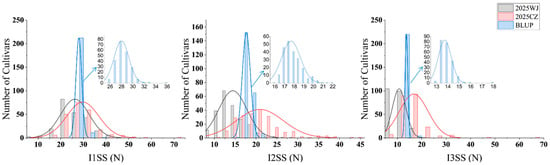
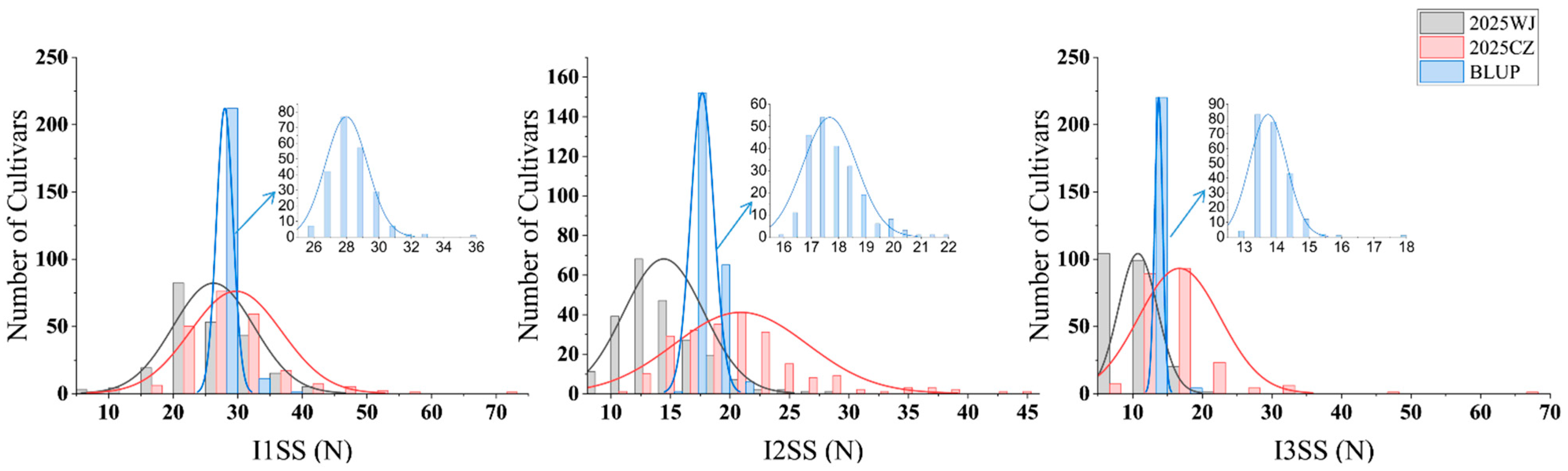
Substantial phenotypic variation was observed for stem strength across the first three basal internodes in both environments (Table 1). Stem strength traits of individual internodes displayed normal distributions, indicating polygenic control (Figure 1). In general, mean stem strength values were higher in CZ2025 than in WJ2025 for all internodes. The mean stem strength of the first basal internode was 26.26 N in WJ2025 and 29.74 N in CZ2025, while stem strength of the second basal internode averaged 14.44 N and 20.92 N, respectively. Stem strength of the third basal internode exhibited the lowest mean values among the three internodes, with means of 10.75 N in WJ2025 and 16.50 N in CZ2025.
Table 1.
Stem strength phenotypes in the association panel (n = 224).
Figure 1.
Frequency distribution of stem strength traits in different environments. I1SS, stem strength of first internode; I2SS, stem strength of second internode; I3SS, stem strength of third internode.
Coefficients of variation ranged from 23.30% to 29.48% across environments, reflecting considerable phenotypic diversity among accessions. Broad-sense heritability estimates were moderate, with values of 45% for stem strength of the first basal internode, 48% for stem strength of the second basal internode, and 37% for stem strength of the third basal internode, suggesting that genetic factors contribute substantially to variation in stem strength, although environmental effects are also important.
Best linear unbiased prediction (BLUP) values calculated across environments exhibited reduced standard deviations and lower coefficients of variation compared with single-environment data, indicating effective correction for environmental heterogeneity. BLUP-derived phenotypes were therefore used for subsequent genome-wide association analyses.
3.2. Correlation Analysis Among Stem Strength and Related Traits
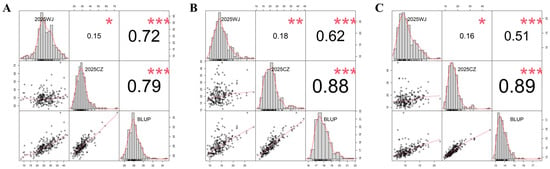
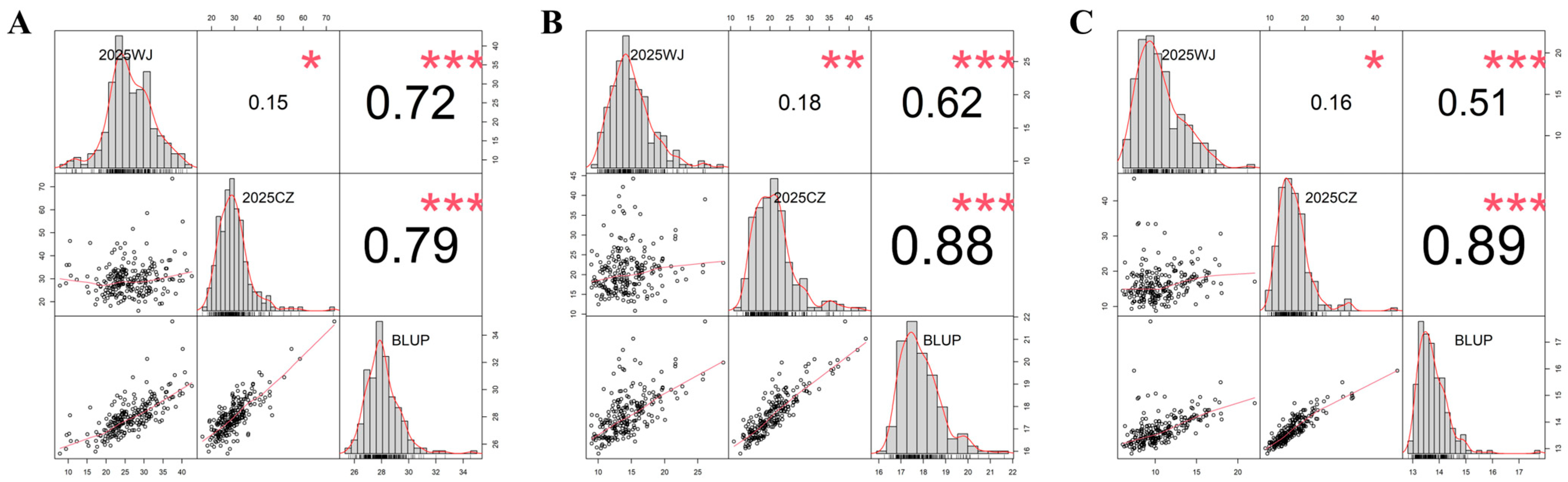
Pearson correlation analysis revealed significant relationships among stem strength of the first, second, and third basal internodes, individual internode lengths (IL1, IL2, and IL3), plant height, and thousand-grain weight (TGW) (Table 2). Strong positive correlations were observed among stem strength traits of different basal internodes across environments (Figure 2). Stem strength of the first basal internode was significantly correlated with stem strength of the second basal internode (r = 0.657, p < 0.01) and stem strength of the third basal internode (r = 0.399, p < 0.01), while stem strength of the second basal internode exhibited a strong positive correlation with stem strength of the third basal internode (r = 0.635, p < 0.01). These results indicate coordinated mechanical development across basal internodes.
Table 2.
Pearson correlations between stem strength traits with other related traits.
Figure 2.
Correlation coefficients of stem strength traits (A), stem strengths of first internode (I1SS) (B), stem strengths of second internode (I2SS) (C), stem strengths of third internode (I3SS). *, ** and ***, significance at the 0.05, 0.01, and 0.001 probability level, respectively.
Stem strength traits showed generally weak but significant negative correlations with internode length traits. Stem strength of the first and second basal internodes was negatively correlated with internode length of the second and third internodes, with correlation coefficients ranging from −0.148 to −0.205 (p < 0.05 or p < 0.01). In contrast, correlations between stem strength traits and internode length of the first internode were weak and not significant. These patterns suggest a trade-off between stem elongation and mechanical strength, particularly in upper internodes.
Plant height showed a weak negative correlation with stem strength of the first basal internode (r = −0.145, p < 0.05), while correlations with stem strength of the second and third basal internodes were not significant, indicating that increased plant height is primarily driven by internode elongation rather than enhanced stem mechanical strength.
No significant correlations were detected between stem strength or internode length traits and thousand-grain weight, suggesting that variation in stem mechanical properties is largely independent of grain weight in this population.
3.3. Population Structure, Principal Component Analysis (PCA) and LD
Based on a previously established population analysis [23], the 224 wheat accessions formed two moderately differentiated genetic clusters, while principal component analysis confirmed broad genetic diversity without strong population stratification, confirming the panel’s suitability for GWAS. The linkage disequilibrium half-decay distance in this population was approximately 1.84 Mb. Significant SNPs located on the same chromosome and falling within the 1.84 Mb linkage disequilibrium half-decay distance were grouped into a single QTL, each designated according to its associated internode trait and chromosomal position [23].
3.4. Significant Loci Associated with Internode Stem Strength Traits
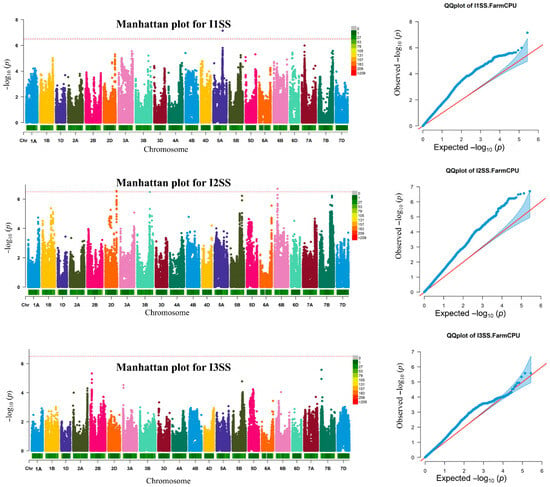
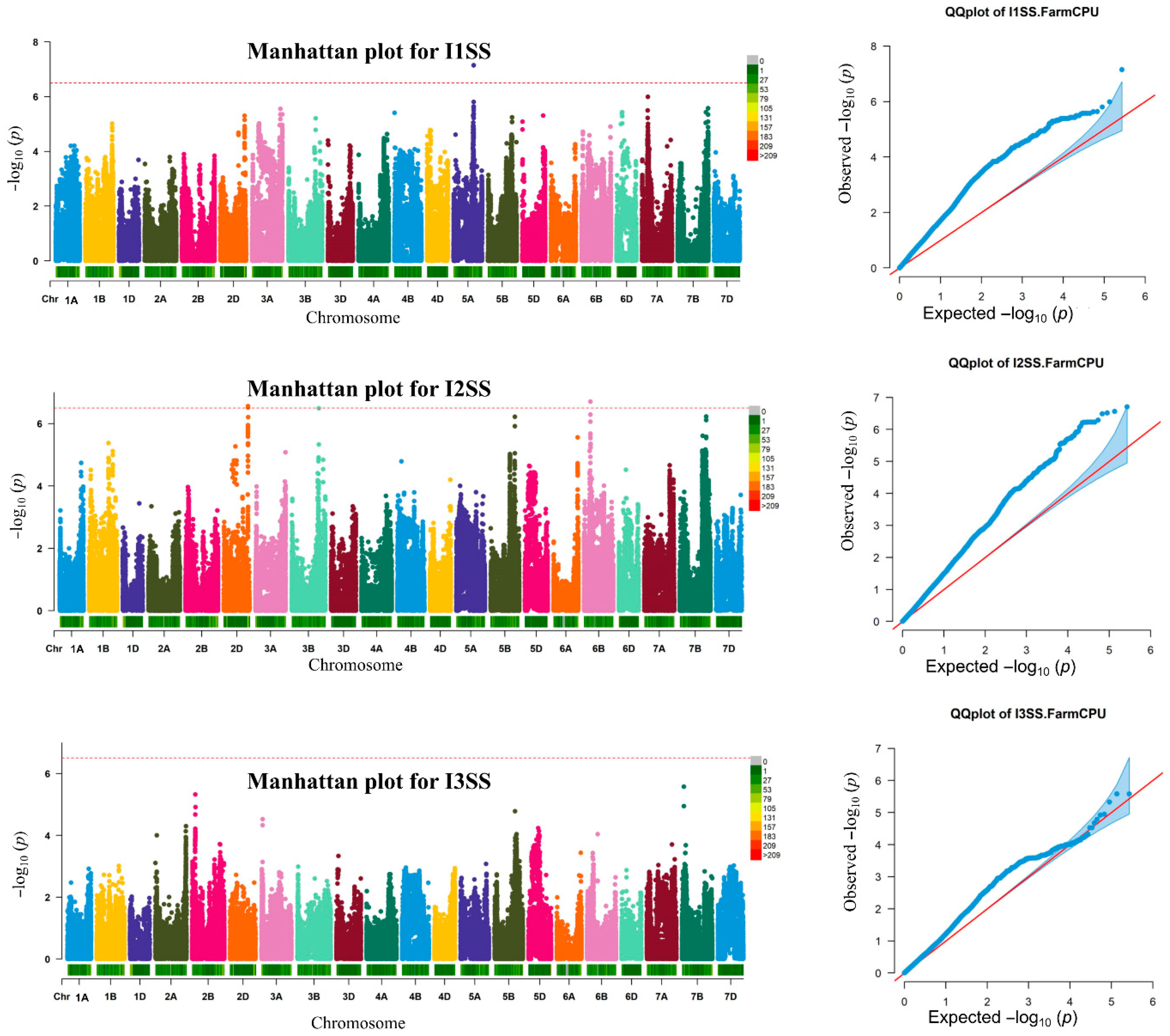
Genome-wide association analysis identified several significant loci associated with internode stem strength traits based on BLUP-derived phenotypes (Table 3, Figure 3). For stem strength of the first internode, a single significant locus, QI1SS.sau.5A, was detected on chromosome 5A. The lead SNP 5A_498249299 was located at 498.25 Mb and exceeded the significance threshold (LOD = 7.15), explaining 4.24% of the phenotypic variation, indicating a moderate-effect locus contributing to basal internode strength.
Table 3.
GWAS-based identification of stably expressed loci for internode stem strengths.
Figure 3.
Manhattan and Q–Q plots of internode stem strength traits (ISS, I2SS, and I3SS) in wheat based on BLUP values using the PCA + K model and FarmCPU method. Manhattan plots (left side) and corresponding Q–Q plots (right side) were generated using the rMVP package. SNP positions along chromosomes are shown on the x-axis and their −log10(p) values on the y-axis. The red dotted line indicates the significance threshold (−log10(p) = 6.5).
For stem strength of the second internode, two loci were identified on chromosomes 2D and 6B. The locus QI2SS.sau.2D was represented by two closely linked SNPs, 2D_609600084 and 2D_609601370, located within a narrow genomic interval on chromosome 2D. These markers showed strong association signals with LOD values of 6.51 and 6.56 and explained 10.73–10.82% of the phenotypic variance, suggesting a relatively stable and major-effect region controlling stem strength of the second internode.
An additional locus, QI2SS.sau.6B, was detected on chromosome 6B, with the lead SNP 6B_163499882 located at 163.50 Mb. This locus displayed a LOD value of 6.70 and explained 10.48% of the phenotypic variation, further supporting the polygenic architecture of internode stem strength.
Overall, the identified loci were distributed across the A, B, and D sub genomes and exhibited small to moderate effects, consistent with the quantitative nature of stem mechanical strength. These loci provide promising targets for further validation and candidate gene analysis related to stem strength and lodging resistance in wheat.
3.5. Allelic Effects of Identified QTL on Stem Strength and Related Traits
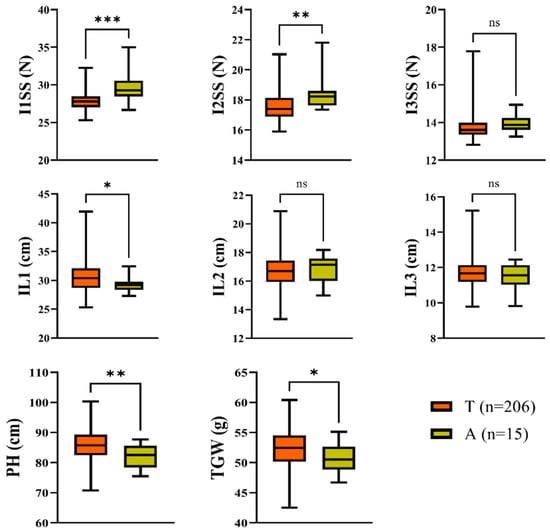
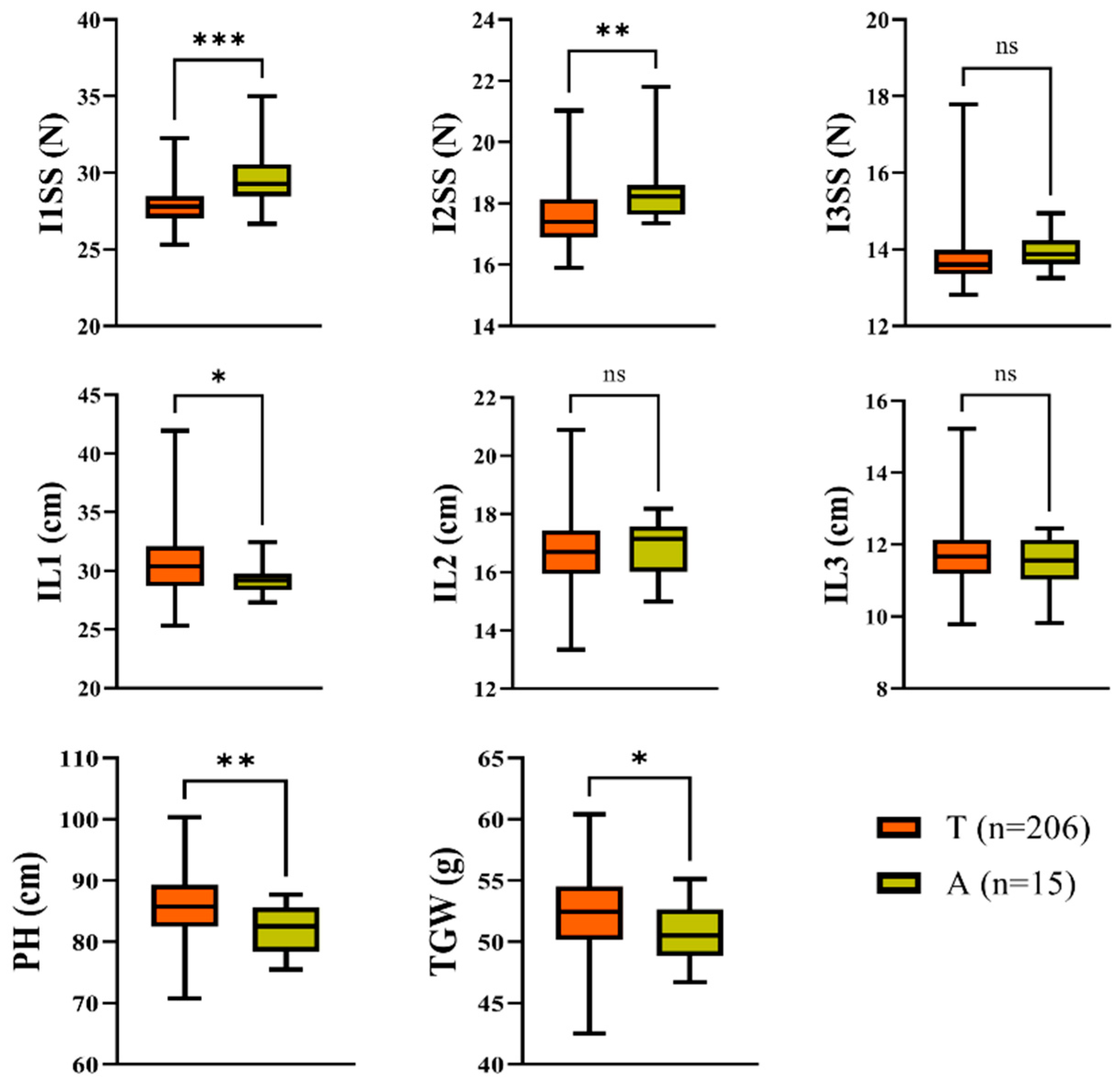
To further characterize the pleiotropic effects of the identified loci, allelic effects of significant QTL were evaluated for internode stem strength and related agronomic traits (Figure 4, Figure 5 and Figure 6).
Figure 4.
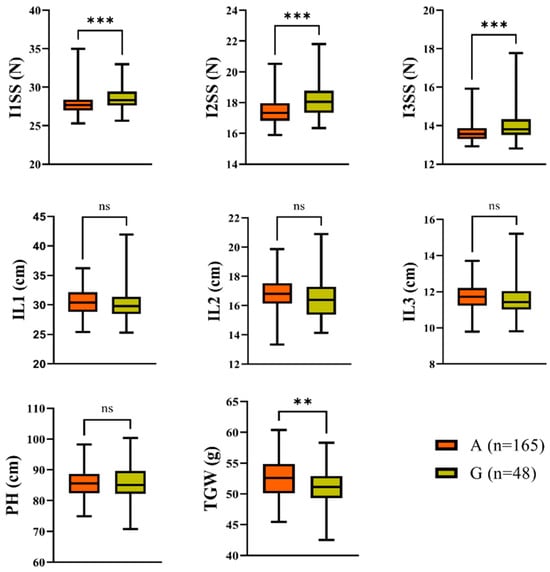
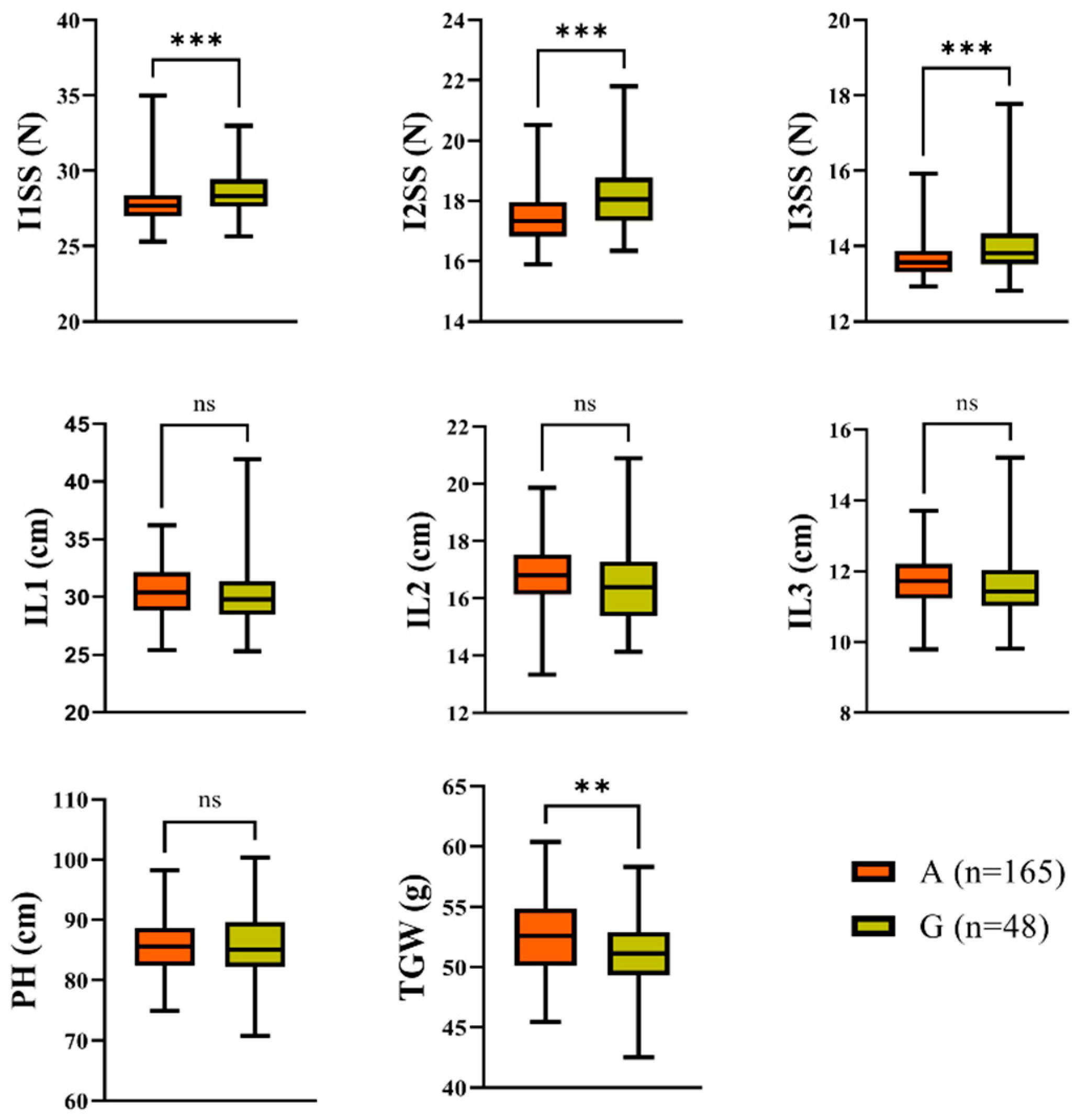
Effects of QI1SS.sau.5A (5A_498249299) on agronomic traits. I1SS, stem strength of first internode; I2SS, stem strength of second internode; I3SS, stem strength of third internode; IL1–3, the length of first, second, and third internode; PH, plant height; TGW, thousand-grain weight. *, ** and ***, significance at the 0.05, 0.01, and 0.001 probability level, respectively.
Figure 5.
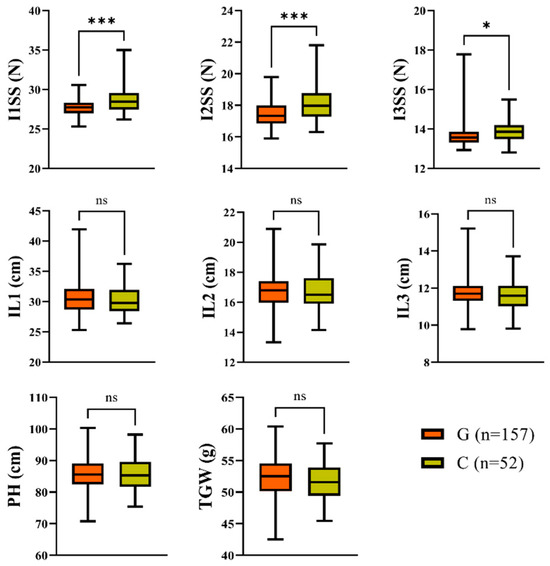
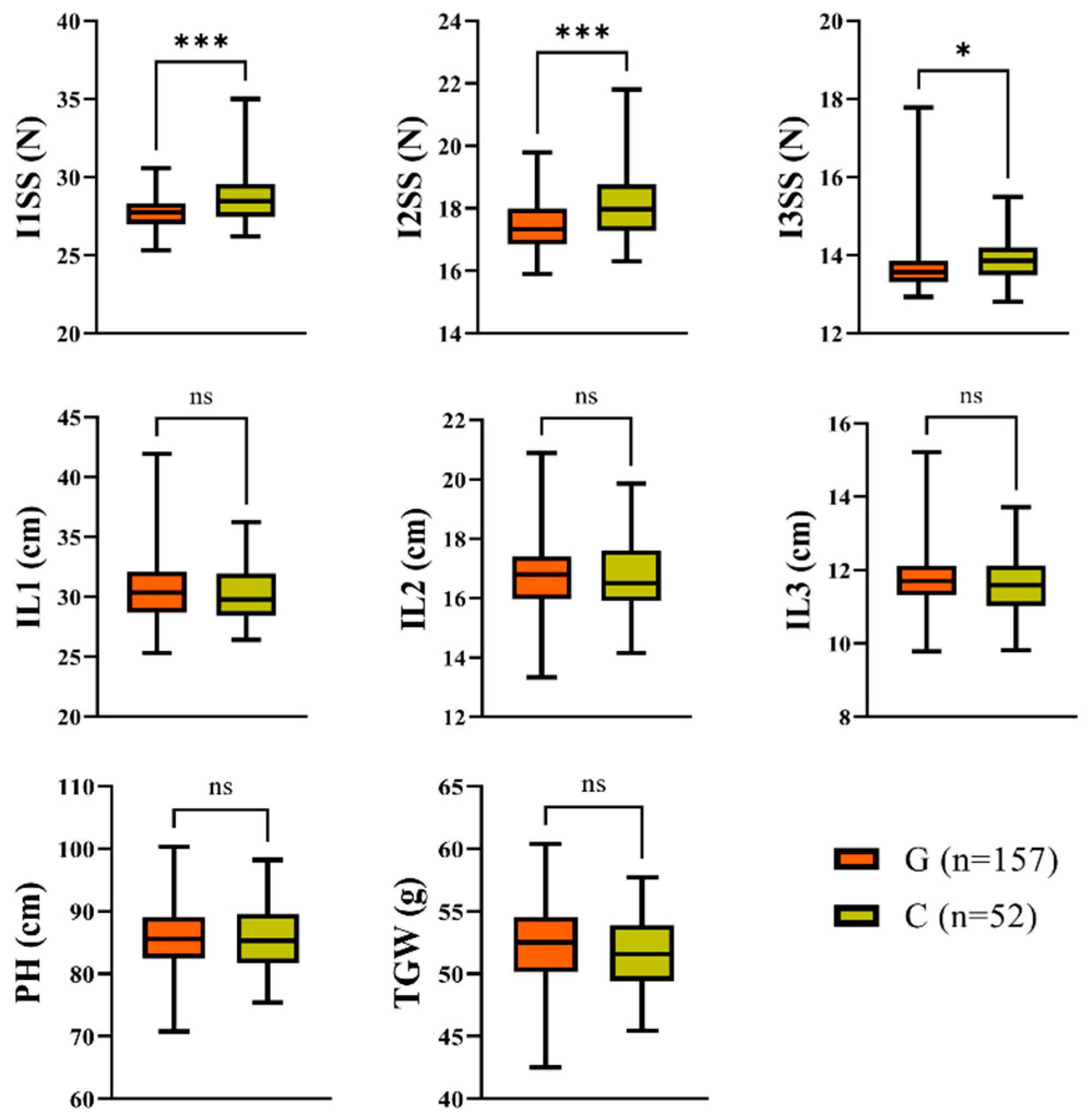
Effects of QI2SS.sau.2D (2D_609600084) on agronomic traits. I1SS, stem strength of first internode; I2SS, stem strength of second internode; I3SS, stem strength of third internode; IL1-3, the length of first, second, and third internode; PH, plant height; TGW, thousand-grain weight. * and ***, significance at the 0.05 and 0.001 probability level, respectively.
Figure 6.
Effects of QI2SS.sau.6B (6B_163499882) on agronomic traits. I1SS, stem strength of first internode; I2SS, stem strength of second internode; I3SS, stem strength of third internode; IL1–3, the length of first, second, and third internode; PH, plant height; TGW, thousand-grain weight. ** and ***, significance at the 0.01, and 0.001 probability level, respectively.
The locus QI1SS.sau.5A, represented by SNP 5A_498249299 (T/A), exhibited significant effects on multiple traits, including stem strength, internode length, plant height, and thousand-grain weight (Figure 4). The A allele was associated with increased stem strength of the first and second basal internodes, while simultaneously reducing internode length of the first internode, plant height, and thousand-grain weight. These results indicate a favorable effect of the A allele on stem mechanical strength accompanied by reduced plant stature.
The locus QI2SS.sau.2D, tagged by SNP 2D_609600084 (G/C), showed significant effects on stem strength across basal internodes (Figure 5). The C allele was consistently associated with increased stem strength of the first, second, and third basal internodes, suggesting a stable and positive contribution of this allele to overall culm mechanical strength.
The locus QI2SS.sau.6B, represented by SNP 6B_163499882 (A/G), displayed significant effects on stem strength of all three basal internodes as well as on thousand-grain weight (Figure 6). The G allele was associated with increased stem strength of the first, second, and third basal internodes but was simultaneously associated with a significant reduction in thousand-grain weight, indicating a potential trade-off between stem mechanical strength and grain weight at this locus.
Collectively, these results demonstrate that the identified QTL exhibits pleiotropic effects on stem strength and key agronomic traits, highlighting both favorable alleles for lodging resistance and potential trade-offs that should be considered in wheat breeding programs.
4. Discussion
Wheat stem strength is one of the most important traits to be considered to mitigate yield loss due to lodging [33,34]. The variation in stem strength among basal internodes reflects the complex mechanical organization of the wheat culm. Consistent with other studies, stem strength traits showed moderate heritability [8,13]. The strong coordination observed among internode stem strength traits suggests that shared genetic mechanisms regulate culm reinforcement across internodes. The identification of QI1SS.sau.5A, QI2SS.sau.2D, and QI2SS.sau.6B supports this view, as these loci influence stem strength in one or multiple internodes rather than acting in a strictly internode-specific manner. Previous genetic studies in wheat have similarly reported moderate heritability for stem mechanical traits and emphasized the contribution of multiple loci with additive or partially pleiotropic effects [15]. QTL associated with culm strength, stem diameter, and lodging resistance have been detected across diverse genetic backgrounds and environments, often showing incomplete consistency among studies. This variability likely reflects differences in phenotyping strategies, environmental conditions, and developmental stages assessed. By focusing on basal internode-specific mechanical strength, the present study provides a more targeted dissection of stem reinforcement than studies relying on whole-culm measurements or visual lodging scores.
QTL on chromosome 5A have been repeatedly associated with stem related traits in wheat, often showing pleiotropic effects on stem architecture [15,16]. Similarly, chromosome 2D has been reported to harbor QTL affecting stem diameter, wall thickness, and lodging resistance [15,16,19]. In contrast, fewer studies have reported stem strength-related QTL on chromosome 6B [18]. To the best of our knowledge, none of the previously reported QTL explicitly overlap with the loci identified here for stem strength, suggesting that these QTL may represent novel genetic factors underlying this trait. Comparable genetic architectures have been reported in other cereal crops. In rice, lodging resistance has been linked to loci regulating culm thickness, secondary cell wall deposition, and vascular bundle organization, with several major-effect genes enhancing stem strength independently of plant height [35]. Barley and maize studies have likewise identified QTL influencing stem mechanical properties through effects on rind thickness and cell wall composition [36,37]. Although direct correspondence between loci across species cannot be inferred from association mapping alone, the convergence of these findings supports the existence of conserved biological mechanisms underlying stem strength across grasses.
The effects of QI2SS.sau.2D across all three internodes indicate that this locus may regulate fundamental components of stem mechanical strength, such as secondary cell wall formation or vascular tissue organization. Loci with consistent effects across internodes are particularly valuable for lodging resistance improvement, as failure of basal internodes is a primary cause of stem lodging in wheat [38]. In contrast, QI1SS.sau.5A showed stronger effects on basal internodes and was also associated with plant height and internode length, suggesting a role in overall culm architecture rather than stem strength alone.
Pleiotropic effects observed for QI1SS.sau.5A and QI2SS.sau.6B highlight the close genetic linkage between stem mechanical properties and other agronomic traits. The allele at QI1SS.sau.5A that enhanced stem strength was associated with reduced plant height and internode length, a pattern consistent with improved lodging resistance through culm stiffening and architectural modification. However, the yield-related effect associated with QI2SS.sau.6B, where increased stem strength coincided with reduced thousand-grain weight, illustrates a potential trade-off that must be considered when deploying such alleles in breeding programs. Trade-offs between lodging resistance and yield-related traits have been widely documented in cereal breeding, particularly when increased assimilate allocation to structural tissues limits resources available for grain filling [39]. Similar relationships have been observed in both wheat and rice, where selection for stronger stems occasionally resulted in reduced grain size or weight [40]. These findings emphasize the importance of distinguishing loci that enhances stem strength through structural efficiency from those that impose broader metabolic costs.
The generally weak correlations between stem strength and plant height further indicate that improvements in culm mechanical strength are not solely dependent on reducing plant stature consistent with other studies [41,42]. This observation aligns with the presence of loci such as QI2SS.sau.2D, which enhanced stem strength without clear adverse effects on height or yield-related traits. Such loci represent promising targets for breeding strategies aimed at strengthening stems while maintaining desirable plant architecture. These results support a shift from traditional height-based lodging resistance toward direct improvement of stem mechanical properties. By decoupling stem strength from plant stature, breeders may achieve lodging resistance without compromising canopy structure or biomass accumulation, particularly under modern high-input production systems.
The polygenic nature of internode stem strength, reflected by multiple moderate-effect QTL across the wheat genome, suggests that cumulative effects of favorable alleles will be required to achieve meaningful gains in lodging resistance [43]. Combining alleles from loci such as QI1SS.sau.5A and QI2SS.sau.2D, while carefully managing trade-offs associated with QI2SS.sau.6B, may enable balanced improvement of stem strength and agronomic performance.
Although these QTL provide valuable insights into the genetic basis of stem mechanical strength, their stability across environments and genetic backgrounds remains to be validated. Future studies integrating multi-environment trials, fine-mapping, and functional characterization will be essential to identify causal genes underlying QI1SS.sau.5A, QI2SS.sau.2D, and QI2SS.sau.6B, and to facilitate their effective utilization in wheat improvement programs.
From a breeding perspective, the identified loci provide complementary opportunities to enhance stem strength and lodging resistance in wheat. QI2SS.sau.2D, with its consistent positive effects across multiple internodes and minimal apparent penalties on agronomic traits, represents a particularly attractive target for marker-assisted selection or genomic-assisted breeding. QI1SS.sau.5A may be useful for improving basal culm strength while simultaneously moderating plant height, which could be advantageous under high lodging pressure. In contrast, deployment of QI2SS.sau.6B should be carefully evaluated due to its associated trade-off with grain weight, although it may still be valuable in environments where lodging severely limits yield. Strategic pyramiding of favorable alleles from these loci, combined with genomic prediction approaches, may enable balanced improvement of stem mechanical strength and overall agronomic performance.
5. Conclusions
This study identified three quantitative trait loci, QI1SS.sau.5A, QI2SS.sau.2D, and QI2SS.sau.6B, associated with stem strength across basal internodes in a diverse wheat association panel. The detected effects represent population-level genetic associations, and allele effects varied among individual accessions rather than being uniform across all wheat varieties, which is consistent with the polygenic nature of stem mechanical strength. A key innovation of this study lies in the internode-specific evaluation of stem mechanical strength, which enabled the dissection of spatially differentiated genetic control along the wheat culm. In particular, QI2SS.sau.2D exhibited stable positive effects across multiple basal internodes without adverse impacts on plant height or yield-related traits, distinguishing it from loci showing trade-offs with plant architecture or grain weight. Together, these findings demonstrate that stem strength can be genetically improved independently of plant height reduction and provide novel genetic resources for enhancing lodging resistance. The identified loci and associated markers offer practical value for marker-assisted and genomic breeding strategies aimed at strengthening wheat stems while maintaining favorable agronomic performance.
Author Contributions
L.Q. conducted phenotype measurement, data analysis and drafted this manuscript. J.C. and H.Z. participated in phenotype measurement, data analysis, and QTL mapping. T.W., H.T. and M.N.L. helped with phenotype measurement and data analysis. H.M.F.U., M.J.J., C.W., X.Y. and Z.Z. did field work and data analysis. T.L., J.M. and G.C. designed the experiments, guided the entire study, participated in data analysis, wrote, and extensively revised this manuscript. All authors have read and agreed to the published version of the manuscript.
Funding
This research was supported by National Key R&D Program of China (2023YFD1201900), and Sichuan Science and Technology Program (2026YFHZ0010).
Informed Consent Statement
All experiments and data analyses were conducted in Sichuan. All authors contributed to the study and approved the final version for submission. The manuscript has not been submitted to any other journal.
Data Availability Statement
The original contributions presented in this study are included in the article. Further inquiries can be directed to the corresponding authors.
Conflicts of Interest
All authors declare that there are no conflicts of interest.
Abbreviations
The following abbreviation is used in this manuscript:
| BLUP | Best Linear Unbiased Prediction |
| CZ | Chongzhou |
| CV | Coefficient of Variation |
| GWAS | Genome Wide Association Study |
| H2 | Broad-Sense Heritability |
| IL1 | The length of first internode |
| IL2 | The length of second internode |
| IL3 | The length of third internode |
| I1SS | Stem strength of first internode |
| I2SS | Stem Strength of second internode |
| I3SS | Stem strength of third internode |
| LD | Linkage Disequilibrium |
| PH | Plant Height |
| QTL | Quantitative Trait Locus |
| SNP | Single Nucleotide Polymorphism |
| SNS | Spikelet Number per Spike |
| TGW | Thousand-grain weight |
| WJ | Wenjiang |
References
- Pinthus, M.J. Lodging in Wheat, Barley, and Oats: The Phenomenon, its Causes, and Preventive Measures. In Advances in Agronomy; Brady, N.C., Ed.; Academic Press: Cambridge, MA, USA, 1974; Volume 25, pp. 209–263. [Google Scholar]
- Berry, P.M.; Sterling, M.; Spink, J.H.; Baker, C.J.; Sylvester-Bradley, R.; Mooney, S.J.; Tams, A.R.; Ennos, A.R. Understanding and Reducing Lodging in Cereals. Adv. Agron. 2004, 84, 217–271. [Google Scholar]
- Worland, T. Genetic basis of worldwide wheat varietal improvement. In The World Wheat Book: A History of Wheat Breeding Paris; Lavoisier Publishing: Paris, France, 2001; pp. 59–100. [Google Scholar]
- Berry, P.M.; Sylvester-Bradley, R.; Berry, S. Ideotype design for lodging-resistant wheat. Euphytica 2007, 154, 165–179. [Google Scholar] [CrossRef] [Scilit]
- Ma, F.; Shen, Y.; Su, D.; Adnan, M.; Wang, M.; Jiang, F.; Hu, Q.; Chen, X.; He, G.; Yao, W.; et al. A high-throughput phenotyping assay for precisely determining stalk crushing strength in large-scale sugarcane germplasm. Front. Plant Sci. 2023, 14, 1224268. [Google Scholar]
- Gianinetti, A.; Baronchelli, M. The Pulvinus Is the Weak Point for Stem Lodging Resistance in Ripe Barley. Plants 2024, 13, 3172. [Google Scholar] [CrossRef] [Scilit]
- Berry, P.M.; Griffin, J.M.; Sylvester-Bradley, R.; Scott, R.K.; Spink, J.H.; Baker, C.J.; Clare, R.W. Controlling plant form through husbandry to minimise lodging in wheat. Field Crops Res. 2000, 67, 59–81. [Google Scholar]
- Yao, J.; Ma, H.; Zhang, P.; Ren, L.; Yang, X.; Yao, G.; Zhang, P.; Zhou, M. Inheritance of stem strength and its correlations with culm morphological traits in wheat (Triticum æestivum L.). Can. J. Plant Sci. 2011, 91, 1065–1070. [Google Scholar]
- Pan, J.; Zhao, J.; Liu, Y.; Huang, N.; Tian, K.; Shah, F.; Liang, K.; Zhong, X.; Liu, B. Optimized nitrogen management enhances lodging resistance of rice and its morpho-anatomical, mechanical, and molecular mechanisms. Sci. Rep. 2019, 9, 20274. [Google Scholar] [CrossRef] [Scilit]
- Shah, L.; Yahya, M.; Shah, S.M.A.; Nadeem, M.; Ali, A.; Ali, A.; Wang, J.; Riaz, M.W.; Rehman, S.; Wu, W.; et al. Improving Lodging Resistance: Using Wheat and Rice as Classical Examples. Int. J. Mol. Sci. 2019, 20, 4211. [Google Scholar] [CrossRef] [Scilit]
- Pinthus, M.J. Spread of the Root System as Indicator for Evaluating Lodging Resistance of Wheat 1. Crop Sci. 1967, 7, 107–110. [Google Scholar]
- Zorić, L.; Živanov, D.; Karagić, Đ.; Karanović, D.; Luković, J. Enhancing lodging resistance in two Vicia species: Unveiling the morphological and stem anatomy transformations induced by Moddus. J. Agric. Sci. 2024, 162, 607–620. [Google Scholar] [CrossRef] [Scilit]
- Skovbjerg, C.K.; Sarup, P.; Wahlström, E.; Jensen, J.D.; Orabi, J.; Olesen, L.; Jensen, J.; Jahoor, A.; Ramstein, G. Multi-population GWAS detects robust marker associations in a newly established six-rowed winter barley breeding program. Heredity 2025, 134, 33–48. [Google Scholar] [CrossRef] [Scilit] [PubMed]
- Gawłowska, M.; Knopkiewicz, M.; Święcicki, W.; Boros, L.; Wawer, A. Quantitative trait loci for stem strength properties and lodging in two pea biparental mapping populations. Crop Sci. 2021, 61, 1682–1697. [Google Scholar] [CrossRef] [Scilit]
- Niu, Y.; Chen, T.; Zhao, C.; Guo, C.; Zhou, M. Identification of QTL for Stem Traits in Wheat (Triticum aestivum L.). Front. Plant Sci. 2022, 13, 962253. [Google Scholar] [CrossRef] [Scilit]
- Hai, L.; Guo, H.; Xiao, S.; Jiang, G.; Zhang, X.; Yan, C.; Xin, Z.; Jia, J. Quantitative trait loci (QTL) of stem strength and related traits in a doubled-haploid population of wheat (Triticum aestivum L.). Euphytica 2005, 141, 1–9. [Google Scholar] [CrossRef] [Scilit]
- Keller, M.; Karutz, C.; Schmid, J.E.; Stamp, P.; Winzeler, M.; Keller, B.; Messmer, M.M. Quantitative trait loci for lodging resistance in a segregating wheat×spelt population. Theor. Appl. Genet. 1999, 98, 1171–1182. [Google Scholar] [CrossRef] [Scilit]
- Berry, P.M.; Kendall, S.; Rutterford, Z.; Orford, S.; Griffiths, S. Historical analysis of the effects of breeding on the height of winter wheat (Triticum aestivum) and consequences for lodging. Euphytica 2015, 203, 375–383. [Google Scholar] [CrossRef] [Scilit]
- Piñera-Chavez, F.J.; Berry, P.M.; Foulkes, M.J.; Sukumaran, S.; Reynolds, M.P. Identifying quantitative trait loci for lodging-associated traits in the wheat doubled-haploid population Avalon × Cadenza. Crop Sci. 2021, 61, 2371–2386. [Google Scholar] [CrossRef] [Scilit]
- Ma, Q.-H. The expression of caffeic acid 3-O-methyltransferase in two wheat genotypes differing in lodging resistance. J. Exp. Bot. 2009, 60, 2763–2771. [Google Scholar] [CrossRef] [Scilit]
- Li, Z.K.; Jiang, X.L.; Peng, T.; Shi, C.L.; Han, S.X.; Tian, B.; Zhu, Z.L.; Tian, J.C. Mapping quantitative trait loci with additive effects and additive x additive epistatic interactions for biomass yield, grain yield, and straw yield using a doubled haploid population of wheat (Triticum aestivum L.). Genet. Mol. Res. 2014, 13, 1412–1424. [Google Scholar] [CrossRef] [Scilit]
- Berry, P.M.; Berry, S.; Spink, J. Identification of Genetic Markers for Lodging Resistance in Wheat; HGCA: London, UK, 2008; 14p. [Google Scholar]
- Liu, H.; Wang, C.; Chen, J.; Tang, H.; Wang, T.; Lohani, M.N.; Umer, H.M.F.; Jalil, M.J.; Lu, L.; Zhang, H.; et al. Stable Grain Protein Content Loci on Chromosome 6D without Adverse Effect On Yield Traits in Sichuan Wheat. Theor. Appl. Genet. 2025; submitted.
- Zhang, Z.; Zhou, J.; Liu, J.; Wang, S.; Wang, T.; Zhao, C.; You, J.; Ding, P.; Tang, H.; Liu, Y.; et al. Identification and verification of low-tillering QTL based on a new model of genetic analysis in wheat. Acta Agron. Sin. 2024, 50, 1373–1383. [Google Scholar] [CrossRef] [Scilit]
- Liu, Q.; Xuan, Q.; Lan, Y.; Xie, X.; Chen, B.; You, J.; Su, L.; Lohani, M.N.; Wu, L.; Hu, X.; et al. Genetic identification and characterization of a novel locus for wheat kernel length. J. Integr. Agric. 2024; in press. [CrossRef] [Scilit]
- Smith, S.E.; Kuehl, R.O.; Ray, I.M.; Hui, R.; Soleri, D. Evaluation of simple methods for estimating broad-sense heritability in stands of randomly planted genotypes. Crop Sci. 1998, 38, 1125–1129. [Google Scholar] [CrossRef] [Scilit]
- Ginestet, C. ggplot2: Elegant graphics for data analysis. J. R. Stat. Soc. Ser. A Stat. Soc. 2011, 174, 245–246. [Google Scholar] [CrossRef] [Scilit]
- Lohani, M.N.; Lan, Y.; Su, L.; Yin, L.; Liu, J.; Chen, G.; Xu, Q.; Jiang, Y.; Jiang, Q.; Chen, G.; et al. Dissecting the genetic architecture of flag leaf morphology in Sichuan Wheat Germplasm using genome-wide association study. Theor. Appl. Genet. 2025, 138, 273. [Google Scholar] [CrossRef] [Scilit] [PubMed]
- Pritchard, J.K.; Stephens, M.; Donnelly, P. Inference of population structure using multilocus genotype data. Genetics 2000, 155, 945–959. [Google Scholar] [CrossRef] [Scilit]
- Li, Y.L.; Liu, J.X. StructureSelector: A web-based software to select and visualize the optimal number of clusters using multiple methods. Mol. Ecol. Resour. 2018, 18, 176–177. [Google Scholar] [CrossRef] [Scilit]
- Yin, L.; Zhang, H.; Tang, Z.; Xu, J.; Yin, D.; Zhang, Z.; Yuan, X.; Zhu, M.; Zhao, S.; Li, X.; et al. rMVP: A memory-efficient, visualization-enhanced, and parallel-accelerated tool for genome-wide association study. Genom. Proteom. Bioinform. 2021, 19, 619–628. [Google Scholar] [CrossRef] [Scilit]
- Liu, X.; Huang, M.; Fan, B.; Buckler, E.S.; Zhang, Z. Iterative Usage of Fixed and Random Effect Models for Powerful and Efficient Genome-Wide Association Studies. PLoS Genet. 2016, 12, e1005767. [Google Scholar] [CrossRef] [Scilit]
- Muhammad, A.; Hao, H.; Xue, Y.; Alam, A.; Bai, S.; Hu, W.; Sajid, M.; Hu, Z.; Samad, R.A.; Li, Z.; et al. Survey of wheat straw stem characteristics for enhanced resistance to lodging. Cellulose 2020, 27, 2469–2484. [Google Scholar] [CrossRef] [Scilit]
- Bisht, D.; Kumar, N.; Singh, Y.; Malik, R.; Djalovic, I.; Dhaka, N.S.; Pal, N.; Balyan, P.; Mir, R.R.; Singh, V.K.; et al. Effect of stem structural characteristics and cell wall components related to stem lodging resistance in a newly identified mutant of hexaploid wheat (Triticum aestivum L.). Front. Plant Sci. 2022, 13, 1067063. [Google Scholar] [CrossRef] [Scilit]
- Yang, H.; Huang, J.; Ye, Y.; Xu, Y.; Xiao, Y.; Chen, Z.; Li, X.; Ma, Y.; Lu, T.; Rao, Y. Research Progress on Mechanical Strength of Rice Stalks. Plants 2024, 13, 1726. [Google Scholar] [CrossRef] [Scilit]
- Zhang, A.; Zhao, T.; Hu, X.; Zhou, Y.; An, Y.; Pei, H.; Sun, D.; Sun, G.; Li, C.; Ren, X. Identification of QTL underlying the main stem related traits in a doubled haploid barley population. Front. Plant Sci. 2022, 13, 1063988. [Google Scholar] [CrossRef] [Scilit]
- Zhang, Y.; Wang, Y.; Ye, D.; Wang, W.; Qiu, X.; Duan, L.; Li, Z.; Zhang, M. Ethephon Improved Stalk Strength of Maize (Zea mays L.) Mainly through Altering Internode Morphological Traits to Modulate Mechanical Properties under Field Conditions. Agronomy 2019, 9, 186. [Google Scholar] [CrossRef] [Scilit]
- Dhariwal, R.; Hiebert, C.W.; Randhawa, H.S. QTL analysis identified two major all-internodes solidness loci from a completely solid-stemmed spring wheat line. Front. Plant Sci. 2022, 13, 1035620. [Google Scholar] [CrossRef] [Scilit]
- Olagunju, S.O.; Dauda, O.S.; Adenaike, E.O.; Oguntade, O.A.; Sakariyawo, O.S.; Nassir, A.L.; Atayese, M.O. Mitigating the trade-off between grain yield and vegetative biomass with orthosilicic acid towards enhancing lodging resistance in upland rice. Discov. Plants 2025, 2, 354. [Google Scholar] [CrossRef] [Scilit]
- Ferrero-Serrano, Á.; Cantos, C.; Assmann, S.M. The Role of Dwarfing Traits in Historical and Modern Agriculture with a Focus on Rice. Cold Spring Harb. Perspect. Biol. 2019, 11, a034645. [Google Scholar] [CrossRef] [Scilit] [PubMed]
- Feng, S.; Shi, C.; Wang, P.; Ding, W.; Hu, T.; Ru, Z. Improving Stem Lodging Resistance, Yield, and Water Efficiency of Wheat by Adjusting Supplemental Irrigation Frequency. Agronomy 2023, 13, 2208. [Google Scholar] [CrossRef] [Scilit]
- Niu, Y.; Chen, T.; Zhao, C.; Zhou, M. Improving Crop Lodging Resistance by Adjusting Plant Height and Stem Strength. Agronomy 2021, 11, 2421. [Google Scholar] [CrossRef] [Scilit]
- Vieira, R.A.; Nogueira, A.P.O.; Fritsche-Neto, R. Optimizing the selection of quantitative traits in plant breeding using simulation. Front. Plant Sci. 2025, 16, 1495662. [Google Scholar] [CrossRef] [Scilit] [PubMed]

Disclaimer/Publisher’s Note: The statements, opinions and data contained in all publications are solely those of the individual author(s) and contributor(s) and not of MDPI and/or the editor(s). MDPI and/or the editor(s) disclaim responsibility for any injury to people or property resulting from any ideas, methods, instructions or products referred to in the content. |
© 2026 by the authors. Licensee MDPI, Basel, Switzerland. This article is an open access article distributed under the terms and conditions of the Creative Commons Attribution (CC BY) license.