


Abstract
Zeolite amendment to arable soils has been proposed as a promising strategy to improve soil quality and crop performance, particularly under drought. Nevertheless, empirical evidence remains scarce. In this study, we evaluated the effect of uncharged and nitrogen-charged chabazite-zeolite amendment on barley growth, nutrient uptake and physiology (i.e., stomatal conductance, photosystem II efficiency and SPAD) under drought. Barley plants were grown in the greenhouse for nine weeks under optimal conditions before inducing a moderate, 2-week drought period. Our results show that amending soils with uncharged zeolite had no effect on the crop yield and nutrient uptake under water-sufficient conditions. In contrast, applying nitrogen-charged zeolites resulted in significant yield improvements (+90%) and nutrient uptake (+60–90%) as compared to control and uncharged zeolite amendment. Further, we observed a disproportional high uptake of calcium (+260–280%) as compared to other base cations with nitrogen-charged zeolite amendment, resulting in significant shifts in elemental ratios. Both zeolite amendments helped maintain stomatal conductance under drought, while only uncharged zeolite also mitigated declines in photosystem II efficiency under water-limited conditions. Against our anticipation, we observed significant reductions in aboveground biomass (−15%) as well as nitrogen (−20%), phosphorus (−29%) and magnesium (−25%) contents in the treatment receiving uncharged zeolite as compared to the unamended control under drought conditions. This suggests that a significant amount of nutrients must have been immobilized in the zeolite’s mineral structure. Therefore, while nitrogen-charged zeolite amendment represents a promising farming management strategy to improve crop productivity, uncharged zeolite amendment may lead to unintended negative outcomes. Our results highlight the need for further research to evaluate the pedoclimatic factors that determine the agronomic effectiveness of zeolite amendments.
1. Introduction
Due to their unique structural and chemical properties, zeolites have been recognized as an important inorganic soil amendment material, with the capacity to improve agricultural productivity [1]. The porous structure of natural zeolites facilitates the adsorption of a wide range of substances, including cations, water and gases [2,3,4,5]. In addition to their high cation exchange capacity, zeolites possess reversible dehydration and selective sorption properties, acting as molecular sieves that can modulate the mobility and availability of nutrients [6]. These distinctive features have long supported their application across various industrial sectors and, more recently, have driven growing interest in their use within agricultural systems [7].
Among the zeolite minerals, chabazite-bearing rocks are considered highly promising for agricultural use due to the exceptionally high cation exchange capacity of chabazite, especially its efficient sorption and release of ammonium (NH4+) [8,9,10], and the low silicon:aluminum ratio, which makes them particularly suitable for ion exchange [11]. Moreover, there is evidence that these minerals reduce NH3 emissions from soil [12] and potentially capture CO2 in the soil [13], thus facilitating the sequestration of soil organic carbon. These aspects, together with their significant water and nutrient re-/sorption capacity [14], put these inorganic soil amendments in the spotlight as a potentially important climate change mitigation strategy. The beneficial effect of zeolite amendment under drought stress has been evidenced by numerous studies [15,16,17,18,19,20,21,22]. Along with positive plant physiological stress responses, zeolite amendments could sustain higher crop yields even under severe drought, making it a particularly important management option in dry regions [17,20,23].
Due to their immensely high sorption capacities, numerous varieties of natural as well as synthetic zeolites have been used to recycle nitrogen (N) from waste water [24,25]. As such, this otherwise highly volatile bioavailable N source is adsorbed to active mineral surfaces and extra-framework sites and slowly released into the soil to reduce strong N pulses that are prone to significant losses [26]. Several studies have shown a strong benefit of applying N-enriched zeolite tuffs to arable soils [27,28] or in controlled pot experiments [29]. On the other hand, Foereid and Szocs [30] did not observe any difference in plant N availability when NH4+ was adsorbed to zeolites or applied conventionally and suggested that N sorption and release from zeolites may strongly depend on the soil type. Clearly, more research is required to investigate the fate of N from N-charged zeolites and its effect on plant growth as well as nutrient uptake. In this regard, the fate of N from N-charged zeolites under drought stress has not been addressed to date, particularly for cereal crops.
While amending arable soils with zeolites commonly results in crop yield gains [31,32], the high proclaimed sorption capacity may also immobilize water as well as macro- and micronutrients otherwise available to plants. For example, several studies have shown that significant amounts of calcium (Ca) and magnesium (Mg)—depending on the type of zeolite tested—can be exchanged with other cations [33,34]. While studies on ion exchange processes in soil systems are entirely missing to date, these dynamics may be strongly determined by the type of zeolite amended and soil physico-chemical characteristics, such as prevalent cations or clay mineralogy.
To address this knowledge gap, we investigated the impact of natural zeolite amendment on growth, physiology and nutrient uptake in barley (Hordeum vulgare)—a globally important cereal and widely used model crop [35,36]—under water-sufficient conditions and under moderate drought stress. Two different varieties of natural chabazite zeolite were used in this study: an uncharged and an N-charged zeolite. The zeolite used is broadly available and its characteristics are well-suited for agricultural production. We hypothesized that (i) plants grown in zeolite-amended soil will exhibit higher tissue concentrations of Ca and K than controls, and that (ii) this increased nutrient uptake will be positively correlated with aboveground biomass; (iii) that zeolite amendment would mitigate drought-induced reductions in stomatal conductance and photosystem (PS) II efficiency compared to the control without stress. We further hypothesized that (iv) the N-charged zeolite would provide a greater growth benefit under drought than the uncharged zeolite type due to the combined effects of improved water as well as nutrient retention and supplemental N supply.
2. Materials and Methods
2.1. Experimental Setup
The pot experiment was set up at the BOKU University and Research Center (UFT) in Tulln an der Donau, Austria (48.321° N, 16.068° E), in March 2024; 2 L plastic pots (diameter 15 cm, height 20 cm) were filled with a 4:1 mixture of sand and soil, totaling 2.5 kg of substrate. We deliberately used a high share of sand in order to amplify potential drought effects. The soil was a Chernozem from loess (IUSS Working Group WRB, 2015) with a silty loam texture from an experimental site at the Hollabrunn Agricultural College, Lower Austria, Austria. The experimental site comprises four different tillage treatments: conventional tillage, i.e., cultivator–plowing–seedbed preparation–sowing; reduced tillage, i.e., cultivator–disking–sowing; minimum tillage, i.e., 5 cm disking–direct sowing; and no-tillage, i.e., direct sowing [37]. Here, we used the soil from the conventional tillage, which is slightly alkaline, with a pH of 7.8 (carbonate content is 9.9%), and has 1.5% soil organic carbon and 0.11% total N.
We used two different zeolites for the experiment: (i) in its natural state (from now on referred to as ‘Zeo’); and (ii) N-charged after sorption of NH4+ from swine slurry (from now on referred to as ‘N-Zeo’). The grain size was equal for both zeolites and ranged between 0.7 and 2 mm. The quarried rock exhibits a trachytic composition and predominantly contains circa 70% chabazite zeolite [38]. The source quarry, named ‘Piandirena’ is located in the Grosseto province, Italy (42°41′27″ N, 11°44′36″ E). The N-enriched zeolite has been obtained in a treatment plant located near Soncino (Cremona, Italy) by treating swine raw liquid manure with the above-described zeolite. Briefly, 6 g of zeolite were mixed with 100 mL of homogenized swine manure in HDPE bottles, shaken for 2 h and then allowed to rest for 4 h to ensure equilibration. This treatment cycle was repeated three times, with fresh zeolite added to the recycled swine manure each day, allowing ammonium ions from the slurry to exchange onto the zeolite framework. As a result, the zeolite became enriched with N [39]. For more information on the zeolites, we refer the reader to Malferrari et al. [40].
A total of 42 g of zeolite, equivalent to a zeolite load of 5 kg m−2, was homogeneously mixed into the soil for the two zeolite treatments. This amount has been commonly used in field experiments and could show positive effects on soil and crop quality [1,41]. Therefore, this experiment used a total of 30 pots (two zeolite treatments + unamended control × 10 pots each).
The pots were transferred to the greenhouse, and 20 barley seeds were planted on 11 March 2024. The water content of the substrate was adjusted to 70% water-holding capacity, which was determined ahead for each treatment (419 mL pot−1 for the Ctrl pots and 443 mL pot−1 for the zeolite-amended pots) by saturating the pots with water, allowing it to drain freely overnight, and quantifying the retained water gravimetrically as the difference between saturated-drained and dry mass [42]. After seed germination, the plants were reduced to 10 seedlings per pot and further grown with additional artificial lighting using LED-KE lamps (full spectrum, 360 W; DHLicht, Wülfrath, Germany). Barley plants were subsequently cultivated for nine weeks under controlled environmental conditions, with a photoperiod of 14 h light and 10 h dark, day and night temperatures of 23 and 18 °C, respectively, and relative humidity held constant at 50%. The water content was adjusted every two days. A Hoagland solution [43] was applied three times (¼ strength in week 2 and ½ strength in week 4 and 6) during the experimental period.
On 13 May 2024—corresponding to BBCH 31-32 (onset of stem elongation), a developmentally sensitive stage at which water limitation strongly affects subsequent yield formation—we induced a moderate drought stress to half of the pots of each zeolite treatment (n = 5). For this, the water content was reduced to 40% of the water-holding capacity for a period of two weeks. At the end of this period, the barley plants displayed clear physiological impairment indicative of drought stress, with symptoms approaching the onset of wilting. The physiological stress was further verified with stomatal conductance and PS II efficiency measurements (details see below). This duration was therefore sufficient to impose the intended stress conditions without inducing irreversible damage [44,45]. Thereafter, the aboveground biomass was harvested and dried at 60 °C to constant weight.
2.2. Plant Physiological Measurements
Plant physiological measurements were conducted on 8 and 22 April as well as on 13 and 27 May 2024, i.e., three times during regular barley growth and one time at the end of the two-week drought period. The chlorophyll content was measured through SPAD using a Konica Minolta SPAD-502Plus (Konica Minolta, Singapore, Singapore) device. The quantum yield of fluorescence (ΦPSII) and stomatal conductance (gS) were measured using a LI-COR LI-600 Porometer/Fluorometer (LI-COR, Lincoln, NE, USA) [46,47]. ΦPSII, i.e., the proportion of light absorbed by PS II used in biochemistry, is calculated using the formula [Fm′ − FS/Fm′], where Fm′ is maximum fluorescence yield in a light-adapted leaf, and FS is steady-state fluorescence yield in a light-adapted leaf; gS is given as mol H2O m−2 h−1. Five measurements per pot were taken on five different barley plants, always on the last fully developed leaf.
2.3. Determination of Macro- and Micronutrient Contents
Macro- and micronutrient contents were determined according to Neugschwandtner et al. [48]. After oven-drying to constant weight, the aboveground biomass samples were weighed and subsequently homogenized using a stainless-steel ball mill (MF 10, IKA® Werke, Staufen, Germany). For the analysis of phosphorus (P), K, Ca, Mg, iron (Fe), zinc (Zn) and manganese (Mn), subsamples of 150 mg were digested in 4 mL concentrated HNO3 and 1 mL 30% H2O2 at 225 °C using a MARS 6 microwave digestion system (CEM Corporation, Matthews, NC, USA). After digestion, the extracts were diluted with deionized water to a final volume of 50 mL. Elemental concentrations were determined using ICP-OES (Optima 8300, Perkin Elmer, Waltham, MA, USA), and nutrient concentrations were calculated against a multi-standard solution.
For N contents, 50 mg of ball-milled plant material were weighed into tin capsules and subsequently measured with an Elementar vario MACROcube CN Elemental Analyser (Elementar Analysensysteme GmbH, Langenselbold, Germany). Nutrient contents are expressed in mg and µg pot−1.
2.4. Statistics
Data were tested for variance homogeneity and normal distribution and log-transformed in case of any violation. We used two-way analyses of variance (ANOVAs) to evaluate main effects (zeolite amendment and drought stress) as well as the interaction thereof (zeolite amendment × drought stress). Furthermore, we tested for significant differences (i) between zeolite treatments (‘Ctrl’, ‘Zeo’ and ‘N-Zeo’) within each drought treatment and (ii) between drought (‘Ctrl’ and ‘Drought’) treatments within each zeolite treatment by using one-way ANOVA and post hoc Duncan tests. Statistical analyses were conducted using SPSS 26. We refer to significant differences at the p < 0.05 level.
3. Results and Discussion
3.1. Verification of the Induced Drought Stress Treatment
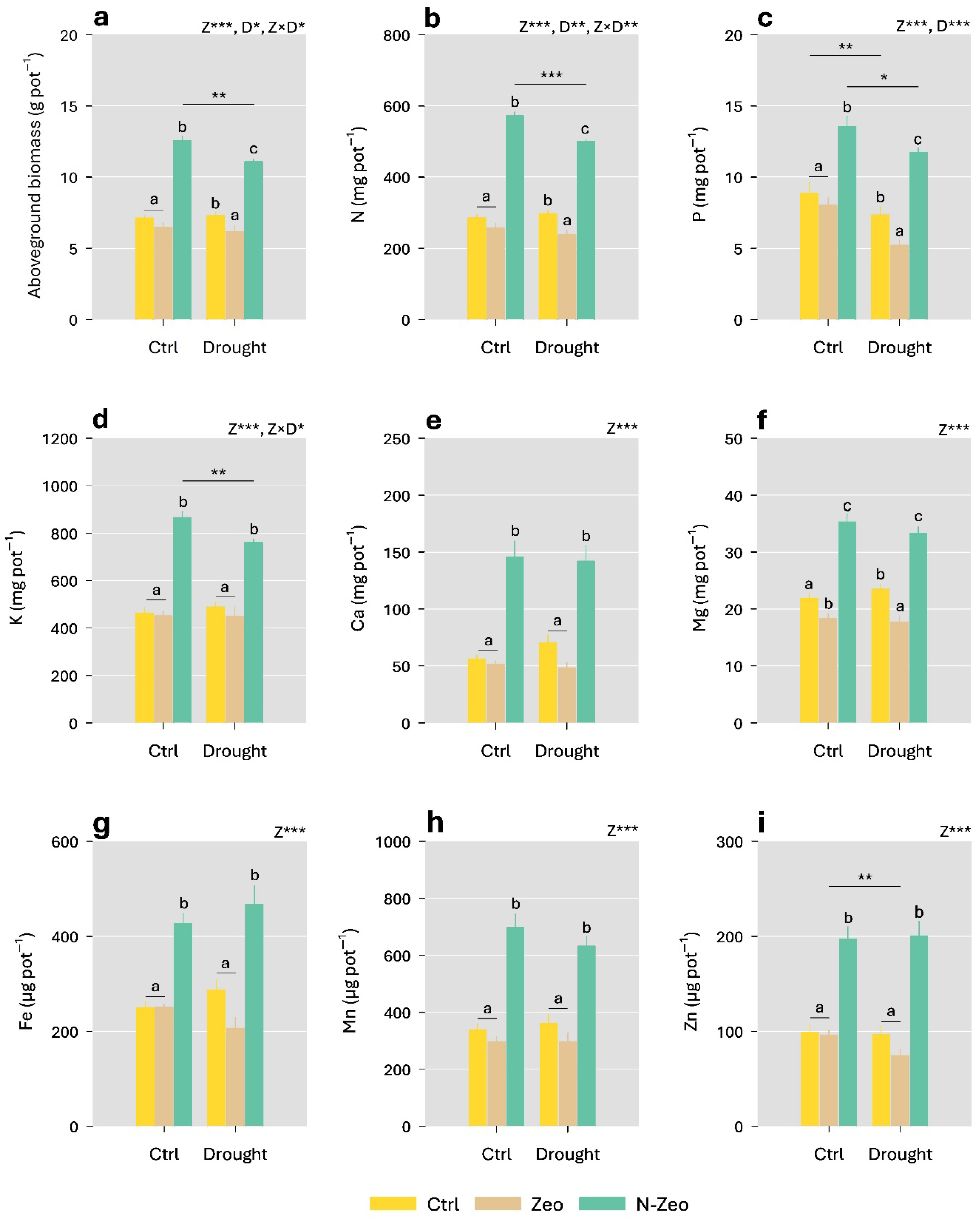
Although the induced drought stress was moderate, the conducted two-way ANOVAs suggest that the chosen drought stress intensity was sufficient to induce a significant reduction in plant growth and the uptake of N and P (p < 0.05; Table 1; Figure 1a–c). The drought stress apparently affected the high plant biomass in the N-Zeo treatment the most, similar to González et al. [49]; in the present study, we observed significant reductions in aboveground biomass (−11.8%; p < 0.01) as well as N (−12.7%; p < 0.001), P (−13.4%; p < 0.05), and K contents (−11.9%; p < 0.01) compared to the water-sufficient control (Figure 1a–d). Moreover, reductions in stomatal conductance and PSII efficiency (p < 0.01 and p < 0.001, respectively) confirmed a significant drought stress at a water content set at 40% water-holding capacity (Table 1 and Figure 3 and Figure 4) [50].
Table 1.
Results of the conducted two-way analyses of variance to evaluate main effects (zeolite amendment and drought stress) as well as the interaction between zeolite amendment and drought stress. Given are F- and p-values, and p-values in bold indicate a significant effect.
Figure 1.
The effect of zeolite amendment (‘Ctrl’, control; ‘Zeo’, uncharged; ‘N-Zeo’, N-charged) on (a) aboveground biomass and (b–i) and macro- and micronutrient contents in Hordeum vulgare under water-sufficient conditions (Ctrl) and after a 2-week drought period. Given is the mean ± SE (n = 5), different letters above bars indicate significant differences (p < 0.05) between zeolite treatments within the drought treatments, and asterisks above bars indicate significant drought effects within the zeolite treatments, while asterisks in the upper left corner indicate main and interaction effects of the zeolite (‘Z’) and drought (‘D’) treatments (*, p < 0.05; **, p < 0.01; ***, p < 0.001).
3.2. Zeolite Effects on Plant Physiology, Growth and Nutrient Uptake Under Water-Sufficient Conditions
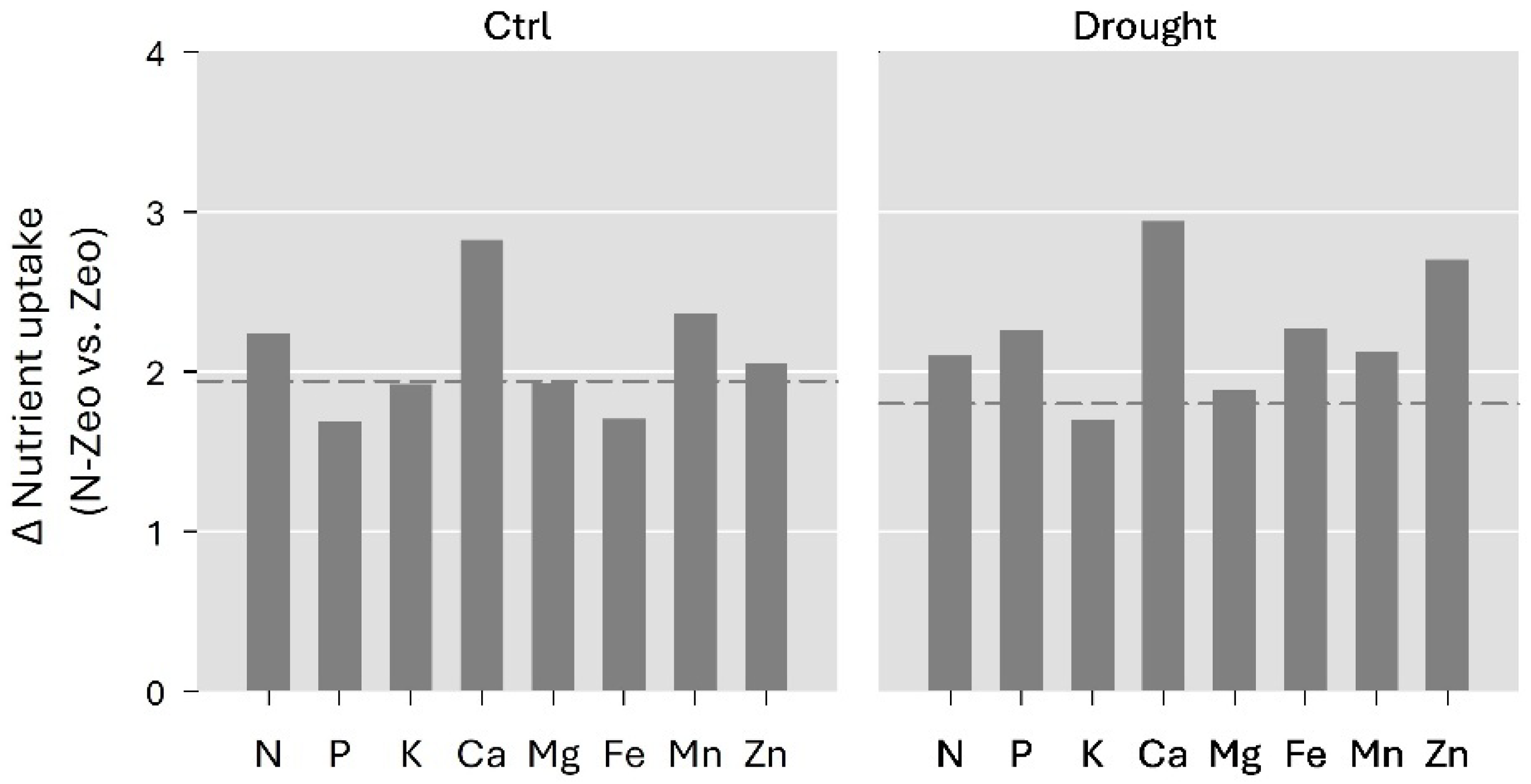
The aboveground biomass of barley, as well as macro- and micronutrient contents, remained unchanged with zeolite addition under water-sufficient conditions (Figure 1). This is a novel finding, given the fact that these natural chabazite zeolite tuffs contain significant amounts of exchangeable K and Ca, which are essential for plant growth. While there is strong evidence for a positive effect of uncharged zeolite amendment on crop yield and nutrient uptake in the literature [32], our results therefore do not confirm such improvements. On the other hand, the addition of N-charged zeolites increased crop performance and nutrient uptake significantly (p < 0.05; Figure 1). Aboveground biomass was 12.57 ± 0.29 g pot−1 in the N-Zeo treatment and thus nearly doubled as compared to aboveground biomasses obtained in the Ctrl (7.13 ± 0.21 g pot−1) and the Zeo (6.48 ± 0.31 g pot−1) treatments (Figure 1a). In general, macro- and micronutrient uptake strongly mirrored the trends observed for aboveground biomass, i.e., ca. 60–90% increases in the N-Zeo treatment as compared to Ctrl and Zeo (Figure 1b–i). Differences in Ca uptake were particularly high (Figure 1e): here, we observed 3-fold increases in the N-Zeo treatment (146 ± 14 mg pot−1) as compared to the Ctrl (56 ± 4 mg pot−1) and the Zeo (52 ± 3 mg pot−1) treatments. Accordingly, across both water-sufficient and drought conditions, the Ca:Mg ratio was significantly increased in the N-Zeo treatment (4.17 ± 0.2) as compared to the Ctrl and the Zeo treatment (2.78 ± 0.18 and 2.70 ± 0.06, respectively). This may suggest that uncharged and N-charged zeolites released plant-available Ca into the soil; however, only the greater aboveground biomass in the N-Zeo treatment could assimilate this additional Ca, whereas barley in the Zeo treatment did not benefit from the increased plant-available Ca (Figure 2). In fact, we also observed a significant reduction in Mg uptake with uncharged zeolite amendment as compared to the control (Figure 1f). These findings demonstrate that excessive Ca supply can suppress Mg uptake and thus subsequently affect crop performance and yield–similar to results of Hao and Papadopoulos [51] or del Amor and Rubio [52]. They further highlight the need for a careful selection of the zeolite type applied to arable soils, as resulting cation imbalances may require corrective measures, for example, through targeted additional fertilization.
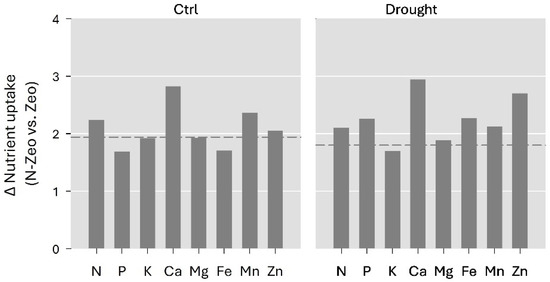
Figure 2.
Mean differences in barley macro- and micronutrient uptake between the N-charged zeolite and the uncharged zeolite treatments under control and drought conditions. The dashed lines indicate the difference in aboveground biomass between the zeolite-amended treatments, and differences were calculated as the quotient of the N-charged relative to the uncharged zeolite treatment.
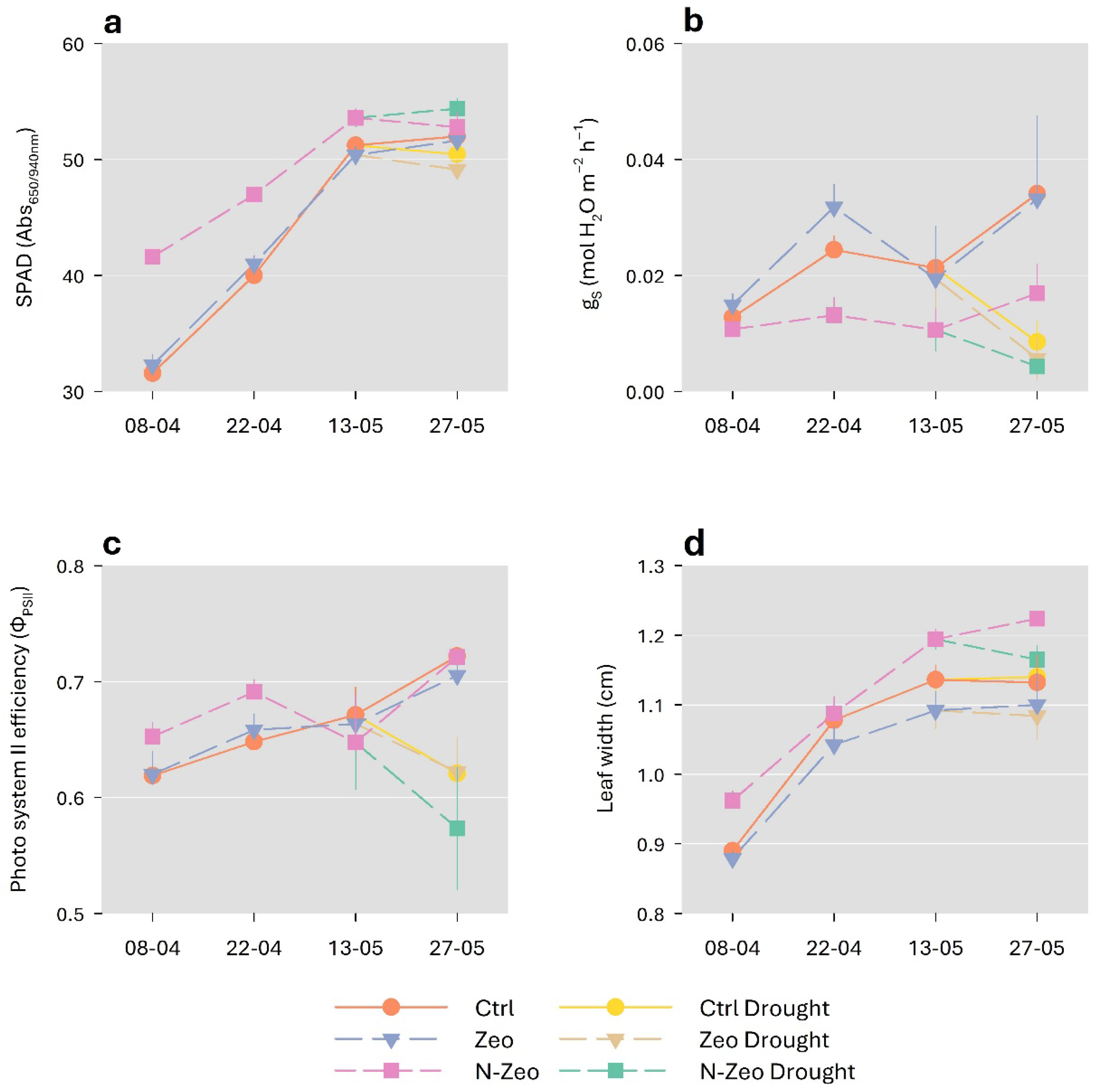
Interestingly, the measured plant-physiological traits during the experimental period did not reflect the differences in plant growth and nutrient uptake between the different zeolite treatments (Figure 3 and Figure 4). After 9 weeks of plant growth under water-sufficient conditions, we observed no significant differences in SPAD, gS and ΦPSII between all three treatments (p > 0.05; Figure 3a–c). This is in line with studies conducted on rice, oat or maize [15,53,54], suggesting no impairment of plant physiological functioning with zeolite addition, yet also no improvements. However, we observed some differences at early growth stages, particularly in the N-Zeo treatment (Figure 4a–c). SPAD values of barley were significantly higher under N-Zeo as compared to both the Ctrl and Zeo treatments in the first six weeks of the experiment (41.6 ± 0.4 vs. 31.6 ± 1.1 and 32.3 ± 0.9 on 8 April, 47 ± 0.6 vs. 40.6 ± 0.9 and 41 ± 0.7 on 22 April, and 53.6 ± 0.8 vs. 51.2 ± 0.5 and 50.4 ± 0.7 on 13 May; all p < 0.05), likely owed to an early and ample supply of bioavailable N. This strongly boosted plant growth, as evidenced by significantly higher leaf width throughout this early period (Figure 4d).
Figure 3.
The effect of zeolite amendment (‘Ctrl’, control; ‘Zeo’, uncharged; ‘N-Zeo’, N-charged) on (a) SPAD value, (b) stomatal conductance and (c) photosystem 2 efficiency of Hordeum vulgare under water-sufficient (Ctrl) and drought conditions. Given is the mean ± SE (n = 5), different letters above bars indicate significant differences (p < 0.05; n.s., not significant) between zeolite treatments within the drought treatments, and asterisks indicate significant drought effects within the zeolite treatments, while asterisks in the upper left corner indicates main and interaction effects of the zeolite (‘Z’) and drought (‘D’) treatments (*, p < 0.05; **, p < 0.01; ***, p < 0.001). Measurements were taken two weeks after inducing moderate water stress and refer to the last timepoint in Figure 4.
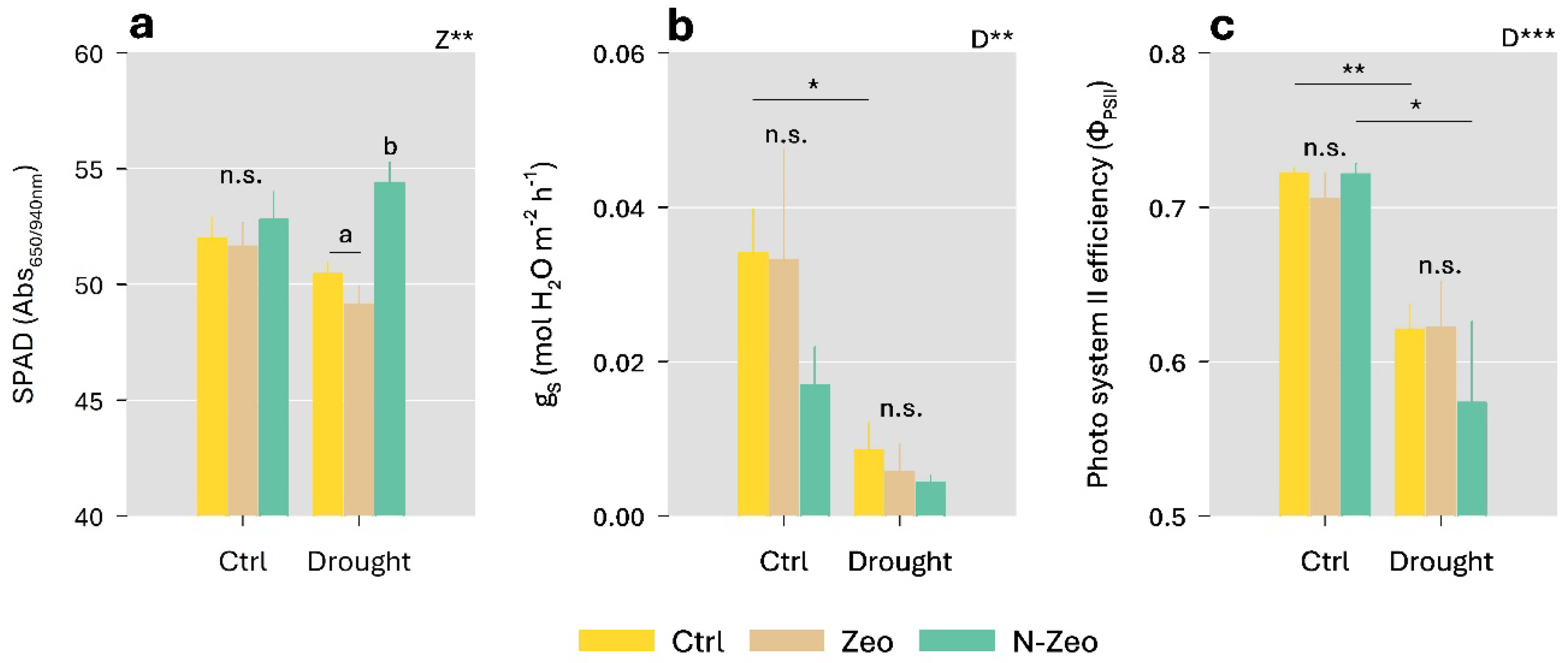
Figure 4.
(a) SPAD value, (b) stomatal conductance and (c) photosystem 2 efficiency and (d) leaf width of Hordeum vulgare grown in unamended (‘Ctrl’) pots and pots amended with uncharged (‘Zeo’) and N-charged (‘N-Zeo’) zeolites under water-sufficient conditions (from 8 April to 13 May) and under both water sufficient conditions and drought stress (‘Drought’; same symbols but different coloring).
3.3. Zeolite Effects on Plant Physiology, Growth and Nutrient Uptake Under Drought Stress
Unexpectedly, we observed significant reductions in aboveground biomass (−15.4%) as well as N (−19.9%), P (−29.2%) and Mg (−24.8%) contents in the Zeo treatment as compared to the unamended Ctrl treatment (p < 0.05; Figure 1a–c,f). This finding contrasts with the prevailing scientific consensus that zeolite amendments generally facilitate crop growth and nutrient uptake under drought stress [15,16,17]. To our knowledge, this response has not been previously reported and warrants further investigation, as the high nutrient sorption capacity of zeolites—particularly for NH4+ [55]—may become disadvantageous under conditions that limit nutrient exchange. For example, NH4+ adsorbed by the zeolite structure may preferentially be released under moist conditions, where exchange processes with the soil matrix could occur. While these zeolites may prevent N leaching under high water levels [56], they may retain significant amounts of N under drier conditions, rendering it temporarily unavailable to plants. This argumentation is in line with results from Lim et al. [57], who evidenced lower rice yields with zeolite application due to reduced N mobility during early stages of crop development. Therefore, we hypothesize that nitrogen retention may contribute to the observed reductions in plant growth and in the uptake of other nutrients, including P and Mg, which were significantly lower in the Zeo treatment compared with the Ctrl treatment under drought conditions (p < 0.05; Figure 1c,f). Clearly, further research is required to elucidate the underlying mechanisms responsible for these effects.
Moreover, applied chabazite zeolite could have also retained significant amounts of water, making it unavailable to plants and thus impairing crop growth [32]. As for our rather coarse-textured substrate, we would have anticipated a positive effect of zeolite amendment. While there are several studies constituting a beneficial zeolite effect on soil water retention [58,59] and subsequent crop yields, this effect, however, seems to depend on soil textural properties as well as on the nature and particle size of the amended zeolite [21]. For example, Ibrahim and Alghamdi [60] reported increased water holding capacity in loamy soils with the addition of nano-particle-sized clinoptilolite zeolite. Coarse zeolite particles (>20 µm), as used in this study, however, had hardly any effect on water retention and infiltration. Furthermore, high zeolite amendments were found to reduce hydraulic conductivity, particularly in sandy loam soils [60].
The N-charged zeolite proved to be a promising amendment to promote crop growth. However, we cannot comment on its N-use efficiency as there was no corresponding treatment with an equivalent addition of mineral N that would allow an adequate comparison of the growth response. Clearly, the higher N supply in the N-Zeo treatment significantly increased plant biomass and particularly facilitated the uptake of zeolite-derived Ca (Figure 2); thus, zeolite addition may be particularly beneficial under an ample supply of essential nutrients such as N and P. We propose that future studies should compare the effect of N-charged zeolite amendment with other forms of N fertilization to test its effect on N-use efficiency [26].
While our study demonstrated declines in barley yield and nutrient uptake due to uncharged zeolite amendment, several limitations should be acknowledged. First, we did not assess nutrient availability in the soil post-harvest, leaving uncertainty about the amendment’s residual effects on soil fertility. Second, we only evaluated drought responses after one drought period. However, to fully understand the impact of zeolite on plant nutrient uptake under drought stress, its effects should be assessed across multiple drought events over time [61,62]. Third, the short duration of the experiment (i.e., 9 weeks) limits our ability to draw conclusions about the long-term impacts of zeolite, particularly for crops exhibiting long vegetation periods and across successive cropping seasons. This is important, as previous research suggests that zeolite amendment improves soil health over long time periods [1]. Fourth, our N fertilization dosage in the Ctrl and Zeo treatments was rather low; therefore, these negative zeolite effects may not appear under recommended fertilization levels. Finally, this pilot study was limited to a single soil substrate and conducted under controlled greenhouse conditions. Therefore, the observed effects of zeolite amendment may be different in finer-textured soils with higher water-holding capacity. Accordingly, future studies should conduct field trials over repeated cultivation periods under various soil types and include soil nutrient analyses to better capture the full potential and sustainability of zeolite amendments.
4. Conclusions
To conclude, this pilot study provides the first evidence that natural chabazite zeolite amendment can exert a negative impact on barley growth and nutrient uptake under drought conditions. This effect was likely induced by the pronounced water-retention capacity and strong NH4+ affinity of chabazite zeolite minerals, potentially leading to an immobilization of these plant growth-limiting factors. These reductions in N availability could have subsequently compromised the uptake of N and other nutrients, particularly P and Mg. Moreover, a high Ca input with zeolite amendment caused strong shifts in biomass Ca:Mg ratios, highlighting the importance of selecting zeolite materials with suitable physicochemical properties. On the other hand, amending soils with N-charged zeolite represents a promising farming management strategy to improve nutrient retention in arable soils. Owing to their ion-exchange capacity and slow-release characteristics, these zeolites can serve as a sustained source of N as well as base cations, such as Ca and K, while simultaneously mitigating nutrient losses through leaching, making them particularly beneficial in soil systems prone to nutrient losses, such as shallow or coarse-textured soils.
Author Contributions
Conceptualization: C.R., G.F. and H.-P.K.; Methodology: C.R., G.F. and H.-P.K.; Formal analysis and investigation: C.R. and G.W.; Writing—original draft preparation: C.R.; Writing—review and editing: G.F., G.W. and H.-P.K.; Funding acquisition: H.-P.K.; Resources: G.F., H.-P.K.; Supervision: C.R. and H.-P.K. All authors have read and agreed to the published version of the manuscript.
Funding
Open access support was provided by BOKU University.
Data Availability Statement
Data are available upon request from the corresponding author.
Acknowledgments
We thank Craig Jackson and Elisabeth Ziss for laboratory assistance with elemental analyses and Anastasia Chyzhyk, Andreas Dietl, Matti Gesien, Stella Ogochukwu Muojiama, Benedikt Johannes Piller, Elise Weijie Poley, Luisa Sander and Ayse Gizem Serin for assistance with plant physiological measurements. Open access funding was provided by BOKU University. Large language models were used to improve the readability of the manuscript.
Conflicts of Interest
The authors have no conflicts of interest to declare.
Abbreviations
The following abbreviations are used in this manuscript:
| Ca | Calcium |
| Ctrl | Control |
| Fe | Iron |
| K | Potassium |
| Mg | Magnesium |
| Mn | Manganese |
| NH4+ | Ammonium |
| N | Nitrogen |
| P | Phosphorus |
| PS | Photo system |
| Zeo | Zeolite |
| Zn | Zinc |
References
- Ferretti, G.; Rosinger, C.; Diaz-Pines, E.; Faccini, B.; Coltorti, M.; Keiblinger, K.M. Soil quality increases with long-term chabazite-zeolite tuff amendments in arable and perennial cropping systems. J. Environ. Manag. 2024, 354, 120303. [Google Scholar] [CrossRef] [Scilit]
- Delkash, M.; Bakhshayesh, B.E.; Kazemian, H. Using zeolitic adsorbents to cleanup special wastewater streams: A review. Microporous Mesoporous Mater. 2015, 214, 224–241. [Google Scholar] [CrossRef] [Scilit]
- Yalçuk, A. Removal of phenol from olive mill wastewater in constructed wetlands using different bedding media. Ekoloji 2011, 20, 1–5. [Google Scholar]
- Zhang, J.; Singh, R.; Webley, P.A. Alkali and alkaline-earth cation exchanged chabazite zeolites for adsorption based CO2 capture. Microporous Mesoporous Mater. 2008, 111, 478–487. [Google Scholar] [CrossRef] [Scilit]
- Sels, B.; Kustov, L. Zeolites and Zeolite-Like Materials; Elsevier: Amsterdam, The Netherlands, 2016. [Google Scholar]
- Sun, Y.D.; Xia, G.M.; He, Z.L.; Wu, Q.; Zheng, J.L.; Li, Y.H.; Wang, Y.Z.; Chen, T.T.; Chi, D.C. Zeolite amendment coupled with alternate wetting and drying to reduce nitrogen loss and enhance rice production. Field Crops Res. 2019, 235, 95–103. [Google Scholar] [CrossRef] [Scilit]
- Cataldo, E.; Salvi, L.; Paoli, F.; Fucile, M.; Masciandaro, G.; Manzi, D.; Masini, C.M.; Mattii, G.B. Application of Zeolites in Agriculture and Other Potential Uses: A Review. Agronomy 2021, 11, 1547. [Google Scholar] [CrossRef] [Scilit]
- Gualtieri, A.F.; Passaglia, E. Rietveld structure refinement of NH4-exchanged natural chabazite. Eur. J. Mineral. 2006, 18, 351–359. [Google Scholar] [CrossRef] [Scilit]
- Mumpton, F.A. La roca magica: Uses of natural zeolites in agriculture and industry. Proc. Natl. Acad. Sci. USA 1999, 96, 3463–3470. [Google Scholar] [CrossRef] [Scilit]
- Ozbahce, A.; Tari, A.F.; Gönülal, E.; Simsekli, N.; Padem, H. The effect of zeolite applications on yield components and nutrient uptake of common bean under water stress. Arch. Agron. Soil Sci. 2015, 61, 615–626. [Google Scholar] [CrossRef] [Scilit]
- Li, J.; Gao, M.; Yan, W.; Yu, J. Regulation of the Si/Al ratios and Al distributions of zeolites and their impact on properties. Chem. Sci. 2023, 14, 1935–1959. [Google Scholar] [CrossRef] [Scilit]
- Pan, S.X.; Wu, Q.M.; Wang, X.; Chen, F.; Meng, X.J.; Xiao, F.S. Mesoporous EU-1 zeolite synthesized in the presence of cationic polymer. Microporous Mesoporous Mater. 2016, 235, 246–252. [Google Scholar] [CrossRef] [Scilit]
- Bezerra, D.P.; Oliveira, R.S.; Vieira, R.S.; Cavalcante, C.L.; Azevedo, D.C. Adsorption of CO 2 on nitrogen-enriched activated carbon and zeolite 13X. Adsorption 2011, 17, 235–246. [Google Scholar] [CrossRef] [Scilit]
- Colombani, N.; Di Giuseppe, D.; Faccini, B.; Ferretti, G.; Mastrocicco, M.; Coltorti, M. Estimated water savings in an agricultural field amended with natural zeolites. Environ. Process. 2016, 3, 617–628. [Google Scholar] [CrossRef] [Scilit]
- Zheng, J.L.; Chen, T.T.; Wu, Q.; Yu, J.M.; Chen, W.; Chen, Y.L.; Siddique, K.H.M.; Meng, W.Z.; Chi, D.C.; Xia, G.M. Effect of zeolite application on phenology, grain yield and grain quality in rice under water stress. Agric. Water Manag. 2018, 206, 241–251. [Google Scholar] [CrossRef] [Scilit]
- Bahador, M.; Tadayon, M.R. Investigating of zeolite role in modifying the effect of drought stress in hemp: Antioxidant enzymes and oil content. Ind. Crops Prod. 2020, 144, 112042. [Google Scholar] [CrossRef] [Scilit]
- Hazrati, S.; Tahmasebi-Sarvestani, Z.; Mokhtassi-Bidgoli, A.; Modarres-Sanavy, S.A.M.; Mohammadi, H.; Nicola, S. Effects of zeolite and water stress on growth, yield and chemical compositions of Aloe vera L. Agric. Water Manag. 2017, 181, 66–72. [Google Scholar] [CrossRef] [Scilit]
- Alfi, S.; Azizi, F. Effect of drought stress and using zeolite on some quantitative and qualitative traits of three maize varieties. Res. J. Recent Sci. 2015, 2277, 2502. [Google Scholar]
- Mahmoud, A.W.M.; Rashad, H.M.; Esmail, S.E.; Alsamadany, H.; Abdeldaym, E.A. Application of silicon, zinc, and zeolite nanoparticles—A tool to enhance drought stress tolerance in coriander plants for better growth performance and productivity. Plants 2023, 12, 2838. [Google Scholar] [CrossRef] [Scilit]
- Elseedy, M.; Mohammed, R.Y.; El-Sherpiny, M.; Taha, A. Enhancing crop resilience to drought stress: Antitranspirants, zeolite and water conservation strategies for strategic crop productivity. J. Soil Sci. Agric. Eng. 2023, 14, 267–274. [Google Scholar] [CrossRef] [Scilit]
- Zeinalipour, N.; Galehdari, F.; Saadati, S.; Arvin, M.J.; Sarcheshmehpour, M. Zearalenone and nanozeolite improve Arugula (Eruca sativa) drought tolerance by enhancing photosynthesis and water relations. Sci. Rep. 2025, 15, 28770. [Google Scholar] [CrossRef] [Scilit]
- Narouei, M.; Sirousmehr, A.; Dahmardeh, M.; Seyedabadi, E. Effects of drought stress and zeolite application rates on yield, oil content, and antioxidant enzymes of sesame cultivars in arid regions of Iran. Agrosyst. Geosci. Environ. 2025, 8, e70256. [Google Scholar] [CrossRef] [Scilit]
- Al-Busaidi, A.; Yamamoto, T.; Tanigawa, T.; Rahman, H.A. Use of zeolite to alleviate water stress on subsurface drip irrigated barley under hot environments. Irrig. Drain. 2011, 60, 473–480. [Google Scholar] [CrossRef] [Scilit]
- Galamini, G.; Ferretti, G.; Rosinger, C.; Huber, S.; Medoro, V.; Mentler, A.; Diaz-Pines, E.; Gorfer, M.; Faccini, B.; Keiblinger, K.M. Recycling nitrogen from liquid digestate via novel reactive struvite and zeolite minerals to mitigate agricultural pollution. Chemosphere 2023, 317, 137881. [Google Scholar] [CrossRef] [Scilit]
- Hermassi, M.; Dosta, J.; Valderrama, C.; Licon, E.; Moreno, N.; Querol, X.; Batis, N.H.; Cortina, J.L. Simultaneous ammonium and phosphate recovery and stabilization from urban sewage sludge anaerobic digestates using reactive sorbents. Sci. Total Environ. 2018, 630, 781–789. [Google Scholar] [CrossRef] [Scilit]
- de Carvalho Izidoro, J.; Fungaro, D.A.; Cataldo, E. Zeolites synthesized from agro-industrial residues applied in agriculture: A review and future prospects. Soil Use Manag. 2024, 40, e13003. [Google Scholar] [CrossRef] [Scilit]
- Galamini, G.; Ferretti, G.; Rosinger, C.; Huber, S.; Mentler, A.; Diaz–Pines, E.; Faccini, B.; Keiblinger, K. Potential for agricultural recycling of struvite and zeolites to improve soil microbial physiology and mitigate CO2 emissions. Geoderma 2025, 453, 117149. [Google Scholar] [CrossRef] [Scilit]
- Ferretti, G.; Galamini, G.; Medoro, V.; Faccini, B. Amount and speciation of N leached from a sandy soil fertilized with urea, liquid digestate, struvite and NH4-enriched chabazite zeolite-tuff. Soil Use Manag. 2023, 39, 456–473. [Google Scholar] [CrossRef] [Scilit]
- Ramalingappa, P.L.; Singh, R.; Shrivastava, M. Synergistic Impacts of Synthesized Nanozeolite-Based Nitrogen Fertilizers on Soil Nitrogen Mineralization, Nitrogen Loss Mitigation, Enzymatic Pathways, Photosynthetic Efficiency, and Crop Yield in Agricultural Systems. Water Air Soil Pollut. 2025, 236, 833. [Google Scholar] [CrossRef] [Scilit]
- Foereid, B.; Szocs, J. Does Loading Ammonium to Sorbents Affect Plant Availability in Soil? Agriculture 2022, 12, 1057. [Google Scholar] [CrossRef] [Scilit]
- Ippolito, J.A.; Tarkalson, D.D.; Lehrsch, G.A. Zeolite Soil Application Method Affects Inorganic Nitrogen, Moisture, and Corn Growth. Soil Sci. 2011, 176, 136–142. [Google Scholar] [CrossRef] [Scilit]
- Nakhli, S.A.A.; Delkash, M.; Bakhshayesh, B.E.; Kazemian, H. Application of Zeolites for Sustainable Agriculture: A Review on Water and Nutrient Retention. Water Air Soil Pollut. 2017, 228, 1–34. [Google Scholar] [CrossRef] [Scilit]
- Hailu, Y.; Tilahun, E.; Brhane, A.; Resky, H.; Sahu, O. Ion exchanges process for calcium, magnesium and total hardness from ground water with natural zeolite. Groundw. Sustain. Dev. 2019, 8, 457–467. [Google Scholar] [CrossRef] [Scilit]
- Tahraoui, Z.; Nouali, H.; Marichal, C.; Forler, P.; Klein, J.; Daou, T.J. Influence of the Compensating Cation Nature on the Water Adsorption Properties of Zeolites. Molecules 2020, 25, 944. [Google Scholar] [CrossRef] [Scilit]
- Tao, F.; Rötter, R.P.; Palosuo, T.; Díaz-Ambrona, C.G.H.; Mínguez, M.I.; Semenov, M.A.; Kersebaum, K.C.; Nendel, C.; Cammarano, D.; Hoffmann, H. Designing future barley ideotypes using a crop model ensemble. Eur. J. Agron. 2017, 82, 144–162. [Google Scholar] [CrossRef] [Scilit]
- Dawson, I.K.; Russell, J.; Powell, W.; Steffenson, B.; Thomas, W.T.; Waugh, R. Barley: A translational model for adaptation to climate change. New Phytol. 2015, 206, 913–931. [Google Scholar] [CrossRef] [Scilit] [PubMed]
- Sae-Tun, O.; Bodner, G.; Rosinger, C.; Zechmeister-Boltenstern, S.; Mentler, A.; Keiblinger, K. Fungal biomass and microbial necromass facilitate soil carbon sequestration and aggregate stability under different soil tillage intensities. Appl. Soil Ecol. 2022, 179, 104599. [Google Scholar] [CrossRef] [Scilit]
- de’Gennaro, M.; Langella, A. Italian zeolitized rocks of technological interest. Miner. Depos. 1996, 31, 452–472. [Google Scholar] [CrossRef]
- Ferretti, G.; Galamini, G.; Medoro, V.; Coltorti, M.; Di Giuseppe, D.; Faccini, B. Impact of Sequential Treatments with Natural and Na-Exchanged Chabazite Zeolite-Rich Tuff on Pig-Slurry Chemical Composition. Water 2020, 12, 310. [Google Scholar] [CrossRef] [Scilit]
- Malferrari, D.; Laurora, A.; Brigatti, M.F.; Coltorti, M.; Di Giuseppe, D.; Faccini, B.; Passaglia, E.; Vezzalini, M.G. Open-field experimentation of an innovative and integrated zeolitite cycle: Project definition and material characterization. Rend. Lincei-Sci. Fis. E Nat. 2013, 24, 141–150. [Google Scholar] [CrossRef] [Scilit]
- Faccini, B.; Di Giuseppe, D.; Ferretti, G.; Coltorti, M.; Colombani, N.; Mastrocicco, M. Natural and NH 4+-enriched zeolitite amendment effects on nitrate leaching from a reclaimed agricultural soil (Ferrara Province, Italy). Nutr. Cycl. Agroecosystems 2018, 110, 327–341. [Google Scholar] [CrossRef] [Scilit]
- Cassel, D.; Nielsen, D. Field capacity and available water capacity. In Methods of Soil Analysis: Part 1 Physical and Mineralogical Methods; American Society of Agronomy: Madison, WI, USA, 1986; Volume 5, pp. 901–926. [Google Scholar]
- Hoagland, D.R.; Arnon, D.I. The Water-Culture Method for Growing Plants Without Soil; University of California: Davis, CA, USA, 1938. [Google Scholar]
- Mejri, M.; Siddique, K.H.; Saif, T.; Abdelly, C.; Hessini, K. Comparative effect of drought duration on growth, photosynthesis, water relations, and solute accumulation in wild and cultivated barley species. J. Plant Nutr. Soil Sci. 2016, 179, 327–335. [Google Scholar] [CrossRef] [Scilit]
- Hein, J.A.; Sherrard, M.E.; Manfredi, K.P.; Abebe, T. The fifth leaf and spike organs of barley (Hordeum vulgare L.) display different physiological and metabolic responses to drought stress. BMC Plant Biol. 2016, 16, 248. [Google Scholar] [CrossRef] [Scilit]
- Busch, F.A.; Ainsworth, E.A.; Amtmann, A.; Cavanagh, A.P.; Driever, S.M.; Ferguson, J.N.; Kromdijk, J.; Lawson, T.; Leakey, A.D.; Matthews, J.S. A guide to photosynthetic gas exchange measurements: Fundamental principles, best practice and potential pitfalls. Plant Cell Environ. 2024, 47, 3344–3364. [Google Scholar] [CrossRef] [Scilit]
- Aliu, S.; Zeka, D.; Jakupi, M.; Gashi, B.; Rusinovci, I.; Kaul, H.-P. Polyethylene glycol (PEG)-induced drought causes stress responses in growth and photosynthesis of common beans (Phaseolus vulgaris L.). Bodenkult. J. Land Manag. Food Environ. 2025, 76, 52–62. [Google Scholar] [CrossRef] [Scilit]
- Neugschwandtner, R.W.; Száková, J.; Pachtrog, V.; Tlustoš, P.; Kulhánek, M.; Černý, J.; Kaul, H.-P.; Wagentristl, H.; Moitzi, G.; Euteneuer, P. Exchangeable and plant-available macronutrients in a long-term tillage and crop rotation experiment after 15 years. Plants 2022, 11, 565. [Google Scholar] [CrossRef] [Scilit] [PubMed]
- González, A.; Martín, I.; Ayerbe, L. Barley yield in water-stress conditions.: The influence of precocity, osmotic adjustment and stomatal conductance. Field Crops Res. 1999, 62, 23–34. [Google Scholar] [CrossRef] [Scilit]
- Abdelrady, W.A.; Elshawy, E.E.; Abdelrahman, H.A.; Hassan Askri, S.M.; Ibrahim, Z.; Mansour, M.; El-Degwy, I.S.; Ghazy, T.; Aboulila, A.A.; Shamsi, I.H. Evaluating physiological and yield indices of Egyptian barley cultivars under drought stress conditions. Agronomy 2024, 14, 2711. [Google Scholar] [CrossRef] [Scilit]
- Hao, X.M.; Papadopoulos, A.P. Effects of calcium and magnesium on growth, fruit yield and quality in a fall greenhouse tomato crop grown on rockwool. Can. J. Plant Sci. 2003, 83, 903–912. [Google Scholar] [CrossRef] [Scilit]
- del Amor, F.M.; Rubio, J.S. Effects of antitranspirant spray and potassium: Calcium: Magnesium ratio on photosynthesis, nutrient and water uptake, growth, and yield of sweet pepper. J. Plant Nutr. 2009, 32, 97–111. [Google Scholar] [CrossRef] [Scilit]
- Di Giuseppe, D.; Faccini, B.; Melchiorre, M.; Ferretti, G.; Coltorti, M.; Ciuffreda, G.; Zago, A. Yield and quality of maize grown on a loamy soil amended with natural chabazite zeolitite. EQA-Int. J. Environ. Qual. 2015, 17, 35–45. [Google Scholar]
- Rodrigues, M.A.; Torres, L.D.D.; Damo, L.; Raimundo, S.; Sartor, L.; Cassol, L.C.; Arrobas, M. Nitrogen Use Efficiency and Crop Yield in Four Successive Crops Following Application of Biochar and Zeolites. J. Soil Sci. Plant Nutr. 2021, 21, 1053–1065. [Google Scholar] [CrossRef] [Scilit]
- Aiyuk, S.; Xu, H.; Van Haandel, A. Removal of ammonium nitrogen from pretreated domestic sewage using a natural ion exchanger. Environ. Technol. 2004, 25, 1321–1330. [Google Scholar] [CrossRef] [Scilit]
- Piñón-Villarreal, A.R.; Bawazir, A.S.; Shukla, M.K.; Hanson, A.T. Retention and transport of nitrate and ammonium in loamy sand amended with clinoptilolite zeolite. J. Irrig. Drain. Eng. 2013, 139, 755–765. [Google Scholar] [CrossRef] [Scilit]
- Lim, S.S.; Lee, D.S.; Kwak, J.H.; Park, H.J.; Kim, H.Y.; Choi, W.J. Fly ash and zeolite amendments increase soil nutrient retention but decrease paddy rice growth in a low fertility soil. J. Soils Sed. 2016, 16, 756–766. [Google Scholar] [CrossRef] [Scilit]
- de Campos Bernardi, A.C.; Oliviera, P.P.A.; de Melo Monte, M.B.; Souza-Barros, F. Brazilian sedimentary zeolite use in agriculture. Microporous Mesoporous Mater. 2013, 167, 16–21. [Google Scholar] [CrossRef] [Scilit]
- Xiubin, H.; Zhanbin, H. Zeolite application for enhancing water infiltration and retention in loess soil. Resour. Conserv. Recycl. 2001, 34, 45–52. [Google Scholar] [CrossRef] [Scilit]
- Ibrahim, H.M.; Alghamdi, A.G. Effect of the Particle Size of Clinoptilolite Zeolite on Water Content and Soil Water Storage in a Loamy Sand Soil. Water 2021, 13, 607. [Google Scholar] [CrossRef] [Scilit]
- Liu, G.Y.; Zheng, J.L.; Chen, T.T.; Chen, X.D.; Chen, W.; Sun, Y.D.; Lærke, P.E.; Chen, Y.L.; Siddique, K.H.M.; Chi, D.C.; et al. Zeolite mitigates N2O emissions in paddy fields under alternate wetting and drying irrigation. Agric. Ecosyst. Environ. 2022, 339, 108145. [Google Scholar] [CrossRef] [Scilit]
- Zhao, Q.; Chen, T.; Wang, S.; Sha, Y.; Zhang, F.; Sun, Y.; Chi, D. Effects of five-year field aged zeolite on grain yield and reactive gaseous N losses in alternate wetting and drying paddy system. Sci. Total Environ. 2023, 904, 166279. [Google Scholar] [CrossRef] [Scilit]

Disclaimer/Publisher’s Note: The statements, opinions and data contained in all publications are solely those of the individual author(s) and contributor(s) and not of MDPI and/or the editor(s). MDPI and/or the editor(s) disclaim responsibility for any injury to people or property resulting from any ideas, methods, instructions or products referred to in the content. |
© 2026 by the authors. Licensee MDPI, Basel, Switzerland. This article is an open access article distributed under the terms and conditions of the Creative Commons Attribution (CC BY) license.