


Abstract
Aquaculture-derived bio-based fertilizers (BBFs) represent a promising alternative to inorganic P in Andisols for sustainable alfalfa (Medicago sativa L.) cultivation. However, their agronomic performance and physiological impacts on alfalfa remain poorly understood. This study evaluated three BBFs, consisting of composted fish sludge (CFS), dried fish sludge (DFS), and fish bone meal (FBM), in comparison with inorganic P (InoP) and a zero-P control (NoP). Forage yield (FY), P use efficiency (PUE), spectral canopy indices, and leaf gas-exchange parameters were assessed across five harvests in a Mediterranean environment. Results showed significant differences among fertilizer types driven by their distinct P release dynamics. DFS consistently maintained stable leaf P concentrations, enhanced PUE and P uptake, and lead to higher FY, improved photosynthesis, and water use efficiency (WUE). It performs statistically similarly to the inorganic P. In contrast, CFS released P too slowly, which in turn lowered leaf P concentration, P uptake, and PUE, resulting in the lowest photosynthesis and WUE. FBM produced intermediate responses but maintained WUE comparable to inorganic fertilizer. Gas-exchange measurements demonstrated that photosynthesis ranged from 9.01 to 16.7 μmol m−2 s−1, with no significant difference between DFS and inorganic P. Transpiration remained stable across BBF treatments (mean 3.2 mmol m−2 s−1). The canopy reflectance indices such as RARS, Gite2, and PSSR proved to be strong predictors of both P concentration and PUE in alfalfa. In conclusion, DFS emerged as the most efficient BBF that matched inorganic fertilizer to enhance P nutrition, plant physiology, and FY. These findings highlight the potential of aquaculture-derived BBFs, particularly DFS as sustainable P sources for improving alfalfa productivity while reducing reliance on synthetic fertilizers.
1. Introduction
The increasing global demand for sustainable agricultural practices has driven research into alternative nutrient sources that can enhance soil fertility while reducing reliance on synthetic fertilizers [1,2]. In Chile, agriculture heavily depends on imported inorganic fertilizers, with annual imports exceeding 1.5 million metric tons, primarily nitrogen (N)-, phosphorus (P)-, and potassium (K)-based compounds [3]. This dependence not only represents a significant economic burden but also exposes the sector to global market volatility and supply chain disruptions. Furthermore, the excessive use of synthetic fertilizers contributes to soil degradation [4], water eutrophication [5], and greenhouse gas emissions (GHGs) [6]. This alarming situation underscore the urgent need for more sustainable nutrient sources.
Alfalfa (Medicago sativa L.) is a key forage crop in Chilean agriculture and has particularly high P requirements due to its extensive and deep root system and role in biological nitrogen fixation (BNF) [7,8]. Studies indicate that alfalfa production demands 5–7 kg of P per ton of dry matter yield, making P availability a critical factor for optimal growth and productivity [9]. However, P use efficiency (PUE) in alfalfa cropping systems is generally low, ranging from 15% to 30% [10]. It indicates that most applied P remains unavailable to plants in the short term. This low efficiency stems from multiple factors including soil P fixation (SPF) (particularly in acidic soils), microbial immobilization, and the crop’s specific growth patterns, where peak demand occurs during establishment and early regrowth phases [11]. Recent studies on P availability indicate that organic P sources, such as those derived from fish waste, can enhance P availability through gradual mineralization and reduced SPF compared to conventional fertilizers [12,13,14]. The current reliance on imported rock phosphate-based fertilizers for alfalfa cultivation presents both economic and environmental challenges, as these resources are finite and their processing is energy-intensive [15]. This presents an opportunity to utilize alternative P sources, such as salmon-derived fertilizers, which contain substantial amounts of organic P that may be more readily available to plants than conventional mineral phosphates [16].
One promising approach involves the valorization of fish processing by-products, particularly salmon residues and aquaculture-derived fish sludge, as organic fertilizers. Chile, being the world’s second-largest producer of farmed salmon, generates substantial amounts of fish waste, including heads, bones, skin, and viscera, which are rich in essential macronutrients (N, P, K) and micronutrients (Ca, Mg, and trace elements) [17]. Similarly, fish sludge, a mixture of uneaten feed, feces, and metabolic waste from aquaculture systems, contains high levels of organic matter and nutrients, presenting another valuable resource for agricultural use [18,19].
The decomposition of salmon residues and fish sludge releases nutrients gradually through microbial activity, improving soil structure, water retention, and organic matter content [20]. High protein content in salmon residues and fish sludge contributes to N mineralization and ultimately promote plant growth [21]. However, challenges such as odor emissions, potential pathogen presence in fish sludge, heavy metal accumulation (especially in farmed salmon), and the need for optimized processing methods (e.g., composting, anaerobic digestion, or enzymatic hydrolysis) must be addressed to ensure environmental safety and agronomic efficiency [22,23]. Recent studies have demonstrated that composted salmon waste and treated fish sludge can enhance crop yields while reducing the environmental footprint associated with synthetic fertilizers [24,25]. This approach aligns with circular economy principles, converting fishery and aquaculture waste into valuable agricultural resources [25].
Chile’s predominant volcanic soils (Andisols) present unique challenges for P management due to their distinctive physicochemical properties. These soils exhibit exceptional P fixation capacity through three primary mechanisms: (i) Mineralogical Fixation: Andisols contain high concentrations of amorphous aluminosilicates (allophane and imogolite), with extremely large surface areas (700–800 m2 g−1), providing numerous binding sites for phosphate anions [26]. (ii) Chemical Retention: The abundant iron and aluminum oxides in Andisols form strong inner-sphere complexes with phosphate ions, particularly in acidic conditions (pH 4.5–5.5). This chemisorption process can immobilize up to 90% of applied P [27]. (iii) Biological Limitations: The cool, moist conditions typical of Chilean Andisols slow microbial mineralization of organic P, while the high organic matter content promotes temporary P immobilization by soil microbes [28]. These factors combine to create a soil environment where only 10–20% of conventionally applied P remains plant-available, with the majority becoming fixed in non-labile forms within weeks of application [29]. Organic amendments such as fish waste can enhance P availability through multiple pathways: (i) organic acids competing with phosphate for soil binding sites, (ii) organic matter forming protective coatings on soil colloids, and (iii) increased microbial activity promoting P mineralization [30].
Modern precision agriculture relies on affordable, fast, and reliable techniques to assess plant performance and agronomic values. Nowadays, traditional analytical methods are increasingly being substituted by spectroscopic techniques [31]. Canopy reflectance sensors measure how much light is reflected by plant surfaces, which offer valuable information about their physiological condition [32]. Portable spectroradiometers allow rapid, non-destructive, in-field assessment of crops without the need for sample processing. It enables repeated measurements on the same plants. Their high spectral resolution (50 nm to 2500 nm) across the visible and near-infrared range captures pigment-related information, which makes them powerful tools for precision agricultural research and crop monitoring [33]. Studies indicate that visible and near-infrared spectroscopy is a reliable approach for estimating the levels of various organic constituents in field-grown crops. For example, a study used portable spectroradiometer within the wavelength of 325 to 1075 nm for spectral reflectance measurements to estimate N levels in alfalfa grown under field and greenhouse conditions. The results showed that reflectance in the visible and near-infrared regions particularly blue, red, and NIR wavelengths can be effectively used to estimate nutrient levels in alfalfa [34]. Another study revealed a strong linear relationships between reflectance wavelengths (measure by spectroradiometer), their indices, and forage quality components in sainfoin pasture [35]. The estimation of alfalfa biomass was successfully performed using different spectral reflectance-derived indices [36]. Therefore, canopy reflectance measured with portable spectroradiometers can non-destructively indicate nutrients such as P status and overall nutritional health in alfalfa fertilized with BBFs. Improved P availability leads to greener, denser canopies, with higher NIR and lower visible reflectance that are closely linked to higher FY.
In Chile, both the salmon industry and agriculture are major economic sectors. Therefore, it was hypothesized that the integration of salmon waste-derived BBFs into Andisol could substantially reduce reliance on imported inorganic fertilizers while promoting the sustainable intensification of alfalfa farming systems. The objectives of this study were to (i) evaluate PUE in alfalfa fertilized with salmon residues and fish sludge as organic fertilizers compared with conventional inorganic fertilizers in Andisol and (ii) to assess the relationship between canopy spectral reflectance indices and P uptake/yield responses of alfalfa under different fertilizer treatments. This study evaluates the potential of salmon residues and fish sludge as organic fertilizers, focusing on their nutrient release dynamics, effects on crop productivity, and long-term soil health implications under Chilean agroecological conditions.
2. Materials and Methods
2.1. Experimental Site and Alfalfa Establishment
The alfalfa trails were established in the Santa Rosa Experimental Station of the Instituto de Investigaciones Agropecuarias (INIA) in Chillán, Chile (36°03′ S, 72°07′ W). The experiment was conducted on an Andisol belonging to the Pueblo Seco series, locally referred to as “trumao”. Taxonomically, this soil type is classified as a medial over amorphic, sandy skeletal, thermic Humic Haploxerand [37]. The experimental site experiences a Mediterranean climate, with an average annual precipitation of 1053 mm over the three-year experimental period (2022–2024). During January 2024, minimum and maximum air temperatures were approximately 10 °C and 31.1 °C, respectively. The mean annual air temperature at Santa Rosa, Chillán, increased slightly across years, averaging 19.1 °C in 2022, 20.1 °C in 2023, and 20.5 °C in 2024. Sowing was performed on 5 November 2022. Seeds of alfalfa cultivar ACB450 (fall dormancy 6) were distributed in rows separated by 20 cm between them. A seed dose of 25 kg ha−1 of pelleted seed was used. Before the establishment, soil was chemically characterized at 0–20 cm depth (Table 1).
Table 1.
Soil chemical composition, nutrient status, and properties at the Santa Rosa Research Station, INIA, Chile.
The experimental area was supplemented with specific fertilizers, including 150 kg ha−1 of potassium chloride (60% K2O), 100 kg ha−1 of Sulpomag (22% K2O, 11% MgO, 22% S), and 20 kg ha−1 of boronatrocalcite (11% B).
2.2. Bio-Based Fertilizer Treatments
Three bio-based fertilizers (BBFs) were tested: (1) Composted fish sludge (CFS), which is produce by Rilesur, the main waste handling plant supporting the aquaculture sector. It handles the largest share of fish sludge and silage produced in aquaculture industry of Chile. The materials are combined with cereal straw before undergoing composting. Each year, the facility produces over 30,000 tons of compost containing approximately 5.5% P2O5 and a moisture content ranging from 20% to 30%. (2) Fish bone meal (FBM) is produced by Landes, a fisheries company specializing in transforming marine-derived proteins into high-quality ingredients for animal nutrition. During protein extraction, fish bones are removed using a sieving system to produce a high-quality bone meal, characterized by a high calcium phosphate content (19% P2O5) and a low moisture level of about 5%. (3) Dried fish sludge (DFS), is produced by Circular Solutions Company through a drying technology able to dry fish sludge in situ. This process reduces the overall waste volume and minimizes the negative impacts typically associated with this type of material. The resulting product is a dry, stable powder containing 3% P2O5 and about 5% moisture. Properties of all three BBFs are described in Table 2.
Table 2.
Chemical properties of three aquaculture-derived bio-based fertilizers, fish bone meal, dried fish sludge, and fish sludge compost, are presented along with their corresponding mean values and standard deviations (SDs).
The three BBFs were applied to the soil at a rate equivalent to 100 kg ha−1 of P2O5. In addition, two control treatments were included: (i) an inorganic-P (InoP) control, where 100 kg ha−1 of P2O5 was supplied using triple superphosphate (46% P2O5), and (ii) a NoP control, where no P fertilizer was applied. All fertilizer treatments were broadcast-added prior to the sowing and incorporated to soil with rototiller. Treatments were added to plots of 2 × 8 m and arranged in randomized complete block design (RCBD) with four replicates.
2.3. Forage Yield and Phosphorus Efficiency
Alfalfa forage yield (FY) was measured five times over two growing years (2023–2024): 27 April 2023 (H1), 27 July 2023 (H2), 13 December 2023 (H3), 25 January 2024 (H4), and 4 March 2024 (H5). Total FY was calculated by summing yields from all harvests over the two growing seasons. Alfalfa plots were harvested with a 1.3 m length cutter bar (Dual laser Elasto, BCS, Milan, Italy). The harvests were performed five cm aboveground at the 10% flowering stage. Dry matter content was determined after drying at 65 °C in a forced-air oven until a constant weight was reached. The dried herbage samples were grinded (200–300 g) with a cutting mill (SM300, Retsch, Haan, Germany), and the P concentration was determined by phosphovanadomolybdate calcination and colorimetry in the soils and plants laboratory of INIA [38].
The P use (PUE = ΔFY/ΔP) and uptake (PupE = ΔPabs/ΔP) efficiency were determined according to [39], where ΔFY and ΔPabs are the difference in FY and P absorbed among each BBF treatment and NoP control, respectively; ΔP corresponds to the amount of P added by each BBF treatment (100 kg ha−1 of P2O5).
2.4. Physiological Traits
Leaf photosynthesis (A), transpiration rate (T), and water use efficiency (WUE = A/T) were measured prior to harvest 3 and 4. Measurements were taken at noon in unclouded days. Five fully expanded leaves were selected from the top third of the plant. The photosynthetic traits were measured with a portable photosynthesis system equipped with a light source (LICOR-6400XT, Licor, Lincoln, NE, USA). The setting conditions were 2000 μmol m−2 s−1 PAR, 400 μmol CO2 mol−1, chamber temperature of 20.0 °C ± 0.5 °C, and a vapor pressure difference between the leaf and chamber of 1 kPa.
One day before each harvest, the canopy spectral reflectance was recorded with a portable spectroradiometer FieldSpec, HandHeld 2 (ASD Inc., Boulder, CO, USA). The spectroradiometer was mounted on a tripod to measure at a height of 25 cm above the canopy in the middle of the plot; equipment sensor covered a circle of 12.5 cm diameter. Five spectra were collected per plot and then averaged. Each full spectrum included 725 narrow bands, recorded at 1 nm intervals between 350 and 1075 nm. All measurements were taken on clear days between 11:00 and 16:00 h. Radiometric calibration was routinely conducted using a Spectral on reference panel (ASD Inc.). The reflectance data obtained were then used to compute spectral reflectance indices (SRIs) described in Supplementary Table S1, which are closely associated with plant photosynthetic activity and growth performance [40,41,42].
2.5. Data Analyses
Data analysis was conducted using ANOVA, and treatment means were separated using the least significant difference (LSD) test. All statistical procedures were carried out in R software Version 4.5.2 (http://www.r-project.org/, accessed on 1 December 2025).
3. Results
3.1. Forage Yield and Phosphorus Use Efficiency
The BBF treatments had significant effects (p < 0.05) on FY, PUE, PupE, P centration, and P uptake across the five alfalfa harvests, except for PupE in H2. The cumulative effect over the entire experimental period (five harvests) was highly significant for all traits (Table 3).
Table 3.
F-values, coefficients of variation (CV), and least significant differences (LSDs) for forage yield and phosphorus-related traits across five alfalfa harvests and the cumulative experimental period.
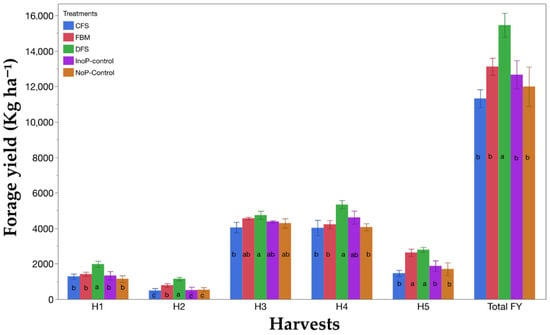
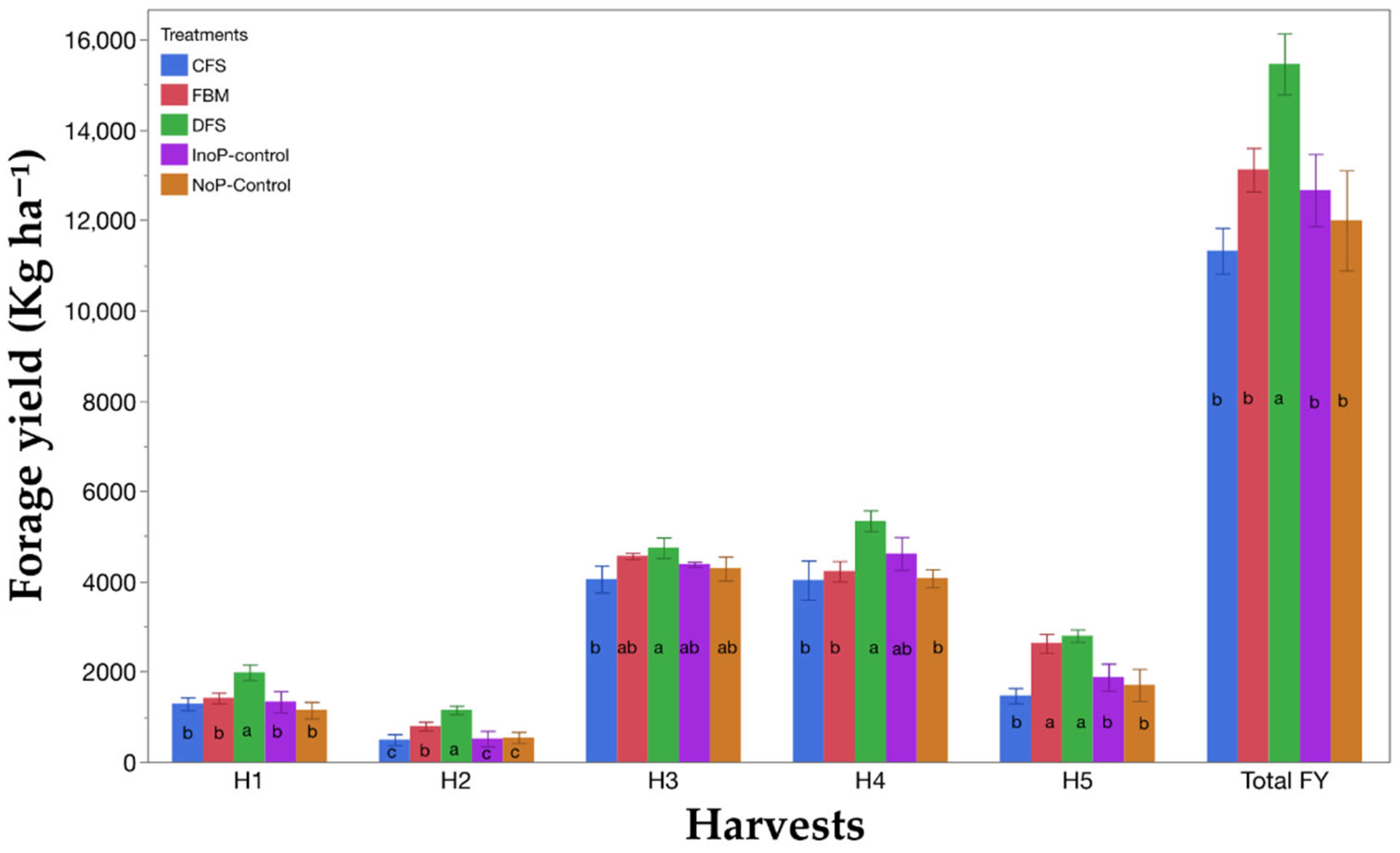
Across all harvests, highest and significant (p < 0.05) alfalfa FY was recorded with the DFS treatments. Furthermore, in H1, H2, H5, and for the total growing period of alfalfa, the DFS treatment exhibited an FY significantly higher than the InoP-control. The InoP and NoP controls showed non-significant differences in FY across all harvests and over the total experimental period. However, CFS treatment was non-significant across all the alfalfa harvest with NoP-control. The FY evaluated in H3 and H4 represented 70% of the total FY (Figure 1).
Figure 1.
Alfalfa forage yield across five harvests (H1 = Harvest 1; H2 = Harvest 2; H3 = Harvest 3; H4 = Harvest 4; H5 = Harvest 5; and total FY) under different phosphorus treatments: composted fish sludge (CFS), fish bone meal (FBM), dried fish sludge (DFS), inorganic-P control (InoP), and NoP control (no phosphorus applied). Different letters within each harvest indicate significant differences among treatments (p < 0.05).
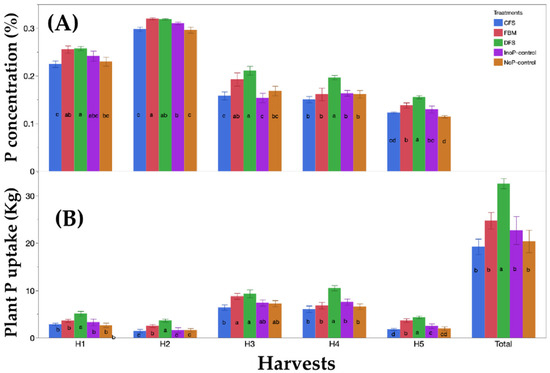
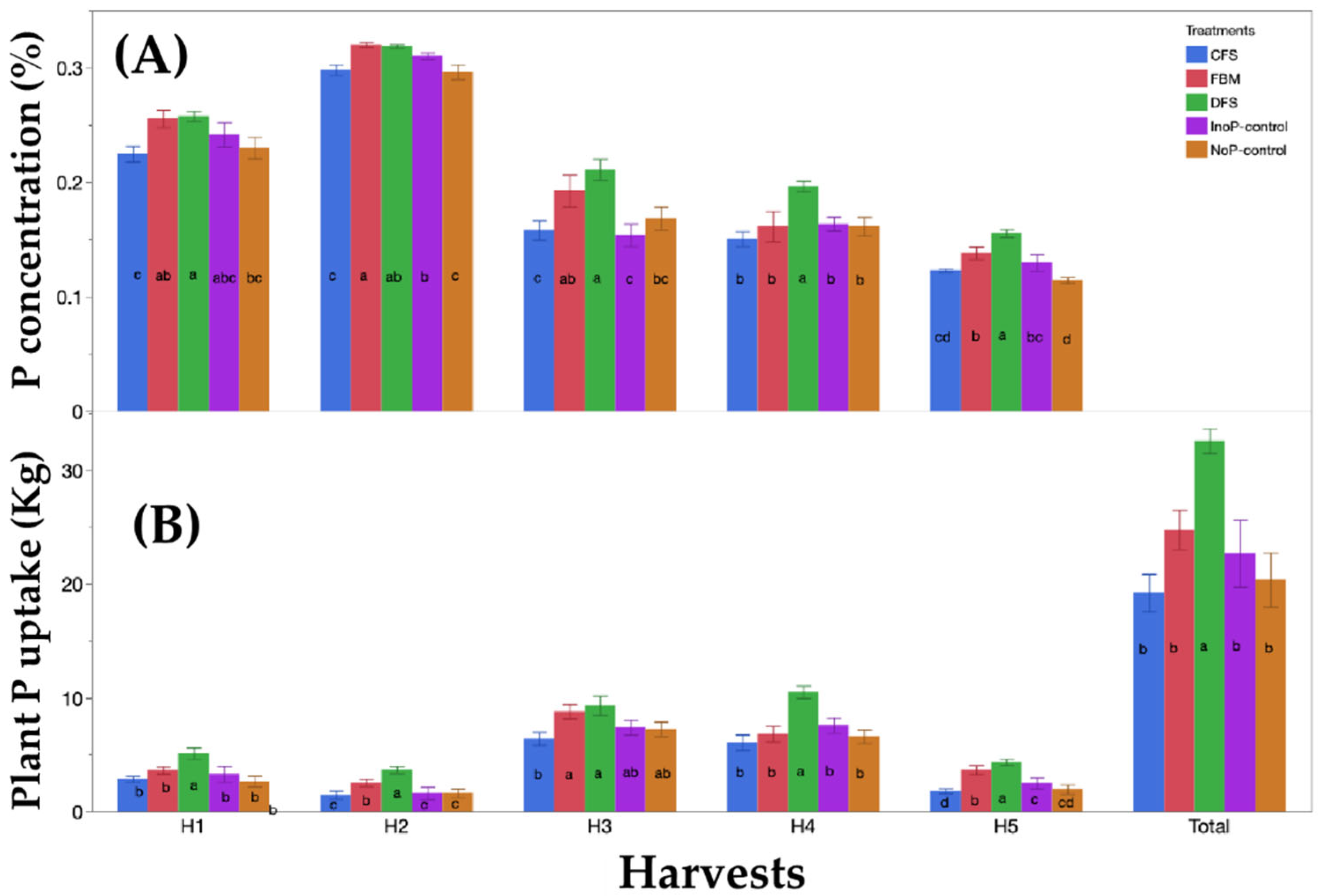
The P concentration varied across the experimental period from 0.13 (H5) to 0.31 (H2). The treatments DFS and FBM showed higher values of P concentration across all the harvests. On the other hand, the treatments CFS and NoP-control exhibited the lower values of P concentration (Figure 2A). The total P uptake by alfalfa in the cumulative experimental period ranged from 19.2 (CFS) to 32.5 (DFS) kg ha−1. The lowest P uptake was observed in H2 and H5 across all growing seasons (Figure 2B).
Figure 2.
Phosphorus concentration (A) and phosphorus uptake (B) by alfalfa across five harvests (H1 = Harvest 1; H2 = Harvest 2; H3 = Harvest 3; H4 = Harvest 4; H5 = Harvest 5) and total period under different phosphorus treatments: composted fish sludge (CFS), fish bone meal (FBM), dried fish sludge (DFS), inorganic-P control (InoP), and NoP control (no phosphorus applied). Different letters indicate significant differences among treatments (p < 0.05, LSD test).
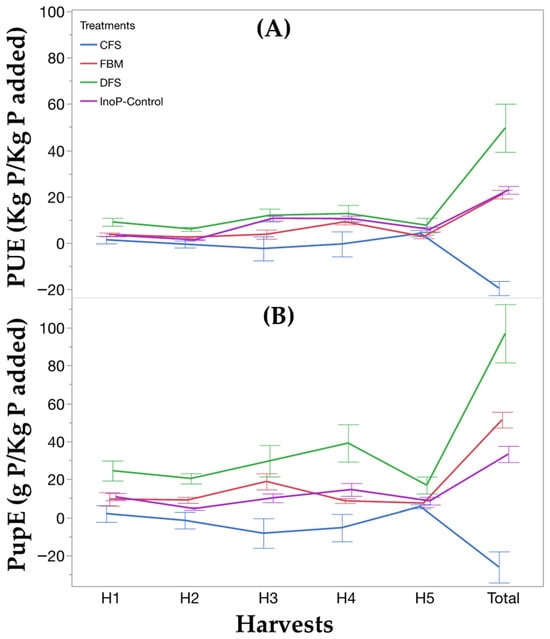
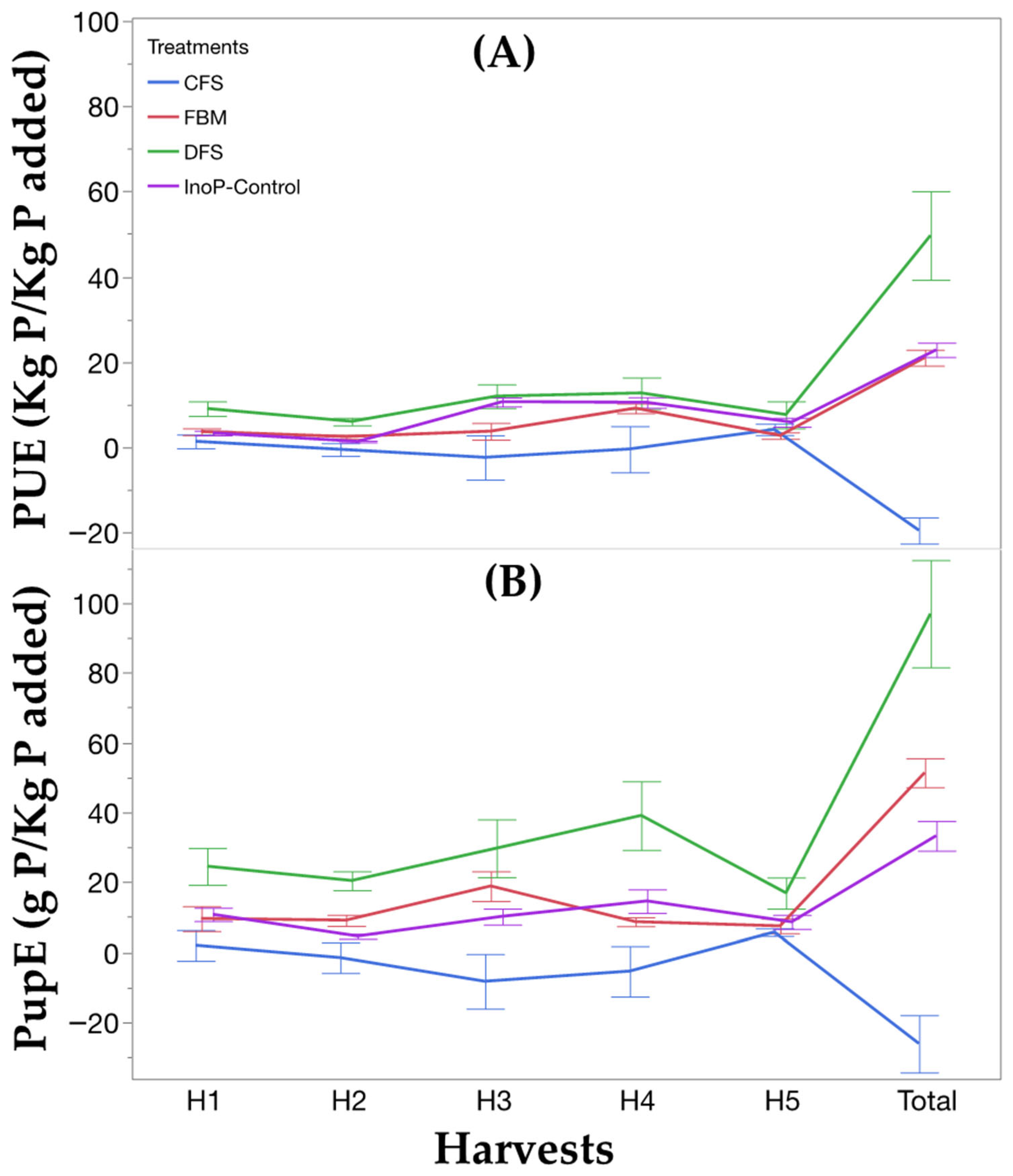
PUE varied across harvests, with H1 and H2 showing lower values compared to H3 and H4 across all P treatments. PUE was almost identical (18.5%) between FBM and the InoP-control across the alfalfa growth period (2023–2024). The DFS treatment achieved the highest PUE value across all the harvests. The treatment CFS showed the lowest PUE value in each alfalfa harvest, as well as in the total experimental period. The CFS treatment exhibited negative values of PUE because its FY was lower than the NoP-control, except in H5. The FBM treatment showed the same pattern of PUE across harvests to the InoP-Control (Figure 3A).
Figure 3.
Phosphorus use efficiency (PUE; A) and phosphorus uptake efficiency (PupE; B) of alfalfa across five harvests (H1 = Harvest 1; H2 = Harvest 2; H3 = Harvest 3; H4 = Harvest 4; H5 = Harvest 5) and the total experimental period under different phosphorus treatments: composted fish sludge (CFS), fish bone meal (FBM), dried fish sludge (DFS), and inorganic-P control (InoP). Error bars indicate the standard error of the means.
The mean PupE ranged from 8.5 g kg−1 in H2 to 14.2 g kg−1 in H4 across the five alfalfa harvests. The mean total PupE over the experimental period was 38.8 g kg−1. The treatment DFS showed the maximum values of PupE in each harvest as well as in the total or cumulative harvests. Similarly to the PUE, the treatment CFS exhibited the lowest values of PupE including negative values in H2, H3, and H4 (Figure 3B).
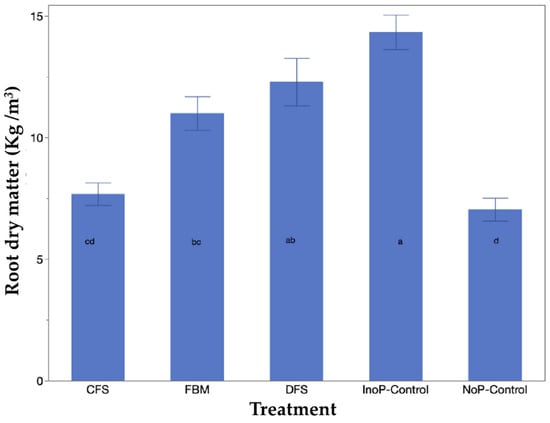
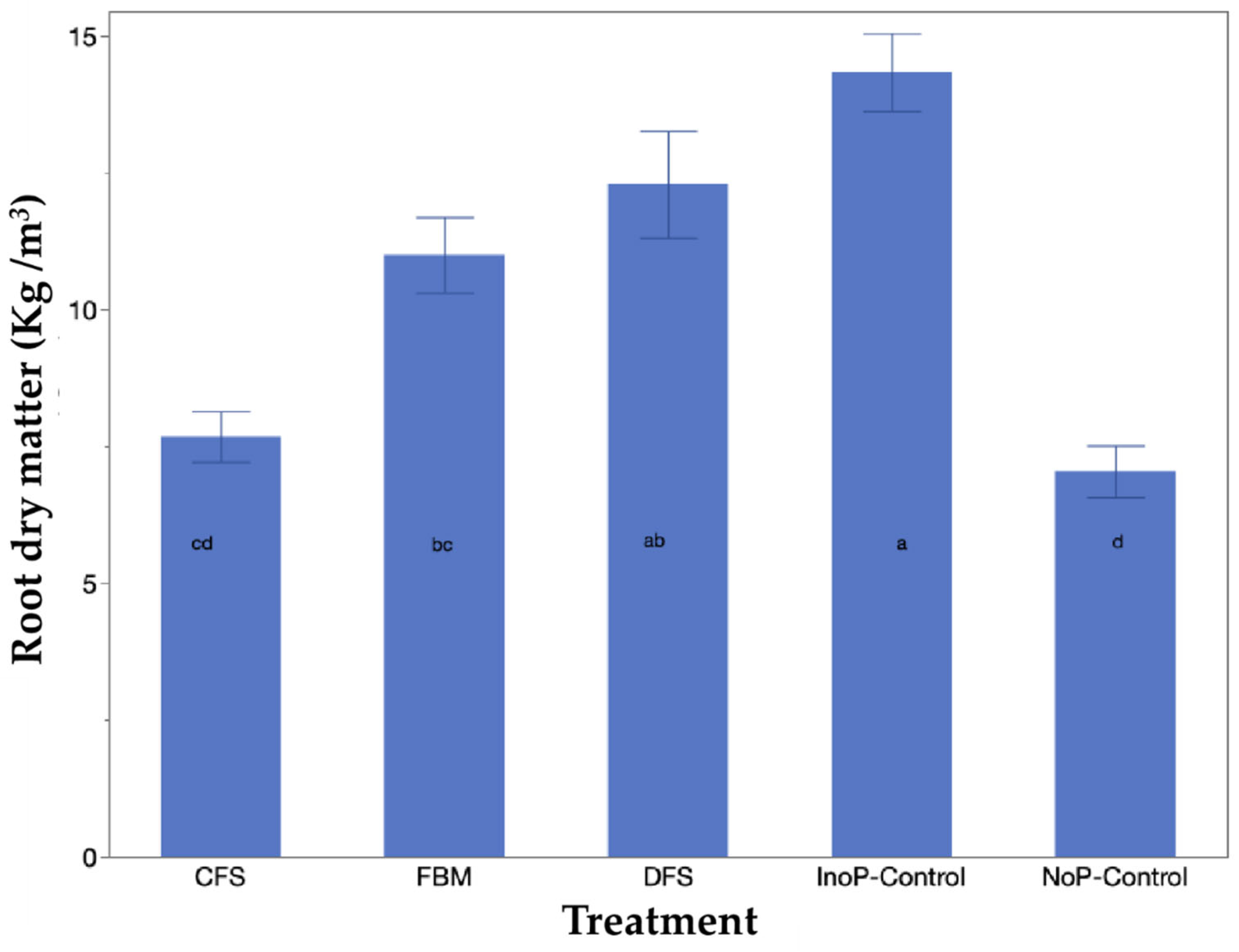
Root dry matter production (RootDM) evaluated at H4 showed significant differences among BBFs (p < 0.05, Figure 4). The RootDM of the InoP-control was twice as high that of the NoP-control. The DFS treatment achieved the same RootDM than the InoP-control. On the other hand, the CFS treatment showed the same RootDM as the NoP-control. RootDM ranged from 7.0 (NoP-control) to 15.2 (InoP-control) kg/m3 of soil (Figure 4).
Figure 4.
Root dry matter accumulation evaluated in the strata 0–30 cm at fourth harvest (H4, summer, 25-January-2024). Different phosphorus treatments include composted fish sludge (CFS), fish bone meal (FBM), dried fish sludge (DFS), inorganic-P control (InoP-Control), and no phosphorus applied (NoP-control). Different letters (a, b, c, d) indicate significant differences among treatments (p < 0.05, LSD test). Error bars indicate the standard error of the mean.
3.2. Spectral Canopy and Photosynthetic Traits
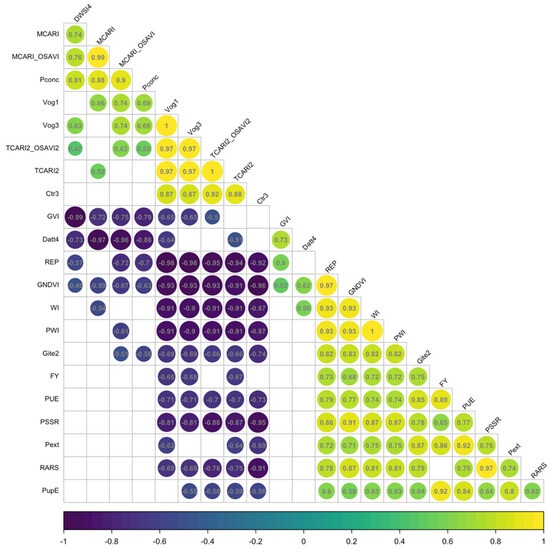
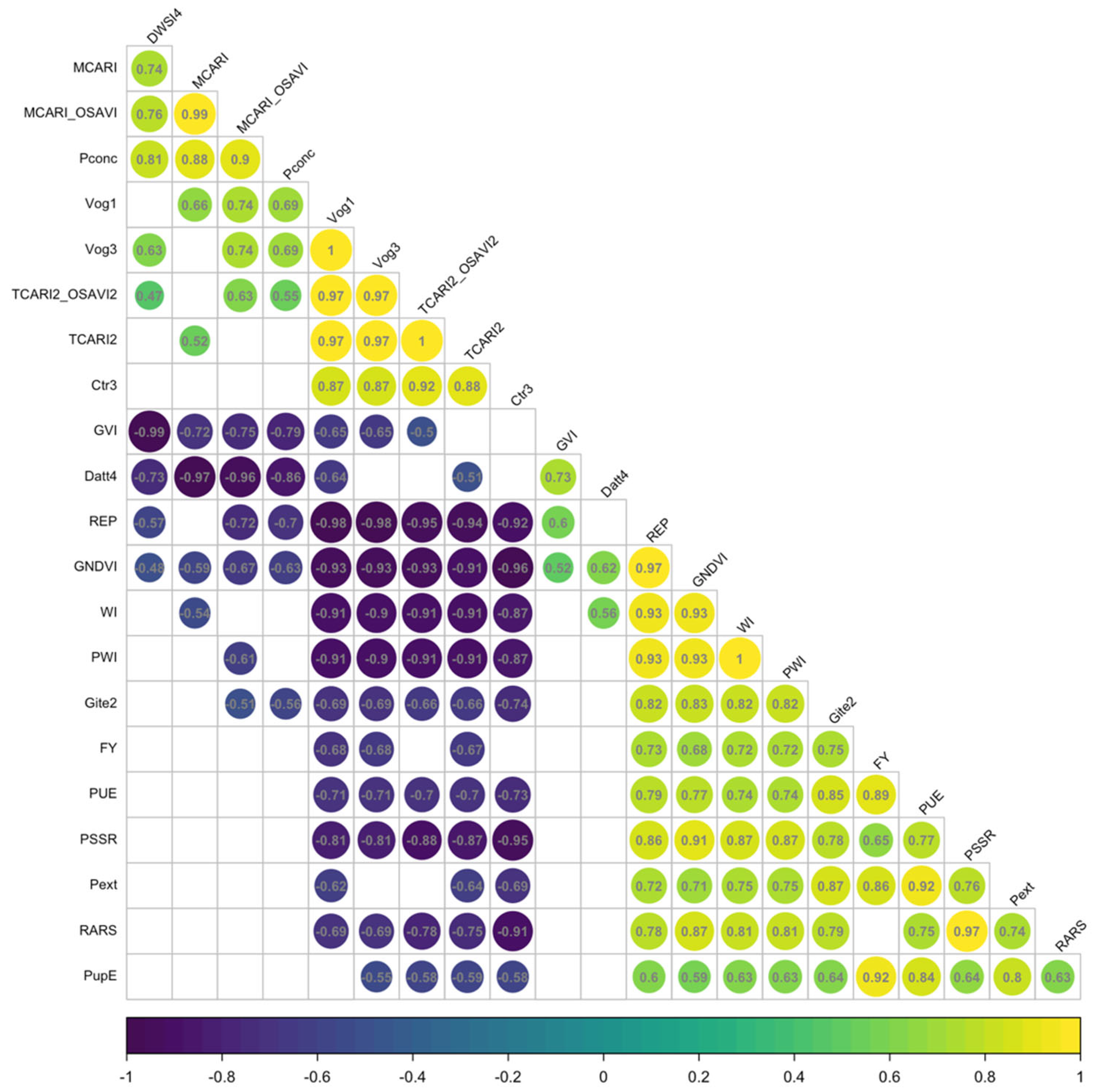
More than 100 spectral indices were calculated (Supplementary Table S1). Their relationships with FY, PUE, and PupE were evaluated through Pearson correlation. Nineteen indices showed significant correlation with the targeted traits (FY, PUE, and PupE). FY was significantly associated with nine spectral indices (vog1, vog3, TCARI/OSAVI, REP, RE_LE, WI, PWI, Gite2, and greenNDVI), with r-values ranging from −0.65 (TCARI/OSAVI) to 0.75 (Gite2). The PUE was significantly associated with 13 spectral indices (vog1, vog3, TCARI/OSAVI, TCARI2, Ctr3, REP, RE_LE, WI, PWI, Gite2, greenNDVI, PSSR, RARS), with r-values ranging from −0.70 (TCARI2) to 0.85 (Gite2). PupE was associated with the same spectral indices as PUE, but the correlation coefficients (r-values) were not much stronger, ranging from r = −0.55 (Vog1) to r = 0.64 (Gitel2). Additionally, P concentration was highly associated with MCARI/OSAVI (r = 0.90), Datt4 (r = −0.86), and DWSI4 (r = 0.81) (Figure 5).
Figure 5.
Pearson correlation between spectral canopy indices and photosynthetic traits with alfalfa forage yield (FY), phosphorus use efficiency (PUE), and phosphorus uptake efficiency (PupE).
Alfalfa gas-exchanges were significantly affected by BBF treatments (p < 0.05). Leaf photosynthesis (A) ranged from 9.01 µmol m−2 s−1 in the CFS treatment to 16.7 µmol m−2 s−1 in the InoP control. No significant difference in A was observed between the DFS treatment and the InoP control. Transpiration rate (T) did not show significant difference among BBF treatments (p > 0.05) and achieved a mean value of 3.2 µmol m−2 s−1. Water use efficiency (WUE = A/T) exhibited significant difference among BBF treatments (p < 0.05). The CFS treatment showed lower WUE of alfalfa. The CFS treatment showed a WUE of 47% and 29% lower than the InoP-control and NoP-control, respectively. On the other hand, the treatments DFS and FBM exhibited a WUE statistically similar to the InoP-control (Table 4).
Table 4.
Leaf photosynthesis (A), transpiration rate (Tr), and water use efficiency (WUE) with corresponding statistical values under different phosphorus treatments: composted fish sludge (CFS), fish bone meal (FBM), dried fish sludge (DFS), inorganic-P control (InoP), and NoP control (no phosphorus applied).
4. Discussion
Alfalfa FY was measured across five harvests. The first two harvests (autumn and winter) corresponded to the crop establishment year. The remaining three harvests (H3, H4, and H5) were conducted during the second growing season, which started in spring after a three-month winter dormancy period. The alfalfa FY observed throughout the year (five harvests), as well as the accumulated total FY, was consistent with findings from previous studies conducted under Chilean Mediterranean environmental conditions [43,44,45,46]. Despite the low level of soil P content (7 mg kg−1 at 0–20 cm; Table 1), the treatment NoP-control achieved the same FY than the InoP-Control (Figure 1). This could be due to the architecture of alfalfa root system. It is broadly known that alfalfa has a deep root system that enable it to explore more soil for water and nutrients uptake [47]. For instance, in a mesocosm experiment, it was observed that alfalfa concentrates around the 50% of the root biomass at the strata 0–30 cm and almost the 25% at the strata 30–60 cm. This suggests that the soil chemical characterization conducted at 0–20 cm was not fully representative of the deeper soil layers explored by the alfalfa root system. On the other hand, the P adsorption reactions of Andisols severely limits the soil P availability. In Andisols, a large proportion of the P applied to the soil is not absorbed by plants but instead accumulates as residual P, which remains only sparingly available for plant uptake [48]. However, it has been demonstrated that alfalfa can access to this residual P through their root exudates [49].
4.1. Bio-Based Fertilizers Efficiency in Supporting Alfalfa Growth
The soluble nature of residual P is often interpreted as an indication that it is recalcitrant and has limited availability to plants and soil microorganisms [50]. However, there is some evidence that the residual P pool can be accessed by plants and or their associated microflora. For example, significant long-term depletion of soil residual P was observed in response to plant uptake and removal in arable cropping and managed forest systems in the absence of P fertilizer inputs [51], while short-term depletion of residual P has also been observed in some rhizosphere soils [52]. It was shown that drop in available P could be possible in the root-surrounding soil. Considering this scenario, our study demonstrates higher alfalfa FY with DFS among other treatments under all the harvests and supported our hypothesis that BBFs can function as an alternative P source to conventional inorganic fertilizers by achieving comparable crop yields and P uptake. Higher alfalfa FY with DFS could be because DFS produces a large amount of residual P in soil [53]. The amount of residual soil P varies across locations and soil types. For instance, in a two-year experiment on cereal crops in Norway, residual P ranged between 65 and 197 kg P ha−1 at Øsaker and between 41 and 178 kg P ha−1 at Rakkestad, respectively, with DFS treatment. At both sites, initial soil P levels differed, and after two seasons, DFS increased soil P at Øsaker as compared to other fertilizers [54]. Our results were consistent with the expected differences in P availability among the various P sources. In addition to P, DFS contains organic N. Experiments have shown that this organic N mineralizes rapidly, which makes it quickly available for plant uptake [55,56]. This could be another reason for increased alfalfa FY with DFS treatment as compared to other P treatments in our study. Moreover, DFS contains higher organic matter (58% by weight) and trace elements such as micronutrients like Zn and Fe, among others, which enhance soil microbial activity and root exudation, thereby improving P solubilization via acid phosphatases [57]. This stimulates beneficial rhizosphere microbes, increasing plant root biomass and nutrient uptake efficiency effects that are less pronounced with inorganic P sources, which can disrupt soil biology [58]. Alfalfa root dry matter accumulation in the 0–20 cm soil strata was recorded higher in the DFS and inorganic P as compared to other treatments. These findings are consistent with results reported by [59,60] in pot experiments. They found that alfalfa root dry matter increased from suboptimal to 20 mg kg−1 of P available in the substrate. In this work, the soil P-level was 7 mg kg−1 (suboptimal condition) and all BBF treatments, except CFS, exhibited a root dry matter higher than the NoP-control. Treatments that achieved higher root dry matter also had higher FY; this could be explained by the fact that legume species such as alfalfa release root exudates, particularly flavonoids and organic acids, which attract and regulate beneficial soil microbes. These microbial communities enhance nutrient cycling, support BNF, and stimulate processes that solubilize P, thereby increasing its availability to the plant [61].
Along with other BBFs, FBM also plays a significant role in enhancing the concentration of nutrients such as Ca, P, Se, Mn, N, omega-3 fatty acids, and bioactive substances to the soil [62]. Moreover, FBM’s physical and sustainable properties allow its use in agriculture. It supports environmental protection. Its unique physical characteristics also enable applications that enhance water-retention capacity and overall stability in soil. FBM is widely used in organic farming and continues to serve as a substitute for modern farming inputs. Organic growers regard FBM fertilizer as a sustainable source for replenishing declining soil trace elements [63]. Compared with newer ammonium phosphate fertilizers, FBM provides a broader range and larger quantity of essential nutrients required for plant growth. A study on FBM showed that organic fertilizers formulated with FBM improved the performance of cabbage and green bean crops. FBM increased soil pH, Ca, and P. However, K levels were lower due to the low K content of FBM [64]. In our study, favorable outcomes were observed with FBM application in alfalfa, as FY, plant P concentration, P uptake, P-uptake efficiency, and root dry matter all increased. It is interesting to note that conventional P fertilizers often lack micronutrients that cause gradual soil depletion and eventual yield declines—a problem that may go unnoticed for years. As a result, many commercial fertilizers are now criticized for being unsustainable, whereas FBM-based organic fertilizers are viewed as a more sustainable alternative. The reason is that FBM also contains significant amounts of Ca (15%), Mg (0.2%), and trace elements such as Fe (50 mg), Mn (>35 mg), and Zn (>140 mg) [65] (Table 2).
Moreover, although CFS moderately enhanced alfalfa FY, it was associated with lower PUE relative to the other P sources. These counterintuitive results are primarily driven by a dilution effect and better nutrient synchrony. The reason is that most P in CFS exists in organic and Ca-bound forms. Compost is widely recognized for stimulating soil microbial growth and metabolic activity, leading to the slow and sustained release of nutrients in the soil [66]. Therefore, only 20 to 40% becomes plant-available in the first year, delivering a steady, moderate P supply that nearly matches alfalfa demand throughout multiple growth cycles [67,68]. In contrast to CFS, soluble P fertilizers generate a large early-season pulse of available P, which triggers luxury consumption and P concentrations often well above the critical level required for maximum growth [69]. Additionally, the absence of an initial P deficiency signal early in the season reduces allocation to root growth, resulting in slightly lower root dry matter [70,71]. It is noted that low concentrations of certain heavy metals may be beneficial to plant growth, whereas elevated levels generally exert detrimental effects on plant performance [72]. CFS used in our study contained relatively high concentrations of Fe (~6977 mg kg−1), Al (~4068 mg kg−1), and Mn (~249 mg kg−1), as also reported by Martín et al. (2025) [25], compared with other BBFs. It is well documented that elevated concentrations of Fe, Al, Mn, and other heavy metals in soil can strongly influence PUE. These elements tend to bind with P, which decreases its mobility and plant availability. As a result, a larger proportion of P contained in CFS becomes fixed in the soil and unavailable for uptake, which ultimately reduces PUE (30–50% lower than that under inorganic P fertilization) in alfalfa. This limitation in P availability is widely recognized as an important constraint on crop productivity globally [25,73]. To gain a better understanding of the mechanisms underlying the low PUE observed in alfalfa grown with CFS, measurements of available P levels in the soils applied with different fertilizers would be necessary. The absence of these measurements represents a limitation of the present study.
4.2. Preference of Bio-Based Fertilizers over Inorganic Fertilizers in Alfalfa
In Andisols, inorganic P fertilization primarily increases labile soil P and modifies organic matter dynamics by enhancing inorganic P pools and polysaccharide-derived compounds associated with P stabilization. Therefore, recalcitrant P and soil organic matter remain largely unaffected. Under these conditions, alfalfa mainly utilizes the readily available fertilized P, whereas the substantial and stable residual P pool characteristic of Andisols remains largely unaltered [28], which may explain why the FY response to inorganic P treatment was non-significant as compared to other BBFs, except DFS, in the current study. This statement is also confirmed by Frick et al. (2025), who stated that BBFs were able to substitute mineral fertilizers at rates ranging from 43% to 125%, on average [67]. In addition, Andisols has extremely high P-fixing capacity due to abundant amorphous Al/Fe oxides and allophane. BBFs, particularly CFS or DFS, FBM, and digested aquaculture by-products consistently outperform conventional soluble inorganic sources when growing alfalfa. Unlike soluble inorganic P, which is rapidly adsorbed and rendered largely unavailable within weeks, BBFs release P gradually through microbial mineralization [74] that allow 60 to 80% of the applied P to escape immediate fixation and remain plant available over multiples extended growing years. This slow-release pattern perfectly synchronizes with continuous demand of alfalfa across multiple cuts per season. This also helps to avoid the early-season luxury uptake and late-season deficiency typical of inorganic fertilizers. Consequently, alfalfa fertilized with BBFs, particularly DFS, achieves 5 to 15% higher cumulative FY, maintains more stable tissue P concentrations, and exhibits nearly 40% greater P uptake compared to inorganic treatments in our study. It also develops stronger root biomass and sustains effective symbiotic N2 fixation, as the accompanying organic N does not inhibit nodulation [54]. Field trials on Chilean Andisols [75] and European high-fixing soils [53] confirm that a single application of 40–60 kg P ha−1 as fish sludge-based fertilizer at establishment or after the second production year often eliminates the need for additional P inputs for the multiyear alfalfa stand. However, this approach substantially reduces total P loading to the environment while delivering greater economic returns compared with annual applications of inorganic fertilizers.
4.3. Effect of Bio-Based Fertilizers on Physiology of Alfalfa
BBFs used in this study released P at different rates, depending on their formulation [76].Treatments with slow P release, such as CFS, likely resulted in lower leaf P concentration, which directly limit ATP production and reduce stomatal conductance (gs) to conserve energy [77], resulting in decreased internal CO2 concentration and reduced RuBP regeneration key processes required for efficient photosynthesis [77,78]. Consequently, photosynthetic rates declined under CFS. In contrast, DFS appeared to supply sufficient plant-available P just like InoP control that enabled a maximum photosynthetic rate of 16.7 µmol m−2 s−1, which is considered typical for well-fertilized alfalfa under non-stressed conditions. The absence of significant differences between InoP and DFS indicates that DFS released P rapidly enough during harvests H3 and H4 to match inorganic fertilization. Adequate P supports enhanced electron transport, higher Rubisco activity, optimal mesophyll conductance, and improved gs [79], which explained the similar photosynthetic performance between DFS and InoP. Specific BBFs such as DFS may also promote microbial activity, improve root development, enhance nutrient uptake and water status, and stabilize gas-exchange processes [55]. For example, a study on Medicago truncatula demonstrates that it has a narrow optimal P range, with an optimum at 12 μM P, close to its toxicity threshold [80]. A tissue P concentration of 2.7 mg g−1 dry matter, which is considered normal for many crops, inhibited growth in alfalfa. Under P deficiency, M. truncatula showed higher symbiotic efficiency with Sinorhizobium meliloti due to greater electron allocation to N over H+. P deprivation markedly altered phloem amino acid composition, driven by a sharp increase in asparagine, which suggests its role as a shoot-derived signal that downregulates nitrogenase activity. Overall, N2 fixation in M. truncatula is regulated by feedback mechanisms tightly linked to nodule carbon metabolism under P stress [80]. Wang et al. (2024) explained that P fertilizer improved crown and taproot diameter of alfalfa, resulting in a stronger root system, better winter survival, and higher FY [8]. Therefore, DFS usually contains higher water-soluble P compared to CFS, which is easily mineralizable. This is why, DFS performed like inorganic P, while CFS did not.
Alfalfa transpiration rate (T) showed no significant differences among all BBF treatments and controls (p > 0.05) because stomatal aperture in alfalfa is primarily controlled by vapor pressure deficit (VPD), soil moisture [81], and hydraulic signals [82] rather than by moderate variation in P nutrition once P stress is not severe. Even the CFS treatment, despite inducing P limitation, did not reduce soil water availability or trigger strong abscisic acid (ABA)-mediated stomatal closure at the moment of measurement. Intrinsic WUE was nevertheless significantly affected (p < 0.05) and followed the exact same ranking as photosynthesis. CFS exhibited the lowest WUE (47% lower than inorganic P and 29% lower than the NoP control). This is because its low A (~9 µmol m−2 s−1) was not accompanied by a proportional drop in T. Stomata remained relatively open, while CO2 fixation was biochemically restricted by P deficiency, a classic symptom of non-stomatal limitation [82]. Thus, the gas-exchange data perfectly reflect the speed of P release. Only fertilizers that delivered readily available P (InoP, DFS, and FBM) supported maximal A and WUE. Whereas very slow P mineralization from CFS caused a strong biochemical limitation of CO2 assimilation without closing stomata, resulting in dramatically reduced WUE despite unchanged T.
4.4. Relationship Among Spectral Reflectance Indices, FY, and P-Efficiency
Several studies have explored the use of remote sensing to estimate alfalfa FY. For example, Biswas et al. (2021) found strong relationships (r = 0.72 to 0.83) between FY and various vegetation indices, including NDVI, NDRE, GNDVI, and GRVI, based on evaluations of 145 alfalfa breeding populations grown under field conditions [83]. These r-values were higher than those observed in our study. It could be because their data were acquired using UAV-based platforms, which provide higher spatial resolution and more precise canopy measurements. Noland et al. (2022), informed r-values from 0.56 to 0.92 [84]. They also observed a substantial improvement in FY prediction when combining VIS and NIR spectral information. Consistent with our findings, they reported no significant relationship between FY and NDVI
To our knowledge, no previous studies have examined the relationship between canopy reflectance and PUE in alfalfa. In the present study, we identified strong associations between P-related traits and several canopy reflectance indices (Figure 5). In particular, the indices RARS, Gite2, and PSSR showed the strongest correlations with P-efficiency traits (PUE and PupE). This is consistent with previous findings indicating that chlorophyll content is a reliable indicator of plant P status [85]. All aforementioned indices are strong predictors of plant chlorophyl content [86]. For this reason, these are strongly related to P-efficiency traits and even P concentration (MCARI-OSAVI index, Figure 5).
5. Conclusions
Bio-based fertilizers (BBFs) derived from aquaculture residues exhibited great agronomic value and P-efficiency in an alfalfa stand cultivated in an Andisol under a Mediterranean climate. Dried fish sludge (DFS) consistently improved forage yield, phosphorus uptake, phosphorus concentration in plant, overall phosphorus use efficiency, and plant physiological performance, matching or exceeding that of inorganic fertilizer. Fish bone meal (FBM) also showed positive effects, whereas composted fish sludge (CFS) performed poorly across most traits. Overall, aquaculture-derived fertilizers, especially DFS, represent a sustainable alternative for enhancing alfalfa productivity and phosphorus efficiency. The canopy reflectance indices RARS, Gite2, and PSSR proved to be strong predictors of both P concentration and P-efficiency traits, highlighting their potential for developing new decision support tools for phosphorus fertilization management in alfalfa.
Supplementary Materials
The following supporting information can be downloaded at: https://www.mdpi.com/article/10.3390/agronomy16030348/s1, Table S1: List of vegetation indices used in this study.
Author Contributions
L.I.: data curation, data analysis, original draft writing, investigation, formal analysis, and supervision. J.H.: original draft writing and investigation. F.S.: original draft writing and investigation. H.A.N.: formal analysis, original draft writing, revision, and editing. G.M.: data curation and data analysis. All authors have read and agreed to the published version of the manuscript.
Funding
This work was supported by the following grants: SEA2LAND (https://sea2landproject.eu, accessed on 1 December 2025) and INIA-500302-70.
Data Availability Statement
The original contributions presented in this study are included in the article/Supplementary Material. Further inquiries can be directed to the corresponding author.
Conflicts of Interest
The authors declare that they have no known competing financial interests or personal relationships that could have appeared to influence the work reported in this paper.
References
- Asghar, W.; Akça, M.O.; Akça, H.; Tarf, O.J.; Kataoka, R.; Turgay, O.C. Alternative Strategies to Synthetic Chemical Fertilizers: Revitalization of Soil Quality for Sustainable Agriculture Using Organic-Based Approaches. In New and Future Developments in Microbial Biotechnology and Bioengineering; Elsevier: Amsterdam, The Netherlands, 2022; pp. 1–30. [Google Scholar]
- Robinson, G.M. Global Sustainable Agriculture and Land Management Systems. Geogr. Sustain. 2024, 5, 637–646. [Google Scholar] [CrossRef] [Scilit]
- ODEPA Oficina de Estudios y Políticas Agrarias, Ministerio de Agricultura, Gobierno de Chile. Available online: https://www.odepa.gob.cl (accessed on 1 December 2025).
- Tripathi, S.; Srivastava, P.; Devi, R.S.; Bhadouria, R. Influence of Synthetic Fertilizers and Pesticides on Soil Health and Soil Microbiology. In Agrochemicals Detection, Treatment and Remediation; Elsevier: Amsterdam, The Netherlands, 2020; pp. 25–54. [Google Scholar]
- Liu, L.; Zheng, X.; Wei, X.; Kai, Z.; Xu, Y. Excessive Application of Chemical Fertilizer and Organophosphorus Pesticides Induced Total Phosphorus Loss from Planting Causing Surface Water Eutrophication. Sci. Rep. 2021, 11, 23015. [Google Scholar] [CrossRef] [Scilit] [PubMed]
- Menegat, S.; Ledo, A.; Tirado, R. Greenhouse Gas Emissions from Global Production and Use of Nitrogen Synthetic Fertilisers in Agriculture. Sci. Rep. 2022, 12, 14490. [Google Scholar] [CrossRef] [Scilit] [PubMed]
- Zhang, T.; Wan, W.; Sun, Z.; Li, H. Phosphorus Uptake and Rhizosphere Properties of Alfalfa in Response to Phosphorus Fertilizer Types in Sandy Soil and Saline-Alkali Soil. Front. Plant Sci. 2024, 15, 1377626. [Google Scholar] [CrossRef] [Scilit] [PubMed]
- Wang, Y.; Xie, J.; Fan, F.; Sun, Z.; Yuan, F.; Wang, Q.; Yu, L.; Liu, Y.; Li, J.; Cui, L. Phosphorus Fertilization Enhanced Overwintering, Root System and Forage Yield of Late-Seeded Alfalfa in Sodic Soils. Sci. Rep. 2024, 14, 18090. [Google Scholar] [CrossRef] [Scilit]
- Berg, W.K.; Cunningham, S.M.; Brouder, S.M.; Joern, B.C.; Johnson, K.D.; Santini, J.; Volenec, J.J. Influence of Phosphorus and Potassium on Alfalfa Yield and Yield Components. Crop Sci. 2005, 45, cropsci2005.0297. [Google Scholar] [CrossRef] [Scilit]
- Sulieman, S.; Mühling, K.H. Utilization of Soil Organic Phosphorus as a Strategic Approach for Sustainable Agriculture. J. Plant Nutr. Soil Sci. 2021, 184, 311–319. [Google Scholar] [CrossRef] [Scilit]
- Zhu, Y.; Xing, Y.; Li, Y.; Jia, J.; Ying, Y.; Shi, W. The Role of Phosphate-Solubilizing Microbial Interactions in Phosphorus Activation and Utilization in Plant–Soil Systems: A Review. Plants 2024, 13, 2686. [Google Scholar] [CrossRef] [Scilit]
- Zhang, J.; Edesi, L.; Talve, T.; Akyol, Ç.; Koll, B.; Roman, I.; Toom, M.; Aranguren, M.; Virgel Mentxaka, S.; Kuu, A.; et al. Recycling Fishery Waste into Biobased Fertilizers: Agronomic Performance and Soil Health Impacts. Soil Tillage Res. 2025, 253, 106686. [Google Scholar] [CrossRef] [Scilit]
- Radziemska, M.; Vaverková, M.D.; Adamcová, D.; Brtnický, M.; Mazur, Z. Valorization of Fish Waste Compost as a Fertilizer for Agricultural Use. Waste Biomass Valorization 2019, 10, 2537–2545. [Google Scholar] [CrossRef] [Scilit]
- Ahuja, I.; Dauksas, E.; Remme, J.F.; Richardsen, R.; Løes, A.-K. Fish and Fish Waste-Based Fertilizers in Organic Farming—With Status in Norway: A Review. Waste Manag. 2020, 115, 95–112. [Google Scholar] [CrossRef] [Scilit]
- Cordell, D.; Drangert, J.-O.; White, S. The Story of Phosphorus: Global Food Security and Food for Thought. Glob. Environ. Change 2009, 19, 292–305. [Google Scholar] [CrossRef] [Scilit]
- Hirzel, J.; Inostroza, L. Nitrogen and Phosphorus Availability from a Salmon Hydrolyzed Fertilizer: A Study in Controlled Conditions. Chil. J. Agric. Res. 2025, 85, 135–146. [Google Scholar] [CrossRef] [Scilit]
- Rustad, T.; Storrø, I.; Slizyte, R. Possibilities for the Utilisation of Marine By-products. Int. J. Food Sci. Technol. 2011, 46, 2001–2014. [Google Scholar] [CrossRef] [Scilit]
- Dauda, A.B.; Ajadi, A.; Tola-Fabunmi, A.S.; Akinwole, A.O. Waste Production in Aquaculture: Sources, Components and Managements in Different Culture Systems. Aquac. Fish. 2019, 4, 81–88. [Google Scholar] [CrossRef] [Scilit]
- Zhang, J.; Akyol, Ç.; Meers, E. Nutrient Recovery and Recycling from Fishery Waste and By-Products. J. Environ. Manag. 2023, 348, 119266. [Google Scholar] [CrossRef] [Scilit]
- Olsen, L.; Hernández, K.; Van Ardelan, M.; Iriarte, J.; Sánchez, N.; González, H.; Tokle, N.; Olsen, Y. Responses in the Microbial Food Web to Increased Rates of Nutrient Supply in a Southern Chilean Fjord: Possible Implications of Cage Aquaculture. Aquac. Environ. Interact. 2014, 6, 11–27. [Google Scholar] [CrossRef] [Scilit]
- Ghaly, A.E.; Ramakrishnan, V.V.; Brooks, M.S.; Budge, S.M.; Dave, D. Fish Processing Wastes as a Potential Source of Proteins, Amino Acids and Oils: A Critical Review. J. Microb. Biochem. Technol. 2013, 5, 107–129. [Google Scholar] [CrossRef]
- Arvanitoyannis, I.S.; Kassaveti, A. Fish Industry Waste: Treatments, Environmental Impacts, Current and Potential Uses. Int. J. Food Sci. Technol. 2008, 43, 726–745. [Google Scholar] [CrossRef] [Scilit]
- Goddek, S.; Joyce, A.; Kotzen, B.; Burnell, G.M. (Eds.) Aquaponics Food Production Systems; Springer International Publishing: Cham, Switzerland, 2019. [Google Scholar]
- Jayathilakan, K.; Sultana, K.; Radhakrishna, K.; Bawa, A.S. Utilization of Byproducts and Waste Materials from Meat, Poultry and Fish Processing Industries: A Review. J. Food Sci. Technol. 2012, 49, 278–293. [Google Scholar] [CrossRef] [Scilit]
- Pérez-San Martín, A.; Tortosa, G.; Bustamante, M.Á.; González, A.; Curaqueo, G. Composting Salmon Farming Sludge: A Potential Soil Amendment with a Focus on the Circular Economy Approach. J. Soil Sci. Plant Nutr. 2025, 25, 5313–5322. [Google Scholar] [CrossRef] [Scilit]
- Takahashi, T.; Dahlgren, R.A. Nature, Properties and Function of Aluminum–Humus Complexes in Volcanic Soils. Geoderma 2016, 263, 110–121. [Google Scholar] [CrossRef] [Scilit]
- Borie, F.; Rubio, R. Total and Organic Phosphorus in Chilean Volcanic Soils. Gayana Botánica 2003, 60, 69–78. [Google Scholar] [CrossRef] [Scilit]
- Velásquez, G.; Calabi-Floody, M.; Poblete-Grant, P.; Rumpel, C.; Demanet, R.; Condron, L.; Mora, M. Fertilizer Effects on Phosphorus Fractions and Organic Matter in Andisols. J. Soil Sci. Plant Nutr. 2016, 16, 294–304. [Google Scholar] [CrossRef] [Scilit]
- Ibrahim, M.; Iqbal, M.; Tang, Y.-T.; Khan, S.; Guan, D.-X.; Li, G. Phosphorus Mobilization in Plant–Soil Environments and Inspired Strategies for Managing Phosphorus: A Review. Agronomy 2022, 12, 2539. [Google Scholar] [CrossRef] [Scilit]
- Turrion, M.-B.; Lafuente, F.; Aroca, M.-J.; López, O.; Mulas, R.; Ruipérez, C. Characterization of Soil Phosphorus in a Fire-Affected Forest Cambisol by Chemical Extractions and 31P-NMR Spectroscopy Analysis. Sci. Total Environ. 2010, 408, 3342–3348. [Google Scholar] [CrossRef] [Scilit]
- Gámez, A.L.; Vatter, T.; Santesteban, L.G.; Araus, J.L.; Aranjuelo, I. Onfield Estimation of Quality Parameters in Alfalfa through Hyperspectral Spectrometer Data. Comput. Electron. Agric. 2024, 216, 108463. [Google Scholar] [CrossRef] [Scilit]
- Ali, A.M.; Salem, H.M. Bijay-Singh Site-Specific Nitrogen Fertilizer Management Using Canopy Reflectance Sensors, Chlorophyll Meters and Leaf Color Charts: A Review. Nitrogen 2024, 5, 828–856. [Google Scholar] [CrossRef] [Scilit]
- Araus, J.L.; Kefauver, S.C.; Vergara-Díaz, O.; Gracia-Romero, A.; Rezzouk, F.Z.; Segarra, J.; Buchaillot, M.L.; Chang-Espino, M.; Vatter, T.; Sanchez-Bragado, R.; et al. Crop Phenotyping in a Context of Global Change: What to Measure and How to Do It. J. Integr. Plant Biol. 2022, 64, 592–618. [Google Scholar] [CrossRef] [Scilit]
- Özyiğit, Y.; Bilgen, M. Estimation of Nitrogen Levels By Remote Sensing Method in Alfalfa (Medicago sativa L.). Kahramanmaraş Sütçü İmam Üniversitesi Tarım ve Doğa Derg. 2018, 21, 902–907. [Google Scholar] [CrossRef] [Scilit]
- Albayrak, S. Use of Reflectance Measurements for the Detection of N, P, K, ADF and NDF Contents in Sainfoin Pasture. Sensors 2008, 8, 7275–7286. [Google Scholar] [CrossRef] [Scilit] [PubMed]
- Moran, M.S.; Pinter, P.J.; Clothier, B.E.; Allen, S.G. Effect of Water Stress on the Canopy Architecture and Spectral Indices of Irrigated Alfalfa. Remote Sens. Environ. 1989, 29, 251–261. [Google Scholar] [CrossRef] [Scilit]
- Stolpe, N. Descripciones de Los Principales Suelos de La VIII Región de Chile; Universidad de Concepción: Concepción, Chile, 2006; p. 84. [Google Scholar]
- Sadzawka, A.; Carrasco, M.A.; Grez, R.; de la Luz Mora, M. Para Los Suelos Chilenos. 2004. Available online: https://bibliotecadigital.uchile.cl/discovery/fulldisplay/alma991004011009703936/56UDC_INST:56UDC_INST (accessed on 4 January 2026).
- Sadras, V.; Calderini, D. Crop Physiology; Applications for Genetic Improvement and Agronomy; Elsevier: Amsterdam, The Netherlands, 2009. [Google Scholar]
- Main, R.; Cho, M.A.; Mathieu, R.; O’Kennedy, M.M.; Ramoelo, A.; Koch, S. An Investigation into Robust Spectral Indices for Leaf Chlorophyll Estimation. ISPRS J. Photogramm. Remote Sens. 2011, 66, 751–761. [Google Scholar] [CrossRef] [Scilit]
- Agapiou, A.; Hadjimitsis, D.; Alexakis, D. Evaluation of Broadband and Narrowband Vegetation Indices for the Identification of Archaeological Crop Marks. Remote Sens. 2012, 4, 3892–3919. [Google Scholar] [CrossRef] [Scilit]
- Lehnert, L.W.; Meyer, H.; Bendix, J. hsdar: Manage, Analyse and Simulate Hyperspectral Data in R, R Package Version 0.5.1. Available online: https://rdrr.io/cran/hsdar/ (accessed on 13 January 2020).
- Inostroza, L.; Espinoza, S.; Barahona, V.; Gerding, M.; Humphries, A.; del Pozo, A.; Ovalle, C. Phenotypic Diversity and Productivity of Medicago Sativa Subspecies from Drought-Prone Environments in Mediterranean Type Climates. Plants 2021, 10, 862. [Google Scholar] [CrossRef] [Scilit]
- del Pozo, A.; Espinoza, S.; Barahona, V.; Inostroza, L.; Gerding, M.; Humphries, A.; Lobos, G.; Cares, J.; Ovalle, C. Aerial and Ground-Based Phenotyping of an Alfalfa Diversity Panel to Assess Adaptation to a Prolonged Drought Period in a Mediterranean Environment of Central Chile. Eur. J. Agron. 2023, 144, 126751. [Google Scholar] [CrossRef] [Scilit]
- Noushahi, H.A.; Inostroza, L.; Barahona, V.; Espinoza, S.; Ovalle, C.; Quitral, K.; Lobos, G.A.; Guerra, F.P.; Kefauver, S.C.; del Pozo, A. Selecting High Forage-Yielding Alfalfa Populations in a Mediterranean Drought-Prone Environment Using High-Throughput Phenotyping. Remote Sens. 2025, 17, 1517. [Google Scholar] [CrossRef] [Scilit]
- Noushahi, H.A.; Inostroza, L.; Guerra, F.; Ali, M.; Nazzicari, N.; del Pozo, A. Genome-Wide Association Studies (GWAS) Identified Novel QTLs for Forage Yield, Stem-Leaf and Canopy Traits of 250 Half-Sib Alfalfa Populations Grown under Mediterranean Conditions. Ind. Crops Prod. 2025, 237, 122183. [Google Scholar] [CrossRef] [Scilit]
- Ali, G.; Wang, Z.; Li, X.; Jin, N.; Chu, H.; Jing, L. Deep Soil Water Deficit and Recovery in Alfalfa Fields of the Loess Plateau of China. Field Crops Res. 2021, 260, 107990. [Google Scholar] [CrossRef] [Scilit]
- Velásquez, G.; Ngo, P.-T.; Rumpel, C.; Calabi-Floody, M.; Redel, Y.; Turner, B.L.; Condron, L.M.; de La Luz Mora, M. Chemical Nature of Residual Phosphorus in Andisols. Geoderma 2016, 271, 27–31. [Google Scholar] [CrossRef] [Scilit]
- Du, T.; Zhao, S.; Zheng, X.; Ding, X.; He, H.; Xie, G.; Zhu, J.; Kou, Y.; Shen, W. External Phosphorus Enhances the Efficient Acquisition of Phosphorus by Alfalfa (Medicago sativa L.) through Its Interaction with Root Morphological Traits and Rhizosphere Carboxylates. Rhizosphere 2024, 29, 100861. [Google Scholar] [CrossRef] [Scilit]
- Condron, L.M.; Newman, S. Revisiting the Fundamentals of Phosphorus Fractionation of Sediments and Soils. J. Soils Sediments 2011, 11, 830–840. [Google Scholar] [CrossRef] [Scilit]
- Pierzynski, G.M.; Gehl, K.A. Plant Nutrient Issues for Sustainable Land Application. J. Environ. Qual. 2005, 34, 18–28. [Google Scholar] [CrossRef] [Scilit] [PubMed]
- George, T.; Gregory, P.; Wood, M.; Read, D.; Buresh, R. Phosphatase Activity and Organic Acids in the Rhizosphere of Potential Agroforestry Species and Maize. Soil Biol. Biochem. 2002, 34, 1487–1494. [Google Scholar] [CrossRef] [Scilit]
- Brod, E.; Øgaard, A.F. Closing Global P Cycles: The Effect of Dewatered Fish Sludge and Manure Solids as P Fertiliser. Waste Manag. 2021, 135, 190–198. [Google Scholar] [CrossRef] [Scilit]
- Brod, E.; Henriksen, T.M.; Ørnsrud, R.; Eggen, T. Quality of Fish Sludge as Fertiliser to Spring Cereals: Nitrogen Effects and Environmental Pollutants. Sci. Total Environ. 2023, 875, 162541. [Google Scholar] [CrossRef] [Scilit]
- Brod, E.; Oppen, J.; Kristoffersen, A.Ø.; Haraldsen, T.K.; Krogstad, T. Drying or Anaerobic Digestion of Fish Sludge: Nitrogen Fertilisation Effects and Logistics. Ambio 2017, 46, 852–864. [Google Scholar] [CrossRef] [Scilit]
- Brod, E.; Haraldsen, T.K.; Krogstad, T. Combined Waste Resources as Compound Fertiliser to Spring Cereals. Acta Agric. Scand. Sect. B—Soil Plant Sci. 2014, 64, 329–340. [Google Scholar] [CrossRef] [Scilit]
- Mustapha, A.; Bakali, M. El Phosphorus Waste Production in Fish Farming a Potential for Reuse in Integrated Aquaculture Agriculture. Int. J. Environ. Agric. Res. 2021, 7, 5–13. [Google Scholar]
- Wankhade, A.; Wilkinson, E.; Britt, D.W.; Kaundal, A. A Review of Plant–Microbe Interactions in the Rhizosphere and the Role of Root Exudates in Microbiome Engineering. Appl. Sci. 2025, 15, 7127. [Google Scholar] [CrossRef] [Scilit]
- He, H.; Peng, Q.; Wang, X.; Fan, C.; Pang, J.; Lambers, H.; Zhang, X. Growth, Morphological and Physiological Responses of Alfalfa (Medicago sativa) to Phosphorus Supply in Two Alkaline Soils. Plant Soil 2017, 416, 565–584. [Google Scholar] [CrossRef] [Scilit]
- Hao, Y.; Wang, X.; He, J.; Dhanuskodi, R.; Chen, Y.; Li, Z.; Zhao, X.; Chen, J.; Gu, X.; Chen, C.; et al. Unveiling the Impact of Phosphorus Availability on Growth, Root Morphological and Physiological Traits of Different Phosphorus-Tolerant Alfalfa (Medicago sativa L.) in Acidic Soils in the Karst Region of Southwest China. Environ. Exp. Bot. 2025, 240, 106271. [Google Scholar] [CrossRef] [Scilit]
- Hassan, S.; Mathesius, U. The Role of Flavonoids in Root-Rhizosphere Signalling: Opportunities and Challenges for Improving Plant-Microbe Interactions. J. Exp. Bot. 2012, 63, 3429–3444. [Google Scholar] [CrossRef] [Scilit] [PubMed]
- Abdel-Moemin, A.R. Healthy Cookies from Cooked Fish Bones. Food Biosci. 2015, 12, 114–121. [Google Scholar] [CrossRef] [Scilit]
- Abdel-Moemin, A.R.; Abdel-Rahman, M.K. Environmental Protection with Sustainable Products from Fish Bone Waste. Environ. Qual. Manag. 2022, 32, 425–440. [Google Scholar] [CrossRef] [Scilit]
- Blatt, C.R.; McRae, K.B. Comparison of Four Organic Amendments with a Chemical Fertilizer Applied to Three Vegetables in Rotation. Can. J. Plant Sci. 1998, 78, 641–646. [Google Scholar] [CrossRef] [Scilit]
- Bechtel, P.J. Advances in Seafood Byproducts: 2002 Conference Proceedings; Alaska Sea Grant; University of Alaska Fairbanks: Fairbanks, AK, USA, 2003; ISBN 9781566120821. [Google Scholar]
- Aguilar-Paredes, A.; Valdés, G.; Araneda, N.; Valdebenito, E.; Hansen, F.; Nuti, M. Microbial Community in the Composting Process and Its Positive Impact on the Soil Biota in Sustainable Agriculture. Agronomy 2023, 13, 542. [Google Scholar] [CrossRef] [Scilit]
- Frick, H.; Bünemann, E.K.; Hernandez-Mora, A.; Eigner, H.; Geyer, S.; Duboc, O.; Santner, J.; Recena, R.; Delgado, A.; D’Oria, A.; et al. Bio-Based Fertilisers Can Replace Conventional Inorganic P Fertilisers under European Pedoclimatic Conditions. Field Crops Res. 2025, 325, 109803. [Google Scholar] [CrossRef] [Scilit]
- Brod, E.; Øgaard, A.F.; Müller-Stöver, D.S.; Rubæk, G.H. Considering Inorganic P Binding in Bio-Based Products Improves Prediction of Their P Fertiliser Value. Sci. Total Environ. 2022, 836, 155590. [Google Scholar] [CrossRef] [Scilit]
- Görlach, B.M.; Henningsen, J.N.; Mackens, J.T.; Mühling, K.H. Evaluation of Maize Growth Following Early Season Foliar P Supply of Various Fertilizer Formulations and in Relation to Nutritional Status. Agronomy 2021, 11, 727. [Google Scholar] [CrossRef] [Scilit]
- Choi, I.; Cho, H.; Brandizzi, F.; Rouached, H. Phosphorus Deficiency and Root Growth: The Role of TOR Signaling in Adaptive Responses. J. Exp. Bot. 2025, eraf204. [Google Scholar] [CrossRef] [Scilit] [PubMed]
- Paz-Ares, J.; Puga, M.I.; Rojas-Triana, M.; Martinez-Hevia, I.; Diaz, S.; Poza-Carrión, C.; Miñambres, M.; Leyva, A. Plant Adaptation to Low Phosphorus Availability: Core Signaling, Crosstalks, and Applied Implications. Mol. Plant 2022, 15, 104–124. [Google Scholar] [CrossRef] [Scilit] [PubMed]
- Arif, N.; Yadav, V.; Singh, S.; Singh, S.; Ahmad, P.; Mishra, R.K.; Sharma, S.; Tripathi, D.K.; Dubey, N.K.; Chauhan, D.K. Influence of High and Low Levels of Plant-Beneficial Heavy Metal Ions on Plant Growth and Development. Front. Environ. Sci. 2016, 4, 69. [Google Scholar] [CrossRef] [Scilit]
- Gypser, S.; Schütze, E.; Freese, D. Single and Binary Fe- and Al-Hydroxides Affect Potential Phosphorus Mobilization and Transfer from Pools of Different Availability. Soil Syst. 2021, 5, 33. [Google Scholar] [CrossRef] [Scilit]
- Silva, L.I.d.; Pereira, M.C.; de Carvalho, A.M.X.; Buttrós, V.H.; Pasqual, M.; Dória, J. Phosphorus-Solubilizing Microorganisms: A Key to Sustainable Agriculture. Agriculture 2023, 13, 462. [Google Scholar] [CrossRef] [Scilit]
- Mazzarino, M.J.; Laos, F.; Satti, P.; Moyano, S. Agronomic and Environmental Aspects of Utilization of Organic Residues in Soils of the Andean-Patagonian Region. Soil Sci. Plant Nutr. 1998, 44, 105–113. [Google Scholar] [CrossRef] [Scilit]
- Anglade, I.; Kristensen, B.S.B.; Dahl, T.H.; Hagemann, A.; Malzahn, A.M.; Reitan, K.I. Upcycling of Carbon, Nitrogen, and Phosphorus from Aquaculture Sludge Using the Polychaete Hediste Diversicolor (OF Müller, 1776) (Annelida: Nereididae). Front. Sustain. Food Syst. 2023, 7, 1278586. [Google Scholar] [CrossRef] [Scilit]
- Bechtaoui, N.; Rabiu, M.K.; Raklami, A.; Oufdou, K.; Hafidi, M.; Jemo, M. Phosphate-Dependent Regulation of Growth and Stresses Management in Plants. Front. Plant Sci. 2021, 12, 679916. [Google Scholar] [CrossRef] [Scilit]
- Noushahi, H.A.; del Pozo, A. Traits Underpinning Productivity and Persistence of Alfalfa in Rainfed Mediterranean Environments. Eur. J. Agron. 2026, 174, 127964. [Google Scholar] [CrossRef] [Scilit]
- Xia, D.; An, X.; López, I.F.; Ma, C.; Zhang, Q. Enhancing Alfalfa Photosynthetic Performance through Arbuscular Mycorrhizal Fungi Inoculation across Varied Phosphorus Application Levels. Front. Plant Sci. 2023, 14, 1256084. [Google Scholar] [CrossRef] [Scilit]
- Sulieman, S.; Ha, C.V.; Schulze, J.; Tran, L.-S.P. Growth and Nodulation of Symbiotic Medicago Truncatula at Different Levels of Phosphorus Availability. J. Exp. Bot. 2013, 64, 2701–2712. [Google Scholar] [CrossRef] [Scilit]
- Yang, J.; Li, C.; Kong, D.; Guo, F.; Wei, H. Light-Mediated Signaling and Metabolic Changes Coordinate Stomatal Opening and Closure. Front. Plant Sci. 2020, 11, 601478. [Google Scholar] [CrossRef] [Scilit]
- Burgess, A.J.; Ugalde, J.M. SOS: Speed of Stomata Opening and Closing Is Influenced by Vapor Pressure Deficit. Plant Physiol. 2024, 195, 251–253. [Google Scholar] [CrossRef] [Scilit]
- Biswas, A.; Andrade, M.H.M.L.; Acharya, J.P.; de Souza, C.L.; Lopez, Y.; de Assis, G.; Shirbhate, S.; Singh, A.; Munoz, P.; Rios, E.F. Phenomics-Assisted Selection for Herbage Accumulation in Alfalfa (Medicago sativa L.). Front. Plant Sci. 2021, 12, 756768. [Google Scholar] [CrossRef] [Scilit]
- Noland, R.L.; Wells, M.S.; Coulter, J.A.; Tiede, T.; Baker, J.M.; Martinson, K.L.; Sheaffer, C.C. Estimating Alfalfa Yield and Nutritive Value Using Remote Sensing and Air Temperature. Field Crops Res. 2018, 222, 189–196. [Google Scholar] [CrossRef] [Scilit]
- Lopez-Cantarero, I.; Lorente, F.A.; Romero, L. Are Chlorophylls Good Indicators of Nitrogen and Phosphorus Levels? J. Plant Nutr. 1994, 17, 979–990. [Google Scholar] [CrossRef] [Scilit]
- Blackburn, G.A. Spectral Indices for Estimating Photosynthetic Pigment Concentrations: A Test Using Senescent Tree Leaves. Int. J. Remote Sens. 1998, 19, 657–675. [Google Scholar] [CrossRef] [Scilit]

Disclaimer/Publisher’s Note: The statements, opinions and data contained in all publications are solely those of the individual author(s) and contributor(s) and not of MDPI and/or the editor(s). MDPI and/or the editor(s) disclaim responsibility for any injury to people or property resulting from any ideas, methods, instructions or products referred to in the content. |
© 2026 by the authors. Licensee MDPI, Basel, Switzerland. This article is an open access article distributed under the terms and conditions of the Creative Commons Attribution (CC BY) license.