Article

Improvement of Resistance to Rice Blast and Bacterial Blight by CRISPR/Cas9-Mediated Mutagenesis of OsERF922 and Xa41 in Rice

1
Agricultural Technology Extension Service Station of Motuo County, Nyingchi 860700, China
2
National Engineering Research Center for Plant Space Breeding, South China Agricultural University, Guangzhou 510642, China
3
Agricultural and Animal Husbandry Comprehensive Service Center of Motuo Town, Motuo County, Nyingchi 860700, China
*
Authors to whom correspondence should be addressed.
Agronomy 2026, 16(3), 349; https://doi.org/10.3390/agronomy16030349
Submission received: 23 December 2025 / Revised: 22 January 2026 / Accepted: 27 January 2026 / Published: 30 January 2026
(This article belongs to the Section Agricultural Biosystem and Biological Engineering)

Abstract

Rice blast and bacterial blight are two major diseases that seriously threaten rice production. Developing rice germplasm with enhanced resistance to multiple diseases while maintaining favorable agronomic traits is essential for sustainable breeding. In this study, two rice landraces from Motuo County, Xizang Autonomous Region, China, Benglinba and Gare, were used to simultaneously edit OsERF922 and Xa41 using a structurally optimized dual-target CRISPR/Cas9 vector, pRGEB32-2T. A total of 32 and 28 T0 transgenic plants were generated in the Benglinba and Gare backgrounds, respectively. Targeted mutagenesis generated eight homozygous oserf922 mutants and three homozygous xa41 mutants in Benglinba, and four and five homozygous mutants in Gare. Twelve double homozygous mutant lines (nine Benglinba and three Gare) were selected for further analysis. Disease resistance assays showed that these double mutants exhibited significantly enhanced resistance to the rice blast fungus strain GDYJ7 and the bacterial blight pathogen strain GDXO-1, with markedly reduced lesion size or lesion length compared with wild-type plants (p < 0.001, Student’s t-test). Importantly, three independent T-DNA-free double mutant lines from each genetic background displayed no significant differences from their corresponding wild types in major agronomic traits, including plant height, effective panicle number, panicle length, seed-setting rate, or thousand-grain weight (p > 0.05). Grain quality parameters, such as brown rice rate, milled rice rate, amylose content, and gel consistency, were also unaffected. Overall, this study generated rice materials with enhanced resistance to rice blast and bacterial blight while maintaining elite agronomic and quality traits, providing valuable germplasm resources and a feasible strategy for the precise improvement of disease resistance in rice landraces from Xizang Autonomous Region.

1. Introduction

Rice (Oryza sativa L.) is one of the most important staple crops worldwide, serving as the primary food source for more than half of the global population. However, rice production is severely constrained by various diseases each year. Among them, rice blast caused by the fungal pathogen Magnaporthe oryzae and bacterial blight caused by Xanthomonas oryzae pv. oryzae (Xoo) are the two most widespread and destructive diseases. In China, rice blast is a significant plant disease and can occur throughout the entire growth period, resulting in yield losses of 10–30%, and up to 50% or even total crop failure under severe conditions [1]. Bacterial blight generally leads to yield reductions of 8–32%, with losses reaching 50–70% in heavily infected fields [2,3]. Therefore, breeding rice varieties with stable and durable resistance is a key strategy for ensuring food security and promoting green and sustainable rice production.
The traditional local rice landraces Benglinba and Gare, distributed in Motuo County of Xizang Autonomous Region, China, represent valuable germplasm resources adapted to high-altitude environments and possess important agricultural and cultural value. However, these landraces are generally highly susceptible to rice blast and bacterial blight, which severely limit their yield stability and large-scale utilization. Improving disease resistance in Motuo rice varieties is thus essential not only for enhancing their production performance but also for supporting the conservation and utilization of plateau-specific rice germplasm.
Over the past two decades, substantial progress has been made in the identification, cloning, and functional characterization of rice blast resistance genes. To date, more than 100 rice blast resistance genes have been identified [4]. Correspondingly, over 24 Avr genes have been reported in M. oryzae, of which 12 have been cloned [4]. In addition to classical R genes, a range of disease resistance regulators, including both positive regulators and susceptibility factors, play critical roles in immune signaling and metabolic pathways. For example, the plant architecture gene IPA1 can be phosphorylated upon rice blast infection, enhancing its interaction with the positive immune regulator WRKY45 and thereby promoting WRKY45 expression and broad-spectrum blast resistance [5]. In contrast, the AP2/ERF transcription factor OsERF922 is strongly induced by both virulent and avirulent M. oryzae strains; it binds specifically to GCC-box elements and functions as a transcriptional activator, ultimately conferring susceptibility to rice blast [6].
Significant advances have also been achieved in the study of bacterial blight resistance. To date, at least 46 genes conferring dominant or recessive resistance to Xoo have been identified and registered worldwide [7], of which 16 genes or alleles have been cloned. These include receptor-like kinase genes (e.g., Xa4, Xa21, Xa3/Xa26) [8,9,10], immune receptor genes (e.g., Xa1, Xa2) [11,12], sugar transporter genes (e.g., xa13, xa25, xa41(t)) [13,14,15], and executor genes activated by pathogen effectors (e.g., Xa7, Xa10, Xa23, Xa27) [16,17,18,19]. Among them, the recessive gene xa41(t) encodes a sucrose transporter and is considered a susceptibility gene for bacterial blight [15]. The Xoo effector AvrXa7 can bind to the promoter of xa41(t) and drive its high-level expression, increasing apoplastic sugar availability and thereby facilitating bacterial growth and disease development [20].
With the rapid development of genome-editing technologies, the CRISPR/Cas9 system has become one of the most powerful tools for crop improvement and has shown great potential in breeding for disease resistance. In rice, CRISPR/Cas9-mediated editing of susceptibility or negative regulatory genes has been successfully applied to enhance resistance to rice blast. For instance, targeted mutagenesis of the AP2/ERF transcription factor gene OsERF922 significantly improved blast resistance without obvious penalties on agronomic performance, while genome editing of the susceptibility gene Pi21 conferred durable and broad-spectrum resistance to M. oryzae [21]. Despite its considerable potential, the application of CRISPR/Cas9 technology in crop improvement still faces several limitations and challenges. A major issue lies in the regulatory uncertainty associated with genome-edited crops, which differs markedly among countries and regions and may influence both the pace and feasibility of their commercial adoption. Moreover, although CRISPR/Cas9 is widely regarded as a highly precise genome-editing tool, the occurrence of unintended mutations or unforeseen pleiotropic effects cannot be entirely ruled out, highlighting the need for rigorous molecular characterization and phenotypic assessment. Therefore, thorough off-target analyses, multi-environment field evaluations, and strict adherence to relevant biosafety and regulatory frameworks are indispensable to ensure the safe and reliable application of CRISPR/Cas9-mediated breeding strategies in rice.
In this study, the Motuo landraces “Benglinba” and “Gare” were used as experimental materials, and CRISPR/Cas9 was employed to precisely knock out the rice blast susceptibility gene OsERF922 and the bacterial blight susceptibility gene Xa41(t). Multiple homozygous, transgene-free edited lines were obtained. By systematically evaluating disease resistance, agronomic traits, and grain quality characteristics, this study aimed to develop Motuo rice materials with combined resistance to rice blast and bacterial blight, thereby providing both theoretical support and valuable germplasm resources for the disease-resistant improvement of plateau-specific rice varieties.

2. Materials and Methods

2.1. Plant Materials

The main locally cultivated rice landraces Benglinba and Gare from Motuo County, Xizang Autonomous Region, China, were used as experimental materials in this study. Transgenic plants were grown in the greenhouse at 32 °C for 14 h (light) and 28 °C for 10 h (dark).

2.2. Design of Knockout Targets and Vector Construction

The gene sequences of OsERF922 (LOC_Os01g54890) and Xa41 (LOC_Os11g31190) were retrieved from the RiceData database (https://www.ricedata.cn/gene/, accessed on 18 October 2024). CRISPR/Cas9 target sites were designed within the first exon of OsERF922 and Xa41 using the CRISPR-GE online tool (http://skl.scau.edu.cn/targetdesign/, accessed on 18 October 2024). Gene editing was performed using the modified CRISPR/Cas9 expression vector pRGEB32-2T derived from pRGEB32 [22]. Target fragments were amplified from the pGTR vector using the primers Cas9-OsERF922-F and Cas9-Xa41-R (Table 1), while the pRGEB32-2T vector was digested with KpnI and BamHI. The amplified fragments were subsequently cloned into the linearized CRISPR/Cas9 vector via homologous recombination. Recombinant plasmids were transformed into Escherichia coli DH5α competent cells, and positive clones were selected, cultured, and extracted for plasmid DNA. Correct constructs were confirmed by Sanger sequencing and stored for subsequent genetic transformation.

2.3. Detection of T0 Positive Plants

The CRISPR/Cas9 expression vector was introduced into embryogenic calli of Benglinba and Gare via Agrobacterium tumefaciens-mediated transformation. Hygromycin-resistant calli were selected and regenerated into T0 plants. Genomic DNA was extracted from T0 leaf tissues using the CTAB method, and PCR amplification with hygromycin-specific primers (Hyg-F/R) was performed to identify positive transgenic plants (Table 1). Target regions and flanking sequences of OsERF922 and Xa41 were amplified using the primers OsERF922-seq-F/R and Xa41-seq-F/R (Table 1), respectively. PCR products were sequenced by Ruibo Biotechnology Co., Ltd. (Guangzhou, China), and mutation types were analyzed using the DSDecode tool (http://skl.scau.edu.cn/dsdecode/, accessed on 28 December 2024).

2.4. Screening of Transgene-Free T1 Plants

At the tillering stage of T1 plants, genomic DNA was extracted from leaves and PCR sequencing was performed using OsERF922-seq-F/R and Xa41-seq-F/R to identify homozygous mutant plants. Hygromycin-specific primers (Hyg-F/R) and Cas9-specific primers (Cas9-F/R) were then used to screen for homozygous mutants lacking T-DNA insertion (Table 1). Potential off-target sites were predicted using the CRISPR-GE database, and Sanger sequencing was performed on the T-DNA-free plants to examine these sites. Plants with no detectable off-target mutations were further propagated to the T2 generation.

2.5. Evaluation of Resistance to Rice Blast and Bacterial Blight

Twenty to forty seeds were soaked, germinated, and sown. At the three-leaf–one-heart stage, a conidial suspension of the rice blast isolate GDYJ7 (1 × 10⁵ spores mL−1) was prepared, and detached-leaf assays were conducted following the method described by Zhao et al. [23]. For each material, three leaves were inoculated, with three lesions per leaf. Seven days after inoculation, photographs were taken, and lesion lengths were measured to assess disease severity compared with the wild-type controls.
For bacterial blight assays, Xoo isolates were cultured on NA medium at 28 °C for 2 d, diluted with PBS to OD600 = 1, and supplemented with 0.5% Tween-20. Rice plants were inoculated 45 d after transplanting using the leaf-clipping method. Four to five fully expanded upper leaves per plant were clipped by scissors dipped in the bacterial suspension, removing 1–2 cm from the leaf tip. Infection was assessed 5 d after inoculation. Twenty-one days after inoculation, disease development was observed. For each material, three leaves showing stable and consistent symptoms were selected, photographed, and lesion lengths were measured to assess disease severity compared with the wild-type controls.

2.6. Measurement of Major Agronomic Traits

Benglinba, Gare, and T2 homozygous transgene-free mutant lines were grown in the Qilinbei experimental field of South China Agricultural University (Guangzhou, China, 23.16° N, 113.36° E) at a planting density of 20 cm × 20 cm under standard field management. Single-plant transplanting was employed, with each material planted in one plot. Each plot consisted of six rows, with six plants per row. After maturation, major agronomic traits, including grain length, grain width, thousand-grain weight, seed-setting rate, and grain number per panicle, were recorded.

2.7. Rice Grain Quality Analysis

After maturation, seeds from each plot were harvested together, naturally air-dried in a glass greenhouse, and stored for 3 months before measuring rice quality traits. Rice quality traits, including brown rice rate (BRR), milled rice rate (MRR), head rice rate (HRR), amylose content (AC), gel consistency (GC), and alkali spreading value (ASV), were determined according to the national standard GB/T 17891-2017 [24].

2.8. Statistical Analysis

Data were analyzed using GraphPad Prism 5 software, and differences between samples were compared using Student’s t-test. Significant differences are indicated as * p < 0.05, ** p < 0.01, and *** p < 0.001.

3. Results

3.1. Design of Knockout Targets for OsERF922 and Xa41 and Construction of the Gene-Editing Vector

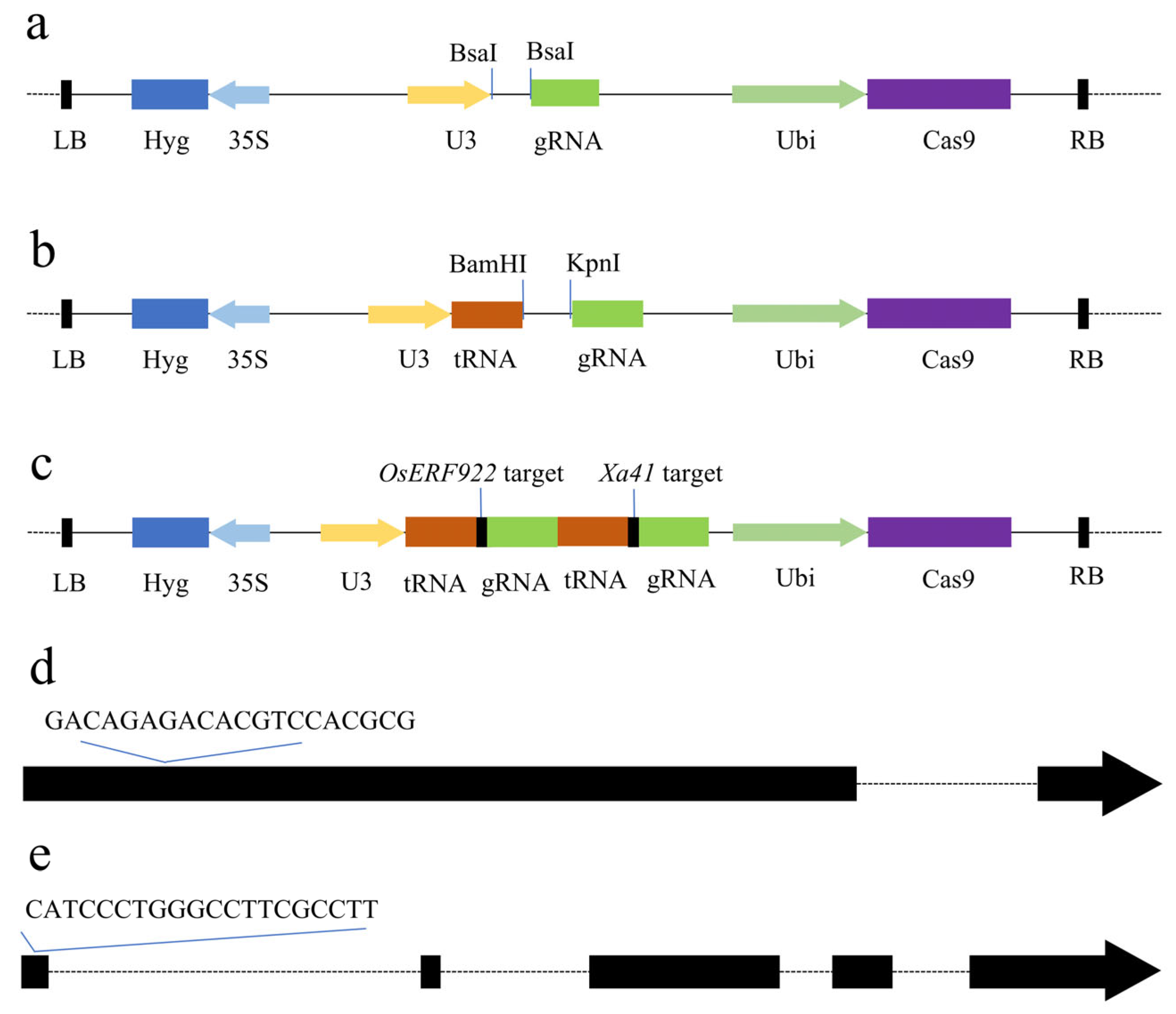
The functions of OsERF922 and Xa41 have been well characterized, and transgenic studies have demonstrated their stable roles in disease susceptibility [25,26]. To generate novel Motuo rice materials with enhanced resistance to both rice blast and bacterial blight, sgRNAs targeting OsERF922 and Xa41 were designed using the CRISPR-GE online platform. Both sgRNAs were located within the first exon of the respective genes (Figure 1d,e). To improve the efficiency of multi-target vector construction, the pRGEB32 vector was structurally optimized by replacing the original BsaⅠ site with a multiple restriction enzyme cloning region, resulting in the modified CRISPR/Cas9 vector pRGEB32-2T (Figure 1a,b). Based on this vector, a dual-target CRISPR/Cas9 construct containing sgRNAs targeting both OsERF922 and Xa41 was successfully assembled (Figure 1c) and used for subsequent rice transformation.

3.2. Generation of OsERF922 and Xa41 Mutant Lines

Using Agrobacterium tumefaciens-mediated transformation, 32 and 28 T0 transgenic plants were obtained in the Benglinba and Gare backgrounds, respectively. PCR analysis with hygromycin-specific primers (Hyg-F/R) confirmed that all regenerated plants were positive transformants. Target regions of OsERF922 and Xa41 were amplified using the primers OsERF922-F/R and Xa41-F/R and subjected to Sanger sequencing.
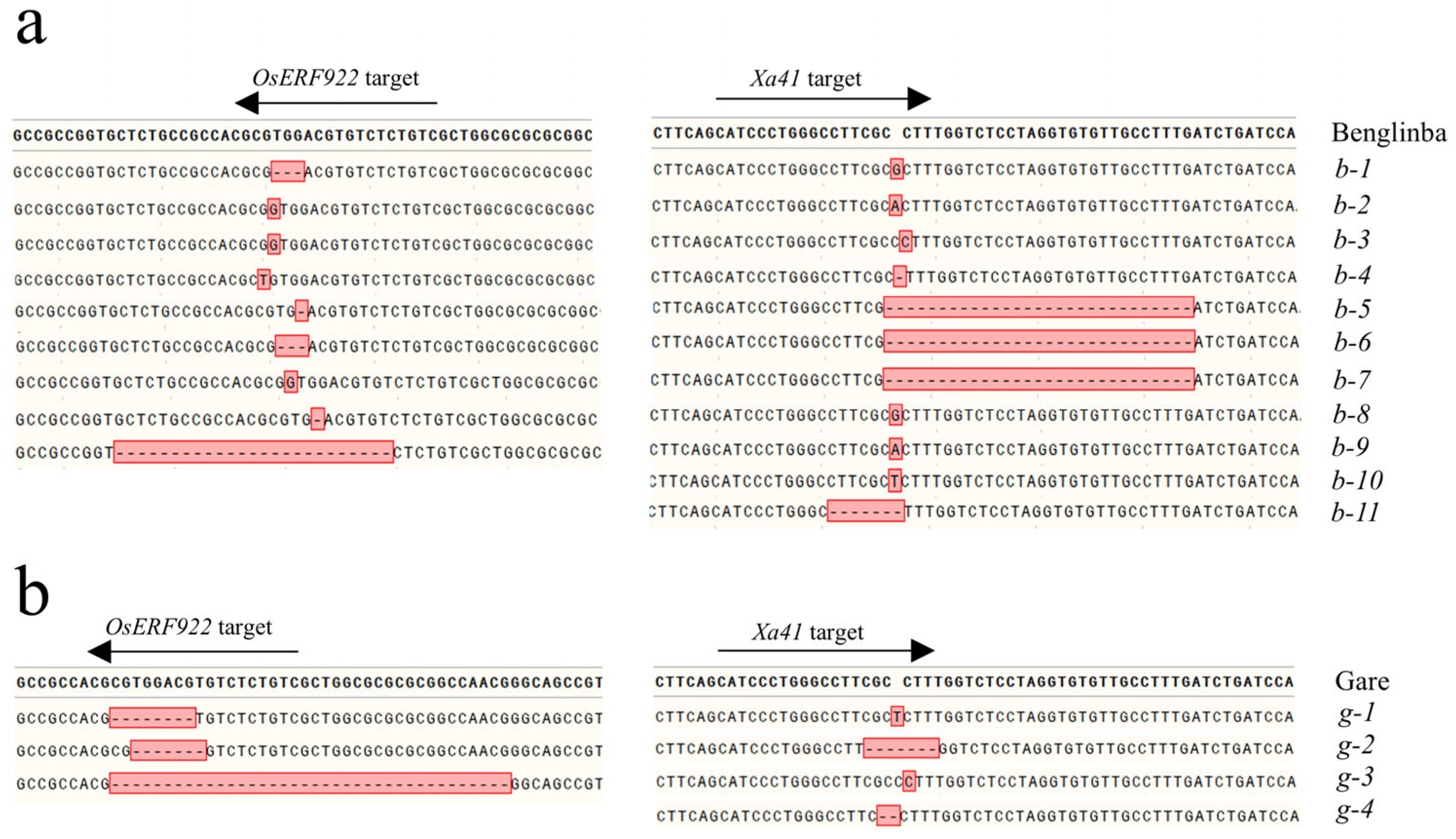
In Benglinba, mutations in OsERF922 were detected in 31 plants, among which 8 were homozygous mutants (25.8%), while Xa41 mutations were identified in 32 plants, including 3 homozygous mutants (9.3%). In Gare, 24 plants carried mutations in OsERF922, with 4 homozygous mutants (16.67%), and 25 plants harbored Xa41 mutations, including 5 homozygous mutants (20%). After single-plant propagation, five homozygous mutation types of OsERF922 and seven of Xa41 were identified in Benglinba, yielding nine double homozygous mutant types (Figure 2a). In Gare, four homozygous mutation types were identified for each gene, resulting in three double homozygous mutant types (Figure 2b).
To assess potential off-target effects, candidate off-target sites with the highest prediction scores (Table 2) were selected using CRISPR-GE and analyzed by PCR amplification and sequencing. No off-target mutations were detected in any examined lines, indicating high specificity and accuracy of the designed sgRNAs.

3.3. Resistance of Mutant Lines to Rice Blast and Bacterial Blight

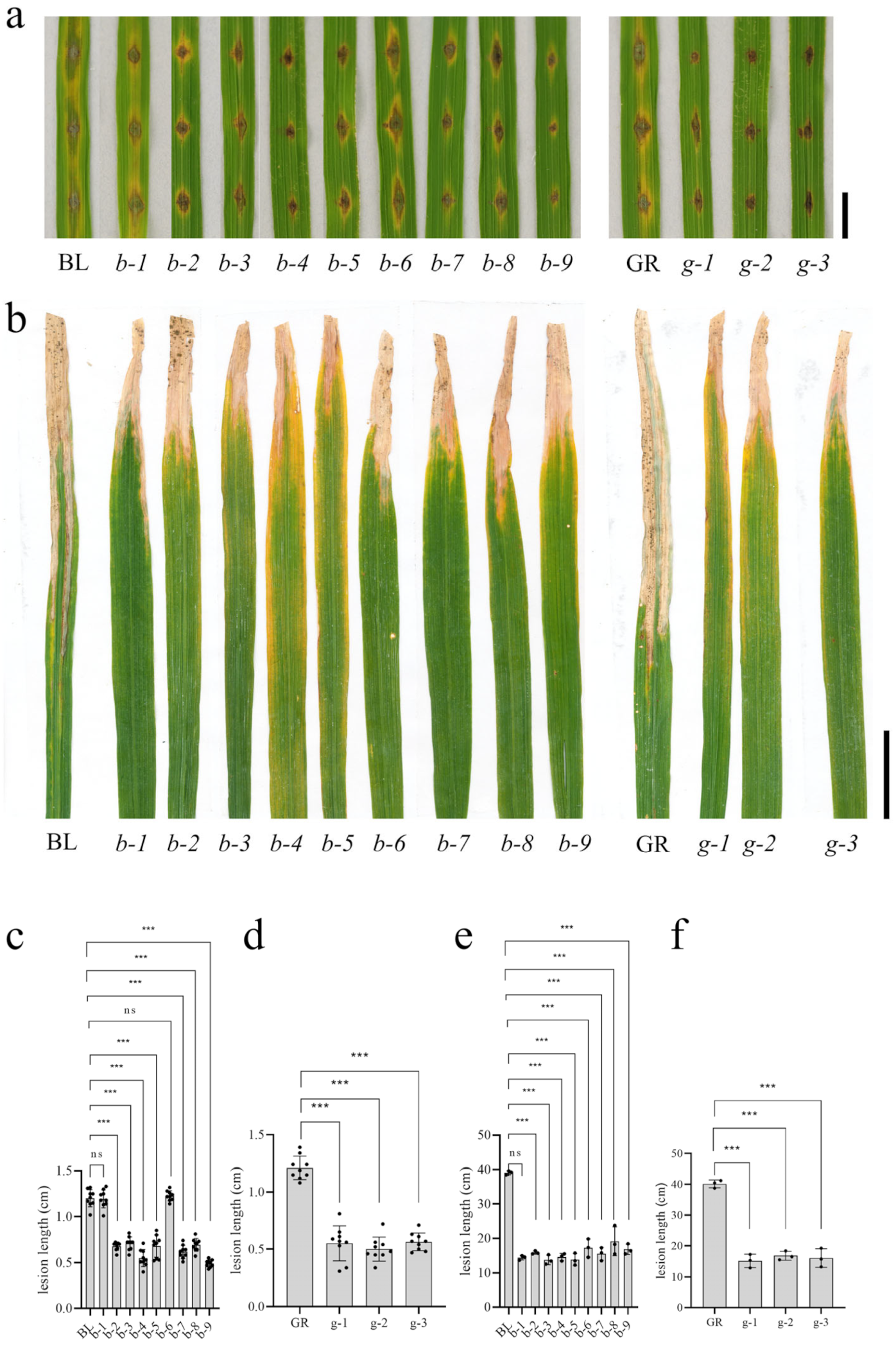
Twelve double homozygous mutant lines were inoculated with the rice blast isolate GDYJ7, using Benglinba and Gare as controls. As shown in Figure 3a, typical spindle-shaped lesions were observed on the leaves of wild-type plants. Among the double mutant lines, most displayed significantly reduced lesion size, which demonstrates that OsERF922 knockout can markedly enhance rice blast resistance in both genetic backgrounds. Notably, lines b-1 and b-6 carried a 3 bp in-frame deletion that did not induce a frameshift mutation, and consistent with this mutation type, their lesion size showed no significant reduction compared to the wild type.
The same mutant lines were subsequently inoculated with the bacterial blight isolate GDXO-1 using the leaf-clipping method. As shown in Figure 3b, both wild-type Benglinba and Gare were highly susceptible to GDXO-1, whereas lesion lengths in all double mutant lines were significantly shorter than those in the controls. These results indicate that knockout of Xa41 substantially enhances bacterial blight resistance. Collectively, simultaneous disruption of OsERF922 and Xa41 significantly improves resistance to both rice blast and bacterial blight within the same genetic background.

3.4. Agronomic Performance of the Mutant Lines

To obtain transgene-free plants, all double homozygous mutant lines were screened using hygromycin-specific primers (Hyg-F/R) and Cas9-specific primers (Cas9-F/R). Three double homozygous mutant lines without T-DNA insertion were successfully obtained in both the Benglinba and Gare backgrounds. Major agronomic traits, including plant height, flag leaf length, flag leaf width, number of effective panicles, panicle length, seed-setting rate, and thousand-grain weight, were evaluated in these transgene-free mutants and their corresponding wild types (Table 3).
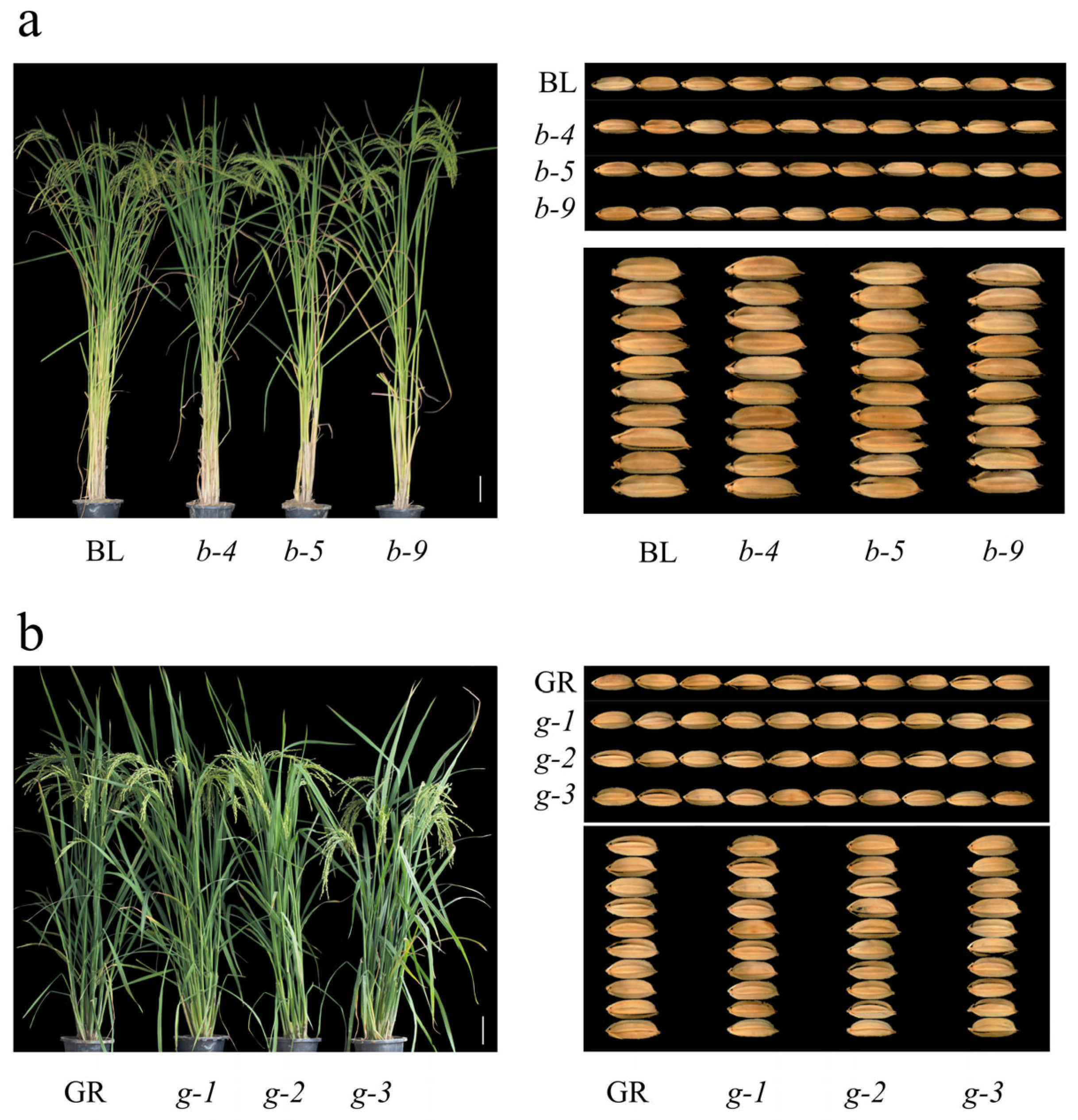
The wild-type Benglinba plants exhibited a plant height of 167.8 cm, flag leaf length of 40.3 cm, flag leaf width of 2.0 cm, eight effective panicles, panicle length of 21.4 cm, seed-setting rate of 83.2%, 10-grain length of 8.84 cm, 10-grain width of 3.08 cm, and thousand-grain weight of 27.6 g. Wild-type Gare plants showed a plant height of 115.42 cm, flag leaf length of 46.2 cm, flag leaf width of 2.1 cm, nine effective panicles, panicle length of 25.3 cm, seed-setting rate of 86.3%, 10-grain length of 8.73 cm, 10-grain width of 3.74 cm, and thousand-grain weight of 31.8 g. Measurements of the double mutant lines (Table 3) revealed no significant differences in any major agronomic traits compared with the wild-type plants (Figure 4a,b), indicating that knockout of OsERF922 and Xa41 does not impair normal growth or development.

3.5. Grain Quality Analysis of the Mutant Lines

Benglinba and Gare are important specialty rice varieties from Motuo, Xizang, and their superior grain quality is critical for utilization and industrial development. To determine whether knockout of OsERF922 and Xa41 affects grain quality, rice quality traits were analyzed in the wild types and their transgene-free double mutant lines.
As shown in Table 4, Benglinba exhibited a brown rice rate of 77.45%, milled rice rate of 61.76%, and head rice rate of 49.42%, with a chalky grain rate and chalkiness degree of 30.51% and 10.16%, respectively. Its amylose content, alkali spreading value, gel consistency, and crude protein content were 16.3%, grade 4.1, 62.5 mm, and 9.8%, respectively. Gare showed a brown rice rate of 79.51%, milled rice rate of 60.31%, head rice rate of 43.85%, chalky grain rate of 48%, and chalkiness degree of 9.48%, with amylose content of 16.7%, alkali spreading value of grade 4.2, gel consistency of 58 mm, and crude protein content of 11.2%.
No significant differences were observed between the double mutant lines and their corresponding wild types for any measured grain quality traits, indicating that simultaneous knockout of OsERF922 and Xa41 enhances disease resistance without adversely affecting rice grain quality.

4. Discussion

CRISPR/Cas9 technology has been successfully applied to trait improvement in a wide range of crops, including maize [27], wheat [28,29,30], and sorghum [31]. Compared with conventional breeding approaches, CRISPR/Cas9 offers clear advantages such as operational simplicity, high target specificity, and a low frequency of off-target effects, making it a powerful tool for modern crop improvement. As a staple food crop, rice has become one of the most intensively studied species for CRISPR-based applications, particularly in the areas of disease resistance and grain quality improvement. For example, Long et al. edited the metal transporter gene OsNramp5 to develop indica rice lines with extremely low cadmium accumulation, achieving a reduction of up to 94.8% in grain cadmium content with only minor effects on yield [32]. In resistance-related studies, Kumar et al. generated OsDST knockout lines that showed markedly improved drought and salt tolerance [33]. Similarly, Tao et al. created a triple mutant (pi21, bsr-d1, and xa5) that displayed significantly enhanced resistance to rice blast and bacterial blight without obvious penalties in major agronomic traits [21]. These studies collectively highlight both the potential and the challenges of using genome editing to balance disease resistance and plant growth.
OsERF922 is a member of the AP2/ERF transcription factor family and is strongly induced by M. oryzae infection as well as by ABA and salt stress. OsERF922 has been reported to act as a negative regulator of rice blast resistance and is associated with reduced expression of defense-related genes [6]. Consistently, CRISPR/Cas9-mediated knockout or RNAi-mediated suppression of OsERF922 has been shown to significantly enhance resistance to rice blast [6,34]. In bacterial blight, the promoter region of Xa41 contains an 18 bp effector binding element that can be directly recognized by TAL effectors such as AvrXa7, PthXo3, and TalI5, leading to transcriptional activation of Xa41, which has been proposed to increase sugar availability in the apoplast and may favor pathogen proliferation [20,35]. Li et al. targeted this effector-binding element using an advanced genome-editing strategy and obtained deletion mutants with enhanced resistance to bacterial blight [36]. In the present study, targeted knockout of OsERF922 and Xa41 in the Motuo rice landraces Benglinba and Gare resulted in double homozygous mutants that exhibited significantly reduced lesion areas for rice blast and shorter lesion lengths for bacterial blight, consistent with the previously reported roles of OsERF922 and Xa41 as susceptibility-associated genes. Moreover, by structurally optimizing the pRGEB32 vector and developing the multi-restriction cloning version pRGEB32-2T, we markedly improved the efficiency of dual-target vector construction, suggesting that this optimized system can facilitate stable and efficient genome editing in local rice varieties. The absence of detectable off-target mutations further confirms the high specificity and reliability of the CRISPR/Cas9 system used in this study.
A common concern in resistance breeding is the trade-off between enhanced immunity and plant growth, as increased defense responses often incur growth or yield penalties. Notably, our results showed that the double knockout lines displayed normal growth and development. Major agronomic traits, including plant height, panicle architecture, flag leaf morphology, seed-setting rate, and thousand-grain weight, were not significantly different from those of the wild-type plants. This finding aligns with previous reports in which the removal of negative regulators of immunity resulted in improved disease resistance without obvious fitness costs, and it supports the feasibility of applying double gene editing strategies for practical rice breeding.
Importantly, Benglinba and Gare are valued not only for their adaptation to the Motuo environment but also for their distinctive eating and cooking qualities, which underpin their economic and cultural importance. Grain quality analysis in this study revealed no significant differences between the double mutants and wild types in key quality parameters, including brown rice rate, milled rice rate, chalkiness, amylose content, gel consistency, alkali spreading value, and protein content. These results indicate that knockout of OsERF922 and Xa41 does not compromise grain quality, a critical consideration for the industrialization and branding of local rice varieties. The ability to enhance disease resistance without sacrificing quality suggests that CRISPR/Cas9-mediated editing provides a rapid and effective route for the improvement of specialty rice cultivars.
Overall, this study represents, to our knowledge, the first report of precise dual-gene editing in Motuo rice landraces, resulting in transgene-free materials that combine enhanced resistance to both rice blast and bacterial blight with stable agronomic performance and superior grain quality. These edited lines provide valuable parental resources for future breeding programs and warrant further multi-location field evaluation under high-altitude and disease-prone environments. Future work may also focus on dissecting the immune regulatory networks altered by simultaneous knockout of these two susceptibility genes, which may contribute to a better understanding of multilayer disease resistance mechanisms. Collectively, this work demonstrates the strong potential of CRISPR/Cas9 technology for the precise improvement of local and specialty crop germplasm.
Despite the encouraging results, some limitations should be acknowledged. The resistance phenotypes reported here were evaluated under a limited set of environmental conditions, and broader field validation is required to confirm long-term stability. Although no off-target mutations were detected at predicted sites, the possibility of rare unintended edits elsewhere in the genome cannot be completely excluded. Future studies should therefore incorporate expanded genome-wide analyses and further dissect the immune regulatory networks affected by simultaneous knockout of OsERF922 and Xa41. Such efforts will deepen our understanding of multilayer disease resistance and support the practical application of genome editing in local and specialty rice germplasm. In addition, regulatory frameworks for genome-edited crops differ among regions and may influence the pace of commercialization. Public acceptance, seed multiplication, and distribution logistics also represent practical considerations that must be addressed.

5. Conclusions

In this study, CRISPR/Cas9-mediated genome editing was successfully applied to simultaneously target OsERF922 and Xa41 in the Motuo rice landraces Benglinba and Gare. Transgene-free knockout lines were successfully obtained that exhibited enhanced resistance to both rice blast and bacterial blight, without compromising major agronomic traits or grain quality. These results provide valuable germplasm resources for breeding plateau-specific rice varieties. Importantly, the T-DNA-free edited lines could potentially be approved for field use following regulatory review. Future work will focus on multi-location field validation, assessment of long-term agronomic performance, thereby facilitating broader breeding applications and supporting the development of high-resistance, high-quality rice cultivars.

Author Contributions

Conceptualization, J.W., Z., C.C. and T.G.; Methodology, L.Z., Z.Z. and R.W.; Software, Y.C., S.H., C., Y.Y., B.W. and M.S.; Formal analysis, L.Z., Z.Z., R.W., Y.C., J.W., S.H., C., Y.Y., B.W., M.S. and H.X.; Investigation, L.Z., Z.Z., R.W., Y.C., S.H., C., Y.Y., B.W. and M.S.; Data curation, Y.C., S.H., C., Y.Y., B.W. and M.S.; Writing—original draft, L.Z., Z.Z., R.W. and H.X.; Writing—review and editing, H.X. and J.W.; Visualization, L.Z., Z., H.X., C.C. and T.G.; Supervision, J.W., Z., C.C. and T.G.; Funding acquisition, J.W., Z., C.C. and T.G. All authors have read and agreed to the published version of the manuscript.

Funding

This work was financially supported by the Science and Technology Planning Project of Nyingchi City, Xizang Autonomous Region, China (Grant No. QYCX2024-06).

Data Availability Statement

The original contributions presented in this study are included in the article. Further inquiries can be directed to the corresponding authors.

Conflicts of Interest

The authors declare no conflicts of interest.

References

  1. Gu, F.; Han, Z.; Zou, X.; Xie, H.; Chen, C.; Huang, C.; Guo, T.; Wang, J.; Wang, H. Unveiling the role of RNA recognition motif proteins in orchestrating Nucleotide-Binding site and Leucine-Rich repeat protein gene pairs and chloroplast immunity pathways: Insights into plant defense mechanisms. Int. J. Mol. Sci. 2024, 25, 5557. [Google Scholar] [CrossRef]
  2. Liu, W.; Liu, J.; Triplett, L.; Leach, J.E.; Wang, G. Novel insights into rice innate immunity against bacterial and fungal pathogens. Annu. Rev. Phytopathol. 2014, 52, 213–241. [Google Scholar] [CrossRef]
  3. Jiang, N.; Yan, J.; Liang, Y.; Shi, Y.; He, Z.; Wu, Y.; Zeng, Q.; Liu, X.; Peng, J. Resistance Genes and their Interactions with Bacterial Blight/Leaf Streak Pathogens (Xanthomonas oryzae) in Rice (Oryza sativa L.)—An Updated Review. Rice 2020, 13, 3. [Google Scholar] [CrossRef] [PubMed]
  4. Younas, M.U.; Ahmad, I.; Qasim, M.; Ijaz, Z.; Rajput, N.; Parveen, M.S.; UL Zaman, W.; Jiang, X.; Zhang, Y.; Zuo, S. Progress in the management of rice blast disease: The role of avirulence and resistance genes through Gene-for-Gene interactions. Agronomy 2024, 14, 163. [Google Scholar] [CrossRef]
  5. Wang, J.; Zhou, L.; Shi, H.; Chern, M.; Yu, H.; Yi, H.; He, M.; Yin, J.; Zhu, X.; Li, Y.; et al. A single transcription factor promotes both yield and immunity in rice. Science 2018, 361, 1026–1028. [Google Scholar] [CrossRef] [PubMed]
  6. Liu, D.; Chen, X.; Liu, J.; Ye, J.; Guo, Z. The rice ERF transcription factor OsERF922 negatively regulates resistance to Magnaporthe oryzae and salt tolerance. J. Exp. Bot. 2012, 63, 3899–3911. [Google Scholar] [CrossRef]
  7. Chen, S.; Wang, C.; Yang, J.; Chen, B.; Wang, W.; Su, J.; Feng, A.; Zeng, L.; Zhu, X. Identification of the novel bacterial blight resistance gene Xa46(t) by mapping and expression analysis of the rice mutant H120. Sci. Rep. 2020, 10, 12642. [Google Scholar] [CrossRef]
  8. Hu, K.; Cao, J.; Zhang, J.; Xia, F.; Ke, Y.; Zhang, H.; Xie, W.; Liu, H.; Cui, Y.; Cao, Y.; et al. Improvement of multiple agronomic traits by a disease resistance gene via cell wall reinforcement. Nat. Plants 2017, 3, 17009. [Google Scholar] [CrossRef]
  9. Ercoli, M.F.; Luu, D.D.; Rim, E.Y.; Shigenaga, A.; Teixeira, D.A.J.A.; Chern, M.; Jain, R.; Ruan, R.; Joe, A.; Stewart, V. Plant immunity: Rice XA21-mediated resistance to bacterial infection. Proc. Natl. Acad. Sci. USA 2022, 119, e2121568119. [Google Scholar] [CrossRef]
  10. Banerjee, A.; Roy, S.; Bag, M.K.; Bhagat, S.; Kar, M.K.; Mandal, N.P.; Mukherjee, A.K.; Maiti, D. Phenotypic and molecular analysis of bacterial blight resistance in rice cultivars from eastern and northeastern India. In Extended Summaries; Association of Rice Research Workers: Odisha, India, 2020; p. 251. [Google Scholar]
  11. Yoshihisa, A.; Yoshimura, S.; Shimizu, M.; Sato, S.; Matsuno, S.; Mine, A.; Yamaguchi, K.; Kawasaki, T. The rice OsERF101 transcription factor regulates the NLR Xa1-mediated immunity induced by perception of TAL effectors. New Phytol. 2022, 236, 1441–1454. [Google Scholar] [CrossRef]
  12. He, Q.; Li, D.; Zhu, Y.; Tan, M.; Zhang, D.; Lin, X. Fine mapping of Xa2, a bacterial blight resistance gene in rice. Mol. Breed. 2006, 17, 1–6. [Google Scholar] [CrossRef]
  13. Kim, Y.; Moon, H.; Park, C. CRISPR/Cas9-targeted mutagenesis of Os8N3 in rice to confer resistance to Xanthomonas oryzae pv. Oryzae. Rice 2019, 12, 67. [Google Scholar] [CrossRef] [PubMed]
  14. Zaka, A.; Grande, G.; Coronejo, T.; Quibod, I.L.; Chen, C.; Chang, S.; Szurek, B.; Arif, M.; Cruz, C.V.; Oliva, R. Natural variations in the promoter of OsSWEET13 and OsSWEET14 expand the range of resistance against Xanthomonas oryzae pv. Oryzae. PLoS ONE 2018, 13, e203711. [Google Scholar] [CrossRef] [PubMed]
  15. Hutin, M.; Sabot, F.; Ghesquière, A.; Koebnik, R.; Szurek, B. A knowledge-based molecular screen uncovers a broad-spectrum OsSWEET14 resistance allele to bacterial blight from wild rice. Plant J. 2015, 84, 694–703. [Google Scholar] [CrossRef] [PubMed]
  16. Chen, X.; Liu, P.; Mei, L.; He, X.; Chen, L.; Liu, H.; Shen, S.; Ji, Z.; Zheng, X.; Zhang, Y. Xa7, a new executor R gene that confers durable and broad-spectrum resistance to bacterial blight disease in rice. Plant Commun. 2021, 2, 100143. [Google Scholar] [CrossRef]
  17. Gui, Y.; Tian, D.; Ong, K.H.; Teo, J.C.Y.; Yin, Z. TAL effector-dependent Bax gene expression in transgenic rice confers disease resistance to Xanthomonas oryzae pv. Oryzae. Transgenic Res. 2022, 31, 119–130. [Google Scholar] [CrossRef]
  18. Wang, C.; Zhang, X.; Fan, Y.; Gao, Y.; Zhu, Q.; Zheng, C.; Qin, T.; Li, Y.; Che, J.; Zhang, M. XA23 is an executor R protein and confers broad-spectrum disease resistance in rice. Mol. Plant 2015, 8, 290–302. [Google Scholar] [CrossRef]
  19. Das, P.P.; Bhandari, K.P.; Bhati, K.; Gireesh, C.; Laha, G.S.; Sundaram, R.M.; Ghazi, I.A. Analysis of nucleotide diversity among alleles of intronless bacterial blight resistant genes Xa27 and Xa23 in rice. Biocatal. Agric. Biotechnol. 2025, 63, 103477. [Google Scholar] [CrossRef]
  20. Antony, G.; Zhou, J.; Huang, S.; Li, T.; Liu, B.; White, F.; Yang, B. Rice xa13 recessive resistance to bacterial blight is defeated by induction of the disease susceptibility gene Os-11N3. Plant Cell 2010, 22, 3864–3876. [Google Scholar] [CrossRef]
  21. Tao, H.; Shi, X.; He, F.; Wang, D.; Xiao, N.; Fang, H.; Wang, R.; Zhang, F.; Wang, M.; Li, A.; et al. Engineering broad-spectrum disease-resistant rice by editing multiple susceptibility genes. J. Integr. Plant Biol. 2021, 63, 1639–1648. [Google Scholar] [CrossRef]
  22. Xie, K.; Minkenberg, B.; Yang, Y. Boosting CRISPR/Cas9 multiplex editing capability with the endogenous tRNA-processing system. Proc. Natl. Acad. Sci. USA 2015, 112, 3570–3575. [Google Scholar] [CrossRef]
  23. Zhao, C.; Cong, S.; Liang, S.; Xie, H.; Lu, W.; Xiao, W.; Huang, M.; Guo, T.; Wang, J. Development and application of KASP marker for rice blast resistance gene Pi2. J. South China Agric. Univ. 2023, 44, 725–734. [Google Scholar]
  24. GB/T 17891-2017; High Quality Paddy. General Administration of Quality Supervision, Inspection and Quarantine of the People’s Republic of China, China Standards Press: Beijing, China, 2018.
  25. Qiu, J.; Liu, Z.; Xie, J.; Lan, B.; Shen, Z.; Shi, H.; Lin, F.; Shen, X.; Kou, Y. Dual impact of ambient humidity on the virulence of Magnaporthe oryzae and basal resistance in rice. Plant Cell Environ. 2022, 45, 3399–3411. [Google Scholar] [CrossRef] [PubMed]
  26. Zeng, X.; Luo, Y.; Vu, N.T.Q.; Shen, S.; Xia, K.; Zhang, M. CRISPR/Cas9-mediated mutation of OsSWEET14 in rice cv. Zhonghua11 confers resistance to Xanthomonas oryzae pv. Oryzae without yield penalty. BMC Plant Biol. 2020, 20, 313. [Google Scholar] [CrossRef] [PubMed]
  27. Liang, Z.; Zhang, K.; Chen, K.; Gao, C. Targeted mutagenesis in Zea mays using TALENs and the CRISPR/Cas system. J. Genet. Genom. 2014, 41, 63–68. [Google Scholar] [CrossRef] [PubMed]
  28. Upadhyay, S.K.; Kumar, J.; Alok, A.; Tuli, R. RNA-guided genome editing for target gene mutations in wheat. G3 Genes Genomes Genet. 2013, 3, 2233–2238. [Google Scholar] [CrossRef]
  29. Wang, Y.; Cheng, X.; Shan, Q.; Zhang, Y.; Liu, J.; Gao, C.; Qiu, J. Simultaneous editing of three homoeoalleles in hexaploid bread wheat confers heritable resistance to powdery mildew. Nat. Biotechnol. 2014, 32, 947–951. [Google Scholar] [CrossRef]
  30. Shan, Q.; Wang, Y.; Li, J.; Zhang, Y.; Chen, K.; Liang, Z.; Zhang, K.; Liu, J.; Xi, J.J.; Qiu, J. Targeted genome modification of crop plants using a CRISPR-Cas system. Nat. Biotechnol. 2013, 31, 686–688. [Google Scholar] [CrossRef]
  31. Jiang, W.; Zhou, H.; Bi, H.; Fromm, M.; Yang, B.; Weeks, D.P. Demonstration of CRISPR/Cas9/sgRNA-mediated targeted gene modification in Arabidopsis, tobacco, sorghum and rice. Nucleic Acids Res. 2013, 41, e188. [Google Scholar] [CrossRef]
  32. Long, Q.; Huang, Y.; Tang, X.; Wang, H.; Lu, M.; Yuan, L.; Wan, J. Creation of low-Cd-accumulating indica rice by disruption of OsNramp5 gene via CRISPR/Cas9. Chin. J. Rice Sci. 2019, 33, 407. [Google Scholar]
  33. Santosh Kumar, V.V.; Verma, R.K.; Yadav, S.K.; Yadav, P.; Watts, A.; Rao, M.V.; Chinnusamy, V. CRISPR-Cas9 mediated genome editing of drought and salt tolerance (OsDST) gene in indica mega rice cultivar MTU1010. Physiol. Mol. Biol. Plants 2020, 26, 1099–1110. [Google Scholar] [CrossRef]
  34. Wang, F.; Wang, C.; Liu, P.; Lei, C.; Hao, W.; Gao, Y.; Liu, Y.; Zhao, K. Enhanced rice blast resistance by CRISPR/Cas9-Targeted mutagenesis of the ERF transcription factor gene OsERF922. PLoS ONE 2016, 11, e154027. [Google Scholar] [CrossRef]
  35. Streubel, J.; Pesce, C.; Hutin, M.; Koebnik, R.; Boch, J.; Szurek, B. Five phylogenetically close rice SWEET genes confer TAL effector-mediated susceptibility to Xanthomonas oryzae pv. Oryzae. New Phytol. 2013, 200, 808–819. [Google Scholar] [CrossRef]
  36. Li, C.; Liu, B.; Dong, H.; Yang, B. Enhancing resistance to bacterial blight in rice using CRISPR-based base editing technology. Crop J. 2025, 13, 115–124. [Google Scholar] [CrossRef]
Figure 1. Schematic diagram of the CRISPR/Cas9-OsERF922-Xa41 vector construction. (a) Schematic diagram of the pRGEB32 construct; (b) Schematic diagram of the pRGEB32-2T construct; (c) Schematic diagram of the pRGEB32-2T-OsERF922-Xa41 construct; (d) Schematic diagram of the location of targeted sites in OsERF922; and (e) Schematic diagram of the location of targeted sites in Xa41.
Agronomy 16 00349 g001
Figure 2. Analysis of OsERF922 and Xa41 mutation types. (a) Knockout types of OsERF922 and Xa41 in the Benglinba background, with the mutants designated as b-1 to b-9. (b) Knockout types of OsERF922 and Xa41 in the Gare background, with the mutants named g-1 to g-4. For each mutation event, the target site and protospacer adjacent motif (PAM) are labeled. The wild-type nucleotide sequences are presented as reference, and the mutated regions are highlighted with red shading.
Agronomy 16 00349 g002
Figure 3. Disease resistance phenotypes of OsERF922/Xa41 knockout mutants and their wild-type controls. (a) Rice blast infection symptoms: Leaves of wild-type Benglinba (BL) and its OsERF922/Xa41 knockout mutants (b-1 to b-9), as well as wild-type Gare (GR) and its mutants (g-1 to g-3), are shown after pathogen inoculation. Scale bar = 1 cm. Scale bar = 1 cm. (b) Comparison of bacterial blight resistance: Leaves of the same wild-type lines and mutants were inoculated with bacterial blight pathogen. Scale bar = 10 cm. (c) Statistical analysis of rice blast resistance in BL and its mutants. (d) Statistical analysis of rice blast resistance in GR and its mutants. (e) Statistical analysis of bacterial blight resistance in BL and its mutants. (f) Statistical analysis of bacterial blight resistance in GR and its mutants. Data are presented as mean ± standard deviation (SD), analyzed by Student’s t-test (each mutant vs. corresponding wild type). ns indicates no significant difference, *** indicates p < 0.001.
Agronomy 16 00349 g003
Figure 4. Phenotypic comparison of transgene-free mutants and their wild-type counterparts. (a) Plant architecture and grain morphology of transgene-free mutants and Benglinba (BL). (b) Plant architecture and grain morphology of transgene-free mutants and Gare (GR). Scale bar = 10 cm.
Agronomy 16 00349 g004
Table 1. Primers for vector construction and transgenic detection.
Primer NamePrimer Sequence (5′–3′)Application
Cas9-OsERF922-FTTCCCGGCTGGTGCAGACAGAGACACGTCCACGCGGTTTTAGAGCTAGAAVector constructs
Cas9-Xa41-RTTCTAGCTCTAAAACAAGGCGAAGGCCCAGGGATGTGCACCAGCCGGGAAVector constructs
OsERF922-seq-FATGTCTCTCTCCTTGGGGTTTarget sequencing
OsERF922-seq-RCCTACGCGCTGTACATGTCATarget sequencing
Xa41-seq-FATCAAGCCTTCAAGCAAAGCAAACTTarget sequencing
Xa41-seq-RGCTTTGCAATAATGAGGGTGGTGGTarget sequencing
Hyg-FCAATGCGGAGCATATACGCCCHygromycin Detection
Hyg-RGGCTATGGATGCGATCGCTGHygromycin Detection
Cas9-FATCCTGTCTGCCAGACTGAGCCas9 detection
Cas9-RCTCCCAGGTGGATCTGGTGGCas9 detection
Table 2. Mutation detections in the putative off-target site.
Mutant GenePutative Off-Target SiteThe Sequence of the Putative Off-Target Site
OsERF922chr07:28684353AGCAGAGACGCGCCCATGCG TGG
chr05:24001095 GACGCAGACAAGGCCACGCG TGG
chr03:21260136 GGCATAGCCGCGTTCACGCG TGG
chr08:6802477 GACATCGCCACATCCACGAG TGG
chr08:7099591 GACATCGCCACATCCACGAG TGG
Xa41chr07:17324522 CAACCCAAGGTCATCGCCTT TGG
chr12:2436323 CATGGCTGGTCCATCGACTT TGG
chr07:10370691GATGCCTCGGCCTCCGCTTT TGG
chr12:17305091 CATCCCTGGGCTTTTGCCTT CGG
chr06:26986420 CCTAGCTGGGCCTTGGCCTT TGG
Note: the PAM sites are highlighted in red bold and the bases that are mismatched with sgRNA are highlighted in black bold.
Table 3. The agronomic traits of transgene-free mutants and their corresponding wild types.
TraitsBenglinbab-4b-5b-9Gareg-1g-2g-3
Plant height (cm)167.80 ± 6.0166.63 ± 3.2165.10 ± 2.1168.37 ± 2.9115.42 ± 2.5115.90 ± 1.1115.97 ± 1.6115.37 ± 1.5
Flag leaf length (cm)40.30 ± 2.339.43 ± 2.439.87 ± 2.340.17 ± 1.046.20 ± 3.243.30 ± 2.343.73 ± 3.345.80 ± 2.3
Flag leaf width (cm)2.00 ± 0.02.00 ± 0.02.03 ± 0.052.00 ± 0.02.10 ± 0.02.10 ± 0.02.10 ± 0.02.10 ± 0.0
Number of effective panicles8.00 ± 0.87.67 ± 0.58.33 ± 0.98.33 ± 0.59.00 ± 0.89.33 ± 0.59 ± 0.09.33 ± 0.5
Panicle length (cm)21.40 ± 0.722.73 ± 1.321.47 ± 0.8521.4 ± 0.7525.30 ± 1.724.37 ± 0.824.80 ± 1.025.60 ± 0.7
Seed-setting rate (%)83.20 ± 2.482.53 ± 2.182.67 ± 2.682.8 ± 1.0286.30 ± 3.285.30 ± 2.283.73 ± 0.683.87 ± 1.3
Thousand-grain weight (g)27.60 ± 0.227.57 ± 0.0527.53 ± 0.0927.53 ± 0.0931.80 ± 0.131.73 ± 0.131.73 ± 0.131.73 ± 0.1
Grain length (cm)8.84 ± 0.018.83 ± 0.028.83 ± 0.018.83 ± 0.018.73 ± 0.068.70 ± 0.048.71 ± 0.048.73 ± 0.02
Grain width (cm)3.08 ± 0.0053.07 ± 0.023.06 ± 0.013.08 ± 0.013.74 ± 0.023.74 ± 0.023.74 ± 0.023.74 ± 0.02
Note: the values are presented as means ± standard deviation.
Table 4. The rice grain quality traits of transgene-free mutants and their corresponding wild types.
TraitsBenglinbab-4b-5b-9Gareg-1g-2g-3
Brown rice rate (%)77.45 ± 3.274.33 ± 2.976.60 ± 1.375.93 ± 2.679.51 ± 1.078.20 ± 3.478.63 ± 2.179.07 ± 3.6
Milled rice rate (%)61.76 ± 1.461.77 ± 1.261.80 ± 1.262.07 ± 0.560.31 ± 0.860.70 ± 2.260.30 ± 0.960.30 ± 1.6
Head rice rate (%)49.42 ± 1.248.90 ± 1.249.67 ± 1.049.40 ± 0.843.85 ± 3.043.33 ± 2.444.00 ± 1.044.77 ± 1.4
Chalky grain rates (%)30.51 ± 2.030.47 ± 1.230.00± 0.530.57 ± 1.448.00 ± 0.843.67 ± 1.746.67 ± 3.444.33 ± 3.3
Chalkiness degree (%)10.16 ± 0.310.23 ± 0.910.3 0± 0.510.10 ± 0.59.48 ± 0.29.50 ± 0.39.50 ± 0.59.33 ± 0.2
Amylose content (%)16.30 ± 0.616.13 ± 0.116.17 ± 0.916.07 ± 0.916.70 ± 0.716.23 ± 0.216.57 ± 0.316.40 ± 0.6
Alkali spreading value4.33 ± 0.54.00 ± 0.04.33 ± 0.54.00 ± 0.04.33 ± 0.54.00 ± 0.04.00 ± 0.04.00 ± 0.0
Gel consistency (mm)62.50 ± 2.461.47 ± 1.963.00 ± 2.262.93 ± 1.658.00 ± 4.457.90 ± 3.557.23 ± 2.159.40 ± 1.1
Crude protein content (%)9.80 ± 0.49.73 ± 0.29.57 ± 0.69.87 ± 0.211.20 ± 1.510.97 ± 0.411.70 ± 0.611.40 ± 0.1
Note: the values are presented as means ± standard deviation.
Disclaimer/Publisher’s Note: The statements, opinions and data contained in all publications are solely those of the individual author(s) and contributor(s) and not of MDPI and/or the editor(s). MDPI and/or the editor(s) disclaim responsibility for any injury to people or property resulting from any ideas, methods, instructions or products referred to in the content.