Article

Production Parameters and Biochemical Composition of ‘BRS Núbia’ Table Grapes Affected by Rootstocks Under Subtropical Conditions


by
Harleson Sidney Almeida Monteiro
1,*,
Marco Antonio Tecchio
1,
Sinara de Nazaré Santana Brito
1,
Juan Carlos Alonso
1,
Daví Eduardo Furno Feliciano
1,
Marcelo de Souza Silva
1,
Giuseppina Pace Pereira Lima
2,
Sergio Ruffo Roberto
3,*,
Aline Cristina de Aguiar
3 and
Sarita Leonel
1
1
College of Agriculture, São Paulo State University (UNESP), Botucatu 18618-689, SP, Brazil
2
Institute of Biosciences, São Paulo State University (UNESP), Botucatu 18618-689, SP, Brazil
3
Agricultural Research Center, State University of Londrina, Londrina 86057-970, PR, Brazil
*
Authors to whom correspondence should be addressed.
Agronomy 2026, 16(3), 347; https://doi.org/10.3390/agronomy16030347

Submission received: 7 December 2025 / Revised: 21 January 2026 / Accepted: 29 January 2026 / Published: 30 January 2026

Abstract

Table grapes are among the main fruit crops cultivated in Brazil, supported by cultivar diversity, technological advances, and adaptation to diverse edaphoclimatic conditions. Rootstock selection is critical in viticulture, influencing phenology, yield, and fruit quality. This study evaluated yield- and fruit-related production parameters, cluster characteristics, and biochemical composition of ‘BRS Núbia’ table grape grafted onto different rootstocks. The experiment was conducted at the Experimental Farm of the Faculty of Agricultural Sciences (UNESP), São Manuel, São Paulo, Brazil, using a randomized block design in a split-plot scheme (three rootstocks × three seasons) with seven replicates. Rootstocks included ‘IAC 572 Jales’, ‘IAC 766 Campinas’, and ‘Paulsen 1103’, while subplots corresponded to the first three production seasons after grafting. Evaluated variables comprised bud fruitfulness, yield, productivity, physical attributes of clusters, berries, and rachises, and in 2022, berry biochemical traits, including total phenolics, flavonoids, anthocyanins, and antioxidant activity. Rootstocks did not significantly affect bud fruitfulness or yield-related parameters. In contrast, production season markedly influenced vine performance, with the third (2023) season showing higher cluster and berry mass and size. Regarding fruit composition, vines grafted onto ‘Paulsen 1103’ and ‘IAC 766 Campinas’ showed greater accumulation of total phenolics and anthocyanins than those grafted onto ‘IAC 572 Jales’, overall.

1. Introduction

The Brazilian grape industry is characterized by a wide diversity of cultivars and production systems, reflecting the country’s vast territory and heterogeneous climate [1]. This adaptability has driven the growth of the grape sector and contributed to rural employment and income generation [2,3].
Among cultivated fruits, table grapes hold a leading position due to the range of cultivars, modern production techniques, and expansion into new regions [4,5]. The southern, northeastern, and southeastern regions concentrate most of the national output, especially in Rio Grande do Sul (51.47%), Pernambuco (28.23%), and São Paulo (8.68%) [6,7]. While Rio Grande do Sul primarily produces grapes for wine, juice, and derivatives, São Paulo is the second-largest producer of table grapes, emphasizing seeded cultivars such as ‘Niagara Rosada,’ ‘Italia,’ and ‘BRS Núbia.’ ‘BRS Vitória’ and ‘BRS Isis’ seedless grapes are also relevant [1,8,9,10]. Despite production gains, the vineyard area decreased by 2.94% between 2022 and 2024, reaching 8070 ha [11,12]. ‘BRS Núbia’ is notable for its high fruit quality and adaptability to temperate, tropical, and subtropical environments [13,14,15,16].
The choice of rootstock is a decisive factor in vineyard performance. Rootstocks influence vegetative vigor and reproductive development, as well as nutrient uptake, tolerance to drought, pests, and diseases. Collectively, these effects shape overall yield and fruit quality [8,17,18,19,20]. Rootstocks also protect against phylloxera (Daktulosphaira vitifoliae) and soil pests, such as ground pearl (Eurhizococcus brasiliensis). It has been demonstrated that the use of the appropriate rootstock enables cultivation in low-fertility or saline soils [21,22,23].
In addition to yield, rootstocks modulate fruit physicochemical and biochemical traits by regulating nutrient availability and scion–root system interactions [24,25,26,27]. These effects extend to the accumulation of bioactive compounds, such as phenolics, flavonoids, and anthocyanins, which contribute to nutritional quality and human health benefits [28,29].
In Brazil, ‘IAC 572 Jales’, ‘IAC 766 Campinas,’ and ‘Paulsen 1103’ are the main rootstocks in tropical and subtropical vineyards [30,31]. ‘IAC 572 Jales’ confers moderate vigor and drought resistance, making it suitable for water-limited regions [31,32]. ‘IAC 766 Campinas’ promotes high vigor and adapts well to low-fertility soils, sustaining high productivity [9,30,31]. Widely cultivated worldwide, ‘Paulsen 1103’ (P1103) is valued for its drought and salinity tolerance, broad cultivar compatibility, and ability to enhance potassium uptake and maintain balanced growth [33,34]. Therefore, rootstock selection must align with the local edaphoclimatic conditions and production objectives, as each genotype uniquely modulates growth, yield, and fruit quality. Given this, in this study, we aimed to evaluate the influence of the rootstocks ‘IAC 572 Jales’, ‘IAC 766 Campinas’, and ‘Paulsen 1103’ on the yield- and fruit-related production parameters, physical characteristics of clusters, and biochemical profile of ‘BRS Núbia’ grapes under subtropical conditions over three seasons.

2. Materials and Methods

2.1. Location and Climate of the Experimental Area

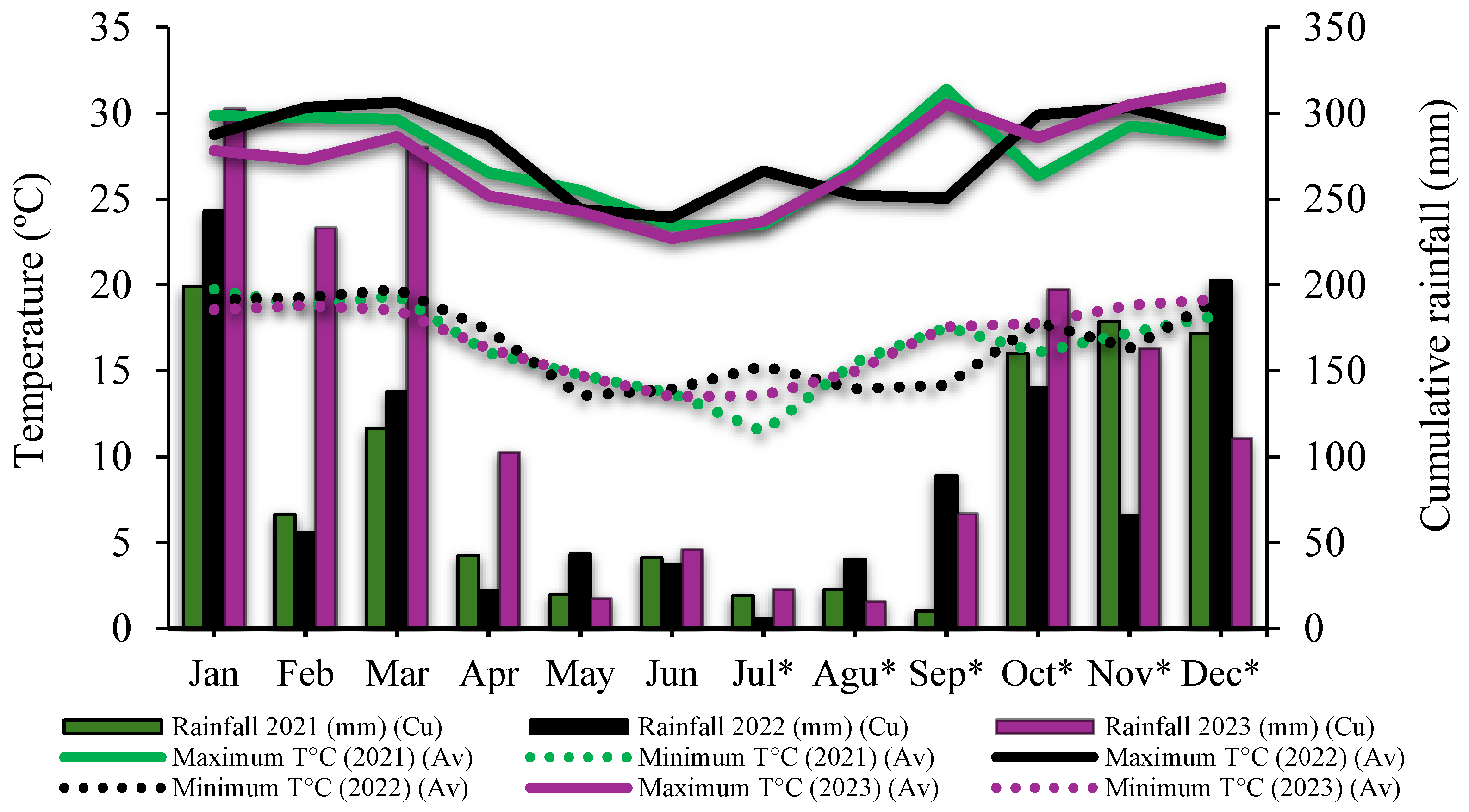
The experiment was conducted in the vineyard of the Experimental Farm of São Manuel, São Paulo, Brazil (22°44′28″ S, 48°34′37″ W, and 740 m altitude), belonging to the Faculty of Agricultural Sciences (FCA) of the São Paulo State University “Júlio de Mesquita Filho” (UNESP). According to the Köppen classification, the climate of this region is classified as Cfa, which is characterized as humid subtropical (mesothermal) with hot summers. The average annual rainfall is 1433 mm, and the mean annual temperature is 19.3 °C, with minimum and maximum averages of 16.5 °C and 27.7 °C, respectively, and a relative humidity of 71% [16]. The meteorological conditions during the experimental period (2021–2023) are shown in Figure 1. The soil was classified as Red Nitisol [35].
Meteorological conditions varied substantially among seasons. The 2021 season showed lower cumulative rainfall and moderate temperatures, whereas 2022 was characterized by higher maximum temperatures and irregular rainfall distribution. In contrast, 2023 presented warmer and wetter conditions, with higher cumulative rainfall, particularly from September to December.

2.2. Plant Material, Training System and Agricultural Practices

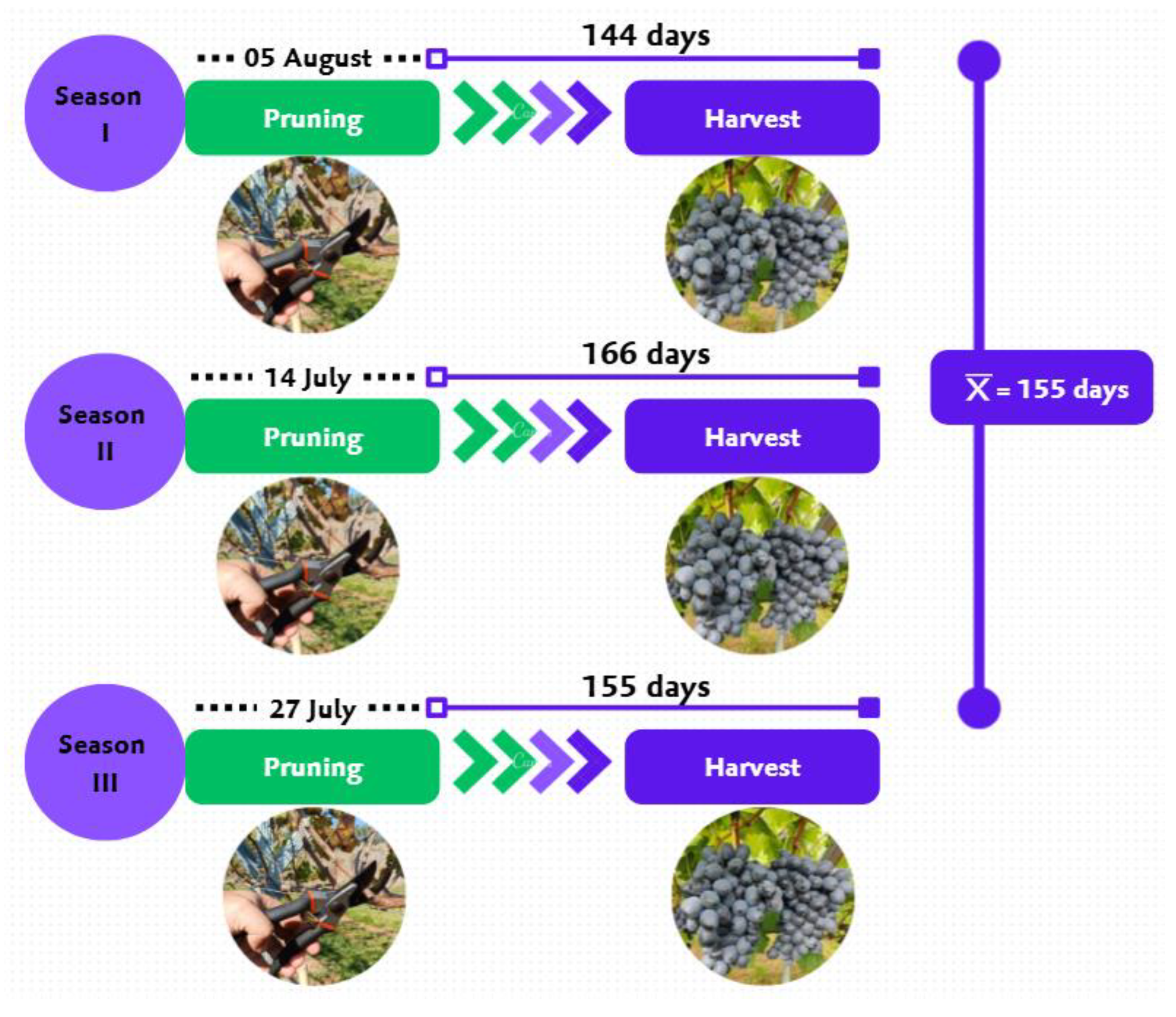
Soil preparation in the experimental area began in April 2020 and included plowing, harrowing, liming, furrow opening, and fertilization. In August 2020, certified nursery trees of the ‘BRS Núbia’ table grape (‘Michele Palieri’ × ‘Arkansas 2095’) grafted onto the rootstocks ‘IAC 572 Jales’, obtained from the cross between Vitis caribaea and 101-14 Mgt (Vitis riparia × Vitis rupestris); ‘IAC 766 Campinas’, derived from the cross between Vitis caribaea and 106-8 Mgt; and ‘Paulsen 1103’, obtained from the cross between Vitis berlandieri and Vitis rupestris were planted. The Open Gable (Y-trellis system) was used as a training system, and vines were spaced 3.0 × 2.0 m apart. Irrigation was conducted using an inverted micro-sprinkler system, activated according to the crop’s water demand and rainfall occurrence. Short winter pruning was performed on 5 August 2021, 14 July 2022, and 27 July 2023, with two buds retained per spur. On average across the three production seasons, harvesting occurred 155 days after pruning (Figure 2).
To promote bud break and uniform budburst, 2.5% hydrogen cyanamide (Dormex®, BASF, Ludwigshafen am Rhein, Germany) was applied on buds immediately after pruning. Following the budburst, which usually occurred 20 d after pruning, one bearing shoot per cane was maintained. Throughout the development season, agricultural practices, such as shoot thinning, tying, removal of axillary shoots, defoliation, and tipping, were performed.
Fertilization was carried out according to the recommendations of Technical Bulletin 100 of the Agronomic Institute of Campinas [18], and phytosanitary management was performed based on crop requirements and regional guidelines [36]. Soil fertility was monitored annually through chemical soil analyses conducted in the experimental area. As base saturation (V%) remained above 80% throughout the study period, lime application was not required.
In each production season, fertilization consisted of the application of 8 t ha−1 of organic compost, 250 kg ha−1 of N, 300 kg ha−1 of P2O5, and 300 kg ha−1 of K2O, adjusted according to soil analysis results. The mineral fertilizer sources included Yorin Master (18% P2O5), NPK 20–5–5, and potassium chloride (KCl; 58% K2O).
Phosphorus was applied entirely, along with 50% of the potassium dose, together with the organic compost approximately one month before pruning. After pruning, when shoots had developed two to three expanded leaves, 50% of the nitrogen dose was applied. The remaining nitrogen and potassium were applied during the berry development period, between the pea-size and half-berry stages. Post-pruning nitrogen and potassium fertilizations were applied as top dressing around the vines.
In addition, during all three seasons, three foliar applications of boron were performed prior to flowering. Boron was supplied as boric acid at a concentration of 1 g L−1.

2.3. Experimental Design and Treatments

The experiment was conducted using a randomized block design arranged in a split-plot scheme, in with the main plots consisting of the rootstocks and the subplots comprising the production seasons, with seven replicates. Each experimental unit consisted of three vines.

2.4. Assessments

2.4.1. Bud Fruitfulness

Bud fruitfulness (BF) was determined as the ratio of the number of buds with inflorescences and total number of buds sprouted, adapted from Leão and Silva [37]. The evaluation was conducted at the visible inflorescence stage, based on the phenological stages proposed by Eichhorn and Lorenz [38], on the lateral shoots of three vines per plot by counting the total number of buds and the number of differentiated buds using Equation (1):
B F = N u m b e r   o f   b u d s   w i t h   i n f l o r e s c e n c e s T o t a l   n u m b e r   o f   b u d s   s p r o u t e d

2.4.2. Harvest and Chemical Characteristics of Grape Juice

Harvesting was done according to the ripening curve, considering the stabilization of soluble solids and titratable acidity over the three production seasons. Only bunches free of mechanical damage, physiological disorders, and pest infestations were selected, following the quality standards established for ‘BRS Núbia.’ The soluble solid content (SS, °Brix), titratable acidity (TA, % tartaric acid), pH, and maturity index (SS/TA ratio) were determined according to standard analytical procedures [39,40]. Soluble solids were measured by direct refractometry using a digital refractometer (Reichert®, r2i300, Depew, NY, USA). pH was determined with a digital pH meter (Tecnal®, Tec-10, Piracicaba, Brazil). TA was quantified by titration with 0.1 N NaOH until pH 8.2, with results expressed as % tartaric acid. The maturity index was calculated using the SS/TA ratio.

2.4.3. Yield- and Fruit-Related Production Parameters and Physical Characteristics of Clusters, Berries and Rachis

At harvest, the number of clusters and yield per vine (NCP, kg/vine) were recorded based on the total mass of the clusters per experimental plot. Productivity (t ha−1) was estimated based on the yield per vine and the density of 1667 vines ha−1. The fresh cluster mass (FCM, g) and fresh rachis mass (FRM, g) were measured from composite samples of ten representative clusters per plot using an analytical balance with 0.01 g precision. Cluster length (CLB, cm) and width (CWB, cm) were measured using a graduated ruler. The relationship between berry length and width (BRL, cm) was evaluated. The number of berries per cluster (NBC) was then recorded.
For berry evaluation, ten berries were sampled from each cluster in the upper, middle, and lower portions, totaling 100 berries per plot. The fresh mass (FBM, g), length (BL, cm), and width (BW, cm) of the berries were measured using an analytical balance and graduated ruler.

2.4.4. Biochemical Analysis of the Berries

Biochemical analyses were conducted during the second production season at the Vine Chemistry and Biochemistry Laboratory of the Institute of Biosciences, UNESP, Botucatu, Brazil. For sampling, ten berries per cluster were collected, comprising three from the upper, four from the middle, and three from the lower sections. The berries were halved, frozen in liquid nitrogen, ground with a mortar and pestle, and stored at −20 °C until analysis. All procedures were performed in triplicate. Metabolite extraction was performed by homogenizing 300 mg of tissue in 5 mL 80% of methanol:water (80:20, v/v) acidified by the addition of acetic acid to a final concentration of 10% (v/v), followed by vortexing for 30 s and sonication for 20 min. The samples were centrifuged at 6000 rpm for 10 min at 5 °C, and the supernatant was collected. The extraction was repeated, and the supernatants were combined and stored in amber vials until analysis.
Total Phenolic Compounds
Total phenolic content was determined using the method described by Singleton and Rossi [41], using the Folin-Ciocalteau reagent (MilliporeSigma, St. Louis, MI, USA), with the results expressed in mg of gallic acid equivalents (mgEAG) per 100 g of fresh fruit.
Total Flavonoids
The total flavonoid content was quantified using the aluminum chloride (AlCl3) reaction, with absorbance measured at 510 nm after incubation in the dark for 30 min, according to Santos et al. [42], Awad et al. [43], and Popova et al. [44]. The results were expressed in milligrams of quercetin equivalents per 100 g of fresh fruit.
Total Monomeric Anthocyanins
Total monomeric anthocyanins were determined using the pH differential method described by Giusti and Wrolstad [45], with absorbance readings at 510 and 700 nm. The results are expressed in milligrams of cyanidin-3-O-glucoside equivalents per 100 g of fresh fruit.
Antioxidant Activity
Antioxidant activity was determined using two methods:
DPPH: Reduction of the 2,2-diphenyl-1-picrylhydrazyl (DPPH) radical, following Brand-Williams et al. [46], with results expressed in μg of Trolox equivalents per 100 g of fresh fruit.
FRAP: Ferric reducing antioxidant power (FRAP), according to Benzie and Strain [47], with absorbance measured at 595 nm and results expressed in mmol of reduced FeSO per 100 g of fresh fruit.

2.5. Statistical Analysis

The data were initially checked for outliers, and none were detected. The assumptions of the analysis of variance were verified by testing the homogeneity of variances using Bartlett’s test and the normality of residuals using the Shapiro–Wilk test. All evaluated variables showed a normal distribution, and the ANOVA residuals also met the normality assumption. Therefore, no data transmission was necessary, including for ordinal variables.
Subsequently, the data were subjected to analysis of variance (ANOVA), and mean comparisons were performed using Tukey’s test with a significance level of 5% (p ≤ 0.05). Statistical analyses were conducted using the SISVAR software (version 6.0) [48].
To further investigate the influence of rootstocks and growing seasons (years) and explore the relationships between the variables, a Principal Component Analysis (PCA) was performed using the Statistical Analysis Software (SAS), version 4.0. Before PCA, the data were standardized, and the analysis was based on the correlation matrix to eliminate scale effects between variables.

3. Results and Discussion

3.1. Bud Fruitfulness and Production Parameters

The rootstocks did not significantly influence (p > 0.05) BF, NCP, yield, or productivity (Table 1). However, the relatively high coefficients of variation observed for these traits indicate substantial biological variability, which may have reduced the sensitivity to detect moderate differences among rootstocks under field conditions.
Yield-related traits such as clusters per vine, yield, and productivity are known to exhibit high variability in grapevines, particularly during the early production years. This variability may arise from differences in canopy architecture, rootstock–scion balance, soil heterogeneity, and plant establishment, which contribute to higher dispersion of field data and elevated CV values.
In production season III, grapevines showed higher BF (0.66), which significantly exceeded the values observed in seasons I (0.54) and II (0.51) (p < 0.05; Table 1). This likely reflects both physiological and environmental factors that influence bud differentiation. Increased carbohydrate reserves accumulated in the preceding season may have supported fertile bud formation [49,50]. Moderate temperatures and adequate water availability during bud differentiation potentially enhance reproductive potential [31,51]. In season III, a higher average maximum temperature (29.0 °C) was recorded compared with seasons I (28.7 °C) and II (27.8 °C) (Figure 1). Fruiting is most successful under temperatures between 24 °C and 35 °C [52]. Meanwhile, elevated temperatures stimulate cytokinin synthesis in roots, promoting floral bud differentiation [14,53,54,55].
Studies conducted under subtropical conditions consistently show differences in yield performance among rootstocks. For ‘BRS Isis’, higher yield per vine (18.42–18.05 kg vine−1), productivity (30 t ha−1), and number of bunches per vine (36–37) were reported for vines grafted onto ‘IAC 572 Jales’ and ‘IAC 766 Campinas’, whereas ‘Paulsen 1103’ resulted in significantly lower values [9]. Similar patterns were observed for ‘BRS Vitória’ grafted onto the same rootstocks, in which ‘IAC 572 Jales’ promoted superior yield (23.87 kg vine−1), productivity (39.81 t ha−1), and cluster number (84.18) compared with ‘IAC 766 Campinas’ and ‘Paulsen 1103’ [29]. Together, these results indicate that the rootstocks improved yield-related characteristics when associated with productive expression under subtropical conditions, a response also obtained in the present study.
The NCP was also significantly higher in season III (19.4 ± 4.18) than in seasons I (12.3 ± 4.72) and II (12.5 ± 4.43) (Table 1). This increase was associated with greater BF and a higher number of productive shoots during vine formation. Moderate temperatures during bud induction favor floral meristem activation and enhance reproductive development over vegetative development. Physiological maturity in the third year of production may have also contributed to the improved reproductive performance. This is because older vines are more efficient at synthesizing and allocating photoassimilates [56,57]. Adequate management in previous seasons, pruning, fertilization, and vine health practices likely reinforced the positive responses observed in season III. The combined effect of favorable climate and vineyard management explains the higher cluster number per vine [51].
Similar patterns have been reported in various edaphoclimatic contexts. In the Brazilian Cerrado, Campos et al. [15] recorded an average of 13.2 NCP for ‘BRS Núbia.’ This is a value directly linked to shoot fruitfulness and local conditions. Season III also had higher yield and productivity, reaching 18.8 ± 1.70 kg/vine and 31.3 ± 2.84 t ha−1, respectively (Table 1). These increases reflect the cluster number and mass. Campos et al. [15] observed lower averages (4.48 kg/vine and 8.95 t ha−1), highlighting the role of the environment and management practices. In the sub-middle São Francisco Valley, Leão and Lima [14] reported productivity of 19.2 and 33.8 t ha−1 across production seasons, reinforcing the influence of climate and shoot fruitfulness [53,58].
During season III, agrometeorological conditions were decisive in the superior performance of ‘BRS Núbia.’ A higher average maximum (29.0 °C) and annual mean temperatures (22.4 °C) compared to seasons I (21.2 °C) and II (20.5 °C) (Figure 1) favored floral differentiation, shoot fruitfulness, and cluster development [51,59]. Lower precipitation during ripening enhances sunlight exposure, supporting berry growth and ripening. These conditions created an environment conducive to both vegetative and reproductive development, as reflected by the improved productivity indicators in season III.
The strong seasonal effect combined with field heterogeneity likely contributed to the elevated CV observed for yield-related traits, reinforcing that the lack of significant rootstock effects should be interpreted within the context of high biological and environmental variability.
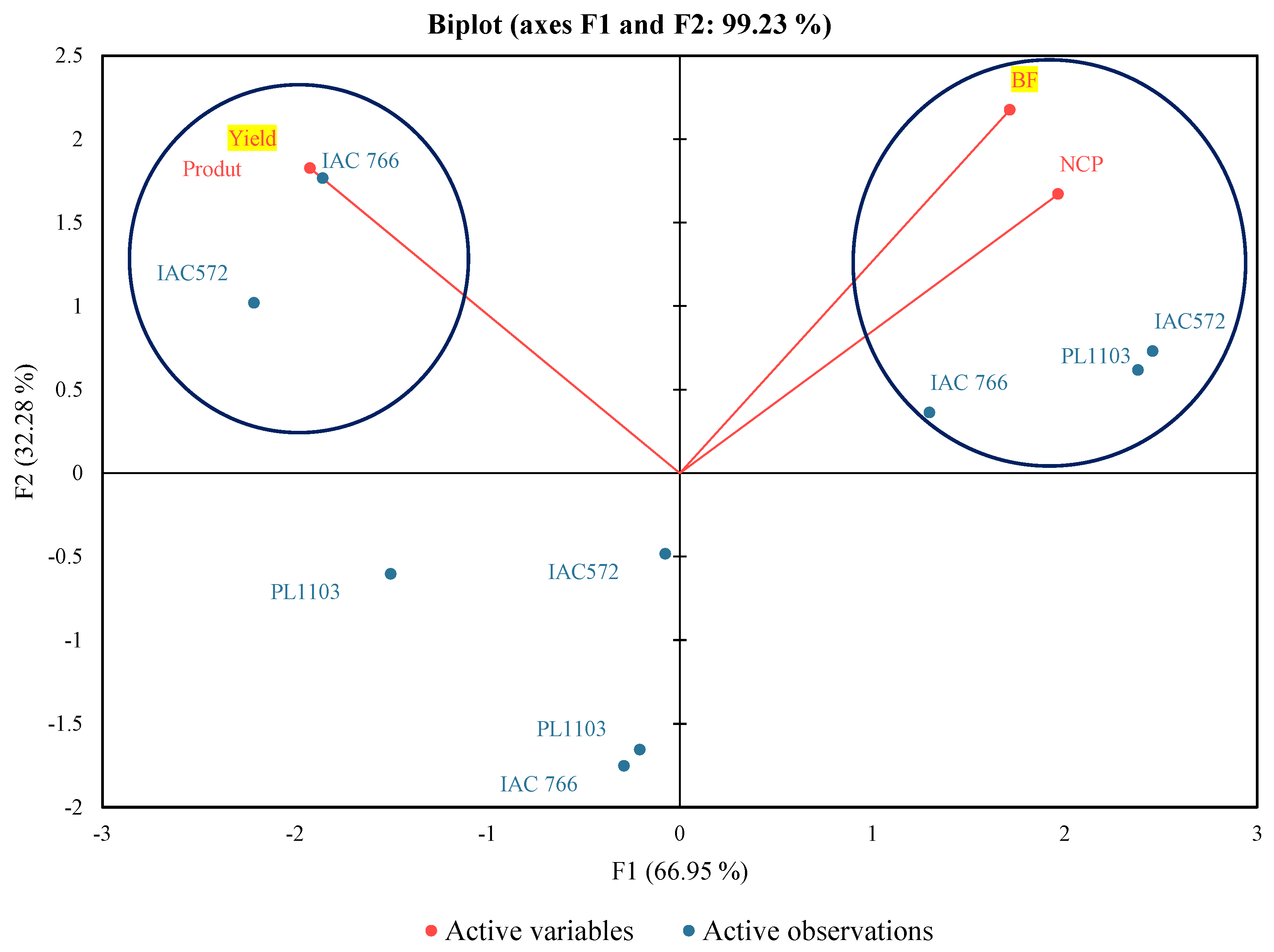
Principal Component Analysis (PCA) was applied to the production-related variables, including BF, NCP, yield, and productivity. Prior to analysis, the data were standardized, and the PCA was performed based on the correlation matrix to eliminate scale effects among variables. The first two principal components explained 99.23% of the total variance, with 66.95% attributed to PC1 and 32.28% attributed to PC2 (Figure 3). PC1 was strongly associated with BF and the NCP, while PC2 was mainly associated with yield and productivity per vine. The biplot shows the formation of two main groupings: on one side, ‘IAC 572 Jales’ and ‘IAC 766 Campinas’ are positively associated with yield and productivity variables. On the other side, ‘Paulsen 1103’ has a distinct distribution, indicating a different behavior. This is potentially linked to its balanced vegetative-reproductive growth pattern.
Although univariate analyses results did not indicate any significant differences in production parameters among the rootstocks, the PCA highlighted relevant patterns. The proximity of ‘IAC 766 Campinas’ to ‘IAC 572 Jales’ indicates a similar productive behavior, characterized by a higher number of clusters and greater yield per vine. In contrast, the distinct positioning of ‘Paulsen 1103’ reflects its lower vegetative vigor, a trait widely reported in the literature [17,26]. This may limit assimilate partitioning and reduce yield-related traits.
These findings emphasize rootstock selection as a strategic tool for vine adaptation to edaphoclimatic conditions and to modulate the balance between vigor and productive efficiency [8,22]. They also demonstrated the value of PCA for capturing joint variations across multiple variables that may remain undetected in univariate analyses. Although average yields did not differ significantly among rootstocks, the distinctive profile of ‘Paulsen 1103’ suggests the need for tailored management practices, such as more rigorous pruning or shoot thinning, to optimize its performance in ‘BRS Núbia’ under subtropical conditions.
Although vine vigor was not evaluated in this study, field observations conducted over the three growing seasons suggested differences in vegetative growth among the rootstocks evaluated. Vines grafted onto ‘IAC 572 Jales’ and ‘IAC 766 Campinas’ tended to exhibit more pronounced vegetative development, with greater shoot growth and canopy density, while vines grafted onto ‘Paulsen 1103’ generally displayed more moderate vegetative expression. These observations are consistent with the known agronomic behavior of these rootstocks; such qualitative differences in canopy development may help contextualize the productive and biochemical responses observed in this study, particularly in relation to source-sink balance, without extrapolating the scope of the measured variables.

3.2. Physical Characteristics of Clusters, Berries, and Rachis

No significant interaction (p > 0.05) was observed between rootstocks and production seasons for the physical characteristics of clusters, berries, or rachises. This allowed for an independent analysis of the factors (Table 2 and Table 3). Although rootstocks did not significantly influence these variables, the effect of the production season was significant for most of the evaluated attributes. Season III stood out by having the highest values for FCM (985.7 ± 147.8 g), cluster width (14.9 ± 1.64 cm), berry fresh mass (13.1 ± 1.14 g), number of berries per cluster (75.7 ± 12.2 units), and rachis fresh mass (18.4 ± 2.90 g). In contrast, the lowest values for these variables were recorded in season II. This indicated that climatic conditions and vine developmental stages directly influenced fruit formation and growth.
Although season II had the highest mean values for CL (25.1 ± 2.98 cm) and berry size (3.24 ± 0.09 cm in length and 2.46 ± 0.05 cm in width), these increases did not translate into higher cluster mass or berry count (Table 1). This pattern indicated lower cluster compactness due to reduced berry density. Despite larger individual berries, this resulted in lighter clusters. Therefore, berry size alone is insufficient to increase cluster mass. In this context, cluster architecture, BF, and berry growth dynamics must be considered [60,61].
In contrast, season III achieved a higher cluster mass owing to both a greater berry number and larger berry mass, which directly contributed to the yield and productivity. Cluster and berry fresh mass are recognized indicators of grapevine performance and are influenced by genetic, climatic, and management factors, such as solar radiation, temperature, and water availability [30,62]. These findings highlight the role of climatic conditions and vine developmental stage in shaping the physical traits of fruit. Season III was the most favorable for heavier clusters and larger berries, which reflects the productive potential of the cultivar under suitable conditions. Variation among seasons illustrates the interaction between the genetic background and the seasonal environment. Compact clusters with greater berry mass enhance commercial quality, improving both visual appeal and yield per unit area.
Comparative analyses across cultivars and environments indicate that rootstock effects on yield and cluster–berry morphology are strongly modulated by climatic conditions. For ‘BRS Clara’ grown under semi-arid conditions in Petrolina–PE, vines grafted onto ‘P1103’ showed the highest yield per vine (10.20 kg vine−1), NBC (51.31), and BW (205.13 g), whereas ‘IAC 572’ resulted in lower yield (4.30 kg vine−1) and reduced berry number [4], despite presenting a higher berry length-to-width ratio, indicating distinct morphological responses. Similarly, for ‘BRS Maria Bonita’ grown under the same semi-arid conditions, the rootstocks ‘IAC 572’ and ‘IAC 766’ promoted greater bunch weight (276.30 and 273.66 g, respectively) and berry mass, while productivity per vine ranged from 4.63 to 7.37 kg vine−1 [4], reinforcing the rootstock function in determining nutrient absorption capacity.
Under subtropical conditions in São Manuel–SP, ‘BRS Vitória’ grafted onto ‘IAC 572 Jales’ showed greater bunch weight (332.47 g), number of berries per bunch (70.75) and berry weight (4.51 g) compared to ‘IAC 766 Campinas’ and ‘Paulsen 1103’ [29], highlighting that more vigorous rootstocks tend to increase bunch size and number of berries when thermal and water limitations are less restrictive. Taken together, these results demonstrate that the rootstock-mediated effects on yield and physical characteristics depend on the cultivar and the environment, with semi-arid conditions favoring balanced rootstocks, while subtropical environments allow greater expression of yield components in more vigorous combinations.
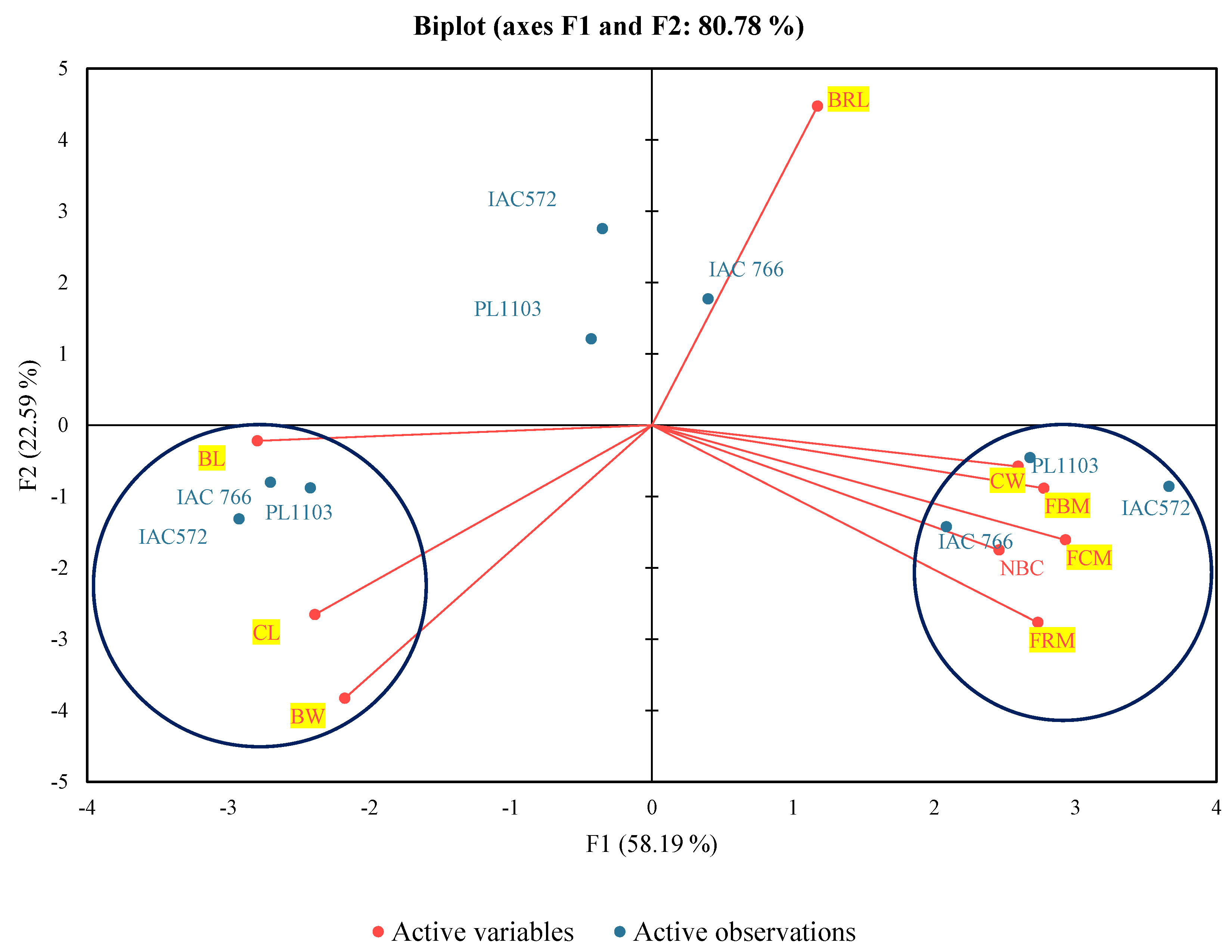
In contrast, the elongated clusters recorded in season II, associated with a lower berry number and mass, suggest an imbalance between vegetative and reproductive growth. This is likely linked to suboptimal photoassimilate accumulation under less favorable microclimatic conditions. In grapevines, optimizing the source–sink relationship is crucial for achieving fruits with high mass and uniformity, a process strongly modulated by radiation and water supply during berry filling. Therefore, maximizing productivity and fruit quality in table grapes requires the genetic potential of the cultivar and the alignment of climatic conditions with critical stages of fruit development. Applied to the physical characteristics, PCA explained 80.78% of the total variability in the first two components, with 58.19% attributed to PC1 and 22.59% to PC2 (Figure 4). PC1 was primarily associated with variables related to fruit size and weight, including FCM, fresh berry mass (FBM), number of berries per cluster (NBC), and FRM. PC2 was associated with berry length (BL), cluster length (CL), berry width (BW), and berry length-to-width ratio (BRL).
The biplot has two distinct clusters. On the right, ‘Paulsen 1103,’ ‘IAC 572 Jales,’ and ‘IAC 766 Campinas’ are positively associated with berry number and mass, indicating greater potential for yield improvement and cluster compactness. On the left, the same rootstocks are positioned near the dimensional traits (BL and width), which contribute less to the differentiation. These findings demonstrate that the performance of ‘BRS Núbia’ was more strongly driven by berry number and mass than by individual berry or cluster size. Among the rootstocks, ‘Paulsen 1103’ stood out for promoting higher fruit load. This is consistent with reports that it enhances assimilate partitioning to berries, which increases fresh mass. In contrast, ‘IAC 572 Jales’ and ‘IAC 766 Campinas’ tended to maintain a balance between vegetative vigor and productivity [17,25].

3.3. Chemical Characteristics of ‘BRS Núbia’ Grape Juice

A significant interaction (p < 0.05) was observed between rootstocks and production seasons for soluble solids content (SS), TA, pH, and the maturity index (SS/TA) in the juice of ‘BRS Núbia’ grapes (Table 4). The combination of the rootstock ‘Paulsen 1103’ with production season III resulted in the highest soluble solids content (18.8 ± 0.04 °Brix) and the highest maturity index (40.7 ± 3.92), indicating fruits with superior ripening quality (Table 4).
In season II, the lowest SS were recorded for ‘Paulsen 1103’ (17.2 ± 0.04 °Brix) and ‘IAC 572 Jales’ (17.3 ± 0.04 °Brix). This indicated that the environmental conditions of season III were more favorable for sugar accumulation. The reduction in season II was likely related to lower solar radiation and milder temperatures during ripening, which may limit photosynthesis and assimilate transport to the berries [49,63]. Excess rainfall in season II also likely stimulated vegetative growth, reducing assimilate allocation to fruits [64,65,66]. This is a physiological response common in humid environments that compromises sugar accumulation.
TA varied from 0.38 ± 0.04% to 0.71 ± 0.04% across rootstocks and production seasons (Table 4). In season III, vines grafted onto ‘IAC 766 Campinas’ exhibited the highest TA value (0.71 ± 0.04%), followed by ‘IAC 572 Jales’ (0.51 ± 0.03%). In season II, the maximum TA was observed in ‘IAC 572 Jales’ (0.51 ± 0.08%), whereas lower values were recorded for ‘Paulsen 1103’, particularly in season II (0.38 ± 0.04%). Overall, TA was influenced by both production season and rootstock, with greater acidity generally associated with season III. Despite the higher temperatures observed during season III, titratable acidity was maintained or even increased in some rootstocks. This response suggests that factors beyond temperature, source–sink balance, and seasonal water availability may have modulated organic acid metabolism during berry ripening. Although warmer conditions generally favor organic acid degradation, the more regular rainfall distribution and the physiological influence of specific rootstocks may have contributed to the preservation of acidity by sustaining canopy functionality and delaying excessive respiratory consumption of malic and tartaric acids [67,68]. Similar interactions between climate conditions and rootstock effects on berry acidity have been reported in subtropical viticulture.
The juice pH showed the opposite trend, with higher values in season II, such as 3.85 ± 0.06 for ‘IAC 572 Jales’ and 3.82 ± 0.06 for ‘Paulsen 1103’, and significantly lower values in season III (3.40 ± 0.03 for ‘IAC 766 Campinas’ and 3.34 ± 0.07 for ‘IAC 572 Jales’). This reduction in season III was consistent with the higher sugar accumulation and lower acidity, typically under a wider thermal amplitude and reduced rainfall. The higher pH during season II may reflect cooler and more humid conditions, which preserve organic acids and reduce respiratory loss [69,70]. Potassium translocation also influences pH. Rootstocks such as ‘Paulsen 1103’ tend to increase pH, while ‘IAC 766 Campinas’ maintains lower values [71,72]. Therefore, pH variations reflect both environmental conditions and rootstock-mediated mineral metabolism.
The SS/TA varied significantly across treatments, with the highest values in season III for ‘Paulsen 1103’ (40.7 ± 3.92) and ‘IAC 572 Jales’ (36.4 ± 3.92), indicating sweeter berries with lower acidity. These results were attributed to the warmer and drier conditions of season III, which promoted sugar accumulation and organic acid degradation [49,73,74]. In contrast, the lowest maturity index occurred in season II for ‘IAC 766 Campinas’ (26.9 ± 5.18), reflecting a less favorable sugar-to-acid ratio due to milder temperatures and excessive humidity that preserved acids and reduced photosynthetic efficiency [49,75]. These results demonstrate that the maturity index of ‘BRS Núbia’ is strongly shaped by the interaction between environmental factors and grapevine physiology. Season III offered the most favorable conditions for achieving the sugar–acid balance required for high-quality table grapes in subtropical climates.
Comparisons of must chemical attributes across cultivars, environments, and rootstocks indicate a relatively stable pattern for soluble solids, pH, titratable acidity, and maturity index, with stronger modulation by environmental conditions than by rootstock choice. For ‘BRS Isis’ grafted onto ‘IAC 572 Jales’, ‘IAC 766 Campinas’, and ‘Paulsen 1103’ under subtropical conditions, soluble solids ranged from 16.38 to 16.71 °Brix, pH values remained close to 3.45, titratable acidity varied between 0.39 and 0.42%, and the maturity index ranged from 45.66 to 50.00, with no significant differences among rootstocks [9]. A similar response was observed for ‘BRS Vitória’ grafted onto the same rootstocks in São Manuel–SP, where soluble solids varied from 16.99 to 19.08 °Brix, pH ranged from 3.46 to 3.49, titratable acidity from 0.50 to 0.52%, and maturity index from 34.38 to 39.40, indicating limited rootstock influence on must composition [29].
Under contrasting edaphoclimatic conditions in Goiânia–GO [15], ‘BRS Vitória’ grafted onto ‘IAC 572 Jales’ and ‘IAC 766 Campinas’ also showed stable must attributes, with soluble solids close to 19–20 °Brix, pH between 3.51 and 3.64, and titratable acidity ranging from 0.58 to 0.62%. Consistently, in the present study, ‘BRS Núbia’ grafted onto ‘IAC 572 Jales’ and ‘IAC 766 Campinas’ exhibited soluble solids of 18.00 ± 1.41 and 18.31 ± 0.48 °Brix, pH values of 3.02 ± 0.06 and 3.04 ± 0.05, titratable acidity of 0.51 ± 0.01 and 0.52 ± 0.04%, and maturity indices of 35.07 ± 2.40 and 35.27 ± 3.95, respectively, with no significant differences between rootstocks. These results confirm that most chemical attributes in Brazilian table grape cultivars are primarily governed by cultivar–environment interactions rather than by rootstock selection.
In subtropical conditions in Votuporanga–SP, and evaluated over three production seasons, most chemical attributes showed limited variation between rootstocks [18]. In ‘BRS Carmem’, soluble solids ranged from 17.51 to 17.73 °Brix and pH from 3.18 to 3.32 on ‘IAC 572 Jales’ and ‘IAC 766 Campinas’. Similar patterns were observed for ‘BRS Cora’, with soluble solids between 17.35 and 17.61 °Brix and pH from 3.05 to 3.12. In ‘Isabel Precoce’, soluble solids varied from 16.64 to 17.79 °Brix, while pH remained stable (3.18–3.21), regardless of rootstock. These results align with the present study, also conducted across three consecutive seasons, in which soluble solids, pH, titratable acidity, and maturity index showed low sensitivity to rootstock choice. Overall, these findings indicate that most chemical composition is predominantly driven by cultivar–environment interactions and seasonal climatic conditions, with rootstock effects playing a secondary role.

3.4. Biochemical Characteristics of Berries

The rootstocks significantly influenced the levels of total phenolic compounds, total monomeric anthocyanins, and antioxidant activity measured using the FRAP method. Meanwhile, no statistically significant differences were observed in the total flavonoids and antioxidant activity assessed using the DPPH method (Table 5).
Berries from vines grafted onto ‘IAC 766 Campinas’ and ‘Paulsen 1103’ showed higher total phenolic contents than those grafted onto ‘IAC 572 Jales’, with values above 120 mg 100 g−1. In contrast, values for ‘IAC 572 Jales’ averaged 109.07 ± 1.71 mg 100 g−1 (Table 5). Total flavonoid contents were not significantly affected by rootstock, with mean values of 17.25 ± 1.53 and 18.40 ± 1.77 mg 100 g−1 across treatments. Total monomeric anthocyanins followed a similar pattern to total phenolics, with higher mean values in berries from ‘IAC 766 Campinas’ (64.67 ± 2.37 mg 100 g−1) and ‘Paulsen 1103’ (64.67 ± 2.37 and 66.55 ± 5.35 mg 100 g−1) (Table 5). This increase is likely related to the vegetative vigor of ‘IAC 766 Campinas’ and ‘Paulsen 1103,’ which may favor the synthesis of secondary metabolites [29]. Phenolic compounds are key determinants of fruit nutritional quality and provide oxidative protection at the cellular level [76]. This accumulation may result from favorable rootstock–scion interactions that modulate secondary metabolism, particularly under high solar radiation and elevated temperatures during ripening [77,78].
Regarding antioxidant activity, no statistically significant differences among the rootstocks were detected using the DPPH assay, with mean values ranging from 15.66 ± 1.28 to 17.09 ± 1.87 µg Trolox g−1. In contrast, the FRAP assay indicated higher reducing power in berries from vines grafted onto ‘Paulsen 1103’, which averaged 9.59 ± 0.35 mmol FeSO4 100 g−1 (Table 5). The superior antioxidant potential of ‘Paulsen 1103’ is consistent with its higher phenolic and anthocyanin levels, which are closely linked to radical scavenging activity [79,80].
These results demonstrate that rootstocks influence grapevine productivity and berry biochemical composition, with direct implications for nutritional quality and postharvest longevity. Rootstocks such as ‘Paulsen 1103’ and ‘IAC 766 Campinas’ appear to modulate carbon allocation and phenylpropanoid metabolism during ripening, promoting the accumulation of antioxidant compounds in the vineyard environment. Therefore, rootstock selection should not only be based on vigor or edaphoclimatic adaptation, but also on the capacity to enhance the nutritional and bioactive attributes of table grapes, which are increasingly demanded by premium markets.
For other table grape cultivars, the effects of rootstock on the bioactive composition of the berries were consistently observed. In ‘BRS Isis’ [9] grown under subtropical conditions, vines grafted onto ‘Paulsen 1103’ showed higher total phenolic content (123.89 ± 1.47 mg 100 g−1) compared to ‘IAC 572 Jales’ (109.93 ± 2.47 mg 100 g−1) and ‘IAC 766 Campinas’ (110.08 ± 4.76 mg 100 g−1). The total flavonoid content followed a similar trend, with higher values in ‘Paulsen 1103’ (12.45 ± 0.28 mg 100 g−1) compared to ‘IAC 766 Campinas’ (6.70 ± 0.20 mg 100 g−1). Anthocyanin levels were numerically higher in ‘Paulsen 1103’ (43.04 ± 6.35 mg 100 g−1), although without statistical significance.
In the ‘BRS Vitória’ cultivar, in São Manuel–SP [29], the grapes grafted onto ‘Paulsen 1103’ also showed the highest accumulation of total phenolics (226.70 ± 4.40 mg 100 g−1), flavonoids (25.07 ± 0.85 mg 100 g−1) and anthocyanins (181.29 ± 12.19 mg 100 g−1), exceeding the values observed in ‘IAC 572 Jales’ and ‘IAC 766 Campinas’. Under arid conditions in Giza, Egypt, Flame Seedless grapes [34] grafted onto ‘Paulsen 1103’ showed higher total phenolic content (average ≈ 10.23 mg g−1 fresh weight) compared to the Freedom rootstock (9.99 mg g−1 fresh weight), indicating enhanced antioxidant metabolism.
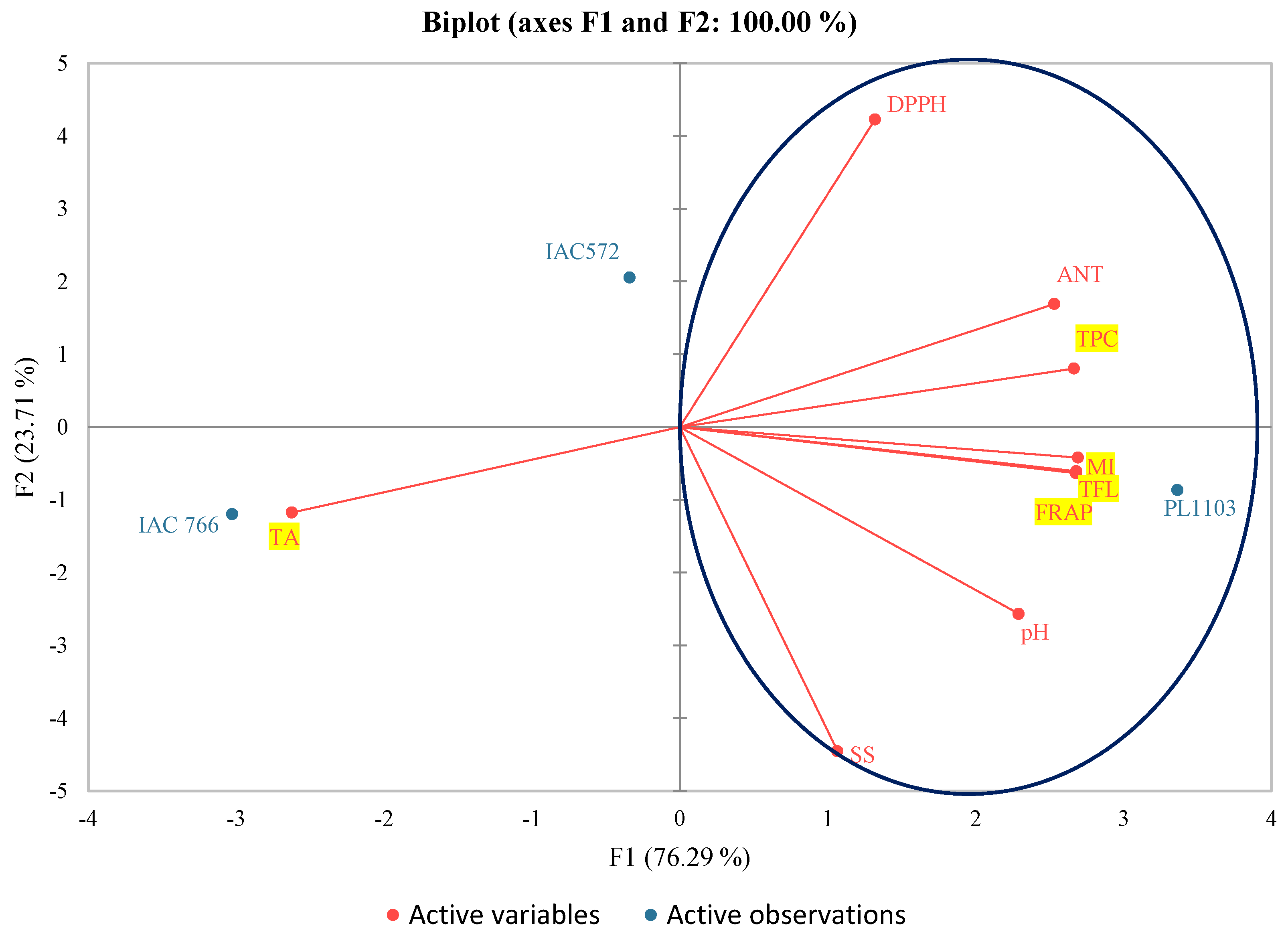
PCA applied to the chemical and biochemical variables explained 100% of the total variability in the first two components, with 76.29% attributed to PC1 and 23.71% attributed to PC2 (Figure 5). PC1 was positively associated with SS, MI, TFL, TPC, ANT, FRAP, and pH. Meanwhile, TA showed a negative correlation. PC2 was primarily influenced by DPPH, providing complementary information on its antioxidant activity.
The biplot shows clear groupings. ‘Paulsen 1103’ stood out for its higher concentrations of bioactive compounds, that is, phenolics, anthocyanins, and flavonoids, stronger antioxidant activity (FRAP and DPPH), and elevated soluble solids and MI, indicating a superior chemical profile. In contrast, ‘IAC 766 Campinas’ was associated with TA, reflecting fruit with a more acidic profile and delayed ripening. ‘IAC 572 Jales’ occupied an intermediate position, showing balanced chemical traits without strong associations with specific variables.
These findings emphasize that rootstock choice influences agronomic performance and the nutritional and functional qualities of table grapes. Known for its moderate-to-high vigor and efficient potassium uptake, ‘Paulsen 1103’ appears to stimulate secondary metabolite synthesis, which enhances antioxidant potential and sensory attributes [29,79]. Conversely, ‘IAC 766 Campinas’ may require targeted management practices, such as crop load regulation or canopy training, to improve ripening and reduce acidity under subtropical conditions. PCA is essential for detecting multivariate patterns among scion–rootstock combinations, providing an integrated view of grape chemical and bioactive attributes. For growers seeking grapes with higher functional and nutritional value, ‘Paulsen 1103’ is the most promising rootstock under the evaluated conditions.

4. Conclusions

Under subtropical conditions, rootstocks did not significantly affect the yield-related production parameters of ‘BRS Núbia’ grapevines; however, marked differences were observed among production seasons. The third production season, characterized by higher temperatures and a greater number of productive shoots, resulted in increased bud fruitfulness, number of clusters per vine, and overall productivity. Physical attributes of clusters, berries, and rachises were also strongly influenced by production season, with season III showing greater cluster and berry mass, wider clusters, and a higher number of berries per cluster.
Regarding berry biochemical composition, rootstocks played a relevant role. ‘IAC 766 Campinas’ and ‘Paulsen 1103’ promoted higher accumulation of total phenolic compounds and anthocyanins and greater antioxidant activity as assessed by the FRAP method, whereas total flavonoids and antioxidant activity measured by DPPH were not affected.
Overall, ‘IAC 572 Jales’, ‘IAC 766 Campinas’, and ‘Paulsen 1103’ are suitable rootstocks for cultivating ‘BRS Núbia’ under subtropical conditions. Nevertheless, when the production goal includes enhancing the functional and nutritional quality of table grapes ‘IAC 766 Campinas’ and especially ‘Paulsen 1103’ represent more advantageous choices, while seasonal climatic conditions and/or vine maturity remain the primary drivers of vine performance.

Author Contributions

Conceptualization, M.A.T., H.S.A.M., S.L., S.R.R. and G.P.P.L.; investigation, H.S.A.M., M.A.T., S.d.N.S.B., D.E.F.F., J.C.A., M.d.S.S. and A.C.d.A.; methodology, M.A.T., H.S.A.M., S.d.N.S.B., G.P.P.L., H.S.A.M. and S.R.R.; supervision, M.A.T., H.S.A.M. and S.L.; visualization, M.A.T. and H.S.A.M.; writing—original draft, H.S.A.M., M.A.T., G.P.P.L., S.R.R. and S.L. All authors have read and agreed to the published version of the manuscript.

Funding

This research was funded by the Coordenação de Aperfeiçoamento de Pessoal de Nível Superior (CAPES) process no. 88887.669920/2022-00 through granting the scholarship for the first author. We also have the research assistance project from the Fundação de Amparo à Pesquisa do Estado de São Paulo (FAPESP), project number 2020/121523, and the support of the Conselho Nacional de Desenvolvimento Científico e Tecnológico (CNPq) for a Research Productivity Grant (process number 304258/2024-5).

Data Availability Statement

The original contributions presented in this study are included in the article. Further inquiries can be directed to the corresponding authors.

Acknowledgments

To São Paulo State University (UNESP), School of Agriculture Science, Botucatu, especially the Graduate Program in Agronomy/Horticulture, for the opportunity to pursue a Master’s degree and carry out this research.

Conflicts of Interest

The authors declare that the research was conducted in the absence of any commercial or financial relationships that could be construed as a potential conflict of interest.

References

  1. Leão, P.C.d.S.; Carvalho, J.N.d. Tropical Viticulture in Brazil: São Francisco Valley as an Important Supplier of Table Grapes to the World Market. In Latin American Viticulture Adaptation to Climate Change: Perspectives and Challenges of Viticulture Facing up Global Warming; Gamboa, G.G., Fourment, M., Eds.; Springer: Cham, Switzerland, 2024; pp. 47–59. [Google Scholar]
  2. Botelho, R.V.; Pires, E.J.P.; Roberto, S.R.; Alvarenga, A.A.; Norberto, P.M.; Chalfun, N.N.J.; Pio, R. Propagação. In Uva: Do Vineio à Colheita; Motoike, S., Borém, A., Eds.; Editora UFV: Viçosa, MG, Brazil, 2018; pp. 61–83. [Google Scholar]
  3. Silva, J.N.D.; Ponciano, N.J.; Souza, C.L.M.; Souza, P.M.D.; Viana, L.H. Characterization of tropical viticulture in the Fluminense north and northwest regions. Rev. Bras. Frutic. 2019, 41, e-136. [Google Scholar] [CrossRef]
  4. Leão, P.C.d.S.; Oliveira, C.R.S.D. Agronomic performance of table grape cultivars affected by rootstocks in semi-arid conditions. Bragantia 2023, 82, e20220176. [Google Scholar] [CrossRef]
  5. Moura, M.F.; de Oliveira, G.L.; Rodrigues, C.S.; Paioli-Pires, E.J. The Role of Vine Breeding in Grapevine Production. In Advances in Botanical Research; Academic Press: Cambridge, MA, USA, 2024; Volume 110, pp. 255–294. [Google Scholar] [CrossRef]
  6. Associação Brasileira dos Produtores Exportadores de Frutas e Derivados (ABRAFRUTAS). Produção de Frutas Brasileiras, por Estado. Brasília. 2023. Available online: https://abrafrutas.org/paineis-de-producao/ (accessed on 15 January 2024).
  7. Instituto Brasileiro de Geografia e Estatística (IBGE). Levantamento Sistemático da Produção Agrícola (LSPA); IBGE: Rio de Janeiro, Brazil, 2023. Available online: https://sidra.ibge.gov.br/pesquisa/lspa/tabelas (accessed on 12 January 2024).
  8. Callili, D.; Silva, M.J.R.; Sanchez, C.A.P.C.; Watanabe, C.Y.; Macedo, B.M.P.; Domingues Neto, F.J. Rootstock and potassium fertilization, in terms of phenology, thermal demand and chemical evolution, of berries on Niagara rosada grapevine under subtropical conditions. Bragantia 2022, 81, 2022. [Google Scholar] [CrossRef]
  9. Sánchez, C.A.P.C.; Tecchio, M.A.; Callili, D.; da Silva, M.J.R.; Basílio, L.S.P.; Leonel, S.; Lima, G.P.P. Productivity and physicochemical properties of the BRS Ísis grape on various rootstocks under subtropical climatic conditions. Agriculture 2023, 13, 2113. [Google Scholar] [CrossRef]
  10. Santana, S.; Dos Santos, V.; Tecchio, M.; Pereira, L.; Nunes, A.; Almeida, H.; Pereira, G. Caracterização físico-química de uvas ‘BRS Vitória’ cultivadas em clima subtropical. Rev. Iberoam. Tecnol. Postcosecha 2023, 24, 150–163. [Google Scholar]
  11. Mello, L.M.R.; Machado, C.A.E. Vitivinicultura Brasileira: Panorama 2021; Comunicado Técnico n. 26; Embrapa Uva e Vinho: Bento Gonçalves, RS, Brazil, 2022; 17p. [Google Scholar]
  12. Instituto Brasileiro de Geografia e Estatística (IBGE). Levantamento Sistemático da Produção Agrícola (LSPA). 2024. Available online: https://sidra.ibge.gov.br/pesquisa/lspa/tabelas (accessed on 20 March 2025).
  13. Maia, J.D.G.; Ritschel, P.; Camargo, U.A.; Souza, R.T.; Farjado, T.V.M.; Girardi, C.L. BRS Núbia Nova Cultivar de Uva para Mesa com Sementes e Coloração Preta Uniforme; Circular Técnica n. 139; Embrapa Uva e Vinho: Bento Gonçalves, RS, Brazil, 2013; 12p. [Google Scholar]
  14. Leão, P.C.d.S.; Lima, M.A.C.d. Cultivar BRS Núbia: Produtividade e Qualidade da Uva no Submédio do Vale do São Francisco; Circular Técnica n. 172; Embrapa Semiárido: Petrolina, PE, Brazil, 2017. [Google Scholar]
  15. Campos, L.; Vendruscolo, E.; Campos, C.; Teramoto, A.; Seleguini, A. Preliminary results on agronomic behavior of table grapes on different rootstocks in Brazilian Cerrado conditions. Agric. Conspec. Sci. 2022, 87, 265–276. [Google Scholar]
  16. Monteiro, H.S.A.; Tecchio, M.A.; Brito, S.d.N.S.; Neto, F.J.D.; Sánchez, C.A.P.C.; Alonso, J.C.; Feliciano, D.E.F.; Maniero, C.R.; Cunha, P.H.H.; Silva, M.d.S. Phenological development, thermal requirement, and quality of ‘BRS Núbia’ (Vitis vinifera L. × Vitis labrusca L.) grapes on different rootstocks. Horticulturae 2025, 11, 466. [Google Scholar] [CrossRef]
  17. Tecchio, M.A.; Silva, M.J.; Callili, D.; Hernandes, J.L.; Moura, M.F. Yield of white and red grapes, in terms of quality, from hybrids and Vitis labrusca grafted on different rootstocks. Sci. Hortic. 2020, 259, 108846. [Google Scholar] [CrossRef]
  18. Tecchio, M.A.; Silva, M.J.R.; Cunha, S.R.; Callili, D.; Sánchez, C.A.P.C.; Souza, J.R.; Moura, M.F. Productive performance and physicochemical quality of grapes for processing grown on different rootstocks. Pesq. Agropec. Bras. 2022, 57, e02071. [Google Scholar] [CrossRef]
  19. Domingues-Neto, F.J.; Pimentel Junior, A.; Modesto, L.R.; Moura, M.F.; Putti, F.F.; Boaro, C.S.F.; Ono, E.O.; Rodrigues, J.D.; Tecchio, M.A. Photosynthesis, biochemical and yield performance of grapevine hybrids in two rootstock and trellis height. Horticulturae 2023, 9, 596. [Google Scholar] [CrossRef]
  20. Domingues Neto, F.J.; Tecchio, M.A.; Borges, C.V.; Rodrigues, J.D.; Ono, E.O.; Lima, G.P.P.; Moura, M.F.; Hernandes, J.L.; Silva, M.d.S.; Leonel, M. Yield performance and quality assessment of Brazilian hybrid grapes influenced by rootstocks and training systems. Horticulturae 2024, 10, 909. [Google Scholar] [CrossRef]
  21. Mahouachi, J. Long-term salt stress influence on vegetative growth and foliar nutrient changes in mango (Mangifera indica L.) seedlings. Sci. Hortic. 2018, 234, 95–100. [Google Scholar] [CrossRef]
  22. Ahanger, M.A.; Ahmad, P. Role of mineral nutrients in abiotic stress tolerance: Revisiting the associated signaling mechanisms. In Vine Signaling Molecules; Elsevier: Amsterdam, The Netherlands, 2019; pp. 269–285. [Google Scholar]
  23. Souza, L.P.; Nobre, R.G.; Gheyi, H.R.; Fátima, R.T.; Lima, G.S.; Diniz, G.L. Índices fisiológicos e crescimento de porta-enxertos de cajueiro sob estresse salino e concentrações de prolina. Irriga 2021, 1, 169–183. [Google Scholar] [CrossRef]
  24. Tecchio, M.A.; Moura, M.F.; Teixeira, L.A.J.; Paioli-Pires, E.J.; Leonel, S. Influence of rootstocks and pruning times on yield and on nutrient content and extraction in ‘Niagara Rosada’ grapevine. Pesq. Agropec. Bras. 2014, 49, 340–348. [Google Scholar] [CrossRef]
  25. Callili, D.; Tecchio, M.A.; Sánchez, C.A.P.C.; Campos, O.P.; Teixeira, L.A.; Campos, L.S.; Bonfim, F.P.G.; Leonel, S. Rootstocks on yield and on nutrient uptake and extraction in ‘BRS Vitória’ grapevine. Bragantia 2025a, 84, e20240213. [Google Scholar] [CrossRef]
  26. Lecourt, J.; Lauvergeat, V.; Ollat, N.; Vivin, P.; Cookson, S.J. Shoot and root ionome responses to nitrate supply in grafted grapevines are rootstock genotype dependent. Aust. J. Grape Wine Res. 2015, 21, 311–318. [Google Scholar] [CrossRef]
  27. Zamboni, M.; Garavani, A.; Gatti, M.; Vercesi, A.; Parisi, M.G.; Bavaresco, L.; Poni, S. Vegetative, physiological and nutritional behavior of new grapevine rootstocks in response to different nitrogen supply. Sci. Hortic. 2016, 202, 99–106. [Google Scholar] [CrossRef]
  28. Cechin, K.S.R.S.; Bernardi, D.M. Elaboração e análise sensorial de patê de frango com ômega-3 e antioxidantes naturais do bagaço de uva. Fag J. Health 2020, 2, 93–102. [Google Scholar] [CrossRef]
  29. Callili, D.; Tecchio, M.A.; Sánchez, C.A.P.C.; Domingues Neto, F.J.; Bonfim, F.P.G.; Silva, M.S.; Leonel, S.; Lima, G.P.P.; Campos, O.P. Table grape ‘BRS Vitória’ yield performance, vigor, and quality as influenced by rootstocks in a subtropical region. Aust. J. Crop Sci. 2025, 19, 284–291. [Google Scholar] [CrossRef]
  30. Silva, M.J.R.d.; Paiva, A.P.M.; Junior, A.P.; Sánchez, C.A.P.C.; Callili, D.; Moura, M.F.; Tecchio, M.A. Yield performance of new juice grape varieties grafted onto different rootstocks under tropical conditions. Sci. Hortic. 2018, 241, 194–200. [Google Scholar] [CrossRef]
  31. Oliveira, C.R.S.D.; Silva, F.B.D.; Pontes, G.M.D.A.; Mendonça, A.F.; Leão, P.C.D.S. Agronomic performance of ‘BRS Melodia’ seedless table grape grafted onto different rootstocks. Bragantia 2024, 83, e20230245. [Google Scholar] [CrossRef]
  32. Grigolo, C.R.; Citadin, I.; Pereira, E.A.; Oliveira, L.D.S.D.; Gobetti, R.C.R.; Feldberg, N.P. Yield components and physical attributes of the ‘BRS Magna’ grapevine on different rootstocks. Ciênc. Agrotec. 2023, 47, e008023. [Google Scholar] [CrossRef]
  33. Leão, P.C.D.S.; Nascimento, J.H.B.D.; Moraes, D.S.D.; Souza, E.R.D. Rootstocks for the new seedless table grape ‘BRS Vitória’ under tropical semi-arid conditions of São Francisco Valley. Ciênc. Agrot. 2020, 44, e025119. [Google Scholar] [CrossRef]
  34. Fayek, M.A.; Ali, A.E.M.; Rashedy, A.A. Physiological and chemical performance of the Flame seedless grapevine cultivar in the presence of Paulsen 1103 as the interstock. Ciênc. Agrotec. 2022, 46, e021621. [Google Scholar] [CrossRef]
  35. Empresa Brasileira de Pesquisa Agropecuária (EMBRAPA). Centro Nacional de Pesquisa de Solos—CNPS. Sistema Brasileiro de Classificação do Solo; EMBRAPA-SPI/Embrapa-CNPS: Brasília, Brazil; Rio de Janeiro, Brazil, 1999. [Google Scholar]
  36. Maia, J.D.G.; Ritschel, P.; Souza, R.T.; Garrido, L.R. BRS Vitória’ Uva Para Mesa, sem Sementes, de Sabor Especial e Tolerante ao Míldio: Recomendações Agronômicas para a Região de Campinas, São Paulo; Circular Técnica n. 129; Embrapa Uva e Vinho: Bento Gonçalves, RS, Brazil, 2016; pp. 1–28. [Google Scholar]
  37. Leão, P.C.D.S.; Silva, E.E.G.D. Brotação e fertilidade de gemas em uvas sem sementes no Vale do São Francisco. Rev. Bras. Frutic. 2003, 25, 375–378. [Google Scholar] [CrossRef]
  38. Eichhorn, K.W.; Lorenz, D.H. Phaenologische entwicklungsstadien der rebe. Bull. OIV 1984, 14, 295–298. [Google Scholar]
  39. AOAC International. Official Methods of Analysis, 18th ed.; AOAC International: Gaithersburg, MD, USA, 2005. [Google Scholar]
  40. Instituto Adolfo Lutz. Procedimentos e Determinações Gerais. In Metodos Fisico-Quimicos para Análise de Alimentos, 4th ed.; Zenebon, O., Pascuet, N.S., Tiglea, P., Eds.; Instituto Adolfo Lutz: São Paulo, SP, Brasil, 2008; pp. 85–104. [Google Scholar]
  41. Singleton, V.L.; Rossi, J.A. Colorimetry of total phenolics with phosphomolybdic-phosphotungstic acid reagents. Am. J. Enol. Vitic. 1965, 16, 144–158. [Google Scholar] [CrossRef]
  42. Santos, M.D.D.; Blatt, C.T.T. Teor de flavonóides e fenóis totais em folhas de Pyrostegia venusta Miers. de mata e de cerrado. Braz. J. Bot. 1998, 21, 135–140. [Google Scholar] [CrossRef]
  43. Awad, M.A.; de Jager, A.; Van Westing, L.M. Flavonoid and chlorogenic acid levels in apple fruit: Characterisation of variation. Sci. Hortic. 2000, 83, 249–263. [Google Scholar] [CrossRef]
  44. Popova, M.; Bankova, V.; Butovska, D.; Petkov, V.; Nikolova-Damyanova, B.; Sabatini, A.G.; Bogdanov, S. Validated methods for the quantification of biologically active constituents of poplar-type propolis. Phytochem. Anal. 2004, 15, 235–240. [Google Scholar] [CrossRef] [PubMed]
  45. Giusti, M.M.; Wrolstad, R.E. Characterization and measurement of anthocyanins by UV–visible spectroscopy. Curr. Protoc. Food Anal. Chem. 2001, 1, F1.2.1–F1.2.13. [Google Scholar] [CrossRef]
  46. Brand-Williams, W.; Cuvelier, M.E.; Berset, C.L.W.T. Use of a free radical method to evaluate antioxidant activity. LWT–Food Sci. Technol. 1995, 28, 25–30. [Google Scholar] [CrossRef]
  47. Benzie, I.F.F.; Strain, J.J. The ferric reducing ability of plasma (FRAP) as a measure of antioxidant power: The FRAP assay. Anal. Biochem. 1996, 239, 70–76. [Google Scholar] [CrossRef]
  48. Ferreira, D.F. SISVAR: A computer statistical analysis system. Ciênc. Agrotec. 2011, 35, 1039–1042. [Google Scholar] [CrossRef]
  49. Rienth, M.; Vigneron, N.; Darriet, P.; Sweetman, C.; Burbidge, C.; Bonghi, C.; Castellarin, S.D. Grape berry secondary metabolites and their modulation by abiotic factors in a climate change scenario—A review. Front. Plant Sci. 2021, 12, 643258. [Google Scholar] [CrossRef]
  50. Miccichè, D.; de Rosas, M.I.; Ferro, M.V.; Di Lorenzo, R.; Puccio, S.; Pisciotta, A. Effects of artificial canopy shading on vegetative growth and ripening processes of cv. Nero d’Avola (Vitis vinifera L.). Front. Plant Sci. 2023, 14, 1210574. [Google Scholar] [CrossRef]
  51. Poni, S.; Frioni, T.; Gatti, M. Summer pruning in Mediterranean vineyards: Is climate change affecting its perception, modalities, and effects? Front. Plant Sci. 2023, 14, 1227628. [Google Scholar] [CrossRef]
  52. Mendonça, J.A.; Da Silva, S.R.; Scarpare Filho, J.A. Análise das gemas permite estimar produtividade e orientar manejo. Rev. Visão Agrícola 2021, 14, 18–21. [Google Scholar]
  53. Taiz, L.; Møller, I.M.; Murphy, A.; Zeiger, E. Fisiologia e Desenvolvimento Vegetal, 7th ed.; Artmed: Porto Alegre, RS, Brazil, 2024; 834p. [Google Scholar]
  54. Ferrara, G.; Mazzeo, A. Potential and actual bud fruitfulness: A tool for predicting and managing the yield of table grape varieties. Agronomy 2021, 11, 841. [Google Scholar] [CrossRef]
  55. Monteiro, A.I.; Malheiro, A.C.; Bacelar, E.A. Morphology, physiology and analysis techniques of grapevine bud fruitfulness: A review. Agriculture 2021, 11, 127. [Google Scholar] [CrossRef]
  56. Callili, D.; Sánchez, C.A.P.C.; Campos, O.P.; Carneiro, D.C.D.S.; Scudeletti, A.C.B.; Tecchio, M.A. Phenology, thermal demand, and maturation development of the ‘BRS Vitória’ grape cultivated on different rootstocks in subtropical conditions. Rev. Bras. De Frutic. 2023, 45, e-999. [Google Scholar] [CrossRef]
  57. Shakya, R.; Lal, M.A. Photoassimilate translocation. In Plant Physiology, Development and Metabolism; Bhatla, S.C., Lal, M.A., Eds.; Springer: Singapore, 2018; pp. 227–251. [Google Scholar]
  58. Zhang, P.; Dong, T.; Jin, H.; Pei, D.; Pervaiz, T.; Ren, Y.; Fang, J. Analysis of photosynthetic ability and related physiological traits in nodal leaves of grape. Sci. Hortic. 2022, 304, 111251. [Google Scholar] [CrossRef]
  59. Dinu, D.G.; Ricciardi, V.; Demarco, C.; Zingarofalo, G.; De Lorenzis, G.; Buccolieri, R.; Rustioni, L. Climate change impacts on plant phenology: Grapevine (Vitis vinifera) bud break in wintertime in Southern Italy. Foods 2021, 10, 2769. [Google Scholar] [CrossRef]
  60. Kowalczyk, B.A.; Bieniasz, M.; Kostecka-Gugała, A. Flowering biology of selected hybrid grape cultivars under temperate climate conditions. Agriculture 2022, 12, 655. [Google Scholar] [CrossRef]
  61. O’Brien, P.; De Bei, R.; Sosnowski, M.; Collins, C. A review of factors to consider for permanent cordon establishment and maintenance. Agronomy 2021, 11, 1811. [Google Scholar] [CrossRef]
  62. Du, W.; Cui, X.; Zhu, Y.; Liu, P. Detection of table grape berries need to be removed before thinning based on deep learning. Comput. Electron. Agric. 2025, 231, 110043. [Google Scholar] [CrossRef]
  63. Leão, P.C.D.S.; Rego, J.I.D.S.; Nascimento, J.H.B.; Souza, E.M.D.C. Yield and physicochemical characteristics of ‘BRS Magna’ and ‘Isabel Precoce’ grapes influenced by pruning in the São Francisco river valley. Ciênc. Rural 2018, 48, e20170463. [Google Scholar] [CrossRef]
  64. Arrizabalaga-Arriazu, M.; Gomès, E.; Morales, F.; Irigoyen, J.J.; Pascual, I.; Hilbert, G. High temperature and elevated carbon dioxide modify berry composition of different clones of grapevine (Vitis vinifera L.) cv. Tempranillo. Front. Plant Sci. 2020, 11, 603687. [Google Scholar] [CrossRef]
  65. Prinsi, B.; Simeoni, F.; Galbiati, M.; Meggio, F.; Tonelli, C.; Scienza, A.; Espen, L. Grapevine rootstocks differently affect physiological and molecular responses of the scion under water deficit condition. Agronomy 2021, 11, 289. [Google Scholar] [CrossRef]
  66. Rogiers, S.Y.; Greer, D.H.; Liu, Y.; Baby, T.; Xiao, Z. Impact of climate change on grape berry ripening: An assessment of adaptation strategies for the Australian vineyard. Front. Plant Sci. 2022, 13, 1094633. [Google Scholar] [CrossRef]
  67. Moresi, F.V.; Cirigliano, P.; Rengo, A.; Brunori, E.; Biasi, R.; Scarascia Mugnozza, G.; Maesano, M. Monitoring abiotic stressors in rainfed vineyards involves combining UAV and field monitoring techniques to enhance precision management. Remote Sens. 2025, 17, 803. [Google Scholar] [CrossRef]
  68. Burbidge, C.A.; Ford, C.M.; Melino, V.J.; Wong, D.C.J.; Jia, Y.; Jenkins, C.L.D.; Sweetman, C. Biosynthesis and cellular functions of tartaric acid in grapevines. Front. Plant Sci. 2021, 12, 643024. [Google Scholar] [CrossRef]
  69. Wang, C.; Wang, L.; Ye, J.; Xu, F. Fruit quality of Vitis vinifera: How vine metabolites are affected by genetic, environmental, and agronomic factors. Sci. Hortic. 2022, 305, 111404. [Google Scholar] [CrossRef]
  70. Filimon, R.M.; Bunea, C.I.; Filimon, R.V.; Bora, F.D.; Damian, D. Long-term evolution of the climatic factors and its influence on grape quality in northeastern Romania. Horticulturae 2024, 10, 705. [Google Scholar] [CrossRef]
  71. Ramos, M.C.; Jara, M.Á.I.; Rosillo, L.; Salinas, M.R. Effect of temperature and water availability on grape phenolic compounds and their extractability in Merlot grown in a warm area. Sci. Hortic. 2024, 337, 113475. [Google Scholar] [CrossRef]
  72. Hu, W.; Wang, J.; Deng, Q.; Liang, D.; Xia, H.; Lin, L.; Lv, X. Effects of different types of potassium fertilizers on nutrient uptake by grapevine. Horticulturae 2023, 9, 470. [Google Scholar] [CrossRef]
  73. Chen, Y.; Fei, Y.; Howell, K.; Chen, D.; Clingeleffer, P.; Zhang, P. Rootstocks for grapevines now and into the future: Selection of rootstocks based on drought tolerance, soil nutrient availability, and soil pH. Aust. J. Grape Wine Res. 2024, 2024, 6704238. [Google Scholar] [CrossRef]
  74. Lu, H.C.; Chen, W.K.; Wang, Y.; Bai, X.J.; Cheng, G.; Duan, C.Q.; He, F. Effect of the seasonal climatic variations on the accumulation of fruit volatiles in four grape varieties under the double cropping system. Front. Plant Sci. 2022, 12, 809558. [Google Scholar] [CrossRef] [PubMed]
  75. Rafique, R.; Ahmad, T.; Ahmed, M.; Khan, M.A.; Wilkerson, C.J.; Hoogenboom, G. Seasonal variability in the effect of temperature on key phenological stages of four table grapes cultivars. Int. J. Biometeorol. 2023, 67, 745–759. [Google Scholar] [CrossRef]
  76. Geng, K.; Zhang, Y.; Lv, D.; Li, D.; Wang, Z. Effects of water stress on the sugar accumulation and organic acid changes in Cabernet Sauvignon grape berries. Hortic. Sci. 2022, 49, 164. [Google Scholar] [CrossRef]
  77. Wang, Y.; Ma, H.; Fu, X.; Wang, H.; Wang, R. Optimizing grape growth, berry quality and phenolic compounds with foliar co-application of iron and calcium. S. Afr. J. Bot. 2024, 169, 146–154. [Google Scholar] [CrossRef]
  78. Belviso, S.; Torchio, F.; Novello, V.; Giacosa, S.; De Palma, L.; Segade, S.R.; Gerbi, V.; Rolle, L. Modelling of the evolution of phenolic compounds in berries of ‘Italia’ table grape cultivar using response surface methodology. J. Food Compos. Anal. 2017, 62, 14–22. [Google Scholar] [CrossRef]
  79. Júnior, A.P.; Neto, F.J.D.; Monteiro, G.C.; Borges, C.V.; Lima, G.P.P.; Tecchio, M.A. Biochemical profile of ‘Niagara Rosada’ grapes under different rootstocks and training system. Rev. Bras. Ciênc. Agrár. 2021, 16, 1–6. [Google Scholar] [CrossRef]
  80. Kurt-Celebi, A.; Colak, N.; Hayirlioglu-Ayaz, S.; Kostadinović Veličkovska, S.; Ilieva, F.; Esatbeyoglu, T.; Ayaz, F.A. Accumulation of phenolic compounds and antioxidant capacity during berry development in black ‘Isabel’ grape (Vitis vinifera L. × Vitis labrusca L.). Molecules 2020, 25, 3845. [Google Scholar] [CrossRef] [PubMed]
Figure 1. * Seasons period. Annual meteorological data of maximum, minimum, and average temperature, and precipitation during the production seasons, São Manuel, São Paulo, Brazil. Source: Data obtained from the Department of Soil and Environmental Resources, FCA/UNESP, 2021, 2022, and 2023.
Agronomy 16 00347 g001
Figure 2. Pruning and harvest dates of ‘BRS Núbia’ grapes over three production seasons in São Manuel, São Paulo, Brazil.
Agronomy 16 00347 g002
Figure 3. Principal Component Analysis (PCA) biplot of production parameters of ‘BRS Núbia’ table grapes grafted onto different rootstocks. under subtropical conditions. The PCA was performed using standardized data based on the correlation matrix. Note: BF, Bud fruitfulness; NCP, Number of clusters per vine; Yield (kg per vine); and Produt, Productivity (t ha−1). Rootstocks: ‘IAC 572 Jales’, ‘IAC 766 Campinas’, and ‘Paulsen 1103’. Active observations correspond to the evaluated rootstocks.
Agronomy 16 00347 g003
Figure 4. Principal Component Analysis (PCA) biplot of physical characteristics of ‘BRS Núbia’ table grapes grafted onto different rootstocks under subtropical conditions. The PCA was performed using standardized data based on the correlation matrix. Note: BL: Berry length; BW: Berry width; BRL: Berry length-to-width ratio; CL: Cluster length; CW: Cluster width; FCM: Fresh cluster mass; FBM: Fresh berry mass; NBC: Number of berries per cluster; FRM: Fresh rachis mass. Rootstocks: ‘IAC 572 Jales’, ‘IAC 766 Campinas’, and ‘Paulsen 1103’. Active observations correspond to the evaluated rootstocks.
Agronomy 16 00347 g004
Figure 5. Principal Component Analysis (PCA) biplot of chemical and biochemical characteristics of ‘BRS Núbia’ table grape grafted onto different rootstocks under subtropical conditions. The PCA was performed using standardized data based on the correlation matrix. Note: SS, Soluble solids; TA, Titratable acidity; MI, Maturity index; TFL, Total flavonoids; TPC, Total phenolics; ANT, Anthocyanins; antioxidant activity determined by DPPH, and ferric reducing antioxidant power (FRAP). Rootstocks: ‘IAC 572 Jales’, ‘IAC 766 Campinas’, and ‘Paulsen 1103’. Active observations correspond to the evaluated rootstocks.
Agronomy 16 00347 g005
Table 1. Bud fruitfulness and productive performance of ‘BRS Núbia’ grapevines grafted onto various rootstocks and assessed across production seasons under subtropical conditions, São Manuel, São Paulo, Brazil.
RootstocksBF
(Ratio)
NCP
(Number/Vine)
Yield
(kg/Vine)
Productivity
(t ha−1)
‘IAC 572 Jales’0.57 ± 0.1614.2 ± 5.4611.7 ± 3.6119.4 ± 6.01
‘IAC 766 Campinas’0.58 ± 0.2115.9 ± 5.8913.1 ± 3.9521.9 ± 6.58
‘Paulsen 1103’0.56 ± 0.1614.1 ± 5.9012.7 ± 2.5121.2 ± 4.19
LSD0.124.644.126.81
CV (%)24.938.239.839.8
Seasons
I0.54 ± 0.17 ab12.3 ± 4.72 b9.5 ± 3.49 b15.8 ± 5.81 b
II0.51 ± 0.19 b12.5 ± 4.43 b9.3 ± 2.27 b15.5 ± 3.79 b
III0.66 ± 0.10 a19.4 ± 4.18 a18.8 ± 1.70 a31.3 ± 2.84 a
LSD0.133.162.504.20
CV (%)30.128.426.426.4
Means followed by different letters within the columns differ significantly according to Tukey’s test (p < 0.05). Note: BF, Bud fruitfulness; NCP, Number of clusters per vine; LSD, Least Significant Difference; CV, coefficient of variation.
Table 2. Physical characteristics of clusters and rachis of ‘BRS Núbia’ grapes grafted onto different rootstocks and evaluated across production seasons under subtropical conditions, São Manuel, São Paulo, Brazil.
RootstocksFCM
(g)
CL
(cm)
CW
(cm)
FRM
(g)
‘IAC 572 Jales’828.6 ± 160.520.8 ± 2.8914.1 ± 1.8516.2 ± 2.96
‘IAC 766 Campinas’807.8 ± 153.421.7 ± 5.1614.5 ± 1.9116.3 ± 3.11
‘Paulsen 1103’863.5 ± 172.120.9 ± 1.9813.7 ± 1.5016.5 ± 3.09
LSD81.91.741.181.77
CV (%)11.910.010.213.2
Seasons
I774.3 ± 122.5 b18.9 ± 1.25 b13.9 ± 1.86 ab15.1 ± 2.92 b
II739.9 ± 90.7 b25.1 ± 2.98 a13.4 ± 1.50 b15.4 ± 2.06 b
III985.7 ± 147.8 a19.3 ± 2.17 b14.9 ± 1.64 a18.4 ± 2.90 a
LSD104.81.191.332.31
CV (%)16.77.4512.518.8
Values are expressed as mean (three seasons) ± standard deviation (n = 10). Means followed by different letters within the columns differ significantly according to Tukey’s test (p < 0.05). Note: FCM, fresh cluster mass; CL, cluster length; CW, cluster width; FRM, fresh rachis mass; LSD, Least Significant Difference; and CV: coefficient of variation.
Table 3. Physical characteristics of berries of ‘BRS Núbia’ grapes grafted onto different rootstocks and evaluated across production seasons under subtropical conditions, São Manuel, São Paulo, Brazil.
RootstocksFBM
(g)
BL
(cm)
BW
(cm)
BRL
(cm)
NBC
(Number/Cluster)
‘IAC 572 Jales’12.3 ± 1.203.10 ± 0.162.26 ± 0.191.38 ± 0.1466.3 ± 9.78
‘IAC 766 Campinas’12.4 ± 1.363.10 ± 0.172.20 ± 0.241.41 ± 0.1764.7 ± 12.3
‘Paulsen 1103’12.4 ± 1.113.20 ± 0.202.26 ± 0.301.43 ± 0.1969.1 ± 13.8
LSD0.910.090.120.086.15
CV (%)8.943.396.506.8211.2
Seasons
I12.3 ± 0.92 ab3.11 ± 0.16 b2.08 ± 0.12 b1.50 ± 0.13 a61.9 ± 10.5 b
II11.7 ± 1.22 b3.24 ± 0.09 a2.46 ± 0.05 a1.32 ± 0.03 b62.5 ± 8.23 b
III13.1 ± 1.14 a2.98 ± 0.18 c2.18 ± 0.30 b1.40 ± 0.23 ab75.7 ± 12.2 a
LSD0.860.120.140.118.86
CV (%)9.225.178.4810.817.6
Values are expressed as mean (three seasons) ± standard deviation (n = 10). Means followed by different letters within the columns differ significantly according to Tukey’s test (p < 0.05). Note: FBM, fresh berry mass; BL, berry length; BW, berry width; BRL, berry length-to-width ratio; NBC, number of berries per cluster; LSD, Least Significant Difference; CV, coefficient of variation.
Table 4. Interaction between rootstocks and production seasons on soluble solids, TA, pH, and maturity index of ‘BRS Núbia’ grape juice under subtropical conditions, São Manuel, São Paulo, Brazil.
VariablesSeasonsRootstocksCV1CV2
‘IAC 572 Jales’‘IAC 766 Campinas’‘Paulsen 1103’
Soluble solids SS (°Brix)I18.1 ± 0.03 Aab18.5 ± 0.08 Aab18.9 ± 0.04 Aa3.663.63
II17.3 ± 0.04 Ab17.8 ± 0.03 Ab17.2 ± 0.04 Ab
III18.4 ± 0.04 Ba18.8 ± 0.05 ABa19.6 ± 0.04 Aa
Titratable acidity TA (%)I0.43 ± 0.03 Aa0.46 ± 0.04 Ab0.46 ± 0.04 Aab13.313.7
II0.51 ± 0.08 Aa0.47 ± 0.02 ABb0.38 ± 0.04 Bb
III0.51 ± 0.03 Ba0.71 ± 0.04 Aa0.50 ± 0.04 Ba
pHI3.46 ± 0.03 Ab3.49 ± 0.06 Ab3.50 ± 0.03 Ab1.851.94
II3.85 ± 0.06 Aa3.79 ± 0.06 Aa3.82 ± 0.06 Aa
III3.34 ± 0.07 Bc3.40 ± 0.03 Bc3.55 ± 0.03 Ab
Maturity index (SS/TA)I42.4 ± 2.87 Aa40.6 ± 6.03 Aa41.8 ± 2.87 Aa16.913.6
II34.3 ± 4.26 Bb37.9 ± 2.39 Ba45.3 ± 4.26 Aa
III36.4 ± 3.92 Aab26.9 ± 5.18 Bb40.7 ± 3.92 Aa
Values are expressed as mean (three seasons) ± standard deviation (n = 7). Means followed by the same lowercase letter within the columns and uppercase letter within rows do not differ significantly, according to Tukey’s test (p < 0.05). Note: CV: coefficient of variation; CV1 and CV2 correspond to the coefficients of variation associated with seasons and rootstocks, respectively.
Table 5. Bioactive compounds and antioxidant activity of ‘BRS Núbia’ grapes grafted onto different rootstocks under subtropical conditions, São Manuel, São Paulo, Brazil.
Bioactive Compounds and Antioxidant Activity‘IAC 572 Jales’‘IAC 766 Campinas’‘Paulsen 1103’CV (%)
Total phenolics
(mg 100 g−1)
109.07 ± 1.71 b124.35 ± 2.98 a136.12 ± 1.98 a5.68
Total flavonoids
(mg 100 g−1)
16.74 ± 0.58 a17.25 ± 1.53 a18.40 ± 1.77 a6.42
Total monomeric anthocyanins (mg 100 g−1)59.44 ± 5.24 b64.67 ± 2.37 a66.55 ± 5.35 a3.46
DPPH
(µg Trolox 100 g−1)
15.66 ± 1.28 a17.09 ± 1.87 a16.47 ± 1.97 a11.86
FRAP
(mmol FeSO4 100 g−1)
8.08 ± 0.34 b8.54 ± 0.48 b9.59 ± 0.35 a3.93
Values are expressed as mean ± standard deviation (n = 3). Means followed by different letters within the columns differ significantly according to Tukey’s test (p < 0.05). CV: coefficient of variation.
Disclaimer/Publisher’s Note: The statements, opinions and data contained in all publications are solely those of the individual author(s) and contributor(s) and not of MDPI and/or the editor(s). MDPI and/or the editor(s) disclaim responsibility for any injury to people or property resulting from any ideas, methods, instructions or products referred to in the content.