


Abstract
Aquaponics is an integrated food production system that combines aquaculture with hydroponics, using nutrient-rich fish wastewater to support plant growth through continuous recirculation. This study designed and evaluated a smart, solar-powered aquaponic system with Internet of Things (IoT) monitoring and control in a closed-loop configuration. The system comprised distributed sensors for temperature, humidity, pH, and water level; a microcontroller-based control unit; and automated actuators powered by a photovoltaic panel, charge controller, and battery. Over a 70-day trial under high ambient temperatures (41.06 ± 1.56 °C), kale (Brassica oleracea var. acephala) grown in the aquaponic system (n = 60) was compared with a conventional soil-based control (n = 60). No significant differences were detected in plant height (10.39 ± 3.00 vs. 9.78 ± 2.52 cm; p = 0.232), leaf width (4.70 ± 1.12 vs. 4.60 ± 1.05 cm; p = 0.615), or leaf number (7.88 ± 2.10 vs. 7.62 ± 2.16; p = 0.495). Nile tilapia (Oreochromis niloticus) in the same system achieved 100% survival (n = 10). These results indicate that the IoT-enabled system supported kale and tilapia production over the trial period.
1. Introduction
Traditional agricultural practices, heavily reliant on synthetic fertilizers, pesticides, and intensive irrigation, are increasingly unsustainable because they degrade ecosystems, soil quality, and freshwater supplies [1,2]. To address these challenges, researchers are prioritizing integrated, resource-efficient systems that strengthen food security while minimizing environmental impact. Among these solutions, aquaponics has emerged as a prominent closed-loop technology that integrates aquaculture (fish farming) with hydroponics (soilless crop production) [3,4]. The core mechanism relies on a continuous recirculating water loop that recycles fish waste into plant nutrients.
Aquaculture effluent contains high levels of nitrogen, phosphorus, and toxic ammonia (NH3). Before reaching the crops, this water undergoes biological filtration, where nitrifying bacteria convert ammonia into nitrites (NO2−) and subsequently nitrates (NO3−) [5]. Hydroponic plants absorb these nitrates as primary nutrients, accelerating crop growth while purifying the water to safe levels for aquatic life [6,7,8]. Once cleaned, the water is returned to the fish tanks, establishing a self-sustaining ecosystem that advances key Sustainable Development Goals (SDGs), including responsible consumption and resource conservation [9,10].
The integration of Internet of Things (IoT) technologies has emerged as a transformative solution to these challenges [11,12]. IoT enables real-time monitoring and control of critical parameters such as water temperature, pH, dissolved oxygen, nutrient concentrations, and light intensity. By deploying distributed sensor networks and automated actuators, IoT-based aquaponic systems can dynamically adjust conditions to optimize fish and plant growth. Moreover, cloud-based platforms enable data storage, predictive analytics, and remote management, allowing farmers and researchers to make informed decisions even from a distance. This capability not only improves productivity but also reduces labor requirements, human error, and operational costs.
Energy demand remains one of the most significant barriers to sustainable aquaponics [13,14]. Pumps, aerators, lighting, and IoT devices require continuous power [15]. Solar photovoltaic (PV) systems have been widely studied as alternatives for powering aquaponic operations [16,17]. Especially in regions with unreliable grid access or high energy costs, dependence on fossil fuels undermines the sustainability and affordability of aquaponics. By integrating PV panels with energy storage systems, aquaponic farms can operate independently of traditional power grids, reduce carbon emissions, and achieve long-term economic viability. Solar-powered IoT-enabled aquaponics thus represents a convergence of technological and ecological innovation, advancing the vision of sustainable agriculture.
1.1. Literature Review and Related Work
1.1.1. Fundamentals of Aquaponic Systems and Key Water-Quality Parameters
Aquaponics consists of three biological communities (fish, bacteria, and plants) that share one water body; no single set of conditions is optimal for all of them. Extension guidance notes that the optimal values of key parameters differ among fish, plants, and bacteria, so compromises are unavoidable [18]. Five parameters are generally considered most important: dissolved oxygen (DO), total nitrogen, pH, hardness, and water temperature [18]. The FAO technical manual proposes a comparable compromise temperature range of 18–30 °C and a slightly acidic pH of 6–7 for plants, while noting that pH 7–8 may also function and remains an active research question [19]. Most fish species used in aquaponics tolerate a pH of 6.0–8.5 [19]. These parameters are interdependent.
1.1.2. IoT Architectures and Sensors in Precision Agriculture
IoT-based precision agriculture is commonly described through layered architectures. Ha et al. [20] summarized four layers: data collection (perception), data transmission (transport), data processing, and application. An analysis of 18 reported smart-agriculture systems found that the four-layer model was most common (approximately 67%); that three-layer designs typically supported small prototypes; and that edge computing, fog computing, digital twins, and event-driven patterns often supplement the base architecture [21]. Ayaz et al. [22] reviewed network technologies, topologies, protocols, sensors, and platforms used in agricultural IoT. Reported barriers include fragmented network protocols, limited bandwidth, and the high cost of IoT infrastructure for small-scale farmers [23]. ESP32-based platforms commonly pair temperature sensors (DHT22 and DS18B20) with pH and TDS probes [24], and some aquaponic systems additionally report turbidity sensing and hybrid ESP32–Raspberry Pi control [25].
1.1.3. Renewable-Energy Integration
Aquaponic operation depends on continuous pumping and aeration, which is problematic where grid supply is absent or unreliable [26]. Ismail [27] designed a modular aquaponic prototype using PV for electricity and solar-thermal heating; the stand-alone PV system sustained a load of 1352 Wh per day for the pump and four hours of night lighting and recorded an average output of 1167 Wh per day over an eight-day winter monitoring period spanning clear, cloudy, and stormy conditions. Espada Sanjurjo et al. [28] coupled a small tilapia–lettuce system to a PV unit and, using life cycle assessment (LCA), reported a 52% reduction in grid electricity consumption; electricity and fish feed together accounted for roughly 90% of the environmental impacts, and PV integration reduced these impacts by about 40% on average. Notably, the IoT literature reviewed above treats energy mainly as a constraint on sensor nodes [29,30,31], rather than as a system-level variable optimized alongside the aquaponic process.
1.1.4. Sustainability and Economic Feasibility
Greenfeld et al. [32] reviewed existing Life Cycle Assessment (LCA) studies on aquaponics, highlighting the key environmental drivers, methodological challenges, and critical findings across the literature. A systematic review concluded that aquaponics conserves water relative to aquaculture and hydroponics but is energy-intensive and that results depend on methodological choices such as system boundaries and functional units [33]. These findings are consistent with the energy-dominated impact profile reported in [28]. Furthermore, Greenfeld et al. [34] summarized the economic literature and, despite contradictory views on current profitability, identified a consensus that larger systems outperform smaller ones, that profitability is sensitive to retail prices, and that better business planning can improve returns; they called for more attention to grower financial planning and risk management, consumer willingness to pay, and the economic value of environmental benefits.
1.2. Research Objectives and Contributions
This study provides a validated proof of concept for deploying fully automated, semi-closed-loop aquaponics under high-temperature ambient stress (>40 °C). Integrating off-grid solar (PV) power with low-cost IoT automation directly addresses two major barriers in commercial soilless farming—high energy expenditure and intensive manual monitoring. The proposed framework provides real-time monitoring and automated regulation of essential environmental parameters, such as water temperature and pH, ensuring suitable conditions for both flora and fauna. To assess system performance, we conducted a comparative evaluation to measure the growth and yield of kale (Brassica oleracea var. acephala) under a conventional soil-based cultivation system and this system. We also monitored the growth and health of Nile tilapia (Oreochromis niloticus) to validate the suitability of recycled water and the long-term biological stability of the aquaponic loop. The results offer a scalable, resource-efficient model for arid and tropical regions facing severe water scarcity.
2. Materials and Methods
2.1. Aquaponic System
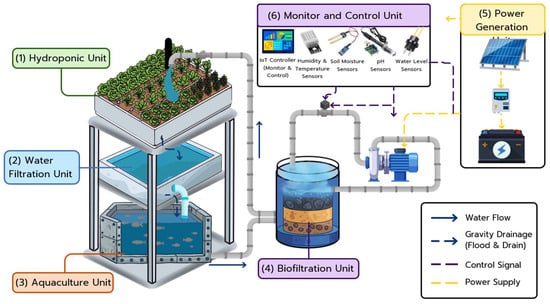
Figure 1 delineates the physical configuration of a multi-tiered, closed-loop aquaponic system. The closed-loop aquaponic system consists of five core subsystems: (1) hydroponic unit; (2) biofiltration unit; (3) water filtration unit; (4) aquaculture unit; (5) power generation unit; and (6) control unit.
Figure 1.
A closed-loop aquaponics framework consisting of six core subsystems interconnected through the water recirculation system.
Structured as a space-saving three-floor unit, the top level features a durable fiberglass plant cultivation bed (0.6 × 1.2 m) (suspended 125 cm high to facilitate gravity-assisted downward drainage and easy maintenance). This bed holds 100 L of clay pellets at a depth of 30 cm to optimize plant root stability, utilizing an integrated PVC siphon system (comprising 1″, 2″, and 3″ pipes) alongside a standpipe, bell tube, and media guard to automatically cycle water via a flood-and-drain mechanism while preventing pellet clogging.
Directly below, the middle floor houses a polyethylene water reservoir (0.74 × 0.84 × 0.32 m) embedded with fiberglass reinforcement for preliminary filtration of solid waste. The ground floor houses a mobile, food-grade polyethylene fish tank (350 L capacity, 70 cm high) that initially uses conditioned, chlorine-free tap water to raise aquatic livestock.
Effluent from the fish tank is channeled through a 1-inch blue PVC pipe into a separate 60-L biofilter tank containing a high-surface-area porous medium (bio-balls and gravel). This biofiltration unit acts as a biological engine, fostering the growth of Nitrosomonas and Nitrobacter bacteria to oxidize toxic ammonia (NH3) into nitrites (NO2−) and then into nitrates (NO3−), effectively purifying the water for the fish while generating essential nutrients for the vegetation. Finally, to complete the recirculating loop back to the top floor, the biofilter tank connects to a 1-inch PVC pipe network integrated with an electronic solenoid valve and a water pump, which an IoT control device and its companion solar power supply subsystem automatically control.
2.2. IoT-Based Monitoring, Control, and Power Supply System
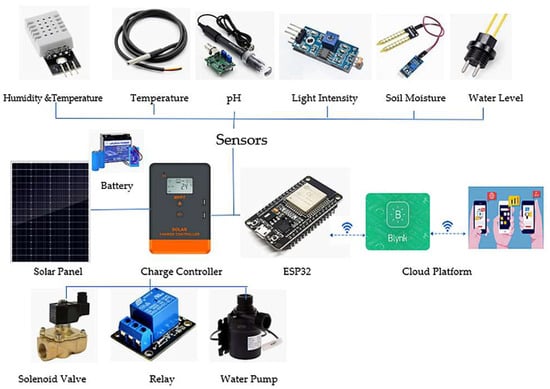
Figure 2 illustrates the proposed system’s IoT-based monitoring and control architecture. The IoT architecture comprises three operational layers: (1) the perception layer, which integrates sensors for monitoring water and environmental conditions; (2) the network layer, which provides Wi-Fi connectivity for transmitting measurement data from field devices to the cloud; and (3) the application layer, which provides real-time data visualization, mobile notifications, and automated control functions supported by cloud-based data processing. An ESP32 microcontroller serves as the system’s edge controller and provides an integrated Wi-Fi interface for wireless communication with the cloud platform. The controller acquires measurements from multiple sensors, performs local processing and control operations, and transmits the acquired data to cloud storage for monitoring and analysis.
Figure 2.
System architecture and hardware components of the smart aquaponic system.
2.2.1. Sensing and Actuation Module
The sensing module comprises five types of sensors for monitoring environmental and water-related parameters: an ambient temperature and humidity sensor (DHT22/AM2302; Aosong Electronics Co., Ltd., Guangzhou, China), a waterproof water temperature sensor (DS18B20; Maxim Integrated, San Jose, CA, USA), a light intensity sensor (BH1750; Rohm Semiconductor, Kyoto, Japan), a soil-moisture sensor (Capacitive Soil Moisture Sensor v1.2; Generic, Shenzhen, China), a pH sensor (PH-4502C; Generic, Shenzhen, China), and a custom water-level sensor consisting of a 1-inch pipe and a stripped LAN cable (Water Level Sensor Module; Generic, Shenzhen, China). All sensors were calibrated using standardized reference procedures before system deployment. An ESP32 microcontroller acquires sensor measurements; it uses a dual-core 32-bit Tensilica LX6 processor with integrated Wi-Fi and Bluetooth connectivity. The ESP32 functions as the central edge controller, processing sensor inputs, executing the predefined control logic, and transmitting real-time measurements to the cloud platform.
The actuation subsystem regulates water circulation and maintains the aquaponic system’s required operating conditions. The ESP32 controls the electromechanical actuators through a 1-channel active-HIGH 5 V relay module (KY-019), which interfaces with an electrically actuated solenoid valve (RS PRO G 1/2 ZS Series) and a 12 VDC water pump (ZYW 680, 12 VDC, 1600 mA, 15 W). The integrated sensing and actuation arrangement enables the controller to respond to water-level conditions and regulate water movement automatically according to the predefined control logic.
2.2.2. Design and Component Sizing of an Autonomous Off-Grid Solar Power Subsystem
Figure 2 illustrates the autonomous off-grid solar power subsystem, comprising photovoltaic (PV) panels, a solar charge controller, a deep-cycle battery, and the electrical loads associated with the IoT, water-circulation systems, and monitoring. Table 1 shows the daily energy requirements of the electrical components for the solar-powered aquaponic system.
Table 1.
Daily energy requirements for the aquaponic system.
For a daily energy requirement of 394 Wh, the required PV capacity was estimated based on the system’s daily energy demand and an assumed average of 4 peak sunlight hours per day. The minimum PV capacity was calculated as approximately 394 Wh/4 h, or 98.5 W. A 20% design safety factor was then applied to account for variations in solar availability and system operating conditions, resulting in a required capacity of approximately 1.20 × 98.5 W, or 118.2 W. Thus, polycrystalline solar panels (VSK-150) were used to generate electrical energy under varying solar irradiance levels.
A commercial 12 V battery system was selected to provide energy storage during periods of insufficient solar generation. Based on the estimated energy requirement, a 12 V, 50 Ah LiFePO4 (lithium iron phosphate) battery was selected. The battery’s nominal energy capacity was 600 Wh (12 V × 50 Ah). Assuming a maximum depth of discharge (DoD) of 80%, the usable energy capacity was estimated at approximately 480 Wh (12 V × 50 Ah × 0.80), which was sufficient to meet the estimated daily energy requirement of 394 Wh.
An MPPT solar charge controller (PowMr) was integrated to regulate power transfer between the PV array and the battery while protecting against overcharging and excessive battery discharge. The charge controller current requirement was conservatively estimated from the selected PV capacity (150 W) and nominal battery voltage as approximately 12.5 A (150 W/12 V). Accordingly, a 15 A-rated MPPT charge controller was selected to provide an additional operating margin and ensure stable power regulation under the specified operating conditions.
The solar panel and battery capacities were designed based on the system’s estimated daily energy consumption of 394 Wh. During the 70-day experimental period, the solar-powered system operated satisfactorily without observed power-supply problems, supporting the practical feasibility of the proposed configuration under the conditions investigated. Nevertheless, the energy-autonomy calculation is a theoretical design estimate and serves as an upper bound on the energy requirement.
2.2.3. Configuration and Operational Logic of Water-Level Management System
Water-level sensors were installed at various locations, including the fish tank, water reservoir, plant beds, and biofilter, to continuously monitor water availability. The ESP32 controller processes the sensor outputs, determines the corresponding water-level condition, and regulates pumps M1–M4 through the relay-based actuation system.
The control operation is based on three predefined water-level thresholds. Under the high-level condition, the corresponding pump is deactivated to prevent excessive water accumulation and potential overflow. Under the medium-level condition, the water volume is considered within the optimal operating range, and no control intervention is initiated. Under the low-level condition, the corresponding pump is activated to restore the water volume and maintain continuous water circulation. This threshold-based control enables autonomous regulation of water movement, reduces the need for manual intervention, and supports stable operation of the closed-loop aquaponic system.
The sensing, control, and actuation functions described above are integrated with a cloud-based IoT platform to enable continuous data acquisition, remote monitoring, and real-time system supervision. The data collection and monitoring framework is described in the following section.
2.3. Data Collection and Monitoring
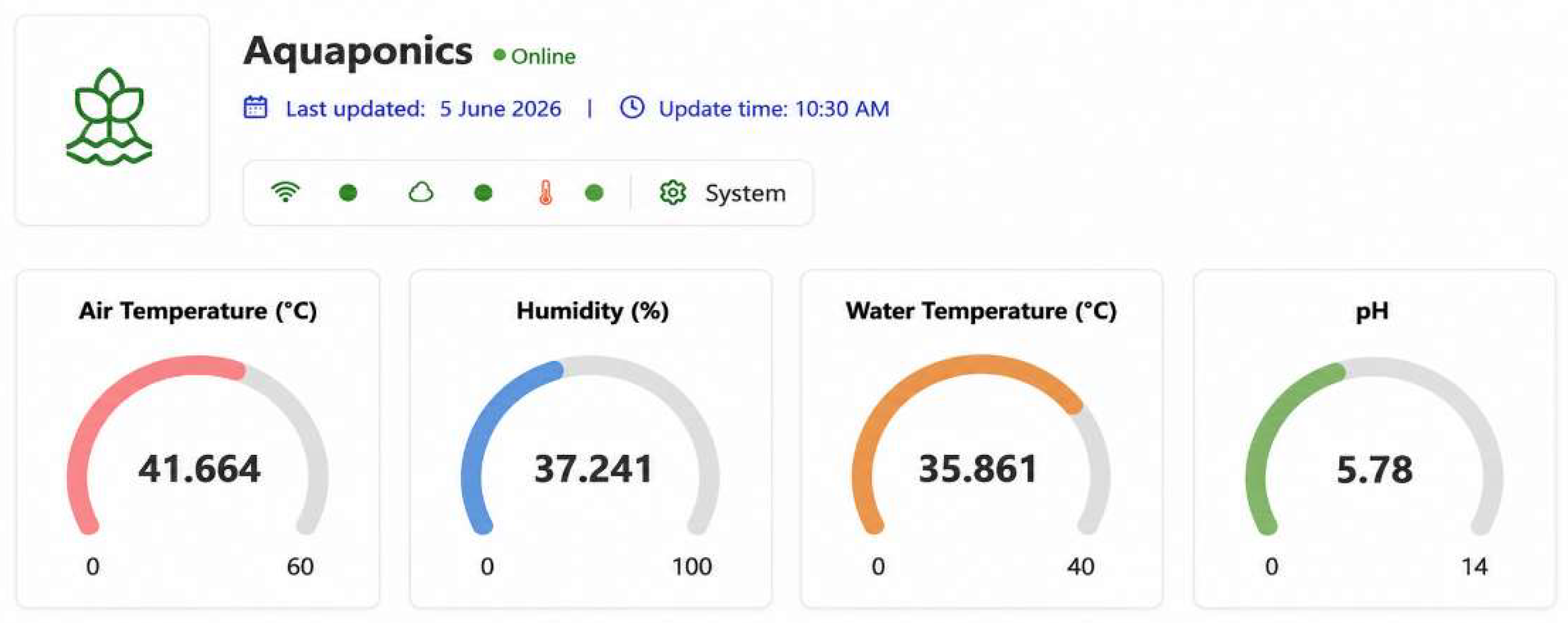
The Blynk IoT platform is selected for data collection and monitoring. Figure 3 shows the Blynk cloud interface for real-time data visualization. To establish a secure connection, the system utilizes a unique, automatically generated authentication token embedded within the ESP32 microcontroller’s source code via the Arduino IDE (#define BLYNK_AUTH_TOKEN “your_token”). After the firmware is programmed to handle bidirectional communication and validated via the Arduino Serial Monitor, the system continuously logs critical environmental variables at 30-minute intervals.
Figure 3.
Blynk cloud interface for real-time data visualization.
As visualized on the Blynk web dashboard snapshot (dated 5 June 2026, at 10:30 AM) in Figure 3, the interface uses distinct, color-coded gauge widgets to display precise sensor readings, showing an ambient air temperature of 41.664 °C (on a 0 to 60 scale), a relative humidity level of 37.241% (on a 0 to 100 scale), a water temperature of 35.861 °C (on a 0 to 40 scale), and a water pH value of 5.78 (on a standard 0 to 14 scale). In addition to remote data visualization on mobile and desktop platforms, the cloud network integrates threshold-based rules that leverage live data streams to drive automated decision-making, optimize environmental performance, and proactively predict system anomalies, such as water imbalances.
Environmental and operational data were continuously collected and monitored via the Blynk IoT platform throughout the 70-day experimental trial.
2.4. Performance Evaluation and Analysis
Kale (Brassica oleracea var. acephala) and tilapia (Oreochromis niloticus) were selected for plant and fish growth trials due to their high biological compatibility and robustness. Kale was chosen because it grows rapidly, commands a high market value, tolerates a wide pH range, and efficiently removes nitrates from water. Conversely, tilapia was selected as a hardy, fast-growing aquatic species that can thrive in varied water conditions while producing the steady ammonia levels needed to support plant growth.
To evaluate crop growth, a total of 120 kale plants were monitored: 60 plants cultivated within the single smart aquaponic system (n = 60) and 60 plants in an adjacent single soil bed control (n = 60). In this design, individual plants served as sub-samples within each system unit (N = 1 aquaponic unit; N = 1 soil plot; non-replicated system). Independent-samples Student’s t-tests (df = 118) were conducted on plant height, leaf width, and leaf count to assess within-treatment growth performance and plant-level variability across these experimental environments.
3. Results
3.1. Real-Time Data of Temperature, Humidity, pH, and Light Intensity for 70 Days
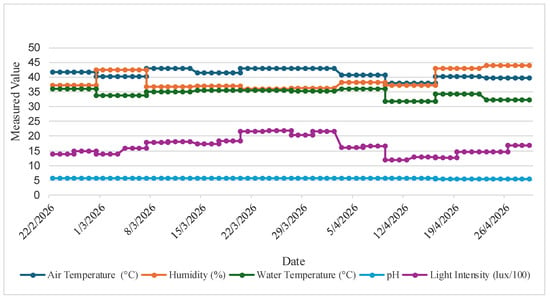
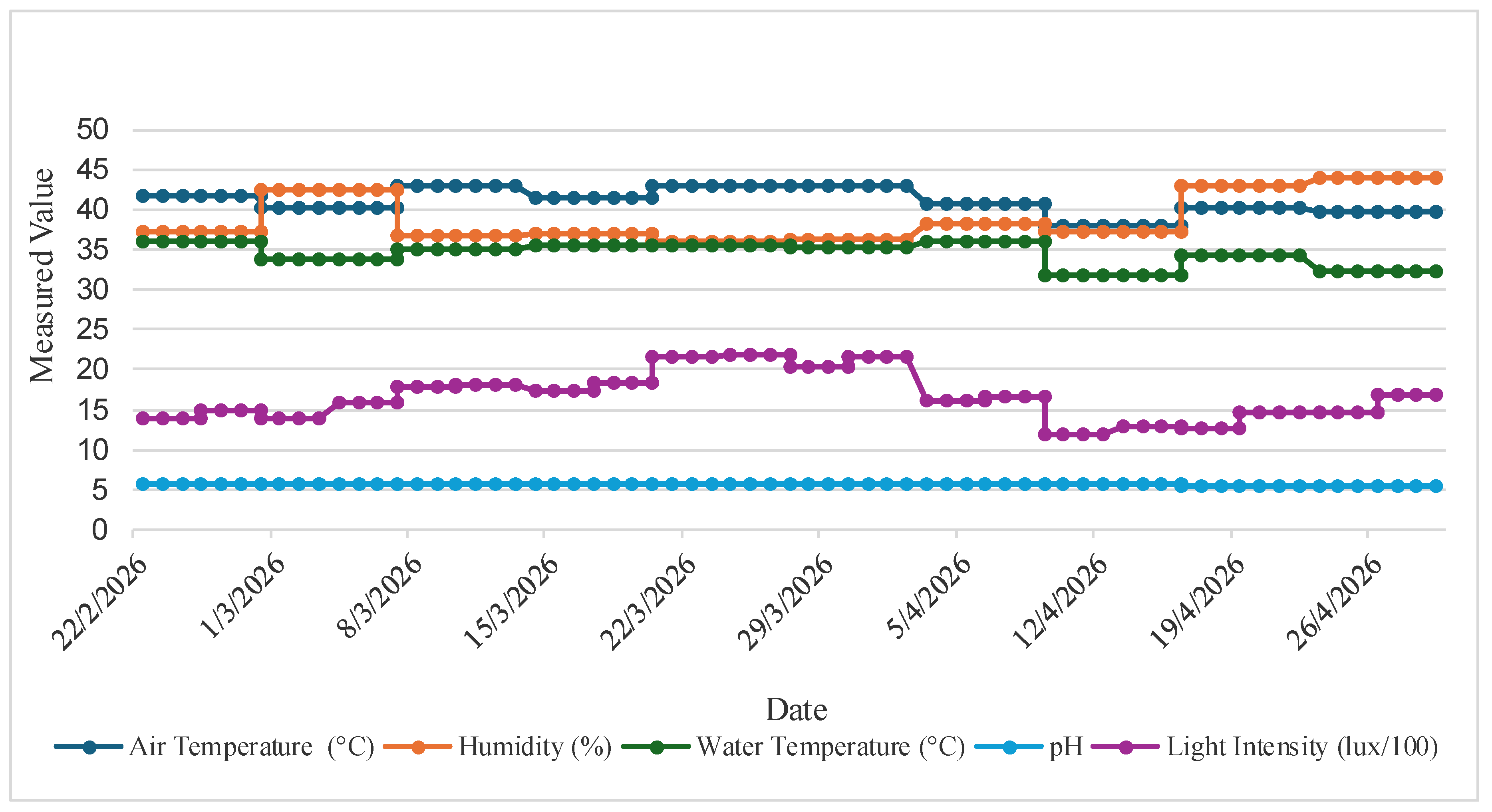
The real-time environmental conditions were continuously monitored throughout the 70-day cultivation period using the proposed IoT-enabled aquaponic system. Integrated sensors acquired environmental parameters, including air temperature, relative humidity, water temperature, pH, and light intensity, which were transmitted to the Blynk cloud platform via the ESP32 microcontroller for continuous visualization and remote monitoring. This architecture enabled environmental observation throughout the experiment without requiring manual data collection, as shown in Figure 4 and summarized in Table 2.
Figure 4.
Real-time monitoring of air temperature, relative humidity, water temperature, pH, and light intensity throughout the 70-day cultivation period.
Table 2.
The descriptive statistics of monitored environmental parameters throughout the 70-day cultivation period.
Ambient air temperature ranged from 38.0 °C to 43.0 °C, averaging 41.06 ± 1.56 °C. Despite relatively high daytime temperatures inside the cultivation area, the environmental conditions remained sufficiently consistent throughout the experiment. Relative humidity ranged from 36.0% to 43.86%, with a mean of 38.79 ± 2.88%, indicating moderate atmospheric moisture that varied naturally with daily climatic changes.
Compared with ambient temperature, water temperature fluctuated much less, remaining between 31.70 °C and 35.98 °C, with an average of 34.51 ± 1.41 °C. The relatively stable water temperature can be attributed to the thermal buffering capacity of the recirculating water volume, which possesses greater thermal inertia than the surrounding air. This thermal stability is advantageous because it minimizes thermal stress on aquatic organisms [35]; deviations from the optimal thermal range can significantly reduce growth rates [36], while supporting microbial activity that drives biological nitrification within the biofilter [37,38,39].
Water pH remained remarkably stable throughout the cultivation period, ranging from 5.52 to 5.82, with an average value of 5.71 ± 0.11. The small variation in pH indicates that the interactions among fish metabolism, microbial nitrification, and plant nutrient uptake remained well balanced during system operation. Maintaining a stable pH is particularly important because it directly affects nutrient availability, microbial activity, and fish health, thereby contributing to the long-term stability of the aquaponics ecosystem [40].
Among the monitored variables, light intensity showed the greatest temporal variation, ranging from 11.79 × 10² to 21.80 × 10² lux, with an average of 16.62 ± 2.97 × 10² lux. These fluctuations mainly resulted from changes in natural solar radiation due to cloud cover and daily weather conditions. Nevertheless, the real-time monitoring platform successfully captured these variations continuously, allowing environmental changes to be observed without interrupting normal system operation.
The descriptive statistics further confirm the monitoring system’s overall stability. In particular, the low standard deviations observed for water temperature and pH indicate that the recirculating aquaponic system effectively maintained both thermal and chemical conditions throughout cultivation. Such stability is essential for sustaining nutrient cycling, maintaining biological filtration efficiency, and promoting healthy fish and plant growth in closed-loop aquaponic systems. To further investigate relationships among environmental variables, we performed Pearson correlation analysis on the collected sensor data, as shown in Table 3.
Table 3.
Pearson correlation coefficients among environmental parameters.
The correlation analysis revealed that the monitored environmental variables were closely interconnected. The strongest positive correlation was observed between air temperature and light intensity (r = 0.83), indicating that variations in solar radiation substantially influenced the thermal conditions within the cultivation environment. Likewise, water temperature exhibited a strong positive correlation with air temperature (r = 0.80), suggesting that heat exchange between the surrounding atmosphere and the recirculating water contributed to the observed thermal dynamics. Despite this relationship, the smaller variation in water temperature than in ambient temperature demonstrates the thermal buffering effect of the recirculating water system.
A strong positive relationship was also identified between water temperature and pH (r = 0.80), while air temperature showed a positive correlation with pH (r = 0.76). These relationships may reflect concurrent biological and physicochemical processes occurring within the aquaponic ecosystem, including microbial activity and nutrient transformation. However, these correlations should not be interpreted as direct causal relationships because multiple interacting environmental factors influence water chemistry simultaneously.
The strongest negative correlation was found between relative humidity and pH (r = −0.89), indicating that periods of higher atmospheric humidity tended to coincide with slightly lower pH values. Although the underlying mechanisms require further investigation, this relationship may reflect simultaneous environmental responses associated with microbial metabolism, plant transpiration, and water chemistry rather than humidity directly influencing pH.
Overall, the monitoring results show that the proposed IoT-enabled monitoring platform provided continuous, real-time observation of key environmental parameters while maintaining stable operating conditions throughout the 70-day cultivation period. The integration of wireless sensing, cloud-based data transmission, and continuous environmental monitoring provides a practical foundation for future intelligent aquaponic systems incorporating predictive analytics, automated environmental control, and AI-assisted decision support for sustainable agricultural production.
3.2. Growth Performance of Kale (Brassica oleracea)
Over the 70-day cultivation period, kale growth within the IoT-assisted aquaponic system showed encouraging baseline stability and performance comparable to traditional soil-based cultivation (Table 4). Aquaponically grown kale achieved a higher mean plant height (10.39 ± 3.00 cm) than soil-grown controls (9.78 ± 2.52 cm), though an independent-samples t-test confirmed this difference was not statistically significant (t = 1.203, df = 118, p = 0.232). Similarly, mean leaf width (4.70 ± 1.12 vs. 4.60 ± 1.05 cm; p = 0.615) and total leaf count (7.88 ± 2.10 vs. 7.62 ± 2.16; p = 0.495) did not differ significantly between treatments.
Table 4.
Comparison of plant height, leaf width, and number of leaves of kale grown in aquaponics and soil-based systems using a t-test.
Although kale is taxonomically categorized as a cool-season crop with optimal growth thermal thresholds between 15 °C and 25 °C [41], plants in both treatments maintained steady vegetative development despite severe ambient thermal stress (41.06 ± 1.56 °C). The positive growth trends observed in the aquaponic loop can be attributed to the continuous delivery of bioavailable dissolved nutrients—most notably nitrate generated through continuous microbial nitrification of fish metabolic waste [42]. Unlike static soil matrices, where nutrient transport is often impeded by soil moisture dynamics and root-zone microbial competition, closed-loop automated hydrodynamics provide direct, uninterrupted nutrient access at the rhizosphere. These findings demonstrate that organic fish effluent delivered through smart recirculating systems can effectively match conventional soil fertility under extreme climatic conditions.
3.3. Fish Growth Dynamics and Water Management
The aquaculture subsystem successfully sustained 10 Nile tilapia specimens over the 70-day experimental period. Initially stocked at 10–12 cm, the fish grew substantially, reaching a final average body length of 18–22 cm. Survival was complete (100%), with no mortality recorded throughout the study.
Nile tilapia are eurythermal freshwater teleosts that can tolerate wide physiological ranges. The fish were fed pellet food twice daily, in the morning and evening, to ensure they received sufficient nutrition for growth. After two months, the fish showed significant growth, with an average final size of about 18–22 cm. This indicates that the fish in the aquaponic system are healthy and have nearly doubled in size since their initial measurements [43].
The system operated as a semi-closed-loop aquaponic system, in which water was continuously circulated among the fish tank, filtration components, and plant-growing unit. During the 70-day experimental period, we added about 10 L of fresh water on two occasions, about three weeks apart, when we needed to replenish based on observed water level and clarity. Adding fresh water also helped prevent excessive chemical oxygen demand (COD) buildup [44].
4. Discussion
In this 70-day trial, the IoT-assisted aquaponic system demonstrated physiological growth performance comparable to conventional soil-based cultivation for kale (Brassica oleracea var. acephala). Despite extreme ambient field conditions (41.06 ± 1.56 °C), kale grown in the smart aquaponic system achieved mean plant height, leaf width, and leaf count that were not statistically different from soil-grown controls (p = 0.232, 0.615, and 0.495, respectively), with marginal differences of only 6%, 2%, and 3.5%. These findings validate the technical feasibility of soilless organic nutrient delivery, proving that fish-waste effluent can substitute synthetic or soil-bound fertilizers without compromising crop yields.
While previous studies in controlled environments, such as Nishanth et al. [45], reported enhanced biomass in basil and coriander, these results highlight the aquaponic loop’s robust baseline stability under high-temperature stress. Rather than a limitation, the modest growth observed across both treatments (ca. 10 cm) shows that the aquaponic system maintained crop viability and nutrient absorption equal to soil under identical thermal conditions [41]. This provides strong proof of concept for deploying closed-loop aquaponics in tropical or high-heat agricultural regions, where soil degradation and water scarcity are prevalent.
Crucially, integrating distributed IoT sensors and automated water-level regulation ensured unbroken operational stability throughout the 70-day cycle, reaffirming the reliability of smart management under challenging ambient stress [46]. By pairing photovoltaic power generation with automated recirculation, the proposed architecture successfully addresses key sustainability hurdles—significantly reducing grid reliance and optimizing water use in high-evaporation environments [47,48,49]. Overall, these results confirm that solar-powered, IoT-governed aquaponics is a highly viable, eco-friendly alternative to conventional soil agriculture for severe environments.
5. Conclusions
This study provides a validated proof of concept of an IoT-based aquaponic system capable of real-time monitoring and control of environmental parameters to support the sustainable production of kale and Nile tilapia. The comparative experiment between aquaponic and traditional soil-based cultivation systems revealed that kale plants grown under aquaponic conditions exhibited slightly higher average plant height, leaf width, and leaf number than those grown in soil-based systems. The t-test results indicated no statistically significant differences (p > 0.05), as both systems achieved comparable growth performance. Environmentally, the aquaponic system recycles water, significantly reducing the need for freshwater and chemical fertilizers while minimizing waste discharge. Economically, it offers opportunities for dual production of plants and fish, improving resource-use efficiency and potential profitability. However, key limitations of this study included a lack of nutrient profiling (ammonium nitrogen, nitrites, nitrates), dissolved oxygen, water- and energy-consumption data, long-term operational data, and detailed characteristics of kale and Nile tilapia. Future research should collect more complete operational data to improve the efficiency, scalability, and intelligence of aquaponic systems. Integrating advanced automation and machine learning could enable predictive control of water quality, nutrient distribution, and feeding cycles, leading to more stable and optimized production. Long-term performance evaluations are also essential to assess system stability, energy use, and water-reuse efficiency. Moreover, developing comprehensive models will help quantify the sustainability and cost-effectiveness of aquaponics in large-scale applications. Finally, strategic public policy studies are essential to promote widespread adoption of smart, zero-grid aquaponics.
Author Contributions
Conceptualization, T.T.; methodology, T.T.; software, T.T.; validation, T.T.; formal analysis, T.T.; investigation, T.T.; resources, T.T.; data curation, T.T.; writing—original draft preparation, T.T.; writing—review and editing, C.P.; visualization, C.P.; supervision, C.P.; project administration, C.P.; funding acquisition, C.P. All authors have read and agreed to the published version of the manuscript.
Funding
This research was funded by King Mongkut’s University of Technology North Bangkok, Thailand, the National Science, Research and Innovation Fund (NSRF), and King Mongkut’s University of Technology North Bangkok, grant number KMUTNB-FF-68-A-06.
Data Availability Statement
The original contributions presented in this study are included in the article. Further inquiries can be directed to the corresponding author.
Acknowledgments
Nonthraphat Nakrong, Naif Hemmunt, and Affan Senathip made significant contributions to this research. All in the Department of Electrical and Computer Engineering, Faculty of Engineering, King Mongkut’s University of Technology North Bangkok, and helped set up the experiments, including hardware, software, and data collection.
Conflicts of Interest
The authors declare no conflicts of interest.
References
- Gangadhar, B.; Sridhar, N.; Hemaprasanth, K.; Raghunath, M.; Jayasankar, P.; Gangadhar, C.B. Indigenous technical knowledge in the aquaculture sector: A literature review. Int. J. Fish. Aquat. Stud. 2016, 4, 373–378. [Google Scholar]
- Ghaffar, A.; Abbas, A.; Afzal, K.; Batool, K.; Nawaz, B.; Zafar, L.; Shaheen, H.; Sajid, S.A.; Yasin, R. Innovations in aquaponics technology and building sustainable infrastructure for agriculture. Indones. J. Agric. Environ. Anal. 2024, 3, 121–134. [Google Scholar] [CrossRef] [Scilit]
- Ali, M.E.; Hafeez, A. A smart monitoring and observation framework for an aquaponics ecosystem. ARPN J. Eng. Appl. Sci. 2024, 19, 864–869. [Google Scholar] [CrossRef] [Scilit]
- Aleksić, N.; Šušteršič, V. Analysis of application of aquaponic system as a model of the circular economy: A review. Recycl. Sustain. Dev. 2020, 13, 73–86. [Google Scholar] [CrossRef] [Scilit]
- Mahmoud, M.M.M.; Darwish, R.; Bassiuny, A.M. Development of a smart aquaponic system based on IoT. In Proceedings of the 23rd International Conference on Control, Automation and Systems (ICCAS 2023), Yeosu, Korea, 17–20 October 2023; IEEE: New York, NY, USA, 2023. [Google Scholar]
- Vijay, V.G.R.; Abhikumar, R.; Jahnavi, D.N.; Kavya, D.R.; Mahendra, V. Long-range self-powered IoT devices for agriculture and aquaponics. Int. J. Adv. Res. Sci. Commun. Technol. 2023, 3, 200–204. [Google Scholar] [CrossRef] [Scilit]
- Wirza, R.; Nazir, S. Urban aquaponics farming and cities—A systematic literature review. Rev. Environ. Health 2021, 36, 47–61. [Google Scholar] [CrossRef] [Scilit] [PubMed]
- Vaca Vargas, S.A.; García Navarrete, O.L.; Colorado Gómez, M.A. Automated, technified, and traditional aquaponic systems. Rev. Ing. Solidar. 2022, 18, 1–39. [Google Scholar] [CrossRef] [Scilit]
- Dwiardani, K.H.; Prayogo; Rahardja, B.S. Utilization of Nitrosomonas sp and Nitrobacter sp probiotics towards total suspended solids and ammonia level in Nile tilapia culturing using an aquaponic system. IOP Conf. Ser. Earth Environ. Sci. 2021, 679, 012067. [Google Scholar] [CrossRef] [Scilit]
- Roy, P.; Lee, D.H.; Choi, S.M.; An, Y.K.; Choi, S.D. Sustainable development of water quality, growth, and production efficiency of the giant mottled eel (Anguilla marmorata) at different stocking densities in the indoor media-based aquaponics system. Animals 2025, 15, 2705. [Google Scholar] [CrossRef] [Scilit] [PubMed]
- Farooq, M.S.; Riaz, S.; Abid, A.; Abid, K.; Naeem, M.A. A survey on the role of IoT in agriculture for the implementation of smart farming. IEEE Access 2019, 7, 156237–156271. [Google Scholar] [CrossRef] [Scilit]
- Demir, B.E. A New Low-Cost Internet of Things-Based Monitoring System Design for Stand-Alone Solar Photovoltaic Plant and Power Estimation. Appl. Sci. 2023, 13, 13072. [Google Scholar] [CrossRef] [Scilit]
- Rao, C.K.; Sahoo, S.K.; Yanine, F.F. An IoT-based intelligent smart energy monitoring system for solar PV power generation. Energy Harvest. Syst. 2024, 11, 20230015. [Google Scholar] [CrossRef] [Scilit]
- Murdan, A.P.; Joyram, A. An IoT-based solar-powered aquaponics system. In Proceedings of the 13th International Conference on Electronics, Computers and Artificial Intelligence (ECAI 2021), Pitesti, Romania, 1–3 July 2021; IEEE: New York, NY, USA, 2021. [Google Scholar]
- Palniladevi, P.; Sabapathi, T.; Kanth, D.A.; Kumar, B.P. IoT-based smart agriculture monitoring system using renewable energy sources. In Proceedings of the IEEE International Conference on Vision Towards Emerging Trends in Communication and Networking Technologies (ViTECoN 2023), Vellore, India, 5–6 May 2023; IEEE: New York, NY, USA, 2023. [Google Scholar]
- Mohd Ali, M.F.; Asrul Ibrahim, A.; Mohd Zaman, M.H. Optimal sizing of solar panel and battery storage for a smart aquaponic system. In Proceedings of the 19th IEEE Student Conference on Research and Development (SCOReD 2021), Kota Kinabalu, Malaysia, 23–25 November 2021; IEEE: New York, NY, USA, 2021; pp. 186–191. [Google Scholar]
- Alam, M.N.H.Z.; Kamaruddin, M.J.; Adzila, S.; Nordin, N.; Othman, R. Solar-powered aquaponics prototype as sustainable approach for food production. Mater. Today Proc. 2022, 66, 2942–2947. [Google Scholar] [CrossRef] [Scilit]
- Masabni, J.; Sink, T. Water Quality in Aquaponics; Texas A&M AgriLife Extension: College Station, TX, USA, 2020; Publication EHT-147. Available online: https://extension.rwfm.tamu.edu/wp-content/uploads/sites/8/2020/10/Water-Quality-In-Aquaponics-Sink-Masabni.pdf (accessed on 1 November 2026).
- Somerville, C.; Cohen, M.; Pantanella, E.; Stankus, A.; Lovatelli, A. Small-Scale Aquaponic Food Production; FAO Fisheries and Aquaculture Technical Paper No. 589; FAO: Rome, Italy, 2014; Available online: https://learn.farmhub.ag/resources/small-scale-aquaponic-food-production/ (accessed on 1 November 2026).
- Ha, C.D.; Dung, L.T.; Trien, P.M. IoT solutions for smart farming: A comprehensive review on the current trends, challenges and future prospects for sustainable agriculture. J. For. Sci. Technol. 2023, 8, 28–35. [Google Scholar] [CrossRef] [Scilit]
- Klymchuk, V.V.; Ptashnyk, V.V. Architectural patterns of IoT systems in smart agriculture. In Proceedings of the International Scientific and Technical Conference: Information Technologies in Metallurgy and Machine Building, Dnipro, Ukraine, 21–23 April 2026; pp. 447–452. [Google Scholar] [CrossRef] [Scilit]
- Ayaz, M.; Uddin, A.; Sharif, Z.; Mansour, A.; Aggoune, E.-H. Internet-of-Things (IoT)-based smart agriculture: Toward making the fields talk. IEEE Access 2019, 7, 129551–129583. [Google Scholar] [CrossRef] [Scilit]
- Rehman, A.; Lu, S.; Ashraf, M.A.; Shahid Iqbal, M.; Nawabi, A.; Amin, F.; Abbasi, R.; De la Torre Díez, I.; Gracia Villar, S.; Dzul López, L.A.; et al. The role of Internet of Things (IoT) technology in modern cultivation for the implementation of greenhouses. PeerJ Comput. Sci. 2024, 10, e2309. [Google Scholar] [CrossRef] [Scilit] [PubMed]
- Rofiansyah, W.; Zalianty, F.R.; La Ito, F.A.; Wijayanto, I.; Ryanu, H.H.; Irawati, I.D. IoT-based control and monitoring system for hydroponic plant growth using image processing and mobile applications. PeerJ Comput. Sci. 2025, 11, e2763. [Google Scholar] [CrossRef] [Scilit] [PubMed]
- Risal, M.; Wahyuningsih, P.; Haerani, N.; Mikolas, M.; Lewa, M.I. Integration of multi-modal sensors in aquaponic farming for IoT-ready based on ESP32 and Raspberry Pi hybrid platform. J. Appl. Inform. Comput. 2025, 9, 2239–2246. [Google Scholar] [CrossRef] [Scilit]
- Alam, M.N.H.Z.; Kamaruddin, M.J.; Samsudin, S.A.; Othman, R.; Radzi, N.H.M.; Emmanuel, A.A.; Abidin, M.S.Z. Smart farming using a solar-powered aquaponics system for sustainable food production. Malays. J. Sci. 2023, 42, 68–77. [Google Scholar] [CrossRef] [Scilit]
- Ismail, F. Use of Solar Energy to Control the Environment for Aquaponics in Low Income Communities. Master’s Thesis, Cape Peninsula University of Technology, Cape Town, South Africa, 2020. [Google Scholar]
- Espada Sanjurjo, J.J.; Díaz de Mera-Sánchez, M.P.; Rodríguez Escudero, R. Design and environmental analysis of an aquaponics system coupled with photovoltaic unit for food production and reuse of nutrients from wastewater: A life cycle assessment study. Appl. Sci. 2026, 16, 635. [Google Scholar] [CrossRef] [Scilit]
- Abdelli, A.; Boujnah, W.; Salah, Y.B.; Issa, K.; Garrab, H.; Nengroo, S.H.; Machhout, M.; Lee, K. Field-validated hybrid ESP-NOW and long-range IoT monitoring system for energy-autonomous precision agriculture. IEEE Access 2025, 13, 207511–207526. [Google Scholar]
- Rodríguez, E.A. Benefits and challenges of the Internet of Things in aquaculture production: A literature review. Front. Sustain. Food Syst. 2025, 9, 1590153. [Google Scholar] [CrossRef] [Scilit]
- Sportelli, M.; La Rosa, D.; Crivello, A.; Pineda-Medina, D.; Bacco, M.; Barsocchi, P. Beyond prototypes: What is missing to fill the gaps in IoT-enabled hydroponics platforms. Horticulturae 2025, 11, 1322. [Google Scholar] [CrossRef] [Scilit]
- Greenfeld, A.; Becker, N.; Bornman, J.F.; Spatari, S.; Angel, D.L. Is aquaponics good for the environment? Evaluation of environmental impact through life cycle assessment studies on aquaponics systems. Aquac. Int. 2022, 30, 305–322. [Google Scholar] [CrossRef] [Scilit]
- Mehdi, S.E.H.; Sharma, A.; Shahzad, S.; Pandey, S.; Hussain, F.; Kang, W.; Oh, S.-E. A systematic analysis of factors influencing life cycle assessment outcomes in aquaponics. Water 2026, 18, 301. [Google Scholar] [CrossRef] [Scilit]
- Greenfeld, A.; Becker, N.; McIlwain, J.; Fotedar, R.; Bornman, J.F. Economically viable aquaponics? Identifying the gap between potential and current uncertainties. Rev. Aquac. 2019, 11, 848–862. [Google Scholar] [CrossRef] [Scilit]
- Zhu, W.; Yuan, G.; Song, Z.; Li, Q.; Liu, C.; Xu, A.; Luan, Y.; Liu, Y. In situ biofilm aquaculture systems (In Situ BFSs) for Litopenaeus vannamei: A review. Rev. Aquac. 2025, 17, e70058. [Google Scholar] [CrossRef]
- Pindihama, G.K.; Mudzielwana, R.; Mukwevho, S.N.; Rambau, M.O. Water quality in recirculating aquaculture systems for Oreochromis mossambicus in Dzimauli Village, South Africa. S. Afr. J. Agric. Ext. 2026, 54, 217–246. [Google Scholar] [CrossRef] [Scilit]
- Zou, Y.; Hu, Z.; Zhang, J.; Xie, H.; Guimbaud, C.; Fang, Y. Effects of pH on nitrogen transformations in media-based aquaponics. Bioresour. Technol. 2016, 210, 81–87. [Google Scholar] [CrossRef] [Scilit] [PubMed]
- Klimenko, M.; Grokhovska, Y.; Yashchenko, L. Influence of temperature in aquaponic system on nitrification processes. Sci. Rep. Natl. Univ. Life Environ. Sci. Ukr. 2025, 21, 36–48. [Google Scholar] [CrossRef] [Scilit]
- Love, D.C.; Fry, J.P.; Li, X.; Hill, E.S.; Genello, L.; Semmens, K.; Thompson, R.E. Commercial aquaponics production and profitability: Findings from an international survey. Aquaculture 2015, 435, 67–74. [Google Scholar] [CrossRef] [Scilit]
- Tyson, R.V.; Simonne, E.H.; Treadwell, D.D.; White, J.M.; Simonne, A. Reconciling pH for ammonia biofiltration and cucumber yield in a recirculating aquaponic system with perlite biofilters. HortScience 2008, 43, 719–724. [Google Scholar] [CrossRef] [Scilit]
- Nozzi, V.; Graber, A.; Schmautz, Z.; Mathis, A.; Junge, R. Nutrient management in aquaponics: Comparison of three approaches for cultivating kale, mint, and basil. Agronomy 2018, 8, 27. [Google Scholar] [CrossRef] [Scilit]
- Jordan, R.A.; Ribeiro, E.F.; de Oliveira, F.C.; Geisenhoff, L.O.; Martins, E.A.S. Yield of lettuce grown in hydroponic and aquaponic systems using different substrates. Rev. Bras. Eng. Agríc. Ambient. 2018, 22, 525–529. [Google Scholar] [CrossRef] [Scilit]
- Palm, H.W.; Knaus, U.; Appelbaum, S.; Goddek, S.; Strauch, S.M.; Vermeulen, T.; Jijakli, M.H.; Kotzen, B. Towards commercial aquaponics: A review of systems, designs, scale and sustainability. Aquac. Int. 2018, 26, 263–290. [Google Scholar] [CrossRef] [Scilit]
- Endut, A.; Lananan, F.; Abdul Hamid, S.H.; Jusoh, A.; Wan Nik, W.N. Balancing of nutrient uptake by water spinach (Ipomoea aquatica) and mustard green (Brassica juncea) with nutrient production by African catfish (Clarias gariepinus) in scaling aquaponic recirculation system. Desalin. Water Treat. 2016, 57, 29531–29540. [Google Scholar] [CrossRef] [Scilit]
- Nishanth, D.; Alshamsi, M.H.S.; Alkaabi, A.M.K.A.; AlKaabi, A.H.A.; Alnuaimi, S.H.K.; Nair, C.S.; Jaleel, A. Aquaponics as a climate-smart technology for sustainable food production: A comparison with conventional production system in United Arab Emirates. J. World Aquac. Soc. 2024, 55, e13049. [Google Scholar] [CrossRef] [Scilit]
- Goda, A.M.A.S.; Mohammady, E.Y.; Aboseif, A.M.; Aboushabana, N.M.; Helal, A.M.; Abdelaty, B.S.; Ashour, M.; El-Haroun, E. Comparative socioeconomic, environmental and technical analysis of conventional versus smart sustainable integrated multi-trophic aquaponics systems. Sci. Rep. 2025, 15, 39414. [Google Scholar] [CrossRef] [Scilit] [PubMed]
- Elakrouch, M.; Mohaddab, M.; Rachid, A.; Jijakli, M.H. Soilless agriculture at a crossroads: Strengths, challenges, and prospects of hydroponics, aquaponics, and bioponics in relation to precision farming. Sustainability 2026, 18, 64. [Google Scholar] [CrossRef] [Scilit]
- Soussi, M.; Chaibi, M.T.; Buchholz, M.; Saghrouni, Z. Comprehensive review on climate control and cooling systems in greenhouses under hot and arid conditions. Agronomy 2022, 12, 626. [Google Scholar] [CrossRef] [Scilit]
- Cortés, C.J.; Moraga, N.O.; Jana, C.; Merino, G.E. Environmental performance of trout–lettuce aquaponic integrated system measured: A life cycle assessment. Aquaculture 2026, 622, 744050. [Google Scholar] [CrossRef] [Scilit]

Disclaimer/Publisher’s Note: The statements, opinions and data contained in all publications are solely those of the individual author(s) and contributor(s) and not of MDPI and/or the editor(s). MDPI and/or the editor(s) disclaim responsibility for any injury to people or property resulting from any ideas, methods, instructions or products referred to in the content. |
© 2026 by the authors. Licensee MDPI, Basel, Switzerland. This article is an open access article distributed under the terms and conditions of the Creative Commons Attribution (CC BY) license.