


Abstract
Peanut (Arachis hypogaea L.) is an important oilseed crop whose diversity provides opportunities to identify germplasm combining high yield, physiological performance, and desirable oil quality. This study evaluated the morphophysiological, productive, and biochemical diversity of ten peanut accessions under field capacity conditions. Traits included leaf area, root number, nodulation, gynophores, pods per plant, stomatal number and opening state, photosystem II photochemical activity, and fatty acid composition. Gynophore number was strongly related to pods per plant (R2 = 0.6688), while pod number explained 43.09% of yield variation (R2 = 0.4309). INIAP-ECU-11465 and INIAP-ECU-11832 achieved yields exceeding 4000 kg ha−1. Nodulation showed limited association with yield, whereas stomatal traits and photochemical performance revealed distinct physiological responses among accessions. Oleic acid predominated in the lipid profile (40.77–53.54%), indicating variability relevant to oil quality and oxidative stability. The agronomic, physiological, and biochemical diversity identified provides useful criteria for selecting promising peanut germplasm and supports further evaluation of these accessions in breeding strategies aimed at improving productivity and oil quality.
1. Introduction
Peanut (Arachis hypogaea L.) is one of the most important oilseed crops worldwide and occupies a prominent place among legumes due to its high production and diversity of uses [1,2,3]. Its economic importance is related to its contribution to agri-food systems and the vegetable oil industry [4,5]. Its nutritional and functional value derives from its high content of unsaturated lipids, proteins, and bioactive compounds, such as polyphenols, vitamins, and antioxidants [6,7,8,9,10,11]. Furthermore, peanuts represent a strategic raw material for the development of value-added products [12,13].
Although global peanut production has increased in recent decades, Ecuador has experienced a progressive decline in yield and cultivated area [14]. Among the main factors limiting crop productivity, water availability is one of the most important, especially under scenarios of climate variability and water scarcity [15,16,17]. In the coastal region of Ecuador, where most peanut production is concentrated, agriculture depends primarily on seasonal rainfall, which is irregularly distributed and contributes to droughts during critical crop stages [18,19,20].
Peanuts are particularly sensitive to water deficit during the reproductive phase; reduced soil moisture can affect pod formation and filling, biomass accumulation, and photoassimilate mobilization [21,22,23,24,25]. Furthermore, due to their geocarpic habit, decreased moisture increases soil mechanical resistance and limits gynophore penetration and pod development [26,27,28,29]. In this context, field capacity represents a key parameter for evaluating water availability and soil-plant interaction [30,31]. However, the physiological and productive responses of the crop depend largely on genetic variability among accessions, particularly in traits related to photosynthetic efficiency, water use, and productive stability [32,33,34,35].
The genetic variability of peanuts is also manifested in characteristics associated with vegetative growth, nodulation, yield, and physiological adaptation [36,37]. Therefore, the comparative evaluation of accessions under controlled humidity conditions is fundamental to identifying materials with greater adaptability and agronomic potential [38,39,40,41,42,43,44,45,46]. Furthermore, oil quality is a relevant criterion in breeding programs, as fatty acid composition directly influences oxidative stability, nutritional value, and the industrial potential of the crop [47,48,49,50]. Recent studies have shown that the lipid profile exhibits marked variability among genotypes due to genetic and environmental factors [51,52].
In this context, the present study evaluated the agronomic, physiological, and biochemical behavior of ten peanut accessions grown under field capacity conditions, with the objective of identifying promising materials for breeding programs aimed at increasing productivity and industrial quality of oil in dry tropical environments.
2. Materials and Methods
2.1. Experimental Site Conditions
The research was conducted between October 2022 and January 2023 at the experimental campus of the Faculty of Agronomic Engineering of the Technical University of Manabí, located in Lodana, Manabí, Ecuador. The area has an annual rainfall of 1003.2 mm, 1327.4 h of sunshine, an average temperature of 27.65 °C, and clay loam soil.
2.2. Plant Material and Experimental Design
Ten peanut accessions from the National Germplasm Bank of the National Institute of Agricultural Research (INIAP), Ecuador, were evaluated (Table 1). The geographical origin of each accession was obtained from the passport data available in the INIAP Germplasm Bank. When geographical information was unavailable in the historical collection records, the origin was designated as unspecified. The experiment was established using a randomized complete block design (RCBD) with four replicates per accession.
Table 1.
Origin and geographic attributes of the evaluated peanut accessions.
The experimental plots had dimensions of 2.50 × 2.50 m. Sowing was done manually using one disinfected seed per site, with a spacing of 0.50 m between rows and 0.25 m between plants, equivalent to a density of 80,000 plants ha−1. This density was selected considering the predominance of accessions with a decumbent growth habit (types 2 and 3), characterized by greater lateral expansion of the canopy, to reduce intraspecific competition and maintain uniformity in crop management.
2.3. Soil Water Characterization and Irrigation Management
The physical and hydrological characterization of the soil was performed using undisturbed samples collected at a depth of 0–30 cm using 100 cm3 Kopecky rings, following the methodology described by Bejar et al. [53]. The samples were saturated with distilled water and subjected to gravitational drainage for 24 h to estimate field capacity (FC), equivalent to a matric potential of −10 kPa in clay loam soils [54]. Subsequently, the samples were oven-dried at 105 °C for 24 h until constant weight was reached.
The gravimetric moisture content (θg) was calculated as
where mwet is the weight of the wet soil (g), and mdry is the weight of the dry soil (g). The volumetric moisture content (θv, cm3 cm−3) was obtained from the following relationship:
where ρb is the apparent density of the soil (1.30 g cm−3), and ρw is the water density (1.00 g cm−3).
The soil water retention curve was fitted using Campbell’s empirical model [54], which has been validated and refined in recent studies to improve prediction based on basic soil properties [55]. The model is expressed as
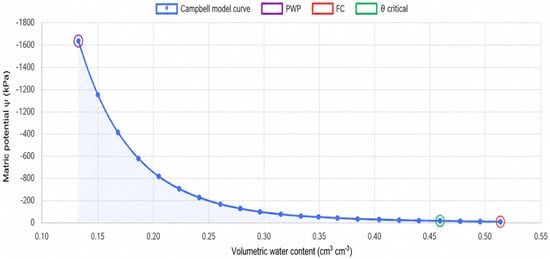
where ψ is the matric potential (kPa), as is the aeration coefficient (0.000382), and bs is the exponent related to the pore size distribution (8.6448). From the model fit, the following hydrodynamic parameters were determined for the evaluated horizon (0–30 cm): field capacity (θCC) of 0.3083 cm3 cm−3 (ψ = −10 kPa), permanent wilting point (θPMP) of 0.1727 cm3 cm−3 (ψ = −1500 kPa), and available water (AD) of 0.1356 cm3 cm−3. In the graphical representation of the retention curve (Figure 1), the thresholds for CC, PMP, and critical irrigation moisture are also identified.
ψ = as × θv−bs
Figure 1.
Soil water retention curve fitted to the Campbell model. Field capacity (FC, ψ = −10 kPa), permanent wilting point (PWP, ψ = −1500 kPa), and critical irrigation moisture (θcritical, PDL = 15%) are indicated.
Water management during the crop cycle was based on maintaining soil moisture close to field capacity, allowing a maximum depletion of 15% of the Total Available Water (TAW), a conservative value compared to the 40–50% recommended for A. hypogaea under production conditions [56]; however, the value is appropriate for a trial aimed at evaluating physiological determinants of yield without water limitation. The Permissible Depletion Level (PDL) of 15% defined a critical irrigation moisture (θ critical) of 0.2879 cm3 cm−3 (equivalent to a matric potential of −18.04 kPa, Figure 1). Considering an effective root zone depth of 300 mm, the Total Available Water in the irrigation profile was 40.68 mm, of which 15% was exhaustible, corresponding to 6.10 mm. Irrigation was applied using a micro-sprinkler system with an application efficiency of 85%, with variable gross application rates (2.5–9.9 mm) programmed every two days, based on the Estimated Crop Evapotranspiration (ETc) for each phenological stage. In this way, the soil moisture content never fell below the established critical threshold (θ critical = 0.2879 cm3/cm−3), guaranteeing optimal water availability throughout the entire cycle.
2.4. Agronomic Variables, Nodulation, and Yield
Variables associated with vegetative growth, nodulation, and yield were evaluated. Leaf area was estimated from fully expanded leaves of the upper middle third, using ten 1 cm2 subsamples per plant, which were oven-dried at 70 °C for 72 h and related to total leaf dry matter [57].
The root system was evaluated by root extraction and washing. Root volume was determined by water displacement, and the total number of roots per plant was counted [58]. Nodulation was classified as active (pinkish or reddish) or inactive (brown or greenish) based on the color of the cross-section of the nodules, according to Mesfin et al. [59] and Escalera et al. [60]. During the reproductive stage, the number of gynophores per plant was recorded, and at harvest, the number of pods per plant. Yield was estimated from the total weight of full pods and expressed in kg ha−1.
2.5. Physiological Variables
The number of stomata per optical field and chlorophyll fluorescence parameters were evaluated using four experimental replicates per accession. One representative plant was selected from each replicate, and four healthy, fully expanded leaves were sampled from the north, south, east, and west orientations of the plant canopy. Stomatal counts were determined using the epidermal impression technique with transparent nail polish. The impressions were examined under a light microscope at 40× magnification, and stomata were counted separately on the adaxial and abaxial leaf surfaces. The counts from both surfaces were subsequently summed to obtain the total number of stomata per leaf, and the values from the four sampled leaves were averaged within each experimental replicate [61].
Chlorophyll fluorescence was assessed 40 days after planting using an OS5p+ pulse-modulated fluorometer (Opti-Sciences, Hudson, NH, USA). Measurements were performed at 08:00 and 12:00 h on the four selected leaves per replicate, located in the upper third of the canopy. The electron transport rate (ETR) was determined under light-adapted conditions, whereas the maximum quantum efficiency of photosystem II (Fv/Fm) was measured after 30 min of dark adaptation [62]. For statistical analysis, individual leaf observations were averaged within each experimental replicate to obtain representative values for each physiological variable, with the experimental replicate considered the independent experimental unit.
2.6. Lipid Composition Analysis
Lipid composition was assessed by determining total fat content and fatty acid profile. Following harvest, seed samples collected from the four field replicates of each peanut accession were pooled to obtain a single 200 g composite sample per accession, in accordance with the laboratory’s sample mass requirements and considering the need to preserve sufficient seed material for other experimental analyses. Each composite sample was submitted to an accredited laboratory for biochemical characterization. Total fat content was determined according to AOAC method 963.22, whereas the fatty acid profile was quantified by gas chromatography following AOAC method 996.06 and the validated procedure PEE.LASA.INS.03 established by LASA Laboratories. Accordingly, lipid composition was determined from one composite sample per accession, and the resulting measurements were used for descriptive characterization rather than statistical inference based on independent field replicates.
2.7. Statistical Analyses
The data were initially subjected to normality and homogeneity of variance tests using the Shapiro–Wilk and Bartlett tests, respectively. Subsequently, an analysis of variance (ANOVA) was performed according to the statistical model for a randomized complete block design, namely Yij = μ + τi + βj + εij, where Yij is the observed value of the response variable for the i-th accession in the j-th block; μ is the overall mean; τi is the fixed effect of the i-th accession (i = 1, 2, …, 10); βj is the effect of the j-th block (j = 1, 2, 3, 4); and εij is the random experimental error. The means were compared using the Scott–Knott test (p ≤ 0.05). Pearson correlation coefficients were also calculated to assess associations between agronomic variables, nodulation, and yield. A Principal Component Analysis (PCA) was also performed to integrate agronomic, physiological, and biochemical variables. Because the variables were expressed in different units and measurement scales, they were standardized prior to the analysis (centered on the mean and scaled to unit variance, therefore, the PCA was based on the correlation matrix, and each variable contributed equally to the total variance. All statistical analyses and graphical representations were performed using R software version 4.5.2 [63] with the following packages: ExpDes.pt, tidyverse, and FactoMineR.
3. Results and Discussion
3.1. Vegetative Growth, Symbiotic Association, and Productive Components
Table 2 shows significant differences (p < 0.01) between accessions for most of the variables evaluated, except for root volume and number of active nodules per plant (p > 0.05). These results reflect marked phenotypic variability among genotypes in traits associated with vegetative growth, nodulation, and yield.
Table 2.
Summary of the analysis of variance of variables associated with vegetative growth, symbiotic association, and yield of ten peanut accessions (Arachis hypogaea L.) in the province of Manabí, Ecuador.
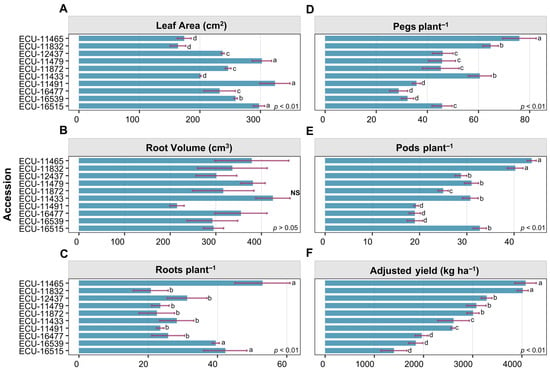
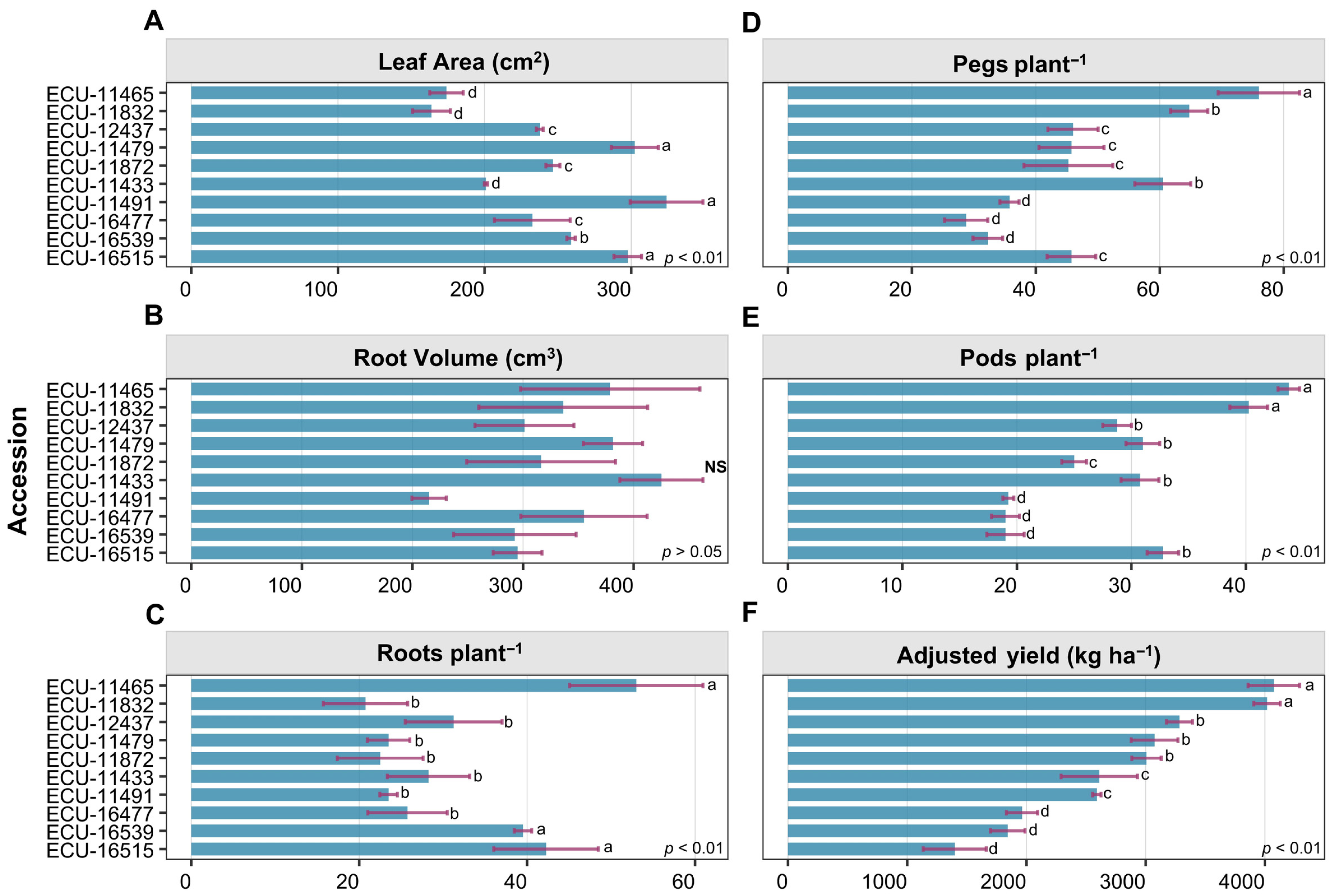
Accessions INIAP-ECU-11465 and INIAP-ECU-11832 exhibited the highest number of gynophores and pods per plant (Figure 2D–E), reaching yields exceeding 4000 kg ha−1 (Figure 2F). In contrast, both showed lower leaf area (Figure 2A), suggesting that yield was more related to reproductive efficiency than to vegetative growth [64,65]. Similarly, although INIAP-ECU-11491 and INIAP-ECU-11479 showed greater leaf expansion, this did not translate into higher yields, indicating a limited relationship between aboveground biomass and productivity [66,67]. These results are consistent with studies that attribute peanut yield to the source–sink balance and the efficiency of assimilate partitioning during pod filling [68,69,70,71].
Figure 2.
Agronomic and reproductive traits of ten peanut (Arachis hypogaea L.) accessions evaluated under field capacity conditions in Manabí, Ecuador: (A) leaf area, (B) root volume, (C) number of roots per plant, (D) number of gynophores per plant, (E) number of pods per plant, and (F) pod yield. Bars represent the mean values of four independent experimental replicates (n = 4 corresponding to the four blocks of the randomized complete block design (RCBD)). Different letters indicate statistically distinct groups according to the Scott–Knott test (p ≤ 0.05). NS indicates a non-significant accession effect according to the ANOVA F-test (p > 0.05). The p-value displayed in each panel corresponds to the F-test for the accession effect.
The highest-yielding accessions also showed better physiological coordination during the reproductive stage, favoring the maintenance of carbon flow to reproductive structures [72,73]. Although root volume did not differ significantly among accessions (Figure 2B), the number of roots per plant did show variability, with INIAP-ECU-11465 and INIAP-ECU-16515 standing out (Figure 2C). These results suggest that root architecture may have greater functional importance than total volume in resource uptake and physiological stability of the crop [74,75].
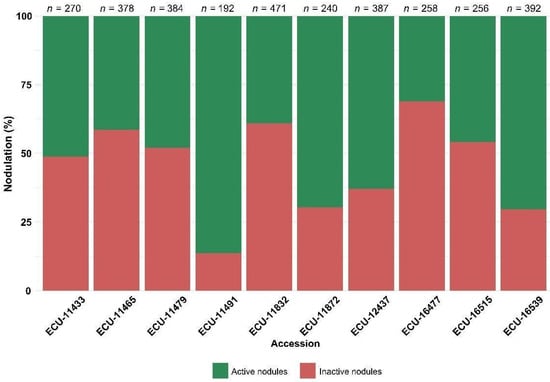
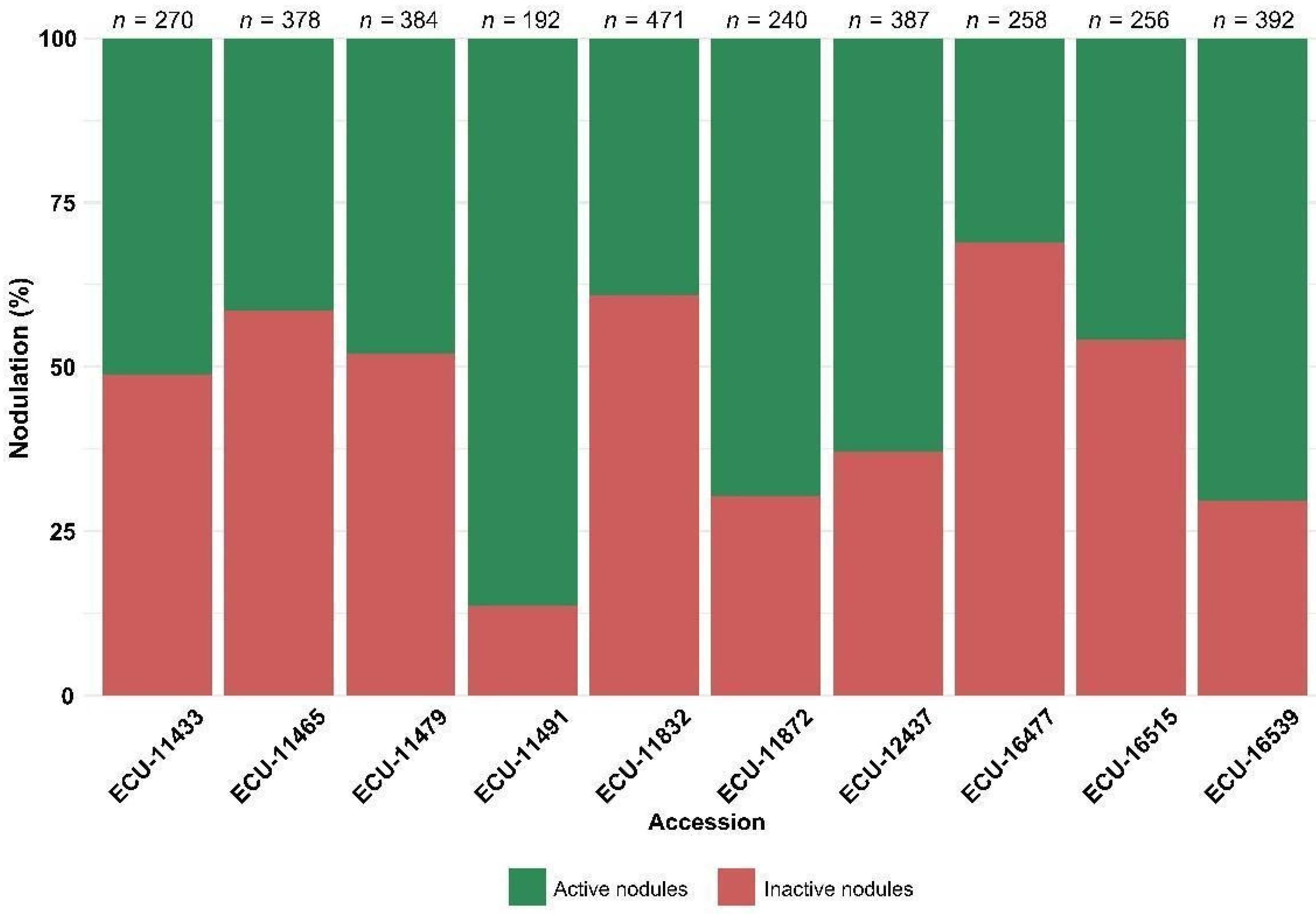
Figure 3 shows variability among accessions in the proportion of active and inactive nodules. INIAP-ECU-11491 presented the highest percentage of active nodules, followed by INIAP-ECU-16539 and INIAP-ECU-11872, while INIAP-ECU-16477 showed the highest proportion of inactive nodules. These results suggest differences in the functionality of biological nitrogen fixation rather than in the total nodulation capacity, since the physiological contribution to growth and reproductive development depends mainly on nitrogenase activity and not on the absolute number of nodules [24].
Figure 3.
Relative proportion (%) of active and inactive nodules in ten peanut accessions (Arachis hypogaea L.) evaluated in Manabí, Ecuador. Nodules were classified as active (pink to red interior) or inactive (brown to greenish interior). Values above the bars (n) indicate the total number of nodules counted per accession.
Recent studies indicate that the efficiency of biological nitrogen fixation and the persistence of functional nodules during the reproductive period directly influence the productive stability of peanuts, especially under high metabolic demand [76,77,78,79]. Furthermore, the genetic regulation of symbiosis and the plasticity of the nodule response have been associated with differences in agronomic performance among genotypes [73].
3.2. Correlation Between Vegetative Growth Parameters, Symbiotic Association, and Productive Components
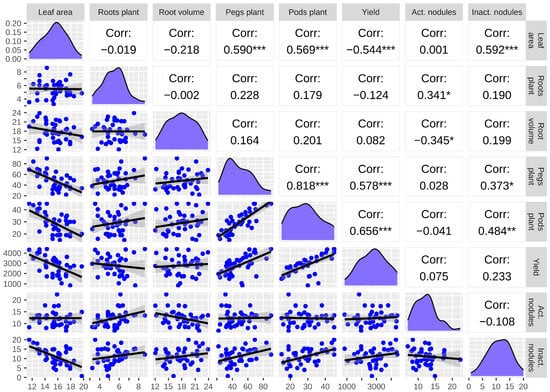
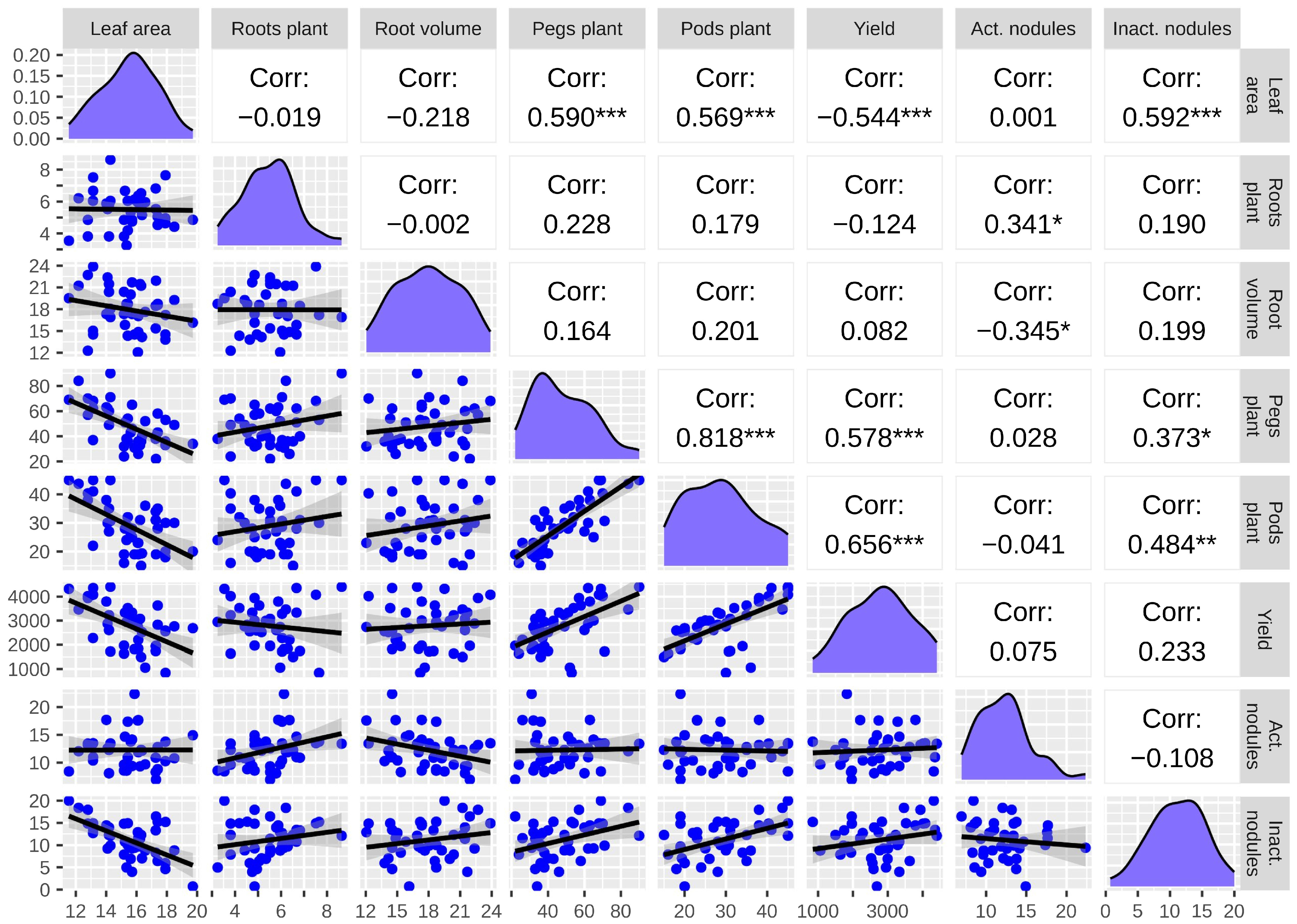
The correlation analysis (Figure 4) showed that reproductive variables were most closely related to yield. The number of gynophores was strongly correlated with the number of pods per plant (r = 0.818 ***), and both were positively associated with yield (r = 0.578 *** and r = 0.656 ***, respectively). Although leaf area was positively related to both gynophores and pods, it showed a negative correlation with yield (r = −0.544 ***), indicating that greater vegetative growth did not necessarily translate into higher productivity. Root variables and nodulation showed weak or indirect associations with yield, with only a positive correlation between the number of roots and active nodules being particularly noteworthy (r = 0.341 *).
Figure 4.
Pearson correlation matrix among vegetative growth, nodulation, and yield variables of ten peanut accessions (Arachis hypogaea L.) (n = 40 plots: 10 accessions × 4 blocks). Upper panels: Pearson correlation coefficients (Corr.); diagonal: density distribution of each variable; lower panels: scatter plots with the fitted linear trend and 95% confidence band; *, ** and ***: significant at p < 0.05, p < 0.01, and p < 0.001.
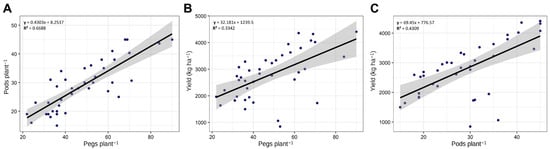
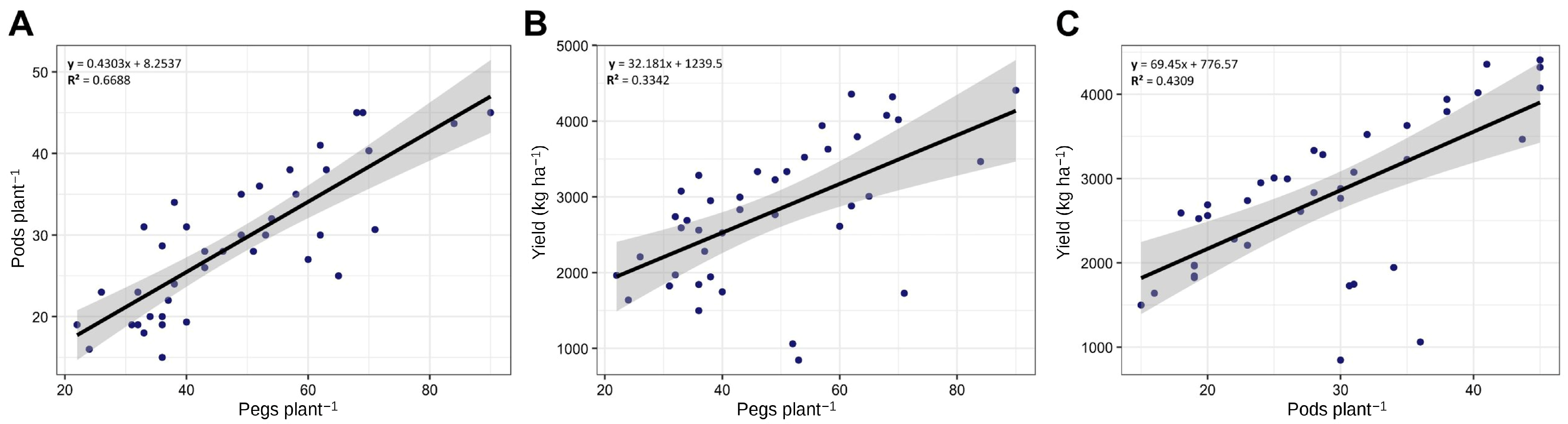
Regression analysis shows that productivity was primarily determined by reproductive efficiency (Figure 5). The number of gynophores explained 66.88% of the variation in the number of pods (R2 = 0.6688). However, its relationship with yield was weaker (R2 = 0.3342), and it could explain the gynophore-pod-filling transition process. Meanwhile, the number of pods explained 43.09% of the variation in yield (R2 = 0.4309), making it one of the main predictors of productive performance. Therefore, it can be observed that yield depends on pod retention and effective filling capacity.
Figure 5.
Linear regression between (A) gynophores per plant and pods per plant, (B) gynophores per plant and pod yield, and (C) pods per plant and pod yield of ten peanut accessions (Arachis hypogaea L.) (n = 40 plots). Solid lines represent the least-squares fit, and shaded areas the 95% confidence interval; the fitted equation and coefficient of determination (R2) are shown in each panel. All regressions were significant (F-test, p < 0.001).
The significant differences between accessions show genetic variability with direct implications for the selection of superior materials. The higher yield of INIAP-ECU-11465 and INIAP-ECU-11832 is associated with reproductive efficiency, confirmed by the strong relationship between gynophores, pods, and yield (R2 up to 0.43). This suggests that, in peanuts, productivity depends primarily on the retention and filling of reproductive structures rather than on absolute vegetative growth [24,42]. The negative correlation between leaf area and yield would be associated with a decoupling in the source–sink dynamic, where the capacity of the reproductive organ can restrict the efficient conversion of photoassimilates into yield [80], and even when the photosynthetic source is large enough, the yield may be more limited by the capacity of the “sink” (demand of the reproductive organs) than by the availability of assimilates [81,82,83].
Under conditions close to field capacity, where water availability does not severely limit stomatal conductance or carbon fixation, the strong relationship between gynophores and pods observed in Figure 5A indicates that early establishment of the reproductive sink in peanuts occurs with adequate assimilate supply [84]. However, the weaker association between gynophores and yield (Figure 5B) suggests that not all potential structures are consolidated into economic biomass due to the strong regulation of the source–sink balance and metabolic control during filling [85].
The greater contribution of the number of pods to yield (Figure 5C) confirms that, even under optimum soil moisture, peanut productivity depends mainly on the retention and effective filling of the reproductive sink [86]. When the soil is kept close to field capacity, turgor, nutrient availability, and photoassimilate transport are favored; however, variability in yield responds more to differences in reproductive efficiency and carbon partitioning than to direct water limitations [87,88].
3.3. Number of Stomata
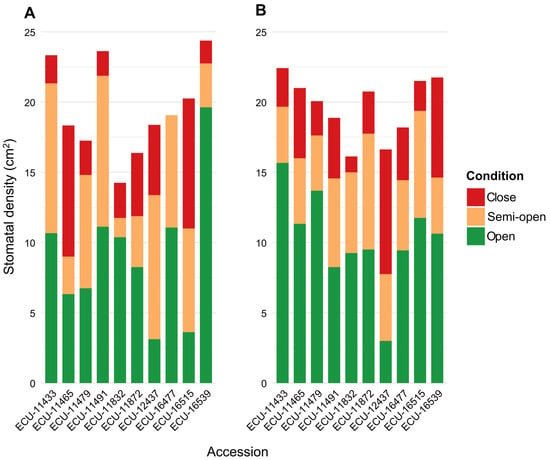
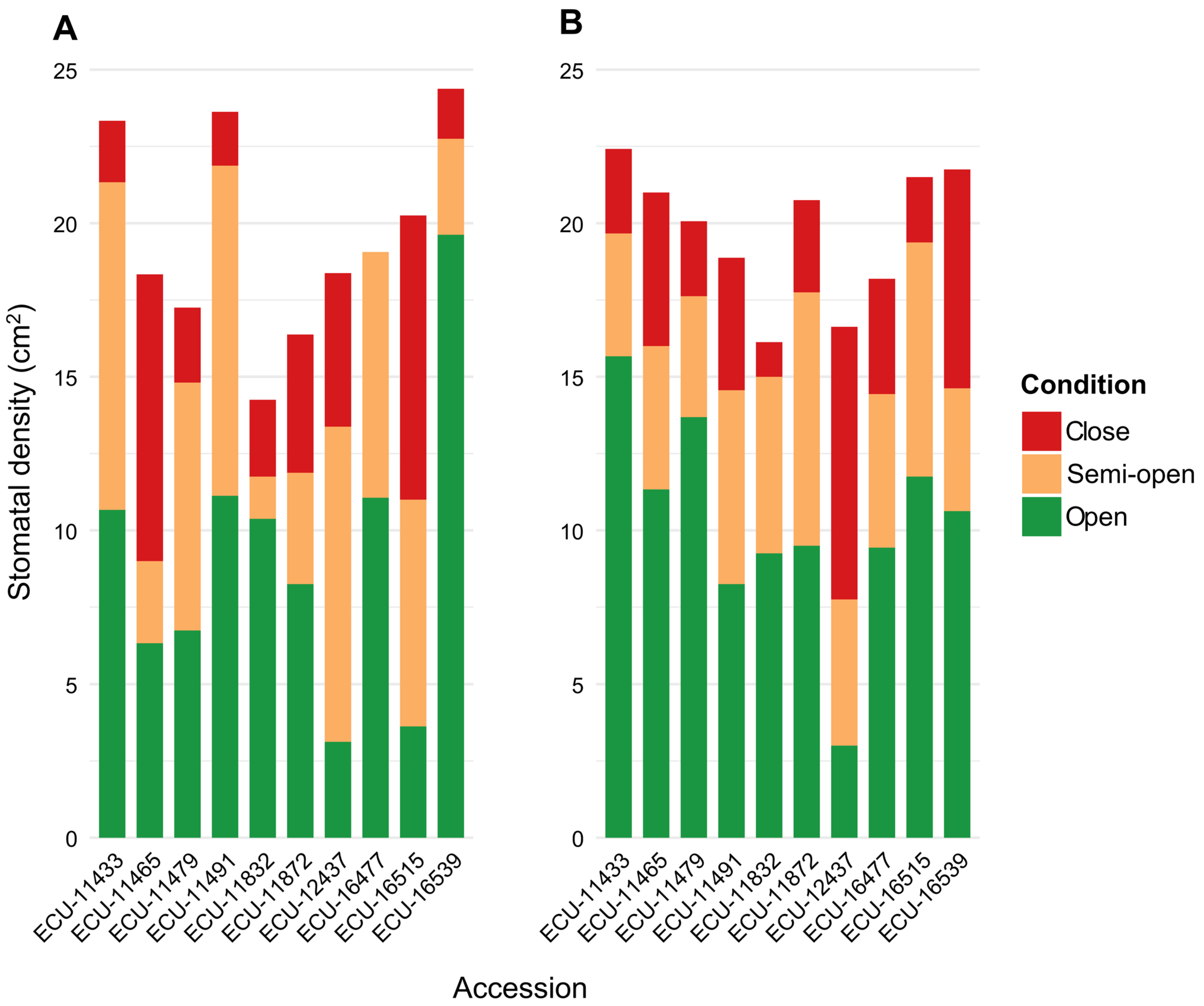
In Figure 6, it can be observed that, even under field capacity, the peanut accessions do not exhibit the same behavior in relation to stomatal regulation. Some accessions, such as INIAP-ECU-16539 and INIAP-ECU-12437, show a higher proportion of open stomata, while others, such as INIAP-ECU-11872 and INIAP-ECU-11465, maintain more semi-open or closed stomata, reflecting a more conservative strategy.
Figure 6.
Number of stomata per optical field (40×) by opening state (open, semi-open, and closed) on the (A) adaxial and (B) abaxial leaf surfaces of ten peanut accessions (Arachis hypogaea L.). Stacked bars represent mean values.
In Figure 6A,B, although all accessions were evaluated under the same field capacity conditions, differences were observed in the number of stomata per optical field and their opening state among accessions. Accessions such as INIAP-ECU-16539 and INIAP-ECU-11433 showed a higher proportion of open stomata, whereas INIAP-ECU-12437 and INIAP-ECU-16515 showed a greater proportion of semi-open or closed stomata, indicating differences in stomatal behavior among the evaluated accessions under non-water-limiting conditions [89].
From a physiological point of view, the differences and asymmetries between leaf surfaces indicate that the adaxial and abaxial epidermis can contribute differentially to gas flow, which has been demonstrated in amphistomatic species where both surfaces actively participate in photosynthetic regulation and transpiration [90,91,92,93].
These results are consistent with reports highlighting the genetic variability in physiological and agronomic traits of peanuts [87] and with genomic studies demonstrating the wide diversity present in subgenomes A and B and their relationship with complex traits [94]. Furthermore, quantitative trait locus mapping and the identification of regions associated with agronomic traits support the idea that physiological differences such as stomatal regulation can be determined by loci [95].
The observed variation indicates differences in stomatal behavior among accessions under non-water-limiting conditions. These differences may reflect intrinsic physiological variation within the evaluated germplasm; however, further studies across environments and with additional physiological measurements would be required to determine their genetic basis and potential usefulness as selection criteria in peanut breeding programs [76].
3.4. Electron Transport Rate (ETR) and Maximum Quantum Efficiency of Photosystem II (Fv/Fm)
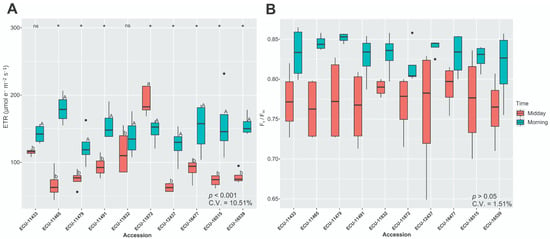
As shown in Figure 7A, the ETR exhibited significant differences between accessions and times of day (p < 0.001), with higher values in the morning and a reduction at midday, indicating a diurnal variation in PSII photochemical performance. In the morning, the accessions maintained the highest and most stable ETR values, which could indicate greater efficiency in electron transport. At midday, INIAP-ECU-11465 and INIAP-ECU-12437 presented the lowest values. However, INIAP-ECU-11832 remained stable, and INIAP-ECU-11872 showed an increase in its ETR, suggesting differences in photochemical responses to diurnal environmental variation. Photoprotective mechanisms have been identified as important processes in photosynthetic regulation and efficiency [96,97]. As shown in Figure 7B, the Fv/Fm ratio remained within the optimum range in most accessions, although with a slight decrease at midday, especially in INIAP-ECU-16539, INIAP-ECU-11433, and INIAP-ECU-11479, which showed greater photochemical stability, while INIAP-ECU-12437 showed greater variability. All Fv/Fm values close to 0.80 suggested the absence of severe photoinhibition under the evaluated conditions [46].
Figure 7.
(A) Electron transport rate (ETR, µmol e− m−2 s−1) and (B) maximum quantum efficiency of photosystem II (Fv/Fm) measured in the morning and at midday in ten peanut accessions (Arachis hypogaea L.). Uppercase and lowercase letters indicate comparisons among accessions in the morning and at midday, respectively, according to the Scott–Knott test (p ≤ 0.05). Accessions sharing the same letter within each measurement time do not differ significantly. Asterisks (*) indicate significant differences between morning and midday measurements within each accession, according to the ANOVA F-test (p ≤ 0.05), whereas ns indicates non-significant differences (p > 0.05). The p-values for the accession effect and the coefficients of variation (CV) from the analysis of variance (ANOVA) are presented in each panel.
Although the experiment was conducted under field capacity conditions, where there was no water limitation, the differences observed in ETR and Fv/Fm between accessions demonstrate a clear influence of the genetic component on photochemical efficiency. The moderate reduction in ETR at midday, accompanied by slight decreases in Fv/Fm, could suggest the activation of dynamic photoprotection mechanisms rather than structural damage to PSII, a phenomenon widely described as a physiological adjustment to transient increases in radiation and temperature, even in the absence of water stress [98]. In this context, the accessions INIAP-ECU-16539 and INIAP-ECU-11433, which maintained higher ETR values and stability in Fv/Fm, reflect better coordination between electron transport and energy dissipation, which could translate into greater photosynthetic efficiency and productive potential [99].
Photochemical stability under fluctuating environmental conditions is considered an important physiological trait associated with plant performance and yield stability [100]. Even under optimal water availability, peanut accessions can exhibit differences in photochemical responses, as observed in the present study. Therefore, the results suggest that the variation in ETR and Fv/Fm under non-limiting water conditions may provide useful preliminary information for identifying promising peanut accessions, although further evaluation under contrasting environmental conditions is required to establish their relevance for adaptation and breeding programs.
3.5. Fatty Acid Profile
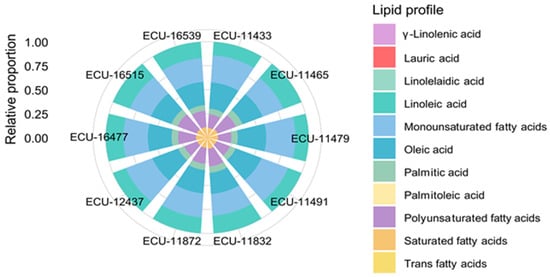
Monounsaturated fatty acids, primarily oleic acid (40.77–53.54%), were predominant in all accessions (Figure 8). INIAP-ECU-11479 and INIAP-ECU-12437 stood out for their higher oleic acid content, which confers greater oxidative stability and improved industrial quality. On the other hand, INIAP-ECU-11465 and INIAP-ECU-16515 showed higher proportions of linoleic acid (24.85–36.71%), reflecting a more polyunsaturated profile. Saturated fatty acids, especially palmitic acid (10.61–13.13%), showed less variation among accessions, while trans fatty acids (<0.5%) remained at marginal levels, confirming the oil’s good nutritional quality.
Figure 8.
Fatty acid profile of ten peanut accessions (Arachis hypogaea L.) evaluated in Manabí, Ecuador, shown in polar coordinates as the relative proportion of total fatty acids. Values below the quantification limits (<0.01% and <0.5%) were plotted at those limits. Consequently, γ-linolenic, lauric, linolelaidic and palmitoleic acids and trans fatty acids, although included in the legend, are not visible at this scale because of their very low relative proportions.
The variation observed in the fatty acid profile under field capacity conditions revealed contrasting oil composition among the evaluated accessions. The inverse relationship between oleic acid (40.77–53.54%) and linoleic acid (24.85–36.71%) is consistent with previous studies describing the role of Δ12-oleate desaturase (FAD2), a key enzyme involved in the conversion of oleic acid to linoleic acid and in determining the oleic/linoleic balance in peanut oil [48,52]. Although FAD2 activity or expression was not evaluated in the present study, this mechanism provides a physiological basis for interpreting the contrasting fatty acid profiles observed among accessions. INIAP-ECU-11479 and INIAP-ECU-12437 stood out for their higher proportion of oleic acid, which favors the oxidative stability of the oil and reduces its susceptibility to peroxidation [48,52]. In contrast, INIAP-ECU-11465 and INIAP-ECU-16515 showed a higher linoleic acid content, associated with greater unsaturation and nutritional value, although also with lower oxidative stability [48].
This lipid pattern could be linked to differences in carbon partitioning and metabolic regulation during the reproductive phase [24,34,78,101]. Although genotype × environment interactions can modify oil quality [46], evaluation under non-limiting humidity conditions allowed the identification of contrasting fatty acid profiles among the evaluated accessions. In particular, INIAP-ECU-11479 and INIAP-ECU-12437 showed higher oleic acid contents, indicating their potential value for further evaluation in breeding programs focused on oil quality [73].
3.6. Comprehensive Analysis of Morpho-Physiological Performance, Productivity, and Oil Quality
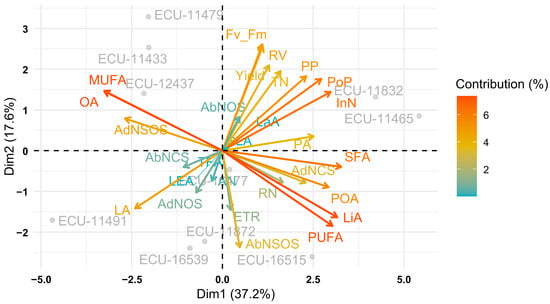
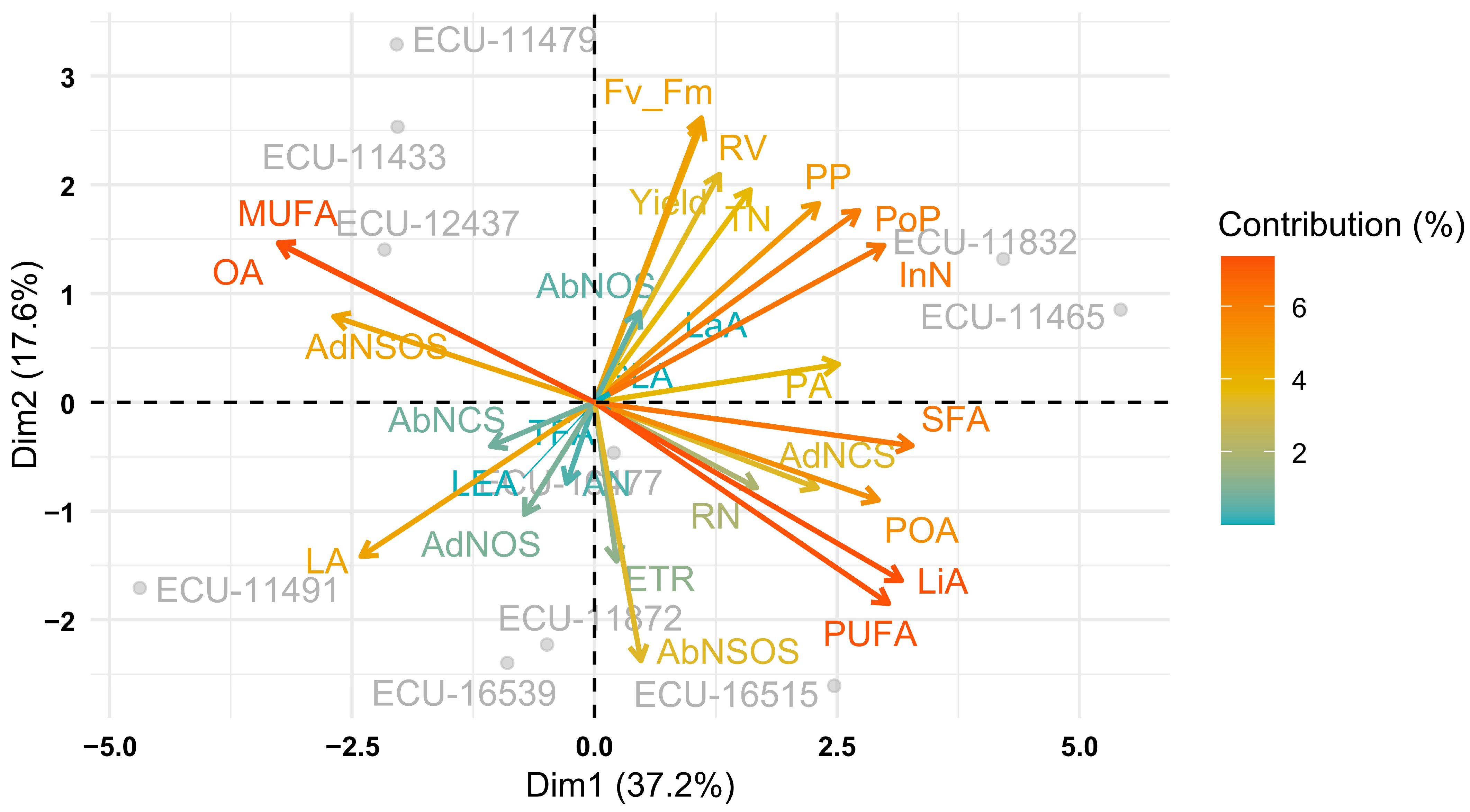
The principal component analysis (PCA) in Figure 9 describes 54.8% of the total variability (Dim1 = 37.2% and Dim2 = 17.6%), showing a clear differentiation between accessions according to productive, physiological, and oil quality traits. On the principal axis (Dim1), the variables related to yield, mainly number of pods, gynophores, and productivity, were closely associated with accessions INIAP-ECU-11465 and INIAP-ECU-11832, explaining their higher agronomic performance observed in the field and reinforcing reproductive components as key determinants of peanut yield [24].
Figure 9.
Principal component analysis (PCA) biplot. Projection of peanut (Arachis hypogaea L.) accessions and evaluated variables. Grey dots and labels identify the peanut accessions, while arrows represent the agronomic, physiological, and oil quality traits. Arrow colors indicate the relative contribution of each variable to the principal components, from lower (blue-green) to higher (orange-red) contributions. Variables: LA: leaf area; RN: number of roots; RV: root volume; PP: gynophores per plant; PoP: pods per plant; TN: total nodules; AN: active nodules; InN: inactive nodules; ETR: electron transport rate; Fv/Fm: maximum quantum efficiency of photosystem II; AdNOS: adaxial number of open stomata; AdNSOS: adaxial number of semi-open stomata; AdNCS: adaxial number of closed stomata; AbNOS: abaxial number of open stomata; AbNSOS: abaxial number of semi-open stomata; AbNCS: abaxial number of closed stomata; LaA: lauric acid; LiA: linoleic acid; OA: oleic acid; PA: palmitic acid; POA: palmitoleic acid; GLA: γ-linolenic acid; READ: linolelaidic acid; TFAs: trans fatty acids; PUFAs: polyunsaturated fatty acids; MUFAs: monounsaturated fatty acids; SFAs: saturated fatty acids.
In contrast, accessions INIAP-ECU-11479 and INIAP-ECU-12437 are related to lipid composition, particularly oleic acid, showing a differentiated chemical profile [52], highlighting contrasting oil quality profiles among the evaluated accessions [48]. On the other hand, accessions such as INIAP-ECU-11491 and INIAP-ECU-16539 were more closely associated with vegetative traits, indicating a contrasting phenotypic profile relative to accessions more strongly associated with reproductive and yield-related variables [34]. Physiological variables related to photochemical efficiency are located near the origin of the graph (Figure 9), indicating a minor contribution to the overall differentiation among accessions; however, these traits remain relevant indicators of photosynthetic stability and physiological performance of the crop [39].
4. Conclusions
This study revealed differences in morphological, reproductive, physiological, and fatty acid traits among ten peanut (Arachis hypogaea L.) accessions evaluated under field capacity conditions. Reproductive components, particularly the number of gynophores and pods per plant, were positively associated with yield, highlighting their relevance for the preliminary identification of promising germplasm. In contrast, leaf area did not show a strong direct association with yield components, indicating that greater vegetative development was not necessarily accompanied by higher reproductive performance.
The accessions exhibited differences in stomatal characteristics and PSII photochemical performance, as reflected by variations in electron transport rate (ETR) and maximum quantum efficiency (Fv/Fm). The diurnal changes observed in these parameters indicate differences in photochemical responses under the evaluated conditions. However, these measurements do not establish the operation of specific photoprotective mechanisms or demonstrate tolerance to water deficit.
Differences in fatty acid composition also distinguished the evaluated accessions. INIAP-ECU-11479 and INIAP-ECU-12437 showed comparatively higher oleic acid contents, suggesting their potential interest for further studies focused on peanut oil quality. These findings provide complementary information to the agronomic and physiological characterization, although the biochemical mechanisms underlying the observed differences were not directly investigated.
Author Contributions
Conceptualization, A.C.-S.; methodology, A.C.-S.; validation, G.C.-G., Á.M.-A., M.T. and J.L.-R.; formal analysis, G.C.-G. and L.A.S.-R.; investigation, X.H.-S., C.V.P., F.R. and G.C.; resources, M.T. and F.R.; data curation, G.C.-G., C.V.P. and L.A.S.-R.; writing—original draft preparation, A.C.-S., X.H.-S. and G.C.; writing—review and editing, A.C.-S., X.H.-S., G.C.-G., C.V.P., L.A.S.-R., Á.M.-A., M.T., F.R., G.C. and J.L.-R.; visualization, L.A.S.-R.; supervision, A.C.-S.; project administration, A.C.-S. All authors have read and agreed to the published version of the manuscript.
Funding
This research received no external funding.
Data Availability Statement
The raw data supporting the conclusions of this article will be made available by the authors on request.
Acknowledgments
The authors express their gratitude to the Technical University of Manabí and the National Institute of Agricultural Research (INIAP), Ecuador, for the technical, logistical, and institutional support provided for the development of this research.
Conflicts of Interest
The authors declare no conflicts of interest.
References
- Bodoira, R.; Cecilia Cittadini, M.; Velez, A.; Rossi, Y.; Montenegro, M.; Martínez, M. An Overview on Extraction, Composition, Bioactivity and Food Applications of Peanut Phenolics. Food Chem. 2022, 381, 132250. [Google Scholar] [CrossRef] [Scilit] [PubMed]
- Machado, N.M.; Nunes, Y.C.; Lima, E.P.; Chehadi, A.C.; Otoboni, A.M.M.B.; Miola, V.F.B. Peanuts (Arachis hypogaea L.) in Food Industry and Their Benefits for Human Health—A Review of the Current Literature. J. Food Compos. Anal. 2025, 143, 107574. [Google Scholar] [CrossRef] [Scilit]
- USDA Foreign Agricultural Service. World Agricultural Production, September 2025; USDA: Washington, DC, USA, 2025. Available online: https://apps.fas.usda.gov/PSDOnline/Circulars/2025/09/production.pdf?utm_source=chatgpt.com (accessed on 21 October 2026).
- Neves, F.P.; Leite, A.R.; Mantovani, L.P.; da Silva, C.; Gabriel Filho, L.R.A.; Oliveira, S.C.D. The Economic Importance of the Peanuts Production Chain. Rev. Bras. Eng. Biossistemas 2023, 17, 1186. [Google Scholar] [CrossRef] [Scilit]
- Variath, M.T.; Janila, P. Economic and Academic Importance of Peanut. In The Peanut Genome; Varshney, R.K., Pandey, M.K., Puppala, N., Eds.; Compendium of Plant Genomes; Springer International Publishing: Cham, Switzerland, 2017; pp. 7–26. [Google Scholar]
- Akram, N.A.; Shafiq, F.; Ashraf, M. Peanut (Arachis hypogaea L.): A prospective legume crop to offer multiple health benefits under changing climate. Compr. Rev. Food Sci. Food Saf. 2018, 17, 1325–1338. [Google Scholar] [CrossRef] [Scilit] [PubMed]
- Arya, S.S.; Salve, A.R.; Chauhan, S. Peanuts as Functional Food: A Review. J. Food Sci. Technol. 2016, 53, 31–41. [Google Scholar] [CrossRef] [Scilit] [PubMed]
- Çiftçi, S.; Suna, G. Functional Components of Peanuts (Arachis hypogaea L.) and Health Benefits: A Review. Future Foods 2022, 5, 100140. [Google Scholar] [CrossRef] [Scilit]
- Ros, E.; Singh, A.; O’Keefe, J.H. Nuts: Natural pleiotropic nutraceuticals. Nutrients 2021, 13, 3269. [Google Scholar] [CrossRef] [Scilit] [PubMed]
- Sebei, K.; Gnouma, A.; Herchi, W.; Sakouhi, F.; Boukhchina, S. Lipids, Proteins, Phenolic Composition, Antioxidant and Antibacterial Activities of Seeds of Peanuts (Arachis hypogaea L.) Cultivated in Tunisia. Biol. Res. 2013, 46, 257–263. [Google Scholar] [CrossRef] [Scilit] [PubMed]
- Zahran, H.A.; Tawfeuk, H.Z. Physicochemical Properties of New Peanut (Arachis hypogaea L.) Varieties. OCL 2019, 26, 19. [Google Scholar] [CrossRef] [Scilit]
- Shah, P.; Wright, G.; Nwosu, C.V.; O’Connor, D.; Tsatsos, P.; Janila, P. Industry Perspective, Genetics and Genomics of Peanut Blanchability. Plant Sci. 2025, 355, 112473. [Google Scholar] [CrossRef] [Scilit] [PubMed]
- Toomer, O.T. A Comprehensive Review of the Value-Added Uses of Peanut (Arachis hypogaea) Skins and by-Products. Crit. Rev. Food Sci. Nutr. 2020, 60, 341–350. [Google Scholar] [CrossRef] [Scilit] [PubMed]
- Food and Agriculture Organization of the United Nations (FAOSTAT). FAOSTAT Statistics Database; FAO: Rome, Italy, 2025. Available online: https://www.fao.org/faostat/en/#data/QCL (accessed on 21 September 2025).
- Adla, S.; Pande, S.; Vico, G.; Vora, S.; Alam, M.F.; Basel, B. Place for Sociohydrology in Sustainable and Climate Resilient Agriculture: Review and Ways Forward. Camb. Prism. Water 2023, 1, e13. [Google Scholar] [CrossRef] [Scilit]
- Dahal, D.; Bhattarai, N.; Silwal, A.; Shrestha, S.; Shrestha, B.; Poudel, B. A Review on Climate Change Impacts on Freshwater Systems and Ecosystem Resilience. Water 2025, 17, 3052. [Google Scholar] [CrossRef] [Scilit]
- Wei, S.; Li, K.; Yang, Y.; Wang, C.; Liu, C.; Zhang, J. Comprehensive Climatic Suitability Evaluation of Peanut in Huang-Huai-Hai Region under the Background of Climate Change. Sci. Rep. 2022, 12, 11350. [Google Scholar] [CrossRef] [Scilit] [PubMed]
- Instituto Nacional de Estadística y Censos (INEC). Módulo de Información Agroambiental y Tecnificación Agropecuaria (MIATA)—ESPAC 2024; INEC: Quito, Ecuador, 2025. Available online: https://www.ecuadorencifras.gob.ec/documentos/web-inec/Encuestas_Ambientales/Modulo_Ambiental_ESPAC/2024/PPT_MOD_AMB_ESPAC_2024_04.pdf (accessed on 21 September 2025).
- Matailo-Ramirez, L.; Luna, A.; Chabla, J.; Gálvez, P. Modelización del rendimiento con Aquacrop-FAO en el cultivo de maní (Arachis hypogaea L.), Ecuador. Manglar 2023, 20, 51–58. [Google Scholar] [CrossRef] [Scilit]
- Pérez, R.; Cabrera, E.; Hinostroza, M. Régimen de riego de cultivos en Manabí Ecuador: Estudio climatológico. Rev. Cienc. Téc Agropecu. 2018, 27, 5–12. [Google Scholar]
- Emara, E.I.; Moursy, M.; Hamed, L. Response of Certain Peanut (Arachis hypogaea L.) Varieties to Water Regime Using Different Irrigation Systems in New Reclaimed Areas. J. Saudi Soc. Agric. Sci. 2023, 22, 245–260. [Google Scholar] [CrossRef] [Scilit]
- Htoon, W.; Jogloy, S.; Vorasoot, N.; Toomsan, B.; Kaewpradit, W.; Puppala, N. Nutrient Uptakes and Their Contributions to Yield in Peanut Genotypes with Different Levels of Terminal Drought Resistance. Turk. J. Agric. For. 2014, 38, 781–791. [Google Scholar] [CrossRef] [Scilit]
- Pokhrel, S.; Kharel, P.; Pandey, S.; Botton, S.; Nugraha, G.T.; Holbrook, C. Understanding the Impacts of Drought on Peanuts (Arachis hypogaea L.): Exploring Physio-Genetic Mechanisms to Develop Drought-Resilient Peanut Cultivars. Front. Genet. 2024, 15, 1492434. [Google Scholar] [CrossRef] [Scilit] [PubMed]
- Puppala, N.; Nayak, S.N.; Sanz-Saez, A.; Chen, C.; Devi, M.J.; Nivedita, N. Sustaining Yield and Nutritional Quality of Peanuts in Harsh Environments: Physiological and Molecular Basis of Drought and Heat Stress Tolerance. Front. Genet. 2023, 14, 1121462. [Google Scholar] [CrossRef] [Scilit] [PubMed]
- Seleiman, M.F.; Al-Suhaibani, N.; Ali, N.; Akmal, M.; Alotaibi, M.; Refay, Y. Drought Stress Impacts on Plants and Different Approaches to Alleviate Its Adverse Effects. Plants 2021, 10, 259. [Google Scholar] [CrossRef] [Scilit] [PubMed]
- Haro, R.J.; Mantese, A.I.; Otegui, M.E. Peg Viability and Pod Set in Peanut: Response to Impaired Pegging and Water Deficit. Flora 2011, 206, 865–871. [Google Scholar] [CrossRef] [Scilit]
- Kumar, R.; Pandey, M.K.; Roychoudhry, S.; Nayyar, H.; Kepinski, S.; Varshney, R.K. Peg biology: Deciphering the molecular regulations involved during peanut peg development. Front. Plant Sci. 2019, 10, 1289. [Google Scholar] [CrossRef] [Scilit] [PubMed]
- Li, G.; Guo, X.; Sun, W.; Hou, L.; Wang, G.; Tian, R.; Wang, X.; Qu, C.; Zhao, C. Nitrogen Application in Pod Zone Improves Yield and Quality of Two Peanut Cultivars by Modulating Nitrogen Accumulation and Metabolism. BMC Plant Biol. 2024, 24, 48. [Google Scholar] [CrossRef] [Scilit] [PubMed]
- Zhao, C.; Zhao, S.; Hou, L.; Xia, H.; Wang, J.; Li, C.; Li, A.; Li, T.; Zhang, X.; Wang, X. Proteomics Analysis Reveals Differentially Activated Pathways That Operate in Peanut Gynophores at Different Developmental Stages. BMC Plant Biol. 2015, 15, 188. [Google Scholar] [CrossRef] [Scilit] [PubMed]
- Almaz, C.; Miháliková, M.; Báťková, K.; Vopravil, J.; Matula, S.; Khel, T. Simple and Cost-Effective Method for Reliable Indirect Determination of Field Capacity. Hydrology 2023, 10, 202. [Google Scholar] [CrossRef] [Scilit]
- Rai, R.K.; Singh, V.P.; Upadhyay, A. Soil Analysis, En Planning and Evaluation of Irrigation Projects; Elsevier: Amsterdam, The Netherlands, 2017; pp. 120–150. ISBN 9780128117484. [Google Scholar]
- Damerum, A.; Smith, H.K.; Clarkson, G.J.J.; Truco, M.J.; Michelmore, R.W.; Taylor, G. The Genetic Basis of Water-Use Efficiency and Yield in Lettuce. BMC Plant Biol. 2021, 21, 237. [Google Scholar] [CrossRef] [Scilit] [PubMed]
- Gilchrist, E.J.; Haughn, G.W.; Ying, C.C.; Otto, S.P.; Zhuang, J.; Cheung, D. Use of Ecotilling as an Efficient SNP Discovery Tool to Survey Genetic Variation in Wild Populations of Populus trichocarpa. Mol. Ecol. 2006, 15, 1367–1378. [Google Scholar] [CrossRef] [Scilit] [PubMed]
- Massa, A.N.; Sobolev, V.S.; Faustinelli, P.C.; Tallury, S.P.; Stalker, H.T.; Lamb, M.C. Genetic Diversity, Disease Resistance, and Environmental Adaptation of Arachis duranensis: New Insights from Landscape Genomics. PLoS ONE 2024, 19, e0299992. [Google Scholar] [CrossRef] [Scilit] [PubMed]
- Ramírez-Toledo, M.; Reina-Pinto, J.J.; Domínguez, E.; Cantero, E.; Pérez-Alfocea, F.; Romero-Aranda, M.R. Variación genética de la eficiencia del uso del agua en una población recombinante de tomate. Actas Hortic. 2012, 60, 67–70. [Google Scholar]
- Lumactud, R.A.; Dollete, D.; Liyanage, D.K.; Szczyglowski, K.; Hill, B.; Thilakarathna, M.S. The Effect of Drought Stress on Nodulation, Plant Growth, and Nitrogen Fixation in Soybean during Early Plant Growth. J. Agron. Crop Sci. 2023, 209, 345–354. [Google Scholar] [CrossRef] [Scilit]
- Umadevi, M.; Vanitha, K.; Mythili, S.R.; Shanthi, P.; Kavithamani, D.; Arulselvi, S. Genetic Analysis of Groundnut (Arachis hypogaea L.) Genotypes for Yield and Oil Quality Parameters. Plant Sci. Today 2025, 12, 1–10. [Google Scholar] [CrossRef] [Scilit]
- Bhaskara, G.B.; Lasky, J.R.; Razzaque, S.; Zhang, L.; Haque, T.; Bonnette, J.E.; Civelek, G.Z.; Verslues, P.E.; Juenger, T.E. Natural variation identifies new effectors of water-use efficiency in Arabidopsis. Proc. Natl. Acad. Sci. USA 2022, 119, 2205305119. [Google Scholar] [CrossRef] [Scilit] [PubMed]
- Huang, L.; Zhang, L.; Zeng, R.; Wang, X.; Zhang, H.; Wang, L. Brassinosteroid Priming Improves Peanut Drought Tolerance via Eliminating Inhibition on Genes in Photosynthesis and Hormone Signaling. Genes 2020, 11, 919. [Google Scholar] [CrossRef] [Scilit] [PubMed]
- Jiang, C.; Li, X.; Zou, J.; Ren, J.; Jin, C.; Zhang, H. Comparative Transcriptome Analysis of Genes Involved in the Drought Stress Response of Two Peanut (Arachis hypogaea L.) Varieties. BMC Plant Biol. 2021, 21, 64. [Google Scholar] [CrossRef] [Scilit] [PubMed]
- Zhao, X.; Li, C.; Wan, S.; Zhang, T.; Yan, C.; Shan, S. Transcriptomic Analysis and Discovery of Genes in the Response of Arachis hypogaea to Drought Stress. Mol. Biol. Rep. 2018, 45, 119–131. [Google Scholar] [CrossRef] [Scilit] [PubMed]
- Zhen, X.; Huo, W.; Sanz-Saez, A.; Miao, Y.; Chen, C.Y.; Batchelor, W.D. Drought-Tolerant Peanut (Arachis hypogaea L.) Varieties Can Mitigate Negative Impacts of Climate Change on Yield in the Southeastern U.S. Comput. Electron. Agric. 2024, 224, 109105. [Google Scholar] [CrossRef] [Scilit]
- Kang, J.; Hao, X.; Zhou, H.; Ding, R. An Integrated Strategy for Improving Water Use Efficiency by Understanding Physiological Mechanisms of Crops Responding to Water Deficit: Present and Prospect. Agric. Water Manag. 2021, 255, 107008. [Google Scholar] [CrossRef] [Scilit]
- Qiao, Y.; Li, D.; Qiao, W.; Li, Y.; Yang, H.; Liu, W. Development and Application of a Relative Soil Water Content—Transpiration Efficiency Curve for Screening High Water Use Efficiency Wheat Cultivars. Front. Plant Sci. 2022, 13, 967210. [Google Scholar] [CrossRef] [Scilit] [PubMed]
- Raman, H.; Raman, R.; McVittie, B.; Borg, L.; Diffey, S.; Yadav, A.S. Genetic and Physiological Bases for Variation in Water Use Efficiency in Canola. Food Energy Secur. 2020, 9, 237. [Google Scholar] [CrossRef] [Scilit]
- Yuan, X.; Li, S.; Chen, J.; Yu, H.; Yang, T.; Wang, C. Impacts of Global Climate Change on Agricultural Production: A Comprehensive Review. Agronomy 2024, 14, 1360. [Google Scholar] [CrossRef] [Scilit]
- Abbas, M.; El-Shabrawi, H.; Hamza, M.; Wahba, H.; Shahba, M. Association between Productivity, Fatty Acid Profiles, Oil Bodies’ Ultrastructure and Molecular Markers in Peanut (Arachis hypogaea L.) Cultivars. Agronomy 2020, 10, 1401. [Google Scholar] [CrossRef] [Scilit]
- Huang, Y.; Ma, R.; Xu, Y.; Zhong, K.; Bu, Q.; Gao, H. A Comparison of Lipid Contents in Different Types of Peanut Cultivars Using UPLC-Q-TOF-MS-Based Lipidomic Study. Foods 2021, 11, 4. [Google Scholar] [CrossRef] [Scilit] [PubMed]
- Idrissi, Z.L.E.; El Moudden, H.; Mghazli, N.; Bouyahya, A.; Guezzane, C.E.; Alshahrani, M.M. Effects of Extraction Methods on the Bioactivities and Nutritional Value of Virginia and Valencia-Type Peanut Oil. Molecules 2022, 27, 7709. [Google Scholar] [CrossRef] [Scilit] [PubMed]
- Symoniuk, E.; Ksibi, N.; Wroniak, M.; Lefek, M.; Ratusz, K. Oxidative Stability Analysis of Selected Oils from Unconventional Raw Materials Using Rancimat Apparatus. Appl. Sci. 2022, 12, 10355. [Google Scholar] [CrossRef] [Scilit]
- Carrín, M.E.; Carelli, A.A. Peanut Oil: Compositional Data. Eur. J. Lipid Sci. Technol. 2010, 112, 697–707. [Google Scholar] [CrossRef] [Scilit]
- Li, W.; Yoo, E.; Lee, S.; Sung, J.; Noh, H.J.; Hwang, S.J. Seed Weight and Genotype Influence the Total Oil Content and Fatty Acid Composition of Peanut Seeds. Foods 2022, 11, 3463. [Google Scholar] [CrossRef] [Scilit] [PubMed]
- Bejar, S.J.; Cantú Silva, I.; Yáñez Díaz, M.I.; Luna Robles, E.O. Curvas de retención de humedad y modelos de pedotransferencia en un Andosol bajo distintos usos de suelo. Rev. Mex. Cienc. For. 2020, 11, 31–50. [Google Scholar] [CrossRef] [Scilit]
- Campbell, G.S. A Simple Method for Determining Unsaturated Conductivity from Moisture Retention Data. Soil. Sci. 1974, 117, 311–314. [Google Scholar] [CrossRef] [Scilit]
- Pittaki-Chrysodonta, Z.; Moldrup, P.; Knadel, M.; Iversen, B.V.; Hermansen, C.; Greve, M.H. Predicting the Campbell Soil Water Retention Function: Comparing Visible–Near-infrared Spectroscopy with Classical Pedotransfer Function. Vadose Zone J. 2018, 17, 1–12. [Google Scholar] [CrossRef] [Scilit]
- Pereira, L.S.; Paredes, P.; Hunsaker, D.J.; López-Urrea, R.; Jovanovic, N. Updates and Advances to the FAO56 Crop Water Requirements Method. Agric. Water Manag. 2021, 248, 106697. [Google Scholar] [CrossRef] [Scilit]
- Garcés, F.R.; Forcelini, C.A. Peso de hojas como herramienta para estimar el área foliar en soya. Cienc. Y Tecnol. 2011, 4, 13–18. [Google Scholar] [CrossRef] [Scilit]
- Kaysar, M.S.; Sarker, U.K.; Monira, S.; Hossain, M.A.; Haque, M.S.; Somaddar, U. Dissecting the Relationship between Root Morphological Traits and Yield Attributes in Diverse Rice Cultivars under Subtropical Condition. Life 2022, 12, 1519. [Google Scholar] [CrossRef] [Scilit] [PubMed]
- Mesfin, S.; Gebresamuel, G.; Haile, M.; Zenebe, A.; Desta, G. Mineral Fertilizer Demand for Optimum Biological Nitrogen Fixation and Yield Potentials of Legumes in Northern Ethiopia. Sustainability 2020, 12, 6449. [Google Scholar] [CrossRef] [Scilit]
- Escalera, R.A.V.; Carvalho, I.R.; Pimentel, J.R.; Troyjack, C.; Szareski, V.J.; Jaques, L.B.A.; Conte, G.G.; Villela, F.A.; Aumonde, T.Z.; Pedó, T. Nodulation and Agronomic Performance of Soybean Grown in Different Seeding Periods and Glyphosate Formulations. Agron. Sci. Biotechnol. 2021, 7, 1–10. [Google Scholar] [CrossRef] [Scilit]
- Rivera Calvo, C.; Armas Armas, I.; Pérez Reyes, C.; Pérez Tamargo, A. Caracterización de los estomas en la especie Juglans jamaicensis ssp. insularis (Griseb.) H. Schaarschm. (nogal del. país). Rev. Cub Cienc. For. 2020, 8, 122–128. [Google Scholar] [PubMed]
- Singh, A.L.; Nakar, S.; Chaudhari, V.; Chakraborty, K.; Goswami, N.; Kalariya, K. Physiological Efficiencies in 186 Peanut Cultivars of Various Botanical Groups. Indian J. Exp. Biol. 2018, 56, 899–913. [Google Scholar]
- R Core Team. R: A Language and Environment for Statistical Computing; R Foundation for Statistical Computing: Vienna, Austria, 2025; Available online: https://www.r-project.org/ (accessed on 21 September 2025).
- Keller, B.; Zimmermann, L.; Rascher, U.; Matsubara, S.; Steier, A.; Müller, O. Toward Predicting Photosynthetic Efficiency and Biomass Gain in Crop Genotypes over a Field Season. Plant Physiol. 2022, 188, 301–317. [Google Scholar] [CrossRef] [Scilit] [PubMed]
- Tamang, B.G.; Bernard, G.; Bernacchi, C.J.; Diers, B.W.; Ainsworth, E.A. Bigger Is Not Always Better: Optimizing Leaf Area Index with Narrow-Leaf Shape in Soybean. Plant Physiol. 2026, 200, 663. [Google Scholar] [CrossRef] [Scilit] [PubMed]
- Hashimoto, N.; Saito, Y.; Yamamoto, S.; Ishibashi, T.; Ito, R.; Maki, M.; Homma, K. Relationship between Leaf Area Index and Yield Components in Farmers’ Paddy Fields. AgriEngineering 2023, 5, 1754–1765. [Google Scholar] [CrossRef] [Scilit]
- Liu, Z.; Gao, F.; Li, X.; Zhang, J. Source–Sink Coordinated Peanut Cultivar Increases Yield and Kernel Protein Content through Enhancing Photosynthetic Characteristics and Regulating Carbon and Nitrogen Metabolisms. Plant Physiol. Biochem. 2024, 206, 108311. [Google Scholar] [CrossRef] [Scilit] [PubMed]
- Golan, G.; Weiner, J.; Zhao, Y.; Schnurbusch, T. Agroecological Genetics of Biomass Allocation in Wheat Uncovers Genotype Interactions with Canopy Shade and Plant Size. New Phytol. 2024, 242, 107–120. [Google Scholar] [CrossRef] [Scilit] [PubMed]
- Guanzon, I.M.; Rivera, K.J.S. Enhancing biomass partitioning and yield traits in soybean (Glycine max L.) through Bradyrhizobium sp. and molybdenum fertilization. Discov. Plants 2025, 2, 1. [Google Scholar] [CrossRef] [Scilit]
- Qi, S.; Li, H.; Bi, Y.; Zou, X.; Zhang, X.; Yu, X.; Si, T. Moderate Source-Reduction Improves Peanut Yield and Quality through Modulating Photosynthesis, Source–Sink Equilibrium, and Secondary Metabolisms. Plant Physiol. Biochem. 2025, 229, 110415. [Google Scholar] [CrossRef] [Scilit] [PubMed]
- Tsogtsaikhan, T.; Yang, X.; Gao, R.; Liu, J.; Tang, W.; Liu, G.; Ye, X.; Huang, Z. Biomass Allocation between Reproductive and Vegetative Organs of Artemisia along a Large Environmental Gradient. BMC Plant Biol. 2025, 25, 27. [Google Scholar] [CrossRef] [Scilit] [PubMed]
- Joshi, P.; Soni, P.; Sharma, V.; Manohar, S.S.; Kumar, S.; Sharma, S. Genome-Wide Mapping of Quantitative Trait Loci for Yield-Attributing Traits of Peanut. Genes 2024, 15, 140. [Google Scholar] [CrossRef] [Scilit] [PubMed]
- Zhen, X.; Zhang, Q.; Sanz-Saez, A.; Chen, C.Y.; Dang, P.M.; Batchelor, W.D. Simulating Drought Tolerance of Peanut Varieties by Maintaining Photosynthesis under Water Deficit. Field Crops Res. 2022, 287, 108650. [Google Scholar] [CrossRef] [Scilit]
- Gelaye, Y.; Li, J.; Luo, H. Exploring the Role of Peanut (Arachis hypogaea L.) Root Architecture in Enhancing Adaptation to Climate Change for Sustainable Agriculture and Resilient Crop Production: A Review. J. Genet. Eng. Biotechnol. 2025, 23, 100535. [Google Scholar] [CrossRef] [Scilit] [PubMed]
- Wang, Z.; Zhan, Y.; Kang, Y.; Huai, D.; Wang, X.; Liu, K. Correlation and Variability Analysis of Yield and Quality Related Traits in Different Peanut Varieties across Various Ecological Zones of China. Oil Crop Sci. 2023, 8, 236–242. [Google Scholar] [CrossRef] [Scilit]
- Ding, H.; Zhang, Z.; Zhang, G.; Xu, Y.; Guo, Q.; Qin, F. Nitrogen Application Improved Peanut Yield and Nitrogen Use Efficiency by Optimizing Root Morphology under Drought Stress. Chil. J. Agric. Res. 2022, 82, 256–265. [Google Scholar] [CrossRef] [Scilit]
- Guo, P.; Ren, J.; Shi, X.; Xu, A.; Zhang, P.; Guo, F. Optimized Nitrogen Application Ameliorates the Photosynthetic Performance and Yield Potential in Peanuts as Revealed by OJIP Chlorophyll Fluorescence Kinetics. BMC Plant Biol. 2024, 24, 774. [Google Scholar] [CrossRef] [Scilit] [PubMed]
- Liu, Y.; Yan, Z.; Wang, J.; Zhao, J.; Liu, Y.; Zou, J. Optimizing Initial Nitrogen Application Rates to Improve Peanut (Arachis hypogaea L.) Biological Nitrogen Fixation. Agronomy 2023, 13, 3020. [Google Scholar] [CrossRef] [Scilit]
- Wang, Z.; Lei, Y.; Liao, B. Omics-Driven Advances in the Understanding of Regulatory Landscape of Peanut Seed Development. Front. Plant Sci. 2024, 15, 1393438. [Google Scholar] [CrossRef] [Scilit] [PubMed]
- Smith, M.R.; Rao, I.M.; Merchant, A. Source–Sink Relationships in Crop Plants and Their Influence on Yield Development and Nutritional Quality. Front. Plant Sci. 2018, 9, 1889. [Google Scholar] [CrossRef] [Scilit] [PubMed]
- Borrás, L.; Slafer, G.A.; Otegui, M.E. Seed Dry Weight Response to Source–Sink Manipulations in Wheat, Maize and Soybean: A Quantitative Reappraisal. Field Crops Res. 2004, 86, 131–146. [Google Scholar] [CrossRef] [Scilit]
- Li, H.; Liu, N.; Shao, L.; Liu, X.; Sun, H.; Chen, S. Changes in Root Growth and Water Uptake Contribute to the Yield and Water Productivity Improvement in Winter Wheat during the Past Three Decades: A Case Study in the North China Plain. Agric. Water Manag. 2025, 313, 109482. [Google Scholar] [CrossRef] [Scilit]
- Yan, Y.; Duan, F.; Li, X.; Zhao, R.; Hou, P.; Zhao, M. Photosynthetic Capacity and Assimilate Transport of the Lower Canopy Influence Maize Yield under High Planting Density. Plant Physiol. 2024, 195, 2652–2667. [Google Scholar] [CrossRef] [Scilit] [PubMed]
- Paul, M.J.; Foyer, C.H. Sink Regulation of Photosynthesis. J. Exp. Bot. 2001, 52, 1383–1400. [Google Scholar] [CrossRef] [Scilit] [PubMed]
- Lawlor, D.W.; Tezara, W. Causes of Decreased Photosynthetic Rate and Metabolic Capacity in Water-Deficient Leaf Cells: A critical evaluation of mechanisms and integration of processes. Ann. Bot. 2009, 103, 561–579. [Google Scholar] [CrossRef] [Scilit] [PubMed]
- Lu, Y.; Hao, Z.; Xie, C.; Crossa, J.; Araus, J.-L.; Gao, S. Large-Scale Screening for Maize Drought Resistance Using Multiple Selection Criteria Evaluated under Water-Stressed and Well-Watered Environments. Field Crops Res. 2011, 124, 37–45. [Google Scholar] [CrossRef] [Scilit]
- Plett, D.C.; Ranathunge, K.; Melino, V.J.; Kuya, N.; Uga, Y.; Kronzucker, H.J. The Intersection of Nitrogen Nutrition and Water Use in Plants: New Paths toward Improved Crop Productivity. J. Exp. Bot. 2020, 71, 4452–4468. [Google Scholar] [CrossRef] [Scilit] [PubMed]
- Sinclair, T.R. Effective Water Use Required for Improving Crop Growth Rather than Transpiration Efficiency. Front. Plant Sci. 2018, 9, 1442. [Google Scholar] [CrossRef] [Scilit] [PubMed]
- Udhaya, B.S.; Suseendran, K.; Jawahar, S.; Sriramachandrasekharan, M. Physiological Response of Groundnut (Arachis hypogaea L.) Genotypes under Moisture Stress Condition. J. Pharm. Negat. Results 2022, 13, 2678–2681. [Google Scholar]
- Hõrak, H. Functional and Developmental Differences between Adaxial and Abaxial Stomata in Amphistomatous Leaves. New Phytol. 2026, 249, 1675–1686. [Google Scholar] [CrossRef] [Scilit] [PubMed]
- Muir, C.D. Light and Growth Form Interact to Shape Stomatal Ratio among British Angiosperms. New Phytol. 2018, 218, 242–252. [Google Scholar] [CrossRef] [Scilit] [PubMed]
- Richardson, F.; Jordan, G.J.; Brodribb, T.J. Leaf Hydraulic Conductance Is Linked to Leaf Symmetry in Bifacial, Amphistomatic Leaves of Sunflower. J. Exp. Bot. 2020, 71, 2808–2816. [Google Scholar] [CrossRef] [Scilit] [PubMed]
- Wei, J.; Hu, K.; Liu, M.; Liu, Y.; Tian, W.; Zhou, Y. Guard Cells on the Adaxial and Abaxial Leaf Surfaces Use Different Compositions of Potassium Ion Channels to Drive Light-Induced Stomatal Opening. Nat. Plants 2025, 11, 1260–1269. [Google Scholar] [CrossRef] [Scilit]
- Pandey, M.K.; Agarwal, G.; Kale, S.M.; Clevenger, J.; Nayak, S.N.; Sriswathi, M. Development and Evaluation of a High Density Genotyping “Axiom_Arachis” Array with 58 K SNPs for Accelerating Genetics and Breeding in Groundnut. Sci. Rep. 2017, 7, 40577. [Google Scholar] [CrossRef] [Scilit] [PubMed]
- Kassie, F.C.; Nguepjop, J.R.; Ngalle, H.B.; Assaha, D.V.M.; Gessese, M.K.; Abtew, W.G.; Tossim, H.-A.; Sambou, A.; Seye, M.; Rami, J.-F.; et al. An overview of mapping quantitative Trait Loci in peanut (Arachis hypogaea L.). Genes 2023, 14, 1176. [Google Scholar] [CrossRef] [Scilit] [PubMed]
- Wu, G.; Bin, S.; Chen, J.; Li, J.; Yi, H.; Wei, C. Plastocyanin Affects Photosynthesis and High Light Acclimation by Modulating Redox States of Electron Transport Chain in Chlamydomonas reinhardtii. Commun. Biol. 2025, 8, 476. [Google Scholar] [CrossRef] [Scilit] [PubMed]
- Yan, Q.; Wang, X.; Arslan, A.M.; Ma, R.; Liu, Q.; Li, L. Electron Transport to Assimilation Ratio (ETR/A) of C3 Plants Is Affected by Atmospheric CO2. J. Plant Ecol. 2025, 18, 085. [Google Scholar] [CrossRef] [Scilit]
- Didaran, F.; Kordrostami, M.; Ghasemi-Soloklui, A.A.; Pashkovskiy, P.; Kreslavski, V.; Kuznetsov, V. The Mechanisms of Photoinhibition and Repair in Plants under High Light Conditions and Interplay with Abiotic Stressors. J. Photochem. Photobiol. B 2024, 259, 113004. [Google Scholar] [CrossRef] [Scilit] [PubMed]
- Yokoyama, G.; Ono, S.; Yasutake, D.; Hidaka, K.; Hirota, T. Diurnal Changes in the Stomatal, Mesophyll, and Biochemical Limitations of Photosynthesis in Well-Watered Greenhouse-Grown Strawberries. Photosynthetica 2023, 61, 1–12. [Google Scholar] [CrossRef] [Scilit] [PubMed]
- Yoshiyama, Y.; Wakabayashi, Y.; Mercer, K.L.; Kawabata, S.; Kobayashi, T.; Tabuchi, T. Natural Genetic Variation in Dynamic Photosynthesis Is Correlated with Stomatal Anatomical Traits in Diverse Tomato Species across Geographical Habitats. J. Exp. Bot. 2024, 75, 6762–6777. [Google Scholar] [CrossRef] [Scilit] [PubMed]
- Perez-Arcoiza, A.; Hernández, M.L.; Sicardo, M.D.; Hernandez-Santana, V.; Diaz-Espejo, A.; Martinez-Rivas, J.M. Carbon Supply and Water Status Regulate Fatty Acid and Triacylglycerol Biosynthesis at Transcriptional Level in the Olive Mesocarp. Plant Cell Environ. 2022, 45, 2366–2380. [Google Scholar] [CrossRef] [Scilit] [PubMed]

Disclaimer/Publisher’s Note: The statements, opinions and data contained in all publications are solely those of the individual author(s) and contributor(s) and not of MDPI and/or the editor(s). MDPI and/or the editor(s) disclaim responsibility for any injury to people or property resulting from any ideas, methods, instructions or products referred to in the content. |
© 2026 by the authors. Licensee MDPI, Basel, Switzerland. This article is an open access article distributed under the terms and conditions of the Creative Commons Attribution (CC BY) license.