


Abstract
Soil moisture plays a critical role in soil organic carbon (SOC) storage and stabilisation and carbon dioxide (CO2) emissions amid climatic variability and in different agroecosystems. However, the mechanisms that regulate organic matter decomposition, microbial activities, and root respiration with direct impacts on carbon (C) cycling remain incompletely synthesised. This review synthesises evidence showing how soil moisture regulates SOC stabilisation and CO2 fluxes, particulate organic C (POC) and mineral-associated organic C (MAOC) response and the role of rare microbes under drought. Findings from 87 peer-reviewed studies from Web of Science and Scopus between 2007 and 2026 confirm that soil moisture is a key regulator of C circulation. Additionally, moderate soil moisture of a 60–70% water-holding capacity (WHC) enhances SOC stocks and CO2 efflux peaks due to increased microbial activities and respiration. Extreme drying and rewetting cycles in rainfed soils trigger drastic CO2 emission pulses. However, under drought conditions, rare microbes can be utilised (for rhizosphere modification) to improve microbial biomass C (MBC), necromass C and MAOC formation, thereby enhancing sustainable agricultural production. This study confirms that CO2 efflux and SOC stabilisation primarily rely on soil moisture dynamics. Therefore, sustainable moisture conservation practices improve moisture retention and SOC stabilisation and reduce CO2 emissions, offering a viable pathway for mitigating the impacts of climate change footprints.
Keywords:
soil moisture; SOC; CO2 emissions; C sequestration; rare microbes; drought; climate change 1. Introduction
Soil is the second-largest carbon (C) pool, and CO2 emissions form part of the largest component of the global C cycle [1,2]. It has also been recorded that soils serve as natural regulators of CO2 with the capacity to store up to three times the amount of atmospheric CO2 [3], making them the largest terrestrial C reservoir. However, the storage of SOC and its mineralisation rate to atmospheric CO2 are greatly modulated by soil moisture dynamics [4]. Basheer et al. [1] record that soil moisture is the most significant component regulating soil gas emissions. This is mainly caused by the bio-physical and chemical processes that take place during the soil drying and wetting cycles in different agroecosystems [5]. The biotic and abiotic activities under the soil, which mostly rely on soil moisture, have a substantial stake in the accumulation of atmospheric greenhouse gases (GHGs). These soil processes have been estimated to contribute between 10 and 12% of CO2 emissions [3], which is attributed to the historical cumulative C loss of 42–78 Gt from global agricultural and degraded soils. Moreover, studies indicate that human activities, like the conversion of forest lands to croplands, have led to significant losses of moisture, nutrients, and SOC, with considerable amounts of CO2 going back into the atmosphere [6]. However, with erratic rainfall and frequent incidences of drought and floods [7], it is important to understand C cycling phenomena as influenced by soil moisture changes in different agricultural systems.
Consequently, soil moisture affects both above- and below-ground life, which directly impacts SOC turnover. Studies indicate that three key mechanisms, namely, the decomposition and stabilisation of organic C, soil microbial activities, and photosynthesis with respiration, are mostly influenced by soil moisture in an interdependent ecosystem [8]. Evidence indicates that these mechanisms influence each other to a great extent, as they are not isolated but interdependent. For instance, soil moisture has a direct impact on photosynthesis and respiration rates, which regulate root exudates in the rhizosphere and the decomposition of litter in the phyllosphere [9]. Wang et al. [10] recorded that supplementary moisture could improve crop yields and mitigate GHG emissions. Furthermore, SOC stabilisation, which increases C stock and turnover, is greatly influenced by microbial biomass accumulation, which is regulated by soil moisture availability. A study by Pan et al. [11] found that the accumulation of mineral-associated organic C (MAOC) was primarily influenced and driven by the interaction resulting from microbial biomass C (MBC) and necromass. These findings clearly highlight how soil moisture affects complex mechanism processes in divergent pathways within the rhizosphere that, in turn, regulate SOC stabilisation and turnover. Therefore, it is fundamental to understand the soil moisture dynamics in different agricultural production sites to elucidate and put into perspective soil C cycle phenomena.
The extreme soil moisture conditions caused by drought and floods tend to equivocally alter microbial respiration processes, for example, limited diffusion of substrates and enzyme activities due to broken water films under droughts while waterlogging limits oxygen, leading to anaerobic respiration [12]. Moreover, with the rise of global warming in the recent past, cases of extreme droughts, floods, and erratic rains are expected to increase, posing a significant threat to soil moisture, which is key for sustainable agricultural production. Nevertheless, research has found that with modern technologies like precision irrigation (drip irrigation), use of water retainers and regenerative agriculture, moisture will be conserved, leading to reduced CO2 emissions [10], increased nutrient availability, soil C pools and crop yields [4]. Additionally, the use of rare microbes like actinobacteria may also modify rhizospheric conditions during drought seasons [13], thereby enhancing C stabilisation and soil health. Consequently, the increased moisture in the soil tends to enhance microbial activities and stabilisation of SOC, which eventually reduces CO2 emissions.
Conversely, some study findings show that persistent droughts greatly contribute to an increase in SOC as a result of enhanced microbial necromass C [14]. This could be attributed to drought-resistant rare microbes that thrive under moisture stress. These results are not in line with common expectations, as most studies have found drought conditions limiting the formation and accumulation of SOC during drought [15] as microbes die under dry and hot conditions. For instance, Wang et al. [14] found that rare microbes, comprising rare bacteria in the subsoil and fungi on the topsoil, were tolerant to drought stress and limited resources over a long period of time. However, less research work has been done on the subject of drought-resistant microbes.
First, while previous reviews have examined soil moisture effects on C cycling, few have systematically compared the responses of both SOC and CO2 emissions across contrasting agroecosystems. Secondly, the differential responses of SOC fractions (POC and MAOC) to moisture variations also remain poorly synthesised. Thirdly, integrated emerging evidence on drought-tolerant rare microbes and their role in SOC stabilisation represents a paradigm shift in our understanding of C cycling under moisture stress. However, the mechanisms through which rare microbes modify rhizosphere conditions have not been well reviewed in the context of agricultural management. This review, therefore, focuses on synthesising recent advances in soil moisture–C interactions across agroecosystems, the role of drought-adapted microbes and practical moisture conservation measures for climate change mitigation. Soil moisture does not simply increase or decrease soil C storage; rather, it governs a dynamic balance between microbial C processing, SOC stabilisation and GHG emissions, making moisture management a critical pathway for climate-smart agriculture.
2. Materials and Methods
2.1. Search Strategy
A systematic literature search for this review paper was sourced from the Web of Science and Scopus electronic databases and covered the publication period between 2007 and 2026. PRISMA 2020 reporting guidelines were used to organise the recorded indentification and screening totals. The peer-reviewed publications were searched using the following keywords with relevance to soil health and agricultural sustainability: ‘soil organic matter’ OR ‘soil moisture’ OR ‘carbon dioxide emissions’ OR ‘soil organic carbon’ AND ‘climate change’ OR ‘rare microbes’ OR ‘POC’ AND ‘MAOC’. The search was limited to peer-reviewed journal articles, review articles, conference papers, and book chapters published in English for title and abstract screening. No restrictions were placed on geographical locations.
2.2. Eligibility Criteria
Studies were included if they met the following criteria: subject areas analysed were soil moisture dynamics, soil health, rare microbes, C cycling and climate mitigation strategies in the context of forests, grasslands and agricultural production, and study designs were field experiments, controlled moisture manipulation experiments, and long-term monitoring studies.
2.3. Study Selection
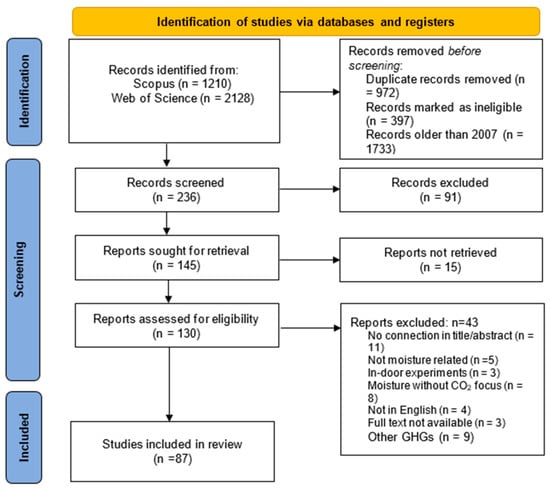
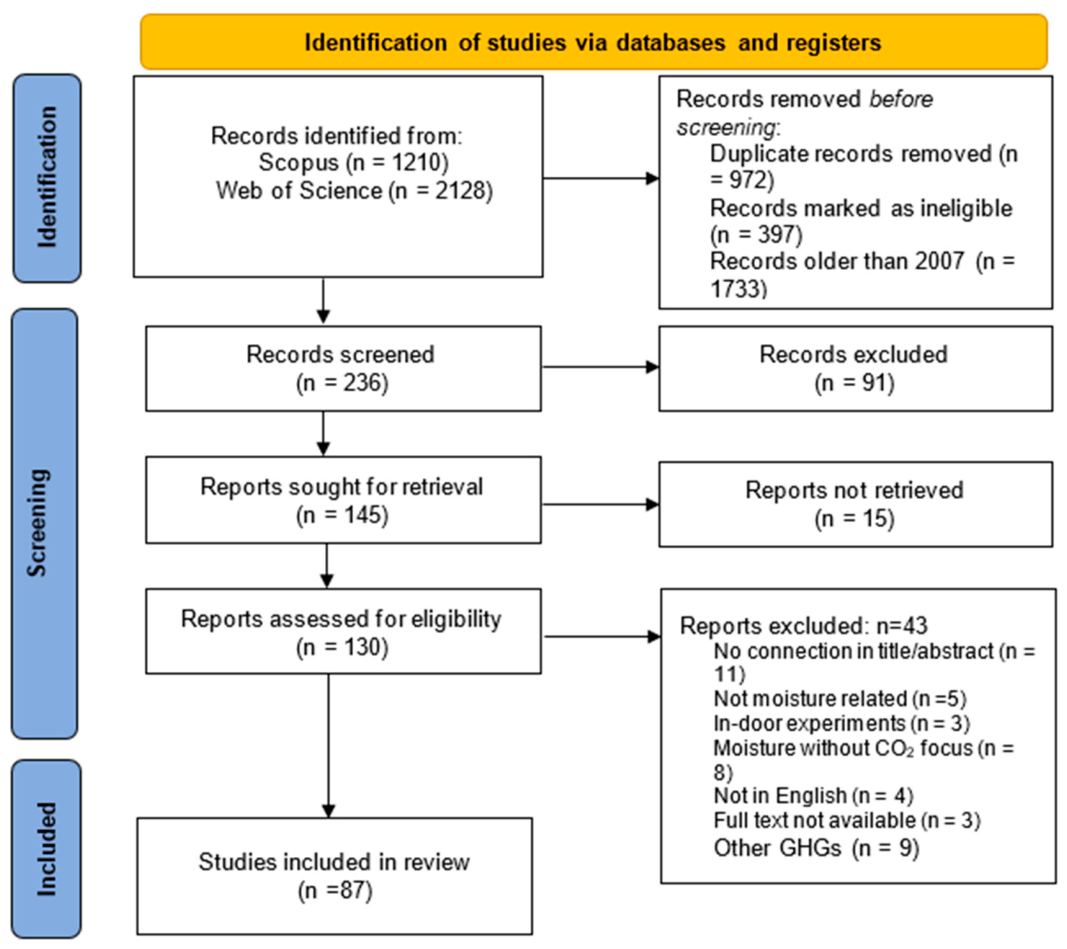
The search results yielded 3338 initial records from the two electronic databases, after which duplicates (n = 972), ineligible records (n = 397), and pre-2007 records (n = 1733) were removed, leaving 236 studies for independent title/abstract screening. After excluding 91 records, 145 full texts remained; 15 were unavailable. Of the 130 assessed, 43 were excluded for specific reasons (no topic relevance, n = 11; not moisture-related, n = 5; indoor-only, n = 3; focused solely on other GHGs without CO2 gas, n = 8; non-English language studies, n = 4; unavailable, n = 3; other GHGs, n = 9). Following screening, 87 publications were selected for in-depth full-text review and synthesis (Figure 1). The selected publications were thematically analysed to find patterns and research gaps in sustainable soil moisture management practices.
Figure 1.
Prisma flow chart of literature selection process.
3. Advances in Soil Moisture Measurement Techniques
Soil moisture measurement has evolved from traditional gravimetric sampling [10] to sophisticated, real-time sensor systems that capture fine-scale temporal dynamics [16]. With fluctuating soil moisture, which directly influences SOC turnover and CO2 emissions, understanding the best measurement methods is key to interpreting C–water interactions across agroecosystems [17]. Zhang et al. [18] highlighted that there was enhanced water use efficiency coupled with increased crop productivity with the use of advanced soil moisture sensors. Similarly, advanced techniques, when integrated, may improve soil health and reduce wastage of water, which is a scarce resource [16]. Nonetheless, as soil moisture sensors gain more attention under water-saving techniques, challenges such as high cost are evident (Table 1) [19].
Table 1.
Soil moisture sensor types and measurement principles.
However, modern advanced methods used in precision irrigation are more effective and accurate, such as UAVs and Time Domain Reflectometry (TDR) probes [20], which assess soil moisture in the root zone and even determine the groundwater level. On-the-go sensors like Veris-3100 in tractors for loam and silty loam soils, VIS-NIR soil reflectance sensors with DGPS, and SPECIM FX10 overcome extreme weather impacts and streamline atmospheric and radiation correction steps to a specific figure [21]. Remote sensing (RS) is primarily used for large-scale monitoring [18], where soil moisture distribution can be computed and visualised through a spatial map [16]. Furthermore, RS is less labour-intensive compared to traditional and on-the-go sensors, but its spatial and temporal resolution is lower. In recent years, RS has been used in precision agriculture not only to measure moisture but also to monitor salinity, SOC and soil characteristics. However, RS still encounters limitations, like the high cost of equipment and operation coupled with low accuracy when the soil surface is covered with crop residues or vegetation [16]. These technologies used under precision agriculture can facilitate the optimisation of soil moisture use for the production of field crops and reduce risks related to environmental degradation and climate change.
The most recent and modern sensors are wireless sensor networks (WSNs), which work on a four-basis principle, namely, devices or sensors, connectivity, data processing, and user interface. They provide soil moisture data in real time after being gathered, processed and shared accurately. The soil moisture data provided by WSNs is high-resolution, both spatially and temporally, compared to that obtained via RS, on-the-go and traditional methods [16,18]. The main focus under precision irrigation is in the root zone and topsoil layers as key points for determining soil moisture and other parameters like temperature and soil pH, which are essential for crop production. Optimisation of irrigation starts with efficient soil moisture-monitoring techniques [18]. For water use efficiency in water-limited areas, especially dryland agriculture [18], moisture sensors are useful and effective for monitoring the soil moisture level to help in decision making.
4. Soil Moisture Effects on SOC and CO2 Emissions
4.1. Soil Moisture as a Driver of Soil Organic Carbon (SOC)
Soil moisture is a critical factor in biotic activities such as metabolic processes, nutrient cycling and enzyme functions. A study by Zhang et al. [15] on environmental controls found that the aridity index (amount of moisture in the soil) was the key driver affecting soil MBC in all grasslands compared to its temperature and N counterparts. There are two primary physical mechanisms at play: the drying effect as a result of low water potential and the limitation of substrate diffusion caused by low soil moisture, which restrict microbes from accessing the substrates within the rhizosphere [9].
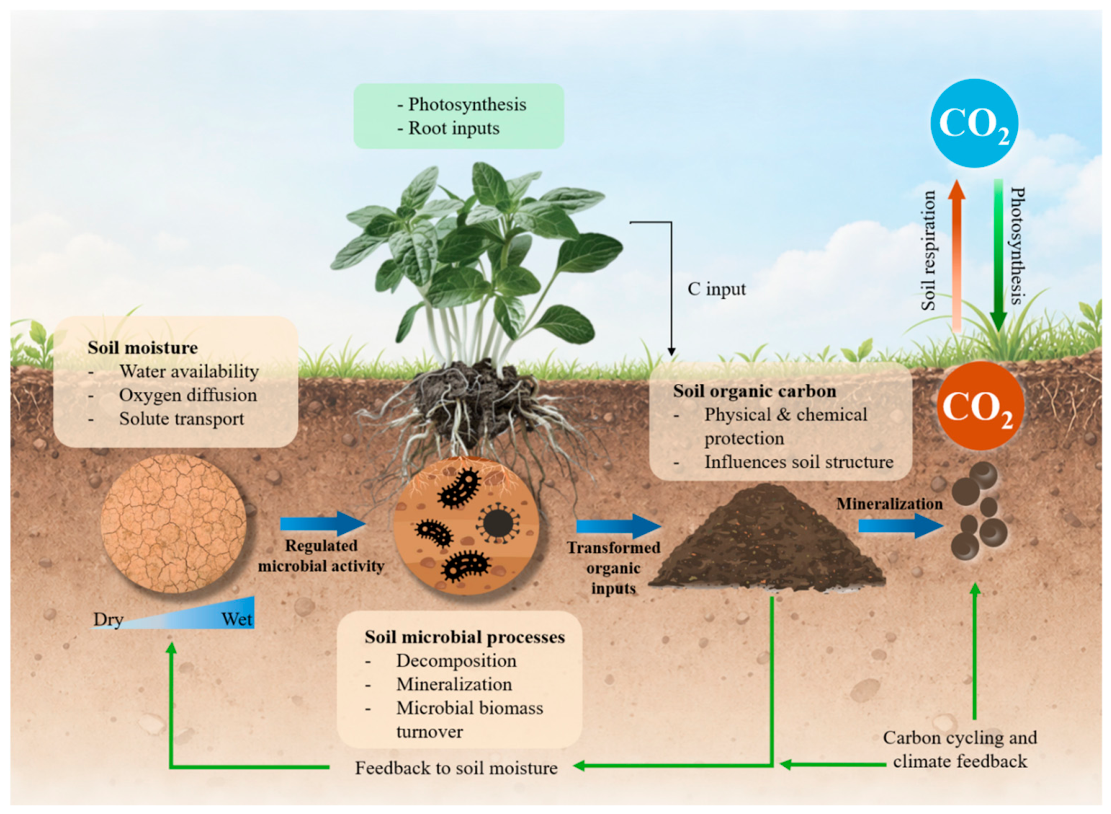
Changes in soil moisture can influence SOC in both the short and long terms. During irrigation or rewetting cycles, the moist soil tends to rapidly stimulate organic matter decomposition as microbial and enzymatic activities are increased, leading to increased microbial biomass. However, the moisture pulses could cause CO2 emission peaks from labile C due to microbial osmotic shocks. Additionally, in wetter soils, root respiration rates have been observed to be high, which corresponds directly to root deposits within the rhizosphere [22]. The increased rhizo-deposit content in the soil consequently enhances the SOC content. Under short-term drought conditions, soil respiration reduces significantly as a result of reduced metabolic activities in the soil. However, in several instances, the MBC and Dissolved Organic C (DOC) have been recorded to increase under drought. This rare phenomenon could be attributed to the accumulation of microbial necromass or organic compounds (Figure 2).
Figure 2.
Soil moisture and C nexus (source: the authors).
The stabilisation of SOC is affected by soil moisture to a significant degree over time [23]. It is evident that microbial community adaptation and C stabilisation take place under soils with adequate moisture over a long period of time. For instance, physical properties such as soil aggregates are affected when the soil is dry or wet. Similarly, chemical mineral interactions and redox reactions are affected. Studies confirm that soil moisture fluctuations greatly impact shifts in microbial activities, which consequently alter the decomposition process of soil organic matter (SOM). Under drought conditions, with soils at <30%, WHCs exhibit suppressed microbial activity and limited substrate utilisation, resulting in the temporary protection of SOC. Extracellular enzyme activities, which are key drivers of SOM and mineral nutrients, were reduced under drought conditions [12]. This could lower the accumulation of SOC due to the limited interaction of enzymes with respective substrates and reduced rates of organic matter decomposition. Similarly, Kotroczó et al. [22] recorded that the reduced rate of heterotrophic respiration was attributed to low rates of SOM decomposition. Furthermore, it was observed that soils in drier microclimates had a tendency to experience intense evaporation coupled with the increased loss of organic C, which clearly indicates a direct correlation between evaporation and soil C loss. In another study, the metabolic processes and growth of the soil microbial communities, which are key drivers of SOC, were greatly limited under arid conditions. Under these low-moisture conditions, litter decomposition and the conversion of amino acids are impeded, slowing down the breakdown of crop residues [14]. These findings suggest that any factor that reduces both soil and root respiration generally leads to the limited accumulation of SOC within the rhizosphere. However, when dry soils are rewetted, microbial activity rebounds sharply, producing large CO2 pulses that can offset earlier C gains.
Contrary to the general understanding, under severe drought, Wang et al. [14] reported that fungal-abundant phyla such as (Basidiomycota, Ascomycota) and bacterial-abundant phyla like (Actinobacteria, Chloroflexi, Proteobacteria, Acidobacteria) had adopted to the harsh conditions for over 7 years, hence improving the microbial necromass C in the soil. Another study recorded that soil microbial C use efficiency might be enhanced after specific microbes (rare microbial taxa) respond to reduced soil water potential [24]. Thus, these specific rare microbes might have the capacity to facilitate enzyme accessibility to the labile substrates that are originally limited by low moisture in the soil. This makes these rare microbial communities very significant in the accumulation of C and the stabilisation of SOC under low-soil-moisture conditions, contributing significantly to climate change mitigation in the long run.
It has been reported that when soil moisture is adequate, aerobic microbial respiration is optimal between 60% and 65% of the soil WHC [2,24]. These findings are backed by high CO2 emissions due to the increased responses of soil microbes to the added LOC. However, the study found that the response level of soil microbes in soils with 30% moisture was low compared to the added LOC. At 60–65% WHC, aerobic microbial and root respiration is optimal, leading to the rapid decomposition of added labile C and high CO2 emissions, which contribute to SOC losses. Therefore, the balance between dry-phase C protection and wet-phase C mineralisation is central to predicting long-term soil C dynamics under variable moisture regimes.
Research conducted by Leghari et al. [20] found that soil nutrients (nitrogen) were lost significantly through leaching under excessive rainfall and irrigation. This could imply a significant decline in crop yields and the total biomass of crop residues in the subsequent growing season, leading to the reduced production of organic matter, which is the main source of SOC. This is attributed to the fact that decreased litter production is directly proportional to the crop’s net primary production [22]. Conversely, microbial biomass N increased significantly with increasing soil moisture up to 60% of the WHC [25]. They also found that there was a significant positive relationship between DOC and the cumulative N2O. Similar results were recorded by Pan et al. [11], where the ecological restoration measures over a long period of time significantly increased the accumulation of SOC due to exogenous C inputs while arid mines (with low moisture content) indicated low SOC (Table 2).
Table 2.
Factors affecting soil moisture and carbon cycling.
4.2. Soil Moisture as a Driver of CO2 Emissions
Soil moisture is a fundamental factor that indirectly affects CO2 emissions by influencing vapour pressure deficit, temperature [32], microbial activities and decomposition of SOM. Consequently, these processes directly regulate atmospheric C fixation and sequestration and CO2 fluxes [8]. Studies confirm that soil moisture fluctuations contribute to approximately 90% of the global soil C uptake variability [32]. The amount of moisture in the soil plays a pivotal role in both autotrophic (CO2 from plant roots) and heterotrophic (CO2 from microbial decomposition) respiration [8,28,33]. Extreme soil moisture conditions, which include either excessive wetness or dryness, significantly reduce the rate of soil respiration [28]. For instance, in hot and dry areas, soil moisture has been recorded to be the most limiting factor affecting both C sequestration and the microbial decomposition of organic matter [3]. One in situ drought manipulation study showed that limited soil moisture reduced CO2 efflux by 32% compared to irrigated and rainfed conditions, which had higher moisture content [12]. However, they also recorded no significant differences in CO2 efflux between rainfed and irrigation conditions, and this could be due to negligible differences in the water received in the treatments.
Similarly, Bian et al. [24] found that low soil moisture content (<30% WHC) led to lower CO2 emissions and reduced microbial responses. This was ascribed to the breaking of soil aggregates, which consequently lowers substrate diffusion. Moreover, it was recorded that low moisture availability limited the basic physiological processes of microbes in soil [28]. In another study, Singh et al. [12] observed that the CO2 efflux under low soil moisture content due to drought was 32% lower compared to that under rainfed and irrigated conditions. However, CO2 emissions were the highest when the moisture content was at 60% WHC, which favoured aerobic respiration.
In the event that soils are saturated (waterlogging) above 70% WHC, the anaerobic conditions decrease the oxidation reduction process while limiting soil microbial enzyme activities [24]. Hao et al. [8] recorded that anaerobic conditions from saturated rice fields increased methane (CH4) production, which has 28 times the global warming potential of CO2. Moreover, heterotrophic respiration (from microbial decomposition) increased with increasing soil moisture, with a peak at 80% WHC. Beyond that threshold, a decline in respiration was observed [28]. This is due to the reduced pore spaces (filled with water), which displace air and oxygen, leading to the anaerobic condition limiting C mineralisation by microbes. These anaerobic conditions are favourable for CH4 production, which is detrimental to agricultural production [8]. Sustainable irrigation practices, like intermittent flooding in rice fields, are therefore important and could reduce CO2 and CH4 emissions. However, the influence of soil moisture on CO2 efflux and SOC stocks under rainfed and irrigation conditions still needs synthesis.
Soil saturation (>80% WHC) from heavy precipitation/over-irrigation and drying of soil due to drought occurrences may be frequent as a result of climate change. These unpredictable climatic factors alter water cycles in the soil, thereby impacting C cycling. A study conducted by Lin et al. [5] in cropland and forest soils with different drying–rewetting cycles between 35 and 100% WHC found that the cumulative SOM-derived CO2 emitted increased by 7.9–85% under moisture fluctuation compared to constant soil moisture. This indicates that moisture pulses within the soil led to increased rates of microbial respiration and organic matter decomposition, thereby enhancing CO2 emissions. The frequent moisture pulses (rewetting) in this experiment could have triggered bacterial growth [34].
4.3. CO2 Emissions Under Different Weather Seasons
Research confirms that soil CO2 fluxes have seasonal variance, mostly recording maximum emissions during summer and minimum emissions in winter [35,36]. This is because plants and microbes go into a state of dormancy during winter, reducing their rates of growth and respiration. During summer, soils are warmer, and with adequate moisture, the growth, decomposition and respiration rates are enhanced, leading to increased CO2 emissions.
Additionally, CO2 emissions also vary significantly under different cropping systems (microclimates) and seasons [37,38]. During winter, when temperatures are low, CO2 emissions were recorded to be low under a crop–livestock system, which regulated the soil moisture [39]. In the same study, during summer, the CO2 emissions observed increased significantly, attributed to the increased rate of soil respiration, an indicator of enhanced microbial activities. Another study recorded that high soil moisture content coupled with warm weather significantly increased CO2 emissions under ridge tillage and no tillage in the summer and early autumn of 2019 [40]. This demonstrates that the microclimate was conducive to microbial physiological activities in the soil at the tail end of summer. However, they also recorded that during the hot and dry weather of 2018, the overall CO2 decreased in all treatments, with plough tillage recording less than 6 μmol CO2 m−2 s−1. Soil microbial communities have been found to be distinctly different as seasons change [41]. But soil moisture has been reported as the primary factor regulating CO2 efflux during warm and dry seasons [35]. Soil moisture shows a closer correlation with CO2 efflux [42] compared to soil temperature, making it a master regulator of GHG fluxes. Results consistently show that climatic factors, mainly soil moisture and temperature, play a key role in the distribution of microbial communities, which can have a direct impact on CO2 emissions.
4.4. Strategies That Modify Soil Moisture Status and Sequester C
Anthropogenic activities such as land use management, tillage practices and different cropping systems [8,43] are vital in the utilisation and conservation of soil moisture [44]. A study on spatial mapping revealed that soil moisture and vegetation cover had a substantial influence on the variation in soil CO2 emissions [39]. Therefore, the trade-offs between soil C losses due to respiration and erosion and the accumulation of C from additional organic matter continuously fluctuate [3]. These C dynamics can be modified by both human activities [45] and vegetation cover [39] to enhance soil C stabilisation. For instance, a study by Kotroczó et al. [22] suggested that the use of soil conservation measures like mulching reduces water loss and eventually increases microbial activity in upper-soil profiles. Moreover, mulching significantly increased the SOC in the upper 15 cm of a soil layer, attributed to the use of surface crop residues, which consequently increase water infiltration rates. Santos et al. [39] recorded that vegetation cover had a great influence on the soil respiration process, with its potential to enhance soil moisture retention through rainfall interception. In line with these findings, vegetation cover builds up the amount of SOC with above-ground litter and below-ground root deposits [1,46]. Additionally, the use of organic manure improved water infiltration and moisture retention and minimised evaporation, thereby creating a moist and biologically conducive environment for C sequestration [47]. In contrast, the absence of litter cover and soil input treatments increased the evaporation intensity as well as the drying of soil during the summer season [22] due to direct sunlight exposure. These processes led to the enhanced mineralisation of SOC, leading to increased CO2 efflux from the soil. However, another study found no significant effect on CO2 emissions from bare soil without vegetation cover [48]. This is ascribed to the fact that a primary CO2 source (root respiration) was excluded due to lack of vegetation. In this study, the soil moisture was very low and varied within a relatively narrow range as a result of low precipitation and poor soils. Moreover, these biotic factors could have led to less responsive soil microbial respiration.
Other practices such as agroforestry and optimised water management have been recorded to increase C sequestration and reduce CO2 emissions, thereby mitigating climatic change [8,49,50,51]. Studies have also indicated a high amount of organic matter in addition to a high level of resistance to erosion, which contribute to the higher concentration of plant-available nutrients as well as soil moisture [27]. The use of soil amendments with exogenous C, such as biochar [52] and gypsum [53], has been reported to be significant in enhancing soil C sequestration. Biochar has been recorded to reduce CO2 emissions and retain soil moisture due to its unique spongy structure and ability to adsorb and encapsulate SOM [54]. Gypsum was recorded by Gashi et al. [53] to improve soil penetration rates and nutrient balance when combined with reduced tillage. Moreover, the general soil health improved due to a notable increase in fungal diversity, which led to the better functionality of the soil in the upper layer.
Therefore, the manipulation of environmental conditions like soil moisture and organic C inputs (mulch, manure, cover crops) has a significant effect on the microbial physiology and general C cycle within an ecosystem [55,56]. Studies have suggested that a combination of two or more conservation agriculture practices, for instance, no tillage and mulching, or crop rotation and no tillage, would significantly improve soil moisture and top SOC stocks [57]. Similarly, plant material (C inputs) from corn, wheat and soybean was found to increase SOC stocks in the soil surface layer [58]. Future research should prioritise soil moisture retention practices during irrigation and how they impact crop production, CO2 efflux and SOC stabilisation.
4.5. Soil Moisture Regulation of C Priming Effects
C priming is the microbial response to fresh organic C input that alters the decomposition rate of SOC. Soil moisture has been found to be one of the key drivers of soil C priming. This is mostly associated with the different forms of responses of soil microbes to both the exogenous substrate inputs and the available SOM. Under soil moisture stress, microbial activities are reduced, suppressing priming, while optimum moisture enhances priming due to increased microbial access to fresh inputs and substrate diffusion. However, under excess or saturated soil moisture, oxygen is reduced, shifting microbial processes into anaerobic conditions, which lowers the priming intensity. A study by Bian et al. [24] found that soil microbes responded rapidly to labile organic C (LOC) and promoted the decomposition of native SOM, with optimum changes in C utilisation at 60% WHC. Furthermore, the study found that under a 60% WHC, microbial respiration derived from LOC increased with the moisture content, and the proportion gradually decreased above the 60% WHC. Moreover, priming was found to vary over time and across soil types over the long term, but moisture conditions in the soil remained a key modulating factor in each priming period.
5. Role of Drought-Adapted Rare Microbes in SOC Stabilisation
Microbes play an outsized role in transforming plant-derived C into POC and MAOC, despite their numeric scarcity. While MBC could increase significantly under adequate moisture, rare microbes have been reported to have a metabolic versatility that survives under low-moisture conditions. Under persistent drought, water films thin and microbe cells face the simultaneous limitation of water and nutrients, causing a stress response. Rare microbes use diverse strategies to survive these conditions: some enter dormancy for minimum metabolism, synthesis of DNA-protective proteins and C storage. For instance, when under stress, Actinobacteria exhibit stress-resistant structural traits like thick peptidoglycan layers and formation of endospores [14]. A study done in desert conditions found that some rare microbes adopt a mixotrophic and chemolithotrophic lifestyle. Additionally, a cellular water budget process called microbial hydrogenesis takes place, where potentially ~4.5% of saturated cell water is supplied over 24 h [59]. This hydrogen-derived water is very useful for the desiccated cells of microbes.
Other rare microbes employ osmotic adjustments as they accumulate compatible solutes—trehalose, glycine betaine, amino compounds, potassium ions and polyols—to maintain turgor and protect macromolecular structures [59]. As osmotic regulators like potassium accumulate within the cells, they elevate the metabolic quotient (qCO2) and maintenance of microbial respiration, which reflects the increased energy demand of stress adaptation. During drying and rewetting cycles, rapid physiological readjustments are triggered by sudden shifts in water potential, causing osmolyte release. Degradation of osmolytes occurs during rewetting, leading to additional C costs by microbes [59].
Under severe drought, rare microbes may increase extracellular polymeric substance (EPS) production relative to the microbial necromass, which contributes to SOC over a long period of time. EPSs form a hydrated matrix that surrounds microbial cells, thereby offering a protective layer. EPS components like nucleic acid and lipids contain abundant hydrophilic functional groups that bind water vapour at a low matric potential (aw < ~0.2). This enables biofilms to adsorb substantial amounts of water during adsorption phases. Moreover, EPSs enhance cell adhesion, enzyme protection against desiccation, water retention capacity and soil particle aggregation [11]. As drought persists, rare microbial communities shift from high-yield strategies toward resource acquisition strategies that prioritise solely survival over growth. This transition reduces CUE as energy is diverted to stress responses rather than biomass production. However, drought-induced shifts in community composition can also positively impact C utilisation. In one study, the CUE slightly increased from 56.0% to 59.5%, indicating that rare fungi and Gram-positive bacteria positively impacted the utilisation of SOC [60]. However, moisture stress led to a 41.2% decline in Gram-negative bacteria.
The accumulation of microbial necromass (dead cellular material) represents a key pathway for soil C stabilisation. Under low-moisture conditions, necromass dynamics depend on drought intensity and microbial group. Under drought conditions, rare microbes exert a disproportionate influence on the necromass contribution to SOC [61]. Rare microbial taxa play a crucial role in bacterial- and fungal-derived C in sub-tropical forests [14]. In this study, the fungal and bacterial diversity were not affected by drought, and the contribution of necromass C to the SOC increased, with rare microbes predominantly regulating this effect. Thus, despite the low abundance of rare microbes in the soil, they served as a key contributor to C under drought conditions.
Therefore, the incorporation of drought-tolerant rare microbial communities and metabolically active microbes under drought will enhance future SOC prediction, as suggested by Wang et al. [14]. These rare microbes will facilitate the production of MAOC, which is resistant to climatic changes and stays longer in the soil compared to POC. Moreover, drought-resistant rare microbes have the capacity to increase CUE under limited soil moisture. Thus, the traits and mechanisms of these rare microbes should be utilised in sustainable land management models to improve SOC predictions in the future.
Particulate Organic Carbon (POC) and Mineral-Associated Organic Carbon (MAOC) Under Different Soil Moisture Contents
Research has found that the transformation of SOC is mainly affected by various biotic and abiotic factors, especially soil moisture and shifts in microbial communities. In this regard, SOC components that are not bound in clay or minerals are very sensitive to environmental and climatic changes and are known as particulate organic C (POC). Those that are protected by minerals are called mineral-associated organic C (MAOC) and are more resistant to environmental changes compared to POC. A study by Niu et al. [62] explored the POC-to-MAOC transformation mechanisms that are driven by microbes at the molecular level, which has a direct link to moisture availability in the soil. The results indicated that high moisture content in the soil enhanced POC decomposition and the formation of MAOC. Studies found that fungal necromass C increased with POC, whereas bacterial necromass C drove MAOC. These findings are in line with Pan et al. [11], who found that plant lignin phenols and microbial shifts directly influenced POC while MAOC accumulation was primarily driven by microbial necromass–mineral interactions. Due to lack of clay protection, the POC turnover is faster, causing a rapid decoupling from the CUE compared to MAOC. Additionally, it was found that bacterial necromass C was more important for SOC accumulation than fungal necromass C in subsoil.
These findings could be attributed to the fact that soil moisture increases cation availability and enhances the formation of cation bridges between organic compounds and clay surfaces. The broader perspective of the study is that microbial decomposition necromass is a major contributor to MAOC, followed closely by plant-derived dissolved organic matter.
6. Environmental Benefits of Conservation Management Practices
Conservation management practices, which involve cover cropping and crop rotation and diversification, play a significant role in SOC build-up and have been found to improve C sequestration and water retention and reduce GHG emissions [1,63], thereby fostering the mitigation of environmental degradation with a keen focus on soil [64]. For instance, straw returns from crop residues have been found to improve soil physical and biochemical properties [65], as they improve biomass and SOC. A review by Liang et al. [64] indicates that reduced-tillage practices have a vast array of benefits, starting from reduced soil compaction, which translates to low bulk density, and preservation of soil aggregates, structure and biodiversity while limiting nutrient loss. Strip tillage and loosening was found to favour soil biological activities, eventually increasing MBC by over 80% [66]. Likewise, strip tillage led to a 28% increase in SOC and a 66% increase in enzymatic activities compared to plough tillage [67]. Additionally, ridge tillage was found to have a higher concentration of SOC and total nitrogen (TN) in the upper 15 cm of the soil layer compared to no tillage and plough tillage [68]. Alongside this, there were low CO2 emission rates [69], eventually reducing environmental pollution. Soil conservation practices, which improve physio-chemical and biological conditions, are essential for sustainable crop production [70].
One of the major contributions of conservation tillage, especially no tillage and ridge tillage, is the maintenance, stabilisation, and enhancement of SOC in various climatic zones [68]. Another study recorded that water-stable aggregates and SOM increased significantly when conservation tillage was applied for a period of 16 years [71]. This shows that soil health is likely to improve significantly when conservation measures are applied continuously (for a long time) to enable the build-up of beneficial soil organic compounds. Much of the evidence for conservation tillage comes from short-term experiments (<5 years) that may not have captured the longer-term SOC dynamics. Long-term studies (10+ years) show that SOC accumulation can slow or plateau as soils approach a new equilibrium [58,71]. Some studies suggest that SOC gains are limited to surface layers, with potential losses at depth [57].
This is in line with Yang et al. [58], who suggested long-term studies to determine changes in SOC. Similarly, Sosulki et al. [72], Omwoyo et al. [43], and Nugroho et al. [73] found that long-term organic manure application showed almost twice the increase in SOC and TN stocks. Using conservation tillage to increase the amount of C in the soil is easier and more effective than using conventional tillage, which might even decrease the soil C rates after continuous cultivation on the same piece of land [27]. Non-inversion tillage has been proven to facilitate a more balanced mobilisation of nutrients, enhance C sequestration and boost levels of SOC [38,74]. Minimum tillage has gained global attention in recent decades due to its effective contribution to sustainable agriculture and enhancement of climate change mitigation and food security [75] because it offers beneficial nutrients to crops and microorganisms in the form of food and energy [10,51]. These, in turn, establish a physical barrier between SOM and soil microbes, thereby enhancing the development of long-term micro- and macroaggregates improving soil structure and reducing CO2 emissions, with potential global warming effects.
The magnitude of SOC gains under conservation tillage varies widely: studies report increases ranging from 0 to 40% depending on climate, soil type, and management history [64]. The greatest benefits are observed in degraded soils with low initial SOC, while soils near C saturation show minimal response. These caveats underscore the need for a nuanced approach that considers local conditions, management history, and specific objectives. Policy recommendations should avoid prescribing uniform solutions and instead support adaptive, context-specific approaches.
Conservation Tillage for Moisture Sustainability and C Storage
Most studies have reported conservation tillage and how the whole process influences soil moisture, nutrient accumulation and enzyme activity. In a study by Wang et al. [10], the authors found that conservation tillage significantly enhances nutrient elements, particularly SOM, N, P, and increases the rate of microbial activities, contributing to long-term soil fertility. Similarly, reduced tillage intensity and organic manure application [76], the removal of summer fallows, and restoration of grasslands enhance soil moisture storage [28] and C sequestration [3,77]. Furthermore, Liang et al. [64] reviewed the effects of conservation tillage on GHG emissions, highlighting its role in reducing CO2 and CH4 emissions while improving soil C sequestration towards the enhancement of general soil health. Similarly, no tillage was recorded to increase SOC compared to plough tillage, which breaks the soil aggregates, consequently losing more water [78]. Isaboke et al. [77] found that farmers who left crop residues on their farms after harvesting increased the SOM, which is a fundamental factor to the enhancement of soil C [27] and increased soil aggregation. They also concluded that maintaining land cover under conservation tillage was essential for reduced soil erosion, eventually minimising the loss of essential nutrients and soil moisture. Similarly, covering the inter-row soil surface with harvested crop residues improves soil moisture retention and soil health [79,80]. Many success stories from different parts of the world have underscored the positive impacts of conservation tillage on long-term soil fertility [81] and C retention and stabilisation, as well as sustainable agricultural production, by maintaining moisture regimes [60,64,68].
7. Implications for Climate Change Mitigation and C Modelling
The relationship between moisture and respiration is critical. For instance, Abbas et al. [3] reported that below- and above-ground biological activities are significantly affected by variations in precipitation amid global warming. As the climate continues to change, the occurrences of soil drying and increased evaporation rates will require sustainable measures to curb the inevitable threat caused. In this regard, Abbas et al. [3] concluded that the implementation of no tillage in combination with mulching can potentially enhance soil moisture and reduce the rate of C losses into the atmosphere, resulting in SOC stabilisation. Moreover, no tillage was recorded to reduce CO2 emissions by 6.3%, which eventually minimised the global warming potential by 14.4%, thereby enhancing climate mitigation [82]. Similarly, policies that leverage the mitigation of environmental degradation with a main focus on reducing GHGs (CO2) have the potential to reduce CO2 emissions [83,84] by 81.5%, as evidenced between 1985 and 2018 by Mohammed et al. [85].
At the global level, significant progress has been made in recognising agriculture as a key sector for climate mitigation, with most countries including land use and agricultural emissions in their nationally determined contributions. However, only a limited number of policies explicitly quantify soil C sequestration targets or integrate soil moisture dynamics into mitigation planning. Current estimates suggest that improved management of agroecosystems could sequester approximately 4–10 Pg CO2 equivalents per year [86], yet this potential remains unevenly realised across continents. As regions like North America, Europe, and parts of Latin America advance in their conservation agriculture, agroforestry, and soil health initiatives, many African and Asian countries still face barriers related to financing, monitoring, and large-scale adoption. A global mapping of mitigation efforts would therefore reveal both strong progress in certain countries and substantial gaps in others in the explicit targeting of soil moisture regulation and pulse-driven C dynamics, underscoring the need for more comprehensive, data-driven sustainability frameworks. These policy interventions will eventually create room for sustainable land management, such as protecting natural resources and reinforcing climate-smart agricultural practices [87].
8. Conclusions
This review synthesises evidence showing that soil moisture is a key regulator of multiple interconnected mechanisms, including microbial activities, C priming, necromass and MAOC accumulation, and the ultimate balance between SOC stabilisation and CO2 emissions across agroecosystems. We found that SOC mineralisation and peak CO2 emissions commonly occur under an optimum soil moisture of approximately 60–70% of the WHC, highlighting a trade-off between C stabilisation and C loss through respiration. This review further demonstrates that the long-term application of multiple conservation practices, like organic amendments, residue retention, mulching, cover cropping, reduced tillage and crop diversification, improves soil moisture retention and SOC accumulation in the topsoil. Additionally, these practices increase habitat heterogeneity and organic substrate availability, creating favourable conditions for both abundant and rare microbes, which improve drought resilience and environmental sustainability.
However, emerging evidence suggests that drought-resistant rare microbial taxa may play a disproportionate role in regulating C dynamics under moisture stress. By modifying rhizosphere conditions, supporting microbial necromass C accumulation, and contributing to stable MAOC formation, these taxa may reduce CO2 emissions while enhancing long-term C sequestration. Conservation-oriented practices that support the persistence of rare microbial taxa may offer a novel pathway for maintaining soil productivity and ecosystem resilience under increasing climatic variability. The differential responses of sensitive POC and resistant MAOC to moisture variations have profound implications for long-term C sequestration yet remain understudied. As climate variability intensifies, incorporating soil moisture regulation into climate-smart agricultural practices will be essential for sustaining soil health, C storage and agroecosystem resilience. Thus, future research should focus on understudied regions like Africa and Asia, POC/MAOC mechanisms, rare microbial taxon application and improved C models capable of predicting ecosystem responses to changing soil moisture regimes.
Author Contributions
Conceptualisation, E.W. and J.Z.; methodology, E.W.; validation, E.W., J.Z. and C.J.; resources, C.J.; data curation, E.W.; writing—original draft preparation, E.W.; writing—review and editing, E.W. and J.Z.; visualisation, E.W.; supervision, J.Z.; project administration, C.J.; funding acquisition, C.J. All authors have read and agreed to the published version of the manuscript.
Funding
Supported by the University of Debrecen Program for Scientific Publication.
Data Availability Statement
No new data were created or analysed in this study. Data sharing is not applicable to this article.
Acknowledgments
The authors acknowledge the university administrative and technical support.
Conflicts of Interest
The authors declare no conflicts of interest.
Abbreviations
The following abbreviations are used in this manuscript:
| SOC | Soil Organic Carbon |
| SOM | Soil Organic Matter |
| CO2 | Carbon dioxide |
| N2O | Nitrous Oxide |
| CH4 | Methane |
| C | Carbon |
| N | Nitrogen |
| P | Phosphorus |
| TN | Total Nitrogen |
| RS | Remote Sensing |
| TDR | Time Domain Reflectometry |
| WHC | Water-Holding Capacity |
| GHG | Greenhouse Gas |
| MBC | Microbial Biomass Carbon |
| DOC | Dissolved Organic Carbon |
| LOC | Labile Organic Carbon |
| CUE | Carbon Use Efficiency |
| POC | Particulate Organic Carbon |
| MAOC | Mineral-Associated Organic Carbon |
References
- Basheer, S.; Wang, X.; Farooque, A.A.; Nawaz, R.A.; Pang, T.; Neokye, E.O. A Review of Greenhouse Gas Emissions from Agricultural Soil. Sustainability 2024, 16, 4789. [Google Scholar] [CrossRef] [Scilit]
- Fairbairn, L.; Rezanezhad, F.; Gharasoo, M.; Parsons, C.T.; Macrae, M.L.; Slowinski, S.; Van Cappellen, P. Relationship Between Soil CO2 Fluxes and Soil Moisture: Anaerobic Sources Explain Fluxes at High Water Content. Geoderma 2023, 434, 116493. [Google Scholar] [CrossRef] [Scilit]
- Abbas, F.; Hammad, H.M.; Ishaq, W.; Farooque, A.A.; Bakhat, H.F.; Zia, Z.; Fahad, S.; Farhad, W.; Cerdà, A. A Review of Soil Carbon Dynamics Resulting from Agricultural Practices. J. Environ. Manag. 2020, 268, 110319. [Google Scholar] [CrossRef] [Scilit] [PubMed]
- Wei, C.; Ren, S.; Yang, P.; Wang, Y.; He, X.; Xu, Z.; Wei, R.; Wang, S.; Chi, Y.; Zhang, M. Effects of Irrigation Methods and Salinity on CO2 Emissions from Farmland Soil during Growth and Fallow Periods. Sci. Total Environ. 2021, 752, 141639. [Google Scholar] [CrossRef] [Scilit] [PubMed]
- Lin, J.; Chen, B.; Dong, H.; Zhang, W.; Kumar, A.; Hui, D.; Zhang, C.; Shan, S.; Zhu, B. Effects of Soil Moisture Fluctuation and Microplastics Types on Soil Organic Matter Decomposition and Carbon Dynamics. Soil Biol. Biochem. 2025, 205, 109781. [Google Scholar] [CrossRef] [Scilit]
- Okolo, C.C.; Gebresamuel, G.; Zenebe, A.; Haile, M.; Orji, J.E.; Okebalama, C.B.; Eze, C.E.; Eze, E.; Eze, P.N. Soil Organic Carbon, Total Nitrogen Stocks and CO2 Emissions in Top- and Subsoils with Contrasting Management Regimes in Semi-Arid Environments. Sci. Rep. 2023, 13, 1117. [Google Scholar] [CrossRef] [Scilit] [PubMed]
- Masika, W.E.; Okello, H.O.; Odhiambo, G.D. Effect of Intercropping Maize with Selected Agroforestry Species on Maize Yields and Harvest Index in Kisumu and Kisii Counties, Kenya. Int. J. Innov. Sci. Res. Technol. 2024, 9, 1995–2002. [Google Scholar]
- Hao, Y.; Mao, J.; Bachmann, C.M.; Hoffman, F.M.; Koren, G.; Chen, H.; Tian, H.; Liu, J.; Tao, J.; Tang, J.; et al. Soil Moisture Controls over Carbon Sequestration and Greenhouse Gas Emissions: A Review. npj Clim. Atmos. Sci. 2025, 8, 16. [Google Scholar] [CrossRef] [Scilit]
- Dang, R.; Liu, J.; Lichtfouse, E.; Zhou, L.; Zhou, M.; Xiao, L. Soil Microbial Carbon Use Efficiency and the Constraints. Ann. Microbiol. 2024, 74, 37. [Google Scholar] [CrossRef] [Scilit]
- Wang, C.; Zhao, J.; Feng, Y.; Shang, M.; Bo, X.; Gao, Z.; Chen, F.; Chu, Q. Optimizing Tillage Method and Irrigation Schedule for Greenhouse Gas Mitigation, Yield Improvement, and Water Conservation in Wheat–Maize Cropping Systems. Agric. Water Manag. 2021, 248, 106762. [Google Scholar] [CrossRef] [Scilit]
- Pan, J.; Wu, Y.; Zhang, W.; Wang, Y.; Zou, S.; Wu, Q.; Dong, Z.; Guo, X. Divergent Pathways of Soil Organic Carbon Sequestration Mediated by Ecological Restoration in Arid Coal Mining Areas: Plant- vs. Microbial-Derived Contributions. J. Environ. Manag. 2025, 395, 127978. [Google Scholar] [CrossRef] [Scilit] [PubMed]
- Singh, S.; Mayes, M.A.; Shekoofa, A.; Kivlin, S.N.; Bansal, S.; Jagadamma, S. Soil Organic Carbon Cycling in Response to Simulated Soil Moisture Variation Under Field Conditions. Sci. Rep. 2021, 11, 10841. [Google Scholar] [CrossRef] [Scilit] [PubMed]
- Metze, D.; Schnecker, J.; Canarini, A.; Fuchslueger, L.; Koch, B.J.; Stone, B.W.; Hungate, B.A.; Hausmann, B.; Schmidt, H.; Schaumberger, A.; et al. Microbial Growth Under Drought Is Confined to Distinct Taxa and Modified by Potential Future Climate Conditions. Nat. Commun. 2023, 14, 5895. [Google Scholar] [CrossRef] [Scilit] [PubMed]
- Wang, X.; Zhou, L.; Fu, Y.; Jiang, Z.; Jia, S.; Song, B.; Liu, D.; Zhou, X. Drought-Induced Changes in Rare Microbial Community Promoted Contribution of Microbial Necromass C to SOC in a Subtropical Forest. Soil Biol. Biochem. 2024, 189, 109252. [Google Scholar] [CrossRef] [Scilit]
- Zhang, X.; Jia, J.; Chen, L.; Chu, H.; He, J.-S.; Zhang, Y.; Feng, X. Aridity and NPP Constrain Contribution of Microbial Necromass to Soil Organic Carbon in the Qinghai-Tibet Alpine Grasslands. Soil Biol. Biochem. 2021, 156, 108213. [Google Scholar] [CrossRef] [Scilit]
- Zhang, X.; Feng, G.; Sun, X. Advanced Technologies of Soil Moisture Monitoring in Precision Agriculture: A Review. J. Agric. Food Res. 2024, 18, 101473. [Google Scholar] [CrossRef] [Scilit]
- Cheţan, F.; Rusu, T.; Călugăr, R.; Chețan, C.; Şimon, A.; Ceclan, A.; Bărdaș, M.; Mintaș, O. Research on the Interdependence Linkages Between Soil Tillage Systems and Climate Factors on Maize Crop. Land 2022, 11, 1731. [Google Scholar] [CrossRef] [Scilit]
- Zhang, Y.; Wang, G.; Li, L.; Huang, M. A Monitoring Method for Agricultural Soil Moisture Using Wireless Sensors and the Biswas Model. Agriculture 2025, 15, 344. [Google Scholar] [CrossRef] [Scilit]
- Devita, P.; Dipaolo, E.; Fecondo, G.; Difonzo, N.; Pisante, M. No-Tillage and Conventional Tillage Effects on Durum Wheat Yield, Grain Quality and Soil Moisture Content in Southern Italy. Soil Tillage Res. 2007, 92, 69–78. [Google Scholar] [CrossRef] [Scilit]
- Leghari, S.J.; Hu, K.; Liang, H.; Wei, Y. Modeling Water and Nitrogen Balance of Different Cropping Systems in the North China Plain. Agronomy 2019, 9, 696. [Google Scholar] [CrossRef] [Scilit]
- Lim, H.-H.; Cheon, E.; Lee, D.-H.; Jeon, J.-S.; Lee, S.-R. Classification of Granite Soils and Prediction of Soil Water Content Using Hyperspectral Visible and Near-Infrared Imaging. Sensors 2020, 20, 1611. [Google Scholar] [CrossRef] [Scilit] [PubMed]
- Kotroczó, Z.; Makádi, M.; Kocsis, T.; Béni, Á.; Várbíró, G.; Fekete, I. Long-Term Changes in Organic Matter Content and Soil Moisture Determine the Degree of Root and Soil Respiration. Plants 2023, 12, 251. [Google Scholar] [CrossRef] [Scilit] [PubMed]
- Green, J.K.; Seneviratne, S.I.; Berg, A.M.; Findell, K.L.; Hagemann, S.; Lawrence, D.M.; Gentine, P. Large Influence of Soil Moisture on Long-Term Terrestrial Carbon Uptake. Nature 2019, 565, 476–479. [Google Scholar] [CrossRef] [Scilit] [PubMed]
- Bian, H.; Li, C.; Zhu, J.; Xu, L.; Li, M.; Zheng, S.; He, N. Soil Moisture Affects the Rapid Response of Microbes to Labile Organic C Addition. Front. Ecol. Evol. 2022, 10, 857185. [Google Scholar] [CrossRef] [Scilit]
- Shah, A.; Huang, J.; Han, T.; Khan, M.N.; Tadesse, K.A.; Daba, N.A.; Khan, S.; Ullah, S.; Sardar, M.F.; Fahad, S.; et al. Impact of Soil Moisture Regimes on Greenhouse Gas Emissions, Soil Microbial Biomass, and Enzymatic Activity in Long-Term Fertilized Paddy Soil. Environ. Sci. Eur. 2024, 36, 120. [Google Scholar] [CrossRef] [Scilit]
- Chalchissa, F.B.; Kuris, B.K. Modelling Soil Organic Carbon Dynamics Under Extreme Climate and Land Use and Land Cover Changes in Western Oromia Regional State, Ethiopia. J. Environ. Manag. 2024, 350, 119598. [Google Scholar] [CrossRef] [Scilit] [PubMed]
- Corsi, S.; Friedrich, T.; Kassam, A.; Pisante, M.; Moraes Sa, J. Soil Organic Carbon Accumulation and Greenhouse Gas Emission Reductions from Conservation Agriculture: A Literature Review; Integrated Crop Management; Food and Agriculture Organization of the United Nations: Rome, Italy, 2012; Volume 16. [Google Scholar]
- Widanagamage, N.; Santos, E.; Rice, C.W.; Patrignani, A. Study of Soil Heterotrophic Respiration as a Function of Soil Moisture Under Different Land Covers. Soil Biol. Biochem. 2025, 200, 109593. [Google Scholar] [CrossRef] [Scilit]
- Ryzhova, I.M.; Podvezennaya, M.A.; Telesnina, V.M.; Bogatyrev, L.G.; Semenyuk, O.V. Assessment of Carbon Stock and CO2 Production Potential for Soils of Coniferous-Broadleaved Forests. Eurasian Soil Sci. 2023, 56, 1317–1326. [Google Scholar] [CrossRef] [Scilit]
- Thapa, R.; Tully, K.L.; Cabrera, M.; Dann, C.; Schomberg, H.H.; Timlin, D.; Gaskin, J.; Reberg-Horton, C.; Mirsky, S.B. Cover Crop Residue Moisture Content Controls Diurnal Variations in Surface Residue Decomposition. Agric. For. Meteorol. 2021, 308, 108537. [Google Scholar] [CrossRef] [Scilit]
- Király, É.; Borovics, A. Carbon Sequestration of Hungarian Forests by Management System and Protection Status. Trees For. People 2024, 15, 100511. [Google Scholar] [CrossRef] [Scilit]
- Humphrey, V.; Berg, A.; Ciais, P.; Gentine, P.; Jung, M.; Reichstein, M.; Seneviratne, S.I.; Frankenberg, C. Soil Moisture–Atmosphere Feedback Dominates Land Carbon Uptake Variability. Nature 2021, 592, 65–69. [Google Scholar] [CrossRef] [Scilit] [PubMed]
- Chauhan, P.; Sharma, N.; Tapwal, A.; Kumar, A.; Verma, G.S.; Meena, M.; Seth, C.S.; Swapnil, P. Soil Microbiome: Diversity, Benefits and Interactions with Plants. Sustainability 2023, 15, 14643. [Google Scholar] [CrossRef] [Scilit]
- Leizeaga, A.; Meisner, A.; Rousk, J.; Bååth, E. Repeated Drying and Rewetting Cycles Accelerate Bacterial Growth Recovery After Rewetting. Biol. Fertil. Soils 2022, 58, 365–374. [Google Scholar] [CrossRef] [Scilit]
- Dai, Q.; Guo, Z.; Xie, Z.; Zhang, X.; Yan, H.; Xiao, X. Seasonal Variations of Soil CO2 Concentrations and Efflux and Their Influencing Factors in a Subtropical Hilly Oak Forest in Huainan, China. Theor. Appl. Climatol. 2024, 155, 8029–8046. [Google Scholar] [CrossRef] [Scilit]
- Zhang, X.; Li, Y.; Ren, S.; Zhang, X. Soil CO2 Emissions and Water Level Response in an Arid Zone Lake Wetland Under Freeze–Thaw Action. J. Hydrol. 2023, 625, 130069. [Google Scholar] [CrossRef] [Scilit]
- Jasek-Kamińska, A.; Szostak, R.; Chmura, Ł.; Bartyzel, J.; Zimnoch, M. Carbon Dioxide and Evapotranspiration Fluxes in an Urban Area of Krakow, Poland. Q. J. R. Meteorol. Soc. 2024, 150, 5498–5517. [Google Scholar] [CrossRef] [Scilit]
- Buragienė, S.; Šarauskis, E.; Romaneckas, K.; Adamavičienė, A.; Kriaučiūnienė, Z.; Avižienytė, D.; Marozas, V.; Naujokienė, V. Relationship Between CO2 Emissions and Soil Properties of Differently Tilled Soils. Sci. Total Environ. 2019, 662, 786–795. [Google Scholar] [CrossRef] [Scilit] [PubMed]
- Santos, P.C.D.D.; Moitinho, M.R.; Salles, F.A.; Aferri, G.; Salles, M.S.V.; Cassiano, G.A.; Nogueira, C.P.; Francisco, A.C.; Simili, F.F. The Interactive Effects of Temperature and Soil Moisture on Carbon Dioxide Emissions in Agricultural Systems during Seasonal Extremes. Agric. Ecosyst. Environ. 2026, 398, 110105. [Google Scholar] [CrossRef] [Scilit]
- Mühlbachová, G.; Růžek, P.; Kusá, H.; Vavera, R. CO2 Emissions from Soils Under Different Tillage Practices and Weather Conditions. Agronomy 2023, 13, 3084. [Google Scholar] [CrossRef] [Scilit]
- Jia, S.; Zhang, X.; Chen, X.; McLaughlin, N.B.; Zhang, S.; Wei, S.; Sun, B.; Liang, A. Long-Term Conservation Tillage Influences the Soil Microbial Community and Its Contribution to Soil CO2 Emissions in a Mollisol in Northeast China. J. Soils Sediments 2016, 16, 1–12. [Google Scholar] [CrossRef] [Scilit]
- Magdolna, T.; Kátai, J.; Sándor, Z.; Oláh, Z.Á. Examination of Some Soil Biological Characteristics of Three Soil Types Under Different Plant Crops. Nat. Resour. Sustain. Dev. 2023, 13, 41–48. [Google Scholar] [CrossRef] [Scilit]
- Omwoyo, A.M.; Onwonga, R.N.; Wasonga, V.O.; Mwangi, J.K. Influence of Selected Land Use and Land Cover Types on Greenhouse Gas Fluxes in Drylands of Eastern Kenya. Soil Adv. 2024, 1, 100005. [Google Scholar] [CrossRef] [Scilit]
- Chen, J.; Chen, Y.; Wang, K.; Zhang, H.; Tian, H.; Cao, J. Impacts of Land Use, Rainfall, and Temperature on Soil Conservation in the Loess Plateau of China. Catena 2024, 239, 107883. [Google Scholar] [CrossRef] [Scilit]
- Dragović, N.; Vulević, T. Soil Degradation Processes, Causes, and Assessment Approaches. In Life on Land; Leal Filho, W., Azul, A.M., Brandli, L., Lange Salvia, A., Wall, T., Eds.; Encyclopedia of the UN Sustainable Development Goals; Springer International Publishing: Cham, Switzerland, 2020; pp. 1–12. [Google Scholar]
- Nie, S.; Ge, T.; Liu, C.; Xiao, H. Crop-Assimilative Carbon in the Farmland Ecosystem—An Important Source for Carbon Turnover in Soil. Acta Agric. Scand. Sect. B—Plant Soil Sci. 2011, 61, 105–111. [Google Scholar] [CrossRef] [Scilit]
- Njagi, C.; Varga, K.; Tuba, G.; Zedan, S.; Zsembeli, J. Investigation of Environmentally Friendly Nutrient Replenishment Options for Grasslands with Saline Soil Conditions in Karcag. Gyepgazdálkodási Közlemények 2026, 24, 9–16. [Google Scholar] [CrossRef] [Scilit]
- Juhász, C.; Huzsvai, L.; Kovács, E.; Kovács, G.; Tuba, G.; Sinka, L.; Zsembeli, J. Carbon Dioxide Efflux of Bare Soil as a Function of Soil Temperature and Moisture Content Under Weather Conditions of Warm, Temperate, Dry Climate Zone. Agronomy 2022, 12, 3050. [Google Scholar] [CrossRef] [Scilit]
- Törő, Á.; Ragán, P.; Rátonyi, T.; Harsányi, E. Examinations of the Carbon Dioxide Emission of the Soil in the Case of Different Tillage Methods in a Field Experiment. Acta Agrar. Debreceniensis 2018, 74, 209–212. [Google Scholar] [CrossRef] [Scilit] [PubMed]
- Dutta, J.; Gokhale, S. Field Investigation of Carbon Dioxide (CO2) Fluxes and Organic Carbon from a Conserved Paddy Field of North–East India. Int. Soil Water Conserv. Res. 2017, 5, 325–334. [Google Scholar] [CrossRef] [Scilit]
- Pramanick, B.; Kumar, M.; Naik, B.M.; Singh, S.K.; Kumar, M.; Singh, S.V. Soil Carbon-Nutrient Cycling, Energetics, and Carbon Footprint in Calcareous Soils with Adoption of Long-Term Conservation Tillage Practices and Cropping Systems Diversification. Sci. Total Environ. 2024, 912, 169421. [Google Scholar] [CrossRef] [Scilit] [PubMed]
- Beillouin, D.; Corbeels, M.; Demenois, J.; Berre, D.; Boyer, A.; Fallot, A.; Feder, F.; Cardinael, R. A Global Meta-Analysis of Soil Organic Carbon in the Anthropocene. Nat. Commun. 2023, 14, 3700. [Google Scholar] [CrossRef] [Scilit] [PubMed]
- Gashi, N.; Szőke, Z.; Czakó, A.; Fauszt, P.; Dávid, P.; Mikolás, M.; Stündl, L.; Gál, F.; Remenyik, J.; Sándor, Z.; et al. Gypsum and Tillage Practices for Combating Soil Salinity and Enhancing Crop Productivity. Agriculture 2025, 15, 658. [Google Scholar] [CrossRef] [Scilit]
- Yang, X.; Hou, R.; Fu, Q.; Li, T.; Li, M.; Cui, S.; Li, Q. Effects of Coupled Biochar and Snow Cover on Soil Carbon Components and CO2 Emissions in Seasonally Frozen Soil Areas Under Climate Change Conditions. Catena 2024, 243, 108203. [Google Scholar] [CrossRef] [Scilit]
- Gougoulias, C.; Clark, J.M.; Shaw, L.J. The Role of Soil Microbes in the Global Carbon Cycle: Tracking the Below-ground Microbial Processing of Plant-derived Carbon for Manipulating Carbon Dynamics in Agricultural Systems. J. Sci. Food Agric. 2014, 94, 2362–2371. [Google Scholar] [CrossRef] [Scilit] [PubMed]
- Anokye, J.; Logah, V.; Opoku, A. Soil Carbon Stock and Emission: Estimates from Three Land-Use Systems in Ghana. Ecol. Process. 2021, 10, 11. [Google Scholar] [CrossRef] [Scilit]
- Shumba, A.; Chikowo, R.; Thierfelder, C.; Corbeels, M.; Six, J.; Cardinael, R. Conservation Agriculture Increases Soil Organic Carbon Stocks but Not Soil CO2 Efflux in Two 8-Year-Old Experiments in Zimbabwe. EGUsphere 2023, 1–40, PrePrint. [Google Scholar] [CrossRef] [Scilit]
- Yang, Y.-Y.; Goldsmith, A.; Herold, I.; Lecha, S.; Toor, G.S. Assessing Soil Organic Carbon in Soils to Enhance and Track Future Carbon Stocks. Agronomy 2020, 10, 1139. [Google Scholar] [CrossRef] [Scilit]
- Rosinger, C.; Rousk, J.; Bonkowski, M.; Rethemeyer, J.; Jaeschke, A. Rewetting the Hyper-Arid Atacama Desert Soil Reactivates a Carbon-Starved Microbial Decomposer Community and Also Triggers Archaeal Metabolism. Sci. Total Environ. 2023, 892, 164785. [Google Scholar] [CrossRef] [Scilit] [PubMed]
- Mamun, A.A.; Chowdhury, M.M.R.; Islam, S.B.; Hossain, M.S.; Zia, S.A.; Mondal, M.; Mia, M.R.; Khan, S. Microbial and Biogeochemical Responses to Drought in Soil Carbon Cycling Systems. Res. Sq. 2025. PrePrint. [Google Scholar] [CrossRef] [Scilit] [PubMed]
- Oskonbaeva, Z.; Khan, A.; Hemkemeyer, M.; Schwalb, S.; Joergensen, R.G.; Wichern, F. From Dry to Thrive: Increased Metabolic Activity, Potassium Content and a Shift towards Fungi After Drying-Rewetting Reveals Adjustment of the Microbial Community to Osmotic Stress. Appl. Soil Ecol. 2024, 202, 105578. [Google Scholar] [CrossRef] [Scilit]
- Niu, Y.; Li, Y.; Lou, M.; Cheng, Z.; Ma, R.; Guo, H.; Zhou, J.; Jia, H.; Fan, L.; Wang, T. Microbial Transformation Mechanisms of Particulate Organic Carbon to Mineral-Associated Organic Carbon at the Chemical Molecular Level: Highlighting the Effects of Ambient Temperature and Soil Moisture. Soil Biol. Biochem. 2024, 195, 109454. [Google Scholar] [CrossRef] [Scilit]
- Wasikoyo, E.; Zsembeli, J.; Gashi, N.; Gumisiriya, C.; Csaba, J. Plant–Soil Microbe Interactions’ Effects on CO2 Emissions, Soil Organic Carbon and Nutrients Under Different Tillage Systems. Agriculture 2026, 16, 429. [Google Scholar] [CrossRef] [Scilit]
- Liang, X.; Rehman, S.U.; Zhiqi, W.; Raza, M.A.; Haider, I.; Khalid, M.H.B.; Saeed, A.; Iqbal, Z.; Fatima, S.; Siddiqa, A.; et al. Impacts of Conservation Tillage on Agricultural Land Development: A Review. J. Soil Sci. Plant Nutr. 2025, 25, 428–449. [Google Scholar] [CrossRef] [Scilit]
- Li, S.; Hu, M.; Shi, J.; Tian, X. Improving Long-term Crop Productivity and Soil Quality through Integrated Straw-return and Tillage Strategies. Agron. J. 2022, 114, 1500–1511. [Google Scholar] [CrossRef] [Scilit]
- Zsolt, S.; Tállai, M.; Kincses, I.; László, Z.; Kátai, J.; Vágó, I. Effect of Various Soil Cultivation Methods on Some Microbial Soil Properties. DRC Sustain. Future J. Environ. Agric. Energy 2020, 1, 14–20. [Google Scholar] [CrossRef] [Scilit] [PubMed][Green Version]
- Balla Kovács, A.; Juhász, E.K.; Béni, Á.; Kincses, I.; Tállai, M.; Sándor, Z.; Kátai, J.; Rátonyi, T.; Kremper, R. Changes in Microbial Community and Activity of Chernozem Soil Under Different Management Systems in a Long-Term Field Experiment in Hungary. Agronomy 2024, 14, 745. [Google Scholar] [CrossRef] [Scilit]
- Liu, S.; Zhang, X.; Liang, A.; Zhang, J.; Müller, C.; Cai, Z. Ridge Tillage Is Likely Better than No Tillage for 14-Year Field Experiment in Black Soils: Insights from a 15N-Tracing Study. Soil Tillage Res. 2018, 179, 38–46. [Google Scholar] [CrossRef] [Scilit]
- Bogunovic, I.; Telak, L.J.; Pereira, P.; Filipovic, V.; Filipovic, L.; Percin, A.; Durdevic, B.; Birkás, M.; Dekemati, I.; Comino, J.R. Land Management Impacts on Soil Properties and Initial Soil Erosion Processes in Olives and Vegetable Crops. J. Hydrol. Hydromech. 2020, 68, 328–337. [Google Scholar] [CrossRef] [Scilit]
- Birkás, M.; Dekemati, I.; Kende, Z.; Pósa, B. Review of Soil Tillage History and New Challenges in Hungary. Hung. Geogr. Bull. 2017, 66, 55–64. [Google Scholar] [CrossRef] [Scilit]
- Madarász, B.; Jakab, G.; Szalai, Z.; Juhos, K.; Kotroczó, Z.; Tóth, A.; Ladányi, M. Long-Term Effects of Conservation Tillage on Soil Erosion in Central Europe: A Random Forest-Based Approach. Soil Tillage Res. 2021, 209, 104959. [Google Scholar] [CrossRef] [Scilit]
- Sosulski, T.; Srivastava, A.K.; Ahrends, H.E.; Smreczak, B.; Szymańska, M. Carbon Storage Potential and Carbon Dioxide Emissions from Mineral-Fertilized and Manured Soil. Appl. Sci. 2023, 13, 4620. [Google Scholar] [CrossRef] [Scilit]
- Nugroho, P.A.; Juhos, K.; Prettl, N.; Madarász, B.; Kotroczó, Z. Long-Term Conservation Tillage Results in a More Balanced Soil Microbiological Activity and Higher Nutrient Supply Capacity. Int. Soil Water Conserv. Res. 2023, 11, 528–537. [Google Scholar] [CrossRef] [Scilit]
- Xu, H.; Huang, L.; Chen, J.; Zhou, H.; Wan, Y.; Qu, Q.; Wang, M.; Xue, S. Changes in Soil Microbial Activity and Their Linkages with Soil Carbon Under Global Warming. Catena 2023, 232, 107419. [Google Scholar] [CrossRef] [Scilit]
- Li, Z.; Zhang, Q.; Li, Z.; Qiao, Y.; Du, K.; Yue, Z.; Tian, C.; Leng, P.; Cheng, H.; Chen, G.; et al. Responses of Soil Greenhouse Gas Emissions to No-Tillage: A Global Meta-Analysis. Sustain. Prod. Consum. 2023, 36, 479–492. [Google Scholar] [CrossRef] [Scilit]
- Kátai, J.; Zsuposné Oláh, Á.; Makádi, M.; Henzsel, I.; Tállai, M. Effect of Mineral and Organic Fertilizers on Some Soil Chemical and Biological Properties in a 90-Year-Old Long-Term Experiment. Agrokém. Talajt. 2022, 71, 101–118. [Google Scholar] [CrossRef] [Scilit]
- Isaboke, J.; Osano, O.; Humphrey, O.S.; Dowell, S.M.; Njoroge, R.; Watts, M.J. Influence of Agricultural Land Use Management on Soil Particle Size Distribution and Nutrient Adsorption in Western Kenya. Chem. Afr. 2025, 8, 1599–1610. [Google Scholar] [CrossRef] [Scilit] [PubMed]
- Woźniak, A.; Rachoń, L. Effect of Tillage Systems on the Yield and Quality of Winter Wheat Grain and Soil Properties. Agriculture 2020, 10, 405. [Google Scholar] [CrossRef] [Scilit]
- Kovács, G.P.; Simon, B.; Balla, I.; Bozóki, B.; Dekemati, I.; Gyuricza, C.; Percze, A.; Birkás, M. Conservation Tillage Improves Soil Quality and Crop Yield in Hungary. Agronomy 2023, 13, 894. [Google Scholar] [CrossRef] [Scilit]
- Dencső, M.; Tóth, E.; Zsigmond, T.; Saliga, R.; Horel, Á. Grass Cover and Shallow Tillage Inter-Row Soil Cultivation Affecting CO2 and N2O Emissions in a Sloping Vineyard in Upland Balaton, Hungary. Geoderma Reg. 2024, 37, e00792. [Google Scholar] [CrossRef] [Scilit]
- Engell, I.; Linsler, D.; Sandor, M.; Joergensen, R.G.; Meinen, C.; Potthoff, M. The Effects of Conservation Tillage on Chemical and Microbial Soil Parameters at Four Sites across Europe. Plants 2022, 11, 1747. [Google Scholar] [CrossRef] [Scilit] [PubMed]
- Beillouin, D.; Demenois, J.; Cardinael, R.; Berre, D.; Corbeels, M.; Fallot, A.; Boyer, A.; Feder, F. A Global Database of Land Management, Land-Use Change and Climate Change Effects on Soil Organic Carbon. Sci. Data 2022, 9, 228. [Google Scholar] [CrossRef] [Scilit] [PubMed]
- Dinesh, G.K.; Sinduja, M.; Priyanka, B.; Sathya, V.; Karthika, S.; Meena, R.S.; Prasad, S. Enhancing Soil Organic Carbon Sequestration in Agriculture: Plans and Policies. In Plans and Policies for Soil Organic Carbon Management in Agriculture; Meena, R.S., Rao, C.S., Kumar, A., Eds.; Springer Nature: Singapore, 2022; pp. 95–121. [Google Scholar]
- Brombin, V.; Mistri, E.; De Feudis, M.; Forti, C.; Salani, G.M.; Natali, C.; Falsone, G.; Vittori Antisari, L.; Bianchini, G. Soil Carbon Investigation in Three Pedoclimatic and Agronomic Settings of Northern Italy. Sustainability 2020, 12, 10539. [Google Scholar] [CrossRef] [Scilit]
- Mohammed, S.; Gill, A.R.; Alsafadi, K.; Hijazi, O.; Yadav, K.K.; Hasan, M.A.; Khan, A.H.; Islam, S.; Cabral-Pinto, M.M.S.; Harsanyi, E. An Overview of Greenhouse Gases Emissions in Hungary. J. Clean. Prod. 2021, 314, 127865. [Google Scholar] [CrossRef] [Scilit]
- Giri, A.; Pant, D.; Chandra Srivastava, V.; Kumar, M.; Kumar, A.; Goswami, M. Plant -Microbe Assisted Emerging Contaminants (ECs) Removal and Carbon Cycling. Bioresour. Technol. 2023, 385, 129395. [Google Scholar] [CrossRef] [Scilit] [PubMed]
- Ma, B.; Karimi, M.S.; Mohammed, K.S.; Shahzadi, I.; Dai, J. Nexus Between Climate Change, Agricultural Output, Fertilizer Use, Agriculture Soil Emissions: Novel Implications in the Context of Environmental Management. J. Clean. Prod. 2024, 450, 141801. [Google Scholar] [CrossRef] [Scilit]
Disclaimer/Publisher’s Note: The statements, opinions and data contained in all publications are solely those of the individual author(s) and contributor(s) and not of MDPI and/or the editor(s). MDPI and/or the editor(s) disclaim responsibility for any injury to people or property resulting from any ideas, methods, instructions or products referred to in the content. |
© 2026 by the authors. Licensee MDPI, Basel, Switzerland. This article is an open access article distributed under the terms and conditions of the Creative Commons Attribution (CC BY) license.