


Abstract
Microplastics are an increasingly pervasive contaminant of agricultural soils, where they frequently co-occur with heavy metals such as nickel (Ni), an element still catalogued mainly as a pollutant yet now recognised as an essential plant micronutrient and the cofactor of urease. A pot experiment assessed how three of the most common microplastics—polyethylene (PE), poly(ethylene terephthalate) (PET) and polystyrene (PS), added at 2% v/v—affect nickel behaviour in two calcareous agricultural soils differing chiefly in texture (Soil 1, a clay loam; Soil 2, a silty clay), cropped with industrial hemp (Cannabis sativa L., cv. Fedora 17) and tobacco (Nicotiana tabacum L., cv. Burley). Forty-eight pots (2 soils × 4 treatments × 2 crops × 3 replicates) were analysed for pseudo-total (aqua regia), bioavailable (DTPA-extractable) and plant-tissue Ni. Pseudo-total Ni was unchanged across all treatments (15.1–15.4 mg kg−1), confirming that microplastics are modifiers and not sources of the metal. DTPA-extractable Ni rose significantly under PE and PS in the coarser-textured Soil 1 (1.87 and 1.80 versus 1.69 mg kg−1) but not in the finer-textured Soil 2. Tissue Ni nevertheless declined under every polymer, in the order control > PE > PS > PET, and was consistently lower on Soil 2. The Bioavailability Factor and the soil-referenced transfer indices (BAF, TC) followed the same pattern, whereas the internal root-to-shoot Transfer Factor remained close to unity, indicating that microplastics restrict the acquisition of nickel rather than its internal distribution. Neither crop showed visible symptoms of phytotoxicity and both completed their full growth cycle; because biomass was not quantified, no conclusion regarding yield is drawn. Chemically measured availability therefore ceases to predict plant uptake under microplastic amendment, with implications both for the expected efficiency of Ni phytoextraction and for the supply of an essential micronutrient on calcareous soils.
1. Introduction
1.1. Phytoremediation of Metal–Microplastic Co-Contaminated Soils
Modern agriculture is increasingly confronted with the progressive degradation of its soil resource by a growing burden of anthropogenic contaminants. Heavy metals such as cadmium, lead, nickel, copper and zinc, released by mining and smelting, waste disposal, agrochemicals and atmospheric deposition, accumulate in cultivated land and, because they cannot be degraded, persist for decades and enter the food chain [1,2]. To this long-standing problem, a newer one has been added: the pervasive contamination of agricultural soils by plastic residues, which arrive through mulching films, sewage sludge, composts and irrigation water and increasingly co-occur with metallic pollutants. The restoration of such soils has therefore become a pressing objective for both food security and ecosystem health [3].
Conventional remediation, excavation, physicochemical separation, sanitary landfilling and incineration are costly, invasive and poorly suited to the simultaneous management of several pollutants [4]. Against this background, phytoremediation has emerged as a sustainable and economically attractive alternative: it exploits living plants to extract, stabilise or degrade pollutants directly in place, at a fraction of the cost of engineering-based methods and with minimal disturbance of the landscape [3,4]. Phytoextraction in particular can be up to an order of magnitude cheaper per hectare than conventional soil treatment [4]. Beyond its low cost, the approach is appealing because the plants deployed can be cultivated on marginal or contaminated land and their biomass subsequently valorised for fibre, energy or bioproducts, closing a circular economy loop rather than generating hazardous waste [1,2].
The plastic component of this burden deserves particular emphasis. Microplastics, plastic particles smaller than 5 mm, together with the nanoplastic fraction below 100 nm, have emerged as a global pollutant of agricultural soils, introduced through plastic mulching, sewage sludge, composts and atmospheric deposition and persisting for more than a century by virtue of their chemical stability [5,6]. Their input into terrestrial systems now exceeds that into the oceans, even though the soil compartment has received far less scrutiny [7]. Because their hydrophobic surfaces and large specific surface area readily adsorb metals and other pollutants, plastic and metallic contaminants increasingly co-occur and interact rather than act in isolation [6]. Far from being biologically inert, microplastics reshape plant performance: depending on polymer type, particle size and dose, they modify root architecture, disturb photosynthesis and nutrient balance and trigger oxidative stress, with low doses occasionally stimulating and high doses inhibiting growth in crops as varied as rice, lettuce, maize, wheat and tobacco [5,7]. The simultaneous presence of metals and microplastics thus defines the contemporary contamination context within which any candidate crop must be assessed.
The value of the technique, however, rests entirely on the choice of plant. An effective phytoremediator must tolerate elevated pollutant loads, produce abundant biomass over a short cycle, develop a root system capable of intercepting contaminants, and yield harvestable material of commercial worth [1,3]. Among the crops that satisfy these requirements, industrial hemp has attracted particular attention.
1.1.1. Industrial Hemp
Industrial hemp (Cannabis sativa L.) is a fast-growing, multipurpose annual that has been cultivated for millennia for fibre, grain and medicinal use, and whose entire biomass can be turned to commercial account [8,9]. These same agronomic traits—rapid establishment, a short life cycle, deep and vigorous roots, low input requirements and a natural ability to suppress weeds without pesticides—also make it an outstanding candidate for the remediation of degraded soils [2,8]. Its roots have a marked capacity to absorb and store heavy metals such as lead, nickel and cadmium, while the plant simultaneously acts as an efficient carbon sink and biofuel feedstock [8].
A consistent body of evidence confirms hemp’s tolerance of, and ability to accumulate, potentially toxic elements. Pot and field studies show that the crop forms stable complexes with metal ions and concentrates them predominantly in its underground tissues, leaving stems and seeds comparatively clean and thus usable for high-value products [3]. Controlled experiments on cadmium-, lead- and nickel-spiked soils demonstrated that hemp varieties tolerate metal levels above the thresholds set for commercial and industrial use, with cultivar Futura 75 outperforming others in both productivity and tolerance [1]. A comprehensive field trial across differently polluted sites likewise found that, although the metals concentrated mainly in the inflorescences and roots, the majority of tissues remained below contamination limits, so that hemp fibre and seed could still be directed safely to the textile and food industries [2]. Reviews synthesising this literature underline hemp’s strong tolerance and accumulation capacity for cadmium, lead and arsenic, with uptake concentrated in the roots and stress that cultivar identity strongly governs both uptake efficiency and biomass yield [3,4].
Remarkably, exposure to contaminated substrates need not compromise, and may even stimulate, the plant’s secondary metabolism: hemp grown on abandoned mine-land soil not only tolerated the heavy metal load but overexpressed the cannabidiolic-acid-synthase gene and produced significantly higher cannabidiol content than plants raised on control soil [10]. The uptake of individual metals is, moreover, sensitive to growing conditions, with nickel accumulation in the leaves being several-fold higher outdoors than under greenhouse cultivation [10]. Remediation performance can be further improved by managing the rhizosphere, for instance through symbioses with mycorrhizal fungi that promote nutrient uptake and reinforce the plant’s resilience [3] and by adjusting crop nutrition, since both nitrogen and phosphorus supply strongly modulate hemp growth, physiology, biomass and nutrient-use efficiency [9,11]. Taken together, these attributes establish industrial hemp as a robust, versatile crop well suited to the phytomanagement of soils burdened simultaneously by metallic and plastic contaminants and provide the rationale for its selection in the present study.
1.1.2. Tobacco
Tobacco (Nicotiana tabacum L.) is a high-biomass industrial crop that, like hemp, couples commercial value with a pronounced capacity for metal uptake. It is recognised as an efficient accumulator that concentrates cadmium and zinc mainly in its leaves, a trait with a double edge, since it makes the plant both a well-documented route of dietary cadmium for smokers and a widely used species for the phytoremediation of metal-contaminated soils [12]. This dual character has placed the regulation of leaf metal content, and the molecular mechanisms of metal homeostasis that govern it, at the centre of research on the crop [12].
Under field and pot conditions, tobacco achieves a high cadmium-removal rate within a single short growth cycle, combining large biomass with strong bioaccumulation and mobilising the metal by acidifying its rhizosphere and reshaping the associated bacterial community [13]. Uptake is, however, markedly cultivar-dependent: comparative trials on soils at the average world cadmium level and at moderate contamination reported hyperaccumulation in every cultivar tested, with leaf concentrations of roughly 11–16 mg kg−1 and more than half of the plant’s cadmium load retained in the leaves, despite differences of up to about 28% between commercial brands [14]. The very accumulation that underpins remediation therefore also generates a human-health concern that crop management must confront [14].
Because leaf cadmium is the decisive variable for both remediation efficiency and consumer safety, growing attention has turned to constraining metal uptake through soil management. Zinc amendment, for example, significantly lowers cadmium uptake and accumulation in tobacco, with cadmium being retained largely in the roots (translocation factor < 1), while zinc is translocated to the shoots and thus provides a route to health-risk mitigation [15]. In the same vein, biofertilizers alleviate cadmium-induced growth inhibition by redistributing the metal towards larger, more stable soil aggregates and by enriching beneficial bacterial taxa, immobilising soil cadmium while preserving leaf quality [16].
To this metal-uptake behaviour, the microplastic dimension adds a further layer of complexity. Controlled experiments show that polyethylene microplastics inhibit tobacco growth and root architecture and provoke oxidative damage, raising malondialdehyde content and antioxidant-enzyme activity in a concentration-dependent manner [5], while in soil, the same particles depress soil-enzyme activity, alter root morphology and reduce leaf chlorophyll, with low doses paradoxically stimulating root biomass and soil urease [6]. Polystyrene nanoplastics elicit a comparably dose-dependent, hormetic response, promoting biomass, photosynthesis and nutrient content at low concentrations but inducing reactive-oxygen accumulation, growth inhibition and extensive transcriptional reprogramming at higher ones [7]. Together, these findings establish that microplastics actively modulate the physiology of tobacco and, by extension, its interaction with co-occurring metals, which is the very coupling that the present study sets out to examine.
1.2. Soil Processes in Microplastic-Contaminated Agricultural Systems
Once in the soil, microplastics cease to be a passive presence. They have become a ubiquitous and persistent contaminant of agricultural land, with plastic mulching being one of the principal sources in modern agroecosystems [17,18], and they actively reshape the soil environment across its physical, chemical and biological dimensions [19,20]. Physically, they lower bulk density and modify porosity, aggregate stability and water-holding capacity; chemically, they alter pH, dissolved organic matter and nutrient availability; and biologically, they perturb microbial activity, enzyme function and the cycling of carbon and nutrients [21,22,23]. The direction and magnitude of these effects depend on polymer type, particle size, shape and dose, so that different plastics can leave markedly different imprints on the same soil [20,22].
Because the soil is the medium through which crops draw water and nutrients, these changes propagate to the plants growing in it, affecting germination, root architecture, nutrient uptake and yield in ways that vary with both plant species and plastic type [24,25]. It is this soil-mediated link to plant performance rather than the soil disturbance in itself that is most pertinent to the present study, in which the soil serves chiefly as the arena where microplastics, metals and crop physiology intersect [26].
1.3. Microplastic Effects on Soil Nickel Bioavailability
Nickel is a natural constituent of soils whose biological significance is determined not by its total content but by its bioavailable fraction, which is governed by soil pH, carbonates, organic matter and mineralogy and is best described through chemical speciation [27,28]. Because availability, and hence both phytotoxicity and nutritional sufficiency, is controlled by solid- and solution-phase equilibria rather than by the total pool, any factor that perturbs soil chemistry can alter the amount of nickel accessible to plants. Microplastics introduce precisely such a perturbation: plastic particles behave as reactive surfaces that adsorb and subsequently release heavy metals, redistributing their partitioning between the solid and dissolved phases [29,30]. The extent of this sorption depends on polymer type, particle surface chemistry and environmental conditions such as salinity and pH [29,30,31], and for Ni(II) in particular, laboratory studies show ready adsorption onto microplastics and subsequent desorption, with weathering markedly changing both the capacity and the reversibility of the exchange and generally enhancing the mobile, potentially available fraction [32].
At the scale of the agricultural soil–plant system, the co-occurrence of microplastics and heavy metals is now recognised as a distinct co-pollution problem whose combined effects on metal bioavailability, crop performance and the rhizosphere differ from those of either stressor acting alone, with cascading effects that propagate through soil properties, crop responses and soil biological communities [33,34,35]. Nickel, however—an element of dual identity, at once a regulated pollutant and an essential plant micronutrient—has seldom been the explicit focus of such work, and the question of how different polymers reshape its available fraction in calcareous agricultural soils remains largely open, which is precisely what the present investigation sets out to address.
1.4. Nickel as an Essential Plant Micronutrient
For most of the twentieth century, nickel was regarded solely as a toxic heavy metal, and its admission to the roll of mineral nutrients was resisted long after the other micronutrients had been catalogued. Today, it is firmly established as an essential plant micronutrient, indeed the most recently recognised one, with its essentiality having been demonstrated when plants deprived of the element proved unable to complete their life cycle [36,37]. This reclassification is more than a taxonomic correction: it reframes an element that environmental legislation still records chiefly as a pollutant as a bona fide nutrient whose deficiency, and not only whose excess, carries agronomic consequences [38,39].
The physiological foundation of this essentiality is remarkably specific. Nickel is the metal cofactor of urease, the enzyme that hydrolyses urea into carbon dioxide and ammonia; in its absence, urea accumulates to toxic concentrations in the leaves and urea-derived nitrogen cannot be recycled, so nitrogen metabolism itself is compromised [36,40]. Beyond urease, nickel underpins the glyoxalase and glutathione systems that detoxify the cytotoxic by-product methylglyoxal and help buffer oxidative stress [36,39]. Within the plant, the metal is chelated by low-molecular-weight ligands—most notably the non-proteinogenic amino acid nicotianamine, together with histidine and organic acids—which mediate its intracellular sequestration and its radial and long-distance transport [41]; the same ligand chemistry underlies the extreme tolerance and hyperaccumulation displayed by serpentine-adapted flora and explains why nickel, once supplied, is highly mobile within the plant and is readily redistributed to metabolically active tissues rather than being immobilised in the roots [39,41].
The agronomic implications of these mechanisms are now being demonstrated experimentally. Many cultivated soils are deficient in available nickel, and modest additions of the order of 0.05–5 kg ha−1 have been shown to raise yield and urea-nitrogen-use efficiency while curbing the loss of nitrogenous pollutants [39]. In soybean, agronomic doses improve growth and reshape the entire ionome, whereas excessive doses tip the plant into a toxicity profile [42,43], and aqueous nickel applied to the foliage can restore urease function and raise leaf nitrogen without the metal accumulating to unsafe levels in the harvested product [44,45]. Nickel therefore emerges as an undervalued lever of crop nutrition and soil fertility [39,46], but one governed by a narrow window, for the element that is indispensable at trace levels becomes phytotoxic once its available concentration rises beyond roughly 100 mg kg−1; its agronomic value depends entirely on the bioavailable, not on the total, fraction [39,43]. It is precisely this biologically decisive fraction that stands to be altered when microplastics enter the soil, which is why the behaviour of available nickel is placed at the very centre of the present study.
2. Materials and Methods
2.1. Soil Sampling and Pot Filling
The soils used in the present investigation were two agricultural soils (Soil 1 and Soil 2) collected from cultivation areas of central and northern Greece. Soil 1 was collected from the largest cultivation area of the country, located in central Greece (Thessaly) [47,48], while Soil 2 was collected from a cultivation area of northern Greece, near the city of Thessaloniki [49]. Both soils are calcareous and slightly alkaline and are comparable in organic matter content and in nickel content; they differ chiefly in texture, with Soil 1 being the coarser of the two (27% sand, 30% clay; clay loam) and Soil 2 the finer (15% sand, 41% clay; silty clay), and, to a smaller extent, in carbonate content (5.90% and 6.70% CaCO3, respectively). Their main physicochemical properties are presented in Table 1. Surface soils (0–30 cm) were sampled, as the highest heavy metal concentrations are observed there due to long-term contamination by anthropogenic activities [50,51].
Table 1.
Main physicochemical properties of the two studied soils.
Soil sampling was carried out using a small wooden shovel to avoid contamination from metal parts. Each soil sample consisted of several subsamples collected from the sampling area, which were subsequently pooled. After collection, the samples were placed in polyethylene plastic bags and transported to the Soil Science Laboratory of the Aristotle University of Thessaloniki, where the necessary pre-treatment steps were performed. Part of the material was used to fill the pots in order to start the experiment.
2.2. Plant Growth Experiment
A randomised pot experiment was conducted using the two soils (Soil 1 and Soil 2), to which poly(ethylene) (PE), poly(ethylene terephthalate) (PET) and polystyrene (PS) microplastics (MPs) were added at 2% v/v. Two crops, Cannabis sativa L. (cv. Fedora 17) and Nicotiana tabacum L. (cv. Burley), were cultivated in the soil–MP mixtures. The design was fully crossed: 2 soils × 4 treatments (untreated control, PE, PET, PS) × 2 crops × 3 replicates = 48 pots, which is 24 pots per crop. Control pots were replicated in exactly the same manner as the amended ones (three pots per soil and per crop), and one seedling was grown per pot. Throughout the manuscript, n = 3 therefore refers to three independent pots, i.e., true experimental replicates each analysed once, and not to analytical replicates of a pooled sample. All pots had a volume of 5.1 L, sufficient for the plants to develop their root systems, and were arranged in a completely randomised layout.
Polyethylene (PE), poly(ethylene terephthalate) (PET) and polystyrene (PS) were obtained from post-consumer commercial items of everyday use. The material was cut manually into smaller pieces, ground and separated by sieving, with the fraction passing a 5 mm sieve and retained on a 0.5 mm sieve being collected, so that the working particle-size fraction was 0.5–5 mm and the particles were irregular fragments. The fragments were then washed with a 0.01 M NaClO solution in order to remove impurities and to inhibit potential microbial activity before being incorporated into the soil and mixed thoroughly and evenly through the whole soil mass of each pot [52]. The three polymers therefore differed in chemical composition but not in provenance, physical form or preparation.
No further analysis of the particle-size distribution within the 0.5–5 mm fraction was undertaken, and neither the specific surface area nor the surface functional-group composition of the polymers, for instance by ATR-FTIR or SEM, was determined; the surface-chemistry mechanisms invoked in Section 3.1 and Section 3.2 are accordingly interpreted from polymer identity and from the published literature and are treated as working hypotheses rather than directly measured properties. The particles were, moreover, used in the pristine state and were not artificially weathered or aged [32]. Both points are taken up among the limitations in Section 3.5.
The dose of 2% v/v was chosen, after preliminary incubation tests, as a worst-case level: one high enough for effects on the behaviour of nickel to be resolved within a single growing season and in line with the levels used in comparable pot and incubation experiments [48,52,53,54]. It is not presented as an environmentally realistic concentration, and the consequences of testing a single, deliberately high dose are set out in Section 3.5.
To ensure proper incorporation of the plastics, the soil samples were moistened and maintained at a moisture content of 60–65% of water-holding capacity. Seedlings were transplanted one month after the initial addition. The growth period was 128 days for Cannabis sativa and 139 days for Nicotiana tabacum [49]. Above- and below-ground biomass was not recorded in this experiment; plant development was followed only by visual inspection, namely the phenological progress and the presence or absence of chlorosis, necrosis or stunting.
2.3. Physicochemical Analysis of Soil and Plant Tissue
After air-drying (3 days) and gentle crushing with a mortar, the soil samples were passed through a 2 mm sieve to be ready for the physicochemical analyses [55]. The analyses followed the procedures described in JAOAC [56] and the classical methods of soil analysis [55], including the determination of acidity (pH), electrical conductivity (EC), organic matter content, calcium carbonate content, and soil texture.
Particle-size distribution (percentages of clay, sand, and silt) was determined by the Bouyoucos hydrometer method following standard sedimentation procedures; approximately 50 g of soil was dispersed in a sodium hexametaphosphate solution (5% w/v) and mechanically shaken for 12 h, after which the suspension was transferred to a 1 L sedimentation cylinder, brought to volume with deionized water, and hydrometer readings were taken at 40 s and 2 h to determine the sand, silt, and clay fractions, applying temperature corrections when necessary [57].
Soil pH was determined potentiometrically in a 1:2.5 soil–water suspension (10 g of air-dried, sieved soil mixed with 25 mL of deionized water, stirred and allowed to stand for 30 min, with the electrode calibrated using pH 4.00 and 7.00 buffer standards), while electrical conductivity was measured in a 1:1 soil-to-water extract (10 g of soil in 10 mL of deionized water, shaken for 1 h and equilibrated for a further 30 min) using a calibrated conductivity metre with temperature compensation.
For the quantitative determination of organic matter, the soil sample was digested with concentrated sulfuric acid and potassium dichromate to carry out the redox reaction, followed by volumetric titration with an iron(II) sulfate solution and diphenylamine as the indicator (Walkley–Black method). The percentage of CaCO3 was determined by measuring the volume of carbon dioxide released after the reaction of the soil carbonates with a concentrated hydrochloric acid solution.
For the determination of the water-soluble fraction of the metal, a 0.01 M CaCl2 solution was used, whereas for the available (bioavailable) fraction, extraction with a DTPA solution was performed. DTPA-extractable Ni was determined using the Lindsay and Norvell [58] method: a 10 g sample of air-dried, <2 mm soil was extracted with 20 mL of a solution of 0.005 M DTPA, 0.01 M CaCl2, and 0.1 M triethanolamine, adjusted to pH 7.3, shaken for 2 h at room temperature, and filtered through Whatman No. 42 paper.
For the total (pseudo-total) concentration of Ni, both in soil and in plant tissues, digestion was carried out with a mixture of hydrochloric and nitric acid in a 3:1 ratio (Aqua Regia). Approximately 0.5 g of finely ground soil (<2 mm) was treated with 9 mL of concentrated hydrochloric acid (HCl, 37%) and 3 mL of concentrated nitric acid (HNO3, 65%) and was digested in a closed system following a thermal programme of 1 h at 120 °C and 2.5 h at 240 °C [59]. Ni determinations in plants were likewise carried out after Aqua Regia digestion.
The concentration of Ni in both soil and plant extracts was measured using an atomic absorption spectrophotometer (Shimadzu 6300, Kyoto, Japan) equipped with flame or graphite furnace accessories, depending on the detection limits. Appropriate standard curves were prepared for the calibration of the instrument, the extracts were suitably diluted, and certified reference materials for both soil and plant tissues were used to maintain the accuracy and reproducibility of the measurements. The measured Ni concentrations in the soils and in the corresponding treatments are presented in Table 2.
Table 2.
Pseudo-total (aqua regia) nickel concentration (mg kg−1) in the two studied soils and in the corresponding microplastic-amended treatments.
2.4. Soil and Plant Metal Indices
The availability and distribution of nickel were characterised through a set of indices calculated from the measured soil and plant concentrations. In the soil, the potentially plant-available fraction was expressed through the Bioavailability Factor (BF), following [57]. The soil-to-plant and within-plant transfer of the metal was then described through three further indices: the Transfer Factor, the Bioaccumulation Factor and the Transfer Coefficient, following [50].
The Bioavailability Factor (BF) was used to assess the proportion of Ni in the soil that is potentially available for plant uptake and was calculated as the ratio of the DTPA-extractable Ni concentration (CDTPA) to the total Ni concentration (CTotal), expressed as a percentage: BF is reported as a percentage of the pseudo-total soil Ni throughout the manuscript.
BF (%) = (CDTPA/CTotal) × 100
These indices were derived from the Ni concentrations measured in the above-ground (shoot) tissues, the below-ground (root) tissues, the available (DTPA-extractable) fraction of the soil, and the pseudo-total (aqua regia) concentration of the soil, and are defined below.
The Transfer Factor (TF) was used to quantify the efficiency of Ni transfer from the below-ground to the above-ground plant parts:
TF = Cshoots/Croots
The Bioaccumulation Factor (BAF) was used to assess the soil-to-root transfer of Ni and was calculated as the ratio of the Ni concentration in the roots to the available (DTPA-extractable) Ni concentration in the soil; a value above unity (BAF > 1) characterises the plant as an accumulator of the metal. It should be stressed that BAF references here to the DTPA-extractable and not to the pseudo-total fraction because the DTPA pool represents only a small share of total soil Ni, and values above unity are to a large extent a consequence of this choice of denominator and are not directly comparable with bioconcentration factors computed against total soil metal (see Section 3.3).
BAF = Croots/CDTPA
The Transfer Coefficient (TC) was used to assess the soil-to-shoot transfer of Ni and was calculated as the ratio of the Ni concentration in the above-ground (shoot) tissues to the pseudo-total (aqua regia) Ni concentration in the soil:
where Cshoots and Croots are the Ni concentrations in the above-ground (shoot) and below-ground (root) plant tissues, respectively, CDTPA is the available (DTPA-extractable) Ni concentration in the soil; and Csoil is the pseudo-total (aqua regia) Ni concentration in the soil.
TC = Cshoots/Csoil
2.5. Statistical Analysis
After completing the experimental procedures and all soil and chemical analyses, the data were processed using Microsoft Excel (Microsoft 365) for the creation of graphs and preliminary statistical exploration, and SPSS Statistics (v. 29), accessible through the PS IMAGE PRO 10 software suite, for the main statistical analysis. Normality of the residuals was assessed using the Shapiro–Wilk test and visual inspection of Q–Q plots, and, since no substantial deviations from normality were detected, parametric tests were applied. The influence of the microplastics (MPs) on Ni was evaluated by means of one-way analysis of variance (ANOVA) across the eight treatment combinations (two soils × four treatments), with n = 3 independent pots per combination [60,61]. Statistical significance was evaluated at α = 0.05. Homogeneity of variances was assessed using Levene’s test, and, when significant effects were detected, post hoc multiple comparisons were conducted using Tukey’s honestly significant difference (HSD) test. Results are presented as mean ± standard deviation. In the figures presenting the statistically processed results, distinct letters beside the bars or data points denote the presence or absence of statistically significant differences among the compared parameters.
3. Results and Discussion
The behaviour of nickel in the microplastic-amended pots was examined at two complementary levels that must be read together: its accumulation in the tissues of the two crops (Figure 1) and its status in the soil, expressed both as the pseudo-total (aqua regia) and as the bioavailable (DTPA-extractable) fraction (Figure 2). This joint reading is essential because the agronomic and environmental significance of nickel is governed not by its total content but by the size and mobility of its available pool [27,28,39]. The initial characteristics of the two control soils (Table 1) frame the whole discussion. Both are calcareous and neutral to slightly alkaline and are similar in organic matter and total Ni content; what separates them is chiefly texture, with Soil 2 being the distinctly finer material (41% versus 30% clay, 15% versus 27% sand) and, to a smaller degree, the more calcareous (6.70% versus 5.90% CaCO3). The larger clay surface area of Soil 2, on a common background of free carbonates and pH-buffered fixation, gives it the greater capacity to retain nickel and lowers its availability to plants [27,47,62]. This contrast, and not a difference in the total Ni stock, underlies the soil effects described below and is not restated in the sections that follow. All nickel variables except pseudo-total soil Ni differed significantly among the eight treatments (one-way ANOVA, p < 0.001), and Levene’s test confirmed homogeneity of variances in every case, so the Tukey HSD groupings shown in the figures are statistically robust.
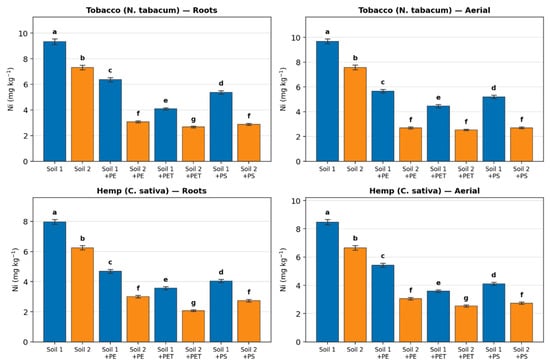
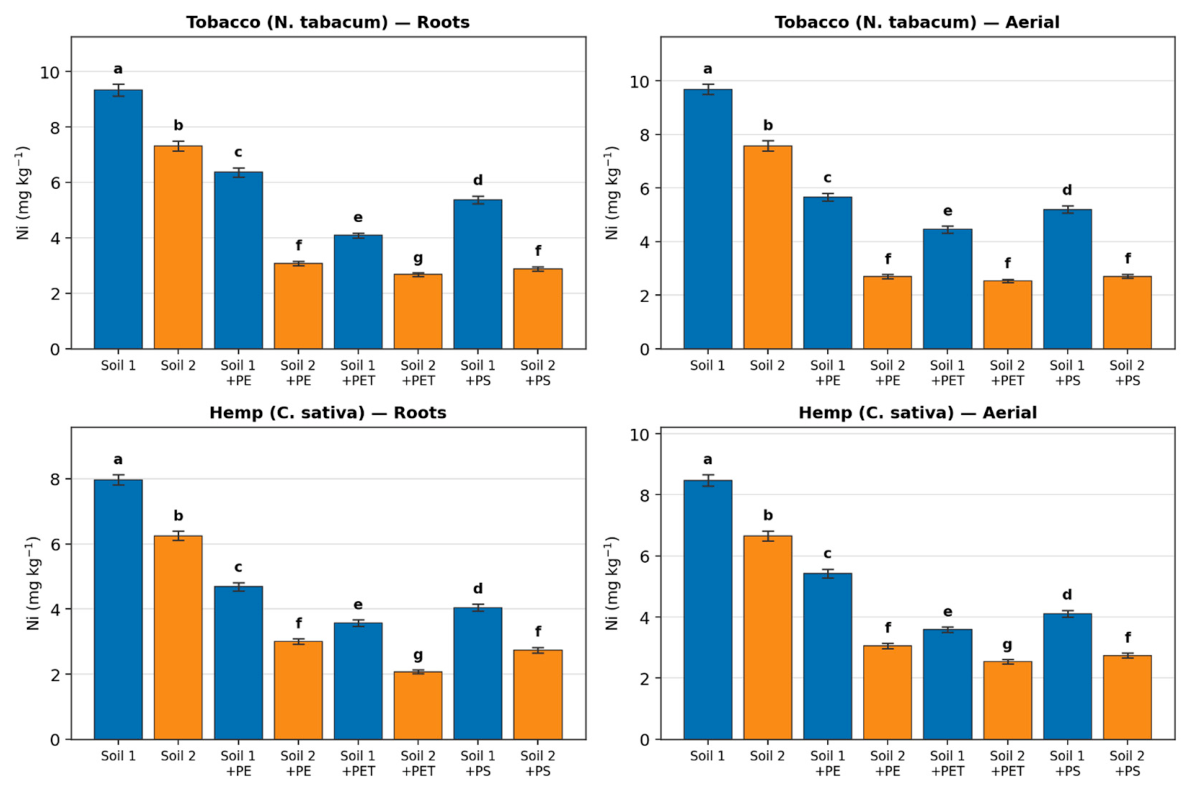
Figure 1.
Nickel (Ni) concentration (mg kg−1) in the roots and aerial tissues of tobacco (Nicotiana tabacum cv. Burley) and hemp (Cannabis sativa cv. Fedora 17) across the eight treatments. Bars show the mean of three replicates; error bars denote the standard deviation (n = 3). Different letters above the bars indicate statistically significant differences among treatments (one-way ANOVA, Tukey HSD, α = 0.05). The letters derive from the one-way ANOVA across the eight treatment combinations, with n = 3 independent pots per treatment.
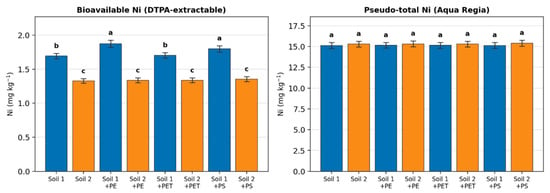
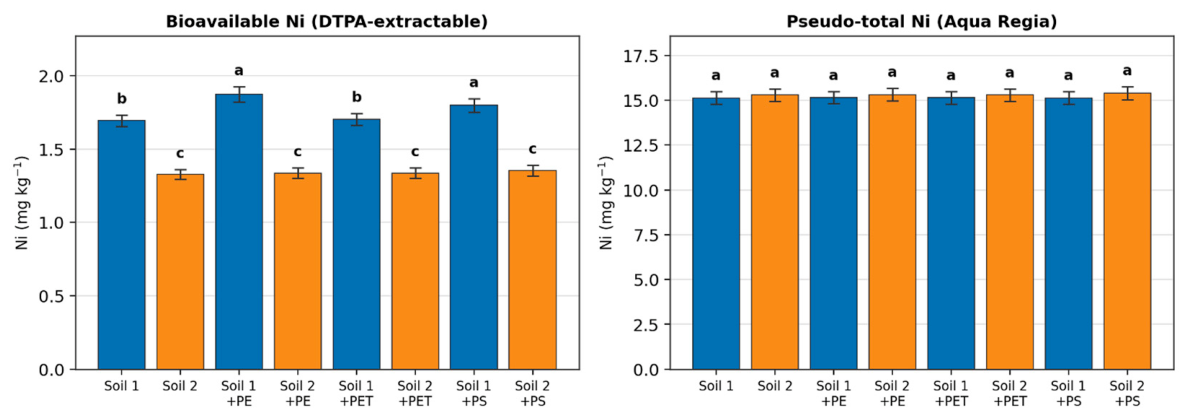
Figure 2.
Bioavailable (DTPA-extractable) and pseudo-total (aqua regia) Ni concentration (mg kg−1) in the soils of the eight treatments. Bars show the mean of three replicates ± standard deviation (n = 3); different letters indicate significant differences (one-way ANOVA, Tukey HSD, α = 0.05). For aqua regia Ni, no significant differences were detected among treatments. The letters derive from the one-way ANOVA across the eight treatment combinations, with n = 3 independent pots per treatment.
3.1. Nickel Accumulation in the Tissues of Tobacco and Hemp
Tissue nickel varied sharply and significantly across the treatments for every plant compartment (Figure 1; p < 0.001, Tukey HSD), and two consistent gradients governed the pattern. First, in both species and in both roots and aerial parts, the untreated controls accumulated the most nickel: tobacco reached 9.34 and 9.69 mg kg−1 in roots and shoots on Soil 1, and hemp reached 7.97 and 8.48 mg kg−1, respectively. Second, every microplastic treatment lowered tissue nickel relative to its own control, so that the lowest concentrations were recorded in the microplastic-amended Soil 2 pots (as low as 2.07 mg kg−1 in hemp roots).
The soil effect was systematic: for a given treatment, Soil 1 always yielded higher tissue nickel than Soil 2. This is consistent with the textural contrast set out above, since the coarser, less clay-rich Soil 1 retains nickel more weakly and releases it more readily to the root, whereas the higher clay content of Soil 2 provides additional sorption sites and, together with the free carbonates present in both soils, a stronger pH-buffered fixation of the metal, reducing the fraction available for uptake [27,47,62]. The same control of texture and carbonates over nickel mobility has been repeatedly reported for the calcareous agricultural soils of the wider Thessaly region [47,57].
Superimposed on this soil gradient, the microplastics themselves depressed nickel uptake, and the magnitude of the reduction depended on the polymer. Within Soil 1, tissue nickel decreased in the order control > PE > PS > PET—equivalently, the magnitude of the suppression increased in the order PE < PS < PET, with PET being the polymer associated with the largest reduction. This single formulation is used consistently throughout the manuscript. For example, tobacco roots fell from 9.34 mg kg−1 in the control to 6.37, 5.38 and 4.09 mg kg−1 under PE, PS and PET. Nearly inert, hydrophobic polyethylene interfered least, whereas the more polar polyester (PET) and the aromatic polystyrene (PS), whose surfaces sorb heavy metals far more strongly, were associated with the largest reductions [29,30,31,32].
Two non-exclusive mechanisms have been proposed in the literature to account for a pattern of this kind, and it should be stated clearly that neither of them was measured in the present experiment. The first is soil-mediated: microplastics reshape the biophysical environment of the soil and impair root growth and function so that the root system explores a smaller effective volume and the transpiration-driven mass flow of the metal is curtailed [19,20,25]; the growth and physiological penalties that PE, PET and especially PS impose on tobacco have been documented directly elsewhere [5,6,7]. The second is interfacial: the metal-sorbing particle surfaces intercept part of the nickel in the rhizosphere and compete with the root for the labile pool [29,31,32,33,34]. Because we quantified neither root morphology nor physiology nor the nickel bound to the recovered particles, these two processes are advanced here as hypotheses consistent with the published evidence and with our own observations, and not as mechanisms demonstrated by this study; testing them directly is a priority for further work (Section 3.5).
Tobacco, a recognised efficient metal accumulator, took up slightly more nickel than hemp under equivalent conditions [12,13,15], while in hemp, the metal was, as expected, preferentially retained in the roots [1,2,4]. Across all treatments, the recorded tissue concentrations remained well within the range that hemp and tobacco tolerate without visible phytotoxicity, in line with the efficient uptake regulation and detoxification mechanisms these species deploy against nickel [63,64,65]. Consistent with this, no visible symptoms of phytotoxicity, chlorosis or growth suppression were recorded in either crop, and both species completed their full growth cycle (128 days for hemp, 139 days for tobacco) under every polymer. Since biomass and yield were not quantified in this experiment, these observations establish only the absence of overt phytotoxicity; they cannot exclude a sub-clinical reduction in growth or in yield, and no claim regarding yield is made on their basis (Section 3.4 and Section 3.5).
3.2. Nickel in the Soil: Pseudo-Total and Bioavailable Fractions
The two soil fractions behaved in opposite ways (Figure 2). Pseudo-total nickel, extracted with aqua regia, remained essentially constant across all treatments within a narrow 15.1–15.4 mg kg−1 band, with no statistically significant differences (F = 0.26, p = 0.959; all treatments share letter a). This is the expected result and an important internal control: microplastics are not a source of nickel and do not add to the total metal stock of the soil; they act instead as carriers and as modifiers of its partitioning and mobility [20,33,34,35].
The bioavailable, DTPA-extractable fraction told a different story. In Soil 1, the addition of polyethylene and polystyrene raised available nickel significantly above the control (1.87 and 1.80 versus 1.69 mg kg−1; group a versus b), while PET left it essentially unchanged; in the finer-textured Soil 2, no microplastic treatment altered available nickel significantly (all near 1.33–1.35 mg kg−1, group c). This pattern is itself the soil-dependent polymer effect that lies at the centre of the present work: the same amendment that mobilises nickel in the coarser soil produces no detectable change in the finer, more strongly sorbing one, and the eight-treatment Tukey groupings resolve the contrast unambiguously. The mobilisation is most plausibly attributable to sorption–desorption exchange at the particle interface, to the release of dissolved organic matter competing with the metal for binding sites, and to subtle changes in rhizosphere pH [27,28,29,32]; none of these processes was measured here, and they are therefore proposed as the most likely explanation rather than as a demonstrated mechanism. In Soil 2, the abundant clay and carbonate surfaces are expected to re-bind the released nickel and mask the effect [27,47,62]. Read together with the evidence that aged particles release a larger and more readily exchangeable share of the Ni(II) they have sorbed [32], these results indicate that the action of microplastics on nickel is essentially one of mobilisation—a transfer of metal from the solid phase into the labile pool, without any change in the total stock.
Reading Figure 1 and Figure 2 together resolves an apparent paradox: available nickel rose in Soil 1 under PE and PS, yet tissue nickel fell under every microplastic. The increase in the DTPA pool is modest, whereas the microplastic-induced impairment of root uptake and translocation, together with the competition of the particle surfaces for the metal, appears to outweigh it in determining the net flux into the plant, a reading consistent with the published evidence [19,20,24,33] rather than one demonstrated by the measurements made here. In other words, higher chemical availability does not translate into higher uptake once the biological uptake machinery and the root environment are compromised, a distinction of direct relevance to any assessment of nickel risk or of phytoextraction efficiency [26,35]. The corollary is methodological. DTPA is an equilibrium chemical extraction that measures the size of a labile pool under standardised laboratory conditions; it does not integrate root architecture, root physiology, or rhizosphere processes, and there is therefore no reason to expect it to track plant uptake when those are themselves altered. We present this as the most parsimonious interpretation of the decoupling observed here, and not as a demonstrated failure of the DTPA test, which would require the direct measurement of root function and of rhizosphere speciation.
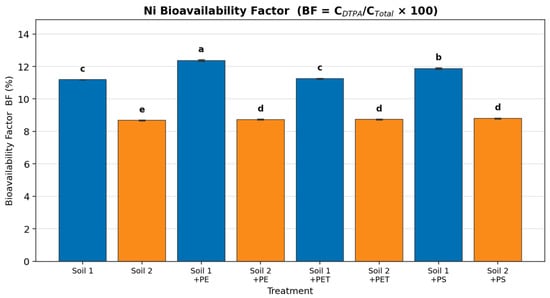
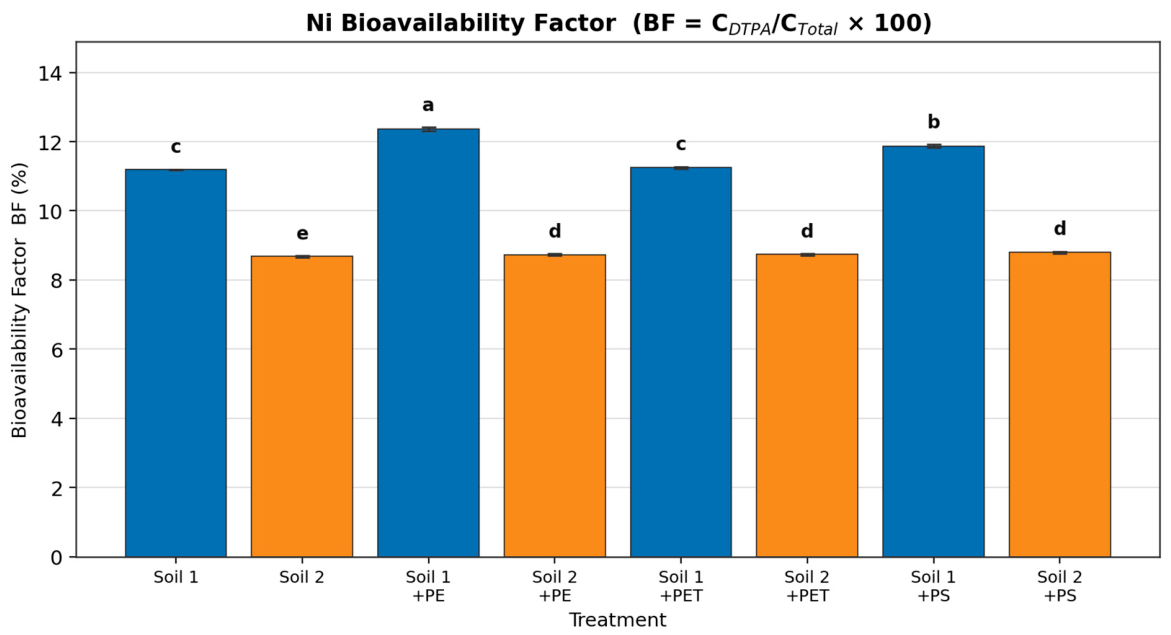
A concise, normalised expression of these soil results is provided by the nickel Bioavailability Factor (BF = CDTPA/CTotal × 100), which reports the percentage of the total soil nickel that is present in the DTPA-available form (Figure 3) [57]. Because the pseudo-total concentration was invariant across treatments, the factor essentially rescales the DTPA-Ni response and renders the treatment differences directly comparable between the two soils. The Bioavailability Factor was significantly higher in Soil 1 (11.2–12.4%) than in Soil 2 (8.7–8.8%; p < 0.001, Tukey HSD), a gap that reflects the intrinsically weaker retention of nickel in the coarser, less clay-rich Soil 1 compared with the finer, more clay-rich Soil 2 [27,47,62].
Figure 3.
Nickel bioavailability factor (BF = CDTPA/CTotal × 100, %) of the eight treatments, expressing the share of the pseudo-total soil nickel that is present in the DTPA-extractable form. Bars show the mean of three replicates ± standard deviation (n = 3); different letters indicate statistically significant differences (one-way ANOVA, Tukey HSD, α = 0.05). The letters derive from the one-way ANOVA across the eight treatment combinations, with n = 3 independent pots per treatment.
Within Soil 1, the microplastics raised the Bioavailability Factor in the order PE (12.4%, group a) > PS (11.9%, b) > PET ≈ control (≈11.2%, c), mirroring exactly the DTPA-Ni pattern and confirming that polyethylene and polystyrene are the polymers most effective at mobilising nickel [29,30,31,32]. In Soil 2, the effect was marginal: every microplastic produced a small but statistically detectable rise over the control (group d versus e), yet the absolute change never exceeded about 0.2 percentage points because the abundant clay and carbonate surfaces rapidly re-bind the released metal [27,47,62]. Even under the most mobilising treatment, only about one-eighth of the total nickel was DTPA-available, so both soils remain within a low-availability regime; nonetheless, the systematic, microplastic-driven increase in the available proportion is precisely the fraction that governs plant uptake and environmental risk, and therefore the parameter that most deserves routine monitoring [27,28,39].
Interpreted alongside the plant data, the Bioavailability Factor is diagnostic rather than predictive: the treatments that most enlarged the available proportion of soil nickel in Soil 1 were among those that most reduced its concentration in the plant. The factor is therefore best read as a sensitive, soil-side early indicator of microplastic-driven mobilisation to be monitored together with, and not instead of, the nickel actually taken up by the crop. Because the pseudo-total concentration remained constant while the factor shifted systematically, this single index also encapsulates the wider argument of the present work, namely that risk assessment and nutrient management decisions on soils of this kind should rest on the available rather than on the total nickel fraction [39,45,46].
3.3. Distribution of Nickel Within the Plant (TC, BAF and TF)
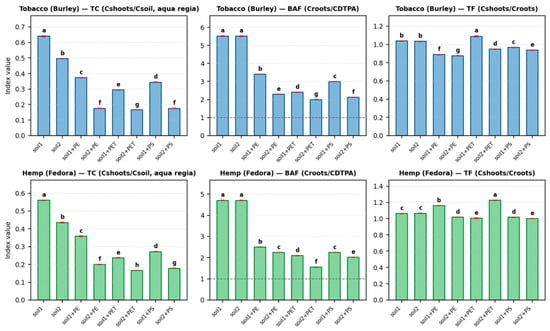
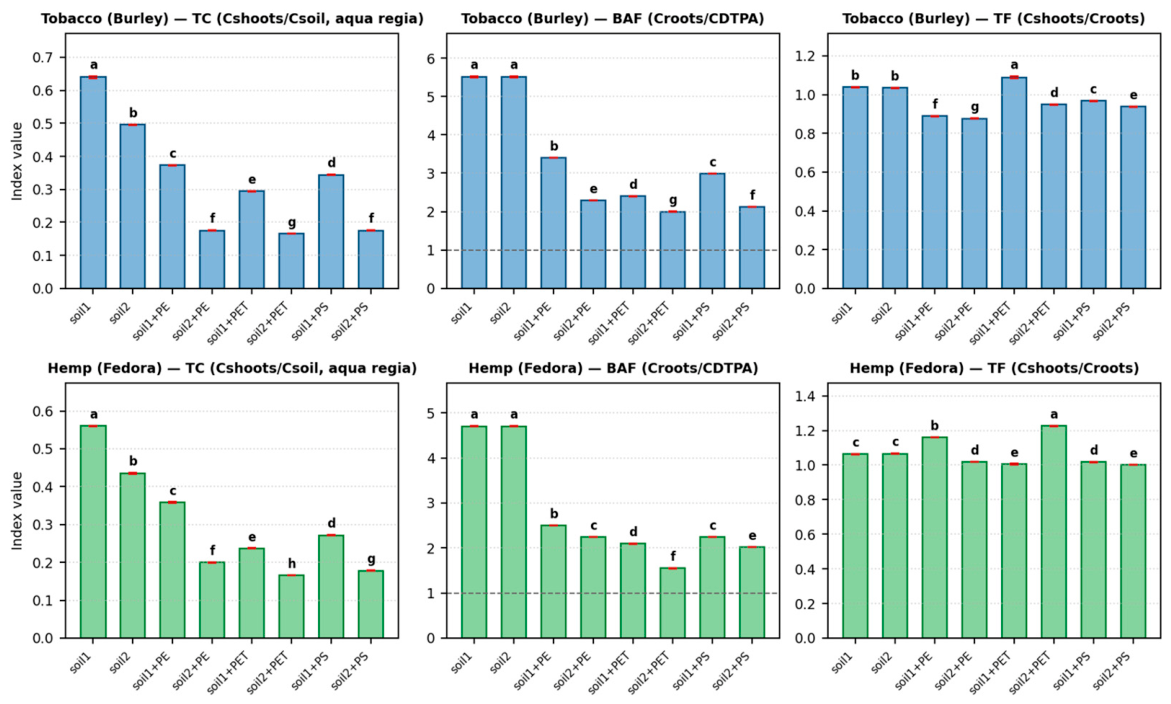
The partitioning of nickel between below- and above-ground tissue was quantified through the Transfer Coefficient (TC = Cshoots/Csoil, shoot Ni relative to pseudo-total soil Ni), the Bioaccumulation Factor (BAF = Croots/CDTPA, root Ni relative to available soil Ni) and the Transfer Factor (TF = Cshoots/Croots), following [50] (Figure 4). The Bioaccumulation Factor exceeded unity in every treatment (BAF ≈ 1.5–5.5), so that, relative to the available (DTPA-extractable) pool, both crops behaved as nickel accumulators, whereas the Transfer Coefficient, referenced to the much larger pseudo-total soil pool, remained well below one (TC ≈ 0.17–0.64); the Transfer Factor meanwhile clustered around unity (TF ≈ 0.9–1.2). A Transfer Factor near or above 1 denotes efficient root-to-shoot movement of metal into the harvestable aerial biomass, a trait that is desirable for phytoextraction and that both hemp and tobacco are known to possess [1,3,12]. The contrast between the first two indices is largely a matter of denominator and must be read as such: because the DTPA fraction is only 8.7–12.4% of the pseudo-total pool, BAF values above unity follow to a large extent from referencing root Ni to that small labile fraction, and they are not comparable with bioconcentration factors calculated against total soil metal. BAF > 1 therefore means that the roots concentrate nickel relative to the labile soil pool; it does not by itself identify these crops as effective phytoremediators, and still less so when, as here, the absolute quantity of nickel acquired falls under every polymer.
Figure 4.
Nickel transfer and distribution indices in tobacco and hemp: Transfer Coefficient TC = Cshoots/Csoil (shoot Ni/pseudo-total soil Ni), Bioaccumulation Factor BAF = Croots/CDTPA (root Ni/available soil Ni), and Transfer Factor TF = Cshoots/Croots. Bars show the mean of three replicates ± standard deviation (n = 3); different letters above the bars indicate statistically significant differences among treatments (one-way ANOVA, Tukey HSD, α = 0.05). The dashed line in the BAF panels marks BAF = 1. The letters derive from the one-way ANOVA across the eight treatment combinations, with n = 3 independent pots per treatment. Note that BAF is referenced to the DTPA-extractable and not to the pseudo-total soil pool.
Crucially, the microplastics left the internal partitioning of nickel almost unchanged: the Transfer Factor, which reflects the shoot-to-root distribution inside the plant, proved far more stable than the two soil-referenced indices and than the absolute quantity taken up. Because TC and BAF are referenced to the soil concentrations, they inherit the strong treatment effect on tissue nickel: both fell markedly and significantly under every microplastic (one-way ANOVA, p < 0.001; distinct Tukey letters in Figure 4), the untreated controls showing the highest soil-to-shoot and soil-to-root transfer and the microplastic-amended Soil 2 pots showing the lowest. The Transfer Factor, by contrast, depends only on the internal shoot-to-root ratio and stayed close to unity across all treatments, so the differences it resolved, though statistically significant, were numerically small. This means that the dominant effect of microplastic contamination is based on how much nickel the plant acquires, not on how it distributes it internally. A slight rise in the Transfer Factor under PET, most visible in hemp, suggests that when total uptake is suppressed, the plant maintains, or even slightly favours, translocation to the shoot, a response consistent with the tightly regulated, nicotianamine-mediated homeostatic transport of nickel in higher plants [40,41]. From an applied standpoint, the stability of the Transfer Factor near unity is encouraging for phytoremediation. It must be stressed, however, that the nickel actually removed per pot and per growth cycle cannot be quantified here, because biomass was not recorded. The reduction in tissue concentration establishes a lower extraction efficiency per unit of biomass; it would translate proportionally into a lower total removal only if biomass were itself unaffected, which the present data cannot establish (Section 3.5).
3.4. Integrated Interpretation and Implications for Phytoremediation
Taken together, the nickel results describe a coherent, mechanistically consistent picture. The total nickel stock of the soil is conserved, confirming that microplastics are modifiers rather than sources of the metal; the bioavailable fraction is redistributed in a soil-dependent way, rising only in the coarser-textured Soil 1; and, most consequentially for the crops, plant uptake is suppressed by every polymer, with the magnitude of the suppression increasing in the order PE < PS < PET (tissue Ni: control > PE > PS > PET), and always more so on the finer-textured Soil 2. The concurrent increase in available soil nickel and decrease in tissue nickel shows that the availability measured chemically and the availability realised biologically are governed by different balances, with the former by sorption–desorption equilibria and the latter by the integrity of the root and its environment [27,33,34,35].
A yield-oriented reading of these results requires caution. At the dose applied here (2% v/v), the suppression of nickel uptake was not accompanied by any visible loss of crop performance: both hemp and tobacco completed their full growth cycle under every polymer, without symptoms of phytotoxicity or stunting. Because biomass and yield were not measured, however, we cannot state that yield was unaffected, and the earlier formulation to that effect has been withdrawn. Published evidence indicates that the effects of micro- and nanoplastics on crop yield are generally moderate and strongly dose-dependent, with low-to-moderate loads often producing neutral or mildly stimulatory (hormetic) responses, whereas marked yield penalties emerge only at higher concentrations [7,53]; whether the two crops studied here fall within that neutral range can be established only by an experiment in which biomass is quantified.
For the use of hemp and tobacco as phytoremediators of nickel-affected soils, this carries a clear but appropriately bounded message. Co-occurring microplastic contamination, now a realistic feature of Mediterranean agricultural soils [48,52,53,54], does not increase the metal burden but does lower the concentration of nickel that these high-biomass crops acquire, and the penalty is greatest for the polymers (PET, PS) whose surfaces are most reactive to metals [29,30,31,32]. It must be emphasised that the two soils used here are not contaminated in any regulatory sense: their pseudo-total Ni content of 15.1–15.4 mg kg−1 lies below typical background values reported for European agricultural soils and well below the screening values commonly applied to nickel in agricultural land [62]. The present experiment therefore describes how microplastics modify the soil–plant transfer of nickel at background concentrations; the phytoextraction implications drawn from it are expectations to be tested on genuinely contaminated soils, and not a demonstration of reduced remediation performance on such soils. Within that limit, the interaction deserves to be factored into the design and the expected performance of phytoextraction schemes on plastic-contaminated land [33,34,35].
Seen from the complementary, nutritional perspective—nickel being an essential micronutrient and the cofactor of urease [36,37,41]—the same suppression of uptake is not necessarily benign. Here too, a qualification is required. The soils studied are not nickel-deficient: their DTPA-extractable Ni (1.33–1.87 mg kg−1) and the tissue concentrations recorded in the control plants (8.0–9.7 mg kg−1) both lie above the critical values commonly cited for nickel deficiency, and urease activity, urea accumulation and nitrogen metabolism were not measured in this experiment. The argument advanced here is therefore a potential implication rather than a result: on soils whose available nickel is genuinely low, a microplastic-driven reduction in nickel acquisition of the magnitude observed here could constrain urea metabolism, nitrogen use and ultimately yield, which reinforces the case for monitoring the available, rather than merely the total, nickel fraction in cultivated soils [39,45,46].
3.5. Limitations of the Study
The scope of these results is bounded in several respects, which should be borne in mind before they are generalised. (i) Only two soils were compared. They differ chiefly in texture, but their carbonate contents also differ slightly (5.90% versus 6.70% CaCO3), so that texture and carbonates covary and their individual contributions to the observed behaviour of nickel cannot be separated; the soil effect reported here is most plausibly textural, but a wider set of soils, in which the two properties vary independently, would be needed to establish that. (ii) A single microplastic dose was applied (2% v/v), chosen as a worst-case level so that effects could be resolved within one growing season; it is not necessarily representative of the concentrations found in the field. Since the effects of microplastics are dose-dependent, no dose–response relationship can be derived from the present design, and the results should not be extrapolated to other loads. (iii) The polymers were pristine and unweathered, whereas particles in the field are aged and their sorption capacity and its reversibility differ accordingly [32]. (iv) Beyond the 0.5–5 mm size fraction used, the polymers were not characterised instrumentally: the particle-size distribution within that fraction, the specific surface area and the surface functional groups were not determined. Because metal sorption at polymer surfaces depends on these properties as well as on polymer chemistry, the differences observed between PE, PET and PS can be attributed to polymer type but cannot be resolved in terms of particle geometry or surface chemistry. (v) The experiment was a pot study conducted over a single growing season, so neither longer-term processes nor field-scale heterogeneity are represented. (vi) Biomass and yield were not quantified; consequently, no statement can be made about the yield consequences of the observed reduction in nickel uptake, nor about the absolute quantity of nickel removed per crop cycle. (vii) The mechanisms invoked in Section 3.1 and Section 3.2—impairment of root growth and function, and interception of nickel by the particle surfaces—were not measured directly and remain hypotheses. Addressing points (ii), (iv), (vi) and (vii), through a dose series that uses fully characterised and weathered polymers, keeps full biomass and yield records, and measures root function and particle-bound nickel directly, is the natural continuation of this work.
4. Conclusions
This pot experiment assessed how three of the most common microplastics—polyethylene (PE), poly(ethylene terephthalate) (PET) and polystyrene (PS)—modify the behaviour of nickel in two calcareous agricultural soils differing chiefly in texture, cropped with industrial hemp and tobacco. Three findings stand out. First, the pseudo-total nickel stock of the soils was unaffected by any microplastic, confirming that these particles are not a source of the metal but a modifier of its partitioning. Second, the bioavailable, DTPA-extractable fraction rose only modestly and only in the coarser, less clay-rich Soil 1 under PE and PS, showing that the mobilisation of nickel is real but small and strongly buffered by soil texture and carbonates. Third, and most important agronomically, nickel accumulation in the tissues of both crops declined under every microplastic, with the magnitude of the reduction increasing in the order PE < PS < PET (tissue Ni: control > PE > PS > PET), and always more markedly on the finer-textured Soil 2, while the internal root-to-shoot partitioning (Transfer Factor ≈ 1) remained efficient. Microplastics therefore suppress the biological acquisition of nickel rather than its translocation, and they do so even where the metal is chemically more available. No visible impairment of crop development accompanied these changes: both species completed their full cycle under every polymer. Because biomass and yield were not recorded, however, this observation establishes only the absence of overt phytotoxicity and cannot be read as evidence that yield was preserved.
For the use of hemp and tobacco as phytoremediators, the practical implication is a lower nickel concentration acquired per unit of biomass on plastic-contaminated soils, with the largest penalty imposed by the most metal-reactive polymers, PET and PS. Both species remain attractive candidates, as they combine a high harvestable biomass with efficient translocation of the metal to the above-ground parts, but co-occurring microplastics—an increasingly realistic feature of Mediterranean agricultural soils—act as an interfering factor that must be built into the design and the expected performance of phytoextraction schemes. It should be kept in mind that the soils studied here carry background rather than contaminated levels of nickel (15.1–15.4 mg kg−1), so this expectation requires confirmation on genuinely polluted soils; integrated strategies that couple metal phytoremediation with microplastic mitigation are an emerging avenue worth exploring in that context.
Read through the complementary lens of nickel as an essential micronutrient and the metal cofactor of urease, the microplastic-driven suppression of uptake is not necessarily benign. The soils examined here are not nickel-deficient, and urease activity and nitrogen metabolism were not measured, so this remains a potential implication rather than a demonstrated consequence: on soils in which available nickel is genuinely low, a reduction in acquisition of the magnitude reported here could constrain urea metabolism, nitrogen use and ultimately yield. The consistent decoupling of total, bioavailable and plant-acquired nickel argues in any case for routinely monitoring the available rather than the total fraction, and for extending these controlled results through field-scale, longer-term studies across polymer types, ageing states, application doses and crop species, in which biomass and yield are quantified alongside metal uptake.
Beyond these specific findings, the present work illustrates the value of treating nickel simultaneously as a potential contaminant and as an essential micronutrient, a dual perspective still rarely applied to microplastic co-contamination and one that proved decisive for interpreting the results obtained here. Methodologically, determining the pseudo-total, the bioavailable, and the plant-acquired nickel in parallel, and coupling them with the transfer and bioaccumulation indices, provided a diagnostic framework able to separate chemical from biological availability, a distinction that a total-metal survey alone would have concealed. Set within the wider goal of a circular and sustainable agriculture, in which high-biomass crops such as hemp and tobacco can help restore degraded land while yielding valuable products, these results make clear that the increasingly realistic co-occurrence of microplastics must be built into the planning of such nature-based, low-input strategies if they are to deliver their expected benefits on Mediterranean soils.
Author Contributions
Conceptualization, A.S., T.M. and E.E.G.; methodology, A.S., T.M. and E.E.G.; software, A.S. and T.M.; validation, A.S., T.M. and E.E.G.; formal analysis, A.S. and T.M.; investigation, A.S., T.M. and E.E.G.; resources, E.E.G.; data curation, A.S.; writing—original draft preparation, A.S. and T.M.; writing—review and editing, A.S., T.M. and E.E.G.; visualization, A.S. and T.M.; supervision, E.E.G.; project administration, E.E.G.; funding acquisition, E.E.G. All authors have read and agreed to the published version of the manuscript.
Funding
This research received no external funding.
Institutional Review Board Statement
Not applicable.
Informed Consent Statement
Not applicable.
Data Availability Statement
Data that support the findings of this study are available from the corresponding author upon reasonable request.
Conflicts of Interest
All authors declare that there are no conflicts of interest.
References
- Testa, G.; Corinzia, S.A.; Cosentino, S.L.; Ciaramella, B.R. Phytoremediation of Cadmium-, Lead-, and Nickel-Polluted Soils by Industrial Hemp. Agronomy 2023, 13, 995. [Google Scholar] [CrossRef] [Scilit]
- Flajšman, M.; Košmelj, K.; Grčman, H.; Kocjan Ačko, D.; Zupan, M. Industrial hemp (Cannabis sativa L.)—A valuable alternative crop for growing in agricultural soils contaminated with heavy metals. Environ. Sci. Pollut. Res. 2023, 30, 115414–115429. [Google Scholar] [CrossRef] [Scilit] [PubMed]
- Singh, A.; Sankhla, M.S.; Sharma, V.; Kumari, P.; Rai, A.R.; Gautam, A.; Sharma, T.; Awasthi, K.K.; Kumar, R. Exploring the Potential of Industrial Hemp in Phytoremediation of Heavy Metals. Nat. Resour. Hum. Health 2024, 4, 98–107. [Google Scholar] [CrossRef] [Scilit] [PubMed]
- Ansari, O.; De Prato, L. Current Knowledge on Phytoremediation Potential of Industrial Hemp (Cannabis sativa L.) for PFAS and Heavy Metal Contaminated Soils. Remediat. J. 2026, 36, e70059. [Google Scholar] [CrossRef] [Scilit]
- Zhang, S.; Gao, W.; Cai, K.; Liu, T.; Wang, X. Effects of Microplastics on Growth and Physiological Characteristics of Tobacco (Nicotiana tabacum L.). Agronomy 2022, 12, 2692. [Google Scholar] [CrossRef] [Scilit]
- Wang, X.; Gao, W.; Cai, K.; Pan, W.; Tu, Z. Response of Tobacco (Nicotiana tabacum L.) Growth to Soil Microplastic Pollution. Pol. J. Environ. Stud. 2024, 33, 5357–5365. [Google Scholar] [CrossRef] [Scilit] [PubMed]
- Tian, J.; Xu, Z.; Huang, W.; Han, D.; Dang, B.; Xu, J.; Jia, W. Physiobiochemical and transcriptional responses of tobacco plants (Nicotiana tabacum L.) to different doses of polystyrene nanoplastics. Ind. Crops Prod. 2024, 220, 119218. [Google Scholar] [CrossRef] [Scilit]
- Visković, J.; Zheljazkov, V.D.; Sikora, V.; Noller, J.; Latković, D.; Ocamb, C.M.; Koren, A. Industrial Hemp (Cannabis sativa L.) Agronomy and Utilization: A Review. Agronomy 2023, 13, 931. [Google Scholar] [CrossRef] [Scilit]
- Kaur, N.; Brym, Z.; Sharma, L.K.; Monserrate Oyola, L.A. Nitrogen fertilization impact on hemp (Cannabis sativa L.) crop production: A review. Agron. J. 2023, 115, 1557–1570. [Google Scholar] [CrossRef] [Scilit]
- Husain, R.; Weeden, H.; Bogush, D.; Deguchi, M.; Soliman, M.; Potlakayala, S.; Katam, R.; Goldman, S.; Rudrabhatla, S. Enhanced tolerance of industrial hemp (Cannabis sativa L.) plants on abandoned mine land soil leads to overexpression of cannabinoids. PLoS ONE 2019, 14, e0221570. [Google Scholar] [CrossRef] [Scilit] [PubMed]
- Islam, M.M.; Rengel, Z.; Storer, P.; Siddique, K.H.M.; Solaiman, Z.M. Phosphorus fertilisation differentially influences growth, morpho-physiological adaptations and nutrient uptake of industrial hemp (Cannabis sativa L.). Plant Soil 2023, 492, 301–314. [Google Scholar] [CrossRef] [Scilit]
- Kozak, K.; Antosiewicz, D.M. Tobacco as an efficient metal accumulator. Biometals 2023, 36, 351–370. [Google Scholar] [CrossRef] [Scilit] [PubMed]
- Li, X.; Li, Y.; Zhu, X.; Gui, X.; Ma, C.; Peng, W.; Li, Y.; Zhang, Y.; Huang, W.; Hua, D.; et al. Evaluation of the cadmium phytoextraction potential of tobacco (Nicotiana tabacum) and rhizosphere micro-characteristics under different cadmium levels. Chemosphere 2022, 286, 131714. [Google Scholar] [CrossRef] [Scilit] [PubMed]
- Jia, J.; Dai, H.; Zhan, J.; Wei, S.; Miszczak, E.; Chang, J. Cadmium uptake/accumulation from low and moderately contaminated soil by different tobacco (Nicotiana tabacum L.) cultivars and their management suggestion in the human health context. Ind. Crops Prod. 2025, 233, 121458. [Google Scholar] [CrossRef] [Scilit]
- Cham, R.; Moghtaderi, T.; Rodríguez-Seijo, A.; Alamdar, R. Single and Combined Effect of Cd and Zn on Growth, Metal Accumulation and Mineral Nutrition in Tobacco Plants (Nicotiana tabacum L.). J. Soil Sci. Plant Nutr. 2023, 23, 4521–4531. [Google Scholar] [CrossRef] [Scilit]
- Wang, M.; Duan, S.; Zhou, Z.; Chen, S. Alleviation of cadmium toxicity to tobacco (Nicotiana tabacum) by biofertilizers involves the changes of soil aggregates and bacterial communities. Ecotoxicol. Environ. Saf. 2019, 169, 240–247. [Google Scholar] [CrossRef] [Scilit] [PubMed]
- Rillig, M.C. Microplastic in Terrestrial Ecosystems and the Soil? Environ. Sci. Technol. 2012, 46, 6453–6454. [Google Scholar] [CrossRef] [Scilit] [PubMed]
- Khalid, N.; Aqeel, M.; Noman, A.; Rizvi, Z.F. Impact of plastic mulching as a major source of microplastics in agroecosystems. J. Hazard. Mater. 2023, 445, 130455. [Google Scholar] [CrossRef] [Scilit] [PubMed]
- de Souza Machado, A.A.; Lau, C.W.; Till, J.; Kloas, W.; Lehmann, A.; Becker, R.; Rillig, M.C. Impacts of Microplastics on the Soil Biophysical Environment. Environ. Sci. Technol. 2018, 52, 9656–9665. [Google Scholar] [CrossRef] [Scilit] [PubMed]
- de Souza Machado, A.A.; Lau, C.W.; Kloas, W.; Bergmann, J.; Bachelier, J.B.; Faltin, E.; Becker, R.; Görlich, A.S.; Rillig, M.C. Microplastics Can Change Soil Properties and Affect Plant Performance. Environ. Sci. Technol. 2019, 53, 6044–6052. [Google Scholar] [CrossRef] [Scilit] [PubMed]
- Mondol, M.; Angon, P.B.; Roy, A. Effects of microplastics on soil physical, chemical and biological properties. Nat. Hazards Res. 2025, 5, 14–20. [Google Scholar] [CrossRef] [Scilit]
- Hanif, M.N.; Aijaz, N.; Azam, K.; Akhtar, M.; Laftah, W.A.; Babur, M.; Abbood, N.K.; Benitez, I.B. Impact of microplastics on soil (physical and chemical) properties, soil biological properties/soil biota, and response of plants to it: A review. Int. J. Environ. Sci. Technol. 2024, 21, 10277–10318. [Google Scholar] [CrossRef] [Scilit]
- Aralappanavar, V.K.; Mukhopadhyay, R.; Yu, Y.; Liu, J.; Bhatnagar, A.; Praveena, S.M.; Li, Y.; Paller, M.; Adyel, T.M.; Rinklebe, J.; et al. Effects of microplastics on soil microorganisms and microbial functions in nutrients and carbon cycling—A review. Sci. Total Environ. 2024, 924, 171435. [Google Scholar] [CrossRef] [Scilit] [PubMed]
- Iqbal, B.; Zhao, T.; Yin, W.; Zhao, X.; Xie, Q.; Khan, K.Y.; Zhao, X.; Nazar, M.; Li, G.; Du, D. Impacts of soil microplastics on crops: A review. Appl. Soil Ecol. 2023, 181, 104680. [Google Scholar] [CrossRef] [Scilit]
- Rillig, M.C.; Lehmann, A.; de Souza Machado, A.A.; Yang, G. Microplastic effects on plants. New Phytol. 2019, 223, 1066–1070. [Google Scholar] [CrossRef] [Scilit] [PubMed]
- Chen, Z.; Carter, L.J.; Banwart, S.A.; Kay, P. Microplastics in Soil–Plant Systems: Current Knowledge, Research Gaps, and Future Directions for Agricultural Sustainability. Agronomy 2025, 15, 1519. [Google Scholar] [CrossRef] [Scilit]
- Weng, L.P.; Wolthoorn, A.; Lexmond, T.M.; Temminghoff, E.J.M.; van Riemsdijk, W.H. Understanding the Effects of Soil Characteristics on Phytotoxicity and Bioavailability of Nickel Using Speciation Models. Environ. Sci. Technol. 2004, 38, 156–162. [Google Scholar] [CrossRef] [Scilit] [PubMed]
- Ding, S.; Guan, D.-X.; Dai, Z.-H.; Su, J.; Teng, H.H.; Ji, J.; Liu, Y.; Yang, Z.; Ma, L.Q. Nickel bioaccessibility in soils with high geochemical background and anthropogenic contamination. Environ. Pollut. 2022, 310, 119914. [Google Scholar] [CrossRef] [Scilit] [PubMed]
- Lin, W.-H.; Wang, H.-Y.; Kuo, J.; Lo, S.-L. Adsorption and desorption characteristics of heavy metals onto conventional and biodegradable plastics. Chemosphere 2023, 333, 138920. [Google Scholar] [CrossRef] [Scilit] [PubMed]
- Chen, P.-W.; Hsiao, M.-N.; Xiao, L.-W.; Liu, Z.-S. Adsorption behavior of heavy metals onto microplastics derived from conventional and biodegradable commercial plastic products. Sci. Total Environ. 2024, 951, 175537. [Google Scholar] [CrossRef] [Scilit] [PubMed]
- Barus, B.S.; Chen, K.; Cai, M.; Li, R.; Chen, H.; Li, C.; Wang, J.; Cheng, S.-Y. Heavy Metal Adsorption and Release on Polystyrene Particles at Various Salinities. Front. Mar. Sci. 2021, 8, 671802. [Google Scholar] [CrossRef] [Scilit]
- Xie, A.; Chen, S.; Liang, X.; Li, L.; Song, Y.; Lv, M.; Liang, F.; Zhou, W. Influence of microplastic aging on the adsorption and desorption behavior of Ni(II) under various aging conditions. Environ. Geochem. Health 2025, 47, 87. [Google Scholar] [CrossRef] [Scilit] [PubMed]
- Xu, L.; Xie, W.; Dai, H.; Wei, S.; Skuza, L.; Li, J.; Shi, C.; Zhang, L. Effects of combined microplastics and heavy metals pollution on terrestrial plants and rhizosphere environment: A review. Chemosphere 2024, 358, 142107. [Google Scholar] [CrossRef] [Scilit] [PubMed]
- Bian, J.; Peng, N.; Zhou, Z.; Yang, J.; Wang, X. A critical review of co-pollution of microplastics and heavy metals in agricultural soil environments. Ecotoxicol. Environ. Saf. 2024, 286, 117248. [Google Scholar] [CrossRef] [Scilit] [PubMed]
- Mo, G.; Zhang, Z.; Guo, X. Systematic review of microplastics and heavy metals co-contamination on soils: The triple-chain effects of soil properties, crop responses, and biological communities. Plant Soil 2026, 520, 19–40. [Google Scholar] [CrossRef] [Scilit]
- Fabiano, C.C.; Tezotto, T.; Favarin, J.L.; Polacco, J.C.; Mazzafera, P. Essentiality of nickel in plants: A role in plant stresses. Front. Plant Sci. 2015, 6, 754. [Google Scholar] [CrossRef] [Scilit] [PubMed]
- Shahzad, B.; Tanveer, M.; Rehman, A.; Cheema, S.A.; Fahad, S.; Rehman, S.; Sharma, A. Nickel; whether toxic or essential for plants and environment—A review. Plant Physiol. Biochem. 2018, 132, 641–651. [Google Scholar] [CrossRef] [Scilit] [PubMed]
- Begum, W.; Rai, S.; Banerjee, S.; Bhattacharjee, S.; Mondal, M.H.; Bhattarai, A.; Saha, B. A comprehensive review on the sources, essentiality and toxicological profile of nickel. RSC Adv. 2022, 12, 9139–9153. [Google Scholar] [CrossRef] [Scilit] [PubMed]
- Rabinovich, A.; Di, R.; Lindert, S.; Heckman, J. Nickel and Soil Fertility: Review of Benefits to Environment and Food Security. Environments 2024, 11, 177. [Google Scholar] [CrossRef] [Scilit]
- Merlot, S. Understanding Nickel Responses in Plants: More than Just an Interaction with Iron Homeostasis. Plant Cell Physiol. 2020, 61, 443–444. [Google Scholar] [CrossRef] [Scilit] [PubMed]
- Seregin, I.V.; Kozhevnikova, A.D. Nicotianamine: A Key Player in Metal Homeostasis and Hyperaccumulation in Plants. Int. J. Mol. Sci. 2023, 24, 10822. [Google Scholar] [CrossRef] [Scilit] [PubMed]
- Correia, D.V.P.; Rodak, B.W.; Machado, H.A.; Lopes, G.; Freitas, D.S. Beneficial or detrimental? How nickel application alters the ionome of soybean plants. Plant Sci. 2024, 349, 112274. [Google Scholar] [CrossRef] [Scilit] [PubMed]
- Kováčik, J.; Vydra, M. The impact of nickel on plant growth and oxidative balance. Physiol. Plant. 2024, 176, e14595. [Google Scholar] [CrossRef] [Scilit] [PubMed]
- de Oliveira, J.B.; Lavres, J.; Kopittke, P.M.; Chaney, R.L.; Harris, H.H.; Erskine, P.D.; Howard, D.L.; dos Reis, A.R.; van der Ent, A. Unravelling the fate of foliar-applied nickel in soybean: A comprehensive investigation. Plant Soil 2024, 502, 537–556. [Google Scholar] [CrossRef] [Scilit]
- Rabinovich, A.; Heckman, J.R.; Wyenandt, C.A.; Di, R. Foliar Nickel Nutrient Application for Improved Urea Conversion and Abiotic Stress Mitigation in Tomato. Agric. Res. 2026, 15, 219–227. [Google Scholar] [CrossRef] [Scilit]
- Elia, A.; Palmitessa, O.D.; Santamaria, P. Nickel in agri-food systems: A review. Front. Plant Sci. 2026, 17, 1829209. [Google Scholar] [CrossRef] [Scilit] [PubMed]
- Golia, E.E.; Diakoloukas, V. Soil Parameters Affecting the Levels of Potentially Harmful Metals in Thessaly Area, Greece: A Robust Quadratic Regression Approach of Soil Pollution Prediction. Environ. Sci. Pollut. Res. 2022, 29, 29544–29561. [Google Scholar] [CrossRef] [Scilit] [PubMed]
- Golia, E.E.; Bethanis, J.; Xagoraris, C.; Tziourrou, P. Potentially Toxic Elements in Urban and Peri-Urban Soils—A Critical Meta-Analysis of their Sources, Availability, Interactions, and Spatial Distribution. J. Ecol. Eng. 2024, 25, 335–350. [Google Scholar] [CrossRef] [Scilit] [PubMed]
- Alexiadis, D.; Bethanis, J.; Papadimou, S.G.; Barbieri, E.; Vogia, R.; Tatsi, E.; Tziourrou, P.; Tsaliki, E.; Golia, E.E. Effect of Plastics (Geotextiles) on Heavy Metal Accumulation by Industrial Hemp Plants Cultivated in Polluted Mediterranean Soils. Int. J. Plant Biol. 2025, 16, 53. [Google Scholar] [CrossRef] [Scilit]
- Vasilou, C.; Tsiropoulos, N.G.; Golia, E.E. Phytoremediation & Valorization of Cu-contaminated Soils Through Cannabis sativa (L.) Cultivation: A Smart Way to Produce Cannabidiol (CBD) in Mediterranean Soils. Waste Biomass Valorization 2024, 15, 1711–1724. [Google Scholar] [CrossRef] [Scilit]
- Papadimou, S.G.; Barbayiannis, N.; Golia, E.E. Preliminary investigation of the use of Silybum marianum (L.) Gaertn. as a Cd accumulator in contaminated Mediterranean soils: The relationships among cadmium (Cd) soil fractions and plant Cd content. Euro-Mediterr. J. Environ. Integr. 2024, 9, 405–417. [Google Scholar] [CrossRef] [Scilit]
- Bethanis, J.; Golia, E.E. Revealing the Combined Effects of Microplastics, Zn, and Cd on Soil Properties and Metal Accumulation by Leafy Vegetables: A Preliminary Investigation by a Laboratory Experiment. Soil Syst. 2023, 7, 65. [Google Scholar] [CrossRef] [Scilit]
- Tziourrou, P.; Golia, E.E. Plastics in Agricultural and Urban Soils: Interactions with Plants, Micro-Organisms, Inorganic and Organic Pollutants: An Overview of Polyethylene (PE) Litter. Soil Syst. 2024, 8, 23. [Google Scholar] [CrossRef] [Scilit]
- Golia, E.E.; Liava, V.; Achilias, D.S.; Navarro-Pedreño, J.; Zorpas, A.A.; Bethanis, J.; Girousi, S. Microplastics’ impact on soil health and quality: Effect of incubation time and soil properties in soil fertility and pollution extent under the circular economy concept. Waste Manag. Res. 2025, 43, 1146–1155. [Google Scholar] [CrossRef] [Scilit] [PubMed]
- Page, A.L.; Miller, H.R.; Keeney, R.D. Methods of Soil Analysis, Part II—Chemical and Microbiological Properties; American Society of Agronomy: Madison, WI, USA; Soil Science Society of America: Madison, WI, USA, 1982. [Google Scholar]
- JAOAC. Official Method of Analysis, 14th ed.; Williams, E., Ed.; Association of Official Chemists, Inc.: Arlington, VA, USA, 1984. [Google Scholar]
- Papadimou, S.G.; Kantzou, O.-D.; Chartodiplomenou, M.-A.; Golia, E.E. Urban Soil Pollution by Heavy Metals: Effect of the Lockdown during the Period of COVID-19 on Pollutant Levels over a Five-Year Study. Soil Syst. 2023, 7, 28. [Google Scholar] [CrossRef] [Scilit]
- Lindsay, W.L.; Norvell, W.A. Development of a DTPA Soil Test for Zinc, Iron, Manganese, and Copper. Soil Sci. Soc. Am. J. 1978, 42, 421–428. [Google Scholar] [CrossRef] [Scilit]
- ISO/DIS 11466; Environmental Soil Quality. ISO Standards Compendium: Geneva, Switzerland, 1994.
- Roldán-Nofuentes, J.A.; Sheth, T.S.; Vera-Vera, J.F. Hypothesis Test to Compare Two Paired Binomial Proportions: Assessment of 24 Methods. Mathematics 2024, 12, 190. [Google Scholar] [CrossRef] [Scilit]
- Macharia, J.M.; Veronica, N.; Wangare, L.; Bence, R.L. Analysis of Selected Potentially Harmful Metal Elements in Soils and Vegetables in Gold Mining Region: Case Study Evaluated in Kenya, Africa. Environments 2025, 12, 317. [Google Scholar] [CrossRef] [Scilit]
- Kabata-Pendias, A. Trace Elements in Soils and Plants, 4th ed.; CRC Press: Boca Raton, FL, USA, 2011. [Google Scholar]
- Mustafa, A.; Zulfiqar, U.; Mumtaz, M.Z.; Radziemska, M.; Haider, F.U.; Holatko, J.; Hammershmiedt, T.; Naveed, M.; Ali, H.; Kintl, A.; et al. Nickel (Ni) phytotoxicity and detoxification mechanisms: A review. Chemosphere 2023, 328, 138574. [Google Scholar] [CrossRef] [Scilit] [PubMed]
- Iqbal, M.; Mukhtiar, A.; Mahmood, A.; Javed, W.; Khan, S.A.; Qari, S.H.; Ullah, S. Nickel bioaccumulation, physio-biochemical responses, phytotoxicity, and its mitigation strategies in plants. Discov. Plants 2026, 3, 59. [Google Scholar] [CrossRef] [Scilit]
- Clemens, S. Toxic metal accumulation, responses to exposure and mechanisms of tolerance in plants. Biochimie 2006, 88, 1707–1719. [Google Scholar] [CrossRef] [Scilit] [PubMed]

Disclaimer/Publisher’s Note: The statements, opinions and data contained in all publications are solely those of the individual author(s) and contributor(s) and not of MDPI and/or the editor(s). MDPI and/or the editor(s) disclaim responsibility for any injury to people or property resulting from any ideas, methods, instructions or products referred to in the content. |
© 2026 by the authors. Licensee MDPI, Basel, Switzerland. This article is an open access article distributed under the terms and conditions of the Creative Commons Attribution (CC BY) license.