


Abstract
Microbial inoculants are increasingly used in conservation agriculture to enhance soil biological functioning and crop performance, yet their field effectiveness remains variable. This study evaluated how soil resource status, extracellular enzyme activities, and plant traits were associated with maize grain weight per plant under no-tillage straw mulching. A two-year field microplot experiment was conducted in an irrigated semi-arid maize system in northeastern China, comparing four microbial inoculants (M44, CF, SF, and YM) with an uninoculated control (CK). Maize growth and reproductive traits, soil physicochemical properties, and extracellular enzyme activities were measured, with soil variables assessed at depths of 0–10 and 10–20 cm. Microbial inoculation significantly affected aboveground biomass (p = 0.013), hundred-grain weight (p = 0.003), and grain weight per plant (p < 0.001), but not ear weight (p = 0.083). CF and M44 produced the strongest plant-level responses: their two-year mean aboveground biomass exceeded CK by 13.24% and 10.25%, respectively, while grain weight per plant increased by 10.78% and 10.66%. SF showed a weaker grain-weight response but increased β-glucosidase activity by 35.3% relative to CK in 2024, whereas YM increased available phosphorus by 70.8% in 2025 without a comparable grain-weight response. Soil treatment responses varied between years, with significant effects on soil organic carbon and available phosphorus in 2024 and on available phosphorus and soil water content in 2025. Treatment effects on β-glucosidase and cellobiohydrolase were detected only in 2024, while phosphatase was unaffected in either year. The random forest model explained 63.6% of the out-of-bag variation in grain weight per plant (p ≤ 0.001), with plant growth and reproductive traits showing the greatest predictive importance; soil organic carbon, soil water content, and cellobiohydrolase provided additional predictive information. Overall, inoculant responses were product-specific, and variation in grain weight per plant was jointly associated with plant development, soil resource status, and microbial functioning.
1. Introduction
Conservation agriculture practices, particularly straw mulching, have been widely adopted to maintain soil quality and sustain crop productivity in intensive cropping systems [1,2,3]. By reducing soil disturbance and increasing residue inputs, straw mulching (SM) can improve soil organic carbon storage, conserve soil moisture, and regulate nutrient cycling [4,5,6]. However, the retention of crop residues does not necessarily guarantee efficient conversion of crop straw resources into crop production. The decomposition of surface residues, nutrient release, and plant nutrient demand are often temporally asynchronous, particularly under variable environmental conditions, which may constrain the contribution of residue resources to crop growth [7,8,9,10].
Microbial inoculants have been increasingly considered as a potential approach to improve residue transformation and soil resource availability by introducing microorganisms with specific functional traits [11,12,13,14]. Previous studies have shown that microbial inoculation can stimulate extracellular enzyme activities, modify nutrient pools, and promote crop growth. However, field responses to microbial inoculants remain inconsistent across environments and management systems [15,16]. The introduction of functional microorganisms does not necessarily result in predictable agronomic benefits, because inoculated microorganisms must function within complex soil environments characterized by variable resource availability, climatic conditions, and interactions with indigenous microbial communities. In addition to environmental constraints, field performance may also depend on the composition of the inoculant itself. Microbial products differ in taxonomic composition, community complexity, and potential functional complementarity, which may lead to contrasting responses even when they are applied under the same field conditions. Therefore, comparing inoculants with distinct microbial formulations provides an opportunity to determine whether soil biochemical activation and plant responses are consistent across products or are product-specific. This distinction is particularly important for evaluating whether microbial functional responses can be reliably translated into plant-level benefits under field conditions.
Northeast China is a major maize-producing region that contributes substantially to national food security [17,18,19,20]. Crop production in this semi-arid region is frequently constrained by seasonal water limitation and variable hydrothermal conditions [21,22,23]. Straw mulching is widely used to conserve soil moisture, reduce erosion, and increase carbon inputs under no-tillage management [24,25,26]. However, surface residue retention can create a vertically heterogeneous resource environment, with organic substrates and microbial activity concentrated near the soil surface [27,28,29]. Determining whether microbial inoculation modifies this resource environment and is associated with improved crop development is therefore important for evaluating inoculants under conservation agriculture [30,31,32,33].
Most previous evaluations of microbial inoculants have focused on changes in individual soil biochemical indicators, such as extracellular enzyme activities or nutrient availability. However, the extent to which these microbial functional responses translate into improved crop productivity under field conditions remains unclear. Extracellular enzymes, including β-glucosidase (BG), β-cellobiohydrolase (CBH), and phosphatase (Phos), are widely used indicators of microbial resource acquisition processes involved in carbon and phosphorus cycling [30,31,34]. Nevertheless, enzyme activities measured under standardized conditions represent potential microbial activity rather than direct measurements of nutrient release or plant acquisition. Therefore, integrating soil biochemical responses with crop developmental traits is necessary to determine whether microbial inoculation-induced changes are associated with meaningful agronomic outcomes.
Therefore, we conducted a two-year field microplot experiment in an irrigated semi-arid maize system to evaluate the effects of four microbial inoculants (M44, CF, SF, and YM) under no-tillage straw mulching conditions. Specifically, this study aimed to (i) quantify the effects of microbial inoculation on maize growth, reproductive traits, and grain weight per plant; (ii) determine how soil resource availability and extracellular enzyme activities responded to inoculation across years and soil depths; and (iii) identify soil and plant indicators associated with variation in inoculant performance. We hypothesized that microbial inoculation would improve grain weight per plant by enhancing soil resource availability and supporting crop developmental processes, while recognizing that microbial functional responses may not necessarily translate directly into agronomic benefits under field conditions.
2. Materials and Methods
2.1. Experimental Site and Field Management
The experiment was conducted during 2024 and 2025 at the National Agricultural Environment Fuxin Observation and Experimental Station, located in Fuxin Mongolian Autonomous County, Fuxin City, Liaoning Province, China (42°07′39″ N, 121°43′49″ E). The region has a temperate semi-arid climate, characterized by cold winters, warm summers, and uneven precipitation distribution during the maize-growing season. The soil is classified as a Mollisol according to the USDA Soil Taxonomy [35,36], which is representative of major maize-producing areas in northeastern China. Before experiment establishment, soil samples from the 0–20 cm layer were collected to determine baseline soil properties. The initial soil characteristics were as follows: soil organic carbon 7.82 g·kg−1, total nitrogen 0.94 g·kg−1, available phosphorus 9.11 mg·kg−1, available potassium 87.86 mg·kg−1, and pH 7.03. The no-tillage straw-mulching system was initiated at the experimental site in 2022, after which no soil tillage was performed.
Maize was continuously cropped as a monoculture during the 2024 and 2025 growing seasons. The field used a two-row maize–one straw-covered strip configuration, in which two maize rows alternated with one straw-covered strip of equal width. The maize cultivar was Dongdan 1331. Maize was sown around 1 May and harvested around 30 September in both years. Row spacing was 50 cm and within-row plant spacing was 19.8 cm, corresponding to an equivalent planting density of approximately 6.75 × 10⁴ plants ha−1.
After maize harvest, standing residues were retained at approximately 50 cm height during winter to reduce wind erosion. Before the following growing season, residues were shredded into 3–5 cm fragments and evenly distributed on the soil surface as mulch, with an annual straw return amount of approximately 8000 kg ha−1. All treatments received the same straw management practices throughout the experiment.
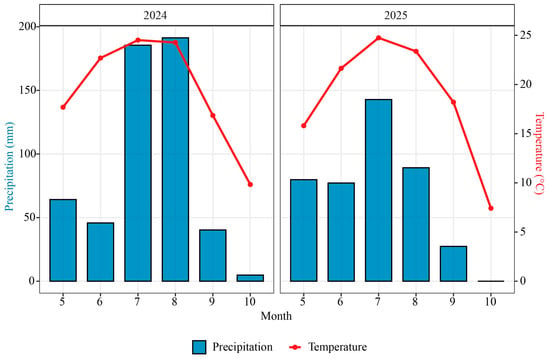
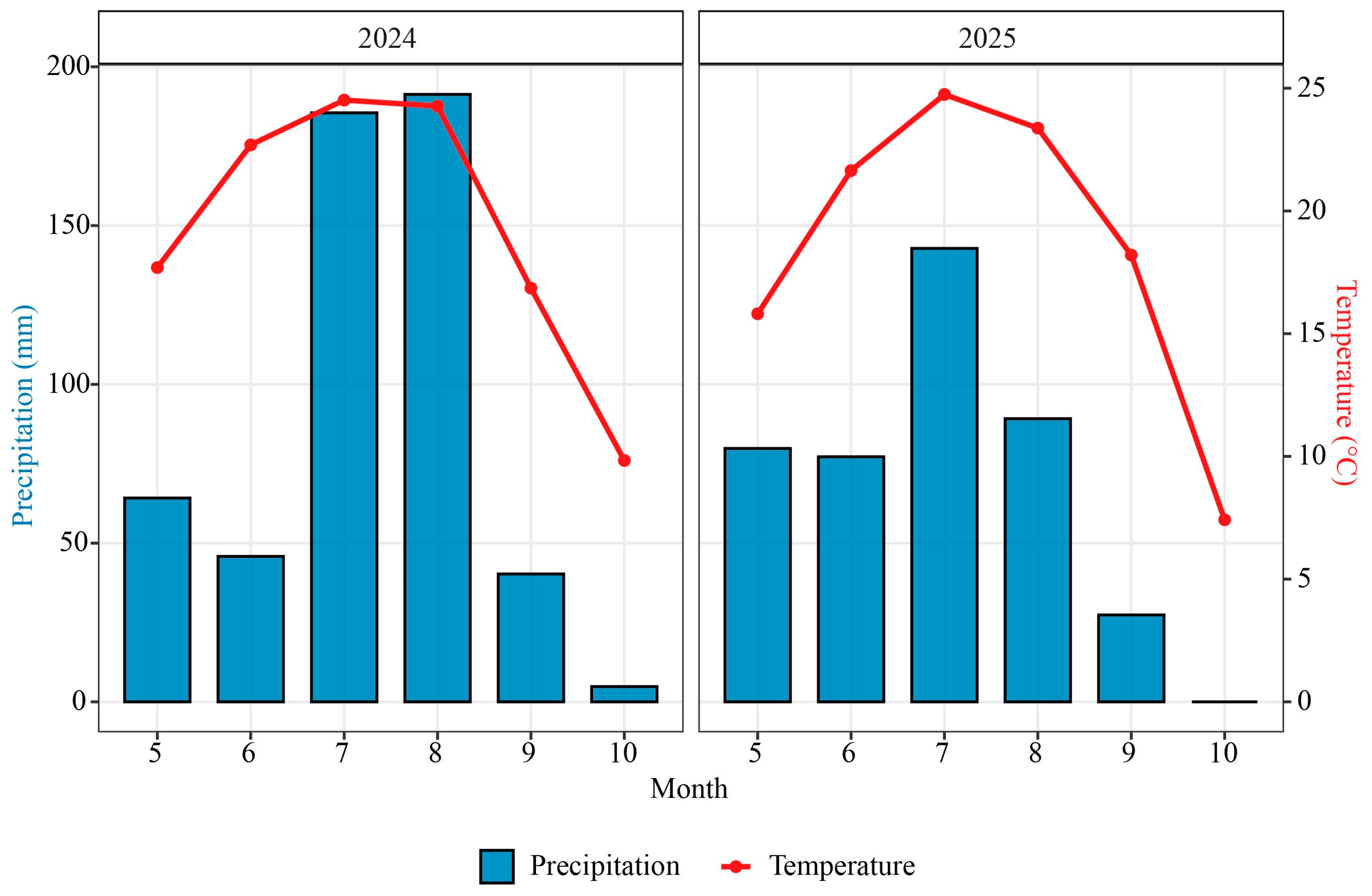
At sowing, a stabilized compound fertilizer (N–P2O5–K2O = 26–11–11) was applied at 692 kg ha−1, providing 180 kg N ha−1. Immediately after sowing, microbial inoculants were applied as dry formulations at 30 kg ha−1 by evenly broadcasting them onto the straw-covered soil surface, whereas CK plots received no inoculant application. The inoculants were applied at the straw–soil interface. During the growing seasons, drip irrigation was applied 6 times to maintain soil moisture at approximately 75% of field capacity. Pest and weed management followed local high-yield maize production practices and remained consistent among all treatments and years. Meteorological data were obtained from the on-site field weather station at the National Agricultural Environment Fuxin Observation and Experimental Station. Monthly precipitation was calculated as the cumulative daily precipitation within each month, whereas monthly mean air temperature was calculated from daily mean air temperature values. The two growing seasons showed broadly similar seasonal temperature patterns but differed substantially in precipitation distribution, particularly during July and August (Figure 1).
Figure 1.
Monthly precipitation and mean air temperature during the 2024 and 2025 maize-growing seasons at the experimental site. Bars represent monthly cumulative precipitation, and lines represent monthly mean air temperature. Monthly precipitation was calculated as the sum of daily precipitation, whereas monthly mean air temperature was calculated from daily mean temperature values.
2.2. Experimental Design and Microbial Inoculant Treatments
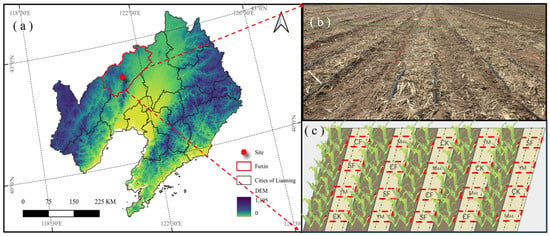
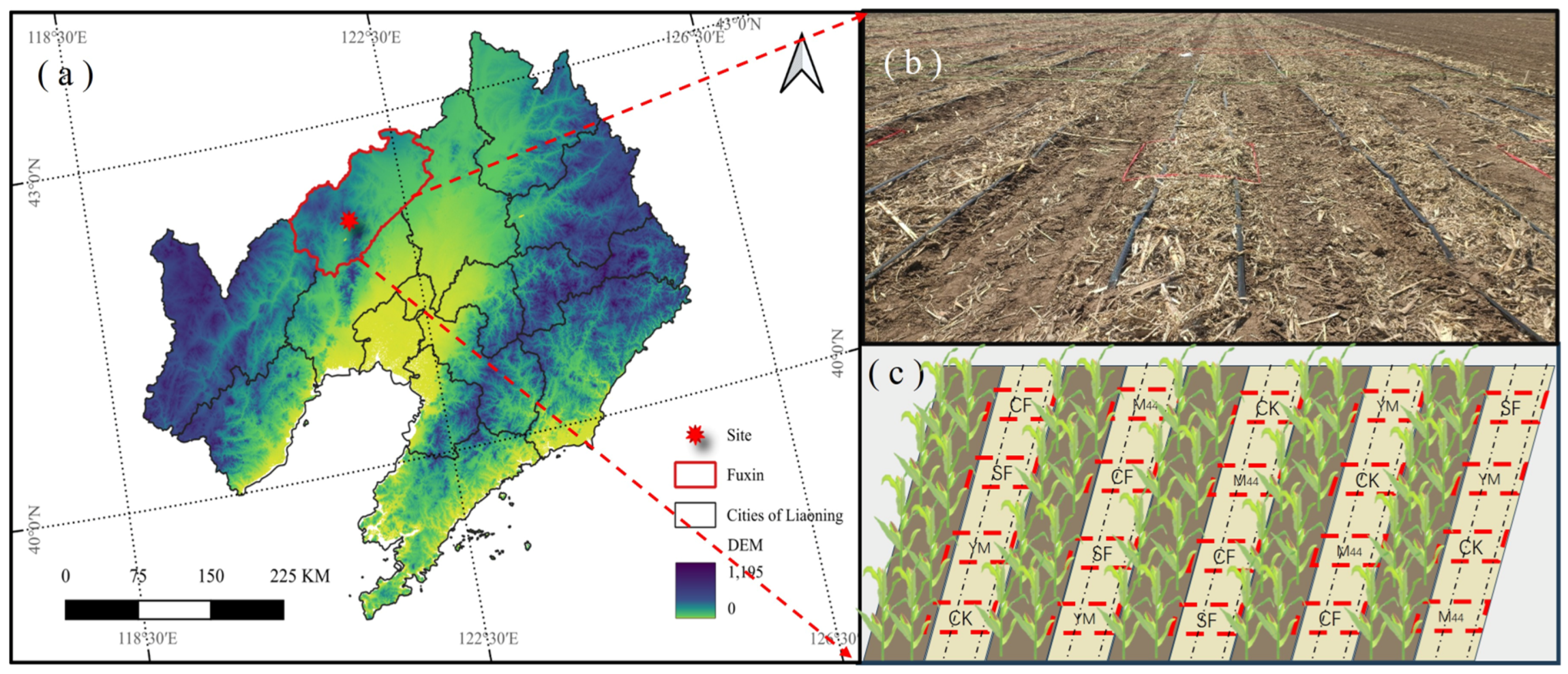
The experiment was established using a randomized complete block design with five treatments and four blocks. Four microbial inoculants (M44, CF, SF, and YM) were compared with an uninoculated control (CK). Each experimental microplot measured 1.0 × 2.0 m (2.0 m2). Adjacent microplots were separated by 1.0 m, and neighboring blocks by 3 m. Each treatment was randomly assigned to one microplot within each block, and the same plots were maintained throughout the two-year experiment. A schematic of the field layout and planting configuration is provided in Figure 2.
Figure 2.
Experimental site and field layout. (a) Geographic location of the experimental site in Fuxin, Liaoning Province, Northeast China. (b) Representative field photograph under no-tillage straw mulching. (c) Schematic of the treatment arrangement and maize planting configuration. Each microplot measured 1.0 × 2.0 m (2.0 m2). Maize was planted in two-row units at 0.50 m row spacing, separated by a straw-covered strip. Adjacent microplots were separated by 1.0 m and neighboring blocks by 3 m. The schematic is not drawn to scale.
Four microbial inoculants with contrasting microbial compositions and origins were selected based on their potential functional relevance to straw decomposition and crop–soil responses. M44 and CF were laboratory-developed formulations prepared at Inner Mongolia Agricultural University using microorganisms previously screened for low-temperature tolerance and cellulose- and lignin-degrading capacities. SF was a commercial microbial inoculant, whereas YM was obtained from China Agricultural University. These contrasting formulations were included to determine whether microbial inoculants with different functional backgrounds produced consistent or product-specific plant and soil responses under no-tillage straw mulching; prior field effectiveness was not assumed. All inoculants had viable microbial densities of ≥1.0 × 10⁸ CFU g−1. Specifically, M44 was dominated by Pseudomonas, Brevundimonas, Acinetobacter, and Azospirillum. CF contained members of the bacterial family Enterobacteriaceae and the genus Acinetobacter, together with the fungal genus Cladosporium. SF contained Glutamicibacter and Bacillus, together with members of the fungal family Dipodascaceae. YM was mainly composed of Bacillus subtilis.
2.3. Plant Sampling and Growth Measurements
At physiological maturity, two representative maize plants were sampled from each microplot. Plant height was measured from the cotyledonary node to the tip of the tassel. Stem diameter was measured along two perpendicular axes at the basal internode using a vernier caliper, and the two measurements were averaged. Ear length was measured from the base to the tip before threshing, and ear diameter was measured at the widest part of the ear. Plant height, ear height, stem diameter, ear length, ear diameter, ear weight, aboveground biomass, hundred-grain weight, and grain weight per plant were measured. The two plant observations were used to characterize each microplot [29]. For aboveground biomass determination, plant samples were heated at 105 °C for 2 h and then oven-dried at 80 °C to constant mass. Grain moisture content was measured using a grain moisture meter, and grain weight was corrected to a standard moisture content of 14%. Measurements from the two plants were averaged to obtain one value for each microplot. Thus, the microplot was regarded as the experimental unit, with four block replicates per treatment in each year. Grain weight per plant was interpreted as a plant-level reproductive indicator rather than an estimate of area-based grain yield.
2.4. Soil Sampling and Biochemical Analyses
After harvest, soil samples were collected from the 0–10 and 10–20 cm layers of each microplot. Soil bulk density (BD) and gravimetric soil water content (SWC) were determined using the core method with 100 cm3 stainless-steel cylinders [37]. Fresh soil was weighed immediately after sampling and then oven-dried at 105 °C to constant mass. Bulk density was calculated from oven-dry soil mass and core volume, whereas SWC was calculated from the difference between fresh and oven-dry soil mass. Total soil porosity was determined using the saturated-core method and calculated as:
where (Ms) is the mass of the saturated soil core, (Md) is the oven-dry soil mass, (Vc) is the core volume, and (ρw) is the density of water.
Soil pH was measured potentiometrically in a soil-to-water suspension of 1:2.5 (w/v) after shaking for 30 min [38]. Soil organic carbon (SOC) was determined by potassium dichromate oxidation followed by ferrous sulfate titration using a modified Walkley–Black procedure [39]. Total nitrogen (TN) was measured using the Kjeldahl digestion method [40]. Available phosphorus (AP) was extracted with 0.5 mol L−1 NaHCO3 and quantified colorimetrically using the molybdenum–antimony method following the Olsen extraction procedure [41], whereas available potassium (AK) was extracted with 1 mol L−1 neutral N4OAc and determined by flame photometry [37,38,42].
Extracellular enzyme activities were determined using fluorometric microplate assays following established procedures with minor modifications [43,44,45,46]. Fresh soil (1.0 g) was suspended in 50 mL of deionized water and homogenized by shaking at 200 r min−1 for 30 min. Aliquots of the soil suspension were transferred to 96-well microplates and incubated with enzyme-specific fluorogenic substrates. β-Glucosidase (BG), β-cellobiohydrolase (CBH), and phosphatase (Phos) activities were quantified fluorometrically using a Fluoroskan Ascent microplate reader. Soil physicochemical properties and extracellular enzyme activities were analyzed at the Key Laboratory of Farming System, Ministry of Agriculture and Rural Affairs of China, China Agricultural University, Beijing, China.
2.5. Statistical Analysis
The microplot was considered the experimental unit. For plant traits, measurements from the two plants sampled within each microplot were averaged to obtain one value per microplot before statistical analysis. Plant growth and reproductive traits were analyzed using two-way analysis of variance (ANOVA), with microbial inoculant treatment, year, and their interaction as fixed factors. To display treatment differences within each growing season, separate one-way ANOVAs followed by Tukey’s HSD tests were conducted for each year.
Soil physicochemical properties and extracellular enzyme activities were analyzed separately for each year using two-way ANOVA, with microbial inoculant treatment, soil depth, and their interaction as fixed factors. Because no significant Treatment × Depth interactions were detected, treatment estimated marginal means were calculated across the two soil depths and compared using Tukey-adjusted pairwise comparisons (p < 0.05).
For the exploratory integrated analyses, depth-specific soil physicochemical properties and extracellular enzyme activities were matched with the corresponding plant measurements from the same microplot and year, resulting in 80 matched records across the two years. Because the same microplot-level plant measurement was paired with observations from the two soil depths, the integrated analyses were used to characterize exploratory associations rather than independent causal effects. Relationships among soil properties, enzyme activities, plant traits, and grain weight per plant were evaluated using Pearson correlations, Mantel tests, and univariate regressions. Random forest analysis was conducted with 1500 trees (ntree = 1500) and five candidate predictors at each split (mtry = 5), using a random seed of 1000. Variable-importance significance was assessed using 500 permutations, and overall model significance was evaluated using 999 response permutations. Variable importance was expressed as the percentage increase in mean squared error (%IncMSE) [47]. Statistical significance was determined at p < 0.05. All analyses were performed in R 4.3.1 using the agricolae, vegan, linkET, randomForest, rfPermute, and ggplot2 packages. Integrated analyses were interpreted as exploratory associations rather than evidence of causality.
3. Results
3.1. Effects of Microbial Inoculants on Maize Growth and Reproductive Traits
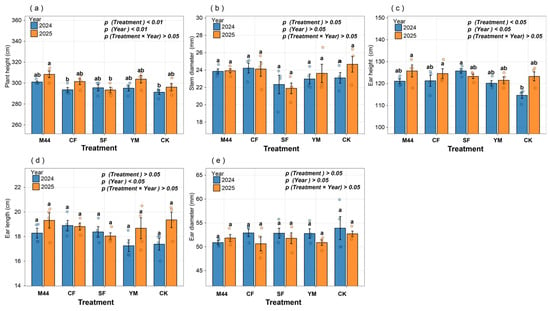
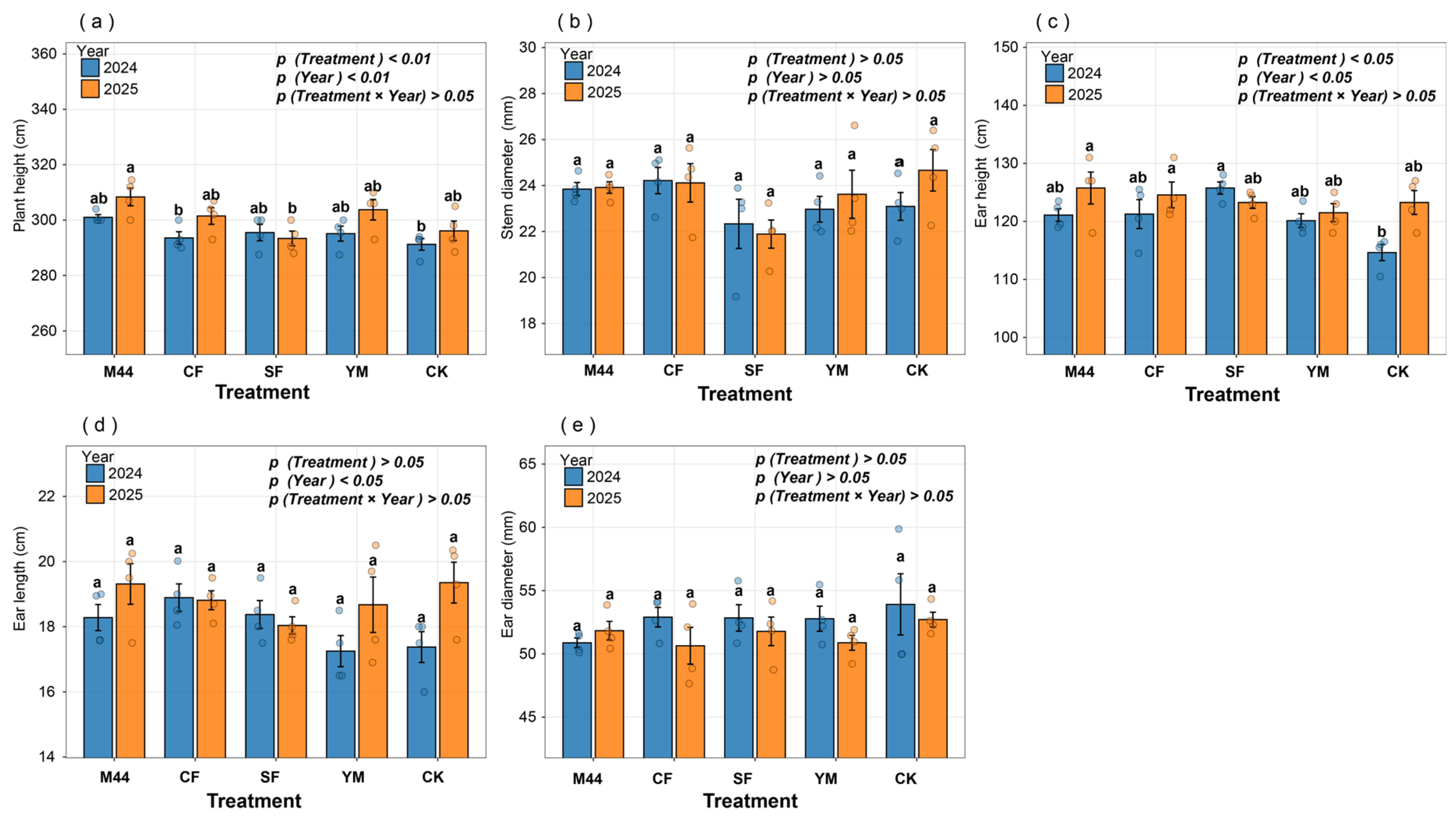
Microbial inoculation significantly affected plant height and ear height (p = 0.003 and p = 0.031, respectively), but not stem diameter, ear length, or ear diameter (p > 0.05; Figure 3). Plant height, ear height, and ear length differed significantly between years (p = 0.005, p = 0.010, and p = 0.019, respectively), whereas stem diameter and ear diameter did not. Across the two years, plant height was greatest under M44 (304.69 cm), representing an increase of 3.75% relative to CK (293.69 cm). Ear height was greatest under SF (124.50 cm), followed by M44 (123.42 cm) and CF (122.90 cm), compared with 118.94 cm under CK. No significant Treatment × Year interactions were detected for any growth trait (p > 0.05).
Figure 3.
Effects of microbial inoculant treatments on maize growth traits in 2024 and 2025. (a) Plant height, (b) stem diameter, (c) ear height, (d) ear length, and (e) ear diameter. Bars represent means ± standard errors (n = 4), and circles represent individual observations. Different lowercase letters indicate significant differences among year-by-treatment combinations according to Tukey’s multiple-comparison test (p < 0.05); groups sharing at least one letter are not significantly different. The results of the two-way ANOVA for the main effects of Treatment and Year and their interaction are shown in the upper-right corner of each panel.
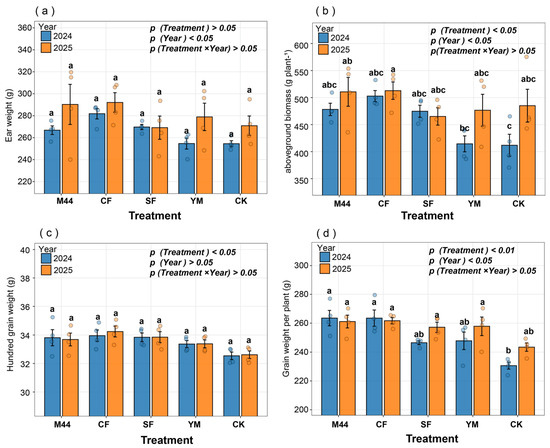
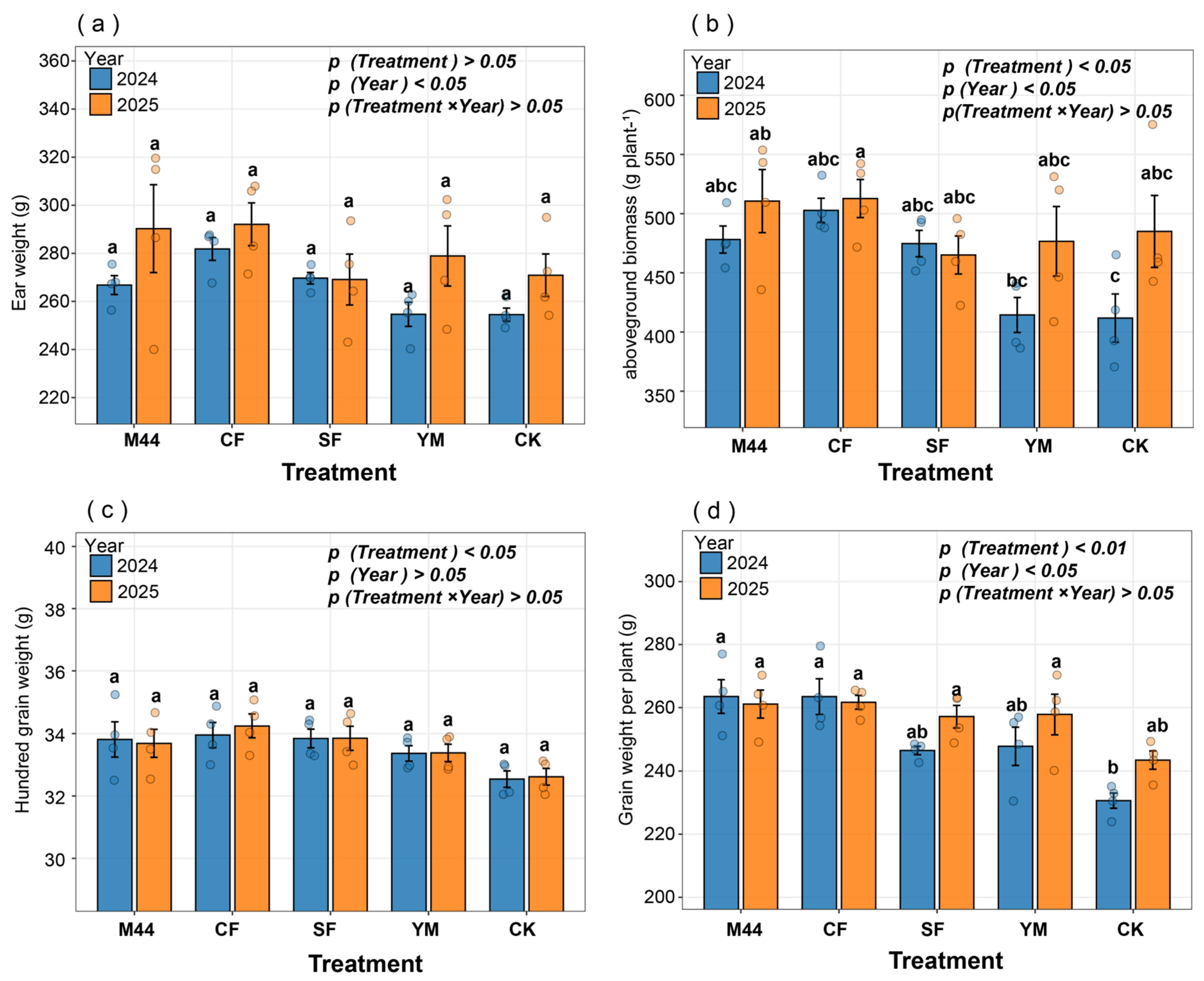
Microbial inoculation affected aboveground biomass, hundred-grain weight, and grain weight per plant (p = 0.013, p < 0.01, and p < 0.001, respectively), but not ear weight (p = 0.083; Figure 4). Ear weight, aboveground biomass, and grain weight per plant differed significantly between years (p = 0.016, p = 0.013, and p = 0.042, respectively), whereas hundred-grain weight did not (p = 0.823). Aboveground biomass reached 507.75 and 494.36 g plant−1 under CF and M44, representing increases of 13.24% and 10.25% relative to CK. Grain weight per plant reached 262.58 and 262.31 g plant−1 under CF and M44, respectively, corresponding to increases of 10.78% and 10.66% relative to CK (237.04 g plant−1). The highest pooled hundred-grain weight was recorded under CF (34.10 g), whereas CK produced the lowest value (32.58 g). No significant Treatment × Year interactions were detected for these traits (p > 0.05).
Figure 4.
Effects of microbial inoculant treatments on maize reproductive and yield-related traits in 2024 and 2025. (a) Ear weight, (b) aboveground biomass, (c) hundred-grain weight, and (d) grain weight per plant. Bars represent means ± standard errors (n = 4), and circles represent individual observations. Different lowercase letters indicate significant differences among treatments within the same year based on one-way ANOVA followed by Tukey’s HSD test (p < 0.05). The p-values shown in each panel represent the main effects of treatment and year and their interaction from the two-way ANOVA.
3.2. Microbial Inoculation and Soil Depth Affected Soil Physicochemical Properties Under No-Tillage Straw Mulching
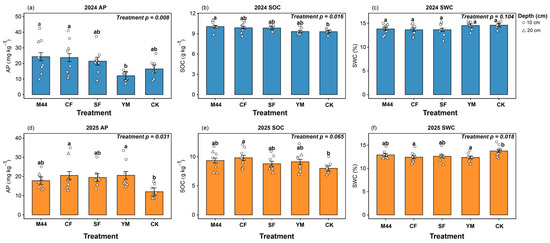
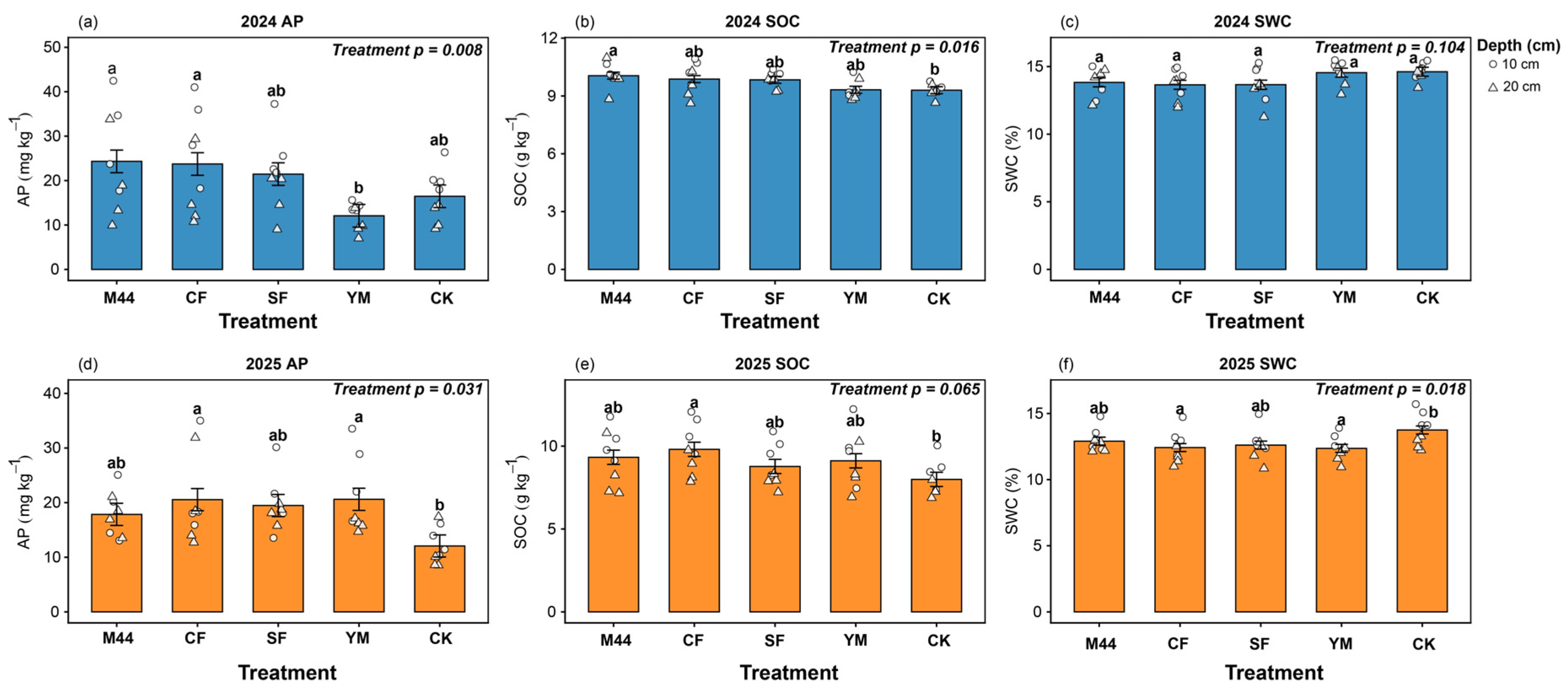
In 2024, microbial inoculation significantly affected soil organic carbon (SOC; p = 0.016) and available phosphorus (AP; p = 0.008) but had no significant effects on soil bulk density (BD), soil water content (SWC), soil porosity, pH, available potassium (AK), or total nitrogen (TN) (p > 0.05; Figure 5; Table S1). Based on the estimated marginal means across soil depths, SOC was highest under M44 (10.05 g kg−1), representing an increase of 8.1% relative to CK (9.30 g kg−1). AP concentrations under M44 and CF reached 24.33 and 23.74 mg kg−1, respectively, and were numerically 47.7% and 44.1% higher than that under CK. Tukey-adjusted comparisons showed that M44 and CF had significantly higher AP than YM, whereas SF and CK exhibited intermediate values. Soil depth significantly affected all measured soil properties in 2024 (p < 0.05). The 0–10 cm layer generally had lower BD and higher SWC, soil porosity, SOC, AK, AP, and TN than the 10–20 cm layer. No significant Treatment × Depth interactions were detected (p > 0.05).
Figure 5.
Treatment estimated marginal means for soil available phosphorus (AP), soil organic carbon (SOC), and soil water content (SWC) in 2024 (a–c) and 2025 (d–f). Bars show estimated marginal means averaged across soil depths, and error bars show model-based standard errors. Points show individual observations; circles and triangles denote the 0–10 and 10–20 cm layers, respectively. Different lowercase letters indicate significant differences among treatment estimated marginal means averaged across the two soil depths, based on Tukey-adjusted pairwise comparisons (p < 0.05). The p-values represent the treatment main effect from the year-specific two-way ANOVA.
In 2025, microbial inoculation significantly affected SWC (p = 0.018) and AP (p = 0.031), but not BD, soil porosity, pH, SOC, AK, or TN (p > 0.05; Figure 5; Table S2). SWC was highest under CK (13.75%) and was 9.7% and 10.1% lower under CF and YM, respectively. M44 and SF exhibited intermediate SWC values. AP concentrations reached 20.55 and 20.61 mg kg−1 under CF and YM, representing increases of 70.3% and 70.8% relative to CK (12.07 mg kg−1). AP under M44 and SF was also numerically higher than under CK, but the corresponding pairwise differences were not significant. The treatment effect on SOC was not significant (p = 0.065). Soil depth significantly affected SWC, SOC, AK, and TN (p < 0.05), but not BD, soil porosity, pH, or AP (p > 0.05). No significant Treatment × Depth interactions were detected for any soil property.
3.3. Effects of Microbial Inoculants on Soil Extracellular Enzyme Activities
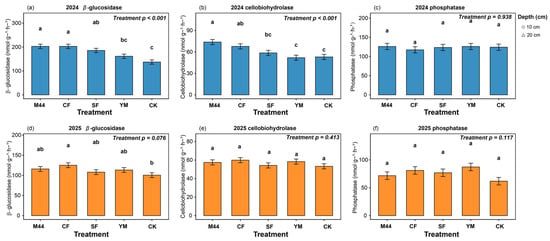
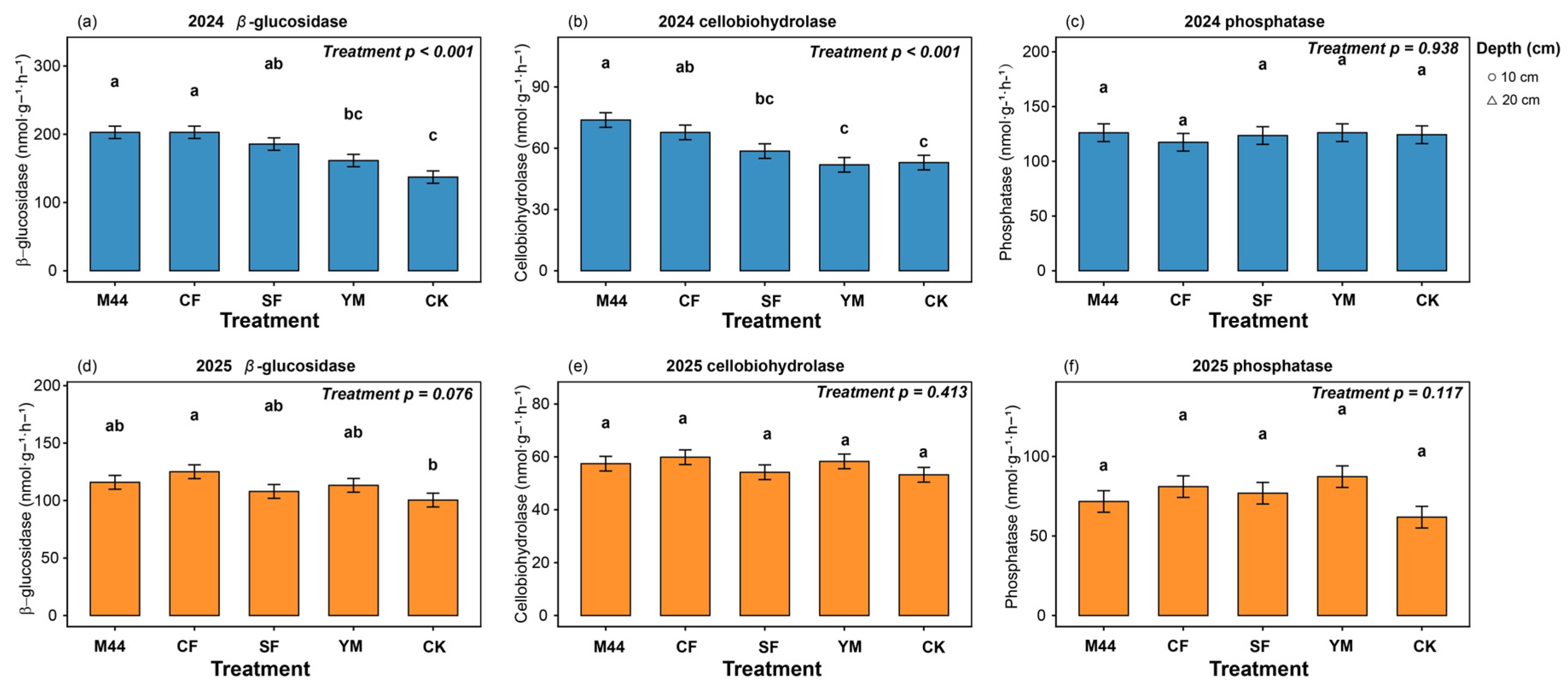
Microbial inoculation effects on soil extracellular enzyme activities differed between the two growing seasons. Significant treatment responses were detected for the carbon-acquiring enzymes β-glucosidase (BG) and cellobiohydrolase (CBH) in 2024, whereas no significant treatment effects were observed for BG, CBH, or phosphatase (Phos) in 2025. No significant Treatment × Depth interactions were detected for any enzyme in either year (p > 0.05; Figure 6; Table S3).
Figure 6.
Treatment estimated marginal means for soil β-glucosidase (BG), cellobiohydrolase (CBH), and phosphatase (Phos) activities in 2024 (a–c) and 2025 (d–f). Panels (a,d), (b,e), and (c,f) show BG, CBH, and Phos, respectively. Bars show estimated marginal means averaged across soil depths, and error bars show model-based standard errors. Points show individual observations (n = 4 per treatment × depth combination); circles and triangles denote the 0–10 and 10–20 cm layers, respectively. Different lowercase letters indicate significant differences among treatment estimated marginal means averaged across the two soil depths, based on Tukey-adjusted pairwise comparisons (p < 0.05). The p-values represent the treatment main effect from the year-specific two-way ANOVA.
In 2024, microbial inoculation significantly affected BG and CBH activities (p < 0.001), but not Phos activity (p > 0.05). Based on the estimated marginal means across soil depths, BG activity reached 202.89 and 202.87 nmol g−1 h−1 under CF and M44, representing increases of 47.9% and 47.8% relative to CK. BG activity under SF was 35.3% higher than that under CK. Similarly, CBH activity under M44 and CF reached 73.82 and 67.74 nmol g−1 h−1, corresponding to increases of 39.3% and 27.9% relative to CK. Soil depth significantly affected BG and CBH activities (p < 0.001) and Phos activity (p < 0.01). Averaged across treatments, BG, CBH, and Phos activities in the 0–10 cm layer were 42.4%, 23.7%, and 23.8% higher, respectively, than those in the 10–20 cm layer.
In 2025, microbial inoculation had no significant effects on BG (p = 0.076), CBH (p = 0.413), or Phos activity (p > 0.05). Soil depth significantly affected BG (p < 0.001) and Phos activity (p < 0.05), but not CBH activity (p > 0.05). Averaged across treatments, BG activity was 134.09 nmol g−1 h−1 in the 0–10 cm layer and 90.95 nmol g−1 h−1 in the 10–20 cm layer, corresponding to a 47.4% higher activity in the surface soil. Phos activity was 20.1% higher in the 0–10 cm layer than in the 10–20 cm layer.
3.4. Soil and Plant Attributes Associated with Variation in Grain Weight per Plant Under Microbial Inoculation
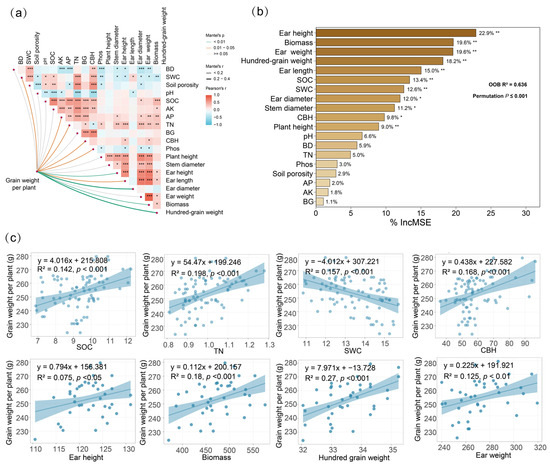
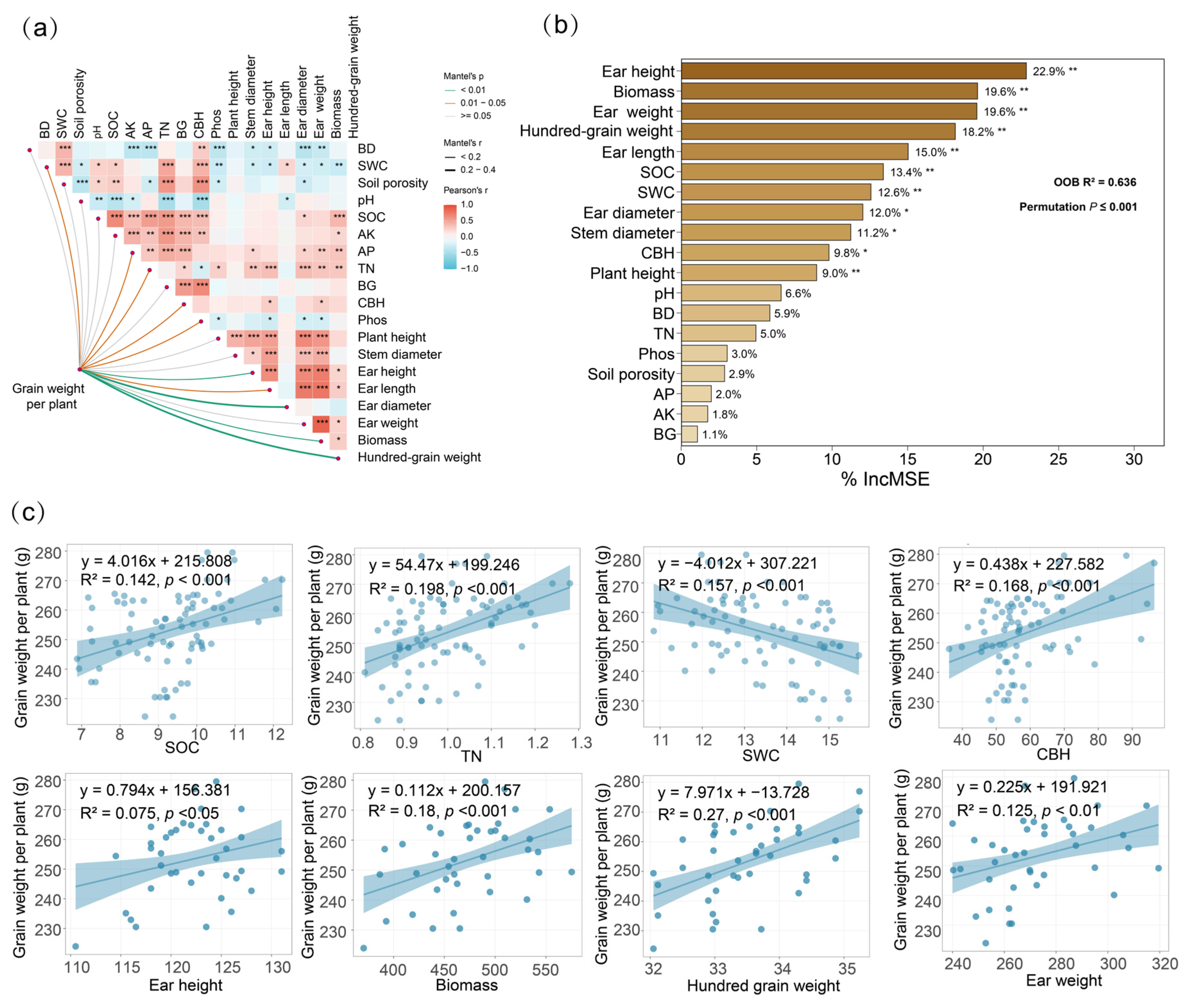
Grain weight per plant was associated with multiple plant traits, soil properties, and extracellular enzyme activities (Figure 7a). Mantel tests identified significant associations between grain weight per plant and several yield-related traits, particularly ear height, ear length, ear diameter, ear weight, aboveground biomass, and hundred-grain weight. Pearson correlation analysis further revealed extensive covariation among soil nutrient availability, extracellular enzyme activities, and plant growth and yield-related traits.
Figure 7.
Associations of soil properties, extracellular enzyme activities, and plant traits with grain weight per plant under microbial inoculation. (a) Pearson correlation matrix among the measured indicators and Mantel-test associations between grain weight per plant and individual indicators. The colors represent Pearson’s correlation coefficients, whereas link colors and widths represent the significance and strength of Mantel correlations, respectively. (b) Random forest variable importance, expressed as the percentage increase in mean squared error (%IncMSE). The coefficient of determination (OOB R2) and permutation-test p-value indicate overall model performance. (c) Univariate linear relationships of grain weight per plant with selected soil properties, enzyme activity, and plant traits. Points represent individual observations, solid lines represent fitted linear regressions, and shaded bands indicate 95% confidence intervals. Asterisks indicate significance levels (* p < 0.05, ** p < 0.01, and *** p < 0.001).
The random forest model explained 63.6% of the out-of-bag variation in grain weight per plant and showed significant predictive performance according to the permutation test (p ≤ 0.001; Figure 7b). Ear height exhibited the highest permutation importance, with a 22.9% increase in mean squared error, followed by aboveground biomass and ear weight (both 19.6%), hundred-grain weight (18.2%), and ear length (15.0%). Among the soil properties, SOC and SWC showed the highest predictive importance, with increases in mean squared error of 13.4% and 12.6%, respectively. CBH showed greater predictive importance (9.8%) than Phos (3.0%) and BG (1.1%).
Univariate linear regressions showed positive relationships of grain weight per plant with hundred-grain weight (R2 = 0.270, p < 0.001), TN (R2 = 0.198, p < 0.001), aboveground biomass (R2 = 0.180, p < 0.001), CBH activity (R2 = 0.168, p < 0.001), SOC (R2 = 0.142, p < 0.001), ear weight (R2 = 0.125, p < 0.01), and ear height (R2 = 0.075, p < 0.05; Figure 7c). SWC was negatively related to grain weight per plant (R2 = 0.157, p < 0.001). Additional significant relationships were detected for AP, AK, ear length, plant height, BD, ear diameter, and Phos activity (Figure S1). Soil porosity, stem diameter, and BG activity were not significantly related to grain weight per plant (p > 0.05).
4. Discussion
4.1. Microbial Inoculation Was Associated with Greater Biomass Accumulation and Grain Weight per Plant
The stronger plant-level responses under CF and M44 were characterized by greater biomass accumulation and grain weight per plant, whereas ear weight was numerically higher and hundred-grain weight showed a modest but significant overall treatment response. Maize grain formation depends on the coordination of biomass production, assimilate supply, reproductive development, and kernel filling [48,49]. Thus, the higher grain weight per plant could not be attributed to variation in individual kernel mass alone and may have involved combined differences in biomass accumulation, reproductive sink development, and kernel filling. Because kernel number per ear, kernel abortion, and assimilate partitioning were not measured, this interpretation remains provisional [48,50,51].
The stronger responses under CF and M44 may reflect improved coordination between soil resource availability and crop developmental demand. Previous studies have shown that microbial inoculants can promote crop growth through enhanced nutrient acquisition, microbial interactions, and regulation of plant physiological processes [11,51]. However, field responses remain context-dependent because introduced microorganisms must establish functional activity within specific soil environments [13,16]. The significant year effect observed for grain weight per plant showed that grain production also differed between growing seasons. CF and M44 maintained numerically higher grain weight per plant than CK in both years, although significant pairwise differences were detected only in 2024. This pattern indicates that the magnitude of the observed treatment response may have varied with seasonal environmental conditions, despite the nonsignificant Treatment × Year interaction.
Overall, CF and M44 were associated with greater grain weight per plant under no-tillage straw mulching, but these benefits likely resulted from multiple interacting processes rather than a single microbial trait. Because kernel number, nutrient uptake, and assimilate partitioning were not directly measured, the present study identifies an association between inoculation, biomass accumulation, and reproductive development rather than a specific physiological pathway controlling grain formation.
4.2. Microbial Inoculation Altered Soil Resource Availability Within a Vertically Stratified Soil Profile Under No-Tillage Straw Mulching
Within the established no-tillage straw-mulching management background, microbial inoculation affected selected soil resource variables but produced limited changes in soil physical properties. SOC and nutrient availability responded more strongly than soil physical characteristics, consistent with the slower response of soil structure compared with biologically mediated processes [52,53]. Irrespective of inoculant treatment, the 0–10 cm layer generally contained higher SOC, available nutrients, and SWC than the 10–20 cm layer. This vertical stratification is consistent with the accumulation of crop residues and organic substrates near the soil surface under no-tillage straw mulching [24,33,54]. However, because no significant Treatment × Depth interactions were detected, the treatment effects cannot be attributed specifically to the surface layer. The absence of significant treatment differences within an individual soil layer also does not exclude an overall treatment effect averaged across depths, because the latter was estimated using information from both soil layers.
The identity of the treatment-responsive variables differed between years: SOC and AP responded in 2024, whereas AP and SWC responded in 2025. Residue decomposition, microbial activity, and nutrient dynamics are strongly regulated by temperature, moisture availability, and substrate accessibility, which may modify the magnitude of inoculation effects among years [27,28]. Thus, microbial inoculation was associated with changes in selected soil resource indicators within an already stratified soil profile, without detectable changes in BD or soil porosity during the two-year study.
4.3. Carbon-Acquiring Enzymes Showed Treatment-Sensitive but Indicator-Specific Responses
Extracellular enzyme activities provide important insights into microbial resource acquisition strategies and represent a key functional link between residue transformation and soil nutrient cycling [30,31]. In the present study, significant treatment effects were confined to the carbon-acquiring enzymes BG and CBH in 2024, whereas Phos showed no significant treatment response in either year. No significant treatment effects on enzyme activities were detected in 2025. This pattern indicates that the enzyme response to inoculation differed among enzymes and between growing seasons.
The vertical distribution of enzyme activities also differed among enzymes. BG activity was significantly higher in the 0–10 cm layer than in the 10–20 cm layer in both years, whereas a significant depth effect on CBH was detected only in 2024. Phos activity also differed significantly between soil depths in both years. The higher activities observed in the surface layer are consistent with the concentration of straw-derived substrates under no-tillage straw mulching [33,55]. Surface-retained residues can generate vertical heterogeneity in substrate availability, microbial activity, and extracellular enzyme production [24,54]. However, because inoculant persistence, microbial community composition, and in situ decomposition rates were not measured, the relative contributions of the introduced microorganisms and indigenous microbial communities cannot be distinguished.
Importantly, enzyme activity did not show a simple one-to-one correspondence with grain production. CF and M44 showed similarly high marginal BG activities, whereas CF produced the highest mean grain weight per plant. In contrast, CBH activity was positively related to grain weight per plant and retained significant predictive importance in the random forest analysis. These results indicate that the agronomic relevance of enzyme activity differed among enzyme indicators. Enzyme assays quantify potential catalytic capacity rather than actual residue decomposition, nutrient transfer, or plant nutrient uptake [30,44,56]. Therefore, individual enzyme activities should be interpreted as indicators of microbial functional responses rather than direct proxies for grain production.
The contrasting responses among the four inoculants further indicate that field performance was product-specific. Differences in microbial composition and formulation may influence establishment, functional complementarity, and interactions with resident soil microbial communities, all of which can contribute to context-dependent inoculant performance [10,16]. However, the stronger plant responses under CF and M44 cannot be attributed to microbial diversity or any individual compositional characteristic because inoculant persistence, colonization, and community dynamics were not quantified.
Consequently, enzyme activities remain valuable indicators for diagnosing microbial functional changes following inoculation, but individual enzyme measurements alone were insufficient to characterize the overall agronomic response. Their interpretation should therefore be integrated with soil resource indicators and plant performance measurements.
4.4. Integrated Soil–Plant Indicators Characterized Variation in Grain Weight per Plant Under Field Conditions
The integrated analysis showed that grain-weight variation was better characterized by combined soil resource and crop developmental indicators than by a single biochemical variable. The random forest model explained 63.6% of the out-of-bag variation in grain weight per plant. Ear height showed the highest predictive importance, followed by aboveground biomass, ear weight, hundred-grain weight, and ear length. SOC and SWC were the most important soil predictors, while CBH showed greater predictive importance than BG and Phos. Random forest importance represents predictive relevance rather than causal control and should therefore be interpreted cautiously [47,57].
The negative relationship between post-harvest SWC and grain weight per plant should not be interpreted as evidence that greater water availability reduced maize performance. Because SWC was measured after harvest, it represents residual end-of-season soil water rather than water availability throughout crop development. Greater crop growth and seasonal water use may have resulted in lower residual SWC at harvest. In addition, differences in precipitation distribution between the two growing seasons, particularly during July and August (Figure 1), may have influenced the pooled relationship. Therefore, the negative association should be regarded as an exploratory relationship involving end-of-season water status rather than a direct adverse effect of soil moisture on maize growth [23,58,59].
The univariate regressions were consistent with the random forest results in showing significant relationships between grain weight per plant and several plant and soil indicators. Hundred-grain weight, TN, aboveground biomass, CBH, SOC, and ear weight were positively related to grain weight per plant, whereas SWC was negatively related to grain weight per plant. However, these relationships were based on pooled observations, and the measured variables differed in sampling scale. Plant traits were measured at the microplot level, whereas soil properties and enzyme activities were depth-specific [48,50,58]. Accordingly, these relationships indicate statistical associations and predictive relevance rather than direct causal pathways. The combined results identified plant growth and yield-related traits as the variables most strongly associated with grain weight per plant, with additional associations involving SOC, SWC, and CBH.
From an agronomic perspective, microbial inoculant performance should be evaluated using measurements that integrate microbial functions, soil resource conditions, and crop responses. Such measurements may improve the assessment of inoculants under conservation agriculture systems in which residue inputs, soil conditions, and climate variability jointly influence microbial and plant processes [11,13,16].
4.5. Limitations and Future Perspectives
Several limitations should be considered when interpreting the present findings. First, this study was conducted at a single field site over two growing seasons, and therefore the consistency of inoculant performance across different soil types and climatic conditions requires further validation. Although CF and M44 produced consistently higher two-year means for grain weight per plant, multi-site experiments are required to determine whether these responses can be generalized across broader agroecological regions. Second, the no-tillage straw-mulching system had been maintained since 2022 and represented the common management background for all treatments. Because no contrasting tillage or residue-management treatment was included, the study was not designed to quantify the independent effects of no-tillage or straw mulching on soil structure, carbon accumulation, nutrient stratification, or enzyme activity. Accordingly, the observed responses should be interpreted as inoculant effects within this management system rather than as evidence of the effects of no-tillage straw mulching itself.
Third, most soil and plant measurements were obtained at crop maturity, providing limited information on the temporal processes linking microbial activity, soil resource dynamics, and plant development. Inoculant persistence, root distribution, nutrient uptake, kernel number, assimilate partitioning, and within-season changes in soil properties were not directly quantified. Repeated seasonal sampling combined with measurements of rhizosphere processes, root development, plant nutrient uptake, and inoculant colonization would help clarify the temporal relationships among microbial activity, soil resources, and crop responses.
Finally, grain production was evaluated using grain weight per plant rather than area-based grain yield. Although grain weight per plant provides information on individual-plant productivity, it does not account for variation in plant density or yield at the field scale. Longer-term, multi-site studies incorporating area-based grain yield and direct measurements of inoculant persistence and nutrient transfer will be necessary to assess their broader agronomic value.
5. Conclusions
Microbial inoculant responses were product-specific under no-tillage straw mulching. CF and M44 produced the most consistent plant-level responses, increasing aboveground biomass by 13.24% and 10.25% and grain weight per plant by 10.78% and 10.66%, respectively, relative to CK. These responses were accompanied by changes in selected soil resource indicators and extracellular enzyme activities, although the responsive variables differed between years. Treatment effects were detected for SOC and AP in 2024 and for AP and SWC in 2025, while the carbon-acquiring enzymes BG and CBH responded significantly only in 2024. The random forest model explained 63.6% of the out-of-bag variation in grain weight per plant, with plant growth and yield-related traits showing the highest predictive importance; SOC, SWC, and CBH provided additional predictive information. Overall, the measured plant-level responses to microbial inoculation were associated with combined changes in plant performance, soil resource status, and microbial functioning rather than with any single biochemical indicator. Longer-term, multi-site studies incorporating area-based grain yield, inoculant persistence, plant nutrient uptake, and nutrient-transfer measurements are required to confirm the broader agronomic value of these inoculants.
Supplementary Materials
The following supporting information can be downloaded at: https://www.mdpi.com/article/10.3390/agronomy16181816/s1, Figure S1: Additional univariate linear relationships of grain weight per plant with ear diameter, ear length, stem diameter, plant height, available phosphorus (AP), soil bulk density (BD), available potassium (AK), soil porosity, phosphatase activity (Phos), and β-glucosidase activity (BG); Table S1: Effects of microbial inoculant treatment and soil depth on soil physicochemical properties in 2024; Tableo S2: Effects of microbial inoculant treatment and soil depth on soil physicochemical properties in 2025; Table S3: Effects of microbial inoculant treatment and soil depth on soil extracellular enzyme activities.
Author Contributions
Y.T.: conceptualization, investigation, and writing—original draft. X.L.: investigation. B.L.: investigation. X.Z.: supervision, project administration, funding acquisition, and writing—review and editing. H.Z.: writing—review and editing. All authors have read and agreed to the published version of the manuscript.
Funding
This research was supported by the National Key R&D Program of China (Grant NO. 2023YFD1501500).
Data Availability Statement
The original contributions presented in the study are included in the article. Further inquiries can be directed to the corresponding author.
Conflicts of Interest
The authors declare no conflicts of interest.
References
- Alhassan, A.-R.M.; Yang, C.; Ma, W.; Li, G. Influence of Conservation Tillage on Greenhouse Gas Fluxes and Crop Productivity in Spring-Wheat Agroecosystems on the Loess Plateau of China. PeerJ 2021, 9, e11064. [Google Scholar] [CrossRef] [Scilit] [PubMed]
- Chandra, P.; Khippal, A.K.; Prajapat, K.; Barman, A.; Singh, G.; Rai, A.K.; Ahlawat, O.P.; Verma, R.P.S.; Kumari, K.; Singh, G. Influence of Tillage and Residue Management Practices on Productivity, Sustainability, and Soil Biological Properties of Rice-Barley Cropping Systems in Indo-Gangetic Plain of India. Front. Microbiol. 2023, 14, 1130397. [Google Scholar] [CrossRef] [Scilit] [PubMed]
- Lal, R. Farming Systems to Return Land for Nature: It’s All about Soil Health and Re-Carbonization of the Terrestrial Biosphere. Farming Syst. 2023, 1, 100002. [Google Scholar] [CrossRef] [Scilit]
- Li, J.; Wang, Y.; Guo, Z.; Li, J.; Tian, C.; Hua, D.; Shi, C.; Wang, H.; Han, J.; Xu, Y. Effects of Conservation Tillage on Soil Physicochemical Properties and Crop Yield in an Arid Loess Plateau, China. Sci. Rep. 2020, 10, 4716. [Google Scholar] [CrossRef] [Scilit] [PubMed]
- Zhang, C.; Lv, X.; Liang, X.; Peng, P.; Feng, Y. Effects of Continuous Return of Bt Corn Straw on Soil Nutrients, Enzyme Activities, and Microbial Communities. Agronomy 2024, 14, 2737. [Google Scholar] [CrossRef] [Scilit]
- Dusingizimana, P.; Devkota, K.P.; Cherif, M.; Nduwumuremyi, A. Conservation Agriculture for Closing Maize Yield Gap and Enhancing Climate Resilience in Semi-Arid Eastern Rwanda. Farming Syst. 2025, 3, 100151. [Google Scholar] [CrossRef] [Scilit]
- Du, C.; Li, L.; Effah, Z. Effects of Straw Mulching and Reduced Tillage on Crop Production and Environment: A Review. Water 2022, 14, 2471. [Google Scholar] [CrossRef] [Scilit]
- de Jesús Astacio, L.M.; Prabhakara, K.H.; Li, Z.; Mickalide, H.; Kuehn, S. Closed Microbial Communities Self-Organize to Persistently Cycle Carbon. Proc. Natl. Acad. Sci. USA 2021, 118, e2013564118. [Google Scholar] [CrossRef] [Scilit] [PubMed]
- Whalen, J.K. Managing Soil Biota-Mediated Decomposition and Nutrient Mineralization in Sustainable Agroecosystems. Adv. Agric. 2014, 2014, 384604. [Google Scholar] [CrossRef] [Scilit]
- Atoloye, I.A. Revitalizing Soil Health for Climate Resilience in Africa: The Need for High Rates of Carbon Inputs. Farming Syst. 2024, 2, 100096. [Google Scholar] [CrossRef] [Scilit]
- Backer, R.; Rokem, J.S.; Ilangumaran, G.; Lamont, J.; Praslickova, D.; Ricci, E.; Subramanian, S.; Smith, D.L. Plant Growth-Promoting Rhizobacteria: Context, Mechanisms of Action, and Roadmap to Commercialization of Biostimulants for Sustainable Agriculture. Front. Plant Sci. 2018, 9, 1473. [Google Scholar] [CrossRef] [Scilit] [PubMed]
- Huang, H.; Wang, J.; Leng, S. Construction and Application of Soil-Amending Microbial Inoculant for Straw Decomposition. Int. Microbiol. 2025, 28, 1521–1538. [Google Scholar] [CrossRef] [Scilit] [PubMed]
- Schütz, L.; Gattinger, A.; Meier, M.; Müller, A.; Boller, T.; Mäder, P.; Mathimaran, N. Improving Crop Yield and Nutrient Use Efficiency via Biofertilization—A Global Meta-Analysis. Front. Plant Sci. 2018, 8, 2204. [Google Scholar] [CrossRef] [Scilit] [PubMed]
- Xie, X.; Tao, H.; Li, Y.; Feng, X.; Li, K.; Zhang, Z.; Yan, J.; Wang, X. Microbial Fertilizer for Improving Maize Yield, Straw Decomposition and Soil Microbiome Structure. Front. Microbiol. 2025, 16, 1670118. [Google Scholar] [CrossRef] [Scilit] [PubMed]
- Fierer, N. Embracing the Unknown: Disentangling the Complexities of the Soil Microbiome. Nat. Rev. Microbiol. 2017, 15, 579–590. [Google Scholar] [CrossRef] [Scilit] [PubMed]
- Kaminsky, L.M.; Trexler, R.V.; Malik, R.J.; Hockett, K.L.; Bell, T.H. The Inherent Conflicts in Developing Soil Microbial Inoculants. Trends Biotechnol. 2019, 37, 140–151. [Google Scholar] [CrossRef] [Scilit] [PubMed]
- Liu, Z.; Yang, X.; Hubbard, K.G.; Lin, X. Maize Potential Yields and Yield Gaps in the Changing Climate of Northeast China. Glob. Change Biol. 2012, 18, 3441–3454. [Google Scholar] [CrossRef] [Scilit]
- Lu, X.; Li, Z.; Bu, Q.; Cheng, D.; Duan, W.; Sun, Z. Effects of Rainfall Harvesting and Mulching on Corn Yield and Water Use in the Corn Belt of Northeast China. Agron. J. 2014, 106, 2175–2184. [Google Scholar] [CrossRef] [Scilit]
- Luo, N.; Meng, Q.; Feng, P.; Qu, Z.; Yu, Y.; Liu, D.L.; Müller, C.; Wang, P. China Can Be Self-Sufficient in Maize Production by 2030 with Optimal Crop Management. Nat. Commun. 2023, 14, 2637. [Google Scholar] [CrossRef] [Scilit] [PubMed]
- Wang, W.; Deng, X.; Yue, H. Black Soil Conservation Will Boost China’s Grain Supply and Reduce Agricultural Greenhouse Gas Emissions in the Future. Environ. Impact Assess. Rev. 2024, 106, 107482. [Google Scholar] [CrossRef] [Scilit]
- Huang, J.; Yu, H.; Guan, X.; Wang, G.; Guo, R. Accelerated Dryland Expansion under Climate Change. Nat. Clim. Change 2016, 6, 166–171. [Google Scholar] [CrossRef] [Scilit]
- Li, M.; Wu, P.; Sexton, D.M.H.; Ma, Z. Potential Shifts in Climate Zones under a Future Global Warming Scenario Using Soil Moisture Classification. Clim. Dyn. 2021, 56, 2071–2092. [Google Scholar] [CrossRef] [Scilit]
- Yin, G.; Gu, J.; Zhang, F.; Hao, L.; Cong, P.; Liu, Z. Maize Yield Response to Water Supply and Fertilizer Input in a Semi-Arid Environment of Northeast China. PLoS ONE 2014, 9, e86099. [Google Scholar] [CrossRef] [Scilit] [PubMed]
- Ren, Z.; Han, X.; Feng, H.; Wang, L.; Ma, G.; Li, J.; Lv, J.; Tian, W.; He, X.; Zhao, Y.; et al. Long-Term Conservation Tillage Improves Soil Stoichiometry Balance and Crop Productivity Based on a 17-Year Experiment in a Semi-Arid Area of Northern China. Sci. Total Environ. 2024, 908, 168283. [Google Scholar] [CrossRef] [Scilit] [PubMed]
- Wang, L.; Qi, S.; Gao, W.; Luo, Y.; Hou, Y.; Liang, Y.; Zheng, H.; Zhang, S.; Li, R.; Wang, M.; et al. Eight-Year Tillage in Black Soil, Effects on Soil Aggregates, and Carbon and Nitrogen Stock. Sci. Rep. 2023, 13, 8332. [Google Scholar] [CrossRef] [Scilit] [PubMed]
- Zhao, X.; Dai, L.-L.; Xu, Z.-Y. Enhancing the returning and utilizations of crop straw towards sustainable agriculture. Farming Syst. 2026, 4, 100197. [Google Scholar] [CrossRef] [Scilit]
- Allison, S.D.; Treseder, K.K. Warming and Drying Suppress Microbial Activity and Carbon Cycling in Boreal Forest Soils. Glob. Change Biol. 2008, 14, 2898–2909. [Google Scholar] [CrossRef] [Scilit]
- Brockett, B.F.T.; Prescott, C.E.; Grayston, S.J. Soil Moisture Is the Major Factor Influencing Microbial Community Structure and Enzyme Activities across Seven Biogeoclimatic Zones in Western Canada. Soil Biol. Biochem. 2012, 44, 9–20. [Google Scholar] [CrossRef] [Scilit]
- Mathers, C.; Heitman, J.; Huseth, A.; Locke, A.; Osmond, D.; Woodley, A. No-till Imparts Yield Stability and Greater Cumulative Yield under Variable Weather Conditions in the Southeastern USA Piedmont. Field Crops Res. 2023, 292, 108811. [Google Scholar] [CrossRef] [Scilit]
- Burns, R.G.; DeForest, J.L.; Marxsen, J.; Sinsabaugh, R.L.; Stromberger, M.E.; Wallenstein, M.D.; Weintraub, M.N.; Zoppini, A. Soil Enzymes in a Changing Environment: Current Knowledge and Future Directions. Soil Biol. Biochem. 2013, 58, 216–234. [Google Scholar] [CrossRef] [Scilit]
- Sinsabaugh, R.L.; Lauber, C.L.; Weintraub, M.N.; Ahmed, B.; Allison, S.D.; Crenshaw, C.; Contosta, A.R.; Cusack, D.; Frey, S.; Gallo, M.E.; et al. Stoichiometry of Soil Enzyme Activity at Global Scale. Ecol. Lett. 2008, 11, 1252–1264. [Google Scholar] [CrossRef] [Scilit] [PubMed]
- Wen, L.; Peng, Y.; Lin, Y.; Zhou, Y.; Cai, G.; Li, B.; Chen, B. Conservation Tillage Increases Nutrient Accumulation by Promoting Soil Enzyme Activity: A Meta-Analysis. Plant Soil 2025, 508, 531–546. [Google Scholar] [CrossRef] [Scilit]
- Zhu, Y.; Zhang, H.; Wang, Q.; Zhu, W.; Kang, Y. Soil Extracellular Enzyme Activity Linkage with Soil Organic Carbon under Conservation Tillage: A Global Meta-Analysis. Eur. J. Agron. 2024, 155, 127135. [Google Scholar] [CrossRef] [Scilit]
- Sanaullah, M.; Razavi, B.S.; Blagodatskaya, E.; Kuzyakov, Y. Spatial Distribution and Catalytic Mechanisms of β-Glucosidase Activity at the Root-Soil Interface. Biol. Fertil. Soils 2016, 52, 505–514. [Google Scholar] [CrossRef] [Scilit]
- Soil Survey Staff. Keys to Soil Taxonomy, 13th ed.; USDA Natural Resources Conservation Service: Washington, DC, USA, 2022.
- Wen, Y.; Liu, B.; Jiang, H.; Li, T.-Y.; Zhang, B.; Wu, W. Initial Soil Moisture Prewinter Affects the Freeze–Thaw Profile Dynamics of a Mollisol in Northeast China. Catena 2024, 234, 107648. [Google Scholar] [CrossRef] [Scilit]
- Carter, M.R.; Gregorich, E.G. (Eds.) Soil Sampling and Methods of Analysis, 2nd ed.; CRC Press, Taylor & Francis Group: Boca Raton, FL, USA, 2007. [Google Scholar]
- Sparks, D.L.; Page, A.L.; Helmke, P.A.; Loeppert, R.H.; Soltanpour, P.N.; Tabatabai, M.A.; Johnston, C.T.; Sumner, M.E. (Eds.) Methods of Soil Analysis, Part 3: Chemical Methods; SSSA Book Series 5; Soil Science Society of America and American Society of Agronomy: Madison, WI, USA, 1996. [Google Scholar]
- Sahrawat, K.L. Simple Modification of the Walkley-Black Method for Simultaneous Determination of Organic Carbon and Potentially Mineralizable Nitrogen in Tropical Rice Soils. Plant Soil 1982, 69, 73–77. [Google Scholar] [CrossRef] [Scilit]
- ISO 11261:1995; Soil Quality—Determination of Total Nitrogen—Modified Kjeldahl Method. ISO: Geneva, Switzerland, 1995.
- Horta, M.d.C.; Torrent, J. The Olsen P method as an agronomic and environmental test for predicting phosphate release from acid soils. Nutr. Cycl. Agroecosyst. 2007, 77, 283–292. [Google Scholar] [CrossRef] [Scilit]
- Zhang, C.; Tong, S.; Zhang, R.; Li, X.; Wang, X.X.; Wang, H. Intercropping with pear and cover crops as a strategy to boost soil carbon sequestration in the Taihang mountains’ fragile ecosystems. Front. Plant Sci. 2025, 16, 1695802. [Google Scholar] [CrossRef] [Scilit] [PubMed]
- Liu, W.S.; Zhu, Z.H.; Lu, Z.G.; Oladele, O.P.; Dang, Y.P.; Zhao, X.; Zhang, H.L. Soil Quality Associated with Microbial Community Characteristics and Dominant Taxa across Different Tillage Practices. Land Degrad. Dev. 2024, 35, 4682–4695. [Google Scholar] [CrossRef] [Scilit]
- Marx, M.C.; Wood, M.; Jarvis, S.C. A Microplate Fluorimetric Assay for the Study of Enzyme Diversity in Soils. Soil Biol. Biochem. 2001, 33, 1633–1640. [Google Scholar] [CrossRef] [Scilit]
- Saiya-Cork, K.R.; Sinsabaugh, R.L.; Zak, D.R. The Effects of Long Term Nitrogen Deposition on Extracellular Enzyme Activity in an Acer Saccharum Forest Soil. Soil Biol. Biochem. 2002, 34, 1309–1315. [Google Scholar] [CrossRef] [Scilit]
- German, D.P.; Weintraub, M.N.; Grandy, A.S.; Lauber, C.L.; Rinkes, Z.L.; Allison, S.D. Optimization of Hydrolytic and Oxidative Enzyme Methods for Ecosystem Studies. Soil Biol. Biochem. 2011, 43, 1387–1397. [Google Scholar] [CrossRef] [Scilit]
- Breiman, L. Random Forests. Mach. Learn. 2001, 45, 5–32. [Google Scholar] [CrossRef] [Scilit]
- Borrás, L.; Slafer, G.A.; Otegui, M.E. Seed Dry Weight Response to Source–Sink Manipulations in Wheat, Maize and Soybean: A Quantitative Reappraisal. Field Crops Res. 2004, 86, 131–146. [Google Scholar] [CrossRef] [Scilit]
- Ciampitti, I.A.; Vyn, T.J. Physiological Perspectives of Changes over Time in Maize Yield Dependency on Nitrogen Uptake and Associated Nitrogen Efficiencies: A Review. Field Crops Res. 2012, 133, 48–67. [Google Scholar] [CrossRef] [Scilit]
- Gambín, B.L.; Borrás, L.; Otegui, M.E. Kernel Water Relations and Duration of Grain Filling in Maize Temperate Hybrids. Field Crops Res. 2007, 101, 1–9. [Google Scholar] [CrossRef] [Scilit]
- Bender, R.R.; Haegele, J.W.; Ruffo, M.L.; Below, F.E. Nutrient Uptake, Partitioning, and Remobilization in Modern, Transgenic Insect-Protected Maize Hybrids. Agron. J. 2013, 105, 161–170. [Google Scholar] [CrossRef] [Scilit]
- Rouphael, Y.; Colla, G. Editorial: Biostimulants in Agriculture. Front. Plant Sci. 2020, 11, 40. [Google Scholar] [CrossRef] [Scilit] [PubMed]
- Blanco-Canqui, H.; Ruis, S.J. No-Tillage and Soil Physical Environment. Geoderma 2018, 326, 164–200. [Google Scholar] [CrossRef] [Scilit]
- Kuzyakov, Y.; Blagodatskaya, E. Microbial Hotspots and Hot Moments in Soil: Concept & Review. Soil Biol. Biochem. 2015, 83, 184–199. [Google Scholar] [CrossRef] [Scilit]
- Liu, X.; Song, X.; Li, S.; Liang, G.; Wu, X. Understanding How Conservation Tillage Promotes Soil Carbon Accumulation: Insights into Extracellular Enzyme Activities and Carbon Flows between Aggregate Fractions. Sci. Total Environ. 2023, 897, 165408. [Google Scholar] [CrossRef] [Scilit] [PubMed]
- Wallenstein, M.D.; Burns, R.G. Ecology of Extracellular Enzyme Activities and Organic Matter Degradation in Soil: A Complex Community-Driven Process. In Methods of Soil Enzymology; John Wiley & Sons, Ltd.: Hoboken, NJ, USA, 2011; pp. 35–55. [Google Scholar]
- Strobl, C.; Boulesteix, A.-L.; Zeileis, A.; Hothorn, T. Bias in Random Forest Variable Importance Measures: Illustrations, Sources and a Solution. BMC Bioinform. 2007, 8, 25. [Google Scholar] [CrossRef] [Scilit] [PubMed]
- Zhang, Q.; Shen, X.; Dong, W.; Su, X.; Wan, Y.; Lyu, H.; Song, T. Hydrological Drivers of Maize Productivity: A New Analytical Framework. J. Hydrol.-Reg. Stud. 2025, 62, 102976. [Google Scholar] [CrossRef] [Scilit]
- Wang, Y.; Zhou, L.; Ping, X.; Jia, Q.; Li, R. Ten-Year Variability and Environmental Controls of Ecosystem Water Use Efficiency in a Rainfed Maize Cropland in Northeast China. Field Crops Res. 2018, 226, 48–55. [Google Scholar] [CrossRef] [Scilit]
Disclaimer/Publisher’s Note: The statements, opinions and data contained in all publications are solely those of the individual author(s) and contributor(s) and not of MDPI and/or the editor(s). MDPI and/or the editor(s) disclaim responsibility for any injury to people or property resulting from any ideas, methods, instructions or products referred to in the content. |
© 2026 by the authors. Licensee MDPI, Basel, Switzerland. This article is an open access article distributed under the terms and conditions of the Creative Commons Attribution (CC BY) license.