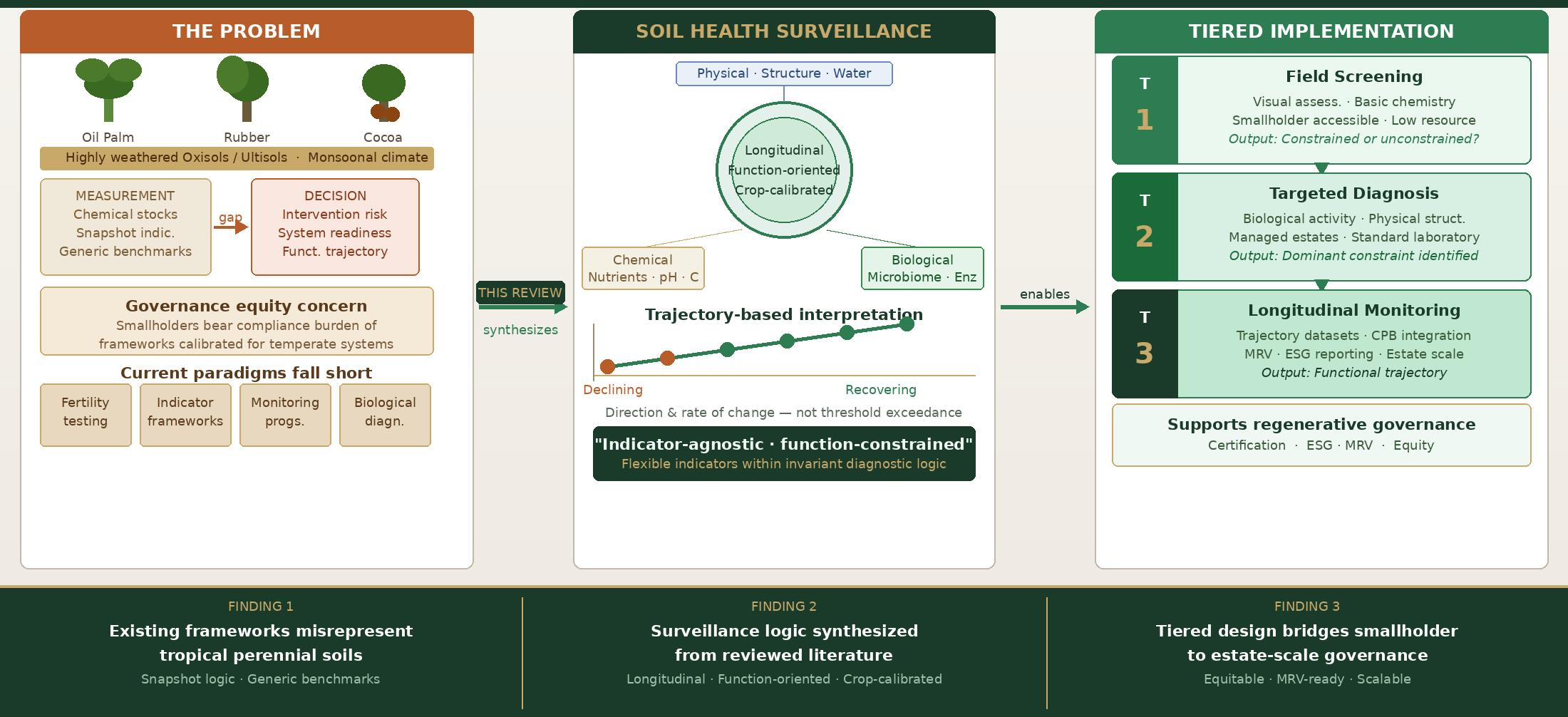
Diagnostic Limitations in Soil Health Frameworks for Tropical Perennial Systems: A Critical Review and Implications for Regenerative Agriculture in Southeast Asia


Abstract
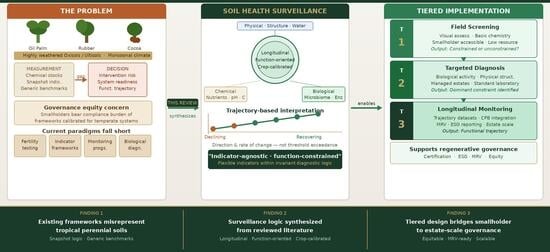
1. Introduction
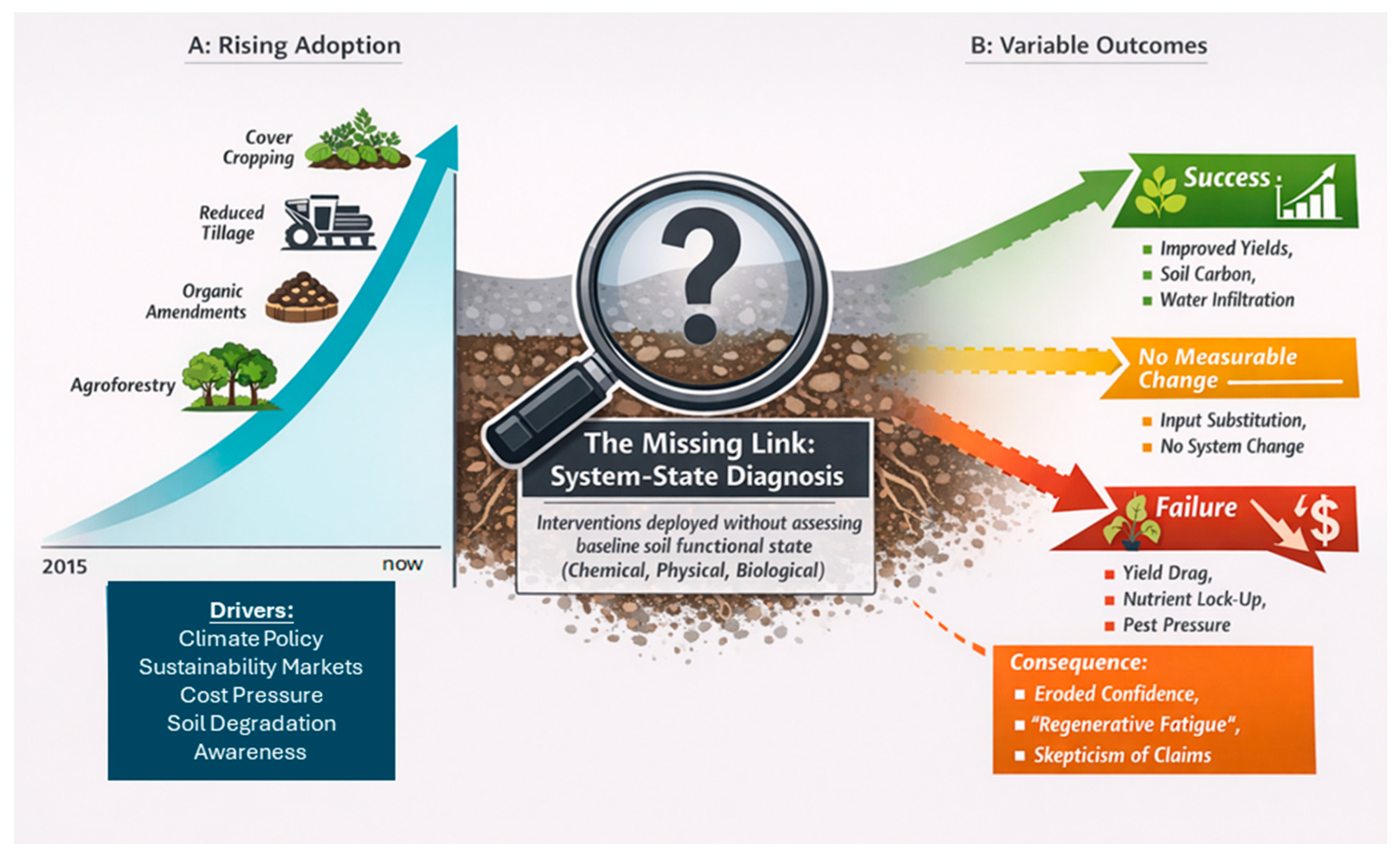
1.1. The Limits of Practice-Led Regeneration Without Diagnosis
1.2. Scope and Objectives of This Review
2. Methods for Literature Review
3. Existing Paradigms in Soil Health Assessment and Monitoring
3.1. From Fertility Testing to Indicator Frameworks
- •
- Functional state—the current capacity of the soil system to perform its chemical, physical, and biological roles in supporting crop production and ecosystem function, assessed through the integrated status of all three dimensions rather than through any single indicator.
- •
- Functional capacity—the potential of the soil system to perform these roles under given management and environmental conditions, which may differ from realized performance where constraints are present.
- •
- Functional constraint—a specific limitation in one or more dimensions that restricts the soil system from performing its roles at the level required by the crop, i.e., the primary diagnostic target of surveillance.
- •
- Functional transition—a sustained shift in functional state over time, distinguished from transient fluctuation by its persistence across sampling events and its inferability from trajectory rather than point-in-time values.
- •
- Functional trajectory—the direction and rate of change in functional state over time, i.e., the primary interpretive output of longitudinal surveillance and the basis for intervention risk assessment and decision gating.
3.2. Limits of Indicator Accumulation and Yield-Based Assessment
4. Why Tropical Perennial Systems Expose Diagnostic Limitations
4.1. Soil Function Beyond Fertility Assessment
4.2. Temporal Dynamics and Structural Heterogeneity
5. Limits of Snapshot Assessment and the Case for Surveillance
5.1. Soil Sampling and Surveillance: Definitions in the Reviewed Literature
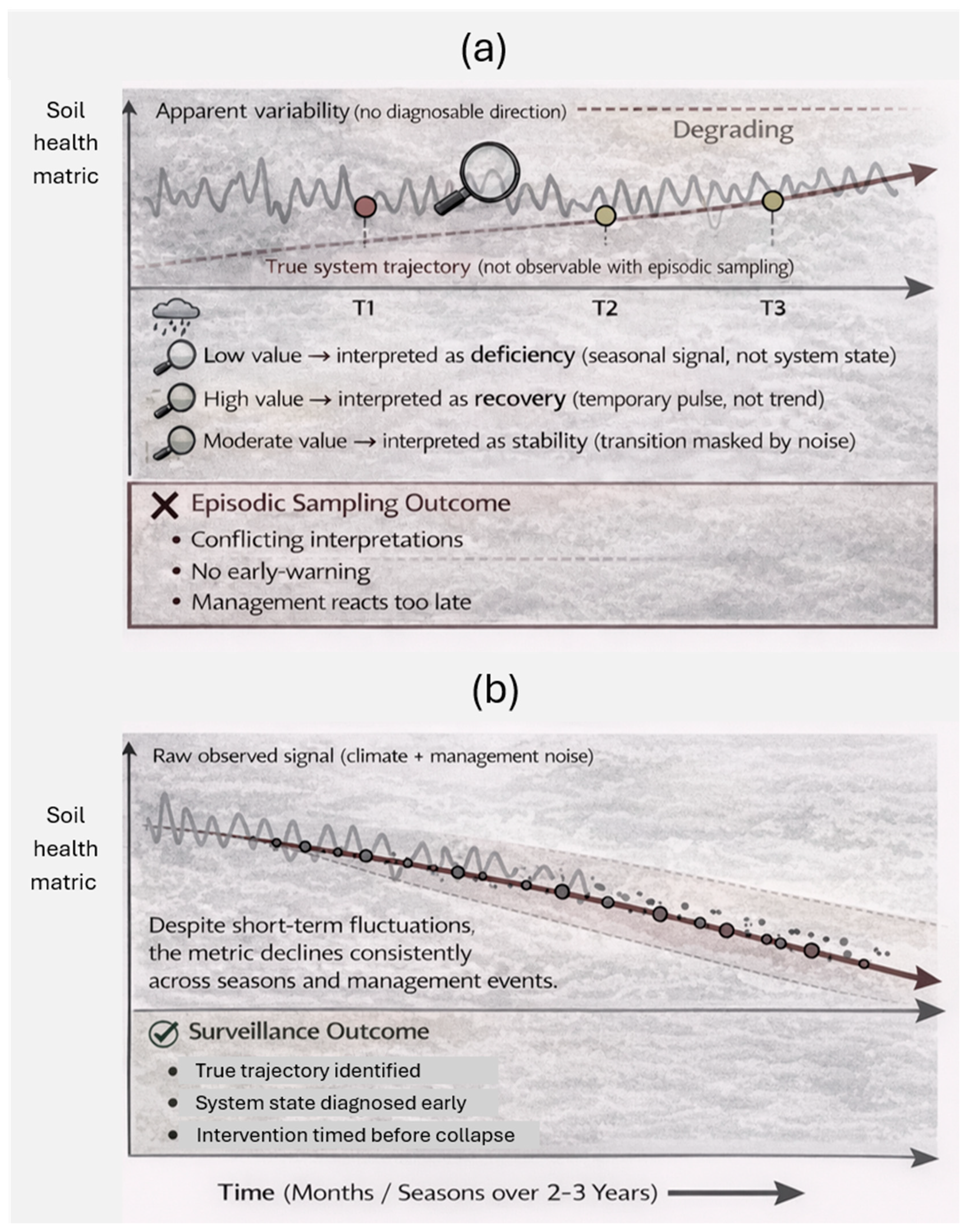
5.2. Diagnostic Value of Trajectory-Based Interpretation
6. Soil Health as a Crop-Context-Dependent Diagnostic Concept
7. Biological Mediation and Nutrient Flux: Insights from the Reviewed Literature
7.1. Divergence Between Chemical Sufficiency and Crop Performance
7.2. Biological and Activity-Based Diagnostics Discussed in Prior Studies
8. Soil Health Surveillance: Diagnostic Logic Synthesized from Literature
8.1. Indicator Flexibility and Crop-Specific Interpretation
8.2. Tiered Observation Approaches
8.3. Tier 1 Implementation in Resource-Constrained Smallholder Contexts
8.4. Indicative Metrics for Crop-Calibrated Surveillance in Southeast Asian Perennial Systems

| Functional Dimension | Tier | Oil Palm | Rubber | Cocoa | Rationale and SE Asian Source |
|---|---|---|---|---|---|
| Chemical | 1 | Soil pH, extractable P, exchangeable K, Ca, Mg | Soil pH, exchangeable Al, extractable P | Soil pH, exchangeable Ca and Mg, total N | Routine fertility indicators; low cost; interpretable across resource contexts [16,46] |
| Chemical | 2 | Soil organic carbon, total N, P sorption capacity, subsoil pH profile | Soil organic carbon, total N, Al saturation (%) | Soil organic carbon, available P, exchangeable cation balance | Resolves buffering capacity and toxicity constraints beyond simple deficiency [5,6,16] |
| Chemical | 3 | Longitudinal SOC trajectories, N mineralization potential, P fractionation | SOC stocks by depth, Al toxicity trends across seasons | SOC and N trajectories, Ca:Mg ratios over time | Trajectory interpretation across seasons; supports MRV carbon reporting [10,63] |
| Physical | 1 | Visual soil structure assessment, waterlogging observation, compaction by penetration resistance (field rod) | Visual rooting depth assessment, drainage observation | Shade canopy assessment, surface litter depth, visual aggregate stability | Field-observable proxies accessible without laboratory infrastructure [30] |
| Physical | 2 | Bulk density, penetrometer resistance at 0–30 cm and 30–60 cm, aggregate stability, saturated hydraulic conductivity | Bulk density, penetrometer resistance, texture and drainage class | Bulk density, aggregate stability, surface organic matter depth, soil moisture retention | Resolves compaction and structural constraints limiting root access and aeration [8,60,74] |
| Physical | 3 | Longitudinal bulk density and penetrometer profiles, seasonal hydraulic conductivity, subsoil compaction trends | Longitudinal bulk density and aeration status across wet and dry seasons | Longitudinal aggregate stability and surface organic matter accumulation | Detects management-induced structural recovery or decline across seasons [16] |
| Biological | 1 | Earthworm count and surface cast observation, litter decomposition rate (visual), frond decomposition presence | Surface macrofauna observation, root hair density at profile face, litter turnover assessment | Surface macrofauna, fungal hyphal presence in litter layer, visual mycorrhizal root tips | Rapid, low-cost biological proxies reflecting habitat quality and biological activity [39,42] |
| Biological | 2 | Microbial biomass carbon, β-glucosidase activity, dehydrogenase activity, acid phosphomonoesterase activity | Microbial biomass carbon, β-glucosaminidase activity, basal soil respiration | Microbial biomass carbon, β-glucosidase activity, mycorrhizal colonization rate | Sensitive to management change; documented in SE Asian perennial contexts [14,24,56,59,69] |
| Biological | 3 | Longitudinal enzyme activity profiles (C, N, P cycling enzymes), ecoenzymatic stoichiometry ratios, microbial biomass C:N | Longitudinal microbial biomass carbon, soil respiration trajectories, fungal:bacterial ratios | Longitudinal mycorrhizal colonization, enzyme activity profiles, microbial community composition by amplicon sequencing | Trajectory interpretation of biological function; detects recovery lags documented in SE Asian systems [20,23,51,52] |
9. Implications for Regenerative Management and Verification
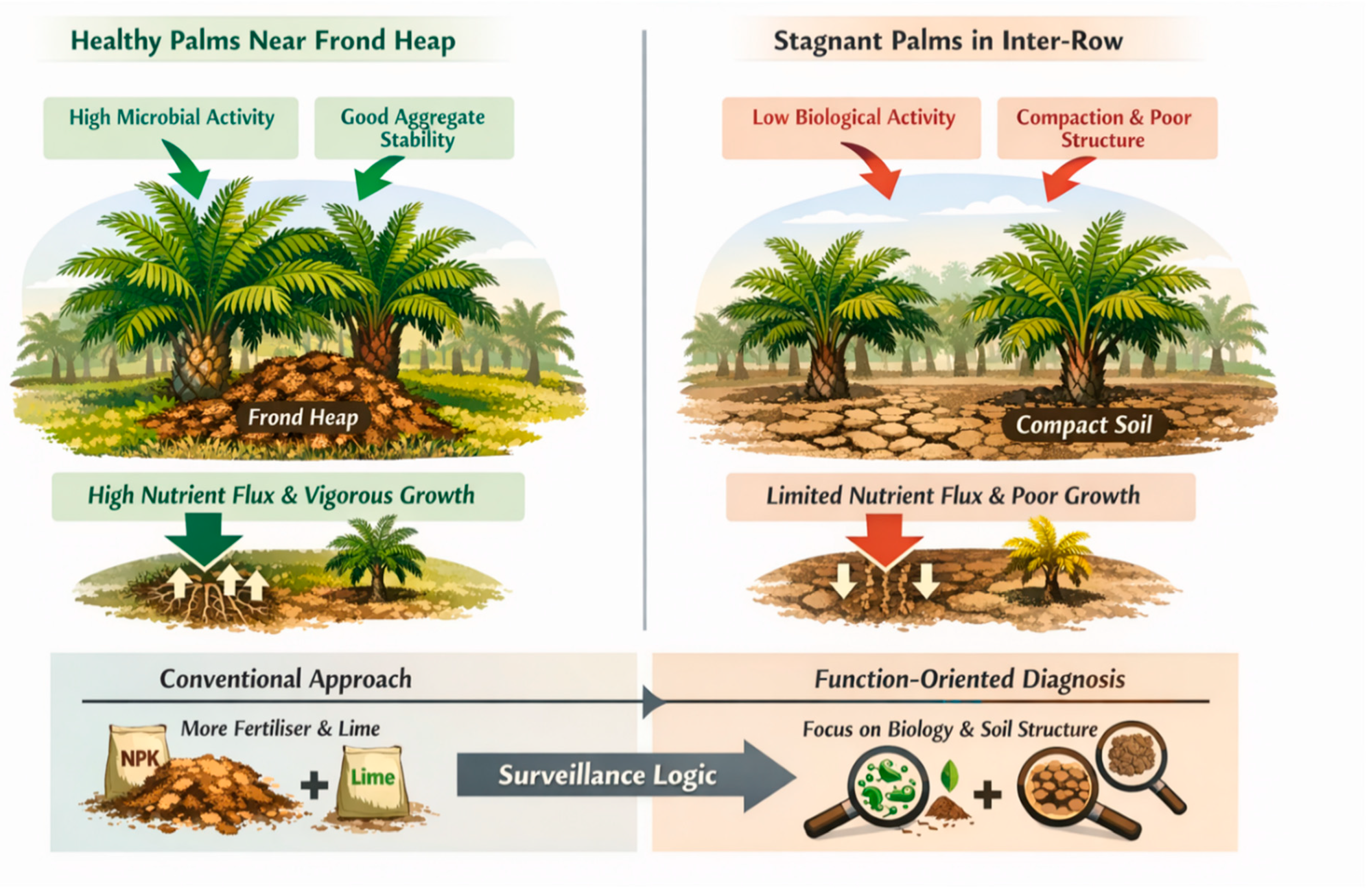
9.1. Illustrative Demonstration Using Documented Field Patterns
9.2. Surveillance-Informed Decision Gating
9.3. Certification Credibility and Verification
10. Knowledge Gaps and Research Priorities
11. Conclusions
Author Contributions
Funding
Data Availability Statement
Acknowledgments
Conflicts of Interest
Abbreviations
| ESG | Environmental, social, and governance |
| GHG | Greenhouse gas |
| RSPO | Roundtable on Sustainable Palm Oil |
| ISPO | Indonesian Sustainable Palm Oil |
| MRV | Monitoring, reporting, and verification |
| SOC | Soil organic carbon |
| CPB | Chemical–physical–biological |
| AI | Artificial intelligence |
| EU | European Union |
| OECD | Organisation for Economic Co-operation and Development |
| N | Nitrogen |
| P | Phosphorus |
| K | Potassium |
| Ca | Calcium |
| Mg | Magnesium |
| Al | Aluminum |
| pH | Potential of hydrogen (acidity/alkalinity measure) |
References
- Byerlee, D. The Fall and Rise Again of Plantations in Tropical Asia: History Repeated? Land 2014, 3, 574–597. [Google Scholar] [CrossRef] [Scilit]
- Qaim, M.; Sibhatu, K.T.; Siregar, H.; Grass, I. Environmental, Economic, and Social Consequences of the Oil Palm Boom. Annu. Rev. Resour. Econ. 2020, 12, 321–344. [Google Scholar] [CrossRef] [Scilit]
- Tan, S.S.X.; Kuebbing, S.E. A synthesis of the effect of regenerative agriculture on soil carbon sequestration in Southeast Asian croplands. Agric. Ecosyst. Environ. 2023, 349, 108450. [Google Scholar] [CrossRef] [Scilit]
- Choy, Y.K.; Onuma, A. The tropical peatlands in Indonesia and global environmental change: A multi-dimensional system-based analysis and policy implications. Reg. Sci. Environ. Econ. 2025, 2, 17. [Google Scholar] [CrossRef] [Scilit]
- Sanchez, P.A. Properties and Management of Soils in the Tropics, 2nd ed.; Cambridge University Press: Cambridge, UK, 2019. [Google Scholar]
- Hartemink, A.E. Tropical soils—Properties and management for sustainable agriculture. Geoderma 2004, 123, 373–375. [Google Scholar] [CrossRef] [Scilit]
- Borken, W.; Matzner, E. Reappraisal of drying and wetting effects on C and N mineralization and fluxes in soils. Glob. Change Biol. 2009, 15, 808–824. [Google Scholar] [CrossRef] [Scilit]
- Hartemink, A.E. Soil Science in Tropical and Temperate Regions—Some Differences and Similarities. In Advances in Agronomy; Sparks, D.L., Ed.; Academic Press: Cambridge, MA, USA, 2002; Volume 77, pp. 269–292. [Google Scholar]
- OECD. Sustainable Finance in Asia: ESG and Climate-Aligned Investing and Policy Considerations. Available online: https://www.oecd.org/en/publications/sustainable-finance-in-asia-esg-and-climatealigned-investing-and-policy-considerations_bde9ec0d-en.html (accessed on 28 November 2025).
- Smith, P.; Soussana, J.-F.; Angers, D.; Schipper, L.; Chenu, C.; Rasse, D.; Batjes, N.; van Egmond, F.; McNeill, S.; Kuhnert, M.; et al. How to measure, report and verify soil carbon change to realize the potential of soil carbon sequestration for atmospheric greenhouse gas removal. Glob. Change Biol. 2019, 26, 219–241. [Google Scholar] [CrossRef] [Scilit] [PubMed]
- Rinot, O.; Levy, G.J.; Steinberger, Y.; Svoray, T.; Eshel, G. Soil health assessment: A critical review of current methodologies and a proposed new approach. Sci. Total Environ. 2019, 648, 1484–1491. [Google Scholar] [CrossRef] [Scilit] [PubMed]
- de Hoop, E.; van der Vleuten, E. Sustainability knowledge politics: Southeast Asia, Europe and the transregional history of palm oil sustainability research. Glob. Environ. 2022, 15, 209–245. [Google Scholar] [CrossRef] [Scilit]
- Hartemink, A.E. Nutrient Stocks, Nutrient Cycling, and Soil Changes in Cocoa Ecosystems: A Review. In Advances in Agronomy; Academic Press: Cambridge, MA, USA, 2005; Volume 86, pp. 227–253. [Google Scholar]
- Boafo, D.K.; Kraisornpornson, B.; Panphon, S.; Owusu, B.E.; Amaniampong, P.N. Effect of organic soil amendments on soil quality in oil palm production. Appl. Soil Ecol. 2020, 147, 103358. [Google Scholar] [CrossRef] [Scilit]
- Rahman, N.; Giller, K.E.; de Neergaard, A.; Magid, J.; van de Ven, G.; Bruun, T.B. The effects of management practices on soil organic carbon stocks of oil palm plantations in Sumatra, Indonesia. J. Environ. Manag. 2021, 278, 111446. [Google Scholar] [CrossRef] [Scilit] [PubMed]
- Pauli, N.; Donough, C.; Oberthür, T.; Cock, J.; Verdooren, R.; Rahmadsyah; Abdurrohim, G.; Indrasuara, K.; Lubis, A.; Dolong, T.; et al. Changes in soil quality indicators under oil palm plantations following application of ‘best management practices’ in a four-year field trial. Agric. Ecosyst. Environ. 2014, 195, 98–111. [Google Scholar] [CrossRef] [Scilit]
- Sapalina, F.; Farrasati, R.; Wiratmoko, D.; Rahutomo, S.; Santoso, H.; Ginting, E.N.; Pradiko, I.; Hidayat, F. Oil palm intercropping system: A potential nature-based solution to improve soil biology activities in North Sumatra plantation, Indonesia. Malays. J. Microbiol. 2022, 18, 235–241. [Google Scholar] [CrossRef] [Scilit]
- Thoumazeau, A.; Mettauer, R.; Junedi, H.; Baron, V.; Chéron-Bessou, C.; Ollivier, J. Effects of fertilization practices and understory on soil health and oil palm performances in smallholdings: An Indonesian case study. Agric. Syst. 2024, 213, 103802. [Google Scholar] [CrossRef] [Scilit]
- Hidayat, F.; Pane, R.D.P.; Sapalina, F.; Listia, E.; Koga, T.; Winarna; Lubis, M.E.S.; Oshiro, M.; Sakai, K.; Utami, S.N.H.; et al. Long-term application of organic matter improves soil properties and plant growth-promoting bacteria in soil communities of oil palm plantation. Soil Sci. Plant Nutr. 2024, 70, 393–405. [Google Scholar] [CrossRef] [Scilit]
- Peerawat, M.; Blaud, A.; Trap, J.; Chevallier, T.; Alonso, P.; Gay, F.; Thaler, P.; Spor, A.; Sebag, D.; Choosai, C.; et al. Rubber plantation ageing controls soil biodiversity after land conversion from cassava. Agric. Ecosyst. Environ. 2018, 257, 92–102. [Google Scholar] [CrossRef] [Scilit]
- Panklang, P.; Thoumazeau, A.; Chiarawipa, R.; Sdoodee, S.; Sebag, D.; Gay, F.; Thaler, P.; Brauman, A. Rubber, rubber and rubber: How 75 years of successive rubber plantation rotations affect topsoil quality? Land Degrad. Dev. 2022, 33, 1159–1169. [Google Scholar] [CrossRef] [Scilit]
- Yang, Q.; Li, J.; Xu, W.; Wang, J.; Jiang, Y.; Ali, W.; Liu, W. Substitution of inorganic fertilizer with organic fertilizer influences soil carbon and nitrogen content and enzyme activity under rubber plantation. Forests 2024, 15, 756. [Google Scholar] [CrossRef] [Scilit]
- Panwar, R.; Pinkse, J.; Cashore, B.; Husted, B.W. Why corporate sustainability initiatives fail to reduce deforestation and what to do about it. Bus. Strategy Environ. 2023, 32, 5121–5127. [Google Scholar] [CrossRef] [Scilit]
- Schmidt, J.E.; Hasan, H.; Ward, A.; Firl, A.J.; Khalsa, S.D.S. Tradeoffs among ecosystem services and microbiome impacts associated with two cover crops for cocoa in South Sulawesi, Indonesia. Agrofor. Syst. 2025, 99, 24. [Google Scholar] [CrossRef] [Scilit]
- Xu, W.; Zhang, Y.; Tahir, A.; Cao, Y.; Kuang, C.; Guo, X.; Sun, R.; Liu, W.; Wu, Z.; Yang, Q. Rubber-based agroforestry ecosystems enhance soil enzyme activity but exacerbate microbial nutrient limitations. Forests 2024, 15, 1827. [Google Scholar] [CrossRef] [Scilit]
- Lehmann, J.; Bossio, D.A.; Kögel-Knabner, I.; Rillig, M.C. The concept and future prospects of soil health. Nat. Rev. Earth Environ. 2020, 1, 544–553. [Google Scholar] [CrossRef] [Scilit] [PubMed]
- Bünemann, E.K.; Bongiorno, G.; Bai, Z.; Creamer, R.E.; De Deyn, G.; de Goede, R.; Fleskens, L.; Geissen, V.; Kuyper, T.W.; Mäder, P.; et al. Soil quality—A critical review. Soil Biol. Biochem. 2018, 120, 105–125. [Google Scholar] [CrossRef] [Scilit]
- Cherubin, M.R.; Pinheiro Junior, C.R.; Souza, L.F.N.; Canisares, L.P.; Ferreira, T.O.; Cerri, C.E.P.; Minasny, B.; Smith, P. Global blind spots in soil health research overlap with environmental vulnerability hotspots. Commun. Earth Environ. 2025, 6, 651. [Google Scholar] [CrossRef] [Scilit]
- Giller, K.; Hijbeek, R.; Andersson, J.; Sumberg, J. Regenerative Agriculture: An agronomic perspective. Outlook Agric. 2021, 50, 13–25. [Google Scholar] [CrossRef] [Scilit] [PubMed]
- Shepherd, K.D.; Shepherd, G.; Walsh, M.G. Land health surveillance and response: A framework for evidence-informed land management. Agric. Syst. 2015, 132, 93–106. [Google Scholar] [CrossRef] [Scilit]
- Singh, J.; Rakshit, A. Meeting the Challenges of the Developing World with Regenerative Agriculture; CRC Press: Boca Raton, FL, USA, 2024; pp. 195–209. [Google Scholar]
- Lal, R. Restoring Soil Quality to Mitigate Soil Degradation. Sustainability 2015, 7, 5875–5895. [Google Scholar] [CrossRef] [Scilit]
- Knowler, D.; Bradshaw, B. Farmers’ adoption of conservation agriculture: A review and synthesis of recent research. Food Policy 2007, 32, 25–48. [Google Scholar] [CrossRef] [Scilit]
- Tittonell, P.A. Ecological intensification of agriculture—Sustainable by nature. Curr. Opin. Environ. Sustain. 2014, 8, 53–61. [Google Scholar] [CrossRef] [Scilit]
- Baveye, P. Bypass and hyperbole in soil research: Worrisome practices critically reviewed through examples. Eur. J. Soil Sci. 2020, 72, 1–20. [Google Scholar] [CrossRef] [Scilit]
- Newton, P.; Civita, N.; Frankel-Goldwater, L.; Bartel, K.; Johns, C. What Is Regenerative Agriculture? A Review of Scholar and Practitioner Definitions Based on Processes and Outcomes. Front. Sustain. Food Syst. 2020, 4, 577723. [Google Scholar] [CrossRef] [Scilit]
- Schreefel, L.; Schulte, R.P.O.; de Boer, I.J.M.; Schrijver, A.P.; van Zanten, H.H.E. Regenerative agriculture—The soil is the base. Glob. Food Secur. 2020, 26, 100404. [Google Scholar] [CrossRef] [Scilit]
- van Noordwijk, M.; Bayala, J.; Hairiah, K.; Lusiana, B.; Muthuri, C.; Khasanah, N.M.; Mulia, R. Agroforestry solutions for buffering climate variability and adapting to change. In Climate Change Impact and Adaptation in Agricultural Systems; CABI: Wallingford, UK, 2014; pp. 216–232. [Google Scholar]
- Muchane, M.; Sileshi, G.; Gripenberg, S.; Jonsson, M.; Pumariño, L.; Barrios, E. Agroforestry boosts soil health in the humid and sub-humid tropics: A meta-analysis. Agric. Ecosyst. Environ. 2020, 295, 106899. [Google Scholar] [CrossRef] [Scilit]
- Fahad, S.; Chavan, S.B.; Chichaghare, A.R.; Uthappa, A.R.; Kumar, M.; Kakade, V.; Pradhan, A.; Jinger, D.; Rawale, G.; Yadav, D.K.; et al. Agroforestry systems for soil health improvement and maintenance. Sustainability 2022, 14, 14877. [Google Scholar] [CrossRef] [Scilit]
- Kiup, E.; Swan, T.; Field, D. Soil management practices in coffee farming systems in the Asia-Pacific region and their relevance to Papua New Guinea: A systematic review. Soil Use Manag. 2025, 41, e70068. [Google Scholar] [CrossRef] [Scilit]
- Kibblewhite, M.G.; Ritz, K.; Swift, M.J. Soil health in agricultural systems. Philos. Trans. R. Soc. B Biol. Sci. 2007, 363, 685–701. [Google Scholar] [CrossRef] [Scilit] [PubMed]
- Doran, J.W.; Parkin, T.B. Defining and Assessing Soil Quality. In Defining Soil Quality for a Sustainable Environment; Wiley: Hoboken, NJ, USA, 1994; pp. 1–21. [Google Scholar]
- Karlen, D.L.; Mausbach, M.J.; Doran, J.W.; Cline, R.G.; Harris, R.F.; Schuman, G.E. Soil Quality: A Concept, Definition, and Framework for Evaluation (A Guest Editorial). Soil Sci. Soc. Am. J. 1997, 61, 4–10. [Google Scholar] [CrossRef] [Scilit]
- Singare, P.; Suryavanshi, A. Soil Testing for Precision Agriculture. Agriyouth 2021, 1, 14. [Google Scholar]
- Cottenie, A. Soil and Plant Testing as a Basis of Fertilizer Recommendations; Food and Agriculture Organization of the United Nations: Rome, Italy, 1980. [Google Scholar]
- Vågen, T.-G.; Winowiecki, L.; Tondoh, E.; Tamene, L.; Gumbricht, T. Mapping of soil properties and land degradation risk in Africa using MODIS reflectance. Geoderma 2016, 263, 216–225. [Google Scholar] [CrossRef] [Scilit]
- Montanarella, L.; Panagos, P. The relevance of sustainable soil management within the European Green Deal. Land Use Policy 2021, 100, 104950. [Google Scholar] [CrossRef] [Scilit]
- Bloem, J.; Hopkins, D.W.; Benedetti, A. Methods for Assessing Soil Quality; CABI Publishing: London, UK, 2006. [Google Scholar]
- Moebius-Clune, B.N. Comprehensive Assessment of Soil Health: The Cornell Framework Manual; Cornell University: New York, NY, USA, 2016. [Google Scholar]
- Sinsabaugh, R.L.; Follstad Shah, J.J. Ecoenzymatic Stoichiometry and Ecological Theory. Annu. Rev. Ecol. Evol. Syst. 2012, 43, 313–343. [Google Scholar] [CrossRef] [Scilit]
- Burns, R.G.; DeForest, J.L.; Marxsen, J.; Sinsabaugh, R.L.; Stromberger, M.E.; Wallenstein, M.D.; Weintraub, M.N.; Zoppini, A. Soil enzymes in a changing environment: Current knowledge and future directions. Soil Biol. Biochem. 2013, 58, 216–234. [Google Scholar] [CrossRef] [Scilit]
- Jacoby, R.; Peukert, M.; Succurro, A.; Koprivova, A.; Kopriva, S. The Role of Soil Microorganisms in Plant Mineral Nutrition—Current Knowledge and Future Directions. Front. Plant Sci. 2017, 8, 1617. [Google Scholar] [CrossRef] [Scilit] [PubMed]
- Moeskops, B.; Sukristiyonubowo; Buchan, D.; Sleutel, S.; Herawaty, L.; Husen, E.; Saraswati, R.; Setyorini, D.; De Neve, S. Soil microbial communities and activities under intensive organic and conventional vegetable farming in West Java, Indonesia. Appl. Soil Ecol. 2010, 45, 112–120. [Google Scholar] [CrossRef] [Scilit]
- Nannipieri, P.; Giagnoni, L.; Renella, G.; Puglisi, E.; Ceccanti, B.; Masciandaro, G.; Fornasier, F.; Moscatelli, M.C.; Marinari, S. Soil enzymology: Classical and molecular approaches. Biol. Fertil. Soils 2012, 48, 743–762. [Google Scholar] [CrossRef] [Scilit]
- Nurulita, Y.; Adetutu, E.; Kadali, K.; Shahsavari, E.; Zul, D.; Taha, M.; Ball, A. Assessment of the Influence of Oil Palm and Rubber Plantations in Tropical Peat Swamp Soils Using Microbial Diversity and Activity Analysis. J. Agric. Chem. Environ. 2016, 5, 53–65. [Google Scholar] [CrossRef]
- Stockdale, E.; Griffiths, B.; Hargreaves, P.; Bhogal, A.; Crotty, F.; Watson, C. Conceptual framework underpinning management of soil health-supporting site-specific delivery of sustainable agro-ecosystems. Food Energy Secur. 2018, 8, e00158. [Google Scholar] [CrossRef] [Scilit]
- Campbell, G.A.; Smith, P.; Broothaerts, N.; Panagos, P.; Jones, A.; Ballabio, C.; De Rosa, D.; de Jonge, L.W.; Arthur, E.; Gomes, L.; et al. Continental Scale Soil Monitoring: A Proposed Multi-Scale Framing of Soil Quality. Eur. J. Soil Sci. 2025, 76, e70174. [Google Scholar] [CrossRef] [Scilit]
- Lori, M.; Armengot, L.; Schneider, M.; Schneidewind, U.; Bodenhausen, N.; Mäder, P.; Krause, H.-M. Organic management enhances soil quality and drives microbial community diversity in cocoa production systems. Sci. Total Environ. 2022, 834, 155223. [Google Scholar] [CrossRef] [Scilit] [PubMed]
- Six, J.; Feller, C.; Denef, K.; Ogle, S.M.; de Moraes Sa, J.C.; Albrecht, A. Soil organic matter, biota and aggregation in temperate and tropical soils—Effects of no-tillage. Agronomie 2002, 22, 755–775. [Google Scholar] [CrossRef] [Scilit]
- Daunoras, J.; Kačergius, A.; Gudiukaitė, R. Role of soil microbiota enzymes in soil health and activity changes depending on climate change and the type of soil ecosystem. Biology 2024, 13, 85. [Google Scholar] [CrossRef] [Scilit] [PubMed]
- Liptzin, D.; Silver, W.L.; Detto, M. Temporal Dynamics in Soil Oxygen and Greenhouse Gases in Two Humid Tropical Forests. Ecosystems 2011, 14, 171–182. [Google Scholar] [CrossRef] [Scilit]
- Golicz, K.; Cheak, S.C.; Jacobs, S.; Große-Stoltenberg, A.; Safaei, M.; Bellingrath-Kimura, S.; Breuer, L.; Wartenberg, A. The older, the better: A comprehensive survey of soil organic carbon under commercial oil palm plantations. Environ. Monit. Assess. 2024, 197, 86. [Google Scholar] [CrossRef] [Scilit] [PubMed]
- Widyati, E.; Nuroniah, H.S.; Tata, H.L.; Mindawati, N.; Lisnawati, Y.; Darwo; Abdulah, L.; Lelana, N.E.; Mawazin; Octavia, D.; et al. Soil degradation due to conversion from natural to plantation forests in Indonesia. Forests 2022, 13, 1913. [Google Scholar] [CrossRef] [Scilit]
- Wiesmeier, M.; Urbanski, L.; Hobley, E.; Lang, B.; von Lützow, M.; Marin-Spiotta, E.; van Wesemael, B.; Rabot, E.; Ließ, M.; Garcia-Franco, N.; et al. Soil organic carbon storage as a key function of soils—A review of drivers and indicators at various scales. Geoderma 2019, 333, 149–162. [Google Scholar] [CrossRef] [Scilit]
- Ludwig, M.; Wilmes, P.; Schrader, S. Measuring soil sustainability via soil resilience. Sci. Total Environ. 2017, 626, 1484–1493. [Google Scholar] [CrossRef] [Scilit] [PubMed]
- Scheffer, M.; Bascompte, J.; Brock, W.A.; Brovkin, V.; Carpenter, S.R.; Dakos, V.; Held, H.; van Nes, E.H.; Rietkerk, M.; Sugihara, G. Early-warning signals for critical transitions. Nature 2009, 461, 53–59. [Google Scholar] [CrossRef] [Scilit] [PubMed]
- Fierer, N.; Wood, S.A.; Bueno de Mesquita, C.P. How microbes can, and cannot, be used to assess soil health. Soil Biol. Biochem. 2021, 153, 108111. [Google Scholar] [CrossRef] [Scilit]
- Haron, K.; Brookes, P.C.; Anderson, J.M.; Zakaria, Z.Z. Microbial biomass and soil organic matter dynamics in oil palm (Elaeis guineensis jacq.) plantations, West Malaysia. Soil Biol. Biochem. 1998, 30, 547–552. [Google Scholar] [CrossRef] [Scilit]
- Carneiro, R.G.; de Figueiredo, C.C.; Malaquias, J.V.; Mendes, I.C. A soil health assessment tool for vegetable cropping systems in tropical soils based on beta-glucosidase, arylsulfatase, and soil organic carbon. Appl. Soil Ecol. 2024, 198, 105394. [Google Scholar] [CrossRef] [Scilit]
- Pramunadipta, S.; Harsonowati, W.; Latifah, E.; Krismawati, A.; Handayati, W.; Iqbal, R. Soil microbial enzyme activities as indicators of soil health. In Soil Microorganisms for Plant Growth Promotion and Soil Health; Elsevier: Amsterdam, The Netherlands, 2026; pp. 289–309. [Google Scholar]
- Zheng, C.; Ji, B.; Zhang, J.; Zhang, F.; Bever, J. Shading decreases plant carbon preferential allocation towards the most beneficial mycorrhizal mutualist. New Phytol. 2014, 205, 361–368. [Google Scholar] [CrossRef] [Scilit] [PubMed]
- Do, H.; Nguyen, H.T.X.; Whitney, C.; Nguyen, L.T.T.; La, N.; Luedeling, E. Agroforestry adaptation by farm households in northwestern Vietnam: Resource needs and implications for practice and policy. Agron. Sustain. Dev. 2026, 46, 41. [Google Scholar] [CrossRef] [Scilit]
- Tan, N.P.; Mum Keng, W.; Yusuyin, Y.; Abdu, A.; Iwasaki, K.; Tanaka, S. Soil Characteristics in An Oil Palm Field, Central Pahang, Malaysia with Special Reference to Micro Sites under Different Managements and Slope Positions. Trop. Agric. Dev. 2014, 58, 146–154. [Google Scholar] [CrossRef]
- Udomkun, P.; Rupngam, T.; Müller, J.; Masso, C.; Boonupara, T.; Kaewlom, P. A critical review of regenerative soil management: A novel scoring system for SOC and GHG emissions in Southeast Asia. Soil Use Manag. 2025, 41, e70118. [Google Scholar] [CrossRef] [Scilit]
- Pareira, S.P. Achieving Indonesian Palm Oil Farm-to-Table Traceability Through ISPO-RSPO Harmonization; Policy Paper No. 56; Center for Indonesian Policy Studies: Jakarta, Indonesia, 2023; Available online: https://www.cips-indonesia.org/publications/achieving-indonesian-palm-oil-farm-to-table-traceability-through-ispo-rspo-harmonization (accessed on 10 July 2026).
- Roundtable on Sustainable Palm Oil (RSPO). RSPO Principles and Criteria for the Production of Sustainable Palm Oil; RSPO: Kuala Lumpur, Malaysia, 2018; Available online: https://rspo.org/resources/certification/rspo-principles-criteria-certification/ (accessed on 10 July 2026).
- Rainforest Alliance. Rainforest Alliance 2020 Sustainable Agriculture Standard: Farm Requirements; Rainforest Alliance: New York, NY, USA, 2020; Available online: https://www.rainforest-alliance.org/resource-item/2020-rainforest-alliance-sustainable-agriculture-standard-farm-requirements/ (accessed on 10 July 2026).


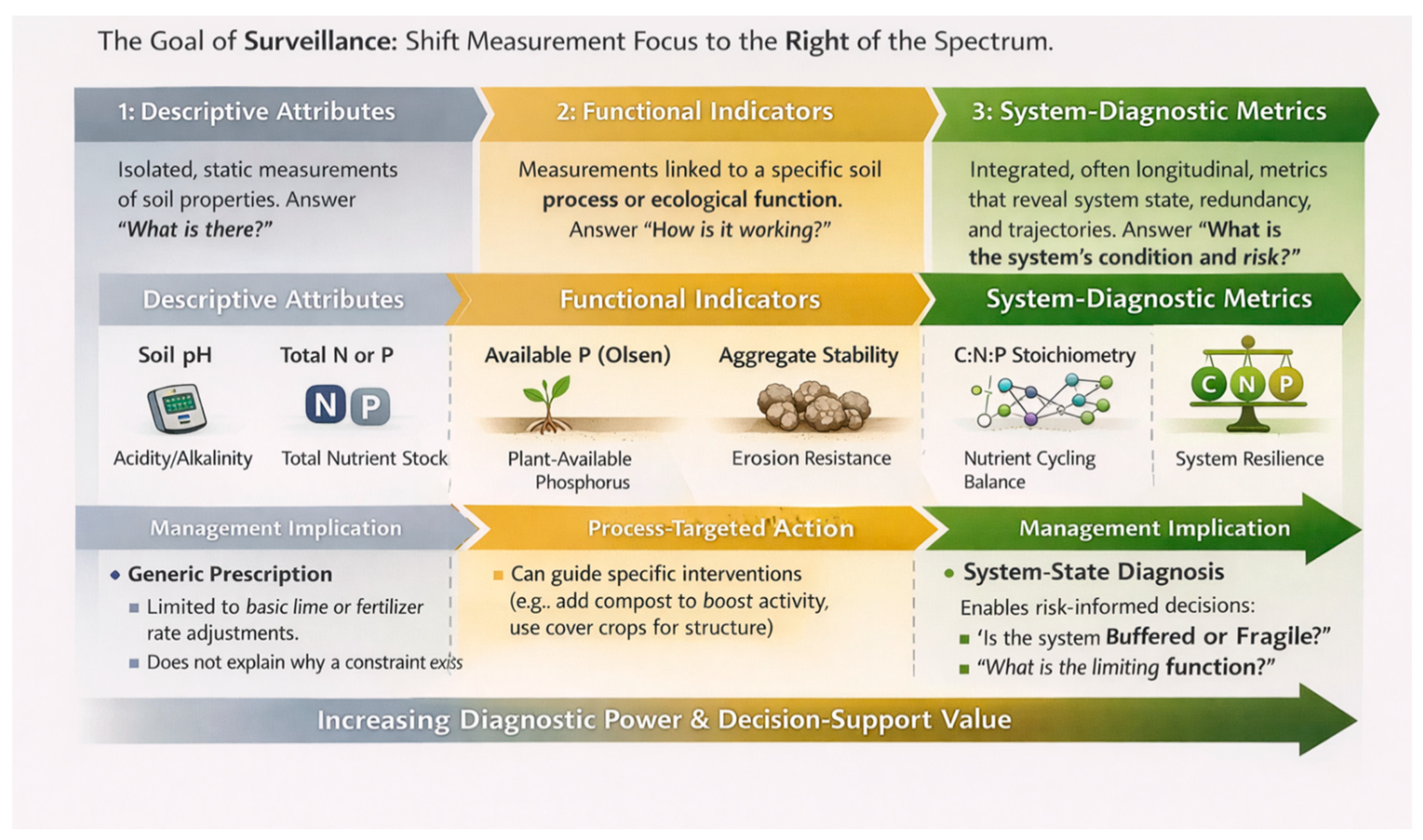

| Paradigm | Primary Distinguishing Feature | Primary Purpose (as Stated in the Literature) | Temporal Logic | Typical Outputs | Diagnostic Claims | Recurrent Limitations Highlighted in Reviewed Studies | References |
|---|---|---|---|---|---|---|---|
| Conventional soil testing/fertility assessment | Chemical measurement at a point in time to guide input decisions; does not incorporate biological or physical dimensions or temporal context | Input recommendation and deficiency correction | Single time point or periodic | Chemical properties (e.g., pH, extractable nutrients) | Short-term nutrient sufficiency | Limited ability to resolve temporal dynamics, biological mediation, or physical constraint; weak inference on system trajectory | [6,26,27,29,43,46] |
| Indicator-based soil health frameworks | Multi-dimensional indicator aggregation to benchmark or score overall soil condition; does not prescribe diagnostic logic or intervention sequence | Benchmarking, comparison across management systems, composite scoring | Predominantly snapshot | Multi-indicator dashboards or indices | Overall soil condition or “health status” | Indicator accumulation without explicit diagnostic logic; limited transferability across crops, soils, and climates | [11,26,27,44,49,50] |
| Soil and land monitoring program | Repeated measurement at population or landscape scale to detect trends and report condition; designed for policy reporting not operational management decisions | Trend detection and reporting at regional or national scale | Repeated observation | Time-series datasets, spatial maps | Population-level change | Often not crop-calibrated; limited resolution for field-level decision-making. Primary interpretive question is population-level condition change, not individual system readiness or management decision support. | [11,30,42,47,48] |
| Biological diagnostics (process proxies) | Process-level measurement of biological activity to infer functional capacity; addresses biological dimension only and requires contextual integration with chemical and physical data | Inference of biological mediation and process capacity | Responsive; can be repeated | Activity-based or stoichiometric indicators | Functional constraint beyond chemical stocks | Method sensitivity and environmental contingency; interpretation requires contextual integration | [26,51,52,53,54,55] |
| Soil health surveillance (organizing concept derived from review) | Crop-calibrated, trajectory-based interpretation of repeated multi-dimensional observations to support individual management decisions; the interpretive logic, not the measurement itself is the defining contribution | Diagnosis of system state, trajectory, and intervention risk | Longitudinal; trajectory-based | Interpretable temporal patterns | Crop-specific readiness to respond; direction, rate, and management implication of functional change at individual system scale—individual decision-support rather than population reporting. | Requires empirical calibration (thresholds, frequency) and supporting data infrastructure | [27,28,30,56,57] |
| Aspect | Episodic Soil Sampling | Soil Health Surveillance |
|---|---|---|
| Primary objective | Condition assessment [11,26,43] | Trajectory and state diagnosis [27,30,57] |
| Temporal logic | Single time point [11,27,46] | Longitudinal [30,57,65] |
| Scale | Plot/field [43,46] | Field to landscape [30,42] |
| Typical use | Fertility guidance [43,46] | Risk-informed decision support [29,57] |
| Output | Indicator values [11,26,27] | Interpretable trends [30,57,65] |
| Cost–benefit focus | Input cost efficiency [43,46] | Asset resilience and risk management [29,42] |
| Tool flexibility | Fixed indicator sets [11,27,49] | Adaptive tools within invariant diagnostic logic [26,42,57] |
| Chemical Status | Physical Status | Biological Status | Diagnosis | Priority Intervention |
|---|---|---|---|---|
| Adequate | Adequate | Low | Biological limitation—nutrient flux constrained despite adequate stocks and permissive physical conditions | Restore organic substrate and microbial habitat; do not increase nutrient inputs; escalate to Tier 2 biological diagnosis |
| Adequate | Constrained | Adequate | Structural constraint—root access and water relations limiting despite adequate chemistry and biology | Address compaction or drainage before any other intervention; structural remediation is the first priority |
| Deficient | Adequate | Adequate | Classical nutrient deficiency—chemical correction appropriate | Standard fertility correction; monitor biological response to confirm uptake improvement |
| Adequate | Constrained | Low | Compound physical-biological constraint—structure limiting biological habitat | Prioritize structural remediation; biological recovery expected to follow improved physical conditions |
| Deficient | Constrained | Low | Multi-dimensional limitation—system requires preparatory remediation | Full Tier 2 diagnostic workup before any intervention; regenerative practices not yet appropriate |
| Adequate | Adequate | Adequate— yield declining | Constraint not resolved by standard three-dimension assessment | Investigate subsoil, spatial heterogeneity, or pest and disease factors; escalate to Tier 2 spatial diagnosis |
| All dimensions improving | — | — | System in functional recovery—trajectory positive | Continue current management; Tier 3 longitudinal monitoring to confirm sustained trajectory |
| All dimensions declining | — | — | Functional decline underway—intervention urgent | Identify dominant declining dimension and prioritize remediation; surveillance frequency should increase |
| Tier | Diagnostic Function | Gate Logic | Indicative Resource Context | Core Measurements | Decision Output |
|---|---|---|---|---|---|
| Tier 1 | Constraint screening | Flag ambiguity; escalate if performance diverges from chemical status | Smallholder/low resource | Yield trend, visual soil structure, basic chemistry | Constrained or unconstrained; escalate to Tier 2 if ambiguous |
| Tier 2 | Constraint resolution | Identify dominant limiting dimension; sequence intervention accordingly | Managed estates | Tier 1 + expanded chemistry, physical structure proxies, biological activity indicators | Dominant constraint identified; intervention sequence determined |
| Tier 3 | Trajectory monitoring | Interpret direction and rate of functional change across seasons | Industrial/MRV-obligated | Tier 1–2 + Longitudinal chemical–physical–biological (CPB) datasets | Functional trajectory; adaptive management; MRV and ESG reporting |
Disclaimer/Publisher’s Note: The statements, opinions and data contained in all publications are solely those of the individual author(s) and contributor(s) and not of MDPI and/or the editor(s). MDPI and/or the editor(s) disclaim responsibility for any injury to people or property resulting from any ideas, methods, instructions or products referred to in the content. |
© 2026 by the authors. Licensee MDPI, Basel, Switzerland. This article is an open access article distributed under the terms and conditions of the Creative Commons Attribution (CC BY) license.
Share and Cite
Ho, L.S.; Tan, G.Y.A.; Ibrahim, J.; Teh, C.-K. Diagnostic Limitations in Soil Health Frameworks for Tropical Perennial Systems: A Critical Review and Implications for Regenerative Agriculture in Southeast Asia. Agronomy 2026, 16, 1733. https://doi.org/10.3390/agronomy16171733
Ho LS, Tan GYA, Ibrahim J, Teh C-K. Diagnostic Limitations in Soil Health Frameworks for Tropical Perennial Systems: A Critical Review and Implications for Regenerative Agriculture in Southeast Asia. Agronomy. 2026; 16(17):1733. https://doi.org/10.3390/agronomy16171733
Chicago/Turabian StyleHo, Li Sim, Geok Yuan Annie Tan, Julia Ibrahim, and Chee-Keng Teh. 2026. "Diagnostic Limitations in Soil Health Frameworks for Tropical Perennial Systems: A Critical Review and Implications for Regenerative Agriculture in Southeast Asia" Agronomy 16, no. 17: 1733. https://doi.org/10.3390/agronomy16171733
APA StyleHo, L. S., Tan, G. Y. A., Ibrahim, J., & Teh, C.-K. (2026). Diagnostic Limitations in Soil Health Frameworks for Tropical Perennial Systems: A Critical Review and Implications for Regenerative Agriculture in Southeast Asia. Agronomy, 16(17), 1733. https://doi.org/10.3390/agronomy16171733