


Abstract
The growth of vegetable plants is dependent on numerous environmental factors, including the presence of rhizosphere bacteria that produce phytohormones and support mineral uptake. The aim of this study was to determine the effect of symbiotic bacteria belonging to the Rhizobium leguminosarum species and other PGPR bacteria: Bacillus cereus, Chryseobacterium lathyri, and Lysinibacillus fusiformis, on seed germination and plant growth of a few crop species (i.e., white cabbage, broccoli, red pepper, and sugar beet). Three inoculation variants were tested: a mixture of R. leguminosarum strains (R), a mixture of other PGPR bacteria (B), and a combination of both of them (R + B). Biometric parameters such as seed germination, seedling growth, and the length and weight of upper parts and roots were determined. Our results showed diverse responses of the studied crop species to the bacterial mixtures used. In the case of variants R and R + B, the strongest effect of inoculation on seed germination and plant growth was observed. The obtained results indicated the agricultural potential of the analyzed bacterial consortia as biological support for the production of vegetable crops. They also emphasize the need for further research on their effectiveness in various environmental conditions.
1. Introduction
Since the green revolution in the last century, agrochemicals, especially nitrogen (N), have been extensively used for crop production. Although this approach resulted in a remarkable increase in crop yield, it drastically reduced soil fertility and fossil reserves, leading to negative effects on the environment and ecological sustainability [1]. As a consequence, excessive N in water reservoirs and emissions of N in different forms play an important role in global climate change and acid rain, causing several health problems for humans and the environment.
Field crops are increasingly intensified to meet human food needs and renewable energy resources. However, climate change is forcing humans to reorient strategies and develop a more sustainable and resilient agriculture [2]. Global warming may shorten crop cycles in cold regions (temperate climate regions) but has serious negative consequences for agriculture in arid and semiarid regions, in which drought is the main factor limiting the productivity of field crops [2,3]. Furthermore, other environmental factors essentially affect crop yields. Among them are nutrient limitation, salinity, toxic compounds, and heavy metal pollution [4,5,6]. Therefore, modern agriculture is now a promising alternative to traditional crop production. It requires the development of new eco-friendly and cost-efficient methods [7]. With the increasing demand for alternative solutions to replace or optimize the use of synthetic fertilizers and pesticides, inoculation with bacteria—commonly referred to as PGPR—that can contribute to plant growth and health is essential. These microorganisms belong to different species and possess unique and valuable phenotypic traits [8,9,10,11].
Soil is a challenging environment for all organisms residing in it, including plants and bacteria, where different conditions may change rapidly [12]. Therefore, they have to adapt to survive. The health and growth of plants are directly linked to their root-associated microbiota [13], as they are able to recruit soil microorganisms that are important for their survival and beneficial development [14,15,16]. Soil microorganisms are responsible for the carbon cycle (C) and the cycle of mineral elements (N, P, and K), which are the main limiting factors of plant growth. Furthermore, the microbiota associated with plant roots, which utilize root exudates as a source of C and energy, play an important role in the transfer of water and mineral elements to plants [17,18]. Bacteria associated with roots and aerial parts of plants are also engaged in the protection of their health against pathogens [19,20,21]. The mechanisms that enhance plant growth and health include the production of phytohormones (e.g., auxins), abscisic acid, indole-3-acetic acid, and siderophores, as well as inorganic phosphate solubilization and a decrease in the concentration of endogenous ethylene by ACC deaminase activity [16,22,23,24,25]. Bacterial interactions with plants can also increase both the root number and the leaf area [26]. Moreover, PGPR are able to protect plants against various abiotic stresses, such as salt and metal pollution, by mechanisms of capturing pollutants inside their cells or altering water use by plants [27,28,29]. Therefore, the use of bacterial strains in modern agriculture seems to be highly beneficial for plant growth and the quality of produced food. Inoculation of a single bacterial strain or a combination of bacterial strains can stimulate plant growth and resistance to abiotic stresses, as well as ensure protection against several pathogens [30,31,32,33]. The positive effects of this type of biostimulation of plant growth and response to environmental stresses have been confirmed in many different plants, including beans, chickpea, vetch, wheat, soya, and maize [15,21,27,34,35,36]. The most widely studied bacteria exerting a confirmed positive effect on plant growth under stress conditions belong to many genera, such as Pseudomonas, Azospirillum, Bacillus, Paenibacillus, Brevibacillus, Pantoea, Rhizobium, Bradyrhizobium, Ensifer, and Serratia [7,8,16,19,26,27,37,38,39]. Among the properties of these PGPRs, the production of exopolysaccharides (EPS) is very important. This polymer ensures effective colonization of the plant root surface and rhizosphere, which is the first step of plant-bacterium interactions. Furthermore, EPS is important for the structuring of root-adhering soil. Many bacteria possess the ability to synthesize EPS. However, substantial differences in their sugar composition, structure, size, and level of synthesis have been found [5,8,40,41,42,43,44,45]. Bacterial EPS also helps to protect plants against biological and physical stresses (desiccation, nutrient limitations, toxic compounds, and pathogens) [46,47]. Hence, the implementation of cost-efficient and eco-friendly methods of plant cultivation, characterized by a reduced use of water and synthetic fertilizers, is highly demanded. Inoculation with specific bacteria or fungi is relatively easy in application; however, it suffers from some drawbacks. Among these are the high specificity towards specific hosts of specific plant growth-promoting microorganisms and their unpredictable or non-uniform response to environmental conditions [7,48]. Inoculation with single bacterial strains has been the preferred form of plant biotization. However, the results of such treatments are usually very ambiguous [49]. Thus, simultaneous co-inoculation with different bacterial species brings better results in terms of plant development than inoculation with single bacterial strains. In the natural environment, plants harbor a high variety of different microorganisms that play diverse roles in host fitness and drive the functioning of microbial consortia introduced into the rhizosphere [7,8,37,50]. Utilization of consortia containing phylogenetically distinct microorganisms has not been investigated as readily, but this approach potentially carries several advantages over inoculation with a single bacterium.
In this study, we tested three consortia (R, B, and R + B) composed of bacterial strains belonging to different genera in accelerating the growth of a few vegetable plants that are very important in the human diet. For this analysis, four plant species: Brassica oleracea var. capitate (white cabbage), Brassica oleracea var. italica (broccoli), Capsicum annuum L. (sweet red pepper), and Beta vulgaris subsp. vulgaris var. saccharifera (sugar beet), which are known for their nutritional and health-promoting properties, were chosen. These plants are a rich source of vitamin C, carotenoids, minerals, and polyphenols and serve as material for sugar production in countries located in temperate climate regions. The cultivation of these vegetables is maintained at a very high production level all over the world. The leaders in the production of cabbage and broccoli include China (35.5 mln t/year (60% of the global production) and 9.6 mln t/year (43%), respectively) and India (10 mln t/year (17%) and 9.2 mln t/year (41%), respectively) (data for 2023) [51]. Moreover, the USA, Spain, and Mexico are important producers of these vegetables [51,52]. China is also a leading country in the production of red peppers, yielding 16.8 mln t of this vegetable per year, which constitutes 53% of the world’s production. Other important red pepper producers are Mexico (3.11 mln t; 9.7%), Indonesia (3.02 mln t; 9.5%), and Turkey (3 mln t; 9.4%). In turn, sugar beet is cultivated mainly in Europe and North America. The most important producers are Russia, France, the USA, Germany, Turkey, and Egypt [51,52].
For preparation of bacterial consortium R, four symbiotic strains belonging to Rhizobium leguminosarum species, isolated from root nodules of pea (Pisum sativum L.) and faba bean (Vicia faba L.) plants, were used. These strains were selected based on their previously characterized phenotypic traits, such as vigorous growth and efficient EPS production. In addition, three bacterial species: Bacillus cereus, Lysinibacillus fusiformis, and Chryseobacterium lathyri were included in the analyses and formed consortium B. They were isolated from Arabidopsis arenosa belonging to the Brassicaceae family and have been previously described as components of a larger bacterial consortium that had a positive effect on the growth of cabbage seedlings [7]. The third consortium (R + B) was composed of all seven tested strains.
The aim of our study was to check the stimulation potential of three proposed bacterial consortia in seed germination and plant growth. We examined the influence of these consortia using both sterile controlled conditions and unsterile soil conditions. Our results showed positive stimulatory effects on both seed germination and plant growth processes. The range of changes was different and depended on both the plant and the bacterial variant used. The data suggest that such consortia may be used as a promising, cheap, natural, and eco-friendly method to enhance plant growth in horticulture systems. However, to verify the persistence of the effect of inoculation during greenhouse culture, additional field trials are necessary.
2. Materials and Methods
2.1. Bacterial Strains and Media
In this study, four symbiotic strains belonging to the Rhizobium leguminosarum species were used. These strains were isolated from root nodules of pea (Pisum sativum L.) and faba bean (Vicia faba L.) plants (Table 1). Moreover, three strains representing Bacillus cereus (strain 287), Lysinibacillus fusiformis (strain 290), and Chryseobacterium lathyri (strain 300) were studied. These bacteria were isolated from roots and leaves of Arabidopsis arenosa, as described earlier [7]. The rhizobial strains were grown in a rich 79CA agar medium, whereas the other bacteria were cultivated in PDA agar medium [7,53].
Table 1.
Bacterial strains used in this study.
2.2. Preparation of Bacterial Consortia
For the preparation of bacterial consortia, R. leguminosarum strains (B19, B1K, P16, and P22) were grown on plates containing 79CA agar medium at 28 °C for 5 days. After this time, bacteria were collected from the plates and introduced into flasks containing 100 mL of sterile water to obtain suspensions with an optical density of OD600 = 0.4. For each strain, one 100 mL suspension was prepared. The four suspensions containing strains B19, B1K, P16, and P22, respectively, were mixed in a ratio of 1:1:1:1 (vol./vol./vol./vol.), and the resulting mixture was designated R. Then, the suspension was diluted using sterile water to a final optical density of OD600 = 0.1. A similar procedure was used for the Bacillus cereus 287, Chryseobacterium lathyri 300, and Lysinibacillus fusiformis 290 strains. These bacteria were grown on plates containing PDA agar at 30 °C for 5 days. Next, the bacteria were harvested from the plates and suspended in 100 mL of sterile water to an OD600 = 0.4. The suspensions were mixed in a ratio of 1:1:1 (vol./vol./vol.). This bacterial consortium (designated as B) was subsequently diluted with sterile water to a final density of OD600 = 0.1. The third consortium, R + B, was obtained by mixing bacterial suspensions R and B with an OD600 = 0.1 in a ratio of 1:1 (vol./vol.).
2.3. Plant Material and Medium Used for Seed Germination
Seeds of the following four vegetable plants were tested: white cabbage (Brassica oleracea var. capitate), broccoli (Brassica oleracea var. italica Plenck, Cesar), sweet red pepper (Capsicum annuum L., Ożarowska), and sugar beet (Beta vulgaris subsp. vulgaris var. saccharifera) (W. Legutko Breeding and Seed Company, Jutrosin, Poland). Surface-sterilized seeds were used in all experiments. Before sowing, the seeds were surface sterilized by immersion in 0.1% HgCl2 (30 s), triple rinsing in sterile water (3 min), a second immersion in 96% ethanol (30 s), and double rinsing in water (for 3 and 5 min, respectively).
2.4. Determination of Seed Germination Efficiency in the Presence of Bacterial Consortia
To evaluate the germination process, sterile filter paper disks were placed in sterile Petri dishes (three per plate). Fifteen seeds of each of the tested variants (control, without bacteria (K), and bacterial mixtures R, B, and R + B) were placed on the plates. A total of 7.5 mL of the appropriate bacterial suspension was added to the seeds (0.5 mL/seed). In the case of the control, sterile water was used. Next, the seeds were incubated at 20 °C for 9 days. Germination efficiency was assessed on days 6 and 9 after the inoculation of the seeds to evaluate the kinetics of this process. The experiment was conducted in April 2024.
Seed germination and seedling growth were examined using sterilized pots containing 2 L of solid Hoagland’s medium [54]. The seeds were placed on the surface of the medium and incubated at 20 °C for 4 days in a phytotron (Biogenet) (63% humidity, photoperiod: 11 h of light and 13 h of darkness). Twenty seeds per plant and bacterial variant were used. Next, the seeds were inoculated with the appropriate bacterial consortia (0.5 mL of OD600 = 0.1/seed) or sterile water (control group), and their incubation was continued for 14 days. After this time, germination efficiency and seedling growth were assessed. The experiment was performed twice (conducted in April–May 2024). Zero variants in the biological replicates were obtained when the same number of seeds germinated in a particular variant tested, or all tested seeds germinated (100%).
2.5. Plant Growth in Soil in the Greenhouse
Seed germination and plant growth of four vegetable species were tested in pot experiments in a greenhouse located in Lublin, Poland (51°15′55–57″ N, 22°32′6–10″ E). The experiment was conducted in July 2024. For this approach, pots with a diameter of 25 cm, with 2 kg of a medium containing garden soil, sand, and granular perlite in a ratio of 2:1:1 (g/g/g), were used to ensure good soil permeability and structure, as well as similar nutrient and pH conditions. The experiment was performed using 40 seeds per plant type and bacterial variant tested (6 or 7 seeds/pot). The universal garden soil used had a pH of 5.5–6.5. The seeds were sown at 6 cm spacing, watered with 100 mL of sterile water, and incubated in the greenhouse (25 °C, 11 h of light; 18 °C, 13 h of darkness). After 24 h, 50 mL of individual bacterial consortia with an OD600 = 0.1, prepared according to the procedure described above, were added into each pot. The plants were cultivated for 3 weeks. After this time, the plants were harvested, and their roots were cleaned with water and placed on filter paper to eliminate the remaining liquid. Next, the length and weight of shoots and roots were determined.
2.6. Statistical Analyses
Statistical analysis was carried out using Statistica ver. 13.0 (StatSoft Inc., Tulsa, OK, USA). Normality of data distribution was assessed using the Shapiro–Wilk test and homogeneity of variances was evaluated using Levene’s test. The obtained results were analyzed using the non-parametric Kruskal–Wallis test and post hoc multiple comparisons of mean ranks at α = 0.05. The results of all experiments are presented as arithmetic means with standard deviations.
3. Results
3.1. Effect of Bacterial Consortia on Seed Germination Under Sterile Conditions
In this study, three bacterial consortia, R, B, and R + B, were composed on the basis of soil symbiotic bacteria R. leguminosarum (B19, B1K, P16, and P22) and other PGPR strains (Bacillus cereus 287, Chryseobacterium lathyri 300, and Lysinibacillus fusiformis 290). These mixtures were tested on both seeds and young seedlings of white cabbage, broccoli, red pepper, and sugar beet, which are very important in the human diet and are commonly cultivated over a large area.
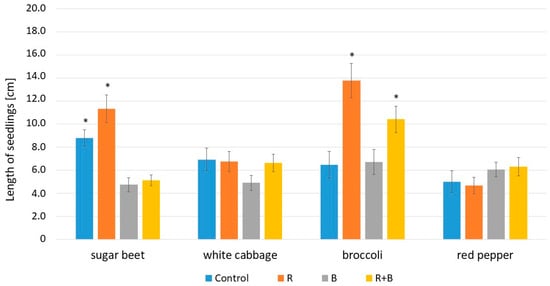
At first, the influence of bacterial consortia R, B, and R + B on the germination efficiency of seeds of the four vegetable plants was examined under sterile conditions. Surface-sterilized seeds were placed in Petri dishes containing sterile filter paper disks and water (control group) or one of the tested bacterial mixtures. Next, the seeds were incubated at 20 °C for 9 days in darkness. After 6 and 9 days, the number of germinated seeds was counted, and the length of 9-day seedlings was measured. The data obtained are shown in Figure 1 and Table S1 (Supplementary Materials).
Figure 1.
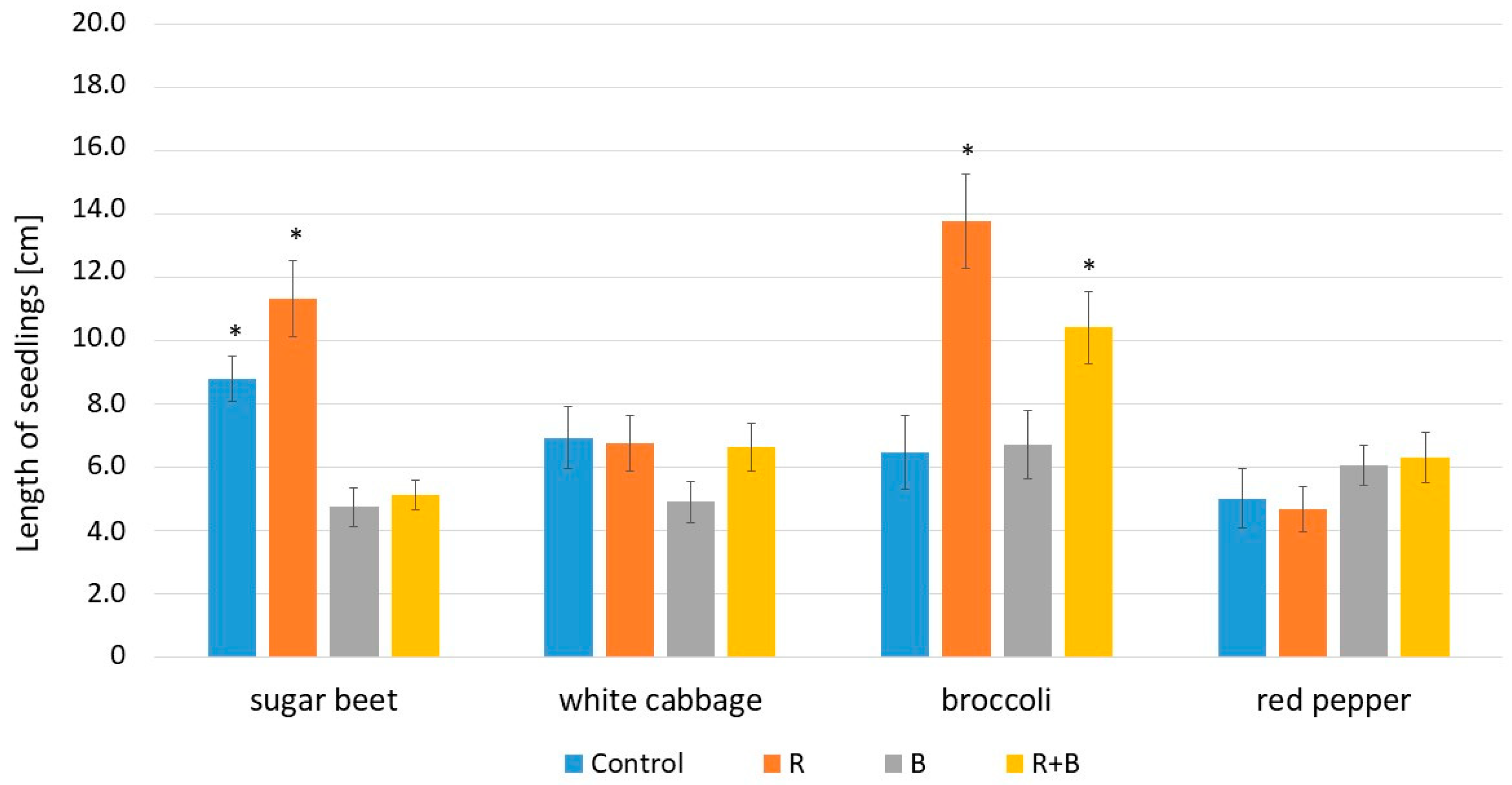
Length of 9-day seedlings of sugar beet, white cabbage, broccoli, and red pepper after treatment with different bacterial consortia R, B, and R + B. The data are average values ± standard deviation (SD) obtained from 20 seedlings for each plant and variant tested (n = 2). Statistically significant differences between inoculation variants for the individual plant are marked with a * (Kruskal–Wallis test; p < 0.05).
Our results indicated that the seeds of individual plants differed in the speed and efficiency of germination under the control conditions. The seeds of broccoli and sugar beet germinated fast and very effectively, reaching 60% and 80% of the tested seeds at day 9 of the experiment. The red pepper seeds germinated more slowly, since 23.3% and 66.7% of the seeds were germinated on days 6 and 9, respectively (Table S1). In contrast, the rate of germinated white cabbage seeds was the lowest (20%) among the tested plants.
Next, the effects of the bacterial consortia on seed germination were checked. When compared to the untreated seeds (K), the changes observed differed and were dependent on the plant type tested. In the case of white cabbage, the highest increase in seed germination after stimulation by the bacterial consortia was found; it ranged from 20% in K to 50% in R, and even 73.3% in R + B (data for 9-day seedlings). Mixture B also positively affected seed germination, but the observed effect was weaker (33.3%). Similarly, the three consortia also positively affected seed germination in broccoli; however, the observed effects were weaker than in the case of the cabbage seeds. Both consortia R and B slightly increased the rate of germinated seeds (by 6.7–10%), and a stronger stimulation effect was observed (by 26–27%) when a mixture of both R and B consortia was simultaneously used. The similar strong positive effects of consortium R + B on these plants can be explained by the fact that white cabbage and broccoli belong to the same Brassicaceae family. For red pepper, the inoculation of the seeds with the bacterial mixtures had opposite effects than those found for cabbage and broccoli. Consortium B resulted in a decrease in seed germination of 33.4% (from 66.7% to 33.3%). A more pronounced negative effect was observed when the seeds were treated with consortium R + B (40% reduction in comparison to the control). In the case of sugar beet seeds, the use of R stimulated this process (increased germination to 96.7–100% on days 6 and 9, respectively). In contrast, the use of B and R + B negatively affected germination since the rate of germinated seeds under these conditions was reduced to 20% (B) and 13.3% (R + B). These data indicated that the red pepper and sugar beet seeds were sensitive to bacteria present in mixture B, which, in some way, negatively influenced this process.
In conclusion, the highest stimulatory effect on seed germination was observed for cabbage after the treatment with R + B and for sugar beet after the treatment with R. The opposite, negative effect of seed inoculation with the bacterial mixtures was observed for red pepper and sugar beet, when the B and R + B consortia, containing Bacillus cereus 287, Chryseobacterium lathyri 300, and Lysinibacillus fusiformis 290, were used.
In the next step, the effect of inoculation with bacterial consortia on seedling growth was examined. To this end, the length of 9-day seedlings was measured and compared between the bacterial variants tested (Figure 1).
The lengths of the seedlings inoculated with bacterial mixtures R, B, and R + B were compared to the length of the control seedlings. Our results showed that the growth of young seedlings was stimulated by the tested consortia in the case of sugar beet (R), broccoli (R and R + B), and red pepper (B and R + B), whereas no effect (R, R + B) or even a slight decrease in this parameter (B) was found for white cabbage. The highest stimulatory effect on the seedling growth was observed for broccoli. R and R + B proved to be highly efficient, suggesting that the rhizobial strains occurring in these mixtures were most probably responsible for this effect. The longest seedlings were obtained in variant R (13.8 cm; 215.6% of the control; p = 0.0001), where their average length was two times higher than that in the control group (6.4 cm). Variant R + B also had a positive effect on broccoli growth, but the stimulation was slightly weaker (10.41 cm; 162.5%; p = 0.0006). The B variant had no significant effect (6.70 cm; 104.7%; p > 0.05). In the case of sugar beet, only R positively affected the seedling growth (128.4% of the control; p = 0.0333) (Figure 1). In contrast, both B and R + B negatively influenced sugar beet growth (p = 0.0001 and p = 0.0001). For cabbage, the length of seedlings in the control group, R, and R + B was very similar (no statistically significant changes). Mixture B had a negative effect on the growth of young cabbage plants (p = 0.0002), and likewise, in sugar beet. In the case of red pepper, a moderate stimulation of the growth was found for seedlings inoculated with B (120%) and R + B (174%). Inoculation with the R variant yielded the lowest value (89.6%). However, the observed differences were not statistically significant (p > 0.05).
In conclusion, our data showed that the effectiveness of bacterial inoculation is dependent on the plant and bacterial mixture used. The best results were obtained for broccoli and sugar beet inoculated with variant R. In the case of red pepper, positive effects were obtained for variants B and R + B, while cabbage seedlings were not influenced by the bacterial mixtures.
3.2. Effect of Bacterial Consortia on Seed Germination and Plant Growth Tested in Solid Hoagland’s Medium
In the additional experiment, seed germination and seedling growth were examined using solid Hoagland’s medium, which is designed for plant growth. For this approach, the seeds were surface sterilized, placed on the surface of the medium, and incubated at 20 °C for 4 days in darkness (in a phytotron). Then, the bacterial suspension with an OD600 = 0.1 was added to the seeds/seedlings, and their cultivation was continued for another 14 days in light and darkness periods. After this time, the germination rate and growth effectiveness of plants uninoculated and inoculated with bacterial consortia were determined (Table S2). In the control group (K), the highest germination rate was observed for the seeds of sugar beet (80%) and red pepper (75%); it was slightly lower for broccoli (75%) and white cabbage (60%). These data showed that these experimental conditions were favorable for seed germination of the tested plants. When bacterial consortia were applied, a similar tendency was observed as in the previous experiment with the use of liquid conditions for the seedling growth (Table S1, Figure 1). Here, in the case of cabbage and broccoli, inoculation with R, B, and R + B resulted in a moderate increase in germination rates in comparison to the control group, with R + B exerting the strongest effect (up to 90%). For red pepper and sugar beet, no stimulation effect on the seed germination was observed under the conditions examined (the only exception was R for sugar beet, with an increase from 80% to 95%). An explanation of these results may be the fact that the migration of bacterial cells in the solid agar medium was reduced in comparison to the liquid conditions.
Next, the length and weight of both the upper parts and roots of plants grown in the absence and presence of the consortia were measured (Table S2). Our results showed that the inoculation of the seeds with the tested bacterial mixtures had positive effects on the growth of young plants. However, the effect of the stimulation varied between the plants examined. In the case of white cabbage and sugar beet, the R, B, and R + B mixtures positively affected plant growth, as evidenced by the longer shoots and roots and the higher weight of these parts in relation to the control plants. The strongest effect was observed for R and R + B (with statistically significant differences in the majority of the tested parameters; p-values from 0.0006 to 0.0335). Consortium B had a weaker or no influence on the plant growth (p > 0.05). Similar positive effects of these bacterial mixtures were observed in broccoli; however, the range of stimulation was slightly weaker than that observed for white cabbage and sugar beet. Statistically significant differences were only found for the plant length after the treatment with B (p = 0.0051). In the case of the red pepper plants, a strong stimulatory effect of R and R + B on the length and weight of roots was found (p = 0.0003 and p = 0.008). Treatment B had a very low influence on plant length and no effect on plant weight (p > 0.05). R strongly stimulated the length and weight of white cabbage, red pepper, and sugar beet, whereas in broccoli, it increased only their weight.
In summary, consortia R, B, and R + B had a positive effect on the development and growth of the tested vegetable plants. However, their efficiency in stimulation was different and dependent on the plant species. Among the bacterial consortia, R and R + B proved to be the most effective.
3.3. Effect of Bacterial Consortia on Seed Germination and Plant Growth in the Pot Experiment
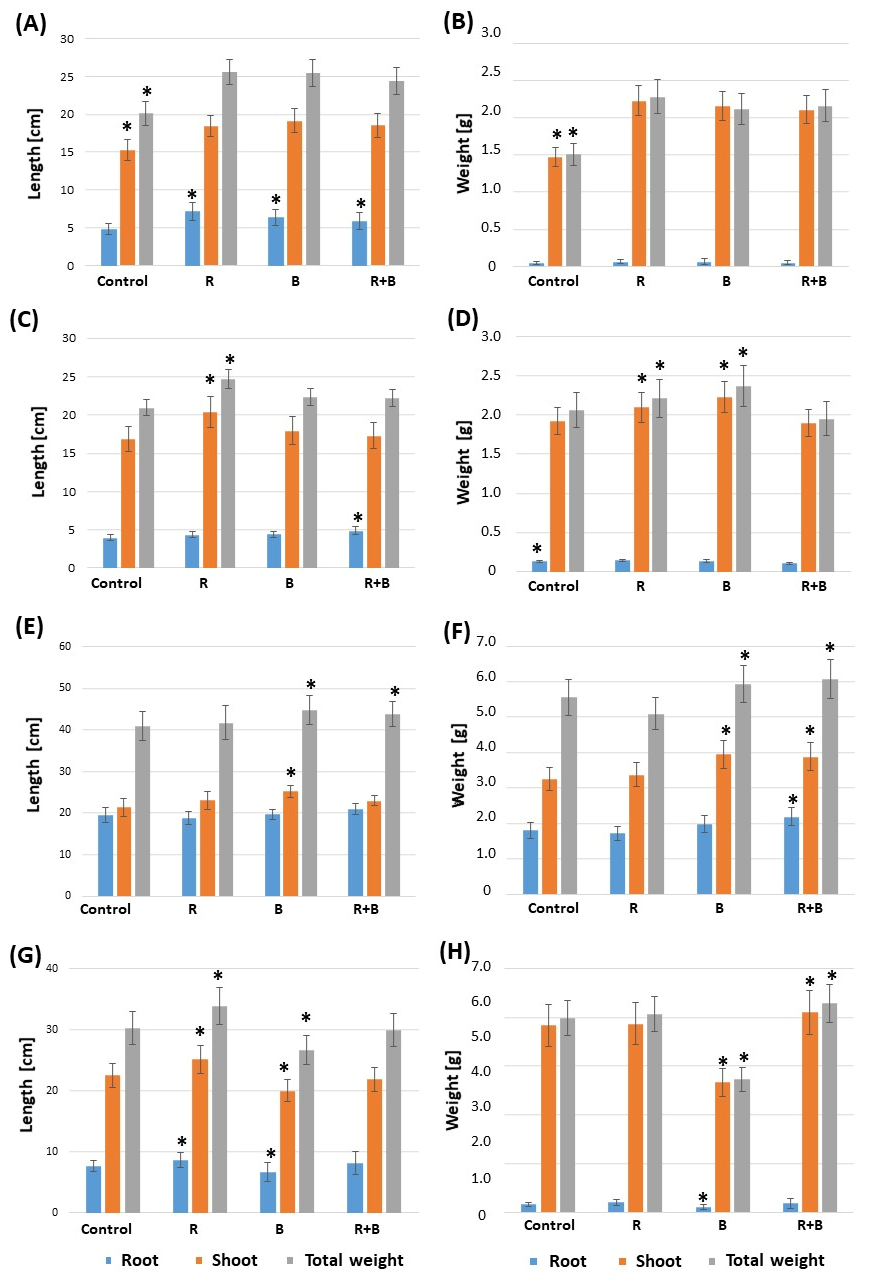
Subsequently, the influence of the bacterial consortia on seed germination and plant growth was examined under unsterile soil conditions, where autochthonous bacteria were present. For this approach, sterile seeds were used and cultivated in pots containing soil, sand, and perlite in a ratio of 2:1:1 (g/g/g) for 3 weeks under greenhouse conditions. After sowing, the seeds were inoculated with appropriate bacterial mixtures. Seeds without inoculation were used as a control. The germination effectiveness was checked after 7, 14, and 21 days (Table S3). In general, the seeds germinated effectively under the tested conditions, achieving from 65% (broccoli) to 81.25% (sugar beet) after the first 7 days. The only exceptions were the seeds of red pepper (7.5%). Finally, a high germination level was observed for all the tested plants after 21 days, with a range from 62.5% (red pepper) up to 97.5% (sugar beet). The analysis of the effect of the bacterial consortia on the germination revealed that they affected this process differently. This depended on the plant examined, suggesting that it is based on specific plant–microbe interactions. In the case of white cabbage, only R + B highly increased the ratio of germinated seeds (95% in comparison to 76.25% in the control). For broccoli, all consortia positively affected this process; however, the highest effect was observed for R + B (91.25% in relation to 77.5%). Similarly, all consortia stimulated the germination of red pepper seeds. R + B and R were the most effective, depending on the time point examined (R + B after 7 days, whereas R after 21 days). Since the seeds of sugar beet germinated very effectively, the lowest changes in their germination levels after bacterial inoculation were observed. Nonetheless, the treatment of the seeds with all the examined consortia yielded a positive effect after the first 7 days of the experiment, and R and R + B had the highest stimulatory effects (Table S3). Next, the shoots and roots of the tested plants were measured and weighed (Figure 2).
Figure 2.
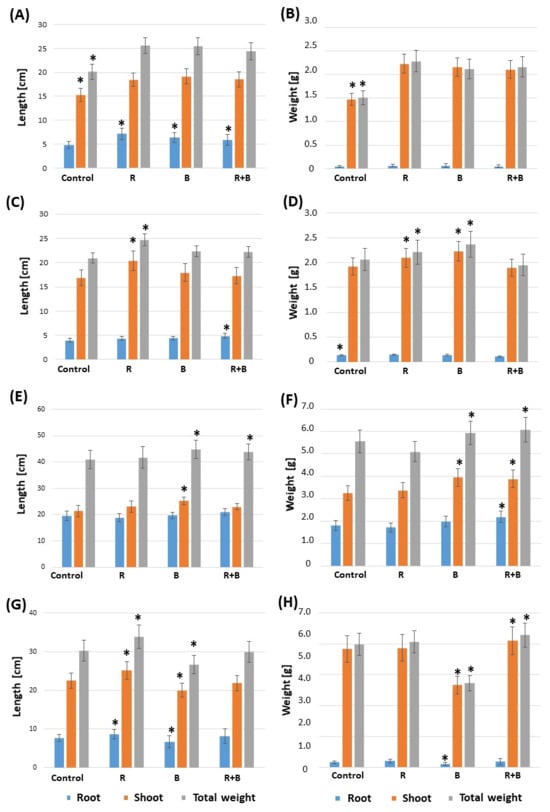
Length and weight of upper parts and roots of plants cultivated for 21 days in soil-filled pots in a greenhouse; (A,B) white cabbage, (C,D) broccoli, (E,F) red pepper, and (G,H) sugar beet. Sterile seeds were inoculated with different bacterial consortia (R, B, and R + B). Seeds untreated with bacteria were used as a control (K). The data presented are average values ± standard deviation (SD) obtained from 40 seedlings for each plant and variant tested. Statistically significant differences between variants examined for individual plants are marked with a * (Kruskal–Wallis test; p < 0.05).
Our results indicated that the bacterial consortia were also effective in the stimulation of plant growth. However, the range of this effect was different and dependent on the individual plant and the bacterial mixture tested. For white cabbage, the consortia had a positive effect on the root length of plants grown under these conditions (statistically significant differences; R versus C p = 0.00002; pB/C = 0.0003; pR+B/C = 0.0348) (Figure 2A). R, B, and R + B also positively affected these parameters for shoots (pR/C = 0.00018, pB/C = 0.0001, pR+B/C = 0.0001) and, consequently, for whole plants (pR/C = 0.00001, pB/C = 0.0001, pR+B/C = 0.0001). However, no statistically significant differences were found between the data for R, B, and R + B (Figure 2A,B). As shown by the analysis of the weight of the upper parts and whole white cabbage plants, R, B, and R + B significantly increased these parameters (for shoots: pR/C = 0.00001, pB/C = 0.00002, pR+B/C = 0.00002; for whole plants: pR/C = 0.00001, pB/C = 0.00001, pR+B/C = 0.00002) (Figure 2B).
In the case of broccoli, slightly longer roots were found in plants treated with R + B in relation to the control (pR+B/C = 0.000132) and plants independently treated with R and B (p > 0.05) (Figure 2C,D). A slight positive effect of R on the length of shoots (pR/C = 0.00284) and whole plants (pR/C = 0.004319), as well as R and B on the weight of shoots (pR/C = 0.007684, pB/C = 0.005671) and whole plants, was also found (pR/C = 0.004924, pB/C = 0.003429). For red pepper (Figure 2E,F), statistically significant differences were only found for the length of the upper parts and whole plants after the treatment with B (pB/C = 0.001481 and pB/C = 0.01306). A significant stimulatory effect was also found for the weight of shoots after the treatment with B and R + B (pB/C = 0.005032 and pR+B/C = 0.000284), as well as for the weight of roots pR+B/C = 0.003057) and whole plants after the treatment with R + B (pR+B/C = 0.00027). For sugar beet, the bacterial consortia moderately affected the plant growth (Figure 2G,H). R slightly increased the length of the roots, upper parts, and whole plants (pR/C = 0.000632, pR/C = 0.000049, pR/C = 0.000005), whereas B had opposite effects, as a decrease in the length (roots—pB/C = 0.004351, stem—pB/C = 0.012792, total length pB/C = 0.000259) and weight of plants treated with this bacterial consortium was observed in relation to the control and the other bacterial variants (roots—pB/C = 0.000002, stem—pB/C = 0.0000012, total length pB/C = 0.000023). Moreover, R + B resulted in a statistically significant increase in the weight of the shoots and whole sugar beet plants (stems: pR+B/C = 0.0120607 and pR+B/C = 0.019141).
In conclusion, our results indicate that the three bacterial consortia containing different sets of rhizobial strains and other bacteria from the Bacillus genus may be useful in accelerating germination and improving the rooting and growth of young plants of several cultivated vegetables that are important components of the human diet. However, the magnitude of the stimulation varied, depending on the plant type and conditions tested. The highest stimulation rate was recorded under sterile conditions when the role of other microorganisms was excluded. However, positive stimulatory effects were observed even under soil conditions in the presence of other organisms. These data suggest that some of the presented bacterial consortia may be used in future agricultural practice to increase the production of some vegetable plants.
4. Discussion
Nowadays, there is a need to constantly increase the quantity and quality of produced food, as consumers are becoming more aware of their health. Therefore, implementation of new eco-friendly and cost-efficient methods for enhancement of plant growth is highly desirable and is an interesting alternative to traditional agrotechnical practices. One of the promising and effective approaches is biotization of plants using microorganisms called PGPR that have several unique and important traits that enhance plant health and yield [15,37,39]. This treatment is relatively easy in application, but it suffers from some significant drawbacks. Among these are the high specificity towards specific hosts of specific plant growth-promoting microorganisms and their unpredictable or non-uniform response to environmental conditions occurring in soil [7,15,37]. Moreover, since the results of inoculation with single microbial strains are usually very ambiguous, simultaneous co-inoculation with different bacterial species should bring much better effects. Following this trend, we have developed the composition of three bacterial consortia, R, B, and R + B, and tested their efficiency in stimulating seed germination and plant growth in four species that are important for food production. For this approach, we selected three edible vegetable plants with high economic importance: cabbage and broccoli belonging to the Brassica genus, and red pepper Capsicum annum. In addition, sugar beet was included in these analyses since this plant is commonly cultivated to achieve plant material for sugar production. Many Brassicaceae plants are known for their nutritional and health-promoting properties. Most Brassica vegetables are a rich source of vitamin C, carotenoids, minerals, polyphenols, and species-specific glucosinolates [55,56]. In recent years, broccoli has become a very popular ‘superfood’ thanks to its phytochemical content and documented beneficial, particularly anti-carcinogenic, effects [57,58,59]. Red peppers are a rich source of vitamins, antioxidants, and fiber, which provide anti-inflammatory benefits. The bacterial consortia examined in this study were composed of four symbiotic strains belonging to the R. leguminosarum species and three strains from the Bacillus and Chryseobacterium genera [7]. We used an optical density of OD600 as a control parameter, which ensured easy preparation of bacterial suspensions and repeatability. Our earlier results showed that suspensions of the R. leguminosarum strains with an OD600 = 0.1 contain ~5 × 10⁷ cells in 1 mL [60,61]. These rhizobia are Gram-negative rods with an average cell length of 1.5–3 μm and width of 0.5–0.9 μm. Bacteria C. lathyri are Gram-negative rods with a size very similar to that of rhizobial cells (length 1.5–2.5 μm, width 0.5–0.9 μm). L. fusiformis and B. cereus are Gram-positive bacilli, having slightly larger cell sizes than those of R. leguminosarum and C. lathyri cells (L. fusiformis: length 2.5–3 μm, width 0.5–0.9 μm; B. cereus: length 3–5 μm, width 1.2–1.5 μm). To achieve a similar cell number in all consortia, R + B was prepared so as to contain 50% of cells occurring in R and 50% of cells present in B. Therefore, the total number of cells of bacterial strains in the R, B, and R + B consortia, as well as the number of cells of individual strains, were very similar. These consortia were tested for their stimulatory effects on seed germination and plant growth under both sterile and soil conditions. Our results indicated that some of the tested consortia had positive effects on seed germination, rooting, and plant growth. However, their efficiency in the stimulation of these processes differed and depended on the type of plant examined. Among the bacterial consortia, R and R + B proved to be the most effective in all the tested plants. More pronounced effects were observed under sterile conditions when the role of other microorganisms was eliminated. However, even under soil conditions, positive stimulatory effects were found. In contrast, consortium B reduced germination in red pepper and sugar beet under sterile conditions, suggesting that these bacterial strains negatively affected this process through a direct impact on the seeds/seedlings or an indirect antagonistic interaction between them. However, under soil conditions, this negative effect was essentially reduced or even eliminated (e.g., red pepper length and weight), probably as a result of interactions of bacteria from consortium B with autochthonous microorganisms. The differences in the responses of the tested plant species to consortia R, B, and R + B may also be attributed to the differences in the chemical composition of seed coat and root exudates between the Brassicaceae and red pepper and sugar beet. Another explanation may be the different sensitivity of individual plant species to the strains used in the consortia and various compounds and enzymes secreted by the bacteria (e.g., ACC deaminase activity, auxin and indole-3-acetic acid production, EPS synthesis). Despite these difficulties and limitations associated with the use of bacterial consortia, our data suggest that the presented bacterial preparations can be used in agricultural practice to accelerate germination, strengthen rooting, and increase yields of some plants. These results are in congruence with the data presented by other researchers, who found that inoculation of plants with bacteria belonging to different strains yielded better effects on plant growth than inoculation with a single strain under both control and stress conditions [39,62]. An explanation of this observation is the fact that various microorganisms representing species from phylogenetically distant taxa possess different metabolic and phenotypic traits that can be potentially beneficial for plants. These include the ability to synthesize indole-3-acetic acid, siderophores, lactones, and extracellular polysaccharides and to solubilize inorganic phosphate compounds. Therefore, bacterial consortia composed of a few strains may have additive or synergistic beneficial properties [15]. However, it must be taken into consideration that antagonistic effects can sometimes be found between some bacterial strains. This requires careful consideration when designing the composition of microbiological consortia.
Our results indicated that symbiotic rhizobia, i.e., the components of the R and R + B consortia, are efficient in accelerating seed germination and growth of plants belonging to different species. In natural environments, rhizobia can be microsymbionts of legume plants, including pea, bean, soybean, vetch, clover, alfalfa, etc., and reduce atmospheric N2 in specific root structures, called nodules, to forms available to plants [63,64]. Among the properties of rhizobial strains belonging to PGPR is their ability to produce and secrete large amounts of EPS into the environment. EPS is important for root colonization, biofilm formation, and structuring of root-adhering soil [61,65]. This high-molecular-weight polymer, generally soluble in water, supports water and nutrient uptake by plants and absorption of heavy metals and toxic substances [46,47]. In the case of saline soils, the biofilm formed by EPS reduces the diffusion of salt, thus reducing the adverse effect on plant growth [8,27,31]. The structure of rhizobial EPS has been established for many bacterial species [65,66]. Thus, the synthesis of EPS seems to be a very important trait for rhizobial activity as a PGPR. This has recently been confirmed by Tulumello and others, who showed that EPS produced by symbiotic R. alamii strains improves water stress tolerance in non-legumes [8]. They showed that R. alamii had a PGPR effect on rapeseed growth, increasing its tolerance to water stress, probably involving its capacity to synthesize EPS and other plant-growth-promoting traits. Inoculation with this bacterium significantly increased the shoot biomass of this plant under water-stressed conditions (+7% for the YAS34 strain and +15% for the GBV030 strain) [8]. Researchers have confirmed the role of another rhizobial strain belonging to R. laguerreae as a potent biofertilizer for spinach (Spinacia oleracea), boosting growth and yield by over 73% in mature plants and enhancing the chlorophyll and N contents [67]. This PGPR bacterium very effectively colonized the spinach root surface and stimulated the development and growth of this plant. Therefore, these findings indicate that R. laguerreae is an excellent plant probiotic, which increases the yield and quality of spinach, a vegetable that is increasingly being consumed raw worldwide. These data have shown that rhizobia are a source of valuable plant growth-promoting molecules important for plant health and growth, especially under adverse stress conditions [21,68]. As evidenced by other researchers, some of these metabolites can enhance plant growth via the suppression of the deleterious effects of other antagonistic molecules, as exemplified by a reduction in the deleterious effect of ethylene by ACC deaminase synthesized by rhizobia [68]. Moreover, rhizobial strains are also useful in remediation, most probably through their capability of producing large amounts of EPS that are highly efficient in the elimination of heavy metal ions from the soil environment [60,69]. Thus, rhizobia are not only microsymbionts of leguminous plants in nitrogen-fixing symbiosis but are also efficient PGPR that can act individually or as components of more complex bacterial consortia in accelerating the growth of several plants.
Our results and data presented by other researchers indicated that the efficiency of stimulation of seed germination and plant growth is dependent on the plant type. Plant factors that can reduce this stimulatory effect of bacterial consortia include the chemical composition of the seed coat, imbibition by seeds, changes in pH of the surrounding environment during seed germination, and secretion of mucilage and other compounds by germinating seeds [6,7,14,30,70,71,72,73,74]. For example, capsaicin, the active compound in chili peppers, is a natural antimicrobial agent with varying activity depending on its concentration [75,76]. Furthermore, soil properties, environmental conditions, and climatic parameters are factors that affect the final results [30,70,77,78]. All these data show that, to maximize the effectiveness of seed germination and plant growth stimulation, many factors must be considered. These include seed properties and quality, plant requirements for a given soil type and climatic conditions, and the type of bacteria used for stimulation, their phenotypic properties, as well as the presence of potential antagonisms between these microorganisms. Thus, this issue is highly complex and requires determination of many factors to achieve optimal results.
5. Conclusions
In this study, the effects of symbiotic rhizobia belonging to R. leguminosarum and other PGPR strains, B. cereus, C. lathyri, and L. fusiformis, on the seed germination and growth of four plant species (white cabbage, broccoli, red pepper, and sugar beet) were examined. Three inoculation variants were tested: a consortium containing four R. leguminosarum strains (R); a consortium containing three strains, B. cereus, Chryseobacterium lathyri, and Lysinibacillus fusiformis (B); and a combination of both (R + B). Our results indicate the agricultural potential of these bacterial consortia as biological support for the production of vegetable crops. The treatment of the seeds with all the examined consortia exerted a positive effect. However, the range of stimulation varied depending on the plant, the consortium, and the conditions tested. Consortia R and R + B proved to have the highest stimulatory effects. The results indicate that the prepared bacterial consortia can be effective in accelerating germination and promoting better rooting and growth of young vegetable crops. In conclusion, our data suggest that some of the presented bacterial consortia can be used in future agricultural practice to increase the production of some vegetable plants.
Supplementary Materials
The following supporting information can be downloaded at: https://www.mdpi.com/article/10.3390/agronomy16131298/s1, Table S1. The number of germinated seeds of the individual plants after treatment with bacterial consortia. Table S2. Effectiveness of seed germination and plant growth, determined in the agar Hoagland’s medium after 14 days. Table S3. The number of germinated seeds of the individual plants without and after treatment with bacterial consortia, determined at 7, 14, and 21 days after seed sowing.
Author Contributions
Conceptualization, M.J.; methodology, M.J.; software, M.G. (Mateusz Grabowski) and M.J.; validation, M.J., M.G. (Mateusz Grabowski), and M.G. (Maciej Gustab); formal analysis, M.G. (Mateusz Grabowski), M.J., and M.G. (Maciej Gustab); investigation, M.G. (Mateusz Grabowski) and M.J.; resources, M.J., M.G. (Mateusz Grabowski), and M.G. (Maciej Gustab); data curation, M.J.; writing—original draft preparation, M.J.; writing—review and editing, M.J.; visualization, M.J. and M.G. (Mateusz Grabowski); supervision, M.J.; project administration, M.J.; funding acquisition, M.J. All authors have read and agreed to the published version of the manuscript.
Funding
This research received no external funding.
Data Availability Statement
The raw data supporting the conclusions of this article will be made available by the authors on request.
Acknowledgments
During the preparation of this manuscript, no AI tools were used.
Conflicts of Interest
The authors declare no conflicts of interest.
Abbreviations
The following abbreviations are used in this manuscript:
| EPS | Extracellular polysaccharide |
| PGPR | Plant Growth Promoting Rhizobacteria |
| N | Nitrogen |
| C | carbon |
| OD | Optical Density |
References
- Imran, A.; Hakim, S.; Tariq, M.; Nawaz, M.S.; Laraib, I.; Gulzar, U.; Hanif, M.K.; Siddique, M.J.; Hayat, M.; Fraz, A.; et al. Diazotrophs for Lowering Nitrogen Pollution Crises: Looking Deep Into the Roots. Front. Microbiol. 2021, 12, 637815. [Google Scholar] [CrossRef] [Scilit] [PubMed]
- Lotze-Campen, H. Climate change, population growth, and crop production: An overview. In Crop Adaptation to Climate Change; Yadav, S.S., Redden, R.J., Hatfield, J.L., Lotze-Campen, H., Hall, A.E., Eds.; Wiley-Blackwell: Oxford, UK, 2011; pp. 1–11. [Google Scholar] [CrossRef] [Scilit]
- Simelton, E.; Fraser, E.D.G.; Termansen, M.; Benton, T.G.; Gosling, S.N.; South, A.; Arnell, N.W.; Challinor, A.J.; Dougill, A.J.; Forster, P.M. The socioeconomics of food crop production and climate change vulnerability: A global scale quantitative analysis of how grain crops are sensitive to drought. Food Sec. 2012, 4, 163–179. [Google Scholar] [CrossRef] [Scilit]
- Janczarek, M.; Kozieł, M.; Adamczyk, P.; Buczek, K.; Kalita, M.; Gromada, A.; Mordzińska-Rak, A.; Polakowski, C.; Bieganowski, A. Symbiotic efficiency of Rhizobium leguminosarum sv. trifolii strains originating from the subpolar and temperate climate regions. Sci. Rep. 2024, 14, 6264. [Google Scholar] [CrossRef] [Scilit] [PubMed]
- Wang, E.T.; Chen, W.F.; Tian, C.F.; Chen, W.F.; Young, J.P.W.; Shen, W.X. Ecology and Evolution of Rhizobia, Principles and Application, 1st ed.; Springer: Berlin/Heidelberg, Germany, 2019; pp. 8–32. [Google Scholar] [CrossRef] [Scilit]
- Hanaka, A.; Nowak, A.; Ozimek, E.; Dresler, S.; Plak, A.; Sujak, A.; Reszczyńska, E.; Strzemski, M. Effect of copper stress on Phaseolus coccineus in the presence of exogenous methyl jasmonate and/or Serratia plymuthica from the Spitsbergen soil. J. Hazard Mater. 2022, 436, 129232. [Google Scholar] [CrossRef] [Scilit] [PubMed]
- Gustab, M.; Ważny, R.; Jędrzejczyk, R.R.J.; Kalisz, A.; Domka, A.; Nosek, M.; Tokarz, K.; Rozpądek, P. Beneficial impact of multi-bacterial inoculation on growth of selected Brassicaceae seedlings in a greenhouse culture. Sci. Hortic. 2024, 324, 112575. [Google Scholar] [CrossRef] [Scilit]
- Tulumello, J.; Chabert, N.; Rodriguez, J.; Long, J.; Nalin, R.; Achuak, W.; Heulin, T. Rhizobium alamii improves water stress tolerance in a non-legume. Sci. Total Environ. 2021, 797, 148895. [Google Scholar] [CrossRef] [Scilit] [PubMed]
- Janczarek, M.; Adamczyk, P.; Gromada, A.; Polakowski, C.; Wengerska, K.; Bieganowski, A. Adaptation of Rhizobium leguminosarum sv. trifolii strains to low temperature stress in both free-living stage and during symbiosis with clover. Sci. Total Environ. 2024, 951, 175554. [Google Scholar] [CrossRef] [Scilit] [PubMed]
- Wang, Y.; Liao, Z.; Liu, L.; Chen, J.; Gu, J.; Kreuzwieser, J.; Werner, C.; Du, B. Evergreen camphor and deciduous N2-fixer alder differently impact soil bacterial communities and N and P cycling in a Cupressus funebris monoculture. Plant Soil 2026, 518, 1129–1148. [Google Scholar] [CrossRef] [Scilit]
- Nawroth, L.; Cartwright, L.A.; Rutter, A.; Zeeb, B. Phytoremediation of road salt affected soils in the Toronto region using native halophytes. Plant Soil 2025, 517, 459–471. [Google Scholar] [CrossRef] [Scilit] [PubMed]
- Yanmei, S.; Zhao, N.; Sun, H.; Xu, S.; Lu, Y.; Xi, H.; Guo, Z.; Shi, H. Transcriptome profiling reveals molecular responses to salt stress in common vetch (Vicia sativa L.). Plants 2024, 13, 714. [Google Scholar] [CrossRef] [Scilit] [PubMed]
- van der Heijden, M.G.A.; Bardgett, R.D.; van Straalen, N.M. The unseen majority: Soil microbes as drivers of plant diversity and productivity in terrestrial ecosystems. Ecol. Lett. 2008, 11, 296–310. [Google Scholar] [CrossRef] [Scilit] [PubMed]
- Berendsen, R.L.; Pieterse, C.M.; Bakker, P.A.H.M. The rhizosphere microbiome and plant health. Trends Plant Sci. 2012, 17, 478–486. [Google Scholar] [CrossRef] [Scilit] [PubMed]
- Santoyo, G.; Guzman-Guzman, P.; Parra-Cota, F.I.; Santos-Villalobos, S.; Orozco-Mosqueda, M.; Glick, B.R. Plant growth stimulation by microbial consortia. Agronomy 2021, 11, 219. [Google Scholar] [CrossRef] [Scilit]
- Janczarek, M.; Adamczyk, P.; Galazka, A.; Marzec-Grzadziel, A.; Wójcik, M.; Polakowski, C.; Maciejczyk, N.; Bieganowski, A. Signal molecules and enzymes produced by Rhizobium leguminosarum sv. trifolii strains originating from the subpolar and temperate climate zones as elements of adaptation to low temperature stress. Soil Biol. Biochem. 2025, 208, 109863. [Google Scholar] [CrossRef] [Scilit]
- Guyonnet, J.P.; Cantarel, A.A.M.; Simon, L.; Haichar, F.Z. Root exudation rate as functional trait involved in plant nutrient-use strategy classification. Ecol. Evol. 2018, 8, 8573–8581. [Google Scholar] [CrossRef] [Scilit] [PubMed]
- Compant, S.; Samad, A.; Faist, H.; Sessitsch, A. A review on the plant microbiome: Ecology, functions, and emerging trends in microbial application. J. Adv. Res. 2019, 19, 29–37. [Google Scholar] [CrossRef] [Scilit] [PubMed]
- Santoyo, G.; Hernandez-Pacheco, C.; Hernandez-Salmeron, J.; Hernandez-Leon, R. The role of abiotic factors modulating the plant-microbe-soil interactions: Towards sustainable agriculture. A review. Span. J. Agric. Res. 2017, 15, e03R01. [Google Scholar] [CrossRef] [Scilit]
- Olenska, E.; Małęk, W.; Wójcik, M.; Święcicka, I.; Thijs, S.; Vangronsveld, J. Beneficial features of plant growth-promoting rhizobacteria for improving plant growth and health in challenging conditions: A methodical review. Sci. Total Environ. 2020, 743, 140682. [Google Scholar] [CrossRef] [Scilit] [PubMed]
- Montes-Grajales, D.; Esturau-Escofet, N.; Esquivel, B.; Martinez-Romero, E. Exo-Metabolites of Phaseolus vulgaris-Nodulating Rhizobial Strains. Metabolites 2019, 9, 105. [Google Scholar] [CrossRef] [Scilit] [PubMed]
- Asghar, H.; Zahir, H.; Arshad, M.; Khaliq, A. Relationship between in vitro production of auxin by rhizobacteria and their growth–promoting activities in Brassica juncea L. Biol. Fertil. Soils 2002, 35, 231–237. [Google Scholar] [CrossRef] [Scilit]
- Belimov, A.A.; Dodd, I.C.; Safronova, V.I.; Dumova, V.A.; Shaposhnikov, A.I.; Ladatko, A.G.; Davies, W.J. Abscisic acid metabolizing rhizobacteria decrease ABA concentrations in planta and alter plant growth. Plant Physiol. Biochem. 2014, 74, 84–91. [Google Scholar] [CrossRef] [Scilit]
- Glick, B.R.; Jacobson, C.B.; Schwarze, M.M.K.; Pasternak, J.J. 1-Aminocyclopropane-1-carboxylic acid deaminase mutants of the plant growth-promoting rhizobacterium Pseudomonas putida GR12-2 do not stimulate canola root elongation. Can. J. Microbiol. 1994, 40, 911–915. [Google Scholar] [CrossRef] [Scilit]
- Brunetti, C.; Saleem, A.R.; Della Rocca, G.; Emiliani, G.; De Carlo, A.; Balestrini, A.; Khalid, A.; Mahmood, T.; Centritto, M. Effects of plant growth-promoting rhizobacteria strains producing ACC deaminase on photosynthesis, isoprene emission, ethylene formation and growth of Mucuna pruriens (L.) DC. in response to water deficit. J. Biotechnol. 2021, 331, 53–62. [Google Scholar] [CrossRef] [Scilit] [PubMed]
- Ruzzi, M.; Aroca, R. Plant growth-promoting rhizobacteria act as biostimulants in horticulture. Sci. Hortic. 2015, 196, 124–134. [Google Scholar] [CrossRef] [Scilit]
- Benidire, L.; El Khalloufi, F.; Oufdou, K.; Barakat, M.; Tulumello, J.; Ortet, P.; Heulin, T.; Achouak, W. Phytobeneficial bacteria improve saline stress tolerance in Vicia faba and modulate microbial interaction network. Sci. Total Environ. 2020, 729, 139020. [Google Scholar] [CrossRef] [Scilit] [PubMed]
- Khanna, K.; Jamwal, V.L.; Gandhi, S.G.; Ohri, P.; Bhardwaj, R. Metal resistant PGPR lowered Cd uptake and expression of metal transporter genes with improved growth and photosynthetic pigments in Lycopersicon esculentum under metal toxicity. Sci. Rep. 2019, 9, 5855. [Google Scholar] [CrossRef] [Scilit] [PubMed]
- Ahmad, M.; Zahir, Z.A.; Khalid, M.; Nazli, F.; Arshad, M. Efficacy of Rhizobium and Pseudomonas strains to improve physiology, ionic balance and quality of mung bean under salt-affected conditions on farmer’s fields. Plant Physiol. Biochem. 2013, 63, 170–176. [Google Scholar] [CrossRef] [Scilit] [PubMed]
- Calvo, P.; Nelson, P.; Kloepper, J.W. Agricultural uses of plant biostimulants. Plant Soil 2014, 383, 3–41. [Google Scholar] [CrossRef] [Scilit]
- Molina-Romero, D.; Baez, A.; Quintero-Hernández, V.; Castañeda-Lucio, M.; Fuentes-Ramírez, L.E.; del Bustillos-Cristale, R.M. Compatible bacterial mixture, tolerant to desiccation, improves maize plant growth. PLoS ONE 2017, 12, e0187913. [Google Scholar] [CrossRef] [Scilit] [PubMed]
- Rouphael, Y.; Colla, G. Synergistic biostimulatory action: Designing the next generation of plant biostimulants for sustainable agriculture. Front. Plant Sci. 2018, 9, 1–7. [Google Scholar] [CrossRef] [PubMed]
- Ullah, S.; Khan, M.Y.; Asghar, H.N.; Akhtar, M.J.; Zahir, Z.A. Differential response of single and co-inoculation of Rhizobium leguminosarum and Mezorhizobium ciceri for inducing water deficit stress tolerance in wheat. Ann. Microbiol. 2017, 67, 739–749. [Google Scholar] [CrossRef] [Scilit]
- Hamaoui, B.; Abbadi, J.M.; Burdman, S.; Rashid, A.; Sarig, S.; Okon, Y. Effects of inoculation with Azospirillum brasilense on chickpeas (Cicer arietinum) and faba beans (Vicia faba) under different growth conditions. Agronomie 2001, 21, 553–560. [Google Scholar] [CrossRef] [Scilit]
- Casanovas, E.M.; Barassi, C.A.; Sueldo, R.J. Azospirillum inoculation mitigates water stress effects in maize seedlings. Cereal Res. Commun. 2002, 30, 343–350. [Google Scholar] [CrossRef] [Scilit]
- Creus, C.M.; Sueldo, R.J.; Barassi, C.A. Water relations and yield in Azospirillum-inoculated wheat exposed to drought in the field. Can. J. Bot. 2004, 82, 273–281. [Google Scholar] [CrossRef] [Scilit]
- Lu, L.; Leng, P.; Jin, F.; Hu, Q.; Liang, W.; Huang, Y.; Zhang, C.; Li, C.; Xu, Z.; Yang, Z.; et al. Evaluation of the symbiotic effects of Bradyrhizobium elkanii Y63-1 inoculation on soybean Zhongdou 63. Agronomy 2025, 15, 2649. [Google Scholar] [CrossRef] [Scilit]
- Dimkpa, C.; Weinand, T.; Asch, F. Plant-rhizobacteria interactions alleviate abiotic stress conditions. Plant Cell Environ. 2009, 32, 1682–1694. [Google Scholar] [CrossRef] [Scilit] [PubMed]
- Lally, R.D.; Galbally, P.; Moreira, A.S.; Spink, J.; Ryan, D.; Germaine, K.J.; Dowling, D.N. Application of Endophytic Pseudomonas fluorescens and a Bacterial Consortium to Brassica napus Can Increase Plant Height and Biomass under Greenhouse and Field Conditions. Front. Plant Sci. 2017, 8, 2193. [Google Scholar] [CrossRef] [Scilit] [PubMed]
- Alami, Y.; Achouak, W.; Marol, C.; Heulin, T. Rhizosphere soil aggregation and plant growth promotion of sunflower by an exopolysaccharide-producing Rhizobium sp. strain isolated from sunflower roots. Appl. Environ. Microbiol. 2000, 66, 3393–3398. [Google Scholar] [CrossRef] [Scilit] [PubMed]
- Bezzate, S.; Aymerich, S.; Chambert, R.; Czarnes, S.; Berge, O.; Heulin, T. Disruption of the Paenibacillus polymyxa levansucrase gene impairs its ability to aggregate soil in the wheat rhizosphere. Environ. Microbiol. 2000, 2, 333–342. [Google Scholar] [CrossRef] [Scilit] [PubMed]
- Santaella, C.; Schue, M.; Berge, O.; Heulin, T.; Achouak, W. The exopolysaccharide of rhizobium sp. YAS34 is not necessary for biofilm formation on Arabidopsis thaliana and Brassica napus roots but contributes to root colonization. Environ. Microbiol. 2008, 10, 2150–2163. [Google Scholar] [CrossRef] [Scilit] [PubMed]
- Amellal, N.; Burtin, G.; Bartoli, F.; Heulin, T. Colonization of wheat roots by an exopolysaccharide-producing Pantoea agglomerans strain and its effect on rhizosphere soil aggregation. Appl. Environ. Microbiol. 1998, 64, 3740–3747. [Google Scholar] [CrossRef] [Scilit] [PubMed]
- Janczarek, M.; Kutkowska, J.; Piersiak, T.; Skorupska, A. Rhizobium leguminosarum bv. trifolii rosR is required for interaction with clover, biofilm formation and adaptation to the environment. BMC Microbiol. 2010, 10, 284. [Google Scholar] [CrossRef] [Scilit] [PubMed]
- Janczarek, M. Environmental Signals and Regulatory Pathways That Control Exopolysaccharide Production in Rhizobia. Int. J. Mol. Sci. 2011, 12, 7898–7933. [Google Scholar] [CrossRef] [Scilit] [PubMed]
- Nwodo, U.U.; Green, E.; Okoh, A.I. Bacterial exopolysaccharides: Functionality and prospects. Int. J. Mol. Sci. 2012, 13, 14002–14015. [Google Scholar] [CrossRef] [Scilit] [PubMed]
- Tecon, R.; Or, D. Biophysical processes supporting the diversity of microbial life in soil. FEMS Microbiol. Rev. 2017, 41, 599–623. [Google Scholar] [CrossRef] [Scilit] [PubMed]
- Mishra, S.; Kumar, S. (Eds.) Advances in Agricultural Biotechnology; AkiNik Publications: New Delhi, India, 2022. [Google Scholar] [CrossRef] [Scilit]
- Hu, J.; Yang, T.; Friman, V.P.; Kowalchuk, G.A.; Hautier, Y.; Li, M.; Wei, Z.; Xu, Y.; Shen, Q.; Jousset, A. Introduction of probiotic bacterial consortia promotes plant growth via impacts on the resident rhizosphere microbiome. Proc. Biol. Sci. 2021, 288, 20211396. [Google Scholar] [CrossRef] [Scilit] [PubMed]
- Hu, J.; Wei, Z.; Friman, V.P.; Gu, S.H.; Wang, X.F.; Eisenhauer, N.; Yang, T.J.; Ma, J.; Shen, Q.R.; Xu, Y.C.; et al. Probiotic Diversity Enhances Rhizosphere Microbiome Function and Plant Disease Suppression. mBio 2016, 7, e01790-16. [Google Scholar] [CrossRef] [Scilit] [PubMed]
- Available online: https://worldmapper.org/ (accessed on 10 April 2025).
- Cambardella, C. Chapter Six-organic farming, soil health, and food quality: Considering possible links. Adv. Agron. 2016, 137, 319–367. [Google Scholar] [CrossRef] [Scilit]
- Kozieł, M.; Kalita, M.; Janczarek, M. Genetic diversity of microsymbionts nodulating Trifolium pratense in subpolar and temperate climate regions. Sci. Rep. 2022, 12, 12144. [Google Scholar] [CrossRef] [Scilit] [PubMed]
- Hoagland, D.R.; Arnon, D.I. The water culture method for growing plants without soil. Calif. Agric. Exp. Stn. Circ. 1938, 347, 32. [Google Scholar]
- Jahangir, M.; Kim, H.K.; Choi, Y.H.; Verpoorte, R. Health-Affecting Compounds in Brassicaceae. Compr. Rev. Food Sci. Food Saf. 2009, 8, 31–43. [Google Scholar] [CrossRef] [Scilit]
- Soundararajan, P.; Kim, J.S. Anti-Carcinogenic Glucosinolates in Cruciferous Vegetables and Their Antagonistic Effects on Prevention of Cancers. Molecules 2018, 23, 2983. [Google Scholar] [CrossRef] [Scilit] [PubMed]
- Li, H.; Xia, Y.; Liu, H.-Y.; Guo, H.; He, X.-Q.; Liu, Y.; Wu, T.-W.; Mai, Y.-M.; Li, H.-B.; Zou, L.; et al. Nutritional values, beneficial effects, and food applications of broccoli (Brassica oleracea var. italica Plenck). Trends Food Sci. Technol. 2022, 119, 288–308. [Google Scholar] [CrossRef] [Scilit]
- Le, T.N.; Chiu, C.H.; Hsieh, P.C. Bioactive Compounds and Bioactivities of Brassica oleracea L. var. Italica Sprouts and Microgreens: An Updated Overview from a Nutraceutical Perspective. Plants 2020, 9, 946. [Google Scholar] [CrossRef] [Scilit] [PubMed]
- Li, Y.; Zhang, T.; Korkaya, H.; Liu, S.; Lee, H.F.; Newman, B.; Yu, Y.; Clouthier, S.G.; Schwartz, S.J.; Wicha, M.S.; et al. Sulforaphane, a dietary component of broccoli/broccoli sprouts, inhibits breast cancer stem cells. Clin. Cancer Res. 2010, 16, 2580–2590. [Google Scholar] [CrossRef] [Scilit] [PubMed]
- Kopycińska, M.; Lipa, P.; Cieśla, J.; Kozieł, M.; Janczarek, M. Extracellular polysaccharide protects Rhizobium leguminosarum cells against zinc stress in vitro and during symbiosis with clover. Environ. Microbiol. Rep. 2018, 10, 355–368. [Google Scholar] [CrossRef] [Scilit] [PubMed]
- Janczarek, M.; Rachwał, K.; Cieśla, J.; Ginalska, G.; Bieganowski, A. Production of exopolysaccharide by Rhizobium leguminosarum bv. trifolii and its role in bacterial attachment and surface properties. Plant Soil 2015, 388, 211–227. [Google Scholar] [CrossRef] [Scilit]
- Bakhshandeh, E.; Gholamhosseini, M.; Yaghoubian, Y.; Pirdashti, H. Plant growth promoting microorganisms can improve germination, seedling growth and potassium uptake of soybean under drought and salt stress. Plant Growth Regul. 2020, 90, 123–136. [Google Scholar] [CrossRef] [Scilit]
- Haag, A.F.; Arnold, M.F.F.; Myka, K.K.; Kerscher, B.; Dall’Angelo, S.; Zanda, M.; Mergaert, P.; Ferguson, G.P. Molecular insights into bacteroid development during Rhizobium-legume symbiosis. FEMS Microbiol. Rev. 2013, 37, 364–383. [Google Scholar] [CrossRef] [Scilit] [PubMed]
- Janczarek, M.; Rachwał, K.; Marzec, A.; Grzadziel, J.; Palusinska-Szysz, M. Signal molecules and cell-surface components involved in early stages of the legume-rhizobium interactions. Appl. Soil Ecol. 2015, 85, 94–113. [Google Scholar] [CrossRef] [Scilit]
- Acosta-Jurado, S.; Fuentes-Romero, F.; Ruiz-Sainz, J.-E.; Janczarek, M.; Vinardell, J.-M. Rhizobial exopolysaccharides: Genetic regulation of their synthesis and relevance in symbiosis with legumes. Int. J. Mol. Sci. 2021, 22, 6233. [Google Scholar] [CrossRef] [Scilit] [PubMed]
- Robertsen, B.K.; Aman, P.; Darvill, A.G.; McNeil, M.; Albersheim, P. Host-symbiont interactions: V. The structure of acidic extracellular polysaccharides secreted by Rhizobium leguminosarum and Rhizobium trifolii. Plant Physiol. 1981, 67, 389–400. [Google Scholar] [CrossRef] [Scilit] [PubMed]
- Jiménez-Gómez, A.; Flores-Félix, J.D.; García-Fraile, P.; Mateos, P.F.; Menéndez, E.; Velázquez, E.; Rivas, R. Probiotic activities of Rhizobium laguerreae on growth and quality of spinach. Sci. Rep. 2018, 8, 295. [Google Scholar] [CrossRef] [Scilit] [PubMed]
- Jaiswal, S.K.; Mohammed, M.; Ibny, F.Y.I.; Dakora, F.D. Rhizobia as a Source of Plant Growth-Promoting Molecules: Potential Applications and Possible Operational Mechanisms. Front. Sustain. Food Syst. 2021, 4, 619676. [Google Scholar] [CrossRef] [Scilit]
- Tsyganov, V.E.; Tsyganova, A.V.; Gorshkov, A.P.; Seliverstova, E.V.; Kim, V.E.; Chizhevskaya, E.P.; Belimov, A.A.; Serova, T.A.; Ivanova, K.A.; Kulaeva, O.A.; et al. Efficacy of a Plant-Microbe System: Pisum sativum (L.) Cadmium-Tolerant Mutant and Rhizobium leguminosarum Strains, Expressing Pea Metallothionein Genes PsMT1 and PsMT2, for Cadmium Phytoremediation. Front. Microbiol. 2020, 11, 15. [Google Scholar] [CrossRef] [Scilit] [PubMed]
- Wang, M.-L.; Zhao, R.-S.; Wang, X.-K.; Tian, J.-Y.; Hu, Q.-K.; Yuan, L.-Y.; Xiong, Y.-C.; Ren, A.-T. The potential relationships between soil microbial communities and seed germination in the floodplain wetlands. Plant Soil 2026, 519, 1901–1917. [Google Scholar] [CrossRef] [Scilit]
- Martins, S.J.; Medeiros, F.H.V.; Lakshmanan, V.; Bais, H.P. Impact of Seed Exudates on Growth and Biofilm Formation of Bacillus amyloliquefaciens ALB629 in Common Bean. Front. Microbiol. 2018, 8, 2631. [Google Scholar] [CrossRef] [Scilit] [PubMed]
- Vallabhaneni, M.; Dong, Z.; Goud, E.M. Differential Impacts of pH and Acid Type on Seed Germination and Seedling Growth in Brassica juncea and Raphanus sativus. Plant Environ. Interact. 2025, 6, e70074. [Google Scholar] [CrossRef] [Scilit] [PubMed]
- Cherrate, M.; Radouane, N.; Ezrari, S.; Echchgadda, G.; Maissour, A.; Makroum, K.; Plavan, G.; Abd-Elkader, O.H.; Bourioug, M. Effects of Temperature, pH, and Salinity on Seed Germination of Acinos alpinus subsp. Meridionalis and FTIR Analysis of Molecular Composition Changes. Sustainability 2023, 15, 4793. [Google Scholar] [CrossRef] [Scilit]
- War, A.F.; Bashi, B.; Reshi, Z.A.; Kardol, P.; Rashid, I. Insights into the seed microbiome and its ecological significance in plant life. Microbiol. Res. 2023, 269, 127318. [Google Scholar] [CrossRef] [Scilit] [PubMed]
- Periferakis, A.T.; Periferakis, A.; Periferakis, K.; Caruntu, A.; Badarau, I.A.; Savulescu-Fiedler, I.; Scheau, C.; Caruntu, C. Antimicrobial Properties of Capsaicin: Available Data and Future Research Perspectives. Nutrients 2023, 15, 4097. [Google Scholar] [CrossRef] [Scilit] [PubMed]
- Füchtbauer, S.; Mousavi, S.; Bereswill, S.; Heimesaat, M.M. Antibacterial properties of capsaicin and its derivatives and their potential to fight antibiotic resistance—A literature survey. Eur. J. Microbiol. Immunol. 2021, 11, 10–17. [Google Scholar] [CrossRef] [Scilit] [PubMed]
- Nair, G.R.; Raja, S.S. Climate and Soil Properties Influence Species Diversity of Soil Bacillus Community in India. Microbiol. Insights 2018, 11, 1178636118810366. [Google Scholar] [CrossRef] [Scilit] [PubMed]
- Khan, M.T.; Supronienė, S.; Žvirdauskienė, R.; Aleinikovienė, J. Climate, Soil, and Microbes: Interactions Shaping Organic Matter Decomposition in Croplands. Agronomy 2025, 15, 1928. [Google Scholar] [CrossRef] [Scilit]

Disclaimer/Publisher’s Note: The statements, opinions and data contained in all publications are solely those of the individual author(s) and contributor(s) and not of MDPI and/or the editor(s). MDPI and/or the editor(s) disclaim responsibility for any injury to people or property resulting from any ideas, methods, instructions or products referred to in the content. |
© 2026 by the authors. Licensee MDPI, Basel, Switzerland. This article is an open access article distributed under the terms and conditions of the Creative Commons Attribution (CC BY) license.