


Abstract
Weeds remain one of the primary constraints on crop productivity, making accurate detection and spatial localization essential for precision weeding systems. Over the past decades, weed detection has evolved from traditional feature-based image processing to deep learning-driven visual recognition, substantially improving detection accuracy under controlled and semi-controlled conditions. However, most existing approaches still follow a weed-centric paradigm in which models are trained to explicitly recognize diverse weed species or weed classes. Such strategies face persistent limitations caused by extreme weed morphological variability, crop-weed similarity, high annotation cost, and spatial-temporal heterogeneity across fields, seasons, and cropping systems. This review therefore reframes weed detection as a broader transition from feature-based vision and direct weed recognition toward crop-guided, context-aware, and decision-oriented intelligence. Specifically, we synthesize the literature from three perspectives: (i) methodological evolution, including handcrafted features, machine learning, deep learning, segmentation, and multimodal sensing; (ii) paradigm transformation, from weed-centric detection to crop-guided inference based on crop structure, crop rows, and non-crop vegetation; and (iii) deployment-oriented integration, including edge devices, latency-accuracy-energy trade-offs, and robotic actuation. We further summarize representative public datasets, method categories, crop-guided studies, and edge-platform reporting requirements. Finally, we outline a decision-aware hybrid framework in which crop-guided perception provides low-latency weed localization, while species-level recognition is conditionally activated when required by herbicide selection, resistance management, or high-risk weed control. This synthesis clarifies both the value and the limitations of crop-guided weed detection and outlines actionable directions for scalable, robust, and field-deployable intelligent weeding systems.
1. Introduction
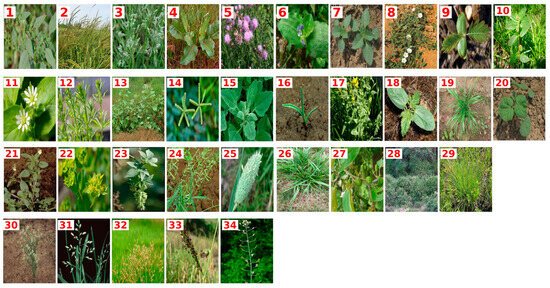
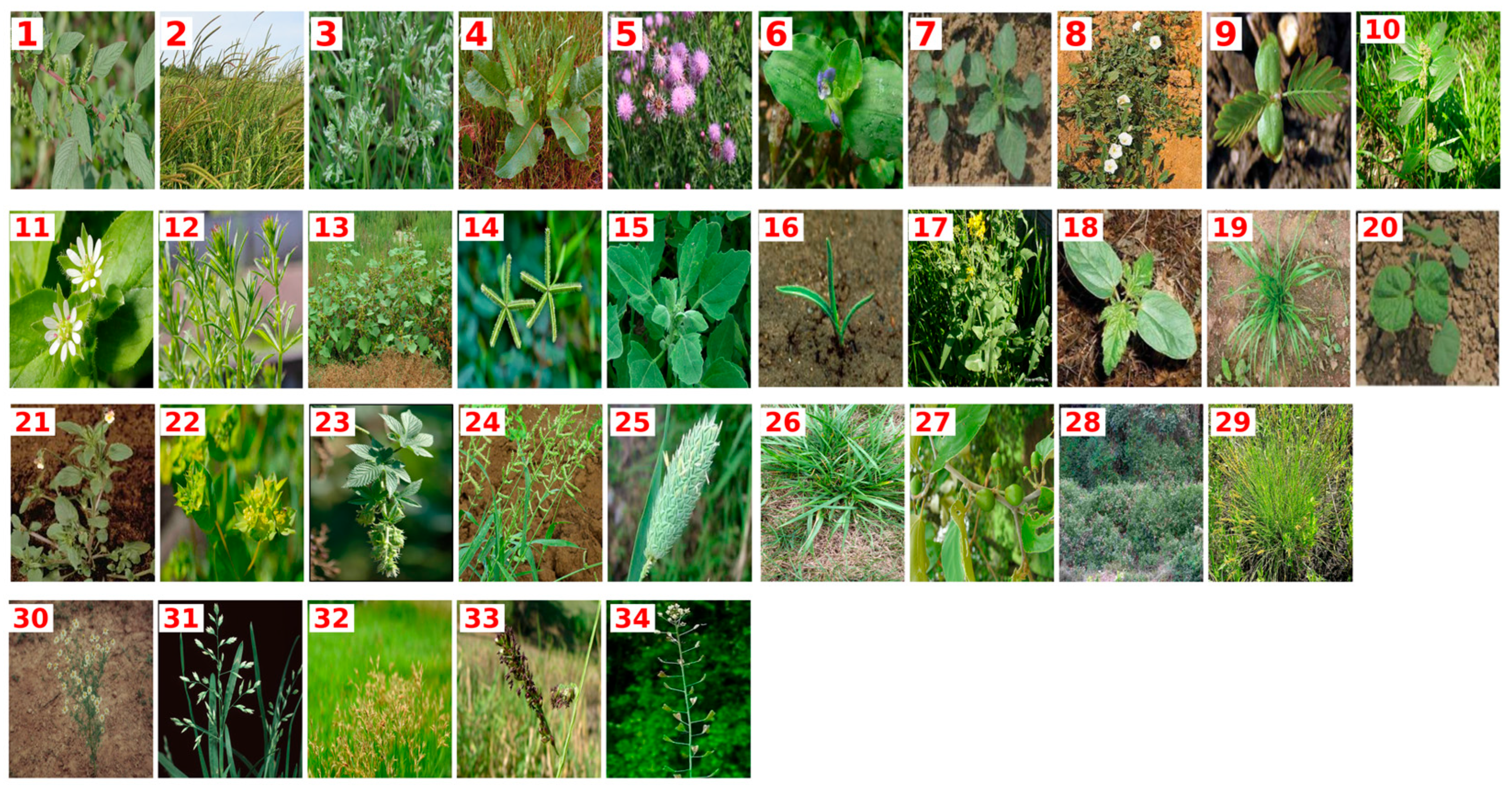
Weeds encompass a vast diversity of species, including annual, biennial, and perennial types. As illustrated in Figure 1, thirty-four representative species are shown, though this does not capture the full range of existing weed diversity [1]. Their presence poses a major threat to crop growth and yield. Traditionally, yield losses have been attributed mainly to competition for essential resources such as water, nutrients, and light [2]. However, studies have demonstrated that weeds can reduce yields even when these resources are not limiting. Without effective management, yield reductions of up to 34% have been reported, resulting in significant economic losses [3]. The extent of damage depends on the timing and intensity of weed infestation, the efficiency of weed control, and the degree of resource supplementation during critical crop growth stages [4]. Moreover, weeds often serve as alternative hosts for pathogens and insect vectors. For example, both field and laboratory studies have shown that certain weed species can harbor tomato yellow leaf curl virus (TYLCV) and sustain its insect vector, the whitefly (Bemisia tabaci) [5]. In some cases, such indirect impacts can exceed the harm caused by the pests themselves [6]. Consequently, effective weed management is a vital component of sustainable agricultural production. In addition to direct competition, weeds can also affect crop performance through allelopathic interactions, altered canopy microclimate, and by acting as reservoirs for pests and diseases, which increases management complexity in precision agriculture [3,4,5,6]. Table 1 list the common names, scientific names or category labels, and broad life-cycle grouping of the 34 representative weed categories shown in Figure 1 [1,7].
Figure 1.
Numbered illustrations of 34 representative weed categories. The category numbers correspond to the common names, scientific names or category labels, and broad life-cycle groups listed in Table 1 [1,7].
Traditional weed management strategies primarily rely on manual, mechanical, or chemical control. Manual weeding is labor-intensive, time-consuming, and inefficient, making it impractical for large-scale agricultural production. Mechanical weeding generally involves inter-row and intra-row operations. Compared with inter-row weeding, intra-row weeding poses a greater challenge because it requires accurate real-time identification of weeds while minimizing damage to crops. Achieving precise weed recognition thus remains a major technical barrier for mechanical weeding [8]. Chemical herbicides, although easy to apply and fast-acting, are often used in a non-selective manner across large areas, leading to excessive pesticide use, environmental contamination, and ecological risks [9]. Consequently, leveraging machine vision for accurate weed identification has become increasingly essential for ensuring the safety of mechanical operations and the precise application of herbicides. Accordingly, perception quality directly constrains downstream actuation safety and efficacy in both targeted spraying and robotic/mechanical intra-row weeding systems [8,9,10,11].
Accurate weed recognition is the cornerstone of precision weed management. Early studies predominantly relied on traditional image processing techniques that extracted low-level features such as color, shape, and texture for classification [12,13,14]. However, these handcrafted feature-based methods exhibited poor robustness under complex field conditions. With the emergence of deep learning, researchers have progressively adopted convolutional neural network (CNN) models—such as the YOLO-family detectors and other CNN-based detection frameworks [15,16]—to automatically learn weed representations in an end-to-end manner. In addition to independent studies on CNN-based weed classification, detection, and segmentation [17]. recent weed-focused studies in turfgrass, sod-farm, and vegetable production systems provide specific field examples of direct deep-learning weed detection and localization [17]. Nevertheless, whether based on manually designed features or data-driven deep models, most existing approaches share a common assumption: weeds themselves are the direct targets of detection (i.e., direct weed detection). In real-world agricultural fields, however, the tremendous diversity, morphological complexity, and strong spatio-temporal variability of weed species make it difficult to construct comprehensive training datasets, leading to high annotation costs and limited model generalization.
To address these challenges, an emerging line of research has begun to move beyond weed-centric recognition toward crop-guided inference. Rather than treating each weed species as an independent recognition target, crop-guided approaches first model crops as relatively structured, agronomically meaningful anchors in the field scene, and then infer weeds from vegetation that violates expected crop locations, spatial arrangements, or crop–weed contextual relationships. In this sense, indirect weed detection is not merely a simplified labeling strategy, but reflects a broader shift from object-centric weed classification to context-aware agricultural scene understanding. By reducing dependence on exhaustive weed annotations and exploiting the higher regularity of crop distribution, this paradigm provides a promising route for improving scalability, cross-field adaptability, and decision-level integration in precision weeding systems. For instance, Jin et al. [18] demonstrated that detecting individual crop plants and regarding non-crop green vegetation as potential weeds could simplify model training and support subsequent site-specific weeding decisions. Compared with existing surveys that mainly summarize vision-based weed detection models, deep learning architectures, or broad agricultural perception pipelines [1,19,20], this review specifically focuses on this paradigm transition. We organize the literature around the evolution from feature-based recognition to deep learning and multimodal perception, and further examine how crop-guided, context-aware, and decision-oriented intelligence may reshape future weed detection and field-deployable weeding systems [10,11].
The central contribution of this review lies in reframing weed detection as a perception-to-decision problem rather than treating it solely as an algorithm-centered recognition task. Within this perspective, weed-centric recognition is analyzed as a direct species- or object-recognition strategy, whereas crop-guided detection is interpreted as an indirect, context-aware inference strategy that can reduce annotation burden while also introducing error-propagation and deployment risks. This framing enables the review to connect algorithm selection, dataset design, edge deployment, and robotic actuation within a unified decision-oriented storyline. As summarized in Table 2, the present synthesis differs from representative prior surveys by explicitly highlighting the crop-guided, decision-oriented gap in current weed-detection research.
Table 2.
Positioning of the present review relative to representative prior surveys.
The distinctions summarized in Table 2 are used to structure the remainder of the review: Section 2 examines weed-centric recognition and its data dependence, Section 3 evaluates crop-guided inference and its error-propagation/generalization risks, Section 4 links perception strategies to edge deployment constraints, and Section 5 translates these findings into decision-aware evaluation criteria.
Review Scope and Literature Selection Strategy
The literature selection strategy focused on English-language studies related to weed detection, crop–weed recognition, crop-guided inference, and field-deployable intelligent weeding systems. Relevant studies were searched in Web of Science, Scopus, Google Scholar, ScienceDirect, SpringerLink, IEEE Xplore, and publisher databases related to agricultural engineering and computer vision. The search covered studies published from approximately 2000 to 2025, with particular emphasis on literature published after 2017, because this period corresponds to the rapid adoption of deep learning, UAV/UGV sensing, public weed datasets, and edge deployment in precision agriculture.
Search terms were combined around four groups: (i) task and application terms, including “weed detection”, “crop-weed recognition”, “precision weeding”, “site-specific weed management”, and “robotic weeding”; (ii) algorithmic terms, including “feature-based vision”, “machine learning”, “deep learning”, “CNN”, “YOLO”, “semantic segmentation”, and “instance segmentation”; (iii) paradigm terms, including “crop-guided detection”, “indirect weed detection”, “crop row”, “crop mask”, and “non-crop vegetation”; and (iv) deployment terms, including “multimodal sensing”, “hyperspectral”, “UAV”, “UGV”, “edge deployment”, “Raspberry Pi”, “Jetson”, “latency”, and “real-time”. Backward and forward citation tracing was also used for seminal and highly relevant papers.
Studies were screened first by title and abstract and then by full text when their relevance was unclear. Papers were prioritized if they met at least one of the following criteria: (i) they proposed or evaluated traditional image features, machine-learning classifiers, deep-learning detectors, or segmentation models for weed or crop-weed recognition; (ii) they introduced public datasets or benchmark scenarios relevant to weed detection; (iii) they used crop structure, crop rows, crop masks, or spatial context to infer weed presence; or (iv) they reported deployment-related information for UAVs, ground robots, edge devices, or robotic actuation. Studies focused exclusively on non-visual weed management, purely agronomic herbicide trials, or sensing tasks without weed/crop discrimination were excluded from the core synthesis.
The final synthesis is based on the 77 cited references and is organized according to their operational roles in precision weeding: direct weed recognition, crop-guided indirect inference, multimodal context sensing, dataset and annotation strategy, and field deployment. This organization highlights system-level questions that are not fully addressed by prior surveys focused mainly on weed-identification models.
2. Weed-Centric Detection Paradigm
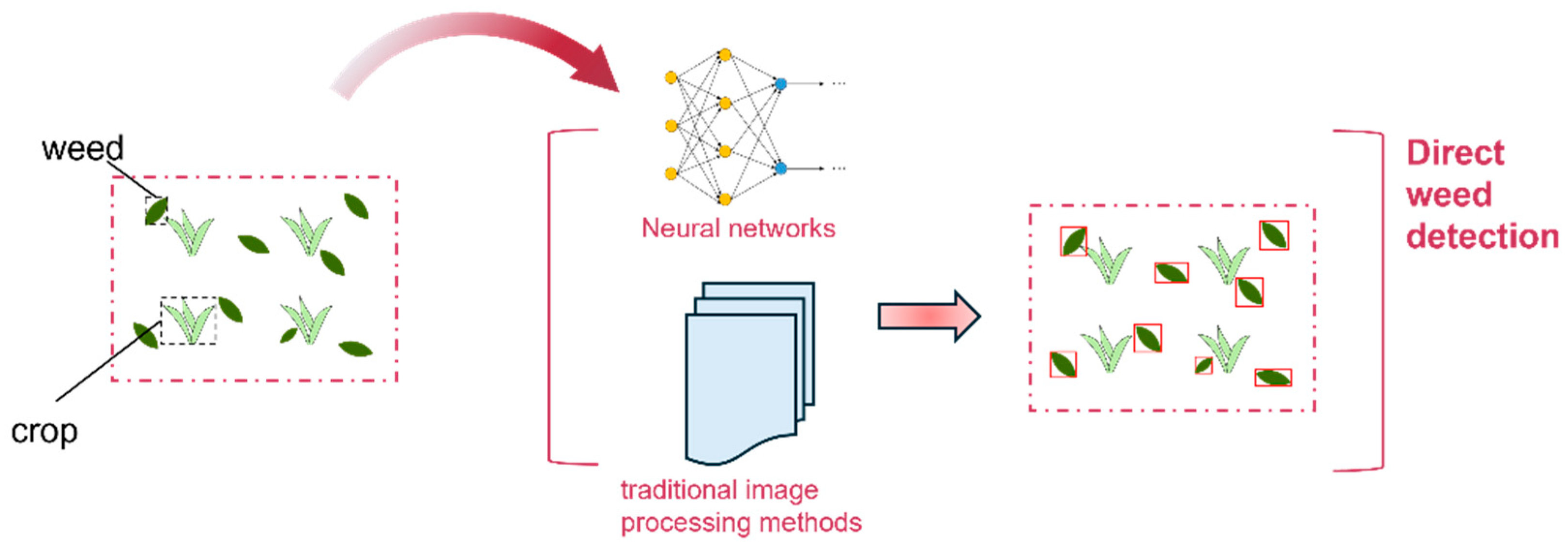
The weed-centric detection paradigm treats weeds as the primary objects of interest and aims to explicitly identify them through visual features or learned representations. These methods typically employ either traditional image processing techniques—such as threshold segmentation and edge detection—or modern deep learning networks, including convolutional neural networks (CNNs) and semantic or instance segmentation models. By extracting discriminative features related to weed color, shape, and texture, these approaches enable precise identification and spatial localization of weeds in the field (as illustrated in Figure 2). The key advantage of this strategy lies in its ability to directly capture the spatial distribution and abundance dynamics of weeds, providing essential data support for precision weeding and the optimization of weed management strategies.
Figure 2.
Overview of weed-centric detection paradigm [23].
2.1. Feature-Based and Traditional Image Processing Methods
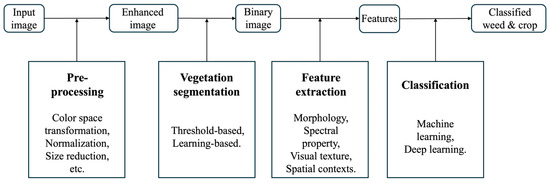
Before the widespread adoption of deep learning, weed detection primarily relied on classical image processing techniques combined with conventional machine learning models. A typical workflow involved image preprocessing, segmentation, feature extraction, and classification (Figure 3) [19]. Researchers generally extracted visual features such as color, shape, texture, and spectral signatures, and employed classifiers including support vector machines (SVMs), artificial neural networks (ANNs), or decision trees to distinguish crops from weeds [10,24,25,26].
Figure 3.
Typical workflow of image processing for weed detection [19].
Color has long been a central focus in early studies due to its intuitive reflection of plant optical properties, low computational cost, and suitability for real-time applications. Early work mainly explored color-space selection and threshold segmentation strategies. For instance, Guo et al. [27] developed a vegetation segmentation approach based on a classification and regression tree (CART) model, which selected features from multiple color spaces to achieve stable wheat (Triticum aestivum L.). segmentation under varying illumination—outperforming the conventional Excess Green (ExG) index. However, color-based approaches alone often fail to differentiate crops and weeds at certain growth stages and are highly sensitive to illumination and background noise. Consequently, later research increasingly integrated shape and texture features or adopted deep learning to enhance robustness and generalization [10,11].
Shape descriptors have also been widely used for weed–crop discrimination because they are less affected by lighting conditions and can serve as a reliable complement when color features become ineffective. Pereira et al. [13] constructed a dataset comprising three common aquatic weed species and compared multiple shape descriptors, including Fourier descriptors, Hu moment invariants, multi-scale fractal dimensions, and tensor scale descriptors. Their method combining Optimum-Path Forest (OPF) with Beam Angle Statistics achieved the highest classification accuracy (96.41%), demonstrating the strong potential of shape features for aquatic weed recognition. Nevertheless, shape descriptors alone are limited by morphological similarities between crops and weeds, as well as complex field backgrounds. Their inability to capture fine color and texture details makes them insufficient for large-scale applications unless integrated with complementary features or deep learning models.
Texture provides a crucial supplement to color and shape cues, capturing subtle differences in leaf surface patterns and canopy structures—particularly valuable in complex or “green-on-green” scenarios. The concept originates from the gray-level co-occurrence matrix (GLCM) proposed by Haralick et al. [28], which quantifies local spatial complexity using measures such as energy, contrast, correlation, and entropy. Subsequent studies have refined and extended texture extraction strategies. For example, Ishak et al. [29] combined Gabor wavelets with gradient field distribution (GFD), achieving a classification accuracy of 93.75%. Similarly, Bakhshipour et al. [30] used wavelet decomposition and GLCM-based multi-scale texture features with principal component analysis and neural networks, reaching 95% accuracy in distinguishing sugar beet (Beta vulgaris ssp. vulgaris L.) from weeds—even under severe leaf overlap. However, texture-based approaches are sensitive to image resolution and acquisition conditions, and they perform poorly when crop and weed textures are similar at early growth stages. Their high computational cost also limits real-time deployment, leading researchers to combine texture with color, shape, or deep-learning-derived features for improved overall performance.
Spectral characteristics enable discrimination between crops and weeds by quantifying reflectance differences across visible, red-edge, and near-infrared wavelengths, representing one of the most physically interpretable approaches in traditional weed detection. For instance, Ahmed et al. [31] integrated color, shape, and moment-invariant features with spectral information and used an SVM classifier with feature selection to achieve 97.3% recognition accuracy without any false crop-to-weed misclassifications. Similarly, Dammer et al. [32] demonstrated the effectiveness of hyperspectral imaging (400–900 nm) for fine-grained species and physiological discrimination, achieving >90% classification accuracy between ragweed (Ambrosia artemisiifolia) and mugwort (Artemisia vulgaris) across growth stages using discriminant analysis on red-edge and NIR regions. Spectral-based approaches thus provide a physically grounded dimension of weed discrimination, applicable from indoor spectroscopy to ground- and UAV-based hyperspectral imaging and even real-time discrete spectral systems.
In summary, each type of handcrafted feature—color, shape, texture, or spectral—offers unique advantages and limitations (Table 3). However, no single feature type can ensure consistently reliable weed identification under varying field conditions. Recent trends therefore emphasize multi-modal feature fusion, integrating complementary visual and spectral cues to enhance the accuracy, robustness, and scalability of automated weed detection systems [10,11].
Table 3.
Comparison and Analysis of Weed Recognition Methods Based on Image Features.
2.2. Deep Learning-Based Weed Detection Methods
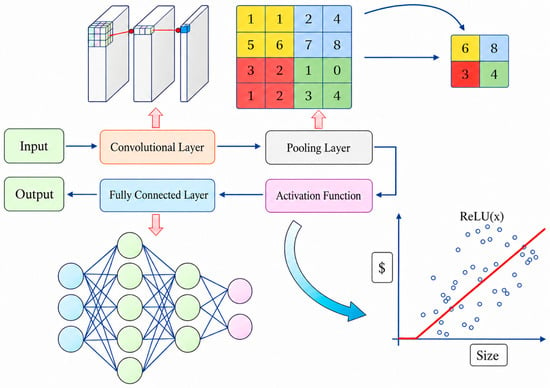
As a representative architecture of deep learning, CNNs have demonstrated outstanding feature learning capabilities in weed detection, surpassing traditional handcrafted-feature models such as SVMs and ANNs in both accuracy and robustness. A typical CNN consists of convolutional, pooling, activation, and fully connected layers (Figure 4) [33]. With the increasing availability of UAV imagery, field robots, and large annotated datasets, CNNs have become a cornerstone technology for automatic crop–weed discrimination in precision agriculture [34,35,36]. Together with independent studies on CNN-based classification, object detection, and segmentation [35,36], these recent field-oriented studies illustrate how deep-learning weed detection has expanded from controlled image classification toward practical turfgrass, vegetable, and precision herbicide-application scenarios.
Figure 4.
Basic components of a convolutional neural network [33]. Blue arrows indicate the direction of information flow. Red upward arrows link the named layers to their corresponding schematic illustrations, and the red line in the lower-right panel represents the ReLU activation function. Colored blocks in the feature-map and pooling panels illustrate example feature values and their pooling results, whereas circles of different colors represent neurons in successive fully connected layers.
Early research primarily focused on image-level classification. For example, dos Santos Ferreira et al. [37] utilized UAV-acquired soybean (Glycine max (L.) Merr.) field images and constructed a dataset of over 15,000 samples using SLIC superpixel segmentation. Their ConvNet models, based on CaffeNet/AlexNet architectures, achieved over 99.5% classification accuracy—significantly outperforming traditional algorithms such as SVM, AdaBoost, and Random Forest. In the study cited above, the authors also developed Pynovisão, a software tool for integrating SLIC-based segmentation and classification, thereby demonstrating the feasibility of CNNs under real-world field conditions. Similarly, Suh et al. [38] compared six pretrained networks (AlexNet, VGG-19, GoogLeNet, ResNet-50/101, and Inception-v3) through transfer learning for differentiating sugar beet from volunteer potato (Solanum tuberosum L.) plants. VGG-19 achieved the highest accuracy (98.7%), confirming the effectiveness of transfer learning under limited training data. In another study, Yu et al. [39] applied GoogLeNet, VGGNet, and DetectNet to turfgrass weed detection, reporting that VGGNet performed best for broadleaf weed identification, while DetectNet achieved an F1 score of 0.99 for annual bluegrass (Poa annua L.), highlighting architecture-specific strengths across weed types.
As CNN development advanced, research expanded from image classification to object detection and semantic segmentation tasks [40,41]. Quan et al. [42] enhanced the Faster R-CNN framework by substituting different pretrained backbones, achieving precision and recall rates above 97.7% and 96.9%, respectively, in maize (Zea mays) seedling detection—outperforming YOLOv2 and demonstrating robustness across varying growth stages and climates. You et al. [43] proposed an improved semantic segmentation network based on ResNet-50, integrating dilated convolutions, attention mechanisms, and multi-scale feature fusion. Their method achieved a mean Intersection over Union (mIoU) of 89.01% on the Bonn and Stuttgart datasets, exceeding FCN, UNet, and SegNet baselines. Similarly, Asad and Bais [44] combined maximum-likelihood classification with CNN-based segmentation for pixel-level detection of weeds in canola (Brassica napus L.) fields, where ResNet-50 + SegNet achieved an mIoU of 0.8288.
Meanwhile, researchers have also explored data-efficient and lightweight CNN architectures. Peteinatos et al. [45] compared VGG16, ResNet-50, and Xception across large-scale datasets, finding that Xception yielded the highest accuracy (98%). Olsen et al. [46] introduced DeepWeeds, the first publicly available multi-class weed dataset for pasture environments, containing 17,509 images across eight weed species. Using ResNet-50, they achieved a classification accuracy of 95.7%, filling a critical data gap in this domain. To further enable real-time deployment on low-cost agricultural robots, Chechliński et al. [47] developed a lightweight CNN model using knowledge distillation and network compression, achieving over 10 FPS inference speed on a Raspberry Pi with a crop misclassification rate as low as 0.1–0.9%, proving the deployability of deep learning models on embedded hardware platforms [39,48].
Overall, CNN-based research in weed detection has evolved from image classification to object detection and segmentation, from high-accuracy models to lightweight real-time implementations, and from small experimental datasets to large-scale field applications. Under controlled or UAV-based conditions, CNNs have achieved classification and detection accuracies exceeding 95%, substantially outperforming traditional approaches. Even in complex field environments, improved segmentation networks and lightweight architectures have demonstrated remarkable robustness and deployability. As a pioneering deep learning technique in agricultural vision, CNNs have not only established the foundation for direct weed detection but also paved the way for the development of subsequent models such as FCN, YOLO, and self-supervised learning frameworks in intelligent weeding systems.
In addition, multimodal and hybrid pipelines deserve explicit attention: hyperspectral/multispectral cues and RGB-based deep models are often complementary, and depth or geometric priors can help separate crop-weed overlap in complex canopies [26,32,49,50,51,52,53]. In practice, a lightweight deep detector can be combined with traditional color/shape constraints or row-structure priors to improve robustness under variable illumination while controlling computation [12,14,27,54].
2.3. Limitations of Weed-Centric Detection Methods
Despite their significant progress, weed-centric detection approaches—whether based on traditional image processing or deep learning—face several inherent limitations. Traditional methods rely heavily on low-level visual cues such as color, shape, and texture, which are highly sensitive to illumination changes, background complexity, and morphological similarities between crops and weeds. As a result, these methods often exhibit limited detection accuracy and poor generalization beyond controlled conditions.
Deep learning–based approaches, while offering superior feature representation and recognition capabilities in complex field environments, are constrained by their dependence on large volumes of high-quality annotated data. Their training and inference processes demand substantial computational resources, and model performance tends to degrade when transferred across different regions, crop types, or growing seasons [20]. This bottleneck is particularly severe for pixel-level annotation tasks, motivating semi-supervised learning, knowledge distillation, and annotation-efficient workflows in recent weed studies [17].
Furthermore, although the number and diversity of publicly available weed datasets have steadily increased, they still fail to comprehensively represent the vast variability of weed species and field conditions (Table 4). Weed characteristics vary markedly across geographic regions, growth stages, and seasonal cycles, making data collected from one location difficult to generalize to others. Consequently, direct detection methods often suffer from domain dependency, limited scalability, and reduced adaptability to heterogeneous agricultural ecosystems. Therefore, dataset descriptions should be interpreted not only by image count but also by crop scene, sensing platform (ground/UAV), annotation granularity (classification/detection/segmentation), and acquisition domain [39,48,49,50,51,55,56,57,58,59].
These constraints highlight a fundamental methodological bottleneck in weed-centric detection paradigms, thereby motivating a shift toward crop-guided weed detection frameworks, which aim to infer weed presence by first identifying crop regions—offering a more robust and transferable solution for real-world agricultural applications.
For readability, the datasets in Table 4 can be grouped into: (i) ground-image datasets for classification/detection [39,48,55,56,59], (ii) UAV or mapping-oriented datasets and studies [34,37,49,60], and (iii) segmentation/robot-oriented datasets emphasizing pixel-level annotation and field deployment [50,51,54,56,57].
Table 4.
Representative public datasets for crop–weed recognition and weed detection, grouped by application scenario, sensing platform, and annotation purpose.
Beyond image number and class labels, public weed datasets should be evaluated according to domain diversity, annotation granularity, and benchmark usability. A dataset that contains many images but only one crop, one camera height, one growth stage, or one illumination regime may still provide limited evidence for field generalization. For crop-guided detection, dataset value depends particularly on whether crop masks, crop rows, plant centers, non-crop vegetation regions, growth stages, camera metadata, and train/test domain splits are available, because these factors determine whether crop recognition errors and downstream weed-inference errors can be separately quantified.
A more rigorous benchmark should therefore report not only image size and species categories, but also: (i) acquisition domain, including region, season, soil background, and sensing platform; (ii) annotation level, including image-level labels, bounding boxes, semantic masks, instance masks, crop rows, or weed-presence maps; (iii) domain-adaptability tests, including cross-field, cross-season, cross-camera, and cross-crop evaluation; and (iv) failure-case documentation, such as crop occlusion, weed emergence inside crop boxes, dense overlap, and mixed-species weed patches. These criteria are essential for comparing weed-centric and crop-guided baselines fairly.
3. Crop-Guided Weed Detection Paradigm
To overcome the limitations of weed-centric detection in terms of generalization and data dependency, recent research has begun to explore crop-guided strategies for weed inference. In contrast to explicitly recognizing diverse weed species, this paradigm models crops as structured and agronomically meaningful elements in the field, and infers weeds as vegetation that deviates from expected crop locations or spatial arrangements. Jin et al. [18] first proposed a crop-guided indirect weed detection framework. Instead of explicitly identifying weed species, their method detects individual vegetable crops and classifies all remaining green vegetation as weeds. This conceptual shift fundamentally departs from conventional weed-by-class recognition and significantly reduces model design complexity and annotation costs, establishing a methodological foundation for subsequent research in this field.
Building upon this idea, researchers have developed a variety of crop-guided weed detection frameworks. For instance, Kong et al. [54] introduced a lightweight convolutional network, LCSNet, which segments cabbage (Brassica oleracea L. ssp. pekinensis) plants and applies mask expansion combined with HSV thresholding to identify residual vegetation as weeds. The method maintains high segmentation accuracy while substantially reducing computational cost, making it suitable for deployment on resource-limited robotic platforms. Chen et al. [62] further proposed TSP-YOLO, which integrates Swin-conv modules, ParNet attention, and tracking algorithms into YOLOv8n to achieve real-time monitoring and counting of cabbage seedlings in UAV video streams. The framework attained a counting accuracy of 98%, demonstrating the potential of crop-guided detection for dynamic monitoring applications.
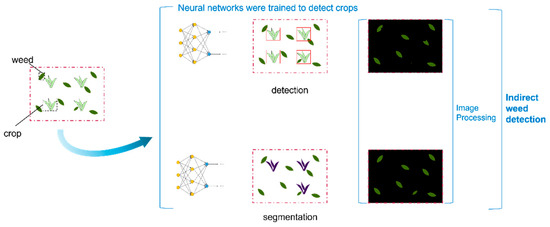
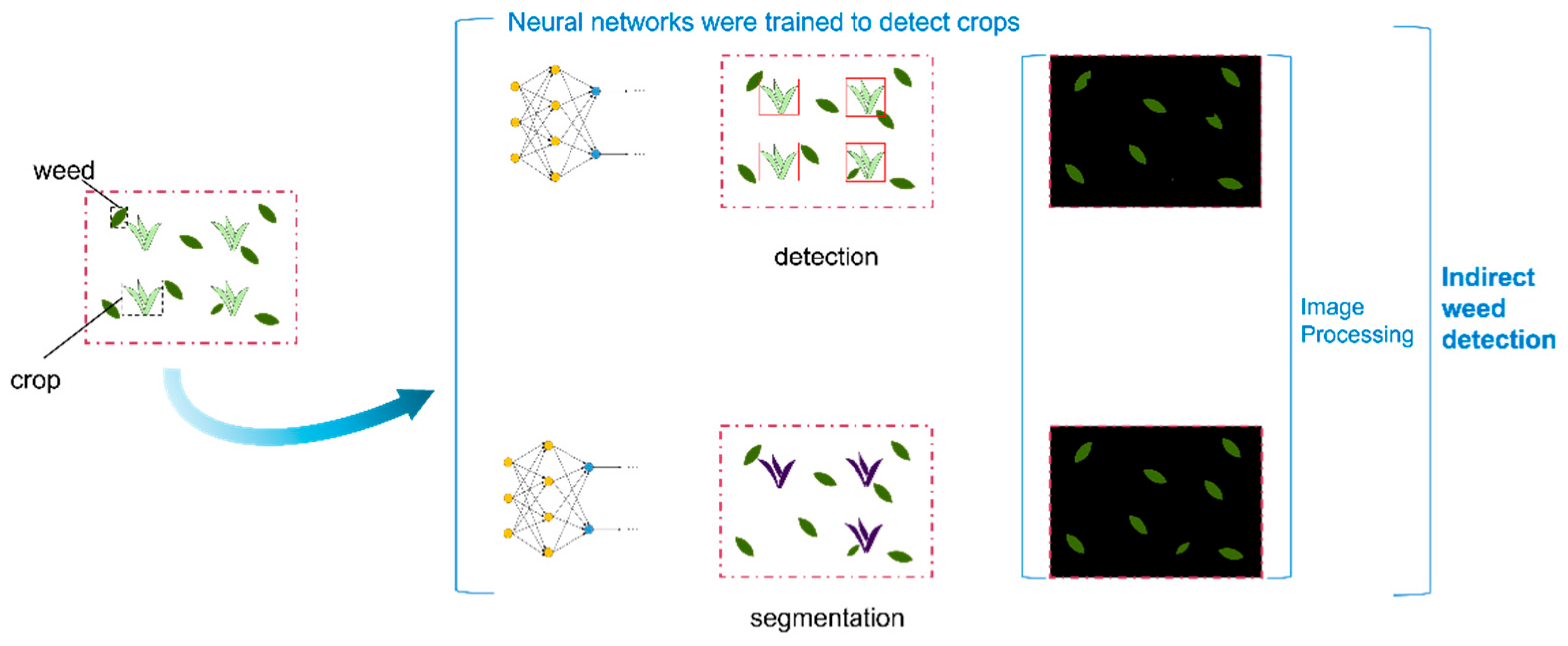
The core principle of crop-guided weed detection lies in shifting the detection focus from weeds to crops. By accurately segmenting or detecting crop regions, non-crop areas can be inferred as weed regions (Figure 5). This approach effectively circumvents the need to distinguish among diverse weed species, thereby enhancing adaptability and generalization—particularly in environments with high weed diversity and costly manual labeling. However, the performance of this approach depends heavily on the accuracy of crop detection; any errors in crop recognition may propagate and compromise the accuracy of weed inference.
Figure 5.
Overview of crop-guided weed detection methods [19].
Compared with traditional weed-centric detection strategies, the crop-guided approach offers several advantages (Table 5). First, by prioritizing crop segmentation or detection, it minimizes misclassification caused by overlapping spectral and morphological characteristics between crops and weeds. Second, by leveraging spatial priors of crop distribution, it improves robustness under complex “green-on-green” conditions, where weed-centric methods often struggle. Third, it reduces reliance on large-scale, multi-class weed annotation datasets, thereby lowering data preparation and model maintenance costs. Overall, crop-guided weed detection represents a promising shift toward more scalable, robust, and resilient weed management systems in precision agriculture [10].
Table 5.
Representative Recent Studies on Crop-guided Weed Detection Methods.
To improve structural clarity, the reviewed studies can be interpreted as three layers: crop-guided weed inference (e.g., [54]), crop detection/segmentation plus operational mapping or path planning ([37,60,64]), and system-level robotic deployment/prototyping ([8,65]).
At the same time, the current crop-guided weed detection literature remains crop-skewed: many examples focus on vegetables (especially cabbage/row crops), while evidence for globally dominant systems such as wheat-, rice-, and soybean-based production, as well as intercropping or highly mixed canopies, is still comparatively limited in the reviewed corpus [18,23,37,51,60,62,64], which is consistent with crop-coverage imbalances highlighted in broader weed-recognition reviews [21,22] and cross-crop generalization studies [66].
Therefore, generalization claims for crop-guided weed detection should be bounded by planting geometry and ecological context. In regular row-crop or transplanted vegetable systems, crop location, crop spacing, and crop-row priors provide strong anchors for indirect weed inference. In non-row crops, broadcast-seeded crops, mixed cropping systems, relay intercropping, or dense canopies, these priors become weaker or ambiguous; the system may require temporal tracking, multi-view perception, crop phenology priors, or explicit uncertainty estimation before non-crop vegetation can be treated as weeds. Tropical and subtropical field conditions can further amplify this difficulty through rapid weed growth, frequent rainfall, soil splash on crop stems and leaves, strong solar-angle variation, and dense background vegetation.
The “green-on-green” challenge should also be interpreted as a growth-stage-dependent spectral, textural, and structural ambiguity rather than a single visual problem. At early seedling stages, crops and weeds may have similar leaf color, size, and texture; at middle stages, leaf overlap and canopy closure can obscure plant boundaries; at later stages, senescence, nutrient stress, water stress, or pest injury may alter crop color and make vegetation-index thresholds unstable. These factors mean that crop-guided pipelines should explicitly evaluate crop-mask reliability, boundary uncertainty, and the probability that residual green pixels are true weeds rather than crop leaves, stems, shadows, or imaging artifacts.
Although crop-guided weed detection approaches have demonstrated considerable potential for reducing annotation costs and improving adaptability, several intrinsic challenges still limit their broader deployment in real-world agricultural systems. Most existing methods rely heavily on accurate crop segmentation or crop-row extraction, making weed inference highly sensitive to segmentation errors caused by occlusion, illumination variation, or growth-stage differences. As a result, inaccuracies in crop recognition can propagate through the inference pipeline and significantly compromise overall system robustness.
In addition, many crop-guided frameworks depend on computationally intensive segmentation or detection networks, which restrict their applicability in real-time scenarios, particularly on resource-constrained platforms such as UAVs and field robots. The dynamic and heterogeneous nature of agricultural environments further complicates this issue, as models trained under specific field conditions often struggle to generalize across different crop species, geographic regions, and seasonal conditions. Consequently, current crop-guided detection systems still face a persistent trade-off among accuracy, computational efficiency, and cross-domain generalization.
Future research should therefore focus on lightweight, adaptive, and domain-generalizable crop-guided frameworks to improve robustness and scalability under heterogeneous field conditions.
4. Deployment Landscape and Edge-Platform Considerations
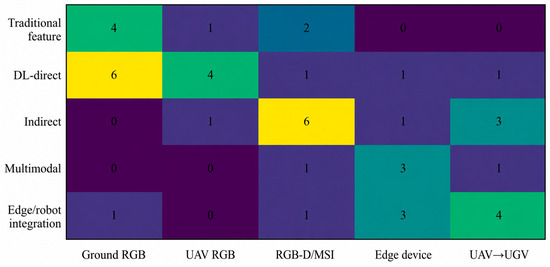
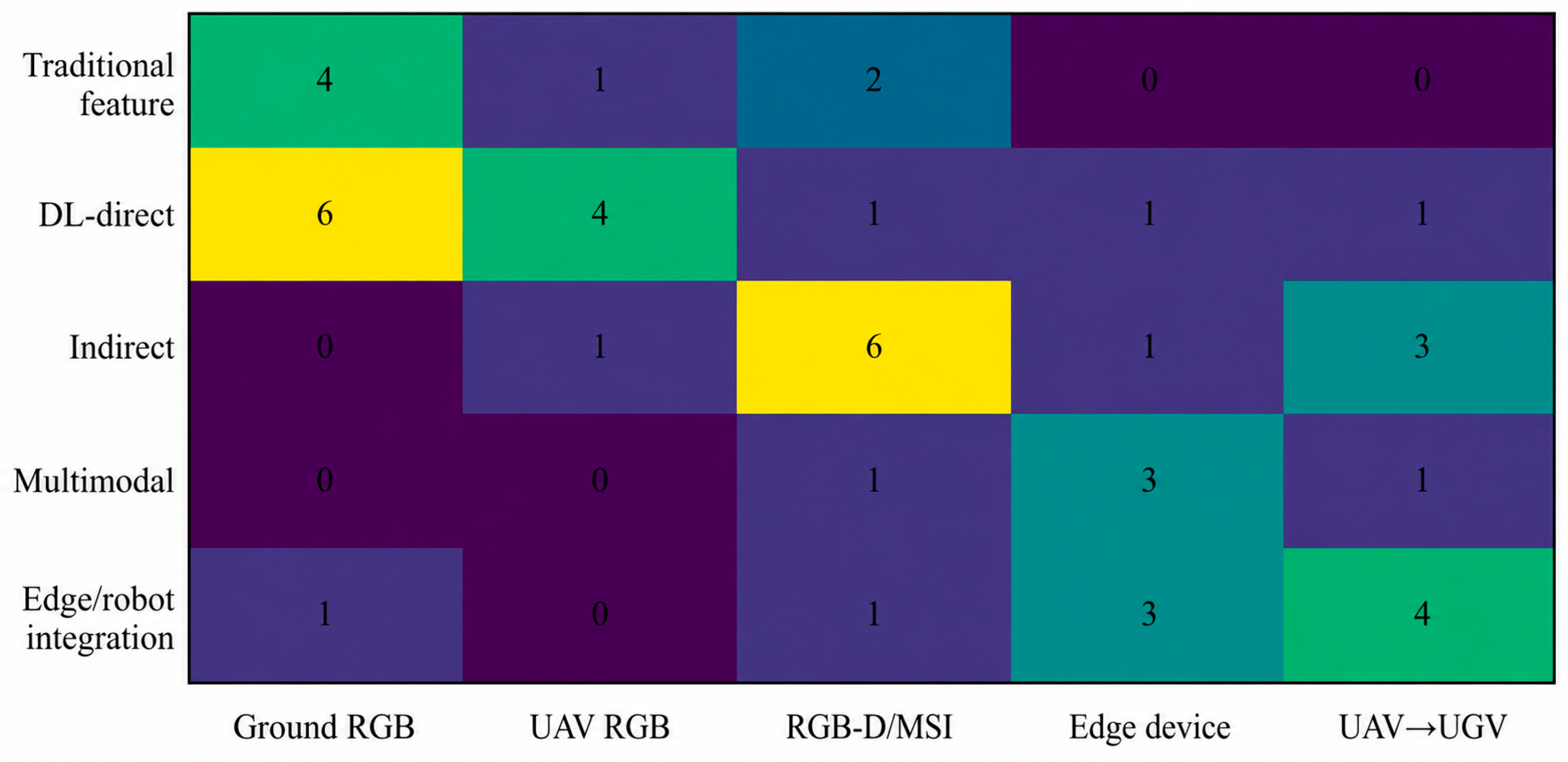
Although weed detection studies have achieved substantial progress in algorithmic accuracy, their deployment characteristics remain unevenly reported. As summarized in Figure 6, the representative studies reviewed in this paper are still largely concentrated in RGB-based perception workflows and row-crop scenarios, whereas multimodal sensing, robotic deployment, and edge-oriented evaluations remain comparatively underrepresented. This suggests that current research is still dominated by image-level benchmarking, while field-oriented validation under real deployment constraints has received relatively less attention.
Figure 6.
Heatmap summary of representative studies by methodological emphasis and deployment context, compiled from the representative studies discussed in Table 4. Rows represent traditional feature-based methods, direct deep-learning methods (DL-direct), indirect crop-guided methods, multimodal methods, and edge/robot integration. Columns represent ground RGB, UAV RGB, RGB-D/MSI, edge-device deployment, and UAV–UGV integration. The number in each cell indicates the number of representative studies in the corresponding category. Cell colors encode the same counts, ranging from dark purple for lower counts to yellow for higher counts. Author-generated.
For practical intelligent weeding systems, perception models must operate under constraints imposed by sensing platforms, computing hardware, inference latency, energy consumption, and robotic actuation requirements. Therefore, deployment-oriented studies should report not only conventional metrics such as precision, recall, mAP, or mIoU, but also hardware-dependent indicators, including image resolution, sustained FPS, end-to-end latency, power consumption, precision mode, and edge-device configuration. Such information is essential for evaluating whether a model can support real-time weed perception on UAVs, unmanned ground vehicles, or robotic weeding platforms.
Table 5 provides a minimal reporting-oriented comparison of common edge-platform classes for field weed perception. Raspberry Pi-class CPU platforms are generally suitable for lightweight classification, region-of-interest filtering, or control logic, whereas embedded GPU platforms such as Jetson Nano-, Xavier-, or Orin-class devices provide stronger support for real-time detection, segmentation, and robot-decision integration. Rather than serving as a fixed hardware recommendation, this comparison highlights the need for reproducible reporting of latency–accuracy–energy trade-offs in field-deployable weed detection studies.
In addition to hardware class, field disturbances should be treated as deployment variables rather than incidental noise. For ground robots, vibration-induced motion blur, rolling-shutter distortion, changing camera-to-canopy distance, dust, soil splash, dew, and leaf occlusion can distort crop masks and shift weed coordinates before actuation. For UAV platforms, altitude variation, motion blur, wind-induced crop movement, shadow, and changing solar angle can alter both spectral and spatial cues. These disturbances are especially consequential for crop-guided pipelines because a small crop-segmentation error can be amplified into false weed inference, missed weeds near crop stems, or unsafe actuation close to crop plants.
Accordingly, deployment-oriented reporting should include the sensing platform, image resolution after preprocessing, camera height and speed, illumination condition, edge device, precision mode, model size, sustained FPS, per-stage latency, end-to-end perception-to-actuation delay, and any safety fallback rule. When crop-guided and weed-centric methods are compared, latency and accuracy should be evaluated under the same image resolution, hardware, and field disturbance conditions; otherwise, reported accuracy alone may overstate practical feasibility (Table 6).
Table 6.
Minimal edge-platform reporting comparison for field weed perception (added to address deployment re-producibility).
5. Discussion
Deep learning has substantially advanced automated weed recognition, yet weed detection systems still face structural challenges at the levels of data, algorithms, and field deployment. Weed-centric detection methods, which explicitly identify weeds as target objects or species, are essential when taxonomic information is required. However, their scalability is often constrained by the high diversity of weed species, large intra-class morphological variation, growth-stage-dependent phenotypes, regional differences in weed communities, and the high cost of constructing exhaustive, finely annotated weed datasets. In contrast, crop-guided weed detection reframes the perception task around crops, which are usually more regular in spatial distribution and often involve a limited number of target classes within a field. By detecting crop plants, crop rows, or crop regions first and then inferring non-crop vegetation as potential weeds, crop-guided strategies can reduce annotation costs and improve adaptability under complex “green-on-green” field conditions. Nevertheless, this paradigm also introduces new challenges. Its performance depends heavily on the accuracy of crop segmentation or crop-row extraction, and errors in crop recognition may propagate into subsequent weed inference. Moreover, segmentation-based crop-guided frameworks may still involve considerable computational overhead, limiting their real-time deployment on resource-constrained platforms such as unmanned aerial vehicles (UAVs) and field robots. Therefore, current weed detection systems face a persistent trade-off among accuracy, efficiency, and generalization.
A key implication is that crop-guided weed detection should not be considered a universal replacement for weed-centric recognition. Instead, the choice between crop-guided and weed-centric strategies should be determined by the operational requirements of the weeding task. For mechanical weeding, laser weeding, or other species-agnostic actuation scenarios, the system often only needs to determine whether a plant is a crop or a weed and where the weed is located. In such cases, crop-guided weed detection is particularly suitable because it can provide weed-presence maps or treatment zones without requiring detailed species-level labels. By contrast, chemical weed control may require species-level information when herbicide selectivity, resistance management, or regulatory constraints are involved. In these cases, crop-guided inference alone may be insufficient, and weed-centric or species-level recognition remains necessary. Therefore, the practical value of crop-guided weed detection lies not in replacing species identification, but in providing a scalable perception foundation when species identity is unavailable, unnecessary, or too costly to annotate.
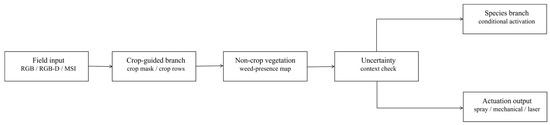
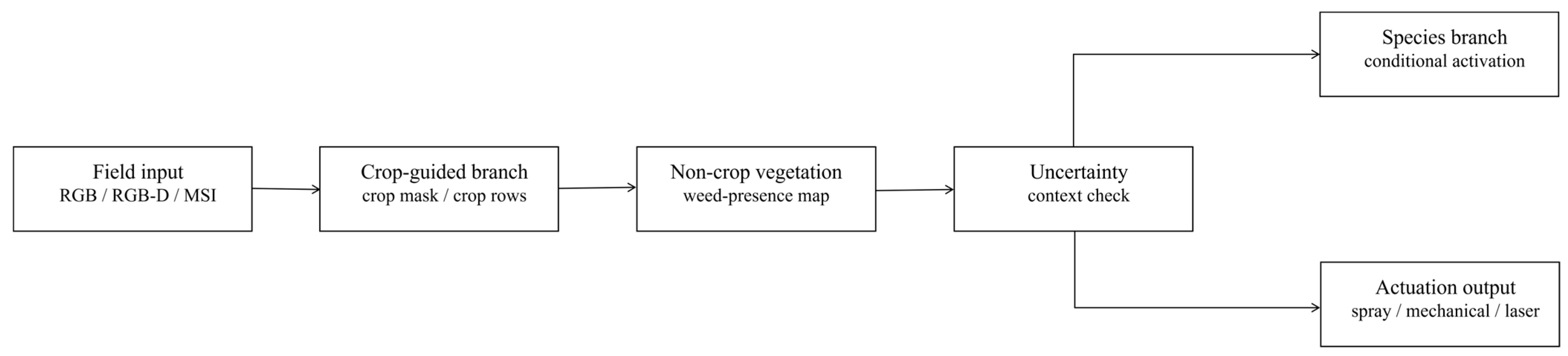
Based on this perspective, we define the decision-aware hybrid framework as a synthesis-level design principle rather than a newly validated algorithm. The framework combines the strengths of crop-guided and weed-centric paradigms. Crop-guided weed detection serves as the base layer for continuous, low-latency field perception, generating crop masks, weed-presence maps, candidate treatment regions, or prescription zones. A species-level recognition branch is activated only when the downstream decision requires taxonomic information, such as herbicide selection, resistance monitoring, or high-risk weed management. Conversely, when the actuation strategy is species-agnostic, such as mechanical removal or laser targeting, the system can directly operate on the crop-guided weed map, thereby reducing computational cost and response delay. This task-conditioned perception strategy aligns model complexity with agronomic need, but it should be interpreted as a hypothesis and design guideline that requires quantitative validation in future field systems.
From an implementation perspective, the decision-aware hybrid framework can be realized through mode-switching mechanisms. A crop-guided branch may run continuously to support real-time treatment zoning, while a species-level branch is triggered only under specific conditions, such as low crop-segmentation confidence, dense crop–weed overlap, uncertain weed boundaries, or the need for herbicide-specific decision-making. Such uncertainty-driven switching can allocate computational resources to the situations where additional recognition is agronomically meaningful, rather than applying costly species classification to every image or plant instance. This is particularly important for field robots and UAV platforms, where inference latency, energy consumption, and hardware capacity directly constrain practical deployment.
Technically, this pipeline can be implemented as a two-branch system (Figure 7). The crop-guided branch first estimates crop masks, crop rows, or crop centers and then infers non-crop vegetation as candidate weeds. An uncertainty module evaluates crop-mask confidence, vegetation-boundary ambiguity, spatial consistency with row priors, and the downstream decision requirement. If confidence is high and the actuator is species-agnostic, the system directly generates treatment zones for mechanical, laser, or generic spraying actions. If confidence is low or herbicide selectivity requires taxonomic information, the species branch performs conditional recognition only for candidate regions. This design keeps the low-latency advantage of indirect detection while preserving species-level information when agronomically necessary.
Figure 7.
Decision-aware hybrid weed detection pipeline. Arrows indicate the flow of information and decision-making. The horizontal arrows represent the main crop-guided inference pathway from field input to uncertainty/context checking. From the uncertainty/context-check stage, the upper branch indicates conditional activation of species-level recognition, whereas the lower branch indicates the actuation output pathway, including spraying, mechanical weeding, or laser weeding. Crop-guided perception operates as a continuous base layer, whereas species-level recognition is activated only under uncertainty, dense overlap, herbicide-specific decision requirements, or high-risk weed scenarios.
To support this framework, future model development should focus on three aspects. First, lightweight and efficient architectures are needed to enable real-time operation on edge devices. Techniques such as pruning, quantization, knowledge distillation, early-exit networks, and multi-resolution inference may help reduce computational burden while maintaining acceptable detection performance. Second, generalization remains a central challenge. Self-supervised or weakly supervised pretraining on large-scale unlabeled field images, domain adaptation, test-time adaptation, and open-set recognition may improve robustness across regions, crop species, seasons, and imaging conditions. Third, uncertainty-aware inference should be incorporated into both crop-guided and species-level branches. Since crop recognition errors may propagate into weed inference and actuation, confidence calibration and uncertainty propagation are necessary for determining when to treat, when to abstain, and when to activate additional recognition modules.
Practical deployment also requires closer integration between weed perception and robotic weeding systems. For UAV-based monitoring, crop-guided detection can rapidly generate crop distribution maps, weed-risk layers, and candidate prescription maps for variable-rate spraying or targeted ground intervention. For unmanned ground vehicles (UGVs), perception outputs must be translated into safe and timely actuation decisions, including route planning, tool positioning, treatment-zone selection, and collision avoidance around crop plants. In this context, crop-guided weed detection provides a useful bridge between visual perception and robotic execution because it naturally encodes crop location, crop-row geometry, and non-crop vegetation distribution. However, field deployment requires more than image-level accuracy. The perception module must operate within the timing constraints of the robot, remain robust under vibration, motion blur, occlusion, changing illumination, and canopy overlap, and provide outputs that are directly usable by spraying, cutting, laser, or mechanical end-effectors.
This deployment-oriented view also highlights the need to evaluate weed detection systems beyond conventional computer-vision metrics. Although mAP, precision, recall, and mIoU remain useful for algorithm comparison, they are insufficient to determine whether a system is suitable for field operation. Future studies should report task-level and system-level indicators, including treatment accuracy, crop injury rate, missed-weed rate, herbicide or energy savings, processing latency, end-to-end response time, edge-device power consumption, and robustness across regions and seasons. For robotic weeding systems, additional indicators such as actuation success rate, path efficiency, safety margin around crops, and operator intervention frequency should also be considered. Such metrics would better reflect whether a detection model can support reliable and sustainable weed management under real agricultural conditions.
Accordingly, Table 7 is used to translate the preceding deployment-oriented discussion into a concrete evaluation matrix, linking crop-guided failure modes, recommended quantitative indicators, and their relevance to field operation.
Table 7.
Recommended evaluation matrix for crop-guided and decision-aware weed detection systems.
Consistent with the evaluation dimensions summarized in Table 6, dataset construction and benchmarking should also be aligned with this hybrid and deployment-oriented perspective. Existing datasets differ substantially in crop type, weed species, platform, annotation granularity, image resolution, and acquisition environment, making direct comparison across studies difficult. Future datasets should include not only weed species labels where possible, but also crop masks, crop-row structures, weed-presence maps, growth-stage information, and field metadata. For crop-guided detection, annotations should support evaluation of both crop recognition accuracy and downstream weed inference quality. For weed-centric recognition, datasets should better represent long-tail weed species and region-specific weed communities. Semi-supervised learning, active learning, promptable segmentation, and synthetic data generation may help reduce annotation burden, especially when fine-grained species labels are difficult to obtain.
Actionable strategies are therefore needed to reduce the data bottleneck. Synthetic data generation and domain randomization can enrich rare crop-weed configurations, while cross-domain adaptation and test-time adaptation can reduce performance loss across regions, seasons, cameras, and crop stages. Semi-supervised learning, pseudo-labeling, active learning, weak supervision, and foundation-model-assisted annotation can also reduce the cost of dense pixel-level masks. In practical workflows, a feasible approach is to combine automatic vegetation pre-segmentation, crop-row or crop-mask priors, model-generated pseudo-labels, and human-in-the-loop correction so that annotation effort is concentrated on ambiguous crop–weed overlap, rare species, and failure cases rather than on every image uniformly.
In summary, crop-guided weed detection offers a scalable and practical route for robust weed localization, especially when weed annotations are limited or when species identity is not required for actuation. Weed-centric recognition, however, remains indispensable when species-level information is necessary for herbicide selection, resistance diagnosis, or ecological management. Rather than treating these two paradigms as mutually exclusive, future intelligent weeding systems should integrate them within a decision-aware hybrid framework. By using crop-guided perception as a base layer, activating species-level recognition only when agronomically necessary, and coupling perception outputs with robotic actuation, edge computing, uncertainty estimation, and field-level evaluation, weed detection research can move from algorithm-centered benchmarking toward reliable, deployable, and sustainable precision weeding systems.
6. Conclusions
This review summarized the evolution of weed detection from handcrafted visual features and classical machine learning to deep learning, multimodal sensing, crop-guided inference, and deployment-oriented intelligent weeding systems. The central conclusion is that weed detection should no longer be viewed only as a species-recognition problem. For many robotic, mechanical, laser, or treatment-zone applications, crop structure and spatial context can provide a scalable basis for weed localization when weed annotations are scarce or species identity is not required. However, crop-guided detection is not a universal substitute for weed-centric recognition; species-level information remains essential for selective herbicide use, resistance management, and ecological monitoring. Future work should therefore develop decision-aware hybrid architectures that combine continuous crop-guided perception with conditional species recognition, uncertainty-aware mode switching, multimodal context fusion, and standardized edge-platform evaluation. Such systems should be validated across major crops and complex planting patterns, report latency–accuracy–energy trade-offs, and connect perception metrics with practical outcomes such as crop safety, weed control efficacy, herbicide savings, and robotic actuation reliability. In particular, future studies should avoid presenting crop-guided detection as a universal solution and should instead report the crop type, planting geometry, disturbance condition, failure cases, and decision criteria under which the paradigm is technically and agronomically justified.
Author Contributions
Conceptualization, Y.D., W.Z., S.D. and M.L.; methodology, S.D. and Y.L.; validation, Y.D., X.L. and Y.L.; formal analysis, F.G., M.Z. and B.W.; investigation, S.D., K.H. and X.L.; resources, M.Z. and X.J.; data curation, W.Z., Z.L. and B.W.; writing—original draft preparation, Y.D., W.Z. and M.L.; writing—review and editing, S.D. and X.J.; visualization, K.H., F.G. and Z.L.; supervision, X.J.; project administration, Y.D.; funding acquisition, X.J. All authors have read and agreed to the published version of the manuscript.
Funding
This work was supported by the Weifang Science and Technology Development Plan Project (Grant No. 2024ZJ1097).
Data Availability Statement
No new data were created or analyzed in this study. Data sharing is not applicable to this article.
Conflicts of Interest
The authors declare no conflicts of interest.
References
- Murad, N.Y.; Mahmood, T.; Forkan, A.R.; Morshed, A.; Jayaraman, P.P.; Siddiqui, M.S. Weed Detection Using Deep Learning: A Systematic Literature Review. Sensors 2023, 23, 3670. [Google Scholar] [CrossRef] [Scilit] [PubMed]
- Reddy, C. A study on crop weed competition in field crops. J. Pharmacogn. Phytochem. 2018, 7, 3235–3240. [Google Scholar] [CrossRef] [Scilit]
- Flessner, M.L.; Burke, I.C.; Dille, J.A.; Everman, W.J.; VanGessel, M.J.; Tidemann, B.; Manuchehri, M.R.; Soltani, N.; Sikkema, P.H. Potential wheat yield loss due to weeds in the United States and Canada. Weed Technol. 2021, 35, 916–923. [Google Scholar] [CrossRef] [Scilit]
- Horvath, D.P.; Clay, S.A.; Bruggeman, S.A.; Anderson, J.V.; Chao, W.S.; Yeater, K. Varying Weed Densities Alter the Corn Transcriptome, Highlighting a Core Set of Weed-Induced Genes and Processes with Potential for Manipulating Weed Tolerance. Plant Genome 2019, 12, 190035. [Google Scholar] [CrossRef] [Scilit] [PubMed]
- Tabassum, M.; Vo, T.T.B.; Bupi, N.; Qureshi, M.A.; Im, H.-J.; Jahan, S.H.; Lee, K.-Y.; Kim, C.-S.; Lee, S. Eco-pathological validation of weed preferences as reservoirs for tomato yellow leaf curl virus and whitefly. Plant Dis. 2026, 110, 1449–1460. [Google Scholar] [CrossRef] [Scilit] [PubMed]
- Oerke, E.C. Crop losses to pests. J. Agric. Sci. 2006, 144, 31–43. [Google Scholar] [CrossRef] [Scilit]
- Cabi. Weed Archives, Improving Lives by Solving Problems in Agriculture and the Environment. Available online: https://www.cabi.org/tag/weed/ (accessed on 3 June 2026).
- Quan, L.; Jiang, W.; Li, H.; Li, H.; Wang, Q.; Chen, L. Intelligent intra-row robotic weeding system combining deep learning technology with a targeted weeding mode. Biosyst. Eng. 2022, 216, 13–31. [Google Scholar] [CrossRef] [Scilit]
- Vieira, K.C.; Silva, C.T.; da Silva, M.M.; da Costa, A.S.V. Potencial de contaminação ambiental dos herbicidas utilizados nas culturas do milho, soja e cana de açúcar. Res. Soc. Dev. 2020, 9, e417997442. [Google Scholar] [CrossRef] [Scilit]
- Christensen, S.; SØGaard, H.T.; Kudsk, P.; NØRremark, M.; Lund, I.; Nadimi, E.S.; JØRgensen, R. Site-specific weed control technologies. Weed Res. 2009, 49, 233–241. [Google Scholar] [CrossRef] [Scilit]
- LÓPez-Granados, F. Weed detection for site-specific weed management: Mapping and real-time approaches. Weed Res. 2011, 51, 1–11. [Google Scholar] [CrossRef] [Scilit]
- Tang, J.-L.; Chen, X.-Q.; Miao, R.-H.; Wang, D. Weed detection using image processing under different illumination for site-specific areas spraying. Comput. Electron. Agric. 2016, 122, 103–111. [Google Scholar] [CrossRef] [Scilit]
- Pereira, L.A.M.; Nakamura, R.Y.M.; de Souza, G.F.S.; Martins, D.; Papa, J.P. Aquatic weed automatic classification using machine learning techniques. Comput. Electron. Agric. 2012, 87, 56–63. [Google Scholar] [CrossRef] [Scilit]
- Lin, F.; Zhang, D.; Huang, Y.; Wang, X.; Chen, X. Detection of Corn and Weed Species by the Combination of Spectral, Shape and Textural Features. Sustainability 2017, 9, 1335. [Google Scholar] [CrossRef] [Scilit]
- Upadhyay, A.; Sunil, G.C.; Das, S.; Mettler, J.; Howatt, K.; Sun, X. Multiclass weed and crop detection using optimized YOLO models on edge devices. J. Agric. Food Res. 2025, 22, 102144. [Google Scholar] [CrossRef] [Scilit]
- Haq, M.A. CNN based automated weed detection system using UAV imagery. Comput. Syst. Sci. Eng. 2022, 42, 837–849. [Google Scholar] [CrossRef] [Scilit]
- Chen, X.; Liu, T.; Han, K.; Jin, X.; Yu, J. Semi-supervised learning for detection of sedges in sod farms. Crop Prot. 2024, 179, 106626. [Google Scholar] [CrossRef] [Scilit]
- Jin, X.; Sun, Y.; Che, J.; Bagavathiannan, M.; Yu, J.; Chen, Y. A novel deep learning-based method for detection of weeds in vegetables. Pest Manag. Sci. 2022, 78, 1861–1869. [Google Scholar] [CrossRef] [Scilit] [PubMed]
- Wang, A.; Zhang, W.; Wei, X. A review on weed detection using ground-based machine vision and image processing techniques. Comput. Electron. Agric. 2019, 158, 226–240. [Google Scholar] [CrossRef] [Scilit]
- Al-Badri, A.H.; Ismail, N.A.; Al-Dulaimi, K.; Salman, G.A.; Khan, A.; Al-Sabaawi, A.; Salam, M.S.H. Classification of weed using machine learning techniques: A review—Challenges, current and future potential techniques. J. Plant Dis. Prot. 2022, 129, 745–768. [Google Scholar] [CrossRef] [Scilit]
- Coleman, G.R.Y.; Bender, A.; Hu, K.; Sharpe, S.M.; Schumann, A.W.; Wang, Z.; Bagavathiannan, M.V.; Boyd, N.S.; Walsh, M.J. Weed detection to weed recognition: Reviewing 50 years of research to identify constraints and opportunities for large-scale cropping systems. Weed Technol. 2022, 36, 741–757. [Google Scholar] [CrossRef] [Scilit]
- Darbyshire, M.; Coutts, S.; Bosilj, P.; Sklar, E.; Parsons, S. Review of weed recognition: A global agriculture perspective. Comput. Electron. Agric. 2024, 227, 109499. [Google Scholar] [CrossRef] [Scilit]
- Kong, X.; Liu, T.; Chen, X.; Jin, X.; Li, A.; Yu, J. Efficient crop segmentation net and novel weed detection method. Eur. J. Agron. 2024, 161, 127367. [Google Scholar] [CrossRef] [Scilit]
- Murawwat, S.; Qureshi, A.; Ahmad, S.; Shahid, Y. Weed Detection Using SVMs. Eng. Technol. Appl. Sci. Res. 2018, 8, 2412–2416. [Google Scholar] [CrossRef] [Scilit]
- Monteiro, A.L.; Freitas Souza, M.d.; Lins, H.A.; Teófilo, T.M.d.S.; Barros Júnior, A.P.; Silva, D.V.; Mendonça, V. A new alternative to determine weed control in agricultural systems based on artificial neural networks (ANNs). Field Crops Res. 2021, 263, 108075. [Google Scholar] [CrossRef] [Scilit]
- Goel, P.K.; Prasher, S.O.; Patel, R.M.; Landry, J.A.; Bonnell, R.B.; Viau, A.A. Classification of hyperspectral data by decision trees and artificial neural networks to identify weed stress and nitrogen status of corn. Comput. Electron. Agric. 2003, 39, 67–93. [Google Scholar] [CrossRef] [Scilit]
- Guo, W.; Rage, U.K.; Ninomiya, S. Illumination invariant segmentation of vegetation for time series wheat images based on decision tree model. Comput. Electron. Agric. 2013, 96, 58–66. [Google Scholar] [CrossRef] [Scilit]
- Haralick, R.M.; Shanmugam, K.; Dinstein, I.H. Textural features for image classification. IEEE Trans. Syst. Man Cybern. 1973, SMC-3, 610–621. [Google Scholar] [CrossRef] [Scilit]
- Ishak, A.J.; Hussain, A.; Mustafa, M.M. Weed image classification using Gabor wavelet and gradient field distribution. Comput. Electron. Agric. 2009, 66, 53–61. [Google Scholar] [CrossRef] [Scilit]
- Bakhshipour, A.; Jafari, A.; Nassiri, S.M.; Zare, D. Weed segmentation using texture features extracted from wavelet sub-images. Biosyst. Eng. 2017, 157, 1–12. [Google Scholar] [CrossRef] [Scilit]
- Ahmed, F.; Al-Mamun, H.A.; Bari, A.S.M.H.; Hossain, E.; Kwan, P. Classification of crops and weeds from digital images: A support vector machine approach. Crop Prot. 2012, 40, 98–104. [Google Scholar] [CrossRef] [Scilit]
- Dammer, K.H.; Intress, J.; Beuche, H.; Selbeck, J.; Dworak, V. Discrimination of Ambrosia artemisiifolia and Artemisia vulgaris by hyperspectral image analysis during the growing season. Weed Res. 2013, 53, 146–156. [Google Scholar] [CrossRef] [Scilit]
- Taye, M.M. Theoretical Understanding of Convolutional Neural Network: Concepts, Architectures, Applications, Future Directions. Computation 2023, 11, 52. [Google Scholar] [CrossRef] [Scilit]
- Li, W.; Zhu, W.; Wang, J.; Han, K.; Jin, X.; Yu, J. Precision weed detection and mapping in vegetables using deep learning. Weed Sci. 2025, 73, e69. [Google Scholar] [CrossRef] [Scilit]
- Jin, X.; Zhao, H.; Kong, X.; Han, K.; Lei, J.; Zu, Q.; Chen, Y.; Yu, J. Deep learning-based weed detection for precision herbicide application in turf. Pest Manag. Sci. 2025, 81, 3597–3609. [Google Scholar] [CrossRef] [Scilit] [PubMed]
- Zhu, W.; Zu, Q.; Wang, J.; Liu, T.; Maity, A.; Sun, J.; Li, M.; Jin, X.; Yu, J. CD-YOLO-based deep learning method for weed detection in vegetables. Weed Sci. 2025, 73, e99. [Google Scholar] [CrossRef] [Scilit]
- dos Santos Ferreira, A.; Matte Freitas, D.; Gonçalves da Silva, G.; Pistori, H.; Theophilo Folhes, M. Weed detection in soybean crops using ConvNets. Comput. Electron. Agric. 2017, 143, 314–324. [Google Scholar] [CrossRef] [Scilit]
- Suh, H.K.; Ijsselmuiden, J.; Hofstee, J.W.; van Henten, E.J. Transfer learning for the classification of sugar beet and volunteer potato under field conditions. Biosyst. Eng. 2018, 174, 50–65. [Google Scholar] [CrossRef] [Scilit]
- Yu, J.; Sharpe, S.M.; Schumann, A.W.; Boyd, N.S. Deep learning for image-based weed detection in turfgrass. Eur. J. Agron. 2019, 104, 78–84. [Google Scholar] [CrossRef] [Scilit]
- Wu, T.; Wang, L.; Xu, X.; Su, L.; He, W.; Wang, X. An intelligent fault detection algorithm for power transmission lines based on multi-scale fusion. Intell. Robot. 2025, 5, 474–487. [Google Scholar] [CrossRef] [Scilit]
- Ruan, Y.; Wang, D.; Yuan, Y.; Jiang, S.; Yang, X. SKPNet: Snake KAN perceive bridge cracks through semantic segmentation. Intell. Robot. 2025, 5, 105–118. [Google Scholar] [CrossRef] [Scilit]
- Quan, L.; Feng, H.; Lv, Y.; Wang, Q.; Zhang, C.; Liu, J.; Yuan, Z. Maize seedling detection under different growth stages and complex field environments based on an improved Faster R–CNN. Biosyst. Eng. 2019, 184, 1–23. [Google Scholar] [CrossRef] [Scilit]
- You, J.; Liu, W.; Lee, J. A DNN-based semantic segmentation for detecting weed and crop. Comput. Electron. Agric. 2020, 178, 105750. [Google Scholar] [CrossRef] [Scilit]
- Asad, M.H.; Bais, A. Weed detection in canola fields using maximum likelihood classification and deep convolutional neural network. Inf. Process. Agric. 2020, 7, 535–545. [Google Scholar] [CrossRef] [Scilit]
- Peteinatos, G.G.; Reichel, P.; Karouta, J.; Andújar, D.; Gerhards, R. Weed Identification in Maize, Sunflower, and Potatoes with the Aid of Convolutional Neural Networks. Remote Sens. 2020, 12, 4185. [Google Scholar] [CrossRef] [Scilit]
- Olsen, A.; Konovalov, D.A.; Philippa, B.; Ridd, P.; Wood, J.C.; Johns, J.; Banks, W.; Girgenti, B.; Kenny, O.; Whinney, J.; et al. DeepWeeds: A Multiclass Weed Species Image Dataset for Deep Learning. Sci. Rep. 2019, 9, 2058. [Google Scholar] [CrossRef] [Scilit] [PubMed]
- Chechliński, Ł.; Siemiątkowska, B.; Majewski, M. A System for Weeds and Crops Identification—Reaching over 10 FPS on Raspberry Pi with the Usage of MobileNets, DenseNet and Custom Modifications. Sensors 2019, 19, 3787. [Google Scholar] [CrossRef] [Scilit] [PubMed]
- Giselsson, T.M.; Jørgensen, R.N.; Jensen, P.K.; Dyrmann, M.; Midtiby, H.S. A public image database for benchmark of plant seedling classification algorithms. arXiv 2017, arXiv:1711.05458. [Google Scholar]
- Sa, I.; Chen, Z.; Popović, M.; Khanna, R.; Liebisch, F.; Nieto, J.; Siegwart, R. weedNet: Dense Semantic Weed Classification Using Multispectral Images and MAV for Smart Farming. IEEE Robot. Autom. Lett. 2018, 3, 588–595. [Google Scholar] [CrossRef] [Scilit]
- Chebrolu, N.; Lottes, P.; Schaefer, A.; Winterhalter, W.; Burgard, W.; Stachniss, C. Agricultural robot dataset for plant classification, localization and mapping on sugar beet fields. Int. J. Robot. Res. 2017, 36, 1045–1052. [Google Scholar] [CrossRef] [Scilit]
- Ma, X.; Deng, X.; Qi, L.; Jiang, Y.; Li, H.; Wang, Y.; Xing, X. Fully convolutional network for rice seedling and weed image segmentation at the seedling stage in paddy fields. PLoS ONE 2019, 14, e0215676. [Google Scholar] [CrossRef] [Scilit] [PubMed]
- Mensah, B.; Rai, N.; Betitame, K.; Sun, X. Advances in weed identification using hyperspectral imaging: A comprehensive review of platform sensors and deep learning techniques. J. Agric. Food Res. 2024, 18, 101388. [Google Scholar] [CrossRef] [Scilit]
- Kitzler, F.; Barta, N.; Neugschwandtner, R.W.; Gronauer, A.; Motsch, V. WE3DS: An RGB-D Image Dataset for Semantic Segmentation in Agriculture. Sensors 2023, 23, 2713. [Google Scholar] [CrossRef] [Scilit] [PubMed]
- Kong, X.; Li, A.; Liu, T.; Han, K.; Jin, X.; Chen, X.; Yu, J. Lightweight cabbage segmentation network and improved weed detection method. Comput. Electron. Agric. 2024, 226, 109403. [Google Scholar] [CrossRef] [Scilit]
- Leminen Madsen, S.; Mathiassen, S.K.; Dyrmann, M.; Laursen, M.S.; Paz, L.-C.; Jørgensen, R.N. Open Plant Phenotype Database of Common Weeds in Denmark. Remote Sens. 2020, 12, 1246. [Google Scholar] [CrossRef] [Scilit]
- Sudars, K.; Jasko, J.; Namatevs, I.; Ozola, L.; Badaukis, N. Dataset of annotated food crops and weed images for robotic computer vision control. Data Brief 2020, 31, 105833. [Google Scholar] [CrossRef] [Scilit] [PubMed]
- Champ, J.; Mora-Fallas, A.; Goëau, H.; Mata-Montero, E.; Bonnet, P.; Joly, A. Instance segmentation for the fine detection of crop and weed plants by precision agricultural robots. Appl. Plant Sci. 2020, 8, e11373. [Google Scholar] [CrossRef] [Scilit] [PubMed]
- Wu, S.G.; Bao, F.S.; Xu, E.Y.; Wang, Y.X.; Chang, Y.F.; Xiang, Q.L. A Leaf Recognition Algorithm for Plant Classification Using Probabilistic Neural Network. In Proceedings of the 2007 IEEE International Symposium on Signal Processing and Information Technology, Cairo, Egypt, 15–18 December 2007; pp. 11–16. [Google Scholar]
- Zheng, Y.-Y.; Kong, J.-L.; Jin, X.-B.; Wang, X.-Y.; Su, T.-L.; Zuo, M. CropDeep: The Crop Vision Dataset for Deep-Learning-Based Classification and Detection in Precision Agriculture. Sensors 2019, 19, 1058. [Google Scholar] [CrossRef] [Scilit] [PubMed]
- Luo, W.; Chen, Q.; Wang, Y.; Fu, D.; Mi, Z.; Wang, Q.; Li, H.; Shi, Y.; Su, B. Real-time identification and spatial distribution mapping of weeds through unmanned aerial vehicle (UAV) remote sensing. Eur. J. Agron. 2025, 169, 127699. [Google Scholar] [CrossRef] [Scilit]
- Yu, J.; Schumann, A.W.; Cao, Z.; Sharpe, S.M.; Boyd, N.S. Weed Detection in Perennial Ryegrass With Deep Learning Convolutional Neural Network. Front. Plant Sci. 2019, 10, 1422. [Google Scholar] [CrossRef] [Scilit] [PubMed]
- Chen, X.; Liu, T.; Han, K.; Jin, X.; Wang, J.; Kong, X.; Yu, J. TSP-yolo-based deep learning method for monitoring cabbage seedling emergence. Eur. J. Agron. 2024, 157, 127191. [Google Scholar] [CrossRef] [Scilit]
- Jin, H.; Han, K.; Xia, H.; Xu, B.; Jin, X. Detection of weeds in vegetables using image classification neural networks and image processing. Front. Phys. 2025, 13, 1496778. [Google Scholar] [CrossRef] [Scilit]
- Liu, T.; Jin, X.; Han, K.; He, F.; Wang, J.; Chen, X.; Kong, X.; Yu, J. Semantic segmentation for weed detection in corn. Pest Manag. Sci. 2025, 81, 1512–1528. [Google Scholar] [PubMed]
- Nguyen, V.-T.; Tung, T.T. Development of a prototype of weeding robot. Eng. Res. Express 2024, 6, 015411. [Google Scholar] [CrossRef] [Scilit]
- Sapkota, B.B.; Hu, C.; Bagavathiannan, M.V. Evaluating Cross-Applicability of Weed Detection Models Across Different Crops in Similar Production Environments. Front. Plant Sci. 2022, 13, 837726. [Google Scholar] [CrossRef] [Scilit] [PubMed]

Disclaimer/Publisher’s Note: The statements, opinions and data contained in all publications are solely those of the individual author(s) and contributor(s) and not of MDPI and/or the editor(s). MDPI and/or the editor(s) disclaim responsibility for any injury to people or property resulting from any ideas, methods, instructions or products referred to in the content. |
© 2026 by the authors. Licensee MDPI, Basel, Switzerland. This article is an open access article distributed under the terms and conditions of the Creative Commons Attribution (CC BY) license.