1. Introduction
Grassland occupies 20–40% of the global land surface and constitutes the primary feed resource for ruminant livestock production worldwide [
1,
2]. The geographical position of Colombia allows for the year-round production of tropical forage grasses, resulting in continuous biomass accumulation [
3]. Consequently, grasslands play a crucial role in livestock systems, which rely predominantly on heterogeneous pastures, which serve as the most cost-effective source of animal feed for ruminants [
4].
The ecological and productive value of grasslands is closely linked to the diversity of plant species. Heterogeneous tropical pastures typically contain grasses, legumes, sedges, and other herbaceous species that contribute to ecosystem resilience and forage supply [
5]. However, this botanical heterogeneity also generates substantial spatial and temporal variation in forage yield and nutritive value, which can influence grazing behavior and animal performance [
6,
7,
8]. The botanical composition of pastoral systems is not a constant characteristic, as it is the result of interactions between weather, soil, and grazing management [
9]. Understanding the relationship between forage characteristics and ruminant performance is crucial for livestock grazing management.
Several methods have been developed to evaluate paddock botanical composition, focusing on variables such as plant density, plant cover, frequency, and biomass yield [
10]. Agronomic evaluations of forage quality and yield employ methods such as the comparative yield method (CYM) or double sampling. To enhance accuracy while reducing labor demands, these methods combine direct measurements or destructive sampling with visual estimates [
11,
12].
The dry weight rank (DWR) method, which serves as a nondestructive botanical classification approach, is used to estimate the botanical composition by evaluating the individual contributions of the three main species to the total biomass of the assessed meadows [
13]. However, factors such as slope and high biodiversity make applying this method difficult. The slope influences vegetation composition, basal cover, forage yield, nutrient dynamics, and species diversity [
14]. Additionally, meadows with high biodiversity, which contain six or more species per sampling point, increase the complexity of species classification by DWR, requiring more time and effort to properly assign proportions to the three main species at each observation point [
15].
In contrast, indirect methods, such as FR, measure the proportion of observation points where a species is detected within a defined sampling area [
10]. Compared with DWR, the FR method offers several advantages: it is nondestructive, eliminates the need for visual biomass estimation, integrates directly into routine sward height monitoring, and remains practical even when six or more species co-occur at a sampling point. The FR method can be employed during undisturbed sward height monitoring, a simple yet valuable structural measure for assessing forage production [
16]. Thus, it provides a dual-purpose monitoring tool that optimizes labor efficiency and field throughput on operational commercial farms.
Currently, many grazing management strategies rely on optimal pasture sward heights, as sward height has a stronger link to plant structure, and short-term forage intake in grazing animals correlates more with sward height than with overall forage mass [
17]. Despite the potential advantages of FR as a rapid and non-destructive approach, its performance in heterogeneous tropical grasslands remains insufficiently documented. Whether FR can provide estimates of botanical composition comparable to those obtained with the dry weight rank method across species abundances and grazing conditions remains unclear.
Thus, this study aimed to evaluate the agreement of an FR method, which allows obtaining the botanical composition and plant diversity from heterogeneous grasslands before and after cattle grazing by monitoring the height of individual species without disturbing the sward surface. In addition, the study also explored the multivariate relationship between the botanical composition and the chemical composition in leaves through CCA. We hypothesized that the FR method provides a practical and efficient complementary approach for assessing botanical composition and plant diversity in heterogeneous tropical grasslands, and that its results agree with those of the DWR method during undisturbed sward height monitoring.
2. Materials and Methods
2.1. Location and Characteristics of the Grazing Systems
The study was conducted at the El Nus Research Center of Agrosavia, located in San Roque, Antioquia, Colombia (6.471722, −74.853750). This region has a tropical rainforest climate (Af, Köppen classification), with an altitude of 801 m above sea level, an annual precipitation of 2200 mm, and an average temperature of 24.1 °C. Forage evaluations were conducted in 2019 (Year One: March–October) and 2020 (Year Two: May–December), and the corresponding climatic conditions are detailed in
Table S1.
Two grazing systems were evaluated. The BC1 system, established in 2010, covered 6.1 ha and was managed under rotational grazing with a 26-day rest period and a stocking rate of 2.4 AU/ha. The BC2 system, established in 2013, covered 2.0 ha and was also managed under rotational grazing, with a 28-day rest period and a stocking rate of 1.4 AU/ha. BC1 was grazed by Blanco Orejinegro (BON) steers of 24.0 ± 1.6 months and 358.6 ± 65.2 kg of body weight (BW), while BC2 was grazed by BON heifers of 18.0 ± 0.27 months and 204.9 ± 17.4 kg of BW. Eight paddocks were selected in BC1, averaging 4356 ± 1258 m2, while BC2 comprised four paddocks averaging 1333 ± 40 m2. A total of 23 grazing cycles were evaluated, resulting in 184 observations. Paddocks were not monitored systematically throughout all grazing cycles. Instead, paddocks were selected according to their availability for grazing on each sampling date, with paired pre- and post-grazing measurements obtained within the same grazing event.
The dominant species in BC1 included native grasses from the Paspalum genus, Urochloa decumbens (U. decumbens), Urochloa humidicola (U. humidicola), Urochloa plantaginea (U. plantaginea), Urochloa arrecta (U. arrecta), and Cynodon spp., along with legumes such as Arachis pintoi (A. pintoi) and species from the Desmodium genus. Weeds such as Paspalum virgatum (P. virgatum) and Cyperaceae were also present. In contrast, BC2 primarily comprised U. decumbens and U. brizantha cv. Marandú, along with native grasses from the Paspalum genus and Hyparrhenia rufa (H. rufa). The secondary species included weeds such as Andropogon bicornis and Cyperaceae.
Both grazing systems were fertilized with nitrogen (125 kg N/ha/year) and dolomitic lime (1000 kg/ha/year) one month before the evaluation series and during the summer-to-winter transition periods.
2.2. Sampling Procedures
The botanical composition of both grazing systems was assessed during the pre-grazing and post-grazing periods using two methods: the dry weight rank (DWR) as described by Mannetje and Haydock [
13], which served as the reference method, and the frequency sampling (FR) as described by Peratoner & Pötsch [
10], which was used as a complementary approach during the undisturbed sward height measurement. Four observers were trained for 30 days prior to data collection in plant species identification and classification criteria for both methods. Inter-observer agreement and the time required for each evaluation were not formally evaluated, and this is noted as a study limitation.
During each grazing period, in the DWR method, 50 quadrats (0.25 m2; 0.5 m × 0.5 m), constructed from cPVC frames, were systematically placed on the sward following an “L”-shaped sampling pattern, with a spacing of 3–5 m between quadrats until the entire paddock was covered. Each species within a quadrat was classified into three ranks (1, 2, and 3) based on its dry weight contribution, with the following assigned values used to estimate its relative contribution: 0.7019 for rank 1, 0.2108 for rank 2, and 0.0873 for rank 3. The 50 quadrat rankings were averaged into a single mean relative abundance value per species per paddock.
In contrast, in the FR method, the specific contribution of each species was determined by calculating its proportional frequency relative to the total frequency of all species simultaneously detected during undisturbed sward height monitoring using a sward stick, as described by Valencia-Echavarría et al. [
18]. A total of 150 sward height records were obtained per grazing period within each paddock of both systems, following the same sampling pattern used in the DWR method; species identification was recorded simultaneously at each height measurement, so the 150 FR records correspond to the same 150 sward height measurements with no additional field effort. The 150 detection events were averaged into a single mean relative frequency value per species per paddock. Using the FR method, the relative contribution of each species was calculated based on its frequency of occurrence in the recorded dataset [
10].
The chemical composition of the forage was evaluated using an average of three samples per paddock (
Table S2), collected at pre-grazing using the hand-plucking method [
19]. Forage samples were dried in a forced-air ventilation oven (Memmert GmbH + Co. KG, Schwabach, Germany) at 60 °C for 72 h and then ground to 1.00 mm. The dry matter (DM) and ash content were analyzed using methods 943.01 and 942.05, respectively [
20]. Organic matter (OM), neutral detergent fiber (NDF), acid detergent fiber (ADF), ether extract (EE), and crude protein (CP) were determined according to the method of Ariza-Nieto et al. [
21] using near-infrared reflectance spectroscopy (NIRS), scanning from 400 to 2500 nm in a spectrophotometer (Foss NIR Systems DS2500, FOSS Analytical A/S, Hillerød, Denmark).
2.3. Data Analysis
The relative abundance composition of plant species did not follow a normal distribution, as determined by the Shapiro–Wilk test. The botanical composition dataset consisted of proportional data (0–100%) with a high frequency of zero values for several species, resulting in highly skewed distributions. Because DWR and FR were applied simultaneously to the same paddock and grazing event, each paddock–grazing event combination was considered a matched observational unit. A non-parametric Friedman test was applied to compare the evaluation methods (DWR and FR) and grazing moments (pre-grazing and post-grazing) using R software (v. 4.3.2). Species detection was recorded as presence/absence for each paddock–grazing event using both DWR and FR methods. Differences in detection frequencies between methods were assessed using McNemar’s test for paired binary data. Additionally, Lin’s concordance correlation coefficient (CCC) was used to quantify the agreement between the two methods’ results [
22]. Bland–Altman agreement diagnostics were used to estimate the mean difference (bias; DWR − FR), where positive and negative values indicate higher estimates by DWR and FR, respectively.
Plant species diversity indices (Shannon–Wiener, Simpson, Inverse Simpson, and Pielou’s indices) were calculated for each paddock at each grazing event using the R software package BiodiversityR (v. 4.3.2). These indices were then examined for outliers using a box-and-whisker plot approach, normality was tested using the Shapiro–Wilk test, and homoscedasticity was assessed using the Bartlett test. Diversity indices were analyzed using ANOVA to evaluate the effects of vegetation assessment method (DWR and FR), grazing moment (pre-grazing and post-grazing), and their interaction. Grazing system (BC1 and BC2) was included as a blocking factor to account for differences between production systems. The sampling unit corresponded to each paddock–grazing event combination, for which diversity indices were calculated independently from the plant species composition recorded during that assessment. Tukey’s multiple comparison test was used for post hoc analysis of significant differences between groups.
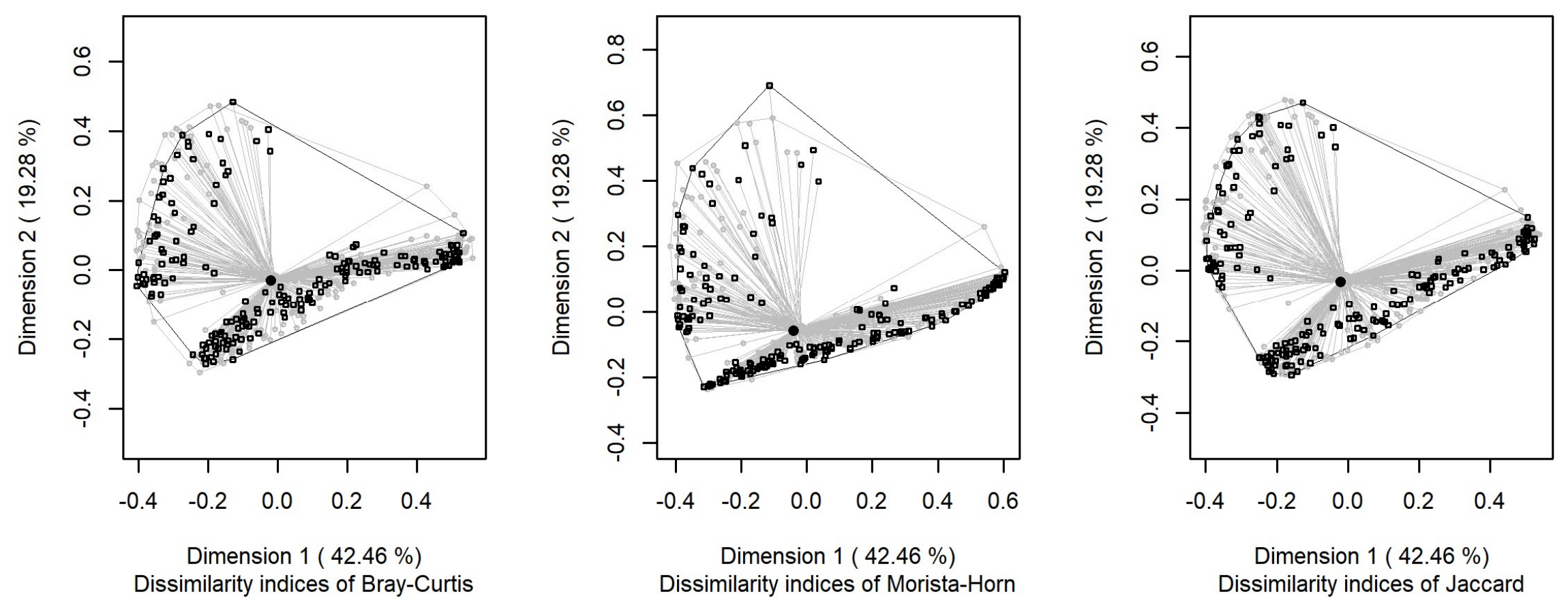
Distance-based tests for homogeneity of multivariate dispersions [
23] were applied using the Bray–Curtis dissimilarity index [
24], Morisita–Horn index, and Jaccard index to compare the two methods. These analyses were conducted using the vegan package (v. 2.6-4) in the R software (v. 4.3.2). Multivariate dispersion was visualized by Principal Coordinates Analysis (PCoA), in which distances from each observation to the corresponding group centroid were used to assess homogeneity of dispersion.
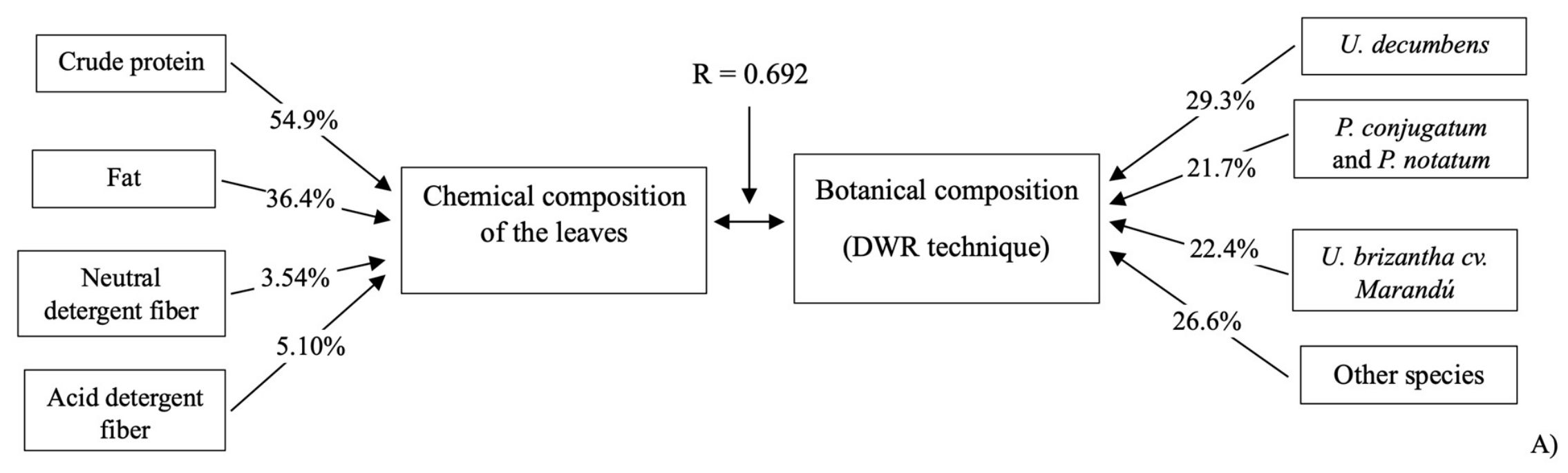
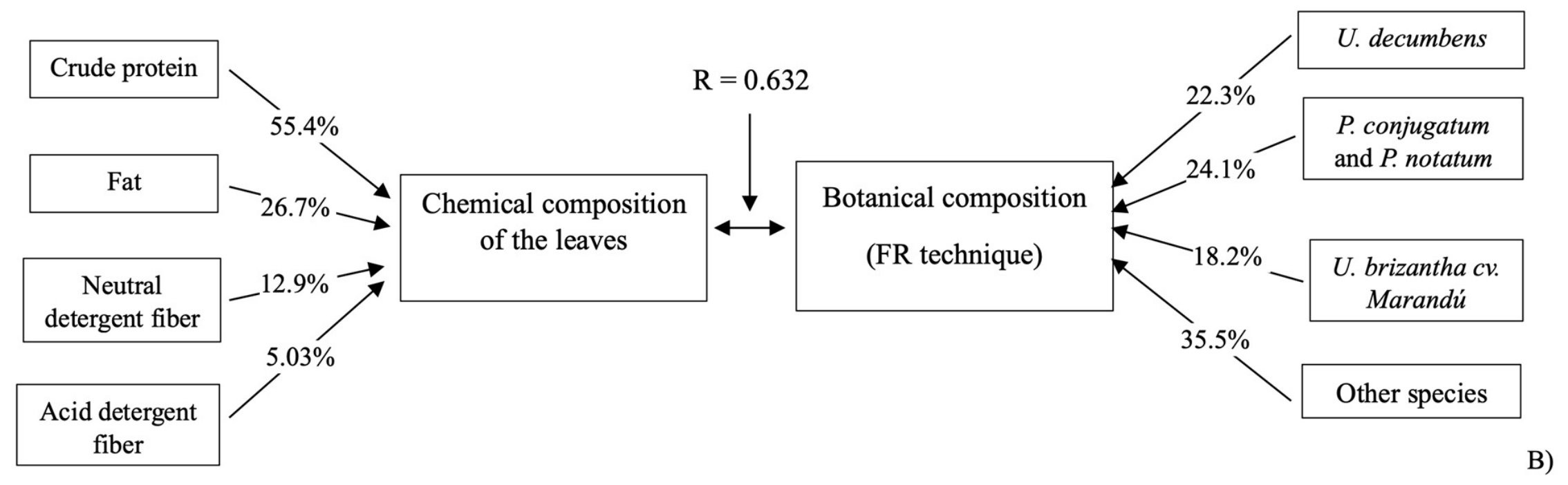
To explore the multivariate relationship between the botanical composition of tropical forages and the chemical composition of leaves, a CCA was performed using the PROC CANCORR procedure in the Statistical Analysis System (SAS 9.4, Cary, NC, USA; 2017). The CCA estimates the multivariate associations between two groups of variables. Each group is defined by a canonical variate, which is a linear combination of its original variables. Note that canonical correlations are invariant to linear scale transformations [
25]; therefore, variables were analyzed in their original measurement units, and no prior standardization was applied.
Three canonical variates were defined for this study as follows:
where a, b, and c are canonical weights that describe the contributions of the original variables to their respective canonical variates, respectively.
The analysis was conducted using 184 paired observations, in which botanical and chemical composition data were obtained from the same sampling units and matched on a one-to-one basis (pre-grazing chemical composition data were matched with pre-grazing botanical composition data and the same for post-grazing). The multivariate relationships explored between the defined canonical variates were as follows:
The significance of the canonical correlations was tested using Wilk’s Lambda and Bartlett’s test, and squared canonical correlations (R2) were calculated to characterize the association strength between the canonical variates. Squared canonical correlations were interpreted exclusively as associations between canonical variates and not as the proportion of total variance explained in the original variable sets. Furthermore, redundancy indices were not calculated because the primary objective of the analysis was to evaluate the strength of association between the canonical variates.
Diagnostics of multicollinearity among botanical composition variables were not explicitly performed. However, canonical correlation analysis is based on the correlation structure among variables, and multicollinearity within variable sets does not bias the estimation of canonical correlations [
26]. Nevertheless, multicollinearity can affect the stability and interpretability of canonical coefficients; therefore, interpretation focuses primarily on the magnitude of canonical correlations and standardized canonical loadings rather than on canonical weights [
25].
Finally, to explore the relative contributions of the original variables to their respective canonical variates, standardized canonical loadings were transformed using the following equation:
Relative contribution = absolute value of the standardized canonical loading/sum of the absolute values of the standardized canonical loadings within each canonical variate × 100.
4. Discussion
Continuous measurements of botanical composition could allow for an approach to understanding vegetation dynamics in pastoral systems and could be used as a key tool for decision-making in tropical grazing systems, which are characterized by their diversity of plant species. However, assessing botanical composition involves arduous field work, which makes it difficult to monitor changes in vegetation associated with grazing management and environmental factors [
27]. To address this limitation, this study compared the performance of a rapid technique, such as FR, conducted simultaneously with undisturbed sward height monitoring, with that of the DWR method for assessing the botanical composition and plant diversity of heterogeneous tropical pastures. We found that the FR method is a practical and complementary approach for the assessment of botanical composition and plant species diversity in heterogeneous tropical grasslands, although it has limitations in detecting specific groups of plants. The FR method provides quantitatively comparable results and captures community structures similar to those detected by DWR.
A high degree of concordance between methods for dominant species indicates that FR can reliably characterize the main components of pasture vegetation despite requiring substantially less field effort than biomass-based approaches. These findings support the hypothesis of Peratoner and Pötsch [
10] that the FR method is suitable for detecting structurally dominant species that are clearly visible during sward height assessments conducted with instruments such as a sward stick. The agreement diagnostics based on Bland–Altman bias estimates complemented the CCC values’ interpretation. For
U. decumbens, the bias was relatively small (2.51% units), supporting the strong agreement observed between the methods. Although the
Paspalum genus showed a bias of 4.31%, its CCC remained high (0.92), indicating that both methods produced highly consistent rankings and patterns of variation across paddocks despite moderate differences in absolute abundance estimates. Given the high variability in
Paspalum abundance observed among grazing events (IQR = 38.05%), this level of bias is unlikely to affect the overall characterization of its contribution to pasture composition.
In contrast, Cyperaceae weeds presented the lowest CCC (0.17) and one of the largest bias values (−4.37 percentage units), although both methods detected them with similar frequency. This finding indicates a systematic difference between methods, with FR tending to yield higher abundance estimates than DWR for this functional group. This discrepancy may be related to the growth form and structural characteristics commonly observed in Cyperaceae species, which can result in a high frequency of occurrence despite a relatively low contribution to total biomass. In addition, the DWR tends to underestimate minor species because they rarely achieve the top three weight ranks within a quadrat to be recorded [
13,
28]. Consequently, abundance estimates for Cyperaceae weeds obtained with DWR and FR should be interpreted cautiously, as the two methods may not provide directly comparable values for this group.
Agreement between methods was also maintained for several less abundant species, such as
U. brizantha cv. Marandú,
U. plantaginea,
U. arrecta, and
U. humidicola, suggesting that FR can provide consistent species identification across a wide range of pasture compositions. These species also exhibited similar proportions of non-detection, ranging from 42.4% to 80.4%. Despite its methodological simplicity, the FR method provides consistent identification not only for the most abundant species but also for those less frequently represented in heterogeneous tropical pastures. Tothill et al. [
12] reported that the FR method can effectively capture minor species that may not rank among the top species identified in the DWR. Therefore, FR can act as a complementary tool to DWR, contributing to more comprehensive datasets on botanical composition in diverse grasslands. From an ecological perspective, the higher sensitivity of FR has important implications for interpreting pasture dynamics. Detecting rare or less dominant species is important for understanding the ecological functions of grasslands. Rare species contribute to ecosystem resilience, nutrient cycling, and forage stability, particularly under grazing or climatic stress [
29].
Considering this, the assessment of plant diversity clearly shows that FR has a higher ability, as this method consistently resulted in higher values for the Shannon–Wiener, Simpson, Inverse Simpson, and Pielou’s evenness indices compared to the DWR method. These differences could be attributed to the capability and sensibility of FR to detect less dominant species in the presence and biomass accumulation production [
12]. This outcome is expected because the number and proportion of species detected directly influence the diversity indices calculation [
30]. For example, the Shannon–Wiener and Simpson indices increase with both the number of species and their distribution across the grasslands, whereas Pielou’s evenness reflects the uniform distribution of individuals among the detected plant species. When FR identifies species that are overlooked by DWR, the indices capture this additional information and yield higher diversity and evenness values even if they occur at low frequencies [
31]. In contrast, the DWR method estimates species composition based on dry weight contributions within each quadrant, resulting in incomplete species frequency data because it only records the three species with the highest dry weight contributions. The above-mentioned take relevance in species with stolon or high tiller density but low biomass, and where identification of individuals could be a challenge.
Nevertheless, FR showed some limitations in detecting specific functional groups, particularly those with prostrate growth habits or a dispersed distribution. For example, weeds from the Commelinaceae family showed a significantly higher proportion of non-detection under FR compared to DWR, with a CCC of 0.38. Similarly, narrow-leaved weeds were underestimated by FR, with a higher non-detection rate (23.3%) than that of DWR (10.8%). These discrepancies may be attributed to the lower visibility or shorter height of these species during sward height monitoring, as plants with creeping or drooping growth habits may not be consistently detected [
32]. Note that the tool used to measure sward height was a sward stick with a 1.0 cm × 2.0 cm window for recording height. This design tends to make contact primarily with taller species, potentially overlooking shorter species. To improve accuracy, we could increase the number of measurements taken per paddock and modify the height-measuring tool design to ensure it contacts a wider range of plant species. For groups such as
Cynodon spp., legumes, and broad-leaved weeds, the FR overestimated their relative abundance compared with the DWR.
However, the CCC values for these groups remained within acceptable ranges (0.52–0.68). This overestimation may be attributed to the structural characteristics of these species, as larger leaves or more conspicuous morphological features are more readily detected during sward height assessments. Broad-leaved weeds, for example, are easily detected by an observer because of their high color contrast between vegetation and soil [
33]. Moreover, as noted by Cayley & Bird [
32], the binary nature of the FR method can also contribute to this bias, since the mere presence of a species at a sampling point is recorded as representation, without accounting for its proportional contribution to the overall biomass. These findings indicate that the agreement between FR and DWR is species-dependent and tends to decrease for low-stature, creeping, or spatially dispersed plant groups, even when the overall community-level patterns remain comparable. Consequently, FR may not be suitable as a stand-alone method when accurate quantification of these plant groups is required.
Despite the limitations previously discussed for the FR method, the CCA revealed that U.
decumbens,
Paspalum genus, and
U. brizantha cv. Marandú were the most influential species proportions affecting CP and EE in leaves. These species contribute significantly to protein and extract content in tropical pastures [
21]. The magnitude of the first canonical correlations and the high cumulative proportions indicate strong multivariate associations between botanical composition and chemical composition of leaves. However, these statistics reflect the strength of association between canonical variates and should not be interpreted as the proportion of variance explained in the chemical composition variables [
25]. Therefore, rather than indicating predictive capacity, the results demonstrate that botanical composition patterns are closely associated with leaf chemical composition patterns, particularly for CP and EE.
The similarity in the variable patterns observed between the DWR and FR methods highlights two key points. First, the botanical composition itself appears to be a reliable indicator of the chemical composition of leaves, particularly of nutrients such as CP and EE. Second, both methods provide comparable multivariate structures for assessing botanical composition. This finding is consistent with the results of distance-based dissimilarity analyses, which indicated no significant differences in multivariate dispersions between methods, suggesting that both approaches broadly capture similar community structures [
24,
34].
Taken together, the univariate and multivariate analyses indicate that FR and DWR describe similar community-level patterns despite differences in the estimation of some functional groups. Nevertheless, while this study leveraged a substantial dataset spanning two years and 23 grazing cycles, a longer period of cross-regional testing is necessary to confirm its universal operability. Long-term testing will be particularly vital for adjusting the detection sensitivities of non-dominant, low-stature functional groups such as Commelinaceae and Cyperaceae weeds, where the FR method exhibited lower concordance with traditional biomass rankings.
Grazing significantly influences changes in botanical composition, favoring certain species over others based on animal selectivity, especially in diverse pastures. Comparisons made before and after grazing typically show a decline in palatable species, alongside an increase in less preferred or more grazing-resistant species [
7]. Consistent with this, our study also identified changes in the relative abundance of species when comparing pre- and post-grazing assessments. Changes in species abundance before and after grazing reflected patterns of selective forage consumption and differential tolerance to grazing pressure, which were consistently detected by both assessment methods. Despite these shifts, there were no significant differences in diversity indices related to the grazing moment or its interaction with the evaluation method. This indicates that while grazing modifies the relative abundance of some species, it does not necessarily alter the overall community diversity within the short-term grazing cycle. Importantly, both DWR and FR methods consistently captured these grazing-induced compositional shifts, indicating the potential of FR as a practical complementary tool for monitoring botanical dynamics in heterogeneous tropical grasslands.
The similarity in alpha diversity indices of plant species observed at pre-grazing and post-grazing moments may indicate an appropriate grazing practice, which maintains functional richness while balancing selective disturbance and herbivory resistance or avoidance. Under optimal productivity conditions, grazing management can reduce the competitiveness between dominant and subordinate species. However, in less productive conditions, grazing can harm species diversity by increasing plant mortality, thereby affecting the species composition of these populations in the evaluated area [
35,
36]. This is important in a country like Colombia, where cattle production is based on grasses that dominate meadows, savannas, and other open ecosystems with moderate moisture, with grass and legume species identified as relevant to livestock production.
Appropriate measurement methods must be selected for assessing botanical composition in tropical grassland management. This selection significantly impacts the evaluation of plant species diversity and forage value, especially in heterogeneous grasslands where species composition varies greatly over time and space [
37,
38]. From a practical perspective, the FR method has several advantages over DWR. It is less invasive, does not require destructive sampling, and is faster to implement once observers are adequately trained. Based on field observations, DWR required approximately 120–150 min per paddock with two observers, whereas FR required approximately 45–60 min with one observer; these values were not formally recorded or statistically analyzed and should be considered approximate. However, our study highlights the need for caution when applying FR to detect less abundant or low-stature species, which may be overlooked. Thus, FR should be applied cautiously and ideally complemented with periodic DWR assessments when the aim is to fully characterize biodiversity or evaluate rare species, forming a robust methodological framework for tropical grazing systems. Future studies should consider combining FR with complementary approaches or refining sampling strategies to improve species detection. Additionally, post-grazing measurements can be influenced by trampling, which alters the residual structure of the sward and may impact measurement accuracy.




 ,
,