


Abstract
This study investigated alternative pathways involving adaptive traits associated with drought tolerance in popcorn cultivated under soil water restriction through path analysis. Direct and indirect effects were estimated for morpho-agronomic variables, including ear height (EH), grain number per ear (GNE), grain number per row (GNR), 100-grain weight, grain yield (GY), and popping expansion (PE); physiological variables, such as relative chlorophyll content, anthocyanin and flavonoid indices, and maximum quantum efficiency of photosystem II; and root-related traits, including brace- and crown-root number and root angle. Fifty popcorn inbred lines were assessed under contrasting water conditions (WC), namely well-watered and water-stressed environments, during two crop seasons (CS). Water restriction was imposed before male anthesis, and the permanent wilting point was reached at 63 days after sowing in CS-2020 and at 100 days in CS-2021. Significant genotype × WC × CS interactions were identified for all evaluated traits. The effects of drought varied according to the developmental stage at which stress occurred. Under both water regimes, indirect selection through EH and GNR favored gains in GY, whereas EH and GNE showed the strongest indirect contributions to PE. Among the evaluated variables, EH emerged as a promising trait for indirect selection in popcorn breeding under water-limited conditions.
1. Introduction
Recent climate instability has increased the frequency and intensity of extreme temperature fluctuations and irregular precipitation patterns, creating substantial constraints for agricultural production worldwide [1,2,3,4,5,6]. Among the climatic factors associated with crop losses, reduced and poorly distributed rainfall strongly limits plant growth and development and may decrease popcorn grain yield by more than 50% under severe water-deficit conditions [7,8]. Despite the economic relevance and commercial expansion of popcorn cultivation in Brazil, breeding efforts targeting drought-prone environments remain limited, and only one hybrid is currently recommended for cultivation under water-restricted conditions [9].
Genetic variability conserved in germplasm collections represents an important source of alleles for the development of cultivars adapted to unfavorable environmental conditions, including drought stress [10,11]. The Germplasm Bank maintained by the Darcy Ribeiro State University of Northern Rio de Janeiro (UENF) comprises popcorn inbred lines derived from distinct Latin American regions, including materials with tropical and temperate adaptation, as well as Brazilian elite genotypes [12,13]. Such diversity provides an opportunity to explore adaptive traits associated with drought tolerance, including morpho-agronomic, physiological, root-related, and yield-associated variables [14,15].
The effectiveness of indirect selection, however, depends on the interaction between genotypes, environmental conditions, and crop seasons [15]. Previous studies in popcorn have demonstrated that morpho-agronomic, physiological, root, and yield traits are strongly affected by genotype (G), water condition (WC), crop season (CS), and their interactions, highlighting the complexity of plant responses under water-limited conditions [7,16,17].
The effects of drought are also influenced by the developmental stage at which stress occurs, since the timing of the permanent wilting point (PWP) alters the magnitude of damage expressed by different traits, thereby affecting the identification of useful secondary variables for indirect selection, as reported by Kim & Lee [3] in maize. In popcorn, reductions in grain set are more severe when water restriction occurs during pre-anthesis and anthesis [7,9], whereas drought imposed during grain filling predominantly affects grain weight in both maize and popcorn crops [2,18]. According to Araus et al. (2012) [1], drought timing directly influences genotype performance and the efficiency of secondary traits used in breeding programs, whose predictive value may vary depending on stress intensity and crop developmental stage. Consequently, breeding strategies targeting drought tolerance should account for both environmental conditions and the phenological timing of water limitation.
Phenotypic and genotypic correlations have been extensively applied in breeding programs to assist genotype selection; however, these associations may reflect indirect influences from other explanatory traits [19,20]. In this context, path analysis proposed by Wright (1921) [21] allows the partitioning of correlation coefficients into direct and indirect effects, improving the interpretation of trait relationships. In popcorn breeding, grain yield (GY) and popping expansion (PE) are commonly adopted as primary response variables [22]. Because of its ability to clarify complex trait interrelationships, path analysis has been successfully applied to identify more efficient selection criteria under water-stress conditions [7].
Therefore, this study aimed to estimate the direct and indirect contributions of morpho-agronomic, physiological, and root traits to grain yield (GY) and popping expansion (PE) in popcorn inbred lines cultivated under contrasting water conditions and evaluated across two crop seasons, seeking to identify useful traits for indirect selection under drought stress.
2. Materials and Methods
2.1. Genotypes
The present study was conducted using 50 popcorn inbred lines belonging to the Germplasm Bank of the Darcy Ribeiro State University of Northern Rio de Janeiro (UENF). These lines were developed from genetic materials originating from different Latin American countries and comprise genotypes with tropical and/or temperate adaptation [12]. Detailed information regarding pedigree, country of origin, donor institution, and climatic adaptation of each genotype is provided in Supplementary Table S1.
2.2. Crop Management and Experimental Conditions
Field trials were conducted during the 2020 and 2021 crop seasons (CS) at the Colégio Estadual Agrícola Antônio Sarlo, located in Campos dos Goytacazes, Rio de Janeiro, Brazil (21°34′31″ S, 41°54′40″ W). In both crop seasons, sowing was carried out in April, and harvesting was performed in August. The crop cycle lasted approximately 120 days in both years. This period was intentionally selected because April to June corresponds to one of the driest periods of the year in southeastern Brazil [7].
The popcorn inbred lines were evaluated under two contrasting water conditions: well-watered (WW), in which irrigation was supplied according to crop requirements, and water-stressed (WS), where irrigation was interrupted 15 days before male anthesis and maintained suspended until physiological maturity. The timing of male anthesis used to define irrigation withdrawal followed information obtained in previous studies [8].
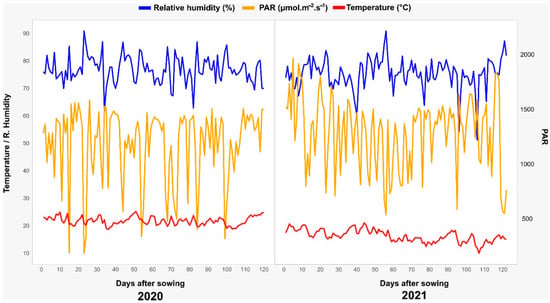
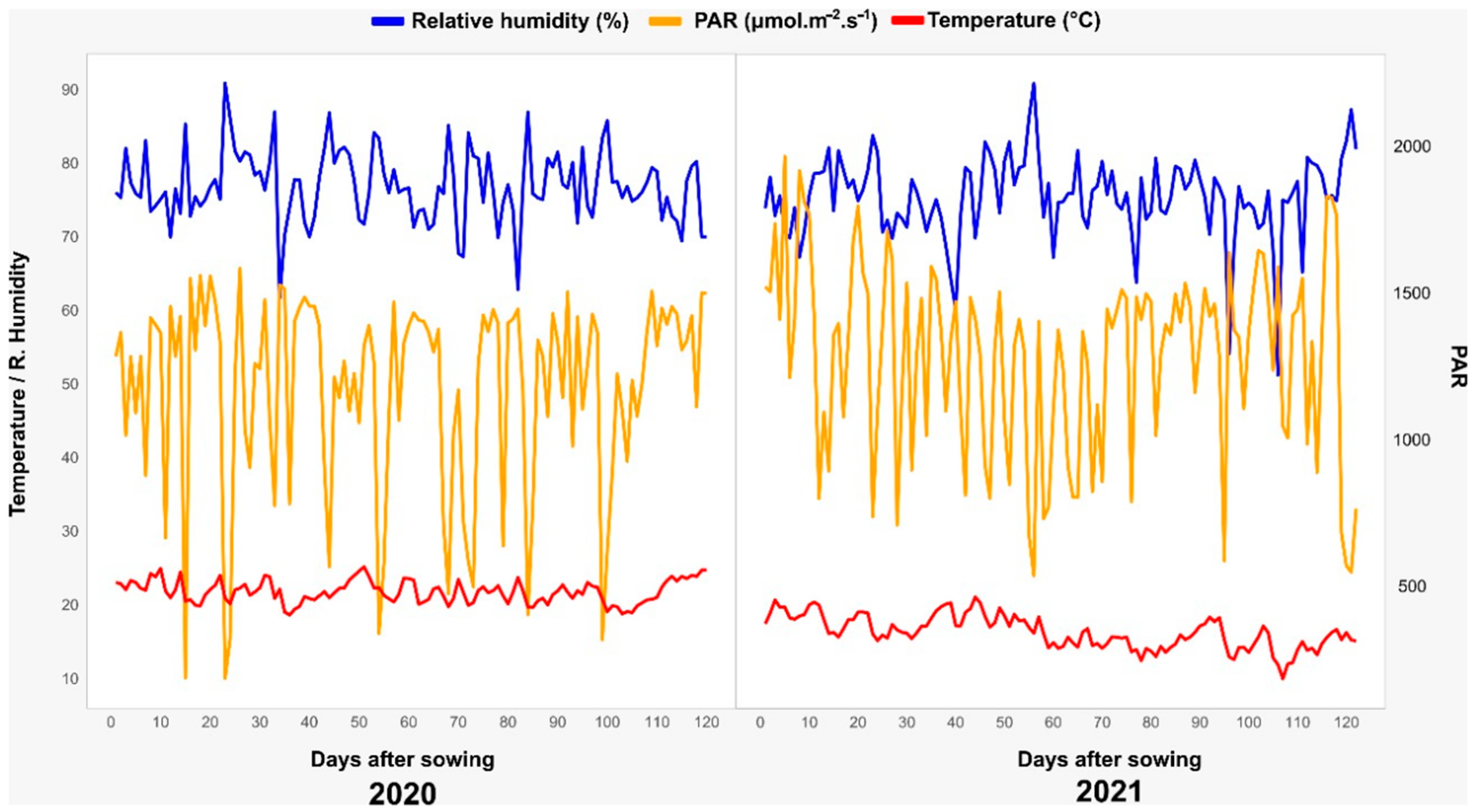
Meteorological conditions throughout the experiments were monitored using an automatic weather station installed at the experimental area, and the recorded data are presented in Figure 1. Across the experimental period, CS-2020 and CS-2021 showed mean air temperatures of 21.77 °C and 21.26 °C, relative humidity averages of 76.85% and 77.27%, and photosynthetically active radiation values of 1240.07 and 1415.80 µmol m2 s−1, respectively (Figure 1).
Figure 1.
Micrometeorological conditions recorded during the cultivation of 50 popcorn inbred lines in the 2020 and 2021 crop seasons, including relative humidity, photosynthetically active radiation (PAR), and mean air temperature.
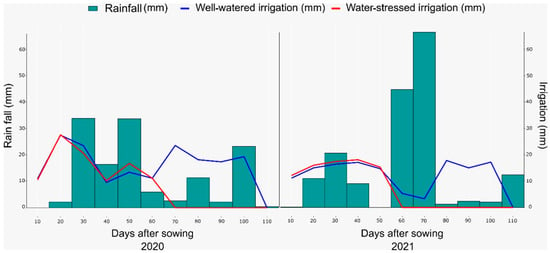
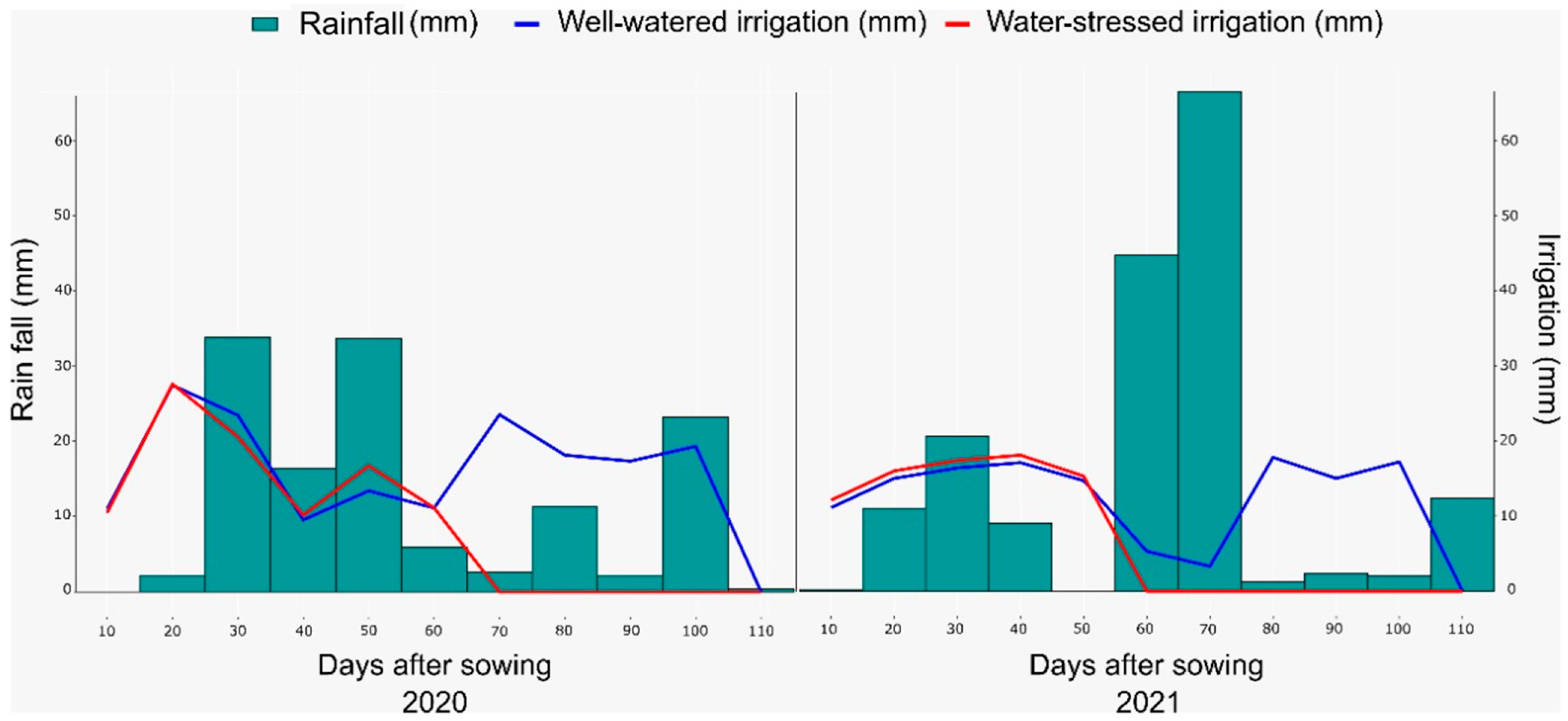
The experiments followed a randomized block design with three replications. Each plot was composed of a single 4.40 m row, with spacing of 0.20 m between plants and 0.80 m between rows, resulting in 23 plants per experimental unit. Irrigation was supplied through a drip system equipped with one emitter per plant. In CS-2020, irrigation depths reached 157.68 mm under WW and 87.48 mm under WS, corresponding to a 44.5% reduction in water supply between conditions. In CS-2021, the total irrigation depths were 132.93 mm in WW and 78.92 mm in WS, corresponding to a 40.6% reduction in water supply between conditions (Figure 2). Accumulated rainfall during the experimental periods was 119.2 mm in CS-2020 and 170.20 mm in CS-2021 (Figure 2).
Figure 2.
Irrigation depth (mm) applied throughout the 2020 and 2021 crop seasons according to days after sowing of popcorn inbred lines cultivated under contrasting water conditions. WW = well-watered and WS = water-stressed. Blue and red lines represent WW and WS conditions, respectively.
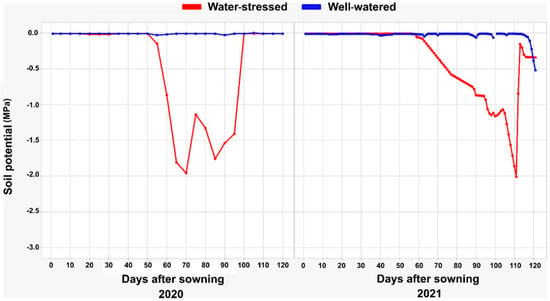
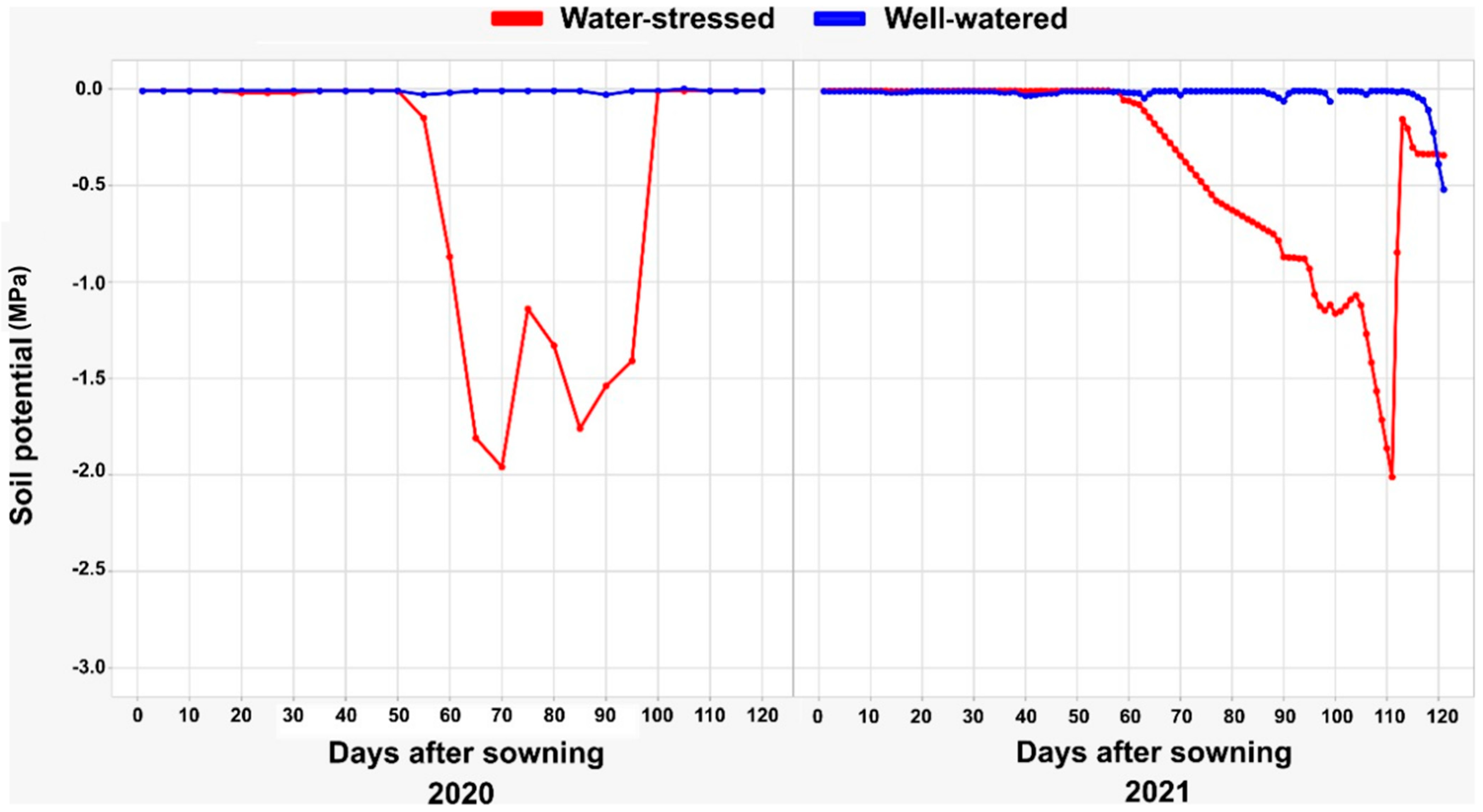
Soil water potential was continuously monitored using Decagon MPS-6 sensors (Decagon, Inc., Pullman, WA, USA) installed at 0.20 m soil depth between adjacent plants within the row. Under WW conditions, irrigation was maintained to keep soil moisture close to field capacity (−0.01 MPa). In contrast, under WS conditions, soil water potential progressively declined until reaching the permanent wilting point (−1.5 MPa), which occurred at 63 days after sowing (DAS) in CS-2020, during grain formation, and at 100 DAS in CS-2021, during the grain-filling stage (Figure 3).
Figure 3.
Soil water potential recorded during the cultivation of popcorn inbred lines under well-watered (WW) and water-stressed (WS) conditions in the 2020 and 2021 crop seasons.
In both crop seasons (CS) and under both water conditions (WC), fertilization management included basal and topdressing applications. At sowing, 30 kg ha−1 of N (urea), 60 kg ha−1 of P2O5 (triple superphosphate), and 60 kg ha−1 of K2O (potassium chloride) were applied. An additional nitrogen topdressing consisting of 100 kg ha−1 N (urea) was supplied at 30 days after sowing (DAS). Crop management practices related to weeds, pests, and diseases were adopted whenever necessary throughout the experimental period.
2.3. Morphological, Physiological, Root, and Agronomic Traits Evaluated
Three shoot morphological traits were assessed: plant height (PH), ear height (EH), and stem diameter (SD). Measurements were performed after tasseling, with PH corresponding to the distance from the soil surface to the flag leaf and EH measured from the soil surface to the insertion point of the main ear [7,16,17]. Stem diameter (SD) was measured immediately below the main ear using a digital caliper (Stainless Steel Digital Caliper 150 mm, Mtx).
The physiological variables analyzed included chlorophyll content (CC), anthocyanin index (ANT), flavonoid index (FLA), and the maximum quantum efficiency of photosystem II (Fv/Fm). Evaluations were carried out during grain filling and at 40 days after male flowering using the middle third of the leaf positioned immediately above the main ear in 10 plants per plot. The variables CC, ANT, and FLA were quantified using a DUALEX® SCIENTIFIC sensor (FORCE-A, Orsay, France). Measurements of chlorophyll fluorescence (Fv/Fm) were obtained with a handheld Pocket PEA non-modulated fluorimeter (Hansatech Instruments Ltd., King’s Lynn, Norfolk, UK) after 30 min of dark adaptation of the evaluated leaf region.
Root-related traits were determined according to the methodology proposed by Trachsel et al. (2011) [23], with modifications described by [24]. Under both water conditions (WC), root systems from two plants per plot were collected using soil cylinders measuring 25 cm in diameter and 40 cm in depth. According to Trachsel et al. (2011) [23], brace roots correspond to the outermost nodal root whorl, whereas crown roots correspond to the nodal root whorl located immediately below the brace roots. The evaluated root traits comprised number of brace roots (NBR), number of crown roots (NCR), brace-root angle (ABR), and crown-root angle (ACR). Root numbers were obtained by direct counting, whereas ABR and ACR were measured with a protractor and expressed in degrees (°) relative to the soil surface.
Agronomic evaluations included ear length (EL), ear diameter (ED), grain number per row (GNR), row number per ear (RNE), grain number per ear (GNE), 100-grain weight (GW), grain yield (GY), popping expansion (PE), and expanded popcorn volume per hectare (EPV), in addition to PH, EH, and SD. The variables RNE and GNR were determined by direct counting. Measurements of PH, EH, SD, RNE, and GNR were obtained from 10 plants sampled randomly within each plot. Grain weight (GW) was estimated from two subsamples containing 100 grains after threshing. Grain yield (GY) was calculated from the total grain mass harvested per plot and adjusted to 13% moisture content (kg ha−1). Popping expansion (PE) was determined using 30 g grain samples heated in a microwave oven (1000 W) for 2 min inside kraft paper bags, with popped volume measured in a 2000 mL graduated cylinder and expressed as mL g−1. Expanded popcorn volume per hectare (EPV) was estimated from the product between GY and PE (m3 ha−1).
2.4. Analysis of Variance
The joint analysis of variance was based on the following statistical model: Yijkp = µ + (B/WC)/CS)jkp + Gi + (WC)k+ (CS)p + (GWC)ik + (GCS)ip + (WCCS)kp + (GWCCS)ikp + εijkp, where Yijkp observed value for the variable under study, corresponding to the j-th replication of the combination of the i-th level of the Genotype factor with the k-th level of the Water Condition factor and the p-th level of the Crop Season factor; µ = overall mean; (B/WS)/CS)jkp = Block effect; Gi = effect of the i-th level of the Genotype factor on the observed value Yijkp; (WC)k = effect of the k-th level of the Water Condition factor; (CS)p = effect of the p-th level of the Crop Season factor; (GWC)ik = interaction effect of the i-th level of Genotype with the k-th level of Water Condition; (GCS)ip = interaction effect of the i-th level of Genotype with the p-th level of Crop Season; (WCCS)kp = interaction effect of the k-th level of Water Condition with the p-th level of Crop Season; (GWCCS)ikp = triple interaction effect of the i-th level of Genotype with the k-th level of Water Condition and the p-th level of Crop Season; and e εijkp = experimental error associated with the observation Yijkp, assuming NID (0, σ2).
The individual analysis of variance was based on the model , where = observed value for the variable under study for the jth replication of the ith level of the Genotype factor; = overall mean; = effect of the jth replication = effect of the ith level of the Genotype factor; and = experimental error associated with the observation , assuming NID (0, σ2).
2.5. Genotypic Correlations
Genotypic correlations were estimated and tested at the 5% and 1% probability levels, according to the t-test. Statistical analyses were performed using R software® (version R-4.2.2, 2022) [25].
2.6. Path Analysis Using the Structural Equation Modeling (SEM) Approach
For path analysis, the values of each plot for all traits were standardized, followed by analysis of variance to obtain mean square estimates and generate the genotypic correlation matrix among the evaluated traits.
The genotypic correlation matrix was tested for collinearity according to Christensen & Montgomery (1981) [26]. Path analysis was performed considering two groups of traits (dual-chain model), represented by 17 explanatory variables. In the first chain, six agronomic traits were used: ear length (EL, P01), ear diameter (ED, P02), grain number per row (GNR, P03), row number per ear (RNE, P04), grain number per ear (GNE, P05), and 100-grain weight (GW, P06). In the second chain, 11 traits were included: four physiological (ANT, P01; CC, P02; FLA, P03; Fv/Fm, P04), three morphological (SD, P05; EH, P06; PH, P07), and four root traits (ABR, P08; NBR, P09; ACR, P10; NCR, P11). The primary traits were grain yield (GY) and popping expansion (PE). The trait expanded popcorn volume (EPV) was excluded due to its high collinearity with GY and PE.
The matrix resolution was obtained from the normal equations X’X = X’Y, where X’X is a nonsingular matrix of correlations among explanatory variables, is a column vector of path coefficients, and X’Y is a column vector of correlations between the primary variable and the explanatory variables for popcorn (GY and PE) across the two water conditions and crop seasons studied. All analyses were performed in R [25], using the packages stats 3.6.0, biotools 3.1, semPlot 1.1, and lavaan 0.6.
3. Results
3.1. Joint Analysis of Variance for Morpho-Agronomic, Physiological, Root, and Agronomic Traits
In the joint analysis of variance, the source of variation crop season (CS) significantly affected all evaluated traits, except number of brace roots (NBR) (Table 1). For water condition (WC), significant effects were observed for all variables, with the exception of brace-root angle (ABR) (Table 1). Genotype (G) also showed significant effects for all analyzed traits (Table 1). Concerning the double interactions involving CS × WC, CS × G, and WC × G, significance at p ≤ 0.01 was detected for nearly all variables, whereas NBR did not differ significantly in the CS × WC interaction (Table 1). In addition, the triple interaction among CS, WC, and G was significant for all evaluated traits (Table 1).
Table 1.
Combined analysis of variance for morphological shoot, physiological, root-system, and agronomic traits evaluated in popcorn inbred lines grown under contrasting water conditions (WC: WS and WW) during the 2020 and 2021 crop seasons (CS).
3.2. Analysis of Variance and Mean Estimates of Agronomic, Physiological, and Root-Related Morphological Traits in the 2020 and 2021 Crop Seasons
The individual analyses performed for CS-2020 and CS-2021 revealed significant differences among treatments for all evaluated traits at the 1% probability level. Likewise, the genotype × water condition interaction (G × WC) was significant for all variables within each crop season (Table 2 and Table 3). The coefficients of experimental variation (CVe) remained below 20% for all traits, indicating satisfactory experimental precision (Table 2 and Table 3).
Table 2.
Summary of the individual analysis of variance, including mean estimates, mean squares, coefficients of variation, and standard errors for morphological, physiological, root-system, and agronomic traits evaluated in popcorn inbred lines cultivated under well-watered (WW) and water-stressed (WS) conditions during the 2020 crop season.
Table 3.
Summary of the individual analysis of variance, presenting mean estimates, mean squares, coefficients of variation, and standard errors for morphological, physiological, root-system, and agronomic traits of popcorn inbred lines evaluated under well-watered (WW) and water-stressed (WS) conditions in the 2021 crop season.
During the 2020 crop season, drought stress caused pronounced changes (>±15.0%) in traits belonging to different physiological, agronomic, and morphological groups. Among the physiological variables, chlorophyll content (CC) decreased by 49.11%, whereas the anthocyanin index (ANT) increased by 17.39%. Substantial reductions were also observed for agronomic traits, including grain yield (GY; −69.66%), expanded popcorn volume per hectare (EPV; −75.88%), popping expansion (PE; −21.44%), 100-grain weight (GW; −15.49%), and grain number per ear (GNE; −26.55%). Regarding morphological traits, plant height (PH) was reduced by 17.55%.
In CS-2021, the physiological responses to water restriction were even more pronounced for some variables, especially CC (−56.32%), ANT (+128.57%), and FLA (>+150.00%). Among the agronomic traits, the greatest declines under WS conditions were detected for GY (−36.82%), EPV (−45.69%), and PE (−15.38%).
3.3. Study of Genotypic Correlations Among Morphological, Physiological, Root System, and Agronomic Traits
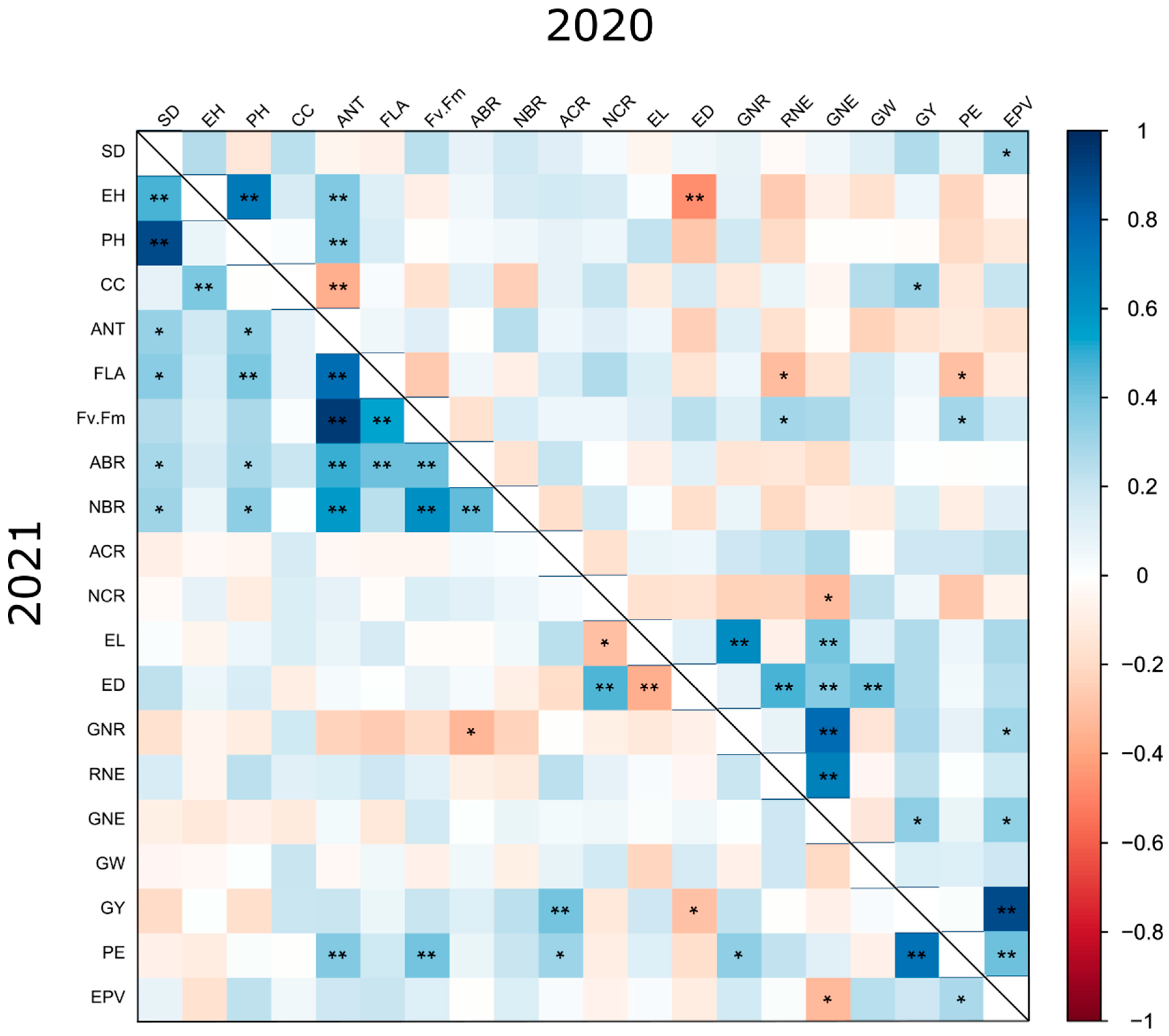
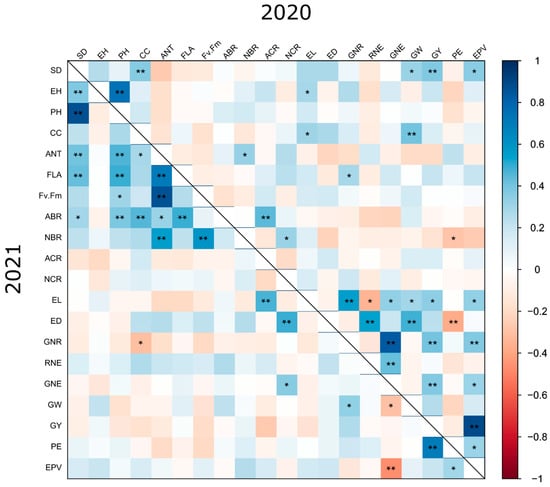
In CS 2020 and under WS, the genotypic correlation coefficients (rg) were significant and positive among the pairs EH × PH (0.72), EH × ANT (0.38), PH × ANT (0.38), SD × EPV (0.33), CC × GY (0.33), Fv/Fm × RNE (0.30), Fv/Fm × PE (0.30), EL × GNR (0.64), EL × GNE (0.40), ED × RNE (0.48), ED × GNE (0.37), ED × GW (0.41), GNR × GNE (0.78), GNR × EPV (0.30), RNE × GNE (0.69), GNE × GY (0.35), GNE × EPV (0.33), GY × EPV (0.89), and PE × EPV (0.42) (Figure 4); and negative among the pairs EH × ED (−0.47), CC × ANT (−0.36), FLA × RNE (−0.31), FLA × PE (−0.30), and NCR × GNE (−0.31) (Figure 4).
Figure 4.
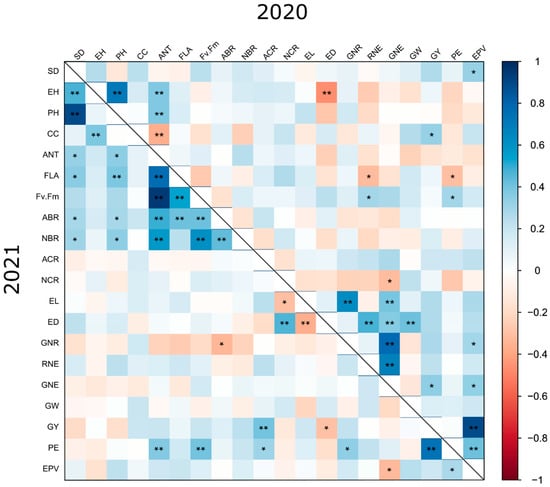
Estimates of genotypic correlations among twenty traits studied in popcorn cultivated under water-stressed (WS) condition in the 2020 and 2021 crop seasons (SD = Stem diameter; EH = Ear height; PH = Plant height; CC = Chlorophyll content; ANT = Anthocyanin content; FLA = Flavonoid content; Fv/Fm = Chlorophyll fluorescence; ABR = Angle of brace roots; ACR = Angle of crown roots; NBR = Number of brace roots; NCR = Number of crown roots; EL = Ear length; ED = Ear diameter; GNR = Grain number per row; RNE = Row number per ear; GNE = Grain number per ear; GW = 100-grain weight; GY = Grain yield; PE = Popping expansion; EPV = Expanded popcorn volume. * and ** represent significant differences at the 5% and 1% levels, respectively, by the t-test.
In WS and CS 2021, significant positive associations were observed among the pairs SD × EH (0.28), EH × PH (0.74), EH × Fv/Fm (0.34), EH × NCR (0.31), EH × GNR (0.40), EH × GNE (0.37), PH × NCR (0.40), ACR × ABR (0.46), EL × ED (0.44), EL × GNR (0.62), EL × GNE (0.57), EL × GY (0.34), EL × EPV (0.30), ED × GNR (0.42), ED × RNE (0.41), ED × GNE (0.49), ED × GY (0.28), ED × EPV (0.28), GNR × RNE (0.54), GNR × GNE (0.94), RNE × GNE (0.77), RNE × GY (0.39), RNE × EPV (0.36), GNE × GY (0.34), GNE × EPV (0.33), GW × PE (0.39), GY × EPV (0.90), and PE × EPV (0.47) (Figure 4); and negative among the pairs SD × ANT (−0.32), PH × ABR (−0.30), Fv/Fm × ED (−0.33), ABR × NBR (−0.37), and NBR × ACR (−0.30) (Figure 4).
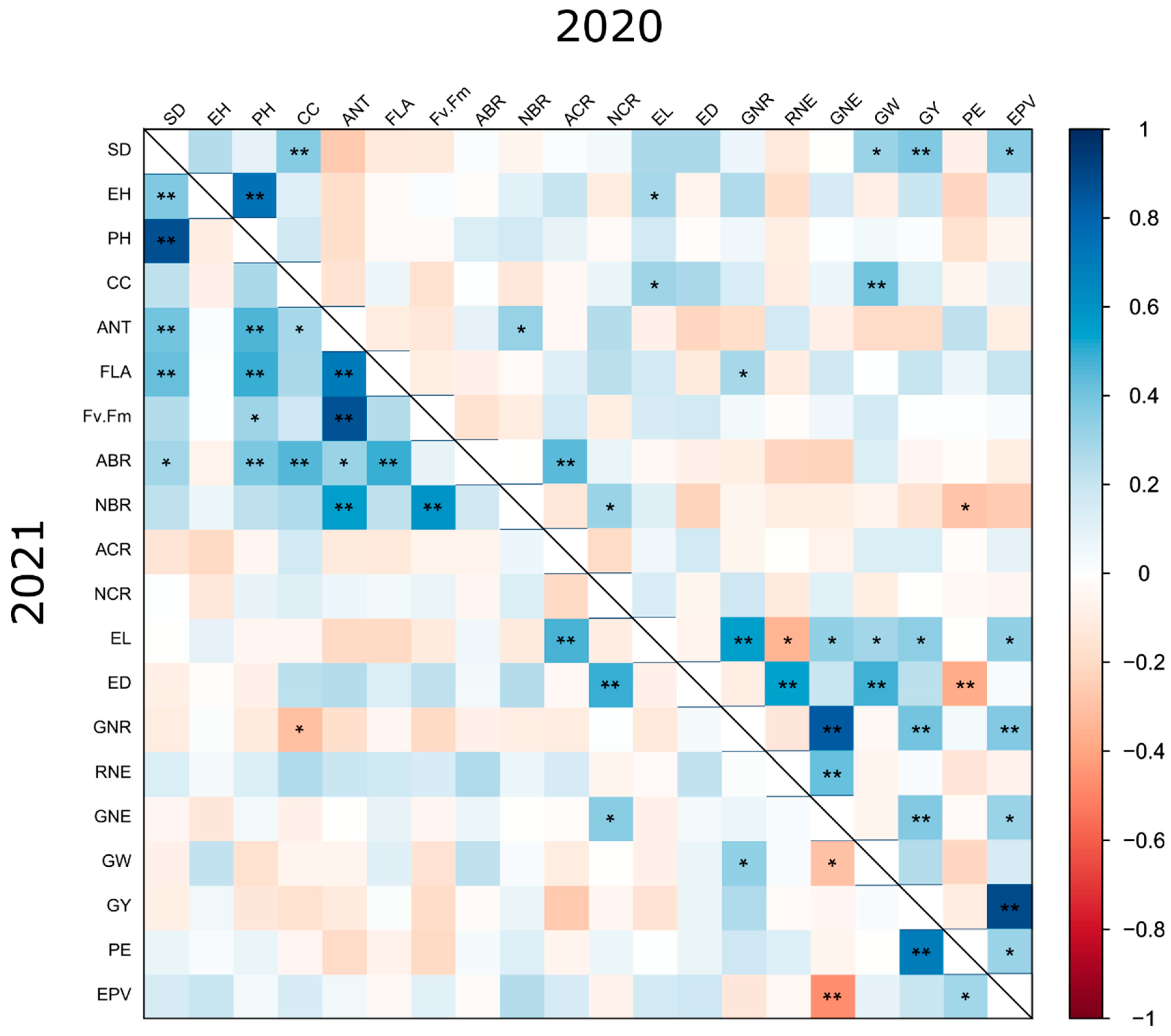
In WW and CS 2020, significant positive associations were detected among the pairs SD × CC (0.37), SD × GW (0.31), SD × GY (0.38), SD × EPV (0.35), EH × PH (0.74), EH × EL (0.28), CC × EL (0.30), CC × GW (0.40), ANT × NBR (0.32), FLA × GNR (0.29), ABR × ACR (0.44), NBR × NCR (0.32), EL × GNR (0.56), EL × GNE (0.33), EL × GW (0.29), EL × GY (0.34), EL × EPV (0.33), ED × RNE (0.54), ED × GW (0.48), GNR × GNE (0.84), GNR × GY (0.40), GNR × EPV (0.38), RNE × GNE (0.42), GNE × GY (0.38), GNE × EPV (0.31), GY × EPV (0.89), and PE × EPV (0.31) (Figure 5); and negative among the pairs NBR × PE (−0.28), EL × RNE (−0.34), and ED × PE (−0.37) (Figure 5).
Figure 5.
Estimates of genotypic correlations among twenty traits studied in popcorn cultivated under well-watered (WW) condition in the 2020 and 2021 crop seasons (SD = Stem diameter; EH = Ear height; PH = Plant height; CC = Chlorophyll content; ANT = Anthocyanin content; FLA = Flavonoid content; Fv/Fm = Chlorophyll fluorescence; ABR = Angle of brace roots; ACR = Angle of crown roots; NBR = Number of brace roots; NCR = Number of crown roots; EL = Ear length; ED = Ear diameter; GNR = Grain number per row; RNE = Row number per ear; GNE = Grain number per ear; GW = 100-grain weight; GY = Grain yield; PE = Popping expansion; EPV = Expanded popcorn volume. * and ** represent significant differences at the 5% and 1% levels, respectively, by the t-test.
In WW and CS 2021, significant positive associations were detected among the pairs SD × EH (0.29), EH × PH (0.70), CC × Fv/Fm (0.34), ANT × ACR (0.36), ABR × ACR (0.49), NBR × NCR (0.47), EL × GNR (0.59), EL × GNE (0.55), ED × RNE (0.49), ED × GNE (0.32), ED × GY (0.46), ED × EPV (0.30), GNR × GNE (0.86), GNR × GY (0.31), RNE × GNE (0.70), RNE × GY (0.49), RNE × EPV (0.42), GNE × GW (0.28), GNE × GY (0.47), GNE × EPV (0.40), GY × EPV (0.87), and PE × EPV (0.37) (Figure 5); and negative among the pairs SD × ANT (−0.46), CC × ANT (−0.29), and Fv/Fm × GW (−0.31) (Figure 5).
3.4. Estimation of Direct and Indirect Effects of Agronomic, Morphological, Physiological, and Root Traits on Grain Yield (GY) and Popping Expansion (PE)
In both WCs, the path coefficients (R2) were significant according to the t-test, indicating a reliable model configuration to explain genetic effects and reflecting the high contribution of the explanatory traits used in the model. For the path analysis of morphophysiological variables, a collinearity diagnosis was performed among traits to determine the linear relationship between the basic variables (GY and PE) and the other traits. The multicollinearity diagnosis indicated a moderate estimate under WS for CS 2020 (236.56) and weak for 2021 (68.07).
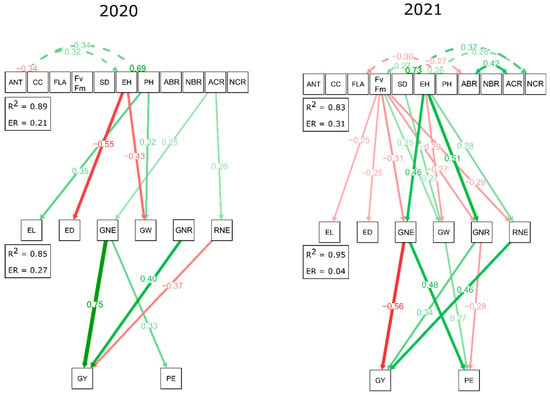
Under WS and in CS 2020, the first-chain traits GNE (0.75), GNR (0.40), and RNE (−0.37) had the largest direct effects on GY. For PE, the greatest direct effect was exerted by GNE, with a value of 0.33 (Figure 6). In this crop season, on analyzing the effects of secondary traits on GNE, the strongest positive effect was observed for ACR (0.25). On RNE, the largest effects were expressed by ACR (0.26) and FLA (−0.30) (Figure 6).
Figure 6.
Causal diagram of the path analysis of seventeen explanatory variables on the primary variables grain yield (GY) and popping expansion (PE) under water-stressed (WS) condition in the 2020 and 2021 crop seasons. Unidirectional lines represent direct effects of one trait on another indicated by the arrow, while bidirectional lines represent correlations between variables. Green indicates positive effect and correlation; red indicates negative effect and correlation. The intensity of colors and line thickness indicate the magnitude of the effect of one trait on the others. (First chain: EL = Ear length; ED = Ear diameter; GNE = Grain number per ear; GW = 100-grain weight; GNR = Grain number per row; RNE = Row number per ear. Second chain: ANT = Anthocyanin content; CC = Chlorophyll content; FLA = Flavonoid content; Fv/Fm = Chlorophyll fluorescence; SD = Stem diameter; EH = Ear height; PH = Plant height; ABR = Brace-root angle; ACR = Crown-root angle; NBR = Number of brace roots; NCR = Number of crown roots. R2 = path coefficient; ER = residual effect).
For CS 2021 under WS, the traits GNE (−0.56), GNR (0.34), and RNE (0.46) had the greatest direct effects on GY. For PE, the strongest direct effects were observed for GNE (0.48), GW (0.27), and GNR (−0.28) (Figure 6). In the same crop season, considering the effects of secondary traits on GNE, the strongest positive effect was found for EH (0.46) and the strongest negative for Fv/Fm (−0.31). On GW, the most prominent effects were promoted by Fv/Fm (0.25), SD (0.27), and EH (−0.29). On GNR, the main effects were from EH (0.51) and Fv/Fm (−0.27). For RNE, the strongest effects were from EH (0.28) and Fv/Fm (−0.29) (Figure 6).
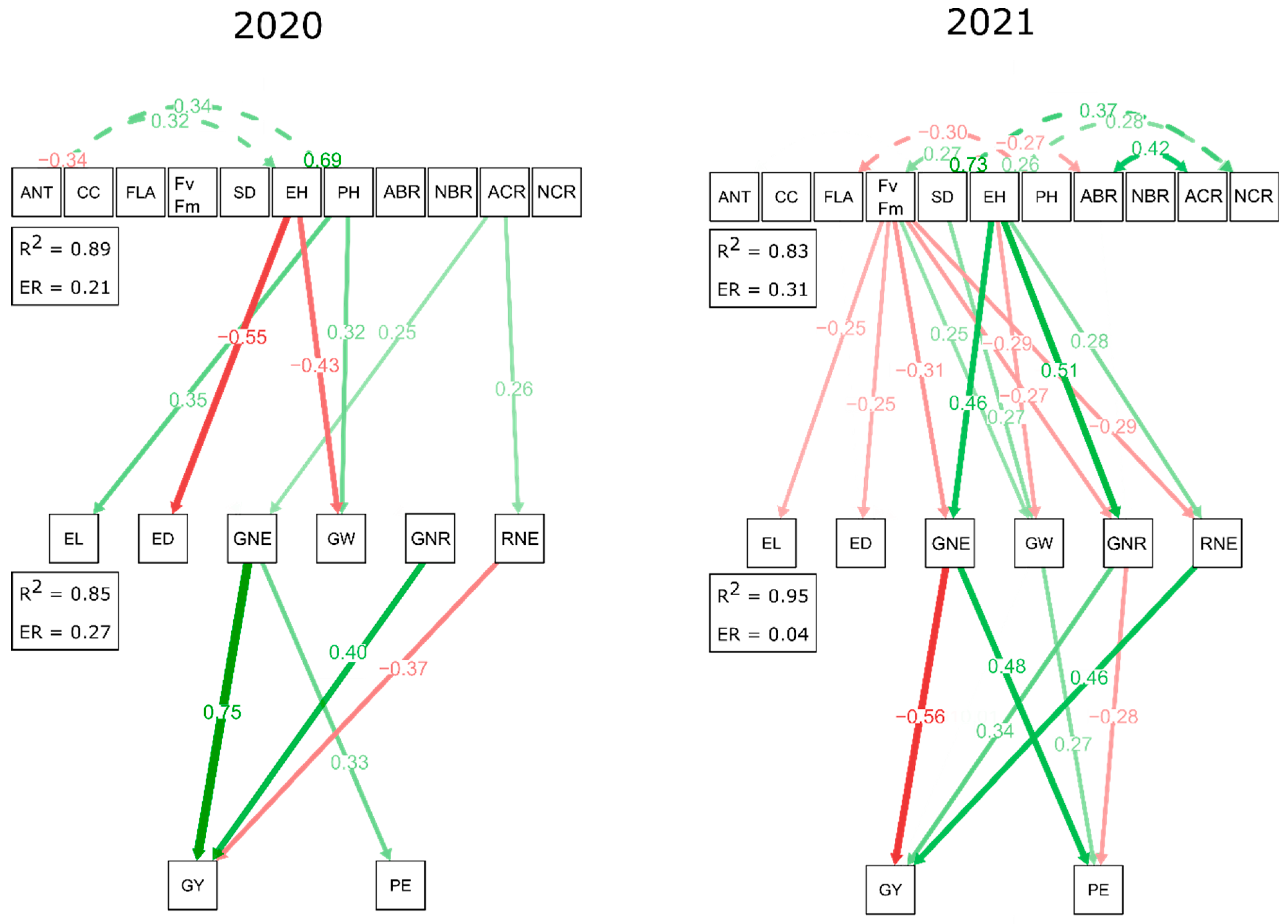
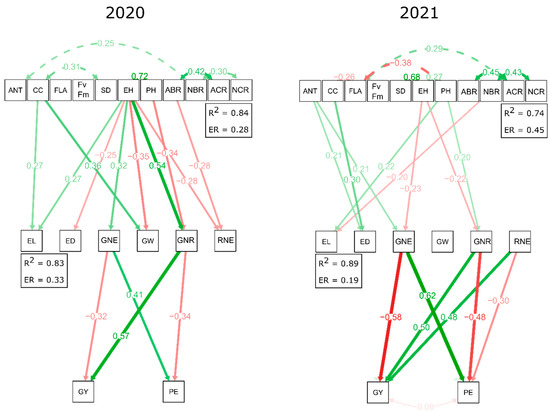
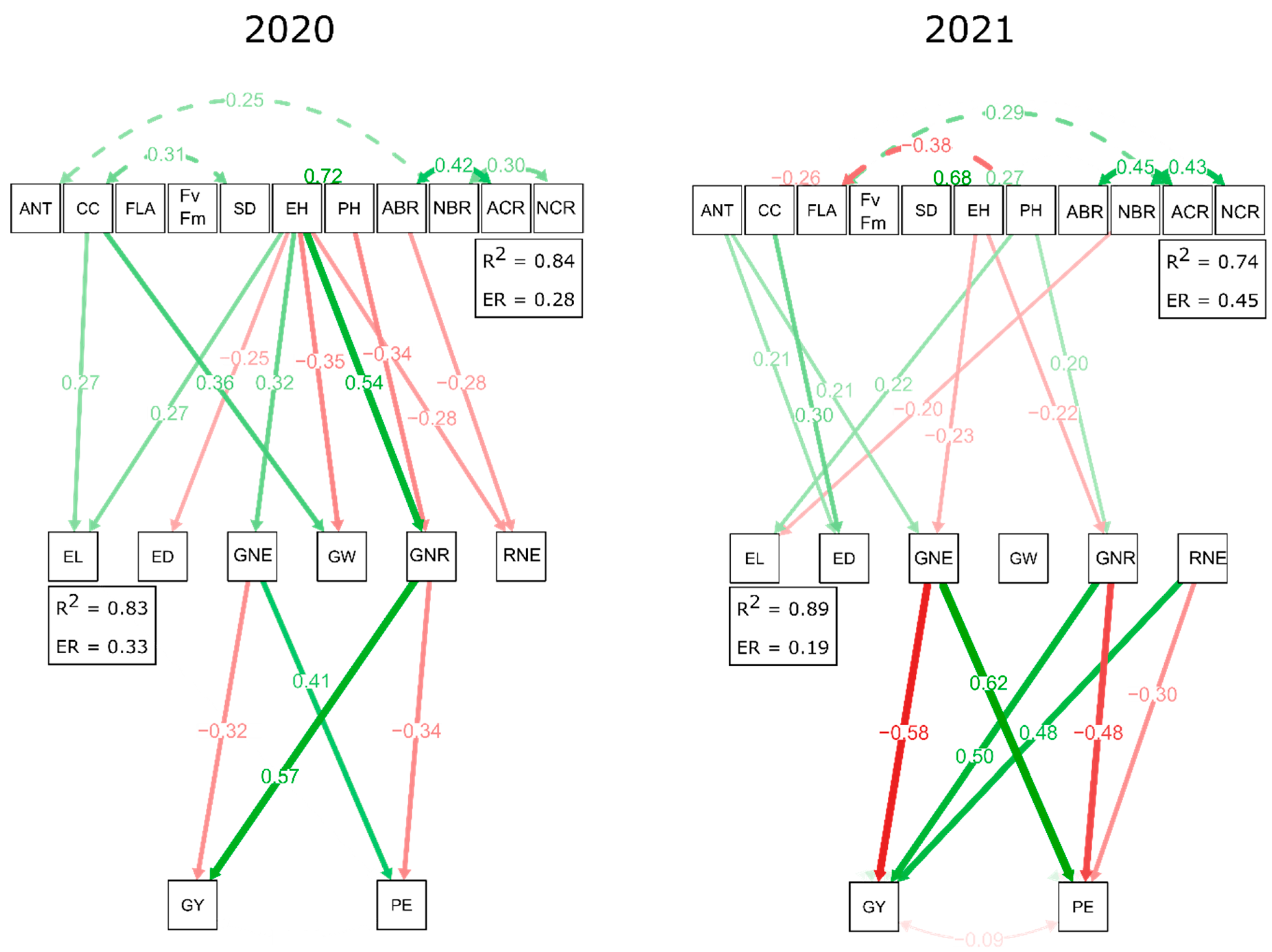
For the path analysis under WW, the multicollinearity diagnosis indicated moderate collinearity for CS 2020 (203.26) and weak for 2021 (64.39). For 2020, under the same condition, the variables GNE and GNR expressed the greatest direct effects on GY (−0.32 and 0.57, respectively) and also on PE (0.41 and −0.34, respectively) (Figure 7). In this crop season, analyzing the effects of secondary traits on GNE, the strongest positive quantum came from EH (0.32), and the strongest negative from PH (−0.22). On GNR, the greatest expression of effects came from EH (0.54) and PH (−0.34) (Figure 7). On RNE, the strongest effects were from EH (−0.28) and ABR (−0.28) (Figure 7).
Figure 7.
Causal diagram of the path analysis of seventeen explanatory variables on the primary variables GY and PE for the well-watered (WW) condition in the 2020 and 2021 crop seasons. Unidirectional lines represent the direct effects of one trait on another indicated by the arrow, and bidirectional lines refer to correlations among variables. Green indicates positive effect and correlation; red indicates negative effect and correlation. The intensity of the colors and the thickness of the line indicate the degree of effect of one trait on the others. First chain: EL = Ear length; ED = Ear diameter; GNE = Grain number per ear; GW = 100-grain weight; GNR = Grain number per row; RNE = Row number per ear. Second chain: ANT = Anthocyanin content; CC = Chlorophyll content; FLA = Flavonoid content; Fv/Fm = Chlorophyll fluorescence; SD = Stem diameter; EH = Ear height; PH = Plant height; ABR = Brace-root angle; ACR = Crown-root angle; NBR = Number of brace roots; NCR = Number of crown roots. R2 = path coefficient; EF = residual effect.
For CS 2021 under WW, the traits GNE, GNR, and RNE were those that had the greatest direct effects on GY (−0.58, 0.50, and 0.48, respectively) and also on PE (0.62, −0.48, and −0.30, respectively, in the same order) (Figure 7). In this crop season, based on the estimates of secondary traits on GNE, the strongest positive effect was from ANT (0.21), and the strongest negative from EH (−0.23). On GNR, the strongest incident effects were from EH (−0.22) and PH (0.20). On RNE, the strongest effects were from CC (0.21) and NBR (−0.22).
4. Discussion
4.1. Genotype, Water Condition, and Crop Season Interaction and Implications for Popcorn Breeding
The irrigation suspension adopted before anthesis efficiently induced water restriction and promoted clear differentiation among genotypes for most evaluated variables. This strategy has been widely used in studies involving maize and popcorn cultivated under drought conditions [2,7,27,28,29,30], mainly because gradual exposure to water limitation favors plant acclimation responses [16]. Such an approach allows a more reliable assessment of physiological adjustment mechanisms and productive performance under limited water availability [3,31,32], contributing to the identification of genotypes with greater adaptation to drought-prone environments.
The significant interactions involving genotype, water condition, and crop season indicate that genotype performance varied according to environmental conditions and seasonal climatic variation. These results reinforce the strong environmental influence on phenotypic expression and demonstrate that genotype responses are not stable across distinct water regimes and crop seasons. Although this behavior complicates direct selection, it also provides opportunities to identify genotypes with either broad adaptability or specific adaptation to particular environmental conditions [20,33]. Furthermore, the significance of the triple interaction (G × WC × CS) for all variables highlights the importance of multi-environment evaluations involving different years and water regimes to improve the reliability of genotype recommendation.
Given the occurrence of significant interactions, indirect selection based on secondary traits becomes an important strategy, particularly when these traits maintain stable associations with primary variables and exhibit lower environmental sensitivity [20]. Overall, these findings emphasize the importance of breeding approaches that incorporate genotype × environment interactions and support the need for genotype evaluation under contrasting water conditions and seasonal scenarios to maximize selection efficiency and genetic progress.
4.2. Effects of Water Limitation Across Crop Seasons on Morphological, Physiological, Root-System, and Agronomic Traits
Water restrictions promoted substantial changes in several evaluated traits during both crop seasons. However, the magnitude of these responses was primarily associated with differences in the timing at which the permanent wilting point (PWP) was reached. In CS-2020, PWP occurred earlier, overlapping pre-anthesis, anthesis, and the onset of grain development, whereas in CS-2021, the most severe water restriction was concentrated during grain filling. These differences in drought timing strongly influenced the pattern and intensity of plant responses under water-stressed conditions.
Among the shoot morphological variables, the effects of drought differed according to the developmental stage affected by stress. In CS-2020, plant height (PH) was reduced by 17.55%, indicating that early water limitation negatively influenced stem elongation and cell expansion processes. Reduced plant growth under drought during vegetative and transition stages to reproduction has been associated with lower cell turgor and restricted tissue expansion [28,34,35,36,37]. In contrast, in CS-2021, reductions in PH and ear height (EH) were less pronounced, suggesting that plants completed most of their vegetative development before severe water deficit was established, similar to observations reported by Cairns et al. (2012) [2] in maize. These results indicate that later drought onset tends to reduce the impact of water restriction on vegetative growth traits.
Physiological traits were markedly affected by WS conditions, especially chlorophyll content (CC), anthocyanin index (ANT), and flavonoid index (FLA). In both crop seasons, CC decreased substantially, with the greatest reduction occurring in 2021 (−56.32%). This reduction may be related to oxidative damage caused by drought stress combined with the natural progression of plant senescence [38,39], since the PWP in CS-2021 coincided with advanced reproductive stages and the beginning of physiological maturation. In parallel, ANT and FLA increased sharply during CS-2021, exceeding 128% and 150%, respectively, indicating intensified activation of antioxidant defense pathways under prolonged water restriction and tissue aging [39]. These findings suggest that biochemical adjustments induced by drought are strongly influenced by the phenological stage at which stress occurs, becoming more pronounced when water deficit overlaps the final stages of crop development.
The root system exhibited moderate changes under WS conditions, with no reductions exceeding 15%, although important adaptive responses were still detected. In CS-2020, brace-root angle (ABR) and crown-root angle (ACR) remained relatively stable between water conditions, possibly due to lower stress intensity and occasional rainfall events during the experimental period. Conversely, in CS-2021, root angles tended to become steeper under WS conditions, indicating greater root growth toward deeper soil layers in search of water [40,41,42,43]. This behavior reflects increased root-system plasticity under prolonged drought stress. The number of brace roots (NBR) and crown roots (NCR) also tended to decrease under WS, especially in CS-2021, although reductions remained below 15%. Such responses may indicate a shift in carbon allocation toward the formation of deeper and longer roots rather than the production of a greater number of roots, favoring water uptake from deeper soil layers [40].
Water deficit also markedly affected agronomic traits, particularly grain number per ear (GNE) in CS-2020 and 100-grain weight (GW) in CS-2021. These differences reflected the distinct timing of PWP occurrence between crop seasons. In CS-2020, drought coincided with pre-anthesis and anthesis, impairing pollen production, pollen release, and fertilization processes [1,28,44] and resulting in substantial reductions in GNE. In CS-2021, however, severe stress occurred predominantly during grain filling, after grain number had already been established [1,2,28,45,46]. Under these conditions, drought mainly limited assimilate accumulation within grains, reducing GW. Similar patterns have been described in maize studies, where early reproductive stress primarily reduces grain set, while drought during grain filling mainly compromises grain mass [28,44,47].
The cumulative effects of drought on yield components directly affected the main commercial traits of popcorn, namely grain yield (GY), popping expansion (PE), and expanded popcorn volume per hectare (EPV). Grain yield was drastically reduced under WS conditions, especially in CS-2020 (−69.66%), although substantial reductions were also observed in CS-2021 (−36.82%). Popping expansion, which is closely associated with popcorn quality, also declined under drought, with reductions of 21.44% in 2020 and 15.38% in 2021. As a consequence of simultaneous reductions in GY and PE, EPV was the most severely affected trait, decreasing by more than 75% in CS-2020 and 45% in CS-2021. These findings demonstrate that drought-induced reductions in grain number and grain weight compromise not only productivity but also the commercial quality of popcorn through negative impacts on popping performance.
4.3. Genotypic Correlations Among Shoot Morphological, Physiological, Root System, and Agronomic Traits
The positive association between grain number per ear (GNE) and grain yield (GY) was consistently detected under all evaluated conditions (rg ranging from 0.35 to 0.47), demonstrating the importance of GNE as one of the major determinants of productivity under contrasting water regimes. Grain number per ear also exhibited positive correlations with expanded popcorn volume per hectare (EPV), particularly under WS conditions (rg = 0.33 in both crop seasons), reinforcing its relevance for both productivity and commercial performance.
Another highly consistent relationship involved GY and EPV, with strong positive correlations across all water conditions and crop seasons (rg between 0.87 and 0.90). These results indicate that EPV is strongly dependent on productive performance and reflects not only grain expansion capacity but also the yield potential of the evaluated lines. Likewise, popping expansion (PE) maintained positive associations with EPV in all evaluated environments (rg varying from 0.31 to 0.47), confirming the importance of PE as a fundamental quality trait in popcorn breeding.
Ear height (EH) and plant height (PH) also showed stable and significant positive correlations across all experimental conditions (rg from 0.70 to 0.74). This relationship suggests the occurrence of pleiotropic effects and/or genetic linkage controlling plant architectural traits. Although these variables are not directly associated with productivity, they may contribute to the identification of genotypes with favorable agronomic architecture and productive potential.
Among the physiological traits, chlorophyll content (CC) was positively associated with grain yield (GY) under WS conditions in CS-2020 (rg = 0.33), indicating that genotypes capable of maintaining higher chlorophyll levels under drought tended to show superior productive performance. In contrast, negative correlations between CC and anthocyanin index (ANT) were observed under WS conditions in both crop seasons (rg = −0.36 and −0.29), suggesting a physiological balance between chlorophyll degradation and antioxidant compound accumulation under stress conditions. Chlorophyll fluorescence (Fv/Fm) also exhibited positive associations with row number per ear (RNE) and popping expansion (PE) under WS in CS-2020, as well as with ear height (EH) under WS in CS-2021. These relationships indicate that greater photochemical stability of photosystem II may contribute to maintaining both productivity and grain quality under drought stress [48,49,50].
For root-system traits, most significant correlations occurred among variables belonging to the same functional group, while associations with agronomic traits were generally weak or negative. Positive correlations between number of brace roots (NBR) and number of crown roots (NCR), as well as between brace-root angle (ABR) and crown-root angle (ACR), were mainly observed under WW conditions in both crop seasons. However, under WS in CS-2020, crown-root angle (ACR) showed a positive association with grain number per ear (GNE), suggesting that modifications in root architecture may contribute to maintaining reproductive performance under drought conditions. According to Gao & Lynch (2016) [40], root ideotypes adapted to water-limited environments tend to present fewer roots combined with greater soil depth exploration efficiency, reducing metabolic costs while improving water acquisition. This pattern, however, was not clearly detected in the present study.
4.4. Path Analysis of Relationships Among Morphological, Physiological, Root-System, and Agronomic Traits
Overall, the path analyses demonstrated that GNR, GNE, and RNE consistently represented the first-chain variables with the greatest influence on grain yield (GY) and popping expansion (PE), regardless of crop season, confirming their usefulness for indirect selection in popcorn breeding. However, the contribution of secondary traits varied according to water condition. Under WS, root-system and architectural traits such as ACR and EH assumed greater importance, forming promising selection pathways mainly through GNE and GNR. Under WW, EH became even more influential, acting as one of the main secondary variables affecting GNR and GNE, while traits such as PH, ANT, and CC also contributed, although less consistently under drought conditions.
Differences between crop seasons were also evident. Although similar traits frequently showed the greatest direct effects, both the magnitude and direction of these effects varied according to the season, indicating a strong influence of the genotype × crop season interaction on trait relationships. These results emphasize the importance of performing selection under specific environmental and water-regime conditions to better exploit associations among morphophysiological, root-system, and agronomic variables [51,52].
Taken together, the results indicate that the most efficient indirect selection pathways for grain yield (GY) and popping expansion (PE) depend on complex interactions among physiological, morphological, root-system, and agronomic traits, as well as on environmental conditions and water availability. These findings reinforce the importance of breeding strategies specifically adapted to contrasting drought scenarios [53,54].
5. Conclusions
The developmental stage at which drought occurred influenced the intensity of genotypic responses to water limitation.
Water deficit negatively affected morphological, physiological, root-system, and agronomic traits, with early stress mainly impairing vegetative growth and grain establishment, whereas late stress predominantly reduced grain filling.
Ear height represents a promising secondary trait for indirect selection targeting grain yield and popping expansion in popcorn breeding programs under both well-watered and water-deficit conditions.
Supplementary Materials
The following supporting information can be downloaded at: https://www.mdpi.com/article/10.3390/agronomy16131284/s1. Table S1: Description of popcorn maize genotypes and information on pedigree, country of origin, donor institution, and climatic adaptation.
Author Contributions
Conceptualization, A.T.d.A.J., E.C., J.T.L., and S.H.K.; methodology, A.T.d.A.J., C.M.C., D.L.L., D.R.d.S.J., E.C., F.N.V., H.D.V., J.T.L., L.P.G., M.d.S.S., S.H.K., U.A.d.O., V.J.d.L., and W.d.P.B.; software, J.T.L., S.H.K., and V.J.d.L.; validation, J.T.L., S.H.K., and V.J.d.L.; formal analysis, J.T.L., S.H.K., and V.J.d.L.; investigation, A.T.d.A.J., C.M.C., D.L.L., D.R.d.S.J., E.C., F.N.V., H.D.V., J.T.L., L.P.G., M.d.S.S., S.H.K., U.A.d.O., V.J.d.L., and W.d.P.B.; resources, A.T.d.A.J., E.C., J.T.L., and S.H.K.; data curation, A.T.d.A.J., J.T.L., and S.H.K.; writing—original draft preparation, A.T.d.A.J., C.M.C., D.L.L., D.R.d.S.J., E.C., F.N.V., H.D.V., J.T.L., L.P.G., M.d.S.S., S.H.K., U.A.d.O., V.J.d.L., and W.d.P.B.; writing—review and editing, A.T.d.A.J., C.M.C., D.L.L., D.R.d.S.J., E.C., F.N.V., H.D.V., J.T.L., L.P.G., M.d.S.S., S.H.K., U.A.d.O., V.J.d.L., and W.d.P.B.; visualization, J.T.L. and S.H.K.; supervision, A.T.d.A.J., J.T.L., and S.H.K.; project administration, A.T.d.A.J., J.T.L., and S.H.K.; funding acquisition, A.T.d.A.J., J.T.L., and S.H.K. All authors have read and agreed to the published version of the manuscript.
Funding
This study was financed in part by the Coordenação de Aperfeiçoamento de Pessoal de Nível Superior—Brasil (CAPES)—Finance Code 001. Conselho Nacional de Desenvolvimento Científico e Tecnológico (CNPq) (304470/2023-6); Fundação Carlos Chagas Filho de Amparo à Pesquisa do Estado do Rio de Janeiro (E-26/200.957/2022) conceded to E.C.
Data Availability Statement
The data supporting the findings of this study are available within the article and its Supplementary Materials submitted together with the manuscript. Additional information may be obtained from the corresponding author upon reasonable request.
Conflicts of Interest
The authors declare no conflicts of interest.
Abbreviations
The following abbreviations are used in this manuscript:
| ABR | Brace-root angle |
| ACR | Crown-root angle |
| ANT | Anthocyanin index |
| CC | Chlorophyll content |
| CS | Crop season |
| DAS | Days after sowing |
| ED | Ear diameter |
| EH | Ear height |
| EL | Ear length |
| EPV | Expanded popcorn volume per hectare |
| FLA | Flavonoid index |
| Fv/Fm | Maximum quantum efficiency of photosystem II |
| G | Genotype |
| GNE | Grain number per ear |
| GNR | Grain number per row |
| GW | 100-grain weight |
| GY | Grain yield |
| NCR | Number of crown roots |
| NBR | Number of brace roots |
| PE | Popping expansion |
| PH | Plant height |
| PWP | Permanent wilting point |
| RNE | Row number per ear |
| SD | Stem diameter |
| SEM | Structural Equation Modeling |
| WC | Water condition |
| WS | Water-stressed |
| WW | Well-watered |
References
- Araus, J.L.; Serret, M.D.; Edmeades, G.O. Phenotyping Maize for Adaptation to Drought. Front. Physiol. 2012, 3, 305. [Google Scholar] [CrossRef] [Scilit] [PubMed]
- Cairns, J.E.; Sanchez, C.; Vargas, M.; Ordoñez, R.; Araus, J.L. Dissecting Maize Productivity: Ideotypes Associated with Grain Yield under Drought Stress and Well-Watered Conditions. J. Integr. Plant Biol. 2012, 54, 1007–1020. [Google Scholar] [CrossRef] [Scilit] [PubMed]
- Kim, K.-H.; Lee, B.-M. Effects of Climate Change and Drought Tolerance on Maize Growth. Plants 2023, 12, 3548. [Google Scholar] [CrossRef] [Scilit] [PubMed]
- Salami, M.; Tan, H.; Alizadeh, B.; Heidari, B. Photosynthetic Performance, Pigments and Biochemicals Influence Seed Yield in Rapeseed under Water Deficit Conditions: MGIDI Index Helps Screening Drought-Tolerant Genotypes. Field Crops Res. 2025, 322, 109733. [Google Scholar] [CrossRef] [Scilit]
- Schmitt, K.F.M.; do Amaral Junior, A.T.; Kamphorst, S.H.; Pinto, V.B.; de Lima, V.J.; de Oliveira, U.A.; Viana, F.N.; Leite, J.T.; Gomes, L.P.; Silva, J.G.d.S.; et al. Decoding the Effects of Drought Stress on Popcorn (Zea mays Var. Everta) Flowering Combining Proteomics and Physiological Analysis. Plant Physiol. Biochem. 2024, 208, 108444. [Google Scholar] [CrossRef] [Scilit] [PubMed]
- Shailaja, D.S.; Lohithaswa, H.C.; Sowmya, M.S.; Mallikarjuna, M.G.; Banakara, S.; Likhithashree, T.R.; Kirankumar, R.; Basanagouda, G.; Patne, N.; Vivek, B.S. Identification of Drought Tolerant Inbred Lines and Assessment of Combining Ability in Maize (Zea mays L.). Plant Breed. 2024, 143, 562–586. [Google Scholar] [CrossRef] [Scilit]
- Kamphorst, S.H.; do Amaral Junior, A.T.; de Lima, V.J.; Carena, M.J.; Azeredo, V.C.; Mafra, G.S.; Santos, P.H.A.D.; Leite, J.T.; Schmitt, K.F.M.; dos Santos Junior, D.R.; et al. Driving Sustainable Popcorn Breeding for Drought Tolerance in Brazil. Front. Plant Sci. 2021, 12, 732285. [Google Scholar] [CrossRef] [Scilit] [PubMed]
- Leite, J.T.; do Amaral Junior, A.T.; Kamphorst, S.H.; de Lima, V.J.; dos Santos Junior, D.R.; Alves, U.O.; Azeredo, V.C.; Pereira, J.L.; Bispo, R.B.; Schmidt, K.F.M.; et al. All Are in a Drought, but Some Stand Out: Multivariate Analysis in the Selection of Agronomic Efficient Popcorn Genotypes. Plants 2022, 11, 2275. [Google Scholar] [CrossRef] [Scilit] [PubMed]
- de Lima, V.J.; do Amaral Júnior, A.T.; Kamphorst, S.H.; dos Santos, A.; Schmidt, K.F.M.; Azeredo, V.C.; Leite, J.T.; dos Santos Junior, D.R.; Santos, T.d.O.; Bispo, R.B.; et al. UENF WS01: Popcorn Hybrid with Water Use Efficiency for the State of Rio de Janeiro. Crop Breed. Appl. Biotechnol. 2021, 21, 375821411. [Google Scholar] [CrossRef] [Scilit]
- Zagatto Paterniani, M.E.A.G.; Bernini, C.S.; Guimarães, P.D.S.; Rodrigues, C.S. Estratégias de Melhoramento Para Tolerância à Seca Em Germoplasma de Milho Tropical. Singul. Meio Ambiente E Agrár. 2019, 1, 19–24. [Google Scholar] [CrossRef] [Scilit]
- Ribeiro, M.P.; Viana, J.M.S.; Gama, G.F.V.; da Silva, L.J.; de Oliveira, J.A.; Ribeiro, C. Uni- and Multivariate Analyses for the Characterization of Popcorn Inbred Lines for Drought Tolerance at Seedling and Vegetative Stages. Agronomy 2024, 14, 2513. [Google Scholar] [CrossRef] [Scilit]
- Vittorazzi, C.; Júnior, A.T.A.; Guimarães, A.G.; Silva, F.H.L.; Pena, G.F.; Daher, R.F.; Gerhardt, I.F.S.; Oliveira, G.H.F.; Santos, P.H.A.D.; Souza, Y.P.; et al. Evaluation of Genetic Variability to Form Heterotic Groups in Popcorn. Genet. Mol. Res. 2018, 17, gmr18083. [Google Scholar] [CrossRef] [Scilit]
- Santos, T.d.O.; do Amaral Junior, A.T.; Bispo, R.B.; de Lima, V.J.; Kamphorst, S.H.; Leite, J.T.; dos Santos Júnior, D.R.; Santos, P.H.A.D.; de Oliveira, U.A.; Schmitt, K.F.M.; et al. Phenotyping Latin American Open-Pollinated Varieties of Popcorn for Environments with Low Water Availability. Plants 2021, 10, 1211. [Google Scholar] [CrossRef] [Scilit] [PubMed]
- Teixeira, F.F.; Gomide, R.L.; de Albuquerque, P.E.P.; de Andrade, C.L.T.; Leite, C.E.P.; Parentoni, S.N.; Guimarães, P.E.d.O.; Guimarães, L.J.M.; Silva, A.R.; Bastos, E.A.; et al. Evaluation of Maize Core Collection for Drought Tolerance. Crop Breed. Appl. Biotechnol. 2010, 10, 312–320. [Google Scholar] [CrossRef] [Scilit]
- Dias, K.O.D.G.; Gezan, S.A.; Guimarães, C.T.; Parentoni, S.N.; Guimarães, P.E.d.O.; Carneiro, N.P.; Portugal, A.F.; Bastos, E.A.; Cardoso, M.J.; Anoni, C.d.O.; et al. Estimating Genotype × Environment Interaction for and Genetic Correlations among Drought Tolerance Traits in Maize via Factor Analytic Multiplicative Mixed Models. Crop Sci. 2018, 58, 72. [Google Scholar] [CrossRef] [Scilit]
- Kamphorst, S.H.; do Amaral Júnior, A.T.; Vergara-Diaz, O.; Gracia-Romero, A.; Fernandez-Gallego, J.A.; Chang-Espino, M.C.; Buchaillot, M.L.; Rezzouk, F.Z.; de Lima, V.J.; Serret, M.D.; et al. Heterosis and Reciprocal Effects for Physiological and Morphological Traits of Popcorn Plants under Different Water Conditions. Agric. Water Manag. 2022, 261, 107371. [Google Scholar] [CrossRef] [Scilit]
- de Oliveira, U.A.; do Amaral Junior, A.T.; Leite, J.T.; Kamphorst, S.H.; de Lima, V.J.; Bispo, R.B.; Ribeiro, R.M.; Viana, F.N.; Lamego, D.L.; Carvalho, C.M.; et al. Unveiling Drought-Resilient Latin American Popcorn Lines through Agronomic and Physiological Evaluation. Life 2024, 14, 743. [Google Scholar] [CrossRef] [Scilit] [PubMed]
- Zia, S.; Romano, G.; Spreer, W.; Sanchez, C.; Cairns, J.; Araus, J.L.; Müller, J. Infrared Thermal Imaging as a Rapid Tool for Identifying Water-Stress Tolerant Maize Genotypes of Different Phenology. J. Agron. Crop Sci. 2013, 199, 75–84. [Google Scholar] [CrossRef] [Scilit]
- Cruz, C.D.C.D.; Regazzi, A.J.; Carneiro, P.C.S.P.C.S.; Regazzi, I.A.J.; Carneiro, P.C.S.P.C.S. Modelos Biométricos Aplicados Ao Melhoramento Genético; UFV: Viçosa, Brazil, 2012; Volume 1, ISBN 9788572694339. [Google Scholar]
- Hallauer, A.R.; Carena, M.J.; Miranda Filho, J.B. Quantitative Genetics in Maize Breeding; Springer: New York, NY, USA, 2010; ISBN 978-1-4419-0765-3. [Google Scholar]
- Wright, S. Correlation and Causation. J. Agric. Res. 1921, 20, 557–580. [Google Scholar]
- Do Amaral Júnior, A.T.; dos Santos, A.; Gerhardt, I.F.S.; Kurosawa, R.N.F.; Moreira, N.F.; Pereira, M.G.; Gravina, G.D.A.; Silva, F.H.D.L. Proposal of a Super Trait for the Optimum Selection of Popcorn Progenies Based on Path Analysis. Genet. Mol. Res. 2016, 15, gmr15049309. [Google Scholar] [CrossRef] [Scilit] [PubMed]
- Trachsel, S.; Kaeppler, S.M.; Brown, K.M.; Lynch, J.P. Shovelomics: High Throughput Phenotyping of Maize (Zea mays L.) Root Architecture in the Field. Plant Soil 2011, 341, 75–87. [Google Scholar] [CrossRef] [Scilit]
- Kamphorst, S.H.; do Amaral Júnior, A.T.; de Lima, V.J.; Guimarães, L.J.M.; Schmitt, K.F.M.; Leite, J.T.; Santos, P.H.A.D.; Chaves, M.M.; Mafra, G.S.; dos Santos Junior, D.R.; et al. Can Genetic Progress for Drought Tolerance in Popcorn Be Achieved by Indirect Selection? Agronomy 2019, 9, 792. [Google Scholar] [CrossRef] [Scilit]
- R Core Team. R: Integrated Development for R; R Core Team: Vienna, Austria, 2018. [Google Scholar]
- Christensen, H.K.; Montgomery, C.A. Corporate Economic Performance: Diversification Strategy versus Market Structure. Strateg. Manag. J. 1981, 2, 327–343. [Google Scholar] [CrossRef] [Scilit]
- Araus, J.L.; Sánchez, C.; Cabrera-Bosquet, L. Is Heterosis in Maize Mediated through Better Water Use? New Phytol. 2010, 187, 392–406. [Google Scholar] [CrossRef] [Scilit] [PubMed]
- Liu, S.; Qin, F. Genetic Dissection of Maize Drought Tolerance for Trait Improvement. Mol. Breed. 2021, 41, 8. [Google Scholar] [CrossRef] [Scilit] [PubMed]
- Tardieu, F. Plant Response to Environmental Conditions: Assessing Potential Production, Water Demand, and Negative Effects of Water Deficit. Front. Physiol. 2013, 4, 17. [Google Scholar] [CrossRef] [Scilit] [PubMed]
- Sah, R.P.; Chakraborty, M.; Prasad, K.; Pandit, M.; Tudu, V.K.; Chakravarty, M.K.; Narayan, S.C.; Rana, M.; Moharana, D. Impact of Water Deficit Stress in Maize: Phenology and Yield Components. Sci. Rep. 2020, 10, 2944. [Google Scholar] [CrossRef] [Scilit] [PubMed]
- Sheoran, S.; Kaur, Y.; Kumar, S.; Shukla, S.; Rakshit, S.; Kumar, R. Recent Advances for Drought Stress Tolerance in Maize (Zea mays L.): Present Status and Future Prospects. Front. Plant Sci. 2022, 13, 872566. [Google Scholar] [CrossRef] [Scilit] [PubMed]
- Ali, M.L.; Luetchens, J.; Singh, A.; Shaver, T.M.; Kruger, G.R.; Lorenz, A.J. Greenhouse Screening of Maize Genotypes for Deep Root Mass and Related Root Traits and Their Association with Grain Yield under Water-Deficit Conditions in the Field. Euphytica 2016, 207, 79–94. [Google Scholar] [CrossRef] [Scilit]
- Cruz, C.D.; Carneiro, P.C.S.; Regazzi, A.J. Modelos Biométricos Aplicados Ao Melhoramento Genético—Vol II; UFV: Viçosa, Brazil, 2014; ISBN 8572691510. [Google Scholar]
- Maazou, A.-R.S.; Tu, J.; Qiu, J.; Liu, Z. Breeding for Drought Tolerance in Maize (Zea mays L.). Am. J. Plant Sci. 2016, 07, 1858–1870. [Google Scholar] [CrossRef]
- Bruce, W.B.; Edmeades, G.O.; Barker, T.C. Molecular and Physiological Approaches to Maize Improvement for Drought Tolerance. J. Exp. Bot. 2002, 53, 13–25. [Google Scholar] [CrossRef] [Scilit]
- Dalal, M.; Sharma, T.R. Biotechnological Applications for Improvement of Drought Tolerance. In Abiotic Stress Management for Resilient Agriculture; Minhas, P.S., Rane, J., Pasala, R.K., Eds.; Springer: Singapore, 2017; pp. 299–312. [Google Scholar]
- Zaidi, P.H.; Srinivasan, G.; Cordova, H.S.; Sanchez, C. Gains from Improvement for Mid-Season Drought Tolerance in Tropical Maize (Zea mays L.). Field Crops Res. 2004, 89, 135–152. [Google Scholar] [CrossRef] [Scilit]
- Costa, E.F.N.; Santos, M.F.; Moro, G.V.; Alves, G.F.; de Souza Júnior, C.L. Herança Da Senescência Retardada Em Milho. Pesqui. Agropecuária Bras. 2008, 43, 207–213. [Google Scholar] [CrossRef] [Scilit]
- Escobar-Gutiérrez, A.J.; Combe, L. Senescence in Field-Grown Maize: From Flowering to Harvest. Field Crops Res. 2012, 134, 47–58. [Google Scholar] [CrossRef] [Scilit]
- Gao, Y.; Lynch, J.P. Reduced Crown Root Number Improves Water Acquisition under Water Deficit Stress in Maize (Zea mays L.). J. Exp. Bot. 2016, 67, 4545–4557. [Google Scholar] [CrossRef] [Scilit] [PubMed]
- Lynch, J.P. Steep, Cheap and Deep: An Ideotype to Optimize Water and N Acquisition by Maize Root Systems. Ann. Bot. 2013, 112, 347–357. [Google Scholar] [CrossRef] [Scilit] [PubMed]
- Lynch, J. Root Architecture and Plant Productivity. Plant Physiol. 1995, 109, 7–13. [Google Scholar] [CrossRef] [Scilit] [PubMed]
- Calleja-Cabrera, J.; Boter, M.; Oñate-Sánchez, L.; Pernas, M. Root Growth Adaptation to Climate Change in Crops. Front. Plant Sci. 2020, 11, 544. [Google Scholar] [CrossRef] [Scilit] [PubMed]
- Zinselmeier, S.A.; Lauer, M.J.; Boyer, J.S. Reversing Drought-Induced Losses in Grain Yield: Sucrose Maintains Embryo Growth in Maize. Crop Sci. 1995, 35, 1390. [Google Scholar] [CrossRef] [Scilit]
- Edmeades, G.O.; Bolaños, J.; Chapman, S.C.; Lafitte, H.R.; Banziger, M.; Edmeades, G.O. Selection Improves Drought Tolerance in Tropical Maize Populations. Crop Sci. 1999, 39, 1306. [Google Scholar] [CrossRef] [Scilit]
- Bolaños, J.; Edmeades, G.O. Eight Cycles of Selection for Drought Tolerance in Lowland Tropical Maize. I. Responses in Grain Yield, Biomass, and Radiation Utilization. Field Crops Res. 1993, 31, 233–252. [Google Scholar] [CrossRef] [Scilit]
- Lisar, S.Y.S.; Motafakkerazad, R.; Hossaın, M.M.; Rahm, I. Water Stress in Plants: Causes, Effects and Responses. In Water Stress; InTech: London, UK, 2012. [Google Scholar]
- Araus, J.L.; Kefauver, S.C. Breeding to Adapt Agriculture to Climate Change: Affordable Phenotyping Solutions. Curr. Opin. Plant Biol. 2018, 45, 237–247. [Google Scholar] [CrossRef] [Scilit] [PubMed]
- Temesgen, B. Global Role of Plant Breeding in Tackling Climate Change. Int. J. Agric. Sci. Food Technol. 2021, 7, 223–229. [Google Scholar] [CrossRef] [Scilit]
- Gazal, A.; Dar, Z.A.; Lone, A.A.; Yasin, A.; Ali, Y.; Habib, M. Breeding Climate Change Resilient Maize and Wheat for Food Security. Arch. Agric. Environ. Sci. 2017, 2, 129–133. [Google Scholar]
- Tripodi, P.; Figàs, M.R.; Leteo, F.; Soler, S.; Díez, M.J.; Campanelli, G.; Cardi, T.; Prohens, J. Genotypic and Environmental Effects on Morpho-Physiological and Agronomic Performances of a Tomato Diversity Panel in Relation to Nitrogen and Water Stress under Organic Farming. Front. Plant Sci. 2022, 13, 936596. [Google Scholar] [CrossRef] [Scilit] [PubMed]
- Ahmed, H.G.M.D.; Yang, J.; Yang, X.; Akram, M.; Iqbal, R.; Alwahibi, M.; Elshikh, M.; Zeng, Y. Integrative Morpho-Physiological and Genetic Characterization of Barley Genotypes for Climate Resilience under Water Deficit Conditions. Appl. Ecol. Environ. Res. 2025, 23, 6011–6040. [Google Scholar] [CrossRef] [Scilit]
- Kou, X.; Han, W.; Kang, J. Responses of Root System Architecture to Water Stress at Multiple Levels: A Meta-Analysis of Trials under Controlled Conditions. Front. Plant Sci. 2022, 13, 1085409. [Google Scholar] [CrossRef] [Scilit] [PubMed]
- Messina, C.; Gho, C.; Hammer, G.; Cooper, M. Two Decades of Harnessing Standing Genetic Variation for Physiological Traits to Improve Drought Tolerance in Maize. J. Exp. Bot. 2023, 74, 4847–4861. [Google Scholar] [CrossRef] [Scilit] [PubMed]

Disclaimer/Publisher’s Note: The statements, opinions and data contained in all publications are solely those of the individual author(s) and contributor(s) and not of MDPI and/or the editor(s). MDPI and/or the editor(s) disclaim responsibility for any injury to people or property resulting from any ideas, methods, instructions or products referred to in the content. |
© 2026 by the authors. Licensee MDPI, Basel, Switzerland. This article is an open access article distributed under the terms and conditions of the Creative Commons Attribution (CC BY) license.