


Abstract
Legume–grass intercropping and phosphorus (P) fertilization are recognized strategies for enhancing forage productivity, but their interactive effects on soil microbial processes and plant phosphorus nutrition in a semi-arid climate remain poorly understood. We conducted a field experiment with common vetch (Vicia sativa) and oat (Avena sativa) under two monocultures and three intercropping treatments (legume–grass ratios of 1:3, 2:3, and 1:1), combined with three P fertilization rates (0, 60, and 120 kg P ha−1). The results showed that common vetch/oat intercropping with moderate legume–grass proportions (1:3 and 2:3) significantly outyielded monocultures across all P levels and exhibited a stronger net biodiversity effect than the 1:1 intercropping at P fertilization. Plant P concentration was primarily increased by P fertilization. Crucially, all intercropping treatments showed a significantly lower microbial biomass carbon/phosphorous ratio than the monoculture in the absence of P fertilization. However, this difference disappeared when P was applied, indicating P fertilization overrode the intercropping-induced stoichiometric shift. Correlation analyses further showed that forage yield and plant P uptake were positively linked to microbial biomass P and negatively to the microbial biomass carbon/phosphorous ratio. Together, our findings reveal that a common vetch/oat intercropping system combined with P fertilization may improve the nutrient use efficiency through microbial pathway. This improvement in nutrient use efficiency leads to higher nutrient uptake by plants, thereby causing more rapid soil reserve depletion.
1. Introduction
Grassland ecosystems are under mounting pressure from land degradation, soil nutrient depletion, and climate variability, posing significant challenges to sustainable forage production and plant nutrient uptake [1,2]. In this context, developing management strategies that enhance forage yield while maintaining or improving soil fertility is a critical global priority. Among various approaches, the intercropping of legumes and grasses has received growing attention for its potential to increase biodiversity, improve resource use efficiency, and stabilize productivity in forage systems [3,4,5].
Legume–grass intercropping can substantially increase the pool of plant-available soil nitrogen, leading to more efficient resource allocation, greater nutrient–use efficiency, and higher forage yield for sustainable livestock production [6,7]. These systems also promote soil biological activity. For example, co-cultivation of Leymus chinensis and alfalfa has been shown to elevate levels of extracellular enzymes (e.g., alkaline phosphatase, catalase), microbial biomass carbon, nitrogen, and phosphorus, soil organic matter, and available phosphorus and potassium compared with monocultures [8]. Legume–grass intercropping can further enrich beneficial microbial communities, including plant growth promoting rhizobacteria, thereby enhancing nitrogen nutrition and forage yield [9]. In arid regions, intercropping at a legume/grass ratio of 1:1 was reported to significantly increase mineralizable carbon and nitrogen and total microbial biomass, thereby improving both soil health and plant nitrogen uptake [10]. Beyond these benefits, when compared with monocultures, increased plant diversity in intercropping can also mitigate drought stress in water-limited environments [11].
The productivity of legume–grass intercropping is sensitive to the legume proportion. Forage yield typically peaks at a moderate legume proportion (e.g., 39%), beyond which further increases can lead to a linear decline in forage yield [12]. At an optimal legume proportion of between 33% and 41%, intercropping can dramatically increase nitrogen acquisition from both atmospheric and soil sources, with soil-derived nitrogen yield substantially exceeding that of pure grass or legume stands [5]. Intercropping oats with legumes can also improve water use efficiency and light interception [13,14]. Although optimal legume proportions have been reported in some regions, the interactive effects of legume proportion and fertilization regimes, particularly in temperate arid and semi-arid climates, remain poorly understood.
Phosphorus (P) availability frequently limits plant growth in grasslands. Although total soil P is often abundant, only a small fraction is readily available for plant uptake. P fertilization is commonly used to overcome this limitation, but a large proportion of applied P can become fixed to soil particles, reducing its bioavailability [15,16]. Phosphorus addition enhances plant P acquisition and promotes biomass accumulation, as plant P concentrations increase with greater soil P availability [17,18,19,20]. Soil microorganisms play a key role in P cycling. Through the release of organic acids and enzymes such as phosphatases and phytases, microbes solubilize insoluble inorganic P and mineralize organic P, thereby increasing plant-available P [21]. Moreover, practices that increase soil organic matter (e.g., intercropping) can enhance P availability and uptake efficiency by supporting P-solubilizing microbial communities [22]. In acidic soils, the combination of microbial consortia and P fertilization has been shown to act synergistically, improving both crop yield and P uptake [23]. Compared with monocultures, diverse plant cultivation can stimulate soil phosphatase activity and increase available P, thereby improving plant P nutrition [24]. These observations suggest that intercropping combined with P fertilization could support favorable conditions for microbially mediated P mobilization, offering a pathway to forage yield and plant P uptake.
Despite growing evidence for the individual benefits of intercropping and P fertilization, few studies have systematically examined their combined effects on forage productivity, plant P concentration, soil physicochemical properties, and microbial biomass stoichiometry. In particular, the ecological mechanisms that underline the interaction between legume proportion, P input, and soil microbial processes remain poorly understood in temperate semi-arid intercropping systems. To address these knowledge gaps, we conducted a field experiment with common vetch and oat under two monocultures and three intercropping treatments (legume–grass ratios of 1:3, 2:3, and 1:1), combined with three P fertilization rates (0, 60, and 120 kg P ha−1) in the arid agro–pasture ecotone of China. Our objectives were to (1) assess the effects of legume/grass ratio and P input on forage yield and plant P concentration, (2) identify the key soil and microbial indicators driving these responses, and (3) elucidate the relationship between forage yield, plant P concentration and microbial biomass stoichiometry. This study will provide mechanistic insights into how legume/grass intercropping and P fertilization can be co-optimized to enhance sustainable forage production and improve P management in arid intercropping systems.
2. Materials and Methods
2.1. Study Site
The study was conducted in the Zhengxiangbai Banner of Inner Mongolia in northern China (115°24′ E, 42°9′ N). This area has a temperate arid continental climate, with an annual mean temperature of 1.9 °C and annual mean precipitation of 351 mm, most of which falls during the summer. The soil is classified as Katsanoses soil according to the world reference base [25], with an initial soil pH of 7.72, total nitrogen content of 3.1 g kg−1, and available phosphorus content of 10.1 mg kg−1. The soil texture consists of sand (28.2%), silt (63.7%), and clay (8.1%) [25].
2.2. Experimental Design and Field Management
A randomized complete-block design with four replicates was established in June 2023. The experiment included two monocultures (common vetch, Vicia sativa L. and oat, Avena sativa L.) and three legume–grass intercropping treatments with seeding ratios (common vetch: oat) of 1:3, 2:3, and 1:1. Each intercropping and monoculture treatment was combined with three phosphorus (P) fertilization rates: 0, 60, and 120 kg P ha−1 (supplied as single superphosphate). This experiment consisted of 15 treatments, each replicated 4 times, resulting in a total of 60 plots, which were randomized within blocks.
Individual plots (4 m × 4 m) were bordered by 25 cm high ridges, with 0.8 m spacing between plots along north–south rows and 0.45 m along east–west rows. All plots were plowed and leveled before sowing. Seeds were sown on the same day using a drill seeder (2BF-6, Shangjie Co., Ltd. Shijiazhuang, China) at a depth of 4–5 cm with 25 cm row spacing. In intercropping plots, the target legume proportions (25%, 40%, and 50% for the 1:3, 2:3, and 1:1 ratios, respectively) were achieved by adjusting the seed weight of each species while maintaining a total stand density equivalent to local practice. Monoculture seeding rates were 90 kg ha−1 for common vetch and 150 kg ha−1 for oat. Farmyard manure was used as a basal fertilizer and applied according to local recommendations prior to sowing, at an application rate of 15,000 kg ha−1 [3]. Plots were irrigated when needed during the growing season, and manual weeding was performed twice.
2.3. Plant and Soil Sampling
Forage yield was determined in late August 2023 by harvesting all aboveground biomass within a randomly placed 1 m × 1 m quadrat per plot. Plants were cut 3 cm above the soil surface, dried at 65 °C to constant weight, and weighed [3]. Dried plant samples were ground to pass a 1 mm sieve, and plant phosphorus concentration was determined using the molybdenum blue colorimetric method after acid digestion. After plant sampling in each plot, five soil cores were randomly collected from the 0–20 cm layer using a 3 cm diameter auger and mixed as a composite sample. Each soil sample was sieved to <2 mm to remove any coarse material. After homogenizing, one part was stored at 4 °C for microbial biomass, enzyme activities and soil chemical analysis, and the other was air–dried for soil properties analyses.
2.4. Soil and Microbial Analyses
Soil pH was measured in water at the ratio of 1:5 (5 g of dry soil and 25 mL of deionized water) [7]. Soil organic matter (SOM) was measured by the potassium dichromate external heating method [7]. Total C and N were measured using 150 mg of ground soil sample with an elemental analyzer (Vario MACRO cube, organic elemental analyzer (Elementar, Langenselbold, Germany) [7]. Soil-available phosphorus (AP) was extracted using 0.5 M NaHCO3 solution and measured with an atomic absorption spectrometer [7]. Ammonium–N (NH4+–N) and nitrate–N (NO3−–N) concentrations were determined by using a continuous flow analyzer (Auto Analyzer 3, SEAL Analytical, Norderstedt, Germany) [7]. Urease activity was measured using the indophenol blue method. Briefly, fresh soil (5 g) was incubated with 0.1 M urea in borate buffer at 37 °C for 2 h. The ammonium released was extracted with 2 M KCl and quantified colorimetrically at 690 nm. Nitrate reductase activity (NR), acid phosphatase activity (ACP) and alkaline phosphatase activity (ALP) were measured using a commercial kit (Solarbio, Beijing, China). Microbial biomass carbon (MBC), nitrogen (MBN), and phosphorus (MBP) were determined by the chloroform fumigation extraction method [9]. Briefly, fresh soil was fumigated with ethanol-free chloroform for 24 h at 25 °C. After fumigation, MBC and MBN were extracted with 0.5 M K2SO4 and analyzed using a TOC analyzer. MBP was extracted with 0.5 M NaHCO3 and measured colorimetrically. MBC, MBN, and MBP were calculated as the difference between fumigated and non-fumigated samples using conversion factors of 0.45, 0.54, and 0.40, respectively. The microbial biomass stoichiometry was calculated as MBC/MBN, MBC/MBP, and MBN/MBP. The soil C/N ratio was the ratio of soil organic carbon to total nitrogen.
2.5. Calculation of Net Biodiversity Effect (NE)
We calculated NE based on the total yield of each mixture to quantify biodiversity effects as follows:
The NE quantifies the overyielding of a mixture relative to the expected yield, where and represent the observed and expected hay yield of the mixture, respectively.
2.6. Statistical Analysis
First, the effects of fertilization and mixed sowing on soil and microbial variables were evaluated using a two-way analysis of variance (ANOVA). Before performing the ANOVA, homogeneity of variances was tested using Bartlett’s method, and normality was assessed using the Shapiro–Wilk test. Data transformations were applied to meet normality assumptions. Specifically, logarithmic transformation was used for SOM, AP, the C/N ratio, and alkaline phosphatase activity; reciprocal transformation for NO3−–N, NH4+–N, and the MBC/MBN ratio; square root of reciprocal transformation for pH; and power transformation for MBP, MBC, nitrate reductase activity, and urease activity using the powerTransform function. After transformation, normality was rechecked, and all transformed data conformed to a normal or approximately normal distribution. Second, we tested for the impact of the ratio of legumes to grass, phosphorus fertilizer, and their interactions on herbage yield, NE, soil properties, and microbial variables. This was undertaken using a linear mixed-effects model, where “ratio of legumes to grass” and “phosphorus fertilizer” were treated as fixed factors, and block was treated as a random factor (“lme” function, NLME package). Post–hoc comparisons were performed using the emmeans test, and differences were considered significant at p < 0.05. All statistical analyses were conducted in R version 4.4.3 [26].
3. Results
3.1. Forage Yield, Net Plant Diversity Effect and Plant Phosphorus Concentration
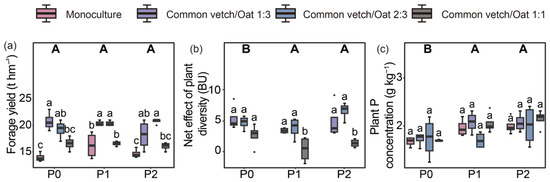
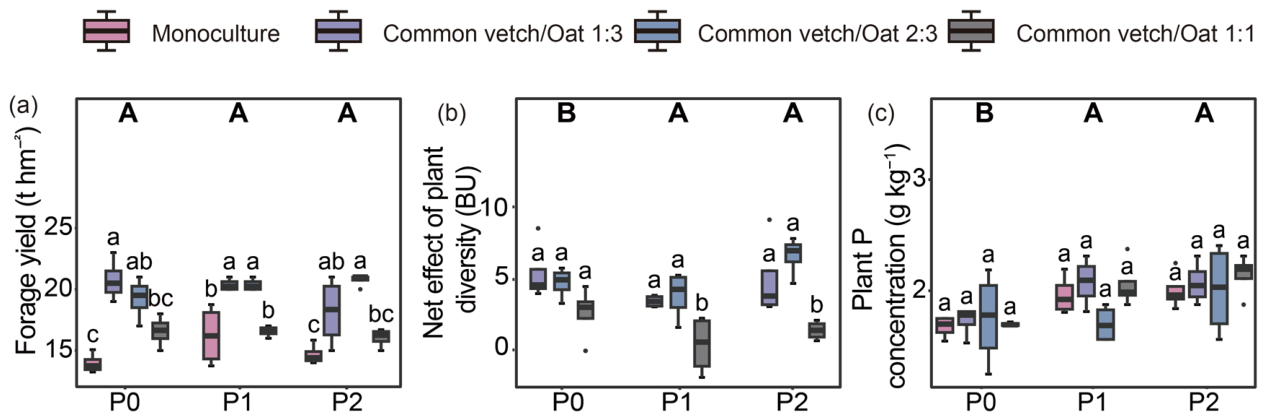
Common vetch/oat intercropping at legume–grass ratios of 1:3 and 2:3 significantly outyielded monocultures across all P fertilization levels (p < 0.05; Figure 1a). This yield advantage was supported by a correspondingly greater NE in the 1:3 and 2:3 mixtures compared with the 1:1 mixture at P rates of 60 and 120 kg ha−1 (Figure 1b). While the intercropping ratio governed yield and NE responses, plant P concentration was primarily increased by P fertilization, with both application rates resulting in significantly higher concentrations than the unfertilized control (Figure 1c). However, intercropping and phosphorus addition have no interactive effect on the above three variables (Table 1).
Figure 1.
Forage yield (a), net biodiversity effect (b), and plant P concentration (c) under different intercropping treatments and P fertilization levels. Monoculture represents the average of common vetch and oat single cultivation. Intercropping treatments represent the common vetch/oat at sowing ratios of 1:3, 2:3, and 1:1. P0, 0 kg ha−1; P1, 60 kg ha−1; P2, 120 kg ha−1. Different lowercase letters above boxes indicate significant differences among intercropping treatments (p < 0.05) and different uppercase letters indicate significant differences among P fertilization levels (p < 0.05).
Table 1.
Effects of mixed sowing and fertilization and their interaction on yield, plant phosphorus content, soil physicochemical properties, microorganisms and enzyme activities. *, p < 0.05; **, p < 0.01; ***, p < 0.0001.
3.2. Soil Physicochemical Properties
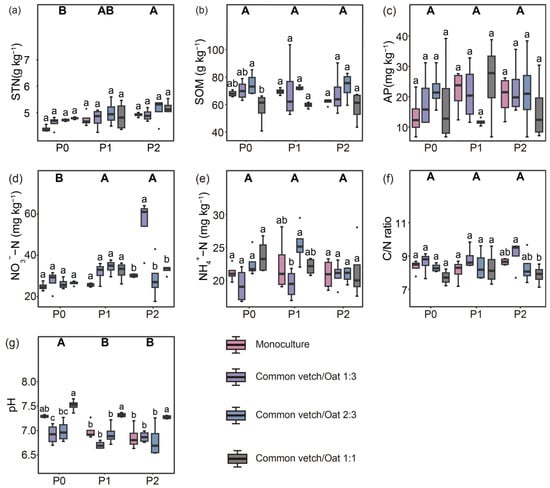
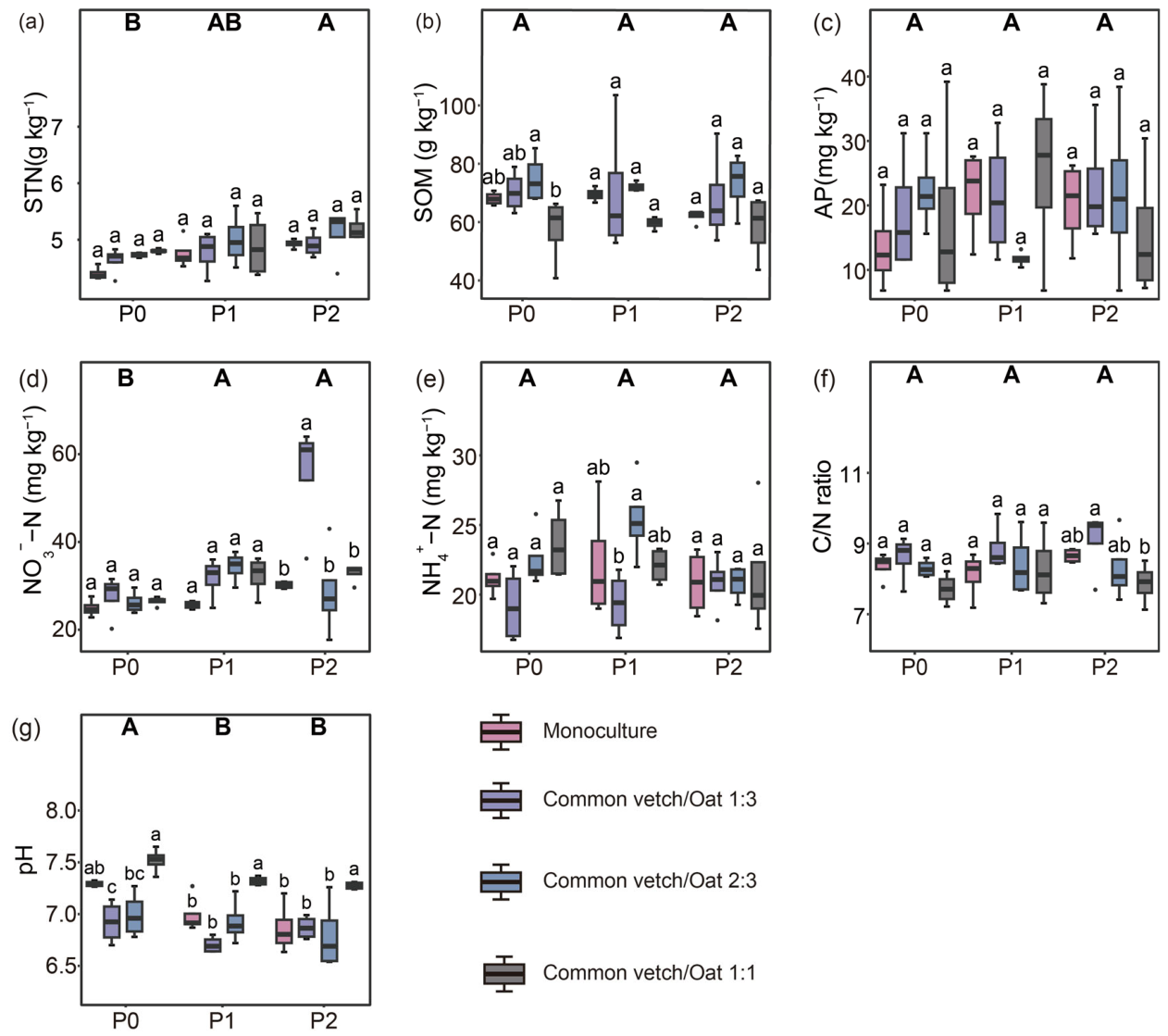
Phosphorus fertilization significantly increased total soil nitrogen but decreased soil pH (p < 0.05; Figure 2a,g; Table 1). In parallel, intercropping significantly enhanced SOM, NH4+–N, and the soil C/N ratio when compared with monoculture (Figure 2b,e,f). Notably, a significant interaction between intercropping and P fertilization was observed for soil NO3−–N, with the common vetch/oat 1:3 treatment under high P (120 kg ha−1) showing the highest NO3−–N content (Figure 2d; Table 1). In contrast, soil AP content was not significantly affected by either intercropping or P fertilization (Figure 2c).
Figure 2.
Soil physicochemical properties under different intercropping treatments and P fertilization levels. Panels (a)–(g) present soil properties for soil total nitrogen content (STN), soil organic matter content (SOM), soil-available phosphorus content (AP), soil nitrate nitrogen content (NO3−–N), soil ammonium nitrogen content (NH4+–N), the ratio of soil organic carbon to total nitrogen (C/N ratio), and soil pH. Monoculture represents the average of common vetch and oat single cultivation. Intercropping treatments represent the common vetch/oat at sowing ratios of 1:3, 2:3, and 1:1. P0, 0 kg ha−1; P1, 60 kg ha−1; P2, 120 kg ha−1. Different lowercase letters above boxes indicate significant differences among intercropping treatments (p < 0.05) and different uppercase letters indicate significant differences among P fertilization levels (p < 0.05).
3.3. Microbial Biomass and Enzyme Activity
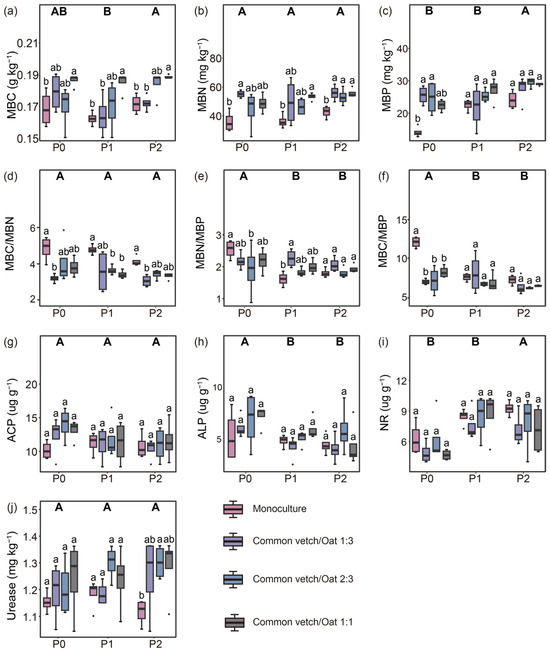
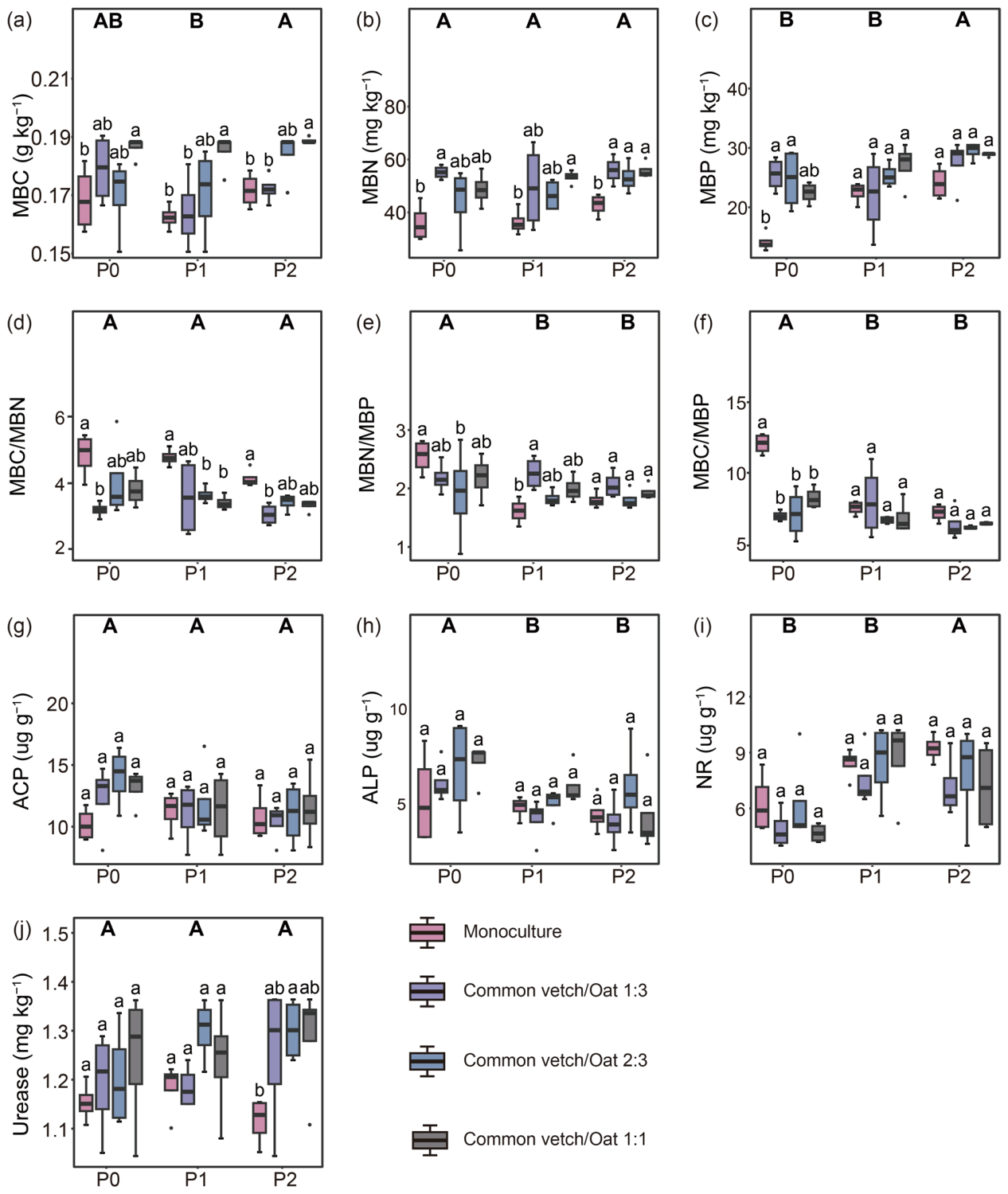
Intercropping significantly increased MBC and MBN relative to monoculture (p < 0.05; Figure 3a,b). In contrast, P fertilization significantly increased MBP (p < 0.05; Figure 3c). These shifts in microbial biomass were accompanied by distinct changes in microbial stoichiometry. Intercropping significantly lowered the MBC/MBN ratio, while P fertilization significantly reduced both the MBN/MBP and MBC/MBP ratios (p < 0.05; Figure 3d–f). A particularly notable interaction was observed for the MBC/MBP ratio, with all intercropping treatments showing a significantly lower ratio than the monoculture in the absence of P fertilization. However, this difference disappeared when P was applied at either 60 or 120 kg ha−1, indicating that P fertilization overrode the intercropping-induced stoichiometric shift (Table 1).
Figure 3.
Microbial biomass carbon (MBC), microbial biomass nitrogen (MBN), microbial biomass phosphorus (MBP), and microbial enzyme activities under different intercropping treatments and P fertilization levels. Panels (a)–(j) present MBC, MBN, MBP, MBC/MBN, MBN/MNP, MBC/MBP, acid phosphatase activity (ACP), alkaline phosphatase activity (ALP), nitrate reductase activity (NR), and Urease. Monoculture represents the average of common vetch and oat single cultivation. Intercropping treatments represent the common vetch/oat at sowing ratios of 1:3, 2:3, and 1:1. P0, 0 kg ha−1; P1, 60 kg ha−1; P2, 120 kg ha−1. Different lowercase letters above boxes indicate significant differences among intercropping treatments (p < 0.05) and different uppercase letters indicate significant differences among P fertilization levels (p < 0.05).
Enzyme activities responded differently to the two management factors. Intercropping significantly enhanced urease activity (p < 0.05; Figure 3j); P fertilization significantly suppressed ALP activity but stimulated NR activity (Figure 3h,i); and ACP activity, in contrast, remained unaffected by either intercropping or P fertilization (Figure 3g).
3.4. Key Drivers of Forage Yield and Plant P Concentration
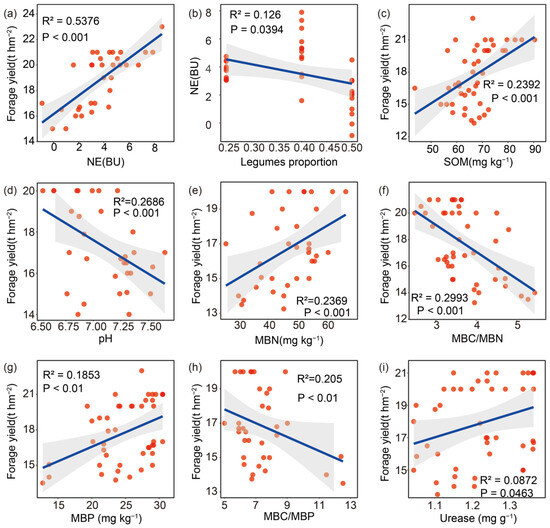
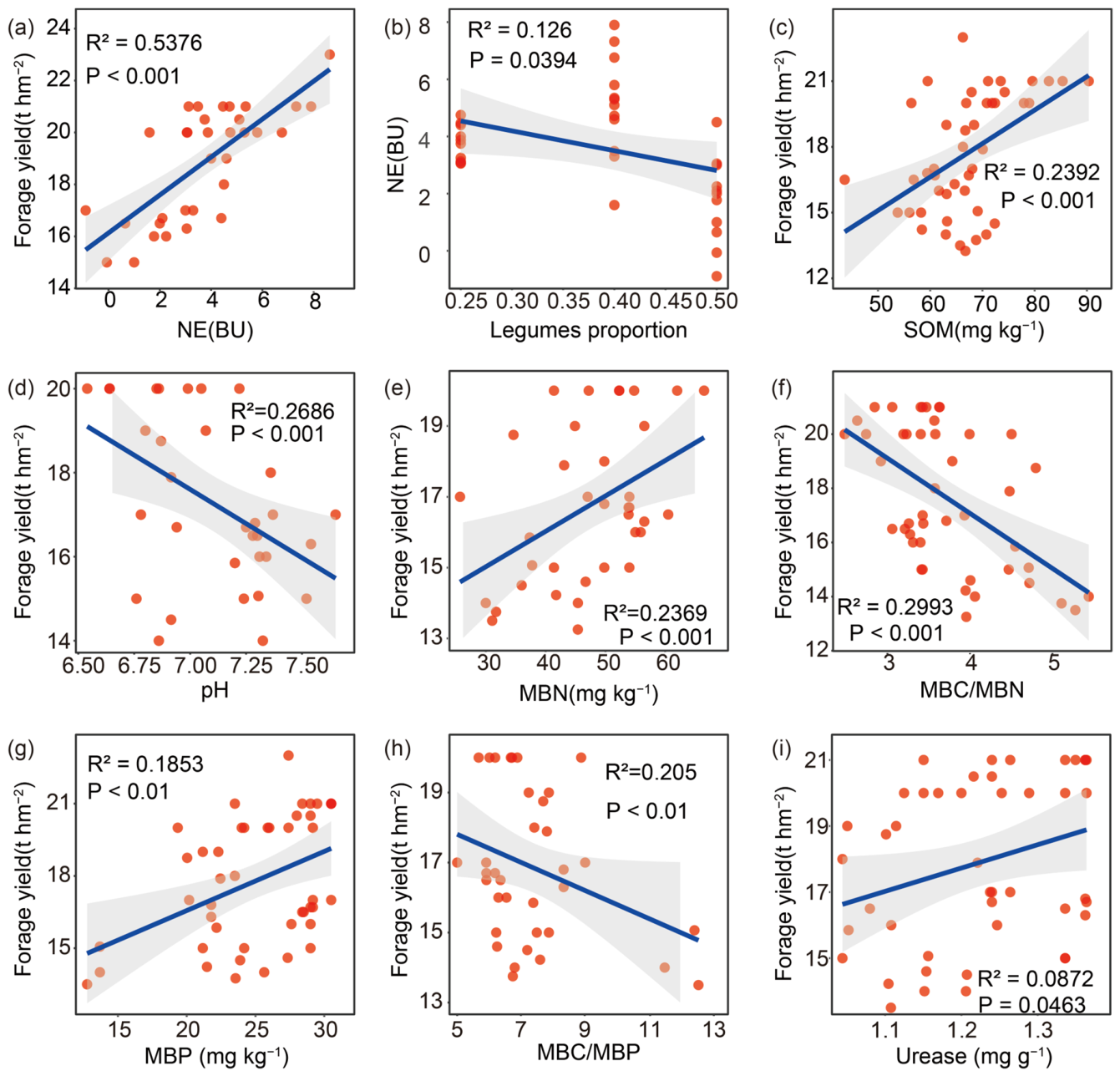
Forage yield was positively associated with the NE, SOM, MBN, MBP, and urease activity (p < 0.05), whereas it showed negative correlations with soil pH, the MBC/MBN ratio, and the MBC/MBP ratio (p < 0.05; Figure 4). Notably, the NE declined as the legume proportion increased in the intercropping system (p < 0.05; Figure 4).
Figure 4.
Contribution of the net biodiversity effect (a,b), soil physicochemical properties (c,d), and microbial indicators (e–i) to forage yield. NE, net biodiversity effect; SOM, soil organic matter; MBC, microbial biomass carbon; MBN, microbial biomass nitrogen; MBP, microbial biomass phosphorus. The solid lines indicate a significant linear relationship (p < 0.05) the shaded area represents the 95% confidence interval.
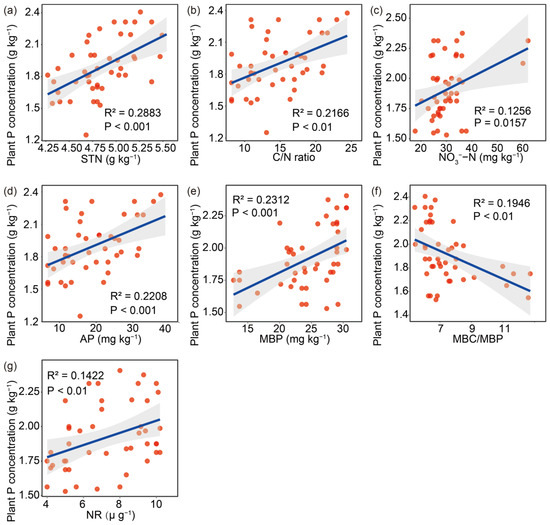
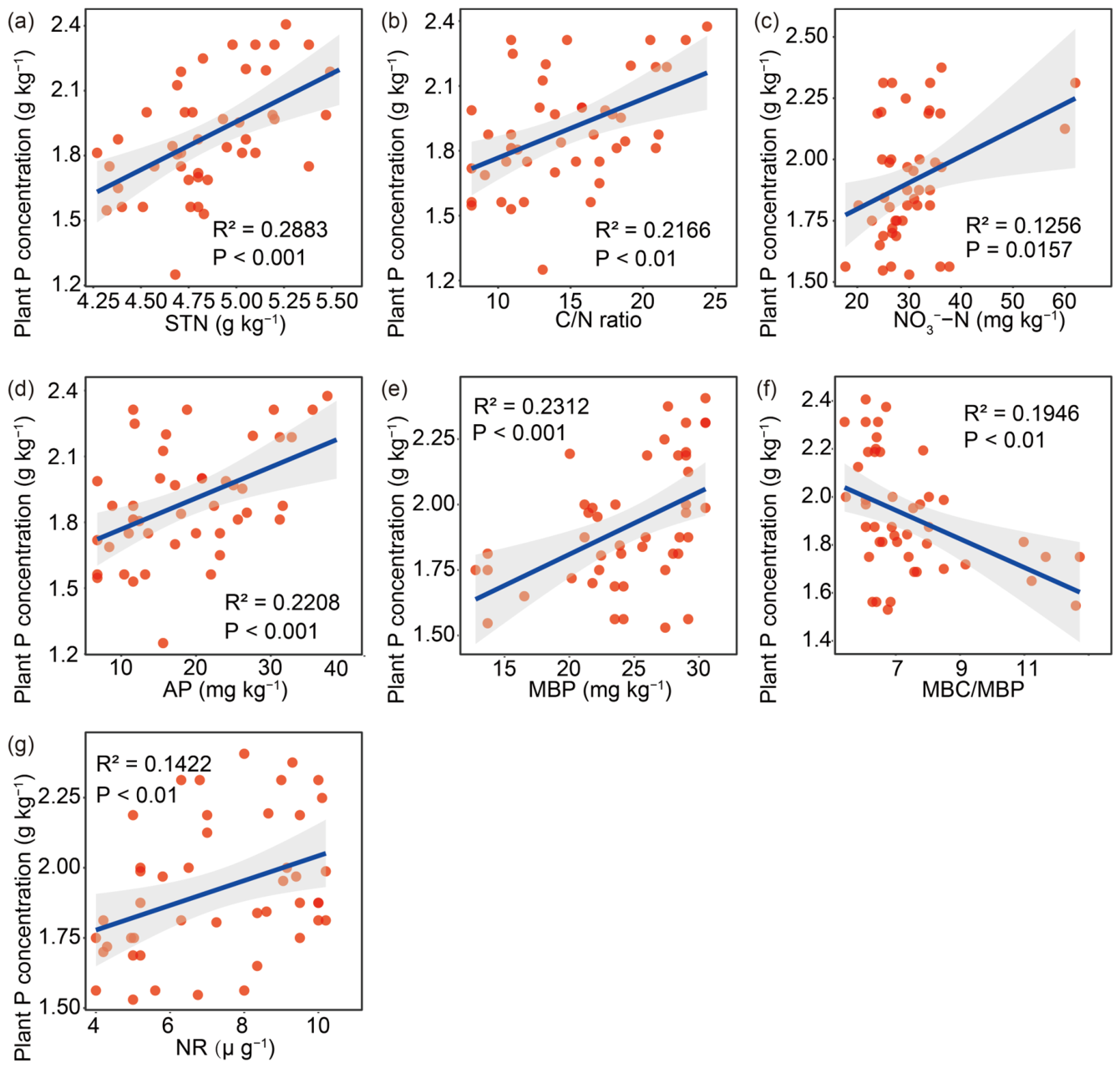
Plant phosphorus concentration exhibited a distinct set of linkages. It was positively related to soil total nitrogen, soil C/N ratio, NO3−–N, AP, MBP, and NR activity, but negatively related to the MBC/MBP ratio (p < 0.05; Figure 5). Together, these correlation patterns underscore the central role of microbially mediated phosphorus cycling in coupling the effects of intercropping and phosphorus fertilization to forage productivity and plant phosphorus uptake.
Figure 5.
Contribution of soil physicochemical properties (a–d) and microbial indicators (e–g) to plant P concentration. STN, soil total nitrogen content; C/N ratio, the ratio of soil organic carbon and total nitrogen; NO3−–N, nitrate nitrogen content; AP, soil-available phosphorus content; MBP, microbial biomass phosphorus; NR, nitrate reductase activity. The solid lines indicate a significant linear relationship (p < 0.05) the shaded area represents the 95% confidence interval.
4. Discussion
4.1. Effects on Forage Yield and Net Diversity Effects
Higher plant diversity in legume–grass mixtures generally enhances forage yield, with the NE serving as a key indicator of diversity–ecosystem functioning [27,28]. Previous studies have reported optimal legume proportions for maximizing productivity in the range of 40–50% [29], and even a 30% legume seeding ratio combined with phosphorus fertilization has been shown to improve forage production [3]. In contrast, our results revealed that a lower legume proportion (25%) produced the highest hay yield and NE across most P fertilization levels, suggesting a shifted optimum in this semi-arid alkaline grassland. This divergence is likely context-dependent. Under water-limited and alkaline conditions, a moderate legume proportion may provide sufficient nitrogen facilitation while minimizing competition for soil moisture and phosphorus, thereby maximizing complementarity and NE. Consistent with this interpretation, the common vetch/oat 1:3 treatment maintained higher NE and yield than the 1:1 treatment, supporting the view that excessive legume dominance can weaken interspecific complementarity. Additionally, phosphorus fertilization contributed to a slight decline in soil pH, a shift that is favorable for soil organic matter accumulation [30,31]. In this study, this concurrent increase in soil organic matter and urease activity, particularly in the common vetch/oat 1:3 treatment, suggests a more active nitrogen cycle driven by biological nitrogen fixation of common vetch, which may partly explain the overyielding observed at a legume proportion of 25% [32,33].
4.2. Effects on Plant Phosphorus Concentration
Phosphorus fertilization significantly increased plant P concentration, an effect closely associated with elevated microbial biomass phosphorus and reduced soil pH. The decline in soil pH induced by P addition likely enhanced P solubility and stimulated phosphate-solubilizing microorganisms, thereby expanding the microbial P pool [34,35]. The combined application of P fertilizer with organic acids has also been reported to increase plant P concentration [16]. Meanwhile, greater plant diversity, reflected by a higher net biodiversity effect, may have increased the diversity of root exudates, thereby promoting microbial functional differentiation and enhancing P mobilization [36]. Because available P is the direct source for plant P uptake, an increase in available P directly contributes to improved plant P concentration [37]. In addition, improved soil nitrogen status, evident from the positive correlations among total soil nitrogen, nitrate–N, and plant P, may further facilitate P acquisition, consistent with the coupling of nitrogen supply and P demand during rapid biomass accumulation.
4.3. Soil and Microbial Responses to Intercropping and Fertilization
Phosphorus application indirectly influenced forage yield by increasing total soil nitrogen and enhanced plant phosphorus concentration through a significant increase in nitrate reductase activity and soil nitrate levels. These effects likely reflect the way that P input promoted root growth and nitrogen fixation in common vetch, thereby improving soil nitrogen status [38,39]. Notably, the NE responded non-linearly to P addition, suggesting threshold effects and the involvement of multiple concurrent processes. Intermediate P supply may have coincided with transient P immobilization or adsorption, alongside a rebalancing of legume–grass competition that reduced complementarity, whereas higher P more fully alleviated P limitation and reactivated facilitative interactions and microbial turnover pathways [3]. The reduction in yield and NE at 60 kg P ha−1 compared with both the unfertilized control and the 120 kg P ha−1 treatment may therefore reflect a threshold response, short-term P immobilization or shifts in competitive dynamics under intermediate P availability.
The contrasting responses of soil organic matter and ammonium–N between the common vetch/oat 1:3 and 2:3 treatments at 60 kg P ha−1 suggest that the 1:3 mixture may require higher P input to fully realize its facilitative effects, whereas the 2:3 mixture can already benefit from moderate P supply. Intercropping of common vetch and oat significantly reshaped microbial nutrient pools and stoichiometry. MBN and MBP were positively correlated with hay yield, while the MBC/MBN, and MBC/MBP ratios were negatively correlated, indicating that mixtures promoted more efficient microbial turnover and improved N and P supply to plants [40,41]. Phosphorus fertilization further increased MBC and, more notably, MBP, suggesting enhanced microbial P cycling and soil fertility, likely driven by legume root growth and N fixation that also supported plant P acquisition [42,43,44]. Enzymatic responses were also dependent on P status. Alkaline phosphatase activity declined under P addition, whereas acid phosphatase activity remained unchanged. This pattern is consistent with ecosystem-specific regulation influenced by background climate and C–N availability [45,46]. Collectively, these results support a coupled pathway whereby intercropping and P supply expand microbial N and P pools, optimize microbial stoichiometry, and regulate phosphatases, thereby sustaining forage productivity [47,48,49,50].
5. Conclusions
We found that common vetch/oat intercropping with a 25–40% legume proportion outyielded monocultures across all P levels and exhibited stronger net biodiversity effects than the 1:1 intercropping. Forage yield and plant P concentration were positively correlated with MBP and negatively with the MBC/MBP ratio. Intercropping increased microbial biomass C and N, whereas P fertilization specifically enhanced MBP, followed by reductions in the MBN/MBP and MBC/MBP ratios. Notably, a significant interaction between intercropping and P addition was observed for the MBC/MBP ratio. These findings suggest that P supply can buffer intercropping-induced stoichiometric shifts. Overall, optimizing legume–grass intercropping ratios with moderate P fertilization synergistically enhances forage yield and plant P uptake in semi-arid grasslands. Collectively, this study provides a mechanistic framework for optimizing nutrient management in diversified forage systems and underscores the critical role of microbial phosphorus cycling in mediating plant–soil interactions under integrated management practices.
Author Contributions
Conceptualization, Z.L.; Methodology, Y.L., L.Z., P.N. and X.C.; Software, Y.L.; Validation, Y.L.; Formal analysis, Y.L., L.Z., P.N., X.C., S.G. and M.Z.; Investigation, L.Z., X.C., S.G. and M.Z.; Resources, Z.L.; Data curation, Y.L., L.Z., P.N., S.G. and M.Z.; Writing—original draft, Y.L. and L.Z.; Writing—review & editing, Z.L.; Visualization, Y.L.; Supervision, Z.L.; Project administration, Z.L.; Funding acquisition, Z.L. All authors have read and agreed to the published version of the manuscript.
Funding
This work was supported by the National Natural Science Foundation of China (32001143 and 32271769) and the Project for Scientific Innovation Capability Development of the Key Laboratory of Ecology and Resource Use of the Mongolian Plateau, Ministry of Education of China (MPL20250202).
Data Availability Statement
The raw data supporting the conclusions of this article will be made available by the authors on request.
Acknowledgments
We are grateful to the anonymous reviewers and the handling editor for providing insightful and constructive comments.
Conflicts of Interest
The authors declare no conflicts of interest.
References
- Bardgett, R.D.; Bullock, J.M.; Lavorel, S.; Manning, P.; Schaffner, U.; Ostle, N.; Chomel, M.; Durigan, G.; Fry, E.L.; Johnson, D.; et al. Combatting global grassland degradation. Nat. Rev. Earth Environ. 2021, 2, 720–735. [Google Scholar] [CrossRef] [Scilit]
- Milazzo, F.; Francksen, R.M.; Abdalla, M.; Ravetto Enri, S.; Zavattaro, L.; Pittarello, M.; Hejduk, S.; Newell-Price, P.; Schils, R.L.M.; Smith, P.; et al. An overview of permanent grassland grazing management practices and the impacts on principal soil quality indicators. Agronomy 2023, 13, 1366. [Google Scholar] [CrossRef] [Scilit]
- Bi, Y.; Zhou, P.; Li, S.; Wei, Y.; Xiong, X.; Shi, Y.; Liu, N.; Zhang, Y. Interspecific interactions contribute to higher forage yield and are affected by phosphorus application in a fully-mixed perennial legume and grass intercropping system. Field Crops Res. 2019, 244, 107636. [Google Scholar] [CrossRef] [Scilit]
- Francisquini Junior, A.; Calonego, J.C.; Rosolem, C.A.; dos Santos, C.H.; Tiritan, C.S. Increase of nitrogen-use efficiency by phosphorus fertilization in grass–legume pastures. Nutr. Cycl. Agroecosystems 2020, 118, 165–175. [Google Scholar] [CrossRef] [Scilit]
- Caram, N.; Sollenberger, L.E.; Wallau, M.O.; Dubeux, J.C.B. Nitrogen niche differentiation and overyielding along a legume proportion gradient in a subtropical grass-legume mixture. Plant Soil. 2025, 513, 1085–1100. [Google Scholar] [CrossRef] [Scilit]
- Księżak, J.; Staniak, M.; Stalenga, J. Restoring the importance of cereal-grain legume mixtures in low-input farming systems. Agriculture 2023, 13, 341. [Google Scholar] [CrossRef] [Scilit]
- Wang, T.; Wang, B.; Xiao, A.; Lan, J. Optimizing seeding ratio for legume forage to maximize system productivity and resource use efficiency in mixed cropping systems. Agriculture 2024, 14, 1249. [Google Scholar] [CrossRef] [Scilit]
- Wu, S.; Nan, L.; Wang, K. Effects of alfalfa–grass mixed sowing on grass yield and rhizosphere soil characteristics. Agronomy 2025, 15, 830. [Google Scholar] [CrossRef] [Scilit]
- Liu, Y.; Yan, W.; Yang, T.; An, Y.; Li, X.; Gao, H.; Peng, Z.; Wei, G.; Jiao, S. Grass-legume mixtures maintain forage biomass under microbial diversity loss via gathering Pseudomonas in root zone soil. mSystems 2023, 8, e00755-23. [Google Scholar] [CrossRef] [Scilit] [PubMed]
- Dhakal, D.; Islam, M.A. Grass-legume mixtures for improved soil health in cultivated agroecosystem. Sustainability 2018, 10, 2718. [Google Scholar] [CrossRef] [Scilit]
- Grange, G.; Finn, J.A.; Brophy, C. Plant diversity enhanced yield and mitigated drought impacts in intensively managed grassland communities. J. Appl. Ecol. 2021, 58, 1864–1875. [Google Scholar] [CrossRef] [Scilit]
- Caram, N.; Sollenberger, L.E.; Wallau, M.O.; Dubeux, J.C.B., Jr.; DiLorenzo, N. Optimum legume proportion for plant and animal production in a subtropical grassland. Crop Sci. 2024, 65, e21426. [Google Scholar] [CrossRef] [Scilit]
- Wang, Z.; Jiang, H.; Shen, Y. Forage production and soil water balance in oat and common vetch sole crops and intercrops cultivated in the summer-autumn fallow season on the Chinese Loess Plateau. Eur. J. Agron. 2020, 115, 126042. [Google Scholar] [CrossRef] [Scilit]
- Li, R.; Zhang, Z.; Tang, W.; Huang, Y.; Nan, Z. Effect of row configuration on yield and radiation use of common vetch-oat strip intercropping on the Qinghai-Tibetan plateau. Eur. J. Agron. 2021, 128, 126290. [Google Scholar] [CrossRef] [Scilit]
- Bindraban, P.S.; Dimkpa, C.O.; Pandey, R. Exploring phosphorus fertilizers and fertilization strategies for improved human and environmental health. Biol. Fertil. Soils 2020, 56, 299–317. [Google Scholar] [CrossRef] [Scilit]
- Izhar Shafi, M.; Adnan, M.; Fahad, S.; Wahid, F.; Khan, A.; Yue, Z.; Danish, S.; Zafar-ul-Hye, M.; Brtnicky, M.; Datta, R. Application of single superphosphate with humic acid improves the growth, yield and phosphorus uptake of wheat (Triticum aestivum L.) in calcareous soil. Agronomy 2020, 10, 1224. [Google Scholar] [CrossRef] [Scilit]
- Hou, E.; Luo, Y.; Kuang, Y.; Chen, C.; Lu, X.; Jiang, L.; Luo, X.; Wen, D. Global meta-analysis shows pervasive phosphorus limitation of aboveground plant production in natural terrestrial ecosystems. Nat. Commun. 2020, 11, 637. [Google Scholar] [CrossRef] [Scilit] [PubMed]
- Mäkelä, P.S.A.; Wasonga, D.O.; Solano Hernandez, A.; Santanen, A. Seedling growth and phosphorus uptake in response to different phosphorus sources. Agronomy 2020, 10, 1089. [Google Scholar] [CrossRef] [Scilit]
- Loudari, A.; Mayane, A.; Zeroual, Y.; Colinet, G.; Oukarroum, A. Photosynthetic performance and nutrient uptake under salt stress: Differential responses of wheat plants to contrasting phosphorus forms and rates. Front. Plant Sci. 2022, 13, 1038672. [Google Scholar] [CrossRef] [Scilit] [PubMed]
- Moeneclaey, I.; Schelfhout, S.; Vanhellemont, M.; DeCock, E.; Van Coillie, F.; Verheyen, K.; Baeten, L. Species ecological strategy and soil phosphorus supply interactively affect plant biomass and phosphorus concentration. Basic Appl. Ecol. 2022, 62, 1–11. [Google Scholar] [CrossRef] [Scilit]
- Che, S.; Xu, Y.; Qin, X.; Tian, S.; Wang, J.; Zhou, X.; Cao, Z.; Wang, D.; Wu, M.; Wu, Z. Building microbial consortia to enhance straw degradation, phosphorus solubilization, and soil fertility for rice growth. Microb. Cell Fact. 2024, 23, 232. [Google Scholar] [CrossRef] [Scilit] [PubMed]
- Jiang, B.; Shen, J.; Sun, M.; Hu, Y.; Jiang, W.; Wang, J.; Li, Y.; Wu, J. Soil phosphorus availability and rice phosphorus uptake in paddy fields under various agronomic practices. Pedosphere 2021, 31, 103–115. [Google Scholar] [CrossRef] [Scilit]
- Rai, A.K.; Dinkar, A.; Basak, N.; Dixit, A.K.; Das, S.K.; Dev, I.; Sundha, P.; Chandra, P.; Kumar, S. Phosphorus nutrition of oats genotypes in acidic soils: Exploiting responsive plant-microbe partnership. Appl. Soil Ecol. 2021, 167, 104094. [Google Scholar] [CrossRef] [Scilit]
- Chen, X.; Chang, S. Meta-analysis shows that plant mixtures increase soil phosphorus availability and plant productivity in diverse ecosystems. Nat. Ecol. Evol. 2022, 6, 1112–1121. [Google Scholar] [CrossRef] [Scilit] [PubMed]
- Baoyin, T.; Li, F.Y.; Bao, Q.; Minggagud, H.; Zhong, Y. Effects of mowing regimes and climate variability on hay production of Leymus chinensis (Trin.) Tzvelev grassland in northern China. Rangel. J. 2014, 36, 593–600. [Google Scholar] [CrossRef] [Scilit]
- Pinheiro, J.; Bates, D.; DebRoy, S.; Sarkar, D.; Team, R.C. nlme: Linear and Nonlinear Mixed Effects Models. R Package; Version 3.1-137; Comprehensive R Archive Network: Vienna, Austria, 2018. [Google Scholar]
- Isbell, F.; Adler, P.R.; Eisenhauer, N.; Fornara, D.; Kimmel, K.; Kremen, C.; Letourneau, D.K.; Liebman, M.; Polley, H.W.; Quijas, S.; et al. Benefits of increasing plant diversity in sustainable agroecosystems. J. Ecol. 2017, 105, 871–879. [Google Scholar] [CrossRef] [Scilit]
- Craven, D.; Isbell, F.; Manning, P.; Connolly, J.; Bruelheide, H.; Ebeling, A.; Roscher, C.; van Ruijven, J.; Weigelt, A.; Wilsey, B.; et al. Plant diversity effects on grassland productivity are robust to both nutrient enrichment and drought. Philos. Trans. R. Soc. B Biol. Sci. 2016, 371, 20150277. [Google Scholar] [CrossRef] [Scilit] [PubMed]
- Luo, C.L.; Duan, H.X.; Wang, Y.L.; Liu, H.J.; Xu, S.X. Complementarity and competitive trade-offs enhance forage productivity, nutritive balance, land and water use, and economics in legume-grass intercropping. Field Crops Res. 2024, 319, 109642. [Google Scholar] [CrossRef] [Scilit]
- Wang, C.; Kuzyakov, Y. Soil organic matter priming: The pH effects. Glob. Change Biol. 2024, 30, e17349. [Google Scholar] [CrossRef] [Scilit] [PubMed]
- Zhu, X.; Ros, G.H.; Xu, M.; Xu, D.; Cai, Z.; Sun, N.; Duan, Y.; de Vries, W. The contribution of natural and anthropogenic causes to soil acidification rates under different fertilization practices and site conditions in southern China. Sci. Total Environ. 2024, 934, 172986. [Google Scholar] [CrossRef] [Scilit] [PubMed]
- Błońska, E.; Lasota, J.; Gruba, P. Enzymatic activity and stabilization of organic matter in soil with different detritus inputs. Soil Sci. Plant Nutr. 2017, 63, 242–247. [Google Scholar]
- Luo, F.; Liu, W.; Mi, W.; Ma, X.; Liu, K.; Ju, Z.; Li, W. Legume-grass mixtures increase forage yield by improving soil quality in different ecological regions of the Qinghai-Tibet Plateau. Front. Plant Sci. 2023, 14, 1280771. [Google Scholar] [CrossRef] [Scilit] [PubMed]
- Alori, E.T.; Glick, B.R.; Babalola, O.O. Microbial phosphorus solubilization and its potential for use in sustainable agriculture. Front. Microbiol. 2017, 8, 971. [Google Scholar] [CrossRef] [Scilit] [PubMed]
- Zhu, J.; Li, M.; Whelan, M. Phosphorus activators contribute to legacy phosphorus availability in agricultural soils: A review. Sci. Total Environ. 2018, 612, 522–537. [Google Scholar] [CrossRef] [Scilit] [PubMed]
- Gong, X.; Feng, Y.; Dang, K.; Jiang, Y.; Qi, H.; Feng, B. Linkages of microbial community structure and root exudates: Evidence from microbial nitrogen limitation in soils of crop families. Sci. Total Environ. 2023, 881, 163536. [Google Scholar] [CrossRef] [Scilit] [PubMed]
- Lambers, H. Phosphorus acquisition and utilization in plants. Annu. Rev. Plant Biol. 2022, 73, 17–42. [Google Scholar] [CrossRef] [Scilit] [PubMed]
- Mitran, T.; Meena, R.S.; Lal, R.; Layek, J.; Kumar, S.; Datta, R. Role of soil phosphorus on legume production. In Legumes for Soil Health and Sustainable Management; Meena, R.S., Das, A., Yadav, G.S., Lal, R., Eds.; Springer: Singapore, 2018; pp. 487–510. [Google Scholar] [CrossRef] [Scilit]
- Wang, Q.; Wang, J.; Li, Y.; Chen, D.; Ao, J.; Zhou, W.; Shen, D.; Li, Q.; Huang, Z.; Jiang, Y. Influence of nitrogen and phosphorus additions on N2-fixation activity, abundance, and composition of diazotrophic communities in a Chinese fir plantation. Sci. Total Environ. 2018, 619–620, 1530–1537. [Google Scholar] [CrossRef] [Scilit] [PubMed]
- Song, Y.N.; Zhang, F.S.; Marschner, P.; Fan, F.L.; Gao, H.M.; Bao, X.G.; Sun, J.H.; Li, L. Effect of intercropping on crop yield and chemical and microbiological properties in rhizosphere of wheat (Triticum aestivum L.), maize (Zea mays L.), and faba bean (Vicia faba L.). Biol. Fertil. Soils 2006, 43, 565–574. [Google Scholar] [CrossRef] [Scilit]
- Tang, X.; Bernard, L.; Brauman, A.; Daufresne, T.; Deleporte, P.; Desclaux, D.; Souche, G.; Placella, S.A.; Hinsinger, P. Increase in microbial biomass and phosphorus availability in the rhizosphere of intercropped cereal and legumes under field conditions. Soil Biol. Biochem. 2014, 75, 86–93. [Google Scholar] [CrossRef] [Scilit]
- Li, L.-J.; Zhu-Barker, X.; Ye, R.; Doane, T.A.; Horwath, W.R. Soil microbial biomass size and soil carbon influence the priming effect from carbon inputs depending on nitrogen availability. Soil Biol. Biochem. 2018, 119, 41–49. [Google Scholar] [CrossRef] [Scilit]
- Nelson, D.W.; Sommers, L.E. Total carbon, organic carbon, and organic matter. In Methods of Soil Analysis; American Society of Agronomy, Inc.: Madison, Wisconsin, 1996; pp. 961–1010. [Google Scholar] [CrossRef] [Scilit]
- Schleuss, P.M.; Widdig, M.; Heintz-Buschart, A.; Kirkman, K.; Spohn, M. Interactions of nitrogen and phosphorus cycling promote P acquisition and explain synergistic plant-growth responses. Ecology 2020, 101, e03003. [Google Scholar] [CrossRef] [Scilit] [PubMed]
- Margalef, O.; Sardans, J.; Maspons, J.; Molowny-Horas, R.; Fernández-Martínez, M.; Janssens, I.A.; Richter, A.; Ciais, P.; Obersteiner, M.; Peñuelas, J. The effect of global change on soil phosphatase activity. Glob. Change Biol. 2021, 27, 5989–6003. [Google Scholar] [CrossRef] [Scilit] [PubMed]
- Gou, X.; Ren, Y.; Qin, X.; Wei, X.; Wang, J. Global patterns of soil phosphatase responses to nitrogen and phosphorus fertilization. Pedosphere 2024, 34, 200–210. [Google Scholar] [CrossRef] [Scilit]
- Ahmad, E.; Zaidi, A.; Khan, M.S. Response of PSM inoculation to certain legumes and cereal crops. In Phosphate Solubilizing Microorganisms: Principles and Ppplication of Microphos Technology; Khan, M.S., Zaidi, A., Musarrat, J., Eds.; Springer International Publishing: Cham, Switzerland, 2014; pp. 175–205. [Google Scholar] [CrossRef] [Scilit]
- Lazo, D.E.; Dyer, L.G.; Alorro, R.D. Silicate, phosphate and carbonate mineral dissolution behaviour in the presence of organic acids: A review. Miner. Eng. 2017, 100, 115–123. [Google Scholar] [CrossRef] [Scilit]
- Kalayu, G. Phosphate solubilizing microorganisms: Promising approach as biofertilizers. Int. J. Agron. 2019, 2019, 4917256. [Google Scholar] [CrossRef] [Scilit]
- Yang, X.; Chen, X.; Yang, X. Effect of organic matter on phosphorus adsorption and desorption in a black soil from Northeast China. Soil Tillage Res. 2019, 187, 85–91. [Google Scholar] [CrossRef] [Scilit]

Disclaimer/Publisher’s Note: The statements, opinions and data contained in all publications are solely those of the individual author(s) and contributor(s) and not of MDPI and/or the editor(s). MDPI and/or the editor(s) disclaim responsibility for any injury to people or property resulting from any ideas, methods, instructions or products referred to in the content. |
© 2026 by the authors. Licensee MDPI, Basel, Switzerland. This article is an open access article distributed under the terms and conditions of the Creative Commons Attribution (CC BY) license.