


Abstract
Wheat production demands simplified fertilization strategies to achieve sustainable high yields. This study evaluated the effects of the one-time high-rate application of an organic–inorganic compound fertilizer on soil properties, photosynthetic characteristics, and grain yields. A multi-year field experiment was conducted with a single basal application of an organic–inorganic compound fertilizer at 3600 kg·ha−1, using conventional split chemical fertilization as the control. Compared with the control, this treatment significantly increased soil organic matter and available nutrient content, enhanced the bacteria/fungi ratio, elevated soil enzyme activity, and promoted the conversion of humus into more stable forms. These improvements sustained a higher flag leaf photosynthetic capacity during the grain-filling stage and delayed leaf senescence. The multi-year average grain yield was 5.28% higher than that of conventional split fertilization. The one-time high-rate application of an organic–inorganic compound fertilizer can improve soil biological properties, maintain late-season photosynthetic function, and increase yields, serving as an effective technical measure for simplified, sustainable, and high-yield wheat cultivation in the region.
1. Introduction
Major wheat-producing regions in China have long relied on the split application of chemical fertilizers. This practice not only incurs high labor costs but also leads to soil compaction, reduced microbial diversity, loss of humus, and other issues due to over-application, threatening the sustainable productivity of farmland and food security [1,2]. Although organic fertilizer can improve soil fertility, its low nutrient content necessitates large application volumes to meet crop demands, and the costs of composting and transportation are high, making it economically difficult to promote. Processing organic fertilizer into a pelleted organic–inorganic compound fertilizer can increase nutrient concentration and reduce the costs associated with storage, transport, and application [3]. This type of fertilizer combines the soil-conditioning and fertility-building functions of organic fertilizer with the rapid nutrient supply characteristics of chemical fertilizers. Its organic component can slow down nutrient release, better matching the crop’s demand throughout its growth period; one-time application aligns with the trend towards agricultural simplification and has significant application potential [4].
Currently, research on organic–inorganic compound fertilizers is often based on short-term trials or limited to single-effect evaluations, such as only examining single-season yield responses or changes in a few soil indicators [5], lacking the comprehensive observation of photosynthetic characteristics, soil properties, and yield formation processes under long-term conditions. Regarding photosynthesis, studies have indicated that humic acid in organic fertilizers can increase wheat leaf chlorophyll content and Rubisco enzyme activity [6,7,8], but these studies mostly focus on the early growth stages, and the effect on maintaining photosynthetic function during the grain-filling stage remains unclear. Concerning soil, organic–inorganic compound fertilizers can increase organic carbon input [9], but how soil organic matter transformation affects microbial communities and the nutrient supply capacity after long-term application needs further clarification. Regarding fertilization methods, the one-time application of chemical fertilizers can easily lead to nutrient deficiency in wheat during the late growth stage [10]. Whether organic–inorganic compound fertilizers can overcome this defect and maintain the soil nutrient supply capacity and photosynthetic function over the long term, thereby achieving stable and increased yields, requires verification through long-term experiments. From the perspective of crop–soil interaction, the role of organic–inorganic compound fertilizers is not merely to substitute part of the chemical fertilizer but rather to promote sustained nutrient release through organic carbon input, humification, and microbial activation, thereby influencing photosynthetic maintenance and yield formation during the late growth stage of wheat. Previous studies have shown that partially replacing chemical fertilizer with organic fertilizer can increase soil organic matter, nutrient content, and microbial activity in wheat fields and improve yield components [11,12,13]. Whether single or slow-release fertilization can achieve stable yields depends on the degree of matching between nutrient release and the wheat demand in the mid-to-late growth period [14,15,16]. Therefore, the key scientific question concerning the long-term single application of an organic–inorganic compound fertilizer is whether it can continuously improve the soil nutrient-supplying capacity, maintain the photosynthetic function of flag leaves during the grain-filling stage, and promote yield formation while reducing the number of fertilizer applications.
Therefore, relying on a 14-year field positioning experiment, this study established four treatments: no fertilizer, conventional split chemical fertilizer, and one-time application of low and high rates of an organic–inorganic compound fertilizer. The effects of each treatment on wheat flag leaf photosynthetic characteristics, soil physicochemical and biological properties, and yields were systematically analyzed to clarify the comprehensive effects of the long-term, one-time application of an organic–inorganic compound fertilizer, providing a technical basis for simplified, high-yield wheat cultivation in the region. On this basis, this study proposes the hypothesis that the long-term single application of an organic–inorganic compound fertilizer can improve the soil physicochemical and biological properties, enhance the nutrient-supplying capacity in the late growth stage, delay the photosynthetic decline of flag leaves, and ultimately achieve stable and increased yields.
2. Materials and Methods
2.1. Study Site and Experimental Design
This experiment began in October 2010. The experimental field was located in Shaomaying Village, Dezhou City, Shandong Province (115°45′ to 117°24′ E, 36°24′ to 38°0′ N). This area is situated in the Yellow River alluvial plain, where non-calcareous fluvo-aquic soils have developed. It belongs to a typical temperate continental monsoon climate zone. Local climate data show an average annual temperature of 12.9 °C and average annual precipitation of approximately 547.5 mm.
A typical winter wheat–summer maize rotation system is adopted. The winter wheat variety is the high-yield, high-quality cultivar Jimai 22, and the summer maize variety is the widely planted Zhengdan 958. Before the experiment, the basic soil nutrient status was systematically measured: the soil pH was 8.3 (weakly alkaline); the organic matter content was 20.3 g·kg−1; the total nitrogen, total phosphorus, and total potassium content was 1.2 g·kg−1, 0.83 g·kg−1, and 20.8 g·kg−1, respectively; the available phosphorus content was 37.4 mg·kg−1; and the available potassium content was 282 mg·kg−1. This provided detailed soil background data for subsequent research.
2.2. Experimental Design
2.2.1. Experimental Treatments
A randomized block design was used with four treatments, each replicated four times, totaling 16 plots. The area of a single plot was 50 m2 (10 m × 5 m). The specific treatments were as follows: CK—control with no fertilizer application; CF—conventional nitrogen, phosphorus, and potassium fertilizer treatment; OF1—application of 1800 kg·ha−1 pig manure organic–inorganic compound fertilizer; OF2—application of 3600 kg·ha−1 pig manure organic–inorganic compound fertilizer.
All experimental plots remained fixed with consistent boundaries and corresponded one-to-one between wheat and maize seasons, ensuring the continuity and uniformity of the long-term fertilization treatments. The fertilization regimes for maize were matched to those for wheat, as described below.
(1) Conventional NPK control treatment (CF): The total nutrient input in the maize season was 250 kg ha−1 pure N, 45 kg ha−1 P2O5, and 45 kg ha−1 K2O. All phosphate and potash fertilizers were applied once as a basal fertilizer. Urea served as the nitrogen source, with 1.09 kg applied as a basal fertilizer per plot and an additional 1.63 kg topdressed at the jointing stage, thus splitting nitrogen into two applications. In the wheat season, the CF treatment received total nutrients of 300 kg ha−1 pure N, 120 kg ha−1 P2O5, and 100 kg ha−1 K2O. For each plot, 1.3 kg urea was applied as a basal fertilizer, followed by two topdressings of 0.98 kg urea at the regreening and jointing stages, respectively; all phosphate and potash fertilizers were incorporated into the basal fertilizer.
(2) Pig manure-based organic–inorganic compound fertilizer treatments (OF1 and OF2): The fertilization pattern for maize was identical to that for wheat. OF1 supplied total nutrients of 162 kg ha−1 pure N, 54 kg ha−1 P2O5, and 54 kg ha−1 K2O, whereas OF2 provided 324 kg ha−1 pure N, 108 kg ha−1 P2O5, and 108 kg ha−1 K2O. The full amount of the compound fertilizer was incorporated as a one-time basal application before sowing, with no supplementary topdressing throughout the growing season. All agronomic measures were identical across plots, except for the fertilization treatments. Unified field management protocols were strictly implemented over the 14-year experimental period, guaranteeing the stability and repeatability of the experimental results. The fertilizers used included urea (46% N), triple superphosphate (46% P2O5), and potassium sulfate (50% K2O). The pig manure organic–inorganic compound fertilizer (total N + P2O5 + K2O ≥ 15%, N-P2O5-K2O ratio: 9-3-3, organic matter ≥ 20%, beneficial bacteria 3 × 10⁸ to 5 × 10⁸ per gram) was produced and supplied by Jiangyin Lianye Biotechnology Co., Ltd. Specific fertilizer application rates are detailed in Table 1.
Table 1.
Fertilizer application rates for each treatment (kg·ha−1).
2.2.2. Experimental Period
The positioning experiment started in October 2010 and continued until June 2024, covering 14 wheat growth cycles. The data in this study were derived from the experimental results for 2022–2024 (seasons 12–14), representing the stable effects after long-term positioning application.
The tested wheat variety was “Jimai 22”. Sowing occurred in mid-October each year, and harvest was in mid-June of the following year. The sowing rate was 150 kg·ha−1, row spacing was 20 cm, and the planting density was approximately 2.25 million plants·ha−1. Except for the different fertilization measures, all other field management practices (e.g., irrigation, pest and disease control) were consistent across treatments.
2.3. Measurement Indicators and Methods
After wheat harvest, soil samples from the 0–20 cm plough layer were collected from each plot using the “five-point plum blossom method” and mixed thoroughly, and plant residues and stones were removed. The samples were divided into two parts: one part of fresh soil was passed through a 2 mm sieve and stored at 4 °C for the determination of the soil microbial quantity and enzyme activity; the other part was air-dried, ground, and sieved for the analysis of soil nutrients [17] and humus components. The soil samples were collected using the same method each year, and all soil and physiological indicators measured were obtained from the same growth stage.
2.3.1. Determination of Wheat Leaf Photosynthetic Characteristics
At the flowering stage (late April to early May) and the mid-grain-filling stage (20 days after anthesis, around mid-to-late May), on clear, cloudless mornings from 9:30 to 11:30 a.m., an LI-6400 portable photosynthesis system (LI-CORBiosciences, Lincoln, NE, USA) was used to measure the net photosynthetic rate (Pn), stomatal conductance (Gs), intercellular CO2 concentration (Ci), and transpiration rate (Tr) of wheat flag leaves. Photosynthetic parameters were also measured using the LI-6400 portable photosynthesis system (LI-COR Biosciences, Lincoln, NE, USA). The target photosynthetic photon flux density (PPFD) inside the leaf chamber was set to 1000 μmol·m−2·s−1 and precisely regulated by the built-in LED light source of the instrument, with actual measured values ranging from 999 to 1001 μmol·m−2·s−1. The CO2 concentration in the leaf chamber was set to the automatic control mode, and the reference CO2 concentration was maintained at 430–453 μmol·mol−1 to match the ambient atmospheric CO2 concentration in the field. A constant leaf–air temperature difference control mode was adopted for leaf temperature regulation. The leaf chamber temperature control system stabilized the temperature difference between the leaf chamber and the field ambient environment, and a leaf temperature sensor was equipped to monitor the real-time leaf temperature, which remained between 24.9 and 29.4 °C during measurement. Although all measurements were carried out under open-field outdoor conditions, the closed-loop regulation of the light intensity, CO2 concentration, and leaf temperature by the instrument effectively minimized interference from external environmental fluctuations, thus guaranteeing the reliability of the measured data and the repeatability of this study.
Ten uniformly growing plants were selected from each plot, and one fully expanded flag leaf was measured per plant. Simultaneously, a SPAD-502 chlorophyll meter was used to measure the relative chlorophyll content (SPAD value) on the same leaves, averaging measurements taken from the upper, middle, and lower parts of each leaf.
The flag leaf area (LA) was measured synchronously at the flowering and mid-filling stages. The leaf length (from ligule to tip) and maximum width were measured with a ruler, and LA was calculated using the following formula: leaf area = length × width × 0.83.
2.3.2. Determination of Soil Enzyme Activity
Fresh-soil chemical colorimetry methods [18] were used to determine the activity of the following enzymes, with three technical replicates and a soil-free blank control for each: urease (URE)—phenol–sodium hypochlorite colorimetric method, with activity expressed as mg NH4+-N released per gram of fresh soil per hour at 37 °C (mg NH4+-N·g−1·h−1); β-glucosidase (β-G)—nitrophenyl-β-D-glucoside colorimetric method, with activity expressed as mg p-nitrophenol released per gram of fresh soil per hour at 37 °C (mg p-nitrophenol·g−1·h−1); cellulase (CL)—3,5-dinitrosalicylic acid colorimetric method, with activity expressed as mg glucose generated per gram of fresh soil over 24 h at 37 °C (mg Glu·g−1·24 h−1); polyphenol oxidase (PPO)—pyrogallol colorimetric method, with activity expressed as mg purpurogallin generated per gram of fresh soil per hour at 30 °C (mg purpurogallin·g−1·h−1); peroxidase (POD)—guaiacol colorimetric method, with activity expressed as mg tetraguaiacol generated per gram of fresh soil per hour at 37 °C (mg tetraguaiacol·g−1·h−1).
2.3.3. Determination of Soil Microbial Quantities
The dilution plate coating method was used to enumerate culturable soil microorganisms [19]. A 10.0 g fresh soil sample was placed in a conical flask containing 90 mL of sterile saline and shaken to prepare a 10−1 soil suspension, followed by serial dilution. Bacteria (B) were cultured on beef extract–peptone agar medium at 28 °C for 3–5 days. Fungi (F) were cultured on Martin’s medium (with rose bengal and streptomycin to inhibit bacterial growth) at 28 °C for 5–7 days. Actinomycetes (A) were cultured on modified Gause’s No. 1 medium (with potassium dichromate to inhibit fungi and bacteria) at 28 °C for 7–10 days. Results were expressed as colony-forming units per gram of dry soil (CFU·g−1).
2.3.4. Determination of Soil Humus Components
Soil humic acid (HA), fulvic acid (FA), and humin (Hm) content was determined using the sodium pyrophosphate–sodium hydroxide extraction–potassium dichromate external heating oxidation methods [20], and the HA/FA ratio was calculated. Air-dried soil samples passing through a 0.25 mm sieve were extracted with a 0.1 mol·L−1 sodium pyrophosphate and 0.1 mol·L−1 sodium hydroxide mixture in a 60 °C water bath with shaking for 2 h. After centrifugation, the total humus extract was obtained. Part of the total extract was acidified to pH 1.0 with 1 mol·L−1 H2SO4 and allowed to stand for 24 h to precipitate HA (after centrifugation). The supernatant was FA. The organic carbon content in HA, FA, and the total extract was determined using the potassium dichromate external heating method. The humus component content (g·kg−1 dry soil) was calculated using a conversion factor of 1.724. The HA/FA ratio reflects the degree of humification of soil humus.
2.3.5. Determination of Wheat Yield
From the late dough stage to the harvest of wheat over three consecutive years (2022–2024), yield surveys were conducted in each plot using the five-point sampling method. Five sampling points were set diagonally in each plot. At three representative sampling points per plot, a 1 m2 quadrat was established, and all wheat plants within the quadrat were manually harvested, threshed, and cleaned. The threshed grains were naturally air-dried in a ventilated area. The actual moisture content of the grains was measured using a rapid grain moisture meter, and the plot yield was standardized to 13% moisture content.
2.4. Data Statistics and Analysis
Experimental data were first entered, organized, and subjected to basic calculations (mean, standard deviation (SD), standard error (SE), outlier screening) using Microsoft Excel 2021. In this study, indicators including flag leaf photosynthetic characteristics, soil physicochemical properties, and culturable microorganism counts were all measured in the 2023 winter wheat growing season. Therefore, one-way analysis of variance (one-way ANOVA) was adopted to compare differences across different fertilization treatments, and the least significant difference (LSD) method was used for post hoc multiple comparisons. Grain yield data were obtained from three consecutive winter wheat seasons from 2022 to 2024. Accordingly, two-way ANOVA was performed, with the fertilization treatment and year as fixed factors, to analyze the effects of the fertilization treatment, year, and treatment × year interaction on the wheat grain yield. When the treatment effect reached a significant level, the LSD method was further applied for multiple comparisons. The significance level was set at p < 0.05 and the extreme significance level at p < 0.01. Data visualization (bar charts, line graphs, correlation heatmaps, scatter plots, etc.) was performed using the Origin 2021 software. All charts included error bars (standard error (SE)) and were standardized and annotated appropriately.
3. Results
3.1. Effects on Wheat Yield
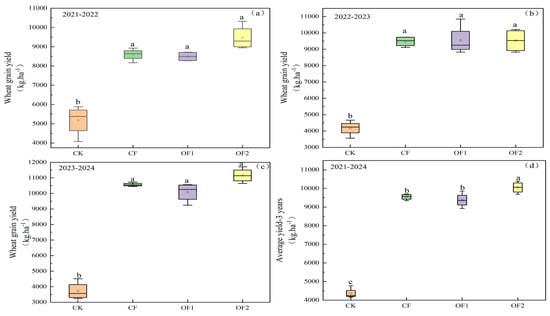
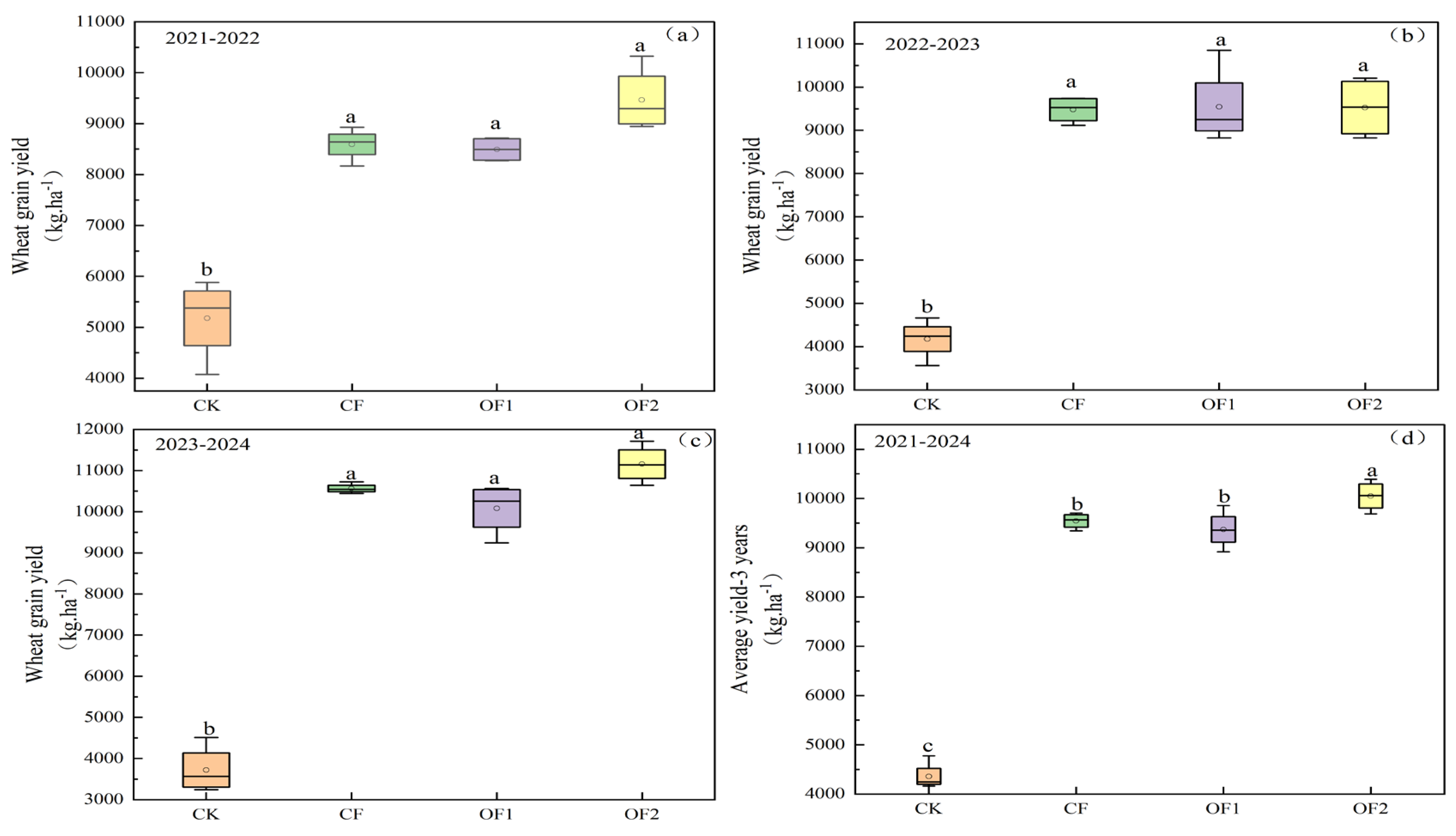
The box plot (Figure 1) shows that, regarding the yield, the OF2 treatment demonstrated a sustained yield advantage and stability—a key innovative finding. As shown in Figure 1 the OF2 treatment yielded 10.14% and 5.59% higher values than CF in 2022 and 2024, respectively, with an average increase of 5.28%. It showed a continuous optimization trend of increased yields across years. In contrast, although the OF1 treatment showed an advantage in the early stage, its yield decreased in 2024, indicating insufficient stability. The CF treatment maintained stable but limited yield increases.
Figure 1.
Wheat grainyieldin 2021–2022 (a), 2022–2023 (b), and 2023–2024 (c) and the 3-year average yield (d) under different fertilization treatments. Different letters indicate significant differences among treatments (p < 0.05).
3.2. Effects on Wheat Leaf Photosynthetic Characteristics
Regarding photosynthetic characteristics, Pn decreased from flowering to grain filling for all treatments (Table 2). OF2 consistently had the highest Pn and the smallest decrease. CF increased Pn by 53.06% compared to CK, while OF1 and OF2 showed successive increases of 7.57% and 8.64% compared to the previous treatment. Gs and Tr showed similar trends, with OF2 maintaining the highest values at both stages. Changes in Ci showed clear treatment differences: Ci significantly decreased for OF1 and OF2 during grain filling, whereas it increased for CF and CK, indicating a stronger CO2 assimilation capacity for the organic treatments during grain filling.
Table 2.
Effects of one-off application of organic–inorganic compound fertilizer on photosynthetic parameters of wheat flag leaf.
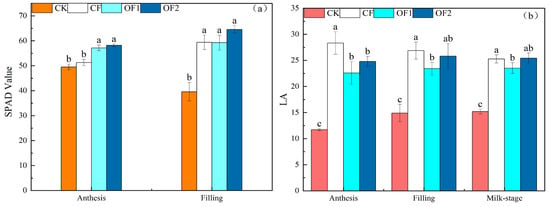
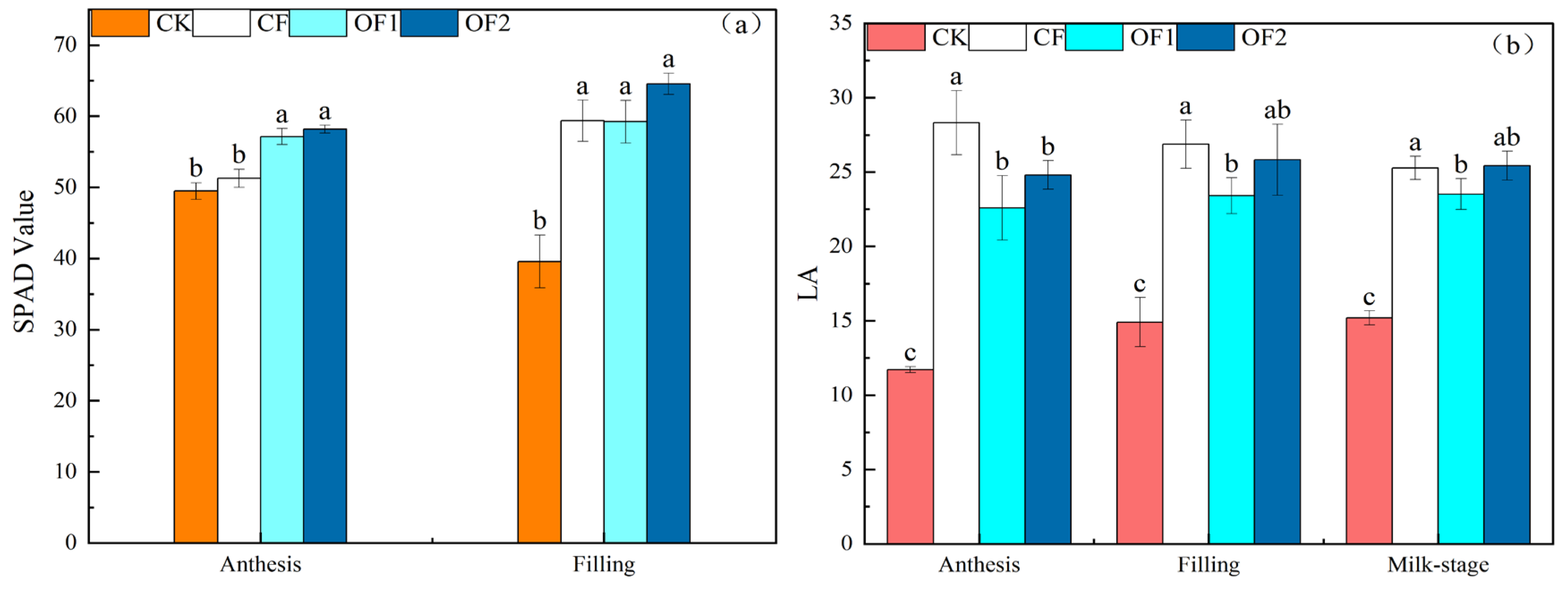
Regarding the SPAD values, OF2 had the highest values at both stages (Figure 2a), increasing by 13.46% and 8.76% compared to CF, respectively, indicating a stable photosynthetic material basis. OF1 increased SPAD by 11.44% compared to CF only at anthesis and was comparable to CF at the filling stage. Regarding the leaf area (Figure 2b), OF2 maintained relatively high levels at both the filling and milk stages, increasing by 3.82% and 0.55% compared to CF, respectively, demonstrating both an early light capture ability and sustained photosynthetic capacity in the later stage.
Figure 2.
SPAD value (a) and flag leaf area (LA) (b) of wheat under different fertilization treatments at different growth stages. Different letters indicate significant differences among treatments (p < 0.05).
3.3. Effects on Soil Properties
3.3.1. Soil Nutrient Content
The CK treatment had the lowest levels for all indicators, indicating a weak soil fertility base (Table 3). The nutrient reserves and available supply capacity were severely insufficient, with the available phosphorus decreasing by 67.68% and organic matter by 18.13%, resulting in very poor soil support conditions for crop growth. The CF treatment had the highest total nitrogen content, but the increases in available nutrients (except available phosphorus) and organic matter were less than those in OF2, indicating average soil comprehensive fertility stability and sustainability. Compared to CF, the OF1 treatment increased organic matter by 13.75%, provided better available phosphorus and potassium than CK but weaker than CF and OF2, and slightly decreased alkaline hydrolyzable nitrogen by 3.69%. OF1 could serve as a supplementary option for soil fertility improvement. The OF2 treatment had the most significant effect in terms of optimizing soil chemical fertility. Compared to CF, the increases in available phosphorus, available potassium, organic matter, and alkaline hydrolyzable nitrogen reached 33.08%, 10.99%, 23.75%, and 21.59%, respectively. Furthermore, the pH was moderately reduced by 1.47%, potentially activating nutrients with an acidic preference, providing ample, coordinated nutrient supply and a favorable soil environment for crops.
Table 3.
Effects of one-off application of organic–inorganic compound fertilizer on soil nutrient content.
3.3.2. Soil Microbial Community Structure
As shown in Table 4, different fertilization treatments had certain effects on the number of culturable microorganisms in the soil. Compared with CK, the CF treatment increased the numbers of culturable bacteria, fungi, and actinomycetes, indicating that fertilization improved the soil microbial population to some extent. Compared with the CF treatment, the OF2 treatment significantly increased the culturable bacterial count, total microbial count, and bacteria/fungi ratio by 101.9%, 95.9%, and 103.9%, respectively, suggesting that the single application of a high-rate organic–inorganic compound fertilizer is conducive to increasing the number of culturable bacteria and the total microbial population in the soil. The OF1 treatment increased the number of culturable fungi by 13.8% relative to CF, but its enhancement of the total culturable microbial population was relatively limited.
Table 4.
Effects of one-off application of organic–inorganic compound fertilizer on soil microbial community structure.
3.3.3. Soil Enzyme Activity
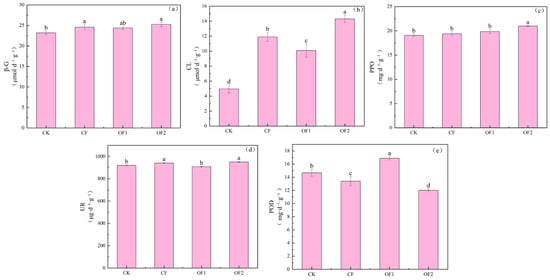
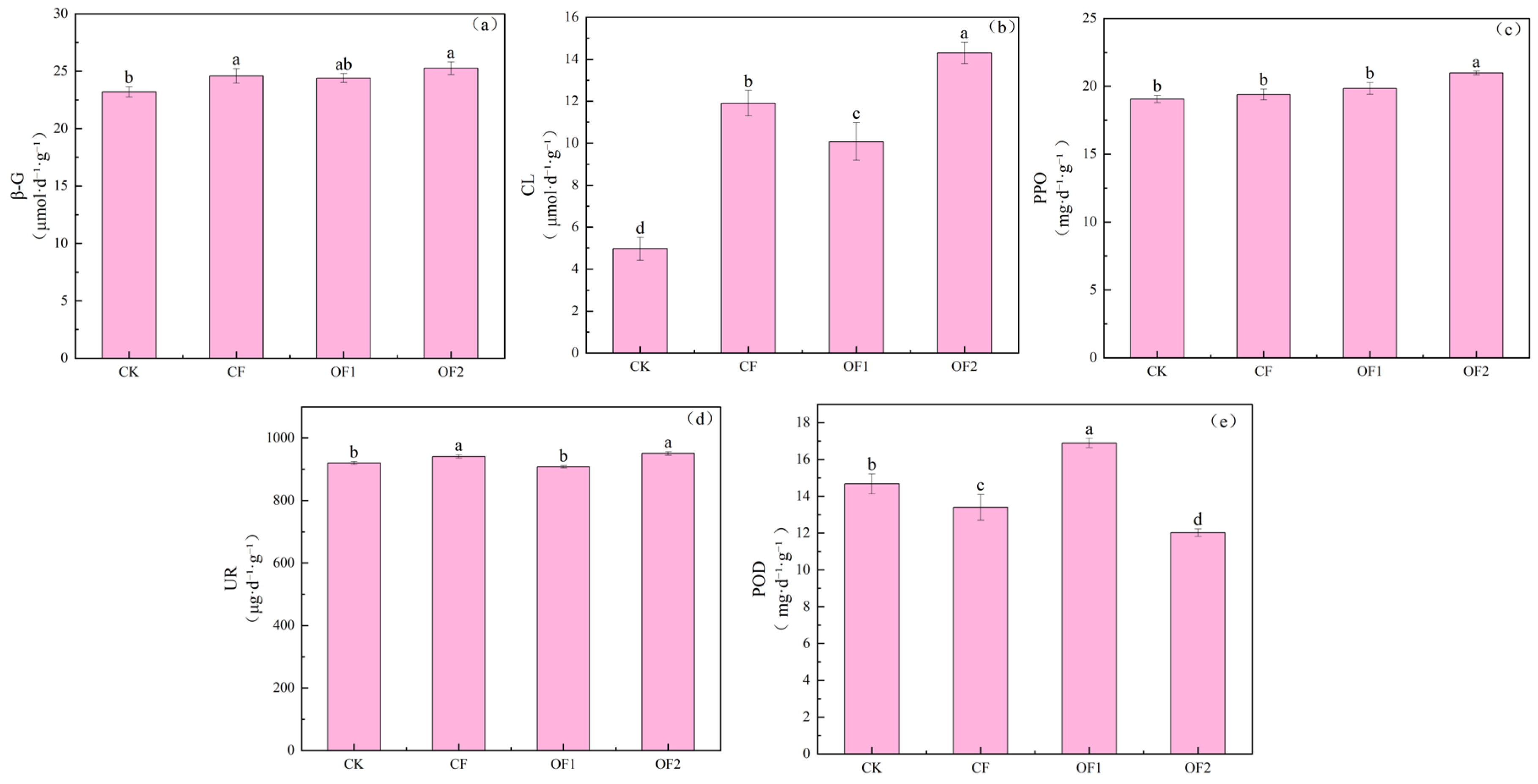
Soil enzyme activity varied significantly among treatments (Figure 3). The key finding of this study is that the OF2 treatment fully activated the soil enzyme system. Its cellulase (CEL) and polyphenol oxidase (PPO) activity was significantly higher than that of the CF treatment by 69.62% and 8.14%. In contrast, all enzyme activity in the CK treatment was low. The OF1 treatment exhibited enhanced peroxidase (POD) activity, suggesting that its metabolic pathway leans towards humification processes.
Figure 3.
Activity of β-glucosidase (β-GLU) (a), cellulase (CEL) (b), polyphenol oxidase (PPO) (c), urease (UR) (d), and peroxidase (POD) (e) under different fertilization treatments. Different letters indicate significant differences among treatments (p < 0.05).
3.3.4. Soil Humus Composition
Regarding the soil humus composition, the OF2 treatment showed a key advantage (Table 5). Its humic acid content and humic acid/fulvic acid (HA/FA) ratio were significantly higher than those of the CF treatment by 41.8% and 338.5%, respectively. This result indicates that OF2 effectively promotes the transformation of fulvic acid into humic acid, making it the optimal treatment for optimizing the humus composition, enhancing stability, and improving the nutrient retention capacity. In comparison, although the OF1 treatment also increased the humin content and the HA/FA ratio, the extent and pathway of improvement differed from those in OF2.
Table 5.
Effects of one-off application of organic–inorganic compound fertilizer on soil humus composition.
3.4. Correlation and Principal Component Analysis
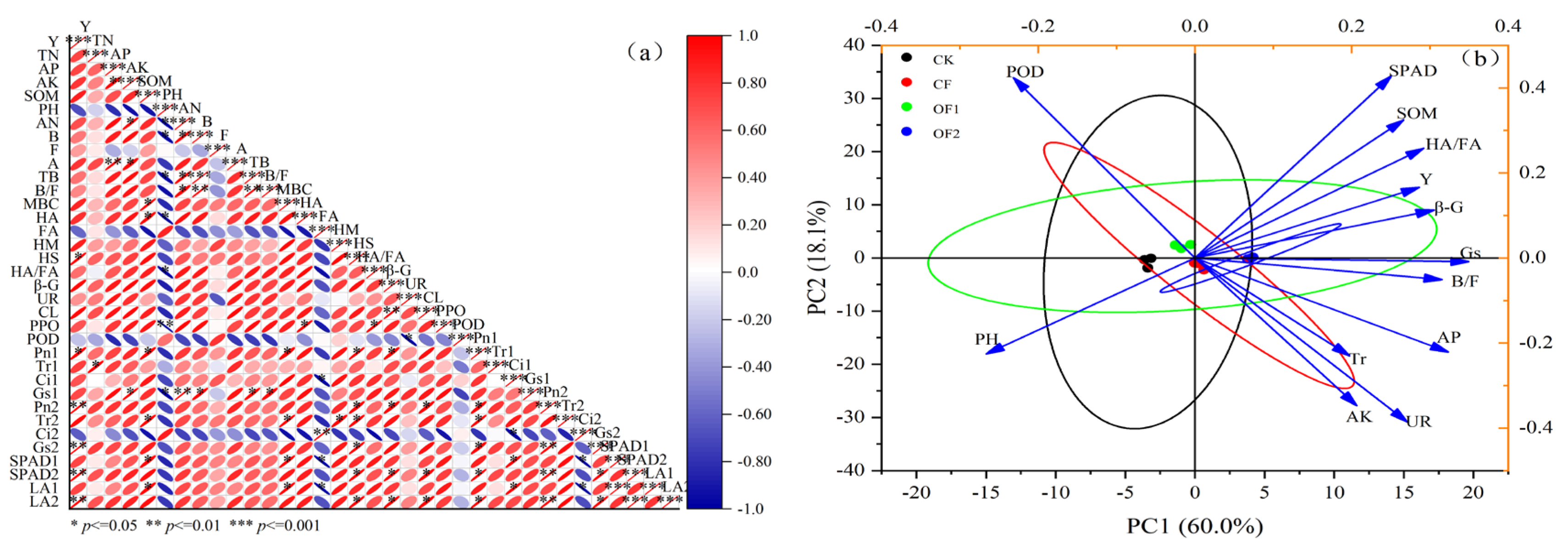
Correlation analysis showed (Figure 4a) that the wheat yield was significantly positively correlated (p < 0.01) with soil nutrients (total nitrogen, available phosphorus, etc.), microbial indicators (bacteria, actinomycetes, etc.), photosynthetic parameters (Pn, SPAD, etc.), and soil enzyme activity (β-glucosidase, urease, etc.), indicating an interconnected synergistic feedback relationship among these indicators. Principal component analysis showed (Figure 4b) that PC1 contributed 55.5% and PC2 contributed 13.2%. The OF2 treatment performed prominently on positive loading indicators such as yield, soil nutrients, and photosynthetic parameters, distinctly separating it from CK and CF.
Figure 4.
Correlation heatmap of wheat yield, photosynthetic characteristics, and soil properties (a) and principal component analysis (PCA) biplot of different fertilization treatments (b). Notes—Y: Yield, TN: Soil Total Nitrogen, AP: Soil Available Phosphorus, AK: Soil Available Potassium, OM: Organic Matter, PH: pH Value, AN: Soil Alkaline Hydrolyzable Nitrogen, B: Soil Bacteria, F: Soil Fungi, A: Soil Actinomycetes, TB: Total Microbial Count, B/F: Bacteria/Fungi Ratio, MBC: Soil Microbial Biomass Carbon, HA: Humic Acid, FA: Fulvic Acid, HM: Humin, HS: Humic Substance, HA/FA: Humic Acid/Fulvic Acid Ratio, β-G: β-Glucosidase, URH: Urease, CL: Cellulase, POX: Polyphenol Oxidase, POD: Peroxidase, Pn1: Photosynthetic Rate at Flowering Stage, Tr1: Transpiration Rate at Flowering Stage, Ci1: Intercellular CO2 Concentration at Flowering Stage, Gs1: Stomatal Conductance at Flowering Stage, Pn2: Photosynthetic Rate at Filling Stage, Tr2: Transpiration Rate at Filling Stage, Ci2: Intercellular CO2 Concentration at Filling Stage, Gs2: Stomatal Conductance at Filling Stage, SPAD1: SPAD Value (Chlorophyll Content) at Flowering Stage, SPAD2: SPAD Value (Chlorophyll Content) at Filling Stage, LA1: Leaf Area at Flowering Stage, LA2: Leaf Area at Filling Stage. This figure is a Principal Component Analysis (PCA) biplot. The colored graphical elements are explained as follows: 1. Colored closed ellipses (95% confidence ellipses for each treatment) Each color corresponds to one experimental treatment group. The ellipse represents the 95% confidence distribution range of all samples in the group, which intuitively reflects the intra-group aggregation degree and inter-group differentiation. Black ellipse (CK): Represents the control check group. Samples are concentrated in the left area of the plot. The ellipse is elongated along the PC2 axis, indicating that samples in this group have greater variation on the second principal component. Red ellipse (CF): Represents the conventional fertilization group. It is distributed in the lower-right area near the center, and partially overlaps with the ellipses of CK and OF1, suggesting certain similarities in treatment effects among these groups. Green ellipse (OF1): Represents the first organic fertilizer treatment group. It is located in the upper central area with the largest horizontal span, indicating the highest dispersion of samples in this group on the first principal component. Blue ellipse (OF2): Represents the second organic fertilizer treatment group. It is concentrated in the right area with the most compact shape, meaning the indicators of samples in this group have the highest similarity. Less overlap between ellipses indicates more significant differences in comprehensive indicators between groups. The ellipses of OF2 and CK barely overlap, representing the largest difference among all treatments. 2. Blue arrow lines (variable loading vectors) All blue rays with arrows represent the detected indicators, which explain the driving factors of sample differentiation. Arrow direction: Indicates the positive or negative correlation between the indicator and principal components. Indicators pointing in the same direction are positively correlated, while those in opposite directions are negatively correlated. For instance, POD and PH on the left are positively correlated with each other, and negatively correlated with indicators on the right such as SPAD, SOM and UR. Arrow length: Represents the contribution of the indicator to the principal components. A longer arrow means the indicator has stronger explanatory power for inter-group differences. POD, SPAD, UR and AK are the core indicators driving the grouping differentiation in this plot.
From the variable loadings, indicators such as yield (Y), soil total nitrogen (TN), humus (HS), and humin (HM); crop physiological indicators like the photosynthetic rate at the anthesis and filling stages (Pn1, Pn2) and chlorophyll content (SPAD1, SPAD2); and soil enzymes like β-glucosidase (β-G) and urease (URH) had arrows pointing towards the positive direction of PC1, with high loadings on PC1, playing a key role in distinguishing different fertilization treatments. In contrast, peroxidase (POD) pointed towards the positive direction of PC2, while indicators like pH and fulvic acid (FA) pointed towards the negative direction of PC1, showing different correlations with PC1 and contributions to the principal components.
Overall, the fertilization treatments significantly altered the characteristics of the soil–crop system. Organic substitution treatments (OF1, OF2) differed from CF in their effects on soil humus components, enzyme activity, and crop photosynthetic physiology. For example, organic substitution treatments may enhance crop photosynthetic efficiency and yield formation by improving soil nutrients and enzyme activity. The OF2 treatment was closer to the yield-increasing direction for some indicators, showing a more prominent effect. The PCA visually demonstrates the impacts of different fertilization treatments on the soil–yield system, indicating that the comprehensive effect of organic substitution treatments on soil quality and yields is more significant, providing a visual basis for optimizing fertilization strategies, enhancing soil ecological function, and improving crop yields.
4. Discussion
4.1. Effects of One-Time Application of Organic–Inorganic Compound Fertilizer on Photosynthetic Characteristics of Wheat During Grain Filling
The photosynthetic function of the flag leaf during the grain-filling stage is crucial for wheat grain yield formation [21,22]. This study found that the OF2 treatment maintained higher Pn, Gs, and SPAD values during the grain-filling stage, with the smallest decrease in Pn after anthesis. This benefit is attributed to the sustained nutrient supply characteristic of the organic–inorganic compound fertilizer: its inorganic part can meet the early growth needs of wheat, while the organic part mineralizes slowly, releasing nutrients that coincide with the demand rhythm of wheat during grain filling [23,24], effectively alleviating the premature decline in photosynthetic function caused by late-stage nutrient deficiency associated with conventional chemical fertilizers. Furthermore, the significantly lower intercellular CO2 concentration (Ci) in the OF2 treatment during grain filling, combined with higher Pn compared to CF, suggests that the maintenance of photosynthetic capacity primarily stems from enhanced mesophyll cell assimilation activity rather than changes in stomatal aperture [25,26].
4.2. Effects of One-Time Application of Organic–Inorganic Compound Fertilizer on Soil Physicochemical and Biological Properties
The soil fertility status is directly influenced by fertilization methods [27]. Under the conditions of this experiment, the OF2 treatment significantly increased the soil organic matter and available nutrient content. This is attributed not only to the direct input of nutrients from the fertilizer itself but also to the improvement of the soil aggregate structure by the organic material, which enhances the water and nutrient retention capacity [28,29,30,31]. Regarding biological properties, the OF2 treatment significantly increased soil bacterial quantities and the bacteria/fungi ratio. A higher bacteria/fungi ratio generally indicates a higher rate of soil nutrient transformation, favoring the conversion of organic nutrients into available forms that crops can directly absorb [32,33]. Simultaneously, the OF2 treatment significantly enhanced the activity of cellulase (related to carbon cycling) and polyphenol oxidase (related to humification) [34,35,36], providing a biochemical basis for sustained soil nutrient supply. Additionally, the substantial increase in humic acid content and the HA/FA ratio under this treatment indicates that the soil humification process tends to form structurally more stable humic acid, which is conducive to the long-term retention and slow release of nutrients [37].
4.3. Analysis of Yield-Increasing Effect of One-Time Application of High-Rate Organic–Inorganic Compound Fertilizer
This study shows that fertilization practices influence wheat yields by altering soil properties, thereby regulating photosynthetic function. Specifically, the long-term application of a high rate of organic–inorganic compound fertilizer (OF2) significantly improved the soil nutrient supply, microbial community structure, and enzyme activity. This favorable soil environment provided a stable nutrient source for wheat throughout its growth period, especially during grain filling, thereby maintaining high flag leaf photosynthetic efficiency [38], delaying plant senescence, and ultimately promoting a grain yield increase (Figure 4).
It is noteworthy that the OF1 treatment did not show a sustained yield-increasing effect in this experiment, indicating a threshold for the application rate of organic–inorganic compound fertilizers. Only when the application rate reached 3600 kg·ha−1 did its soil-improving and yield-increasing effects become consistently apparent, which aligns with previous field trials demonstrating that the yield-promoting effect of organic fertilizers on wheat is often dose-dependent and requires sufficient application rates to achieve stable benefits [39]. Although the CF treatment maintained a certain yield level, its effects in terms of enhancing soil microbial activity and humus quality and delaying photosynthetic function decline were limited. The long-term, single application of chemical fertilizers may lead to the deterioration of the soil physicochemical properties, which is the reason that the one-time application of a high-rate organic–inorganic compound fertilizer showed a comparative advantage in this study [40]. However, it should be noted that, compared with the CF treatment, the OF2 treatment showed differences in total nutrient input, organic carbon input, and the input of organic active substances, so the improvements in relevant traits cannot be fully attributed to the one-time fertilization regime or the organic–inorganic compound fertilizer itself, which is one of the limitations of this study. In addition, the conclusions of this paper only serve to illustrate the effects of the long-term one-time application of an organic–inorganic compound fertilizer on wheat yields, photosynthetic characteristics, and soil properties, and further research on its economic feasibility and promotion value is still required, in combination with fertilizer inputs, labor costs, fertilizer use efficiency and cost–benefit analysis.
5. Conclusions and Prospects
Under the experimental conditions of this study, the one-time application of a high-rate organic–inorganic compound fertilizer (3600 kg·ha−1) improved the soil nutrient status and partial biological properties, as evidenced by the increased soil organic matter and available nutrient content, elevated bacteria/fungi ratio, enhanced activity of related soil enzymes, and promoted transformation of humus into more stable fractions. Meanwhile, the OF2 treatment helped to maintain the high photosynthetic capacity of wheat flag leaves during the grain-filling stage and delayed leaf senescence to a certain extent, resulting in a multi-year average yield that was 5.28% higher than that of the conventional split application of a chemical fertilizer.
Overall, the one-time application of a high-rate organic–inorganic compound fertilizer showed certain effects of soil improvement and yield increase under the experimental conditions; this can provide a reference for the simplified fertilization management of wheat in this region. However, since this study did not evaluate economic benefits, fertilizer use efficiency, environmental risks, or regional adaptability on a larger scale, its practical promotion value still needs further verification. In addition, the impacts of long-term organic–inorganic compound fertilizer application on soil ecological security require further investigation, such as whether organic fertilizer application increases heavy metals or antibiotics in the soil and whether fertilization exacerbates greenhouse gas emissions.
Author Contributions
Conceptualization, Z.L. and H.L.; methodology, X.Z. and H.G.; formal analysis, X.Z. and M.D.; investigation, X.Z., H.L., H.G., M.D., Y.W., T.Z. and W.W.; resources, Z.L.; writing—original draft preparation, X.Z. and H.G.; writing—review and editing, Z.L. and H.G.; supervision, Z.L.; project administration, Z.L.; funding acquisition, Z.L. and H.L. All authors have read and agreed to the published version of the manuscript.
Funding
This research was funded by the Shandong Provincial Key R&D Program (Major Scientific and Technological Innovation Project, No. 2023CXGC010703); the Shandong Provincial Key R&D Program (No. 2025TSGCXTHG048); the Dezhou Agricultural Science and Technology Innovation and Demonstration Project (No. YCQDW202401); and the Dezhou Academy of Agricultural Sciences Internal Project (No. YNXM202404).
Data Availability Statement
The data presented in this study are available on request from the corresponding authors.
Conflicts of Interest
The authors declare no conflicts of interest.
References
- Qian, S.; Xu, Y.; Zhang, Y.; Wang, X.; Niu, X.; Wang, P. Effect of AMF inoculation on reducing excessive fertilizer use. Microorganisms 2024, 12, 1550. [Google Scholar] [CrossRef] [Scilit] [PubMed]
- An, X.F. Preparation of Novel Biochar-Based Slow-Release Fertilizer and Its Slow-Release Mechanism. Master’s Thesis, Shihezi University, Shihezi, China, 2022. [Google Scholar]
- Méndez, S.S.; Orden, L.; Luesma, F.S.; Andreu-Rodríguez, F.J.; Mira-Urios, M.A.; Sáez-Tovar, J.A.; Martínez-Sabater, E.; Bustamante, M.A.; Álvaro-Fuentes, J.; Marks, E.A.N.; et al. Agronomic and environmental assessment of a new fertilization strategy using pelleted organo-mineral fertilizers for wheat production in mediterranean agricultural soils. Sci. Rep. 2025, 15, 36866. [Google Scholar] [CrossRef] [Scilit]
- Fei, W.; Fang, H.L.; Zhang, H.; Gu, K.; Yang, S. Effects of one-off application of slow and controlled release nitrogen fertilizer on wheat yield and nitrogen use efficiency in Zhoushan area. J. Zhejiang Agric. Sci. 2024, 65, 1325–1328. [Google Scholar]
- Dang, H.Y.; Wang, Z.H. Organic fertilizer application in wheat fields in China: Research history, bottlenecks and solutions. J. Plant Nutr. Fertil. Sci. 2025, 31, 12–31. [Google Scholar]
- Wang, J.W.; Zhao, J.J.; Li, G.J.; Yue, D.; Zhen, J.; Gao, D.; Mu, Q.; Sun, C.; Chen, G. Effects of a new type of compound microbial fertilizer on biological characteristics of winter wheat. J. South. Agric. 2018, 49, 1953–1958. [Google Scholar]
- Ji, Y.K. Effects of combined application of chemical fertilizer, organic fertilizer and soil improvement substrate on soil quality and wheat growth and development. Jiangsu J. Agric. Sci. 2022, 50, 221–227. [Google Scholar]
- Li, Y.N.; Sun, S.Y.; Lü, X.D.; Wang, Y.; Fu, X.; Ning, P.; Peng, Z. Partial replacement of chemical nitrogen fertilizer with organic fertilizer under reduced nitrogen application improves winter wheat yield and fertilizer use efficiency in medium and low-yield fields of the north china plain. J. Plant Nutr. Fertil. Sci. 2025, 31, 882–893. [Google Scholar]
- He, Y.T. Characteristics of Soil Organic Carbon Fractions and Structures in Farmland Under Long-Term Fertilization in China. Ph.D. Thesis, Chinese Academy of Agricultural Sciences, Beijing, China, 2015. [Google Scholar]
- Hua, Y.F.; Qin, J.Y.; Wang, J.; Zhang, X.; Chu, J.; Zheng, F.; Yu, H.; He, M.; Dai, X. Effects of sowing methods and one-off basal application of slow and controlled release nitrogen fertilizer on dry matter accumulation, transportation and yield of winter wheat. J. Plant Nutr. Fertil. Sci. 2022, 28, 2185–2200. [Google Scholar]
- Liu, X.; Yang, W.; Li, W.; Ali, A.; Chen, J.; Sun, M.; Gao, Z.; Yang, Z. Moderate organic fertilizer substitution for partial chemical fertilizer improved soil microbial carbon source utilization and bacterial community composition in rain-fed wheat fields. Front. Microbiol. 2023, 14, 1190052. [Google Scholar] [CrossRef] [Scilit] [PubMed]
- Zhang, J.; Li, S.; Jiang, P.; Wang, R.; Guo, J.; Xiao, H.; Wu, J.; Shaaban, M.; Li, Y.; Huang, M. Organic fertilizer substituting 20% chemical N increases wheat productivity and soil fertility but reduces soil nitrate-N residue in drought-prone regions. Front. Plant Sci. 2024, 15, 1379485. [Google Scholar] [CrossRef] [Scilit] [PubMed]
- Cui, X.; Zhang, Y.; Gao, J.; Peng, F.; Gao, P. Long-term combined application of manure and chemical fertilizer sustained higher nutrient status and rhizospheric bacterial diversity. Sci. Rep. 2018, 8, 16554. [Google Scholar] [CrossRef] [Scilit] [PubMed]
- Cui, P.; Chen, Z.; Ning, Q.; Wei, H.; Zhang, H.; Lu, H.; Gao, H.; Zhang, H. One-time nitrogen fertilizer application using controlled-release urea ensured the yield, nitrogen use efficiencies, and profits of winter wheat. Agronomy 2022, 12, 1792. [Google Scholar] [CrossRef] [Scilit]
- Ali, M.F.; Han, R.; Lin, X.; Wang, D. Controlled-release nitrogen combined with ordinary nitrogen fertilizer improved nitrogen uptake and productivity of winter wheat. Front. Plant Sci. 2024, 15, 1504083. [Google Scholar] [PubMed]
- Ren, L.; Lv, J.; Zhang, F.; Dou, B.; Li, L.; Wang, Y.; Zhang, Y. Integrated fertilization with organic manure and Trichoderma enhances wheat productivity and soil nutrient availability. Front. Plant Sci. 2025, 16, 1687216. [Google Scholar] [CrossRef] [Scilit] [PubMed]
- Bao, S.D. Soil Agrochemical Analysis, 3rd ed.; China Agriculture Press: Beijing, China, 2005. [Google Scholar]
- Li, F.D.; Yu, Z.N.; He, S.J. Experimental Techniques in Agricultural Microbiology; China Agriculture Press: Beijing, China, 1996; pp. 125–137. [Google Scholar]
- Shen, P.; Fan, X.R.; Li, G.W. Microbiology Experiments; Higher Education Press: Beijing, China, 1999; pp. 214–215. [Google Scholar]
- Dou, S.; Yu, S.Q.; Zhang, J.J. Effects of different CO2 concentrations on soil humus formation during corn straw decomposition. Acta Pedol. Sin. 2007, 44, 458–466. [Google Scholar]
- Huang, M.; Jiang, P.P.; Zhang, Z.W.; Wu, J.; Li, Y. Effects of drought and varieties on photosynthetic rate, key enzyme activities and yield of flag leaves in wheat during grain filling stage in the afternoon. Acta Agric. Boreali-Sin. 2024, 39, 90–98. [Google Scholar]
- Liang, T.B.; Wang, Z.L.; Liu, J.; Chen, X.; Shi, C. Effects of humic acid compound fertilizer on physiological characteristics and yield of wheat under irrigated and dry farming conditions. Chin. J. Eco-Agric. 2009, 17, 900–904. [Google Scholar] [CrossRef] [Scilit]
- Liu, Q.; Zhao, S.; Li, Y. Optimized organic-inorganic fertilization enhances soil carbon sequestration and wheat productivity: Evidence from hierarchical carbon pool analysis. Field Crops Res. 2026, 337, 110274. [Google Scholar] [CrossRef] [Scilit]
- Lu, S.; Luo, X.G.; Liu, Q.W.; Zhang, Q.; Meng, Y.; Li, J.; Zhang, J. Effects of organic-inorganic compound fertilizer on wheat growth, soil nutrients and heavy metal content. Acta Agric. Zhejiangensis 2023, 35, 922–930. [Google Scholar]
- Ma, Z.; Zhang, Z.; Wang, X.; Yu, Z.; Shi, Y. Effect of nitrogen management practices on photosynthetic characteristics and grain yield of wheat in high-fertility soil. Agronomy 2024, 14, 2197. [Google Scholar] [CrossRef] [Scilit]
- Yang, Z.S.; Zhang, Q.; Hao, X.C. Stomatal and non-stomatal limitations to flag leaf photosynthesis of rain-fed spring wheat at late growth stage under natural conditions in semi-arid areas. Chin. J. Eco-Agric. 2015, 23, 174–182. [Google Scholar]
- Bezzalla, A.; Bennadji, A.E.M.; Zidane, L.; Neffar, S.; Chenchouni, H. A review on the impact of biochar applications on soil health and fertility, plant growth, and food security: Advancing agricultural sustainability. Biomass Bioenergy 2026, 209, 108960. [Google Scholar] [CrossRef] [Scilit]
- Uddin, K.M.; Saha, K.B.; Wong, N.V.; Patti, A.F. Organo-mineral fertilizer to sustain soil health and crop yield for reducing environmental impact: A comprehensive review. Eur. J. Agron. 2025, 162, 127433. [Google Scholar]
- Guo, X.Y.; Zhao, W.; Wu, C.Y.; Tang, X.; Ying, C.; Sun, T.; Guo, B.; Li, Y. Combined application of organic and inorganic fertilizers increases the proportion of aromatic carbon in soil aggregates and soil nutrient availability. J. Plant Nutr. Fertil. Sci. 2025, 31, 1095–1108. [Google Scholar]
- Barra Netto-Ferreira, J.; Palmeira Gabetto, F.; Muniz de Araujo, A.C.; de Castro Dias, R.; Moura Brasil do Amaral Sobrinho, N.; Zonta, E. Combining biosolid and mineral sources of phosphorus and potassium in organomineral fertilizers influences the dynamics and efficiency of nutrient release. Environ. Geochem. Health 2023, 45, 4965–4978. [Google Scholar] [CrossRef] [Scilit] [PubMed]
- Jiang, F.; Han, S.; Cheng, W.; Song, L.; Tang, S.; Wang, H.; Bu, R.; Li, M.; Zhu, R.; Islam, M.U.; et al. Soil quality, elemental stoichiometry and crop yield under partial substitution of chemical fertilizers with organic inputs in Vertisols: A six-site field study. Front. Plant Sci. 2026, 16, 1742932. [Google Scholar] [CrossRef] [Scilit] [PubMed]
- Lin, X.G.; Hu, J.L. Research Progress on Soil Microbial Diversity and Its Ecological Service Functions. In Proceedings of the 4th National Symposium on Soil Biology and Biochemistry, Guangzhou, China, 7–8 December 2007; p. 58. [Google Scholar]
- Du, H.; Tong, Y.; Liu, H.; Yuan, Z.; Zhang, H.; Zheng, X.; Deng, Y.; Chen, M.; Ge, T. Strategic fertilization enhances crop quality index via changes in soil microbial generalist communities. Appl. Soil Ecol. 2025, 216, 106548. [Google Scholar] [CrossRef] [Scilit]
- Zhang, Q.; Zhang, X.M.; Liang, B.; Li, J.; Dong, J. Effects of long-term positioning fertilization on dynamic changes of soil enzyme activities and soil nutrients in protected tomato soil. Acta Agric. Boreali-Sin. 2017, 32, 179–186. [Google Scholar]
- Yuan, L.; Yang, B.J.; Zheng, L.J.; Liu, X. Effects of long-term fertilization on soil enzyme activities and nitrogen and phosphorus nutrients. J. Plant Nutr. Fertil. Sci. 1997, 4, 300–306. [Google Scholar]
- Wang, P. Effects of Long-Term Fertilization on Soil Enzyme Activities and Nutrients in Wheat/Corn Intercropping System. Master’s Thesis, Gansu Agricultural University, Lanzhou, China, 2009. [Google Scholar]
- Li, X.; Fang, J.; Shagahaleh, H.; Wang, J.; Hamad, A.A.A.; Hamoud, Y.A. Impacts of partial substitution of chemical fertilizer with organic fertilizer on soil organic carbon composition, enzyme activity, and grain yield in wheat–Maize rotation. Life 2023, 13, 1929. [Google Scholar] [CrossRef] [Scilit] [PubMed]
- Zhou, L.F.; Feng, H. Effects of a new type of organic-inorganic compound fertilizer on yield and growth of winter wheat at key stages. Chin. J. Eco-Agric. 2012, 20, 13–18. [Google Scholar] [CrossRef] [Scilit]
- Li, J.; Xu, Y.; Zhang, C.L. Preliminary report on the yield effect experiment of commercial organic fertilizer application on wheat. Anhui Agric. Sci. Bull. 2020, 26, 87–88. [Google Scholar]
- Zhang, F.S.; Wang, J.Q.; Zhang, W.F.; Wei, Z.; Ma, W.; Chen, X.; Jiang, R. Current status and improvement approaches of fertilizer use efficiency of major grain crops in China. Acta Pedol. Sin. 2008, 5, 915–924. [Google Scholar]

Disclaimer/Publisher’s Note: The statements, opinions and data contained in all publications are solely those of the individual author(s) and contributor(s) and not of MDPI and/or the editor(s). MDPI and/or the editor(s) disclaim responsibility for any injury to people or property resulting from any ideas, methods, instructions or products referred to in the content. |
© 2026 by the authors. Licensee MDPI, Basel, Switzerland. This article is an open access article distributed under the terms and conditions of the Creative Commons Attribution (CC BY) license.