


Abstract
A sensitive and reliable analytical method based on ultra-high performance liquid chromatography–tandem mass spectrometry (UHPLC-MS/MS) was developed and validated for the simultaneous determination of bifenazate, cyflumetofen, etoxazole, and abamectin B1a in citrus leaves, whole fruit, peel, and pulp. The method exhibited good linearity (0.0001–0.1 mg/L, R2 > 0.999), a limit of quantification (LOQ) of 0.001 mg/kg, mean recoveries of 77.3–110.5%, and relative standard deviations of 3.1–19.8%. This method was applied to compare the dissipation dynamics and dietary risks of the four acaricides following knapsack spraying versus unmanned aerial vehicle (UAV) spraying. Compared to knapsack application, UAV spraying resulted in 2.2- to 4.1-fold higher initial deposits on citrus leaves and shorter dissipation half-lives. After 21 days, all terminal residues were below the maximum residue limits (MRLs) established by China, the Codex Alimentarius Commission, the United States, Australia, Korea, the European Union, and Japan. Chronic dietary risk assessment revealed risk quotients below 1% for cyflumetofen and etoxazole, and approximately 47% for bifenazate and 93% for abamectin B1a. Although all values were below the acceptable threshold of 100%, the risk for abamectin B1a approached this limit, indicating that its cumulative dietary risk should not be overlooked. This study provides scientific evidence for residue monitoring of acaricides in citrus and for the safety evaluation of UAV-based pesticide application.
1. Introduction
According to China’s National Bureau of Statistics, the citrus planting area reached 2.996 million hectares in 2022 [1], and production reached 67.91 million tons in 2024 [2]. Citrus has surpassed apples to become the fruit with the largest planting area and output in China. The country is not only the world’s largest producer but also a major exporter of citrus products to developed regions [3]. Meanwhile, the European Food Safety Authority (EFSA) has launched the “Farm to Fork” strategy under the European Green Deal, which sets a quantitative target of reducing the use and risk of chemical pesticides by 50% by 2030 [4,5]. This implies that pesticide residue standards for Chinese exported citrus will become increasingly stringent, posing new challenges.
Under climate stress, citrus production in China faces persistent threats from pests and diseases, among which the citrus red mite (Panonychus citri) is particularly severe [6]. This pest degrades chlorophyll, impairs photosynthesis, and causes leaf and fruit drop, leading to significant economic losses if not effectively controlled [7]. Most citrus orchards in China are located in mountainous and hilly areas, which increases the difficulty of pest management [8]. Although biological control technologies have been developed over recent years, chemical control remains the primary method for managing citrus pests and diseases [9].
A decade ago, citrus pest control relied mainly on knapsack spraying. However, with rapid economic development and urbanization, a large number of agricultural workers have migrated to cities, leading to a substantial decline in the rural labor force. In this context, plant protection UAV spraying technology has developed rapidly since 2015 [10,11]. Over the past five years, UAV spraying has become a mainstream application method in orchards [12,13,14]. UAV spraying is not restricted by terrain, offers high operational efficiency, and its current market operation cost is lower than that of knapsack spraying [15,16]. As a new productive force in agriculture, UAV spraying has been widely adopted in China’s citrus-producing regions. Extensive research has demonstrated that, compared to knapsack spraying, UAV spraying significantly improves operational efficiency, reduces labor requirements, and minimizes pesticide exposure risk for operators [17,18,19,20]. Furthermore, the downward airflow generated by UAV rotors can effectively disturb the crop canopy, facilitating the penetration and deposition of fine droplets within the canopy [21,22]. These advantages have collectively driven the rapid popularization of plant protection UAVs in agricultural production [23,24].
The development of efficient, low-residue plant protection technologies has become a global consensus. However, with the rapid development of the market economy, government regulatory policies have yet to fully catch up with the pace of technological change [25]. Currently, pesticide residue registration trials for citrus are all conducted using knapsack sprayers as the primary application equipment. To date, no pesticide formulations have been specifically registered for UAV spraying, and the pesticide label information used in actual production all originates from registration data obtained under knapsack spraying scenarios [26]. Despite operators relying on these knapsack-based registration data, their validity for UAV spraying scenarios must be established through systematic experimental evaluation. The unique operational characteristics of UAVs may significantly alter the deposition distribution and dissipation dynamics of pesticides within the crop canopy [27]. Therefore, comparing residue differences between the two application methods and assessing the applicability of existing registration data to UAV spraying has important practical implications.
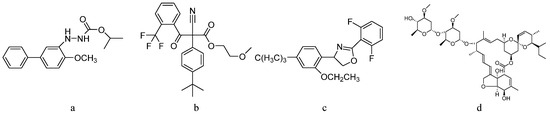
This study selected four registered acaricides with the highest usage on citrus in China—bifenazate, cyflumetofen, etoxazole, and abamectin B1a—as the research subjects. Briefly, bifenazate (Figure 1a) acts by inhibiting mitochondrial electron transport chain complex III and GABA receptors [28]; cyflumetofen (Figure 1b) inhibits mitochondrial complex II, thereby blocking energy metabolism [29]; etoxazole (Figure 1c) targets chitin synthase, interfering with the molting process of eggs, nymphs, and larvae [30]; and abamectin B1a (Figure 1d) increases chloride ion membrane permeability, blocking nerve signal transmission [31]. The combined application of these acaricides not only produces synergistic effects but also delays the development of resistance, forming the cornerstone of integrated mite management strategies in citrus orchards.
Figure 1.
Molecular structures of bifenazate (a), cyflumetofen (b), etoxazole (c) and abamectin B1a (d).
Although analytical methods for these compounds exist, such as GC-MS/MS [32] and UHPLC-MS/MS [33,34], most established methods in China focus primarily on whole fruit or pulp matrices, with limits of quantification (LOQs) typically at 0.01 mg/kg. In contrast, the European Union has established a more advanced technical framework for the analysis of trace pesticide residues [35], under which LOQs for multi-residue methods have generally been achieved below 0.01 mg/kg, with some methods reaching as low as 0.001–0.005 mg/kg.
To compare potential residue differences between the two application methods, this study further refined the analytical method, achieving an LOQ of 0.001 mg/kg. The differential distribution of pesticides among various tissues (e.g., peel and pulp) underscores the necessity of developing highly sensitive analytical methods. Insufficient analytical sensitivity often leads to residue concentrations in the pulp being reported as below the LOQ, thereby hindering the accurate characterization of tissue-specific residue differences [36]. Furthermore, since leaves serve as the primary target site for pesticide application, residue analysis in leaves is essential for the reliable assessment of field efficacy and dissipation behavior.
Against this background, this study aimed to: (i) develop and validate a robust UHPLC-MS/MS method for the simultaneous determination of four acaricides in citrus leaves, whole fruit, peel, and pulp with an LOQ of 0.001 mg/kg; (ii) systematically compare residue levels and dissipation patterns between knapsack spraying and UAV spraying; and (iii) assess the chronic dietary risk associated with both application methods. The findings are expected to provide scientific evidence and technical support for optimizing pesticide application strategies and for assessing the safety and quality of citrus products under modern orchard management models.
2. Materials and Methods
2.1. Chemicals and Reagents
Analytical standards of bifenazate (CAS No. 149877-41-8, purity 99%), cyflumetofen (CAS No. 400882-07-7, purity 99.5%), etoxazole (CAS No. 153239-91-1, purity 96.7%), and abamectin B1a (CAS No. 65195-55-3, purity 95%) were obtained from Tanmo Quality Inspection Standard Material Center (Beijing, China), Shanghai Macklin Biochemical Technology Co., Ltd. (Shanghai, China), Aladdin Reagent Co., Ltd. (Shanghai, China), and Guangzhou Jiatu Technology Co., Ltd.(Guangzhou, China), respectively.
HPLC-grade methanol and acetonitrile were sourced from Thermo Fisher Scientific (Waltham, MA, USA). Formic acid (≥98.0%, HPLC grade) was purchased from J&K Scientific Ltd. (Beijing, China). Anhydrous magnesium sulfate and sodium chloride (analytical grade) were supplied by Beijing Green Technology Development Co., Ltd. (Beijing, China).
Ultra-pure water was produced using a Milli-Q system (Bedford, MA, USA). Dry ice was purchased from Beijing Xiangyou Trading Co., Ltd. (Beijing, China).
A 20% abamectin–etoxazole suspension concentrate (SC, containing 4% abamectin and 16% etoxazole w/w) and a 40% cyflumetofen–bifenazate SC (containing 15% cyflumetofen and 25% bifenazate w/w) were acquired from Xi’an Dingsheng Bio-Chemical Co., Ltd. (Xi’an, China) and Shaanxi Kanghe Lifeng Biotechnology Co., Ltd. (Xi’an, China), respectively. QuEChERS cleanup tubes with various specifications (detailed composition provided in Table 1) were procured from Welch Technology (Shanghai) Co., Ltd. (Shanghai, China) Nylon 0.22 µm membrane filters were purchased from Tianjin Bonna-Agela Technologies Co., Ltd. (Tianjin, China).
Table 1.
Formulations of sorbents in different purification cartridges.
2.2. Apparatus
Pesticide residue analysis was performed using an Acquity UPLC H-Class system coupled to a Xevo TQ-XS triple quadrupole mass spectrometer (Waters Corp., Milford, MA, USA). Data acquisition and processing were conducted using MassLynx™ software (version 4.2). Chromatographic separation was achieved on an Acquity UPLC BEH C18 column (50 mm × 2.1 mm i.d., 1.7 μm particle size) and an Acquity UPLC HSS T3 column (100 mm × 2.1 mm i.d., 1.8 μm particle size).
Sample preparation was facilitated by the following key instruments: a FOSS 2094 homogenizer (FOSS, Hillerød, Denmark); a ME155DU analytical balance (readability 0.1 mg, Mettler Toledo, Greifensee, Switzerland); a JY2002 electronic balance (readability 0.01 g, Shanghai Sunny Hengping Scientific Instrument Co., Ltd., Shanghai, China); a UMV-2 multi-tube vortex mixer (Beijing Yousheng Union Technology Co., Ltd., Beijing, China); H1650-W high-speed and TDZ5-WS benchtop low-speed centrifuges (Hunan Xiangtan Instrument Co., Ltd., Changsha, China); and a KQ-500E ultrasonic cleaner (Kunshan Ultrasonic Instrument Co., Ltd., Kunshan, China).
Knapsack spraying was performed using a Shixia SX-MD16E-2 high-pressure electric knapsack sprayer (maximum tank capacity: 16 L; Zhejiang Shixia Holding Group Co., Ltd., Taizhou, China) equipped with a single XR TeeJet 11003 conical nozzle. The operating parameters were as follows: spray pressure of 0.3–0.4 MPa, spray angle of 60°, swath width of 1.0 m, flow rate of 1.0 L/min, walking speed of 0.5 m/s, application volume of approximately 3.0 L per tree, and nozzle height of 1.2–3.0 m above ground.
UAV spraying was performed using a DJI T70 agricultural drone (maximum tank capacity: 70 L; SZ DJI Technology Co., Ltd., Shenzhen, China) operating in autonomous fixed-point mode, with an application volume of approximately 3.0 L per tree. The drone was equipped with four LX07550SX high-pressure centrifugal nozzles operating in large droplet anti-drift mode (droplet size: 100–250 µm). This mode effectively reduced droplet drift while improving droplet coverage density and adhesion efficiency per unit leaf area. The main operating parameters were set as follows: spray flow rate of 6 L/min (a relatively high rate favorable to droplet sedimentation), flight speed of 2.0 m/s, swath width of 3.0–4.0 m, spray angle of 110°, estimated droplet settling time of 4.5 s, and flight height of 2.0 m above the canopy.
It should be noted that the application volume for UAV spraying was intentionally set equal to that of knapsack spraying (3 L per tree) to compare residue differences under a worst-case scenario.
2.3. Field Trials
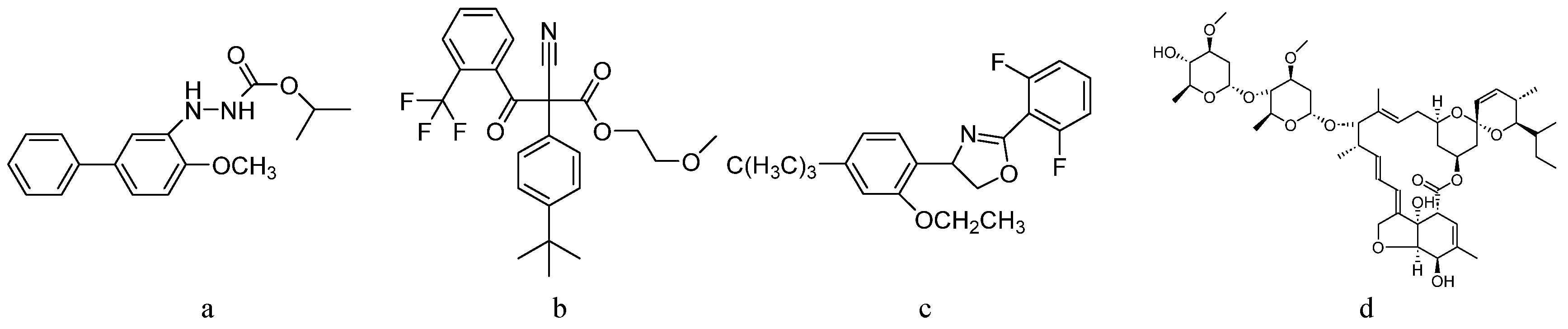
The field trial was conducted from 25 October to 22 November 2024, in a citrus orchard located in Mayang Miao Autonomous County, Hunan Province, China (27°32′02″ N, 109°24′43″ E), as illustrated in Figure 2. Knapsack spraying was performed by technical personnel from the Agriculture and Rural Affairs Bureau of Mayang Miao Autonomous County under ambient wind speeds of less than 3 m/s on the day of application. UAV operations were carried out by a certified drone pilot from the same bureau under identical wind speed conditions.
Figure 2.
Location map of the experimental citrus orchard in Mayang, Hunan Province (Red symbols denote trees in the UAV-sprayed plots, while yellow symbols denote trees in the knapsack-sprayed plots).
The orchard soil was clay with a pH of 5.4, an organic matter content of 36.77 g/kg, and a cation exchange capacity of 17.1 cmol/kg. The sweet orange variety used was ‘Jinhong Bingtangcheng’ (Citrus sinensis). The trial period coincided with the fruit ripening stage, during which the fruits successively passed through the following physiological phases: beginning of fruit coloring (color-break, BBCH 81); fruit ripe for picking but not yet showing variety-specific color (BBCH 83); advanced ripening with increased intensity of variety-specific color (BBCH 85); and fruit ripe for consumption with typical taste and firmness (BBCH 89) [37].
The experiment followed a split-plot design in accordance with the NY/T 788-2018 guideline for pesticide residue trials [38]. Two insecticides were evaluated: 20% abamectin–etoxazole suspension concentrate (SC) and 40% cyflumetofen–bifenazate SC, applied using either a knapsack sprayer or an unmanned aerial vehicle (UAV). Label recommendations specify a single application at 6000–8000-fold dilution for the 20% SC and 2000–3000-fold dilution for the 40% SC, both with a 21-day pre-harvest interval (PHI). To assess residue dissipation under worst-case conditions, the maximum recommended dosages were employed, i.e., 6000-fold dilution for the 20% SC and 2000-fold dilution for the 40% SC.
In this study, four treatment groups and one blank control group were established, with three replicates per treatment. Treatments T1 and T2 were applied using a knapsack sprayer. Each plot consisted of four citrus trees, with a spray volume of 3 L per tree (the optimal number of trees within the capacity of the knapsack sprayer), resulting in a total spray volume of 12 L per plot. One to two rows of guard trees are arranged between the experimental plots. T1 received a 20% suspension concentrate (SC), while T2 received a 40% SC. Treatments T3 and T4 were applied using an UAV sprayer. Each plot contained 20 citrus trees, also with a spray volume of 3 L per tree (the optimal number of trees within the UAV sprayer’s capacity), resulting in a total spray volume of 60 L per plot. Three to four rows of guard trees were arranged between the experimental plots. The blank control plots received no pesticide application and were sampled only at the first (2 h post-application) and fifth (28 days post-application) time points.
Sampling was conducted in each treatment plot at 2 h (BBCH 81–83), 7 days (BBCH 83–85), 14 days (BBCH 84–86), 21 days (BBCH 85–88), and 28 days (BBCH 85–89) after application, using pre-established sampling points. Due to differences in tank capacity between the knapsack sprayer and the UAV sprayer, the number of trees per plot was determined based on the optimal spray volume for each device. To account for the resulting variation in tree numbers across treatments, the number of sampling points was proportionally increased to minimize errors caused by spatial heterogeneity. Specifically, in manual spray plots (4 trees per plot), a grid sampling method was adopted. Samples were collected from different orientations and positions (upper, middle, lower, inner, and outer canopy) of each tree, with at least 12 sampling points per plot. From each plot, two subsamples of 2 kg of healthy, disease-free citrus fruits and two subsamples of 40 citrus leaves were collected. In UAV spray plots (20 trees per plot), the same grid sampling method was applied, with at least 36 sampling points per plot. From each plot, two subsamples of 6 kg of healthy, disease-free citrus fruits and two subsamples of 120 citrus leaves were collected. All samples were immediately transported to the laboratory for processing. The blank control plots were sampled synchronously at the first and last time points.
Upon arrival at the laboratory, the fresh mass of the fruit samples was recorded. Each fruit was longitudinally cut into 4 to 8 even segments, and 2 to 4 non-adjacent segments were selected. The peel and pulp were then completely separated. The entire peel and pulp from the selected segments were collected and weighed separately to calculate the peel-to-pulp ratio. For whole fruit processing, the selected non-adjacent fruit segments were placed into a homogenizer with dry ice, homogenized, and thoroughly mixed. Two 150 g subsamples were obtained, each placed into a sealed container and labeled. For pulp processing, the separated pulp was homogenized with dry ice, and two 150 g subsamples were prepared, sealed, and labeled. For peel processing, the peel was cut into approximately 2 cm pieces, homogenized with dry ice, and mixed, yielding two 50 g subsamples. For leaf processing, the leaves were cut into 1–2 cm fragments, mixed, homogenized with dry ice, and then two 50 g subsamples were prepared. All subsamples were immediately transferred to a –20 °C freezer and stored until subsequent analysis.
2.4. Analytical Procedure
Sample extraction followed the QuEChERS method. Whole citrus (10.0 g), pulp (10.0 g), peel (5.0 g), and leaves (1.0 g) (weighed to 0.01 g) were transferred into 50 mL PTFE centrifuge tubes. Ten milliliters of water–acetonitrile (20:80, v/v) was added, and the mixture was vortexed at 2500 rpm for 3.0 min. Sodium chloride was then added according to the following matrix: 2.0 g for whole fruit and peel, 1.0 g for pulp, and 0.5 g for leaves. After vortexing at 2500 rpm for 1 min, the mixture was centrifuged at 4000 rpm for 5 min.
During the cleanup procedure, 1.5 mL of supernatant was transferred into a 2.0 mL dispersive solid-phase extraction tube containing matrix-specific sorbents. The composition of the sorbents was as follows: for whole fruit and peel samples, 150 mg MgSO4, 50 mg PSA, and 50 mg C18; for pulp samples, 150 mg MgSO4 and 50 mg PSA; and for leaf samples, 150 mg MgSO4, 50 mg PSA, 50 mg C18, and 15 mg GCB. The mixture was vortexed at 2500 r/min for 1 min and then centrifuged at 12,000 r/min for 3 min. The resulting supernatant was filtered through a 0.22 μm nylon membrane, and the filtrate was directly transferred into a pre-slit 2.0 mL autosampler vial. For samples with relatively high residue concentrations, 0.1 mL of the filtrate was diluted with 0.9 mL of acetonitrile in a 2.0 mL vial. It was verified that the recoveries of the target analytes under this dilution condition were within acceptable ranges. All samples were finally analyzed by UHPLC-MS/MS.
Chromatographic separation was performed on an Acquity UPLC BEH C18 column at 40 °C, with the autosampler at 15 °C. The mobile phase consisted of acetonitrile (A) and 0.1% formic acid in water (B) at 0.3 mL/min. Gradient elution: 0–1.5 min, 30–90% A; 1.5–6.0 min, hold at 90% A; 6.0–8.0 min, 90–30% A for re-equilibration. Injection volume was 3.0 μL. Detection used electrospray ionization in positive/negative switching mode with optimized parameters: capillary voltage 3.0 kV, source temperature 150 °C, desolvation temperature 400 °C. High-purity nitrogen served as desolvation gas (700 L/h) and cone gas (150 L/h) and high-purity argon as collision gas (0.2 mL/min). Data were acquired in multiple reaction monitoring (MRM) mode. Two characteristic transitions (quantifier and qualifier) were monitored per compound. Confirmation relied on retention time matching and ion ratio criteria, and quantification used peak area integration.
2.5. Data Processing Methods
Data acquisition and processing were performed using MassLynx™ software (version 4.2, Waters Corp., Milford, MA, USA). Quantitative analysis was conducted using the matrix-matched external standard method. Matrix-matched standard working solutions covering at least five concentration levels were prepared by spiking blank matrix extracts with appropriate volumes of pesticide standard stock solutions. Weighted least squares regression was employed to establish calibration curves, with the analyte concentration (mg/kg) as the abscissa (x-axis) and the peak area of the quantitative ion pair as the ordinate (y-axis). The residual concentration in the samples was calculated according to Equation (1):
where C is the pesticide concentration in the sample (mg/kg); a and b are the slope and intercept of the calibration curve, respectively; Asample is the peak area of the quantitative ion pair in the sample solution; Vextract is the volume of the extraction solvent (mL); MSample is the mass of the weighed sample (g); and S is the dilution factor.
The magnitude of the matrix effect (ME) was evaluated using Equation (2).
where ME represents the matrix effect (%); A is the slope of the solvent-based calibration curve; and B is the slope of the matrix-matched calibration curve. Based on the systematic assessment of ME values, specific criteria were applied: if ∣ME∣ ≤ 10%, the matrix effect was considered negligible, allowing for the direct use of solvent-based calibration curves for quantification; whereas if 10% < ∣ME∣ ≤ 50%, a significant matrix enhancement or suppression effect was indicated, necessitating the use of matrix-matched calibration curves for compensation; otherwise (i.e., ∣ME∣ > 50%), severe matrix interference existed, requiring improvements in the sample preparation method to reduce the matrix effect to an acceptable range.
The degradation kinetics of the pesticide on the citrus matrix were modeled using first-order kinetic equations, and their half-lives were calculated using Equations (3) and (4):
where Ct (mg/kg) represents the pesticide concentration at time t, C0 (mg/kg) denotes the initial concentration after application (t = 2 h), t (days) is the time after application, k is the first-order rate constant, and t1/2 (days) is the half-life required for the pesticide concentration to reduce to half of its initial value.
Ct = C0 e−kt
t1/2 = ln(2)/k
The chronic dietary risk was assessed by calculating the risk quotient (RQ), defined as the ratio of the National Estimated Daily Intake (NEDI, mg/kg bw) to the Acceptable Daily Intake (ADI, mg/kg bw), expressed as a percentage [39]. NEDI was derived using Equation (5).
NEDI = ∑STMR × Fi/bw
The risk quotient (RQ) was calculated using Equation (6):
RQ = NEDI/ADI × 100%
The supervised trials median residue (STMR, mg/kg) for each acaricide was determined separately for knapsack and UAV spraying using the residue concentrations measured at a PHI of 21 days after application. The acceptable daily intake (ADI, mg/kg bw) serves as the toxicological reference value. In the chronic dietary risk assessment, Fi represents the daily consumption of food commodity i (kg/day), sourced from the Chinese Resident Dietary Survey [40], and bw is the average body weight of an adult (63 kg). An RQ value of less than 100% indicates that the chronic dietary risk is acceptable. Conversely, an RQ value exceeding 100% suggests a potential health risk with unacceptable adverse effects on human health.
2.6. Statistical Analysis
The experiment was arranged in a completely randomized block design. All statistical analyses were performed using SPSS version 27.0 (IBM Analytics, Armonk, NY, USA). Residue concentration is presented as mean ± standard error. For dissipation rate constants (k), differences between application methods were assessed using a two-sample t-test on the estimated k values derived from first-order kinetic fitting. A probability value of p < 0.05 was considered statistically significant.
3. Results and Discussion
3.1. Optimization of Instrumental Parameters
To achieve optimal ionization efficiency for etoxazole, bifenazate, abamectin B1a, and cyflumetofen, both positive and negative electrospray ionization (ESI) modes were evaluated. The results showed that all four compounds formed stable [M+H]+ precursor ions in positive ion mode with significantly higher response intensities. After precursor ion confirmation, characteristic ion scanning of each target compound standard solution was performed using a UHPLC-MS/MS system equipped with the IntelliStart™ function, generating multiple characteristic ion pairs for each compound. For each analyte, the two ion pairs with the highest responses and minimal interference were selected as qualitative ion pairs. Data acquisition was carried out in multiple reaction monitoring (MRM) mode. Qualitative confirmation of each compound was accomplished by combining chromatographic retention time with the two selected qualitative ion pairs. For quantitative analysis, the ion pair with less interference, higher sensitivity, and larger integrated peak area was selected from the two qualitative ion pairs as the quantitative ion pair. Additionally, key mass spectrometry parameters, including cone voltage and collision energy (CE), were optimized to obtain the optimal mass spectrometric conditions for experimental requirements. The optimized parameters are presented in Table 2.
Table 2.
Optimized mass spectrometric parameters for the target pesticides.
A preliminary optimization of LC conditions was then conducted. Two columns (HSS T3 and BEH C18) and two mobile phase systems (0.1% formic acid in water/acetonitrile and 0.1% formic acid in water/methanol) were compared. The BEH C18 column provided better retention times, improved peak shapes, and lower instrument backpressure compared to the HSS T3 column. Regarding the mobile phase, the acetonitrile-based system exhibited stronger elution power, resulting in earlier elution, sharper peak shapes, and lower baseline noise, whereas the methanol-based system led to severe peak tailing and higher baseline noise. Based on these results, the combination of a BEH C18 column and a mobile phase consisting of 0.1% formic acid in water/acetonitrile was selected for subsequent analyses.
3.2. Optimization of Extraction and Cleanup
Four extraction solvents—pure methanol, pure acetonitrile (ACN), water–methanol (20:80, v/v), and water–ACN (20:80, v/v)—were evaluated without a cleanup step for the recovery of the four acaricides from citrus matrices at 100 μg/kg. Pure ACN and water–ACN (20:80, v/v) consistently gave recoveries of 70–110% with superior precision, owing to ACN’s moderate polarity and lipid-precipitating capacity, which minimizes matrix interference. ACN also maintained a manageable column backpressure of 7000–8000 psi. In contrast, methanol-based solvents (pure methanol and water–methanol) yielded significantly lower and more variable recoveries due to poor cuticular penetration and excessive co-extraction of sugars and pigments and caused much higher column backpressure (9000–12,000 psi), indicating their unsuitability. The addition of water to ACN enhanced wetting and penetration into hydrophilic cellular structures, making water–ACN (20:80, v/v) the optimal extraction medium.
Following the optimization of the extraction solvent, sixteen commercially available QuEChERS cleanup tubes (summarized in Table 1) were evaluated to refine the sample preparation protocol. For pulp matrices, which are predominantly composed of polar interferences (e.g., pigments, sugars, and organic acids), sorbents comprising only MgSO4 and PSA (tubes #1, 2, 9, 10) afforded stable recoveries ranging from 90.8% to 103.4% with RSDs < 8.8%. Conversely, peel and whole fruit matrices are enriched with waxes, lipids, and flavonoids; consequently, PSA alone exhibited insufficient retention of these lipophilic impurities. Formulations combining PSA with C18 (tubes #3, 4, 11, 12) significantly outperformed the PSA-only mixtures by effectively sequestering lipids. Notably, tube #3 delivered the most robust performance, achieving recoveries of 94.6% to 104.6% (RSD < 9.1%). Regarding leaf matrices, characterized by exceptionally high chlorophyll content, the incorporation of GCB was imperative. While high-level GCB formulations (tubes #6, 14) effectively adsorbed chlorophyll, they induced unacceptable analyte retention, resulting in recoveries below 70%. To mitigate this, mixed-sorbent tubes containing reduced GCB, elevated PSA, and C18 (tubes #5, 7, 8, 13, 15, and 16) were investigated. This configuration enabled the efficient removal of pigments (via GCB), lipids (via C18), and polar interferences (via PSA), while minimizing the excessive adsorption of target compounds. Among these, tubes #7 and #15 demonstrated optimal stability, with recoveries of 88.8% to 94.9% (RSD < 9.1%). Ultimately, based on a comprehensive assessment of purification efficiency, recovery, precision, and cost-effectiveness, the water–ACN (20:80, v/v) system was selected as the extraction solvent. For routine analysis, tube #1 (150 mg MgSO4, 50 mg PSA) is recommended for pulp; tube #3 (150 mg MgSO4, 50 mg PSA, 50 mg C18) for peel and whole fruit; and tube #7 (150 mg MgSO4, 50 mg PSA, 50 mg C18, 15 mg GCB) for leaf samples.
3.3. Method Validation
An external standard method was employed for quantification. Standard calibration curves were constructed by plotting the mass concentrations of the target compounds against the corresponding chromatographic peak areas of the quantitative ion pairs. All four acaricides exhibited excellent linearity over the concentration range of 0.0001–0.1 mg/L, with correlation coefficients (r) exceeding 0.999.
To verify the reliability of the method, recovery tests were conducted. Fortification levels were set according to the characteristics of each compound: 0.001, 0.7, and 5.0 mg/kg for bifenazate; 0.001, 0.5, and 5.0 mg/kg for etoxazole and cyflumetofen; and 0.001, 0.02, and 5.0 mg/kg for abamectin B1a. As shown in Table 3, at the aforementioned spiking levels, the average recoveries of the four acaricides in whole fruit, peel, pulp, and leaf ranged from 77.3% to 110.5%, with relative standard deviations (RSD) between 3.1% and 19.8%.
Table 3.
Method validation parameters for four acaricides in citrus matrices (n = 5).
European guidelines require RSD ≤ 20% and recommend RSD ≤ 15% for routine methods [35]. In conventional sample analysis, an LOQ of 0.01 mg/kg is generally sufficient to meet market monitoring requirements. However, this study aimed to compare residue differences between knapsack spraying and UAV spraying. Given the uncertainty regarding the residue differences between the two application methods, the LOQ of the method was improved to 0.001 mg/kg. At fortification levels between 0.001 and 0.01 mg/kg, recoveries and RSDs exhibited greater variability. Notably, all higher RSD values presented in Table 3 originated from samples spiked at 0.001 mg/kg. According to the Chinese standard NY/T 788-2021 [38], the 0.001 mg/kg level falls within the range of trace analysis, where recoveries of 60–130% and RSD ≤ 30% are considered acceptable.
All validated parameters—including selectivity, linearity, accuracy, precision, sensitivity, matrix effects, and dilution integrity—complied with the acceptance criteria specified in the Chinese standard and European guidelines, satisfying the requirements for trace analysis. Based on a signal-to-noise ratio (S/N) of 3, the limit of detection (LOD) was determined using the standard calibration curve method, and the results were converted to the content expressed in terms of the original sample mass (μg/kg). The LODs for bifenazate, etoxazole, cyflumetofen, and abamectin B1a in acetonitrile and various citrus matrices ranged from 0.01 to 0.04 μg/kg. In addition, obvious matrix effects were observed across the different citrus matrices. To correct for signal suppression or enhancement, matrix-matched standard solutions were employed for calibration, which significantly improved the accuracy of the analytical results.
Owing to the presence of matrix effects, the validated limit of quantification (LOQ) of the method was established at 0.001 mg/kg. Although further optimization might achieve a lower LOQ, the current value meets the analytical requirements of this study; therefore, no additional optimization was pursued. For samples exceeding the linear calibration range, a validated 10- to 20-fold dilution was applied, which consistently yielded satisfactory recoveries.
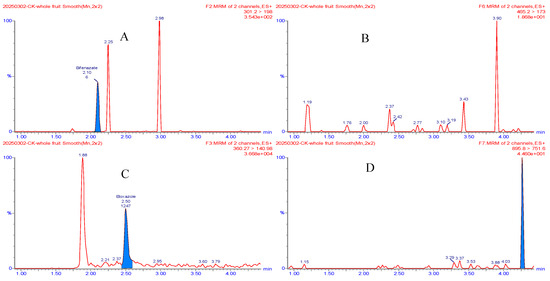
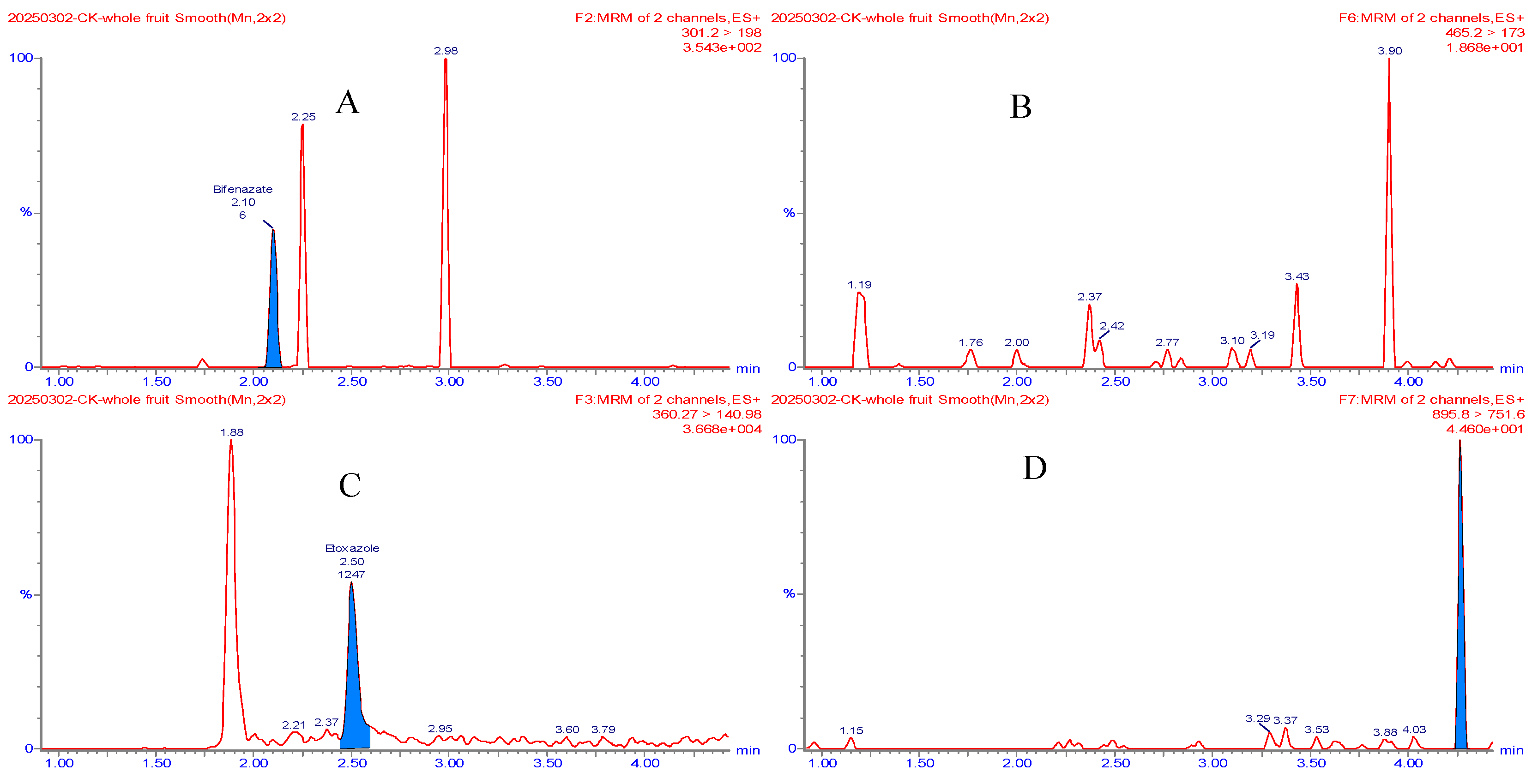
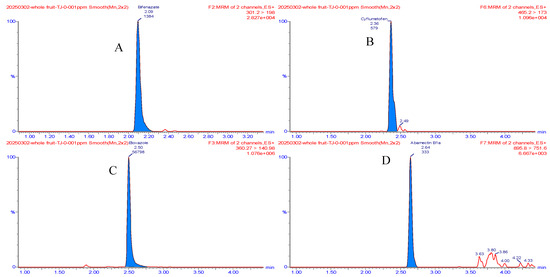
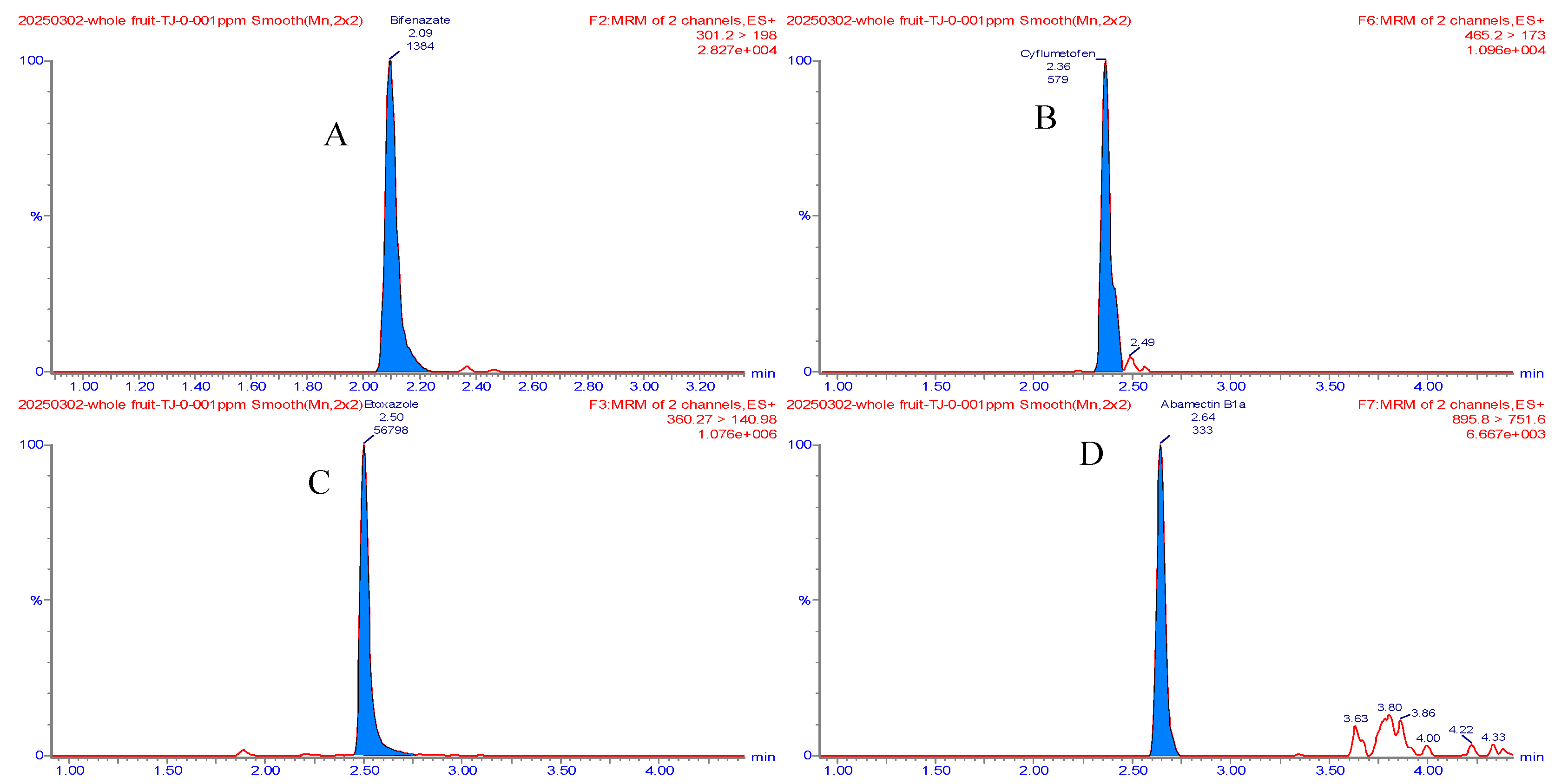
Representative multiple reaction monitoring (MRM) chromatograms are provided in Figure 3 and Figure 4.
Figure 3.
MRM chromatograms of bifenazate (A), cyflumetofen (B), etoxazole (C), and abamectin B1a (D) in blank citrus (whole fruit).
Figure 4.
MRM chromatograms of bifenazate (A), cyflumetofen (B), etoxazole (C), and abamectin B1a (D) in spiked citrus (whole fruit) at a concentration of 0.001 mg/kg.
3.4. Comparative Influence of Application Method on Residue Dissipation of Four Acaricides on Citrus Leaves
Panonychus citri preferentially colonizes the abaxial surface of citrus leaves and feeds on phloem sap; therefore, leaves are the first and most severely damaged organs, where initial symptoms typically appear. Compared with analyzing residue behavior in whole fruits, peel, or pulp, elucidating the deposition characteristics and dissipation dynamics of acaricides on citrus leaves is of greater practical value for pest control guidance. Accordingly, this study compared the dissipation behaviors of four acaricides—bifenazate, cyflumetofen, etoxazole, and abamectin B1a—on citrus leaves under two application modes: conventional knapsack spraying and UAV spraying.
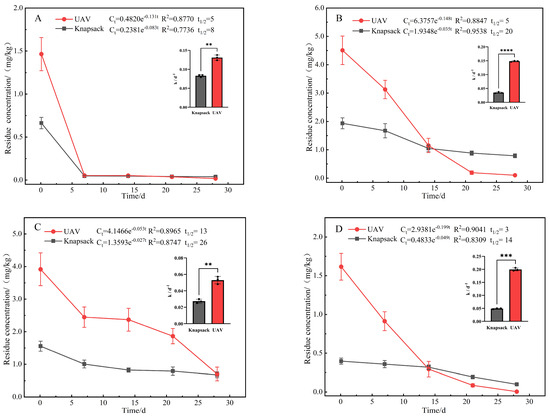
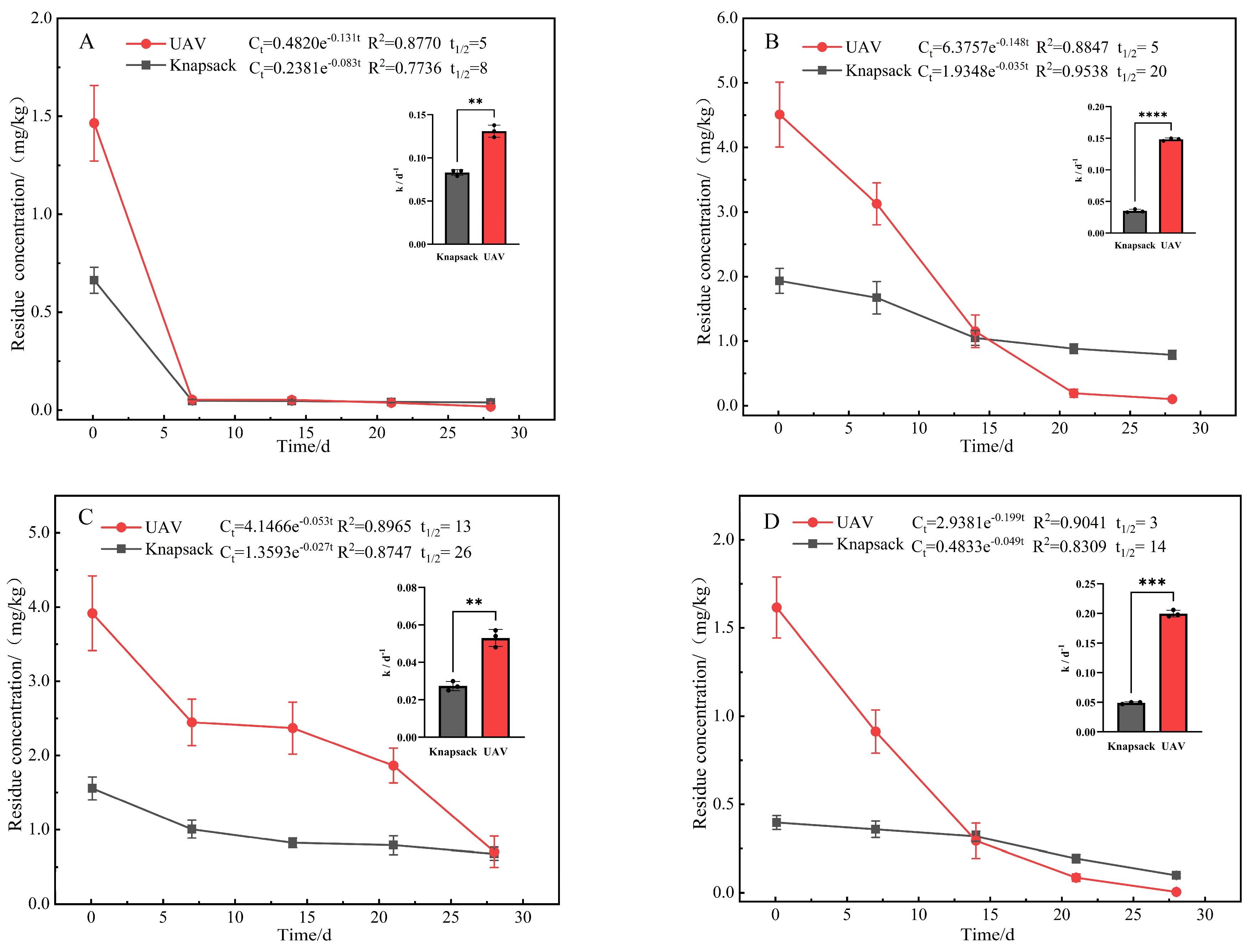
The dissipation dynamics of all four acaricides on citrus leaves were well described by the first-order kinetic model, with the corresponding dissipation curves presented in Figure 5.
Figure 5.
Dissipation kinetics of bifenazate (A), cyflumetofen (B), etoxazole (C), and abamectin B1a (D) in citrus leaves (Significance levels: ** p < 0.01, *** p < 0.001, **** p < 0.0001).
Under knapsack spraying, the initial deposits of bifenazate, cyflumetofen, etoxazole, and abamectin B1a on leaves were 0.663, 1.933, 1.554, and 0.397 mg·kg−1, respectively. Under UAV spraying, the corresponding values were 1.465, 4.508, 3.916, and 1.616 mg·kg−1, yielding UAV-to-knapsack deposit ratios of 2.2, 2.3, 2.5, and 4.1, respectively. These results indicate that UAV spraying led to higher initial leaf deposits than knapsack spraying.
Dissipation kinetics analysis revealed that the half-lives of all four acaricides under UAV spraying were significantly shorter than those under knapsack spraying. Specifically, the half-life of bifenazate decreased from 8 d under knapsack spraying (dissipation rate constant k = 0.083 d−1, 95% confidence interval [CI]: 0.074–0.092) to 5 d under UAV spraying (k = 0.131 d−1, 95% CI: 0.114–0.148); etoxazole decreased from 26 d (k = 0.027 d−1, 95% CI: 0.021–0.034) to 13 d (k = 0.053 d−1, 95% CI: 0.042–0.064); cyflumetofen decreased dramatically from 20 d (k = 0.035 d−1, 95% CI: 0.028–0.042) to 5 d (k = 0.148 d−1, 95% CI: 0.143–0.154); and abamectin B1a decreased substantially from 14 d (k = 0.049 d−1, 95% CI: 0.044–0.053) to 3 d (k = 0.199 d−1, 95% CI: 0.186–0.214).
The confidence intervals of the rate constants for each group showed no overlap between the two application methods, and all differences were statistically significant (bifenazate, p = 0.002; etoxazole, p = 0.003; cyflumetofen, p < 0.0001; abamectin B1a, p = 0.0002). Among the four acaricides, abamectin B1a exhibited the fastest dissipation rate and the shortest half-life under UAV spraying, whereas etoxazole showed the longest persistence under both application methods, although UAV spraying still effectively shortened its residual period.
In summary, under the conditions of this study, UAV spraying was associated with both higher initial leaf deposits and faster dissipation rates. This observation may be related to the application mechanism of UAV spray systems and their precisely controllable operational parameters. It should be noted that, to comply with the technical requirements of the NY/T 788-2018 standard for pesticide residue testing, the UAV spraying in this study employed a relatively high-water volume. This experimental design was intended to compare residue concentration differences between the two application methods under a risk-maximizing scenario (fixed pesticide dosage and water volume). Based on the comprehensive analysis of leaf deposition characteristics and dissipation kinetics, UAV spraying demonstrated superior application performance and more rapid pesticide dissipation compared with knapsack spraying under the specific conditions tested.
3.5. Comparative Influence of Application Method on Residue Dissipation of Four Acaricides in Citrus Whole Fruit, Peel, and Pulp
This study further investigated the dissipation behaviors of four acaricides in whole fruit, peel, and pulp under two application methods. Compared with leaves, residue concentrations in fruit were generally lower.
The residue concentrations of the four acaricides in whole fruit, peel, and pulp over time under the two application methods are presented in Table 4 (knapsack spraying) and Table 5 (UAV spraying). Overall, residue concentrations in all matrices decreased significantly over time. Taking whole fruit as an example, the residue concentration of bifenazate under knapsack spraying decreased from 0.036 mg/kg on day 0 to 0.004 mg/kg on day 28; under UAV spraying, it decreased from 0.039 mg/kg to 0.004 mg/kg. The highest initial residues were observed in the peel (e.g., 0.182 mg/kg for etoxazole under knapsack spraying), while the lowest were found in the pulp, with most compounds declining to below 0.01 mg/kg within 7 days after application.
Table 4.
Residues of four acaricides in whole citrus fruit, peel, and pulp under knapsack spraying.
Table 5.
Residues of four acaricides in whole citrus fruit, peel, and pulp under UAV spraying.
Although a first-order kinetic model could be fitted to describe the dissipation process, the reliability of the derived kinetic parameters was limited due to the low residue levels. The dissipation rate constants (k), 95% confidence intervals (CIs), and p-values for the differences between the two application methods, derived from first-order kinetic fitting, are summarized in Table 6. For whole fruit, k values ranged from 0.023 to 0.076 d−1 under knapsack spraying and from 0.030 to 0.086 d−1 under UAV spraying; for peel, the ranges were 0.025–0.102 d−1 and 0.012–0.119 d−1, respectively; and for pulp, the ranges were 0.028–0.054 d−1 and 0.038–0.044 d−1, respectively. Statistical comparisons indicated no significant differences in dissipation rates between the two application methods for most compounds across the three matrices.
Table 6.
Influence of application methods on acaricide degradation kinetics (k) across citrus matrices.
As shown in Table 4 and Table 5, residue concentrations in whole fruit, peel, and pulp decreased to very low levels within the first 14 days. Such rapid dissipation rendered the later time points (21 d and 28 d) of limited value for kinetic parameter estimation, leading to considerable uncertainty in the first-order kinetic fitting. Overall, the dissipation rates of most compounds across the three matrices were comparable between the two application methods, and no consistent statistically significant differences were observed in residue levels in pulp or whole fruit between UAV spraying and knapsack spraying. Due to rapid dissipation of residues in fruit matrices to levels near or below the LOQ within 14 days, the first-order kinetic parameters presented in Table 6 should be interpreted with caution.
3.6. Comparison of Dietary Risks Posed by Two Application Methods
This study evaluated the residue safety of four acaricides on citrus following application via knapsack spraying and UAV spraying. Comparison with the MRLs for citrus established by various countries and international organizations (Table 7), the results showed that the residue concentrations of the four acaricides in whole citrus fruit and pulp complied with the import standards of major countries and regions, regardless of the application method used.
Table 7.
Citrus MRLs of four acaricides across different countries and international organizations.
With respect to dietary intake risk, the RQs for each acaricide were highly consistent between knapsack spraying and UAV spraying: bifenazate (47.04% vs. 47.01%), cyflumetofen (0.44% vs. 0.45%), etoxazole (0.08% vs. 0.05%), and abamectin B1a (93.53% for both). This indicates that the choice of spraying technique does not substantially affect the outcomes of dietary risk assessment.
Although the RQs of all acaricides were below the acceptable threshold of 100%, marked differences in risk levels were observed among the compounds. Specifically, the RQs of abamectin B1a and bifenazate were considerably higher than those of cyflumetofen and etoxazole. This disparity is primarily attributable to two factors. First, abamectin and bifenazate have lower ADI values (0.001 and 0.01 mg/kg bw, respectively), resulting in substantially narrower margins of safety. Second, both compounds have broader ranges of registered uses. Abamectin has been registered on 82 crops in China, and its cumulative exposure risk across different crops warrants attention, as its RQ is approaching the 100% alert line. In contrast, cyflumetofen and etoxazole are registered on only 5 and 11 crops, respectively, and their higher ADI values (0.1 and 0.05 mg/kg bw) provide a more ample margin of safety. Notably, although bifenazate is currently registered on only 18 crops, GB 2763-2026 has established MRLs for this compound on multiple crops, suggesting that its future dietary exposure risk may increase further.
Based on the above analysis of risk differences, this study proposes the following recommendations: (i) For abamectin, it is recommended to appropriately reduce its application rate and frequency in citrus production to mitigate its relatively high dietary exposure risk. (ii) For bifenazate, although its current RQ is at a moderate level, dynamic monitoring of its dietary risk is necessary as its registered crop range expands beyond the existing 18 crops. (iii) Given that UAV spraying shows no significant difference in residue safety compared to knapsack spraying, it is recommended that UAV technology be adopted as an effective alternative to traditional knapsack application.
4. Conclusions
In this study, a sensitive and reliable analytical method based on UHPLC-MS/MS was developed and validated for the simultaneous determination of bifenazate, cyflumetofen, etoxazole, and abamectin B1a in citrus leaves, whole fruit, peel, and pulp. The method achieved an LOQ of 0.001 mg/kg for all four analytes, with mean recoveries ranging from 77.3% to 110.5% and relative standard deviations of 3.1–19.8%, satisfying the requirements for trace residue analysis.
Compared with knapsack spraying, UAV spraying resulted in 2.2- to 4.1-fold higher initial deposits on citrus leaves and significantly shortened the dissipation half-lives of all four acaricides on leaves: abamectin B1a from 14 days to 3 days, cyflumetofen from 20 days to 5 days, bifenazate from 8 days to 5 days, and etoxazole from 26 days to 13 days. Statistically significant differences in leaf residue behavior were observed between the two application methods. In contrast, residue levels in whole fruit, peel, and pulp were much lower than those in leaves, and the rapid dissipation in these fruit matrices limited the reliability of first-order kinetic parameter estimation. No consistent or statistically significant differences in fruit residue behavior were observed between the two spraying methods.
At 7 days after application, all terminal residues in whole fruit and pulp were below the MRLs established by major countries and international organizations. The recommended pre-harvest interval on the pesticide label is 21 days, indicating a substantial safety margin in practical use. The chronic dietary RQs for cyflumetofen and etoxazole were below 1%, while those for bifenazate and abamectin B1a were approximately 47% and 93%, respectively—all below the acceptable threshold of 100%. Notably, the RQ for abamectin B1a approached this threshold, indicating that its cumulative dietary risk from multiple registered crops (82 crops in China) should not be overlooked. The differences in RQ between the two spraying methods were within 1% for all four compounds, which is considered biologically negligible.
Based on the above findings, for abamectin B1a, its application rate and frequency in citrus production should be prudently managed, and its cumulative exposure from other crops should be monitored. For bifenazate, although its current RQ is at a moderate level, dynamic dietary risk monitoring is recommended as its range of registered crops expands. Given that UAV spraying performed non-inferiorly or even superiorly to knapsack spraying in terms of leaf deposition, dissipation rate, and fruit residue safety, it can be regarded as a promising and safe alternative for citrus mite control. It should be noted that the present residue comparison was conducted only in a hilly citrus orchard in Hunan Province. Future studies should include multiple experimental sites covering diverse climatic conditions and topographical features to establish more generalizable models of residue behavior under UAV spraying and to provide further scientific evidence for the development of UAV-specific pesticide registration standards.
Author Contributions
X.Q. Writing draft, Resources, Investigation, Formal analysis, Y.Z. (Yalin Zhou) Conceptualization, Resources, Investigation, Validation; Y.Z. (Yuhan Zhang) Resources, Investigation, Formal analysis, Validation; Z.Z. Investigation, Validation, Formal analysis; Y.T. Data curation, Formal analysis, Visualization; P.H. Data curation, Visualization, supervision; Y.Z. (Yongquan Zheng) Review and supervision; M.H. Conceptualization, Methodology, Writing—review and editing, Funding acquisition; All authors have read and agreed to the published version of the manuscript.
Funding
This work was supported by the National Key Research and Development Program of China [Grant Numbers 2023YFD1701300 and 2022YFD1400200].
Institutional Review Board Statement
Not applicable.
Informed Consent Statement
Not applicable.
Data Availability Statement
The original contributions presented in the study are included in the article; further inquiries can be directed to the corresponding authors.
Conflicts of Interest
The authors declare no conflicts of interest.
References
- National Bureau of Statistics of China. Citrus Planting Area in China. 2022. National Data. Available online: https://data.stats.gov.cn/ (accessed on 1 March 2026).
- National Bureau of Statistics of China. Citrus Production in China. 2024. National Data. Available online: https://data.stats.gov.cn/ (accessed on 1 March 2026).
- Hu, H. Analysis of the Impact Mechanism of the China-EU Geographical Indications Agreement Policy on Agricultural Exports. Eurasian Econ. Rev. 2025, 15, 891–913. [Google Scholar] [CrossRef] [Scilit]
- European Commission. Communication from the Commission to the European Parliament, the Council, the European Economic and Social Committee and the Committee of the Regions: A Farm to Fork Strategy for a Fair, Healthy and Environmentally-Friendly Food System (COM (2020) 381 Final); European Commission: Brussels, Belgium, 2020; Available online: https://food.ec.europa.eu/system/files/2020-05/f2f_action-plan_2020_strategy-info_en.pdf (accessed on 2 June 2026).
- European Commission. Proposal for a Regulation of the European Parliament and of the Council on the Sustainable Use of Plant Protection Products and Amending Regulation (EU) 2021/2115 (COM (2022) 305 Final); European Commission: Brussels, Belgium, 2022; Available online: https://eur-lex.europa.eu/legal-content/EN/TXT/?uri=COM:2022:305:FIN (accessed on 2 June 2026).
- Pan, D.; Dou, W.; Yuan, G.; Zhou, Q.; Wang, J. Monitoring the resistance of the citrus red mite (Acari: Tetranychidae) to four acaricides in different citrus orchards in China. J. Econ. Entomol. 2020, 113, 918–923. [Google Scholar] [CrossRef] [Scilit] [PubMed]
- Rioja, T.; Ruiz, K.B.; Ceballos, R. Red Mite (Panonychus citri) Attack Amplifies Citrus Rootstock-Driven Responses in Physiological and Biochemical Traits, VOC Emission, and Expression of Defence-Related Genes in Mandarin Scions. Front. Plant Sci. 2025, 16, 1645535. [Google Scholar] [CrossRef] [Scilit] [PubMed]
- Cui, Z.Y.; Cui, L.; Yan, X.J.; Han, Y.F.; Yang, W.G.; Zhan, Y.L.; Wu, J.P.; Qin, Y.D.; Chen, P.C.; Lan, Y.B. Field Evaluation of Different Unmanned Aerial Spraying Systems Applied to Control Panonychus citri in Mountainous Citrus Orchards. Agriculture 2025, 15, 1283. [Google Scholar] [CrossRef] [Scilit]
- Xin, T.R.; Li, P.; Wang, H. Biological and Biochemical Responses of Panonychus citri (Acari: Tetranychidae) Exposed to Sublethal Concentrations of Cyflumetofen. Crop Prot. 2024, 178, 106604. [Google Scholar] [CrossRef] [Scilit]
- Jiang, S.K.; Zhu, S.Y.; Liu, Y.J.; Wang, C.L.; Song, J.L.; He, X.K. UAV-Based Spraying in Orchard Systems: Mechanisms, Performance Indicators, and Integrated Applications. Pest Manag. Sci. 2026, 82, 5107–5125. [Google Scholar] [CrossRef] [Scilit] [PubMed]
- Zhang, Y.L.; Sun, Z.L.; Peng, W.H.; Lin, Y.Q.; Li, X.T.; Yan, K.T.; Chen, P.C. Key Technologies for Intelligent Operation of Plant Protection UAVs in Hilly and Mountainous Areas: Progress, Challenges, and Prospects. Agronomy 2026, 16, 193. [Google Scholar] [CrossRef] [Scilit]
- Li, L.L.; Hu, Z.H.; Liu, Q.J.; Yi, T.C.; Han, P.; Zhang, R.R.; Pan, L.G. Effect of flight velocity on droplet deposition and drift of combined pesticides sprayed using an unmanned aerial vehicle sprayer in a peach orchard. Front. Plant Sci. 2022, 13, 981494. [Google Scholar] [CrossRef] [Scilit] [PubMed]
- Biglia, A.; Grella, M.; Bloise, N.; Comba, L.; Mozzanini, E.; Sopegno, A.; Pittarello, M.; Dicembrini, E.; Alcatrao, L.E.; Guglieri, G.; et al. UAV-spray application in vineyards: Flight modes and spray system adjustment effects on canopy deposit, coverage, and off-target losses. Sci. Total Environ. 2022, 845, 157292. [Google Scholar] [CrossRef] [Scilit] [PubMed]
- Wang, C.; Liu, Y.; Zhang, Z.; Han, L.; Li, Y.; Zhang, H.; Wongsuk, S.; Li, Y.; Wu, X.; He, X. Spray performance evaluation of a six-rotor unmanned aerial vehicle sprayer for pesticide application using an orchard operation mode in apple orchards. Pest Manag. Sci. 2022, 78, 2449–2466. [Google Scholar] [CrossRef] [Scilit] [PubMed]
- Wu, Y.; Pu, X. Evaluating the technical efficiency and influencing factors of citrus fruits planting in China. PLoS ONE 2026, 21, e0345871. [Google Scholar] [CrossRef] [Scilit] [PubMed]
- Chen, X.; Wang, C.; Zhao, M.; Zhu, Z.; Zhu, T.; Gao, J.; Wu, J.; Han, J.; Zhao, F.; Wang, K. Pesticide spray drift and risk assessment using unmanned aerial vehicle (UAV) sprayer and traditional electric knapsack sprayer (EKS). Sci. Total Environ. 2025, 1005, 180866. [Google Scholar] [CrossRef] [Scilit] [PubMed]
- Zeeshan, M.; Li, H.; Yousaf, G.; Ren, H.; Liu, Y.; Arshad, M.; Dou, Z.; Han, X. Effect of formulations and adjuvants on the properties of acetamiprid solution and droplet deposition characteristics sprayed by UAV. Front. Plant Sci. 2024, 15, 1441193. [Google Scholar] [CrossRef] [Scilit] [PubMed]
- Zhao, P.; Zheng, L.; Li, Y.; Wang, C.; Cao, L.; Cao, C.; Huang, Q. Tank-mix adjuvants regulate the deposition, absorption, and permeation behavior of pesticide solutions on rice plant. Agriculture 2022, 12, 1119. [Google Scholar] [CrossRef] [Scilit]
- Zhan, Y.L.; Chen, P.C.; Xu, W.C.; Chen, S.D.; Han, Y.F.; Lan, Y.B.; Wang, G.B. Influence of the downwash airflow distribution characteristics of a plant protection UAV on spray deposit distribution. Biosyst. Eng. 2022, 216, 32–45. [Google Scholar] [CrossRef] [Scilit]
- Yan, X.J.; Zhou, Y.Y.; Liu, X.H.; Yang, D.B.; Yuan, H.Z. Minimizing occupational exposure to pesticide and increasing control efficacy of pests by unmanned aerial vehicle application on cowpea. Appl. Sci. 2021, 11, 9579. [Google Scholar] [CrossRef] [Scilit]
- Lan, Y.B.; Qian, S.C.; Chen, S.D.; Zhao, Y.J.; Deng, X.L.; Wang, G.B.; Zang, Y.; Wang, J.; Qiu, X.Y. Influence of the downwash wind field of plant protection UAV on droplet deposition distribution characteristics at different flight heights. Agronomy 2021, 11, 2399. [Google Scholar] [CrossRef] [Scilit]
- Wei, P.; Yan, X.J.; Yan, W.T.; Sun, L.N.; Xu, J.; Yuan, H.Z. Precise extraction of targeted apple tree canopy with YOLO-Fi model for advanced UAV spraying plans. Comput. Electron. Agric. 2024, 226, 109425. [Google Scholar] [CrossRef] [Scilit]
- Nahiyoon, S.A.; Ren, Z.J.; Wei, P.; Li, X.; Li, X.S.; Xu, J.; Yan, X.J.; Yuan, H.Z. Recent development trends in plant protection UAVs: A journey from conventional practices to cutting-edge technologies—A comprehensive review. Drones 2024, 8, 457. [Google Scholar] [CrossRef] [Scilit]
- Chen, P.; Douzals, J.P.; Lan, Y.; Cotteux, E.; Delpuech, X.; Pouxviel, G.; Zhan, Y. Characteristics of unmanned aerial spraying systems and related spray drift: A review. Front. Plant Sci. 2022, 13, 870956. [Google Scholar] [CrossRef] [Scilit] [PubMed]
- Chouhan, S.S.; Patel, R.K.; Singh, U.P.; Tejani, G.G. Integrating drone in Agriculture: Addressing technology, challenges, solutions, and applications to drive economic growth. Remote Sens. Appl. Soc. Environ. 2025, 38, 101576. [Google Scholar] [CrossRef] [Scilit]
- Ministry of Agriculture and Rural Affairs of the People’s Republic of China. China Pesticide Information Network. Available online: http://www.chinapesticide.org.cn/zwb/dataCenter?hash=reg-info (accessed on 30 January 2026).
- Qi, P.; Zhang, L.T.; Wang, Z.C.; Han, H.; Mueller, J.; Li, T.; Wang, C.L.; Huang, Z.; He, M.; Liu, Y.J.; et al. Effect of operational parameters of unmanned aerial vehicle (UAV) on droplet deposition in trellised pear orchard. Drones 2023, 7, 57. [Google Scholar] [CrossRef] [Scilit]
- Xu, L.; Ren, C.W.; Qiang, P.P.; Zhao, M.Y.; Wen, X.; Li, J.H.; Dou, W.; Feng, K.Y.; He, L. Differences in Mitochondrial Cytochrome b Binding Mediate Selectivity of Bifenazate Toward Phytophagous and Predatory Mites. J. Agric. Food Chem. 2024, 72, 19699–19709. [Google Scholar] [CrossRef] [Scilit] [PubMed]
- Khalighi, M.; Tirry, L.; Van Leeuwen, T. Cross-resistance risk of the novel complex II inhibitors cyenopyrafen and cyflumetofen in resistant strains of the two-spotted spider mite Tetranychus urticae. Pest Manag. Sci. 2014, 70, 365–368. [Google Scholar] [CrossRef] [Scilit] [PubMed]
- Wang, Z.; Pang, J.; Liao, C.; Zhang, Q.; Sun, D. Determination of etoxazole in different parts of citrus fruit and its potential dietary exposure risk assessment. Chemosphere 2021, 268, 128832. [Google Scholar] [CrossRef] [Scilit] [PubMed]
- Liu, X.Y.; Li, K.; Pan, D.; Dou, W.; Yuan, G.R.; Wang, J.J. Cross-resistance, inheritance and biochemical mechanism of abamectin resistance in a field-derived strain of the citrus red mite, Panonychus citri (Acari: Tetranychidae). Pest Manag. Sci. 2024, 80, 1258–1265. [Google Scholar] [CrossRef] [Scilit] [PubMed]
- Golge, O.; Kabak, B. Determination of 115 pesticide residues in oranges by HPLC-MS/MS and GC-MS/MS with QuEChERS method. J. Food Compos. Anal. 2015, 41, 86–97. [Google Scholar] [CrossRef] [Scilit]
- Tang, H.X.; Sun, Q.; Huang, J.Q.; Wen, G.Y.; Han, L.J.; Wang, L.; Zhang, Y.; Dong, M.F.; Wang, W.M. Residue behaviors, degradation, processing factors, and risk assessment of pesticides in citrus from field to product processing. Sci. Total Environ. 2023, 897, 165321. [Google Scholar] [CrossRef] [Scilit] [PubMed]
- Karaagacli, H.; Balkan, T.; Kizilarslan, M.; Kara, K. Pesticide residues in citrus fruits from Türkiye: Assessment of distribution, matrix effects, and health risks in lemon, mandarin, and orange. J. Food Compos. Anal. 2025, 147, 108091. [Google Scholar] [CrossRef] [Scilit]
- SANTE 11312/2021; Analytical Quality Control and Method Validation Procedures for Pesticide Residues Analysis in Food and Feed. European Commission: Brussels, Belgium, 2021. Available online: https://www.eurl-pesticides.eu/docs/public/tmplt_article.asp?CntID=727 (accessed on 12 December 2025).
- Hikino, S.; Yajima, T.; Sakasai, M.; Tomiyama, N.; Iijima, K.; Ohyama, K. Separate Analysis of Loquat Fruit Pulp, Peel, and Pits to Calculate Pesticide Residue Levels in the Whole Commodity. Food Hyg. Saf. Sci. 2022, 63, 62–69. [Google Scholar] [CrossRef] [Scilit] [PubMed]
- Meier, U. (Ed.) Growth Stages of Mono- and Dicotyledonous Plants. In BBCH Monograph, 2nd ed.; Federal Biological Research Centre for Agriculture and Forestry: Bonn, Germany, 2001; Available online: https://www.reterurale.it/downloads/BBCH_engl_2001.pdf (accessed on 12 December 2025).
- Ministry of Agriculture and Rural Affairs of the People’s Republic of China. Guideline for Pesticide Residue Trials in Crops (NY/T 788—2018); China Agriculture Press: Beijing, China, 2018. (In Chinese) [Google Scholar]
- Lucic, M.; Onjia, A. Probabilistic dietary exposure and risk ranking of pesticides in peppers (Capsicum annuum): Regional and consumer group variability. Food Chem. 2025, 492, 145355. [Google Scholar] [CrossRef] [Scilit] [PubMed]
- Chinese Center for Disease Control and Prevention. Report on Nutrition and Health Status of Chinese Residents; People’s Medical Publishing House: Beijing, China, 2022. (In Chinese) [Google Scholar]
- GB 2763-2026; National Food Safety Standard: Maximum Residue Limits for Pesticides in Food. Standards Press of China: Beijing, China, 2026.
- Codex Alimentarius Commission. Pesticide Residues in Food Online Database. Available online: https://www.fao.org/fao-who-codexalimentarius/codex-texts/dbs/pestres/pesticides/en/ (accessed on 12 December 2025).
- United States Environmental Protection Agency. Tolerances and Exemptions for Pesticide Chemical Residues. Available online: https://www.ecfr.gov/current/title-40/chapter-I/subchapter-E/part-180/subpart-C (accessed on 12 December 2025).
- Australian Pesticides and Veterinary Medicines Authority. Agricultural and Veterinary Chemicals Code Instrument No. 4 (MRL Standard). 2012. Available online: https://www.legislation.gov.au/F2012L02501/latest/text (accessed on 12 December 2025).
- Ministry of Food and Drug Safety, Korea. Pesticide Maximum Residue Limits Database. Available online: http://www.foodsafetykorea.go.kr/residue/prd/mrls/list.do (accessed on 12 December 2025).
- European Commission. EU Pesticides Database: Maximum Residue Levels. Available online: https://ec.europa.eu/food/plant/pesticides/eu-pesticides-database/start/screen/mrls (accessed on 11 February 2026).
- Japan Food Chemical Research Foundation. Maximum Residue Limits of Agricultural Chemicals in Foods. Available online: http://db.ffcr.or.jp/front/ (accessed on 12 December 2025).

Disclaimer/Publisher’s Note: The statements, opinions and data contained in all publications are solely those of the individual author(s) and contributor(s) and not of MDPI and/or the editor(s). MDPI and/or the editor(s) disclaim responsibility for any injury to people or property resulting from any ideas, methods, instructions or products referred to in the content. |
© 2026 by the authors. Licensee MDPI, Basel, Switzerland. This article is an open access article distributed under the terms and conditions of the Creative Commons Attribution (CC BY) license.